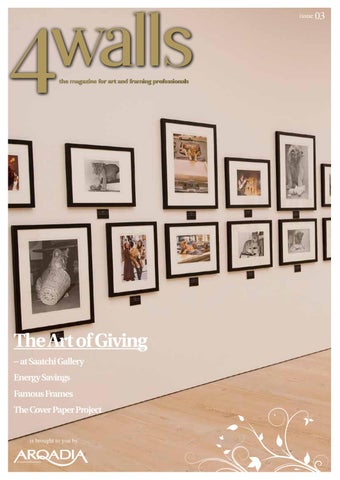
issue 03
the magazine for art and framing professionals
The Art of Giving – at Saatchi Gallery Energy Savings Famous Frames Available from Arqadia Ltd.
The Cover Paper Project
www.arqadia.co.uk Arqadia Ltd, 2 Wolseley Road, Kempston, Bedford UK MK42 7AD Tel: 01234 857488 Fax: 01234 840190
13615_4walls_issue3 Nov10 v6.indd 1-2
Sales order and enquiry: 01234 852777 E-mail: sales@arqadia.co.uk
International sales: 0044 1234 846307 E-mail: export@arqadia.co.uk www.arqadia.co.uk
is brought to you by
15/12/2010 09:55
p02
p03
...
to 4walls magazine Welcome from Mike Brown, Arqadia’s Managing Director
What’s Hot With the trend for using big, bold wallpaper in our interior decoration looking like it is here to stay and designers continuing to use colour blocking to create high impact contemporary spaces, there is still a need for stunning but versatile mouldings which can take their place against such strong backgrounds. One such range is the simple but modern Romana from Arqadia. A striking range with a flat profile and smooth reflective finish, it is available in two sizes and five colour finishes – gold, bronze, silver black, silver brown and copper with a touch of natural grain. Similarly, the glossy Metallica range gives a curved profile in the same five metallic finishes. Both ranges offer mouldings which will look fabulous against even the most daring of feature walls. Wood is also set to play a strong role this coming season and the traditional English feel is enjoying a new lease of life. Arqadia’s new Rustica range gives a neutral wood finish in a 38mm flat or 65mm cushion profile. It has an etched grain finish with a subtle wash effect which adds character and charm. Available in black, medium oak, dark oak, light grey and mahogany it
Florence
provides a tonal solution for any neutral setting. Inspired by the art and architecture of 20th century Europe, Marais combines classic beauty and charm with a unique finish and delicate embossings, offering a mix of classic design with a modern twist. The new Larson Juhl collection features many popular profiles, including a 35mm smooth slope shape, leading the eye towards the centre of the artwork; a generous panel profile with raised lip on the inside edge and a 84mm profile with gentle slope and raised back edge, ideal for pieces that need a substantial design. It is available in a French Ebony finish - a unique, ebonised black walnut finish with a slight grey patina and a subtle wood grain texture. Mirrors are often used to add light and depth to interior spaces and the new addition to Arqadia’s Essentials Collection is the perfect framing solution. Florence is a range of decorative profiles available in four colours – ivory, black, silver and gold, making it suitable for a range of interior design schemes. With a range of profile sizes the frames are suitable for all types of artwork, with the larger profiles looking particularly effective used around mirrors.
Welcome to the latest edition of 4 Walls. The market continues to be challenging for all of us with little sign of imminent change. But, despite the often gloomy headlines, there’s plenty we can do in the framing industry to weather the storm – and come out as stronger businesses in the end. Attention to customer service, responding to market demand and appropriate diversification all offer opportunities for savvy business owners to flourish. Our ‘What’s Hot for 2011’ article included in this magazine takes a look at framing trends for next year to maximise the opportunity as many homeowners seek to redecorate in the current ‘improve rather than move’ trend. It provides an overview of our product ranges, which offer some exciting new takes on both contemporary and traditional looks and designs. Our commitment to innovate remains as strong as ever and we continue to see product development as a key driver for us if our business is to continue to perform well. There’s also an in-depth feature on one of our longest standing customers, Picturecraft Gallery, and a look at how their business has evolved through their exciting collaboration with child painting protégé, Kieron Williamson. It’s great to see such businesses going from strength to strength and we’re also giving other readers some tips on maximising links with their own local communities by using sponsorship to boost their businesses. As always, our panel of experts is on hand to offer some great advice covering a diverse range of topics raised by you, our readers. Of course, in the current economic climate, it makes sense to watch the pennies. Areas where we do recommend you look at potential savings are energy usage and we have included an interesting article offering tips and advice on how small businesses can be greener and save money. At Arqadia, we’ve introduced a series of new, sustainable initiatives during the past two years and hope to inspire you to improve your own energyefficiency and drive down costs. On a lighter note, Arqadia frames have recently hit the nation’s TV screens, thanks to Philip’s Framing in London. Read on to find out more, and do let us know if you have any famous framing stories of your own to share. With the New Year, comes our new price list for 2011. Effective from Monday 17th January it contains up-to-date prices for our entire range of high quality mouldings, ready-made frames, mountboards and sundries. Don’t forget that VAT is increasing to 20% on 4th January and will be included in all orders after this date.
Rustica
13615_4walls_issue3 Nov10 v6.indd 3-4
Larson Juhl Marais
We hope you enjoy this issue and, as always, if you have any comments or feedback please email pauline.hutchinson@arqadia.co.uk. And if you would like friends and colleagues to read 4walls you will be pleased to know it is available for download at www.arqadia.co.uk.
Export
Thirsty Lions
clear preference for larger, more ornate and decorative, gold moulding.
Mark Winter has been with Arqadia for 24 years. His role as export manager for the last 12 years has seen him travel all over the world, affording him a unique perspective on the international market. Here he gives an insight into the export framing trade. “After working for Arqadia for almost a quarter of a century I know the product range inside out. However there are always new designs, styles and colours coming through so it’s interesting to see which designs have longevity and staying power and which are more trend related, changing with interior design fashions.” “One of the most interesting aspects of my international role is the clear differences in trends and tastes between countries. Arqadia has customers all over the world and while it’s not surprising that different product lines appeal to different areas of the globe, it is nonetheless interesting. Over the years I’ve seen clear buying trends within each market; Europe, for example, has embraced contemporary moulding that’s quite flat and plain, with minimalist black and white colours being extremely popular. However, the Middle East and India demonstrate a
“My success depends on my understanding the markets I’m working in. One of the challenges of being based in the UK but working internationally is that I’m limited to the stock I can take with me. I therefore have to know my customers well and take with me what I think that particular region will be interested in and want to buy. Sometimes there’s no substitute for customers seeing and handling products for themselves, but being able to use the Internet and access Arqadia’s full range online certainly makes my life easier! I couldn’t do my job without the fantastic support from the head office team, in particular Yve Humphries who is an extension of my mobile office. Yve corresponds with the shipping agents, completes endless paperwork, processes orders, deals with customer service queries and is the person you’re likely to deal with whenever you contact the office – whether it is by phone, email or fax. “Many people envy my globetrotting lifestyle. In fact, Arqadia exports its products to pretty much everywhere in the world, except for Canada and the USA, so there aren’t many places I’ve not visited. I visit some regions once a year and others twice a year. It’s not unusual for me to cover three countries in ten days, and with me overseas every two to three weeks I’m easily visiting 20 to 25 countries each year, as well as attending the trade shows in places like Hong Kong, Germany and Italy. With customers as far flung as Australia it’s not hard to believe that I clock up a huge number of miles and regularly run out of pages in my passport! “With all the places that I’ve visited you can imagine that I always have a story to tell at a dinner party….whether it be
the one about the near death experience in a Dubai taxi, or getting the real experience of Indian cuisine (if you get my drift)! “There are two things I love most about working in the export market; one is the experience of different cultures and the other is the fantastic people I’ve met along the way - I’ve made overseas friends for life. “I often get asked what I do for annual leave – surely I don’t want to spend more time on a plane and away from home. Well, in fact, I love travelling and if anything this job makes me want to see even more of the world. There are some amazing places out there and despite seeing so many of them in a year I haven’t even scratched the surface of this wonderful planet. I have a long list of places I still want to see, of things I want to experience and of cultures I want to absorb. At Arqadia, we’re currently breaking in to new markets in India and Russia, so there are plenty of exciting times and more countries to visit ahead. “One that I’ve just ticked off my list though is safari. My wife and I have just returned from two weeks seeing the Big Five in Kenya - it was an amazing experience that I’d thoroughly recommend to anyone.”
Mark with giant tortoise
15/12/2010 09:55
p02
p03
...
to 4walls magazine Welcome from Mike Brown, Arqadia’s Managing Director
What’s Hot With the trend for using big, bold wallpaper in our interior decoration looking like it is here to stay and designers continuing to use colour blocking to create high impact contemporary spaces, there is still a need for stunning but versatile mouldings which can take their place against such strong backgrounds. One such range is the simple but modern Romana from Arqadia. A striking range with a flat profile and smooth reflective finish, it is available in two sizes and five colour finishes – gold, bronze, silver black, silver brown and copper with a touch of natural grain. Similarly, the glossy Metallica range gives a curved profile in the same five metallic finishes. Both ranges offer mouldings which will look fabulous against even the most daring of feature walls. Wood is also set to play a strong role this coming season and the traditional English feel is enjoying a new lease of life. Arqadia’s new Rustica range gives a neutral wood finish in a 38mm flat or 65mm cushion profile. It has an etched grain finish with a subtle wash effect which adds character and charm. Available in black, medium oak, dark oak, light grey and mahogany it
Florence
provides a tonal solution for any neutral setting. Inspired by the art and architecture of 20th century Europe, Marais combines classic beauty and charm with a unique finish and delicate embossings, offering a mix of classic design with a modern twist. The new Larson Juhl collection features many popular profiles, including a 35mm smooth slope shape, leading the eye towards the centre of the artwork; a generous panel profile with raised lip on the inside edge and a 84mm profile with gentle slope and raised back edge, ideal for pieces that need a substantial design. It is available in a French Ebony finish - a unique, ebonised black walnut finish with a slight grey patina and a subtle wood grain texture. Mirrors are often used to add light and depth to interior spaces and the new addition to Arqadia’s Essentials Collection is the perfect framing solution. Florence is a range of decorative profiles available in four colours – ivory, black, silver and gold, making it suitable for a range of interior design schemes. With a range of profile sizes the frames are suitable for all types of artwork, with the larger profiles looking particularly effective used around mirrors.
Welcome to the latest edition of 4 Walls. The market continues to be challenging for all of us with little sign of imminent change. But, despite the often gloomy headlines, there’s plenty we can do in the framing industry to weather the storm – and come out as stronger businesses in the end. Attention to customer service, responding to market demand and appropriate diversification all offer opportunities for savvy business owners to flourish. Our ‘What’s Hot for 2011’ article included in this magazine takes a look at framing trends for next year to maximise the opportunity as many homeowners seek to redecorate in the current ‘improve rather than move’ trend. It provides an overview of our product ranges, which offer some exciting new takes on both contemporary and traditional looks and designs. Our commitment to innovate remains as strong as ever and we continue to see product development as a key driver for us if our business is to continue to perform well. There’s also an in-depth feature on one of our longest standing customers, Picturecraft Gallery, and a look at how their business has evolved through their exciting collaboration with child painting protégé, Kieron Williamson. It’s great to see such businesses going from strength to strength and we’re also giving other readers some tips on maximising links with their own local communities by using sponsorship to boost their businesses. As always, our panel of experts is on hand to offer some great advice covering a diverse range of topics raised by you, our readers. Of course, in the current economic climate, it makes sense to watch the pennies. Areas where we do recommend you look at potential savings are energy usage and we have included an interesting article offering tips and advice on how small businesses can be greener and save money. At Arqadia, we’ve introduced a series of new, sustainable initiatives during the past two years and hope to inspire you to improve your own energyefficiency and drive down costs. On a lighter note, Arqadia frames have recently hit the nation’s TV screens, thanks to Philip’s Framing in London. Read on to find out more, and do let us know if you have any famous framing stories of your own to share. With the New Year, comes our new price list for 2011. Effective from Monday 17th January it contains up-to-date prices for our entire range of high quality mouldings, ready-made frames, mountboards and sundries. Don’t forget that VAT is increasing to 20% on 4th January and will be included in all orders after this date.
Rustica
13615_4walls_issue3 Nov10 v6.indd 3-4
Larson Juhl Marais
We hope you enjoy this issue and, as always, if you have any comments or feedback please email pauline.hutchinson@arqadia.co.uk. And if you would like friends and colleagues to read 4walls you will be pleased to know it is available for download at www.arqadia.co.uk.
Export
Thirsty Lions
clear preference for larger, more ornate and decorative, gold moulding.
Mark Winter has been with Arqadia for 24 years. His role as export manager for the last 12 years has seen him travel all over the world, affording him a unique perspective on the international market. Here he gives an insight into the export framing trade. “After working for Arqadia for almost a quarter of a century I know the product range inside out. However there are always new designs, styles and colours coming through so it’s interesting to see which designs have longevity and staying power and which are more trend related, changing with interior design fashions.” “One of the most interesting aspects of my international role is the clear differences in trends and tastes between countries. Arqadia has customers all over the world and while it’s not surprising that different product lines appeal to different areas of the globe, it is nonetheless interesting. Over the years I’ve seen clear buying trends within each market; Europe, for example, has embraced contemporary moulding that’s quite flat and plain, with minimalist black and white colours being extremely popular. However, the Middle East and India demonstrate a
“My success depends on my understanding the markets I’m working in. One of the challenges of being based in the UK but working internationally is that I’m limited to the stock I can take with me. I therefore have to know my customers well and take with me what I think that particular region will be interested in and want to buy. Sometimes there’s no substitute for customers seeing and handling products for themselves, but being able to use the Internet and access Arqadia’s full range online certainly makes my life easier! I couldn’t do my job without the fantastic support from the head office team, in particular Yve Humphries who is an extension of my mobile office. Yve corresponds with the shipping agents, completes endless paperwork, processes orders, deals with customer service queries and is the person you’re likely to deal with whenever you contact the office – whether it is by phone, email or fax. “Many people envy my globetrotting lifestyle. In fact, Arqadia exports its products to pretty much everywhere in the world, except for Canada and the USA, so there aren’t many places I’ve not visited. I visit some regions once a year and others twice a year. It’s not unusual for me to cover three countries in ten days, and with me overseas every two to three weeks I’m easily visiting 20 to 25 countries each year, as well as attending the trade shows in places like Hong Kong, Germany and Italy. With customers as far flung as Australia it’s not hard to believe that I clock up a huge number of miles and regularly run out of pages in my passport! “With all the places that I’ve visited you can imagine that I always have a story to tell at a dinner party….whether it be
the one about the near death experience in a Dubai taxi, or getting the real experience of Indian cuisine (if you get my drift)! “There are two things I love most about working in the export market; one is the experience of different cultures and the other is the fantastic people I’ve met along the way - I’ve made overseas friends for life. “I often get asked what I do for annual leave – surely I don’t want to spend more time on a plane and away from home. Well, in fact, I love travelling and if anything this job makes me want to see even more of the world. There are some amazing places out there and despite seeing so many of them in a year I haven’t even scratched the surface of this wonderful planet. I have a long list of places I still want to see, of things I want to experience and of cultures I want to absorb. At Arqadia, we’re currently breaking in to new markets in India and Russia, so there are plenty of exciting times and more countries to visit ahead. “One that I’ve just ticked off my list though is safari. My wife and I have just returned from two weeks seeing the Big Five in Kenya - it was an amazing experience that I’d thoroughly recommend to anyone.”
Mark with giant tortoise
15/12/2010 09:55
p04
p05
Energy-Efficiency Many people think saving energy is the right thing to do for the future of the planet, and they’d probably be right. But saving energy is also the right thing to do for the bottom line of your business and, with just a few small changes, you can start making real, tangible differences straight-away. Paul Witt, financial manager at Arqadia, is one of the driving forces behind a new energy-efficiency regime at the company’s head office in Bedford which is showing real differences to the energy spend year on year. Paul said: “We started off by making quite simple changes like replacing all our bulbs with energy-saving ones, encouraging staff to switch off lights when they leave a room and also turning off appliances which are not in use.
“One of the most important aspects of such an initiative is to demonstrate to everyone within the company that each of their small actions adds up to a much greater whole that is really making a difference. All the way through our energy-saving efforts I have fed back the results to staff in the form of savings graphs every month. These show staff where energy is being saved as a result of their small changes in behaviour and it reinforces the message and encourages them to carry on.
your own leaner, greener business, a good place to start is the following tips for small businesses to start making energy-savings in the workplace: The light fantastic Lighting is a key part of most framing businesses, particularly if you have gallery or exhibition space. A few simple changes mean that you can continue to provide an attractive well-lit area for customers, but can also make significant savings.
When the heat is on Although it’s important to provide a comfortable environment for staff and customers, you can make a real difference to your fuel bills without making noticeable changes in temperature. • Try to keep your thermostat at 19oC, rather than the usual 20oC. It’s unlikely that anyone will notice the difference. Your heating costs increase by 8% each time you turn the temperature up by just one degree.
• Don’t turn up the heating unless you “Since starting the project we’ve moved • Switch lights off in empty rooms. You could cut your lighting costs by really need to. on to installing further energy-saving as much as 15% just by making sure technologies. One of the most successful you turn off lights in areas that aren’t • Replace inefficient boilers to enjoy a of these is the movement sensors on more comfortable environment and being used. the lights in our showrooms which reduce heating costs. There are detect when the space is not in use and • If you have fluorescent tube lighting, often grants available to replace old switch off the lights automatically. changing from T12 tubes to T8s will equipment. bring energy-savings of 10%. “We used to live in a world where Well equipped energy was seemingly free flowing and Upgrading lamps and fittings to T5 Office equipment of some kind or will bring even greater savings and where we needn’t worry about things another – cash registers, computers will retain a high light output. like switching off office lights. We’re and printers, for example - is used by better educated about world • Why light empty spaces? Occupancy almost all UK businesses, and accounts resources now and have a social and sensors, which switch off lights when for around 15% of all the electrical moral responsibility to use resources a space isn’t being used, can reduce energy used in UK offices. Effective carefully. But perhaps more pressingly lighting costs by 30%. management of equipment can reduce for some in the current economic its energy consumption by up to 70%. climate, small changes in behaviour can • Lighting a space artificially when make a huge difference to the profit daylight is already doing the job is a • Activate stand-by modes on PCs margin of a small business.” waste of energy. Light sensors when not in use. (photocells) can switch off or dim If you want to follow Arqadia’s • Set up printers to print on both sides artificial lighting when there is example and work towards running of the paper. sufficient daylight. • Ensure all electrical equipment is turned off at night. Well-maintained equipment is more efficient and lasts longer. So set up a maintenance schedule, keep equipment free from obstructions and prevent overheating by cleaning filters and fans regularly.
24,000 18,000 Units
12,000
• Develop a set of guidelines to standardise operations for office equipment and make sure everyone knows.
6,000 0 Jan Feb Mar Apr May Jun Jul Aug Sep Oct Nov Dec Last year
This year
For more information about making savings in your business visit www.carbontrust.org.uk where there is plenty of advice and support for businesses wanting to make a difference.
Since its launch five years ago Arqadia’s online PR Toolkit has helped hundreds of art professionals boost their business, raise their profile and increase sales. Now, it has been updated with a new quick-glance activity calendar, making it even better and easier to use than before.
Art of PR is just a click away Screengrab of PR toolkit calendar
The fresh new look is based on a new, easy to navigate12 month planner that enables you to delve in according to time of year or type of activity. Supported by a plethora of press releases, competitions, activities and event ideas the PR Toolkit gives Arqadia’s customers the support, knowledge, resources and skills needed to implement their own Public Relations programme.
Marketing manager, Pauline Hutchinson, said: “Public relations is an integral part of any effective marketing campaign, no matter what size of business you are. In the current economic climate it’s more important than ever to engage with your customers but running the day-to-day aspects of a company can often get in the way.
Famous Frames Kevin Phillips and his son Ritchie have worked for a range of clients within film and television and produced work for some of the most visited sites in London. And their latest job was no exception. No fewer than nine huge Arqadia frames adorn the set of the Paul O’Grady Show and it was Phillips Framing that put them there. Kevin Phillips said: “The brief from the Paul O’Grady Show was ‘big and glitzy’ so we went for a range of huge, ornate mouldings suited to a gentleman’s club library! We were lucky that they were planning well ahead of schedule, and we were actually able to spend time
The PR Toolkit has proved to be an easy-to-use and effective way for our customers to develop their business. “The new design enables art professionals to choose from a range of ideas based on time of year as well as type of activity. The activity is simple to implement and easily adapted to suit different needs. We’ve also introduced a new section of templates - covering everything
from letters and press releases to competitions – making it even easier, and quicker, for businesses to achieve media coverage and attract customers.” For further information on the Arqadia PR Toolkit, log on to www. arqadia.co.uk or call 01234 852777.
Being a central London framing business, you might not be surprised to hear that Phillips Framing often gets called upon to fulfil, well, more glamorous contracts.
with them looking through Arqadia’s catalogue online. We had to meet certain criteria on budget but also take into consideration the fact they were filming in high definition. “Typically, an additional two frames were needed and ordered on the day of the first show. We managed to get them on set just hours before broadcast!” With this in mind, 4 Walls is laying down the gauntlet. What is the most unusual place you’ve sent an Arqadia product? We’d love to hear if, like the Phillips Framing team, you’ve been rubbing shoulders with the stars. Let us know at pauline.hutchinson@arqadia.co.uk Paul O’Grady set
13615_4walls_issue3 Nov10 v6.indd 5-6
15/12/2010 09:55
p04
p05
Energy-Efficiency Many people think saving energy is the right thing to do for the future of the planet, and they’d probably be right. But saving energy is also the right thing to do for the bottom line of your business and, with just a few small changes, you can start making real, tangible differences straight-away. Paul Witt, financial manager at Arqadia, is one of the driving forces behind a new energy-efficiency regime at the company’s head office in Bedford which is showing real differences to the energy spend year on year. Paul said: “We started off by making quite simple changes like replacing all our bulbs with energy-saving ones, encouraging staff to switch off lights when they leave a room and also turning off appliances which are not in use.
“One of the most important aspects of such an initiative is to demonstrate to everyone within the company that each of their small actions adds up to a much greater whole that is really making a difference. All the way through our energy-saving efforts I have fed back the results to staff in the form of savings graphs every month. These show staff where energy is being saved as a result of their small changes in behaviour and it reinforces the message and encourages them to carry on.
your own leaner, greener business, a good place to start is the following tips for small businesses to start making energy-savings in the workplace: The light fantastic Lighting is a key part of most framing businesses, particularly if you have gallery or exhibition space. A few simple changes mean that you can continue to provide an attractive well-lit area for customers, but can also make significant savings.
When the heat is on Although it’s important to provide a comfortable environment for staff and customers, you can make a real difference to your fuel bills without making noticeable changes in temperature. • Try to keep your thermostat at 19oC, rather than the usual 20oC. It’s unlikely that anyone will notice the difference. Your heating costs increase by 8% each time you turn the temperature up by just one degree.
• Don’t turn up the heating unless you “Since starting the project we’ve moved • Switch lights off in empty rooms. You could cut your lighting costs by really need to. on to installing further energy-saving as much as 15% just by making sure technologies. One of the most successful you turn off lights in areas that aren’t • Replace inefficient boilers to enjoy a of these is the movement sensors on more comfortable environment and being used. the lights in our showrooms which reduce heating costs. There are detect when the space is not in use and • If you have fluorescent tube lighting, often grants available to replace old switch off the lights automatically. changing from T12 tubes to T8s will equipment. bring energy-savings of 10%. “We used to live in a world where Well equipped energy was seemingly free flowing and Upgrading lamps and fittings to T5 Office equipment of some kind or will bring even greater savings and where we needn’t worry about things another – cash registers, computers will retain a high light output. like switching off office lights. We’re and printers, for example - is used by better educated about world • Why light empty spaces? Occupancy almost all UK businesses, and accounts resources now and have a social and sensors, which switch off lights when for around 15% of all the electrical moral responsibility to use resources a space isn’t being used, can reduce energy used in UK offices. Effective carefully. But perhaps more pressingly lighting costs by 30%. management of equipment can reduce for some in the current economic its energy consumption by up to 70%. climate, small changes in behaviour can • Lighting a space artificially when make a huge difference to the profit daylight is already doing the job is a • Activate stand-by modes on PCs margin of a small business.” waste of energy. Light sensors when not in use. (photocells) can switch off or dim If you want to follow Arqadia’s • Set up printers to print on both sides artificial lighting when there is example and work towards running of the paper. sufficient daylight. • Ensure all electrical equipment is turned off at night. Well-maintained equipment is more efficient and lasts longer. So set up a maintenance schedule, keep equipment free from obstructions and prevent overheating by cleaning filters and fans regularly.
24,000 18,000 Units
12,000
• Develop a set of guidelines to standardise operations for office equipment and make sure everyone knows.
6,000 0 Jan Feb Mar Apr May Jun Jul Aug Sep Oct Nov Dec Last year
This year
For more information about making savings in your business visit www.carbontrust.org.uk where there is plenty of advice and support for businesses wanting to make a difference.
Since its launch five years ago Arqadia’s online PR Toolkit has helped hundreds of art professionals boost their business, raise their profile and increase sales. Now, it has been updated with a new quick-glance activity calendar, making it even better and easier to use than before.
Art of PR is just a click away Screengrab of PR toolkit calendar
The fresh new look is based on a new, easy to navigate12 month planner that enables you to delve in according to time of year or type of activity. Supported by a plethora of press releases, competitions, activities and event ideas the PR Toolkit gives Arqadia’s customers the support, knowledge, resources and skills needed to implement their own Public Relations programme.
Marketing manager, Pauline Hutchinson, said: “Public relations is an integral part of any effective marketing campaign, no matter what size of business you are. In the current economic climate it’s more important than ever to engage with your customers but running the day-to-day aspects of a company can often get in the way.
Famous Frames Kevin Phillips and his son Ritchie have worked for a range of clients within film and television and produced work for some of the most visited sites in London. And their latest job was no exception. No fewer than nine huge Arqadia frames adorn the set of the Paul O’Grady Show and it was Phillips Framing that put them there. Kevin Phillips said: “The brief from the Paul O’Grady Show was ‘big and glitzy’ so we went for a range of huge, ornate mouldings suited to a gentleman’s club library! We were lucky that they were planning well ahead of schedule, and we were actually able to spend time
The PR Toolkit has proved to be an easy-to-use and effective way for our customers to develop their business. “The new design enables art professionals to choose from a range of ideas based on time of year as well as type of activity. The activity is simple to implement and easily adapted to suit different needs. We’ve also introduced a new section of templates - covering everything
from letters and press releases to competitions – making it even easier, and quicker, for businesses to achieve media coverage and attract customers.” For further information on the Arqadia PR Toolkit, log on to www. arqadia.co.uk or call 01234 852777.
Being a central London framing business, you might not be surprised to hear that Phillips Framing often gets called upon to fulfil, well, more glamorous contracts.
with them looking through Arqadia’s catalogue online. We had to meet certain criteria on budget but also take into consideration the fact they were filming in high definition. “Typically, an additional two frames were needed and ordered on the day of the first show. We managed to get them on set just hours before broadcast!” With this in mind, 4 Walls is laying down the gauntlet. What is the most unusual place you’ve sent an Arqadia product? We’d love to hear if, like the Phillips Framing team, you’ve been rubbing shoulders with the stars. Let us know at pauline.hutchinson@arqadia.co.uk Paul O’Grady set
13615_4walls_issue3 Nov10 v6.indd 5-6
15/12/2010 09:55
p06
p07
The cover paper project by Christopher Clarkson As book conservators we find ourselves in a tragic situation; the most common being that the materials we use - leather and bookcloth - cannot be guaranteed longer than 30 to 50 years. Where is the sense in using such short-life materials? This project is obviously not about replacing leather and bookcloth with paper, but where a cover paper is appropriate we need to understand the qualities and techniques required for it to last many generations.
Christopher Clarkson
Conservation by Design is a company dedicated to the design and supply of high quality conservation storage and display products. The team of experts get involved in a diverse range of fascinating conservation products all around the world. Read on to find out about one of their most intriguing projects to date. 13615_4walls_issue3 Nov10 v6.indd 7-8
text-blocks in Florence in 1967– 9 was thwarted by not being able to find any hand papermakers to replicate the durability and toughness of the early Italian Renaissance cover papers. All samples produced were similar to heavy artist watercolour papers, with few of the qualities I was seeing and feeling in the Renaissance cover papers.
When I moved to America in 1972 I discussed the need for quality cover paper with the Twinrockers papermakers, showed them some examples of Venetian and Florentine After the Florence flood of early 16th century examples in the November 1966 I noticed how well Library of Congress and talked of my the limp and semi-limp paper and need for such a similar cover paper. vellum-covered book structures of the Although we have been friends Magliabechiana Collection stored in ever since and I purchased many two basement floors of the Biblioteca papers for other purposes, such a Nazionale Centrale di Firenze (BNCF) replicate quality cover paper was had survived, compared to stiff board never produced. bindings. They had been under water, It was not until Tim Barrett returned mud, oil and sewerage for about 10 from Japan that I found an enthusiastic days before being sent to tobacco person who took on the challenge. kilns for quick drying. Over the years, although Tim was Historically the early limp or semi-limp unable to obtain a cover paper of binding structures use no adhesive in sufficient quality and character that their construction but rely on the suited 16th – 18th century textquality of cover material and stitching blocks, he has produced a variety of or tacketing techniques. The qualities cover papers that I have used on required in the cover material are 19th & 20th century items. therefore more those where there is It was at the IPC, Edinburgh a stiff-board core – mouldability, Conference in 2006 that Stuart Welch hinging strength and abrasive resistance. Also required are tear and introduced me to Jacques Brejoux of Moulin du Verger, by saying “Meet crease strength, fold moulding – not Chris - he has been trying to get only of smoothness but also girdercover papers similar to 1500’s quality like folds, designed for structural support. The consideration of weight for many years”. Jacques & I got on to format and rigidity without loss of a well together, but I found it difficult, certain flexing are also important. All without examples of Renaissance books, to explain what was required. such factors play their part in the success and tactile enjoyment of such Stuart then suggested that we should bindings. These early cover papers are run a workshop together and he knew of certain senior conservators full of character, strength and who would be interested. durability. My wish to develop similar rebinding styles for treated and repaired
The workshop was set for September 2007 in Jacques’ mill in Angouleme, France, its aim being an attempt to
Conservation delegates
It was after this workshop that brush-sizing experiments took place, in which it was noted that about10% of certain multi-couched papers had areas of their outer layers delaminating. This lead to speculation about whether historically a gelatine or starch ‘binder’ could have been used between each couched sheet. This caused Jacques to re-look at Lalande’s reference to starch being used, although his reference is to the production of playing cards, which suggests pasteboard-making by a binder or other professional using dry Word about our efforts at the mill sheets. Lalande describes three or had got round and the workshop was four different types; at least one type repeated in September 2008. By this could be describing multi-couching in time Jacques had designed and built a a paper mill. set of stampers so direct comparisons Obviously we should test Renaissance could be made between pulp cover papers as to whether gelatine produced using the Hollander and or starch is present between their that produced using the stampers. I layers, but I wonder how this could be had also been able to get funding to done without staining or destroying a bring Silvia Pugliese over with many small part of the period item. The Venetian 16th & 17th century paper samples Jacques has produced so far, covers from Biblioteca Marciana. although not tested professionally, Jacques was in heaven. In studying the have very good fold and tear strength. Venetian cover papers he thought In fact in a standard test ‘3’ – pulling a that many appeared to be a multitapered whittawed lacing through layered couched paper, couched a given size hole drilled through ‘in-line’ or some possibly ‘crossa fold of the paper – no burst couched’. Some appeared to be tears occurred. pressed and hand glazed. Although A reliable source of linen rag is crucial they do not have the appearance of to the production of this cover paper; pasteboard, where a corner is worn Jacques has been building up a stock and dog-eared, some of them for many years. Only having a few certainly display a layered material. published sources to hand, Jacques When I arrived at the third workshop and I were wondering if any one in 2009, it was extraordinary to arrive knows of other archival sources, in Jacques’ valley to hear the thumping especially pre-Lalande, describing echo of a set of stampers preparing multi-layered, possibly couched, linen pulp, a sound which would have heavyweight paper. If you can suggest been common in the medieval past. other 18th century, or earlier sources, This was the first workshop in which please get in touch. the stampers were in full swing and Christopher Clarkson ARCA, ACR some of the couched linen papers produced at this workshop, and later e-mail: info@ClarksonConservation.com, or visit www.ClarksonConservation.com. by Jacques, are remarkably similar to the Venetian cover papers we had handled the year before. produce a cover paper similar to those of the Venetian/Florentine Renaissance. Jacques and the participants became enthusiastic about the 16th & 17th century limp paper bindings I had brought as exemplars, and experiments and ideas flowed. As we continued with testing and binding various cover papers the qualities we were after became better understood. It was during this workshop that Jacques became aware that he needed to prepare pulp with stampers rather than a Hollander.
Jacques Brejoux with wooden stampers
Discussion with Nadine Dumain
Hand-sewing a binding
15/12/2010 09:55
p06
p07
The cover paper project by Christopher Clarkson As book conservators we find ourselves in a tragic situation; the most common being that the materials we use - leather and bookcloth - cannot be guaranteed longer than 30 to 50 years. Where is the sense in using such short-life materials? This project is obviously not about replacing leather and bookcloth with paper, but where a cover paper is appropriate we need to understand the qualities and techniques required for it to last many generations.
Christopher Clarkson
Conservation by Design is a company dedicated to the design and supply of high quality conservation storage and display products. The team of experts get involved in a diverse range of fascinating conservation products all around the world. Read on to find out about one of their most intriguing projects to date. 13615_4walls_issue3 Nov10 v6.indd 7-8
text-blocks in Florence in 1967– 9 was thwarted by not being able to find any hand papermakers to replicate the durability and toughness of the early Italian Renaissance cover papers. All samples produced were similar to heavy artist watercolour papers, with few of the qualities I was seeing and feeling in the Renaissance cover papers.
When I moved to America in 1972 I discussed the need for quality cover paper with the Twinrockers papermakers, showed them some examples of Venetian and Florentine After the Florence flood of early 16th century examples in the November 1966 I noticed how well Library of Congress and talked of my the limp and semi-limp paper and need for such a similar cover paper. vellum-covered book structures of the Although we have been friends Magliabechiana Collection stored in ever since and I purchased many two basement floors of the Biblioteca papers for other purposes, such a Nazionale Centrale di Firenze (BNCF) replicate quality cover paper was had survived, compared to stiff board never produced. bindings. They had been under water, It was not until Tim Barrett returned mud, oil and sewerage for about 10 from Japan that I found an enthusiastic days before being sent to tobacco person who took on the challenge. kilns for quick drying. Over the years, although Tim was Historically the early limp or semi-limp unable to obtain a cover paper of binding structures use no adhesive in sufficient quality and character that their construction but rely on the suited 16th – 18th century textquality of cover material and stitching blocks, he has produced a variety of or tacketing techniques. The qualities cover papers that I have used on required in the cover material are 19th & 20th century items. therefore more those where there is It was at the IPC, Edinburgh a stiff-board core – mouldability, Conference in 2006 that Stuart Welch hinging strength and abrasive resistance. Also required are tear and introduced me to Jacques Brejoux of Moulin du Verger, by saying “Meet crease strength, fold moulding – not Chris - he has been trying to get only of smoothness but also girdercover papers similar to 1500’s quality like folds, designed for structural support. The consideration of weight for many years”. Jacques & I got on to format and rigidity without loss of a well together, but I found it difficult, certain flexing are also important. All without examples of Renaissance books, to explain what was required. such factors play their part in the success and tactile enjoyment of such Stuart then suggested that we should bindings. These early cover papers are run a workshop together and he knew of certain senior conservators full of character, strength and who would be interested. durability. My wish to develop similar rebinding styles for treated and repaired
The workshop was set for September 2007 in Jacques’ mill in Angouleme, France, its aim being an attempt to
Conservation delegates
It was after this workshop that brush-sizing experiments took place, in which it was noted that about10% of certain multi-couched papers had areas of their outer layers delaminating. This lead to speculation about whether historically a gelatine or starch ‘binder’ could have been used between each couched sheet. This caused Jacques to re-look at Lalande’s reference to starch being used, although his reference is to the production of playing cards, which suggests pasteboard-making by a binder or other professional using dry Word about our efforts at the mill sheets. Lalande describes three or had got round and the workshop was four different types; at least one type repeated in September 2008. By this could be describing multi-couching in time Jacques had designed and built a a paper mill. set of stampers so direct comparisons Obviously we should test Renaissance could be made between pulp cover papers as to whether gelatine produced using the Hollander and or starch is present between their that produced using the stampers. I layers, but I wonder how this could be had also been able to get funding to done without staining or destroying a bring Silvia Pugliese over with many small part of the period item. The Venetian 16th & 17th century paper samples Jacques has produced so far, covers from Biblioteca Marciana. although not tested professionally, Jacques was in heaven. In studying the have very good fold and tear strength. Venetian cover papers he thought In fact in a standard test ‘3’ – pulling a that many appeared to be a multitapered whittawed lacing through layered couched paper, couched a given size hole drilled through ‘in-line’ or some possibly ‘crossa fold of the paper – no burst couched’. Some appeared to be tears occurred. pressed and hand glazed. Although A reliable source of linen rag is crucial they do not have the appearance of to the production of this cover paper; pasteboard, where a corner is worn Jacques has been building up a stock and dog-eared, some of them for many years. Only having a few certainly display a layered material. published sources to hand, Jacques When I arrived at the third workshop and I were wondering if any one in 2009, it was extraordinary to arrive knows of other archival sources, in Jacques’ valley to hear the thumping especially pre-Lalande, describing echo of a set of stampers preparing multi-layered, possibly couched, linen pulp, a sound which would have heavyweight paper. If you can suggest been common in the medieval past. other 18th century, or earlier sources, This was the first workshop in which please get in touch. the stampers were in full swing and Christopher Clarkson ARCA, ACR some of the couched linen papers produced at this workshop, and later e-mail: info@ClarksonConservation.com, or visit www.ClarksonConservation.com. by Jacques, are remarkably similar to the Venetian cover papers we had handled the year before. produce a cover paper similar to those of the Venetian/Florentine Renaissance. Jacques and the participants became enthusiastic about the 16th & 17th century limp paper bindings I had brought as exemplars, and experiments and ideas flowed. As we continued with testing and binding various cover papers the qualities we were after became better understood. It was during this workshop that Jacques became aware that he needed to prepare pulp with stampers rather than a Hollander.
Jacques Brejoux with wooden stampers
Discussion with Nadine Dumain
Hand-sewing a binding
15/12/2010 09:55
p08
p09
The Art of Creating
Visual Impact Most business owners will admit that it’s often difficult to see the wood for the trees. This is particularly true for retailers when it comes to shop windows, point of sale displays and the store layout. How often have you been critical, or even invited criticism, of your efforts? How do you know you’ve struck the right balance between the gallery space and framing parts of your business? Would Joe Bloggs walking down the street know at a glance what you do? How often do you take a step back and look at your window display through the eyes of a customer? Try standing 30 yards from your premises and ask passers-by if they know a good framer in the area – you may well be surprised by their answers! In this industry, you’re more aware than most that a picture tells a thousand words and your shop window is no different. It should achieve two things: tell people what you do and entice people into your store. The success of your store lies firstly on your window display and secondly on your shop display. You need to provide inspiration for customers with key looks they want to emulate, and you need to have your product and service range clearly on display. At Arqadia, our showroom houses our entire product range. It’s open every working day of the week and not only provides an opportunity for us to showcase our products to our customers, but gives you an opportunity to see new ranges, to see how we display our mouldings and frames and provide inspiration on how you can spruce up your own displays.. Eve Reid, director of visual merchandise consultants Metamorphosis and consultant on Arqadia’s Ask the Expert panel, offers some top tips on creating a visual impact to help you to increase your sales. “Long gone are the days of ‘’Are you being served?’ type retail displays,” she says. “Today, visual merchandising is recognised to combine both art and science. We take in only 7% of what we see; so with this in mind it is all the more important to ensure you are creating visual impact in your own business.”
13615_4walls_issue3 Nov10 v6.indd 9-10
Ten Top Tips to ensure you are creating visual impact
1
Be visible Use your shop front to its maximum. Look where potential customers are coming from. Ensure your signage is clear and clearly says what you do.
2
Dress for success Show me your wares. Use your windows to let me know what’s new, what’s hot and what I should have.
3 4 5
Face your customers Look at the direction your customers are coming from and make sure your products are facing your customer. Make an impact Be bold. Use colour, light and reflection to create strong displays. Remember eyeline is buyline 64% of sales come from the area directly in your customers’ eyeline so use it well.
6
Space sells Don’t crowd products. Use space to welcome customers onto your shop floor and to show off more exclusive, image led lines to their full advantage.
7
Show some style Group frames and prints by colour and style to create stronger visual impact that’s easy to shop.
8
Show off your strengths Think about how to visually demonstrate your specialist skills. Make sure your customers can see some fabulous examples of what you can do
9
Show your price Demonstrate price point – give higher price point products more room to shine and display lower price point products in greater volume.
10
Talk your customers’ language Don’t be afraid to use point of sale to communicate with your customers. Think of the language you use and give your POS a more personal voice.
Arqadia’s showroom is based at our offices in Bedford, on Wolseley Road, and is open Monday to Friday from 9am to 5pm (closed from 1pm-2pm for lunch). Here you can view our entire product range, with our ready-made collection shown with images and mirrors so you can see their versatility. Come and visit us and speak to Heather to find out more about our range, new products and any special promotions and offers we have. Contact us on - +44 (0)1234 857488 - email info@arqadia.co.uk
Matt Finish – a family affair “...Pocahontas,” she said, “Oh, and Howard Carter.”
“Pocahontas, the Native American Indian, and Howard Carter, the discoverer of the Boy King’s tomb?” I was shocked; my sisterin-law had casually announced at a family gathering that she had some very famous ancestors. This explains why, when my niece and nephew visit my house, they rush into the garden, with my nephew making a bow and arrow and chasing the cat around, while my niece immediately picks up the spade and starts digging! It all started when I explained that I had been to the BBC’s Who Do You Think You Are? exhibition in London. It opened doors to a whole world of finding out about the personal past of so many people. Conservation By Design, an Arqadia, Larson Juhl company was present at this WDYTYA exhibition to showcase its family history storage solutions (see www.timecare.co.uk). This gave me the excuse to discover more about this kind of history. I wandered around the various stands, with military historians on hand to advise about service records and commonwealth stands to help people search further afield, surrounded all the time by a swarm of people carrying faded documents and photographs creating a buzz of excitement when they discovered long-lost family members. The media furore around whole family history subject has given a generation the desire and ability to look more closely at what makes them the person they are today. Thanks to new online ancestral websites, you can even do the searching from the comfort of your own home.
My own family history is now stored in the correct way thanks to advice from Conservation By Design. My mother’s school report, my grandfather’s military records and the old photographs of his comrades in the North African campaign, which were always a treasure for him in his latter years, will now be passed on safely to our children. So, back to my sister-in-law and her Pocahontas revelation. Apparently, when the English settlers arrived in Jamestown, Pocahontas was taught English by the now famous John Smith but later converted to Christianity and married a man call John Rolfe. Together they had a son Thomas. Unfortunately, when visiting England as a guest of James I, Pocahontas caught a fever and just before returning to America died suddenly at the age of 22. She is buried at Gravesend in Kent. My brother often introduces his wife as Indian. “What part of India?” they ask. “The Native American part,” he replies. It amuses him anyway! The Howard Carter connection is a more recent history and is easier to trace back than Pocahontas. When I asked my sister-in-law how she was connected to Howard Carter, she said with a smile, “My grandmother is a direct descendant of his mummy’s!” “Ha, ha!” I said. Conservation By Design gets involved in some fascinating projects in the museum sector, more of which I am sure you will read about in this magazine and maybe they will invite me along to report on such things. Until then, make sure you look after your family history - it may be your own haul of “buried treasure.”
15/12/2010 09:55
p08
p09
The Art of Creating
Visual Impact Most business owners will admit that it’s often difficult to see the wood for the trees. This is particularly true for retailers when it comes to shop windows, point of sale displays and the store layout. How often have you been critical, or even invited criticism, of your efforts? How do you know you’ve struck the right balance between the gallery space and framing parts of your business? Would Joe Bloggs walking down the street know at a glance what you do? How often do you take a step back and look at your window display through the eyes of a customer? Try standing 30 yards from your premises and ask passers-by if they know a good framer in the area – you may well be surprised by their answers! In this industry, you’re more aware than most that a picture tells a thousand words and your shop window is no different. It should achieve two things: tell people what you do and entice people into your store. The success of your store lies firstly on your window display and secondly on your shop display. You need to provide inspiration for customers with key looks they want to emulate, and you need to have your product and service range clearly on display. At Arqadia, our showroom houses our entire product range. It’s open every working day of the week and not only provides an opportunity for us to showcase our products to our customers, but gives you an opportunity to see new ranges, to see how we display our mouldings and frames and provide inspiration on how you can spruce up your own displays.. Eve Reid, director of visual merchandise consultants Metamorphosis and consultant on Arqadia’s Ask the Expert panel, offers some top tips on creating a visual impact to help you to increase your sales. “Long gone are the days of ‘’Are you being served?’ type retail displays,” she says. “Today, visual merchandising is recognised to combine both art and science. We take in only 7% of what we see; so with this in mind it is all the more important to ensure you are creating visual impact in your own business.”
13615_4walls_issue3 Nov10 v6.indd 9-10
Ten Top Tips to ensure you are creating visual impact
1
Be visible Use your shop front to its maximum. Look where potential customers are coming from. Ensure your signage is clear and clearly says what you do.
2
Dress for success Show me your wares. Use your windows to let me know what’s new, what’s hot and what I should have.
3 4 5
Face your customers Look at the direction your customers are coming from and make sure your products are facing your customer. Make an impact Be bold. Use colour, light and reflection to create strong displays. Remember eyeline is buyline 64% of sales come from the area directly in your customers’ eyeline so use it well.
6
Space sells Don’t crowd products. Use space to welcome customers onto your shop floor and to show off more exclusive, image led lines to their full advantage.
7
Show some style Group frames and prints by colour and style to create stronger visual impact that’s easy to shop.
8
Show off your strengths Think about how to visually demonstrate your specialist skills. Make sure your customers can see some fabulous examples of what you can do
9
Show your price Demonstrate price point – give higher price point products more room to shine and display lower price point products in greater volume.
10
Talk your customers’ language Don’t be afraid to use point of sale to communicate with your customers. Think of the language you use and give your POS a more personal voice.
Arqadia’s showroom is based at our offices in Bedford, on Wolseley Road, and is open Monday to Friday from 9am to 5pm (closed from 1pm-2pm for lunch). Here you can view our entire product range, with our ready-made collection shown with images and mirrors so you can see their versatility. Come and visit us and speak to Heather to find out more about our range, new products and any special promotions and offers we have. Contact us on - +44 (0)1234 857488 - email info@arqadia.co.uk
Matt Finish – a family affair “...Pocahontas,” she said, “Oh, and Howard Carter.”
“Pocahontas, the Native American Indian, and Howard Carter, the discoverer of the Boy King’s tomb?” I was shocked; my sisterin-law had casually announced at a family gathering that she had some very famous ancestors. This explains why, when my niece and nephew visit my house, they rush into the garden, with my nephew making a bow and arrow and chasing the cat around, while my niece immediately picks up the spade and starts digging! It all started when I explained that I had been to the BBC’s Who Do You Think You Are? exhibition in London. It opened doors to a whole world of finding out about the personal past of so many people. Conservation By Design, an Arqadia, Larson Juhl company was present at this WDYTYA exhibition to showcase its family history storage solutions (see www.timecare.co.uk). This gave me the excuse to discover more about this kind of history. I wandered around the various stands, with military historians on hand to advise about service records and commonwealth stands to help people search further afield, surrounded all the time by a swarm of people carrying faded documents and photographs creating a buzz of excitement when they discovered long-lost family members. The media furore around whole family history subject has given a generation the desire and ability to look more closely at what makes them the person they are today. Thanks to new online ancestral websites, you can even do the searching from the comfort of your own home.
My own family history is now stored in the correct way thanks to advice from Conservation By Design. My mother’s school report, my grandfather’s military records and the old photographs of his comrades in the North African campaign, which were always a treasure for him in his latter years, will now be passed on safely to our children. So, back to my sister-in-law and her Pocahontas revelation. Apparently, when the English settlers arrived in Jamestown, Pocahontas was taught English by the now famous John Smith but later converted to Christianity and married a man call John Rolfe. Together they had a son Thomas. Unfortunately, when visiting England as a guest of James I, Pocahontas caught a fever and just before returning to America died suddenly at the age of 22. She is buried at Gravesend in Kent. My brother often introduces his wife as Indian. “What part of India?” they ask. “The Native American part,” he replies. It amuses him anyway! The Howard Carter connection is a more recent history and is easier to trace back than Pocahontas. When I asked my sister-in-law how she was connected to Howard Carter, she said with a smile, “My grandmother is a direct descendant of his mummy’s!” “Ha, ha!” I said. Conservation By Design gets involved in some fascinating projects in the museum sector, more of which I am sure you will read about in this magazine and maybe they will invite me along to report on such things. Until then, make sure you look after your family history - it may be your own haul of “buried treasure.”
15/12/2010 09:55
p10
p11
Picturecraft Gallery
Shop Doctor competition
Art has always been at the heart of Picturecraft Gallery, which has been open (and a valued Arqadia customer) for over three decades. In recent years, however, the business has been transformed through its relationship with a world-famous artist. Read on to hear about its fascinating evolution.
Earlier this year Arqadia ran its popular Shop Doctor competition, giving framers the chance to win business advice from a team of experts. Karen Sibley from Brampton Framers won the competition and has enjoyed an invaluable day with Metamorphosis as her prize. Five years ago Karen Sibley swapped her high-pressured, well-paid job in the public sector to take on a framing business in Brampton, her home town. With her life partner, Derek Amery, she bought Brampton Picture Gallery – a brave decision for someone with no experience in framing whatsoever.
Karen said: “I have vast business management experience and various craft skills and Derek is a highly experienced carpenter, so we were confident that our areas of expertise would marry up perfectly for the business needs.’ “We had a thorough handover from the previous owner and went on an intensive training course for framing. Coupled with an existing customer base, our enthusiasm and existing skill set we got the business off to a good start.” Karen kept on the existing part time staff who had incredible knowledge about the industry and fantastic framing skills. She concentrated on marketing the business, setting up a website and advertising in local and regional publications to attract customers from a wider geographic area. Over the last five years Karen’s hard work has paid off with her increasing the customer base by 50%. However,
13615_4walls_issue3 Nov10 v6.indd 11-12
Shop window
Our internal displays now show the diversity of our framing capability and that we can take on pretty much any size framing work, which was not apparent before. In addition, on Ellie’s advice we have rebranded our overall Karen continued: “I was caught up in look to bring the business up to date the day-to-day running of the business and obvious to the customer and to Ellie guided Karen and Derek on store give it the identity we wanted.” rather than being able to focus on a experience and visual merchandising strategy and direction. When I saw and with her advice and training they With the help of Shop Doctor Karen Arqadia’s Shop Doctor competition has been able to take a step back and have completely transformed their I knew it could provide us with the look at things through the customer’s shop window and store display. perfect opportunity to take the eyes. It has helped her understand the business forward and get our focus importance of identity, visual displays back.” (both internal and external) and how As the winner of the competition the customer shops. Through taking Karen was provided with a team an in-depth look at different areas in of retail consultants and visual the shop Karen was able to see that merchandise experts, who looked she needed to find more time to objectively at her business and worked spend ‘on’ her business rather than ‘in’ with her and Derek to find a solution it, which has given her the new focus that was right for them. she needed. she hadn’t yet achieved the goal of getting her partner into the business full time, and felt that she’d lost direction to drive the business further forward.
In June this year Ellie Kidson, Retail Specialist from Metamorphosis, visited the couple to clarify their vision and get them to think about their business strategy for the future, whilst also providing quick-win solutions and longer-term advice. From the discussions it was clear that Karen felt they lacked an identity as when they bought the business they kept the original name to help retain the existing customer base. Ellie commented: “From the conversations I had with Karen and Derek it became apparent that people didn’t actually know they were a framing business – a potential loss of hundreds of customers on their doorstep, simply because it’ wasn’t obvious what they did from the outside. Their name ‘Brampton
Picture Gallery’ didn’t help matters, so a quick-win solution, but one that would make a huge difference to the business, was to change the name to ‘Brampton Framing’ and change their window display to reflect what they actually do.”
‘Before’ seating area
‘After’ seating area
Karen said: “We’ve opened up our displays to make them more contemporary and have styled them symmetrically so they’re appealing to the eye. We’ve improved the lighting and we’ve displayed chevrons of moulding in the window, rather than prints, which clearly shows customers that we are ‘Framers’ and not just a ‘picture gallery’.
Adrian Hill, managing director of Picturecraft Gallery, believes, “Art is for everyone and any artist, at whatever stage of their career, should have the opportunity to display their work for all to see and enjoy.” As such, it’s no surprise that his award-winning business has been designed with this in mind. Entering the gallery, situated in picturesque Holt, Norfolk, visitors find themselves in a very large, open-plan exhibition space containing a vast range of original works of art. The gallery has been tastefully divided into thirty-two separate alcoves, each one dedicated to an individual exhibitor. A unique ’noncommission’ system of display attracts some of the UK’s finest professional and semi-professional artists. The gallery, which has been operating for some 30 years, is now firmly established as Picturecraft Gallery exterior
Picturecraft Gallery
and other artists’, paintings (www. picturecraftpublishing.com). Customers can now purchase a range of new printed items including limited edition signed and numbered prints, silk screen prints and further open editions. Today, Picturecraft Gallery is the sole distributor of the young painter’s work and open and limited edition prints are for sale in the shop, the next release of recent originals is planned for next August. The youngster’s journey into art began only three years ago at the age of five, before which he had shown no interest in painting or drawing. Kieron first began drawing on the Williamsons’ first family holiday to Cornwall in May 2008 where, inspired by the boats in a nearby port, he asked his parents for a sketch pad.
Kieron painting
watercolour course where, despite being the only child, he was well accepted and charmed the adults attending. Not only was Kieron quickly becoming a more competent artist, he and his family also began to recognise that his art could have commercial value. During the early summer of 2009, Kieron advertised in Holt’s local newspaper, offering pet portraits to raise pocket money – the young entrepreneur appreciated that good art material didn’t come cheap! Later that year, Kieron’s paintings made their first public appearance and the rest, as they say, is history! Keiron has become a global phenomenon and his paintings have sold worldwide. His first exhibition sold out in just 14 minutes. He has interest from over 35 countries worldwide and, with 1,800 followers, the list of his fans (and customers) is still growing. The gallery’s association with Kieron has brought new customers to Picturecraft with audiences keen to view his breathtaking work. The gallery shop, supplying one of the largest and most comprehensive stocks of artists’ material in East Anglia, has been a lucrative side of the business and has recently enjoyed a new layout and design to accommodate further growth. Painting by Kieron Williamson
Although Karen still has further changes to make, the 25% increase in sales enables Derek to work in the business on a full time basis and she’s even had to increase her staff numbers to cope with the increased business levels. Karen says “Winning Shop Doctor has been fantastic for us. It’s given us the boost and focus we needed, and helped us achieve our goals. We’re extremely pleased with the success we’ve had in the last couple of months and can’t wait to implement more ideas in 2011. We can’t thank Arqadia and Metamorphosis enough.”
one of East Anglia’s leading art venues and stages ten mixed exhibitions each year interlinked with six major events, attracting visitors from all over the world.
The following day, he began drawing pictures of boats and as the holiday progressed he began to add backgrounds, scenery, hills and houses.
Last year, Picturecraft Gallery found itself in the international media spotlight as its long standing association with child painting protégé, Kieron Williamson, made headlines. Overnight fame for the young artist followed quickly and in light of an unprecedented demand for young Kieron’s paintings, Picturecraft Gallery began to promote his work through exhibitions and marketing, launching a website dedicated to the sale of Kieron’s,
As Kieron’s work evolved, his parents would regularly take him to the nearby Picturecraft Gallery, to get the opinions of Adrian Hill, husband and wife Michael and Teresa Hill, together with their team. “Praise, support and encouragement is free and we willingly share this with children, whatever they are doing”, says Adrian. They continued to offer praise, encouragement and support and the gallery encouraged him to join an evening
As an Arqadia customer, Picturecraft has been long renowned for its specialist framing service and has been offering customers professional guidance on every aspect of bespoke picture framing for over four decades. The Hills and their team take great pride in offering the benefit of their expertise and in working closely alongside their customers. Today, the Picturecraft Gallery continues to go from strength to strength as its traditional product and service offerings blend seamlessly with their current and continued involvement with Kieron Williamson – a global painting prodigy.
15/12/2010 09:55
p10
p11
Picturecraft Gallery
Shop Doctor competition
Art has always been at the heart of Picturecraft Gallery, which has been open (and a valued Arqadia customer) for over three decades. In recent years, however, the business has been transformed through its relationship with a world-famous artist. Read on to hear about its fascinating evolution.
Earlier this year Arqadia ran its popular Shop Doctor competition, giving framers the chance to win business advice from a team of experts. Karen Sibley from Brampton Framers won the competition and has enjoyed an invaluable day with Metamorphosis as her prize. Five years ago Karen Sibley swapped her high-pressured, well-paid job in the public sector to take on a framing business in Brampton, her home town. With her life partner, Derek Amery, she bought Brampton Picture Gallery – a brave decision for someone with no experience in framing whatsoever.
Karen said: “I have vast business management experience and various craft skills and Derek is a highly experienced carpenter, so we were confident that our areas of expertise would marry up perfectly for the business needs.’ “We had a thorough handover from the previous owner and went on an intensive training course for framing. Coupled with an existing customer base, our enthusiasm and existing skill set we got the business off to a good start.” Karen kept on the existing part time staff who had incredible knowledge about the industry and fantastic framing skills. She concentrated on marketing the business, setting up a website and advertising in local and regional publications to attract customers from a wider geographic area. Over the last five years Karen’s hard work has paid off with her increasing the customer base by 50%. However,
13615_4walls_issue3 Nov10 v6.indd 11-12
Shop window
Our internal displays now show the diversity of our framing capability and that we can take on pretty much any size framing work, which was not apparent before. In addition, on Ellie’s advice we have rebranded our overall Karen continued: “I was caught up in look to bring the business up to date the day-to-day running of the business and obvious to the customer and to Ellie guided Karen and Derek on store give it the identity we wanted.” rather than being able to focus on a experience and visual merchandising strategy and direction. When I saw and with her advice and training they With the help of Shop Doctor Karen Arqadia’s Shop Doctor competition has been able to take a step back and have completely transformed their I knew it could provide us with the look at things through the customer’s shop window and store display. perfect opportunity to take the eyes. It has helped her understand the business forward and get our focus importance of identity, visual displays back.” (both internal and external) and how As the winner of the competition the customer shops. Through taking Karen was provided with a team an in-depth look at different areas in of retail consultants and visual the shop Karen was able to see that merchandise experts, who looked she needed to find more time to objectively at her business and worked spend ‘on’ her business rather than ‘in’ with her and Derek to find a solution it, which has given her the new focus that was right for them. she needed. she hadn’t yet achieved the goal of getting her partner into the business full time, and felt that she’d lost direction to drive the business further forward.
In June this year Ellie Kidson, Retail Specialist from Metamorphosis, visited the couple to clarify their vision and get them to think about their business strategy for the future, whilst also providing quick-win solutions and longer-term advice. From the discussions it was clear that Karen felt they lacked an identity as when they bought the business they kept the original name to help retain the existing customer base. Ellie commented: “From the conversations I had with Karen and Derek it became apparent that people didn’t actually know they were a framing business – a potential loss of hundreds of customers on their doorstep, simply because it’ wasn’t obvious what they did from the outside. Their name ‘Brampton
Picture Gallery’ didn’t help matters, so a quick-win solution, but one that would make a huge difference to the business, was to change the name to ‘Brampton Framing’ and change their window display to reflect what they actually do.”
‘Before’ seating area
‘After’ seating area
Karen said: “We’ve opened up our displays to make them more contemporary and have styled them symmetrically so they’re appealing to the eye. We’ve improved the lighting and we’ve displayed chevrons of moulding in the window, rather than prints, which clearly shows customers that we are ‘Framers’ and not just a ‘picture gallery’.
Adrian Hill, managing director of Picturecraft Gallery, believes, “Art is for everyone and any artist, at whatever stage of their career, should have the opportunity to display their work for all to see and enjoy.” As such, it’s no surprise that his award-winning business has been designed with this in mind. Entering the gallery, situated in picturesque Holt, Norfolk, visitors find themselves in a very large, open-plan exhibition space containing a vast range of original works of art. The gallery has been tastefully divided into thirty-two separate alcoves, each one dedicated to an individual exhibitor. A unique ’noncommission’ system of display attracts some of the UK’s finest professional and semi-professional artists. The gallery, which has been operating for some 30 years, is now firmly established as Picturecraft Gallery exterior
Picturecraft Gallery
and other artists’, paintings (www. picturecraftpublishing.com). Customers can now purchase a range of new printed items including limited edition signed and numbered prints, silk screen prints and further open editions. Today, Picturecraft Gallery is the sole distributor of the young painter’s work and open and limited edition prints are for sale in the shop, the next release of recent originals is planned for next August. The youngster’s journey into art began only three years ago at the age of five, before which he had shown no interest in painting or drawing. Kieron first began drawing on the Williamsons’ first family holiday to Cornwall in May 2008 where, inspired by the boats in a nearby port, he asked his parents for a sketch pad.
Kieron painting
watercolour course where, despite being the only child, he was well accepted and charmed the adults attending. Not only was Kieron quickly becoming a more competent artist, he and his family also began to recognise that his art could have commercial value. During the early summer of 2009, Kieron advertised in Holt’s local newspaper, offering pet portraits to raise pocket money – the young entrepreneur appreciated that good art material didn’t come cheap! Later that year, Kieron’s paintings made their first public appearance and the rest, as they say, is history! Keiron has become a global phenomenon and his paintings have sold worldwide. His first exhibition sold out in just 14 minutes. He has interest from over 35 countries worldwide and, with 1,800 followers, the list of his fans (and customers) is still growing. The gallery’s association with Kieron has brought new customers to Picturecraft with audiences keen to view his breathtaking work. The gallery shop, supplying one of the largest and most comprehensive stocks of artists’ material in East Anglia, has been a lucrative side of the business and has recently enjoyed a new layout and design to accommodate further growth. Painting by Kieron Williamson
Although Karen still has further changes to make, the 25% increase in sales enables Derek to work in the business on a full time basis and she’s even had to increase her staff numbers to cope with the increased business levels. Karen says “Winning Shop Doctor has been fantastic for us. It’s given us the boost and focus we needed, and helped us achieve our goals. We’re extremely pleased with the success we’ve had in the last couple of months and can’t wait to implement more ideas in 2011. We can’t thank Arqadia and Metamorphosis enough.”
one of East Anglia’s leading art venues and stages ten mixed exhibitions each year interlinked with six major events, attracting visitors from all over the world.
The following day, he began drawing pictures of boats and as the holiday progressed he began to add backgrounds, scenery, hills and houses.
Last year, Picturecraft Gallery found itself in the international media spotlight as its long standing association with child painting protégé, Kieron Williamson, made headlines. Overnight fame for the young artist followed quickly and in light of an unprecedented demand for young Kieron’s paintings, Picturecraft Gallery began to promote his work through exhibitions and marketing, launching a website dedicated to the sale of Kieron’s,
As Kieron’s work evolved, his parents would regularly take him to the nearby Picturecraft Gallery, to get the opinions of Adrian Hill, husband and wife Michael and Teresa Hill, together with their team. “Praise, support and encouragement is free and we willingly share this with children, whatever they are doing”, says Adrian. They continued to offer praise, encouragement and support and the gallery encouraged him to join an evening
As an Arqadia customer, Picturecraft has been long renowned for its specialist framing service and has been offering customers professional guidance on every aspect of bespoke picture framing for over four decades. The Hills and their team take great pride in offering the benefit of their expertise and in working closely alongside their customers. Today, the Picturecraft Gallery continues to go from strength to strength as its traditional product and service offerings blend seamlessly with their current and continued involvement with Kieron Williamson – a global painting prodigy.
15/12/2010 09:55
p12
p13
Got a problem? Ask the experts! Q: A customer has asked us to frame a completed jigsaw glued to a piece of hardboard. The moulding they have chosen is quite small and with glass in place the rebate depth is full, which makes it difficult to fasten at the back. What is the best solution to this please? A: Rebate depth is quite a common problem and sometimes it can be difficult getting everything into the frame. Being aware that there could be a problem helps in the first instance because one can attempt to steer the customer away from that particular moulding to a similar one with a deeper rebate. Should the customer be adamant about their first choice, then one should explain the problem and the extra costs involved in using the moulding of their choice at the outset. Turning to your problem, there are two fixes. First, cut your backboard slightly larger than the glass size and if it lays flat on the back of the moulding then staple it to the back and then tape over as normal. The more professional approach is to use Arqadia’s Framebox moulding to build a small box. The box should be made before the moulding is cut. The added advantage of using a box is the facing paper of the jigsaw can be kept away from the glass by using home-made spacers. Q: We have been asked to frame a very large museum quality wrap around ceremonial dress of about 250 years old from Africa. The total size of the fabric is approx. 77cm wide and 9m long. The method we have chosen and agreed with our client to mount the fabric is by folding it so that it will be 77cm wide and 252cm long. The dress is going to be displayed in a falling cascade fashion with the 9m side being gathered up. We want this item to be framed once in its lifetime
13615_4walls_issue3 Nov10 v6.indd 13-14
and to the highest possible conversation standards so we need a little advice. (Further detail suppied). A: Sounds as though you have a very interesting framing job. There are several points that I would note from your well thought through plan. My observations are as follows: You mention that basic float glass is to be used. This immediately means that your work is not at either conservation level. In FATG terms you are framing the item at commended level. Without seeing the material I suspect it has either been tie-dyed or maybe even a form of Batik and the dyes are unlikely to be colourfast. Using a non-UV coated glass will result in the item being damaged by UV radiation. I would not consider completing the job to the customer’s specification, i.e. never coming out of the frame again, without using UV glass. I would look to be using Glass and Mirror museum water white. You should advise the customer to use UV glass, state your reasons and perhaps put it in writing. To support/hang the work in the frame I might be inclined to drill the box frame and insert the dowelling through the side of the frame. I would do this for the dowels supporting the work. With regards to the dowelling that supports the work and folds, I would cover this with the same linen canvas rather than the cotton rag tape. I would coat the dowelling with EVA-CON R, let it dry and then coat it again and stick the linen around the dowelling. This should provide a double layer of protection to stop any acid leaching out of the dowelling and attacking the fabric. As far as the thread is concerned, each piece of dowelling should not be taking too much weight because
The panel (l to r): Arqadia’s Sales Director, Steve Burke; Mal Reynolds from Harlequin Framing; Eve Reid from visual merchandising consultants, Metamorphosis, and Stuart Welch, founder of conservation storage and equipment specialists, Conservation By Design.
of the folds and cascade arrangement. That said, I would use straight linen or cotton thread (Anchor or DMC) and match the colours used to the place where the thread ties the item to the dowell. Use the full thread – do not strip the strands. Again at museum level I would seriously consider using Plastazote rather than foam board. Plastazote is completely inert and can be purchased through Arqadia. You could also make your own spacers by using Plastazote and covering it with conservation or cotton museum mount board. I hope this helps and will be interested to see a photo when you’ve finished. Q: I have an old black and white photo, brought in by a customer, with holes in the photo and the mount, which look just like woodworm. There are no woodworm holes in the wood frame. What might have caused this and how do I stop it happening in the future? A: We are grateful to Nick Burnett of Museum Conservation Services Ltd who has given the following answer. Photographs are a very special area because they are a chemical process and chemical reactions can be stimulated at any time. This sounds like woodworm. The absence of holes in the frame may be accounted for if the woodworm lived in the frame backboard. Plywood was often used in the past and seems particularly prone to woodworm. If the wormy backboard was replaced at some point in the past then there would be no evidence other than the hole. Have a look at the edges of the holes. If they are somewhat discoloured, they are not fresh and it is unlikely the woodworm is
active. But, if the holes are fresh, you need to treat them. There is a freeze/thaw cycle that can be used which avoids the use of chemicals that might damage the photo. There is another method of treating insect-infected objects. “Anoxia” means placing the object in a special oxygen barrier plastic bag in which you also enclose special oxygen scavengers, which remove all the oxygen and therefore kill the insects and their eggs. This kind of treatment would be easier for you to do than freezing and it also uses no chemicals that will react with the photograph. Conservation By Design Limited supplies ArchiPress, Mitsubishi PTS and Escal Oxygen Barrier Film and Bags and RPK System Oxygen Scavengers, should you decide this is an appropriate treatment. The mount that the photo is adhered to may well be made from wood-pulp board. This is something that would concern me as a conservator and would need to be removed. The methods for both of these processes are too long to detail here but it’s worth looking into. To prevent woodworm attack in the future, use a material for the backing board that would not be attractive to woodworm and seal the glass to this backing board using a foil to prevent insects getting inside. Conservation By Design uses a material we call Planopanel, which is a sandwich of aluminum and polyethylene that would make an ideal backing. It is rigid, waterproof and would not be attractive to insects. We also supply, along with Arqadia, a material called RIBS Foil, which is a Corrosion Intercept product. This foil can be attached by applying a strong double-sided tape to the edges of the glass and the Planopanel backing.
Derek Cattani with his ‘Christian the Lion’ pictures
Sponsorship The notion that only large corporates can act as sponsors for an event, charity, initiative or organisation is eroding as opportunities for small businesses to get involved in sponsorship is on the increase, says Pauline Hutchinson, marketing manager of Arqadia. Apart from providing goodwill amongst staff, the local community and existing and potential customers, the right type of sponsorship can have far-reaching benefits for a business, with some marketeers claiming this to be the most effective form of business promotion. Among the results you can expect to enjoy through successful sponsorship are: • Generating greater awareness of your company among customers • Creating a stand–out image from competitors • Forging stronger links with current and potential customers • Showcasing products and services through great PR coverage in your local media • Opportunity to compete with larger businesses (with bigger marketing budgets) • Potential to attend and invite guests to an event • Potential to boost long and shortterm sales Sponsorship opportunities must be selected carefully and businesses must be clear on their reasons for aligning themselves with another organisation. For operators in the framing industry, it makes sense that you look to associate with groups that will benefit from the use of framing products in some way. Look for local photography
societies, painting groups or talented individuals to whom you can provide services, experience or products that support their organisation or a current project such as an exhibition. Arqadia has recently been involved in ‘The Art of Giving’ exhibition at the Saatchi Gallery in London, providing over 50 frames as part of a fundraising initiative in support of charities including the British Red Cross and The Shooting Starts Hospice in London. The exhibition saw established and aspiring artists donate and exhibit their artworks alongside stars from TV and film, with a common goal of supporting these worthwhile causes. Arqadia’s involvement with this event offered the company an ideal platform from which to showcase its framing products, whilst aligning itself with a high profile exhibition alongside a host of celebrated names. As with this (and other sponsorship opportunities), sponsors can enjoy joint PR and promotional benefits driven by the event organiser, whilst being part of an exciting initiative that supports an important cause. Contact local art galleries and photographic clubs to discuss potential collaborations. Donating materials, frames or simply experience and knowledge would often be welcomed. By supporting an event or group in this way, there is very little effort or expense needed on behalf of the sponsor, yet your association and support will be apparent in all resulting PR, promotional opportunities and positive messaging. In the instance of ‘The Art of Giving’ exhibition, the association in the audiences’ minds
Derek with Christian the lion picture
between the sponsor and the event was a hugely positive one in relation to charitable giving, quality artwork and a high profile event launch. When forming a sponsorship alliance, businesses must be keen to capitalise on its involvement with an organisation or event independently. There is often a reluctance for self-promotion, particularly amongst smaller businesses, however, owners must recognise the benefits in conveying such up-beat messages and celebrate their support. For further advice about using PR to promote your sponsorship initiatives, please log onto our website and use our PR toolkit which offers excellent advice on gaining local media coverage. Arqadia’s recent involvement in the ‘Golf Through a Lens’ photography
exhibition, orgnanised by the Seve Ballesteros Foundation, again offered a great platform to promote the business and its products. Over 50 photographs were displayed at St Andrews, each framed using Arqadia mouldings and mountboard. Attended by top golfers, TV pundits and celebrities, the event celebrated the beauty, history and emotion of St Andrews over the past 150 years and helped raise over £50,000 for Cancer Research UK. Arqadia’s reputation has been strengthened by this association, which was publicised to visitors and a wider audience through positive media coverage of the event. “We can’t thank Arqadia enough for its generosity and support in making the event a great success.” Commented the organisers. Business sponsorship offers small businesses an unrivalled way to engage with their customers. Building closer relationships with your local community in this way can only be a good thing in the current economic climate, so it’s worth putting in a little extra effort to forge these links – you’ll reap the rewards in the future. Seve Ballesteros pictures
15/12/2010 09:55
p12
p13
Got a problem? Ask the experts! Q: A customer has asked us to frame a completed jigsaw glued to a piece of hardboard. The moulding they have chosen is quite small and with glass in place the rebate depth is full, which makes it difficult to fasten at the back. What is the best solution to this please? A: Rebate depth is quite a common problem and sometimes it can be difficult getting everything into the frame. Being aware that there could be a problem helps in the first instance because one can attempt to steer the customer away from that particular moulding to a similar one with a deeper rebate. Should the customer be adamant about their first choice, then one should explain the problem and the extra costs involved in using the moulding of their choice at the outset. Turning to your problem, there are two fixes. First, cut your backboard slightly larger than the glass size and if it lays flat on the back of the moulding then staple it to the back and then tape over as normal. The more professional approach is to use Arqadia’s Framebox moulding to build a small box. The box should be made before the moulding is cut. The added advantage of using a box is the facing paper of the jigsaw can be kept away from the glass by using home-made spacers. Q: We have been asked to frame a very large museum quality wrap around ceremonial dress of about 250 years old from Africa. The total size of the fabric is approx. 77cm wide and 9m long. The method we have chosen and agreed with our client to mount the fabric is by folding it so that it will be 77cm wide and 252cm long. The dress is going to be displayed in a falling cascade fashion with the 9m side being gathered up. We want this item to be framed once in its lifetime
13615_4walls_issue3 Nov10 v6.indd 13-14
and to the highest possible conversation standards so we need a little advice. (Further detail suppied). A: Sounds as though you have a very interesting framing job. There are several points that I would note from your well thought through plan. My observations are as follows: You mention that basic float glass is to be used. This immediately means that your work is not at either conservation level. In FATG terms you are framing the item at commended level. Without seeing the material I suspect it has either been tie-dyed or maybe even a form of Batik and the dyes are unlikely to be colourfast. Using a non-UV coated glass will result in the item being damaged by UV radiation. I would not consider completing the job to the customer’s specification, i.e. never coming out of the frame again, without using UV glass. I would look to be using Glass and Mirror museum water white. You should advise the customer to use UV glass, state your reasons and perhaps put it in writing. To support/hang the work in the frame I might be inclined to drill the box frame and insert the dowelling through the side of the frame. I would do this for the dowels supporting the work. With regards to the dowelling that supports the work and folds, I would cover this with the same linen canvas rather than the cotton rag tape. I would coat the dowelling with EVA-CON R, let it dry and then coat it again and stick the linen around the dowelling. This should provide a double layer of protection to stop any acid leaching out of the dowelling and attacking the fabric. As far as the thread is concerned, each piece of dowelling should not be taking too much weight because
The panel (l to r): Arqadia’s Sales Director, Steve Burke; Mal Reynolds from Harlequin Framing; Eve Reid from visual merchandising consultants, Metamorphosis, and Stuart Welch, founder of conservation storage and equipment specialists, Conservation By Design.
of the folds and cascade arrangement. That said, I would use straight linen or cotton thread (Anchor or DMC) and match the colours used to the place where the thread ties the item to the dowell. Use the full thread – do not strip the strands. Again at museum level I would seriously consider using Plastazote rather than foam board. Plastazote is completely inert and can be purchased through Arqadia. You could also make your own spacers by using Plastazote and covering it with conservation or cotton museum mount board. I hope this helps and will be interested to see a photo when you’ve finished. Q: I have an old black and white photo, brought in by a customer, with holes in the photo and the mount, which look just like woodworm. There are no woodworm holes in the wood frame. What might have caused this and how do I stop it happening in the future? A: We are grateful to Nick Burnett of Museum Conservation Services Ltd who has given the following answer. Photographs are a very special area because they are a chemical process and chemical reactions can be stimulated at any time. This sounds like woodworm. The absence of holes in the frame may be accounted for if the woodworm lived in the frame backboard. Plywood was often used in the past and seems particularly prone to woodworm. If the wormy backboard was replaced at some point in the past then there would be no evidence other than the hole. Have a look at the edges of the holes. If they are somewhat discoloured, they are not fresh and it is unlikely the woodworm is
active. But, if the holes are fresh, you need to treat them. There is a freeze/thaw cycle that can be used which avoids the use of chemicals that might damage the photo. There is another method of treating insect-infected objects. “Anoxia” means placing the object in a special oxygen barrier plastic bag in which you also enclose special oxygen scavengers, which remove all the oxygen and therefore kill the insects and their eggs. This kind of treatment would be easier for you to do than freezing and it also uses no chemicals that will react with the photograph. Conservation By Design Limited supplies ArchiPress, Mitsubishi PTS and Escal Oxygen Barrier Film and Bags and RPK System Oxygen Scavengers, should you decide this is an appropriate treatment. The mount that the photo is adhered to may well be made from wood-pulp board. This is something that would concern me as a conservator and would need to be removed. The methods for both of these processes are too long to detail here but it’s worth looking into. To prevent woodworm attack in the future, use a material for the backing board that would not be attractive to woodworm and seal the glass to this backing board using a foil to prevent insects getting inside. Conservation By Design uses a material we call Planopanel, which is a sandwich of aluminum and polyethylene that would make an ideal backing. It is rigid, waterproof and would not be attractive to insects. We also supply, along with Arqadia, a material called RIBS Foil, which is a Corrosion Intercept product. This foil can be attached by applying a strong double-sided tape to the edges of the glass and the Planopanel backing.
Derek Cattani with his ‘Christian the Lion’ pictures
Sponsorship The notion that only large corporates can act as sponsors for an event, charity, initiative or organisation is eroding as opportunities for small businesses to get involved in sponsorship is on the increase, says Pauline Hutchinson, marketing manager of Arqadia. Apart from providing goodwill amongst staff, the local community and existing and potential customers, the right type of sponsorship can have far-reaching benefits for a business, with some marketeers claiming this to be the most effective form of business promotion. Among the results you can expect to enjoy through successful sponsorship are: • Generating greater awareness of your company among customers • Creating a stand–out image from competitors • Forging stronger links with current and potential customers • Showcasing products and services through great PR coverage in your local media • Opportunity to compete with larger businesses (with bigger marketing budgets) • Potential to attend and invite guests to an event • Potential to boost long and shortterm sales Sponsorship opportunities must be selected carefully and businesses must be clear on their reasons for aligning themselves with another organisation. For operators in the framing industry, it makes sense that you look to associate with groups that will benefit from the use of framing products in some way. Look for local photography
societies, painting groups or talented individuals to whom you can provide services, experience or products that support their organisation or a current project such as an exhibition. Arqadia has recently been involved in ‘The Art of Giving’ exhibition at the Saatchi Gallery in London, providing over 50 frames as part of a fundraising initiative in support of charities including the British Red Cross and The Shooting Starts Hospice in London. The exhibition saw established and aspiring artists donate and exhibit their artworks alongside stars from TV and film, with a common goal of supporting these worthwhile causes. Arqadia’s involvement with this event offered the company an ideal platform from which to showcase its framing products, whilst aligning itself with a high profile exhibition alongside a host of celebrated names. As with this (and other sponsorship opportunities), sponsors can enjoy joint PR and promotional benefits driven by the event organiser, whilst being part of an exciting initiative that supports an important cause. Contact local art galleries and photographic clubs to discuss potential collaborations. Donating materials, frames or simply experience and knowledge would often be welcomed. By supporting an event or group in this way, there is very little effort or expense needed on behalf of the sponsor, yet your association and support will be apparent in all resulting PR, promotional opportunities and positive messaging. In the instance of ‘The Art of Giving’ exhibition, the association in the audiences’ minds
Derek with Christian the lion picture
between the sponsor and the event was a hugely positive one in relation to charitable giving, quality artwork and a high profile event launch. When forming a sponsorship alliance, businesses must be keen to capitalise on its involvement with an organisation or event independently. There is often a reluctance for self-promotion, particularly amongst smaller businesses, however, owners must recognise the benefits in conveying such up-beat messages and celebrate their support. For further advice about using PR to promote your sponsorship initiatives, please log onto our website and use our PR toolkit which offers excellent advice on gaining local media coverage. Arqadia’s recent involvement in the ‘Golf Through a Lens’ photography
exhibition, orgnanised by the Seve Ballesteros Foundation, again offered a great platform to promote the business and its products. Over 50 photographs were displayed at St Andrews, each framed using Arqadia mouldings and mountboard. Attended by top golfers, TV pundits and celebrities, the event celebrated the beauty, history and emotion of St Andrews over the past 150 years and helped raise over £50,000 for Cancer Research UK. Arqadia’s reputation has been strengthened by this association, which was publicised to visitors and a wider audience through positive media coverage of the event. “We can’t thank Arqadia enough for its generosity and support in making the event a great success.” Commented the organisers. Business sponsorship offers small businesses an unrivalled way to engage with their customers. Building closer relationships with your local community in this way can only be a good thing in the current economic climate, so it’s worth putting in a little extra effort to forge these links – you’ll reap the rewards in the future. Seve Ballesteros pictures
15/12/2010 09:55
p14
p15 1
1A
4
5
2
3
7
8
What’s Inside
Fabrics 6
Superb Gold thread work
In last January’s 4Walls magazine we discussed the common mistakes made when framing artwork on paper. This article goes on to address those mistakes most commonly made when framing fabric art. I am sure that it would not surprise many to know that these mistakes fall into similar categories as before but the remedy and /or treatment can be quite different.
out – a good impression and quality workmanship bring repeat orders and referrals.
The most common mistakes will normally fall into one of the following:
When considering materials, wherever possible, use those of conservation quality but certainly those that will not damage a customer’s work.
• Method of Support and associated problems. • Quality of materials and techniques used in framing. • Type of glazing and distance from the glass. At a recent Embroiderers Guild meeting, the group was given a presentation on textile conservation by a conservator who made the following two comments. First, regarding preservation; “Always use the best possible materials and never use techniques or materials that might damage or alter an item.” The second referred to display; “Factors to consider when positioning one’s work include sunlight, damp and the effect of radiators.” These are important factors to consider in how we approach the work in hand but also the framer should assume that the embroiderers are aware of the conservation issues that might affect their work. Don’t be caught
13615_4walls_issue3 Nov10 v6.indd 15-16
Fabrics are essentially organic in nature and as such will degrade over time, the rate depending on a range of factors and, whilst any existing damage to fabric art is irreversible, the use of quality materials and techniques will slow down the degradation and, of course, the converse is true.
• Arqadia has a wide range of conservation mountboard of differing thicknesses which are more than adequate for framing fabric art and their Timecare Heritage mountboard is suitable for up to and including museum level framing. • Never use any form of adhesive or tape and certainly not pressure sensitive tape to support fabric art; the use of such will eventually damage the fabric. Should an adhesive be considered, then this should be EvaCon R, a conservation quality adhesive available from Arqadia. See Diagram 1 • Any part of the moulding rebate or slips that might come in contact with the fabric should be sealed to prevent the lignin, which eventually will turn to acid, from attacking the fabric. This tape should be of conservation quality with the paper being pH neutral. Diagram 1. • Finally, always attempt to use materials in the same classification group as the fabric art in order that they react
in a similar manner to changes in temperature and humidity. A good rule of thumb is “use silk with silk, cotton with cotton and linen with linen but if in doubt use cotton.” Good impressions start when a customer brings fabric art to the workshop. Clean work surfaces, hands (no hand cream etc), no drinks or food that could be knocked over and damage the work – a quick clean before the work is examined is a good start. It is a good idea to be able to recognise types of fabric art which in most cases will be either cross stitch or needlepoint; this is particularly helpful when examining the work for any possible faults that might affect the framing. A point to note is that the customer will almost certainly be aware of any faults in the work. This examination is one’s thinking/decision time as to what technique should be used to support the artwork and how one should approach the framing/ mounting of the item. Let us look now at different methods of supporting the work. I find people frequently confuse the term ‘stretching’ with ‘support’ but I don’t advocate putting fabrics under too much tension that could either distort the artwork or damage the fabric; this is particularly important when considering antique fabrics. I use one of four methods of support; lacing, pins and foamboard, the tight fit and light tack. In addition, I also use donor materials when supporting items such as samplers and lace work. It is not my intention to discuss these methods in detail as they are adequately covered in a number of books; Framing and Presenting Textile Art published by FATG is the most current and by far the best on this subject.
A particular point made by the conservator was never to use sellotape or masking tape and I would also add any form of pressure sensitive tape e.g. tapestry tape; further, at commended level and above I would add any form of adhesive board to the list. Yet on numerous occasions, one finds fabric art stuck down with one or more of these tapes. The worst case I have seen was a cross stitch on linen; the work had been cut to size and stuck to a poor quality indefinable board using double-sided carpet tape; this was then taped over with brown adhesive tape. Diagram 1a Using any of these tapes, will, over time, stain and eventually damage fabric. A point to note is that as a framer one should never trim a customer’s work. Diagram 2 provides an additional example of all three mistakes; fabric trimmed to make corners lay flat, the use of masking tape, poor quality materials and techniques. Reversibility is important and most often one of the four methods mentioned above could have been easily used. In many cases, other than cross stitch or needlepoint, I find the light tack the best method; it is simple and effective. The light stitches can be hidden in supporting cloth or a combination of single strands of thread can be used to camouflage the stitch. Diagram 3. Sometimes a customer might comment on the cost of lacing but to get this aspect correct is time consuming and as such I often suggest they might do it themselves; mostly they decline and Diagrams 4 and 5 show two such attempts. Both use poor quality card as support and the thread used and style of lacing leaves a lot to be desired;
overall, both examples are particularly poor. It is astonishing that the time, effort and the cost of completing the gold work is accompanied by such poor quality and standard of support. Diagram 4. Supporting the work will result in the thickness of the item and board of up to around 5mm. Consequently, when mounting the package a filler is required to ensure that the window mount sits flat onto the work. Diagram 6. Without such a filler the edges of the aperture, when placed in the frame, will lift off the face of the work. Foamboard strips can be used as a filler in a similar way to the Newberry method. As previously mentioned, any material that comes into direct contact with the fabric should be preferably of conservation quality or, in the case of moulding and slips, sealed. Diagram 7. Turning to framing, I always like to allow plenty of room around the work and there is always the challenge of how to keep the fabric away from the glass. On simple cross stitch the customer may not be willing to pay extra and hence the double mount should suffice, otherwise, I like to keep a minimum gap of approx ¼ inch. This is important to avoid crushed threads, to allow air to circulate around the item and to avoid the possibility of condensation forming on the inside of the glass, eventually causing mould and subsequent rot. The normal method I use should the moulding rebate be of insufficient depth, is to box frame using Arqadia’s box moulding and the use of home made spacers. These techniques were described in January 2010 issue of 4Walls Magazine.
There are many different types of glass available to the framer but suffice to say glass with a UV protection factor in excess of approx 90% should be used whenever possible. In addition, to causing fading to fabrics, UV radiation will over time also affect their structure. See Diagram 8. The subject of fabric framing is now so important that an element is now included in the GCF examination. I have only skimmed the surface in this article; I shall be giving two seminars at this year’s Spring Fair on the subject and will be contactable on the Arqadia stand for questions. Otherwise, questions may be posted through Arqadia’s ‘Ask the Experts.’ My final word is that fabric art framing offers the picture framer the possibility of a new and much varied revenue stream – don’t miss out.
1 - Arqadia’s Tapes and Adhesives
1A - Poor use of tape on
2 - 3 - 4 - 5 - 6 - 7 - 8 -
Cross Stitch Trimmed fabric Example of the Light Tack Poor quality materials Poor example of lacing Foamboard filler Sealed Moulding/slip Effect of UV light on an Antique Sampler
15/12/2010 09:55
p14
p15 1
1A
4
5
2
3
7
8
What’s Inside
Fabrics 6
Superb Gold thread work
In last January’s 4Walls magazine we discussed the common mistakes made when framing artwork on paper. This article goes on to address those mistakes most commonly made when framing fabric art. I am sure that it would not surprise many to know that these mistakes fall into similar categories as before but the remedy and /or treatment can be quite different.
out – a good impression and quality workmanship bring repeat orders and referrals.
The most common mistakes will normally fall into one of the following:
When considering materials, wherever possible, use those of conservation quality but certainly those that will not damage a customer’s work.
• Method of Support and associated problems. • Quality of materials and techniques used in framing. • Type of glazing and distance from the glass. At a recent Embroiderers Guild meeting, the group was given a presentation on textile conservation by a conservator who made the following two comments. First, regarding preservation; “Always use the best possible materials and never use techniques or materials that might damage or alter an item.” The second referred to display; “Factors to consider when positioning one’s work include sunlight, damp and the effect of radiators.” These are important factors to consider in how we approach the work in hand but also the framer should assume that the embroiderers are aware of the conservation issues that might affect their work. Don’t be caught
13615_4walls_issue3 Nov10 v6.indd 15-16
Fabrics are essentially organic in nature and as such will degrade over time, the rate depending on a range of factors and, whilst any existing damage to fabric art is irreversible, the use of quality materials and techniques will slow down the degradation and, of course, the converse is true.
• Arqadia has a wide range of conservation mountboard of differing thicknesses which are more than adequate for framing fabric art and their Timecare Heritage mountboard is suitable for up to and including museum level framing. • Never use any form of adhesive or tape and certainly not pressure sensitive tape to support fabric art; the use of such will eventually damage the fabric. Should an adhesive be considered, then this should be EvaCon R, a conservation quality adhesive available from Arqadia. See Diagram 1 • Any part of the moulding rebate or slips that might come in contact with the fabric should be sealed to prevent the lignin, which eventually will turn to acid, from attacking the fabric. This tape should be of conservation quality with the paper being pH neutral. Diagram 1. • Finally, always attempt to use materials in the same classification group as the fabric art in order that they react
in a similar manner to changes in temperature and humidity. A good rule of thumb is “use silk with silk, cotton with cotton and linen with linen but if in doubt use cotton.” Good impressions start when a customer brings fabric art to the workshop. Clean work surfaces, hands (no hand cream etc), no drinks or food that could be knocked over and damage the work – a quick clean before the work is examined is a good start. It is a good idea to be able to recognise types of fabric art which in most cases will be either cross stitch or needlepoint; this is particularly helpful when examining the work for any possible faults that might affect the framing. A point to note is that the customer will almost certainly be aware of any faults in the work. This examination is one’s thinking/decision time as to what technique should be used to support the artwork and how one should approach the framing/ mounting of the item. Let us look now at different methods of supporting the work. I find people frequently confuse the term ‘stretching’ with ‘support’ but I don’t advocate putting fabrics under too much tension that could either distort the artwork or damage the fabric; this is particularly important when considering antique fabrics. I use one of four methods of support; lacing, pins and foamboard, the tight fit and light tack. In addition, I also use donor materials when supporting items such as samplers and lace work. It is not my intention to discuss these methods in detail as they are adequately covered in a number of books; Framing and Presenting Textile Art published by FATG is the most current and by far the best on this subject.
A particular point made by the conservator was never to use sellotape or masking tape and I would also add any form of pressure sensitive tape e.g. tapestry tape; further, at commended level and above I would add any form of adhesive board to the list. Yet on numerous occasions, one finds fabric art stuck down with one or more of these tapes. The worst case I have seen was a cross stitch on linen; the work had been cut to size and stuck to a poor quality indefinable board using double-sided carpet tape; this was then taped over with brown adhesive tape. Diagram 1a Using any of these tapes, will, over time, stain and eventually damage fabric. A point to note is that as a framer one should never trim a customer’s work. Diagram 2 provides an additional example of all three mistakes; fabric trimmed to make corners lay flat, the use of masking tape, poor quality materials and techniques. Reversibility is important and most often one of the four methods mentioned above could have been easily used. In many cases, other than cross stitch or needlepoint, I find the light tack the best method; it is simple and effective. The light stitches can be hidden in supporting cloth or a combination of single strands of thread can be used to camouflage the stitch. Diagram 3. Sometimes a customer might comment on the cost of lacing but to get this aspect correct is time consuming and as such I often suggest they might do it themselves; mostly they decline and Diagrams 4 and 5 show two such attempts. Both use poor quality card as support and the thread used and style of lacing leaves a lot to be desired;
overall, both examples are particularly poor. It is astonishing that the time, effort and the cost of completing the gold work is accompanied by such poor quality and standard of support. Diagram 4. Supporting the work will result in the thickness of the item and board of up to around 5mm. Consequently, when mounting the package a filler is required to ensure that the window mount sits flat onto the work. Diagram 6. Without such a filler the edges of the aperture, when placed in the frame, will lift off the face of the work. Foamboard strips can be used as a filler in a similar way to the Newberry method. As previously mentioned, any material that comes into direct contact with the fabric should be preferably of conservation quality or, in the case of moulding and slips, sealed. Diagram 7. Turning to framing, I always like to allow plenty of room around the work and there is always the challenge of how to keep the fabric away from the glass. On simple cross stitch the customer may not be willing to pay extra and hence the double mount should suffice, otherwise, I like to keep a minimum gap of approx ¼ inch. This is important to avoid crushed threads, to allow air to circulate around the item and to avoid the possibility of condensation forming on the inside of the glass, eventually causing mould and subsequent rot. The normal method I use should the moulding rebate be of insufficient depth, is to box frame using Arqadia’s box moulding and the use of home made spacers. These techniques were described in January 2010 issue of 4Walls Magazine.
There are many different types of glass available to the framer but suffice to say glass with a UV protection factor in excess of approx 90% should be used whenever possible. In addition, to causing fading to fabrics, UV radiation will over time also affect their structure. See Diagram 8. The subject of fabric framing is now so important that an element is now included in the GCF examination. I have only skimmed the surface in this article; I shall be giving two seminars at this year’s Spring Fair on the subject and will be contactable on the Arqadia stand for questions. Otherwise, questions may be posted through Arqadia’s ‘Ask the Experts.’ My final word is that fabric art framing offers the picture framer the possibility of a new and much varied revenue stream – don’t miss out.
1 - Arqadia’s Tapes and Adhesives
1A - Poor use of tape on
2 - 3 - 4 - 5 - 6 - 7 - 8 -
Cross Stitch Trimmed fabric Example of the Light Tack Poor quality materials Poor example of lacing Foamboard filler Sealed Moulding/slip Effect of UV light on an Antique Sampler
15/12/2010 09:55
issue 03
the magazine for art and framing professionals
The Art of Giving – at Saatchi Gallery Energy Savings Famous Frames Available from Arqadia Ltd.
The Cover Paper Project
www.arqadia.co.uk Arqadia Ltd, 2 Wolseley Road, Kempston, Bedford UK MK42 7AD Tel: 01234 857488 Fax: 01234 840190
13615_4walls_issue3 Nov10 v6.indd 1-2
Sales order and enquiry: 01234 852777 E-mail: sales@arqadia.co.uk
International sales: 0044 1234 846307 E-mail: export@arqadia.co.uk www.arqadia.co.uk
is brought to you by
15/12/2010 09:55