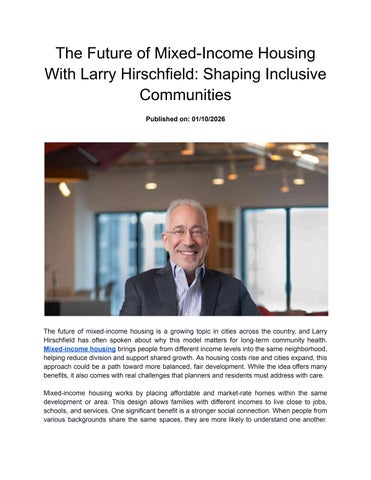
The Future of Mixed-Income Housing With Larry Hirschfield: Shaping Inclusive Communities Published on: 01/10/2026
The future of mixed-income housing is a growing topic in cities across the country, and Larry Hirschfield has often spoken about why this model matters for long-term community health. Mixed-income housing brings people from different income levels into the same neighborhood, helping reduce division and support shared growth. As housing costs rise and cities expand, this approach could be a path toward more balanced, fair development. While the idea offers many benefits, it also comes with real challenges that planners and residents must address with care. Mixed-income housing works by placing affordable and market-rate homes within the same development or area. This design allows families with different incomes to live close to jobs, schools, and services. One significant benefit is a stronger social connection. When people from various backgrounds share the same spaces, they are more likely to understand one another.
This can lower stigma and reduce the feeling of separation that often exists between income groups. Over time, neighborhoods can feel safer and more welcoming for everyone. Another benefit of mixed-income housing is better access to opportunity. Lower-income families often gain access to higher-quality schools, public transit, and health services. Children who grow up in stable neighborhoods tend to do better in school and feel more hopeful about their future. At the same time, cities benefit from more stable housing markets. When neighborhoods include a mix of incomes, they are often more resilient during economic downturns. The future of mixed-income housing also supports more innovative land use. Cities face limited space and rising demand. Mixed-income housing allows developers to build efficiently while meeting affordable housing needs. This approach can reduce long commutes and help lower pollution, since people live closer to work and their daily needs. These outcomes support healthier cities and stronger local economies. Despite these benefits, mixed-income housing faces clear challenges. One concern is community tension. Some residents fear that property values may fall or that services will become strained. These fears can slow or stop projects. Clear communication and community involvement are key to easing these concerns. When residents understand the goals and rules of a project, trust can grow. Another challenge is long-term affordability. In some cases, affordable units are limited by time. When these limits expire, lower-income residents may be forced to move. To secure the future of mixed-income housing, policies must protect affordability over the long term. This requires strong public support and clear agreements with developers. The future of mixed-income housing depends on thoughtful design, firm policy, and community trust. Leaders like Larry Hirschfield continue to highlight the need for balance between growth and fairness. When done well, mixed-income housing can create inclusive, stable, and opportunity-rich neighborhoods. While challenges remain, the potential benefits make this model an essential part of the housing conversation for years to come.