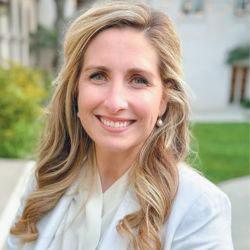
2025-2026 President’s Message: Dawn Eash Wazzan
In 1926, a small group of visionary women came together with a simple yet powerful idea: when women are trained, empowered, and united in purpose, they can transform their communities. One hundred years later, that idea has not only endured, it has flourished in ways those founders could never have imagined.
As we celebrate the Centennial of the Junior League of Los Angeles, this special edition invites you to look back at a century of women’s leadership and community impact across our city. Within these pages, you will find stories and photographs that capture mo-
ments both large and small, each one a thread in a much larger tapestry of service.
What begins with one woman’s decision to show up, to learn, to lead, and to serve becomes something far greater when leveraged multiplied across generations. Over the past 100 years, thousands of JLLA members have carried that commitment into every corner of Los Angeles, into classrooms and courtrooms, into nonprofits and neighborhoods, into moments of crisis and moments of hope. Together, they have built programs, shaped policy, strengthened institutions, and most importantly, improved lives across our community.
Our history is rich with milestones. From our founding project, a convalescent home for children, to partnerships that continue to evolve alongside the needs of our city, JLLA has remained grounded in a single purpose: to advance women’s leadership for meaningful community impact through volunteer action,
collaboration, and training. That purpose has guided us through times of growth and challenge alike, always calling us to listen first and lead with intention.
This Centennial year has been both a reflection and a renewal. We have created a new strategic partnership with the Los Angeles City Recreation and Parks and completed the first transformation of many at the Green Meadows Dance and Movement Studio in South Los Angeles, creating a lasting investment in youth, wellness, and community. We have advanced a million dollar plus Legacy of Impact Campaign to fund community projects, expand training opportunities, and fund our endowment for long term sustainability. Lastly, we have continued to invest in what has always set JLLA apart; developing women leaders who carry their training far beyond our organization and into every sector of our city.
But as meaningful as these accomplishments are, they are only part of the story. The true legacy of JLLA lives in the col-
lective impact of its members, past and present, whose leadership ripples outward in ways that are not always captured in headlines, but have been extremely meaningful in communities across Los Angeles. This Centennial commemorative history stands as a moment to reflect, to celebrate, and to preserve that impact for our members, our donors, our community, and for generations to come.
It has been an incredible honor to serve as President during our Centennial year, but truly, the greatest gift has been a front row seat to understanding what so many League members have contributed to this organization and to our city.
Each story in these pages, and the thousands more that live beyond them, comprise the JLLA Centennial Legacy of Impact.
As you turn these pages, we hope you see not only where we have been, but what is possible when women come together with purpose. Because one hundred years later, the story of the Junior League
of Los Angeles is still being written. And its next chapter begins with us.
JLLA Centennial Issue
Editorial Committee
Dawn Eash Wazzan
Kylee Peña
Marsha Sallai
Charlotte Otremba
Candy Beaver
Board of Directors
Dawn Eash Wazzan, President Ashley Corp, Treasurer
Lynn Lipinski, Secretary
Latoya Vickers
Kylee Peña
Marsha Sallai
Jen Shah
Kim Pettiford
Candy Beaver, Advisor
Management Council
Leanna Wood, President-Elect
Amy Mathias, Communications
Coley Nelson, Community
Michelle Amado, Development
Jessica Begley, Development-Elect
Rebecca Fleming, DEIB
Elissa Refold, Finance
Janine Moy, Membership
Jenna Murphy, Nominating-Elect
Raffaella Liserre, Operations
Jasmine Tabankia, Public Policy
Lauren Ekerling, Sustaining
Bonnie Wong, Training
Special thanks to the Larchmont Chronicle for their support and partnership over the decades.
JLLA Centennial: Legacy of Impact Campaign
By Elizabeth Tegley Curtis & Dawn Eash Wazzan
As the Junior League of Los Angeles approached its Centennial, the question was not simply how to celebrate 100 years, but how to do so in a way that honored its legacy while boldly shaping its future.
The answer was not immediate. Over several years, the League engaged in a thoughtful and inclusive process, gathering insight through focus groups, member surveys, and conversations with past presidents, donors, community partners, and civic leaders. From this work, a clear vision emerged to honor a century of impact by leaning into what the League has always done best, showing determination to create meaningful and visible change in the community.
From this foundation, the JLLA Centennial: Legacy of Impact Campaign was born, structured around three pillars designed to both celebrate the past and secure the future.
The first pillar, Commu-
nity Improvement Projects, represents the most visible expression of the campaign. The vision was both simple and powerful. Invest in spaces. Partner deeply. Go where the need is greatest. Renovate green spaces. Expand access to youth programming. Work hand in hand with the City of Los Angeles Recreation and Parks to deliver targeted, sustainable impact across Los Angeles. This Centennial partnership stands among the largest in JLLA’s history and sets a new standard for the next century of community empowerment and impact.
In many ways, this work reflects a return to the League’s roots. For generations, JLLA members have strengthened their communities through hands-on service, like the school library renovations at Clover Avenue Elementary and 3rd Street Elementary, highlighted by the Los Angeles Times in 2000. The guiding idea remains the same. Tens of thousands of women rolling up their sleeves to build, restore, and strengthen the
communities around them.
The campaign’s second pillar, Special Centennial Year Training Opportunities, reinforces the League’s core mission. For 100 years, JLLA has served as a training ground for women leaders, equipping members with the skills, confidence, and experience to lead both within the organization and far beyond it. The Centennial Campaign expanded this commitment in meaningful and tangible ways.
Members were awarded scholarships to attend trainings through the Association of Junior Leagues International, including miniMBAs, Organizational Development Training, and the Annual Conference. In addition, two members were selected as fellows for the prestigious CORO Leadership Center.
The League also deepened its commitment to fundraising education through the creation of its Fund Development Institute, an annual five-session program designed to build members’ confidence and expertise in philanthropy,
JLLA Across a Century
No celebration is complete without a look back at the years that went into getting JLLA to where it is today. Throughout this issue, we’ll take a stroll down memory lane from the Junior League of Los Angeles’ early days
in 1926 through today. We even dug into the archive and pulled out some photos and newspaper clippings from several of these important moments in JLLA’s history. Enjoy this march through time.
donor engagement, and creating a culture of giving. Together, these initiatives represent a significant investment in the next generation of women leaders and ensure that training remains at the heart of the League’s mission.
The campaign’s third pillar, Endowment and Sustainability, represents a critical step forward. As the League began receiving more significant philanthropic gifts, including M’Leigh Koziol’s bequest, it became clear that a more formal structure was needed to steward these contributions responsibly. The creation of the JLLA Endowment ensures that such gifts are preserved, grown, and deployed with intention, providing a stable financial foundation to sustain the League’s mission for generations to come.
Momentum continued through a series of thoughtfully designed engagement opportunities, including the introduction of the 1926 Society, a leadership giving circle recognizing those whose generosity is helping to shape
the League’s future. Through gatherings and events, the 1926 Society fostered not only philanthropy, but connection, bringing members and supporters together around a shared vision of impact.
To date, the JLLA Centennial: Legacy of Impact Campaign has raised $1.3 million in support of its three pillars, a remarkable achievement and a testament to the collective commitment of our members and supporters.
More than a Centennial initiative, the Legacy of Impact Campaign has become a bridge between generations, bringing together new members and 50+-year members alike to celebrate, reflect, and build what comes next. It connects a century of service to a future defined by even greater possibility and reinforces a truth that has guided the Junior League of Los Angeles for 100 years. When women come together with purpose, there is no limit to the impact they can create.
Thirty-three women form the Convalescent Children’s League, which is responsible for the operation and support of a twelve-bed children’s convalescent home. The home is presented to Children’s Hospital Society, today known as Children’s Hospital Rehabilitation Center.
Green Meadows Dance Studio Project Breathes New Life Into Community
By Charlotte Otremba & Dawn Eash Wazzan
Ona sunny afternoon in South Los Angeles, cheers and applause echoed off the crisp white walls of a newly transformed studio. Inside, groups of elementary and middle school students raised pom-poms high and moved in unison across the floor, celebrating not just a performance, but a long-awaited beginning. What was once an empty, underutilized space had been reimagined into the new Dance & Movement Studio at Green Meadows Recreation Center and has become a place now filled with energy, creativity, and community.
The project, a collaboration between the Junior League of Los Angeles (JLLA) and the Los Angeles City Department of Recreation and Parks (RAP), marked the official opening of JLLA’s Centennial Community Improvement Project.
“Now the girls of the dance and cheer troops have somewhere beautiful to practice,” said JLLA President Dawn Eash Wazzan in an interview
with Los Angeles Channel 35 News. “It’s going to serve the entire community, not just youth, but also seniors and families.”
For Erica Anenberg, Owner Operator of Girl Flip Construction, the impact was immediate and deeply personal. “This dance studio is crucial to the community,” she shared. “It is so important to give both children and adults a creative outlet so they can see their community grow, flourish, and thrive.”
The journey to this moment began several years earlier. As JLLA shaped its Centennial vision around community improvement, the organization made a deliberate decision: to prioritize need over visibility.
That commitment led to a pivotal moment in 2022, when RAP invited JLLA leaders on a bus tour of parks across Los Angeles. By the end of the tour, three locations stood out. But the guiding question remained unchanged: where could this investment make the most difference? The answer was Green Meadows.
At the time, the site in-
cluded a vacant preschool classroom that was quiet, worn, and in need of significant care. Yet within that space was undeniable potential.
Over the following year, JLLA worked closely with RAP and city partners to bring the vision to life. The process required careful coordination, persistence, and collaboration, including navigating approvals and finalizing agreements.
Led by Girl Flip Construction, a women-led firm that contributed additional time and resources, the renovation transformed the space into a vibrant, purpose-built studio. Throughout the process, JLLA volunteers worked alongside partners, reinforcing the League’s commitment to hands-on community impact.
“By transforming an underutilized space into a vibrant movement studio, we are creating long-term impact that will serve generations of families,” said Jenn Hsu, Chair of the JLLA Centennial Community Improvement Project.
For Girl Flip Construction, the experience was equally meaningful. “Every detail was done with love and joy,” said
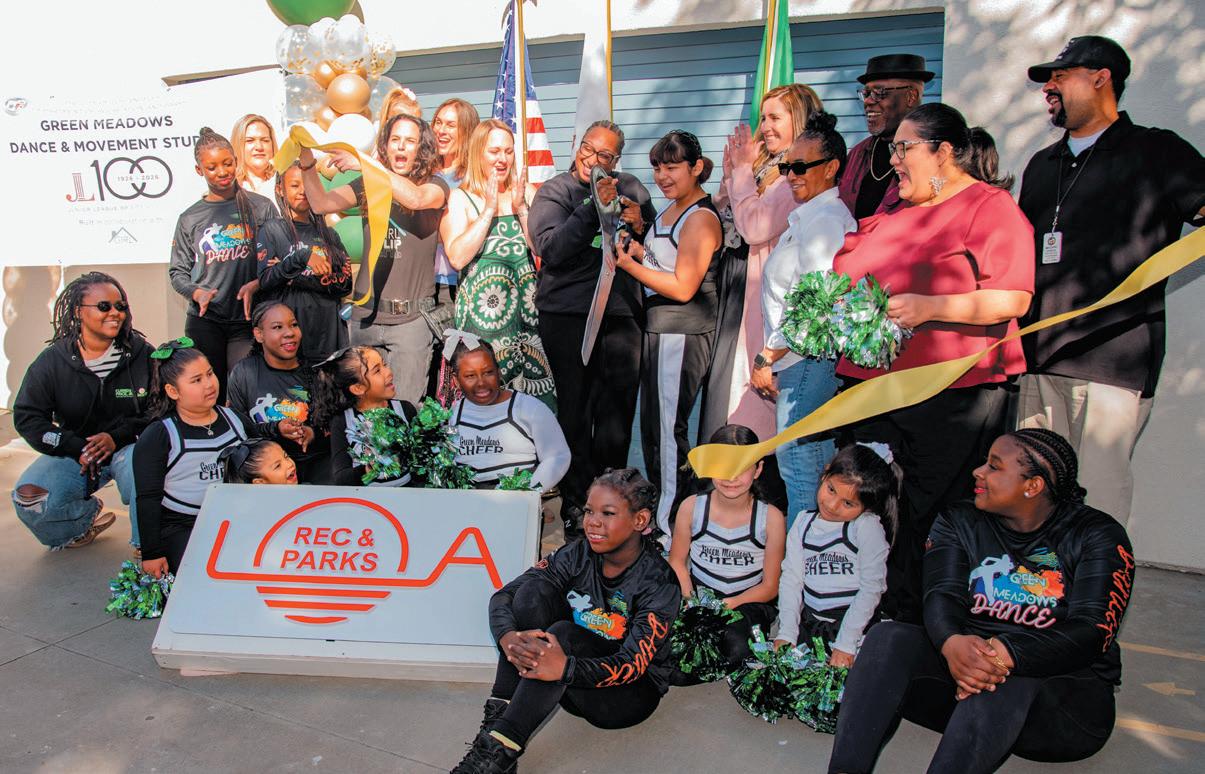
Anenberg. Today, the Green Meadows Dance & Movement Studio stands as a dynamic space designed to serve a wide range of programs, from youth dance and cheer to fitness classes, after-school activities, and community wellness initiatives. The studio is expected to reach hundreds of local residents each year, offering a positive outlet for physical activity, creativity, and personal growth.
“Partnerships like this allow us to expand access to programming in neighborhoods where it matters most,” said Jimmy Kim, General Manager of the City of Los Angeles Department of Recreation and Parks. “We are grateful to the
Junior League of Los Angeles for their leadership and for choosing Green Meadows as part of their Centennial legacy.”
For JLLA, the project represents more than a single renovation. It reflects a century-long commitment to empowering women and strengthening communities.
“This studio is a tangible expression of our mission,” said Wazzan.
From an empty classroom to a vibrant community hub, Green Meadows is now a place where something meaningful has taken root— and where its impact will continue to grow for years to come.
Centennial Gala: A Night 100 Years in the Making
By Rebecca Mellos & Charlotte Otremba
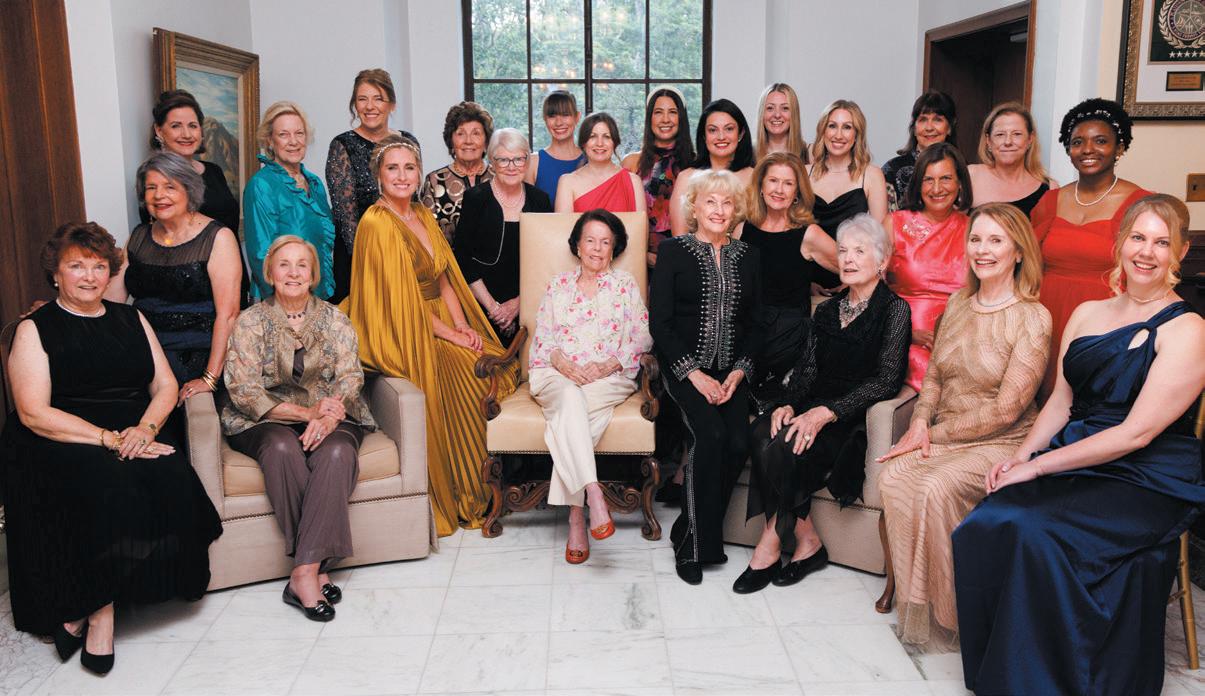
The Junior League of Los Angeles (JLLA) celebrated its 100th anniversary with a landmark black tie optional Centennial Gala on Saturday, March 21st, 2026. Nearly three hundred and fifty members, community partners, and guests arrived in their finest gowns and tuxedos to dine and dance the night away at The California Club, which was richly decorated in the Junior League’s signature red. Throughout the night, one could spot meaningful moments of celebration, connection, and reflection amongst members. The energy in the lustrous wood-paneled room was palpable.
JLLA President Dawn Eash Wazzan, wearing an ethereal floor-length chartreuse dress, and Centennial Gala Chair Rebecca Mellos, wearing a striking pale pink gown, each gave rousing speeches commemorating JLLA’s accomplish-
ments and lasting community impact. Twenty-three past Junior League of Los Angeles presidents were in the audience.
“Our legacy began 100 years ago with visionary founders whose commitment to service created something enduring. Those women didn’t just imagine change— they built it. They saw a need, created a place for care, and ultimately donated the children’s convalescent home to Children’s Hospital to serve children in need during World War II. That spirit of action is the foundation of who we are,” said Dawn Eash Wazzan, JLLA President. “Our Centennial has been years in the making and was shaped by thoughtful input from our members. One thing was clear: this moment deserved to be celebrated. Because milestones are not meant to pass quietly; they are meant to honor what has been built and carry it forward.”
The evening featured a lively cocktail hour, curated
auction, elegant seated dinner, and a popular live band. Attendees also enjoyed a screening of “Because of You,” an original short film featuring the voices of JLLA presidents who shared personal accounts of meaningful impact throughout their own JLLA career. The women’s powerful experiences highlighted the scale of JLLA’s impact over one hundred years in Los Angeles, both in community action and training.
After dinner, Matt Mauser, the Sinatra-style vocalist and “America’s Got Talent” finalist, took to the stage with The Matt Mauser Big Band and played a rousing mix of Frank Sinatra classics and upbeat pop hits. Guests dusted off their dancing shoes and the dance floor was bustling the entire evening.
“The League has always been strongest when we stand side by side, and this historic evening would not be complete without the community that made it possible,” said
The Convalescent Children’s League is admitted to the Association of Junior Leagues International (AJLI) and becomes the Junior League of Los Angeles.
Rebecca Mellos, Centennial Gala Chair.
All told, Leaguers raised nearly $300,000.
“The evening reflects on the legacy that brought us here, celebrates what we have accomplished together, and looks ahead with anticipation to the century to come,” Rebecca Mellos added. We’ll toast to that!
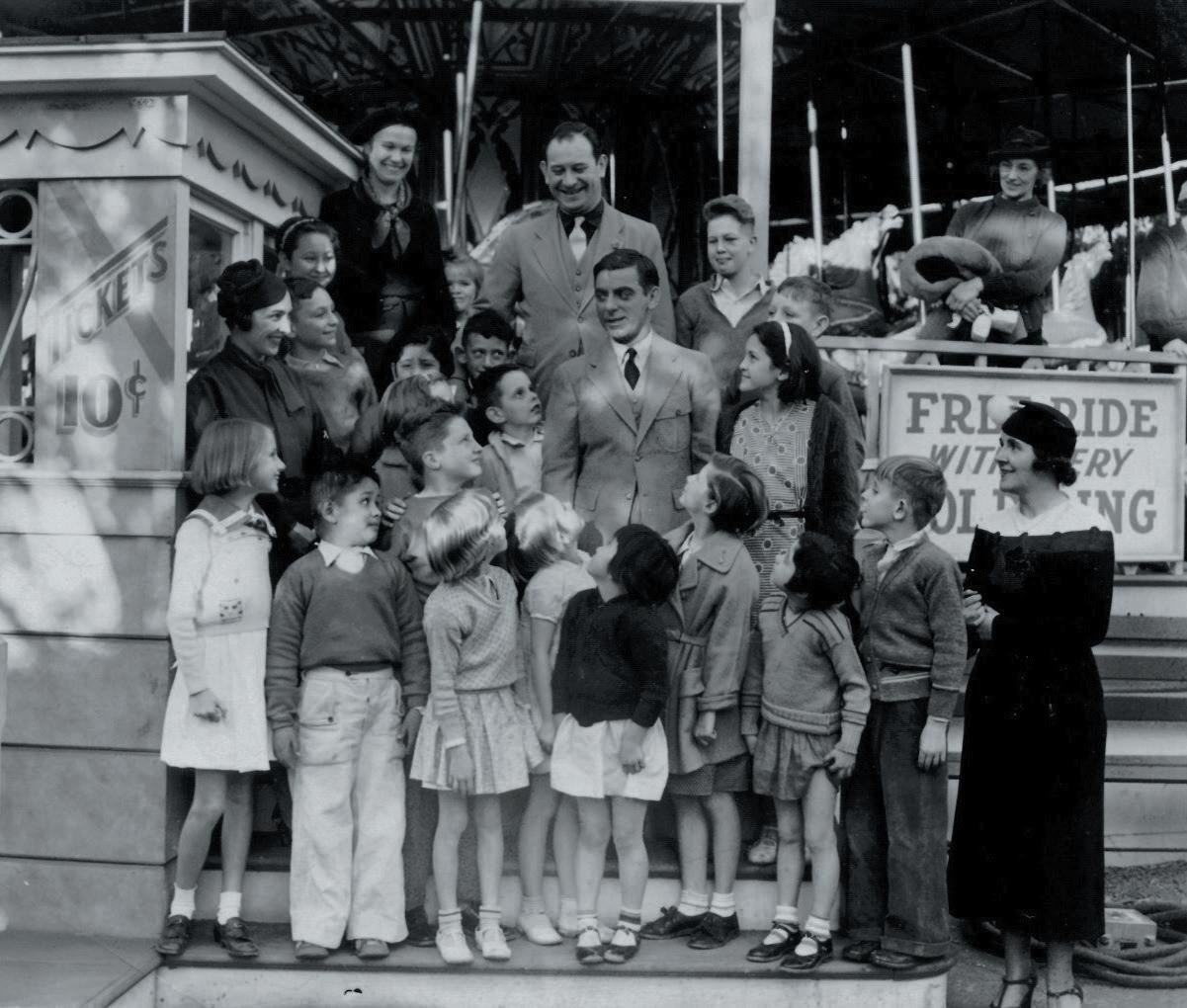
JLLA forms Players Group and performs for local children.
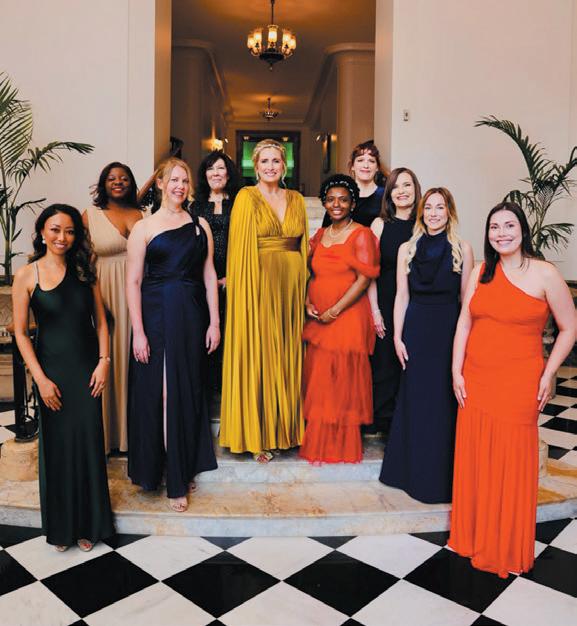
THE 2025-2026 Board of Directors with incoming President-Elect Chelsea El-
PRESIDENTS PAST, PRESENT, AND FUTURE gathered at The California Club to celebrate the Centennial Gala.
der.
100 Things You Might Not Know About the Junior League of Los Angeles
By Kristin Stark & Charlotte Otremba
One hundred years of JLLA – that’s a lot of sustained woman power benefiting the citizens of Los Angeles! But have you ever wondered what JLLA members have done during that time? Like, where was JLLA housed before Rainey House? What fundraisers did we have before Harvest Boutique and Legacy Ball? And, is it true Carol Channing once auctioned a dinner party at her house to benefit JLLA? We certainly did and to appease our curiosity, we created the following list of 100 things you might not know about the Junior League of Los Angeles!
1 In 1923, 14 women gathered in Mrs. Braley’s drawing room to form a group known as the Convalescent Children’s League. The founders raised $100 each, then leased and renovated an old house to care for patients discharged from the Children’s Hospital. In 1926, this group of women became the 86th member of the Association of Junior Leagues.
2 Helen Bullis was the first president of the newly-formed Convalescent Children’s League and the first president of the subsequent Junior League of Los Angeles.
3 What was the first JLLA Headquarters? According to limited information in the Archives, the Junior League of Los Angeles likely set-up shop in the Town House at Wilshire and Commonwealth across from Lafayette Park. The Doheny family owned the building.
4 One of the city’s movers and shakers in the 1920s and 1930s was the Doheny family. Led by patriarch and oil tycoon Edward L. Doheny, he gifted his son and his daughterin-law, Lucy Smith Doheny, with the infamous Greystone Mansion in Beverly Hills. Lucy was not only a JLLA member, but was its 2nd President.
5 The first Junior League gift shop opened on November 8, 1926 at 641 Carondelet Street and the profits contributed to the later construction for a new home for convalescent children.
6 “I’ll get you, my pretty, and your little dog, too!” Did you know this famous line from The Wizard of Oz is uttered by a Junior Leaguer? Margaret Hamilton, the actress who played the Wicked Witch of the West, was a member of the Junior League of Los Angeles. She outlined and executed a complete year’s program of Educational Therapy at the Convalescent Home.
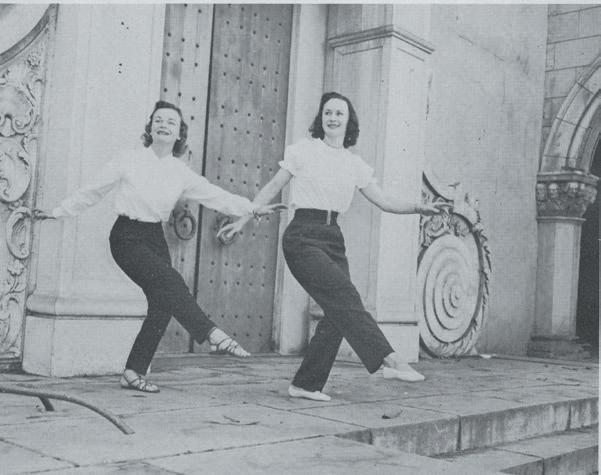
7 The Flintridge Horse Show was one of the first fundraisers JLLA used to raise funds at the Flintridge Riding Club. In 1930, the 6th annual event opened and attracted 2000 fans.
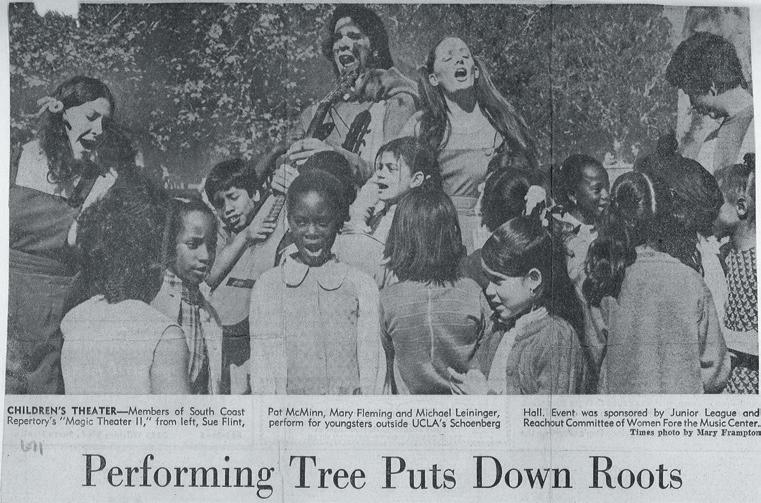
8 With assistance from the Board of Education, JLLA’s Players Group eventually expanded to become the Children’s Theater, performing for roughly 9,000 children in fourteen schools in the underserved areas of Los Angeles. The program continued until 1972.
9 Did you know Junior League of Los Angeles published the first official League cookbook? The Junior League Recipes included 500 recipes and was dedicated to the children of the Convalescent Home. There is currently an exhibition at The Book Club of California in San Francisco entitled “Serving the Community: The Junior League Cookbook - Regional Cookbooks, Historical Monographs, Programs, and Guidebooks” through July 17, 2026 which showcases the rare early publications of the Association of Junior Leagues International, Inc. and includes the self-published and now very collectible material produced by the women of The Junior League from the early 1920s to the early 2000s.
10 In 1934, Junior League of Los Angeles sponsored an all-in-motionpicture polo game with riders including Hal Roach, Walt Disney, Spencer Tracy, Frank Borzage, and Jack Warner. Walt Disney promised to bring Mickey Mouse to hold his mallets. This fundraiser was held for several year and in 1936, Joan Crawford was chosen as the hostess and it was held at Will Rogers Memorial Field!
With assistance from the Board of Education, Players Group expands to become a trouping group, renamed Children’s Theater. It performed for almost 9,000 children in fourteen schools in underserved areas. The program continues until 1972.
11
In the 1940s, JLLA created a children’s radio program called the “Radio Group.” It presented adaptations of children’s books every Wednesday on radio station KHJ. The program was sponsored by the Los Angeles Public Library and the Los Angeles Board of Education.
12
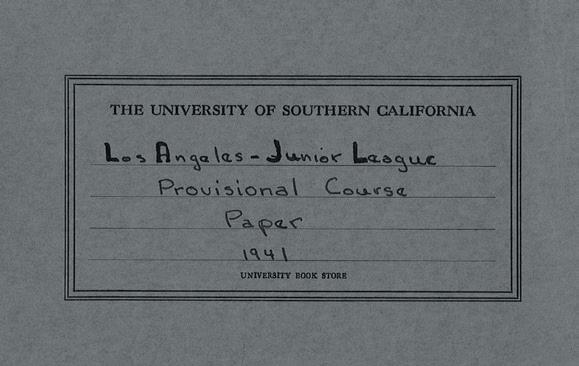
Imagine writing a paper as part of your provisional requirements. Well, back in 1941, that’s exactly what Provisionals had to do! Patsy Burr titled hers “An Ounce of Prevention” about health and social welfare. Luckily, she earned an “A” on her paper and thus bestowed membership into JLLA.
13
The League sponsored an original radio program called “Young America Speaks Out,” in which young Americans would voice their opinions on world topics. The radio program won a Peabody Award for outstanding student participation and was later telecast on KFI Channel 9.
14
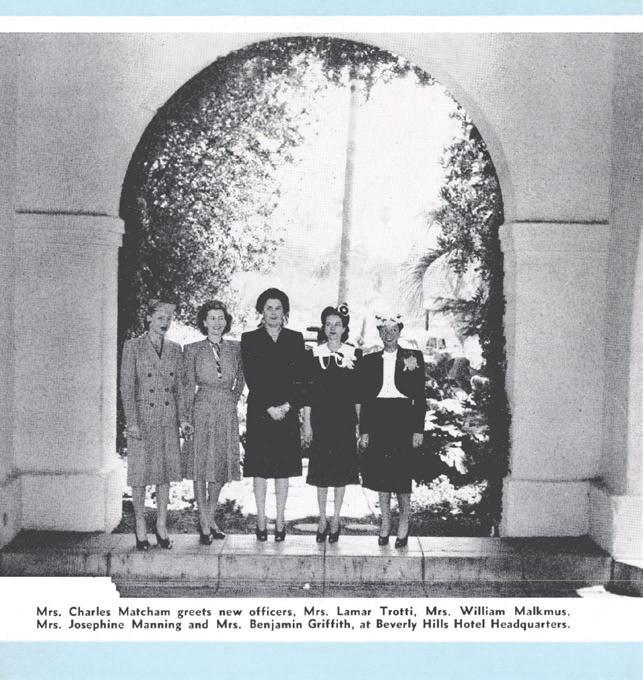
Chic headquarters alert! In 1943, the League made their home in the Beverly Hills Hotel and stayed there until 1962.
15
JLLA held an upholstery class for its members in the 1940s and 1950s. The group met each Friday for over 15 years in JLLA member Mrs. John Bullis’ garage where they turned furniture trash into designer treasure.
16
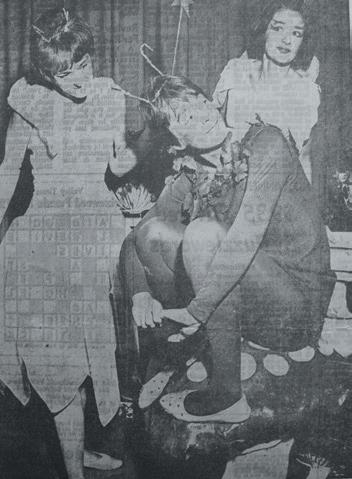
As World War II was coming to an end, JLLA lent its services by helping sell war bonds to help pay for service men’s returning rehabilitation and hospital expenses. League members sold the war bonds at the Santa Anita and Hollywood Park Thoroughbred racetrack, where they also received hot tips on bad horses. One man even bought a $500 bond for “Goldie Goldfinger” every week.
17 JLLA co-sponsored Symphony Previews with the Junior Philharmonic Committee at the L.A. Philharmonic in 1950, later presenting lectures preceding the afternoon concerts at the Music Center. 600 people attended each lecture. JLLA will be holding its Centennial Training at the Music Center this year!
18 During the 1950s, JLLA took advantage of its HQ at LA hotspot The Beverly Hills Hotel and held two annual events open to the public. One was a show of architects’ plans and models; the other was a show of holiday decorations. On more than one occasion, the Los Angeles Times featured the League’s holiday decorations in its Sunday magazine.
19
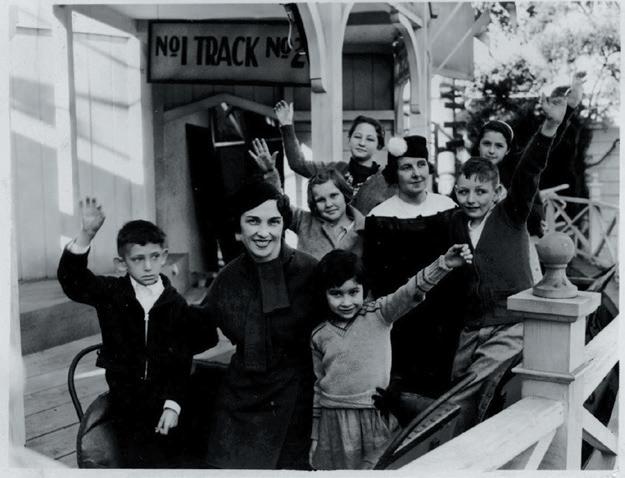
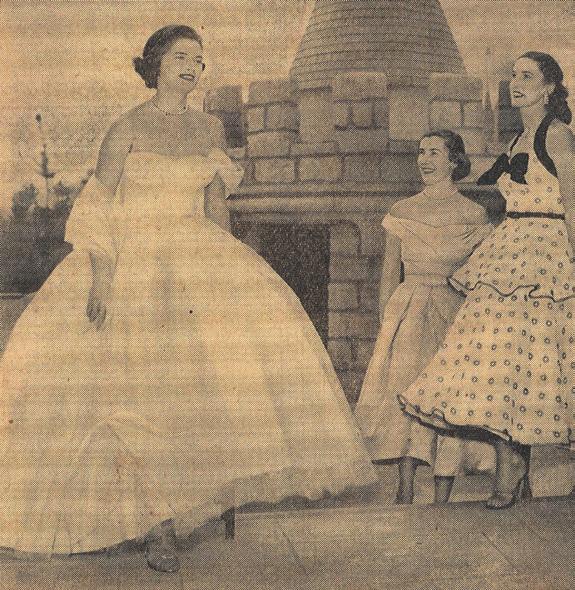
The annual Ballet Ball would follow a performance by Sadler’s Wells Ballet company each year throughout the 1950s. In 1955, “Sleeping Beauty” was the chosen ballet. To promote the ball, League members dressed in their “fairy tale finery” and trekked down to Disneyland for a publicity photo shoot at Sleeping Beauty’s castle.
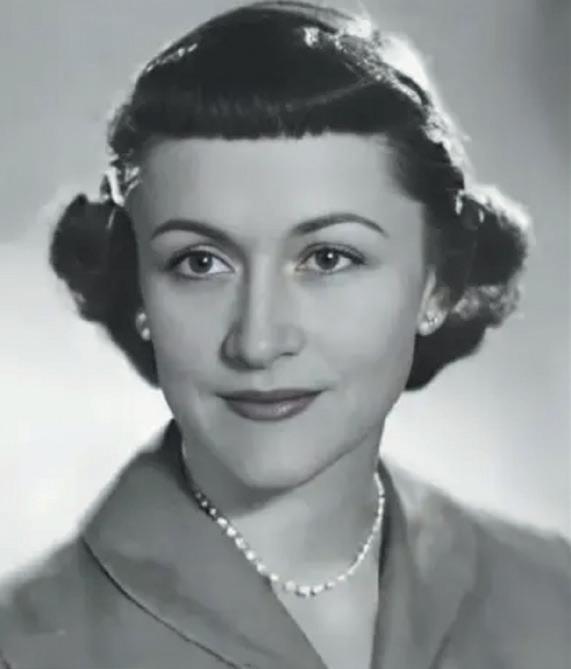
20 Former JLLA president Jean Webb Vaughan Smith (1954) served as president of AJLI from 1958 to 1960. In 1958, she was named Los Angeles Times Woman of the Year. She was a close friend of Nancy and Ronald Reagan.
JLLA’s Radio and Television Committee, in connection with the Public Library and Board of Education, produces the “Tell Me a Story” network radio program.
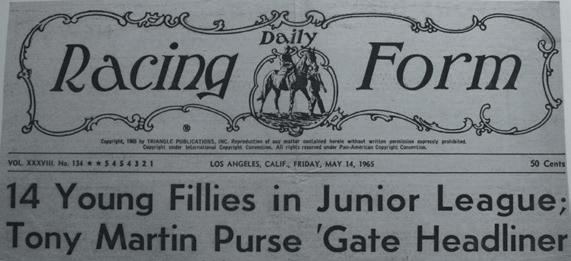
21 Every May, starting in 1954 and continuing for over a decade, the Junior League of Los Angeles held the Junior League Race Day at the historic Hollywood Park Racetrack. The festivities included a pre-race luncheon followed by the “Junior League Handicap” horse race; the winner would be crowned by the JLLA President. The day’s events were always capped off by cocktails and dancing to Barney Sorkin and his orchestra in the Club House. Funds raised went into the League’s Community Trust Fund.
22 JLLA…recording artists? Yes, indeed. In 1958, the League’s vocallytalented members formed The Larks: a singing troupe to provide “music for the mending” to children, senior citizens, and hospital patients. The Larks performed for nearly two decades and recorded 3 LP albums. Grammy nominated singer Rico Owen Moore, a soloist with the Ray Coniff Singers, directed the a cappella group.
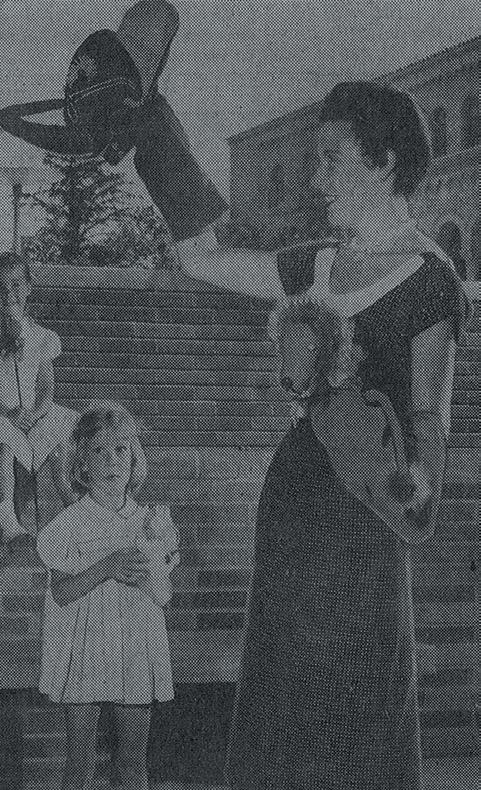
23 Puppets Committee?! Yes! JLLA had its very own Puppets Committee, which constructed puppets, wrote scripts, and gave weekly performances in the wards of the Children’s Hospital. Over the years, the program expanded to 40 hospitals, special schools, day cares, and youth centers throughout the 1950s.
24 JLLA devoted incredible services to the blind in the 1950s and 1960s, transcribing and binding Braille textbooks and Children’s Zoo guides, Subsequently, the Junior League Information for the Blind Center was created, which collected and disseminated facilities and services for the blind and visually handicapped in Los Angeles.
25 For JLLA’s 30th Anniversary luncheon in 1956, members celebrated in Roaring Twenties style at the Beverly Hills Hotel, modeling the “vogues of three decades ago.” The fashion “antiques” were borrowed from the Brooklyn Museum.
26 “Around the Town,” first published by Leaguers in 1959, was a free directory of children’s activities throughout Los Angeles.
JLLA co-sponsors with the Southern California Society for Mental Hygiene to establish the Veterans Psychiatric Clinic.
27 Throughout the 1950s, JLLA hosted annual Christmas parties for members’ children and their friends. Admission wasn’t free; pint-sized attendees were asked to bring a giftwrapped toy to gain admission to the party. The gifts were then distributed to community partners.
28 The Salvation Army presented JLLA with the Sally Award in 1958 for its work creating the Girls Club at its Red Shield Youth Center in Los Angeles. Premiere filmmaker Cecil B. DeMille presented the award.
29 JLLA moved its headquarters just down the street from The Beverly Hills Hotel to the Beverly Wilshire Hotel in 1962 and was officed there until 1970.
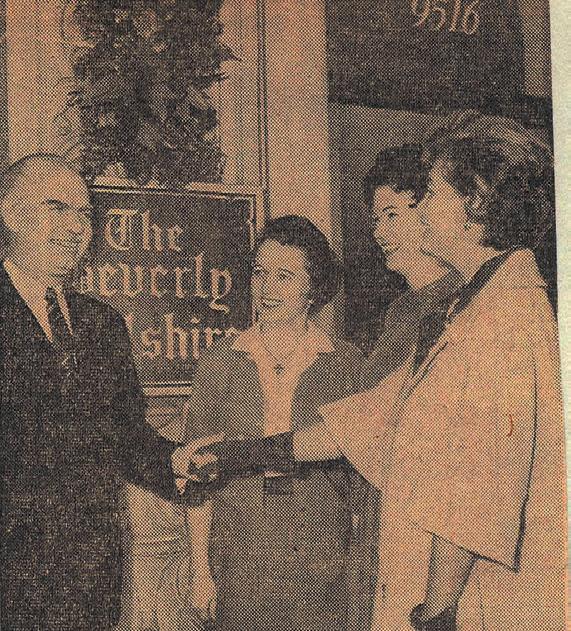
meetings.
31 Why did every move JLLA make get printed in the local papers early in its founding? Was it bribery? Well, not exactly. But in the 60s, the League did throw an annual luncheon for the local newspaper editors of the Los Angeles Herald and Express, Examiner, Mirror-News, Valley Times, Beverly Hills Citizen, Hollywood Citizen News, Santa Monica Evening Outlook, and of course, the Los Angeles Times. Charities across Los Angeles would compete for precious ink in the papers to publicize their organizations and their events. The luncheon certainly did the trick: JLLA received extensive coverage in all the papers over the years.
32 When First Lady Jacqueline Kennedy caused a ruckus by strolling through the White House in slacks, the Los Angeles Times turned to the Junior League of Los Angeles’s President Dorothy Haight for her take on the hot button issue issue. Mrs. Haight stated she much prefers slacks “at home – and that means indoors – or in a mountain cabin… I’m not the slacks type. I have one pair, and I wear them at Arrowhead.” (Published April 4, 1961)
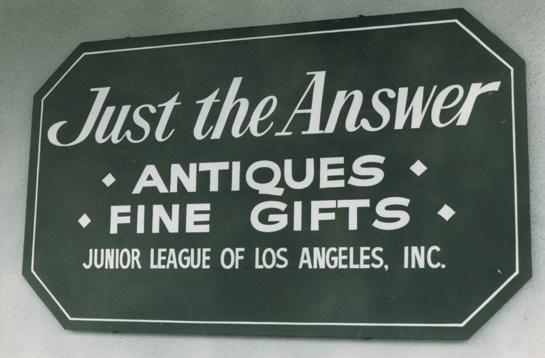
33 Did you know JLLA used to have a thrift shop called “Just the Answer”? It opened its doors in Brentwood in 1966. Staffed by JLLA members, the shop raised funds for League Community projects and remained open for 19 years.
JLLA’s “Young America Speaks” radio program debuts on KFI. Program wins the Peabody Award for outstanding student participation programming. It is later turned over to the Board of Education in 1953.
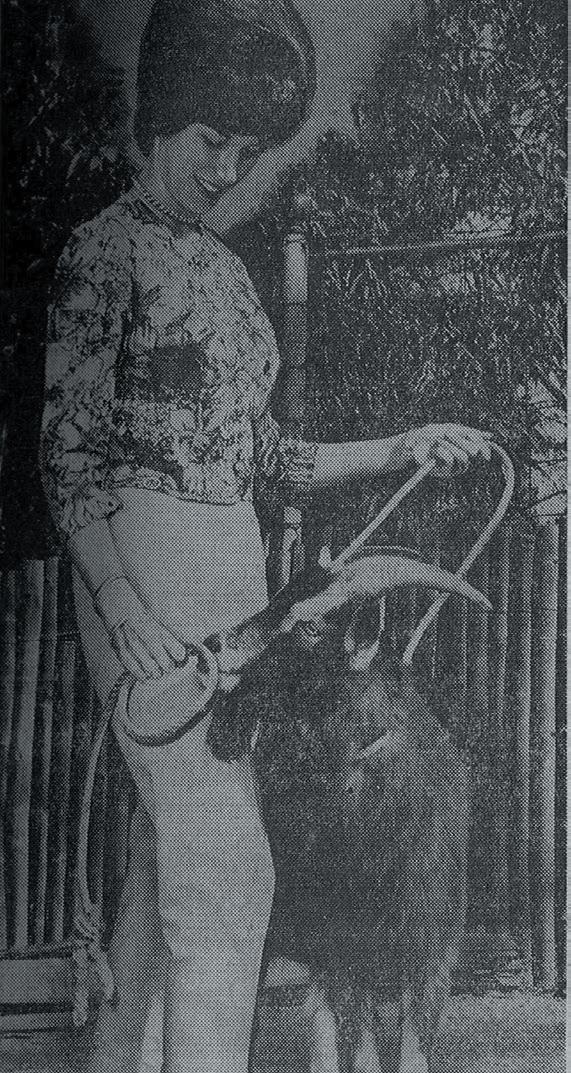
34 During the 1960s, JLLA held an annual fashion brunch at the Bullocks Wilshire’s Tea Room. JLLA members would serve as the runway models for an array of themed fashion shows, including “What We’d Wear to League Events,” “Heroines of Fashion,” “Political Fashion Options,” and “Fashion Horoscope –Your Future in Fashion.”
35 JLLA hosted Husband of the Year Awards at the first general meeting of the year throughout the 1960s.
36 Inspired by the earlier 1959 Around the Town directory, JLLA published Around the Town With Ease in 1966. This free guide listed activities and accessibility points around Los Angeles. Around the Town With Ease received awards from the National Rehabilitation Association of Southern California and the March of Dimes.
37 What is a Junior Leaguer?
Merriam-Webster’s Dictionary once defined Junior Leaguers as “Young women of leisure and the upper social class organized to engage in volunteer welfare work.” In 1966, after some Junior League members wrote a letter of protest to the editor, Webster changed the definition to reflect the new Junior Leaguer as “a member of a league of young women organized for intelligent participation in civic affairs, especially through direct volunteer services to civic and social organizations and agencies for community betterment.”
38 Tapping into the talents of its membership, JLLA held a Cabaret to benefit its Community Trust Fund during the 1960s. The evening included dinner and dancing, but the main event was the floor show. League members, their husbands, and friends displayed their singing and dancing talents under professional direction. Participants had to audition for their roles and spent many hours rehearsing, learning new dance steps, and “participating in all the hard work of a theatrical production.”
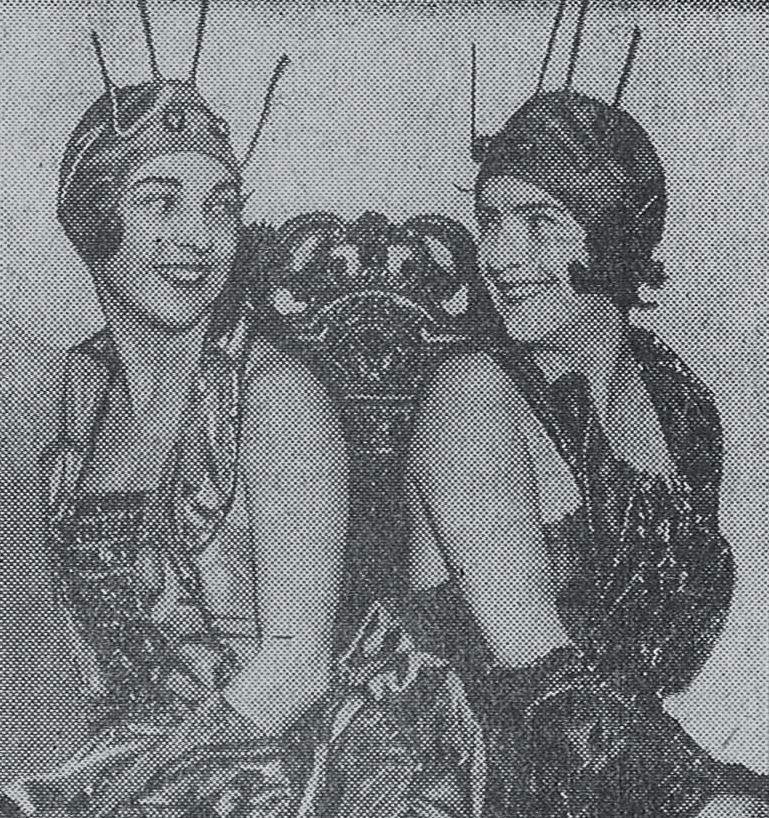
39 “Views and Reviews” was the theme of JLLA’s 40th Anniversary in 1966. At the celebratory general meeting, sustaining members presented a decade-by-decade look back on the League with a review of fashions, song hits, and memorable moments from its history. The Larks provided musical accompaniment.
40 The JLLA headquarters moved to an office above the Farmer’s Market, provided through the generosity of the Gilmore Corporation and Foundation, from 1970 until 1995.
41 The Junior League of Los Angeles made headlines in 1971 when the League elected Janice Ogden Vest its president. Turns out, at 30, she was the youngest JLLA president in its history.
42 JLLA’s Historic Education committee hosted a series of lectures in the early 1970s called “Yesterdays.” The lectures aimed to stimulate interest in the history of Los Angeles and to encourage the preservation of our historical heritage: “Our todays and tomorrows may be enriched by knowing more about our yesterdays.”
43 In 1974, JLLA organized a 90-minute debate-style meeting between California gubernatorial candidates Houston I. Flournoy and Edmund G. Brown. Of the six scheduled joint appearances with the candidates during that election year, this was the only one televised statewide. An estimated 2,500 persons watched the debate in person at the Los Angeles Convention Center.
44 The Performing Tree was an award-winning three-year joint pilot program with the Performing Arts Council of the Music Center. Its purpose was to expose young children to the performing arts and their own creative potential. In 1976, The Performing Tree, Inc. was formed to carry the program forward and continued into the early 2000s and reached over eight million school children in five counties.
45
JLLA helped found The Alcoholism Project, co-sponsored by the National Council on AlcoholismLos Angeles, to address the needs of women alcoholics. It included a school program, the Alcoholism Information Center, and a downtown information and referral center for alcoholics and their families.
46
“Going once! Going twice! Sold!” J. In 1968, “ACTION, an auction” was (at the time) the largest fundraising event ever hosted by a Junior League. Six years later in 1974, the event was revived as Auction II. The 1974 revived Auction II event featured a variety of extravagant auction items, including a ride in the Goodyear blimp; a package that included a wedding dress, cake, nightgown, and one night at the Beverly Wilshire in the Bridal Suite; a skiing vacation at Mammoth with a complimentary setting of a fracture included (just in case!); a private yacht for a cruise to the Virgin Islands; an Arabian stallion; and a dinner for six cooked and served by comedian and actress Phyllis Diller at her home. The LA Times published a story about the dinner.
47 The League adopted new procedures in the 1970s to reflect its changing membership. Traditionally, League events like board and general meetings were held during the day, but with more women entering the workforce and working at an office, the League agreed to hold at least one general meeting at night. JLLA also created a new category of membership called “Professionals.” This was just the beginning; new projects would be additionally assessed on their ability to accommodate the busy schedules of its members. The League also extended the maximum membership age to 45, since many women were joining later and focusing on their careers right out of college.
48 “Women tend to shy away from power because they have seen its abuse by men. But it is important that they, we, recognize that power is to be exercised—and not ignored. We need to re-define power, to pull it away from aggressive bindings. Rather, we should view it as the use of some control over our lives and over the decisions we must make.”
– Aileen Hernandez, founder and former president of the National Organization for Women (NOW), in her keynote address at the national conference of the Association of Junior Leagues International hosted by JLLA in 1974.
49 The Coro Fellows Program in Public Affairs is the gold standard in public affairs training, dedicated to preparing citizen leaders to effectively lead with impact and purpose. In 1977–78, the League funded 12 members to participate as Fellows. According to sustainer Marion Banning, this “changed the course of JLLA.”
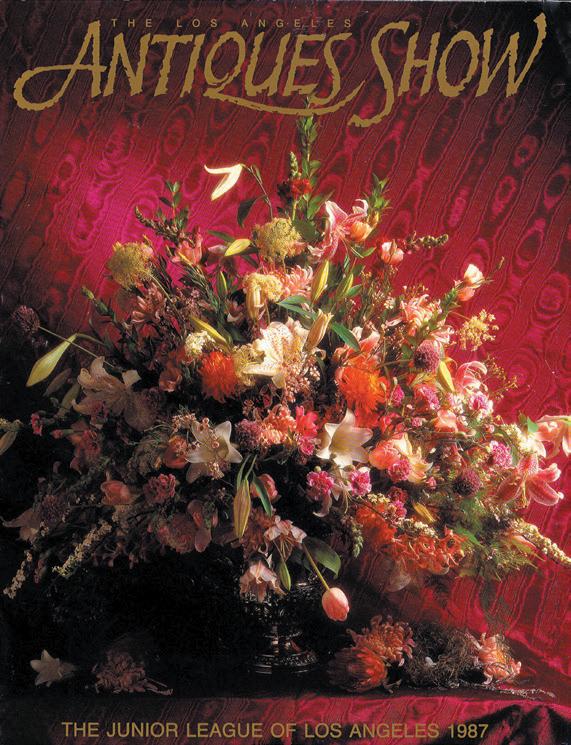
50 The Los Angeles Antiques Show began in 1979 and ran for 10 years. JLLA’s annual event – and only antique show in LA at the time – was held after Thanksgiving at various venues over the years, including The Ambassador Hotel, The Biltmore, and the Santa Monica Civic Auditorium. JLLA’s highly-respected event planner selected antique dealers from around the country to showcase their items. The three-day event kicked off with an opening night party of cocktails, dinner, live music, and a preview of the items. The following three days included a lecture series covering topics such as trends in interior design, decorative arts, or popular styles of furniture – all open to the public. Barbra Streisand was a regular attendee!
51 The Children’s Bicentennial Map Committee developed a graphic guide to downtown and its historic architecture in 1979. For two years, the committee gave docent tours to school children and promoted the map during the Los Angeles Bicentennial Celebration.
52 JLLA co-sponsored the Victim Assistance project with the District Attorney’s office in 1980 to provide aid to victims of violent crime. The project ultimately expanded to seven DA branch offices. The new V.A. Committee wrote a training manual that became available for all victim advocate programs in the state.
53 The Crime Prevention Alert project, co-sponsored with the Los Angeles Police Department, developed a program for neighborhood watch seminars in 1981. The league also published a training manual and the booklet Are You Fed Up With Crime?
54 Back when computers were brand new, JLLA founded Computers for Non-Profits in 1984, co-sponsored with the California Community Foundation, to offer hands-on, fundamental micro-computer training to representatives of non-profit organizations.
55 In anticipation of the 1984 Olympics held in Los Angeles, JLLA and the Los Angeles Olympic Organizing Committee produced, wrote, printed and distributed the 1984 Official Olympic Youth Handbook. The goal of the project was to inspire and educate young people in matters relating to the Olympics and the 1984 Games.
JLLA establishes the Volunteer Bureau, which places volunteers in the community, and becomes an integral part of the Welfare Planning Council, Los Angeles Region.
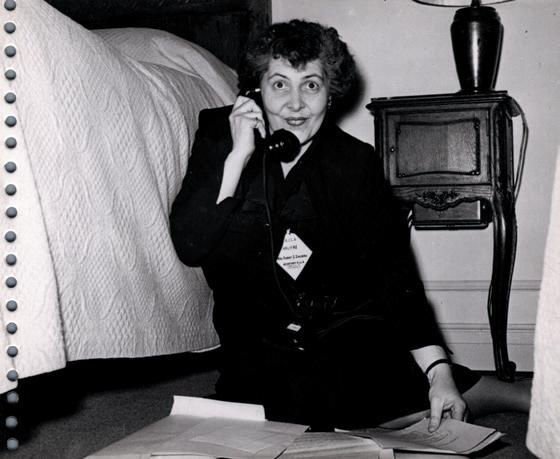
League members write and star in a seven-week live talent show produced for radio station KMPC. Project is developed into Free Radio and Television Committee and presents local Christmas and Easter telecasts.
30 In 1964, Vin Scully—the voice of the Dodgers—spoke to League members at one of the League’s general
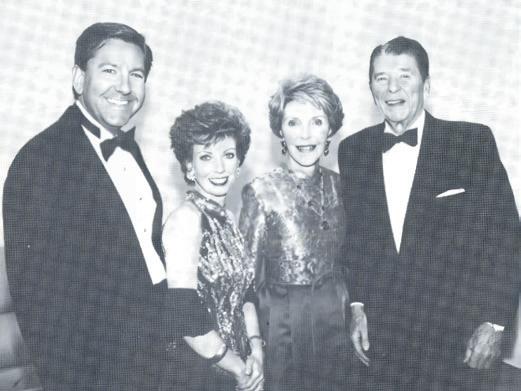
56 On the League’s 60th Anniversary, First Lady Nancy Reagan sent the following letter:
THE WHITE HOUSE
March 24, 1986
Dear Friends: I would like to extend my warmest greetings to all of you celebrating the 60th anniversary of the Junior League of Los Angeles. It’s been so heartening to learn of the valuable contribution the Junior League of Los Angeles has made over the years. As volunteers, you have done so much to enrich the lives of others – not to mention your own sense of fulfillment in self giving. I am reminded of a wonderful saying that goes, “You only begin to live when you begin to give.” How true that is!
You have my sincere wishes for many more years of success.
Sincerely,
Nancy Reagan
57 JLLA was the first league in the Association of Junior Leagues International, Inc. – and one of the first groups in Los Angeles – to establish an AIDS project. Started in 1986, the AIDS Community Education Outreach Project staffed a hotline and a corporate Speaker’s Bureau to provide much needed information to the community. It was co-sponsored with AIDS Project Los Angeles.
58 In a Los Angeles Times article in 1986, at the time of the League’s 60th Anniversary, Junior League members shared how the League had changed since its early years. Gone were the days of “exclusive” membership; the only requirements were a woman between the ages of 22 and 39. What has not changed? “The substance, that concern with social issues, the desire to make things better.”
59 JLLA hit the airwaves in 1988 with its cable television project “City Window,” focused on the League’s Caring for Babies With AIDS project. It produced forty-seven half hour pre-taped segments, including one in Spanish. AJLI awarded JLLA first place in the Creative Public Relations Awards for the project in 1993, and the Silver Angel Award in Local Television in 1996.
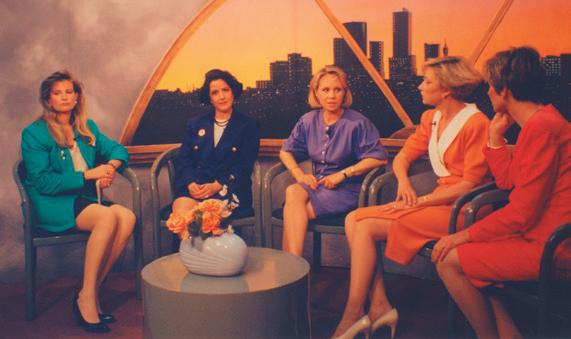
60 In 1985, JLLA membership counted 526 Active members, 1300 Sustaining members, and $6.7 million raised over time and 23 million hours donated.
61 For Gourmet LA: A Collection of Elegant Recipes from the Junior League of Los Angeles, JLLA’s cookbook published in 1988, each recipe had to be tested a minimum of three times – leading to more than 4,500 total tastings! The Cookbook Committee focused on easy, refreshing recipes tailored for busy readers – to great success.
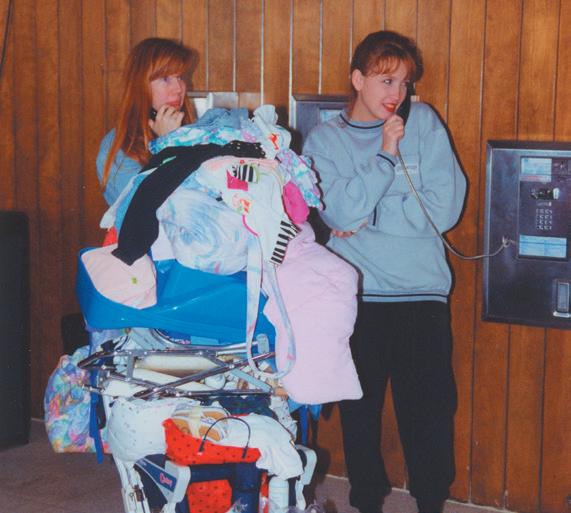
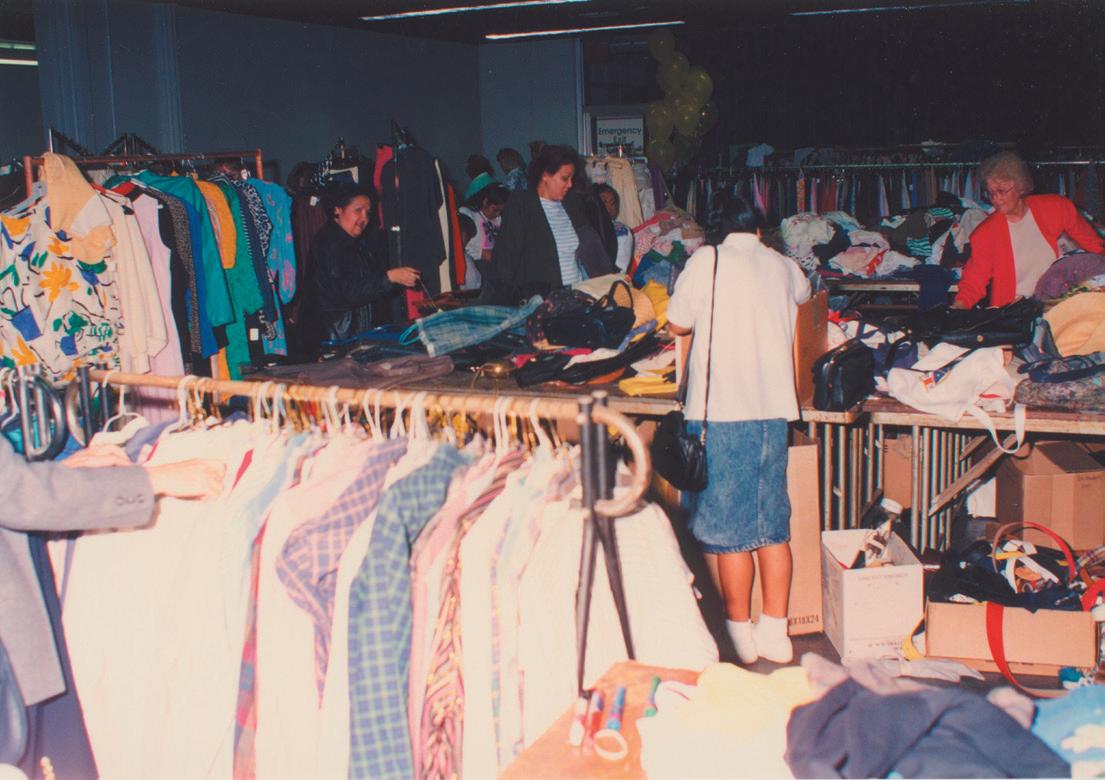
62 JLLA held its annual rummage sale at the Santa Monica Civic Auditorium from the late 1980s until 1999. Designed as both a fundraiser and community service event, members were required to donate merchandise and work the event as part of their development service hour requirement.
63 The Done in a Day Committee was established in 1991 to perform projects in the community that could be completed with a single day-long activity.
64 JLLA, along with co-sponsor Mount St. Mary’s College, created the Women’s Internship Program (WIN) in 1991 to provide public policy role model mentoring and career development options for college women. The Junior League found female mentors in various public policy careers and matched them with students at the college. This successful program ran for 15 years.
65 In 1992, JLLA and the Jewish Family Service of Los Angeles (JFSLA) established Women And The Court System, a program that helped support women experiencing domestic violence, including legal advocacy and court accompaniment. The program also created a Legal Training Advisory Committee to train judges and attorneys working in the area of domestic violence.
66 The “Adolescent Pregnancy Prevention Education” Project, which the League co-sponsored with Planned Parenthood LA, developed a curriculum to teach positive role modeling and skill-building reinforcement to adolescents. It earned the annual BMW Community Impact Award from AJLI in 1993.
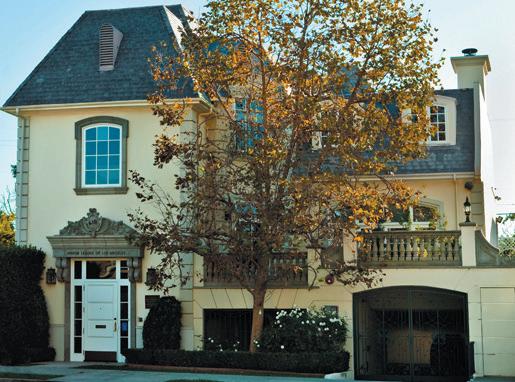
67 Rainey House officially opened its doors in 1995 ending JLLA’s nearly 70-year search for a permanent headquarters! JLLA’s 18th President Marjorie Hamlin Rainey (1943-44) left a bequest specifically to build a long-wished for headquarters. Her stipulations were that the building be in the French Regency style, the groundbreaking had to take place within one year, and it had to be named after her. Although she left land in Santa Monica, that land was sold so the headquarters could be more central. The bungalow on Larchmont was then purchased and the Board got busy with architects and construction. City of Los Angeles Mayor Richard Riordan presided at the grand opening ceremonies!
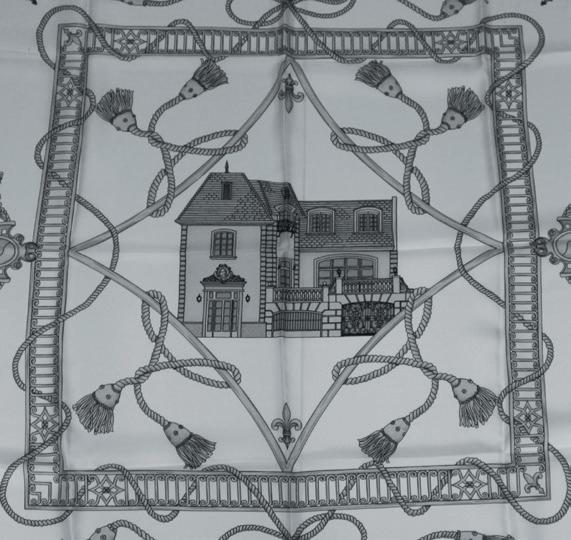
68 To commemorate JLLA’s 70th Anniversary and JLLA’s new headquarters, a silk scarf was designed with an artistic rendering of Rainey House and it still hangs on the wall of the house today. A silk scarf was also designed to commemorate our 100th Anniversary, too!
69 JLLA was the first League in the Association of Junior Leagues International (AJLI) to dedicate its own independent council strictly for the purposes of advocacy and advancing public policy with the founding of the Public Policy Council in 1990. Today, the Public Policy Council is responsible for the League’s advocacy efforts and government relations and has recently been merged into the Training and Advocacy Council.
70 Also in 1990, JLLA formed The Women’s Appointment Collaboration with over 80 other organizations to obtain the appointment of women to Los Angeles County and City Boards and Commissions.
71 The Silent Witness Initiative was a national traveling visual memorial to victims of Family and Intimate Partner Violence. In 1996, JLLA collaborated with the project to display the bright red, life-size wooden silhouettes on the steps of Los Angeles City Hall and the Capitol in Sacramento.
72 In partnership with the Wonder of Reading, JLLA completely renovated two libraries in 2000: Clover Street Elementary School in Culver City and 3rd Street Elementary School in Hancock Park.
73 Due to the attacks of September 11th, JLLA’s first General Meeting of 2001 was cancelled. The League sent a donation to the Junior League of New York with funds raised at the September Rainey Friday and the Community Assistance Funds.
74 To celebrate JLLA’s 75th Anniversary, the League published a special insert in the Larchmont Chronicle, which it also did for the 85th Anniversary, and again for the 100th Anniversary (which you’re reading now)!
75 JLLA welcomed a recordbreaking provisional class of over 150 new members in 2003, earning AJLI’s Best Practice Award for member recruitment. Feeling motivated, JLLA revitalized Leadership Retreat and created the Leadership Boot Camp, leading to a second AJLI Best Practice Award. JLLA then enhanced the Training Non-Profit Leaders program and renamed it Board Fellows Program, resulting in a THIRD AJLI Best Practice Award and $10,000 grant from Crest Whitestrips.
76 JLLA was honored as Outstanding Volunteer Organization at National Philanthropy Day LA in 2002. Six community partners nominated the League for this award.
77
Project partner Hollygrove, which provides health services and developmental programs for children and families in Los Angeles, nominated JLLA for the Los Angeles Mentoring Coalition Award. The Los Angeles City Council presented the League with the Award in 2004.
78
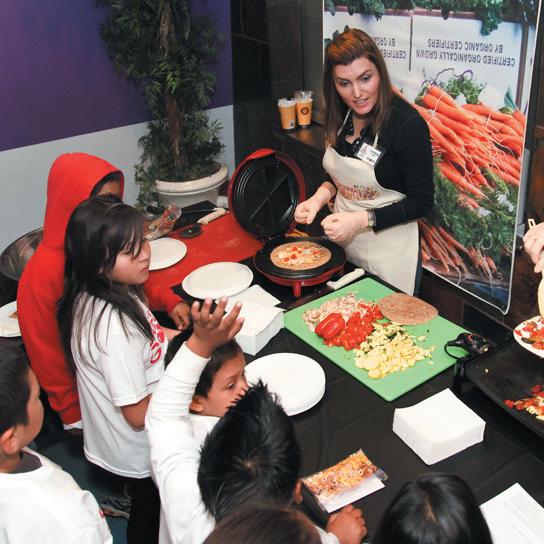
JLLA participated in the inaugural AJLI volunteer week event “Kids in the Kitchen” at the Boys & Girls Club of Venice in 2005. More than 220 leagues across the country and in Canada, Mexico, and Great Britain planned simultaneous events.
JLLA co-sponsors Symphony Previews with the Junior Philharmonic Committee at the L.A. Philharmonic. Later at the Music Center, Symphony Previews presents lectures preceding the afternoon concerts. Average attendance for the free lectures was around 600 attendees. 1953
79 The Holiday Boutique & Tea Party was held at the iconic Beverly Hills Hotel in 2006, with 603 guests, 32 vendors, a silent auction, and a fashion show, bringing guests together for an uplifting holiday shopping event that would lay the foundation for the future Harvest Boutique.
80 Turning Point, an organization that offers crucial shelter and recovery programs for unhoused individuals in Los Angeles, recognized the League’s volunteer impact on its resident guests with its 2006 “Open Heart Award.”
81 In 2009, JLLA’s Leadership Development Institute (LDI) training program won AJLI’s Leadership Development Award and $10,000. LDI is a program designed to empower women with intensive workshops focused on self-discovery, strategic leadership, and effective management techniques.
82 Recognizing what this product could do for women’s health and mental well-being, JLLA brought the topic of microbicide development to the California State Public Affairs Committee (CalSPAC). With the help of State Senator Jackie Speier, the League authored legislation that became SJR22 and was later approved by the California Assembly and Senate in August 2006. In 2007, the Board of Directors voted to support the Federal Microbicide Development Act (MDA), which received bipartisan support in Congress.
83 JLLA authored a significant piece of legislation on Human Trafficking which was passed into law in 2008. The Human Trafficking Victims Protection Act (AB2810) strengthens the state’s response to human trafficking and increases its protections for victims.
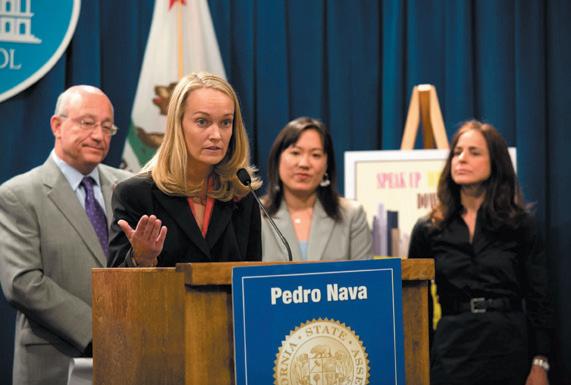
84 JLLA launched California’s “Speak Up When You’re Down” campaign to address perinatal depression throughout the state in 2010. The campaign was designed to raise awareness about postpartum depression (PPD), reduce its associated stigma, and encourage women to seek help. The month of May is now, officially, Perinatal Depression Awareness Month.
Along with the Junior Leagues of Long Beach, Pasadena and Santa Barbara, JLLA produces a thirteen-week television series, “Voluntarily Speaking,” which airs on KTTV.
85 In 2007, the Junior League of Los Angeles established the Public Policy Institute (PPI), a training program that prepares members to serve in public policy within and outside the League. The program received AJLI’s Leadership Development Award in 2010 and has since trained numerous women on state and local advocacy. Thanks to PPI, JLLA members have served on commissions or board appointments, have run for or been elected to public office, or have pivoted to a career in public policy.
86 At the end of 2010, JLLA established the Appointments to Boards and Commissions Institute (ABC). ABC is a training program designed to inform, educate and encourage League members to pursue appointments on California’s many boards and commissions of the local, county and state level and, in turn, to develop civic leaders within JLLA membership.
87 A historical record of the Junior League of Los Angeles’s extraordinary community service and voluntarism now resides at California State University, Northridge (CSUN). As a part of the 85th Anniversary celebration in 2011, JLLA donated its archives to the CSUN Oviatt Library’s Urban Archives Center, the main research facility in the San Fernando Valley and has been updating its archive every year since then. The CSUN Oviatt Library is dedicated to preserving the history of Los Angeles and especially the LA women’s leadership evolution. CSUN published a “Peek in the Stacks” article highlighting some of the items in the Special Archives in honor of our Centennial this year!
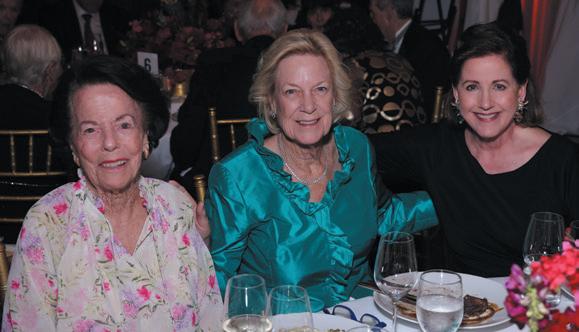
88 Leadership runs in the family at JLLA! Our 64th President Robin Nenninger Nugent was the niece of Biddy Liebig, our 48th President, following in the footsteps of Biddy’s mother-in-law, Caroline Liebig, our 15th President proving that women’s leadership is passed down through generations.
89 Membership voted to split JLLA’s governance structure in 2014, dividing strategic and management duties between the Board of Directors and the newly created Management Council in 2014. AJLI recognized JLLA for its groundbreaking governance plan at the Annual Conference in St. Louis, Missouri.
90 JLLA welcomed Junior Leaguers from all over the world to Los Angeles in 2015 as it hosted the 93rd Annual AJLI Conference. More than 600 delegates from the United States, Mexico, Canada and the United Kingdom attended. JLLA hosted the opening reception at Greystone Mansion in honor of its historical relevance to the League. The year, JLLA won the first-ever AJLI Award for Public Policy for joint efforts to promote awareness for maternal mental health along with California SPAC and the Junior League of San Francisco.
91 Following the Los Angeles riots, JLLA responded immediately by organizing the first of many Donein-a-Day food and clothing drives to help the residents of South-Central Los Angeles.
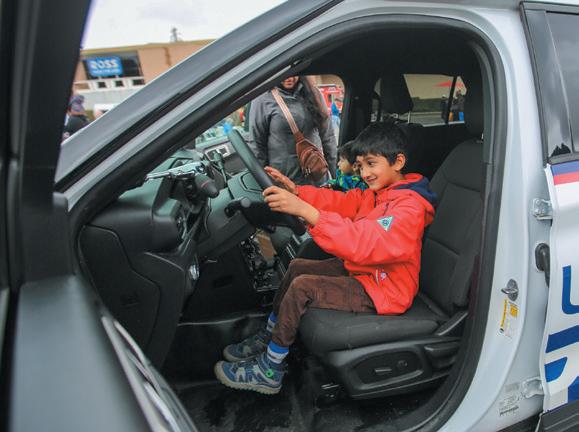
92 Touch-a-Truck took off! Since its debut in 2018, JLLA’s hands-on event has become a fan favorite: kids can climb aboard fire trucks, hop into police cars, and explore massive construction vehicles up close. Now in its seventh year, it draws thousands of families each year… and yes, a few familiar celebrity faces have been spotted joining in the fun, kids in tow!
93 John Welbourne of the Larchmont Chronicle isn’t just a longtime supporter of the League—he’s part of its origin story. His mother, Pauline Cornwell Schoder, was one of JLLA’s founding members and later became Mrs. William E. Welbourne, tying one family of many directly to the League’s very beginnings.
94 For over a decade, JLLA’s Casino Night wasn’t just a fundraiser— it was a full-on Hollywood moment. Picture rolling the dice at Sony Studios, Jim Henson Studios, or the Natural History Museum of Los Angeles County, then realizing your blackjack dealer might be Christina Applegate, Lisa Rinna or Eva Longoria. Only in LA do you gamble for a good cause and get dealt a hand by a celebrity!
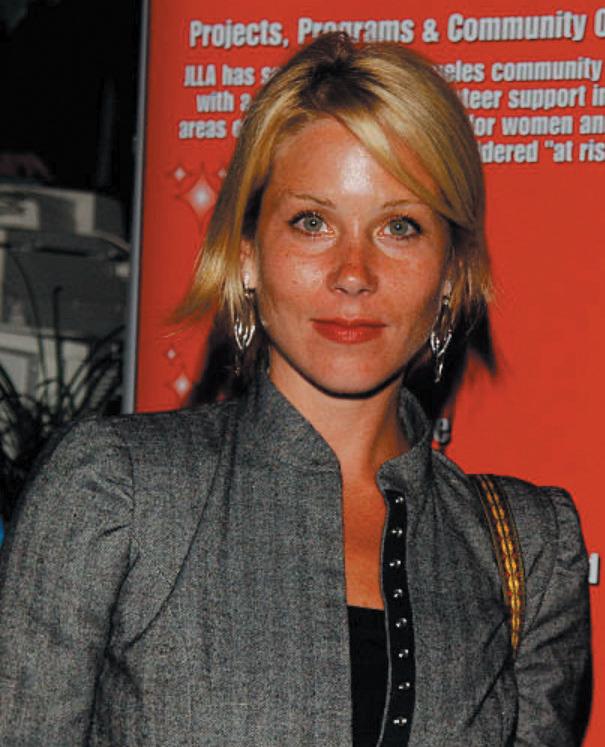
95 In California, taking time to grieve a pregnancy or reproductive loss is now legally protected—and the Junior Leagues helped make it happen. Through CalSPAC, Leagues co-sponsored SB 848, signed by Gavin Newsom in 2023, giving families the space to heal starting in 2024. The impact was so meaningful that Association of Junior Leagues International honored CalSPAC with its top Public Policy and Advocacy Award in 2024.
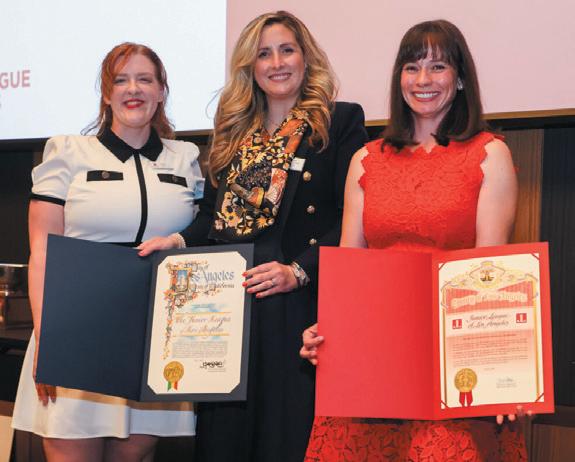
96
In 2025, wildfires devastated the Pacific Palisades and Altadena neighborhoods of Los Angeles, destroying the homes of many members and their families. JLLA members jumped into action, assisting in evacuations, offering housing and support, sharing updates, hosting donation drives, and swapping resources. Some members even coordinated relief efforts while evacuating from their own homes. JLLA launched a Wildfire Relief Fund to provide immediate and long-term financial support to community partners, and earned commendation from the LA County 3rd District Supervisor Lindsay P. Horvath (2025) and Commendation from LA City Councilmember Hugo Soto-Martinez (2025) in recognition.
97
“Dance and you’ll feel better!” In January 2026, JLLA proudly celebrated the construction of a new Dance & Movement Studio at Green Meadows. JLLA formed an innovative partnership with the LA Department of Recreation and Parks, one of the largest community partners in JLLA history, with goals to renovate and renew future park spaces across the city.
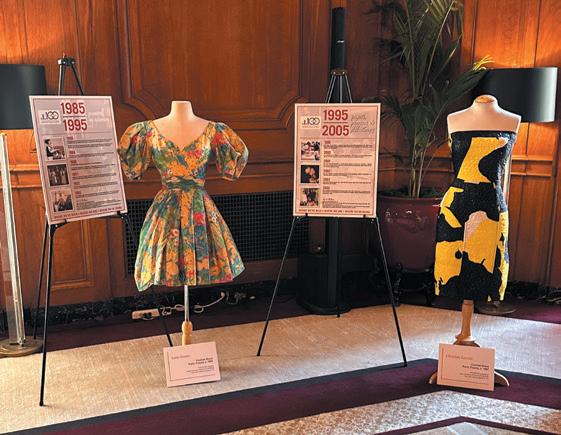
98 The 2026 Centennial Gala at The California Club wasn’t just a celebration — it was a walk through fashion history. Thanks to the FIDM ASU Museum, guests experienced what Leaguers might have worn across the decades — from a flowing 1974 Halston caftan to a glamorous 1985 Loris Azzaro cocktail dress— because in true LA style, even the past shows up dressed for the occasion.
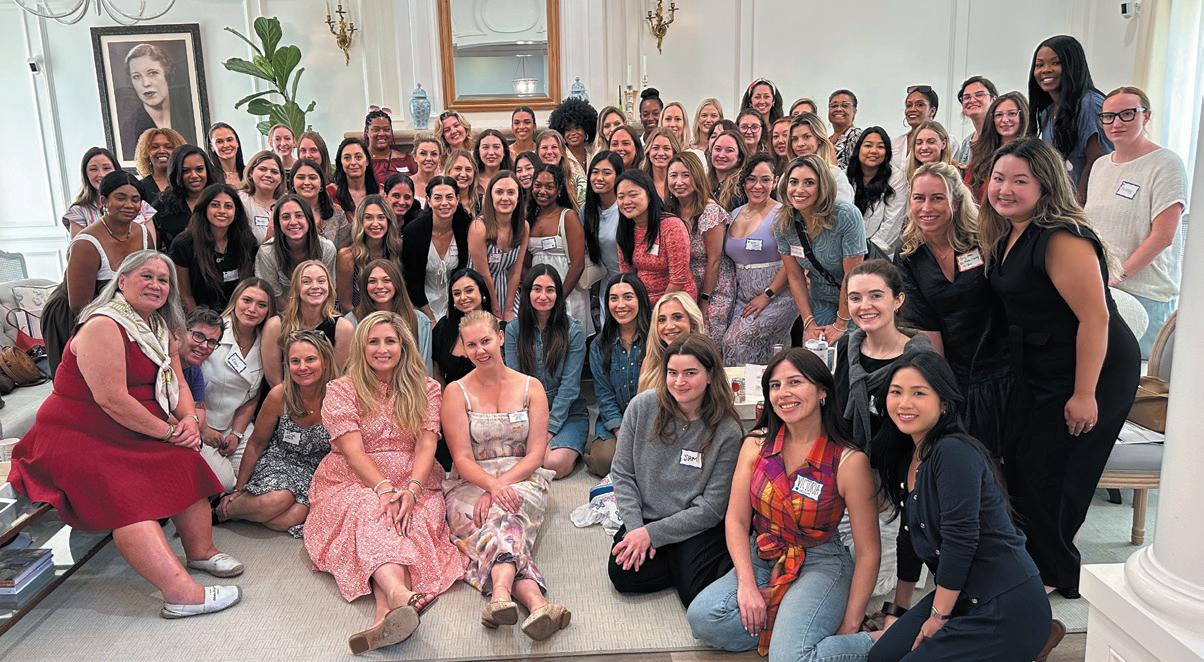
99 As of 2026, the Junior League of Los Angeles is 850+ members strong—and in true Centennial style, welcomed a powerhouse New Member class of 100+, smashing one of its milestone goals for the year!
100 Today, Merriam-Webster’s Dictionary defines a Junior Leaguer as “a member of a league of young women organized for volunteer service to civic and social organizations.”
1954
With the assistance of JLLA, a Girls’ Club is added to the existing Salvation Army Red Shield Youth Center. In its second year, over 400 girls register for Junior League run activities at the center.
1964
League volunteers assist teachers in a Teachers’ Aide program. JLLA volunteers are instrumental in providing the Junior Great Books enrichment program in public and parochial schools throughout Los Angeles County.
Interested in joining us? You’ll develop leadership skills, volunteer with impact, expand your network, learn to advocate in California, and become part of women’s history in Los Angeles! Applications re-open this summer – go to www.jlla.org for more information.
1969
JLLA kicks off a seven year partnership with the Los Angeles County-USC Medical Center. Efforts include volunteering at the main admitting and emergency desks, at the Family Planning Center, and staffing a Child Care Center formed and financed by the League in 1972 which provides an education program for healthy siblings of pediatric patients.
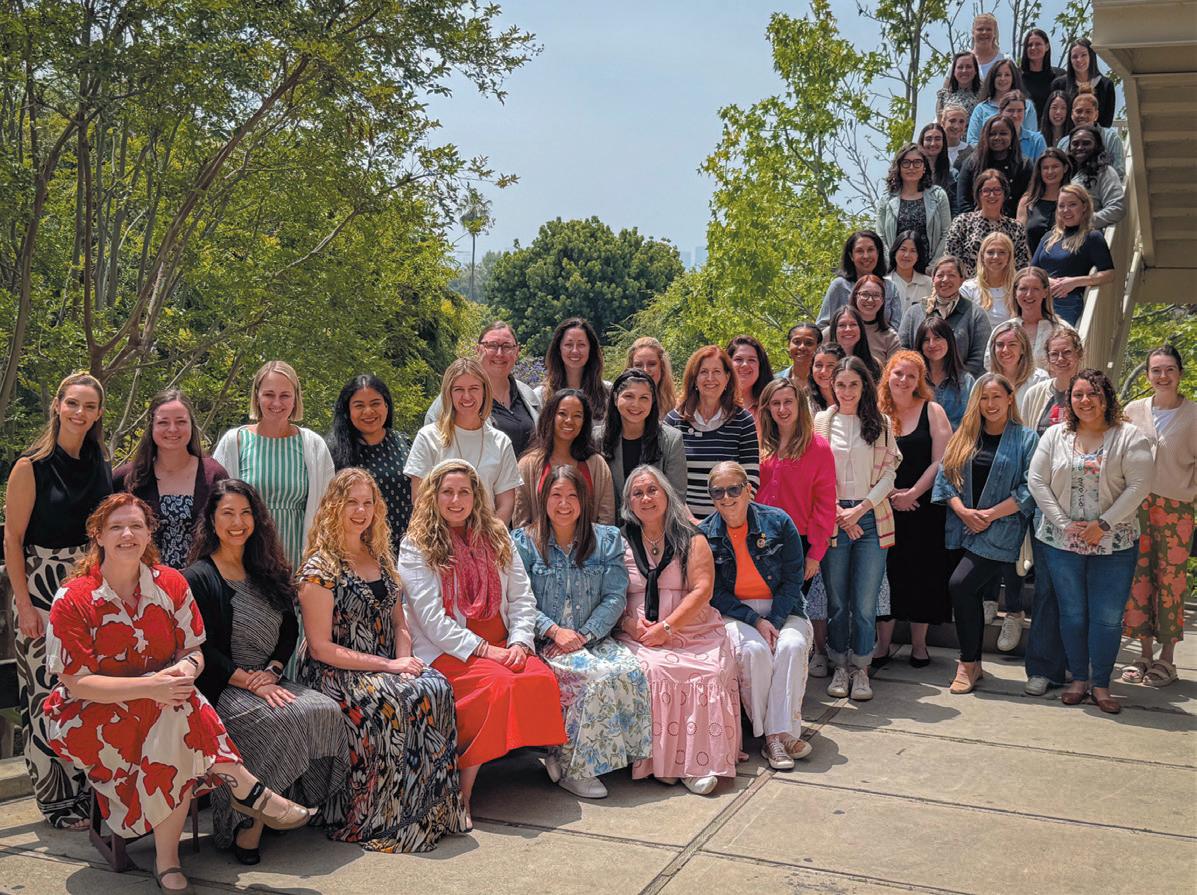
THE NEW MEMBER class of 2025-2026 at Rainey House.
ON LEADERSHIP DAY, 2025-2026 JLLA leaders gathered for training and community.
JLLA’s Beginnings: The Convalescent Home
By Liz Tracton
Originally published in June 2011
Founded in 1901, Children’s Hospital Los Angeles had been treating sick and injured children for twenty-five years when, in 1926, a one-year old group of women known as the Convalescent Children’s League came to the hospital and offered to build and maintain a twelve-bed convalescent home for children discharged from the Hospital to receive continued care in a related facility. Thus began the first of many life-altering projects created by the group that was admitted to the Association of Junior Leagues International (AJLI) in 1926 and became known as the Junior League of Los Angeles.
From 1926-1943, JLLA ran the facility, located on Westmoreland Avenue, just a few blocks from the hospital. League Sustainer, Bonnie McClure, has dedicated much of her adult life to this very special hospital. She served
on the hospital’s Board of Directors for nineteen years and is currently a member of the hospital’s Board of Trustees. “The Westmoreland Convalescent Home of the Junior League accommodated the children who needed rehabilitative services following their hospitalization,” McClure explained. Many of the patients in the home were orthopedic patients suffering from the effects of polio and rheumatoid arthritis.
Junior League members volunteered their time, helping the nurses and entertaining the children. In 1943, the League turned over the convalescent home to Children’s Hospital. The Children’s Hospital Convalescent Home continued to care for children who required longer periods of treatment and many JLLA members continued to do their volunteer placement there until 1973. That year, all the patients were moved to the new Rehabilitation Center on the top floor of the newly
completed McAlister Building of the hospital. Following the relocation of the patients, the former convalescent home’s building was used by the hospital’s Division of Adolescent Medicine.
In 2000, the original building on Westmoreland was torn down due to earthquake damage. When the building was demolished, a time capsule was discovered inside the Cornerstone of the building. The capsule was opened during the Children’s Hospital Centennial Celebration in 2001 by members of the Junior League and contained various articles put there by the determined Junior League members who were devoted to bringing excellent pediatric health care to Los Angeles. These items are now on display in JLLA’s Headquarters, Rainey House, which was built with assets bequeathed to the League by Marjorie Hamlin Rainey, JLLA President, 1943-1944.
The Junior League Cookbook Started In Los Angeles
By Charlotte Otremba
Nearly 100 years ago, the women of JLLA put their heads together. They needed another way to raise funds for their newly-formed League; The National Association of Junior Leagues (ALJI) had only accepted the group a few years earlier in 1926. By then, there were Junior Leagues in 110 cities in the United States and counted over twenty thousand in number between the ages of 20 and 40 years. Their decision would make a lasting impact on Junior Leagues across the country for decades to come.
The ladies of JLLA asked members and friends to submit their favorite recipes. The goal? A casual cookbook: simple recipes compiled into a straightforward book. “We have not attempted to compile a comprehensive recipe book but rather have we selected five hundred favorite recipes of members of the Junior League and their friends,” the dedication reads. The Junior League Recipe Book was pri-
vately printed in 1930, its recipes printed across two hundred six pages. It is dedicated to the Children of the Convalescent Home.
The recipe book is straightforward, indeed. There are no pictures, but there are a touching dedication, description of the Junior League, and a Table of Contents that reflects the wide range of included recipes: Soups, Fish, Spanish and Mexican, Eggs, Desserts and Ices, Cookies, and Sandwiches, to name a few. Among the recipes are Water Cress Soup, Prune Whip with Soft Custard, Chile Con Carne-California, Brains and Artichoke Dore’ from famed The Victor Hugo restaurant, and California Club chef Eugene Voueluscher’s Almond Souffle Pudding.
Fifty-five years later, a new JLLA Cookbook Committee gathered for their first meeting. They, too, had devised the idea as a way to boost JLLA’s yearly fundraising goals. The committee sought fresh, elegant recipes that were easy to prepare and captured the
JLLA joins forces with the Junior League of Long Beach to create a docent marine biology program for children at Cabrillo Beach Marine Museum in San Pedro. In June of 1976, this project was turned over to the Cabrillo Museum Volunteers.
wide range of local ingredients of Los Angeles. “We were a lot of busy women working in the ‘80’s,” Barbara Wright, past JLLA President and Head of Marketing for Gourmet LA told Inspire Magazine in 2010, “so we did focus on making sure that recipes were relatively easy to prepare.”
The Committee also wrote original recipes, conducting research and taste-testing to ensure their quality. Each recipe was tested a minimum of three times, leading to more than 4,500 total tastings! More than three hundred recipes were ultimately chosen; favorites include Baked Goat Cheese with Garlic and Herbs, Roasted Rosemary Chicken, Tortilla Pastel Con Pollo (Tortilla Pie With Chicken), Cranberry Orange Bread, and Polka Dot Brownies With White Chocolate.
Self-published in 1988, Gourmet LA: A Collection of Fresh and Elegant Recipes from the Junior League of Los Angeles is still beloved nearly forty years later.
“It is representative – a
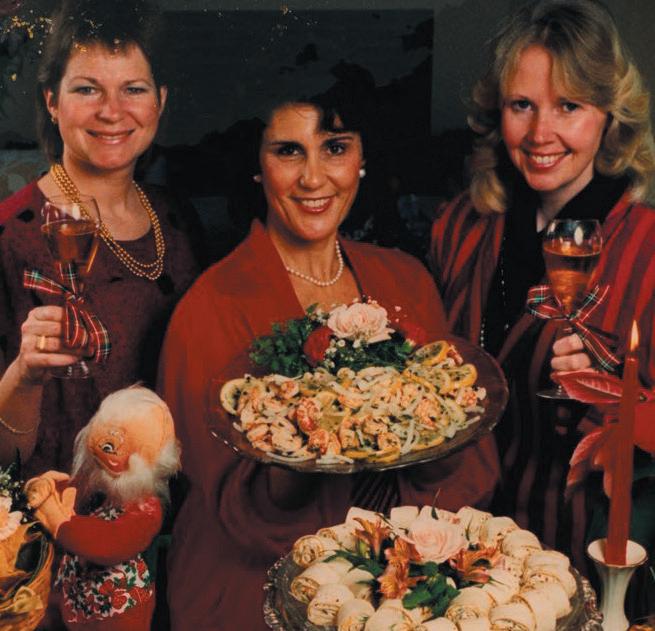
SHERRY SCLAFANI, left, Ellen Weitman, and Catherine Maywood share an array of appetizers from JLLA’s cookbook. Weitman served as cookbook committee chair – the sage stuffed mushrooms (below) remain a family favorite!
benchmark – of one of our most successful fundraising efforts,” said Wright. “We are using it and it’s in our kitchens.”
Two cookbooks capture two eras in the history of JLLA. For both, women were motivated by a desire to raise funds to give back to Los Angeles. They were also motivated by excellence: to create a useful cookbook that reflected and connected members through food. Today, over a third of Junior League chapters have published more than two hundred individual cookbooks that reflect the diverse cultural and regional tastes of their members across the nation. With nearly 20 million copies in print, they are recognized and prized by home cooks around the country.
“Junior League cookbooks have served the organization in so many ways,” AJLI CEO Melanie Schild told League Life Magazine. “Not only did they serve as a massively successful fundraising opportunity for many of our Leagues, but they also provided a hugely effective vehicle for relevance and visibility.”
The Performing Tree, co-sponsored by the Performing Arts Council of the Music Center and the Junior League in cooperation with the Los Angeles Unified School District, brings cultural performances to elementary and secondary schools with a series of music, theater, dance and opera utilizing paid professional performers. The project was the recipient of several large grants and service awards. In June 1976, Performing Tree, Inc., a non-profit corporation was formed to carry on the work begun by the League.
SAGE STUFFED MUSHROOMS
10 ounces bulk sage pork sausage
1 tablespoon finely chopped green onion
1 tablespoon chopped fresh parsley
1/4 teaspoon black pepper
1 clove garlic, minced 1(8 ounce) package cream cheese, softened and cut into large cubes
40 medium mushrooms 1/3 cup butter, melted
Brown sausage in medium skillet until crumbly. Drain.
Add onion, parsley, pepper and garlic. Add cream cheese cubes to sausage mixture.
Remove mushrooms stems and discard. Place mushrooms in single layer in large shallow baking dish.
Brush with melted butter. Stuff with sausage mixture.
Bake at 350 degrees 20 minutes, or until bubbly.
Makes 40 appetizers.
MRS. BRADNER LEE and Mrs. Catherine McCahill Lane with Eddie Cantor and the children of the Los Angeles League’s Convalescent Home, taken when the children were entertained on the Cantor set.
JLLA Creates Variety of Children’s, Veteran’s Programs
Originally published in October 2000
In the early 1940s, the League’s long desired dream of creating a children’s radio program became a reality through the hard work of the “Radio Group.” Every Wednesday on radio station KHJ (the Don Lee School of the Air), adaptations of children’s books were presented to enthused listeners. The program was sponsored by the Los Angeles Public Library and the Los Angeles Board of Education, and Junior League members prepared and produced each broadcast.
A few years later, together with the Los Angeles Times, the Board of Education and station KMPC, the League introduced “Youth Interprets the News” to the Los Angeles Community. Each week, four students from junior and senior high schools participated in the program. These students were invited to read news reports on the air and then make on the air commentaries.
In 1947, a League spon-
sored radio program, “Young America Speaks Out,” won the George Foster Peabody Award. The Peabody Award honored a program inaugurated and broadcast by a regional radio station that made an outstanding contribution to the welfare of the community. “Young America Speaks Out” was recorded weekly from various schools as young Americans would voice their opinions on world topics. In addition to the radio broadcast, the show was later telecast on KTLA Channel 5.
In 1944, when veterans were being discharged by the score and little was known about psychiatric problems resulting from the war, the Junior League of Los Angeles had the wisdom and vision to support the development of a psychiatric facility for veterans in the community.
The pressures of civilian life, crowded housing, dead end jobs and tough military experiences increased the demand for a rehabilitation center for discharged servicemen.
Almost immediately after it came into operation in the spring of 1945, the Veterans Psychiatric Clinic was at full capacity.
Thanks to the Good Hope Clinic, the League secured space for four and a half years. And thanks to the cosponsorship by the Southern California Society for Mental Hygiene, the League set up a Clinic that met every professional requirement. The Junior League supported the Clinic completely for three years after which time it became a Community Chest Agency, which in itself was a tribute to what the League had done in the way of pioneering a service.
In only four and a half years, through the services of one part time psychiatrist, a psychiatric social worker, and a volunteer staff, the Clinic cared for hundreds of veterans with non-service-connected psychiatric problems.
With the support of the Welfare Foundation, the Junior League established the
Music, Arts Programs Flourish in the 50s
Originally published in October 2000
The Junior League of Los Angeles continued its focus on “arts for the community” during the 1950s. Through a co-sponsorship with the Los Angeles County Museum Association, the JLLA Art Views Committee offered a series of free lectures in conjunction with major art exhibitions on view at Los Angeles County Museum of Art. JLLA also created the Symphony Previews, a lecture series preceding Friday afternoon performances by the LA Philharmonic Orchestra.
This project was co-sponsored by the Junior Philharmonic Committee. In 1958, the League’s vocally talented members performed and provided “music for the mending.” Known as the “Larks,” the singing troupe created inspiration for children, senior citizens and hospital patients for nearly two decades and recorded 3 LP albums.
The Puppets Committee, which originated in the previous decade, continued to visit
1978
hospitals, schools, day-care centers and orphanages, entertaining many youngsters.
Another popular trouping committee was Children’s Theater which brought “the stage” to schools and hospitals for years.
A significant amount of League members’ time was devoted to Services for the Blind from 1950 to 1955. JLLA provided soundproof testing booths for this organization. In addition, League members transcribed and bound Braille textbooks and printed Braille guides for the Children’s Zoo.
In 1952, JLLA collaborated with the Salvation Army to establish the Junior League Girls’ Club. The club, which is still located on 11th Street, provided daily recreational and educational programs for hundreds of young girls.
The facilities included playgrounds, recreation rooms, a gymnasium, and an Olympic-size pool. The League then opened the doors of the Girls’ Club to senior citizens and offered a variety of activi-
JLLA co-sponsored the Victim Assistance project with the District Attorney’s office in 1980 to provide aid to victims of violent crime. The project ultimately expanded to seven DA branch offices. The new V.A. Committee wrote a training manual that became available for all victim advocate programs in the state.
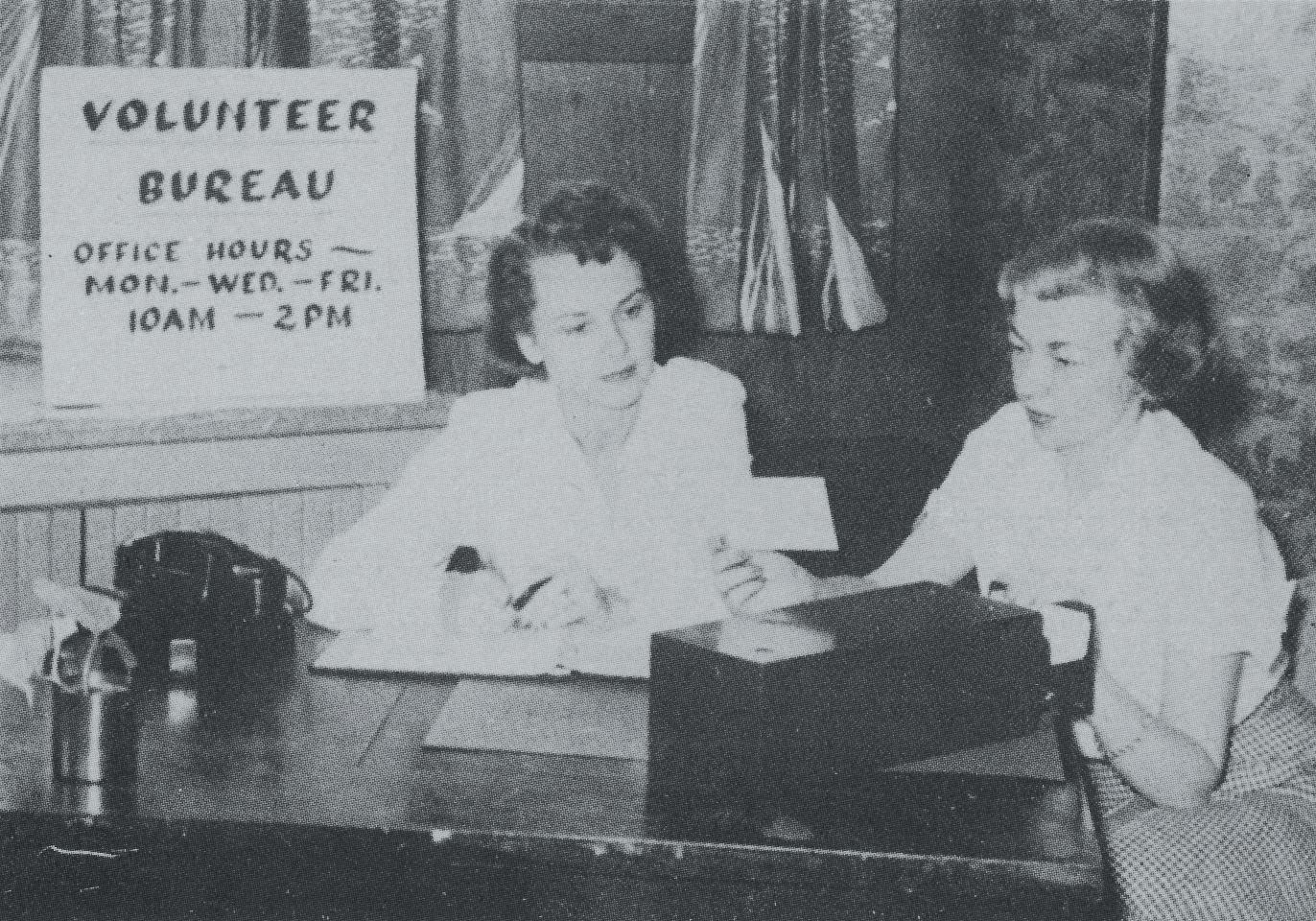
THE VOLUNTEER BUREAU recruited, trained, and placed volunteers in health, welfare, and cultural agencies in Los Angeles. It was established with support of the Welfare Foundation.
Volunteer Bureau in 1947. The Bureau’s objectives were to recruit, train and place volunteers in health, welfare, and cultural agencies of the community. Located on South Figueroa Street, the Bureau was jointly financed by the League and the Community Chest.
For the second time in its history, the Junior League be-
gan a project with Childrens Hospital.In this project, the League provided the funding for remodeling and operating expenses for Childrens Hospital School of Physical Therapy. Physical Therapy was a relatively new science at the time and the League selected this program as a major focus area for the next three years.
Programs Diversify in the 1960s
ties — arts, crafts, book reviews, discussion groups and interaction with members of the Girls’ Club.
Parents breathed a sigh of relief when the Junior League answered a child’s age-old question, “What can we do today?” For eight years the League published “Around the Town,” a guide to children’s activities throughout the Los Angeles community. This detailed booklet was free of charge and provided points of interest as well as admission prices and directions to the activities.
Originally published in October 2000
In the 1960s, the most notable and recognizable contribution to the blind community was the inception and staffing of the Junior League Information for the Blind Center. The Center, which opened at the Farmers Market in 1961, collected and disseminated facilities and services for the blind and the visually handicapped in the Los Angeles Community.
Art exposure and appreciation were major focus areas for the League in this decade.
JLLA initiated and participated in the Los Angeles County Museum of Art docent program, which was later turned over to the community.
Support of the museum continued through special events such as Art Views and the Costume Council. In 1965, Leaguers proudly teamed with the City of Los Angeles to fund and staff the Junior Arts Center in Barnsdall Park. The center supported creative art instruction for 3 to 18 year olds, in addition to housing an art
1979
gallery and workshop area. Other significant achievements included Opportunity Open Door, a cultural and educational enrichment program for underprivileged teen boys and the Teachers’ Aide Program, a collaboration with the City School District Office of Urban Affairs, with the goal to combat absenteeism and high dropout rates. For the next two decades, the League published a guide called “Around the Town with Ease” which focused on providing the disabled with vital information on handicapped accessibility. Just The Answer Gift Shop, a vehicle to raise funds for League Community projects, opened its doors in 1966. For 19 years, the shop was staffed by League members and offered a variety of gifts, antiques and decorative items for purchase.
Children’s Bicentennial Map Committee develops a graphic guide to downtown and its historic architecture. For two years the committee gives docent tours to school children based on the map and promotes the map during the Los Angeles Bicentennial Celebration.
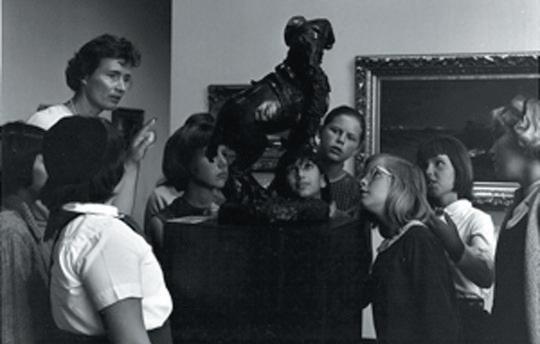
The Los Angeles County Museum Docent Council is about to celebrate its 65th anniversary and continues to touch the lives of thousands of members of the community each year. The role of the docent is more crucial than ever today since the focus on art in classrooms has diminished, with much less funding for art education. The Junior League of Los Angeles played a crucial role in the establishment of the docent program at the museum, thus exposing thousands of children over the years to art.
LACMA has its roots in the Los Angeles Museum of History, Science and Art, established in 1910 in Exposition Park. LACMA was founded in 1910 in Exposition Park, containing a collection of the late Pleistocene fossil bones from the La Brea pits. In 1913, the museum became known as the Los Angeles County Museum of History, Science and Art and the art collection was strengthened through gifts from Preston Harrison, Paul Rodman Mabury and William Randolph Hearst in the 1920s, 1930s and 1940s. In 1961, the Los Angeles County Museum of Art was established as a separate, art-focused institution.
The Junior League of Los CelebratesAngeles Its Contribution to Art Education
In 1965, LACMA opened its doors at its current location on Wilshire Boulevard.
In the late-1950s, ads appeared in Museum Quarterly about the opportunities for docents. At the time, there were three groups that eventually combined their expertise and dedication to form the current Docent Council.
In 1961, one group of fourteen members gave “highlight” tours that included the bones and rocks as well as art.
Another group of volunteers consisted of sixteen members of the Volunteer League of the San Fernando Valley who provided tours for valley residents and their children. The third founding group consisted of twenty-three members of the Junior League of Los Angeles who set out to provide an art experience for fifth and sixth graders.
In 1925, the goals of the Junior League of Los Angeles were to provide volunteer community service in areas where there is need, in fields of education, social services and the arts. The Junior League’s project began when the museum was still downtown. “I was in the second class in the fall of 1961. There was already a small group of women who
The Los Angeles Volunteer Roundtable is convened by the League during National Volunteer Week in 1982. The leaders of 76 volunteer organizations are invited to hear Marlene Wilson speak on “Volunteerism in the 80’s: Challenges Unlimited.”
worked as volunteers in the museum who were very well trained,” said JLLA Sustainer and Docent, Jo Ann Ganz. “It was a big push for arts education. It was a great placement for docents because you learned so much and became qualified to pass it along to the children so it was a benefit both ways.”
One of the early members, Docent Nancy Manella, wrote in a report that the volunteers were encouraged to really “see” the art. The Monet exhibition in 1960 was impactful for her, she wrote, “The group felt slide talks would be more efficient so they found chairs, a projector, a screen and slides, wrote a script and gave the talks.” This new approach to experiencing art was a quantifiable success as 500 people attended the talks on the last day of the exhibit.
In 1961, when LACMA was established as a separate entity with the directive to embrace the entire range of the history of art, the volunteer organizations re-organized into one entity, the Docent Group. They were given one year to prove themselves in order to become a Council, which they easily did. Their goal was to have 200 trained docents by
Computers for Non-Profits, co-sponsored with the California Community Foundation, offers hands-on microcomputer fundamental training to representatives of non-profit organizations. This project is continued with the Center for Non-Profit Management as the co-sponsor in 1986.
“Not only is the appreciation of art important for students, but... here are thousands of docents whose lives have been touched by giving back, exciting, engaging and educating the community about art.”
--
2011 Docent Chair Eleanor Baril
the new museum’s opening date of 1965. On July 1, 1962, the Board of Trustees of the Los Angeles County Museum of Art officially recognized the LACMA Docent Council as a council. In keeping with the educational goals of the museum, the Council’s mission was to extend the museum experience in the fullest possible way to the widest possible audience. Glenn Janss, from the Junior League group, was named the first Chairman. Later, another docent from the Junior League group, Mary Waycott, would become the Docent Chair. “The fact that the Ju-
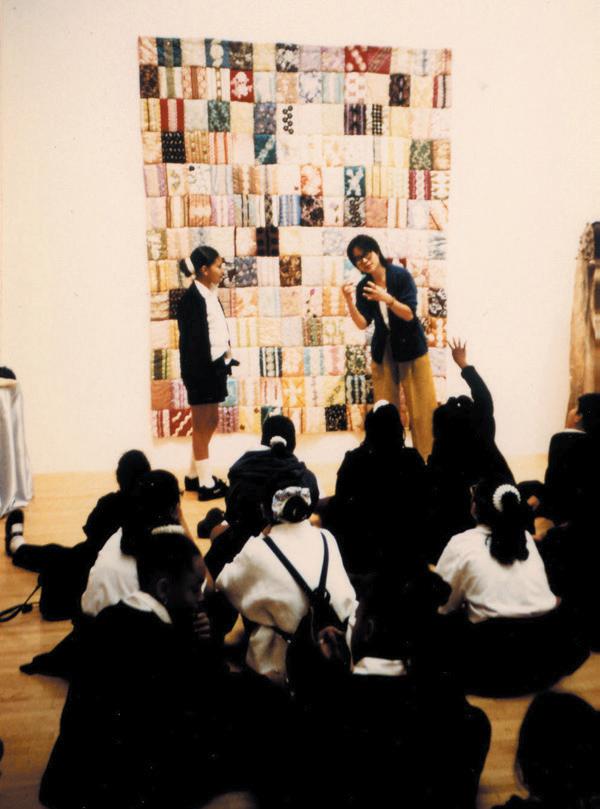
nior League was a part of the original group of volunteers indicates the League’s commitment to the same goals expressed in the Docent Council’s Mission Statement,” said 2011 Docent Chair Eleanor Baril, “and its understanding that the appreciation of art is an important component of one’s own life as well as that of a thriving community.” Not only is the appreciation of art important for students, but, additionally, there are thousands of docents whose lives have been touched by giving back, exciting, engaging and educating the community about art.
Contemporary ArtStart, in partnership with the Museum of Contemporary Art, provides a hands on participatory program to children of the Los Angeles Unified School District to acquaint them with contemporary art and artists.
By Erin Laurence
Originally published in June 2011
1970s Projects Meet Health Challenges
Originally published in October 2000
During the 1970s, JLLA tackled many different social issues in the community.
The League launched a public information campaign to heighten the awareness and prevention of sexually transmitted diseases and hosted a conference with medical, legal, and civic experts about the community problem of rape.
The growing concerns of alcohol and drug abuse were addressed through such programs as Sunrise and the Alcoholism Project. The League continued its commitment to community art education with two specific projects, Art At Your Fingertips and the Craft and Folk Art Museum Project.
The League embraced a multi-faceted project in the late 1960s which extended
throughout the 1970s, the LA County-USC Medical Center Project. Members were able to staff the admitting and emergency areas as well as the Child Care Center. This center provided an education program for healthy siblings of pediatric patients.
The most visible and defining project during the 1970s was the Performing Tree, a three year joint pilot program with the Performing Arts Council of the Music Center. Its purpose was to introduce the best in the performing arts to young children and to expose them to opportunities to realize their own creative potential.
A two-year study of art education in the LAUSD, conducted by JLLA, found that art education was sorely lacking. The League pledged $45,000
Rummage Sales Raise Critical Funds
By Kylee Peña
In 1985, a new tradition began – The Rummage Sale. This massive undertaking by the Development Council soon became one of JLLA’s larges fundraisers, a well-regarded community service, and an unmatched experience for members. The Rummage Sale contributed more than half a million dollars for the support of the League’s projects and community effors. These funds enabled our trained volunteers to impact the community by providing an extensive range of services for children and families at risk.
Sales were held at facilities such as the Santa Monica Civic Center, with items for sale contributed by JLLA members. There was even a
pre-sale party for members, friends, and family. Donating to or volunteering at the Rummage Sale was a requirement – sign-ups for shifts were accepted via mail! Plus, members received additional credit for recruiting friends to work the Sale with them.
The 14th and final Rummage Sale in October 1999 raised $83,100. Corporate sponsors and donors contributing to the event’s success included Circuit City, Coffee Bean & Tea Leaf, Souplantation, Western Bagel, Universal Pictures, and many more.
Today, many Junior Leagues continue to host annaul Rummage Sales.
JLLA is the first League to start an AIDS Community Education Outreach Project, co-sponsored with AIDS Project Los Angeles. It creates a JLLA staffed hotline and corporate Speaker’s Bureau providing much-needed information to the community.
over three years to bring diverse performing art experiences such as opera, dance, improvisation, magic and mimes, into the school curriculum.
The project received sizable grants and service awards in addition to widespread academic support. JLLA extended its commitment to the project for a fourth year and then in 1976, The Performing Tree, Inc. was formed to carry the program forward.
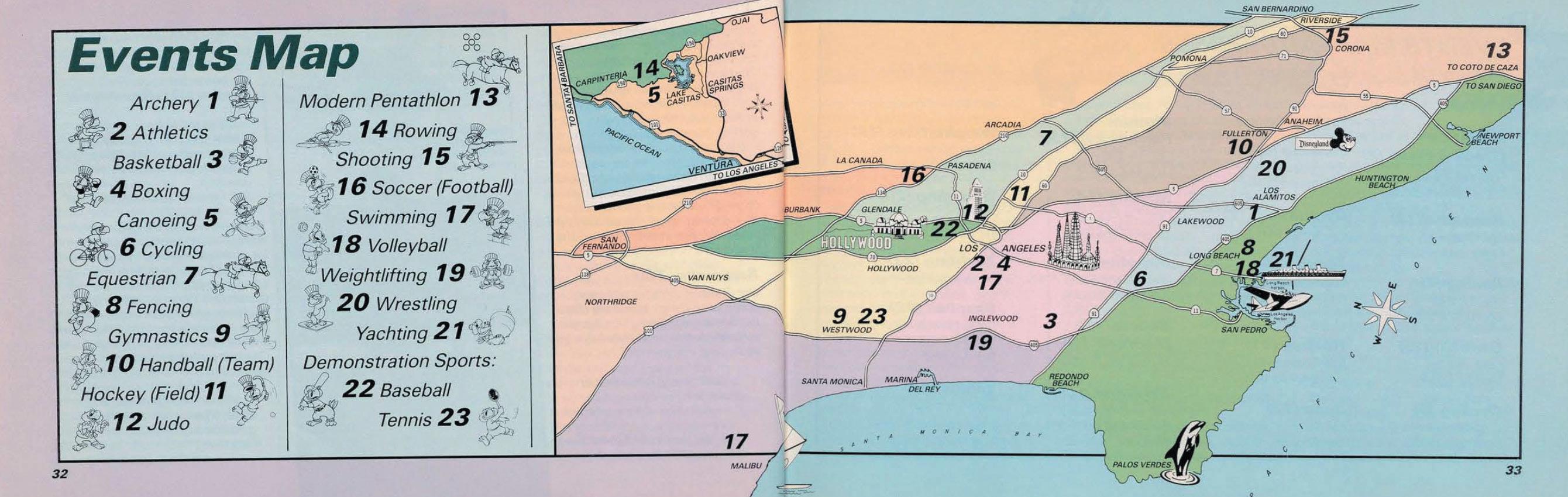
IN 1984, JLLA and the Los Angeles Olympic Organizing Committee produced an Olympic Youth Handbook to distribute to schools and libraries across LA, Orange, and Ventura counties. Written for fourth to eighth graders, the 176-page Handbook includes sections on the history of the Olympics and explanations of each sport. The book was written and designed over four years by JLLA members.
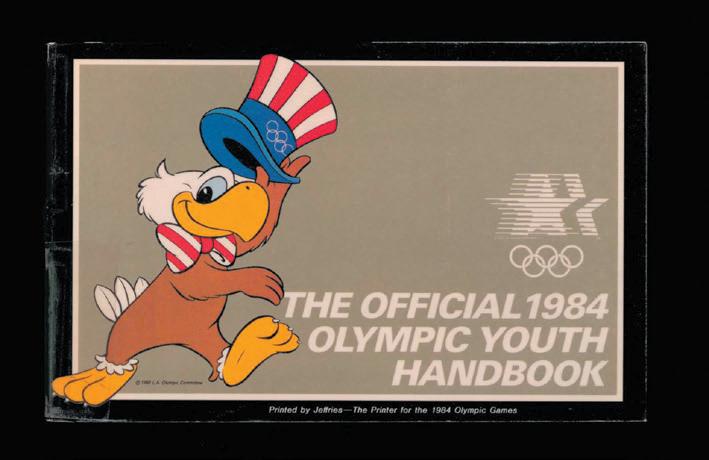
JLLA’s LA28 committee is currently planning our involvement in the 2028 Summer Games!
90s Projects Assist Babies with AIDS, Education
In 1990, Caring for Babies with Aids, a non-profit organization in Santa Monica, asked the Junior League of Los Angeles to co-sponsor a new project with them. For the next three years, JLLA members developed a Volunteer Manual as a guide for working with HIV-positive children, coordinated a volunteer program, developed the traveling resource center, and provided home support through donations of goods and services. During this time, the League also began a project with Culver City Youth Center called "Ask Us About AIDS" which focused on peer counseling for high risk adolescents.
In 1993, JLLA received two awards at the Association of Junior Leagues International Annual Conference.
JLLA received the first place Creative Public Relations Award for the City Window episode, "Caring for Babies with AIDS" and the BMW Community Impact Merit Award for "Adolescent Pregnancy Prevention Education."
For well over five years the Junior League has been involved in the area of Domestic Violence. Our first program, Silent Witness, began in 1996 when the Junior League of Los Angeles
organized the Silent Witness Exhibit as part of the National Silent Witness initiative to end domestic violence. This exhibit is a public display of life-size silhouettes and represents Los Angeles County women who were murdered in acts of domestic violence. The goals of Silent Witness are to: remember the women; raise awareness of the issue; advocate to and for those in need; and encourage legislative action to end violence in our society.
JLLA has also held a number of "Refuse to Abuse" student assemblies providing education for teenagers to help break the domestic violence cycle. Currently, JLLA members are working with LA County/U.S.C. Medical Center's Violence Intervention Program which focuses on sexual assault and domestic violence victims. JLLA members support the efforts of the staff by working with the children implementing the Free Arts
program at its treatment facility. Finally, as part of its public awareness program against Domestic Violence, the Junior League provides both Domestic Violence Pamphlets, currently in six languages, and the Survivor Wallet Cards. As of October 2000, JLLA will have refurbished and restocked 6 elementary school libraries: Carthay Elementary School; Kester Elementary; Denker Elementary; Windsor Hills Elementary; Third Street Elementary; and Clover Avenue Elementary. In many of these schools, JLLA has also provided volunteers to work with the students on their reading skills.
The Chrysalis project also began in 1998 with the objective of helping disadvantaged women become self-sufficient through employment. JLLA volunteers provide many of the basic skills needed, such as resume writing and interview techniques to obtain a job.
JLLA collaborates with the non-profit Caring for Babies With AIDS and developes a Volunteer Manual as a guide for working with HIV-positive children. The League also helps coordinate the volunteer program and the traveling resource center and provides support in the home through coordination of donated goods and hands-on projects.
CITY WINDOW, a JLLA produced local access series, produced an awardwinning episode on Caring for Babies with AIDS. The episode was hosted by former JLLA president Wendy Woods Chandler.
JLLA creates the first Public Policy Council in the Association of Junior Leagues International, Inc.
Originally published in October 2000
Partnership to End Homelessness: Downtown Women’s Center and JLLA
By Kristin Stark
Originally published in June 2011
Los Angeles’ Skid Row has the largest concentration of homeless in the country with between 8,000 and 11,000 people living in this part of downtown Los Angeles under appalling conditions. Although there are several shelters serving this area, only a few of them cater exclusively to addressing and meeting the needs of homeless women on Skid Row. The first shelter to do so was The Downtown Women’s Center (DWC).
The partnership between the Junior League of Los Angeles and the Downtown Women’s Center grew out of a shift in thinking about how we chose our community partners. Previously, community partners that received assistance from JLLA were selected from a field of applicants. At some point, however, it became clear that many organizations were so overwhelmed with their own work, that applying for JLLA assistance was a low priority.
When past JLLA President, Julie Guest, was Projects Director in 2001-2002, she saw that the process was in need of revamping. During the following year, as Community Director, she, along with JLLA’s Projects Research and Development Chair, Shelli Herman, went about developing a new selection system. The decision to partner was clear from the moment Ms Guest and Ms. Herman visited the Center. “From the moment we walked in,” recalls Ms. Herman, “we knew it was absolutely the right place for the League to be. The energy was good, they were a group that was totally together, but they still needed help, and I think that’s what was important for us. We just instinctually knew that they really, truly needed a group like ours to help them. It was women, it was Skid Row. There were so few organizations working down there because people were afraid to be there. But the League has never been afraid to be where they need to
be and we’ve never shied away from problems and issues.”
Ms. Guest adds, “DWC was helping homeless women in the heart of the business community of our city. The Center was succeeding as a model for other cities to build upon. How could we not make that a Junior League priority?
Once JLLA chose DWC as a community partner, the next step was creating a program that would resonate for the women there. The committee tasked with this job spent time speaking to the DWC staff as well as the potential participants to gain an understanding of their backgrounds and interests. After much data gathering, JLLA created the “Whole Woman: Saturdays for Yourself” program which aims to assist DWC participants –both residents and drop-ins – to both redefine and realize their potential. The program guides women on paths toward self-awareness, self-motivation, and self-sufficiency with supportive services.
For JLLA volunteers, the
experience of working at DWC has been enlightening. “You get to see first hand what women of extremely diverse backgrounds are experiencing in downtown Los Angeles,” says Erika Zimmerman, a former JLLA and DWC committee member. “I left with an extremely humble heart and feeling that generalizations are often so inaccurate when it comes to this population. I met extremely bright and educated women with great life stories. I respected them… and really felt as though my time at DWC brought about a difference in the lives of the women I interacted with. This project really shaped me into the person I am today.”
All JLLA projects are transitioned back to the community after three to four years;
once it is clear that the community partner can self-sustain the program should it choose to do so. Due to the success of the partnership between the League and DWC, the project has had a prolific six-year life, but we will be handing over the “Whole Woman” program to DWC in May 2011.
As the two groups began the separation process, it was clear that both have benefited from the experience of having the other involved in their organization and that they are better organizations because of the partnership. But, most important, they have each helped countless homeless women make better lives for themselves. And, that is the mark of true success for all of us.
Letting Kids Be Kids in Nature with Happy Trails
By Marsha Sallai
What began as a personal act of love and care in 1982 by Pepper Edmiston has grown into a vital source of support for foster youth across Los Angeles. Happy Trails for Kids carries the promise that every child deserves moments of joy, connection, and hope. For the past six years, the League has stepped in with compassion and commitment, creating experiences that offer not only fun, but also healing
and belonging.
Happy Trails delivers more than outings, it brings smiles, laughter, and a sense of belonging to Los Angeles foster youth. For many of these children, the program provides rare opportunities to simply be kids: to explore, discover, and dream.
The children served by Happy Trails have often experienced profound trauma and significant loss of safety, stability, and love. And yet,
they continue to embody remarkable resilience and hope. League members have shared meaningful outdoor experiences with the children of Happy Trails, whether walking along the beach, observing wildlife, or learning from experts in nature. Time spent in nature and shared experiences remind them that difficult seasons pass and brighter days are possible. Together they are creating space for curiosity, growth, and healing.
Supported by League members, these moments underscore the difference a single day can make. “To be given the opportunity to serve as Chair of the Happy Trails for Kids Committee for three of my seven years in JLLA is one of the great privileges of my heart and life,” reflected Bess Rous, Happy Trails for Kids Committee Chair 2023–2026.
JLLA is proud to be a partner in creating moments that are simple yet powerful, re-
minding us that even one safe, joyful day can shift a child’s perspective and help build confidence, curiosity, and a sense of possibility.
Our long-standing commitment to Happy Trails for Kids demonstrates the League’s ongoing dedication to service, collaboration, and compassion, ensuring meaningful experiences that positively shape young lives every day.
Two Decades of Impact with The People Concern
By Julie Guest
JLLA has partnered with The People Concern for more than two decades, creating a sustained and meaningful impact on individuals experiencing homelessness in Los Angeles.
JLLA Past President Julie Guest credits her League training for her leadership on the boards of both OPCC and The People Concern, including serving as board chair during the merger of the Ocean Park Community
JLLA establishes a Community Assistance Fund enabling local non-profits to request and receive emergency funding from the League.
Center (OPCC) and LAMP. Reflecting on her experience, she shared that being part of the work is “uplifting,” as it helps vulnerable neighbors become housed, healthy, and safe.
JLLA’s work began with the Turning Point project in 2003 through OPCC, providing transitional housing and support for individuals experiencing homelessness. Residents received shelter, meals, counseling, and the opportunity to save the majority of their income as they
prepared for long-term stability. The League enhanced this program through its Life Leadership Workshops, which equipped participants with practical skills such as budgeting, goal setting, and securing housing. Activities like creating “Dream Boards” helped participants envision and plan for a more stable future.
Through this work, League members formed meaningful connections and gained insight into the complex causes of homelessness,
With Planned Parenthood, Los Angeles, JLLA develops curriculum to teach positive role modeling and skillbuilding reinforcement to adolescents as part of Adolescent Pregnancy Prevention Education.
including medical debt, job loss, domestic violence, and the high cost of living.
In 2008, JLLA expanded its partnership to include Daybreak, a program serving women experiencing homelessness, many of whom faced trauma and mental health challenges. Through book discussions, wellness activities, and creative outlets like Daybreak Design, participants built confidence, community, and income opportunities.
Over the years, this part-
Domestic violence brochures and survivor cards are developed and printed in English and Spanish. In 1994, JLLA joins with the LA District Attorney Office in launching city-wide domestic violence billboard campaign.
nership has grown through volunteer events, training, and leadership pathways— demonstrating the lasting impact of collaboration, compassion, and women’s leadership in action.

JLLA VOLUNTEERS discuss food nutrition with a DWC participant.
Holiday Boutique: A Legacy of Friendship, Leadership, and Heart
By Marsha Sallai
For many members of the Junior League of Los Angeles, the Holiday Boutique in all its evolutions holds a special place in our hearts. More than a shopping event, it has always been a celebration of friendship, leadership, and women coming together to make a meaningful difference.
In 1994, Marsha Sallai (Tauber) chaired Holiday LA, a two-day event that filled The Ebell of Los Angeles with energy and excitement. The event sold out and drew overflow crowds for both the wine tasting and boutique. More than fifty vendors, a VIP KickOff, fashion show, auctions, cooking demonstrations, and a lively luncheon created an unforgettable weekend.
Equally meaningful were the behind-the-scenes moments, Provisionals, Actives, and Sustaining members working side by side and forming friendships that would last for decades. The event united League members, friends, and the greater Los Angeles com-
munity around a shared purpose.
That spirit continued as the Boutique evolved. In 2006, Lauren Ekerling chaired the Holiday Boutique & Tea Party at the iconic The Beverly Hills Hotel. Encouraged to step into leadership before she felt fully prepared, she embraced the opportunity and led the event to a sell-out of six hundred three guests, featuring thirtytwo vendors, a silent auction, and a fashion show. Though the late nights were demanding, the sense of accomplishment and the pride of bringing something beautiful to life with a dedicated team made it worthwhile.
Elissa Refold, Harvest Boutique Chair (2018–2019), recalls arriving at the JW Marriott before sunrise with her committee after months of preparation. Setting up as the light changed, taking photos in their dresses, and watching the first attendees trickle in for the VIP hour, the venue soon buzzed with excitement. What struck her most was that they were carrying forward a
tradition built by generations of women before them. Every detail coordinated and every dollar raised connected directly to JLLA’s mission and programs. Watching months of teamwork culminate in both community connection and meaningful impact was deeply rewarding.
In 2023, Chair Katie McGorman described Harvest Boutique as one of the most meaningful leadership experiences of her time with JLLA. Producing the event required vision, discipline, and collaboration from managing the committee to partnering closely with League leadership and it stretched her in all the best ways. She was proud to welcome a packed room of friends, colleagues, and family, knowing the team had created an afternoon that was both beautiful and purposeful. Sharing the stage with admired League leaders and her co-chair, Ashley AllenMurphy, reflected the strength and generosity that define the organization.
From Holiday LA to Holi-
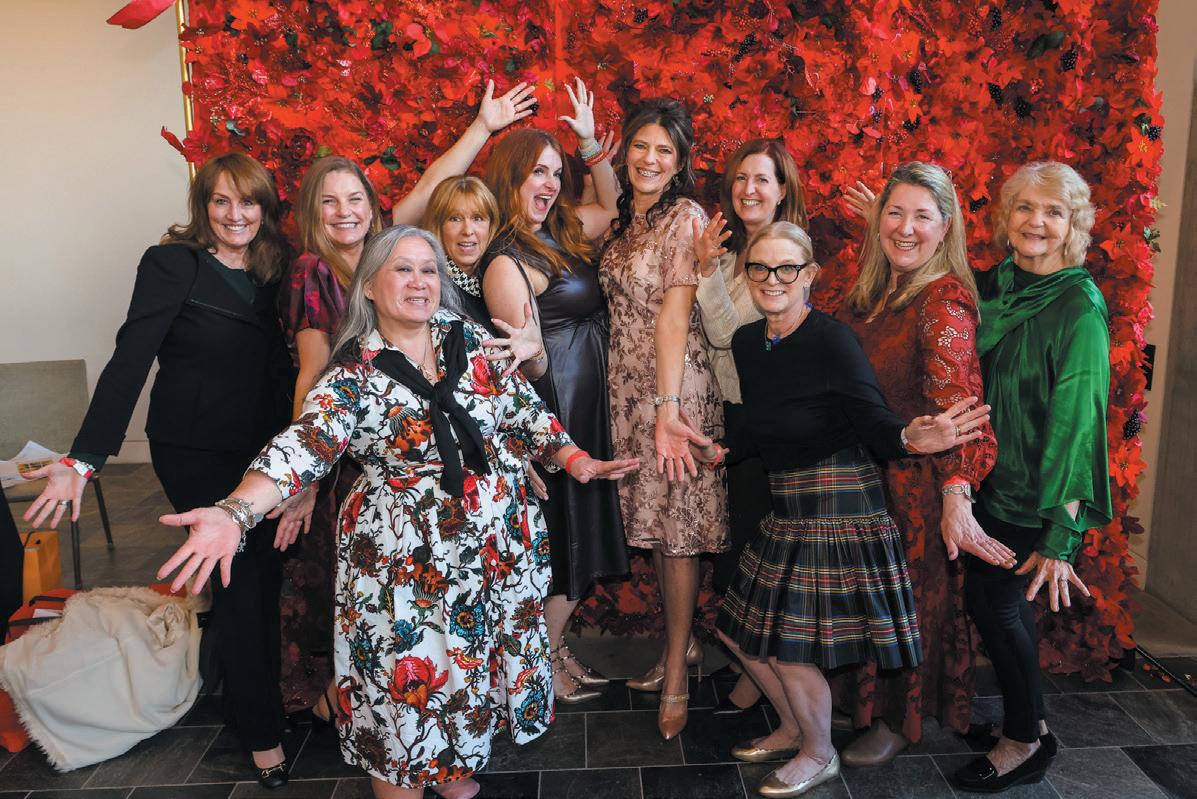
day Boutique, Harvest Boutique, and Rainey Market, the details may evolve, but the heart remains constant. These events do more than invite us to shop; they cultivate leadership, deepen mentorship, and strengthen community.
When women come together with purpose, the impact extends far beyond a single day — it becomes part of a legacy that continues to shape Los Angeles for generations to come.
JLLA Finds a Home of Its Own on Larchmont
Originally published in October 2000
In 1995 the Junior League of Los Angeles moved into its permanent home, Rainey House, on Larchmont Boulevard. Prior to this, JLLA has served the community from rented donated office space. From 1925 until 1970, a number of locations had been used, including a cottage at the Beverly Hills Hotel and a room at the Beverly Wilshire Hotel. For the next 25 years, the League had been headquartered in 1,600 square feet of space at the Farmers Market, provided through the generosity of the Gilmore Corporation and Foundation.
For many years, the Junior League dreamed of building a home of its own. To realize this dream, a feasibility study was conducted in 1986. And following the study, the Board of Directors began looking for a site on which to build the JLLA headquarters. The new headquarters would serve as a meeting place for members to collaborate with each other and with community leaders.
Aided by the continuing generosity of Grace Ford Sal-
vatori and of our membership, the Junior League dream of a permanent headquarters building was finally realized when Marjorie Hamlin Rainey, a past president of the League, bequeathed a million dollars to the League to build a headquarters. That permanent headquarters is fully functioning today at 630 North Larchmont Boulevard.
Groundbreaking for the new Junior League of Los Angeles home took place on November 16, 1993. The Dedication Ceremony for the Marjorie Hamlin Rainey Headquarters followed almost two years later on September 22, 1995.
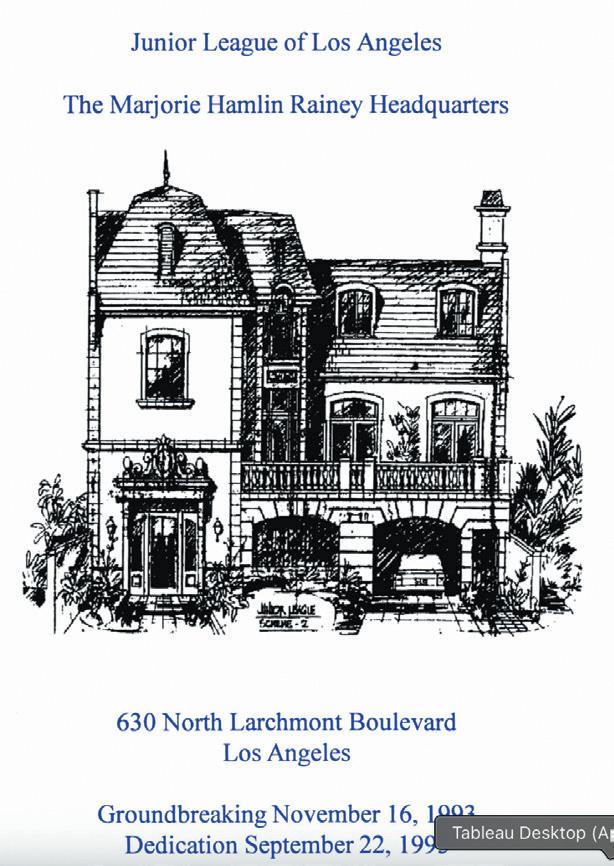
JLLA hosts “At The Table,” a national com munity outreach effort sponsored by the White House. Ms. Gwendolyn Brown, Assistant Secretary for Defense, facilitates the event, which focuses on issues facing women in the Los Angeles community. Participants include women from the political arena, the arts community, law enforcement, senior citizens, and JLLA members.
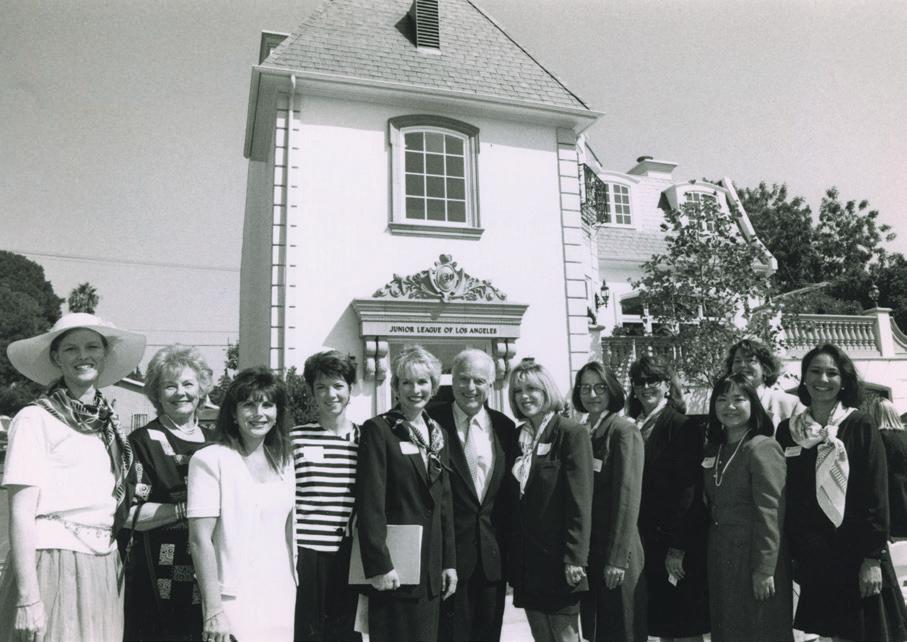
AT DEDICATION: (left)
Mayor Richard Riordan (surrounded by JLLA board members) was guest speaker at the dedication of the Junior League of Los Angeles headquarters building at 630 N. Larchmont Blvd.
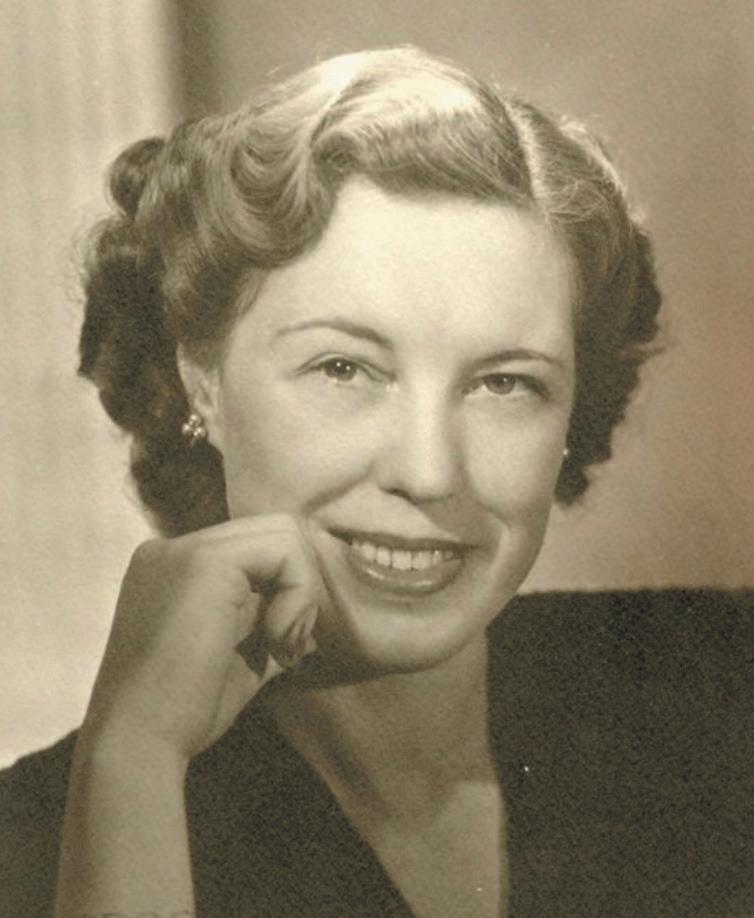
THE GROUNDWORK for the League’s first permanent headquarters was laid when past president Marjorie Hamlin Rainey, pictured left, bequeathed assets worth more than one million dollars to the organization.
JLLA participates in the inaugural AJLI volunteer week event, “Kids in the Kitchen,” at the Boys & Girls Club of Venice. Over 220 Leagues across the country and in Canada, Mexico and Great Britain plan simultaneous events.
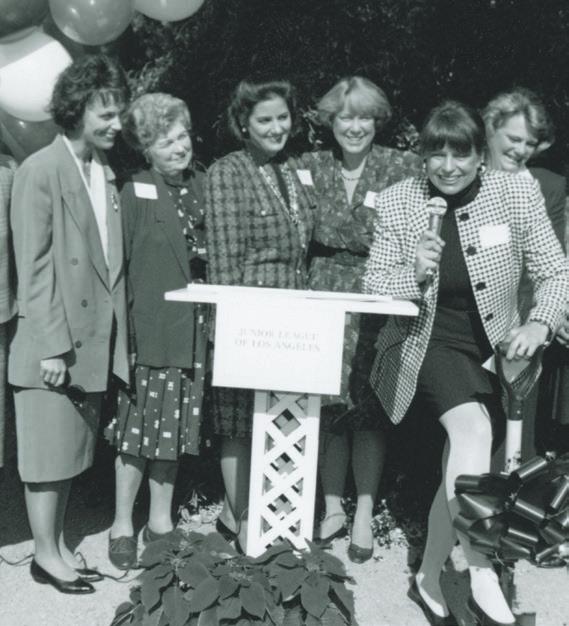
in September 1995. Members are, from left to right, Mary Ruth Hardesty, Fran Muir, Lisa Hallaian, Beth Quillen Thomas, Kimila Ulrich (1995 president), Mayor Riordan, Linda D. Small, Yolanda Brown, JoAnn Bourne, Melody Mishida, M'Leigh Koziol and Joanne Coghill. (right) Members held a groundbreaking ceremony on the site nearly one year from the date of the gift on November 16, 1993.
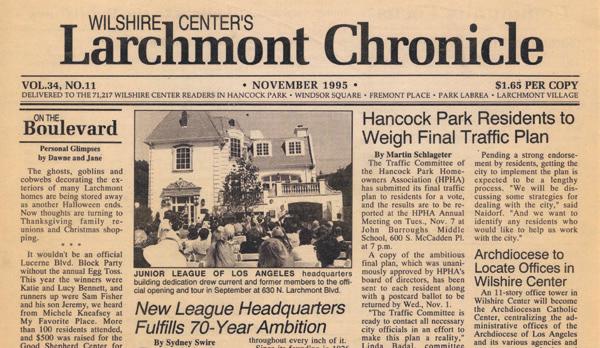
AT THE 2024 HARVEST BOUTIQUE at the Skirball Center, Spirit of Voluntarism honoree Terrie Weeden (center) celebrates with Shaunna Raab, Bonnie Wong, Alexa Bleifer, Nichole Kuclok-Waldman, Elizabeth Curtis, Lauren Ekerling, Maria Higgins, and Joan Prestine. THE NOVEMBER 1995 issue of the Larchmont Chronicle covered the dedication of Rainey House.
As part of the 85th Anniversary celebration, JLLA donates its archive to the CSUN Oviatt Library’s Urban Archives Center. Since then, the League contributes materials every year so the archive remains a complete collection of our history.
Across LA, Leaguers Answer Call to Action
By Coley Nelson
On February 28, 2026, the Junior League of Los Angeles (JLLA) demonstrated the power of collective action during its annual Impact Day, a dedicated day of service that saw over 100 JLLA volunteers support seven non-profit organizations across Los Angeles County. Since 2023, the Impact Day initiative has partnered with nearly 20 local organizations to provide hands-on volunteer support in areas including food insecurity, youth empowerment, childhood literacy, and foster youth support services.
In celebration of JLLA’s Centennial year, Community in Action Co-Chairs Sandi Bourbeau and Nicole Kucera prioritized reconnecting with the League’s most storied community partners. This historic focus included a volunteer shift supporting Children’s Hospital of Los Angeles (CHLA)—the recipient of the JLLA Convalescent Home in 1943—and a project with AIDS Project LA (APLA
Health), honoring JLLA’s legacy as the first Junior League to establish an AIDS project. The committee also strengthened long-standing ties with Make Good Inc. and Children’s Institute while reconnecting with historic partner Pacific Clinics - Hollygrove.
In North Hollywood, our team of volunteers worked diligently to sort and bag food items at the AIDS Project LA (APLA Health), an agency that provides HIV/AIDS health services and housing services, to support their robust food pantry program. During their designated on-site shift, volunteers prepared 622 bags of food for clients in just three hours! In Santa Monica, JLLA members hosted bingo games and served lunch to clients of The People Concern, which provides housing, services and advocacy to unhoused individuals in Los Angeles.
At JLLA Headquarters, two teams of volunteers initiated projects preparing supplies to distribute to community partners. Members assembled over 100 art supply kits for patients
at Children’s Hospital of Los Angeles and packed over 80 snack bags for the Downtown Women’s Center. In Larchmont, non-profit organization Pacific Clinics - Hollygrove, which provides health services and developmental programs for children and families in Los Angeles, hosted a family event for their clients. JLLA volunteers helped set up the event, facilitated games for the youth attendees, and ensured the families in attendance had an unforgettable experience.
At its Echo Park campus, a team of over 30 JLLA members supported the Children’s Institute in hosting their 12th annual Father/Daughter Tea in collaboration with Project Fatherhood with the theme of “Alice in Wonderland.” The Children’s Institute provides education and youth programs, counseling services, and parenting support to underserved communities. Community in Action Committee members Erin Murray and Holly Freeman oversaw JLLA’s support by planning hands-on activities for the fa-
ther and daughter attendees by setting up a headband and hat decorating station and offering customized goodie bags for elementary, middle, and high school participants. Attendees enjoyed refreshments such as tea, mini desserts, and cupcakes generously donated by SusieCakes.
At the Make Good Inc. at Emporium site in Mid-City, a dedicated group of sustaining members supported staff in organizing and categorizing donations and supplies that will be utilized for future programs supporting foster youth
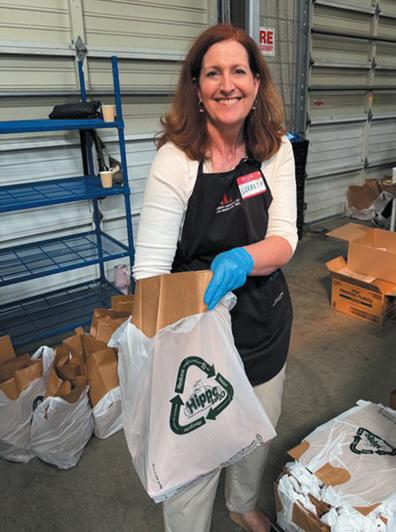
Leading Through Crisis When LA Burned
By Cristina Rivard
On the morning of January 7, 2025, I received a text from Dawn Eash Wazzan, who was serving as President-Elect at the time, flagging a wind advisory and asking whether we should consider contingency plans for our upcoming Junior League of Los Angeles (JLLA) General Membership Meeting. Like many Angelenos that morning, I had no way of knowing what the next few hours would bring. In a blink of an eye, the first flames broke out in Pacific Palisades.
What began as a wind advisory would become one of the most consequential moments in our organization’s century of service — and one of the most clarifying. Within twenty-four hours of the first fire’s ignition, I activated the JLLA Crisis Management Team, which expanded organically as members reached out to help; some team members even coordinated relief efforts while evacuating from their own homes. I also called on Junior League leaders across the country who had navigated natural disasters in their respective cities. The relationship I built with Junior
League of Pasadena President Sara Langley was particularly meaningful. We became each other’s sounding boards and resource-sharers throughout the response.
Over six weeks, JLLA hosted ten volunteer opportunities, mobilizing over 80 members who contributed approximately 300 hours of direct service in addition to regularly scheduled programming. We felt that maintaining continuity was just as important as responding to the crisis. We partnered with Project Angel Food, where members prepared thousands of meals for people impacted by serious illness. At LA CAN DO’s Soft Landing relief effort, volunteers helped displaced families “shop” for furniture and home goods, helping restore dignity to people who had lost nearly everything. At the Los Angeles Regional Food Bank, our members sorted and packed critical donations. We also organized a Necessities Drive with the LA Regional Food Bank and Junior Achievement of Southern California, collecting food, hygiene products, and household essentials for displaced families.
JLLA membership selects Literacy and Self Esteem/ Empowerment as its future focus issues. In 2014, foster youth is also added as a focus area.
JLLA also promptly launched a Wildfire Relief Fund to provide immediate and long-term financial support to community partners, raising over $7,600. We directed $5,000 to 4th Trimester (formerly Mama2Mama) a nonprofit headquartered in Pasadena focused on direct cash assistance to pregnant and postpartum mothers displaced by the fires, and over $2,600 to the American Red Cross for ongoing recovery. Beyond organized deployments and fundraising, many members contributed independently by hosting donation drives, volunteering with additional nonprofits, and sharing resources throughout the community, leveraging skills they had developed through JLLA.
As a membership organization, we also focused on supporting our members as we navigated the daily reality of loss, worry, confusion, exhaustion, and the fragile hope that perhaps each day would be the last of the fires. Many members lost their homes. Others evacuated and began the long process of smoke recovery. Some re-
JLLA hosts the 93rd Annual AJLI Conference. JLLA jointly wins the first ever AJLI Award for Public Policy for our efforts to promote awareness for maternal mental health.
turned to find their homes standing beside neighbors whose homes had burned. Others evacuated outside official zones but were unable to return for weeks. Many packed belongings and lived with phones nearby, monitoring alerts and the Watch Duty app late into the night, waiting for warnings that could require evacuation within the hour. And across the League, members wondered whether their own neighborhoods might be next as new fires continued to emerge.
As senior leaders of JLLA, we divided our membership roster by zip code and began conducting welfare checks. On one call, a member answered hurriedly, thanking us for checking in before explaining she was moments away from fleeing her home and needed to hang up immediately. We reached hundreds of members, though in the chaos we were unable to connect with dozens more.
I was moved by how the greater Los Angeles community showed up for one another. Volunteer shifts
For the second year in a row, JLLA wins the AJLI Award for Public Policy for that year’s Community Leadership Forum which explored the disturbing link between Foster Youth and Human Trafficking.
participants. Make Good Inc. is a nonprofit dedicated to supporting underserved youth in Los Angeles; it often hosts pop-up shopping events to equip foster youth attendees with supplies and clothing for school, professional life, or special events like prom. Impact Day has become and will continue to be a signature event for the Junior League of Los Angeles: a group of dedicated volunteers can come together, even for one day, to make a lasting impact in the greater community.
POWER IN NUMBERS
takes on new meaning as hundreds of JLLA members participated in volunteer shifts across Los Angeles. Elizabeth Tegley Curtis (pictured left) packed pantry bags for the AIDS Project LA. Impact Day is named in her honor.
were snapped up; nonprofits couldn’t post opportunities fast enough. For a city sometimes defined by individual ambition, the community action was genuinely faithrestoring. But we at JLLA also knew the enthusiasm would wane and recovery would far outlast the public’s attention, so we made a deliberate decision to play the long game. We formed a Wildfire Recovery Committee to identify how JLLA could best support ongoing recovery efforts. Our January Meeting may have been canceled and rescheduled, but they did not interrupt our centennial story. They became part of it — perhaps one of its most honest chapters. Indeed, it highlighted that JLLA has existed for 100 years through wars, pandemics, economic crisis, national mourning, civic upheaval and through the challenges, we’ve relied on our foundation as the gold standard of volunteers ready to roll up our sleeves and listen to what our community needs from us.
JLLA forges a new strategic partnership LA Regional Food Bank to provide pandemic-proof volunteering through non-client-facing foodpacking shifts throughout COVID-19.
Reproductive Loss Leave Becomes Law
By Jill Flores
Families who have experienced reproductive-related losses now have job-protected leave to grieve and heal thanks to a 2023 California Bill co-sponsored by the Junior Leagues of California State Public Affairs Committee (CalSPAC). The Junior League of Los Angeles (JLLA) is a proud member of CalSPAC and worked to support the drafting and passing of this new law. The bill, Senate Bill (SB) 848 – Reproductive Loss Leave, was formally signed into law by Governor Newsom on October 10, 2023, and went into effect on January 1, 2024.
The California Family Rights Act (CFRA) requires employers to allow employees to take up to 12 weeks in any 12-month period for family care. The CFRA was expanded in 2022 to also provide up to 5 days of job-protected Bereavement Leave for time to grieve and attend to logistical matters in the event of the death of a close family member. Until 2024, however, the CFRA failed to provide similar leave
for a reproductive loss, such as a miscarriage, failed adoption, or failed fertility treatment.
Thanks to S.B. 848, California workers are now guaranteed five days off after a miscarriage, stillbirth, and other types of reproductive loss. The new measure creates a separate category of leave specifically for “reproductive loss,” which also includes failed adoption, failed surrogacies, and failed assisted reproductions, and extends to spouses and domestic partners.
“We are thrilled to see Senate Bill 848, the Reproductive Loss Leave Act, successfully drafted and passed. This critical legislation acknowledges the profound impact that miscarriage, failed IVF attempts, and other forms of pregnancy loss can have on individuals and families,” states Summer Smith, SB 848 Policy Lead and CalSPAC Trainer, hailing from the Junior League of Long Beach. “The passage of this bill is a testament to the tireless efforts of our dedicated team and our commitment to advocating for policies that support women and families
in our community.”
AJLI awarded its 2024 Public Policy and Advocacy Award to the Junior Leagues of California State Public Affairs Committee (CalSPAC) for successfully leading this co-sponsored policy project in collaboration with Southern California-based nonprofit Forever Footprints and Senator Susan Rubio, representative of California Senate District 22.
“Senate Bill 848’s passage is a powerful example of the strength that comes from collaboration. Building a broad coalition of supporters, from healthcare professionals to labor advocates, was essential in securing bipartisan backing for this critical legislation,” says Janelle Greenlee, SB 848 Legislative Lead, CalSPAC Co-Chair, and member of the Junior League of San Jose. “While navigating complex amendments during the legislative process could have been divisive, we prioritized open communication and a focus on the shared goal of supporting Californians experiencing reproductive loss. Ultimately,
SB 848’s success as the most bipartisan bill of its kind in the US speaks volumes about the unifying power of empathy and the importance of recognizing this often-silenced experience.”
CalSPAC’s effort was conducted with 100% volunteer work. This project and its success culminated in the connections and collaboration of diverse stakeholders across the state with multiple Junior League members of various California-based Leagues acting as catalysts for this change.
This is CalSPAC’s second AJLI Public Policy and Advocacy Award; the first was in 2015. Over three years beginning in 2009, CalSPAC introduced one bill and two resolutions, resulting in ACR 105 (Nava) (Chaptered 2010), which declares every May Perinatal Depression Awareness month in California; and ACR 53 (Hernandez)(Chaptered 2011), which urges health care stakeholders to invest resources to educate women about perinatal depression risk factors and triggers.
In 2011, the California
Maternal Mental Health Collaborative was created and is now a separate nonprofit. CalSPAC supported the Collaborative’s sponsored ACR 148 (Lowenthal)(Chaptered 2014), creating the State Commission on the Status of Maternal Mental Health Care.
Since 1971, the Junior Leagues of California State Public Affairs Committee (CalSPAC) has represented the interests of its member Leagues and their community projects to policymakers at the national, state, and local levels. CalSPAC advocates for legislation favorable to its member Leagues’ projects and issues in health, education, family support, violence prevention, and anti-human trafficking.
The Junior League and CalSPAC provide members the volunteer training and support they need to advocate on behalf of our communities, focus areas, and our mission. The Junior League of Los Angeles is a proud member of CalSPAC to support its critical work of tackling some of the state’s most vexing issues.
Touch-a-Truck Wins the Hearts of Adventurous Tykes and Families
By Jamie Shapiro & Lauren Lyster
The Junior League of Los Angeles Touch-a-Truck is in its seventh year and has grown to an event that draws thousands of local families who come together to see many of the vehicles and first responders that power our Southern California community. From the fire department to police and garbage collectors, it’s a chance for kids to get up close and personal with cool cars and trucks, while also interacting with local heroes, all while supporting the charitable cause of the Junior League.
Over the years, this event has only grown. During Jamie Shapiro’s time as Chair of Touch a Truck for the 2023 to 2024 League year, she focused on reimagining the event to better serve families in the Los Angeles community and create a more engaging and thoughtful experience for children. One of the most impactful changes was relocating the event from Westfield Topanga
to Westfield Sherman Oaks, making it far more accessible for many members and families throughout the Valley. As a Valley parent with young children and strong connections within the Sherman Oaks, Studio City, and Valley Village parenting communities, she brought a firsthand understanding of what excites young children and encourages families to attend. In addition to the traditional trucks, she expanded the event to include interactive experiences such as a kid sized digger attraction inspired by children’s fascination with construction vehicles, train rides that contributed a percentage back to the League, and live performances from beloved children’s entertainers The Beat Buds and Jason Mesches, both of whom generously donated their time. Building on a popular element from the prior year, we also brought in characters from Paw Patrol, which proved to be a major draw for families and helped attract even larger crowds.
Senate Bill (SB) 848 – Reproductive Loss Leave, co-sponsored by JLLA and CalSPAC, is formally signed into law by Governor Newsom on October 10, 2023, and goes into effect on January 1, 2024.
Organizers also introduced a VIP early hour so families could enjoy the attractions with shorter lines, which was especially helpful for those attending with young children. In addition, creating sponsor supported VIP gift bags filled with exciting surprises for children, giving the experience the festive feel of receiving a birthday party favor. To further support younger children and those with sensory sensitivities, they expanded “Horn Honkers” hours to only the final portion of the afternoon, allowing families to enjoy a quieter environment earlier in the day.
These enhancements helped elevate Touch a Truck from a simple truck viewing event into a vibrant family festival that strengthened community engagement and increased excitement around the Junior League’s work. As both a League member and a parent, this event holds a special place in Jamie’s heart, with her own children looking forward to Touch-a-Truck
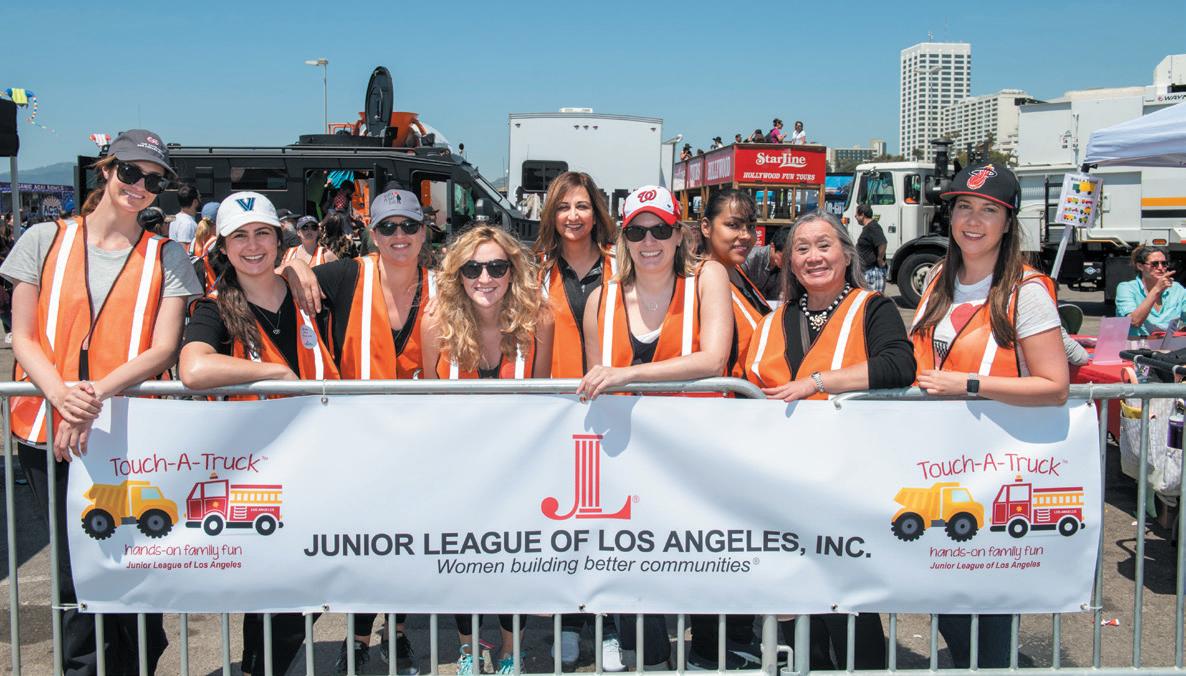
every year, and it is incredibly meaningful to help create an experience that brings so much joy to families throughout our community. Members have continued to build on these successes in recent years, with KTLA 5 News becoming a media sponsor, Westfield giving an everexpanding footprint to the successful event, and a growing list of community partners joining in to participate in the fun. At the same time, more and more families have come to count on the festivities each year!
JLLA earns commendations from the LA County 3rd District Supervisor Lindsay P. Horvath (2025) and Commendation from LA City Councilmember Hugo Soto-Martinez (2025) in recognition of our response to the wildfires in the Pacific Palisades and Altadena.
2026
SOCIAL AND SPECIAL
EVENTS Co-Chair Emily Craig and committee members launched Touch-aTruck at the Santa Monica Pier in 2018. Touch-a-Truck became an official project and committee the following year.
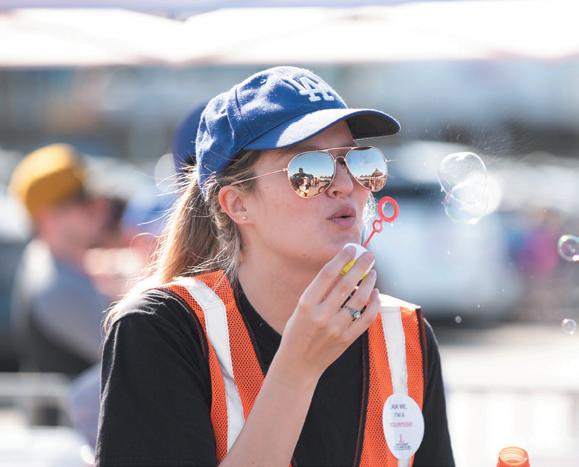
On January 5th, 2026, JLLA officially celebrates 100 years as part of AJLI!