Classification Notes: HTS (6 Digit Harmonized WTO)
1. Product Description
The LARC crate is a multi-use modular connected shipping system that can be adapted to a variety of different cargo It is a configurable shipping container that is adjustable to diverse cargo loads utilizing latching and stacking elements. The primary components of the crate are constructed of High Density Polyethylene plastic, (HDPE), with additional support from ethylene propylene diene monomer rubber, (EPDM), and steel We were unable to determine the percentage by weight of each component, however, the breakdown of the bill of materials indicated the pallet and modular wall structures are of HDPE with underpinning from reinforced steel rods and hardware Additional primary contributions to structure are provided in the latches and hinges used for the risers and dampeners that are composed of EPDM rubber.
2. HTS
Classification
3. Analysis
Heading –
Subheading Classification
Harmonized Tariff Classification (WTO) assigned
World Trade Organization (WTO) Harmonized Tariff Classification (HTS) accounts for the harmonization of the first six (6) digits in a global tariff classification system. Applicable HTS for LARC’s Crate is determined to be 3923.10 identified in the nomenclature as: “Articles for the conveyance or packing of goods, of plastics; stoppers, lids, caps and other closures, of plastics: Boxes, cases, crates and similar articles”
There are no chapter or sections notes that would preclude this item from being classified as such. Additionally, an evaluation to establish essential character was applied to the product in determining the final HTS number.
Additionally, it is determined that the LARC Crate should be qualified as an Instrument of International Traffic, (IIT), as defined in 19USC§1322(a); 19USC§10.41a(a)(1); and could utilize the HTSUS subheading 9803.00.50. for subsequent export/import activities of any serially numbered shipping container if the company abides by the provisions of noted HTSUS code.
Please see Classification Analysis section below for a complete breakout of logic process support for this classification, and the complete 10 digit HTSUS code for initial entry.
Classification Analysis: Initial Entry
Classification of merchandise under the Harmonized Tariff System (HTS) is based in the classification of goods in the Combined Nomenclature and governed in accordance with the six General Rules of Interpretation (GRI’s). GRI-1 provides that the classification of goods shall be determined according to the terms of the headings of the tariff schedule and any relative section or chapter notes. In the event that the goods cannot be classified solely on the basis of GRI-1, and if the headings and legal notes do not otherwise require, the remaining GRIs 2 through 6 may be then applied in order.
The LARC Crate is a composite good that cannot be classified solely on the basis of GRI1.
Continuing the principles of GRI’s process eliminates GRI-2, as the product is not being considered as incomplete or unfinished GRI-3 is determined as applicable to the product under evaluation.
GRI-3. States in pertinent part . . . when goods are, prima facie, classifiable under two or more headings, classification shall be effected as follows:
GRI-3(a) asserts “that the heading which provides the most specific description shall be preferred to headings providing a more general description.”
GRI-3(b) further clarifies our evaluation stating, “Composite goods consisting of different materials or made up of different components … are classified as if they consisted of the material or component which give them their essential character.”
As identified in the description of the product it consist of three individual prima facie components; HDPE – classifiable in Chapter 39 – Plastics and articles thereof
EPDM – classifiable in Chapter 40 – Rubber and articles thereof Steel – classifiable in Chapter 72 – Base Metals – Iron and Steel and articles thereof
The primary component that gives the LARC Crate its essential character was determined to be the HDPE plastic, based on the predominance of material noted in the parts file provided by the client. Applying GRI-3(b) effectively places the product in 3923.10.9000 allowing for: “Articles for the conveyance or packing of goods, of plastics; stoppers, lids, caps and other closures, of plastics: Boxes, cases, crates and similar articles: Other”
Note: CBP definition of Plastics: Chapter 39 Note 1. Throughout the tariff schedule the expression "plastics" means those materials which are or have been capable, either at the moment of polymerization or at some subsequent stage, of being formed under external influence (usually heat and pressure, if necessary with a solvent or plasticizer) by molding, casting, extruding, rolling or other process into shapes which are retained on the removal of the external influence.
The analysis in this section applies to the initial entry of the product from the foreign manufacturing site. The rate of duty ascribed in the 2018 HTSA, Revision 14 will be 3%. With an additional 10% assigned by the 9903.88.03, “Articles the product of China, as provided for in U.S. note 20(e) and (f).” This additional 9903 tariff is currently being applied, however, could be either increased or eliminated by noticed in the Federal Register at any time.
General rules applicable both to nomenclature and to duties
1. Unless provided otherwise, normal provisions relating to customs valuation shall be applied to determine the value for the assessment of ad valorem customs duties
2. Should the customs so require, the declarant shall produce, in support of his declaration, an illustrated document (for example, instructions, prospectus, a page from a catalogue, a photograph) giving the normal description of the product, its uses and essential characteristics and, in respect of an unassembled or disassembled item, an assembly plan and a list of the contents of the various packages
Further classification support is provided by CBP binding rulings, (known as CROSS rulings) that are potentially applicable to the product being evaluated. CROSS ruling HQ H248716 dated 6/27/2014 was considered for relative guidance and support in determining this classification.
Classification Analysis: Instruments of International Traffic (IIT’s)
Per 19 C.F.R. § 141.4(a), “all merchandise imported into the United States is required to be entered, unless specifically excepted.” The four exceptions to the requirement of entry are listed under 19 C.F.R. § 141.4(b), one of which is instruments of international traffic. 19 C.F.R. § 141.4(b)(3). Subheading 9803.00.50 which provides for duty-free treatment of:
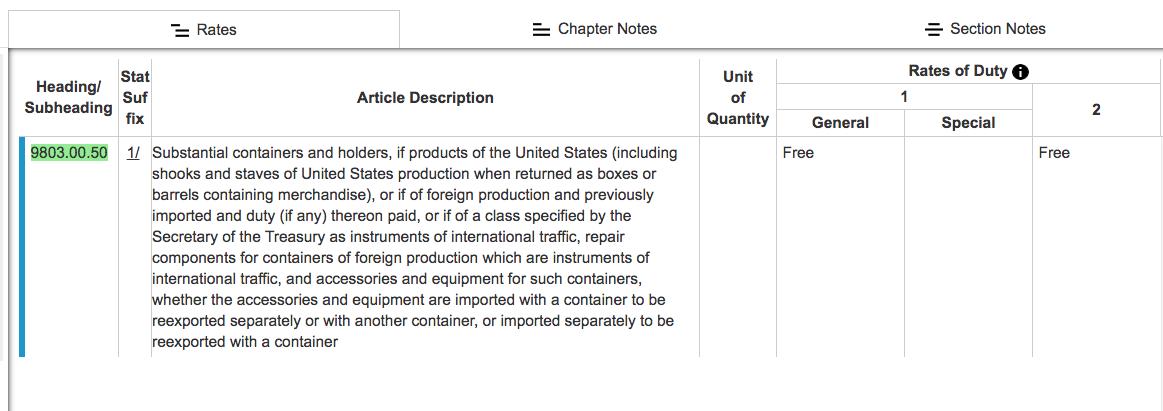
Substantial containers and holders, if products of the United States . . . or if of foreign production and previously imported and duty (if any) thereon paid, or if of a class specified by the Secretary of the Treasury as instruments of international traffic. . .
The subject LARC crate reusable containers and configurable shipping system are substantial inasmuch they are made of HDPE and Steel and should have a life expectancy of more than 10 years. This crate is also suitable for and capable of reuse, according to the concept of reuse intended by CBP that is for commercial shipping or transportation purposes, and not incidental or fugitive uses. In addition, CBP has held that certain collapsible assemblies are IITs so long as their component parts remained together during its transit in international traffic; Ref (H114506/1998) The LARC Crate could therefore be considered for exception under this HTS
To qualify as an "instrument of international traffic" within the meaning of 19 U.S.C. 1322(a) and the regulation promulgated pursuant thereto (19 CFR 10.41a et seq.), an article must be: 1) Used as a container or holder. 2) The article must be substantial, suitable for and capable of repeated use, and 3) used in significant numbers in international traffic. [See subheading 9803.00.50, Harmonized Tariff Schedule of the United States, (full text provided in the appendix of this report)] Also, former Headnote 6(b)(ii), Tariff Schedules of the United States (HTSUS), as well as Headquarters Decisions 104766; 108084; 108658; 109665; and 109702.
LARC would need to adopt and maintain the policy and procedures outlined in the following CFR references
19CFR§113.66 Control of containers and instruments of international traffic And
19CFR§10.41b Clearance of serially numbered substantial holders or outer containers Are included in their entirety in the appendix of this report for your reference.
Further classification support for this section is provided by CROSS ruling HQ H297387 dated 5/10/2018. The specifics of this ruling reflected very similar product description and use and was therefore considered for relative guidance and support in determining this classification
4 Summary
Conclusions and Recommendations
1. Entry of the products must initially be made under the tariff classification that most accurately describes the product and answers the questions, “what is it?” and “What is it made of?” With that as the ultimate assessment that CBP would assign the cargo the HTS of 3923.10.9000 should be applied to the 7501 initial entry. This classification can be fully supported by the evaluation of this report and reinforced by the referenced CROSS rulings.
2. It is recommended that a Customs Binding Ruling be applied for to solidify and validate the transportation component of the LARC Crate after initial import.
3. Although the provisions for being assigned IIT status sound daunting it can be most easily accomplished by filing for a binding ruling. Once the ruling has been rendered the complete support is in place and the remainder of the policy is strictly procedural.
a. This process should not be initiated until you have significant crates being used in International transit, or if the crates used internationally are being returned to the U.S. empty and no consumption commodity is to be declared.
Please contact me with any questions or concerns you may have regarding this evaluation, or if you would like to further discuss any aspect of the review.
Respectfully submitted,
Judy Davis
INDEPENDENT CONSULTING STATEMENT
This report as presented is based on standards, concepts, procedures, and reporting practices that are aligned with Independent Compliance and Operational Practices. In particular those relating to international trade compliance, cargo and supply chain operation and security. The advice relies on evidence, analysis, materials provided by the client, and informed professional judgment. We do not, in giving this opinion, accept or assume responsibility for any purpose other than determining the stated evaluation of the criteria on the preceding pages.
Appendix
9803.00.50 HTSUS Tariff Descrription
19CFR§113.66 Control of containers and instruments of international traffic
19CFR§10.41b Clearance of serially numbered substantial holders or outer containers
From USITC website at: https://hts.usitc.gov/?query=9803.00.50
19CFR§113.66 Control of containers and instruments of international traffic bond conditions.
A bond for control of containers and instruments of international traffic must contain the conditions listed in this section and must be a continuous bond.
CONTROL OF CONTAINERS AND INSTRUMENTS OF INTERNATIONAL TRAFFIC BOND CONDITIONS
(a)Agreement to Enter Any Diverted Instrument of International Traffic. If a principal brings in and takes out of the customs territory of the United States an instrument of international traffic without entry and without payment of duty, as provided by the CBP regulations and section 322(a), Tariff Act of 1930 as amended ( 19 U.S.C. 1322(a)) the principal agrees to:
(1) Report promptly to CBP when the instrument is diverted to point-topoint local traffic in the customs territory of the United States or when the instrument is otherwise withdrawn in the customs territory of the United States from its use as an instrument of international traffic.
(2) Promptly enter the instrument unless exempt from entry; and
(3) Pay any duty due on the instrument at the rate in effect and in its condition on the date of diversion or withdrawal.
(b)Agreement to Comply With the Provisions of subheading 9801.00.10, or 9803.00.50 Harmonized Tariff Schedule of the United States (HTSUS). If the principal gets free release of any serially numbered shipping container classifiable under subheading 9801.00.10 or 9803.00.50, HTSUS, the principal agrees:
(1) Not to advance the value or improve its condition abroad or claim (or make a previous claim) drawback on, any container released under subheading 9801.00.10, HTSUS;
(2) To pay the initial duty due and otherwise comply with every condition in subheading 9803.00.50, HTSUS, on any container released under that item;
(3) To mark that container in the manner required by CBP;
(4) To keep records which show the current status of that container in service and the disposition of that container if taken out of service; and
(5) To remove or strike out the markings on that container when it is taken out of service or when the principal transfers ownership of it.
(c)Agreement to comply with application approved under 19 CFR 10.41b(b). If the principal establishes a program for the cross-border movements of shipping devices based upon an application approved as provided in § 10.41b(b) of this chapter ( 19 CFR 10.41b(b)), the principal agrees:
(1) To timely file complete and accurate reports on the shipping devices, and to pay any applicable duty due on the devices and repairs made to such devices, as provided in the approved application;
(2) To retain complete and accurate records regarding the shipping devices, and to make such records available to CBP for inspection and audit upon reasonable notice, as also required in the approved application; and
(3) To otherwise comply with every other condition of the approved application.
(d)Consequence of Default.
(1) If the principal defaults on agreements in these conditions, the obligors (principal and surety, jointly and severally) agree to pay liquidated damages equal to the value of the merchandise involved in the default or such other amount as may be authorized by law or regulation.
(2) It is understood and agreed that the amount to be collected under these conditions will be based upon the quantity and value of the merchandise as determined by CBP.
(3) If the principal defaults on the agreements in these conditions and the default does not involve merchandise, the obligors agree to pay liquidated damages of $1,000 for each default or such other amount as may be authorized by law or regulation. It is understood and agreed that whether the default involves merchandise is determined by CBP.
19CFR§10.41b Clearance of serially numbered substantial holders or outer containers.
(a) The holders and containers described in this section may be released without entry or the payment of duty, subject to the provisions of this section.
(b) Subject to the approval of a port director pursuant to the procedures described in this paragraph, certain foreign- or U.S.-made shipping devices arriving from Canada or Mexico, including racks, holders, pallets, totes, boxes and cans, need not be serially numbered or marked if they are always transported on or within either intermodal and similar containers or containers which are themselves vehicles or vehicle appurtenances and accessories such as twenty and forty foot containers of general use and “igloo” air freight containers. The following or similar notation shall appear on the vehicle or vessel manifest in relation to such shipping devices which are exempt from serial numbering or marking requirements pursuant to this paragraph: “The shipping devices transported herein, which are not serially numbered or marked, have been exempted from such requirement pursuant to an application approved under 19 CFR 10.41b(b).” Also, pallets and other solid wood shipping devices must be accompanied by an importer document, to the extent that this is required by the U.S.
Department of Agriculture
Animal and Plant Health Inspection Service attesting to the admissibility of such devices as regards plant pest risk, as provided for in 7 CFR 319.40-3.
(1) An importer or his agent, regardless of whether the importer is the owner of the foreign- or U.S.-manufactured shipping devices, may apply to a port director of Customs at one of the importer's chiefly utilized Customs ports or the port within which the importer's or agent's recordkeeping center is located for permission to have such shipping devices arriving from Canada or Mexico released without entry and payment of duty at the time of arrival and without the devices being serially numbered or marked. Application may be filed in only one port. Although no particular format is specified for the application, it must contain the information enumerated in paragraph (b)(2) of this section. Any duty which may be due on these shipping devices shall be tendered and paid cumulatively at the time specified in an approved application, which may be either before or after the arrival of the shipping devices in the U.S. (such as, at the time a contract, purchase order or lease agreement is issued).
(2) The application shall:
(i) Describe the types of shipping devices covered, their classification under the Harmonized Tariff Schedule of the U.S. (HTSUS), their countries of origin, and whether and to whom required duty was paid for
them or when it will be paid for them, including duties for repair and modifications to such shipping devices while outside the U.S.;
(ii) Identify the intended ports where it is anticipated the shipping devices will be arriving and departing the U.S., as well as the particular movements and conveyances in which they are intended to be utilized;
(iii) Describe the applicant's proposed program for accounting for and reporting these shipping devices;
(iv) Identify the reporting period (which shall in no event be less frequent than annual), as well as the payment period within which applicable duty and fees must be tendered (which shall in no event exceed 90 days following the close of the related reporting period);
(v) Describe the type of inventory control and recordkeeping, including the specific records, to be maintained to support the reports of the shipping devices; and
(vi) Provide the location in the United States, including the name and address, where the records supporting the reports will be retained by law and will be made available for inspection and audit upon reasonable notice. (The records supporting the reports of the shipping devices must be kept for a period of at least 3 years from the date such reports are filed with the port director.)
(3) The application shall be filed along with a continuous bond containing the conditions set forth in § 113.66(c) of this chapter. If the application is approved by the port director and the conditions set forth in the application or of the bond are violated, the port director may issue a claim for liquidated damages equal to the domestic value of the container. If the domestic value exceeds the amount of the bond, the claim for liquidated damages will be equal to the amount of the bond.
(4) The port director receiving the application shall evaluate the program proposed to account for, report and maintain records of the shipping devices. The port director may suggest amendments to the applicant's proposal. The port director shall notify the applicant in writing of his decision on the application within 90 days of its receipt, unless this period is extended for good cause and the applicant is so informed in writing. Approval of the application by the port director with whom it is filed shall be binding on all Customs ports nationwide.
(5) If the decision is to deny the application, in whole or in part, the port director shall specify the reason for the denial in a written reply, and inform the applicant that such denial may be appealed to the Assistant Commissioner, Office of Field Operations, Customs Headquarters, within 21 days of its date. The Assistant Commissioner's decision shall be
issued, in writing, within 30 days of the receipt of the appeal, and shall constitute the final Customs determination concerning the application.
(6) If the application is approved, an importer may later apply to amend his application to add or delete particular types of shipping devices listed in the application in which the procedures set forth in the application may be utilized. If a requested amendment to an approved application should be denied, or if an approved application should be revoked, in whole or in part, by the port director, the procedures described in paragraph (b)(5) of this section shall apply.
(7) Application for and approval of a reporting program shall not limit or restrict the use of other alternative means for obtaining the release of holders, containers and shipping devices.
(c) In the case of serially numbered holders or containers of United States manufacture for which free clearance under subheading9801.00.10, Harmonized Tariff Schedule of the United States, is claimed, the owner shall place thereon the following markings:
(1) 9801.00.10, unless the holder or container has permanently attached thereto the manufacturer's metal tag or plate showing, among other things, the name and address of the manufacturer who is located in the United States.
(2) The name of the owner, either positioned as indicated in the example below, or elsewhere conspicuously shown on the holder or container.
(3) The serial number assigned by the owner, which shall be one of consecutive numbers and not to be duplicated. For example: 9801.00.10 * * * Zenda * * * 2468.
(d)
(1) In the case of serially numbered holders or containers of foreign manufacture, other than those provided for in paragraph (d)(2) of this section, for which free clearance under the second provision in subheading 9803.00.50, HTSUS ( 19 U.S.C. 1202), is claimed, the owner shall place thereon the following markings:
(i) 9803.00.50.
(ii) The district and port code numbers of the port of entry, the entry number, and the last two digits of the fiscal year of entry covering the importation of the holders and containers on which duty was paid.
(iii) The name of the owner, either positioned as indicated in the example below, or elsewhere conspicuously shown on the holder or container.
(iv) The serial number assigned by the owner, which shall be one of consecutive numbers and not to be duplicated. For example: 9803.00.50 * * * 10-1-366-63 * * * Zenda * * * 2468.
(2) In the case of substantial holders or containers of either U.S. or foreign manufacture, specially designed and equipped to facilitate the carriage of goods by one or more modes of transport without intermediate reloading, each having a gross mass rating of at least 18,120 kilograms, for which duty-free entry is requested under either the first or the second proviso in subheading 9803.00.50, HTSUS ( 19 U.S.C. 1202), is claimed, only the following clear, conspicuous and durable markings are required to be on the container:
(i) The identity of the owner or operator of the container.
(ii) The serial number assigned by the owner or operator of the container, which shall be one of consecutive numbers and shall not be duplicated.
(e) The prescribed markings shall be clear and conspicuous, that is, they shall appear on an exposed side of the holder or container in letters and figures of such size as to be readily discernible. The markings will be stricken out or removed when the holders or containers are taken out of service or when ownership is transferred, except that appropriate changes may be made if a new owner wishes to use the holders and containers under this procedure.
(f) The owner shall keep adequate records open to inspection by Customs officers, which shall show the current status of the serially numbered holders and containers in service and the disposition made of such holders and containers taken out of service.
(g) Nothing in this procedure shall be deemed to affect:
(1) The requirements for outward or inward manifesting of such holders or containers. The manifests will show for each holder or container its markings as provided for herein.
(2) The requirements of the Department of Commerce on exportation with respect to the filing of Electronic Export Information (EEI).
(3) The treatment of articles covered herein under the coastwise laws of the United States, with particular reference to section 883, Title 46, United States Code.
(h) If the holder or container and its contents are to move in bond or under cover of a TIR carnet (see part 114 of this chapter) from the port of arrival intact, the holder or container shall appear on the inward foreign manifest so as to be related to the cargo contained therein and will be released under this procedure at a subsequent port. If the holder or container is to move in bond or under cover of a TIR carnet from the port of arrival not intact with its contents, the holder or container may appear on the inward foreign manifest separate from and not related to the cargo contained therein and will be released under this procedure at the port of arrival before it moves forward and will not appear on the in-bond document.
(i) A continuous bond containing the conditions set forth in § 113.66 of this chapter shall be filed with the port director. If the conditions are violated the port director shall issue a claim for liquidated damages equal to the domestic value of the holder or container established in accordance with section 606, Tariff Act of 1930 as amended ( 19 U.S.C. 1606). If the domestic value exceeds the amount of the bond the claim for liquidated damages will be equal to the amount of the bond.