MANUFACTURING PRODUCTION
OPINION
THE GROWING IMPORTANCE OF CYBER RECOVERY
MANUFACTURING
AUGUST & SEPTEMBER 2026
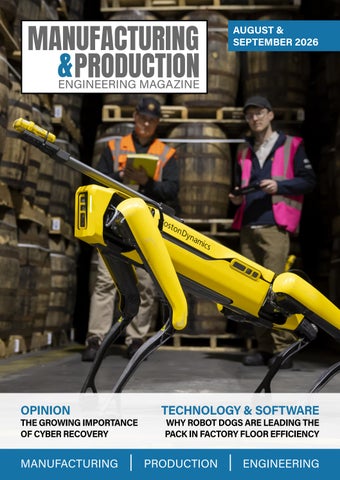
TECHNOLOGY & SOFTWARE WHY ROBOT DOGS ARE LEADING THE PACK IN FACTORY FLOOR EFFICIENCY
PRODUCTION
ENGINEERING
ASSA ABLOY RT1000 Spiral Door Engineered for speed, strength and smarter energy performance • Opening speeds up to 1.75 m/s • Excellent thermal insulation • Optional burglar resistance for enhanced security • Smooth, space-saving single-track spiral design • Ideal for high-traffic environments where performance and reliability matter sales.uk.entrance@assaabloy.com www.assaabloy.com/uk
CONTENTS 48
04
06 Editor
Paul Attwood editor@mpemagazine.co.uk
Senior Editorial Assistant
John Reynolds editorial@mpemagazine.co.uk
04 06 20 48 58
20
58
University of Edinburgh unveils flagship Engineering Forum Research finds reshaping global supply chains could cost $23.6 trillion by 2050 UK companies could do more to strengthen critical supply chains, report finds Why robot dogs are leading the pack in factory floor efficiency Addressing the manufacturing skills shortage at The PPMA Show® 2026
Features Editor
Harry Peters editorial@mpemagazine.co.uk
Production/Design
Laura Whitehead laura@lapthornmedia.co.uk
Sales Manager
Charlotte Chapman charlotte@mpemagazine.co.uk
Accounts
Richard Lapthorn accounts@lapthornmedia.co.uk
Admin Assistant
Jade Still jade@lapthornmedia.co.uk
Circulation Manager
Leo Phillips subs@mpemagazine.co.uk
Publishing Director
Editors Note Welcome to the latest issue of Manufacturing & Production Engineering Magazine. The manufacturing sector continues to evolve rapidly, with businesses balancing the need to improve productivity while responding to skills shortages, rising costs and changing market demands.
Paul Attwood Editor
This issue explores some of the key developments shaping the industry, from automation, robotics and artificial intelligence to smart manufacturing, digital connectivity and advanced engineering. We also look at the importance of cybersecurity, operational resilience and workforce development, alongside the latest solutions designed to improve efficiency, safety and sustainability. As the industry looks ahead, investment in technology, skills and innovation will remain essential to maintaining the UK’s competitive edge. We hope you enjoy this issue and if you have news to share, please contact editorial@mpemagazine.co.uk.
Maria Lapthorn maria@lapthornmedia.co.uk
Lapthorn Media Ltd
5-7 Ozengell Place, Eurokent Business Park, Ramsgate, Kent, CT12 6PB
Every effort is made to ensure the accuracy and reliability of material published in Manufacturing & Production Engineering Magazine however, the publishers accept no responsibility for the claims or opinions made by advertisers, manufactures or contributors. No part of this publication may be reproduced or transmitted in any form or by any means, mechanical, electronic (including photocopying) or stored in any information retrieval system without the prior consent of the publisher.
mpemagazine.co.uk Connect with us @mpemaguk
Phone: 01843 808 106 Manufacturing & Production Engineering Magazine
03
Latest News
UK Parliament enacts ECITB Levy Order The ECITB’s levy proposals that received the overwhelming backing of industry in November, have been enacted into legislation following approval from both the House of Commons and House of Lords. The draft Industrial Training Levy (Engineering Construction Industry Training Board) Order 2026 was tabled by Minister of State (Department for Work and Pensions) the Rt Hon Sir Stephen Timms MP in the House of Commons on Monday 6 July. The Rt Hon Baroness Smith of Malvern, the Minister for Skills, then led the Grand Committee debate in the House of Lords. Speaking in the Commons, Sir Timms said: “The industry faces big, longstanding challenges in recruiting and retaining a skilled workforce, which makes voluntary investment in training harder to secure. Only a statutory levy can guarantee that the skills that industry urgently needs will be provided
at the scale required. It is estimated that the UK needs an additional 40,000 engineering construction workers, and this order will play an important part in supporting major infrastructure projects nationwide. “In addition to industry support, the proposals before the House have received the full support of the devolved Governments of Scotland and Wales. They recognise, as we do, that the ability of the ECITB to raise and invest levy income is vital to ensuring that employers across all three nations can access the engineering construction skills that they need. “What the debate has effectively underlined is just how important the work of the ECITB is.
“Approving this order provides continuity, stability and confidence for engineering construction employers across England, Scotland and Wales.” Baroness Smith told the House of Lords Grand Committee debate: “The engineering construction industry is critical to the delivery of the government’s wider ambitions for economic growth, clean energy and energy security. It provides the skilled workforce needed to build,
University of Edinburgh unveils flagship Engineering Forum The University of Edinburgh’s new Engineering Forum is now complete, creating a major new destination for learning, research and collaboration at the heart of the King’s Buildings campus. Designed by BDP, the School of Engineering, a 6,500sq m building brings together teaching, research, innovation and social spaces within a highly flexible environment designed to support the next generation of engineers. The project forms a vital part of the University’s long-term vision for the campus and has now opened its doors to staff and students. The Engineering Forum provides specialist laboratories, flexible teaching spaces, computer
04
Manufacturing & Production Engineering Magazine
Latest News Baroness Smith speaking at the House of Lords Grand Committee ECITB Levy Order debate July 2026
maintain and operate major energy and industrial infrastructure across Great Britain. “Maintaining the ECITB’s ability to raise and invest levy income is vital to ensuring employers across all three nations can access the engineering construction skills that they need. “An estimated £137.9 million will be raised in levy over 2026 to 2028, which will be invested in supporting the skills needs of the engineering construction industry. That investment will fund vital
laboratories, conference facilities, a dedicated innovation space, academic workspaces and informal areas for students and researchers to connect throughout the day. Designed around collaboration and adaptability, the building supports world-class research in renewable energy, power systems and future electronics while creating a new focal point for the engineering community. Among its specialist facilities is the Wolfson Electrical Power Conversion Laboratory, which will support the development of sustainable energy technologies for offshore renewables and other low-carbon energy systems.
programmes to widen participation, raise skill levels, increase opportunity and to maintain occupational standards for the industry. “The evidence is consistent that market forces alone will not deliver the pipeline of skilled workers the industry urgently needs to meet the demand for new major infrastructure projects. The ECITB’s levy is the mechanism that enables the collective benefits of a focused skills strategy for the engineering construction industry. “It ensures that employers can access support for training and share the benefits of a skilled, competent and resilient workforce. And it also opens opportunity, helping apprentices and other new entrants to complete high quality training and existing workers to reskill or upskill to progress their careers.” Andrew Hockey, CEO of the Engineering Construction Industry Training Board (ECITB), said: “The ECITB received the overwhelming backing of industry for its levy proposals last November with engineering construction companies voting resoundingly in favour of its proposed levy rates for the next three years. “The subsequent consultation on the ITB Reform does not detract from the urgent need to attract, develop, qualify and retain skilled workers within the engineering construction industry (ECI) now. “We will continue to support the industry priorities outlined in our new strategy and deliver against this industry-backed plan. Approval of the levy order gives us the financial underpinning to do this. “Our new strategy sets out how the ECITB will rise to meet the challenges of an increasingly complex and fast-changing external environment and deliver positive,
long-term outcomes for our levy payers, the wider workforce and the country. Our approach aligns with the UK Government’s missiondriven focus – particularly its goal to transition to clean power and stimulate sustainable economic growth in doing so.” The ECITB launched the levy consultation following the publication of its new five-year strategy, Leading Industry Learning, in September 2025. The high level of support for the proposals showed industry is fully behind the ECITB’s strategy to support employers in addressing skills shortages as well as investing in essential workplace training required to deliver the country’s net zero and energy security ambitions. The Levy Order was affirmed by both Houses of Parliament, without opposition. The Statutory Instrument coming into force will be applied to levies raised in respect of 2026-28 and will be payable in 2027, 2028 and 2029 respectively. The Order maintains the levy rates of 0.33% of the earnings paid by employers to off-site employees and 1.2% of the earnings paid by employers to on-site employees for businesses liable to pay the levy. Recognising the budgetary pressures on small businesses, the Order retains the current exemption thresholds. Engineering construction employers with an annual wage bill of less than £1 million for off-site employees will not pay any levy. Employers with an average wage bill of less than £275,000 for on-site employees will also be exempted from paying the levy. These employers will nevertheless continue to be eligible to receive training grants if they are inscope to the ECITB. The Government is expected to announce its decision this Autumn.
BDP was appointed in 2017 to help shape a long-term vision for the School of Engineering and its estate at the King’s Buildings campus. The Engineering Forum emerged from that work, bringing together teaching, research and collaboration spaces within a single, highly connected building designed around the needs of students, academics and industry partners.
Manufacturing & Production Engineering Magazine
05
Latest News
Reshaping global supply chains could cost $23.6 trillion by 2050, new EY-Parthenon research finds The cost of replicating China-linked supply chains across the US, UK and Eurozone could reach approximately $23.6 trillion by 2050, according to new EY-Parthenon analysis. The research highlights the scale of investment required to localise supply chains as organisations seek to mitigate geopolitical risk, and the trade-offs for businesses and governments alike over the coming years. This challenge is particularly visible in East-West supply chains. EY-Parthenon estimates that duplicating these supply chains would require $13.7 trillion in the US, $9.1 trillion in the Eurozone and $800 billion in the UK, to rebuild not only physical infrastructure, but also critical capabilities such as R&D, software, advanced manufacturing, transport networks, supplier ecosystems and workforce skills. Sectors most reliant on Chinese inputs will be the most exposed, with manufacturing, mining, and power and utilities accounting for almost $13tn of the $23.6tn in required investment. Decoupling, as with any major economic transition, would require a phased build-up of investment over time. In its early stages, capital requirements are likely to be relatively contained, allowing for a targeted focus on the most exposed sectors, value chains and critical nodes. However, as the transition progresses, the scale of investment
needed to achieve full decoupling would increase materially. The analysis raises important questions about how these costs will be absorbed. If governments fund the transition, deficits in the US, UK and Eurozone could increase by close to 1 percentage point of GDP annually through 2050. If shouldered by businesses, companies in sectors such as machinery, electronics and automotive could face a sharp increase in capital expenditure — in some cases up to twice current levels.
Geopolitical risk reshapes global trade and supply chain strategy The findings underscore a growing tension at the heart of modern globalisation: while geopolitics and policy push businesses toward more localised operations, economic pressures and innovation continue to pull them toward global scale. Over the past two decades, global trade integration accelerated rapidly, with indirect exports more than tripling to around $11 trillion annually, driven in part by China’s entry into the World Trade Organization. However, today that model is under increasing strain as geopolitical turbulence has a greater impact on business performance. The introduction of US trade tariffs and, more recently, ongoing disruptions in the Strait of Hormuz, has forced companies to reassess assumptions around energy flows, freight availability, inflation expectations and business continuity.
06
Manufacturing & Production Engineering Magazine
Mats Persson, EY-Parthenon UK Macro and Geostrategy Leader, said: “Geopolitics and economics are pulling in opposite directions, driving a more fragmented form of globalisation in which economic nationalism co-exists with continued trade. Western economies are already managing capital intensive transitions across energy, technology, defence and infrastructure; adding full East West supply chain decoupling without clarity on who bears the cost risks proving unaffordable. A more realistic outcome is partial decoupling, requiring a more agile response from businesses. “However, many businesses have not yet adjusted to this new reality — either investing too heavily in localisation where it is not required or continuing to rely on low-cost supply chains that lack resilience. Businesses need a clear understanding of macro risks and a disciplined, case-by-case approach to deciding which operations should be localised and which should remain global. That approach must be underpinned by robust scenario planning and the flexibility to adapt as conditions evolve.”
Rising costs and inflation pressures limit large-scale localisation Beyond initial capital investment, the report highlights the ongoing cost pressures associated with large-scale localisation. Chinese manufacturers retain a significant cost advantage — with factory prices for certain components estimated to be 20% to 100% lower — driven by scale, supply chain density and operational efficiencies. As a result, even partial shifts away from established global networks could contribute to structurally higher inflation, with long-term price levels rising by an estimated 1 to 2 percentage points.
Protect Every Component of Your Business
Manufacturing insurance designed around you Whether you’re a single manufacturing facility in the UK or a global multi-site operation, Gallagher can help you protect your business, your people and your products.
CONNECT WITH A SPECIALIST TODAY. For further information, please scan the QR code.
Partner with an insurance and risk management specialist who knows your industry. Our Specialist team at Gallagher would be glad to arrange a no-obligation insurance review for your company.
AJG.com/uk The Gallagher Way. Since 1927. Arthur J. Gallagher Insurance Brokers Limited is authorised and regulated by the Financial Conduct Authority. Registered Office: Spectrum Building, 55 Blythswood Street, Glasgow, G2 7AT. Registered in Scotland. Company Number: SC108909. FP251-2026 Exp. 16.02.2027. © 2026 Arthur J. Gallagher & Co. | GGBRETUK107473
Company News
Premiere Kitchens Commissions £3.25 Million Manufacturing Investment to Boost Kitchen Manufacturing Capacity Premiere Kitchens has officially commissioned a £3.25 million investment in advanced manufacturing technology that will increase production capacity by up to 60% while raising quality standards for the UK’s social housing sector. The investment was officially opened by Julie Kent MBE, former High Sheriff of Gloucestershire, marking the completion of the first phase of a wider £5 million, threeyear manufacturing investment programme at its Gloucester factory. Following an extensive international review of available technologies, Premiere selected Homag as its machinery partner, with the company’s reputation for innovation, reliability and engineering excellence in panel processing and edge banding being decisive factors.
the art CNC software controls cutting patterns, dimensions, waste handling and cutting speeds to maximise productivity while achieving industryleading cutting tolerances. Waste material is automatically removed via an integrated conveyor
and guillotine system directly to Premiere’s onsite biomass plant, eliminating manual intervention, achieving zero landfill, and supporting the company’s circular manufacturing model. The second major installation is a 42-metre four-sided combination edge bander, capable of processing all four edges of a component in a single pass.
The installation comprises two flagship production systems that fundamentally transform Premiere’s manufacturing capability. At the front end of production is Homag’s highly automated angle plant saw, capable of continuous operation with minimum operator contact. State of
Packsize to Acquire Panotec, Further Increasing Global Automated Packaging Solutions’ Reach Packsize®, a market leader in sustainable, right-sized, on-demand packaging, has announced the company’s completed agreement to acquire the packaging business of Panotec, a premier, award-winning Italian manufacturer of highand low-automation, rightsized packaging machines.
“This acquisition further aligns our go-to-market approach and strengthens our ability to offer more flexibility and choice to businesses looking to optimize packaging operations while reducing waste and cost,” said Brian Reinhart, Chief Revenue Officer, Packsize. “Just as importantly, it brings together teams that share a similar innovative vision for the future of right-sized packaging, making us better positioned to accelerate growth and deliver even greater value globally.”
Under the agreement, Packsize will grow its machine portfolio while expanding its combined installed customer base in over fifty countries throughout North America, Europe, and beyond.
The newest addition to the Packsize portfolio builds upon the April 2025 acquisition of Sparck Technologies, which combined Packsize’s innovative technology and service model with Sparck’s fit-to-
08
Manufacturing & Production Engineering Magazine
size box systems and best-in-class box last and lid and tray solutions. “We’re excited about this acquisition and what it unlocks for Packsize and our customers,” said Kellen Frey, Chief Operating Officer, Packsize. “This move strengthens our core technology capabilities and positions us to deliver even
Company News
The fully automated process mills each edge to ensure perfect squareness before pre-heating the substrate to optimise adhesive performance. High-precision tooling profiles the edging before the component is automatically rotated and processed on its remaining edges. The resulting water-resistant, radiused edge delivers improved durability for cabinet components, doors and drawer fronts, all carrying Premiere’s 20 year warranty on manufactured component parts, all particularly important within demanding social housing environments. The system is capable of producing up to 12,000 components during a single eight-hour shift. Premiere Kitchens says the investment delivers between 50% and 60% additional manufacturing capacity without extending production hours.
more scalable, efficient, rightsized packaging solutions. By combining talent, technology, and capacity, we continue to broaden our global capabilities with an emphasis on delivering best in class quality and service for our expanding customer base.” Carlo Capoia, Vice President of Panotec added “We look forward to leveraging the combined strengths of our companies to provide an unparalleled product selection and service to the markets we serve.” The transaction is expected to close upon the satisfaction of customary closing conditions, including receipt of applicable regulatory approvals and completion of the required consultation process with applicable unions.
Altus Group Invests in Major Headquarters Expansion to Showcase Complete Turnkey Manufacturing Capability Altus Group, a leading distributor of electronics manufacturing equipment in the UK and Ireland, has announced a major expansion of its Redditch headquarters following the acquisition of an adjoining facility that will significantly increase its demonstration, training and customer collaboration space. The expansion adds approximately 363 m² (3,900 ft²) of additional space and includes the creation of a new customer experience centre, developed in collaboration with its technology partners. The investment will enable Altus to install a complete inline manufacturing solution at the heart of its facility, allowing customers to see first-hand how a full production environment can be configured across SMT assembly, THT assembly, backend production and component management. The investment follows a period of sustained growth for Altus, with the company increasing its market share and becoming an established long-term partner for electronics manufacturers making new investments. The additional facility will increase demonstration capacity and create dedicated areas for customer training, applications support and collaboration, enabling Altus to further enhance the services it provides across the UK and Ireland. A key part of this development has been the expansion of Altus’
portfolio, which now enables the company to offer a complete turnkey solution for an entire manufacturing facility where required. This broader capability allows Altus to support customers with a more complete view of the production environment, rather than focusing solely on individual machines within it. Joe Booth, Chief Executive Officer at Altus Group, said: “The acquisition of this additional facility represents another important milestone for Altus and provides us with the space to fully demonstrate our capabilities as a single-source manufacturing partner. “The new customer experience centre will allow manufacturers to see how an entire production environment can be configured and optimised as one connected process, rather than viewing individual pieces of equipment in isolation. “It will provide a collaborative environment where customers can evaluate technologies, undertake training, discuss manufacturing challenges and gain a better understanding of how a complete turnkey solution can be tailored to their requirements. Our aim is to create a gold standard facility that reflects how modern electronics manufacturing operates.” The expanded customer experience centre will be located alongside Altus’ existing purposebuilt headquarters in Redditch, which opened in 2019, and is expected to open in September 2026.
Manufacturing & Production Engineering Magazine
09
Company News What stood out to me about Black & White Engineering was its culture, growth and the clarity of the business strategy.
Hector Hernandez, Area Director, Spain
Black & White Engineering
expands European footprint in Spain Black & White Engineering, a global engineering design consultancy specialising in missioncritical buildings and infrastructure, has expanded into Spain as it continues to grow across the data centre sector. The new office, based in Madrid, strengthens the consultancy’s presence in the country and supports rising demand from data centre clients across Europe. It also brings civil, structural, MEP and design management expertise closer to clients in the region. The office will be led by Hector Hernandez, Area Director, Spain, while Marcos Uttley, Regional Director, Europe, will lead the consultancy’s growth across southern Europe. Its opening forms part of Black & White Engineering’s wider focus on investing in key data centre markets. The consultancy is continuing to build its local resource while maintaining a joined-up design model across civil, structural, MEP and design management disciplines. Marcos brings senior leadership experience across engineering, real estate development, design
10
Manufacturing & Production Engineering Magazine
consultancy and infrastructure services, having held CEO, Managing Director and COO roles across Spain, Portugal, Italy, the UK, Germany and the United States. His role includes strengthening client relationships and supporting growth across Europe. He said: “Spain is an important market for data centre investment and gives us a strong base from which to support clients locally and across wider Europe. The Madrid office reflects our continued focus on building depth in key markets while drawing on the technical experience of our global team. “What stood out to me about Black & White Engineering was its
culture, growth and the clarity of the business strategy. The opportunity is to build on that by creating longterm value for clients, strengthening our European offer and making sure we have the right technical expertise close to the markets we serve.” Hector joins with more than 20 years’ international experience in data centre and critical infrastructure engineering, including major schemes across Europe, the Middle East, Australia and the Americas. His background spans hyperscale and colocation environments, with experience across advisory, design, construction, commissioning, and operational delivery. Hector said: “The opportunity to build Black & White Engineering’s presence in Spain from the ground up was a major draw. The market here is developing quickly and clients need advisers who understand both the technical demands of these projects and the local delivery environment.” Marcos Uttley, Regional Director, Europe
TRUSTED PERFORMANCE. UNBEATABLE VALUE.
When the job’s straightforward, the truck should be too. Cat® EQ range 3 and 4 wheel 1.6 to 3.5t lithium counterbalance forklifts deliver proven performance for everyday handling, indoors or out. Built tough. Easy to operate. Cost-effective to run and backed by Impact’s premium support as standard.
Experience unbeatable value backed with premium support. Let’s talk.
®
0800 169 9789 sales@impact-handling.com www.impact-handling.com © 2026 Logisnext Europe B.V. All rights reserved. CAT, CATERPILLAR, LET’S DO THE WORK, and their respective logos “Caterpillar Corporate Yellow”, the “Power Edge” and Cat “Modern Hex” trade dress as well as corporate and product identity used herein are trademarks of Caterpillar used under license and may not be used without permission from Caterpillar. Specifications are indicative and may vary depending on operating conditions. Failure to assess all factors may result in performance deviations. All relevant sales support materials and technical expertise of the official distributor must be considered when identifying the best product/solution. Options and technical details may change without notice. Full legal notice and up-to-date product information: www.catlifttruck.com.
Grinding & Surface Finishing
TaeguTec’s Aluminium Grade Redefines Sharp Thinking Aluminium machining requires careful balancing, influenced by the tool’s characteristics.
Robot automates grinding operations at Peters Stahlbau Quality requirements in steel construction are continuously increasing - especially for projects with preparation grade P3. For Peters Stahlbau, this led to more rework, greater physical strain on employees and growing time pressure. With the Teqram EasyGrinder robot, the grinding process has been significantly optimised: quality is now fully reproducible, employees experience clear physical relief, and the consumption of grinding materials and tools has been considerably reduced.
Rising quality requirements as a trigger for investment Peters Stahlbau manufactures complex steel structures for industrial and commercial buildings across Europe. Many contracts
12
Manufacturing & Production Engineering Magazine
involve higher requirements for surface preparation - particularly for P3. “The requirements for finishing quality have increased significantly in recent years,” emphasises Frank Evers, workshop manager at Peters Stahlbau. For P3 components, all edges must be rounded to a minimum radius of 2 mm, and the hardened heat-affected zone must be completely removed. When done manually, this process is time-consuming and physically demanding. As production volumes increase, maintaining consistent quality becomes extremely difficult.
When manual processes reach their limits Removing cutting burrs, rounding edges and removing the heataffected zone are among the most demanding grinding tasks in steel construction. This becomes particularly evident in shift operation, where it is challenging to maintain consistent quality over time. In addition to the physical strain, reproducibility was a key concern. Quality deviations cost time, material and margin.
Choosing the EasyGrinder Peters Stahlbau consciously chose the Teqram EasyGrinder. The decisive factors were its easy integration into existing processes, the fact that no robot programming is required, and its intuitive operation directly by the machine operator. The robot fits seamlessly into the production process and was productive without a long start up phase. On the shop floor, the new “colleague” was quickly given a name: Susi - a clear sign of strong acceptance within the team. Frank Evers explains: “Our EasyGrinder affectionately called Susi - delivers consistent P3 quality and works
Grinding & Surface Finishing Cutting too aggressively can cause a built-up edge that affects surface finish, while a tool with inadequate sharpness will increase cutting forces, heat, and shortens tool life. TaeguTec has introduced an ideal solution with the launch of the TTA101 insert grade. This new ta-C coated milling insert offers a genuinely different approach to non-ferrous machining. The exciting new TTA101 grade is now available across TaeguTec’s established AL chip former milling insert family, covering the APCT, AVCT, XEVT, 3PHT, 4NHT, and 4WHU insert designations. This makes the new grade compatible with TaeguTec’s ChaseMill, WinMill, ChaseAlu, MillRush, Chase4Mill, and Chase4Finish cutting tool platforms, offering remarkable flexibility for end users. Whether the application involves face milling, pocketing, or finishing, the impressive TTA101 grade can be integrated into existing toolholding arrangements, simplifying inventory management
while significantly enhancing performance. The defining feature of the TTA101 grade is its ta-C coating, applied at a thickness of less than 0.5µm. Compared to conventional coatings, TaeguTec’s ta-C reduces the inevitable edge rounding that coatings add to an insert. In aluminium machining, where sharpness directly affects surface finish, edge geometry is crucial. By maintaining the coating below 0.5µm, TaeguTec preserves the insert’s sharp cutting edge after coating. The result is a tool that enters the cut smoothly, produces lower cutting forces, and achieves surface finishes demanded by aluminium components in aerospace, automotive, and electronics industries. A persistent frustration in aluminium machining is built-up edges, and with its low coefficient of friction, the ta-C coating tackles this problem directly. Material simply does not adhere to the coating in the way it does with uncoated or
without fatigue, even across multiple shifts.”
efficiency and competitiveness in a sustainable way.
Consistent quality and clear economic benefits
Teqram - automation solutions for reproducible grinding quality
In addition to stable quality, the EasyGrinder also offers clear economic advantages. “The robot uses grinding discs completely down to the backing pad - A result that is difficult to achieve manually.” In manual grinding, declining force often leads to the premature replacement of discs. The grinding robot significantly reduces the consumption of grinding materials and greatly extends the service life of standard angle grinders. At the same time, it enables predictable cycle times and stable processes.
Teqram develops practical robotic solutions with integrated AI. The
conventionally coated inserts, and chip evacuation remains smooth and uninterrupted throughout the cut. For high-volume production environments where a consistent, repeatable surface finish is non-negotiable and this characteristic alone represents a significant process improvement. The TTA101 achieves a hardness of HV 5000 or higher. This exceptional hardness translates directly into resistance to abrasive wear, so inserts retain their cutting edge for longer and deliver consistent performance across extended production runs rather than degrading progressively. Complementing this is the coating’s strong hightemperature oxidation resistance. The addition of the TTA101 grade completes TaeguTec’s aluminium milling insert offering, providing a ta-C-coated option alongside the existing uncoated K10 grade across the most widely used insert geometries. Manufacturers now have a clear upgrade path for applications where built-up edge, surface finish or tool life have been limiting factors, without needing to change cutters.
focus is on simple integration, intuitive operation and consistently reproducible results. With systems such as the EasyGrinder, Teqram supports steel construction companies in economically automating manual grinding processes and safeguarding quality in the long term.
Ergonomics as a strategic factor A key advantage is the noticeable reduction in physical strain on employees. Heavy grinding tasks are significantly reduced. In times of skilled labour shortages, this represents a decisive competitive advantage. With the successful integration of the EasyGrinder, Peters Stahlbau is strengthening its
Manufacturing & Production Engineering Magazine
13
Opinion Piece
When prevention fails: the growing importance of cyber recovery By Wayne Kiphart, CEO, CloudFirst Most discussions about ransomware begin with the same set of questions. Are the right security tools in place? Are users being trained? Are patches being applied quickly enough? Has the organisation invested enough in detection and response? These are fair questions. They also leave out a more awkward one: what happens if the attack works? That is not a defeatist way to look at cyber risk. It is a practical one. IBM’s 2026 X-Force Threat Intelligence Index reported a 49% increase in active ransomware groups compared with the previous year, underlining the scale and persistence of the threat facing organisations. For all the progress made in prevention, no business can realistically assume every attack will be stopped. At some point, the conversation has to move beyond keeping attackers out and towards limiting the damage when they get in. Recovery plans often look robust until they’re examined through that lens. Backups may exist. Recovery objectives may be documented. There may even be a disaster recovery plan sitting somewhere on the corporate network. The harder question is whether the organisation could restore clean systems, in the right order and within a timeframe that avoids serious disruption to customers, employees and operations, as Wayne Kiphart, CEO, CloudFirst, explains.
The problem with treating backups as reassurance There was a time when saying “we have backups” carried real comfort. If files were encrypted, the organisation had a route back. It might be painful and disruptive, but at least there was a copy of the data to return to in the event of a breach.
14
Manufacturing & Production Engineering Magazine
Immutable copies, separated credentials and isolated recovery environments are not simply technical considerations. - Wayne Kiphart
Modern ransomware has made that answer much less reassuring. Attackers understand exactly what organisations rely on to get back on their feet and increasingly target those assets directly. Backup servers, repositories, management consoles and shared administrator credentials can all become part of the attack path because interfering with restoration efforts increases pressure on the victim. The challenge is that backup systems are often treated as though they sit outside the attack surface when, in reality, they may be exposed to many of the same risks as production environments. If recovery infrastructure shares credentials, management tools or network access with the systems it is designed to protect, the separation organisations believe exists may be far weaker than expected. Immutable copies, separated credentials and isolated recovery environments are not simply technical considerations. They help determine whether an organisation still has viable options when the rest of the environment is compromised. Organisations understandably focus on whether backup jobs completed successfully, but that alone says little about how those backups would fare during a live ransomware incident.
The difference between restoring data and restoring a business Many businesses assume that the most recent backup is automatically the best one. In a ransomware incident, that can be a dangerous mistake. Attackers often spend time inside an environment before the business realises anything is wrong. During that period, accounts may be compromised, configurations changed and malicious code introduced. By the time encryption begins, several generations of backups may already contain elements of the problem. The focus then shifts to trust. Which copy is clean? Which systems can safely be brought back online? Which applications need additional checks before they return to production? Anyone who has been through a significant outage knows that bringing systems back online is only part of the job. The harder challenge is getting the business working again. Applications need to function properly, data needs to be reliable and key processes need to resume without creating new issues. In more complex environments, the relationships between systems, data and configuration are often just as important as the files themselves. This is where testing earns its value. Discovering in the middle of a ransomware incident that a restored environment is incomplete, inconsistent or unusable is an
Opinion Piece Security controls will always play a critical role, but ransomware has become a test of how well an organisation functions when things go wrong. - Wayne Kiphart
expensive way to learn where the gaps are.
The plans that only fail once Most organisations have Recovery Time Objectives and Recovery Point Objectives. The difficulty is that many of these targets are treated as planning assumptions rather than tested facts.
therefore need to sit alongside the technical recovery plan rather than being improvised once the pressure is already on.
A four-hour recovery target may look sensible in a business continuity document. It may even satisfy an audit or insurance questionnaire. But if the last full restore took a day and a half, or depended on people who have since left the organisation, that target provides a misleading picture of recovery capability.
Conclusion Few organisations need convincing that ransomware is a serious threat. The harder task is understanding whether the plans designed to minimise disruption would actually work when needed.
Testing can be uncomfortable because it exposes weaknesses that would otherwise remain hidden. Instructions turn out to be outdated. Dependencies emerge that nobody anticipated. Decisions take longer than expected. Yet that discomfort is precisely what makes testing valuable. A failed exercise is far less damaging than a failed recovery during a live incident.
Security controls will always play a critical role, but ransomware has become a test of how well an organisation functions when things go wrong. The question for leadership teams is simple: are those assumptions backed by evidence, or have they yet to be proven?
There is also the wider ransomware reality to consider. Many attacks now involve data theft as well as encryption. Even a well-executed restore will not undo the exposure of sensitive information. Legal, regulatory and communications decisions
Outsource your Manufacturing, Filling or Packing projects to one of our 200+ BCMPA members
For more information visit: cloudfirst.host
Co-Pack & Label
Confectionery Snacks
Food Drink
NPD, Blend & Fill
Chilled/ Frozen
Whatever your project requirements search our free database of members at: bcmpa.org.uk
Store & Deliver
Health/
White/ Private Label
Nutraceuticals
The Association for Contract Manufacturing, Packing, Fulfilment & Logistics
BCM712_AD_FDM_half.indd 1
30/03/2023 15:49
Manufacturing & Production Engineering Magazine
15
Latest News
70% of Britons are more likely to buy products bearing the ‘Made in Britain’ logo The trademark “quickly communicates care and attention” as a growing majority of UK consumers seek out British-made goods An increasing number of shoppers across Great Britain and Northern Ireland are more likely to buy British-made goods that carry the Made in Britain trademark, according to a YouGov survey. Commissioned by Made in Britain, the official non-profit organisation championing Britishmade goods and manufacturing, the survey of more than 2,000 people shows stronger levels of trust in products that are clearly UK-made. The results found that 70% of consumers are more likely to buy goods displaying the Made in Britain trademark, up from 44% in 2025. Meanwhile, 86% of UK adults say they consider product origin when deciding to make a purchase. The findings suggest that consumers increasingly associate British goods with quality and reliability.
People want to know where products come from, how they are made, and the standards they meet. - John Pearce
The findings come after Made in Britain published further survey data that showed that UK adults trust the quality of British-made products over goods made in the USA, China and the European Union. One product that prominently features the Made in Britain trademark on its packaging is the 9Barista Stovetop Espresso Maker, which was designed, engineered and assembled in Cambridge. Hugh Clark, Engineering Lead at 9Barista, the maker of the first jet-engineered stovetop espresso maker, said: “Being made in Britain has given us a huge brand advantage. When purchasing our products, our customers are investing in a premium stovetop espresso maker that they want to count on for years to come. The Made In Britain mark quickly communicates that we have put care and attention into our supply
16
Manufacturing & Production Engineering Magazine
chain and manufacturing, so your investment in our product will be rewarded. “The Made In Britain mark is a great way of communicating to our customers that we’re taking advantage of the manufacturing here in the UK and that our products are of better quality as a result. Having an organisation like Made In Britain lend its name and mark to the 9Barista machine is a recognisable seal of approval saying: ‘This is the real deal.’” The research reflects a broader shift in consumer behaviour towards products with clear provenance and verified credentials. Yet, while demand for British products is growing, poor visibility and a lack of labelling are still holding retail back, according to the survey results, with 46% of consumers surveyed calling for clearer labelling to help them identify UK-made goods on shelves. Nonetheless, when asked to choose from a specified list that included the UK and the country’s biggest importers in a YouGov survey, almost a fifth of respondents (19%) chose the UK as the country they associate with the best quality goods. John Pearce, CEO of Made in Britain, said: “It’s clear that British manufacturing commands a high level of trust among consumers. People want to know where products come from, how they are made, and the standards they meet. “The Made in Britain trademark helps people to identify products manufactured in the UK by verified members committed to quality and accountability. With half of all Britons (49%) recognising the mark, choosing to bear the Made in Britain logo is a strong opportunity for retailers and manufacturers to work together to promote greater visibility of British-made goods.” With more than 2,250 manufacturers now using the Made in Britain trademark, the organisation is calling for greater visibility and promotion of British manufacturing across retail environments, helping consumers support the long-term economic growth of domestic and heritage products. For more information visit www.madeinbritain.org.
Control What Matters Intelligent pump features designed to manage complexity. Intelligence brings calm to complex systems. Our pumps with intelligent features give engineers the peace of mind to focus on what really matters – maximum certainty, no surprises. With our features for advanced pump control, you manage your system automatically and with ease, exactly when it matters most.
Pressure Control
Vacuum Control
Visit knf.com/control-what-matters to learn more about our cutting-edge intelligent pump features.
Flow Control
Versatile Dosing
Compressed Air, Pumps & Valves
Engineering the Future of Diaphragm Pump Technology Christian Kissling and Reto Furrer discuss the development of KNF’s new generation of intelligent pumps
With the launch of an entirely new generation of diaphragm pumps, KNF is pushing the boundaries of pump technology further. The introduction of intelligent features marks a significant development in the evolution of diaphragm pump technology. In this interview, Chief Technology Officer Christian Kissling and Chief Sales and Marketing Officer Reto Furrer explain the technical background of this innovation and the market demands that triggered this development. What are the main advantages of these new intelligent pumps for customers?
Reto Furrer: These intelligent pump features represent a leap forward in precision and control. Each feature, whether for vacuum, gas, or liquid applications, uses integrated sensors and closed loop control, allowing real time adjustments to external and internal changes resulting in optimized performance. This means better efficiency, precision and reliability, and the integrated sensors will make the integration of our pump into a system much easier for our customers. Christian Kissling: Technologically, we have embedded intelligence directly into the pump system. The vacuum pump precisely regulates vacuum levels, the gas pump
KNF CTO Christian Kissling (right) and KNF CSMO Reto Furrer (left) explain what led to the development of KNF’s new intelligent pump features
18
Manufacturing & Production Engineering Magazine
maintains stable pressure, the liquid metering pump ensures consistent flow, and the dosing pump dispenses exactly the right amount of liquid. Previously, this level of control required external components and the development of control logic. Now, it is fully integrated. You might assume it is easy to combine a sensor with a pump and build a system yourself. In reality, it is far more complex. We have invested significant engineering efforts to ensure that the sensor and pump work together with high precision and reliability, while also being space-saving and costeffective. Why has KNF developed these intelligent pump features? Christian Kissling: Many customers use external sensors to control pumps, but it is rarely straightforward. External sensors take up space, are often expensive, and even when they
Compressed Air, Pumps & Valves These intelligent pumps are the result of years of R&D and close collaboration with our customers.
KNF’s four new intelligent liquid, gas and vacuum pumps feature integrated sensor technology, offer advanced closed-loop control for achieving and maintaining flow, pressure or vacuum as well as precise dosing.
work, customers still need to develop the closed loop control themselves. That means writing software, tuning parameters, and testing everything extensively. We have done all of that work for them. Our intelligent pumps offer a ready-to-use solution that is compact, economic, and reliable. Reto Furrer: We saw a clear need in the market. Customers want precision and control, but not every customer has the capacity, time, and resources to build it from scratch. By integrating the sensors and control logic directly into the pump, we make their lives easier and their systems better. Can you explain how closed loop control works in these pumps? Christian Kissling: Closed loop control means the pump continuously monitors its output, be it vacuum, pressure, or flow, and adjusts its operation to maintain the desired setpoint. For example, if the pressure level drops due to a system change like an opened valved on the pressure side, the pump compensates automatically by working harder to achieve the desired pressure. You can think of it as having cruise control inside the pump. It reacts instantly to changes, which is essential in applications like analytical instruments, medical devices, or industrial processes where precision is critical. This ensures stability and responsiveness. How do these innovations support your customers and reflect KNF’s approach to technology development? Reto Furrer: These intelligent pumps are the result of years of R&D and close collaboration with our customers. Thanks to these long-standing partnerships, we have gained a deep understanding of their challenges and can develop solutions that truly meet their needs. Rather than simply following trends, we focus on creating meaningful innovations that offer real value.
Christian Kissling: We have brought together our expertise in diaphragm pump technology with advanced electronics and software to create a product line that is smart, robust, and easy to integrate. Our goal was to develop technology that is not only new, but also practical and user-friendly. We invested significant time and resources to ensure these innovations make a tangible difference in our customers’ applications. What industries or applications will benefit most from these intelligent features? Reto Furrer: Anywhere precision matters. Analytical instruments, environmental monitoring, medical diagnostics, inkjet technologies and even food and beverage testing or water treatment, are just a few applications where intelligent pumps will provide substantial benefits. These pumps simplify system design and improve performance. In general, most OEMs will appreciate the reduced need for external control systems. It saves space, reduces complexity, and shortens development cycles. And it will save them from headaches that come from trying to make sensors work with pumps. Getting started with our intelligent pumps is straightforward. One option is to simply connect them to a computer via USB and set various operating parameters. This makes them ideal for experiments, even if the final choice ultimately falls on a simpler pump without intelligent features.
About KNF KNF is the technology leader in the field of diaphragm pumps. Its portfolio includes OEM, process and laboratory solutions for gas, liquid and vacuum applications in the medical, inkjet, gas analysis, food and chemical industries. Founded in Germany in 1946, the family-owned group employs more than 900 people at 24 locations worldwide and generated a total revenue of over EUR 200 million in 2025. With its highly customizable solutions, combined with global presence and deep local market expertise, KNF provides cuttingedge pump solutions for the most demanding applications. KNF OEM and process pumps transfer gases and liquids or create vacuum. Thanks to a modular system, all KNF pumps can be customized quickly, easily and reliably to meet individual requirements, even from batch size one. In many industries, these pumps are valued for a variety of features including leak-tightness, clean operation, chemical compatibility, gentle media handling and outstanding reliability. For more information please visit: knf.com
Manufacturing & Production Engineering Magazine
19
Latest News
UK companies could do more to strengthen critical supply chains, report finds UK companies can play a bigger role in strengthening the nation’s critical supply chains, but barriers including procurement complexity, limited visibility of opportunities and buyer engagement prevent many from doing more, finds survey. The findings from the new UK Supply Report by the Critical Supply Group (CSG) show that almost three-quarters of the surveyed UK suppliers to critical sectors are capable of providing further support.
Headline findings from the UK Supply Report 2026 include: • Almost three quarters of
surveyed UK companies that supply a critical sector (74%) believe they could supply more, with defence, civil nuclear and space the most commonly identified.
• Procurement and tendering
complexity (67%) is the biggest barrier preventing companies from supplying more to critical sectors, followed by limited visibility of opportunities (64%) and limited buyer engagement (39%)
• Energy is the operational
dependency companies rely on most, ahead of transport and communications, underlining its importance to the resilience, competitiveness and security of UK supply chains.
20
Manufacturing & Production Engineering Magazine
The UK Supply Report sets out a range of other practical recommendations for government, public operators, strategic suppliers, major buyers and SMEs. These include further strengthening strategic procurement and processes, improving supplier visibility, making better use of existing UK capability, supporting resilience planning and deepening understanding of critical supply chains. Many major buyers and operators of Critical National Infrastructure are actively reviewing procurement and supply chain strategies as resilience becomes an increasingly important commercial and strategic priority.
The report comes at a time when supply chain resilience is an increasing priority for governments and businesses, following conflict in the Middle East, the war in Ukraine, and other ongoing shifts in global geopolitics. Critical sectors are the foundational systems, assets, and networks that are vital for a society and economy to function. They include health, defence, transport and energy infrastructure.
chains, and with the Supply Chain Centre, we now have an extra string to our bow to ensure our world-leading global trade status is protected.”
• Europe is regarded as the UK’s
most trusted international supply partner, with 62% of companies identifying it as offering the most secure and reliable supply, ahead of the United States (27%) and China (18%).
• Access to critical inputs
remains stable for most businesses but is becoming more constrained. Companies experiencing a change were almost four times more likely to report access deteriorating than improving.
In the UK, government policy reflects the growing need to strengthen supply chain resilience through interventions such as the establishment of a Supply Chain Centre and ongoing procurement reform. Minister of State at the Department for Business and Trade, Sir Chris Bryant MP said: “At a time of global uncertainty, secure supply chains are vital to our continued prosperity and growth. “UK companies need to be at the forefront of our critical supply
Ben Farrell, CEO of the Chartered Institute of Procurement & Supply (CIPS) said:“This report sends a clear message: the UK already has much of the capability it needs to build more resilient supply chains, but we are not yet making full use of it. “Procurement has a critical role to play in connecting UK capability with commercial opportunity, strengthening national resilience and ensuring that security, competitiveness and growth are considered together. “In an increasingly uncertain world, resilient supply chains are no longer simply an operational issue – they are a strategic national priority.” The full UK Supply Survey & Report 2026 is available at: www.criticalsupply.group/uksupply-report-2026
UK Official Distributor Since 1983 Certificate Number: 13085
Dependable Under Pressure
Pumps & Pumping Equipment • Cleaning Equipment • Hose & Hose Reels Fluid Handling Components • Fittings, Connectors & Filters Spraying & Watering • Engines, Motors & Generators
E IN
AD
Y ITAL %M
100
All our Engine Driven Machines are hand built in the UK
1
Follow / Like / Subscribe Dual Pumps 180 x132 April.indd 1
www.dualpumps.co.uk Tel: 01664 567226 • Email: info@dualpumps.co.uk 06/03/2026 10:14:31
Manufacturing & Production Engineering Magazine
21
Health & Safety
Branching out: fire-safety enclosures for fuse-protected circuits
By Chris Lloyd, Managing Director at Spelsberg UK
For fire protection in large buildings such as railway stations, branchlevel circuits are required to ensure that critical safety systems remain operational even if part of a system fails. However, introducing local fusing increases design complexity and thermal challenges, and the enclosures that protect these junctions require specialist firerated testing. When it comes to safeguarding large buildings against the risk of fire, electrical circuits often include centralised overcurrent protection upstream. Typically installed with the main distribution equipment, devices
22
Manufacturing & Production Engineering Magazine
like circuit breakers can secure entire groups of outgoing circuits. However, to ensure the safety of concentrations of people in large building complexes, branch-level protection can be required. In these types of buildings, ranging from railways stations to football stadia, devices like fire alarms, smoke extraction systems, or emergency lighting need segregated branches to prevent a failure in one area of the circuit taking out the power to the whole system. The challenge, though, comes at the fuse; while fuses enable isolation and prevent a break of connection impacting the wider circuit,
they can fail prematurely due to heat. In the event of a fire, when the device or system they’re connected to is relying on them most, their protection is essential.
Protecting the fuse Fire-rated systems require the simplest, most stable designs. Fewer components reduce the potential for failure during extreme heat, minimising weak points. Moreover, reducing connections means less complexity in certification and testing. By maintaining circuit breakers and fuses at a centralised point, electrical junctions need only protect straight-through connections. In these situations, while fire-protection enclosures are still required, providing between 30 and 120 minutes’ protection in the event of a fire, the housings need to protect only the terminal blocks and cable junctions. However, when branch-level protection and circuit isolation is required for fire safety design providing between 30 and 90 minutes’ protection with devices and systems protected by decentralised fuses, this requires a specially designed enclosure. It’s not just that the enclosure needs to have a larger volume, but adding fuses turns a fire-rated enclosure from a passive
Health & Safety To protect an electrical circuit from fire at a railway station, an enclosure must also provide pressure suction resistance. - Chris Lloyd
housing component into an active protection device. During a fire, heat can impact how the fuse reacts, so the enclosure must be able to resist temperatures and ensure conditions that maintain it, as well as protecting the terminal connections from degradation.
Real-world applications The requirement for branch-level fire protection can apply to any large building that relies on life-safety systems where failure during a fire is unacceptable. Typical settings include football stadia and sporting venues; arenas and entertainment halls; as well as hotels and residential blocks, including prisons. Common requirements also include transport hubs, such as airports, as well as bus, coach and railway stations. To protect an electrical circuit from fire at a railway station, an enclosure must also provide pressure suction resistance. Spelsberg’s WKE 6T fire-protection enclosure, which can also accommodate fuses for branch connections, is pressure and suctiontight according to the Gotthard guideline. Named after the Gotthard Base Tunnel, the world’s longest and deepest railway tunnel, the requirements mean equipment must withstand rapid pressure changes caused by events such as passing high-speed trains.
Tunnel-tested As a result, the WKE 6T enclosure has been tested to ensure that its housing, seals, cable entries and cover remain intact and maintain their protective function when exposed to pressure loads. This prevents the enclosure from drawing in smoke, hot gases, or contaminants, or facing damage caused by pressure fluctuations.
As a result, enclosures with design features that enable fast fitting are key. - Chris Lloyd
This testing is also in addition to the enclosure’s IP66 rating, signifying that the housing is dust-tight and can also withstand high-pressure water jets, common during firefighting. Pressure-testing also makes the enclosure well suited to use in rail, road and pedestrian tunnels, in addition to railway station applications. Alongside the WKE 6T, Spelsberg’s Rapidbox enclosure enables the fast installation of cable taps and sockets from an existing power cable in tunnel applications without needing to cut the supply cable. Compared to installing a new cable, this approach saves significant time. Also providing up to 90 minutes’ fire protection as part of the WKE range, the Rapidbox enclosure can accommodate heavyduty cables up to 50 mm².
Fire safety specification For building managers, as well as electrical designers and installers, navigating the regulations of fire-safety protection in large-scale buildings or tunnel infrastructure is demanding. With a multitude of materials and components to review as part of the overall design, advice from trusted suppliers and manufacturers is vital to clarify and simplify the process. While enclosures play an essential role in the fire protection of electrical circuits in large-scale buildings, they’re also a high-volume item installed throughout an installation. This reliance not only makes enclosures important to the long-term integrity of the overall system, but their selection also impacts the timescale of the project for installation. As a result, enclosures with design features that enable fast fitting are key. Equally as important, partnering with an enclosure specialist that can advise on best practice in design will not only save time overall, but can also help create more effective fire protection systems.
For more information visit: www.spelsberg.co.uk
Manufacturing & Production Engineering Magazine
23
Health & Safety This project HJ Enthoven reduces was about designing workplace lead exposure a solution that risk with PPE-compatible enabled workers to stay fully protected communications solution while still HJ Enthoven, the UK’s leading recycler of lead-acid batteries and producer of refined lead and alloys, has successfully implemented a new bespoke communications solution that has been designed to help protect workers from lead exposure within a lead-processing environment.
communicating clearly and safely.
- Tim Booth
The solution was developed for HJ Enthoven in collaboration with the automated communications specialists, ANT Telecom, and Safer Hearing, a specialist in hearing protection and communication headsets used in hazardous environments.
UK’s Health and Safety Executive (HSE) on occupational exposure. As part of its ongoing commitment to continually improve employee wellbeing, it embarked on this initiative with ANT Telecom and Safer Hearing to further reduce lead exposure within its business.
This new solution enables HJ Enthoven to address a common, industry-wide operational and safety challenge that all lead processors face: reducing lead-exposure more effectively.
HJ Enthoven maintains an outstanding Health and Safety record and it complies with all the relevant industry regulations. This includes the Control of Lead at Work Regulations 2002 (CLAW) and the guidance from the
Therefore, 28 custom headsets have been designed, developed and deployed, enabling maintenance staff to communicate clearly without needing to remove or adjust personal protective equipment (PPE).
Prior to using the new custom designed headsets, HJ Enthoven used an existing DECT communications system (Digital Enhanced Cordless Telecommunications) with handsets
Reducing lead exposure
ACE industry scheme raising fraud protection standards with new card The Engineering Construction Industry Training Board’s (ECITB) new-look ACE cards will incorporate an NFC chip as part of its drive to improve the industry’s card checking procedures and ensure safety on major construction sites. An ACE (Assuring Competence in Engineering) card is automatically issued to individuals who hold both an ECITB vocational qualification and a current CCNSG safety passport. It is one of the 37 CSCS Alliance card schemes that meet Construction Leadership Council (CLC) recommendations. All new and renewal cards issued from 20 July 2026 will have an embedded NFC (Near Field Communication) chip that can be scanned via the CSCS Smart Check
24
Manufacturing & Production Engineering Magazine
App. This makes scanning workers’ cards at site entrances significantly quicker for employers and clients. Chris Mann, Director of Learning & Assurance at the ECITB, said: “Engineering construction covers the construction, repair, maintenance and decommissioning of process plant and machinery spanning the energy, infrastructure and major process industries including oil and gas, power generation, nuclear, renewables, chemicals, pharmaceuticals, food processing and water treatment.
“These are high-risk sites. We must ensure the workers on them are qualified and safe to be there. “As each card is valid for three years there will be a period (until July 2029) where both the new-design card and the existing ACE cards are in circulation. These older cards do still have a QR code on the back for employers and clients to check the authenticity of cardholders but the new cards will make the process much quicker and more secure. “The chip does not store any biometric data but carries the identity, qualifications and safety training of the cardholder. It allows the site manager to verify the card is valid, belongs to the person in front of them and that they are suitably qualified and have the correct
Health & Safety in place to support teams across the site. However, for employees working in areas where airborne lead particles may be present, routine communication continued to cause challenges. The reason for this, for example, is because workers are required to wear personal protective equipment (PPE), including visors and respiratory protection, to minimise exposure to lead dust. In practice, however, employees often needed to lift or remove their visors in order to make or receive telephone calls and/ or speak to colleagues. This briefly exposed them to contaminated air. Lead exposure remains a significant workplace health concern. According to the UK Health and Safety Executive (HSE), more than 5,000 workers in Great Britain are currently under medical surveillance for lead exposure, particularly in industries such as smelting, recycling and battery manufacturing. Determined to further address this industrywide problem for its employees, HJ Enthoven partnered with ANT Telecom and Safer Hearing to develop a custom headset solution that integrates with HJ Enthoven’s existing DECT phones, while remaining fully compatible with the PPE used by workers. The new communication solution enables staff to communicate clearly without
needing to remove or adjust their protective equipment so that their protection is not compromised. 28 units have now being deployed and used by HJ Enthoven’s maintenance team. Since implementation, HJ Enthoven has observed a notable reduction in blood lead levels among its maintenance staff. In addition, this approach demonstrates the effectiveness of combining engineering controls with
card and introducing an online application process for applying for new cards.” CSCS Alliance schemes operate with nationally recognised qualifications in place for all occupations, providing assurance that over two million UK construction workers are trained and qualified for the job they do on site.
level of health and safety for their job. The new-look card is just one element of the planned programme of improvements we will be making to the card scheme. “From September the number of vocational qualifications recognised within the scheme will be broadened to include qualifications from Awarding Bodies other than the ECITB. CSCS Ltd will manage the issuing of cards from this point, supplying cardholders also with a digital version of their
ACE allows individuals to move between civil and engineering construction sites with a single card that validates their credentials. CSCS Smart Check can be used, free of charge, as an app or via the website to validate all CSCS Alliance cards. It is used within existing site access and induction systems by industry’s largest contractors. Read more on the ACE Card here: www.ecitb.org.uk/ professional-development/ ccnsg/ace-card/
enhancements and improvements to communication practices. Carly Henman of HJ Enthoven said, “Communication is essential for our teams, but we realised that the simple act of taking a phone call could mean people lifting their visors and potentially exposing themselves to lead particles in the air. We didn’t want to accept that as unavoidable. By working closely with ANT Telecom and Safer Hearing, we were able to find a practical solution that allows our teams to communicate without compromising their PPE.” Tim Booth, specialist advisor at Safer Hearing adds, “In hazardous environments, communication equipment has to work alongside personal protective equipment — not against it. This project was about designing a solution that enabled workers to stay fully protected while still communicating clearly and safely.” Klaus Allion, Managing Director, ANT Telecom concludes, “HJ Enthoven never gave up on finding a way to solve this challenge. It would have been easy to accept the limitations of the environment, but instead they kept pushing to find a better approach. By combining their operational insight with specialist expertise from Safer Hearing and communications integration from ANT Telecom, we delivered a solution that works in real-world conditions.” The success of the maintenance team rollout has already prompted interest from other departments across the site. HJ Enthoven is exploring how similar PPE-compatible communication solutions could be extended to additional operational areas. Manufacturing & Production Engineering Magazine
25
Health & Safety Through the framework, fire services can either purchase PPE or have a fully-managed service for the term of the contract, with the latter seeing FlamePro also manage the cleaning and maintenance of clothing. Key to FlamePro being named on the framework was the company’s development of the UK’s most comprehensive asset management app of its kind, FlamePro Central, which will enable fire services and other customers to track each individual piece of clothing and kit.
Manufacturer FlamePro wins place on major framework to provide lifesaving kit to fire services Manufacturer FlamePro has been awarded a place on the UK’s biggest framework to supply life-saving kit to fire services. FlamePro has been named on the National Firefighter PPE Framework, overseen by the National Fire Chiefs Council (NFCC). It’s a powerful recognition for FlamePro as a UK leader in the manufacture and supply of clothing that keeps firefighters safe as they respond to critical incidents. It also creates a game-changing business opportunity for FlamePro to supply PPE to all of the UK’s 49 fire and rescue services. East Yorkshire-based FlamePro has been named on six lots within the framework, covering both its structural firefighter and lightweight firefighting PPE. FlamePro Managing Director Tony Arnett said: “Our selection for this framework will widen our customer base in the UK significantly, and enable us to help more fire and rescue services protect their crews when called out on life-saving operations. It reflects the growth of the business as an
26
Manufacturing & Production Engineering Magazine
innovator and an industry leader in the manufacture of firefighter PPE, and is testament to the dedication of our entire team to delivering unrivalled quality, reliability and service to our customers.”
Kit will be provided with a builtin Radio Frequency Identification (RFID) chip, which ensures fire services have real-time visibility of the location of items of clothing and kit. For example, if kit is sent for cleaning, the fire service will receive notifications when individual garments are in transit, at the cleaning facility, and being returned. Fire services will be able to use the app to check kit returns back at the station after a callout, reducing the risk of items being lost or misplaced. It also means fire services have a complete record of how many times each piece of kit has been cleaned, so they know accurately when a garment has reached the end of its life. The National Firefighter PPE Framework will run for eight years, with FlamePro selected for all six lots the business tendered for. For more information on go to www.flame-pro.com
Events & Awards News
Registration Now Open for Microchip’s European MASTERs Conference European MASTERs Conference, October 12–15, 2026, Munich, Germany Microchip Technology announces that registration is now open for its European MASTERs Conference, a premier in-person technical training event for embedded control engineers. The conference will take place October 12–15, 2026, at the Westin Grand Munich in Munich, Germany. MASTERs is an acronym for Microchip Annual Strategic Technical Exchange and Review and is curated to provide engineers with peer-to-peer technical training led by Microchip subjectmatter experts.
MASTERs has been a cornerstone event for the engineering community for more than two decades, offering a comprehensive learning experience that combines technical depth, collaboration and hands-on engagement. To register or learn more about the European MASTERs Conference, visit the website.
The event offers an opportunity for engineers to strengthen their skills, explore new technologies and gain practical insights to accelerate design cycles. The European MASTERs Conference features more than 80 technical classes covering practical solutions for embedded designers such as transitioning from MCUs to MPUs, as well as learning how to implement 10BASE-T1S Single Pair Ethernet technology for scalable networks. “MASTERs is about engineers learning from engineers and our goal is to help engineers solve real problems and move their designs forward faster,” said Michael Malinas, vice president of EMEA client engagement at Microchip. “It’s a place where customers have direct access to our experts to troubleshoot their design challenges, ask direct questions and learn from the people who build the technology every day.” In addition to technical sessions, the conference features an “Ask the Experts” area with interactive demos showcasing core technologies such as embedded software, MCU systems, analog, FPGAs, motor control, power conversion, wireless connectivity and other topics. Other highlights include third-party partner presentations, hands-on labs and networking dinners designed to encourage collaboration and knowledge sharing. The event also features a keynote from Patrick Johnson, senior corporate vice president of Microchip’s FPGA and Timing Business Units, highlighting key trends and innovations shaping embedded design.
Registration and Pricing Registration packages include access to all classes, technical materials and conference activities. Pricing options include: • Standard Registration: €570 + VAT • Alumni Rate: €501.60 + VAT (for returning attendees) • Group pricing available upon request
Manufacturing & Production Engineering Magazine
27
Case Study
Why do smaller manufacturers need practical digitalisation, not another smart factory promise? The technology sector keeps selling smaller manufacturers a spotless digital future. Yazan Khader argues that British industry needs something more useful: practical, shoestring digitalisation that solves one stubborn problem without putting today’s orders at risk.
Spend a day at a manufacturing technology show and the future looks immaculate. Machines talk to one another. Digital twins mirror the shop floor. AI catches a fault before a human being has even heard it. By lunchtime, you could be forgiven for thinking downtime had been designed out of manufacturing. Then there is the typical British SME factory at 7.30 on Monday morning. A rush order has moved to the front of the queue. Material promised last week has not arrived. One operator has called in sick and a quality query from Friday is still sitting on somebody’s desk. The production plan has changed, although the spreadsheet has not. The only maintenance engineer is at the other end of the site, and the managing director is deciding whether to warn a customer now or gamble on making the time back.
Nobody in that factory is discussing digital maturity. They are trying to protect the few productive hours they have left.
established customers, ageing but productive machinery and margins that leave very little room for fashionable experiments.
And this is not some exaggerated picture of an old-fashioned business that has refused to move with the times. This is a real British SME manufacturer: skilled people,
It is British manufacturing as it actually exists beyond the exhibition hall. Walk through one of these factories and you will not find a lack of ingenuity. You will find operators who can hear when a machine is beginning to struggle. You will find supervisors constantly rearranging production around urgent orders, missing material and unexpected breakdowns. You will find machines kept productive for 50 or 60 years because the people running them understand them intimately. Recently, I stood beside an older machine while a small manufacturing team tried to understand why output from the previous shift had fallen short. There had been no dramatic breakdown. The machine was working. The operator knew the job. Parts had been produced. Yet somewhere across the shift, a considerable amount of productive time had quietly disappeared. A few minutes were lost while material was prepared. More disappeared during an adjustment. The operator was pulled away to help with another problem. The machine remained powered on during parts of that time, but it was not producing. Nobody had done anything obviously wrong. Everyone was simply dealing with the next issue in front of them. Ten minutes here and eight minutes there do not look like a crisis. Added
28
Manufacturing & Production Engineering Magazine
Case Study We talk about culture, leadership buyin and a fear of change, as though the problem is that factory owners have somehow failed to understand how marvellous digitalisation is.
The promised return is often based on assumptions made before anybody has properly understood how the factory works.
- Yazan Khader
Stop trying to transform everything
together across a week, they become overtime, late orders and margin slipping out of the door. That is the reality facing a large part of British manufacturing. Not a perfectly connected production line built from scratch, but good businesses trying to become more productive using older equipment, people and cash they already have.
And if the pilot quietly fades away after three months, it is the manufacturer that has lost the time. That is not resistance. It is rational caution. For an SME, even a “small” digital project can create a large operational distraction. The people needed to support it are usually the same people already dealing with late materials, maintenance problems, quality issues and customer deadlines. There is no spare innovation team waiting patiently for something interesting to do.
I first came up against this frustration while researching Industry 4.0: barriers to adoption of digital technologies for manufacturing SMEs in South Yorkshire at the University of Sheffield in 2020. Smaller manufacturers were not short of ambition. Nor were they ignorant of automation or data. Many could see exactly where better information might help.
And then our sector turns up with another smart-factory roadmap.
The problem was the size of the first step.
Frankly, that gets my back up.
They were being shown complete platforms when they needed help with one critical machine. They were being offered enterprise integration when they wanted to understand
Rational caution is not resistance We have become far too comfortable describing smaller manufacturers as resistant to technology. We talk about culture, leadership buyin and a fear of change, as though the problem is that factory owners have somehow failed to understand how marvellous digitalisation is. But look at the offer from their side of the table. They are asked to interrupt production so a supplier can install equipment. Their operators must support a pilot while still hitting the day’s target. Their engineers are expected to help with integration. Their people must attend workshops, answer questions and learn another platform.
one recurring delay. They were being presented with five-year transformation roadmaps while trying to get Friday’s order out of the door. Somewhere along the way, digital manufacturing became all or nothing. Connect the factory. Integrate every system. Collect every signal. Build the data infrastructure. Add artificial intelligence. Create the digital twin. For goodness’ sake, can we not first find out why the saw keeps standing idle? That frustration became part of the reason I founded PredicTech. The objective was to stop trying to squeeze the entire smart-factory promise into a cheaper box. Instead, it was to explore whether useful visibility could be delivered in small, practical pieces around the equipment manufacturers already own and care about Sometimes the question is simply whether an older, very critical machine is cutting, waiting, being loaded or sitting powered on. Non-invasive sensing can provide a practical first step towards understanding how existing equipment is being used. You do not even need an industrial controls overhaul to start answering that. A low-cost non-invasive current sensor, an Arduino-based device and a Raspberry Pi gateway may provide enough information to reveal a pattern worth investigating.
Continued >>> Manufacturing & Production Engineering Magazine
29
Case Study That is the point of shoestring digitalisation. It is not cheap technology for the sake of being cheap. It is a deliberately constrained solution to a clearly bounded industrial problem. Current data is translated into live machine status, utilisation and power information, giving production teams a clearer view of when equipment is working and when capacity is being lost
Shoestring digitalisation therefore requires discipline. Start with one loss that people genuinely care about. Decide what action better information would change. Use the simplest technology capable of producing evidence that the production team trusts. Then count the whole cost: installation, training, maintenance, false alarms and production disturbed.
Shoestring does not mean flimsy
Most importantly, count whether anything actually changed.
The components available today are remarkably accessible. Raspberry Pis, Arduino boards, low-cost cameras and sensors allow prototypes to be built for a fraction of what would once have been possible.
If a simple threshold works, do not add machine learning for the brochure. If nobody acts differently, do not connect another 20 machines and scale the confusion.
But buying an inexpensive sensor is the easy part. Factories are messy environments. Lighting changes. Electrical signals fluctuate. Machines behave differently under different loads. Operators change products. Wireless connections drop. Dust gets everywhere. A £30 sensor that needs an engineer to babysit it every day is not a low-cost solution. It is an expensive nuisance with a small purchase price.
30
Manufacturing & Production Engineering Magazine
Technology should earn its complexity.
Raspberry Pis, Arduino boards, low-cost cameras and sensors allow prototypes to be built for a fraction of what would once have been possible. - Yazan Khader
SMEs do not owe the technology sector faith. We owe them proof.
End the pilot theatre
Proof that the first step fits around their Monday’s production. Proof that the cost reflects the value of the problem.
Too many digital manufacturing programmes celebrate devices connected, dashboards launched and workshops delivered.
The ambition can still be a connected, intelligent factory.
The manufacturer keeps a harsher score: orders shipped, scrap avoided, breakdowns prevented and customers not disappointed. Until those scoreboards meet, we are doing pilot theatre.
But at 7.30 on Monday morning, start with the stubborn little problem making today’s shift harder than it needs to be. Solve that honestly. Prove that it helped. Then earn the right to solve the next problem.
Gain complete control over your manufacturing operation
ERP software for manufacturing SMEs Production planning, inventory, traceability, cost tracking, sales, purchases, and more! Learn more and start your free trial at www.mrpeasy.com
Measurement, Sensors & Monitoring
UK’s third heatwave calls for cooling ‘level up’ says Aggreko As the UK endures its third heatwave of the summer, engineered energy and temperature control solutions provider, Aggreko, is calling upon manufacturing managers to level up their cooling strategies through hybridisation. An important component of cooling is chillers. Chillers are essential for process industries, especially when having to maintain accurate temperatures is critical to ensuring products remain consumable and safe for customers. However, many industries relying on this equipment are now subject to increasing pressures, such as stricter compliance and efficiency standards.
With the additional issues of ageing grid infrastructure and increased weather volatility due to climate change, Chris Smith, Head of Temperature Control at Aggreko, is urging the manufacturing industry to level up its cooling infrastructure this summer. He said: “From the conversations we are having with stakeholders within the industry, we know that demand for more efficient or advanced cooling technology is only rising. Especially within industries where protecting both the volume and quality of a product have become more challenging than ever due to climate change. Weather volatility means that obtaining consistent outcomes is harder, risking delays to critical operations. “So, the focus is on how manufacturers can supplement onsite cooling capacity when demand increases, while making sure this integration works seamlessly with their existing systems. And at the same time, ensure costs and energy consumption remain manageable and aligned with their sustainability objectives.” PICTURED LEFT: Chris Smith
Titan Enterprises Unveils Next-Generation Hygienic Oval Gear Flowmeters Titan Enterprises has announced the release of a newly engineered design for its OG3 and OG4 oval gear flowmeter models. While delivering enhanced performance for hygienic processing applications, these models still maintain the original dimensions of the previous oval gear products to allow interchangeability within customers’ existing systems. Designed for use in industries where cleanliness, accuracy and reliability are critical, the new OG3 and OG4 flowmeters feature an electropolished stainless-steel finish that provides a smooth, easy-to-
32
Manufacturing & Production Engineering Magazine
clean surface suitable for food and beverage, pharmaceutical, biotechnology, cosmetics and personal care manufacturing environments. A key advancement in the redesign is the transition from a cast body construction to a fully machined, engineered design. The precision-machined construction not only enhances mechanical strength but also supports the high levels of measurement accuracy and repeatability for which Titan’s oval gear flowmeters are recognised. The new OG flowmeter design with Hall effect detection, also
benefits from an upgraded circuit board with added protection from mis-wiring or electrical surges, as well as offering both NPN and PNP outputs as standard (up to 100°C max).
Measurement, Sensors & Monitoring The increased frequency of extreme weather is pushing the industry to think about solutions that stand the test of time, with a focus on efficiency and adaptability. Aggreko’s latest research report, Temperature Check: Is UK Manufacturing Keeping its Cool?, supports this necessary shift, after a staggering 99% of UK manufacturers surveyed revealed they faced downtime in the past 12 months due to cooling equipment failures, with 43% facing more than 3 weeks of downtime.
A case study on Cave de Lugny, – a large wine co-operative in France – demonstrated how optimal cooling was maintained in its cellar throughout the harvest season thanks to BESS powered chiller package. A hybrid chiller package from Aggreko helped the co-operative save 2,660 litres of fuel and reduce on-site CO2 emissions by 40%.. Chris concluded: “This summer, manufacturers should reflect on what solutions can truly level up their
cooling operations. It’s a challenging time for all sectors, but hybridisation is a necessary consideration as we move into the future. “Adaptability and longevity are no longer preferences but stepping stones towards a more intelligent era of cooling. And done correctly, BESS can provide critical temporary power to temporary cooling and refrigeration, mitigating the risk of power outages and downtime, while keeping energy costs low and efficiency high.”
As manufacturers face growing cooling demands and ageing infrastructure, many are increasingly relying on temporary cooling solutions to maintain operational continuity. However, these systems are often powered by traditional generators, which can drive up fuel costs and carbon emissions. Chris believes the industry should be looking at new technology and accelerating the adoption of hybrid cooling packages that incorporate battery energy storage systems (BESS). With temporary chillers and cold storage units becoming an increasingly common requirement, integrating BESS can significantly improve efficiency, reduce operating costs and lower environmental impact. In addition, battery-powered solutions offer near-silent operation compared with conventional generators, helping businesses meet both sustainability targets and operational requirements.
The OG3 and OG4 flowmeters provide precise volumetric measurement of liquids across a wide viscosity range. Their robust construction and compact footprint make them suitable for both OEM integration and end-user installations where dependable flow measurement is essential. The new models strengthen Titan Enterprises’ portfolio of high-performance flow measurement solutions and provide customers with a combination of hygienic design, enhanced durability and proven oval gear technology. The redesigned OG3 and OG4 hygienic flowmeters are available now.
OGP Launches New StarLite S1 SemiAutomatic 3-Axis Video Measurement System Featuring All-New HighPerformance Optical System Optical Gaging Products (OGP®), a world-leading manufacturer of optical and precision multisensor metrology systems for industrial quality control, is proud to announce StarLite™ S1, the all-new semi-automatic 3-axis video measurement system. StarLite S1 is a compact, workbench-style 3-axis (X, Y, Z) video measurement system that combines fully automatic video measurements with the simplicity of manual stage motion. Designed for ease of use and dependable performance, StarLite S1 features the all-new IntelliCentric-S Optical System, combining fixed-lens optics and VIRTUAL ZOOM™ technology that delivers highresolution images and accurate measurement results. Standard illumination includes all-LED coaxial lighting, substage profile lighting, and SmartRing™ light illumination.
This advanced lighting system provides programmable control of both light direction and incidence angle, enabling operators to effectively inspect challenging part features and measurement applications. The system is powered by Measure-X® metrology software, which combines powerful programming capabilities with an intuitive operator interface. Measurement routines can be created to guide operators through automated inspection sequences, streamlining operations and improving productivity. Designed for manufacturers that need reliable, high-accuracy dimensional measurements without unnecessary complexity, StarLite S1 delivers exceptional value. Its intuitive ergonomic stage controls and user-friendly operation make it well suited for fast, efficient inspection in both shop-floor production and quality control applications. For more information visit: www.ogpnet.com.
Manufacturing & Production Engineering Magazine
33
Measurement, Sensors & Monitoring
Factors to Consider When Selecting a Thermocouple Thermocouples are widely used in temperature measurement across various industries, from manufacturing to research laboratories. However, with a myriad of options available, choosing the right thermocouple for your application can be daunting. To help you make an informed decision, here are seven factors to consider when selecting a thermocouple: • Temperature Range: The
temperature range of your application is crucial in determining the type of thermocouple suitable for your needs. Ensure the thermocouple you choose can withstand the temperatures present in your environment without compromising accuracy.
• Accuracy Requirements:
Consider the level of accuracy required for your temperature measurements. While most thermocouples offer sufficient accuracy for general applications, some high-precision environments may demand specialised thermocouples or additional calibration to meet accuracy standards.
• Response Time: The response
time of a thermocouple refers to how quickly it can detect and accurately measure changes in temperature. Faster response times are essential for dynamic processes or applications where rapid temperature fluctuations occur. Consider the response time requirements of your application to select a thermocouple that can provide timely and precise measurements.
• Mechanical Strength and
Durability: Assess the mechanical strength and durability of the thermocouple, especially if it will be subjected to harsh operating conditions or physical stress. Choose a robust construction and protective sheathing to prevent damage from vibration, abrasion, or mechanical impact, ensuring the thermocouple’s reliability and longevity.
• Environmental Conditions:
Consider the environmental conditions in which the thermocouple will operate. Factors such as humidity, pressure, and atmospheric contaminants can influence the performance and lifespan of the thermocouple. Choose a thermocouple with suitable insulation and protective measures to withstand the specific environmental challenges of your application.
• Cost and Long-Term
Maintenance: Consider the initial cost and long-term maintenance requirements of the thermocouple. While budget constraints may influence your decision, prioritise quality and reliability to avoid frequent replacements or costly downtime due to equipment failure. Evaluate factors such as calibration frequency requirements, recalibration costs, and availability of spare parts to assess the overall cost of ownership.
In conclusion, selecting the right thermocouple involves careful consideration of various factors,
34
Manufacturing & Production Engineering Magazine
including temperature range, accuracy, chemical compatibility, response time, mechanical strength, environmental conditions, and cost. By prioritising these aspects and conducting thorough research, you can choose a thermocouple that meets your specific application requirements, ensuring accurate temperature measurement and reliable performance.
Labfacility Company Overview For more than 50 years we’ve been a proud UK manufacturer, leading the way in temperature measurement excellence. Here’s to the next 50... We’re excited to make purchasing Labfacility temperature sensors even easier for you! Through our partnerships with Digikey and Farnell, you now have multiple convenient options to access our highquality temperature measurement products. With their reliable service and global distribution networks, you can trust that your order will arrive promptly and with the highest level of care.
Buy online: www.labfacility.com Email: Sales@labfacility.com Telephone: +44 (0) 1243 871280
UK Manufacturer
Measurement, Sensors & Monitoring
Reducing Pharma Temperature-Control Risk: How Temporary Cold Store Solutions Protect High-Value Product By Dave Palmer, district leader UK and Ireland, ICS Cool Energy
Pharmaceutical operations depend on precise temperature control across process cooling, controlled environments, and cold storage. Temporary cold store solutions help protect highvalue, temperature-sensitive products during maintenance, refurbishment, testing, capacity constraints, and contingency events. To be suitable for pharmaceutical use, they must do more than provide refrigerated space: they must maintain product integrity, support controlled operating conditions, and reduce the risk of temperature excursion, deviation, and batch loss. In practice, that means prioritising redundancy, precise and verifiable temperature control, continuous monitoring, GDP-qualified equipment, backup power, cleanliness, and rapid service support.
36
Manufacturing & Production Engineering Magazine
Few industries demand precision like pharmaceuticals. From process cooling and cleanroom support to finishedproduct storage, temperature control infrastructure must perform reliably under changing conditions while supporting product quality, regulatory compliance, and operational continuity. Process chillers form a critical part of that infrastructure. Optimised for demanding use, they provide a reliable solution that not only supports continuity of process but adapts rapidly in response to fluctuations in system demand, helping maintain stable, precise temperature control at all times and under varying operating conditions.
Against this backdrop, temporary cold stores are rarely used as simple overflow space. More often, they are deployed to solve a specific operational challenge: protecting temperature-sensitive product during planned maintenance, supporting refurbishment of existing cold rooms, creating temporary additional capacity, or providing separate storage conditions for testing and stability work. In deep-frozen and ultra-lowtemperature applications in particular, a temporary cold store can be more practical than attempting to replicate permanent infrastructure with a temporary chiller-based arrangement on site. The objective is always clear – to preserve product integrity, maintain controlled conditions, and reduce the
Measurement, Sensors & Monitoring risk of excursion, deviation, and batch loss when permanent infrastructure is unavailable or under pressure.
commercial applications, the operating question is not only whether the unit can achieve setpoint, but how the product remains protected if a refrigeration circuit fails, if power is interrupted, or if a service intervention is required.
Why Use Temporary Cold Stores Permanent cold rooms remain central to pharmaceutical operations, but they do not solve every shortterm challenge on site. Temporary cold stores and freezer containers are used across a broad range of pharmaceutical cold chain applications, including vaccine storage and distribution, biologics and biosimilars, temperature-sensitive enzymes, clinical trial materials, blood plasma, biological samples, and temporary manufacturing backup during shutdowns, refurbishment, maintenance, or peak production periods. They are also relevant across multiple storage regimes, from controlledtemperature applications in the +2°C to +8°C range through frozen and deep-frozen storage to ultra-lowtemperature applications such as -70°C, depending on the product profile, process requirement, and risk level of the material being stored. In pharmaceutical manufacturing and life sciences operations, cold stores are typically used in a set of welldefined operational scenarios. These include: • planned maintenance, refurbishment or replacement of refrigeration infrastructure, when product must be protected while permanent cooling systems or cold rooms are taken offline • temporary expansion, where additional controlled-temperature capacity is required during peak production, site reconfiguration, or shifts in inventory profile.
From a quality perspective, calibration, verification, and certification are central to acceptance of temporary storage in pharmaceutical environments. - Dave Palmer
investigational materials, or deepfrozen inputs for later manufacture. In such cases, the temporary cold store is not simply a space solution; it is controlled, documented, and dependable part of the site’s wider risk-control and continuity strategy.
Redundancy Is the Critical Differentiator From a pharmaceutical perspective, the principal differentiator between a standard refrigerated container and a pharma-specified temporary cold store is redundancy. In pharma, compared to other industrial or
That is why higher-specification pharmaceutical cold stores may incorporate two complete and independent refrigeration systems. Each system operates with its own control logic, allowing one system to assume duty if the other develops a fault. In more advanced configurations, automatic alarm generation and automatic changeover to the backup system are integral to the design. Power resilience is equally important. Depending on the criticality of the application, temporary cold store solutions may also be supported by built-in generator sets, stand-alone gensets, or battery power solutions to maintain operation during site power loss or wider electrical disruption. Taken together, dual refrigeration and backup power options reduce dependence not only on a single refrigeration train, but also on a single power source. For high-value products, this is not a convenience feature; it is a resilience measure designed to reduce the probability of product loss from equipment failure, utility interruption, or other single-point events. In that context, the additional protection is often far more important than the marginal cost difference between standard and higher-specification temporary storage solutions.
Continued >>>
• testing and stability work, where operators need a separate temperature-controlled environment without disrupting validated permanent storage. They also fulfil an important business continuity role, either as live backup or as contingency capacity in the event of permanent equipment failure or power disruption. This is especially relevant where the stored materials include high-value finished products, intermediates, biologics, plasma, enzymes, Manufacturing & Production Engineering Magazine
37
Measurement, Sensors & Monitoring Quantifiable Temperature Control and Continuous Monitoring Are Essential For highly regulated pharmaceutical storage, temperature control performance must be defined in engineering terms, within tight tolerances, rather than described generically. Cold stores featuring proven and dependable refrigeration technologies like Thermo King and Klinge can maintain tolerances of at least ±0.25°C in chill mode, and ±1.0°C in frozen mode. These tolerances matter because pharmaceutical users are not simply evaluating whether a unit cools adequately; they are assessing whether it can maintain a stable control band appropriate for sensitive materials and closely monitored storage condition. This is particularly important where the stored product is susceptible to degradation, where temperature records may be reviewed retrospectively, or where temporary storage is being used in support of a quality-critical activity. In such settings, stability, repeatability, and predictable control response are more important than nominal setpoint alone. However, in pharmaceutical storage, control without visibility is insufficient. Continuous monitoring capability should provide real-time visibility of internal temperature performance, deviation alarms, power loss notifications, alarm history, and access to historical temperature data for review. A robust temporary cold store solution may use 4G telematics as the
primary communications layer, with Wi-Fi modem options available where mobile coverage is poor or unreliable. This is operationally important because many pharmaceutical campuses, yard locations, and remote industrial sites do not offer consistent cellular performance. Under such conditions, communications resilience becomes part of storage resilience. If the unit cannot reliably report alarm states, power events, or temperature trends, the site’s response capability is weakened even if refrigeration performance remains nominal.
Calibration, Verification, and Certification From a quality perspective, calibration, verification, and certification are central to acceptance of temporary storage in pharmaceutical environments. Temperature mapping, and the documented proof of performance it provides, is often as important as the technical specification itself. In practical terms, Good Distribution Practice (GDP) qualification and certification are often the clearest third-party proof point available to support customer confidence and should be a meaningful benchmark when assessing whether a temporary storage solution is suitable for controlled-temperature pharmaceutical use. GDP-related qualification supports confidence in temperature stability, operational consistency, and performance under defined ambient conditions. It also aligns with the broader expectation in pharma that
temperature-controlled equipment should be supported by objective evidence rather than vendor assertion alone.
Service Response Is a Critical Performance Variable A temporary cold store may be well specified, but in practice its real performance depends heavily on the provider’s service model. In pharmaceutical use, the right solution provider is the one that can react quickly and effectively when something occurs, with service teams located nearby, technicians on standby, and the ability to intervene rapidly on both standard and specialist units. This is not a secondary consideration. For high-value pharmaceutical cargo, the speed and competence of service response can materially affect the outcome of a fault event. The relevant question is not merely whether the provider can supply the unit, but whether they can sustain and support it under fault conditions with the urgency that pharmaceutical operations require.
The Economic Logic Is About Risk, Not the Cost of Hire Pharmaceutical operators do not typically evaluate temporary cold stores on rental price alone. The more meaningful calculation is the relationship between cost of hire and the potential cost of failure. A single temperature excursion may result in product loss, batch rejection, deviation investigation, delayed release, interrupted manufacturing, or supply disruption. In that context, temporary cold stores are engineered resilience assets. They are deployed to maintain continuity during maintenance, support controlled testing, provide temporary additional capacity, and protect high-value product when permanent infrastructure is unavailable or at risk. Where inventory value may run into millions, the additional investment in dual refrigeration, backup power, certification support, enhanced monitoring, and rapid service capability is often marginal compared with the financial and operational consequences of inadequate protection.
38
Manufacturing & Production Engineering Magazine
The UK’s leading training for acoustics professionals The IOA Diploma in Acoustics and Noise Control is a flexible way to get into the acoustics profession, with remote learning options that fit around your life. You’ll cover the essentials, core acoustics principles, lab methods, and your own project, then pick two specialist modules in areas such as Building Acoustics, Electroacoustics, Environmental Noise or Noise & Vibration Control. You can study at UK centres or online, wherever suits you, and keep a good work–life balance along the way. With over 50 years of experience, the Institute of Acoustics also connects you to a global network, events, and ongoing CPD. Find out more at: www.ioa.org.uk/education-training
E: education@ioa.org.uk
Institute of Acoustics,
T: +44 (0)300 999 9675
Silbury Court, 406 Silbury Boulevard,
www.ioa.org.uk
Milton Keynes MK9 2AF
9186-AeroBot-Ad-180x132-PRESS_Layout 1 09/06/2025 08:31 Page 1 IOA653_Ad_Diploma_180x132.indd 2
13/05/2026 12:19
knapp.com
rise to new dimensions AeroBot is our brand-new storage technology with intelligent bots that move in three dimensions. Featuring robots that move across the floor and climb the racks, AeroBot is a scalable solution – add locations for more storage or add bots for higher throughput. For more info:
Manufacturing & Production Engineering Magazine
39
Show Preview
UK Metals Expo 2026: where metals and manufacturing deals get done If you specify, purchase or work with metal based components and systems, UK Metals Expo 2026 is the one event you should have in your diary. Returning to NEC Birmingham on 4 and 5 November 2026, it is where the UK metals and manufacturing community comes together to tackle real challenges, explore new solutions and move projects forward. All under one roof. Unlike broad, generalist industry gatherings, UK Metals Expo is built around the end to end metals supply chain. Under one roof you will find primary producers, stockholders, processors, fabricators, surface treatment experts, recyclers and technology providers, alongside engineers and manufacturers responsible for specifying, purchasing and maintaining metal based components and systems. All in one focused, two day event. Whether you are looking to strengthen your supply chain, evaluate new materials or find a more competitive supplier, the answers are on the show floor.
Serious buyers, active projects The 2025 edition hosted almost 300 exhibitors and attracted decision makers from organisations such as BAE Systems, TATA Steel, Boeing,
JLR, Nissan, GKN Aerospace, JCB, Airbus, Leonardo and Balfour Beatty, companies actively investing in UK based capability, resilience and sustainable sourcing. Exhibitors for 2026 already include Swiss Steel, Hydro Aluminium, Behringer, Bridgnorth Aluminium and Van Leeuwen, underlining the breadth of the market now using the event as a strategic sourcing and collaboration platform. The 2026 edition will run alongside Advanced Engineering and Lab Innovations, creating a cross sector hub that connects materials suppliers, manufacturing engineers, R&D and quality teams across multiple industries.
Insight that supports investment decisions Running alongside the exhibition is a free to attend conference programme that tackles the issues shaping metals use and recycling in manufacturing and engineering. Planned topics for 2026 include:
• Green steel revolution: Port
Talbot’s arc furnace construction and its impact on green steel and scrap metal markets
• CBAM countdown: Preparing for
the Carbon Border Adjustment Mechanism, effective January 2027
• Decarbonisation realities:
Pathways and challenges for low carbon metals
• Supply chain resilience:
Reshoring, local content and risk proofing strategies
• Material innovation: New alloys
and lightweight solutions for performance gains
• Industry 4.0 in metals: AI,
automation and the skills gap
Speakers from producers, OEMs, technology innovators and trade bodies will share case studies and lessons learned, giving you the context you need to justify investment in new equipment, suppliers and processes.
A strategic two days at the NEC With major projects moving from planning to delivery in infrastructure, energy, transport and advanced manufacturing, UK Metals Expo 2026 offers a time efficient way for manufacturing and production engineers to survey the market, compare solutions and strengthen their supply chains, while also tapping into the innovation communities brought together by Advanced Engineering and Lab Innovations.
Find out more and register for free: www.ukmetalsexpo.com
40
Manufacturing & Production Engineering Magazine
EXPO
< 2 METALS
4 & 5 November 2026, NEC Birmingham
Co-Located with:
4 & 5 November 2026
Home of the UK metals supply chain Where the full metals industry connects, collaborates and does business
300+ 15,000+ 100+ exhibitors
attendees across 2 co-located shows
speakers
seminars across 4 Theatres
Supported by key industry bodies:
LEARN MORE ABOUT THE EVENT Visit ukmetalsexpo.com
30+
Opinion Piece
Why landed cost should be the starting point for UK manufacturers importing goods Direct answer: freight is a line item, not the decision number. For manufacturers, the figure that matters is landed cost: the total amount paid to move goods from the supplier’s door to the point where they can be used, stored, or put into production.
ONE TAKEAWAY Manufacturers make better buying decisions when they compare suppliers on landed cost rather than freight price alone.
Landed cost typically includes the purchase price of the goods, international freight, insurance where applicable, customs duty, import VAT, clearance charges, port or airport handling fees, storage or inspection charges, and the final inland delivery into the factory or warehouse. If even one of those elements is missed at quotation stage, the final cost can be materially higher than expected. That can compress margin, distort budgeting, and create avoidable disruption when a shipment reaches the UK. A quote that looks cheaper on freight can still become the more expensive option
if duty is misjudged, documents are incomplete, or the load sits in storage while the team waits for clearance.
Where costs usually change One of the most important starting points is correct product classification. Customs duty is based on the commodity code applied to the goods, so the classification must be accurate before any shipping decision is made. Country of origin matters too, because it can affect preferential duty treatment and documentation requirements. For import managers, this is where a small data error becomes a commercial error. Incoterms are equally important. They define where responsibility passes from seller to buyer and help determine who is paying for freight, insurance, export clearance, and import charges. Without that clarity, a shipment can look competitive on paper while carrying hidden cost later in the process.
Documentation and delay risk Documentation is another area that directly affects landed cost. Commercial invoices, packing lists, transport documents, and any product-specific paperwork need to match the goods being shipped. If paperwork is incomplete or inconsistent, clearance delays can trigger storage, demurrage, or detention while also disrupting production schedules. For time-sensitive manufacturing supply chains, lead time should be treated as part of the cost calculation too. A delayed component can create knock-on costs well beyond freight, especially if it affects production planning, customer delivery commitments, or inventory levels. In practice, the cheapest shipping option is rarely the cheapest supplychain outcome if it increases the risk of line stoppage or emergency expediting.
42
Manufacturing & Production Engineering Magazine
PRE-SHIPMENT CHECKLIST • Confirm the commodity code before quoting or booking. • Verify the country of origin and whether preferential duty may apply. • Check the agreed Incoterms and who carries each cost. • Estimate duty and import VAT before the shipment moves. • Review clearance requirements and productspecific paperwork. • Allow for port, airport, storage, and inland delivery delays in the final cost view.
For business owners, landed cost is the number that protects margin.
Common mistake The most common error is comparing two suppliers on freight cost alone. A lower headline rate can still become the more expensive option once duty assumptions, VAT treatment, clearance quality, handling costs, and final delivery risk are taken into account.
Closing line For business owners, landed cost is the number that protects margin. For logistics teams, it is the control point that protects lead time. When manufacturers compare suppliers on landed cost rather than freight alone, they gain a clearer picture of true import cost, reduce surprises at customs, and support better purchasing decisions across the supply chain.
Case Study manufacturers overall are established businesses, these firms support nearly half of all manufacturing jobs in the UK and are crucial to maintaining manufacturing skills and innovation across the country. The lending gap however has left many of these businesses struggling to raise the finance they need to invest. Many firms then, despite their ambition, may find themselves ill-equipped to handle rising orders. The race will now be on to raise finance to invest and grow - but how can manufacturers do this in the face of intransigent business banks?
Are manufacturers ready Gearing up for investment for what comes next? By John Harrison, Head of Relationship Management, Allica Bank There’s no shortage of challenges for UK manufacturers right now as energy costs remain volatile, global supply chains continue to shift, and businesses are still navigating the longer-term impact of tariffs. The recent announcement from the government of increased defence spending will therefore be welcome news for the sector, as it’s expected to boost demand in the manufacturing supply chain. Responding to this demand will mean increasing production capacity by investing in skills, operational efficiency and advanced manufacturing capabilities. The question now is, is the sector ready?
The Finance Gap For most businesses, boosting capacity in anticipation of a growing order book means raising the finance needed to invest in their business in good time, in order to ensure they are ready to take advantage of opportunities as they arise. My conversations with manufacturing leaders tell me there’s no lack of appetite to do this. Manufacturing firms across the country are hungry to innovate and build on the UK’s reputation for manufacturing excellence and innovation. When it comes to finance however, it’s a different story. Recent research undertaken by my team at Allica Bank reveals that business lending in the UK has collapsed over the last thirty years. This has left the UK with a £65bn lending gap and left the country with the lowest rates of business lending in the G7. Established businesses - those with between 5 and 250 employees - have been impacted hardest by this. And that really matters. These established businesses are the backbone of British manufacturing. While only around 36% of British
Given the UK’s business lending gap, it’s unsurprising that many of the manufacturers I speak to assume finance won’t be available or have been given terms that are simply not reasonable for where their business is currently at. Oftentimes these businesses have only spoken to one lender however, meaning they are not being exposed to other lenders who are more willing and able to back Britain’s established businesses. Around 60% of business lending in the UK now comes from challenger banks. Not only that, but many challengers bring manufacturing sector expertise and insights that more generalist lenders lack. Our own team prides itself on the depth of understanding we have of the challenges established manufacturers face, and also the opportunities that exist for them to grow. Whether it’s helping firms leverage the value in existing assets to raise the finance needed to invest, or tapping into the opportunities presented by UK Export Finance to meet demand from overseas, my team’s sector expertise is crucial when it comes to advising the businesses we work with. As defence spending ramps up, supply chain manufacturers are going to be crucial. Investing now to boost capacity and increase productivity will ensure established manufacturers are ready for growing order volumes and that they’re fit for the future and can help close the UK’s productivity gap.
Manufacturing & Production Engineering Magazine
43
Machine & Machinery
Solving Urban Space Limitations How Vertical Lifting Strategies Enable Facilities to Grow Up—Not Out By Michael Renken, Vice President of Sales & Marketing, Advance Lifts, Inc.
Urban warehouses and distribution facilities are under unprecedented pressure. Rising real estate costs, tighter zoning restrictions, and the continued growth of e-commerce and just-in-time inventory models have left many locations with a simple but difficult reality: they are out of space. Relocating to a larger facility is often financially prohibitive, while horizontal expansion is frequently impossible within dense city environments. In response, many organizations are rethinking how they use the vertical dimension of their buildings. Rather than treating ceiling height as a fixed constraint, forward-looking facilities are turning unused vertical clearance
into productive space. Mezzanines and vertical lifting equipment have emerged as practical tools for increasing storage density, improving picking efficiency, and supporting long term operational flexibility without expanding a building’s footprint. The Structural Limits of Urban Growth For most urban facilities, space constraints are not theoretical, they are immediate and operational. Once a building reaches its footprint limits, growth options narrow quickly. Expanding outward may require acquiring adjacent property, navigating zoning approvals, or shutting down operations during construction. In many cases, none of these paths are viable. Vertical expansion, by contrast, offers a more direct return. Facilities with sufficient ceiling height can add mezzanine levels that effectively double usable square footage within the same building envelope. A 10,000 square foot mezzanine creates 10,000 square feet of new operational area without altering the facility’s external footprint. For high cost urban real estate, this one-for-one gain can dramatically shift capacity planning and ROI calculations. Yet adding vertical space is only part of the solution. Once inventory, equipment, or workstations move upward, facilities must address a second challenge: how to move people and materials safely and efficiently between levels.
In space constrained urban facilitiezzanines transform unused vertical clearance into productive storage and work areas without expanding a building’s footprint
44
Manufacturing & Production Engineering Magazine
Why Vertical Access Matters as Much as Vertical Space Historically, vertical access in warehouses has relied heavily on stairways and vertical reciprocating
conveyors (VRCs). VRCs remain a common method for transferring loads between floors, as they are designed as non-rider systems where personnel are not permitted to ride with the load. However, stairs and non-rider systems can introduce inefficiencies and ergonomic risks, especially when large or awkward items are involved. As businesses increase vertical storage density, these inefficiencies become more pronounced. Asking workers to carry heavy or bulky items up and down stairs throughout the day increases fatigue and elevates the risk of injury. Even when VRCs are used, separating people from their loads often slows picking workflows and introduces extra handling steps. Rider mezzanine lifts (scissors lifts) address these challenges by allowing operators to move with their loads. This approach reduces unnecessary manual handling, shortens travel paths, and supports safer, more repeatable workflows, particularly in facilities where items vary in size and weight. One of the defining realities of urban warehouses is that no two layouts are the same. Column spacing, ceiling heights, mezzanine elevations, and surrounding equipment all vary widely. As a result, vertical lift solutions must be engineered to fit specific conditions rather than forced into standardized footprints. Customization becomes especially important when integrating lifts into existing facilities. Platform dimensions, travel height, enclosure requirements, and access points all need to align with the facility’s operational flow and physical constraints. Even small differences in layout can influence
Machine & Machinery limitations are not a temporary challenge, and long term success depends on extracting measurable value from every cubic foot of available space.
whether a lift improves efficiency or becomes a bottleneck.
Storage Strategy and Picking Flow in Practice
Within this context, rider-capable scissor lift platforms are increasingly favored over traditional vertical reciprocating conveyors for many mezzanine applications. By allowing operators to travel with their loads, these systems reduce unnecessary handling steps, limit worker fatigue, and support more intuitive picking and replenishment workflows. Their selfsupporting designs simplify installation and minimize disruption in active facilities, particularly where structural tie-ins or added mast clearances would otherwise constrain layout options.
The impact of vertical lifting strategies becomes clearest when applied to real storage and picking challenges. One large automotive group with more than 40 dealership locations faced many of these challenges across their facilities. Parts departments faced limited floor space, growing SKU counts, and the need to stock large but infrequently accessed items such as bumpers, tires, and wheels. By adding mezzanines equipped with rider scissor lifts, these locations were able to relocate bulky, slow moving inventory to upper levels while preserving prime floor level space for fast moving service items. The result was higher storage density, cleaner picking flow, and reduced strain on workers who no longer needed to carry oversized items up and down stairs. This type of strategy highlights an important point: vertical lifts are not just about access, they are about enabling smarter inventory zoning. By aligning item size, access frequency, and vertical placement, facilities can unlock efficiency gains that go well beyond square footage alone.
Safety, Permitting, and Operational Readiness Any discussion of vertical movement must also account for safety and regulatory considerations. Mezzanine scissor lift installations require appropriate enclosures, gates, and interlocks to prevent falls or accidental entry into lift paths. These protections mirror those required for other vertical material handling equipment and are essential for maintaining a safe working environment. Permitting and inspection requirements, however, can vary by municipality. Most jurisdictions recognize these rider-capable lifts as their own type of product, some others require inspections regardless of travel height or equipment type. For operations teams, this makes early coordination with local authorities a critical step in project planning. Understanding permitting expectations upfront can prevent
costly delays and redesigns later in the process. As facilities increasingly look upward to solve space constraints, Advance Lifts has focused on designing rider mezzanine lift solutions that adapt to the realities of space constrained environments. Rather than offering rigid, one size configurations, their approach emphasizes custom engineering tailored to mezzanine height, load characteristics, and available footprint. This approach allows operators to integrate vertical access into existing buildings with minimal disruption while maintaining safe, ridercapable operation. By delivering fully assembled, structurally self-supported systems, these lifts can reduce installation complexity compared to alternatives that require extensive field assembly or modification.
The most successful projects begin with a clear understanding of how space, people, and materials interact across levels, and with equipment designed to accommodate those realities rather than forcing workarounds. When vertical access is engineered around ergonomics, safety, and site-specific constraints, mezzanines become fully functional extensions of the floor below. The result is a facility layout that scales with demand, adapts to changing inventory profiles, and supports growth without the cost, downtime, or uncertainty of relocation.
Making Vertical Expansion Work in Practice Demand for vertical access systems is expected to grow as urban density increases and facilities are asked to do more within fixed footprints. As upper levels are repurposed for storage, light manufacturing, or staging, vertical movement becomes a core operational function rather than a secondary consideration. In this environment, solutions that integrate cleanly into existing structures, without requiring extensive field modification or long installation timelines, offer a distinct advantage. Urban space
Proper enclosures and gating ensure safe vertical movement while meeting permitting and inspection requirements across municipalities.
Manufacturing & Production Engineering Magazine
45
Company News
New scorecard helps manufacturers spot calibration compliance gaps before auditors do KIT® has launched a free Calibration Compliance Scorecard designed to help manufacturers assess audit readiness, reduce non-conformance risk and identify weaknesses in their calibration control before they become audit findings, production disruptions or product safety concerns.
Sonic Solutions to bolster its offer under one new roof The pioneering industrial parts cleaner has unified its teams from three disparate units into one facility that has been refurbished to meet its requirements. Huddersfield based Sonic Solutions, the UK’s only fullservice industrial parts cleaning company, has combined specialist facilities in ultrasonic cleaning, pyrolysis and thermal stripping, media blasting and jet washing with extensive technical expertise on to one unified site. In doing so, it can offer a unique resource to its traditional markets of manufacturing, engineering, fabrication, industrial contractors and recycling specialists as well as new markets in defence, rail and metals recovery. For more than 20 years, the company has led the use of ultrasonic cleaning in industry, harnessing the potential of technology to rejuvenate,
46
Manufacturing & Production Engineering Magazine
restore and upgrade materials. It previously rented three small industrial units, with a combined floor space of 3750 sq ft with access to a shared yard. The newly purchased facility is significantly bigger, with 9000 sq ft of floor space and an additional 6000 sq ft of entirely private yard space. The refurbished facility is enabling the company to operate all its existing plant and machinery more efficiently, whilst providing the opportunity to deliver more extensive cleaning services and the potential for further expansion and major infrastructure improvements. Having already invested in gas and electric upgrades across the site as well as building and ground works,
The scorecard gives quality, technical, engineering and operations teams a practical way to assess how close they are to simple, audit-ready calibration control. It covers six core areas: leadership and governance, equipment and asset control, in-house calibration capability, records and traceability, scheduling and preventive control, and continuous improvement. Calibration is often treated as a background task until an auditor asks for evidence or a critical item is found to be overdue. For manufacturers operating under customer, ISO quality or industry safety standards, weak calibration records can quickly create wider issues around traceability, product release, downtime and non-conformance management. The new KIT scorecard is intended to help sites move away from reactive calibration management and towards a more controlled, visible and repeatable process. Users score their current approach across 30 statements, producing an overall rating out of 150 and a risk band
The team is delighted to be together under one roof, not only does it mean we can operate more effectively together but we’ve been able to position our machinery so that we can optimise production efficiency. - Andrew Taylor
the company plans to install solar power and water harvesting. This will provide economic benefits around reduced utility bills whilst supporting the company’s ambitions to create a more sustainable business. Andrew Taylor, Managing Director at Sonic Solutions commented:
Company News Too many manufacturers only discover calibration weaknesses when an auditor asks for proof. By that point, teams are often searching for certificates, checking spreadsheets or trying to explain why equipment has gone overdue. This scorecard gives them a simple way to see the gaps earlier and prioritise the areas that matter most. - Wayne Stant
ranging from “audit-ready and in control” to “critical risk”. Wayne Stant, Head of Marketing Strategy for KIT, said: “Too many manufacturers only discover calibration weaknesses when an auditor asks for proof. By that point, teams are often searching for certificates, checking spreadsheets or trying to explain why equipment has gone overdue. This scorecard gives them a simple way to see the gaps earlier and prioritise the areas that matter most. As with KIT, the goal is not to make calibration more
complicated. It is to make it calmer, clearer and easier to evidence. If a manufacturer can see what equipment exists, when it is due, who is responsible and where the records are stored, audits become far less stressful.” The scorecard also highlights the growing importance of internal calibration capability. Many manufacturers still rely heavily on external providers, which can create delays, missed dates and uncertainty when records are not connected to the wider equipment history. KIT’s
approach supports manufacturers in building a balanced clearer rhythm around internal checks and external calibration tasks, certificates, reminders and compliance evidence. The free Calibration Compliance Scorecard takes less than five minutes to complete and is suitable for manufacturers that want to improve audit readiness, reduce reliance on ad-hoc paperwork and gain better visibility over calibration risk. It can be completed by quality managers, technical managers, engineering teams or site leadership as part of an internal review, audit preparation exercise or improvement planning session. Manufacturers using the scorecard are encouraged to focus first on their lowest scoring areas, particularly where overdue calibrations, missing certificates, unclear ownership or weak traceability could affect customer audits, product safety or operational continuity.
Availability The KIT Calibration Compliance Scorecard is available now as a free resource for manufacturers from the KIT website at: https://thisiskit.com/ calibration-compliance/.
“The team is delighted to be together under one roof, not only does it mean we can operate more effectively together but we’ve been able to position our machinery so that we can optimise production efficiency. This enables us to provide faster and more cost-effective solutions to our customers, whilst ensuring we can also take on larger jobs, that we were previously prohibited from owing to space constraints. “It’s also an exciting time for the business as we grow into new markets and look to take advantage of different cleaning capabilities. Whilst we had, prior to the move, started to target defence, rail and metals recovery markets, we were unable to fully develop our offer in these areas until now as they require production capacity and storage space far in excess of what we previously had available. “Going forward, if we continue to expand as planned then we will also be taking on more employees from the local area. It is not unrealistic to see our current 10 staff growing to 15 and more in the next 18 months.”
Manufacturing & Production Engineering Magazine
47
Technology & Software
Why robot dogs are leading the pack in factory floor efficiency By Andrew Hamilton, head of the Digital Process Manufacturing Centre (DPMC) at the National Manufacturing Institute Scotland (NMIS)
Manufacturing facilities today are sprawling, interconnected environments where equipment operates continuously and processes stretch across large physical footprints. From factory floors and plant rooms to service corridors and external assets, engineering teams need clear visibility across areas that are not always easy, or safe, to access. Maintaining performance in these conditions depends on accurate, timely information and the ability to respond before issues escalate. Achieving that level of insight, however, is not straightforward. Manual inspections remain common, requiring engineers to walk sites, take readings, and feed information back into separate systems. The process is labour-intensive, varies from person to person, and becomes harder to sustain as facilities grow in scale and complexity. Against this backdrop, robot dogs are increasingly being explored to support inspections, monitoring, and data collection without disrupting daily operations. The broader growth in industrial robotics helps explain this shift. More than 542,000 robots were deployed in factories globally in 2024 – more than double the number a decade ago – and annual installations have now exceeded 500,000 units for four consecutive years. While most remain fixed to production lines, manufacturers are increasingly exploring the use of mobile robots capable of moving through operational environments in ways humans cannot safely or efficiently reach. Robot dogs, in particular, are opening up new possibilities. Quadruped platforms such as Boston Dynamics’ Spot are designed to navigate spaces built for human movement rather
48
Manufacturing & Production Engineering Magazine
than machinery. Able to averse stairs, uneven surfaces, and confined areas, they are ideal for inspection and monitoring in parts of a facility that are otherwise difficult or hazardous to access. Equipped with cameras, thermal sensors, or environmental monitoring tools, robot dogs follow predefined routes and collect timestamped, location-linked data, providing a consistent, high-quality view of conditions across a site. Beyond improving operational insight, robot dogs also enhance worker safety and efficiency. By taking on tasks in areas that would be risky for humans, they allow engineers and technicians to concentrate on analysis, decisionmaking, and process optimisation. Far from replacing human teams, these autonomous platforms complement them, extending reach while reducing exposure to potentially dangerous environments. Large and complex manufacturing sites are where this approach proves especially valuable. In maritime
and shipbuilding settings, facilities often span multiple compartments, with work carried out by several contractors in parallel. Robot dogs fitted with imaging or 3D scanning equipment can move through these spaces to verify installations, identify discrepancies, and reduce the need for repeated walkthroughs, helping teams maintain oversight as work progresses.
Technology & Software Process manufacturing presents a different, but equally practical, application. In drink manufacturing, where utilities such as carbon dioxide are central to day-to-day operations, close monitoring is essential. Robot dogs can carry out routine checks, take meter and gauge readings, and monitor equipment condition using thermal or infrared sensing. Where abnormalities are detected, alerts can be passed directly to maintenance teams, supporting planned interventions rather than unplanned downtime. Deploying robot dogs also prompts manufacturers to think more critically about digital readiness. Once mobile robots are operating on the shop floor, questions around network coverage, data integration, sensor selection, and ownership of information come into focus. For many organisations, this provides a practical way to explore digitalisation without the cost or disruption associated with retrofitting permanent sensing infrastructure. The shift in digital readiness is shaping the direction of the technology itself. As payload capacities increase and software interfaces become more intuitive, integrating third-party sensors or analytics platforms now requires far less bespoke development than before. Quadruped robots already provide tangible value for inspection and data collection, and manufacturers are exploring how these platforms can be tailored to address specific operational challenges. As these capabilities advance, robot dogs are helping teams work more efficiently and respond proactively, giving early adopters a competitive edge and positioning UK manufacturing to take the lead in building safer and more resilient operations for the future.
The shift in digital readiness is shaping the direction of the technology itself.
Queclink launches industrial 4G router platform for smart manufacturing and factory automation Queclink Wireless Solutions, a global provider of IoT devices and hardware, has launched a 4G LTE router platform that allows manufacturers to achieve real-time control of automated processes and advanced robotic systems. Alongside advanced wireless connectivity, the WR220 Series delivers expanded flexibility through PoE-powered operation, broader accessory integration and enhanced interface options. “WR220 is an industrial networking solution that enables manufacturers to transform traditional production environments into intelligent, automated and data-driven facilities,” explains Vernon Bonser, International Sales Director at Queclink Wireless Solutions. “The router has been developed to provide a digital backbone for smart factory operations that enable the seamless integration of robots, production systems and ancillary equipment within the factory environment.”
Built for demanding deployments and harsh environments, the WR220 features an industrialready and compact design with a rugged aluminium enclosure, wide operating temperature range, and broad power input support. It also delivers stable wireless connectivity with 4G LTE Cat 4, dual SIM redundancy and intelligent failover mechanisms to maintain network availability across distributed sites, while remote management allows centralised monitoring, configuration and diagnostics. The WR220 router combines networking, interfacing and wireless technologies in one compact platform to simplify deployment and reduce additional gateways or hardware requirements. This allows the industrial router to bridge legacy operational technology and modern cloud systems within a single architecture, creating a unified, interconnected manufacturing ecosystem. Meanwhile, the router’s built-in BLE gateway allows direct connection with wireless sensors, beacons and edge devices. PoE PD support has been added to Queclink’s router offering for the first time, enabling the WR220 to receive both power and data delivery through a single Ethernet cable and making the WR220 ideal for space-constrained locations. “We have designed the WR220 for businesses requiring a highly adaptable router that delivers reliable industrial connectivity, flexible device integration and simplified deployment across distributed environments. As a result, we believe it will support the digital transformation goals of modern manufacturing and smart factories,” adds Bonser.
- Andrew Hamilton Manufacturing & Production Engineering Magazine
49
Technology & Software UK-listed IntelliAM AI launches agentic AI platform to complete industrial intelligence platform and revolutionise manufacturing productivity IntelliAM AI launched its end-to-end industrial intelligence platform at the London Stock Exchange promising to drive massive productivity gains for companies worldwide.
The platform, which cracks the code of industrial performance, marks a major opportunity to transform global industry by driving massive productivity gains without requiring major capital investment.
“Britain’s future productivity gains will come less from building new factories and more from improving the performance of the assets we already have,” said Tom Clayton (pictured right), CEO of IntelliAM AI.
Unlike traditional industrial AI that merely monitors equipment or predicts failures, the third layer of IntelliAM’s Industrial Intelligence Platform, Enigma, utilises agentic artificial intelligence to understand productionline performance in context.
“Manufacturers do not have a data problem; they have a decision problem. The opportunity now is to use agentic AI to turn trusted industrial data into better operational performance.”
It goes beyond dashboards and alerts to recommend or trigger direct operational actions, shifting manufacturers from passive data collection to active, intelligent decision-making. The technology arrives as a direct answer to long-standing productivity challenges. In the UK food and drink manufacturing sector alone, which contributes £37.3bn Gross Value Added, a modest 2% productivity uplift would inject £746m of additional annual economic value into the economy, while a 5% boost would deliver £1.865bn.
The tech platform, a complete AI ecoystem, also directly addresses severe labour shortages. With vacancy rates in food and drink manufacturing remaining well above the wider sector average, the platform optimises existing, scarce human resources rather than trying to replace them. By capturing deep manufacturing expertise and interpreting complex operational data, the AI agents guide on-the-floor teams toward faster, more consistent choices. It effectively acts as a force multiplier for current staff, allowing limited engineering expertise to stretch much further. IntelliAM already partners with half of the world’s top 12 food and drink
manufacturers and Enigma was developed using over a decade of domain expertise alongside live deployment trials with leading brands like Müller, Hovis, and SKF. At the London Stock Exchange launch, executives from Müller will spoke about the tangible operational uplifts from their live trials. Across customer deployments, IntelliAM’s technology has already delivered massive reliability gains, including a 215% improvement in the mean-time between failures at a single Müller site over a 12-month period. IntelliAM’s comprehensive Industrial Intelligence Platform processes more than 16 billion industrial data points annually. Built on real factory-floor data rather than generic AI models, the complete ecosystem now seamlessly links three core capabilities: • IntelliAM 53: Generates trusted, clean industrial data. • Decipher: Provides deep operational understanding. • Enigma: Deploys agentic AI to initiate intelligent operational action. “Agentic AI represents the next stage in industrial transformation,” added Clayton. “With the Industrial Intelligence Platform, we have cracked the code of industrial performance. This is how people and machines will be managed. This technology is about helping scarce expertise goes further.”
50
Manufacturing & Production Engineering Magazine
Register at:
Register at:
Nuclear and Technology nce and Science Technology
MSc - 1 year full time time MSc MSc --12year time or 3full year part time Diploma • PG Certificate partPG time MSc - 2 or 3 year part time Short Courses for CPD
Certificate PG Diploma • PG Certificate Designed to create a generation of nuclear engineers and scientists with the skills to secure a sustainable or CPD Short Courses for CPD and safe future for nuclear energy.
to create a generation of erationDesigned of nuclear engineers nuclear engineers and Key features: Demand-driven •scientists Breadth of learning • Delivered by experts • Flexibility • Short-course format kills to secure a sustainable with the skills to secure a ar energy. sustainable and safe future for Course delivered by: The University of Birmingham • University of Central Lancashire • The University of Leeds • The University of Liverpool The University of Manchester • The University of Sheffield • The Nuclear Department of the Defence Academy
nuclear energy.
For more information: email: info.ntec@manchester.ac.uk or visit www.ntec.ac.uk
Breadth of learning • Delivered by experts • Flexibility • Short-course format
Key features:
Central Lancashire • The University of Leeds • The University of Liverpool y of Sheffield • The Nuclear Department of the Defence Academy
For more information: info.ntec@manchester.ac.uk • email: Demand-driven or visit www.ntec.ac.uk
• Breadth of learning • Delivered by experts • Flexibility • Short-course format
Choose from a selection of 19 courses units delivered by the Consortium members For more information: visit www.ntec.ac.uk
email: info.ntec@manchester.ac.uk tel: +44 161 529 4799
Training & Education Government’s Technical Education Reforms Reinforce the Need to Expand Leeds College of Building’s Construction Technical Excellence College Leeds College of Building has welcomed the announcement on expanding technical education pathways for young people from the age of 14, placing technical and academic routes on an equal footing and strengthening links between education, employers and regional growth priorities.
Nikki Davis, Principal and CEO of Leeds College of Building
The College believes the reforms are a significant endorsement of the specialist, employer-led approach it has championed for decades and reflect the model it already delivers as a UK’s Construction Technical Excellence College (CTEC). The announcement presents a major opportunity to build on that success by expanding the College’s capacity to educate more learners, support more employers and help meet the UK’s growing demand for skilled construction professionals.
As the UK’s only specialist further education college dedicated exclusively to construction and the built environment, Leeds College of Building has long worked in partnership with employers to design technical education around real labour market demand. Through apprenticeships, full-time study, higher technical qualifications and adult skills programmes, the College provides clear progression routes into high-value careers while helping address critical skills shortages across housing, infrastructure, retrofit and the transition to net zero. Nikki Davis, Principal and CEO of Leeds College of Building, said: “This announcement sends a powerful message that technical education is fundamental to the UK’s future prosperity. Placing technical and academic pathways on an equal footing recognises the vital role
ECITB Global rolls out courses across world to help industry work safely in confined spaces ECITB Global has rolled out a suite of new courses designed to help workers operating in confined spaces within the engineering construction industry (ECI) across the world.
• Confined Space Entrant (4
The international skills body introduced the four new confined space courses in Qatar earlier this year to replace the confined space low and medium-risk courses.
licensed training providers in other countries.
• Confined Space Rescue (16-18
Three of the new confined space courses can each be delivered in a day, lasting between four and six hours. The longer rescue training is a comprehensive, hands-on course for teams responsible for extracting casualties from confined spaces.
Tristan Kemp, ECITB Head of Commercial, said: “Given the strong uptake in Qatar, we are delighted to be able to extend the opportunity to deliver these four new courses across our wider provider network.
These now form part of the ECITB training courses mandated in the Middle East country by Ashghal, the government regulatory authority for all public works in Qatar. More than 5,000 learners in Qatar have completed one of the four new courses since then, prompting ECITB Global to make the full suite available to its wider network of international
52
Manufacturing & Production Engineering Magazine
The four new confined space courses are: • Confined Space Attendant/Hole
Watcher (4 hours)
hours)
• Confined Space Supervisor (6
hours) hours)
“Confined space training is vitally important in the ECI given the highhazard environments many workers operate in across sectors like oil & gas, renewables and process industries. The training standards these new courses are developed
Training & Education This investment is about expanding a proven national model. that specialist education plays in supporting economic growth, improving social mobility and developing the skilled workforce our country needs. “Leeds College of Building has been delivering this vision for many years. As a UK CTEC, we have built our reputation on working in partnership with employers to provide industry-led technical education that responds directly to workforce demand and prepares learners for successful careers. “The challenge is no longer demonstrating that this model works - it is ensuring we have the capacity to meet growing demand. Our proposed expansion will enable us to build on our existing strengths
by creating more specialist teaching space, investing in additional industry-standard facilities and providing opportunities for more than 2,100 additional learners to access outstanding technical education. “This investment is about expanding a proven national model. It will help more young people develop the skills needed to build the homes, schools, hospitals and infrastructure the country requires, while supporting employers to address persistent skills shortages and deliver the UK’s ambitions for growth and net zero.” The Government’s announcement comes at a pivotal moment for Leeds College of Building. Demand for specialist construction education continues to grow, driven by increasing investment in housing, infrastructure, retrofit and sustainable construction, alongside the need to replace an ageing workforce and attract more young people into the industry. The College’s proposed capital expansion has been developed to respond directly to these challenges. The project will increase the College’s
estate by approximately one third, creating capacity for more than 2,100 additional learners and expanding specialist workshops, teaching environments, digital learning spaces and employer-led training facilities. The proposed expansion will also strengthen the College’s ability to work with schools, helping inspire young people to consider careers in construction from an earlier age and creating clearer pathways into technical education from 14 onwards. By expanding capacity, Leeds College of Building will be able to support more learners from under-represented groups, widen participation and continue its work with those at risk of becoming Not in Education, Employment or Training (NEET).
ECITB Global is the international division of the ECITB (Engineering Construction Industry Training Board), which is the industryled skills body for engineering construction in Great Britain and sponsored by the UK Government’s Department for Work and Pensions (DWP). The four confined space courses are developed against ECITB training standards, which are created working with subject matter experts from across engineering construction employers, professional organisations and training providers.
against are trusted by industry in covering the appreciation, principles and requirements of working safely in low, medium or high-risk confined spaces. “We anticipate a bulk of people will go through the Entrant course, which is equivalent to the old low risk course. Each of the courses
comprises assessed knowledge and practical elements. “Providers will need to have facilities and their equipment approved before they can start delivering these ‘courses in a box’, which include all slides, tutor notes, test papers and supporting materials.”
These standards provide outline content for courses and set out the training necessary to develop the knowledge and skills required to perform an activity in engineering construction, such as working in confined spaces (CS). Among the key topics covered in the four new CS courses include knowledge of hazards, control and safety measures; permit requirements; precautions when working in a confined space; PPE and confined space entry equipment; and responsibilities.
Manufacturing & Production Engineering Magazine
53
Opinion Piece
Why IT downtime is rarely the real cause of production loss By Al Kingsley MBE, Group CEO of NetSupport
When a production line stops because of an IT issue, most manufacturers focus on the fault itself. That may be a mistake. In many cases, the biggest production losses are not caused by the initial outage at all, but by the delays that follow as teams diagnose problems, gain access to systems and wait for support to arrive. At NetSupport, we increasingly see manufacturers operating highly connected environments where even minor technical issues can disrupt production if support teams cannot quickly access affected systems. In these situations, the speed of recovery often matters more than the fault itself. As digital technologies become more deeply embedded in manufacturing operations, IT support is no longer separate from production performance. Delays in diagnosing or resolving technical issues can quickly affect schedules and operational efficiency.
Why response delays drive production losses Often, the technical issue itself is relatively minor. Manufacturers more commonly face software issues, configuration errors or connectivity problems that can be resolved quickly once identified. For manufacturers, the issue is often not the fault itself but the time it takes to diagnose and resolve it. In manufacturing, delays rarely affect a single user or workstation. A fault affecting a production system can halt machinery, interrupt workflows and create knock-on effects across the wider operation. Production schedules are often tightly planned, meaning even short interruptions can affect output. As a result, the cost of delayed diagnosis is
54
Manufacturing & Production Engineering Magazine
frequently measured in lost production time rather than IT downtime alone.
The hidden cost of waiting for site visits If delayed recovery is the problem, the next question is what causes those delays in the first place. One of the most common factors is the time taken to get the right expertise to the right place. When a production line is halted, delays can mount quickly. By the time an issue has been escalated, the appropriate specialist identified and travel arranged, even a relatively straightforward technical fault may have caused significant disruption to production schedules. For organisations operating multiple facilities, maintaining specialist expertise at every location is rarely practical, making secure remote support increasingly important. Solutions such as 247connect enable IT teams to access systems, diagnose faults and resolve issues without the delays associated with travelling to site. By giving specialists immediate visibility of affected systems,
manufacturers can reduce downtime and minimise disruption to production.
Recovery speed is the new measure of resilience Manufacturers will never eliminate every technical issue. The more important question is how quickly operations can recover when problems occur. In today’s connected production environments, resilience is increasingly defined by how quickly organisations can restore operations before a minor issue becomes a major production loss.
For more information visit: netsupportsoftware.com
Our Innoweightion. Your Progress. New Scales Series MiNexx® Discover the award-winning MiNexx® indicators: Combined with its weighing platforms or Minebea Intec load cells, MiNexx® can be integrated in almost any weighing application imaginable. It has got what it takes: GMP compliant for traceable records. Red Dot awarded user interface Blue HMI for process safety and stability. NSF certified for maximum hygiene. Boost efficiency and protect your brand reputation: Stay ahead in every step of your process,
SCALE NOW
Minebea lntec UK Ltd. 2670 Kings Court, The Crescent | Birmingham Business Park, Solihull Parkway I Birmingham B37 7YE Email sales.uk@minebea-intec.com www.minebea-intec.com
People on the Move
Alfa Laval Targets Strategic Growth with Appointment of New Managing Director Alfa Laval UK & Ireland has appointed Alessandro Bracco as its new managing director, as part of a targeted push for growth in a number of key strategic sectors, including HVAC. With a 20-year career spanning B2B sales, marketing and commercial strategy – including five years at Alfa Laval – Alessandro is poised to usher a new era of success for the worldleader in heat transfer, separation and fluid handling. His previous experience includes roles in finance, renewable energy and building materials.
opportunities– particularly in the HVAC sector.
of growth and partnerships for the ocean division.
“Despite being a Scandinavian company, Alfa Laval UK has been established in the UK & Ireland for well over 100 years. I’d like to think this has shaped my style of leadership, which is the product of both British and Swedish approaches to business – empowerment and trust, but above all pragmatism and efficiency!”
Alessandro concluded: “Alfa Laval UK has enjoyed a steady trajectory of growth for many years now. In my new role, I aim to build upon the strong foundations that Rachel and her predecessors have put in place – maintaining what’s already being done well, while also targeting areas where we can make new strides.
“There has never been a more exciting time to take the helm at Alfa Laval”, he said. “While challenges persist in the market, there are also
Alessandro has been in post from May, with the company’s previous managing director, Rachel Bridges, transitioning to portfolio unit president
“The UK’s decarbonisation journey is one that presents both challenges and opportunities in every sector, with HVAC no exception, all while power
Briggs & Stratton appoints New Business Development Manager for Electrification Briggs & Stratton, one of the world’s leading providers of power solutions has announced the appointment of Jamie Bailey as the company’s New Business Development Manager for Electrification, leading Briggs & Stratton’s electrification strategy across EMEA. Jamie steps into the role following five years of successful development within Briggs & Stratton, having progressed from Service Technician within the UK market to Regional Technical Service Leader for Central Europe, later expanding his responsibilities to include Southern Europe, the Middle East, Africa and India.
In his new position, Jamie will lead efforts to support and accelerate Briggs & Stratton and Vanguard Battery Systems’ electrification initiatives across the EMEA region. He will help identify new business opportunities, strengthen customer relationships and support the continued growth of the company’s evolving power solutions portfolio as it progresses its transition towards electrification and new technologies.
Jamie brings a rare combination of technical expertise, commercial awareness and strong customer relationships to this role. - Philipp Deubel
56
Manufacturing & Production Engineering Magazine
People on the Move
Ricardo unveils new CEO and refreshed brand Ricardo, a global engineering company, specialising in complex propulsion and energy systems, has confirmed the appointment of Jason Oms O’Donnell as its new CEO.
demand continues to grow. At Alfa Laval, we believe that a kilowatt-hour saved is better than a kilowatt-hour created, and the concept of efficiency – in every sense of the word – will continue to be a driving force behind our business strategy.”
Over the course of his career at Briggs & Stratton, Jamie has built strong relationships across the business and developed extensive technical knowledge of a wide range of products and applications. Through his close work with OEMs, distributors, and dealers throughout the region, he has also gained valuable commercial insight and a strong understanding of customer needs across multiple markets. Philipp Deubel, Senior Director of Sales at Briggs & Stratton EMEA, added: “Jamie brings a rare combination of technical expertise, commercial awareness and strong customer relationships to this role.
Founded in 1915 by Sir Harry Ricardo, the company has been part of the great British history of technology and mechanical breakthroughs that have helped to define automotive, energy and industrial engineering up to the present day. The appointment of Jason marks the commitment of Ricardo on delivering innovation and engineering excellence for our clients, including the launch of a refreshed brand. The refreshed brand draws directly on this heritage, honouring Ricardo’s legacy of first of its kind engineering, while also positioning the business for the next era of advanced propulsion and sustainable energy solutions. Jason Oms O’Donnell, who began his career at Ricardo as an automotive graduate and has spent 25 years with the company, steps into the CEO role following the acquisition of Ricardo by WSP in October 2025. As part of that acquisition, WSP announced plans to divest the automotive and manufacturing divisions while
For more than a century, this company has shaped the evolution of mobility and energy systems. - Jason Oms O’Donnell
integrating the environmental, energy consulting and rail businesses into WSP from July 2026. “It is a privilege to lead Ricardo into its next phase,” said O’Donnell. “For more than a century, this company has shaped the evolution of mobility and energy systems. “Sir Harry Ricardo’s belief in using emerging technologies and fuels to improve efficiency and eliminate waste remains at the heart of who we are – a legacy that will continue to guide us in the years ahead.”
“He understands both our products and our markets extremely well, which will enable him to play an important role in supercharging our growth and electrification ambitions across EMEA.” Commenting on his appointment, Jamie Bailey said: “I’m really excited to begin this next chapter with Briggs & Stratton. Electrification is a fast-moving and important area for our industry, and I’m looking forward to working closely with our customers, partners and teams across EMEA.”
Manufacturing & Production Engineering Magazine
57
Show Preview
Addressing the manufacturing skills shortage at The PPMA Show® 2026 Organisers of the UK’s biggest processing and packaging machinery, robotics and industrial vision event will address one of the biggest challenges to the sector when it returns to the NEC, Birmingham in September: the skills gap and how to bridge it.
The PPMA Show® 2026, which will take place from 22-24 September, is the must-attend event for professionals from across the manufacturing spectrum, providing access to brand-new technologies, live equipment demonstrations, tried and trusted advice from industry experts and crucial networking opportunities.
how to bridge the skills gap within their organisations, courtesy of Automate UK’s own initiatives.
Amongst the wealth of insight available to visitors to this year’s event will be on-the-ground advice and support on
“Automate UK has an established reputation for encouraging and supporting young people seeking careers in engineering, automation, robotics, and manufacturing, and the PPMA Show® is the perfect platform for those looking to work within the sector, and businesses looking to address those workforce challenges to find out more about the work we do. This year’s show will be the first we’ve hosted since the launch of our Apprenticeship Cluster programme. This initiative, teamed with our expert seminar sessions, will provide employers and young people looking to enter the workforce with huge opportunities,” he explained.
Scott McKenna, Chief Operating Officer at Automate UK, said: “Of all the challenges facing the manufacturing industry at present, a diminished workforce and shortage of skills is perhaps the most pressing.
Automate UK’s groundbreaking Apprenticeship Cluster programme, a fully funded initiative designed to address critical skills shortages in the manufacturing and engineering sectors, was launched in January 2025. It brings together businesses, educators, and apprentices to shape the future workforce through a collaborative, sector-wide approach. The initiative is fully funded through Automate BEST — Automate UK’s charitable arm — using profits generated by its members to create a sustainable future for the sector and its workforce. Scott added: “One of the bestattended seminars at last year’s PPMA Show® was a panel discussion focused on addressing the skills gap, focusing on both education and training, and attracting, developing, and retaining talent. “We hope that this year, in addition to providing a platform for the latest state-of-the-art technologies, we can play a vital role in bringing new talent into the sector, providing them with a route into the industry that combines hands-on experience with structured, high-quality training, and in turn offering businesses opportunities to thrive in an ever increasingly competitive marketplace.”
With more than 350 exhibitors and 1,500 brands in attendance, The PPMA Show® 2026 is free to attend. To register, visit: www.ppmashow.co.uk. For full details of Automate UK’s Apprenticeship Cluster initiative, visit www.automate-uk.com.
58
Manufacturing & Production Engineering Magazine
22 - 24 September 2026 l NEC, Birmingham
The stage is set for the PPMA Show 2026, held at the NEC, Birmingham from 22 to 24 September. See over 350 exhibitors, discover the latest technologies, experience live demonstrations and meet new contacts. Scan the QR code to reserve your free pass today.
e ppmashow@automate-uk.com w ppmashow.co.uk
Organised by