ECITB develops upskill programme amid 47% increase in demand for welders
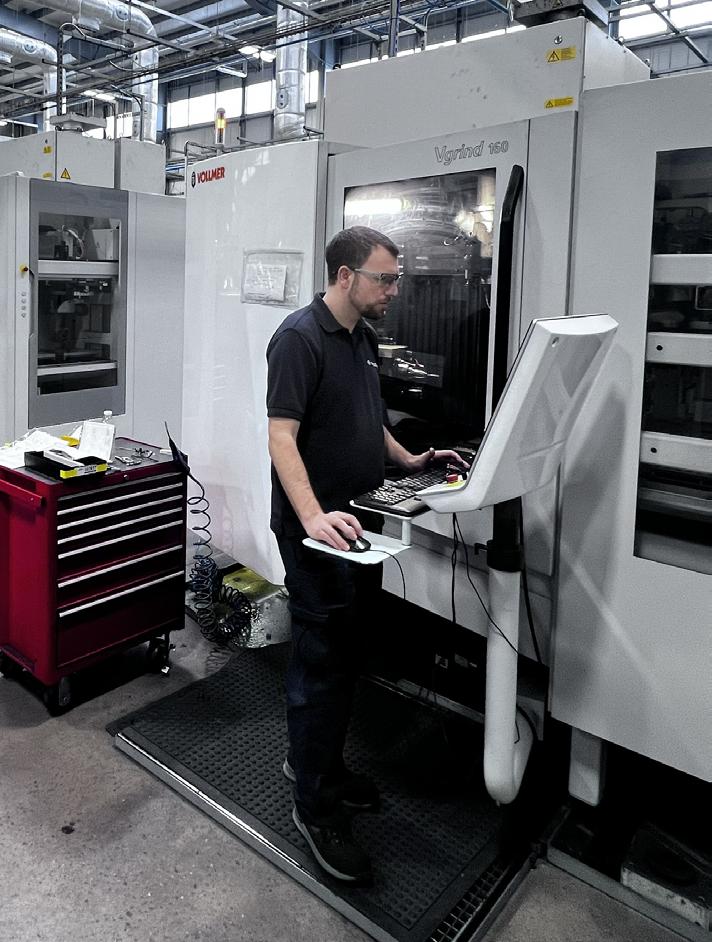
Exactaform Travels Long Journey of Growth With VOLLMER UK
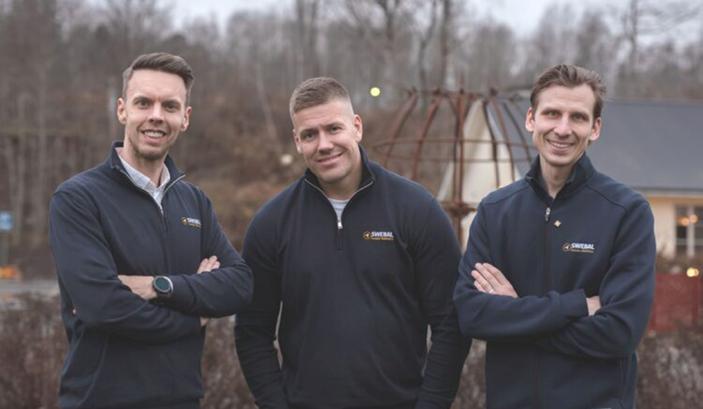
Swebal raises $35M to rekindle Europe’s TNT supply chain
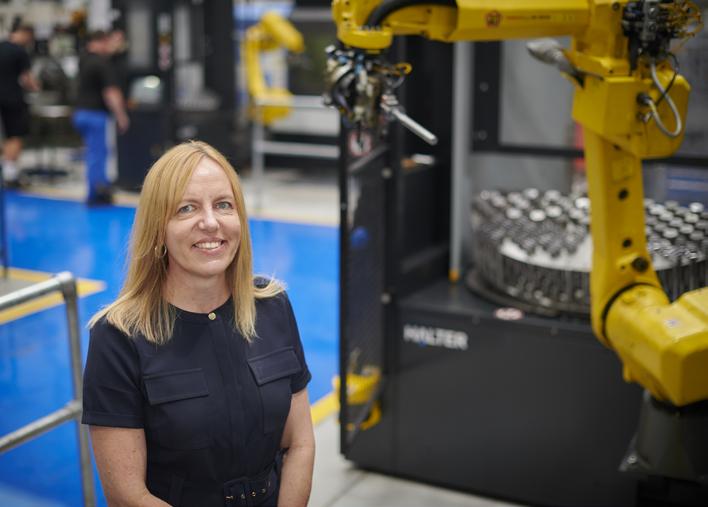
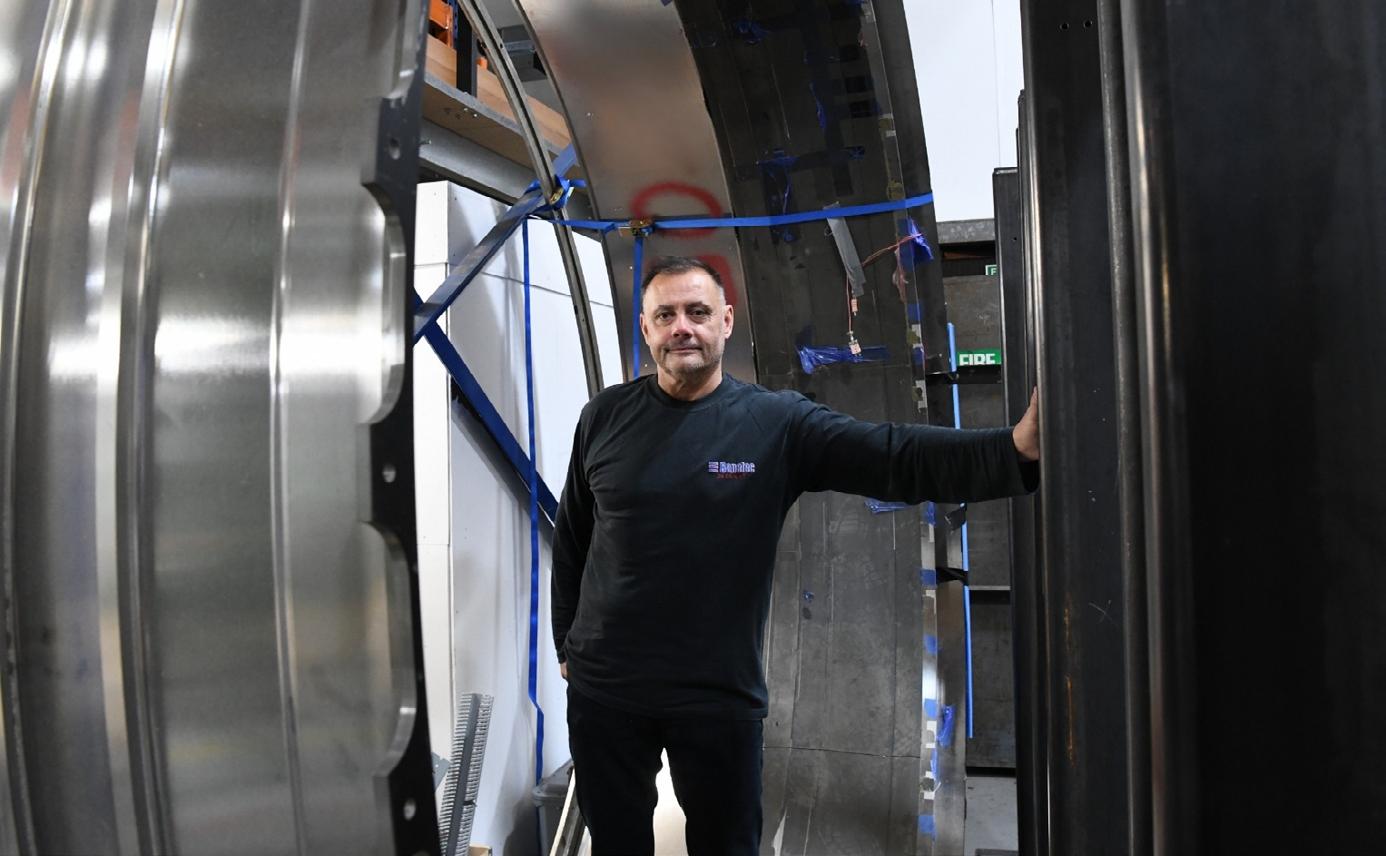
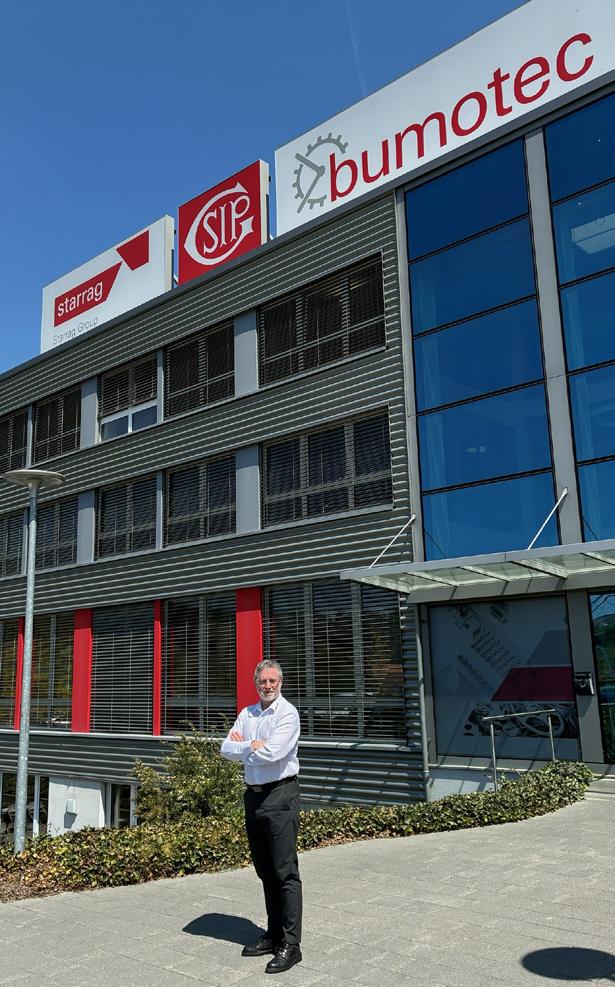
Incoming MD at FB Chain focused on next steps of growth plan
Editors Note
Welcome to the latest issue of Manufacturing & Production Engineering Magazine, where we explore an industry continuing to evolve at pace in response to technological advancement, energy challenges and shifting global demands.
In this edition, we highlight how manufacturers are embracing smarter automation, digital integration and more flexible production strategies to remain competitive. From innovations in robotics and assembly systems to developments in energy efficiency and sustainable infrastructure, the features throughout this issue reflect a sector focused on resilience and long-term growth. At the same time, skills development, supply chain pressures and operational risk remain key considerations for businesses navigating an increasingly complex landscape.
Encouragingly, the stories featured here demonstrate a strong commitment to innovation, collaboration and continuous improvement.
We hope you enjoy this issue and if you have news to share, please contact editorial@mpemagazine.co.uk.
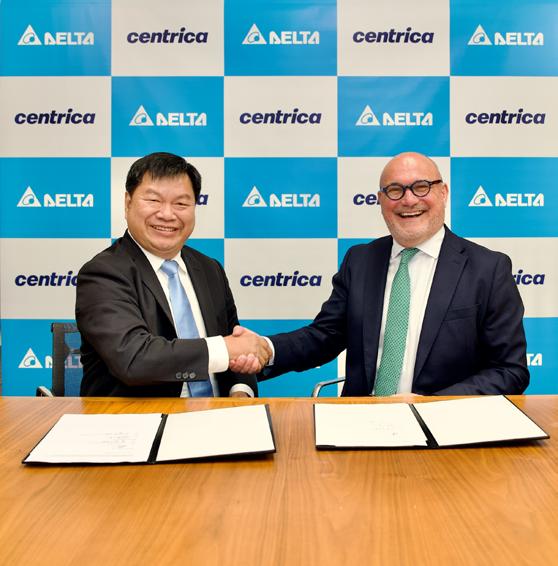
Delta and Centrica Launch Scalable OffGrid Fuel Cell Power
Solution for Data Centres and MissionCritical Applications
Delta, a global leader in power management and smart green solutions, announced an infrastructure partnership with Centrica plc (Centrica) to serve the data centre market and energy intensive industries in theUK and Europe, launching with Solid Oxide Fuel Cells (SOFCs) for off-grid energy generation.
This partnership creates a pathway for offering customers competitively priced, on-site power generation, significantly reducing exposure to wholesale electricity market volatility and grid capacity constraints. The partners plan to establish a demonstration site in the UK within the next 12 months, with a medium-term goal of delivering
MW-scale, rapidly deployable ‘gas-to-power’ solutions within the next three to five years.
Delta’s SOFCs, licensed by British solid oxide technology leader Ceres, provide stable, low-carbon energy fuelled by natural gas and reach 60% electrical efficiency - significantly higher than the open-cycle gas turbines typically used for on-site and back up generation (35%-42%). These cells are designed to meet the growing power demands of dataintensive digital infrastructure in the UK and Europe which underpin economic growth, digital sovereignty and the energy transition.
Commenting on the partnership, Charles Tsai, General Manager of Hydrogen Energy Business Development at Delta Electronics, said: “We chose to partner with Centrica because they share our commitment to delivering reliable, energy-efficient solutions for the rapidly expanding energy market in the UK and Europe.
“Centrica’s deep energy system expertise, strong local presence and innovative approach to off-grid and flexible power make them an ideal partner as we support both data centre operators and high energy intensive industries that demand resilience, sustainability and operational excellence.”
Chris O’Shea, CEO of Centrica, added: “Businesses across the UK and Europe need more power, and they need it faster than the electricity grids can deliver.
“This partnership brings together Centrica’s energy expertise, Delta’s world class manufacturing and cutting edge fuel cell technology to meet this growing energy demand with fast, reliable off grid power at scale.”
PICTURED LEFT: Charles Tsai, General Manager of Hydrogen Energy Delta Electronics (left) and Robert Booker, Chief Strategy & Transformation Officer of Centrica (right)
New fully funded solar scheme helping over 100 SMEs cut energy bills by over £20,000 a year
A new rooftop solar scheme backed by Paragon Bank is eliminating upfront costs for SMEs and is forecast to deliver average savings of £552,380 per customer over 25 years.
Businesses signed up to the initiative to date will also collectively avoid more than 45,000 tonnes of carbon emissions over the panels’ lifetime - equivalent to taking over 10,000 petrol cars off the road for a year.
The scheme, launched by FTSE 250 lender Paragon Bank in partnership with HDM Energies in July last year, aims to help SMEs cut energy bills and carbon emissions with no upfront investment – the
Retail
and manufacturing businesses underestimate impact of disruption from a cyber attack, Beazley report finds
New research from Beazley reveals that cyber risk remains the top concern for retail and manufacturing sector leaders, as businesses grapple with an increasingly complex and fast-moving digital threat landscape.
biggest barrier to adopting renewable energy sources for many businesses.
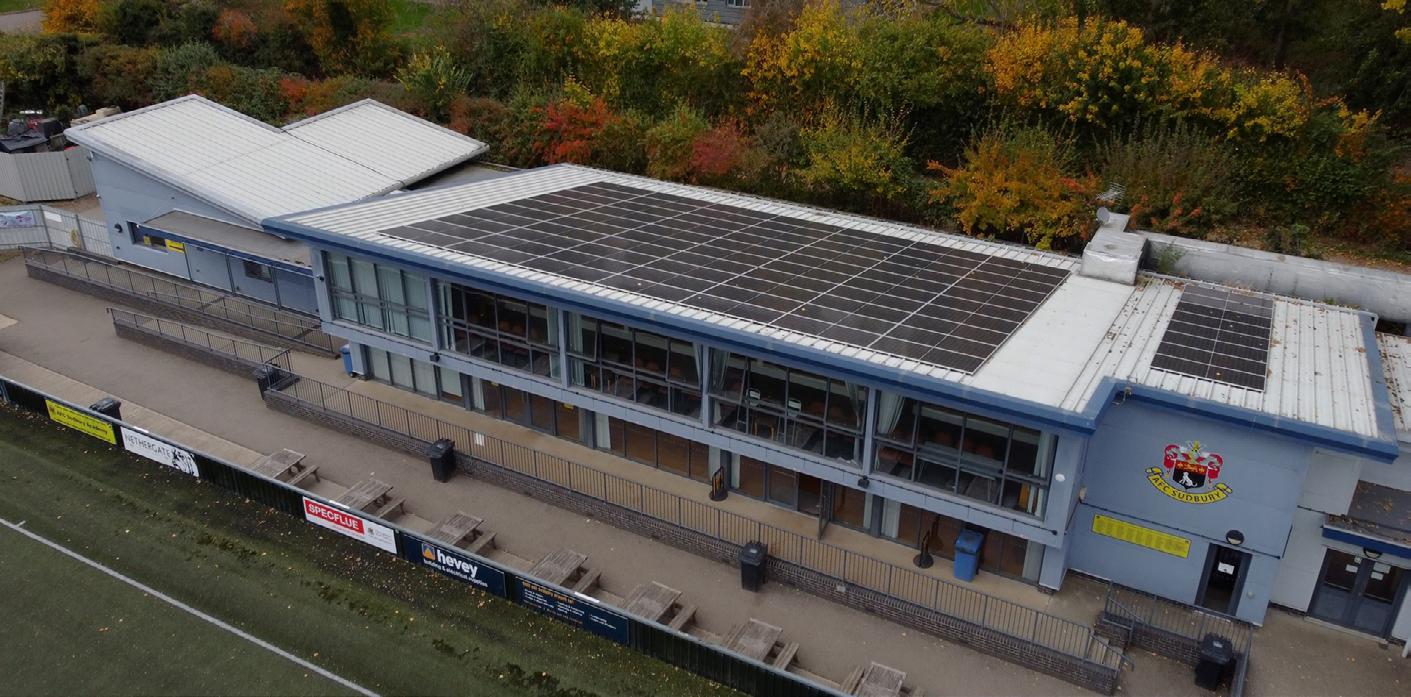
Over 100 organisations across the UK have signed up so far, with installations spanning a diverse range of sectors, including schools, farms, football clubs, manufacturers, office buildings, care homes, charities, a shopping centre and multiple other SME premises. Together, these organisations are on track to save over £58 million in energy costs, with Paragon’s SME Lending division having deployed almost £5.3 million of lending so far.
The initiative operates through a fully funded model in which Paragon finances the supply and installation of rooftop solar panels delivered by HDM Energies. HDM enters into a Power Purchase Agreement with each customer, supplying discounted, fixed rate renewable electricity directly to their premises, with the income from that electricity then used to repay Paragon’s funding.
This accessible model was built in partnership by both organisations as they recognised a need to unlock clean, low cost energy solutions for SMEs nationwide.
AI is also emerging as both an opportunity and a risk multiplier.
Based on a survey of 3,500 global business leaders, including senior executives across retail and manufacturing (including wholesale and food & beverage), the findings show how cyber risk has become a business-wide issue, capable of disrupting operations and driving financial losses across supply chains. This is being further intensified by the rapid adoption of AI and other advanced technologies.
While cyber risk is firmly established as a leading concern, the data also highlights a disconnect in how businesses perceive their resilience. Across industries, resilience is increasingly defined not by whether disruption occurs,
Sports and Youth Centre, Bridlington CYP
but by how far it spreads, how long it lasts and how quickly organisations can recover – a definition that contrasts with the high levels of confidence many businesses express in their cyber resilience.
This overconfidence is particularly evident in sectors heavily reliant on supply chains, such as retail and manufacturing, where despite 87% feeling resilient against cyber threats, ransomware attacks result in an average of 11.6 days of business downtime and a 6-18+ month impact timeline.
Key pressure points for retail and manufacturing businesses in 2026:
• 32% identify cyber risk as the top risk to their business, in line with global findings showing cyber as the number one concern across sectors
• 23% cite technology disruption, with a further 20% pointing to technology obsolescence, particularly where legacy systems remain in place
• 24% highlight intellectual property risk, reflecting the increasing value and exposure of proprietary information
Preparedness of businesses in the retail and manufacturing sectors:
• 87% say they feel prepared for cyber risk, pointing to a potential gap between perception and reality
• 82% are confident they could recover financially from a cyber attack, despite the growing systemic nature of cyber threats
• 34% plan to increase investment in cyber security and resilience measures
• 23% say data loss, regulatory obligations and fines would have the greatest impact following a cyber incident
AI is also emerging as both an opportunity and a risk multiplier. While it is expected to drive productivity and growth, it also introduces new vulnerabilities, requiring businesses to scale governance and controls in line with technological advancement.
AFC Sudbury
Iconic South West Vacuum Manufacturer Addresses Cost of Energy Crisis with UK Solar First
New Solar Solution Delivers High Energy Production For Land-limited Locations
The UK’s first commercial solar array using space-saving technology more commonly employed in domestic settings has been switched on by Numatic International, maker of the iconic Henry vacuum, in Chard, Somerset, to address the cost of energy crisis.
Designed to maximise power and minimise visual impact, the £1m micro-solar-park is seen as providing a blueprint for other manufacturers and commercial operations to adopt where limited land space is available.
Supplying clean power directly into Numatic’s energy intensive plastic moulding operations, the 5-acre site - installed by SunGift Solar - uses groundbreaking AIKO All-Back-Contact (ABC) cells paired with Sigenergy’s hybrid inverters.
This combination produces over 7% more kWh per panel than conventional ground mounted solar PV arrays while supporting future battery integration through Sigenergy’s DC-coupled architecture, helping maximise available grid capacity and reducing the need for costly infrastructure upgrades.
The solution allows Numatic International to generate up to 1.73 MWp in a space that would only previously have been capable of producing 1.6 MWp, and means that payback could be achieved in under five years – a period that could be halved if current high energy prices persist.
Meeting 20% of Numatic International’s annual on-site energy demand – rising as high as 100% on some days – the array of 2,672 panels enhances energy
Part of our ‘Operation Cleansweep’ sustainability goals, the new micro-solarpark shows what can be achieved when you reimagine how you approach small spaces.
independence and long-term energy security.
Space-Saving Payback
Stephen George, Regulatory Affairs and Sustainability Manager at Numatic International, commented on the landmark innovation, saying: “By investing in cutting-edge solar technology, we’re reducing our environmental footprint at the same time as protecting our manufacturing operations from
rapidly rising energy costs. Part of our ‘Operation Cleansweep’ sustainability goals, the new microsolar-park shows what can be achieved when you reimagine how you approach small spaces. It helps us on our journey as a responsible manufacturer and accelerates our progress towards achieving Net Zero by 2035. As a result, we will be able to make the equivalent of 500,000 Henrys a year from sunshine while cutting our CO₂ emissions by 266.91 tonnes a year!”
Commenting more broadly, Steve Whitlock, Finance Director at Numatic International, said: “In the current environment, every business of every size needs to consider how it’s going to secure its energy requirements in the future. This investment represents a step forward in our ability to meet our own energy needs, providing a strong return on capital compared to other investments that we may have made.”
Gabriel Wondrausch, Director at SunGift Solar, added: “Originally earmarked as a site for new manufacturing units, we calculated that by using highly efficient commercial versions of solar panels normally only used on domestic properties, we could transform a relatively small parcel of land into a hugely valuable solar asset for Numatic, capable of delivering a fifth of its annual energy needs.
“Providing a blueprint for other high-energy-use manufacturers to follow, the technology shows how small parcels of land adjoining factories or businesses can be converted into direct-feed solar power generation centres.”
New thinking on prepreg materials
New carbon prepreg material made with recycled carbon fibre nonwoven mat
Groundbreaking prepreg tooling technology
Standard and fire-retardant snap cure systems –including the new RFA570 adhesive film for core bonding applications
Providing technical innovation, exceptional quality, lowering cost-per-part and offering improved sustainability. Kit cut to our customers’ requirements, with standard products available from stock.
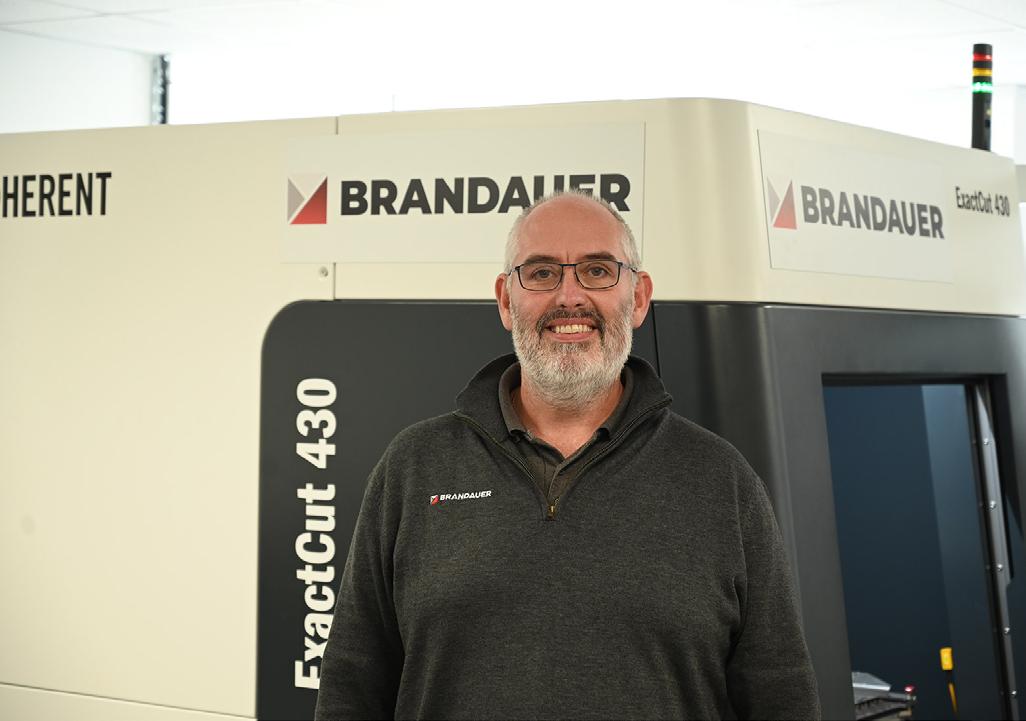
Rowan Crozier, CEO of Brandauer
Liam Conway, co-founder of Greenfields Energy Group
Greenfields energises Brandauer’s £12m expansion plan
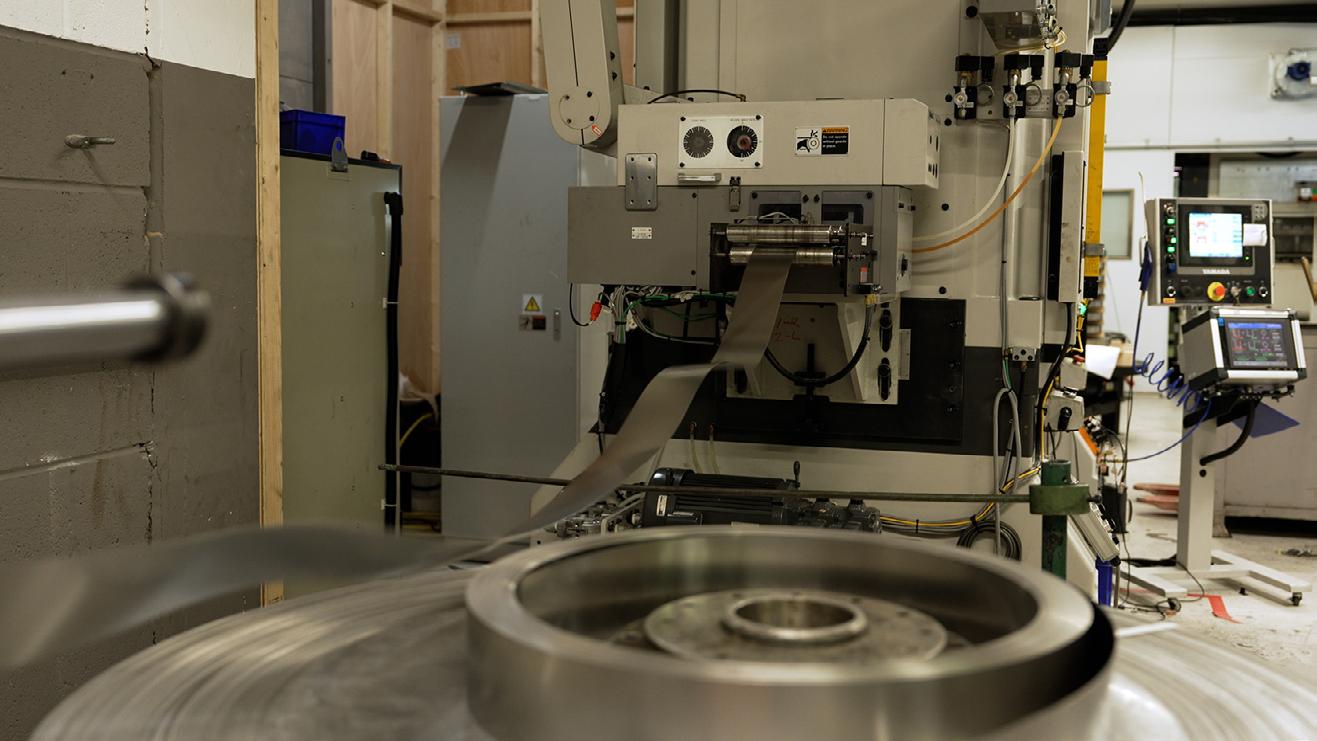
Securing a cost-effective energy agreement has helped one of Birmingham’s oldest-established manufacturers re-invest in delivering precision components for the automotive, construction, electrification and medical sectors.
Brandauer, which was set-up 164-years-ago to produce pen nibs for the world and is now a global leader in metal stamping, has tapped into expert advice from Greenfields Energy to move to a fixed contract on electricity and a cheaper agreement for gas that has generated over £50,000 in savings.
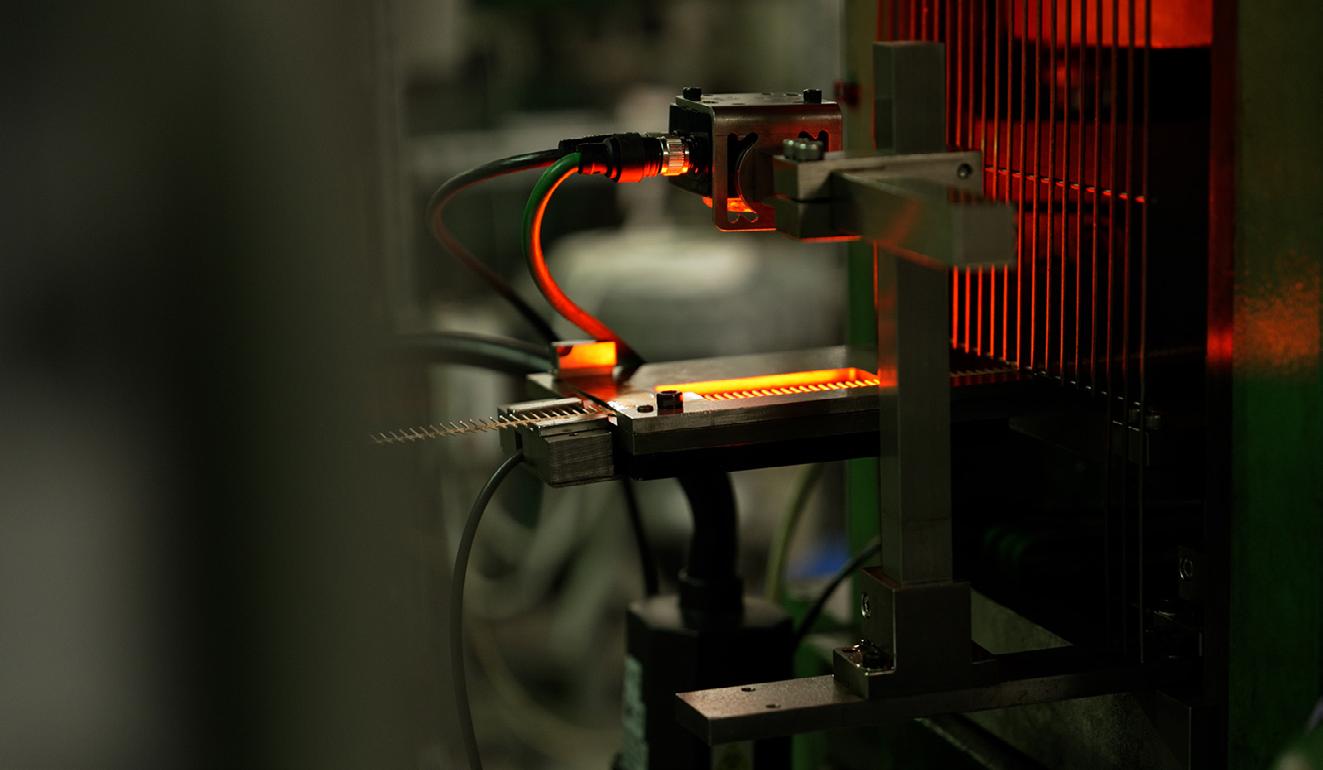
This has immediately been channelled into an automated assembly line and enhancing its wire EDM capability, giving it the capacity to secure new orders from customers at home and overseas in the EU, China and the Middle East.
The Newtown-firm has also benefitted from an audit to ensure the Agreed Supply Capacity Levels were appropriate for the short and medium-term growth expected following the MBO last year, not to mention clarifying the Targeting Charging Review banding was right.
Rowan Crozier, CEO of Brandauer, commented: “Energy has grown to become one of our
biggest costs as we embrace more automation and technology - this means we must be smart in how we access the most competitive and reliable gas and electricity prices.
“For a manufacturer dealing with so many day-to-day issues and customer requirements, this can be a complex and frustrating challenge. That’s why we called in Greenfields Energy, who we knew had a strong working relationship with industry.”
He continued: “Liam and his team immediately put us at ease, working with the team to explore our current situation and any pain points we were experiencing. They then used their knowledge of the market to suggest the best agreements.
Liam and his team immediately put us at ease, working with the team to explore our current situation and any pain points we were experiencing.
- Rowan Crozier, CEO of Brandauer (pictured top left)
“In our case, we were just completing the MBO so needed security of supply and at a rate that allowed us to plan for the next two years, so we could commit to investments that make a real difference to our business.”
After completing a painless audit, Greenfields Energy secured a 6% cost down in electricity price by moving Brandauer from a flexible deal to a fixed contract for two years.
This avoided the market volatility that followed this year and gave the management team clear visibility on costs. A successful TCR Banding analysis also alleviated £36k of unnecessary charges.
The final ‘energy’ win was gas costs being cut by nearly a fifth, amounting to more than £50,000 of savings that have immediately been re-invested in new technology.
“We’re on course to hit £12m in revenue by the end of 2027 with lots of exciting opportunities in laminations, wire EDM work and specialist tooling projects for new markets,” added Rowan.
“To be able to make the most of this, we have to be on top of energy costs and I believe we’re now in that position - mainly thanks to the advice and ongoing support from Greenfields.”
Liam Conway, co-founder of Greenfields Energy Group, added his support: “We currently work with over 150 manufacturing businesses across the country, acting as an extension to their core management teams and delivering the very best, impartial energy advice.
“Brandauer is the perfect example of how, through listening
closely and providing clear guidance, we have delivered a sustainable solution to its energy requirements and savings that have gone into making the business even stronger.
“Rowan and his team can plan for expansion with real certainty that there will be no nasty energy surprises, investing more into technology and recruiting the next generation of precision engineers.”
Greenfields Energy Group, which recently signed a new deal to support Black Country Chamber of Commerce members, provides procurement consultancy on electricity, gas and water, combining extensive risk management and trading expertise with personalised service and modern tools and tech.
Its new Energy Bureau Service acts as a ‘behind-the-scenes’ energy department for businesses, handling the admin, analysis and reporting so management teams can focus on handling day-to-day activities.
We’re on course to hit £12m in revenue by the end of 2027 with lots of exciting opportunities in laminations, wire EDM work and specialist tooling projects for new markets.
- Rowan Crozier, CEO of Brandauer (pictured top left)
From validating utility bills to providing in-depth consumption reporting, this industry-leading service ensures energy strategies are accurate, cost effective and complaint.
Molex Completes
Acquisition of Teramount Ltd.
Molex, a global electronics leader and connectivity innovator, has completed the acquisition of Teramount Ltd., an Israel based developer of detachable fiber to chip connectivity solutions optimized for high volume Co Packaged Optics (CPO) and other silicon photonics applications.
“Teramount’s passive, detachable coupling approach supports large assembly tolerances and semiconductor grade wafer level processes— filling a critical gap in the optical stack,” said Aldo Lopez, president, Datacom Solutions, Molex. “By integrating this unique technology into our optical interconnect portfolio, Molex offers a more seamless path from early-stage prototypes to high-volume CPO and other silicon photonics architectures required for the AI era.”
Teramount will continue to operate as a design and engineering hub in Jerusalem, supported by Molex’s global optical capabilities. It will become part of the Optical Connectivity segment within the Optical Solutions Business at Molex.
Teramount’s passive, detachable coupling approach supports large assembly tolerances and semiconductor grade wafer level processes—filling a critical gap in the optical stack...
- Aldo Lopez
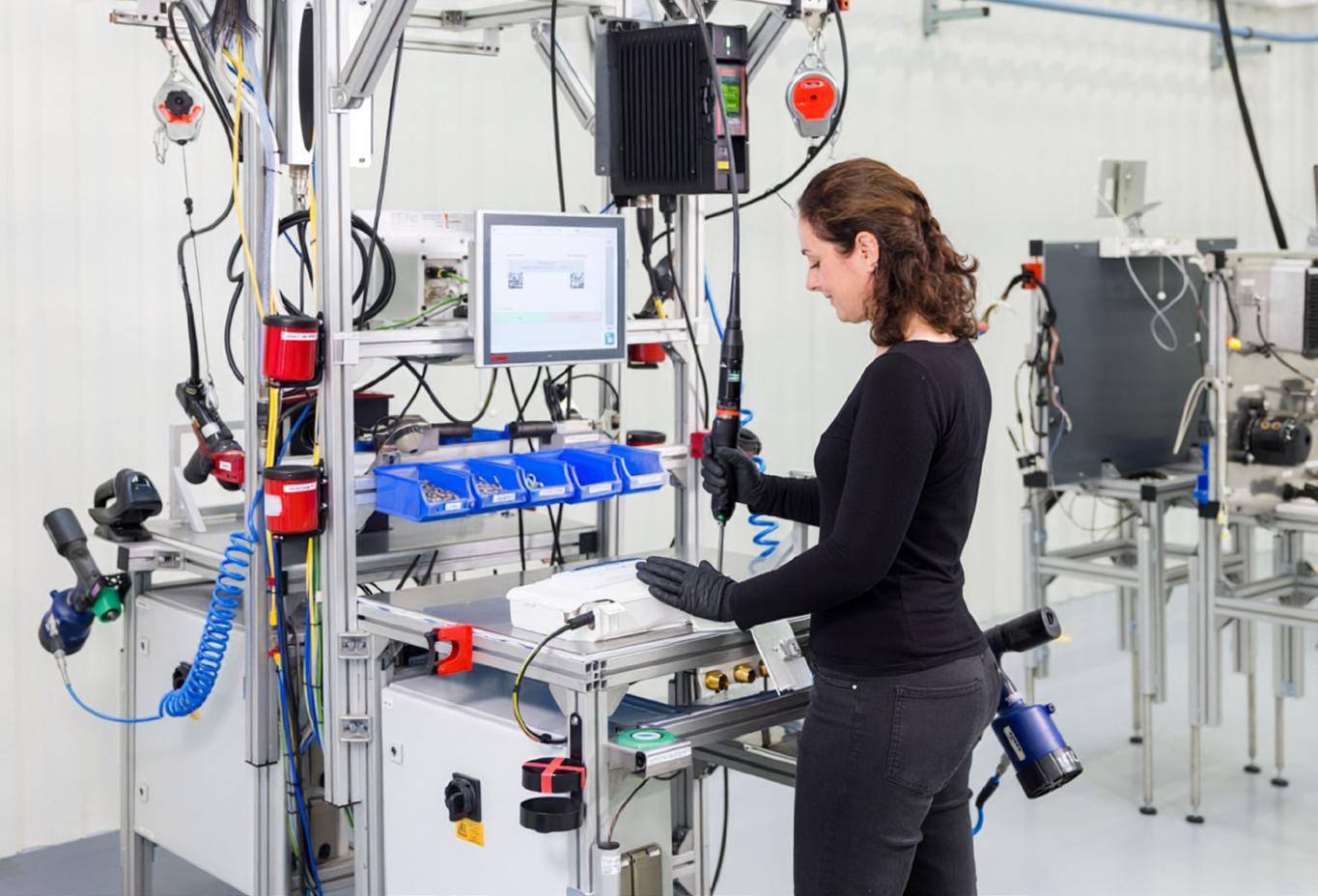
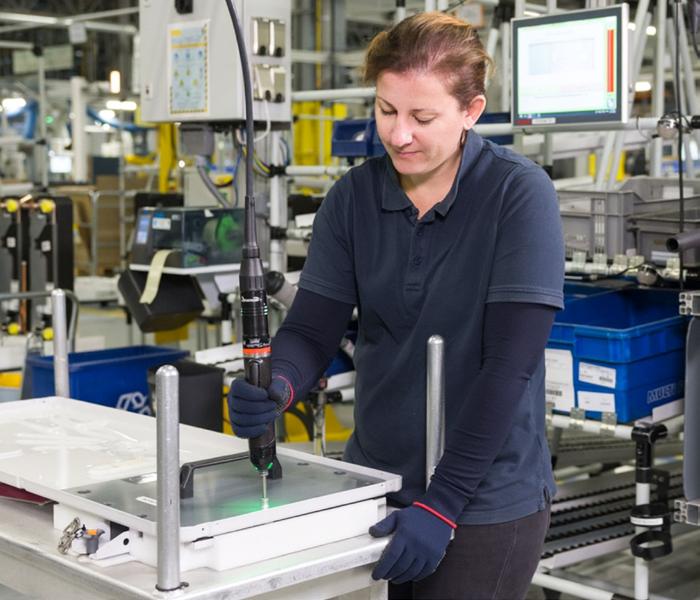
Desoutter bridges manual and automated assembly with new EIDS Series
Industrial assembly solutions specialist Desoutter has launched its new EIDS Series of low torque transducerised screwdrivers, delivering enhanced precision, traceability and usability for manufacturers operating in highvalue, low-torque applications. Engineered to evolve alongside the production environment, the series provides immediate value as a handheld solution, while also offering seamless integration into fixtured or fully automated assembly stations.
Developed in response to a growing need for reliable, low-torque fastening solutions that do not compromise on data capture or process control, the series combines advanced transducer technology with a compact, ergonomic design to ensure highly consistent, repeatable fastening. By integrating easily with Desoutter’s wider digital ecosystem, including process control through Pivotware, advanced data analytics via Demeter and real-time positioning solutions such as Nexonar, the EIDS Series enables manufacturers
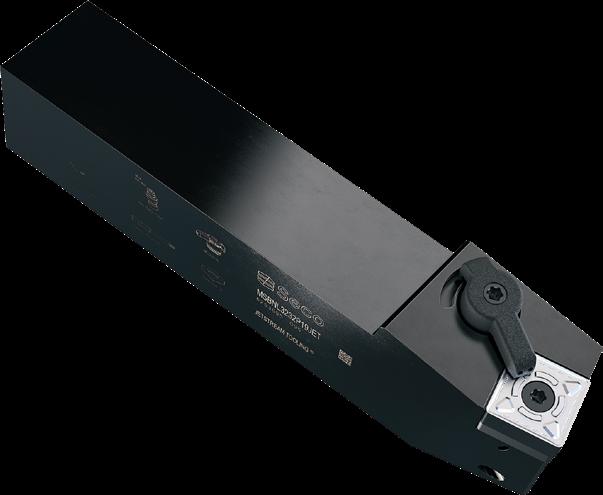
Jetstream Tooling® M-Clamp toolholders for large inserts
introduces Jetstream Tooling® M-Clamp toolholders for large inserts, featuring targeted high-pressure coolant delivery, double clamping security, and innovative 3D-printed clamps.
Designed for demanding machining, the high-pressure coolant through the JETI M-Clamp system deliverslonger tool life, superior chip control, and smoother finishes even in tough materials.
to embed precision fastening within fully connected smart assembly architectures.
The EIDS Series delivers plus or minus 2.5 per cent torque accuracy at a six sigma level across the entire torque range, in accordance with ISO 5393. In simple terms, this means every fastening is completed exactly to target, with minimal variation from one cycle to the next. By capturing real-time torque and angle data, the tools give manufacturers greater visibility and control over critical assembly processes, supporting both quality assurance and long-term operational improvement.
Covering a torque range from 0.2 to 22 Nm, with four inline and three angle models, the series enables manufacturers to reduce tooling complexity by using fewer tools across the line. This helps minimise the need for backup tools and spare parts, lowering inventory and maintenance costs while maintaining consistent tightening quality. A high torque ratio further simplifies production while reducing the risk of scrap, rework or recalls.
A key feature of the EIDS Series is its compact and lightweight design, making it ideal for precision assembly
Extended tool life by at least 30%
By integrating high-pressure coolant directly through a 3D-printed clamp and a secondary DUO JET outlet, the M-Clamp toolholder system ensures optimal temperature control at the cutting zone. This targeted approach extends tool life by at least 30%, improves chip control, and delivers superior surface finishes, even when working with stainless steel and superalloys.
The robust, additively manufactured (AM) clamp is positioned at a safe distance from the cutting edge,
environments. The tools are engineered to reduce operator fatigue during repetitive tasks, supported by proven ergonomics enhanced with a new grip design. Integrated LEDs provide joint illumination and real-time status feedback, including configurable indicators for tool readiness, cycle status and maintenance alerts. This clear visual guidance helps reduce operator errors, improving productivity and overall line efficiency without adding complexity.
The EIDS brings improved functionality while remaining backward compatible with the CVI3 controller, enabling both existing and new customers to implement this new solution with ease.
In addition to precision and usability, the EIDS Series supports full traceability through seamless integration with digital control systems. Combined with Desoutter’s AXON platform, the tools become part of a connected, future-proof fastening loop that enables advanced tightening strategies such as seating detection, while allowing manufacturers to monitor, record and analyse fastening data in real time to support continuous improvement initiatives and compliance with stringent industry standards.
Designed to be robust and built for long-term use, the EIDS Series can be used as handheld tools for manufacturers favouring manual assembly strategies. To ensure tool longevity and as customers adopt higher levels of automation, they also support fixtured applications and offer external start options for automated or robotic integration.
maximizing security and resisting chip hammering which is a common cause of clamp wear and instability. This means fewer replacements, less downtime, and a more consistent machining process.
Double clamping security for negative and round positive inserts
For the first time, double clamping security is available for both negative and round positive inserts. The addition of a center-lock screw together with the top clamp ensures improved stability and rotational
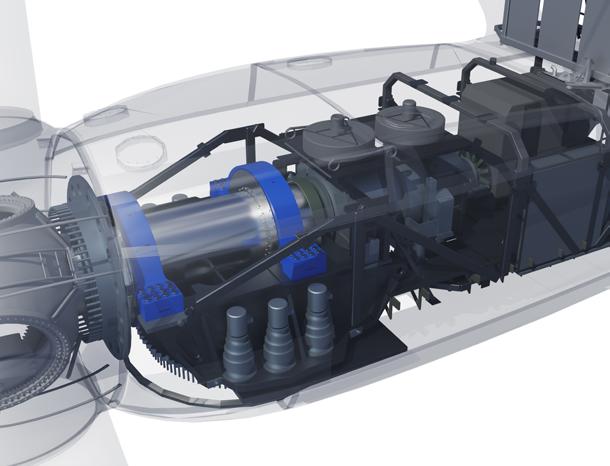
Waukesha Bearings Unveils Innovative NordAlign™ Bearing for Wind Turbine Main Shafts
Waukesha Bearings, a global leader in the design and manufacture of advanced fluid film bearings and magnetic bearing systems, is proud to announce the launch of the NordAlign bearing, specifically engineered for wind turbine main shafts. This groundbreaking technology aims to enhance turbine reliability, reduce maintenance costs, and streamline installation.
NordAlign bearings are robust and reliable, often outlasting existing main bearing options. The tilt pads adjust dynamically to both radial and axial shaft movements, optimizing load distribution and significantly extending the bearing’s lifespan. When maintenance and
security, reducing insert movement and boosting reliability in challenging conditions.
Unmatched flexibility compared to traditional clamps
Efficiency is further enhanced by the JETI M-Clamp’s twist function and shared key slot design, allowing for faster insert changes and easier indexing, minimizing downtime and maximizing productivity.
Customization is also at the forefront: thanks to 3D printing, AM clamps can be tailored to meet
repairs are needed, NordAlign bearing pads can be exchanged uptower, effectively eliminating the need for expensive jack-up vessels and cranes. Its modular design easily scales to accommodate larger wind turbine models, while the optimized pad shape allows for straightforward integration into the nacelle, simplifying installation whether retrofitted to existing equipment or installed in a new application.
NordAlign bearings deliver advanced performance across a wide range of operating conditions, including assembly, low-speed idling, and extreme events.
Recognizing the unique demands placed on wind applications, Waukesha Bearings utilized its exceptional in-house material development and testing expertise to create a TruTech® engineered polymer specially formulated to maximize wear resistance and enhance performance, even in the harshest operating conditions.
unique machining requirements, offering flexibility that traditional clamps cannot match.
“Our goal with the Jetstream Tooling M-Clamp was to solve the real challenges machinists face, such as unreliable coolant delivery, clamp wear, and time-consuming insert changes,” says Fredrik Samuelsson, Global Product Manager ISO Toolholders. “And we achieved it.”
Visit www.secotools.com
LEFT: Additive manufactured coolant clamp positioned at a safe distance from the cutting edge
Unlocking easier automation
As automation systems grow more complex, machine builders are rethinking how they design and deploy motion. Nicola Pezzolato, Application Engineering Leader EMEA at Kollmorgen, explores how a new generation of servo technology is helping manufacturers simplify design, improve flexibility, and build greater resilience into their supply chains.
When it comes to automation systems, complexity tends to grow faster than performance. Each new generation of machines promises higher precision, greater flexibility, and faster commissioning – but the reality is that these ambitions often translate into more wiring, more configuration, and more integration headaches. The result is a development cycle that’s harder to control, at a point when customers expect shorter lead times and lower costs.
That’s the challenge facing today’s machine builders. They’re under pressure to deliver high-performing systems in record time while
navigating unpredictable supply chains, competing global standards, and shifting component availability. In that environment, the biggest advances don’t always come from adding new features or exotic capabilities, but from rethinking the fundamentals.
That shift involves three key ideas. The first is right-sizing: ensuring that systems include only the functions and features that add value, rather than paying for capabilities that will never be used. The second is openness: creating motion systems that can connect freely across different controllers, protocols, and markets without locking users into
closed ecosystems. Finally, the third is resilience: designing equipment that can be built and supported reliably, even amid global uncertainty.
Together, these principles define a new approach to motion control; one where flexibility, reliability, and simplicity are not in conflict, but part of the same design philosophy.
The cost of unnecessary complexity
In the effort to design flexible machines, many OEMs end up overspecifying their motion systems. They select servo drives and motors packed with advanced features that have
plenty of potential benefits in theory but, in practice, will never be used. Now, the motivation behind this is very understandable. Buying the “top-end” option can seem like a safe hedge against future requirements and edgecases.
However, this approach carries hidden (and, sometimes, not-so-hidden) costs. Each unused feature adds overheads in engineering effort, configuration time, and inventory management. Over-specified systems also tend to demand more from the control environment, all the way from safety validation to thermal management. Multiply that by dozens of axes, and the cost of complexity can become a serious drag on development efficiency and real-world usage.
In our experience, we’ve found that around 80% of applications only use a relatively basic set of essential features. As such, a more effective design strategy is to take a modular view of machine design – choosing motion components that deliver exactly the capabilities required for a given task, without the excess. That doesn’t mean compromising on performance; rather, it’s about applying the same precision we value in motion control to system design itself.
This “right-sizing” philosophy is gaining traction across the automation world. It’s reflected in the growing demand for servo platforms that can cover the majority of applications with standardized, streamlined options. By eliminating unnecessary features and focusing on what most users actually need, machine builders can simplify their engineering process and improve time to market, while still meeting demanding performance standards.
Open systems, not closed ecosystems
Many control platforms form what can only be described as closed ecosystems: the controller, drives, software, and even cabling are designed to work only with each other.
In theory, this ensures compatibility. In practice, however, it often creates inefficiencies. It ties machine builders to a single vendor, restricting flexibility and creating difficulties when supply issues arise or when a customer prefers a different PLC environment.
By eliminating unnecessary features and focusing on what most users actually need, machine builders can simplify their engineering process and improve time to market, while still meeting demanding performance standards.
- Nicola Pezzolato
A more open, interoperable approach is now emerging, one that aims to give OEMs freedom without sacrificing reliability. Multi-protocol servo drives, for instance, can operate across EtherCAT, PROFINET, and EtherNet/ IP networks through simple software configuration rather than hardware changes. This allows the same drive and motor platform to integrate with a wide range of controllers and fieldbus architectures, regardless of geography or customer preference.
For global machine builders, that’s a major advantage. A machine designed for one market can be deployed in another without reworking the control architecture or maintaining separate bills of materials for each protocol. This simplifies certification, reduces engineering overheads, and improves long-term serviceability.
Open systems also make it easier to mix and match technology partners. Drives and motors can come from one supplier, PLCs and HMIs from another. So long as everyone speaks the same “language” through standardized communication layers, they can work together effectively.
This not only helps to simplify setup and avoid compatibility issues, it also helps OEMs build resilient systems and respond quickly when components are scarce or delayed – something that remains front-of-
Automation
mind for many businesses after the disruptions we’ve seen over recent years.
Meeting modern expectations
For machine builders, the value of openness and simplicity goes beyond convenience. It enables better business decisions. When hardware can be deployed across multiple regions and control architectures, inventory management becomes easier. When drive systems are available from stock with predictable lead times, project planning becomes more reliable; and when software tools minimize the risk of setup errors, commissioning becomes faster and more consistent across teams and sites.
That’s why the industry is beginning to see a quiet shift in mindset. The old equation – more features = more capability – is giving way to something more nuanced. Enough features, applied intelligently, equals better outcomes.
Manufacturers like Kollmorgen have responded to this change by developing servo platforms built around the essential features most users need, rather than every feature that could be imagined. Systems like the Kollmorgen Essentials range reflect a pragmatic approach to automation: maintaining highquality performance and global interoperability while trimming away unnecessary complexity.
The result isn’t a compromise, but rather a recalibration. It’s about recognizing that not every axis needs to be over-engineered, not every machine needs bespoke integration, and not every component needs to be tied to a single ecosystem.
The world of automation is advancing rapidly, and it’s easy to fall into the trap of thinking that the best way to meet the challenges of tomorrow is to jam every piece of technology possible into your system. However, the smartest progress often comes from simplifying rather than adding.
For more information, visit www.kollmorgen.com/en-us
Q5D and KYOCERA AVX expand three year collaboration
with custom IDC
connectors for automated wire harness assembly
Q5D Technologies (Q5D), the specialist in robotic automation of wiring harness manufacture, and KYOCERA AVX today announced the latest phase of a three year collaboration to enable fully automated wire harness assembly using insulation displacement connector (IDC) technology. The two companies are now jointly developing custom IDC connectors optimised for termination by Q5D’s robotic wiring platforms.
Q5D’s five axis manufacturing robots automate one of industry’s most stubborn bottlenecks: manual wiring harness assembly in sectors such as automotive, aerospace, white goods and industrial equipment. Unlike conventional crimp contacts that usually require hand tools, IDC contacts can be fixed to a surface and terminated from one side, making them ideal for robotic processes that lay in the wire, hold it with simple traps and then press down to complete the connection.
Over the past three years, Q5D and KYOCERA AVX have carried out numerous joint test programmes using established IDC product families with customer specified wires.
Over the past three years, Q5D and KYOCERA AVX have carried out numerous joint test programmes using established IDC product families with customer specified wires. These evaluations span typical harness conductors from around 12 to 32 AWG and current levels from small signal through to approximately 20 A, with a focus on reliable cold weld terminations and robust performance under shock and vibration.
“IDC technology is ideal for automation because we can place the wire across a fixed contact and use the robot to press it into a controlled, repeatable termination,” said Chris Elsworthy, Chief Technology Officer at Q5D. “Working closely with KYOCERA AVX has given us the confidence to move from standard parts toward custom IDC designs that make fully automated harness assembly even more attractive to our customers.”
James Webb, Kyocera AVX’s Field Applications Manager, adds, “The custom IDC concepts under development are modular and can be arranged side by side, allowing designers to scale contact count and layout for each application while minimising material use and overall system cost.”
Once finalised and qualified with early adopters, Q5D and KYOCERA AVX expect the technology to help establish repeatable, industry standard approaches to automated harness manufacture across multiple industry sectors.
Siemens selects AeroBot solution from KNAPP
Electronics manufacturer, Siemens has chosen the award-winning AeroBot warehouse robotics system for its manufacturing facility in Karlsruhe, Germany.
The new AeroBot picking and storage system, due to go live later this year, will connect seamlessly to Siemens’ existing warehouse processes and will optimise intralogistics at the Karlsruhe facility.
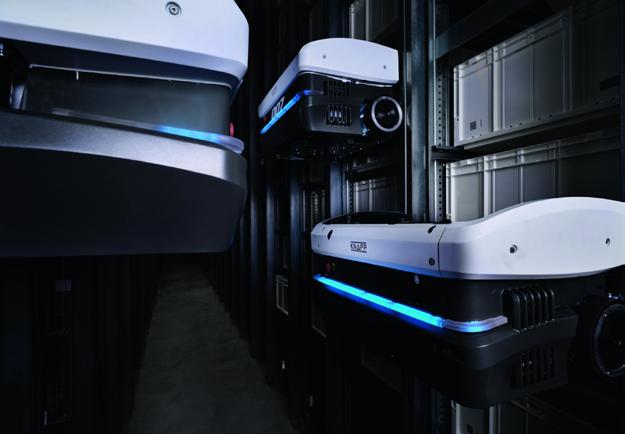
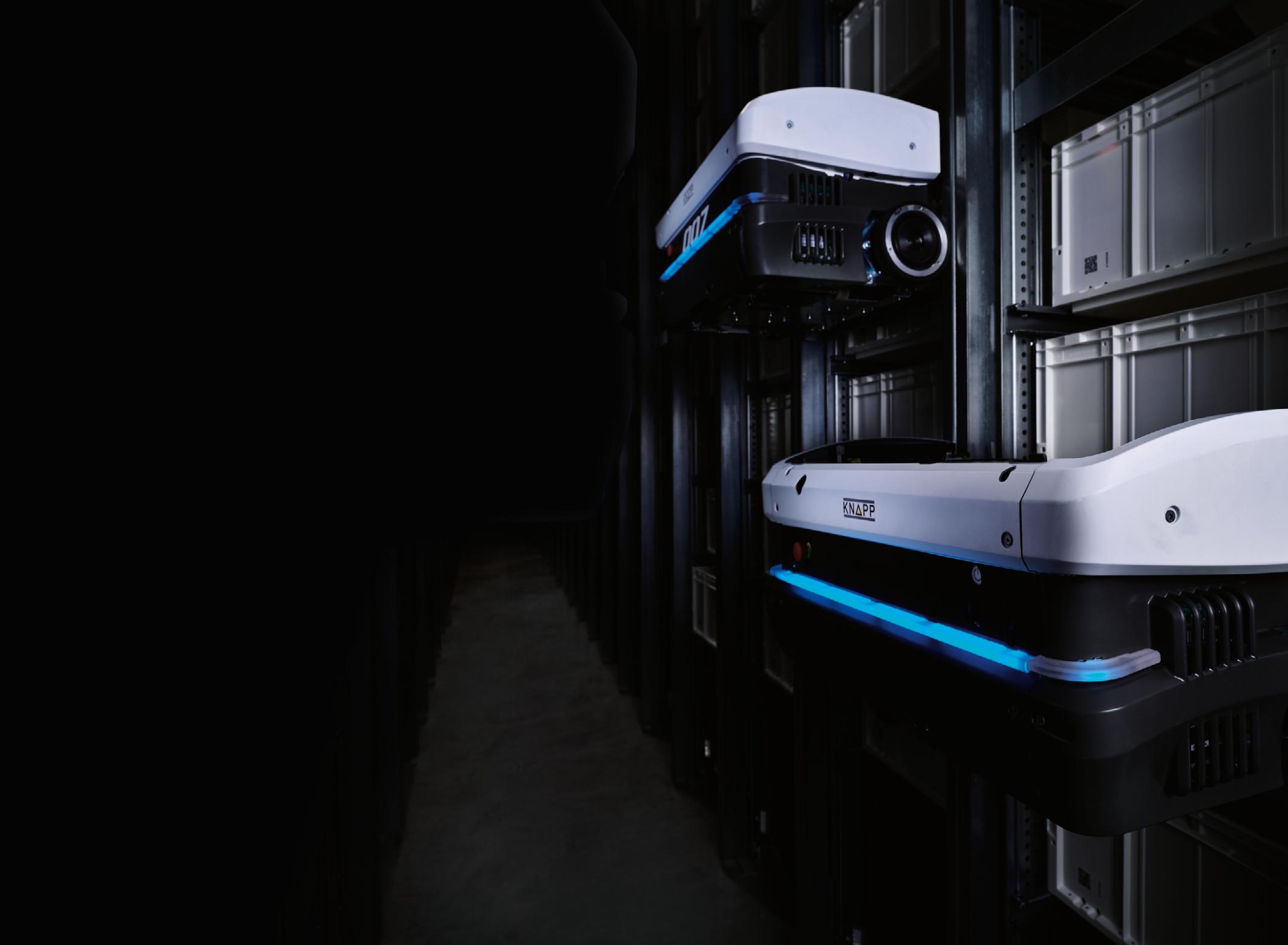
AeroBot features robots that move in three dimensions to store,
retrieve and transport loads. The intelligent bots move lengthwise and crosswise on the floor and vertically by climbing the racks. Working independently to access all areas, the bots will provide a reliable and scalable solution for the supply of Siemens’ manufacturing lines.
The AeroBot system will store containers quadruple-deep across 30,000 locations on 27 levels, fully automatically. In its final form, the system will feature 21 autonomous storage robots, which will make 280 storage and retrieval movements per hour.
The solution will be controlled by KNAPP’s KiSoft One software,
which will be connected to Siemens’ SAP® EWM solution through an interface. The modular software manages all processes to ensure optimal material flows, maximising both efficiency and transparency.
Siemens has been using a fleet of KNAPP’s Open Shuttle autonomous mobile robots (AMRs) to supply its production areas for several years. As part of the latest order, Siemens will also expand the Open Shuttle fleet from three to six AMRs.
KNAPP UK
Tel: 01865 965 000
sales.uk@knapp.com www.knapp.com
Right first time: 7 mistakes to avoid when specifying your automation system
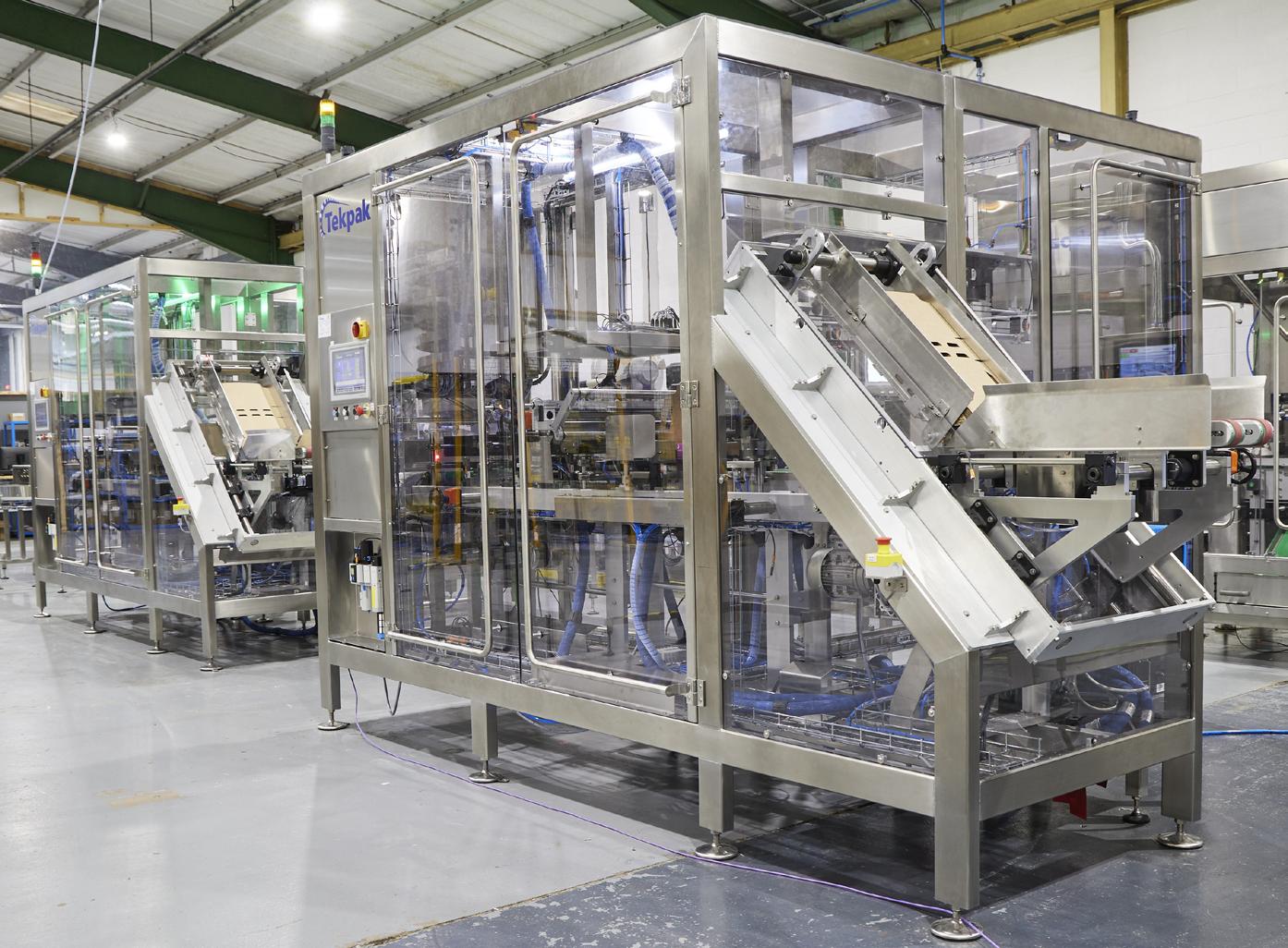
By Andrew Ross, Head of Software, Tekpak Automation
For today’s manufacturers, automation is no longer a choice; it’s a business imperative. Speeding up production times, reducing energy costs, cutting waste and relieving the staffing burden caused by the manufacturing labour crisis, it’s no wonder that in factories across the UK and Ireland, robotic systems are being installed in increasing numbers – and not just in cutting-edge industries such as automotive and medtech, but
also in traditionally manual-heavy sectors like food & beverage and packaging.
However, not all automation solutions are equal. Before investing in a robotic system, it’s vital to ensure that any potential supplier understands your production needs and limitations, as oversights at this level can be costly. Here, we outline the seven key mistakes that every manufacturer should avoid when embarking on a new automation project, to make sure
your installation runs smoothly from day one…
Mistake #1: Not taking into account your existing equipment
Any proposed new solution needs to easily integrate with your existing equipment, otherwise it will lead to production issues further down the line, reducing output and costing you money – essentially, creating more problems than it resolves.
A reputable supplier should want to visit your site and see for themselves the hardware and software systems that are already in place before
recommending a solution that integrates well with both. At Tekpak, we use OPC UA for our automated packaging systems, a cross-platform, secure, open-source communication standard to enable convenient data exchange between our solution and the customer’s existing equipment.
Our engineers will arrange a site visit at the start of every project to find out which signals are already in place and work these in when writing client-specific software, to ensure seamless integration from the point of installation. Make sure to have this conversation with your supplier at the start of your automation project –don’t let it be an afterthought.
Mistake #2: Not considering your available space
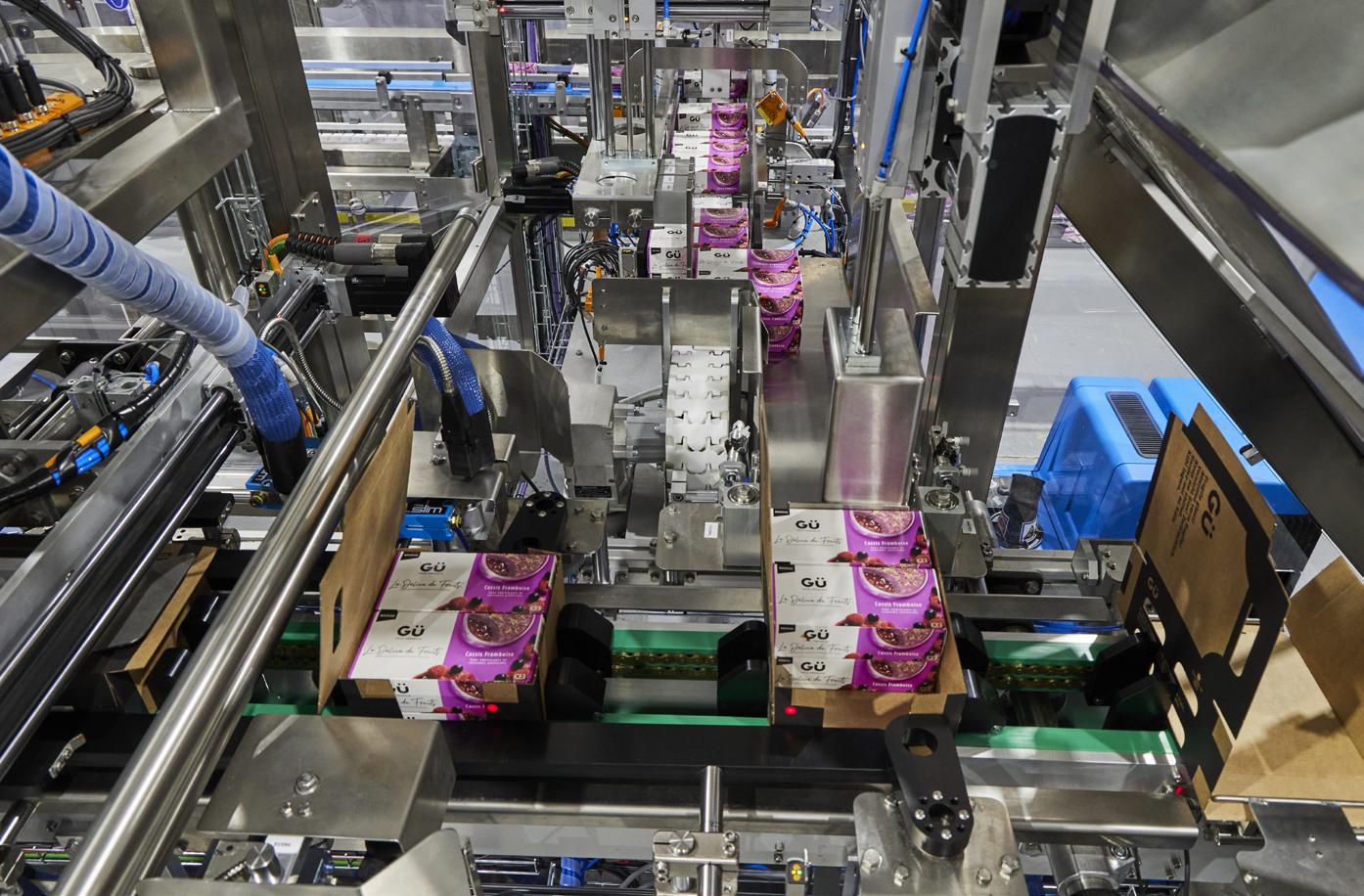
Manufacturing facilities are busy, often crowded spaces. And this rings especially true for packaging halls. Your dream automation solution may look great on paper but if its footprint is too large for your existing layout, you’ll be left with the costly dilemma of deciding whether to increase space, remove existing equipment or rework your new automation system.
We prefer to work ‘backwards’, beginning not with a proposed solution but from the starting point of the customer’s available space. This avoids logistical challenges further down the line. Ask your supplier if they offer a modular solution that can
Manufacturing facilities are busy, often crowded spaces. And this rings especially true for packaging halls.
- Andrew Ross
adapt to your layout constraints – not only will this keep down costs and limit installation difficulties, but it will also futureproof your operation, enabling you to increase production capacity as demand grows.
Mistake #3: Not thinking about day-to-day usability
Often, an automation project is specified by a technical or engineering manager, with input from the C-suite and finance teams. Yet, on a day-today basis, the people using the system will be operatives on the shop floor. To ensure your shiny new set-up isn’t left gathering dust in the corner of a workshop, it’s essential that it is easy to operate by employees who may not have advanced coding or engineering skills, and who may not even have English as their first language.
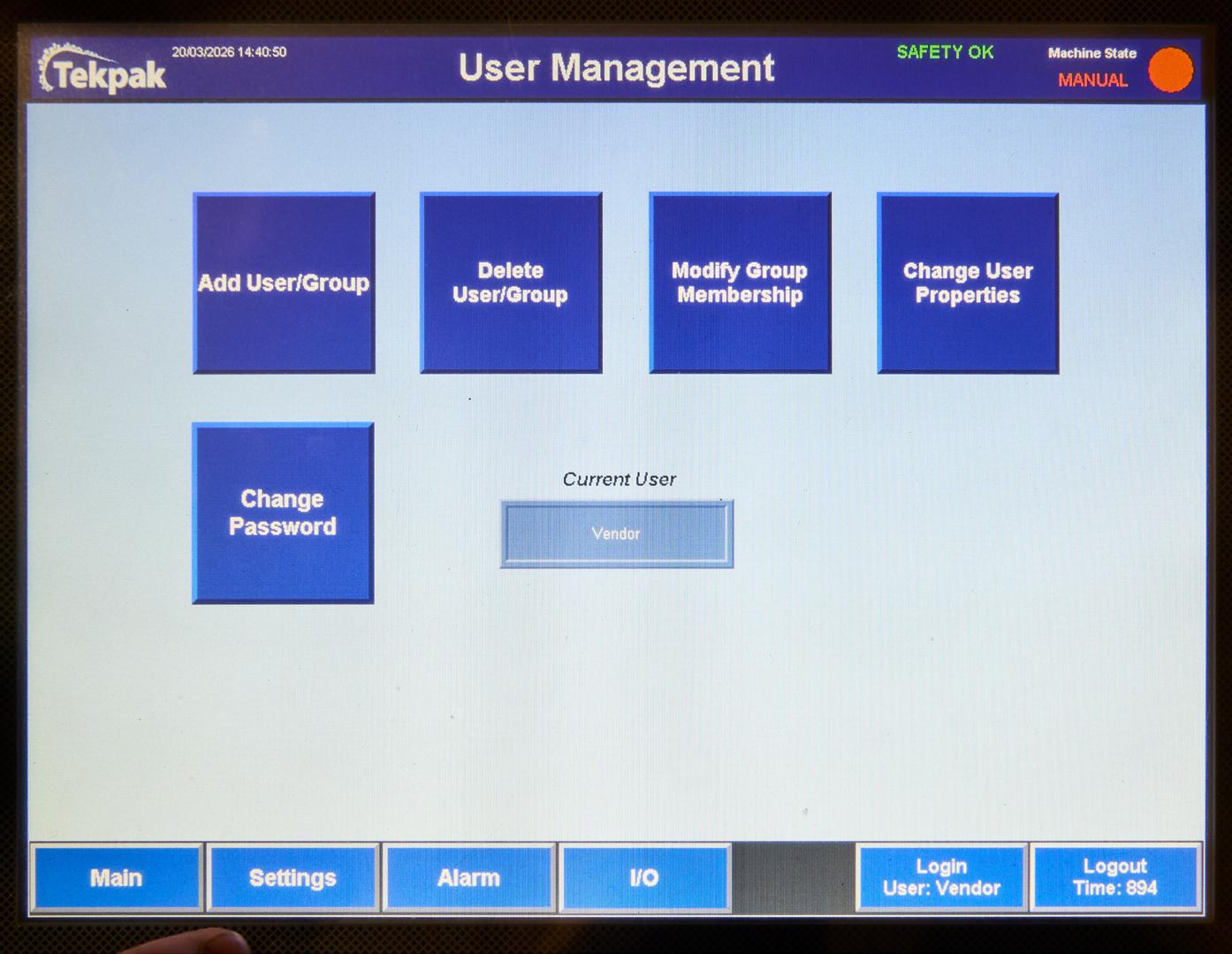
Simple HMIs with touch screens, intuitive menus, colour coding and clear visual cues – as opposed to lengthy technical jargon – will ensure your system can be widely used by all production staff, so check with your supplier that their systems are as userfriendly as this.
At Tekpak, we always ask for feedback on usability from a variety of staff members following the FAT and SAT stages of a project, including those working on the shop floor. Making sure that operatives can easily alter packaging formats and layouts on the HMI, for example, is essential to the long-term success of your automation project.
Mistake #4: Not building in production flexibility
One of the biggest mistakes a manufacturer can make is choosing an automated system that’s perfect for them now.
Automation
Automation is a big investment and consumer demands change rapidly. If your solution has been specified for one particular application, on one particular line, for one particular product, it may quickly become obsolete if your product range alters.
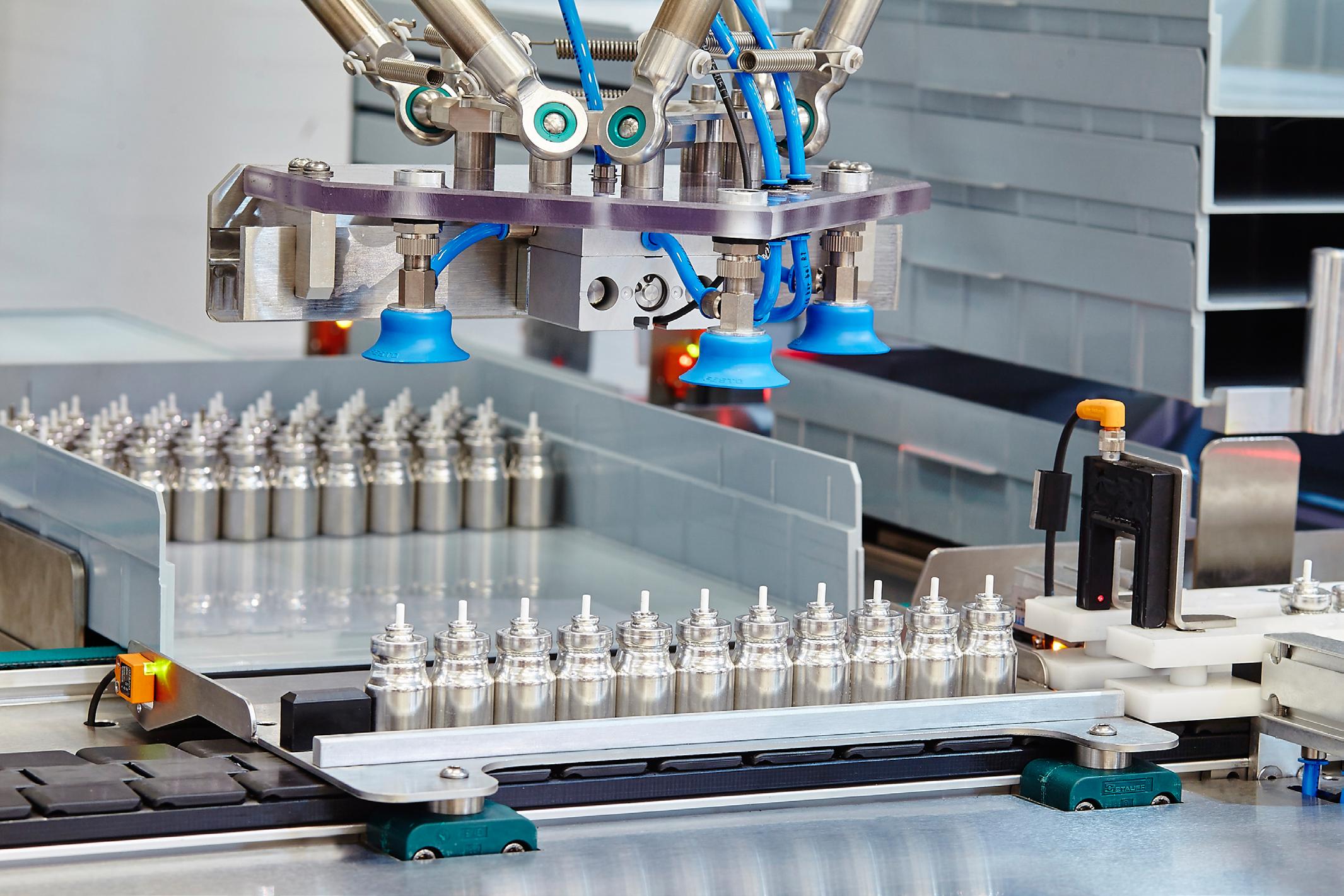
When we deliver a system to a customer, we make it clear that we’ve not merely sold them a machine but the software, too. We ensure that both can be altered as required, to offer maximum production flexibility now and in the future – whether that be a change of size, speed, product type or configuration. For example, we previously installed a high-speed vial coding line that was initially designed to handle three vial sizes. We are currently collaborating with the client to introduce a fourth, smaller format. Thanks to the original futureproof design of all modules, this addition can be implemented seamlessly without any mechanical modifications, providing full flexibility with no complications or unplanned downtime.
Mistake #5: Not having a single point of responsibility
An automated line may comprise equipment from numerous OEMS. However, for a project to succeed, the overall system needs to be ‘owned’, installed, managed and – most importantly – made compliant by one single company. Having a single point of responsibility will limit your risk, reduce admin load and speed up installation and delivery time, while giving you peace of mind that
your solution meets the necessary regulations such as CE, Cyber Resilience and Machinery Directive, as well as validation requirements if applicable.
Some companies go a step further. For example, one of our current customers has ordered additional equipment from a different supplier which will run alongside the robotic pick-and-place packaging cell we are building for them. We have arranged for this equipment to be delivered to our workshop so we can integrate it with our cell and ensure it’s running at the correct rate before it gets to the customer’s site – thereby increasing the chance of project success from day one.
Mistake #6: Not futureproofing your technology
Technology is changing fast. AI tools are becoming increasingly common in automation systems, with AIenabled vision systems helping to position parts accurately, quality check products and increase worker safety, among other things. How can you ensure your automation system is fit for the AI revolution and won’t be outdated in a few years’ time, while remaining confident that your data is safe and secure?
Firstly, check that your supplier’s software can be remotely updated as technology evolves and make sure any smart features are included in the FAT and SAT checks. In addition,
At Tekpak, we always ask for feedback on usability from a variety of staff members following the FAT and SAT stages of a project, including those working on the shop floor.
- Andrew Ross
ask if their solution is compliant with the incoming EU Cyber Resilience Act (CRA). Beginning in September 2026 with full enforcement taking place in December 2027, the CRA sets mandatory cybersecurity requirements for hardware and software products with a digital element. At Tekpak, all our systems are CRA-compliant as standard, well before the Act becomes enforceable.
Mistake #7: Not thinking about after care
Finally, don’t forget that your relationship with your automation supplier should not end at the point of installation – think of it as a partnership rather than a sales transaction. To ensure you get the best out of your system, your supplier should offer training, warranty and after-sales support for as long as you need it, including remote access to limit unexpected downtime.
After the SAT has been completed, our engineers usually remain on site for a week. After this, our service agreements and warranties, including remote access as standard, make sure our systems are never left unsupported. We’ll continue to support the customer for as long as they need us – in fact, we’re still caring for some machines 12 years after they were first installed. Make sure your supplier views your investment as a long-term partnership, not just a quick sale.
For more information visit: tekpakautomation.com
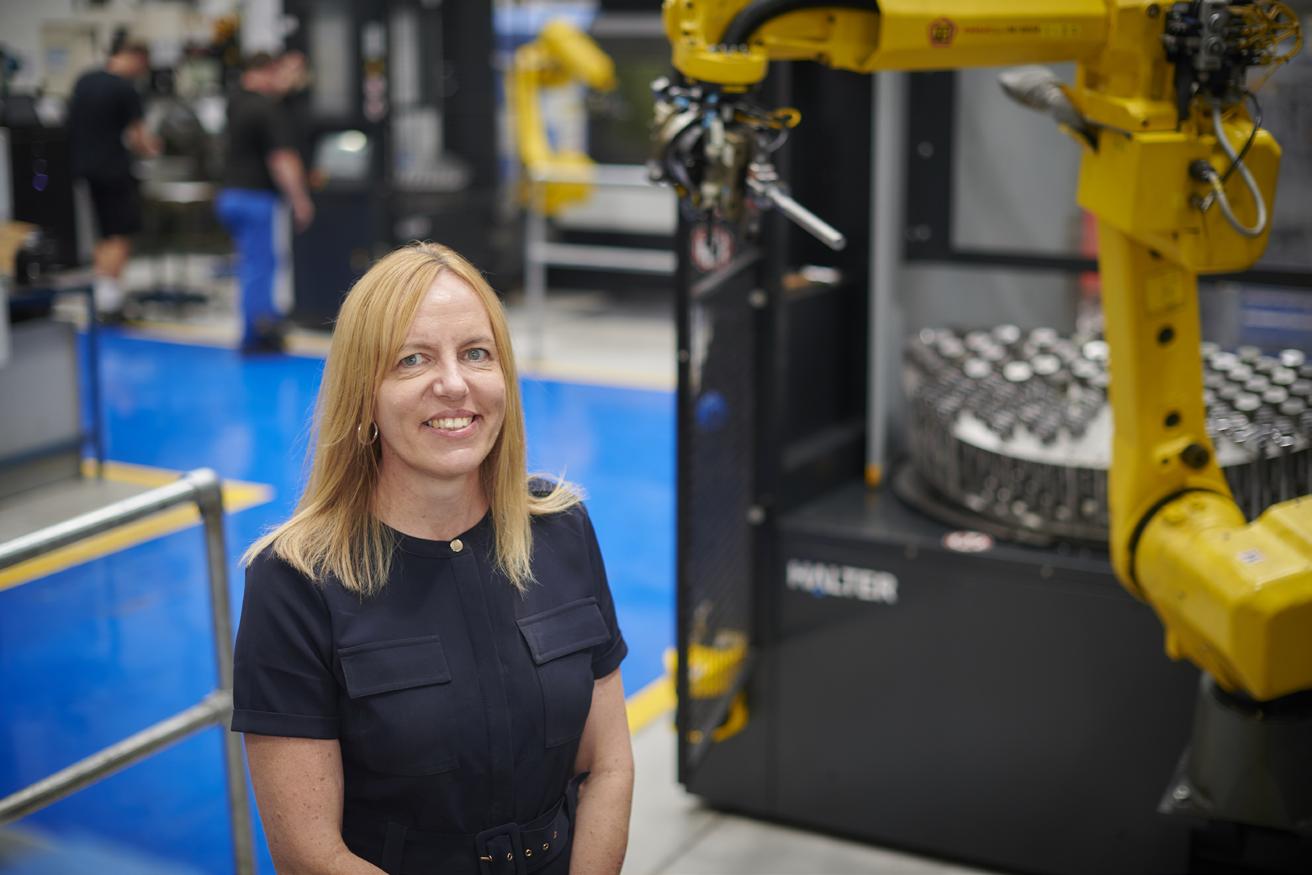
ECITB develops upskill programme amid 47% increase in demand for welders
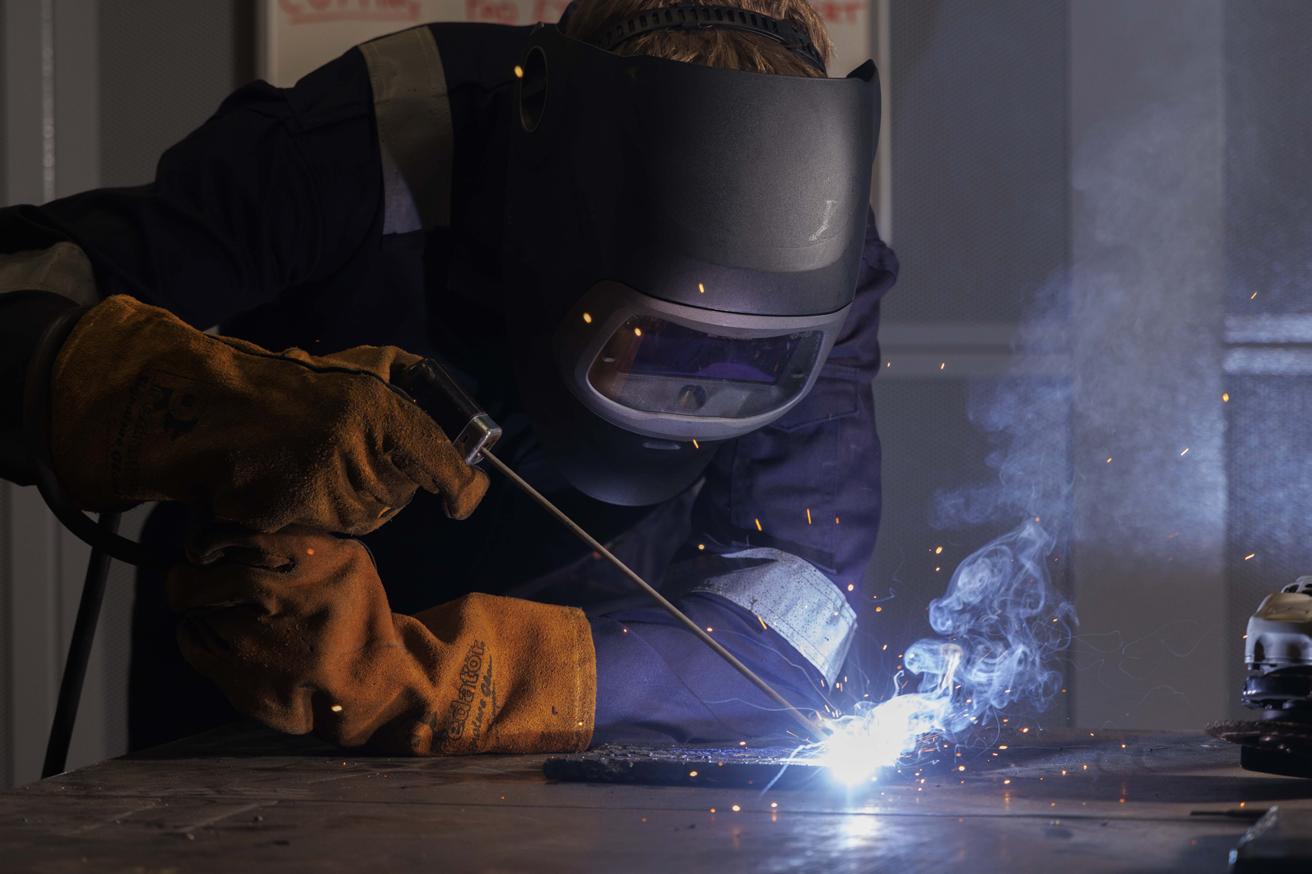
An upskill welding programme has been developed to help address a predicted 47% increase in demand for welders across the engineering construction industry (ECI).
The Engineering Construction Industry Training Board’s (ECITB) Labour Forecasting Tool predicts that the number of welders required in the ECI could rise to more than 2,150 by 2030, up from 1,470 in 2025.
To help tackle this industrywide shortfall in skilled welders, the ECITB has released a six-week programme designed to upskill individuals with limited or basic welding experience, developing
their knowledge and skills through a blended learning approach.
Following a successful pilot, the ECITB is calling for training providers to deliver the Multiposition Fillet Welding (MMA) programme as part of a wider rollout across Great Britain.
ECITB Chief Executive Andrew Hockey said: “Attracting, upskilling and retaining an agile, diverse and competent workforce in sufficient numbers to meet projected growth in demand is a big priority of our Leading Industry Learning strategy 2026-30.
“Upskilling programmes like this help address industry skills shortages and allow workers to move between nascent and traditional industries.
“While this programme has a particular focus on supporting workforce requirements within the nuclear sector, it also has strong cross-sector relevance and is suitable for a wide range of engineering construction environments.
“With trades like welding vital to build the infrastructure needed to deliver major projects in the ECI – and with our Workforce Census stating that 24% of welders are over 60 – this programme will support industry’s growing demand for jobready welders.”
Developing welding capability
The programme provides a structured pathway from
The theory element provides essential knowledge to support safe, compliant and highquality welding practice.
foundational welding skills to multiposition MMA welding capability and technical test readiness.
It is delivered through a blend of theory and practical training, enabling learners to progressively develop their welding capability and underpinning technical knowledge.
As well as those with limited experience, the programme is designed for learners seeking to transition into welding roles or those requiring structured development before formal welder testing to verify competence.
The theory element provides essential knowledge to support safe, compliant and high-quality welding practice. The practical component develops capability across increasing levels of complexity, focusing on technique, control, consistency and quality, aligning with industry expectations.
Learner progress is measured via the completion of a course workbook, a multiple-choice knowledge test and a practical observation and assessment.
Any training providers wishing to deliver the upskill welding programme should email programmeadmin@ecitb.org.uk
Industry collaboration
The programme launch is part of the ECITB’s ongoing work to increase the number of skilled workers in craft roles like welding.
The ECITB helps strengthen welding capability through industryaligned training standards, regulated qualifications, technical training and tests that verify competence and support employer assurance. ECITB Scholarships are also available for those interested in becoming welders.
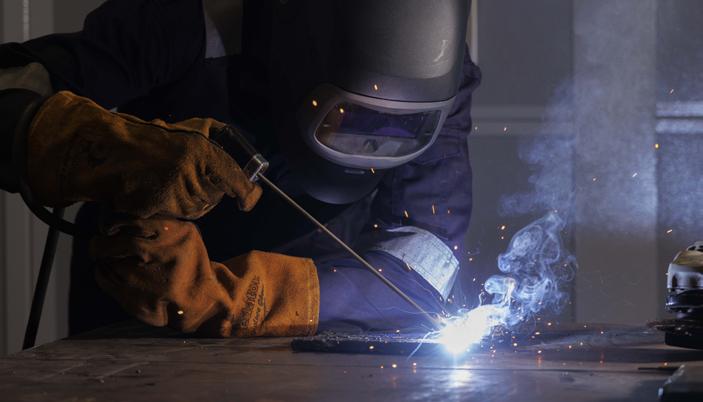
A learner welding at the Energy Transition Skills Hub in Aberdeen. Photo by Newsline Media.
As hard services markets grow, supplier scrutiny is intensifying
By Nick Maggs, Managing Director of Hard Services at OCS
The hard services market for facilities management is experiencing rapid growth, with forecasts projecting a compound annual growth rate of 9.9% between 2026 and 2033. This is being driven by rising demands for building safety, tighter regulation and more complex, energyefficient infrastructure across HVAC, mechanical, electrical and plumbing maintenance.
But as asset bases expand and estates become more complex, customers across defence, government and other mission-critical environments are becoming less tolerant of delivery risk.
According to Nick Maggs, Managing Director of Hard Services at OCS, market growth is increasing exposure and that is fundamentally reshaping how suppliers are selected. “As more assets come under management and regulatory expectations rise, the cost of failure increases. Customers are concentrating risk and that’s changing how credibility is judged.”
Growth is increasing scrutiny
For customers, growth has amplified the cost of getting supplier decisions wrong. As a result, access is being restricted earlier in procurement, with less appetite to take on delivery risk or compensate for weak operating models. In practice, that means fewer suppliers making it through qualification stages, even in a buoyant market.
Engineering capability, security clearance and competitive pricing are still essential, but they no longer secure trust on their own. Customers increasingly expect proof that suppliers can control risk consistently, across large and complex portfolios.
“In high-security and mission-critical environments, it’s not enough to say you can deliver the work,” Maggs explains. “Customers want confidence that you understand the risk you’re taking on, and that you can control it predictably, day in and day out.”
Operational credibility is now the deciding factor
Once suppliers are shortlisted, credibility is increasingly tested against the realities of live delivery rather than headline capability. Defence estates, for example, are made up of dispersed portfolios that include secure operational bases, training environments, accommodation, utilities infrastructure and strategic sites, often spread across wide geographies.
Operating across these estates requires providers to manage multiple workstreams simultaneously while maintaining security protocols, safe systems of work and consistent compliance, often under changing operational conditions. Security clearance may be a prerequisite, but it does little to demonstrate whether an organisation can actually function in these environments day to day. Customers are looking for evidence that suppliers already understand how engineering work is controlled in practice. This can include how access is managed, how tasks are authorised and how delivery holds together when conditions change.
Without that operational maturity, suppliers may appear capable on paper, but struggle to sustain delivery
once exposed to the realities of secure and mission-critical estates.
Data centres illustrate this pressure particularly clearly. In these environments, engineers are working directly on infrastructure that supports uptime and resilience. Tasks such as maintaining electrical systems, cooling plant or backup power cannot be treated as routine maintenance.
Whether it’s an incorrect set point, an unauthorised intervention of a lack of contextual understanding, mistakes can have immediate and visible consequences. As a result, customers expect providers to show proven experience in data centre environments, as opposed to just general engineering competence.
“In data centres, the cost of failure is massive,” Maggs notes. “A hard services provider does not operate remotely. Engineers physically maintain critical systems and work on infrastructure that supports uptime and resilience. If something goes wrong, the consequences are immediate and potentially severe. That reality changes what customers look for in a supplier.”
Compliance performance now determines future opportunity
In regulated and politically sensitive environments, compliance is no longer assessed in isolation. Performance
against statutory and client-mandated requirements actively shapes what work a provider is trusted with next.
On defence estates, even minor lapses can escalate rapidly, moving from a technical issue to a contractual, leadership, or reputational concern. In some cases, compliance performance can even determine whether a provider is invited to bid for future phases of work at all.
As a result, customers are placing greater emphasis on consistent compliance, clear governance and
credible assurance than they did previously.
Manual delivery models are being tested
Many large estates still rely heavily on manual inspection to demonstrate compliance. Engineers attend site, conduct visual checks, produce certificates and upload evidence.
While this remains common practice, it is under growing strain as estates scale. Where building management systems and live asset data are available, customers increasingly expect issues such as inefficient performance, incorrect set points or early indicators of asset failure to be identified before they become operational problems.
This is leading to closer scrutiny of delivery models that rely solely on periodic inspection and retrospective evidence, rather than ongoing visibility and control.
The advice to suppliers: prove discipline, not ambition
Taken together, these pressures explain why access to high-security and mission-critical estates is tightening, even as the overall market grows.
In practice, customers are narrowing their supplier base to organisations that can evidence proven delivery at scale in secure and regulated environments, such as critical national infrastructure, transport and logistics hubs, healthcare estates, and large public sector portfolios. Operational discipline has become the entry price.
“In these environments, trust is built through evidence,” Maggs says. “Customers are looking for proof that the basics are being done properly, every time. Without that, everything else becomes academic.” Visit: ocs.com/uk
What is Refinance?
Refinancing uses the value of assets you already own to help your business. With Sale and HP Back – a type of refinancing – you sell your equipment to us, and we lend you the money you need to invest in your business.
You pay us back in line with what the equipment earns for you. Once you’re done paying us back, you own the equipment again.
This works whether you own the equipment outright or are already financing it with someone else.
It’s a flexible option suitable for businesses of all sizes, including sole traders.
Benefits of Refinance
Get more cash easily: Asset refinancing is a quick and simple way to get extra money for your business needs. You get to keep using the asset you put up as security.
Pay over a longer time: We can take over your current financing deal with another company and extend the time you have to pay. The costs are fixed, so there won’t be any surprises while you’re repaying the loan.
Choose what’s best for you: Use the cash injection for your business or buy other things you need. It’s more flexible than some other financing options.
Decide quickly: Getting cash from your assets helps you make faster decisions when dealing with business contracts. Use the money for hiring people, buying new things, or expanding your workspace.
An example of how it can work for you...
Let’s say you own a CNC machining tool. You need money to expand, so rather than taking out a traditional loan, you decide to utilise the value in your existing assets by refinancing the machine. You approach us and we agree to buy the CNC machining tool from you. After giving you the cash, you then lease it back from us. You make monthly payments – think of it like rent - based on how much money the machine helps you make. When the lease is done, you own the machine again. It’s like getting a loan using your machine as collateral.
Machining & Machinery
Exactaform Travels Long Journey of Growth With VOLLMER UK
From Valve Seats to Raptors
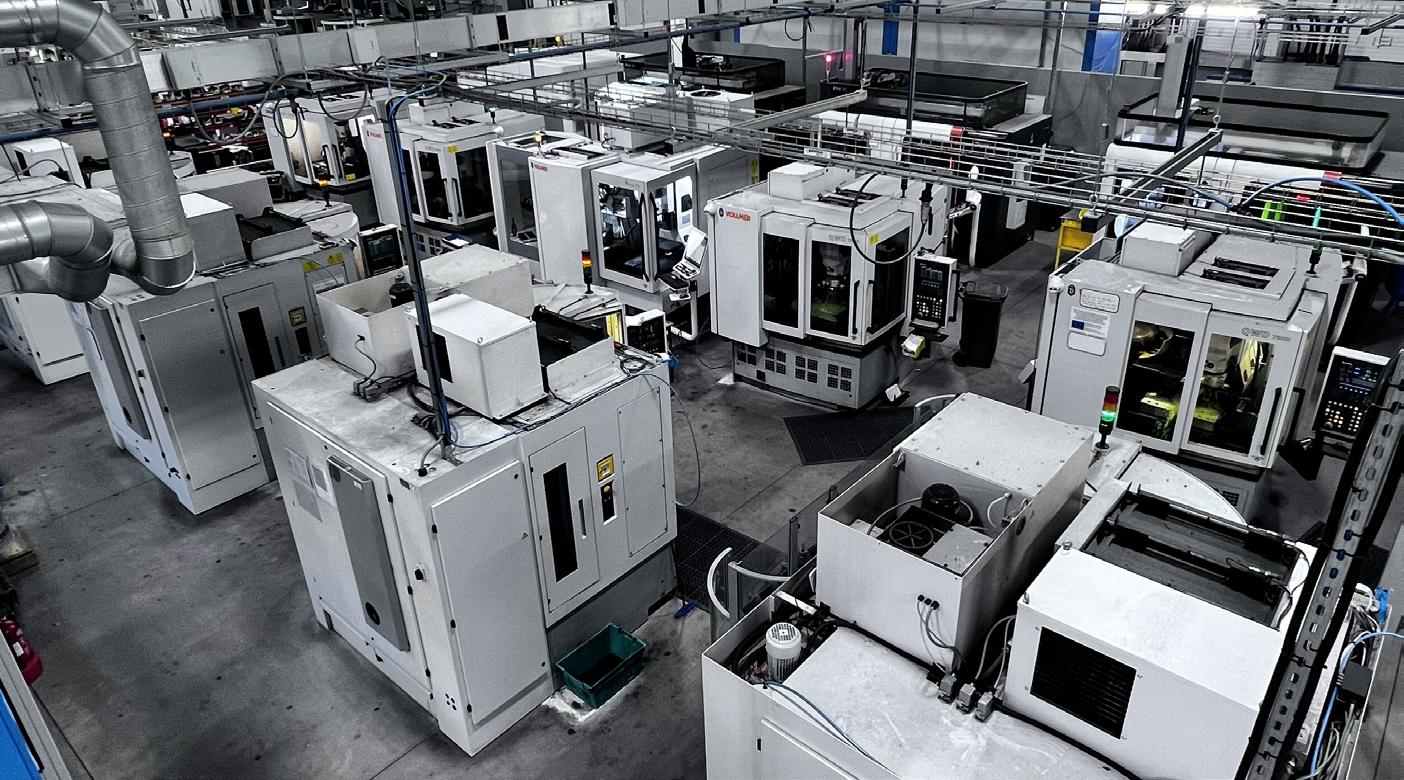
When John Inglis founded Exactaform Ltd in 1979, he was a one-man operation making carbide tooling for the automotive industry. Today, the company employs over 100 people, serves more than 500 customers across four continents, has created upwards of 30,000 unique tools, and is widely recognised as one of the UK’s leading independent PCD tooling manufacturers. Central to every chapter of that growth has been machine tools from Vollmer.
When John Inglis speaks about growth and the corresponding investment in Vollmer machines, he speaks in the language of multiplication. “The first Vollmer machine was a calculated risk with significant financial borrowing that brought sleepless nights, but then came hard-won contracts. But machine one suddenly earns you X, and the second machine earns X times two. That gives you enough money to buy the third, and three machines then earn X times four.”
The first Vollmer QWD760 wire erosion machine landed in December 2000, and the innovation and automation set Exactaform on its way. Now, the Coventry manufacturer supports supply chains for global OEMs across aerospace, automotive, and high-performance engineering sectors.
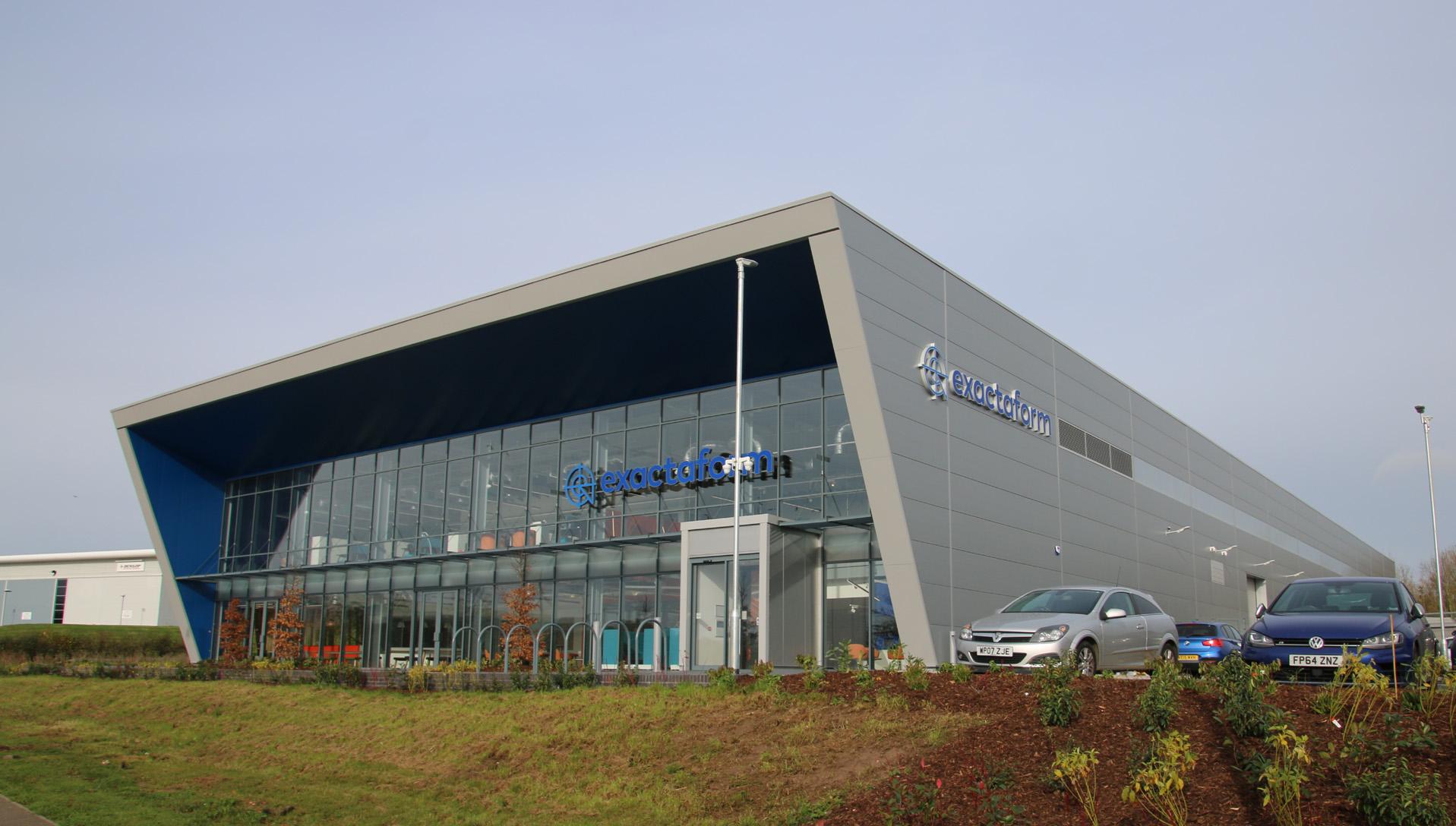
The £5.8m Exactaform Facility Near Coventry
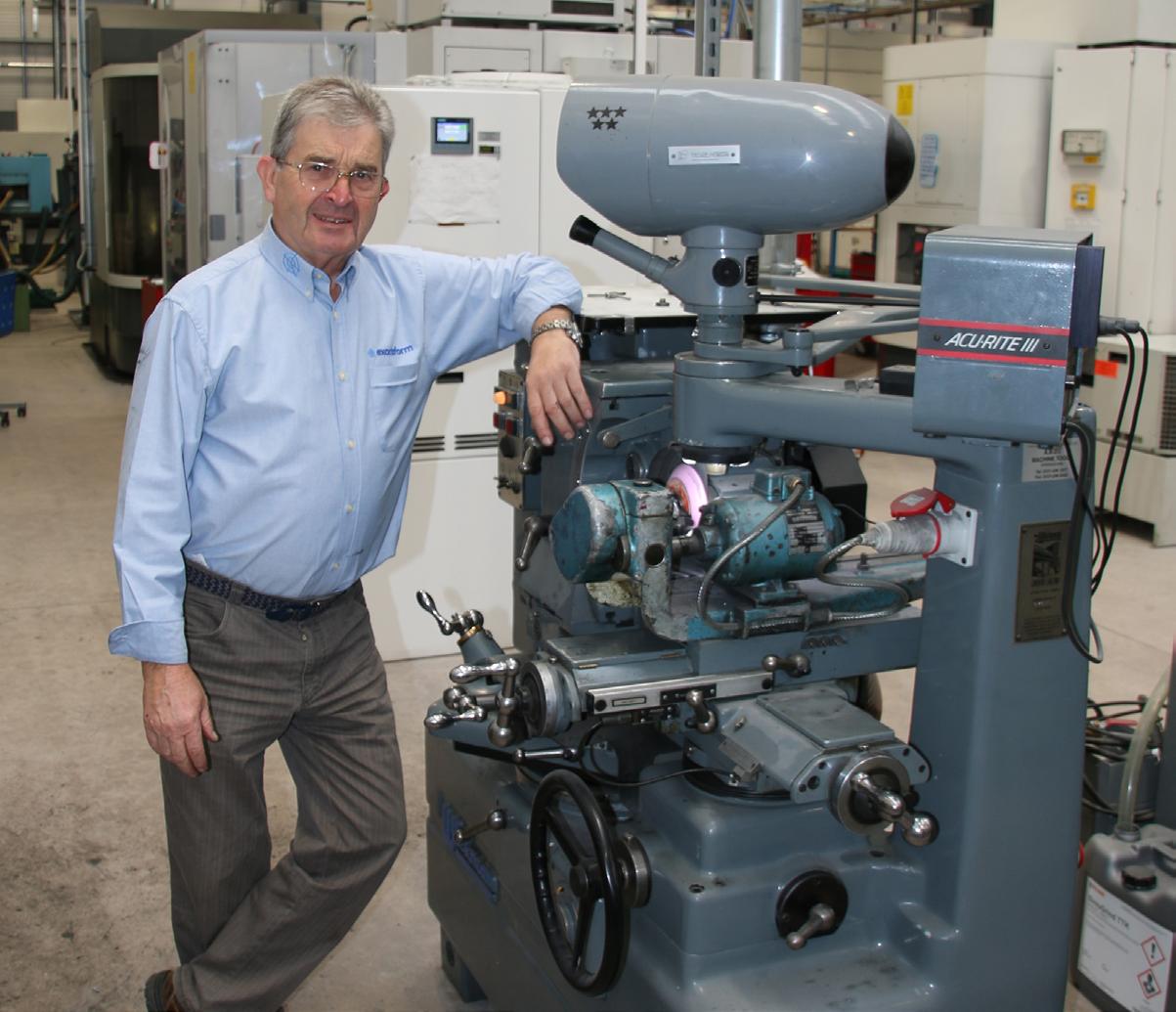
John Inglis With Very First Machine Bought in 1979
The catalyst for the first Vollmer was practical rather than strategic. A highvolume engine programme required CBN tooling for valve seat machining — sintered high-speed steel in exhaust applications that conventional carbide tooling could not handle economically. That introduced Inglis to superhard materials at production scale, and the implications became clear. “I soon realised there was a call for PCD tools, but there was a problem with grinding PCD — we recognised automation, and Vollmer was the way to go.”
The First Gamble
Prior to the first Vollmer machine, Exactaform evaluated a range of wire EDM technologies. However, it was the first Vollmer metalworking machine in the UK, the Vollmer QWD760 wire erosion machine, that started the success story. Still running today, that first Vollmer machine was the point that Exactaform formally diversified into rotary PCD tooling – and then purchased a Vollmer QWD755H, the X times two machine that was the foundation stone for aggressive growth. “At the time, it was a gamble. But the gamble paid off. Once you get your head round it, it just grows and grows and grows,” says Inglis.
On The Wire
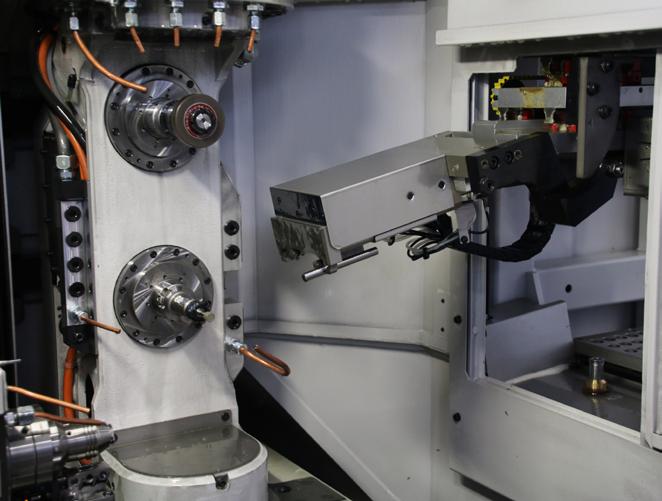
The logic of multiplication took hold quickly. A second QWD760 was added, and another two QWD750H machines arrived in January and March 2008, bringing robotic loading and genuine lights-out production capability. A further QWD750H followed in October 2009. The QWD750H machines transformed how Exactaform operated. With 12-station carousel loading, the QWD machines could be set at the end of a shift and left
Machining & Machinery
At the time, it was a gamble. But the gamble paid off. Once you get your head round it, it just grows and grows and grows.
- John Inglis
to run unmanned through the night, each cutter taking anywhere from 45 minutes to three hours to machine.
“The QWDs would run an average of 120 hours a week, every week,” Inglis notes. “When busy, we have run the Vollmers for 160 hours out of a possible 168 hours in the week — the remaining eight hours used for wire changeovers.” A single operator could oversee an entire bay. “We could load the machines and just walk away.” Further QWD750H additions followed in August 2011, February 2012, December 2012, and December 2013. By the time the wire erosion fleet reached its full complement, one operator per shift was running what amounted to a fully automated PCD finishing line. This uptick in fortunes was driven by a pivot from the automotive industry to the aerospace sector.
The Aerospace Breakthrough
It was against this backdrop of automated production and expansion Exactaform made a decisive move into aerospace in the mid-2000s, driven by the growing demands of carbon fibre machining. It was defeating standard carbide tooling, and PCD offered decisive advantages.
The work within a major UK aerospace programme opened further doors. Inglis was invited to a US military OEM weapon facility, expecting to meet an engineer. He found himself in an auditorium facing 30 engineers. “They asked me to explain why our method was better than theirs on the latest fighter jet,” he recalls. “They were still using carbide, and it was taking forever. The result was a significant first order, followed by further adoption across additional programmes. It rapidly spread around the world.”
The demands of aerospace sharpened every aspect of the business. Carbon fibre machining requires tools that minimise delamination and control cutting forces precisely. Exactaform invested in a dynamometer table to measure both downward and rotary cutting forces during trials, enabling the development of tool geometries to reduce cutting forces and extend tool life. “That was the real breakthrough. Some engineers say our tooling is like polished jewellery.” Continued >>>
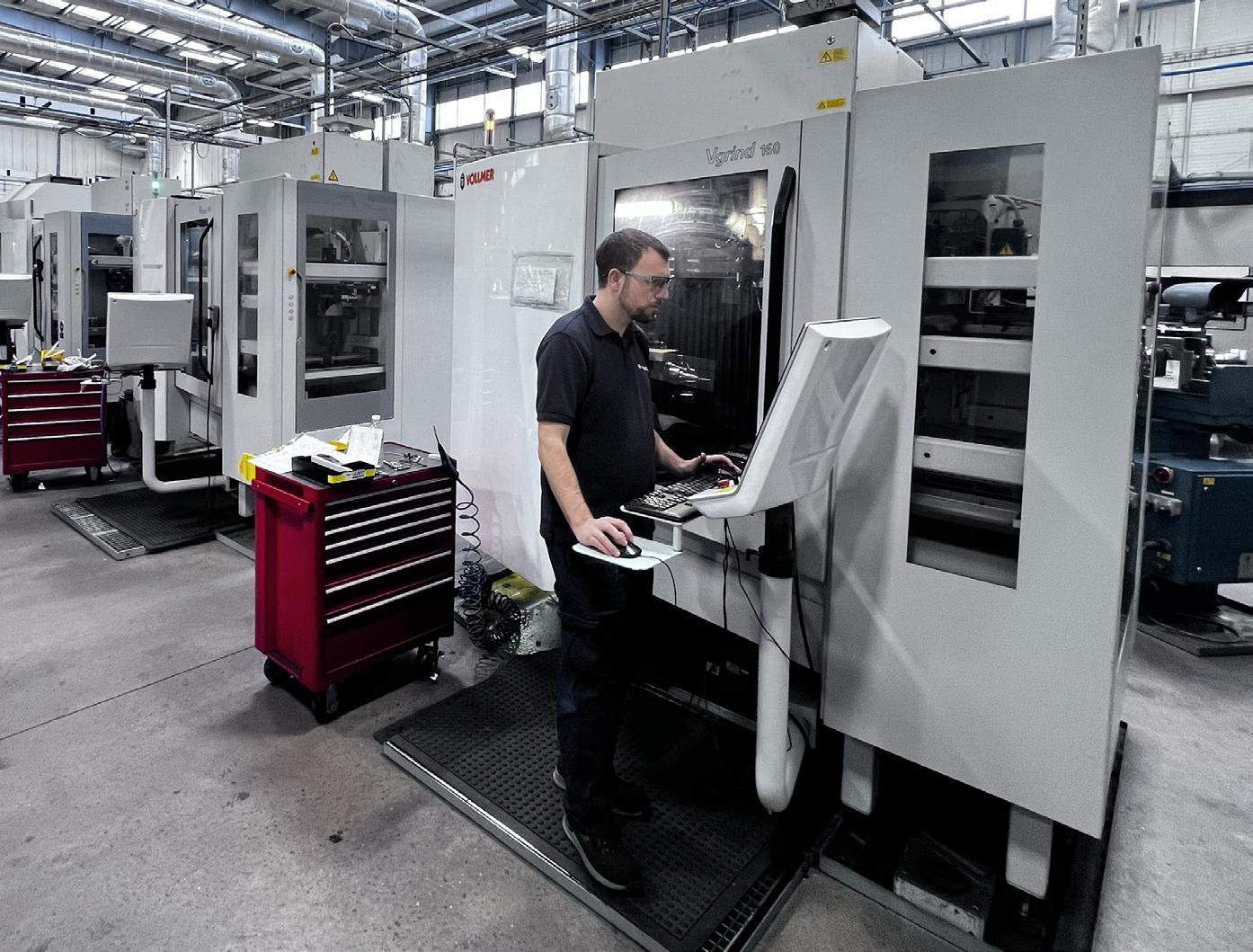
The Vollmer VGrind has certainly made an impact
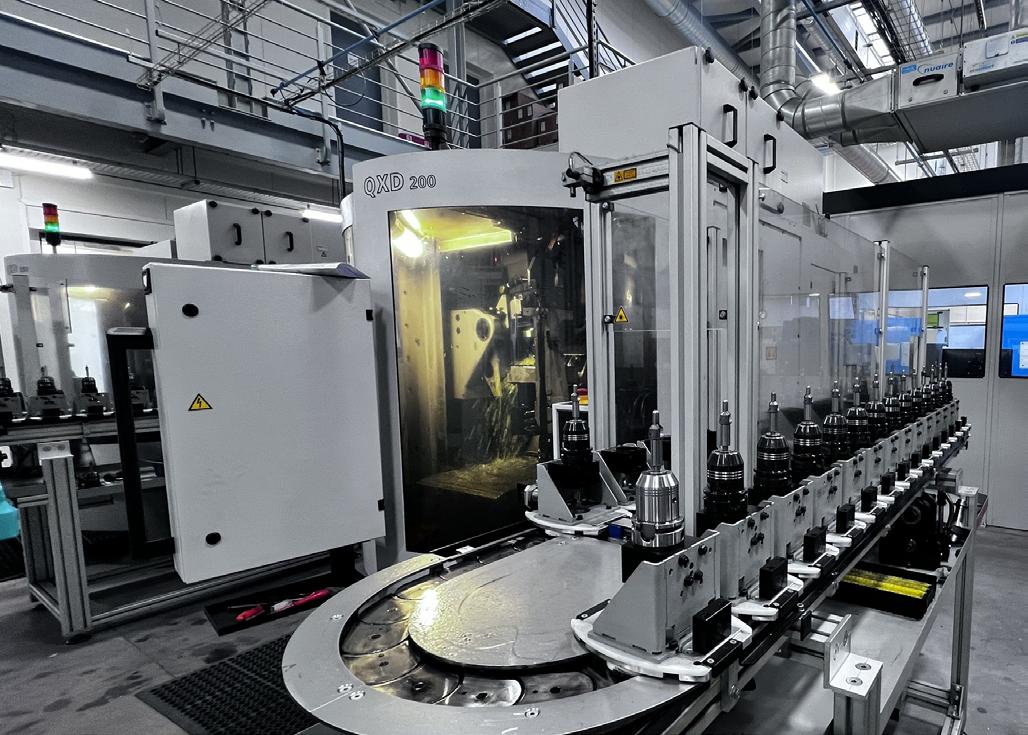
The QXD200 undertaking batch production of aerospace tools
Machining & Machinery
Aerospace is now about 40% of Exactaform’s business, and the company works with the European subsidiaries of the world’s most prominent commercial and defence aerospace OEMs and Tier 1’s. “Once you can get on the quoting list, it can be massive in some cases,” Inglis adds.
Raising the Speed
As wire erosion capacity grew, a different challenge emerged. The QWD machines were highly effective at profile finishing, but cycle times were fixed regardless of how much material needed to be removed. For high-volume finishing, a different solution was needed. Vollmer had the answer with the QXD200 rotary erosion machine.
The first QXD200 arrived in January 2009, accommodating 12 cutting tools and up to six grinding wheels simultaneously across six controlled axes — measuring, eroding, grinding and polishing in a single set-up. Tolerances of 0.001mm were achievable, with repeatability within 5 microns. The results were immediately compelling. A second QXD200 followed in January 2011, this time with a 29-tool changer for larger unmanned batch runs. Two more QXD200 machines arrived in February and September 2012, and the series concluded in May 2014 with a QXD250 for more complex profiles.
You Can’t Make It If You Cannot Measure It
Exactaform has also built substantial metrology capability, with every one of the 7,000 PCD tools produced per month being 100% inspected before dispatch. PCD requires optical inspection and the company uses Helicheck systems for full optical measurement of all tool geometries. “You can’t manufacture it if you can’t measure it,” says Inglis.
The inspection commitment underpins the commercial model where 80% of Exactaform’s output is bespoke — customers supply a component drawing, not a tooling drawing, and Exactaform designs, manufactures, trials and delivers the solution. Over the company’s history, more than 30,000 unique tools have been created in this way. “We produce the tools to machine their part so they don’t have to do any engineering,”
says Inglis. “They just give you a component drawing and ask: how do we machine that? Can you do it quicker than the other guy?”
Carbide, the VGrind, and the VHybrid
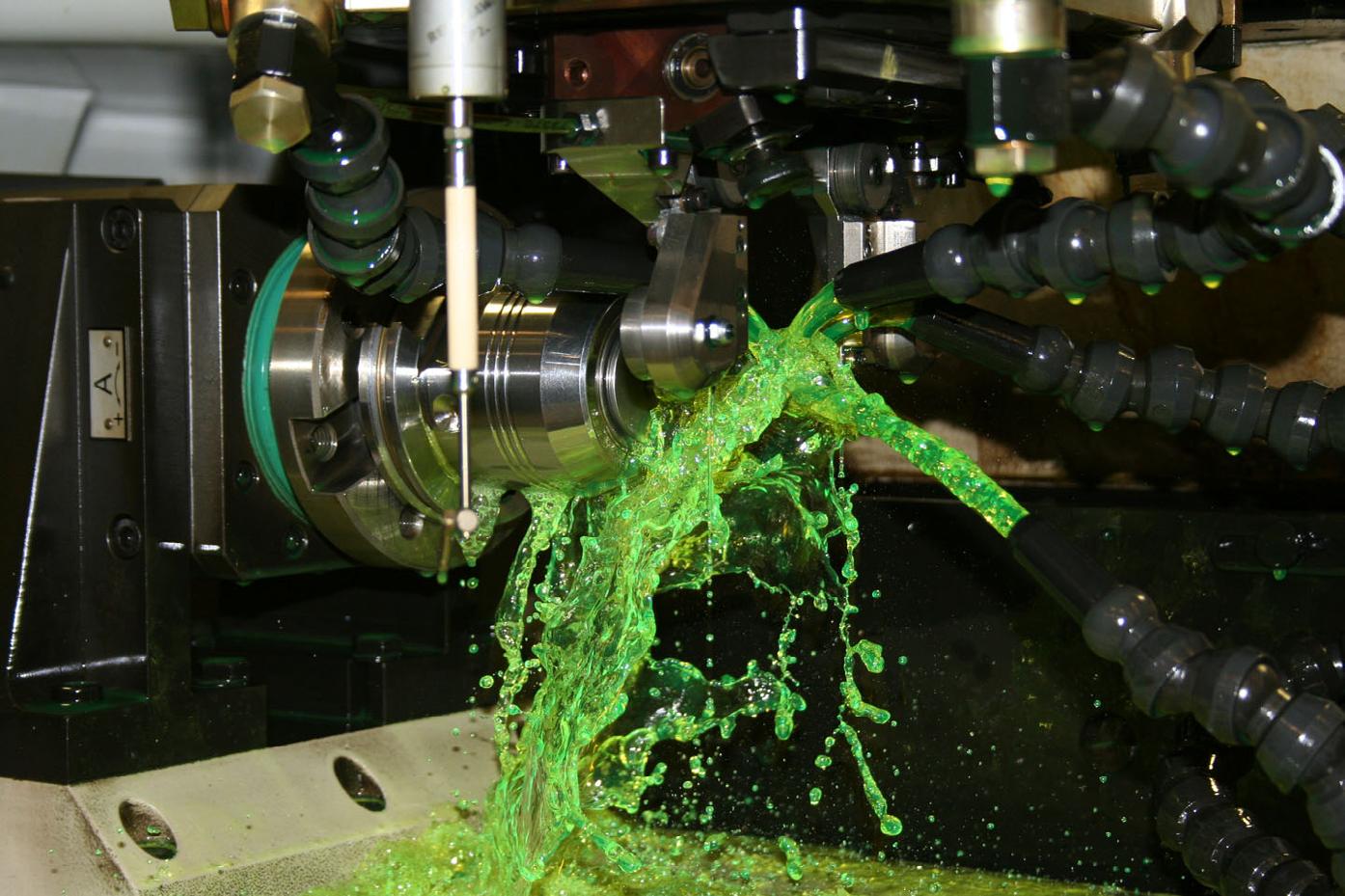
The next chapter of Exactaform’s Vollmer investment began in September 2016 with the arrival of the first VGrind — Vollmer’s 5-axis CNC grinding centre for solid carbide tools. A coolant filtration FC-250W unit followed a month later, supporting the precision fluid management that carbide grinding demands. A second VGrind 360 arrived in September 2019, extending carbide grinding capacity as the product range broadened.
The strategic logic is clear. As carbide raw material prices have surged, the relative economics of PCD have improved. Rising carbide costs make re-tipping in diamond increasingly attractive to end users. “We can tell customers that for the price they pay for carbide, we can re-tip the tool in diamond and offer huge productivity and tool life enhancements,” says Inglis. The carbide-to-PCD split, previously around 80/20, has moved progressively towards 70% PCD, 25% carbide, and 5% accessories — holders, adaptors, and complementary tooling components.
In February 2024, the most complex machine in the UK fleet to date arrived: a VHybrid 260 paired with a Vomat filtration system. The VHybrid combines disc erosion and precision grinding in a single machine, enabling PCD and carbide
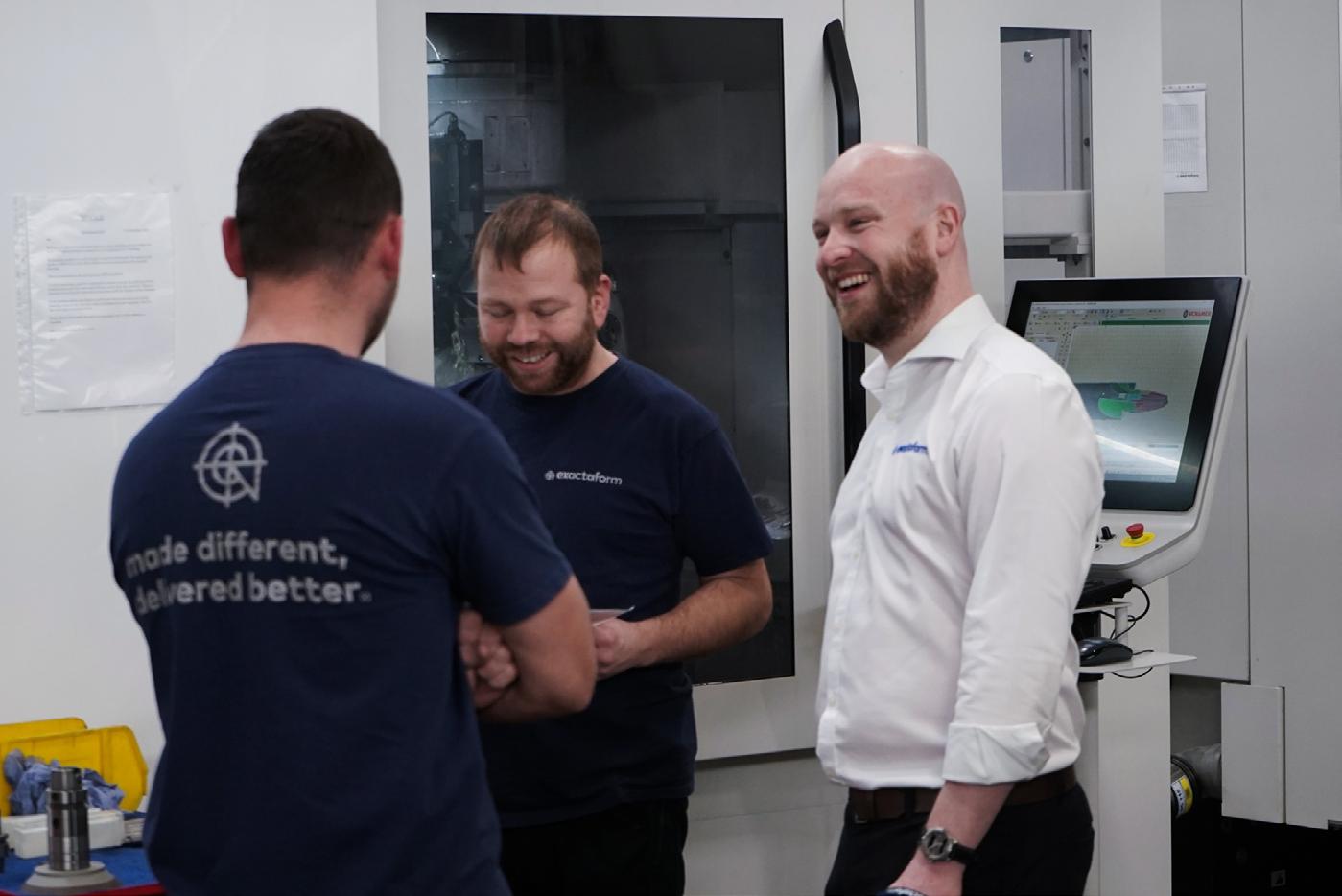
Managing Director Jamie White with engineers on the shop floor
Nine Vollmer wire erosion machines in a cell at Exactaform
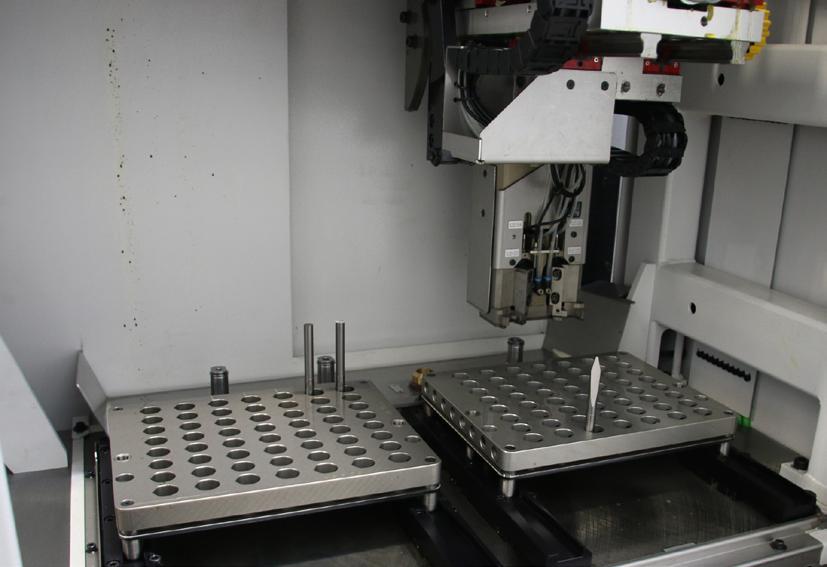
Vgrind loading tools from the twin pallet system
Machining & Machinery
tool processing within one set-up. The primary application was drills. “Horses for courses,” says Inglis. A second VHybrid has been ordered for the Tennessee facility, where the Exactaform USA operation already runs two converted UK Vollmer machines on American specification.
Growth and Acquisitions
In 2017, Exactaform moved into a purpose-built 42,000sq/ft² facility in Coventry — a three-stage process of relocation, machine investment, and R&D expansion that the company’s management describes as planned, not opportunistic. By 2023, the group had taken a further step, forming an aerospace consortium through three acquisitions that broadened both its capability and its customer access within the sector. Today, under Managing Director Jamie White, the group employs over 130 people across its UK and US sites, with the Tennessee manufacturing facility having opened in 2022. The 2024–2025 investment programme, which includes both the VHybrid and the VPulse 500, reflects the current
phase: capability-led growth, focused on people and equipment in equal measure.
Closing the Circle
In May 2025, Exactaform took delivery of a Vollmer VPulse 500, Vollmer’s wire erosion platform for PCD tooling, representing the latest generation of technology. The VPulse 500 achieves unprecedented levels of precision and efficiency. With its new erosion generator, maximum reliability and ease of operation, as well as various automation options, the possibilities for round-the-clock high-efficiency automated operation are endless. Now, the family-owned business has a full complement of Vollmer technology with wire and rotary erosion, carbide grinding and hybrid processing - the circle is complete.
They asked me to explain why our method was better than theirs on the latest fighter jet. They were still using carbide, and it was taking forever. The result was a significant first order, followed by further adoption across additional programmes. It rapidly spread around the world.
- John Inglis
Exactaform is a business continually growing, built on a foundation of process investment that includes 21 Vollmer machines purchased over 25 years. Skills shortages remain a genuine industry challenge, but automation continues to extend what each operator can manage. “Buying the right equipment is very important,” says Inglis. “If you haven’t got the right equipment you’re in trouble — that’s why we went for Vollmer’s.”
From early automotive applications to today’s role within global aerospace supply chains, Exactaform’s story is one of compounding investment and capability.
Vollmer QWD750 Wire Eroding a PCD Tool at Exactaform
Twin Pallet Auto-loading System on Vollmer Vgrind
Machining & Machinery
Metsä Fibre selects ANDRITZ for major cooking system modernization at Kemi mill
Metsä Fibre, part of the Metsä Group, has selected international technology group ANDRITZ to modernize the cooking system at its bioproduct mill in Kemi, Finland. Start-up is scheduled for the fourth quarter of 2026.
“The equipment and solutions from ANDRITZ will enable us to improve availability and cooking yield, increase flexibility in raw material usage, and support us in reaching our planned production levels,” says Ismo Nousiainen, CEO of Metsä Fibre Oy.
The modernization covers the conversion of the existing cooking system to ANDRITZ single-vessel LoSolids continuous cooking technology, which enables the mill to process both softwood and hardwood. The scope of supply also includes the TurboFeed chip feeding system with a new Diamondback chip bin, and a vapor reboiler to improve digester heat recovery and minimize odorous gas emissions.
With the modernized cooking plant, the mill can produce a total of 1.5 million tons of softwood and hardwood pulp per year.
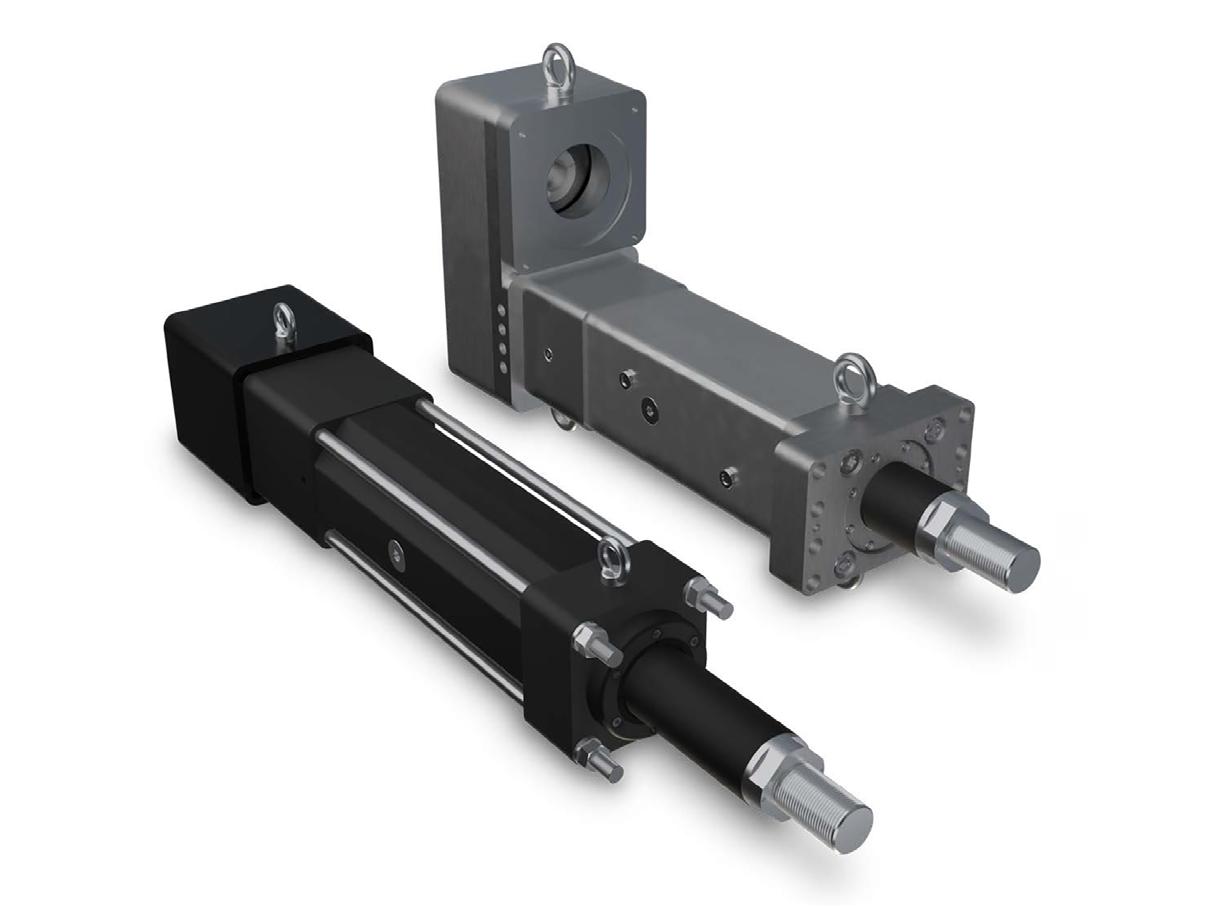
Tolomatic increases electric linear actuator force to 445 kN
Tolomatic has extended the force of its electric linear actuators, now taking on applications previously possible only with hydraulic technology.
The brand’s new RSX50 can achieve force of 445 kN (100,000 lbf), pushing the boundaries of electro-mechanical actuation and providing a more precise and reliable alternative to hydraulic cylinders. The linear actuators are distributed in the UK by INMOCO, which can support application development with motors, drives, and associated equipment.
The Tolomatic RSX50 achieves its high-force rating with a maximum stroke length of 630 mm and a speed up to 432 mm per second. The linear actuator also features a dynamic load rating of 836 kN. High force is accompanied by accuracy, with a planetary roller screw option achieving +/-0.023 mm accuracy over 300 mm stroke.
Hydraulic replacement
This performance makes the RSX50 suitable as a replacement for hydraulic actuators across applications such as metal forming and pressing, timber processing, automotive
manufacturing, and construction. In addition to enhanced control, electric actuators can significantly decrease the time and cost of hydraulic actuator maintenance, and increasing productivity as a result.
The new actuator achieves its high force while retaining a compact, lightweight footprint, particularly compared to hydraulic designs. Options are available for inline motor mounting that directly couples the driving shaft, or a reverse parallel configuration with the motor mounted alongside the actuator. The reverse parallel installation reduces overall length and offers a belt reduction drive with a 1:1 ratio. Optional geared motor reduction is also available, with built-in 4:1 or 6:1 reduction eliminating the need for external gearboxes.
Common across Tolomatic actuators, the RSX50 is built for durability. The actuator can support up to six million pressing moves at 100% of its rated values. Durability features include two roller bearings to support high axial loads and forces for long life, while additional composite bearings prevent internal rotation of the thrust tube.
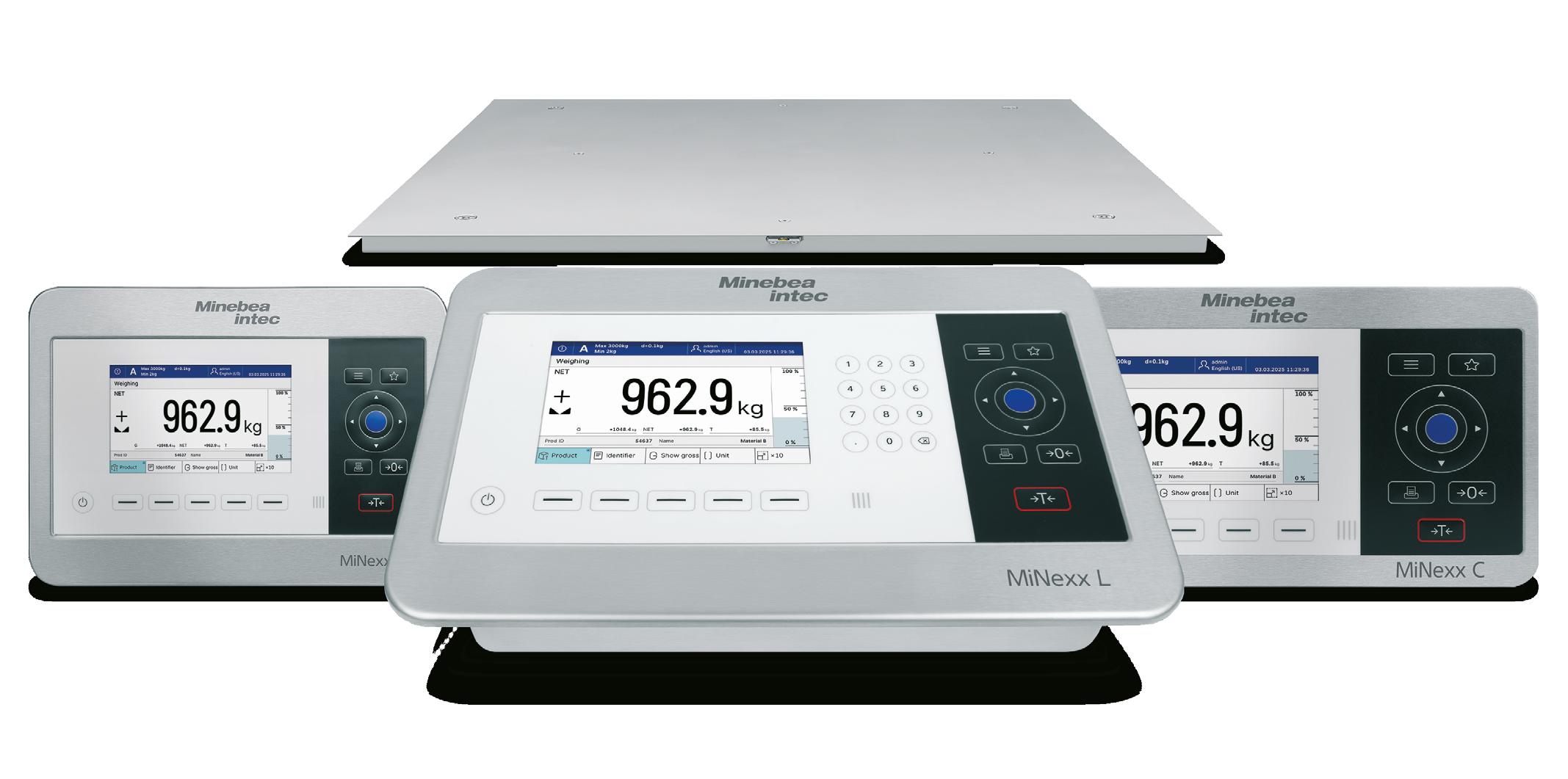
New Scales Series MiNexx®
Discover the award-winning MiNexx® indicators: Combined with its weighing platforms or Minebea Intec load cells, MiNexx® can be integrated in almost any weighing application imaginable.
It has got what it takes: GMP compliant for traceable records. Red Dot awarded user interface Blue HMI for process safety and stability. NSF certified for maximum hygiene.
Boost efficiency and protect your brand reputation: Stay ahead in every step of your process,
Swebal raises $35M to rekindle Europe’s TNT supply chain
Swedish startup secures funding to complete one of Europe’s first new explosives plants in decades
NATO is facing a shortage of TNT, an essential explosive in the manufacturing of weapons. Now, startups are setting up to see how they can fill the gap. In the latest development, Sweden Ballistics, a defence manufacturing company that also goes by the name Swebal, has raised €30 million ($35 million) in equity funding to complete construction of a new TNT production facility.
Founded out of Nora, Sweden, in 2024, Swebal says the funding will allow it to move ahead with construction of the plant in Nora, which would become one of the first new TNT production facilities to be built in Europe since the Cold War,
with full-scale production expected by 2028.
The round includes backing from Sweden’s former Chief of Army, Major General (ret) Karl Engelbrektson, alongside Pär Svärdson, founder of e-commerce companies Apotea and Adlibris, and Thomas von Koch, a founding member and former chief executive of private equity firm EQT, as well as a group of Swedish family offices.
Upstream bottleneck
Europe is ramping up ammunition production across the continent, with manufacturers expanding capacity to meet demand driven by the war in
Ukraine. In some cases, output has increased sharply, with companies such as Rheinmetall scaling artillery shell production to levels that now exceed US output.
But that expansion is hitting a bottleneck: access to explosives and propellants. While governments and industry have focused on increasing the number of shells produced, the upstream materials required to fill them remain in short supply.
Trinitrotoluene, or TNT, is a core component in munitions, used in artillery shells, aerial bombs, and mines. While European governments have accelerated investment in weapons systems and ammunition
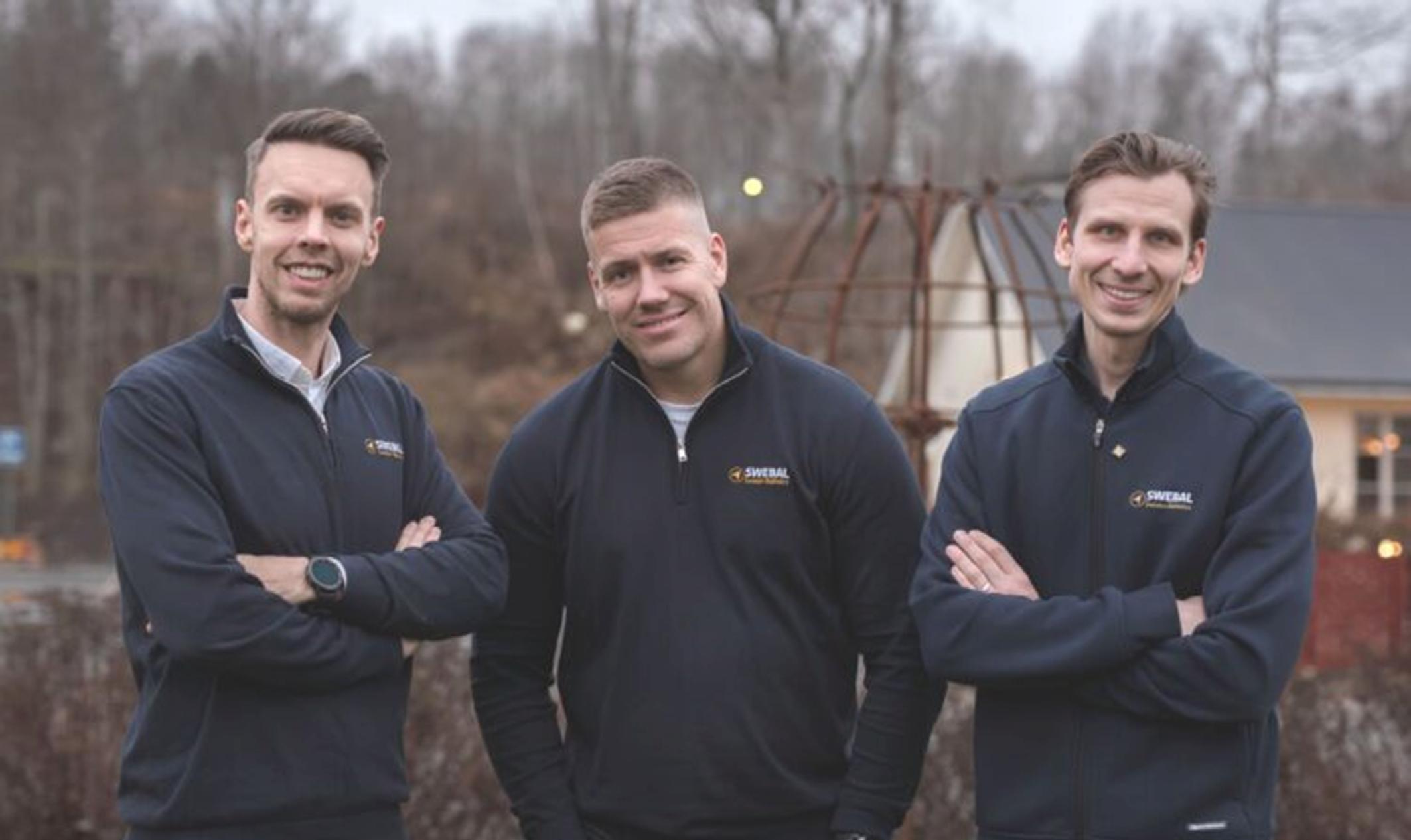
L-to-R Joakim Sjöblom co-founder & CEO, Sebastian Reismer head of construction, Carl Duforce co-founder & COO
production since Russia’s invasion of Ukraine, the supply of explosives has emerged as a constraint on output.
Europe currently has limited domestic TNT production capacity. Poland’s Nitro-Chem (a subsidiary of the state-owned defence prime PGZ) remains one of the few NATO-aligned producers. With some 10,000 tonnes of TNT produced annually, it is also the biggest producer in the NATO bloc. Its output, however, is already committed under long-term contracts, meaning there is none to fill new orders. Nitro-Chem is working on expanding production, but the shortage has left manufacturers reliant on imports to meet demand, exposing supply chains to geopolitical risk and logistical delays.
Swebal is positioning its new facility as a way to address that demand. The company expects the plant to produce more than 4,000 tonnes of TNT annually once operational, supplying European manufacturers involved in expanding artillery and munitions production.
Swebal co-founder and CEO Joakim Sjöblom said the scale of demand reflects not just a supply gap, but a broader push by European governments to bring explosives production back onshore, with manufacturers already securing future supply.
“Swebal’s 4,000 metric tonnes is contributing to closing the supply gap, but Europe is still far away from being sovereign within energetic materials,” he explained to Resilience Media.
“As Europe moves supply chains back to the continent, we see very strong demand and have allocated several years ahead.”
The new facility builds on groundwork laid over the past year, including environmental approval from Sweden’s Land and Environmental Court secured in December. With financing now in place, the company is preparing to move ahead with construction later in 2026.
A slow build-out across Europe
Swebal isn’t the only effort underway to expand Europe’s explosives capacity, though projects typically
Swebal’s 4,000 metric tonnes is contributing to closing the supply gap, but Europe is still far away from being sovereign within energetic materials. As Europe moves supply chains back to the continent, we see very strong demand and have allocated several years ahead.
- Joakim Sjöblom
remain years away from full production.
In Finland, explosives manufacturer Forcit is planning a new TNT facility in Pori, backed by government demand and long-term procurement agreements, with output expected later in the decade. Poland’s Nitro-Chem’s planned expansion is expected to double output in the coming years.
And the UK is exploring new domestic explosives production as part of a broader effort to rebuild ammunition supply chains, with multiple sites under consideration by the Ministry of Defence.
Collectively, these projects point to a gradual rebuilding of Europe’s explosives base. However, most remain in planning or expansion phases, with new capacity unlikely to come online at scale before the latter part of the decade.
Sjöblom said the emergence of multiple projects reflects the scale of the gap, arguing that Europe will need significantly more capacity to meet demand, particularly given the pace of ammunition consumption seen in Ukraine.
“We are big supporters of all projects and initiatives contributing to the
space, as we all share the same ambition and attack the same bottleneck,” he said.
“After the Second World War, it took decades before we achieved mutual disarmament, and with the learnings from Ukraine, the European stockpiles will be significantly larger than before. All in all, these data points tell us that we are looking at least 10 years of imbalance in supply and demand.”
In the meantime, manufacturers are being pushed to increase output using a supply chain that has yet to catch up, leaving explosives as a limiting factor in how quickly production can grow. That creates a mismatch between demand and supply: while ammunition output is being scaled now, much of the supporting infrastructure will take years to come online.
For Swebal, that lag is shaped in part by regulatory timelines. Sjöblom said the company began permitting processes in 2024, with roughly two years required before construction could begin, followed by a further two years to complete the facility.
“In a nutshell, two years of pre-studies and permitting, and two years of construction is as quick as you can possibly act within the European framework,” Sjöblom explained. “If I could accelerate any of these, it would be the permitting, where some of these processes should be able to run in parallel, instead of sequence, and hence shortening timelines without causing harm to the democratic aspect.”
Swebal says its facility will operate continuously and rely on Europeansourced materials and equipment, reducing dependence on longdistance imports. Once operational, the Nora plant is expected to run around the clock, supplying explosives needed for artillery, drone munitions, and other systems.
Even so, projects like Swebal’s are unlikely to close the gap in the near term, with new capacity taking years to come online against a backdrop of sustained demand.
For more information, visit swebal.com/en
Banelec lands £500,000 aerospace order for engine fan case lifting system
Banelec, the Brierley Hill-based electrical control systems specialist, has successfully completed a major £500,000 contract for a fan case lifter designed for a global aerospace OEM, marking another significant milestone for the West Midlands manufacturer.
The project saw Banelec develop and deliver assisted lifting equipment created to solve repetitive health and safety strain injuries associated with handling large, heavy fan case units during aerospace manufacturing.
The bespoke system enables operators to lift, lower and rotate the components safely and precisely, reducing physical strain on engineers while improving handling accuracy on the production line.
The contract win underlines Banelec’s growing reputation as a trusted behind-the-scenes engineering
partner for some of the world’s biggest industrial brands. From its base in the Black Country, the business has built its name over more than two decades by designing and
manufacturing bespoke electrical control and automation systems that help customers improve safety, productivity and operational performance.
Steel manufacturer cuts costs by 50 per cent with bespoke solution
Yorkshire-based company
Shafton Steel Services has significantly reduced both costs and maintenance time after replacing a traditional conveyor system with a tailored lifting solution.
At its facility in South Yorkshire, the steel manufacturer Shafton Steel Services, part of Billington Holdings’ group of companies, operates a robotic coping and drilling line that
generates large quantities of steel scrap, which falls into a pit beneath the machine.
Typically, conveyor systems are used to handle this type of waste. However, due to space constraints at the installation site, the company opted for an alternative solution based on a scissor lift table. A conventional conveyor system would have required too large a footprint to accommodate the machine in its intended location.
– Compared to a conveyor system, the footprint is significantly smaller, while maintenance requirements and safety risks are reduced. The lift table allows us to raise the entire unit by crane, ensuring full access to all components and safer cleaning of
the pit. It is 20-25 per cent easier to do maintenance work on the lift compared to a conveyor, which has a clear impact on our bottom line, says Ryan O’Connor, Profile Manager at Shafton Steel Services.
The company commissioned the design and implementation of the scissor lift table, which runs on a rail system inside the pit. Steel scrap is collected in a bin placed on the lift platform and transported to one end of the system, where it is raised to floor level and removed. The total investment came to just under £29,000 – approximately half the cost of a comparable conveyor system, according to Ryan O’Connor.
Rising demand for flexible solutions
The lift table was developed and supplied by Sax Lift. The project reflects a broader trend for the company, which is seeing increasing demand for bespoke products in the UK market.
In many cases, customers come to us with a specific challenge, and we work together to find a solution. We typically start from a standard
Dean Banner
This was a major contract win for Banelec and one we are extremely proud to have delivered successfully...
Managing director Dean Banner said the successful completion of the project demonstrated the value of combining practical engineering expertise with a clear understanding of customers’ workplace challenges.
“This was a major contract win for Banelec and one we are extremely proud to have delivered successfully,” he said. “The brief was not simply to move a large aerospace component from one position to another. The real challenge was to create a solution that directly addressed repetitive strain and manual handling risks for the people working on and around the fan case every day.”
product and adapt it to meet the customer’s needs. This approach is often both faster and more cost-effective than developing a fully bespoke solution from scratch, explains Jeff Aackersberg Olsen, Sales Manager responsible for the UK market at Sax Lift. According to Sax Lift, around 25 per cent of the company’s orders consist of customised solutions such as the rail system delivered to Shafton Steel Services.
Translating complex needs into practical solutions
Although the solutions are often tailored to individual customers, they are based on a consistent technical foundation. Sax Lift’s products comply with the EN 1570-1 standard, and the company operates with a structured product portfolio that supports scalability and customisation. As a result, the Yorkshire-based manufacturer already knows where to place its next orders.
Quartzelec delivers growth in revenue, profit and order book in 2025
Turnover up 6% to £93.8m, profit before tax up 12% to £10.2m, with a record order intake of £99.4m providing strong forward visibility
Quartzelec, the independent electrical engineering services provider supporting industry, infrastructure and commercial markets across the UK and internationally, has reported another year of growth for the year ended 30 September 2025.
Growth has been driven by demand across both new and existing customers, alongside improved delivery and margins. Order intake increased to £99.4 million, up 12% on the prior year, providing a strong foundation for the year ahead.
“This is another strong performance from Quartzelec, reflecting the resilience of our operating model and demand across our core markets,” commented Stephen Morrison, Managing Director of Quartzelec. “Our focus on service quality, operational delivery and long-term customer relationships underpins sustained growth.”
Profitability improved through a combination of increased activity, more effective framework rates, enhanced procurement and tighter project control. This was achieved despite cost pressures, including inflation and rising employer costs.
Ken Wanless, Finance Director of Quartzelec, added: “The business has delivered another year of profitable growth, with improved margins translating into strong cash generation and a strengthened financial position. With a robust balance sheet and a growing order book, we are well placed to invest in the business while maintaining financial resilience in an uncertain economic environment.”
The company has also invested in its future capability in what remains a highly competitive labour market, increasing headcount by
6% through targeted recruitment, apprenticeships and ongoing development.
Internationally, Quartzelec has expanded its footprint, including the establishment of a subsidiary in Spain to support EU operations, continued development of its presence in the Philippines, and investment in enhanced workshop facilities in Abu Dhabi. A new joint venture in Oman has also been established to support future growth in the Middle East.
The Group also demonstrates strong engagement across its local communities, including its partnership with the Smallpeice Trust and a wide range of charitable initiatives delivered through its regional business units.
Stephen Morrison concluded: “We enter the new financial year with strong momentum, supported by a growing order pipeline and clear strategic focus. Investment in our people, capabilities and international presence ensures we are well placed to deliver further growth, while remaining mindful of wider global uncertainties.”
Titan Enterprises Strengthens Operational Performance Through Streamlined Processes, Innovation and Supply Chain Resilience
Liquid flow meter specialist Titan Enterprises has strengthened its organisational performance through targeted process streamlining, operational efficiencies and continued investment in innovation, reinforcing its competitive position in global markets. From taking bold steps to reduce the company’s impact on the environment, to redesigning products to take advantage of new materials and emerging technologies as opportunities arise.
Forces such as tariffs, politics, climate and logistics can create immense supply chain pressures. Despite these ongoing economic burdens, Titan has delivered a 9% increase in sales revenue over the past two years, with continued momentum across the UK, Europe and the USA. The company remains on track to achieve comparable growth over the 2026/27 fiscal years.
Central to this performance has been Titan’s focus on leaner processes, supply chain optimisation and R&D-driven efficiency. Investment in research and development continues to
drive product innovation while improving manufacturing capability and cost control. Key initiatives include strategic OEM partnership development, the release of a new ultrasonic beverage meter and advances in ultra-low flow measurement below 2ml/min.
Operational efficiency has also been strengthened through closer collaboration with suppliers. By securing new UK-based suppliers, exploring alternative materials and adopting improved manufacturing processes, Titan continues to increase its buying power, mitigate cost pressures, enhance product performance and quality, while reducing risk and environmental impact across its supply chain.
“We work closely with our suppliers to streamline sourcing, limit cost increases and minimise disruption for our customers,” says Jeremy Thorne, Operations Manager at Titan Enterprises. “These changes allow us to maintain competitiveness while improving efficiency and resilience across the business.”
Developing a solid understanding of long-term customer needs and their future
product development plans enables Titan to resource plan, either through offering 12-month call-off order options or ordering additional quantities above customer order requirements. This proves costefficient and helps to relieve demand stress, fluctuations and disruptions in fulfilment, as Titan can predict they will be taken by customers within a relatively short period.
“Demand volatility is often driven by our customers’ need for flexibility within their market so building in additional stock to manage ‘urgent’ demands, especially when we know our own suppliers have long lead times, strengthens our relationship with customers as they know they can rely on us to deliver,” Jeremy continues.
Titan successfully balances adapting to change and advancing technology with maintaining stable, reliable, high-quality products that customers have trusted in their systems for years. Customers continue to choose Titan because we provide a strong sense of continuity, performance, accuracy and reliability.
Further efficiency gains have been achieved through technologyled process improvements. Titan has reduced waste and administrative overhead by transitioning from printed technical documentation to QR codebased digital systems, improving accessibility while lowering paper use. Packaging processes have also been streamlined, with recyclable cardboard and biodegradable fillers replacing traditional polystyrene materials.
Titan’s commitment to operational performance is closely aligned with sustainability objectives. The company’s installation of solar panel arrays at its UK manufacturing facility has reduced energy costs and offset approximately six tonnes of CO₂ in the first year.
“Our focus is on building a business that is operationally excellent, resilient and futureready,” says Kate Thomas, Company & Finance Director.
“Strategic investments in efficiency, technology and sustainability are already delivering tangible cost savings while strengthening our long-term performance.”
DHS DOOR HANDLE SYSTEM: ENHANCE YOUR PRODUCTIVITY WITH VISIBLE MACHINE STATUS
Schmersal’s innovative DHS door handle system combines the functions of a robust door handle with the signalling of machine status via illuminated handle or push-button.
The door handle system is designed for use with the AZM40 solenoid interlock or with safety sensors from the RSS36 and RSS260 series or as a stand-alone solution. The illuminating handle signals various machine conditions over its area using seven different colours, enabling the user to control the colours individually to signal the machine status.
In addition, a push button is available, which can be individually adapted to customer requirements using the coloured push button caps. The pushbutton can be used for tasks such as a reset function or a request to open the guard door.
SCHMERSAL | Enigma Business Park Malvern, Worcestershire, WR14 1GL
www.schmersal.co.uk
uksupport@schmersal.com
Top trends for Next-Generation AI
Charlotte Smith, Technical Manager, SolutionsPT, outlines how AI is shifting from a future ambition to a scalable solution that is reshaping industrial operations.
For some time now Artificial Intelligence (AI) has been at the top of the agenda for industrial innovation. While generative tools and AI chatbots have captured public attention, the technology has evolved more quietly for industrial applications, but far more profoundly. Across every sector, AI software is already influencing how assets are maintained, processes being optimised, and workforce planning transformed, but seeking and achieving these benefits are two different things.
The market is saturated with AI solutions that promise value but may only work in isolation. Without cohesion, cutting-edge pilot projects typically do not translate well into industrial reality. To overcome this, operators need a clear view of how AI is maturing, what defines a scalable project, and how to make multiple
initiatives work together to unlock benefits.
One example at the cutting-edge of AI is a new breed of dark factories in China with fully automated systems that optimise themselves without human input. Previously this approach was only viable for small-scale pilot operations. The development shows how industrial AI can apply to enterprises in the UK and Ireland that want to improve efficiency across previously unrelated systems.
Scalable solutions
Although China’s dark factories have set a benchmark for industrial AI, they were built from the ground up under controlled conditions and designed around a specific manufacturing model. However, most engineering and industrial leaders are working with
brownfield and legacy sites so the success of next-generation industrial AI will be defined by their readiness to scale.
Businesses need to build the necessary foundation before deploying AI. Without this, pilot projects will end at the initial scope without delivering further value or integrating into other operations. It’s important to view AI readiness as not a single step but its own process that requires:
• Structured data as AI depends on consistent and contextualised information. The context is important as it reflects how processes operate together rather than in single applications.
• Ownership of systems for defined accountability across IT and OT, ensuring that any AI insights are acted on by the right people at the right time.
• Alignment between digital strategies and OT realities. AI initiatives must be grounded in real operational constraints so that insights are relevant to the day-today needs of operators.
• Strong Guardrails to ensure that any AI hallucinations do not impact critical production systems.
Putting this foundation in place means that AI will be able to operate across fragmented environments, accounting for legacy systems working alongside new assets, as well as data and workforce silos, and complicated supply chains. Achieving this requires confidence that models can be refined to meet changing needs.
Next-generation solutions will build on small and discrete pilot projects and integrate with strategy to apply enterprise-wide.
Semi-autonomous AI operations
Fully autonomous operations are possible, but so far only under specific conditions. Semi-autonomous operations however are within reach using the building blocks that companies have created with modernisation projects in recent years.
In semi-autonomous operations, an AI agent will be deployed to monitor conditions, identify optimisation, and recommend actions in real time. This offers the best of both worlds as a business can start seeing the benefits of AI without a complete overhaul. It’s a case of AI systems supporting human decisions rather than taking over responsibility.
The important distinction between semi-autonomous AI and a traditional pilot project is that the AI agent is not solving a specific problem in a controlled environment. Instead, it can have a wider impact, for example by triggering maintenance activities, balancing energy loads, or adjusting controls while human operators can schedule higher-value tasks. At the same time, the agent AI is collecting and analysing data to refine recommendations, creating a feedback loop over time to become more accurate. Semi-autonomous AI operations may start small with minor process adjustments, but as confidence grows, it can become a trusted member of the team.
Unified data environment
Like every element of digital transformation AI is powered without real-time data. For AI to be effective there are some new considerations as the success of AI depends on quality, continuity, and contextualised streams of data.
Traditional analytics relied on historical datasets to identify trends and generate reports. The shift with AI is interpreting live conditions as they evolve. The challenge many organisations face is not a lack of data, but with a lack of accessibility and contextualisation. AI requires a
Technology & Software
unified data environment where data from previously unconnected silos is collected, sorted, structured, and accessed. In turn, an AI algorithm can make connections between previously unconnected inputs and outputs, for example how one particular asset influences overall production.
Investing in data management will put a business in a better position to scale as their AI model can use the same structure. New lines, machines, or components can be integrated into the unified data model without rebuilding it.
Crucially, the unified data environment is what enables multiple AI solutions to work together. Successful scalability of AI is about cohesion. Rather than investing in multiple tools that all operate on single points in the operation, businesses can get better results by creating a unified data environment to underpin AI.
All-important human operators
We’ve covered how AI can evolve into a collaborative member of the team, working in tandem with human expertise for the best possible result. The same can also be said for the example of China’s dark factories. Even the most advanced cutting-edge AI and robotics can only deliver value because of the professionals who design systems, define parameters, then monitor and interpret progress. AI might have the power to analyse vast volumes of data, but it needs human expertise to apply insights and take judgements that affect production.
As industrial companies adopt AI, it’s important to evolve and update the roles and responsibilities of operators along with the technology. People need to provide feedback, intervention, and guidance to make AI solutions better. When hiring and training operators, it’s important for them to have confidence in using and validating AI’s recommendations. The future of industrial AI will be driven by people and AI agents working together in partnership.
When solutions are introduced with the right digital foundation in place, operators can quickly learn to trust that the outputs of the algorithm and that they reflect the whole business. So, building confidence in AI is not just
The successful businesses will be the ones that focus on getting the foundations right: ensuring good quality data that is in the correct context and easily accessible, deploying cyber resilient architectures and building operational alignment before scaling AI initiatives.
- Charlotte Smith, Technical Manager, SolutionsPT
technical but also human, and relies on alignment between capabilities and industrial realities.
Deploying AI at scale
Industrial AI is no longer just for experimental pilot projects or limited by technology. As solutions continue to evolve, the real challenge for UK businesses is not access to AI but readiness for it. The successful businesses will be the ones that focus on getting the foundations right: ensuring good quality data that is in the correct context and easily accessible, deploying cyber resilient architectures and building operational alignment before scaling AI initiatives. In turn, these companies can build on isolated pilots to realise the full potential of industrial AI, creating an environment defined by bringing together data and tools into a cohesive intelligent system.
For more information visit: www.solutionspt.com
Technology & Software
Made Smarter launches practical AI toolkit to help manufacturers cut through complexity
Free to download guide helps SMEs move from hype to real-world impact
Co-authored by Chris Dungey, UK Government AI Champion for Advanced Manufacturing, to drive practical adoption
This toolkit is an important step in that direction, helping manufacturers move from curiosity to capability, and from pilots to scaled industrial impact.
- Professor Chris Dungey, AI Champion for Advanced Manufacturing at the Department for Business and Trade, and Chief Technology Officer at the High Value Manufacturing Catapult
A new guide from Made Smarter is helping manufacturers cut through the noise around artificial intelligence and focus on what actually works on the factory floor.
AI Adoption in Manufacturing: A Practical Toolkit from Made Smarter has been developed to support SME leaders navigating one of the most significant technological shifts in decades.
While awareness of AI is high, many manufacturers remain unsure where to start, how to manage risk, and how to translate potential into measurable business value.
Rather than focusing on complex technologies, the guide sets out a clear, task-first approach, helping businesses identify where AI can reduce low-value work, improve decision-making, and strengthen dayto-day operations.
At the centre of the toolkit is a structured “Scan, Pilot, Scale” framework, reflecting how manufacturers successfully adopt AI in practice. It encourages businesses to start with real operational challenges, test solutions safely, and scale only what proves its value in live environments.
The launch comes as AI is increasingly recognised as critical to the UK’s industrial future, yet many SMEs remain cautious. Unlike office-based tools, AI in manufacturing operates in
complex, safety-critical environments, where decisions can directly impact quality, productivity and compliance.
The toolkit has been co-authored by Made Smarter North West, the government-backed programme helping SME manufacturers adopt technology and digital skills, and Professor Chris Dungey, AI Champion for Advanced Manufacturing at the Department for Business and Trade and Chief Technology Officer at the High Value Manufacturing Catapult.
He said: “AI has moved quickly into everyday business, but for many manufacturers, especially SMEs, it still feels complex, distant and risky. That is why practical adoption matters more than technical novelty.
“This toolkit is not about pushing manufacturers faster than they are ready to go. It is about helping them move with confidence, avoid common pitfalls, and ensure AI delivers measurable impact rather than stalled pilots.
“If the UK is to realise the productivity, resilience and competitiveness gains that AI can offer, we must focus less on isolated success stories and more on repeatable adoption pathways. This toolkit is an important step in that direction, helping manufacturers move from curiosity to capability, and from pilots to scaled industrial impact.”
Technology & Software
“Delivering the Future”: DocuWare announces significant product news
DocuWare, a leader in document management and workflow automation, has set its new product direction in motion, with rollout underway now through Autumn 2026. Featuring:
• A new DocuWare user experience with mobile companion offers an improved user interface based on Web Content Accessibility Guidelines.
• DocuWare Aura, a smart AI companion, enables direct access to DocuWare file cabinets.
Made Smarter provides handson support to help manufacturers adopt digital technologies, including AI, in a way that delivers measurable results.
- Kevin Smith, Lead Technology Adoption Specialist at Made Smarter North West
The toolkit cuts through the hype to explain what AI means in practical manufacturing terms, from predicting outcomes and sensing issues to automating everyday tasks. It explores the realities facing SME manufacturers, including common barriers such as fragmented data and limited capacity, and sets out a clear adoption pathway based on Scan, Pilot, Scale.
Users can find, summarise, and compare information in stored documents.
• DocuWare IDP (Intelligent Document Processing) offers tighter integration into DocuWare by supporting both Classic Extraction, giving full control and predictable results, and the new Gen AI-based Zero Shot Extraction, which learns from user data and improves with feedback. In addition, Master Data Matching, as a new capability, allows users to enrich data from documents by comparing them with master data from other sources
• DocuWare E-Invoicing Service is already available in some European markets and continues to be rolled out to others. This compliant and comprehensive service lets users connect to various networks for sending and receiving e-invoices.
• The new DocuWare Integration Platform embedded into DocuWare will form the technical backbone to power standardised,
out-of-the-box integrations with third-party systems. Starting this Autumn, it will allow integrations to be configured in a few guided steps for a simpler, faster way to connect.
Dr Michael Berger, CEO of DocuWare, commented, “AI, UX and other key technologybased advancements represent a significant step forward for our product portfolio and reflect our commitment to delivering reliable digital solutions that make a real difference. That’s exactly what we mean when we say: Delivering the Future.”
Find out more: https://start.docuware.com/
DocuWare Aura, a smart AI companion, enables direct access to DocuWare file cabinets.
Real-world case studies show how businesses such as D Squared Product Development, Ritherdon & Co., Arden Dies and ELE Advanced Technologies are already applying AI to improve design workflows, streamline order processing, enhance customer interaction, and monitor machine performance.
The guide is further supported by expert insight from the Manufacturing Technology Centre, alongside analysis of workforce impacts and the skills required to support adoption.
Kevin Smith, Lead Technology Adoption Specialist at Made Smarter North West, said: “AI is no longer out of reach for SMEs. It doesn’t require major investment or specialist teams to get started.
“The opportunity now is to act with confidence and clarity. By starting small, testing safely and focusing on real business value, manufacturers
can turn AI from an abstract concept into a practical tool for growth.
“Made Smarter provides hands-on support to help manufacturers adopt digital technologies, including AI, in a way that delivers measurable results.
“From initial diagnostics and roadmapping through to pilot projects and scaled implementation, the programme helps businesses move at a pace that suits them.”
Made Smarter supports SME manufacturers, giving them access to expert technology advice, leadership training, digital skills development and match-funded grants to boost productivity, drive innovation, create high-value jobs and cut carbon.
AI Adoption in Manufacturing: A Practical Toolkit from Made Smarter: download now.
E-Invoicing: A modernisation moment
By Marcin Pichur, Regional Vice President Sales at DocuWare
Europe is moving decisively toward fully digital trade processes, and traditional paper based invoicing is being phased out. For businesses operating in the UK and Ireland, the timeline for this transition is now firmly set.
In the UK, April 2029 is the confirmed deadline that finance and IT teams must work toward. In Ireland, large organisations face a late 2028 requirement, and by November 2028, every business - regardless of size - must be able to receive structured e-invoices.
The ready-made blueprint
Marcin Pichur, Regional Vice President Sales at DocuWare
Across Europe, the shift to mandatory e-invoicing is already well established. Italy’s Sistema di Interscambio (SdI) has demonstrated how real timeinvoice reporting can dramatically reduce the VAT gap while accelerating digital adoption. Building on that model, countries such as Poland, France and Spain are rolling out their own requirements to tighten tax controls and simplify B2B transactions.
By capturing invoice data automatically at the point of issue, these markets have gained immediate insight into cash flow movements. In a volatile economic climate, having a live view of what is owed and what is incoming - without waiting for end of month processes - has become a genuine strategic advantage.
For the UK and Ireland, this European experience now serves as a ready made blueprint. The question is no longer whether the model works, but how quickly local organisations can ensure their own systems are prepared to follow it.
In the UK, April 2029 is the confirmed deadline
that
finance and IT teams must work toward.
- Marcin Pichur, Regional Vice President Sales at DocuWare
With real time financial data flowing directly into core systems, you can move beyond compliance and unlock new levels of operational intelligence.
- Marcin Pichur, Regional Vice President Sales at DocuWare
Moving beyond digital paper
Many still confuse digital documents with true e-invoicing. A PDF sent by email is essentially digital paper. It still depends on OCR or manual keying, both of which introduce avoidable errors. Genuine e-invoicing relies on structured data, typically XML aligned to EN 16931, transferred directly from the supplier’s billing system into the buyer’s ERP.
The real complexity lies in coordinating this data flow. Forward looking manufacturers aren’t simply searching for an e-invoicing tool; they need a data orchestration layer that can manage information across multiple systems. This is where automation, particularly Intelligent Document Processing (IDP), is already playing a critical role. Modern IDP solutions can extract, validate and match information across POs, GRNs, invoices and statements, enabling touchless processing and removing the need for manual verification.
Positioned between the ERP and external partners, this layer checks tax and invoice data in real time before anything is sent. By using IDP to manage extraction and validation, organisations can eliminate the rejection cycles that currently consume thousands of hours in manual reconciliation across UK and Irish operations each year.
Technology & Software
Strengthening the foundations
A large proportion of manufacturing businesses operate with a mix of legacy ERPs, custom integrations and manual workarounds, and these environments often carry a significant integration burden when modernising. Waiting for a regulatory mandate risks triggering a rushed compliance effort, one that technically meets requirements but adds technical debt and leaves inefficient processes untouched.
Preparing early allows your business to address underlying operational issues rather than merely achieving compliance. That starts with reducing reliance on spreadsheet driven processes, using the mandate as a catalyst to clean supplier data and breaking down the silos that restrict automation. By strengthening these foundations now, you can turn an upcoming requirement into a meaningful opportunity to modernise.
The beginning of a broader evolution
Those operating across regions face added complexity as they navigate multiple tax authorities and differing national timelines. Implementing separate solutions for each region quickly creates a fragmented landscape that is difficult to maintain and vulnerable to failure.
A more resilient approach is to establish a single, unified e-invoicing gateway. Selecting a platform that supports multi country compliance and varied protocols shields the core ERP from constant regulatory updates. This frees internal teams to focus on delivering value driven capabilities rather than reacting to every new tax schema released abroad.
E-invoicing also marks the beginning of a broader digital evolution. With real time financial data flowing directly into core systems, you can move
E-invoicing also marks the beginning of a broader digital evolution.
- Marcin Pichur, Regional Vice President Sales at DocuWare
beyond compliance and unlock new levels of operational intelligence. This information becomes the foundation for advanced automation and predictive analytics, enabling greater clarity across everything from cash flow management to supply chain visibility.
A modernisation moment
Digital invoicing may be arriving as a tax requirement, but for forward thinking leaders, it represents a genuine competitive opening. By removing manual friction ahead of the deadline, you can turn a regulatory shift into a streamlined, automated finance operation that supports growth rather than slowing it.
The wait and see phase is over. As the industry moves from digital paper to structured data, the real decision is how quickly to act. Move early, and it becomes a strategic upgrade. Delay, and it becomes an expensive obligation.
Compliance is unavoidable, but the route you take is entirely within your control. At DocuWare, we help manufacturers navigate these transitions long before they become urgent.
Speak with one of our experts today to secure your head start.
ByteSnap Design introduces online Project Success Calculator to assess embedded systems feasibility
New online embedded systems Project Success Calculator draws on 400 man-years of engineering experience to identify project feasibility and risks, and predict success probability in under 10 minutes
ByteSnap Design, an embedded electronic design and software consultancy, has introduced a free online Project Success Calculator to help manufacturers and product developers quickly assess the feasibility of their embedded systems projects before committing resources to development.
Designed to avoid costly development failures, the new tool guides users through a 10-question assessment covering project type, development stage, timeline, regulatory requirements, technical challenges, team capability, and risk tolerance.
In just minutes, the free tool generates a personalised Success Probability Score ranging from 0 to 500+. Based on the responses provided, it also delivers practical guidance and prioritised steps to help mitigate project risks.
“In 2026, the margin for error in electronics development has essentially vanished. Component scarcity, tightening cybersecurity regulations like the EU Cyber Resilience Act, and increasingly complex SoC integration mean that projects which start without a clear-eyed view of their risks rarely recover from early missteps. We built this tool so that any manufacturer, regardless of how technical they are, can get an honest assessment of where their project stands before a single component is ordered.”
ByteSnap Design’s new calculator evaluates project roadmaps against more than 18 years of engineering delivery data, drawing on experience across a wide range of development contexts, including:
• IoT and connected devices
• ATEX / intrinsically safe equipment for hazardous environments
Graeme Wintle, Director, ByteSnap Design
In just minutes, the free tool generates a personalised Success Probability Score ranging from 0 to 500+.
• FPGA and custom silicon implementations
• Firmware and embedded software projects
• Medical devices and safetycritical systems subject to IEC 62304 or ISO 13485
• Industrial and automation equipment
For each electronic product development project profile, the tool identifies potential bottlenecks around regulatory compliance (including IEC 62304, ISO 26262, and ATEX certification). It also assesses team capability gaps, hardware and firmware specification feasibility, supply chain vulnerabilities, and cybersecurity obligations under frameworks such as EN 18031 and IEC 62443.
Since its founding in 2008, ByteSnap Design has delivered hundreds of successful projects. The risk assessment methodology underpinning the calculator draws on more than 400 man-years of embedded systems project experience across ByteSnap Design’s expert engineering teams. No technical documentation is required to complete the assessment. Users only need a working knowledge of their project’s goals and high-level requirements.
The free-to-use Project Success Calculator is available now: www.bytesnap.com/ design-solutions/embeddedsystems-project-feasibility/
Helping Small Manufacturers Bring Planning, Inventory, and Production Under Control
For many small and medium-sized manufacturers, growth brings complexity. What once worked with spreadsheets, paper job cards, and manual stock checks can quickly become difficult to manage as order volumes increase, product ranges expand, and customer delivery expectations become tighter.
Production teams need to know what to make, when to make it, whether the required materials are available, and how much each job actually costs. Without the right systems in place, manufacturers can face missed delivery dates, inaccurate stock levels, inefficient purchasing, and limited visibility across the shop floor.
MRPeasy is cloud-based manufacturing ERP/MRP software designed specifically for small and medium-sized manufacturers. It helps companies manage the core processes that connect sales, purchasing, inventory, production planning, and shop floor execution in one practical system.
With MRPeasy, manufacturers can create and manage bills of
By connecting planning with realtime operational data, MRPeasy helps manufacturers improve control over materials, production capacity, lead times, and costs. This allows teams to spend less time chasing information and more time delivering quality products on schedule.
materials, plan production orders, schedule operations, track inventory movements, generate purchase orders, and monitor order progress from quotation to delivery. Real-time visibility helps teams make better decisions, reduce manual work, and respond faster when priorities change.
The software is especially useful for manufacturers that have outgrown spreadsheets but do not want the cost, complexity, and long implementation times often associated with large ERP systems. MRPeasy gives smaller manufacturers access to professional production planning and inventory management tools in a system
that is affordable, scalable, and straightforward to use.
Key features include production planning and scheduling, inventory and warehouse management, bill of materials and routing management, purchasing, sales order management, CRM, shop floor reporting, cost tracking, and financial integrations with accounting platforms such as Xero and QuickBooks.
MRPeasy supports a wide range of manufacturing sectors, including machinery and equipment, metal fabrication, electronics, food and beverage, chemicals, plastics, cosmetics, furniture, and other discrete and process-based manufacturing environments.
By connecting planning with real-time operational data, MRPeasy helps manufacturers improve control over materials, production capacity, lead times, and costs. This allows teams to spend less time chasing information and more time delivering quality products on schedule.
For manufacturers looking to replace spreadsheets, improve stock accuracy, and gain a clearer overview of production, MRPeasy provides a practical route toward more structured and efficient operations.
Start your free trial at www.mrpeasy.com
Tsunami impact of government steel strategy is hitting home warns the CBM
By Stephen Morley, President of the Confederation of British Metalforming (CBM)
Stephen Morley, President of the Confederation of British Metalforming (CBM)
It has taken time, but the full force of the government’s steel policy is beginning to have a devastating impact on the downstream manufacturing sector according to the President of the Confederation of British Metalforming (CBM).
Stephen Morley believes misguided quota reductions, compounded by the inevitable imposition of tariffs, have left metal stockists and manufacturers facing increasing commercial pressures, tighter margins and the prospect of job cuts across the supply chain.
What was designed as a protective framework for domestic steelmaking is now exposing a fundamental flaw - ‘you cannot protect upstream production at the expense of downstream survival’.
Evidence submitted to Ministers by the CBM highlights a growing and systemic breakdown where UK suppliers are unable to meet demand due to minimum batch quantities far exceeding actual needs and having to contend with uncertain delivery timelines.
- Stephen Morley
The CBM, alongside other industry bodies, is now calling for urgent intervention. We need an urgent full review of quota reductions and tariff structures, exemptions for materials not produced in the UK, and a more balanced approach that aligns upstream protection with downstream viability.
- Stephen Morley
This is contributing to delays for critical projects, including those tied to government procurement such as the Royal Navy.
“Frustratingly, costs remain undefined and potentially uncompetitive, leaving businesses unable to plan or price contracts with any confidence,” explained Steve, who has been in the automotive sector for four decades.
“In one case, a UK supplier was told it would have to take a minimum production run of 120 tonnes, when they required just 30 tonnes, forcing a business to potentially hold £80,000 of surplus stock with no guarantee of future demand.”
He continued: “At the same time, the supplier could not confirm delivery timelines due to ongoing uncertainty around its own ownership and production schedule. This is not an isolated issue with this supplier, it is symptomatic of a wider policy failure now playing out across the sector.
“UK manufacturers are being constrained on importing essential raw materials due to quota cuts of up to 98%, while simultaneously being punished with tariffs of 50% when the quota is exhausted. There is also increasing evidence that some materials are not available domestically.
“At the same time, finished goods can be imported without equivalent barriers. The result is a deeply unbalanced system where it is easier to import a finished product than to manufacture one in the UK.”
The real-world consequences of this are already becoming clear. Richard Jewitt, Managing Director of Footprint Sheffield Ltd, one of the UK’s last remaining hand tool forges, has warned that current policy is pushing viable manufacturers toward impossible choices.
“We are now actively reviewing our options, which include scaling back UK production and importing finished goods, increasing prices while reducing the workforce, or winding down production. It’s not a coincidence that we’ve had an Indian supplier of forgings contact us, who we haven’t used for 10 years, after the news came out,” added Richard.
The CBM, which represents the interests of 200 members and over 75,000 employees, is arguing that the scale of quota reductions is distorting the market in ways that cannot be managed.
For example, Category 1 hot rolled coil has been cut by approximately 90%, from around one million tonnes to just 100,000 tonnes, while critical specifications, such as 2000mm wide coil, are not produced in the UK at all, yet nearly 100,000 tonnes were imported last year to meet demand.
Mark McCausland, Managing Director of Sebden Steel, gave his view: “This leaves a supply gap that cannot be filled domestically, creating artificial scarcity, encouraging monopolistic conditions, and driving instability in both price and supply, which will hit all sectors.”
The unintended consequences of these measures are already emerging. Industry discussions have highlighted an increasing reliance on derivative imports as companies seek workarounds, while domestic producers continue to push for further quota restrictions, exacerbating the imbalance.
There are also clear early signs of offshoring, with major manufacturers increasing procurement from overseas suppliers. One large UK steel user has already confirmed a shift to sourcing a
quarter of its components from the Far East, a move that reflects a broader trend. Once this manufacturing capability leaves the UK, it is unlikely to return.
“The government’s approach risks undermining the very industrial base it seeks to protect,” commented Stephen.
“Downstream sectors, including manufacturing, construction, and steel service centres, employ significantly more people than primary steel production, yet they are bearing the brunt of these measures. At a time of rising energy costs, wage inflation, and increasing business rates, the addition of punitive tariffs and supply constraints does not represent protection it represents erosion.
“The CBM, alongside other industry bodies, is now calling for urgent intervention. We need an urgent full review of quota reductions and tariff structures, exemptions for materials not produced in the UK, and a more balanced approach that aligns upstream protection with downstream viability. There is also a need for greater transparency and accountability in supply commitments from domestic producers, particularly where government involvement remains.
“Whitehall needs to be more open on where they are in negotiations with the EU on bi-lateral discussions and where meetings have taken place on quotas. We demand the right to provide feedback on these talks and not endure radio silence, before hearing about another announcement that is a ‘done deal’ that we can’t reply to.”
He concluded: “This is not the end of the story, it is the beginning. The evidence now emerging suggests that without swift corrective action, the UK risks accelerating the decline of its manufacturing base rather than preserving it.
“Warning signs are clear, and the consequences are already being felt. The question now is whether policy will adapt in time, or whether more businesses will be forced into irreversible decisions.”
Measurement, Sensors & Monitoring
IDS: Automated Speed Monitoring System Enhances Safety Across Industrial and Traffic Sites
Combining radar, ANPR and industrial imaging, the system captures speed and vehicle data to support safer operations across sensitive environments.
Whether on the yard of a logistics centre, along the perimeter of an airport, or in an industrial park, these areas do not follow standard traffic rules. At the same time, they are highly sensitive: vehicles often move near pedestrians, forklifts, or machinery. A moment of inattention, combined with excessive speed, can have serious consequences – from personal injury to production downtime and high costs. For safety reasons, vehicle movements on industrial and traffic sites are increasingly monitored automatically.
The British company Westcotec specialises in safety and surveillance solutions for industrial and traffic areas. It develops systems that intelligently link vehicle and personnel safety, helping businesses and municipalities to minimise risks. To meet these needs, Westcotec developed the Automatic Speed Watch Camera (ASWC), an automated system that combines speed measurement and vehicle identification. The system relies on the proven image processing technology of the German industrial
camera manufacturer IDS Imaging Development Systems, which provides high-resolution image data for reliable detection of vehicle speed and licence plates.
How the system works –more than just measuring
“We repeatedly see that internal safety rules are not enough to prevent dangerous driving. Intelligent systems are needed that not only record data but actively contribute to changing behaviour,” explains Olly Samways, Sales Director at Westcotec. The Automatic Speed Watch Camera detects vehicles exceeding a defined speed limit and captures a high-resolution image. In addition to the licence plate, speed, date and time are recorded; Driver and Vehicle Licensing Agency (DVLA) integration provides further details such as make, model, and colour. Processing is radar-assisted and uses ANPR matching to reliably identify vehicle data.
The information is then structured, making it easy to interpret, export, and use for analysis. Repeating offences can also be detected and serve as the basis for targeted measures to improve driving behaviour. Data can be accessed via Wi-Fi or USB, managed remotely through the Westconnect platform, or automatically delivered by email. Secure Digital (SD) card recording eliminates the need for a laptop to always remain connected.
Precision and mobility combined
The core of the ASWC is an IDS uEye LE industrial camera. This camera features a 1.3-megapixel CMOS sensor from e2v, offering highlight sensitivity and excellent image quality. It is available in mono, colour, and NIR variants. The ability to switch between global shutter and rolling shutter modes during operation ensures that fast movements are captured reliably and the camera adapts to changing lighting conditions. Up to four individually definable Areas of Interest (AOIs) can be set to evaluate specific image regions and capture multiple features simultaneously.
The system is not intended as a deterrent or surveillance tool but as a preventive instrument that raises awareness and contributes to longterm safety.
Intelligent
systems are needed that not only record data but actively contribute to changing behaviour.
“The IDS technology gives us the flexibility we need. We can switch between different shutter modes to ensure every image is usable, whether in daylight or at dusk,” emphasises Samways.
The ASWC is also compatible with USB3 and GigE Vision, providing fast and reliable data transfer. Large image files can be retrieved quickly, and the system maintains consistent performance even under high traffic. It can also be easily integrated into third-party systems for data analysis, alerting, or visualisation. This comprehensive hardware compatibility increases reliability, speeds up data handling, and allows seamless
Measurement, Sensors & Monitoring
integration into modern digital site environments.
Practical deployment and results
The ASWC is now used by UK police forces, local authorities, and private site operators, including logistics centres, industrial parks, and airport surroundings. Operators primarily aimed to reduce dangerous driving without adding extra personnel. Installation is straightforward: the device is set up, aligned, and ready to operate immediately. After implementation, users consistently report lower average speeds and significant improvements in compliance with internal safety standards. Automated data collection enables targeted measures such as traffic calming, structural adjustments, or internal training sessions.
The system is not intended as a deterrent or surveillance tool but as a preventive instrument that raises awareness and contributes to longterm safety. Its strengths lie in mobility, precise data collection, and seamless integration into existing systems. This not only enhances safety on site but also provides a foundation for strategic
decisions that optimise operations and reduce risks over time.
Outlook
Requirements are increasing: customers are asking for cloudbased access, flexible reporting tools, visual deterrence combined with covert enforcement, and scalable solutions for entire sites. Westcotec is responding with a roadmap that includes features such as access control, vehicle classification, dynamic hazard detection, and pedestrian protection. “We want to push the boundaries of image processing in traffic areas further by combining hardware performance with intuitive software to create safer environments,” Samways concludes.
Measurement, Sensors & Monitoring
Realtime monitoring cuts pollution risk at Scottish Water site
When a strategic Scottish Water pumping station had to be taken out of service unexpectantly, the utility faced the risk of over-pumping. Working with Xylem and its Avensor service, the team used real-time insights to resolve the issue, avoid disruption and return the station to full operation, writes Mark McCullagh, Xylem’s Scotland South project manager.
Planned maintenance
Scottish Water and Xylem were carrying out planned maintenance at St Nicholas Sewage Pumping Station (SPS), a large, terminal site in St Andrews, which receives flows from five upstream stations. The scope included replacing an inlet gate valve and non-return valve (NRV), along with pump impellers and wear plates.
During the works, engineers found the isolation valve was not sealing, allowing pressure to backflow. This meant the NRV could not be replaced without fully draining the line back into the wet well. Attempts to reseal the flanges failed as the pressure had damaged the gasket beyond repair.
Tankering was not viable due to high inflows exceeding available capacity, leaving the station reliant on its standby pump. Without a quick solution, costly and disruptive overpumping would have been required – with any failures potentially impacting the famous St Andrews golf course.
The team instead developed a solution to restrict flows from the five upstream stations using their available storage, while the rising main was drained and the NRV replaced. This approach required real-time monitoring
of the five stations. Crucially, two of the assets were equipped with Xylem’s Avensor monitoring system, providing live data on levels and asset health.
Data-driven insights
Avensor is a digital service that provides alerts and datadriven insights from a device connected to pumping stations or other assets. Once a modem is installed, Avensor collects and analyses data to give a complete overview of all connected operations, including trends and alerts, via the web and a mobile app.
Insights from Avensor allowed engineers to remotely monitor conditions and attend sites only when necessary to pump water in a controlled manner. The remaining three stations were monitored through periodic site checks. With this intelligence in place, St Nicholas SPS was safely shut down, the rising main fully drained and the NRV replaced.
Throughout the operation, teams worked collaboratively, adapting plans in real-time. As a result, Scottish Water asked Xylem to quote for additional work onsite.
Results
• St Nicholas SPS returned to full operational status without the need for over-pumping
• Significant cost and time savings achieved by avoiding additional mitigation measures
• Environmental risk reduced, with controlled flows preventing pollution events
• Minimal disruption to Scottish Water operations despite the complexity of the site
• Demonstrated value of Avensor, providing real-time intelligence at a critical moment.
UK Manufacturing Shifts from Volume to Value as Technology and Resilience Redefine Competitiveness
HT Brigham Pressings on the future of UK manufacturing competitiveness
For decades, UK manufacturing has been framed around a simple equation: volume versus cost. But in today’s industrial landscape—shaped by persistent cost inflation, geopolitical uncertainty and accelerating technological change—that model is rapidly becoming obsolete. Competitiveness is no longer determined by scale alone, but by the ability to deliver complex, highvalue components with precision, consistency and resilience.
Recent findings from the Make UK Executive Survey 2026 underline this shift. Despite rising employment, energy and technology costs, nearly two-thirds of manufacturers believe opportunities outweigh the risks in the year ahead. Crucially, businesses are not retreating. Instead, they are investing—prioritising innovation,
Michael Benham, Ops Director (left)
Doug Allen, CEO (centre) Allan Murrary, MD (right)
digital transformation and new product development as routes to growth. It is a decisive move away from commoditised production towards capability-led manufacturing.
For HT Brigham Pressings, the Birmingham-based metal pressings specialist, this is not a new direction but a long-standing philosophy now firmly aligned with wider industry trends.
“The UK is no longer set up to compete purely on volume or lowest cost,” says CEO Doug Allen. “Our strength is in engineering depth, process control and the ability to deliver complex work reliably.”
That capability is increasingly being called upon as instability within the automotive and wider manufacturing supply chain creates both risk and
opportunity. Across the sector, margin pressures and operational challenges have left some suppliers struggling to maintain performance, prompting OEMs and Tier 1s to seek alternative partners capable of restoring stability at pace.
Brigham has positioned itself at the centre of this dynamic. The business has developed a strong reputation for stepping into underperforming or distressed supply situations— taking on transferred tooling and programmes from suppliers in difficulty and rapidly stabilising production. This is not simply a question of available press capacity; it requires a combination of engineering expertise, tooling knowledge and disciplined process validation.
“When a programme comes across from a supplier that’s struggling, the priority is rebuilding confidence,” Allen explains. “That means assessing tooling condition, understanding the history of the job, validating every stage of the process and getting parts back into consistent, reliable production as quickly as possible.”
This ability to recover and reestablish supply has become a critical differentiator in a market where continuity is often as valuable as cost. Customers are increasingly prioritising partners who can not only manufacture components, but also safeguard programmes when disruption occurs.
At the heart of this capability is Brigham’s integrated toolroom and in-house engineering team, which allows the company to take full control of tooling performance and lifecycle management. Rather than relying on external support, Brigham can quickly refurbish, adapt or optimise
Anna
Lavender-Moore, Compliance Director
tools brought in from other suppliers, significantly reducing the time required to return programmes to stable output.
This operational depth reflects a broader industry shift identified in both Make UK and Deloitte research. As manufacturers face growing complexity, investment in smart manufacturing technologies, process control and digital systems is becoming central to competitiveness. Deloitte’s 2026 outlook highlights that the majority of manufacturers now view advanced technologies— including automation, data analytics and AI—as essential to improving productivity, increasing agility and unlocking capacity.
For Brigham, however, technology is only part of the equation. The real value lies in combining digital capability with hands-on engineering expertise and a culture of accountability on the shop floor.
“If you’re operating at the commodity end of the market, you’re always exposed to price pressure,” Allen says. “But when you’re taking on complex work, managing tooling properly and working closely with customers, you’re adding value in a completely different way.”
This approach is also shaping the company’s longer-term growth strategy. Alongside organic expansion, Brigham is actively exploring opportunities for growth through
Turning out parts isn’t enough anymore. Customers need confidence in their supply chain.
If you can provide that—if you can step in, solve problems and deliver consistently— then you’re competing on capability, not just cost.
- Compliance Director, Anna Lavender-Moore
acquisition—particularly where businesses bring complementary capabilities or where there is potential to stabilise and strengthen underperforming operations.
In a market where some suppliers are under strain, this presents a strategic opportunity to consolidate capability while reinforcing resilience across the supply chain. Acquisitions are not viewed simply as a route to scale, but as a means of extending engineering expertise, broadening customer relationships and enhancing the
Case Study
company’s ability to support complex programmes.
“There are good businesses out there that need the right support, the right systems and the right approach to realise their potential,” Allen notes. “If we can bring those capabilities into the group and strengthen them, it benefits both the business and the customers they serve.”
This combination of operational resilience and strategic ambition reflects a wider mood across UK manufacturing. The Make UK survey shows that companies are increasingly focused on growth—expanding product portfolios, entering new markets and investing in customer engagement—despite the continued pressure of rising costs. At the same time, the UK’s Industrial Strategy is beginning to rebuild confidence, with a majority of manufacturers expecting it to support increased investment, even if structural challenges around energy, skills and competitiveness remain.
What is emerging is a more focused, capability-driven manufacturing sector—one that recognises its strengths and is aligning investment accordingly. High-value production, supported by engineering expertise and digital infrastructure, is becoming the foundation of competitiveness.
For HT Brigham Pressings, that strategy is already delivering results. By positioning itself as a reliable partner in times of disruption, the company is not only protecting existing programmes but also opening new avenues for growth.
“Turning out parts isn’t enough anymore,” Compliance Director, Anna Lavender-Moore says. “Customers need confidence in their supply chain. If you can provide that—if you can step in, solve problems and deliver consistently—then you’re competing on capability, not just cost.”
In a manufacturing landscape increasingly defined by uncertainty and complexity, that capability may prove to be the UK’s most valuable asset.
For more information, visit brighampressings.com
Altus Announces Return of ‘Factory of the Future’ for 2026
Altus Group, a leading distributor of capital equipment for electronics manufacturing in the UK and Ireland, has announced the return of its ‘Factory of the Future’ event for 2026. Taking place from 22–24 September in Buckinghamshire, the three-day event will once again bring together leading manufacturing technologies
and suppliers from across the electronics industry.
Following two successful events hosted at the Manufacturing Technology Centre in Coventry, this year’s Factory of the Future will introduce a new format, and take place inside a customer’s manufacturing facility. The site has recently invested in one of the most
Plextek receives a King’s Award for Enterprise for Innovation 2026
Plextek has been honoured with a King’s Award for Enterprise for Innovation, marking a major milestone for the business. Now in its 60th year, Plextek is one of just 185 organisations across the UK to receive this prestigious recognition in 2026, celebrating
outstanding achievement in innovation for its breakthrough PLX-T60 technology, an ultracompact, reconfigurable sensing platform designed and engineered in the UK.
At its core, the PLX-T60 demonstrates how British innovation
advanced SMT lines in the UK, giving attendees the opportunity to see a real high-performance production environment.
Joe Booth, CEO of Altus Group, said: “Factory of the Future has always been about giving manufacturers the opportunity to see complete production solutions and technologies working together across the full assembly process. For 2026, we wanted to take that concept even further by hosting the event inside a customer manufacturing facility, giving attendees the opportunity to see how advanced SMT technologies are implemented within a real production operation.”
The host company, which will be revealed closer to the event, is a UK-based OEM developing and manufacturing a high-technology product range with significant market potential and ambitious production forecasts. The facility serves as the company’s key technology centre and will offer visitors the opportunity to learn more about an important future-focused technology and how it is manufactured at scale.
The SMT line on display will represent a full turnkey assembly solution delivered by Altus in partnership with Fuji, highlighting Altus’ capability as a complete manufacturing solutions provider. The line will feature a broad range of SMT processes, including board handling, laser marking, screen printing, solder paste jetting, SPI, pick-andplace, vacuum reflow, and 3D AOI inspection.
Registration will open soon. Visit www.altusgroup.co.uk
can solve complex, real-world challenges across industries. In space, our technology is already being deployed in orbit and is being further developed with the support of multiple International Space Agencies and Satellite Manufacturers to support critical space sustainability missions, enabling satellites to safely locate and remove hazardous debris. Its highly efficient, adaptable design delivers powerful performance while using significantly less power and space than traditional technologies, opening up new possibilities not only in space, but also across the defence, healthcare, and wider industrial sectors.
Staffordshire’s Alpha Manufacturing Crowned Engineering Manufacturer of the Year
Leading sheet metal fabricator, Alpha Manufacturing is celebrating after scooping a top industry award for achievements in engineering, innovation and sustainability.
The Made in the Midlands UK Awards is part of a national series of accolades designed to recognise the best from the UK’s regions.
Alpha Manufacturing was shortlisted
in three hotly contested categories –with judges naming them winners of the Engineering Manufacturer of the Year gong in Birmingham.
Managing Director, Paul Clews said: “Securing this award reflects the innovation and hard work that goes on by everyone concerned.
As a Midlands business that’s proud of its Staffordshire roots, winning this award further strengthens our
Brent Hudson, CEO of Plextek, commented on the win: “Plextek is incredibly proud to receive the King’s Award for Enterprise for Innovation.
“This is a powerful recognition of UK-designed technology delivering real-world impact.
“Our ambition is to turn bold ideas into products that address some of the world’s toughest challenges, and this award reflects the strength of that mission.”
“As we continue to develop this technology, we are expanding its capabilities for use in more demanding environments, while applying the same innovation across a wide range of sectors, from defence and space to medical and beyond, helping our customers across these industries unlock new opportunities and drive meaningful progress.”
PICTURED RIGHT: Brent Hudson, CEO of Plextek
reputation amongst our partners demand in what we do and how we do it. Keeping us firmly at the forefront as one of the region’s leading success stories.”
The judges were particularly impressed with the scale of its innovative and sustainable manufacturing approach –backed by strong targets. Alpha Manufacturing’s commitment to developing the region’s talent and industrial base was also cited by the panel.
Over 40 years, Alpha Manufacturing has grown to become a global leader in precision engineering and manufacturing, supporting a wide range of sectors including construction, nuclear power, rail, digital, plus IT and data centres. Through targeted application of AI, Alpha Manufacturing has invested in automation and quality control processes to help maintain its position in the market and support additional growth.
Securing this award reflects the innovation and hard work that goes on by everyone concerned.
Modulight Relies on Yokogawa for High-Precision Medical Laser Validation for Advanced Oncology Treatments
The development and manufacturing of laser systems for biomedical and life sciences applications requires extremely high levels of precision, control, and stability. In applications such as photodynamic therapy, photoimmunotherapy, fluorescence imaging, and biomedical illumination, laser output is judged not only by power, but also by spectral performance. The wavelength must be correct, the spectral profile must be clearly understood, and weak optical content close to the main signal must remain visible enough to support confident engineering decisions.
Modulight is a Finnish laser manufacturer serving life sciences and biomedical markets, alongside other high-value applications. Its technologies support demanding
uses such as cancer treatment, ophthalmology, fluorescence endoscopy, flow cytometry, and biomedical research. As a vertically integrated laser manufacturer, Modulight’s in-house capabilities span epitaxial growth, chip fabrication, and laser systems assembly, with a laser portfolio covering wavelengths from ultraviolet to beyond 3,000 nm.
For many demanding biomedical laser applications, precise spectral matching between the laser source and a target molecule is essential. Photosensitizers, fluorophores, and other molecules absorb only within a narrow wavelength band, and even small wavelength deviations can reduce effectiveness. For Modulight, the challenge goes beyond confirming center wavelength alone. The company also needs to control linewidth, maintain wavelength stability over time and temperature, and
What I value in the Yokogawa optical spectrum analyzers is their reliability and precision.
- Dr. Lasse Orsila
minimize side modes or secondary peaks that could introduce unwanted wavelengths.
This is particularly important in fluorescence-related systems, where a strong excitation line can sit very close to a much weaker optical feature, and both must be seen clearly. If noise obscures the low-level signal, or if the analyzer does not provide enough dynamic range, engineers lose visibility into behavior that may matter in the final application.
The challenge becomes even greater in the visible range, as Dr. Lasse Orsila, Optical Engineer at Modulight and medical doctor, explains: “Suitable optical spectrum analyzers are much less available in the visible range than in telecom or near-infrared bands. Modulight therefore needed a spectrum analyzer platform combining wavelength accuracy, strong sensitivity, wide dynamic range, and practical usability across a broad range of laser development tasks.”
To support these requirements, Modulight relies on Yokogawa optical spectrum analyzers for both R&D and production-facing work.
Engineers use multiple Yokogawa OSAs covering different wavelength ranges to characterize visible-light spectra, evaluate linewidth, assess filter behavior, and analyze low-level spectral content. The AQ6373E supports visible-light characterization where wavelength placement and spectral shape are especially important, while AQ6370E units provide flexibility for trace comparison, filter assessment, and detailed laser-source analysis.
“What I value in the Yokogawa optical spectrum analyzers is their reliability and precision.” adds Dr Orsila, “They are also very easy to use. The availability of OSAs in the visible range is much more limited than in the telecom or near-infrared ranges. Yokogawa can cover nearly all the wavelength ranges we work with, and performance in the visible range is particularly important to us.”
Yokogawa’s analyzers have given Modulight a dependable platform for characterizing center wavelength, linewidth, spectral tails, signal strength, low-level spectral content, and side-mode suppression ratio with greater clarity. This is especially valuable in demanding applications such as fluorescence-based systems, photoimmunotherapy, and ophthalmic lasers, where spectral precision and clean optical output are critical.
“The high signal-to-noise ratio, wide dynamic range, and strong sensitivity in the visible range allows us to obtain reliable measurements – even at very low optical signal levels,” says Dr. Orsila.
Beyond measurement performance, the Yokogawa platform has made optical characterization more practical in daily engineering work. The ability to record, compare, and analyze traces directly within the instrument workflow gives engineers a faster and more confident way to evaluate devices and optical filters.
Combined with long service life, strong usability, and consistent performance, Yokogawa optical spectrum analyzers have become a trusted part of Modulight’s workflow.
By using Yokogawa’s AQ6373E and AQ6370E optical spectrum analyzers, Modulight can validate demanding medical and photonic laser technologies with the precision, repeatability, and spectral clarity they require.
Specialist Equipment & Tools
Integration of SERI clamping devices
Walter integrates SERI clamping systems into its portfolio
Walter turnkey offer for faster production start-up
Machining expert Walter is integrating SERI’s highperformance clamping fixtures into its range of services. This means that, for the first time, Walter is able to offer its customers a complete machining process from a single source, right from the clamping system and machining strategy to tooling, project setup, management and services.
With the integration of SERI clamping fixtures and related services into the Walter portfolio, Walter now provides a complete solution for individual machining challenges. For machining companies, this means they can design the entire machining process and manage procurement with just one partner. They also receive support with setup and start-up in production. Walter’s process experts deliver a machining solution in which all components are harmonised to achieve optimal results in the
SERI clamping fixtures are the result of over 30 years of experience..
process. This eliminates the need to coordinate with multiple partners, enables changes to be implemented more swiftly, and ensures that status reports are available in a consolidated format at any time.
The optimally coordinated tools and clamping fixtures not only ensure a smooth start to production but also support longterm productivity. Thanks to SERI’s many years of experience, Walter supplies machine-ready fixtures that have already been extensively tested in advance. They are designed to be easy to maintain, based on standard hydraulic components, and feature easily replaceable wear parts.
SERI clamping fixtures are the result of over 30 years of experience in mechanical engineering, machining and project management. Founded in 1988 as an independent company in Portugal, SERI specialises in clamping systems for the manufacture of components for the automotive and aerospace industries. These include, in particular, chassis, e-mobility and combustion engine components. SERI has been part of Walter AG since 2022.
People on the Move
Kingsbury expands team in the GCC to support global growth
Kingsbury, one of the UK’s leading CNC machine tool suppliers, announces the strategic expansion of its team in the Gulf Cooperation Council (GCC), building upon ongoing success and established presence. The expansion reflects increasing customer demand and the company’s commitment to further enhance support for customers in the region,
as well as driving potential for new collaborations.
As part a continued commitment to the region, Kingsbury are strengthening their local presence with the deployment of two new team members. Having a strong team on the ground shall enable support the region’s growing demand, with the business able to respond more effectively as the fast-paced market evolves, while reinforcing strong, longstanding partnerships.
New Sales Manager at Starrag UK
Starrag UK has appointed Ian Morton as its new UK Sales Manager, with responsibility for the company’s full machine tool portfolio across the UK, Ireland and Northern Ireland in all sectors outside aerospace. He succeeds Paul Zajac, who retired at MACH 2026 after 50 years in the industry.
Reporting into the Starrag UK leadership team and working alongside aerospace lead Simon Dutton, Ian’s remit covers the Starrag Group’s full premium brand line-up, spanning the compact Bumotec brand through SIP, Starrag and Heckert to the larger
Anything that doesn’t fly will be my responsibility...
Dörries and Droop+Rein range. This remarkable breadth of technology and scale will see Ian supporting manufacturers across sectors from medical, dental and micromechanics through to automotive, oil and gas, defence, marine and nuclear.
“Anything that doesn’t fly will be my responsibility,” Ian explains. He brings more than three decades of hands-on engineering, CNC programming and technical sales experience, including the past 13 years spent representing premium European tooling and precisionengineering brands. His career began with a 1991 apprenticeship in manual machining, followed by CNC machining, CAD/CAM programming and works management, before he moved into technical sales.
That blend of shop-floor and sales experience made the move to Starrag a natural one. “It was an evolutionary step. I know the product well, and my experience in Ireland will also pay dividends. The step from peripheral products behind the spindle, to the spindle
and the machine tool itself, just fitted perfectly.”
Five weeks into the role, Ian is already on the road for product training across the Starrag Group’s manufacturing centres in Switzerland and Germany, with recent visits to Rorschacherberg and Vuadens, plus upcoming visits to Chemnitz and Bielefeld for the Heckert and Droop+Rein platforms. He sees significant scope to broaden the brand’s UK profile. “Starrag has always been synonymous with the aerospace industry, but there’s so much more to offer,” he says. “There are plenty of businesses out there who probably aren’t aware of what Starrag can do for them.There’s a real buzz in the market at the moment — MACH was a success, with customers who were genuinely interested. I’m really looking forward to engaging that audience and delivering genuine quality for manufacturers.”
Starrag UK’s Sales Director, Lee Scott, says: “Losing someone of Paul Zajac’s calibre to retirement would typically be a blow to any business, but we have been fortunate to find an outstanding replacement in Ian. The Starrag brand is the epitome of quality - a truly marquee brand. This is what attracted Ian to Starrag; but his pedigree, manufacturing expertise and understanding of selling highend technology also make Ian a perfect fit for our team.”
George Kingsbury, Commercial Director – GCC
Ian Morton at the Starrag Vuadens Facility in Switzerland
Having been part of the Kingsbury team for nearly 15 years, I’m delighted to support this expansion in the Gulf.
Leading the expansion are Sales and Applications Director, Dan Castles, and Commercial Director, George Kingsbury.
Dan has played a key role in driving Kingsbury’s sales success across the UK and Ireland, while George brings extensive technical experience from his work with the 3D printing division of Kingsbury, Additure, and long-standing partner HERMLE. Together, their combined expertise will help deepen customer relationships and unlock new opportunities in the region.
Dan Castles: “Having been part of the Kingsbury team for nearly 15 years, I’m delighted to support this expansion in the Gulf. Working more closely with customers on a local level will reinforce our commitment to the region and support our continued growth on a global scale.”
George Kingsbury added: “This is an exciting time for Kingsbury as we grow our sales presence in the GCC. It allows us to strengthen existing partnerships while creating new opportunities to drive the business forward.”
This latest investment marks an important step in Kingsbury’s international growth journey, positioning the company to work even more closely with customers across the GCC and further establish its reputation as a global leader in CNC machine tool solutions.
Dan
Castles,
Sales & Applications Director – GCC
Laurie Wilson and Gary Groves
People on the Move
CMP Strengthens UK and Europe Sales Leadership to Support Sustainable Growth Strategy
Leading manufacturer of cable glands, cleats and accessories - CMP Products - has announced a strategic restructure of its UK and Europe sales team, reinforcing its commitment to sustainable growth, customer understanding and long term market leadership.
As part of the new structure, Laurie Wilson has been promoted to Regional Manager (UK, Ireland & Europe and Central Asia), recognising more than a decade of contribution to the business.
Jean Baptiste Praud has been promoted to Regional Sales Manager (Europe), while Gary Groves joins CMP as Regional Sales Manager (UK and Ireland) from Riello UPS. Jean Baptiste and Gary will report to Laurie, who in turn reports to CEO Vince Patterson.
In addition, Kath Kearns will transition into a Key Account Manager (Europe) role, further strengthening support for strategic customers across the region. With nearly 39 years at the business, she has played a key role in driving growth and building strong, lasting relationships with
customers across Europe, and her new role ensures continued focus on these key relationships.
The restructure follows a comprehensive review of CMP’s sales model, focused on aligning regional leadership, succession planning, customer service and lead generation. By bringing the UK, Ireland and Europe under a unified leadership structure, CMP aims to enhance strategic alignment, improve resource efficiency and provide a consistent, high quality experience for multinational customers, while retaining strong local market expertise.
Speaking about the sales restructure, Vince Patterson, CEO at CMP, said: “As we continue driving our market leading position through sustainable investment in our people and a deeper understanding of our customers, it is essential that our sales structure reflects that ambition.
“This new model strengthens collaboration, enhances accountability and ensures we are well positioned to support customers with the safety, reliability and efficiency they expect from CMP.”
People on the Move
Karen Barton, Managing Director at FB Chain
Incoming MD at FB Chain focused on next steps of growth plan
Award-winning engineering manufacturer FB Chain is entering its next phase of growth with the appointment of Karen Barton as Managing Director as the business accelerates delivery of its 2026 –2029 strategic priorities.
Barton succeeds Peter Church in a planned leadership transition designed to support the company’s continued expansion across international markets, operational capability and technical innovation. Church will remain involved through 2026 to ensure continuity.
With more than 30 years’ experience in the business, Barton steps into the role with a deep understanding of FB Chain’s operations and a proven track record in driving performance, systems development and organisational improvement. As a director since 2018, she has led finance, HR and business improvement, positioning her to lead execution of the company’s next phase.
FB Chain’s strategy is centred on three priorities: driving sustainable revenue growth, strengthening operational excellence and investing
in people and organisational capability.
A major focus is international market expansion. The business has identified Europe as a priority growth market and is actively preparing for further entry into the US by 2027, alongside broader efforts to increase its global footprint and cross-border competitiveness.
Barton will lead the delivery of this growth, ensuring the business has the commercial discipline, operational structure and scalability required to succeed in new markets.
She said: “We are clear on where we want to grow and how we position ourselves in the market. The focus now is on executing that in a consistent and structured way, making sure we scale without compromising on quality or service.”
Operational and digital transformation is a second key pillar of the strategy. FB Chain is investing in ERP and MRP systems to improve planning, forecasting and dataled decision-making, alongside increased automation across production and assembly to drive efficiency and output.
Barton’s experience in business improvement is expected to be
This isn’t about changing
direction. It’s about building on what works and strengthening how we deliver.
- Karen Barton
central to embedding these systems and ensuring they translate into measurable performance gains across the organisation.
The company, a winner of a King’s Award for Enterprise in 2025, is also progressing a number of product and innovation initiatives, including the development of IoTenabled lubrication systems and the expansion of its chain anchors and chain kit offering across European markets, strengthening its technical proposition and supporting customers with more advanced solutions.
Sustainability underpins all areas of the strategy. FB Chain is investing in low-carbon technologies, green energy and the development of a greener product range, while also establishing Carbon Border Adjustment Mechanism (CBAM) reporting capability and aligning operations with evolving environmental standards.
To support long-term growth, the business is continuing to invest in skills and infrastructure. This includes expanding technical apprenticeship programmes and strengthening operational capability at its Blackburn facility.
Church said: “Karen has already played a key role in shaping how the business operates today. This next phase is about executing our strategy with greater structure and focus, and she is well placed to lead that.”
Barton said: “This isn’t about changing direction. It’s about building on what works and strengthening how we deliver. My focus is on creating the structure, accountability and capability we need to support sustainable growth over the long term.”
Change is on the horizon, and our renewable, recyclable paper-based multipacks can help you meet evolving consumer preferences and impending legislation.
Prepare for tomorrow today with our wide range of Better Planet Packaging solutions.