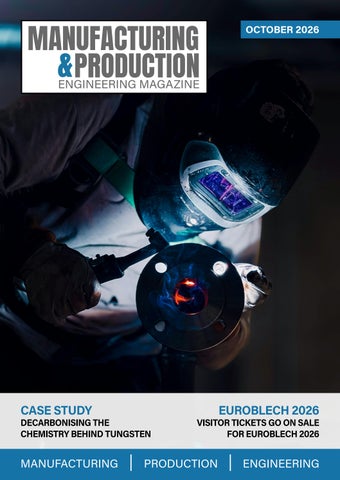
MANUFACTURING PRODUCTION
CASE STUDY
DECARBONISING THE CHEMISTRY BEHIND TUNGSTEN
MANUFACTURING
OCTOBER 2026
EUROBLECH 2026
VISITOR TICKETS GO ON SALE FOR EUROBLECH 2026
PRODUCTION
ENGINEERING
ASSA ABLOY RT1000 Spiral Door Engineered for speed, strength and smarter energy performance • Opening speeds up to 1.75 m/s • Excellent thermal insulation • Optional burglar resistance for enhanced security • Smooth, space-saving single-track spiral design • Ideal for high-traffic environments where performance and reliability matter sales.uk.entrance@assaabloy.com www.assaabloy.com/uk
CONTENTS 42
12
Editor
Paul Attwood editor@mpemagazine.co.uk
Senior Editorial Assistant
John Reynolds editorial@mpemagazine.co.uk
20
30
50
12 20 30 42 50
Managing Rising Manufacturing Costs: Building Resilience in an Uncertain Market Why data sovereignty is becoming manufacturing’s next competitive edge FARO CREAFORM Cuts Laser Line Probe Time to Data on Challenging Surfaces Visitor registration now open for EuroBLECH 2026 The hidden cost of fragmented production in specialist formulation manufacturing
Features Editor
Harry Peters editorial@mpemagazine.co.uk
Production/Design
Laura Whitehead laura@lapthornmedia.co.uk
Sales Manager
Charlotte Chapman charlotte@mpemagazine.co.uk
Accounts
Richard Lapthorn accounts@lapthornmedia.co.uk
Admin Assistant
Jade Still jade@lapthornmedia.co.uk
Circulation Manager
Leo Phillips subs@mpemagazine.co.uk
Publishing Director
Editors Note Welcome to the latest issue of Manufacturing & Production Engineering Magazine. In this edition, we examine how manufacturers are responding to rising costs, supply chain uncertainty and skills pressures while continuing to invest in innovation and long-term resilience. Automation and digital transformation feature strongly, with smarter, more connected production helping businesses improve efficiency, visibility and competitiveness.
Paul Attwood Editor
We also explore why data sovereignty is becoming an important competitive consideration, alongside developments in advanced measurement and production technologies. Looking ahead, our previews of EuroBLECH 2026 and the Engineering Design Show highlight the technologies, expertise and ideas shaping manufacturing’s future. Together, the stories demonstrate an industry embracing change while tackling immediate operational challenges and preparing for future opportunities. We hope you enjoy this issue.
Maria Lapthorn maria@lapthornmedia.co.uk
Lapthorn Media Ltd
5-7 Ozengell Place, Eurokent Business Park, Ramsgate, Kent, CT12 6PB
Every effort is made to ensure the accuracy and reliability of material published in Manufacturing & Production Engineering Magazine however, the publishers accept no responsibility for the claims or opinions made by advertisers, manufactures or contributors. No part of this publication may be reproduced or transmitted in any form or by any means, mechanical, electronic (including photocopying) or stored in any information retrieval system without the prior consent of the publisher.
mpemagazine.co.uk Connect with us @mpemaguk
Phone: 01843 808 106 Manufacturing & Production Engineering Magazine
03
Latest News
Battery technology from hofer technology: Up to double the cycle life at double the energy density Recent University of Cambridge research highlights the importance of mechanical boundary conditions in battery cells. hofer technology has been working on this topic for over five years and has used unique insights to develop a new battery module. How long a battery maintains its performance depends not only on cell chemistry, temperature and state of charge. The mechanical conditions within a battery module also play an important role. In particular, the pressure applied to each cell can influence how quickly it ages. Recent research from the University of Cambridge has brought greater attention to this topic. The studies show that carefully controlled mechanical loading can significantly reduce the aging of lithium-ion cells. Under certain test conditions, the service life of the cells tested was significantly extended.
hofer technology has investigated in a range of customer projects how cell preload, breathing, swelling and mechanical deformation affect the cycle life and performance of different battery cells. The objective is not simply to determine how quickly a cell ages, but rather to identify the mechanical conditions under which it can maintain its performance for as long as possible. To support this work, the hofer technology team has developed proprietary test methods and fully programmable test equipment. During defined charge and load profiles, parameters including cell deformation, temperature, voltage, capacity and
The potential applications go beyond conventional electric vehicles. impedance are recorded. This makes it possible to determine at an early stage which mechanical constraints are best suited to a specific cell technology. Experience also shows that there is no single optimum pressure that works for every battery cell. Both insufficient and excessive mechanical forces can accelerate cell degradation. Cell chemistry, cell format, state of charge, temperature and operating profile therefore need to be considered as an integrated system. The specially
Majority of global manufacturers could only withstand supply chain disruption for up to three weeks: Proxima If a major supply chain shock occurred tomorrow, over half of global (53%) CEOs in the manufacturing sector say their businesses could not maintain day-to-day operations for up to three weeks uninterrupted, according to new research from Proxima, a leading procurement and supply chain consultancy. Alongside this, eight in ten (80%) believe that up to a fifth of their revenue would be in jeopardy if their top three suppliers were disrupted for two weeks. A fifth (20%) put the risk at 21-40% of revenue.
04
Manufacturing & Production Engineering Magazine
Latest News developed test methodology is already being applied across a wide range of cell technologies – from NMC and LFP to next-generation solid-state cells.
A smart battery module The insights gained from our development work and from the successful use of the new test method in numerous projects form the basis for a new generation of battery modules from hofer technology. Smart pressure control is a key feature: the battery module can adapt to the specific requirements of the cell, providing greater flexibility in terms of performance, service life and future cell technologies.
technology, operating profile and initial system design. A longer battery life brings more than just technical benefits. If batteries can be used for longer, their economic value also improves. Replacement and recycling can be delayed, while residual value, total cost of ownership and resource use may also benefit. The potential applications go beyond conventional electric vehicles. High cycle life and long service life can also be important for commercial vehicles, stationary energy storage systems, marine applications, as well as future aviation and aerospace systems.
cycles can have a direct impact on the overall economics of the system. Future battery systems in vehicles will also need to support Vehicle-to-Home (V2H) and Vehicle-to-Grid (V2G) functions. V2G applications in particular can require several times as many charge and discharge cycles. This creates an additional challenge for energy storage systems based on solid-state cells. Smart pressure control helps maintain stable cell performance over a high number of charge and discharge cycles. This makes cell mechanics an important factor in the development of future battery systems.
For energy storage systems using solid-state cells in particular, longer battery life and a high number of
The assessment is based on current NMC cell technologies as well as current solid-state cell technologies.
almost a quarter (23%) of CEOs in the manufacturing sector cited conflict and geopolitical tensions. When asked about the impact of protectionist policies in the past 12 months, over four in ten (43%) say that delays at customs have created periodic stock shortages. The research also finds that emerging technologies (22%) and sustainability targets and regulatory requirements (21%) are the top threats that CEOs believe their peers underestimate most.
The data finds that the majority of CEOs do not have real-time visibility on cyber risk.
A freely programmable force map allows the pressure applied to the cells to be adjusted according to the respective operating condition. This turns what has traditionally been a fixed mechanical design parameter into an actively controllable parameter within the battery system. The high level of development already achieved allows us to support our customers in moving toward series application within a short timeframe. How significant the effect is in each case depends on the cell
Paying a premium for resilience Proxima’s Global Supply Chain Resilience Outlook, based on a survey of over 500 global CEOs at businesses generating over $500m in annual revenue, also found that the 367 CEOs in the manufacturing sector would accept an average uplift of 16% on their current third-party supplier costs to guarantee supply chain resilience. Almost seven in ten (69%) would accept an uplift of 11% or more. When asked how they might fund such an uplift in their thirdparty supplier costs, 40% indicted they would implement cost saving measures while 34% would pass price rises on to customers. Over a quarter (27%) said they would absorb the costs through reduced margins.
A varied threat landscape When asked which threat currently poses the greatest financial challenge to their supply chain,
Technology and cyber risk in supply chains Over four in ten (44%) CEOs in the manufacturing sector said their business had experienced a supply chain disruption caused by a cyber incident in the past 24 months. At the same time, 40% said significant business revenue would be at risk within their organisation if a key supplier fell victim to a cyber-attack. Despite this, the data finds that the majority of CEOs do not have
real-time visibility on cyber risk. Less than four in ten (39%) have conducted a full cyber resilience stress-test across critical suppliers in the past 12 months, while just 35% believe their business has real-time visibility into the cyber risk exposure of its critical suppliers. Over half of CEOs in the manufacturing sector (52%) say AI is delivering measurable value in supplier risk monitoring. However, they also say there are barriers in further scaling AI use in the supply chain including data quality (38%), lack of skills (30%) and clarity around ROI (30%).
Manufacturing & Production Engineering Magazine
05
Latest News
Collaborative robot market leader Teradyne Robotics starts patent infringement case against Chinese robot competitor at European patent court Teradyne Robotics A/S, a Danish-based subsidiary of Teradyne, Inc. and global leader in advanced robotics, announces that it has initiated a patent infringement case at the Unified Patent Court (UPC) in Copenhagen against a German subsidiary of the Chinese robot company JAKA. The case concerns the alleged infringement of patents - both software and hardware - held by Teradyne Robotics A/S and related to its business unit Universal Robots A/S, the world’s leading producer of collaborative industrial robots. The alleged infringement involves a broad range of collaborative robot models marketed by JAKA in the EU. Jean-Pierre Hathout, President of the Teradyne Robotics Group, said: “This case is another clear demonstration that Teradyne Robotics will enforce its patents and intellectual property (IP)
06
Manufacturing & Production Engineering Magazine
rights against what we consider to be illegal and unfair copying and infringement, across both hardware and software. “We cannot and will not accept companies that unlawfully copy protected technologies, and we are resolute in safeguarding our IP so customers can continue to have innovative automation solutions that meet the highest standards for safety and compliance.”
Second IP infringement case in Europe this year The patent infringement case at the UPC is Teradyne Robotics’ second
IP infringement case in Europe in 2026, following a legal action filed earlier this year in Germany against the subsidiary of another robot company for copyright infringement of Universal Robots’ software. A ruling in the ongoing patent infringement case could have effect across Europe within 17 of the current 18 EU Member States participating in the Unified Patent Court (UPC). In addition, certain countries outside the Unified Patent Court Agreement, such as the United Kingdom and Spain, are also included in the case. Teradyne Robotics A/S is headquartered in Odense, Denmark, and as acts of patent infringement appear to have been committed in Denmark - as well as numerous other EU Member States - the case has been filed with the UPC’s Local Division in Copenhagen.
Register at:
Register at:
Nuclear and Technology nce and Science Technology
MSc - 1 year full time time MSc MSc --12year time or 3full year part time Diploma • PG Certificate partPG time MSc - 2 or 3 year part time Short Courses for CPD
Certificate PG Diploma • PG Certificate Designed to create a generation of nuclear engineers and scientists with the skills to secure a sustainable or CPD Short Courses for CPD and safe future for nuclear energy.
to create a generation of erationDesigned of nuclear engineers nuclear engineers and Key features: Demand-driven •scientists Breadth of learning • Delivered by experts • Flexibility • Short-course format kills to secure a sustainable with the skills to secure a ar energy. sustainable and safe future for Course delivered by: The University of Birmingham • University of Central Lancashire • The University of Leeds • The University of Liverpool The University of Manchester • The University of Sheffield • The Nuclear Department of the Defence Academy
nuclear energy.
For more information: email: info.ntec@manchester.ac.uk or visit www.ntec.ac.uk
Breadth of learning • Delivered by experts • Flexibility • Short-course format
Key features:
Central Lancashire • The University of Leeds • The University of Liverpool y of Sheffield • The Nuclear Department of the Defence Academy
For more information: info.ntec@manchester.ac.uk • email: Demand-driven or visit www.ntec.ac.uk
• Breadth of learning • Delivered by experts • Flexibility • Short-course format
Choose from a selection of 19 courses units delivered by the Consortium members For more information: visit www.ntec.ac.uk
email: info.ntec@manchester.ac.uk tel: +44 161 529 4799
Company News
Altus Supports SSTL with Smart Racking Solution as Industry Moves Towards Integrated Traceability As UK electronics manufacturers move beyond traditional X-ray counting towards integrated solutions combining goods-in scanning with intelligent storage, smart racking is emerging as a key enabler of next-generation traceability and production control.
SSTL, a global leader in small satellite design and manufacture, continues to invest in advanced manufacturing technologies to support its growing international operations. As part of its ongoing development, SSTL identified an opportunity to build on its materials management processes, enhancing traceability while improving changeover efficiency and product set-up times.
Reflecting this shift, Altus Group, a distributor of capital equipment for the electronics manufacturing industry, has supported Surrey Satellite Technology Limited (SSTL) with the implementation of a Scienscope Smart Rack system to further enhance component traceability and production efficiency.
Having previously engaged with Altus at technology events, the SSTL team was already familiar with Scienscope Smart Rack technology. Following evaluation, a Scienscope Smart Rack (WH-SR2-COMBO Gen 3), aligned with the latest thirdgeneration platform was integrated. The system features improved build quality, next-generation reel sensors,
Glasgow Start-Up Velocity Edge Launches Online Platform to Simplify Lubricant Procurement Velocity Edge, a Glasgow-based technology start-up, has launched an online platform bringing a faster, smarter way to source lubricants to businesses across the UK and beyond. Founded in December 2024 by co-founders Callum Samuel and Josh Duncan, both in their early twenties, the company was built to tackle a long-standing frustration in the lubricant industry: sourcing the right product for the right application is too often a slow, fragmented process involving multiple suppliers, endless phone calls and inconsistent technical advice. The platform, available at velocityedge.com, replaces that process with a single online destination where buyers can browse, compare and request quotes on lubricants from
08
Manufacturing & Production Engineering Magazine
the world’s most trusted brands. Products are organised by sector across marine, aviation, automotive and industrial applications, giving customers direct access to leading names including Shell, Mobil, Castrol, Fuchs, Petronas, Total, Texaco and Petro-Canada, spanning OEM-approved engine oils, industrial hydraulics, specialty greases and aviation-grade fluids. What sets Velocity Edge apart is that it pairs this convenience with genuine technical expertise. The team offers impartial guidance to help customers select the correct product for their application, reducing the
upgraded LED signalling for multikitting, and adjustable reel thickness capability. Hardware demonstrations confirmed performance, while close collaboration between SSTL, Altus and Scienscope ensured software integration was tailored to site requirements prior to investment. The selected configuration was a 2-metre smart rack designed to support high volumes of 7-inch reels, providing a compact and efficient storage solution.
risk of costly specification errors, a common and expensive mistake in procurement. Through a singlesource supply model, sourcing multiple products from different brands no longer means managing multiple suppliers. Despite launching only in December 2024, the founders have built momentum quickly. Velocity Edge has secured ten key supplier contracts, onboarded its first customers, and already fulfilled early international orders to Hong Kong, the UAE, Thailand and Malaysia. That progress has been recognised across Scotland’s enterprise ecosystem: Velocity Edge is an early-stage account managed by Scottish Enterprise and a member of the Strathclyde Inspire accelerator, Barclays Eagle Labs and TechScaler. The team has also won the Strathclyde Inspire100 competition and the Scottish Young Edge Round 26 competition. The team’s entrepreneurial drive is matched by deep industry expertise. Non-Executive Director
Company News Joe Booth, CEO, Altus Group, said: “It is great to see the Smart Rack now installed and operational on site at SSTL. Smart racks have seen strong growth and are now being more widely adopted as manufacturers focus on improving component traceability and kitting efficiency. “Traditionally, storage towers have been seen as too costly to deliver a clear return on investment. However, more streamlined smart rack solutions are now at a level where they can deliver strong, measurable returns. “Software integration is also critical to success, and Scienscope has demonstrated real strength in this area, giving customers confidence in long-term performance and value.” The Smart Rack provides automatic reel detection, placement and removal tracking, alongside multi-colour LED guidance for multikitting. Each component is assigned a unique ID, enabling full traceability and structured FIFO/FEFO retrieval, with ERP and MES integration supporting real-time data capture. For more information visit: www.altusgroup.co.uk
Andrew Samuel, founder and chairman of Pure Lubrication, brings over 30 years of experience in the sector and was recently named Entrepreneur of the Year 2025 at the Glasgow Business Awards. His involvement gives the young founding team a level of sector credibility that is rare for an early-stage technology venture. PICTURED ABOVE: Callum Samuel and Josh Duncan, Velocity Edge co-founders
Hi-Tech Tooling Selects Tooling Intelligence as Inventory Partner As a leading independent supplier of cutting tools and engineering solutions, Hi-Tech Tooling has announced that it has entered a strategic partnership with Tooling Intelligence Ltd. The collaboration between the two companies designates Tooling Intelligence Ltd as the preferred tool vending and inventory management supplier for Hi-Tech Tooling across Ireland. Supplying manufacturers throughout the Republic of Ireland and Northern Ireland, Hi-Tech Tooling serves the medical, aerospace and general engineering sectors with a diverse portfolio of cutting tools, workholding and consumables. As a multi-brand supplier, Hi-Tech Tooling required a partner capable of supporting its portfolio breadth, selecting Tooling Intelligence Ltd for its
product quality, technical support, innovative technologies and a genuinely independent solution. Tooling Intelligence Ltd offers SupplyPro inventory management solutions and has been exclusive to the brand since 2007. For Irish manufacturers, the partnership provides 24/7 access to tooling, with stock held on consignment, so customers pay only for what they withdraw. Minimum and maximum stock levels are set for each location, and a critical alert is triggered before the minimum is breached, allowing Hi-Tech Tooling to replenish remotely within 24 hours. Real-time usage reporting gives customers full visibility of consumption, while a single monthly invoice replaces the administrative burden of multiple purchase orders, deliveries and invoices. That administrative saving is one many customers overlook. Hi-Tech Tooling estimates the true cost of raising a single purchase order, from leaving the machine and placing the order through to settling the invoice in accounts, at up to €50. Repeated across several suppliers and several orders a week, that hidden overhead mounts up quickly. Tony Foster, Director at Hi-Tech Tooling, expressed his enthusiasm for the partnership: “We absolutely needed a partner in tool vending; a reliable partner, a good-quality product and excellent support. We are not tied to any particular manufacturer or brand, and this is the best solution on the market for our customer base. It is a win-win: the customer has the stock, they have the support, and they pay only as they use it. It will yield huge results for our customers.” PICTURED LEFT: Tony Foster from Hi-Tech Tooling with a Tooling Intelligence Vending System
Manufacturing & Production Engineering Magazine
09
Latest News
Made Smarter launches £400k cyber security drive to protect Yorkshire manufacturers Yorkshire manufacturers are being offered fully funded cyber security support to combat the growing threat from attacks capable of bringing production to a standstill. Made Smarter Yorkshire, the Government-backed technology adoption programme, has launched a new £400,000 cyber security initiative to help SME manufacturers protect their people, systems and operations as factories become increasingly digital and connected. The Government-funded pilot is being delivered with Sheffield Hallam University and will create Cyber Security Champions inside Yorkshire businesses, giving employees the skills and confidence to spot threats, encourage safer working practices and build stronger cyber defences. Manufacturers will be able to access four levels of fully funded support, ranging from basic cyber awareness through to internationally recognised ISO 27001 accreditation. The Yorkshire pilot could also help shape how cyber security support is delivered through Made Smarter across England. The National Cyber Security Centre (NCSC), the part of GCHQ which protects the UK from cyber threats, has warned of a growing risk to the UK, with nationally significant incidents more than doubling in its latest published annual figures. Government research has found that a cyber attack costs a UK business an average of £190,000, contributing to an annual economic cost of £14.7 billion. For manufacturers, the stakes can be particularly high. Digital technology now connects everything from machinery and production systems to suppliers and customers, meaning a cyber incident can quickly become much more than an IT problem. It can stop production, delay orders and increase costs. People are also central to cyber security. While threats continue to evolve, human error remains the most common cause of security incidents, making awareness and
10
Manufacturing & Production Engineering Magazine
Digital technology is creating huge opportunities, but the more connected a business becomes, the more important it is that cyber security develops alongside it. safer working practices vital to protecting a business. Research by Make UK, the manufacturers’ organisation, found that nearly one in three manufacturers had experienced a serious cyber incident, either directly or through their supply chain, in the previous 12 months. Jessica Armitage, Programme Manager for Made Smarter Yorkshire (pictured below), said: “Cyber attacks are no longer something manufacturers can afford to think will happen to somebody else. Digital technology is creating huge opportunities, but the more connected a business becomes, the more important it is that cyber security develops alongside it. This isn’t simply an IT problem. An attack can stop
production, delay orders, increase costs and disrupt customers and suppliers. For smaller manufacturers, one of the biggest challenges can simply be knowing where to start.” The first stage, Cyber Security Awareness, is a 2.5-hour online session open to all SME manufacturers in Yorkshire and aimed particularly at businesses which are new to cyber security. It will help businesses develop Cyber Security Champions who can recognise common threats and encourage safer working practices, while covering risks including phishing, weak passwords and cloud security. Participants will leave with a practical action plan to strengthen cyber resilience. Those wanting to go further can register with the programme to access three additional levels of fully funded support. Cyber Essentials will help manufacturers understand the Government-backed certification scheme and its five key security controls, adopt digital technology more safely, build customer trust and develop an action plan towards certification. Cyber Essentials Plus combines training with tailored one-to-one coaching to prepare businesses for technical assessment and independent verification of their cyber security controls, helping build greater trust with customers and suppliers. The most advanced level, Cyber ISO 27001, will help manufacturers identify security gaps, strengthen their Information Security Management System, prepare for audits and work towards internationally recognised ISO 27001 certification. Support will be delivered online, at Sheffield Hallam University and, for some of the more advanced support, at manufacturers’ own premises. SME manufacturers can find out more www.madesmarter.uk/ yorkshire-cyber
The UK’s leading training for acoustics professionals The IOA Diploma in Acoustics and Noise Control is a flexible way to get into the acoustics profession, with remote learning options that fit around your life. You’ll cover the essentials, core acoustics principles, lab methods, and your own project, then pick two specialist modules in areas such as Building Acoustics, Electroacoustics, Environmental Noise or Noise & Vibration Control. You can study at UK centres or online, wherever suits you, and keep a good work–life balance along the way. With over 50 years of experience, the Institute of Acoustics also connects you to a global network, events, and ongoing CPD. Find out more at: www.ioa.org.uk/education-training
E: education@ioa.org.uk
Institute of Acoustics,
T: +44 (0)300 999 9675
Silbury Court, 406 Silbury Boulevard,
www.ioa.org.uk
Milton Keynes MK9 2AF
9186-AeroBot-Ad-180x132-PRESS_Layout 1 09/06/2025 08:31 Page 1 IOA653_Ad_Diploma_180x132.indd 2
13/05/2026 12:19
knapp.com
rise to new dimensions AeroBot is our brand-new storage technology with intelligent bots that move in three dimensions. Featuring robots that move across the floor and climb the racks, AeroBot is a scalable solution – add locations for more storage or add bots for higher throughput. For more info:
Manufacturing & Production Engineering Magazine
11
Insurance
Managing Rising Manufacturing Costs: Building Resilience in an Uncertain Market For UK manufacturers, managing costs has always been part of doing business. However, today’s operating environment presents a more complex challenge. Rising material prices, increasing operational expenditure and workforce costs are converging at a time when economic uncertainty continues to complicate long-term planning and investment decisions. According to Gallagher’s Business Risk Index, the high cost of materials is currently the sector’s most significant concern, cited by 88% of manufacturers. This is followed by the high cost of operations (77%) and the high cost of salaries (68%). Together, these findings paint a picture of a sector facing pressure on multiple fronts simultaneously. Material costs remain particularly difficult to predict. Ongoing supply chain disruption, geopolitical uncertainty, fluctuating commodity prices and transportation challenges continue to influence the cost and availability of key inputs. For manufacturers already operating with tight margins, absorbing these increases can be difficult, while passing costs onto customers is not always a viable option in competitive markets.
risks facing manufacturers, including sector competition, supply chain disruption, regulatory change, the impact of national insurance increases, US tariffs and the adoption of artificial intelligence.
Operational expenditure presents another challenge. Rising energy costs, logistics expenses, warehousing requirements and other business overheads continue to impact profitability. While many organisations have sought efficiencies wherever possible, there are limits to how much can be achieved through cost reduction alone. At the same time, workforce pressures remain a significant concern. Manufacturers continue to compete for skilled labour while balancing wage expectations and broader employment costs. As labour shortages persist in certain specialist areas, attracting and retaining talent remains a strategic priority for many businesses. What makes the current environment particularly challenging is that these pressures rarely exist in isolation. Gallagher’s Business Risk Index highlights a range of interconnected
As a result, resilience is becoming an increasingly important business objective. Traditionally associated with responding to major disruptions, resilience today extends to an organisation’s ability to adapt to changing market conditions, absorb financial pressures and continue pursuing long-term objectives amid uncertainty. Many manufacturers are exploring initiatives such as supplier diversification, process efficiency programmes, automation and digital transformation to help manage costs and improve operational performance. While these strategies may create opportunities, they can also introduce new considerations around cyber security, business continuity and risk governance. The challenge for manufacturers is not simply responding to individual risks as they emerge, but understanding how multiple pressures interact across the business. Those that take a structured approach to identifying vulnerabilities, assessing exposures and planning for different scenarios may be better positioned to navigate uncertainty and maintain competitiveness in an increasingly complex market. As cost pressures continue to shape the manufacturing landscape, resilience is becoming less about reacting to change and more about preparing for it. Download Gallagher’s full 2026 Business Risk Index report by scanning the QR code.
12
Manufacturing & Production Engineering Magazine
Protect Every Component of Your Business
Manufacturing insurance designed around you Whether you’re a single manufacturing facility in the UK or a global multi-site operation, Gallagher can help you protect your business, your people and your products.
CONNECT WITH A SPECIALIST TODAY. For further information, please scan the QR code.
Partner with an insurance and risk management specialist who knows your industry. Our Specialist team at Gallagher would be glad to arrange a no-obligation insurance review for your company.
AJG.com/uk The Gallagher Way. Since 1927. Arthur J. Gallagher Insurance Brokers Limited is authorised and regulated by the Financial Conduct Authority. Registered Office: Spectrum Building, 55 Blythswood Street, Glasgow, G2 7AT. Registered in Scotland. Company Number: SC108909. FP251-2026 Exp. 16.02.2027. © 2026 Arthur J. Gallagher & Co. | GGBRETUK107473
Automation
Automation and Transparency Underpin New Construction Models By Rob Ellinor, Global Building and Construction Sector Manager, Domino Printing Sciences
The construction industry needs to adapt quickly to the challenges presented by an ageing workforce alongside new regulatory demands for transparency, all while continuing to deliver the infrastructure, buildings, and industrial facilities needed to support global growth. Manufacturers of building and construction products, while also facing skills shortages, have a vital role to play in leveraging automation to support construction companies as they transition towards more industrialised construction models, enabling specialist expertise to be applied where it adds most value, as Rob Ellinor, Global Building and Construction Sector Manager, Domino Printing Sciences, explains.
Escalating skills shortage The global shortage in skills is affecting every industry. For both construction and manufacturing companies the existing scarcity of talent is exacerbated by an ageing workforce heading towards retirement. In the UK alone, there are over 140,000 job vacancies in the construction industry today and with over one third of workers expected to retire by 2035 the outlook is bleak. With too few people
14
Manufacturing & Production Engineering Magazine
entering construction and too many leaving, the industry needs to recruit an additional 36,340 workers every year – more than 181,700 over the next five years – to meet forecast demand. Within manufacturing, 97.5% of companies say that hiring and retaining skilled labour poses a significant challenge to their business; with 75% citing shortage of skills as the biggest barrier to growth. Limited access to training opportunities, shifting career preferences among younger generations, and global economic pressures are all contributing to recruitment challenges. As construction firms seek to maintain output despite workforce constraints, greater emphasis is being placed on productivity, transparency, and process efficiency. In response, organisations across the construction value chain – from product manufacturers to principal contractors and installers – are investing in automation, digitalisation, and datarich identification technologies such as 2D codes to enable more connected and industrialised construction models.
Efficiency, control, and visibility While these pressures are being felt across the value chain, construction manufacturers face a unique combination of workforce, productivity, and operational challenges. They aren’t just losing knowledge; they are being tasked with doing more with less. Gone are the days of continuous runs of a single mass-produced product. Even standard products such as plasterboard, cement, and aggregates may now have multiple product variations and SKUs, necessitating shorter runs, more product changeovers, and increasingly tighter schedules. Short product
runs and faster turnaround rely on automated, integrated manufacturing solutions that increase control and visibility, while reducing the risk of human error. Coding automation solutions can utilise existing production data to automate product changeovers, helping to reduce human error, and downtime, and increase overall shift efficiency. The addition of automated inspection tools can further improve efficiency, allowing machine errors to be rapidly flagged to human operators, and problems to be resolved before they produce unnecessary waste. For example, a line equipped with a simple ‘code and check’ vision system can reject substandard products and provide automatic alerts to prompt intervention and allow manual workers to identify the issue affecting code quality. Integrating machines via industry standards can provide a more complete view of the factory floor, allowing workers to keep lines running with limited downtime. For example, by automating production, coding and inspection through an integrated workflow linked to the manufacturer’s ERP system, human intervention can be eliminated and errors avoided. Integrated dashboards create enhanced visibility that allows bottlenecks to be identified, helping to speed up production and further reduce inefficiencies. For construction stakeholders, these improvements can contribute to more consistent products, greater
Automation production transparency, and improved delivery predictability. Together, these factors can support better planning and coordination across the supply chain, helping manufacturers and construction teams reduce avoidable disruptions and respond more effectively when issues arise.
End-to-end traceability Automated and integrated manufacturing systems form the foundation for end-to-end traceability in the sector. Compliance with new EU regulations including the Construction Products Regulation (CPR) will require manufacturers to provide structured, digital product information that can be accessed and shared consistently throughout the lifecycle of a building. Using automated production data and global standards such as GS1 Digital Link and 2D codes, manufacturers can embed compliance documentation into on-product codes as part of the production process, creating a digital thread from factory floor to construction site. The creation of an end-to-end digital record can streamline processes, approvals, and sign off, reducing the administrative overhead on construction managers. Beyond compliance, it can help create a richer digital record of the build itself, linking specific products to installation records, inspection data, photographs, and location information. This can support the development of more accurate, asbuilt records, making it easier to verify what has been installed, demonstrate compliance, and access relevant product information, instruction manuals, or safety data throughout a building’s lifecycle. Providing this information in a consistent, accessible format can help less experienced workers complete tasks correctly, reducing dependence on a shrinking pool of specialist expertise and supporting knowledge transfer across the workforce.
Expansion of modular construction Automation is also underpinning one of the biggest developments within the construction industry: the rapid emergence of modular components
set position in a specific building module, the use of 2D codes will be key to achieving accuracy and product traceability throughout the manufacturing and pre-assembly processes.
Knowledge retention
Automated and integrated manufacturing systems form the foundation for end-toend traceability in the sector. and building projects. The booming Prefabricated Construction Market provides a solution to the skills shortage, while helping to manage construction costs and demands for environmentally responsible building practices, with market value expected to reach USD 163.93 billion by 2030. For the construction industry, the modular method is compelling. With components manufactured off-site and building elements partially or fully assembled on site, prefabrication allows construction companies to reduce the amount of skilled labour required on site, improve programme certainty, and reduce on site build lead time. However, it does place greater emphasis on planning, coordination, quality assurance, and product identification to verify, install, and commission increasingly complex assemblies. For manufacturers therefore, modular construction further increases the need for transparency: successful builds depend on 100% component accuracy. Any mistakes in, for example, the provision of the electric cables or other parts required for a modular room construction could result in the entire module being rejected. Automation is key to efficiently managing new levels of flexibility as lines producing modular components need to quickly switch between component types. Modular builds further reinforce the need for production traceability. With each component tracked through production and matched to a
The rapid adoption of new construction models, including prefabrication, underlines the changes facing heavy industry, not least the vital knowledge being lost as experienced workers leave the workforce. In addition to supporting the traceability and visibility required, automation provides a way to secure and retain knowledge. Automation is data-driven, backed by analytics that capture the usage characteristics of a manufacturing line. It allows trends and best practices to be recorded and developed into standard policies and operating procedures that can be quickly understood by less experienced staff. Digital developments and AI often go hand in hand, and construction product manufacturers can leverage the data obtained via automation, alongside AI to further streamline operations, support decision-making, and record actions operators take in response to reports and outcomes. Beyond manufacturing, an area where we are already seeing this play out in the construction industry, is the use of AI search tools to match specific project requirements with an exact SKU where global standards are adopted, this helps to promote “AI selection” of components in design. There are significant challenges ahead for the construction industry, and construction product manufacturers – as well as the sector as a whole – will need to adapt to remain competitive, and ensure that knowledge is retained, built upon, and made accessible for the future. The tools to support this transition are already place, all that is needed is to implement them effectively. For manufacturers, the first step is understanding how 2D codes can be integrated into production processes.
For more information visit: www.domino-printing.com
Manufacturing & Production Engineering Magazine
15
Automation
Manufacturers Face Automation Divide as Future-Fit Businesses Accelerate Investment The manufacturers that embrace integrated automation over the next five years are set to pull decisively ahead of competitors still relying on disconnected production systems, according to new global research highlighting one of the biggest shifts in industrial manufacturing for decades. PwC’s Global Industrial Manufacturing Sector Outlook 2026 predicts that the proportion of manufacturers with highly automated core processes will more than double by 2030, rising from 18% today to 50%. Among the industry’s most advanced businesses, automation levels are expected to reach 65%, creating an increasingly significant competitive advantage through higher productivity, greater agility and faster decision-making. For Black Country based electrical control systems manufacturer and automation integrator Banelec, the findings reflect a trend that has been steadily gathering pace across UK manufacturing.
Rather than viewing automation as a series of individual projects designed to improve a single production line, more manufacturers are looking at how electrical controls, machinery, robotics, energy systems and production data can work together as part of a wider operating environment. Dean Banner, Managing Director of Banelec, believes the conversation around automation has fundamentally changed. “Five or ten years ago, many automation projects focused on replacing a manual process or making one machine work more efficiently,” he said. “Today our customers are looking at their entire operation. They want production equipment, electrical controls, robotics, energy systems and factory data to communicate with one another so the whole business becomes more responsive.”
That shift places greater emphasis on the engineering infrastructure underneath digital manufacturing. A modern automated production environment may bring together PLC and HMI systems, SCADA, variable speed drives, robotics, safety systems and industrial networks, with the control architecture providing the link between individual pieces of equipment. It is an area in which Banelec works across the full project lifecycle, from control-system design and panel manufacture through to programming, integration, installation and commissioning. Its engineers work with a range of PLC, HMI and SCADA platforms, including Siemens, AllenBradley, Mitsubishi and Schneider, allowing systems to be integrated around the requirements of individual production environments rather than forcing manufacturers into a single technology stack. The PwC research, based on interviews with 443 senior manufacturing executives across 24 territories, concludes that future performance will depend less on simply acquiring new technologies and more on integrating them effectively. Production and operations are expected to become the largest users of advanced technologies by 2030, while the research also identifies a widening gap between future-fit manufacturers and their peers. That distinction is particularly relevant as factories become more interconnected. Adding a robot, upgrading a PLC or introducing a monitoring system can deliver a local improvement, but the wider gains come when those technologies can exchange information and contribute to a coherent production strategy. PICTURED TOP LEFT: Jennie Banner, Operations Director overseeing customer journey at Banelec PICTURED BOTTOM LEFT: Dean Banner, Managing Director
16
Manufacturing & Production Engineering Magazine
Automation automation infrastructure capable of supporting more flexible production, digital manufacturing, predictive maintenance and remote monitoring.
PICTURED ABOVE: Banelecs recent aerospace fan casing lift £500k order According to Dean Banner, this systems-level thinking is where many manufacturers now gain their competitive advantage. “The real value isn’t simply adding more automation. It’s making every part of the factory work together. If machines operate in isolation, you only improve individual processes. When electrical control systems integrate production equipment, energy management, quality monitoring and operational data, manufacturers gain visibility they simply didn’t have before. That allows faster decisions, better productivity and much greater resilience.” The same principle is increasingly being applied to maintenance. Industry 4.0 technologies can allow manufacturers to move from reactive “fail and fix” maintenance towards more predictive approaches, using equipment data to identify potential problems before they result in unplanned downtime. Banelec’s Industry 4.0 work includes remote monitoring, live data streaming and predictive maintenance applications, reflecting the broader move towards using production data not simply to observe what has happened, but to inform what should happen next. PwC also expects manufacturers to generate an increasing proportion of revenue from activities beyond traditional product manufacturing. Its research projects that 44% of total revenue could come from outside the manufacturing of industrial and consumer products by 2030, as businesses expand into connected solutions, services and intelligent technologies. For engineering companies, that evolution is creating demand for
It also means that integration needs to be considered from the outset. Retrofitting new technologies into an existing production environment can involve legacy equipment, different control platforms, safety requirements and the practical constraints of keeping a working factory operational. Banelec’s integration engineers work on both new systems and existing production equipment, including projects involving PLCs, robotics and HMI systems. The company also provides relocation and integration services where existing equipment needs to be incorporated into a new or modified production environment. Dean Banner believes this represents a natural progression for manufacturers investing for long-term growth. “Automation cannot purely be viewed as a capital investment to reduce labour. It’s becoming part of wider business strategy. Customers want systems that can adapt as production changes, accommodate new equipment, provide better operational information and support future expansion without rebuilding everything from scratch.” That requirement for scalability is particularly important as manufacturers invest in technologies that may need to remain operational for many years. The electrical control system is often the point at which different technologies ultimately meet, making its design and integration an important consideration in determining how easily a factory can adapt. Banelec’s approach is consequently not limited to standalone control panels or individual automation components. The company provides bespoke electrical control systems alongside automation, robotics, PLC and HMI programming, conveyor controls and Industry 4.0 applications, with engineering support extending from initial design through installation and commissioning. As manufacturers continue investing in digital transformation, Banelec expects electrical control engineering to become an increasingly strategic discipline rather than simply a supporting function.
Automation cannot purely be viewed as a capital investment to reduce labour. It’s becoming part of wider business strategy. - Dean Banner
The PwC report reaches a similar conclusion from a broader industry perspective: the manufacturers best placed to benefit from the next wave of technology adoption will not necessarily be those buying the greatest number of new tools, but those capable of combining technology, data and interoperable systems effectively. Dean Banner believes that principle mirrors the direction already being taken by many of Britain’s most successful manufacturers. “The businesses moving fastest aren’t necessarily buying the most technology, because they’re investing in engineering that allows everything to work together. That’s where automation delivers its biggest return, the control system becomes the foundation that connects people, processes and technology into one efficient manufacturing operation.” As UK industry continues its drive towards smarter factories, the distinction between automation leaders and laggards is likely to become increasingly defined not by the number of machines they own, but by how intelligently those machines are connected. For manufacturers considering that transition, the challenge is therefore becoming less about automating one more process and more about creating the control, data and integration infrastructure that allows the entire operation to evolve.
For more information visit: www.banelec.com
Manufacturing & Production Engineering Magazine
17
Automation
Process Automation in Mechanical Engineering:
How Companies Are Removing Manual Routine from Design A customer requests a custom variant, sales commits to a delivery date, and the design department begins the search for the right CAD model. Weeks pass before the drawing and bill of materials are finished, because every variant is adapted by hand. This scenario describes an everyday reality that many design engineers in mechanical engineering know well – and this is exactly where process automation comes in: it replaces manual, error-prone individual steps with predefined, repeatable workflows.
What Process Automation Delivers in Engineering As a key building block of Engineering Automation, process automation connects CAD, PDM, and ERP systems into end-to-end workflows and eliminates existing media breaks. With Lino Automate, recurring tasks – such as opening, editing, and filing technical data – can be mapped rule-based and without programming knowledge using so-called action lists. A trigger, such as a button press or an event in the PDM system, sets off the entire chain: from processing the CAD data to initiating downstream processes in the backend. Lino customers report 25 to 50 percent shorter throughput times and more than 30 percent fewer errors in order processing. A concrete example is configuration automation with Tacton Design Automation. It is based on a master model in the CAD system, in which all relevant dimensions, components, and features are stored. A configuration model links these attributes to a user interface through which users assemble a variant via input fields, dropdowns, or sliders. A live demo on a hand-operated arbor press illustrated the principle:
18
Manufacturing & Production Engineering Magazine
As a key building block of Engineering Automation, process automation connects CAD, PDM, and ERP systems into end-toend workflows and eliminates existing media breaks. selecting a higher pressing force automatically adjusts the required dimensions of the press, restricts the choice of spindle diameter, and immediately proposes a valid combination in case of a conflict. Additional parts, such as extra guides, are inserted automatically. At the same time, components – for example the standard base plate – are automatically replaced with an enlarged base plate featuring clamping grooves when needed, without the user having to select individual components. Because every variant is derived from the same error-free master model, technical validity is maintained across all versions. The production drawing is no longer created manually either: Tacton Design Automation automatically updates dimensions, views, and bill-of-materials positions as soon as the configuration model changes – views don’t overlap, and scales adjust to part size. For SOLIDWORKS users, Lino 2D fix additionally complements drawing automation with its own module. A supplier from the door manufacturing industry puts the time savings from using Design
Automation at around 90 percent compared to manually designing comparable variants. The technical connection is established through interfaces to ERP and PLM systems, so that the generated variant is passed directly into downstream processes. For users, this means they stay within their familiar CAD environment while rules and configuration logic handle the actual automation in the background. Lino GmbH brings nearly 20 years of consulting and software development experience in mechanical engineering to implementing these workflows across different CAD systems such as Autodesk Inventor or SOLIDWORKS. The time difference is most evident in document creation itself. In the manual process, a design engineer or administrator has to accompany every step individually: opening files, entering part numbers and classifications into the PDM system by hand, checking metadata, creating the document, checking it back in – and doing so anew for every single variant. This time cannot be meaningfully parallelized, because someone effectively has to sit alongside the process and monitor it. With Lino Automate PDM, this bound human factor disappears entirely: the complete workflow runs as a stored action in the background, while the design engineer can already turn to the next task. Minutes per document thus become, in effect, no waiting time at all – not because the individual step runs faster, but because it no longer ties up working time.
The technical connection is established through interfaces to ERP and PLM systems, so that the generated variant is passed directly into downstream processes.
www.sheffield-tech.com
Introducing the UK’s new premier materials processing company. Change your way of thinking • We can cut up to 60mm thick - 6m x 2m plate size • Achieve chamfers and precise holes in thick-section materials, opening up new design possibilities • In-house pressing fabrication and machining capabilities
24kW Laser
Industrial
Defence
60mm Stainless Steel
60mm Carbon Steel
60mm Armour
Aerospace
Electrical
Architecture
40mm Aluminium
16mm Copper
12.7mm Brass
Crucible Works, Darnall Road, Sheffield S9 5AB To discuss your next project call us on: 0114 7080 265
sales@sheffield-tech.com
Opinion Piece
Why data sovereignty is becoming manufacturing’s next competitive edge By Jonathan Wright, Chief Product Officer at GCX Managed Services As manufacturers connect more of their production environments, data is no longer just an operational by-product. It helps keep factories moving, supply chains coordinated and equipment performing. From predictive maintenance and quality control to supplier collaboration and AI-enabled decision-making, modern manufacturing depends on information moving quickly and securely across sites, systems and borders. That makes data sovereignty a growing priority. It cannot be treated as a simple matter of where information is stored. For international manufacturers, the bigger question is how to maintain control as operational data moves between factory systems, suppliers, logistics partners and cloud platforms across multiple jurisdictions. As a result, manufacturers must navigate an increasingly fragmented regulatory landscape while maintaining the efficiency and resilience their operations depend on. True sovereignty is not simply about data location, but about flexible infrastructure that balances local compliance with global operational needs.
Global production requires local flexibility Manufacturing has long relied on standardisation, with shared technologies and consistent operating models driving efficiency across sites and regions. However, sovereignty requirements rarely align with a single global framework. In Europe, manufacturers must comply with GDPR requirements around data handling and transfers, while markets such as China enforce stricter data sovereignty and local storage rules.
20
Manufacturing & Production Engineering Magazine
Rather than focusing on residency alone, manufacturers need to consider sovereignty across the full industrial data lifecycle. For organisations managing multiple production facilities, supplier networks and regional operations, these differences can quickly introduce complexity. Applying one sovereignty model everywhere may over-engineer infrastructure in some markets while leaving the business exposed in others. The priority is not uniformity, but adaptability.
Sovereignty across the industrial data lifecycle Rather than focusing on residency alone, manufacturers need to consider sovereignty across the full industrial data lifecycle. As data flows between manufacturing systems, production
equipment, suppliers and logistics partners, every stage raises questions about who can access it, where it is processed and how it is protected. This becomes more important as manufacturers adopt AI, digital twins and predictive analytics. Data may be generated on the factory floor but analysed elsewhere to improve performance, forecast disruption or inform decisions across the wider business. If organisations cannot see how that data moves, sovereignty becomes difficult to enforce in practice.
Balancing resilience with compliance As industrial infrastructure becomes more distributed, manufacturers need unified visibility across factory sites, tier-one suppliers, cloud platforms, and regional operations. This visibility allows organisations to apply local controls without fragmenting global operations, ensuring compliance does
Opinion Piece not come at the expense of speed or resilience. Operational performance cannot be compromised for regulatory compliance. The goal is not to restrict data unnecessarily, but to build targeted control across the entire data lifecycle so information moves securely and compliantly across global boundaries.
Turning sovereignty into a commercial advantage As stakeholders scrutinise data management more closely, control and accountability are becoming commercial differentiators. Manufacturers that shift from reactive compliance to proactive sovereignby-design architecture will have a direct competitive advantage, plus can operate with confidence across different regions. Entering strictly regulated markets like China, the EU or India often involves extensive reviews of data handling processes. Manufacturers with localised, sovereign-ready data architectures can respond to those requirements more efficiently, reduce barriers to expansion and onboard regional supply chains in weeks rather than months. While competitors are held up in compliance reviews, those with sovereignty built into their infrastructure can move faster. At the same time, strong data governance is becoming an increasingly important factor in supplier selection. Sectors such as aerospace, automotive and defence are placing greater emphasis on data lineage, security and transparency, making sovereignty a competitive differentiator (and sometimes a requirement) when bidding for high value contracts. By demonstrating granular control though data sovereignty, manufacturers can turn compliance into a selling point and win business ahead of less secure competitors. Ultimately, data sovereignty is no longer just a regulatory checkbox or an IT burden. For forward-looking manufacturers, building flexible, sovereign-ready data infrastructure provides the foundation to scale AI safely, win trust across global supply networks, and outperform legacy competitors in an increasingly complex global market.
When IT downtime becomes production downtime By Simon Hayward, General Manager & VP of Sales, International at Freshworks Manufacturers are accustomed to measuring downtime in practical terms: halted lines, delayed shipments, idle teams and customer commitments placed at risk. Yet one part of this equation is still too often treated as a backoffice concern: IT service management. In modern manufacturing, a failed system, delayed access request or poorly managed change can quickly move from an IT issue to an operational one. When employees cannot get the support, tools or approvals they need, production slows. When asset data is incomplete, teams spend longer diagnosing faults. When incidents are routed by hand, minutes disappear before work has even begun. And in a sector where output depends on precise timing, those minutes matter. This is why ITSM now belongs in the conversation about uptime. Manufacturers have spent decades refining production environments to remove waste, reduce variation and protect continuity. The same thinking now needs to be applied to the digital workflows that support those environments.
model that is too slow for the pace of manufacturing. The answer is not always another incremental fix. In many cases, manufacturers need to simplify before they automate. That means consolidating fragmented platforms, standardising service catalogues, improving asset visibility and creating consistent workflows for incidents, requests and changes. Modernisation is most valuable when it removes old friction, not when it simply digitises it. AI also has a practical role to play, provided it is built on a clean foundation. Automated routing can send requests to the right team faster, AI assistance can help agents find answers more quickly and employee-facing tools can resolve common questions before they become tickets. Used well, AI gives IT teams more capacity to focus on the issues that carry the greatest operational impact. Change management is equally important, particularly in manufacturing, as even routine updates can have consequences if ownership and approvals and are unclear. With a more structured approach, teams can prevent disruption before it reaches the production floor, giving clearer visibility over what is changing, who owns the decision and where risk may sit. For manufacturers, ITSM shouldn’t really just be seen as closing tickets. Rather, it should be seen as protecting uptime and giving teams faster support, making sure that the digital part of the process isn’t responsible for the delays. When service workflows behind manufacturing are properly controlled and simplified, IT becomes an integrated part of the system that keeps production moving.
The challenge is that many manufacturers are working with IT estates built in layers. Growth, acquisition and local decisionmaking often leave businesses with multiple platforms, siloed teams, spreadsheets and manual processes. Each workaround may make sense in isolation, but together they create a service
Manufacturing & Production Engineering Magazine
21
Technology & Software
Manufacturing ERP Implementation Statistics: Insights From 70 Case Studies MRPeasy analysed 70 case studies to better understand the experiences of small manufacturers with ERP. Case studies span industries including industrial machinery, food, electronics, aerospace, metalworking, automotive, and more.
ERP implementation statistics at a glance • 74% of small manufacturers
lack operational visibility before switching to ERP.
• 64% rely on spreadsheets before
adopting ERP software.
• 82% report improved inventory
accuracy after implementation.
• 81% report reduced administrative
work.
• The median ERP implementation
time for small manufacturers is 2 months.
How the research was conducted • Sample size: 70 MRPeasy
customer case studies.
• Company type: Small
manufacturers.
• Company size: Median 15
employees; range 1–200 employees (Employee count known for 55 companies)
Why small manufacturers switch to ERP software The most common issue that prompted the switch to ERP was a lack of visibility in operations, reported by 74% of small manufacturers. 54% of small manufacturers said they outgrew spreadsheets. In addition, 52% cited administrative
burden as a driver, 37% said multiple disconnected tools proved inefficient, and 35% pointed to lead time issues. “We needed a better way to handle it,” says Andy Nancollis, Co-founder and Chief Design Officer at Motion Impossible, a camera equipment manufacturer from Yate, UK. “The complexity of our new product compared to the older models was overwhelming for a spreadsheetbased system.”
Benefits of ERP implementation for small manufacturers The most common benefits of implementing ERP software were: • 82% of small manufacturers said
that ERP software improved inventory accuracy
• 81% reported significantly
reduced administrative work
• 67% said that production planning
time was reduced
• 49% noted an improvement in
cost visibility
• 43% reported improvements in
lead time accuracy and quoting
In many cases, implementing an ERP system also affected the customer experience. 36% of small manufacturers reported that customer trust increased after implementing ERP, and 34% noted improvements in customer documentation. “Since we started using MRPeasy, we have achieved over 100% growth in revenue. And we have almost tripled our employee count from 25 to 70 without adding the same proportion of administrative overhead,” says Chris Landen, Managing Director at Exacta
22
Manufacturing & Production Engineering Magazine
Technologies, a computer hardware manufacturer from Bristol.
How long ERP implementation takes for small manufacturers Of the 70 customers in the study, 46 of them reported their implementation timelines. Here’s what the research found: • ERP implementation time ranged
from 2 days to 12 months.
• The median implementation time
was 2 months.
• Average implementation time was
14 weeks.
Implementation also largely depends on company size. Here are the median ERP implementation times, based on company size: • 10 or fewer employees: median
implementation time of 1 month
• 11–25 employees: 2 months • 26–50 employees: 3 months • 51+ employees: 6 months
“I personally think that with concentrated effort, you could sit down and implement MRPeasy within a weekend,” says Lee Brien, Director of Intake Engineering, a precision engineering company from Whitstable.
For more information, please visit mrpeasy.co.uk
Gain complete control over your manufacturing operation
ERP software for manufacturing SMEs Production planning, inventory, traceability, cost tracking, sales, purchases, and more! Learn more and start your free trial at www.mrpeasy.co.uk
Health & Safety
Designed to Get Wet Why industrial access should be specified for the conditions it actually faces
Picture a typical October morning. Overnight rain has left an external walkway soaked. Maintenance teams still need to reach equipment. Operators still need to move around the site. Production has not stopped because the weather changed. The walkway still has a job to do. In industrial environments, we often talk about water as though it is an unexpected hazard, something to manage when it rains, when a spill occurs or when a washdown leaves a surface wet. But what if getting wet isn’t the exception?
Stop designing for the perfect day For an outdoor walkway in the UK, rain is hardly unpredictable. Inside a food processing facility, regular washdowns may be part of normal operations. Elsewhere, spills, cleaning processes, humidity or exposure to chemicals can all influence the conditions underfoot.
At COBA, we believe the best solution starts with understanding the problem first.
Solutions such as COBAGRiP® Grating have been developed with these demanding environments in mind, combining a durable GRP construction with a quartz grit surface and independently tested slip resistance.
Start with the environment, not the product
It should begin with the environment, the application and the people who need to use it.
A walkway or access platform does more than provide a route from A to B. It can provide essential access to machinery, production areas and maintenance points. That means specification should consider what the surface will encounter throughout its working life.
So perhaps the better question isn’t: How do we stop this area from getting wet?
Will liquids need somewhere to drain? How will the surface perform when wet? Will moisture, cleaning agents or chemicals affect the material over time? How much maintenance will be required to keep it performing? And what happens after five years of exposure rather than five weeks?
It is: How do we make sure it still works when it does?
The right answer will vary from site to site.
That small change in thinking can make a significant difference to how industrial access is specified.
That’s precisely the point.
Design for reality In wet, exposed or corrosive environments, traditional materials aren’t the only option. GRP grating, for example, can provide open-grid drainage while a grit surface helps provide grip underfoot. Because GRP does not corrode in the same way as steel, it can also be considered for environments where repeated exposure to moisture or corrosive substances is part of everyday operation.
24
Manufacturing & Production Engineering Magazine
But material selection should never begin with a product name.
What will your walkway face this winter? October’s changing weather provides a useful reminder to look at external walkways, platforms and access routes before winter puts them to the test. But the lesson extends far beyond the weather. Whether the challenge is rain outside, regular washdowns inside or an environment exposed to liquids throughout the year, designing for ideal conditions can create problems when reality arrives. At COBA, we believe the best solution starts with understanding the problem first. By considering the environment, application and long-term demands of an access area, businesses can make more informed decisions about the materials they specify. Because the best walkway isn’t the one designed to stay dry. It’s the one designed to keep doing its job when it doesn’t.
For more information please visit: www.coba.com
Case Study Brigham Pressings Delivers Rapid Tooling Solution for High-Volume Aerospace and Automotive Applicator A six-week tooling programme for a global dispensing systems manufacturer has demonstrated how Brigham Pressings is combining designfor-manufacture expertise, toolmaking and high-volume presswork to help customers improve products destined for demanding assembly environments. Brigham Pressings has completed a fast-track tooling and manufacturing project for a global supplier of hand-held chemical dispensing systems used across automotive and aerospace assembly lines. The Birmingham-based precision metal pressings specialist was approached to support the redesign of a chemical-compound applicator, with the customer seeking a lighter and more ergonomic assembly capable of improving change-over performance for operators. With an annual production requirement of 900,000 units, the programme called for a solution designed from the outset around repeatable, high-volume manufacture. For Brigham Pressings CEO Doug Allen, the project highlights the value manufacturers can unlock by involving an experienced presswork partner during the product development process. “The greatest value we can often bring to a customer starts well before the first component comes off the press,” said Allen. “By combining design-for-manufacture thinking with our knowledge of tooling, materials and high-volume presswork, we can help shape a
PICTURED LEFT: Allan Murrary
component around both its end use and the way it will ultimately be manufactured.” Working collaboratively with the customer, Brigham Pressings held a series of design-for-manufacture (DFM) workshops to translate the original CAD concept into two production-ready pressed components. Manufactured from DC04 mild steel in 2.3mm and 1.6mm thicknesses, the components were developed using 3D modelling to refine the finger contours and improve operator ergonomics while retaining the existing mounting envelope. That compatibility meant the redesigned assembly could integrate directly into the customer’s existing production environment while delivering the required improvements in handling and servicing. The programme also placed tooling at the centre of the manufacturing strategy. New wear-resistant dies were developed with maintenance and longterm production requirements incorporated into their design. Brigham Pressings Managing Director Allan Murray said the project reflects the company’s ability to bring together engineering knowledge and practical manufacturing experience. “This was a great example of collaborative engineering translating directly into a production solution,” said Murray. PICTURED LEFT: Doug Allen
“We were working towards very clear objectives around ergonomics, change-over performance, production volume and delivery, so every element of the tooling and presswork strategy was developed with those outcomes in mind.” Speed was another defining feature of the programme. Brigham Pressings completed the tool build within six weeks, followed by a further week of on-site commissioning to bring both dies up to full production speed. The resulting tooling was qualified to support production volumes of 900,000 units per year, with manufacture allocated across Brigham Pressings press capability, including Chin Fong, Bruderer and S&B equipment. On-site trials also validated the ergonomic improvements. Operators confirmed that the redesigned assembly achieved the required hand-force parameters and target change-over time, supporting smoother component changes within high-speed automotive and aerospace production environments. Murray added: “A six-week tool build requires close coordination between engineering, tooling, production and the customer. That joined-up approach is one of Brigham’s strengths. We can take a project from the initial engineering discussion through tool development, trials and commissioning and then into repeat production.” The programme illustrates a broader evolution in the role of specialist presswork manufacturers within modern supply chains. For customers developing components for automotive, aerospace and other advanced manufacturing applications, the manufacturing partner can increasingly contribute during product development — helping optimise material choice, component geometry, tooling strategy, production efficiency and scalability.
Manufacturing & Production Engineering Magazine
25
Sustainability
Reducing Plastic Waste in Supply Chains with Compostable Stretch and Shrink Packaging Single-use polyethylene film remains one of the largest contributors to unrecyclable plastic waste across manufacturing and logistics facilities. Every day, facilities generate substantial volumes of stretch and shrink film used solely for load containment and inventory staging. As disposal fees, carbon reporting, and regional plastic surcharges increase, plant managers face growing pressure to find functional, bio-based alternatives that perform on standard packaging lines. Early bio-based packaging films often lacked the mechanical strength required for automated pallet wrappers, causing frequent tears and load failures in transit. To overcome these mechanical limitations, EcoCortec®, the European subsidiary of Cortec® Corporation, developed two certified compostable packaging films for heavy-duty
industrial use: EcoShrink™ and EcoWrap®. Manufactured at its facility in Croatia, these films serve as direct replacements for conventional polyethylene. They allow operations teams to maintain pallet load stability and meet environmental targets using their existing wrapping equipment and packaging workflows. EcoShrink™ solves the challenge of heat-shrinking both oversized equipment and smaller components without compromising on sustainability. Designed with the complete product lifecycle in mind, it is formulated with 45% biopolymers sourced from certified commercially compostable resins. When standard heat is applied, the film shrinks evenly to form a tough, protective barrier that seals out dust, dirt, and moisture
STL takes a major leap towards Decarbonisation; enabling Eco-friendly product portfolio by transitioning to 100% ‘Green power’ STL, a leading connectivity solutions provider for AI-ready digital infrastructure, announce significant progress on its journey towards decarbonisation and its Net-Zero ambitions.
This transition is expected to deliver a ~65% market-based scope 2 emission reduction in OF & OFC plants, representing a significant reduction in the emissions across participating plants.
26
Manufacturing & Production Engineering Magazine
Sustainability ensuring complete protection during transit and extended outdoor yard storage. EcoShrink™ is engineered for long-term shelf stability: it maintains its structural integrity indefinitely under normal storage conditions and begins breaking down only when exposed to an industrial composting environment.
Compostable Alternatives for Palletizing and Cargo Bundling For palletizing and cargo bundling, EcoWrap® represents the first commercially available compostable, industrial-strength stretch film. Certified “OK compost INDUSTRIAL” by TÜV Austria under EN 13432 and ASTM D6400, EcoWrap® incorporates a specialized tackifier formulation to overcome common bioplastic performance limits. This provides the cling and stretch elasticity needed to run on standard automated wrapping equipment without machine retrofits or workflow adjustments. Due to its high tensile strength, operators can secure heavy pallet loads using fewer wraps compared to conventional
stretch film. This provides two immediate benefits: reduced material consumption per unit shipped and direct mitigation of rising plastic taxes and landfill surcharges. Designed for commercial composting facilities, EcoWrap® breaks down alongside organic waste into nutrient-rich soil for agricultural use. Applicable across manufacturing, e-commerce, agriculture, and logistics operations, EcoWrap® and EcoShrink™ provide a scalable alternative to conventional polyethylene films.
Transitioning to 100% Green Power - STL, recently, has moved a significant share of its electricity sourcing away from conventional fossil-fuel-based grid power to ‘100% Green Power’ generated from wind and solar sources. The transition covers four of the company’s manufacturing plants in Chhatrapati Sambhaji Nagar (Aurangabad), Maharashtra. The shift has been enabled through Maharashtra State Electricity Distribution Company Limited (MSEDCL). This transition is expected to deliver a ~65% market-based scope 2 emission reduction in OF & OFC plants, representing a significant reduction in the emissions across participating plants.
Corporate Mobility Policy
100% Green Hydrogen in Glass manufacturing - STL has integrated 100% Green Hydrogen into its glass manufacturing operations, a critical, energy-intensive step in optical fibre production that has historically relied on conventionally produced
Benefits for customers
hydrogen and oxygen. This has enabled STL to decarbonize one of the most difficult-to-abate stages of the optical fibre value chain. Life Cycle Assessment - STL’s decarbonisation journey also extends to its optical products, where the company has a range of Eco-labelled Certified Optical Products.
STL has updated its corporate mobility policy to accelerate the adoption of low carbon-emission vehicles. Under its Company Car Policy, STL has introduced dedicated incentives and significantly enhanced limits for employees opting for Electric and Hybrid vehicles. The company aims to systematically lower its Scope 3 operational carbon footprint and advance its broader ESG goals.
Together, these initiatives mark an important step in STL’s broader
While stretch and shrink wrapping remain essentials in modern logistics, adding to landfill volume and unrecyclable plastic waste streams is no longer an inevitable byproduct of shipping. By adopting EcoWrap® and EcoShrink™, industrial operations can route used packaging to local commercial composting facilities instead of waste compactors. This allows packaging engineers and logistics managers to meet ambitious corporate waste-reduction targets without compromising load integrity or shipping protection.
sustainability strategy. This demonstrates how energy transition and technology innovation can come together to build a more sustainable digital future. A significant example of decarbonisation is STL’s G.657.A2 optical fibre, which is extensively used by its customers in Data Center and telecom networks. Its carbon footprint has been reduced from 4.7 kg CO₂e per fibre kilometre (fkm) to 0.9 kg CO₂e/fkm, representing a reduction of 80%. Rahul Puri, CEO, ONB, STL: “Decarbonization at STL is a set of connected decisions, from the power that runs our plants to the materials that go into every kilometre of fibre we make, to the policies we make for our employees. By combining renewable energy, Green Hydrogen and Eco-labelledled product innovation, we are making measurable progress towards building a greener and environmentally-friendly manufacturing ecosystem.”
Manufacturing & Production Engineering Magazine
27
Case Study
Decarbonising the chemistry behind tungsten Why green hydrogen matters for established industrial processes Hydrogen is usually framed as a future fuel. For tungsten powder producer Wolfram Bergbau und Hütten AG (Wolfram), however, hydrogen has never been about powering a machine or replacing fossil fuels. It is a critical chemical input in tungsten powder production. Through a longterm agreement with Energie Steiermark, Wolfram is fully replacing grey hydrogen with green hydrogen, reducing emissions by changing the source of this critical input rather than the production process itself. Here, Andreas Bock, senior project manager, and Franz Schwarzl (pictured), expert indirect procurement for energy and chemicals explain more. Under a long-term agreement with Styria’s regional energy provider, Energie Steiermark, Wolfram will become the key customer for a new proton exchange membrane (PEM) electrolysis facility being built in Bergla, around a kilometre from
its St. Martin im Sulmtal site in the southwestern part of Styria. The plant will produce up to 750 tonnes of green hydrogen each year, delivered via a direct underground pipeline to Wolfram, replacing grey hydrogen produced from methane through steam reformation. As one of the first tungsten powder producers to fully replace grey hydrogen with green hydrogen in a core production process at industrial scale, Wolfram is reducing emissions by changing the source of this critical input rather than the production process itself while supporting the company’s ambition to achieve netzero emissions by 2050. The more interesting story, however, lies beneath the announcement. It isn’t simply about adopting green hydrogen. It’s about understanding why a tungsten producer needs hydrogen in the first place, and why that requirement cannot easily be engineered away.
Why hydrogen? Bock likes to explain Wolfram’s raw material by comparing it to gold. The two metals share almost exactly the same density at a little over 19 kilograms per litre. But gold occurs in nature as a native metal, while tungsten doesn’t. It occurs only in oxidised minerals such as scheelite and Wolframite, bound to oxygen, calcium and iron. To produce tungsten metal powder, Wolfram must first remove that oxygen through a carefully controlled reduction process. “To go from tungsten oxide to tungsten metal, you need a reducing agent, something that will take the oxygen away,” Bock explains. “The cheapest route would normally be a carbon source: coal, methane, even wood or sugar. But tungsten reacts with carbon almost immediately, and what you get is tungsten carbide, not tungsten metal. We need the metal first, so carbon-based reduction isn’t an option for us at that stage.” Hydrogen prevents this problem, but also brings a second advantage. “Hydrogen reacts with the tungsten oxide as a gas flowing over a solid
28
Manufacturing & Production Engineering Magazine
Case Study This isn’t about changing the chemistry of tungsten production. It’s about changing the source of an input we have always needed. powder, so we get controlled, even reduction across the material,” Bock says. “It isn’t only about avoiding carbide formation, it’s about process control, and hydrogen gives us that in a way other reducing agents do not.” This is why hydrogen is fundamental to Wolfram’s production route: it is the reactant that converts tungsten oxide into metal powder. Discussions around industrial decarbonisation often focus on developing entirely new manufacturing technologies. But in reality, some of the greatest opportunities lie in improving processes that industry has relied on for decades. For manufacturers that use hydrogen as a chemical reactant, replacing conventionally produced hydrogen with green hydrogen offers a practical route to reduce emissions without redesigning established production routes.
A shift at industrial scale The scale of this transition is significant. By replacing conventionally produced hydrogen with renewable hydrogen in a core production process, Wolfram is taking an important step towards lowering the carbon footprint of its tungsten powders while supporting its longterm ambition to achieve net-zero emissions by 2050. The project also demonstrates how established industrial processes can be decarbonised without compromising product quality or operational performance. “This isn’t about changing the chemistry of tungsten production,” says Bock. “It’s about changing the source of an input we have always needed. Hydrogen remains essential to our process, but producing it with
renewable electricity generated by local wind farms gives us a clear route to lower-carbon manufacturing.” That transition also depends on the wider energy system around Wolfram. Styria is investing in the renewable energy and hydrogen infrastructure needed to support industrial demand, with Energie Steiermark’s Masterplan Grüne Energie 2040 highlighting climate-neutral hydrogen as an important future requirement for the region’s manufacturers. For Wolfram, the regional context matters because hydrogen supply depends on renewable electricity, infrastructure and industrial demand developing together.
Making green hydrogen industrially viable Making the switch from grey to green hydrogen is not only a question of production chemistry. For an industrial user like Wolfram, green hydrogen also has to be available at the right scale, in the right location and with the reliability needed to support an established manufacturing process. “We’re building this on a near-site production model: a PEM electrolysis plant about a kilometre from our site, connected by a direct underground pipeline,” Schwarzl explains. “This proximity matters because hydrogen is difficult to move efficiently by road at the scale that our tungsten production requires, and because green hydrogen depends on access to renewable electricity in sufficient quantity and quality.” The new facility will also include redundant electrolysis capacity, strengthening supply security for a production process in which hydrogen is an essential raw material. As the anchor customer of the facility, Wolfram will benefit from a long-term dedicated supply agreement and direct pipeline delivery from a nearby production source, helping to reduce exposure to transport, availability and infrastructure constraints. More importantly, the project demonstrates how renewable electricity, near-site hydrogen production, direct pipeline supply and industrial demand must develop together to make green hydrogen viable at scale.
Wolfram’s St. Martin site is located in Styria, within Austria’s Green Tech Valley, where regional planning is already addressing hydrogen’s future role in industrial decarbonisation. As Energie Steiermark’s Masterplan Grüne Energie 2040 states, “the decarbonisation of industrial processes is leading to massively increasing electricity and hydrogen demand”. The same report projects that hydrogen demand from participating Styrian industrial companies could rise to as much as 5.6 TWh by 2040, while identifying the expansion of gas and electricity networks as a basic requirement for successful transformation. “A hydrogen network cannot be built in isolation from the industries that will use it,” says Bock. “Production capacity, infrastructure and industrial demand must develop together. For Wolfram, being part of a region investing in renewable energy and hydrogen infrastructure is important to making lower-carbon production viable.”
What doesn’t change for customers For customers, Bock is clear that the headline benefit is straightforward. “One clear benefit for customers is the reduction in emissions associated with one of the inputs behind our core production processes,” he says. But just as important is what stays the same. “The purity and quality requirements for hydrogen used in tungsten reduction are extremely high, so we’re keeping our own hydrogen recycling system in place, cleaning and reusing hydrogen to the same pressure and purity standards as before,” Bock says. Customers will see no difference in the tungsten metal or tungsten carbide powders they receive. The value is a lower-carbon production route behind the same high-quality material.
The project also sits within a wider hydrogen infrastructure picture. Manufacturing & Production Engineering Magazine
29
Measurement, Sensors & Monitoring
FARO CREAFORM Cuts Laser Line Probe Time to Data on Challenging Surfaces Helping manufacturers improve inspection, reverse engineering, and quality workflows when scanning dark, shiny, and high-contrast parts, while reinforcing Quantum X FaroArm and 8-Axis Max workflows. FARO CREAFORM, a business of AMETEK, Inc. and global provider of 3D scanning and portable CMM solutions, announces an update for its Laser Line Probe (LLP) portfolio used with the Quantum X FaroArm® Series and Quantum Max FaroArm Series. The update introduces refined image‑processing algorithms designed to improve scan consistency and reduce time to
data, particularly when working with parts that feature difficult and contrasting surface finishes. Widely used in manufacturing for non‑contact inspection, reverse engineering, and CAD comparison, Laser Line Probes are often used on dark, shiny, reflective, or highly contrasting surfaces that may require additional setup, multiple passes, or manual adjustment to achieve usable results. This update addresses those
challenges directly by improving how LLP image data is processed, helping users obtain cleaner, more consistent point clouds with less effort. Powered by DTEX, FARO CREAFORM’s approved LLP processing pipeline, the update focuses on providing higher quality results for challenging materials while also reducing the need to fine‑tune acquisition parameters. Internal performance benchmarks associated with the release indicate improvements of up to 60% in time to data on representative challenging parts, without compromising measurement integrity. In addition to LLP improvements, the update also brings renewed attention to the FARO 8‑Axis Max, a metrology‑grade rotary worktable designed to extend the effective reach of FaroArm‑based measurement systems. When used together with the Quantum X FaroArm and LLPs powered by DTEX, the 8‑Axis Max acts as a force multiplier for scanning larger or more complex parts. By measuring part rotation through integrated encoders and combining with synchronized data from the arm, it allows DTEX‑enhanced data to be used across the entire part in a single smooth coordinate measurement workflow. The update applies across the Laser Line Probe portfolio, extending the practical value of these systems in everyday measurement scenarios.
Solving complex inspection tasks is easier with smart 2D profile sensor Sensor experts BAUMER have established a new class of sensors following the introduction of their new upgraded smart 2D profile sensors designed to deliver high quality inspection and positioning performance.
30
Manufacturing & Production Engineering Magazine
For users this means easier and more reliable performance for tasks such as presence detection, completeness checks, and quality inspection by utilising smart profile sensors. This improvement in performance is due to the continuing development of the established Baumer Advanced toolset sensor range resulting in revised and upgraded OX sensors which are designed to take on more complex tasks that previously only high‑quality camera systems or multi‑sensor products could deliver. For example, an advanced sensor which detects gaps, missing objects and identifies faulty parts, whilst
Measurement, Sensors & Monitoring • FAROBlu® xR: Offering the
highest‑resolution scans, providing quality results for the most critical small features.
• FAROBlu® xS: Offering the most
efficient scan times, enhancing throughput in demanding manufacturing applications.
• FAROBlu® xP: The perfect
balance of resolution and efficiency, maintaining throughput while providing dense and accurate data
• Quantum X FaroArm® Series:
Improved LLP scan accuracy and confidence across a wider range of part finishes, supporting inspection, reverse engineering, and quality control workflows. Compatibility with the entire FAROBlu LLP lineup ensures that these improvements extend across all laser line probe workflow applications.
• FARO 8‑Axis Max rotary
worktable: When combined with a Quantum X arm and FAROBlu LLP, provides a more efficient workflow by reducing device moves and improving ergonomics, all while providing high accuracy results traceable to an ISO 17025 accredited calibration process.
This new release focuses on providing more value to existing FaroArm and LLPs, enhancing their workflows without requiring new hardware. By refining the image‑processing layer and simplifying how challenging surfaces are handled, FARO CREAFORM aims to improve day‑to‑day efficiency for both existing and new users, while preserving established measurement practices.
providing measuring ranges of up to 500mm, with fields of view up to 300 mm, resulting in further potential in system design.
How do these Smart 2D Profile Sensors work? OX sensors analyse height profiles using the integrated advanced toolset providing essential data in a cost‑efficient way across a wide range of demanding inspection and positioning applications. Data evaluation is performed directly in the sensor, delivering the required results such as, OK/NOK, number of
OGP Launches New StarLite S1 SemiAutomatic 3-Axis Video Measurement System Featuring All-New HighPerformance Optical System Optical Gaging Products (OGP®), a world-leading manufacturer of optical and precision multisensor metrology systems for industrial quality control, is proud to announce StarLite™ S1, the all-new semi-automatic 3-axis video measurement system. StarLite S1 is a compact, workbench‑style 3‑axis (X, Y, Z) video measurement system that combines fully automatic video measurements with the simplicity of manual stage motion. Designed for ease of use and dependable performance, StarLite S1 features the all‑new IntelliCentric‑S Optical System, combining fixed lens optics and VIRTUAL ZOOM™ technology that delivers high‑ resolution images and accurate measurement results.
objects, or position data, without the need for any additional processing unit. Basic profile data is determined with up to 5m precision in Z and a resolution of up to 30µm in X direction. Integrating these compact sensors, which feature Power‑over‑Internet, is extremely easy thanks to the wide selection of available interface options.
Web Interface and live Visualisation for easier operation These compact OX sensors are extremely easy to operate and connection is simple, with the
Standard illumination includes all‑LED coaxial lighting, substage profile lighting, and SmartRing™ light illumination. This advanced lighting system provides programmable control of both light direction and incidence angle, enabling operators to effectively inspect challenging part features and measurement applications. The system is powered by Measure‑X® metrology software, which combines powerful programming capabilities with an intuitive operator interface. Measurement routines can be created to guide operators through automated inspection sequences, streamlining operations and improving productivity. Designed for manufacturers that need reliable, high‑accuracy dimensional measurements without unnecessary complexity, StarLite S1 delivers exceptional value. Its intuitive ergonomic stage controls and user‑friendly operation make it well suited for fast, efficient inspection in both shop‑floor production and quality control applications. Visit: www.ogpnet.com
intuitive web interface allowing for parameterisation of up to 20 tools. This ensures that operators can view the measurement live, enabling them to perform immediate checks along with performing parameter optimisation. With the OX series and its advanced new toolset for profile analysis and linked results, Baumer further strengthens its Smart Vision portfolio by introducing another user‑friendly and cost‑efficient solution. For more information visit: www.baumer.com/gb/en
Manufacturing & Production Engineering Magazine
31
Opinion Piece
Making the Hidden World of Engineering Visible By Lynn Willacy, Community and STEM Ambassador, Air Products
When young people think about engineering, they often picture the more visible sectors – buildings, bridges, aircraft or cars. What they don’t always see are the countless industries and specialisms operating behind the scenes that create the very fabric of modern life – the carbon dioxide in a fizzy drink, the nitrogen in a salad bag, the helium in NASA’s spaceships and birthday balloons. Engineering is often perceived – by both students and the adults guiding them – as a single profession; the breadth of the industry continues to be underestimated. In reality, it is a wide and interconnected field, spanning different disciplines, skills and career paths that come together to solve complex challenges. Yet many students are only exposed to a small part of that picture. This lack of awareness creates one of the biggest barriers to attracting future talent
because young people cannot aspire to careers they don’t know exist. Industrial gases are a good example. During my decades of STEM engagement, it’s been a rare occasion that a student will have heard of our industry before they meet us. This is not surprising – after all our products rarely sit on supermarket shelves and most people will never see them directly. Instead, they help make countless other products, technologies and processes possible, playing an invisible but critical role in many aspects of daily life. When students make that connection, the industry comes alive. Helping them join the dots, see the bigger picture and become curious about what is possible – both in the realm of science and their own future – is my job. It is very rewarding to see when they begin to understand the wide
range of expertise required to make things happen. This means at our engagement events, we can often create an “aha” moment within the first few minutes of speaking to students. When they realise our products can be involved in everything from the pizza in their freezer to hydrogen refuelling infrastructure and technologies supporting space exploration, they begin to see engineering differently. Within our business alone, chemical, process, mechanical, electrical and civil engineers all play important roles, alongside technicians, project managers, safety specialists, commercial teams and many others. Helping students understand the breadth available to them, and how those opportunities can lead to rewarding and impactful careers, is why hands-on STEM programmes matter. Engaging students whilst they’re still at school has been my focus because it is crucial to show what STEM can look like beyond a textbook if we want to help them move from “this is not for me” and to “I could do that” thinking. A traditional careers presentation has its place, but it rarely has the same impact as a challenge to solve, a plant visit, or a conversation with someone working in industry. We’ve also learnt that long, passive sessions do not land as well as shorter and more interactive experiences. Students want to test ideas, receive feedback and see the point of what they are doing. We’ve responded by making our programmes more dynamic and active enough for students to picture themselves doing that work. Our engineers play a central role in making that happen. Many of the challenges we set for students are designed with direct input from
32
Manufacturing & Production Engineering Magazine
Opinion Piece our own people, bringing realistic problems into the classroom. This allows the challenges to demonstrate how teamwork, creativity, communication and problem-solving all come together in industry. Through initiatives such as the National Careers Challenge’s ‘Sustainable Town of the Future’, our collaboration with SATRO and our own Engineering Work Experience Week, we give young people practical ways to explore sustainability, innovation and real industry challenges. Each helps students see engineering as a route to solving problems, improving everyday life and building rewarding careers – the same ambition behind Air Products’ commitment to Engineering UK’s Tomorrow’s Engineers Code, which encourages employers to showcase the breadth and benefits of engineering careers. The common thread running through all of these initiatives is that they make engineering visible, tangible, relatable. It means we are also able
to reach those students who may never have considered a career in engineering because they have not had an opportunity to explore what it looks like in practice. Some of our own employees can trace their career choices back to a single conversation, workplace visit or experience that opened their eyes to options they hadn’t previously considered. The Department for Education wants greater emphasis on employer engagement and meaningful workplace experiences as part of careers education, making opportunities like these more important than ever. But many schools still struggle to secure high-quality technical placements meaning that students miss out on meeting professionals from different disciplines, seeing projects in action and the knowledge of the many routes available to them. This makes it imperative that businesses themselves break these barriers and proactively attract future talent.
Many of the challenges we set for students are designed with direct input from our own people, bringing realistic problems into the classroom. - Lynn Willacy
For employers, creating those opportunities requires time, commitment and collaboration. But if we want a strong future talent pipeline, we have to play a role in helping young people understand the industries and careers available to them. The starting point is simple: we need to make more of engineering visible.
Manufacturing & Production Engineering Magazine
33
Company News
Refra to join international Beijer Ref Group Refra is entering a new stage of its development following the signing of an agreement under which Beijer Ref Group will acquire 90 percent of the company’s shares. Headquartered in Malmö, Sweden, Beijer Ref is a global refrigeration and HVAC group with approximately 7000 employees and more than 150 subsidiaries across Europe, North America, Africa, Asia and Oceania. Its extensive international network serves more than 200 000 customers, while its own manufacturing activities focus primarily on environmentally responsible solutions. Joel Davidsson, acting CEO and CFO of Beijer Ref, comments:
“As demand for natural refrigerant solutions continues to grow, this acquisition enhances our offering and creates opportunities to leverage our global sales network. We look forward to working closely with the existing management team to build on the company’s strong market position.” Founded in 1994, Refra is an experienced European manufacturer of advanced cooling and heating solutions with natural refrigerants. Backed by more than a decade of hands-on experience in natural cooling technology, Refra designs and manufactures highquality, safe and energy-efficient refrigeration, air conditioning and heating systems for industrial and commercial applications.
“By combining our experience with Beijer Ref’s global reach, we will be able to expand our business further and pursue new opportunities while continuing to deliver the solutions and service our customers and partners know us for.” Refra will continue to operate under its own brand and with its existing management team, maintaining the expertise and approach that have shaped the company over more than three decades. The parties have signed a binding agreement. Completion of the transaction remains subject to approval by the Lithuanian competition authority.
Aleksej Pavšukov, CEO of Refra, comments: “Becoming part of Beijer Ref marks an important milestone for Refra and a natural next step in our development.
SubSea Craft makes multi-million-pound investment in LORILLION to strengthen the UK’s sovereign battery capability SubSea Craft has completed a strategic investment for a 40% equity interest in LORILLION to strengthen the UK’s sovereign capability to design, industrialise and manufacture specialist battery systems for defence, marine and automotive sectors. Building on an existing technical relationship between the two companies, the investment combines LORILLION’s battery engineering expertise with SubSea Craft’s advanced maritime platforms. The agreement will significantly advance UK technology, manufacturing capability and supply-chain resilience. LORILLION provides battery development services across the defence, marine, aerospace and automotive sectors, specialising in the rapid development of bespoke battery systems for demanding and highly regulated applications. The investment will enable the expansion of its engineering team to over 70 people, accelerate the development of its proprietary battery-
34
Manufacturing & Production Engineering Magazine
management technology, and support a new production facility in the Midlands. The partnership is particularly important to the development of VICTA, SubSea Craft’s advanced dual domain maritime platform, intended to provide global special operations forces with a new generation of covert maritime insertion. Through the investment, SubSea Craft will gain closer control over a critical element of the platform’s performance and supply chain while retaining the ability to adapt the system as technology and customer requirements evolve. By strengthening battery-system design, engineering and manufacturing capability within a controlled national supply chain, the partnership will help reduce dependence on overseas suppliers and services while advancing the further development of strategically important British technology. Camilla Martin, Chief Executive Officer of SubSea Craft, said: “Modern defence capability is only as resilient as
Company News
Aurrigo International takes off with £1.43m CAM funding to boost airport safety Aurrigo International plc has been awarded £1.43million of UK government funding to investigate how autonomous vehicles can be used to make airports safer. The company, which moved into its new Advanced Engineering Centre in Coventry earlier this year, will use the CAM Pathfinder grant to deploy its AutoShuttle® vehicles to complete several routine tasks, including performing security patrols, routine perimeter inspections and counting birds and encouraging them to move somewhere safer. They will also be used to inspect runway and taxiway surfaces for cracks, wear or spotting loose objects that can cause serious damage to an aircraft. Named SENTRY, the project also taps into the expertise of Warwick Manufacturing Group at Warwick University, the guidance of the Civil Aviation Authority (CAA) and access
the industrial base behind it. Our investment in LORILLION is about more than securing batteries. It is about securing the engineering knowledge, manufacturing capability and freedom of action required to develop and sustain strategically important British technology. For VICTA, the battery is not a commodity component. It is a mission-critical system. Having a UK design and manufacturing partner working directly alongside our engineering teams will allow us to accelerate development, maintain control of performance and strengthen the resilience of our supply chain.”
to a specialist testbed facility located near Teesside International Airport. “Airports are busier and more hazardous than most passengers ever realise,” explained Simon Brewerton, Chief Technology Officer at Aurrigo International plc. “Away from the terminal, staff spend their days walking and driving around parked aircraft, along taxiways and up and down runways, checking for loose debris, chasing away birds, patrolling for security, and inspecting the roadways for damage. Much of this work happens in the dark, in wind and rain, and always with aircraft moving nearby.”
SENTRY will build on Aurrigo International’s increasing presence in the aviation sector, with the company’s Auto-DollyTug® and Auto-Cargo® vehicles already in use at eight global airports. This project has been designed to increased safety by detecting obstacles, birds, damage to runways and security issues, whilst also boosting efficiency through automated inspections and supporting aircraft to move smoothly around the airport. For travellers, flights are less likely to be delayed due to runway inspections or safety checks. Simon went on to add: “Our team will measure the changes the autonomous vehicles make, including staff time savings, how quickly issues were spotted and the positive effect on reducing emissions.
He continued: “SENTRY will investigate whether some of that work could be done by small autonomous vehicles that will navigate on their own, following a set of rules agreed in advance with air traffic control.
“The finding will be written up in a public report that will be shared with airports, regulators and the wider sector, providing a best practice use case for adopting more autonomous vehicles.
“Working with our partners, we are developing the technology and building it into our Auto-Shuttle®, which will firstly be deployed in controlled environments before operating in real airport conditions at Teesside International Airport and at Cincinnati in North America.”
“Aurrigo’s technology is not about replacing people, it is about taking the cold, repetitive, three-in-the-morning jobs off the roster. It will free-up experienced staff for the work that genuinely needs human judgement and gives airports a practical way to raise their safety standards.”
Richie Frost, CEO of LORILLION, said: “Our strategic partnership with SubSea Craft will accelerate the development of key battery technologies and a dedicated battery-pack manufacturing capability, enabling a vital end-to-end sovereign capability in the UK.” PICTURED LEFT: Camilla Martin & Richie Frost
Manufacturing & Production Engineering Magazine
35
Specialist Equipment & Tools
The anatomy of innovative forklift design Martin Jones of Narrow Aisle runs through key innovative design features to look for when selecting an articulated forklift truck.
To be competitive, profitable and successful, a modern logistics operation needs to be consistently efficient and reliable, which requires getting the most from the available storage space in a warehouse or distribution centre.
Traditionally, such operations have required multiple types of material handling equipment, each designed for specific tasks. Modern, highly versatile articulated forklifts, however, have been developed to offer a genuine indoor and outdoor capability.
These operations commonly need to move pallets efficiently between unloading areas, marshalling zones, storage locations and dispatch operations. Sometimes loading and unloading takes place out in the yard.
Inside the warehouse, space is at a premium, leading to many operators adopting very narrow aisle (VNA) storage systems to increase pallet density and ‘maximise the cube’. However, achieving productivity in
these environments depends heavily on a forklift truck’s dimensions: the more compact the truck, the more effectively it can manoeuvre within restricted spaces. When a truck is articulated it doesn’t need the space that a reach or counterbalance truck would require to turn into a pallet position. This means that within any storage space, aisle widths can be reduced and more racking bays introduced. These key characteristics of the articulated truck concept, which is an innovation in itself, have won many converts among 3PLs, retailers and manufacturers alike. However, its considerable success has not halted its development and there have been many recent innovative advances to enhance its capabilities. So, what are the important features to look for when it comes to buying an articulated forklift truck? 1. The natural environment for an articulated forklift truck is a narrow aisle where manoeuvrability really matters. Being designed as a front wheel drive articulated forklift allows 220 degree Over-Rotation to be incorporated on all Flexi® models, with the 15VN achieving 230 degrees. This is one of the defining features of advanced articulated forklift design for warehouse operators, delivering significant advantages by allowing the trucks to turn safely in an extremely tight environment, reducing the need for multiple corrective manoeuvres and giving the operator complete control of the load, improving efficiency during pallet storage and retrieval. By being able to work in narrow aisles an articulated truck, like the Flexi®, allows logistics operations to increase pallet storage capacity by anything between 30 and 50 per cent, enabling
36
Manufacturing & Production Engineering Magazine
Specialist Equipment & Tools a business to get the most from its storage cube. It is also perfectly suited to working in narrow aisles alongside order picking staff during a pick cycle without creating a health and safety issue, whereas traditional warehouse products, such as guided VNA machines and man-up Combis, require the storage cube to be free of pedestrians or other truck traffic at all times. 2. Working in narrow aisles places a forklift truck closer to racking – the damage of which remains one of the most common and costly warehouse issues. Even minor impacts can compromise structural integrity, create safety risks, and generate expensive repair costs. Conventional articulated trucks often swing outward when turning in an aisle, increasing the likelihood of impact and potential racking damage. A bespoke, curved chassis design, known as TrueRadius®, allows a Flexi to follow the exact curvature of the chassis during articulation, significantly reducing the risk of racking damage. This design eliminates the issue by maintaining a consistent profile throughout the turn. As a result, operators can concentrate fully on handling loads, improving both speed and safety during operation. Efficiency is crucial in logistics operations, but safety is paramount. 3. When operating in very narrow aisles and lifting up to 15,000 mm, it is vital to have complete control over the load. Exceptionally smooth and precise operation without the risk of hydraulic interference requires innovative hydraulic design. For operators, the difference is noticeable. Flexi achieves this through being engineered with independent drive, lift, and steer motors. The independent motor system is controlled digitally to ensure productive and safe performance throughout the working day, allowing operators to manoeuvre effortlessly in tight warehouse environments while maintaining full control over loads. The power-steering motor provides precise steering with no ‘kickback’. By eliminating reliance on shared hydraulic functions, the truck delivers consistent power distribution, reducing wear and tear on components and improving long-term reliability. Beyond operational benefits, by reducing stress on shared
Maximium visibility is a critical factor for the safe and accurate operation of lift trucks. - Martin Jones
components and ensuring balanced power distribution and wear, independent motor systems can minimise maintenance requirements over the life of the truck. 4. Maximium visibility is a critical factor for the safe and accurate operation of lift trucks. Poor visibility not only slows down operations but also can increase operator fatigue and elevate the risk of accidents involving personnel, products or warehouse infrastructure. Flexi is designed with a Twin-Post Hi-Vis Operator’s Overhead Guard, which ensures perfect upward visibility of the forks and the load when stacking. In addition, the truck has an advanced ‘Clear View’ HiVis Mast, with mast brace sections designed not to impede eye-line and a sloped nose cone. A short chassis length, meanwhile, ensures the operator is as close to their load as possible. These features combine to provide unrivalled visibility – from an unobstructed view that reduces blind spots, to significantly enhancing safety and accuracy. This allows operators to handle loads with greater precision and confidence, keeping them, the infrastructure and products safe – which is especially important in highdensity racking environments where maximising throughput is mission critical. With its ergonomic design elements and enhanced visibility features, Flexi® ensures a safer, more efficient, and more comfortable experience for operators, ultimately boosting productivity in demanding warehouse operations. 5. A battery charging system should ensure that the electric-powered articulated forklift trucks operate at optimum efficiency 24/7, if required.
An advantage of Flexi’s innovative design is that the battery can be removed simply and safely at low level from the rear using a hand pallet truck or another forklift. No chains or slings are required during battery change over operations. In addition, we have a Lithium-Ion option to suit all applications available to avoid the need for battery changing. 6. A front pivot axle design, as with the Flexi®, improves stability and ride comfort when operating on external surfaces, loading yards and uneven ground conditions. This essential feature of an articulated truck provides operators with greater confidence and control, particularly during intensive, high-volume operations. Front wheel drive gives the operator complete control over the load and allows Over-Rotation of the articulated steer. This enables the operator to turn in an extremely tight environment and allows for an operator to correct any errors in their movements in the aisle. Flexi Narrow Aisle® is a pioneer of front wheel drive design that, combined with a true indoor/ outdoor wheel and tyre configuration, is the perfect option for traction in all conditions. This design feature gives the truck the versatility to collect pallets directly from marshalling, unloading, and loading areas without the need for additional material handling equipment. This capability eliminates the reliance on multiple trucks for different tasks, reducing operational complexity and improving overall efficiency, offering a true one truck, ‘Road-to-Rack™’ solution. With the continual evolution and advancement of articulated trucks, such as with the Flexi® from Narrow Aisle, users have come to benefit from increased picking efficiency, extra storage space in the warehouse, a reduction in double handing and a slimmer truck fleet due to running just one truck that can load/unload vehicles and stack in narrow aisles – resulting in savings of up to 50% in operating costs.
Many of the innovations discussed in this article are demonstrated in the Flexi Feature Focus video series on YouTube.
Manufacturing & Production Engineering Magazine
37
Specialist Equipment & Tools
Parallel thinking – How Maun Industries solves everyday engineering challenges When it comes to solving a problem, British brand Maun Industries has been delivering exceptional results since 1944. Combining more than 80 years of manufacturing expertise with innovative engineering, the Nottinghamshire-based company designs and manufactures specialist pliers and tools that help engineers, maintenance professionals, manufacturers and technicians overcome everyday challenges with greater precision, comfort and efficiency. Proudly British and still manufacturing in the UK, Maun Industries has built its reputation on creating tools that do things differently. Its strapline, No Ordinary Plier Maker Since 1944, reflects a long-standing commitment to innovation, quality and practical problem-solving that continues to define the business today.
Parallel thinking At the heart of many of Maun’s most popular products is a unique parallel-action jaw design. Unlike conventional pliers, Maun’s jaws always move in parallel, providing a more secure grip and greater control across a wide range of applications. This innovative design offers several important benefits. The parallel jaws grip more effectively, particularly on nuts, bolts and other flat-sided components, or metal sheet, helping to reduce slippage and improve accuracy. They also make straightening wire significantly easier, as it can be manipulated more effectively between the parallel jaws. Maun’s best-selling parallel pliers also feature a high-leverage
38
Manufacturing & Production Engineering Magazine
At Maun Industries, solving problems has always been at the heart of what we do.
side cutter that multiplies hand force by up to twenty-five times. The result is a more comfortable user experience, reducing hand fatigue during repetitive tasks and improving productivity throughout the working day.
High Performance Designed to perform in demanding industrial environments, Maun’s specialist pliers are manufactured from high-grade steel and precision engineered to deliver exceptional durability, reliability and a long service life. Combining robust construction with ergonomic performance to provide a solution that is both practical and costeffective, every tool is designed with the end user in mind. Among the company’s most popular products are its Flat Nose Parallel Pliers, Side Cutter Parallel Pliers and Smooth Jaws Flat Nose Parallel Pliers. Each has been developed to solve specific challenges faced by engineers and technicians, delivering precise handling, superior grip and consistent performance in applications where accuracy matters.
Behind every Maun tool is a highly skilled team of engineers, machinists and assemblers based at the company’s Nottinghamshire facility. Working closely together, they transform high-grade steel into innovative tools that help customers work more efficiently while achieving professional results. Timothy Scholes, Managing Director at Maun Industries, said, ‘At Maun Industries, solving problems has always been at the heart of what we do. Since 1944, we have been designing and manufacturing tools that help users overcome everyday engineering and maintenance challenges more effectively. ‘Our parallel-action pliers are a perfect example of this approach. By ensuring the jaws always move in parallel, users benefit from a stronger grip, greater precision and improved comfort, particularly during repetitive tasks. It is a simple concept, but one that delivers significant advantages in real-world applications. ‘We are incredibly proud of our British manufacturing heritage and of the talented team of engineers, machinists and assemblers who continue to design and produce our tools here in Nottinghamshire. Their expertise, combined with our commitment to innovation and quality, enables us to deliver tools that customers can rely on day after day.’ Today, Maun Industries continues to support customers across a wide range of sectors, including engineering, manufacturing, electrical installation, maintenance and specialist industrial applications. By combining traditional British craftsmanship with innovative design and modern manufacturing techniques, the company remains focused on delivering practical solutions that make demanding jobs easier. After more than eight decades of innovation, Maun Industries continues to prove that when it comes to solving problems, ordinary simply isn’t an option.
Applications include:
UK/Ireland Distributors for Tel: +44 (0)1372 378822 | Email: info@qd-uki.co.uk
www.qd-uki.co.uk
Opinion Piece
The £6bn Skills Drain: What Losing Manufacturing Workers Is Really Costing The UK The UK manufacturing skills shortage is usually discussed as a recruitment problem. Employers need more apprentices, better access to technical education and a larger pipeline of experienced workers. Those measures matter, but they do not address everything manufacturers need to turn new recruits into productive, long-term employees. According to Make UK’s Industrial Strategy Skills Commission report, in 2025 there were 55,000 unfilled long-term vacancies, costing the economy £6bn in lost output every year. Apprenticeship starts have dropped 42% since the Apprenticeship Levy was introduced, while early retirements are reducing the number of experienced workers available to train the next generation. The effects are already being felt on factory floors. Companies are struggling to cover shifts, maintain output and honour existing contracts. The shortage is constraining current operations as well as future growth. Recruitment and apprenticeship reform dominate the policy response, but bringing people into manufacturing is only one part of
Greg Wood
40
Manufacturing & Production Engineering Magazine
the task. New employees also need suitable places to learn, practise technical skills and complete induction without competing with live production for space.
Where the shortage is sharpest Make UK survey data shows that half of manufacturers cannot source the talent their business needs locally, and 62% do not expect that to change before 2030. The 2024 Employer Skills Survey, published by the Department for Education, found that manufacturing had one of the highest skill-shortage vacancy densities of any sector in England, at 34% of all vacancies. Make UK’s 2025 Regional Manufacturing Outlook confirms that while all English regions have now exceeded pre-pandemic output levels, regional disparities remain. The South West, North West and East of England have seen the strongest growth, driven by aerospace, defence, and advanced manufacturing.
The wider cost to output and investment An unfilled role means a shift that cannot be covered, a production run delayed, a contract extended or declined. Manufacturers in sectors where margins are tight and lead times are fixed have limited room to absorb that kind of drag before it reaches customers and supply chains. Make UK’s commission report puts a number on it: the investment required to close the skills gap would pay for itself in restored output. Businesses that fall behind on skills lose contracts to those that have not and recovering that ground takes longer than losing it did.
A welldesigned training space changes how fast someone becomes productive and how long they stay. - Greg Wood
Automation offers a route to closing the productivity gap, but the skills shortage blocks that too. Make UK has reported just 112 industrial robots per 10,000 manufacturing workers in the UK, against an EU average of 231 and a global average of 132, according to IFR’s World Robotics 2025 report. Eight Western European countries rank within the global top 20 for robot density; the UK is not among them. Investing in automation while the workforce to run it is unavailable is a circle that does not close.
Why recruitment is not enough Filling a vacancy and developing someone who performs well in that role are different problems. Recruitment campaigns and apprenticeship incentives address the supply side, but they do not create the physical conditions in which training can happen consistently. Companies relying on off-site provision or repurposed floor space find induction takes longer and quality
Opinion Piece varies between cohorts. For anyone weighing up whether to join, the absence of a proper training space says something too. “Manufacturers put a lot of energy into attracting people, but the environment those people walk into on day one matters just as much,” says Greg Wood, Head of Manufacturing at Portakabin. “A well-designed training space changes how fast someone becomes productive and how long they stay. When that space doesn’t exist, you’re asking your training programme to succeed despite its conditions rather than because of them.”
for space, and a purpose-built facility tells prospective recruits more about a business than a job advert does. The obstacle for many sites is adding that capacity without months of disruption to live operations, particularly where space is limited and production needs to continue around the work. Modular manufacturing facilities from Portakabin can provide additional training, production and welfare space, with buildings manufactured off-site and engineered for rapid installation to help reduce work and disruption on site.
The case for on-site training facilities
When Sparrows Engineering and Operations needed a new training facility at its centre outside Aberdeen, installation had to be completed in just three days to avoid disrupting its busy training schedule.
A permanent, dedicated training environment gives manufacturers consistency. Induction runs the same way each time, ongoing development does not compete with production
Bill Kintrea, Facilities Manager at Sparrows Engineering and Operations, said: “The existing buildings were approaching the end of their life, and we had identified a need to expand our
capacity to meet increasing training needs. We needed a flexible solution that would achieve a high-quality learning environment with a canteen and toilet facilities.” Six buildings were installed within the three-day deadline, creating a 400m² facility with training space, a canteen, toilet facilities and a simulator room.
Building capacity for the long term Apprenticeship reform and curriculum change will take years to move through the system. In the meantime, there are decisions manufacturers can make now. The conditions in which people are trained, how consistently that happens, and whether the physical environment supports or undermines the investment in skills: these are decisions a manufacturer controls. They are also what determines whether everything else spent on recruitment and development produces people who can do the work.
We won’t be beaten on value www.hpcplc.co.uk/value www.hpcplc.co.uk/value
* Deals Available! *
HPC KAESER PACKAGE PROMOTION * Limited Time Offer! *
Modular 24 V DC system (up to 20 A), single/dual channel, adjustable Backplane busbar replaces wiring for faster installation
www.hpcplc.co.uk/package www.hpcplc.co.uk/package
REX12: cost-efficient, reliable standard protection REX22: advanced protection with active current limitation (I²t) Higher reliability with precise fault detection, fewer false trips Compact 12mm modules save cabinet space
The official UK partner of
CPC12 / EM12D enable monitoring, control, and remote access Supports IO-Link, PROFINET, EtherNet/IP, EtherCAT, Modbus TCP/RTU
Find out about the Special Promotions we have on offer! Call 01444 241671 or email info@hpcplc.co.uk
Manufacturing & Production Engineering Magazine
41
Events & Awards News
EuroBLECH 2026 Puts Smarter Investment, Resource Efficiency and Production Resilience in Focus as Visitor Tickets Go on Sale Visitors can now secure their ticket for the world’s leading sheet metal working technology exhibition, taking place from 20–23 October 2026 in Hanover. Visitor registration is now open for EuroBLECH 2026, taking place from 20 to 23 October 2026 at the Hanover Exhibition Grounds. At the 28th edition, visitors will meet leading manufacturers, specialist suppliers and technology providers from across the full sheet metal working value chain, with live machinery demonstrations, technical world premieres and hands-on product discovery offering a close-up view of the solutions shaping modern production. Under the theme “For a Stronger Future - Smart & Sustainable Production”, EuroBLECH 2026 will focus on the technologies helping manufacturers improve productivity, reduce resource use, strengthen supply chains and make better investment decisions. Across 15 technology sectors and 8 exhibition halls, the exhibition will cover the full spectrum of sheet metal working technology, following a 2024 edition that welcomed 1,317 exhibitors and 38,946 visitors from 114 countries, with 81% of visitors involved in purchasing decisions.
Visitors will be able to explore solutions from exhibitors including Adige, AIDA, Amada, ArcelorMittal, Bodor, Bystronic, EAGLE, Ermaksan, LVD, Motofil , MVD, Prima Power, Salvagnini, TRUMPF, Valk Welding, Voortman and Yamazaki Mazak, alongside a broad international lineup covering machinery, automation, tooling, forming, joining, surface technology, digital production, subcontracting and more. “Manufacturers have more choices than ever, but the real challenge is understanding which solutions will deliver the greatest value for their operations,” said Evelyn Warwick, Event Director for EuroBLECH on behalf of RX. “EuroBLECH 2026 brings the industry together so visitors can see solutions in action, compare approaches, speak directly with technical experts and make informed
investment decisions based on their own production priorities.”.
More ways to discover, compare and connect EuroBLECH 2026 offers visitors more ways to explore innovation, find specialist suppliers and make their time at the exhibition more productive. The new Innovation Zone | Advanced Manufacturing will spotlight technologies launched within the past 12 months, giving visitors a close-up view of some of the latest developments in machinery, automation, smart manufacturing, tooling innovation and digital production. New specialist areas, including the Job Shop & Subcontractors Market, Tooling & Forming Solutions Spotlight and Laser, CNC & Cutting Solutions Spotlight, will help visitors quickly find subcontracting partners, tooling and forming expertise, and laser, CNC and cutting technologies. Visitors can also book Guided Tours through the online ticket shop, with expert-led routes covering priority topics and sectors including Smart Manufacturing and Resource-Efficient
42
Manufacturing & Production Engineering Magazine
Events & Awards News Production and Market Opportunities: Electronics, HVAC, Aerospace and Defence. The EuroBLECH Awards and Award Trails will spotlight technical excellence in smart and sustainable sheet metal working, helping visitors discover recognised innovations across the show floor. On Friday 23 October, Careers Day will give students, apprentices and young professionals free admission and a dedicated opportunity to explore career paths, meet hiring companies and engage directly with potential future employers. The revived Visitor App will help attendees plan their route, bookmark exhibitors and make the most of their time onsite.
A new expert-led conference programme for 2026 EuroBLECH 2026 will feature a dedicated conference-style programme on the NextGen Technology Stage in Hall 27, with access to all sessions included in the exhibition ticket. Visitors will hear from industry experts, innovators and technology leaders on the technologies and pressures reshaping sheet metal working, from AI, automation and smart manufacturing to sustainability, energy efficiency, circular production and workforce development. Sessions will focus on practical questions facing manufacturers now, including how to make smart production deliver real value, where AI is already working, how to reduce waste and energy intensity, and how suppliers can respond to changing buyer expectations. Highlights include From Smart Factory Hype to Shopfloor Reality, AI in Sheet Metal Production: What Works, What Doesn’t, What’s Next, Energy Efficiency and the New Economics of Sheet Metal Production and What Buyers Really Want from Sheet Metal Technology Suppliers. In addition, EuroBLECH 2026 will host the BME Buyer Day on Thursday 22 October in the Convention Centre. Organised with Bundesverband Materialwirtschaft, Einkauf und Logistik (BME), the dedicated procurement programme will feature networking, presentations and panel discussions on purchasing KPIs, supply chain management, steel market developments, economic security, CBAM and AI-supported product costing.
IDS presents new camera platforms and vision technologies at VISION 2026 IDS Imaging Development Systems will showcase new camera platforms, technologies and innovation projects for industrial image processing at VISION 2026 (Messe Stuttgart, 6–8 October) at booth 8C60. Under the theme “Trends. Innovations. Future.“, IDS will showcase uEye camera platforms, event-based imaging, 3D vision systems, and AI and embedded vision technologies.
New products and technologies for VISION 2026 IDS Imaging Development Systems has been developing industrial cameras and computer vision components for industrial and non-industrial applications for almost 30 years. The focus of this year’s trade fair presence is on new uEye vision camera platforms, which serve as the technological basis for upcoming 2D industrial camera series. They are designed for higher performance, simple integration and long-term availability. A key focus is also event-based image processing. Together with Prophesee, IDS provides an insight into further developments in the field of event-based cameras. The technology is particularly suited to highly dynamic applications such as drones, AGVs and autonomous systems, including object detection, tracking and safe navigation.
In the field of 3D vision, the company is presenting news regarding the 3D ToF camera Nion, including a new RGB set for synchronised image acquisition that merges colour and depth data. In addition, IDS is showing a new version of the active stereo vision Ensenso N series for precise and robust 3D data acquisition in robotics, bin picking and measurement technology. The technology roadmap also includes AI cameras and embedded vision systems. IDS is extending its uEye Live series of monitoring cameras with streaming and recording functionality by adding AI-enabled models, paving the way for AI-powered image processing on-the-edge. Highperformance neural networks from our partner DENKweit perform tasks such as fast object and position detection, precise parcel handling and efficient code reading.
Insight into innovation projects As a key innovation project, IDS is presenting the “GMSL Multi-Camera Vision System”. It demonstrates how intelligent embedded vision processes and combines images from multiple cameras with integrated ISPs and SoCs directly within the system, before transmitting the resulting data via a single GMSL cable. This reduces latency and data load in favour of a reliable basis for your own projects with distributed GMSL cameras, particularly in mobile applications. Another project demonstrates active focus control fully integrated into the camera, where control and feedback are provided directly via the software. The robust hardware is suitable for demanding applications in logistics, autonomous systems and retail. For vegetation analysis, IDS is showing an NDVI camera that combines multispectral imaging with high resolution colour imaging. It makes the health status of plants visible and provides reliable NDVI (Normalized Difference Vegetation Index) values, with which planning and resource allocation in agriculture can be specifically improved.
Manufacturing & Production Engineering Magazine
43
Machining & Machinery
Leuze: New EU Machinery Regulation Shifts Safety Responsibilities to Machine Operators Leuze advises manufacturers and operators to prepare early for the implementation of the Machinery Regulation (EU) 2023/1230. The implementation of the new Machinery Regulation (EU) 2023/1230, effective from 20 January 2027, marks one of the most significant changes to European machinery safety legislation in recent years. While manufacturers remain responsible for compliance when machinery is first placed on the market, the regulation introduces expanded responsibilities for operators throughout the machine’s operational lifecycle. The updated regulation introduces new requirements covering cybersecurity, artificial intelligence, and substantial machine modifications. Under the new rules, operators making significant changes to existing machinery may themselves be considered manufacturers, requiring them to perform risk assessments, maintain technical documentation, and complete conformity assessments before placing modified equipment back into service.
Growing Need for Early Preparation Although the regulation will soon become mandatory, many organizations continue to face uncertainty due to the absence of official implementation guidance. This leaves manufacturers, machine builders, and plant operators making important compliance decisions without detailed interpretation from regulators. Markus Erdorf (pictured above), Senior Safety Consultant at Leuze: “As companies prepare for the transition, understanding how the new regulation applies to existing machinery is becoming increasingly important. Organizations should begin reviewing their machinery, documentation, cybersecurity
44
Manufacturing & Production Engineering Magazine
automation specialists, and IT security teams.
Practical Steps for Machine Operators • To reduce future compliance
strategies, and modification procedures now rather than waiting for the implementation deadline.”
risks, Leuze recommends that operators: • Review the new Machinery Regulation requirements early. • Work closely with machinery manufacturers and system integrators. • Document all safety-related modifications and inspections. • Evaluate whether planned machine changes qualify as substantial modifications. • Monitor evolving standards related to machinery safety, cybersecurity, and AI.
Cybersecurity Becomes Part of Machine Safety
Supporting Safe Machinery Throughout Its Lifecycle
One of the most notable developments within the new Machinery Regulation is the integration of cybersecurity into machinery safety requirements. Organizations will need to protect machinery against unauthorized access, data manipulation, and other cyber risks while demonstrating compliance through appropriate documentation and risk assessments.
As machinery safety requirements continue to evolve, Leuze supports manufacturers and operators with machine safety consulting, risk assessments, training, and engineering services designed to help organizations achieve regulatory compliance while maintaining operational efficiency.
For many operators, this represents a significant shift from traditional machine safety practices and requires closer collaboration between safety engineers,
“The responsibility for machine safety no longer ends when equipment is commissioned,” added Erdorf. “Preparing today will help manufacturers and operators reduce compliance risks and ensure safe machine operation throughout the entire lifecycle.”
UNISIG.COM
UNISIG TAKES YOUR GUNDRILLING PRODUCTION FURTHER
Gundrilling and BTA deep hole drilling for highly productive shops. Whether your shop needs on-center or off-center holes, specialized job shop work or fully automated production, UNISIG has a deep hole drilling solution with the accuracy and performance you need. Take your shop’s production further - learn more at UNISIG.COM.
Machines • Tools • Automation UNISIG machines, engineered and manufactured in the USA
Machining & Machinery
Complete confidence in complex machining with Vericut For precision subcontract machinist WES Engineering Solutions, confidence is fundamental to every machining operation.
Manufacturing complex components for demanding industries that include aerospace, defence, nuclear and oil & gas demands absolute faith in every CNC program before the first chip is cut. By integrating Vericut simulation, verification and analysis software into its programming workflow, the Redruth-based company is verifying all four- and five-axis CNC programs before they reach the machine, safeguarding expensive equipment while enabling productive unattended machining.
WES Engineering Solutions employs around 40 people across three specialist divisions. Alongside its subcontract machining business, the company operates a hard metal engineering division specialising in grinding and EDM, together with British Classic Car Performance Braking, which manufactures highperformance brake calipers for classic vehicles. Everything from Austin, Daimler, Ford, Hillman and Jaguar, to Jensen, Land Rover, MG, Morgan, Sunbeam and Triumph.
Cross-division precision Across its business divisions, WES machines materials that extend from plastics and copper to stainless steel, titanium and Inconel, machining complex, high-precision components to tolerances as tight as 10 μm, even lower in the case of hard-metal parts undergoing grinding or EDM. Supporting these demands is an ongoing investment programme in advanced manufacturing technology. Since 2022, WES has boosted its subcontract offer by installing a trio of palletised Matsuura CNC machining centres. An H.Plus-300 four-axis horizontal model with 15 pallets was the first to arrive, followed by two five-axis vertical models, namely an MX-520 with four pallets in 2024 and an MX-330 with 10 pallets in 2026. The extensive pallet capacity provided by these high-performance machines allows the company to maximise lights-out production while increasing flexibility and throughput. “We found the first Matsuura machine held tolerances exceptionally well, so when we needed additional five-axis capacity it made sense to invest in Matsuura again,” explains James
46
Manufacturing & Production Engineering Magazine
Humphrey, Production Engineer at WES Engineering Solutions. “The latest MX-330 further increases our unattended machining capability, which is becoming increasingly important as customer demand continues to grow.”
Licence to mill Alongside investment in machine tools came investment in Vericut simulation, verification and analysis software. WES currently has one Vericut licence, supporting its Matsuura machining centres. Using Autodesk Fusion 360 CAM software, programmers generate the machining strategy before transferring the job directly into Vericut via its integrated Fusion interface. “When a new job arrives, we decide on the tooling, fixturing and most appropriate machine before creating the tool paths in Fusion,” explains James. “Moving the project into Vericut is incredibly straightforward just a couple of clicks.” Using Vericut’s Verification, Multi-Axis and Machine Simulation modules, WES simulates every machining process against digital models of its Matsuura machining centres, checking for collisions, over-travel and other potential issues before
Machining & Machinery result in broken tooling, scrapped workpieces or even machine damage. “We’ve all heard the stories of programming mistakes causing expensive collisions,” he notes. “Repairing or replacing a spindle on a five-axis machining centre wouldn’t be cheap. Every programmer, however experienced, worries about making that one tiny mistake. Vericut goes a long way towards mitigating that concern.” The software also transforms and expedites the proving-out process on the shop floor. Rather than operators cautiously monitoring every program with a finger poised over the feed-hold button, they can approach new jobs with considerably more confidence. Production Engineer James Humphrey at his Vericut workstation
“It saves time. What’s more, operators can confidently get on with other work instead of standing there waiting to see whether something goes wrong.”
Unmanned, unworried This confidence becomes even more valuable when programming changes are made late in the working day before machines continue running unattended overnight.
releasing programs to production. Vericut’s Auto-Diff module provides an additional layer of confidence by comparing the machined component with the original CAD model, highlighting any remaining stock or potential gouges. “Vericut gives us complete confidence that the machine isn’t going to do something different to what we’ve programmed,” states James. “We’ve had occasions where the job looked fine in the CAM graphics, but Vericut highlighted something different. It prompted me to go back into Fusion, make a few changes, repost the code and check it again before sending it to the machine.”
Trust, then cut For WES Engineering Solutions, independent verification is invaluable. The company regularly manufactures high-value components using equally expensive cutters and machines. Even a minor programming error can
“Confidence is everything,” reasserts James. “With Vericut, if I make a programming change at the end of the shift, I know I can ask the team to run it overnight without worrying about collisions.” Before selecting Vericut, WES evaluated several alternatives. Alongside the software’s proven capability, access to UK-based technical support proved an important consideration. Following a trial period that included deliberately introducing programming errors, the decision quickly became clear. “We wanted reassurance that the software would correctly identify problems before they reach the machine,” he remarks. “During the trial, Vericut detected everything we expected it to. Since then, the ongoing support has been very responsive whenever we’ve needed assistance.”
problems before they occur: “The nature of Vericut means you never really know what it’s saved because the incidents simply don’t happen. It could be a broken cutter, a scrapped component or avoiding serious machine damage. In my opinion, more important is the complete peace of mind it provides, allowing us to concentrate on producing highquality parts and meeting the delivery expectations of customers.” Quality is everything at WES, which is why software like Vericut is so important to its operations. The company is committed to continuous improvement, investment in systems and automation, long-term capability development, and supporting customers in regulated and safetycritical industries. WES Engineering Solutions carries accreditations for ISO 9001 and the AS9100 quality management system standard for the aerospace industry. In addition, the company holds Fit For Nuclear (F4N), a nationally recognised programme that assesses a company’s capability to operate within the UK nuclear supply chain, and JOSCAR registration, the collaborative accreditation system used by major aerospace, defence and security organisations. WES also complies with Cyber Essentials Plus, a governmentbacked certification that verifies the effectiveness of cybersecurity controls through independent technical testing.
Confidence in tomorrow As WES Engineering Solutions continues expanding into increasingly complex, higher-value manufacturing sectors, confidence remains central to its future growth. With its investment in advanced machine tools and automated production, Vericut provides the assurance that every program has been thoroughly simulated and verified before manufacturing begins. The result? Safe, efficient and reliable machining for the benefit of both WES and its customers.
Value-added investment Although the financial return is difficult to quantify precisely, James believes the investment continues to deliver value every day by preventing Manufacturing & Production Engineering Magazine
47
People on the Move NatWest appoints Ashleigh Dorrington-Harvey as Head of Manufacturing and Construction NatWest has appointed Ashleigh Dorrington-Harvey as its new Head of Manufacturing and Construction, further strengthening the bank’s commitment to supporting two sectors that play a vital role in driving UK economic growth, productivity and sustainability.
closely with clients and industry partners to support businesses as they navigate challenges across evolving markets to achieve their growth ambitions.
Ashleigh brings 14 years of experience across NatWest Group, having held a range of leadership and client-facing roles spanning Personal and Business Banking, Large Corporates, Commercial Mid-Market and National Sectors. Throughout her career, she has built a strong track record of developing trusted stakeholder relationships and helping shape strategic growth across key industries.
Both her industry expertise and leadership have been recognised externally through a number of accolades, including being named Lender of the Year in the 2025 Health Investor Powerlist and a Sunday Times Rising Star. Ashleigh is an ACT and Chartered Banker qualified professional and holds a Master’s degree in Leadership and Management. She also holds a private pilot’s licence, reflecting a strong appreciation for precision, engineering and disciplined decision-making, alongside a natural curiosity for understanding how complex systems work.
In her new role, Ashleigh will lead NatWest’s Manufacturing and Construction sector team, working
Ashleigh Dorrington-Harvey, Head of Manufacturing and Construction at NatWest, said:
HORIBA Chair of Advanced Propulsion Technologies to be established at UCL HORIBA UK Limited, a HORIBA Group company, announces that UCL has appointed Professor Thomas S. Miller as the inaugural HORIBA Chair of Advanced Propulsion Technologies in its Faculty of Engineering.
Professor Thomas S. Miller
48
Manufacturing & Production Engineering Magazine
This new chair expands the landmark partnership between UCL and HORIBA, which is dedicated to the decarbonisation of the transport sector, particularly through work on battery and fuel cell electric vehicles. Through this collaboration, HORIBA has committed to providing support for a senior academic post and two doctoral research students within UCL’s Advanced Propulsion Lab (APL), helping to develop the next generation of clean propulsion technologies and the engineers who will deliver them. Located at UCL East on the Queen Elizabeth Olympic Park, the APL converges world-class expertise from Chemical and Mechanical Engineering to enable the high-precision measurement and validation of electrochemical propulsion systems under real-world conditions. Professor Miller currently serves as Director of the APL and is an internationally recognised materials
“I’m really pleased to be taking on this role at such an important time for the Manufacturing and Construction sectors, which are critical to driving UK economic growth and quite literally building the UK -from improving productivity to enabling the transition to a more sustainable future. With NatWest already holding c.25% market share and a strong long-term track record in both sectors, I’m looking forward to building on that momentum.” Ashleigh Dorrington -Harvey
scientist and electrochemist whose research focuses on electrochemical energy systems, including batteries, fuel cells and electrolysers. He is co-lead of the UCL Electrochemical Innovation Lab (EIL) and Deputy Director of UCL’s Global Industrial Technology Cooperation Centre. In his role as HORIBA Chair, he will lead research and training that will strengthen UCL’s ability to deliver technologies that enable cleaner, more efficient mobility. Professor Miller said: “The transition to net zero transport depends on us developing a much deeper understanding of how electrochemical systems behave under real operating conditions. This role provides a unique opportunity to connect fundamental science with industry relevant challenges, developing technologies and approaches that can be translated to deliver realworld impact. I am excited to build on the strong partnership between UCL and HORIBA to advance this work.”
People on the Move Ilias Avgerinos
Bridgnorth Aluminium’s new General Manager targets domestic and international growth One of Bridgnorth’s largest employers has appointed a new General Manager to lead the next stage of its expansion. Ilias Avgerinos officially joined Bridgnorth Aluminium (BAL)’s senior leadership team recently and is already looking to build on a transformational two years that has seen the business return to 24/7 production and capitalise on new investments in the cast house and finishing lines. The experienced industrialist, who has served in several senior roles at parent company Viohalco Group, believes there are significant opportunities for growth in North America and in new markets, such as electrification, energy and defence, where the firm’s flexibility and technical expertise can add value. He also feels the domestic market offers untapped potential, with aluminium now classed as a critical material and UK firms showing a desire to shorten supply chains and claim greater control of production. “This is a very exciting time to be joining Bridgnorth Aluminium, a company I know well after sitting on the board since 2024,” explained Ilias, who holds a degree in chemical engineering from the National Technical University of Athens. “We are the UK’s only coil aluminium rolling mill and play a critical role in sectors ranging from printing, building and construction, packaging and, increasingly, energy storage. Recent investment has increased our capacity and the ability to explore new markets, and this has seen us grow sales and return to round the clock production in Bridgnorth.”
Manufacturing champion Andrea Wilson appointed CBM Ambassador for SMEs The Confederation of British Metalforming (CBM) has appointed one of the industry’s most passionate advocates as its new Ambassador for Small and Medium-sized enterprises (SMEs). Andrea Wilson, who recently left manufacturing business Hone-All Precision after the sale and successful completion of her 5-year earn out, will work closely with CBM members, industry stakeholders and policymakers to ensure the challenges, opportunities and successes of manufacturing SMEs are represented at the highest levels. She has dedicated her extensive career to championing the interests of the forwardthinking businesses that form the backbone of the sector and are responsible for hundreds of thousands of jobs. Her unwavering commitment to promoting British industry has seen her become a leading voice for manufacturing, including her determined campaign calling for the appointment of a dedicated Minister for Manufacturing to provide stronger leadership and strategic support. “Andrea brings unparalleled passion, credibility and commitment to this important role,” explained Geraldine Bolton, CEO of the Confederation of British Metalforming.
reflects the determination and vision our sector needs and we are delighted to welcome Andrea as our Ambassador for SMEs, a new but increasingly important role for the CBM.” Commenting on her appointment, Andrea Wilson said: “Small and Medium-sized manufacturers are the foundation of the UK’s industrial strength, yet too often their voices are not heard, and their needs are overlooked. “I am passionate about ensuring they receive the recognition, support and representation they so richly deserve.” She added: “The UK SME supply chain is resilient, brilliant, and the backbone of our economy, and I look forward to working with the CBM team and its members to champion the sector and help shape a stronger future for British manufacturing.” The Confederation of British Metalforming currently represents the interests of 200 members and 75,000 employees involved in the production of fasteners, forgings, sheet metalwork and cold rolled products. Andrea has also recently launched ManufacturingUK.org - a free-to-access resource hub for UK Engineering and Manufacturing. Andrea Wilson
“She has consistently demonstrated her dedication to supporting manufacturing SMEs and ensuring their voices are heard - using over 20 years’ experience of running her own business. Her tireless advocacy, particularly her campaign for a Minister for Manufacturing, Manufacturing & Production Engineering Magazine
49
Show Preview
Engineering Design Show 2026: The Evolution Takes Shape The Engineering Design Show returns to Coventry this October with a sharper focus, a completely revamped conference programme and new features built around the UK design engineering community.
Earlier this year, the Engineering Design Show (EDS) unveiled a new identity and renewed sense of purpose. But its evolution has always been about more than how the show looks. Now in its 14th year, EDS has grown alongside the engineering community it serves. Technologies have evolved, disciplines have become increasingly connected, and the challenges facing engineers have become more
complex. EDS 2026 has been shaped around this changing landscape. Taking place at Coventry Building Society Arena on 7–8 October, the show will feature more than 200 exhibitors, three dedicated conference theatres, five new Tech Tours and new opportunities to connect with UK manufacturers. At its heart remain the three disciplines EDS brings together: Embedded, Electronic & Mechanical Design. Engineered for Solutions. The exhibition will showcase components, technologies, tools and expertise spanning electronic, embedded and mechanical design, from PCBs, power and connectivity to embedded systems, testing, simulation, materials, manufacturing and compliance. Exhibitors include Solsta, TDK-Lambda, Würth Elektronik, Hitek Electronic Materials, Electro Mechanical Systems Ltd and Telsonic UK. The revamped conference programme mirrors EDS’s three core disciplines, with the Engineer Theatre focusing on Mechanical Design, the New
Electronics Theatre on Electronic Design and the Eureka! Theatre on Embedded Design. Speakers include experts from Airbus, The National Robotarium, MTC, Starship Technologies, Formula 1®, Lola Cars, Lotus Cars, Cadence, QinetiQ and Thales. Topics range from robotics, autonomous systems and physical AI to motorsport engineering, AI-driven chip design, embedded systems and cybersecurity. Two workshop theatres will provide further technical sessions and focused learning. New for 2026, five complimentary Tech Tours will guide visitors through PCB Design, Power & Connectivity, Medical Device Design, Test & Measurement and Design for Manufacture, providing a focused way to discover relevant exhibitors and technologies. The EDS app returns for a second year, helping visitors plan conference sessions, find exhibitors, arrange meetings and connect with fellow attendees. A new Qimtek Supply Chain Lounge will also connect engineering buyers with UK subcontract manufacturers across machining, fabrication, moulding, casting, electronics and complete manufacturing solutions. Beyond the exhibition floor, visitors can explore student engineering projects, immersive VR design, electric vehicles and hands-on technology demonstrations. The Institution of Engineering Designers’ Engineering Design Awards will also take place alongside EDS for the first time, celebrating innovation in engineering and product design. With networking, demonstrations, awards and even a new 5km Electronics Run Club, EDS 2026 offers more than an exhibition. It is a meeting point for the people, ideas and expertise shaping the future of UK design engineering.
Engineering Design Show takes place at the Coventry Building Society Arena on 7–8 October 2026. Registration is free.
50
Manufacturing & Production Engineering Magazine
THE HOME OF UK DESIGN ENGINEERING
@EngDesignShow #EngDesignShow
From concept to prototype. From PCB to production.
ELECTRONIC DESIGN
EMBEDDED DESIGN
MECHANICAL DESIGN
Whatever you’re designing, you’ll find the people, products and expertise at EDS.
7–8 October 2026
Coventry Building Society Arena
www.engineeringdesignshow.co.uk
Training & Education News Engineering firm’s commitment to employer-led learning pays off with five First-Class Honours degrees Multi-disciplinary engineering business Spencer Group is celebrating the achievements of five of its young engineers who have all graduated with FirstClass Honours degrees. The top grades achieved by the five colleagues, all aged 24, highlight the outstanding success of the company’s employer-led apprenticeship programmes, which represent a major, long-term investment in both its people and the future capability of the business.
The Hull-based engineering business delivers projects spanning rail, bridges, and build and civils, specialising in the design and build of multi-disciplinary engineering schemes. The contractor operates across the UK’s rail network, maintains and renovates suspension and multi-span bridges, provides materials handling and bulk storage
solutions, and delivers complex and challenging engineering and construction projects. Oliver Wilkinson, Alistair Sceats and Jack Waslin have completed Civil Engineering Degrees at Leeds Beckett University, with Tom Dubej completing a Construction Management Degree, also at Leeds Beckett, and Matthew Hunter graduating with a Professional Practice in Quantity Surveying Degree at Sheffield Hallam University. Their success underlines the important role employer-led apprenticeships can play in tackling the UK’s engineering skills shortage, while providing an attractive alternative
The approach is also in tune with the new Prime Minister Andy Burnham’s commitment to achieve parity between technical and academic qualifications, and to match education and training with local jobs and the needs of industry. Since joining Spencer Group as Engineering Apprentices six years ago, the five rising stars have all gained HNC, NVQ and HND qualifications before moving onto degree apprenticeships and earning the highest academic classifications in their respective courses.
Engineering firm backs young talent as sector calls for better access routes Engineering firm adi Group is celebrating its latest cohort of 12 students graduating from its Pre Apprentice Programme, at a time when youth unemployment continues to rise and the engineering sector is warning of widening skills gaps. According to Skills England, more than a quarter of job vacancies are hard to fill due to skills shortages, particularly in priority sectors, including engineering, digital and construction. Youth unemployment reached 16.2% in early 2026, while nearly one million young people are currently not in education, employment or training.
52
Manufacturing & Production Engineering Magazine
Now in its tenth year, adi Group’s Pre Apprentice Programme gives young people structured, hands on access to engineering, offering early workplace experience at a point when the industry is calling for stronger routes into technical careers. All 12 students achieved a merit or distinction - a result that reflects both their commitment and the
strength of the programme. Families also toured adi’s facilities to see first hand the practical engineering work students have undertaken. Delivered in partnership with King Edward VI King’s Norton School for Boys, the programme supports 14 to 16 year olds through workshop learning and real workplace experience. It helps young people build confidence, develop technical skills and gain a clearer understanding of the career routes available within modern engineering, supporting their transition into future employment.
Training & Education News for young people to the traditional university route. Degree apprenticeships enable young people to gain professional qualifications without financial barriers, earning a salary, gaining years of practical experience, and graduating without the burden of student debt. The new graduates are all former students of employer-led school, Ron Dearing University Technical College (UTC), in Hull, of which Spencer Group is a Founding Partner. In all, Spencer Group has employed more than 70 Ron Dearing UTC students in various apprentice roles over than past eight years, building an ongoing pipeline of young talent into the business and the engineering industry. The success of the five graduates represents the latest landmark in Spencer Group’s ongoing commitment to nurturing the next generation of engineers and demonstrates how strong partnerships between employers, educators and universities can create lasting opportunities for young people while strengthening the UK’s engineering sector. Quantity Surveyor Matthew Hunter said: “I’m a hands-on learner and really benefit from learning alongside physically doing things, so doing an apprenticeship through to degree level has really allowed me to do that. “An apprenticeship really gives you the best of both worlds, allowing you to get the hands-on practical experience as well as the technical qualifications, all while earning a wage and not getting into student debt. So, for me, there’s no question, I’d 100% recommend a degree apprenticeship.” Spencer Group Founder and Chairman, Charlie Spencer OBE, added: “We’re incredibly proud of the achievements of our five degree apprentices. “Their exceptional results are a testament to their talent, hard work and dedication, as well as to the support and guidance offered by their mentors within the business. “These exceptional young people have earned outstanding academic qualifications while gaining real-world experience on major engineering projects and building successful careers. They represent exactly the kind of skilled professionals our industry needs.”
WERIT and Salford City Council give young people firsthand insight into manufacturing careers Five young people from Salford have gained firsthand experience of a working factory, as part of an initiative helping 16 to 24-year-olds develop skills and explore routes into manufacturing employment. WERIT UK, an industrial packaging manufacturer, welcomed the young people to its Greater Manchester operation following their participation in a five-week manufacturing course through Salford City Council’s Build Salford programme. This traineeship is designed to encourage young Salford residents to undertake apprenticeships by giving them the opportunity to work with some of the best local companies. The programme aims to support young people into employment and help address youth unemployment across Salford. The number of 16 to 24-year-olds claiming unemployment-related benefits in Salford rose from 1,860 in July 2025 to 2,060 in July 2026, an increase of 10.8% year on year. A tour of WERIT’s production facility was followed by a visit to
the manufacturing processes on the factory floor, learning more about machinery, production, warehousing, logistics, health and safety, and the different roles needed to keep a manufacturing operation running. There was also the opportunity to meet WERIT employees and hear how people with different educational and employment backgrounds have developed careers within manufacturing. Sunny Prakash, Managing Director of WERIT UK, said: “Exposing young people to real manufacturing environments is important in helping them understand the opportunities and employers’ expectations. “Qualifications and experience are important, but they are only part of what employers look for. Attitude, reliability, a willingness to learn, and the ability to work as part of a team matter just as much. Young people entering manufacturing may not have all the skills or experience on day one, but if they bring the right attitude and are prepared to learn, employers can help them develop those skills and build a worthwhile career.” Prakash highlighted timekeeping and a can-do attitude as other qualities employers value, alongside the importance of following health and safety procedures in a manufacturing environment. These real-world examples helped demonstrate that careers in manufacturing are not limited to production roles, and can provide pathways into engineering, logistics, management and other business functions.
Manufacturing & Production Engineering Magazine
53
Opinion Piece
The hidden cost of fragmented production in specialist formulation manufacturing By Chris Storer, General Manager at JT Grosvenor
In speciality formulation manufacturing, complexity rarely occurs all at once. From global crop protection solutions to adhesives and cleaning products, businesses often find that operational complexity increases as formulations move from development into commercialscale production. A business starts with a strong product, an ambitious growth plan and a practical need to move quickly. One supplier handles raw materials, another formulation, while manufacturing, packing and logistics sit elsewhere. On paper, that model can look flexible. In practice, it often creates friction at exactly the point a business needs control. The hidden cost of fragmented production is not always obvious in the unit price. It shows in delays, time spent coordinating suppliers, duplicated processes and miscommunication. Every handoff introduces another opportunity for information to be lost or timelines to slip.
Why fragmentation has become a bigger risk Supply chains are under pressure from every direction, from volatility in raw material availability to rising
customer expectations around speed, traceability and performance. At the same time, manufacturers are being asked to scale efficiently without compromising compliance or product integrity. Fragmentation is no longer just an operational inconvenience, but a strategic risk. When formulation, manufacturing, packing and distribution are spread across multiple partners, even small issues can become disproportionately disruptive. A specification change may not be reflected consistently across every stage. A delay in one part of the chain can leave the remained standing still. A quality issue can become harder to diagnose because responsibility is divided across several businesses, each with their own systems, processes and priorities. It slows decision-making, reduces agility and makes it harder to maintain consistency as production volumes increase.
From disconnected suppliers to connected systems That is why more businesses are rethinking how products move from concept through to market. The question is shifting from who can supply each individual step, to how the whole process can work better as a connected system.
An integrated manufacturing approach brings those stages together. Instead of managing multiple interfaces, businesses gain a clearer line of sight from raw materials to finished product. Problems can be identified earlier, before they create knock-on effects elsewhere.
Integration as a growth enabler Just as importantly, integration can improve resilience and support growth. When one partner understands the full manufacturing journey, there is greater continuity between technical development, production and delivery. That reduces handoffs, shortens feedback loops and makes it easier to respond to changing customer requirements or increasing volumes. In speciality formulation, scaling unsuccessfully is rarely just about increasing output. It is about maintaining consistency, protecting quality and building a supply chain that can withstand pressure. The businesses that do that well tend to be the ones that treat manufacturing not as a series of disconnected transactions, but as an end-to-end capability. Fragmented models may appear efficient at first glance. But over time, the operational drag becomes harder to ignore. For manufacturers of speciality chemicals looking to improve speed and control, integration is not simply a procurement decision. It is a more effective platform for growth.
54
Manufacturing & Production Engineering Magazine
EXPO
< 2 METALS
4 & 5 November 2026, NEC Birmingham
Co-Located with:
4 & 5 November 2026
Home of the UK metals supply chain Where the full metals industry connects, collaborates and does business
300+ 15,000+ 100+ exhibitors
attendees across 2 co-located shows
speakers
seminars across 4 Theatres
Supported by key industry bodies:
LEARN MORE ABOUT THE EVENT Visit ukmetalsexpo.com
30+