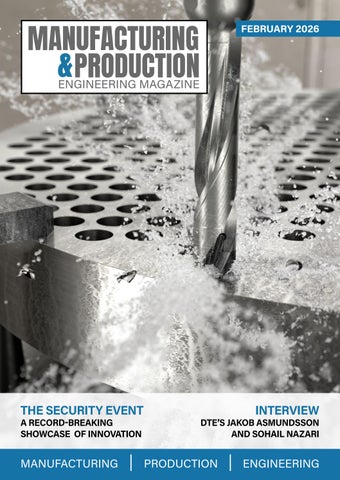
MANUFACTURING PRODUCTION
THE SECURITY EVENT A RECORD-BREAKING SHOWCASE OF INNOVATION
MANUFACTURING
FEBRUARY 2026
INTERVIEW
DTE’S JAKOB ASMUNDSSON AND SOHAIL NAZARI
PRODUCTION
ENGINEERING
CONTENTS 12
23
Editor
Paul Attwood editor@mpemagazine.co.uk
Senior Editorial Assistant
John Reynolds editorial@mpemagazine.co.uk
12 23 28 34 39
34
28
39
Precise level control with the right technology Sunfab Optimises Drilling with Sandvik Coromant’s CoroDrill® DE10 Interview: DTE’s Leaders on Real-Time Aluminium Recycling with LP-LIBS™ The Security Event 2025: A Record-Breaking Showcase of Innovation ECITB Launches New Qualification to Build Skills for Engineering Construction
Features Editor
Harry Peters editorial@mpemagazine.co.uk
Production/Design
Laura Whitehead laura@lapthornmedia.co.uk
Sales Manager
Charlotte Chapman charlotte@mpemagazine.co.uk
Accounts
Richard Lapthorn accounts@lapthornmedia.co.uk
Admin Assistant
Jade Still jade@lapthornmedia.co.uk
Circulation Manager
Leo Phillips subs@mpemagazine.co.uk
Publishing Director
Maria Lapthorn maria@lapthornmedia.co.uk
Lapthorn Media Ltd
5-7 Ozengell Place, Eurokent Business Park, Ramsgate, Kent, CT12 6PB
Editors Note February’s issue of Manufacturing and Production Engineering Magazine comes at a time when manufacturers and engineers are navigating ongoing pressures around costs, skills and compliance, while also embracing new technologies that promise greater efficiency, flexibility and security across production environments. Digitalisation, automation and data-driven decision-making remain central themes, but with increased connectivity comes an increased need for robust protection of people, assets and infrastructure.
Paul Attwood Editor
In this issue, we include a review of The Security Event 2025 ahead of this years event in April, from access control and surveillance to integrated systems designed for industrial settings, the event showcased practical solutions addressing today’s evolving risk landscape. Alongside this, we bring you insight into engineering best practice, technology developments and real-world applications shaping modern manufacturing. We hope you enjoy this edition, and if you have news to share, please contact editorial@mpemagazine.co.uk.
Every effort is made to ensure the accuracy and reliability of material published in Manufacturing & Production Engineering Magazine however, the publishers accept no responsibility for the claims or opinions made by advertisers, manufactures or contributors. No part of this publication may be reproduced or transmitted in any form or by any means, mechanical, electronic (including photocopying) or stored in any information retrieval system without the prior consent of the publisher.
mpemagazine.co.uk @mpemaguk
Tel: 01843 808 102 Manufacturing & Production Engineering Magazine
03
Company News
Anglo-Eastern Partners with Orca AI to Roll Out AI-Assisted Navigation Across 750 Ships Anglo-Eastern Ship Management has signed a strategic partnership with Orca AI to deploy AI-assisted navigation technology across its managed fleet of more than 750 vessels. The collaboration is believed to be the first time a major ship management company has formally committed to integrating AI-driven situational awareness capabilities at this scale. Under the agreement, AngloEastern will incorporate Orca AI’s platform into its operations, including the SeaPod digital watchkeeper, which enhances situational awareness in congested or low-visibility conditions, and FleetView, a shoreside monitoring tool that provides actionable insights for office-based teams.
Torbjorn Dimblad, CIO of AngloEastern, said: “Safety is paramount, and the Orca AI platform provides an extra layer of support when it matters most. By reducing workload and providing alerts and recommendations in critical navigation scenarios, we’re actively driving safety and operational efficiency, alongside initiatives in upskilling our crews and fostering young talent.” Dimblad added that AngloEastern’s diverse client portfolio encourages the company to explore new technologies. “We are pleased to be the first ship management company to commit to AI-assisted navigation, leading the digital transformation of our fleet,” he said.
For Orca AI, the deal represents its first strategic partnership with a ship management company, extending its client base beyond shipowners and operators to multi-client fleet managers. The platform is already used by leading shipping firms to improve navigational safety, optimise fuel consumption, and reduce emissions. Yarden Gross, Co-founder and CEO of Orca AI, commented: “AngloEastern’s decision to partner with us is a strong endorsement of our technology and signals that AI will play a central role in safe, efficient, and sustainable ship operations.” Headquartered in Hong Kong, Anglo-Eastern is one of the world’s largest independent ship managers, providing full technical management for a global fleet of more than 750 vessels. Pictured Left: Torbjorn Dimblad, CIO of Anglo-Eastern Pictured Below: Yarden Gross, CEO and Co-founder of Orca AI
SYS Systems Adds Metal and Ceramic 3D Printing to Industrial Portfolio Derby-based SYS Systems, a leading UK provider of additive manufacturing (AM) solutions and Platinum partner of Stratasys, has expanded its offering to include metal and ceramic 3D printing technology. The move comes through a new Stratasys partnership with Tritone Technologies, enabling SYS to provide industrial-scale, production-grade machines alongside its core polymer range.
04
Manufacturing & Production Engineering Magazine
The addition addresses growing demand for high-strength, conductive, and heat-resistant components across sectors including aerospace, defence, medical devices, and precision engineering. The technology, based on Stratasys’ MoldJet® system, is powder-free and capable of producing complex parts with high density, industrystandard mechanical properties, and rapid changeovers—supporting serial production at scale.
Company News
Carter Manufacturing Celebrates 25 Years of Aerospace Innovation S&S Steelstock Targets Growth with Black Country Acquisition S&S Steelstock has completed a major acquisition of Trident Sections, a move set to double revenues, expand manufacturing capability, and open new markets across the automotive, construction, and electrical sectors. The acquisition, part of S&S Steelstock’s ambitious growth strategy, brings together two well-established Black Country businesses with over 60 years of combined industrial heritage. The enlarged business will operate from a 15,000 sq ft manufacturing facility, creating new capacity, reducing lead times, and supporting several new roles. Trident Sections’ expertise in specialist narrow slitting complements S&S Steelstock’s existing supply of mild steel coil, plate, and sheared blanks, while also expanding the business into galvanised steel capping and channel works for the electrical wholesale market. The complex deal was facilitated by DJH Corporate Finance, with support from their VAT and fundraising teams. A seven-figure funding package from HSBC UK,
Carter Manufacturing Ltd marks over 25 years of excellence in precision bearing engineering, supplying missioncritical components for aerospace, space exploration, and next-generation sustainable aviation. From supporting NASA missions to enabling hydrogenpowered aircraft, the Oxfordshire-based company continues to set the standard in precision engineering. Founded in 2000 as the European Master Distributor for Carter Manufacturing Inc., Carter has built a strong aerospace reputation, earning “Space Heritage” through decades of supplying components to NASA and the European Space Agency (ESA). Its portfolio includes bearings for launch vehicles, satellite systems, LOX turbo pumps, reaction wheels, and deployable antenna mechanisms. In 2020, Carter received formal ESA approval as an authorised supplier of hybrid rocket propulsion bearings, cementing its expertise in extreme aerospace applications.
combining a cash flow loan, commercial mortgage, and invoice financing, enabled the acquisition to be completed efficiently. Legal advice was provided by Knights LLP, ensuring a seamless transaction. Melissa Orpe, Area Director for HSBC UK, commented: “This acquisition secures the future of valuable manufacturing jobs in the Black Country and strengthens supply chain stability, while opening new growth opportunities for the business.”
The company maintains ISO9001, AS9120, and AS9100 certifications, and every component carries AS9102 First Article Inspection Reports, ensuring full traceability of materials, processes, and dimensions. Investing in advanced UK manufacturing through sister company UNASIS, Carter now operates five-axis CNC and specialised grinding equipment, producing highly customised aerospace bearings and tooling solutions for defence, space, and medical sectors. Its new offices and logistics hubs in Valencia, Spain, and Minneapolis, USA further strengthen its global reach and supply chain efficiency. Carter is also driving sustainable aviation innovation through the FETCH project, a collaboration with the University of Bath, Cranfield University, and industry partners to develop hydrogen fuel system technologies for next-generation aircraft.
Manufacturing & Production Engineering Magazine
05
Company News IntelliAM Expands into Building Products Manufacturing Aquis-listed IntelliAM AI plc has moved into the building products sector, securing contracts with Marshalls, Tarmac, H+H, and Knauf across the UK and Japan. The agreements, covering 15 manufacturing sites, are valued at £250,000 in total. IntelliAM provides AI and machine learning solutions designed to improve productivity, efficiency, quality, and safety while reducing waste and downtime. The company has previously focused on FMCG and food & beverage manufacturing, working with global brands including Müller, Mars, ADM, Weetabix, and Diageo. Tom Clayton, CEO of IntelliAM AI, said: “Manufacturers in the building products sector face unique pressures, from abrasive production environments to staffing and maintenance challenges. Our technology allows teams to stay connected 24/7, access engineering insights instantly, and make proactive, data-driven decisions to enhance reliability and reduce downtime.” Clayton added that several companies initially engaged IntelliAM for consultancy before adopting its predictive AI across their factories. “It’s a strong validation of the value we bring, and we expect this sector to continue growing rapidly through the end of the year,” he said. Founded in 2023 and built on Sheffield-based 53 Degrees North, IntelliAM has expanded its machine learning capabilities, strengthened its senior team, and developed strategic partnerships since raising over £5 million on the Aquis Stock Exchange in 2024.
Midlands Manufacturers Launch VORS to Tap £bn Defence, Medical, and Life Sciences Opportunity Three Midlands manufacturing and design specialists have joined forces to capitalise on a multi-billion-pound opportunity across medical, life sciences, defence, and security sectors. Outsourcing expert PP Control & Automation (PP C&A), electronics design and software developer ByteSnap Design, and contract electronics manufacturer Kasdon have launched VORS (Versatile Outsourcing in Resilient Systems). The collaboration aims to provide MoD, primes, and major OEMs with an endto-end service covering design, development, manufacturing, and assembly, helping reduce time-to-market, mitigate risk, and ensure regulatory compliance. Collectively employing over 280 people with annual revenues exceeding £45m, VORS streamlines project management under a single accountable partner, supporting prototyping, new product introduction (NPI), and full-scale production. Richard Spears of PP C&A said: “The collaboration began after government announcements on defence spend. We recognised the sector demands highly regulated capabilities, and Kasdon
06
Manufacturing & Production Engineering Magazine
and ByteSnap’s expertise complements ours to deliver the full product lifecycle.” The initiative leverages ISO 13485 accreditation, advanced automation, and quality processes to meet the stringent demands of regulated markets. Steve Stockley, Managing Director of Kasdon, added: “Products in these sectors must perform reliably in high-stakes, often harsh environments. VORS embodies the resilience and compliance these markets require.” ByteSnap Director Dunstan Power noted that VORS aligns with government initiatives supporting SME engagement, including the Defence SME Action Plan and the MedTech Funding Mandate, helping improve procurement access and uptake of innovative products. The VORS collaboration is already in discussions on potential contracts worth over £5m and is expected to generate new employment in the Midlands. For more information, visit: https://vors.org.uk Pictured Top Left: ByteSnap Director Dunstan Power Pictured Top Right: Richard Spears of PP C&A
New thinking on prepreg materials New carbon prepreg material made with recycled carbon fibre nonwoven mat
Groundbreaking prepreg tooling technology
eXpress cure
Standard and fire-retardant snap cure systems – including the new RFA570 adhesive film for core bonding applications
Providing technical innovation, exceptional quality, lowering cost-per-part and offering improved sustainability. Kit cut to our customers’ requirements, with standard products available from stock.
Contact our team for more information on our innovative prepreg systems today.
Doing things differently
(+44) (0)1202 680022 | enquiries@prfcomposites.com | www.prfcomposites.com
Software & Technology
SECO announces order-ready availability of the Modular Vision 10.1 ASL HMI based on Intel® Atom® processors Powered by Intel® Atom® x7000RE processors (formerly Amston Lake), the Modular Vision 10.1 ASL delivers flexibility and expandability for humanmachine interaction in industrial IoT applications SECO, an innovator in edge computing and IoT solutions, announces the immediate availability of its Modular Vision 10.1 ASL. Part of the company’s next-generation Modular Vision product line as an order-ready HMI solution, it empowers OEMs and system integrators to accelerate project timelines and reduce development complexity for industrial Internet of Things (IoT) applications. Built on the energy-efficient Intel® Atom® x7000RE processor series (formerly Amston Lake), the Modular Vision 10.1 ASL is a
robust, turnkey platform for human-machine interaction. The 10.1-inch device combines advanced computing and graphics with a modular architecture for maximum flexibility and scalability. This functionality allows users to adapt quickly to changing requirements and maintain longterm reliability in demanding environments. As a result, the HMI is ideal for applications such as medical technology, safety and surveillance, automation, smart devices, digital signage, and energy management. Built around SECO’s SMARC®based system-on-modules, the Modular Vision 10.1 ASL enables customers to select the computing power that best fits their needs. There are four processor options available, all based on the Intel Atom® x7000RE series. This processor technology delivers up to eight efficient cores at 3.6 GHz and 12 W TDP (Thermal Design
Power) and comes with integrated Intel UHD Graphics. Real-time industrial features such as TSN (Time-Sensitive Networking) and TCC (Time-Coordinated Computing) ensure suitability even for robotics and motion control applications. The HMI solution supports up to 16 GB of high-speed LPDDR5 memory with in-band error correction code (IBECC) to ensure smooth multitasking and enhanced reliability for mission-critical applications. The Modular Vision series runs SECO’s Clea OS, a Linux operating system based on the Yocto Project. Clea OS is designed specifically for industrial embedded devices, incorporating remote device management, data processing, and standard IoT communication protocols. It is part of the wider Clea framework, enabling seamless connection to cloud services and third-party platforms, and supporting compliance with evolving cybersecurity and regulatory requirements. This setup allows users to efficiently monitor device health, configure and update systems remotely, and maintain security across their installed base, minimising the need for costly field interventions. The HMI is fully supported by the SECO Application Hub, giving OEMs and system integrators access to a curated marketplace of AI and machine learning applications optimised for edge devices. More information on the Modular Vision 10.1 ASL can be found here.
08
Manufacturing & Production Engineering Magazine
Manufacturing Insurance Designed Around Your Business Trusted by over 3,500 manufacturers across the UK Gallagher offers the strength and positioning of
CONNECT WITH A SPECIALIST TODAY.
a global insurance group, combined with the
For further information, please scan the QR code.
personalised care and attention of a local UK broker. With a rich history dating back to 1927, we believe we have the expertise and experience to meet your manufacturing insurance and risk management needs.
AJG.com The Gallagher Way. Since 1927. Arthur J. Gallagher Insurance Brokers Limited is authorised and regulated by the Financial Conduct Authority. Registered Office: Spectrum Building, 55 Blythswood Street, Glasgow, G2 7AT. Registered in Scotland. Company Number: SC108909. FP83-2025 Exp. 16.01.2026. © 2025 Arthur J. Gallagher & Co. | GGBRETUK103758
Latest News
Celebrity chefs hail “incredible” copper pans made entirely in Britain An exclusive range of copper pans has been created as a collaboration between UK manufacturers bearing the internationally recognised Made in Britain trademark. The Heritage Excell Copper Cookware Collection is entirely crafted in Britain. Every element of its creation, from the hand-spun metal bases through to the leather handle inlays and packaging box with tissue packing paper, is created in the UK, with five Made in Britain manufacturers contributing to its creation.
The performance and durability of the range have been thoroughly tested by Gary Pearce, head chef at the Michelin-recommended restaurant 36 on the Quay, and celebrity chef, food writer and cookery teacher, Gill Meller. Heating evenly, even in temperatures up to 220°C, made of 100% copper and finished with a non-stick tin lining, the range delivers clear quality for even the most discerning cook. Made in Britain members involved in the range include Excell Metal Spinning, which is creating the pan bases and handles, The Tuning Shop, which is crafting the leather inlays for the handles, ESSE Engineering Ltd, testing and development. Bladen Box & Display and Roach Bridge Tissues contribute the box packaging and tissue paper insert packaging, respectively. John Pearce, CEO of Made in Britain, added: “This collaboration
is exactly what the Made in Britain mark is here to spark. When members work together under a trusted national trademark, they create not just exceptional products but measurable commercial value, giving buyers instant confidence, stronger pricing power and a clear competitive advantage on global shelves. It is also a practical route to a more productive economy, keeping value and skilled jobs in the UK through shared capability and proven provenance. The Heritage range is a testament to the Made in Britain’s trademark’s growing community of manufacturers and it shows what happens when British manufacturing backs itself, and backs each other.” To explore the range, visit: theheritageexcell.co.uk To learn more about Made in Britain, visit: madeinbritain.org
Global Glass Industry Launches Responsible Glass Initiative Some of the world’s largest glass producers, packaging firms, and automotive companies, including Jaguar Land Rover, have launched Responsible Glass, a global certification programme aimed at establishing sustainability standards across the glass sector. The initiative is a multistakeholder, not-for-profit programme targeting low-carbon glass production, increased supply chain transparency, and improved environmental and social practices. Glass production currently generates 95 million tonnes of CO₂ annually, yet the sector has lacked a unified sustainability framework—an
10
Manufacturing & Production Engineering Magazine
issue Responsible Glass aims to address. Founding members include NSG Group, Ciner Glass, Stara Glass, WE Soda, ARUP, and Belron, with support from organisations such as ERM CVS, ARM, and the Climate Group. Together, they represent over 150,000 employees and $90bn in revenue across the glass supply chain. Responsible Glass will develop auditable standards for emissions reduction, circularity, worker safety, and sourcing, alongside a certification mark for responsibly produced glass. The programme covers flat, container, and specialty glass sectors.
Francis Sullivan, Chair of Responsible Glass, said: “Driving social and environmental change in the glass industry requires openness, trust and collaboration across the value chain. Our members are the foundation of this initiative, and we’re proud to see companies already working with us to make this change happen.”
UNISIG.COM
UNISIG TAKES YOUR GUNDRILLING PRODUCTION FURTHER
Gundrilling and BTA deep hole drilling for highly productive shops. Whether your shop needs on-center or off-center holes, specialized job shop work or fully automated production, UNISIG has a deep hole drilling solution with the accuracy and performance you need. Take your shop’s production further - learn more at UNISIG.COM.
Machines • Tools • Automation UNISIG machines, engineered and manufactured in the USA
Automotive
What can UK defence learn from the automotive industry? By Harry Pickett, Business Development Manager, G&P. With the UK defence sector preparing for its most significant modernisation in a generation, the Strategic Defence Review (SDR) published in June 2025 sets a clear direction of travel. The Review pushes the UK firmly towards “war fighting readiness”, outlining major investment in digital systems, cyber capability, unmanned technology and next-generation hardware. But with defence spending set to rise to 2.5% of GDP by 2027—and potentially to 3%—a central question remains: how can the Ministry of Defence ensure it gets maximum value from this unprecedented inflow of investment? For Harry Pickett, business development manager and defence specialist at G&P, a major part of the answer lies in learning from Europe’s automotive industry, long recognised as a global benchmark for manufacturing quality, supply chain discipline and operational efficiency. While the UK defence forces are admired worldwide for professionalism and capability, their procurement record has been far more mixed. Overspending, technical delays and late delivery have affected several major programmes, as highlighted in the
Manufacturing & Production Engineering Magazine
G&P’s work with MAKE UK Defence indicates three clear areas where automotive methodologies could have an immediate impact. The first is Manufacturing Quality Engineering, including capability audits, supplier readiness checks, counterfeit avoidance and compliance with rigorous export controls. These are commonplace in automotive but inconsistently applied in defence supply chains. The second area is embedding robust quality and supply chain standards, such as JOSCAR registration, ISO certifications and strong cybersecurity practices. Again, these are standard in automotive but represent a stepchange for some defence suppliers.
Sheldon Review, which cited missed opportunities, communication issues and unclear reporting. By contrast, the automotive sector has spent decades refining the very systems and behaviours defence now needs to adopt. Automotive OEMs operate with exacting standards, deeply embedded supplier integration and an unshakeable focus on zero defects. Tier 1 and Tier 2 suppliers follow highly prescriptive processes covering component testing, traceability, validation and lineside delivery. Expectations are set clearly, leadership drives cultural alignment from the top, and success is defined consistently across the supply chain. This disciplined approach is not just cultural—it is structural. Automotive supply chains rely on real-time digital reporting systems, enabling instant visibility of part status, quality issues and delivery risks. Exception reporting is treated as an early-warning system, triggering immediate cross-functional collaboration to resolve issues before they escalate. In defence, such openness is still
12
developing, partly due to legacy systems and slower digital adoption within the MOD.
The third is the deployment of skilled engineering support, including inspection, precision repair, component validation and defect prevention services— activities essential to maintaining supply chain integrity in high-value manufacturing. Underlying all of this is the need for cultural change. The siloed approach identified in defence procurement would struggle to survive in the automotive environment, where shared data, early collaboration and mutual accountability underpin every major programme. For defence to achieve similar reliability and cost control, it must create a partnershipbased model that incentivises innovation and rewards suppliers for productivity and controlled risktaking. As Pickett explains, G&P’s experience across leading European OEMs offers a practical roadmap. Automotive has shown that quality excellence is not the product of isolated initiatives, but the result of system-wide integration, leadership clarity and rigorous supplier alignment. With the SDR signalling major transformation, defence now has the opportunity to embrace these principles—ensuring that new investment translates into real capability, delivered on time, to the highest standard. For more information about G&P, visit: www.gpqm.com
Surface Finishing is our DNA
Electropolishing
Gentle solution for demanding applications without mechanical or thermal stress on components – easily reproducible and cost-effective
Mass Finishing
Efficient systems engineering and innovative technologies – powerful and economical
AM Solutions
Comprehensive solutions for additive manufacturing, especially 3D post processing equipment
Shot Blasting
Individual systems engineering and intelligent process solutions – reliable and energy efficient
Rösler UK Limited | 1 Unity Grove | Knowsley Business Park | Prescot | Merseyside | L34 9GT Tel: +44 (0)151 482 0444 | Fax: +44 (0)151 482 4400 | rosler-uk@rosler.com | www.rosler.com
Introducing the UK’s new premier materials processing company. Change your way of thinking • We can cut up to 60mm thick - 6m x 2m plate size • Achieve chamfers and precise holes in thick-section materials, opening up new design possibilities
Rapid Laser Cutting
• In-house pressing fabrication and machining capabilities
24kW Laser
Industrial
Defence
Aerospace
Electrical
Architecture
60mm Stainless Steel
60mm Carbon Steel
60mm Armour
40mm Aluminium
16mm Copper
12.7mm Brass
www.sheffield-tech.com
Call: 0114 7080 265
sales@sheffield-tech.com
Crucible Works, Darnall Road, Sheffield. S9 5AB
Manufacturing & Production Engineering Magazine
13
Events & Awards News
Winners Lift the 2025 LEEA Awards The 7th LEEA Awards celebrated the UK lifting industry’s innovation, leadership, and safety excellence at Liverpool’s Anfield stadium on 18 November, drawing a record 450 guests—almost double the attendance of the inaugural ceremony. Oliver Auston, Chair of the LEEA Board, reflected on the association’s growth since its founding in 1944, while CEO Dr Ross Moloney noted the competition had attracted more entries than ever, with 27 judges evaluating a strong field. Former England Rugby International Will Greenwood also attended, sharing insights from his World Cupwinning career. Award winners included: • Emerging Talent Award: Rory
Stewart, Europa Engineering Group
• Excellence in People
Development: SCE Academy, Street Cranexpress Ltd
• Technical Excellence and
Professionalism: Justin Powers, Select Plant Hire
• Trainer of the Year –
Craig Morelli Award: Jim Beauchamp, Boilermaker National Training Trust Fund
• Excellence in Leadership:
Steve Hutin, Rope & Sling Specialists
• Sustainability Excellence:
pewag UK Group
• Excellence in Service
Innovation: Lifting by Design, MGF
• Excellence in Product
Innovation: Joint winners RUD CCS FASTLOX and BlueSupra, YOKE Industrial Corp
• Excellence in Safety:
Aluminium Bahrain BSC (Alba)
• Excellence in Lifting
Operations: Gareth McNary, Select Plant Hire
The evening also honoured Outstanding Contribution Awards to Len Latham, Richard Money, Kevin Smith, Tony Stringer, and Chris Towne for their long-standing service to the association. Pictured Left: Rory Stewart wins Emerging Talent Award sponsored by Technical Integrated Services LDA, with Rony Abraham, CEO of TIS, second from right.
Titan Enterprises Scoops “Highly Commended” Accolade for Manufacturer of the Year at Annual Awards Titan Enterprises, a leading UKbased flowmeter manufacturer in Dorset, is proud to announce that it has been Highly Commended in the Manufacturer of the Year category at the recent Instrumentation & Electronics Awards 2025. This recognition acknowledges Titan’s ongoing commitment to innovation, quality, and excellence in precision flow measurement technology. Producing over 70,000 liquid flowmeters and instruments each year for an international market, Titan Enterprises designs and manufactures an extensive portfolio of flow measurement devices for OEM and end-user customers. Supplying robust and reliable measurement solutions for applications across the globe, Titan serves sectors from medical and laboratory research to industrial processes and beverage production. Managing Director Trevor Forster commented, “We are delighted to receive this commendation. It reflects the dedication of our entire team, whose engineering and technical expertise and customer focus underpin everything we do. “Manufacturing and innovation in the UK, while supporting a worldwide customer base, requires precision, agility, and an unwavering commitment to quality – values that are at the heart of Titan’s operations.” The award highlights Titan’s continuous investment in its manufacturing capability, in-house R&D, calibration systems and sustainable practices. From pioneering ultrasonic flow technologies to advancing low-flow and chemicalresistant devices, Titan continues to expand its flowmeter range to meet evolving market needs while maintaining manufacturing excellence.
14
Manufacturing & Production Engineering Magazine
Events & Awards News
CGD Wins Hyundai Open Innovation Challenge Cambridge GaN Devices (CGD) has been named a winner of Hyundai’s Open Innovation Challenge 2025, focused on the future of sporty driving. Out of nearly 50 applicants, CGD’s one-chip ICeGaN® solution was selected for its robustness and ease of integration into EV traction inverter power modules.
Daniel Murphy, Senior Director of Product Management at CGD, said: “Hyundai CRADLE’s mission is to collaborate with innovators to build better mobility experiences. We are honoured that our ICeGaN IC technology has been recognised and look forward to exploring its potential to drive a more dynamic and energy-efficient future for EVs.”
The technology offers a costeffective alternative to silicon carbide (SiC) solutions in highpower EV inverters, combining energy efficiency with a compact, reliable design. Its monolithically integrated control and protection features allow multiple devices to operate in parallel, reducing external component count and improving solution size and reliability.
Dr Reza Fathi, Senior Manager at Hyundai CRADLE, added: “GaN presents significant advantages over traditional silicon and SiC. We are excited to collaborate with CGD on a proof-of-concept project to evaluate ICeGaN technology for potential automotive applications.” The Hyundai Motor Europe Technical Centre (HMETC) and Hyundai CRADLE jointly run the
Open Innovation Challenge, seeking innovative solutions for highperformance applications in Europe and Israel. The 2025 edition, themed “Sporty Driving: An Open Call for Tech Visionaries”, aims to identify technologies that can enhance EV performance and driving dynamics.
Babcock Wanson UK Signs Co-operation Agreement with OLG to Strengthen Project Delivery Capability Industrial process heating equipment and solutions specialist Babcock Wanson UK has signed a three-year co-operation agreement with OLG, the multi-disciplined engineering and design, project management, fabrication and construction specialist. Effective from 2025, the agreement formalises a relationship that has been growing since 2019, during which time Babcock Wanson and OLG have successfully delivered eight major projects together. Building on this track record, the new arrangement enables the two companies to present a combined offering to industrial clients, particularly those seeking to decarbonise their operations. The co-operation agreement offers a single point of contact for turnkey project delivery. This streamlined approach is expected to improve efficiency, shorten lead times and create additional value for end clients. For information on Babcock Wanson, please visit www.babcockwanson.com. For information on OLG, visit olguk.com.
Manufacturing & Production Engineering Magazine
15
Compressed Air, Pumps & Valves
Gas handling at LNG terminals:
Compressor technology and reliability By Rakesh Kulkarni, Engineering Sales Manager, Burckhardt Compression
major performance uplift. In one LNG facility, excessive perlite carry-over was causing premature piston wear, forcing 1st-stage pistons to be replaced every four years. After investigating the root cause, Burckhardt Compression introduced a redesigned aluminium piston, enhanced rider rings and a specialist rod coating. The upgrade lifted the mean time between overhauls from 8,000 to more than 24,000 hours, with higher stages achieving over 72,000 hours of service.
Across the LNG value chain, reciprocating compressors are fundamental to the safe, efficient movement and storage of gas. Their reliability directly influences plant uptime, emissions performance and the overall stability of gas supply networks. As many terminals operate ageing assets, strategic upgrades, improved materials and expert lifecycle support can significantly improve compressor performance—regardless of the original manufacturer.
Optimising processes to cut flaring
Managing boil-off gas safely At LNG import and export terminals, oil-free reciprocating compressors are the standard choice for handling boil-off gas (BOG). As LNG absorbs ambient heat, vapour is generated, and this gas must be returned to the process—either by re-liquefaction or by using it as fuel. Compressors such as Burckhardt Compression’s Laby® and Laby®-GI series are built specifically for these cryogenic conditions, tolerating inlet temperatures down to –170°C and compressing gas to pressures up to 300 bar without cylinder lubrication. By ensuring clean operation and long service intervals, these machines protect heat exchangers, re-liquefaction systems and dualfuel engines.
Keeping the grid supplied Once BOG has been processed, compressors play an important role in stabilising pressure for downstream distribution. From pipeline transport to local storage stations, the wider gas network relies on consistent compressor performance. Over decades of continuous operation, however, mechanical clearances drift, components wear, and reliability diminishes—creating opportunities for modernisation through upgraded materials, reverse-engineered
16
Manufacturing & Production Engineering Magazine
components and improved sealing designs.
The value of a structured assessment When performance issues arise—whether due to regulatory pressures, rising emissions, or an unexpected outage—the first step is a comprehensive technical assessment. Using plant data and additional measurements where required, engineers can identify issues relating to reliability, energy consumption or leakage. Sensors based on API 670 guidelines, including velocity probes, accelerometers and crank-angle data, enable real-time insight into vibration, valve behaviour and developing faults. Correct sensor placement and calibration are critical. Working with experienced OEM-trained specialists ensures meaningful data collection and accurate diagnostics, forming the basis for effective maintenance or upgrade strategies.
Upgrades that extend service life For many terminals, modern materials technology offers a
In another terminal, frequent compressor starts led to extended periods of gas flaring during cooldown. A process review found the desuperheater was being bypassed, lengthening stabilisation time. By revising start-up procedures and reinstating proper cooling sequences, operators were able to eliminate routine flaring— reducing CO₂e emissions by around 25 tonnes per year and cutting financial losses.
Long-term reliability through partnership Even relatively new installations can benefit from operational reviews, while older assets often have significant potential for material upgrades and design improvements. Burckhardt Compression’s BC ACTIVATE assessment programme helps operators evaluate any reciprocating compressor and identify improvement opportunities. The most effective approach is a long-term service agreement, ensuring predictable maintenance, optimised lifecycle costs and maximum reliability. With growing scrutiny on LNG’s operational and environmental performance, a combination of data-driven assessment, modern materials and expert service support is key to ensuring compressors continue to deliver dependable service for decades.
THE NEXT GENERATION MACERATOR. THE ORBITGRINDER. CONSISTENT MACERATION OF SOLIDS. PROTECTING YOUR PUMPS AND SYSTEMS. + EVEN CUTTING SPEED + AUTOMATIC BLADE ADJUSTMENT + PIVOTED CUTTING BLADES
Improving pumping systems efficiency & reliability. Visit www.boerger.com to find out more.
EXCELLENCE – MADE TO LAST
Börger UK Limited | East Wing – Old School | Watling St. Gailey | Staffordshire | uk@boerger.com | +44 1902 798 977 250314 OrbitGrinder_Abwasser_188 x 132 mm_E_RZ.indd 1
14.03.2025 07:27:24
UK Official Distributor Since 1983
1975 2025 Dependable Under Pressure
Pumps & Pumping Equipment • Cleaning Equipment • Hose & Hose Reels Fluid Handling Components • Fittings, Connectors & Filters Spraying & Watering • Engines, Motors & Generators
1 Follow / Like / Subscribe
Dual Pumps 180x132 Dec.indd 1
www.dualpumps.co.uk Tel: 01664 567226 • Email: info@dualpumps.co.uk 10/11/2025 09:58:32
Manufacturing & Production Engineering Magazine
17
People on the Move
Domino’s Adem Kulauzovic Joins OMAC Board Domino Printing Sciences (Domino) has appointed Adem Kulauzovic, Director of Automation and Integration, to the OMAC Board of Directors for a three-year term, highlighting Domino’s commitment to advancing packaging automation and shaping industry standards. In his first board-level role, Kulauzovic will guide OMAC’s strategic direction, including training, membership expansion, and updating standards— particularly around cybersecurity
resilience. He will also focus on coding and marking standards, sustainability initiatives, and leveraging Domino’s expertise across the packaging ecosystem. Kulauzovic said: “I’m honoured to join the OMAC board and help drive forward the standards that underpin our industry. Being part of the conversation—whether it’s PackML, cybersecurity, or sustainability—means helping shape the standards our customers rely on. It’s about understanding their business, anticipating needs, and delivering solutions that move the industry forward.” Domino, an OMAC member since 2017, has actively contributed to PackML (Packaging Machine Language), a global automation standard that ensures consistent communication between machines and PLCs across platforms.
Robert MacDonald Named Head of Sales (UK) at MHP MHP Consulting UK has appointed Robert MacDonald as its new Head of Sales (UK). Bringing over 20 years of leadership experience from companies including Dassault Systèmes and Atos, MacDonald will lead the firm’s new-business strategy in the automotive, aerospace and defence sectors, driving growth and strengthening client relationships across the UK. Bodo Philipp, CEO of MHP Consulting UK, said: “The UK is an important market for MHP, and this is a vital hire. Robert brings fresh energy, sector knowledge, and unrivalled experience in scaling and growing teams. He’s already making an impact with our clients and wider team.”
18
Manufacturing & Production Engineering Magazine
Robert MacDonald added: “The automotive, aerospace and defence sectors are some of the most exciting to be in. I’m proud to help businesses use technology to improve operations, and I look forward to growing MHP Consulting’s business in the UK.”
Austen Adams Appointed Group COO at Avingtrans Avingtrans PLC has promoted Austen Adams to Group Chief Operating Officer and appointed him to the company’s board. Adams began his career as an apprentice at Wyko Power Plant and Gears in the Black Country in the early 1980s and joined Avingtrans in 2013, most recently serving as divisional managing director for its Advanced Engineering Systems (AES) division. Austen Adams said: “I have enjoyed working with some of the most respected specialist engineering names in the industry. In this new role, I look forward to working with our leadership teams to grow our presence in key markets, identify opportunities to innovate, and add real value for our clients and shareholders.” Adams has a strong commitment to skills development, having reinvigorated the internal training academy at Stainless Metalcraft, recognised with a Queen’s Award for Enterprise, and helped establish the North Cambs Training Centre for advanced manufacturing skills. He is also a member of the Board of MAKE UK, previously chaired the Business Board at the Cambridgeshire and Peterborough Combined Authority, and served as a special advisor to the Department of Trade and Industry. Under Adams’ leadership, Avingtrans’ AES division has delivered strong financial performance, strengthened its position in key markets such as nuclear energy, and successfully turned around highly specialised businesses, positioning them for growth and long-term success.
People on the Move Alva Industries Appoints Thomas Bergan as Chief Operating Officer Alva Industries (ALVA), has announced the appointment of Thomas Bergan as the company’s new Chief Operating Officer (COO).
With more than 25 years of experience in manufacturing, industrial scale-up, and highvolume production, Bergan brings deep operational expertise and a proven track record in developing efficient, high-performing industrial organizations. Bergan’s leadership is recognized for its strategic clarity, strong analytical capabilities, and seasoned executive judgement - qualities that have consistently supported scalable growth and strengthened operational structures throughout his career. “Thomas brings an exceptional combination of operational depth, strategic insight, and a people-first leadership style that aligns strongly with Alva’s mission,” said Oliver Skisland, CEO, Alva Industries.
“His experience in building highperformance teams and scaling industrial operations will play a critical role as Alva prepares for its next chapter of growth.” Speaking on his new role, Bergan said: “I have worked within manufacturing for over 25 years, both scale-up and high-volume production, and I look forward to contributing with my experience and together with a great team ensure Alva Industries will meet the expectations and utilize the high potential that is in both the people and the product.” As COO, Bergan will oversee operational strategy, production scalability, and cross-functional execution across Alva’s technology and product platforms. His appointment strengthens the company’s capabilities as it advances toward broader industrialization and global market expansion. Image Credit: Mverdi/Marius Johnsen
Babcock Wanson extends range to large shell boilers & heat recovery steam generators for high demand applications Babcock Wanson UK, a leading supplier of industrial process heating equipment and solutions, has announced the extension of its product portfolio to encompass large high pressure firetube boilers up to 50barg and output to 70 t/h and watertube boilers up to 90barg and 150t/h, along with heat recovery steam generators (HRSGs), making it the only company in the UK capable of providing the complete spectrum of industrial boiler solutions — from compact coil type steam generators through to large, high output watertube systems. The addition of large-scale boiler systems designed for the most demanding industrial applications has been brought about through the integration of German company VKK Standardkessel into the Babcock Wanson Group. The full VKK range is now available through Babcock Wanson UK, supported by its renowned local service and engineering expertise. For information, please contact Babcock Wanson on 020 8953 7111 or info@babcockwanson.com or go to www.babcockwanson.com
Manufacturing & Production Engineering Magazine
19
Measurement, Sensors & Monitoring Quality 4.0: How Advanced Measurement and Monitoring Are Redefining Modern Manufacturing By Simon Francis, Group Quality Director, G&P Manufacturing is entering a new era defined by data-rich inspection, real-time condition monitoring, and intelligent measurement systems. At the centre of this shift is Quality 4.0—the integration of advanced digital technologies into the discipline of quality management. While Industry 4.0 brought connected machines, IoT sensors, machine learning and automation into production, Quality 4.0 focuses on how these tools strengthen measurement accuracy, process stability, and defect prevention across the entire supply chain.
Embedding resilience into digital quality systems As global production environments become more interconnected, even small measurement errors can propagate rapidly across procurement, logistics and manufacturing operations. A single incorrect sensor reading or misaligned inspection parameter can trigger widespread disruption, from scrap generation to customerfacing defects. Quality 4.0 addresses this risk by embedding resilient measurement systems, robust data governance and continuous feedback loops into the digital backbone of organisations. The Chartered Quality Institute (CQI) frames Quality 4.0 through principles including cyberphysical systems, data value, transparency and rapid adaptive learning. For measurement and monitoring professionals, these principles translate into practical requirements: traceable data models, interoperable systems, sensor reliability, and the ability to validate automated inspection outputs with human expertise.
Measurement must be purposeful—not technological indulgence As factories add sensors, edge devices and machine-vision cameras, one risk remains:
20
Manufacturing & Production Engineering Magazine
adopting technology without a clear measurement rationale. Quality 4.0 demands purposeful instrumentation, where each device, data stream and algorithm enhances process capability. Before deploying automated inspection or AI-based monitoring, manufacturers must consider: • What measurement issue does this solve? • How will accuracy be validated and governed? • Does the technology reduce variation or simply add complexity? • Will operators understand, trust and act upon the data? This ensures that digital quality tools enhance precision rather than overwhelm teams with unnecessary data.
Human intelligence remains a critical calibration tool Machine vision and AI are powerful for detecting defects, capturing micron-level deviations, identifying missing components and monitoring assembly states. Yet many inspection scenarios still require human-led judgement, especially for non-repeatable geometries, complex assemblies or short-run manufacturing. Rather than replacing people, Quality 4.0 integrates combined intelligence—human adaptability supported by sensor-driven insight. G&P’s approach blends AI-supported inspection with skilled technicians, enabling reliable detection of NOK parts under challenging production conditions.
A systems-wide measurement and monitoring strategy True Quality 4.0 requires end-to-end visibility. OEMs, tiered suppliers, logistics operations and production facilities must align on: • shared measurement standards • compatible monitoring technologies • unified traceability • transparent data exchange
This systemic approach enables earlier anomaly detection, reduces duplication, and ensures measurement integrity from raw material to final assembly. G&P is already supporting manufacturers through digital audits, risk mapping and the design of measurement-led process controls. AI-supported inspection platforms now autonomously validate multiple features in a single scan, offering consistent, high-repeatability performance that prevents downstream quality escapes.
Accelerating the transition While the term “Quality 4.0” can appear conceptual, successful adoption is fundamentally practical. Manufacturers must invest in digital skills, data literacy, calibration capability, and leadership alignment. Governance, change management and training are just as important as sensors, analytics engines or inspection robots. Quality 4.0 represents more than enhanced defect detection—it is a shift towards predictive, intelligent, measurement-led manufacturing. When applied wisely, it reduces variation, increases resilience and strengthens customer confidence. The future of manufacturing will be defined by how well organisations integrate advanced monitoring systems with human insight. With the right combination of foresight and technical rigour, Quality 4.0 can become the foundation of reliable, zero-defect production for decades ahead.
Measurement, Sensors & Monitoring
Rohde & Schwarz announces two UK dates for the popular Navigating Test & Measurement seminar in 2026 Rohde & Schwarz has announced two UK dates for its Navigating Test & Measurement seminars, in Cambridge on 3 February and Bolton on 5 February. With hands-on sessions guided by Rohde & Schwarz test experts, the purely educational events show engineers how to get the best from commonly used benchtop equipment. “Our Navigating Test & Measurement days are a great opportunity to build confidence and sharpen skills in operating test and measurement equipment,” said Jamie Lunn, vector network analyser product manager at Rohde & Schwarz.
“The program is designed for engineers at any stage in their careers, whether growing their expertise from the ground up or updating their skills with the latest equipment.” The schedule for the seminar allows delegates to navigate between two learning streams according to their interests. Throughout the day, Stream 1 introduces vector network analysers, signal and spectrum analysers, and signal generators, used for tasks such as optimising RF components and high-frequency designs. Stream 2 focuses on ensuring robust and reliable performance with Oscilloscopes
and delving into applications such as Power Electronics and Signal Integrity. Navigating Test & Measurement Cambridge will take place Tuesday 3rd February 2026 at the Møller Institute, with more information and registration available: Navigating Test & Measurement Cambridge Navigating Test & Measurement Bolton will take place Thursday 5th February 2026 at Bolton Toughsheet Stadium, with more information and registration available: Navigating Test & Measurement Bolton
Manufacturing & Production Engineering Magazine
21
Measurement, Sensors & Monitoring News
ifm Introduces Fail-Safe Inductive Sensors for the Food Industry ifm, a global leader in sensor technology, introduces its new robust fail-safe inductive sensors, engineered for the food and beverage industry. These cutting-edge, all-metal sensors establish a new standard for safety and reliability in extreme conditions. ifm is the first and only supplier to offer fail-safe inductive sensors in a durable full-metal design, ensuring maximum safety even in environments with constant moisture or temperatures ranging from -25°C to 100°C. These features make them ideal for critical applications in the food and beverage sector. Our full-metal inductive sensors are perfect for various safety-critical uses. They can be installed on service lids and manways to prevent processes from starting until lids are securely closed, protecting both personnel and machinery. They are well suitable for valves and valve manifolds, withstanding frequent cleaning cycles and continuous moisture exposure. They also ensure reliable operation of cold storage highspeed doors, even in low temperatures. Designed for the harshest conditions, these sensors feature a stainless-steel sleeve that offers exceptional resistance to extreme temperatures, intensive cleaning, and challenging industrial environments. TUV certified to SIL 2/PLd, they provide superior safety and reliability for the most demanding applications.
Samotics Partners with Southern Water to Deploy AI-Driven Asset Monitoring Southern Water has partnered with specialist technology provider Samotics to implement its SAM4 smart condition monitoring system across water and wastewater sites in southern England. The AI-powered system uses electrical signature analysis (ESA) to detect early signs of equipment failure, helping prevent service interruptions, environmental incidents, and costly repairs. The partnership follows a successful one-year trial, which demonstrated the effectiveness of SAM4 in predicting faults. During the trial, Samotics’ technology identified 63 failures on submersible sewage pumps and other key assets, including blockages, air locks, and mechanical faults—helping avoid an estimated £5 million in potential damage and penalties. Under the £7 million, six-year framework agreement, SAM4 is currently monitoring 1,458 critical assets across around 600 sites, with plans for further expansion in 2026. John Penicud, Managing Director for Wastewater at Southern Water, said: “Unplanned failures of critical equipment can impact our customers, the environment, and operational costs. Early detection is vital for proactive maintenance and reliable service.” Tom Swain, Head of UK & Ireland at Samotics, added:
22
Manufacturing & Production Engineering Magazine
“We’re delighted to enter this long-term partnership with Southern Water. “This initiative modernises water infrastructure, drives efficiency, enhances asset performance and resilience, and supports environmental sustainability.” The SAM4 system continuously monitors current and voltage signals from industrial equipment. AI interprets deviations from normal operation and classifies them into specific fault types, identifying issues such as misaligned components, bearing wear, and pump blockages—even on hard-toreach assets. Alerts are displayed on the SAM4 dashboard, enabling water utility teams to prioritise maintenance, manage crews effectively, and maintain detailed asset and incident records. Human-in-the-loop validation ensures 97% accuracy, with fewer than 1% false positives. This partnership highlights Southern Water’s commitment to innovation and proactive asset management, reinforcing the growing role of AI and smart monitoring technologies in the UK water sector. Pictured Top Left: A data acquisition device housed in the motor control cabinet collates information about the assets and equipment. Pictured Top Right: Alerts can be managed remotely on the SAM4 dashboard.
Case Study
Where Precision Flows:
Sunfab Optimises Drilling with Sandvik Coromant’s CoroDrill® DE10 Sandvik Coromant’s CoroDrill® DE10 is helping Sunfab strengthen production efficiency while maintaining high standards in hydraulic quality. Sunfab has grown from pioneering mobile truck cranes to becoming a global leader in hydraulic pumps and motors, manufacturing around 45,000 units annually from its base in Hudiksvall, Sweden. Central to its philosophy is the vision: “together we create the hydraulics of the future”. This ethos drives continuous improvement, precision, and reliability in every component produced.
Precision Demands Hydraulic components operate under high pressures, where tight tolerances are critical. Even minor variations in drilling can affect performance and longevity, while frequent tool changes disrupt production and increase costs. Recognising the value of incremental gains, Sunfab sought to improve drilling consistency and tool longevity. Long-term partner Beros recommended exploring Sandvik Coromant’s CoroDrill® DE10, known for precision, efficiency, and ease of integration. Oskar Strömberg, Production Engineer at Sunfab, said:
By adjusting the cutting data, we achieved even higher hole quality...
“Sandvik Coromant’s focus on precision, innovation and quality mirrors our own approach. Their commitment to understanding production challenges and providing reliable solutions made them an ideal partner.”
From Setup to Success CoroDrill® DE10 features exchangeable tips, enabling fast changeovers and plug-and-play deployment without pilot drills.
Production trials used Sandvik Coromant’s recommended cutting parameters as a baseline, then refined to suit Sunfab’s environment. “By adjusting the cutting data, we achieved even higher hole quality,” Strömberg explained. “At 12.3 mm, tool life more than doubled, from 65 to 160 minutes; at 14.3 mm, it tripled from 90 to 285 minutes; and at 17.8 mm, tool life increased from 180 to 270 minutes. These improvements have significantly reduced our cost per hole.” The drill’s design—including a robust tip, patented pretension interface, twin coolant channels, and optimised chipflute geometry—ensures precise centring, consistent cutting, and long-lasting performance, even under high-volume conditions. “Drilling is also quieter and smoother, which has created a calmer, more efficient shop floor,” Strömberg added. “Operators can focus more on production, while customers continue to receive the same high standards in performance.”
Driving Leaner, Smarter Production By combining Sunfab’s expertise with Sandvik Coromant’s tooling innovation, the partnership has delivered predictable, costeffective drilling processes, reduced interruptions, and strengthened the company’s competitive edge. “Our collaboration has created a strong foundation for ongoing innovation,” Strömberg concluded. “Together, we can continue to explore efficiencies, refine processes and advance reliability, ensuring we keep improving for the future.” For Sunfab, the CoroDrill® DE10 represents a tangible step toward leaner, more consistent, and higherquality production, ensuring its hydraulic components continue to set industry benchmarks.
Manufacturing & Production Engineering Magazine
23
Latest Product Launches
MAPAL Launches DirectCool Option for UNIQ Hydraulic Chucks
Emerson Relaunches ASCO™ Series 327C Solenoid Valve with Enhanced Features
MAPAL has introduced DirectCool, a new decentralised cooling system for its UNIQ hydraulic chuck range, designed to enhance tool life, machining precision, and process reliability. The innovation channels coolant directly along the tool shaft to the cutting edge via three dedicated cooling bores, ensuring even temperature distribution, reducing thermal distortion, and improving chip evacuation. DirectCool is compatible with existing tools and processes, requires no special shank grooves, and is especially effective in stainless steel and aluminium machining. The option is available for UNIQ Mill Chucks and UNIQ DReaM Chucks with 4.5° outer geometry in diameters from 6 to 32 mm. The technology was showcased at EMO 2025 in Hanover and reinforces MAPAL’s ongoing commitment to advanced hydraulic clamping solutions.
Emerson has relaunched its ASCO™ Series 327C solenoid valve, introducing new Intrinsically Safe (IS) and Manual Reset versions designed to improve operational efficiency in demanding industrial environments. The valve uses a direct-acting, high-flow design with balanced poppet construction and two-layer dynamic seals, ensuring reliable, low-friction operation across temperatures from -60 to 90°C. The intrinsically safe model eliminates the need for an electronic booster, enabling faster response times and more consistent partial stroke testing—key for critical applications in power, chemical, and process industries. The valve is globally approved, simplifying supply chains, commissioning, and field installation for OEMs and industrial users.
Spectrum Instrumentation Launches High-ChannelCount GHz AWGs Spectrum Instrumentation has introduced its new DN6.63x Arbitrary Waveform Generators (AWGs), offering up to 6 channels at 10 GS/s or 12 channels at 5 GS/s
24
Manufacturing & Production Engineering Magazine
output. Part of the company’s NETBOX® series, the AWGs combine high-speed 16-bit DACs, ultra-low noise outputs, and flexible synchronization, delivering precise GHz waveform generation across multiple channels in a single enclosure. The DN6.63x models support single-ended or differential outputs, with features including up to 48 Gigasamples of memory, multiple replay modes, and an optional Direct Digital Synthesis (DDS) mode capable of generating hundreds of sine waves per channel. Connectivity is designed
for integration, with digital markers, triggers, and optional pulse generation. Applications include industrial, medical, imaging, quantum research, semiconductor testing, and communications, where synchronized multi-channel signals are essential. Devices are ready to use with Windows and Linux software, including Python, MATLAB, C++, and LabVIEW support. The DN6.63x AWGs are available now, backed by a 5-year warranty with free lifetime software updates.
Latest Product Launches
OMRON Introduces P6K Surface-Mount Sockets for Easier PCB Relay Assembly and Replacement OMRON Electronic Components Europe has launched its P6K surface-mount sockets, designed to simplify assembly and maintenance for G6K throughhole PCB relays. The new sockets enable quick relay insertion during production and straightforward removal for servicing or repair, offering both reliability and flexibility for industrial and commercial applications. The G6K series relays are compact, measuring just 6.5 × 10 × 5 mm, and support coil voltages from 3V to 24V DC. These relays are widely used across industrial machinery, inspection systems, test instruments, office equipment, telecom boards, and security devices. Available in through-hole and two surface-mount versions, the G6K series provides designers with multiple options for a wide range of PCB layouts. The new P6K sockets are specifically compatible with the through-hole G6K relays and allow relays to be inserted without soldering. The sockets themselves are surface-mounted on the PCB and can be reflowed alongside other components, eliminating the need for plated-through holes and reducing board complexity and manufacturing costs. By removing the need for pin-in-paste, wave soldering, or offline hand soldering, the P6K simplifies production while maintaining a robust electrical connection. Field serviceability is another key advantage. Relays can be rapidly removed and replaced without desoldering, enabling fast repair and minimal downtime. The sockets require only minimal tooling, allowing relays to be replaced even in remote or hard-to-access installations.
SiTime Launches JammingResistant Endura Super-TCXO for Aerospace and Defence SiTime Corporation has unveiled the Endura® Super-TCXO, ENDR-TTT, a precision timing solution engineered for GNSS-based applications in aerospace, defence, and industrial markets. The new device is designed to maintain timing stability during GNSS signal loss and to resist jamming and spoofing, delivering up to 20x longer holdover and 20x improved PNT accuracy compared with traditional solutions.
removed using the ultra-stable reference clock.” The ENDR-TTT offers ±50 ppb stability over temperature, extreme operating conditions (-55ºC to +125ºC), high shock resistance (30,000 g), and minimal g-sensitivity, while optional I2C/SPI digital pulling allows fine system tuning. The ENDR-TTT is now sampling, with mass production expected in Q1 2026.
Paul McBurney, GNSS expert and CTO at OneNav, said: “SiTime’s Endura SuperTCXO enables a multi-layer anti-spoofing methodology, allowing signals outside the expected window to be ignored and spoofed signals to be
By streamlining both manufacturing and maintenance, the P6K surfacemount sockets offer designers
and engineers a practical solution for high-reliability PCB relay applications.
Performance and durability are assured: the P6K sockets maintain low contact resistance at 30mΩ, even after 50 insertion/ removal cycles, and can handle up to 1A per contact. They also offer excellent insulation resistance of 1,000MΩ (min. at 500V DC) and operate reliably in temperatures ranging from -40°C to 85°C.
Manufacturing & Production Engineering Magazine
25
Product News Starrag Launches Bumotec 191neo Turn-Mill Centre with Enhanced Digital Interface Starrag has unveiled the Bumotec 191neo, the latest evolution of its versatile s191 turn-mill centre. The new model retains the flexibility of its predecessor while introducing a human-machine interface (HMI) designed to simplify operation and real-time production monitoring. The Bumotec 191neo is offered in 12 configurations, including single or multiple vice setups, counter spindle options, and bar capacities from 42 to 65mm. It caters to high-precision sectors such as medical technology, luxury goods, and micromechanics. Operational efficiency is improved through 15% faster tool changes, increased milling spindle torque, and a faster electric pick-up unit. The standard tool magazine accommodates over 90 tools, with a broken tool sensor for added reliability. Modular design allows integration of temperature-controlled systems, chip conveyors, bar loaders, and robotic automation, enabling near-continuous production. The 191neo also supports digital production workflows, offering remote monitoring and process control, helping companies navigate the ongoing digital transformation in manufacturing.
Microchip Launches Low-Power Digital Monitors for Portable Devices Microchip Technology has introduced two digital power monitors, PAC1711 and PAC1811, designed to cut the power needed to track energy usage in portable and batteryconstrained devices by 50% compared with typical solutions. The devices provide realtime alerts for out-of-limit power events and feature a patent-pending step-alert function for monitoring variations in long-term averages. The 42V, 12-bit PAC1711 and 16-bit PAC1811 come in VDFN packages compatible with existing SOT238 footprints, simplifying integration and secondsourcing. The monitors operate independently of the MCU, allowing the host processor to remain dormant until a significant power event occurs. A slow-sample mode further reduces energy consumption. Typical applications include computing, networking, AI/ML, and e-mobility, where efficient power monitoring is critical. Development tools include Click board™ evaluation boards and Linux® drivers.
Leuze Introduces AI-Enhanced Optical Distance Sensors Leuze has launched optical distance sensors using artificial intelligence (AI) to improve measurement precision in challenging industrial environments. The AI-based sensors are designed to minimise surface-related deviations, a common source of error in conventional time-of-flight (TOF) sensors. TOF sensors measure distance by timing how long light pulses take to reflect from an object. Accuracy can vary depending on surface brightness or texture—dark
26
Manufacturing & Production Engineering Magazine
surfaces produce weaker signals, while bright surfaces yield stronger reflections—leading to inconsistent readings. Traditional correction methods rely on fixed polynomial functions, which struggle with complex or varying surfaces. Leuze’s solution uses a neural network trained on real production data to calculate correction values. The network processes input from raw distance measurements and pulse widths, producing precise adjustments without requiring extra computing power during operation. AI-based calibration has
been shown to reduce systematic measurement errors by more than 50%, enhancing reliability and consistency. Leuze says the new AI-enhanced sensors are flexible across different surfaces and sensor types, offering higher accuracy without adding operational complexity This development positions Leuze at the forefront of industrial sensor technology, providing manufacturers with a robust, future-proof solution for precision-critical applications. Website: www.leuze.com/en-uk
Product News
+130 YEARS OF MAKING CHAIN
...THERE MUST BE SOMETHING SPECIAL ABOUT OUR CHAIN Köbo UK Ltd, +55 Years of supplying TRANSMISSION PARTS IN UK....
+44 (0)161 491 9840 info@kobo.co.uk www.kobo.co.uk
Manufacturing & Production Engineering Magazine
27
Interview
Interview: Jakob Asmundsson, CEO of DTE, and Sohail Nazari, DTE’s Chief Commercial Officer DTE’s Leaders on Real-Time Aluminium Recycling with LP-LIBS™
The aluminium industry is under pressure like never before. Rising demand for sustainable materials, tightening energy regulations, and ambitious carbon reduction targets are reshaping production strategies across Europe and beyond. One company at the forefront of enabling this transformation is Danish Technology Experts (DTE), whose pioneering LP-LIBS™ technology is helping secondary aluminium producers unlock the full potential of recycled metal. To understand how LP-LIBS™ is changing the game, we spoke with Jakob Asmundsson, CEO of DTE, and Sohail Nazari, DTE’s newly appointed Chief Commercial Officer. The discussion covered the challenges of aluminium recycling, the practical benefits of real-time melt analysis, and the future of digitalisation in casthouse operations.
The Motivation Behind LPLIBS™ The development of LP-LIBS™ was driven by a simple yet critical industry problem: secondary aluminium producers often have the furnaces, scrap supply, and market demand to operate at higher efficiency—but they are limited by delayed chemistry data. Jakob Asmundsson: “In traditional secondary production, melt chemistry is determined via manual sampling and laboratory testing. That process can take 20–30 minutes, during which the melt continues to evolve. This creates drift and uncertainty, forcing operators to slow down, dilute with primary aluminium, and accept higher downgrades. We knew there had to be a better way.” LP-LIBS™ transforms LaserInduced Breakdown Spectroscopy (LIBS) from a laboratory method into an in-furnace, real-time measurement system capable of analysing molten aluminium at industrial temperatures with reference-level accuracy. Instant visibility into the chemical composition allows operators to stabilise melting, prevent offspec conditions, and increase throughput while incorporating more end-of-life scrap.
Pictured: Jakob Asmundsson CEO of DTE
28
Manufacturing & Production Engineering Magazine
Pictured: Sohail Nazari DTE’s Chief Commercial Officer
Sohail Nazari: “LP-LIBS™ isn’t just a measurement tool—it’s a production enabler. It gives operators the confidence to use more recycled metal, reduce energy consumption, and make measurable progress toward sustainability and ESG targets.”
Interview Maximising Scrap Usage Secondary aluminium producers are currently limited to around 60% scrap ratios, largely because they cannot see how the melt is changing during the delay for lab results. This limitation drives unnecessary use of primary aluminium. Sohail: “With LP-LIBS™, the chemistry of the melt is available instantly, including the behaviour of volatile elements such as magnesium and strontium. Operators can make corrections in real time instead of after the fact. This allows safe scrap ratios of up to 80%, effectively halving primary aluminium usage and improving recycling performance.” The technology also makes lower grade scrap practical to use. Globally, there are 60–75 million tonnes of recoverable aluminium scrap each year, yet only 40–43 million tonnes are recycled by secondary casthouses. The difference is largely lower grade scrap avoided due to unpredictable chemistry. LP-LIBS™ continuously monitors impurities and drift, preventing 5–10% off-spec events that result from delayed sampling. A 100,000-tonne plant, for example, can produce more metal, incorporate more post-consumer scrap, and reduce costly re-melts—all while maintaining consistent alloy quality.
Operational Impact in Practice Real-world results underscore the value of LP-LIBS™. At Nordural in Iceland, the technology replaced traditional manual sampling at furnaces and crucible skimming stations. Jakob: “Before LP-LIBS™, operators waited 20–30 minutes for lab results, slowing production and often requiring dilution to correct off-spec melts. With LP-LIBS™, chemical composition results are available in under 60 seconds. Sampling time dropped by 79%, and average crucible cycle time decreased by 8.4%. Simulations suggested a wider deployment could cut cycle time by up to 37% and remove four hours of process delays caused solely by sampling bottlenecks.” Real-time visibility also reduced re-melts. Nordural operators could monitor melt drift as it happened and
LP-LIBS™ isn’t just a measurement tool—it’s a production enabler. It gives operators the confidence to use more recycled metal, reduce energy consumption, and make measurable progress toward sustainability and ESG targets. - Sohail Nazari
correct it immediately, avoiding the energy cost of reheating or reworking metal. Accuracy remained stable over 300 days, with average deviation only 20 parts per million compared to laboratory OES results, giving operators confidence to act on live data. Sohail: “These improvements translate directly into fewer rejects, fewer downgrades, and smoother, higher-throughput production. It’s a game-changer for secondary aluminium operations.”
Sustainability and Carbon Reduction Increasing scrap usage is critical to reducing aluminium’s carbon footprint. Every tonne of recycled aluminium avoids up to 13 tonnes of CO₂ compared to primary production. Yet casthouses are limited by delayed lab results and melt variability. Jakob: “LP-LIBS™ removes that uncertainty. Operators can safely raise scrap ratios, reduce primary aluminium usage, and stabilise alloy quality, even with lower grade feedstock.” The technology also improves energy efficiency. Faster chemistry feedback reduces re-melts, shortens hold times, and allows more stable furnace operation, lowering overall energy use.
At Nordural, this capability eliminated hours of process delays and avoided unnecessary dilution work. Sohail: “LP-LIBS™ enables measurable progress on Scope 1, 2, and 3 emissions while simultaneously boosting production capability. It allows producers to align operational efficiency with sustainability goals—a rare combination in secondary aluminium production.”
The Role of Data and Analytics Modern aluminium production increasingly relies on data-driven decision-making. Melt behaviour is dynamic, particularly when high scrap ratios are involved. Waiting for laboratory results leaves operators blind to the most critical process variables. Jakob: “By capturing continuous data on melt chemistry, temperature, energy use, and alloying behaviour, plants can stabilise production, prevent drift, and maintain target compositions with high accuracy. Platforms like DTE’s IRIS™ convert real-time melt data into actionable intelligence, optimising batching strategies, reducing re-melts, improving furnace utilisation, and supporting traceability for low-carbon products.” Sohail: “The industry is moving toward a fully data-enabled operating model. Decisions are made instantly, based on actual melt conditions, rather than delayed snapshots. That’s where digital casthouse operations are headed.”
Managing Scrap Contamination and Variability One of the main obstacles to higher scrap ratios is variability in recycled feedstock. Impurities, coatings, and volatile elements behave unpredictably during melting. Traditional laboratory sampling offers no timely insight, forcing operators to dilute uncertainty with primary aluminium. Jakob: “LP-LIBS™ solves this by showing real-time melt chemistry. Variability is managed while the metal is still in the furnace, not after it has gone out of specification.
Continued >>> Manufacturing & Production Engineering Magazine
29
Interview “Continuous monitoring of magnesium, zinc, and other volatile elements ensures alloy consistency.” Sohail: “With instant measurement, operators can track each scrap stream’s contribution, correct drift immediately, and maintain alloy specifications without slowing production. This makes higher scrap ratios predictable, manageable, and safe.”
Industry Response Major aluminium producers have welcomed LP-LIBS™. Jakob: “Companies such as Novelis, Rio Tinto, and EGA see real-time melt analysis as a practical way to increase recycled content and stabilise production. At Novelis, continuous alloy monitoring aligns with their goals of higher recycled content and more stable casthouse operations. Rio Tinto and EGA also value LP-LIBS™ for impurity control, furnace monitoring, and rapid routing decisions—all reducing delays and preventing offspec production.” The consistent message from these partners: real-time chemical analysis improves safety, supports digitalisation, and strengthens recycling strategies without compromising quality or throughput.
Trends Driving Real-Time Analysis in Europe Several factors are pushing the European market toward higher scrap utilisation and real-time analysis:
1. Strategic importance of recycled aluminium: Europe increasingly relies on secondary metal for energy transition and supply security. Potential restrictions on scrap exports highlight its value. 2. Energy cost pressures: Europe has some of the highest electricity prices globally. Faster, stable melting reduces energy intensity and avoids unnecessary re-melts. 3. Climate targets: European Aluminium has committed to 37% emissions reduction by 2030 and 78% by 2040. Higher scrap ratios and energy efficiency are essential to meeting these goals. Sohail: “LP-LIBS™ directly addresses all three drivers, making real-time melt analysis essential for Europe’s future aluminium supply.”
The Future of LP-LIBS™ Over the next 3–5 years, LP-LIBS™ is expected to evolve beyond measurement into a fully integrated process control system. Jakob: “The next phase will enable automatic adjustments of alloying additions, scrap blends, and furnace actions based on live data. This allows plants to operate closer to ideal windows, increase throughput, and maintain quality even with more variable scrap. Combined with platforms like IRIS™, it will support predictive analytics, traceability, and automated routing, enabling higher recycled content and lower carbon intensity without sacrificing production.”
Companies such as Novelis, Rio Tinto, and EGA see real-time melt analysis as a practical way to increase recycled content and stabilise production. - Jakob Asmundsson
Advice for Adopting Digital Technologies Sohail: “The key is not to wait. Technologies that solve today’s production challenges are available now. Producers should focus on solutions that deliver immediate value: higher throughput, fewer downgrades, and higher scrap utilisation. Realtime melt visibility is critical because delayed information is one of the industry’s biggest constraints.” Jakob: “Choose tools that integrate easily, provide reliable data from day one, and improve furnace stability. LP-LIBS™ delivers exactly that. The future of digital casthouse operations is here—producers who act now will see immediate gains in efficiency, sustainability, and output.” As the aluminium industry faces rising demand, stricter energy and climate regulations, and increasing pressure to recycle, technologies like LPLIBS™ are no longer optional—they are essential. By providing real-time visibility into melt chemistry, DTE is enabling secondary producers to increase scrap usage, reduce energy consumption, stabilise quality, and make measurable progress toward carbon-reduction goals. For European casthouses navigating high energy costs, ambitious recycling targets, and variable scrap streams, LP-LIBS™ represents a tangible, practical step toward a more efficient, sustainable, and data-driven future.
Written by Jakob Asmundsson, and Sohail Nazari.
30
Manufacturing & Production Engineering Magazine
HR, Time & Attendance and Access Control in one solution! Maximise productivity by scheduling your workforce based on skills and production schedules Simplify procedures with clocking-in systems for different environments Reduce admin by tracking costs for specific projects Real-time overview of attendance with automated alerts for lateness or absences Increase security with automatic building-access reports
www.kelio.co.uk | 01442 418800 | enquiries@kelio.co.uk
CREATES SPACE
The REX-System
Benefit from a perfectly harmonised complete system for the DC 24 V control voltage level. The modular REX system flexibly adjusts to your application. It saves up to 60 % space in the control cabinet and can be easily installed thanks to its patented connection technology.
E-T-A Circuit Breakers Ltd. +44 (0) 1296 420336 info@e-t-a.co.uk
e-t-a.co.uk
Manufacturing & Production Engineering Magazine
31
Drives & Controls
Streamlined Motion Control: INMOCO Introduces Easy-Setup Servo Drive and Motor System By Gerard Bush, Sales Application Engineer, Intelligent Motion Control (INMOCO)
Kollmorgen has launched a new servo system designed to simplify motion control integration for OEMs, reduce engineering time, and accelerate machine development. Distributed in the UK by motion specialist INMOCO, the Kollmorgen Essentials system pairs a servo drive and matched servo motor, combining absolute multi-turn feedback, single-cable technology, and multi-protocol communication into a costoptimised, application-ready package. Targeted at machine builders who want to streamline design, build, and commissioning processes, the Essentials platform offers core motion functionality without the complexity or overhead of high-end systems. For design engineers working across multiple disciplines, as well as experienced motion specialists looking to reduce development cycles, the system provides a fully integrated, easy-to-deploy solution.
The graphical interface leads engineers through parameter setup, communications configuration, and autotuning. - Gerard Bush
component compatibility and performance consistency. This allows OEMs to reduce engineering overhead, shorten specification time, and standardise stock holding.
Flexible communication and synchronisation A key advantage for machine builders is the drive’s multi-protocol capability at no extra cost. The Kollmorgen Essentials drive supports:
configuration, and autotuning. For advanced users, the full WorkBench suite remains available, including detailed tuning tools, custom motion profiles, and diagnostic utilities.
High-resolution feedback with power harvesting The accompanying servo motor integrates Kollmorgen’s SFD-M multiturn absolute encoder, offering: • 24-bit single-turn resolution • 16-bit multi-turn resolution (65,536 turn rollover) Unlike battery-backed encoders, the SFD-M uses power-harvesting technology to maintain position data during power loss, eliminating battery maintenance and improving long-term reliability. Functional safety is included as standard with dual-channel STO (SIL2 / Cat 3 PLd).
Single-cable technology and energy sharing
Configurable performance range Drive and motor selection has been simplified with a standardised range covering the majority of generalpurpose motion tasks. Three current ratings—3 A, 6 A and 12 A—are paired with matching motor variants, delivering power outputs between 200 W and 4 kW. AC voltage options include 120 V and 240 V, with 400 V and 480 V models scheduled for release in Q1 2026. An integrated 24 V DC holding brake can be specified where required.
• EtherCAT • EtherNet/IP • PROFINET
The streamlined offering ensures rapid system sizing while guaranteeing
Fast commissioning with Express Setup
For multi-axis applications, the platform supports DC bus sharing, allowing energy balancing between drives and stabilising DC link voltage— improving overall system efficiency and control performance.
Kollmorgen’s WorkBench software has been updated with Express Setup, a guided configuration pathway that reduces commissioning time and supports users with minimal motion control experience. The graphical interface leads engineers through parameter setup, communications
With its simplified commissioning workflow, broad protocol compatibility and integrated high-performance feedback, the Kollmorgen Essentials system provides a streamlined motion solution for OEMs looking to reduce complexity while maintaining precision and reliability.
32
Manufacturing & Production Engineering Magazine
For multi-axis architectures, synchronisation can be achieved using EtherCAT, CIP Sync, or PROFINET IRT, enabling deterministic motion control and coordinated axis movement across different automation platforms. This flexibility helps OEMs maintain a single hardware platform while adapting to varying end-user PLC environments.
To reduce installation time and improve cable management, the system uses single-cable technology for combined power and feedback, with cable lengths up to 25 m. This enhances reliability by reducing electromagnetic interference and minimising connector count. Regen resistors, line filters and spare connectors are also available.
6
1
2
A PREMIUM CHAIN SOLUTION FOR HIGH DEMAND DRIVES
3 4 5
1
Optimised plate shape
2
Calibrated pin and bushing holes
3
High press fit to guarantee maximum fatigue strength
4
Special heat treatment and surface-coated pins give exceptional wear life
5
Seamless bushings & rollers throughout
6
High performance pre-lubrication
A new Chain for the UK market offering a premium solution with three times the performance for wear resistance, fatigue resistance and high speed performance of comparable Roller Chain. Designed with unique pin coating, optimised plate geometry and high precision stamping, the X³ Roller Chain delivers significantly reduced maintenance downtime and longer service life.
Available from Approved Product Partners and Stockists.
Tel: 01902 866200
DOWNLOAD THE NEW X³ CATALOGUE
donghua.co.uk/X3-chain
Donghua Limited Sidings Close Wednesfield Way Wolverhampton West Midlands WV11 3DR
Tube
Exhibition: The Security Event
The Security Event 2025 A Record-Breaking Showcase of Innovation
Birmingham, UK – The Security Event 2025, held from 8-10 April at the NEC Birmingham, concluded with record-breaking numbers, further cementing its position as the ‘biggest, best & favourite’ security show in the UK – and now widely recognised on the global stage as Europe’s leading commercial, enterprise and domestic security event.
What began in 2019 as a UKfocused show has rapidly developed into Europe’s major security show.
This year’s edition welcomed an impressive 16,496 visitors, marking a 15% year-on-year growth, and more than 400 world-leading security manufacturers, suppliers and service providers from across the globe. Attendees experienced the latest advancements in security technology and innovative solutions firsthand.
create a safer world. We are deeply grateful to our exhibitors, visitors and partners for their continued trust and engagement.”
Occupying an impressive 20,000sqm of exhibition space at the NEC Birmingham, the show provided a dynamic environment for exclusive product launches, live demonstrations and interactive workshops. It also served as a vital networking hub, bringing together key industry leaders and professionals to foster knowledge-sharing and professional development across all levels. Tristan Norman, Event Director, commented “The Security Event has evolved into a major hub for the security industry across Europe. What began in 2019 as a UK-focused show has rapidly developed into Europe’s major security show. Watching our growing community gather once again at our NEC Birmingham home is incredibly rewarding. It’s an honour to support this vibrant industry as we work together to
One of the standout achievements of the 2025 edition was a remarkable 25% increase in international attendance, with security professionals travelling from 72 countries underlining the event’s expanding global reach and its influential role within the international security landscape. Among the many show highlights was the highly anticipated LPCB Live Testing Lab, which returned to a standing-room-only crowd. Visitors witnessed live demonstrations of physical security products being put to the test, including padlocks, key safes, fencing, shutters and turnstiles, providing powerful insights into product performance in real-time. Also returning was the Women in Industry Network, a cornerstone of The Safety & Security Series, dedicated to championing women in the sector. This year’s programme featured impactful panel sessions such as “Women on the Frontlines: Advancing Gender Diversity in the Private Security Sector”, tackling the challenges women face and celebrating their contributions. The Women of the Hour networking drinks offered a space for conversation, collaboration and empowerment, helping to drive positive change across the industry. The WorldSkills UK Security Systems Competition also returned for its
34
Manufacturing & Production Engineering Magazine
second year, with a hands-on, interactive zone dedicated to nurturing the next generation of engineers. The National Qualifiers took place live on the show floor, with three heats across three days - raising the bar for apprentice excellence and innovation. Looking ahead, The Safety & Security Event Series is set to grow even further with the launch of Pro Integration Future Europe. This exciting new addition brings together six co-located events into one powerful, integrated platform, delivering an unmatched experience for professionals in safety, security, AV, lighting, immersive technology, and systems integration. The Security Event continues to benefit from the strong backing of leading organisations including the ASC, ASIS, BSIA, ECA, FSA, IPSA, MLA, NAHS, NSI, Skills for Security, SSAIB, The Security Institute, Secured by Design, and many more.
The Security Event will return from 28–30 April 2026, taking place in Hall 5 at the NEC Birmingham the largest hall at the venue, reflecting growing exhibitor and visitor demand and setting the stage for an even bigger and better event. You can register your interest by visiting www.thesecurityevent.co.uk.
Opinion Piece immunity and minimal signal loss over long distances. 5. Miniaturised, rugged solutions expand Durable, compact connectors are increasingly used across automotive, aerospace, industrial automation, consumer electronics, and MedTech, supporting reliable performance in harsh environments. 6. Electrification drives highpower, high-speed connectivity
Molex Names Top 10 Connectivity and Electronics Design Predictions for 2026 Artificial intelligence (AI) is transforming every major industry, from automotive and aerospace to MedTech and data centres. According to Molex, a global leader in connectivity and electronics solutions, AI-driven data proliferation and processing are creating both opportunities and challenges for design engineers. The company has identified the top 10 trends likely to shape electronics design over the next 12–18 months, highlighting innovations in connectivity, power delivery, thermal management, and modular architectures. Aldo Lopez, SVP and President of Datacom and Specialty Solutions at Molex, explains: “AI models in every industry—from autonomous vehicles and highresolution medical imaging to defence systems and factoryfloor control—generate massive data while requiring high-speed connectivity, advanced power delivery, and efficient thermal management. In 2026, we will continue working with customers, suppliers, and partners to develop future-ready, AI-driven infrastructures.”
36
Manufacturing & Production Engineering Magazine
Top 10 Predictions for 2026 1.High-speed interconnects drive AI workloads Molex highlights the need for highspeed board-to-board and backplane solutions at 224Gbps PAM-4, with pluggable I/O connectors supporting 400–800Gbps and future-ready paths to 1.6T. These enable fast GPU-toGPU communication critical for AI/ML workloads in hyperscale data centres. 2. Thermal management advances Heat from high-performance AI servers exceeds traditional air-cooling capabilities. Molex expects liquid cooling, immersion systems, and passive components to gain traction for scaling generative AI applications. 3. Co-Packaged Optics (CPO) scale-up CPO improves interconnect density directly at the chip edge, reducing power consumption and signal loss— essential for GPU-to-GPU connectivity in AI/ML clusters. 4. Speciality fibre optics accelerate MedTech and aerospace innovation High-precision fibre optics power imaging systems, noninvasive therapies, and satellite communications, offering EMI
From eVTOLs to electrified vehicles, Molex predicts growth in lightweight hybrid connectors that manage both power and high-speed signals across next-generation in-vehicle networks and military land systems. 7. Modular solutions and open standards gain traction Participation in the Open Compute Project and aerospace standards initiatives supports modular architectures, enhanced efficiency, and SWaP-C (size, weight, power, cost) reduction. 8. 48V architecture emerges as a universal standard 48V systems improve power efficiency in AI-driven data centres and next-gen vehicles, reducing cabling weight and handling power spikes from intensive workloads. 9. Personalisation driven by agentic AI AI adapts to conditions in real time, enhancing autonomous driving, in-cabin experiences, MedTech wearables, and human-machine interfaces, improving wellbeing, productivity, and efficiency. 10. Supply optionality and localised manufacturing rise Molex notes that global trade volatility is driving investment in regional supply networks and digital supply chain intelligence to support predictive procurement and resilient operations. Molex predicts that AI will continue to shape electronics design in 2026 and beyond. Collaboration across industries, suppliers, and standards groups will be critical to ensure scalable, efficient, and future-ready systems that meet the growing demands of AI-driven technologies.
Change is on the horizon, and our renewable, recyclable paper-based multipacks can help you meet evolving consumer preferences and impending legislation. Prepare for tomorrow today with our wide range of Better Planet Packaging solutions.
Training & Education News South East Manufacturers Kickstart Digital Transformation with Made Smarter Leadership Programme
Point S’s Next Generation Campus Tackles Leadership and Succession Crisis Point S International has launched its first Next Generation Campus, addressing a critical challenge in the automotive industry: the shortage of skilled leaders and the succession gap in family-owned businesses.
Seventeen South East manufacturers have taken a major step into the future by joining the first cohort of the Made Smarter South East Leading Digital Transformation (LDT) programme. The 14-week initiative, delivered by the University of Salford, equips business leaders with the skills to implement digital transformation while strengthening workforce engagement and long-term growth. Hosted at Middlesex University, participants toured robotics and mechatronics labs, explored emerging technologies, and discovered how digital tools can boost productivity, reduce waste, and create new
opportunities. The cohort includes companies from Berkshire, Buckinghamshire, East Sussex, Hampshire, Kent, Oxfordshire, Surrey, and West Sussex, covering industries from electronics and engineering to heritage crafts, signage, cycling, and composites. Notable participants include Philip Clay, MRT Castings, Art4Site, Ercol, and Kava Surfaces. Made Smarter South East is now inviting other manufacturers to register interest for future cohorts, joining a growing network shaping the future of UK industry through digital adoption. For more information or to register: madesmarter.uk
The three-and-a-half-day programme brought together nearly 70 young professionals from nine countries, focusing on leadership development, strategic planning, innovation, and networking. Only 30% of family businesses survive into the second generation, and twothirds lack formal succession plans, while the global automotive sector faces a projected shortage of 2.3 million skilled workers by 2025. By equipping future leaders with practical tools and international networks, Point S is helping secure the resilience and continuity of family-owned automotive businesses worldwide.
HORIBA UK Launches Foundation to Advance STEM and Scientific Research
University of Strathclyde, and partners with UCL and the University of Nottingham to support research projects.
HORIBA UK has launched the HORIBA Foundation UK, a philanthropic initiative dedicated to advancing scientific research and broadening participation in STEM higher education across the country.
research that addresses today’s global challenges. Initiatives include grants, scholarships, bursaries, and advocacy efforts, designed to improve access to resources and opportunities for students and researchers from all backgrounds.
Dr Simon FitzGerald, Head of Science and Technology at HORIBA UK, said: “Science solves the pressing questions of our time— but only when diverse voices are included.
The Foundation aims to support under-represented students and promote diversity in science, technology, engineering, and mathematics, while funding
Already active, the Foundation funds undergraduate and postgraduate scholarships at Aston University, Keele University, Northumbria University, and the
38
Manufacturing & Production Engineering Magazine
“By empowering underrepresented students and supporting impactful research, the HORIBA Foundation UK will drive innovation and inclusivity across STEM.”
Training & Education News 66% Wage Rise Over Two Years Makes Apprenticeships Exceptionally Expensive for SMEs
ECITB Launches New Qualification to Build Skills for Engineering Construction The Engineering Construction Industry Training Board (ECITB) Awarding Body has launched a new Level 2 Certificate in Supporting Engineering Construction Operations, designed to equip learners with the essential skills and knowledge to work as support operatives in engineering construction projects. The qualification is delivered entirely within colleges or training centres, providing learners with the practical experience needed to safely and effectively contribute to real-world projects. Participants will learn to prepare work areas, tools, materials, and equipment; perform basic marking out and shaping tasks; support assembly and dismantling of components; and reinstate work areas after operations. The ECITB’s Labour Forecasting Tool (LFT) projects that the engineering construction industry may require around 40,000 additional workers by 2030, with support operative roles potentially growing by 18%. The new certificate is aligned with Occupational/ Apprenticeship Standards and National Occupational Standards (NOS), ensuring learners gain relevant and future-ready skills. Engineering construction is a specialised sector that underpins critical UK infrastructure, spanning oil and gas, nuclear, power generation, renewables, chemicals, pharmaceuticals, food and drink, and water and waste treatment industries. ECITB qualifications are uniquely designed in consultation with employers to meet the specific needs of this sector.
UK small and medium-sized enterprises (SMEs) are warning that apprenticeship programmes have become “exceptionally expensive” following a 66% rise in the National Living Wage for apprentices over just two years. The sharp increase— from £6/hour in 2023 to £10/hour in 2025, with a further rise to £10.85/hour for under-18s in 2026—has placed a heavy financial burden on companies training the next generation of skilled workers. Chris Houston, Managing Director of Tadweld, a leading steel fabrication and engineering firm, highlights the impact: “Apprentices spend much of their time in training, attending college one day a week and learning alongside skilled fabricators. They are an investment, not high-volume workers. The recent wage hikes add tens of thousands to our costs, making it difficult to sustain programmes that are vital for the future of our industry.” The challenges are being felt across sectors. Unison Ltd, a Scarborough-based tube and wire manufacturer, will for the first time in over 25 years pause its apprenticeship intake. Alan Pickering, MD, said: “We’re proud of the apprentices we’ve trained, many of whom hold key
roles today. Yet rising wages make it impossible to continue in 2025. This comes at a time when interest in vocational training is growing, which is incredibly frustrating.” Historical context underscores the issue. Apprenticeships in the UK date back to 1563 and have traditionally supported industries including welding, plumbing, construction, and manufacturing. Recent funding changes, including the 2017 Apprenticeship Levy, already reduced apprenticeship numbers by 170,000 between 2014 and 2024. Now, wage increases risk reversing the modest gains seen as apprenticeships are increasingly recognised as viable alternatives to costly university education. The skills gap is particularly acute in welding. Tadweld forecasts 35,000 new welding positions in the UK over the next five years, yet only 231 welding apprentices were trained in 2024. Houston emphasises: “The maths simply doesn’t work. Policy makers need to evaluate how these decisions make it harder for industry to train the next generation.” SMEs are now calling on government and industry bodies to act. Houston plans to raise the issue in Westminster with organisations including Madein Group, Enginuity, and MakeUK, highlighting the urgent need for support to sustain apprenticeships and maintain the UK’s manufacturing talent pipeline. For information: Tadweld
For more information visit: www.ecitb.org.uk/professionaldevelopment/ecitb-qualifications/
Manufacturing & Production Engineering Magazine
39
Training & Education News HORIBA UK launches new philanthropic initiative to advance scientific research and broaden STEM participation
working with universities and their established mechanisms through a range of initiatives, including grants, scholarships, bursaries, and advocacy effort. It seeks to support high-impact science and encourage scientists from all possible backgrounds by promoting equitable access to resources and opportunities. By investing in diversity across the board, the Foundation aims to enhance the quality of scientific inquiry, foster a more inclusive scientific community, and drive innovations that benefit society as a whole.
HORIBA UK proudly announces the launch of the HORIBA Foundation UK, its new philanthropic arm dedicated to advancing scientific research and broadening participation in STEM (Science, Technology, Engineering, and Mathematics) higher education across the United Kingdom.
The Foundation is built on two interconnected pillars. The first seeks to remove barriers for students from under-represented or deprived backgrounds and make STEM education more accessible. The second supports scientific research that tackles the challenges of our time, in line with HORIBA’s global mission to utilise science and technology to build a sustainable future for the next generations.
The HORIBA Foundation UK will achieve its mission by
HORIBA Foundation UK is already funding multiple undergraduate and postgraduate scholarships at leading UK universities...
In alignment with its mission, the HORIBA Foundation UK is already funding multiple undergraduate and postgraduate scholarships at leading UK universities, including Aston University, Keele University, Northumbria University and the University of Strathclyde. Additionally, it is a funding and technology partner of research at UCL and University of Nottingham. The foundation aims to further expand its philanthropic reach and boost high-impact research by partnering with more institutions across the country in the coming years.
CAMOZZI TRAINING ACADEMY DEVELOP SKILLS. SAVE ENERGY. IMPROVE SAFETY.
WHY CHOOSE CAMOZZI?
INTRODUCTION TO PNEUMATICS
Hands-on learning in a
Our foundation course, perfect for those
dedicated training facility
new to pneumatics or looking to strengthen their skills.
Blend of theory and ADVANCED PNEUMATICS & ELECTRO-PNEUMATICS Take your knowledge further with mechanical and electrical integration.
practical application
Learn techniques that save time, money, and energy
SAFETY IN PNEUMATICS & ENERGY SAVING
Certification awarded upon
Focused training on safe working
successful course completion
practices and optimising energy use.
EXPERT TUITION FROM STEVE PARTINGTON
WITH 45+ YEARS’ EXPERIENCE
40
Manufacturing & Production Engineering Magazine
Camozzi Automation Ltd 024 7637 4114 training@camozzi.co.uk www.camozzi.co.uk store.camozzi.co.uk
Machining & Machinery
The Real Risk in Scaling: Process Instability, Not Machine Capability By Angela Hodgson, Founder & Director, Ignite Improvement Ltd In machining and manufacturing environments, equipment capability is rarely the limiting factor during periods of rapid growth. Modern CNC machines, automated cells and advanced production systems are engineered for continuous operation. What fails first—long before the machinery—are the human systems that underpin them. After two decades working with UK factories, global OEMs such as Bentley Motors and Jaguar Land Rover, and hundreds of SME manufacturers, one pattern is consistent: production scale exposes weaknesses in leadership and operational discipline faster than any other force. When order volumes increase, when an additional shift is added, when new equipment is commissioned or takt time tightens, underlying cultural and communication gaps begin to surface. Machines follow stable logic; people require stable processes, clarity and leadership. Without these, technical performance deteriorates— resulting in rework, quality drift, missed tolerances, conflict between production and maintenance teams, and increased downtime.
Leader overload: the unseen bottleneck Many manufacturers delay cultural work until “after production settles”, but production rarely settles. As the order book and headcount grow, issues multiply and decision-making
becomes centralised around a handful of overstretched managers. When engineering, scheduling, procurement and quality all rely on one or two senior leaders for approval, the system becomes brittle. Unlike machinery, human capacity degrades under stress: communication drops, detail is missed and tolerance for variation narrows. This directly impacts OEE, scrap levels, delivery performance and the stability of machining operations.
Three technical foundations leaders must establish before scaling 1. Establish leadership clarity before operational clarity In machining environments, ambiguity translates directly into inconsistency at the spindle. If leaders cannot articulate priorities, supervisors fill the gaps with assumptions. Critical questions include: • What are the performance-critical priorities this month? • What process controls or engineering tasks are nonnegotiable? • Which responsibilities must be delegated to maintain throughput? Clear leadership improves decision flow, stabilises load balancing across shifts and reduces unplanned intervention. 2. Build a culture where raising issues is routine In machine shops, silence is expensive. Operators often detect anomalies—tool wear behaviour, unusual vibration, coolant contamination, fixture instability— long before data systems do. A high-performing technical culture encourages early escalation. Leaders should: • Invite operator input before engineering sign-off • Normalise uncertainty (“I don’t know—let’s check the data”) • Praise early problem reporting rather than penalise imperfection Shops where operators hesitate to speak up experience extended cycle times, recurring faults and preventable machine stoppages.
3. Eliminate leader dependency across production flow A machining operation cannot scale if engineers and supervisors default to leadership for every decision. Technical autonomy must increase in parallel with equipment capacity. Practical steps include: • Delegating decision parameters, not just tasks • Giving cell leaders ownership of shift-level problem-solving • Introducing structured weekly rhythms—priority updates, process confirmations, targeted 1:1s • Training teams to diagnose root causes rather than escalate every deviation A machine shop should continue to run safely and efficiently even when senior leaders are off site. If that isn’t possible, scalability is compromised.
The technical truth leaders avoid Investment in high-spec machinery, advanced tooling and automation cannot compensate for organisational instability. If the leadership structure, communication flow and cultural foundation are weak, scaling magnifies every flaw—affecting quality, uptime, throughput and financial performance. Most manufacturing leaders seek to “fix the team”, but improvements often begin with strengthening leadership clarity, operating rhythms and cultural expectations. In machining and engineering environments, a stable culture is not a soft factor—it is a critical component of process capability.
Manufacturing & Production Engineering Magazine
41
Specialist Equipment & Tools Data Services on Track to Futureproof Water Management By Fey McHarg, Project Manager, Metasphere (a Grundfos company)
Across the UK water industry, the pressure to improve operational efficiency, reduce environmental incidents, and manage ageing wastewater networks has never been higher. At the centre of this shift is a new generation of telemetry hardware and datadriven tools that enable utilities to move from reactive intervention to predictive network management. As part of Metasphere, a Grundfosowned remote telemetry specialist, I work closely with customers deploying the equipment and systems that are reshaping how spills, blockages and overflows are prevented. Telemetry as critical infrastructure Wastewater networks rely on reliable, field-proven monitoring technology. Across Yorkshire alone, approximately 2,200 Metasphere Point Blue telemetry units are installed at key network nodes. These IP68-rated devices collect continuous level data and transmit real-time alerts when abnormal conditions occur. The units are designed for hostile, variable environments, offering: • Long-life battery operation • Ruggedised housings for submerged locations • High-accuracy ultrasonic or pressure-based level sensing • Secure cellular communication • Edge processing for early anomaly detection This hardware is the foundation for proactive network management. Fast, reliable detection of rising levels allows operational teams to identify blockages and resolve them before they escalate into pollution events.
Bathing water protection through field monitoring Protecting water quality at bathing sites requires telemetry systems that can operate around the clock with minimal maintenance.
42
Manufacturing & Production Engineering Magazine
Our field teams deploy and service monitoring equipment near highrisk locations, ensuring continuous visibility of wastewater levels. These monitoring points provide Yorkshire Water with: • Early warning of network stress • Data to inform operational models • Insight for interventions that prevent spills into rivers and coastal bathing waters This technology plays a direct role in safeguarding public health and enabling cleaner, safer recreational environments.
Data-as-a-Service (DaaS): reducing customer workload While hardware is essential, the real transformation occurs when telemetry data is integrated into an actionable operational workflow. Metasphere’s Data-as-a-Service (DaaS) model is the first of its kind deployed at scale within the UK wastewater network and delivers a full end-to-end service. Traditionally, utilities supplied weekly lists of maintenance tasks to be actioned. Today, our MAP (Metasphere Analytics Platform) automatically identifies assets requiring attention and plans maintenance activity within two days. This significantly improves network responsiveness. Key advantages include: • Automated site identification • Prioritisation of assets based on risk • Direct scheduling of field crews • Enhanced data availability and uptime • Reduced risk of environmental fines The DaaS model shifts utilities away from report-driven reactive maintenance and into a fully proactive, equipment-informed management cycle.
From reactive to predictive network management Reliable, granular data enables operators to anticipate failures, mitigate spill risk and optimise resource deployment. This approach is especially important for wastewater systems under increasing pressure from population growth, climate-driven rainfall variation and infrastructure ageing. The move towards DaaS strengthens resilience by ensuring that: • Telemetry assets are maintained before failure • Blockages and rising level trends are detected early • Operational decisions are based on real-time system behaviour • Field crews are deployed efficiently • Environmental compliance risk is reduced
A data-driven future for water operations As load on the wastewater network escalates, the water industry’s future will depend on high-quality monitoring equipment, reliable telemetry and accessible, actionable data. DaaS represents a major step forward in making these technologies simpler to deploy and more powerful to use. The success of these deployments demonstrates how engineering tools, field-ready hardware and advanced analytics can work together to futureproof water management — protecting natural habitats, reducing pollution incidents and delivering cleaner, safer environments for communities.
DHS DOOR HANDLE SYSTEM: ENHANCE YOUR PRODUCTIVITY WITH VISIBLE MACHINE STATUS Schmersal’s innovative DHS door handle system combines the functions of a robust door handle with the signalling of machine status via illuminated handle or push-button. The door handle system is designed for use with the AZM40 solenoid interlock or with safety sensors from the RSS36 and RSS260 series or as a stand-alone solution. The illuminating handle signals various machine conditions over its area using seven different colours, enabling the user to control the colours individually to signal the machine status. In addition, a push button is available, which can be individually adapted to customer requirements using the coloured push button caps. The pushbutton can be used for tasks such as a reset function or a request to open the guard door.
SCHMERSAL | Enigma Business Park Malvern, Worcestershire, WR14 1GL
www.schmersal.co.uk uksupport@schmersal.com