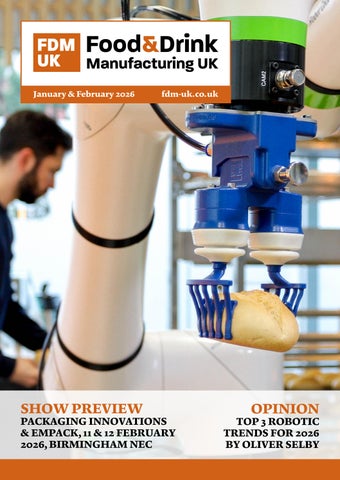
January & February 2026
SHOW PREVIEW
fdm-uk.co.uk
PACKAGING INNOVATIONS & EMPACK, 11 & 12 FEBRUARY 2026, BIRMINGHAM NEC
OPINION
TOP 3 ROBOTIC TRENDS FOR 2026 BY OLIVER SELBY
Small but mighty. Are you looking for an easier, faster and more economical way to extend shelf life and improve product presentation? Introducing the Compact Series from MULTIVAC UK.
The perfect solution for start-up and scale-up processors looking to reduce manual labour Small footprint – from 2m long Automate production – reduced manual labour Ergonomic – tool changes in minutes – no tools required Flexible options – from processing to packaging and labelling Over 60 regional service technicians in the UK Afforadable and easy to maintain – interest free finance available
Enquire for a consultation with one of our experts, or book a trial today.
01793 425899 sales@multivac.co.uk www.multivac.co.uk
CONTENTS 18 34
24 Editor Paul Attwood editor@fdm-uk.co.uk Editorial Assistant John Reynolds editorial@fdm-uk.co.uk
26 18
38
The Co-Packing Community: Where Modern Supply Chains Find Their Seamless Edge
24 Demand soars for Packaging Innovations & Empack 2026 visitor passes 26 Beyond Innovation: Why Circularity’s Real Bottleneck Is Human 34
Top 3 robotic trends for 2026 - By Oliver Selby
38
Moderation moves beyond Dry January - By Iwan Thomas
Features Editor Henry Peters editorial@fdm-uk.co.uk Production/Design Laura Whitehead laura@lapthornmedia.co.uk Sales Manager Holly Jones sales@fdm-uk.co.uk Publishing Director Maria Lapthorn maria@lapthornmedia.co.uk Admin Assistant Jade Still jade@lapthornmedia.co.uk Lapthorn Media Ltd 5-7 Ozengell Place, Eurokent Business Park, Ramsgate, Kent, CT12 6PB
01843 808 117 www.fdm-uk.co.uk @fdmanufacturing
Editor’s Note Welcome to the latest issue of Food and Drink Manufacturing UK Magazine. As the food and drink manufacturing sector enters 2026, it does so with cautious optimism and a continued focus on resilience. Cost pressures, supply chain uncertainty and regulatory demands remain challenges, yet the industry continues to adapt and innovate. In this issue, we bring insight and analysis to support informed decision-making in the months ahead.
Paul Attwood Editor
Efficiency and sustainability are priorities for 2026, with investment in automation, digitalisation and smarter resource management now essential. Packaging remains an area of focus, as manufacturers respond to environmental targets. These themes will be firmly in the spotlight at Packaging Innovations and Empack 2026, where industry leaders and suppliers will gather to explore the latest developments shaping the future of packaging.
Every effort is made to ensure the accuracy and reliability of material published in Food & Drink Manufacturing UK however, the publishers accept no responsibility for the claims or opinions made by advertisers, manufactures or contributors. No part of this publication may be reproduced or transmitted in any form or by any means, mechanical, electronic (including photocopying) or stored in any information retrieval system without the prior consent of the publisher.
03
Latest News IGD sets out 2026 retail and shopper trends and forecasts grocery market growth to 2030 Industry insight organisation IGD has published its latest UK trend reports for Grocery Retail and Shopper Behaviour, alongside new European channel forecasts for 2025–2030. IGD’s projections indicate the grocery channel will grow at 3% CAGR, reaching £297bn in the UK by 2030. Supermarkets are expected to retain the largest share of the market, followed by convenience, while online grocery is forecast as the
fastest-growing channel, reflecting the UK’s position as the leading online grocery market in Europe. The 2026 trend reports outline four themes expected to influence retailer strategy and shopper expectations: • Affordable and accessible – With financial pressures continuing, value remains a top priority as shoppers seek quality and convenience without price premiums. • Elevated experiences – With choice increasing, in-store and brand-led experiences are set to play a bigger role in differentiation and trade-up opportunities. • Sustainability simplified – Shoppers expect clearer guidance from industry and government to help make sustainable choices achievable and visible. • Health as a lifestyle driver – Health and wellness are
increasingly embedded in everyday purchasing decisions, creating demand for guidance and products aligned to wider lifestyle goals. IGD notes that technology will act as an enabler across all four areas, underpinning digital convenience, personalisation, supply chain transparency and product development. The reports assess current market responses, outline recommended actions for 2026, and provide considerations heading into 2027 and beyond as retailers navigate a shifting regulatory and consumer landscape. IGD states that while cost pressures persist, opportunities remain in channels and propositions aligned to digital convenience, health and sustainability, supported by clear value delivery.
Go-Pak UK launches closed-loop recycling scheme for cardboard packaging Sustainable packaging specialist Go-Pak UK, together with parent company SCG Packaging (SCGP), has introduced a new closedloop recycling service to support brands in responsibly managing old corrugated cardboard (OCC). Launched as Go-Recycle, the programme allows customers to return OCC via routine product deliveries, where it is collected, processed, and sent to SCGP papermills in Thailand and Vietnam using otherwise empty containers. The recovered fibre is repurposed
into new cardboard packaging and non-food contact materials before re-entering the supply chain. The solution arrives as brands prepare for the UK’s Extended Producer Responsibility (EPR) regulations, which increase accountability for the full lifecycle of packaging, including take-back and recycling. Go-Pak says the service reflects its long-term sustainability goals as the business works toward net zero emissions by 2050. Tim Allen, Operations Director at Go-Pak UK, said: “Go-Recycle is a simple and efficient closed loop that keeps resources in use for longer and fits naturally around customers’ operations. With no comparable solution currently offered at scale, it meets an industry-wide need for responsible recycling and reliable material supply.” The model also supports cost and supply resilience for brands
04
amid global fluctuations in OCC availability. By combining deliveries with collection, Go-Recycle reduces logistics burden, transport emissions and dependence on the market price of recycled content. With rising demand for recycled materials and new regulations requiring separate recyclable waste streams from April 2025, Go-Pak says Go-Recycle offers a practical route to meet sustainability goals and demonstrate ESG progress, while establishing a consistent supply of quality recyclate.
People on the Move
UK DMO strengthens governance with two independent board appointments The UK Deposit Management Organisation (UK DMO) has appointed Juliet Sotnick and Lynda Heywood as independent non-executive directors, as the organisation continues preparations to deliver the deposit return scheme (DRS) across England, Scotland and Northern Ireland by October 2027.
Central Foods adds technical and sales expertise with three appointments Frozen food distributor Central Foods has expanded its team with three new appointments across its technical and sales functions. Anna Ciszewska has joined as technical controller, bringing a decade of experience in food safety and technical compliance. Her role will focus on supporting product standards, quality systems and technical assurance across the business. Two new sales executives, Stacey Kitchener and Josh Johnston, have also joined the Northamptonshire-based distributor. Kitchener moves into the food sector from a sales background, while Johnston previously worked within foodservice operations in Corby. Central Foods supplies frozen food products to more than 250 wholesalers and directly into hospitality and catering operators across the UK, covering segments including hotels, education, leisure, care, and business and industry.
The UK DMO, a not-for-profit and business-led body, is responsible for designing and operating the scheme, which aims to increase recycling rates and reduce litter by placing a deposit value on drinks containers redeemed at return points. The latest appointments form part of the organisation’s work to build a governance structure capable of overseeing a national environmental programme spanning retailers, manufacturers, logistics networks and consumers. Sotnick brings more than 25 years’ experience in sustainability, procurement and supply chains, having held senior leadership roles at IHS Towers, Babcock International Group and Sky. She currently serves as a non-executive director for Nuclear Waste Services and is a trustee of the Chartered Institute of Procurement and Supply. Sotnick will chair the UK DMO’s fees committee and the operations, technology and IT committee, providing oversight of charging structures and the infrastructure required to support nationwide collection and logistics.
Juliet Sotnick
Sotnick brings more than 25 years’ experience in sustainability, procurement and supply chains, having held senior leadership roles at IHS Towers, Babcock International Group and Sky. Heywood joins the board with longstanding experience in treasury and financial risk management, including previous group treasurer positions and non-executive roles in the retail and property sectors. She has advised on capital structures, liquidity and real estate financing, served on the Tesco Pension Scheme’s investment and risk committee, and was a member of the Bank of England’s Money Markets Committee. She will chair the audit, finance and risk committee and the remuneration committee. With the appointments confirmed, the UK DMO has now formalised its full committee structure, comprising audit, finance and risk; nominations; remuneration; fees; and operations, technology and IT committees. The organisation says the framework is intended to ensure dedicated scrutiny of programme delivery as plans for the DRS move toward implementation.
Lynda Heywood
05
Food Safety
A Combined Approach Prevents Contamination — Why Design Matters as Much as HACCP Matt Hale, Global Key Account Director, HRS Heat Exchangers
Food safety is rarely the result of one action, one piece of equipment, or one stage of production. Instead, it relies on a chain of decisions stretching from raw material procurement through processing, packaging, distribution, and even how consumers store or reheat a product at home. HACCP gives the industry a structured way to manage risk, but real-world safety also depends on whether the equipment we use is designed to eliminate — not merely monitor — the possibility of contamination. In thermal processing, tubular heat exchangers are one of the most important lines of defence. Yet their effectiveness hinges on three factors: system design, construction quality, and ongoing maintenance. Miss one, and the system becomes vulnerable.
Design that eliminates risk — not just detects it When it comes to preventing crosscontamination between product and service fluid, two design philosophies dominate. The first is operational: maintaining a positive pressure differential so that any leak forces product into the service fluid, rather than allowing water, steam, or glycol
to enter the food stream. It can work — but only if pressure is monitored perfectly at all times. That means sensors, alarms, extra controls, and additional engineering complexity. The second approach is more robust: creating a physical separation between two tube plates, one for product and one for service fluid. In the event of a leak, the material escapes into a safe drainage area rather than contaminating the process. Because it does not depend on fluctuating operational conditions, this “double tube plate” method is simpler, safer, and far easier to maintain. It is why we incorporate it as standard in HRS S Series multitube heat exchangers for high-risk food applications. The gap between the plates may be only 3mm, but it becomes a critical safeguard. Whether shrouded or open, the design ensures that leakage becomes visible and manageable long before cross-contamination becomes possible. At the same time, hygienic performance cannot come at the expense of thermal efficiency. Corrugated tube designs — which disrupt boundary layers and prevent viscous products from sticking — allow for more effective heat transfer, smaller equipment footprints, and less frequent cleaning. Efficiency and hygiene are not competing priorities; with the right design, they reinforce each other.
Construction quality: what you can’t see matters too Even the strongest design fails without precision manufacturing behind it. Stainless steel grades, welding standards, and smooth, defect-free joints play a crucial role in preventing product build-up or structural failure. Tube plates must withstand the mechanical stresses of daily operation while maintaining a perfect seal between product and service fluids. Reputable manufacturers should be prepared to walk customers through
06
their fabrication processes — because in food safety, confidence comes from transparency.
Maintenance: the final pillar of protection A poorly maintained heat exchanger can undermine even the most advanced hygienic design. Regular inspection and cleaning, supported by effective CIP systems, ensure that drainage channels remain clear, corrosion is controlled, and small issues are spotted early. For acidic, abrasive, or multi-phase products, increased monitoring may be necessary. But thoughtful hygienic design — smooth surfaces, clean welds, and no hidden crevices — makes cleaning not only more effective but more energy efficient.
Safe food requires combined thinking Food safety isn’t a single intervention; it’s cumulative. The combination of smart system design, high-quality construction, and disciplined maintenance forms a complete defence against contamination. As processing demands increase and regulations tighten, equipment that prevents risk — rather than reacts to it — will define the future of thermal food safety.
For more, visit: hrs-heatexchangers.com
PRODUCED FROM STRONG HONEYCOMB PAPER BOARD.
ISPM 15-EXEMPT 100% RECYCLABLE
Sustainable, ISPM 15-Exempt Pallets & Crates: Easy to Deploy. Engineered for Safe Transit. BUILT TO PROTECT YOUR GOODS IN TRANSIT. • Standard PALLETS – UK and EU sizes. Weight capacity up to 750kg • Shipping Crates – Can be designed to each customer’s specifications. Weight capacity up to 750kg • Layer Boards – 15mm, 25mm as standard.
“PALLITE have been our go-to crate and packaging partner for shipping premium cheeses to Dubai since 2016. The team’s support is faultless, and the packaging performs every time — our products arrive at the right temperature and in perfect condition. Outstanding service and quality”
PROTECTIVE LAYER BOARDS AVAILABLE
STRONG SUSTAINABLE PALLETS
PGL Fresh Produce Ltd
Contact us to discuss your requirements | enquiries@pallitegroup.com | +44 01933 283920 | pallitegroup.com
Company News
Company Shop Middleton marks ten years of surplus redistribution Company Shop Middleton — part of the UK retail surplus redistribution network Company Shop Group — is marking ten years since opening its doors in 2015. During that time, the store reports having helped local households reduce grocery bills while diverting 30,000 tonnes of surplus food and household products from waste streams. Its activities form part of the wider Company Shop model, which works with manufacturers and retailers to repurpose goods impacted by mislabelling, overproduction or seasonal changes.
The store’s operations have contributed to an estimated 78,000 tonnes of CO2e savings and the equivalent of more than 69 million meals redistributed to members in the region.
GreenBottle recycling kiosks roll out across Poland with BIXOLON printing tech A new partnership between receipt printer manufacturer BIXOLON, Polish digital services firm iMedia, and integrator HANT is supporting the installation of GreenBottle reverse vending machines across Poland.
Borough Broth secures £7.5m to expand production capacity Organic bone broth producer Borough Broth Company has secured £7.5 million investment from consumer sector investor Piper to expand its West London manufacturing footprint and support product innovation.
The new site will more than double production capacity and support growth in the ready-tocook and functional foods market, where demand for proteinrich and minimally processed products continues to rise.
Founded in 2015, the business produces broths, ramen bases and stocks from organic and regeneratively sourced ingredients.
The investment follows increased national retail listings and revenue growth over the past year.
08
The smart kiosks collect PET bottles and cans in return for digital rewards and are part of the country’s efforts to improve recycling rates ahead of a national initiative launching in 2025. The machines require fast and durable receipt printing for container records and voucher codes; BIXOLON’s thermal kiosk printer has been integrated to meet those needs while operating continuously in public spaces. The rollout will allow rapid expansion of GreenBottle systems nationwide as Poland adapts infrastructure to support circular economy programmes.
Company News DIC Group and Xampla partner to bring PFAS-free coating to Asian packaging sector
UK material technology firm Xampla has agreed a collaboration with global chemicals manufacturer DIC Group to introduce its plant-based, PFAS-free Morro™ coating to the Japanese and wider Asian market. The biodegradable coating, developed following research at the University of Cambridge, is designed for use on foodservice paper and board packaging and offers water and grease resistance without synthetic plastics or PFAS. The move comes as Japan pushes ahead with targets under the Plastic Resource Circulation Act, which aims to reduce single-use plastics and increase use of biomaterials by 2030. The partnership will see Morro Coating used as a drop-in replacement compatible with existing packaging supply chains, with trials already underway across different substrates and applications.
Dina Foods expands manufacturing capacity with multi-year investment programme Mediterranean bakery and savoury foods producer Dina Foods has completed a series of manufacturing upgrades totalling £1m over the past three years, as the London-based business responds to sustained demand for its pitta, flatbreads and wider product range. The latest phase was the full overhaul of its pitta bread production line, which became operational in
August and forms one of five bread lines at the company’s Park Royal bakery. The upgrade is designed to speed up output, improve production consistency and reduce waste, as well as contribute to lower energy consumption across the plant. This follows improvements to the line producing the company’s traditional Khobez flatbreads, trademarked as Paninette®, which was modernised last year and fitted with a fully automatic stacker. The automation has nearly doubled capacity, increasing throughput from 5,000 to 9,000 pieces per hour and reducing downtime and labour costs. Beyond its bakery lines, Dina Foods has introduced further measures aimed at efficiency and sustainability. An onsite nitrogen generator and new gas-mixing pipework now
supply packing machines directly, replacing the use of CO2 cylinders and reducing gas-flushing costs by around 50%. The switch has also contributed to extended product shelf life. The business has also installed depth meter sensors on its flour silos, providing real-time reporting to both its internal team and its flour supplier. This enables more accurate timing of deliveries, helping to cut transport frequency and minimise the risk of production disruptions due to raw material shortages. Dina Foods says the ongoing programme supports cost efficiency, process improvement and environmental performance, forming part of the company’s long-term plans to expand its capacity for both UK and international customers.
09
Company News
Enzo Wholesale to join Unitas in bid to scale operations North London-based cash and carry operator Enzo Wholesale will join buying group Unitas Wholesale in January 2026, as the business sets its sights on significant expansion within the UK wholesale market.
Plans under consideration include investment in the Edmonton site and potential new branch locations, with a focus on improved service efficiencies and greater value for customers.
Unitas says it expects Enzo to benefit from the group’s commercial programmes and networking opportunities as the business scales in the independent wholesale sector.
Founded by a team with backgrounds in retail, catering and hospitality operations, Enzo Wholesale currently supplies almost 1,500 convenience stores, foodservice businesses and hospitality venues from its 75,000 sq ft multi-temperature site in Edmonton. The company has stated plans to broaden its product portfolio, enhance delivery capabilities, and strengthen logistics and storage capacity as part of its next phase of growth. The move to join Unitas Wholesale – the UK’s largest wholesale buying group – is expected to provide access to centralised trading terms, promotional support and supplier relationships. Enzo says the membership forms a core element of its ambition to grow its turnover from approximately £40m to £100m by the end of 2027.
Ritter Sport welcomes German Industry UK leaders to Leeds for high-level business dialogue Ritter Sport UK & Ireland has this week hosted the latest German Industry UK (GIUK) conference at its state-of-the-art headquarters in Leeds, welcoming senior leaders from a range of prominent
German-owned businesses operating across the country. The event provided a constructive forum for business leaders to discuss the strengths and challenges faced
by German-owned companies in the UK. Attendees represented a cross-section of industries including engineering, manufacturing and FMCG, with brands such as ThyssenKrupp, Fuchs Lubricants, LTi Metaltech, TopRegal, and Rösler in attendance. As a German-owned, family-run business, Ritter Sport has a long legacy of innovation rooted in BadenWürttemberg and was delighted to host the conference reflecting its strong German identity and growing presence in the UK market. GIUK serves to strengthen the cooperation between Germanowned firms, by encouraging shared learning, investment, and long-term industrial collaboration. These companies continue to contribute significantly to the wider economy, supporting thousands of jobs and driving innovation across multiple sectors.
10
Can it be cooked in an air fryer?
Consumers want to know if they can air fry ready meals. You need to know if it’s safe to do so. We provide the answers.
Let our expert food technicians determine whether your product can be cooked safely using domestic air fryers. We’ll also check it has the desired sensory properties, whether that’s gooey cheese, fluffy mash, or a crispy crust.
✓ Product safety testing and quality assessment
✓ UKAS-accredited testing laboratory no. 9365
✓ On-pack cooking instructions verification or generation and validation
✓ 24- and 48-hour service options
We’ve completed more than 9,000 air fryer cooking trials. Contact cooking.instructions@leatherheadfood.com to book yours. www.leatherheadfood.com/service/cooking-instructions/
Leatherhead’s UKAS accredited testing laboratory (no. 9365) status covers: cooking instructions testing (air fryer, microwave oven, gas and electric thermal oven, electric fan oven, gas and electric hob, gas and electric grill, deep fat fryer, defrost) and in cook temperature measuring techniques. The accreditation relates to ISO/IEC 17025:2017 (general requirements for the competence of testing and calibration laboratories).
Events & Awards News
Generative AI set to take centre stage at Packaging Innovations & Empack 2026 Generative AI is poised to play a major role in the future of the global packaging sector, according to new research released ahead of Packaging Innovations & Empack 2026. The study, produced by event research partner Smithers, values the global packaging market at $1.2 trillion in 2025 and identifies GenAI as a key driver of faster product launches, smarter supply chains and greater production efficiency. The report outlines how AI-enabled tools are already reshaping packaging design, reducing the time and cost of prototyping and enabling more personalised, data-driven creative work. Integration with digital printing, automated forming machinery and
intelligent packaging is expected to accelerate supply-chain visibility and cut waste. AI-driven systems are also improving stock management and operational efficiency as brands contend with rising SKU counts and shorter production runs. E-commerce operators are increasingly using AI to create customsized parcels, while predictive analytics are helping manufacturers mitigate risk and optimise throughput. Further developments highlighted include cost- and materialsaving “right-sizing,” rapid line reconfiguration for complex shapes, and the use of real-time data to respond quickly to shifts in demand
Packaging Innovations & Empack 2026 will take place on 11–12 February at the NEC Birmingham. or external events. Smithers suggests that continued advances in generative tools—spanning text, images, video and 3D models—could significantly boost creative productivity by the end of the decade. Josh Brooks, Divisional Director for the Packaging Portfolio at Easyfairs, said AI represents the next major technological shift for the sector, comparable to earlier transformations brought by the internet and cloud computing. Packaging Innovations & Empack 2026 will take place on 11–12 February at the NEC Birmingham, bringing together suppliers, manufacturers and technology providers to explore the latest advances in materials, machinery, automation and sustainability.
Invopak wins Investors in People ‘Best Culture’ Award Packaging firm Invopak, part of the Involvement group, has won the Best Culture title at the Investors in People Awards 2025 in London. The awards marked the organisation’s 35th anniversary of recognising employers that demonstrate strong people-focused practices. Investors in People CEO Paul Devoy praised nominees for their
12
commitment to leadership, learning and long-term development, noting the diversity of organisations represented across sectors and sizes. The Best Culture award is given to organisations that create inclusive, supportive workplaces where employee wellbeing and participation are central. Involvement’s people-first approach, which includes continuous improvement initiatives and
a coaching academy for staff development, was highlighted by the judges. Involvement’s CEO, Arjen, said the recognition reflected a decade of cultural change: “We’ve transformed the business by focusing on developing people and working as a team.”
Events & Awards News
RealMan debuts RealBOT embodied robotics platform at IROS 2025 RealMan Robotics used this year’s IEEE/RSJ International Conference on Intelligent Robots and Systems (IROS 2025) to unveil its RealBOT Embodied Open Platform, demonstrating longdistance teleoperation between Beijing and Hangzhou — a 1,200 km link used to show real-time humanoid robot control. During the demo, a trainer in Beijing remotely operated robots in Hangzhou to complete tasks such as handing over a towel and passing fruit. RealBOT is positioned as an open platform to support embodied-AI research, combining motion control, multisensor perception and precision manipulation. It draws on more than one million multimodal data samples captured across ten application scenarios at RealMan’s Humanoid Robotics Data Training Center, enabling more robust model development and faster prototyping. Key features include in-house actuator and control technology, support for NVIDIA Jetson Orin and Digua RDK S100 compute platforms, fused perception from cameras, LiDAR and IMU sensors, a compact form factor for confined spaces, and 21 active DOFs with support for dexterous or adaptive grippers. RealMan says the platform is designed to help embodied systems move from lab environments into practical industrial and service applications. The company’s Beijing data centre, which operates more than 100 robots across ten environments, underpins the platform’s data generation and supports collaboration with global research partners.
IN THE HIGH COURT OF JUSTICE CLAIM NO: CR-2025-003092 BUSINESS AND PROPERTY COURTS OF ENGLAND AND WALES COMPANIES COURT (ChD)
IN THE MATTER OF ZURICH INSURANCE COMPANY LTD -andIN THE MATTER OF CATALINA WORTHING INSURANCE LIMITED -andIN THE MATTER OF PART VII THE FINANCIAL SERVICES AND MARKETS ACT 2000 NOTICE IS HEREBY GIVEN that on 11 November 2025 Zurich Insurance Company Ltd (acting through its UK branch) (“Zurich”) and Catalina Worthing Insurance Limited (“Catalina”) (together, the “Parties”) applied to the High Court of Justice of England and Wales for an Order under section 111(1) of the Financial Services and Markets Act 2000 (the “Act”) sanctioning an insurance business transfer scheme (the “Scheme”) providing for the transfer to Catalina of a portfolio of employers’ liability insurance policies insured by Zurich and issued before 1 January 2007 in the United Kingdom, the Channel Islands and the Isle of Man (the “Business”), and for the making of ancillary provisions in connection with the Scheme under sections 112 and 112A of the Act. The Business comprises both policies issued by Zurich and policies transferred to Zurich and issued by the following predecessor companies or under the following trading names: Eagle; Star; British Dominions Marine Insurance Company; British Dominions General; Eagle & British Dominions; Eagle, Star & British Dominions Insurance Company Ltd; Bedford General; Navigators & General Insurance Company Ltd; Eagle Star Insurance Company Ltd; and Midland Employers’ Mutual Assurance / Midland Assurance Limited. The proposed transfer will result in the Business, which is currently being carried on by Zurich, being carried on by Catalina. If the Scheme is sanctioned, it is expected to come into effect on 31 March 2026. Further information about the Scheme, including: • a copy of the full Scheme document; • a summary of the terms of the Scheme; • a copy of the report on the terms of the Scheme prepared by an independent expert in accordance with section 109(1) of the Act; and • a summary of the independent expert’s report, are available free of charge and copies can be downloaded from www.zurich.co.uk/eltransfer and https://catalinaworthing.co.uk/zurich-transfer/ or requested by calling or writing to us at the addresses below, from the date of publication of this notice until the date on which the application is heard by the Court. To speak to Zurich about the proposed transfer, please call us on 0800 652 0589 (freephone in the UK) or +44 3330 490 752 (international). The information line will be open from 9.00am to 5.00pm on Monday to Friday (excluding bank holidays) until the Scheme takes effect (currently expected to occur on 31 March 2026). Alternatively, you can write to us by email to eltransfer@uk.zurich.com or by post to Zurich EL Transfer, c/o Davies Specialist Services, PO Box 81791, London EC3P 3GB. To speak to Catalina about the proposed transfer, please call us on 0800 652 0595 (freephone in the UK) or +44 3330 491 080 (international). The information line will be open from 9.00am to 5.00pm on Monday to Friday (excluding bank holidays) until the Scheme takes effect (currently expected to occur on 31 March 2026). Alternatively, you can write to us by email to zurichtransfer@catalinare.com or by post to Catalina Worthing Insurance Limited, c/o Davies Specialist Services, PO Box 81791, London EC3P 3GB. The application is expected to be heard at the High Court of Justice, 7 Rolls Buildings, Fetter Lane, London EC4A 1NL on 25 March 2026 (the “Hearing”). Any person who thinks that they may be adversely affected by the carrying out of the Scheme may attend the Hearing and express their views either in person or through legal Counsel. Anyone who intends to appear at the Hearing is requested to notify their objections to us by 18 March 2026, setting out why they believe they would be adversely affected. Any person who does not intend to attend the Hearing but wishes to make representations about the Scheme or considers that they may be adversely affected is requested to communicate their views to us by calling or writing using the above contact details, preferably before 18 March 2026. Zurich appointed solicitors: Slaughter and May (Ref: JADM/RZXS/AYHC) Catalina appointed solicitors: A&O Shearman (Ref: PEHJ) Visit www.zurich.co.uk/eltransfer or https://catalinaworthing.co.uk/zurich-transfer/ for more information.
13
Case Study
Meeting the Pressures of Modern OEM Design: Why Accredited Cooling Systems Matter Original equipment manufacturers (OEMs) operating in sectors such as medical imaging, food production and industrial processing are required to deliver equipment that meets increasing expectations for precision, reliability and energy performance, while balancing cost constraints and compressed development cycles. In this context, cooling and temperature control systems — though rarely the most visible component — play a critical role in ensuring machines perform safely and consistently throughout their lifecycle. For many OEMs, the choice of cooling partner is becoming a more strategic decision. Independent accreditation of process chillers and temperaturecontrol systems provides third-party validation of performance claims, offering assurance for design teams and procurement stakeholders, particularly in regulated sectors such as healthcare. When combined with warranty cover, clear documentation and evidencebased performance data, accredited solutions can support internal decision-making and strengthen
supply technical data, service support and spare parts consistently across regions is increasingly a priority as design teams work digitally and across borders.
confidence among end users, including hospitals and specialist manufacturing environments. Working directly with equipment manufacturers rather than purchasing generic third-party systems can help reduce uncertainty earlier in the design phase. Access to engineers, digital documentation and integration support allows cooling solutions to be aligned with machine specifications and operational requirements. In applications such as MRI scanning, where temperature stability supports diagnostic accuracy and uptime, this technical engagement can be critical to meeting performance standards and reducing the risk of costly downtime. Where requirements fall outside standard product ranges, factory modification and application-specific testing can support compatibility and shorten the route to market. For OEMs operating internationally, the ability to
Support beyond installation is also a key consideration. Reliable access to parts, responsive technical assistance and continuity of service provide operational resilience at OEM level and throughout the equipment’s lifetime in the field. In sectors where near-continuous operation is the norm, gaps in support can undermine brand reputation and create additional cost. Several trends continue to shape how OEMs approach cooling system selection: • Digital-first collaboration, with demand for digital documentation and remote engineering support. • Independent assurance, with accreditation and warranty becoming fundamental purchasing expectations. • Customisation, as many OEM applications require adapted configurations rather than off-theshelf systems. • Energy efficiency, driven by sustainability goals and total cost of ownership considerations. While cooling systems may not be the headline feature of a machine, temperature control influences cycle times, output, accuracy and service life. Accredited, well-supported solutions can contribute to reliable performance, while unaccredited or unsupported options can introduce avoidable vulnerabilities. As OEMs continue to face tight delivery schedules and competitive markets, closer collaboration with cooling system manufacturers offers a route to managing risk, improving integration and supporting equipment performance over the long term. In a landscape shaped by regulatory expectations, sustainability targets and rising customer standards, the choice of cooling partner is increasingly both technical and strategic.
14
Efficient HACCP Cook & Chill CCP Validation
! s t n u o c e c n ie r Where expe
Product Safety Process Efficiency Improved Product Yields Rapid Fault Finding Full HACCP Certification
ü
Thru-process temperature monitoring solutions for all your cook applications
PhoenixTM Technology • Accurate IP67 data logger (Type K or T) • 10 Measurement Points for full oven mapping • Thermal barrier options to suit cook regime • Comprehensive thermocouple range • Standard miniature thermocouple plugs • Calibrated thermocouple options • Food trays and thermocouple jig options • Full lethality (Fo/Pu) and reporting • Real Time RF Telemetry options • Local efficient calibration and service support
Phoenix Temperature Measurement 25 Earith Business Park, Meadow Drove, Earith, Cambridgeshire PE28 3QF, UK
T: 01353 223100 E: sales@phoenixtm.com
www.phoenixtm.com
Packaging News
Masterpress mono-material pouch selected for EU BeFORE recyclability testing European label and packaging manufacturer Masterpress is contributing to an EU-funded research project exploring the recyclability of high-barrier flexible packaging as the sector prepares for the requirements of the Packaging and Packaging Waste Regulation (PPWR). The BeFORE (Barrier for Recycling) initiative, funded through the CORNET programme, brings together partners from Belgium, Germany and Poland, including manufacturers, research institutes and value-chain organisations. Masterpress is participating via Natureef, a Polish association that supports collaborative R&D in packaging and recycling. The project addresses a key challenge for the industry: transitioning from multi-material, laminated high-barrier pouches that are difficult to recycle, to mono-material formats capable of delivering protection against oxygen, moisture and oils while remaining compatible with mechanical recycling streams. Masterpress is providing a single-layer polyethylene (PE) stand-up pouch used for liquid soap as one of the project’s case studies. Unlike traditional
structures, the pouch is nonlaminated and engineered to sort and process within existing PE recycling systems. Testing focuses on barrier performance, shelf-life and strength under handling, safety and migration, line performance, and recyclability against international guidelines. The BeFORE consortium will also assess how emerging materials align with expected PPWR compliance needs, particularly for food, personalcare and cosmetic applications where high-barrier packaging remains essential. Findings from the project will inform industry guidance, including design-for-recycling best practices and a white paper evaluating different high-barrier structures. The project runs from March 2025 to February 2027 and is co-financed by Poland’s National Centre for Research and Development.
Malcolm Allan unveils major rebrand reflecting heritage and new direction Scottish food manufacturer Malcolm Allan Ltd has introduced a new brand identity as part of the largest relaunch in the company’s 71year history. The redesign features updated packaging and a new navy, gold and white visual identity, intended to reflect the business’s family butcher heritage and long-standing association with Scottish meat products. Founded in 1954 as a butcher shop, the company now operates a modern processing facility in Larbert, employing more than 100 staff and supplying retail, wholesale and foodservice customers with a range including Lorne sausage, steak pies, black pudding, burgers and seasonal meat products. As part of the rebrand, the steak pie range will move to recyclable cardboard packaging, supporting wider packaging sustainability targets across the sector. The company states that consumer recognition of heritage and provenance remains an important factor in the competitive meat and bakery categories.
16
Packaging News
Maestrani upgrades chocolate packaging line with Ishida multihead weighing solution Swiss chocolate manufacturer Maestrani Schweizer Schokoladen AG has completed a packaging line upgrade to improve speed, accuracy and efficiency for its Minor chocolate products, installing a 14-head Ishida multihead weigher supplied through Ishida’s distributor ITECH AG. The company’s previous weighing system had become a constraint on the line, impacting accuracy and throughput as production volumes increased. Maestrani’s Flawil facility produces around 4,500 tonnes of chocolate annually, with demand continuing to rise.
to integrate with the site’s existing VFFS bagmaker and handle a variety of formats ranging from 110g stand-up pouches to 1kg pillow packs and cans. The equipment is capable of packing chocolate pieces between 5g and 22g at approximately 40 packs per minute, depending on format. In addition to higher weighing precision and reduced product giveaway, the installation has delivered operational benefits including lower waste and improved handling of delicate items.
The unit is enclosed to maintain production noise well below the 85dB threshold, enhancing ergonomics on the line. Maestrani reports that operator training and commissioning have supported faster changeovers and internal capability in setting presets and fine adjustments. The collaboration between Maestrani, Ishida and ITECH is cited as a key factor in aligning the solution with production demands and future capacity needs.
Following an evaluation process, the new multihead weigher was selected
André Pfister, Production Manager
Ishida acquires RobotGrader to expand protein packing automation capabilities Ishida Europe has acquired Swedish automation specialist RobotGrader AB, strengthening its position in fixed-weight tray packing and robotic handling for the protein processing sector. Based in Mölndal and founded in 2004, RobotGrader designs robotic solutions that combine weighing, grading and pick-andplace technologies. The acquisition formalises a long-standing relationship between the two businesses; Ishida has acted as RobotGrader’s exclusive European distributor since 2014, with systems installed across 13 countries.
The integration brings RobotGrader’s technology directly into Ishida’s equipment portfolio, enabling closer collaboration on product development and deeper service and project support for customers. Ishida plans to expand the RobotGrader team to enhance technical assistance, spare parts availability and systems optimisation.
of handling up to 320 pieces per minute, depending on machine and product type. Below: Sverre Stenbom (Left), Darren Chandler (Right), and RobotGrader Team (Back)
The move reflects growing demand for automation within protein packing, driven by the need to increase throughput, reduce labour dependency and minimise giveaway. RobotGrader systems are capable
17
Packaging
The Co-Packing Community: Where Modern Supply Chains Find Their Seamless Edge In today’s packaging landscape, logistics can no longer be described as simply “getting goods from A to B.” The supply chain has become a living ecosystem — faster, more customised, and far more complex — and within it, co-packers have emerged as one of the most influential forces shaping how brands grow. At Packaging Innovations & Empack 2026, this evolution will take centre stage in the Contract Pack & Fulfilment Zone, where the UK’s co-packing community will demonstrate why value-added services are no longer optional but essential. Increasingly, brands aren’t looking for transport alone. They want partners who can help them move, shape, assemble, label, pack, personalise, and even reclaim products. As consumer expectations rise and product lifecycles shorten, logistics providers are stepping forward with integrated solutions that blend fulfilment, flexibility, and strategic advantage. For David Richards, Managing Director of Amberley Labels, agility is the new currency. “To scale effectively, businesses need supply chains that support short runs and fast turnarounds,” he says. Outsourcing fulfilment isn’t just a convenience — it’s a competitive necessity, particularly for smaller campaigns where responsiveness counts. But even at scale, the same truth applies: adaptive collaboration
systems can anticipate disruptions, eliminate bottlenecks, and support brands in navigating complex regulatory landscapes, particularly as EPR, ESG reporting, and labelling requirements intensify.
is what binds successful supply chains together. This shift is playing out across the industry. Emma Verkaik (above), CEO of the BCMPA, has seen first-hand how co-packers have transformed their role. Once viewed as transactional add-ons, they’re now integral to the entire supply chain — from technical support and customisation to e-commerce fulfilment, compliance, and quality assurance. “Collaboration is central to success,” she stresses. Stronger relationships between brand owners, logistics providers, and co-packers create supply chains that are not only faster, but more transparent, resilient, and sustainable. It’s a vision echoed by WePack Managing Director Mick Clark, who has watched the profession mature dramatically. “Co-packers now offer technical expertise, quality control, even input on packaging design,” he says. “It’s no longer about packing boxes; it’s about adding value.” Pressures on cost and flexibility have pushed brands to rely more heavily on outsourced specialists — not as gap-fillers, but as long-term partners. Technology and digitalisation are accelerating this transformation. Real-time tracking, automation, AI forecasting, and advanced analytics have created unprecedented visibility — from raw materials to final delivery. Co-packers equipped with smarter
18
The sustainability agenda is reshaping expectations too. From optimised transport networks and greener fleets to carbon tracking and recyclable materials, co-packers are increasingly becoming the custodians of their customers’ environmental goals. For many brands, especially those shipping into Europe, agility around regulatory nuance is no longer a bonus — it’s survival. What ties all of this together is partnership. A co-packer in 2026 is no longer a background operator: they’re a joined-up extension of the brand. “Communication is key,” Verkaik reminds us. “A co-packer should be for life, not just for Christmas.” That sentiment reflects a broader industry reality — resilience, adaptability, and growth come from long-term collaboration, not short-term fixes. As Packaging Innovations & Empack 2026 returns to Birmingham on 11–12 February, the Contract Pack & Fulfilment Zone will once again be a hub where these partnerships are formed and strengthened. For ambitious brands seeking scalable, flexible solutions, it’s where supply chains become seamless — and where the true value of the co-packing community comes sharply into focus.
Brand Overview
– Summary
Packaging News
Falconer develops premium four-can presentation box for emerging drinks brand Toby&Co Falconer Print & Packaging has collaborated with luxury nonalcoholic drinks brand Toby&Co to develop a four-can presentation box, designed to differentiate the brand’s inaugural product from standard multi-pack formats. The pack was produced using CrownBoard Prestige, selected for
rigidity and tactile performance suited to gifting and limited-edition releases. Falconer printed both sides of the board using a four-colour process with a matt varnish finish, while the internal structure incorporates a bespoke fitment to separate and secure the cans during transport and display. A front locking tab reinforces pack stability and contributes to the unboxing experience. The project reflects a wider trend in premium beverage packaging, where structural design and material specification play an increasing role in brand differentiation and consumer perception. Falconer’s approach focused on delivering a presentationled solution that protects the product, supports display and aligns with the brand’s positioning.
Toby&Co launched its first expression in a limited run through its website, alongside selected specialist retailers, bars and restaurants. The brand intends for the presentation box to serve both as a gifting solution and as a collectable-style format for customers seeking elevated non-alcoholic drinks. Following the launch, additional variants and mixed-SKU presentation formats are reported to be in development, with premium secondary packaging expected to remain a feature of future releases.
Sabert launches no-intentionally-added-PFAS pulp packaging as industry prepares for regulation Sabert Corporation Europe has introduced a new range of nointentionally-added-PFAS pulp foodservice packaging, designed to offer home-compostable and recyclable options that meet emerging regulatory requirements and performance expectations in foodservice and retail environments. Produced from plant-based renewable materials, the packaging has been developed as part of Sabert’s wider transition to its HC (home compostable) pulp portfolio, giving customers a standard compostable option and, early
next year, access to Pulp Ultra — a higher-performance formulation engineered for greater strength and heat resistance. The launch reflects growing demand for PFAS-free packaging ahead of Regulation (EU) No 40/2025, which from August 2026 will introduce restrictions on the presence of PFAS under the Packaging and Packaging Waste Regulation (PPWR). Sabert states that its updated ranges are intended to help customers align with upcoming limits on ‘forever chemicals’ while maintaining functionality in applications that typically rely on barrier-lined alternatives. Performance has been a recognised challenge for PFAS-free pulp trays and containers, particularly in hot or greasy food applications where additional liners are often required. Sabert’s development programme focused on addressing these constraints without supplementary packaging layers.
20
The company emphasises that its existing PFAS-containing pulp products remain compliant with current UK and European foodcontact legislation. However, the introduction of new PFAS-free formulations forms part of a longer-term shift toward packaging designed to meet the next phase of regulatory and sustainability expectations. Below: Sabert Quality Environment, Health & Safety Manager Isabelle Ernotte with Alex Noake, Senior Vice President and Managing Director for Sabert Europe.
Packaging News Reconomy and Polytag partner to deliver realtime packaging recycling data for brands Circular economy specialist Reconomy has entered a partnership with Polytag to deploy UV tag-and-trace technology at Reconomy brand Casepak’s Materials Recycling Facility, providing brands with real-time insights into how their packaging performs in the recycling system. The technology will enable participating brands to track when and where specific packaging types are successfully sorted and recycled, giving a clearer view of recycling rates across different product lines. The data is expected to support more accurate sustainability reporting, assist with Extended Producer Responsibility (EPR) compliance, and inform packaging redesign — including material choices and lightweighting initiatives — to reduce costs and improve recyclability. Reconomy brand Valpak, which operates the UK’s largest packaging and product database used by major supermarkets, will support integration of Polytag’s data into brands’ reporting frameworks and compliance systems.
Composty highlights impact of Investment Readiness support as it approaches milestone sales West Midlands eco-product start-up Composty has called for continued support for the Business Growth West Midlands Investment Readiness (BGWM IR) Programme, crediting the initiative with helping the company scale rapidly ahead of its projected one-millionth product sale. The Kingswinford-based business, known for manufacturing biodegradable sponges and compostable household cloths, has grown to around £500,000 in sales within a few years. Founded by husband-and-wife team Matt and Helen Guest, Composty began as a bootstrapped operation before securing funding through an Investment Readiness pitch event — support the pair say proved pivotal in enabling the company to participate in Amazon’s Sustainability Accelerator and accelerate market access. The comments come ahead of the Business Funding Summit 2025, which takes place in Birmingham on 25 November and is expected to bring together more than 150 SMEs, investors and advisers to explore funding routes and financial planning for growing firms. Delivered by
Oxford Innovation Advice, the BGWM IR Programme supports companies across Birmingham, Solihull and the Black Country, providing specialist financial advice, business planning support and links to investors and alternative finance options. According to programme leads, £4.2m has been raised by local firms since October 2023, with a further £4.7m currently in the funding pipeline. More than 2,000 businesses have received tailored support spanning financial forecasts, pitch deck development and exploring grant, equity, debt and crowdfunding routes. The future of the programme beyond March 2026 is yet to be confirmed due to current funding cycles. With the D2C eco-products sector experiencing growth, Composty says continued support is key for companies seeking to navigate financial modelling, access investment and bring lowerimpact packaging and household consumables to market. Speakers at the summit will include business founders who have secured investment, alongside discussions with angel investors, venture capital firms and finance specialists.
Helen and Matt Guest of Composty
The deployment also marks a further step forward for the Ecotrace Programme, an industry initiative designed to improve transparency in recycling and backed by retailers including Marks & Spencer, Ocado Retail and Waitrose & Partners. The programme aims to build a verifiable data route connecting brands, waste management operators and recyclers.
21
Events & Awards News
Logistics UK’s Logistics Awards winners showcase the best of the industry The logistics industry came together at a glittering gala celebration and dinner at the Park Plaza Westminster Bridge on 11 December 2025, as business group Logistics UK announced the winners of the Logistics Awards 2025. Now in its ninth year, the annual event recognises the achievements of businesses and individuals who have made a significant contribution to the logistics and supply industry in the past twelve months. This year’s event, supported by Crown Oil, saw stellar entries from the road, rail, sea and air industries, all displaying outstanding commitment, knowledge and expertise of their sectors. Award winners included the Port of Dover, Woodland Logistics, GXO, Glasgow Prestwick Airport and DP World. The quality of candidates nominated for Rising Star of the Year meant the judges could not separate a winner, and chose to recognise two individuals: Beth Baxter, Fleet Coordinator at Swain Container Solutions and Elliott Lancaster, Innovation Manager at Omnes Global and PhD candidate at Keele University. Malcolm Wilson, former CEO at GXO Logistics received the prestigious Lifetime Achievement Award, and Logistics Leader of the Year was awarded to John Trenchard, Vice
Every year we are proud to host the Logistics Awards, showcasing the widespread skills, talent and expertise of our industry. President Commercial & Supply Chain at DP World. Trenchard was recognised for his Modal Shift Programme, resulting in the removal of 28,000 tonnes of CO2 and almost 9 million truck miles in 2024. The evening also saw Lee ThompsonHalls, Fleet Transport Manager, Brocklesby Ltd announced as the winner of Logistics UK’s Transport Manager of the Year competition for 2025, sponsored by Samsara. Logistics UK Chief Executive Ben Fletcher said: “Every year we are proud to host the Logistics Awards, showcasing the widespread skills, talent and expertise of our industry. The quality of entrants was extremely impressive and acts as a reminder of the exceptional organisations and individuals working in the sector today. Those who were shortlisted for awards should feel proud of themselves and their achievements: competition was stiff, and judges had a tough job on their hands determining the winners.”
Tetra Pak Wins Food Manufacturing Innovation Award from FI Europe Tetra Pak has received the Food Manufacturing Innovation Award from Fi Europe for its Tetra Pak® Air Jet Cleaning System for Powder. The awardwinning innovation replaces costly and time-consuming manual cleaning-in-place (CIP) methods for powder handling equipment, with an innovative dry approach which can deliver cost savings and facilitates quick changeovers between recipes. Judged by independent industry experts, Fi Europe’s Innovation Awards recognise innovative food manufacturing or packaging equipment that improves manufacturing efficiency, reduces waste or enhances product safety. Three Tetra Pak innovations were named as finalists, out of 177 entrants. Also nominated in the Food Manufacturing Innovation category was the Tetra Pak® Industrial Protein Mixer, which addresses the costly problem in high-protein beverage production. Tetra Pak was also named a finalist in the Future Foodtech Innovation category for its Whole oat beverage line, which use the whole grain, making it possible to produce up to 25% more from the same amount of raw material with zero fibre waste, and a beverage with 60% more protein and around 200% more fibre.
22
Industry News Showerings celebrates landmark harvest as 2025 crop nearly triples compared to last year Showerings, the Somerset-based fine cider producer, is celebrating what experts are calling one of
the sweetest harvests in recent memory, with over 2,700 tonnes of Dabinett apples collected this season, almost triple last year’s 1,000 tonnes. Weeks of summer sunshine across southern England have concentrated sugars in the fruit, echoing the conditions described by orchard master Bob Wadey, who noted that this year’s apples are smaller but significantly sweeter. The result is a crop of great promise, arriving at a pivotal moment following the brand’s recent nationwide Waitrose listing across 96 stores and online. Fermentation is already underway at Showerings, where the team reports that early liquids are showing
depth and balance reflective of the high sugar levels in this year’s fruit. After two challenging harvests and changing weather patterns brought on by hotter, drier summers, this year’s strong yield marks a welcome recovery. The combination of sunlight followed by timely rainfall has set the stage for what Showerings believes will be an exceptional vintage. Nick Showering, Director of Showerings, said: “This harvest marks a milestone for us. The long spells of sunshine this year followed by recent rainfall have given us fruit with superb sugar levels, and the quality so far is extremely encouraging. To see the crop almost triple in size while delivering such outstanding sugar levels is extraordinary. The early ferments are tasting exceptional, full of character and complexity, and we could not be more excited for what this vintage will become. Combined with our recent Waitrose listing, it feels like a breakthrough moment for Showerings and fine cider as a whole.”
INTERNORGA 2026:
WHERE TRENDS TAKE OFF
From 13–17 March 2026, Hamburg will once again host INTERNORGA – the international platform for the hospitality and foodservice industry. Under the theme “Where Trends Take Off,” the trade fair offers a unique opportunity to explore cutting-edge innovations, strengthen international networks, and gain fresh inspiration for business growth. With an expanded concept and new formats, INTERNORGA 2026 reflects the dynamic evolution of the out-of-home market. From catering and hotels to bakeries and communal catering, the event brings together decisionmakers, creatives, and newcomers from across the globe. Visitors can expect a vibrant mix of high-level conferences, interactive experience zones, and renowned trend areas such as Future Food, the Skywalk Table, and the Newcomers Area. A key highlight is the International Foodservice Forum, offering valuable insights into future developments and market challenges. Awards like the INTERNORGA Future Prize and NEXT CHEF AWARD celebrate innovation and talent, making INTERNORGA a must-attend event for anyone shaping the future of foodservice.
Save the Date!
Join INTERNORGA 2026 and be part of the movement that’s shaping the future of foodservice – as an exhibitor, visitor, or thought leader. Discover trends, connect globally, and take your business to the next level.
IN26_Advertorial_Food&Drink_UK.indd 1
internorga.com
23
21.10.25 17:51
Show Preview
Demand soars for Packaging Innovations & Empack 2026 visitor passes Packaging professionals rush to register for 2026 show, driven by a focus on disruptive thinking and breakthrough technology.
Packaging Innovations & Empack 2026, taking place on 11 & 12 February at Birmingham’s NEC, is seeing strong demand for visitor passes, with registrations surging ahead of the festive season. The spike reflects the industry’s urgent need for clarity, innovation, and future-ready solutions as brands prepare for major regulatory and market shifts set to reshape the landscape in the latter half of the 2020s. This growing demand comes as the show shapes up to be its most ambitious and future-focused edition
yet, with organisers Easyfairs unveiling a host of new features designed to spotlight disruptive thinking, breakthrough technologies, and professional development across the full packaging supply chain. “Every year, thousands of professionals gather at Birmingham’s NEC to ask a simple but pressing question: what’s next for the packaging industry?” said Josh Brooks, Divisional Director – Packaging Portfolio, at Easyfairs. “In 2026, the answer will be more comprehensive, actionable, and forward-looking than ever.” New for 2026, the Start-up Zone will shine a spotlight on the next generation of disruptive businesses. With AI accelerating the pace of innovation, emerging companies like Stockholm-based Liplid, which develops unique and sustainable cup lids for beverages on the go;
Visitors come not just to see what’s on the market today, but to discover the sparks of innovation that will shape the industry tomorrow. - Josh Brooks
MarinaTex, a home-compostable alternative to plastic film; and waste intelligence automation experts Greyparrot, are reshaping the global packaging landscape, giving visitors the opportunity to discover their next creative breakthrough within a curated showcase of future talent. Innovation continues to take centre stage in the brand-new Discovery Theatre, a platform dedicated to visionary thinking from start-ups, SMEs, and pioneering suppliers. For attendees seeking a window into the future of packaging, this is where they will hear directly from the organisations defining it. Founders and innovators looking to raise their profile can take part in Pitch the Co-packers, a high-energy, Dragon’s Den-style contest offering the chance to present ideas to an expert judging panel, with prizes including funding support, exclusive networking opportunities, and invaluable exposure.
24
Show Preview “Packaging Innovations & Empack has always been about more than products,” added Brooks. “Visitors come not just to see what’s on the market today, but to discover the sparks of innovation that will shape the industry tomorrow. From start-ups and trailblazers to cutting-edge technology, 2026 will set the tone for what’s next in packaging innovation.” These new additions join returning highlights, including the Future Trailblazers ceremony, which celebrates the rising creative and technical talent in the industry. Visitors can also expect the Innovation Gallery, Smart Packaging Zone, Foodservice Zone in partnership with the Foodservice Packaging Association, four conference stages, and numerous networking areas, ensuring a show floor rich with opportunity. Co-located with Empack and Contract Pack & Fulfilment in partnership with the BCMPA, the event brings the entire endto-end packaging value chain together under one roof. Attendees will find more than 450 suppliers, 7,500 visitors, and over 80 expert speakers delivering insights on the trends shaping tomorrow’s market.
As the sector navigates rapid technological, economic, and consumer shifts, Packaging Innovations & Empack 2026 stands out as a guiding force, offering clarity, vision, and a platform for meaningful collaboration. Visitor passes are free but in high demand, and organisers urge professionals to register now to secure their place and ensure they don’t miss out on the show’s full programme.
25
Opinion Piece
Beyond Innovation: Why Circularity’s Real Bottleneck Is Human As the packaging world prepares to gather at Packaging Innovations & Empack Birmingham 2026, the spotlight will undoubtedly fall on cutting-edge materials, smarter machinery, and the latest ecooptimised designs. But beneath the excitement lies a quieter truth: the science behind circular packaging is no longer the stumbling block. People, systems, incentives, and behaviours are. It’s an idea echoed across the industry. From polymers derived from fish waste to endlessly reusable bottles, technical feasibility is no longer theoretical — it’s already here. What’s missing is the collective capacity to implement these breakthroughs at scale. “The tech is not the bottleneck,” says Charlotte Davies of Beyondly. “Circularity often requires businesses to completely rethink operations. Reuse systems aren’t just a new pack; they’re a new operation.” And that’s where the real friction lies: not in material science, but in governance, cross-sector alignment, stable policy, and cost. For food and drink manufacturers facing tight margins, supply chain complexity, and fast-moving regulation, this can feel like trying to rewire the plane mid-flight. Alice Rackley
experts insist is essential. Circularity isn’t the responsibility of manufacturers alone; it’s a shared system, and too many voices are still missing. Raw material producers, recyclers, logistics operators, and local authorities must all be part of the conversation if the UK is to move from ambition to execution. Charlotte Davies
Circularity isn’t the responsibility of manufacturers alone; it’s a shared system, and too many voices are still missing. Circularity also has a global dimension, shaped by incentives that don’t always point in the same direction. “Achieving both positive commercial and sustainable outcomes is often impossible without legislative frameworks,” notes Polytag CEO Alice Rackley. Her view is shared widely: taxes, fees, fines, and interoperable open standards are essential to align commercial realities with environmental imperatives. Without them, even the best innovations are left stranded. Infrastructure remains another sticking point. As Aura’s Gillian Garside-Wight puts it, “The biggest hurdle of all is cost.” Manufacturers can design beautifully recyclable packaging, but without consistent national recycling systems — or the consumer behaviour needed to feed those systems — materials slip through the cracks. Extended Producer Responsibility will help, but awareness and education remain patchy. This is precisely why industry events matter. Packaging Innovations & Empack creates a rare space where the whole ecosystem — suppliers, retailers, recyclers, regulators, and brands — meets under one roof. It mirrors the very cross-value-chain collaboration
26
What also becomes clear is that circularity is powered by relationships as much as metrics. “You can’t measure relationship strength,” Rackley reminds us, “but progress depends on it.” Many of the most promising initiatives — from data-rich traceability programmes to emerging cross-retailer coalitions — work precisely because collaboration, not competition, is their starting point. And this mindset shift may be the biggest innovation of all. As GarsideWight says, “Collaboration doesn’t remove competition. It means recognising that shared goals can deliver greater value than isolated efforts.” The next real leap in sustainable packaging may not come from a lab, but from a boardroom where competitors and regulators sit together to solve shared challenges. Ultimately, circularity is not a single target; it is a living system. One that depends on policy as much as polymers, on behaviour as much as design, and on trust as much as technology. As the industry heads to Birmingham in 2026, the opportunity is clear: to close the gap between what we can do scientifically and what we choose to do collectively.
Gillian Garside-Wight
Automation
Less complexity, more control: Why simplification is the new frontier in automation By Bradley McEwan, business development manager, Beckhoff
The word “automation” often conjures images of tangled cables, crowded control cabinets and layers of software, each performing a small part of a larger system. Yet as production lines evolve, this complexity can hold progress back. Every automation engineer knows that complexity has a cost. Multiple controllers, fieldbuses and interfaces can lead to longer commissioning times and higher maintenance demands. According to a 2024 PwC digital trends in operations survey, more than two-thirds (69 per cent) of operations and supply-chain officers reported that tech investments hadn’t fully delivered their expected results with the most-selected reason being integration complexity (30 per cent). Traditional automation systems rely on a network of specialised devices: one for motion control, another for safety, another for data processing. Each must be configured separately and linked together through intricate communication layers. This fragmented setup means that even small design changes can add weeks to development schedules and increasing engineering hours. Multiple suppliers and different programming
environments contribute to longer commissioning times and greater dependency on specialist skills. As a result, maintenance becomes more reactive than preventative, spare parts inventories grow, and the total cost of ownership rises. For many OEMs, the complexity built into legacy control architectures directly limits their ability to respond quickly to new customer requirements.
A simpler alternative? Beckhoff’s approach to “less complexity” lies in its PC-based control philosophy — using industrial PCs to run all automation functions in software rather than hardware. Motion, logic, safety, robotics, vision and even AI-based analytics can all be handled within the same real-time platform, known as TwinCAT. This reduces the need for multiple controllers and simplifies communication across the entire machine. This unified architecture also allows for seamless expansion. Whether the machine has a handful of I/O points or thousands, the same control logic can scale without redesigning the system. It’s this scalability that helps manufacturers build more machines with the same engineering resources, which is a key advantage in competitive global markets.
Proof in practice A good example of this principle in action comes from Schirmer Maschinen GmbH, a German manufacturer of machinery for processing window and door profiles. To simplify design and improve maintainability, Schirmer adopted Beckhoff ’s MX-System, a
28
modular, cabinet-free control platform that mounts directly onto the machine. By removing conventional control cabinets, the company cut installation and wiring effort dramatically, while freeing up valuable floor space. The modular architecture also made servicing easier, with diagnostic data available directly at each module. The result was a cleaner, faster and more efficient production setup that still maintained full control performance. For Schirmer, the MX-System “ticked all the boxes” for reliability and flexibility — a clear demonstration of how simplification can drive both innovation and practicality on the factory floor. “The MX-System is changing the face of design and installation in the world of machine building,” explained Ludger Martinschledde, managing director of Schirmer Maschinen GmbH. In automation, adding more parts doesn’t always mean gaining more control. The opposite is often true. By reducing hardware, consolidating software and embracing open, PCbased architectures, manufacturers can build smarter, more flexible systems that evolve with their needs. Complexity may once have been the price of sophistication, but a philosophy based on PC-based control shows that real innovation lies in making automation simpler — and that’s how engineers can achieve less complexity and more control.
For more information visi: Beckhoff.com
NON-CONTACT INSTANT, ACCURATE & RELIABLE MOISTURE LEVELS
NEAR-INFRARED MOISTURE & OIL DETECTION
MoistTech Corp. is the global leader in near-infrafred moisture measurement and control solutions. The cutting-edge IR3000 series moisture sensor technology exemplifies innovation, reliability, and significant cost-saving benefits for industries worldwide.
NIR Leaders
Moisture Measurement from Lab to Line
Improved Product Quality Monitoring Increased Plant Efficiency & Product Quality Lower Energy Costs & Less Wasted Product Precise Drying Control
Production Efficiency and Waste Reduction
Energy efficiency and waste reduction are increasingly critical priorities in the food manufacturing sector. Accurately monitoring and controlling moisture levels can support both goals. For instance, real-time moisture data allows for precise adjustments to equipment such as dryers and ovens. This not only ensures optimal product quality but also minimizes energy consumption and reduces downtime caused by equipment strain or product inconsistencies.
NIR Non-Contact Design is Unbeatable
Near-infrared (NIR) technology has emerged as a powerful tool for moisture measurement. Unlike manual or destructive testing methods, NIR sensors analyze moisture levels in real time using light absorption. This non-contact, non-invasive approach preserves product integrity and eliminates the waste associated with traditional testing methods. Advanced sensors designed for food environments feature robust construction to withstand rigorous conditions, along with algorithms that ensure precise moisture calibration. These innovations allow manufacturers to store multiple product codes, enabling seamless adjustments during production and ensuring consistency across batches.
+44 1138-680413 www.moisttech.com
Product News
LAPP launches first UNITRONIC® ACCESS remote I/O devices LAPP has introduced its first remote I/O devices under the UNITRONIC® ACCESS range, bringing multiprotocol versatility and IOLink efficiency to decentralised industrial automation. The devices aim to simplify sensor-actuator communication while reducing wiring complexity and installation time. The new remote I/O components, including IO-Link masters and hubs, extend LAPP’s offering from passive cabling to active field-level components, enabling end-toend connectivity from sensors to controllers or cloud systems.
Multi-protocol versions support five Industrial Ethernet standards — PROFINET, Ethernet/IP, EtherCAT, Modbus TCP, CC-Link IE — along with four IoT protocols, including OPC UA and MQTT. Built for industrial environments, the devices feature rugged metal housings and operate across a temperature range of –40 to +70°C. Their IP67 and IP69K ratings allow direct installation in the plant, cutting cabinet wiring, saving space, and reducing error susceptibility. Plug-and-play commissioning and automatic sensor parameterisation further streamline setup and maintenance.
ChrysaLabs first soil sensing tech validated for Verra carbon projects ChrysaLabs has become the first direct-contact proximal soil sensing technology validated by an independent auditor for use under Verra’s VM0042 methodology for Improved Agricultural Land Management.
enabling faster project deployment and more reliable carbon credit generation. By providing highquality, standards-aligned data, the technology offers developers greater confidence in scaling carbon farming initiatives.
The validation, conducted by Bureau Veritas North America, confirms that ChrysaLabs’ approach meets rigorous international standards for soil organic carbon (SOC) measurement.
The milestone allows VM0042compliant soil data to be integrated into carbon projects, turning soil measurement from a cost centre into a verifiable, bankable asset.
The certification demonstrates that direct-contact proximal sensing can deliver lab-grade accuracy at a fraction of traditional costs,
30
The achievement sets a new benchmark for accuracy, transparency, and scalability in soil carbon measurement, supporting credible, high-integrity carbon markets.
MAPAL launches standardised chip breaker geometry for long-chipping steels MAPAL has introduced a new standardised chip breaker geometry for fine boring blades, aimed at improving machining of long-chipping steel materials, including stainless and alloyed steels. The innovation was unveiled at EMO 2025 in Hanover. Controlled chip formation is critical for tool life, surface quality, and process reliability, particularly when machining challenging materials. MAPAL’s approach combines precisely defined lead and rake angles with optimised cutting data and depths, ensuring consistent chip control, reduced heat generation, and improved process stability. The benefits extend beyond technical performance. Manufacturers can expect less tool wear, reduced machine downtime, higher dimensional accuracy, and overall cost savings. While chip breakers are well established, MAPAL’s move to standardise the geometry for long-chipping steels in fine boring represents a notable step toward efficiency and accessibility. The fine boring blades with the new chip breaker geometry are now available from stock with defined coatings and configurations for unalloyed, alloyed, and stainless steels. Image: © MAPAL
Product News
Domino launches 100W CO2 laser coder for highspeed beverage lines Domino Printing Sciences has added a new high-power system to its laser coding portfolio with the launch of the Dx1060i CO2 Laser Coder, designed for fast-moving beverage production and complex code requirements.
The 100W system is engineered to mark clear, durable codes on plastics, glass and other challenging substrates at line speeds of up to 90,000 bottles per hour. Domino says the higher power is intended to support increasingly complex code
formats — including GS1-compliant 2D codes — without sacrificing clarity on reflective or uneven surfaces. The Dx1060i offers more than 50 beam delivery configurations and a 360° rotatable scanhead to ease integration into existing equipment. Connectivity features allow links to production and business systems, while optional services such as Domino Cloud Interface, Coding Automation, R-Series vision control and AR-enabled remote support aim to minimise downtime. Frauke Schroeder, Senior Product Manager – Laser at Domino, said the system provides manufacturers with “the power and flexibility they need to keep beverage production running efficiently” and supports emerging regulatory requirements. As part of Domino’s x-Generation laser range, the Dx1060i targets both mainstream beverage applications and niche uses such as serialisation, GS1 2D coding and decorative or fine-detail marking, while offering a chemical-free, energy-efficient option for producers seeking more sustainable coding solutions.
Tetra Pak launches heat-pump system to electrify pasteurisation and cut energy use Tetra Pak has expanded its Factory Sustainable Solutions portfolio with a new Integrated Heat Pump system designed to reduce the energy demands of pasteurisation, one of the most energy-intensive stages in food and drink production. Traditional pasteurisation relies on fossil-fuel heating and separate electrical chillers. Tetra Pak’s new system introduces a high-efficiency electric heat pump that recovers waste heat and reuses it in the process. According to the company, for every 1 kWh of electricity consumed, the system can recover up to 2 kWh of heat, making it around three times more efficient than a conventional boiler.
The integrated set-up provides both heating and cooling, upgrading low-temperature waste heat for pasteurisation while also producing ice water for chilling. This combined approach is intended to reduce total energy consumption, lower operating costs and limit exposure to fluctuating energy prices. Tetra Pak says producers running large-scale pasteurisation lines—
such as those for chilled milk, cheese, fruit juice or ambient milk pretreatment—could see energy use cut by as much as 77%. In a typical dairy application, this could translate to significant cost savings and reduced carbon emissions. Nicole Uvenbeck, Director of Factory Sustainable Solutions and OEM Components, said the system offers a practical route to improving efficiency without compromising processing performance. Vice President Fiona Liebehenz added that the launch reflects the company’s ongoing focus on developing technologies that address operational challenges in the food and drink sector.
31
Product News
New thermal inkjet printer is now available from AM Labels AM Labels Limited, an awardwinning supplier of complete labelling solutions, has expanded its portfolio with the addition of an affordable, high resolution coding system, the M2 thermal inkjet printer. Easy to operate and set up, the M2 integrates directly into production lines to deliver accurate variable data at speed. Whether printing best before expiry dates, date codes, QR codes, or barcodes, the M2 thermal inkjet printer applies them accurately, and efficiently, at fast print speeds of up to 100 metres per minute. Utilising HP print cartridges, the M2 can operate with either one or two printheads, adding the benefit of printing labels from 12.7 mm (1/2”) in height up to 25.4 mm (1”). The resolution can be set to any value from 400 to 1200 dpi, subject to the line speed.
Depending on the company’s requirements, users can choose between dye, solvent or pigment inks. Importantly, each ink cartridge includes its own built-in printhead.
Depending on the company’s requirements, users can choose between dye, solvent or pigment inks. Importantly, each ink cartridge includes its own built-in printhead. This keeps ownership cost effective by eliminating expensive printhead replacements and reducing the need for service engineer intervention. The ink cartridge is combined with the printhead, ensuring consistent print quality, as well as reducing maintenance demands. With two printheads available, the M2 can also apply data from different angles, or at multiple stages of the production flow, offering essential flexibility without additional hardware cost. The versatile unit is easily programmed via a 6.5 inch touchscreen display controller and supported by USB data transfer. The menu has been designed to be user friendly with minimal navigation required to
By reducing downtime, simplifying maintenance, and providing precise control over ink usage, it delivers both operational flexibility and cost-effective performance, while reducing material waste too. operate. The M2 coding system is ideal for mounting onto a production line where batch printing or large image marking is required. Additionally, the M2 can automatically monitor ink consumption, giving manufacturers clear insight into usage levels and helping optimise operational efficiency. Brendon Bass, Sales and Marketing Manager, AM Labels Limited comments: “With its combination of reliability, low maintenance, and the ability to print high-quality variable data on demand, the M2 thermal inkjet printer helps manufacturers stay agile and efficient in fast-paced production environments. By reducing downtime, simplifying maintenance, and providing precise control over ink usage, it delivers both operational flexibility and cost-effective performance, while reducing material waste too. It is an ideal solution for companies looking to keep production moving while meeting the demands of modern packaging and labelling requirements.”
For more information please visit www.amlabels.co.uk, call the sales team on 01536 414222 or email: sales@amlabels.co.uk
32
Institute of Food Science and Technology
www.ifst.org
ADVANCE YOUR EXPERTISE, EXPAND YOUR NETWORK. JOIN IFST TODAY IFST membership supports over 3,800 food professionals at every stage of their career. As the UK’s independent voice for food science and technology, IFST empowers our members with trusted resources, specialist networks and preferential rates for every event. Our members play a central role in driving progress, applying scientific excellence to enhance the safety, health and wellbeing of the public. IFST brings professionals together across industry, academia and policy, creating a space where collaboration and evidence-based insight thrive. Join IFST and become part of a growing community as we progress toward Chartered status and work toward a future where food is accessible, sustainable, safe and healthy for everyone. Key IFST events in 2026
Binsted Lecture 2026 A flagship evening reception celebrating international collaboration in food science. Hosted in partnership with IFT British Section, the Food and Drink Federation, and Campden BRI, the Lecture honours Raymond Binsted’s legacy of transatlantic knowledge exchange. 12 February 2026 Food and Drink Federation, London
Visit ifst.org/membership
A year of IFST conferences, lectures and panels supporting the food system
IFST x Campden BRI Panel Programme at IFE Manufacturing 2026 A series of expert-led panel discussions exploring the future of food ingredients, from sustainability and innovation to health and emerging technologies. 30 March 2026 ExCel, London
Visit ifst.org/events
IFST Oxford Food Summit 2026 A full-day summit bringing together academia, industry and policy to discuss key challenges and opportunities shaping the future of food. 9 July 2026 Environmental Change Institute, University of Oxford Join IFST today
Opinion Piece
Top 3 robotic trends for 2026 By Oliver Selby, Head of Sales, FANUC UK
The industrial automation landscape is rapidly evolving. Across manufacturing, a growing number of sectors are investing in robotics to boost efficiency, ensure consistent product quality, address labour shortages and enhance health and safety. As robot manufacturers such as FANUC work to make automation
34
accessible to businesses of all sizes – from small-scale food producers to tier-one automotive suppliers – advanced technologies like AI are playing an increasingly important role. Against this backdrop, we highlight three key robotic trends for 2026 that are set to take industrial automation to the next level…
One of the most significant benefits of AI is its ability to accelerate deployment. - Oliver Selby
Opinion Piece Non-specialists can use natural language to programme robots to perform tasks, reducing the engineering burden on manufacturers and delivering a faster return on investment. AI-enabled robots will also allow existing production lines to be retrofitted without extensive modifications, further speeding up the rollout of automation. AI also expands opportunities for collaborative applications. With AI-driven voice control, robots can interpret spoken instructions and autonomously generate the code needed to execute tasks. This will enable robots to work more flexibly alongside human operators, adapting in real time to changing requirements.
1. AI-driven robotics Artificial intelligence is making robots smarter, safer and faster to deploy. Through voice-controlled operation, adaptive motion control, safety-aware human-robot collaboration, and virtual commissioning via digital twins, AI is transforming industrial automation. One of the most significant benefits of AI is its ability to accelerate deployment. By assisting with code generation, AI makes it easier and quicker for companies to implement robotic systems.
Automation solutions are becoming more flexible, affordable and userfriendly than ever. - Oliver Selby
In addition, AI will enhance robot safety and enable closer human-robot collaboration. For example, integrated vision systems allow robots to detect obstacles in their environment. AI can then instantly recalculate motion paths in three-dimensional space, ensuring safe and efficient operation around people and equipment.
2. Smart and scalable automation Automation is becoming increasingly adaptable.
Continued >>>
35
Opinion Piece At FANUC, we are actively collaborating with leading technology partners bringing AI solutions to market, including NVIDIA, helping to unlock the potential of physical AI. - Oliver Selby
Smart, scalable robotic solutions that can evolve alongside changing business needs are enabling manufacturers to de-risk automation investments without compromising on quality or reliability. Smaller, more agile automated systems are also helping manufacturers address labour challenges, particularly for low-skill or repetitive tasks such as picking, placing and palletising. At the same time, suppliers are prioritising ease of deployment through simplified teaching methods, AI-enabled voice control and intelligent technologies such as vision and force sensing. As a result, the path to automation is now faster and more accessible than ever before.
36
Alongside these technological advances, end-users’ attitudes towards return on investment are shifting. Rather than focusing solely on upfront purchase price, manufacturers are increasingly considering total cost of ownership (TCO), factoring in long-term considerations such as maintenance, downtime and energy consumption when making a purchasing decision. As a result, automation solutions are becoming more flexible, affordable and user-friendly than ever. These smart and scalable systems are set to help more manufacturers overcome labour shortages, enhance product quality and consistency, and drive meaningful gains in productivity.
3. Open ecosystems and partnerships The future of industrial automation is collaborative. Open platforms and partnerships between hardware and software providers are enabling more flexible, integrated solutions that accelerate innovation and adoption. At FANUC, we are actively collaborating with leading technology partners bringing AI solutions to market, including NVIDIA, helping to unlock the potential of physical AI. A key step in this journey is our support for the open-source robotics platform ROS 2, which enables programming via Python. By lowering the barrier
to entry, this allows developers, researchers and companies to build AI-driven robotics applications on FANUC’s proven industrial hardware. One important benefit of this openness is a smoother transition from education into industry. ROS 2 and Python are widely taught in colleges and universities, and making these tools available on industrial equipment will allow more young engineers to apply familiar skills directly in realworld manufacturing and automation environments. More broadly, open platforms such as ROS 2 and Python will help to stimulate a new wave of innovation, enabling companies to build, customise and scale AI-augmented robotics solutions while leveraging their own software expertise on top of FANUC’s hardware and NVIDIA’s advanced simulation infrastructure.
Join FANUC for ‘The Future of Precision Engineering’ to discover the automation innovations set to shape UK manufacturing (27-29 January 2026, FANUC UK, Ansty Park, Coventry). Register today at https://ukopenhouse.fanuc. eu/#whats-on
Industry News
Moderation moves beyond Dry January By Iwan Thomas, Associate in the Corporate team of International law firm Charles Russell Speechlys
The no and low alcohol (NoLo) category is no longer a January blip. It has become a year round growth story, with momentum continuing to build and significant headroom still to play for. In the UK, NoLo shifted from niche to mainstream around 2015 as major brands entered and innovation spread beyond beer into cider, wine, spirits and Ready-to-Drink products (RTDs). Growth was initially propelled by commercial launches and January centric marketing rather than regulation. By 2023, NoLo accounted for a small but rising share of total alcohol in the UK: roughly 0.8% of on trade and 1.5% of off trade sales, with forecasts pointing to 0.9% and 2.3% during
2025. While still a low base, NoLo is consistently outperforming a declining UK alcohol market, led by alcohol free beer, which now exceeds 2% of UK alcohol sales. In value terms, the UK market could approach £800m by 2028. The US is also a key market, with NoLo’s delivering approximately $925m in off premise sales and approximately +22% year on year growth, tracking towards $1bn during 2025.
Consumers now demand parity of taste, feel and ritual, not merely a lookalike.
Consumers are not necessarily quitting, many are “zebra striping” which is alternating between full strength and zero alcohol. Gen Z and Millennials, typically more health conscious and value sensitive, are leading this moderation shift. Since August 2023, UK duty reforms mean manufacturers pay lower tax on beverages under 3.5% ABV. Leading brands have responded with lower ABV products.
beer now accounts for almost 3% of the UK’s total beer market and 200 million pints of NoLo beer are expected to be drunk in 2025, with 22 million over the festive period alone.
Consumers now demand parity of taste, feel and ritual, not merely a lookalike. Major activations, from Guinness 0.0’s Six Nations and Premier League presence to Heineken 0.0’s Formula One tie ups, show NoLo is mainstream beyond January. The British Beer & Pub Association (BBPA) reported late in 2025 that NoLo
- Iwan Thomas
The global picture is, however, more nuanced. Western Europe and parts of North America are moderating, with declining alcohol consumption, while emerging markets, notably in Africa and Latin America, are “getting thirstier”, buoyed by younger demographics and rising incomes. Businesses should therefore plan by region, for example: pushing non alcoholic beer in Brazil, build RTDs and spirits in the US and use lower ABV policy to navigate Europe. The Autumn 2025 Budget confirmed alcohol duty will rise with inflation from 1 February 2026. Most NoLo products (typically lower than 1.2% ABV) sit outside alcohol duty, widening the price gap with standard strength drinks and improving NoLo’s value proposition over time. The BBPA have also called on the UK Government to support the sector and lower the definition of alcohol free from 0.05% to 0.5%. The key takeaway is to treat NoLo as a year round growth bet, with success hinging on product excellence and quality both on tap and on shelf. Businesses should hedge across portfolios to stay flexible with policy, pricing and consumer mood. Brands that move now will capture a moderation movement that now runs 365 days a year. Those that wait risk leaving money on the table.
38
The most important ingredient for your process? A pinch of perfection.
VEGAPULS 6X The perfect radar transmitter for non-contact level measurement in hygienically demanding production facilities.
• Precise level data, even with buildup and internal vessel installations
Everything is possible. With VEGA.
• Tightly focused for maximum measurement certainty
vega.com
• Hygienic, easy-to-clean process fitting, resistant to CIP processes
Opinion Piece
Agility and ‘scaling the plant-based revolution’ Experts predict 2026 shift in food and beverage manufacturing strategies
Food and beverage engineering experts have predicted that manufacturing agility and increasingly scalable plant-based protein manufacturing will be key trends shaping the sector in 2026.
Alongside consumer demand, startups and pioneers are expected to take the lead, according to Jolmer: “There are so many innovative plant-based startups moving products towards pilot and factory scale. The key challenge facing them all is accessing the funding and technical insights to enable them to turn their ideas into safe, scalable and profitable operations and compete with more established players.
Global engineering consultancy NIRAS has called for manufacturers to turn towards more adaptable and efficient factories that can respond quickly to market forces.
Jolmer also emphasised the rise of hybrid protein-products. He said: “There is more focus on hybrid approaches within the protein transition. Plant-based is truly different from animal-based; both the process and the product are distinct since pure plant proteins behave differently. Yet, you can still reduce hybrid content while maintaining the desired product characteristics and ensuring the process remains suitable.
Jonas B. Borrit, Vice President for Process Industries at NIRAS is looking back to look ahead. He said: “Manufacturers across Europe have faced hugely challenging market forces over recent years. In 2025 alone, we’ve seen ever-changing tariffs, stagnant economic growth and rising labour costs, on top of the constant challenge of constantly shifting consumer demands.” Jonas added that these obstacles show no signs of disappearing and manufacturers will need to be adaptive and innovative in their approaches. “For example, at NIRAS we’ve been discussing the rising demand for capital avoidance - a focus on optimising existing operations fully before looking at capital expenditure - and the scrutiny on costs and budgets means this approach will be just as important next year.”
Pictured Above: Jonas B. Borrit, Vice President for Process Industries at NIRAS Pictured Below Left: Nick Hickman, Vice President for Business Development Pictured Below Right: Jolmer Nieuwkerk, Engineering Expertise Manager
Jonas, alongside NIRAS colleagues Nick Hickman, vice president for business development, and Jolmer Nieuwkerk, engineering expertise manager, shared wider predictions for the year ahead.
1. Plant-based proteins will achieve scale Jolmer is experienced in the dairy sector, but is increasingly involved in alternative protein production. He foresees the following next year: “2026 could be the year that the plant-based protein revolution grows at scale. Consumer demand for alternative protein sources has never been higher, driven both by huge improvements to the taste and texture of products and a rising awareness about the impact of animal proteins on the environment.”
40
“Manufacturers have the opportunity to reshape perceptions around plant-based products but will need to overcome a range of practical considerations, including hygienic and scalable plant design.”
2. The energy transition will continue to evolve “The fundamentals of sustainable manufacturing are arguably even more important given the pressure on costs.
Opinion Piece
“Lower emissions, increased energy efficiency and cost reductions are vital considerations for businesses to drive growth, without considering the huge impact manufacturers have on planet health, “ explained Jonas, having observed this trend across the entire sector. He continued: “The good news is that emerging technologies and the rising capability of heat pumps, green fuels and power-to-X solutions are increasing the range of possibilities for manufacturers. Heat pumps in particular are increasingly capable of higher temperatures which can have a significant contribution towards more sustainable energy generation.”
3. A greater emphasis on project justification and Total Cost of Ownership (TCO) “This year we’ve seen many CapEx projects face tighter scrutiny due to global macroeconomic instability delaying approvals and increasing pressure on costs
There are so many innovative plant-based startups moving products towards pilot and factory scale. - Jolmer Nieuwkerk
before work can begin.“ Nick reflected on the past couple of months. Looking ahead to 2026, he noted: “This rising scrutiny means that an increased focus on analysis of the total cost of ownership (TCO) will be vital for businesses. More emphasis on TCO in 2026 will help to assess the viability of projects and support businesses to continue to invest in their facilities for much-needed capacity and efficiency improvements.”
4. A shifted focus towards manufacturing agility and footprint flexibility “Speed-to-market remains key, and ongoing cost pressures mean manufacturers need
adaptable, efficient facilities that can respond quickly to market changes,“ added Nick. “This year we have been speaking about the idea of capital avoidance - the strategic management of assets and operations to prevent unnecessary capital expenditure - and we expect to see this focus on optimising the agility and capacity of existing facilities into 2026. “A factory designed for multiple products has always been inherently flexible and this flexibility should be part of the design process. Many factories are still based on large volumes and huge inventories, so this requires a shift in thinking.”
5. More facility development in urban areas “As well as demand for more agile facilities, new production sites will be increasingly located closer to urban areas. This shift makes it easier to attract and retain staff, but brings additional supply chain challenges,” predicted Jonas. “Many European sites are also facing growing pressure to refurbish, with payback time and productivity gains now central to investment decisions.”
For more information about NIRAS, visit www.niras.com
41
Sustainability
Sustainable energy for your Net Zero journey: how voltage optimisation can help avoid greenstalling and improve efficiency By Stuart Little, Business Development Manager, Powerstar
Food and drink manufacturers must meet growing retail and public demands for more sustainable operations. But every decarbonisation initiative must deliver a clear return on investment.
The pressure to decarbonise Food and drink manufacturing is the fourth largest energy consumer in the UK, and the industry body, Food & Drink Federation, has set an ambitious goal for the sector - a 50% emissions reduction by 2030. Retail customers also have stringent supply chain targets: Tesco demand evidence of clear, measurable sustainability improvements; Sainsbury’s and Morrisons are committed to reducing supply chain emissions by 30% by 2030, and Asda is actively measuring Scope 3 emissions in tandem with The Carbon Trust. The Carbon Trust acknowledge it can be difficult to know where to start when balancing competitiveness with customer demands, hence manufacturers may find themselves greenstalling – fearing the consequences of doing the wrong thing, so avoiding action. They advise incremental steps, “Focus first on the areas that can drive the greatest impact, based on a rigorous assessment of the risks and opportunities for your business, and take action there...” This is where voltage optimisation can play a pivotal role, with immediate payback in efficiencies and emission reductions.
Reducing energy waste with Voltage Optimisation Precision equipment, often working 24/7, is food manufacturing’s most important asset. Protecting it – ensuring optimal energy supply;
42
minimising wear and tear, and avoiding unnecessary downtime through unplanned maintenance – is business-critical, as is minimising energy wastage. The Grid typically supplies an average voltage of 242V, but most equipment in the UK operates at 230V. Voltage Optimisation (VO) stabilises incoming voltage for consistent, optimum voltage levels. This mitigates overvoltage that leads to energy wastage, high production costs, unnecessary stress on machinery, and avoidable emissions. While some manufacturers may already incorporate VO, upgrading to a modern, dynamic solution offers greater energy management control: real-time voltage management, with transparent data to enhance resource efficiency and demonstrate active steps towards Net Zero.
Quick energy wins and lower emissions Depending on energy usage and site profile, ROI on modern VO can be between a year to 30 months. For an energy-intensive sector, cost savings and emission-reduction can be significant. Take Gunstones Bakery - a site survey indicated unstable and high incoming voltage, and VO installation has reduced energy consumption by over 8,000kWh. Similar fluctuations
in incoming voltage were recorded at Danone subsidiary, Nutricia. Dynamic VO is now reducing energy consumption by eight percent, saving more than £25,000 on energy spend and cutting emissions by 110 tonnes per annum. Retailers and supermarkets face pressure from consumers to demonstrate their sustainability credentials. For food and drink manufactures to maintain competitiveness and retain hard-won contracts, the same approach applies. Where quick wins – and VO is a case in point – can both reduce energy spend while lowering emissions, there is a compelling case to investigate this as one part of your Net Zero journey.
For more, visit: www.powerstar.com
ECOLAB CERTIFIED SAFETY LIGHT BARRIERS FOR HYGIENE APPLICATIONS The Schmersal Group has designed a new safety light barrier especially for hygiene-sensitive uses in the food processing industry, such as milk and meat processing. This version has evolved with the demands of standard cleaning operations in the industry as the sophisticated design helps to ensure IP69 degree of protection (protection against the ingress of water from high-pressure of steam cleaning). The protective enclosure with external gaskets satisfies stringent standards and is designed to cope with frequent cleaning with water, foam, lyes, high-pressure or hot steam.
SCHMERSAL | Enigma Business Park Malvern, Worcestershire, WR14 1GL
www.schmersal.co.uk uksupport@schmersal.com
Training & Education News
Beckhoff boosts UK training capacity with larger Huntingdon facility Beckhoff UK has expanded its national training provision with the opening of a significantly larger centre in Huntingdon, responding to growing demand for skills in automation and control technologies.
spaces, including rooms that can host up to 50 people for presentations. The upgrade forms part of a wider investment programme that has also seen Beckhoff expand its Glasgow office and open a new site at Alderley Park.
The new facility is around 50% larger than the previous site and increases trainee capacity from eight to twelve.
Training manager Etienne Phillips said the expanded space will help reduce waiting times for in-demand courses while improving the overall learning environment. The company reports that demand has risen steadily over the past five years.
It is equipped with updated AV systems, dedicated training rigs and improved breakout and meeting
Alongside established PLC programming courses, new streams are being developed for software developers entering industrial automation. Beckhoff is also broadening the scope of its training offer. Alongside established PLC programming courses, new streams are being developed for software developers entering industrial automation. Plans are in place for CPD-style modules on topics such as machine vision fundamentals and objectoriented programming, intended to provide transferable skills across platforms.
UK industrial midmarket struggling to close digital skills gap, Forterro research shows New research from European software provider Forterro warns that skills shortages and slow digital adoption are putting the UK’s industrial midmarket at risk of falling behind European competitors. According to The Digital Future of the European Industrial Midmarket report, 49% of UK manufacturers and wholesalers say a lack of digital skills has hindered growth or delayed projects, while 34% are not confident they can recruit people with the expertise they need. Key gaps include
44
AI literacy (42%), cybersecurity (41%) and data analysis (40%). Although 57% of UK firms say they have a digital transformation roadmap and 56% report having a cloud and data strategy — slightly ahead of European peers — progress remains uneven. Three in ten rated their digital transformation performance as poor over the past three years, and a further third called it merely adequate. AI adoption is seen as a major opportunity, with predictive
maintenance, predictive logistics and document management the most common ERP add-ons. Competitiveness is also a concern: one-third of respondents cited keeping pace with rivals as a key driver for digital transformation, and 57% believe avoiding cloud adoption will harm market share. Forterro’s Thomas Knorr said the skills gap is now a central barrier to progress, warning that digitalisation “is no longer a project for tomorrow; it’s the price of staying relevant.”
The
Saviours of Flavour preserving the punch of preserves
Take a closer look at our closures range www.croxsons.com