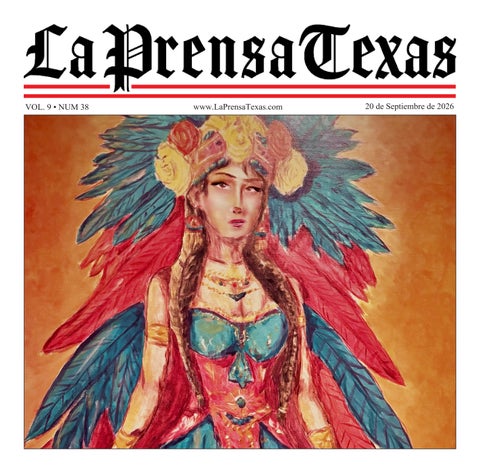
VOL. 9 • NUM 38
www.LaPrensaTexas.com
20 de Septiembre de 2026
2
La Prensa Texas SAN ANTONIO
Let’s Talk About It:
Founded 1913 - Fundada en 1913
Our Language, Our Heritage, Our Power
Publisher / Editora: Yvette Tello y.tello@laprensatexas.com Community Liaison / Enlace Comunitario: Ramon Chapa Jr. r.chapa@laprensatexas.com Advertising & Production Coordinator / Coordinadora de Publicidad y Producción: Jessica Medrano Contributors / Colaboradores: Dr. Ricardo Romo Priscilla Sanchez - Hurt info@laprensatexas.com Editor Español: José I. Franco Sales Representative / Representante de Ventas: Maria Cisneros La Prensa Texas is a grassroots, bilingual publication that serves as a vital voice for the community especially for those who are too often left out of mainstream media conversations. Since its founding, La Prensa Texas has been dedicated to providing relevant, accessible, and culturally rooted news that reflects the lives, struggles, and triumphs of the people of San Antonio and surrounding counties. Our mission is simple yet powerful: to inform, inspire, and empower our readers through storytelling that uplifts the diverse voices of our community. This publication continues to be the lifeline of local news, bridging the gap between the people and the stories that matter most.
Send Press Releases and Advertising Inquiries to: Info@LaPrensaTexas.com 210-628-9611
20 de Septiembre de 2026
By Yvette Tello
The lack of diversity in education has effects on kids, especially people of color. Many Hispanic children grow up feeling ashamed of their heritage, often refusing to speak Spanish because they’ve been taught it’s something to hide. This shame can lead them to loudly declare they don’t understand Spanish, almost as if they’re trying to distance themselves from their roots. For years: speaking Spanish or other languages was seen as bad. In Texas, it was even illegal to speak Spanish in schools until 1973! . Instead of celebrating bilingualism, which can actually lead to better job opportunities and a richer cultural identity, many were taught to feel embarrassed.. We need to teach kids the value of their heritage and the benefits of being multilingual . We need to help them embrace who they are instead of feeling ashamed. But in order to do that, we need to embrace it. There is no shame in being brown. Do you agree? Let’s talk about it….
Raymond Torres: “My last name is Torres, I don’t speak Spanish. My mother was native German, I was raised around whites. So, I was always treated white, I didn’t feel any discrimination growing up. Now my father was in the military, so we were used to all races. This forced tolerance on all. My neighborhood was predominantly military, so there were white, Hispanic and blacks all getting along.” Tracy Bogert: “Born and raised in South Texas, I love the Hispanic culture and the Hispanic people I would live nowhere else. I love the language, the art, the food and everything about it. I have been married to a beautiful talented intelligent Latina for 35 years. One of my daughters was on a volleyball team with older kids. My daughter is a redhead white as a bed sheet but half Latina. A couple of the girls were talking about her repeatedly in front of her. She finally had to inform them that she was completely understanding them. My daughter is fluent in Spanish, reading, writing, and speaking.” Mike Gonzalez: “I recall getting sent to the Principal’s office repeatedly because I would not allow myself to be paddled for speaking Spanish in class.
Having grown adults hitting children on the rear with a wooden board was sadistic. And I never allowed it to happen to me.” Veronica Amaro: “I only spoke Spanish until I was six years old. When I started kindergarten, neither of my teachers spoke Spanish, and one of them was openly prejudiced toward me. I was placed in Special Education even though the real issue was that English was not my first language. I am a first-generation American, and today I can read, write, translate, and fully appreciate Spanish as my first language. My mother came to this country alone at just 13 years old. Her sacrifice makes me incredibly proud. What many of us experienced in the 1970s and ’80s became lessons that helped us become stronger and prepared us to create something better for the next generation. Racism still exists, but some of the most painful discrimination I have experienced has come from within our own community because I married outside my race. That one stings. Eventually, I decided to stay in my own lane and stop trying to please anyone but God. I pursued an education in technology and became a software engineer at a time when Mexican American women were rarely even considered for those opportunities. It was
a male-dominated industry, but I accepted the challenge, overcame the obstacles, and took advantage of every opportunity that came my way. We can sit and wait for others to approve of who we are, or we can take the bull by the horns. I prefer the latter.” Linda Gaitan Estrada: “I wasn’t born Mexican by choice,I got lucky! Brown and proud. I love all your posts, ma.” Jeff Hull: “You should see what it feels like to have a white-sounding name while growing up in a Mexican community and living fully within the culture, even though your blood runs brown. It can be difficult when your own people judge you because of your name. I was raised by my abuelita in a predominantly Mexican community and immersed in the culture, but sometimes none of that seems to matter. People see my name first and make assumptions about who I am. It has been painful at times to feel ostracized by my own community, especially within the art community. Discrimination can take many forms, and sometimes the rejection that hurts the most comes from the people you thought would understand you best.”
20 de Septiembre de 2026
La Prensa Texas SAN ANTONIO
3
About the Artist
George Bedoy By La Prensa Texas
George Bedoy is a 17-year-old artist hailing from San Antonio, Texas. He is currently a student at Sandra Day O’Connor High School in Helotes, actively participating in the Art Program and ranking among the top students in his class. From an early age, George exhibited a strong drive to excel, but it was the arts that truly captured his heart. His artistic journey began in childhood, gaining significant momentum in middle school around 2020. Faced with the choice of electives such as Band, Orchestra, and Art, George chose art, a decision that would profoundly shape his future. This pivotal moment marked the beginning of his exploration into the world of creativity. As he has matured as an artist, George’s style has devel-
oped into a unique blend of illustrative works. His pieces are known for their dynamic use of color and a combination of rough and defined pen strokes, resulting in expressive creations that embody Semi-Surrealist Expressionism and Contemporary Realism. His art delves into serious psychological themes related to the human mind and nature, inviting viewers to engage in thoughtful interpretation. Recently, he has also begun to explore painting, particularly enjoying the medium of acrylics.George has participated in various art competitions, earning multiple regional-level medals in the Visual Arts Scholastic Event (VASE). This year, he has experienced significant growth through mentorship with Donald Darst, curator and partial owner of the Helotes Gallery. This opportunity has al-
lowed him to collaborate with other artists and gain insights into the local art community and the business side of art. On May 9th and 10th, 2026, George showcased his work in a personal gallery exhibit at the Helotes Gallery, featuring a series that depicted the gallery itself along with nine additional pieces. This mentorship has been a crucial step toward his aspirations as an artist, and he is eager to see where this journey takes him. George plans to major in Studio and Fine Arts in college while also studying Mathematics and Architectural/ Interior Design, with the goal of becoming a Concept Artist in the future. How to Contact George Bedoy: Instagram:@george_bedoy Email: georgebedoy02@gmail.com
4
La Prensa Texas SAN ANTONIO
20 de Septiembre de 2026
Una Fuerza Para La Gente The Legacy of Carmen Gamez By Celinda De La Fuente
There is a photograph in the reception area of the Gamez Law Firm of about 36 young men, all dressed in white shirts, khakis, belts which they did not own the week before. Mr. Maldonado, their Counselor at Lanier High School told Carmen Gamez that he wanted his “Men of Honor” to make a great impression when visiting the Capital in Austin. Mr. Maldonado set out to the Goodwill in search of attire for the students. Mrs. Gamez just happened to called Mr. Maldonado while he was at The Goodwill. Without hesitation, Mrs. Gamez said “don’t worry about shopping at the Goodwill, I am on it”. Mrs. Gamez asked for a list of names and sizes. Within days, the students had brand new shirts, slacks, belts and shoes compliments of the Joe Gamez Law Firm. Mr. Maldonado presented Mrs. Gamez with a photograph of the students outside Lanier High School all dressed up in their new clothing. Mr. Maldonado shared with Mrs. Gamez how the mothers of many of these boys cried from the pride of
seeing their sons all dressed up ready to visit the State Capital. This is just one of many stories Mrs. Gamez has been a part of our community all these years. Carmen Gamez does not measure a life’s work by titles and bank accounts. She measures it by the warmth in a child’s shoes, the pride in a young man’s suit, and the quiet dignity restored to familias aqui en San Anto. While public headlines may center on her husband, prominent attorney and former State Representative Joe Gamez, anyone who sits down with Carmen quickly realizes she is not a supporting character in someone else’s script. She is una fuerza, una educadora, a community steward, and a living testament to what happens when a Latina lead con puro corazon. Mrs. Gamez’s story of service began in the classrooms of Edgewood ISD, teaching kindergarten and third grade at Burleson Elementary and Henry B. Gonzalez Elementary. Mrs. Gamez earned her bachelor’s degree in El mentary Education with a bilingual endorsement from UTSA, learned that teaching was more than standing in
front of a classroom. And it was there, con los ninos, in some of San A to’s most underserved neighborhoods, that her vision for community elevation was forged. “Teaching at Edgewood was the foundation for really who I am and my beliefs,” Gamez shared. In her first years, she encountered realities that institutional policies were never designed to handle. It was at Burleson Elementary where Gamez, a new bilingual educator at the time, met a 5-year-old little girl who was sent to school one freezing morning with no socks. When Mrs. Gamez asked the child why she came to school with no socks in freezing weather. The child did not reply. The next day the child told Mrs. Gamez “Teacher, my mom said if you want me to wear socks, you buy them. We ain’t got no money.” Without skipping a beat, Mrs. Gamez did, in fact, purchase socks underwear and sweater, quietly slipping them into her student’s backpacks one child at a time until the principal called her into the office and explained buying clothes for students was against Central Office policy. Con ganas, she
stood her ground and kept at it. When la genteneeds help, sometimes you bypass the red tape and take care of familia. “Those little kids were excited about learning, they were like little sponges ,” Gamez said with a sigh of compassion. “They just needed someone who cared. And that’s where my journey began.” Four decades later, that journey, mi gente, has a number attached to it. The Gamez Law Firm has given more than $2.5 million to community causes in the last three years alone, in the form of scholarships, tuition, mortgage payments for families facing a child’s cancer diagnosis, community fashion shows, camps, choir robes, mariachi uniforms, and the list goes on and on. But Mrs. Gamez is careful to draw the line between checkbook philanthropy and being a servant
20 de Septiembre de 2026 of La Gente. It’s not about the size of the donation or gift. It is about showing up for the child who has never had someone show up for them. And that is the thread that runs so beautifully through this tapestry: two students at St. Mary’s University now have half their $50,000 annual tuition covered, after a dean told Mrs. Gamez that splitting one full scholarship into two half-scholarships would change more lives. A $1 million gift, once kept quiet, now bears the family’s name on a courtroom and endowed scholarship. Fifteen young women from Edgewood recently received scholarships for college. Four eighth-graders from Las Palmas Elementary’s Girls Leadership School are headed to China for a STEM program – a detail that stopped Mrs. Gamez cold when she heard it. “When I was their age, I was trying to get to go to a camp for a few days with Girl Scouts,” she said. She quickly wrote them a $3,000 check on the spot and still carries gift cards in her purse for each girl. Her commitment to young women continues through her work with the Westside Girl Scouts, where she helped sponsor a hi toric Fiesta brunch raising over $65,000 specifically for Westside summer camps, empowering young girls with computer skills, leadership, and field trips. Mrs. Gamez
La Prensa Texas SAN ANTONIO knows all too well what it is to doubt whether you belong in the room. She grew up one of six children in a household that could not afford college, and she remembers sitting in her car outside her first continuing-education class at 18, unable to make herself walk in. She did not think of herself as college material. Still, she walked in anyway, and came out realizing she was in fact prepared for college since she knew many of the answers asked by her professor. That memory right there is why the We The Women movement fits Carmen so naturally. Even when society has told us we do not belong, we stand up and walk through the door anyway. Carmen reminisced about the women in her life, a strong-willed grandmother, a mother in the labor unions, each one proof that a woman who has done it makes it possible for the next one to believe she can too. Now, La Prensa Texas’ La Gente Award recipient, Carmen Gamezis the one teaching us what we can do if we just get up and walk through that door. Her own grandmother, Dioncia Mendoza, rose at 5 am each morning, paid the bills in person, taught Sunday school, and still cooked for forty grandchildren after church. Mrs. Gamez’s mother was a union activist at a local department store, standing on the frontlines
for women’s equal pay and labor rights while raising 6 children. That is gansa personified. That is the foundation Carmen Gamez has spent her life building on: una mesa wide enough for everyone and making sure no child ever has to ask twice for socks. And that legacy of vocal, active leadership will continue through Mrs. Gamez, through her familia, and all those who have been impacted by this Mujer’s compassion and generosity. “Latina women are strong in numbers, Mrs. Gamez emphasized. “We just need to support each other. We embrace our culture, we embrace our language, and we go out there and show them what we are capable of. We have to keep that candle burning.” This is why La Prensa Texas is proud to honor Carmen Gamez at the 2026 La Prensa Texas Gala during Hispanic Heritage Month as part of the celebration of culture, legacy, and We the Women movement. We honor a woman who never forgot where she came from, who never stopped giving back, who proves that our roots, our cultura, y nuestra communidad are the very source of our power. “Take it one day at a time. Don’t let anyone rob your dream. Life’s not fair, but God is Good, and you just keep pressing forward.” Wise words from the champion of La Gente.
5
6
La Prensa Texas SAN ANTONIO
20 de Septiembre de 2026
Comisión de Calidad Ambiental de Texas
AVISO DE RECIBIMIENTO DE LA SOLICITUD E INTENCIÓN DE OBTENER UN PERMISO DE AIRE (NORI) NÚMERO DE PERMISO DE CALIDAD DEL AIRE 43833
SOLICITUD Southwest Research Institute, ha solicitado a la Comisión de Calidad Ambiental de Texas (TCEQ, por sus silgas en inglés) para: Enmienda del Permiso 43833. Esta solicitud autorizaría la modificación del Southwest Research Institute ubicado en 6220 Culebra Road, San Antonio, Bexar Condado, Texas 78238. Esta solicitud se tramita de manera acelerada, tal y como permiten las normas de la Comisión en el Título 30 del Código Administrativo de Texas, Capítulo 101, Subcapítulo J. Este enlace a un mapa electrónico de la ubicación general del sitio o instalación se proporciona como cortesía pública y no como parte de la solicitud o aviso. Para conocer la ubicación exacta, consulte la aplicación. https://gisweb.tceq.texas.gov/LocationMapper/?marker=-98.610277,29.452222&level=13. La instalación emitirá los siguientes contaminantes: amoníaco, monóxido de carbono, contaminantes atmosféricos peligrosos, cloruro de hidrógeno, sulfuro de hidrógeno, óxidos de nitrógeno, compuestos orgánicos, materia particulada con diámetro menor o igual a 2.5 micrómetros y material particulado con diámetros menor o igual a 10 micrómetros, plomo y dióxido de azufre. Esta solicitud se presentó a la TCEQ el 24 de Agosto de 2026. La solicitud estará disponible para su visualización y copia en la oficina central de la TCEQ, la oficina regional de la TCEQ en San Antonio y en Potranco Branch Library, 8765 State Highway 151 Access Road, San Antonio, Condado de Bexar, Texas a partir del primer día de publicación de este aviso. El archivo de cumplimiento de la instalación, si existe alguno, está disponible para su revisión pública en la oficina regional en San Antonio de la TCEQ. La solicitud (cualquier actualización inclusive) está disponible electrónicamente en la siguiente página web: https://www.tceq.texas.gov/permitting/air/airpermit-applications-notices. El director ejecutivo ha determinado que la solicitud está administrativamente completa y llevará a cabo una revisión técnica de la solicitud. COMENTARIO PÚBLICO. Usted puede enviar comentarios públicos a la Oficina del Secretario Oficial en la dirección a continuación. La TCEQ considerará todos los comentarios públicos al desarrollar una decisión final sobre la solicitud y el director ejecutivo preparará una respuesta a esos comentarios. REUNIÓN PÚBLICA. Puede solicitar una reunión pública a la Oficina del Secretario Oficial en la dirección a continuación. El propósito de una reunión pública es para brindar la oportunidad de enviar comentarios o hacer preguntas sobre la solicitud. Se llevará a cabo una reunión pública sobre la solicitud si lo solicita una persona interesada y el director ejecutivo determina que existe un grado significativo de interés público en la solicitud o si lo solicita un legislador local. Una reunión pública no es una audiencia de caso impugnado. ANUNCIO DE SOLICITUD Y DECISIÓN PRELIMINAR. Además de este NORI, 30 Texas Admin. Cod. (TAC) § 39.419 requiere que esta solicitud también tenga un Aviso de Solicitud y Decisión Preliminar (NAPD, por sus siglas en inglés) después de que se determine que la solicitud está técnicamente completa y se prepare un bosquejo de permiso. Tenga en cuenta que: La TCEQ puede actuar sobre esta solicitud sin emitir un NAPD y sin buscar más comentarios públicos o proporcionar más oportunidades para una audiencia de caso impugnado si los cambios en las representaciones en la solicitud hacen que la solicitud ya no esté sujeta a los requisitos de aplicabilidad de 30 TAC § 39.402. En tales casos, este NORI será su aviso final de esta solicitud y no tendrá oportunidades adicionales para hacer comentarios o solicitar una audiencia de caso impugnado. Si se requiere un NAPD, se publicará y enviará por correo a aquellos que hicieron comentarios, enviaron solicitudes de audiencia o están en la lista de correo para esta solicitud, y contendrá la fecha límite final para enviar comentarios públicos.
20 de Septiembre de 2026
La Prensa Texas SAN ANTONIO
OPORTUNIDAD PARA UNA AUDIENCIA DE CASO IMPUGNADO. Puede solicitar una audiencia de caso impugnado si usted es una persona que puede verse afectada por las emisiones de contaminantes del aire de la instalación. Si solicita una audiencia de caso impugnado, debe presentar lo siguiente: (1) su nombre (o para un grupo o asociación, un representante oficial), dirección postal y número de teléfono diurno; (2) nombre y número de permiso del solicitante; 3) la declaración “[Yo/nosotros] solicitamos una audiencia de caso impugnado”; (4) una descripción específica de cómo se vería afectado negativamente por la aplicación y las emisiones atmosféricas de la instalación de una manera no común para el público en general; (5) la ubicación y distancia de su propiedad en relación con la instalación; (6) una descripción de cómo utiliza la propiedad que puede verse afectada por la instalación; y (7) una lista de todas las cuestiones de hecho en disputa que envíe durante el período de comentarios. Si la solicitud es hecha por un grupo o una asociación, uno o más miembros que tienen capacidad para solicitar una audiencia deben ser identificados por su nombre y dirección física. También deben identificarse los intereses que el grupo o asociación busca proteger. También puede presentar los ajustes propuestos a la solicitud / permiso que satisfagan sus inquietudes. La fecha límite para presentar una solicitud para una audiencia de caso impugnado es de 30 días después de que se publique el aviso del periódico. Si una solicitud se presenta oportunamente, la fecha límite para solicitar una audiencia de caso impugnado se extenderá a 30 días después del envío de la respuesta a los comentarios. Si una solicitud de audiencia se presenta oportunamente, después del cierre de todos los períodos de comentarios y solicitudes aplicables, el Director Ejecutivo enviará la solicitud y cualquier solicitud de audiencia de caso impugnado a los Comisionados para su consideración en una reunión programada de la Comisión. La Comisión sólo podrá conceder una solicitud de audiencia de un asunto impugnado sobre cuestiones que el solicitante haya presentado en sus observaciones oportunas que no hayan sido retiradas posteriormente. Si se concede una audiencia, el tema de una audiencia se limitará a cuestiones de hecho en disputa o cuestiones mixtas de hecho y de derecho relacionadas con preocupaciones relevantes y materiales sobre la calidad del aire presentadas durante el periodo de comentarios. Cuestiones como los valores de las propiedades, el ruido, la seguridad del tráfico, y la zonificación están fuera de la jurisdicción de la Comisión para abordar en este procedimiento. LISTA DE CORREO. Además de enviar comentarios públicos, puede solicitar ser colocado en una lista de correo para recibir futuros avisos públicos para esta solicitud específica enviando una solicitud por escrito a la Oficina del Secretario Oficial a la dirección a continuación. CONTACTOS E INFORMACIÓN DE LA AGENCIA. Los comentarios y solicitudes del público deben enviarse electrónicamente a www14.tceq.texas.gov/epic/eComment/, o por escrito a Texas Commission on Environmental Quality, Office of Chief Clerk, MC-105, P.O. Box 13087, Austin, Texas 78711-3087. Tenga en cuenta que cualquier información de contacto que proporcione, incluido su nombre, número de teléfono, dirección de correo electrónico y dirección física, se convertirá en parte del registro público de la agencia. Para más información sobre el proceso de tramitación de permisos, favor de llamar al Programa de Educación pública de la TCEQ sin costo al 1-800-687-4040, o bien visitar su sitio web, www.tceq.texas.gov/goto/pep. Para información en español, favor de llamar al 1-800-687-4040. También es posible consultar oportunidades de participación pública en nuestro sitio web, www.tceq.texas.gov/goto/ participation. También se puede obtener más información de Southwest Research Institute, 6220 Culebra Road, San Antonio, Texas 78238-5166 o llamando a Sra. Amber Chapman, Científica Ambiental Principal al (210) 522-3271. Fecha de emisión del aviso: 31 de Agosto de 2026
7
8
La Prensa Texas SAN ANTONIO
20 de Septiembre de 2026
20 de Septiembre de 2026
La Prensa Texas SAN ANTONIO
9
Daily Habits We Take for Granted Until the World Goes Dark By J. Gilberto Quezada Life has a gentle way of settling into routines that feel so natural, so automatic, that we hardly notice them. Every day, we flip light switches without thinking, illuminating rooms as if the glow were stitched into the walls themselves. We open the refrigerator expecting cool air and fresh food, and we trust the freezer to keep tomorrow’s meals safe and waiting. In the relentless Texas heat especially the 100 degree summers in San Antonio we rely on the steady hum of the central A/C, a quiet guardian that keeps our home livable. These habits become invisible threads woven into our daily comfort, so familiar that we forget how fragile they truly are. But everything changed on Friday evening, August 28th, at around 9:30. A violent, tornado like storm tore through the neighborhood, roaring with a force that felt almost personal. In an instant, the lights blinked out, the hum of the A/C died, and the house fell into a heavy, unfamiliar silence. Jo Emma and I and our two Chihuahua dogs were left with only two small battery powered fans to fight the suffocating heat. Nights became long and restless, and days felt slow and
sticky. Without electricity, even the simplest habits turning on a lamp, cooling off in front of a vent, opening the fridge for a cold drink became impossible. It was startling how quickly comfort turned into discomfort, and how deeply we felt the absence of things we once never noticed. And thank Almighty God that we still had running water and the use of the toilet. The storm didn’t stop at the power lines. Its winds, whipping at 80 miles per hour, uprooted two large trees in our backyard as if they were twigs. Heavy branches from the old mesquite tree in the front yard were hurled against the patio, blocking the door so completely that we couldn’t step outside. The damage was not just physical it was emotional. Seeing our home battered, our yard transformed, and our routines shattered brought a heaviness that lingered long after the winds died down. The five photos in the attachments we took show the raw force of nature hovering over our home, a reminder of how quickly life can shift. For three long days until Monday morning, August 31st we lived without the conveniences we had always trusted. No cool air at night, no fresh food from
the refrigerator, no comfor- darkness to help us see them ting glow of lamps in the clearly again. evening. We slept poorly, ate sparingly, and waited for the return of something we had never truly appreciated: electricity. In that waiting, we learned how much of our daily life depends on small, quiet miracles. Even habits like charging a phone, turning the light on to go to the bathroom, brushing and flossing our teeth, or watching the evening news suddenly felt precious in their absence. And the monitor for my pacemaker, which I keep on the nightstand next to me, was out for lack of power. When the power finally returned, gratitude washed over us not just for electricity, but for the countless daily habits that shape our comfort and stability. We realized that life’s simplest routines are gifts from God we often overlook, until the day they vanish and leave us longing for their quiet presence. This storm taught us a lesson we didn’t know we needed: the everyday habits we take for granted are the very ones that make our lives feel whole. Light switches, refrigerators, air conditioning, and even the ability to open our front door these are not just conveniences, but blessings. And sometimes, it takes a sudden
10
La Prensa Texas SAN ANTONIO
20 de Septiembre de 2026
Shelly Lares
A Tejana Voice for Faith, Legacy, and Women Rising By Yvette Tello
Interview by Celinda De La Fuente
Shelly Lares has spent most of her life using music to move people. Her voice has carried through dance halls, family celebrations, radio stations, concert stages, classrooms, studios, and now hospice rooms where songs become comfort, memory, and prayer. But when Lares speaks about her legacy, she does not begin with fame. She begins with faith. She begins with family. She begins with integrity. Born and raised in San Antonio near Culebra and 36th Street, behind St. Mary’s University, Lares carries the West Side with her everywhere she goes. That neighborhood shaped her understanding of culture, community, and service. She grew up in a musical household, surrounded by family members who could sing or play instruments, and by parents who taught her to work hard, stay grounded, and do everything with purpose. “I became a recording artist at 10 years old,” Lares shared. “I’ve been doing everything I love my entire life.” That love became a calling. For decades, Lares helped shape Tejano
music as one of the genre’s most recognized female voices. She entered an industry where women were often compared to one another, criticized more harshly than men, and placed in competition for limited recognition. Rather than accept that culture, Lares stood in her own authenticity. She knew every woman brought something different to the table. She knew Tejano music had room for all of them. That spirit is exactly why Lares aligns so naturally with La Prensa Texas’ We the Women movement. We the Women is not about competition. It is about alignment. It is about women supporting one another loudly, honoring one another publicly, and refusing to carry forward the old wounds of gatekeeping, jealousy, and division. It is about recognizing that when one woman rises with integrity, she creates room for another woman to rise too. Shelly Lares has lived that message. As a Tejana, artist, producer, mentor, teacher, and woman of faith, Lares represents the kind of leadership We the Women was created to celebrate. She does not simply open doors for herself. She opens doors for others. She does not hoard knowledge. She teaches it. She does not build her legacy by standing above others. She builds it by pouring into the next generation. At ShellShock Records 3, her studio and label, Lares has created a space rooted in “God, family, integrity.” Artists who walk through her doors are not treated like products. They are treated like people with purpose. Before the music begins, she often asks them one of the most important questions an artist can answer: Why do you want to do this? For Lares, the answer matters. Music is not something to chase only for attention, money, or viral moments. It is a gift. It is a responsibility. It is something that can become part of someone’s life forever. That is why she challenges artists to know who they are, understand their purpose,
and approach their craft with honesty. In many ways, her studio has become more than a studio. It has become a place of mentorship, prayer, reflection, laughter, and sometimes tears. Artists of all ages come to her not only for production, but for guidance. Lares understands that many people did not grow up with the kind of support and foundation she received from her parents. So when she can be that support for someone else, she does. “Mentorship is very important to me,” she said. “I mentor all ages, from children to adults.” That is We the Women in action. It is mentorship over gatekeeping. It is wisdom passed down instead of withheld. It is the belief that a woman’s lived experience is not something to hide, but something that can become a bridge for someone else. Lares also carries that same mission into education. Today, she is helping answer an important question for a new generation: What is Tejano music? As the first Artist in Residence at UTSA, she has worked to bring more awareness to Tejano music on campus. After years of speaking in music, audio technology, Selena, and music industry classes, she helped build a true Tejano ensemble where students learn not only how to perform the music, but how to understand where it comes from. In her classroom, students study the different styles of Tejano music, from conjunto to orquesta to progressive sounds. They learn history. They learn instrumentation. They hear from veteran artists who helped shape the genre. Most importantly, they learn that the music did not begin as a product. It began as culture. It began as an expression. It began as love. “We’re not just Mexican music, and we’re not just American music,” Lares explained. “We’re Mexican American music.” That statement carries the heart of her work. Lares understands that preserving Tejano music is also preserving the story
20 de Septiembre de 2026 of a people. It is preserving the sound of families who lived between cultures, languages, borders, and generations. It is pre serving the beauty of a community that has always created something powerful out of its ownexperience. Lares wants students to understand that being an artist is more than singing notes or playing the right chords. It is about knowing why you are doing it. It is about respecting the gift. It is about honoring the people who came before you while making room for those who are still finding their voice. Her service does not stop with students and artists. After stepping away from the road, Lares felt called toward hospice care. At one point, she planned to pursue nursing, believing that was where God was leading her. But then Harmony Hospice Care, owned by her cousin Sylvia, invited her to provide music support for patients. That invitation changed everything. Lares realized that the gift she had carried on stages for decades still had sacred work to do, only now at the bedside of people nearing the end of life. Through music, she has seen patients with dementia remember lyrics when they could not remember names. She has watched bedbound patients move their feet, clap their hands, and reach for her hand to dance from where they lay. She has witnessed anxiety soften, sadness lift, and families receive comfort in some of their most difficult moments. One story still stays with her. Lares visited a woman who loved mariachi music, but the patient’s daughter warned that her mother was not having a good day. Lares gently introduced herself and mentioned mariachi music. The woman’s eyes opened. When Lares began singing a bolero, the patient sat up and sang with her. The room changed. Her daughter cried. A moment that began in heaviness became a moment of connection. On another visit, Lares met a man with severe dementia who had once played saxophone in a big band. At first, he did not remember the instrument was his. But when Lares placed it in his hands, something awakened. His body remembered. His hands found their place. He began to play. His
La Prensa Texas SAN ANTONIO daughter ran into the room, stunned, saying he had not played in more than 20 years. For Lares, moments like that prove what she has always known: music heals. It reaches places words cannot. It moves through memory, spirit, grief, joy, and love. It comforts not only the patient, but the family gathered nearby. It reminds people that even in transition, there is beauty. There is presence. There is dignity. Through every chapter of her life, Lares returns to faith. She speaks openly about prayer, alignment, self-growth, and learning to trust God’s direction even when the path does not look the way she imagined. She once thought retirement from the road meant stepping away from music. Instead, it opened a new season where music became classroom, ministry, mentorship, healing, and legacy. The connection between Shelly’s identity, representation, and We the Women. Lares also understands the power of representation. As a San Antonio woman, a Tejana, a faith-filled leader, a mentor, and a member of the LGBTQ+ community, she knows someone is always watching. A child. An artist. A woman wondering if it is too late. A person wondering if they can still be fully themselves and fully loved by God. Her message is simple: be real, be kind, be rooted, and be yourself. “God is love,” Lares said. “That’s my definition of love.” This is why La Prensa Texas is proud to honor Shelly Lares at the 2026 La Prensa Texas Gala during Hispanic Heritage Month as part of the celebration of culture, legacy, and the We the Women movement. Her recognition is not only for what she has accomplished on stage, but for what she continues to give back off stage. She represents the Cultura y Música spirit of San Antonio: rooted, faithful, creative, generous, and unapologetically authentic. This is why La Prensa Texas is proud to honor Shelly Lares at the 2026 La Prensa Texas Gala during Hispanic Heritage Month as part of the celebration of culture, legacy, and the We the Women movement. Her recognition is not only for what she has accomplished on stage, but for what she continues to give back off
11 stage. She represents the Cultura y Música spirit of San Antonio: rooted, faithful, creative, generous, and unapologetically authentic. Shelly Lares reminds us that women do not have to become hardened by the industries that tried to limit them. They can become wiser. They can become mentors. They can become builders. They can become healers. They can become the example someone else needed to see. Her story speaks directly to the heart of We the Women: we are not here to compete for crumbs. We are here to build together. We are here to honor the women who came before us, support the women beside us, and prepare the way for the women coming after us. Lares has done that through music. Through faith. Through mentorship. Through service. Through love. And as La Prensa Texas prepares to honor her in 2026, we are also honoring what she represents: a woman who has never forgotten where she came from, never stopped growing, and never stopped using her gift to serve others. Shelly Lares is more than a Tejano icon. She is a cultural keeper, a mentor, a healer, and a living example of what it means to be aligned with purpose. She is We the Women.
12
La Prensa Texas SAN ANTONIO
20 de Septiembre de 2026
The Art of Tejas: From Castas to Chicanos By: Ricardo Romo, PH.D
In 1776, when the Declaration of Independence was signed in Philadelphia, Latinos in San Antonio had celebrated 58 years since its settlement. Mexicans from colonial New Spain who settled the region in the 1680s adopted the name Tejas used by the Indigenous tribes. As a Spanish province, Tejas was settled before some of the original Thirteen Colonies. Tejanos, as the Spanish colonists of the province were known, built presidios, missions, and towns in Texas half a century before the inauguration of the first U.S. president. When America celebrated its 250th anniversary on July 4th of 2026, the Briscoe Museum of Art in San Antonio opened its exhibit, Tejano Legacy: Another American Origin Story. The exhibit focused on the Tejano artistic contribution to Texas over the past 400 years. The Briscoe is among the few museums in the United States, if not the only one, that has celebrated the 250th anniversary of the founding of the United States via a regional Hispanic story, not one driven solely by the events in Philadelphia and the thirteen colonies. The Briscoe’s Tejano Legacy is a landmark bilingual exhibition exploring Tejano history, culture and identity, and the enduring influence of Tejanos on Texas and the American West. The exhibit demonstrates that families, communities, language, religion, land-use traditions, and local institutions in Texas did not begin with the establishment of the Republic of Texas in 1836 or with U.S. annexation as a state in 1845. It is fitting that the Tejano Legacy exhibit opened this year given the announcement of the recent U.S. Census that Hispanics make up the largest ethnic
group in the Lone Star state, with 40.2 percent of the population. The exhibit reminds us that much has changed over the last century. Earlier museum exhibits in Texas generally treated Tejanos or Latinos as a minority or marginalized group, while the Briscoe emphasizes the roles played by Latinos in the Southwest part of the United States. The Tejano Legacy exhibition is the most ambitious in the Briscoe Museum’s history and features more than 100 rare artworks and artifacts. It includes immersive storytelling drawn from extraordinary private collections, the Briscoe’s permanent collection, and institutional lenders from across the United States and Mexico. Several works loaned from Mexican institutions, considered part of the Mexico’s cultural and historical heritage, will be seen in the United States for the first time. The exhibit offers visitors a rare opportunity to experience objects and artworks that deepen and broaden the understanding of Tejano identity and its connection to the story of the American West. Spanning from the 16th century to modern times, Tejano Legacy traces the evolution of Tejano identity through art, ranching traditions, military service, music, faith, and community. Many of the historical objects, saddles, firearms, and textiles were loaned anonymously by prominent Tejano ranching families from South Texas and Rio Grande Valley communities. Through these objects and numerous paintings, the exhibition highlights the resilience, innovation, and cultural influences that continue to shape South Texas, San Antonio, and the Southwest today. Among the more interesting paintings in the Tejano Legacy exhibit are the ten artworks related to the Mexican castas social stratification system.
For indepth discussion of the casta system, I consulted the work of Sindy Valdez, president of the Society of Hispanic Historical & Ancestral Research. Her essay, “Understanding the Mexican Casta System: A Historical and Cultural Perspective,” offered excellent insights into the casta paintings featured at the Briscoe exhibit. Spain ruled Mexico as a colony for three centuries, 1520-1820. Over that period, the Spanish colonists introduced more than fifty new terms for racial and ethnic classification, including mestizo and Indio, which survive to this day in Mexico and Tejas. We learn from the paintings that Spanish colonial society in Mexico was highly stratified. The casta paintings, noted Sindy Valdez, “typically portrayed Spaniards and their pure-blood descendants in favorable, dignified positions, often juxtaposed against the less flattering depictions of mixed-race individuals.” She noted, for instance, that the “attire, posture, and accessories of the individuals provide subtle cues about their socio-economic status.”
Artist Once Known (New Spain), De español y mulata, produce morisca, from Mexican Castas series, ca. 18th century. Courtesy of Museo de Historia Mexicana, Monterrey, Mexico. Courtesy of the Briscoe Museum of Western Art.
20 de Septiembre de 2026 Some of the Spanish colonial terms for ethnic and racial groups used during the 19th century were popularized by war and conflict. When Mexico rebelled against Spain and its colonial rulers, the rebel armies that marched with Father Miguel de Hidalgo in 1810 shouted “Death to the gachupines.” The term referred to the Spaniards whom the colonial Mexicans perceived as arrogant, exploitative, and culturally condescending. In an essay by Professor Lauren G. Kilroy-Ewbank titled “Casta paintings: Spaniard and Indian Produce a Mestizo,” the author quotes an inscription on José Joaquín Magón’s painting, The Mestizo. Magón explained, “In America people are born in diverse colors, customs, temperaments and languages. From the Spaniard and the Indian is born the mestizo, usually humble, quiet, and simple.” Sindy Valdez explained that by “depicting the different racial mixtures and their supposed societal roles, these artworks served as a form of visual propaganda that endorsed and normalized the racial stratification of the time.” She added further that the casta paintings offer us a “lens through which to view the complexities of Mexico’s colonial history and its lasting impact on contemporary society.” The exhibit also included works by Chicano artist César Martínez and Tejana artist Gladys Roldán-de-Moras. Cesar Martinez, a native of Laredo, lives and works in San Antonio. He is a veteran of many shows in Texas and beyond. Martinez attended college in Kingsville, Texas in the late 1960s, where he met the new generation of artists who identified as Chicanos. Martinez moved to San Antonio after serving in the U.S. Army, and by the early 1980s he began exhibiting nationally. He won major prizes for his paintings, including first prize in ¡Mira! The Canadian Club Hispanic Art Tour. Martinez’s painting in the Briscoe show, a Chicano wearing his high school letterman jacket, is a prime example of his “bato” series. His work is in major museums, including the
La Prensa Texas SAN ANTONIO
13
Smithsonian Museum of American Art. Gladys Roldán-de-Moras’s paintings of Tejano charros, horsemen, and missions are well-known in San Antonio and beyond. Her paintings include escaramuzas known as charras, a representation of women who ride sidesaddle in synchronized, high-speed equestrian competitions, wearing elaborate traditional dresses. Roldán-de-Moras’s painting in the Tejano Legacy exhibit is of a young girl dressed in a charra outfit holding a toy horse head, a representation of the larger equestrian culture and ceremonial world of Mexican charrería.
Cesar Martinez, Bato Series. Courtesy of the Briscoe Museum of Western Art. Photo by Ricardo Romo.
José de Alcibar, de español y morisca, nace albina, from Mexican Castas series, 18th century. Museo de Historia Mexicana, Monterrey, México. Courtesy of the Briscoe Museum of Western Art.
José de Alcibar, De coyote e yndia, nace chamiso. From the Mexican Castas series, 18th century. Museo de Historia Mexicana, Monterrey, México. Courtesy of the Briscoe Museum of Western Art.
Gladys Roldán-de-Moras. Courtesy of the Briscoe Museum of Western Art. Photo by Ricardo Romo.
14
La Prensa Texas SAN ANTONIO
20 de Septiembre de 2026
A Legacy of Service, Faith, and Family Honoring Steve A. Duran By Celinda De La Fuente This year, La Prensa Texas has the privilege of honoring Steve A. Duran with the Lifetime Achievement Legacy Award, recognizing a life that has been defined not simply by professional accomplishments, but by service, sacrifice, faith, family and an unwavering commitment to his community.For Steve, however, this recognition carries a meaning unlike any award that came before it. “I’ve gotten a lot of awards,” he says. “I’ve never gotten a lifetime achievement award. Especially coming from La Prensa, it’s nice because it’s family to me.” Long before he sat behind a publisher’s desk, Steve understood the meaning of service. He comes from a military family. His father served. His grandfather served. Steve followed that tradition because, he says simply, he wanted to serve his country. Today, that tradition continues through another generation, with his son and grandchildren serving in the Navy.It gave him discipline.“You come out of there with a discipline that you never had before,” he recalls. He later spent ten years as a police officer, including working as an investigator. That experience taught him another lesson that would follow him throughout his life: how to deal with people. He learned to communicate with individuals from different backgrounds, personalities and circumstances. He learned to understand moods, remain composed under pressure and listen closely. Those skills would eventually serve him well in a profession he never expected to enter. Journalism. Steve’s journey into newspapers began in 1988, in typical Tino Duran fashion. His father, Florentino “Tino” Duran, was opening a Fort Worth newspaper called El Informador. Steve, because of his investigative work, had experience using computers at a time when newspaper operations were beginning to change. Tino needed someone to computerize the paper. Steve told his father he believed he could do it. One day, Tino came home with a computer. “Here, do it,” he told his son. And Steve did. There was no lengthy training program. No carefully constructed career path. His father gave him the responsibility and trusted him to figure it out. In many ways, that moment summarizes how Tino raised his son. Steve remembers his father being tough on him growing up. It took years before he understood why. “I really understand now that the whole time, he was teaching me to be a better person,” Steve says. Tino was preparing him not merely for a career, but for life. He also taught Steve a philosophy about journalism that would become part of the DNA of La Prensa. Tell the truth. Tell the stories of the community. And don’t build a newspaper around tearing people down. “My dad’s philosophy about the newspaper was that we never wrote bad
stories,” Steve remembers. “They were truthful. We didn’t want to report the gossip. We told good stories about the community. We passed on what was happening in the community, and that’s what we lived on.” That belief helped distinguish La Prensa as something more than a newspaper. It became a community institution. For the Durans, there was rarely a clear line separating family life from newspaper life. Tino was, as Steve describes him, a workaholic. He taught his children a fierce work ethic, and everyone contributed. Steve’s children delivered newspapers. His oldest son, Steve, who later retired from the Navy, helped with graphics. Christopher, Lexi and other members of the family each played a role at one time or another. Children came to work. Grandchildren came to work. Eventually, great-grandchildren could be seen carrying bundles of papers just as generations before them had done. “It was always like that,” Steve recalls. The newspaper was never simply where the Durans worked. It was part of who they were. And two people stood at the center of it all: Tino and Millie Duran. Millie Duran battled serious illness, but even during difficult periods, she remained deeply involved with the newspaper. “She never stopped,” Steve says. La Prensa was her baby too. She knew exactly how she wanted the paper presented and was uncompromising when it came to protecting its standards. She read the stories. She reviewed the content. She challenged decisions. “She fought everybody to make sure it was exactly like that,” Steve says. “She didn’t let anything pass her.” Tino showed the same devotion. Even as Alzheimer’s disease began affecting him, Steve remembers his father continuing to try to deliver newspapers. He would become lost during his routes, but he still wanted to make those deliveries. Even after he was no longer actively working as publisher, Tino continued handing out his business cards, introducing himself through La Prensa and telling people that if he could help them, they should let him know. The title may have eventually changed. The calling never did. That calling would eventually place Steve in one of the most difficult moments of his life. After his father’s passing, the newspaper hifamily had built was struggling. Steve heard that it might close. For him, allowing that to happen was not an option. He took approximately $20,000 from his own retirement savings and put it into keeping La Prensa alive. It wasn’t merely a financial decision. It was a promise between a son and his father. “I told him that I would never let the newspaper close,” Steve says. “Before he died, I said I’d make sure his dream stays there.” Around that same period, Steve had developed a friendship with Yvette Tello through years of working together during Fiesta. He needed someone he could depend on. He chose Yvette. “We became real close,” Steve
remembers. “She guided me through a lot of the Fiesta things, and I just knew somebody that I could trust.” Steve admits he has never been someone with a large circle of friends. He stays close to his family and keeps much of his life private. But trust, once earned, means something to him.“When I find somebody I can trust, I stick with them and I trust them.” Together, Steve and Yvette worked to stabilize La Prensa. When Steve later stepped away, he watched Yvette continue the work. “I think she’s following the legacy I was hoping for,” Steve says. “When I got rid of the newspaper, my thing was to leave my dad’s legacy there. And I think with Yvette, I was able to do that.” Letting go wasn’t easy. Steve missed the newspaper. He missed talking to people. He missed being part of the daily rhythm of the community. Eventually, he called Yvette and offered something that spoke volumes about the trust he had placed in her. Use me however you need me, he told her. Use the Duran family name however you need it. Because keeping the dream alive mattered more than who held the title of publisher. “I promised him I would keep it alive,” Steve says of his father. “And it is still alive.” “I Still Talk to My Dad” For Steve, that connection to his father never disappeared. Tino was deeply spiritual, and Steve says he still feels his father’s presence. “To this day, I still communicate
20 de Septiembre de 2026 with my dad,” he says. “I still ask him for advice.” He believes his father continues watching over the family and the newspaper he loved. And if Steve could say one thing to him today, it would be this: I kept my promise. For a son who spent much of his life trying to live up to the lessons of his father, perhaps there could be no greater legacy. A New Chapter of Service Steve’s public service did not end with journalism. He eventually joined Alamo Colleges, where his commitment to education and workforce development became another extension of his commitment to the community. He rose through the organization and became Director of the Workforce Center at the Toyota Training Center, helping students and workers gain skills and access opportunities that could change their lives. Officially, his workday might have been 8 a.m. to 5 p.m. Steve apparently never paid much attention to that schedule. He routinely arrived around 5:30 in the morning and sometimes stayed until 8 or 9 at night. Why? Because he loved the students. “I have a big belief that if you love what you work, you never work a day in your life,” Steve says. “At Alamo College, I never worked a day in my life because I loved the kids so much.” Even while working at Alamo Colleges, Steve never completely separated himself from La Prensa. He continued helping with the website, artwork and Gala materials. Once again, the newspaper remained part of him. Investing in the Next Generation Education was not only something the Durans wrote about. They invested in it. Through La Prensa, the family established educational endowments that continue to support students. Steve recalls that Alamo Colleges alone holds roughly $200,000 in endowment funding contributed through La Prensa, with scholarship support awarded to students in the newspaper’s name. Additional endowments and scholarship relationships were established with area colleges and universities, including institutions such as the University of the Incarnate Word. Every year, Steve says, letters would arrive from scholarship recipients thanking the family and La Prensa for helping them continue their education. For Steve, those students are part of the legacy too. Because the measure of a community newspaper is not only how many papers it prints. It is how many doors it opens. Virginia: The Woman Beside the Legacy No telling of Steve’s story would be complete without Virginia Duran, his wife of more than four decades. She has stood beside him through the newspaper, Fiesta, public service, long working hours, family responsibilities and life’s unexpected challenges. Steve jokes that their marriage has been “a life sentence.” But underneath the teasing is tremendous love. Virginia has been his steady hand, his partner and often the person who pushed him forward when Steve himself was running on empty. During Fiesta, even while Steve was experiencing serious health problems, he remained determined to fulfill his commitments. Virginia was there. Through the newspaper, she was there. Through retirement and family life, she remains there. Behind many public legacies is someone whose name appears less often in the headlines but whose strength helped make everything else
La Prensa Texas SAN ANTONIO possible. For Steve, that person is Virginia. The Shirt Off His Back Ask Steve how he wants to be remembered and he doesn’t talk about titles. Not a publisher. Not the director. Not an investigator. Not award recipient. He says he wants people to remember that he was caring and giving. “If I was rich, I would still be poor,” Steve says, “because I always gave the shirt off my back.” Those who know him understand exactly what he means. His instinct has always been to help. To give. To show up. To find a way. Whether it was through education, journalism, public service or simply helping someone who needed him, service was never something Steve turned on for public recognition. It was simply how he lived. Family Is the Real Legacy Today, Steve speaks less about building something new for himself and more about watching his family continue to grow. He is the grandfather of 16 grandchildren and has welcomed great-grandchildren into the family as well. He has also watched his relationships with his brothers grow closer as they have gotten older. Life once pulled everyone in different directions. Now, they make a point of coming together for lunch once or twice a month. Steve hopes they will be there when he receives his award. Not only to watch him be recognized, but to share the moment with him. Because this award may carry Steve’s name, but his story has never belonged to Steve alone. It belongs to Tino. To Millie. To Virginia. To his children, grandchildren and great-grandchildren. To every family member who delivered a newspaper, designed a page, attended a function, carried a box or sacrificed family time because a deadline had to be met. And it belongs to the community the Durans have served for generations. “Follow Your Heart” Steve understands that journalism has changed. But he also understands something that technology cannot change. People still need their stories told. They still need someone willing to listen. And they still need institutions willing to stand with the community rather than simply report about it. His advice to the people now carrying La Prensa Texas forward is remarkably simple: “Follow your heart.” There will be stories, he says, that you simply know need to be told. “Just do the right thing. I think you’ll make it in the newspaper business.” Steve’s hope for the future of La Prensa Texas is equally personal. He hopes the newspaper’s new generation experiences the same success his family did. But more importantly, he hopes they experience the joy of helping people. He hopes they fall in love with the paper. He hopes they become part of the community in the same way the Duran family did. Because for the Durans, success was never only about circulation numbers or advertising revenue. Success was being trusted by la gente. A Love Letter to San Antonio Of all the things Steve spoke about during his interview—his father, his mother, his military service, police work, journalism, education, family and faith—one theme surfaced again and again. San Antonio. He loves this city. He loves its people. And he especially loves the Hispanic community that has embraced his family and La Prensa for generations. “The people of the Hispanic community have always been family to us,” Steve
15 says. Even during his years at Alamo Colleges, he looked for opportunities to use the resources available to him to help that community. “I just have a deep love for the Hispanic community,” he says. “The Hispanic community is just like no other community. They love each other. They’ll do anything they can for each other.” Steve believes there is enormous power in that unity. He describes the Hispanic community as a “sleeping giant” still waiting to fully awaken. And he believes that when it does, it will be unstoppable. It is fitting, then, that when Steve was asked one final question—if he could write a love letter to San Antonio, what would he call it?—he did not need time to think. His answer was immediate. “My Love of San Antonio.” Perhaps Steve Duran has already written that love letter. Not with pen and paper, but with a lifetime. He wrote it while wearing the uniform of his country. He wrote it behind a police badge. He wrote it beside his father in the newsroom. He wrote it when he took money from his own retirement rather than allow his father’s dream to disappear. He wrote it in the early mornings and late nights at Alamo Colleges. He wrote it through scholarships that will help young people he may never meet. He wrote it through 45-plus years beside Virginia. He wrote it through every community event, every newspaper deadline, every person he helped and every promise he refused to break. And today, as La Prensa Texas honors Steve A. Duran with its Lifetime Achievement Legacy Award, we are not simply recognizing one man’s career. We are honoring a family legacy. A promise between a father and a son. A commitment passed from one generation to another. And a belief that has endured through every chapter of the Duran family story: Mi gente cuida a mi gente. Nuestra gente se cuida entre sí. Our people take care of our people. And Steve Duran has spent a lifetime proving it.
Tino and Millie Duran
16
La Prensa Texas SAN ANTONIO
20 de Septiembre de 2026
If it’s personal to you, it’s personal to us. With a Frost Personal Loan or Personal Line of Credit, you don’t just get the financing you need — you get the support you deserve. Whether you’re establishing credit or making a major purchase, your goals are our priorities. And we stay by your side the entire way toward them, offering advice when you want it and a helping hand before you need it. Because here, you matter. Give us a call at (866) 376-7889 or visit your nearest financial center to get started.
Exactly What You Unexpected
TM
FrostBank.com | Member FDIC
No les importa el tamaño de su troca.
No arriesgue su vida manejando por caminos inundados. Recibe alertas. Mantente a salvo.
FLOODSDONTCARE.COM
20 de Septiembre de 2026
La Prensa Texas SAN ANTONIO
17
Henry Pichard De Broncos Pegó Grand Slam Por Sendero Deportivo
Broncos de Reynosa SA (Broncos, por corto), consumaron su tercera victoria consecutiva en categoría Abierta dominical Potranco. Broncos dirigidos por Roberto Garza, y los coaches José Pérez y Macario Rosas, continúa enrachado pegando jonrones con las bases llenas (Grand Slam),
con sus bateadores Reynaldo “Nica” Castañeda, Brandon Andrews, que en el segundo partido contra Swingman dieron Grand Slam, y Henry Pichardo ante Latinos logró la misma hazaña para darle segura victoria a Broncos con pizarra de 12-3 carreras y victoria para el lanzador izquierdo Alan Mow, con relevo del prospecto Isaac Pérez. Linda
Garza, presidenta de Broncos, emocionada agradeció a jugadores, sus familias y seguidores por su apoyo. En otros resultados el bicampeón Piratas del manager Iván Vaquera, con pitcheo del prospecto izquierdo Maxi Vega, doblegó a Diablos del padrino Mike Tabhan con pizarra de 8-3 carreras. Por Piratas hubo hermético relevo de Gilberto Frausto y Rubén Delgado. Jorge Delgado de Piratas pegó de 5-4 y su compañero José Ferrer de 4-3. Antes de comenzar el partido Vaqueros y Mineros, el presidente Simón Sánchez, pidió un minuto de silencio en memoria del legendario pitcher regiomontano José Luis Gómez “Liga Mexicana”, quien pasó a mejor vida. Vaqueros 12 Tuneros 3. Rol de juegos domingo 20 de septiembre estadio Potranco del artista Eloy Rocha, a las 10am Los Diablos vs Vaqueros. 1:30 pm Broncos
vs Tuneros. Campo 2: 10am Swingman vs Latinos. 1-30pm Aliens vs Piratas. José Montes, coach y jugador del siete veces campeón Yankees de Luis Velázquez, dijo en exclusiva a La Prensa Texas, haber visitado en el hospital a su gran amigo Liga Mexicana, ha quien le dijo lo siguiente. “El domingo vas a lanzar. Gómez, le contestó… ‘no quiero
designado porque yo voy a batear’. Fueron sus últimas palabras. Descanse en Paz, quien fue el héroe de mil batallas en su larga y deportiva existencia. En las fotos aparece Maxi Vega, quien dedicó su victoria en memoria de su señor abuelo Coco Vega. Henry Pichardo, feliz por su Grand Slam. (Fotos de Franco).
18
La Prensa Texas SAN ANTONIO
20 de Septiembre de 2026
The Family Degree, Unapologetic Ambition, and the Standard of Somos Poder Dr. Priscilla Aguilar By Celinda De La Fuente
On the office wall of Dr. Priscilla Aguilar hangs a photograph that anchors everything she does: an image of her grandmother on her hands and knees, laboring in the agricultural fields. To this day, her grandmother cannot speak of those days without tears. For Aguilar, that picture is not just family history—it is an altar of sacrifice, a compass of purpose, and an unshakeable standard of ganas. “When I go through moments where it all becomes overwhelming and you kind of want to give up, I think to myself: it’s hard, but it will never be as hard as that,” Aguilar shared. “I’m here with these blessed opportunities. I didn’t come this far, to come this far.” Today, Aguilar serves as the Director of Administrative Operations in the Office of
the President at Palo Alto College (PAC) within the Alamo Colleges District. As she completes her Doctor of Education (Ed.D.) in Interdisciplinary Leadership from Texas Lutheran University, she joins the rare 1% of Latinas nationwide who hold a doctoral degree. But when Aguilar speaks of her trajectory, she does not speak through a lens of individual exceptionalism. She speaks of collective uplift, the weight of immigrant sacrifice, and the urgent necessity to rewrite the societal script for young brown women across San Antonio’s South Side. Aguilar’s path through higher education began not with grand academic ambition, but with the quiet courage of her mother. Raised on San Antonio’s South Side and a graduate of South San ISD., Aguilar initially felt college was an afterthought. “I don’t think college was really in my foresight,” she admitted. “By no means did I graduate top of my class.” Around that time, her mother decided to return to school after a 15-year hiatus to earn her degree at Palo Alto College. Inspired by her mother’s courage, a 19-year-old Aguilar enrolled alongside her. They walked into classrooms together, sat in student government meetings together, and navigated the unknown terrain of college as a family unit. Aguilar secured a part-time stu-
dent work-study position in the office of then-Vice President of Student Success (now PAC President) Dr. Robert Garza, while also supporting Dr. Mike Flores (now Alamo Colleges Chancellor). Recognizing her potential, her mentors pushed her out of administrative comfort and into the Welcome Center to gain direct student-facing experience. That intentional guidance changed her life trajectory. Aguilar completed her Associate of Arts in Communications at Palo Alto College in 2012, earned her Bachelor of Arts in Communications from Texas A&M University–San Antonio in 2014, and completed her Master of Education in Higher Education Leadership, Policy, and Administration at UTSA in 2017. She climbed the institutional ladder step by step: student worker, part-time staff, STEM and high school academic advisor, coordinator, and ultimately, the right hand to the college president. When Aguilar began her doctoral research, she focused her dissertation on a reality she knew intimately: “Somos Poder: Unlocking Postsecondary Success and Shattering Barriers for Latino Students.” While initiatives like the Alamo Promise program removed tuition barriers, Aguilar observed that enrollment numbers did not magically skyrocket overnight. Through qualitative research
and in-depth student interviews, her study revealed that for Latino communities, systemic barriers run far deeper than financial balance sheets. “When I think of my degrees, I hold the weight of all the sacrifices that my grandparents made as immigrants and migrant workers, and the sacrifices of my parents,” Aguilar explained. “For our students, a degree is viewed as a family degree. There is extreme pressure because failure is not an option. It is for all of them.” Her research illuminated the unseen emotional and cultural labor carried by first-generation Latino students, from contributing to household expenses and navigating transportation hurdles to bearing the collective hopes of an entire lineage. True educational equity, Aguilar argues, requires institutions to support the whole family system rather than treating students as isolated individuals. If anyone embodies the endurance required to carry that collective weight, it is Aguilar herself. During the final stretches of her doctoral program—while managing full-time executive operations at the college, co-owning a small business with her husband, and raising children—Aguilar experienced a high-risk pregnancy. Her daughter was born prematurely, leading to an agonizing season in the neonatal intensive care unit (NICU).
20 de Septiembre de 2026 Between hospital visits, postpartum recovery, and caring for a newborn, Aguilar refused to drop her coursework. She recorded academic video presentations from hospital hallways and pushed through dissertation deadlines. “You find that little Southside Mexican girl who never even thought she’d be at this point, and you just refuse to let anything take you off the path you are supposed to be on,” Aguilar said. “It is your own internal fire that gets you through.” Aguilar’s lived experience has made her an outspoken advocate for cultural and professional solidarity among women. Serving on the steering committee for the Latina Leadership Institute (San Antonio Hispanic Chamber of Commerce) and on the City of San Antonio’s Ready to Work Advisory Board, she is committed to dismantling scarcity mindsets. Early in her career, Aguilar encountered instances of the “Queen Bee syndrome”—an outdated mentality where established leaders gatekeep opportunities because they had to struggle to attain them. Aguilar turned those painful experiences into a blueprint of how never to lead. “We already have enough obstacles and barriers set up against us. We cannot do that to each other,” Aguilar emphasized. “Any time we get through that door, we have an obligation to leave it wide open for the next person. We need to be at every table and in every room, but we must make sure we are bringing our fellow Latina with
La Prensa Texas SAN ANTONIO us.” Aguilar also challenges the myth of perfection imposed on mothers. “I remember thinking, ‘I don’t want to choose one thing or another. I want it all,’” she said. “I want motherhood, I want a career, I want both. We don’t have to apologize for what we want. We can have all the versions of ourselves that we desire.” Aguilar fiercely rejects the common trope that successful individuals from underserved zip codes make it “in spite of” where they grew up. “I don’t want to be a ‘despite of.’ I want to be the standard of what this community can produce,” Aguilar stated. “My husband and I bought our home here. We are raising our children here. We are investing back into the South Side because this area is worth it.” This conviction is why La Prensa Texas is proud to celebrate Dr. Priscilla Aguilar as part of our We the Women movement. She reminds us that our roots are not deficits to overcome, but the very soil that grants us our strength. By shouting her wins, opening institutional doors, and honoring the ancestral hands that cleared the fields before her, Dr. Priscilla Aguilar proves that when a Latina steps into her calling, she does not rise alone—she carries an entire community forward with her.
19
20
La Prensa Texas SAN ANTONIO
20 de Septiembre de 2026
La Corte Suprema de Estados Unidos le impide al Servicio Postal restringir el voto por correo Provided by: Brennan Center for Justice En una importante victoria a favor del derecho al voto, la integridad de las elecciones y la democracia, la Corte Suprema de EE. UU. dejó en pie un interdicto preliminar que le impide al Servicio Postal de los Estados Unidos (USPS, por su sigla en inglés) implementar ciertos aspectos clave de una nueva regla que habría restringido considerablemente el voto por correo y privado de su derecho al voto a quienes dependen del correo para votar. El interdicto preliminar permanecerá vigente hasta las elecciones del 3 de noviembre. La decisión significa que los 50 estados podrán seguir utilizando sus procesos existentes de votación por correo, que, durante décadas, han demostrado ser seguros, confiables y transparentes. Cientos de miles de boletas de voto por correo ya se están entregando a las personas votantes elegibles y otros varios millones más están en camino para este mes. Muchas personas estadounidenses dependen del correo para votar, porque, debido a discapacidades, distancia, horarios laborales o responsabilidades familiares, se les dificulta o se les hace imposible llegar hasta un sitio de votación en persona. Con el interdicto vigente, el USPS no puede negarse a entregar las boletas de voto por correo para las elecciones de noviembre. Tampoco puede exigirles a los estados que coloquen información personal sobre su electorado en un portal virtual nuevo que creó el USPS y que no ha sido puesto a prueba. La regla del USPS, que ha sido bloqueada por la justicia, habría implementado la orden ejecutiva del presidente Trump del 31 de marzo que buscaba restringir el voto por correo. El interdicto proviene de una demanda judicial presentada por una coalición de organizaciones cívicas y grupos no partidarios al servicio del electorado: la Liga de Mujeres Votantes
de Massachusetts, la Liga de Mujeres Votantes, la Asociación de Estadounidenses Residentes en el Exterior, la U.S. Vote Foundation, la organización OCA Asian Pacific American Advocates, y el grupo Delta Sigma Theta Sorority, Inc. Estas partes están representadas por la Unión Americana de Libertades Civiles (ACLU, por su sigla en inglés), la ACLU de Massachusetts, el Brennan Center for Justice en la Facultad de Derecho de NYU, la fundación Legal Defense Fund (LDF) y las organizaciones Asian Americans Advancing Justice – AAJC (Advancing Justice – AAJC) y LatinoJustice PRLDEF. Las partes demandantes en el caso y sus representantes publicaron las siguientes declaraciones: Representantes de las partes demandantes: “Este dictamen es un paso fundamental a la hora de garantizar elecciones libres y justas este noviembre, porque conserva el acceso al voto por correo para millones de votantes elegibles a lo ancho de todo Estados Unidos y elimina la grave amenaza de que el Servicio Postal vaya a privarles de su derecho al voto. La votación por correo es una opción segura, transparente y confiable, y la administración Trump no ha presentado ninguna prueba que demuestre lo contrario, tal como los tribunales han reconocido una y otra vez. Permaneceremos alertas, lucharemos contra toda amenaza que surja para el desarrollo de elecciones libres y justas y nos aseguraremos de que cada votante elegible pueda emitir su voto y que se cuente”. Celina Stewart, CEO, Liga de Mujeres Votantes: “Hoy, la Corte Suprema se negó a permitirle al gobierno federal sumir nuestras elecciones en el caos a apenas unas pocas semanas del día de los comicios. El Servicio Postal existe para entregar el correo a la población estadounidense, no para cambiar las reglas de las elecciones, exigir información personal sobre el electorado ni decidir qué boletas llegan y cuáles no. Este fue un intento extraordinario de interferir en
la votación de los 50 estados, y nunca se debería haber puesto al electorado en esta situación. El electorado nunca debe quedar atrapado en medio de una lucha de poder político. La Liga opuso resistencia y seguiremos resistiendo, porque el derecho al voto es fundamental y no puede depender de los caprichos de ningún presidente ni de ninguna agencia federal. Es el electorado quien decide las elecciones. Punto”. Celia Canavan, directora ejecutiva, Liga de Mujeres Votantes de Massachusetts: “La Liga de Mujeres Votantes de Massachusetts se congratula de ver el triunfo de la democracia en el dictamen de hoy. El acceso a elecciones libres y justas es crucial para la participación del electorado, y proteger el acceso al voto por correo y la votación por correo es esencial a la hora de garantizar la participación de la ciudadanía y, lo que es más importante, la confianza del electorado. Continuaremos nuestra lucha para asegurarnos de que cada votante elegible pueda votar de la forma en que elija para estas elecciones y que su voto cuente”. Doris Speer, presidenta, Asociación de Estadounidenses Residentes en el Exterior: “El dictamen de la Corte Suprema es una excelente noticia para las personas estadounidenses que viven en el exterior. La regla del USPS podría haber ocasionado una confusión y un caos masivos para el electorado residente en el exterior. Vivan donde vivan las personas ciudadanas estadounidenses, el derecho al voto es fundamental. Nos alivia saber que no será socavado este próximo noviembre para las personas que dependen del correo para recibir y devolver sus boletas”. Susan Dzieduszycka-Suinat, presidenta y CEO, U.S. Vote Foundation: “Nos alegra que la regla siga bloqueada hasta el día de las elecciones. Nuestra fundación, U.S. Vote Foundation, representa a los estadounidenses residentes en el exterior, miembros de las fuerzas militares desplegadas en el extranjero y sus familias. Para algunos
miembros de los servicios militares, las boletas ya se enviaron. Agradecemos que el electorado tenga la certeza de que las reglas siguen intactas para este ciclo electoral, en especial para quienes ya enfrentamos importantes obstáculos a la hora de participar en las elecciones”. Thu Nguyen, directora ejecutiva, OCA - Asian Pacific American Advocates: “Este dictamen impide, al menos para las elecciones de 2026, un intento de dificultarles el voto a quienes ya se les dificulta muchísimo votar. Las personas estadounidenses de origen asiático votan por correo con un proporción de más del doble que el promedio nacional. Este dictamen confirma que el derecho al voto por correo no les pertenece a unos pocos estadounidenses, sino a toda la ciudadanía”. Cheryl W. Turner, presidenta internacional y presidenta, Junta Nacional de Directores, Delta Sigma Theta Sorority, Incorporated: “La decisión de hoy es trascendental porque conserva la estabilidad y la certeza para el electorado en un momento en el que las elecciones de medio término ya están en curso. La decisión de la Corte Suprema se asegura de que no se impongan nuevos requisitos postales durante las últimas semanas antes del día de las elecciones, que habrían afectado sistemas de votación ya establecidos o creado nuevos obstáculos para los votantes elegibles que dependen del correo para votar. Nuestra organización, Delta Sigma Theta Sorority, Incorporated, se sumó a esta demanda porque el esencial derecho al voto requiere de una protección constante, en especial cuando un cambio amenaza con interferir en el acceso al voto. Esta decisión garantiza una importante salvaguarda a favor del electorado para las elecciones de noviembre y mantendremos nuestro firme compromiso por proteger el derecho al voto”.
20 de Septiembre de 2026
La Prensa Texas SAN ANTONIO
21
Career and Technical Education Annual Public Notification of Nondiscrimination Notificación Publica de No Discriminación en Programas de Educación Técnica y Vocacional Edgewood Independent School District ofrece programas de educación técnica y vocacional en Arts, Audio Visual Technology and Communications, Business, Marketing and Finance, Education and Training, Health Science, Hospitality and Tourism, Human Services, Information Technology, Law and Public Service, Manufacturing, Engineering, and Transportation and Logistics La admisión a estos programas se basa en nivel de grado y prerrequisitos identificadados. Es norma de Edgewood Independent School District no discriminar en sus programas, servicios o actividades vocacionales y brinda igualdad de acceso a los Boy Scouts y otros grupos juveniles designados por motivos de raza, color, origen nacional, sexo o impedimento, tal como lo requieren el Título VI de la Ley de Derechos Civiles de 1964, según enmienda; Título IX de las Enmiendas en la Educación de 1972, y la Sección 504 de la Ley de Rehabilitación de 1973, según enmienda. Es norma de Edgewood Independent School District no discriminar en sus procedimientos de empleo por motivos de raza, color, origen nacional, sexo, impedimento o edad, tal como lo requieren el Título VI de la Ley de Derechos Civiles de 1964, según enmienda; Título IX de las Enmiendas en la Educación, de 1972, la ley de Discriminación por Edad, de 1975, según enmienda; y la Sección 504 de la Ley de Rehabilitación de 1973, según enmienda. Edgewood Independent School District tomará las medidas necesarias para asegurar que la falta de habilidad en el uso del inglés no sea un obstáculo para la admisión y participación en todos los programas educativos y vocacionales. Para información sobre sus derechos o procedimientos de quejas, comuníquese con el Coordinador del Título IX Coordinators at Cynthia.trevino@eisd. net (210)898-2013 (employees), and Kimberly.madkins@eisd.net (210)898-2065 (students), and/or the Section 504 Coordinator at mm.baker@eisd.net, (210)898-2078. Edgewood Independent School District 5358 West Commerce San Antonio, TX 78237 (210)898-2000
A TODAS LAS PERSONAS Y PARTES INTERESADAS: Southwest Research Institute, ha solicitado a la Comisión de Calidad Ambiental de Texas (TCEQ, por sus siglas en inglés) lo siguiente: Enmienda del Permiso 43833 Esta solicitud autorizaría la modificación de Southwest Research Institute ubicado en 6220 Culebra Road, San Antonio,Condado de Bexar, Texas 78238. Esta solicitud se está tramitando de manera acelerada, conforme a lo permitido por las normas de la Comisión establecidas en el Título 30 del Código Administrativo de Texas, Capítulo 101, Subcapítulo J. Información adicional sobre esta solicitud se encuentra en la sección de aviso público de este periódico.
22
La Prensa Texas SAN ANTONIO
20 de Septiembre de 2026
COMISIÓN DE CALIDAD AMBIENTAL DE TEXAS
Aviso de Solicitud y Decisión Preliminar Para el Permiso de Residous Industriales no Peligrosos No. de Permiso Propuesto: 99200
Solicitud y decisión preliminar. VLS Environmental Solutions LLC ha solicitado a la Comisión de Calidad Ambiental de Texas (TCEQ) un permiso para autorizar una instalación comercial e industrial de almacenamiento, reciclaje, y procesamiento de residuos industriales no peligrosos. La instalación esta ubicada en 5350 Buffalo Ranch Drive, New Braunfels, 78132, en el Condado de Comal, Texas. TCEQ recibió la solicitud el 6 de Noviembre de 2025. El siguiente enlace a un mapa electrónico de la ubicación general del sitio o instalación se ofrece como una cortesía pública y no forma parte de la solicitud o el aviso: https://arcg.is/1LzDLu1. Para la ubicación exacta, favor de consultar la solicitud, la cual está disponible (junto con cualquier actualización) en la página web www.tceq.texas.gov/goto/ wasteapps. El Director Ejecutivo de la TCEQ ha completado la revisión técnica de la solicitud y ha preparado un proyecto de permiso el cual, de ser aprobado, establecería las condiciones bajo las cuales debe operar la instalación. El Director Ejecutivo ha tomado la decisión preliminar de que este permiso (de ser concedido) cumple con todos los requisitos regulatorios y establecidos por la ley. La solicitud de permiso, la decisión preliminar del Director Ejecutivo y el proyecto de permiso están disponibles para su consulta y reproducción en la sucursal Westside de la Biblioteca Pública de New Braunfels, ubicada en 2910 South Interstate Highway 35 South Frontage Road, New Braunfels, 78130 en el condado de Comal. Comentarios y reunión públicos El propósito de una reunión pública es ofrecer la oportunidad de presentar comentarios o de hacer preguntas sobre la solicitud. La TCEQ lleva a cabo una reunión pública si el Director Ejecutivo determina que hay un grado significativo de interés público en la solicitud o si la solicita un legislador local. Una reunión pública no es una audiencia de caso impugnado. Oportunidad para una audiencia de caso impugnado. Después de la fecha límite para presentar comentarios públicos, el Director Ejecutivo tomará en cuenta todos los comentarios puntuales y redactará una respuesta a todos los comentarios públicos sustanciales o significativos. A menos que la solicitud se remita directamente a una audiencia de caso impugnado, la respuesta a los comentarios y la decisión del Director Ejecutivo sobre la solicitud se enviarán por correo a todas las personas que hayan presentado comentarios públicos y a aquellas personas que son parte de la lista de correo de esta solicitud. Si se reciben comentarios, el envío de correo también ofrecerá instrucciones para solicitar una audiencia de caso impugnado o la reconsideración de la decisión del Director Ejecutivo. Una audiencia de caso impugnado es un procedimiento judicial similar a un juicio civil en un tribunal de distrito estatal. Para solicitar una audiencia de caso impugnado, es necesario incluir lo siguiente en su solicitud: Su nombre, dirección, número de teléfono, el nombre del solicitante y el número de permiso, la ubicación y distancia de su propiedad/actividades en relación con la instalación, una descripción específica de cómo sería afectado(a) negativamente por esta instalación de una manera que no sea común para el público en general, una lista de las cuestiones de hecho en disputa que planteó durante el periodo de comentarios, y el siguiente enunciado: “[I/we] request a contested case hearing” (“[Yo solicito / nosotros solicitamos] una audiencia de caso impugnado”). Si la solicitud de audiencia de caso impugnado se presenta en nombre de un grupo o una asociación, la solicitud debe designar al representante del grupo para que reciba correspondencia en el futuro. Favor de identificar con su nombre y dirección física a un miembro individual del grupo que se vería afectado negativamente por la instalación o la actividad. Proporcionar la información mencionada sobre la ubicación del miembro afectado y la distancia de la instalación o actividad, y explicar cómo y por qué el miembro se vería afectado, así como por qué los intereses que el grupo busca proteger son relevantes para el propósito del grupo. Tras la conclusión de todos los periodos de comentarios y de solicitud aplicables, el Director Ejecutivo enviará la solicitud y cualquier petición de reconsideración o para una audiencia de caso impugnado a los comisionados para su consideración en una reunión programada de la TCEQ. La Comisión solo puede conceder una solicitud para una audiencia de caso impugnado sobre cuestiones que el solicitante haya presentado en sus comentarios puntuales que no hayan sido retirados posteriormente. Si se concede una audiencia, el tema de ésta se limitará a cuestiones de hecho en disputa o preguntas de hecho y de derecho mixtas que sean sustanciales y relevantes a la decisión de la Comisión sobre la solicitud presentadas durante el periodo de comentarios.
20 de Septiembre de 2026
La Prensa Texas SAN ANTONIO
23
Acción del Director Ejecutivo. El Director Ejecutivo puede emitir una aprobación final de la solicitud a menos que se presente puntualmente una solicitud de audiencia de caso impugnado o una solicitud de reconsideración. Si se presenta cualquiera de estas dos solicitudes, el director no emitirá la aprobación final del permiso y enviará ambas solicitudes a los comisionados para su consideración en una reunión programada de la TCEQ. Lista de correo. Al presentar comentarios públicos, una solicitud de audiencia de caso impugnado o una reconsideración de la decisión del Director Ejecutivo, se le agregará a la lista de correo de esta solicitud para recibir avisos públicos futuros enviados por la Secretaría Oficial de la TCEQ. Además, puede solicitar ser parte de (1) la lista permanente de correo para un solicitante y número de permiso específico, o bien (2) la lista de correo para un condado específico. Para formar parte de cualquiera de estas dos listas, especificar claramente a cúal(es) listas desea pertenecer y enviar su solicitud a la Secretaría Oficial de la TCEQ en la dirección que aparece más abajo. Información disponible en línea. Para detalles sobre el estado de la solicitud, favor de visitar la Base de Datos Integrada de los Comisionados (CID, por sus siglas en inglés) a través de www.tceq.texas.gov/goto/cid, y una vez que se tenga acceso, ingresar el número de permiso de esta solicitud que aparece en la parte superior de este aviso. Contactos e información de la agencia. Todos los comentarios públicos y solicitudes deben presentarse dentro de los 30 días posteriores a la fecha de la publicación de este aviso en el periódico ya sea electrónicamente a través de www14.tceq.texas.gov/epic/eComment/ o enviarse por escrito a la siguiente dirección: Texas Commission on Environmental Quality, Office of the Chief Clerk, MC-105, P.O. Box 13087, Austin, Texas 78711-3087. Favor de tener presente que cualquier información de contacto que proporcione (nombre, teléfono, dirección de correo electrónico y dirección física inclusive) será parte de los registros públicos de la agencia. Para preguntas sobre el proceso de tramitación de permisos, favor de visitar https://www.tceq.texas.gov/agency/decisions/participation/permitting-participation o bien ponerse en contacto con el Programa de Educación Pública de la TCEQ mediante mensaje de correo electrónico a pep@tceq.texas.gov o mediante llamada sin costo al 800-6874040. Para información en español, favor de llamar al 800-687-4040. Para más información. Es posible obtener más información escribiendo representante del solicitante a Mr. Bennett M.L. Sansbury, Director of Project Management, VLS Environmental Solutions LLC, 19500 State Highway 249, Suite 440, Houston, Texas 77070-3022 o bien llamando al Phone Number (713) 936-0960. Fecha de emisión: 10 de septiembre de 2026
Latina to Latina Provided by MS NOW
Alicia Menendez, anchor of MS NOW’s “On the Line” and host of the “Latina to Latina” podcast, will join María Teresa Kumar, president of Voto Latino, onstage in Arlington on Sept. 26 for a conversation
about the changing Latino electorate and the growing influence of young Latino voters. Latino eligible voters are now the second-largest group of eligible voters in the U.S., with nearly 39 million projected in 2026. Pew Research Center data also
shows the Latino electorate is among the nation’s youngest, with 36% of Latino eligible voters ages 18 to 49. The conversation is part of MS NOW Live: Together in Texas, a daylong event at the University of Texas at Arlington’s
College Park Center featuring MS NOW anchors and personalities and discussions on issues shaping Texas and the broader electorate ahead of the 2026 midterm elections. Tickets are on sale at ms.now/together.
24
La Prensa Texas SAN ANTONIO
20 de Septiembre de 2026
Mauricio Esparza Y Janeth Silva Unieron Sus Destinos Por Franco
El beisbolista internacional Mauricio Esparza y Janeth Silva, culminaron su noviazgo uniendo sus destinos durante inolvidable evento social. Fue celebrado en el popular salón Potranco Rodeo, propiedad del artista y buen amigo Eloy
Rocha. Ambos fueron acompañados por familiares y amistades a quienes con anticipación hicieron partícipe de su unión y gran festejo. La deliciosa cena fue preparada por el reconocido chef Adolfo Martínez, dueño de Adolfo ‘s Café, y del equipo “Zacatepec”.
El ambiente musical fue por el prestigioso Mariachi Los Vargas (210 838-8519), y DJ Estopa Show, (210 999-9008), quienes complacieron a los felices novios, familiares y amigos. La decoración del salón, fue muy especial y elegante, para que todos los asistentes dis-
frutaran de una inolvidable fiesta. Janeth y Mauricio (conocido en el ambiente beisbolero como La Malaka), en su momento partieron deliciosos pasteles y brindaron por su felicidad, siendo acompañados por todos los ahí reunidos, que a la vez bailaron cada pieza
musical del DJ Estopa Show. Tras recibir muestras de buenos deseos Janeth y Mauricio, dieron gracias porque disfrutaron de una velada maravillosa.
(Fotos de Franco).
20 de Septiembre de 2026
La Prensa Texas SAN ANTONIO
On View Now Through January 4, 2027
ON THE RIVER WALK
BRISCOEMUSEUM.ORG
SAN ANTONIO, TX
Selena 4 1992, Digital print on panel, Courtesy of the artist, Panel dimensions: 50 x 62 x 1 in. (detail)
25
26
La Prensa Texas SAN ANTONIO
Fiesta Big. Shop Small.
20 de Septiembre de 2026
20 de Septiembre de 2026
La Prensa Texas SAN ANTONIO
Celebrating Local Talent Paulina Reyes by La Prensa Texas
In honor of Hispanic Heritage Month, we spotlight a remarkable local talent whose journey embodies the spirit of our vibrant community. Paulina Reyes, a bilingual Mexican-American actor, singer, and dancer originally from San Antonio, is a San Antonio native and Communications Arts High School Class of 2023 alumna. During her time at Comm Arts, she participated in musical theater, and is set to make waves in the upcoming feature film, “Brotherhood: A Cinematic Musical” Paulina is not only a proud San Antonio native but also a dedicated artist pursuing her BFA in Musical Theatre in New York City. Her role as Sofia in “Brotherhood” marks a significant milestone in her artistic career, transitioning from performing on local stages to the silver screen. This film is
a testament to her hard work and determination. Paulina’s screen credits include notable works such as “Before They Forget,” “Velocity Girl,” and “Teenage Girl: Valerie’s Holiday. On stage, she has captivated audiences as Velma Kelly in “Chicago.” Additionally, she is the creator and producer of “Canciones del Corazón,” a successful concert series at New York City’s “54 Below” celebrating Latin music and culture. This Thursday, the film’s “Love Your Neighbor Tour” will stop in San Antonio, offering Paulina a heartfelt homecoming. With the film set to release in theaters on October 9 and in Mexico in November, this moment is particularly significant for the San Antonio and Latino communities, as it showcases local pride and cultural representation. La Prensa Texas invites you to celebrate this inspiring young artist.
27
28
La Prensa Texas SAN ANTONIO
20 de Septiembre de 2026