VOL. 9 • NUM 33
www.LaPrensaTexas.com
16 de Agosto de 2026
2
La Prensa Texas SAN ANTONIO
Let’s Talk About It:
Founded 1913 - Fundada en 1913
International Day of the World’s Indigenous Peoples
Publisher / Editora: Yvette Tello y.tello@laprensatexas.com
valuable knowledge to future generations. Today, we celebrate that strength, resilience and cultural continuity. What Nation, community or people are you proudly representing today? Let’s talk about it…
Community Liaison / Enlace Comunitario: Ramon Chapa Jr. r.chapa@laprensatexas.com Advertising & Production Coordinator / Coordinadora de Publicidad y Producción: Jessica Medrano Contributors / Colaboradores: Dr. Ricardo Romo Priscilla Sanchez - Hurt info@laprensatexas.com Editor Español: José I. Franco Sales Representative / Representante de Ventas: Maria Cisneros La Prensa Texas is a grassroots, bilingual publication that serves as a vital voice for the community especially for those who are too often left out of mainstream media conversations. Since its founding, La Prensa Texas has been dedicated to providing relevant, accessible, and culturally rooted news that reflects the lives, struggles, and triumphs of the people of San Antonio and surrounding counties. Our mission is simple yet powerful: to inform, inspire, and empower our readers through storytelling that uplifts the diverse voices of our community. This publication continues to be the lifeline of local news, bridging the gap between the people and the stories that matter most.
Send Press Releases and Advertising Inquiries to: Info@LaPrensaTexas.com 210-628-9611
16 de Agosto de 2026
By Yvette Tello
Since 1995, August 9th, the International Day of the World’s Indigenous Peoples has served as an opportunity to recognize Indigenous communities and the important role they continue to play in preserving culture, identity and ancestral knowledge. Here in Texas and across the world, Indigenous history is not simply something from the past. This year’s theme, “Honouring Indigenous Midwives: Safeguarding Life and Well-being,” shines a light on Indigenous midwives whose knowledge, care and traditions have supported mothers, children, families and communities across generations. Indigenous history is not only something to remember from the past. It is living, growing and continuing today. Through language, traditions, family and community, Indigenous Peoples continue to protect their heritage while passing in-
Jaime Medina: “It should be an everyday thing to honor the first people who everything was and is still taken from and forgotten!” Seth Jones: “My Narra‑ gansett tribe are having our 351th pow wow this week‑ end; oldest in the country” Howard Clark Sr.: “Wen‑ gapo (hello) Netab (my friend) language of the Powhatan tribe of James‑ town Virginia”
that living memory matters profoundly, especially in a world changing as quickly as ours.” Leif Amland: “Went to school back in the 70s with some Winnebago and Cher‑ okee Indians. They were pretty cool people and were just trying to make things the best they could like ev‑ eryone” Tanya Smith: “My great great grandmother on my paternal grandmother’s side of the family was a Cherokee medicine woman. Blackfeet bloodline from my paternal grandfather. It saddens me so much that none of the stories or histo‑ ry of our people was passed down to my generation. Happy International Day of the World’s Indigenous Peoples.”
Rusdi Mustapha: “I was inducted into this Kwakiutl west coast indigenous peo‑ ple. I was allowed to work in their salmon fishing boat. The membership stated I’m an honorary member of the clan. I am proud of this.”
Paula Smith: “I am a First Nation Cree, from Alberta, CA. I would love to learn more about my culture. I was adopted in the 70’s and moved to the US. I have been taught some dakota and lokata teachings. Greet‑ ings to all!”
Tatiana Ilina: “Cultur‑ al continuity is one of the deepest forms of human re‑ silience. Languages, rituals, care practices, stories, and knowledge survive because people carry them forward person to person, generation to generation. Preserving
Jeff Platt: “A”HO I have learned more in the last couple of years about the Indigenous Peoples than I have in my last 60 years. I am anxious to learn more.” Eliza Slaughter: “My mother’s maternal grand
Blackfoot; my cousins were taught her culture when they were young. I didn’t live where she lived. I saw her when she was very old and I couldn’t see her when I visited my mother’s pater‑ nal grandmother was Cher‑ okee” Paul Munce: “It’s more of a ‘do not erase those cul‑ tures and their history’.” Craig Houx: “Profound teachings are available from indigenous cultures” Wally Griggs: “Just a thought but if you are say‑ ing the world then we are all Indigenous think about it” Mike Waterbury: “These last 2 years have been an education and eye opener regarding our indigenous peoples. Unlike us, they are varied and their lifestyles are and were different, de‑ pending on the location and environment.” Amy Cimellaro: “Yes, they know more about my Earth than most!” Nancy Smith: “I don’t think the indigenous Euro‑ pean tribes are known or celebrate their culture. I’m glad that those who are root‑ ed in the earth know their cultural roots enough to cel‑ ebrate them in community with others!”
La Prensa Texas SAN ANTONIO
16 de Agosto de 2026
3
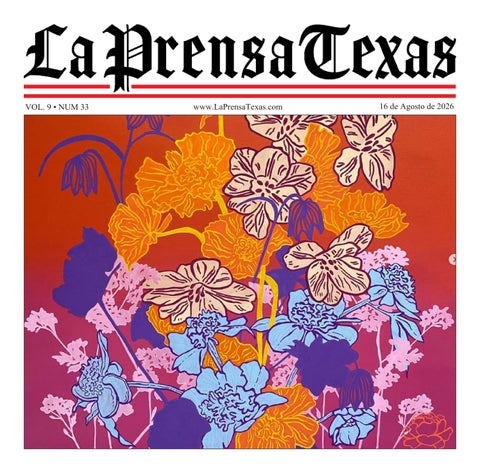
About the Artist
Manola and Maria Ramirez Provided by the artist. Manola and Maria Ramirez are sister artists and graduates of The University of Texas at Austin, where they each earned a BFA in Studio Art. Their collaborative practice centers on painting, printmaking, installation, and public art, with a focus on cultural storytelling rooted in their Mexican heritage and bicultural upbringing. Since 2018, they have developed a body of work that blends vibrant color, intricate pattern, and symbolic imagery to explore themes of identity, memory, resilience, and communi
ty connection. Their most recent solo exhibition, Había Una Vez, reflects on the immigrant and bicultural experience through a series of narrative compositions that honor the quiet struggles, generational strength, and everyday triumphs of families navigating life between worlds. The exhibition expands their ongoing commitment to creating work that uplifts underrepresented stories and fosters dialogue around belonging, cultural continuity, and collective care. In addition to their studio practice, Manola and Maria actively contribute to the cultural landscape of San Antonio through com
munity‑centered projects and artist‑driven initiatives. They have curated exhibitions such as La Dama, highlighting contemporary women artists, and Esperanza Brava, celebrating bicultural creativity and intergenerational resilience.Their work in public art, collaborative programming, and creative advocacy reflects their belief that art can serve as a bridge, connecting people, honoring heritage, and strengthening community networks. Together, the Ramirez sisters continue to build a practice that is visually compelling, culturally grounded, and deeply invested in expanding access to meaningful artistic experiences.
4
La Prensa Texas SAN ANTONIO
16 de Agosto de 2026
Fiesta Big. Shop Small.
16 de Agosto de 2026
La Prensa Texas SAN ANTONIO
If it’s personal to you, it’s personal to us. With a Frost Personal Loan or Personal Line of Credit, you don’t just get the financing you need — you get the support you deserve. Whether you’re establishing credit or making a major purchase, your goals are our priorities. And we stay by your side the entire way toward them, offering advice when you want it and a helping hand before you need it. Because here, you matter. Give us a call at (866) 376-7889 or visit your nearest financial center to get started.
Exactly What You Unexpected
TM
FrostBank.com | Member FDIC
No les importa el tamaño de su troca.
No arriesgue su vida manejando por caminos inundados. Recibe alertas. Mantente a salvo.
FLOODSDONTCARE.COM
5
6
La Prensa Texas SAN ANTONIO
16 de Agosto de 2026
The Texas History Written in Blood Were you Taught this History? By J. Gilberto Quezada
In the latest issue of La Prensa Texas, dated August 9, 2026, a spark arrived like I never expected. As I read this very interesting weekly column, “Let’s Talk About It: Were You Taught This His‑ tory?” and this powerful piece, “The Texas History Written in Blood,” some‑ thing stirred, an urgency, a pull toward memory and truth. Your words carried the weight of generations whose stories were never fully told, and in that mo‑ ment, I felt compelled to search through my own files, hoping to find something that connected my wife’s (Jo Emma) fa‑ mily to that broader, often painful his‑ tory. So, as I was browsing through a family book that Jo Emma’s paternal great aunt, Virginia Bravo López, (who wasthe sister of Jo Emma’s grandfather, Zapata County Judge Manuel Box Bra‑ vo and her mother was Emma Box and her father was David Bravo from McAl‑ len, Texas), had put together entitled, The Box Bravo Connection, and there, tucked safely where it had been placed years ago, was Rolando Hinojosa‑S‑ mith’s article, “River of Blood”, that was published in The Mexican Presence Magazine in January 1986. The disco‑ very felt almost fated, as if the article had been waiting for the right moment to speak again. I remembered how Tía Virginia had saved it and passed it on to me, believing I would understand its importance. Now, I would like to share the article with you that I found to be very interesting and informative. And on the upper right‑hand corner, in Virg nia’s own handwriting, is a note that transformed the article from literature into living history: “David Bravo, my
father, was stopped by the [Texas] ran‑ gers. He purchased cattle in Mexico and brought them to the States. He carried a letter of recommendation written by A.Y. Backer [Baker], Sheriff at the time. It is said dad began to joke with [the Texas] rangers as they tied him to a tree. He was then released.” Her words were not just a memory—they were testi‑ mony. Reading Hinojosa‑Smith’s work through the lens of Virginia’s note and your fascinating weekly column, “Let’s Talk About It: Were You Taught This History?” and your very interesting story on “The Texas History Written in Blood”, brought the past into sharp focus. “River of Blood” has long been recognized for its unflinching portrayal of the violence, injustice, and resilience woven into the history of Mexican Ame‑ ricans in Texas. But now, the story was no longer distant or abstract. It echoed Jo Emma’s family’s experience, revea‑ ling how the broader narrative of state power, border tensions, and cultural sur‑ vival had touched the Bravo family di‑ rectly. The article, combined with your modern historical storytelling, created a powerful continuum—one that stret‑ ched from the early 20th century to the present day, reminding me that history is never just something that happened; it is something that lives on in the stories families choose to preserve. Redisco‑ vering “River of Blood” became more than an act of curiosity. It was an affir‑ mation of why these stories matter and why they must continue to be told. Yvet‑ te, your work encouraged me to look backward; Virginia Bravo López’s han‑ dwritten note guided me to look inward; and Rolando Hinojosa‑Smith’s article helped me better understand the depth
of what I found. Together, they formed a narrative of courage, memory, and truth—one that I now carry forward, en‑ suring that the history written in blood is also remembered with purpose.
La Prensa Texas SAN ANTONIO
16 de Agosto de 2026
7
Project Marvel By Kathy Vale San Antonio’s current debate over Project Marvel and the proposed downtown sports and entertain‑ ment district is a test of what political represen‑ tation means for our city in 2026. Nearly fifty years ago, in November 1977, San Antonio voters approved a consequential change to the City Char‑ ter, moving our city from an “at-large” system to single-member districts. The change followed years of concern that the at-large system dilu‑ ted the political voice of minority communities, particularly the growing Latino population. The principle was straightforward: residents should have a Council me ber who represents a defined geographic community and can be held directly accountable. This historic principle brings to mind a story former City Councilwoman María Anto‑ nietta Berriozábal often shares about one of her last conversations with the late Willie Velásquez, founder of the Southwest Voter Registration Edu‑ cation Project. As María recalls it, Willie believed that after the long struggle to register Mexican American voters, protect voting rights and win meaningful political representation, the next great challenge would be holding elected officials ac‑ countable. Winning a seat at the table was never meant to be the end of the struggle, but the begin‑ ning. Making sure elected representatives remain answerable to the communities that put them in office is what gives representation its meaning, especially here in San Antonio. Project Marvel presents an equally important test of whether that principle and Willie Velásquez’s signature vision will hold strong 50 years later. The proposed new downtown Spurs arena and wider district would be located on District 1 public land, but the fi‑ nancial commitments would be carried by all of us. San Antonio taxpayers have a legitimate in‑ terest in understanding precisely how much pu‑ blic money is being committed, what financing mechanisms are being used, what risks the City will assume, what happens if projections miss the mark, and who ultimately benefits. Why shouldn’t City taxpayers exercise their individual vote on whether they agree or disagree with those plans and investments? When the benefits of a major municipal development project are concentrated geographically but the financial responsibility is held citywide, meaningful representation requires
City Council to ask hard questions, demand full transparency, and direct the City Manager to con‑ vene consistent public meetings for civic engage‑ ment, information sharing and citizen input. When urgency for these elements is missing, political chaos and misinformation fill the void. Single‑ -member representation was not created in 1977 simply so communities could have a seat at the table. It was created so communities that histori‑ cally lacked political power could have a meanin‑ gful voice in critical decisions affecting their lives and future generations. So today, a Council mem‑ ber representing a district with a significant Mexi‑ can American or African American demographic could reasonably ask: Are the costs and risks of Project Marvel being fairly distributed? Are the promised public benefits reaching neighborhoods beyond downtown? Have residents been given a consistent, meaningful opportunity to provide input? These are not anti-arena or anti-Spurs ques‑ tions; they are pro-representation questions that deserve to be applauded and debated, not criti‑ cized. Questions about adequate representation and accountability ring as true today as they did in 1977. Beyond the current political badgering, we need to understand why Council members re‑ presenting some of the most economically chal‑ lenged parts of our city do not support allowing City taxpayers to vote on the City’s $489 million contribution to the arena. San Antonio can support economic development and NBA sports while still demanding transparency. We can value the Spurs while insisting that major public commitments receive the same scrutiny we would expect for any significant, generational leveraging of li‑ mited public resources. And when the financial interests of a billionaire Spurs team owner such as Michael Dell are involved—after his $6.25 bil‑ lion donation to the Trump Administration was hailed by President Trump as helping “millions of Americans”— it is fair to ask why the Spurs cannot support increasing their contribution to Project Marvel in the 6th largest 3rd poorest city facing a jarring $158 million budget deficit and struggling for decades with poverty and hunger. The danger comes when political representation is confused with stale political loyalty, and when open dialogue and legitimate citizen engagement are criticized as disloyalty, dishonesty or incom‑ petence. Respectful public discussion and open
policy debate and public town halls should always happen regardless of whether six consequential City Council votes are already locked in at the Council dais. That is the sausage-making of de‑ mocracy, not a waste of time. Representation has little meaning if elected officials ignore publicly asking whether all the people they represent are receiving a fair hearing before major financial decisions are made. Project Marvel presents San Antonio with a powerful opportunity to reaffirm what single-member districts were intended to accomplish almost 50 years ago: give every voi‑ ce and neighborhood a say, provide transparent access to all the facts, and hold every elected re‑ presentative and municipal executive accountab‑ le. That is our cherished legacy from 1977. San Antonio should not forget in 2026. Representation is not merely having an elected seat at the table; it is continually uplifting the democratic process, holding representatives accountable and ensuring San Antonians are heard before any receipt comes due. In 2026, we need to ask ourselves whether that means respecting our city’s profound history of protecting the democratic process by allowing City taxpayers to vote on their $489 million con‑ tribution to the Spurs arena. Kathleen ‘Kathy’ Vale D1 homeowner, Ridgeview neighborhood D1 Commissioner, Mayor’s Commission on Voting Vice-Chair, P2 Appointee, Bexar County Elections Advisory Committe Volunteer Deputy Registrar and Election Worker, Bexar County
8
La Prensa Texas SAN ANTONIO
16 de Agosto de 2026
SS&E Con Éxito Ofreció Back To School Bash 2026 Por Franco La empresa Spurs Sports and Entertainment (SS&E), propietaria del equipo pentacampeón Spurs de San Antonio (NBA), bajó la administración de inversionistas, y el ejecutivo Peter J. Holt, con el éxito deseado realizó su quinta donación de útiles escolares entre otros servicios gratuitos en nuestra comunidad, previos al año escolar 2026 en la región de El Álamo.La sede de este
concurrido evento comunitario fue el estadio Frost Bank Center, casa de Spurs, donde se exhiben al público los cinco trofeos NBA Larry O’Brien, capturados durante el periodo de las temporadas del legendario entrenador en jefe Gregg Popovich: 1999, 2003. 2005, 2007 y 2014. En boletín de prensa oficial de SS&E, se informó, que durante la quinta edición del programa denominado anualmente “Back to School Bash”, el sábado pasado 8 de agosto, fueron convocados,
padres de familia, estudiantes y docentes quienes imparten clases en los grados K-12. Todos los asistentes estudiantiles gratuitamente recibieron artículos escolares y a la vez exámenes dentales, vasculares, de glucosa y cortes de pelo. En este programa comunitario se contó con el apoyo y patrocinio de organizaciones locales, negocios y agencias sin fines de lucro así como de distritos escolares que hizo posible ayudar económicamente a la comunidad educativa y
estudiantes quienes durante el año escolar podrán salir adelante en sus actividades escolares. Durante cinco años SS&E Back to Bash, ha tenido la asistencia de más de 14,000 participantes, y en los dos últimos años ha proveído más de 1,400 chequeos médicos. Con 1,000 chequeos en limpieza dentales, y donativos de más de 23,000 artículos escolares. “Cada estudiante merece comenzar el año escolar, con las herramientas y confidencia qué estarán necesitando
para un año de éxito en el salón de clases”, indicó Patricia Mejía, Chief Impact & Inclusion Officer at SS&E. Quien añadió lo siguiente. “Back to School Bash es un programa para remover barreras para familias que trabajan para unir comunidades en apoyo de estudiantes y
educadores. Agradecemos el apoyo de nuestros socios que una vez más con sus contribucion. Fotos de cortesía SS&E
La Prensa Texas SAN ANTONIO
16 de Agosto de 2026
9
Latinas for Gina Rally Brings Latino Victory to San Antonio By Yvette Tello San Antonio voters gathered Tuesday evening, August 11, at the Woodlawn Theatre for the Latinas for Gina Community Rally, an event supporting Gina Hinojosa and backed by Latino Victory. Hinojosa is the Democratic nominee for Texas governor in the November 2026 election. The event was about more than one candidate. It also brought attention to an organization many people in our community may have heard about but may not fully understand; Latino Victory. Who are they?In basic terms, Latino Victory works to get more Latinos involved in politics and, importantly, to get more Latinos elected to public office. There are actually several separate organizations under the La-
tino Victory name. Latino Victory Fund is a political action committee, or PAC, whose stated mission is to elect Latino candidates who support progressive policies. The Latino Victory Foundation focuses on nonpartisan civic engagement, research, leadership development and educating and empowering Latino communities. Latino Victory Project works more broadly to build Latino political power and make sure Latino voices are included in public policy. That distinction is important. Latino Victory is not pretending to be politically neutral when it comes to the candidates its political arm supports. The Fund openly supports candidates who share its progressive values. The organization also works to recruit and train people who may want to run for office. Its First Lati-
nas program focuses specifically on increasing the number of Latina women serving in government, while its Young Leaders Network works to get younger Latinos more involved in civic life. According to Latino Victory, it has supported hundreds of candidates across the country and helped elect more than 200 Latino leaders. For San Antonio, Tuesday’s gathering was another reminder of why organizations like this are becoming more visible. Latinos make up a major part of Texas, but having a large population does not automatically mean having political power. Political power comes when people register, vote, understand the issues, support candidates, attend meetings and sometimes decide to run for office themselves. You do not have to be a political expert to get involved.
Latino Victory provides information about its endorsed candidates and upcoming events on its website. People can also sign up to volunteer, donate to its political work or contact the organization to learn how to participate. Hinojosa’s campaign also offers opportunities for Texans to sign up, volunteer and become involved directly with her campaign. Pay attention. Learn who is running. Learn what they stand for. Ask questions. Know who is supporting them and why. Then make your own decision. Civic engagement is not only about showing up on Election Day. It is about understanding that the government belongs to all of us and that our voices only become powerful when we choose to use them.
10
La Prensa Texas SAN ANTONIO
16 de Agosto de 2026
The Ramirez Sisters Explore Visual Interpretations of Culture, Migration, and Belonging By: Ricardo Romo, PH.D
Latina artists Manola and Maria Ramirez’s exhibition, Había Una Vez, at Centro Cultural Aztlán in San Antonio, brings their interest in participation and visual storytelling into an immersive gallery setting.
Manola and Maria Ramirez, “Dreamer.”Courtesy of Centro Cultural Aztlán. Photo by Ricardo Romo.
On view through August 27, 2026, the installation at the Centro Cultural Aztlán explores and commemorates the culture, memories, bicultural identities, and often fractured experiences of immigrant families. Its title “Once Upon a Time” signals an invitation to visitors who are “ asked not simply to view the work, but to enter its story and locate their own relationship to migration, family, and belonging within San Antonio’s cultural landscape. ” This invitation to study one’s“ migration and belonging” led me to think about my own family’s initial arrival in San Antonio. Everyone in Texas has a migration story. The Texas story is important because the state includes families of the earliest European settlers of North America. Spaniards who founded St. Augustine in Florida in 1565 were the first Euro-Americans, followed by the Spanish settlements in New Mexico in 1598. Texas was next with early Spanish colonization in the 1680s. The topic is also important because so much attention lately has been
placed on immigration. Sadly, today we see in the news too many stories about the deportation of undocumented immigrants. Texas, with its large Mexican population, has especially been hit hard. Questions of migration posed by the Ramirez sisters’ art themes reminded me of grandparents who came to Texas during the Mexican Revolution 1910-1920 era. My grandparents were the first of our family to emigrate from Mexico. My genealogy and historical research over the past decade have led me to discover deeper ancestral roots. My migration story begins with my sixth-generation grandfather, Captain Nicolas Flores de Valdes, a frontier Spanish soldier who arrived in Texas in the late 1680s and eventually settled in San Antonio in 1722, four years after the town’s founding. Flores de Valdes first came with a team of explorers in the 1600s and eventually settled in San Antonio with his wife. The Spanish Census classified the Flores de Valdes family as mestizos, a mixture of Spanish and Mexican heritage. Over the previous two centuries, 1500-1700, settlers like the Valdeses often intermarried with spouses from northern Mexican Indigenous tribes. My ancestors came to Texas largely from the northern Mexican states. In the early 1990s, I bought Frederick C. Chabot’s classic book, With the Makers of San Antonio. Published in 1937, Chabot’s research is an essential resource for anyone interested in ancestors who might have been among the early settlers of San Antonio. I found the reference very useful when I was teaching History of the Southwest at UT Austin. At that time, it never occurred to me that my Mexican ancestors were among the earliest settlers of Texas. By 1820, 4,000 Mexicanos resided in Texas, making Texas one of Spain’s largest colonies in North America. In the first hundred years of San Antonio’s founding, 1718-1818, more than 1,500 Mexican [Tejano] colonists settled in San Antonio. A decade ago I learned that several members of my family had received land grants
from Spain in 1750 to establish communities along the Rio Grande. I was curious about their possible settlement in other parts of Texas, so I turned to Frederic Chabot’s book to inquire about the early San Antonio settlers. Chabot had documented the first forty-five families to settle in San Antonio. Some families received more coverage than others. I was lucky! Chabot had dedicated two full pages to my 6th-generation grandfather, Captain Nicolas Flores de Valdes.
Manola and Maria Ramirez,“Grandpa’s Jardin. ”Courtesy of Centro Cultural Aztlán. Photo by Ricardo Romo.
According to Chabot, Flores de Valdes was appointed Captain of the Presidio at San Antonio de Bexar in 1722. As I discovered this fact, I realized that my ancestors had been in North America for over 300 years. Flores de Valdes truly was one of the first Tejanos. Thanks to research completed in the 1930s by Dr. Carlos Castaneda, UT Austin’s first Latino historian whose work was a major source of Chabot’s account, we know quite a bit about San Antonio’s settlement. Construction of the Alamo began under Flores de Valdes’s watch. He was also in charge of protecting workers at San Jose Mission, where construction began in 1720. Historians researching ancestral roots work with civic and religious documents such as birth, marriage, and death certificates, and these documents are of enormous value in ancestry research. I was fortunate that the Handbook of Texas had also documented some of my ancestors’ history.
16 de Agosto de 2026 The Handbook of Texas notes that Flores de Valdes first came to Texas in a supply expedition in 1693 with Governor Gregorio de Salinas Varona at age thirteen. It was not uncommon for the Spanish armies to enlist teens.
La Prensa Texas SAN ANTONIO
11
ned to Mexico. Back-and-forth movement across the Rio Grande was not uncommon. The Ramirez sisters have pressed us to learn about our families, explore family migration patterns, and expand our own sense of belonging. Such inquiries require long conversations with grandparents. Do not wait too long to ask them about their migration experiences.
Artist Terry Ybanez and muralist Shek. Courtesy of Centro Cultural Aztlan. Photo by Ricardo Romo.
Manola and Maria Ramirez, “Mexican American.”Courtesy of Centro Cultural Aztlán. Photo by Ricardo Romo.
In my research, I used traditional academic sources, but also employed more modern research tools such as Family Search, Geni, and Wikipedia. I learned from the more modern Family Search database created by the Mormon Church that my early ancestor Flores de Valdes was born in Saltillo, Coahuila, in 1680 and that he married Nicolasa Ximenes de Valdes on December 31, 1700. He died in San Antonio in 1731 and fathered fourteen children. The new tools are not always accurate. The same database, Family Search, also has my ancestor Flores de Valdes marrying Maria Lucia Rodriguez Longoria on the same date as Nicolasa Ximenes, December 31, 1700. Maria Lucia was cited as a native of Monterrey, Nuevo Leon. From other sources, I learned that Flores de Valdes married at least twice. Frontier life was difficult, and many women died young, often from childbirth or lack of medical treatment. Eventually, the Flores de Valdes clan of early San Antonio married into the Saenz family, a direct link to my maternal grandparents who migrated to Texas in the 1880s. I can now assume that my earliest ancestors migrated to Texas in the early 1700s and later retur-
Manola and Maria Ramirez, “Mexican AmeManola and María Ramírez, “Cactus Garden. ”Courtesy of Centro Cultural Aztlán. Photo by Ricardo Romo.
Manola and María Ramírez are San Antonio–based artist sisters whose individual and collaborative practices move effortlessly among painting, printmaking, illustration, installation, murals, and public art. Raised on the city’s West Side and separated by two years in age, they form an unusually close creative partnership. As artists and muralists, they are drawn to visual interpretations of the cultural life of San Antonio. Maria, the younger sister, began her arts education at the San Antonio nonprofit youth arts program Say Sí, and saw early on that art might become a vocation. Manola initially imagined a different future: studying literature, writing, and perhaps working in film. Both sisters attended Brackenridge High School and studied with artist Terry Ybanez, who encouraged their artistic projects. After graduation, their trajectories shifted when Maria persuaded Manola to join her in a life-drawing class at San Antonio College. Manola’s instructors recognized her artistic aptitude and encouraged her to pursue art seriously. After two years at SAC, both sisters transferred to the University of Texas at Austin,
where they studied studio art, developed an enthusiasm for printmaking, and earned BFA degrees in 2018. Returning to San Antonio, the Ramirez sisters built a shared practice and a community-oriented creative base. Since 2019, they have worked as a duo while maintaining distinct artistic voices. They also help operate Lavaca Studios in Southtown, an all-women collaborative space for making art, teaching, and sharing resources with other artists. The San Antonio Magazine noted that the Ramirez sisters’ screen-printing work has made original art more accessible, enabling artists to create hand-pulled editions for local audiences and markets. Maria’s independent work is often abstract, centering color, texture, line, and pattern. Rather than prescribing a single meaning, both sisters invite viewers to participate through interpretation—an approach shaped by their interest in public, outsider, and street art. Together, the Ramirez sisters often shift toward a bold figurative and illustrative art vocabulary. The paintings at the Centro Cultural Aztlan, with their vivid color and graphic forms, captivated viewers’ attention. Centro Director Malena Gonzalez-Cid noted that the visual energy of the Ramirez sisters readily engages public audiences. The opening reception of the Habia Una Vez exhibit buzzed with excitement as local artists and art enthusiasts viewed the large dual-sided billboard mural dominating one gallery space at the Centro and the numerous beautiful paintings in the main gallery. Most of the works featured red dots indicating the pieces were sold early in the evening.
12
La Prensa Texas SAN ANTONIO
16 de Agosto de 2026
A Legacy of Service, Faith, and Family Honoring Steve A. Duran By Celinda De La Fuente This year, La Prensa Texas has the privilege of hono‑ ring Steve A. Duran with the Lifetime Achievement Legacy Award, recognizing a life that has been defi‑ ned not simply by professional accomplishments, but by service, sacrifice, faith, family and an unwavering commitment to his community.For Steve, however, this recognition carries a meaning unlike any award that came before it. “I’ve gotten a lot of awards,” he says. “I’ve never gotten a lifetime achievement award. Especially coming from La Prensa, it’s nice because it’s family to me.” Long before he sat behind a publi‑ sher’s desk, Steve understood the meaning of service. He comes from a military family. His father served. His grandfather served. Steve followed that tradition because, he says simply, he wanted to serve his cou‑ ntry. Today, that tradition continues through another generation, with his son and grandchildren serving in the Navy.It gave him discipline.“You come out of there with a discipline that you never had before,” he recalls. He later spent ten years as a police officer, including working as an investigator. That experience taught him another lesson that would follow him throughout his life: how to deal with people. He learned to commu‑ nicate with individuals from different backgrounds, personalities and circumstances. He learned to un‑ derstand moods, remain composed under pressure and listen closely. Those skills would eventually serve him well in a profession he never expected to enter. Journalism. Steve’s journey into newspapers began in 1988, in typical Tino Duran fashion. His father, Florentino “Tino” Duran, was opening a Fort Worth newspaper called El Informador. Steve, because of his investigative work, had experience using computers at a time when newspaper operations were beginning to change. Tino needed someone to computerize the paper. Steve told his father he believed he could do it. One day, Tino came home with a computer. “Here, do it,” he told his son. And Steve did. There was no lengthy training program. No carefully constructed career path. His father gave him the responsibility and trusted him to figure it out. In many ways, that moment summarizes how Tino raised his son. Steve remembers his father being tough on him growing up. It took years before he understood why. “I really understand now that the whole time, he was teaching me to be a better person,” Steve says. Tino was preparing him not merely for a career, but for life. He also taught Steve a philosophy about journalism that would become part of the DNA of La Prensa. Tell the truth. Tell the sto‑ ries of the community. And don’t build a newspaper around tearing people down. “My dad’s philosophy about the newspaper was that we never wrote bad
stories,” Steve remembers. “They were truthful. We didn’t want to report the gossip. We told good stories about the community. We passed on what was happe‑ ning in the community, and that’s what we lived on.” That belief helped distinguish La Prensa as something more than a newspaper. It became a community ins‑ titution. For the Durans, there was rarely a clear line separating family life from newspaper life. Tino was, as Steve describes him, a workaholic. He taught his children a fierce work ethic, and everyone contribu‑ ted. Steve’s children delivered newspapers. His oldest son, Steve, who later retired from the Navy, helped with graphics. Christopher, Lexi and other members of the family each played a role at one time or ano‑ ther. Children came to work. Grandchildren came to work. Eventually, great-grandchildren could be seen carrying bundles of papers just as generations before them had done. “It was always like that,” Steve recalls. The newspaper was never simply where the Durans worked. It was part of who they were. And two people stood at the center of it all: Tino and Millie Duran. Millie Duran battled serious illness, but even during difficult periods, she remained deeply involved with the newspaper. “She never stopped,” Steve says. La Prensa was her baby too. She knew exactly how she wanted the paper presented and was uncompromising when it came to protecting its standards. She read the stories. She reviewed the content. She challenged de‑ cisions. “She fought everybody to make sure it was exactly like that,” Steve says. “She didn’t let anything pass her.” Tino showed the same devotion. Even as Alzheimer’s disease began affecting him, Steve re‑ members his father continuing to try to deliver news‑ papers. He would become lost during his routes, but he still wanted to make those deliveries. Even after he was no longer actively working as publisher, Tino continued handing out his business cards, introducing himself through La Prensa and telling people that if he could help them, they should let him know. The title may have eventually changed. The calling never did. That calling would eventually place Steve in one of the most difficult moments of his life. After his fa‑ ther’s passing, the newspaper hifamily had built was struggling. Steve heard that it might close. For him, allowing that to happen was not an option. He took approximately $20,000 from his own retirement sa‑ vings and put it into keeping La Prensa alive. It wasn’t merely a financial decision. It was a promise between a son and his father. “I told him that I would never let the newspaper close,” Steve says. “Before he died, I said I’d make sure his dream stays there.” Around that same period, Steve had developed a friendship with Yvette Tello through years of working together during Fiesta. He needed someone he could depend on. He chose Yvette. “We became real close,” Steve
remembers. “She guided me through a lot of the Fiesta things, and I just knew somebody that I could trust.” Steve admits he has never been someone with a large circle of friends. He stays close to his family and keeps much of his life private. But trust, once earned, means something to him.“When I find somebody I can trust, I stick with them and I trust them.” Together, Steve and Yvette worked to stabilize La Prensa. When Steve later stepped away, he watched Yvette continue the work. “I think she’s following the legacy I was hoping for,” Steve says. “When I got rid of the newspaper, my thing was to leave my dad’s legacy there. And I think with Yvette, I was able to do that.” Letting go wasn’t easy. Steve missed the newspaper. He missed talking to peo‑ ple. He missed being part of the daily rhythm of the community. Eventually, he called Yvette and offered something that spoke volumes about the trust he had placed in her. Use me however you need me, he told her. Use the Duran family name however you need it. Because keeping the dream alive mattered more than who held the title of publisher. “I promised him I would keep it alive,” Steve says of his father. “And it is still alive.” “I Still Talk to My Dad” For Steve, that connection to his father never disappeared. Tino was deeply spiritual, and Steve says he still feels his father’s presence. “To this day, I still communicate
16 de Agosto de 2026 with my dad,” he says. “I still ask him for advice.” He believes his father continues watching over the family and the newspaper he loved. And if Steve could say one thing to him today, it would be this: I kept my promise. For a son who spent much of his life trying to live up to the lessons of his father, perhaps there could be no greater legacy. A New Chapter of Service Steve’s public service did not end with journalism. He eventually joined Alamo Colleges, where his commit‑ ment to education and workforce development became another extension of his commitment to the commu‑ nity. He rose through the organization and became Director of the Workforce Center at the Toyota Trai‑ ning Center, helping students and workers gain skills and access opportunities that could change their lives. Officially, his workday might have been 8 a.m. to 5 p.m. Steve apparently never paid much attention to that schedule. He routinely arrived around 5:30 in the morning and sometimes stayed until 8 or 9 at night. Why? Because he loved the students. “I have a big belief that if you love what you work, you never work a day in your life,” Steve says. “At Alamo College, I never worked a day in my life because I loved the kids so much.” Even while working at Alamo Colleges, Steve never completely separated himself from La Prensa. He continued helping with the website, art‑ work and Gala materials. Once again, the newspaper remained part of him. Investing in the Next Generation Education was not only something the Durans wrote about. They invested in it. Through La Prensa, the family established educational endowments that con‑ tinue to support students. Steve recalls that Alamo Colleges alone holds roughly $200,000 in endowment funding contributed through La Prensa, with scholar‑ ship support awarded to students in the newspaper’s name. Additional endowments and scholarship rela‑ tionships were established with area colleges and uni‑ versities, including institutions such as the University of the Incarnate Word. Every year, Steve says, letters would arrive from scholarship recipients thanking the family and La Prensa for helping them continue their education. For Steve, those students are part of the legacy too. Because the measure of a community ne‑ wspaper is not only how many papers it prints. It is how many doors it opens. Virginia: The Woman Be‑ side the Legacy No telling of Steve’s story would be complete without Virginia Duran, his wife of more than four decades. She has stood beside him through the newspaper, Fiesta, public service, long working hours, family responsibilities and life’s unexpected challenges. Steve jokes that their marriage has been “a life sentence.” But underneath the teasing is tre‑ mendous love. Virginia has been his steady hand, his partner and often the person who pushed him forward when Steve himself was running on empty. During Fiesta, even while Steve was experiencing serious health problems, he remained determined to fulfill his commitments. Virginia was there. Through the news‑ paper, she was there. Through retirement and family life, she remains there. Behind many public legacies is someone whose name appears less often in the hea‑ dlines but whose strength helped make everything else
La Prensa Texas SAN ANTONIO possible. For Steve, that person is Virginia. The Shirt Off His Back Ask Steve how he wants to be remem‑ bered and he doesn’t talk about titles. Not a publisher. Not the director. Not an investigator. Not award reci‑ pient. He says he wants people to remember that he was caring and giving. “If I was rich, I would still be poor,” Steve says, “because I always gave the shirt off my back.” Those who know him understand exactly what he means. His instinct has always been to help. To give. To show up. To find a way. Whether it was through education, journalism, public service or sim‑ ply helping someone who needed him, service was never something Steve turned on for public recogni‑ tion. It was simply how he lived. Family Is the Real Legacy Today, Steve speaks less about building so‑ mething new for himself and more about watching his family continue to grow. He is the grandfather of 16 grandchildren and has welcomed great-grandchildren into the family as well. He has also watched his rela‑ tionships with his brothers grow closer as they have gotten older. Life once pulled everyone in different directions. Now, they make a point of coming together for lunch once or twice a month. Steve hopes they will be there when he receives his award. Not only to wat‑ ch him be recognized, but to share the moment with him. Because this award may carry Steve’s name, but his story has never belonged to Steve alone. It belongs to Tino. To Millie. To Virginia. To his children, gran‑ dchildren and great-grandchildren. To every family member who delivered a newspaper, designed a page, attended a function, carried a box or sacrificed family time because a deadline had to be met. And it belongs to the community the Durans have served for genera‑ tions. “Follow Your Heart” Steve understands that journalism has changed. But he also understands so‑ mething that technology cannot change. People still need their stories told. They still need someone willing to listen. And they still need institutions willing to stand with the community rather than simply report about it. His advice to the people now carrying La Prensa Texas forward is remarkably simple: “Follow your heart.” There will be stories, he says, that you simply know need to be told. “Just do the right thing. I think you’ll make it in the newspaper business.” Ste‑ ve’s hope for the future of La Prensa Texas is equally personal. He hopes the newspaper’s new generation experiences the same success his family did. But more importantly, he hopes they experience the joy of hel‑ ping people. He hopes they fall in love with the paper. He hopes they become part of the community in the same way the Duran family did. Because for the Du‑ rans, success was never only about circulation num‑ bers or advertising revenue. Success was being trusted by la gente. A Love Letter to San Antonio Of all the things Steve spoke about during his interview—his father, his mother, his military service, police work, journalism, education, family and faith—one theme surfaced again and again. San Antonio. He loves this city. He loves its people. And he especially loves the Hispanic community that has embraced his family and La Prensa for generations. “The people of the Hispa‑ nic community have always been family to us,” Steve
13 says. Even during his years at Alamo Colleges, he looked for opportunities to use the resources availab‑ le to him to help that community. “I just have a deep love for the Hispanic community,” he says. “The His‑ panic community is just like no other community. They love each other. They’ll do anything they can for each other.” Steve believes there is enormous power in that unity. He describes the Hispanic community as a “sleeping giant” still waiting to fully awaken. And he believes that when it does, it will be unstoppable. It is fitting, then, that when Steve was asked one final question—if he could write a love letter to San Anto‑ nio, what would he call it?—he did not need time to think. His answer was immediate. “My Love of San Antonio.” Perhaps Steve Duran has already written that love letter. Not with pen and paper, but with a lifetime. He wrote it while wearing the uniform of his country. He wrote it behind a police badge. He wrote it beside his father in the newsroom. He wrote it when he took money from his own retirement rather than allow his father’s dream to disappear. He wrote it in the early mornings and late nights at Alamo Colleges. He wrote it through scholarships that will help young people he may never meet. He wrote it through 45-plus years beside Virginia. He wrote it through every community event, every newspaper deadline, every person he helped and every promise he refused to break. And today, as La Prensa Texas honors Steve A. Duran with its Lifetime Achievement Legacy Award, we are not simply recognizing one man’s career. We are honoring a family legacy. A promise between a father and a son. A commitment passed from one ge‑ neration to another. And a belief that has endured through every chapter of the Duran family story: Mi gente cuida a mi gente. Nuestra gente se cuida entre sí. Our people take care of our people. And Steve Du‑ ran has spent a lifetime proving it.
Tino and Millie Duran
14
La Prensa Texas SAN ANTONIO
16 de Agosto de 2026
On View Now Through January 4, 2027
ON THE RIVER WALK
ANTONIO, TX BRISCOEMUSEUM.ORG S A N
Selena 4 1992, Digital print on panel, Courtesy of the artist, Panel dimensions: 50 x 62 x 1 in. (detail)
16 de Agosto de 2026
La Prensa Texas SAN ANTONIO
15
City Council 101 By Yvette Tello
Most of us know who the President is. But ask someone who their San Antonio City Council member is, and many cannot tell you. The City Council makes decisions that affect our lives every day. Streets, drainage, parks, libraries, police and fire services, zoning, housing, development, code enforcement and how City money is spent all come through local government. San Antonio has a Mayor and 10 City Council members. Each councilmember represents a district, while the Mayor represents the entire city. Councilmembers are elected by us. Their job is to represent the people who live in their district. Not just campaign donors. Not just developers. Not just business owners. Not just neighborhood leaders who already know how City Hall works. Everybody. That includes renters, homeowners, seniors, students, working parents, young people, small-business owners and families living paycheck to paycheck. Living in a district does not automatically mean a councilmember understands the district. Having an address there is not enough. A good representative should actually know the community. They should know the schools, which streets flood, where families are struggling and what businesses are opening and closing. They should understand the concerns of seniors, young families and people who cannot take off work to attend a City meeting. A councilmember cannot personally experience everything every resident experiences. But they can listen. They can show up. They can make themselves available. There are also some cold, hard
facts people should understand. Being elected does not make someone the boss of the community. It makes them a public servant. City officials are subject to ethics rules. They cannot simply use public office however they want. Financial conflicts matter. Public contracts have rules. Government decisions are supposed to serve the public, not somebody’s friends, donors or political connections. A councilmember should never use the position to enrich themselves. They should not hide a financial conflict. They should not use City business to reward friends or punish enemies. They should not give someone special access because that person has money or influence. Voters should also pay attention even when something may not technically break a law. Something can be legal and still be wrong. If developers can get a meeting with a councilmember but ordinary residents cannot get a phone call returned, that should bother us. If a councilmember only appears in a neighborhood when cameras are present, ask why. If residents learn about a major development after decisions are already moving forward, ask why. If the same small group always has the councilmember’s ear, ask why. If somebody appears everywhere during election season and disappears afterward, remember it. Those are not partisan questions. They are accountability questions. Residents can attend City Council meetings. They can speak during public-comment opportunities. They can contact Council offices, look at meeting agendas, follow votes and ask how public money is being spent. You do not have to be a lawyer or have a colle-
ge degree. You can ask simple questions: What is being built? Who approved it? How much does it cost? Where is the money coming from? Who benefits? Did the neighborhood know about it? How did my councilmember vote? The bigger problem is that many people were never taught to ask them. We teach young people about Washington, presidents and national elections. But many graduate without knowing what a City Council district is, what zoning means or how to speak at a public meeting. San Antonio does provide ways for residents to participate. The City holds public meetings and town halls, conducts surveys and uses tools such as SASpeakUp to collect public input. The City also has community-engagement programs. But putting information online is not enough. You have to know where to look. You have to understand the language. You have to know that a meeting is happening in the first place. Government information is often written in a way that sounds like it was written for government employees, lawyers and professionals instead of the people paying for the government. If San Antonio truly wants civic engagement, take civic education into the community. Go to high schools and colleges. Go to libraries, churches, senior centers, apartment complexes, neighborhood associations, community centers and local businesses. Explain City government in everyday language. Show people how to find their district and contact their councilmember. Explain zoning. Explain the City budget. Explain where tax money goes. Teach residents how to read an agenda and find out how their
representative voted. Do it year-round, not just during elections. Councilmembers should do the same. Do not just attend ribbon cuttings, stand behind podiums and take pictures. Sit with people. Walk through neighborhoods. Listen. Talk to the grandmother raising her grandchildren. Talk to the 20-year-old who thinks voting does not matter. Talk to the renter who believes nobody at City Hall cares. That is representation. Young voters especially need to understand how important local elections are. Turnout in City elections can be very low. When most people stay home, a relatively small group of voters can decide who represents an entire district. Then everybody lives with that decision. Voting is not the end of civic engagement. It is the beginning. After an election, keep watching. Know your councilmember’s name. Follow their votes. Read about major projects in your district. Call the office. Attend a meeting sometimes. Ask where the money is going. Your councilmember is not doing you a favor by listening to you. You do not have to be wealthy, connected or politically important to deserve a response. City Hall belongs to the public. Councilmembers work for the public. The people should never feel like outsiders in their own government. If we want better representation, the government has to become easier to understand and elected officials have to become more connected to the communities they serve. But we also have to participate. Ask questions. Pay attention. Speak up. Vote. That is civic engagement in plain English. And it starts with understanding one simple fact: They work for us.
16
La Prensa Texas SAN ANTONIO
16 de Agosto de 2026
BIBLIOTECH ES LA PRIMERA BIBLIOTECA PÚBLICA COMPLETAMENTE DIGITAL DEDICADA A SERVIR A TODOS LOS RESIDENTES DEL CONDADO DE BEXAR. BIBLIOTECH BRINDA ACCESO A LOS MISMOS RECURSOS DE UNA BIBLIOTECA TRADICIONAL EN FORMA DIGITAL ACCESIBLES DESDE CUALQUIER LUGAR. TU MEMBRESÍA GRATUITA TE DA ACCESO A: • • • •
Libros electrónicos y audiolibros (inglés y español) Música, películas y programas de televisión en línea Recursos para profesionistas y plataformas de aprendizaje Nuestras sucursales ofrecen acceso a tecnología/WIFI y programa de préstamo para dispositivos tecnológicos para llevar a casa
Regístrate fácilmente en
BIBLIOTECH.ORG
CPSE_2026_Blu Lacy to Howard Rd Open House Print Ads_Spanish_v8.pdf
2
7/28/26
4:59 PM
El acceso digital está disponible
24 HORAS DEL DÍA, LOS 7 DÍAS DE LA SEMANA 1. Visita bibliotech.org
2. Crea tu cuenta gratuita
3. Disfruta de todos los recurosos disponibles
16 de Agosto de 2026
La Prensa Texas SAN ANTONIO
17
José Espinoza De Astros Campeón De Bateó Moisés Cervantes Yankees Campeón Pitcher Por Sendero Deportivo El presidente Simón Sánchez, mediante su portal digital públicamente dio los resultados oficiales de jugadores individuales y el equipo líder de la temporada Servando Hernández 2026 categoría Liga Potranco Masters 50+ con sede en el campo 2 de Potranco Baseball Field propiedad del artista Eloy Rocha. Yankees del manager y jugador Luis Velázquez, con victoria de partido pendiente contra Astros
de Pedro Espinoza, con cerrado margen se quedó de líder en el standing. Sobresalieron el pitcher izquierdo Moisés Cervantes de Yankees como el lanzador campeón de temporada con marca de 5-1. José Espinoza, de Astros quien desde principios de campaña estuvo consistente en su bateo personal finalizó con promedio de .569 capturando el título de bateo, convirtiéndose en el tercer jugador de Astros en lograr ese título después del bicampeón de su com-
pañero Gustavo Torres (dos títulos), y de sus compañeros Víctor Guerrero y Junior Arias. En el segundo partido de las series semifinales Astros eliminó a Despos del buen amigo Elías Contreras, con victoria para el bicampeón lanzador derecho Ubaldo Montelongo, quien tuvo relevo de Greg Carrera. La derrota fue para Carlos Cerda “La Chiva” con relevos de Luis Rios y Faustino Cortinas. Yankees con su abultada victoria ante Los Rojos y victoria para Moisés
Cervantes, eliminó a Los Rojos del timonel Jimmy Martínez (quien dijo adiós al circuito para seguir impulsando a los equipos Categoría Masters 60’). Quien agradeció el gran apoyo de su coach y jugador Catarino Obregón, quien ahora se encuentra en espera de ver las posibilidades de seguir adelante apoyando esa categoría con la creación de un nuevo equipo al que estará dirigiendo tanto como patrocinador, manager y jugador del próximo campeonato. En cate-
goría Abierta dominical Sánchez dijo tener a siete equipos confirmados para la temporada que será dedicada “Al Cafetero” Mike Tabhan, manager del trabuco Los Diablos, cuya apertura está programada para el domingo 23 de agosto. Los equipos ha participar son: Broncos, Piratas. Diablos, White Sox, Cubs, Vaqueros y Aliens. En las fotos aparecen: José Espinoza y Moisés Cervantes. fotos de Franco
18
La Prensa Texas SAN ANTONIO
16 de Agosto de 2026
Investing in Joy: JW Marriott San Antonio Brings Magic, Wonder and Cultural Artistry to Tejas This Christmas by Celinda De La Fuente
Half the year is over, mi gente, and the Holiday Season is clo‑ ser than you think. Yet, August does not care that Christmas is coming. The AC is running full blast; every electrical outlet has one extra fan plugged into it. You could fry some eggs outside on the concrete. And while South Texans navigate the blazing heat of summer as we always do, a 9-degree winter wonderland is already taking shape in the Texas Hill Country, because Christmas waits for no one. Christmas is al‑ ways coming. That winter won‑ derland has a name: ice!™, the immersive Christmas experience returning to JW Marriott San An‑ tonio Hill Country Resort & Spa for its third year, running Novem‑ ber 23, 2026 through January 3, 2027. And this year’s theme will have everyone recalling the clas‑ sic Christmas songs we all love to sing along to. This year, ice!™ brings the beloved, timeless story of Rudolph the Red-N sed Rein‑ deer™ to life through larger-than‑ -life, hand-carved frozen scenes. None of this ice carves itself. Forty master artisans travel 7,000 miles from Harbin, China, home to the world’s largest ice festival, to spend 3340 days transforming over 7,000 6,700 blocks of ice into the scenes guests will walk through this winter. It’s a techni‑ que passed down through gene‑ rations. It’s the kind of craft that does not come from a manual. It comes from a lineage. It is cultu‑ ral art, built by hand, in a city that isn’t theirs, for a season that is not native to where they come from.
“You are walking through a true art exhibit,” says Nina Shokrian, Director of Marketing & Public Relations at JW Marriott San An‑ tonio Hill Country Resort & Spa. “Without their talent and their expertise, it could not be what it is. They work at such an incre‑ dible speed—you could walk through one day, and the next day a team has completed several new sculptures and a whole new scene.” In a city known to honor cultural exchange, the resort hosts an “Artisan Welcome” each Oc‑ tober when the carvers arrive in San Antonio, celebrating them with traditional dragon dancers and resort hospitality. Whether you are a toddler in your mama’s arms experiencing snow flurries for the first time or in your Señora years joining in on the fun, the resort’s 40,000-square-foot Rein‑ deer Ridge hub offers activities para todos– including real-snow tubing at Snow Flow Moun‑ tain, snowball battles at Snow Ball Build & Blast, gingerbread decorating, and custom plush building at Build-A-Bear Wor‑ kshop®. “It truly is for the little ones, but the adults have fun with it too,” laughs Shokrian, recalling how her 80-year-old father went snow tubing down the mountain alongside his grandchildren. The resort also prioritizes accessibi‑ lity, ensuring that everyone in the community can participate: The entire exhibit is built on a single level with ramps, making it fully wheelchair accessible. For field trips and special needs groups concerned about noise, sensory audio adjustments can be accom‑
modated. Guests are provided with signature warm blue parkas in all sizes to stay warm in the 9-degree winter wonderland ex‑ perience. Bring those extra layers, hats, and gloves, mi gente, so you can fully enjoy the 20-40 minute walk through. As a San Antonio native herself, Shokrian unders‑ tands the deep-rooted cultura y familia values of the local comu‑ nidad. At the conclusion of the colorful Rudolph walkthrough, guests enter a serene room featu‑ ring a massive, crystal-clear ice sculpture of a traditional Nativity scene a quiet moment of reflec‑ tion that holds special meaning for all of us. Because that’s the thing about this city. We carry a bit of Christmas with us wherever we go through the heat, through August, through whatever the calendar says. We tap into that magic because it is magic. And this year, mi gente, it’s 9 degrees, hand-carved, and waiting for us in our own backyard. So let’s do what we do best. Let’s sing. Let’s dance. Let’s celebrate and invest in memories of joy that will last a lifetime. See you on the ice!™ (the immersive Christmas expe‑ rience). To reserve your family’s time slot and explore special sea‑ sonal promotions, visit www.JWHillCountryChristmas.com.
16 de Agosto de 2026
La Prensa Texas SAN ANTONIO
19
20
La Prensa Texas SAN ANTONIO
16 de Agosto de 2026