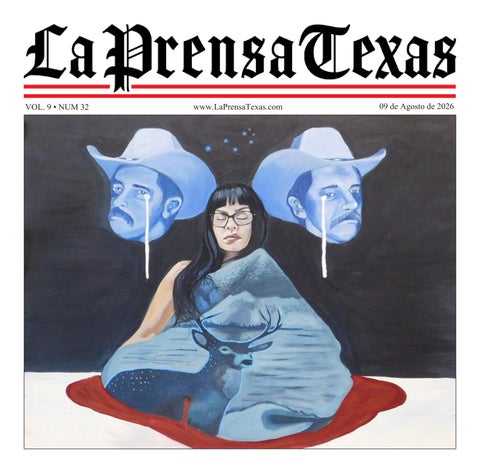
VOL. 9 • NUM 32
www.LaPrensaTexas.com
09 de Agosto de 2026
2
La Prensa Texas SAN ANTONIO
Let’s Talk About It:
Founded 1913 - Fundada en 1913
WERE YOU TAUGHT THIS HISTORY?
Publisher / Editora: Yvette Tello y.tello@laprensatexas.com
Rene Rincon: “During what is known as the Matanza between 1910 - 1920 it is believed that about 5,000 Mexicans / Tejanos were lynched or murdered in Texas. There were notorious events such as the Porvenir massacre . Read the book ‘Revolution in Texas’ by Benjamin Heber Johnson”
Community Liaison / Enlace Comunitario: Ramon Chapa Jr. r.chapa@laprensatexas.com Advertising & Production Coordinator / Coordinadora de Publicidad y Producción: Jessica Medrano Contributors / Colaboradores: Dr. Ricardo Romo Priscilla Sanchez - Hurt info@laprensatexas.com Editor Español: José I. Franco Sales Representative / Representante de Ventas: Maria Cisneros La Prensa Texas is a grassroots, bilingual publication that serves as a vital voice for the community especially for those who are too often left out of mainstream media conversations. Since its founding, La Prensa Texas has been dedicated to providing relevant, accessible, and culturally rooted news that reflects the lives, struggles, and triumphs of the people of San Antonio and surrounding counties. Our mission is simple yet powerful: to inform, inspire, and empower our readers through storytelling that uplifts the diverse voices of our community. This publication continues to be the lifeline of local news, bridging the gap between the people and the stories that matter most.
Send Press Releases and Advertising Inquiries to: Info@LaPrensaTexas.com 210-628-9611
09 de Agosto de 2026
By Yvette Tello
Were you ever taught about La Matanza, the lynching of Mexicans and Tejanos, segregated schools, “Whites Only” public facilities, or the role the Texas Rangers played in violence against Mexican American communities? Or did you first learn these truths through your parents, grandparents, or community elders? Too much of our history was left out of textbooks and classrooms. What were you taught? What do you believe future generations deserve to know? Do you think our stories matter and silence should never erase them? Or do you believe what happened in the past is irrelevant at this point and learning about it will not make a difference? Let’s talk about it… Ismael Delgado: “Also, Texas Rangers were established to take away land from us!”
Maria Ana Nunez: “I read that a town in Texas had two hanging trees. One was for whites and the other for people of color.” Cindy Smith Marquez: “Also in SW Texas ...there were segregated schools for Indigenous people until the 70s” Elizabeth Felan Melgoza: “My dad always told us stories that Hispanics were even treated worse than our dark brothers” Elizabeth Felan Melgoza: “They used them to kill natives and all the buffalos in the states; Buffalo Soldiers” Ralph Elizondo: “Elizabeth Felan Melgoza my mother growing up could not go swimming in the city public pools cause they were not allowed, whites only and we ain’t dark” Jose Cota: “Sounds familiar now, and it’s heartbreaking to think about the struggles our ancestors faced. We
need to keep sharing these stories so we can learn from them.” Rick Melgoza: “What Part Of Texas My Grandparents Move To Lubbock, Texas in 1918 From South Texas Never Knew They Lynch Tejanos” Teresa De Jesus Escandon: “Keep teaching the conveniently erased history! Don’t stay silent!” Luis M. Pineda Sr.: “Kinda like modern MAGA” John Perez: “I believe I’ve read it was Texas Rangers” Jamie M Meza: “One thing I would like to correct: yes, that did happen but we did get something out of it; Mexican heroes whose legendary acts are not forgotten.” Fernando Yebra: “My grandparents lived in the USA in the early 1900 to the 1930’s. Grandma said they moved to Mexico because “the situation” was too difficult. I think this is what she meant.” Pete Castro: “It’s horrible what happened. And it’s wonderful that it no longer happens. There are now equal rights for the US Mexican heritage citizen, and
there is no one around that hung a Mexican or someone around that had a relative that was hanged. It’s good to not erase history and it’s even better to see how long we’ve come.” Tony Tony: “Yes , my ancestors taught us this” Yolanda Wright: “This happened in California as well.” Rose Herrera: “A repeat in history” John Sanchez: “A must know story” Maria Elena Ramirez: “Thank you for sharing Mexican American culture, history, and pride. Never taught in public school’s history” Teresa M. Morales: “My father & uncle told us stories of these lynchings.” Diana Vallarta Sandoval: “Thank you for disclosing the truth” Yvonne Escamilla: “I’m not surprised!” Bennie Garcia: “Say king ranch without saying king ranch !” Mike De Los Santos: “Well let’s hold them accountable!”
La Prensa Texas SAN ANTONIO
09 de Agosto de 2026
3
About the Artist
Ruth Leonela Buentello Provided by the artist.
Ruth Leonela Buentello is a visual artist and arts educator, whose practice is rooted in painting and often bridges other disciplines, including community/public arts andcollaborative installations. Her work centers on representations of Xicana/o/x working-class communities. In 2011, she earned her Bachelors of Fine Arts at the School of the Art Institute of Chicago. From 2009-2015 she co-founded and participated in the Mas Rudas Art Collective, a team of four women exploring socio-cultural examinations of Chican@ identity, cultural representations of gender, and the co-opta-
tion of Chican@/Tejan@/Latin@ history and culture. Ruth has exhibited extensively in and outside of Texas including the following: the School of the Art Institute of Chicago, Self Help Graphics, Slanguage Studio, Meadows Museum of Art, Mexic-Arte Museum, Art Room Houston, National Portrait Gallery, Kemper Museum, National Museum of Mexican Art, Fort Works Gallery, Ro2 Space, Art pace San Antonio, Luminaria Lights Festival and Centro Cultural Aztlan. In 2017, she was nominated to receive the 2017 Joan Mitchell Painters and Sculptors grant. In 2019, her work was selected in the Outwin Boochever National Portrait Competition in
Washington D.C. where her work currently travels across the country for the following 2 years. She has served as an artist-in-residence at the Joan Mitchell Center in New Orleans and at the Institute of Humanities University of Michigan, where she had her first solo exhibition. Her most recent project is Memory Migration Maps, a site-specific permanent public art installation within the City Hall of San Antonio. Ruth is currently teaching at J.T Brackenridge. Contact: https://ruthlbuentello.com or ruthbuentello@gmail.com
4
La Prensa Texas SAN ANTONIO
09 de Agosto de 2026
09 de Agosto de 2026
La Prensa Texas SAN ANTONIO
5
6
La Prensa Texas SAN ANTONIO
09 de Agosto de 2026
“Poor And With A Club” By J. Gilberto Quezada
The Spanish saying “pobre y con garrote” carries a weight far beyond its few words. Literally, it translates to “poor and with a club,” but its meaning is richer, more human. It speaks of someone who may not have much in material wealth, yet carries themselves with dignity, courage, and a fierce determination to protect what matters. It is a phrase born from lived experience from families who learned to stand tall even when life tried to make them small. For many Mexican and Mexican American communities of the Southwest, especially in places like Laredo and San Antonio, this saying is a reminder that strength isn’t measured by possessions but by spirit. I first heard the phrase from my mother when we lived in my beloved Barrio El Azteca in Laredo, a neighborhood full of hardworking people who embodied its meaning every day. Life was not easy, but there was pride in every household, pride in every yard swept clean, pride in every neighbor who looked out for another. My mother used “pobre y con garrote” not as a lament but as a badge of honor. It meant we might not have much, but we had backbone. We had character. We had each other. In that barrio, the phrase was woven into the rhythm of daily life, a quiet anthem of resilience. Years later, during a simple conversation, my wife Jo Emma brought up the saying again. Hearing it from her felt like a gentle echo from the past, a reminder of where I came from and the values that shaped me. She said it with the same warmth and understanding my mother once did, and suddenly
the phrase felt alive again not just a memory, but a living thread connecting generations. It reminded me that our stories don’t stay in the past; they travel with us, carried by the people we love. And among Mexicans and Mexican Americans, pobre y con garrote has taken on a life of its own as a humorous way to call out people who have very little yet carry themselves with exaggerated boldness. It is the kind of phrase you hear at family gatherings when someone shows up demanding the best seat, the biggest portion, or special treatment despite contributing nothing. The saying becomes a gentle jab, a reminder that confidence is admirable, but entitlement without resources can be downright comical. In everyday conversation, the phrase often surfaces when someone insists on luxuries they clearly cannot afford or expects others to accommodate their whims. A cousin who wants to borrow a car but insists it must be the newest model, or a friend who asks for help but dictates exactly how that help should be given, might earn a playful “ándale, pobre y con garrote.” It is a way of poking fun without being cruel, highlighting the mismatch between someone’s circumstances and their demands. For Mexican Americans, especially those raised in bilingual households, the saying also carries a nostalgic charm. It is one of those expressions that bridges generations, echoing the humor of parents and grandparents who used it to keep everyone grounded. In that sense, pobre y con garrote isn’t just sarcasm—it is a cultural shorthand for calling out audacity with affection, reminding people not to overplay their hand while still celebrating the lively, spirited personality that often comes with it.
09 de Agosto de 2026
La Prensa Texas SAN ANTONIO
7
Bexar County Commissioners Court Honors Spurs’ Extraordinary Season By Ramon Chapa, Jr. Spurs pride filled the Bexar County Courthouse on Tuesday, August 4, as the Bexar County Commissioners Court formally recognized the San Antonio Spurs for their extraordinary 2025–2026 NBA season. Spurs representatives, community partners and supporters gathered inside Commissioners Court to accept the proclamation and celebrate a season that brought excitement, unity and renewed championship energy to San Antonio. The recognition was included on the Court’s ceremonial agenda as an official tribute to the team’s remarkable accomplishments. The Spurs finished the regular season with an impressive 62–20 record, placing second in the Western Conference. The young team then made a thrilling playoff run, captured the Western Conference championship and advanced to the NBA Finals for the first time since 2014. The proclamation presented by Commissioners Court honored the players, coaches, staff and entire Spurs organization for representing San Antonio with determination, teamwork and pride. It also recognized the loyal fans whose unwavering support has helped make the Spurs one of the most beloved organizations in professional sports.
Photo caption: Members of the Bexar County Commissioners Court joined Spurs representatives, community partners and supporters to celebrate the San Antonio Spurs’ extraordinary 2025–2026 season and their return to the NBA Finals. by Commissioners Court honored the players, coaches, staff and entire Spurs organization for representing San Antonio with determination, teamwork and pride. It also recognized the loyal fans whose unwavering support has helped make the Spurs one of the most beloved organizations in professional sports.
8
La Prensa Texas SAN ANTONIO
09 de Agosto de 2026
Los Spurs Presentan Su Rol De Juegos Pretemporada 2026-27 Por Franco Ahora que el equipo pentacampeón Los Spurs de San Antonio (NBA), campeón de la Conferencia Oeste bajó el entrenador en jefe novato Mitch Johnson, logró disputar la serie de la 2025-26 NBA Finals al rival neoyorquino Knicks campeón de la Conferencia Este. Sus bonos se ubicaron de nueva cuenta en la cima del deporte ráfaga mundial. La base de sus seguidores en San Antonio y diferentes plazas del circuito, tuvie-
ron la gran paciencia de apoyar a Spurs por los últimos años que se quedaron fuera de la esperada clasificación a la po temporada. La directiva y el staff técnico respondieron al llamado para conformar un equipo integrado por nuevos valores y basquetbolistas veteranos de gran respeto en la NBA. Así la pasada temporada Spurs logró complacer a sus seguidores llegando al final de su serie conferencia del Oeste eliminando al campeón Thunder de Oklahoma City. Lo cuál fue lo
máximo celebrado en la ciudad de El Álamo. En boletín oficial de prensa la empresa SS&E, propietaria de la franquicia Silver and Black, convoca a la noble afición para que con anticipación hagan sus respectivas reservaciones para la pre- temporada 2026 27 ha jugarse con tres partidos locales en su estadio el Frost Bank Center. Spurs será anfitrión de tres partidos locales y a la vez de visitante jugará dos interesantes partidos. Los boletos de admisión se pueden comprar en
Ticketmaster y en el sitio Spurs com. Rol de juegos de pretemporada: jueves 8 de octubre vs Hawks de Atlanta 7pm. Sábado 10 de octubre de visitante ante Suns de Phoenix 9pm. Lunes 12 de octubre en Utah vs Jazz 8pm. De regreso a San Antonio el miércoles 14 de octubre a las 7pm contra el visitante Suns y el viernes 16 de octubre a las 7pm contra el visitante Kings de Sacramento. También se dijo que se estará aceptando membresía de boletos de admisión para la tempo-
rada 2026-27, así como facilidades en paquetes de boletos de admisión entre otras opciones. Más información llamando a un representante de ventas al sitio Spurs.com/Memberships. También llamando o textear al teléfono (210) 444-5940. En las fotos aparecen Wemby vs Knicks y el coach Mitch Johnson, dando instrucciones a jugadores.
Fotos de Franco
09 de Agosto de 2026
La Prensa Texas SAN ANTONIO
9
The Texas History Written in Blood By Yvette Tello
For generations, the killings of Mexicans, Tejanos and Mexican Americans were largely left out of traditional accounts of Texas history. Students learned about famous battles, cattle drives, political leaders and the growth of the Texas Rangers, but rarely heard about the families whose loved ones were lynched, shot or taken from their homes without a trial. Today, historians, descendants and preservation organizations are working to recover this missing history and restore the names and experiences of those who were lost. During the late 1800s and early 1900s, Mexican nationals and American citizens of Mexican descent were killed by mobs, vigilantes, law-enforcement officers and Texas Rangers. Many victims were never formally charged with a crime or given an opportunity to defend themselves in court. In some cases, their deaths were never investigated or officially recorded. The most violent period occurred along the Texas-Mexico border between 1910 and 1920, during the Mexican Revolution and a time of intense political and social unrest throughout the borderlands. Mexican communities remembered this era as La Matanza, meaning “The Massacre,” and La Hora de Sangre, or “The Hour of Blood.” Because so many deaths went undocumented, historians may never know the exact number of victims. Estimates range from approximately 500 to several thousand Mexican nationals, Tejanos and Mexican Americans. Researchers with Refusing to Forget believe the likely number was in the low thousands. The victims included fathers, sons, ranch workers, farmers, laborers and young boys. Some were accused of helping bandits or revolutionaries. Others appear to have been targeted because they were Mexican, spoke Spanish, owned valuable land or were simply present during military and law-enforcement operations. Historical records show that Texas Rangers, local officers, former Rangers and civilian vigilantes participated in killings and campaigns of intimidation. During the summer and fall of 1915, Rangers killed dozens of Mexican men in the Rio Grande Valley. In many cases, little or no evidence was presen-
ted showing that the victims had committed a crime. Among the documented victims were Jesús Bazán and his son-in-law, Antonio Longoria. The two men were traveling near their homes when they were shot and left beside the road. Their relatives found their bodies two days later. One of the most widely known incidents occurred in Porvenir, Texas, in January 1918. Fifteen Mexican American men and boys were removed from their homes and killed by a group that included Texas Rangers, local ranchers and United States Army soldiers. The victims were accused of being connected to a nearby raid, but later investigations found no evidence linking them to the crime. The Porvenir Massacre was not an isolated tragedy. It was part of a larger pattern of violence that affected Mexican American communities throughout South Texas. Families often buried their relatives without receiving justice or even a proper investigation. Many survivors remained silent because they feared retaliation from the same authorities who were supposed to protect them. In 1919, State Representative José Tomás Canales of Brownsville demanded that the Texas Legislature investigate allegations of violence and misconduct involving the Texas Rangers. Canales filed 19 charges involving beatings, threats, unlawful shootings and killings. The hearings became known as the Canales Investigation. Witnesses came forward and described abuses committed against Mexican and Mexican American residents. The investigating committee eventually acknowledged that Rangers had violated Texas civil and criminal laws. The hearings resulted in several reforms. The Ranger force was reduced, recruiting standards were strengthened and procedures were established for filing complaints of misconduct. However, many of the stronger protections proposed by Canales were weakened or removed before the final legislation was approved. Canales also reported receiving threats because he challenged the Rangers and demanded accountability. Another reminder of this violent period still stands beside the Goliad County Courthouse. Known as the Hanging Tree, the large live oak was used for executions during the 1800s. Ac-
cording to its official historical marker, some people sentenced to death were hanged from its branches immediately after court proceedings. The marker also connects the tree to the Cart War of 1857, a violent conflict involving Anglo freight operators and Mexican and Tejano cart drivers who transported goods between Indianola, Goliad and San Antonio. Mexican and Tejano drivers faced attacks because their successful businesses competed with Anglo operators. Approximately 70 men were killed during the conflict, and some were reportedly hanged from the Goliad tree. For much of the 20th century, the lynching of Mexican Americans received little attention in public discussions of racial violence in the United States. Lynching was often presented primarily as a crime committed against Black Americans in the Deep South. That history is essential and must never be minimized. However, violence against Mexican, Indigenous, Chinese and other communities in the West and Southwest must also be recognized and remembered. Organizations such as Refusing to Forget and Lynching in Texas, along with historians, universities and descendants, have worked to identify victims, preserve family testimony, establish historical markers and bring this history into classrooms and public spaces. For many Mexican American families, these stories were never completely forgotten. They were passed down quietly through generations; stories of relatives who disappeared, families who fled their homes and communities that learned to remain silent in order to survive. Recovering this history is not an attempt to create division or blame people living today for crimes committed generations ago. It is an effort to tell the complete story of Texas, honor those whose lives were taken and recognize the lasting effect this violence had on families and communities. History does not become less true because it is painful. The victims of La Matanza, the Porvenir Massacre and other acts of racial violence deserve more than a footnote. Their names, their families and their experiences belong in the history of Texas.
10
La Prensa Texas SAN ANTONIO
09 de Agosto de 2026
Gaspar Enriquez and Scherezade Garcia Featured at Mitote Exhibit in Austin By Ricardo Romo, PH.D
deeply rooted in Chicano identity, barrio life, and borderland experience. Enriquez’s portraits of prominent Latino artists, traditional charros, and Mexican American dancers are among his best-known works. He is wellknown for painting barrio figures, including cholos and community members. As a great admirer of Latino artist Luis Jimenez, who was also a native of El Paso, Enriquez often invited Jimenez to guest lecture at his high school.
Friends of Gilberto Cardenas and Dolores Carillo Garcia gathered on July 11, 2026, at the Emma S. Barrientos Mexican American Cultural Center in Austin, Texas, for a special viewing of the exhibit, Mitote. The exhibit features selections from the Cardenas-Garcia extensive and iconic Chicano art collection.
Gaspar Enriquez, “La Gabby 1.” Courtesy of the artist.
Gaspar Enriquez, “Q-vo Way.” Courtesy of the artist.
The Mitote exhibit paid tribute to Dr. Cárdenas. His wife, Dolores Garcia, curated the show. Sadly, Cárdenas passed away at home in Austin, Texas, on July 26, 2026, at the age of 79. Two artists, Gaspar Enriquez from El Paso and Scherezade Garcia from Austin and New York City, are featured in this week’s story about the Mitote exhibit. El Paso native Gaspar Enriquez is one of the nation’s premier Latino artists. The photorealistic art he created in his hometown has been included in major Latino art exhibits. His paintings have been purchased by the Smithsonian National Portrait Gallery, the Tucson Museum of Art, El Paso Museum of Art, Lyndon Baines Johnson Library, and the Albuquerque Museum of Art. Enriquez grew up in El Paso’s Segundo Barrio [Second Ward], one of the poorest neighborhoods in the United States. His home was blocks away from the Rio
Grande and a short distance fromhis grand parents’ home in Juarez, Mexico. When he walked to Juarez to visit his family, he would take a notebook or scraps of paper for his drawings. The artist Mel Casas lived near Enriquez’s home and would often give him a ride to school. They talked about art, and the encounters proved valuable to Enriquez, who was interested in art but had no direction or plan for how to pursue art as a career. Following high school graduation in 1961, Enriquez moved to Los Angeles where he found work as a machinist. Although working fulltime, Enriquez found time to enroll in evening classes at East Los Angeles College. After several years in Southern California, he returned to El Paso, where he enrolled at the University of Texas at El Paso [UTEP]. With his bachelor’s degree in art from UTEP in 1970, he found a job teaching at Bowie High School in his old neighborhood. In 1985, he earned an MA degree in metalwork from New Mexico State University, a short distance from El Paso. Enriquez’s evolution as an artist led him to switch from oil painting to working primarily with acrylic paint using an airbrush, creating photorealist portraits on paper, canvas, or board. His work is
Enriquez has partnered with UTEP to help create the Gaspar Enriquez Cultural Center in San Elizario, a small community southeast of El Paso.
Art historian and critic Lucy Lippard noted that Enriquez’s mission has been “to represent his community with compassion and honesty. His challenge has been to avoid stereotypes, rhetoric, and sentimentalism.” She added that his art embodies a broader Latino culture. Lippard points to Enriquez’s portraits with “the confrontational gazes, the stances, the fashions, the headgear, the shades, the tattoos, the crossed arms or legs,” and concludes that they are all “components of the ‘attitudes’ he celebrates.” Latina artist Scherezade Garcia is featured in the Mitote exhibit and is best known for her visual and powerful interpretations of Diaspora communities in the Caribbean, particularly in the
09 de Agosto de 2026
La Prensa Texas SAN ANTONIO
Dominican Republic, her native land. In her artist statement, Garcia explains that her work explores allegories of history, migration, collective and ancestral memory, and cultural colonization and politics. Garcia’s artistic interests include painting, printing, and installations. In her writing and lectures, she expands on her research interests in Spanish colonial history and Afro-Atlantic legacies, acknowledging that her art is informed by aspects of her Black and European heritage. Garcia teaches in UT Austin’s Art Department. Her contribution to Latino art is significant no only because of her alluring paintings and installations, but also because she is a pedagogue and art influencer of Caribe [Caribbean] art and history. She told writers of the art magazine Arte Realizzata that she has “an ancestral urgency to rewrite history, to give voices to the silenced, and to create and honor new icons.”
raditional beliefs of salvation, and the questioning of religious and social uses of the notion of paradise.” Garcia migrated to the U.S. in the mid-1980s to study at the Parsons School of Design in New York City. She had earned a degree from Altos de Chavón School of Design in the Dominican Republic. In 2011, she completed a Master’s in Fine Arts in Sculpture at The City College of New York (CUNY). A co-founder of the Dominican York Proyecto GRÁFICA, she taught as a faculty member at Parsons from 2010-2021. In 2021, she joined the Art Department at UT Austin. In 2015, García received a prestigious Joan Mitchell Foundation Painters & Sculptors Grant followed by the Colene Brown Art Prize in 2020. An edited monograph on her work, Scherezade García: From This Side of the Atlantic, was published in 2020 by the Art Museum of the Americas.
Scherezade Garcia at her gallery. Photo by Ricardo Romo.
Scherezade García, “Las Américas 2.” Courtesy of the Barrientos Mexican American Cultural Center. Photo by Ricardo Romo.
Colonial History has always fascinated Garcia. In the late 1490s, Garcia’s island was among the first to experience genocide of the natives, Los Taínos. The Spaniards enslaved the Taínos to mine for gold and then exploited their labor on the new sugar plantations. The plantations requiredlarge numbers of laborers, and as the Taínos died off from forced labor and disease, the Spaniards turned to enslaving people from Africa. Garcia admits to having a fascination with the social human experience of her homeland. “This fascination,” she wrote, “has led me to such themes as the causes and consequences of migration, the mestizo and barroquism as consequences of colonization, the inversion of
At the Emma Barrientos Center, exhibit curators featured Scherezade García’s Las Americas 2 painting of a young mestiza girl in a bright dress. The girl has both a crown of flowers and a band of thorns around her chest. As Harriett and I viewed the painting, we wondered about the symbolism. The title Las Americas 2 suggests that the young maiden may represent a young nation. Her eyes reveal sadness, and an image of a heart is painted floating nearby, linked to herbody. Perhaps the painting is a rendering of the many struggles of youth or of a young nation. The caption did not explain, but the image stayed with us long after we left the exhibit.
11
Dr. Gilberto Cardenas [front center] with art friends Malaquias and Lezlie Salkowitz-Montoya [on the right], Dolores Carillo Garcia in black, and Ricardo and Harriett Romo [on the left]. Photo courtesy of Philip Garcia.
Dr. Cardenas was an internationally recognized sociologist, educator, collector, and institution builder. He was one of the foundational figures in the development of Latino Studies in the United States. For more than five decades, Cárdenas devoted his life to expanding educational opportunity, advancing scholarship, and supporting artists and their work. He dedicated himself to ensuring that future generations of artists, scholars, and community leaders would recognize the richness and importance of Latino history and culture, as well as the institutions that support the Latino art community. He deeply understood that Latino art, scholarship, and community activism were inseparable— each strengthening the other, and together giving voice to the aspirations and hopes of the Latino community.
Dr. Gilberto Cardenas at his home gallery. Photos by Ricardo Romo
12
La Prensa Texas SAN ANTONIO
09 de Agosto de 2026
Una Fuerza Para La Gente The Legacy of Carmen Gamez By Celinda De La Fuente
There is a photograph in the reception area of the Gamez Law Firm of about 36 young men, all dressed in white shirts, khakis, belts which they did not own the week before. Mr. Maldonado, their Counselor at Lanier High School told Carmen Gamez that he wanted his “Men of Honor” to make a great impression when visiting the Capital in Austin. Mr. Maldonado set out to the Goodwill in search of attire for the students. Mrs. Gamez just happened to called Mr. Maldonado while he was at The Goodwill. Without hesitation, Mrs. Gamez said “don’t worry about shopping at the Goodwill, I am on it”. Mrs. Gamez asked for a list of names and sizes. Within days, the students had brand new shirts, slacks, belts and shoes compliments of the Joe Gamez Law Firm. Mr. Maldonado presented Mrs. Gamez with a photograph of the students outside Lanier High School all dressed up in their new clothing. Mr. Maldonado shared with Mrs. Gamez how the mothers of many of these boys cried from the pride of
seeing their sons all dressed up ready to visit the State Capital. This is just one of many stories Mrs. Gamez has been a part of our community all these years. Carmen Gamez does not measure a life’s work by titles and bank accounts. She measures it by the warmth in a child’s shoes, the pride in a young man’s suit, and the quiet dignity restored to familias aqui en San Anto. While public headlines may center on her husband, prominent attorney and former State Representative Joe Gamez, anyone who sits down with Carmen quickly realizes she is not a supporting character in someone else’s script. She is una fuerza, una educadora, a community steward, and a living testament to what happens when a Latina lead con puro corazon. Mrs. Gamez’s story of service began in the classrooms of Edgewood ISD, teaching kindergarten and third grade at Burleson Elementary and Henry B. Gonzalez Elementary. Mrs. Gamez earned her bachelor’s degree in El mentary Education with a bilingual endorsement from UTSA, learned that teaching was more than standing in
front of a classroom. And it was there, con los ninos, in some of San A to’s most underserved neighborhoods, that her vision for community elevation was forged. “Teaching at Edgewood was the foundation for really who I am and my beliefs,” Gamez shared. In her first years, she encountered realities that institutional policies were never designed to handle. It was at Burleson Elementary where Gamez, a new bilingual educator at the time, met a 5-year-old little girl who was sent to school one freezing morning with no socks. When Mrs. Gamez asked the child why she came to school with no socks in freezing weather. The child did not reply. The next day the child told Mrs. Gamez “Teacher, my mom said if you want me to wear socks, you buy them. We ain’t got no money.” Without skipping a beat, Mrs. Gamez did, in fact, purchase socks underwear and sweater, quietly slipping them into her student’s backpacks one child at a time until the principal called her into the office and explained buying clothes for students was against Central Office policy. Con ganas, she
stood her ground and kept at it. When la genteneeds help, sometimes you bypass the red tape and take care of familia. “Those little kids were excited about learning, they were like little sponges ,” Gamez said with a sigh of compassion. “They just needed someone who cared. And that’s where my journey began.” Four decades later, that journey, mi gente, has a number attached to it. The Gamez Law Firm has given more than $2.5 million to community causes in the last three years alone, in the form of scholarships, tuition, mortgage payments for families facing a child’s cancer diagnosis, community fashion shows, camps, choir robes, mariachi uniforms, and the list goes on and on. But Mrs. Gamez is careful to draw the line between checkbook philanthropy and being a servant
09 de Agosto de 2026 of La Gente. It’s not about the size of the donation or gift. It is about showing up for the child who has never had someone show up for them. And that is the thread that runs so beautifully through this tapestry: two students at St. Mary’s University now have half their $50,000 annual tuition covered, after a dean told Mrs. Gamez that splitting one full scholarship into two half-scholarships would change more lives. A $1 million gift, once kept quiet, now bears the family’s name on a courtroom and endowed scholarship. Fifteen young women from Edgewood recently received scholarships for college. Four eighth-graders from Las Palmas Elementary’s Girls Leadership School are headed to China for a STEM program – a detail that stopped Mrs. Gamez cold when she heard it. “When I was their age, I was trying to get to go to a camp for a few days with Girl Scouts,” she said. She quickly wrote them a $3,000 check on the spot and still carries gift cards in her purse for each girl. Her commitment to young women continues through her work with the Westside Girl Scouts, where she helped sponsor a hi toric Fiesta brunch raising over $65,000 specifically for Westside summer camps, empowering young girls with computer skills, leadership, and field trips. Mrs. Gamez
La Prensa Texas SAN ANTONIO knows all too well what it is to doubt whether you belong in the room. She grew up one of six children in a household that could not afford college, and she remembers sitting in her car outside her first continuing-education class at 18, unable to make herself walk in. She did not think of herself as college material. Still, she walked in anyway, and came out realizing she was in fact prepared for college since she knew many of the answers asked by her professor. That memory right there is why the We The Women movement fits Carmen so naturally. Even when society has told us we do not belong, we stand up and walk through the door anyway. Carmen reminisced about the women in her life, a strong-willed grandmother, a mother in the labor unions, each one proof that a woman who has done it makes it possible for the next one to believe she can too. Now, La Prensa Texas’ La Gente Award recipient, Carmen Gamezis the one teaching us what we can do if we just get up and walk through that door. Her own grandmother, Dioncia Mendoza, rose at 5 am each morning, paid the bills in person, taught Sunday school, and still cooked for forty grandchildren after church. Mrs. Gamez’s mother was a union activist at a local department store, standing on the frontlines
for women’s equal pay and labor rights while raising 6 children. That is gansa personified. That is the foundation Carmen Gamez has spent her life building on: una mesa wide enough for everyone and making sure no child ever has to ask twice for socks. And that legacy of vocal, active leadership will continue through Mrs. Gamez, through her familia, and all those who have been impacted by this Mujer’s compassion and generosity. “Latina women are strong in numbers, Mrs. Gamez emphasized. “We just need to support each other. We embrace our culture, we embrace our language, and we go out there and show them what we are capable of. We have to keep that candle burning.” This is why La Prensa Texas is proud to honor Carmen Gamez at the 2026 La Prensa Texas Gala during Hispanic Heritage Month as part of the celebration of culture, legacy, and We the Women movement. We honor a woman who never forgot where she came from, who never stopped giving back, who proves that our roots, our cultura, y nuestra communidad are the very source of our power. “Take it one day at a time. Don’t let anyone rob your dream. Life’s not fair, but God is Good, and you just keep pressing forward.” Wise words from the champion of La Gente.
13
14
La Prensa Texas SAN ANTONIO
09 de Agosto de 2026
Bexar County Honors Icons of Tejano and Norteño Music By Ramon Chapa, Jr.
The Bexar County Commissioners Court proudly presented a proclamation recognizing influential icons of the Tejano and Norteño music industry for their lasting contributions to music, culture and the community. The special recognition celebrated the artists, musicians and industry leaders whose talent and dedication have preserved these beloved musical traditions, inspired generations of performers and helped carry the sound of South Texas to audiences around the world.
09 de Agosto de 2026
La Prensa Texas SAN ANTONIO
15
A LITERARY MOVEMENT REVISITED: TWO NOVELS, ONE SHARED HISTORY In a world where local publishing was out of the reach for local writers, a journal was founded that reached the corners of Paris, Madrid, London and New York. That journal was ViAztlan: an international journal of arts and letters published by Centro Cultural Aztlan (Translated as “I’ve seen Aztlan”) San Antonio’s Tiltwood Press proudly announces the release and critical recognition of two powerful and interwoven novels: When ViAztlan Was the Rage by Julian S. Garcia and ViAztlan Redux by Rafael C. Castillo. Together, these works form a compelling literary dialogue rooted in friendship, cultura, memory, and the enduring struggle for voice and representation. Both native San Antonians and reared on the Westside of San Antonio, Garcia and Castillo are lifelong friends since the fourth grade, emerging to become fiction writers and lifelong chroniclers of San Antonio’s West Side. They captured the lived experiences of a community often overlooked in mainstream narratives. Their novels revisit a pivotal era in which Xicanx writers and thinkers challenged cultural marginalization and asserted the legitimacy of their stories. Garcia, who lived on Tampico Street, attended Cooper Junior and graduated from Burbank High while Castillo also attended Cooper and graduated from Sidney Lanier High. Garcia’s When ViAztlan Was the Rage introduces a protagonist deeply connected to his indigenous roots yet conflicted in his identity as a mestizo navigating multiple worlds. Through natural and supernatural imagery, Garcia crafts a narrative of awakening—one that reflects a broader cultural reckoning. His novel also traces the intellectual and emotional formation of two young writers determined to document their community’s truths, even as they confront institutional resistance and personal doubt. In ViAztlan Redux, Castillo extends and intensifies this narrative, offering a more dialogue-driven exploration of the same literary and cultural movement. The novel deepens the stakes, portraying the emotional toll of sustained activism and the fractures that emerge within the Chicano literary community. Themes of exhaustion, resilience, and moral ambiguity surface as characters wrestle with internal and external conflicts, including ideological divisions (such as do we write it in Tejano Spanish or mainstream English) over how boldly to challenge dominant structures (city funding and local control). Both novels center on the creation of an international literary journal—an ambitious endeavor born from necessity and fueled by determination. As the protagonists navigate competing factions, funding challenges, and questions of authenticity, they confront a timeless dilemma: whether to seek acceptance within established systems or to risk everything for an uncompromised voice. The works are further enriched by a wide spectrum of characters—from scholars and editors to laborers and outsiders—each rendered with nuance and humanity. While reflecting the gender limitations of the period depicted, both novels ultimately gesture toward a more inclusive future, framed by the often-unacknowledged influence of women in shaping literary production. At their core, these companion novels affirm the enduring power of storytelling. As one character observes, literature may not “heal the sick” or “stop wars, ” yet it remains a vital force in revealing truths that transcend politics and speak directly to the human condition. Together, When ViAztlan Was the Rage and ViAztlan Redux stand as a testament to the courage of writers who dared to speak when silence was expected. They are not only reflections on a historical moment but urgent reminders of the ongoing struggle for cultural voice, artistic freedom, and collective identity. Both titles are available now from Tiltwood Press, Amazon and Barnes & Noble retailers 3114 Tiltwood Lane San Antonio, Texas 78251 Rafe1985@icloud.com
16
La Prensa Texas SAN ANTONIO
CPSE_2026_Blu Lacy to Howard Rd Open House Print Ads_Spanish_v8.pdf
2
7/28/26
4:59 PM
09 de Agosto de 2026
09 de Agosto de 2026
La Prensa Texas SAN ANTONIO
17
Yankees Y Astros Adelante En El Playoff Másters 50+ Por Sendero Deportivo En las series del playoff ha ganar 2 de 3 partidos, categoría Másters 50+ Liga Potranco con sede en el campo 2 del complejo deportivo y social Potranco Baseball Field propiedad del artista Eloy Rocha y bajo la dirección del presidente Simón Sánchez con la colaboración de su hijo José
Sánchez (comentarista y compilador oficial en Másters 50+), se dieron los siguientes resultados. Yankees se impuso ante Los Rojos con pitcheo de lanzador izquierdo Moisés Cervantes, quien a la vez celebró su segundo título de campeón de pitcheo en temporada regular con marca de 5 triunfos y 1 derrota, siendo felicitado por el manager Luis Velázquez. Por
Los Rojos de Jimmy Martínez y los coaches Catarino Obregón y Alacrán Galindo, perdió Alfredo Obregón quien fue relevado por Jorge Morales. Astros de Pedro Espinoza derrotó a los Despos de Elías Contreras, Chris Hux, ganó por Astros y la derrota fue para Amado Razura, que fue relevado por Carlos Cerda “La Chiva” , quien pegó par de imparables. José Espinoza, receptor de Astros, ganador del título de bateo con promedio de .568, temporada dedicada al Rielero Servando Hernández, pegó de 5-3, por lo que dejó huella de su consistente habilidad con el madero al hombro. Esté domingo 9 de agosto las series se jugarán en el estadio Potranco Baseball Field en los horarios de las10am Astros vs Despos y à la 1pm Los Rojos vs Yan-
kees. En el campo 2 se estará jugándose gran partido a las 10am entre Gringos de la Nacional vs Mariachis de la Americana. Gringos en partido jugado el pasado domingo en el campo 1, doblegaron a Mariachis con pizarra de 15-8 carreras. De acuerdo al coordinador de esta categoría 60+ Jimmy Martínez, el equipo que resulte ganador este domingo 9 de agosto, tendrá la oportunidad de ir a jugar partido amistoso en el estadio municipal Nelson W. Wolff, todo
en fecha por determinar. La invitación está abierta para los aficionados locales para que acudan este domingo al estadio Potranco y aplaudan las espectaculares acciones del playoff categoría Másters 50+ En las fotos aparecen: Aficionados que apreciaron las acciones del playoff categoría Abierta Liga Potranco. Chris Hux, pitcher de Astros y el saludo deportivo entre jugadores de los Despos y Astros. Fotos de Franco
18
La Prensa Texas SAN ANTONIO
09 de Agosto de 2026
San Antonio Mayor Visits THRU Project, Meets Young Adults Transitioning From Foster Care By LPT staff
The Mayor of San Antonio visited THRU Project on Wednesday, August 12, to see firsthand how mentorship, stable housing, education, employment assistance and life-skills training are helping young adults build successful lives after foster care. The visit gave the Mayor an opportunity to tour THRU Project’s facilities, meet young adults participating in its programs and learn how City funding has helped create life-changing opportunities for some of San Antonio’s most vulnerable residents. Each year, hundreds of young adults leave the foster care system without the security and support of a permanent family. Many are expected to navigate housing, education, employment, transportation and financial responsibilities entirely on their own. THRU Project is working to change that reality. Through trusted mentors, supportive housing, career guidance, educational assistance, transportation resources and practical life-skills training, the organization helps young adults gain the stability, confidence and support they need to become independent. “City support has helped create opportunities that simply would not exist for many of the young adults we serve,” said Leonard Rodriguez, CEO of THRU Project. “We were honored to welcome the Mayor and share the stories of resilience, determination and hope that demonstrate the real impact of this investment.” During the visit, the Mayor met with THRU Project staff, mentors and program participants. Young adults shared how the organization’s services helped them secure housing, continue their education, find meaningful employment and prepare for a brighter
future. Their experiences demonstrated that public investment is more than a line item in a budget. It can mean a safe place to live, reliable transportation to work, guidance from a caring adult or the encouragement needed to complete an education and pursue a meaningful career. The visit also came as City leaders evaluated future budget priorities, providing an opportunity to witness how public funding has produced meaningful results for young adults transitioning out of foster care. As demand for services continues to grow, strong partnerships among the City, nonprofit organizations, businesses and community supporters remain essential. Continued collaboration can help ensure that young adults leaving foster care are not forced to face adulthood without guidance, resources or a dependable support system. “Our mission is to make sure no young person has to navigate adulthood alone,” Rodriguez said. “We appreciate the Mayor taking the time to experience our work firsthand and meet the remarkable young adults whose lives have been changed through the partnership between THRU Project and the City of San Antonio.” THRU Project is a San Antonio nonprofit organization dedicated to helping young adults transition successfully from foster care into independent adulthood. Through mentorship, supportive housing, education, workforce development, life-skills training and meaningful community connections, THRU Project empowers young people to build stable, successful futures and become thriving members of the San Antonio community.
STUDENT
PASS
Study on the GO Get complimentary rides:
Any bus route VIA Link VIA Park & Ride
APPLY TODAY while funding is available. VIA goLine (210) 362-2020
Fiesta Big. Shop Small.
09 de Agosto de 2026
La Prensa Texas SAN ANTONIO
Desenchufe y Conserve. Únase a Cam el camaleón para conservar energía y ahorrar dinero en periodos de máxima demanda. Descubra consejos sencillos y compruebe su estado de color actual en cpsenergy.com/ConservarYAhorrar
On View Now Through January 4, 2027
ON THE RIVER WALK
BRISCOEMUSEUM.ORG
SAN ANTONIO, TX
Selena 4 1992, Digital print on panel, Courtesy of the artist, Panel dimensions: 50 x 62 x 1 in. (detail)
19
20
La Prensa Texas SAN ANTONIO
09 de Agosto de 2026