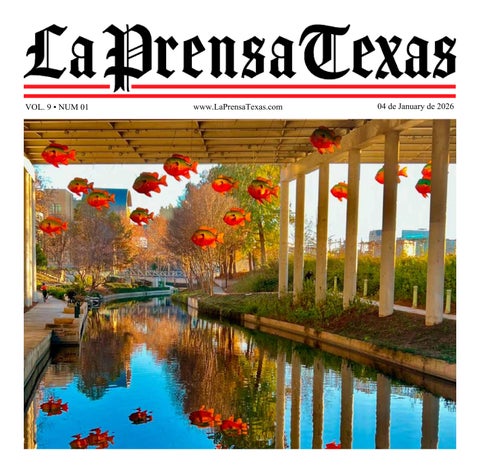
VOL. 9 • NUM 01
www.LaPrensaTexas.com
04 de January de 2026
2
La Prensa Texas SAN ANTONIO
LA PRENSA TEXAS Founded 1913 - Fundada en 1913
Publisher / Editora: Yvette Tello y.tello@laprensatexas.com Community Liaison / Enlace Comunitario: Ramon Chapa Jr. r.chapa@laprensatexas.com Creative Director / Director Creativo: Nicodemus Gonzalez Advertising & Production Coordinator / Coordinadora de Publicidad y Producción: Jessica Medrano Contributors / Colaboradores: Dr. Ricardo Romo, Henrietta Hernandez info@laprensatexas.com Editor Español: José I. Franco Sales Representative / Representante de Ventas: Maria Cisneros
La Prensa Texas is a grassroots, bilingual publication that serves as a vital voice for the community — especially for those who are too often left out of mainstream media conversations. Since its founding, La Prensa Texas has been dedicated to providing relevant, accessible, and culturally rooted news that reflects the lives, struggles, and triumphs of the people of San Antonio and surrounding counties. Our mission is simple yet powerful: to inform, inspire, and empower our readers through storytelling that uplifts the diverse voices of our community. This publication continues to be the lifeline of local news, bridging the gap between the people and the stories that matter most. Sales Info: Our Circulation 45,000 Printed And Distributed Weekly English And Spanish Send Press Releases And Advertising Inquiries To: Info@LaPrensaTexas.com 210-628-9611
Let’s Talk About It: The Origin of the Pinata
By Yvette Tello That colorful piñata hanging at every fiesta didn’t start where most of us think it did. Its story actually begins far from Mexico, traveling continents and centuries before landing in our celebrations. The earliest versions came from China, where paper figures filled with seeds were broken during New Year celebrations to bring good fortune. From there, the idea traveled west to Europe, passing through Italy. The Italians called it pignatta, a fragile clay pot used in festive games. When Spain entered the picture, the tradition crossed the ocean with colonizers and missionaries and eventually arrived in Mexico. And that’s where everything changed.In Mexico, the piñata was loaded with symbolism. The classic star shape has seven peaks, representing the seven deadly sins. The bright colors stand for temptation. Being blindfolded reminds us that faith doesn’t rely on sight. The stick represents strength and virtue. Each swing is the struggle against temptation. And when the piñata finally breaks, the fruit and candy spilling out symbolize reward for perseverance and righteousness. What started as a teaching tool during evangelization became something much bigger. Over time, the lesson remained, but the joy took center stage. Piñatas turned into expressions of creativity, humor, resistance, and community. They became part of birthdays, holidays, protests, pop culture, and everyday joy. The piñata is more than a party game. It’s a living
04 de January de 2026
piece of history — layered with faith, from somewhere else but Mexico was struggle, and celebration — passed the one who made it famous” down generation by generation. What were you taught? Let’s talk about it…. Claudia Luna: “We are Mexicans and we add that something that makes us Poot V Karyna Karla: “Mexico unique and unrepeatable in the world and our piñatas are a prime example acquired it and improved it!” of it” Jeff Hull: “I read China and Europe. In China it was reported back by Patricia Ibarra: “Desde la primaria Marco Polo. Also both the Aztecs se sabe eso la piñata viene de China” and Mayans had practices similar to piñatas, involving breaking decorated Ali Vega: “De hecho en Italia el día clay pots filled with treasures, which que aquí es de Reyes, ellos festejan a the Spanish later adapted for religious una bruja buena y rompen una piñata instruction, transforming them into en forma de bruja rellena de dulces. Lo the Christian symbols we know today, sé porque estuve ahí durante el jubileo notes Amigo Energy and McClung y salía en todas las noticias. Entonces Museum of Natural History and el guía explicó que ellos no festejan a Culture. The Aztecs used them for los reyes magos sino a esa bruja. Ese Huitzilopochtli’s birthday, while festejo es aún más antiguo que el de las Mayans had a blindfolded pot-hitting pozadas acá.” game, both utilized by Spanish missionaries to teach about sin and Miguel Ramos: “No es mexicana pero México le pusó color y sabor en un faith.” ambiente de alegría y diversión “ Alma Rosa Martinez E: “Pues las piñatas nacen donde les da la gana y Mynú Dominguez: “La piñata si es de origen chino y los picos representa quisieron ser mexicanas…” los pecados capitales..pero una piñata Lidia CarRa: “No importa dónde es en época navideña también representa que se creó la piñata, el caso es que en la estrella de Belén y los dulces son México se masterizó como la obra de los deseos...y adoptamos tradiciones arte que es! Aparte, en ningun lugar sin saber el origen y sin una referencia del mundo se celebran los cumpleaños bíblica... finalmente son tradiciones de los niños y las posadas cómo se paganas son origen bíblico” celebran en México, con piñatas!” Mareli Paez: “Pues aunque muchas Chewey Jag: “It’s not true that the cosas no son mexicanas ya las sweets are the prize, the inside of the adoptamos siii” piñata represents the grace of God that when you break the fish with faith, God Vero Hormiga Atomica: “La Virgen Maria es de Nazaret, la trajieron los pours out his grace” espan̈ oles, y la fabrican los chinos, pero Maria Calvillo-Morales: “It may be se quedó para ser de los mexicanos.”
04 de January de 2026
La Prensa Texas SAN ANTONIO
3
About The Scholar & Artist: Dr. Ricardo Romo Dr. Ricardo Romo is a nationally respected urban historian, educator, and advocate for Latino culture and civil rights. From 1992 to 1999, he served as an Executive Officer and Vice Provost for Academic Affairs at the University of Texas at Austin. He left UT Austin in 1999 to serve as the fifth president of The University of Texas at San Antonio (UTSA). His eighteen-year tenure at UTSA, 1999 to 2017, is one of the longest in the University of Texas System. Romo led one of the fastest-growing public universities in Texas into a new era of academic and research excellence. A native of San Antonio’s West Side, Romo attended Fox Tech High School, where he won three state championships in cross-country and track. As the nation’s second-best miler, he earned a track scholarship to the University of Texas at Austin. Romo was the Southwest Conference Champion in the mile and three-mile and earned All-American honors. In 1966, he became the first Texan and first Latino to run a mile in under four minutes—a record that stood for 41 years. He earned a B.S. in Education from UT Austin in 1967,
an M.A. in History from Loyola Marymount University in 1970, and a Ph.D. in History from UCLA in 1975. His book, East Los Angeles: History of a Barrio, was published by the University of Texas Press and is currently in its ninth printing. Romo began his career as a high school teacher in Los Angeles, where he taught one of the first Mexican American history courses in the country. He then held academic positions in Chicano Studies and History at California State University, Northridge; the University of California, San Diego (where he also served as Director of Chicano Studies); and the University of Texas at Austin. At UT Austin, he was an associate professor of history and an active member of the Center for Mexican American Studies. He also held visiting positions at UC Berkeley and the Stanford Center for Advanced Studies in the Behavioral Sciences. During the late 1980s through the mid-1990s, Romo was active in Latino public policy research and civil rights. He served as an expert witness in the Garza v. County of Los Angeles, Cal., 756 F. Supp. 1298 (C.D. Cal. 1990). This case found that the Board’s 1981 redistricting plan violat-
ed Section 2 of the Voting Rights Act and the Equal Protection Clause, resulting in the creation of a new Latino-majority district in which Gloria Molina was elected. Romo was also an expert witness in the Hopwood v. Texas case decided by the United States Court of Appeals for the Fifth Circuit in 1996 and is formally cited as Hopwood v. Texas, 78 F.3d 932 (5th Cir. 1996). Romo has received many honors throughout his career, including: Fellow at the Center for Advanced Studies at Stanford; the prestigious Clark Kerr Award for Distinguished Leadership in Higher Education from the University of California, Berkeley; the Council for Advancement and Support of Education (CASE) Chief Executive Leadership Award; the Outstanding Civilian Service Medal from the United States Army North; the Distinguished Alumnus Award from the Texas Exes Alumni Association; and, the Isabel la Catolica award, the highest award given to non-Spanish subjects, bestowed by King Juan Carlos of Spain. Romo has received numerous special appointments, including: by former President Bush and re-appointed by President
Obama to the White House Advisory Commission on Educational Excellence for Hispanics; as a U.S. representative to the United Nations Educational, Scientific and Cultural Organization; as Vice Chair for the Federal Reserve Bank; as Chair for Southwest Research Institute; and as Vice Chair for Air University. As UTSA’s president, Romo led the university through a period of tremendous growth. Under his leadership, enrollment rose by 68% to over 31,000 students, and doctoral programs expanded from three to 24. He launched “The UTSA Plan: A Roadmap to Excellence,” focusing
on educational access, research expansion, and institutional prestige. UTSA’s annual research expenditures had a six-fold increase during his tenure. The Texas Legislature recognized UTSA as an emerging Tier One research university under his leadership. Romo is also active in the San Antonio community, serving on numerous nonprofit boards and generously contributing to scholarships, museums, and youth organizations. He and his wife, Harriett, have an extensive Chicano art collection, and they have donated art to seven museums, including the Smithsonian American Art Museum.
4
La Prensa Texas SAN ANTONIO
04 de January de 2026
04 de January de 2026
La Prensa Texas SAN ANTONIO
5
San Antonio to Rename East Side Street in Honor of Tuskegee Airmen! By Henrietta Hernandez Buress
San Antonio is honoring a pivotal chapter in American and military history by renaming an East Side street in recognition of the legendary Tuskegee Airmen, the nation’s first African American military pilots. The San Antonio City Council has approved the renaming of a portion of Iowa Street as Tuskegee Airmen Memorial Way, paying tribute to the men who served with distinction during World War II while breaking racial barriers in the U.S. Armed Forces. The newly designated stretch is located in the historic Denver Heights neighborhood on the city’s East Side. The Tuskegee Airmen were members of the 332nd Fighter Group and related units, known for escorting Allied bombers during combat missions across Europe. Flying their iconic red-tailed aircraft, the Airmen earned a reputation for excellence and discipline at a time when segregation was still deeply entrenched in American society. San Antonio holds a special connection to this history. Local organizers note that approximately 20 Tuskegee Airmen and support personnel lived in or had ties to the city, particularly on the East Side. Some made their homes in the Denver Heights area after their
military service, becoming part of the fabric of the community they are now being honored within. The street renaming is part of a broader effort to preserve and elevate the legacy of the Airmen. Plans include the installation of new street signage, a commemorative plaque bearing the names of local Airmen, and a public ceremony attended by descendants, veterans, and community leaders. City leaders emphasized that honoring the Tuskegee Airmen is not only about remembering the past, but also about educating future generations. The designation serves as a permanent San Antonio to Rename East Side Street in Honor of Tuskegee Airmen! reminder of courage, perseverance, and the fight for equality—values that continue to shape San Antonio and the nation. With the creation of Tuskegee Airmen Memorial Way, San Antonio ensures that the legacy of these trailblazers will remain visible, respected, and remembered for generations to come. Thomas Marvin Ellis and fellow Tuskegee Airmen during World War II — Ellis was one of the Tuskegee Airmen from San Antonio who later lived here after the war.
TPR Tuskegee Airmen pilots and crew — iconic historical photos of the all-Black 332nd Fighter Group, known as the “Red Tails.” CAF RISE ABOVE Historic squadron group photos of airmen stationed overseas. The Library of Congress Another group shot of Tuskegee Airmen during WWII.
Alamy
man who lived in San Antonio and was a respected mentor in Here’s what we do know about the community; he was awardthe two Airmen linked to the ed the Congressional Gold new street designation in San Medal for his service. Antonio: MySA Thomas Marvin Ellis — Served with the Tuskegee Airmen and Unfortunately, individual, later lived and worked in San identified professional portraits Antonio after WWII, including of Ellis or Eusan aren’t widely as a mail carrier. published online through public archives, but group photos TPR and multiple archive images of Tuskegee Airmen in action do Warren “Godfather” Harding exist in library collections and Eusan — Also a Tuskegee Air- museum archives.
6
La Prensa Texas SAN ANTONIO
04 de January de 2026
Comisión de Calidad Ambiental de Texas AVISO DE UN PERMISO FEDERAL PARA OPERACIÓN PRELIMINAR Permiso Preliminar Número: O4790 SOLICITUD Y PERMISO PRELIMINAR. Vantage Data Centers TX21, LLC, 14720 Omicron Dr, San Antonio, TX 78245-5131, ha presentado una solicitud ante la Comisión de Calidad Ambiental de Texas (TCEQ, por sus siglas en inglés) para la expedición inicial de un Permiso Federal de Operación (en adelante denominado como Permiso) núm. O4790, Solicitud núm. 38600, para autorizar la operación de Vantage Data Center TX2, un Procesamiento de datos, alojamiento y servicios relacionados instalación. El área a la cual se refiere la solicitud está ubicada en 5207 Carretera Rogers en la ciudad de San Antonio, Condado de Bexar, Texas 78251-3632. Este enlace a un mapa electrónico de la ubicación general del sitio o la instalación es proporcionado como una cortesía y no es parte de la solicitud o el aviso. Para la ubicación exacta, consulte la solicitud. https://gisweb.tceq.texas.gov/LocationMapper/?marker=-98.698055,29.478055&level=13 Esta solicitud fue recibida por la TCEQ el 17 de julio de 2025. El propósito de un Permiso Federal de Operación es mejorar el acatamiento general con las normas que gobiernan el control de la contaminación atmosférica, claramente definiendo todos los requisitos aplicables como están definidos en el Título 30 del Código Administrativo de Texas § 122.10 (30 TAC § 122.10, por sus siglas en inglés). El permiso preliminar, si es aprobado, codificará las condiciones bajo las cuales el área debe operar. El permiso no autorizará construcción nueva. El director ejecutivo ha concluido la revisión técnica de la solicitud y ha hecho una decisión preliminar para preparar el permiso preliminar para la revisión y comentario público. El director ejecutivo de la TCEQ recomienda la expedición de este permiso preliminar. La solicitud de permiso, la declaración de fundamentos y el proyecto de permiso estarán disponibles para su consulta y reproducción en TCEQ Region Office 13, 14250 Judson Rd, San Antonio, Texas 78233-4480 a partir del primer día de la publicación de este aviso. El proyecto de permiso y la declaración de fundamentos están disponibles electrónicamente en la página web de la TCEQ: www.tceq.texas.gov/goto/tvnotice. La solicitud (junto con cualquier actualización) está disponible través del siguiente enlace: https://www.tceq.texas.gov/permitting/air/airpermit-applications-notices. Es posible acceder a esta información electrónicamente en la Secretaría Oficial, ubicada en el Edificio F (planta baja) de las Oficinas Centrales de la TCEQ en Austin, Texas, así como en la Oficina Regional en San Antonio de la comisión. También es posible acceder electrónicamente a materiales de apoyo relevantes en estas ubicaciones (entre ellos los permisos de Revisión de Nuevas Fuentes que se han incorporado por referencia). COMENTARIOS/NOTIFICACIÓN PÚBLICA Y AUDIENCIA. Cualquier persona puede entregar comentarios públicos sobre el permiso preliminar. Comentarios relacionados a la exactitud, lo completo, y lo apropiado de las condiciones del permiso pueden resultar en cambios al permiso preliminar. Una persona que podría ser afectada por la emisión de contaminantes atmosféricos del área del sitio del permiso puede solicitar una audiencia de aviso y comentarios. El propósito de la audiencia de notificación y comentarios es para proporcionar la oportunidad para entregar comentarios sobre el permiso preliminar. El permiso puede ser cambiado en base a si los comentarios relacionados con el permiso permiten el cumplimiento con el Título 30 del Código Administrativo de Texas, Capítulo 122 (ejemplos pueden incluir que el permiso no tiene todos los requisitos aplicables que correspondan o que no se cumplieron los procedimientos de aviso público). La TCEQ puede otorgar una audiencia de aviso y comentarios con respecto a esta solicitud si una petición por escrito es presentada dentro de los treinta días después de la publicación del anuncio en el diario. La solicitud de audiencia debe incluir la base de la solicitud, incluyendo una descripción de como la persona puede ser afectada por la emisión de contaminantes atmosféricos del área de la solicitud. La solicitud también debería especifi-
04 de January de 2026
La Prensa Texas SAN ANTONIO
7
Comentarios públicos por escrito y/o peticiones para una audiencia de aviso y comentarios deberían ser presentados a la Comisión de Calidad Ambiental (TCEQ), Oficina del Secretario Oficial (Office of Chief Clerk), MC-105, P.O. Box 13087, Austin, Texas 78711-3087, o por internet al www14. tceq.texas.gov/epic/eComment/, dentro de treinta días después de la fecha de publicación en el periódico de este aviso. Si se comunica electrónicamente con la TCEQ, favor de notar que su correo electrónico, tal como su dirección de correo doméstico, formarán parte del archivo público de la agencia. Un aviso de la acción final propuesta que incluye una respuesta a los comentarios y denotando cualquier cambio al permiso preliminar, será enviado a todas las personas que hayan presentado comentarios públicos, una solicitud de audiencia o que hayan solicitado ser incluidos en la lista de correo. Este envío de correo también proveerá instrucciones para hacer peticiones públicas a la Agencia de Protección Ambiental (EPA, por sus siglas en inglés), para solicitar que la EPA se oponga a la expedición del permiso preliminar. Después de recibir una solicitud, la EPA solamente podrá objetar a la expedición de un permiso que no cumple con los requisitos aplicables o los requisitos del 30 TAC Capítulo 122 LISTA PARA ENVÍO DE CORREO. Aparte de entregar comentarios públicos, usted puede solicitar ser incluido en una lista para envío de correo con respecto a esta solicitud al enviar su petición a la Oficina del Secretario Oficial (Office of Chief Clerk) a la dirección antes mencionada. Los que se encuentran en la lista para envío de correo recibirán copias de avisos públicos futuros (si hay) para esta solicitud enviados por correo por el Secretario Oficial. INFORMACIÓN. Para más información sobre el proceso de tramitación de permisos, favor de llamar al Programa de Educación pública de la TCEQ sin costo al 1-800-687-4040, o bien visitar su sitio web, www.tceq.texas.gov/goto/ pep. Para información en español, favor de llamar al 1-800-687-4040. También es posible consultar oportunidades de participación pública en nuestro sitio web, www.tceq.texas.gov/goto/participation. Puede obtener más información sobre Vantage Data Centers TX21, LLC llamando a Mr. Ryan Peterson al teléfono (509) 750-1736. Fecha de Expedición: 2 de diciembre de 2025
8
La Prensa Texas SAN ANTONIO
04 de January de 2026
Juego Del Recuerdo Gran Éxito Por Sendero Deportivo Todo un gran éxito en “El Juego del Recuerdo Potranco”, organizado por los beisbolistas Jimmy Martínez y Roberto Hernández que tuvieron el apoyo del presidente Simón Sánchez (Potranco Baseball League), el artista Eloy Rocha, dueño del terreno de juego estadio Potranco.
Así como de Jack López, manager y jugador del equipo Toronto Blue Jay’s y Chris Urdiales, manager y jugador de los Dodgers. Esté gran evento deportivo logró reunir beisbolistas de sesenta años y mayores, quienes aportaron sus respectivas habilidades sobre el terreno de juego y a la vez convivieron durante el amistoso partido. Por Blue Jay’s se llevó la victoria Ozzie Parra, con relevo de Luis Sánchez. Por Dodgers el lanzador derecho Hilario Álvarez, tiro cinco entradas y bateó importante imparable, lo relevo Roberto Cervantes. La pizarra final fue de 8-5 carreras. Durante el partido hubo acciones en las que destacaron por Blue Jay’s, el jardinero izquierdo Mencho Vargas, quien recibió base por golpe, luego se
robó la segunda base y en bola ocupada avanzo a tercera base, donde con toque de bola ejecutado magistralmente por Benito Martínez “El Venado”, anotó carrera pisando el plato con su tradicional “brinco”, lo cual le fue aplaudido por fanáticos y sus compañeros. El Venado Martínez, en error del receptor se fue a la intermedia llegando a salvo con espectacular barrida. Posteriormente El Venado, en batazo por el jardín derecho ejecutado por el bateador zurdo Rafa López, logró atajar la bola, pero en la caída se le escapó del guante. Esa jugada le dio emotiva ovación. Al final del partido Simón Sánchez, comentarista y compilador, anunció las elecciones de Rafa López, como el mejor bateador con perfecto 3-3. Benito
Martínez MVP. De acuerdo a los organizadores este domingo 4 de enero se jugará el partido de la revancha entre Dodgers y Toronto en el campo 2 de Potranco en el horario de las 12pm. Por otro lado la categoría Abierta dominical en el estadio Potranco a las 10am se jugará el clásico entre los líderes Piratas de Sabinas
que tiene récord de 10-2, y Broncos de Reynosa SA con fijación de 8-2-2. El playoff categoría Másters 50+ se comenzará a jugar a partir del domingo 11 de enero en su sede del campo 2 Potranco. En las fotos aparecen los jugadores de Dodgers y Blue Jay’s unidos. Hilario Álvarez y Mencho Vargas. (Fotos de Franco).
04 de January de 2026
La Prensa Texas SAN ANTONIO
9
Arab Influence on The Spanish Language J. gilberto Quezada The Spanish language, like many tongues, is a tapestry woven from centuries of cultural encounters. One of the most profound influences came from the Arab world during the Middle Ages, when the Moors ruled much of the Iberian Peninsula for nearly 800 years. This long coexistence left an indelible mark not only on architecture, science, and agriculture, but also on the very words Spaniards, Mexicans, and Mexican Americans speak today. The Arabic imprint is so strong that modern Spanish carries thousands of terms derived from Arabic, shaping its vocabulary and enriching its expressive power
The Arab influence on Spanish began with the Muslim conquest of the Iberian Peninsula in 711 CE. For nearly eight centuries, large parts of Spain were under Islamic rule, a period known as Al‑Andalus. This long coexistence between Arabic‑speaking rulers and the local Romance‑speaking population created fertile ground for linguistic exchange. One of the most visible legacies is the thousands of Arabic loanwords in modern Spanish. Everyday terms such as aceituna (olive), azúcar (sugar), and alfombra (carpet) trace directly back to Arabic. Many of these words entered Spanish through agriculture, trade, and domestic life, reflecting the areas where Arab culture had
the strongest impact. Beyond everyday words like aceituna (olive) and azúcar (sugar), Arabic left its mark on Spanish through terms such as ojalá (hopefully, from in shā’ Allāh “if God wills”), alcázar (fortress), almohada (pillow), and alcalde (mayor). Many agricultural and culinary words—acequia (irrigation ditch), naranja (orange), berenjena (eggplant)—reflect innovations introduced during Al‑Andalus. Even abstract concepts like hazaña (feat) and technical terms like alfiler (pin) or alhaja (jewel) show the breadth of influence.
Together, these examples illustrate how Arabic shaped Spanish vocabulary across gov-
ernance, science, daily life, and expressions of hope. Arabic also enriched Spanish with specialized vocabulary in mathematics, astronomy, medicine, and architecture. Words like álgebra (algebra), cifra (digit), and noria (waterwheel) highlight the transmission of advanced knowledge from the Islamic world to medieval Europe via Spain. Geographic names across Spain preserve Arabic roots. Cities such as Guadalajara (from Wādī al‑Ḥijārah, “Valley of Stones”) and Almería (from al‑Meriyya, “the watchtower”) are reminders of the Arab presence. These toponyms remain a living testimony of the cultural fusion that shaped Spain’s landscape. Beyond vocabu-
lary, Arabic influenced Spanish phonetics and expressions. For example, the frequent use of the definite article al‑ in loanwords (almohada, alcázar) reflects Arabic grammar. Some idiomatic expressions and stylistic flourishes in medieval Spanish poetry also show traces of Arabic literary traditions. Today, the Arab imprint on Spanish is not just linguistic but cultural. It connects Spain to a broader Mediterranean and Middle Eastern heritage, reminding speakers of centuries of coexistence and exchange. The richness of Spanish vocabulary and its historical depth owe much to this Arab contribution, which continues to fascinate linguists and historians alike.
10
La Prensa Texas SAN ANTONIO
04 de January de 2026
Latinos in America: Photos of the Year. By Ricardo Romo, Ph.D
Quinceañera in Downtown Los Angeles. Credit R.Romo.
Michael Menchaca. San Antonio, TX. Credit R. Romo
Vincent Valdez in his studio. Courtesy Contemporary Arts Museum Houston. Credit R. Romo.
Vincent Valdez, “Just a Dream…” exhibit. Courtesy Contemporary Arts Museum Houston. Credit R. Romo.
04 de January de 2026
La Prensa Texas SAN ANTONIO
11
Scherezade Garcia-Vazquez, UT Austin Art Professor, in her New York City Studio. Credit R. Romo
Mural on the San Antonio Riverwalk north. Credit R. Romo
A New York City Dominican Cigar Shop. Credit R. Romo.
Arthur Lopez. Santa Fe, New Mexico. King Gallery. Credit R. Romo
East Los Angeles artist Margaret Garcia in her studio. Credit R. Romo.
12
La Prensa Texas SAN ANTONIO
04 de January de 2026
TCU Walks It Off in Alamo Bowl Thriller — San Antonio 2026 By Ramon Chapa Jr. The TCU Horned Frogs delivered a heart-stopping finish, defeating the USC Trojans 30–27 on a walkoff touchdown in overtime at the Alamo Bowl in San Antonio. More than 60,000 fans packed the Alamodome, creating an electric atmosphere from start to finish. Families and friends turned the day into a full celebration, tailgating before the game and keeping the party going well after the final whistle. An unforgettable night of football, excitement, and fun—San Antonio 2026 showed up and showed out. The pictures tell the story.
04 de January de 2026
La Prensa Texas SAN ANTONIO
13
When Excellence Isn’t Enough: The cost of normalizing suspicion toward minority success Op Ed submitted by Vincent Lazaro There was a time when excellence was assumed to speak for itself. Or at least we liked to believe it did. Today, accomplishment— particularly when worn by a minority face—often arrives not as proof, but as a provocation: something to be questioned, discounted, and quietly reframed as unearned.This posture has become public and even fashionable among certain right-wing commentators who treat diversity not as an American strength but as an affront to a hierarchy they assume once worked in their favor. In early 2024, Charlie Kirk remarked that when he boards an airplane and sees a Black pilot, he feels uneasy—not because of turbulence, weather, or mechanical failure, but because he assumes that pilot’s presence in the cockpit is the product of affirmative action or DEI rather than merit. That sentiment did not emerge in a vacuum. It resonates because many Americans quietly
share it—especially those competing with minorities for finite spots in colleges and professions. What is striking is not merely the insult embedded in such a claim, but the confidence with which it is asserted— often by people who have never competed at the levels they now feel entitled to police. I have spent much of my life in elite and competitive environments—the military and Ivy League universities, including Harvard, Yale, and Columbia. Along the way, I met many minority students—Black, Latino, Asian—whose stories bore little resemblance to the caricatures so casually invoked by DEI critics. Most came from modest or outright poor backgrounds. We did not have SAT prep courses, private tutors, or parents who could buy advantage. My high school did not offer Advanced Placement classes. In fact, I did not even know such courses existed until I arrived at Yale. We learned to compete not because the system favored us, but because it often did not—
where grit, discipline, and stubborn resilience were survival tools. And yet, even in those rarefied spaces, the presumption lingered: that we were somehow less prepared, less deserving, less legitimate. Achievement did not erase suspicion—it merely invited it. Sam Flores, my high school principal, made it impossible for students like me to internalize the world’s low expectations. At Harlandale High School, a predominantly Mexican American campus routinely dismissed as noncompetitive, we were assumed to be placeholders, warm-up rounds, or beneficiaries of lowered standards. We learned early that our zip code would be mistaken for our potential. That attitude has not disappeared. It has simply migrated upward. I saw it again years later in a friend from high school—one of the few Anglo students in a largely Mexican American school. It took him nine years to complete a community college degree. He never held a steady job.
Yet he carried himself with a sense of inherited superiority that required no evidence beyond his skin color. He referred to my people as “Mescans,” peppered his speech with racial epithets, and joked openly about the supposed worthlessness of minorities—often in front of me. At first, I couldn’t understand why someone who held such views wanted to spend time with me at all. Eventually, it became clear. My accomplishments—Army officer, Ivy League degrees, professional credentials— had finally made me legible to him. Not admirable, perhaps, but acceptable. Equal, in his mind, not because of shared humanity, but because I had cleared a bar he never approached himself.
foundational. But equality of worth does not imply equality of effort. Some people work harder, sacrifice more, and persist longer—often in spite of systems that never fully welcomed them.
This is the unspoken logic behind much of today’s backlash. It is not about merit, but resentment. About the discomfort of watching people once presumed inferior compete—and succeed—on equal footing. The Jeffersonian ideal that all men are created equal remains
That should concern us all. Because a society that cannot recognize merit when it sees it—especially when it wears an unfamiliar face—is not defending excellence. It is retreating from it. And in the long run, that retreat diminishes everyone.
To reduce those achievements to “DEI hires” or “affirmative action beneficiaries” is not only lazy; it is corrosive. It tells every minority who succeeded through sheer determination that their labor will always be questioned, their competence always conditional. The danger of voices like Charlie Kirk’s is not that they are crude—it is that they are becoming normalized. Suspicion is now marketed as common sense. Dismissal is repackaged as realism.
14
La Prensa Texas SAN ANTONIO
04 de January de 2026
La Prensa Texas SAN ANTONIO
04 de January de 2026
15
COMISIÓN DE CALIDAD AMBIENTAL DE TEXAS
AVISO DE RECIBIMIENTO DE LA SOLICITUD E INTENCIÓN DE OBTENER UN PERMISO DE AIRE (NORI) NÚMERO DE PERMISO DE CALIDAD DEL AIRE PROPUESTO 182371 SOLICITUD Kamps, Inc, ha solicitado a la Comisión de Calidad Ambiental de Texas (TCEQ, por sus siglas en inglés) para: Emisión de Permiso 182371 Esta solicitud autorizaría la construcción de un incinerador con cortina de aire dentro de la instalación fabricante de palets de madera ubicada en 5889 Farm-to-Market Road 1346, San Antonio, Condado de Bexar, Texas 78220. Este enlace a un mapa electrónico de la ubicación general del sitio o instalación se proporciona como cortesía pública y no como parte de la solicitud o aviso. Para conocer la ubicación exacta, consulte la aplicación. https://gisweb.tceq.texas.gov/LocationMapper/?marker=-98.3738,29.4275&level=13. La instalación emitirá los siguientes contaminantes: monóxido de carbono, contaminantes atmosféricos peligrosos, óxidos de nitrógeno, compuestos orgánicos, material particulado incluyendo material en partículas con diámetros de 10 micras o menos y 2.5 micras o menos y dióxido de azufre. Esta solicitud se presentó a la TCEQ el 4 de diciembre de 2025. La solicitud estará disponible para su visualización y copia en la oficina central de la TCEQ, la oficina regional de TCEQ en San Antonio y en la Biblioteca Schaefer Branch, 6322 U.S. Highway 87 East, San Antonio, Condado de Bexar, Texas a partir del primer día de publicación de este aviso. El archivo de cumplimiento de la instalación, si existe alguno, está disponible para su revisión pública en la oficina regional de San Antonio de la TCEQ. La solicitud (cualquier actualización inclusive) está disponible electrónicamente en la siguiente página web: https://www.tceq.texas.gov/permitting/air/airpermit-applications-notices. El director ejecutivo ha determinado que la solicitud está administrativamente completa y llevará a cabo una revisión técnica de la solicitud. COMENTARIO PÚBLICO. Usted puede enviar comentarios públicos a la Oficina del Secretario Oficial en la dirección a continuación. La TCEQ considerará todos los comentarios públicos al desarrollar una decisión final sobre la solicitud y el director ejecutivo preparará una respuesta a esos comentarios. REUNIÓN PÚBLICA. Puede solicitar una reunión pública a la Oficina del Secretario Oficial en la dirección a continuación. El propósito de una reunión pública es para brindar la oportunidad de enviar comentarios o hacer preguntas sobre la solicitud. Se llevará a cabo una reunión pública sobre la solicitud si lo solicita una persona interesad y el director ejecutivo determina que existe un grado significativo de interés público en la solicitud o si lo solicita un legislador local. Una reunión pública no es una audiencia de caso impugnado. Una vez completada la revisión técnica de la solicitud, el director ejecutivo puede preparar un bosquejo de permiso y emitirá una decisión preliminar sobre la solicitud. Si se prepara un bosquejo de Permiso de Calidad del Aire, se requiere un Aviso de Solicitud y Decisión Preliminar y luego se publicará y enviará por correo a aquellos que hicieron comentarios, presentaron solicitudes de audiencia o están en la lista de correo para esta solicitud y contendrá la fecha límite final para enviar comentarios públicos. OPORTUNIDAD PARA UNA AUDIENCIA DE CASO IMPUGNADO. Puede solicitar una audiencia de caso impugnado si usted es una persona que puede verse afectada por las emisiones de contaminantes del aire de la instalación. Si solicita una audiencia de caso impugnado, debe presentar lo siguiente: (1) su nombre (o para un grupo o asociación, un representante oficial), dirección postal y número de teléfono diurno; (2) nombre y número de permiso del solicitante; 3) la declaración "[Yo/nosotros] solicitamos una audiencia de caso impugnado"; (4) una descripción específica de cómo se vería afectado negativamente por la aplicación y las emisiones atmosféricas de la instalación de una manera no común para el público en general; (5) la ubicación y distancia de su propiedad en relación con la instalación; (6) una descripción de cómo utiliza la propiedad que puede verse afectada por la instalación; y (7) una lista de todas las cuestiones de hecho en disputa que envíe durante el periodo de comentarios. Si la solicitud es hecha por un grupo o una asociación, uno o más miembros que tienen capacidad para solicitar una audiencia deben ser identificados por su nombre y dirección física. También deben identificarse los intereses que el grupo o asociación busca proteger. También puede presentar los ajustes propuestos a la solicitud / permiso que satisfagan sus inquietudes. La fecha límite para presentar una solicitud para una audiencia de caso impugnado es de 30 días después de que se publique el aviso del periódico. Si una solicitud se presenta oportunamente, la fecha límite para solicitar una audiencia de caso impugnado se extenderá a 30 días después del envío de la respuesta a los comentarios. Si una solicitud de audiencia se presenta oportunamente, después del cierre de todos los períodos de comentarios y solicitudes aplicables, el Director Ejecutivo enviará la solicitud y cualquier solicitud de audiencia de caso impugnado a los Comisionados para su consideración en una reunión programada de la Comisión. La Comisión sólo podrá conceder una solicitud de audiencia de un asunto impugnado sobre cuestiones que el solicitante haya presentado en sus observaciones oportunas que no hayan sido retiradas posteriormente. Si se concede una audiencia, el tema de una audiencia se limitará a cuestiones de hecho en disputa o cuestiones mixtas de hecho y de derecho relacionadas con preocupaciones relevantes y materiales sobre la calidad del aire presentadas durante el periodo de comentarios. Cuestiones como los valores de las propiedades, el ruido, la seguridad del tráfico, y la zonificación están fuera de la jurisdicción de la Comisión para abordar en este procedimiento. LISTA DE CORREO. Además de enviar comentarios públicos, puede solicitar ser colocado en una lista de correo para recibir futuros avisos públicos para esta solicitud específica enviando una solicitud por escrito a la Oficina del Secretario Oficial a la dirección a continuación. CONTACTOS E INFORMACIÓN DE LA AGENCIA. Los comentarios y solicitudes del público deben enviarse electrónicamente a www14.tceq.texas.gov/epic/eComment/, o por escrito Texas Commission on Environmental Quality, Office of Chief Clerk, MC-105, P.O. Box 13087, Austin, Texas 78711-3087. Tenga en cuenta que cualquier información de contacto que proporcione, incluido su nombre, número de teléfono, dirección de correo electrónico y dirección física, se convertirá en parte del registro público de la agencia. Para más información sobre el proceso de tramitación de permisos, favor de llamar al Programa de Educación pública de la TCEQ sin costo al 1-800-687-4040, o bien visitar su sitio web, www.tceq.texas.gov/goto/pep. Para información en español, favor de llamar al 1-800-687-4040. También es posible consultar oportunidades de participación pública en nuestro sitio web, www.tceq.texas.gov/goto/participation.
También se puede obtener más información de Kamps, Inc, 5889 Farm-to-Market Road 1346, San Antonio, Texas 78220-1909 o llamando al Sr. Marco Montoya, Gerente de Planta al (470) 2979667.
Fecha de emisión del aviso: 17 de diciembre de 2025
16
La Prensa Texas SAN ANTONIO
04 de January de 2026
Insulin Isn’t Enough. Nutrition Can Transform Type 1 Diabetes. By Andrew Koutnik, PhD
diagnosed, I did what less insulin. My mental survive. But eating in -- a critical safeguard for everyone told me to health improved. a way that minimizes those of us on low-carb do: count carbs, take The science backs this blood sugar swings diets -- is inconsistently I was 16 when I ended insulin, and hope the up. allows me to use insulin covered. up in a hospital bed numbers balance out. Multiple studies have the way it was intended If my health results had and heard three words I lived with constant shown that people with -- to normalize glucose come from a new drug, that changed my life: blood sugar swings that type 1 diabetes on low- levels. it would be hailed as a type 1 diabetes. What I left me exhausted and carb diets can lower This isn’t “fringe.” breakthrough. Because didn’t know then -- and discouraged. their blood sugar into Ketogenic diets were the intervention is food, what too few doctors I t r i e d d i f f e r e n t the normal range -- standard of care in our system dismisses it. acknowledge today -- is s t r a t e g i e s , b u t slashing the risk of long- diabetes treatment dating That must change.After that dietary changes are nothing took me off term complications like back to 1797. Despite 17 years with type 1 often the best way to the rollercoaster. My brain, vision, and nerve centuries of evidence, diabetes, my life isn’t combat the disease. health only began to damage. nutrition remains an dictated by blood sugar For decades, doctors improve when I tried a I ’ v e e v e n a d d e d afterthought in diabetes chaos. Insulin saves have treated type 1 diet that would put me my own case in the care. Over two-thirds of lives -- but pairing it diabetes as if insulin into therapeutic ketosis. scientific literature so healthcare professionals with low-carb diets alone could manage Because carbohydrates researchers can benefit are uneducated about transforms them. It’s it. But despite billions raise blood glucose from the findings. For these strategies. time for our healthcare poured into drugs and higher and faster than more than 10 years on a Insurance coverage for system to catch up. devices, most people i n s u l i n c a n l o w e r ketogenic diet, I’ve kept nutrition and monitoring Dr. Andrew Koutnik, with type 1 diabetes glucose, cutting them my HbA1c around 5.5% remains patchy at best. P h D , i s a r e s e a r c h s t i l l d o n ’ t a c h i e v e out of my diet nearly -- the healthy target Access to continuous scientist specializing recommended blood entirely made my blood for someone without glucose monitors has in nutrition, exercise, sugar control. I know this sugar levels far more diabetes -- while cutting improved in recent years, and stress on metabolic firsthand, as a scientist predictable. Almost my insulin use by 43%. but patients still face health, and an advisory and someone living with i m m e d i a t e l y , m y Insulin is still essential. hurdles with high costs c o m m i t t e e m e m b e r type 1 diabetes. blood glucose levels Every person with type and insurance denials. for the Coalition for W h e n I w a s f i r s t normalized and I needed 1 diabetes needs it to And ketone monitoring Metabolic Health.
04 de January de 2026
La Prensa Texas SAN ANTONIO
17
Los Spurs Y Methodist Healthcare Llevaron Felicidad A Pacientes Por Franco La treceava edición anual del caritativo programa navideño entre el club pentacampeón Los Spurs de San Antonio y el sistema de salud Methodist Healthcare y Methodist Healthcare Ministries, con el éxito deseado realizaron los donativos de árboles navideños (Christmas Tree Giveaway 2025”.
Con lo que llevaron felicidad a pacientes y clientes. También donaron decoraciones alusivas y coronas navideñas, en lo que fue una cantidad de 150 árboles, los cuales fueron entregados por el ex guardia Bruce Bowen, quien ostenta tres anillos de campeón conquistados durante las temporadas de 2003, 2005 y 2007. Bowen, de 54 años de edad, se retiró del baloncesto
tras haber jugado 16 temporadas en el circuito de la NBA. Bowen, quien con orgullo tiene su jersey número 12 inmortalizada en el nicho del estadio Frost Bank Center, sigue siendo muy querido por la legión de seguidores del equipo Silver and Black. Durante el periodo navideño en este gran evento Bowen, estuvo acompañado por la
carismática mascota The Coyote, así como de personal de Spurs y el sistema de salud del Methodist Healthcare Care. Por el excelente trabajo realizado por tan selecto grupo, que llevó felicidad tanto a pequeños como adultos, La Prensa Texas, les extiende su gratitud por seguir adelante en lo que es toda una tradición por servir a nuestra comunidad.
Las bendiciones recibidas por este gran programa, han tenido como buenos resultados para el pentacampeón Spurs de San Antonio que ahora bajo la dirección de Mitch Johnson, quien junto con sus asistentes y jugadores continúan ganando partidos que los ubica en el segundo lugar de la potente NBA Conferencia del Oeste. (Fotos de cortesía SS&E).
18
La Prensa Texas SAN ANTONIO
04 de January de 2026
A TODAS LAS PERSONAS Y PARTES INTERESADAS:
Kamps, Inc, ha solicitado a la Comisión de Calidad Ambiental de Texas (TCEQ, por sus siglas en inglés) lo siguiente: Emisión del Permiso 182371 Esta solicitud autorizaría la construcción de un incinerador con cortina de aire dentro de la instalación fabricante de palets de madera ubicada en 5889 Farm-to-Market Road 1346, San Antonio, Condado de Bexar, Texas 78220. Información adicional sobre esta solicitud se encuentra en la
La Prensa Texas SAN ANTONIO
04 de January de 2026
19
The Ghost Town Survivors By Eduardo Jiménez Mayo Ph.D., J.D. The media portrays Chicano gangs as being insanely violent. Think of Jimmy Santiago Baca’s film, Blood In Blood Out, or Edward James Olmos’ movie, American Me. The stereotype may be based on fact; but there are other facts that remain in the shadows unless brought to light by interested parties who would redeem the reputation of Chicano gangs. San Antonio’s West Side gangs believed in revolutionary brotherhood and courageous self-sacrifice on behalf of their communities. By far the biggest, the Ghost Town Gang protected a vast swath of territory on San Antonio’s West Side near the Cassiano Homes. The derivation of its name is shrouded in mystery. Prevailing wisdom has it that the gang’s name was inspired by the San Fernando Cemetery near their center of operations. Other theories include the lack of street lighting in the neighborhood, which made it appear like a ghost town at night; or that when the Ghost Town Gang showed up in mass, the streets cleared out, leaving the neighborhood as barren as a ghost town. A Google search brings up the following results: “The Ghost Town Gang was a notorious Chicano barrio gang on San Antonio’s West Side in the 50s and 60s, known for turf wars in areas like the Cassiano Homes; they’ve since transformed into the Ghost Town Survivors (GTS), a group of former members who now give back to the community through charity, scholarships, and mentorship, honoring their past
while promoting positive change.” and the impoverished. Violence only broke out occasionally, when A w a r d - w i n n i n g B e r k e l e y a rival gang “crossed the line,” historian and sociologist David so to speak. Many of the gang Montejano focuses on the Ghost members and Brown Berets of the Town Gang in his book, Quixote’s post WWII era came back to San Soldiers: A Local History of Antonio after Korea or Vietnam the Chicano Movement, 1966– and capitalized on the GI Bill to 1981. In it you will discover educate themselves. They have that, properly contextualized, provided leadership in minority the post-WWII gangs on San businesses, civic institutions, Antonio’s West Side (the Alazán and the learned academies of this Apache Court Gang, the Riverside great city. I recall fondly that former Gang, and the Ghost Town Gang, among others) served a protective members of Ghost Town reunited function in their respective this past Veteran’s Day at the Good Samaritan Center Senior territories. Services building, housed on San After all, this was a time and Antonio’s West Side. It was filled a place in which the police may to the brim with highly-decorated not even show up if you called war veterans and their families, to report an assault or robbery. teachers, businessmen, musicians, Patrolling was done by the gangs, politicians, social workers, civil according to Montejano, because servants, and other esteemed no one else seemed to care. professionals. Local entrepreneur and Korean Patrolling was also a key function of the Brown Beret movement, era veteran, Max Navarro, a which attempted to hold law former Ghost Town member, and enforcement accountable for their other Ghost Town vatos of his actions at a time when most brown generation, bestowed an award folks were content to remain in on my father, psychiatrist Robert L. Jiménez (a former Riverside the shadows. gang member), for his record of The objective was clear: ensure service on behalf of his country that the police do their duty to and community. A native of San Antonio’s West protect and serve the community, and that the police refrain from Side, Dr. Jiménez, born in 1940, resorting to unnecessary violence. was the first Mexican American Consider the horrendous case of to become a Clinical Professor of Houston resident José Campos Psychiatry at Harvard University Torres. On May 5, 1977, the HPD Medical School and he was also severely beat war veteran José awarded the Navy Medal of Campos Torres, and dumped his Commendation for heroism in corpse in a cesspool without being Vietnam. Tears came to my eyes so much as reprimanded. Such to see my father honored among ghastly “deputized” brutality was so many other heroes who had what the gangs and the Brown put their lives on the line for their country and their carnales. Berets resolved to combat. These brave men incarnate The gangs stood up against the quixotic spirit detailed in bullies and protected the weak, the Professor Montejano’s history of elderly, the disabled, the hungry, the Chicano movement on San
Antonio’s West Side. It is tragic that we are losing these heroes to old age with the passing of each season. All the more reason that San Antonians should have a copy of Quixote’s Soldiers in their library, and should pass it down to their children, grandchildren and great grandchildren. We cannot afford to lose this vital account of Chicano revolutionary brotherhood in San Antonio’s West Side. To do otherwise would be to allow
our organized, and, at times, armed resistance to be erased and defaced by majority narratives wherein the conqueror’s history suppresses and buries the history of the conquered. It has been said that Chicanos have become immigrants in their own land. By authoring Quixote’s Soldiers, Professor Montejano has done his part to ensure that this will not be the case. It is our part to read his book and entrust its lessons to future generations.