












There is a specific kind of silence that English teachers in Indian schools know well. It settles over the classroom the moment a speaking task is set. Students look at their desks. Some find something urgent in their notebooks. A few look toward the door. The question hangs in the air unanswered until the teacher selects someone who would rather not have been selected.
Thissilenceisnotignorance.Thesestudentsunderstandthequestion.Theyknow the answer. What they do not have is the confidence to produce it out loud in English in front of their peers.
The fear of speaking English is one of the most consistently reported and least effectively addressed challenges in school English education. And it has a specific cause that points directly to a solution.
WheretheFearComesFrom
Speaking English in an Indian school classroom carries a social risk that most students are acutely aware of. Pronunciation errors invite teasing. Grammatical mistakesinvitecorrection publiccorrection infrontofeveryone.Thestudentwho tries and fails visibly pays a social price. The student who stays silent pays no immediate price at all.

Overtimetherationalcalculusofthissituationproduceswhatteachersobserve: the silence. Students develop a habit of not speaking English in precisely the


environment where they most need to practice it because that environment makes the cost of trying too high relative to the perceived benefit.
Changing this pattern requires changing the environment not just encouraging students to try harder but creating a context in which trying feels genuinely safe.
WhataLanguageLabDoestotheRiskEquation
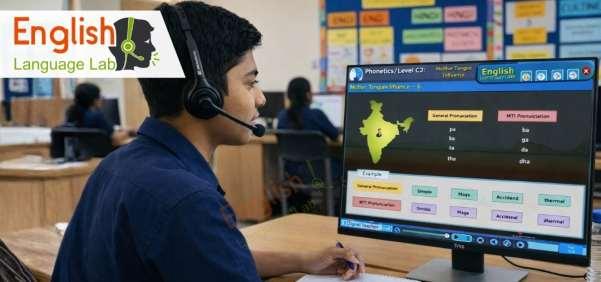
English Language Lab in school transforms the speaking practice environment by making it private. In the lab every student works with headsets at their individual workstation. They record their speaking exercises into software that plays the recording back to them alone. No classmate hears their attempt. No peer observes their hesitation. No mistake is public.
In this environment the risk equation changes completely. The student who was silent in class not because they could not speak but because they would not risk the social cost of speaking imperfectly begins to attempt speaking exercises in thelab.Theyrecord.Theyhearthemselves.Theytryagain.Andgraduallythrough dozens of private low-stakes attempts the experience of speaking English accumulates.

WhatAccumulatesOverTime
This accumulation is what builds the confidence that classroom instruction cannot engineer. A student who has spoken English many times even privately even imperfectly develops a different relationship with the act of speaking. They haveareferencebankofsuccessfulattemptstodrawonwhenapublicspeaking opportunity arrives.
By the time a Class 10 student who has been using the language lab since Class 6 faces an interview a presentation or a competitive examination oral component they have spoken English in structured contexts hundreds of times. The public setting is more formal but the underlying activity is not entirely new.
ForSchools:AStructuralSolutiontoaStructuralProblem
The fear of speaking English is not a personality trait that some students have and others don't. It is a learned response to a learning environment that has made speaking feel risky. A language lab changes that environment not by removing all challenge but by removing the social cost that prevents students from engaging with the challenge at all.
That change made consistently available across the school years produces the confident communicators that the next phase of every student's life will require them to be.