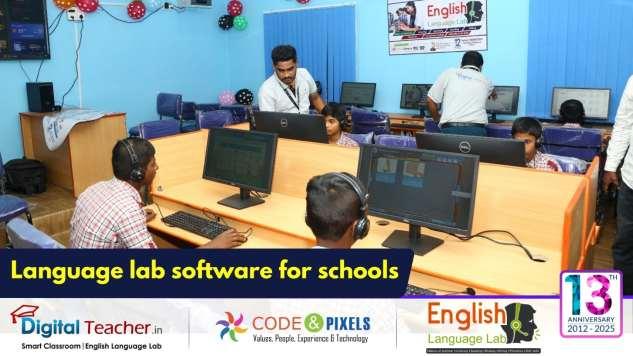











One of the less obvious advantages of offlinelanguagelabsoftware is that the same core platform installed on local computers, running without internet, delivering structured CEFR-aligned content serves educational institutions across a remarkably wide range of levels and contexts.
The same software that develops foundational English listening and speaking skills in a KG or primary school is the same software that prepares final-year engineering students for campus recruitment, that equips ITI students with the technical communication skills their trade demands, and that develops professional English for skill development institute participants entering the workforce.
This cross-level applicability is not incidental. It reflects a content architecture designed from the outset to serve learners at every point on the English proficiency spectrum and to serve them within the same reliable, offline, locally installed delivery model.
TheContentArchitectureThatMakesItWork
A vocabulary and skill development architecture spanning more than 5,000 words across eight proficiency levels, mapped to CEFR standards from A1 to C2, naturally accommodates learners from beginner to advanced without requiring different software for different stages.



A KG or primary school student beginning their English language journey works through A1 content foundational vocabulary, basic listening comprehension, simple phonetic exercises. An engineering final-year student preparing for placement works through B2 and above group discussion skills, technical vocabulary, professional presentation practice, interview preparation.
Bothstudentsareusingthesamesoftware,onthesametypeofhardware,inthe sameofflineenvironment.Theplatformadaptstothelearnerthroughitscontent structure, not through complexity that requires separate tools at each level.
TheInfrastructureSimplicityAdvantage
This cross-level scalability is made practically viable by the offline model. An institution that serves students from primary to higher secondary or a polytechnic that offers both basic skill development and advanced technical diplomaprogrammes doesnotneedtomanagedifferentsoftwareplatformsfor different student cohorts.
One platform, installed once on each computer in the lab, serves the full range. Teachers at different levels access content appropriate to their students without navigating separate systems. Institutions manage one license, one installation, one technical environment.

This simplicity has real operational value. Technology that is simple to manage is technology that gets used consistently. And consistent use, across every level
of the institution, is what produces the cumulative English communication development that changes student outcomes.
WhatThisMeansforMulti-LevelInstitutions
For institutions that serve students across multiple levels central schools, trustrun school-to-college campuses, skill development centres that serve both schoolleaversandworkingadultsthescalabilityofofflinelanguagelabsoftware is a direct operational advantage.
The same investment that builds English skills in Class 8 students is building professional communication confidence in engineering final-year students in the same institution. The lab infrastructure is shared. The learning outcomes are differentiated by content level, not by platform.
From KG to engineering college, the offline language lab scales because its content is comprehensive, its delivery is reliable, and its operational simplicity holds across every context in which it is deployed.