




LanguageLabforPrimary SchoolsvsEngineering Colleges—KeyDifferences
ThatMatter






One language lab platform, one software installation, one license serving students from KG through Class X in a primary and secondary school, and separately serving final-year engineering students preparing for campus placement. The same product. Completely different use contexts.
Understanding how language lab software actually functions differently across these two institution types helps both types of institution get more from their investment and helps institutions evaluating language lab options understand what to look for.
What Primary and Secondary Schools Need From a LanguageLab
For schools serving students from KG through Class X, the language lab serves as a foundational English communication development environment. Students at this level are building the habits andinstincts that will shape their relationship with English for the rest of their education.
The most important features at this level are scaffolded difficulty, accessible content formats, and vocabulary development that builds systematically from basic daily communication to more complex academic language. A student in Class 3 should encounter A1-level content that matches where they actually are not be exposed to B1 material because the school has a single license covering all grades.
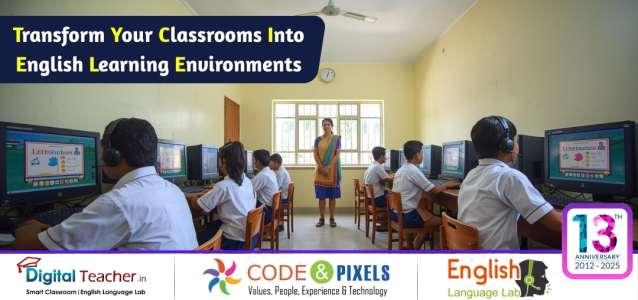


Audio-visual content that engages younger learners through animation, clear audio, and visually supported vocabulary is particularly valuable at this level. Young students' engagement with static text-based exercises is limited. Their engagementwithanimated,interactive,soundsupportedcontentissignificantly higher and engagement is the precondition for practice, and practice is what builds the habit.
The phonetics foundation is also critical at the primary level. Students who learn accurate English pronunciation early, before mother tongue influence patterns have consolidated fully, have a significantly easier time maintaining clarity throughout their subsequent English education. Language labs that include structured phonetics from the earliest CEFR levels serve primary schools particularly well.
WhatEngineeringCollegesNeedFromaLanguageLab
Engineering colleges are using language labs for a fundamentally different purpose: placement preparation. Final-year students need to demonstrate communicative competence in group discussions, technical interviews, professional presentations, and client-facing communication within a compressed timeline.

At this level, the most important language lab features are communicative scenario practice, group discussion simulations, interview preparation modules,
and the MTI reduction work that helps students from regional language backgrounds communicate more clearly in professional contexts.
The vocabulary priorities are also different. Engineering students need professional and technical vocabulary the language of their specific domain alongside general business English. A language lab that covers 5,000 words across 8 levels should ensure that its upper levels include the professional vocabulary ranges that engineering graduates actually encounter in workplace communication.
The teacher's role in an engineering college language lab is also different from the primary school context. Engineering faculty using language labs are often facilitating placement preparation workshops rather than foundational language development. They need dashboard tools that allow them to track batch-level readiness metrics how many students have completed interview preparation modules, how pronunciation scores are trending rather than individual foundational skill development.
WhattheSoftwareNeedstoAccommodateBoth
For a language lab platform to serve both primary schools and engineering colleges effectively with the same core software, it needs genuine multi-level content depth content that is as appropriate and challenging for a Class 3 studentasitisforafinalyearBEstudent,attherespectivelevelstheyareactually working at.
This is not a given. Some language lab software is designed primarily for one context and stretched to serve the other. The product that serves both genuinely is the product whose CEFR-aligned content structure provides real educational value at every level not just a range of difficulty levels on paper.
When evaluating a language lab for your institution, identify where on this spectrum your primary use case falls, and test the software's content quality specificallyat that level. Thedemocontent should look andfeel asthoughit was built for your students because if it was, the outcomes for those students will reflect it.