
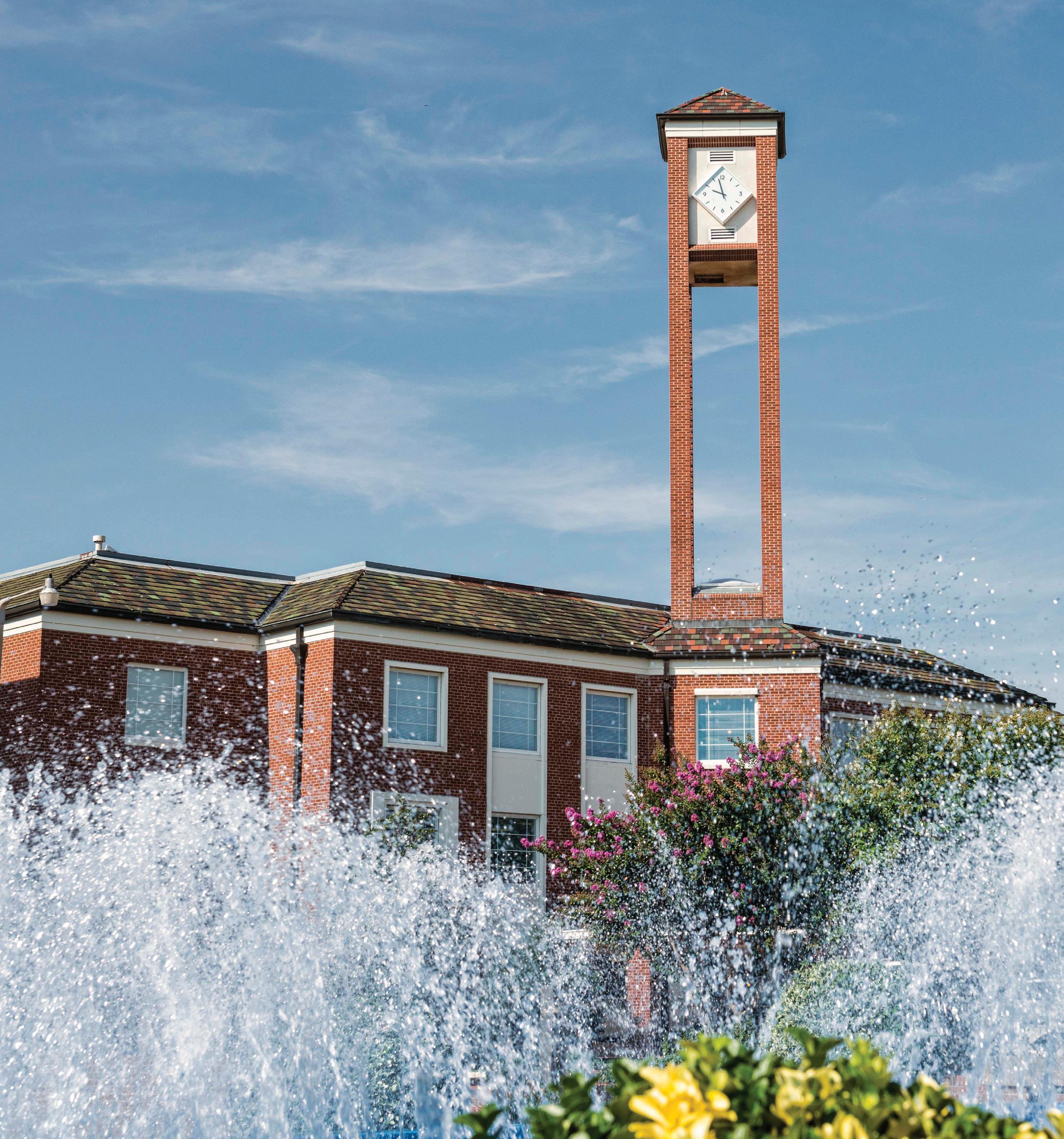

LANGSTON UNIVERSITY HOSTS SUMMER YOUTH PROGRAMS
BY ELLIE MELERO
As the spring semester at Langston University ends, the Langston Campus slowly begins to empty out. Graduates pack up their dorms for the last time, faculty submit final grades ahead of the summer break, and underclassmen prepare to go home for the next two months. But in just a few short weeks, the campus will be abuzz again as elementary through high school students flock to the campus for LU’s summer youth programs.
Each summer, Langston University hosts several youth programs that provide fun learning environments intended to expose young people to higher education and teach them about different careers they may want to pursue when they grow up. Many of these programs are low-cost or even free, and they are aimed at a variety of age groups. Some programs have been around for decades, and many students have chosen to attend LU because of their experiences at one of these summer camps. Others are newer but still offer students exciting opportunities to learn.
This summer, LU is offering several summer programs specifically focused on STEM education. From the Math and Science Academy to the STEAM Innovation Institute, Langston University is committed to offering quality youth programming to Oklahoma and beyond.
For more than 30 years, Langston University has hosted the Math and Science Academy at the beginning of each summer to enhance high school students’ appreciation for math and science while exposing
them to STEM careers and college preparation. Participants engage in hands-on learning experiences, innovative instruction and real-world applications of STEM concepts.
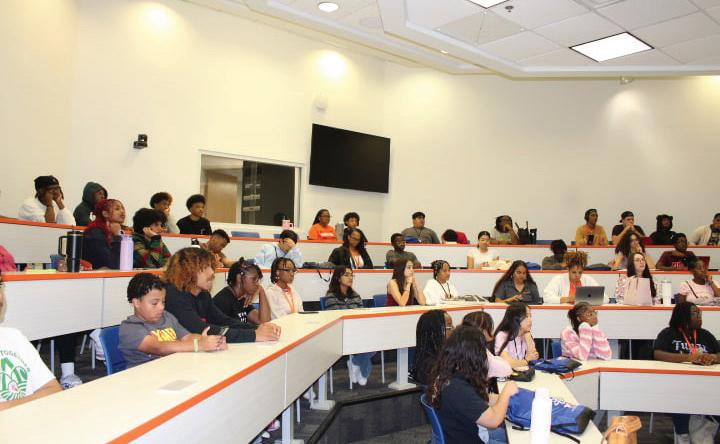
For two weeks, these high schoolers live on the Langston Campus and get a taste of life at LU, attending classes in the day and participating in fun activities in the evening. They take classes on public speaking, ACT preparation, math, biology, chemistry and technology. They also take fun field trips to places like LU’s E. Kika de la Garza American Institute for Goat Research (AIGR) and the Oklahoma Science Museum.
“I believe summer academies are important because they give students a chance to be inspired,” said Dr. Lindsey Davis, the Summer Camp Director for the Math and Science Academy. “A chance is the possibility, probability or likelihood that something will happen. Programs like the Math and Science Academy increase the probability that students will see themselves as future scientists, doctors, engineers, researchers and leaders.
“We are not just offering activities. We are intentional about creating moments of exposure, confidence, and possibility. I am honored to be in the business of inspiring young minds, because sometimes one experience can change the way a student sees their future.”
Dr. Davis is also a graduate of the Math and Science Academy. She attended every summer in high school, and the Academy was the first place she ever saw a Black scientist. That experience helped her realize she could pursue a career in STEM if she wished, and she went on to become the first African American to earn a Ph.D. in Chemistry at the University of Texas at Arlington in 2021.
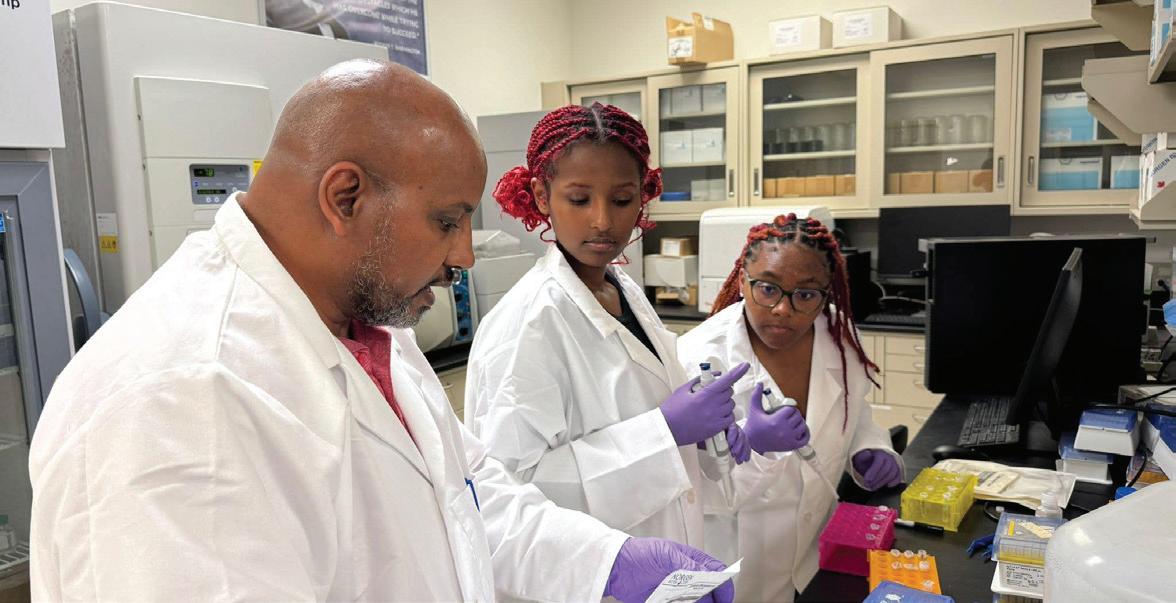
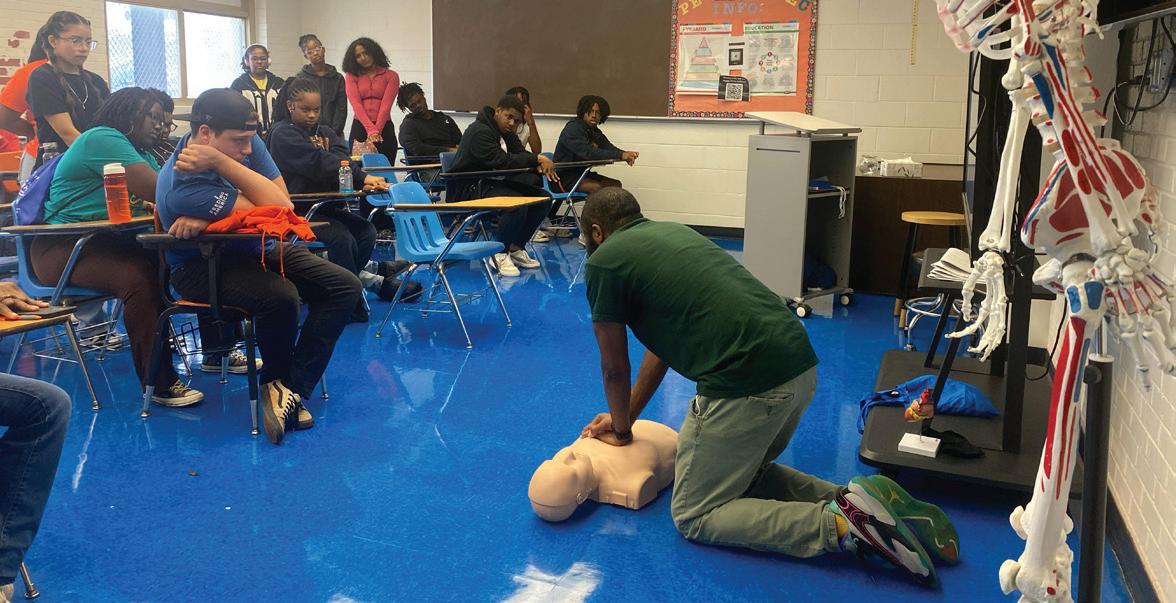
Beyond exposure to STEM, the Math and Science Academy teaches students life skills, such as public speaking and group work. It also prepares them for the college admissions process with ACT prep and visits from LU’s academic advisors. At the end of the Academy, all the students take the ACT for free.
The Math and Science Academy is free to attend. It is funded by the Oklahoma Regents for Higher Education, the National Aeronautics and Space Administration, and Alpha Phi Alpha Fraternity, Inc.
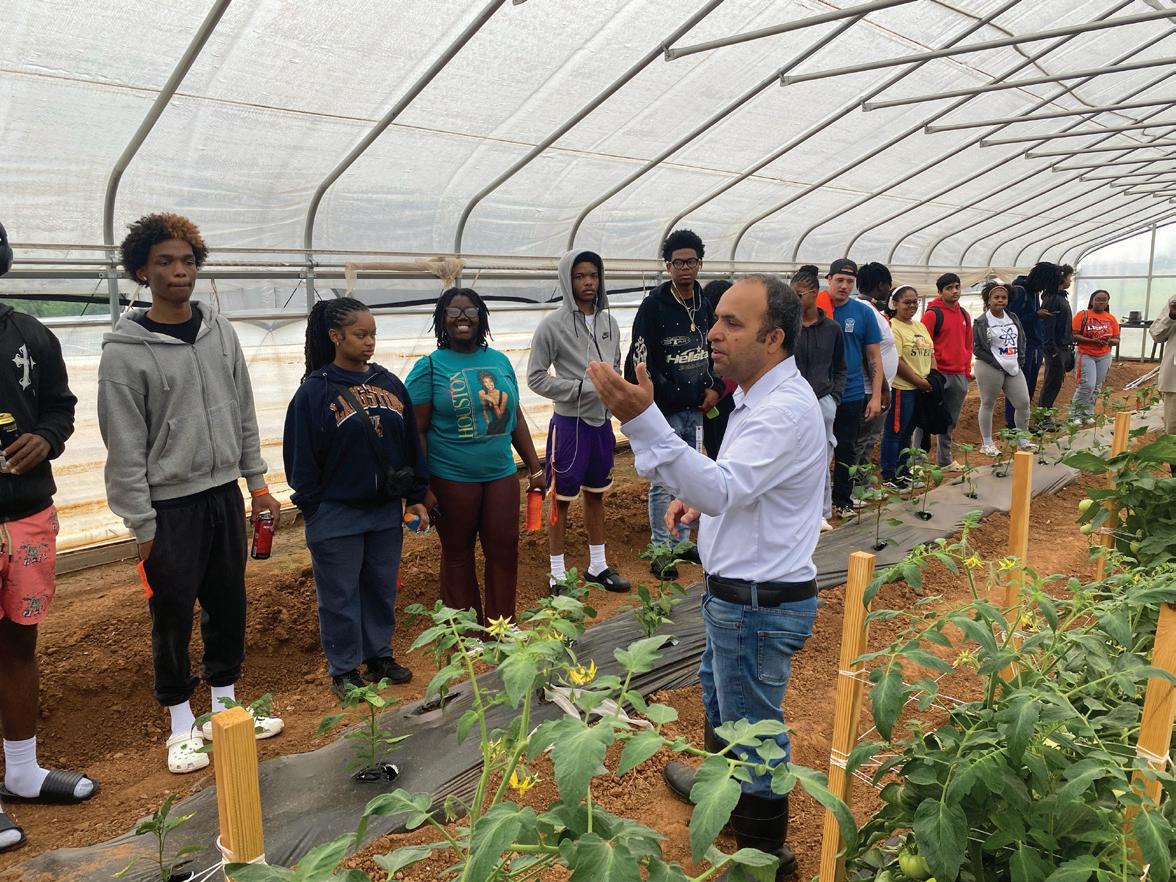
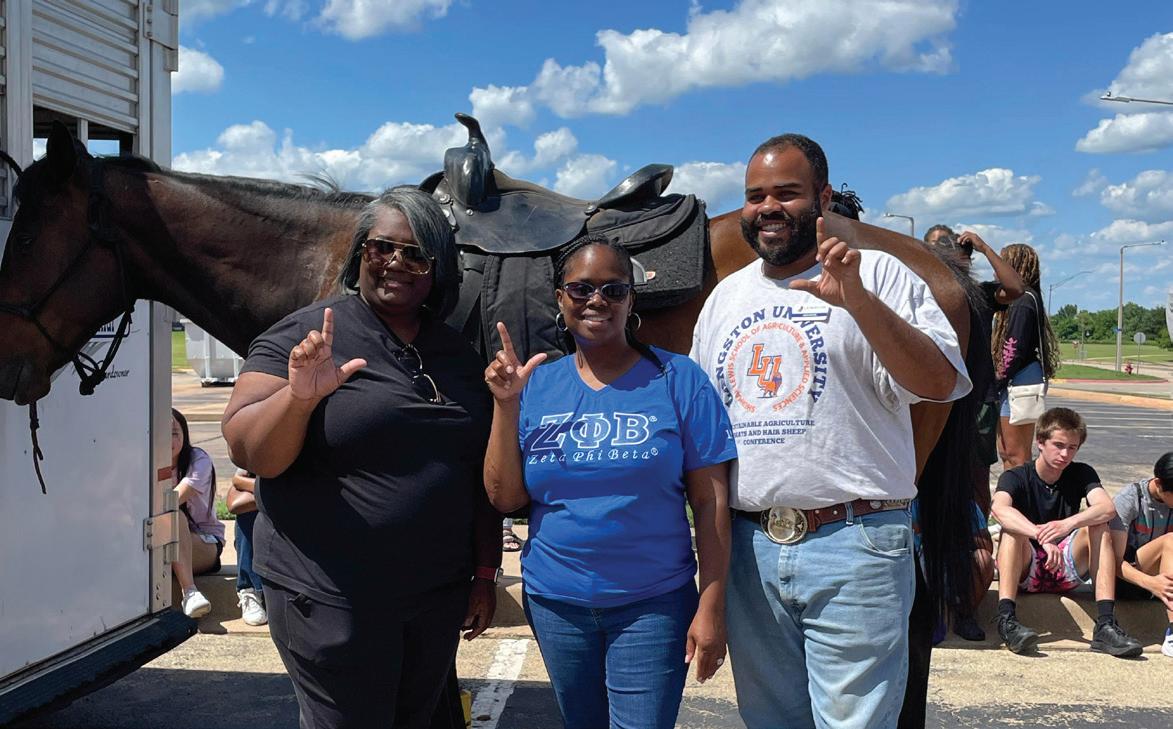
For four years, the Pre-Collegiate Residential Training Camp (PCRT) has facilitated hands-on mentoring for high schoolers from LU faculty, staff and researchers, exposing them to higher education curricula and careers in food, agriculture, natural resources and human sciences. The campers learn about these programs and the career options they provide while also giving them opportunities to participate in 4-H and LU Cooperative Extension programming so they can “learn by doing” in leadership, civic engagement, agriculture, animal science, healthy living and STEM.
Each PCRT participant is paired with a mentor to research and learn more about their areas of interest in food, agriculture, agribusiness, plant and soil sciences, natural resources management, child development and related areas. Students learn in the classroom as well as on field trips to the AIGR’s farm and creamery, the Agribusiness and Financial Resource Center, and Horticulture Education and Research Center (HERC).
Dr. Emisha Maytubby runs PCRT with Dr. Nirodha De Silva. Dr. Maytubby said the camp is an important tool to expose high schoolers to careers in agriculture, and many former PCRT campers have attended Langston University with competitive nationally funded scholarships and gone on to participate in research.
“(With PCRT), students have the opportunity to experience a college environment and curriculum,” Dr. Maytubby said. “We have seen the positive impact the camp has on camp participants who later attend LU. Last year (2025), we had 25 students attend the camp. Nine of those participants attended Langston University, and 7 majored in Agriculture and FCS-related degrees and received the David L. Scott Land Grant Scholarship.”
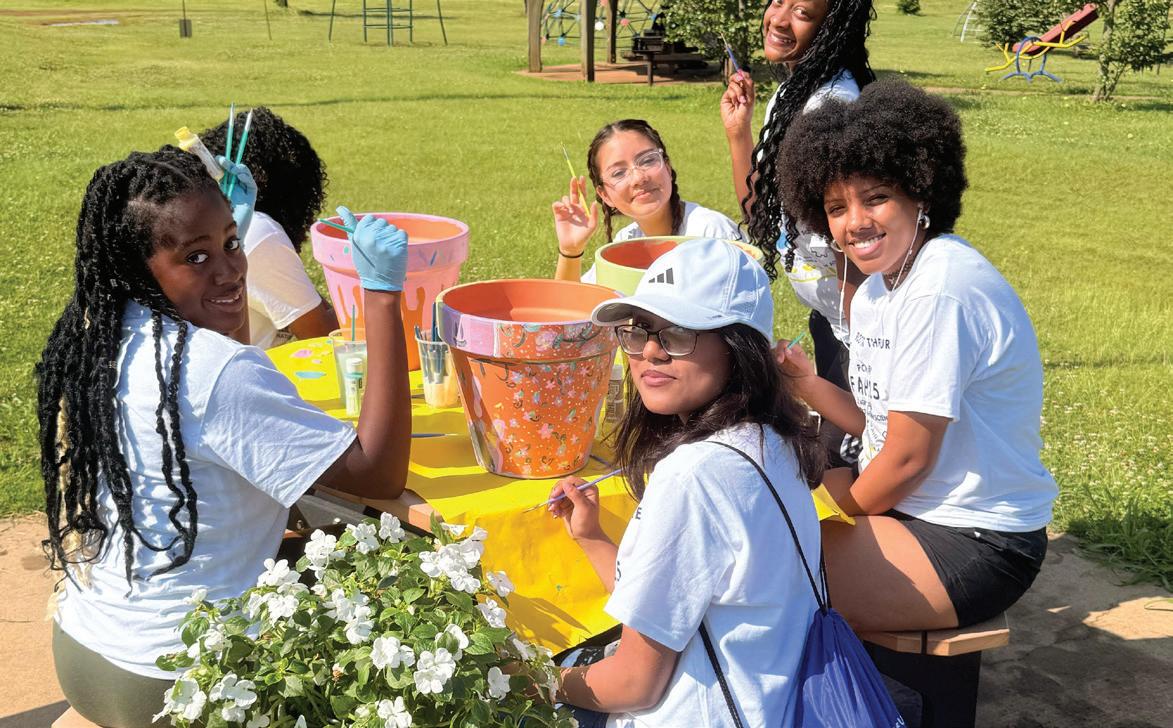
Last year, in addition to the collegiate-level learning experiences, PCRT participants completed two service-learning projects during the camp. Together with the Math and Science Academy and LU Cooperative Extension, PCRT sponsored a community beautification project at T.G. Green Park and Langston Community Gardens. Participants and community members cleaned the park, tended to the gardens and planted flowers. The PCRT campers also painted mural stencils at Thelma Parks Elementary and Martin Luther King Elementaryin Oklahoma City to encourage students to engage in more movement activities.
The service-learning projects will continue this year with another Langston Community Beautification project at Langston Community Gardens.
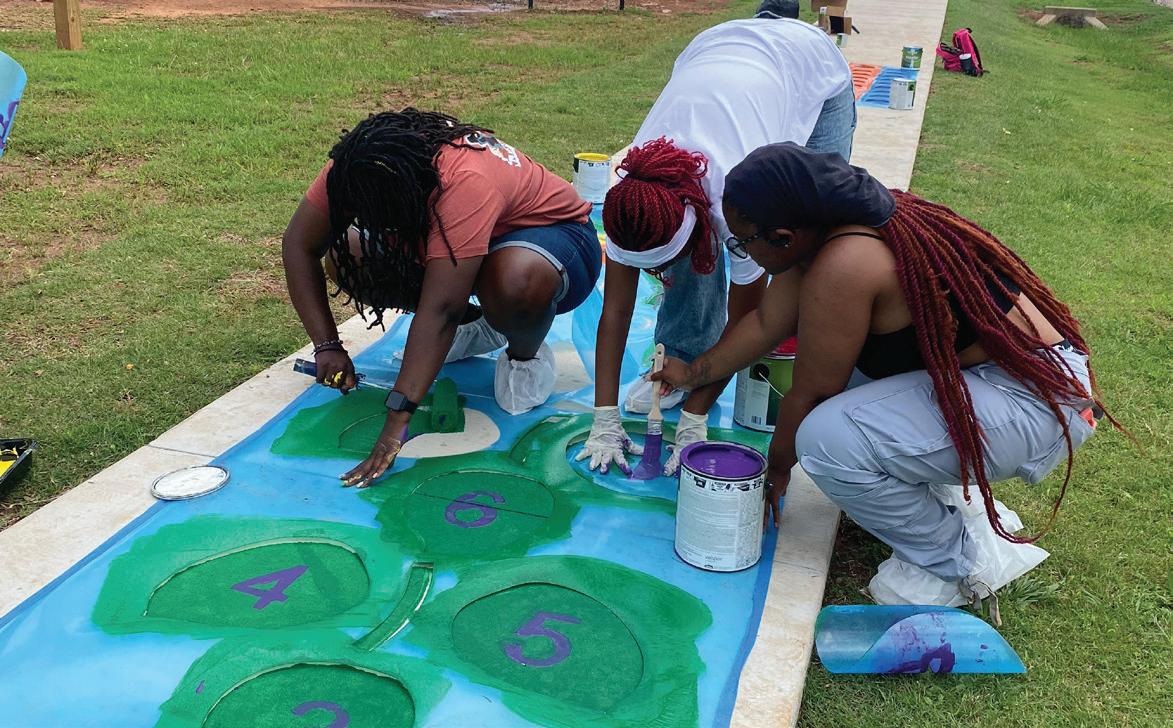
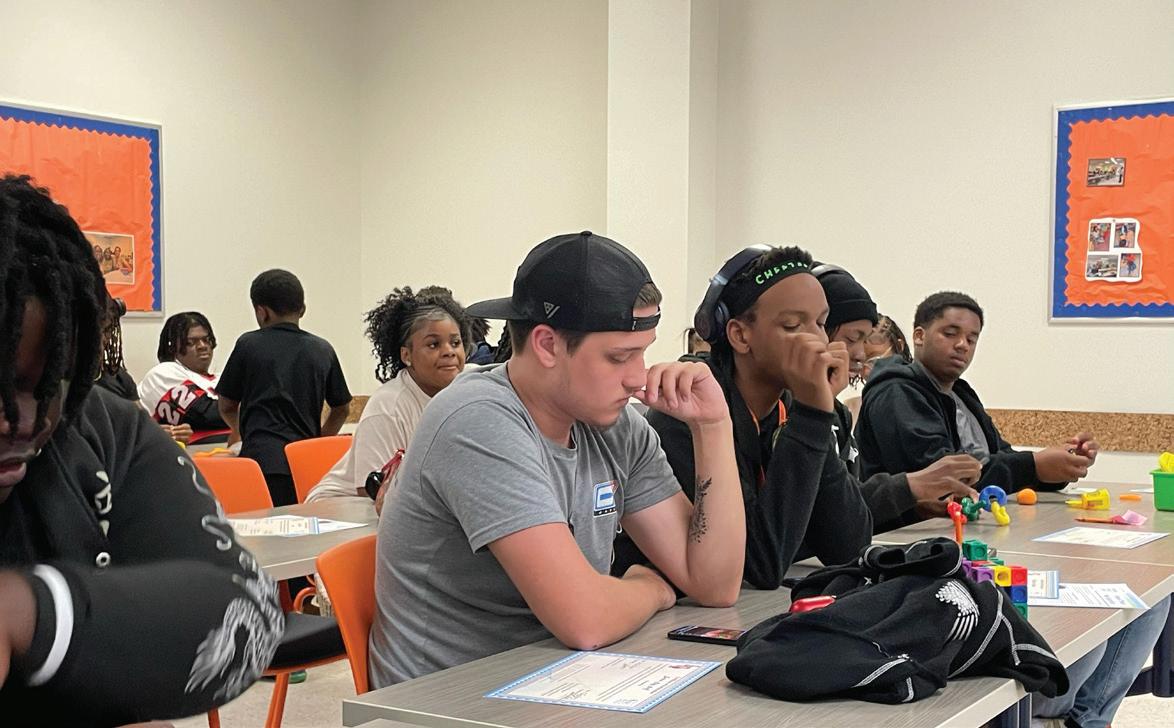
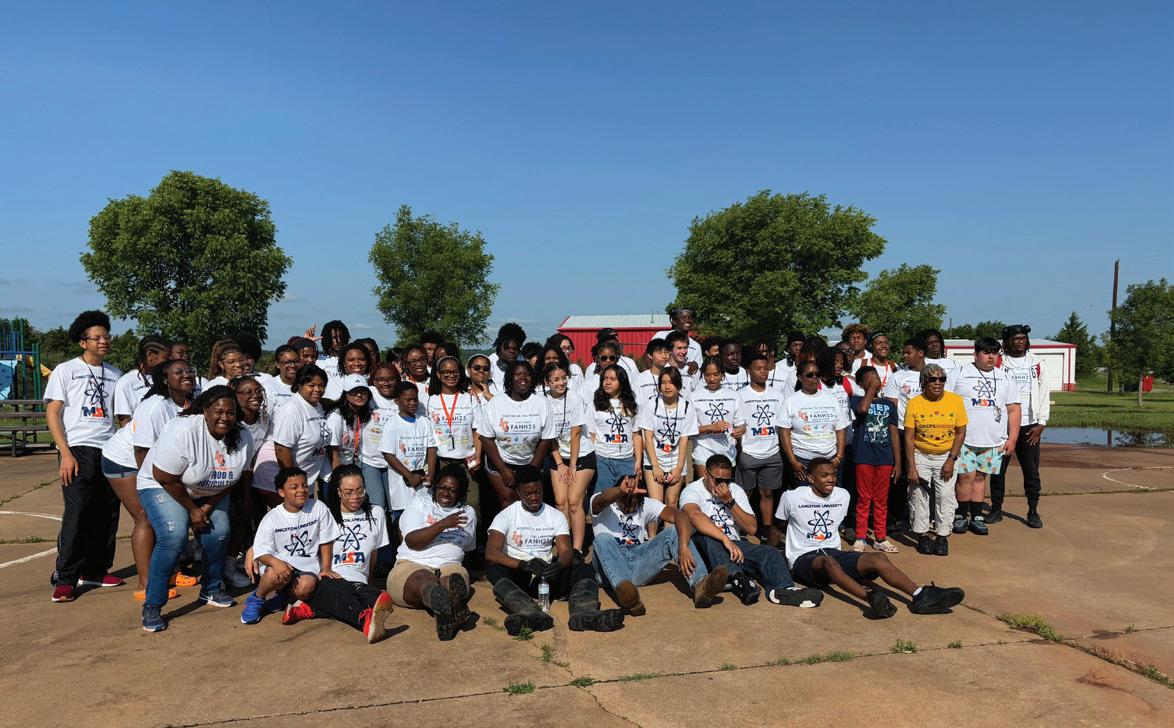
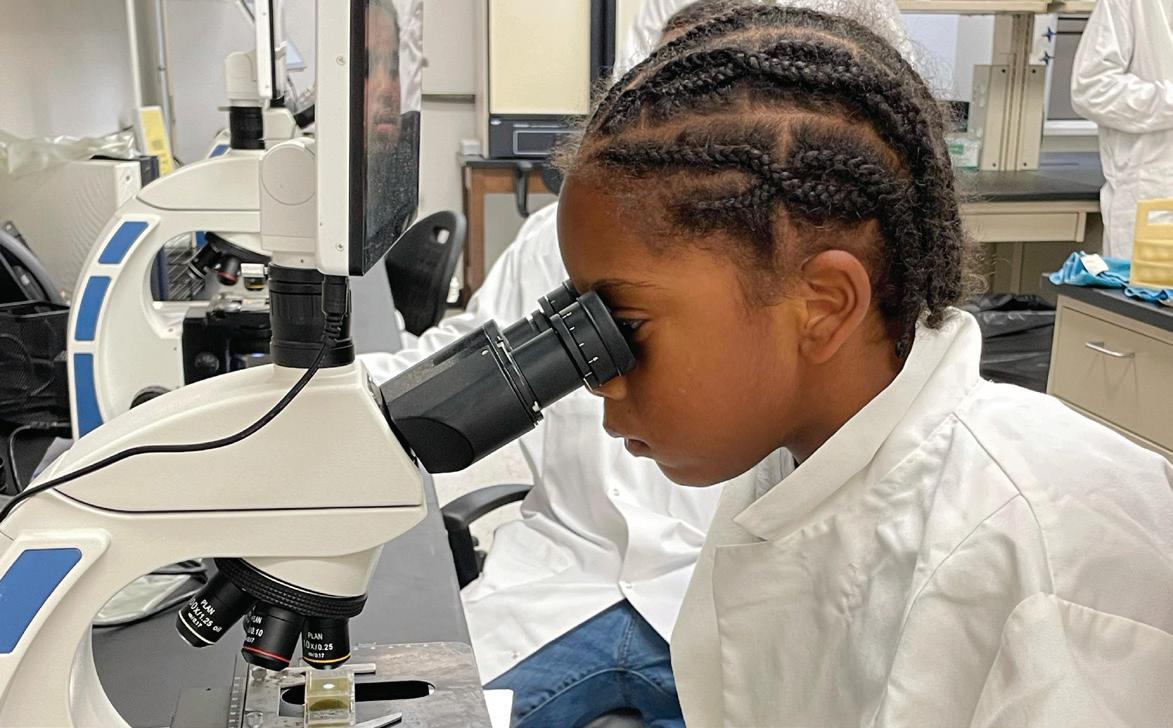
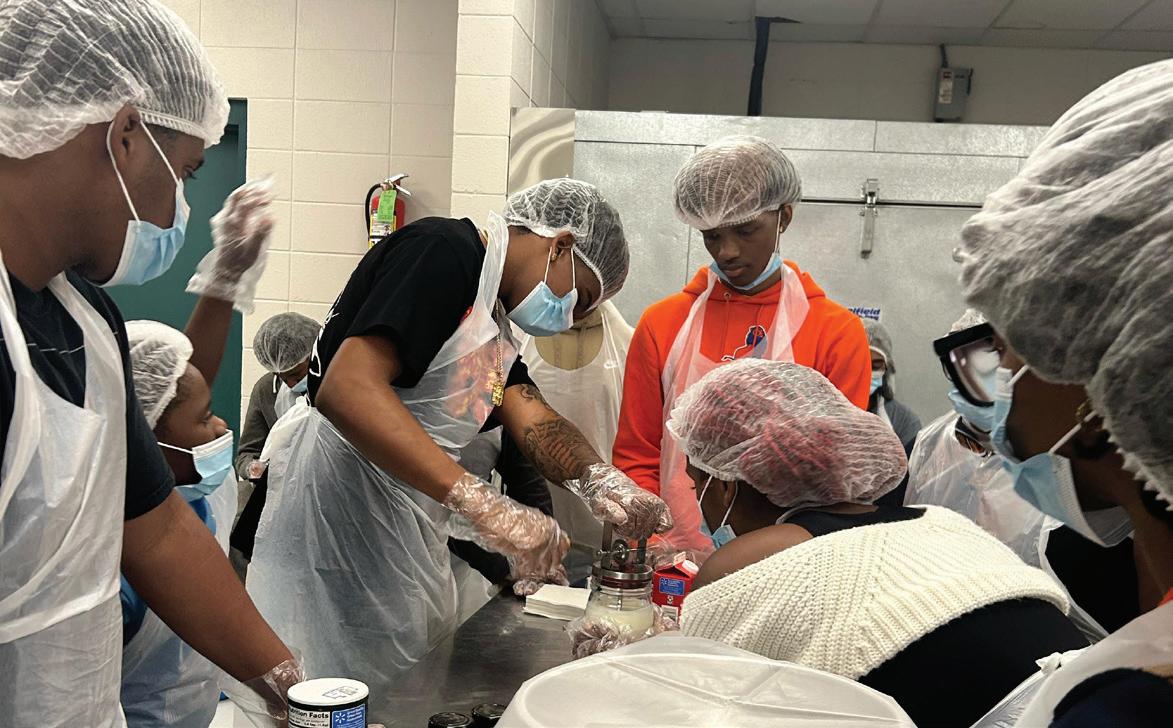
PCRT students live on the Langston Campus for the duration of the camp. PCRT is free to attend, and it’s funded by a grant from the National Institute of Food and Agriculture and the USDA.
This summer, the Sherman Lewis School of Agriculture and Applied Sciences will introduce a new youth program for elementary and middle schoolers.
The Farm-to-Table STEAM Innovation Summer Institute is a hands-on 4-H program that teaches pre-teens about agriculture, food, nutrition, science and technology in fun and interactive ways. For five weeks, students will learn how food gets from the farm to their table through fun activities like drone obstacle courses, hydroponics, AI prompting, cooking and agriculture technology projects. The goal of the institute is to help students build confidence, teamwork, leadership and problemsolving skills while exposing them to agriculture and agriculture related fields.
Dr.Tiffany Williams, the program leader, said the School decided to offer this summer camp as an opportunity to connect with young people early and expose them to opportunities in STEM, agriculture, nutrition, health and higher education. By offering programs like this, LU can strengthen relationships with schools, families and communities while helping students explore new interests and career pathways they may not otherwise experience.
“These programs help students build confidence, develop new skills, and see themselves as future college students and professionals,” Dr. Williams said.“It is also important for youth to understand where their food comes from and how it gets to their plate. Many students are disconnected from agriculture and food systems, so programs like this help them better understand the role science, technology and agriculture play in their everyday lives.”
The program will include lots of hands-on activities that allow youth to explore STEM, agriculture and food science in fun and interactive ways. As a dietitian, Dr. Williams is particularly excited for the food science week when students will learn how liquids can change into
solids through slushie science and explore how carbon dioxide plays a role in dough development while making pizzas.
Other activities will include a field trip to the AIGR farm where students will learn how to milk goats and make goat milk lotion, a lesson on how to use drones, a tour of the aquaponics research lab to learn how to grow food with aquaponics, developing a business plan, and participating in engineering and agriculture-based activities that connect science and technology to real-world experiences.
The Farm-to-Table STEAM Summer Institute is free to attend, and it’s funded by the Sherman Lewis School of Agriculture and Applied Sciences and its Cooperative Extension and Outreach Programs.
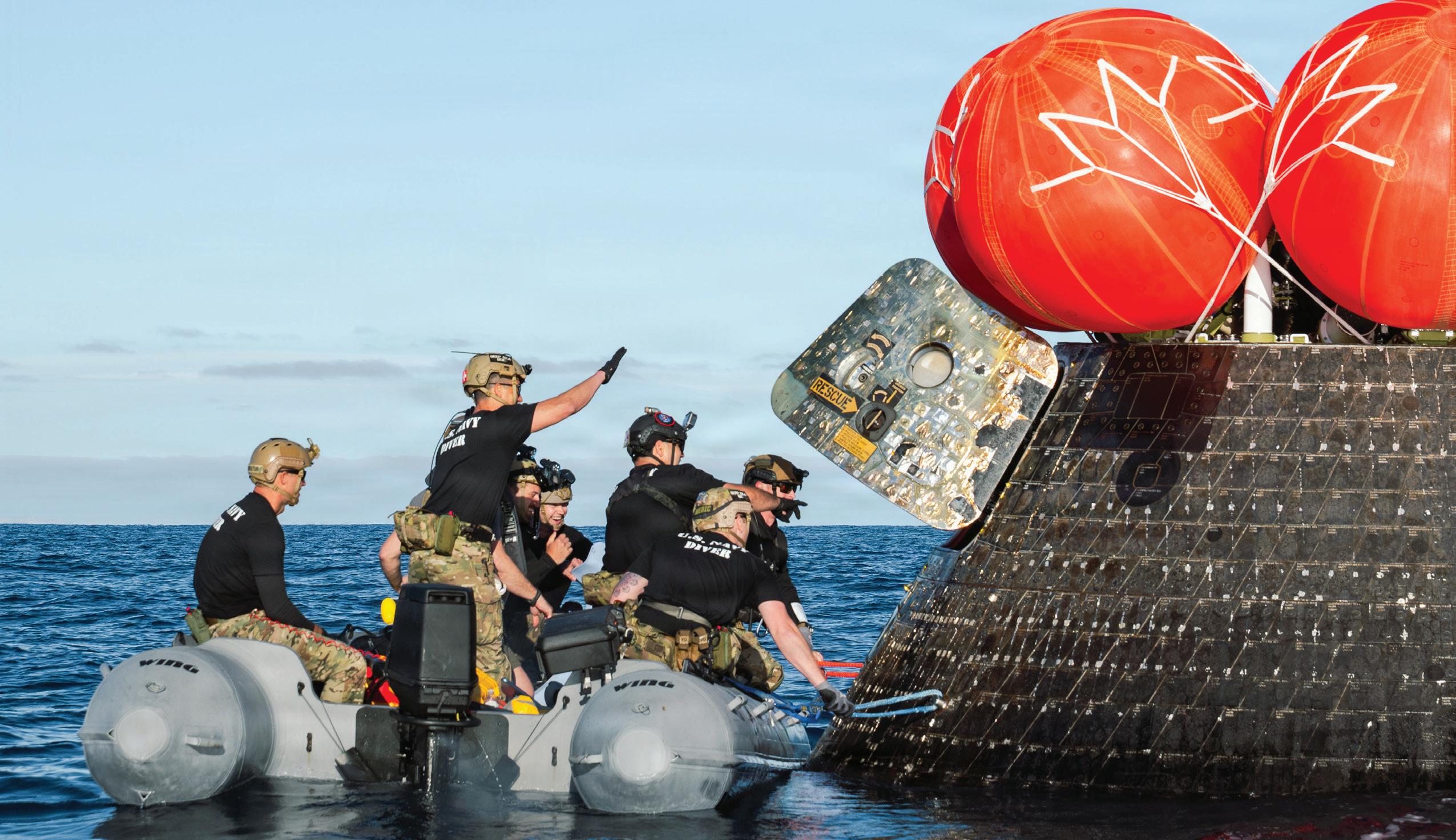
On April 1, the world watched excitedly as astronauts Reid Wiseman, Victor Glover, Christina Koch and Jeremy Hansen launched into space as part of the Artemis II Mission–NASA’s first crewed lunar flyby since 1972. For 10 days, people eagerly awaited updates as the Artemis II crew orbited the moon and traveled the greatest distance from Earth humans have ever achieved. On April 10, the crew reentered the Earth’s orbit and splashed down off the coast of San Diego.
The first person to greet them was Langston University alumnus Laddy Aldridge.
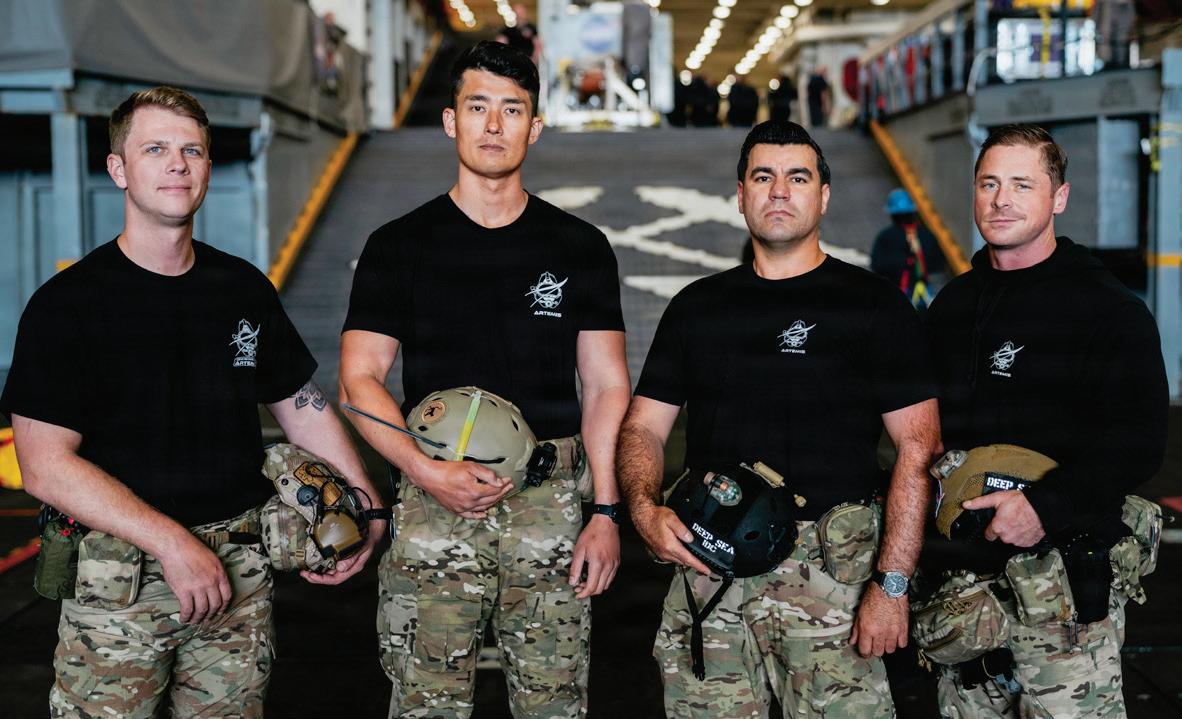
Aldridge is a Senior Chief Petty Officer in the U.S. Navy, and he serves as the Independent Duty Corpsman for Explosive Ordinance Disposal Expeditionary Support Unit 1. He was one of four Navy Sailors selected for the Navy Dive Medical Recovery Team for the Artemis II Mission, serving as a first-contact medical provider inside the Orion capsule. But long before that, he was just a boy from Oklahoma.
“To be a part of this mission is truly an honor,” Aldridge said. “I am humbled to have been just a small part in it.”
Aldridge grew up in Cushing, Oklahoma, and he found his passion for medicine at a young age. His father, a former U.S. Coast Guardsman, had a long medical history and was at the doctor’s often. Sometimes Aldrige accompanied him, and he was inspired to pursue a medical career after seeing the many interactions between his dad and Dr. Ike Hubbard.
After that, he talked to his high school career counselor. She suggested he apply to Langston University’s Bachelor of Science in Nursing
BY ELLIE MELERO
(BSN) program because the school’s licensure exam pass rate was better than that of the University of Oklahoma. Additionally, LU was more affordable and closer to his family. So, in the fall of 2005, Dear Langston became Aldridge’s new home.
For the next two years, Aldridge worked over 40 hours a week while balancing a full course load each semester and commuting from Cushing. It was hard, but he was determined. His professors were helpful and supportive, and one of his chemistry professors was particularly influential in his decision to enlist in the Navy.
“She never hesitated to ask if I was grasping the concepts in class at the end of every session,” Aldridge said. “Making small talk one day, I mentioned my father’s military background and said something like, ‘I would join if I was not currently enrolled.’ She supported the thought and also immediately offered to help search for more scholarships if I was struggling financially. I will always remember how supportive she was of me no matter what direction I wanted to go in life.”
In 2007, Aldridge decided to pause his studies and join the Navy as an enlisted Hospital Corpsman. His naval career has taken him places he never imagined. Over the past 19 years, he’s had the opportunity to work with wonderful people, learn from next-level leaders, and gain skills and viewpoints that he said will forever shape his life.
In 2017, NASA announced the Artemis Program, a moon exploration program made up of several missions of increasing complexity with the end goal of establishing a permanent lunar base on the moon.
When the Artemis II Mission was announced, Aldridge was excited to be named to its Navy Dive Medical Recovery Team. His initial excitement was quickly followed by nervousness and then eagerness to learn more about space medicine and physiology. Then the training began.
“Over the past few years, our team took several trips to NASA’s Neutral Buoyancy Laboratory located in Houston, Texas,” Aldridge said. “These helped familiarize the team with the procedures and gear utilized in the mission. Along with those trips, we conducted several underway trips on various U.S. Navy ships where we would practice the mission with a training capsule in the open ocean.”
The Team’s years of training paid off. When the Orion capsule landed in the Pacific Ocean, they went straight to work.
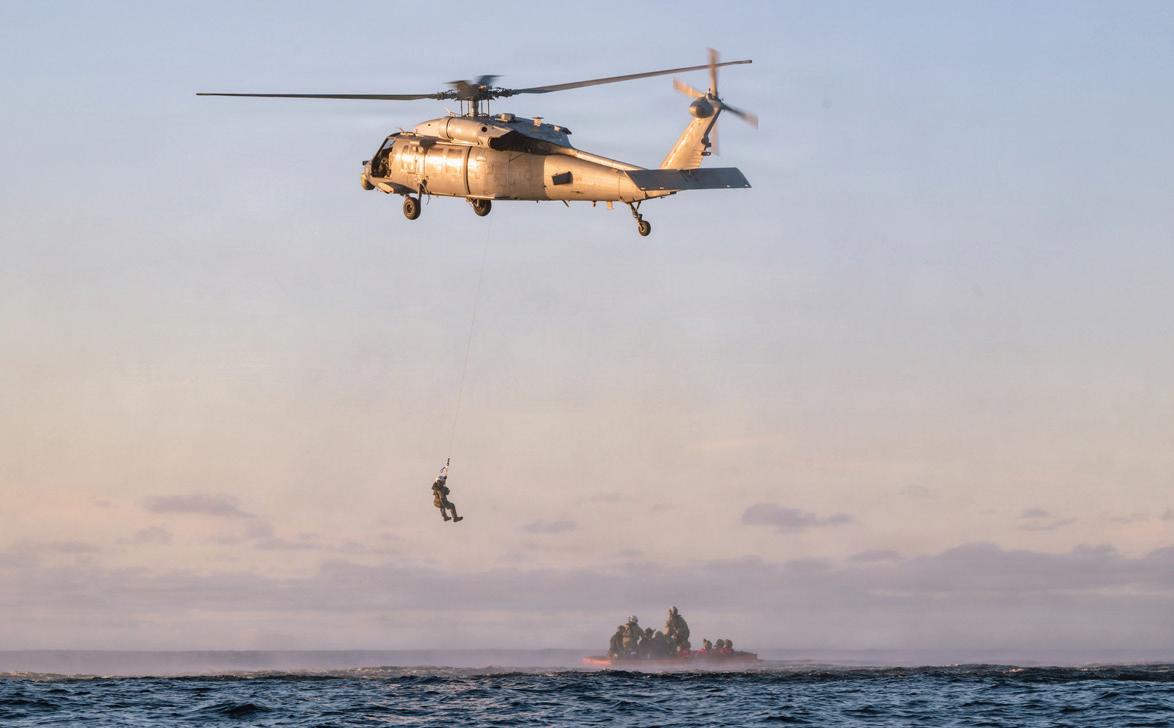
Once they opened the capsule, Aldridge was the first person to make contact with the astronauts. He entered the capsule and began conducting initial medical exams for the crew. The Navy Dive Medical Team provided care as needed and then assisted the astronauts out of the capsule and onto a raft set up by Navy divers. They then prepared the astronauts for a helicopter airlift to the USS John P. Murtha for further medical evaluations.
Reflecting on the mission afterward, Aldridge was honored to participate. Growing up in Oklahoma, he never would have imagined he would one day be working with NASA and caring for astronauts returning from a lunar mission. He knows he wouldn’t have had the opportunity without the support of people throughout his life, from Cushing and Langston to his many naval duty stations.
“LU prepared me not only academically for life after college but also for life in general!” Alrdidge said. “To Langston University, my first home after high school, thank you for helping me build the foundation of who I am as a person and a student. Even though I never completed my initial goal of a degree from LU, I will always be a Lion at heart.”



OKLAHOMA’S HBCU IS PROUD OF ITS LAND-GRANT MISSION.
“Being a land-grant university means we don’t keep knowledge to ourselves,” President Ruth Ray Jackson said. “We teach, we research and we share so that the work we do here makes life better far beyond our campuses.”
LU’s diverse faculty and staff serve as role models and mentors for students and enrich their educational experience by providing varied perspectives and support networks.
‘E Roar magazine is pleased to celebrate the achievements of faculty and staff during the 2025-2026 academic year.
Top 1 Percent in Country, School of Business. Peregrine Exit Exam for Accreditation Council for Business Schools and Programs (ACBSP) Accredited Schools, 2026.
Top 10 Program and Highest Ranked HBCU, Master of Rehabilitation Counseling. U.S. News & World Report, 2026.
“1890 Multistate Integrated Project”. Adverse Weather Events Annual Fall Meeting, Atlanta, GA, October 2025.
Leonard C. Kibet, Ph.D., Associate Professor/Director of Crops & Natural Resources, Sherman Lewis School of Agriculture and Applied Sciences
“Accessibility in Microsoft 365 and Google”. Oklahoma Learning Innovations Summit (OKLIS) Countdown to Compliance: A Hands-on Workshop, September 2025.
Ally Sharp, M.S., Certified Secondary Teacher for the State of Oklahoma, Instructional Designer/Director of Faculty Development, Division of Academic Affairs
“Accessibility in Word and PowerPoint for the OCO Accessibility Office Hours”.
Online Consortium of Oklahoma (OCO), February 2026.
Ally Sharp, M.S., Certified Secondary Teacher for the State of Oklahoma, Instructional Designer/Director of Faculty Development, Division of Academic Affairs
“Beyond Bone Density: Why the Musculoskeletal Syndrome of Menopause Matters”.
American Physical Therapy Assoiation Combined Sections Meeting, Anaheim, CA, February 2026.
Donna Sylvester, P.T., D.P.T., Associate Professor, School of Physical Therapy
“Building Sustainable Small Ruminant Agriculture Through Global Collaboration and Technology Transfer”.
The 1890 ARD Biennial Research Symposium, New Orleans, LA, March 2026.
Ryszard Puchala, Ph.D., Small Ruminants Research, Sherman Lewis School of Agriculture and Applied Sciences
“Combatting Generational Bug Trauma: Engaging NonMajors at an HBCU”.
Entomological Society of America, Amarillo, TX, March 2026.
Tracey Payton, Ph.D., Assistant Professor of Horticulture & Entomology, Sherman Lewis School of Agriculture and Applied Sciences
“Comparative Accuracy of Two Ultrasound Machine Models in Diagnosing Pregnancy and Fetal Count by Skilled and Unskilled Operators in Three Goat Breeds in Oklahoma”. The 1890 ARD Biennial Research Symposium, New Orleans, LA, March 2026.
Ryszard Puchala, Ph.D., Small Ruminants Research, Sherman Lewis School of Agriculture and Applied Sciences with N. Achariya, A. Sonibare, D. Tadesse H.Yirga, A. Patra, D. Woldemariam, G. Dinegdie and F. Belkasmi
“Diet-, Breed-, and Sex-dependent Effects in Taxonomic and Functional Signatures of the Rumen Microbiome in Meat Goats”.
American Society of Animal Science Meetings, Hollywood, FL, July 2025.
Ryszard Puchala, Ph.D., Small Ruminants Research, Sherman Lewis School of Agriculture and Applied Sciences, with Amlan K. Patra, Ignacio Tovar-Luna
“Differences in Integumentary Presentation Among Individuals with Darkly Pigmented Skin”.
Two-hour education course with retired colleague Dr. Eddie Traylor Rutgers University School of Health Professions Clinical Educators Continuing Education Workshop, October 2025.
Donna Sylvester, P.T., D.P.T., Associate Professor, School of Physical Therapy
“The Ease of Access Experience: What is it like to use Accessible Technologies?”
Oklahoma Library Association (OLA) Tech Round Table, November 2025.
Ally Sharp, M.S., Certified Secondary Teacher for the State of Oklahoma, Instructional Designer/Director of Faculty Development, Division of Academic Affairs
“Economic Contributions and Supply-Chain Linkages of the Goat Industry in Oklahoma”.
Fiftieth 50th Biennial Association of Research Directors (ARD) Symposium, New Orleans, LA, March-April 2026.
Bolanle Atilola, Ph.D., Research Associate Professor, Sherman Lewis School of Agriculture and Applied Sciences
“Effect of Accelerometer Location on Machine-LearningPredictive Models of Animal Behavior”.
American Society of Animal Science Meetings, Hollywood, FL, July 2025.
Ryszard Puchala, Ph.D., Small Ruminants Research, Sherman Lewis School of Agriculture and Applied Sciences, with I. Bradhams, T. Gipson, S. Wildeus, D. O’Brien, N. Brown
“The Effects and Breakdown of Microplastics by Bacteria”. Langston University Annual Research Symposium, Langston, OK, April 2026.
Kj. Abraham, Ph.D., Assistant Professor of Biology, School of Arts and Sciences
“Effects of Ascorbic Acid and Artemisia absinthium Supplementation on Heat Stress Responses in Spanish Goats During Summer in Oklahoma”.
American Society of Animal Science Meetings, Hollywood, FL, July 2025.
Ryszard Puchala, Ph.D., Small Ruminants Research, Sherman Lewis School of Agriculture and Applied Sciences, with Sonibare O. Adekayode, Hirut Y. Yirga, Dereje T. Gulich, Ignacio Tovar-Luna, Maxine Brown, Amlan K. Patra
“Effects of Dietary Hempseed Meal Levels on Feed Intake, Digestion, and Methane Emission by Boer Does in Late Lactation”.
The 1890 ARD Biennial Research Symposium, New Orleans, LA, March 2026.
Ryszard Puchala, Ph.D., Small Ruminants Research, Sherman Lewis School of Agriculture and Applied Sciences with I. Tovar-Luna, D. Tadesse, H,Yirga, A.L. Goetsch, A.K. Patra
Effects of Diet, Breed, and Sex on Taxonomic and Functional Signatures of the Rumen Microbiome in Meat Goats”.
The 1890 ARD Biennial Research Symposium, New Orleans, LA, March 2026.
- Ryszard Puchala, Ph.D., Small Ruminants Research, Sherman Lewis School of Agriculture and Applied Sciences with J. Lyons, I. Tovar-Luna, A. K. Patra
“Effects of the Dietary Hempseed Meal on Feed Intake, Digestion, Methane Emission, and Heat Production in Boer Does During Late Gestation”.
American Society of Animal Science Meetings, Hollywood, FL, July 2025.
Ryszard Puchala, Ph.D., Small Ruminants Research, Sherman Lewis School of Agriculture and Applied Sciences, with Ignacio Tovar-Luna, Amlan K. Patra, Dereje T. Gulich, Nar K. Gurung, Arthur L. Goetsch
“Effects of Forage Type and Concentrate Level on Methane
Output and Heat Production in Meat Goats”.
The 1890 ARD Biennial Research Symposium, New Orleans, LA, March 2026.
Ryszard Puchala, Ph.D., Small Ruminants Research, Sherman Lewis School of Agriculture and Applied Sciences with R. Gilpin, D. Tadesse, S. Adekayode, H.Yirga, A.K. Patra & I. Tovar-Luna
“Effects of Natural Sources of Brackish Water on Milk Yield and Composition of Alpine Dairy Goats”.
American Society of Animal Science Meetings, Hollywood, FL, July 2025.
Ryszard Puchala, Ph.D., Small ruminants Research, Sherman Lewis School of Agriculture and Applied Sciences, with Hirut Y.Yirga, Woldemariam Dawit, Dereje T. Gulich, Carlos Alvarado, Amlan K. Patra
“Effects of Natural Sources of Brackish/Saline Water on Milk Yield, Composition, and Blood Parameters in Alpine Dairy Goats”.
The 1890 ARD Biennial Research Symposium, New Orleans, LA, March 2026.
Ryszard Puchala, Ph.D., Small Ruminants Research, Sherman Lewis School of Agriculture and Applied Sciences with K, Mosley, H.Yirga, D. Woldemariam, D. Tadesse, A. K. Patra, C. Alvarado, and S. Adekayode
“Epilepsy Foundation’s Seizure First Aid Ready Course”. Oklahoma Public Health Association Conference. Edmond, OK, September 2025.
Desmond W. Delk, Ph.D., MPH, CHES®, Associate Professor/Chair, Department of Health, Physical Education, and Recreation, School of Education and Behavioral Sciences
Brittany Mays, Ph.D., Instructor, Health, Physical Education, and Recreation, School of Education and Behavioral Sciences
“Evaluation of a Laser Methane Detector for Measuring Methane Emissions in Growing Spanish Goats Fed Different Diets”.
American Society of Animal Science Meetings, Hollywood, FL, July 2025.
Ryszard Puchala, Ph.D., Small Ruminants Research, Sherman Lewis School of Agriculture and Applied Sciences, with Dereje T. Gulich, Sonibare O. Adekayode, Hirut Y.Yirga, Amlan K. Patra, Ignacio Tovar-Luna, Terry A. Gipson, Lionel J. Dawson
“Evaluation of Laser Methane Detector Measurements Relative to Calorimetry in Meat Goats”.
The 1890 ARD Biennial Research Symposium, New Orleans, LA, March 2026.
Ryszard Puchala, Ph.D., Small Ruminants Research, Sherman Lewis School of Agriculture and Applied Sciences with D. Tadesse, S. Adekayode, H.Yirga, A.K. Patra, and I. Tovar-Luna
“From Mentorship To Molecules: Using Nitrosamines to Train The Next Generation Of Chemists”.
National Conference on Mentoring and Undergraduate STEM Research & Education, Langston, OK, April 2026.
Lindsay Davis, Ph.D., Assistant Professor/Chairperson, Department of Chemistry and Physical Science, School of Arts and Sciences with Cortnie Morgan, and Anginique Sears
“The Good, Bad, and Ugly of Insect Pest Management”. EPA Region 6 Pesticide Inspector Residential Training Program, Langston, OK, May 2026.
Tracey Payton, Ph.D., Assistant Professor of Horticulture & Entomology, Sherman Lewis School of Agriculture and Applied Sciences
“The Great Plains Stormwater Center of Excellence”. Pawnee Chamber of Commerce Meeting, Pawnee, OK, 2026. Langston Small Farmers Conference, Langston, OK, 2026. Oklahoma Clean Lakes and Watersheds Conference, Stillwater, OK, May 2026.
Tracey Payton, Ph.D., Assistant Professor of Horticulture & Entomology, Sherman Lewis School of Agriculture and Applied Sciences
“Health, Leadership, and Advocacy: Reflections from the ROARS Peer Educators at Langston University”. Oklahoma Public Health Association Conference, Edmond, Ok, September 2025.
Desmond W. Delk, Ph.D., MPH, CHES®, Associate Professor/Chair, Department of Health, Physical Education, and Recreation, School of Education and Behavioral Sciences, with Mays, B. N., Newhouse, N., Bailey, J., West, P., Lavalais, J., & Brown, A.
“Heat Stress Adaptation Capacity in Small Ruminant Production: Findings from a Jamaica–U.S. Collaborative Project”.
The 1890 ARD Biennial Research Symposium, New Orleans, LA, March 2026.
Ryszard Puchala, Ph.D., Small Ruminants Research, Sherman Lewis School of Agriculture and Applied Sciences
“How Digital Can Transform a Public Relations Plan”. Association for Communication Excellence (ACE) Conference, Billings, MT, June 2026.
Sonya Moore-Davis, B.A., Director of Media & Communications, Sherman Lewis School of Agriculture and Applied Sciences.
Heleen Sheets, M.O.L., Director of Public Relations, Division of Operations
“How to Recruit More Students From the Continent of Africa: What Every Business School Should Know About Growing Global Enrollment”.
Sixth Current Business Issues in African Countries Conference, Online, May 2025.
Charles J. Mambula, Ph.D., PHRP, Associate Professor/ Chair, Master’s in Entrepreneurial Studies, School of Business
“Impact of Langston University on Logan County”. Third Biennial Mayor’s Summit, Oklahoma City, OK, October 2025.
Bolanle Atilola, Ph.D., Research Associate Professor, Sherman Lewis School of Agriculture and Applied Sciences
“Implementing the Seizure Safe Classroom Curriculum at a Rural HBCU: An Integrative Educational Approach”. American Public Health Association Conference, Washington, DC, November 2025.
Desmond W. Delk, Ph.D., MPH, CHES®, Associate Professor/Chair, Department of Health, Physical Education, and Recreation, School of Education and Behavioral Sciences, with May, B.N.
“Innovative Goat Meat Processing Technologies for Tenderness, Flavor, and Quality Enhancement”. Conference on Agricultural Systems Including Goats, Hair Sheep, and Emerging Technology, April-May 2026.
Allah Bakhsh, Ph.D.,Visiting Research Scientist, Sherman Lewis School of Agriculture and Applied Sciences
“Integrated Pest Management and Sustainable Insect Control”
Oklahoma Organic Gardening Association, Oklahoma City, OK, February 2026.
Tracey Payton, Ph.D., Assistant Professor of Horticulture & Entomology, Sherman Lewis School of Agriculture and Applied Sciences
“Integrated Pest Management for Horticulture Production”.
Northeast Oklahoma Local Agriculture Collaborative, Talihina, OK, April 2026.
Tracey Payton, Ph.D., Assistant Professor of Horticulture & Entomology, Sherman Lewis School of Agriculture and Applied Sciences
“Integrated Pest Management for Oklahoma Specialty Crop Growers”.
Oklahoma Local Agriculture Summit, February 2026.
Tracey Payton, Ph.D., Assistant Professor of Horticulture & Entomology, Sherman Lewis School of Agriculture and Applied Sciences
“Meat Alternatives/Hybrid Meat Through the Incorporation of Various Ingredients by Evaluating Sensory
Characteristics”.
Sixteenth Pangborn Sensory Science Symposium, Philadelphia, PA, August 2025.
Allah Bakhsh, Ph.D.,Visiting Research Scientist, Sherman Lewis School of Agriculture and Applied Sciences
“Metatranscript Detection of Haemonchus Contortus Infection in Goats.”
Association of Research Directors Symposium (ARD), New Orleans, LA, March-April 2026.
Yonathan Tilahun, Ph.D., Research Scientist/Assistant Professor, Sherman Lewis School of Agriculture & Applied Sciences
“Mitigating Effects of Heat Stress in Caribbean Animal Production: Adaptation to Changing” World Food Prize/Borlaug Dialogue, Des Moines, IA, October 2025.
Ryszard Puchala, Ph.D., Small Ruminants Research, Sherman Lewis School of Agriculture and Applied Sciences
“My Tutors Ain’t Professionals and I Ain’t About to Try to Pretend They Are”.
South Central Writing Center Association Conference, Norman, OK, February 2026.
Mick Howard, Ph.D., Assistant Professor/Director of Writing Center, School of Arts and Sciences
“Natural Pest Control Options and IPM”.
Oklahoma Tribal Community-Based Organization, Anadarko, OK, April 2026.
Tracey Payton, Ph.D., Assistant Professor of Horticulture & Entomology, Sherman Lewis School of Agriculture and Applied Sciences
“The Nexus Between Housing Status, Demographic Factors, and Employment Among People with Disabilities”. The Association for Rehabilitation, Research, Policy, and Education (ARRPE), San Antonio, TX, February 2026.
Edward Ombati Manyibe, Ph.D., Research Director/ Research Professor, School of Education and Behavioral Sciences with Irfanullah Khan, Ph.D., Gemarco J. Peterson, Ph.D. (Georgia State University), Kelsey R. Webb, Ph.D., James Onsongo Nyamao, M.S., Joshua Simpson, M.S., Shyreeta Hearne, M.S. (North Carolina A&T State University)
“Partnership and Collaboration for the Survival of the Family Farm”.
Oklahoma Black Historical Research Project, Inc. and the Oklahoma Association of Conservation Districts: 26th Annual Small Farms Conference, Oklahoma City, OK, September 2025.
Leonard C. Kibet, Ph.D., Associate Professor/Director of Crops & Natural Resources, Sherman Lewis School of Agriculture and Applied Sciences
“Resilience, Innovation & Local Capacity Building”. Oklahoma Black Historical Research Project, Inc., 14th Annual Rural Economic Development Conference, Oklahoma City, OK, April 2026.
Leonard C. Kibet, Ph.D., Associate Professor/Director of Crops & Natural Resources, Sherman Lewis School of Agriculture and Applied Sciences
“Seizure First Aid Ready and Epilepsy Foundation Resources”.
Oklahoma Association for Health, Physical Education, Recreation, and Dance Convention, Edmond, Oklahoma, October 2025.
- Desmond W. Delk, Ph.D., MPH, CHES®, Associate Professor/Chair, Department of Health, Physical Education, and Recreation, School of Education and Behavioral Sciences
Brittany Mays, Ph.D., Instructor, Health, Physical Education, and Recreation, School of Education and Behavioral Sciences
“STEM Accessibility” Panelist
Online Consortium of Oklahoma (OCO), March 2026.
Ally Sharp, M.S., Certified Secondary Teacher for the State of Oklahoma, Instructional Designer/Director of Faculty Development, Division of Academic Affairs
“Strategies for Incorporating Executive Function Skills in College Classrooms”.
North Central AAAE Research Conference and National Conference on Learner-Centered Teaching, West Lafayette, IN.
Desmond W. Delk, Ph.D., MPH, CHES®, Associate Professor/Chair, Department of Health, Physical Education, and Recreation, School of Education and Behavioral Sciences
Elizabeth A. Albright, Ph.D., Acting Dean, School of Education and Behavioral Sciences
“Towards Teaching a Black Press Ethics: A Critical Exploration of Relevant Ethical Frameworks”. Association for Education in Journalism and Mass Communication Midwinter Conference, Spring 2026.
Daniel Thompson, M.A., Instructor of Communication/ Faculty Advisor to The Gazette, School of Arts and Sciences
“The Untold Truths of the Minds of Students’ Mental Health and Academic-Wellbeing”.
Kansas IDeA Network of Biomedical Research Excellence (K-INBRE) Annual Symposium, Overland Park, KS, January 2026. Susan Abraham, Ph.D., Assistant Professor of Psychology,
School of Arts and Sciences
Lauren Moore, ’26 Biology graduate, School of Arts and Sciences
“You are the Future of Research: Ask Why”. Oklahoma Association for Health, Physical Education, Recreation, and Dance Convention, Edmond, Oklahoma, October 2025.
Desmond W. Delk, Ph.D., MPH, CHES®, Associate Professor/Chair, Department of Health, Physical Education, and Recreation, School of Education and Behavioral Sciences, with Conchola, E., MooSong, K., Morgan, K., & Mays, B.
135th Anniversary of the Second Morrill Act of 1890: Social Media Strategy Toolkit. August 2025.
https://canva.link/b0npeg40ndvmvzf
Sonya Moore-Davis, B.A., Director of Media & Communications, Sherman Lewis School of Agriculture and Applied Sciences.
The 1890 Voice: Where Innovation Drives Impact.
Contributor: Sonya Moore-Davis, B.A., Director of Media & Communications, Sherman Lewis School of Agriculture and Applied Sciences, with Alvarado, C., Williams, T., Patra, A.
ACE EDGE – Logo Graphic Design September 2025.
Contributor: Sonya Moore-Davis, B.A., Director of Media & Communications, Sherman Lewis School of Agriculture and Applied Sciences.
Accelerating United States Economic Growth Through Minority-Serving Institution Disability and Rehabilitation/ Health Research Participation and Entrepreneurship Among Multiply Marginalized People with Disabilities (Part 2).
Journal of Rehabilitation, 2025.
Edward Ombati Manyibe, Ph.D., Research Director/ Research Professor, School of Education and Behavioral Sciences, with Corey L. Moore, Susan Foley
Alterations in Goat Microbiota Following Panax Notoginseng Supplementation: Metagenomic Insights and Potential for Gastrointestinal Nematode Control.
American Journal of Molecular Biology, 2025,15(4). https://10.4236/ajmb.2025.154019
Yonathan Tilahun, Ph.D., Research Scientist/Assistant Professor, Sherman Lewis School of Agriculture & Applied Sciences, with Sonibare A, Wang Z.
Artificial Intelligence Chatbots and Self-Efficacy in the Journalism Classroom.
Journalism & Mass Communication Educator, 2026, 0(0).
Daniel Thompson, M.A., Instructor of Communication/ Faculty Advisor to The Gazette, School of Arts and Sciences, with Wilderman, M.
Association of Extension Administrators – Extension Today Outreach Programs.
Moore-Davis, S., 2025-2026.
Contributor: Sonya Moore-Davis, B.A., Director of Media & Communications, Sherman Lewis School of Agriculture and Applied Sciences.
Barriers to the Participation of Small African American-Owned Technology Firm Entrepreneurs in the Federal Assistive Technology-Research and Development Ecosystem: A Companion Delphi Study. Journal of Rehabilitation, 2025.
Edward Ombati Manyibe, Ph.D., Research Director/ Research Professor, School of Education and Behavioral Sciences, with Courtney Ward-Sutton, Corey L. Moore, Andre L. Washington, Penghua Wang, and Kacie R. Dentleegrand
Concentrated Media Inoculant for Food Production Using Metagenomics.
American Journal of Molecular Biology, 2025, 15, 283-290. https:// doi.org/10.4236/ajmb.2025.154020
Yonathan Tilahun, Ph.D., Research Scientist/Assistant Professor, Sherman Lewis School of Agriculture & Applied Sciences, with McCallum, M., Lounis, A., Ware,V. and Gosh, K.
Effect of Group Size in a Greenfeed System on Estimates of Enteric Methane Emissions from Goats Grazing Grassbased Pasture.
Smart Agricultural Technology, 2025, 11, 100989. https://doi. org/10.1016/j.atech.2025.100989.
Ryszard Puchala, Ph.D., Small ruminants Research, Sherman Lewis School of Agriculture and Applied Sciences, with Tadesse, D.,Yirga, H., Patra, A. K., & Goetsch, A. L.
The Effect of Methylococcus Capsulatus in Mono- or Coculture with Methanobrevibacter Smithii or with Mixed Rumen Fluid on Bacterial Growth and Methane Gas p\ Production.
Journal of Animal Science, 2025, 103. https://doi.org/10.1093/jas/ skaf383.
Ryszard Puchala, Ph.D., Small ruminants Research, Sherman Lewis School of Agriculture and Applied Sciences, with Min, B. R., Ismael, H., Chaudhary, S., Hilaire, M., Kanyi,V., Wang, H., Abdo, H.
Effect of Moderate to High Salinity in Drinking Water and Protein Supplementation on Water and Feed Intake, Digestion, Energy Metabolism, Blood Constituents, and Mineral Balances in Yearling Meat Goats.
Journal of Agriculture and Food Research, 2025, 24, 102515. https://doi.org/10.1016/j.jafr.2025.102515.
Ryszard Puchala, Ph.D., Small Ruminants Research, Sherman Lewis School of Agriculture and Applied Sciences
The Effect of Postbiotic Supplementation on Body Weight Changes, Blood Metabolic Profiles, Rumen Microbiome Changes, and Immune Responses in Dairy Calves. Open Journal of Animal Sciences, 2026, 16(3).
Ryszard Puchala, Ph.D., Small ruminants Research, Sherman Lewis School of Agriculture and Applied Sciences, with Min, B. R., M. Hilaire, H. H. Wang, A. Kumi, S. Chaudhary,V. Kanyi, I. Min, U.Y. Kim, I. Ha, H. Abdo, H. Ismael, S.Yang
The Effect of the Forage-to-concentrate Ratio of the Total Mixed Ration on Ruminal Microbiota Changes in Alpine Dairy Goats.
Journal of Animal Science, 2025, 103. https://doi.org/10.1093/jas/ skaf260.
Ryszard Puchala, Ph.D., Small Ruminants Research, Sherman Lewis School of Agriculture and Applied Sciences, with Min, B. R., Lourencon, R.V., Nagaraju, I., Pitta, D., Ismael, H., Abdo, H., Chaudhary, S., Hilaire, M., Kanyi,V., Solaiman, S.
Effects of Drinking Water Salinity on Water and Feed Intake, Nutrient Utilization, Physiological Conditions, and Mineral Balances in Yearling Meat Goats with Different Protein Levels.
Heliyon, 2026, 12(6), e44688. https://doi.org/10.1016/j. heliyon.2026.e44688.
Ryszard Puchala, Ph.D., Small Ruminants Research, Sherman Lewis School of Agriculture and Applied Sciences, with Keli, A., Patra, A. K., Erge, C. M., Ribeiro, L. P. S., Lourencon, R., & Goetsch, A. L.
An Emerging Conceptual Framework for Small Business Development and Entrepreneurship: Multiply Marginalized People with Disabilities Incubator. Journal of Rehabilitation, 2025.
Edward Ombati Manyibe, Ph.D., Research Director/ Research Professor, School of Education and Behavioral Sciences with Nyree D. Cunningham-Pullen, Edward O. Manyibe, Corey L. Moore, Kacie R. Dentleegrand, Bernard M. Manyibe, and Fanee Webster
Featured Impacts and Land-Grant Impact Communications.
Land Grant Impacts. https://landgrantimpacts.org/featured-impacts/
Contributor: Sonya Moore-Davis, B.A., Director of Media & Communications, Sherman Lewis School of Agriculture and Applied Sciences.
Microbiome as a Diagnostic Tool: Identifying Resistance to Haemonchus Contortus in Goats Through Metagenomic Profiling.
American Journal of Molecular Biology, 2025, 15(4). https://10.4236/ajmb.2025.154021
Yonathan Tilahun, Ph.D., Research Scientist/Assistant Professor, Sherman Lewis School of Agriculture & Applied Sciences, with Wang Z.
“Relationship-Based Tutoring Versus Transactional Tutoring: The Impact of Trust on the Writing Center Environment”. Chapter in Anthology: Our Charge to Keep: Writing Center and Writing Program Administration at Historically Black Colleges and Universities.
May 2026.
Mick Howard, Ph.D., Assistant Professor/Director of Writing Center, School of Arts and Sciences
Relationships Between Dietary Characteristics and Feed Intake, Milk Yield and Composition, and the Efficiency of Energy Utilization for Milk Synthesis by Goats.
Cogent Food & Agriculture, 2026, 12(1). https://doi.org/10.10 80/23311932.2026.2653218.
Ryszard Puchala, Ph.D., Small Ruminants Research, Sherman Lewis School of Agriculture and Applied Sciences
Rooted & Rising Updates. Newsletter, February 2026.
Contributor: Sonya Moore-Davis, B.A., Director of Media & Communications, Sherman Lewis School of Agriculture and Applied Sciences, with Lounis, A.
A Scoping Review of Frameworks for Promoting Employment among Multiply Marginalized People with Disabilities.
Journal of Rehabilitation, 2025.
Edward Ombati Manyibe, Ph.D., Research Director/ Research Professor, School of Education and Behavioral Sciences, with Corey L. Moore, James O. Nyamao, Daniel Hopkins, Fanee Webster, and Kacie R. Dentleegrand
Black Heritage Tree Project, Greenwood Team. National Geographic Society. 2025.
Tracey Payton, Ph.D., Assistant Professor of Horticulture & Entomology, Sherman Lewis School of Agriculture and Applied Sciences with Odewale, A., R. Box, K. Williams
EPA Center of Excellence Grant: Great Plains Stormwater Center of Excellence.
$80,000, 2025.
Tracey Payton, Ph.D., Assistant Professor of Horticulture & Entomology, Sherman Lewis School of Agriculture and Applied Sciences, with Vogel, J., R. Narin, L. Han, P. Kirstetter, T. Moore, J. Bergtold, F. Chavez-Ramirez, J. Schussler, N. Wang
Evaluation of Agronomic Traits, Nutritional Values, and Promotion of Quinoa as a Climate-resilient Forage for Small Ruminants – collaboration with Lincoln University. 1890 CBG funded by NIFA, $186,655 of $594,183 over 3 years.
Ryszard Puchala, Ph.D., Small Ruminants Research, Sherman Lewis School of Agriculture and Applied Sciences
Expanding Markets for Sheep and Goats in Southeast USA, Supporting Limited Resource Producers, $4.8 million over 3 years.
65% Direct Payment to Farmers. LU Share: $111,216.
Ryszard Puchala, Ph.D., Small Ruminants Research, Sherman Lewis School of Agriculture and Applied Sciences
Gastrointestinal Nematode Infection Control In Sheep Evans Allan Grant
Yonathan Tilahun, Ph.D., Research Scientist/Assistant Professor, Sherman Lewis School of Agriculture & Applied Sciences
Mitigating Effects of Heat Stress in Caribbean Animal Production – Molecular Work to Mitigate Heat Stress in Small Ruminants.
1890 Foundation USDA NIFA, 1 year/Merit Award, $75,000.
Ryszard Puchala, Ph.D., Small Ruminants Research, Sherman Lewis School of Agriculture and Applied Sciences
National Institutes of Health - Kansas IDeA Network of Biomedical Research Excellence (K-INBRE)
“Dietary Nitrosamines as Triggers of AutoimmuneAssociated Molecular Pathways.” Spring Pilot Award, $39,659.
Lindsay Davis, Ph.D., Assistant Professor/Chairperson, Department of Chemistry and Physical Science, School of Arts and Sciences.
“Microlearning as a Mediator of Academic Challenges Linked to Mental Health Among College Students” Spring Pilot Project Award, $39,943.
Susan Abraham, Ph.D., Assistant Professor, School of Education and Behavioral Sciences.
“Undergraduate Biomedical Research Experience at LU.”
$69,655 for one year.
Kj. Abraham, Ph.D., Assistant Professor of Biology, School of Arts and Sciences.
“Variance of Cancer Mortality in the United States” Spring Pilot Award, $39,811
Sharon A. Lewis, Ph.D., Associate Professor, Department
of Chemistry and Physical Science, School of Arts and Sciences
Teaching & Learning Innovative Practice Grant: Immersive Virtual Reality in Health and Recreation-Centered Courses. Oklahoma State Regents for Higher Education, $10,000 for 1 year.
Desmond W. Delk, Ph.D., MPH, CHES®, Associate Professor/Chair, Department of Health, Physical Education, and Recreation, School of Education and Behavioral Sciences
Brittany Mays, Ph.D., Assistant Professor, Health, Physical Education and Recreation, School of Education and Behavioral Sciences
Teaching & Learning Innovative Practice Grant –Integration of Innovative Instructional Technologies. Online Consortium of Oklahoma, $9,800, Second Semester of 2026.
Ally Sharp, M.S., Certified Secondary Teacher for the State of Oklahoma, Instructional Designer/Director of Faculty Development, Division of Academic Affairs
Director, Office of Financial Aid and Technical Services, Division of Operations.
Nacasaw Coppage, M.S., Division of Operations
State of Oklahoma Representative, Student Success Summit Advisory Committee, 2026-2027.
Southern Regional Education Board (SREB)
Dytisha Davis-Washington, Ph.D., CRC Assistant Vice President for Student Success, Division of Academic Affairs
Full Professor, Langston University.
Edward Ombati Manyibe, Ph.D., Research Director/ Research Professor, School of Education and Behavioral Sciences
ACE 2027 Conference Planning Co-Chair.
Elected to National Association for Communication Excellence (ACE) Board of Directors.
Civil Rights Liaison Officer for Land-Grant Programs.
Publishing & Graphic Design ACE Learning Committee-Co-Chair. Elected to National Association for Communication Excellence (ACE) Board of Directors.
Sonya Moore-Davis, B.A., Director of Media & Communications, Sherman Lewis
Associate Professor, School of Physical Therapy. Donna Sylvester, P.T., D.P.T., Associate Professor, School of Physical Therapy
Assistant Director of Financial Aid and Technical Services. Courtney Youngblood, M.S., Division of Operations.
Nominee, Gamma Class of the Music Greeks Under 40 Society. Induction, Atlanta, GA, June 2026.
Jonathon Allen, Ph.D., Department Chair of Music, School of Arts and Sciences
First Place Poster Award – Mentored Student Research. “The Economic Impact of Langston University Student Spending in Logan County, Oklahoma (Fiscal Year 2023–2024).”
Association of 1890 Research Directors/ARD Research Symposium, New Orleans, LA, March-April 2026.
Bolanle Atilola, Ph.D., Research Associate Professor, Sherman Lewis School of Agriculture and Applied Sciences
Grand Award, Postcard and Invitation: 17th President’s Inauguration. Excellence Award, Infographic or Data Visualization: LU Day at the Capitol Infographic.
Excellence Award, Event or Communications Logo: “One Roar” Homecoming Logo.
Excellence Award, Sports or Spirit Poster: 300 Wins for Chris Wright.
Achievement Award, Event or Performance Poster: Homecoming Save the Date.
Achievement Award, Short-Form Writing (Headlines, Captions, Microcontent): Traveling on the Play: Former Lions Ball Overseas.
Honorable Mention: Portrait or Personality Photos: 17th President of Langston University.
Honorable Mention: Seasonal or Celebration Design: Black History Month.
Oklahoma College Public Relations Association (OCPRA) Awards, July 2025.
Brandon Clemoens, B.S., Senior Graphic Designer, Photographer and Brand Standards Manager, Office of Public Relations, Division of Operations
Grand Award, Campaign Fundraising or Alumni Engagement: 19th Annual President’s Scholarship Gala.
Achievement Award, Single Event Marketing and Promotion: Inauguration of President Ruth Ray Jackson. Oklahoma College Public Relations Association (OCPRA) Awards, July 2025.
Brandon Clemoens, B.S., Ellie Melero, M.S., Heleen Sheets, M.O.L., Jet Turner, M.S., Office of Public Relations, Division of Operations
Honoree - “50 Under 50: Oklahoma’s Most Influential Rising Leaders.”
The Black Chronicle Magazine, March 2026.
Dytisha Davis-Washington, Ph.D., CRC Assistant Vice President for Student Success, Division of
Academic Affairs
Joshua A. Busby
Dean of Students, Division of Student Affairs; Interim Executive Director, Langston University
2025 Tom Goodale Award for Exceptional Advising in Peer Education.
NASPA, January 2026.
Desmond W. Delk, Ph.D., MPH, CHES®, Associate Professor/Chair, Department of Health, Physical Education, and Recreation, School of Education and Behavioral Sciences.
Langston University Faculty Development Award for Leadership, January 2026.
Lindsay Davis, Ph.D., Assistant Professor/Chairperson, Department of Chemistry and Physical Science, School of Arts and Sciences
Second Place Poster Award – Mentored Student Research. “ Technology and Inflation in Agricultural Systems: Understanding Farm Input Costs and Food Prices in Oklahoma.”
Langston University Research Day Competition, April 2026.
Zacc Harris-Gulley, Agribusiness and Applied Economics major, Sherman Lewis School of Agriculture and Applied Sciences
Nirodha De Silva, Ph.D., Assistant Professor/ Program Leader of Agribusiness and Applied Economics, Director of Agribusiness, Analytics, and Financial Resources Center (AFRC), Sherman Lewis School of Agriculture and Applied Sciences
Best Social Media Presence (Small Team) Oklahoma College Public Relations Association (OCPRA) Awards, July 2025.
Ellie Melero, M.S., Media Relations Specialist, Division of Operations
Women of Color – Impact Woman of the Year, 2026.
Ayana Spriggs Talley, M.B.A., Executive Director of Technology, CTI/ITS, Office of President
OSU Spears School of Business – Cloud of Honor Inductee, 2026.
Ayana Spriggs Talley, M.B.A., Executive Director of Technology, CTI/ITS, Office of President
Randy Talley Rising Star Award
Oklahoma College Public Relations Association (OCPRA) Fall Workshop, October 2025.
Jet Turner, Assistant Director of Communications/Public Relations, Office of Public Relations, Division of Operations
2026 Games Committee, SAC Baseball Championships hosted in Joplin, MO.
John Winters, Ph.D., Associate Professor, Health, Physical Education, and Recreation, School of Education and Behavioral Sciences.
2026 Games Committee, SAC Men’s and Women’s Basketball Championships.
John Winters, Ph.D., Associate Professor, Health, Physical Education, and Recreation, School of Education and Behavioral Sciences.
2026 NAIA Men’s Opening Round Tournament hosted by LU Athletics.
John Winters, Ph.D., Associate Professor, Health, Physical Education, and Recreation, School of Education and Behavioral Sciences.
NATIONAL AND INTERNATIONAL SELECTIONS
Amp’d Up Mentorship Program
Association for Communication Excellence (ACE)
Sonya Moore-Davis, B.A., Director of Media & Communications, Sherman Lewis School of Agriculture and Applied Sciences.
Association for Communication Excellence (ACE) Leadership Institute immersive program in partnership with the Voyager Institute, 2026.
Sonya Moore-Davis, Title, Sherman Lewis School of Agriculture and Applied Sciences
Heleen Sheets, M.O.L., Director of Public Relations, Division of Operations
Impact of Foreign Direct Investment (FDI) in Nigeria, November 2025.
Charles J. Mambula, Ph.D., PHRP, Associate Professor/ Chair, Master’s in Entrepreneurial Studies, School of Business
LEAD21 Training for Land-Grant Institutions.
Leonard C. Kibet, Ph.D., Associate Professor/Director of Crops & Natural Resources, Sherman Lewis School of Agriculture and Applied Sciences
Mitigating Effects of Heat Stress in Caribbean Animal Production, USDA/NIFA.
International collaborative research program between Langston University and collaborating institutions in Jamaica.
Sonya Moore-Davis, B.A., Director of Media & Communications, Sherman Lewis School of Agriculture and Applied Sciences
Ryszard Puchala, Ph.D., Small Ruminants Research, Sherman Lewis School of Agriculture and Applied Sciences
Participant, National Association of College and University Business Officers (NACUBO) Emerging Leaders Program Class of 20252026.
Nykkia Harris, M.S., CPA, CGFM, Controller, Division of Fiscal and Administrative Services
Renewed Hope Agenda USA 2027: For a Stronger and United Nigeria for Development.
Charles J. Mambula, Ph.D., PHRP, Associate Professor/ Chair, Master’s in Entrepreneurial Studies, School of Business
U.S. Fulbright Scholar to Mongolia, Spring 2026 semester. Visiting Professor, Institute of Public Health, Mongolian National University of Medical Sciences, Ulaanbaatar, Mongolia.
Desmond W. Delk, Ph.D., MPH, CHES®, Associate Professor/Chair, Department of Health, Physical Education, and Recreation, School of Education and Behavioral Sciences
DEGREES/LICENSURES/CERTIFICATIONS ACHIEVED Doctor of Philosophy (Ph.D.)
Heath P. Burge, Ph.D., Assistant Vice President for Strategic Enrollment and Advising Services, Division of Operations
Collaborative Institutional Training Initiative (CITI), Responsible Conduct of Research, Physical Science Responsible Conduct of Research Course 1, Oklahoma State University.
Sharon A. Lewis, Ph.D., Associate Professor, School of Physical Therapy
Langston University Initial Training for Administrative Pcards.
Sharon A. Lewis, Ph.D., Associate Professor, School of Physical Therapy
Master’s of Science in Digital Strategy and Audience Engagement Jet Turner, M.S., Assistant Director of Communications/ Public Relations, Division of Operations
Executive Committee Member, Kansas IDeA Network of Biomedical Research Excellence (K-INBRE)
Kj. Abraham, Ph.D., Assistant Professor of Biology, School of Arts and Sciences Member, Music Teachers National Association (MTNA/).
Member, National Association for Music Education (NAfME).
Member, Oklahoma Educators Association (OKMEA).
Member, HBCU National Band and Orchestra Directors’ Consortium (HBCU-NBDOC).
Member, Oklahoma Music Teachers Association (OMTA).
Jonathon Allen, Ph.D., Department Chair of Music, School of Arts and Sciences
Member, Oklahoma Association for Health, Physical Education, Recreation, and Dance (OAHPERD).
Member, Society of Health and Physical Education America (SHAPE America)
Member, National Association for Kinesiology in Higher Education (NAKHE).
Member, Oklahoma Public Health Association (OPHA)
Member, American Public Health Association (APHA).
Member, Society of Public Health Education.
Desmond W. Delk, Ph.D., MPH, CHES®, Associate Professor/Chair, Department of Health, Physical Education, and Recreation, School of Education and Behavioral Sciences
Master of Entrepreneurial Studies, May 2026
Esther Keener, M.E.S.
Administrative Assistant / Records Clerk / Receptionist Office of Financial Aid & Scholarships Division of Operations
Member, American Society of Soil Science. Member, American Society of Agronomy.
Member, American Society of Crop Science.
Leonard C. Kibet, Ph.D., Associate Professor/Director of Crops & Natural Resources, Sherman Lewis School of Agriculture and Applied Sciences
Member, Global Oklahoma Organization Director, Global African Diaspora Development Network
Charles J. Mambula, Ph.D., PHRP, Associate Professor/ Chair, Master’s in Entrepreneurial Studies, School of Business
Member, The Kenya Scholars and Studies Association (KESSA), Southwest Regional Representatives.
Edward Ombati Manyibe, Ph.D., Research Director/ Research Professor, School of Education and Behavioral Sciences
Secretary, Association of 1890 Land-Grant Communicators
Director, Member Services, Association for Communication Excellence (ACE).
Member, Association for Communication Excellence (ACE).
Member, Association of Extension Administrators – 1890 Communicators.
Association of Research Directors – 1890 Land-Grant Communicator.
Member, Cooperative Extension Foundation – Health Institutional Contact.
Member, National Land-Grant Impact Database Communications Team.
Sonya Moore-Davis, B.A., Director of Media & Communications, Sherman Lewis School of Agriculture and Applied Sciences
Member, Association for Communication Excellence (ACE).
Sonya Moore-Davis, B.A., Director of Media & Communications, Sherman Lewis School of Agriculture and Applied Sciences
Heleen Sheets, M.O.L., Director of Public Relations, Division of Operations
Member, Oklahoma Media Center.
Member, National Association of Black Journalists.
Member, Oklahoma Broadcast Educators Association.
Daniel Thompson, M.A., Instructor of Communication/ Faculty Advisor to The Gazette, School of Arts and Sciences
President, Alliance of NIDILRR Grantees (ANG), formerly known as National Association Rehabilitation and Training Centers (NARRTC)
Chair, Committee on Opportunity, Access, and Representation, Alliance of NIDILRR
Andre L. Washington, Ph.D., CRC
Executive Director, Langston University Oklahoma City Campus

Sherman Lewis knew to wake up when he heard the rooster crow.
The sun was just beginning to peer into the windows of the bedroom he shared with his four siblings. Mom was already stirring in the other room. Lewis dressed quickly and began attending to his morning chores. The chickens, cows, pigs and horses needed to be fed, and the cows needed to be milked. Regardless of how tired Lewis might be in the mornings, the animals had to be tended.
The small sharecropper farm Lewis lived on was six miles south of Beggs, Oklahoma, and about half a mile from Toland Primary School. After the animals were cared for, Lewis and his siblings walked to school.
The trek took Lewis through farmland and dirt roads before he came upon the small, two-room schoolhouse where he was educated from pre-primer (what we now call kindergarten) through the eighth grade. After finishing the school day, Lewis would return home and help care for the crops. The grit of the sandy loam soil worked its way under his nails as he tended to the cotton, corn, hay, black-eyed peas or other specialty crops. The flat farmland gave him a perfect view of the sunset Afterward, his mother would sit Lewis and his siblings down by the kerosene lamp so they could focus on their homework and study.
“My mother, although she only had an eighth-grade education, thoroughly believed in getting an education,” Lewis said. “She
emphasized it to all the children. We had a set time to do (homework)... she always enforced that at this time, you’re going to study. Now, after you do that, then you can have some time to play.
“She would always say to me, ‘Promise me that we––’ and she would always say ‘we,’ me and her ‘––are going to college.’ She wanted me to be the first one in the family to get a college education. She kind of drilled that into me.”
That idea was drilled in Lewis not just with the words of his mother, but also with her discipline and perseverance. Lewis had no choice but to feed the animals and milk the cows every morning. He had no choice but to tend to the crops, and he had no choice but to study. This regimen continued throughout Lewis’ childhood. Eventually, he moved from Tolson Primary School to Beggs Wheatley High School where he continued to work hard and study even harder. College was always the goal.
Only Lewis and two of his four siblings graduated from high school. Lewis kept his promise to his mom after graduating and enrolled at Langston University so “they” could go to college.
His disciplined upbringing on the farm prepared Lewis for life at LU. Now, instead of waking up early to feed the animals and milk the cows, he started his mornings in the university cafeteria, washing pots and pans and preparing breakfast. His walks to Toland and Beggs Wheatley High
BY JET TURNER

School became treks across campus to attend class, and he would return to the cafeteria for lunch and dinner to continue washing the dishes.
Lewis would finish with the dishes around 8 p.m. every day, return to his dorm and study. His old routine rooted in him so long ago.
“Having a very disciplined life growing up on the farm prepared me extremely well for college because I already had that work ethic and didn’t mind working,” Lewis said. “Success is when preparation meets opportunity. My upbringing prepared me for the opportunity to go to college.”
Despite all the hard work, life at Langston University is Lewis’ favorite memory.
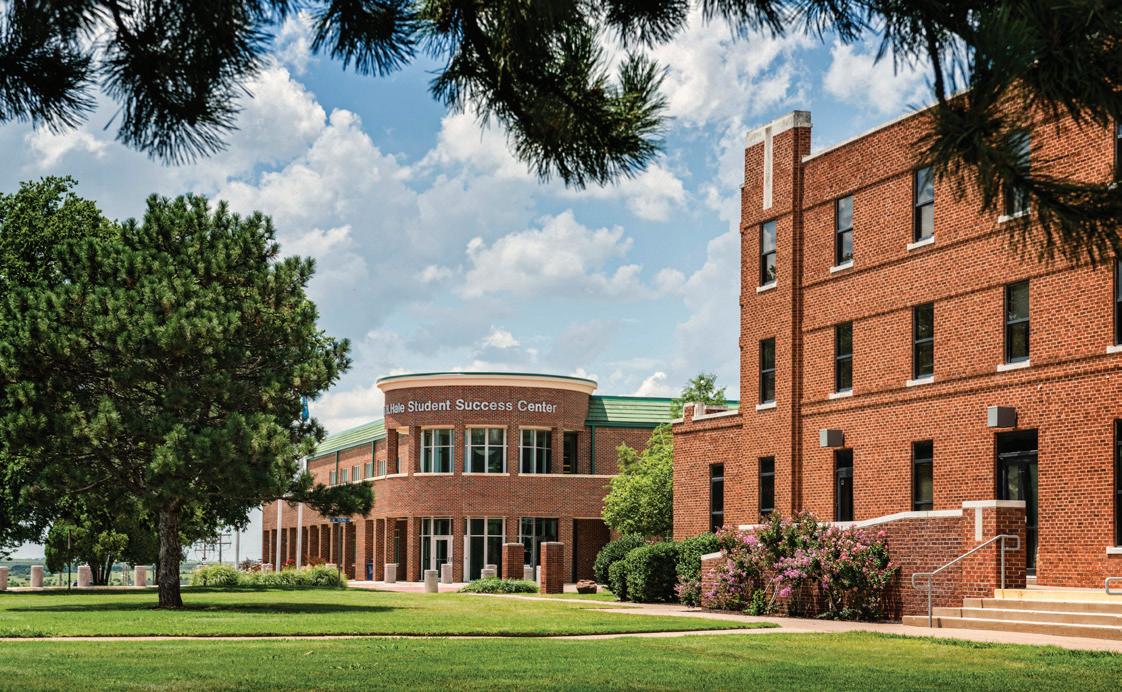
Campus was even closer knit in the ‘60s than it is today. Many of the students were poor, and hardly any of them had a car. They mostly stayed on campus or visited downtown Langston, so campus events were essential to the social lives of Langston Lions. Dances at the Student Success Center kept them the most entertained.
But professors still had the highest expectations for their pupils. Lackadaisical students were not tolerated. Professors would call out students who were not doing their work in front of the class, and students would support each other by helping them study.
“You hear about Langston University being a family,” Lewis said. “Well, that’s been the case forever. Everybody was here to help each other.”
Lewis graduated from Langston University in 1964 with a degree in agricultural economics and a minor in mathematics, fulfilling his and his mom’s dream of becoming the first college graduate in his family. Lewis couldn’t have known it at the time, but those four years he spent at Dear Langston would shape the trajectory of his personal and professional life for years to come.
“Having the opportunity to come to Langston University and get an education is responsible for what I’ve achieved over my lifetime,” Lewis said.
Soon after earning his degree, Lewis joined the United States Air Force. His service time was spent at Clinton-Sherman Air Force Base in Clinton, Oklahoma, working in the accounting and finance office during the Vietnam War from 1964-1966.
“I often tell people that I made sure the soldiers got paid,” Lewis said. Much like he did during his childhood and collegiate career, Lewis found comfort in the structure and routine of the miliary. Just like on the farm or on the campus of Langston University, he developed habits that kept him consistent and reliable throughout his career.
After two years of military service, Lewis began working for the United State Department of Agriculture (USDA) in what was then known as the Soil Conservation Service.
Lewis moved to Bristow, Oklahoma, to begin his training. Here, he worked directly with farmers and ranchers on conservation practices for a year before being promoted to a Soil Conservationist position in Lawton.
After three years in the position, the USDA approached Lewis with another promotion. This time, they wanted him to be a District Conservationist. The first Black District Conservationist in the country.
“The decision makers (in Oklahoma) and in Washington D.C. were trying to figure out if a Black District Conservationist could be successful working with white farmers and white employees,” Lewis said. “They decided to test it, and for some reason they selected me.
“Basically, what they were saying was, ‘If you succeed, we’ll select another (Black District Conservationist), but if you fail, we are not going to select another one.’”
Lewis didn’t have a choice but to be successful.
But to his surprise, Lewis didn’t run into the issues the “decision makers” were concerned about.
“They were seeing things that did not exist,” Lewis said. “As far as the employees and farmers were concerned, I had no problem. They just
wanted someone to help them. They didn’t care.”
After two years of success as a District Conservationist, the USDA decided to give Lewis another opportunity. This time, to be the first Black Area Conservationist.
Lewis accepted the opportunity in 1974 and was sent out of Oklahoma to Spokane, Washington, where he was responsible for all of Eastern Washington.
Regardless of the role he was given, Lewis continued to break down barriers. He proved not only that he was capable, but that Black workers were capable of the same work white employees had been doing for decades.
Because Lewis had proven himself, the USDA decided to send him back to school for a little more education.
Lewis began attending Harvard University in 1976 and within a year earned his master’s degree in public administration from the John F. Kennedy School of Government, otherwise known as the Harvard Kennedy School.
After graduating, Lewis was sent to Boise, Idaho, as an Assistant State Conservationist. He was the first Black Assistant State Conservationist in the United States.
After over two years in the position, Lewis was made the first Black State Conservationist, sending him to Massachusetts, then Nebraska. He served in these roles until 1986, when Lewis was asked by the Deputy Secretary of Agriculture to move to Washington, D.C., to develop national policy
for the advancement of civil rights within the USDA. This made Lewis the Special Assistant to the Deputy Secretary of Agriculture.
Through this role, Lewis helped develop the 1890 National Scholars Program, place liaisons on all 1890 land-grant institutions and create the 1890 Centers of Excellence.
“I did that,” Lewis said. “I provided that leadership in putting those policies in place.”
These programs continue to benefit not just Langston University students, but students at HBCUs across the nation.
After a year as the Special Assistant to the Deputy Secretary of Agriculture, Lewis was reassigned back to the Soil Conservation Service as the Director of Conservation planning in Washington, D.C. After a year, he became the country’s first Black Assistant Chief of the Midwest in 1990. Two years later, Lewis was named the first Black Deputy Chief for Management and Strategic Planning.
During this time, Lewis began the National Organization of Professional Black Soil Conservation Employees. The goal of this organization is to assist Black employees with their training so they can move into middle and upper management positions. This organization is still active today. Lewis was also instrumental in changing the name of the Soil Conservation Service to the Natural Resource Conservation Service. Lewis retired from the USDA as the Deputy Chief for Management and Strategic Planning in 1997.
Dr. Ernest Holloway, the 14th President of Langston University,
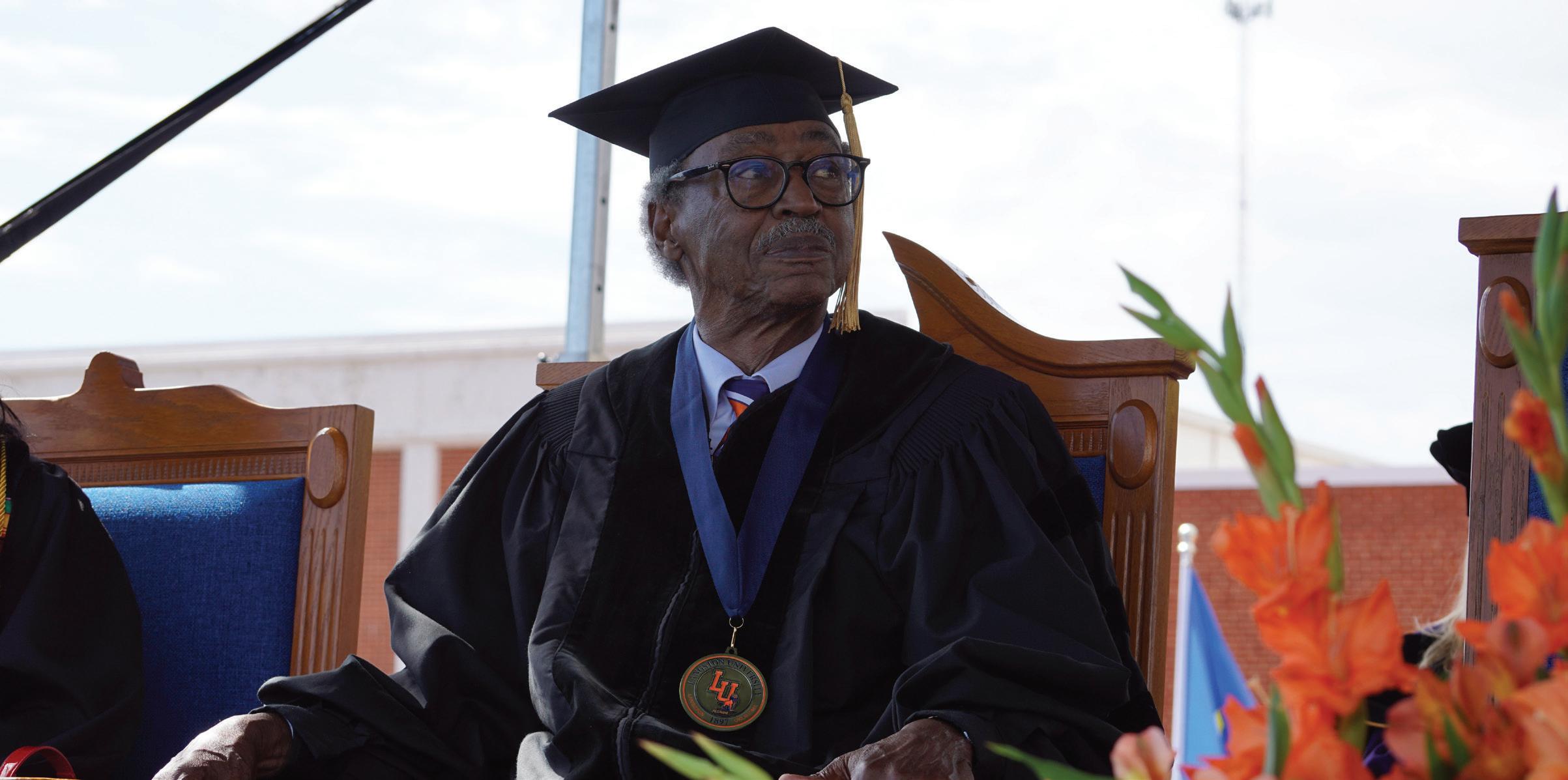
convinced Lewis to retire early.
“Whenever Dr. Holloway was in D.C., he would always stop by my office,” Lewis said. “He would always say, ‘As soon as you’re able to retire, we need you to come back home and help us start a new program out there in outreach management.’
“I had not planned on retiring in 1997. I was only 56 years old. If he had not asked me to do so, I would have worked for another three, four or five years in Washington, D.C. I retired on a Friday morning in 1996, and the following Monday in 1997 I started to work (at Langston University).”
Drawing on decades of federal and state relationships, Lewis created the Center for Outreach Programs, securing grants and cooperative agreements with several agencies, eventually bringing in around $5 million a year. These funds not only sustained Dear Langston’s outreach work but also supported other university programs.
After Dr. Holloway’s retirement, Lewis became the Assistant Administrator for Extension, continuing to serve the Langston University community until 2006.
“I felt like I finally had something to offer Langston University,” Lewis said. “Langston University had been very good to me and helped me be what I was at the time and what I am today. So, I wanted to give something back to LU. It was one of the best decisions I ever made.”
Within five years of graduating from Langston University, Lewis started giving back to the university every year.
It started small. At first, it was maybe $100 a year. But as his professional life grew, so too did his giving.
While working at Langston University, Sherman began a private business in Houston, Texas, with his son and daughter. When he retired from LU in 2006, Lewis began working in that business full-time. It began to flourish.
This allowed Lewis to start giving to the university in a major way, with his first large donation being made in 2015.
In 2018, Lewis and his family sold the business. This gave Lewis the time and means to really focus on his philanthropy. Now, he’s the largest individual donor in Langston University history.
“I’ve always wanted to be a philanthropist because I know the value of giving back,” Lewis said. “I’m so proud of that philanthropy. I think back to the founders of Langston University who were doing whatever they could to raise $5,000 (in the 1890s). Baking, selling blankets, whatever it took.
“They weren’t doing that for themselves. It’s about the future, about future kids and about their education. They were philanthropists, but they didn’t have a lot of money. They had a vision. That’s my philosophy, doing something now to help future generations.”
Lewis remembers hearing some smart person say the words “Learn. Earn. Return.” The phrase immediately resonated with him. Now, he lives by that motto.
Because of Lewis’ generosity, he became the namesake of the Sherman Lewis School of Agriculture and Applied Sciences in 2022, the first named school in LU history.
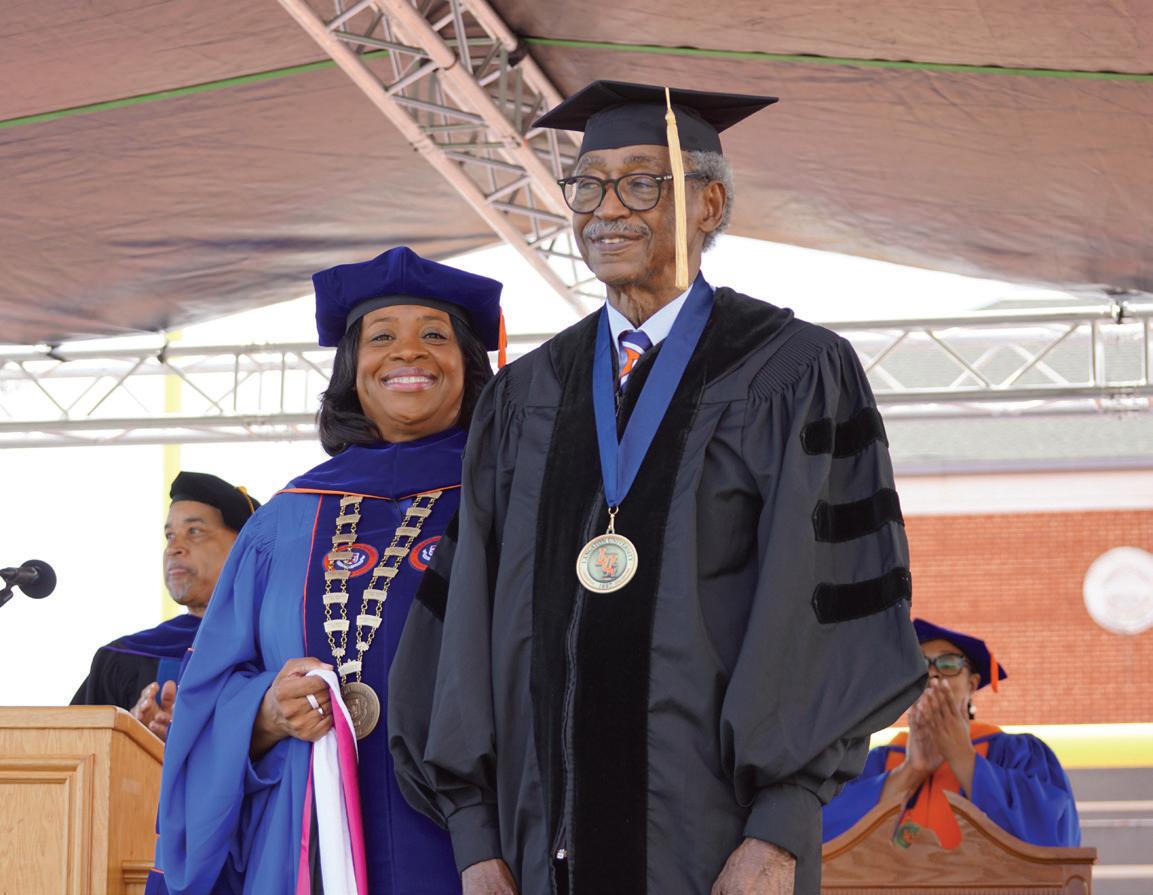
At this year’s Commencement Ceremony, Lewis served as the commencement speaker and was honored with the conferral of an honorary doctorate in humane letters.
“It’s an extreme honor,” Lewis said. “I’m the first in my family to ever receive a college education. If my mother and sisters and brother were here today to know I was receiving an honorary doctorate from Langston University, they would be so proud of that.
“I’m proud of it not for myself, but for my family. For my daughter and son. To show young people that anything is possible, but you must be willing to help others.”
But giving isn’t about the accolades and honors received.
To Lewis, It’s about the future of Langston University.
“You came to Langston University to learn,” Lewis said. “Now you’re ready to go out to earn money. Be willing to return some of those earnings to Langston University to educate someone else 100 years from now, the same way people in 1890 did for you.
“If more of us adopted that saying, Langston University would be strong for a long, long, long time.”
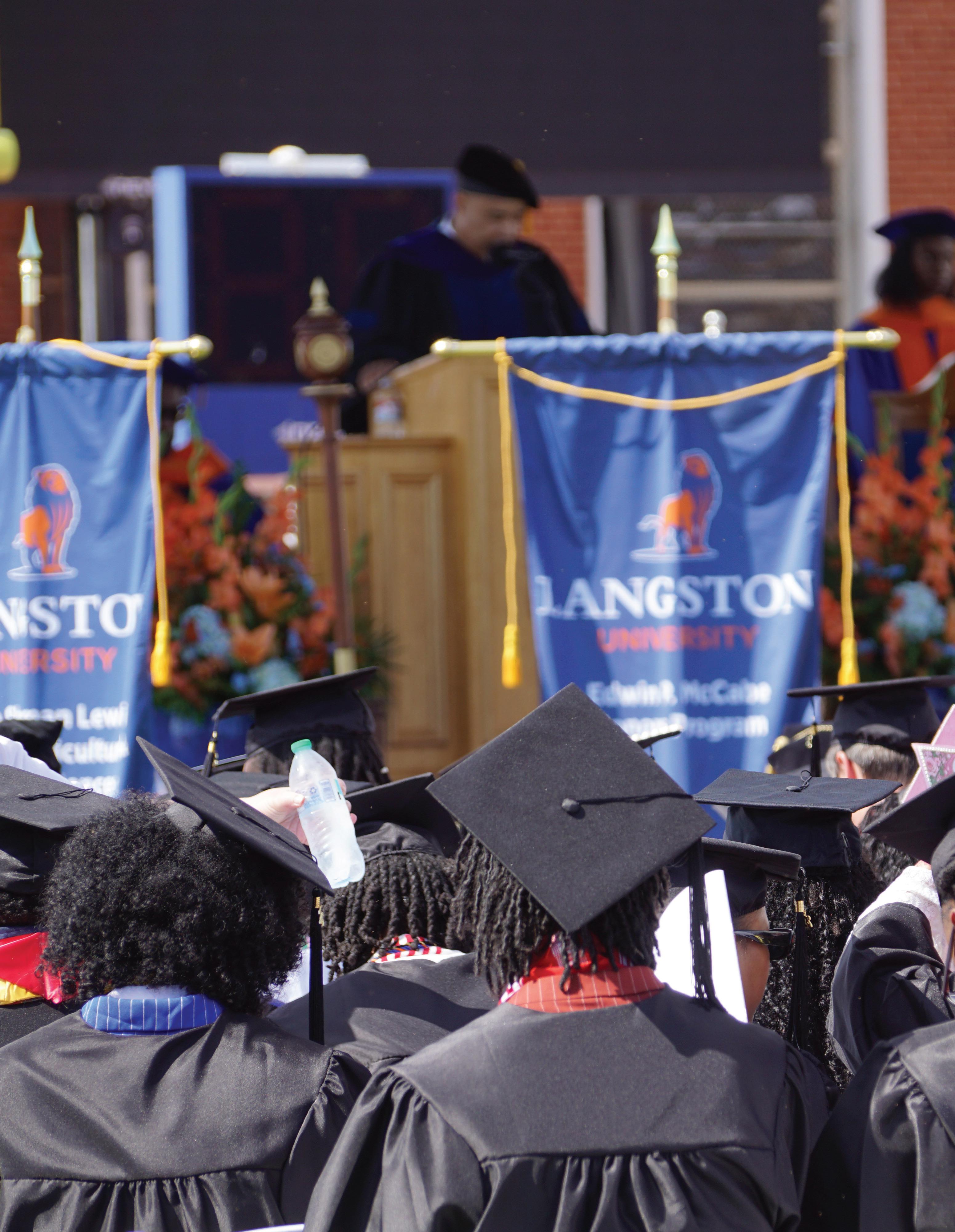
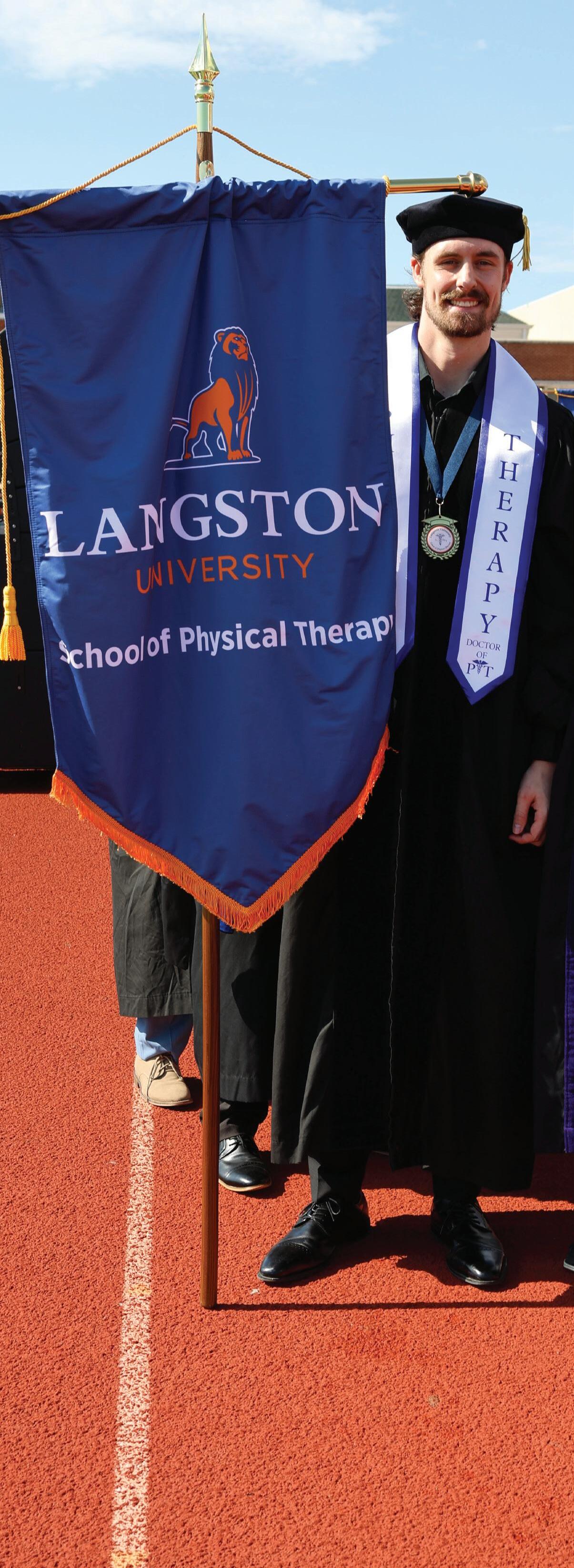
Langston University’s annual Commencement Ceremony is a joyous event filled with many meaningful traditions, and one of the most prized of these is the tradition of the School Flag Bearers. As the graduates process onto the field at the beginning of the ceremony, each academic school is led by their dean and one of their peers who carries the school flag. These coveted positions are awarded to the graduates with the highest grade point averages from each school. It is a recognition of their hard work and stellar academic performances throughout their time at Dear Langston. Meet the School Flag Bearers for the Class of 2026.
OF PHYSICAL THERAPY
SCHOOL OF PHYSICAL THERAPY
Jake Landes has always believed in helping others. He grew up in Tonkawa, Oklahoma, and his small town upbringing taught him the importance of community and service. So when he graduated from the University of Central Oklahoma in 2023 with his B.S. in General Studies, after earning his associate’s in biomedical sciences from Northern Oklahoma College in 2020, it made sense to choose a career that was all about helping people.
“I chose physical therapy because I wanted to have the ability to have a direct impact on people’s quality of life,” Landes said. “Physical therapy combines science and critical thinking, allowing me to use my mind to solve complex problems and my hands as tools to help restore function, movement and independence.”
With this goal in mind, Langston University seemed like the perfect fit for Landes. The smaller class sizes appealed to him, and the program’s affordability made it feasible to pursue his dream of being a physical therapist. Additionally, the university’s values aligned with his own. “I decided to attend Langston University School of Physical Therapy because of their focus on servant leadership, and the opportunity to be a part of a program that values clinical excellence and serving the underserved,” Landes said.
Landes excelled right from the beginning. His first year, his classmates elected him Class President. In this role, he advocated on behalf of his classmates and organized community service projects. In class, his professors mentored him. They guided him as he developed his clinical reasoning and professionalism, and they instilled confidence in him.
Landes built strong relationships with his classmates. They had class outings, both class-related and just for fun, and they attended the APTA Combined Sections Meeting in Houston together where they had the opportunity to network, learn and grow professionally. He said some of his favorite memories from the program were the latenight study sessions he hosted with his friends, as well as tailgating during Homecoming.
After graduation, Landes plans to work as a travel physical therapist to continue developing his clinical skills in different settings and communities. Eventually, he plans to transition into an outpatient clinic with the hopes of owning his own clinic one day.
“Langston University School of Physical Therapy has prepared me academically, clinically and professionally,” Landes said. “This program pushed me to develop strong clinical reasoning, confidence in patient care, and leadership skills that I will continue to develop into my career. Being selected as Flag Bearer represents not only my journey, but the support of my family, classmates, faculty and everyone who helped me along the way.”
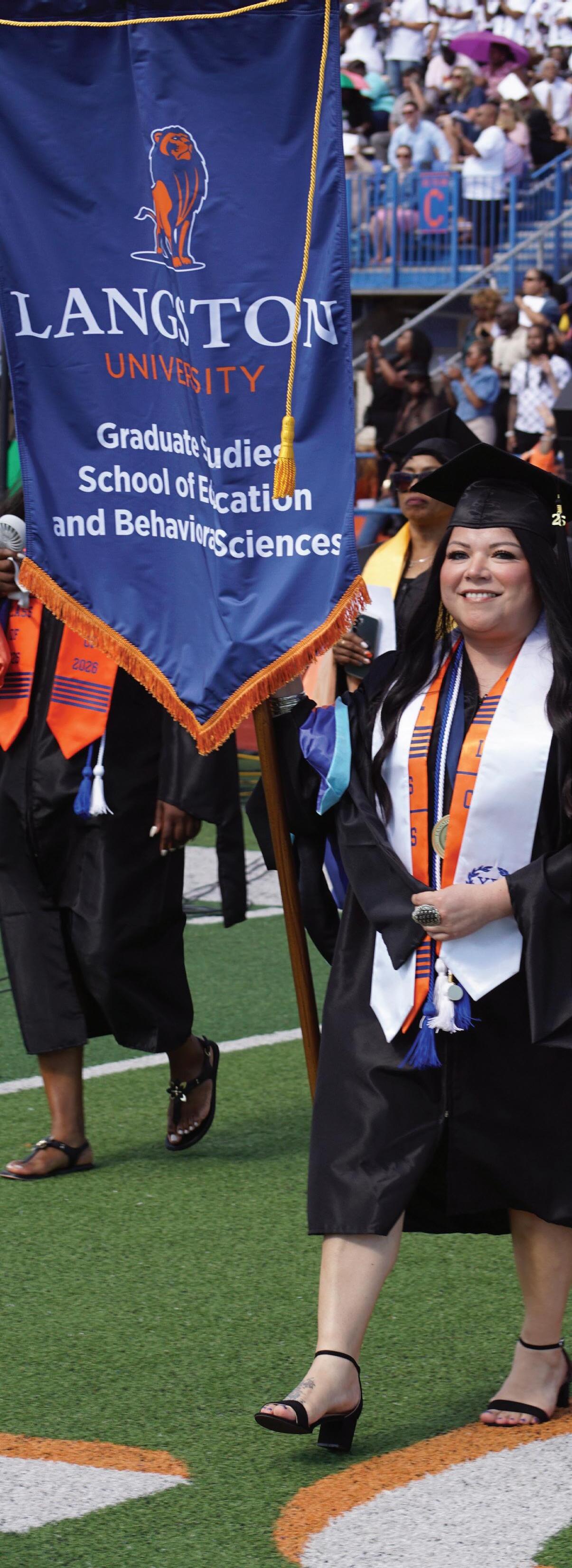
After graduating with her bachelor’s degree in psychology from Cameron University in 2021, Ereca Camero found her way into the field of tribal vocational rehabilitation services. In this line of work, she supports individuals with disabilities and mental health challenges in achieving their vocational goals. In 2024, she decided it was time to take the next step forward in her career.
That fall, she enrolled in Langston University’s Rehabilitation Counseling master’s program.
“I chose Rehabilitation Counseling because I am passionate about helping individuals overcome mental health challenges, disabilities and vocational barriers,” Camero said. “I wanted to develop the skills needed to support clients in achieving independence, stability and meaningful employment opportunities. And I chose Langston University because of its strong reputation for supporting diverse student populations and its commitment to academic excellence and community impact.”
Camero thrived at LU. Throughout her master’s program, she learned about applied counseling concepts through case studies and clinical practice scenarios which strengthened her understanding of client needs and evidence-based counseling approaches. The program’s faculty became her mentors, providing guidance, encouragement and valuable professional insight throughout her academic journey.
As she continued to perform well in her classes, Camero was invited to join Chi Sigma Iota Counseling Academic and Professional Honor Society International (CSI). The invitation was a recognition of her academic excellence and professional potential in the field of counseling, and she became a proud member of the Lambda Upsilon Chapter at Langston University.
After graduation, Camero plans to continue working in tribal vocational rehabilitation services while expanding her professional experience in counseling and advocacy.
“Langston University has thoroughly prepared me for my next steps by providing both academic knowledge and practical application in rehabilitation counseling,” Camero said. “The program has strengthened my confidence and readiness to continue to work in the field. Some of my favorite memories (from the program) include engaging in meaningful class discussions, collaborating with classmates on assignments and case studies, and growing both personally and professionally throughout the program. The relationships built with peers and faculty made the experience especially memorable.”
B.B.A. MANAGEMENT
An Oklahoma City native, Kobe Law came to Langston University in Fall 2022 as a student athlete. He was a basketball player with interests in business and finance, and he knew Langston University was the perfect place for him to grow as an athlete and a young entrepreneur. “I decided to attend Langston University because it offered a strong Black atmosphere, a supportive campus community and meaningful opportunities for leadership development,” Law said. “I began my journey at LU as a collegiate athlete on the basketball team through an athletic scholarship, which made Langston the right fit for both my academic and personal goals.”
Law majored in Business Administration–Management with a minor in finance. He chose those programs because he knew management would help him understand leadership and operations while finance would strengthen his ability to make strategic decisions and build long-term value.
During his time at LU, Law participated in several student organizations which he said helped him grow as a leader, communicator and more well-rounded person in professional settings. This included becoming the Co Founder and Director of Operations of the Langston University Collegiate Chapter of DECA, the Public Relations Chair for Gents, a member of Delta Mu Delta, a member of the National Society of Leadership and Success, a member of the Langston Chamber of Commerce and a student leader in the School of Business.
Law also participated in research as part of the Langston Community Plaza Feasibility Study, which aimed to integrate technology, business innovation and entertainment to create a vibrant community hub for families, entrepreneurs, students, visitors and professionals. Law presented his research in a pitch competition and won first place, receiving a $3,000 award and a three day trip to Washington, D.C., to attend the 2025 HBCU Entrepreneurship Empowerment Summit.
“My feasibility study evaluated the project’s potential by analyzing market demand, technical requirements, financial sustainability and operational feasibility,” Law said. “Through this project, I gained skills in first hand and second hand research, forecasting, project management and professional presentation.”
Law’s professors supported and encouraged him throughout his time at LU, and he considers Dean Daryl Green, Michael Hamilton and Dr. Charles Mambula to be his biggest mentors. After graduation, Law plans to become a project manager and pursue his MBA and a PMP License. Eventually, he wants to become a business consultant.
“Langston prepared me through rigorous coursework, mentorship and leadership experiences that strengthened my professionalism, discipline and strategic thinking,” Law said. “I’m proud to represent LU and excited to carry what I’ve learned here into the next chapter of my life.”


SHERMAN LEWIS SCHOOL OF AGRICULTURE AND APPLIED SCIENCES
As a student at Landry Walker High School in New Orleans, Louisiana, Delisha Carter started her college search with the intent of studying accounting and finance. As she researched schools, LU stood out to her because it was Oklahoma’s only HBCU. Further research into the history of the institution, its campus life and its academic reputation convinced her to apply, and she was accepted with scholarships. She enrolled in Fall 2022, and Dear Langston quickly became a place she was happy to call home.
Carter got involved on campus right away. She has been a member of the Manners Club since 2022, serving as Vice President for the 2025–26 term. She has also served as the Public Relations Officer for the ABAC Club since 2024. Since Fall 2023, Carter has worked as a Resident Assistant, and she received the RA of the Year award, a Leadership Advocate Award and recognition for maintaining a 3.5 GPA within University Housing departments.
“Some of my favorite highlights at Langston have been the relationships I built with my friends, who have continuously motivated and supported me,” Carter said. “I also cherish the opportunities I’ve had to attend conferences and represent the university, as well as moments where I was able to lead and grow as a student leader.”
Carter made sure to take advantage of networking opportunities throughout her time in school, and she eventually met LU alumna Jateya Jackson. Jackson introduced Carter to the wide range of opportunities within the agriculture field, and Carter decided to change her major to Agribusiness with a minor in accounting.
“Since making that decision, I have not looked back,” Carter said. “I have grown to truly appreciate how diverse and impactful the field of agriculture is.”
After graduation, Carter plans to pursue a career in the corporate sector while working toward becoming a successful businesswoman. Her long-term goal is to own a real estate firm. Thanks to her professors, mentors and her advisor, Dr. Nyairo Newton, Carter is confident she’s prepared for what comes next.
“(Langston University) has shaped me into the woman I am today and has instilled in me the drive to continue striving for excellence,” Carter said. “I am thankful for the experiences, growth and opportunities that Langston has provided me. The long nights and early mornings have all led to this moment, and I am proud to carry the legacy forward.”
Originally from Kansas City, Missouri, Samiya Robinson has always been familiar with Langston University because it’s her great aunt’s alma mater. She understood the unique cultural and historical significance LU holds as Oklahoma’s HBCU, so she decided to apply and was accepted into the Edwin P. McCabe Honors Program. She came to LU in Fall 2021.
Though she originally chose LU because of her McCabe Honors scholarship, she soon fell in love with Dear Langston, and she is proud to be part of the same legacy as her great aunt.
Planning to pursue a career in business, Robinson chose to double major in English and Finance. She chose Finance because she hoped to develop her analytical and strategic thinking skills, and she chose English because she saw the growth and transformation the department has experienced in recent years and wanted to be part of it.
“The English Department pushed me to expand beyond technical skills and really develop my voice, especially in terms of creative expression and rhetoric,” Robinson said. “Together, these programs have allowed me to think both analytically and critically, blending business strategy with creativity and communication in a way that I believe is essential for leadership.”
Robinson also worked to become a leader outside the classroom. She joined the Iota Chapter of Sigma Gamma Rho Sorority, Inc., in Spring 2022, and she said the sorority has been central to her leadership development and college experience. She has served as her chapter’s Vice President, President and Parliamentarian. She has also served as both a National Pan Hellenic Council and chapter delegate. Beyond Greek life, Robinson worked in the LU Writing Center as a tutor and she served as the Community and Public Relations Chair for the School of Business. She is a Overnight Assistant for Residential Life and Housing Services. She is also a member of the National Society of Leadership and Success, the National Council of Negro Women, the School of Business Student Advisory Board, Sigma Tau Delta English Honor Society, and Delta Mu Delta International Business Honor Society.
After graduation, Robinson will head to Minnesota as part of the 2026 NBA x HBCU Fellowship. She will spend the summer working in Community Engagement with the Minnesota Lynx and Timberwolves organizations.
“My experience here has shaped me in ways that go far beyond academics,” Robinson said. “More than anything, Langston has taught me growth both personally and socially. The 22-year-old I am today exists because my 17-year-old self made the decision to step outside of her comfort zone and choose a school just four hours from home as a place to grow into who I am.”


B.S. NURSING SCHOOL OF NURSING AND HEALTH PROFESSIONS
Kaitlyn Mitchell first discovered her passion for nursing as a student at Perry High School in Perry, Oklahoma. Her mother is a registered nurse, so she grew up with a lot of exposure to the field. When she got to high school, she decided she wanted to learn more. She took classes and became a Certified Nursing Assistant (CNA), and she continued working as a CNA until she graduated.
“I started working as a CNA in high school and fell in love with it,” Mitchell said. “I wanted to be able to do more for people, so I decided to become a nurse.”
Once Mitchell realized this was her calling, she started looking into nursing programs in Oklahoma. Her mother’s coworkers highly recommended Langston University, and it didn’t take Mitchell long to understand why.
She enrolled at LU in Fall 2022, and her professors made it clear early on that it would take a lot of hard work and dedication to earn her BSN. Mitchell was more than up for the challenge. She studied hard for her classes and made the most of her time in clinicals, and she excelled.
Outside of nursing, Mitchell was a member of the Edwin P. McCabe Honors Program, and she was also a member of the Langston University Quiz Bowl Team. She made friends and had fun, but school was her priority.
“Getting into the nursing program was a highlight (of my time at LU),” Mitchell said. “But also, I think nursing pinning and graduation will be my favorite memories since it highlights all my hard work paying off.”
After graduation, Mitchell plans to spend her first year focusing on being a newly graduated registered nurse and gaining experience. Later, she plans to continue her education to eventually become a nurse practitioner.
“I honestly feel like Dr. Hunter has done a good job preparing me for what comes next,” Mitchell said. “But I am absolutely glad it is over, and I made it to this point.”
Originally from Oklahoma City, Brooklyn Noiel has always been a stellar student. She graduated in the top 10% of her class from Moore High School in 2022 before enrolling as a quad major–double bachelors in corrections and psychology and double associates in criminal justice and general studies–at Langston University that fall.
Noiel knew she wanted to be a lawyer, and she knew Langston University was the perfect place for her to earn her bachelor’s degree and prepare for law school.
“I decided to attend Langston University because it offers a strong sense of community, academic excellence and opportunities for personal growth,” Noiel said. “Attending Langston University allows me to grow academically, professionally and personally while being part of a legacy of excellence.”
From the beginning, Noiel was drawn to the supportive environment at LU. As Oklahoma’s HBCU, Langston University celebrates culture, develops leaders and empowers students to reach their highest potential. That’s exactly what Noiel wanted.
That supportive atmosphere helped Noiel excel in and out of the classroom.
She was an LU Ambassador, serving terms as the Historian and the Chief of Staff; a Resident Assistant; a member of Legal Lions, where she served as Treasurer; a member of Sigma Gamma Rho Sorority Incorporated, where she served as the Recording Secretary; and a member of the Scholar’s Club, where she was Secretary and Miss Scholars’ Club. She was also part of LU’s student chapters of the National Council of Negro Women and the National Association of Blacks in Criminal Justice. She sang in LU’s Concert Choir, serving as the Wardrobe Lead and President, and she participated in the Student Government Association Senate, where she served as an Associate Justice to the Chief Justice.
After graduation, Noiel will intern at MedPro Group as their Inclusion and Engagement Intern in Fort Wayne, Indiana. In addition to her internship, Noiel plans to study for the LSAT with hopes of attending law school in Fall 2027.
“I truly feel that Langston University has prepared me for what comes next,” Noiel said. “My time here has given me not only a strong academic foundation, but also the confidence, leadership skills and resilience needed to pursue my future goals. Through the support of faculty, staff and fellow students, I have grown personally and professionally, and I feel ready to take the next step toward law school and my career aspirations.”
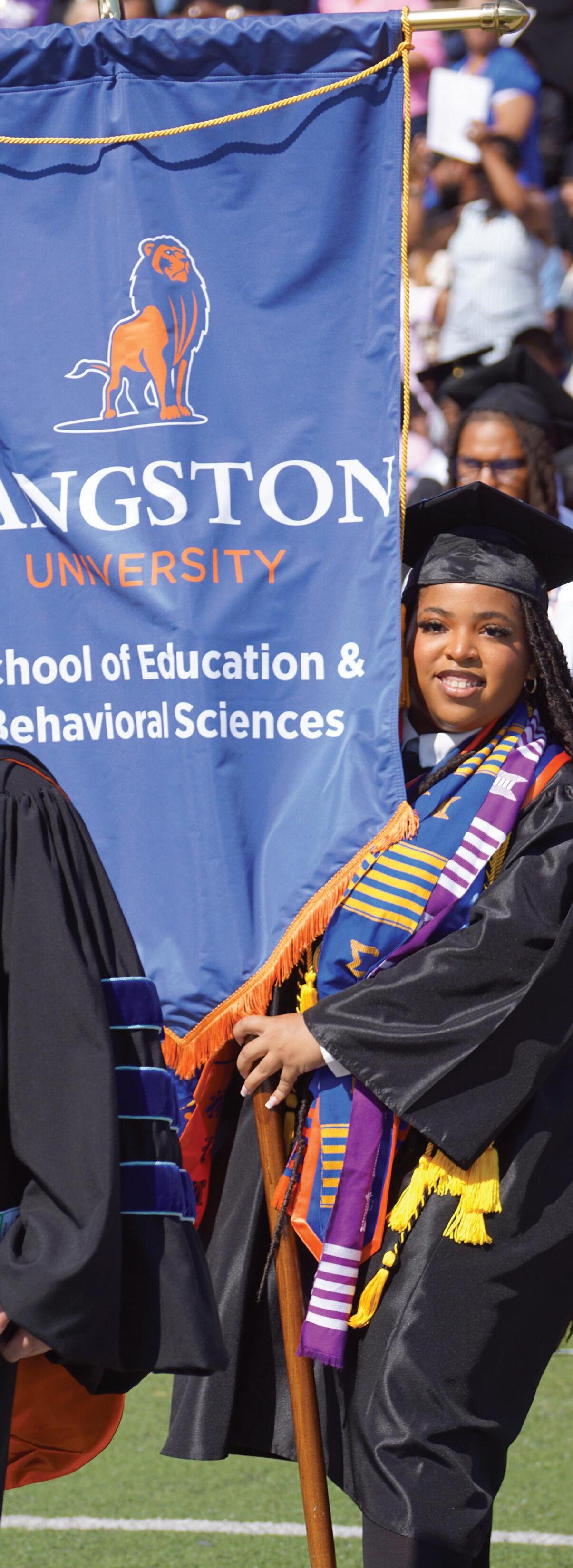
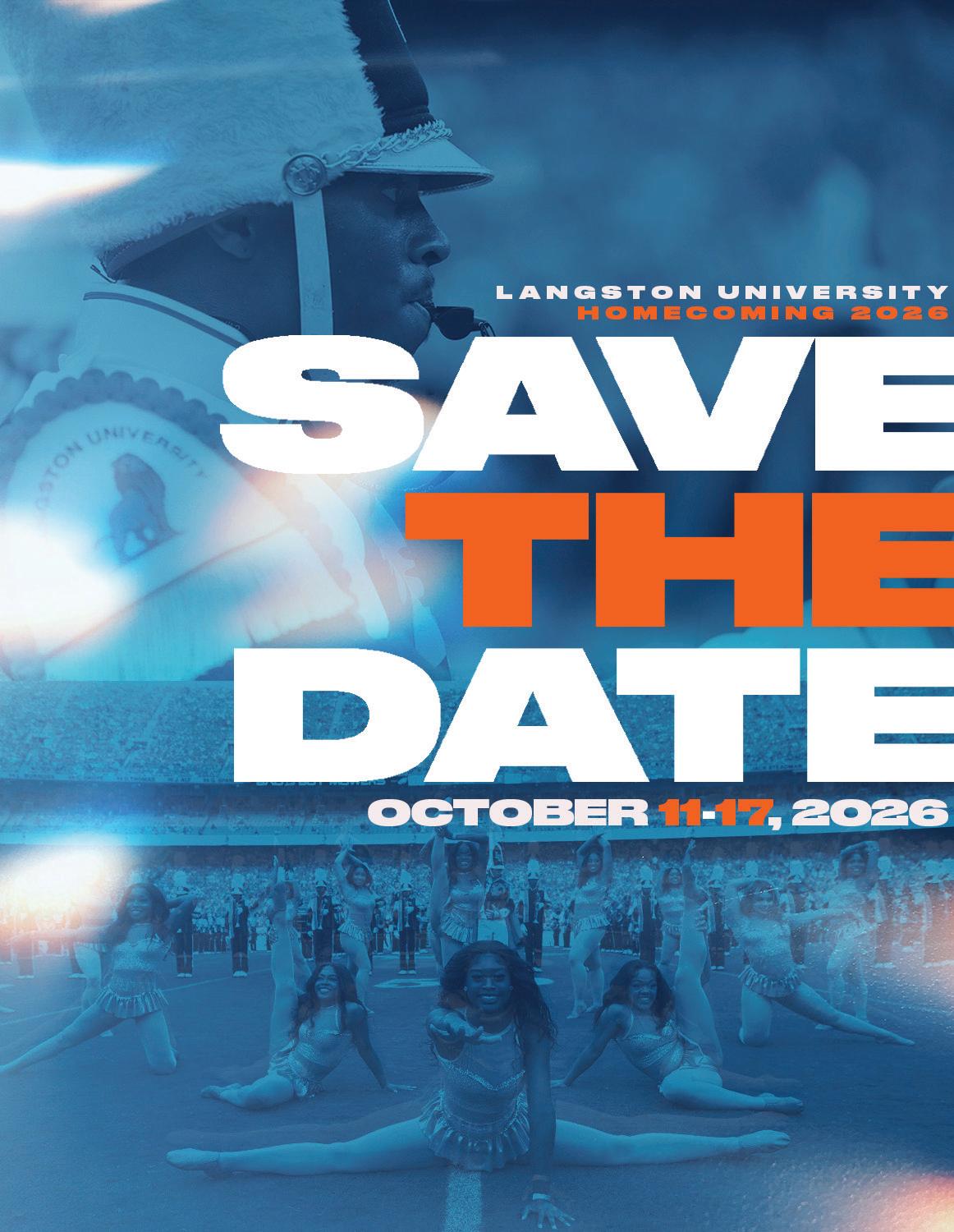
‘E ROAR IS PRODUCED BY THE LANGSTON UNIVERSITY OFFICE OF PUBLIC RELATIONS
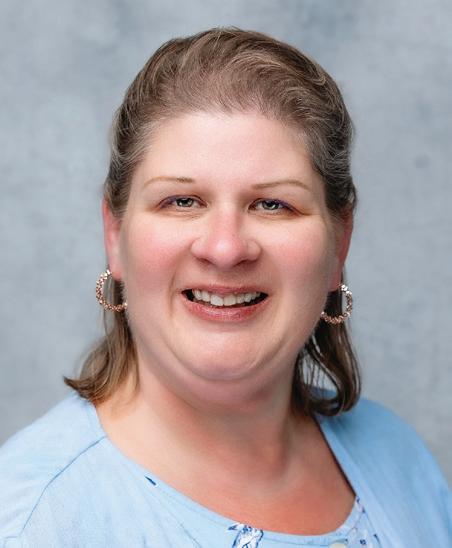
Theresa Powell Vice President for Operations
want to be featured in next month's issue?
SEND US YOUR NEWS:
If you have any accomplishments or upcoming events in your department and you want them publicized, please send to the LU Office of Public Relations via the online project request form found at www.langston.edu
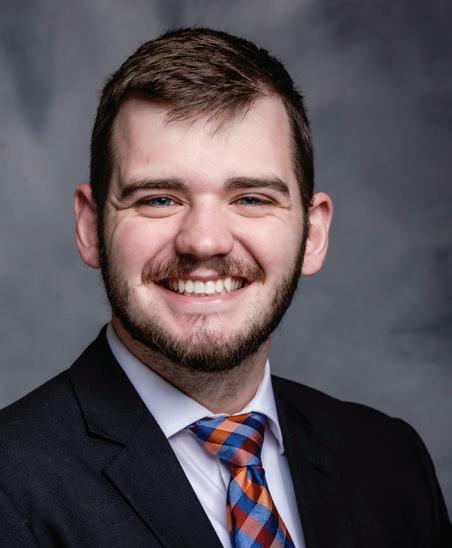
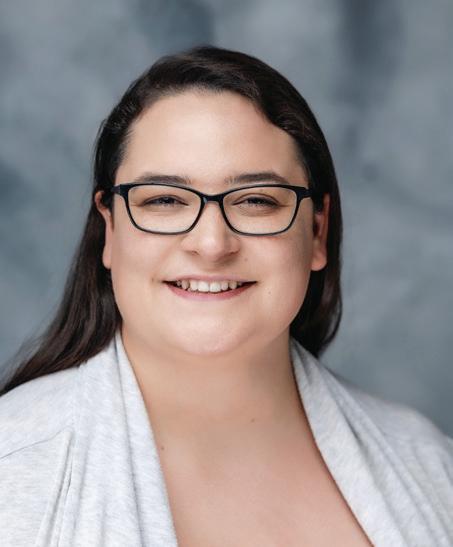
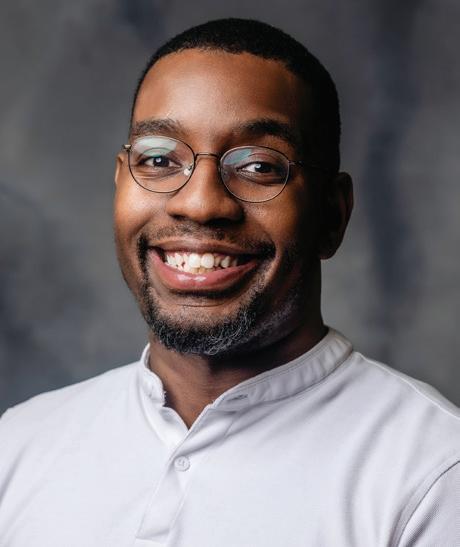
sheets Director of Public Relations
Assistant Director of Communications Editor-in-Chief
Media Relations Specialist
Contributing Editor
Senior Graphic Designer/Photographer
Design and Layout