UAPB Summer Research Internships prepare students for ag careers
ARDUPdates
T H E A S S O C I AT I O N O F 1 8 9 0 R E S E A R C H D I R E C T O R S “To advance transformative agricultural research that drives innovation, strengthens regional and national food systems and addresses global challenges in sustainable agriculture and food security.”
SEPTEMBER 2026 VOL. 17, ISSUE 9
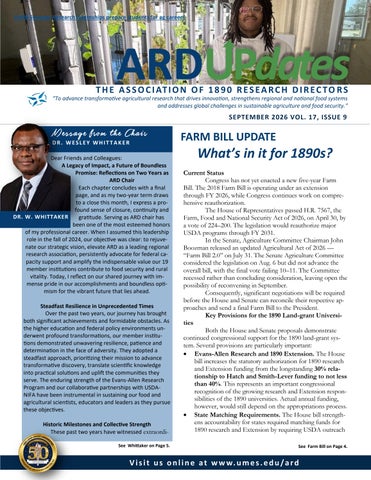
Message from the Chair DR. WESLEY WHITTAKER Dear Friends and Colleagues: A Legacy of Impact, a Future of Boundless Promise: Reflections on Two Years as ARD Chair Each chapter concludes with a final page, and as my two-year term draws to a close this month, I express a profound sense of closure, continuity and DR. W. WHITTAKER gratitude. Serving as ARD chair has been one of the most esteemed honors of my professional career. When I assumed this leadership role in the fall of 2024, our objective was clear: to rejuvenate our strategic vision, elevate ARD as a leading regional research association, persistently advocate for federal capacity support and amplify the indispensable value our 19 member institutions contribute to food security and rural vitality. Today, I reflect on our shared journey with immense pride in our accomplishments and boundless optimism for the vibrant future that lies ahead.
What’s in it for 1890s?
Historic Milestones and Collective Strength These past two years have witnessed extraordi-
Current Status Congress has not yet enacted a new five-year Farm Bill. The 2018 Farm Bill is operating under an extension through FY 2026, while Congress continues work on comprehensive reauthorization. The House of Representatives passed H.R. 7567, the Farm, Food and National Security Act of 2026, on April 30, by a vote of 224–200. The legislation would reauthorize major USDA programs through FY 2031. In the Senate, Agriculture Committee Chairman John Boozman released an updated Agricultural Act of 2026 — “Farm Bill 2.0” on July 31. The Senate Agriculture Committee considered the legislation on Aug. 6 but did not advance the overall bill, with the final vote failing 10–11. The Committee recessed rather than concluding consideration, leaving open the possibility of reconvening in September. Consequently, significant negotiations will be required before the House and Senate can reconcile their respective approaches and send a final Farm Bill to the President. Key Provisions for the 1890 Land-grant Universities Both the House and Senate proposals demonstrate continued congressional support for the 1890 land-grant system. Several provisions are particularly important: Evans-Allen Research and 1890 Extension. The House bill increases the statutory authorization for 1890 research and Extension funding from the longstanding 30% relationship to Hatch and Smith-Lever funding to not less than 40%. This represents an important congressional recognition of the growing research and Extension responsibilities of the 1890 universities. Actual annual funding, however, would still depend on the appropriations process. State Matching Requirements. The House bill strengthens accountability for states required matching funds for 1890 research and Extension by requiring USDA outreach
See Whittaker on Page 5.
See Farm Bill on Page 4.
Steadfast Resilience in Unprecedented Times Over the past two years, our journey has brought both significant achievements and formidable obstacles. As the higher education and federal policy environments underwent profound transformations, our member institutions demonstrated unwavering resilience, patience and determination in the face of adversity. They adopted a steadfast approach, prioritizing their mission to advance transformative discovery, translate scientific knowledge into practical solutions and uplift the communities they serve. The enduring strength of the Evans-Allen Research Program and our collaborative partnerships with USDANIFA have been instrumental in sustaining our food and agricultural scientists, educators and leaders as they pursue these objectives.
1
FARM BILL UPDATE
V i s i t u s o n l i n e a t w w w. u m A ReDsU. e P DdAuT / E Sa/rSd EPTEMBER 2026
1890s HAVING AN IMPACT Congress approved the Evans-Allen Act of 1977 to provide capacity funding for food and agricultural research at the 1890 land-grant universities and Tuskegee University (the 1890 Institutions) similar to that provided to the 1862 universities under the Hatch Act of 1887. Research conducted under the Evans-Allen Program has led to hundreds of scientific breakthroughs of benefit to both the unique stakeholders of the 1890 institutions and the nation as a whole. The Evans-Allen Program has been extremely important in allowing the 1890 institutions to attract topnotch scientists to their campuses, conduct high-quality and innovative research and become more fully integrated within the land-grant system. This edition includes impacts from the 1890 research program submitted by scientists at Lincoln University of Missouri.
LU IDs alternative to fishmeal for rainbow trout farmers The continued growth of aquaculture depends on system. Researchers are also examining how feed ingredients access to nutritious, affordable and sustainable feeds. Fishrelate to water quality and contaminants of emerging concern meal has traditionally been a major protein source in rainbow (CECs), including PFAS, microplastics, antibiotics and algal trout diets. However, its high cost, fluctuating availability and toxins. Led by Dr. John Maiyo, assistant professor of water dependence on finite marine resources create economic chal- quality, this portion investigates whether feed ingredients may lenges and increase pressure on the environment. Identifying serve as a pathway for these contaminants to enter producalternative protein ingredients that maintain fish performance tion systems and how their presence could affect water qualiwhile reducing reliance on fishmeal is critical to supporting a ty, fish health and food safety. By combining expertise in fish viable and resource-efficient U.S. aquaculture industry. At Lincoln University of Missouri (LU), Dr. Moureen Matuha, assistant professor of aquaculture, and her research team are addressing this challenge by evaluating soybean-based ingredients as fishmeal alternatives in rainbow trout diets. Their research focuses on conventional soybean meal and fermented soybean meal (Fermex200) to determine how to incorporate these ingredients into trout feeds without compromising fish growth and production performance. Conventional soybean meal is an abundant plantbased protein source, but naturally occurring compounds such as anti-nutritional factors can limit digestion and nutrient absorption in fish. Fermentation can break down some of those compounds, potentially making the nutrients more available. By comparing conventional soybean meal with Fermex 200, a fermented soybean meal product, researchers can determine whether fermentation provides additional benefits for trout growth performance and feed efficiency. Preliminary findings from two 12-week feeding trials with juvenile and sub-adult rainbow trout are promising. ReFrom left Adebusola Ishola, a research assistant, and Sadiat Onilesults indicate up to 50% of the fishmeal can be replaced with owo, a graduate student in the Sustainable Agriculture Program at soy-based ingredients without compromising growth or over- LU measure length and weight for rainbow trout fed soy-based diall performance. ets during a 12-week feeding trial. “These findings are important because they show that producers may have more flexibility in choosing feed nutrition with water quality and contaminant monitoring, ingredients without sacrificing fish growth and performance,” Matuha and Maiyo are taking a broader approach to evaluatMatuha said. “Using readily available plant-based proteins ing novel feed ingredients. could help manage feed costs, broaden ingredient choices and Together, these research efforts show how LU reprovide feed manufacturers with additional options for devel- searchers are addressing aquaculture challenges from multiple oping practical trout diets.” perspectives. By connecting feed innovation with production The potential benefits extend beyond fish perforperformance, economics, water quality and food safety, the mance. Feed is one of the largest production expenses in fish work provides a more complete understanding of how new production, and reducing dependence on high-priced fishingredients function within production systems. This informeal could help producers manage operating costs. Greater mation could help producers and feed manufacturers make use of soy-based products may also strengthen connections informed decisions about feeding strategies while supporting between U.S. agriculture and the aquaculture sector. continued growth and new opportunities across U.S. agriculThe project also examines factors beyond fish perture and aquaculture. formance. Determining whether a feed performs well is only For more information, contact: Dr. Moureen Matuba, at Matuone part of evaluating its role in an aquaculture production haM@lincolnu.edu. 2
ARD UPDATES/SEPTEMBER 2026
USDA grants seek solutions to food and ag systems’ threats Some of the most important threats to food and agri- growth stage and season can influence crop chemical and cultural systems are also among the hardest to see. Volatile nutritional profiles. molecules associated with foodborne pathogens can signal contamination, while emerging contaminants such as per- and Moving from Measurement to Mitigation polyfluoroalkyl substances (PFAS) can move through soil and That analytical foundation now supports a shift from plants and disrupt biological processes at the molecular level. identifying environmental problems toward developing potential solutions. Faster Tools for Food Safety Through a recently funded approximately $600,000 Supported by an Evans-Allen project launched in USDA-NIFA Capacity Building Grant, Yang and collabo2021, Yang’s team developed a portable fiber-optic Raman rators are investigating how silver nanoparticles and PFAS probe to detect volatile organic compounds, or VOCs, associ- affect eight major soil enzymes and broader soil metabolic ated with foodborne pathogens. Combined with machineprocesses. The project combines enzymatic assays with untarlearning algorithms, the system extracts information from geted metabolomics to examine how emerging contaminants complex Raman spectra. A 2023 study in Measurement demon- interfere with soil biochemical and microbial functions. strated the feasibility of rapid, noncontact and real-time deThe team is also developing thiol-functionalized biotection of highly diluted VOC mixtures. The team later exchar to immobilize silver nanoparticles and PFAS, reducing tended the approach to more challenging mixtures. In a 2025 their bioavailability and potentially restoring soil enzymatic RSC Advances study, researchers analyzed 1,445 Raman spec- activity. The long-term goal is a low-cost, scalable mitigation tra from 42 VOC mixtures. Optimized models achieved more strategy for growers facing emerging soil-health challenges. than 90% classification accuracy for pure VOCs and identiLincoln University’s Cooperative Research and Extension fied mixtures containing as many as six programs will help engage growers compounds at concentrations as low as and small farmers, particularly those 0.25%. from under-resourced communities, A second Evans-Allen project, in future testing and dissemination. launched in 2025, is advancing the platform through enhanced Raman fiber Cultivating the Next Generation probes incorporating micro- and naof Expertise noscale fabrication to increase sensitivity Mastering advanced analytical techand move toward field-deployable sensniques takes time, requiring students ing. The laboratory is also developing to progress beyond instrument opertime-stretched ultrafast optical spectrosation to sample preparation, quality copy for high-speed chemical detection. control, troubleshooting, data processing and interpretation. From Detection to Metabolomics Former and current students have The same challenge behind the contributed to peer-reviewed publisensing research — extracting useful cations, trained newer researchers information from complex chemical sigand carried their experience into nals — has led the laboratory into highdiverse careers. Samira Mahdi, who resolution metabolomics. developed extensive UHPLC-MS/ In one ongoing study, Yang’s MS expertise in the lab and contribteam is examining how PFOS and uted to three published studies, is PFOA affect mung bean sprouts. Both preparing to pursue doctoral studies. contaminants accumulated in a doseXavier Jones, Yang’s first master’s Dr. Yang troubleshooting the UHPLC-MS/ and tissue-dependent manner, with the student and coauthor of two publiMS system. highest concentrations in roots but cations, entered the biotechnology measurable transport into stems and leaves. High-resolution industry, while Travis Barrett built research experience at UHPLC-MS/MS analysis also revealed metabolomic changes Washington University in St. Louis and Lincoln University involving central carbon metabolism, amino acids, lipids and before joining the Missouri Department of Natural Replant defense pathways. Rather than asking only where a con- sources. Their progress reflects the laboratory’s commitment taminant accumulates, the work examines what happens to to generating new scientific knowledge while preparing stuplant metabolism after exposure. dents to use sophisticated analytical tools independently. The laboratory is also applying metabolomics to othFor more information, contact: Dr. Quigbo Yang, College of Agrier agricultural questions. Studies of Elderberries and Sochan culture, Environmental and Human Sciences, Lincoln University at (Rudbeckia laciniata), a native edible plant traditionally used by YangQ@lincolnu.edu. the Cherokee, show how production practices, environment, 3
ARD UPDATES/SEPTEMBER 2026
In memory of Dr. Sunil Pancholy It is with profound sadness that we announce the unexpected passing of Sunil K. Pancholy in Tampa, FL, on Aug. 24, at the age of 81. He was a devoted and beloved husband, father, grandfather, brother, uncle and mentor to so many. Pancholy was born in Udaipur, Rajasthan, India, and received his early education in Udaipur and Pali, followed by a Bachelor of Science degree in agriculture from the University of Udaipur. In 1967, he moved to Stillwater, OK, where he received his master’s and Ph.D. in soil microbiology and biochemistry. Pancholy built a long, meaningful career in a variety of roles beginning as an assistant professor and progressing to associate professor, full professor, research director and associate dean of the College of Food and Agricultural Sciences. He spent 35 years at Florida A&M University in Tallahassee, FL, a place that always held a special place in his heart. He made lifelong friends at FAMU and remained in touch with many colleagues until his passing. Throughout his career, Pancholy was known for his strong work ethic, commitment and dedication. Just as Pancholy was dedicated to his work, he was even more committed to his family and friends. Anyone
who knew him understood how deeply he loved his wife, children, grandchildren and extended family. No words can capture the person he was. He was intelligent, funny, gentle, generous, kind, loving, philanthropic and deeply compassionate. He will always be remembered for his warm, loving nature; his ability to make people laugh; his calmness and quiet strength in difficult situations; and his unwavering belief in the importance of education and giving back to the commuDR. SUNIL K. PANCHOLY nity. His family will carry his memory forward through the lessons, stories and love he gave so generously. In lieu of flowers, the family kindly asks that you honor his memory by giving back to others, as he so often did, through a donation of your time or resources to a charitable organization or cause that is meaningful to you. If you are so inclined, ARD is recognized by the IRS as a charitable, educational and scientific organization.
Farm Bill . . . From Page 1
to states and state attestations concerning their ability to infrastructure and scientific workforce development meet the federal matching requirement. This could proshould remain priorities during final negotiations. vide additional leverage for ensuring that 1890 universities receive their required state support. Implications and Priorities for the 1890 Community 1890 Centers of Excellence. Both chambers support The current Farm the Centers’ continuation and expansion. The House bill Bill proposals provide a genincreases the minimum number of 1890 Centers of Exerally favorable foundation cellence to at least eight and expand eligible focus areas. The Senate proposal would specifically designate the pro- for the 1890 universities, pargram as the “Centers of Excellence at 1890 Institutions,” ticularly the proposed 40% authorization for Evansrequire USDA to support no fewer than six Centers, Allen and 1890 Extension, broaden program priorities and authorize $20 million stronger state-match accountability, continued scholarships annually through FY 2031. During the August Senate and expanded Centers of Excellence. markup, an amendment offered by Sen. Raphael As negotiations resume, the 1890 community should Warnock (D-Georgia) to increase support for the 1890 maintain a unified message: retain the strongest 1890 proviCenters of Excellence was approved by voice vote as part sions from both bills in the final conference agreement; proof an en bloc amendment. tect and strengthen Evans-Allen and 1890 Extension capacity 1890 Scholarships. Both bills would reauthorize the funding; preserve the 1:1 state matching requirement and scholarship program through FY 2031. The House bill strengthen enforcement; expand the 1890 Centers of Excelwould rename it the David A. Scott Scholarship Prolence; sustain scholarships and capacity-building programs; gram for Students at 1890 Institutions, recognizing Congressman Scott's longstanding advocacy for the 1890 and increase investments in research facilities and infrastructure. universities. The broader message to Congress should remain Facilities and Capacity Building. The House legislaclear: investments in the 1890 land-grant universities are tion continues authorization for important 1890 instituinvestments in America's agricultural research capacity, tional-capacity programs, including agricultural and food scientific workforce, rural communities, agricultural sciences facilities. Continued and enhanced investments productivity and national food security. in facilities, competitive capacity-building grants, research
Update
4
ARD UPDATES/SEPTEMBER 2026
Whittaker . . . From Page 1 nary celebrations of our heritage and monumental showcases A Strategic Roadmap for the 21st Century of our scientific excellence: As we look at the horizon, ARD is uniquely positioned to lead through our newly formulated 1890 Integrated The 135th Anniversary of the Second Morrill Act: Strategic Roadmap. Grounded in our core values— Commemorating 135 years since August 30, 1890, we collaboration, integrity, accountability, legacy, innovation and celebrated how legislation born to remedy exclusion communication—this roadmap will guide our focus toward evolved into an engine of nationwide transformation. Under the banner of 19 Strong, we reaffirmed our mission mission-driven excellence and the public good. We have charted bold frontiers that will define our relevance for decto expand opportunity, drive high-impact research and extend university resources far beyond campus borders. ades to come, including establishing the 1890 Artificial Intelli The Record-Setting 22nd Biennial Research Sympo- gence Collaborative, integrating agricultural science with husium: Celebrating 50 years of symposia in New Orleans man health outcomes, expanding rural veterinary medicine education and helping to strengthen the 1890 Universities under the theme “Innovations in Food, Health & Agriculture,” we convened a historic gathering of 1,737 par- Foundation infrastructure. ticipants, more than 700 students and scholars and a recPassing the Torch and Sincere Appreciation ord 15 university presidents. It was a dazzling demonstraLeadership is fundamentally a relay of purpose— tion of cutting-edge research across animal health, plant building strong foundations, maintaining momentum and genomics, biotechnology and agricultural economics. passing the baton to capable hands. I extend my heartfelt congratulations and deepest support to our incoming ARD Honoring a Mentor and Champion: Chair, Dr. Gregory Goins, dean and research director at NC Dr. Alton Thompson A&T. With Goins’s visionary leadership, ARD will reach Allow me to express my sincere gratitude for the even greater heights. privilege of serving alongside Dr. Alton Thompson, the I express my sincere appreciation to our dedicated ARD executive director. His mentorship profoundly shaped Executive Committee, including Mrs. Lisa Williamson, my journey in food and agricultural sciences, beginning durwhose behind-the-scenes excellence ensures this association ing my undergraduate studies at North Carolina A&T State University. Thompson’s unwavering dedication to his role as runs seamlessly. To the research directors, faculty, scientists, an administrator has extended beyond mere executive leader- Extension professionals and administrators across all 19 universities—and above all to our students, who filled our poster ship; he has emerged as a generational mentor whose wisdom, diplomacy and institutional memory continue to guide halls and presentation rooms with brilliance and passion— leaders across the industry. As he celebrates a decade of exec- thank you. Sincere thanks also go to my colleagues at Langston University for their unwavering support during this nautive service to ARD, I extend my heartfelt congratulations tional service while ensuring our institutional mission reon behalf of every dean and research director who draws mained steadfast. Thank you for your trust, camaraderie and strength and direction from his stewardship. My chairmanshared devotion. I am fully convinced that our greatest conship has been immeasurably strengthened by the invaluable tributions still lie ahead! partnership I have shared with Thompson. Thank you for 19 Universities: One land-grant mission--A legayour unwavering support and guidance. cy of opportunity--A future of innovation and impact. WE ARE 19 STRONG!
5
ARD UPDATES/SEPTEMBER 2026
ARD OFFICERS Wesley L. Whittaker (Chair) Langston University Email: wesley.whittaker@langston.edu
Gregory Goins (Chair-Elect) Email: gdgoins@ncat.edu
Ami M. Smith (Secretary)
JOB OPPORTUNITIES SOUTH CAROLINA STATE UNIVERSITY, CAFCS, Department of Agriculture, Assistant/Associate Professor in Animal Science, Assistant/Associate Professor in Natural Resource Management. SOUTHERN UNIVERSITY AGRICULTURAL RESEARCH AND EXTENSION CENTER, Vice Chancellor for Research UNIVERSITY OF MARYLAND EASTERN SHORE Assistant Professor of Artificial Intelligence for Agriculture Assistant Professor of Soil Science
West Virginia State University Email: smitham@wvstateu.edu
Research Associate in Ecological Numerical Modeling (Department of Natural Sciences)
Jose Ulises Toledo (Treasurer)
Assistant/Associate Professor of Food Animal Veterinarian
Central State University Email: jtoledo@centralstate.edu
Assistant Professor of Animal Science (Veterinarian)
Olga Bolden-Tiller (Member-at-Large) Tuskegee University Email: oboldentiller@tuskegee.edu
Louis Whitesides (Immediate Past Chair) South Carolina State University
Distinguished Research Associate in Marine Sciences (Department of Natural Sciences)
Assistant/Associate Professor - Director of Veterinarian Clinical Skills Assistant/Associate Professor - Director of Large Animal Ambulatory Services Assistant/Associate Professor - Assistant Dean for Student Affairs (School of Veterinarian Medicine) Assistant/Associate Professor of Anatomy (School of Veterinarian Medicine) Assistant/Associate Professor of Pathology (School of Veterinarian Medicine)
Email: lwhitesides@scsu.edu Chandra Reddy (agInnovation Chair) Email: creddy@tnstate.edu Non-Elected Alton Thompson (Exec. Director) Email: athompson1@ncat.edu
Lisa Williamson (Exec. Asst.) Email: lmwilliamson1@ncat.edu
1890 Land Grant Universities Alabama A&M University Alcorn State University Central State University Delaware State University Florida A&M University Fort Valley State University Kentucky State University Langston University Lincoln University North Carolina A&T State University Prairie View A&M University South Carolina State University Southern University and A&M College Tennessee State University Tuskegee University University of Arkansas at Pine Bluff University of Maryland Eastern Shore Virginia State University West Virginia State University
CALENDAR 2 0 2 6 A G I N N O V A T I O N A N N U A L M E E T I N G , Sept. 21-25, 2026, Grand Junction, CO | “Inspiring
Solutions to Tomorrow’s Challenges.” Hosted by Colorado State University AI IN AGRICULTURE: THE NEXT BIG HARVEST – AUTOMATION, DATA, DRONES, AND DIGITAL TWINS | Agri AI Summit 2026 will be an event where industry leaders and agritech innovators meet to explore advancements in automation, data analytics, sustainable farming, livestock management, and workforce development that are shaping the future of agriculture. Nov. 9 - 10, 2026 | Los Angeles, California. THE BOARD ON AGRICULTURE ASSEMBLY (BAA) IS HOSTING A NEW ADMINISTRATORS ORIENTATION on Dec. 8-10, in the D.C. metro area. This event is intended for individuals on the Board on Agriculture Assembly and their supporting administrators or faculty who have entered an administrative position recently and any others who would like to learn more about APLU, the land-grant university system and the BAA. Information presented will be particularly useful to administrative heads, deans/directors, and associate/ assistant deans/directors. Learning objectives include gaining an understanding of the BAA and APLU, including how national priorities are set by organizational committees and how you can become involved; gaining valuable tips from experienced administrators about what they wish they had known when they were hired and hearing from senior university leadership about their career pathways. Please indicate your interest here. For questions, please contact Sophia Baker at sbaker@aplu.org A P L U A N N U A L M E E T I N G , Nov. 15-17, 2026, San Antonio, TX
ARD Updates is published monthly by the Association of Research Directors. To suggest articles, contact Dr. Alton Thompson at athompson1@ncat.edu
6
ARD UPDATES/SEPTEMBER 2026