New women-led motorsports club at Langara breaks gender stereotypes. P8
Pinball revival
Vancity Pinball and Arcade in East Vancouver brings new life to old games. P6
Positive failures
Turning mistakes into something you can be proud of. langaravoice.ca
The Hudson Effect P. 7
Catch 22 for bus route 49
Faster commute, fewer stops but lost parking for residents along the avenue
TransLink plans to speed up Route 49 by adding bus lanes and removing stops, but residents say they’ll lose the street parking they rely on along 49th Avenue.
The proposal affects 28 stops between Crown Street and Boundary Road. Route 49 carries 8.5 million trips annually, yet one in four buses run off schedule.
Carol Kong, assistant branch manager of transportation design for the City of Vancouver, said in a statement to the Voice that the project aims to improve bus reliability and service.
“The planned bus improvements on 49th Avenue are delivered in partnership with TransLink,” Kong said. “Businesses, residents, and transit users were able to provide feedback
via surveys, email, and in-person meetings.”
Some residents say consultation has been insufficient.
Ajay Brach’s elderly parents live along the route. “They haven’t consulted anyone. They haven’t asked anyone for their feedback,” he said.
Brach said his parents were struggling with the changes.
“I think they’re quite devastated,” he said.
Brach said visiting his parents often requires parking several blocks away.
Some of us have kids. And then we have to walk with, imagine, three or four kids, several blocks to visit them. So it just kind of deters us [from] wanting to go to visit them.”
Brach said the plan ignores other possible solutions.
“There’s tons of options … but they chose to do the laziest, in my opin-
ion,” he said.
Transit advocates say all-door boarding could improve travel times without disrupting the neighbourhood.
“It makes transit faster,” said Denis Agar, executive director of Movement YVR, a Vancouver transit advocacy group. The group launched a petition for alldoor boarding in early March.
door boarding policy in the future, but no details are available at this time,” said TransLink media relations in an email to the Voice.
“There’s tons of options ... but they chose to do the laziest, in my opinion.”
— AJAY BRACH, RESIDENT
TransLink’s current policy limits all-door boarding to RapidBus routes and several high-volume routes, including the 145, a shuttle to SFU that has used all-door boarding since 2002.
“We are planning to review our all-
Agar said shorter boarding times could also lower operating costs.
“Time is money. The longer a bus route takes, the more it costs to run,” he said.
“We think alldoor boarding can save about $15 million a year.”
Movement YVR said the estimate is based on a three per cent travel time reduction using TransLink service hours and operating costs, for about $15.4 million in annual savings.
Vancouver’s neighbour, Seattle,
Wash., is switching to all-door boarding system-wide this month.
All-door boarding also reduces crowding, Agar said.
“When passengers board only at the front, buses get packed near the driver while space remains at the back,” he said. “With all-door boarding, you can have people board evenly throughout the bus. It’s really such a no-brainer.”
Riders say crowding and delays are already part of their commute.
“It’s busy. It’s fast, but sometimes it’s too full,” said Ngawang Eden Gyeltshen, a first-year health science student at Langara. “Sometimes they just pass by you because it’s full.”
Jaiden Ranta, a first-year general science student at Langara, said front-door boarding doesn’t always work.
“The door opens and everyone just floods in,” she said.
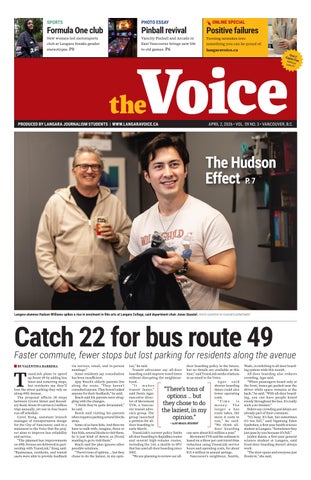
Langara alumnus Hudson Williams spikes a rise in enrolment in film arts at Langara College, said department chair Jonas Quastel. PHOTO COURTESY OF FILM ARTS DEPARTMENT
BY VALENTINA BARRERA
UNLOCK YOUR COMMUNICATION SKILLS & MASTER STORYTELLING
Masterful storytelling is the core of exceptional journalism. Gathering facts, cultivating a compelling narrative and harnessing the power of imagery are powerful skills that connect you with your audience.
Develop your storytelling skills with these journalism classes, now open to all general arts students:
JOUR 1122 Introduction to Media Research
JOUR 1128 Fundamentals of Reporting
JOUR 1288 Radio Storytelling and Podcasting
JOUR 1168 Photojournalism
JOUR 1290 Introduction to Digital Media Storytelling
JOUR 2398 Storytelling Through Video
JOUR 1224 Investigative Journalism
Students’ graduations delayed
With fewer courses available, some are finding their plans have stalled
BY LIAM ROBERT SCOTT
Langara College faculty and students say reduced course availability is making it harder for students in certain programs to secure required classes, delaying their graduation and ability to transfer to other universities.
Students inability to access required courses this summer comes in the wake of significant reductions to faculty and course offerings at the college, following the federal government’s 2024 decision to limit study permits for international students, causing reduced enrolment.
In the business management department, 22 course sections are scheduled for summer 2026, a sharp decrease from the 72 course sections that were offered in summer 2024, according to Nina Winham, vice-president of member engagement for the Langara Faculty Association.
“Massive, massive change,” she said.
For business students nearing graduation, the decrease in course section availability comes with consequences. Timothy Matiachuk, a business management student, said the cancellation of the summer offering of BUSM 4300, a required fourth-year business management course, has forced him to wait until September to take the class, delaying his graduation.
“My original plan was to finish this summer,” he said. “It pushed me back four months.”
Matiachuk said now more students will also have to compete for limited seats in September.
“I’m not very confident at all that I’m going to get in,” he said.
On March 18, Matiachuk, along with 22 other business students, sent a letter to the college’s faculty of management requesting the course be offered this summer.
Bernie Maroney, the only business instructor qualified to teach BUSM 4300, said he offered to teach it this summer. However, the college is still not running it.
David Wright, interim dean of the faculties of arts and management, responded to the students on March 31, saying the college is not offering the course in the summer due to low
22 per cent of students who were unable to get a course they wanted, 29 per cent said it was because the course was not offered.
enrollment. Wright said the college worked closely with students to find solutions, including granting overrides for students and allowing some students to take certain classes at the same time.
Matiachuk said the college’s decision to not run the course is “beyond frustrating” and “maddening.”
A recently released survey conducted by Langara for 2025–2026 found that 22 per cent of students were unable to get the courses they wanted.
Niall Christie , a history instructor at Langara, said his students have felt the impact of cuts to classes over the past year.
“The number of sections we can offer in history has been reduced from 48 to 28,” he said, creating a “crush” where students are forced to compete for a dwindling number of seats.
Christie said he has seen the strain this puts on students first-hand.
“If I was a student . . . I’d be constantly stressed about whether or not I’m going to get the courses I want ,” he said.
Matthew Chai, a first-year general studies student taking business courses, said some waitlists for required transfer courses, including a business-focused calculus course,
have reached up to 60 students. He said his inability to get into these classes will delay his planned transfer to UBC.
“The chance of me getting that course is probably going to be near zero,” Chai said. “I probably would not have gone to Langara if I’d known this was going to be an issue.”
In a written statement to the Voice, Wright said the college regularly reviews programs and course offerings to reflect enrolment and available resources, and aims to support students in completing their programs.
“This includes making adjustments
in response to changing enrollment patterns and fiscal realities,” Wright said in the statement.
Maroney said some business students have already dropped out after losing confidence they will be able to finish their programs.
“They don’t know when they’re going to graduate or if they’re going to be able to graduate,” he said. “They’re in limbo.”
Maroney said the uncertainty of being able to graduate within the expected timeframe is a serious problem.
“It’s going to destroy the school’s reputation,” he said.
International caps caused unexpected chaos
Permit reductions caused job cuts and uncertainty at post-secondaries
BY RIDWAAN ADAS
Langara faculty are concerned about a recent report from the federal Auditor General that government limits on international student permits led to a much steeper drop in enrolment than expected.
While initial federal government projections estimated an 18 per cent reduction in international student permits, the actual decline has been reported to be as high as 66 per cent. The Auditor General’s report was released March 23 and covered
the impact of permit reductions first announced in 2024. Langara instructors said the impact is being felt in different ways from both inside the classroom and behind the scenes.
An English instructor, who asked to remain anonymous as many instructors fear losing their jobs among ongoing layoffs, said the effects have been immediate and personal.
“I think it’s mainly led to increased job insecurity,” she said. “In my first couple of years here, we always had full sections… but right now, I don’t have any classes assigned for the summer yet. We’re kind of just waiting.”
Her experience reflects a broader concern across post-secondary institutions, where international students often make up a significant portion of enrolment.
Aurora Landin, chair of the fine arts department, said in an email to the Voice that while her program has historically had fewer interna-
She said fewer international students have meant fewer course sections, especially in classes that once relied heavily on that enrolment.
“Every semester, I’m waiting to see how things will go,” she said. “It’s created a lot of uncertainty.”
have lost jobs and courses.”
She added that increasing minimum enrolment requirements is also putting pressure on programs, such as cancelling classes that affect current students.
But for other faculty, the impact goes beyond numbers.
“I miss the higher population of international students.”
— GLORIA HAN, INSTRUCTOR IN THE FINE ARTS DEPARTMENT
tional students, the effects across campus have been significant.
“You can see the devastating effect on multiple programs across the college, with several cut completely,” she said. “Countless colleagues from other departments
Gloria Han, an instructor in the fine arts department, said the absence of international students is changing the learning environment itself.
“I miss the higher population of international students. It was something really unique to Langara,” she said.
In her classes, where critique and discussion are central, she said international students played a key role in shaping conversations.
“Some of the best critiques came from international students,” she said. “With encouragement, they often gave some of the most thoughtful feedback.”
She said their absence is not just noticeable, but it changes how students learn from each other.
“International students bring new worlds to share in the classroom and in the community,
“As their numbers dwindle, so too does the interaction,” Landin said. Han also pushed back on how international students are not fully appreciated by the institutions. “Institutions really undervalue what international students contribute beyond money,” she said. “Some of my best students and strongest critiques came from them.”
Landin added that the impact of the reduction of international students at Langara is also being felt emotionally across campus.
“The cuts have been brutal and morale has certainly been affected,” she said. “Faculty and staff are trying to navigate through the difficulties and keep providing the highest quality education with increasingly less resources.”
Langara College was contacted for comment but declined to respond.
According to a survey conducted by Langara for 2025-2026, of the
PHOT0 BY LIAM ROBERT SCOTT
Unplug & unwind
Young textile artists destress from doom scrolling
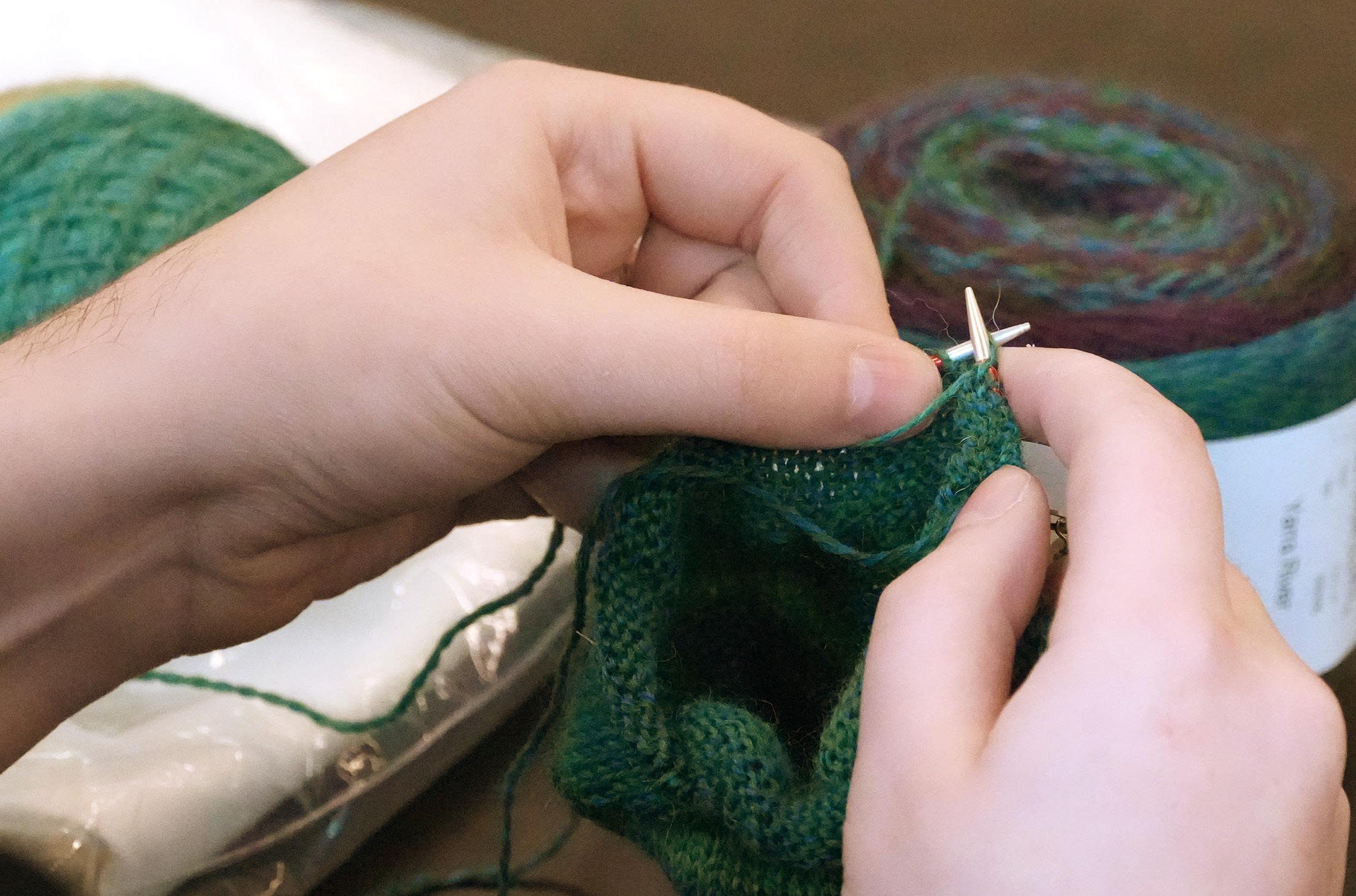
To escape the stress of the digital age, young people are pursuing old-fashioned hobbies such as knitting, sewing and crocheting.
Brooklyn Jones, UBC geological engineering student, discovered crocheting through her friend in 2020.
Knitting in class helps Jones, now an employee at Urban Yarns, a knitting supply store in West Point Grey, deal with stress. But it also has helped her academically.
“Which is kind of crazy,” said the 23-year-old Jones. “I get so entranced in the motion that I focus on what they’re saying. So, I’ve actually been doing much better in classes.”
She is one of the growing numbers of young people who adopt traditional hobbies like knitting, crocheting and sewing to escape the stress of the digi tal era. According to Statistics Canada in 2022, knitting and sewing sales increased 30 per cent.
Based on a Canadian study conducted in 2019 and 2023, 37 per cent of a cohort of teenagers exceeded the two-to-three-hour screen time guidelines.
give her.
She learned how tactile stimulation is good for a person’s long-term mental and physical health, “You can ward off Alzheimer’s … which runs in my family,” Jones said.
rienced in photography and textiles, said textiles are a good hobby.
“Social media has made people really feel like something has to be happening all the time.”
Lyn Scatchard, 22, the president of the UBC Knit and Sew club, said the importance
PENNY STEWART, FIBRE ARTS STUDIO
As someone who needs constant stimulation to avoid becoming “stir crazy,” Jones usually has eight crocheted projects going on at a time. She says it replicates the same stimulation that 15 second TikTok video would
have my knitting project, whatever I’m working on in my bag, that I can pull out and start working on it,” Scatchard said.
Holly Hames, a knitting and sewing instructor at Langara who is also expe-
Hames said her students are happy to get offline because they’re saturated with social media. Looking at screens constantly altered the way a person’s eyes operate over time and narrowed thinking processes; tactile work does the opposite, said Hames.
“We have more younger students now, but it fluctuates…I get a lot of people who took [textiles] in high school, they didn’t take it seriously and now they’re like, ‘I wish I could remember more,’” Hames said.
Penny Stewart, who has been weaving for over 40 years, believes in keeping traditional arts alive as an alternative to screen time and loves to see people who are eager to learn.
“Social media has made people really feel like something has to be happening all the time,” said Stewart, a volunteer at Fibre Art Studio in Granville Island.
“Even the young people themselves know that it would be a good idea,” said Stewart. “Most people recognize that it’s a societal addiction.”
Photos and stories by Avery St. Germain
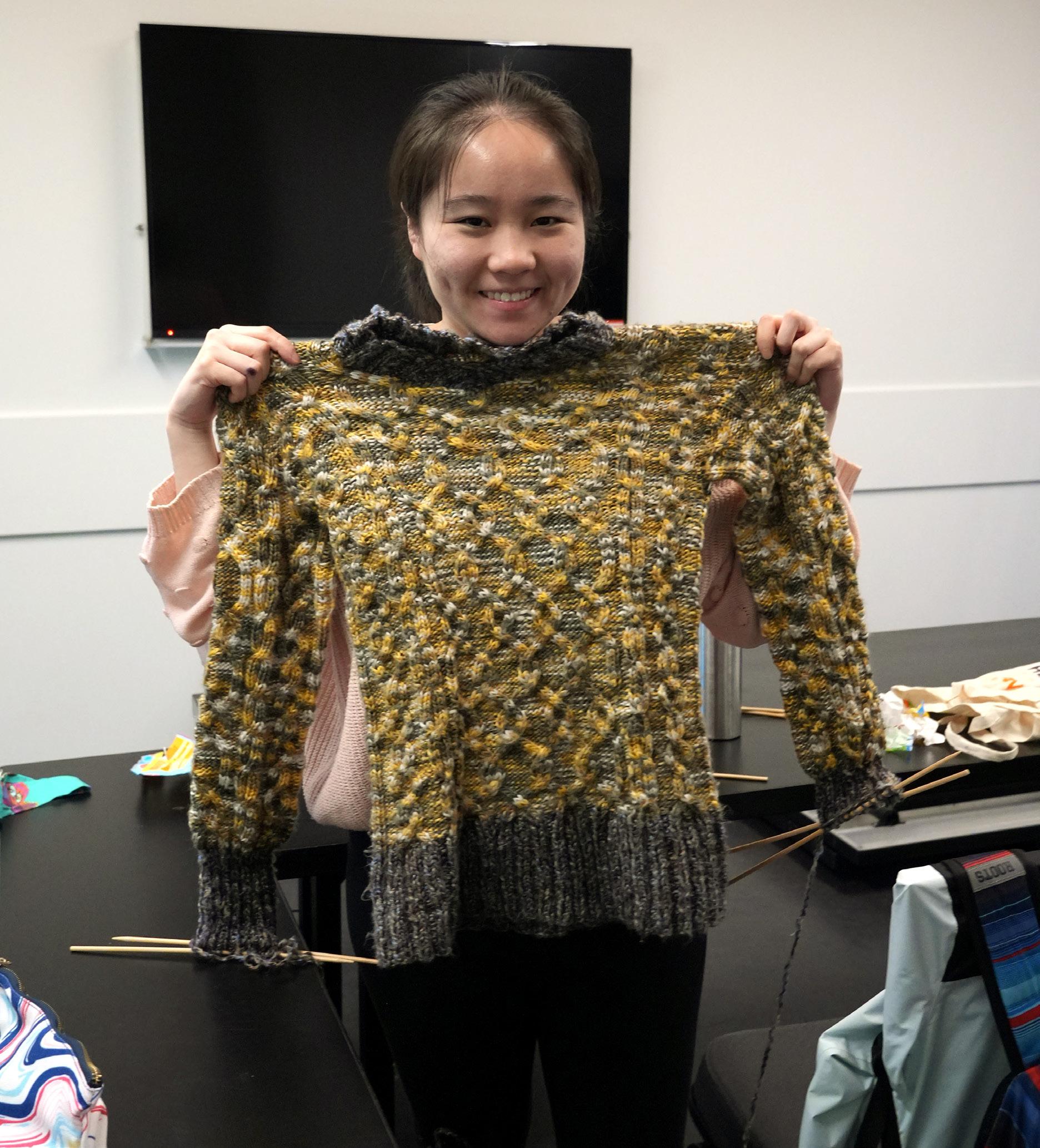
Jessica Sun holds up her expertly crafted sweater at UBC Knit and Sew club meeting
Spinning yarn into cash
Students turn their hobby into a business through UBC’s Makers Market
As textile artists get more expe rience, some take their passion to the next step and sell their work.
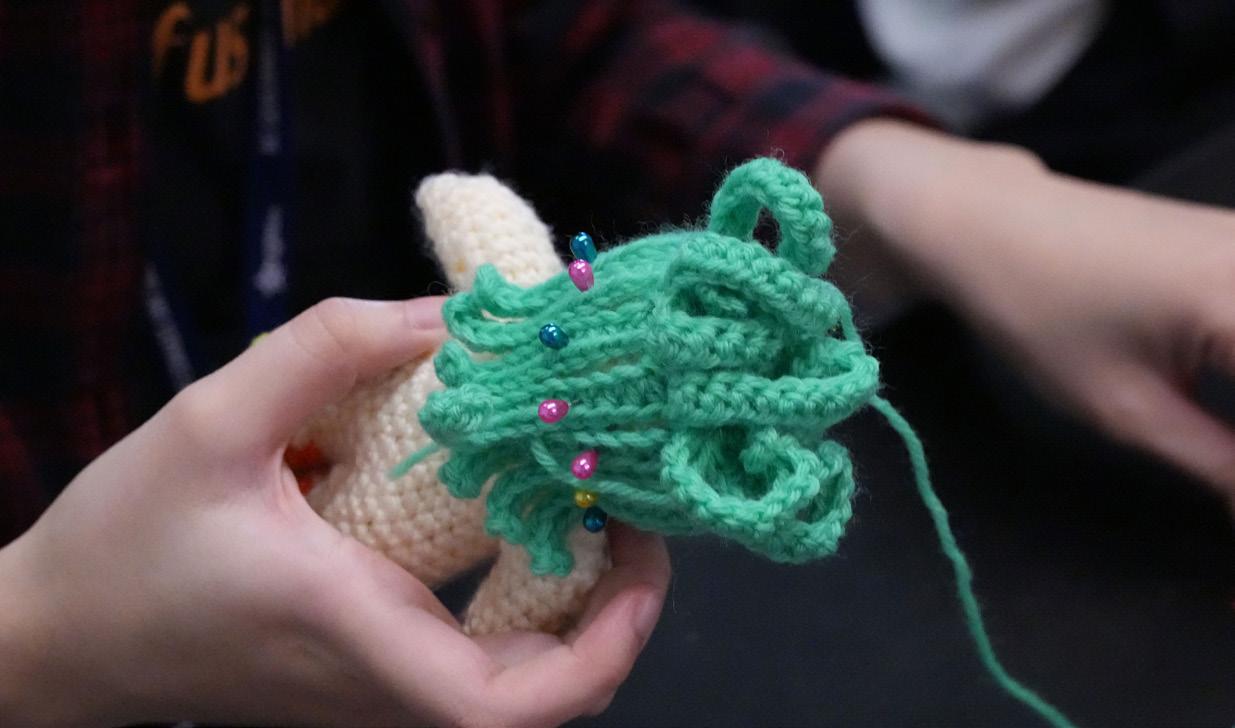
The UBC Makers Market is a fiveday fair held biannually where UBC artists get a chance to show off and sell their crafts. Crafts on display include crocheted plushies and keychains.
Lucy Lu, a neuroscience alumna of UBC, began crocheting three years ago to avoid procrastination while studying for exams.
Lu started her business called Scare Dee Cats when her crocheted passion projects filled up her house and her
She said in recent years crocheting has become trendy, something that her sister, whose been passionate about crocheting since she was nine,
Ggümm Studio has gone to multiple markets and sells prod-
ucts through the market at UBC.
Nieh’s family is hustling and it’s difficult for them to not always dedicate their life to crocheting.
Despite constant work, Nieh adds that it is very rewarding.
“If you’re talented in crocheting and you know how it works, then you can make anything,” said Nieh.
ABOVE: Choose some funky yarn with Ava Vervas at UBC Knit and Sew.
LEFT: From 5 p.m. to 6 p.m. on Mondays, UBC Knit and Sew holds a meeting for crocheters to hang out.
TOP-RIGHT: Focused crocheters at the UBC Knit and Sew annual general meeting.
BOTTOM RIGHT: Christina Nieh, graduate of UBC, is here representing her family business, Ggümm Studio, that her sister started in 2022 at the UBC Makers Market.
Pinball lights up again
Age is no barrier as pinball finds its legs at Vancity Pinball & Arcade
BY RHEA SINGH
The story of Vancity Pinball & Arcade is more than just a collection of gaming machines; it’s a story about passion. What started as a personal hobby slowly turned into something much bigger.
For Angelo Muro, who recently opened the arcade this March, pinball wasn’t just a phase. He started collecting pinball machines 22 years ago. When he was young, his best friend’s mother brought home a pinball
machine.
After he began repairing the machine, he realized there are many components inside the machine that go beyond what is on the surface.
This sparked his passion for pinball machines and resulted in him opening an arcade.
Since this March, Vancity Pinball and Arcade have opened its doors to the public. The turning point came during the pandemic when many of the individual locations housing his machines were shut down.
When Muro was faced with the
choice of selling everything or taking a leap, he chose to try something new. What surprised both Muro, and his wife Alicia, was the response. The space quickly became more than a niche attraction. People of all ages walked through the doors, from young kids discovering pinball for the first time, to older visitors laughing and giggling, reconnecting with their memories from decades ago.
Muro said there is a “huge” difference between playing a game on a pinball machine and playing a video game at home.
Recently, the arcade held a tournament that was attended by participants and casual enthusiasts alike. PHOTO BY RHEA SINGH
The arena also carries a number of other themes on the pinball machines. Pictured above, some games include Pokemon, Pirates of the Caribbean, Willy Wonka, etc. PHOTO BY RHEA SINGH
An avengers-themed pinball game on offer at the arena. PHOTO BY RHEA SINGH
A participant at the pinball tournament recently held at the arcade, plays a 1994 Roadshow pinball game at Vancity Pinball and Arcade, in Vancouver, B.C., on March 22, 2026. PHOTO BY RHEA SINGH
The complex inner mechanism of a pinball machine, visible through the transparent glass outer. PHOTO BY RHEA SINGH
When words fail, youth heals through art
Art therapy is reshaping mental health support among young people
BY LIAM CLARKE
As mental health challenges increase among young Canadians, art therapy has become an alternative to traditional talk-based approaches.
Sheida Shamloo, an art therapist working in Montreal, said many of her clients are younger people who are “fed up with conventional talk therapy.”
Shamloo said words can sometimes fall short when describing emotions like sadness and depression.
Instead, she encourages clients to use art to explore their feelings and assists them in creating images about their lives and thoughts.
Canadians aged 12 to 25 are experiencing higher rates of mental health challenges, according to the
Public Health Agency of Canada. Art therapists say alternative approaches to therapy are becoming more relevant.
Art therapists are credentialed mental health professionals with training in both creative practice and psychotherapy. In Canada, they are credentialled through provincial regulatory colleges or professional associations that require a master’s degree in psychology or counselling.
Jillian Bagan, a Vancouver-based art therapist who specializes in supporting LGBTQ+ individuals aged 10 to 30, says if someone wants to make a change in their life, “just making an image can start them off in the right direction.”
Bagan said the key difference between someone using art as therapy and art therapy is working with a trained therapist.
“Lots of people can access art as a form of their own therapy. As an art therapist, I use [art] as an entry point for a reflective discussion,” Bagan said. “It’s really helpful for those who have a difficult time putting things into words.”
At Langara College, counsellors are also incorporating art-based practices to support students.
Michael Cheng, assistant department chair and counsellor at Langara counselling services, said in an email to the Voice that staff use creative methods alongside a wide range of therapeutic techniques.
Cheng said that these approaches can include artistic journalling, illustrating emotional experiences and using diagrams or artistic symbolism to help students better understand anxiety, depression and stress.
“Many forms of therapy can
Spotlight on film arts
Students and admin capitalizing on Williams popularity
BY EHXEA ANTOINE
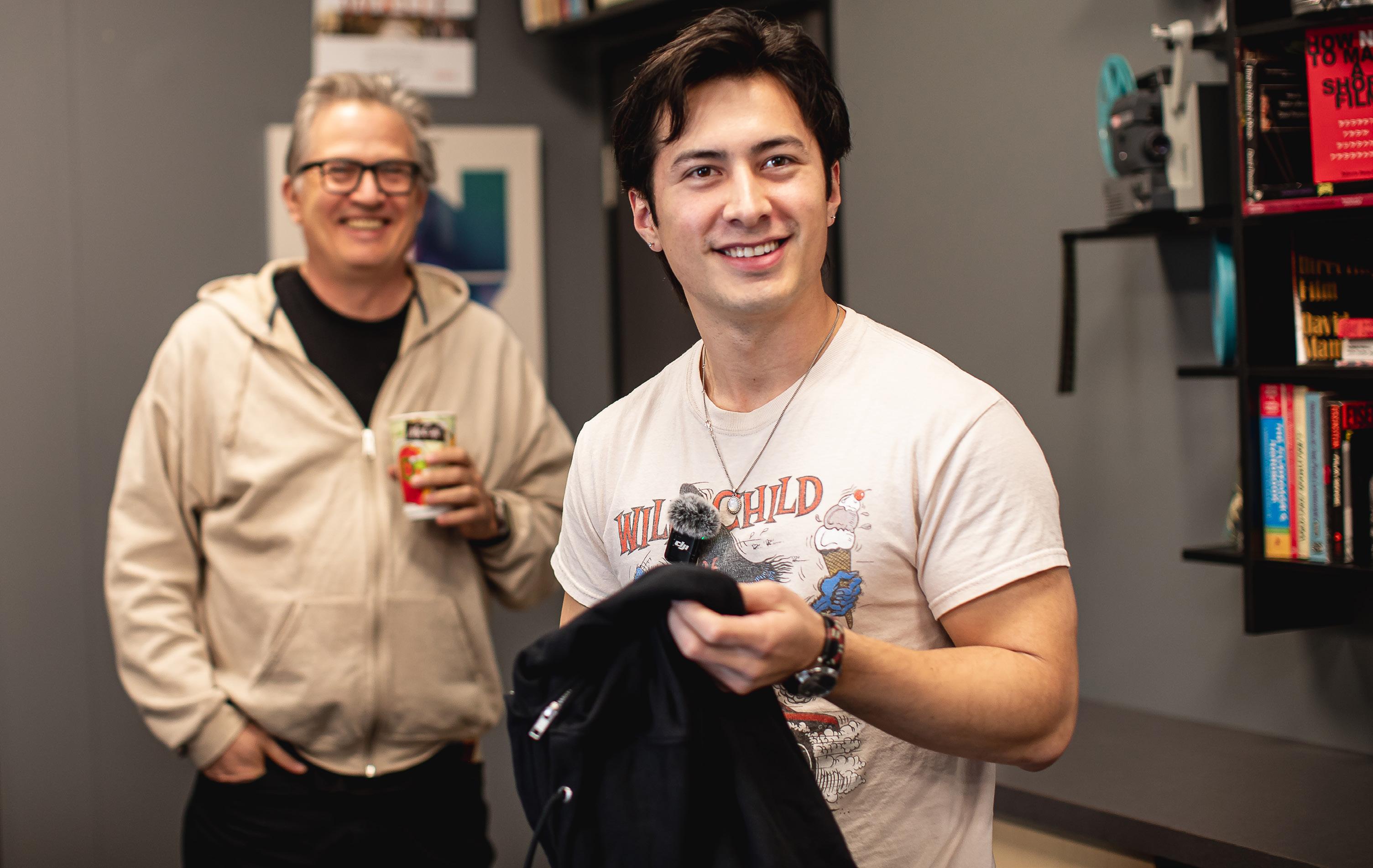
As enrollment declines across Langara College, the film arts production program is experiencing a surge in applications due to alumni Hudson Williams’ meteoric rise to stardom, according to the department head.
Students say with more eyes on the fim arts program is already boosting their audition prospects.
Program coordinator Jonas Quastel attributes the sharp increase to Williams’ popularity after starring in the hit Crave series “Heated Rivalry,” about two hockey players who fall in love.
Williams, who graduated in 2020, co-stars with Conner Storri in “Heated Rivalry,” which is adapted
from the Rachel Reid 2019 novel of the same name.
Quastel said the rise in applications started in February when Williams “blew up.” He expects the number of applications to double by the next application deadline in August.
The spike in enrolment is in stark contrast to what many other programs have experienced since the federal government implemented a cap on international students in 2024.
“We should have some really great actors next year,” he said.
The eight-month film arts program is split into three streams; writing, directing and acting and Quastel said the acting stream is triple the number of the others.
Acting students say they are getting new opportunities since Williams put a spotlight on the program.
Evan Hsu, an actor in the program, said he has gotten more auditions since January, after the show was released.
“I was like booming with auditions,” Hsu said.
Liam Nguyen, another acting student, said Williams has done a lot for the visibility of this program.
“I feel like it will probably be to our advantage in this right now,” he said.
Quastel, who taught Hudson in the film arts program, said he always expected him to succeed but was surprised at the extent of his fame.
“I heard he got the role and I congratulated him and I thought it was a little Canadian show,” Quastel said. “Little did I know what would happen.
“This just doesn’t happen.”
With the rise in popularity of the program, students are excited at the prospect of having a wider pool of students joining the program to collaborate with.
Jordan Nelson, a film student in the acting stream, said students want to ensure they are producing the highest-quality work with more attention on the program.
“I have a feeling that we are going to have more eyes than we’ve ever had before,” Nelson said.
But Christian Asimakos, also in the acting program, said he hopes students are applying for the right reasons.
“I hope they are applying because they actually want to,” he said. “Not just because this guy got successful.”
work to support an individual,” Cheng said. “When a student feels supported, understood, and that they have been given tools to improve their situation, no matter what therapy is used, it can be effective.”
During his time at the department, Cheng said that he has seen an increase in students’ interest in getting support for mental health challenges.
Langara previously offered an art therapy program, but it was discontinued in 2022.
Connie Chong, dean of continuing studies at Langara, said the decision to end the program was due to
changing learner demand, industry needs and institutional priorities.
“The expressive art therapy program ran successfully for a number of years before being concluded. We’re proud of the role it played in supporting learners and the community,” Chong said.
Despite the end of the art therapy program, Langara fine-arts teacher Natalie Purschwitz is still encouraging students to use art to better understand themselves.
Purschwitz agrees that creating art on its own is not the same as art therapy but said it can still be a powerful tool for self-reflection.
“Students in our program are often using artwork as a way of searching for something that’s missing in their lives. And I think that it can really help students … find their way through difficult times,” said Purschwitz.
Acrylic masks at Reach into Self-Expression showcases, an exhibit by Jillian Bagan, exploring artists own definitions and lived experiences. SUBMITTED PHOTO BY LIAM CLARKE
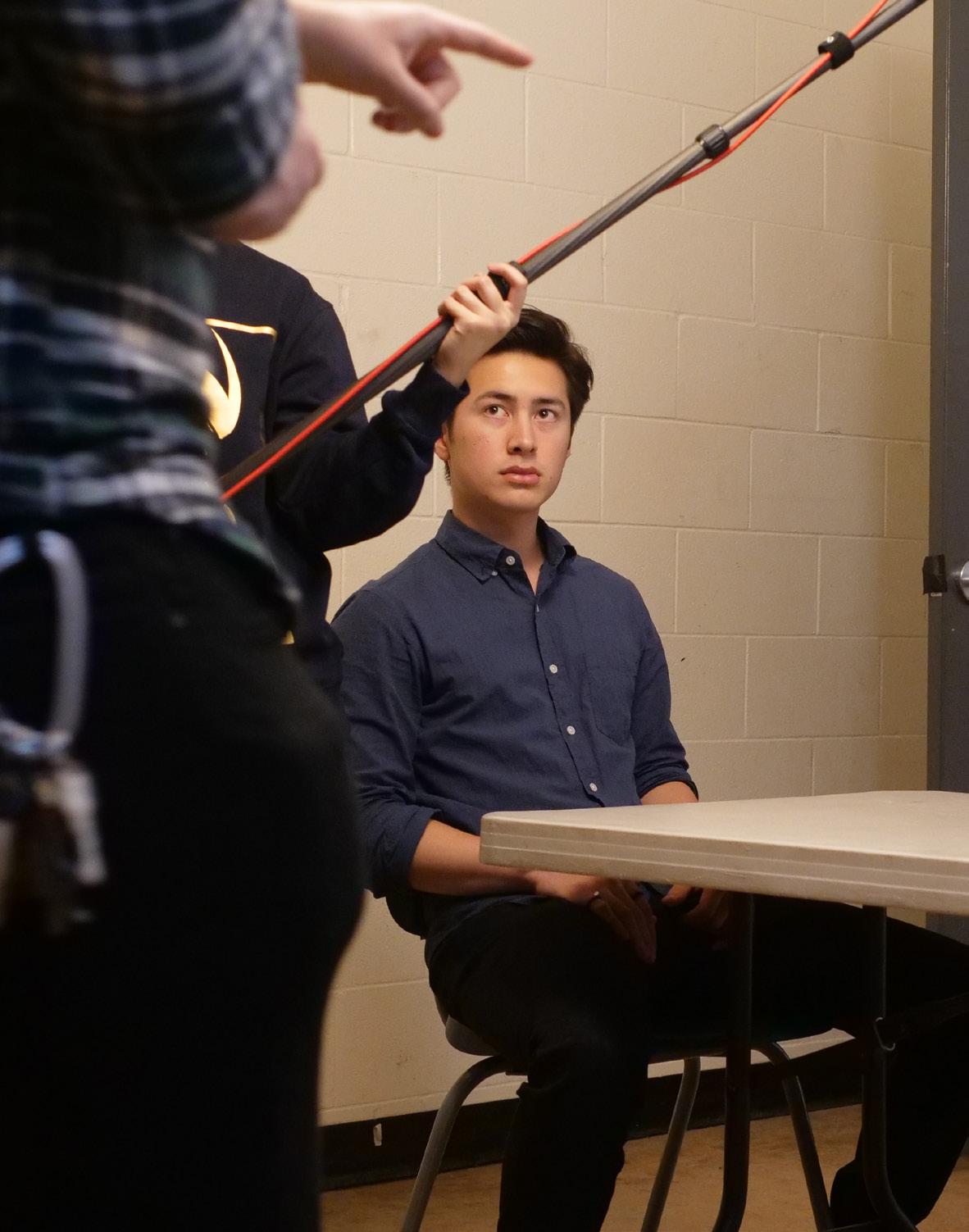
Hudson Williams on set at Langara when he was a student. PHOTO COURTESY OF LANGARA FILM ARTS DEPARTMENT
JILLIAN BAGAN ART THERAPIST
Female student creates F1 club
The new group hopes to bring together an under-appreciated fanbase
BY ZOE LI
Langara’s Formula Alliance Club wants to help women overcome gender stereotypes in the automotive and racing industry, inviting them to participate in everything from race watch parties to go-karting and simulation racing.
The club seeks to encourage a sense of belonging, participation and ultimately inspire a large number of females to consider themselves part of racing culture through its blend of social and interactive activities.
Areeba Saqib, a first-year commerce student, founded the club in February. So far, it has approximately 20 members. She said the club is open to all motorsport lovers, regardless of their prior knowledge or experience. Saqib’s primary goal is to create an inclusive space for women, where members can watch races together, attend workshops and events, ask questions and learn without being talked down to.
“I find it really important for girls to have an empowering area for them to be able to bond over this hobby without being discriminated,” said Saqib, who noted that women in the automotive industry remains underrepresented.
Saqib said both UBC and SFU have Formula student teams that build their own cars and compete in international races. The Langara club is working with these two teams to organize workshops and provide members with more experience and fundamental knowledge about
motorsports and engineering.
The club is also inviting women working in the automotive industry to give lectures and share their professional insights.
Francine Parizotto Sartori, a firstyear associate of arts student, joined the club because she likes breaking down the construction of race cars and how drivers make adjustment during a race.
She said it’s frustrating that people assume women only watch automotive races because they’re attracted to the male drivers.
“It’ll be super interesting to have women that share the same interests,” Sartori said.
Manisha Singh, coordinator of women’s studies program at Langara, said women often face a lack of trust in their technical expertise in male-dominated fields.
She said providing women-specific spaces offers a supportive and safe environment necessary for skill development.
“A sport can grow with a contribution of diverse talent,” Singh said. “You just don’t know what it can become until you have representation through diversity of membership.”
Karen Clouston, a race car driver and member of Women in Motorsport for the Confederation of Autosport Car Clubs, said becoming a racing driver in B.C. is a big undertaking, requiring classroom learning and three races being graded before getting a racing license.
Clouston said the biggest challenge women face in racing is that
Funding denied for at-risk park
Invasive species could choke out Champlain Heights again: non-profit
BY AJ WATT
Native-plant advocates say that Vancouver city council needs to create a new form of grant for environmental non-profit organizations who keep invasive-plant species from spreading in community greenspaces.
Currently, grants like the BC Arts Council Grants or the Theatre Rental Grant Program are meant for arts organization, not for environmental stewardship groups like Free the Fern.
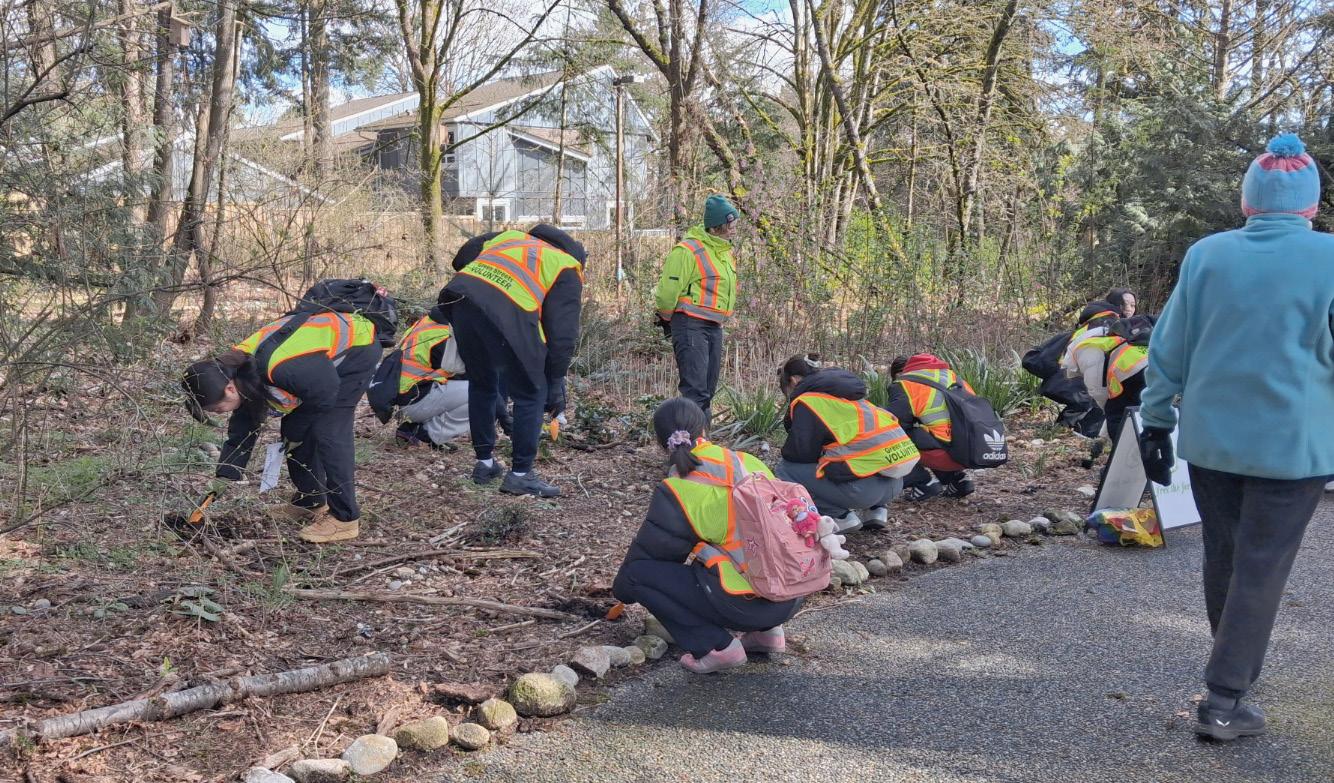
In 2021, a group of volunteers banded together to form Free the Fern, to clear invasive species of plants that were choking out trees in the Champlain Heights trail system, one of the last native forests in Vancouver. Removing invasive species like English ivy from the 45-hectare trail system located in the Killarney area, their work made the city redesignate the area from a “hazard status” to an “ecological corridor.”
they often don’t know where to get this information or who to consult. The club might help in this aspect.
“When I first started 35 years ago, women were far and few between working in corners or driving a race car,” Clouston said.
Linda Sakaluk, director of Women in Motorsport for the Western Canadian Motorsports Association, said
On March 4, the city declined Free the Fern’s initial ask for $30,000 of core operational funding to coordinate volunteers maintaining the park, founder Grace Nombrado said, because there were other applications that rank higher on the list of city priorities. Nombrado said the non-profit needs the funds to cover one part-time staff member, to run all of their events, and to buy tools, gloves and plants.
“That was our ask from the city,” she said.
She said the community climate action grant that Free the Fern applied for is only for climate change initiatives, and according to the city that meant their stewardship work wasn’t “directly related to climate change.”
Nombrado said that Free the Fern has just enough funds to make it to the end of planting season, which is in October.
Without city funding, the Champlain Heights could revert back to hazard status. Nombrado said, adding that she will continue to advocate for the area but is limited in what she can do as a citizen.
On March 10, Vancouver city councillor, Pete Fry made an amended request for core funding for the nonprofit to try and make sure stewardship work could continue but that was also declined by the city.
“Those grants are a sort of finite
female participation in motorsports is often hindered by their lower disposable incomes, family commitments and a lack of early mechanical exposure.
“Most women don’t grow up knowing a lot about a car,” she said. The lack of knowledge creates a steep learning curve for women when it comes to rebuilding a carburetor or
changing the engine when they first enter motorsports.
Her advice for young women interested in motorsports is to volunteer for a local motorsports team to learn and build a network at no cost.
Saqib said there are no entry criteria for the club.
“You can just join it to see if you’re interested.”
pool of money,” Fry said. “There’s no easy answer, unfortunately.”
The Voice reached out to the city community climate action department for comment but did not receive a response by publication deadline.
“We wouldn’t even need a Free the Fern if the city was to steward the area,” said Nombrado.
She said that because the city has never funded their efforts that they’ve had to apply for grants outside of Vancouver.
“If it’s city land, it should be funded by the city,” she said. “The irony is the biggest thing. They have donated things like gloves and topsoil but have not funded us.”
Fry said that he has had discussions
with a few different non-profit groups to come up with a new form of grants for stewardship in the city.
“We used to have dedicated granting streams focused on green city initiatives and that is something I’m interested in exploring,” he said.
Champlain Heights is a “bit of an anomaly” with over 50 per cent tree canopy cover, according to Allison Luke, a master of urban forest leadership from UBC, and a red seal landscape horticulturist, which is a professional who surveys and assesses landscapes.
“There’s only four per cent of Vancouver’s native forest remaining,” said Luke, who authored the article titled, Growing Together: How the
Champlain Heights Trail System Benefits the Local Community and Environment in Vancouver
According to a tree inventory and species analysis Luke conducted, there are 590 trees on the Champlain Heights trail system, and 45 native and ornamental species.
Nombrado said that they’ll keep advocating and protect what’s left of the trail system.
Champlain Heights resident Kim Halladay said she has been walking the trails there for the past 30 years and really appreciates the clean-up efforts from her neighbours.
“It’s really nice because everything’s cleaned up now were as it used to be a little bit overgrown,” said Halladay.
A group of volunteers helps remove invasive species from the Champlain Heights trail with the help of Free the Fern in Vancouver, B.C. on March 26, 2026. PHOTO BY AJ WATT
An attendee takes photo of a race car at the 2026 Vancouver Auto show in Vancouver, BC on March 26, 2026. PHOTO BY ZOE LI