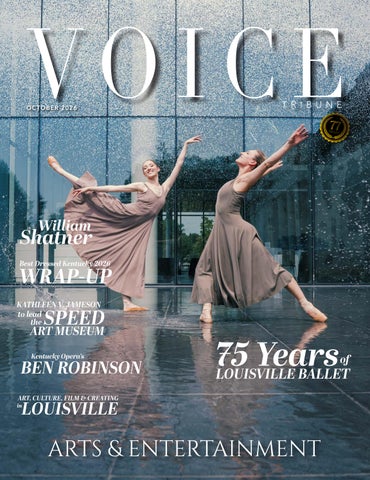
OCTOBER 2026
William
Shatner Best Dressed Kentucky 2026
WRAP-UP KATHLEEN V. JAMESON to lead the
SPEED
ART MUSEUM Kentucky Opera’s
BEN ROBINSON
75 Years LOUISVILLE BALLET
ART, CULTURE, FILM & CREATING
LOUISVILLE
in
ARTS & ENTERTAINMENT
of
FEEL THE JOY WHEN JOINT PAIN DOESN’T CALL THE SHOTS. THE LESS TIME YOU SPEND LIVING WITH JOINT PAIN, THE MORE TIME YOU CAN SPEND REALLY LIVING. So don’t put off getting the care chosen by more people in Kentucky and southern Indiana. Our full spectrum care approach ensures that you have access to a variety of services, from joint replacement and sports medicine to advanced surgical options and physical therapy. If you suffer from a sports injury, joint pain, or any other condition, don’t wait for it to get worse. Get the care you need now for more moments later. Learn more at BaptistHealth.com/Ortho.
Let’s Celebrate Made-To-Measure Month at Rodes!
4938 Brownsboro Rd. | rodes.com 502.753.7633 | @rodeslouisville
Dear Louisville Voices & Readers, When words fail, and the world becomes unbearable, art gives the soul a place to rest and the mind a reason to endure. Art has always been, and will always be, a place for me to retreat to, and I believe so many others feel the same way. Art is not merely an expression of life; sometimes, it is the very thing that allows us to survive it. To witness the Louisville Ballet is to experience generations of beauty, movement, endurance, perseverance, and strength passed from one artist to the next. From ballet’s earliest performances in France over 445 years ago (Le Ballet Comique de la Reine, first performed in 1581) to the modern stage, its legacy continues to inspire. I could not be more honored to celebrate the Louisville Ballet’s 75th anniversary and the extraordinary artistry that brings centuries of tradition to life. As the Speed Art Museum approaches its 100th anniversary, I could not be more excited to bring these two extraordinary institutions together to bring our front cover to life and showcase what art brings to our everyday lives. Thank you to our artists, Anna Ford and Elizabeth Pemberton, for being so open-minded when I mentioned that we were probably going to leave the Speed Art Museum completely soaking wet, and for trusting the creative process! You all are the best! I also want to thank the Louisville Ballet’s new Executive Director, Felicia Swoope, and the Speed Art Museum’s new Director, Kathleen Jameson, for allowing my team to come in and demonstrate that collaboration is not only key but essential to Louisville’s creative process. I deeply look forward to getting to know you both better and cannot wait to see what future collaborations are in store for your organizations. I believe it is more important now than ever for the arts to come together, inspire one another, and reach new heights. You both also have incredible teams that help make magic like this happen every day, so thank you to all as well. Now for this month’s volume…. Please explore… and learn more about our artistic community.
To the Many Voices of Louisville, you have one.
Amelia Frazier Theobald Publisher & CEO, The VOICE-TRIBUNE
PRESIDENT/CEO, AMELIA FRAZIER THEOBALD OPERATIONS MANAGER, MARY ZOELLER CHIEF DIRECTOR OF EDITORIAL & EDITOR, ALISHA PROFFITT CHIEF REVENUE OFFICER & DIRECTOR OF SALES, JULIE KOENIG CHIEF GRAPHIC DESIGNER, JOSH ISON COPY EDITOR, RENAE ISON SOCIAL MEDIA MANAGER & EXECUTIVE ASSISTANT, BRYLEA PEACH ACCOUNT EXECUTIVE & FASHION DIRECTOR , CLEO HEINE CHIEF EVENT PHOTOGRAPHER & DIRECTOR, EDITORIAL PHOTOGRAPHER & VIDEOGRAPHER, GRAPHIC DESIGNER, KATHRYN HARRINGTON FASHION & EDITORIAL PHOTOGRAPHER, MATT JOHNSON FASHION & EDITORIAL PHOTOGRAPHER & VIDEOGRAPHER, ANTONIO PANTOJA DISTRIBUTION, KELLI & RAGAN VAN HECKE, JILL & JOHN MINNIX, TANNER BATEMAN CONTRIBUTING WRITERS: ALISON CARDOZA, ALISHA PROFFITT, ANTONIO PANTOJA, BAPTIST HEALTH, JACKIE ZYKAN, KEITH L. RUNYON, KELSEY KNOTT, KEVIN MURPHY WILSON, KRISTINA GOETZ, LAUREN TAYLOR CARR, MARY ZOELLER, RUSS BROWN CONTRIBUTING PHOTOGRAPHERS: GIOIA PATTON, JACKIE ZYKAN, PATRICK & WHITNEY ANDERSON OF PROMETHEAN PHOTOGRAPHY STUDIOS, SPEED ART MUSEUM, UOFL ATHLETICS
VOICE-TRIBUNE OCT 2026
5
FEATURES
34
10 Louisville Ballet at 75: Celebrating History and What Comes Next By VOICE-TRIBUNE Photos By Matt Johnson
20
Just One Look: Graham Nash at 84
44
Ben Robinson Reflects Louisville as Family with Kentucky Opera
By Lauren Taylor Carr & Kevin Murphy Wilson Photos By Amy Grantham & Misti Layne
Meet Samantha Jean Moore, the multi-dimensional artist and award-winning designer behind the local sustainable fashion brand MOCOCO
36
By Alisha Proffitt Photos By Patrick & Whitney Anderson of Promethean Photography Studios
By Kelsey Knott Photos By Matt Johnson
14 Kathleen V. Jameson Returns to Louisville to Lead the Speed By VOICE-TRIBUNE Photos Provided
16 Baptist Health By Baptist Health
22 Kentucky, Take One
Monarch Artist Feature: Blakeley Burger
By Lauren Taylor Carr Photos by Matt Johnson
Kelsey Knott Photos By Matt Johnson
26
40
The Seer and the Sword
Frances Brunner’s “Boyhood” Reconsiders the Codes of Masculinity
By Antonio Pantoja
32 William Shatner: The Wrath of Time By Lauren Taylor Carr & Kevin Murphy Wilson PHOTOS PROVIDED 6
OCT 2026 VOICE-TRIBUNE
By VOICE-TRIBUNE Photos By Matt Johnson
50 Best Dressed Kentucky 2026 Wrap-Up
64 Jackie Zykan Maître Liquoriste + Perfumer + Herbalist
On the Cover: Louisville Ballet Artists Photographed By Antonio Pantoja at Speed Art Museum
66 Fresh Fall Decorating Ideas for Your Kitchen
76
By VOICE-TRIBUNE
Coast to Coast and beyond: Gayle Godfrey ran marathons in all 50 states, plus more
70
By RUSS BROWN Photos Provided
Use What You Grow: Fall Decorating With Garden Flowers, Branches, and Foliage By VOICE-TRIBUNE
72 Jane Brown: Finding Peace After Cancer By Kristina Goetz Photos Provided
74
78 “Scrappy Cards” On Path To Title? By RUSS BROWN Photos By UofL Athletics
80
82 Mary Zoeller’s Spooky Halloween Story
84 LOUISVILLE CALENDAR
85
SOCIETY
103
THANK YOU TO SPONSORS
In Memory of Wendall Berry By Keith L. Runyon Photos Provided
Just Keep Walking By Alison Cardoza Photos By Matt Johnson
26 > VOICE-TRIBUNE OCT 2026
7
You shop local. You eat local. You play local. Your real estate should be local, too.
TOP 10 BROKERAGES IN LOUISVILLE. STILL LOCAL. www.whitepicketky.com
BITTNERS
personalized residential design l modern interiors studio custom handcrafted furniture
CELEBRATING HISTORY AND WHAT COMES NEXT By VOICE-TRIBUNE • Photos By Antonio Pantoja & Kathryn Harrington
Seventy-five years gives a ballet company a long list of names to remember. Louisville Ballet’s anniversary season uses that history as a point of departure, bringing together the people, performances, and artistic experiments that have defined the company while introducing a season centered on new work and reimagined repertory. The company was founded in 1952 and is the fifth-oldest ballet company in the country. Over its seven and a half decades, the company has featured works and collaborations by some of the most recognizable figures in American dance, including Mikhail Baryshnikov, Twyla Tharp, and Wendy Whelan. The 75th Anniversary Committee is central to the celebration. Rather than functioning solely as a ceremonial group, its members have been assembled with the company’s longer-term financial and civic future in mind. Felicia Swoope, Louisville Ballet’s Executive Director, said, “The committee is dedicated to elevating the ballet’s profile while demonstrating their own personal support for the organization’s financial future.” That connection between history and infrastructure is particularly relevant for a company whose past includes both major artistic achievements and periods of instability. Alun Jones, who served as artistic director from 1978 through 2002, remains the longest-serving artistic director in Louisville Ballet’s history. His tenure included appearances by Baryshnikov during the 1978–79 and 1979–80 seasons. Baryshnikov’s 1979 performance of Petrouchka at Louisville Memorial Auditorium remains one of the company’s significant historical events. Baryshnikov returns to Louisville this season, but in a different role. On February 12, 2027, he will appear for an evening of conversation as part of the anniversary celebration. The event coincides with the premiere of Resident Choreographer Andrea Schermoly’s Carmen. Another anniversary event, “Stories of Legends,” will bring together Baryshnikov, Whelan, and Clinton Luckett to discuss their connections to Louisville Ballet. 10 OCT 2026 VOICE-TRIBUNE
The season begins this month with Frankenstein, October 30–31 at the Brown Theatre. The new ballet, Frankenstein, is being choreographed by Louisville Ballet’s Artistic Director, Anthony Krutzkamp, his first work for the company since joining in 2025. Classical repertory remains in the picture. The Brown-Forman Nutcracker returns to the Kentucky Center December 11–21, followed by Carmen in February. In March, Bourbon & Ballet, formerly Choreographer’s Showcase, brings together the work of Louisville Ballet’s choreographers at Actors Theatre, while May’s Momentum will feature works by Alejandro Cerrudo, Adam Hougland, and the recipient of Louisville Ballet’s inaugural Commonwealth Choreography Award. The award provides $100,000 in support for Momentum, with $25,000 specifically allocated to the award-winning choreographer for the creation of the new work. Meanwhile, “Behind the Curtain: 75 Years of Louisville Ballet”, on view at The Filson Historical Society through August 2027, showcases costumes, set models, photographs, and other archival material alongside the stories of the artists who made the company’s productions possible. The anniversary, then, is unfolding in two directions. The exhibit looks back at the dancers, artists, and community members who established Louisville Ballet’s place in the city. The 75th Anniversary Committee is helping carry that history into a season that puts new choreography, collaborations, and audiences into the conversation. At 75, the company honors its legacy not by repeating the past, but by using it to build what comes next. To learn more and support, visit: louisvilleballet.org
VIEW FULL SCHEDULE ONLINE VOICE-TRIBUNE OCT 2026
11
JOIN OUR
FITNESS COMMUNITY
MORE THAN A GYM—
Milestone is a place to move, connect, and feel your best.
Diverse Diverse Equipment Equipment Fitness Fitness Professionals Professionals 100+ 100+ Group Group Classes Classes Aquatic Aquatic Programming Programming
baptistmilestone.com
|
502.896.3900
|
750 Cypress Station Dr.
142 Wildflower Ave Offered for $385,000 S H A N N O N E D WA R D S | 5 0 2 . 9 3 8 . 1 2 4 1
3029 Beals Branch Dr Offered for $825,000 J A C K I E S T R A N G E | 5 0 2 . 74 1 . 7 1 74
222 E Witherspoon #806 Offered for $425,000 ANN JAMES | 502.296.8849
Scan to view this month’s collection of featured properties
7734 Woodbridge Hill Ln Offered for $2,165,000 L I B B Y LO E S E R | 5 0 2 . 3 1 4 . 5 0 9 9
12901 Westport Rd Offered for $650,000 B E T H N O RT H U P | 5 0 2 . 8 1 9 . 2 3 8 4
4029 St. Ives Ct Offered for $649,000 J U DY WAT S O N | 5 0 2 . 2 4 0 . 9 3 3 4
14 OCT 2026 VOICE-TRIBUNE
KATHLEEN V. JAMESON RETURNS TO LOUISVILLE TO LEAD THE SPEED By VOICE-TRIBUNE • Photos Provided Kathleen V. Jameson, Ph.D., has returned to Louisville to lead the Speed Art Museum as its new director, guiding Kentucky’s oldest and largest art museum as it approaches its centennial in 2027. Jameson began her new position on September 8, bringing more than three decades of experience in museum leadership, curatorial work, fundraising, strategic planning, and community engagement. Her appointment also brings her back to an institution that played an early role in her development as a museum professional. While earning her master’s degree in American Art and Architecture at the University of Louisville, Jameson worked with Peter Morrin, who was then director of the Speed. She has described that experience as formative to her career. “Returning to Louisville and to the Speed is deeply meaningful to me,” Jameson said. “My time here as a graduate student helped shape both my scholarship and my career in museums, and I have always valued the Speed’s commitment to artistic excellence and connection.” Since her time in Louisville, Jameson has held senior positions at several major American art museums. Most recently, she served as executive director of the James A. Michener Art Museum in Doylestown, Pennsylvania, where she led work involving collections development, exhibitions, community engagement, and the museum’s infrastructure. Previously, Jameson was president and CEO of The Mint Museum in Charlotte. Her responsibilities there included collections development, exhibitions, scholarship, fundraising, strategic planning, organizational restructuring, and governance. During her tenure, she established the museum’s inaugural digital media program, a contemporary architecture and design series, and a major Latino and Latin American initiative. Jameson also spent several years at the Museum of Fine Arts, Houston, where she held curatorial and administrative positions including assistant director and director of program support. Her work included long-range institutional planning and oversight of an international architect search. Her academic specialization is American art and the history of photography, particularly late-19th- and early-20th-century American art, with additional expertise in works on paper. She holds a Ph.D. from the University of Delaware, an MBA from Rice University, an MA from the University of Louisville, and a BA from the University of Texas at Austin. She has also served as a scholar-in-residence at the Isabella Stewart Gardner Museum and as a National Arts Strategies Chief Executive Program Fellow. At the Speed, Jameson has identified listening to staff and community partners, strengthening connections throughout the region, and advancing the museum’s artistic and educational mission among her early priorities. The centennial will provide a significant moment for the museum to reflect on its history while looking toward the years ahead. “The Centennial is an extraordinary opportunity not only to celebrate the Speed’s history, but also to think ambitiously about its future,” Jameson said. “Museums are at their best when they bring art, ideas, and people together.” Jameson’s return places her at the center of a milestone year for the organization with which she has a longstanding connection. As the Speed prepares to mark 100 years, its new director brings with her both an established career in American museums and a personal history with the museum she now leads. For more information, visit: www.speedmuseum.org VOICE-TRIBUNE OCT 2026
15
PERFORMS ONE OF WORLD’S FIRST TOTAL SHOULDER REPLACEMENTS USING NEW ROBOTIC TECHNOLOGY By: Baptist Health • Sponsored Content
Baptist Health has become one of the first healthcare providers in the world to perform a shoulder joint replacement utilizing the advanced CORI XT surgical robotic system. The procedure was performed in late August at Baptist Health’s River Ridge Surgical Suites in Jeffersonville, IN by Ryan Eads, MD, an orthopedic surgeon with Baptist Health Louisville Orthopedic Clinic. Created by Smith+Nephew, the technology gives surgeons real-time 3D mapping and handheld robotic precision to help place implants more accurately. 16 OCT 2026 VOICE-TRIBUNE
“There’s a screen at the foot of the bed that has the CT scan of the patient’s shoulder. The robotic device is attached to the burr (saw). I’m looking at the screen and at the patient, and the burr essentially won’t let me cut where it’s not supposed to cut,” Dr. Eads explained. “The device will burr where you need and as soon as you try to go somewhere else it just pulls in and stops.” The CORI XT system uses ultra-precise optical tracking and real-time intraoperative data to allow the surgical team to tailor implant fit and alignment to the patient’s exact joint mechanics while physically safeguarding surrounding tissue. Bringing CORI XT to the Baptist Health orthopedic team provides patients with a fit tailored to their exact joint structure and a smoother path to recovery whether they have surgery in the hospital or an outpatient center. “I just love that Baptist Health supports this new technology and made sure that we were some of the first people to get it, the first in the region and I think fifth in the world,” Dr. Eads said. “I really appreciate the support now everyone is able to see what kind of benefit this would be for patients, so that we can deliver this kind of cutting-edge care.” For more information on Baptist Health Orthopedic Care, visit www.BaptistHealth.com/Ortho.
VOICE-TRIBUNE OCT 2026
17
More space. More relaxation.
New Spa Grand Opening
jmichaelsspasalon
502.742.8790
jmichaelsspaandsalon.com
4121 Shelbyville Road | Louisville, KY
Elevated Living, Designed for the Season As the fall market unfolds, distinctive architecture, refined interiors, and thoughtful design set exceptional homes apart. At Laura Rice & Associates, we bring local expertise, elevated marketing, and the global reach of Sotheby’s International Realty to Louisville luxury real estate. Global reach. Local expertise. Exceptional results.
2900 Newburg Road
2037 Tyler Lane
13201 Snowden Valley
Louisville, Kentucky | Offered at $1,395,000
Louisville, Kentucky | Offered at $699,999
Goshen, Kentucky | Offered at $435,000
1210 Beckley Hills Court
11405 Walnut Farm Place
7230 Heatherly Square
Louisville, Kentucky | Offered at $389,000
Louisville, Kentucky | Offered at $319,000
Louisville, Kentucky | Sale Pending at $595,000
5913 Mason Boulevard
3214 Grand Lakes Drive
4009 Mosswood Lane
Prospect, Kentucky | Sold for $1,100,000
Louisville, Kentucky | Sold for $775,000
La Grange, Kentucky | Sold for at $450,000
LAURA RICE & ASSOCIATES 502.595.8450 | lra@lsir.com | lauramovesyou.com ©2026 Lenihan Real Estate, LLC. All Rights Reserved. Sotheby’s International Realty® and the Sotheby’s International Realty Logo are service marks licensed to Sotheby’s International Realty Affiliates LLC and used with permission. Lenihan Real Estate, LLC fully supports the principles of the Fair Housing Act and the Equal Opportunity Act. Each franchise is independently owned and operated. Any services or products provided by independently owned and operated franchisees are not provided by, affiliated with or related to Sotheby’s International Realty Affiliates LLC nor any of its affiliated companies.
3827 Shelbyville Road, Suite 201, Louisville, KY 40207 | 502.899.2129 | lsir.com
20 OCT 2026 VOICE-TRIBUNE
REFLECTS LOUISVILLE AS FAMILY WITH KENTUCKY OPERA By Kelsey Knott • Photos By Matt Johnson Last November, Ben Robinson returned to Kentucky Opera, this time as General Director and CEO, and never counting the hours since. In the 26-27 season, he’s showing us the possibilities of what opera can be. Robinson first found the Kentucky Opera as a Studio Artist for a season, which he credits for launching his 11-season singing career. From there, music took him all over–to Anchorage Opera in Alaska, Lyric Fest in Philadelphia, and Raylynmor Opera in New Hampshire. He learned directing is his happy place in Ithaca, remotely filming a 1918 ensemble comedy opera but set during the pandemic. “It became an international success, being seen by an audience in 8 different countries and 33 states. It was my first project that really got notice, and ultimately led to me getting hired in Alaska. Creativity really starts kicking in when the ideas get big and the money runs out.” Fostering collective human experiences through pursuing live performance is central to Robinson’s mission, especially in a world forcing us into individual, personalized “human on a phone” experiences. “There’s no protective barrier. This didn’t go through the extensive editing process. This is happening, warts and all, mistakes and all, brilliance and all, in real time without a filter. It’s not being brought to you electronically; it’s being offered to you by human beings. This creates that sense of wonder. Live theater of any kind should surprise you and take you to a place that makes you feel special. We’re launching our season with The Barber of Seville, and that should make you feel joy, and you will laugh over and over again. There’s nothing in it heavier than a feather, yet it’s propulsive, thrilling, and inspiring.” The hilarious and talented cast will feature greats like Ming hao Liu, Charles Eaton, and Lisa Marie Rogali. Specifically for Robinson, he hopes audiences redefine everything they thought opera was, as it lives in perpetual “perception patrol,” fighting preconceived notions of being old, stuffy, and in a language most don’t understand. Having shared experiences alongside an audience provides an immediate response and impacts the perceptions of everyone in the room. “We have to let everybody know that there’s safety and a place where you can find humor and joy, collective humanity, and shared experiences.” The Awakenings series serve as one example, meant to draw attention to current community issues, good or bad, and bring in a panel to offer different perspectives and discuss how opera still relates to these subjects even 400 years later. Whether he’s meeting people to advocate for the organization, writing grants, or directing in the rehearsal room, Robinson feels at home in the role he serves. “It’s beautiful, overwhelming, and oh so satisfying. I feel very lucky because you don’t always get to come into a new company and actually put your handprint on anything for a couple or seasons. This season, I feel so proud of everything that we’re doing.” Kentucky Opera is returning to its roots in ways, heading back to Brown Theater and Whitney this season, but still defying expectations and changing perceptions with new unique sites like the Waterfront Botanical Gardens, where the audience will physically move to new scenes during the show. In November, Kentucky Opera’s Song Week will showcase three different programs about women who can no longer tell their own stories. There’s a very unserious holiday cabaret in store, as well as Salome with the Louisville Orchestra. Robinson sees promise in collaborating with peer organizations like Louisville Orchestra and Louisville Ballet, ultimately strengthening the organization and helping to build projects of increasing national relevance. Louisville’s small-but-mighty arts scene sets the 74 year-old Opera Company up for strong community support and upward growth. “Louisville is the perfect backdrop. There’s a sense of tradition here, and a sense of occasion. It’s a city that likes big events.” But the goal isn’t to duplicate what you might see in New York or other major arts cities. Robinson sets out to tell the story of Louisville and create something truly Louisville from the ground up, with dreams of exporting. “We’re telling their stories and reflecting our community. We’re surprising them all season long, and we’re collaborating and shining a spotlight on other really worthy organizations. And it feels like it’s creating this big, happy family. It’s the ultimate hug.” Don’t miss The Barber of Seville on October 9th and 11th! Find tickets at kyopera.org. VOICE-TRIBUNE OCT 2026
21
22 OCT 2026 VOICE-TRIBUNE
NEW KENTUCKY FILM OFFICE EXECUTIVE DIRECTOR MEG FISTER BRINGS A CAREER SPENT IN THEATER, TELEVISION, AND FILM BACK HOME—AND A VISION FOR MAKING THE COMMONWEALTH A DESTINATION FOR FILMMAKERS AND KENTUCKY STORIES. By Lauren Taylor Carr • Photos by Matt Johnson Meg Fister never expected a career in film to begin at Actors Theatre of Louisville. Her first job out of college placed the Kentucky native inside one of the country’s most respected regional theaters. Within four months, she was running casting sessions in New York for the Humana Festival of New American Plays, working alongside writers and directors as characters and entire worlds took shape for the first time. “As someone who has always appreciated artists but has never been an artist myself, it was exciting to be that close to the creative process and to do everything I could to support it,” Fister says. She spent more than five years at Actors Theatre before deciding to move to New York. Then Los Angeles intervened. Center Theatre Group called and asked her to run casting. Fister had never been to Los Angeles, but flew out for an interview. The organization offered her the position on her way home. Six weeks later, she moved west. After two years, Fister followed many of the artists she knew into television and film. “Creating new television programs and films seemed like the most exciting kind of world-building possible,” she says. Over the next decade, she worked for Warner Bros., Universal, and NBC, developing television series and feature films. That experience— understanding budgets, locations and what producers need—ultimately made her uniquely suited for an opportunity back home. In January, Fister became Executive Director of the Kentucky Film Office, charged with helping turn the Commonwealth’s growing production activity into a sustainable industry. “I know what producers need, and I know how to make budgets work because that was my job,” she says. Fister sees particular promise in independent film. Kentucky offers filmmakers diverse urban and rural locations within relatively short distances, along with an experienced crew base accustomed to tight budgets and quick turnarounds. Her goal is for Kentucky to become known as the place filmmakers can successfully produce a $5 million or $15 million independent feature. But attracting productions is only part of her ambition. “I have always felt that Kentucky is a wonderful secret,” Fister says. “We have so much to offer through our people, culture, and heritage.” That means not simply allowing Kentucky to double for somewhere else, but encouraging films that are unmistakably Kentucky—stories capable of sharing the Commonwealth’s people, history, and landscape with audiences around the world. Building that industry will also require creating pathways for Kentuckians to work in it. To that end, Fister’s office is partnering with universities and technical schools [including Kentucky College of Art + Design, where this writer is currently pursuing a BFA in Film] to connect students—and workers with transferable skills in fields such as construction, electrical work and manufacturing—to production jobs. The goal is to build careers rather than simply host occasional movie shoots. Five years from now, Fister hopes Kentucky will be recognized nationally for a thriving film-production ecosystem, with crews working sustainably throughout the year and the benefits extending across the creative community. “I would love to see Kentucky musicians scoring films and television series produced here,” she says. “I would love to see the Louisville Orchestra hired for recording sessions or appearing onscreen as musicians.” For Fister, that would bring the journey full circle: a career that began by helping artists build worlds on a Louisville stage, traveled through Hollywood, and returned home with an opportunity to help Kentucky build one of its own. For more information visit: kyfilmoffice.com. VOICE-TRIBUNE OCT 2026
23
JOIN US FOR THE ANNUAL CHENOWETH SQUARE HOLIDAY WALK
FRIDAY, N OVEMBER 6TH 5- 8p m
Photo By: Ashley Agnew
WEDDING BELLS ARE
LEARN MORE WWW.SUSANSFLORIST.COM (502) 635-6351
26 OCT 2026 VOICE-TRIBUNE
By Antonio Pantoja The Seer and the Sword started as a very simple idea that explores one question: how far would a parent actually go to save their child? But making this film became the most grueling shoot the cast and crew had ever been on. The elements almost prevented it from happening. The irony is that those same elements were written into the script, and somehow, by happenstance, the world gave us exactly what we asked for. We got snow, sleet, and freezing temperatures. Just how it was written. A lot of equipment was broken because of the harsh conditions. It was almost unbearable for the crew, but imagine John Wells, our lead actor, wearing nearly eighty pounds of steel armor. Eighty pounds of steel armor turns into a refrigerator when you’re standing outside in the cold, and then imagine being shirtless for several hours in nine-degree weather, covered in blood and prosthetics. That was John. Melissa Bowen, who appeared in Superman (2025), plays the Oracle in our film. Melissa sat through five and a half hours of prosthetic makeup every day. Originally, we needed to cast a woman in her 70s for the role, but Melissa’s performance was so perfect that Sebrina, John, and I looked at each other and basically said, “We have to figure this out.” So we had to bring in the best. Because if the makeup didn’t work, the film didn’t work. Enter legendary makeup effects artist Vincent Guastini, whose credits include Super Mario Bros., The Last of the Mohicans, Dogma, Requiem for a Dream, and a list that could go on forever. Probably one of the only people on the planet who could pull something like this off believably. Casting a child is one of the hardest things you can do when making a film; we looked at nearly 300 auditions. Then casting director Sarah East reached out and told us she had the perfect kid, someone local. A girl who went to school with my daughter, Echo. I didn’t believe her. Then we met Ellie Gullo. She blew our minds from the moment she walked in; she was perfect. The film simply does not work if Lyra doesn’t work, and Ellie was exactly what we needed. She brought something to that character that you cannot manufacture or direct into somebody. The incredible wardrobe was all made by John Wells himself. Every character has a personality that is spoken through the clothing. There is history in what they wear; you can look at these characters before they ever say a word and understand something about who they are. At its core, though, The Seer and the Sword is a film about carrying grief. It is set in an unknown world where monsters roam the land and bounties are posted so that hunters can protect the realm for coin. The film introduces Therin, a bounty hunter whose wife is expecting a child. He accepts what he believes will be his final mission before welcoming his new daughter into the world. Then we jump forward ten years. Therin has traded hunting monsters for hunting game, doing whatever he can to keep his family fed and isolated from the dangers of the outside world. He has spent years trying to leave that life behind. But what happens when Therin’s past comes back to haunt him?
VOICE-TRIBUNE OCT 2026
27
We were incredibly lucky with our locations. Valaterra truly believed in the spiritual message behind this film and opened its doors to us. Historic Locust Grove was equally kind and generous. Every actor in this film brought something magical, and just wait until you get a load of the bandits. Crixus (Scotland) was especially terrifying in an indescribable way. There are so many people who came together to make this film possible, and I will never be able to properly express how thankful I am. Most of all, Sebrina Scott, who co-wrote and produced the film with me. Sebrina was actually a major inspiration for the film when I wrote the initial draft. I sent it to Sebrina and John almost immediately. Because Sebrina has lived the nightmare at the center of this story, I knew this film needed her fingerprints on it. And she took what I thought was a decent script and turned it into something beautifully haunting. John called me almost immediately after reading it and said, “How can I play Therin?” He hadn’t even spoken to Sebrina yet. What he didn’t know was that I had written Therin for him. Sebrina and I sat on the phone every single day for hours. For nine months. The three of us had dreamed about making a film together for years. Sebrina and I were on the same page about the artistic direction of the film from the very beginning. While I may have the title of director, I made every major decision with John and Sebrina. This film belongs to all of us. And there are so many other people who helped bring it to life. A film of this magnitude only gets made because people believe. I sent the script to Amelia Frazier Theobald while she was overseas because I thought she might actually have some time to read it. She called me almost immediately and told me, “We have to make this film.” I had written a blacksmith role into the story from the beginning because you can really only write from your lived experiences and the people around you. Amelia is a jack of all trades. At one point in her life, she was a blacksmith. And she would tell me little things over the years that stuck with me. Then enter Sherman Brown and Knight Shamrock. Sherman believed in me at times when I didn’t believe in myself. He pushed me. He inspired me. And he became an incredible producer on this film. Then there were Kristen and Matt Gullo, who quite literally saved our behinds. We had a final portion of financing begin to fall through. People needed to be paid. They overheard a conversation and saw how afraid we were that everything might collapse. And they saved the film.
28 OCT 2026 VOICE-TRIBUNE
FULL ARTICLE
Our original director of photography unfortunately had to step away about a week before we started shooting. We didn’t know what we were going to do. Looking back, though, I am incredibly thankful things happened the way they did, because Andrew Robinson stepped into the role and treated this film like it belonged to him. He knew the script better than I did. It mattered deeply to him. And you can see that on the screen. I also never work without Herschel Zahnd. There are so many other people I could thank that this article would eventually turn into an end-credit sequence if I listed everyone. Right now, the film is in the hands of Matt Niehoff and the team at ThoughtFly, going through the final stages of editing, color, and visual effects. After that, it goes to Joe Stockton at Post 237, an absolute master of sound and musical score. Everyone who worked on this film dumped their heart and soul into it. They endured brutal conditions and just kept pressing forward. This film is deeply personal to me for a lot of reasons. I wrote the first draft in four days while I was in a very dark place. But once it became real, once people started saying yes and everything began moving forward, the film became important to me for a completely different reason. I had gotten people I loved, respected, and looked up to involved. And I couldn’t let them down. But they became so emotionally invested in the film themselves that eventually I realized something, none of us were going to let it fail. There were moments on set when I would watch my close friend John going through some of the most physically and emotionally brutal conditions I had ever asked of an actor, and I would just break down and cry. Herschel or Sebrina would put their arms around me. I hated putting John through it. There were moments when I genuinely wondered if the entire thing had been a mistake. I know where John had to go inside himself to bring this performance out. And knowing Sebrina’s connection to the story, I hated that she had to stand there and watch some of those scenes unfold. But I know now that it was worth it. I think what we collectively created is going to have a profound emotional impact on people. And I think that message is necessary right now. The Seer and the Sword isn’t simply a collection of performances on a screen. It’s a warning shot about carrying grief. About what happens when pain becomes part of your identity. About what we are willing to sacrifice for the people we love. And about what happens when we carry something for so long that we no longer remember who we were before it. So many of us are already doing that. In the QR Link, John Wells, Sebrina Scott, and Melissa Bowen share their own experiences making The Seer and the Sword, what these characters required of them, and what this film ultimately means to each of them. VOICE-TRIBUNE OCT 2026
29
UNCUT
&
Whiskey Thief Distilling Co. is a 14-year-old, farm-to-bottle distillery offering a oneof-a-kind, full-proof single-barrel tasting experience straight from the barrel. As the first Kentucky distillery where guests can thief their own uncut Bourbon, it’s truly a hidden gem worth uncovering.
UNFILTERED VISIT THE
EXPERIENCE
KMASQUERADE 2026
Artwork by W.R. Waken
STUDIO area OCTOBER 10 8:00 - 11:00PM
PURCHASE TICKETS NOW! Tickets: $54 includes admission and 1 drink ticket
32 OCT 2026 VOICE-TRIBUNE
By Lauren Taylor Carr & Kevin Murphy Wilson • Photos Provided More than four decades after “Star Trek II: The Wrath of Khan” first hit theaters, William Shatner is still discovering something new in the tale—and in himself. Widely regarded as one of the finest “Star Trek” projects, “The Wrath of Khan” found Captain James T. Kirk confronting an adversary from his past while wrestling with something considerably more universal: aging, regret, friendship, and mortality. Those themes inevitably carry different weight today, as Shatner, now 95, revisits the film with viewers around the country. And on Saturday, Oct. 31, Shatner brings that unique opportunity to the Louisville Palace. According to the star of this special event, the evening begins with a full screening of the 1982 fan favorite, followed by an unscripted conversation and audience Q&A with Shatner. There is one catch: Shatner won’t actually watch the film that night. “I can’t stand looking at myself,” he told VOICE-TRIBUNE. “Not only that, I can’t stand listening to myself.” Instead, he’ll wait backstage until the credits roll, then emerge to share stories and take questions. “You’ll see a wonderful movie,” he joked, “and then you’ll see this actor attempting to be amusing.” Needless to say, with this one, the specter of time looms large both on and off the screen. For his part, Kirk begins the film feeling that his best years may be behind him, only to discover that life still has surprises in store. Shatner’s own answer to aging seems remarkably similar. By way of example, Shatner points to his latest unlikely pursuit: a collaborative album featuring dozens of high-profile musicians [including Brian May, Tony Iommi, Rob Halford, Zakk Wylde, and Ritchie Blackmore], titled “What the F is Heavy Metal?” “What does the future hold for me?” Shatner mused. “It’s heavy metal!” That restless curiosity has carried him through a career extending far beyond Captain Kirk, from T.J. Hooker and Emmy-winning turns as Denny Crane, over to the less familiar worlds of books, documentaries, Super Bowl commercials, comedy, and eventually real-life space travel. In fact, his brief 2021 flight [aboard the Blue Origin space shuttle] profoundly altered Shatner’s perspective on everything. “What I saw in space was this tiny mote of dust that is our planet,” he said. “But I also saw that the place is filled with such mystery and magic, and that we’re killing it.” After landing, Shatner found himself unexpectedly weeping. “It was only later that I discovered that I was in grief for the planet.” Considering all the meaningful endeavors he has been a part of over the years [Shatner emerged as a prominent actor in the mid-1950s], it is interesting that Shatner attributes much of his longevity and success to something less than grandiose. “Life is a lot of luck,” he said. “There are some things you can perhaps make happen—very little. Most of it is simply that you don’t get hit by a bus.” Yet if “The Wrath of Khan” is ultimately about accepting mortality without surrendering to it, Shatner appears to have taken the lesson to heart. Even at his age, there are more records to make, stories to tell, audiences to meet, and invigorating ideas that are still worth chasing. That is to say, there is always something left to explore. For more information about William Shatner: Live On-Stage with “Star Trek II: The Wrath of Khan,” visit LouisvillePalace.com.
G R A H A M
34 OCT 2026 VOICE-TRIBUNE
N A S H
A T
8 4
By Lauren Taylor Carr & Kevin Murphy Wilson • Photos by Amy Grantham & Misti Layne We recently caught up with Graham Nash—the two-time Rock and Roll Hall of Fame inductee and veteran of the British Invasion, the original Woodstock Music and Art Fair, the Altamont Speedway Free Festival, and the Laurel Canyon music scene—to discuss his legendary work with the Hollies and Crosby, Stills, & Nash, as well as the solo storytelling tour that lands him in the Bluegrass for an intimate performance at Lexington’s Kentucky Theatre on October 06. VOICE-TRIBUNE: Your autobiography and books of photography tell quite a remarkable story. Does it ever seem surreal to you that this has actually been your life? Graham Nash: “Absolutely. I think a song called ‘Cold Rain’ [which was recorded by Crosby, Stills, & Nash in 1977] that I wrote when I went [back home] to see my mum while she was a little poorly, tells the story of ‘Why me?’ You know, why was it me who formed the Hollies with Allan Clarke? Why was it me who got out of Manchester? To this day, I’m still amazed that I’m here doing what I do.” VT: Looking back, was there a particular moment when you realized you were going to make it as an artist? GN: “Yes, there was a particular moment. In late 1963 or early 1964, the Hollies were walking to a studio in London and we passed a storefront where two workmen were putting in a brand-new window. They had a very small transistor radio with them. As we walked by, our single—which I think was ‘Just Like Me’—came out of their radio. I knew then that if we were on their radio, we had kind of made it.” VT: At this point in your life, what is one piece of music that still stops you in your tracks? It doesn’t have to be one of your own. GN: “I would say two pieces. Samuel Barber’s ‘Adagio for Strings,’ an incredible piece of classical music, and ‘Suite: Judy Blue Eyes’ [from the eponymous 1969 Crosby, Stills & Nash LP]. When I first heard Stephen [Stills] play that song—which was four different kinds of music that he had combined into the suite—I thought he was from Mars. I didn’t think anyone could write songs like that.” VT: What about David? Was there anything about Crosby, the musician, that got overlooked because his personality was so large? GN: “David was a very large personality in many ways. When he passed away, the loss of the music and of my best friend was devastating to me. One of the things I realized was just how much fun we had and how much faith we had in each other’s music. That was very obvious when David and I were singing together. There is, I think, a six-song BBC television performance that David and I did in the early ’70s [as a duo, currently available on YouTube]. Watching that, you can really tell that we loved each other and loved the music we were making.” VT: What did you think of the film “Echo in the Canyon,” for which you were interviewed? Was Jakob Dylan, as a musician himself, able to pull more out of his interview subjects than, say, a professional journalist? GN: “Yeah, because he was a musician—and obviously the son of Bob Dylan—he was able to ask questions that a normal journalist who was not a musician might not ask. I enjoyed talking to him, and I enjoyed that movie. Living in Laurel Canyon was a very important part of my life, you know. Even today, when I go back, I still get a really warm feeling inside.” VT: “I Used to Be a King” [which adorns Nash’s 1971 debut solo album] laments the end of that era. What do you remember about writing and recording that track? GN: “I wrote a song earlier called ‘King Midas in Reverse’ when I was in the Hollies. We made a pretty good record of it. It was a kind of psychedelic thing with a full orchestra, and that’s the king I used to be. But I wrote ‘I Used to Be a King’ for Joni [Mitchell] after we had broken up. I love that song. I sing it every night.” VT: Your current tour highlights 60-plus years worth of songs and stories. What can you tell us about these shows? GN: “I get to play a lot of songs that people want to hear [including classics such as ‘Bus Stop,’ ‘Our House,’ and ‘Wasted on the Way’], and in the process the audience gets to find out where my head was when I wrote ‘Teach Your Children,’ for example, or how I came to write ‘Just a Song Before I Go.’ Some of those stories are very interesting to people. And one of the things that occurred to me recently is that some of those songs—like ‘Immigration Man,’ which I wrote [over] 50 years ago—are still on the front page of ‘The New York Times.’ They’re still relevant today.” For more information visit GrahamNash.com. VOICE-TRIBUNE OCT 2026
35
36 OCT 2026 VOICE-TRIBUNE
By Kelsey Knott • Photos By Matt Johnson In the traditional bluegrass scene, Blakeley Burger is here to evolve the music and keep it alive. A deeply-rooted Kentuckian dating back 14 generations in her family, Burger acknowledges Kentucky as the hotbed of traditional fiddle music for centuries. She accompanies several local groups: Kelsey Waldon, who recently toured in Europe; YAPA, a Latin band; and her own feminist old-time project, Man Eater, with Grace Rogers and Nadia Ramlagan. “We play traditional regional folk songs and fiddle tunes from around Kentucky. We’re all super passionate about traditional music and find these obscure recordings and try to revive them. There was a lot less documentation of women back in the day, so it’s vital to try to pull these recordings of women back into the forefront and keep music alive that might just be sitting in an archive for the next hundred years otherwise.” In addition to Man Eater’s new record coming soon, you’ll hear Burger on tracks in genres outside of bluegrass, like Moose Loon’s singer-songwriter “Do You Feel Me?” and Waffodill’s hip-hop “Hot Days,” as well as two other tracks on that album. “I love collaborating and providing support to artists who connect to country music but are modernizing. As my mentor John Harris says, ‘In order for traditional music to survive, it has to evolve.’ That’s how I view my role in a lot of these groups.” Beyond using The Monarch as a rehearsal space, Burger gives back to the community by offering weekly fiddle lessons to all ages. “A huge part of the Kentucky fiddle tradition is centered around passing the music on to the next generation. Mark has been generous in allowing me to use the space to teach kiddos fiddle, basic music theory, and a good introduction to music education that really everybody should have.” For Burger, her uncle taking her to fiddle lessons when she was young allowed her to carry on Kentucky’s long-standing traditional history of fiddle music. Furthermore, her experience in public school allowed her to find community in the orchestra. “It’s interesting that traditional music is not integrated into the school system even though Kentucky fiddling is so vital to our culture, and always has been, but so many kids haven’t been exposed to it. It’s rewarding to see these kids grab on to music and pursue it in the long-term. Whether or not they fully master the art form, they take away basic life skills like discipline, working through challenges, and connecting with the community through jam sessions or orchestra practice. It’s beautiful to witness.” While traditional music is her love, Burger hopes to inspire people to play music of any kind. “Any type of music is so vital for people’s mental health. It’s so necessary and important for connecting and bonding with people, and fostering a sense of community.” Catch Blakeley Burger live at her YAPA and Man Eater shows in October, and learn more at the Man Eater band page.
VOICE-TRIBUNE OCT 2026
37
1341 Bardstown Rd, Louisville, KY 40204
RECONSIDERS THE CODES OF MASCULINITY By VOICE-TRIBUNE • Photos By Matt Johnson At Highland Art Center Louisville fashion designer Frances Brunner is developing “Boyhood”, a new collection and cinematic project examining masculinity through adolescence, defiance, camaraderie, and the pressure to conform. The project fuses together fashion, choreography, music, and film in an exploration challenging familiar ideas about how masculinity should look and move. At the center of Boyhood is a tension between control and self-definition. Brunner’s garments contrast disciplined, almost militaristic tailoring with exposed construction, sheer materials, and less restrained forms. The clothing draws from traditional menswear while disrupting its expectations, using structure alongside elements associated with vulnerability, experimentation, and youth. The accompanying film will feature 9 male performers and 4 models (Alé Betts, Brandon Hayes, Dominique Walker, Cameron Njugena, Lenny Garcia, Jose Brooks, Kristopher Stein, and Sage Delaney) moving through choreographed sequences and narrative scenes. The project explores social dynamics: groups of friends, shared rituals, rebellion, and the desire to establish an identity outside of social norms. Boyhood focuses on four different types of male characters within a larger group. Part One follows each character’s personal development and exploration of identity. In Part Two, their stories come together. The production is being assembled by a group of Louisville and regional creatives. Local videographer Omar Miranda and direction assistant Kayla Prather lead the film’s visual capture, with photography teams and models Devin Bransford, Callum Peters, Jaxon McLemore and Alfred Gonzalez supporting the production. Jose Brooks directed the choreography. Jordan Mason and Kalynd Parrish are coordinating the project. Brunner is designing and constructing the garments, with leather accessories by Katie Ensor. The visual language of the film takes inspiration from contemporary music and fashion imagery, including the video for Storm by GENER8ION and Yung Lean. That reference point suggests an emphasis on collective movement and atmosphere rather than a conventional fashion-film presentation. Brunner’s approach to the project is grounded in both conceptual research and technical fashion practice. Based in Louisville, she holds a BFA in Fashion Design from Kent State University and has worked internationally in Hong Kong, Vietnam, Italy, Denmark, and Canada. Her experience spans menswear design, patternmaking, draping, garment construction, sustainable textile development, and 3D design. 40 OCT 2026 VOICE-TRIBUNE
Her previous work includes assisting designer Freya Dalsjø during Copenhagen Fashion Week, where she worked across construction, fittings, styling, and backstage production. In 2025, she served as Lead Designer for Vancouver Fashion Week, overseeing not only the collection but also models, fittings, backstage operations, public relations, fundraising, sponsorship outreach, and presentation materials. Brunner’s work has also received recognition from Vogue Italia, while her earlier achievements include the Rising Star Sponsorship from Vancouver Fashion Week, the Market Ready Award at Kent State’s annual fashion show, and recognition as an Outstanding Student in Fashion Design. Boyhood is intended as a multi-part project, with plans to submit the work to the 2026 PhotoVogue Global Open Call and pursue publication in fashion and creative outlets. The project will also coincide with the development of Brunner’s independent menswear line, FRANC_S, through which selected pieces from the collection are expected to become available. Brunner’s project places clothing within a larger visual and social framework, using menswear as a way to examine the structures surrounding masculinity rather than simply reproducing them.
VOICE-TRIBUNE OCT 2026
41
PYRO GALLERY is a dynamic collective of contemporary artists based in Louisville, Kentucky, dedicated to presenting innovative and thought-provoking work across a diverse range of mediums and styles. The gallery features five exhibition spaces, a boutique, and a sculpture garden.
PYRO GALLERY HOURS: FRI & SAT: 12-6PM • SUN: 1-4PM
STEVE’S LOUISVILLE
ZOOMING IN ZOOMING OUT
Paintings & Drawings by Stephen Kuhlman Oct 2 – Oct 25 Opening Reception: Fri, Oct 2, 6-9pm
Paintings by Dessie Spears Oct. 30 - Nov 22 Opening Reception: Nov. 6, 5-8:30pm
1006 E. Washington St. Louisville, KY. 40206 • www.pyrogallery.com • Pyro.gallery@gmail.com
fashion forward without spending a fortune.
shopsassyfoxconsign.com New Hours Tue–Fri 11–5 pm Sat 10–4 pm
502.895.3711 150 Chenoweth Lane
44 OCT 2026 VOICE-TRIBUNE
MULTI-DIMENSIONAL ARTIST AND AWARD-WINNING DESIGNER BEHIND THE LOCAL SUSTAINABLE FASHION BRAND MOCOCO By Alisha Proffitt • Photos By Patrick & Whitney Anderson of Promethean Photography Studios Long before Samantha Jean Moore was creating couture from discarded materials, she and her sister were given the fabric scraps from their mother’s sewing room floor. They cut the pieces into shapes and made pictures of themselves. Her mother, a seamstress, could turn those scraps into something useful, and Samantha grew up with the assumption that making anything was possible. She watched her mother transform fabric into Halloween costumes, prom dresses, and whatever else the family needed. “If I could dream it, she could sew it.”
In 2013, Samantha started MOCOCO, short for “Modern Country Couture,” with recycled burlap bags from Coffee Times, vintage bed sheets, old blue jeans, and maps. Her first product was a Kentucky-shaped pillow. She made her own patterns, hand-cut and sewed each pillow on her mother’s vintage Singer machine, and took them to festivals from Paducah to Pikeville. She became a regular at the Flea Off Market and the Night Market in Lexington. For several years, the pillows sold well enough to buy her first car and move her into her first studio apartment.
Samantha comes from a fourth-generation family of seamstresses. “When you don’t have anything to waste, you have to make every single thing count: every egg, every grain of rice, every hand-me-down or yard sale find,” she says. “Everything can have a new life if you give it enough time and attention.”
Then the market changed. Kentucky-themed products became oversaturated, and other people began imitating her designs. “Something that I poured my heart into, something that sustained me as an artist and truly changed my life, was just sort of taken away.” So she changed course. “I figured if people wanted to copy me, then they’d better get really good at sewing because I was going to make things that they couldn’t copy!”
Her mother was also the person who made Samantha believe that an idea could become a physical thing. “I trusted in my mother’s abilities and pushed her beyond her own limitations because I didn’t see them.” And so, what had begun as a way to save money became the foundation of her design career.
She shifted her focus onto couture, and today, she describes her circular fashion brand as “Southern eclectic streetwear and couture rooted in classic Americana: the working man, the prom queen, the Southern belle and bride.” But the philosophy underneath is pretty simple: make something useful and beautiful from what has been cast aside.
VOICE-TRIBUNE OCT 2026
45
46 OCT 2026 VOICE-TRIBUNE
Recycle the Runway gave her a place to test that ambition. She credits local designers Maui Crane and Soreyda Begley with inspiring her to push further, including creating unconventional pieces such as a bag that transformed into a cape. Samantha was competitive, too, about desiring the validation that came with winning. “I was determined to make something undeniable, and it worked.” She won Recycle the Runway in 2015 and again in 2017, along with the first Audience Favorite Award in 2018. Her work also became a way for her to tell stories. In 2015, she incorporated a quote from the Statue of Liberty into a piece as a statement of solidarity with DACA recipients losing their immigration status. “Everything I create has a narrative attached to it as well, and I want people to feel something when they see my clothes.” KMAC Couture became another important part of her story. Samantha showed her work on the orange runway from 2018 through 2025, using the experience not only to develop her craft but to explore what she wanted her work to say. “KMAC has pushed me to my creative limits and given me the space to process the deep emotional experiences that come up during intense work.” She has since created sustainable pieces from hemp and discarded clothing, shown work in New York and Washington, D.C., styled for Best Dressed Kentucky 2025 (and won Best Stylist!), and participated in women-focused fashion showcases. She has also worked in film as a producer, actor, costume designer, choreographer and location scout. “For me, it all just flows together,” she says.
For much of her career, Samantha has been a team of one, handling everything from concepts and locations to styling, hair and makeup, posing, photography, and editing. Years of traveling to craft fairs also gave her a mental map of people, places, and resources she could draw on later. Adaptability has been a necessity for her. “Nothing that I do is consistent or reliable. I’ve had to pivot many times in my career just to make ends meet.” When COVID disrupted the festivals and markets that had supported her, she moved toward costume design, theater, and acting rather than forcing MOCOCO into an online business she says simply “wasn’t where I wanted to be.” You could say her resourcefulness goes back to the sewing room floor. “I literally make things out of trash,” Samantha says. “Just ask people. There is so much free stuff to create with.” And she is quick to point out that creativity is not an overnight skill. “Sewing is like playing basketball; it takes years of practice to be any good, and a lot of that time is spent missing a lot of baskets and getting knocked down on the court.” In Samantha’s experience, making things has meant accepting failure, rejection, and uncertainty without allowing any of them to end her journey. “That’s the only secret. Keep doing the work. Make bad art. Show it to your friends. If people hate it, don’t let that stop you. Keep creating whatever makes you feel good. It doesn’t have to be good for anyone else.” To learn more and follow along, visit: instagram.com/mococolex
get the voice delivered
right to your door!
502•895•3650 amyjo@mellwoodartcenter.com
OHIO VALLEY BIENNIAL September 12 - November 15 A juried exhibition showcasing a snapshot of artistic talent from across the Ohio Valley region, featuring 39 artists. www.louisvillevisualart.org
Featured artwork by Aaron Raymer
3 9 2 9 C H E N OW E T H S Q U A R E , L O U I S V I L L E , KY 4 0 2 0 7 502-384-4450 I G & F B : @ M A M I L I 5 0 2 @ M A D H AT T E R 5 0 2 W W W. M A M I L I 5 0 2 .C O M
On Aug. 29, we gathered at The Henry Clay for Best Dressed Kentucky 2026, bringing together friends, local businesses, boutiques, artists, and fashion lovers for a fun night celebrating personal style and the people who make Kentucky’s creative community so special. The evening included fashion, shopping, food, music and, thanks to a beautiful opening performance by the Louisville Ballet, a little bit of dance too. This year’s event also benefited the Louisville Ballet, whose artists modeled in the runway show, helping support its work in bringing dance and the arts to our community. We also had the chance to recognize this year’s Best Dressed honorees, each of whom brought their own personality and perspective to Kentucky style. Most of all, the evening was made possible by a lot of people working together—from our event team and participating boutiques to the vendors, artists, sponsors, donors, and everyone who showed up to celebrate with us. We’re grateful to everyone who helped make the night such a memorable one. With Gratitude The Team Behind the Night A special thank-you goes to the people who helped bring Best Dressed Kentucky from an idea to an actual night out. Amelia Frazier Theobald, Event Producer & Choreographer; Angie Fenton, MC; Cleo Heine, Backstage Coordinator & Fashion Director; Mary Zoeller, Venue Director; Brylea Peach, Social Media & Campaign Director; Kathryn Harrington, Photographer; Matt Johnson, Photographer; Julie Koenig, Chief Revenue Officer; Sage Delaney & Team/Eric Waters, videographers; Elias Feghaly, Fashion Coordinating Assistant; Margaret Streeter, Flowers from Susan’s Florist, and Fashion Coordination Assistant; Amanda Danielson, Fashion Coordination Assistant; each played an important role in making the evening come together. We’re also grateful to the entire VT Team for all the work that happens behind the scenes. Our Partners Thank you to AXXIS, Twisted Sisters Bar Service, Heitzman Traditional Bakery & Cafe, Volare Italian Ristorante, and The Silver Spoon for helping make the evening feel like a celebration. We’re grateful to Chris Kirtley for providing the evening’s music and to Angie Fenton for keeping the night moving as our emcee. Thank you as well to Susan’s Florist for helping set the scene, and to The Henry Clay and its staff for welcoming us and helping everything run smoothly. A special thank you to Louisville Ballet for all of your hard work. Our Community Partners We’re especially thankful to David Green for his generous donation of a painting, as well as the Frazier History Museum, KMAC, and Baptist Health Louisville for their support of this year’s event. Their involvement helped make the evening about more than fashion and gave us an opportunity to bring together different parts of Louisville’s creative and cultural community. The Boutiques Our thanks to the boutiques that brought the fashion to the evening and helped showcase the range of personal style found here in Kentucky: Von Maur, Circe, Sassy Fox Upscale Consignment, DapperFam, Rodes For Him | For Her, Clay & Cotton, Peppermint Palm, Mamili Boutique, Glasscock|Glasscock Too and Rodeo Drive. We’re grateful for the time, talent, and thought that went into every look. 50 OCT 2026 VOICE-TRIBUNE
Our Vendors Thank you to Von Maur, Clay & Cotton, Glasscock|Glasscock Too, Bridleberry Leather & Tack Co., Jennifer Wright with Cabi, Her Best Foot Forward, Fire & Fusion Creations and Shop Basic for being part of the evening. Your presence added another layer to the experience and gave guests a chance to discover something new. Swag Bag Donors And a big thank-you to everyone who helped us send guests home with a little something extra: KY Derby Museum, Maker’s Mark, TC Highland Farm, The Bay Cigar Lounge, Talon Winery, Twisted Sisters Bar Service, Ginkins Gin, Kulli Parfum, Oduoak Parfum, Peppermint Palm, The Only Facial, Physicians Center for Beauty, Highland Cleaners, Whiskey Thief, True Story Whiskey, Louisville Brands, 502Hemp, Margaret’s Consignment, Von Maur, Twisted Pink and Sassy Fox. We’re grateful for every donation and for the generosity behind it. Thank You Finally, thank you to everyone who attended, participated, donated, volunteered, and helped spread the word. Best Dressed Kentucky is only possible because so many people are willing to pitch in and make the evening their own. We’re grateful to have such a supportive community behind it.
2026 BEST DRESSED KENTUCKY WINNERS: WOMAN | Pam Hendrickson
AVANT-GARDE LOOK | Web Richards
MAN | Scooter Ray Minyard
STYLIST OF THE YEAR | Jordan Douglas
COUPLE | Jeff Hunter & Mike Lafountain
FASHION INFLUENCER | Danielle Mullins
BUSINESS STYLE | Shannon Cogan
LOCAL DESIGNER | Elle Patterson
EVERYDAY STYLE | Sydney Shurn Goldsmith
BOUTIQUE OF THE YEAR | RODEO DRIVE
CLASSIC STYLE | Claudia Coffey
DERBY STYLE | Mamili Boutique
MODERN STYLE | Dorian Washington
DERBY HAT | Mad Hatter 502
VINTAGE STYLE | Lynsey Jordan Cavallo
FASCINATOR | Lynsey Jordan Cavallo
CREATIVE LOOK | Julia Comer
DERBY DRESS | Sydney Goldsmith
STATEMENT PIECE | Steve Wilson
DERBY ACCESSORIES | Scooter Ray Minyard
VOICE-TRIBUNE OCT 2026
51
LOUISVILLE BALLET MODELS: JORDAN NOBLETT • ASHLEY THURSBY • KAYLEIGH WESTERN • LILITH MARCHETTI • JULIA ENWRIGHT
52 OCT 2026 VOICE-TRIBUNE
LOUISVILLE BALLET MODELS: LEIGH ANNE ALBRECHTA • ASHLEY THURSBY • KAYLEIGH WESTERN • HANNAH POWELL • LILITH MARCHETTI
VOICE-TRIBUNE OCT 2026
53
LOUISVILLE BALLET MODELS: ANNA FORD • SARABELLA REYNOLDS • SARAH HUTCHISON • EVA PREGONT • BELLA DUNPHY
54 OCT 2026 VOICE-TRIBUNE
LOUISVILLE BALLET MODELS: DANIEL SCOFIELD • IAN ANDERSON-CONLON • CALEB EMORY • JOEL MORIN-KENSICKI • CHRISTOPHER BALBUENA
VOICE-TRIBUNE OCT 2026
55
LOUISVILLE BALLET MODELS: JORDAN NOBLETT • LEIGH ANNE ALBRECHTA • HANNAH POWELL • LILITH MARCHETTI • SARAH HUTCHISON
56 OCT 2026 VOICE-TRIBUNE
LOUISVILLE BALLET MODELS: JORDAN NOBLETT • ANNA FORD • SARABELLA REYNOLDS • EVA PREGONT • BELLA DUNPHY
VOICE-TRIBUNE OCT 2026
57
LOUISVILLE BALLET MODELS: JOEL MORIN-KENSICKI • BRIENNE WILTSIE • AMBER WICKEY • ABIGAIL WYRRICK • JULIA ENWRIGHT
58 OCT 2026 VOICE-TRIBUNE
LOUISVILLE BALLET MODELS: JORDAN NOBLETT • ASHLEY THURSBY • KAYLEIGH WESTERN • LILITH MARCHETTI • JULIA ENWRIGHT
VOICE-TRIBUNE OCT 2026
59
LOUISVILLE BALLET MODELS:: LEIGH ANNE ALBRECHTA • ASHLEY THURSBY • HANNAH POWELL • SARABELLA REYNOLDS • SARAH HUTCHISON
60 OCT 2026 VOICE-TRIBUNE
LOUISVILLE BALLET MODELS: DANIEL SCOFIELD • IAN ANDERSON-CONLON • ABIGAIL WYRRICK • EVA PREGONT • BELLA DUNPHY
VOICE-TRIBUNE OCT 2026
61
3741 Lexington RD Louisville, KY 40207
peppermintpalmlou.com
@peppermintpalmlou
HEITZMAN TRADITIONAL BAKERY AND CATERING
Serving Louisville And Indiana For 135 Years
LET US CATER YOUR NEXT EVENT. Heitzmanbakery.com (502)426-7736 9426 Shelbyville Rd
• Catering and baking for over 135 years. • Family owned and operated since 1891 • Retail location and dining room (rent also) • Complete catering, setup, serving, bar service, insured, custom menu, desserts, cleanup • Custom decorated cakes and wedding cakes
By Jackie Zykan In a world of polarization there is one aromatic plant I have yet to ever hear anyone be offended by, and I hope I’m never proven otherwise. Lavender is one of the most beneficial botanicals in both medicinal and fragrance realms. Granted there are moments where perhaps we aren’t seeking calm and instead searching for something to engage elevated energy levels. What many don’t realize is that the same plant can deliver on both, depending on the cultivar. Marketing has most of us under a spell of associating lavender with wind down, which is sometimes true, but not always. Perhaps this piece is biased, as I have been in a deep love affair with lavender for as long as I can remember. It would be a disservice to withhold the knowledge of its much more expansive breadth of its applications. NOT ALL LAVENDER IS CALMING I know this may disrupt some neurons but let me explain. The primary calming compounds in lavender are linalool and linalyl acetate. These work with your GABA receptors and provide a relaxed effect. If you’re seeking serenity or looking for a lavender plant that you can use for culinary purposes, English Lavender (Lavandula angustifolia) is your friend. And your only lavender friend. Pay very close attention to the scientific name on the tag when you purchase a plant you intend to utilize for these purposes. English lavender has excellent cold tolerance, which we appreciate in the Midwest, but it struggles in the heat. On the other side of the lavender spectrum you will find French Lavender (Lavandula dentata), Spanish Lavender (Lavandula stoechas), and Portuguese Lavender AKA “Spike Lavender (Lavandula latifolia). These varieties have a significantly higher aromatic profile and are primarily used in commercial essential oil production. Important to note, Spanish Lavender hides its aroma in its foliage, not flowers. The increased fragrance can seduce you into leaning towards these types however, they possess a lower content of calming compounds and a higher content of camphor. They are not for use in culinary applications and they’re not going to help your road rage or work burn out. Here’s why… CAMPHOR EXPLAINED Camphor is a compound found in many plant species, or if you’re in a pinch and feeling industrious, can be synthesized from turpentine. This is an interesting fact to consider when purchasing essential oils. Yes these precious drops of plant-matter-gold can be incredibly potent, not to mention expensive. I assure you it’s for good reason. You see, the term “fragrance” as an ingredient is still somewhat of a gamble when it comes to regulations. There are endless products available that may smell like lavender, may have purple labeling, and may add elusive marketing language to convince you you’re getting the benefit of what this plant has to offer - when in fact you’re just slathering what used to be turpentine on your skin. But back to camphor the compound, or I’ll be on a soap box in November’s issue. 64 OCT 2026 VOICE-TRIBUNE
Camphor is a very potent chemical that acts as a stimulant for the brain, heart, and circulatory system. It offers pain relief, decongestion, is antimicrobial, and is an effective insect repellent. It is toxic when consumed at scarily low levels and is very toxic for children especially. It has a sharp, medicinal smell - think VapoRub or muscle relief ointment. It has amazing uses, but it will stimulate, not calm. This is all to say that if you are looking for a lavender essential oil for relaxation, choose Lavandula augustifolia. If you are looking for pain relief, choose Lavandula x intermedia or latifolia. If the scientific name is not present on the label, steer clear altogether. By law a true essential oil must list it. WELCOME TO THE WORLD OF HYBRIDS Given our climate here in Kentucky with its wide range of temperature swings, I have found most success growing hybrid varieties. These are listed as Lavandula x intermedia and are a mix between the English and French types. You may recognize “phenomenal”, “grosso”, “Lavandin”, or “Provence” as names at your local garden center; these are hybrids. They have a lower camphor content than pure bred Portuguese or Spanish types, and will thrive through our grueling summers as well as survive the intense winter to return in the spring. SKIP THE SEEDS This is a half serious notion, as I have cultivated thousands of robust, healthy plants over the years from seed. However, the process is a bit different than just plopping them in the dirt. These aren’t your grandmother’s zinnias. These are a labor of love. If you really want the full seed-to-scent experience, just note that you will be more likely to succeed using a process known as cold stratification. About 6 weeks before you are ready to get the seeds in a tray (not outside!) place them on a wet paper towel in a plastic bag. Store them in your refrigerator and be mindful to keep every part of this as sterile as possible to prevent molding. After the 6 weeks, gently transfer the seeds to your preferred starting substrate. They are TINY, so a practice I use is to fill the bag with water, gently shake the seeds loose from the paper towel, and pour them into a white vessel. Use a pipette to carefully deposit the seeds into the substrate. Keep them indoors until they are hardly enough to hold up outside, and keep them moist, not drowned until they’re strong. Don’t be afraid to thin the seedlings out, even though I know it can be heart breaking. They will need all the room they can get. ALTERNATIVE (BETTER) OPTION: CUTTINGS Now we’re finally arriving at why a lavender article belongs in the peak of pumpkin spice season. Taking cuttings is one of the easiest ways to propagate your already established plants that have proven themselves capable of surviving in your environment. Lavender cuttings can be taken in spring or fall, just make sure to collect them in the morning when the plant is hydrated, as well as when the plant is not actively blooming. Here’s how: snip a 2-3” spring from your healthy, hydrated, bloom free plant. Remove the lower leaves and retain only the top bundle. Feel free to trim their tips off however I have seen success in using them without the additional haircut. Dip the bottom of the bare sprig in a rooting powder, then insert it into a shallow tray or dish filled with a well draining mix. The key is to keep it moist, not wet, and to give it time. Don’t be shy with populating your tray, the goal is just to get enough roots revved up to sustain the plant, not to live forever in the cutting tray. Check the cuttings after 6-8 weeks for root growth by gently pulling the entire cutting out of the substrate. If you see roots, transplant. If you don’t, discard. Don’t be discouraged if many of your cuttings simply wither away and don’t take root. The ones that do last will be well suited for success as the plant grows. I grow my cuttings covered outside if the weather behaves. But I move the individual babies in for the winter to get them ready for permanent planting in spring. DIRT MATTERS Lavender thrives in sandy, nutrient poor soil. Don’t give in to the temptation to add compost or feed, and resist over watering. I add generous volumes of vermiculite and sand to spent garden soil when planting, and I skip watering my lavender beds 75% of the time the rest of the garden gets the hose. If you’re looking for a ready made potting mix, grab the succulent blend. These plants make the most out of sun exposure, not fertilizer, so the more drainage the better when it comes to your substrate and vessels. HARVESTING If you’re looking for color and to provide for your local pollinators, by all means let your lavender bloom in all its glory. If you’re looking to harvest dried buds, snip the stems right before the buds open and hang in a dark, dry place for at least 6 weeks. The stems and foliage contain aromatic elements as well, so don’t be quick to discard them when your bundle is dried. They can be used in combination with the buds for infusions and tinctures for a more holistic profile.
VOICE-TRIBUNE OCT 2026
65
66 OCT 2026 VOICE-TRIBUNE
By VOICE-TRIBUNE • Photo By Cottonbro Studio (Pexels.com)
As autumn arrives, the kitchen presents an ideal opportunity to introduce seasonal warmth through thoughtful color, texture, and material selections. Rather than relying on overtly themed décor, this year’s interior design trends are highlighting a fall kitchen that incorporates subtle elements that complement the existing architecture and design of the space. Introduce a Warm, Autumnal Palette Color is one of the most effective ways to transition a kitchen into the fall season. Rich, muted tones such as terracotta, olive, ochre, camel, and deep brown can add visual warmth without competing with the room’s permanent finishes. For kitchens with white or neutral cabinetry, consider introducing these tones through textiles, ceramics, artwork, or upholstered seating. In kitchens with darker cabinetry or natural wood finishes, earthy colors can reinforce the existing palette while creating a more layered appearance. Incorporate Natural Materials Natural materials are particularly effective in creating the depth and warmth associated with autumn. Wood, stone, woven fibers, and aged finishes can soften a kitchen dominated by polished surfaces and contemporary materials. A collection of wooden cutting boards leaning against a backsplash, a stone serving bowl, or a hand-thrown ceramic vessel can provide both function and visual interest. Seasonal produce, including apples, pears, squash, and pumpkins can also serve as organic decorative elements when thoughtfully arranged in bowls or on trays. Layer Texture Throughout the Space Interior designers often rely on texture to add dimension to neutral interiors, and the kitchen is no exception. Introducing linen, cotton, wool, and woven materials can give the space a more inviting seasonal character. Consider replacing lightweight textiles with heavier woven runners, linen towels, or textured placemats. In kitchens with an adjacent dining or seating area, upholstered counter stools or cushions in warm, tactile fabrics can further reinforce the autumnal palette. Create a Considered Kitchen Island Display Because the kitchen island frequently serves as the visual center of the room, it is an ideal location for a restrained seasonal arrangement. Instead of filling the surface with multiple decorative objects, select one cohesive grouping. A sculptural ceramic vessel filled with dried branches, a substantial wooden bowl, or a low arrangement of seasonal produce can establish a focal point while maintaining the functionality of the island. Using objects of varying heights and textures creates visual hierarchy without making the space appear cluttered. Consider Seasonal Lighting Lighting plays an important role in how materials and colors are perceived, particularly as daylight decreases during the fall months. Warm, layered lighting can enhance the richness of wood cabinetry, natural stone, and autumn-inspired accents. Under-cabinet lighting, decorative pendants, and strategically placed lamps can provide both function and atmosphere. For evening entertaining, candles or low-profile lanterns can add another layer of warmth while complementing the kitchen’s existing lighting plan. Embrace Restraint Rely on subtlety. Rather than transforming the kitchen with overtly autumnal decorations, focus on materials, color, and composition that naturally evoke the season. By incorporating warm tones, organic materials, tactile textiles, and carefully considered accessories, the kitchen can transition into fall while maintaining a cohesive relationship with the home’s overall interior design. The result is a space that feels seasonal, elevated, and enduring rather than overly themed. VOICE-TRIBUNE OCT 2026
67
WE ARE NOT JUST LOUISVILLE ANYMORE!
FIND EVENTS IN YOUR REGION ENJOY A MORE INTERACTIVE EXPERIENCE EASILY ADD YOUR EVENTS TO THE CALENDAR FOR FREE
kentuckycalendar.com
70 OCT 2026 VOICE-TRIBUNE
FALL DECORATING WITH GARDEN FLOWERS, BRANCHES, AND FOLIAGE By VOICE-TRIBUNE • Photo By Nati (Pexels.com)
Fall decorating doesn’t always require a trip to the store. Some of the prettiest autumn décor may already be growing right outside your door. With a pair of garden clippers and a little creativity, flowers, branches, foliage, grasses and seed heads can become beautiful seasonal decorations for your porch, patio, entryway, or dining table. Using what you grow is also a wonderful way to enjoy the garden as the growing season winds down. Instead of seeing fading flowers and changing leaves at the end of the gardening season, look at them as materials for bringing the beauty of fall indoors and around your home. Gather From the Garden Start by looking for plants that have interesting color, texture and shape. Late-blooming flowers such as asters, goldenrod and native coneflowers can add pops of color to a simple arrangement. Ornamental grasses provide height and movement, while seed heads add texture and can last for weeks when displayed indoors. Branches are another easy way to bring fall into your decorating. Look for branches with colorful leaves, interesting bark or berries. Even a few branches arranged in a large container can make a striking statement on a porch or entryway. Before cutting anything, make sure you know the plant and that it is appropriate to harvest. Avoid taking branches or flowers from public property or your neighbor’s yard, and leave plenty behind for pollinators and wildlife. Create a Simple Fall Arrangement You don’t need professional floral-arranging skills to make a beautiful display. Start with a container you already have, like a simple pitcher, crock, basket, galvanized bucket or even a favorite vase. Begin with your tallest branches or grasses, then add flowers and foliage around them. Don’t worry about making everything perfectly symmetrical. A slightly loose, natural arrangement often feels more appropriate for an autumn garden. For an especially simple look, fill a vase with several branches of colorful foliage and let the changing leaves do the work. Don’t Overlook Seed Heads As summer flowers fade, their seed heads can become some of the most interesting elements in a fall arrangement. Coneflowers, black-eyed Susans, grasses and other seed-producing plants can add architectural shapes and earthy texture. Leaving some seed heads in the garden also benefits wildlife, so consider harvesting selectively rather than cutting everything at once. The remaining plants can provide food and shelter for birds and insects through the colder months. Bring Fall to the Porch Your outdoor spaces can benefit from garden cuttings, too. Fill containers with ornamental grasses, branches, dried flowers, and colorful foliage. Add to wreaths. Tuck a few pumpkins or gourds among the plants if you enjoy traditional fall decorating, but let the natural materials take center stage. A simple collection of containers in different sizes can create a welcoming entrance without requiring a complete seasonal makeover. Enjoy What You’ve Grown Perhaps the best part of decorating with your own garden is that it’s kinder to the environment and every arrangement tells a story. The flowers, leaves, and branches came from plants you tended throughout the year, giving your fall décor a personal connection to the season. So before you head to the store for autumn decorations, take a walk through your garden. You may discover that you already have everything you need to celebrate fall growing right outside your door. VOICE-TRIBUNE OCT 2026
71
By Kristina Goetz • Photos Provided Jane Brown was in the thick of it — between her second and third round of Doxorubicin, a chemo drug nicknamed the Red Devil. She’d watched the IV drip unnerving red liquid into the port in her chest.
But you can’t help people. You feel so bad. Your body is not functioning. And that’s when I would think, ‘It would be great to give them a piece of art.’ … just to be able to share something with them to say: ‘You’re not alone.’”
She was restless, nauseous, and living on Ribena, a British drink made of blackcurrants she’d drunk as a girl in Herefordshire, England. She’d lost her hair. Every joint and muscle ached.
This October — Breast Cancer Awareness Month — Jane is sharing her journey with the disease and promoting her book 52²: Finding Pockets of Peace that was born from the experience. All proceeds from the book’s sale go to Gilda’s Club Kentuckiana, a local non-profit that provides free psychosocial support for anyone impacted by cancer.
Now, at 2 in the morning, she was alone, wide awake, and miserable. She had no attention for TV or books. Out the glass door, she could see moonlight across her backyard. Her brain was stuck in a loop: When will this stop? When will this stop? When will this stop? There in the dark, she remembered a moment from that afternoon — probably the best few minutes she’d had all day. From a big yellow Bean Bag on the floor, she’d looked up to see swallows nesting in the porch eaves. There were babies. It was just a moment, but everything else disappeared, and she felt peace. She carried that moment into the night. “And then I thought of those people who were alone who didn’t have anything to give them peace,” she said, especially the ones who came to treatment by themselves. “‘I wish I could help you.’ 72 OCT 2026 VOICE-TRIBUNE
“The fear is not necessarily of the cancer,” Jane said. “It’s the dying. Everyone’s afraid.… Gilda’s does a great job of creating an environment that people feel comfortable in. They connect people with other cancer patients and families, tell stories that inspire hope, and they encourage positivity to face fear.” A Surprising Diagnosis Jane’s own fear came after a routine mammogram in January 2024. The radiologist said something looked suspicious and that she needed more testing. “I thought, ‘Oh shit, here we go,’” she remembered. She didn’t panic or burst into tears. Like any proper Brit, she was pragmatic about next steps. Keep Calm and Carry On.
A biopsy confirmed the details: Ductal carcinoma of the left breast. Spread to two lymph nodes. Stage 2. HER2 positive. The first thing the oncologist said was, “This is not your fault.” Jane didn’t hear much else. Her mind churned. Why has this happened to me? What does the future look like? Oh my God, is it moving? Where is it? What’s the treatment going to be like? Was it weed killer? Because I do garden. Did I drink too much wine? Is it because I drink out of plastic bottles? Is it radon? Am I going to die? “But you cannot solve the mystery,” she said. Jane’s treatment began March 5 that year, the day after her birthday, with eight rounds of chemotherapy. First, the Red Devil and then Taxol, which made her bones hurt. She suffered nausea, exhaustion, constipation then diarrhea. She was light-headed and in bed most of the time. She rarely ate. The longer treatment went on, the worse she felt. The reprieve she hoped for never arrived. Instead, the side effects were cumulative. After chemotherapy, Jane had a lumpectomy and lymph node removal to rid her body of what was left of the cancer. She endured 28 radiation treatments. Then came the estrogen blocker because her type of cancer feeds on it. Night sweats and the onset of menopause followed. And Verzenio, a medication to help prevent cancer cells from replicating. It took eight months, but Jane was finally declared cancer free. But during all those sleepless nights, the lifelong artist made herself a promise: when treatment was over, she’d spend a year seeking out one peaceful moment each week, then illustrating it and writing a poem about it.
Jane started with ink and colored pencil on smooth paper. But she didn’t have energy to drag the materials out every day. Sometimes, she sat in her comfy office chair with cricket on the telly, creating digital art on her iPad. She could layer the scenes from dark to light — trunk and limbs, shadows on the tree bark — just as she did on paper but didn’t worry about bleeding or feathering or any little mistake. She could easily create when the family travelled. Those moments became the book: 52 weeks, 52 square images. Hence, 52 squared. She wanted the book to be of the highest quality so anyone reading it could feel the care that had gone into creating it. That included a linen cover with debossed images, a linen book sleeve, gold page edges, and a golden fabric bookmark ribbon. Jane wanted to create a tactile and visual experience to help calm the mind before opening the book. “We are so grateful to Jane for sharing her talent with this creative project, which will not only provide peace and comfort but also help ensure families facing cancer will have a community of support at Gilda’s Club,” said Karen Morrison, president and CEO of Gilda’s Club Kentuckiana. The book has become so much more than a personal project, the response more than she ever expected. It has taken on a life of its own, Jane said. “Whatever you are going through…grief, fear, loneliness, cancer, anxiety… I hope this book will encourage you to walk with the trees, study a flower, take in a view, or just sit in nature,” she wrote. “Gratitude for the small things is where the real power lies and experiencing the dark days makes these moments feel like a precious gift. Pockets of peace.”
A 52-week Creation The search for moments began in September 2024. A walk on the beach that lasted 30 minutes or a moment just long enough for a bee to buzz around a hydrangea. A stiff wind that launched the parachute-like fluff of dandelion seeds across the grass. The instant a storm rolled in, and she was still standing in the sun. A long look at a majestic heron in sparkling water until a grandchild called out: Come on, Dobby! Let’s go!
VOICE-TRIBUNE OCT 2026
73
74 OCT 2026 VOICE-TRIBUNE
By: Alison Cardoza • Photos By Matt Johnson • Sponsored Milestone member Roz Schneider is committed to her workout routine at Baptist Health Milestone—and at 90 years old, she’s still going strong! “I’ve always enjoyed walking, swimming, and biking,” says Roz. “I worked in retail for 45 years, and I walked for an hour every morning. I think being on my feet for so many hours was beneficial to me. My feet might have disagreed, but I’m still walking!” she laughs. Staying active has always been a way of life for Roz. “One summer I ran four miles, biked ten miles, and swam a mile almost every day. I also ran in the first ten mini marathons and even won my age group one year,” she says. As the years passed, Roz decided to shift her focus from running to walking. “Later in life, I switched back to walking because there’s less chance of injury and more time to stop and smell the roses,” she says. Roz’s daughter and son-in-law gave her a membership to Baptist Health Milestone for her birthday several years ago, and they continue to renew it for her each year. Since then, Milestone has become her happy place. She enjoys strength training, walking the indoor track, and especially loves taking Sue’s Stretch and Abs class. “I treat it like my job five days a week, spending two to three hours there each day. It’s a comfortable atmosphere, and it feels like family. I never feel like playing hooky! Some of my time is spent visiting with people, and that’s a good thing,” says Roz. At 90, Roz says staying healthy and independent remains one of her top priorities. “Life at 90 is good for me, and taking care of myself is important,” she says. “I have three children, eight grandchildren, and five great-grandchildren. None of them live here in Louisville, so it’s important that I remain self-sufficient. Fortunately, I’m still able to travel and spend time with them.” She adds with her trademark humor, “My biggest handicap is hearing loss, but I’m happy I can still see, walk, and talk.” When she’s not at Milestone, Roz enjoys working crossword puzzles and completing puzzles on both her phone and in the newspaper. “My family and I love to travel- we recently went to Hilton Head, and I even participated in a 5K. I came in last place, but I finished!” she laughs. Her advice to others is simple: “Just keep moving. I’ve had falls and other setbacks, but I’ve always healed and gotten back to my routine.” Roz’s story is a reminder that it’s never too late to stay active. Walking every day can improve heart health, boost your mood, and help you maintain a healthy weight. Regular walks also build strength and support overall well-being. For general health, experts recommend aiming for 7,000 to 10,000 steps per day, although meaningful health benefits can begin with as few as 4,000 daily steps. Many free smartphone apps, including StepsApp, Step Counter, and Step Tracker, can help you monitor your daily activity. Wearing a pedometer or fitness watch is another great way to track your progress and stay motivated. Or leave the apps and trackers behind, and simply walk until your body feels like it has gotten a good workout. Listen to your body, and challenge yourself in a healthy, sustainable way. Alison Cardoza, ACSM Certified Personal Trainer and FiTOUR Group Exercise Instructor at Baptist Health Milestone Wellness Center. Bachelor of Science in Exercise Science and Sports Medicine with a minor in Health Promotion from the University of Louisville. Former University of Louisville Ladybird and NFL Indianapolis Colts Cheerleader.
VOICE-TRIBUNE OCT 2026
75
GAYLE GODFREY RAN MARATHONS IN ALL 50 STATES, PLUS MORE By RUSS BROWN • Photos Provided Gayle Godfrey, a retired middle school teacher, ran her first marathon at age 44. She didn’t stop until she had run over 100 more, including at least one in all 50 states over the course of three decades. Before she was through her total was 106. Her first was the Louisville Marathon at Cox’s Park in 1984. Number 100 was the Walker North Country event in northern Minnesota in 2003, but she didn’t stop there. The same year she completed the Chesapeake Bay Bridge Run in Maryland, known as one of the scariest bridges in the nation due to its high elevation of 200 feet, narrow lanes, and exposure to strong winds. Three years later she ended her marathon career at age 65, returning to the Walker North Country. One of her most memorable races also came in the Land of 10,000 Lakes in the Gear Grease Ultra Marathon near Duluth in the dead of winter and requiring runners to wear snowshoes. However, it didn’t count among the hundred as it was the only one she didn’t finish, thanks to those troublesome snowshoes. “I’d never put snowshoes on,” Godfrey said. “I’m from Kentucky, I didn’t know anything about snowshoes. The only snowshoes I had ever seen were on the wall of a Cracker Barrel Restaurant. It was terrible. The snowshoes kept banging on my legs and we were moving so slow.” After more than five hours and many falls into the deep snow, having covered only half the distance, she had to drop out due to impending darkness. Fortunately, most of her races went smoothly, the only other exception being the Pikes Peak Hill Climb up the iconic 14,115-foot mountain in Manitou Springs, Colorado. Climbing from 6,300 feet to the summit for a grueling 7,800-foot vertical gain on switchbacks over rough, rocky trails, it is widely considered the most difficult standard 26.2-mile marathon in the world. Godfrey can attest to that; she tripped over rocks on the descent and fell, suffering painful scrapes and bruises. But she escaped serious injury and got up and kept running. Another memorable experience was the Blue Angels Marathon in Pensacola, Fla. “When the runners started, all those Blue Angels took off too,” she said. “You could hear them coming. They were really loud and low. It was spectacular. All this noise. The funny thing was it set off car alarms.” Occasionally she ran two marathons back-to-back on a weekend in neighboring states. Her best time came in her maiden race in Louisville at three hours, 34 minutes, 44 seconds, and it remained her favorite because so many friends and family members from the community were on hand to cheer her on.
Godfrey, past president and still a member of the Iroquois Hill Runners, began entering races in the 1970s and they got longer and longer until she worked her way up to marathons, joined the 50 States & D.C. Club with five running buddies in 1997 and began working toward their common goal. “We decided it would be really fun, so we started planning,” she said. A prospective member has to run 20 marathons before qualifying for membership; that year alone, she completed 25 in as many states. While keeping in shape for running, Godfrey also had to be a dedicated planner, identifying and registering for sanctioned marathons and arranging for travel and lodging. She kept a map at home, coloring each state as she finished it. Following her inaugural ‘84 marathon, she didn’t run another until 1987 in Long Beach, Calif. Only a handful followed the next nine years because she was still teaching. They came fast and furious after that, though -- she ran 89 from 1997 to 2003. “I enjoyed it because I was with friends, the camaraderie,” she said. “We’d run together, comment on things, talk about where we were going to eat, how pretty something was. And I got to see a lot of the country.” Her late husband, Gene, who died two years ago, always accompanied her on trips. He would sometimes run part of the way with her and always waited for her at the finish line. “It was so much fun to do that together,” she said. “I’m thankful I was able to do that. I stopped because my husband and I wanted to do other things.” (She also enjoyed scuba diving) However, she continued to run mini marathons and shorter races for a while and she stays in motion these days with a variety of activities that would tire most younger women. She works out on a treadmill in her home, lifts weights and exercises in the gymnasium at Southeast Christian Church, does volunteer work, and tutored elementary students for 10 years. She also walks regularly with a group of friends at a mall. “I told them, ‘We were all runners at one time, who in the world would have thought some decades ago that we’d be mall walkers?’” she said with a laugh. Any advice for other senior citizens? “I think the key is staying busy,” she said. “Keep moving. Don’t stay inside. Get out of the house.”
“I was running faster because I didn’t want to embarrass them,” she said. “Then the time came over the years when I just wanted to finish in five hours. I always tried not to be the last one. I was always happy to cross the finish line and when I did that I told myself I was a winner.” VOICE-TRIBUNE OCT 2026
77
Senior rush end Cleve Lubin, a preseason first-team All-ACC selection, is one of the leaders for U of L’s defense.
78 OCT 2026 VOICE-TRIBUNE
By RUSS BROWN • Photo by Taris Smith, University of Louisville Athletics.
Louisville’s football team survived its early-season gauntlet of two Top-20 teams in the first three weeks of the season, and the most recent victory as of this writing has Card Nation worked into a frenzy about what could be looming on the horizon. The importance of the Cardinals’ 41-31 victory over No. 16 SMU on Sept. 19 in their Atlantic Coast Conference opener at L&N Stadium -their first against the Mustangs in five tries -- is difficult to over emphasize. Because now U of L has a clear path to the ACC championship game in December in Charlotte and a possible spot in the College Football Playoffs (CFP). The Cards control their own fate, and a favorable schedule the rest of the way makes them the favorite, behind No. 5 Miami, to advance to the league title game and compete for the automatic CFP bid that goes to the ACC champion. U of L is finished not only with ranked opponents in the remaining nine games (unless UK has broken into the top 25 by publication time), but more importantly their ACC slate is built for success. The Cards avoid the most dangerous teams in the conference -- the Hurricanes, who were runners-up to IU in last year’s playoffs; a ranked Virginia team; and Clemson. They will be favored every time they take the field in October and November, and five of their last seven league foes were expected to finish at the bottom of the 17-team conference in the preseason poll. Now they have to take care of business against less talented teams, which they haven’t been able to do under Brohm in the past. In his three previous seasons, he has shown the ability to prepare his team for a significant upset, only to suffer a head-scratching defeat not long afterwards. In 2023, they followed an upset of No. 10 Notre Dame with a 38-21 thrashing against Pitt on the road the next weekend. In 2024, a week after celebrating their first win ever over No. 11 Clemson in Death Valley, they blew a 14-point fourth-quarter lead at Stanford and lost 38-35 to a team destined to finish next-to-last in the league. In 2025, unranked U of L pulled off the biggest upset in program history by knocking off No. 2 heavily-favored Miami 24-21 in the Sunshine State. But in early November a 29-26 overtime loss at home to underdog Cal delivered a crushing blow to the Cards’ ACC championship hopes and ignited a three-game losing skid. No wonder Brohm has cautioned his current team about a letdown despite holding the upper hand in the ACC race. “If we think we’re going to roll through anybody, it’s not going to happen,” he said following the win over SMU. “Not even come close to happening, so we’ve got to build on this.” Brohm was outspoken going into the season about his optimism that his fourth team at his alma mater could be special, and he definitely likes what he’s seen so far. The Cards scored the last 14 points against the Mustangs, and in the season opener against No. 9 Ole Miss, they wiped out a 14-point deficit in the 4th quarter only to lose 41-38 on the Rebels’ walk-off field goal. “I think that’s the makeup of this team,” he says. “They’re scrappers, they’re fighters. I’d love for everything to look pretty and smooth, but that’s not football on this level when you face good opponents.” Louisville has shown it has plenty of offensive firepower in mobile quarterback Lincoln Kienholz, who is blessed with a talented array of receivers at his disposal. A two-headed monster in running backs Isaac Brown and Keyjuan Brown, who combined for 230 yards and four touchdowns against SMU. And an improving defense that created three turnovers and limited the Mustangs to half their average in passing yards. “At the end of the day, you’ve got to go 1-0 every week,” linebacker Clev Lubin said. “So we’re not really focused on who we just played.” Now the Cards have to prove that’s true for eight ACC games in a row.
VOICE-TRIBUNE OCT 2026
79
80 OCT 2026 VOICE-TRIBUNE
STEWARD OF KENTUCKY By Keith L. Runyon • Photo Provided
Some Kentuckians become so rooted in this place that it is difficult to think of one without the other. Wendell Berry was such a Kentuckian. He died Monday at age 92 at his beloved Lane’s Landing Farm in Port Royal, Ky. Poet, novelist, essayist, teacher, farmer, conservationist, and dissenter, he spent a lifetime asking: What do we owe to the place that sustains us? It is an old question in Kentucky, a state blessed—and sometimes burdened—by the abundance of its earth. Limestone and timber, coal and tobacco, fertile fields and flowing rivers have brought prosperity. Yet too often we mistake stewardship for possession, taking what the land yields without asking what must be returned or preserved for those who follow. Berry answered from Henry County, along the Kentucky River, where generations of his family had lived. He came home, farmed with horses, walked the fields, knew his neighbors, watched the seasons turn, and wrote from that attentive life. He understood that anyone who speaks for the land ought first to know one place intimately—its creeks and hollows, good ground and poor, abundance and limits. From that small piece of Kentucky came a vision that reached far beyond it. He opposed war, strip mining, industrial agriculture and heedless consumption, challenging the notion that whatever can be done profitably ought to be done. His criticism of Kentucky came from affection, not contempt. He loved the place too much to flatter it. When mountains were torn apart for coal and small farms disappeared, he warned that something more precious than efficiency was being lost. When modern life assured us that progress was inevitable, Berry asked: Progress toward what? Such questions did not always make him popular. They made him necessary. Wendell Berry said that to inherit land was not simply to own it; it was to accept its care. He gave that idea human form in Port William, his fictional Kentucky community, where people are joined by memory, necessity, affection, obligation, and forgiveness. They share work and sorrow, bury their dead, and remember those who came before. Belonging there is more than geography; it is a covenant with the land, neighbors, the dead, and those not yet born. That idea traveled far. When Charles, then Prince of Wales, came to Louisville in 2015, Berry introduced him at the Cathedral of the Assumption. The prince called Berry “a very special son of Kentucky” and said he had “long been a hero of mine.” One man was born to inherit a kingdom; the other chose to tend a Kentucky hillside. Yet both understood that inheritance is not merely what we receive, but what is placed in our care. That understanding ran through Wendell Berry’s life. In an age that celebrated mobility, he celebrated staying. Against enormous institutions, he defended the farm, town, household, and neighbor. And when information was mistaken for wisdom, he reminded us that wisdom begins with attention—to a field after rain, a river bend, a wounded mountainside, an old man’s memory, a country churchyard’s silence. Someday today’s arguments will seem distant. Institutions will change, fortunes disappear, and much we mistake for permanence will be gone. But the Kentucky River will still turn through Henry County. Rain will fall on the fields. Someone will plant in spring, hope for a harvest and walk toward evening beneath a tree planted long ago by hands he never knew. Perhaps that person will understand that the ground beneath his feet was never entirely his. Others walked there before him; others will follow. For a little while, it was entrusted to his care. Wendell Berry understood that. He spent a lifetime teaching Kentucky the same. That may be the finest definition of stewardship we have. Keith Runyon retired in 2012 as editorial page and book editor of The Courier-Journal, where he worked for 43 years. VOICE-TRIBUNE OCT 2026
81
Story & Illustrations By: Mary Zoeller
I found it on my front door when I came back from a short shopping run to the corner grocery. A plain old yellow stickie that said, “C u at 217”. It puzzled me. I left it there while I went inside to put away the few items I’d picked up. I hadn’t really needed groceries. Sometimes I just needed an excuse to get out and be with people. I lived in a five-story brick apartment building on a quieter street in this mid-size, midwestern city. The building wasn’t fancy, but it was solid and well-tended. That fact and the empty lot between my building and the one next door had sold me on the apartment. My windows even looked out on that lot. Given the narrowness of that lot, it should have just been scrubby grass but somehow three lovely large maple trees were thriving there. The kids from our building played there often while adults visited on the carefully placed benches in the trees’ shade. The veil of leaves outside my second-story windows gave me a great deal of comfort. Today was Saturday, October 30th, and since Halloween had always been one of my favorite holidays, I was making a few preparations. Decorations and a bowl of chocolate bars later, I was ready. I hadn’t lived here for very long, so had no idea whether there would be trick-or-treaters, but I had hopes. About 11:13 a.m. I heard a noise at the door and decided to check. There was a new note in the same pale yellow paper, but this time it said, “C u at 217!” The same but with emphasis. I didn’t want to waste time on this silliness but, of course, I did exactly that. Maybe 217 wasn’t a time? Was it a place? Maybe I wasn’t reading the scribbled note correctly? I decided I’d knock on a few of my neighbors’ doors to see if they had left the note or seen any strangers. I’d make sure I was back by 2:17. There were three other apartments on my floor and two of the other tenants were home. They didn’t know anything about the note, nor had they seen anything unusual. 2:17 pm was approaching as I climbed the stairs from the basement with a load of laundry. While I’d waited for the washing to finish, I’d managed to meet even more fellow tenants on the first floor as I’d asked about the odd note. It had been a delightful experience to get to know the people who lived all around me. Many of them were fellow lovers of Halloween and I’d even gotten an invite to join a third-floor couple for spiced cider that afternoon. They’d been visiting downstairs. 2:17 was a bust. No one showed. Not a peep. I was putting away my fresh clothes when I remembered that I’d promised to have a visit with the tenants on the third floor for cider. When I was locking the door, there was another note: orange this time with the message, “C U AT 217!!!!”. Emphatic yelling now, hmmph. 82 OCT 2026 VOICE-TRIBUNE
On the third floor I enjoyed my visit. Some of the other third-floor tenants had even dropped in to meet me. I felt very welcome. I was nursing a warm glow until I saw my front door. There, in a tidy line, were three now-orange notes, all with the same message, “C u at 217”. Well, at least no more yelling, so that was good? My neighbor from 207 came in towing his two kids but said he hadn’t seen a thing, but did agree the notes were odd. I spent the evening catching up with some things from work and watched one of my favorite Halloween movies. Afterward, I realized I’d met more people in the building on this one day than I had in the two months I’d lived there. With that thought I fell pleasantly asleep. Sunday, early, I was leaving for a morning walk. When I opened the door, I was met with a curtain of the same orange notes. All the notes were taped to strings that hung from the top of the door to the floor. All the notes with the same, “C u at 217!!”. Alas, the yelling was back. I left the notes hanging and left. I wasn’t sure what to do. This felt like harassment, but it was on such a benign level there was no point in reaching out to anyone. I decided to go home and talk to more neighbors. Surely one of them had to know something about the mysterious notes. I was wrong, though; no one from the fourth floor knew anything. When I got back to my apartment, the curtain of notes was gone. In its place a single orange note with “C u at 217. Please”. I chuckled at the switch to politeness. I left the note there, had lunch and then decided to tackle the unvisited fifth floor. It was very quiet as I made my way up the stairs. Usually, the weekends here were full of children and families making their way to events, outside to play or to catch up with some gossip in our little park. The silence felt weird. I began to hear a rumble as I went up. It sounded like a low-pitched hive of bees murmuring to each other on a sultry summer day. The sound stopped when I reached the fifth floor. This floor was different. There was a short hall when I opened the door from the stairs. At the end of the hall was a single door. Nothing obscured the number on the door as so many of the other doors downstairs did. The number said, of course, 217. I knocked and when the door was opened, I was greeted by cheers of “Welcome!” “Happy Halloween” and even “It’s about time”. I stood in a room full of people who would become life-long friends. In the center of it all was the owner of the building. They apologized for the notes, with a twinkle in their eye, but said everyone had noticed my reticence to ‘bother them’ so together they had hatched this odd plan. I’ve been grateful ever since.
VOICE-TRIBUNE OCT 2026
83
FI ND CURRE NT A ND PAST SOCI ET Y EVENT S ONL I NE!
VOICE-TRI BU NE.COM /SOCI ET Y
86 OCT 2026 VOICE-TRIBUNE
VOICE-TRIBUNE OCT 2026
87
88 OCT 2026 VOICE-TRIBUNE
VOICE-TRIBUNE OCT 2026
89
90 OCT 2026 VOICE-TRIBUNE
VOICE-TRIBUNE OCT 2026
91
92 OCT 2026 VOICE-TRIBUNE
VOICE-TRIBUNE OCT 2026
93
94 OCT 2026 VOICE-TRIBUNE
VOICE-TRIBUNE OCT 2026
95
96 OCT 2026 VOICE-TRIBUNE
VOICE-TRIBUNE OCT 2026
97
98 OCT 2026 VOICE-TRIBUNE
VOICE-TRIBUNE OCT 2026
99
100 OCT 2026 VOICE-TRIBUNE
VOICE-TRIBUNE OCT 2026
101
DON’T MISS OUT ON WHAT’S GOING ON
AROUND LOUISVILLE
GET YOUR YEARLY VOICE-TRIBUNE SUBSCRIPTION TODAY!
Thank you to our sponsors for your continued support: We extend our deepest gratitude to our sponsors, whose generous support makes it possible for us to share the stories, voices, and creative spirit of Louisville. Through your commitment, the VOICE-TRIBUNE is able to highlight the arts, culture, fashion, philanthropy, and the many facets of our vibrant society. It is because of you that we can continue to celebrate and uplift the people and organizations shaping our community with vision, style, and heart. Thank you for believing in our mission and for helping us shine a light on the voices that make Louisville truly extraordinary.
Baptist Health
Mamili Boutique
Baptist Health - Milestone Wellness Center
Mad Hatter 502
Bittners Chenoweth Square Clay & Cotton Heitzman Traditional Bakery J Michael’s Spa & Salon Kentucky Select Properties KMAC Laura Rice Louisville Visual Arts Association
Melanie Galloway Mellwood Art Center Peppermint Palm Pyro Art Gallery Rodes For Him | For Her Sassy Fox Upscale Consignment Susan’s Florist The Only Facial Von Maur White Picket Real Estate
VOICE-TRIBUNE OCT 2026
103
The ones who get your home seen. M E L A N I E G A L LOWAY & A S S O C I AT E S 502.291.9210 | mgalloway@lsir.com
1802 Park Boundary Road
11120 Monkshood Drive
205 Locust Park Place
The Highlands | Offered at $1,695,000
Norton Commons | Pending at $998,000
The Park at Locust Creek | Offered at $675,000
6402 Haverhill Road
2609 Whittier Avenue
5208 Indian Woods Court
Crossgate | Under Contract at $499,000
Strathmoor Village | Offered at $479,000
Indian Woods | Pending at $450,000
3827 Shelbyville Road, Suite 201, Louisville, KY 40207 | 502.899.2129 | lsir.com ©2026 Lenihan Real Estate, LLC. All Rights Reserved. Sotheby’s International Realty® and the Sotheby’s International Realty Logo are service marks licensed to Sotheby’s International Realty Affiliates LLC and used with permission. Lenihan Real Estate, LLC fully supports the principles of the Fair Housing Act and the Equal Opportunity Act. Each franchise is independently owned and operated. Any services or products provided by independently owned and operated franchisees are not provided by, affiliated with or related to Sotheby’s International Realty Affiliates LLC nor any of its affiliated companies.
OCTOBER 2026
VOICE-TRIBUNE
77YEARS
VOL. · 47 NO. 10
105
VOICE-TRIBUNE OCT 2026