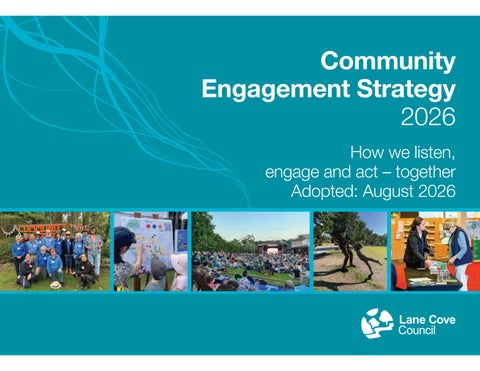
Community Engagement Strategy 2026 How we listen, engage and act – together Adopted: August 2026
Document Control Title: Community Engagement Strategy 2026 Date of Publication: August 2026 Publisher: Lane Cove Council © Lane Cove Council 2026 All rights reserved. Except as permitted under the Copyright Act 1968 (Cth), no part of this publication may be reproduced or transmitted in any form or by any means, electronic or mechanical, photocopying, recording or otherwise, without the prior permission of the publisher and copyright owner. All images are used with photographers kind permission. Any person who infringes the above in relation to this publication may be liable to criminal prosecution and civil claims for damages.
Acknowledgement of Country In the spirit of reconciliation, Lane Cove Council acknowledges the Traditional Custodians of the land, the Cameraygal people. We pay our respects to Elders past and present and extend that respect to all Aboriginal and Torres Strait Islander peoples today.
2
Community Engagement Strategy | 2026
A message from Council Community engagement is not something we do to our community. It is something we do with them. Lane Cove is a vibrant, diverse and engaged community. Our residents, business owners and community groups have strong views about what makes Lane Cove a great place to live and work. Council’s job is to make sure those views genuinely shape the decisions we make. This Strategy sets out how Lane Cove Council will listen to, involve and respond to its community across all of our activities — from everyday decisions about parks and services, to major planning proposals and long-term strategic direction.
This Strategy applies to all Lane Cove Council engagement activities – from statutory planning processes through to community events and service delivery. It is consistent with the NSW Government’s Draft Statewide Community Participation Plan (April 2026) and Council’s obligations under the Environmental Planning and Assessment Act 1979 and the Local Government Act 1993.
We know from our own evidence that we have room to improve. Our 2026 community survey found that 62% of people who participated in a Council consultation had never seen how their input made a difference. Nearly one in three residents who responded did not believe Council genuinely considers community feedback. These are honest findings, and this Strategy is our honest response to them as consultation and engagement accounts for 14.2% of overall satisfaction variance - the single biggest driver of community satisfaction” - 2025 Customer Satisfaction Survey by Micromex. The commitments in this document are not aspirational statements. They are operational standards — things we will deliver, measure and report on. We will tell you when we got it right, and we will tell you when we fell short. We invite the Lane Cove community to hold us to account.
Community Engagement Strategy | 2026
3
Contents Our Approach Section 1: About Lane Cove Our community What our own evidence tells us Section 2: Who we engage Section 3: What engagement means at Lane Cove Our 8 principles Section 4: When we engage and how we engage How long does engagement last? Section 5: Closing the loop When we will report back Section 6: What you can expect from us — and what we ask of you What you can expect from Lane Cove Council What we ask of you Section 7: Our statutory obligations — the Community Participation Plan Mandatory exhibition timeframes Section 8: How we will deliver on these commitments A Dedicated Community Engagement Coordinator Role Engagement Tools and Templates Digital Engagement Platform Staff Training and Capability Building an Engagement Culture How we will measure success How this Strategy will be reviewed Section 9: How to have your say Appendix A: Implementation plan
4
Community Engagement Strategy | 2026
5 6 7 7 8 12 13 15 19 20 22 23 24 25 26 28 29 30 31 31 31 31 32 33 34 36
Our Approach Lane Cove Council Community Engagement Strategy 2026 – Our Approach
8 Guiding Principles • Transparency • Proportionality • Early engagement • Representative • Accessibility • Closing the loop • Genuine consideration • Continuous improvement Assess every decision • Scale • Complexity • Financial impact • Safety • Legislation • Risk
Ongoing cycle
Assessment determines the right level of engagement Inform
Consult
Involve
Collaborate
Empower
Tell the community what is happening Website, notices, social media
Ask for feedback on plans and ideas Surveys, exhibition, submissions
Work with community throughout the process Workshops, pop-ups, co-design
Partner with community to shape solutions Panels, reference groups
Place community at the centre Deliberative forums, community led
Always close the loop • Publish outcomes • Explain what changed and why • Report back within defined timeframes
Reaching all of our community
CALD communities
Young people
Renters
Translated materials, community partners, multilingual channels
Digital-first, schools, youth networks, pop-up formats
Letterbox drops, accessible venues, property managers
People with disabilities
Older residents
Business community
Accessible venues, WCAG digital tools, easy-read formats
Phone, face-to-face, printed materials, community centres
Business chambers, targeted surveys, business forums
Statutory exhibition under the Community Participation Plan Planning function
CPP minimum
Development application (general)
14 days
Inform
IAP2 level
State significant development
14 days
State Government led
Consult
Residential flat buildings
Proposed nil
Inform
Consult
Draft DCP / Contributions Plan
28 days
Consult
Involve
Community Strategic Plan / LSPS
28 – 60 days
Collaborate
Empower
Public exhibitions will not occur between 15 December and 10 January (black out period). Statutory public exhibitions placed between 1 December and 14 December will be extended to close on 26 January the following year (where the statutory exhibition period is ordinarily 14 days or less) Non-statutory public exhibitions placed between 1 December and 14 December will automatically extend to close on 31 January the following year. Community Engagement Strategy | 2026
5
Section 1: About Lane Cove
6
Community Engagement Strategy | 2026
Section 1: About Lane Cove Understanding who we are helps us design engagement that reaches everyone. Our Community
What our own evidence tells us
The Lane Cove local government area sits on the lower north shore of Sydney, covering 10.5 square kilometres and home to approximately 42,000 residents across Lane Cove, Longueville, Northwood, Lane Cove West, Linley Point, Longueville, Riverview, St Leonards, Lane Cove North and Longueville.
Lane Cove Council commissioned a comprehensive review of its community engagement approach in 2025-2026. The findings were clear and honest:
Lane Cove is one of the most highly educated communities in Australia, with high rates of professional employment and home ownership. It is also a community of growing cultural diversity. The 2021 ABS Census records Mandarin, Spanish, Cantonese, Persian (excluding Dan) and Japanese among the most common languages spoken at home other than English.
Awareness gap
Trust deficit
42% of residents surveyed were unaware or barely aware of Council engagement opportunities.
31% of residents did not believe Council genuinely considers their feedback.
The community is changing. A growing proportion of residents are younger, live in apartments, and rent rather than own their home. These groups are often least visible in traditional consultation processes, and this Strategy is specifically designed to address that gap.
Missing voices
Broken feedback loop
Zero respondents under 30. Zero non-English-speaking residents among active contributors.
62% of residents who engaged had never seen how their input influenced a decision.
42,000
30%
76%
residents
speak a language other than English at home
satisfaction with Council consultation (2025)
These findings are the foundation for this Strategy. Every commitment in this document is a direct response to what our community told us — and what our data showed us.
Community Engagement Strategy | 2026
7
Section 2: Who we engage
8
Community Engagement Strategy | 2026
Section 2: Who we engage Our community is not a single audience. Different people have different needs, different ways of receiving information, and different barriers to participation. A key finding from our 2026 review is that Lane Cove’s current engagement approach predominantly reaches a narrow cross-section of the community: older, established owner-occupiers who are already civically active. This is not a failing of those residents – it is a failing of our design. Young people, renters, culturally and linguistically diverse residents, people with disabilities, and time-poor families are often effectively excluded by the way we have traditionally engaged. This Strategy commits Lane Cove Council to active and deliberate outreach to every part of our community. Below we set out who those groups are and how we will reach them. This Strategy operates alongside Council’s Draft Digital Engagement Strategy (June 2026), which sets out the channels, platforms, content standards and measurement framework through which these commitments are delivered.
Established residents Long-term homeowners with strong civic investment
Families and time-poor residents Families and residents who have limited time but high impact from Council decisions
How we reach you Direct mail and email, public exhibition notices, Have Your Say platform, structured public meetings at accessible venues, hard-copy submission options that focus on using mobile-first layouts, plain English and clear next steps.
How we reach you Mobile-optimised surveys of 5 minutes or fewer, social media promotion, pop-up engagement at school drop-off points, weekend markets and community facilities, evening hybrid sessions. Can also include emails, newsletters, social media (including paid where appropriate), Have Your Say, and use of local media where required.
Topics most relevant to you Planning and development, tree canopy, heritage, traffic and transport, long-term Council strategy
Topics most relevant to you Childcare, traffic and active travel, parks, development in residential areas, local services
Community Engagement Strategy | 2026
9
Culturally diverse residents
How we reach you
Topics most relevant to you
Translated materials in Mandarin, Korean and other key community languages, partnerships with multicultural organisations and cultural associations, facilitated sessions in community languages, TIS National interpreting service. Also includes use of video content (reels, stories and polls) across social media and streaming platforms such as YouTube, Instagram and Facebook (paid and unpaid) Also Council can utilise local area marketing across bus shelters and other key areas across the community. Depending on the audience, Council can also use visual story telling techniques and translated web content.
Planning near residential areas, community facilities, public safety, Council events, rates and charges
Young people
How we reach you
Topics most relevant to you
Residents under 30 – entirely absent from current engagement data
Instagram and social media, schools, TAFE and youth networks, pop-up engagement at the library, town square and sporting facilities, interactive digital formats, youth reference groups including (but not limited to) Synergy Youth Centre. Council can also make use of paid and unpaid social media channels such as Instagram and Facebook.
Active travel, public open space, town centre, climate and environment, employment and creative opportunity
Older residents
How we reach you
Topics most relevant to you
Active seniors who are excluded by digitalonly design, not by disengagement
Telephone consultation, face-to-face sessions at community facilities during business hours, printed notices and hard-copy newsletters, engagement through existing clubs and aged care networks
Aged care and community services, parks and accessibility, library services, traffic safety, residential amenity
Business community
How we reach you
Topics most relevant to you
Precinct engagement, targeted surveys through business associations, early morning or posttrading-hours sessions, dedicated Council contact point. Council can also utilise digital platforms such as the website, emails, newsletters, Google Business, printed materials and social media as well.
Town centre planning and activation, traffic and parking, events and markets, development applications, rates and economic development
Residents from non-English speaking backgrounds
Business owners and operators in the Lane Cove commercial area
10
Community Engagement Strategy | 2026
Renters and apartment residents Not reached by standard rates-based notification
People with disabilities Excluded by inaccessible venue and format design
How we reach you
Topics most relevant to you
Letterbox drops to rental properties, partnerships with real estate agencies and property managers, printed materials at The Canopy, library and shopping precincts. Council can also utilise digital platforms such as the website, emails, newsletters, Google Business, printed materials and social media as well.
Residential development, local services, active transport, neighbourhood amenity
How we reach you
Topics most relevant to you
Accessible venues only, WCAG 2.1 AA digital tools, easy-read and plain-language formats, consultation with disability advocacy groups and Council’s Access Committee
Accessibility infrastructure, services, community facilities, planning decisions affecting amenity
Community Engagement Strategy | 2026 11
Section 3: What engagement means at Lane Cove
12
Community Engagement Strategy | 2026
Section 3: What engagement means at Lane Cove Engagement is not a form to fill in or a box to tick. It is the way Council makes decisions in the public interest. Community engagement is the deliberate and structured process through which Council seeks, considers and responds to the views, ideas and concerns of residents, businesses, community groups and other stakeholders when making decisions that affect the local area. It is not a communications exercise. It is not a procedure to be satisfied before a decision already made is announced. And it is not something that benefits only residents who choose to participate — it benefits the quality of every decision Council makes, because better-informed decisions produce better outcomes for the whole community.
Our 8 principles Lane Cove Council’s engagement principles are operational commitments. Each creates a specific obligation on how we plan, deliver and report on engagement activity. Note: In developing our 8 principles, we considered the community participation principles in section 2.23(2) of the Environmental Planning and Assessment Act 1979..
Transparency
1
We will clearly explain the decision-making process, what aspects of the decision are open to community input, and what the final decision was and why. The community should never have to guess how a decision was made.
Proportionality
2 3
The level and intensity of engagement must match the scale, complexity and significance of the matter. A minor park furniture upgrade and a new town centre masterplan require fundamentally different approaches.
Early and meaningful Engagement must occur when community input can genuinely influence the outcome — before preferred options are settled and before significant financial commitments have been made.
Representative participation
4
Those who respond to standard engagement activities are not a representative sample of Lane Cove. We will actively design for reach across all parts of our community, not just the portions most likely to respond.
Community Engagement Strategy | 2026 13
Accessible and inclusive
5 6 7
Engagement must be accessible to all community members regardless of language, physical ability, digital literacy, work schedule or caring responsibilities. All digital engagement tools and platforms must meet WCAG 2.1 Level AA accessibility standards.
Closing the loop We will tell every participant what we heard, how we considered it, and what decision was made. This commitment applies to every engagement activity, statutory and non-statutory, without exception.
Genuine consideration Community feedback will be documented, analysed and presented to decision-makers in a structured format. We do not undertake engagement to validate decisions already made.
Continuous improvement
8
14
We will monitor our engagement activities against defined metrics (ncluding platform traffic, survey completion rates, demographic data from registrations), report outcomes to Councillors, 1and update this Strategy on a regular cycle.
Community Engagement Strategy | 2026
Being heard does not equal having your feedback adopted. Council considers community input alongside legal requirements, technical standards, financial constraints, and the views of the broader community. Where community input is not reflected in a decision, we will explain why — specifically and honestly.
Section 4: When we engage and how we engage
Community Engagement Strategy | 2026 15
Section 4: When we engage and how we engage Not every decision requires the same level of engagement. The right level depends on the scale, complexity and significance of what is being decided. Before engaging on any matter, Council assesses it against six criteria: the scale of impact, the complexity of the decision, the financial commitment involved, any safety requirements, whether the matter is covered by legislation, and the risk of getting engagement wrong. That assessment determines the appropriate level of engagement. We use the internationally recognised IAP2 (International Association for Public Participation) spectrum of engagement, adapted for Lane Cove’s community and legislative context. The spectrum has five levels. Each level builds on the previous: a decision assessed at the Collaborate level carries all the obligations of Inform, Consult and Involve, plus its own.
16
Community Engagement Strategy | 2026
INFORM We keep you informed about what is happening and why.
How we engage
Our commitment to you
• • • • • •
• We will provide clear, timely and accessible information • We will explain what is planned or has been decided, and why • We will tell you where to find more information and how to contact us
Council website updates and project pages Social media announcements E-newsletter and EDM notifications On-site signage and public notices Letters to directly affected properties Media releases
CONSULT We ask for your feedback on plans and proposals and genuinely consider what you tell us.
How we engage
Our commitment to you
• Statutory public exhibition via Council website and NSW Planning Portal • Online surveys via the Have Your Say platform, mobile optimised • Written and online submission process • Notification to adjoining and affected properties • Multi-touchpoint promotion throughout the exhibition period, including paid boost framework for major consultations to ensure demographic reach beyond existing followers
• We will ask for your feedback and give you enough time and information to respond • We will acknowledge all submissions • We will report back on what we heard and how it was considered in the final decision
INVOLVE We work directly with you throughout the process to make sure your concerns and ideas are reflected in decisions.
How we engage
Our commitment to you
• Community drop-in sessions and pop-up events • Online and in-person workshops with hybrid participation as default • Co-design activities and scenario testing • Focus groups with targeted demographic groups • Community reference groups with ongoing advisory role • Translated materials and varied session timing
• We will involve you directly in developing options and solutions • We will document your concerns and ideas at key points throughout the process • We will show you how your input shaped the options before a final decision is made
COLLABORATE We partner with you to develop options and recommendations. Community input directly shapes what goes to Council.
How we engage
Our commitment to you
• Extended engagement program with multiple structured touchpoints • Community reference group or advisory panel with formal advisory role • Technical briefings for community representatives • Joint design workshops with Council officers, experts and community members • Draft recommendations published for community review before Council consideration
• We will partner with you in developing the options and recommendations that go to Council • We will be transparent about constraints and trade-offs • We will report publicly on how community collaboration shaped the outcome
Community How Engagement we developed Strategy this strategy | 2026 17
EMPOWER We place community voice at the centre of the outcome for decisions about our long-term vision and values.
18
Community Engagement Strategy | 2026
How we engage
Our commitment to you
• LGA-wide engagement using multiple channels, languages and formats • Deliberative processes: citizens panels, community assemblies • Community-led working groups with Council officer support • Independent facilitation to build confidence in the process • Formal community vision or priorities document as an output
• We will design processes that place community voice at the centre of the outcome • We will make the community’s position clear in the final decision • We will provide a formal and public account of how community direction shaped the outcome
How long does engagement last? The length of engagement depends on the level of engagement required and the nature of the matter. As a guide:
Engagement level
Typical duration
What this looks like
Inform
Ongoing / as required
Website updates, social media posts and onsite notices published as matters arise. No fixed engagement period.
Consult
Minimum 2 to 6 weeks (including statutory exhibition)
The minimum period depends on the type of matter. Council may extend where the scale or complexity warrants it. Multi-touchpoint promotion across the full period.
Involve
Typically, 4 to 8 weeks
Multiple engagement touchpoints across the consultation period. Community reference groups engaged over a longer project lifecycle.
Collaborate
Typically, 2 to 6 months
Extended program with multiple structured sessions. Draft recommendations published for review before Council consideration. Example would include Community Strategic Plan reviews aligned to the 4-year IP&R cycle.
Empower
Typically, 6 to 12 months
Extended, multi-phase program with deliberative components. Example would include a deliberative democracy exercise involving a Community Panel.
Community Engagement Strategy | 2026 19
Section 5: Closing the loop
20
Community Engagement Strategy | 2026
Section 5: Closing the loop 62% of residents who participated in Council consultation had never seen how their input made a difference. This is the most cited improvement opportunity across all of our evidence – and our most important commitment. Closing the loop is not a courtesy. It is the mechanism through which trust between Council and community is built or destroyed. A community that submits feedback and hears nothing further will reasonably conclude that its input was not considered. Over time, this becomes the culture of disengagement that Council is seeking to reverse. Council commits to the following You Said, We Did standard for every engagement activity, regardless of the level. Within defined timeframes following the close of consultation, we will publish a structured Engagement Outcomes Report that tells you: • What the community said – the key themes, range of views, and any significant divergence of opinion. • How Council considered your feedback — what was incorporated, what was not, and the reasons why. • What decision was made, or what the recommended option is. • What happens next – if further engagement is planned, when and how.
Where community input is not reflected in a decision, Council will explain why – specifically and honestly. We will not use generic language such as ‘submissions noted’. Community members deserve a genuine account of how their views were weighed.
Community Engagement Strategy | 2026 21
When we will report back
22
Community Engagement Strategy | 2026
Level
Timeframe
How we report back
Inform
As soon as practicable
Website update, social media post, EDM to subscribers.
Consult
Within 6 weeks of close of engagement
Published Engagement Outcomes Report on project page and Council website. Direct email to all participants. Included in Council report.
Involve
Within 6 weeks of close of engagement
Published Engagement Outcomes Report. Direct email to participants. Briefing to community reference group if applicable, prior to public report.
Collaborate
Within 12 weeks of close of engagement
Comprehensive Engagement Outcomes Report published publicly. Direct communication to all participants. Presentation to advisory panel. Formal inclusion in Council report. Media release where appropriate.
Empower
Within 16 weeks of close of engagement
Comprehensive community report-back document in plain language. Direct communication to all participants. Council resolution acknowledging community direction. Public presentation at a Council meeting.
Section 6: What you can expect from us – and what we ask of you
Community Engagement Strategy | 2026 23
Section 6: What you can expect from us — and what we ask of you Community engagement is a two-way relationship. It works best when both Council and the community come to it in good faith. What you can expect from Lane Cove Council • Genuine consideration – your feedback will be documented, analysed and presented to decision-makers in a structured format. • Transparency about what is open for input – we will tell you at the outset of every engagement activity exactly what aspects of the decision are open to community input, and what is determined by legislation, technical standards or prior Council resolutions. • Timely and honest feedback – we will report back to you within the timeframes in Section 5, honestly explaining how your input was used. • Fit-for-purpose methods – we will design engagement activities appropriate to the nature of the decision and accessible to the community members most directly affected. • Active effort to reach all voices – we will make deliberate and documented efforts to engage community members who do not typically respond to standard engagement channels. • Accessible formats – we will offer engagement in formats that residents can reasonably participate in, including hybrid options, varied timing, and translated materials.
24
Community Engagement Strategy | 2026
What we ask of you •
Engage through Council’s formal channels – submissions, surveys and consultations conducted through Council’s Have Your Say platform and the NSW Planning Portal are the authoritative record of community input. Submissions received through third-party petition platforms are not part of the formal engagement record. Council may take note of unsolicited commentary on its digital platforms as contextual background information. Such commentary does not form part of the formal engagement record and will not be treated as representative community input for the purposes of reporting engagement outcomes or informing decisions.
•
Participate early – your input has the greatest influence on outcomes when it occurs at an early stage. Engage when consultation opens rather than at the final stage.
•
Provide reasons – feedback that explains the basis for your view is more useful than feedback that simply expresses support or opposition. Context helps us respond specifically and honestly.
•
Stay informed – subscribe to project updates through our Have Your Say platform to receive outcomes reports and notifications when consultation opens.
•
Engage respectfully – all community members, Council staff and elected representatives are entitled to participate in engagement activities free from harassment, intimidation or abuse.
The community sets the direction. Council makes the decisions. Community engagement is one important input into those decisions, alongside legal requirements, technical advice, financial constraints and the views of the broader community. We are elected to make decisions in the public interest — but we are most effective when those decisions are genuinely informed by the community we serve.
Community Engagement Strategy | 2026 25
Section 7: Our statutory obligations – the Community Participation Plan
26
Community Engagement Strategy | 2026
Section 7: Our statutory obligations — the Community Participation Plan The NSW Government has prepared a draft statewide Community Participation Plan and is seeking community views on the plan at present. The new statewide Community Participation Plan is intended to ensure that consultation on Council planning functions is clear and consistent across NSW. When the statewide Community Participation Plan comes into effect it may be necessary for amendments to this section to be made to ensure consistency with the statewide Community Participation Plan. Existing Community Participation Plans will remain in place until the statewide Community Participation Plan is finalised, and the relevant clauses of the EP&A Act commence, supported by savings and transitional arrangements. At that time, the statewide Community Participation Plan will become the only active plan in NSW. This means that Lane Cove Council’s existing Community Participation Plan will be superseded. Community Participation Plans (CPP) are prepared under Division 2.6 of the EP&A Act. CPPs set out community participation principles, consistent with Section 2.32(2) of the EP&A Act, and mandatory minimum public exhibition timeframes for planning functions across all NSW councils.
Lane Cove Council’s community engagement strategy sets out the satisfy the minimum requirements of the statewide CPP. The statewide CPP sets out the minimum exhibition timeframes for planning functions. This Strategy provides the framework for how Council will meet those requirements.
NSW planning legislation requires all councils to meet mandatory community participation standards under the Environmental Planning and Assessment Act 1979. Lane Cove Council is committed to satisfying those statutory requirements and delivering an engagement practice that is consistent and in the best interests of its community.
Community Engagement Strategy | 2026 27
Mandatory exhibition timeframes The table below sets out the minimum public exhibition timeframes for the planning functions most relevant to Lane Cove Council.
28
Planning function
CPP Minimum Timeframe
How we report back
Development application (general)
14 days
Inform
Consult
Council development application (Council as consent authority)
28 days
Inform
Consult
Designated / nominated integrated development
28 days
Inform
Consult
State significant development (Council as referral body)
14 days
State Government led
State significant development (with rezoning proposal)
14 days
State Government led
Residential flat buildings and shop top housing
N/A
Inform
Consult
Planning proposal — LEP amendment
28 days or per gateway
Consult
Involve
Draft Development Control Plan (DCP)
28 days
Consult
Involve
Draft Contributions Plan
28 days
Consult
Involve
Draft Local Strategic Planning Statement (LSPS)
28 days (statutory min)
Collaborate
Empower
Community Strategic Plan review
28 days (statutory min)
Collaborate
Empower
Draft Community Participation Plan
28 days
Inform
Complying development — neighbour notification
7 days prior to works
Inform
Community Engagement Strategy | 2026
Consult
Exhibition timeframes are measured in calendar days including weekends. Public exhibitions will not occur between 15 December and 10 January (black out period). Statutory public exhibitions placed between 1 December and 14 December will be extended to close on 26 January the following year (where the statutory exhibition period is ordinarily 14 days or less) Non-statutory public exhibitions placed between 1 December and 14 December will automatically extend to close on 31 January the following year. Council may also extend exhibition periods during other public holiday periods and where the scale, complexity or community sensitivity of a matter warrants it
Section 8: How we will deliver on these commitments
Community Engagement Strategy | 2026 29
Section 8: How we will deliver on these commitments A strategy without infrastructure is just a list of good intentions. Lane Cove Council is building the operational foundation to make this work. A Dedicated Community Engagement Coordinator Role Council is looking to establish a dedicated Community Engagement Coordinator position. It is acknowledged the position is not yet funded in the budget, however, should Council have the financial capacity to do so throughout the 2026/27 financial year, this position will be a high priority for funding. This role is not a delivery function — it is a governance and coordination role. The responsibility for designing and delivering engagement activities remains with the relevant Council officer or project team. The Coordinator’s function is to: • Maintain strategic oversight of all active engagement activities across Council. • Provide expert advice and quality assurance to project teams on engagement design, accessibility and CPP compliance. • Coordinate the schedule of engagement activities to prevent conflicts and avoid community consultation fatigue.
• Develop and maintain tools, templates, guidance and training resources for all Council teams.
• Manage Council’s Have Your Say platform and ensure project pages are current and accessible.
• Manage the Engagement Outcomes Report process to ensure the You Said, We Did standard is met within required timeframes.
• Monitor engagement performance data, demographic reach and outcomes, and report to senior management and Councillors.
• Provide training and prepare practical resources for staff on the community consultation process
30
Community Engagement Strategy | 2026
Engagement Tools and Templates
Building an Engagement Culture
Council will develop and maintain a standard suite of engagement tools available to all project teams. This includes engagement plan templates aligned to the IAP2 spectrum, notification checklists that reflect statutory requirements under the Environmental Planning and Assessment Act 1979 and the Local Government Act 1993, IAP2 spectrum decision guides to assist project officers in selecting the appropriate level of engagement for a given activity, and closing-the-loop report templates that meet the You Said, We Did standard. These tools will be reviewed regularly to reflect legislative updates and lessons learnt from practice across the organisation.
Infrastructure and training are necessary, but they are not sufficient on their own. Sustained improvement in community engagement requires an organisational culture in which engagement is treated as a core function of good governance, not a procedural requirement to be satisfied at the end of a project. Lane Cove Council is committed to embedding that culture across all teams. This means engagement planning begins at the project design stage, feedback is genuinely considered and documented, and the community receives a clear account of how their input influenced decisions. Council’s annual reporting process will include engagement performance data, providing Councillors and the community with an honest account of how well the organisation is delivering on its commitments each year.
Digital Engagement Platform Council’s Have Your Say platform is the primary digital channel for community engagement. All active engagement activities at the Consult level and above will be listed on the platform with clear project descriptions, engagement timelines, and accessible feedback mechanisms. The platform will also support the publication of Engagement Outcomes Reports, ensuring the community can see how their input was considered after each engagement process concludes.
Staff Training and Capability Consistent engagement outcomes depend on staff who understand both the legislative obligations and the practical skills required to design and deliver engagement well. Council is committed to providing structured training for all staff with engagement responsibilities. This will include onboarding for new staff, annual refresher training aligned to the IAP2 spectrum, and coaching support for project teams at the planning stage of significant engagement activities. Training will be coordinated centrally to ensure consistency across all directorates rather than relying on individual initiative or team budget availability.
Community Engagement Strategy | 2026 31
How we will measure success Council will report on the following performance indicators to Councillors every six months as part of the Delivery Program update required under the Local Government Act 1993 (NSW), and annually in the Council Annual Report. These indicators are designed to demonstrate whether this Strategy is producing the changes it is committed to delivering — not just whether activities are being conducted, but whether those activities are reaching the community equitably and producing genuine outcomes.
32
Measure
How we measure it
Target
Community satisfaction with consultation and engagement
Annual Community Satisfaction Survey
Increase from 76% baseline (2025 Micromex survey). Reach NSW metro council benchmark within 3 years.
You Said, We Did compliance rate
Quarterly audit of all Engagement Outcomes Reports published in the period
100% of Consult level and above activities completed within required timeframes by end of Year 2.
Demographic reach – under-30 participation
Platform registration data and event attendance records
Measurable representation in at least 50% of Involve level and above activities by end Year 2.
Demographic reach – CALD communities
Platform registration data, submission origin data, and translated materials downloads
Measurable improvement on 2026 baseline across all major engagement activities by end Year 2.
Multi-touchpoint promotion adoption
Coordinator audit of engagement activity promotion plans
100% of Consult level and above activities using a multi-touchpoint promotion approach by end Year 1.
Engagement plan completion rate
Coordinator audit of project files
100% of Involve level and above activities to have a documented engagement plan approved before activity launches.
Statutory CPP compliance
Governance team audit of all statutory planning exhibition activities
Zero instances of non-compliant exhibition for any statutory planning function.
Community Engagement Strategy | 2026
How this Strategy will be reviewed This Strategy will be reviewed on the following cycle to ensure it remains current, effective and responsive to community needs.
Annual review A performance review against the metrics above will be conducted each year, with a brief report to Councillors on outcomes and any required adjustments to implementation priorities.
Four-yearly comprehensive review A full strategy review will be conducted every four years, aligned to Council’s Delivery Program cycle under the Integrated Planning and Reporting framework. This review will incorporate updated evidence, community feedback, and any changes to NSW legislation or the Statewide Community Participation Plan. The comprehensive review will be conducted through a community engagement process consistent with the principles in this Strategy, including public exhibition of the draft revised strategy for a minimum of 6 weeks.
Review as required An immediate review will be triggered if significant changes to NSW planning legislation, the Statewide Community Participation Plan, or Council’s operating environment require amendments to the statutory compliance elements of this Strategy. Any revised version will be subject to public exhibition consistent with Council’s engagement principles.
Community Engagement Strategy | 2026 33
Section 9: How to have your say
34
Community Engagement Strategy | 2026
Section 9: How to have your say There are many ways to engage with Lane Cove Council. Here is how to find and participate in our consultation activities. Council’s primary community engagement platform is Have Your Say – haveyoursay.lanecove.nsw.gov.au/. All active consultations are listed there, including surveys, exhibition documents, online submission forms and project updates.
Lane Cove Council accepts submissions through Council’s formal channels and the NSW Planning Portal. Submissions received through third-party petition websites are not considered part of the formal engagement record.
Online — Have Your Say
In person
Visit haveyoursay.lanecove.nsw. gov.au/. Complete surveys, read exhibition documents and submit feedback online. Subscribe to project updates to be notified when new consultations open.
Attend community drop-in sessions, public meetings and pop-up events. Check the Have Your Say platform and Council’s social media for dates and locations.
By mail or in writing
NSW Planning Portal
Written submissions can be posted to: The General Manager, Lane Cove Council, PO Box 20, Lane Cove NSW 1595.
Development applications, planning proposals and statutory planning documents are also exhibited on the NSW Planning Portal at planningportal.nsw.gov.au
Call or visit Council
Lane Cove Council 48 Longueville Road, Lane Cove NSW 2066 PO Box 20, Lane Cove NSW 1595 02 9911 3555 service@lanecove.nsw.gov.au lanecove.nsw.gov.au Have Your Say: haveyoursay.lanecove.nsw.gov.au/ ABN 42 062 211 626
Contact Council on 02 9911 3555 or visit 48 Longueville Road, Lane Cove.
Translated materials Translated summaries of major consultation documents are available in community languages. Contact Council or visit the project page on Have Your Say.
Address Council in a Public Forum
Community Engagement Strategy | 2026 35
Appendix A: Implementation plan
36
Community Engagement Strategy | 2026
12: ServiceA: Appendix Journey Implementation Design plan This Strategy will be implemented over three years, sequenced to build the foundations of consistent engagement practice in Year 1, embed new processes and extend community reach in Year 2, and evaluate outcomes and mature the approach in Year 3. The three-year cycle will then be reviewed and aligned with Council’s next Delivery Program under the Integrated Planning and Reporting framework, as required under the Local Government Act 1993 (NSW).
Year
Focus
Key actions
Year 1 2026–2027
Build the foundations
When financial capacity becomes available, appoint a Community Engagement Coordinator Deliver training for all project officers on engagement assessment, engagement planning, and statutory obligations. Develop a standard engagement project plan template, Engagement Outcomes Report template, and assessment framework guidance document for all project teams. Audit all active engagement activities to ensure compliance with this Strategy and CPP requirements under the Environmental Planning and Assessment Act 1979. Pilot the You Said, We Did standard for three to five active engagement activities, with documented lessons learned Establish baseline demographic reach measurement to identify primary engagement gaps. Develop a community network partnership map identifying organisations and networks that can assist Council in reaching underrepresented groups. Undertake training in survey development
Community Engagement Strategy | 2026 37
Year
Focus
Key actions
Year 2 2027–2028
Extend our reach
Full rollout of the You Said, We Did standard for all engagement activities above the Inform level. Launch a multi-touchpoint promotion model for all Consult level and above activities, replacing the current single-broadcast approach. Implement the translated materials program for key community languages. Roll out pop-up engagement as a standard activity type for Involve and Collaborate level activities Establish at least three active community network partnerships for reaching underrepresented groups, including young people, CALD communities, and renters. Introduce hybrid participation as the default for all in-person engagement events at Involve level and above. Complete the first annual performance review against the metrics in the section below.
Year 3 2028–2029
Evaluate and improve
Comprehensive review of engagement outcomes against the Year 1 baseline, with particular attention to demographic reach, participation rates among underrepresented groups, and community trust indicators from the annual Community Satisfaction Survey. Update the Community Strategic Plan engagement approach in preparation for the Liveable Lane Cove 2035 review cycle, consistent with the IP&R framework obligations under the Local Government Act 1993 (NSW). Full strategy review and update, incorporating lessons from three years of implementation, any changes to the Statewide CPP, and updated community needs and expectations Undertake public consultation on the revised strategy draft, consistent with the engagement principles in this document. Upgrade and configuration of the Granicus engagement platform to support multi-project management, demographic tracking, and the You Said, We Did reporting process.
38
Community Engagement Strategy | 2026
Photo Credits Lane Cove Council gratefully acknowledges the photographic contributions made to the Community Engagement Strategy and have added the contributor’s names whenever possible. • Teresa Tan • Stephen Golding • Karen Mitchell • Maggie Langtry • Eric Sierins • Matthew Duchesne • Fancy Boy Photography • Coastal Creatures • Tom Roberts Photography • Mary Grace Olfato
Community Engagement Strategy | 2026 39