Volume 53 issue four 2019
11 Canine Scent Detection: Another Tool in the Arborist’s Arsenal
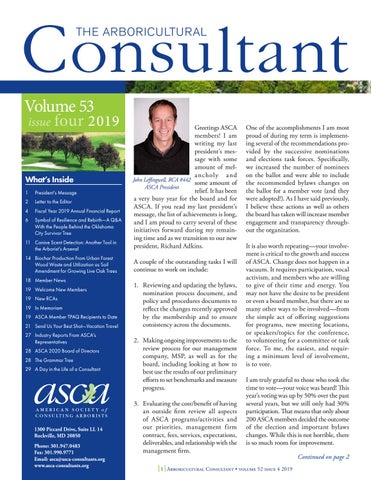
Greetings ASCA members! I am writing my last president’s message with some amount of mela nc holy a nd John Leffingwell, RCA #442 some amount of ASCA President relief. It has been a very busy year for the board and for ASCA. If you read my last president’s message, the list of achievements is long, and I am proud to carry several of these initiatives forward during my remaining time and as we transition to our new president, Richard Adkins.
14 Biochar Production From Urban Forest Wood Waste and Utilization as Soil Amendment for Growing Live Oak Trees
A couple of the outstanding tasks I will continue to work on include:
What’s Inside 1
President’s Message
2
Letter to the Editor
4
Fiscal Year 2019 Annual Financial Report
6
Symbol of Resilience and Rebirth—A Q&A With the People Behind the Oklahoma City Survivor Tree
18 Member News 19 Welcome New Members 19 New RCAs 19 In Memoriam 19 ASCA Member TPAQ Recipients to Date 21 Send Us Your Best Shot—Vacation Travel 27 Industry Reports From ASCA’s Representatives 28 ASCA 2020 Board of Directors 28 The Grammar Tree 29 A Day in the Life of a Consultant
1300 Piccard Drive, Suite LL 14 Rockville, MD 20850 Phone: 301.947.0483 Fax: 301.990.9771 Email: asca@asca-consultants.org www.asca-consultants.org
1. Reviewing and updating the bylaws, nomination process document, and policy and procedures documents to reflect the changes recently approved by the membership and to ensure consistency across the documents. 2. Making ongoing improvements to the review process for our management company, MSP, as well as for the board, including looking at how to best use the results of our preliminary efforts to set benchmarks and measure progress. 3. Evaluating the cost/benefit of having an outside firm review all aspects of ASCA programs/activities and our priorities, management firm contract, fees, services, expectations, deliverables, and relationship with the management firm.
One of the accomplishments I am most proud of during my term is implementing several of the recommendations provided by the successive nominations and elections task forces. Specifically, we increased the number of nominees on the ballot and were able to include the recommended bylaws changes on the ballot for a member vote (and they were adopted!). As I have said previously, I believe these actions as well as others the board has taken will increase member engagement and transparency throughout the organization. It is also worth repeating—your involvement is critical to the growth and success of ASCA. Change does not happen in a vacuum. It requires participation, vocal activism, and members who are willing to give of their time and energy. You may not have the desire to be president or even a board member, but there are so many other ways to be involved—from the simple act of offering suggestions for programs, new meeting locations, or speakers/topics for the conference, to volunteering for a committee or task force. To me, the easiest, and requiring a minimum level of involvement, is to vote. I am truly grateful to those who took the time to vote—your voice was heard! This year’s voting was up by 50% over the past several years, but we still only had 30% participation. That means that only about 200 ASCA members decided the outcome of the election and important bylaws changes. While this is not horrible, there is so much room for improvement.
1 Arboricultural Consultant • volume 52 issue 4 2019
Continued on page 2
< home 2019 BOARD OF DIRECTORS President’s Message continued
President
John S. Leffingwell, RCA #442, Pleasanton, CA President-Elect
Richard Adkins, RCA #573, Gilbert, AZ Immediate Past President
Jonathan E. Butcher, RCA #486, Milford, OH Treasurer
Jeremy T. Chancey, RCA #646, Fort Lauderdale, FL Directors:
Patrick Anderson, RCA #475, Shelby, NC Glenn Gentzke, RCA #485, Tonawanda, NY Jeffrey Ling, RCA #337, Fort Wayne, IN Ron Matranga, RCA #488, Spring Valley, CA Micah Pace, RCA #607, McKinney, TX
STAFF Executive Director
Thérèse O. Clemens, CAE Vice President Meetings
During my time as an ASCA member (and I only joined in 2004), there have been ongoing concerns raised by the members about opportunities for member engagement, organizational transparency, and the cost/benefit of the management company. The board has begun to tackle some of these very important operational issues, but this work will continue beyond the current board. It is important to remember, however, that this is a strategic board and that the operational activities must be balanced with the equally important strategic efforts of guiding the
organization into the future. The good news is that the increase in operational efforts also creates increased opportunities for each of us to participate and take ownership for the direction and trajectory of ASCA. This is your organization, and it depends on each of us to step up at one time or another. My time is winding down, but I hope you will find the time, energy, and desire to give back and move ASCA forward in your own way.
Grace L. Jan, CAE, CMP Sr. Marketing Director
Julie Hill
Marketing Director
Letter to the Editor
Jennifer Olivares Managing Editor
Lynne Agoston Meetings Manager
Morgan Prior
Marketing Coordinator
Meghan Maker
Member Services Coordinator
Julianne Clarke Accounting
Dawn Rosenfeld Exhibits/Sponsorship Manager
Barbara Bienkowski, CEM
NEWSLET TER The Arboricultural Consultant is published four times a year by ASCA. Articles and news items are encouraged and must be submitted six weeks prior to publication. Editorial Review Committee Tom Bradley, RCA #492, Mississauga, ON Chad Clink, RCA #589, Cleveland, OH Thomas Dodge, RCA #584, Pacheco, CA Nick Drunasky, RCA #467, Woodbridge, VA Jordan Endahl, Vancouver, WA Briana Frank, Madison, WI Jeannine Lubeshkoff, RCA #500, Duarte, CA Jason Miller, RCA #526, Woodbury, NJ Todd Prager, RCA #597, Lake Oswego, OR Lisa Smith, RCA #464, Los Angeles, CA Matt Weibel, RCA #534, Fair Lawn, NJ Robert Wells, RCA #593, Princeton, NJ
ASCA ANTITRUST STATEMENT The following antitrust statement has been approved by the president and board of directors of the American Society of Consulting Arborists. “Members of the American Society of Consulting Arborists, especially members of the board of directors and Society committees, are reminded that they do not and may not speak for or on behalf of the Society without the express permission of the president or board of directors of the American Society of Consulting Arborists. This prohibition includes the use of ASCA letterhead when making a statement of a technical, economic, or political nature. Members of ASCA speak only for themselves as professional consultants when giving opinions or making statements.”
Depreciation Buckets and Brackets
I would like to clarify the context of James Komen’s recent, thought-provoking article 1 on depreciation in the 10th Edition. Context is set in the first sentence: “The 10th Edition of the CTLA Guide for Plant Appraisal has changed the depreciation factors used in the Trunk Formula Method [TFM](now ‘Technique’)[TFT].” There are two things to clarify. First, the 10th Edition has indeed changed the three percentage depreciation factors. Since those changes apply across the Cost Approach, James’s article actually applies to 10th Edition depreciation factors generally. It is not limited to basic cost developed with TFT. Second, in the 8th and 9th Editions, both cost development operations and the depreciation operation were included in TFM. 2 Depreciation was a required part of the method (even if all the factor ratings were 100%). In the 10th Edition, by contrast, TFT includes cost development only. Thus, depreciation is not a required part of the technique. The depreciation operation is not in TFT at all. 3 Cost development was isolated in the 10th Edition techniques so that those techniques could be transportable across methods. For example, the trunk formula unit cost calculations can be used in both the Reproduction and Functional Replacement Methods. As a result, depreciation is also isolated. In the 10th Edition, three-factor Komen, James. 2019. Buckets and Depreciation in the CTLA Trunk Formula Technique. Arboricultural Consultant 52(3):14-16.
1
2
And also in 8th and 9th Edition Replacement Cost Method (RCM) and Cost of Cure (COC, Condition only).
3
This is also true of the 10th Edition Direct Cost Technique (DCT) and Cost Compounding Technique (CCT).
American Society of Consulting Arborists
2
Arboricultural Consultant volume 52 issue 4 2019
< home Letter to the Edior continued
depreciation is an “orphan operation” in that it is neither a) within a method or a technique nor b) a separate “technique.” This is clear in the 10th Edition, Figure 5.1 and text. This clarification of context does not affect the substance of James’s article. Depreciation remains an important part of the Cost Approach. The overlap of depreciation factors and the potential for “double dipping” remain a concern for plant appraisers. Sincerely, Scott Cullen, RCA #348
Response From James Komen
Scott makes a persuasive case here that depreciation is a separate operation not contained within the TFT. His conclusion is supported by the flow chart in the 10th Edition that shows TFT (and CCT and Direct Cost) listed as separate from the depreciation step. I agree that a linguistic differentiation could be articulated that depreciation is separate because it may be applied to the basic cost developed by any of the cost techniques (CCT, TFT, Direct Cost) and not just TFT. However, I would also like to present the contrary viewpoint. The Trunk Formula Technique may also be said to encapsulate the process of formulating a Basic Cost and also of multiplying it by a depreciation factor, if applicable. This broader bracketing of the beginning and end of the TFT was presented recently at a local conference (“In the Trunk Formula Technique, we characterize condition as a [percent] where 100% is excellent and 0% is dead.”) 4 and confirmed by later personal communication with the presenter. 5
when depreciable attributes are distributed differently among the three depreciation “buckets,” as I discuss in my article. 7 I am ambivalent to either interpretation of the bracketing of TFT. Should the label of TFT only refer to the steps used in calculating the Basic Cost through extrapolation of a Unit Cost derived from nursery stock pricing? Or should the TFT refer to the entire process of developing the Basic Cost and also applying depreciation if applicable? Either way, they both have the same resulting “depreciated cost.” I leave the labeling of that distinction to the powers that be. Whatever the answer, I intend to follow the guidance of any future published developments answering this question. I hope that my “Buckets” article will still continue to spark discussion about allocation of depreciable attributes within the new rating system. Sincerely, James Komen, RCA #555
Scott’s Reply
James is, of course, correct that mathematically, the result is the same whether the notation is bracketed as single or separate steps. Since the 10th Edition presents an entirely new organizational scheme, understanding and reflecting that scheme is as important (to appraisers and appraisal users) as the numerical result. Separating cost and depreciation operations or steps in mathematical notation more accurately reflects the organizational scheme depicted in Fig. 5.1.
Scott’s points do not change the substance of my article, which was focused entirely on the significance of the allocation of depreciation attributes among the new depreciation factors themselves. His points also do not change the outcome of the cost approach calculation. Whether the total depreciation is multiplied with tree cost within or immediately after the TFT brackets (or CCT or Direct Cost brackets) does not make a mathematical difference due to the associative property of multiplication. 6 A theoretical mathematical difference only occurs Clark, James. “Plant Appraisal: from assessment of health, structure, and form to determining depreciation.” Assessing Trees for Value and Safety. September 20, 2019. Anaheim Community Center, Anaheim, CA.
4
Clark, James. September 20, 2019. Personal communication.
5
The associative property of multiplication is expressed as A x B x C = ( A x B ) x C. In tree appraisal, the following is equivalent: Trunk Area x Unit Cost x Depreciation = ( Trunk Area x Unit Cost ) x Depreciation 6
American Society of Consulting Arborists
( Condition - a - b ) x (Functional Lim) ≠ ( Condition - a ) x ( Functional Lim - b ) Or, more precisely, the above equation is only true when b is 0. 7
3
Arboricultural Consultant volume 52 issue 4 2019
< home
Fiscal Year 2019 Annual Financial Report to Membership The annual audit for fiscal year 2019 (October 1, 2018–September 30, 2019) concluded on November 18, 2019, with a meeting of the ASCA Audit Committee, auditor, and executive director. The resulting annual audit draft financial statement is provided to the board for review and approval. Board approval finalizes the audit. The audit committee is pleased to report to the membership that, again, the audit firm’s opinion is that the financial statements “present fairly, in all material respects, the financial position of the American Society of Consulting Arborists as of September 30, 2019 and 2018, and the changes in its net assets and its cash flows for the years then ended in accordance with accounting principles generally accepted in the United States of America.” It was stated that ASCA programs are two-thirds of its expenses, and that the management fees decreased from the previous year by a small percentage. Reserves are strong. The balance sheet from the audit is provided by the board in ongoing efforts to improve communication with membership. Respectfully,
Balance Sheet Assets
2019
2018
Current Assets Cash and cash equivalents $ 455,286 $ 383,755 Certificates of deposit 295,000 289,000 Prepaid expenses 113,171 133,351 Accounts receivable 100 Total current assets 863,557 806,106 Equipment Equipment 1,182 1,182 Less accumulated depreciation 1,182 1,182 - Total assets $ 863,557 $ 806,106
Liabilities and Net Assets
Current Liabilities Accounts payable $ 5,214 $ 2,063 Deferred membership dues revenue 261,980 280,220 Deferred annual meeting revenue 152,749 137,429 Deferred TPAQ revenue 8,950 Deferred academy revenue 12,600 15,550 Deferred advertising - 84 Total liabilities 441,493 435,346
ASCA Audit Committee Jeremy Chancey, RCA #646, Secretary/ Treasurer, Committee Chair
Net Assets Without donor restrictions
422,074
370,760
Richard Adkins, RCA #573, President-elect
$ 863,557
$ 806,106
Glenn Gentzke, RCA #485
The accompanying notes are an integral part of these financial statements.
Total liabilities and net assets
John Leffingwell, RCA #442 (ex officio) Jeff Ling, RCA #337 Ron Matranga, RCA #488
American Society of Consulting Arborists
4
Arboricultural Consultant volume 52 issue 4 2019
< home
ASCA Consulting 2020 Academy February 26–29
Sheraton Grand Sacramento Hotel Sacramento, California
Co-sponsored by
www.asca-consultants.org/Academy
American Society of Consulting Arborists
5
Illinois Arborist Association Indiana Arborist Association ISA Utah Chapter New York State Arborists Ohio Chapter ISA Pacific Northwest Chapter ISA Western Chapter ISA Supported by Tree Care Industry Association Arboricultural Consultant volume 52 issue 4 2019
< home
Symbol of Resilience and Rebirth A Q&A With the People Behind the Oklahoma City Survivor Tree Photo courtesy of Oklahoma City National Memorial & Museum
Trees can be beautiful just on their own, but when a tree takes on special meaning and serves as a symbol for human resilience and rebirth, its beauty is multiplied many times over. Such is the case of a solitary American elm tree that once shaded a parking lot of the Alfred P. Murrah Federal Building in Oklahoma City, Oklahoma. In April 1995, when the building was bombed in one of the worst terrorist attacks on U.S. soil, the tree miraculously survived, despite being heavily damaged. The force of the blast ripped most of the branches from the tree, and fire from the cars parked beneath it burned much of what was left. The tree—estimated to be about 100 years old—was nearly chopped down during the initial investigation because workers wanted to recover evidence from the tree, including debris hanging in its remaining few branches and embedded in its trunk. Most thought the tree could not survive. But almost a year after the bombing, people gathering for a memorial ceremony by the tree noticed that it was beginning to bloom again. When planning began for the Oklahoma City National Memorial & Museum, those involved in developing its mission statement—including community citizens, family members of those who were killed, survivors, and rescue workers—said that one of the components of the memorial must be the “Survivor Tree,” as it is now known.
And so began great efforts to save the tree and incorporate it as part of the overall memorial. One of those contacted early in this endeavor was Mark Bays, an urban forester with the Oklahoma Department of Agriculture, Food, and Forestry, who was enlisted to help develop a plan to save the tree. Another key player has been Gabriel Taylor, director of facility operations at the memorial. Gabriel and his crew take care of the Survivor Tree on a daily basis. Without Mark’s help and the dedication of the Oklahoma City National Memorial & Museum’s Facilities & Grounds staff and many others, the Survivor Tree would not exist today. ASCA had a chance to interview Mark and Gabriel regarding their roles in the project and the steps that were taken to save this beautiful tree.
ASCA: How were you selected to lead the Survivor Tree project?
Mark Bays: I had been working with Richard Williams of the General Services Administration with the tree recovery on the plaza area above the parking garage on the south side of the property. In 1996, Rowland Denman, the Memorial Foundation’s volunteer executive director, reached out to me and asked if I would be willing to help with the recovery efforts around this now very special tree. I pledged that I would not only bring the entire lot of Oklahoma Forestry Services resources to the table, but I was also networked with well-established horticulturists, foresters, arborists,
American Society of Consulting Arborists
6
and tree care companies in Oklahoma that would be willing to help as well. Across the country, we are a committed group of people in the community forestry field. It’s a true team effort, with many folks working together, including the Facilities & Grounds department at the Oklahoma City National Memorial & Museum, who take care of the Survivor Tree on a daily basis.
ASCA: What did the tree look like after the blast? How was it damaged?
Mark Bays: Photos from the early 1900s show that the tree was actually in the yard of a home. As Oklahoma City continued to change, the house was taken down but the tree remained. The tree was in the middle of a parking lot for close to 20 years and somehow was able to withstand and survive those conditions. The asphalt of the parking lot was around its entire root system, including all the way up on the trunk of the tree. When the bomb was detonated just across the street, the tree took the full force of the blast, along with glass and debris from the building that was blown into its trunk and branches. Cars caught fire and scorched its trunk and branches. It was in pretty bad shape.
ASCA: What were the most important things to consider as you began work on this project?
Mark Bays: We worked very closely with the Oklahoma City National Memorial Foundation and developed a plan for
Arboricultural Consultant volume 52 issue 4 2019
< home Symbol of Resilience and Rebirth continued
recovery, and the first thing was to begin the process of carefully removing the asphalt parking lot around the root system. In doing this, we didn’t want to cause any additional damage. For the most part, this was done manually. We were also concerned about the overall health and condition of the tree, so we had to consider how we might best address this without causing additional issues.
ASCA: Why were seeds taken from the tree at the beginning of the project?
Mark Bays: Initially, we were not sure if we were going to be able to help the Survivor Tree fully recover, so one of the first things we did was to collect the seeds off the tree so we would be sure to have its offspring. A tree care company donated its time and equipment that first year. They picked what few seeds we could find off the tree by hand. We also took a cutting from the tree so that we could eventually clone it and make sure the special genetics of this individual tree were protected.
ASCA: When excavating the site, did you use any special equipment to survey or evaluate the root system of the tree?
Mark Bays: The Oklahoma City Public Works Department sent out a street crew to assist. Technology was different back then, and they showed up with every imaginable heavy piece of equipment you can think of. It was decided to put away the heavy equipment and remove everything by hand. Jack hammers were used to break through the asphalt, and the gravel bedding material was slowly excavated down to the original soil level. We did use one piece of heavy equipment called a Gradeall excavator that allowed us to carefully pull back the asphalt and gravel inch by inch. When all that was removed, we used hand picks to break through the heavily compacted soil. Rich organic compost was spread around the entire root system of the tree. I can only imagine how the tree was feeling when we were able to directly water its roots that first time.
ASCA: What aspects of the root system made things particularly challenging? How were these challenges overcome?
Photos courtesy of City of Oklahoma City and Oklahoma City National Memorial & Museum
American Society of Consulting Arborists
7
Mark Bays: Most trees’ working roots are shallow in the soil and can be crushed when driving across them. We didn’t use any heavy equipment around the root system of the tree for risk of further damaging the root system. Arboricultural Consultant volume 52 issue 4 2019
< home Symbol of Resilience and Rebirth continued
Tree roots continue to grow and die throughout the life of the tree in response to the changing conditions. One of the big concerns before starting with the removal of the asphalt was whether the tree had developed a root system that was growing within the gravel aggregate after the parking lot was put in. As we carefully excavated the parking lot from around the tree, we were quite happy to find that this was not the case.
ASCA: Did you have to treat the trunk and/or branches of the tree in order to heal or save it?
Mark Bays: After close inspection, we were thankful to find there were no major wounds in the trunk or branches. It’s not necessary to apply any wood sealant to recently pruned or damaged branches. It is an American elm (Ulmus americana), and it has been treated with a product to help prevent it from contracting Dutch elm disease.
ASCA: Can you tell us about the aeration systems that were put in place? Why are they necessary?
Mark Bays: Trees need a certain amount of oxygen exchange in the soil for root development and good health. The design called for additional soil fill to be placed around a small portion of the Survivor Tree root system, so we designed an aeration system to be installed at the existing grade to continue to allow for this air exchange. We utilized two-inch PVC pipe with half-inch holes drilled with close spacing. Fabric cloth and gravel were used, and then it was covered with soil and eventually the turf. We also designed a subterranean drip watering system to water the roots that were covered, if needed.
ASCA: What does the routine maintenance for the Survivor Tree entail? How is the ongoing health of the tree monitored?
Gabriel Taylor: Those of us in the Memorial’s Facilities and Grounds department
Photos courtesy of Oklahoma City National Memorial & Museum
inspect the Survivor Tree every morning for anything that looks out of the ordinary. The changing seasons dictate the type of care required. Limb removal is used to prevent pest infestation in lieu of chemical treatments. Occasionally, we remove sap from the cavities in the tree. During ice storms, we are on standby to remove ice buildup on the limbs. Sometimes, we find coins, paper, and other objects stuck in the tree bark and remove them immediately. In 2015, we installed
American Society of Consulting Arborists
8
a new cast-iron tree well cover because of the growth of the tree trunk. Outside experts, including Mark Bays, are brought into the discussion as needed.
ASCA: Can you talk about the seedling program associated with the tree? How are the seeds/seedlings collected and distributed?
Gabriel Taylor: When the Survivor Tree begins producing seeds, the Memorial Facilities & Grounds crew collects the
Arboricultural Consultant volume 52 issue 4 2019
< home Symbol of Resilience and Rebirth continued
seeds on a daily basis for about a month. We dry out the seeds in a cool, dark room. Steve Bieberich with Sunshine Nursery in Clinton, Oklahoma, grows them until the following year, when they are distributed on April 19, following the Memorial Museum’s annual Remembrance Ceremony. In addition, grow kits of the Survivor Tree are available from The Jonsteen Company. With the kit, you can grow a true descendant of this historical tree. A portion of the proceeds of these sales benefits the continuing mission of the memorial and museum. There are now thousands of Survivor Tree offspring planted around the country, spreading the important message of resilience, renewal, and rebirth.
ASCA: The inscription around the Survivor Tree reads, “The spirit of this city and this nation will not be defeated; our deeply rooted faith sustains us.” Describe what this quote means to you, having been so intimately involved in the project.
ted to continuing to do all we can do together to never forget what happened and honor those who were taken from us before their time. I’m one person among so many others who are standing strong in so many different ways to show our continued support to the Oklahoma City National Memorial. I take great pride and am honored to continue to play my role as this work continues. Gabriel Taylor: The Survivor Tree, standing on the highest point of the memorial, helps tell the inspirational story of an entire nation coming together after one of the worst domestic terrorist attacks on American soil. We were not defeated but made stronger. For me, the Survivor Tree is a daily reminder of the hope, resilience, and growth Oklahoma City has shown for the past 24 years. I’m honored to be part of the team responsible for the care of such an important symbol.
Mark Bays: Oklahoma City and our nation were forever changed that day. I, like so many others, am commit-
Photo courtesy of Oklahoma City National Memorial & Museum
American Society of Consulting Arborists
9
Arboricultural Consultant volume 52 issue 4 2019
< home
Canine Scent Detection: Another Tool in the Arborist’s Arsenal By Cory Gritzmacher
When Cory Gritzmacher, ISA Certified Arborist (WI-0463A), began working for Mequon Nature Preserve (MNP) to head up restoration efforts of its now 444-acre tract of land, he didn’t necessarily expect “dog handler” to someday fall on his list of responsibilities. Yet several years in, the restoration and operations director spends considerable time at the managing end of a leash for a highly specialized tool in the organization’s work of restoring former agricultural fields to their native states of forests, wetlands, and prairies. Enter Tilia, arguably MNP’s besttrained staff member and official conservation dog. Canine scent detection has been around almost as long as dogs and humans have been friends; early evidence shows dogs guiding ancient hunters to prey in exchange for a cut of the day’s harvest. Since that time, however, humankind’s application of dogs’ phenomenal scenting skills has soared to include detection of narcotics, explosives, ivory, cancer, bed bugs, leaking sewer lines, endangered animals, and now, even invasive plants. With as many as 40–50 times the olfactory receptors as humans and a 40 times larger portion of their brains dedicated to interpreting smells, “man’s best friend” is impeccably built for scent detection work. Think of their ability in these terms: with a sense of smell estimated to be 10,000 to 1,000,000 times better than humans, dogs can detect a 1/2 teaspoon
Photo courtesy Stonehouse Photography
of sugar in an Olympic-sized swimming pool. Joining MNP in Summer 2016 at just a few weeks old, Tilia, a chocolate Labrador retriever, had no clue she was destined to be Wisconsin’s first on-staff conservation dog; she’s been on a course of nonstop learning ever since. Named for the genus of the basswood tree, Tilia is currently trained to detect the scents of several invasive species, including wild parsnip and garlic mustard, along with two types of salamanders, the native eastern tiger and blue-spotted. But why have Tilia locate these particular species? Wild parsnip, with its burn- and blisterinducing effects, is more than a nonnative aggressor at a place committed to authenticity and biodiversity in its restoration; it’s a hazard to visitors hiking MNP’s trails. Wild parsnip can be difficult for humans to locate while still in the low-growing rosette stage and buried among taller plants. Left unattended, it will wreak its seed-strewing havoc. Tilia’s task is to direct Gritzmacher to the plant so that it may be eradicated before it ever flowers. She also has the keen ability to locate wild parsnip in areas where upwards of 60 prairie plant species grow—an impressive feat, even for an animal whose worldview comprises smells. Salamanders, on the other hand, are desirable restoration indicators, attesting
American Society of Consulting Arborists
11
to high-quality woodland habitat; they only show up in the best of conditions. Secretive by nature, they tend to burrow into the soil and are difficult for humans to detect without major disturbance to their habitat. By contrast, Tilia locates the salamanders without having to flip a single log or turn over even the smallest patch of soil. She indicates a successful find by providing the handler with a passive response, also known as “the look,” and waits patiently for the handler to confirm the find. The idea for a working dog at MNP was sparked during some online research by Executive Director Kristin Gies when she came across the term “conservation dogs” in reference to a couple of specialized companies out West. Digging deeper, Gies learned of dogs doing invasive species work in Minnesota and felt this was just too close to home to not learn more. She continued by reaching out to several local dog-training contacts and quickly developed a program outlining a scent dog’s value, not just in the restoration work at MNP but also as a resource-forhire by other preserves, parks departments, corporations, and municipalities for invasives management and other vital scent detection. While Tilia’s portfolio currently includes the two invasives and two salamander species, she can easily be trained to locate up to a dozen or more smells as she becomes increasingly more adept in the process of learning new target scents. There are endless opportuni-
Arboricultural Consultant volume 52 issue 4 2019
< home Canine Scent Detection: Another Tool in the Arborist’s Arsenal continued
In addition to her scent work, Tilia also serves as a key ambassador for MNP, creating awareness of the preserve as an exceptional outdoor space that is free and open to the public, as well as teaching empathy for the land and environment to thousands of children who visit MNP annually on school field trips. She enjoys a rich home life, too, just being a dog and spending evenings and weekends as the family pet in Gies’ household. Mequon Nature Preserve is a nonprofit organization that operates on donations, sponsorships, and grants to support its programming, including Tilia and her training.
Photo courtesy Stonehouse Photography
ties for dog scent work in the tree care industry. In her book Using Detection Dogs to Monitor Aquatic Ecosystem Health and Protect Aquatic Resources, canine handler Ngaio L. Richards includes a case study based in the State of Virginia in which a detection dog was deployed to locate the scat of nutria, a non-native, beaverlike rodent. Nutria cause significant damage (or outright destruction) of delicate marsh systems that provide vital habitat and control erosion. As part of a larger program to rid the area of the invasive species, detection dogs in this case were able to cover “larger survey areas with greater confidence and efficiency than human-only methods.” That said, Richards cautions, detection dogs “are not a silver bullet” in and of themselves. Rather, “they are a complementary tool in the toolbox that helps makes sense out of—and solve—complex…situations.”
Consider, for example, a tree management plan. At a time when managers are asked to do more with less, such as smaller crews, tighter budgets, and quicker turnaround times, all while maintaining uncompromised standards of quality, another tool to improve efficiencies would be a welcome resource. Canine scent detection could be that tool. A street tree assessment could be streamlined in its launch with an initial canine scent evaluation focused on identifying trees for the presence of the sweet smell of Oak wilt pressure pads, as an example. It would also be a useful tool to help establish the perimeter of infestation for an invasive plant or even play a role in curtailing the approach of a species like kudzu, currently knocking on Wisconsin’s door. Are arborists prepared for Asian long-horned beetle and its impact on communities’ maple and birch canopies? There’s a possible role for canine scent detection in staying ahead of that curve as well.
American Society of Consulting Arborists
12
Have a species you’re looking to locate? Contact Cory Gritzmacher at Mequon Nature Preserve at coryg@mequonnaturepreserve. org or (262) 242-8055 x108 to discuss the options available for having Tilia train for your scent of concern.
Photo courtesy Stonehouse Photography
Cory Gritzmacher joined MNP as the director of restoration and operation in 2017 but has been in the green industry for over 20 years. He graduated from Milwaukee Area Technical College with a degree in landscape horticulture in 1998. Prior to his position at MNP he owned and operated Second Nature Landscape Company. Cory is a past president of the Wisconsin Arborist Association and an ISA Certified Arborist, and he has served on a number of forestry-related committees over the past 20 years. He enjoys family vacations to Colorado with his wife, Andrea, and two boys, Caleb and Ryan.
Arboricultural Consultant volume 52 issue 4 2019
< home
RCA Embosser and Stamp—Distinguish Yourself The Registered Consulting Arborist® (RCA)* status represents ASCA's premier level of membership. Official RCA stamps and embossers are available for purchase— use these items to distinguish your work products. *You must be an RCA to order RCA products.
American Society of Consulting Arborists
13
Arboricultural Consultant volume 52 issue 4 2019
Biochar Production From Urban Forest Wood Waste and Utilization as Soil Amendment for Growing Live Oak Trees By Kamran Abdollahi, Ph.D., Professor and Program Leader, Urban Forestry and Natural Resources, Southern University Agricultural Research and Extension Center
There are many types of soil amendments used to improve the structure and functions of soil. One that has emerged in the last few years is biochar. Interest in biochar has increased recently as urban foresters, arborists, and horticulturalists have looked for sustainable ways to improve soils and decrease their use of chemical fertilizers. According to the United States Department of Agriculture, Agricultural Research Service (USDA-ARS), biochar is black carbon produced from biomass sources (i.e., wood chips, plant residues, manure, or other agricultural waste products) for the purpose of transforming the biomass carbon into a more stable form (carbon sequestration). Black carbon is the name of the range of solid residual products resulting from the chemical and/or thermal conversion of any carbon-containing material (e.g., fossil fuels, biomass) (Jones et al., 1997). Biochar does not refer to a singular product with a given set of chemical and physical characteristics. Rather, biochar spans the spectrum of black carbon forms (Spokas, 2010) and is chemically and physically unique as a function of the feedstock, creation process (pyrolysis unit), cooling, and storage conditions. The main purpose for the creation of biochar is for carbon sequestration. Equipment for making biochar can be as simple as a primitive campfire or as complex as a modern biorefinery. The basic process is called pyrolysis. Pyrolysis is the breaking down (lysis) of a material by heat
(pyro). As the material is broken down, it releases gas. This is the first step in the combustion or gasification of biomass. Pyrolysis systems use kilns and retorts and other specialized equipment to contain the baking biomass while excluding oxygen. The reaction vessel is vented to allow pyrolysis gases to escape. Pyrolysis gases are often called “syngas.� The process becomes self-sustaining as the syngas produced is combusted and heat is released. There are two types of pyrolysis systems in use today: fast pyrolysis and slow pyrolysis. Fast pyrolysis tends to produce more oils and liquids while slow pyrolysis produces more syngas (https://biochar-international.org/ biochar-production-technologies/). Urban tree and yard refuse predominantly originate from yard trimmings of woody and herbaceous vegetative material such as grass, leaves, and tree and brush trimmings from residential, institutional, and commercial sources. Arboricultural practices and trimming account for 55% wood and 45% herbaceous material. Over the past 30 years, 143.3 million tons of urban wood waste were produced in the United States (Howard, 2012). These urban wood wastes cannot be used for any high value solid wood production and historically have either been used as mulch or dumped in the garbage and landfills. According to the latest studies in Louisiana, however, only
American Society of Consulting Arborists
14
25% of the wood waste is utilized for mulch and composting and more than 70% goes to the landfills, with significant costs to the municipalities. Converting the urban wood waste into biochar would be a very clean approach to managing the urban wood waste without any negative impact to the environment. In evaluating the few waste management alternatives for urban wood waste, the biochar produced from the wastes can be a highly valuable solution. According to the latest research, the key benefits of biochar include reduced soil bulk density, increased nutrient and water retention, and decreased nutrient leaching (https://biochar-international.org/ soil-health/). This rise in biochar interest brings up a number of new questions: How much biochar should be used in soils? How should biochar be applied? What types of biochar fit specific types of soils? How do we know if a particular biochar actually helps a particular soil retain nutrients and water? How do we know what is in the biochar? The answers can vary depending on the purpose of the product, as biochar can be used as a product itself or as an ingredient within a blended product. In addi-
Arboricultural Consultant volume 52 issue 4 2019
https://www.istockphoto.com/photo/live-oak-tunnel-in-spring-gm971607690-264605553
< home
< home Biochar Production From Urban Forest Wood Waste and Utilization as Soil Amendment continued
tion to use as a soil improvement device, biochar can also be used for remediation and/or protection against environmental pollution and as an avenue for greenhouse gas mitigation. The application of biochar could adjust the soil structure (surface area, pore size and distribution etc.), improve the soil physicochemical properties (pH, cation exchange capacity, water retention capacity etc.) and enhance the uptake of soil nutrients for plant growth; In addition, it also can be used to adsorb various contaminants (heavy metals, organic matters), modify the habit and function of microorganism and mitigate climate problem by changing the bioavailability of elements (C, N, K etc.) in soil (Peng Yuan, 2018).
differences could be used to formulate different biochar products for soil amendment to serve a variety of purposes. The future research directions could be suggested as long-term field trials, the evaluation of environmental risk, and the optimization of biochar production. Moreover, the relevant mechanisms should be adequately considered for maximizing the all-around efficiency of biochar amendments. Figure 2. Urban forest wood waste utilization for biochar production
Collaborative research between Southern University (SU) Ag Center and Louisiana State University (LSU) Ag Center in bio-oil and biochar quantification from urban wood waste has provided a foundation for the current and future bioengineering and formulation of biochar products from wood waste (Figure 1). At SU Research Station, biochar from pyrolysis of urban wood waste in Louisiana (Figure 2 and Figure 3) was used as a soil amendment in a randomized experimental field design (Figure 4) to study the impact of biochar soil treatments on growth and physiology of live oak (Quercus virginiana) saplings. Growth and physiology of live oak saplings were measured after biochar soil amendment treatments during three growing seasons. In addition, the impact of biochar on the chemical properties of the soil was quantified. The results indicated statistically significant positive impacts on physiology and growth (Figures 5, 6, 7, and 8) of live oak saplings treated by the biochar soil amendment. Additionally, some chemical soil properties were impacted significantly (i.e., statistically significant) by the biochar amendment (Figures 6a and 6b). There are statistically significant differences among biochar sources and rates. These
Figure 3. Example of biochar yield from tallow tree (invasive tree species used for bioenergy and biochar production) biomass
Figure 1. SU biochar production and utilization (R&D) conceptual framework
American Society of Consulting Arborists
15
Arboricultural Consultant volume 52 issue 4 2019
< home Biochar Production From Urban Forest Wood Waste and Utilization as Soil Amendment continued Figure 4. Biochar for field application. Dr. Kamran Abdollahi (left) is pointing to “CoolTerra� biochar from Cool Planet (biochar from woody plant-based biomass)
Figure 5. Example of biochar soil amendment (different rates) on net photosynthesis of the live oak saplings
Figure 6b. Example of the impact of biochar soil amendment on soil nutrients
Figure 7. Example of live oak sapling shoot growth impacted by different biochar applications
Figure 6a. Example of the impact of biochar soil amendment on soil nutrients
Figure 8. Experimental live oak trees impacted by biochar soil amendment. Graduate student is recording data
American Society of Consulting Arborists
16
Arboricultural Consultant volume 52 issue 4 2019
< home
Example Reports
Biochar Production From Urban Forest Wood Waste and Utilization as Soil Amendment continued
for Consulting Arborists 3rd Ed.
References Abdollahi, K.K. and Zhu Hua Ning (2019). Impact of biochar soil amendment on growth and physiology of urban tree species in Southern United States. In Proceedings of the XXV IUFRO World Congress, International Union of Forest Research Organizations. Curitiba, Brazil. Forest Research and Cooperation for Sustainable Development. 247 pp. Charles Henkel, Pranjali D. Muley, Kamran K. Abdollahi, and Dorin Boldor (2016). Pyrolysis of energy cane bagasse and invasive Chinese tallow tree (Triadica sebifera L.) biomass in an inductively heated reactor. Energy Conversion and Management Journal. Vol. 109, pp. 175–183.
This is your resource for knowing what information to include and how to format Consulting Arborist reports. The book encompasses practice reports from students of the ASCA Consulting Academy and a real-life report as submitted by an author to an actual client.
Jones T.P., Chaloner W.G., and Kuhlbusch T.A.G. (1997). Proposed Biogeological and Chemical Based Terminology for Fire-Altered Plant Matter. Springer-Verlag, Berlin. Peng Yuan, Jianqiao Wang, Yijun Pan, Boxiong Shen, and Chunfei Wu. (2018) Review of biochar for the management of contaminated soil: Preparation, application and prospect. Science of the Total Environment Volume 659, 1 April 2019, Pages 473–490. Pranjali D. Muley, Kamran K. Abdollahi, and Dorin Boldor (2015). Pyrolysis and Catalytic Upgrading of Pinewood Sawdust Using an Induction Heating Reactor. Energy & Fuels Journal. Vol. 29: Issue 11, pp. 7375–7385. Spokas K.A. (2010). Review of the stability of biochar in soils: predictability of O:C molar ratios. Carbon Management 1:289–303. DOI: 10.4155/cmt.10.32.
Dr. Kamran Abdollahi is a full professor and program leader in urban forestry and natural resources at Southern University Agricultural Research and Extension Center and the College of Agricultural, Family and Consumer Sciences. He is a National Fellow of the Society of American Forester (SAF) and serves on the National Urban and Community Forestry Advisory Council to the USDA Secretary of Agriculture (NUCFAC). He is the past president of ISA Arboricultural Education and Research Academy (AREA) and the new chair for the Urban Tree Growth and Longevity Technical Working Group. He has received many state and national awards, including the Southern University System Global Excellence Award.
Order your copy at www.asca-consultants.org
Dr. Abdollahi will present “Development of Biochar From Urban Forest Wood Waste and Utilization for Enhancing Urban Soil and Tree Growth” on Tuesday, December 10, at the ASCA Annual Conference in New Orleans, Louisiana.
Submit Your CEUs! You must earn 30 CEUs every two years to maintain your ASCA membership. ASCA provides many oppor tunities to earn CEUs— View a full list of approved CEUs. Remember to submit your CEUs as you earn them. Once you have 30 approved CEUs for the period, additional credits are not required.
Submitting CEUs online is easy: • Log in to the ASCA website. • Click “Manage Profile.” • At the top of the page, click the “Enter Your CEUs Now” icon. • In the Certification/Program dropdown, select the 20–21 cycle. View step-by-step instructions.
American Society of Consulting Arborists
17
Arboricultural Consultant volume 52 issue 4 2019
< home
Member News
Julian Dunster, RCA #378, Awarded R.W. Harris Author’s Citation
Julian Dunster, Ph.D., RCA #378, of Victoria, Br it i s h C olu mbi a , received the 2019 International Society of Arboriculture (ISA) R.W. Harris Author’s Citation. This Award of Distinction is given to authors who consistently publish timely and valuable content related to the field of arboriculture. He led the writing of a seminal piece of Canadian arboriculture literature, Arboriculture and the Law in Canada, and co-authored the award-winning book The Dictionary of Natural Resource Management. In 2018, he published Trees and the Law in Canada, which has been well received.
When asked about his feelings on the Author’s Citation award, Dunster remained humble. “It’s always nice to be recognized by your peers, to know the effort you’ve put in is recognized and is acknowledged as being worthwhile. Often when you write an article or publish a piece, it just goes out into the world and that’s it. To know people really appreciate your work in this way proves what I’ve done has been a useful contribution.”
Dunster was recognized during the opening ceremony of the ISA Annual International Conference and Trade Show August 11 in Knoxville, Tennessee.
Ron Matranga, RCA #488
Ron Matranga, RCA #488, and current member of the ASCA board of directors, has been invited to join the Curriculum Advisory Committee for the Ornamental Horticulture program at Cuyamaca College in San Diego. Offerings in this program include courses in landscaping, soils, pest control, plant propagation, design, irrigation, urban forestry, and arboriculture. His first meeting as part of this committee will be in January.
construction. The assignment included a tree inventory, health assessment, and summary report. Tree protection recommendations included relocation, protecting in place, and removal. The assignment and report were recently completed in September 2019.
Jeremy Rappoport, RCA #564
Rappoport Development Consulting Services LLC (RDCS) was hired by PCL Construction as a subconsultant arborist for the Triton Pavilion for Student Resources and Community Engagement at the University of California, San Diego campus. The Triton Pavilion project will include public realm site improvements that will transform the campus arrival experience and create a defined entry portal and primary gateway destination at the center of campus for students, prospective students, faculty, staff, alumni, and visitors. Development plans will impact hundreds of existing trees on campus. RDCS was hired as the Consulting Arborist to inventory and assess the health condition of approximately 224 trees that may be impacted by future
American Society of Consulting Arborists
18
Arboricultural Consultant volume 52 issue 4 2019
< home
Welcome New Members Brian Anderson Leawood, KS briana@leawood.org
Todd McNeil Pleasant Hill, CA jmcneilt@gmail.com
Kevin Brewer Woburn, MA treeguy734@yahoo.com
Apollo O’Neil Ozona, FL apollo@oneilstreeservice.com
Matt Davis Calgary, Alberta matt@adairtreecare.com
Bradford Phillips Porter, TX bradphillips@arbortrue.com
Hannah Edinburgh Dallas, TX certifications@texastreesurgeons.com
Vincent Rozette Roanoke, VA vrozette@bartlett.com
Michael Embesi Austin, TX membesi@yahoo.com
Nathan Schuettpelz Delafield, WI nates@wachteltree.com
Ryan Gilpin Pleasanton, CA rgilpin@bartlett.com
Ian Scott Shoreline, WA ian.scott@davey.com
Kevin Hartke Charlotte, NC Kevink@heartwoodtree.com
Dale Seale Santa Clara, CA DSeale@SantaClaraCA.gov
Anna Heckman Edmonds, WA aheckman@bartlett.com
Ron Serven La Verne, CA rserven@verizon.net
Brian Jorgenson Boise, ID bkj.arborist@gmail.com
Sara Stacy Fremont, CA snturner11@gmail.com
Jillian Keller Pleasanton, CA kellerj1034@gmail.com
Mark Webber Dayton, OH mwebber@webberlandscaping.com
Ryan Korpela Ashland, WI rkorpela@northernclearing.com
Corrine Winfield Calgary, Alberta corrine.winfield@arborcare.com
New RCAs Merlin Schlumberger, RCA #687 Kelley Gilleran, RCA #688
In Memoriam Richard C. Johnson
Former ASCA member and Registered Consulting Arborist Richard C. (“Dick”) Johnson passed away on October 12, 2019. Richard was born on April 8, 1942, in Dallas and was married to Mary Jo Consuelo for 49 years. In addition to his wife, he is survived by his son, Robert A. Johnson (Malika), and his daughter, Hilary A. King (Matthew). He was proud grandfather to Wyatt and Eleanor Johnson and Caroline and Josephine King. Richard was the owner of All Seasons Tree Service.
ASCA Member TPAQ Recipients to Date Joseph McNeil, RCA #299 Bob Meoak Edward Milhous, RCA #350 Jason Miller, RCA #526 Verna Mumby Michael Neumann Apollo O’Neil Rowland Orr Mike Parker Thomas Pramuk, RCA #409
Christopher Rippey, RCA #633 Ronald Rothhaas Edwin Slowik, RCA #462 William Spiewak, RCA #381 Mark Stephens Lisa Sullivan, RCA #624 Ryan Thomas, RCA #653 James Thompson, RCA #385 Christopher Uhland
American Society of Consulting Arborists
19
Zachary Vought Walter Warriner Mark Webber Garth Welch, RCA #622 Glenn Whitlock-Reeve Mark Williams, RCA #580 Richard Wilson Corrine Winfield Torrey Young, RCA #282
Arboricultural Consultant volume 52 issue 4 2019
Involved With Community and Urban Forestry?
There is a professional organization waiting for you. Confidence, competence, and camaraderie.
www.urban-forestry.com
Join the Society of Municipal Arborists Today!
< home
Send Us Your Best Shot— Vacation Travel We asked readers for photos of cool, unique, or interesting trees they encountered while on recent vacations. Check out these great specimens!
A photo montage from a Europe 2019 summer trip.
(Photo credit: Walter Levison, RCA #401)
Above: Japanese cryptomeria foliage prepared as a bed on the asphalt walkway in front of the local church, in preparation for a village festival where the catholic images of saints are walked down the streets of the entire village, Sete Cidade Village, Sao Miguel Island (Azore Islands), Portugal. The entire village was laid in this manner, with every street covered with cryptomeria foliage and dried flowers arranged in the manner as seen in this image. Top right: Mediterranean fan palm of huge proportions with kids playing all over it. Public park, Lisbon, Portugal. Right: Huge tree of unknown species, with many steel support props beneath, and a “danger” sign in Portuguese. Public square, Ponte Delgada, Sao Miguel Island, Portugal.
American Society of Consulting Arborists
21
Arboricultural Consultant volume 52 issue 4 2019
< home Best Shot continued Photographs from a trip to Hardwick Hall in Derbyshire, England. It was the ancestral home of Bess of Hardwick, a very powerful women in the time of Queen Elizabeth I. The trees are yews pruned as umbrellas for shade.
(Photo credit: Andy Smith)
We visited Paris, France, in late August, and I took photos of this creative “tree protection” next to the grave of singer Jim Morrison from The Doors. His grave in Paris is heavily visited, and people were carving initials and other things into the nearby tree. The cemetery decided to wrap the tree with a bamboo-like material, and visitors now stick their gum on it. It’s not perfect, but at least they’re protecting the bark of the tree!
(Photo credit: Lisa Smith, RCA #464)
American Society of Consulting Arborists
22
Arboricultural Consultant volume 52 issue 4 2019
< home Best Shot continued Photographs from Zion National Park.
(Photo credit: Randall Frizzell, RCA #361)
Look closely to see the 50’ tall whisper of a Pinus ponderosa growing from a rock ledge.
How do these trees thrive in what seems an uninhabitable environment?
American Society of Consulting Arborists
23
Arboricultural Consultant volume 52 issue 4 2019
< home Best Shot continued I had a chance to go to Charleston, South Carolina, right after the hurricane and visited the Middleton Plantation. On the grounds was an historic tree called the Middleton Oak, which is a live oak Quercus virginiana, estimated to be 900 years old. It had a few large limbs removed and propped up but is still an impressive tree, and with its own plaque. They obviously care deeply about the tree and are doing everything they can to preserve it.
(Photo credit: Faith Appelquist, RCA #495)
American Society of Consulting Arborists
24
Arboricultural Consultant volume 52 issue 4 2019
< home Best Shot continued Judy Thomas, RCA #484, went on a Mediterranean Garden Society trip to Corfu and Athens and then had some free time in Crete.
(Photo credit: Judy Thomas, RCA #484)
Fig tree taken on Crete at the Knossos Palace..
Olive tree at the Parthenon in Athens.
Olive grove on Crete.
Me and an olive tree at the ruins of Gortyn on Crete.
American Society of Consulting Arborists
25
Arboricultural Consultant volume 52 issue 4 2019
< home Best Shot continued Spring break and summer vacation photos.
(Photo credit: Nick Drunasky, RCA #467)
Stand of unique old growth bottomland hardwood forest community containing species such as Nyssa aquatica, Nyssa sylvatica, and Taxodium distichum thriving in the warm humid climate at Congaree National Park in South Carolina.
American Society of Consulting Arborists
Spectacular old growth stand of Sequoiadendron giganteum in April 2019 at Sequoia National Park in California.
26
Arboricultural Consultant volume 52 issue 4 2019
< home
Industry Reports From ASCA’s Representatives American National Standards Institute (ANSI) A300 Committee By Richard Gessner, RCA #496
The last full A300 committee was help from October 15–17 in Minneapolis, Minnesota. The spring meeting is scheduled for the middle of March in San Diego, California. At this time, Part 5: Construction and Site Development has been recently published and is now available. Part 8: Roots and Part 3: Supplemental Support Systems completed their public review and have both been approved by the full committee to go to publishing. Part 4: Lightning Protection is approved by the committee and will go to public review in the winter. Part 6: Tree Planting is under complete overhaul and mostly complete, with the new document scheduled to go to public review after the spring meeting. Two items of note from the meeting are as follows: There were discussions regarding the potential to make the documents available online, including a collaboration with the ISA, and the possibility of combining all 10 documents into one rather than 10 separate parts. These are items that will be discussed further at future meetings, and both are extremely important and valuable to our ASCA community. Please reach out with any questions.
Sustainable Urban Forests Coalition (SUFC) By John Harris, RCA #496
Our fall season is turning to winter, but reading about so many benefits and values generated by urban forests and trees is keeping me warm. The SUFC continues to expand its reach and is providing regular reporting to membership. Check out the latest SUFC News to Share at https://sufc.org/ november-2019-news-to-share/ Expanding the canopy coverage (canopy provided by trees) in cities is a theme I find this year for many of the national and international environmental organizations who focus on forests, urban forests, and trees. The Arbor Day Foundation, American Forests, The Nature Conservancy, the National Wildlife Federation, USDA Forest Service, and others have announced and are conducting projects involving procuring and planting millions of trees across the United States and in other countries. Hopefully, ASCA members are participating in some of these projects, working as arborists and experts (and likely teamed with other professionals from other scientific disciplines). Being a part of the SUFC nationally on behalf of ASCA, I am able to learn about a variety of programs and projects and research and funding opportunities in which ASCA members can participate, depending on what your business oper-
American Society of Consulting Arborists
27
ations include and the areas of practice you are interested in pursuing. Some of the community projects I can share with you include urban tree canopy analysis, tree inventories, urban forest management plans, street tree planting plans, natural areas inventories, arboricultural maintenance plans, green infrastructure plans, stormwater management plans, urban forest appraisals, tree benefit calculations, community resilience plans, and others. After all this planning and analysis, ASCA members can also be part of review boards for environmental/conservation land bond purchasing properties, street tree planting contracts, parks improvement projects, environmental justice advocacy (yes, justice through tree plantings), tree maintenance projects (to increase canopy growth and tree values), and other work. The next gathering for SUFC members was scheduled for November 20–21 at the Arbor Day Foundation’s Partners in Community Forestry Conference in Cleveland, Ohio. Maybe we can have a discussion group at our Annual Conference in New Orleans for members who want to learn more about opportunities to pursue from all the projects of the SUFC member organizations. (Not all of these projects are just for volunteering; many require paid consultants and contractors to do the work.) I am up for leading that discussion with everyone and will see you in the Louisiana low country in a couple of weeks. Thanks for your efforts in improving our shared environment and increasing the values of trees and urban forests for everyone to enjoy.
Arboricultural Consultant volume 52 issue 4 2019
< home
The Grammar Tree
ASCA 2020 Board of Directors We welcome the new ASCA 2020 board of directors, to be installed at the Annual Conference during the Business Meeting on Tuesday, December 10.
Officers • Richard Adkins, RCA #573, President • John S. Leffingwell, RCA #442, Past President • Jeremy Chancey, RCA #646, President-Elect • Secretary/Treasurer to be selected at the December 7 Board Meeting from the following directors: • Patrick Anderson, RCA #475 • Jeffrey Ling, RCA #337 • Ron Matranga, RCA #488 • Micah Pace, RCA #607 • Kay Sicheneder, RCA #668 • Philip van Wassenaer, RCA #678
Flat Adverbs
Many adverbs end in -ly, and if you take the -ly off, you are left with an adjective. Adverbs describe verbs, and adjectives describe nouns. I drive slowly. Slowly is an adverb describing drive. That is a slow rabbit. Slow is an adjective describing rabbit. If you say, I drive slow, you have used what is called a flat adverb. It isn’t technically wrong, but flat adverbs are not considered good English, so try to avoid them.
Thank you to outgoing Past President Jon Butcher, RCA #486, and Director Member Glenn Gentzke, RCA #485, for their dedicated service.
American Society of Consulting Arborists
28
Arboricultural Consultant volume 52 issue 4 2019
< home
A Day in the Life of a Consultant
Highlighting experiences in the tree consulting world Arborist Manager and Biltmore’s Vast Historical Grounds Prove an Ideal Match By Glenn D. Gentzke, RCA #485, and Ann Whitcher Gentzke
Our small group ambles through the verdant grounds of the Biltmore this September morning with Bill Hascher, Arborist Manager for George Vanderbilt’s grand creation in Asheville, North Carolina, as our guide. The tour entails both breathtaking panoramas and upclose study of botanical wonders that grace the French Renaissance-style château and surrounding mountains. Hascher’s car radio is playing a Mendelssohn piano trio as we wind our way to the house designed by Richard Morris Hunt that looms over the landscape planned by Frederick Law Olmsted. The music seems a fitting accompaniment to the sylvan wonders Hascher witnesses daily. Yet, he has to remain resolutely practical, given Biltmore’s sheer expanse and the respon-
This Persian ironwood (Parrotia persica) is among 20 North Carolina state champion trees at Biltmore.
sibilities of helping care for vast grounds that include 20 state champion trees. “Nearly every time I drive around is like a level 1 TRAQ inspection,” says Hascher, a Consulting Arborist who arrived here in 2002 from the Morris Arboretum in Philadelphia. His four-person crew includes three certified arborists; the team works four 10-hour workdays and operates year-round. In addition to maintaining an inventory of 5,000 trees for risk assessment amid the Appalachian/ Blue Ridge mixed oak and pine forest, Hascher’s team takes on “a lot of special projects” attendant to the estate’s size and historic importance. On the day of our visit, there’s an unexpected removal of a large tree using a crane, for instance.
Glenn Gentzke sniffs the tomato-like scent of the “stinking cedar” leaf. Bill Hascher says the stinking cedar (Torreya taxifolia) is “close to extinction.”
American Society of Consulting Arborists
29
Today, the privately owned Biltmore remains a Vanderbilt family business four generations after George Vanderbilt first visited Asheville in 1887 and the next year began acquiring land south of the city. Of the 125,000 acres Vanderbilt procured, 8,000 acres now comprise the Biltmore. Today, Biltmore’s wooded lands and the nearby Pisgah National Forest showcase Olmsted’s pioneering work to develop a forest where previously there had been open fields. As we drive along the three-mile pathway toward the house, Hascher explains how Olmsted wanted the visitor’s anticipation to be ever heightened by gradually unfolding views in a horse and buggy era. “You’re meant to hear the water moving,” he says, as we pass by a stream.
This cucumbertree magnolia (Magnolia acuminata) was planted as a seedling on the site of the original tree placed there in 1900 by George Vanderbilt and his wife, Edith, to commemorate the birth of their daughter, Cornelia.
Arboricultural Consultant volume 52 issue 4 2019
< home A Day in the Life of a Consultant continued
Hascher says he acquired his own love of trees from his late father, a municipal arborist in the Philadelphia suburbs. “My dad introduced me to the industry as a child, so I give him the credit.” He went on to earn a bachelor’s degree in landscape contracting with a minor in horticulture from Penn State University and then received a master’s degree in forest resources from Clemson University. When he applied for the arborist opening at the Biltmore, he believed— as he still does—that it ideally matched his interests and abilities and was wellsuited to arboricultural education. “I look at Biltmore as a classroom where we can host trainings in all different areas—from arborist safety to advanced tree risk assessment.”
As we take in the dramatic view of the Biltmore House from a stone overlook, Hascher points to trees aligning the walkway on both sides. “In 2004, only 38 of the original 52 trees existed from the 1895 formal Tuliptree (Liriodendron tulipifera) Esplanade, owing to lightning strikes, storms, and decay,” Hascher says. “In order to maintain the historic design intent, the trees all had to be the same size/age. To preserve the design, all the trees needed to be replaced and replanted at the same time. Otherwise, it would be unevenly aged, and the formal intent would be lost over time.” Hascher documents the trees’ progress with annual photographs. “They were just whips. Now all of them are climbable.”
Whether the challenges involve historic authenticity or modern-day machinery, Hascher clearly loves his job. “Being arborist manager on such a large property gives me an incredible chance to practice nearly all facets of arboriculture—from powerline clearance operations and tree support systems to soil management and tree risk assessment. There’s certainly a great variety of opportunity to make things interesting and keep us all engaged.”
Ann Whitcher Gentzke with fascinating protuberances of the bald cypress (Taxodium distichum). “It’s a crowd-pleaser,” Bill attests. We can certainly understand why.
Bill Hascher at Biltmore House’s Library Terrace with what might be the world’s largest trumpet creeper vine, as Gerlinde GentzkeLeykam and Luke DeDecker look on.
Bill Hascher makes a point to Gerlinde Gentzke-Leykam and Ed Leykam during their tour of the Biltmore House grounds.
Bill Hascher showed us this splendid view of the Biltmore House as we entered a clearing from the woods.
American Society of Consulting Arborists
30
Arboricultural Consultant volume 52 issue 4 2019
< home A Day in the Life of a Consultant continued
A Fisheye View By Scott Cullen, RCA #348
This white oak (Quercus alba) suffered severe (estimated at 89%) root loss in 2000. Some ASCA members may remember this tree from a presentation at the 2001 Tree Biomechanics Conference in Savannah, Georgia. The tree has surprised most observers by surviving this long. The case has been closed for years, but I still drive by the tree frequently. This photo was taken recently in October 2019. I was testing a new Sigma 4.5mm f2.8 circular fisheye camera lens. I could not get both the afternoon sun and my own shadow out of the frame and still keep the tree centered. I could, however, get a wide subject in a single frame from a close distance. I think this lens will become a useful part of the consulting tool kit.
American Society of Consulting Arborists
31
Arboricultural Consultant volume 52 issue 4 2019
2019
Annual Conference December 8–11 Intercontinental New Orleans
New Orleans, LA
See You in New Orleans! Co-sponsored by:
Illinois Arborist Association Indiana Arborist Association ISA Utah Chapter The New York State Arborists Ohio Chapter ISA Pacific Northwest ISA Western Chapter ISA
Supported by:
Tree Care Industry Association
asca-consultants.org/AC2019