Summer/Autumn 2026
landscapeinstitute.org
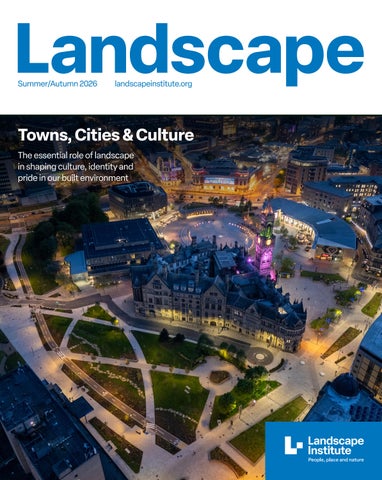
Towns, Cities & Culture The essential role of landscape in shaping culture, identity and pride in our built environment
Extraordinary
for Landscape Architects Product: Solid Serif Hug A Tubs
Project: Bradford Interchange Station Plaza, Bradford
Architect: Fereday Pollard Architects Ltd
New Products 2026-2027
Bento Big Green Bench
STREETLIFE BV
Solid Green Terrace Curved
Drifter Seat
enquiries@streetlife.com
I
www.streetlife.com
I
t. +44 (0) 20 30 20 1509
I FSC® license number: C105477
Open Pipe Pillar
Streetlife BV
Box Bin Wood
streetlifedesign
Welcome
Public spaces become stages for culture. Heritage becomes more meaningful and accessible. Communities feel seen and included. Pride grows. Belonging strengthens.
Find out more on page 11
3
Welcome
How the urban landscape reflects, influences and enables our way of life. Culture: “The way of life, especially the general customs and beliefs of a particular group of people at a particular time.” — Cambridge Dictionary
Marc Tomes CMLI
4
At this particular moment in time, around 83% of the UK population lives in urban areas. Astonishingly, this means that more than 55 million people experience their everyday lives in towns and cities. These urban areas are not only places where people live and work, but they also play an important role in shaping the experiences of the millions of domestic and international visitors who travel across the UK each year. Urban landscapes provide the settings where communities come together, where culture is expressed through art, events and public life, and where everyday moments become shared experiences. These places create memories, tell stories and contribute to the distinctive identities that make our towns and cities unique. At the same time, urban places face significant challenges. They are under increasing pressure to respond to social, environmental and economic change while continuing to meet the evolving needs of the communities they serve. This edition of Landscape explores how landscape can shape and enrich the way of life within our urban environments,
delivering benefits that extend well beyond the physical realm. It also considers how culture, in turn, influences and defines both our existing and future built environments. Building on recent successes, including Bradford’s City of Culture year, and looking ahead to initiatives such as the Pride in Place programme, this edition highlights the vital role of landscape and the expertise of landscape professionals in celebrating culture in ways that are meaningful, inclusive and enduring. Through the projects and perspectives featured here, we demonstrate how thoughtfully planned, designed and managed landscapes can strengthen people’s connection to place. Landscape-led approaches not only celebrate the cultural identity of our towns and cities but also help shape resilient, welcoming and distinctive places for future generations. Built and natural environment professionals have both a responsibility and an opportunity to create high-quality places where people feel they belong, whether through the policies we can shape, the collaborative processes we
Welcome
lead or the places we help to deliver. The projects in this edition demonstrate the breadth of that contribution. Among them are outstanding examples of landscape practice, including last year’s Landscape Institute Awardwinning Greenwich Park Revealed project and other case studies such as Stratford Waterfront and King’s Cross. We also reflect on places of remembrance through the Glade of Light memorial, Manchester, exploring the important role landscape plays in commemoration, healing and collective memory. This edition also pays tribute to two influential figures in the profession, Nigel Dunnett and Brian Clouston, whose contributions to landscape architecture continue to inspire and whose passing this year is deeply felt across our community. We touch on policy matters such as the Landscape Institute’s response to the government’s New Towns Programme and we include a feature on ‘local governance and landscape’. Alongside contributions from Landscape Institute members, we hear from collaborators across the wider built environment and cultural sectors. Their insights offer valuable perspectives on the role landscape plays in delivering successful outcomes within our towns and cities, and invite us to consider what we can learn from those working alongside our profession. Together, they explore how landscape can help foster meaningful connections between people and place. As a Chartered Landscape Architect, former High Street Task Force Expert, a community planner, a member of the Policy & Public Affairs Committee and the Editorial Advisory Panel, I am delighted to present my first edition as Managing Editor of Landscape, centred on this broad yet deeply important theme.
Landscape is everywhere. It is woven through our cities, towns and villages, quietly shaping the places where we live, work and gather. It helps create opportunities for connection, belonging and community pride, while reflecting the culture and identity of the places we call home. As our urban environments continue to evolve, the landscape profession has an increasingly important role in ensuring that these places remain inclusive, resilient and inspiring for generations to come. Urban landscapes do, can, and will always provide people with a strong sense of belonging. They have a profound influence on our way of life as humans, shaping how we live, connect, and identify with the world around us. Perhaps now more than ever, our urban environments continue to define our shared experiences and our sense of place. Please don’t just take my word for it: our first feature article in this edition (Page 8) provides what others think about this. For sure, there is far more that could be said on this subject, but I hope this edition of Landscape offers both inspiration and insight into the powerful relationship between towns, cities, culture and landscape. I hope you enjoy reading it.
At a time when forces seek to divide us, arts, culture and heritage are what bind us together. Lisa Nandy Secretary of State for Digital, Culture, Media and Sport
By Marc Tomes CMLI, Interim Managing Editor / Director of Allen Scott / member of the LI’s Policy and Public Affairs Committee and the Editorial Advisory Panel.
Landscape is printed on paper sourced from EMAS (Environmental Management and Audit Scheme) certified manufacturers to ensure responsible printing. The views expressed in this journal are those of the contributors and advertisers and not necessarily those of the Landscape Institute, Darkhorse or the Editorial Advisory Panel. While every effort has been made to check the accuracy and validity of the information given in this publication, neither the Institute nor the Publisher accepts any responsibility for the subsequent use of this information, for any errors or omissions that it may contain, or for any misunderstandings arising from it.
Landscape is the official journal of the Landscape Institute, ISSN: 1742–2914 © 2026 Landscape Institute. Landscape is published four times a year by Darkhorse Design.
Towns, Cities & Culture Bradford city centre © Sweco
Print or online? Landscape is also available to both members and non-members online. To view online, visit issuu. com/landscape-institute.
5
Contents
xxx PUBLISHER
FEATURE
FEATURE
Darkhorse Design Ltd T (0)20 7323 1931 darkhorsedesign.co.uk studio@darkhorsedesign.co.uk
EDITORIAL ADVISORY PANEL Saira Ali FLI, Team Leader, Landscape, Design and Conservation, City of Bradford Metropolitan District Council Stella Bland, Head of Communications, LDA Design
08
Marc Tomes CMLI, Director, Allen Scott Landscape Architecture
A sense of belonging
Sandeep Menon, Lecturer in Landscape Architecture, Manchester School of Architecture xxx
Exploring what culture means within the xx and cities context of our towns
Jaideep Warya CMLI, Landscape Architect, Allies and Morrison
11 Bradford City of Culture A landscape-led transformation
Jane Findlay PPLI & FLI, Director FIRA Landscape Architects LANDSCAPE INSTITUTE
CASE STUDY
FEATURE
FEATURE
Interim Managing Editor: Marc Tomes CMLI Marketing, Communications and Events Team: Neelam Sheemar Oliver Ryan Tom Jenks Technical Copy Editor: Romy Rawlings FLI
16
19
Pride in Place through landscape
King’s Cross: designing a place for London
Proof Reader: Johanna Robinson President: Saira Ali FLI CEO: Rob Hughes Head of Marketing, Communications and Events: Neelam Sheemar Landscapeinstitute.org @talklandscape landscapeinstitute landscapeinstituteUK
Landscape is not just a finishing touch
CASE STUDY
Industrial heritage and contemporary culture combined CASE STUDY
27 Glade of Light Remembrance and healing in a city centre garden
6
24 Healthy places = Healthy people Compelling evidence-based research
CASE STUDY
30
34
Stratford Waterfront
Me in place and the place in me
Art, culture and nature in one distinct destination
Landscape-inspired poetry and placemaking in Bellaghy
FEATURE
FEATURE
36
FEATURE
41
FEATURE
42
44
Telling tales
Shaping New Towns
This is the place…
Tending Bearwood
The unexpected joy of integrating public art into public realm enhancements
The Landscape Institute’s Call for a landscape-led future
Lessons learned from firsthand experiences of ‘pride in place’ in practice
Community stewardship and the cultural life of landscapes on the urban edge
CASE STUDY
CASE STUDY
46
FEATURE
48
The Teenage Market
Landscape as living heritage
Engaging young people in placemaking
Greenwich Park’s heritage and culture
52 Local governance and landscape Challenges and opportunities for raising the profile of landscape within local government
LI LIFE
54
60 years of shaping landscape LUC’s influence on practice, policy and place
56
Brian Clouston OBE PPLI Landscape architect and pioneer of international practice
58
Nigel Dunnett FLI Remembering the master of the naturalistic look
61
LI Campus On-demand learning
62 Reflections from the RHS Chelsea Flower Show 2026
64
LI pavilion at UKREiiF 2026 Bringing landscape led development to the fore
66
The LI Awards are back Celebrate. Connect. Be Inspired.
70
Leadership, innovations and impact Celebrating Carolin Göhler’s achievements
71
A presidency rooted in hope Meet our new President, Dr Saira Ali FLI
LI members win at Chelsea
7
Research Feature
A sense of belonging Quotes from: Dr Saira Ali FLI / Carolin Göhler FLI PPLI / Ian Phillips CMLI MRTPI / Alice-Rose Hoile CMLI / Andrew Rylah / Scott Carroll CMLI
The culture of the UK is shaped by its rich history, diverse communities and continual exchange of influences from around the world. Across the country, towns and cities each possess distinct identities expressed through art, music, sport, heritage, industry, food, festivals and everyday social life. From historic market towns and former industrial centres to contemporary cities and coastal communities, culture is embedded within both people and place. The landscape of our towns and cities provide the essential canvas upon which culture unfolds, evolves and is experienced. Streets, parks, waterfronts, civic squares, cultural venues, neighbourhood centres and everyday public spaces all help shape how communities gather, interact, celebrate, remember and express their identities. Landscape is therefore not simply the backdrop to culture, but an active participant in enabling and supporting cultural life. In this introductory article and throughout this edition of the journal we explore what culture 8
Exploring what culture means within the context of our towns and cities, and why landscape is fundamental in supporting, expressing and strengthening cultural identity.
1
means within the context of our towns and cities, and why landscape is fundamental to supporting, expressing and strengthening cultural identity. The following quotes, taken from some of those who
have contributed to this edition of Landscape, provide insight into how landscape professionals understand and shape places that foster identity, inclusion and connection, ultimately helping support a positive ‘sense of belonging’.
1 Norfolk Gardens outside Bradford City Hall. © Sweco
Research Feature
What they said: Culture does not happen in isolation. It unfolds in streets, squares, parks, civic spaces and everyday landscapes. The places where people gather, celebrate, reflect and connect are integral to cultural life. Bradford’s City of Culture journey has reinforced my belief that landscape is fundamental to creating places where people feel seen, included and connected. When we invest in landscape, we invest in people, culture and hope, creating places where belonging strengthens and communities can thrive together.
Belonging can mean that some feel they fully belong whereas others never will, but a landscape-led approach is placemaking at its best – not only ensuring beneficial and effective proposals are delivered for a piece of land but also creating unique and enjoyable environments that support the health and wellbeing of both people and nature. Achieving an enhanced sense of belonging for many enables happier, more resilient and fitter communities in light of the dramatic impacts of climate change and the biodiversity emergency.
Landscape has a vital role in shaping places that reflect local character, strengthen community identity and create a genuine sense of belonging. As local governance evolves, we have an opportunity to embed landscape-led thinking from the outset, ensuring development supports nature, health, wellbeing and resilient communities. Landscape must be recognised not as a blocker, but as a valued and essential part of creating sustainable places where people and nature can thrive together for generations to come.
Dr Saira Ali FLI, President, Landscape Institute
Carolin Göhler FLI PPLI
Ian Phillips CMLI MRTPI Chair, LI Policy and Public Affairs Committee
9
Feature
Working on Greenwich Park Revealed has been a rare and rewarding opportunity to help safeguard one of Britain’s most iconic historic landscapes for future generations. Receiving an award in 2025 from the Landscape Institute is a testament not only to the project’s ambition, but also to the care taken to honour the park’s 17th-century character while opening it up in new and meaningful ways. From restoring historic views and features to creating new spaces for learning, volunteering and community events, every element was designed to balance heritage with contemporary needs. Alice-Rose Hoile CMLI, Senior Landscape Project Manager, The Royal Parks
By placing landscape at the heart of planning from day one, we can shape resilient communities that connect people with nature, foster health and wellbeing, and create places with lasting identity and pride. Landscape is not an afterthought or simply a pleasant extra – it is critical infrastructure that helps build communities where people feel they belong, now and for generations to come. Andrew Rylah, Policy & Public Affairs Manager, Landscape Institute
Social and economic problems can also be solved by prioritising the natural world, sociability and culture. What’s more, as you gather the answers to the question, “What’s the change you want to see?”, you can surface the roles and involvement everyone sees for themselves. Because the answers will demand co-creation and dreaming big, with local communities helping to uncover what is precious about a place. Culture builds community, and landscape can provide the canvas to support cultural activation and engagement, places that people care about and can see something of themselves in, welcoming places that democratise the arts and also break down barriers, creating moments of joy and sanctuary. Scott Carroll CMLI, Designer, LDA Design
10
Research Feature
Bradford City of Culture Dr Saira Ali FLI
Culture Needs Place: Bradford’s Landscape-Led Transformation
1 Bradford 2025 UK City of Culture opening event. © Ian Hodgson
11
Feature
In 2025, Bradford stepped onto the national stage as the UK City of Culture. For many, the designation was a celebration of arts, heritage and creativity. For those of us who have helped shape the city over recent decades, however, Bradford’s year as City of Culture represented something much deeper: an opportunity to reimagine the relationship between people, place and identity through landscape. Culture does not happen in isolation. It unfolds in streets, squares, parks, civic spaces and everyday landscapes. The places where people gather, celebrate, protest, reflect and connect are integral to cultural life. In Bradford, landscape has not simply supported City of Culture; it has been central to enabling it. As cities and towns across the UK seek renewal, Bradford offers important lessons about how landscape-led investment can foster belonging, strengthen identity and create places that are inclusive, resilient and culturally meaningful. When Bradford was announced as UK City of Culture in 2022, I remember a collective sense of pride across the district. For many of us who have spent decades working to improve Bradford’s places and champion its potential, it felt
2 12
like long-overdue recognition for a city that has always possessed extraordinary cultural richness, creativity and resilience. But for me, as a landscape architect working in local government, the announcement also represented something deeper. I saw it as an opportunity to demonstrate the essential role of landscape in shaping cultural life and transforming how people experience their city. Too often, culture is understood through buildings or events alone. We think of theatres, galleries, performance spaces and festivals. Yet culture happens everywhere. It lives in the everyday landscapes where people meet friends, celebrate milestones, share traditions, protest, reflect and belong. The truth is simple: culture needs place. And those places matter. Bradford’s City of Culture journey has reinforced my belief that landscape is not secondary to culture: it is fundamental to it. This is placemaking in action.
A city with culture woven into its landscape Bradford is a place of contrasts and complexity. It is shaped by dramatic topography, remarkable Victorian
architecture, industrial heritage and extraordinary cultural diversity. Ours is a district that stretches from dense urban neighbourhoods to valleys, moorland and internationally significant heritage landscapes. As someone who has worked in Bradford for many years, I have always believed the district’s greatest strength lies in the richness of its people and places. We are one of the UK’s youngest and most diverse cities, with communities representing cultures, languages and stories from across the world. Bradford is home to the UNESCO World Heritage Site of Saltaire, magnificent parks, historic civic spaces and landscapes that tell stories of industry, migration and reinvention. Yet Bradford has not always been recognised for its strengths. Like many post-industrial places, we have experienced economic challenge, inequality and underinvestment. Too often, narratives about Bradford focused on deficits rather than possibilities. That is one reason why the City of Culture bid mattered so much. The bid was never simply about securing a title or hosting a programme of events. It was about changing perceptions, building confidence and telling a fuller story about who we are. From the outset, landscape played a critical role in Bradford’s successful bid, announced in 2022. We understood that culture is experienced spatially. Public spaces would become the stages upon which cultural life could unfold. Streets, parks and civic environments would host performances, festivals, everyday encounters and moments of shared memory. Importantly, Bradford’s bid recognised culture in its broadest sense. It was not solely about flagship arts venues, but about recognising the stories embedded in communities, landscapes and lived experience. In a district where over 150 languages are spoken,
2 Upswing at Bradford 2025 celebrations. © David Lindsay
Feature
3
3 Big Zee at Bradford 2025 celebrations. © Simon Drew Photography
any meaningful vision for culture had to be grounded in inclusivity, participation and co-design. Landscape architecture provided the framework to bring these ambitions together, connecting heritage, ecology, health, movement and culture into a coherent vision for place. We understood that if Bradford was to welcome artists, performers, residents and visitors into shared cultural experiences, the city itself had to feel welcoming, connected and inspiring. Public spaces would become stages for culture, not only in the traditional sense, but as places where everyday life unfolds. Culture in Bradford could never be about a single story. It had to reflect multiple identities, histories and experiences. The
spaces we created therefore needed to feel accessible and welcoming to everyone.
Preparing for 2025: creating the conditions for culture to thrive Winning City of Culture status in 2022 was only the beginning. One of the realities of working in local government is that ambition must be translated into delivery, and delivery is never simple. It requires persistence, partnership and often years of groundwork that remain largely invisible to the public. Significant work was needed to prepare Bradford for 2025: to create an environment capable of hosting events, welcoming visitors and reflecting both local pride and
future aspiration. But we also asked ourselves bigger questions. What kind of city did we want people to experience? How could investment benefit residents long after the celebrations ended? And how could landscape help deliver multiple outcomes at once? For me, the answer was clear. We needed to think about public realm not as cosmetic enhancement, but as cultural infrastructure. Central to Bradford’s transformation was the recognition that infrastructure is not simply about buildings and transport. Highquality public realm and landscape are forms of cultural infrastructure in their own right. Through programmes such as the Bradford Transforming Cities Fund (TCF), we worked to reshape the city centre around 13
Feature
4
people rather than vehicles. Streets and civic spaces were redesigned to improve accessibility, active travel and connectivity, while creating environments capable of supporting cultural events and everyday life. But our ambition extended far beyond aesthetics. As landscape architects, we are trained to think holistically. Every intervention became an opportunity to address climate resilience, biodiversity, public health, inclusion and heritage together. We introduced greener infrastructure, improved streetscapes and enhanced walkability, helping reconnect communities with the city centre. Materials, movement and spatial character were considered carefully to ensure interventions responded to Bradford’s distinct identity rather than imposing something generic. What mattered most to me was ensuring these spaces felt authentically Bradford. That meant understanding local stories, listening to communities and embracing the district’s diversity. Successful placemaking cannot happen in isolation. It requires collaboration between residents, artists, businesses, transport specialists, engineers, planners, ecologists and 14
heritage professionals. Some of the most rewarding moments came through this collaborative process: seeing people feel ownership of spaces, watching conversations evolve and recognising how physical improvements can help rebuild civic confidence. As practitioners, we sometimes underestimate how deeply people care about place. When people see investment in their environment, they see possibility.
Beyond 2025: creating a legacy that lasts City of Culture lasts for a year. Landscape legacy lasts for generations. One of my strongest beliefs is that successful regeneration should never end when funding programmes close or media attention fades. The real test is whether people’s everyday lives improve. For Bradford, the legacy of City of Culture is already becoming visible. Bradford’s transformation demonstrates how landscape investment can leave a meaningful and lasting legacy. Public spaces are greener, more accessible and better connected. Streets once dominated by traffic are beginning to prioritise people. New opportunities for
walking, gathering and participation are emerging. Heritage settings have been strengthened, and the city feels increasingly confident in celebrating its own identity. The Bradford TCF programme, recognised through the Landscape Institute Awards in 2025, has demonstrated how landscapeled regeneration can deliver multiple benefits simultaneously. At the same time, Bradford has embraced a broader understanding of resilience. Landscape interventions have contributed to climate adaptation through sustainable drainage, urban greening, biodiversity enhancements and measures that reduce urban heat. These environmental benefits matter because cultural life cannot flourish in degraded or disconnected places. Attractive, safe and healthy environments encourage people to spend time outdoors, participate in civic life and develop stronger emotional connections to place. There is also an important social legacy. Bradford’s City of Culture programme has strengthened civic confidence and challenged outdated narratives about the district. Too often, places facing complex challenges are viewed through a deficit lens. Bradford’s story demonstrates the importance of recognising strengths: creativity, diversity, resilience and community energy. Public space has played a crucial role in this reframing. It has provided visible evidence of investment, care and optimism. Perhaps most importantly, Bradford’s experience reinforces the idea that culture belongs everywhere, including parks, streets, neighbourhood centres and shared landscapes. Cultural links to our landscapes can be an everyday occurrence, not just when curated events are delivered. Working in local government can be challenging, particularly during periods of financial pressure and uncertainty. Yet Bradford has reminded me that transformation becomes possible when people commit to a shared vision and believe
4 Shipley Market Square. © Sweco
Feature
5 Bradford city centre. © Sweco 6 Shipley Market. © Sweco
5
change can happen. Bradford’s City of Culture journey has been built through partnership, determination and collective pride. No single profession, organisation or funding programme can transform a place alone.
A call to action for the profession As I reflect on Bradford’s journey, and as the landscape profession looks to its future, I believe there is an important lesson here. Landscape must no longer be treated as an afterthought. If we want towns
and cities that are healthier, fairer, more resilient and culturally vibrant, landscape thinking needs to be embedded from the beginning. As local authorities across the UK face financial pressures, structural change and increasing environmental challenges, investment in landscape should not be regarded as optional enhancement. It is foundational infrastructure that supports health, climate resilience, economic vitality and cultural participation. Landscape architects bring something uniquely valuable: the ability to connect systems, disciplines and people. We understand how environmental resilience, health, movement, heritage and culture intersect. We know that successful places emerge through stewardship, collaboration and long-term thinking. Bradford demonstrates what becomes possible when landscape is given permission to lead. Public
spaces become stages for culture. Heritage becomes more meaningful and accessible. Communities feel seen and included. Pride grows. Belonging strengthens. In an era defined by climate change, inequality and uncertainty, the role of the landscape profession has never been more important. The future success of our towns and cities will depend not only on the events we programme or the buildings we construct, but on the landscapes we create together. Bradford’s story reminds us of something simple but powerful: when we invest in landscape, we invest in people, culture and hope. Saira Ali FLI is President of the Landscape Institute and Team Leader of Landscape Design and Conservation at Bradford Council.
6 15
Research Feature
Pride in Place through landscape 1 Eastbourne Seafront. © Rupert Kirby Photography
Green space is where wellbeing, identity and belonging are quietly made, which makes landscape not a finishing touch to the Pride in Place agenda but a foundation – and the landscape profession is central to delivering it…
2 I love Eastbourne sign, located along Eastbourne’s valued seafront. © Rupert Kirby Photography
1
16
Research Feature
1
inistry of Housing, M Communities & Local Government (2025) Pride in Place Strategy. Available at: https://www.gov. uk/government/ publications/pridein-place-strategy (accessed June 2026).
2
astbourne E Neighbourhood Board (2025) Pride in Place Regeneration Plan, November 2025. Available at: https:// weareeastbourne. org.uk.
3
ore in Common M (2025) Parks, pride and place: the role green spaces can play in building pride in place and support at the ballot box, November 2025, in partnership with the Town and Country Planning Association and the Green Infrastructure Partnership. Available at: https://www. moreincommon. org.uk/our-work/ research/parkspride-and-place/.
4
own and Country T Planning Association (2025) Parks, pride and place research: 5 key findings. Available at: https://www.tcpa. org.uk/parks-prideand-place-research5-key-findings/.
5
atural England N (2024) A rapid scoping review of health and wellbeing evidence for the Framework of Green Infrastructure Standards. Available at: https:// publications. naturalengland.org. uk/publication/ 4799558023643136.
6
7
astbourne E Neighbourhood Board (2026), Parks & Open Spaces Audit and Projects Pack – Brief, April 2026. Commissioned tender document, We Are Eastbourne/ Eastbourne Borough Council. reater London G Authority (n.d.), Exploring London’s Public Realm. Available at: https:// www.london.gov.uk/ sites/default/files/ exploring_londons_ public_realm.pdf.
Joanne Rogers
The Pride in Place Strategy is the government’s plan to create safer, healthier neighbourhoods where communities can thrive, with longterm investment targeted at the places facing the greatest social and economic disadvantage. At its heart sits a simple proposition: that the quality of the places people live in has a direct bearing on wellbeing, opportunity, pride and resilience.1 It is a concept I have come to believe is true street by street rather than in the abstract. The question this article asks is a practical one: what can landscape, and the landscape profession, contribute to delivering it? I write as a placemaking consultant, former High Streets Task Force Expert and a member of the Eastbourne Neighbourhood Board, which is overseeing a £20 million, ten-year Pride in Place programme. Our Regeneration Plan sets out five priority themes and one of them, Natural Eastbourne, places the town’s coastline, chalk downland, parks and urban green spaces at the centre of renewal rather than at its edges.2 That choice was not made in isolation by the Board but by local people.
What people actually value When we ask Eastbourne residents what matters most to them, they rarely begin with buildings. They begin with the seafront, the South Downs, the parks and gardens. This is not a local quirk. Recent national research by More in Common, in partnership with the Town and Country Planning Association, found that parks and green spaces are Britons’ single biggest source of local pride and this is true across voters of every political party.3 The
same research found that the mental health benefit of green space is the benefit people value most, rising to almost six in ten among those living with a mental health condition, and that improving green space would do more to rebuild public faith in the government’s ability to better people’s lives than many flagship policies.4 For a programme explicitly designed to restore pride and confidence, that is a striking finding: landscape is not a soft add-on to the agenda; it may be one of its sharpest instruments. The wellbeing case is now well evidenced. Natural England’s scoping review for the Framework of Green Infrastructure Standards draws together the links between green infrastructure and physical health, mental wellbeing, climate resilience and biodiversity, and it is clear that the benefits are greatest in the more disadvantaged urban areas Pride in Place is meant to reach.5 This matters especially in Eastbourne, where healthy life expectancy sits below regional levels: nearly one in three working-age residents report a work-limiting disability, almost one in ten Eastbourne residents are unpaid carers, and demand on primary care runs well above the national average. Landscape professionals already work fluently across health, movement, climate and ecology – which is precisely the combination this agenda demands.
Starting where people stand If pride is built anywhere, it is built locally – at the scale of a bench, a verge, a row of replacement trees. Eastbourne lost much of its canopy to ash dieback and Dutch elm disease, and residents have been vocal in wanting ‘leafy Eastbourne’ back. So the Board has begun its work close to home: small per-ward funding for community-chosen quick wins, a spring clean-up of neglected public realm corners, and a townwide audit of our parks and open spaces to produce a co-created,
ten-year Strategic Projects Pack.6 A landscape architect was deliberately sought to lead the audit because the questions it must answer, about condition, accessibility, connectivity, biodiversity, climate adaptation, usage and future maintenance, are landscape questions before they are anything else. A key learning is that landscape’s real value in Pride in Place is integrative. A good landscape-led approach holds several priorities in one frame at once. A green corridor is simultaneously active travel, flood management, biodiversity, a safer route to school and a source of everyday pride. The profession’s habit of thinking spatially and over the long term is exactly what stops investment fragmenting into disconnected gestures.
2
Belonging needs more than design Pride, though, is emotional before it is physical. People protect and take pride in places they feel they belong to, and belonging is built through culture, heritage and shared stories as much as through good design. The Greater London Authority’s work on the public realm makes the same point: well-made public space generates a greater sense of community and pride, not merely a functional improvement.7 And in my own consultancy practice, I have seen how landscape becomes meaningful when its history is known, and its future is shaped by the people who use it. A small example illustrates the principle. For Wealden District Council, my company delivered 17
Feature
3
4
the Cuckoo Trail Arts & Heritage Programme along a former steam railway line now used daily by walkers and cyclists. Funded through the UK Shared Prosperity Fund, but very much in the spirit of Pride in Place, it paired a 14-mile landscape masterplan with public art, and heritage interpretation with free nature-based art workshops (reaching 1,138 participants, from primary-school children to carehome residents living with dementia), alongside an augmented-reality wildlife trail for families.8 One teacher noted that the children use the greenway daily to travel to and from school and that our programme made their local area newly relevant to them. The landscape did not change; the relationship to it did. That is the quiet mechanism by which pride takes hold, and it is one landscape professionals can 18
design for deliberately, through interpretation, play, storytelling and the involvement of children, who are markedly less likely to damage a place they connect with.
Stewardship, collaboration and the profession ahead But none of this lasts without stewardship. In Eastbourne, 16 ‘Friends’ groups already maintain green spaces, and a rich ecosystem of growing, conservation and food organisations exists, although too often in isolation. As a Neighbourhood Board, our approach is to support and connect grassroots activity rather than replace it, including through a proposed Natural Eastbourne Network and a deliberate insistence that every funded project carries a resilience plan from the
outset. This reflects a wider truth: community-led landscape needs professional backing, funding and governance to remain sustainable, particularly in more deprived areas. The shift is from designing for communities to co-designing with them as active citizens; a move the Board is taking seriously as it explores a groundbreaking ‘minipublic’ citizen forum and a youth shadow board.9 Delivering this well is beyond any single discipline. Pride in Place asks local authorities, communities, developers, artists, designers, businesses, ecologists, place-makers and public-health professionals to work as one, and landscape is frequently the connective tissue between them. That points to where the profession must grow. The technical skills of spatial planning, green infrastructure, ecology and placemaking are already there. What the agenda demands in addition is fluency in public health and social value, confidence in community co-production and, above all, the advocacy and leadership to argue for the landscape as core infrastructure when budgets are set, not to defend the line that is cut first. That, ultimately, is the premise of this article. Landscape is not simply the space between buildings: it is the framework within which communities can flourish. In the context of Pride in Place, landscape professionals are uniquely positioned to connect people to place, strengthen local identity through heritage and culture, and support long-term civic and environmental resilience. In Eastbourne, residents told us where their pride lives. Our task, as a Board, and as a place profession, is to be worthy of that answer. Joanne Rogers is owner of Prowse & Co Ltd and a Member of the Eastbourne Pride in Place Neighbourhood Board.
8
rowse & Co Ltd P (2024–25), Cuckoo Trail Arts & Heritage Programme, delivered on behalf of Wealden District Council under the UK Shared Prosperity Fund (UKSPF). Programme summary and UKSPF end-year report.
9
lexander, J. (2022), A Citizens: Why the Key to Fixing Everything Is All of Us, Canbury Press.
3 Eastbourne bandstand and pier. © Rupert Kirby Photography 4 Pride in Place engagement event where stakeholders and residents were invited to a relaxed, informal drop-in session to share their thoughts and idea about the parks and open spaces across Eastbourne. © Allen Scott
Case Study
King’s Cross: designing a place for London Martha Alker
1 Gasholder Park.
In 2000, the land directly north of King’s Cross and St Pancras stations in central London was a neglected, post-industrial wasteland. Its industrial past remained highly visible, and the area suffered from a notoriously run-down, seedy reputation. The site was split in two by the Regent’s Canal. The southern section was dominated by decommissioned gasworks, including the historic gasholders, and the northern section featured the Goods Yard, along with a cluster of heritage buildings. The names of the Granary Building, the Coal Drops and the Fish and Coal building hinted at their past functions. These were all tucked behind a perimeter wall deliberately designed to keep goods in and people out. Since then, the area has been completely transformed. The first major step came in 2000 with extensive works to improve
Few places in London can match the richness of old and new found at King’s Cross, a place where industrial heritage, contemporary culture, and future ambition coexist to create a distinctive sense of place and possibility. the King’s Cross St Pancras Underground station. This was followed by the major renovation of the Grade I listed St Pancras Station, which incorporated the Eurostar extension, and officially opened in 2007. In 2012, the new King’s Cross Railway Station ticket hall, designed by John McAslan + Partners, was unveiled. These foundational infrastructure projects provided the catalyst for the wider, multi-billion-pound development of King’s Cross led by the developer, Argent. In 2001 Townshend Landscape Architects joined the team, alongside Allies and Morrison Architects and Porphyrios Architects, to develop the King’s Cross masterplan. The masterplan team developed a collective way of working that allowed a variety of voices to be heard, from the extensive public consultation to the integration of other built environment consultants. By sharing, debating and testing
ideas, the team united around a shared ambition: to create an exceptional place. Ultimately, this approach allowed the development to respect and draw from the site’s unique historic grain while boldly creating a new neighbourhood for the future. The masterplan sought to stitch the new development into the surrounding urban context,
1
© Townshend Landscape Architects
19
Case Study
x xx xxx
x xx
2 King’s Cross, St Pancras Square.
2
addressing the challenges of connectivity and building on the site’s positive attributes: its excellent public transport connections, historic narrative, Regent’s Canal setting and proximity to central London. The masterplan for the 67-hectare site was largely designed around the public realm, including ten new parks and squares along with 20 new streets. Two key routes were identified: the first established an east–west connection between Camden and Islington along the Regent’s Canal corridor and the second forged a central spine extending northwards from Battlebridge Place. Following planning consent in 2006, delivery of the masterplan started in earnest in 2008. One of the biggest challenges of King’s Cross has been to turn a ‘no go’ area into a
20
© Townshend Landscape Architects
desirable, safe destination. The public realm has played a large part in achieving this by being the place from which day-to-day life can play out. Delivered in advance of many of the buildings and their occupiers, it has invited the public to inhabit the site and be part of the new emerging neighbourhood. To generate footfall, one of the early strategies was to use the completed areas of public realm to host a number of mostly free, temporary and pop-up activities. As observed by William H Whyte in his study of human behaviour in urban settings: “What attracts people most, it would appear, is other people”.1 Events included King’s Cross Sports Day, yard sales, concerts and pop-up screens for sports and films. A collection of pop-up street food vendors drew in visitors looking for fast, fresh lunchtime food. An
arts programme delivered several temporary installations, which the public were able to engage with. Fast forward to today and the development is nearing completion. Plot by plot, each phase has contributed to the creation of a neighbourhood in which people feel comfortable where they can and enjoy their surroundings. The development now includes the University of the Arts Central St Martins campus, Picturehouse Cinema, King’s Cross Academy School and many shops, restaurants, offices and homes. The design process sought to create a landscape that would become part of the fabric of London and transform an industrial working environment into one that supports leisure, culture and nature without losing its identity. As a reflection of its London setting, a constrained palette of
1
hyte, William H. The W Social Life of Small Urban Spaces. Conservation Foundation, 1980.
Case Study
3 Granary Square. © Townshend Landscape Architects
traditional materials and layouts was used in the streets to provide a tonal cohesion to the public realm. The palette is comprised of granites in warm tones, Yorkstone, weathering steel and large format timber pieces. In Granary Square, the original granite setts, railway lines, turntables and capstans were incorporated into the scheme. The 1,080 water jets are located where there was once a busy canal basin, bringing water back as the focus of activity in a way that would allow people to interact with it. The masterplan has evolved and adapted over time in response to change and following
observations of how public realm is, and could be, used. Several changes have been made, which broadly fall within three main themes: firstly, reduced vehicle access. While the masterplan allowed for minimal traffic, as a reflection of being a city centre site, this has been minimised further in the project delivery. Secondly, by prioritising places for people to dwell and engage with their environment we were able to increase the areas of soft landscape, particularly along the canalside corridor where the masterplan was originally a predominantly paved setting for
the historic buildings. Thirdly, as the site became more established, the events strategy evolved. Regularly turning off the fountains in Granary Square to accommodate events proved increasingly disruptive so, as a result, the brief for Lewis Cubitt Square was revised so that it could become the principal event space.
3
21
Case Study
We wanted the development to become a pluralistic neighbourhood for people to explore, and not an enclave for only those who live and work in the buildings. As the project has opened up it has welcomed visitors in and allowed them to occupy the public realm. This is where the majority of people
4
22
experience the development and encounter its architecture; here, as with many other sites, it is the glue that binds the project together. The team that has worked on the project has been vast, with many architects, artists, asset management teams, designers, engineers, property managers and developers, town planners,
charities, councillors, and of course landscape architects. With construction nearing completion, we can now reflect on the lessons we have learned on the way. One reason the masterplan succeeded was as a result of the teamwork approach: throughout the project there has been a shared culture that recognised King’s Cross as a
4 King’s Cross plan. © Townshend Landscape Architects
Case Study
rare opportunity to contribute to an extraordinary project and to the long-term fabric of central London. Its success has allowed the public realm to play a significant role in placemaking and it’s clear that it has created much more than just the setting for the buildings. It is the space where the built environment meets nature,
where the public can enter, dwell in, engage with and enjoy the city. We expect that, as with all neighbourhoods, the area will continue to evolve over time as the occupiers change and mould their new city environment. Ultimately, the greatest measure of the project’s success will be the extent to which King’s Cross is no longer
regarded as a regeneration project, but simply as another much-loved part of London. Martha Alker is Director at Townshend Landscape Architects
23
Research
Healthy places = Healthy people Compelling evidence-based research reinforcing the essential relationship between people and place. Marc Tomes CMLI
Rosie McEachan
We often think about health in terms of hospitals, healthcare services and medical interventions. Yet some of the most powerful influences on our health are found closer to home: on the streets we walk, in the parks where we play, in the homes where we live, and in the public spaces where we meet and connect with others. For decades, evidence has demonstrated the health benefits of access to nature and well-designed public spaces. Green spaces support physical activity, reduce stress and improve mental wellbeing. Safe and attractive streets encourage walking and cycling and foster social connection. Trees and vegetation can help mitigate the effects of extreme heat and minimise the impacts of flooding. The impacts of urban landscape extend beyond measurable environmental and health outcomes. The public realm is where everyday culture and community unfold. Markets, festivals, community events, informal gatherings and spontaneous encounters depend upon the quality of the spaces that host them. A well-used park or town square is not simply a piece of infrastructure; it is a stage for civic life.
24
Emily Nix
When people feel connected to a place, they have greater social involvement; they participate in community activities, support local initiatives and feel like they belong. Place attachment, the emotional bond between people and place, can boost mental health, improve life satisfaction and reduce loneliness. Well-designed and maintained places, therefore, not only shape our physical and mental
1
wellbeing, but also the culture and sense of belonging of our towns and cities. Healthy urban places support healthier, happier and more connected communities and more resilient places. Creating healthy urban places has never been more important. Across the UK, towns and cities face a set of complex challenges: health inequalities, a climate crisis, social isolation, economic uncertainty
1
cEachan, R. R. M C., Santorelli, G., Watmuff, A., Mason, D., Barber, S. E., Bingham, D. D., Bird, P. K., Lennon, L., Lewer, D., MonWilliams, M., Shire, K. A., Waiblinger, D., West, J., Yang, T. C., Lawlor, D. A., Pickett, K. E., & Wright, J. (2024). Cohort Profile Update: Born in Bradford. International Journal of Epidemiology, 53(2), dyae037. https:// doi.org/10.1093/ije/ dyae037.
1 How to make a healthy city. © Healthy Urban Places
Research
2
cEachan, R. (2023). M AIR QUALITY: Pollution and health [Evidence Briefing]. Born in Bradford. https:// borninbradford.nhs. uk/wp-content/ uploads/2023/04/ HG2929-BIHR-BiBEvidence-BriefingCAZ-Air-Quality-10. pdf
3
cEachan, R. (2023). M Green Space and Health: Evidence and Interventions [Evidence Briefing]. Born in Bradford.
4
owling, L., OrtegonD Sanchez, A. & McEachan, R. Making Children-Friendly Streets Lessons Learnt from Bradford District’s School Street Schemes. (2025).
5
owling, L., D Barnes, A., Nix, E., Cartwright, C., Lightfoot, K., Knamiller, C., & McEachan, R. R. C. (2025). How to make a healthy city – Evidence and recommendations to maximise health co-benefits of urban regeneration v1.0 2025. PHI UK Healthy Urban Places.
6
ashid, R., Chong, R F., Islam, S., Bryant, M. & McEachan, R. R. C. Taking a deep breath: a qualitative study exploring acceptability and perceived unintended consequences of charging clean air zones and air quality improvement initiatives amongst low-income, multiethnic communities in Bradford, UK. BMC Public Health 21, 1305 (2021).
7
ebrahtu, T. F. et al. M Impact of an urban city-wide Bradford clean air plan on health service use and nitrogen dioxide 24 months after implementation: An interrupted time series analysis. Environmental Research 270, 120988 (2025).
and increasing pressure on public services. At the same time, the role of communities is now recognised as crucial for stronger local identities and renewed pride in place. This is where landscape professionals have a unique role to play. Through planning, design and stewardship, they can create places that deliver multiple outcomes simultaneously. A street designed for active travel can improve health, reduce emissions and support local businesses. A park can enhance biodiversity, provide opportunities for recreation, host cultural events and strengthen community cohesion. A public square can become both a climate-resilient space and a focal point for civic identity. But how do we convince policymakers to back investment into places to maximise their health benefits? For over 18 years, the Born in Bradford project has been collecting evidence on the impacts of places on health, and using it to change a city. Bradford is the fifth largest metropolitan district, home to over 550,000 residents. It is a vibrant and young city home to a diverse and multi-ethnic community. But like many other urban areas it has its fair share of burden. There are many families living in areas of high deprivation, and this, combined with unhealthy environments, means that there are high levels of health inequality. Born in Bradford is a longitudinal birth cohort study which was set up in 2007 to understand why some families stay healthy and why others fall ill. Between 2007 and 2011 it recruited over 12,500 mums and over 13,500 babies, and it has been following up their health ever since.1 “Our Healthy Urban Places programme is working with communities, local partners and decision-makers to understand and shape urban environments to improve health and wellbeing,” says Rosie McEachan & Emily Nix from Born in Bradford. “Our Born in Bradford research provides compelling evidence of this
relationship between people and place. We uncovered how high levels of air pollution in Bradford are linked with low birth weight, higher blood pressure and poorer brain development in children.2 We have shown that families in greener parts of Bradford have better health outcomes, but that it is the quality, not the quantity, of green space that really matters.3 We have shown that access to green space is limited and how this limits the physical activity of children aged 7 to 11 years.3 Children and parents have told us that safer and more attractive streets would enable children to walk or cycle to school and improve children’s mental wellbeing and physical activity.4” “Perhaps most significantly, our research shows that families living in areas with the highest levels of deprivation tend to have less access to high-quality green space, higher exposure to poor air pollution and a greater density of fast-food outlets.5 As the number of environmental risks increases, so does the ill-health of communities that live in those areas.5 Prioritising investments in more deprived neighbourhoods will maximise health gains and reduce health inequalities, ensuring our towns and cities are more equal.” “Importantly, our research demonstrates that meaningful engagement with local communities can ensure improvements are successful and address local priorities and inequalities.6 As a result of our evidence there have been numerous investments into Bradford to make our city a healthier and fairer place to live. For example, we have supported the implementation of an ambitious Clean Air Zone in the city and we have tracked its impact – our preliminary analysis found that after one year respiratory health in the city had improved, reducing the burden on GP surgeries, and saving the NHS £30,000 every month.7 We have championed neighbourhood approaches to increasing physical activity, attracting investment into urban and pocket parks, and co-designing green spaces with communities making them safe places to play.”
“Our communities understand the strengths, challenges and stories of the places they inhabit. We are connecting communities, community researchers, city authorities and other local actors to integrate community evidence in research and policy processes. By involving local people in shaping their environments, places will better reflect local priorities and celebrate local identity.” As local government structures evolve and communityled initiatives become increasingly common, the role of co-production in the landscape profession will become even more significant. Programmes focused on pride in place, culture-led regeneration and community empowerment all depend on high-quality public environments that enable participation, interaction and shared experiences. This will create stronger ownership and help ensure that places remain valued and cared for long after construction is complete. Healthy places create healthy people. They create opportunities for culture to thrive and communities to flourish and belong. Landscape is essential infrastructure for both health and culture; we can create urban environments that are not only more sustainable and resilient, but also more meaningful, inclusive and enduring. The evidence is clear. The challenge is now ensuring that landscape is recognised, invested in and championed as a fundamental component of healthier towns, healthier cities and healthier lives. Marc Tomes CMLI is a Director at Allen Scott. Rosie McEachan is Director of Born in Bradford. Emily Nix is Healthy Urban Places Research Programme Coordinator for Born in Bradford.
25
Why partner with the Landscape Institute? The Landscape Institute (LI) is the Royal Chartered body for the landscape profession and a charity championing the importance of landscapes everywhere. We support members to shape places that provide long-term value to people, place and nature. The LI works with a wide range of organisations and sectors across the UK and internationally to influence policy, support education, develop our members’ expertise and deliver positive environmental, social and economic outcomes.
Beyond joining the LI as a member, there are many other ways we would like to work with organisations. ▪ Joint Action on Policy, Research ▪ ▪ ▪ ▪
and Technical Guidance Developing a diverse and skilled workforce Sponsor or contribute to CPD training and LI events Value of working with the LI for developers and investors Become a Registered Practice
Find out more by visiting out website:
26
Case Study
Glade of Light A remarkable and emotive city centre garden offering a welcoming place of remembrance and healing.
Andy Thomson
Shivani Gunawardana CMLI
On 22 May 2017, 22 people, both concertgoers and loved ones waiting for them, had their lives taken in a terrorist atrocity at the Manchester Arena. The
1 Early design of
1
Glade of Light has been created as a memorial garden: a place to reflect, to remember and a lasting testament to love. The garden is a special place where people can briefly pause time, find a place of quiet and stillness in their busy lives, reflect and linger a while. We wanted to create a wild and beautiful garden that embraces you within its reach, somewhere to feel connected to nature and see the passing of the seasons and years. The delicate and complex design for the memorial needed to be welcoming and inclusive, but also offer moments of silence and stillness.
It was important to allow space and time for people to pause. In Japanese culture this can be described by a single word – Ma. Designing for Ma is about creating moments of awareness and quiet. The developing design aimed to focus on what was truly important and not be burdened by superfluous details. It was about purity and simplicity. Care and accuracy in the design process, down to the last detail, was important to show respect to all those involved. At the heart of the memorial, a pure white halo of stone balances delicately above the rugged landscape in a sunny glade, creating a calm and invisible energy within its embrace. The names of the loved ones that lost their lives have been inlaid in bronze within the Carrera marble circle. Beneath the bronze hearts set around the marble halo are memory capsules, within which the bereaved families have left special memories, private messages and meaningful mementoes. This was an incredibly important and intrinsic part of the design. These memories are always present and, at the same time, they are hidden as deeply personal moments that only the families can truly understand. Inspired by the colours and wild beauty of the nearby
Glade of Light. © BCA Landscape
27
Case Study
Peak District heathlands, the planting within the sunny glade of grasses, heathers, bulbs and perennials changes throughout the year – through crimson, cerise, ruby, magenta and amethyst. In the dappled shade beneath the trees grow mosses, ferns, snowdrops, wood anemones and sages. Within the planting sit ridges of weathered sandstone boulders, reminiscent of the High Peak escarpments, or ‘Scarps’ and ‘Edges’, as they are known. The beneficial emotional and physical restorative powers of this quiet, green and welcoming place have been wonderful to witness. Many visitors return on a regular basis to pay their respects, find a quiet moment in the middle of a busy city and enjoy the changing colours, movements and scents within the garden. This is a remarkable and emotive project which has managed to not only create a unique city centre space but, more importantly, offers a welcoming place of remembrance for people visiting from all over the world. The garden reflects that the process of healing is always ongoing, needing space, understanding and time. We are honoured to have played some role in establishing it.
2
3
Andy Thomson, Director and Shivani Gunawardana, Senior Landscape Architect – BCA Landscape
2 3 4 A place for personal and communal remembrance, grieving and healing.
5 Inspired by the colours and wild beauty of the nearby Peak District Heathlands.
© BCA Landscape
© Glenn Maguire
4 5
28
Case Study
29
Case Study
Stratford Waterfront
Scott Carroll CMLI
A celebrated and activated landscape that brings together art, culture and nature to create a distinct destination – one that encourages overlap between audiences, communities and activities through food markets, outdoor exhibitions, performances, recitals and everyday social interaction.
Stratford Waterfront at East Bank is one of the most exciting things to happen in London since the 2012 Olympic Games. Part of a £1.1 billion new cultural and educational district in Queen Elizabeth Olympic Park (the Park) the area has been designed to pull London’s centre of gravity east and create a 21st-century equivalent to the Museum Quarter in South Kensington. From the start, the public realm was recognised as having a key part to play. The Mayor of London’s vision for East Bank is a place that addresses social and economic inequality through access to worldclass culture and education on the doorstep. The design intent was to create a place where, regardless of background, everyone was welcome and local people felt that what was on offer was for them. For the big names in culture putting down roots there, it is a chance to find new and younger audiences. The bar is set high, with the arrival of four leading British institutions – Victoria & Albert (V&A) East Museum, London
30
College of Fashion, BBC Music Studios and Sadler’s Wells East. Thankfully, the idea of space working hard as ‘common ground’ was embraced by all institutions, with Sir Tristram Hunt, Director of the V&A, describing the public realm as a modern-day agora that is democratising the arts.
1
This ambition for equity is part of a continuum. A decade ago, the key principle for LDA Design’s masterplan for the University College London East campus at East Bank was to eliminate the ‘town and gown’ effect of elite institutions by channelling the inclusive, welcoming and relaxed
Case Study
2
1 Stratford Waterfront Hip Hop Games. © Neil Speakman 2 Stratford Waterfront. © Neil Speakman
values of the Park. This spirit has informed the approach adopted for Stratford Waterfront. The landscape unifies and frames a terrace of different buildings. A striking skyline was created for Stratford Waterfront by a design team led by Allies and Morrison. At one end of the terrace, the V&A East Museum, by architects O’Donnell + Tuomey (ODT), is boldly faceted. It opened with an exhibition that explores the power and impact of Black British music. At the other end, Sadler’s Wells East, also designed by ODT, is topped with a sawtooth factory roofline that references the area’s industrial past. The venue incubates and develops dance
form, including hosting Breakin’ Convention, the world’s biggest festival of hip hop theatre, which is run by an organisation supporting street and youth culture. Care was taken with thresholds and open edges to make the buildings feel welcoming, with airy and activated ground floors. Sadler’s Wells East has an expansive, fully glazed foyer, for example, with a space called ‘The Dance Floor’, that hosts dance classes, workshops and community and artist practice sessions. At 1.5ha, the site is constrained and an eight-metre level change made it technically challenging. The solution included a podium with active edges that
could conceal infrastructure. A series of terraced green walkways and paths ascend gently from the Park to join an upper promenade. These terraces include generous seating and spaces designed to host free public events and outdoor cultural programming, curated by the institutions with the local community. All the terraces enjoy a sunny, southfacing outlook, including V&A East Museum’s roof terrace with its views across the Park. The public realm of Stratford Waterfront needs to offer a comfortable place in which residents, students, workers and visitors can spend time. The diversity of social edges provides
31
Case Study
x
opportunities for informal exchange and encounter. Seating includes niches for wheelchair users, and there is step-free access through the site. This is public realm that supports an ambition for both global xx reach and local impact, with a mosaic of spaces designed for cultural events inviting exchange between performer, spectator xxx through and setting. Additionally, the inclusion of biophilic design principles, a rich, natural sensory experience is embedded that lifts the mood, fosters creativity and fuels cultural endeavour. Space has been shaped to x provide a spectrum of experience, from sanctuary and immersion to spectacular city prospect. After xxsoft lighting introduces a sense dusk, of drama and romance, making the space feel safe and inviting, while respecting the nighttime ecology of the river below. The topography is steep enough to bring to mind sketches of plant distribution in the Andes by 19th-century Prussian explorer and naturalist, Alexander von Humboldt. The lower levels are richly verdant, and planting communities gradually transform with increasing altitude. There is a spirit of wildness
throughout, inspired by nature’s colonisation of post-industrial landscapes, as if seeds have blown in on the breeze and communities have found a foothold to thrive. Scott Carroll is Director at LDA Design and design lead for the public realm and roofscapes for Stratford Waterfront, East Bank.
3 Stratford Waterfront. © Neil Speakman 4 Stratford Waterfront terraces. © Scott Carroll
3 4 32
Case Study
Space has been shaped to provide a spectrum of experience, from sanctuary and immersion to spectacular city prospect. 33
Case Study
Me in place and the place in me Landscape-inspired poetry and placemaking in the village of Bellaghy. James Hennessey CMLI
The village of Bellaghy in County Derry is in many regards typical of a small rural settlement in Ulster. Yet walking along its main street, a grand zinc roof that catches the eye signals something special. HomePlace
1
34
is an arts and literary centre opened in 2016 to honour Bellaghy’s most famous son – the poet and Nobel laureate, Seamus Heaney. Celebrated for his “lyrical beauty and ethical depth”1 Heaney’s poetry weaved together deeply personal narratives of memory and place, touching the hearts of millions during the troubled times of Northern Ireland’s recent past. The centre is widely considered a success and enjoys a steady
flow of visitors through its doors. Yet the challenge since opening has been to find ways for such investment and footfall to help regenerate the village, which still struggles with vacancy and dereliction. One initial response after opening was to invite visitors on a poetry trail around the village and beyond into the landscape that so inspired his words. Open Ground comprises interventions at five locations designed by
1
ress release: Nobel Prize P Outreach Mon. 6 Jul 2026. https://www.nobelprize. org/prizes/literature/1995/ press-release/
1 Bellaghy drawing by Anna, aged 9. © The Paul Hogarth Company
Case Study
2 Bellaghy church. © The Paul Hogarth Company 3 Bellaghy HomePlace. © The Paul Hogarth Company
2
Tandem interpretative designers and The Paul Hogarth Company (TPHC) landscape architects. Each bespoke intervention features an artwork, seating and planting that invite you to experience the landscape through poetry. With the touch of a button, Heaney’s voice can be heard reciting his words to you about that place. Another solution was to develop a roadmap for the future, with TPHC commissioned by Mid Ulster District Council in 2025 to prepare a regeneration strategy. A collaborative process of public events, workshops and surveys was used to help the community shape their vision for their place, while the insightful ideas of local school children were brought alive through vividly coloured drawings. Strategy proposals include the tackling of dereliction through redevelopment, with the continued use of art to bring about shortterm transformations. Investment in the public realm is also proposed to greatly improve the quality of the pedestrian experience and at the request of local school children, make the heavily trafficked Main Street “less scary”. Funding is now in place to establish a writer’s residence in the historic Bellaghy Bawn, further cementing the village’s reputation as a centre for literary endeavour. Bellaghy is a place where a landscape and its people inspired one of the greatest poets of our age. Today a new generation looks to the future of their place, with landscape continuing to shape not only how the village is experienced, but also how its cultural identity is understood and celebrated. James Hennessey is a Director at The Paul Hogarth Company.
3
35
Research Feature
Telling tales The unexpected joy of integrating public art into public realm enhancements. Steve Sawyer
“We don’t do arts projects in Manor Royal.” Almost word for word, this is what I said when confronted by someone asking me about my thoughts on yet another arts strategy for Crawley. Surprising then that, alongside my day job, I would end up as the first Chair of Creative Crawley and play my part in leveraging millions of pounds to support arts and culture in the town. But we still don’t do arts projects in Manor Royal. That said, at the last count, we have worked with at least 15 artists over the years including photographers, filmmakers, blacksmiths, sculptors, architects, dancers, musicians, muralists and poets. And yet, I maintain, we have never done a single arts project since the Manor Royal BID was created in 2013. I should explain. Before taking on the challenge of helping to create and later manage the Manor Royal Business Improvement District (BID), the UK’s largest ‘industrial’ BID, I was an eager economic development guy at my local council. Manor Royal wasn’t in a good place. Companies were leaving. It was 40% empty. Some business leaders described it as “a bit of a dump” and “not very glamorous”, making it difficult to attract and keep staff. Neglected and outdated were other words they used. Signs of a place in decline, you might say. Or, with the right 36
conditions and the right people, signs of a place about to experience a resurgence. So began the challenge of trying to figure out what was going wrong (quite a bit) and what needed to happen to put it right (quite a lot). Armed with my latest issue of the Regeneration Thesaurus (surely there is such a thing?), I ventured out to meet business leaders to seek their views and share my naïve ideas for more innovation, better skills and higher productivity. It was during one of my elegant proclamations that the Managing Director of one company stopped me, politely agreed with everything I said and then took me to his office window: “If you can just put a bench on that verge my staff would be delighted.” This was my first proper lesson in place. The best answers are sometimes the simplest. They may not always be easy to deliver, but they should always put people first. This set me on a different path to take a fresh look at Manor Royal and
1 Bespoke public artwork, Keki’s Fusion, by Karl Singporewala integrated into new public space within Manor Royal. © Manor Royal BID
1
2 Keki’s Fusion, by Karl Singporewala. A six-metre-high public sculpture conceived as both a personal memorial and a civic landmark, integrating narrative, infrastructure and place-making. © Karl Singporewala
2
Research Feature
37
Feature
3
understand why people felt disconnected from each other and dissatisfied with the place they were expected to locate their businesses. Remarkably just 13% of people said they were satisfied with Manor Royal as a place to work and do business. An entirely unacceptable position. By now, we had ditched the thesaurus and were armed with a business plan. It was, and still is, an essential document, but it didn’t properly articulate the humancentred change we needed to make and it certainly didn’t say anything about art. We needed to bring the community together, change the key points of entry and create new outdoor space that was accessible to all. The public realm needed to
4 38
improve, and the environment was in serious need of upgrading if it was to support people’s feeling of wellness, tackle that entrenched lack of satisfaction and engender some sense of pride. But still we weren’t talking about art. What we were talking about was reimagining the entire character of the business park, to elevate it beyond an intensely developed place with no seats, big roads, thousands of vehicle movements, hundreds of different commercial buildings, poor supporting infrastructure and lack of character. In the reimagining we found a role for art. Not for its own sake, but as a tool for changing the fabric and perception of Manor Royal. Still, that wasn’t enough. Public art goes wrong where there is a lack of integration, where it feels irrelevant, or where it is generic and fails to respond to its unique setting as part of a cohesive plan for the landscape. Where it is part of a broader vision, is place specific and resonates with the local narrative, reflecting the quirky personality of the place, it can be very powerful. And when you involve the community that energy is amplified. Art is subjective. Two people can look at the same object or
engage in the same experience and have very different feelings about it. It can also be quite difficult to quantify the value of it, its contribution and return on investment. This is especially true when we fall victim to ‘arts wash’ by sticking a random sculpture bought from a catalogue in the middle of a roundabout, daubing the pavements with street art because we saw it in Barcelona or putting on a fancy show you saw in Edinburgh because it would be good for ‘your’ people. Or when a developer must meet a planning obligation, so buys an offthe-shelf solution to uplift the spirits of the residents of a new housing development. People can smell when something is not authentic. They have an instinct for it, and it can sometimes have the polar opposite effect to that which you intended. But when people feel connected in some way to what you have done, when they have been involved and the intervention plays its part in telling the story of your place, that lands differently. It’s more interesting, it’s engaging and it’s unique. Our approach involved bringing on board landscape architects who understood the
3 Green Lung, by Andrew Mckeown. Integrated into new outdoor art gallery space at Crawter’s Brook People’s Park, Manor Royal. © Manor Royal BID 4 The ‘Big M’, a super-sized geometric public sculpture by Allen Scott located at Gateway 3 in Manor Royal. © Allen Scott
Feature
5 Crawter’s Molecules, by Andrew Mckeown incorporates the theme of science, a reference to the prevalence of science-based businesses within Manor Royal. © Manor Royal BID 6 Connections, by Andrew Mckeown. Evokes the industrial and organic spirit of Manor Royal, celebrating its post-war origins and ongoing evolution. The words on the sculptural steel sections are from a poem written by local person Mike Lewis called “New Town Pioneers”. © Allen Scott
1
f Streets and O Squares (Maddalena Lovene, Nicholas Boys Smith and Chanuki Illushka Seresinhe, 2019).
2
ow cities can boost H brain capital (Harris A Eyre, Shuo Chen and Rym Ayadi, 2023).
importance of designing places for people to develop a new spatial plan and vision for the area. With their help, we scrutinised all 540 acres to assess where the opportunities were, which ones would have the greatest impact and how difficult they would be to deliver. This catalogue of ideas became the Manor Royal Projects Pack, a vital companion to our core Business Plan, and our programme for positive change. But we didn’t stop there. With funding from Arts Council England, we pulled together a multi-disciplinary team, including the same landscape architects who developed our Projects Pack, to produce our Arts and Heritage Trail narrative. A rewarding piece of work that captured the history of our place in the usual ways, with events and dates to form a timeline, but also depicted the story of our place through the words, pictures, poems, memories and feelings of the people who made it and those that still work here. We even asked what sights, sounds, smells, animals and superheroes they associated with Manor Royal. Weird right? But fun,
and hugely influential. We now have a deep, emotional and human insight into Manor Royal. In the development and delivery of our spatial vision, covering new park areas, entranceways, subways and even bus stops, we select a specific artist and attach them to the project with a simple instruction. They are to work with our landscape architects, stick to budget and produce a piece of art that complements our spatial vision and is an expression of our place as described in our Trail narrative document. Involving local people along the way, keeping them involved and putting them and their stories at the heart of the project is the anchor. The impact is a more engaging, more attractive place where people have somewhere to go and are happy to spend time. It has also elevated the reputation of Manor Royal. A once outdated, neglected place is now one where 90%+ of people say they are satisfied and can see the improvements. Places can have an impact on our health too. They have the power
to make us feel comfortable, safe and stimulated. It logically follows that places can also have the equal and opposite effect. It’s something we are increasingly aware of and interested in, as the concept of brain-friendly cities emerges.1,2 Can art help? Yes, absolutely. But almost never by itself and not in isolation. Properly understood and sensitively applied, arts and culture can help to bring people together, provoke interest, create cohesive communities, support employee health and wellbeing, promote the area and attract investment.
6
5 39
Feature
7
When we become involved in trying to change a place, we want to do something that is uniquely ‘us’. Art and culture can help when they are planned, place specific and responsive to the unique conditions of your place. Then art has the power, as part of a wider place-based design strategy, to transform a place that could be anywhere into a place that can’t be anywhere else.
Patience, persistence and a coherent overarching place-based and people-centred vision are critical ingredients for success. As has been our enduring relationship with our landscape architects who have become an essential component in our mission to make Manor Royal the place that people and business choose to be. But we still don’t do arts projects.
8
© Manor Royal BID
www.manorroyal.org
8 Story Poles, by DPQ set within a new ‘micropark’ public space. The tall, slender elements of the artwork are representative of the traditional form of local woodland management known as ‘coppicing’.
Steve Sawyer is Executive Director at Manor Royal BID
Then art has the power, as part of a wider place-based design strategy, to transform a place that could be anywhere into a place that can’t be anywhere else. 40
7 Countdown, by James Hopkins. Helping to activate the edge of a road and busy bus stop within Manor Royal.
© Manor Royal BID
9
9 Tales of Manor Royal integrated and embedded within new bespoke public art. © Manor Royal BID
Research
Shaping New Towns The Landscape Institute’s Call for a Landscape-Led Future. Andrew Rylah
1
I Responds to L New Towns Draft Programme Consultation
2
ine in ten people N want greener neighbourhoods, new research shows
The government’s New Towns Programme represents one of the UK’s most significant planning initiatives in decades – a chance to build places at scale, but which demands foresight, ambition and genuine sustainability. When the Ministry of Housing, Communities and Local Government sought views on its draft New Towns Programme via a consultation in March 2026, the Landscape Institute (LI) responded with a clear and evidence-based message:1 landscape must be treated as critical infrastructure, not as an afterthought. A landscapeled approach, i.e. the early integration of landscape practice in the development and delivery of the towns, is the optimal way of creating resilient places that support communities and nature, while also delivering economic, environmental, health and wellbeing benefits. Our consultation response broadly supports the government’s ambition. The post-war New Towns from Stevenage to Milton Keynes demonstrated what is possible, when
landscape professionals are involved from the outset, shaping the urban form, connecting communities to nature and creating places with lasting identity and pride. The challenge now is to ensure the new programme draws on those lessons rather than repeating the mistakes of more piecemeal development. Central to the LI’s position is a call for mandatory professional incorporation. We call for landscape architects to be embedded within multidisciplinary teams at every stage of decision-making and delivery. It’s too late if involvement is brought in at the margins (literally!) to ‘green up’ schemes that have already been fixed in plan or delivered. We have also called for formal representation on the New Towns Place Review Panel to ensure that landscape expertise shapes governance as well as design. Our response urges a genuinely integrated delivery model, moving away from housingonly thinking towards a coordinated approach where planning, design and environmental assessment work in concert. Green and blue infrastructure should be understood not as an amenity, a pleasant extra, but as functional infrastructure that is essential for flood resilience, air quality, thermal comfort and longterm structural performance.
The LI also highlighted the need for strategic alignment with the national Land Use Framework and Local Nature Recovery Strategies, and for new Planning Practice Guidance to support the long-term stewardship of multifunctional landscapes. We believe that public opinion is firmly on our side. New national polling2 commissioned by the LI and conducted by Ipsos (April 2026) found that: ▪ 90% of respondents consider green features between buildings and pavements important ▪ 89% value access to communal green space when choosing a home ▪ 83% say nature conservation is important in housing development. The message to government is clear: the New Towns Programme has the potential to create places that are genuinely fit for living: environmentally resilient, socially vibrant and economically strong. Let’s realise that potential by placing landscape at its heart from day one. Andrew Rylah was Policy and Public Affairs Manager at the Landscape Institute
41
Research Feature
This is the place… Danny Crump
1 42
Lesson learned from first-hand experiences of ‘pride in place’ in practice.
I saw Pride in Place first-hand at a recent community co-design workshop in Radcliffe, Greater Manchester. It was there in the passion, honesty and care people brought into the room: in the stories they shared, the places they celebrated, the frustrations they named and the ideas they shaped. Pride in Place is not a set of projects. It is the connection people feel to where they live, and their determination to make it better. Our job is to find that connection and give it room to grow. To do that properly, we have to map place, not space. Too often, ‘space’ is what gets handed over; a polygon on a GIS layer with a deprivation score attached. We read a neighbourhood through three lenses: physical setting (scale, landmarks, buildings); activity (vitality, enterprise, play, hanging about); and meaning (legibility, symbolism, language). Data and GIS mapping are the starting point for diagnostic understanding, helping reveal patterns and relationships between health, green space, access and opportunity. But it is the intersection between data and lived experience that tells the real story. A park might
1 Pride in Leigh. © Layer.studio
Research Feature
1
inistry of Housing, M Communities and Local Government (2026) Pride in Place Programme: prospectus, GOV. UK. Available at: https://www.gov. uk/government/ publications/pridein-place-programmeprospectus/ pride-in-placeprogrammeprospectus
2
2 Leigh Neighbourhood Board on ‘Walkshop’. © Layer.studio 3 Walking the Streets Radcliffe. ©Layer.studio 4 Radcliffe workshop. © Layer.studio
3
be a shortcut, a memory, a play space or a symbol of neglect, all at once. A high street might be where people shop, meet, wait for the bus, or watch their town change around them. The public realm matters because it is where everyday life becomes shared life, and you don’t understand that from a desktop. The Pride in Place Programme (PiPP),1 the government’s initiative for safer, healthier and more resilient neighbourhoods, channels longterm investment into places facing disadvantage. But its real value is
not in funding projects alone – it is to help communities shape the future of the places they already know best. That makes it a place-led challenge, touching regeneration, housing, skills, cohesion, health, transport, safety and education, all played out in the ordinary settings of everyday life: parks, streets, civic spaces, green corridors. This is exactly where the landscape profession belongs. These spaces are never neutral backdrops – they are where communities gather, culture is expressed and belonging is reinforced or eroded. We bring a rare combination of skills across spatial planning, green infrastructure, placemaking, engagement, health, movement, biodiversity and social value. Through our work with neighbourhood boards and local authorities in Rochdale, Hartlepool, St Helens, Rossendale, Wigan and Bury, we have learned that pride is always there before a single project starts. It lives in local identity, heritage, independent businesses, schools and everyday acts of care. Nobody needs us to invent it. They just need us to listen.
On the ground In Leigh, town safaris with the neighbourhood board tested data against lived experience, walking the streets to see what the data missed. In Rossendale, young residents mind-mapped their own journeys across a neighbourhood, marking what felt safe, unsafe, valued or ignored. In Radcliffe, stakeholders distilled their ambition for the town into three words, drawing out a shared vision faster than any consultant could. None of this happens by working alone, and we wouldn’t want it to. We move between local authorities, communities, developers, public health teams, transport planners and investors, translating ambition into deliverable plans while holding onto the deeper purpose beneath: places people actually care about. There are
tensions – tight budgets, competing priorities, land ownership, uneven local capacity – and without a place-led approach, investment risks becoming fragmented, cosmetic, or stuck on isolated capital projects. Lasting change needs a framework that connects identity, need, opportunity, delivery and stewardship.
4
What this asks of us Landscape professionals have most of the skills Pride in Place needs. What PiPP asks for now is a shift in posture: acting as place finders, community translators and deliveryminded enablers, revealing what is distinctive about a place and celebrating the authentic local life already there. It asks for confidence: the ability to demonstrate how different layers of place can create social, environmental and economic value, to argue for place-led thinking when investment decisions are made and to hold long-term ambition steady against short-term pressure. Pride in Place should help communities see their own value reflected in the places they use every day. At its best, it can turn ordinary landscapes into places that are loved, resilient and stubbornly cared for; the life and soul of communities, shaped with people and nature at their core. This is the place where pride begins. Danny Crump is the Director of Urbanism at Layer.studio
43
Research Feature
Tending Bearwood John P Newman CMLI
Landscape architects are accustomed to following projects from brief and concept through to technical design and delivery. Yet once a scheme is completed, our relationship with it often changes. We may return to photograph the work, observe patterns of use, or note the adaptations made by clients, managers and the local community, but we rarely experience these landscapes as part of everyday life. That distance matters. It can limit our understanding of how designed and managed landscapes become embedded in local culture, and how communities extend, reinterpret and sustain them over time. My perspective is shaped by living and practising in Bearwood, a neighbourhood on the western edge of Birmingham and part of Smethwick in the West Midlands. Like many urban and suburban places, Bearwood’s public realm is made up not only of streets, parks and civic spaces, but also of the less formal landscapes of allotments, front gardens, volunteer projects and community-managed green infrastructure. These are not peripheral to the built environment. 44
Community stewardship and the cultural life of landscapes on the urban edge.
1
They are part of the cultural infrastructure of place. Warley Woods is perhaps the most visible example within the wider Bearwood area. The hundredacre woodland, park and golf course is managed by Warley Woods Community Trust, which was established to restore and safeguard the site as a community asset. Its continuing challenge is a familiar one across the sector: how to combine landscape stewardship, financial resilience and public benefit. The value of Warley Woods lies partly in its ecological and recreational functions: access to
trees, wildlife, exercise, shade and open space. However, its social value is equally important. The landscape is maintained not only by professional management, but by a broad culture of volunteer care. Local people litter-pick, plant trees, trim hedges, distribute information, support events and undertake numerous small tasks that are rarely visible in design narratives. Through this collective activity, the Woods become both a setting for community life and an expression of it. This raises a wider professional question. How can
1 Concept perspective for the proposed People’s Pavilion at Warley Woods, West Midlands. © WWCT Sept 2023; Architect/Landscape Architect Red Bear Landscape Ltd
Research Feature
2
2 Planters installed on Bearwood Road June 2026 by the Bearwood Front Gardens Group. © John P Newman
landscape architects better recognise the cultural agency of communities after the formal design process has ended? In Bearwood, landscape is not simply consumed as amenity; it is actively made, maintained and given meaning through use. The reciprocal relationship between place and people is central to understanding the long-term success of public and community landscapes. Allotments provide another instructive example. As an allotment holder, and through involvement in community allotment projects, I have seen how growing spaces can support social cohesion across cultures and generations. Plot holders exchange produce, plants, practical knowledge and recipes. Public events invite neighbours beyond the site boundary. The sharing of food, in particular, creates a direct and generous form of cultural exchange, introducing people to unfamiliar crops, preparation methods and traditions through everyday horticultural practice. In this sense, landscape infrastructure can become a point of
invitation. It connects different forms of knowledge and helps broaden the constituency of those who feel able to contribute to a place. Bearwood’s Front Gardens Group demonstrates the same principle at the scale of the street. More than a decade ago, local gardeners began with a simple ambition to ‘green the grey’, particularly in front gardens. Its annual Blooming Bearwood trail now invites residents to visit local front gardens, while related events include seed and cutting swaps, talks on wildlife gardening and informal opportunities to share horticultural knowledge. What might appear modest in physical terms has become significant as a form of neighbourliness and local identity. More recently, the group has secured funding for planters to bring greenery to a public plaza, with ambitions to extend further along Bearwood Road, the local high street. This is landscape-led placemaking at an incremental scale: cumulative, visible and rooted in local enthusiasm rather than imposed from above.
For the profession, these examples are a reminder that landscape practice extends beyond the production of drawings, specifications and completed schemes. It is also concerned with stewardship, governance, horticultural knowledge, ecological literacy and the capacity of places to support social connection. In a period of prolonged summer heat, the cool canopy of Warley Woods is not merely scenic. It is climate adaptation experienced bodily, psychologically and collectively. Shade, soil, trees and volunteer effort become part of local resilience. As towns and suburbs respond to climate pressures, changing demographics and renewed interest in culture-led regeneration, the profession has an opportunity to foreground these forms of everyday landscape culture. Community-led projects may begin with shallow roots, but they deepen when participation is welcomed, care is recognised and success is measured not only through capital investment or awards, but through sustained use, local pride and informal appreciation. Landscape architects help design the conditions in which this happens, but communities give places their working longevity. Bearwood suggests that landscape is not a finished product. It is a living network of people, plants, skills, memories and possibilities. If we listen more closely to these local cultures of care, we may design, manage and advocate for landscapes that are not only used, but loved, adapted and sustained. John P Newman CMLI is a tutor in Landscape Architecture at Manchester Metropolitan University and Founder of Red Bear Landscape.
45
Case Study
The Teenage Market Joe Barratt
Too often, young people are spoken about in relation to public space as a challenge to be managed, rather than a partner to be trusted. The Teenage Market was created to change that relationship by giving young people a free, accessible platform to trade, perform and showcase their creative talents in the heart of their towns and cities. In simple terms, The Teenage Market transforms familiar urban spaces into platforms for
1
46
A platform for young people to be directly and meaningfully engaged in placemaking and town centre activation.
youth creativity and enterprise. A stall, a stage or a workshop space may seem like a modest intervention, but for a young person it can change how they see themselves and the place in which they live. It gives them a visible role in the life of their town centre: as makers, traders, performers, entrepreneurs and contributors to public life. Over the past year, through our not-for-profit organisation Place For Youth CIC, The Teenage Market has supported the
engagement of hundreds of young people aged nine to 24 in high streets, markets, shopping centres and civic squares across the country. Last year, young people generated more than £75,000 in direct income, sold more than 20,000 products and accessed 760 trading opportunities across 60 events. Behind those numbers are young people gaining newfound confidence, learning how to speak to customers, testing business ideas, developing products and
1 The Teenage Market at Lincoln. © The Teenage Market
Case Study
2
experiencing public space as somewhere they can belong. For landscape professionals, this matters because the success of public space is not only determined by how it looks, but also by what it enables. Well-designed and well-managed places should be flexible enough to host enterprise, performance, play, culture and temporary activity. They must create the conditions for people not just to pass through, but to participate in too.
We’ve seen this for example in Lincoln, where our Teenage Market event animated the newly refurbished City Square, creating a welcoming, intergenerational environment for the local community through the provision of markets, music and a free climbing wall.
The long-term placebased impact of this approach is clear. In Salisbury and Horncastle, we’ve seen young traders go from stall to store, opening their own shops on the high street as a natural progression of their business development, clearly demonstrating the wider local economic value that youth-led activation can have on town centres. If we want young people to feel pride in the places they live, we must give them meaningful opportunities to shape and activate their places. The Teenage Market does exactly that. Joe Barratt, Co-founder of The Teenage Market
3
2 Teenage Market at Lincoln. © The Teenage Market 3 Pop-up events and activities as part of The Teenage Market. © The Teenage Market 4 Live music by teenagers at The Teenage Market, Lincoln. © The Teenage Market
4
47
Case Study
Landscape as living heritage Revealing Greenwich Park’s heritage and culture through award-winning landscape practice. Alice-Rose Hoile CMLI
Greenwich Park is a 74-hectare urban park forming the southern boundary of the Maritime Greenwich World Heritage Site. The park’s position on an escarpment above the River Thames has made it significant for millennia, with an AngloSaxon cemetery and evidence of a Romano-Celtic temple suggesting occupation for at least the last 1,500 years. The site has long-standing royal associations. Recorded in the Domesday Book as a manor held by King Harold, it later passed to the Duke of Gloucester, who enclosed the park and whose tower and riverside mansion evolved into the Royal Palace at Greenwich, birthplace of Henry VIII and Elizabeth I. Inigo Jones’ Queen’s House established the formal relationship between the Thames and the palace, later developed through the 1660s ‘Grand Plan’. The park’s defining 17thcentury design, partly attributed to André Le Nôtre, introduced
48
tree-lined avenues, woodland bosquets, the Grand Ascent and Parterre Banks. While the avenues and earthworks still shape the park today, the bosquets have largely given way to more informal Edwardian landscapes. Greenwich Park was under immense pressure due to increased visitor numbers, climate change and impacts from pests and diseases. Important historic landscape features had suffered from erosion, tree avenues were in decline, public facilities needed improvement and there was poor public engagement with the wider park. The Greenwich Park Revealed project (GPR) was a
once-in-a-generation opportunity to conserve, restore and make more accessible the incredibly rich heritage of this Grade I Historic Park and Garden. This is the only one of London’s Royal Parks that is also designated a World Heritage Site and is an exemplar of 17thcentury baroque landscape. GPR has protected the past, improved natural habitats so nature can thrive and future-proofed visitor facilities for a growing local population. The Royal Parks charity was supported by a grant from the National Lottery Heritage Fund and National Lottery Community Fund ‘Parks for People’ programme to deliver a park-wide regeneration project that would share the park’s
1 The Grand Ascent.
1
© The Royal Parks, Credit Chris O’Donovan
Case Study
2
unique heritage now and for future generations. The project focused on three key areas: Past – Telling the story of the park through improved access, engagement and learning opportunities, as well as restoring historical features. Present – Improving facilities and access, the provision of learning and volunteer facilities and enhancement and protection of the park’s biodiversity.
2 Ignatius Sancho Café Kitchen Garden. © The Royal Parks, Credit Chris O’Donovan
Future – Future-proofing the unique landscape heritage, involving residents through learning, training, apprenticeships and volunteering opportunities to re-establish the park in its rightful place at the heart of the community and as a World Class Heritage Site for all to enjoy.
Heritage restoration ▪ The proposals have revealed Greenwich Park’s extraordinary history and reinstated the visual impact of the ‘Grand Plan’ by protecting views and restoring the Grand Ascent, Parterre Banks and iconic tree avenues associated with André Le Nôtre’s 17th-century vision ▪ The avenue restoration included the replanting of 92 new trees to futureproof the baroque structure while improving habitat for pollinators, birds, bats and other wildlife, including the endangered white-letter hairstreak butterfly ▪ Works were phased over three planting seasons to reduce disruption and support community understanding: clear communication, local notices, blog posts and stakeholder engagement
explained the need for tree removals and the long-term benefits of restoration ▪ The 1840s southern diagonal path across the Parterre was removed, with capacity addressed by widening the path along the northern edge of the escarpment ▪ Together, the earthworks, avenue planting and path changes have restored the clarity and visual power of this key 17th-century landscape
Biodiversity and nature ▪ The Wilderness, once part of the 17th-century ‘Grand Plan’ bosquets and later adapted as a deer park, has been conserved and enhanced as a quieter, more biodiverse part of the Park ▪ A new net-zero-carbon Learning Centre, supported by woodland trails, a wildlife pond and the repurposed Wildlife
49
Case Study
Centre, now provides facilities for learning, volunteering, training and small events, creating an important new destination within the park ▪ Subtly reinforced grass paths and a metal grid walkway connect the Flower Garden to the meadows, outdoor classroom, and woodland activity areas, with native planting strengthening existing hedgerows
Greenwich Park is one of the country’s most important designed landscapes and an historic site of international significance. Historic England has worked closely with The Royal Parks over the past seven years as it undertook considerable research, careful planning, and extensive engagement with experts and community alike to develop its Greenwich Park Revealed project. We are thrilled to have reached this exciting stage and look forward to seeing the park revitalised and made more resilient, with its formal landscape presented in all its intended glory. Chris Laine, Landscape Architect at Historic England
50
▪ Invasive species removal, new planting, meadow enhancement and consolidated deer park boundaries are improving habitat quality, biodiversity and conditions for the herd
Futureproofing ▪ The Wolfe Statue public realm is the park’s busiest viewpoint, offering nationally important protected views towards the Queen’s House, St Paul’s Cathedral, Docklands and the City of London; the viewing platform was extended northwards, unifying the statue, Grand Ascent, and Observatory Hill footpath, while creating more space, level access, seating, and improved opportunities for photography ▪ Declining horse chestnuts were replaced with resilient silver limes, supported by soil cell trenches and surface water directed from the permeable paving to the tree trenches ▪ The Ignatius Sancho Café, Kitchen Garden, new toilets, Changing Places facility, volunteer mess room and greenhouse provide new facilities for learning, volunteering, training, community activities and events ▪ The Vanbrugh Gate arrival experience has been transformed with a welcoming public space, seating, woodland-floor planting, cycle parking, a drinking fountain and views to the deer park from the Kitchen Garden; the space now supports gatherings, volunteering and community events, while the Kitchen Garden, orchard and greenhouse offer horticultural learning opportunities for apprentices
Greenwich Park Revealed has been years in the making, from the seed of an idea over twenty years ago to the realisation of this vision in 2024. Thanks to the support of National Lottery players through The National Lottery Heritage and Community Fund, The Royal Parks charity has been able to accomplish the biggest project in its history and provide a better experience for all visitors. Andrew Scattergood, Chief Executive of The Royal Parks charity
▪ Together, the new public realm and Ignatius Sancho Café have transformed the south-east corner of the park into a community-focused destination, supporting visitor dispersal and significantly enhancing local facilities
Access and inclusion ▪ Improved interpretation has encouraged exploration throughout Greenwich Park, sharing stories of its people, landscape, royal residence, time, ancient traces and ongoing care ▪ The interpretation methodology includes panels, QR codes, a Roman temple tactile model, Montagu House metalwork, a woodcut sculpture trail, maps, welcome messages, an app with Grand Ascent viewfinder, audio tours, highlights trail and supporting blog posts ▪ Site-wide accessibility has been improved through ramps, steps, automatic doors and wheelchair-accessible raised
Case Study
planters and potting benches. The Royal Parks and its partners also delivered numerous events and activities that used history, the arts and nature to engage participants and support wellbeing ▪ Training, volunteering, and a mobility buggy service have improved access, while five major archaeological digs have involved schools, students and community volunteers in uncovering the park’s hidden histories ▪ Overall, the works have created a high-quality, accessible, and multifunctional public realm that strengthens the relationship between the key site features while encouraging longer visits and greater enjoyment of the views.
Conclusion
3 View from Wolfe Public Realm. © The Royal Parks, Credit Chris O’Donovan
The project has helped more visitors understand and explore Greenwich Park and has also created stronger connections between heritage, nature and community, encouraging visitors to explore further into the park and discover less familiar spaces. These changes support longterm stewardship by making the park more accessible, easier to understand and more meaningful to the visitors who use it. It has successfully balanced conservation with improved public facilities, protecting the park’s exceptional heritage while creating a more inclusive, sustainable and community-focused landscape at the heart of the Maritime Greenwich World Heritage Site. Alice-Rose Hoile CMLI is Senior Landscape Project Manager at The Royal Parks
Greenwich Park Revealed has revitalised one of London’s most significant historic landscapes while ensuring it remains relevant, resilient and welcoming for future generations. By restoring key features and protected views, the project has strengthened the park’s 17th-century design legacy and re-established the visual power of its historic landscape.
At the Heritage Fund, we believe that everyone should be able to access, connect with and enjoy nature on their doorstep – whether they are in urban areas or the countryside. We are very proud to have supported the Greenwich Park Revealed project which has greatly enhanced and opened up this Grade I-listed landscape… Thanks to National Lottery players this muchloved parkland will be enjoyed by locals and tourists alike for generations to come. Stuart McLeod, Director of England – London & South at The National Lottery Heritage FundClare Lanes, Park Manager, Greenwich Park
It’s wonderful to welcome everyone back to these much-loved and much-improved spaces in Greenwich Park. The park is a space where nature, people, and heritage meet, and through this significant project we’ve been able to protect the landscape for centuries to come. Clare Lanes, Park Manager, Greenwich Park
3
51
Research Feature
Local governance and landscape Ian Phillips CMLI MRTPI
The imminent transition from twotier councils (County and District) to Unitary Authorities and the associated expansion of Mayoral Strategic Authorities, coupled with broader planning overhauls, has the potential to significantly impact landscape provision in England. These political initiatives will take shape alongside the government’s ambitious housing and infrastructure commitments, together with aspirations to tackle climate change, restore nature and provide for food and energy security. There are opportunities and challenges here for the landscape profession. Under the Planning and Infrastructure Act, new Mayoral Strategic Authorities have a mandatory duty to produce subregional Spatial Development Strategies. These will replace fragmented, district-level plans with a unified framework. Landscape assets like regional parks and reserves, green corridors, nature recovery areas, water catchment 52
Challenges and opportunities for raising the profile of landscape within local government.
and flood risk areas can be mapped across functional economic geographies rather than artificial council lines. A strategic landscapeled approach can be applied to plan for and allocate multifunctional and connected green infrastructure networks and nature recovery areas, together with development proposals that will contribute to their delivery either directly or through funding contributions. Furthermore, the integration of the National Land Use Framework into large-scale planning should encourage councils to plan and design multifunctional landscapes that simultaneously address housing, carbon sequestration and food security. The government’s drive towards standardising planning policies across England aims to free up local authorities to focus purely on hyper-local priorities. This shift means baseline landscape requirements (such as access to open space and biodiversity issues) may become increasingly dictated by national standards. Design policies
in the National Planning Policy Framework (NPPF) and the draft Design and Placemaking Guidance (DPG) set out key principles for good design. The draft guidance sets out seven key features of well-designed places as liveability, climate, nature, movement, identity, public space and built form, all of which offer opportunities for landscape-related interventions. However, these need to be interpreted, applied and assessed within a local context and by competent practitioners. The use of landscape characterisation studies and impact assessments will help to inform good landscape-sensitive development, but the devil will often be in the detail. Erosion of local character and sense of place can result from the cumulative effect of many small-scale developments, each of which may not be perceived as meriting serious design consideration. Locally focused design advice and design codes are important in providing context-based application of national guidance.
Research Feature
1 1 Houses of Parliament. © iStock
1
ttps://www.local h governmentlawyer. co.uk/planning/318planningfeatures/100756streamlining-theplanning-systemthe-new-nationaldelegation-scheme
Recognition of local characteristics and distinctiveness will also help to inform development projects of all scales and types and contribute to stronger community engagement. Landscape professionals should be playing key roles in framing local policies and design guidance that support essential development while promoting nature-based initiatives and genuinely sustainable outcomes. Although the consolidation into unitary authorities aims to pool resources, newly formed planning departments are likely to remain under immense financial and capacity pressures.1 The rush to meet mandatory housing targets means many councils may lack the dedicated landscape professionals or other specialist officers needed to rigorously advise on, monitor and enforce highquality environmental outcomes through the planning process. The potential to integrate a landscapeled approach into new development will need strong support from local planning authorities.
The power of councils and combined authorities to establish Development Corporations should be an opportunity to highlight the benefits of landscape-led development, particularly for the emerging New Towns Programme. The success of the post-war new towns owed much to the influence of landscape architects working in Development Corporations on their planning and design. Because these corporations command large-scale land assembly and possess streamlined powers, they are far better equipped to produce masterplans that mandate infrastructure-first and design-led principles. This would ensure, for example, that major green infrastructure is put into the ground before residents move in, rather than tacked on as an afterthought. The draft consultations on the NPPF and DPG appear to demonstrate that national government policy is corporately aware of the importance of good design, the value of nature and the role of high-quality open space in
promoting community cohesion, health and wellbeing. However, the rhetoric of many politicians of all persuasions tends to be unreasonably critical of environmental concerns as being responsible for undue costs and delays in development projects. The challenge for the landscape profession is to market its skills and expertise in delivering cost-effective and sustainable contributions to the development and management of land that can meet the complex, multiple and sometimes conflicting expectations of both government and civil society. Landscape must be recognised, not as a ‘blocker’ but as a valued and essential element of the build. Ian Phillips is the Chair of the Landscape Institute Policy and Public Affairs Committee
53
LI Life
60 years of shaping xxx landscape Adrian Wikeley FLI
xxx
Founded in 1966, LUC has grown alongside the evolution of the landscape profession itself. Over the past six decades, landscape architecture has moved from being viewed primarily as a design and amenity function to a discipline that plays a central role in planning, environmental policy, nature recovery and climate resilience. LUC’s story reflects that wider transformation. The practice was established by environmentalist Max Nicholson (ecologist), Cliff Tandy (landscape architect and twice LI President) and John Herbert (planner), who believed that decisions about land should be informed by a broad understanding of environmental systems and their relationship with people and place. Their approach brought together expertise in landscape, ecology and planning long before multidisciplinary working became commonplace. Nicholson described the environment as an “invisible twin client” – a principle that continues to resonate in an era of increasing environmental pressures and competing land-use demands.
Restoring damaged landscapes Many of LUC’s earliest commissions focused on some of Britain’s most 54
Reflecting on LUC’s influence on practice, policy and place. xx
damaged landscapes. Following the Aberfan disaster and through wider coalfield restoration programmes, the practice helped demonstrate how landscape design, ecological understanding and planning could support long-term recovery and renewal. Projects such as Central Forest Park in Stoke-on-Trent transformed degraded industrial land into valuable public landscapes, helping establish approaches to reclamation that influenced regeneration practice across the UK.
Influencing policy and professional practice As environmental awareness and legislation developed through the 1970s and 1980s, landscape became increasingly embedded within planning and decisionmaking. LUC contributed to this shift through research, guidance and assessment methodologies that helped shape professional practice. The practice was involved in pioneering work on landscape assessment, environmental impact assessment and later strategic environmental assessment, helping to establish approaches that are now embedded throughout planning and environmental management. LUC also played an important
1
role in advancing landscape character assessment. Work on the Countryside Character Initiative and the development of the ‘New Map of England’ helped demonstrate the value of character-based approaches to planning and land management. Subsequent projects, including the Landscape Character Map of Wales, seascape assessments and more recent national landscape mapping initiatives, have continued to show how a robust understanding of place can support better decisions at local, regional and national scales.
Landscape, culture and identity Alongside its policy and research contributions, LUC has delivered projects that demonstrate the cultural, social and economic value of landscape. The restoration of the Lost Gardens of Heligan contributed to one of Britain’s most celebrated heritage recovery stories.
1 Green lung of the City. © LUC
LI Life
2 The Eden Project. © LUC 3 Diana Princess of Wales Memorial Garden, Playful water feature. © LUC 4 Early sketch perspective of The Eden Project. © LUC 5 University of Glasgow, Swan Western Campus. © LUC
2
At the Eden Project, LUC’s team transformed a former china clay quarry into a globally recognised environmental destination, demonstrating how landscape-led regeneration can reshape perceptions of place while delivering lasting economic and cultural benefits. The Diana, Princess of Wales Memorial Playground pioneered a new generation of natural play environments and helped influence thinking about children’s engagement with landscape and public space.
and policy contexts. LUC also majors on mentoring and supporting the next generation of practitioners and participates in the professional debate around landscape and land use nationally.
Looking ahead
4
Responding to new challenges
3
Earlier urban ecology projects such as Lavender Pond and William Curtis Ecological Park in London likewise helped establish innovative approaches to bringing nature into towns and cities. Today, LUC operates throughout the UK with offices in Bristol, Cardiff, Edinburgh, Glasgow, London, Manchester and Sheffield. This has allowed the business to build regional expertise while sharing knowledge nationally and to support clients across diverse geographic
while community engagement has become increasingly central to successful placemaking. Landscape is no longer concerned solely with the appearance of places; it is increasingly recognised as a strategic framework through which environmental, social and economic objectives can be brought together. Responding to these challenges requires genuinely integrated thinking. Over time, LUC has evolved from a landscape consultancy into a multidisciplinary practice bringing together landscape architects, planners, ecologists, heritage specialists and environmental professionals. From Green Belt reviews and strategic planning studies to nature recovery initiatives and major infrastructure projects, this breadth of expertise enables more holistic responses to complex challenges.
The profession itself has undergone profound change over the last 60 years. Today’s landscape architects work within a context shaped by climate change, biodiversity loss, renewable energy transition and growing pressure on land. Advances in mapping, visualisation and digital technology have transformed how evidence is gathered and communicated,
5
Looking ahead, balancing housing delivery, renewable energy, biodiversity recovery, climate adaptation and economic growth will place increasing demands on finite land resources. Meeting those challenges will require the same qualities that have shaped the profession’s progress over the last 60 years: rigorous analysis, creativity, collaboration and a deep understanding of place. For LUC, the enduring lesson of six decades in practice is that better outcomes begin with understanding. Whether informing national policy, restoring damaged landscapes or creating places that enrich everyday life, lasting success depends on recognising landscape not as an afterthought, but as a fundamental framework for shaping better futures for people, nature and place. Adrian Wikeley FLI is the Executive Director for Design; LUC is a Registered Practice of the Landscape Institute
55
LI Life
Brian xxx Clouston OBE PPLI FLI Annie Coombs FLI xxx
1 56
Landscape architect and pioneer of international practice. xx
Long before the phrase ‘landscape-led’ was in vogue, Brian Clouston, Past President of the Landscape Institute and founding director of what became one of the largest landscape architectural practices in Europe, was pioneering the leadership role of landscape architects on major reclamation schemes. Examples include Silksworth Colliery, where 65 hectares were transformed from an environmental hazard into a recreational asset; Willow Tree Lane, where a heavy metalcontaminated, methane-emitting refuse tip was reclaimed for housing and recreation; and Surrey Quays, where 50 hectares of abandoned dockland were reclaimed and integrated into the surrounding urban fabric. Expertise in reclaiming contaminated sites was pivotal in Brian’s work for the International Garden Festival in Liverpool in 1984. He was a passionate advocate of the Garden Festival concept as a basis for urban renewal and the creation of new parks, and played a leading role, as President of the Landscape Institute, lobbying government to establish a National Garden Festival programme. This found favour with Michael Heseltine, Secretary of State for the Environment and
1 Brian Clouston OBE PPLI FLI at Silksworth Colliery. © BCP
LI Life
2 2 Brian Clouston OBE PPLI FLI in 2023. © Chris Driver
Minister for Liverpool, after the Toxteth riots and led to Garden Festivals in Liverpool, Stoke (1986), Glasgow (1988), Gateshead (1990) and Ebbw Vale (1992). Brian, who has died aged 91, was instrumental, with others, in changing the practice of landscape architecture to a 20th-century model of a technology-based, commercially astute business, serving both its clients and the environment. He was fearless, had boundless energy, a deep belief in his ability to make a difference, and the confidence to expand his practice to meet new opportunities. Offices were opened in Asia and Australia and services broadened to include architecture. As a practitioner he had a strong sense of how landscape architects can improve people’s living, work and leisure environments. Brian was full of extraordinary ideas which often turned out to be deliverable and successful. As an employer, Brian had generous belief in his teams, encouraging the careers of those who worked for him. He is
remembered by many for the trust he placed in relatively young and inexperienced individuals who relished the challenge and grew into the responsibility. His leadership and example nurtured many individuals to move on and open their own practices. Born in Liverpool, Brian left school at 15 and served an apprenticeship with the Liverpool Parks Department while studying horticulture at night school. After National Service in the Royal Navy and as a trainee gardener at the Royal Botanic Garden Edinburgh, he studied landscape design at the University of Newcastle. He joined Durham County Council, working on pioneering land reclamation projects across the Durham coalfields. By 1968 he had established Brian Clouston and Partners (BCP) in Durham to service the reclamation of derelict land in a post-industrial world. The practice grew, working on reclamation projects and environmental improvement of urban areas throughout Britain. By the mid1980s there were seven UK offices and five overseas. BCP also undertook numerous projects in the Middle East, where it was one of the first landscape practices to engage with the development of urban areas in desert conditions. In the late 1970s the firm established an office in Hong Kong; further offices were opened in the 1980s in Singapore, Kuala Lumpur and Sydney, and other Australian locations. Projects were delivered in many other countries. Early in his career Brian became involved with the Landscape Institute (LI) as a member of the Council, serving 14 years in a variety of honorary positions. He instigated the introduction of divisions to include landscape managers and scientists and was elected President in 1981. He wrote and/or edited four landscape books including the groundbreaking textbook Landscape Design with Plants (1977) and the first book on the history of the Institute, Landscape by Design (1980) with Tony Aldous.
In the late 1980s, Brian Clouston and Partners UK merged with environmental consultancy Rural Planning Services (later RPS Group plc), with Brian serving as Chairman until 1993. In 1992, the Asian business was acquired by Aspinwall and Company Ltd and in 2022 the Australian business, which still bears his name, was acquired by Beveridge Williams. Brian was made an Officer of the Order of the British Empire in the 1990 Birthday Honours. He retired from practice in 1996 and obtained, through study in retirement, a Fine Art degree in sculpture from the University of Sunderland. Brian became active again in the LI to secure protection of its library and archive and later returned to its Council, sharing his deep commitment to the regional branch structure of the Institute and the role it plays in membership engagement. In 2020, Brian was awarded the LI Legacy Award. Business was important to Brian, but also vital to him was family and his deep-seated Christian faith. Brian is survived by his wife Linda, three of his four children, eight grandchildren and two great granddaughters. His first wife Karin, mother of his children, predeceased him. James Brian Clouston OBE, PPLI, FLI Dip LD, NDH, DH Edin. b. 3 February 1935, d. 14 May 2026 Annie Coombs FLI with contributions from FOLAR, Tim Gale PPLI FLI, Mark Loxton, Prof. Alan Tate PPLI FLI
57
LI Life
Nigel xxx Dunnett FLI xx
xxx
Carolin Göhler FLI PPLI
Professor Helen Woolley FLI
“We are bound to nature, tied tight. It’s in our very core, in our blood, inescapable. It’s integral to us: it’s what makes us feel complete... To design with plants, to make our expressions of the natural world, somehow brings us closer to that inbuilt yearning to be part of the bigger scheme of life.”1 This is how Nigel Dunnett FLI described the core of his work: connecting with the wild and going beyond the functional to emulate the beauty and connectivity of nature. Nature, natural systems and plants interested Nigel from an early age and his memories of the joy they brought led him to give others the opportunity to experience the same. He achieved this through his studies of botany and plant sciences, a decade spent designing and building gardens and his academic career as Professor of Planting Design, Urban Horticulture and Vegetation Technology at the Department of Landscape Architecture at the University of Sheffield. He took all who met him on a journey to showcase how a greener city could be created. His was a vision where colour, a relaxed aesthetic and a richness of artistically designed green space could counter concrete 58
1 Members of the Sustainable Landscape Foundation in 2023. © Davies White Landscape Architects
Remembering the master of the ‘naturalistic look’, Professor Nigel Dunnett FLI.
Adam White FLI PPLI
1
and tarmac while delivering multiple environmental benefits. Walking through Sheffield today, one can see that his ideas were influenced by both the European movement of using herbaceous plantings in public green spaces and his expeditions to the prairie and desert landscapes of North America. Replicating nature’s processes and wild plant communities in his approach to landscape design, his legacy lies in
challenging the perception of how planting might look and, in doing so, creating beautiful annual and perennial colourful spectacles that became ever more popular. A modest and private person, Nigel gained numerous commissions within the UK and Europe, lecturing around the world, appearing in many TV programmes and authoring several peer-reviewed journals and books. His horticultural and
1
xtract of the para of E the introduction from Naturalistic Planting Design by Nigel Dunnett.
LI Life
High impact ▪ Year round seasonal spectacles with huge public appeal ▪ A sustainable approach, integrating ecological functions and biodiversity as core principles ▪ Climate resilient neighbourhoods – maximising cooling and rehydration while filtering pollution and reducing flooding to support health and wellbeing for all.
2
2 End of Phase 1 of the transformation at the Tower of London with remnant of the Nigel Dunnett Super Bloom. © Carolin Göhler 3 Picturesque
seed mix of native and non-native annuals provide long seasonal interest – Trentham Estate – Planting mix Pictorial Meadows ‘Classic’. © Carolin Göhler
design accolades are numerous, including Gold-medal winning RHS Chelsea Flower Show gardens, the King’s Award for Enterprise in 2023 and the Royal Society for Arts’ Royal Designer for Industry. At the Landscape Institute, we remember him fondly as the first winner of the Award for Planting Design, Public Horticulture and Strategic Ecology and the Fellows’ Award for the Most Outstanding Project (both 2018) for his work on the Barbican’s podium landscape. In 2020, Nigel became a Fellow of the Landscape Institute. This year, students at the University of Sheffield were encouraged to plant as many flowers as they liked as part of their end of year projects – in memory of Nigel, his work and inspiration. Nigel’s cosmopolitan annual and perennial
plantings have achieved global reach, and Nigel thrived creating designed and amplified naturalistic plantings, particularly within urban places accessible to everyone – let us all do the same as Nigel and his students, and not only this year – by bringing colour into the cityscape! Nigel’s ‘Low input – high impact approach’ enabled him to bring joy to those experiencing his plantings at many levels: Low input ▪ Minimal budgets ▪ No chemicals or fertilisers, minimal water demand ▪ Simple maintenance, mimicking ecological techniques 3 59
LI Life
xxx xxx
7. Roof garden on the Critical Care building at King’s College Hospital (completion early summer 2026). Situated on the roof garden of the Critical Care building (King’s College Hospital), this is the world’s first functioning ward space with direct access to an external garden setting. A collaboration with Sarah Price based on an original vision of ‘a ward in a meadow’, the planting and wider landscape provide full life support to patients, but also create space for family, friends and hospital staff.
xx
4
Some of Nigel’s key transformational schemes 1. Pictorial Meadows (2000s) Setting up a not-for-profit community enterprise in 1998; today as Pictorial Meadows it is a partnership between the University of Sheffield and The Green Estate Community Interest Company. This has led to an exciting new era of naturalistic, sustainable and design approaches to landscape planting offering a long season of successional flowering, supporting biodiversity and providing outstanding visual impact. 2. Queen Elizabeth Olympic Park, London (2012) Principal planting consultant for the Olympic ‘Gold Meadows’, delivering large-scale pictorial meadows designed to peak in colour for that summer’s opening ceremony. 3. The Barbican Estate, London (2015) Championed the redesign of the podium landscapes, transforming a Brutalist icon into a more climateresilient oasis using droughttolerant, steppe-style planting within a Grade II listed setting.
60
4. Grey to Green, Sheffield (2016–2020) The UK’s longest green street replaces former dual carriageways with bioswales, rain gardens and seasonal plantings. A flagship project for climate resilience that has significantly improved biodiversity and reduced urban flood risk. 5. Tower of London Superbloom (2022–2025) Nigel’s planting design and horticultural advice celebrated the Platinum Jubilee of HM Queen Elizabeth II. As part of the Phase 1 transformation the historic moat became a vibrant field of wildflowers using millions of seeds to international acclaim, converting it into a naturalistic landscape with broad seasonal appeal. 6. Chelsea Flower Show (2025) A garden inspired by the dramatic Scottish sand dune landscapes at Arbroath, where partner Hospitalfield Arts is based. A highly sculptural and immersive garden demonstrating the use of sand and other mineral substrates as a growing medium for climate-adapted planting. The benefits of creating a garden-scale topography to maximise different ecological niches in the smallest of spaces were well demonstrated.
8 . Grosvenor Square, London (completion summer 2026) As horticultural lead, Nigel supported the multi-million transformation of this historic square into an extraordinary urban garden and forest, dramatically increasing plant diversity and biodiversity. This remarkable project will set a new benchmark for green infrastructure in city centres.
Key publications Dunnett, N. and Hitchmough, J. editors (2004) The Dynamic Landscape: Design, Ecology and Management of Naturalistic Urban Planting, Taylor & Francis Group Dunnett, N. and Clayden, A. (2007) Rain Gardens: Managing Water Sustainably in the Garden and Designed Landscape, Timber Press Dunnett, N., Kingsbury, N. (2008) Planting Green Roofs and Living Walls, Hardback, Timber Press Nigel Dunnett, N. (2019) Naturalistic Planting Design – The Essential Guide, Filbert Press Dunnett, N, Gedge, D., Little, J., Snodgrass, E. (2011) Small Green Roofs: Low-Tech Options for Greener Living, Timber Press. Prof Nigel Dunnett FLI is a lecturer, researcher, botanist, horticulturist, planting pioneer and innovator, landscape designer and author.
4 Nigel Dunnett with collaborating artist Bob and Roberta Smith in the Hospitalfield Arts Garden at Chelsea Flower Show 2025. © Carolin Göhler
Advertorial
LI Campus Take your learning further with on-demand access to a wealth of knowledge. campus.landscapeinstitute.org Sponsored by
In this edition of Landscape, we’ve explored how landscape can inform and shape culture within our urban environments. So now let’s take that learning further with additional knowledge and insights provided by LI Campus. Campus is the Landscape Institute’s library of on-demand learning, with recordings of webinars, masterclasses, CPD days, conferences and new material being added every month. Watch on your phone, tablet or laptop, at your own pace. Hosting over 200 videos, Campus has something for everyone, but here we’ll focus on just a few sessions that will build upon your learning from this edition.
1 Kingsbrook estate play area. © Barratt David Wilson Homes 2 Lovedon Fields by B|D landscape architects. © Jim Stephenson
Let’s start with the webinar Aewell: Measuring How Urban Landscapes Boost Health, Wellbeing and Community. This webinar considers how the Aewell impact assessment framework and toolkit builds evidence on how your landscape designs, green spaces, and nature engagement activities can deliver health and wellbeing benefits to the local community in the short, medium and long term. The 2025 Jellicoe Lecture, Making Places Fit for Living, in which the
1
speakers discuss how good landscape supports daily life, belonging and pride in place, is a good follow-up. Learn how landscape and nature-based solutions can ensure the delivery of high-quality, sustainable living places while accelerating the delivery of the homes and jobs we need.
premium content. Non-members can buy a subscription to enjoy all member benefits or purchase individual videos. Browse the full library at campus.landscapeinstitute.org. Tom Jenks is Marketing and Campaign Manager at the Landscape Institute.
Finally, How to Define and Promote a LandscapeLed Approach to Development sets out how landscape professionals can place landscape at the heart of planning and design to achieve environmental, social and economic benefits, while streamlining the planning and consultation process. As our towns and cities develop, there is an underlying need to maintain and grow a sense of belonging and community, and the skills and knowledge of landscape professionals will be essential in achieving this. Explore the Campus library to build those skills and increase your knowledge so that you’re ready for the next challenge. For members, Campus sessions count towards CPD. Members can also watch most content free, with a discount on
2 61
LI Life
Reflections from xxx the RHS Chelsea Flower Show 2026 xxx Oliver Ryan
Few events in the horticultural and landscape calendar generate as much excitement as the RHS Chelsea Flower Show. Returning to the Royal Hospital Chelsea this year alongside Tracy Whitfield, the Landscape Institute’s Technical and Research Manager, I was once again reminded why the show continues to capture the imagination of professionals and the public alike. Chelsea is far more than a showcase of exceptional planting and design. It is a gathering of ideas, innovation and inspiration, bringing together the very best of horticulture, landscape architecture and environmental thinking. Walking through the showground, it was impossible not to notice the increasing emphasis on climate resilience, biodiversity and the role landscapes play in improving people’s lives. As someone with a passion for planting, one of the highlights for me was seeing the diversity and confidence of the planting schemes on display. Across the gardens, designers embraced naturalistic approaches, combining texture, 62
xx
The Landscape Institute reflects on this year’s exciting and optimistic RHS Chelsea Flower Show.
colour and structure in ways that felt both beautiful and purposeful. The use of resilient planting palettes demonstrated how gardens can respond to environmental challenges while remaining inspiring places to experience. Tracy and I had the opportunity to meet with Landscape Institute members involved in a
1
variety of projects across the show. It was fascinating to hear about the collaborative effort required to bring these gardens to life, from the earliest design concepts through to construction and planting. The dedication, creativity and professionalism displayed by members was evident throughout the showground.
1 Tom StuartSmith FLI's gold medal-winning garden, The Tate Britain Garden. © Tracy Whitfield
LI Life
2 2 Arit Anderson’s BBC/RHS People’s Choice Awardwinner, Chelsea Flower Show 2026 garden, Parkinson’s UK – A Garden for Every Parkinson’s Journey. © Tracy Whitfield
The Landscape Institute would also like to extend its congratulations to members and fellows recognised at this year’s RHS Chelsea Flower Show. Congratulations go to Sarah Eberle FLI, Tom Stuart-Smith FLI and Arit Anderson CMLI on their medal-
3 Sarah Eberle FLI’s gold medalwinning garden, On the Edge. © Oliver Ryan 4 Oliver Ryan, Communications Officer, and Tracy Whitfield, Technical and Research Manager, Landscape Institute. © Tracy Whitfield
3
winning gardens. The recognition received at Chelsea is a testament to their talents and to the positive impact that thoughtful landscape design can have in inspiring people and connecting them with nature. Beyond the gardens themselves, Chelsea remains a valuable opportunity to strengthen relationships across the sector. As I left Chelsea for another year, I found myself reflecting on the optimism that runs through the event. Despite the challenges facing our environment and communities, the show demonstrated that creativity, collaboration and good design can help shape a more sustainable future.
For landscape professionals, Chelsea continues to be more than a flower show: it is a celebration of the positive impact our profession can have on people, place and nature. Oliver Ryan is the Communications Officer at the Landscape Institute
4 63
LI Life
LI pavilion at xxx UKREiiF 2026 xx
xxx Neelam Sheemar
The Landscape Institute brings landscape-led development to the forefront at UKREiiF 2026.
As UKREiiF (UK’s Real Estate Investment & Infrastructure Forum) draws to a close, we celebrate three inspiring days as the Landscape Institute (LI) hosted its first pavilion at UKREiiF (19–21 May 2026). The event was delivered in collaboration with our valued partners: Active Partnerships, Greenbelt Group, GreenBlue Urban, Nature North, Van den Berk Nurseries and Vestre. Shaped around the core themes of people, place and nature, the pavilion brought landscape-led thinking to the forefront of the UK
1 64
property and infrastructure sector. We sought to demonstrate how a landscape-led approach can maximise value in built development by unlocking economic growth, improving health and wellbeing, creating climate resilience and delivering high-quality places. UKREiiF was a major opportunity to make the case for landscape-led development with the people shaping housing, infrastructure, investment and regeneration across the UK. The event brings together policymakers, developers, investors and local authorities whose decisions shape the places we live in. Our message was that highquality places start with landscape. Landscape-led development considers the place rather than the site boundary or the building footprint. It brings together green and blue infrastructure, streets, public realm, active travel, biodiversity, water management, local character, health and wellbeing, access and long-term stewardship. In practice, this means considering these elements from the outset, rather than treating
landscape as something to be added once the core design, movement and infrastructure decisions have already been made. It is about making better decisions earlier, so that new homes and infrastructure create places that work for people, place and nature over the long term. Across the three days, the LI pavilion was exceptionally well attended, bringing together developers, investors, planners, local authorities and environmental specialists through engaging panel discussions, workshops, networking and fringe events led by the LI and its partners. Together, participants explored how landscape can create high-quality places that demonstrate the vital role of landscape-led approaches. The programme covered the economic and wider benefits delivered through: ▪ Landscape-led development and planning ▪ Climate resilience and biodiversity ▪ Place regeneration and land management ▪ Public health, wellbeing and social value
1 LI UKREiiF Pavilion 2026. © Landscape Institute
LI Life
2 Landscape Institute representatives – Rob Hughes, CEO. Carolin Göhler FLI PPLI. Dr Saira Ali FLI, President. Ruth Lin Wong Holmes FLI Vice President. © Neelam Sheemar
2
▪ Nature-based solutions and SuDS ▪ ESG and long-term asset value
New polling evidence launched The LI launched findings from a recent national Ipsos polling at the event on what people value in housing developments. The research shows that the vast majority want greener neighbourhoods, with strong support for better-connected and planned housing developments across the UK. The results from the poll help strengthen our landscape-led development message, which is that people care about many of the things this approach is designed to deliver: greener streets, shared green space, nature, rainwater management, routes, access, layout and wider place quality.
Speakers We were delighted to be joined by a high calibre group of leaders from across the natural and built environment, representing a great breadth of expertise. Their insights, experience and guidance helped drive constructive conversations on the value of landscape-led approaches and the skills needed to support biodiversity, shape healthier
communities, attract investment and deliver long-term value. The pavilion showcased how a landscape-led approach from the start can help address growing and competing demands on land, from housing and infrastructure to nature restoration and climate adaptation. The quality of discussion and engagement reflected the need for collaboration and innovative approaches to creating high-quality places.
Key learning outcomes for attendees from the pavilion ▪ How built development can create quality places that work for people, place and nature ▪ The value of landscape-led approaches in reducing planning and consents risks as well as enhancing commercial value ▪ Insights and tools to support ESG policies ▪ Current best practice and thought leadership ▪ Networking with landscape and sustainability professionals, including our partners (Active Partnerships, Greenbelt, GreenBlue Urban, Nature North, Van den Berk Nurseries and Vestre)
The LI would also like to thank our partners, speakers and delegates who contributed to the success of the programme. The LI has always championed collaboration and this was another great example of what can be achieved when people come together with a shared goal to address the challenges and opportunities facing our towns, cities and regions. The annual UKREiiF event continues to provide a valuable opportunity to connect with decision-makers and leaders from across the natural and built environment, share best practice and collectively shape the future for people and the planet. We are encouraged by the momentum behind landscape-led development and inspired by the conversations that took place throughout the event. We look forward to continuing these discussions and working together to create healthier, greener and more prosperous places in the years ahead.
Useful links: ▪ Link to the polling results: https:// landscapeinstitute.org/news/ nine-in-ten-people-wantgreener-neighbourhoods-newresearch-shows/ ▪ Link to landscape-led brief: https://landscapeinstitute. org/policy-practice/topics/alandscape-led-approach-todevelopment/ ▪ Opportunities to work with the Landscape Institute: https:// landscapeinstitute.org/about/ partner-with-us/ Neelam Sheemar Head of Marketing, Communications and Events, Landscape Institute
65
LI Life
The xxxLI Awards are back Neelam Sheemar
xxx
Join us for an evening celebrating the very best in landscape. The Landscape Institute Awards celebrate people, place and nature, and the myriad ways that landscape projects connect them. This annual event showcases the profession’s most inspiring projects that improve quality of life, strengthen communities and create places people can be truly proud of. The Awards demonstrate the very best in landscape planning, design, management and research in the UK and internationally. The role of landscape has never been more important in addressing today’s challenges, and the shortlisted projects demonstrate the wideranging benefits that landscape delivers for the environment, the economy and society when it is considered from the outset. Landscape professionals make a vital contribution to addressing the global challenges, of climate, nature and health and wellbeing by creating better places to live in. The Landscape Institute (LI) Awards bring the profession together to network with peers from across the natural and built environment. The event celebrates this year’s achievements and the people making a difference through landscape. Showcasing best practice, it 66
Celebrate. Connect. Be Inspired. xx
demonstrates how landscape delivers positive outcomes for people, place and nature. An evening not to be missed.
The date and venue Following on from the success of our previous Awards, this year’s event will take place on Friday 13 November, at The Brewery in London, one of the UK’s premiere event venues.
Why attend? ▪ Celebrate the very best in landscape ▪ Connect with industry leaders and emerging talent ▪ Gain inspiration from awardwinning projects ▪ Recognise the people shaping places through the restoration of natural systems ▪ Be part of the profession’s biggest night of the year. Over 160 entrants have put their work forward to be recognised for their outstanding achievements in landscape. There are 17 categories in total, including nine redesigned Professional category awards, six Open category awards, and two Student category awards.
Innovation in Infrastructure is a new category introduced this year. It celebrates projects that integrate transportation, utilities, flood control, energy or civic systems into the landscape in ways that are functional, resilient and connected to people and place. In addition, on the night of the Awards, the President of the LI will select one piece of work from the winners of all the categories to receive the prestigious President’s Award for the Best Landscape Scheme of the Year. You can see the finalists on the following pages and the winners will be announced at the awards ceremony on Friday 13 November. We invite everyone working across the natural and built environment to join us for an inspiring evening of networking, celebrating excellence and sharing best practice.
Visit the LI Awards website to find out more information about booking tickets.
LI Life
Brenda Colvin Legacy Award Reviving a Living Creek: Dachongkou Creek, Julong Bay Area, Guangzhou Guangzhou S.P.I Design Co., Ltd. Built by Many Hands: An Ethics of Care Framework for Yuexiu Park South China University of Technology Landscape as a Catalyst for Change BD landscape architects LUC: Past, Present & Legacy LUC Peak House Garden Z’scape
Dame Sylvia Crowe International Award for Large Scale Projects (10ha and above) Guangming Science Park, Shenzhen – The Green Heart of the Science City Guangzhou S.P.I Design Co., Ltd. Breathing with the Seasonal Rhythm: Chenhu Wetland Restoration Shanghai WEME Landscape; SJTU; Wuhan Ecological WEME Landscape Haitang River Eco Park Phase I AECOM Asia Company Limited
Water as Leverage Cartagena Felixx Landscape Architects & Planners Dannan Forest Park Department of Public Works, Taoyuan City Government Dame Sylvia Crowe International Award for Small to Medium Scale Projects (up to 10ha) Life and Mind Building, University of Oxford Fira Landscape Shipyard 1914 Heritage Park (Phase I) DDON Planning & Design Co., Ltd Poetry of Ugliness: Section Garden China Academy of Art / CAADI /Shen Shixian Sanya Guanlan Garden Z’scape Eemsdelta Campus Felixx Landscape Architects & Planners Excellence in Biodiversity, Conservation and Enhancement (BCE) Avonmouth Severnside Enterprise: Ecology Mitigation & Flood Defence Project Mott MacDonald Cleator Moor Innovation Quarter / Landscape-Led Regeneration One Environments
Cockcrow Green Bridge – M25 Junction 10 / A3 Wisley AtkinsRéalis SKY Osterley Landscape Alexandra Steed URBAN Wintringham Waters Bradley Murphy Design Climate, Environment and Social outcomes (CES) From Grey To Green: The Yinchuan No. 1 Reclaimed Water Plant Guangzhou GVL International Planning & Design Co., Ltd. The Queen Elizabeth II Garden HTA Design Peru Reconstruction Programme ANIN & UKDT The Canal Quarter, Cardiff AtkinsRéalis, Cardiff Council and Knights Brown Excellence in Collaboration, Engagement and Influence Yitpi Yartapuultiku Cultural Centre WAX Design with Yitpi Yartapuultiku Working Group and Ashley Halliday Architects Peru Reconstruction Programme ANIN & UKDT 67
LI Life
Major Urban Park, Ebbsfleet Define
xxx
Oxford North Gustafson Porter + Bowman
Chillizens Play Pocket Layer Studio
Excellence in Landscape Planning and Assessment (LPA)
Moredunvale Park HTA Design
Atlas Place Vision and Strategic Framework MOOWD
Excellence in Heritage and Culture (HC) xxx
Digital Somerset Landscape Evidence Base LUCxx
Beningbrough: The Mediterranean Garden Andy Sturgeon Design Finsbury Circus Gardens Realm Thames Tideway Tunnel Fereday pollard & Partners Excellence in Landscape Design (LD) Stratford Waterfront at East Bank LDA Design and Allies and Morrison The Queen Elizabeth II Garden HTA Design SKY Osterley Landscape Alexandra Steed URBAN Sloane Street, London John McAslan + Partners
68
Great Ouse Valley Heritage Landscape Arkwood Ltd Excellence in Masterplanning and Urban Design (MPUD) Gilston Strategic Landscape Masterplan Grant Associates Alconbury Weald KP3 Bradley Murphy Design Surf London MOOWD ARK EdCity BD landscape architects Excellence in Place regeneration (PR) Parkside Quarter, Rochester Riverside LUC
The Canal Quarter, Cardiff AtkinsRéalis, Cardiff Council and Knights Brown Teviot Estate, Poplar Outerspace The Brentford Project Grant Associates Union Square HTA Design
Excellence in Public Health and Wellbeing The Wellbeing Garden at Huddersfield Royal Infirmary Milieu Landscape Design Ltd Cranbrook New Town, Exeter FPCR Environment & Design Beatlie School Campus SLR Consulting Ltd The Farfield Centre Groundwork Yorkshire Excellence in Small Landscape and Garden Design (SLGD) Future Plants Landscape: A Botanical Innovation Hub Stefano Marinaz Landscape Architecture The Strand: Harbour Public Realm BD landscape architects
LI Life
Kingston Memorial Gardens Davies White Landscape Architects Finsbury Circus Gardens Realm St Pancras Campus Jonathan Cook Landscape Architects Limited Innovation in Infrastructure Award Designing green and blue infrastructure for active travel networks Walk Wheel Cycle Trust Shenzhen East Sea Dike Renovation Project (Phase III) Shenzhen Hope Design Co., Ltd. Thames Tideway Tunnel Gillespies Landscape Research and Digital Innovation Gap to Green: Reclaiming Urban Void Space through Data-Driven Landscape Design Dr Roxana Karam Nature Capital Initiative | Data-based infrastructure for Nature+ Economy AECOM Asia Company Limited Public Realm Design Guide – Hostile Vehicle Mitigation Realm
Digital Somerset Landscape Evidence Base LUC London Green Infrastructure Framework Greater London Authority / LUC Student Dissertation What are the Key Barriers to Integrating Multifunctionality in Dry Attenuation Basin Design? Bryn White, University of Gloucestershire Indigenous Ecologies of Consciousness: Wixárika Medicine as Global Commodity Tsz Kiu Lam, The Bartlett, University College London Reef and Ruins: Cultural Narratives in Regenerated Coral Landscapes Mohamed Nazal Nazim, The Bartlett, University College London Planting in a Post-AI World Mark Loveless, University of Sheffield Rusty Rebels Zachary Elliott, The Bartlett, University College London Student Portfolio Symbiotic Landscapes – Rewilding Pastures into Beaver Habitat Ninghung Kao, Manchester School of Architecture (UOM + MMU)
Pits of the Past, Paths to the Future Arya Aravindakshan, Manchester School of Architecture Post-Industrial Archives Zachary Elliott, The Bartlett, University College London Landscape in Transition Yixia Zhao, The Bartlett, University College London Trace as Plan Juan Elton, The Bartlett, University College London
Thank you to our Awards sponsors: ▪ AtkinsRéalis ▪ British Association of Landscape Industries ▪ Green-tech specifier ▪ Hillier ▪ Hardscape ▪ Blakedown Landscapes ▪ LI Insurance Services ▪ LighthouseIT ▪ Marshalls Landscaping ▪ Pegasus Group ▪ Arcadis ▪ Russell Play ▪ Society of Garden+Landscape Designers ▪ Tobermore ▪ Vestre ▪ Wood BlocX
69
Research LI Life
Leadership, innovations and impact Carolin Göhler FLI, PPLI
Representing the Landscape Institute for the last three years has kept me busy, both supporting our members and moving our professional body forward. For me it has been all about teamwork. My main ambition has been to strengthen the Landscape Institute’s foundations and continue to build a positive culture. The Council and Board have enhanced outdated governance through the introduction of ‘New Ways of Working’, which places members at the heart of the Institute, by expanding the Standing Committees from three to four and, crucially, adding task and finish groups. Ultimately, these vital groups will work harder and faster to address the current demands of our profession. Meeting members on numerous occasions (from branch AGMs to conferences, and visiting landscape practices and universities) has been invaluable to ensure a better understanding of today’s needs. Under my presidency, and led by our CEO, the staff team has been developed and positive progress has been made on many fronts. Our stronger education 70
Celebrating Carolin Göhler’s achievements as she steps down.
team has enabled a considerable transformation and now supports the engagement of landscape students and graduates that will, in time, ensure a larger talent pool for recruitment into practices. We have now also launched a functional, modern digital ecosystem in line with today’s professional standards that will support our profession through a new website, database functionality and much more. Working with the Council on our new Corporate Strategy has been exhilarating and will lead us into our centenary year in 2029. Together with a refreshed brand, this will enable us to demonstrate our incredible work in planning, designing, implementing and managing landscapes and lays the foundations for even more mutually beneficial partnerships. All of this enables the Landscape Institute (LI) to highlight that we are one of the best placed professions to tackle climate change impacts and the biodiversity crisis. Our campaign on a landscape-led approach to development is laying the foundation for all of us to make a difference, which is so needed in both the UK and globally.
1
It has required a joint effort to modernise the LI and make it fitter for the future, more innovative and better able to serve its charitable purpose and Royal Charter “to protect, conserve, and enhance the natural and built environment for the public benefit by advancing the arts and sciences of landscape architecture”. This has been achieved by members, our fabulous trustees and Council members, committees, our professional staff, other volunteers and incredible sponsors. We all make things happen for people, place and nature – thank you all! Carolin Göhler FLI, Immediate Past President, Landscape Institute
1 Carolin Göhler FLI PPLI, at London Pride. © Neelam Sheemar
Research LI Life
1 Dr Saira Ali FLI, President of the Landscape Institute, with LI members and attendees at the LI Presidential inauguration. © Nick Harrison
A presidency rooted in hope Dr Saira Ali FLI
Some tell stories of our past, of heritage, culture and identity. Others tell stories of resilience, where nature is recovering, communities are reconnecting and places are finding new life. But the landscapes that have inspired me most are those that tell stories of possibility. They remind us that, with imagination, collaboration and care, we have the power to create places that are healthier, fairer and more hopeful for future generations. That is why I became a landscape architect. It is also why it is such a privilege to serve as President of the Landscape Institute. We are living in extraordinary times. Across the world, we face complex and interconnected challenges: climate change, biodiversity loss, pressures on housing, public health, flooding and the need to create places where people and nature can thrive together. But I remain optimistic. Because I believe the solutions to many of society’s greatest challenges already exist. More often than not, they begin with landscape. Throughout my career, I have witnessed the extraordinary power of landscape to transform lives. I have seen neglected spaces become places of pride, historic environments become catalysts for regeneration and green
Words of optimism and encouragement from our new President.
infrastructure improve health, wellbeing and resilience. Those experiences have reinforced one enduring belief: when we invest in landscape, we invest in people. As President, my ambition is not simply to lead the Landscape Institute, but to help us tell our story with greater confidence. I want to celebrate the outstanding work of our members, inspire the next generation of landscape professionals, strengthen our voice in shaping policy and decisionmaking and build partnerships that demonstrate the essential role our profession plays. As we look ahead to LI100, we have an extraordinary opportunity, not only to celebrate a century of achievement, but also to shape the next century with confidence and purpose. My hope is that
future generations will look back on this moment as a time when our profession stepped forward; when we demonstrated that landscape is not an afterthought, but an essential part of the solution to the challenges we face. I also hope that more people, from every background and every community, will see themselves reflected in our profession and recognise that they belong here. Talent exists everywhere, and our profession is stronger when it embraces different perspectives, experiences and voices. Dr Saira Ali FLI is President of the Landscape Institute and Team Leader of Landscape Design and Conservation at Bradford Council.
1 71
Landscape The Journal of the Landscape Institute
Towns & Cities
Summer/Autumn 2026