Enforcement Excellence 2026 brings together local authori琀es, policymakers, transport professionals and technology providers to explore the evolving role of enforcement in managing roads, public spaces and urban environments.
Exhibitors include:
To par琀cipate in this sectordefining event contact Jason Conboy on: 020 7091 7895 or email: jason@landor.co.uk
Key themes:
Parking enforcement and compliance
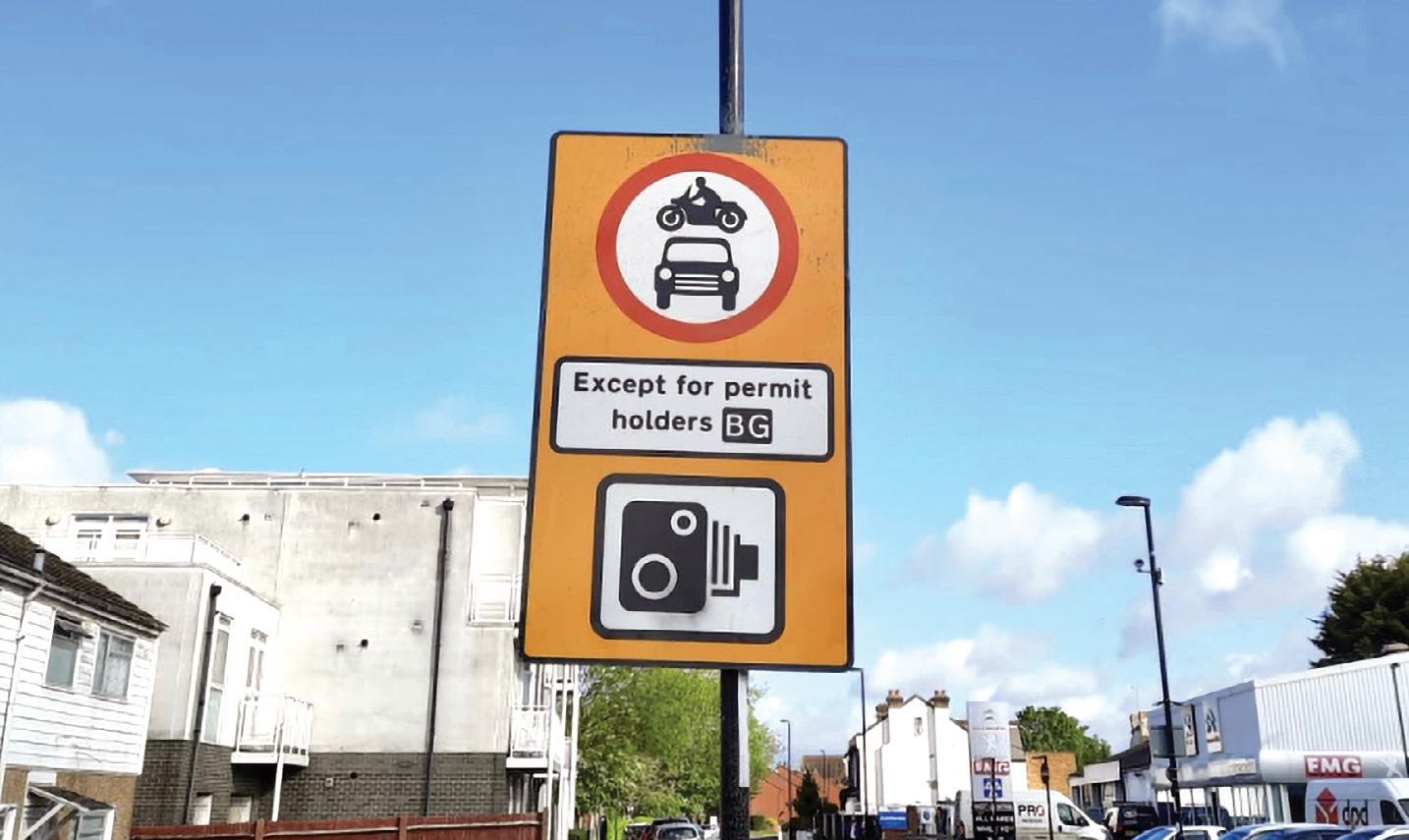
Moving traffic regula琀ons and enforcement powers
Road user and emissions charging schemes
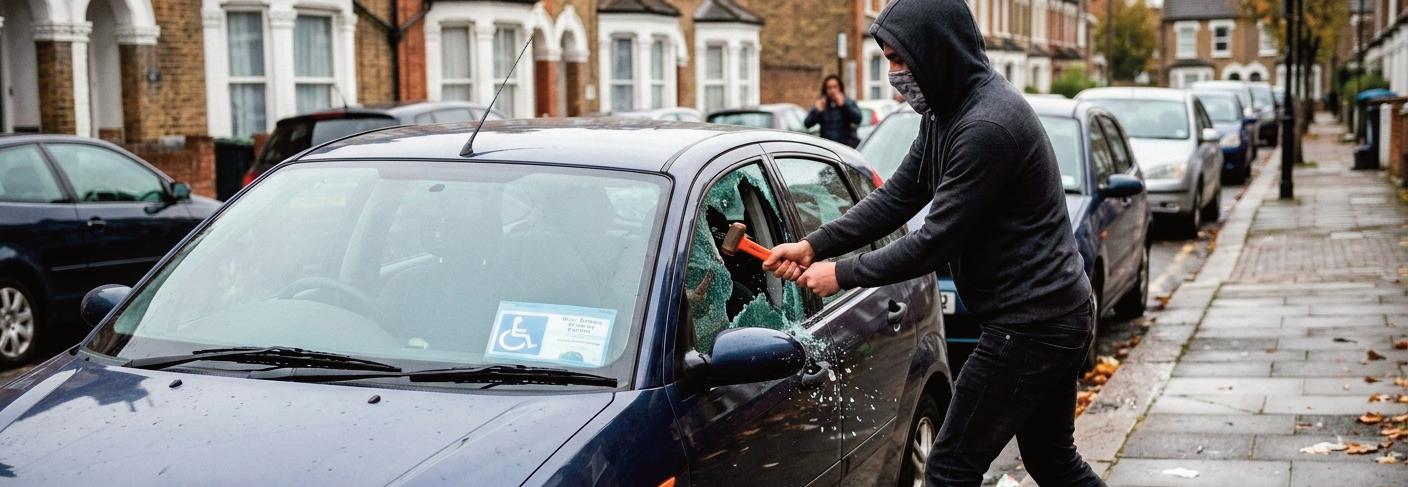
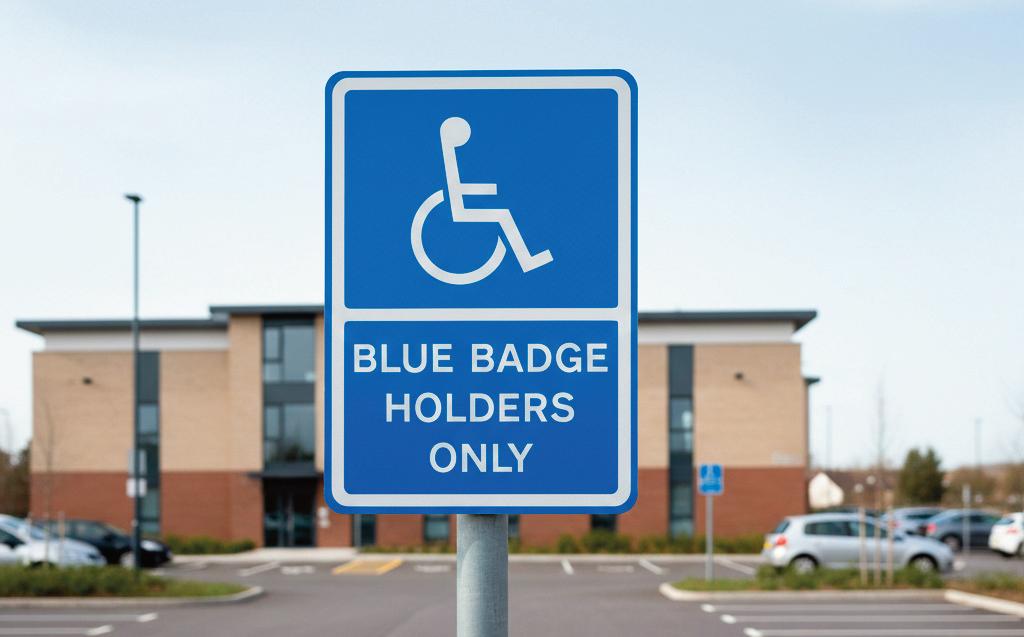
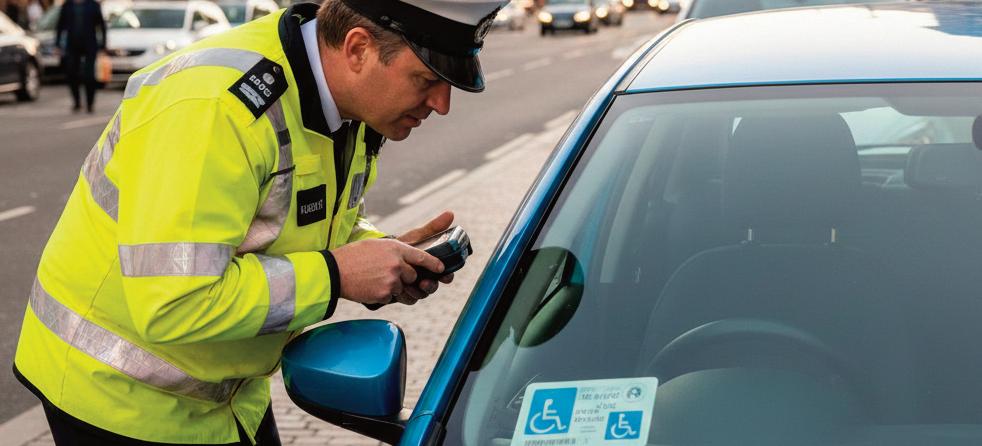
The Blue Badge scheme: access, misuse and reform
The results and impact of Na琀onal Blue Badge Awareness Week
Public Space Protec琀on Orders (PSPOs) and an琀social behaviour
Pavement parking, fly琀pping and environmental enforcement
Managing electric vehicle charging bays
Ghost and cloned number plates
Debt recovery and suppor琀ng vulnerable debtors
Protec琀ng frontline staff
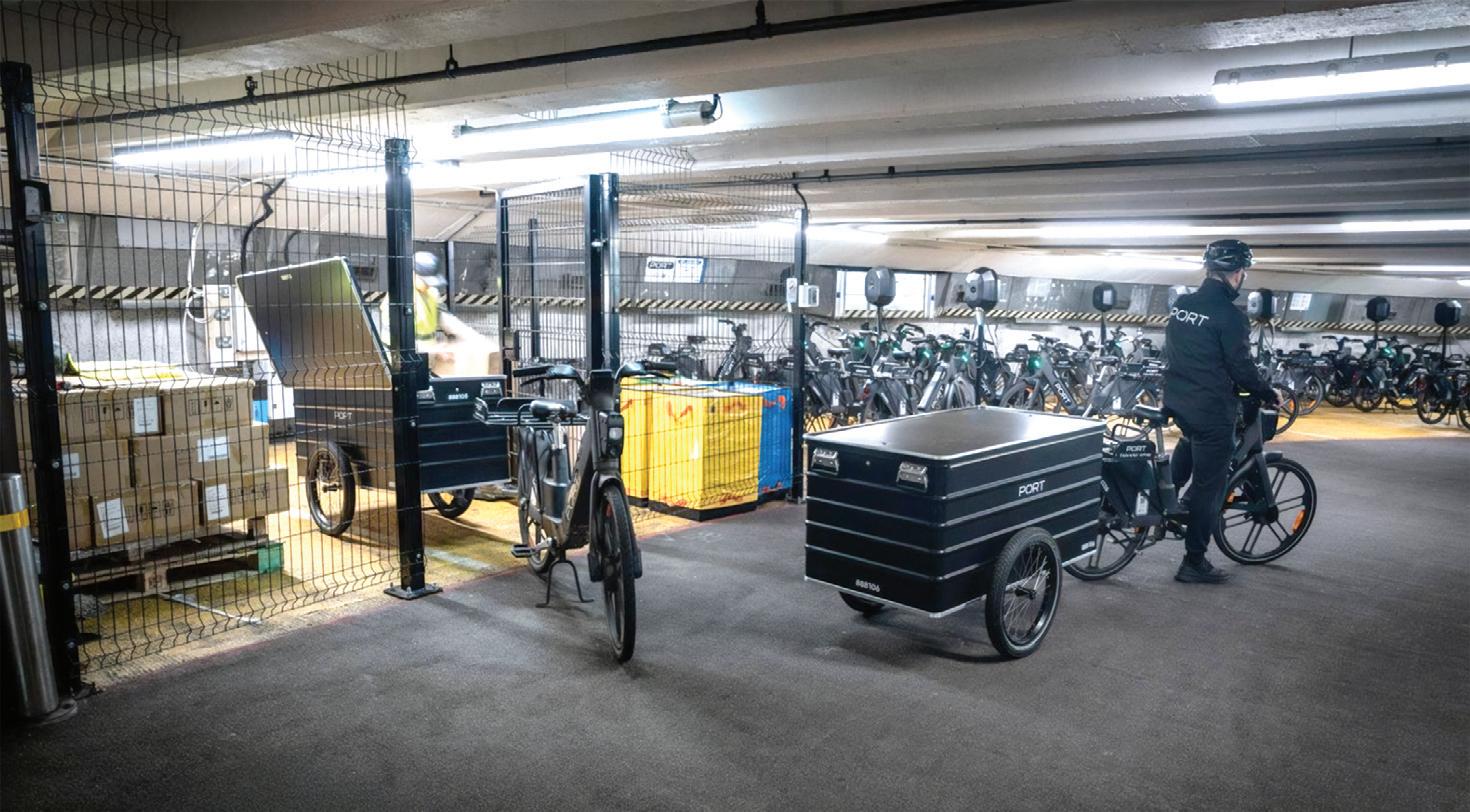
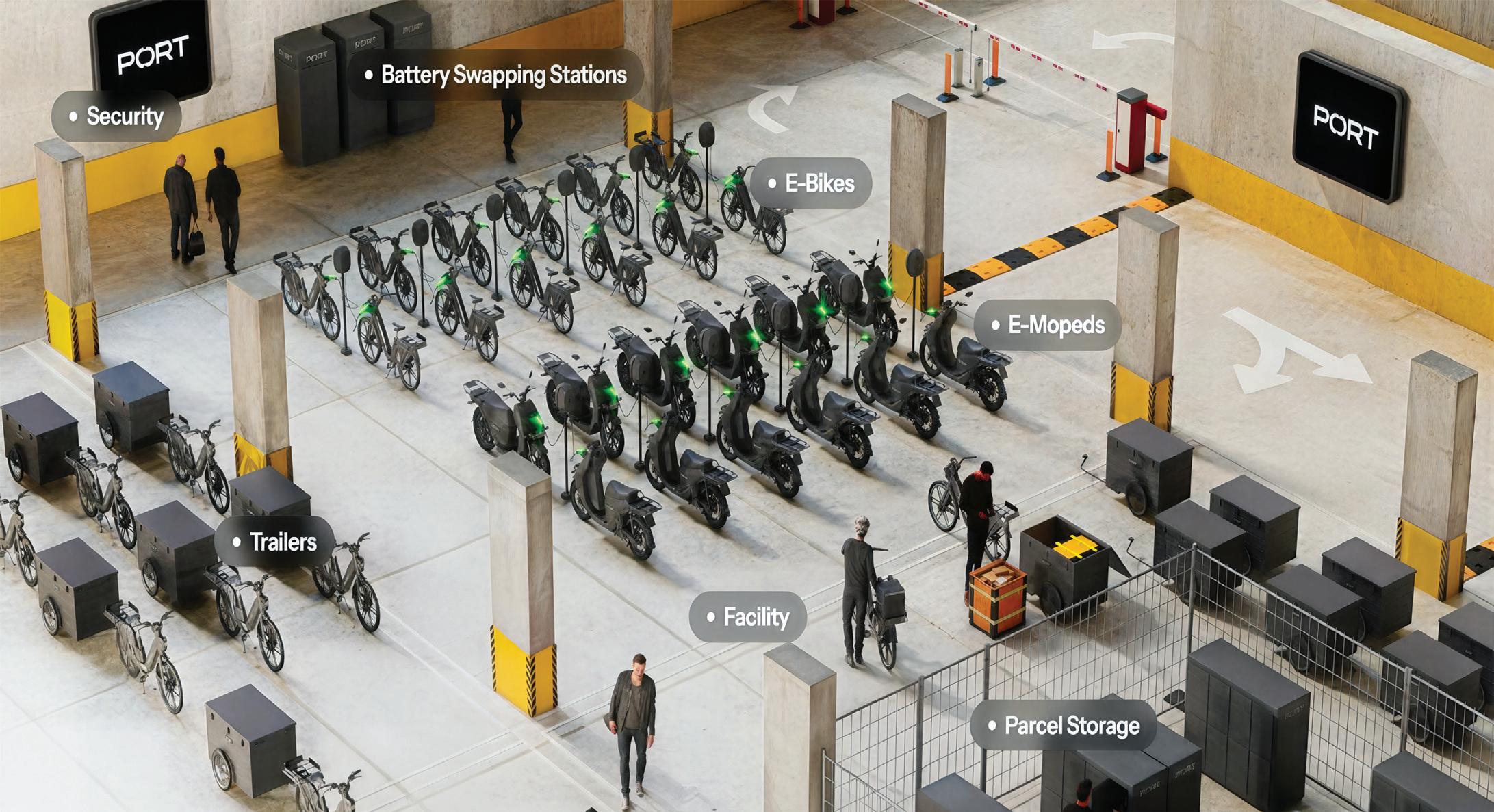
Ideas such as courier cycle hubs offer a glimpse of the parking business
There is life after parking
This year has been a story of endings and beginnings in the world of parking. The endings include the shutters coming down at a batch of loss-making National Car Parks sites as part of an administration process that could see the disappearance of what is possibly the parking sector’s most iconic brand. The economic travails of NCP, a company that has been around for almost a century, betoken wider structural issues affecting the parking business. There are arguably too many car parks in city centres chasing a decreasing number of commuters and shoppers whose work patterns and spending habits have changed. In a world of home working and online shopping, the trip to town is now an optional activity for many people, reducing custom at some car parks.
But elsewhere new roles are being found for car parks, which is where we see the beginnings of different business models emerging. For example, we have seen the launch of the Urban Mobility Alliance, which enables cycle couriers to hire electric bikes and trailers from docking stations set up in city centre car parks operated by the likes of APCOA, Q-Park and, yes, NCP.
Ideas such as courier cycle hire suggest there is life yet in parking… it’s just that what is parked may not always be cars.
Mark Moran Editor
The business cycle for city centre car parks is shifting gears
A Port-managed cycle hire hub
Testing the water for higher fines
Pioneering BCP Council trial suggests tougher penalties improve drivers’ parking behaviour at seaside resorts
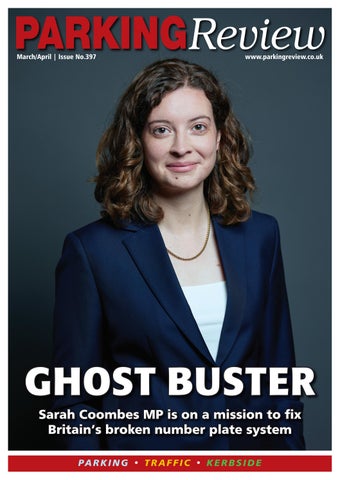
The ghost plate buster
Sarah Coombes MP sees fixing the UK’s vehicle registration system as key to tackling dangerous and criminal driving
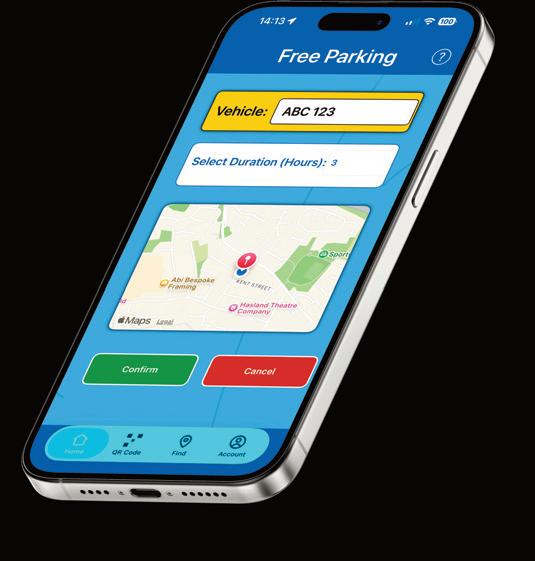
Taking the faff out of parking
Seamless parking payments will improve the travel experience, says the Better Connected integrated transport strategy
Fake fines, real threats
Fraser Richards of Anchor Group Services discusses how scams such as fake penalty charges are undermining trust in parking
Durham’s data-driven future
Cllr Tim McGuinness provides insights into Durham County Council’s approach to delivering its parking policies
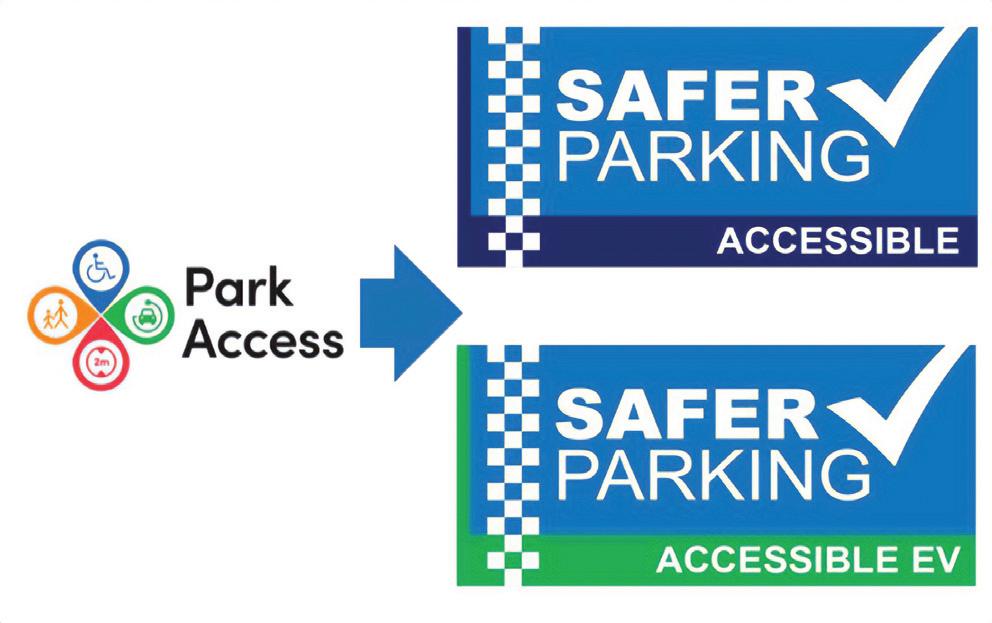
Safer Parking: The next chapter
Police Crime Prevention Initiatives explains why it has taken over management of a new look Safer Parking Scheme
Championing low carbon travel
The winners of inaugural Decarbonising Transport Awards competition revealed by Red Dwarf star Robert Llewellyn
EVolution Magazine
The latest developments in electric vehicle infrastructure
7091
Huseyin
020 7091
Robert Llewellyn
Sarah Coombes MP
Karparc, Newcastle-under-Lyme
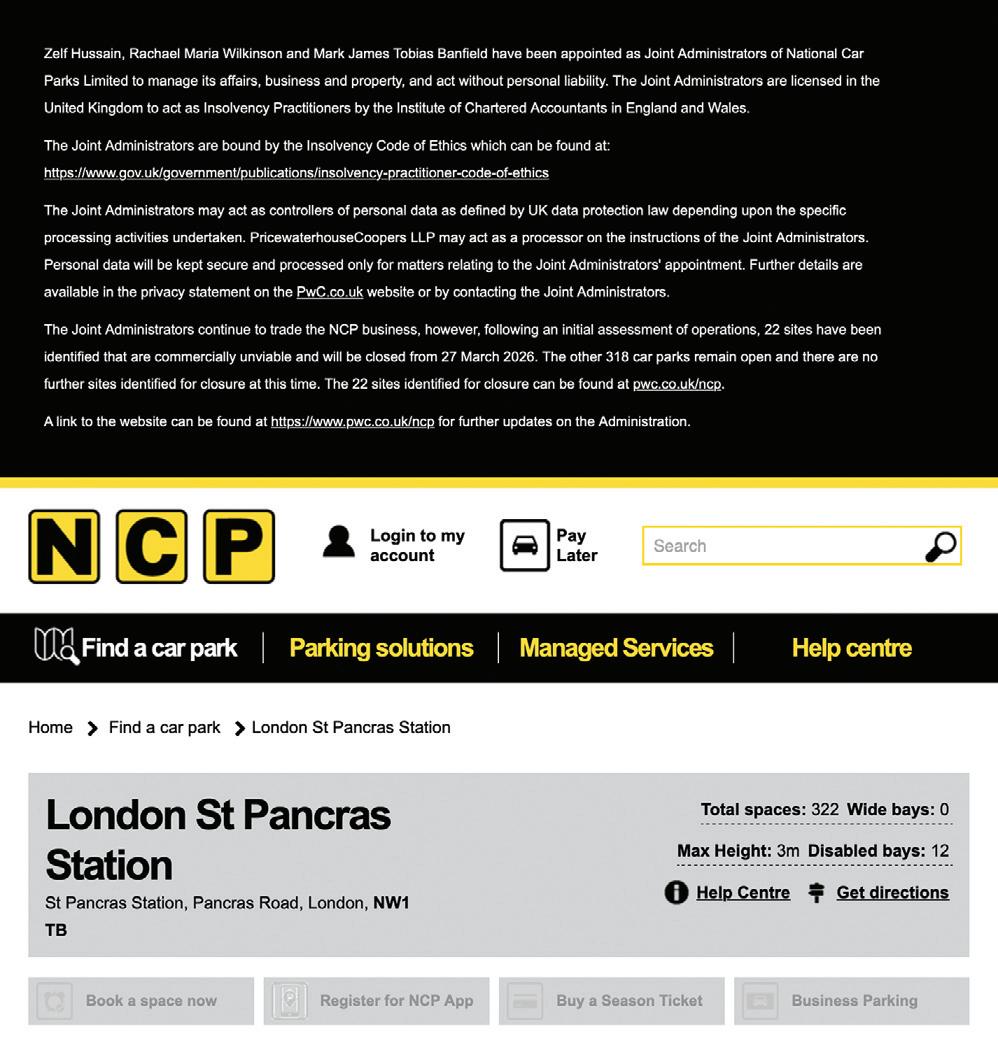
Is this the end of NCP?
Administrators PwC continue to trade the business while assessing options
In a dramatic moment in the history of parking, National Car Parks has gone into administration. An iconic brand that has been operating since the 1930s, NCP operates 340 car parks across the country, including sites in town and city centres, airports, hospitals and transport hubs
The estate is a mix of leased and directly managed sites. The company employs around 680 people.
Since 2017 NCP has been operated by a consortium comprising Japanese parking company Park24 and the Development Bank of Japan. Park24 runs more than 19,000 sites in eight countries.
PricewaterhouseCoopers (PwC) is handling the administration process. Zelf Hussain, Rachael Wilkinson and Toby Banfield of PwC were appointed as Joint Administrators of National Car Parks Limited on 16 March. They are taking steps to stabilise the business while assessing options for its future.
The Joint Administrators will continue to trade the business while undertaking an assessment of the options for the company. For now, most sites remain open, employees will continue to be employed in their roles and customers will see no immediate changes to the day-to-day operations. Over 20 car parks deemed to be loss-making were closed by mid-April.
The administrators say the company’s performance has deteriorated over a number of years post-COVID-19 as demand for parking has not recovered to historic levels, particularly across city-centre and commuter locations.
Continued shifts in commuting and customer driving patterns have impacted site occupancy, while the high concentration of long-term, inflexible leases has meant the company has been unable to reduce costs in line with revenue or to exit loss-making sites, resulting in ongoing trading losses.
The company now has insufficient cash available to meet its financial obligations and the directors therefore took the decision to appoint administrators.
The administrators’ statutory duties include communicating with employees, landlords and suppliers, and issuing an initial creditors’ update in due course.
The Joint Administrators will engage with landlords and other stakeholders to assess and, where necessary, make changes to the business designed to improve the viability of as many of the sites as possible. A sale of all or part of the business will be explored as one of the options to secure the best outcome for creditors. The administrators will continually review the viability of each location, and depending on the outcome of discussions with stakeholders, there may need to be site closures as part of the process.
Zelf Hussain, Joint Administrator and PwC partner, said: “NCP has faced a challenging trading environment over several years, with changing consumer behaviours impacting volumes, and a high fixed cost-base leading to trading losses. Our priority on appointment is to ensure continuity of service while we undertake a detailed review of the business.
“Sites are open, staff remain in post, and trading continues as normal. We will be engaging with landlords, employees and other stakeholders as we explore all options, including the potential sale of all or part of the business, to secure the best possible outcome for creditors.”
Reacting to NCP’s move into administration, Nick Stockley, a partner specialising in commercial dispute resolution at law firm Mayo Wynne Baxter, said: “NCP’s landlords will want to have new owners taking over both the leases and locations. The administrators will also be looking to sell the leases to new owners. It is unlikely that there will be any value in the NCP brand name and I would not be surprised if the locations, particularly the town centres, will be of interest to residential property developers.
“The more profitable sites at airports and stations are very likely to remain parking venues but with new owners, which should save some jobs. The less profitable sites will be transferred as land sales and this will result in job losses. NCP will have wanted the security of long-term leases but that has also been their downfall. There will also be the inevitable and significant knock-on impact of unpaid creditors who will also face insolvency.”
Loss-making car parks closed
Over 20 NCP sites have been shut by administrators
Abatch of around 25 National Car Parks sites have been closed by the administrators who have taken over the running of the financially troubled company. The remaining 315 or so sites will remain open while buyers are found. On 16 March, Zelf Hussain, Rachael Wilkinson and Toby Banfield PricewaterhouseCoopers (PwC) were appointed as Joint Administrators of National Car Parks Limited.
Following an initial assessment of operations, the Joint Administrators identified around 20 sites that were commercially unviable and were closed to customers on 27 March. PwC identified a second batch of sites that it deemed to be loss-making and closed them on 16 April.
The locations that have been shuttered are a mix of surface car parks and multi-storeys located in town centres, serving railway stations and at destinations such as hotels. Their closure leaves landowners with the headache of finding new operators and concerns among local businesses, local councillors and stakeholders about a loss of amenity.
Closed NCP sites
• Ashford – County Square
• Ashton-under-Lyne – Cotton Street
• Banbury – Marlborough Road
• Bexley Royal – Oak Road
• Belfast – Dublin Road
• Birmingham – Gough Street
• Bournemouth – Hinton Road
• Bristol – Nelson Street
• Bromley – Travelodge
• Coventry – Belgrade Plaza
• Eastbourne – Trinity Place
• Exeter – Market Street
• Grantham – Grantham Station 1, 2 & 3
• Hinckley – Britannia Shopping Centre
• Ipswich – Portman Road
• Leicester – Abbey Street
• Leicester – East Street
• Leicester – Lee Circle
• Leicester – Rutland Centre
• Leicester – St Nicholas Centre
• London – Kings Cross St Pancras (prev. Judd St)
• London – Knightsbridge
• Luton – Regent Street
• Sheffield – Blonk Street
Leicester loses four NCP sites
City council says there are still plenty of spaces
The administrators of National Car Parks have closed a quartet of the troubled operator’s sites in Leicester. On 27 March PwC permanently closed the car parks on Abbey Street, East Street, Lee Circle and the Rutland Centre. On 16 April the NCP at St Nicholas Circle also shut. The loss of thousands parking spaces led to some local politicians and stakeholder to call for Leicester City Council to take over their operation. However, The city’s Labour mayor Sir Peter Soulsby is not be keen to take on what were loss-making enterprises.
Sir Peter said: “The car parks are not owned by NCP but by separate entities who have been left with them as liabilities. We have had preliminary discussions with them and its early days to say whether there is any prospect of us or anyone else taking them over. At least one of the operators was quite optimistic about finding a new operator. However, I can understand why NCP were failing to balance the books with them. The level of usage across the four of them was under 25% in total. That doesn’t sound like a viable operation and I’d be reluctant to make a commitment to take on a loss-making enterprise.”
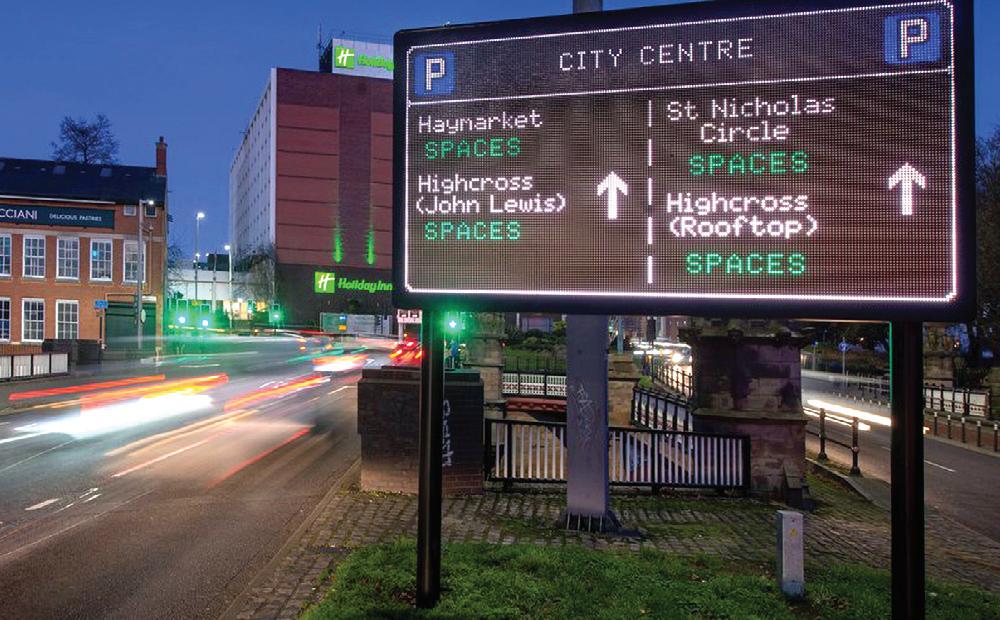
Leicester City Council is instead advising drivers that it has plenty of capacity in its city centre car parks. Martin Fletcher, the council’s city highways director, said: “We recognise the NCP closures will reduce parking capacity in and around the city centre and appreciate the concern this may cause for residents, visitors, and businesses. We are working closely with partners to manage the impact of these closures, and looking at any future actions needed. However, it’s important to note that even with the loss of the NCP spaces, there remain more than 9,000 off-street parking spaces in the centre of Leicester, as well as around 1,300 on-street spaces available for public use. These include key city centre sites such as Highcross, Haymarket, Newarke Street, St Nicholas Circle, Welford Road, Dover Street and Phoenix Square.”
To help ease pressure, the council is encouraging drivers to also consider using the city’s park & ride services from Birstall, Enderby and Meynell’s Gorse, which provide convenient, affordable and sustainable access to the city centre. Fletcher explained: “Parking is free all day, and buses run into the city centre every 15 minutes from 7am to 7pm. Tickets cost £4.85 for a single passenger, and £6 for up to five people arriving at the site in one car.”
The council has recognised that the closure of the Rutland Centre car park may have a particular impact on disabled people heading to the city’s cultural quarter. Geoff Whittle, assistant city mayor for environment and transport, said: “The Cultural Quarter boasts some of the city’s most popular visitor attractions and is a busy hub for workers and residents. There are several car parks within a few minutes’ walk, but we know that the closure of the Rutland Centre car park has hit people with disabilities wanting to visit the area.
“We are therefore taking immediate action to increase the number of dedicated disabled parking spaces in the Cultural Quarter, prior to removing parking restrictions across the wider area and creating more pay & display bays. Important maintenance works are also under way in the area to remove signs of wear and tear and ensure the footpaths are in good shape for years to come.
“We are also taking the opportunity to upgrade some of the materials used to create a more welcoming and attractive environment for residents, visitors and local businesses.”
VMS signage in Leicester
Transforming kerbside management with connected infrastructure and unified data
How do you measure parking capacity?
It sounds like a simple question, but for many councils the answer requires a manual, timeand resource-intensive process. In a world where it is possible to quickly and easily find almost any answer online, developing a holistic view of parking across a town or city still requires someone to repeatedly check capacity in person just to gain a basic understanding.
Across the UK, there are tens of thousands of paystations in use, but only a small fraction are internet-connected, and even fewer provide live updates to councils.
Adding to the challenge, many councils continue to manage their estates through multiple, disconnected back-office systems, where input from paystations and mobile payment apps sits separately.
As towns and cities face growing pressure to improve traffic flow, reduce emissions and make better use of kerbside space, access to accurate, unified parking data is becoming increasingly important.
A data-driven way forward
When paystations operate offline or details are scattered across separate back-office systems, it becomes difficult for city decision makers to build a reliable baseline for understanding what is really happening across their wider parking network. To make informed and impactful decisions, councils need reliable, joined-up information they can act on. That starts with moving away from legacy infrastructure and inconsistent technologies towards a unified kerbside management approach, breaking down longstanding silos so previously isolated datasets can be brought together.
Combining input from paystations, parking apps and, where agreements can be made, private operators, gives councils a full picture of how residents and visitors are travelling by car, where they are parking, how long for and what pain points are arising. This
provides a clearer view of how supply and demand interact across locations and time of day, instead of relying on assumptions.
Greater integration helps develop strategic insights, providing real-time and predictive visibility into how people move, and turning complex information into actionable intelligence. With more comprehensive data, local authorities are better equipped to establish long-term patterns rather than reacting to temporary spikes. There is growing recognition that better analysis leads to more informed decisions around parking infrastructure, kerbside use, traffic management, EV charging infrastructure rollout and multimodal planning.
It also creates a stronger foundation for choices that affect residents and visitors, such as improving accessibility, repurposing underused parking into
green areas and reducing unnecessary circling as motorists search for a space. With this level of insight, councils can implement policies that support a more inclusive, efficient and sustainable mobility ecosystem.
Connecting systems and data
Arrive brings together decades of experience from across the urban mobility landscape. Among others, it is the parent company of RingGo, the UK’s leading cashless parking provider; Flowbird, which has longstanding expertise in paystation hardware, parking and public transport technology; and Parkopedia, the world’s leading provider of connected car services, trusted by automakers, organisations and millions of drivers. As a global leader in urban mobility, Arrive combines the strengths of these core pillars under a single mission: to make cities more liveable.
Unified parking management and data-driven decision-making require greater integration across systems, supported by connected infrastructure. This is the challenge Arrive has set out to address with Arrive Pulse, a single global platform to consolidate fragmented mobility data from across parking, payment, transport and automotive sources into one single system.
This journey begins with parking, bringing together mobile and paystation data, parking management and market insights. By consolidating information that has traditionally sat in silos – including on-street space inventory, off-street facility capacity, parking availability, tariffs and policies, and kerb usage and allocation – councils can move away from disconnected systems towards a clearer, more complete view of their parking operations.
Modernising paystation infrastructure
However, a digitally merged ecosystem is only as strong as the infrastructure behind it. Many of the UK’s existing paystations were installed before internet connectivity was a consideration. A new generation of hardware is required. One that is digitally native, able to mesh with modern technology and compliant with the latest banking certification requirements. Arrive is taking a two-pronged approach, upgrading and modernising legacy hardware, while also ensuring new paystations are fit for the future and capable of feeding into the upcoming Arrive Pulse platform.
For some councils, retrofit kits that allow older paystations – up to 25 years old – to be brought up to date are a great way to continue getting the most from their initial hardware investment. This upgrade adds internet connectivity and current banking certification, extending the lifespan of existing equipment and avoiding the need for complete replacement. It is a sustainable option that retains much of the original infrastructure, bringing previously offline machines online so their transaction data can be captured and used alongside other data to build a more complete view of parking activity.
Although retrofitting will be the right approach in some locations, others will benefit from new paystations. Arrive’s soon-to-be-released models have internet connectivity built in as standard, which
means transactions can be fed into the same systems as data from parking apps or kerbside analysis. This helps build a clearer picture of usage, demand and performance across the network, supporting more informed decisions about pricing, enforcement and longer-term parking strategy. The redesign has been in part driven by the need to comply with V6 banking hardware certification, which will become mandatory for new sales from April 2027, giving operators a compliant, future-ready route to modernising their infrastructure.
Chris Head, Regional Director, UK & Ireland, Arrive commented: “What is exciting about this new phase of kerbside management is the opportunity to implement policy and see the results on congestion and parking availability immediately. It makes ‘solving’ these issues for the long term a possibility.”
Completing the picture with insights
Internet-connected paystations provide valuable input when combined with mobile payment data, but they do not always tell the whole story. That is where Arrive Insights can help, giving towns and cities the extra visibility they need to identify challenges and make meaningful improvements.
Arrive’s insights team can collect kerbside information to complement the transaction data generated by paystations and parking apps. To carry out this work, Arrive uses its own scanner to map the number of parking spaces. Additional data, including occupancy patterns by hour and day, is captured using council-owned vehicles equipped with a detachable LiDAR scanner. These vehicles patrol towns and cities, assessing parking capacity without collecting any identifiable information.
Collecting data is the first step to improving operations. Understanding it follows. Arrive’s advisory services help councils turn complex mobility data into clear, strategic plans, whether addressing immediate issues or planning long-term improvements. This approach has been used to support policy decisions in Barcelona, Heidelberg, Lyon and Stockholm.
The way forward for parking management
For local authorities, the way forward is clear: upgrade to internet-connected hardware, reduce fragmentation and make decisions based on evidence rather than assumptions. When data from paystations and parking apps is brought together, councils can move from reactive interventions to long-term, strategic parking management.
Find out more about how internet-connected paystations can provide the foundation for stronger, data-driven parking strategies.
Visit RingGo at the Arrive Stand P10 at Parkex, CBS Arena, Coventry, on 20-21 May 2026.
manifesto calls for measures to ensure an affordable EV charging network and support for local businesses to rapidly adopt electric vans and e-cargo bikes.
The Electrify London coalition has united a range of stakeholders from grassroots groups such as Mums for Lungs, the Federation of Small Businesses and the London Taxi Drivers Association (LTDA).
Responses
Did council car club charges drive Zipcar out of London?
Clean Cities says parking tariffs for shared clubs exceeded cost of parking private vehicles. Mark Moran reports
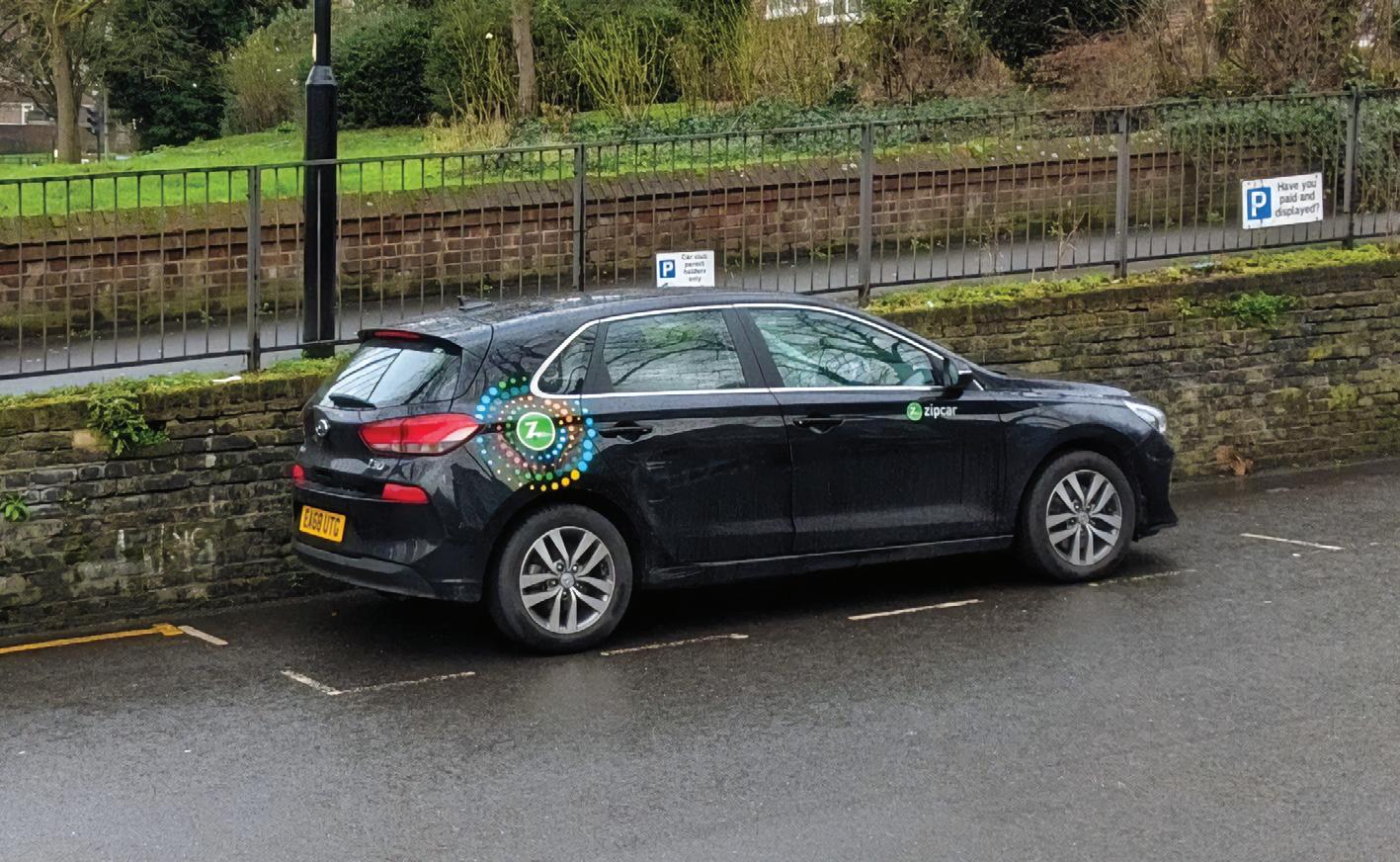
High parking charges set by London councils may have contributed to the exit of Zipcar from the UK at the start of the year, according to Clean Cities, a network of over 140 environmental NGOs. Zipcar was the largest car club operator in the UK, with an estimated 650,000 members across the country and 550,000 in London, including both residents and businesses. However, Zipcar left the UK on 1 January, amidst rising operational costs and policy challenges.
Independent research commissioned by Clean Cities found that car club parking tariffs levied by some councils far exceeded the price for parking a private car, with maximum costs averaging more than £900 per year per shared car. The research indicates that some boroughs have policies leading to almost double this amount. Kensington & Chelsea had the highest maximum tariff for a car club parking permit, and could be charging up to £2,382 for a single car club permit, while the lowest was Merton at £80.
A small number of boroughs do not charge for bay permits for car clubs, including Brent, Croydon, Harrow and Enfield.
Following the exit of Zipcar from the market Southwark promised to cut parking costs. Now, Richmond and Wandsworth councils have pledged to cut the charges.
Seven local authorities – Barnet, Bexley, City of London, Havering, Hillingdon, Lewisham and Redbridge – indicated that car clubs do not operate in their local authority. The Clean Cities campaign is calling on those seven authorities to commit to implementing a borough car club action plan to get car sharing off the ground in their areas.
Zak Bond, campaign manager at Clean Cities, said: “The positive news is that some London boroughs are now starting to cut
charges for car clubs, some of which were astronomical before. We know many people will feel like they are forced to buy a private car if they can no longer access a car club.
“Cutting costs is an important step towards rebuilding the market for electric car clubs in London, and indeed the rest of the UK. We’ll only tackle climate change and pollution if we give people access to affordable and convenient shared electric cars.”
The research was compiled using Freedom of Information (FOI) requests issued to all London borough councils and the City of London Corporation. Whilst not able to ascertain the specific charges per vehicle owing to commercial sensitivity, Clean Cities says the analysis shows that policies allow for high costs, especially compared to per vehicle costs for residents, giving a strong market signal to operators.
The analysis, produced by Thomas Fleming Transport Consulting, says: “While a car club vehicle may occupy a similar amount of kerbside space to a private car, its higher utilisation (up to 4.75 times higher) and its potential to replace up to 32 privately owned vehicles [in London] provide a strong policy rationale for preferential treatment through permit pricing.”
The new work follows previous research by Clean Cities, which found London was ranked 30th out of 42 cities in deploying electric car clubs in 2023 – behind major cities including Paris, Rome, Brussels and Berlin.
The research was published as campaigners urge London councillors to commit to cutting car club charges ahead of elections in May. Clean Cities has published an Electrify London manifesto asking all councillors to commit to a car club action plan to ensure every resident should be within walking distance of an electric car club vehicle they can hire. The
Richard Dilks, chief executive of collaborative mobility association CoMoUK, said: “We’ve warned for years that a difficult policy environment and rising costs would affect the viability of car clubs. Car clubs have faced sharp rises in costs such as council parking permits, insurance, charging costs for EVs and recent changes to the Congestion Charge. But there is hope – where boroughs commit to reducing costs, speeding up and simplifying processes and being flexible – we can restart the market and get back on the right path to healthier neighbourhoods for all.”
Cllr Alexander Ehmann, chair of Richmond upon Thames’s transport and air quality committee, said: “Car clubs are a key part of reducing dependency on individual car ownership. We need to see growth in this area of shared mobility. Following Zipcar’s departure from London, Richmond Council has taken the bold decision to remove parking charges for any car club provider in our borough until at least 2027. We welcome new providers who can offer a great service to our residents.”
Cllr John Batteson, cabinet member for climate emergency, jobs and transport at Southwark Council, which was the first borough to announce a policy change, said: “We’re creating a cleaner, greener borough and car clubs have been vital in reducing private car ownership in Southwark, helping cut congestion and emissions while freeing up street space. Zipcar’s recent decision to cease operating in the UK was disappointing. Many Southwark residents relied on their service and it was an important part of our Streets for People programme.
“With 60% of households in Southwark not owning a car, we remain committed to supporting a strong and sustainable carsharing network for residents and businesses who need occasional vehicle access. That’s why we’re in talks with new car club operators, and we’ve offered free parking permits to car-sharing providers until April 2027 – making us the first council to do so.
“We also want to work closely with the Mayor of London, Transport for London and other London councils so together we can support providers build an environment across the capital where they can thrive and create better streets for everyone.”
Cllr Jenny Yates, cabinet member for transport at Wandsworth Council, said: “We’re committed to keeping Wandsworth moving in a sustainable way. By waiving parking permit fees for car club operators, we’re taking action to keep and increase providers in the borough so that residents can benefit from accessible, affordable, and greener travel options.”
A Zipcar vehicle
Smart Compliance for Tomorrow
A next‑generation SaaS platform transforming parking, compliance, and enforcement services for local authorities.
“Local authorities need technology that simplifies complexity — and NSL-IQ delivers exactly that” Jamie Box, Traffic Software Specialist.
What authorities value most about NSL-IQ:
Smarter, automated workflows that reduce friction
Real‑time analytics for faster, evidence‑based decisions
Cloud‑native resilience and security
A user‑centred design shaped by 20+ years of enforcement expertise
A scalable SaaS model that lowers total cost of ownership
The use of artificial intelligence (AI) to detect dangerous drivers, more 20mph limits, a trial of side road zebras and action on SUVs all feature in the Mayor of London’s updated plan to reduce road danger and prevent deaths and serious injuries on roads in the capital over the next five years.
A set of 43 actions have been drawn up to support Mayor Sadiq Khan’s Vision Zero ambition to eliminate all deaths and serious injuries from London’s transport network by 2041. The actions have been drawn up by Transport for London (TfL) in partnership with the Metropolitan Police and local authorities.
The Vision Zero Action Plan 2 will explore ways of tackling safety issues posed by oversized cars, which are more likely to cause deaths or serious injuries in collisions. The plan states: “The cars on our streets are getting larger, heavier and wider. Oversized models, such as large SUVs, make it harder for drivers to see people walking and cycling nearby. These design features significantly increase the severity of collisions – including the risk of death – particularly for children, who are more easily hidden from a driver’s view. Those under nine are at the greatest risk.”
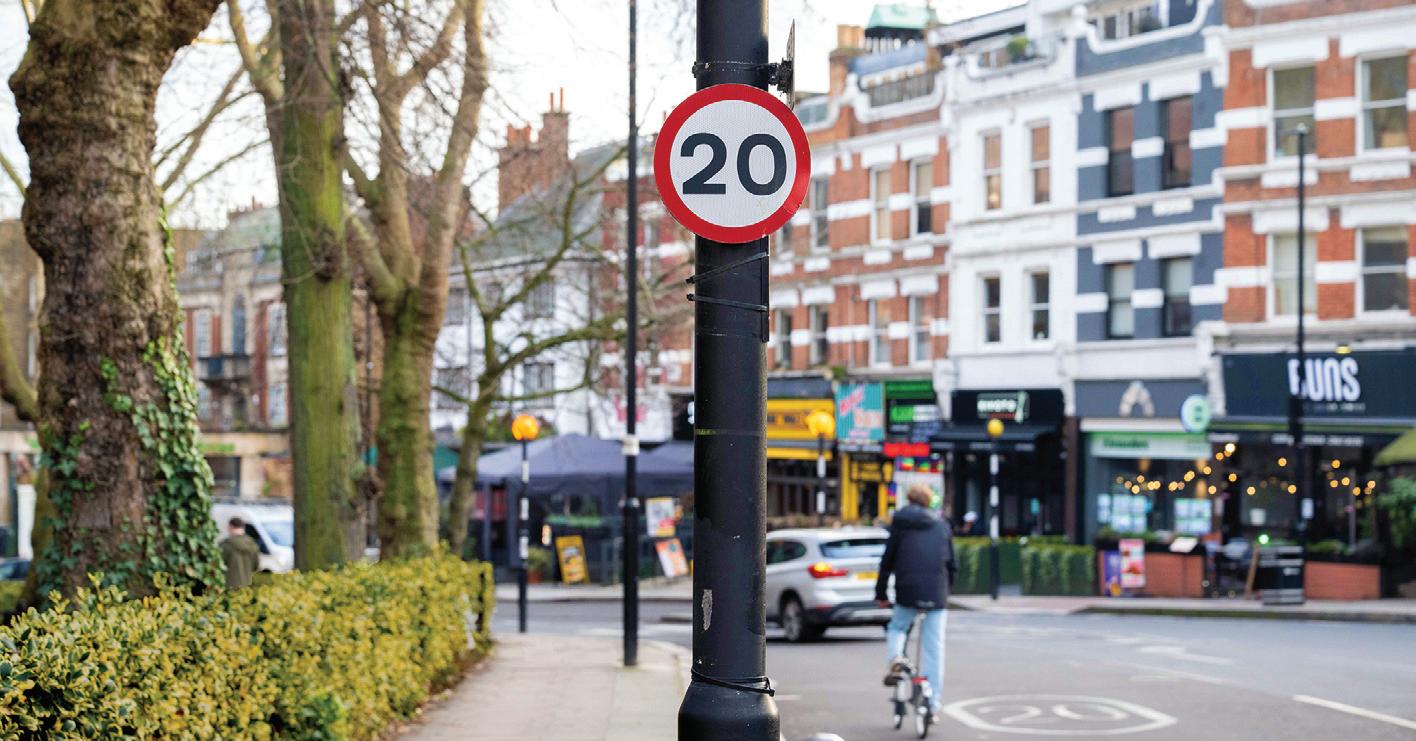
At least 65km of safer speed limits will be delivered on the TfL road network, including more 20mph schemes. Another pledge is to expand and modernise London’s safetycamera network, with at least 20 new sites, and investing in new technology that is adaptable to future enforcement needs.
TfL plans to partner with the Metropolitan Police to trial cameras that use AI to detect drivers using mobile phones or not wearing seatbelts, technology to detect illegal number plates, and enhanced roadside drug-testing.
Vision Zero Action Plan 2 sets a target for another 1,000 zebra or signalised pedestrian crossings by 2031 – including on school routes, high streets, busy roads and near bus stops. There will also be trials of side road zebra crossings on the TfL road network following a Westminster City Council trial, which found that side road zebras substantially increase the proportion of drivers giving way to pedestrians, improving compliance with the Highway Code.
The Mayor wants to expand and accelerate the delivery of high-quality cycle routes, so the proportion of Londoners living within 400 metres of the strategic cycle network increases from 29% in 2025 to 55% by 2035.
The plan includes the target of 200 more School Streets by 2030, expanding the programme to secondary schools, and bringing the total number of School Streets in London to 1,000.
Improved bus safety is another ambition, with the target of 100% Intelligent Speed Assist (ISA) coverage across the bus fleet by 2031, by introducing new vehicles and retrofitting older vehicles.
Road Danger Reduction team
A new dedicated London-wide Road Danger Reduction team is to be formed to tackle criminal and dangerous behaviour as well as unsafe vehicles. The new enforcement drive is among the aims set out in the London
Vision Zero maps route to making London a safer city
Mayor of London sets out an ambition to eliminate all deaths and serious injuries from London’s transport network by 2041, reports Deniz Huseyin
Mayor’s Vision Zero Action Plan 2
The TfL-funded operation will be made up of Metropolitan Police Service (MPS) officers and civilian staff, who will seek to deliver a “step change” in enforcing criminal, dangerous and reckless road user behaviour.
“To succeed, we must continue working effectively together and ensure that safety remains central to everything we do,” says the document. “Clear governance structures and performance indicators are in place to maintain accountability, monitor delivery and measure progress towards achieving our Vision Zero ambition.”
From 2026, the role of Police Community Support Officers will be expanded within the Road Danger Reduction Team, increasing their involvement in speed enforcement. This will include greater use of mobile safety cameras during peak periods, later in the evenings and at weekends, when risks are often higher.
TfL will continue to fund the team based in its control centre, which will operate 24 hours a day to manage the road network and minimise the impact of incidents and unplanned events.
Reducing road danger
TfL says the evidence-led Vision Zero approach has already made the capital’s roads safer –especially for children and people walking, cycling, motorcycling or catching the bus. Since 2015, an estimated 262 deaths have been prevented on London’s roads thanks to the Mayor, TfL and Vision Zero partners collectively taking action.
In 2024, the number of people killed or seriously injured was 24% lower (1,162 people fewer) than the 2010-2014 baseline, marking the lowest number of serious casualties ever recorded outside the pandemic-affected years (2020 and 2021), claims TfL. Provisional data indicates 2025 matched 2023 for the lowest
number of road fatalities in London ever outside the pandemic, TfL said.
On average, six fewer people each year have been killed in collisions with HGVs while walking, cycling or motorcycling since the introduction of the Mayor’s Direct Vision Standard and targeted enforcement by TfL and the Met, the plan states. Meanwhile, the introduction of 20mph limits on borough roads at current levels of enforcement has reportedly led to 34% fewer people, and 50% fewer children, being killed or seriously injured on those roads.
Mayor of London Sadiq Khan said: “I’m proud that we have saved lives through the important steps already taken to deliver my Vision Zero goal, making our roads safer more quickly than the rest of the country and equivalent international capitals, including New York and Paris. But every death or serious injury on our roads is unacceptable and we must go further and faster to eliminate this heartbreak across the capital.”
Lilli Matson, TfL’s chief safety health and environment officer, said: “London has made real progress in reducing road danger, with lives saved across the city through the action we have taken. But we cannot accept that it is inevitable that anyone should lose their life while travelling in the capital. This new fiveyear plan sets out the clear, evidenceled actions we know will save lives,from safer speed limits and safer junctions to modern enforcement technology.”
Commander Charmain Brenyah, head of Met Police Uniformed Operations, said: “It is tragic whenever anyone is killed or seriously injured on our roads, and our officers remain totally committed to reducing that risk. We are using data and precise intelligence to identify high-risk areas and deploy officers where they can target the offenders causing the most harm on our roads.”
A 20mph zone
ONE-DAY WORKSHOP
CONFLICT MANAGEMENT TRAINING
Practical annual refresher training for Civil Enforcement Officers
Designed for frontline Civil Enforcement Officers, this one-day workshop refreshes essential skills and builds confidence in managing conflict on street.
→ Equip your officers with the skills to confidently manage challenging situations, reduce risk and improve public interactions.
→ Delivered by experienced trainers, this course focuses on practical techniques that can be applied immediately.
→ The one-day refresher training can be delivered either online or on-site.
→ Flexible group sizes to suit your organisation.
Lambeth creates formal e-bike parking bays
London council signs agreement with shared mobility operators
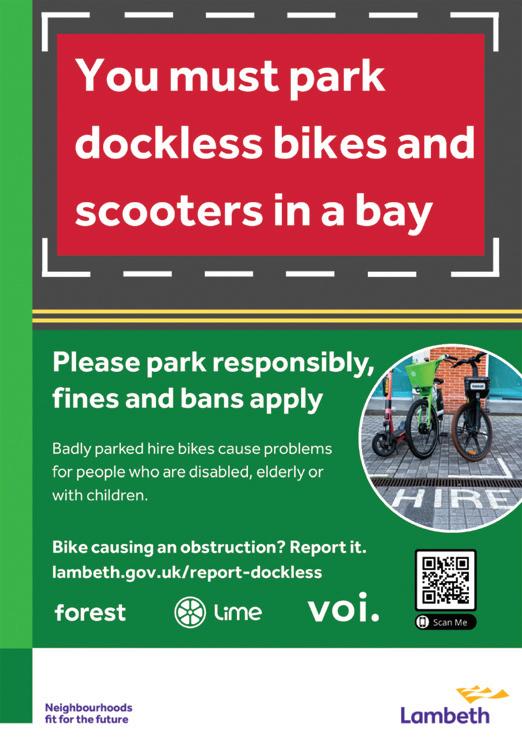
Lambeth Council is to convert parking spaces into dockless bike parking bays in an attempt to stop them being abandoned on pavements. Operators, Lime, Voi and Forest have agreed to implement a ‘bay parking only’ policy in the south London borough to better manage their fleets. This means all riders of hired e-bikes and e-scooters must end their rides in designated dockless parking bays.
The council – in collaboration with the operators – will use real-time data to monitor bike parking in a bid to ensure operators swiftly remove bikes that block pavements and roads. The operators will face fines and bike seizures if they fail to comply with the new arrangement.
Council enforcement teams will access real-time data on dockless bike fleets and carry out on-street patrols to ensure compliance. Data access will also enable better management
during busy events, with additional temporary parking bays and operator relocation when large clusters of bikes build up.
The council aims to place a dockless bike parking bay every 200 metres. Operators and Transport for London (TfL) will fund the roll out of 136 new parking bays, bringing the total in Lambeth to over 500.
Lime and Forest will each be allowed to have about 2,000 bikes in Lambeth, with Voi permitted to have 800.
Lambeth has also negotiated cheaper fares for residents, with the operators offering a lower fee of £1.75 for shorter journeys, the equivalent cost of a single bus fare. Discounts of up to 50% will be offered to key workers and people on low incomes.
Cllr Rezina Chowdhury, deputy leader and cabinet member for sustainable Lambeth and clean air said: “Dockless bikes are an affordable, sustainable way to travel, but we recognise poor parking causes real prob-
lems, especially for disabled and elderly residents. Our new deal ensures dockless bike operators manage their fleets responsibly. It will unlock cheaper fares for residents, clear pavement clutter by making Lambeth a ‘bay parking only’ borough, and sets tough penalties if operators fall short.” Boroughs do not currently have full statutory powers to regulate dockless bikes, meaning they must rely on local agreements to govern their operation.
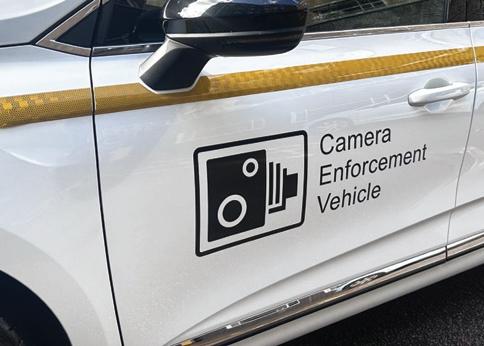
Leicester CCTV car will tackle dangerous and illegal parking
Leicester City Council has deployed a new CCTVequipped car to help tackle illegal and dangerous parking.
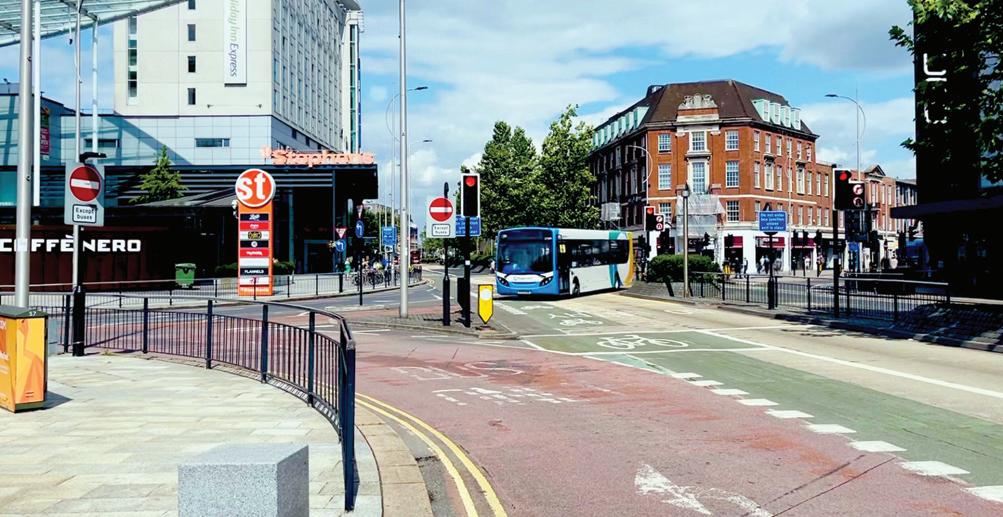
Hull enforces yellow box junctions
In a bid to improve public transport reliability and ease congestion, Hull City Council is now enforcing the yellow box junctions on its Ferensway arterial road.
Yellow box junctions are a power under the Traffic Management Act shared by Humberside Police and Hull City Council.
In December 2024, the council was granted the powers to enforce moving traffic offences by the government. These include blocking a box junction, banned right or left turns, going the wrong way in a oneway street, or driving where motor vehicles are prohibited.
From 1 April 2026, the council issued warning notices for a period of six weeks. Live enforcement will commence from 13 May 2026.
For the first six months, the penalty charge notice (PCN) will be a warning notice only. Any following contraventions will result in a £70 PCN. After the six-month period all contraventions will result in a £70 penalty charge notice.
Kerry Ryan, head of transport and traffic management at Hull City Council, said: “Enforcing these yellow box junctions will help keep traffic moving smoothly through one of the busiest parts of the city.”
The camera car went into action on 1 April and is being be used to monitor zigzag markings on School Streets, Red Routes and bus stop clearways where illegal parking can put the safety of others at risk and cause unnecessary congestion.
Anyone found parking illegally by the new camera car will be issued with a £70 fixed penalty notice, or a warning notice if the restrictions are newly established.
The move has been prompted by regular complaints about dangerous, inconsiderate and illegal parking outside schools, in bus lanes and at bus stops.
Cllr Geoff Whittle, assistant city mayor for environment and transport, said: “Councils have a duty to tackle dangerous parking and are given powers to enforce parking restrictions by CCTV in
areas where there are ongoing problems.
“As part of this, we are introducing a new CCTVequipped car to penalise and help address illegal parking in areas where there are persistent issues but no fixed camera enforcement.
“We know that camera enforcement can be a very effective deterrent. We want to get the message across that parking without consideration for others, especially in areas where there are lots of children and busy traffic, will not be tolerated.”
The car has cost £57,000 to buy and equip. Its purchase and ongoing maintenance will be paid for from parking fine income.
Ferensway, Hull
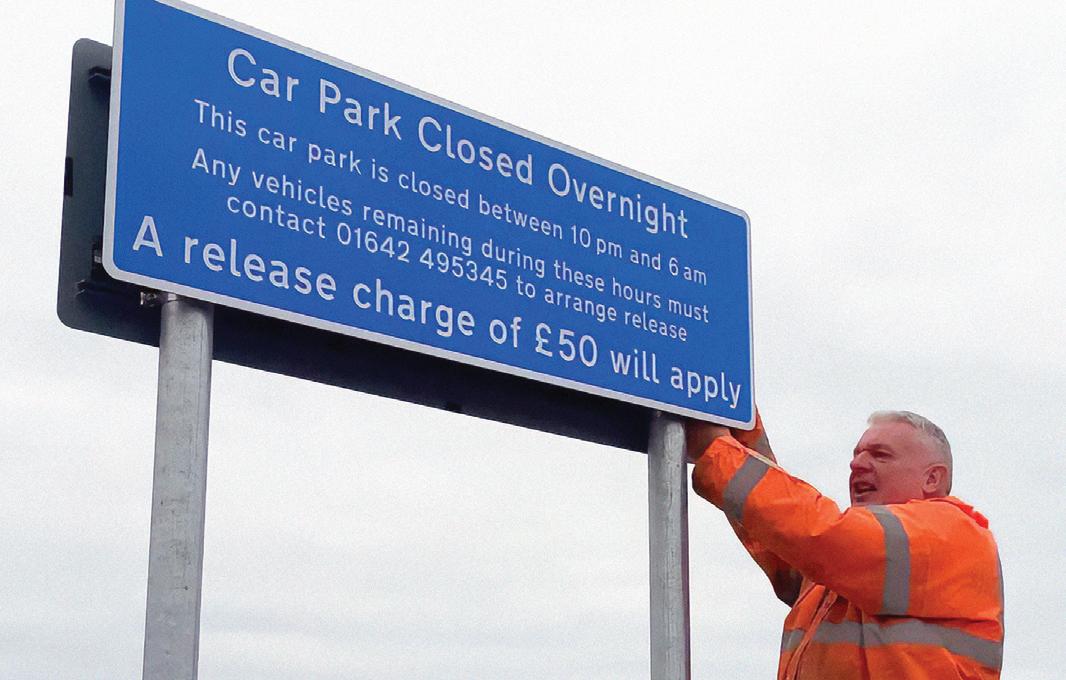
Night-time nuisance lockdown
Redcar closes seafront car park in bid to deter antisocial driving
A council car park on Redcar’s seafront will be closed at night from 7 April in a six-month trial designed to stop nuisance and criminal behaviour.
Gates have been installed and fencing repaired at the Majuba car park, which will be closed between 10pm and 6am until late September.
The move by Redcar and Cleveland Borough Council has been supported by Cleveland Police following years of antisocial behaviour at the car park.
Neighbours have endured antisocial behaviour including cars being used for racing, ‘donuting’, wheelspins, loud revving, burnouts and even tugs-of-war, as well as blowing their horns and releasing fireworks in the early hours of the morning.
A Public Space Protection Order (PSPO) has been in place since 2021 which has given both police and council officers more
Installing signage at the Majuba car park
powers, including issuing onthe-spot fines. However, neither the police nor council have the resources to patrol the site every night. Traffic calming measures have also been installed, which has reduced high-speed racing but has had only a limited impact on reducing noise.
Cllr Neil Bendelow, cabinet member for neighbourhoods, said: “The people living by this car park should simply not have to put up with this nuisance which can go on right through the summer.”
Fuller elected as BPA vice president
Hannah Fuller, Unity5’s director of commercial strategy and partnerships, has been elected as vice president of the British Parking Association (BPA) for the 2026-27 term.
As vice president she will act as a key ambassador for the BPA’s 750plus members, helping to shape the strategic direction of the association.
“I am honoured to represent Unity5 on the BPA’s leadership stage,” said Fuller. “Unity5 and the BPA share a vision for a professional, tech-forward, and inclusive industry. I am excited to get to work and support our members through the challenges and opportunities of
2026 and beyond.”
She will assume office in July alongside the next BPA president, Steven Foster, parking team leader at Newcastle City Council.
Fuller has over 10 years of experience with Unity5, JustPark and PayByPhone, focussing on the latest in parking permits and enforcement technology.
She is current representative on the BPA Council and a frequent panellist at major industry events. She was also a co-founder of the BPA’s Women in Parking group and is a voice for inclusion and professional development in the sector.
Redcar and East Cleveland Neighbourhoods Inspector Neil Deluce said: “We welcome this move and will continue to work alongside Redcar and Cleveland Borough Council to listen to local residents, conduct patrols in the area and take swift action whenever required. As a Neighbourhood Policing Team, we are open to a variety of problem-solving methods, including education and enforcement, but this environmental-based solution will help bring immediate respite to the local community.”
Buckinghamshire appoints APCOA
Buckinghamshire Council has appointed APCOA UK to deliver civil parking enforcement across the county for up to seven years.
APCOA replaces previous contractor NSL Services.
Under the new arrangements, APCOA will run an intelligence-led service with civil enforcement officers deployed where they are most needed, guided by an agreed Enforcement Plan that sets minimum service levels seven days a week.
The service will target moving traffic and parking contraventions using tools including unattended CCTV and mobile cameras in ANPR-equipped (automatic number plate recognition) vehicles.
Day-to-day car park maintenance and back-office administration will remain inhouse with the council-led service.
Steve Bowles, cabinet member for communities, said: “Good parking enforcement helps everyone – it keeps our roads safer, protects access for residents and businesses, and supports our towns and villages to run smoothly.
The Digital Blue Badge transforms the physical badge into a secure smartphonebased solution, helping authorities prevent misuse and improve compliance.
Key features:
l Can allow for the physical badge not to be displayed, stopping the theft of badges and reducing the fear of crime
l Biometric verification at the point of use
l Prevents badge sharing and fraudulent use
l In-app payment where required
l Dynamic QR code for fast verification, access and 3rd party integration
l Our partner app for CEO’s monitors the digital badges in real-time and has the facility to check physical badges with the DfT database
l New for 2026: Integration with enforcement software and NPP
Contact us now for further information on the digital Blue Badge
Croydon Council has been ordered to remove six Low Traffic Neighbourhood (LTN) schemes after they were deemed unlawful at Judicial Review. A High Court judge ruled that the dominant purpose of making the temporary schemes permanent was the council’s quest for the annual income.
According to the High Court judgement, the south London borough had expected to make a surplus of £10.7m from the LTNs between 2023 and 2027.
All those issued with penalty charge notices (PCNs) for driving in the LTNs between 30 March 2024 and 4 March 2026 will now be able to request refunds, the council said.
The LTNs that were installed temporarily in 2020 and made permanent in March 2024. Croydon’s elected Mayor Jason Perry had criticised the schemes while in opposition, stating he would like to remove them on his first day in office. However, after his election in May 2022, Perry’s stance changed due to budgetary considerations, noted Mr Justice Pepperall in his 34-page judgement.
According to the judge, the LTNs were reportedly found to have been rolled out to support the borough’s finances by producing “significant revenue” from enforcement cameras.
Mr Justice Pepperall stated: “Taking the relatively modest benefits of the schemes into account together with the Mayor’s apparent lack of public enthusiasm for the road safety or health case for these schemes, and his clear and repeated comments before and after the vote as to his hands being tied by the budgetary considerations, I am satisfied on the balance of probabilities that the dominant purpose for these orders making the schemes permanent was the need to safeguard the revenue raised by enforcement. Such purpose was unlawful and I therefore quash the orders.”
Mayor Perry said: “Low Traffic Neighbourhood schemes were introduced in Croydon in May 2020, before I was elected Mayor. Since becoming Executive Mayor in 2022, I have been clear that these schemes must reflect the priorities and experiences of local communities. That is why we removed a number of the physical road barriers that blocked streets, introduced free resident permits and carried out a further trial to review how the schemes were operating in practice.”
Following the High Court judgement, the council had two options, appeal the decision, which could take many months, or accept the ruling and remove them, Perry said. “After careful consideration, I have decided that Croydon Council will not appeal the judgement. The schemes have, therefore, been removed with immediate effect and enforcement activity has ceased on the affected streets. I can confirm that residents who received a penalty notice whilst the schemes were in operation will be able to claim refunds.”
Conservative Mayor Perry said he will be seeking re-election in May. He made fixing the borough’s finances one of his central pledges in the 2022 election, but his administration
Court tells Croydon to remove Low Traffic Neighbourhoods
Judge says dominant purpose of south London council’s LTN schemes was raising revenue, writes Deniz Huseyin
has not been able to reduce the £1.4bn owed by the council.
The mayor said: “Since 2022, we have stabilised the debt and we have fixed the hole beneath the waterline. That is real progress. But Croydon’s recovery remains fragile. All councils continue to face significant pressures
from rising demand and increased costs, and Croydon bears a £1.4bn general fund debt burden. We are working hard to keep improving our council, reduce costs and become a smaller, more efficient organisation that delivers better value for everyone in Croydon. That is my vision.”
Properly supported LTNs create ‘virtuous circle’
Low Traffic Neighbourhoods will fail without sufficient funding, academic study warns
Councils will find it hard to successfully implement Low Traffic Neighbourhoods (LTNs) without regional leadership and adequate funding streams, concludes a report from a team of academics.
“We found that local authorities needed access to extra resources boosting the limited capital budgets allocated to successfully design, implement and sustain schemes,” said the researchers.
Councils implementing properly supported and funded LTNs experienced a “virtuous circle” where learning from past, even failed, schemes was retained and used for new ones, researchers found.
By contrast, other councils saw initial failures “translate in increasing challenges for future schemes and overall, an inability to implement successfully”.
LTNs can become “unfeasibly expensive” for under-resourced English councils such as many outside London, said the team. This is the case where a council relies on project funds or its own capital programmes to bring in experienced staff, or consultants, or more advanced design features than those deemed necessary,
such as greening. “This means that in a context of austerity, where local government has seen a progressive erosion of its core capacity and staff resources, the success of a scheme is hampered by the fragmented and projectified funding frameworks available.”
The success of an LTN requires funding frameworks “which enable longer term and more comprehensive funding”, the study suggests. This, it adds, could be key to supporting controversial schemes outside the ‘easiest’ local contexts, chiefly those in inner London.
“Such funding frameworks may also enable local governments to develop learning cultures where both successful and unsuccessfully implemented schemes can encourage better practice in future.”
The research team comprised academics from: the School of Architecture and Cities, University of Westminster; London School of Hygiene & Tropical Medicine; School of Cardiovascular & Metabolic Health, University of Glasgow; MRC Epidemiology Unit, University of Cambridge, Cambridge; Texas A&M Transportation Institute; and Department of Primary Care & Public Health, Imperial College London.
Street space reallocation under austerity: The case of low traffic neighbourhoods in the UK
Testing the water for higher fines
Pioneering BCP Council trial suggests stronger penalties improve drivers’ parking behaviour at seaside resorts
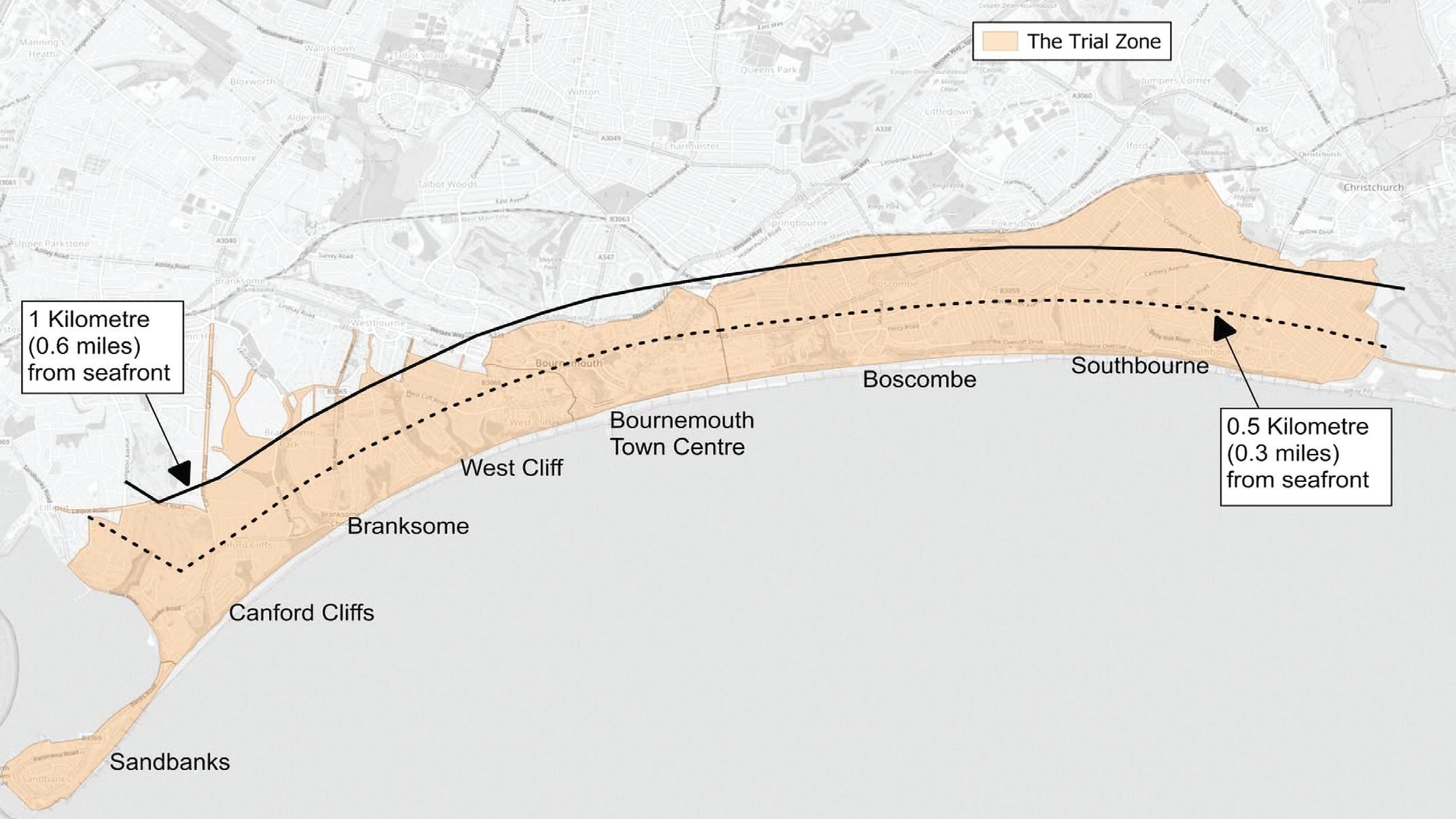
Increasing the cost of penalty notices could help reduce illegal parking in tourist towns, suggest the results of a trial conducted in Dorset last summer. The aim of the trial was to test whether or not higher fines reduced illegal and irresponsible parking along the seafront during the busiest periods. A report on the month-long trial by Bournemouth, Christchurch and Poole Council (BCP Council) reveals that illegal and obstructive parking fell significantly, and that roads became easier for public transport, emergency services and residents to navigate.
Persistent issues with dangerous and irresponsible parking –particularly during peak summer weekends – were leading to thousands of penalty charge notices (PCNs) being issued in the coastal resorts across the six busiest days during summer months.
BCP Council felt the cost of the penalties seem to have lost their deterrent effect. After lobbying government for several years, last Summer BCP Council was given permission by the Department for Transport (DfT) to issue higher penalty charge notices (PCNs) along roads between Sandbanks and Southbourne during August.
The month-long trial showed that increased fines reduced illegal parking – keeping coastal routes safer, traffic moving more freely, and making BCP’s coastline more accessible for all.
BCP Council concludes that higher PCN levels act as an effective deterrent, reversing upward trends in illegal parking and improving compliance.
Behavioural displacement occurred as some motorists shifted from high-risk on-street contraventions to lower-level breaches in car parks. This highlights a need for complementary measures such as clearer signage and enforcement in designated bays.
There was no evidence of reduced visitor numbers, nor signs of negative economic impact, supporting the feasibility of adopting higher PCN levels permanently.
BCP Council has analysed the data from the trial and submitted a report to the Department for Transport, which will now decide if BCP can implement the higher penalty charges on a permanent basis. BCP Council has also made what it feels are two feasible recommendations for reviewing penalty charge notice policy:
A: Review and update PCN fees and charges outside of London. The level of financial penalty has not changed since 2008, has not kept pace with inflation and rising incomes, or with the relative increase in parking charges and is no longer an effective deterrent. Fees and charges should be matched to London rates or subject to a review to determine an appropriate rate of increase.
B: Carry out a further trial for an extended period of time and across a wider geography. An extended trial, with a longer preparation period could be carried out to test whether the results of the BCP Council trial could be replicated, or improved, using a selection of authorities with differing characteristics.
Cllr Mille Earle, leader of BCP Council, said: “Higher PCN levels, implemented along our coastal roads from Sandbanks to Southbourne, helped reduce serious illegal parking, reduced congestion and obstruction on our busy roads, and supported safer, more reliable access for emergency services, public transport, and local residents. Importantly, the nationally significant trial achieved this without deterring visitors to our area: reflecting that most people rightly want – and expect – parking to be fair, safe and responsibly managed.
“We recognise the limitations of a short, single-area trial but the evidence shows the effect of higher PCNs and we should be allowed to implement that, again, over a longer period of time. This is a really good example of how local authorities can work with government officials, and constituency MPs, to deliver on resident priorities. The results are clear: higher penalties change behaviour, make our roads safer for everyone, our stunning coastline more accessible, and enjoy strong public support.”
BCP Council’s head of parking Helen Taverner, who devised and led the trial, added: “Leaders of BCP Council, and predecessor local authorities, have spent years lobbying successive governments for more powers to tackle illegal and irresponsible parking across our three towns. Our three busiest weekends in 2025 saw more than 4,000 PCNs issued.
“On 17 July 2025 we were granted permission to implement a onemonth trial of higher rate PCNs along 543 coastal roads from Sandbanks to Southbourne. Implementing the trial, on 10 working days notice, relied on the dedication and professionalism of teams right across the organisation. I am proud to have been a critical part of this nationally significant trial to see if increased PCN levels could improve compliance –the short answer is ‘yes’.
Setting the price of penalties
How the cost of PCNs were revised
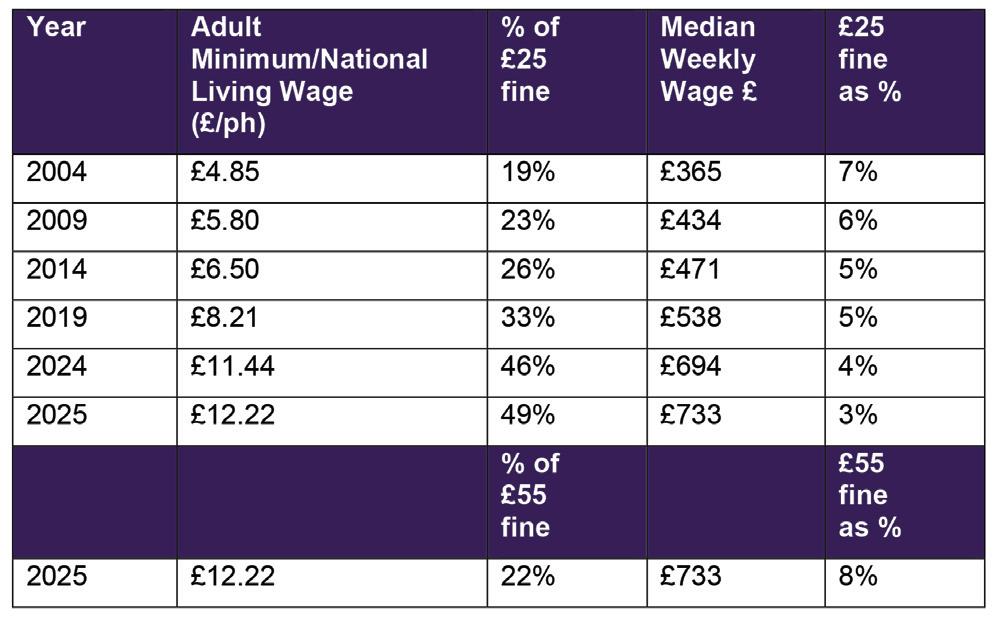
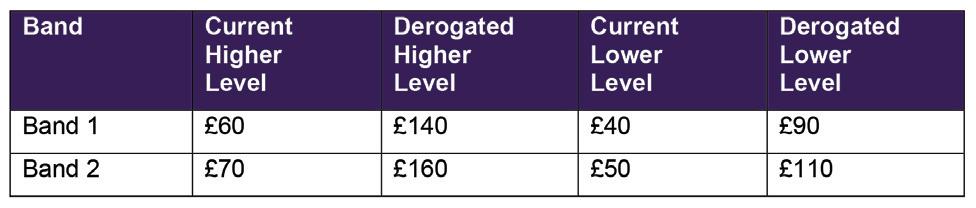
The deterrent value of parking penalties has been declining, says BCP Council. In 2004 someone earning the minimum wage for adults would have to work five hours to pay off a £25 fine, but by 2025 this fine represents just over two hours work at the National Living Wage. In 2004, a £25 fine accounted for 7% of the median UK weekly wage, but by 2025 that has dropped to just 3%. The final row in the table above shows the same figures, but using the BCP Council trial figure of £55 for a discounted (paid within 14 days) fine for the same contravention. It can be seen that this level of fine brings the affordability back in line with 2009 levels and is arguably therefore a much more effective deterrent.
The number of penalty charge notices (PCNs) issued by BCP Council on a monthly basis has been increasing steadily over time. Data for the month of August shows that around 5,800 PCNs were issued in 2019 and had almost doubled by 2024, with 10,510 being issued in that month. BCP Council reports the pattern is similar for most months, but particularly in the spring and summer months when the weather is warmer.
The council suggests the increase could be explained by the fact that the level of fine has remained the same over an extended period of time, whilst levels of income have increased. The cost of PCNs need to be such that they deter illegal parking and encourage compliance with the parking regulations. But, in essence, BCP Council argues that fines have become more affordable and less effective as a deterrent.
There has been no formal review of civil parking penalty charges in England and Wales since 2008, except for in London, where at the start of 2022 Transport for London (TfL) was granted permission to make a notable increase of its penalty charge levels for parking contraventions on Red Rroutes. The increase took TfL’s penalty levels to £160. It was the first increases in PCN levels in London since 2011.
The levels of penalty charges in London are set by the Secretary of State for Transport. For the purposes of the BCP Council trial, the Department for Transport (DfT) considered that parity with the current PCN levels in London would be appropriate:
• Band 1: During the trial Band 1 charges set at the higher level was £80 (133%) and at the lower level was £50 (125%).
• Band 2: The increase in Band 2 charges at the higher level was £90 (129%) and at the lower level was £60 (120%).
In both cases, the level of increase is more than double the current rates, which BCP Council suggests, in part, illustrates the level of disparity between London and all other areas, but also indicates that the increase should be of sufficient scale to encourage the desired change in parking behaviour.
The DfT also agreed that additional parking charges during the trial should match the current London levels
Costlier fines change behaviour
BCP Council sets out the PCN trial’s key findings
The Increased Penalty Charge Notice and Associated Charges Trial explored whether higher penalty charges can help reduce dangerous, illegal and irresponsible parking. “It worked,” says Helen Taverner, BCP Council’s head of parking. “The trial showed a significant reduction in illegal and dangerous parking with fewer vehicles on double-yellow lines, less cars obstructing junctions, and better access for buses and emergency services. Our car parks had more than enough space everyday of the summer and the public overwhelmingly support the implementation of higher fines.”
Overall PCN reduction
Total PCNs in the trial area fell by 6.8% compared to August 2024, reversing the previous year’s sharp increase (+34%). Forecast models predicted an 8.9% rise without the trial, meaning the actual outcome represents a headline 16% reversal from expected growth There are limitations with this outcome, given the short duration of the trial, very constrained preparation time and other variable factors. But the trial represents a positive indication of the impact of increasing financial penalties as a deterrent to illegal parking.
Behavioural change
Higher-level on-street contraventions decreased by 7%, while lowerlevel contraventions fell by 8-9%, suggesting motorists were less willing to risk fines at increased rates.
Comparison area contrast
Christchurch saw a 21% increase in serious contraventions during the same period, reinforcing that standard PCN levels remain ineffective as a deterrent.
Weather influence
August 2025 had similar temperatures and sunshine hours to 2024, yet PCN counts were lower, confirming the trial, and not external factors, drove behavioural change.
Bank Holiday exception
Despite overall success, the August Bank Holiday saw a 13% increase in PCNs, driven by extreme visitor pressure and perceived capacity constraints.
Parking capacity
Legal spaces were available throughout the trial, with average utilisation at 57%, meaning illegal parking was a choice rather than necessity.
Vend analysis
Vend trends continued a gradual decline consistent with previous years and mirrored in the comparison area, indicating no negative impact on visitor numbers. Declines are more likely linked to rising parking tariffs and broader behavioural shifts rather than the trial.
Public transport
Bus punctuality and speeds improved compared to August 2024, suggesting reduced obstruction from illegal parking.
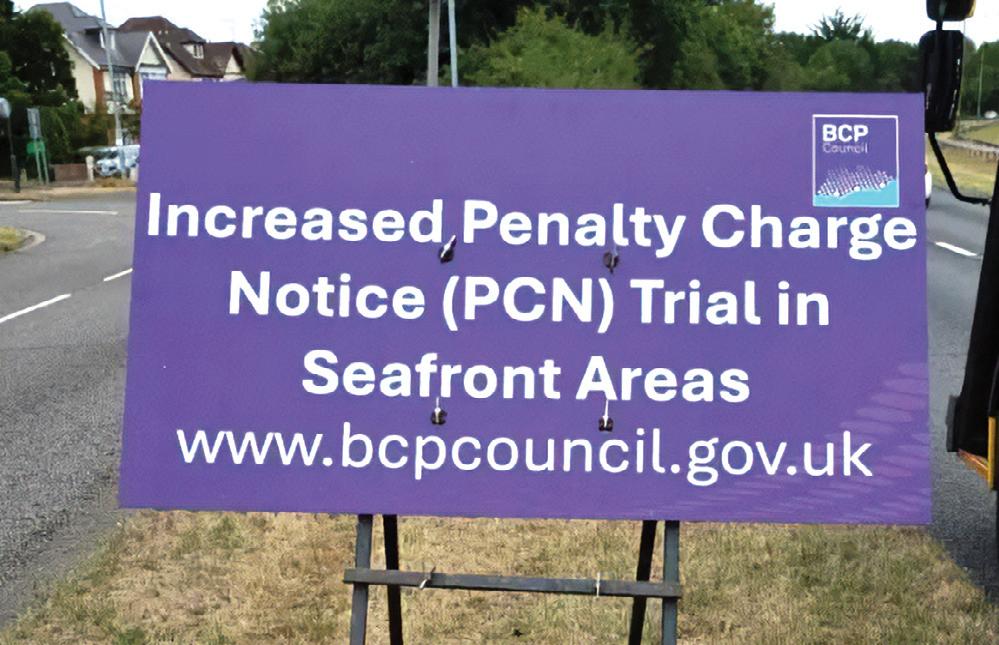
Temporary roadside notices advised drivers of the trial
Barbour Logic becomes part of Infoshare+
Omni buys automated correspondence software provider
Omni Partners has acquired Barbour Logic, an AI-first software provider. Barbour Logic is specialises in automating correspondence related to penalty charge notices (PCNs) for local authorities.
The company’s solutions streamline citizen interactions and lower the volume of unnecessary appeals, delivering time and cost savings. Built specifically for regulated environments, the technology ensures outputs are consistent, auditable and policy compliant.
Barbour Logic offers a suite of four complementary products:
• Response Master, which streamlines letter generation
• Chatbot Max, a multilingual chatbot that helps motorists understand and respond to PCNs
• Voice Master extends this capability to telephone-based interactions so that digitally excluded citizens can access the same high-quality services
• Challenge Writer helps people
series of additions to Omni’s public sector focussed software and data platform, Infoshare+.
Wayne Story, partner at Omni, said: “Barbour Logic’s technology demonstrates how AI can be applied in a practical, highly targeted way to solve the operational challenges faced by the public sector, improving efficiency while delivering better experiences for citizens.”
draft appeals, improving the clarity of submissions received by councils.
The solutions are powered by a proprietary AI rules engine (dubbed the ‘Parking Brain’) which encodes over 800 policies to generate accurate plainEnglish responses aligned to individual council requirements.
Over the past 15 years Barbour Logic has built a client base of more than 60 organisations, focussed on local authority parking enforcement teams, which
Go2Sim appoints Ravat as CEO
Internet of Things connectivity provider Go2Sim has appointed Hiran Ravat as its new chief executive.
A telecoms industry specialist, Ravat will work closely with Go2Sim’s founders Simon Powley and Tim Bealey to focus on leading the company through its next phase of growth in the IoT connectivity market.
“IoT continues to accelerate, but too often the focus remains on products rather than solutions,” said Ravat. “Our approach will be different. We believe collaboration outperforms competition, and we will work openly with organisations that share our values to solve real customer challenges.
“In a crowded IoT market, Go2Sim has built a clear, differentiated proposition that is already delivering meaningful value to customers, What stood out immediately is that the business operates on three principles that have guided my own 25-plus year career in
Omni identified as generating a recurring revenue base.
Omni invests in businesses that are looking for their first external capital. The investor says these are typically highmargin, UK-based companies that dominate their niche, are driven by culture-focussed management teams and make at least £2m EBITDA. Barbour Logic is the eighth acquisition Omni has completed since October 2024. The value of the deal has not been disclosed.
The deal is the latest in a
Steve Thorn, executive chairman at Infoshare+, said: “Infoshare+ is built on the principle that the right technology, deployed responsibly, can transform outcomes for citizens across our communities. Barbour Logic embodies that same belief.”
The Barbour Logic team, led by founder Jason Barbour, now transfers to Infoshare+. He said: “Our focus has always been on using technology to automate complex processes and improve communication between councils and citizens. Becoming part of Infoshare+ allows us to scale that impact, bringing our technology into a wider ecosystem dedicated to transforming public services.”
Arrive names Tsyrklevich as AI chief
Arrive is pushing towards becoming an AI-first mobility platform as it looks to turn vast volumes of data into predictive real-time user experiences.
telecommunications: speed, simplicity and trust.
“Go2Sim is built on real relationships – starting with its founders and extending to our investors, people, customers and partners. We don’t chase noise or short-term wins. We focus on doing the right things, the right way, and delivering outcomes that endure.”
Ravat was head of IoT business development and partnerships at CSL Group for five years. Before that he was an industry specialist working across telecoms and IoT at the Department for Business and Trade. He has also held commercial leadership roles at Vodafone and Telefonica.
The strategic focus on artifical intelligence is anchored by the appointment of Eugene Tsyrklevich as Arrive’s first chief AI officer (CAIO). In his new role, Tsyrklevich will lead Arrive’s mandate with AI as the catalyst between travellers and city infrastructure, making urban mobility more fluid and predictable.
Tsyrklevich has served as the general manager for Arrive’s Automotive & Data business unit since the mobility platform acquired his Parkopedia car park location and connected vehicle business.
Eugene Tsyrklevich said of the strategic focus on AI: “We are focussed on results, not only research. We are already using AI to handle the vast majority of simple customer queries, provide accurate parking space availability predictions to millions of drivers and navigate vehicles inside parking garages using indoor maps autonomously. We’re automating the friction out of every journey.”
Arrive sees AI serving as the intelligence layer that unifies mobility data, including parking availability, traffic conditions and vehicle signals.
Cameron Clayton, chief executive of Arrive, said: “Our strategy is simple: move from tracking mobility to predicting it. We are building a platform where intelligence is the baseline, not a feature. Appointing a CAIO and upskilling our organisation strengthens us to turn complex mobility data into intuitive travel, embedding autonomous vehicles into the fabric of human-centric, liveable communities.”
Arrive is also to create an AI Academy, an upskilling initiative designed to embed AI fluency across its global workforce.
Jason Barbour
Hiran Ravat
Eugene Tsyrklevich
JustPark acquires BigParking
Deal will boost roll-out of EventPass service
Parking provider JustPark has acquired BigParking, a UK football and event parking operator specialising in professionally managed events and community partnerships.
The acquisition expands JustPark’s event parking network with the addition of over 120 locations, bringing tens of thousands of additional parking spaces online near venues, including Arsenal FC’s Emirates Stadium, Liverpool FC’s Anfield and Birmingham City FC’s St Andrew’s @Knighthead Park.
The deal accelerates the rollout of JustPark Passes, a booking platform designed specifically for live events that enables fans to pre-purchase event parking at a fixed rate.
Parking spaces will be available to purchase through JustPark’s marketplace using the EventPass solution.
BigParking has been a partner of JustPark for several years.
Intelli-Park adds Davitt to top team
Intelli-Park has strengthened its senior team with the appointment of Anna Davitt as enterprise commercial director.
Many of its locations operate in partnership with local community organisations, including schools, churches and mosques, creating revenue streams that are reinvested locally.
Sarah-Jane Evans, director at BigParking, said: “At BigParking, everything we do is built around strong local partnerships, professional event-day management and a genuine commitment to supporting the communities we work with.”
The acquisition will see JustPark combine its digital
marketplace with event-day operational expertise delivered through BigParking’s subsidiary, Event Support Team (EST).
Jeff Shanahan, chief executive of JustPark, said: “This deal now allows us to roll out EventPass, a product built specifically for the live event experience, at scale. At the same time, it brings a significant amount of new event parking inventory onto the platform, allowing us to support fans at more events, in more cities across the UK.”
Davitt brings over 12 years’ experience in technology and managed service sales, building commercial propositions that deliver measurable value across both public and private sectors. Her career spans retail, telecoms and software, working with complex organisations and regulated environments.
Davitt will work closely with Intelli-Park chief executive Ben Cooke, leading enterprise strategy and targeting key sectors where Intelli-Park can deliver greater commercial and operational outcomes.
Anna Davitt
BigParking
11 - 15 May 2026
The Blue Badge Day of Action is being expanded into an Awareness Week for 2026, giving Local Authorities, and this year private parking operators – the opportunity to contribute to building a national picture of Blue Badge misuse and enforcement.
The Awareness Week provides a coordinated national opportunity to:
l Raise awareness of Blue Badge misuse
l Support fair and proportionate enforcement
l Highlight the impact of fraud on genuine badge holders
l Contribute to a national picture of misuse and enforcement activity
Local Authorities and Parking Operators can take part for the full week or on selected days, depending on local priorities and resources.
Why take part?
Currently, there is no central dataset showing the scale or patterns of Blue Badge misuse across the UK.
This initiative aims to change that – providing evidence, insight and a stronger collective voice.
By registering your interest to the Awareness Week, Local Authorities and Private Parking Operators will:
l Be part of a coordinated national campaign
l Help build the first centralised picture of Blue Badge misuse
l Receive a post-event analysis report with national insights
l Demonstrate proactive action to residents and stakeholders
l Contribute to shaping future policy and best practice
Register your interest
To take part in the National Blue Badge Awareness Week, please register your interest by going to: www.landorlinks.uk/nbb-awareness-week If you have any questions please contact: info@nationalbluebadge.com
The Awareness Week is supported by:
CMA fines Euro Car Parks £473k
Competition authority says parking firm failed to comply with legal information notice
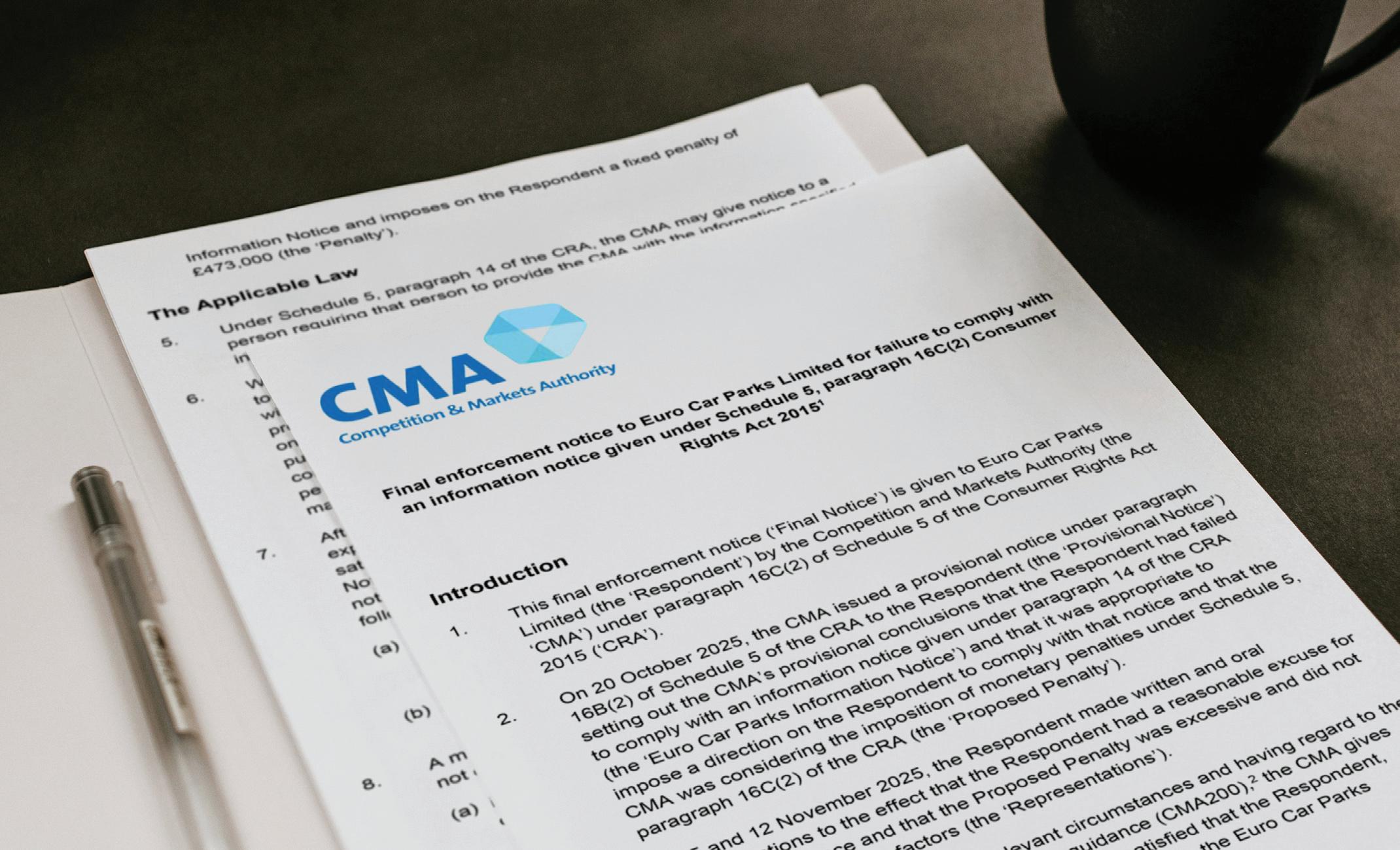
Parking operator Euro Car Parks has been fined £473,000 by the Competition and Markets Authority (CMA) for failing to respond to a notice that legally required the company to provide information.
The penalty is the first issued under the CMA’s new fining powers.
Euro Car Parks Limited has appealed the CMA’s decision to the High Court.
The CMA issued Euro Car Parks with an information notice in July 2025. Despite seven separate attempts by the CMA to secure a response – including delivery by registered post, by hand, and multiple emails to company directors – Euro Car Parks did not respond to the CMA for three months.
It was only after the CMA told the company it was proposing to issue a fine that Euro Car Parks responded and began to provide the necessary information.
The company told the CMA it had blocked the CMA’s emails, stating that they believed they were fraudulent, and attempts to scam the firm. However, the CMA did not consider this a reasonable excuse and imposed the £473,000 penalty against Euro Car Parks in December 2025.
Euro Car Parks also tried to stop the CMA from naming the company, including by applying to the High Court for an injunction. The Court refused that application following a hearing earlier this week.
Information notices are formal demands issued by the CMA that legally require businesses to provide information. The notices can require businesses to provide a wide range of information, such as copies of emails, meeting notes, or details about internal roles and responsibilities.
The CMA considers information notices to be a key tool for gathering evidence as part of assessing whether an investigation should be launched, and timely responses are critical to ensuring effective action.
By ignoring the CMA’s notice and failing to respond to its multiple communications, Euro Car Parks delayed the CMA’s work, causing the authority to spend extra time and resources to get the requested information.
In light of the seriousness of Euro Car Parks’ failure to respond, the CMA has fined the company 75% of the maximum possible fixed charge – a total of £473,000.
Under its enforcement powers, the CMA can issue a fixed penalty of up to 1% of the company’s annual turnover for this type of breach. The penalty against Euro Car Parks has been issued under Schedule 5 Consumer Rights Act 2015 (as amended by the Digital Markets, Competition and Consumers Act 2024), which allows the CMA to fine businesses for failing to comply with information requests. The maximum penalties the CMA can impose for this failure are a fixed sum of £30,000 or (if higher) 1% of the business’ turnover and/or a daily penalty of £15,000 of (if higher) 5% of the business’ daily turnover. It is separate from the CMA’s powers to fine for substantive consumer law infringements.
The CMA is in the process of analysing the
information it has obtained to determine whether a case should be launched.
Hayley Fletcher, senior director of consumer enforcement, said: “We are an evidence-based authority, and information notices are essential tools that help us understand the facts and get to the bottom of potential infringements of the law. It is a legal obligation to comply with them – they are not optional.
“This is the first time we’ve used our new powers to fine a company for failing to respond to such a notice – and it sends a clear message: firms that don’t reply to our requests or refuse to comply risk facing penalties like this one.
“This penalty marks the first use of the CMA’s new fining powers, granted by the Digital Markets, Competition and Consumers Act 2024. These powers enable the CMA to take decisive action when businesses fail to comply with legal requests for information, ensuring its work can proceed swiftly and effectively to protect consumers throughout the UK.”
Euro Car Parks Limited has appealed the CMA’s decision to the High Court. The fine is not payable until this appeal is determined or withdrawn, unless the court orders otherwise.
The CMA said the penalty relates solely to Euro Car Parks’ failure to respond to a legal information notice. It does not concern any alleged infringement of consumer protection law.
The CMA collects payments on behalf of HM Treasury relating to penalties imposed by the CMA. All payments collected are transferred to HM Treasury’s Consolidated Fund.
Euro Car Parks has been asked for comment.
The ghost plate buster
Sarah Coombes MP sees fixing the UK’s vehicle registration system as key to tackling dangerous and criminal driving
Parking is very similar to being an MP. There is always someone who thinks they could do a better job! My constituency, West Bromwich, is a historic industrial town which has long been at the heart of the automotive industry in Britain. We have lots of big roads and lots of cars. And while I pride myself on my safe driving, and have never had a speeding ticket, unfortunately I can’t say the same about parking tickets!
When I was elected in July 2024, I never imagined that I would become a parliamentary expert in number plates and parking enforcement. But here I am, and I’m very pleased because the rules of the road, including parking rules, really matter. While some might say these rules are just of bureaucratic importance –I would say actually they’re of real political importance.
When people break the rules with no punishment, when there is a sense of lawlessness and danger that goes unchecked, it erodes people’s trust in the system. What people in the parking sector do to uphold the rules is important and it makes a difference.
Ghost plates
Every new MP wants to find a campaign topic to make their own, and I stumbled across mine one grey January day last year when transport secretary Heidi Alexander was visiting West Brom to discuss my area’s chronic street racing issue.
The racing happens late at night, just as the residents in the blocks of flats are trying to get to sleep. Some 40 or 50 cars turn up, roar up and down for 5-10 minutes and are gone before the police turn up. It’s a nightmare for the community and it’s also been deadly – two teenagers were killed spectating one of these races.
I was telling the transport secretary and local council staff that what we needed was a speed camera when one of the police officers stopped me and said: “Sarah, it’s useless, they’ll be using ghost plates.”
It was the first time I’d ever heard of ‘ghost number plates’. A ghost plate looks completely normal to the human eye. But the plate has some kind of reflective material on it that makes it invisible to infrared cameras and therefore unreadable to ANPR software. Many of these ghost plates have raised characters –what we call 3D and 4D – but some flat plates also have a plastic coating making them unreadable too. When I Googled ‘ghost plates’ after first being told about them, I was gobsmacked. There were thousands of websites and social media accounts advertising these plates with one clear goal: to go undetected by cameras.
If you get a ghost plate you can speed through any camera, jump any red light, drive through any congestion charging zone and you won’t get caught. You can also park in any cameraenforced car park, go through any airport drop-off zone, and you won’t pay a penny.
Even scarier: you can traffic drugs or people up and down the country or deal in stolen goods, and your vehicle won’t show up on the automatic number plate recognition (ANPR) database. You effectively make yourself invisible to the police.
ANPR is one of the most important modern policing tools we have in this country. It’s essential to the police but also essential to enforcing the rules of our roads, and for commercial use –from car park enforcement to toll roads.
If you speak to experts in policing, trading standards and local authorities, they will tell you ANPR is being subverted on a massive scale by these ghost plates. It was these revelations that started my journey – taking me from a number plate novice, to presenting a Bill in Parliament to campaign for stronger penalties for anyone caught using a ghost plate.
The current penalty for having a ghost plate is pitiful – just £100. No points on your licence. This makes it absolutely worth
Sarah Coombes MP speaking at BPA Live in London on 17 March
Non-compliant behaviour on our roads undermines the basic British value of fairness and it’s costing us all dearly
Sarah Coombes MP
it if it means you never have to pay to park, use the Silvertown Tunnel in London or drop-off at Heathrow Airport.
I’m glad to report that the Department for Transport and the Home Office have woken up to the absurdity of this situation and agreed in the Road Safety Strategy to make the changes I’ve been campaigning on.
Once the law is changed, offenders get points on their licence for having a ghost plate and repeat offenders will have their vehicles seized. But the other thing that became clear to me is how broken the number plate system overall is. The parking industry knows more than most how important it is to be able to identify a vehicle and its owner.
In some countries the number plate is regulated almost as much as a passport – you get given one when you pass your test and that’s your plate for life. Or there are just one or two suppliers you can buy plates from. In contrast, in the UK we have 35,000 companies registered as selling number plates – plus all the unregistered ones operating on the black market.
I would wager that a huge chunk of even the registered ones are selling ghost plates or cloned plates. This situation is making life very difficult for the parking sector… and everyone’s lives more dangerous. I have been pushing to fix Britain’s broken number plate system – and the parking sector’s support could really help.
Public perceptions
I often see the statistic that 10% of offenders are responsible for half of all crimes in this country. When the public see that stat I think they feel angry because the behaviour of a minority can ruin things for the rest of us and they think authorities aren’t getting a handle on it. I think the same is true of those who break the rules of our roads.
Most motorists are law-abiding. They are at pains to ensure that their tax is paid, their vehicle is correctly registered, they abide by the speed limit and park properly. And while some people are trying to push a narrative around “car culture wars”, I actually think there is a lot of consensus about this in communities. When I go door knocking and ask residents if I can do anything for them, the most common thing they ask for is speed bumps or a speed camera. Because they want their kids to be able to play in the street, or to drive to work without fearing they’ll be crashed into by a dangerous driver.
People know that it’s this small number of dangerous drivers and antisocial parkers who put the rest of us at risk. These are the people who are ignoring and exploiting the system. The ones who routinely break the speed limit, don’t pay their penalty charge notices (PCNs) or are using dodgy plates.
Non-compliant behaviour on our roads is having an impact on us all. It undermines the basic British value of fairness and it’s costing us all dearly.
The cost of non-compliance
I know that parking costs are a sensitive subject. There is a debate to be had about the balance between the costs of parking and economic growth on the high street. I feel the pain as much as any driver when you think you’ve done the right thing but get slapped with a parking ticket. But we need to talk about is the cost to ordinary drivers and the system of those who don’t follow the rules, and the holes in the system itself.
In the past I would see cars with five or six tickets on their
windscreen and just thought ‘Gosh, that’s someone with money to burn’. But since I started doing this work I’ve realised how much of an issue unpaid fines are. I have heard stories of individual drivers owing local authorities thousands of pounds in unpaid PCNs. I’ve also heard stories about so-called ‘NIP farms’ (Notice of Intended Prosecution) and the increase in cars on our roads with no registered keeper. Even if the number plate can be read – there is no one and no address to send the fine to.
I recently asked my council, Sandwell, how much was owed to them. I was absolutely shocked to discover that almost one-third of PCNs had gone unpaid since last April. This equates to over £1.2m! Councils are not flush with cash. And I am thinking of all the libraries and youth clubs in West Bromwich that £1.2m could be put towards. This is not fair, this is public money.
We also have a huge problem with untraceable vehicles and car insurance, which is hurting our economy and exacerbating the cost of living crisis. I’ve been doing a lot of work with the Motor Insurers Bureau and it tells me that every 20 minutes someone is the victim of an uninsured or hit-and-run driver.
This is costing the UK economy £1 billion per year and it’s sending all our premiums up. The rise in collisions where one party cannot be traced – either because they drove off or because their plate can’t be read or there’s no registered keeper – is adding up to £50 to every driver’s annual insurance premium.
I’m not naive, I know we’ll never be able to achieve a world where no one breaks the rules, but I think there’s so much more we could do within the system to make the rules harder to flout.
Data is the key
My final point is about the importance of data. Better enforcement is necessary and absolutely essential if we’re to have fairer, safer roads. My view is that driving is an earned privilege, not a Godgiven right. But without up-to-date registered keeper data, how can we know who is really driving on our roads?
Unfortunately, the DVLA’s database is woefully out of date. It’s far too easy for cars to have no registered keeper at all.
I learned this first hand when out with the roads police in West Brom. The ANPR kept dinging every 30 seconds and when I asked the officer what was triggering it, he said they were all vehicles with no registered keeper. When I put this to the DVLA I was shocked to find that this was true of 7% of all vehicles on our roads. And there are plenty more where the registered keeper details are wrong or out of date.
Of the 50,000 total PCNs issued in my borough since last April, I wonder how many have not been paid because someone had a dodgy plate, or couldn’t be tracked down because there was no proper keeper data? I’m sure this is something that frustrates many in the parking sector. So I am pushing the DVLA to up their game and modernise. This starts with number plates. We have to wrench back control of the current number plates Wild West.
But we also need better ways of handling vehicle and driver data to make it easier for drivers to update their details, for local authorities to enforce and for info about persistent rule-breakers to be shared with the police. Taken together, this will stop so many criminals having free-reign and allow local authorities to claim the money they’re owed. Money that should be invested in road safety and maintenance.
Dangerous parking, non-payment of fines, persistent evasion, illegal plates: these are not victimless crimes. And it’s us, the lawabiding public, who are paying the price.
I hope the parking sector can see is that you’ve got an ally in Parliament. The government is consulting on the road safety strategy – including plans for number plate reform. Please do respond to the consultation in favour of fixing our broken number plate system. The voice of your industry is crucial in this.
Roads are the blood vessels of our nation – and we have rules to police them for a reason. And when the rules are flouted, it impacts us all. I look forward to working with the parking sector so we can improve life for everyone in our communities.
Sarah Coombes is Labour MP for West Bromwich www.sarahcoombes.co.uk
Better Connected: Priorities
Simplify payments and information
Journeys across different kinds of transport will be easy to plan, pay for, and navigate –with integrated ticketing wherever possible
Provide safe and dependable journeys
We will provide safe and dependable transport, so people can travel with confidence
Make travel accessible and affordable
Increasingly accessible and affordable transport will provide people with real choice in how they travel
Create healthier communities
Making healthy travel choices will be easy and convenient, supporting cleaner, quieter and more liveable places
Align transport and development
Decisions on transport, housing and wider development will be integrated, creating better-connected places
Champion data and technology
Data and technology will drive the integrated, innovative and accessible transport system of the future
Empower local leaders
Local leaders will be empowered and supported to deliver better local transport for their communities
Optimise decision-making and appraisal
Transport investment decisions will prioritise our principles of people and place, underpinned by high quality analysis
Taking the faff out of parking
Better Connected: Seamless parking payments will help deliver a simpler and better travel experience
Passengers and drivers should be able to travel seamlessly across Britain without the need to juggle multiple tickets or apps. This is a key aim of the Better Connected national transport strategy, which seeks to make everyday journeys simpler by making it easier to pay for and more reliable from door to door. The Department for Transport (DfT) envisages contactless tap-and-go travel becoming the norm across buses, trains, and trams in cities and towns across England. Local leaders will be given the tools to replicate joined-up systems currently in place in areas like Liverpool, London and Nottingham.
Drivers will benefit from the expansion of the National Parking Platform (NPP), allowing them to use any parking app across participating car parks, ending the frustrating experience of having to download a different app each time.
Traffic and technology priorities in the Better Connected strategy are:
• continuing to support the National Parking Platform
• devolving powers to enable local transport authorities to prohibit pavement parking
• publishing an updated Manual for Streets
• updating the Traffic Signs and Regulations General Directions
• updating the Network Management Duty Guidance
• supporting wider work in the DfT on knowledge exchanges for local authorities and other practitioners through the Transport Technology Forum
• building the Digital Traffic Regulation Order Service to move from a paper-based system to digital traffic regulation orders
• delivering a Connected Vehicles Services Framework
• updating streetworks guidance to improve safety standards and accessibility for both workers and road users
• supporting the roll-out of more street works lane rental schemes
• devolving the power for mayors of strategic authorities to approve lane rental schemes.
The strategy has a strong focus on technology, with contactless ticketing, data and innovation playing a key role. The government has announced a new partnership with Google, allowing passengers across England to track their bus in real-time through Google Maps. The service will be especially useful for passengers in rural areas where bus services are less frequent.
Better Connected features a ‘Mini Switzerland’ pilot in the Peak District’s Hope Valley, backed by £6m of government funding. Taking its name from best practice in European rural areas, the trial will test more frequent, reliable rural bus services timed to connect with arriving trains to support local communities and tourism. The government is also publishing new local transport plan guidance, giving local leaders clear blueprints for building joined-up transport, making the most of their funding and boosting local growth.
Transport secretary Heidi Alexander said: “Parking shouldn’t be a faff. The fact that this platform has already handled more than 10 million transactions shows just how much people value a simpler, more straightforward way to pay. Now we want this platform to work harder for drivers in England. The way we drive is changing and so should the technology, which is why our Better Connected strategy encourages more local councils to adopt the parking platform and then look to expand it beyond, to things like electric vehicle charging and paying tolls.”
Rod Dennis, senior policy officer at the RAC, said the roll-out had the potential to simplify an increasingly fragmented system. “Paying to park a car should be one of the simplest tasks any driver does, but with a plethora of different mobile parking payment apps now in existence things have got a little more complicated. The roll-out of the National Parking Platform has the potential to change that, giving drivers the chance to use a single app of their choice. We now need as many operators as possible to join the scheme to make parking easier for everyone.”
Better connected parking
The integrated transport strategy contains a number of references to the role of parking
National Parking Platform
The Department for Transport (DfT) says paying for all journeys should be easier, not just on public transport. It will work with all local authorities in England to roll out the National Parking Platform (NPP), a system that allows drivers to use one app to pay for parking in any participating area, rather than needing to download a new payment app in each place. This digital infrastructure was designed by government and is now operated by the not-for-profit National Parking Platform consortium, supported by the British Parking Association.
Electric vehicle charging
As more people drive and own electric vehicles, there is a need to ensure public chargepoints are accessible to everyone. The DfT has co-sponsored a chargepoint accessibility standard with the Motability Foundation and has passed legislation to enable them mandate accessibility requirements for public chargepoints in future if needed.
Pavement parking
The DfT says it recognises that pavements are a critical part of the network and says it wants to see physical barriers to travel reduced as far as possible, so that people can move around their streets and access transport more easily. To support this, the government is devolving powers to enable local transport authorities to prohibit pavement parking within their local areas. The DfT will also publish guidance for managing shared cycle and e-scooter parking to support the safe use of streets and pavements.
Station car parks
Rail stations are important community hubs and drivers of local economies and opportunities, connecting people not only to rail but also to buses, walking, wheeling and cycling routes and private transport. Stations act as gateways to an area, attract investment and regeneration and enable housing and commercial development. Car parks around stations play an important role as interchange points, says the DfT. In some cases, reconfiguring or resizing them can help unlock brownfield land for development while maintaining essential parking. To support this, Network Rail is updating previous analysis to identify opportunities for housing and redevelopment around rail station car parks, where land can be released and parking can instead be provided in new multistorey car parks or where existing car parking is underutilised.
Cycle parking at railway stations
Great British Railways will ensure that cycle parking is maintained, and where demand exists for new cycle parking or new security features, that provision is actively considered when developing business plans. Active Travel England will develop a framework for assessing the quality and connectivity of walking, wheeling and cycling routes to rail stations, as well as cycle parking provision, in line with best practice approaches for safety and accessibility.
Car club bays
To further develop other types of shared mobility, as part of updating the legislation for traffic signs and road markings, the DfT will consider whether there are changes that could make it easier for local authorities to create dedicated parking bays for car clubs. In addition, it will publish guidance for local authorities on car clubs.
Seamless parking payment makes for better journeys
The National Parking Platform’s Sarah Randall welcomes the government’s transport strategy
The National Parking Platform (NPP) was developed by the government before being handed to a consortium that is run on a not-for-profit basis. The board members include representatives from the British Parking Association, participating local authorities and app providers. The consortium delivers the NPP service, with the government retaining oversight by monitoring the sector’s compliance with agreed terms.
The Department for Transport’s new integrated transport strategy envisages contactless tap-and-go travel becoming the norm across buses, trains, and trams in cities and towns across England. Local leaders will be given the tools to replicate joined-up systems currently in place in areas like Liverpool, London and Nottingham.
Drivers will benefit from the expansion of the National Parking Platform, allowing them to use any parking app across participating car parks, ending the frustrating experience of having to download a different app each time.
We welcome the publication of the Department for Transport’s Better Connected: A Strategy for Integrated Transport which promotes seamless journeys for users. The strategy highlights the government’s continued support for the roll-out of the National Parking Platform (NPP) across England, aiming to make parking payments simpler and more consistent for drivers.
It reinforces that motorists can use their preferred app across multiple locations, removing the need to download different apps in different areas, while positioning the NPP as government-backed digital infrastructure operating in the public interest.
The strategy also recognises future opportunities to integrate parking with wider transport systems, including tolling and rail, and encourages local authorities to consider how the platform can support their wider transport plans.
This demonstrates the important role the NPP is playing in simplifying parking for drivers, giving them the freedom to use the app they already know and trust, while supporting a more joinedup, user-focussed transport system.
The NPP has been designed to operate in the public interest –bringing together local authorities, service providers, and the wider sector to deliver a seamless and inclusive parking experience. It is encouraging to see the government recognise the potential of the platform, from supporting innovation and new market entrants, to enabling better integration across transport modes.
We will work collaboratively with local authorities across the United Kingdom to support adoption and deliver real benefits for drivers and communities.
Sarah Randall is interim chief executive of the NPP
Painless parking payments
RAC research reveals divers prefer ease of use when it comes to paying for parking. Can apps deliver a seamless experience?
Three-quarters of UK drivers (73%) who have used a mobile app to pay for parking have experienced difficulties when doing so, with most preferring the reliability that comes from using bank cards or cash, new RAC research has found. A nationally representative sample of 1,709 UK drivers were surveyed for the RAC by Online95 between June and July 2025
Of those that ran into problems, top of the list of frustrations by a considerable margin is a lack of reliable mobile phone signal in the car park (70%). This was followed by the mobile app not correctly recognising the car park the driver was in (36%), and the app in question crashing (35%).
Three-in-10 drivers (30%) reported other functionality problems with the app, while 24% said the app they were using didn’t accept their bank card. A smaller proportion of drivers (13%) said they couldn’t work out how to use the parking app in the first place – a figure that doubled to 26% for drivers surveyed aged 75 and over.
When it comes to how drivers prefer to pay for parking, the simplicity and ease that comes from using a bank card or Apple Pay/Google Pay makes this the most popular option (favoured by 46% of drivers), with cash and paying by mobile app preferred by 33% and 30% respectively. Just 6% of drivers prefer to scan a QR code and then paying using card – something that leaves them vulnerable to so-called ‘quishing’ operations that the RAC has previously warned about.
Nearly two-thirds of drivers (64%) who use mobile apps to pay to park have at least two installed on their phones, while 36% have at least three and around one-in-10 (15%) have as many as four or more installed at any one time.
The government is backing the roll-out of a system called the National Parking Platform (NPP) which, if adopted widely by councils and private parking operators, should mean drivers can use a single mobile app of their choice when parking – the simplicity of which could make paying by app much more popular. Currently 15 local authorities are live including Manchester,
Liverpool and Coventry city councils.
RAC senior policy officer Rod Dennis said: “There’s no doubt mobile apps have an important and increasing role to play when it comes to parking our vehicles, and the best ones make parking an easier task. But our figures show there’s still plenty drivers find frustrating about using them – whether that’s a lack of mobile signal, problems registering bank cards, or the app crashing or behaving strangely.
“Parking should, in theory at least, be one of the simplest tasks any driver completes but having to navigate a variety of differently designed apps – and register an account, vehicle details and bank cards with each one – can be a pain. Having card details saved with a myriad of different providers also isn’t ideal from security perspective, as unlike using conventional websites there’s generally no reassuring padlock symbol on parking apps to show card details are being shared securely.
“The launch of the National Parking Platform, which we welcome, should spell the end of drivers needing to download lots of separate apps just to park and simplify things enormously. This does depend on enough local authorities and parking companies up and down the country signing up, though.
“In the meantime, we encourage drivers to ensure they’re always using the latest versions of each parking app they use. This reduces the chance of the app not functioning and ensures they always benefit from the app’s latest features. But even then, those with older smartphones need to be aware that over time, parking app developers stop supporting their devices. This means these drivers will no longer be able to update their apps, which could lead to future problems using them to pay for parking.
“For anyone running into difficulty when paying by app is the only option, whether that’s struggling with phone signal or the app just not working, we strongly recommend they collect evidence of their attempts to park, including screenshots of any app errors. This can be used to challenge the parking operator in the event they send the driver a parking charge notice for apparently not paying to park, as it shows the driver did everything they reasonably could to pay.
“We also continue to believe that all parking operators, whether public or private, should offer drivers at least two different ways to pay. No-one should be forced to use to a mobile app when parking if they don’t want to, especially those who struggle with technology or just don’t have a smartphone.”
Accessibility matters
Jonathan Hassell offers advice on avoiding digital exclusion
Over the past few years, parking has become increasingly digitised. The growth of parking apps has been driven by many local authorities moving from more traditional ‘pay & display’ machines to cashless systems, with the goal of making parking more convenient for users.
However, the growth in parking apps has not been immune from its issues, including poor phone signals hampering connectivity, users having to install multiple apps depending on the location of the car park, and confusing instructions.
The Department for Transport has backed a National Parking Platform (NPP), a ‘one app fits all’ initiative designed to make life easier for car park users. While this is undoubtedly a welcome move, it doesn’t overcome some of the more fundamental user complaints.
Recent research from the RAC highlights this, revealing that 73% of drivers who used a parking app in the last year experienced difficulties, with common problems including poor mobile signal and apps not correctly recognising the car park location. It advocates for local authorities to ensure that there are back-up options, so that users are not reliant on an app to make the payment.
In addition, the widespread use of apps, and other digital ways of making payments, raises specific issues around accessibility. While
Beyond the app
Digital parking needs to work for everyone, says TNS’s John Tait
Across the United Kingdom, paying to park has become a digital experience. Drivers expect to tap, scan or pre-book rather than handle coins, yet friction still exists across parking estates. Research commissioned by Transaction Network Services (TNS) found that 46% of UK drivers had been unable to park at least once in the past year because of a payment problem.
The research suggests UK drivers are among Europe’s most active users of mobile payments for parking, yet inconsistency across councils and private operators continues to frustrate motorists.
Over the past decade, UK parking has shifted from cash and chip & PIN to mobile wallets, pre-book portals and tap-to-pay terminals. Younger drivers are the heaviest mobile users: 18-to-24-year-olds are most likely to use their phone to pay and also the most likely to report issues when doing so. Drivers aged 55 and over still favour card or terminal payments.
For many people, parking is their first encounter with what the industry calls an unattended payment, so reliability here shapes confidence in wider digital services. Similar patterns appear in Europe and Australia, but the UK’s dense mix of local authorities and private operators makes national consistency especially challenging.
an app can be preferable as a payment mechanism for some people with disabilities, this is only the case if the app is digitally accessible. Otherwise they could be the blocker to parking all together.
This is where this issue moves from being a minor inconvenience for some, to something that has a much wider societal impact for many. And this exclusion can be hugely detrimental. For many people, a parking space is more than just somewhere to leave their car, it is a necessary connection to their communities and many essential services.
It is paramount that parking app companies and car park operators consider the accessibility needs of the whole variety of their potential users, particularly if they go down a fully cashless, digital route.
It’s also the law – the Public Sector Bodies Accessibility Regulations 2018 (PSBAR)
The UK has dozens of parking payment apps, often varying from town to town. Regular commuters may know which one to use, but visitors face a confusing download-and-register routine each time they park. Local authorities are responding through open-data initiatives and the National Parking Platform (NPP), designed to improve interoperability.
Many operators are now adopting complete commerce approaches, consolidating mobile, terminal and online payments within a single managed environment. This unification looks to reduce points of failure and gives customers a consistent experience. Collaboration and shared standards matter more than launching another app and the British Parking Association (BPA) and International Parking Community (IPC) Code of Practice shows that the drive toward consistency is now part of the policy landscape. Public confidence depends on visible security and clear communication. Fake QR codes are being placed on pay-to-park signage that divert drivers to fraudulent
requires accessibility to be delivered in all digital tools provided by public sector bodies. As many local authorities operate car parks, it is their responsibility to ensure they are accessible and inclusive for all users.
So what’s needed? Digital accessibility can mean different things for different people, depending on their conditions and preferences. For example, older people who have issues with fine motor skills may struggle to use some apps on their smartphone, while neurodivergent people may experience increased anxiety if there is no alternative to using an app for payment.
For us, there are three ways parking app companies can ensure better accessibility:
• define responsibility and get buy in from senior stakeholders
• make sure accessibility is a requirement across your suppliers
• embed accessibility from the outset and treat it as a long-term strategy.
Without doubt, we are moving towards a digital-first future. However, an over-reliance on digital products without non-digital backups means there is a real danger of exacerbating inequalities, particularly for disabled, elderly and other customers with additional needs. When it comes to parking, people may find it harder to get to work, struggle to reach essential services, and users without smartphones may lose access entirely.
Jonathan Hassell is chief executive at Hassell Inclusion
websites. Operators and suppliers must support payment routes that are genuine and secure. Strong encryption, tokenisation and adherence to PCI DSS and P2PE standards protect transactions, while clear branding and certification marks help drivers recognise trusted systems. Similar fraud attempts have surfaced in the United States and Asia Pacific, reinforcing that vigilance must be global even when regulation is local.
Digital convenience cannot come at the expense of inclusion. National and local debate continues about supporting people without smartphones or bank accounts. The most resilient car parks now offer multiple payment channels: mobile, contactless terminals, assisted pay-on-foot and SMS options. This aligns with guidance from the BPA and the Department for Transport on inclusive design.
Behind the scenes, many UK operators are consolidating fragmented systems into unified, cloud-based platforms that connect every payment channel. These environments work together to help reduce vendor complexity, speed up upgrades and deliver a consistent customer experience. One national operator now processes tens of millions of transactions each year through a single managed service, that has recorded an improvement with uptime and data visibility while benefiting from lower operating costs.
John Tait is global managing director for TNS’s payments market business.
Fake fines, real threats
Fraser Richards of Anchor Group Services on how scam penalty charges are undermining trust in UK parking
You return from shopping, a family day out, or a client meeting and there it is, a yellow slip tucked under your windscreen wiper. A parking charge notice, issued because you overstayed or failed to pay. But increasingly, this ticket is not from any legitimate authority. It’s a scam.
Across the UK, fake PCNs are on the rise and they’re more convincing than ever. Mimicking official council notices and using cloned logos, correct car registration numbers and even the names of legitimate car parks. These bogus tickets are defrauding drivers out of hundreds of pounds and undermining public trust in the system. At Anchor, we manage parking for some of the UK’s busiest retail and commercial destinations. Our frontline teams have seen first-hand how these scams operate and how they are evolving.
A new breed of parking fraud
According to the British Parking Association (BPA), there has been a surge in reported incidents involving fake tickets, QR scams, and card skimmers at pay & display machines.
Local councils from Southampton to Islington have issued public warnings about fraudsters placing dummy PCNs on windscreens, often in high-footfall locations such as retail parks, seafronts or commuter hubs.
These scams are well-crafted and executed. The ticket may look and feel identical to a council-issued notice. A convincing web link or QR code leads to a payment portal. The victim thinks they’re resolving a minor issue until their bank account is compromised.
The rise in vehicle-related fraud reflects an unfortunate broader trend, the UK recorded a 24% increase in payment card fraud in 2023, according to UK Finance, with parking scams named among emerging methods. For FM (facilities management) providers and property owners, these are not isolated incidents. They threaten customer experience, brand trust, and site safety.
Parking providers must respond proactively
Fraser Richards
Parking has evolved dramatically over the past decade. Contactless payments, app-based permits, and ANPR technology have made the process faster and more flexible. But digitisation also opens new doors for abuse.
That’s why at Anchor we are investing in prevention and protection to try our best to mitigate this threat. From re-evaluating the signage and appearance of legitimate PCNs, to training our staff to spot fraudulent activity and educating the public in partnership with clients.
At key retail destinations we have already implemented the below:
• Secure QR and NFC technology: Verified, encrypted links with anti-cloning protocols.
• Staff awareness training: Ensuring parking officers and site teams know what to look for.
• Customer guidance signage: Clear messaging around authorised payment methods.
• Incident reporting systems: Allowing suspicious activity to be flagged immediately.
We’re also in active conversation with trade associations and retail partners to ensure a joined-up response that protects both motorists and client assets.
Rebuilding trust in parking services
The damage caused by scam PCNs extends far beyond the individual. It chips away at public trust. It creates confusion around legitimate enforcement. And it risks discrediting both private and public parking services at large.
Parking providers have a responsibility to not just enforce fairly, but to communicate clearly. It means protecting customer data, validating signage and branding across every touchpoint. Our preferred approach is centred in partnership, with retail landlords, local authorities, and above all, with the public. When parking feels unsafe, chaotic, or inconsistent, everyone loses.
A call to action
The parking sector cannot afford complacency. We need a coordinated response from councils, private operators, technology providers, and consumer groups. Public education is key but so is proactive infrastructure review, staff vigilance, and improved digital security.
At Anchor, we’re committed to making parking not just efficient, but secure and trustworthy. Because the next time someone returns to their vehicle, the only thing they should worry about is beating the traffic home.
Fraser Richards is director of parking services at Anchor Group Services www.anchorgroupservices.com
Fraud reporting service revamped
The way in which cyber crime and fraud can be reported to the police is changing, with the Serious Fraud Office launching Report Fraud, a new service that replaces Action Fraud as the national platform for reporting cyber crime and fraud.
The new Report Fraud service has been designed by the City of London Police to provide a better experience for victims and deliver improved information to law enforcement.
The service includes:
• A new Report Fraud Contact Centre and online reporting tool, where victims can make reports of cyber crime and fraud.
• The Report Fraud National Crime Analysis Service (N-CAS), replacing Action Fraud’s backend system for analysing reports. All police forces will have access to this system.
• The Report Fraud Victim Service (formerly the National Economic Crime Victim Care Unit), continuing to provide specialist victim support.
Members of the public can report cyber crime and fraud at reportfraud.police.uk or by calling 0300 123 2040 (the phone number remains unchanged).
For more information about the Report Fraud service visit: reportfraud.police.uk
Grounding rogue operators
Avon & Somerset Police, North Somerset Council and British Parking Association tackle bad practice
Unprofessional airport meet & greet parking operations are a problem that police forces and trading standards teams are tackling across the country. These shady operations often come to light when drivers discover their cars have wracked up unexpected high mileage and damage despite being supposedly parked in secure compounds after being handed to the companies at airports.
An investigation of unauthorised meet & greet companies offering off-airport parking to people travelling from Bristol Airport discovered customers cars abandoned in muddy fields.
The joint day of action, held in the run-up to last Christmas, was led by Avon and Somerset’s airport police team, the Immigration Enforcement Team, North Somerset Council and the British Parking Association. The day targeted three sites used by the parking firms. These were found to have no staff present, and the ‘offices’ used consisted of unlocked vehicles and a caravan that contained what appeared to be the keys of customers’ vehicles. One driver working for the unaccredited parking operators was stopped in a customer’s car and reported for driving a motor vehicle without insurance.
Avon and Somerset Police’s Sgt Danielle Hardaway said: “People would be horrified if they understood how their vehicles are used and stored. The last thing anyone wants is the worry over whether their car will be returned to them when they return from holiday.”
Cllr Annemieke Waite, cabinet member for planning and environment at North Somerset Council, said: “None of the off-site operators have ever been granted planning permission, and many have never been assessed against planning policy. It’s really important for travellers to take a moment to check exactly who they’re booking with and read the terms and conditions carefully. When deals look too good to be true – they usually are.”
Dave Lees, chief executive, Bristol Airport, said: “We welcome this latest operation to target rogue operators who cause distress to customers who trust them with their vehicles – many of which are left insecure in fields, roads and laybys to the annoyance of local residents. Nuisance parking is a key area of concern for our local communities, so we hope this partnership operation by the police and council to deal with illegal parking operators, helps make a difference and deters this activity.
“Meanwhile, we’d urge customers to respect our neighbours and not park outside houses or drop people off, which causes disturbance, particularly during the early hours of the morning.”
Customers’ cars were left in fields
The ‘office’ was an unlocked caravan
Delivering for Durham
Cllr Tim McGuinness provides insights into Durham County Council’s approach to traffic and parking management
Parking sits at the intersection of network management, place making, public confidence, and day-to-day service delivery. As the portfolio holder for rural, farming and transport at Durham County Council parking forms a key part of that role. This is a brief overview based on some of my experiences as a portfolio holder so far, about some of the lessons learnt, and where we in County Durham are headed as a result.
Lesson 1: Consistency and trust…
Suffice to say, as an elected member I did not truly realise the extent to which the public would resist parking charges and costs related to parking. Parking charges and enforcement will always attract public scrutiny. And that is unlikely to change. What we can change is how clearly and consistent we are in communicating our processes:
• why enforcement takes place
• how decisions are made
• and how income is used.
In Durham, we publish clear information on enforcement activity and the use of surplus income, demonstrating that civil parking enforcement is operated as a self-funding public service, not a revenue raising exercise.
Our self-financing approach, when paired with national best practices – including guidance promoted through Parking and Traffic Regulations Outside London (PATROL) and the use of technology – makes that consistency and transparency easier. But this only matters if transparency is treated as a principle, not an afterthought. All of this ensures consistency. Through this we can start to build trust.
Lesson 2, In data, we trust…
It’s also worth remembering that, as is true for all local authorities, finances are tight. This makes Durham’s self-financing goal even more poignant and challenging.
How then can we ensure that our budget is used where it is most needed and to the greatest benefit to the tax payer? We must follow the data. We simply do not have the luxury of being able to do anything else.
And in many ways, as a politician, it is as much my job to defend officers and the budget as it is to ensure service improvements and value for money for our residents. In fact, these two things are wholly dependent upon each other.
Thankfully, technology is providing increasingly affordable solutions and is already playing a growing role in parking management. But in Durham we are very deliberate about how and why it is used. We already operate in a largely digital environment:
• pay-by-phone and cashless payments are well established
• back office processing and case management is fully digitised
• enforcement activity is supported by mobile and vehicle-based systems rather than paper-based processes.
However, our starting position is clear: technology is an enabler of policy, not a substitute for it. In other words, we are data-led, not ticket-led. One of the most critical changes we are making is moving away from measuring success purely in terms of activity
– numbers of penalty charge notices or patrol hours – and towards data-led outcomes. Technology allows us to:
• understand patterns of non-compliance
• identify locations where parking behaviour creates congestion, obstruction, or safety issues
• align enforcement deployment with wider network management priorities.
A data-led approach supports a more proportionate and defensible enforcement model, focussed on resolving problems rather than maximising outputs.
Cllr Tim McGuinness has been digging into traffic and parking management
Enforcement technology and governance
Across the sector, there is increasing interest in: vehicle-based enforcement systems; automated evidence captures; and more sophisticated back office platforms. Durham’s approach is pragmatic rather than technology-led. We recognise the benefits these tools can bring in improving: accuracy; consistency; officer safety; and evidential robustness.
But we are equally clear that technology must operate within: strong governance arrangements; clear decision making frameworks; and full compliance with statutory guidance and data protection requirements. The challenge is not whether technology exists, but rather it is how it is deployed, explained, and controlled.
It is worth mentioning that this ability to be pragmatic is heavily reliant on the experience and knowledge that has been built up within our team, without this it would be a much more difficult proposition. I value the expertise and advice of the officers around me. It is my job to blend their knowledge and experience with the needs of the county and its residents.
Lesson 3: Right first time…
Good policy is good policy. To make everything we want to happen work, we need to ensure that we create policy that addresses parking and parking problems in the first instance wherever possible. I am referring here to the basics. Ensure when we build new developments, that enough bays are built to accommodate cars. Ensure verges are hardened or protected as standard. And to ensure budget gets allocated, so where there are problems, we can go back and engineer a long-term solution.
It is all too easy to write planning rules and alternative travel schemes and lose sight of the simple fact: if people cannot find a sensible convenient car parking space, they will still park their car somewhere. We need to ensure that we are not simply managing parking and parking enforcement, but that we are informing developments and improvement schemes so that the need to enforce will be minimised, allowing us to focus our efforts where it really matters.
Durham’s digital future
What does the future of parking policy in Durham look like? And what is driving change? In the first instance, clear and consistent parking and enforcement policies. Then ensuring policies are linked to network management outcomes, and wider council planning considerations. It must be driven by the data and the local context.
Technology used needs to be fair, accurate, efficient and, most importantly, affordable. There must be a continued emphasis on consistency and transparency, to ensure we build public confidence. In short, the future is not about being tougher, nor simply about being more automated, it is about being clearer…
• clearer about purpose
• clearer about outcomes
• clearer about how parking management supports the network and communities we serve.
Parking will always generate strong views. That is the nature of the beast. But Durham’s experience shows that when parking management is: purpose driven; proportionate; well governed; and openly explained it becomes easier to deliver, easier to defend, and easier for the public to understand. And when that happens, parking enforcement stops being the problem, and becomes part of the solution.
Durham’s digital streetworks plan
GeoPlace helps Durham County Council develop congestion-beating Lane Rental Scheme proposals
Lane Rental Schemes allow councils to charge utility companies and contractors for roadworks on high-traffic routes during peak times. The charges encourage off-peak scheduling, alternative locations, and joint working, helping to minimise congestion and frustration for road users. Durham County Council is planning a Lane Rental Scheme (LRS) as part of works to reduce disruption on its roads. Permission is being sought for the scheme from the Department for Transport (DfT).
County Durham’s proposal highlights how data-driven planning and collaboration can improve road management. If approved, it will provide a model for other authorities looking to reduce congestion and improve service delivery.
Cllr Tim McGuinness, Durham’s cabinet member for rural, farming and transport, said: “With over 4,000 kilometres of highway to maintain, serving over 530,000 people, it’s vital that we try to keep County Durham’s roads moving. The Lane Rental Scheme gives us new powers to ensure roadworks are delivered promptly and efficiently. That means fewer delays, reduced disruption, and better journeys for everyone.”
Following a competitive tender, GeoPlace was appointed to develop a cost-neutral scheme that integrates with Durham’s existing streetworks permit system and complies with the DfT’s Lane rental scheme: guidance for English Highway Authorities 2024. “By harnessing accurate data and working closely with Durham County Council, we’ve been able to design a Lane Rental Scheme that reduces disruption, improves traffic flow, and supports smarter, more efficient road management,” said Laura O’Gorman, associate delivery manager for GeoPlace. “Collaboration and data-driven insight are at the heart of delivering real benefits for communities.”
Using its Critical Highway Routes Identification Service (CHRIS), GeoPlace collaborated with the council’s highways team to identify priority routes, integrating traffic flow data, DfT datasets, and local insights. GeoPlace also produced a cost-benefit analysis, identifying potential lane rental models, including options for cost banding, time restrictions, and other configurable elements.
The scheme has been shaped through extensive stakeholder engagement, including an informal consultation session via an MS Teams meeting before opening up the proposed scheme to a sixweek formal consultation process. GeoPlace provided interactive mapping tools and data outputs to ensure transparency and refine the proposed charges and restrictions.
Luke Meaton, streetworks operations and regulatory manager at Openreach said: “GeoPlace’s thorough and transparent consultation process enabled us to align our operations with the proposed scheme by sharing emerging insights and approaches, which made us feel part of the process rather than just being presented with a finalised network. This collaborative approach gives us confidence that the scheme will work effectively for all stakeholders.”
GeoPlace LLP is a public sector limited liability partnership between the Local Government Association (LGA) and Ordnance Survey. GeoPlace maintains a national infrastructure that supports the address and street information needs of the public and private sectors. Its work relies on close working relationships with every local authority in England and Wales to build the National Address Gazetteer infrastructure and National Street Gazetteer (NSG).
Cllr Tim McGuinness is the Reform Party’s cabinet member for rural, farming and transport at Durham County Council
Lane Rental Scheme management screenview
Cllr McGuinness was the keynote speaker at the North East Parking Show, held in Durham on 3 March. The event was organised by Landor LINKS, which would like to thank Durham County Council for hosting the day and Marston Holdings for being its main sponsor.
Let ’s go to the parking show
BPA’s trade show and conference takes place in Coventry on 20-21 May
Parking professionals from across the world will be gathering in Coventry for the British Parking Association’s annual conference and exhibition. Parkex 2026 will be held at the CBS Arena on 20-21 May 2025.
The BPA is a membership association representing the UK’s parking and mobility sector. It represents over 750 corporate members, including local government, commercial providers, parking system operators, consultants and academics. In addition, the BPA has a separate membership structure for individuals.
Parkex 2026 will feature seminars and presentations in the BPA Live and EV Connect theatres.
Over two days, panels comprising sector experts and guest speakers will convene on the BPA Live stage where they will address a range of themes, including:
• Government transport and parking policy
• National Parking Platform
• Parking enforcement
• Kerbside management
• The Blue Badge scheme
• Procurement
• Ghost plates and cloned vehicles
• EV infrastructure and payment
• Structural safety
• Women in Parking
• Diversity and inclusion in parking services.
The event will see the BPA reveal the winners of The John Heasman Innovation Awards, which recognise excellence and technological developments in parking.
Traffex and Cold Comfort
Parkex 2026 is co-located with the Traffex, a highways event, and Cold Comfort, a winter roads maintenance event. Both these exhibitions have their own dedicated conference streams.
Exhibition
Parkex 2026 will see many suppliers and technology providers exhibiting their systems and services.
Companies taking part in the show include: AppyWay, Arvoo, Barbour Logic, CoIX Group, DCBL, Efaflex, Egis, Go2Sim, IPS Group, Marston Holdings, Metric, m2m Connect Data, Nagels, Newlyn, NMI, NPED, PayByPhone, Postworks, RingGo, Sagoss, ScanNeo, Scheidt & Bachmann, SWARCO, Tagmaster, Twin, Unity5, VREO Innovation and Yunex Traffic.
Free tickets
Parkex 2026 is free to attend.
Opening times
Wednesday 20 May: 09:30 – 17:00
Thursday 21 May: 09:30 – 16:30
Free Parking
Parking is free at Parkex for visitors and exhibitors but must be booked in advance.
Exhibition
Networking
Debates
Presentations
Safer Parking: T he next chapter
Police Crime Prevention Initiatives is directly managing Safer Parking Scheme
The Safer Parking certification mark is awarded to parking facilities that have met the requirements of a risk assessment conducted by the Police. These requirements mean the parking operator has to put in place measures that help to deter criminal activity and anti-social behaviour, thereby doing everything they can to prevent crime and reduce the fear of crime in their parking facility. The scheme covers over 5,000 sites is open to parking facility owner and operators from both the commercial and public sectors, such as those at shopping centres, leisure parks, hotels, hospitals, train stations, freight parking and those run by local authorities.
The Safer Parking Scheme has undergone a major overhaul. On 1 April, the operation and administration of the initiative was brought in-house by its owners, Police Crime Prevention Initiatives (Police CPI). This move aligns all major UK police-backed prevention initiatives under one direct operational control.
As part of the transition, the Park Mark initiative is rebranding to Safer Parking. The new identity is designed to communicate the scheme’s primary mission: providing demonstrably safer spaces for all motorists. The refreshed suite of awards will be:
• Safer Parking (formerly Park Mark)
• Safer Parking Plus (formerly Park Mark Plus)
• Safer Parking Freight (formerly Park Mark Freight)
• Safer Parking Meet and Greet (formerly Approved Meet and Greet Operator).
Additionally, following a consultation with Disabled Motoring UK (DMUK), the accessibility standards are also evolving:
• Safer Parking Accessible (formerly Park Access)
• Safer Parking Accessible EV (formerly Park Access EV).
The Safer Parking Scheme had been run on behalf of Police CPI by the British Parking Association (BPA) since 2002. All scheme
members, BPA members and partners have now received a communication detailing the transition arrangements. As part of the transition, the BPA staff members who work on the Safer Parking Scheme have transferred to Police CPI, ensuring points of contact remain unchanged.
Police CPI told Parking Review: “The Safer Parking scheme is one of a number of innovative and ground-breaking crime prevention and demand reduction initiatives Police CPI delivers to support the wider UK Police Service, government and the general public. Operational and administrative delivery of the scheme has been delivered by the BPA on Police CPI’s behalf for the past two decades. This transition is an evolution designed to strengthen the governance and delivery of the scheme, reinforcing its position as the sole police-backed national standard for secure parking. It builds upon the highly effective partnership between Police CPI and the BPA that has been essential to the initiative’s success for over two decades.”
The Safer Parking Scheme, created in 1999, is a UK-wide initiative aimed at reducing crime and the fear of crime in parking facilities. Under the scheme a Park Mark tick logo is awarded to parking facilities that have met the requirements of a risk assessment conducted by the Police. These requirements mean the parking operator has put in place measures that help to deter criminal activity and anti-social behaviour, thereby doing everything they can to prevent crime and reduce the fear of crime in their parking facility.
Reflecting on the transfer of the accreditations to Police-CPI, Andrew Pester, chief executive of the BPA, said: “We are immensely proud of the part we’ve played in building and delivering trusted accreditation schemes, and our commitment to working closely with our colleagues at Police-CPI remains unwavering.
“As the sector’s leading professional association, we will continue to champion these accreditations – making sure they stay visible, valued and indispensable to every car park operator.
“This transition also opens up fresh opportunities for BPA members, enabling the association to sharpen its focus and build real momentum behind the service that matter most to them.”
saferparkinguk.com
Promoting accessible parking
Disabled
DMotoring UK
welcomes new arrangement
elivery of Disabled Motoring UK’s Park Access accreditation is now being undertaken by the national Police Crime Prevention Initiatives (Police CPI) organisation.
Park Access is a nationally recognised UK accessible parking scheme for parking operators. Via the accreditation, DMUK wants to enable everyone, regardless of their accessibility needs, to identify car parks and facilities, such as EV chargepoints, that they can use with ease.
The accreditation had been managed on behalf DMUK by the British Parking Association (BPA) alongside Safer Parking Scheme, which is a Police CPI initiative. However, Police CPI has decided to take over direct management of the safer parking scheme, whose accreditations are called Park Marks. This provided an opportunity for DMUK to entering into a new partnership with Police CPI to develop the Park Access scheme.
On 1 April Police CPI assumed operational management of the Park Access and Park Access EV accreditations, alongside its Safer Parking Scheme initiatives. The accreditations are being rebranded as:
• Safer Parking Accessible (formerly Park Access)
• Safer Parking Accessible EV (formerly Park Access EV).
Each car park submitted for a Safer Parking Accessible accreditation will undergo an assessment by Police CPI. The Safer Parking Accessible version of the accreditation includes requirements and recommendations for accessible electric vehicle charging informed by the British Standard Institution accessibility standard, PAS 1899.
There are now 1,300 Safer Parking Accessible accredited car parks, which can be found at train stations, hospitals, universities, town centres, shopping centres, leisure centres, airports, supermarkets, banks and constabularies.
DMUK wants Safer Parking Accessible to become recognised throughout the whole of the UK for accessible and inclusive parking and electric vehicle charging facilities. The charity believes a more direct relationship with Police CPI will be fundamental in providing enhanced operational management and further growth.
Graham Footer, chief executive of Disabled Motoring UK, said: “The transition represents a significant milestone for the Park Access Accreditation. Partnering with Police CPI provides a strong foundation for future development while preserving the values, standards, and impact that have underpinned the scheme since its inception. This partnership with Police CPI ensures the scheme continues to raise accessibility standards in car parks for disabled motorists and build confidence in safer parking facilities.”
Michael Brooke, deputy chief operating officer of Police Crime Prevention Initiatives, said: “Police CPI is delighted to be forming this partnership with DMUK. Bringing together our focus on personal safety and crime prevention with DMUK’s expertise in representing disabled motorists, we are committed to improving awareness, accessibility and experiences for disabled road users nationwide.” www.disabledmotoring.org
Protecting the public
A guide to Police Crime Prevention Initiatives
Set up by the Police Service in 1989, Police Crime Prevention Initiatives (Police CPI) delivers a range of innovative crime prevention and demand reduction initiatives to support the wider UK Police Service, central government and the general public. It brings organisations together to reduce crime and the fear of crime and create safer communities. Police CPI acts as a catalyst for crime prevention with a simple mission at its core: “To support policing and communities by preventing crime where we live, work and socialise.”
Operational arm of preventative policing
Police CPI is an operational arm of preventative policing and is a portfolio of the National Police Chiefs’ Council (NPCC) Prevention Coordination Committee. It works closely with the committee to deliver the outcomes of the National Policing Prevention Strategy. Senior police officers from England, Scotland, Wales and Northern Ireland control and direct the work Police CPI carries out on behalf of the Police Service, setting the strategic direction of Police CPI to ensure there are benefits for both the public and the Police Service.
A not-for-profit organisation
Police CPI is owned by MOPAC on behalf of UK Policing and is a notfor-profit organisation. MOPAC – Mayor’s Office for Policing and Crime – is the strategic body overseeing the Metropolitan Police Service. Police CPI is not centrally funded and generates its own income to fund the prevention activities. This financial freedom enables it to be agile and to deliver crime and police demand reduction projects within very short time periods.
Police CPI’s partners
The organisation seeks to be a catalyst for organisations to work together to reduce and prevent crime, the fear of crime and create safer communities.
Key relationships include: the wider policing family; the Home Office; Police and Crime Commissioners; the Ministry of Housing, Communities and Local Government; National Counter Terrorism Security Office (NaCTSO); National Protective Security Authority (NPSA); Department for Culture Media and Sport (DCMS); and Department for Science, Innovation and Technology (DSIT).
Police CPI also works closely with: academic institutions; local authorities; British and European standards authorities; trade associations; test houses; certification bodies; the construction industry; manufacturers and companies involved in security products – both within the UK and those in countries that supply the UK – as well as many other organisations.
Initiatives
Police CPI has evolved and grown in response to changing demands and emerging crime threats. Its initiatives include:
• Secured by Design (SBD)
• The Police Crime Prevention Academy
• The Licensing Security Vulnerability Initiative (Licensing SAVI)
• Secured Environments
• The Safer Parking Scheme
• The Community Safety Accreditation Scheme (CSAS)
• Railway Safety Accreditation Scheme (RSAS)
• Guidance and Policy for Security Systems
• Fraud Resources. www.policecpi.com
CAR PARKS
Capital&Centric starts work on Karparc
Newcastle-under-Lyme multi-storey car park becomes housing
Work has begun turning a multistorey car park into a pioneering neighbourhood scheme in Newcastle-under-Lyme.
The Karparc project is being undertaken by social impact developer Capital&Centric.
Work is now underway to transform the former Midway multi-storey into a community of 111 apartments.
The design-led layouts are built for light and space, topped off with a floor of penthouse apartments featuring distinctive red pitched roofs.
Every home at Karparc comes with an outdoor aspect. They will feature private balconies and roof terraces with integrated edge planters.
Amenities for residents will include a social hub, gym, minicine and lounge, bringing a big city lifestyle to the town centre and giving people a place to hang out, work out or catch a movie.
Re-casting car parks as spaces for playing sports and making movies
Swindon Borough Council is looking at ways of finding alternative uses for under-used multi-storey car parks in the Wiltshire town. The council recently unveiled a plan to convert the upper floors of its Whalebridge car park into a roller-skating venue.
Now the council has set out plans for activities for the Brunel North and Brunel West car parks, which serve the Brunel shopping centre.
The council’s planning application for Brunel North states: “The intention is to transform the spaces into an exciting sport and community destination for the town centre. A flexible planning permission is sought which will allow level five to be used for pickleball and level four as a community and events space or other leisure, recreation, cultural and community purposes.”
At Brunel West the council
neighbourhood is something you won’t find anywhere else in the UK.
“It’s a creative way to solve the housing crisis and protect the planet, by re-using a building with tons of embodied carbon.
The former car park is currently being hollowed out to create a triple-height atrium, with the raw concrete frame softened by cascading gardens and lightfilled social spaces.
By saving the building, the project locks in tons of embodied carbon that would otherwise be lost.
Simon Tagg, leader of Newcastle-under-Lyme Borough Council, said: “This brilliantly innovative design, which is attracting interest from across Europe, will turn an old
Newcastle landmark into a brand new one. Along with the other developments at Rye Park and York Place, it is a delight to see brownfield land and derelict buildings repurposed and become hundreds of homes boosting our town centre economy.”
John Moffat, joint managing director at Capital&Centric, said: “People doubted it would work but Karparc is set to be something truly unique. Taking a concrete hulk of parking spaces and turning them into a buzzing new
Let ’s play pickleball up on the roof
Starting the transformation proves the naysayers wrong and now that we’re under construction, people will quickly see the changes happening. It will bring energy back to the town centre and create a neighbourhood that’s packed with character, light, and loads of greenery.”
The project is part of a wider £60mn regeneration of Newcastle-under-Lyme, supported by the borough council and recently backed by a £19m funding boost from Homes England.
The redevelopment sits alongside Capital&Centric’s other upcoming town centre sites, Astley Place (the former York Place shopping centre) and Rye Park (a new neighbourhood in the Ryecroft area of Newcastleunder-Lyme).
The community is expected to complete in mid-2027.
included a detailed examination of the parking landscape in Swindon, focussing on the profound shifts in parking behaviour following the COVID19 pandemic. The review mentioned that, with a marked reduction in demand for town centre parking, there had emerged an urgent imperative to identify avenues for costsaving within car parks, particularly those that may transition from revenue generators to potential liabilities.
wants floors five and six of the multi-storey to be used as a film location. The planning application states: “The new use will allow an existing business to grow by utilising the floorspace for a productive use to benefit the local economy and will contribute towards the regeneration of Swindon’s central area.”
The planning applications for both car parks suggest that allowing alternative uses would add greater social value and business opportunity in the town centre.
The proposed developments
involve limited operational development, with minor works proposed internally. Gates to prevent vehicular access to the upper floors of the car park, and new secure doors on each stairwell.
The applications are supported by a RIBA Stage 3 Fire Safety Strategy Report (December 2025) by Osborn Associates that outlines the design and mitigation measures that will be put in place.
Both change of use proposals are said to align with a key recommendation of 2024’s Swindon Parking Review, which
Swindon tasked Amey with conducting a review of councilrun and privately operated car parks in the town centre and Old Town. The survey found:
• Brunel North was only at around 20% capacity and dropped to 11% postpandemic
• Brunel West was below 30% capacity and dropped below 15% post-pandemic.
Both sets of planning applications were drawn up by LPC Town and Country Planning Development Consultants and are being considered by the borough council’s planning department.
CGI of Karparc
Plan for ball games at Brunel North
Delivering a new role for car parks
Urban Microhub Alliance creates a logistics network in car parks and railway arches
Agroup of parking operators, landowners, food delivery companies and e-mobility providers are working together to develop a network of urban logistics hubs in London.
The hubs are located in car parks, railway arches or other under-used real estate, breathing new life into often hidden urban spaces. Each hub offers subscription-based access to delivery bikes, charging facilities and secure parcel storage, providing ready-to-use infrastructure for sustainable logistics.
The Urban Microhub Alliance unites landlords, car park operators, delivery platforms and a technology company to repurpose underused spaces into urban logistics microhubs.
While most cities tackle last-mile deliveries through piecemeal projects, the Urban Microhub Alliance (UMA) aims to build a coordinated network of shared mobility between landlords and logistics partners. Founder members include car park operators such as APCOA, NCP, Q-Park and Saba, as well as railway arches operator The Arch Company.
The alliance’s exclusive network operator is Port, which will equip UMA microhubs with electric two-wheelers, proprietary charging infrastructure and dedicated parcel storage, and then operate the hubs on a daily basis.
Port provides on-site mechanics to ensure safety and reliability.
Kamil Suda, founder and chief executive of Port, said: “Deliveries are at the centre of urban life. The way in which we shop, eat and buy goods has transformed over the last decade. But urban logistics have not kept pace. It’s time to re-think the way we move goods around city centres.
“By bringing together logistics, sustainable
vehicles and couriers in smart, hi-tech microhubs, we can work towards a less congested London with cleaner air and safer roads. While doing so, we can repurpose underused, hidden spaces in the centre of town.
“The UMA is a bold new alliance that aims to set the standard for modern logistics infrastructure around the world.” Each hub brings together:
• Hub-based electric vehicle rental: Electric two-wheelers – e-bikes and e-mopeds – on an all-in-one subscription, with modular trailers that can be added as required.
• Micro distribution hubs: Dedicated storage spaces for parcel logistics companies to consolidate deliveries in a local area, enabling a single vehicle to drop-off large volumes of parcels that can then be efficiently distributed by local couriers.
• Couriers: Freelance couriers with subscriptions to use Port vehicles.
The network of 22 microhubs already put in place by UMA members covers 60% of inner London within a two-mile radius, and 92% of the congestion charging zone within a onemile radius.
The alliance says that for couriers the microhubs provide access to reliable, legally certified bikes at a safe storage location in the city centre, on a subscription model with maintenance support on hand. The hubs already on the network have already been used by more than 18,000 food delivery couriers who undertake tens of thousands of food and parcel deliveries every day.
Food delivery company Deliveroo is an early partner in the alliance. Tom Wellingham, head of rider content and engagement UK & Ireland at Deliveroo, said: “At Deliveroo, we aim to
bring peoples’ neighbourhood to their doors through safe, low emission delivery. The Urban Microhub Alliance brings together all the different partners required for world leading last mile logistics. We’re pleased to be a part of the alliance, and look forward to working together to create the infrastructure for green, efficient urban deliveries.”
The attraction of the microhub concept for car park operators is that in diversifying the use of a site they provide ancillary income. Last-mile hubs complement the provision of other services such as click & collect lockers and car hire.
John Denton, UK & Ireland commercial director, Q-Park, said: “At Q-Park, we’re committed to unlocking the full potential of urban spaces. By joining the Urban Microhub Alliance, we’re helping to transform city centre real estate into vital infrastructure for cleaner, faster, more efficient last-mile delivery. This partnership aligns perfectly with our strategy to support sustainable mobility while creating real value for communities, couriers and customers.”
Kim Challis, UK regional managing director, APCOA, said: “By making space available within some of our car parks, we are helping enable cleaner last mile delivery while providing couriers with safe and compliant infrastructure. Partnerships like this demonstrate how existing parking assets can be repurposed to support new forms of urban mobility, while continuing to deliver value for cities, businesses and communities.”
While the UMA’s initial focus is on London, the alliance’s vision is to create a blueprint for logistics infrastructure in urban areas around the world.
www.umalliance.uk
Gossica Anichebe, Hackney Council’s policy and projects manager, was named Decarbonisation Hero
Championing low carbon travel
Decarbonising Transport Awards: Winners of 2026 competition revealed
The transport sector is working hard to achieve net zero via initiatives that decarbonise traffic and travel. Across the UK local authorities, transport operators and businesses are supporting the transition to electric vehicles, introducing low carbon materials into the upkeep of the road network, and encouraging people to walk, cycle and use public transport rather than depend on private vehicles.
To recognise the work being done to reduce carbon across the transport sector by individuals, teams, partnerships and innovators Landor LINKS has created the Decarbonising Transport Awards
The entries submitted in what is the inaugural year of the competition has revealed the wide variety activities across the UK. The submissions were assessed by a panel of experts drawn from across the academic, institutional, consultancy, activist and commercial worlds.
The winners of the Decarbonising Transport Awards 2026 were revealed at a packed and lively gala lunch ceremony held the Royal Lancaster Hotel in London on 27 March. The ceremony was hosted by Robert Llewellyn, actor, comedian and writer, famous for his media and event series Everything Electric, as well as his roles in Scrapheap Challenge and the sci-fi sitcom Red Dwarf.
Glenn Lyons, chair of the Decarbonising Transport Awards judging panel, is Mott MacDonald Professor of Future Mobility, University of the West of England and a past president of the Chartered Institution of Highways & Transportation (CIHT). “The judges were very impressed by the number and quality of the submissions received,” he said.
“Across the entries were stories of change that are collectively affecting hundreds of thousands if not millions of people. A few hundred here, a few thousand there; it all adds up! And change can be infectious. The broad range of winners was a reminder of the multifaceted nature of the decarbonisation journey, and also reminds us how many rising stars we have within the transport sector – the future’s bright!”
www.decarbonisingtransportawards.uk
Decarbonising Hackney
East London council drives down emissions
The London Borough of Hackney was the recipient of a pair of Decarbonising Transport Awards. It received the Best EV Project Award for its chargepoint programme. The judges were impressed by the large scale and transferability of the project, with 1,100 of a planned 2,500 public chargepoints installed across the east London borough by the end of 2025. This gives Hackney among the densest concentration of public EV chargepoints in the UK.
The bid highlighted innovative procurement and installation processes, including the funding model, use of surplus local low-carbon electricity, reductions in the construction carbon in creating charging infrastructure, integration with the electrification of local car clubs and accessible mapping of the EV charging network.
Gossica Anichebe, Hackney’s policy and projects manager, was named Decarbonisation Hero. The judges wanted to highlight her commitment to driving down emissions through the multi-headed parking strategy which she has led.
Hackney Council won the Best EV Project Award
Decarbonisation leaders
The Decarbonising Transport Awards 2026 winners
• Leadership in Local Government: Cllr Clyde Loakes MBE, Deputy Leader, London Borough of Waltham Forest
• Decarbonisation Hero: Gossica Anichebe, Policy and Projects Manager, London Borough of Hackney
• Transport Team: Southern Renewals Enterprise
• Young Professional Award (joint winners): Dr Fanran Meng, Senior Lecturer (Associate Professor) in Sustainable Chemical Engineering, University of Sheffield Dr Haopeng Wang, Lecturer in Structural Engineering Materials (T&R), Department of Civil and Environmental Engineering, University of Liverpool
• Best EV Project Award: London Borough of Hackney
• Highways Award: East Riding of Yorkshire Council
• Public Transport Award: Oxfordshire Bus Enhanced Partnership
• Local Transport Project Award: Liverpool Live Lab Programme
• Glenn Lyons, Mott MacDonald Professor of Future Mobility, University of the West of England and past resident of the Chartered Institution of Highways & Transportation
• Greg Marsden, Professor of Transport Governance, University of Leeds
• Becca Massey-Chase, Head of Citizen Engagement and Principal Research Fellow, IPPR
• Jessica Matthew, Director, Local and Regional Transport Strategy, Department for Transport
• Nick Ruxton-Boyle, Technical Director, Citisense
• Sameer Savani, Transport Managing Director, Connected Places Catapult
• Simon Shapcott, Net Zero Director for Transportation, AtkinsRéalis
• Sarah Sharples, Vice-President and Dean of the Faculty of Science and Engineering, University of Manchester
• Anne Snelson, Certified Carbon Literacy Project Trainer, Lead With Sustainability
Let’s tell positive stories
Robert Llewellyn advocates for low carbon travel
The Decarbonising Transport Awards were hosted by the actor, author and comedian Robert Llewellyn, famed for playing the android Kryton in the sci-fi series Red Dwarf. In parallel to his creative career, Llewellyn’s interest in electric vehicles has seen him become an advocate for low carbon living via the Everything Electric online channels and live events, which now take place internationally. After the ceremony, Llewellyn spoke about how he was impressed by the range of entries and positive spirit evident on the day.
The Decarbonising Transport Awards really seem to have brought together teams who are working all over the country. Having all these different teams grouped together means they are all busy talking to each other and having an amazing time. This event is the first one of its kind, and it really shows that there is enormous support for what all these people are doing running incredible projects around the country – some with big financial backing, some really small local sort of community projects. It was a real good mixture.
Decarbonisation is a really important topic. What we’re trying to do at Everything Electric, and what the people attending the awards are trying to do, is critically important. I think this going to stand out to me as a really important awards ceremony.
The support of the entire audience was really noticeable. It was a very good collective event. I think the support that the whole field received from each other, and from being at this awards, will give them all a real big boost. I think it’s important for teams that aren’t here – and haven’t put their project forward – to know that it’s a really supportive, friendly environment. It’s not a hostile, Formula One competition. There is no ‘drive to survive’. Instead, these are really amazing people. It felt like a really supportive crowd of people who want the ideas that they’re talking about to be spread out.
The room was absolutely full of really interesting, fascinating projects. It is about the step-by-step approach to slightly, marginally improving the world that we all have to inhabit, the environment we live in, the way that the machinery that we live with operates, the way that the systems operate, the way that we park cars, ride bikes and walk down paths. If you improve all those things, it gradually makes an impact on a long-term basis. So it’s really important what the entrants are doing. How we get that message to a much wider audience is in a sense another challenge and is kind of what I’m involved in.
What you have to hope is that all the people that came here who won awards, who got acknowledged, or were even on just on the list of competitors, will be able to communicate that to a wider audience. There is so much going on in the world, and it is a great frustration of mine that decarbonisation isn’t reported in day-to-day news because it’s not a story about what murder or death. It’s a story about really good things or positive things that are changing for the better. And that doesn’t really make headlines. You know, if it bleeds, it leads. Yeah, but that’s boring! We’ve seen all that. Can we actually hear some good news?
https://fullycharged.show
Electric vehicle charging should be signposted as clearly as petrol stations on the UK’s roads, says a coalition of organisations working in the sector. The government is being urged to ensure EV charging signage covers on-street and residential charging, not just rapid hubs.
Major players across the EV charging sector have united to back the Office for Zero Emission Vehicles’ call for evidence on electric vehicle signage. They are urging government to seize the opportunity to fix what they describe as one of the simplest – and most overlooked – barriers to EV uptake: visibility.
In a coordinated response, InstaVolt, char.gy, Electric Vehicles UK and Octopus Electric Vehicles are calling for EV charging to be treated on an equal footing with petrol in national road sign regulations, and for clear, consistent signage to be rolled out across motorways, A-roads and residential streets, citing research that shows that drivers actively look for roadside EV charging signs.
Creating consumer confidence
InstaVolt’s 2025 consumer polling found that over half of drivers actively look for roadside signs to find EV chargers, and nearly nine in ten say clear physical signage is important to them. InstaVolt says message from the 1,000 drivers surveyed is clear: chargers don’t just need to exist, they need to be visible and easy to find from the road. For many people, especially those new to EVs or considering the switch, clear and consistent signage provides reassurance and confidence.
Delvin Lane, chief executive of InstaVolt, said: “We welcome OZEV’s call for evidence on EV signage as a really positive step towards fixing one of the most overlooked barriers to EV uptake. Right now, EV charging locations are treated very differently to petrol stations in the rules that govern road signs. That means thousands of highquality public chargers are installed, operating, but not obviously signposted from key routes.
“If we want drivers to feel confident going electric, that has to change. We will be responding to this call for evidence and urging government, National Highways and local authorities to:
• Put EV charging on an equal footing with fuel in the road sign regulations.
• Roll out clear, consistent symbols and presigns for chargers on motorways, A-roads and key urban routes.
• Make it simpler for councils to add EV charging to existing direction signs where hubs already exist.”
“This would be a low-cost, high-impact intervention. Better signage increases use of the chargers we already have, and sends a powerful public signal that the UK’s charging network is real, reliable and ready today.”
On-street and residential charging
On-street charging network char.gy is urging government to ensure the review explicitly covers wayfinding to residential, lamppost and kerbside chargepoints, not just rapid chargers on main roads.
EV charging should be clearly signposted
InstaVolt, char.gy, Electric Vehicles UK and Octopus Electric Vehicles call for clear, consistent signage of chargepoints to be rolled out across motorways, A-roads and residential streets
Char.gy highlights that while on-street and lamppost chargers are already bringing convenient, affordable charging to thousands of residential streets across the UK, they are too often effectively “hidden in plain sight”. Many drivers may live within a few minutes’ walk of reliable public charging but have no idea it exists. John Lewis, chief executive of char.gy, said: “We would urge government and local authorities to treat EV signage, including wayfinding to on-street and lamppost chargepoints, as critical infrastructure. Clear, consistent signage can:
• Make home-adjacent charging visible to residents who don’t have off-street parking, helping them understand that switching to an EV is realistic for them.
• Reduce anxiety and confusion for new and prospective EV drivers by showing, at a glance, that charging is available on ordinary streets, not just at retail parks and motorways.
• Maximise the impact of existing investment in charging infrastructure; a chargepoint that isn’t clearly signposted or identifiable from the road isn’t delivering its full potential.
“As we continue deploying thousands of public EV chargers in partnership with local authorities, signage policy must evolve alongside this growth. That’s why we’re working with Brighton and Hove City Council and the British Parking Association to help shape future signage standards, and have submitted a proposed design with the ambition of it becoming the national EV charging sign. We believe there should be a stronger emphasis on simple, instantly recognisable symbols for EV charging,
alongside clearer national guidance for councils on how and where these signs should be implemented.”
A simple fix
The chargepoint operators’ ideas regarding signage are supported by Tanya Sinclair, chief executive of Electric Vehicles UK, an organisation whose mission is to increase consumer confidence in electric vehicles.
“Drivers cannot use infrastructure they cannot see,” she said. “If we are serious about confidence in the EV transition, charging must be signposted as clearly and consistently as petrol. This is not a technology issue. It is a visibility issue, and if we can fix it, we will bring confidence to current and future EV drivers. Other than the vehicles themselves, signage is one of the most visible ways drivers build confidence in going electric. Clear, consistent signage makes charging feel normal and navigable. It’s why many countries have moved quickly to standardise it. The UK has not. That lack of progress is frustrating, because this is one of the simplest and lowest-cost ways government could support driver confidence and accelerate adoption.”
Fiona Howarth, founder and director of Octopus Electric Vehicles, added: “Households with driveways can cut petrol costs by up to 80% by going electric. Now we need to make sure everyone can share those savings by clearly signposting low-cost kerbside charging. With a pay-per-mile tax expected in two years, government has a real opportunity to make charging simple, visible, and affordable on every street. If we get that right, more drivers can get their hands on EVs and discover just how great they are.”
A trial motorway services sign with an EV charging point symbol
Delivering accessible electric vehicle charging
CIHT guidance helps councils support transition to EVs
The Chartered Institution of Highways & Transportation (CIHT) has published guidance that helps councils plan, deliver and maintain public EV charging networks that are reliable, accessible and fit for a net zero future.
As government policy accelerates the transition away from petrol and diesel vehicles by 2035, local authorities have a critical role in ensuring communities have access to convenient, safe and dependable places to charge electric vehicles – particularly for residents without off-street parking.
Rolling out Electric Vehicle Charging Infrastructure: Advice for Local Authorities provides practical, evidence-based advice to support councils in meeting this challenge.
The guide draws on national evidence, expert workshops and extensive engagement with local authorities, industry partners and user groups, offering
clear direction on strategy, planning, delivery and long-term operation.
The CIHT emphasises that local authorities are central to a successful transition to electric vehicles. Early public provision of charging infrastructure can unlock private investment, build
Tax tribunal rules EV public charging VAT rate should be 5%
A UK tax tribunal has ruled that the 5% domestic VAT rate should apply for charging an electric vehicle (EV) on the public network, instead of the 20% currently paid by drivers.
HM Revenues & Customs requires chargepoint operators to charge the full 20% VAT. However, community chargepoint operator Charge my Street has successfully argued at appeal against the 20% rate.
Charge my Street was advised by tax experts at Deloitte who had noticed that existing VAT law says that the provision of less than 1,000kWh per month of electricity to a person at any particular premises counts as ‘domestic’. This would mean the 5% rate already should apply to public EV charging, provided it was under that limit. It calculated that even if an EV driver always charged at the same public chargepoint, it would still be nigh-on impossible to exceed 1,000 kWh per month.
Daniel Barlow, tax partner at Deloitte, said: “The First-Tier Tribunal found that, under existing UK law, drivers should be charged the 5% reduced rate of VAT when charging their electric vehicles at any public charging facility.
“Specifically, the Tribunal interpreted the de-minimis provision in Note 5(g), Group 1, Schedule 7A, VAT Act 1994 as applying the 5% reduced rate of VAT to supplies of electricity at public EV charging locations where the amount of electricity supplied is below 1,000 kilowatt hours per month per customer at each location.”
At the First-Tier Tribunal Tax Chamber hearing last October, Charge my Street was represented by Sarabjit Singh KC. The Tribunal found that Charge my Street’s model of providing accessible, community-based EV charging met the criteria for the reduced VAT rate previously reserved for domestic electricity supplies.
tance of strategic, data-driven planning aligned with wider transport, energy, planning and climate objectives.
Robust feasibility assessments, early engagement with communities and distribution network operators (DNOs), and strong cross-departmental collaboration within councils are identified as key factors in successful delivery.
The guidance also addresses ongoing challenges, including grid capacity constraints, power upgrade delays and the need for future-proofed procurement. It calls on councils to ensure contracts clearly define responsibilities, maintenance expectations, interoperability requirements and handover arrangements as technology evolves.
public confidence and support wider EV uptake. It also stresses that EV charging should be treated as a public service, with accessibility and inclusivity embedded from the outset, meeting – and where possible exceeding – PAS 1899 standards.
CIHT highlights the impor-
Peter Molyneux FCIHT, chair of CIHT’s Board of Trustees, said: “A comprehensive and integrated public charging network is essential to supporting zeroemission mobility. We hope this guidance helps local authorities make confident, long-term decisions that benefit communities for decades to come.”
Electric Vehicle Infrastructure Support Service launched
The Department for Transport has announced a new Electric Vehicle Infrastructure (EVI) Support Service for organisations involved in delivering England’s EV charging network.
The service, which will be operated by the Energy Saving Trust, Cenex and PA Consulting, will help increase the delivery of chargepoints in England over the next three years.
The EVI Support Service will expand on the support currently available to local authorities to include other public sector organisations. It will be offering:
• training
• one-to-one guidance
• knowledge resources
• help with electric vehicle infrastructure (EVI) policies.
The service will also provide support for ongoing UK government schemes such as the Local Electric Vehicle Infrastructure (LEVI) Fund and the Electric Vehicle Pavement
Channels Grant, as well as future policy development and the wider delivery of public chargepoints.
Local authorities, organisations and public services are considered key to the rollout of EV chargers due to their understanding of local needs and their ownership of roads and highways.
Since March 2022, £381m in LEVI funding has been issued to help local authorities:
• accelerate public EV infrastructure development
• leverage significant private investment
• deliver over 100,000 new public chargepoints.
The money includes capability funding that allows local authorities to recruit over 350 specialist EV infrastructure officers in England, with further recruitment underway.
By March 2026, most LEVI funded local authorities are expected to have completed their procurement for chargepoint operators.
Solving the UK’s EV charger roll-out location problem
The UK’s electric vehicle charging network is growing. But growth alone will not guarantee success. New Department for Transport figures show the country is adding more chargers each year, with 88,513 public electric vehicle (EV) charging devices recorded in February 2026, 19% more than a year earlier.
Yet as the demand for EV’s accelerates, the pace and distribution of their infrastructural roll-out is becoming increasingly uneven. The real challenge is no longer simply how many chargers we build, but whether we are building them in the right place. This misalignment is, at its core, a location problem.
Month-on-month installation rates have become less consistent, suggesting that national rollout is beginning to encounter structural challenges around planning, deployment and local infrastructure.
The scale of the task ahead is significant. To reach the government’s minimum target of 300,000 public chargers by 2030, around 211,000 additional devices will need to be installed over the next four years. This implies sustained annual growth of close to 30%.
At the same time, demand for electrified vehicles continues to rise. The SMMT shows that combined sales of battery electric, hybrid electric and plug-in hybrid vehicles reached 44,085 in February 2026 – a 10.4% increase year-on-year – and electrified vehicles account for nearly half of new car registrations.
Taken together, these trends point to a system under increasing pressure, where growth alone is no longer enough, and where better use of geospatial data will be essential to align infrastructure with how real people live, work and travel.
The gap between charger growth and real-world access
Access to charging infrastructure remains uneven. Those with driveways or off-street parking can typically charge at home, often at far lower cost than public alternatives.
But millions of households, particularly in urban areas, terraced housing or flats, do not have that option. In these areas, the challenge is less about upfront costs and more about consistency. Charging depends on availability, reliability and how easily it fits into existing routines, factors that make EV ownership less straightforward without access to home charging.
Where local provision is limited, reliance shifts towards rapid or ultra-rapid chargers at motorway services or commercial sites. While they are essential for long-distance travel, they are typically more expensive than residential or on-street charging. Over time, this imbalance risks creating a two-tier charging experience, and with it, uneven confidence in electric vehicle ownership.
The challenge we face is no longer simply how many EV chargers we build, but whether we are building them in the right place. The Ordnance Survey’s Tom Gray maps out a route forward
The problem is not just the cost of charging, but its placement. Charging infrastructure is often built where it is easiest or most commercially attractive, rather than where demand is greatest. As a result, some areas risk being overserved while others, particularly communities with limited offstreet parking, remain underserved.
Without a clearer understanding of how demand is distributed at a local level, this pattern risks reinforcing regional disparities and creating critical gaps in the charging network, rather than closing them.
Why the next phase of EV roll-out must be data-led
Planning EV infrastructure requires understanding how multiple datasets interact across a physical landscape. Housing types, parking access, traffic flows, grid capacity, and travel patterns all shape where charging demand will emerge. Bringing these factors together enables policymakers and local authorities to prioritise investment accordingly.
Better spatial planning also helps avoid costly deployment errors and poorly sited installations.
Chargers installed in poorly chosen locations can remain underused, tying up investment that could have been directed elsewhere and place unnecessary pressure on local electricity networks, triggering delays or expensive grid upgrades.
For local authorities responsible for delivering much of the UK’s charging infrastructure, access to high-quality location
data is, therefore, becoming critical as they balance cost, coverage and fair distribution.
Ordnance Survey’s work reflects how mapping itself has evolved to support these challenges. Today, Ordnance Survey (OS) maintains a digital database containing more than 600 million location features across Great Britain, updated around 30,000 times every day. Increasingly, artificial intelligence is helping extract new insights from this data to support infrastructural planning.
This capability is already being applied to EV infrastructure. Working with Transport for the North, Ordnance Survey developed a machine learning model to identify where households can and cannot access home or off-street EV charging.
By analysing driveways across the UK, this model highlights neighbourhoods where reliance on public charging is likely to be highest and helps local authorities plan infrastructural investment based on real-world needs rather than assumptions.
As the UK moves towards its 2030 charging targets, success will not be measured by charger numbers alone. It will depend on whether the network reflects how people actually live, work and travel. Building this network requires more than investment. It requires better geospatial insight and the ability to turn this insight into actionable, smarter decisions about where investment in infrastructure is directed next.
Tom Gray is transport market development lead at Ordnance Survey (OS) www.ordnancesurvey.co.uk
Flash and Blade speed up charging
BYD is aiming to match petrol forecourt fuelling speeds
Chinese electric vehicle maker BYD has showcased its Flash charging technology in China, ahead of a global roll-out of the technology.
At a launch event in Shenzhen, Wang Chuanfu, chairman and president of BYD, said: “The industry needs to address the lingering challenge of slow charging speeds and poor low-temperature charging performance if the remaining consumers are to commit to electric mobility.”
The company showed the charging technology, which delivers up to 1,500kW through a single connector, alongside an upgrade of its Blade Battery.
The second-generation Blade Battery can charge rapidly from 20% to 97% in under 12 minutes, even at minus 20 degrees Celsius (minus 4 degrees Fahrenheit), delivering a driving range of 777 km (483 miles).
The company is aiming to
Zapmap now shows live pricing
Zapmap has introduced live pricing data directly into its map view to help drivers check charging costs at a glance.
To save drivers from tapping through multiple pins to compare rates, the current price per kWh is displayed directly on the map markers as they browse the map.
achieve charging speeds similar to refuelling a traditional internal combustion engine vehicle.
BYD says that when its Flash and Blade technologies are combined, the systems deliver recharging speeds of a 10% to 70% refill in as little as five minutes, while 10% to 97% requires only nine minutes.
The ‘Flash-Release’ cathode features a directionally engineered, multi-level particle-size architecture that enables dense packing and rapid deintercala tion (the removal of a molecule that had been inserted between
EV charging designed for shoppers
Retailers can attract customers by offering battery-supported ultra-fast charging, says electric vehicle chargepoint manufacturer ADS-TEC Energy.
The company’s market analysis and retail studies show that the drivers of EVs are increasingly deciding where to shop based on the availability of EV charging. However, with typical dwell times of 20 to 30 minutes in grocery stores and drugstores, traditional AC charging infrastructure cannot deliver enough charging power to meet drivers’ needs.
To meet this market need, ADS-TEC Energy’s batterybuffered system, ChargePost, has been designed to deliver ultra-fast charging even in
retail locations with limited grid capacity and can be deployed without extensive grid expansion.
ChargePost’s compact footprint features an integrated 201kWh battery and can charge up to 300kW or 150kW when charging two vehicles at the same time. This makes high charging available in retail locations even at the limit of grid availability.
ChargePost’s 75-inch digital out-of-home (DOOH) screen enables location-based, timesensitive advertising. The advertising content is managed by a DOOH network with programmatic connectivity and regional and national direct marketing.
two others). In addition, a ‘FlashFlow’ electrolyte uses AI-driven precision optimisation to deliver high ionic conductivity and fast ion mobility, while the ‘FlashIntercalate’ anode has a multidimensional lithium-insertion site construction, allowing 360° 3D high-speed lithium-ion intercalation. BYD says these technologies significantly reduce internal resistance, cutting heat generation at the source.
BYD has installed 4,000 Flash Charging stations across China,
The map view can be combined with Zapmap’s price filter, which allows drivers to set a maximum price per kWh and only shows chargers within their budgets.
“At Zapmap, we’re always looking for ways to help EV drivers find and pay for charging with confidence. We know that as the charging landscape evolves, having clear, up-to-date information is key to planning your journeys with peace of mind,” said Melanie Shufflebotham, chief operating officer of Zapmap.
“We know energy prices can change, and we want to remove the guesswork from your charging routine. This update isn’t just about finding the lowest cost, it’s about providing the clarity you need to make an informed choice.”
EVolution is an independent source of news and analysis on planning, creating and operating electric vehicle and zero-emission charging infrastructure.
A BYD Flash and Blade set-up
An ADS-TEC charger with display
WINNERS OF THE EXCELLENCE IN SUPPORTING VULNERABLE CUSTOMERS AWARD 2026
OVER 25 YEARS’ INVESTMENT IN PEOPLE, PROCESSES AND TECHNOLOGY