PR395_P01_Cover.qxp_PR395_p01 16/12/2025 15:07 Page 1
December | Issue No.395
www.parkingreview.co.uk
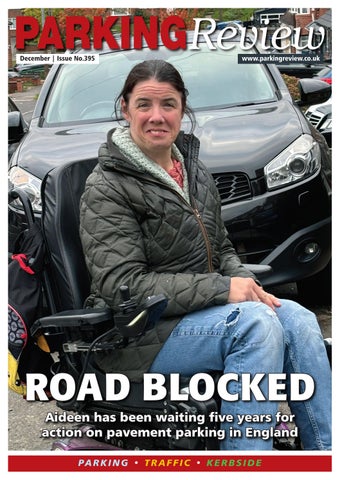
ROA D BLOCKED Aideen has been waiting five years for action on pavement parking in England PA R K I N G • T R A F F I C • K E R B S I D E
PR395_P02-03_Welcome.qxp_PR395_p02-03 16/12/2025 15:06 Page 2
SAV TH E DA E TES !
School Streets are back! Be part of the national conversation on creating safer, cleaner routes to school. The essential events for safer, healthier journeys to school. Hosted by:
Hosted by:
12 February 2026 Lambeth Town Hall, London
13 May 2026 Hilton Hotel, Liverpool
PROGRAMME ENQUIRIES Contact Deniz Huseyin at: deniz.huseyin@landor.co.uk
EXHIBITION / SPONSORSHIP OPPORTUNITIES Contact Jason Conboy at: jason@landor.co.uk
PR395_P02-03_Welcome.qxp_PR395_p02-03 16/12/2025 15:06 Page 3
WELCOME December 2025 | Issue No.395
Five years have passed since UK government’s pavement parking consultation
LIVING STREETS
Pavements are for people, not cars
Aideen Blackborough and her children
Aideen just wants to use pavements without fearing for her safety
P
avement parking is covered by a patchwork of local policies and contradictory regulations, with London, the rest of England, Scotland, Wales and Northern Ireland all adopting different approaches. The lack of a coherent nationwide rule on footway parking simply causes confusion. Five years have passed since the UK government conducted a consultation on this issue. Since then a succession of ministers have promised action. Furthermore, transport secretary Heidi Alexander’s hope to produce guidance in the ‘not too distant future’ does not inspire confidence. To help ministers focus on the fact that public safety should take priority over the storage of private vehicles, they should meet Aideen Blackborough, a wheelchair user with cerebral palsy. Pavement parking threatens her safety and that of her children. Last year, while on the school run, Aideen fell out of her wheelchair trying to get past a car parked on the pavement. She says: “I was just trying to take my child to school and get on with my day. The car shouldn’t have been there – I was so shaken and angry.” This wasn’t an isolated incident. Aideen is regularly blocked from pavements by obstructive parking. She says: “As a mum and a wheelchair user, this practice puts me and my children in danger every day. I don’t understand why drivers think they can block pavements – they’re for pedestrians.” Mark Moran Editor
Parking Review online: www.parkingreview.co.uk
cdergroup.co.uk PARKING REVIEW | 3
COVER IMAGE: AIDEEN BLACKBOROUGH (LIVING STREETS)
CDER-2025-Strip-Ads PR.indd 3
15/01/2025 14:29
PR395_P04-05_Contents.qxp_PR395_p04-05 16/12/2025 15:02 Page 4
Hosted by:
Programmed with:
Headline Sponsor:
The North’s leading parking, mobility, and place management event
About the event Parking is changing fast – shaped by new technology, sustainability goals, and the need to make towns and cities more accessible, inclusive, and economically vibrant. The North East Parking Show 2026 will explore how e昀ective parking management underpins local success, supporting clean air, active travel, tourism, and thriving high streets. Through case studies, expert panels, and exhibitor showcases, the event will celebrate parking as a key part of place-making, bringing together local authorities, operators, and suppliers to share best practice, build partnerships, and discuss what's next for the sector.
The programme If you have an idea for a talk contact the programme coordinator Gavin Manger, Strategic Partnership Manager at Landor LINKS: gavin.manger@landor.co.uk
Exhibition/Supporter Opportunities To secure your exhibition space at the annual North East Parking Show contact Jason Conboy at: jason@landor.co.uk
Exhibitors include:
Tuesday 3 March 2026 The Radisson Hotel Durham
Pre-event Networking Evening Kick o昀 the event with a relaxed networking reception on Monday 2 March. Held at The Holy GrAle, 57 Crossgate, St Margarets Garth, Durham. This informal gathering o昀ers delegates, speakers and exhibitors a chance to meet, exchange ideas, and enjoy the atmosphere of one of England’s most historic and picturesque cities.
Delegate Rates Local Authority delegates
FREE*
Private Sector delegates
£275 + VAT
Academics / 3rd Secor delegates
£175 + VAT
Local Authority additional delegates £145 + VAT * Maximum of two tickets per local authority
For further information and to book visit:
parkingshow.uk
PR395_P04-05_Contents.qxp_PR395_p04-05 16/12/2025 15:02 Page 5
CONTENTS Southern Gateway, Bristol
21 23 24 26 30 34 44
So, why do drivers bend the rules? A focus on enforcement will not solve the root causes of why drivers ignore parking regulations, suggests The AA
Shining a light without crossing the line Tom Gallagher advises councils to think about tone and impact when creating social media about Blue Badge enforcement
The IPC: Laying sound foundations The International Parking Community’s Will Hurley emphasises the fact that parking is a service that actually works really well
Shining a spotlight on parking Alpha Parking’s annual conference shared illuminating ideas, explored policy trends and showcased best practice
IPC Awards
Green and pleasant places Surrey County Council has created a series of parklets to showcase sustainable street design solutions for urban areas
Budget 2025: Motoring taxes Chancellor announces electric vehicle mileage levy, more funding for chargepoints and revises support for EV buyers
Spotlight on Parking
Ensuring EV charging is accessible Government has accepted an amendment in the House of Lords mandating schemes must be compliant with PAS 1899
EVolution Magazine The latest developments in electric vehicle infrastructure
Editorial Managing editor: Mark Moran Tel: 020 7091 7871 mark.moran@landor.co.uk Deputy editor: Deniz Huseyin Tel: 020 7091 7872 deniz.huseyin@landor.co.uk Editorial director: Peter Stonham
Production and design production@landor.co.uk
Subscriptions subs@landor.co.uk
Advertising, sponsorship, marketing and exhibition packages Jason Conboy Tel: 020 7091 7895 jason@landor.co.uk
Accounts Irina Cocks Tel: 020 7091 7854 irina.cocks@landor.co.uk
Parking Review was launched in 1989. It is the only independent magazine dedicated to the UK parking sector.
Published by: Landor LINKS Ltd, Unit 20a, The Circle, Queen Elizabeth Street, London SE1 2JE
ISSN: 0962 3599
© Landor LINKS Ltd 2025
The Independent Press Standards Organisation www.ipso.co.uk
www.landor.co.uk
The Professional Publishers Association www.ppa.co.uk
Printed by: Pensord 1 Goat Mill Road, Dowlais, Merthyr Tydfil CF48 3TD
Registered members of:
PARKING REVIEW | 5
PR395_P06-07_LA income DPS.qxp_PR395_p06-07 16/12/2025 15:02 Page 6
PARKING REVENUE Figure 1: Percentage change in real net parking revenues 2017/18 to 2024/25
Councils count on parking John Siraut studies the latest figures for English local authority parking revenues
T
he latest local government revenue and expenditure returns highlight that total parking gross revenues exceeded £2bn in 2024/5 of which over £1bn was taken in on-street revenues by London boroughs. As usual, Westminster was the top earner with gross revenues of £125m. Which was higher than the total for all the Metropolitan districts in England. But just seven local authorities outside London netted more than £10m in parking revenues, highlighting that it is not the money spinner that many people assume. The Ministry of Housing, Communities and Local Government (MHCLG) local government finance returns (Revenue Outturn 2024-25: Highways and Transport Services (RO2) data) include parking expenditure and revenue. Published alongside the annual data is a time-series dataset covering the last eight years. Gross parking revenue across nearly all English local authorities (data from some councils (e.g. Birmingham), is missing from the analysis) totalled £2.3bn in 2024/25, with net revenue just under £1.2bn. These figures exclude capital costs and depreciation, which are particularly relevant for off-street parking provision. Revenues include income from parking charges, penalty charge notices (PCNs), and parking permits. Operational costs only reflect day-to-day running expenses Table 1 provides a high-level summary of revenue by type of council. As can be seen, London dominates on-street parking, accounting for 69% of gross and 79% of net revenues. While across both on and off-street parking, London accounts for 54% of net revenues. Westminster is poised to become the first council to net £100m from parking charges, nearly matching its Council Tax revenue of £105m highlighting the importance of parking revenue to the council. Table 2 highlights the top ten London grossing councils. It is notable that there are large differences in the cost of parking operations between the councils. Kensington & Chelsea report operating costs of just £13m, half of Islington’s £26m. Across London, based on London Council’s enforcement data, PCNs
6 | PARKING REVIEW
alone will have brought in, in excess of £250m. Amongst the Metropolitan Districts only Manchester and Newcastle netted more than £10m, while for most councils parking revenues is relatively small change (Table 3). Amongst the other local authorities, there are few (e.g. Brighton) where parking revenues are significant, but there are only six that net more than £10m a year (Table 4). While the London boroughs dominate on-street parking revenue, the top off-street parking revenue generators are a very varied mix of authorities (Table 5). Ranging from more tourist locations to major cities. A number of local authorities have disposed of their off-street parking assets due to the cost of maintenance and increased land values making alternative uses more attractive. MHCLG has also released a time-series dataset this year, providing a consistent view of parking revenues over the past eight years. To ensure comparability across years, the data has been cleaned to account for local government reorganisations and missing returns. As a result, the aggregate figures in this dataset do not align precisely with those presented earlier. All values have been adjusted to 2024/25 prices using the Consumer Price Index, enabling meaningful year-on-year comparisons. Total net parking revenue has remained broadly stable across the eight-year period, with the notable exception of the pandemic years (Table 6). In the first year of the pandemic, net revenue fell by £600m but recovered relatively quickly. Nevertheless, revenues in 2024/25 remain slightly below those recorded in 2018/19. London was comparatively resilient during the pandemic, likely due to the continued income from residents’ parking permits. By 2024/25, London’s net revenue had risen to around 10% above pre-pandemic levels. In contrast, the other local authority groups experienced a total collapse in parking revenue turning surpluses to deficits. While revenues have recovered they remain below pre-pandemic levels across all authority types. However, individual authority performance has varied considerably. Figure 1 looks at how net parking revenues have changed in real terms between 2017/18 and 2024/24 for those local authorities outside Greater London with the highest net revenues in 2017/18 plus the City of London.
PR395_P06-07_LA income DPS.qxp_PR395_p06-07 16/12/2025 15:02 Page 7
PARKING REVENUE Table 1: Gross and net parking revenues by council type On-street revenue £m Gross
Off-street revenue £m
Net
Gross
Total £m
Net
Gross
Net
Unitary Authorities
209
94
314
170
523
264
Shire Districts
42
3
385
177
427
180
Metropolitan Districts
112
54
109
38
221
92
London Boroughs
1,011
628
54
10
1,065
638
Shire Counties Total
81 1,462
13 797
9 876
-5 392
90 2,338
8 1,189
Table 2: Gross and net parking revenues for top ten earning London Boroughs £m Gross
Table 3: Gross and net parking revenues for top ten earning Metropolitan Districts £m
Net
Gross
Net
Westminster
129
91
Manchester
40
19
Lambeth
63
39
Newcastle
25
11
Kensington & Chelsea
63
50
Liverpool
16
5
Islington
61
35
Leeds
13
8
Hammersmith & Fulham
59
38
Sheffield
10
5
Camden
50
32
Coventry
9
3
Haringey
49
31
Bradford
7
3
Wandsworth
43
32
Stockport
6
2
Ealing Newham
41 40
18 26
Kirklees Calderdale
5 4
2 3
The City of London has seen a 43% fall in real revenues as the large reduction in business travel and increased working from home has had an impact. Other cities have been hit by weakened retail performance and working from home, while more tourist locations like Brighton and York have seen growth in revenues. However, Manchester is the standout location possibly benefiting from its strongly performing economy. For a small number of local authorities, primarily in London, parking remains a significant revenue stream. But for the majority, it’s more of a millstone: politically contentious and, in some cases, financially burdensome. Parking income is shaped by the strength of local retail and leisure sectors, council pricing strategies, and supply-side decisions. Yet all three are under pressure. The decline of bricks-and-mortar retail, the rise of remote working, and the fall in business travel are steadily eroding demand and with it, local authority revenues. Parking also carries a substantial opportunity cost. Is road space better used for the movement of people and goods? Could land tied up in off-street parking deliver greater economic or social value through redevelopment? However, to date, there’s been no serious, coordinated effort to push the public sector to exit the off-street parking business, unlike the push to withdraw from direct public transport provision. And yet the numbers are compelling. Simply retaining offstreet sites for parking but selling them off to the private sector could unlock between £4bn and £8bn in capital receipts, money that cash-strapped councils could redeploy elsewhere. In a market that appears stagnant, the real question for many councils is no longer how to maximise parking revenue, but whether parking itself is the best use of public land from a wider economic and social perspective.
Table 4: Gross and net parking revenues for top twelve earning councils £m Gross
Net
Brighton & Hove
51
33
Nottingham City
28
20
Bournemouth, Christchurch & Poole
28
17
North Yorkshire
25
15
Bristol
23
12
Bath & North East Somerset
17
9
Windsor & Maidenhead
15
8
Somerset
14
7
Canterbury
13
7
Southampton
13
6
Milton Keynes Portsmouth
13 13
10 4
Table 5: Gross and net off-street parking revenues for top ten earning councils £m Gross
Net
Manchester
40
19
Bournemouth, Christchurch & Poole
28
17
Nottingham City
28
20
North Yorkshire
25
15
Newcastle
25
11
Bath & North East Somerset
17
9
Windsor & Maidenhead
15
8
Somerset
14
7
Canterbury York
13 12
7 8
Note on the data All data is from Ministry of Housing, Communities and Local Government (MHCLG) local government finance returns (Revenue Outturn 2024-25: Highways and Transport Services).
John Siraut is director of Transport Economics at Fortia Insight, an RSK company. https://fortiainsight.com
Table 6: Net parking revenue in 2024/25 constant prices £m by local authority type 2017/18
2018/19
2019/20
2020/21
2021/22
2022/23
2023/24
2024/25
Grand Total
987
1035
976
378
877
899
936
1025
London
514
558
534
360
555
542
548
603
Unitary Authority
200
205
190
24
151
165
180
190
Shire District
169
173
154
-1
111
121
132
147
Metropolitan District
86
81
80
-10
50
61
63
78
(Numbers may not add up to the total due to rounding and shire counties not included)
PARKING REVIEW | 7
PR395_P08-09_NSL+.qxp_PR395_p08-09 16/12/2025 15:01 Page 8
NSL+ The Future of Private Land Parking Management Ethical. Compliant. Technology-Driven. Powered by NSL Expertise.
1536_Marston - NSL+ launch advert S2.indd 1
28/11/2025 10:59
PR395_P08-09_NSL+.qxp_PR395_p08-09 16/12/2025 15:01 Page 9
Setting a New Standard Raising the Bar for Private Land Parking Management
Marston Holdings has unveiled NSL+, a bold new division designed to redefine private land parking management. This strategic move signals a major evolution for the group, bringing its proven expertise into the private parking sector with a smarter, ethical, and revenue-positive approach for property owners and businesses. Why NSL+ Changes the Game Private parking has long wrestled with challenges – compliance gaps, enforcement transparency, and operational inefficiencies. NSL+ tackles these head-on by delivering: Nationwide Infrastructure: Rapid deployment powered by NSL’s trusted UK network Advanced Compliance Expertise: Full regulatory adherence and ethical enforcement practices Integrated Enforcement & Data Analytics: Smarter, tech-driven decisions in one seamless package Comprehensive End-to-End Service: From signage and installation to enforcement, recovery, and performance reporting This end-to-end model sets a new benchmark, helping operators boost revenue, streamline operations, and enhance visitor experience – all while maintaining fairness and transparency. Key Benefits for Property Owners Secure, Ethical Enforcement: Industry-leading compliance and transparent practices Boost Revenue & Streamline Operations: Optimised enforcement and data-driven insights Seamless Parking, Happier Visitors: Frictionless parking with clear signage and user-friendly payment options A Complete Parking Management Solution NSL+ combines operational excellence with the strength of Marston Holdings to deliver: Compliance & Enforcement Leadership: Backed by decades of proven experience Nationwide Reach: Fast implementation using their established UK network Integrated Solutions: Parking management, enforcement, and analytics in one package Operational Cost Savings: Outsourcing reduces expenses in recruitment, training, and IT
Keith Hanshaw, Group Managing Director “NSL+ is more than a service – it’s a commitment to raising standards in private parking. By combining compliance expertise with cutting-edge technology, we’re delivering solutions that property owners can trust.”
Richard Overington, Private Parking Specialist, heading up the division “I’m proud to be leading NSL+ and excited about the journey ahead. This is a true end-to-end solution for private parking landowners – covering everything from installation and client partnership through to enforcement, recovery, and performance reporting. It’s a complete lifecycle approach that sets a new standard for smarter, fairer, and more efficient parking management.”
For more information on NSL+ and how it can transform private land parking management… Email: NSLplusenquiries@marstonholdings.co.uk Visit: marstonholdings.co.uk/nsl-2/ ADVERTISING FEATURE
PR395_P10-17_News.qxp_PR395_p10-17 16/12/2025 15:01 Page 10
NEWS
EVs have to pay London Congestion Charge TfL brings in range of discounts for different types of electric vehicle Electric vehicles will lose the 100% discount they receive when travelling through London’s Congestion Charge zone when new tariffs are introduced in the New Year. The Congestion Charge has been in place for over two decades and is credited with reducing traffic congestion in the capital. However, without changes, Transport for London (TfL) has estimated that there could be more than 2,000 additional vehicles driving during operating hours in the zone on an average weekday. Transport for London is concerned this would undermine the benefits of the Congestion Charge, leading to more queues and delays – negatively impacting London’s economy, local businesses, bus passengers and other essential services. TfL cites INRIX research that indicates in 2024 vehicle congestion cost the capital £3.85 billion, averaging £942 per driver. The cost of London’s Congestion Charge is to rise to £18 from January 2026, it has been confirmed by the Mayor of London and Transport for London. The charge was last increased to £15 in 2020 from £11.50. Previous to that, the charge was
last changed in 2014 from £10 to £11.50. The new daily £18 charge applies if you pay in advance or on the same day, or £21 if paid by midnight of the third day after travel. TfL says the price rises are below inflation. The 100% discount offered to electric vehicles entering the Congestion Charge zone will be cut to 25%. This decision has led to concerns being expressed by car clubs and advocates of EVs. However, TfL states that drivers of electric vehicles will still be able to pay less via the Cleaner Vehicle Discount (CVD). Since the CVD was introduced in 2019, the number of EVs registered has risen almost sixfold – from around 20,000 to more than 116,000 earlier this year – they will account for close to 20% of all vehicles in the Congestion Charging Zone by the end of the year.
The new CVD system means that: • As part of a first phase running from 2 January 2026, there will be a 50% discount for electric vans, HGVs and quadricycles registered for Auto Pay as well as a 25% discount for electric cars registered for Auto Pay. • As part of a second phase from 4 March 2030, there will be a 25% discount for electric vans, HGVs and quadricycles registered for Auto Pay and a 12.5% discount for electric cars registered for Auto Pay. To make it easier for drivers to access the CVD, it will be applied automatically from DVLA data, customers do not have to separately register and prove a vehicle is electric. Drivers with eligible vehicles will simply need to sign up to Auto Pay to receive the discount. Mayor of London Sadiq Khan
Zipcar plans to exit UK in face of rising costs Britain’s largest car-sharing provider, Zipcar, is planning to close its UK operations by the end of the year. The US-based company, which is owned by car rental giant Avis Budget, is to suspend new bookings after 31 December, pending the outcome of a consultation with its staff. The firm has launched a formal consultation with around 70 employees. In an email to customers James Taylor, Zipcar UK’s general manager wrote: “We are proposing to cease the UK operations of Zipcar and have today started formal consultation with our UK employees.” Taylor directed customers to the website of CoMoUK, a charity for the shared transport sector, to find other car-sharing options. The company has about 650,000 members in the UK who rent cars by the hour or day from an app and collect the vehicles from parking spaces, making it the UK’s largest car-sharing operator. Zipcar is thought to run nearly 3,000 vehicles,
10 | PARKING REVIEW
including cars and vans, in the UK. Avis Budget has confirmed that it is planning to close Zipcar UK, but states that markets remain unaffected. The spokesperson said the decision to cease trading in the UK from 2026 was part of a plan to streamline operations, improve returns and position the company for longterm sustainability and growth. Zipcar was founded in 2000 by two entrepreneurs in Cambridge, Massachusetts, before being bought by Avis Budget in 2013 for $491m (£371m). It
said: “Keeping London moving by reducing congestion is vital for our city and for our economy. While the congestion charge has been a huge success since its introduction, we must ensure it stays fit for purpose, and sticking to the status quo would see around 2,200 more vehicles using the congestion charging zone on an average weekday next year. We must support Londoners and businesses to use more sustainable travel, so I’m pleased that substantial incentives will remain in place for Londoners who switch to cleaner vehicles, as we work to build a greener and better London for everyone.” Alongside the new tiered system, the Residents’ Discount will change to incentivise longer term take-up of EVs, with those currently living in the area remaining unaffected. Those who are in receipt of the Residents’ Discount prior to 1 March 2027 will retain their 90% discount, regardless of vehicle fuel type. For those newly applying for the Residents’ Discount after 1 March 2027, the 90% discount will only apply to EVs. Based on feedback from the public consultation, there will be further support for lowincome and disabled residents receiving certain benefits, so that they can continue to apply for the Residents’ Discount until March 2030 without their vehicle needing to be electric.
operates in 25 US states, and in three cities in Canada, according to its website. Last year Zipcar closed its operations in Oxford, Cambridge and Bristol to focus on its core London market, where it has more than 550,000 members. In its most recent company accounts for 2024, Zipcar revealed UK revenues falling to £47m from £53m the year before, while its after-tax losses had widened to £11.6m. According to the same accounts, Zipcar membership fees cover the cost of fuelling or charging the vehicle and, as energy costs continued to rise last year, it has added to financial pressures on the company. The accounts stated that the “cost of living crisis” was affecting spending decisions by UK customers. If Zipcar continues operating the company would become liable for the London congestion charge, which is expanding to include electric vehicles from 26 December. The changes to the congestion charges have been estimated to add £1m annually to car club costs in the capital.
PR395_P10-17_News.qxp_PR395_p10-17 16/12/2025 15:01 Page 11
PR395_P10-17_News.qxp_PR395_p10-17 16/12/2025 15:01 Page 12
NEWS
Rethinking Scottish traffic demand legislation Role of Transport (Scotland) Act 2001 under review, reports Rhodri Clark Scottish transport secretary Fiona Hyslop has suggested there is a connection between local authority uninterest in Workplace Parking Levies and the larger numbers of people working from home since the COVID-19 pandemic. The Scottish Government is setting up a review of demand management options available to local authorities, to check whether 2001 legislation is still fit for purpose. Green MSP Mark Ruskell asked Hyslop whether the Scottish Government would support traffic demand measures proposed by local authorities, and how it would respond if a council asked it for support on congestion charging or workplace parking charging. She said it was up to local authorities to decide what they want to do. “However, what has happened is interesting, because fewer people are coming into cities to work,” she said. “Significant numbers of people are still working from home. In fact, the census showed that about a third of people are still working from home. Obviously, the census was taken in 2022. “Circumstances have changed, and we do not see any local
Fiona Hyslop authorities looking at Workplace Parking Levies, for example.” She advised local authorities to ensure they have good public transport alternatives to the car. “We are there to enable and support local authorities where we can, and we will respond to any proposals that come forward. I do not think that we have seen any firm proposals yet, but that is the general atmosphere. “We are doing what we need to do to ensure that the regulatory checks are in place for certain approaches that local authorities might want to use, so that there is provision if they want to use legislation.” When the Scottish Government abandoned its previous target of a 20% reduction
Westminster reviews transport Westminster City Council has mapped out its vision for “good quality sustainable transport options” over the next ten years, which will include reallocating kerb space from cars to other uses. Westminster’s Sustainable Transport Strategy states: “Our communities clearly recognise and value the benefits that both themselves and the city can reap from sustainable transport, from seeing a wider range of kerbside uses, to a greener and more sustainable city, as well as an improvement in the air that we breathe.” The council engagement workshops it carried out last year revealed a “desire for change and that our communities want to see greater provision of
12 | PARKING REVIEW
sustainable transport options across the city”. The strategy lists a set of targets including: • A 70% reduction in the number of people killed or seriously injured on Westminster’s roads by 2030, and a 100% reduction by 2041. • A pledge for every person in Westminster to access sustainable transport options that meet their needs by 2034. • At least 70% of Westminster residents to get 20 minutes of exercise a day through active travel by 2041. • Eliminate NOx and PM2.5 engine emissions from council owned/leased fleets and machinery by 2030, and contracted fleets by 2040. • Reduce surface transport
in car usage by 2030, proposed different actions were set out by the government and the Convention of Scottish Local Authorities. One of the proposals was for regional transport partnerships to explain what they will do locally to tackle emissions and car use. “We also said that we would carry out a regulatory check on the legislation, introduced by the then Labour government, which made provision for road user charging – it is up to local authorities whether they want to use that – so we are establishing a group that will look at whether that legislation, the Transport (Scotland) Act 2001, is still fit for purpose, if anybody wanted to use it,” Hyslop told the Scottish related emissions of PM2.5 by 40% by 2040. • 98% of all powered vehicles on Westminster’s roads to be zero emission by 2040. • A 70% reduction in the observed number of dieselpowered or petrol-powered freight vehicles in the congestion charge zone. The strategy says: “In recent years Westminster residents, workers, and visitors have increasingly voted with their feet, largely preferring a combination of walking, cycling and public transport. “Freight is changing too, with cargo bikes, becoming a normal, everyday feature of doing business in Westminster, but also a growing number of home deliveries as people chose to shop online more often.”
Parliament’s Net Zero, Energy and Transport Committee. She said the UK Climate Change Committee’s advice on Scotland’s carbon budgets indicated that Scotland now needs a 6% modal shift from car to public transport and active travel by 2035. She was currently revising what the Scottish Government will produce, as part of the climate change plan. SNP MSP Bob Doris said he understood the CCC’s 6% figure meant a 6% reduction in anticipated growth in car usage, rather than a 6% reduction in kilometres. He asked Hyslop whether the government wished to see fewer kilometres travelled by car or to constrain the growth in kilometres travelled by car. “It is possible to have the same number of cars and to increase car use while, if they are all EVs, seeing a reduction in emissions,” Hyslop replied. “We need a shift towards, and encouragement of, the use of public transport. That is one reason why we removed peak [ScotRail] fares for good.” Doris responded: “Okay, so we will have to wait and see the climate change plan to know whether the Scottish Government’s position is for fewer kilometres.” Hyslop said: “I am actively considering what that will look like. I am not in a position to tell the committee just now, but it will be set out in the climate change plan.”
Haringey kerbside strategy revealed Haringey Council has set out its ambition to increase kerb space dedicated to sustainable uses from the current 7% to 15% by 2032. In its new Kerbside Strategy, the north London borough wants to make active travel the “default choice” for residents, especially for short local trips. The council says it will provide more places to “dwell, congregate and socialise” with better lighting and wayfinding and more public art. By 2032 it plans to create “adaptable urban spaces that encourage social interaction and reduce unnecessary street furniture”. The council has pledged to support local businesses by promoting street vendors and enhancing public safety.
PR395_P10-17_News.qxp_PR395_p10-17 16/12/2025 15:01 Page 13
PR395_P10-17_News.qxp_PR395_p10-17 16/12/2025 15:01 Page 14
PR395_P10-17_News.qxp_PR395_p10-17 16/12/2025 15:01 Page 15
NEWS
APCOA starts operations in Northern Ireland APCOA’s new central government contract with Northern Ireland’s Department for Infrastructure (DfI) went into operation on 1 November. The 10-year contract has seen the establishment of 19 regional operational bases and two vehicle pounds, providing an integrated network to support DfI’s transport and parking infrastructure. Approximately 160 members of staff will be on patrol across Northern Ireland. The mobilisation phase has taken place over the past eight months to set-up. • APCOA is now responsible for: • on-street enforcement across Northern Ireland • bus lane and urban clearway enforcement • park & ride car park enforcement • residents parking zone enforcement • Blue Badge misuse enforcement • vehicle clamping and removal for PCN debt recovery
APCOA
DfI contract covers kerbside, car parks and park & ride schemes
“Delivering services across all areas of Northern Ireland, the DfI partnership marks one of the most extensive service mobilisations ever undertaken by APCOA,” said Kim Challis, regional managing director UK & Ireland “This contract exemplifies the scale, strength, and expertise of APCOA’s UK and Ireland operations. Our teams have worked tirelessly to ensure a seamless mobilisation, and we look forward to delivering a service that sets new standards of efficiency, innovation, and customer care for communities in Northern Ireland.” APCOA regards the DfI contract marks its move into the central government sector, reflecting its operational capability and ability to collaborate with a supply chain from private landlords to operating partners such as JustPark, Yunex, UTS, GSLS and TES. Challis said: “We would like to extend our sincere thanks to every one of our supply chain partners who have made this complex and extensive mobilisation possible.”
APCOA meets the Derry Girls
Barnet brings in APCOA patrols APCOA has begun operations in the London Borough of Barnet. The contract, which commenced on 1 November 2025, will run for five years, with the potential to extend. A staff of 100 is delivering a range of parking services across the borough. Services include: on-street and off-street parking enforcement; vehicle pound and removals; management of abandoned and untaxed
vehicles; CCTV review; support services; and maintenance of car parks. Civil enforcement officers will be deployed across the north London borough seven days a week. They will patrol using a sustainable all-electric fleet of vehicles and e-bikes. Four operational bases, located in High Barnet, North Finchley, Hendon and Edgware, will serve as the hubs for daily activity.
SAMUEL GREEN ASANTE/UNSPLASH
Over 9.4m PCNs issued across London London Councils data on parking enforcement and appeals in London for 2024-25 show that London boroughs, the London Lorry Control Scheme and Transport for London issued a total of 9,462,185 penalty charge notices (PCNs) to motorists who had contravened parking, bus lane and moving traffic regulations. This represents an increase of 13.5% in PCNs issued since 2023-24. London Councils says the increase was due to an 13.4% rise in the number of parking PCNs issued, while bus lane PCNs saw an increase of 16.8% and moving traffic PCNs an increase of 13.3%. The total number of PCN appeals received by London Tribunals has increased by 13.6%, from 42,193 in 2023-24 to 47,935 in 2024-25. If a motorist believes a PCN has been issued unfairly, they can contact the local authority
that issued it to make a challenge. If they are not satisfied with the response, they can take their case to an independent adjudicator through the London Tribunals appeals service, which is run on behalf of the councils to ensure a fair and impartial review. The percentage of total appeals won by the appellant fell from 54.9% in 2023-4 to 49.4% in 2024-5. Total appeals logged has increased by 5,742 (13.6%) to 47,935, which is 0.45% of appeals received against total PCNs issued. This
shows a significant improvement by boroughs in both the quality of evidence presented at appeal and how challenges to the PCN are considered by boroughs at earlier stages. “London boroughs and Transport for London only issue PCNs when they believe they have evidence that a breach of parking or moving traffic rules has occurred,” says London Councils. “All PCN income goes towards paying for the provision of essential traffic and
• Pay & display machine maintenance and cash collection.
parking services, with any surplus funding ringfenced to invest in other important transport projects and services such as the Freedom Pass concessionary travel scheme for older and disabled Londoners. “Enforcement of the rules of the road leads to positive behaviour change among road users, helping to make the capital’s streets safer for all Londoners and its visitors. It also plays a critical role in reducing congestion and air pollution in certain areas, and particularly on school streets. “A small minority of drivers fail to follow the rules of the road, which is why enforcement is necessary to encourage all motorists to drive and park in a considerate and safe manner. “Parking and traffic management also provides important benefits for pedestrians, cyclists, motorists, and communities throughout London. These include maintaining road safety and access for Londoners as they go to work, travel for leisure, and access services.”
PARKING REVIEW | 15
PR395_P10-17_News.qxp_PR395_p10-17 16/12/2025 15:01 Page 16
PR395_P10-17_News.qxp_PR395_p10-17 16/12/2025 15:01 Page 17
PAVEMENT PARKING
Digital map highlights pavement ‘hotspots’ Five years have passed since consultation on pavement parking December marks five years since the Department for Transport’s consultation into pavement parking in England closed, and there’s still no response. Over 1,500 people have added photos of vehicles parked on pavements to a map of pavement parking ‘hotspots’, in a campaign organised by Living Streets, the UK charity for everyday walking. “We simply can’t wait any longer for action,” says the charity. Manchester and Oxford are among the worst offenders, with nearly 200 pins across Greater Manchester. Many of the photos feature cars and vans fully blocking pavements, forcing pedestrians into the road to get around. Parking on the pavement is illegal in London and Scotland. Elsewhere, the powers local councils have are limited and rarely enforced. Living Streets, alongside other charities and thousands of members of the public, responded to the Department for Transport’s Managing Pavement Parking
Living Streets’ Pavement Parking map consultation on 22 November 2020, calling for clear laws and sharing evidence from their supporters about the issues pavement parking causes. Since then, 1,826 days have passed with no response. Catherine Woodhead, chief executive, Living Streets said: “This month marked five years since the government closed its consultation into pavement parking in England. That’s five more years of people being pushed into the road and oncoming traffic. Someone isolated in their home due to pavement parking could have lost out on around five million walking steps, with a catastrophic effect on their mental and physical health. We simply can’t wait any longer for
Northern Ireland to legislate on inconsiderate pavement parking Northern Ireland’s infrastructure minister Liz Kimmins has announced she will bring forward legislation to tackle inconsiderate pavement parking. The legislation will prohibit parking wholly (with four wheels) on a pavement; parking across dropped kerbs for pedestrian access; as well as a ban on double parking. “Inconsiderate pavement parking has a significant adverse impact in many areas across the north,” said Kimmins. “Unfortunately, too many drivers fail to realise the consequences of their actions when their vehicle blocks the footway. “A vehicle parked fully on a pavement creates serious and often dangerous barriers for pedestrians, forcing people to step out onto the road into oncoming traffic. This poses a safety risk particularly for people with disabilities, older
people, children and people pushing prams. “My department has been exploring a number of options that could be taken forward as positive measures to address inconsiderate pavement parking. I am pleased to confirm that I intend to bring forward legislation which will ban parking wholly on a pavement; parking across dropped kerbs for pedestrian access; and double parking. “This will complement the steps that we have already taken to address the ongoing issue of inconsiderate pavement parking, including introducing legislation to prohibit parking on footways alongside bus lanes, bus stops, mandatory cycle lanes and mandatory ‘School Keep Clear’ markings and encouraging parking compliance across the road network through the promotion of the ‘Think before you park’ initiative.”
action on pavement parking.” Folkert Veenstra is an accessibility campaigner and Living Streets Trustee. He said: “Pavement parking forces wheelchair users like me into the road, dodging traffic just to get by. Parents with prams, blind and partially sighted people, older people with walking aids – we’re all being pushed into danger because pavements are blocked. I’ve personally faced this countless times: cars parked across pavements and dropped kerbs, leaving me no choice but to navigate into oncoming traffic. It’s frightening. It’s wrong. And it needs to change.” Eleanor Briggs, head of policy, public affairs and campaigns at Guide Dogs, said: “Unsafe and
unfair pavement parking continue to force people with sight loss to walk on the road every day while we wait for action following the consultation. We urgently need a clear law across the UK that would empower local councils to tackle pavement parking, allowing everyone to move about their streets independently.” Rachel White, head of policy and communications, Walk Wheel Cycle Trust, said: “There’s cross-party consensus that councils need the power to tackle pavement parking. Now, we need action. The government should amend the English Devolution Bill to bring in this quick, cheap, change to improve people’s health and wellbeing and help ensure more people can travel round their communities safely.” Emma Vogelmann, co-chief executive, Transport for All, said: “For many disabled people, cars parked on pavements are barriers to freedom – they lock away our ability to make every day journeys – we simply can’t get past. After five years of hollow words, it’s high time for the government to finally say pavements are for pedestrians, and give us back our streets.”
Local solutions an option for England Transport secretary can’t offer dates for response on pavement parking The government cannot say when it will respond to the 2020 public consultation on managing pavement parking, Heidi Alexander has told the Transport Select Committee. “I want to get a response to the consultation published soon, because I realise that this has been dragging on for years and I am keen to explore how decisions around pavement parking could be made at a local level,” she said. “Giving local areas powers to regulate pavement parking would promote growth and help us deliver safer streets.” Pressed on timing, Alexander said: “I cannot give you dates, and I suspect that noise that you heard emanating from the audience might be similar to the noise that emanates from my office every now and again, which is a mixture of hope and
frustration. I am serious about getting this consultation response published. “Lilian Greenwood is leading on this issue for us, and has continued to do so subsequent to the ministerial changes [in September], and so I do hope that we might be in a place in the not-too-distant future to be able to say something on this.” Labour MP Scott Arthur said: “I understand that letters from the Department to people asking about pavement parking have moved from the consultation responses being published as soon as possible to ‘imminently’.”
PARKING REVIEW | 17
PR395_P18-19_Business.qxp_PR395_p18-19 16/12/2025 15:00 Page 18
BUSINESS NEWS
Holiday Extras to invest in brands and AI NatWest provides airport services group with access to £30m Holiday Extras has extended its financing arrangement with NatWest, invested extensively in its parking brand and facilities throughout the UK and Europe, expanded its European partnerships, and added a senior artificial intelligence (AI) appointment to its leadership team. The company has also recorded its best-ever September. Capping off a strong summer season, driven by continued demand for airport parking, hotels and lounges. Holiday Extras has refinanced its existing borrowing facility with NatWest for another five years, extending the company’s access to £30m in funding. The agreement provides the financial flexibility to continue investing in technology, innovation, market expansion and acquisitions as the company scales across Europe. The group is also making a multi-million-pound investment in its Airparks facilities and branding at Brussels, Amsterdam, Rotterdam, Aberdeen, Birmingham and Luton.
Supporting this European expansion, Holiday Extras has launched a new partnership with Sunweb, one of Europe’s leading travel groups. The integration brings Holiday Extras’ trusted airport parking products directly into Sunweb’s booking platform, giving customers in France, Belgium and the Netherlands seamless access to secure, verified parking options. The partnership strengthens Sunweb’s ancillary offering while advancing Holiday Extras’ strategy to “Paint Europe Purple” through
smart technology and partnership-led growth. To accelerate its digital transformation, Holiday Extras has appointed Jason Jack as director of AI engineering. Jack will lead the company’s AI engineering efforts, with a focus on harnessing generative and predictive technologies to improve the customer journey, streamline operations and support the company’s long-term growth plans. “I’m thrilled to be joining Holiday Extras at such an exciting time. My focus is on helping
Holiday Extras acquires Aberdeen freehold Holiday Extras has completed the purchase of the freehold for its Airparks site in Aberdeen, which it has leased and operated since 2022. Owning the freehold gives Holiday Extras greater control and long-term security over the Aberdeen site. The acquisition reflects Holiday Extras’ wider strategy of investment in the pan-European Airparks portfolio.
the team harness AI to do what we already do brilliantly — but faster, smarter, and with even more imagination. And yes, I am actually real. Probably.” As part of its strategic focus, the group is winding down its Theatre Breaks project to concentrate on growth opportunities across its core products, European expansion and technology innovation. Matthew Pack, chief executive of Holiday Extras, said: “This is an incredibly exciting time for Holiday Extras. Our recordbreaking September shows the strength of demand for our products, and the renewed support from NatWest gives us the financial firepower to keep investing in our technology, our people and our customer experience. “Expanding our European partnerships with Sunweb, upgrading our Airparks proposition and welcoming Jason to lead our AI engineering programme are all key parts of our plan to make every trip better for our customers.” Phil Brown, corporate director for travel and leisure at NatWest said: “We’re delighted to continue our partnership with Holiday Extras and support their ambitious growth plans through this extended facility.”
Gibson to drive growth at DCBL
Intelli-Park buys Total Parking Solutions
Debt resolution specialist DCBL has appointed Jamie Gibson as its new managing director. Gibson joins DCBL from Water Plus, a commercial water retail business serving over 350,000 customers. He rose to the role of managing director for corporate customers, focussing on operational efficiency, culture, and strategic growth. During his decade at Water Plus, he was instrumental in team recruitment, training and back office operations. Prior to his role at Water Plus, Gibson was the head of debt, business services at Severn Trent Water, progressing from a customer service role to strategic positions in debt management over eight years. He began his career in the Royal Navy, serving for eight years as a weapons engineer. Gibson said: “DCBL has established a strong position across a variety of sectors, including parking, commercial and residential property and the automotive
Parking management provider Intelli-Park has acquired Total Parking Solutions (TPS), an operator with a presence across universities, retail, healthcare, residential, hospitality, corporate estates, local authorities and the transport sector. The transaction was completed on 17 September 2025 for an undisclosed sum. The acquisition will enable Intelli-Park to offer a broader suite of integrated services including automatic number plate recognition (ANPR), smart monitoring, digital permits, compliance support and insights. The deal will see Intelli-Park extend the roll-out of technologies such as View360, eCam and iHub across the TPS portfolio to help operators manage access more effectively and reduce unauthorised parking. A larger national
18 | PARKING REVIEW
Jamie Gibson with group CEO Darren Connor industry, and it continues to grow across further verticals. The business’s ambition to expand into new sectors really resonated with me. We want to expand our presence in sectors such as utilities, energy, and telecoms, and continue to enhance the customer experience through technology and innovation.” Darren Connor, group chief executive of DCBL and DCB Legal, said: “Jamie’s appointment marks an important step in DCBL’s growth. His combination of operational expertise, leadership experience, and strategic vision makes him the perfect choice to lead the next chapter of our development.”
engineering network will also support faster installations and improved response times for clients across the UK. Ben Cooke, group chief executive at Intelli-Park, said: “TPS is a respected provider with deep sector expertise. By combining their existing client relationships with our industry leading tech and nationwide scale, we’ll help clients simplify parking, reduce unauthorised use and improve the experience for drivers.” Rachel Baxter, operations director at Total Parking Solutions, said: “Joining IntelliPark gives our clients access to market leading solutions, analytics and permit systems while preserving the service continuity they value. It’s a natural next step for our team and customers.” Existing TPS clients will see no changes to contracts, service level agreements or support channels.
PR395_P18-19_Business.qxp_PR395_p18-19 16/12/2025 15:00 Page 19
BUSINESS NEWS
Tribute paid to digital pioneer Solutionlabs pays tribute to founder Duane Hodges-Stubbs Duane Hodges-Stubbs, a leading parking technologist and entrepreneur, has passed away after a short illness. Hodges-Stubbs was the founder of IT company Solutionlabs, which developed and connected various parking innovations, such as online notice management, location data analysis, and cashless payment solutions. Its products include systems such as PayMyPCN and GoANPR. He also founded Tap2Park, a noapp or account required payment solution that aims to enhance the parking experience for both operators and users. Before forming Solutionlabs in 2014, he spent six years as head of IT at civil enforcement company Roxburgh (UK). Writing about his career on LinkedIn, Hodges-Stubbs said: “I am passionate about solving complex business problems with
Duane Hodges-Stubbs reliable and empathetic products that leverage my expertise in web applications and databases. I aim to make parking seamless and bring easy-to-use and fast payment solutions to motorists, while providing valuable insights and efficiencies to parking operators.” Solutionlabs issued this tribute: “It is with great sadness that we share the passing of our founder and director, Duane Hodges-Stubbs. Duane was the heart of our company. His vision, kindness, and integrity, shaped
who we are today, and inspired everyone who had the privilege of working with him. Those who knew him personally, will remember his warmth, generosity, vision and entrepreneurial spirit. “Our thoughts and deepest condolences are with his family and loved ones. We remain committed to honouring his legacy and continuing the work he began with the same passion and purpose. Rest in peace Duane, you will be greatly missed and forever remembered.”
TCP’s Robertson passes away Alasdair Robertson, director of chartered surveyors Town Centre Parking, has passed away after fighting cancer for several years. He co-founded the company in 1995, specialising exclusively in car parks, providing consultancy and agency services to the property industry. After gaining a degree in Land Economy from Cambridge University and qualifying as a chartered surveyor at Strutt & Parker, Robertson identified a gap in the UK property market for a general practice, chartered surveying company with an exclusive focus on the car park asset class, subsequently establishing Town Centre Parking.
Alasdair Robertson
Looking for staff or need employment? We currently supply and have PARKING vacancies around the UK for PERMANENT and TEMPORARY positions
* Drop us a confidential call * 0203 668 5680 parking@unity-recruitment.co.uk
www.unity-recruitment.co.uk
PARKING REVIEW | 19
PR395_P20-21_AA.qxp_PR395_p20-21 16/12/2025 15:00 Page 20
Grow Your Business With Us TRY US FOR FREE We will provide free Tap2Park payment signs for all new locations. Works with any existing cashless services on-site, providing customer choice! Plus we are already integrated with all leading parking enforcement software - So we ready to go!
tap2park.com sales@tap2park.com
Complete Service for Operators Cashless Payments Permit Solutions Location Data Reporting Bespoke to any location requirements
PR395_P20-21_AA.qxp_PR395_p20-21 16/12/2025 15:00 Page 21
DRIVER BEHAVIOUR
Necessity and lack of options The survey of nearly 15,000 UK drivers found that the most common reasons for parking on double yellow lines include: • Loading or unloading goods (43%) • Making a quick stop (31%) • Being with a Blue Badge holder (27%) • Lack of available legal parking (18%) • Emergency situations (13%). Only 13% of those who parked illegally reported receiving a fine, suggesting that enforcement is present but not universal.
Rules on double yellow line parking According to the UK Highway Code, double yellow lines signify that parking or waiting is prohibited at all times, even in the absence of accompanying signs. Nonetheless, certain exceptions do apply: • Blue Badge holders may park for up to three hours, provided it is safe and does not cause an obstruction • Loading and unloading may be allowed if there are no kerb markings or signage indicating additional restrictions. On occasions drivers may breakdown on yellow lines and leniency should be shown until breakdown assistance arrives and fixes or moves the vehicle.
Infrastructure over enforcement When asked what would discourage them from parking illegally, 52% of respondents pointed to more legal parking options as the most effective deterrent. Other suggestions included: • More visible enforcement (41%) • Higher fines (25%) • Better signage (18%) • Public awareness campaigns (16%).
MARK MORAN
M
ore than 1.6 million penalty charge notices (PCNs) were issued in 2024 under contravention code 01 – “Parked in a restricted street during prescribed hours”, according to Freedom of Information requests made by The AA to all UK councils in September 2025. This includes both single and double yellow line offences, making it one of the most common parking violations nationwide. The AA argues the scale of enforcement highlights the tension between regulation and reality. The motoring association has commissioned new research that shows nearly two-fifths (37%) of drivers admit to parking on double yellow lines at least once. While 63% say they’ve never done so, more than a quarter (27%) admit to occasional rulebending, with one in 10 admitting they are repeat offenders. The survey’s findings suggest that while enforcement is widespread, it may not be addressing the root causes of illegal parking. Of the 1.6 million PCNs issued, over half-amillion (581,965) came from just ten councils. Five of these are in London, with other major metropolitan cities also featuring in the top ten. Based on a standard charge of £70 per PCN, these councils collectively raised over £40 million from penalty charges in 2024.
37% of drivers admit to having parked on double yellow lines at least once
So, why do drivers bend the rules? A focus on enforcement will not solve the root causes of why drivers ignore parking regulations, suggests The AA The AA says these responses reflect growing frustration among drivers who feel that limited parking availability often forces them into difficult decisions. The data suggests that while enforcement plays a role, many drivers are looking for infrastructure improvements and clearer communication to help them comply with parking rules.
Demographic and regional insights The survey revealed demographic differences in attitudes: • Younger drivers (18-34) were less likely than older drivers to admit to parking on double yellow lines (NET: Yes = 29% vs 38%). They were more likely to support better signage (31%) and higher fines (31%), with moderate support for awareness campaigns (15%). • Older drivers (65+) were most likely to admit to parking on double yellow lines (38%) but showed stronger support for more legal parking options (52%) and visible enforcement (40%), while being less supportive of signage (16%) and awareness campaigns (15%). • 40% of men and 28% of women admitted to parking on double yellow lines at least once. Regionally, Scotland and Wales showed the highest rates of occasional violations, both at 10%, compared to the national average of 8%. This may reflect the unique parking pressures in semi-urban and rural communities, where infrastructure and enforcement vary more widely. These regions also placed greater emphasis on the need for clearer signage and increased legal parking availability. Meanwhile, younger drivers across the UK
were more likely to favour education and awareness campaigns to improve compliance. London (55%) and the South East (54%) placed a stronger emphasis than other regions on the need for more legal parking options, highlighting the impact of urban parking scarcity. In contrast, Eastern England (43%), Yorkshire & the Humber (42%), and the Midlands (42%) were more likely to call for visible enforcement as a deterrent, suggesting regional differences in how drivers perceive and respond to parking restrictions. Jack Cousens, the AA’s parking expert, said: “Double yellow lines are a clear indication that waiting or parking in that area is strictly prohibited, unless there is a legal reason allowing someone to stop there. However, what is clear is that drivers are asking for practical parking solutions. Expanding legal parking provisions and improving visibility of restrictions could significantly reduce violations and improve road safety. Enforcement alone isn’t enough – people need to know where they can park safely and legally. “We also need to consider the diversity of driver needs. Delivery drivers, carers, and those with mobility challenges often face difficult choices. By improving access and signage, we can reduce the pressure that leads to rulebreaking and make streets safer for everyone. “This is a call to action for councils and transport planners. The data shows that drivers are willing to follow the rules – but they need the tools to do so. A combination of infrastructure investment, education, and smart enforcement is the way forward.” www.theaa.com
PARKING REVIEW | 21
PR395_P22-23_Blue Badge.qxp_PR395_p22-23 16/12/2025 15:00 Page 22
Headline Sponsor:
THURSDAY 29 JANUARY 2026 COUNCIL HOUSE, VICTORIA SQUARE, BIRMINGHAM DELIVERING SOLUTIONS ACROSS THE SURFACE TRANSPORT NETWORK
The UK government aims to achieve net zero in transport across all sectors by 2050, driven by the 2021 Transport Decarbonisa琀on Plan. Achieving a net zero surface transport network by 2050 involves a comprehensive, systemwide strategy, and the inaugural Pathways to Net Zero: Transport Planning in Ac琀on event will feature keynotes, case studies and expert panels to showcase the ways in which the surface transport network is changing to meet these cri琀cal targets.
landorlinks.uk/ pathways2netzero
SPEAKERS INCLUDE:
CLAIRE HAIGH
PHIL BLYTHE
Greener Vision
DARe & Newcastle University
RAIAD SHAHZAD Department for Transport
BETH MORLEY Cenex
GREG MARSDEN
LISA HOPKINSON
SIMON SHAPCOTT
University of Leeds
Transport for Quality of Life
AtkinsRéalis
IAN WAINWRIGHT
DAVID HARRIS
TIFF LYNCH
Transport for West Midlands
Freelance Transport Planner
Future City Logis琀cs
PR395_P22-23_Blue Badge.qxp_PR395_p22-23 16/12/2025 15:00 Page 23
BLUE BADGES
I
f you work in parking, you’ll know that Blue Badge misuse is one of the issues that gets the public talking, and rightly so. Every time we take action against someone abusing a badge, we’re protecting spaces for those who genuinely need them. It’s only natural that we want to share these successes, not just to show we’re doing our job, but to raise awareness and deter others. But as someone who’s spent years in this field, I’ve learned that the way we communicate these stories, especially on social media, matters just as much as the enforcement itself. Get it right, and you build trust and confidence. Get it wrong, and you risk legal trouble, reputational damage, or even undermining your own case.
The temptation and the trap I’ve seen plenty of posts over the years – a civil enforcement officer (CEO) holding up a seized badge, a photo of a car parked where it shouldn’t be, a triumphant caption about “another fraudster caught”. Sometimes these posts go viral, and you can almost hear the collective cheer from genuine badge holders. But I’ve also seen the fallout when a post goes too far, when someone is identified before a case is proven, or when personal data is unintentionally shared. The temptation is real. We want to show the world what we’re doing. But every post is a balancing act between transparency and privacy, between public interest and individual rights.
Where the lines are drawn Let’s be clear, Blue Badges contain personal data. The front of the badge shows the holder’s month and year of birth, and even a gender marker. A vehicle, even with the plate blurred, might still be very easily recognised, especially if it’s distinctive or if the location is obvious in the photo. If someone local can spot the street or a unique feature, they can probably identify the vehicle and, by extension, the vehicle owner or the badge holder. That’s a risk we can’t ignore. It’s also tempting to share details from the investigation, such as: “The driver said the badge holder was at home”. But including anything evidential in a public post is a minefield. In court, this could be seen as prejudicing the case or undermining the authority of the court. There are additional legal implications too. Technically, if you publish details from the investigation, you may be creating material that should be included in pre-trial disclosure schedules. That’s not a position you want to find yourself in, especially if the defence argues that your post has influenced proceedings or public perception. And don’t forget the appeal window. If a case goes to court and the defendant pleads not guilty but is found guilty, they have up to six months to appeal the verdict. During that time, it’s best practice to avoid posting anything that could be seen as prejudicial or that might complicate the appeal process. The
Blue Badges contain a lot of personal data
Shining a light without crossing the line Think about tone and impact when creating social media about Blue Badge enforcement, writes Tom Gallagher last thing any of us want is for a social media post to be cited as a reason for an appeal or to undermine the integrity of the case.
Best practice So, what’s the best way to use social media to highlight our Blue Badge enforcement work? First, ask yourself, what’s the purpose of this post? If it’s to raise awareness and show that we’re taking action, you don’t need to show the badge, the car, or any personal details. A simple statement: “Our team has seized a Blue Badge suspected of misuse and the matter is under investigation”. This does the job. If you want to share a photo, use a generic image or make sure everything identifiable is thoroughly obscured. If you’re posting after a conviction, you have more leeway, but I’d still urge caution.
Focus on the outcome and the positive impact: “Following a successful prosecution, we’ve protected spaces for genuine badge holders”. If you do use images, blur out anything that could identify the individual, and avoid sharing unnecessary details from the case. Tone matters, too. It’s understandable to have the urge to want to “name and shame”. But is it not more powerful to share about how we’re here to protect the integrity of the Blue Badge scheme and support those who rely on it? Finally, always get a second opinion. Run your draft post past a manager, your communications team, or legal if you’re unsure. If you wouldn’t be comfortable seeing the post about yourself or a family member, it’s probably best not to share it.
In summary This piece is offered as food for thought. The fantastic work our parking professionals do to uphold the integrity of the Blue Badge scheme should never be put at risk. Our intention is not to discourage proactive communication but to ensure that when we shine a light on enforcement, we do so responsibly. Thoughtful, intentional social media posts can raise awareness and build trust. Provided they respect privacy and legal boundaries. If you’re ever in doubt, remember, it’s better to be cautious than to be clever. Tom Gallagher
Tom Gallagher is interim head of parking at the London Borough of Ealing
PARKING REVIEW | 23
PR395_P24-25_IPC.qxp_PR395_p24-25 16/12/2025 14:59 Page 24
INTERNATIONAL PARKING COMMUNITY
Parking isn’t about rules – it’s about reliability, accessibility, and trust Will Hurley
Laying the foundations The International Parking Community’s Will Hurley looks to the future
E
very single day across the UK, tens of millions of people park. Outside homes, shops, workplaces, airports, schools, hospitals – it just happens. Quietly. Seamlessly. Effortlessly. And almost every one of those moments ends without incident. People park, go about their day, and never think twice about it. That’s what success looks like in our sector: a brilliantly forgettable experience. Because when parking works, it disappears. It’s only when something goes wrong that people notice – when a charge is issued, or a space isn’t available. That’s when the sector suddenly becomes visible. People often think our story begins at the moment of a parking charge. But that’s not the story – that’s the exception. The real story is the millions of successful parking events every day that keep this country moving. Think about it – a parent on the school run, a nurse arriving for an early shift, a delivery driver trying to stay on schedule. Each of them depends on being able to park quickly, safely, and fairly. They probably don’t think about who maintains that space, who keeps it safe, or who ensures it’s there tomorrow – but that’s what this community does. It’s the quiet infrastructure of daily life, and it works because of the people in this room.
been building on it with data, collaboration, and a renewed focus on fairness. We’ve spent much of the past year working closely with government officials and responding in depth to the latest consultation on the government-backed Code of Practice. This consultation could be the one that finally defines the next decade for our industry. And throughout, we’ve been clear, consistent, and constructive – representing your real-world experience with data and insight, not just opinion. We’ve spent months in conversation with ministers, advisers, and officials. We’ve provided detailed responses, case studies, and data to show what works – and what doesn’t. What’s been encouraging is the tone of those discussions. There’s recognition
Foundations for the future The theme for this year’s International Parking Community (IPC) conference was “Foundations for the future”. It isn’t just a slogan, it’s a statement of direction. It reminds us that the work that we do today builds the confidence, the structure, and the credibility that allow our sector to thrive tomorrow. Last year, we laid important foundations – not least the launch of the Sector Single Code, which went live in October 2024. It was a milestone: a single rulebook for the private parking sector. It gave confidence in signage, reduced duplication, and demonstrated that we are a responsible, self-regulating industry capable of taking balanced, evidence-led decisions. But the code was never the destination. It was the foundation. This year, we’ve
24 | PARKING REVIEW
Topical talking points The IPC Annual Conference featured two key debates. • Your Voice, our direction: An engagement session with the IPC’s Chris Naylor, Vicky Jarrett, Jaclyn Thomas and IAS’s new lead adjudicator Dave Finney. • Shaping the future: Steering committee forum with Paul Dawson, John Gauntry, Fraser Richards and Ashley Bijster.
PR395_P24-25_IPC.qxp_PR395_p24-25 26/12/2025 13:10 Page 25
INTERNATIONAL PARKING COMMUNITY now that the private parking sector isn’t the problem – it’s a key part of the solution. We’ve moved from confrontation to collaboration, and that’s progress worth recognising.
Addressing concerns with the code We’ve shown that the IPC and its members are ready to engage, ready to adapt, and ready to help government shape a code that genuinely works in practice. But we’ve also been honest – because there are areas of real concern. One of those concerns is the proposal to significantly reduce the escalation fee – the additional charge applied when a motorist ignores all earlier communication. It might sound like a small tweak, but we know it isn’t. You can’t tinker with one part of the process and expect the rest to stay the same. The escalation stage isn’t about punishment. It’s about maintaining fairness for the motorists who do the right thing. It’s part of the deterrent structure that encourages compliance and keeps the system balanced. Without it, repeat offenders face fewer consequences, compliance drops, and the costs of enforcement rise for everyone else. That said, we recognise this is an area where we must also raise our own standards. There needs to be greater consistency and stronger guidance on how escalation is handled. Fairness isn’t just about what the rules say – it’s about how we apply them. And we stand ready to work with government to ensure those standards are clear, robust, and practical.
Data-driven change This year also marked the beginning of a major step forward for the sector – data collection from every Approved Operator Scheme (AOS) member. For the first time, we’re building a comprehensive, evidence-based picture of what’s really happening in parking management across the UK. That data gives us credibility. It allows us to back up what we see on the ground with facts – and it helps government understand the real impact of its policies. The insights are already telling an important story. Three years ago, the sector achieved 99.77% compliance. Today, analysing a similar data set, compliance stands at 99.5%. That 0.27% difference might look small, but it’s significant. It tells us that fewer people are being compliant. It tells us that the deterrent effect has weakened. And it starts to prove what many of you have been saying for months and years – repeat offenders are on the rise. These are the motorists who consistently flout the rules, take up Blue Badge bays they don’t need, block access for those who do, and drive up the cost of enforcement for everyone else. Further collection of parking charge data will help show the real impact of these repeat offenders. For the first time, we can measure it. We will be able to quantify it. We can show government the real-world consequences of weakening deterrents. Behind every data point is a real-world consequence: a motorist who can’t find a space because someone’s parked where they shouldn’t; a business whose customers can’t access them; a hospital patient delayed by congestion. That’s why the data matters. It’s not just numbers – it’s evidence that supports policy, funding, and fairness. For the first time, we can have those discussions with government backed by facts, not assumptions. That’s the power of data. It tells the full story, not just the convenient one.
247advice.co.uk is something to strengthen the foundations of professional practice. We are delighted the government latched onto it in their consultation. Each of these initiatives shows what a mature, responsible sector looks like in action. One that doesn’t wait for change – it builds it. The Independent Appeals Service is also evolving. We have welcomed Dave Finney as the new IAS’s lead adjudicator. He already driving improvements in software, efficiency, and consistency. He’s also looking at how the service can evolve. To ensure independence and transparency are beyond question. That means better experiences for operators and motorists alike. Because fairness isn’t just about the outcome. It’s about confidence in the process.
What comes next? Whatever the new code brings, the IPC and its members will continue leading on fairness, professionalism, and standards. We’ll support members with training, audits, and practical guidance. We’ll engage government with evidence, not noise. And we’ll prove that this sector is a responsible, self-regulating community that delivers real value to society every day. Because parking isn’t about rules – it’s about reliability, accessibility, and trust. The foundations we’ve built aren’t just for our businesses. They’re for every motorist, every community, every space that depends on us to keep the UK moving. Let’s keep building, together. Will Hurley is chief executive of the IPC www.theipc.info
A community comes together The IPC annual conference featured a charity auction and awards
The PayByPhone team
T
he International Parking Community’s annual conference took place at The Emirates Old Trafford in Manchester on 13 November. The event covered: the sector single code, signage terms and entrance signage, specifics on consideration and grace periods, the new government code and the future plans for the Independent Appeals Service. The evening’s gala dinner featured live entertainment, including a mirror man, stilt walkers, singers, feather girls, drummers, a live band, and a DJ. Gary Carr, director of Empira, hosted a charity auction, which raised £25,000 for Ollie’s Army, which campaigns to find a cure for Batten’s disease.
Improving services
The IPC Awards
Data is just one part of the picture. Over the past year, we’ve rolled out: • New signage audits ensuring greater consistency and clarity for motorists. • New site audit criteria aligning with government intentions and improving transparency. • The Accredited Airport Parking Provider (AAAP) scheme, which is raising consumer confidence and operational quality for those using meet & greet or park & ride facilities. • 247advice.co.uk, a plain-English information hub built with Barbour Logic, helping motorists understand their rights and responsibilities, cutting through misinformation, and improving public trust.
The annual IPC Awards were hosted by Lee Burton, director of Wise Parking, and Chris Naylor, the IPC’s head of membership and relations. The recipients were: • Young Parking Person of the Year: Sahil Khurana, Euro Parking Services • Parking Team of the Year: People services team, Agena Group • Parking Attendant of the Year: Brian Morgan, Agena Group • Parking Technology Award: Go2Sim KAMi • Special Project Award: PayByPhone ‘Donate Your Device’ scheme • Parking Partnership Award: London Borough of Hackney Council Nuisance Vehicle Team & Metropolitan Police Service • Special Recognition Award: Duane Hodges-Stubbs.
PARKING REVIEW | 25
PR395_P26-27_Alpha Spotlight.qxp_PR395_p26-27 16/12/2025 14:59 Page 26
SPOTLIGHT ON PARKING
The panel
The conference
Landor LINKS’s Gavin Manger and Mark Moran ask questions
Networking at The Royal Society
Waltham Forest’s Mehmet Hassan shares an insight with a colleague
Traffic Penalty Tribunal chief adjudicator Caroline Hamilton
Illuminating thoughts Alpha Parking shines a spotlight on policy trends and shares best practice
A
dapting to a changing world was the theme of Spotlight on Parking 2025. Organised by Alpha Parking, the conference provides delegates with a space in which they can discuss devising innovative policies and implementing new ways of working. The 10th annual event was held at the Royal Society in London on 7 October. This impressive venue provided the backdrop for a day of lively debate. Caroline Hamilton, chief adjudicator of the Traffic Penalty Tribunal, led a discussion that encompassed improving air quality, supporting active travel, designing accessible developments, ensuring the wellbeing of front line staff, protecting the integrity of the Blue Badge scheme and tackling persistent evaders. Alpha Parking is an independent parking consultancy providing specialist parking consultancy, surveys, training, Traffic Order and Parkmap. www.aparking.co.uk
26 | PARKING REVIEW
PR395_P26-27_Alpha Spotlight.qxp_PR395_p26-27 16/12/2025 14:59 Page 27
SPOTLIGHT ON PARKING
Revising tariffs and charges
Advocating for the parking sector
Brenda Busingye, transport and travel planning team manager, London Borough of Camden
Laura Padden, director, PATROL
Camden Council wants to reduce the negative impacts of motor vehicles, so it has been revising its parking fees and charges to reflect vehicle carbon emission bands and include air quality surcharges. The north London borough has also streamlined tariff zones, reduced maximum stay durations and introduced limits on vehicles per permit. The council wants to tackle: • Air pollution from vehicles: Road transport is a major source of NOx, PM10, PM2.5, and CO2 emissions, worsening air quality and climate change. • Negative impacts on active transport: Traffic dominance restricts walking and cycling, reducing opportunities for healthy, sustainable travel modes. • Space usage and infrastructure: Excessive kerbside space is occupied by parked cars, limiting sustainable infrastructure development. • Health effects of car ownership: Higher car ownership correlates with reduced physical activity, negatively affecting public health outcomes.
Parking and Traffic Regulations Outside London (PATROL) is the statutory joint committee of over 300 local authorities and charging authorities that manage and enforce parking and other traffic restrictions in England (outside London) and Wales. PATROL has developed a multi-faceted perspective of current and emerging enforcement issues based on listening to its membership and insights gained from both councils and motorists using the Traffic Penalty Tribunal. Current areas of activity include: • Pavement parking outside London. • Penalty charge notice (PCN) amount and proposals for depoliticising charges. • Reducing the financial burden on authorities and making the process more accessible. • Regional local authority user groups via which PATROL is engaging with local authorities to share updates on the traffic management landscape, share insights from appeals, onboarding and the distribution of new internal tools. • The Driving Improvement Awards and encouraging effective annual reporting.
Pursuing the persistent evaders
Collecting and using parking data
Alan Wood, founder, NPED Services
Owen Edwards, project manager, TRICS Consortium
The National Persistent Evader Database (NPED) is the UK’s only centralised database of offending vehicle behaviour data from the parking sector. Vehicles are ranked in a scoring matrix allowing the local authorities and enforcement agencies to prioritise the worst offenders in society. NPED Services has been piloting the database with local authorities and private sector partners, including ANPR providers. NPED advocates for persistent evaders to be addressed by government and police in a coordinated manner. It is working with politicians such as Lord Watson, Lord Lucas, Sarah Coombes MP and Josh Barbarinde MP. This has led to an amendment being tabled on the Vehicle Compliance Management Act (VCMA) that addresses emerging challenges of road use compliance such as ghost and cloned number plates, unregistered or foreign registered vehicles and persistent evaders of toll, congestion and parking offences.
TRICS is a system of multi-modal trip generation analysis for developments in the UK and Ireland. Founded in 1989, TRICS is a database of almost 10,000 transport surveys undertaken at individual developments, which is used to generate estimates of transport activity (trip generation). TRICS users in the transport planning sector apply selection criteria to produce estimates of trip generation for various development scenarios. These figures are then used in the writing – and assessing – of Transport Assessments as part of a new development’s planning process. TRICS surveys include all transport by type (main travel method by distance), arriving at and departing from a development, hourly over typically a 12-hour period. The survey counts are accompanied by descriptive information on a development’s location, functions and composition, and on-site and off-site parking availability.
PARKING REVIEW | 27
PR395_P28-29_HUBS news.qxp_PR395_p28-29 16/12/2025 14:59 Page 28
MOBILITY HUBS
West of England hubs set the gold standard CoMoUK recognises hubs in Bristol and South Gloucestershire Three mobility hubs in the West of England have earned gold standard accreditation from shared transport charity Collaborative Mobility UK (CoMoUK). The trio of hubs in Bristol and South Gloucestershire, which make it easier for people to travel sustainably, are located at the UWE Bristol’s Frenchay Campus, Abbey Wood Shopping Park in Filton, and Ridingleaze in Lawrence Weston. Delivered by Meristem Design for West of England Mayoral Combined Authority (WEMCA), the hubs are part of a wider pilot project in the region, with 10 trial hubs being built in total. Development of the hubs was a collaborative process with the participation of local communities, highway authorities, landowners and consultants on transport and infrastructure. The combined authority is evaluating the sites to learn what facilities are most useful for people and impactful in changing travel behaviour, to inform future
is located adjacent to the Long Cross lay-by bus stop, providing frequent services to Bristol city centre. It offers free public WiFi access. Local amenities located within a one-minute walk include a shop, café, pharmacy and community centre. • Abbey Wood Shopping Park hub includes hire e-bike and e-scooter parking, as well as services including free Wi-Fi. It is located immediately next to the New Road bus stop, with onward transport links to Bristol city centre, Bristol Parkway and UWE Frenchay.
UWE Frenchay Campus hub projects. Helen Godwin, Mayor of the West of England, said: “We need to get the West of England moving, and travel hubs are one way to help do that. Having buses, e-bikes, e-scooters, and car clubs all available in one place helps people get around – while we look to tackle wider long-standing transport challenges in our region.” CoMoUK created a set of standards for assessing the quality of mobility hubs across the country, ensuring that they are safe, accessible, and offer a choice of transport modes. Gold accreditation is awarded to hubs that fulfil all the essential
criteria for transport, and also offer users extra elements on top. The three sites given gold status are: • UWE Frenchay Campus hub includes parking for hire e-bikes and e-scooters and e-cargo bikes, as well as secure bike lockers, a cycle pump and repair stand, mobile phone charging and covered seating. The site incorporates a repurposed shipping container as a ‘library of things’, where people can borrow tools and other useful items, with convenient transport available from the adjacent e-cargo bikes. • Ridingleaze hub includes hire e-bike and e-scooter parking. It
Richard Dilks, chief executive of CoMoUK, said: “The West of England is setting a great example for the rest of the UK by embracing mobility hubs, and we are certain that this trio of excellent facilities will prove popular with local residents. “Mobility hubs are a brilliant way of putting sustainable transport options right in the heart of bustling cities and communities. They make it far easier for both locals and tourists to get around, creating seamless links between public transport and schemes such as shared e-bikes and car clubs.” collaboration with Drylaw
Centre and Edinburgh pop-up encourages active travel Neighbourhood Midlothian Wildflowers, where Residents in the north of Edinburgh have been enjoying a programme of active travel activities after a new pop-up mobility hub was installed in the area. The temporary hub on Pennywell Road was opened by national shared transport charity Collaborative Mobility UK (CoMoUK) at the end of July and closed in mid-September. Over the course of seven weeks, it acted as a base for a series of active travel activities to encourage local residents to walk, wheel or cycle more for local journeys. The hub has since been relocated to the town of Hawick in the Scottish Borders, where it will serve the community until mid-November. Four further pop-up hubs are due to open in other parts of Scotland soon, including in Ayrshire, Stirling and Glasgow. Mobility hubs bring together a range of transport options and community services in a single, attractive place, making it easier for people to travel
28 | PARKING REVIEW
Bike parking at Pennywell Road without using private cars. Placed strategically in key travel corridors, they can seamlessly connect schemes such as shared bikes and car clubs with public transport and other active travel options. The mobility hub concept is already widely applied in many European and North American cities and is growing in popularity in the UK. The Pennywell Road hub was a small, moveable, modular
parklet with space for planting, seating, bike parking and a bike repair stand. While it was in place, five successful active travel activities were held, with more than 50 people attending from the local community. These included guided cycle rides and Dr Bike maintenance sessions in collaboration with North Edinburgh Arts. There was also a guided community walk organised in
participants learned about the importance of urban green spaces. The hub was received positively by the community, being described by attendees as an “excellent initiative”, with many asking about the possibility of future permanent mobility hubs in the area. The pop-up mobility hub project was made possible by a People and Place grant, which was funded by the Scottish Government and administered and supported by South East of Scotland Transport Partnership (SEStran). Laura Wright, Scotland director at CoMoUK, said: “It was brilliant to see that the pop-up mobility hub installed in north Edinburgh over the summer was so popular with residents. These small, simple and flexible pieces of transport infrastructure are really good at getting people to try active travel options, and they also have a lovely community feel to them.
PR395_P28-29_HUBS news.qxp_PR395_p28-29 16/12/2025 14:59 Page 29
MOBILITY HUBS
Enhancing park & ride in Manchester Tyldesley hub will improve connectivity of Bee Network buses Plans for a new travel hub in Tyldesley have been approved in a move that will boost park & ride capacity in the town, helping more people to make journeys by public transport on the Bee Network. The travel hub will create an extra 99 parking spaces, including electric vehicle (EV) charging stations and accessible spaces. It will be built on Astley Street, close to the Leigh Guided Busway, to meet the increased demand for the spaces at the existing park & ride site nearby. Improved pedestrian access to the guided busway – which is due to benefit from more frequent services during the morning peak and extra buses from Manchester in the afternoons – will also be provided, together with new street lighting and CCTV to help people feel safer when using the site at all times of day.
The Leigh Guided Busway The existing Astley Street Park & Ride – which provides 46 spaces and three disabled bays – will be given a new designated pick-up and drop-off area, two extra accessible car parking spaces, covered cycle parking, delivery lockers, and a new office for staff working on the guided busway. Andy Burnham, Mayor of Greater Manchester, said: “This is very welcome news and another example of how we are committed to continuous
improvement of the Bee Network, responding to the specific needs of communities across Greater Manchester. “Together with local councillors we organised public meetings in Tyldesley, responding to concerns from the local community about parking linked to the Busway. We listened closely and were left in no doubt about the need for improvement – and this new travel hub is the result. “Park & rides play a vital role
within the Bee Network, encouraging more people to use our joined-up public transport system, while also reducing congestion on our roads and helping to clean up the air in Greater Manchester. “Demand for parking at Tyldesley Park & Ride has increased due to the success of the Leigh Guided Busway – including our popular night bus pilot. This new travel hub will provide the extra capacity the local community has been asking for, encouraging more people to travel sustainably.” A total of 148 car parking spaces will now be provided at the proposed travel hub, including accessible bays and EV charging parking spaces. Work is expected to start on site in early 2026 and complete by the summer. The travel hub is all part of a wider vision set out in the new Greater Manchester Strategy, which envisages a public transport system connecting people to jobs, education and leisure opportunities.
Don’t let your parking team’s performance be a mystery! WILL YOUR PARKING OPERATION BENEFIT FROM A MYSTERY SHOPPING EXERCISE? How can you be sure that your customer service is at the level you require, that your staff are conforming to your procedures and legislative requirements or that a specific change is working effectively? Our Parking Mystery Shopping checks help in all these areas.
020 7242 2567 | parkingenquiries@aparking.co.uk | www.aparking.co.uk
PARKING REVIEW | 29
PR395_P30-31_Green Parking.qxp_PR395_p30-31 16/12/2025 14:56 Page 30
GREEN PARKING
Surrey County Council’s show garden
Green and pleasant Surrey County Council’s RHS show garden showcases alternative uses for parking spaces
A
group of award-winning small scale gardens have been designed by Surrey County Council as part of a drive to make public spaces less car-focussed. The parklets, which won an award at a major Royal Horticultural Society show this summer, have been given permanent homes in Cranleigh, Guildford and Walton-on-Thames. The show garden won a silver medal at this year’s RHS Hampton Court Palace Garden Festival for showing how parking spaces can be converted into vibrant green spaces. The garden showcased three parking space-sized areas, which were moved to Surrey’s streets after the festival. The themed areas were: • The Walton parklet, which focussed on air quality, with plants and trees that filter pollutants while providing shade and shelter. • The Cranleigh rain garden, which demonstrated sustainable drainage, using climate-resilient plants to manage stormwater and how to reduce flooding risks. • The Guildford parklet, which celebrated biodiversity. It is crafted from reclaimed materials and features pollinator-friendly plants, bird baths and play elements to bring people and wildlife together. A fourth zone had an electric car parked in it, demonstrating to visitors how much can be achieved in the same amount of space. Judges said it was ‘astonishingly clever’ to create a garden in such small public spaces. They said when you sit in the garden you feel cocooned in the street, away from the hustle and bustle of daily life. The garden was also highly commended with an RHS Environmental Innovation award for its commitment to sustainable garden design. The parklets and rain garden were funded through existing placemaking schemes in the three communities where the gardens will be relocated after the festival. Additional support to create the garden came from volunteers, including local young people and community groups, and from private sponsorship.
30 | PARKING REVIEW
Matt Furniss, Surrey’s cabinet member for highways, transport and economic growth, said: “Receiving the silver medal at one of the country’s best known garden festivals is a real honour. It reflects the ambition for our towns and villages that Surrey County Council is showcasing this week. The show garden demonstrates how we can provide a better balance between roads and pedestrians in our town centres and provide attractive and functional areas which will encourage people to visit, stay longer and support our vital local economies. It also shows how local government, volunteers and the private sector can work together to design and create community spaces, offering vital training to our young people along the way.” The sponsors and volunteers who contributed time, materials and expertise to bring the vision to life were: Guildford County School, Surrey Hills, AtkinsRéalis, Meristem Design, Ringway, Surrey Youth Offer Service, Littlethorpe, Kathy Plank, Milestone, Surrey Hills National Landscape, Working in Charge, Youth Offer Development and the Ash Youth Centre. Zoe Metcalfe, client director, local and central government at AtkinsRéalis, said: “The opportunity to co-design this exhibit with Surrey County Council provides a real opportunity to demonstrate the importance of integrating green spaces in our streets and neighbourhoods. Designing sustainable communities to integrate nature and climate resilient spaces is key to tackling equity of access to green space and future fit communities. The show garden demonstrates how it’s possible to take vehicle-dominated spaces transforming them into resilient and thriving places for people and nature. The plants have been selected and integrated with a rain garden and sustainable urban drainage, to create climate-ready streetscapes to reduce impacts from intense rainfall and heat waves. Developing an enhanced public realm for community engagement in this way has a huge positive social impact as well as supporting wildlife and promoting health and wellness.” Lewis Bridgman, service director, Ringway, said: “Transforming parking bays into pockets of green not only showcases the power of thoughtful design but also reminds us that even the smallest spaces can make a big difference. It’s been a joy to involve local NESCOT students in the creation of this garden, growing skills, growing communities, and growing a healthier future together.”
PR395_P30-31_Green Parking.qxp_PR395_p30-31 16/12/2025 14:56 Page 31
GREEN PARKING
Spaces that are places A group of award-winning parklets have been relocated to towns across Surrey
Front gardens shouldn’t be grey Parking is about so much more than where we put our cars, says CPRE London’s Alice Roberts
Walton parklet The Walton parklet transformed a parking space into a vibrant area with places for people to sit, relax, and connect with others. It includes 12 planters with built-in seating so people are surrounded by greenery. There is a chess board to encourage people to come together and play. The seating area is wheelchair accessible, so anyone can sit around the table comfortably. Hardy plants like cotoneaster, known for capturing carbon, are mixed with pollinator-friendly plants like ivy. Two feature trees, forest pansy and field maple, provide shade, and offer a cool, relaxing spot for people to rest and improve wellbeing. This parklet was designed by Surrey County Council working with Meristem Design and Love Walton Business Improvement District (BID). Meristem Design constructed the planters and seating, including sourcing and planting the plants, and relocated the garden to New Zealand Avenue after the show.
Cranleigh rain garden The Cranleigh rain garden turned a parking space into a sustainable green area that help manage rainwater and reduce flooding. In urban areas, rainwater often has nowhere to go because of all the concrete and tarmac, which can lead to flooding and pollution. Rain gardens mimic natural drainage by soaking up rainwater, filtering out pollutants, and helping water slowly return to the ground. The garden featured moisture-loving plants like sage and masterwort. Other plants, such as willow-leaved loosestrife and knotweed, can handle drier conditions once established. There’s also a birch tree that thrives in wet soil but can also cope with dry spells, adding height and shade to the garden. This garden and the planting selection was designed by AtkinsRéalis alongside Surrey County Council, Ringway and students from NESCOT, who helped build and later took down the garden. The plants were moved to rain gardens being built in Fountain Square, Cranleigh. The wooden stepping stones went back to the council to be used in ‘play on the way’ schemes. The wooden log seating was recycled, and the kerbs returned to Ringway to use in other schemes.
Guildford parklet The Guildford parklet used reclaimed materials to transform a parking space into a vibrant area for birds, wildlife and people. There are planters with built-in seating providing a space for people to rest, socialise and interact with nature. A bird bath, made from an old highways sign, collects rainwater through bamboo tubes that also water the plants. A canopy been created from a repurposed parachute to provide shade from the sun and shelter from the rain. A second canopy has been created by jasmine growing around a timber structure, creating resting spots for birds and wildlife. Deep red masterwort, sweet-smelling star jasmine, and skyblue blooms from geraniums bring variety and vibrancy. Coral bells add warm tones with hot pink undersides, while siberian bugloss (jack frost) shows off silver leaves with green veins. These are low maintenance, help cover the ground and attract bees and other pollinators. The initial design of this garden was created by volunteers from the Rosamund Community Garden, which was developed by designers from AtkinsRéalis and Surrey County Council. Molly Klemova-White, alongside colleagues from Surrey County Council’s Youth Offer Team, helped to grow and advise on the planting. The Youth Offer Team guided young people in building the benches, planters and bird bath, giving them hands-on experience. The garden was relocated to Phoenix Court in Guildford, allowing visitors to enjoy tranquillity amidst the bustling town centre. Experience Guildford will help to organise the maintenance of the plants.
F
or years, homeowners have paved over front gardens – often for car parking – without realising they are harming their local area and the planet. The huge amount of ‘grey space’ taken up by cars and parking in the capital contributes to a lack of green spaces. It also leads to urban sprawl and loss of our Green Belt. Plus, there’s the resulting carbon emissions, air pollution, road danger, noise and inactive lifestyles. These impact everyone, despite half of London households not having a car. This is why parking policy is so important. It is key to combatting the effects of climate change, improving air quality, promoting active, shared and sustainable travel, making transport more accessible and delivering safe, attractive, greener streets. CPRE London believes all streets should be green and healthy, to help manage the climate and nature crises and to support healthy streets by enabling and promoting walking, wheeling and cycling. To achieve that, we need all boroughs to support the introduction of 12 design elements into residential streets. CPRE has created a handy guidance leaflet to show quickly – and visually – the 12 design elements. CPRE London’s Front Gardens Network promotes de-paving and regreening of front gardens by enabling people working in this area to exchange information and ideas, amplify the voices of individuals, and promote joint working where it can increase impact. Ultimately the aim is to re-establish important wildlife habitat; reduce river pollution and flooding caused by excessive rainwater run-off; reduce the urban heat island effect caused by paved surfaces; and make streets more pleasant to encourage walking and to promote wellbeing. Members of the network include community groups, campaigners, urban design professionals and individuals concerned about the consequences of front garden destruction, including the increased risk of flooding. Alice Roberts is an environmental campaigner and head campaigns at CPRE London www.cprelondon.org.uk
PARKING REVIEW | 31
PR395_P32-33_Build.qxp_PR395_p32-33 16/12/2025 14:57 Page 32
CAR PARKS
Royal Derby multi-storey starts operating Hospital’s new car park provides 847 spaces for staff and visitors A new multi-storey car park at Royal Derby Hospital has been completed. University Hospitals of Derby and Burton NHS Foundation Trust worked with developer Noviniti to create the facility to resolve parking and congestion, The 847-space MSCP is now open to patients and visitors. It has created 500 additional parking spaces to significantly improve parking at Royal Derby Hospital. The site provides 69 accessible bays and infrastructure for 20 electric vehicles. To reducing environmental impact and reduce running costs a solar array has been installed on the top level. Andrew Selby, the trust’s director of estates and facilities, said: “We are very pleased to be able to open the new car park, which we know will make visiting our hospital easier for all, now and
Royal Derby Hospital’s new car park
in the future, addressing the long-standing challenge of increased demand on NHS services and a limited parking provision. “We are grateful to our communities for providing their feedback as part of this project, and also to everyone who has utilised the park and ride service during
construction, allowing us to safely build the new car park without impacting on people’s ability to access care in our hospital or visit their loved ones on site.” Jonathan Houlston, chief executive at Noviniti, said: “It has been a great pleasure for Noviniti to work with University Hospitals
Airedale General Hospital plans new MSCP
Design for Airedale General Hospital’s car park West Yorkshire’s Airedale NHS Foundation Trust has submitted plans for a multi-storey car park and access road. Airedale General Hospital is an NHS district general hospital based in Steeton with Eastburn. The proposed car park will be located in the south-west corner of the existing hospital grounds and significantly increasing the number of parking spaces across the site ahead of the new hospital being built. A new access road from Skipton Road will help improve traffic flow around the site and will be used to keep construction traffic separate while building work takes
32 | PARKING REVIEW
place. There will also be clear routes for pedestrians and cyclists, and improved access to and from the hospital. The car park design incorporates suggestions gathered from local people last year including larger bays, more accessible parking spaces and electric vehicle charging spaces.There will also be motorcycle and cycle bays. In response to feedback from the pre-planning consultation, the car park will have a laser cut visual design that reflects the surrounding nature of the hospital. It will also have solar panels on the roof of the building to support sustainability.
Foluke Ajayi, chief executive of Airedale NHS Foundation Trust, said: “The new multistorey car park and access road are vital works needed before we can start to build our new hospital. Not only will the new multi-storey car park help support our current parking capacity issues, but it will also create a modern parking environment which improves accessibility, is more sustainable and is designed to complement the local landscape. “The feedback from our patients, local people and staff has been vital to shaping our plans. We have listened carefully and where planning and technical regulations allow, we have included as many of the suggestions as possible. The multi-storey car park is a key enabler for our new hospital and we are very grateful for all the support received so far.” In addition to the new multistorey car park, there will also be 45 surface parking spaces adjacent to the building. The surface car park will be for electric vehicles, bringing the total EV provision to 160.
of Derby and Burton NHS Foundation Trust and Willmott Dixon to deliver the new 874space multi-storey car park at Royal Derby Hospital. This is a significant project for the Trust and will support them in improving the patient and visitor experience at the hospital with a greatly improved on-site parking provision. We would like to thank all involved in the delivery of this exceptional project.” The 5-storey car park was built by construction partner Willmott Dixon, who started building the site last October. Nick Heath, director of delivery at Willmott Dixon, added: “We are delighted that the new multi-storey car park is now open, marking the successful completion of a project that will help resolve parking and congestion issues, and significantly improve the experience for everyone visiting Royal Derby Hospital.” The facility will be operated by parking company Group Nexus.
Newbury hospital plans extra parking Berkshire Healthcare NHS Foundation Trust has applied to build parking spaces on grassland at West Berkshire Community Hospital. The site provides services including a minor injuries unit for patients from Newbury and surrounding areas. The trust says it needs 41 more spaces for staff as it deals with more patients. The plan would cover creating 36 extra bays in total. In a planning statement, the NHS trust said: “Staff numbers are expected to increase to accommodate the rising patient numbers, meaning this is an increasing problem.” The development would involve the loss of about 12 small trees, but 19 new ones could be planted in mitigation, according to the trust’s environmental consultants. The trust said if permission was granted no further patient and visitor spaces would needed. West Berkshire Council has raised objections over potential flooding and drainage. Drainage officer Jenni Walters said the plan made no acknowledgement of the flood risk as well as a lack of detail on drainage.
PR395_P32-33_Build.qxp_PR395_p32-33 16/12/2025 14:57 Page 33
CAR PARKS
Test Valley seeks views on Romsey car park Town centre parking plan involves loss of 1930s meeting hall Test Valley Borough Council is looking to build the Hampshire town’s first multi-storey car park on the site of a community centre and surface car park. The decked facility would have 285-spaces – of which 58 would be electric vehicle charging spaces and 13 disabled parking bays. The multi-storey car park forms part of a £23m redevelopment of the South Town site, which could also include a community centre, housing, and a new bus station. The project would involve the demolition of Crosfield Hall, which was built by a local philanthropist and opened in 1936. The hall is used for exhibitions and classes. A council-commissioned study found that parking in Romsey was insufficient. Existing parking options include various surface-level car parks with different time restrictions, such as Broadwater Road, Church Road, and Princes Road. The plans have been shaped
available until the new facility is ready. • Construction will be phased to minimise disruption. • Retains key features from the masterplan, including transport and public realm improvements. • Benefits from existing transport links and pedestrian routes, making it easy to access by foot, bike, bus or car.
Conceptual design for Romsey’s car park by years of community input, including two Citizens’ Assemblies, public consultations, and design workshops. Following presentation of the three options to the Citizens’ Assembly in October 2024 and further work and technical studies, Option 1+ was developed, as a refined version of a previously suggested Option 1. Option 1+ aims to maximise parking provision while delivering a community facility in a central location. The preferred option:
• Responds directly to community feedback about location and accessibility to the town centre. • Places the community facility centrally, supporting linked trips (where people combine visits to the community centre with shopping, dining or other activities in the town centre). This will boost footfall and support local businesses. • Maximises parking provision to support town centre vitality and helps meet future parking demand. • Crosfield Hall will remain
Leader of the council Cllr Phil North, said: “Romsey is a town full of character and community spirit, and these plans reflect the ideas and priorities local people have shared with us over the years. I, along with the Romsey councillors, are proud to present a vision that supports Romsey’s future.” Cllr Neil Gwynne, leader of the opposition, added: “This is an important moment for Romsey. There has been a lot of community input up to this point and it’s vital that residents continue to have their say as we move forward. I encourage everyone to take a look at the plans and share their views.” Test Valley Borough Council said a planning application was likely to be made in 2027.
Bristol’s Southern Gateway receives planning permission The new Bristol Temple Quarter Southern Gateway transport hub at Bristol Temple Meads railway station has received a resolution to grant planning permission from Bristol City Council. Councillors on Development Control Committee A voted unanimously to grant permission subject to conditions. The new transport hub will comprise a standalone secure cycle building, new bus stops, new and improved walking and cycling routes, and a multi-storey car park. The development is a key first step for the Bristol Temple Quarter project. It will be the first project to be delivered by the Bristol Temple Quarter Limited Liability Partnership (BTQ LLP). It is a key piece of infrastructure that will enable development elsewhere. By relocating station car parking into a single high-quality facility, land will be unlocked to deliver new homes, commercial space and improvements to public spaces and travel routes around the station. In October, the BTQ LLP announced the search for a contractor for Southern Gateway. The BTQ LLP aims to appoint the successful organisation in January, with works expected to begin on site in mid2026. Southern Gateway will feature: • a new 379 space car park for relocation
of rail passenger and staff parking, with accessible spaces, electric vehicle charging, and short stay parking for drop off and pick up • a separate high-quality cycle hub with secure access for over 530 bikes, including cargo bikes and accessible cycles • new bus stops and future-proofed space for mass transit • improvements to the Bath Road cycle path and walkway. The works are funded as part of the £95m government grant, awarded to Bristol Temple Quarter in 2022 to deliver new entrances and infrastructure around the station. Additional funding is being sought from the Bristol City Council Economic Development Fund. A new Eastern Entrance, opening into
the new University of Bristol Enterprise Campus, is set to open in Autumn 2026. In total, Bristol Temple Meads will benefit from four new or improved entrances as part of the Temple Quarter programme. Karen Mercer, chief executive of BTQ LLP, said: “Southern Gateway is the first piece in the jigsaw to unlock the new homes, jobs and public spaces that the city needs. This resolution to grant planning permission means we can move into delivery at Temple Quarter, which is what the Bristol Temple Quarter LLP was created to do. “I’d like to thank the BTQ LLP partners and Network Rail for their hard work and continued support to get us to this point. Starting on site at Southern Gateway next year will be the first in a series of milestones for the project in 2026, and I can’t wait for us to get started.” Helen Godwin, Mayor of the West of England, said: “This planning permission brings us a step closer to turning Bristol Temple Quarter into somewhere that people in our region can be really proud of, and that works for them. The transformation of the station itself will complement our work with partners to deliver new stations at North Filton, Portishead, and elsewhere, helping to bring more new jobs and economic growth to the West.”
PARKING REVIEW | 33
PR395_P34-39_EV Budget.qxp_PR395_p34-39 16/12/2025 14:57 Page 34
HOUSE OF COMMONS
BUDGET 2025
Chancellor of the Exchequer Rachel Reeves
EVs will face pay-per-mile tax BUDGET 2025: EV mileage tax, funding for chargepoints, boost for Electric Car Grant and reforms to Motability Scheme
D
rivers of electric and hybrid vehicles face a new pay-per-mile charge, the chancellor announced in the Budget. Chancellor of the Exchequer Rachel Reeves’ confirmation that EVs will face a form of road pricing came alongside an expansion of the Electric Car Grant scheme, which supports purchases of qualifying vehicles, and more support for the provision of EV chargepoints. In a gesture of support for drivers of petrol and diesel vehicles, the chancellor also extended the freeze on fuel duty until September 2027. The new pay-per-mile scheme for EV drivers is designed to offset a reduction in revenue from fuel duty as more electric vehicles take to the UK’s roads. Reeves told Parliament: “Because all cars contribute to wear and tear on our roads, I will ensure that drivers are taxed according to how much they drive and not just by the type of car they own by introducing Electric Vehicle Excise Duty on electric cars. This will be payable each year alongside Vehicle Excise Duty at 3p per mile for electric cars and 1.5p for plug-in hybrids, helping us to double road maintenance funding in England over the course of this Parliament.” The Office for Budget Responsibility (OBR) has previously projected a loss of around £13bn per year by 2030 in fuel duty due to increasing EV uptake as there was no equivalent taxation for fuel. Rachel Reeves said that the tax charge will raise around £1.2bn as a result of the new mileage-based charge on electric and plugin hybrid cars from April 2028, which will be set at around half the fuel duty rate paid by drivers of petrol cars. The rates will go up each year with inflation and electric car drivers will still pay Vehicle Excise Duty (VED). Under the measures, A typical electric car driver clocking up
34 | PARKING REVIEW
8,500 miles in the 2028-29 financial year is expected to pay about £255, about half the cost per mile that petrol and diesel drivers pay in fuel tax. The OBR expects the new per-mile charge to bring in £1.1bn in the 2028-29 financial year, rising to £1.9bn by 2030-31. The EV pay-per-mile tax is expected to raise around £7bn per year in current prices by 2050–51. All new cars will have to be electric or hybrid from 2030, when a ban on the sale of new petrol and diesel cars comes into force under the Zero Emission Mandate. However, the OBR predicts the pay-per-mile charge was likely to reduce demand for electric cars as it increases their lifetime cost. The OBR said: “To meet the mandate, manufacturers would therefore need to respond through lowering prices or reducing sales of non-EV vehicle.” The pay-per-mile charge is forecast to result in around 440,000 fewer electric car sales. However, government policies such as the Electric Car Grant may offset around 130,000 of those possible lost sales. The government is to invest a further £1.3bn into the Electric Car Grant, which allows as much as £3,750 off the price of an EV under £42,000. The size of the discount is dependant on the UK government’s rules on sustainable production methods of the EVs, with a few vehicles are at the full discount. The threshold of EVs to be eligible for the grant is set to rise to £50,000 from April 2026. Reeves confirmed that luxury vehicles will be removed from the Motability Scheme, which will refocus on delivering affordable vehicles to the disabled. There was no change in the VAT paid for charging electric vehicles at public facilities. Public EV charging has a VAT rate of 20%, while domestic charging is taxed at 5%. The chancellor did commit to extending the 5p cut in fuel duty until September next year, after which it will increase annually by the Retail Prices Index measure of inflation. Fuel duty has not risen since April 2010. The freeze will cost £2.4bn next year and £900m in the medium term. A new Fuel Finder tool, launching in early 2026, will help for motorists compare fuel prices at different petrol stations.
PR395_P34-39_EV Budget.qxp_PR395_p34-39 16/12/2025 14:57 Page 35
BUDGET 2025
Motoring measures Chancellor Rachel Reeves has introduced a raft of the tax and regulatory changes affecting vehicles Electric Vehicle Excise Duty (eVED) The government is introducing Electric Vehicle Excise Duty (eVED), a new mileage charge for electric and plug-in hybrid cars, with effect from April 2028. Drivers will pay for their mileage on a per-mile basis alongside their existing Vehicle Excise Duty. Electric cars will pay half the equivalent fuel duty rate for petrol and diesel cars, and plug-in hybrid cars will pay a reduced rate equivalent to half of the electric car rate. The government has published a consultation which provides further detail on how eVED will work and seeks views on its implementation. The consultation is open until 18 March 2026.
BUDGET 2025 STRONG FOUN DATIONS, SECURE FUTU RE
HC 1492 November 2025
Fuel duty: 2026-27 main rates The government will extend the temporary 5p fuel duty cut for a further five months, with the cut being reversed in three stages: 1p on 1 September 2026, 2p on 1 December 2026 and 2p on 1 March 2027. This will return rates to pre-March 2022 levels. The planned inflation increase for 2026-27 will not take place, with the government uprating fuel duty rates by Retail Prices Index (RPI) from April 2027.
Company car tax: Plug-in hybrid electric vehicle (PHEV) tax easement The government will introduce a temporary benefit in kind tax easement for plug-in hybrid electric vehicles (PHEVs) in the Benefit in Kind system to prevent their tax charge increasing significantly due to new emissions standards. This easement will be in place from 1 January 2025 to 5 April 2028.
Electric Car Grant The government will provide an additional £1.3bn funding for the Electric Car Grant and extend funding to 2029-30.
Vehicle Excise Duty for cars, vans and motorcycles The government will uprate Vehicle Excise Duty rates for cars, vans and motorcycles in line with RPI from 1 April 2026.
Local authority chargepoint capability funding The government will allocate £100m to local authorities and public bodies to accelerate installation of chargepoints where people live and work.
Vehicle Excise Duty for heavy goods vehicles (HGVs) and the HGV levy The government will uprate Vehicle Excise Duty for heavy goods vehicles (HGVs) in line with the RPI from 1 April 2026. The government will also uprate the heavy goods vehicle levy in line with the RPI from 1 April 2026.
Chargepoint: Infrastructure The government will invest an extra £100m in EV charging infrastructure, including to support the installation of home and workplace chargepoints. Cross-pavement EV charging: Permitted development rights consultation Publication of a Department for Transport (DfT) consultation on permitted development rights for EV charging to accelerate the rollout of cross pavement charging solutions and make EV charging easier, cheaper and more accessible across England. Review of public EV charging cost The government will review the cost of public electric vehicle charging, looking at the impact of energy prices, wider cost contributors, and options for lowering these costs for consumers. The review will start in Q1 2026 and report by Q3 2026. Business rates 100% relief for eligible electric vehicle charging points and electric vehicle only forecourts The government is introducing a 10-year 100% business rates relief for EVCPs separately assessed by the Valuation Office Agency and electric vehicle only forecourts to ensure that they face no business rates liability. Capital allowances: First year 100% allowances for zero emission vehicles (ZEVs) and chargepoints The government will extend for a further year the 100% first year allowances (FYA) for qualifying expenditure on zero emission cars and the 100% FYA for qualifying expenditure on plant or machinery for electric vehicle (EV) chargepoints. The FYA will now be in place until 31 March 2027 for corporation tax purposes, and 5 April 2027 for income tax purposes. Company car tax: Employee car ownership schemes At Autumn Budget 2024, the government announced it would bring employee car ownership schemes (ECOS) into scope of the Benefit in Kind rules from 6 April 2026. To allow more time for the sector to prepare for and adapt to this change in treatment, its implementation will be delayed to 6 April 2030, with transitional arrangements until April 2031.
Vehicle Excise Duty Expensive Car Supplement (ECS) The government will increase the Vehicle Excise Duty Expensive Car Supplement threshold to £50,000 for zero-emission vehicles only. This change will take effect from 1 April 2026 and will apply to ZEVs registered from 1 April 2025 onwards. Motability Scheme: Reforming tax reliefs From July 2026, vehicles leased through the Motability Scheme, or through any equivalent qualifying schemes, will be subject to 20% VAT on top-up payments which are made in addition to the transfer of eligible welfare payments for more expensive vehicles on the scheme. Insurance Premium Tax will also be applied at the standard rate of 12% for insurance related to vehicles leased through the scheme. Tax changes will not apply to vehicles designed for or substantially and permanently adapted for, wheelchair or stretcher users. DRIVE35 The government will extend funding for the DRIVE35 (Driving Research & Investment in Vehicle Electrification) programme, with an additional £1.5bn to 2035, providing a total of £4bn over the next 10 years VAT on Private Hire Vehicle Services Suppliers of private hire vehicle and taxi services will be excluded from the scope of the Tour Operators’ Margin Scheme from 2 January 2026, except where these are supplied in conjunction with certain other travel services. Vehicle Excise Duty (VED) exemption for search and rescue vehicles The government will exempt search and rescue vehicles from VED and will work with stakeholders to design and implement an exemption from April 2027. Annual uprating of the Van Benefit Charge and Car and Van Fuel Benefit Charges for 2026-2027 The government will uprate the Van Benefit Charge and Car and Van Fuel Benefit Charges by CPI from 6 April 2026.
PARKING REVIEW | 35
PR395_P34-39_EV Budget.qxp_PR395_p34-39 16/12/2025 14:57 Page 36
BUDGET 2025 Fuel Duty revenue decline (2024-25 prices)
Fuel Duty Revenue (£bn)
30,000 25,000 20,000 15,000 10,000 5,000 0 2024-25
2029-30
2034-35
2039-40
2044-45
2049-50
HMRC figures
The road to eVED BUDGET 2025: HM Treasury sets out case for Electric Vehicle Excise Duty
T
he government is to introduce a new mileage charge for electric and plug-in hybrid cars, chancellor Rachel Reeves confirmed in her Budget. The Electric Vehicle Excise Duty (eVED) will take effect from April 2028. The eVED scheme will require drivers of electric cars to estimate the mileage they expect to travel and pay either annually or monthly. The actual distance travelled will then be reconciled at the year end. The scheme will be administered by DVLA and apply only to cars. Motoring taxation is currently structured around two elements: taxation on the usage of the vehicle (primarily via fuel duty) and taxation on the ownership of the vehicle (primarily via Vehicle Excise Duty). While drivers of petrol and diesel vehicles are subject to taxation on usage via fuel duty at the pump, HM Treasury says that drivers of electric vehicles do not currently pay an equivalent. If left unchanged, the government predicts that by 2030 around one in five car drivers will pay no fuel duty equivalent, in contrast to other drivers who currently contribute an average of £480 a year. The eVED proposal is designed to achieve fiscal sustainability in a changing landscape. As the share of electric vehicles rises and overall petrol and diesel consumption falls, the Office of Budgetary Responsibility (OBR) has forecast that fuel duty revenues (~£24bn in 2024-25) will decline to around half current levels (~£12bn per year) by the 2030s. This decline was identified as a substantial risk to the sustainability of the public finances by the OBR in its 2025 Fiscal Risks and Sustainability Report. Revenue from cars is most at risk, because the EV transition for cars is the most developed across vehicle types, with cars also representing the largest proportion of fuel duty revenue. The eVED regime is intended to ensure all motorists will pay based on how much they drive and this declining revenue base is replaced. The government will implement eVED as an additional mileagebased add-on to VED for EV and PHEV cars, which is designed
36 | PARKING REVIEW
to replace the fuel duty revenues which will be lost as petrol and diesel vehicles are phased out over time. Other vehicle types, such as vans, buses, motorcycles, coaches and HGVs, will not be in scope of eVED upon its introduction in April 2028. The government says this approach will protects motorists’ privacy as there will be no requirement to report where and when miles are driven or install trackers in cars. User-supplied mileage reporting and payments for eVED will be integrated into existing VED processes, to make complying with the new requirements as simple for motorists. In making the case for EV mileage levy Dan Tomlinson MP, exchequer secretary to the Treasury, said: “The transition to electric cars will improve our air quality, create high-skilled jobs and support our Consultation on net zero goals. eVED will ensure the Introduction of Electric Veh icle Excise Duty this happens fairly and will also (eVED) protect vital motoring taxation revenues for the long term. “The government remains firmly committed to supporting the transition to electric vehicles. At Budget 2025, we have announced measures worth £3.6bn which will make electric cars and chargepoints more accessible and back our British automotive sector to build the electric vehicle models of the future here in Britain. “The government will continue to take steps to ensure the transition to electric is successful, fair and fiscally sustainable. Through this consultation and wider engagement, the government wants to hear views on eVED and how best to implement it.” November 2025
The consultation runs until 18 March 2026. It is hosted on an online survey platform called SmartSurvey
PR395_P34-39_EV Budget.qxp_PR395_p34-39 16/12/2025 14:57 Page 37
BUDGET 2025
How eVED will be implemented HM Treasury’s consultation on Electric Vehicle Excise Duty sets out how new mileage tax would work in practice Overview of tax design Electric Vehicle Excise Duty (eVED) is intended to replace lost fuel duty revenue from cars over the long term so, like fuel duty, the amount motorists pay will vary based on the amount they drive. Through the tax design, the government has sought to ensure the system is fair, respects motorists’ privacy and is as simple as possible to comply with. From 1 April 2028, VED on EV and PHEVs will continue to apply alongside eVED on mileage, from the point of their next VED renewal. The rate of tax will be 3 pence per mile for fully electric cars; this is around half of the 6 pence per mile the average petrol or diesel driver pays in fuel duty. This means comparatively, EV drivers will continue to pay significantly less tax on the miles they drive. An EV driver accruing 8,000 miles per year will pay around £20 per month (£240 annually) in eVED compared to a petrol and diesel driver, who would pay around £40 per month in fuel duty (£480 annually) for the same mileage. The rate will be uprated in 202930 and in future years in line with Consumer Prices Index (CPI) inflation, to ensure that the tax maintains its real-terms value.
Replacing fuel duty revenue with eVED The government will implement eVED as an additional mileagebased add-on to VED for EV and PHEV cars, which is designed to replace the fuel duty revenues which will be lost as petrol and diesel vehicles are phased out over time. Other vehicle types, such as vans, buses, motorcycles, coaches and HGVs, will not be in scope of eVED upon its introduction in April 2028. The government has taken an approach that protects motorists’ privacy; there will be no requirement to report where and when miles are driven or install trackers in cars. User-supplied mileage reporting and payments for eVED will be integrated into existing VED processes, to make complying with the new requirements as simple as possible for motorists. eVED will be implemented from April 2028 to give motorists sufficient notice and those affected the opportunity to provide views on how it should be implemented.
Mileage estimation New mileage estimation and reporting requirements, and payments for eVED, will be integrated into the existing VED system, to minimise administrative burdens for motorists. Integration with VED will means most motorists will only be required to interact with the system once per year and through familiar channels. VED is administered by DVLA, who will also administer eVED. Alongside paying their VED each year, under eVED motorists will estimate their mileage for the year ahead, pay an upfront charge based on their estimate or spread their payment across the year, and then submit their actual mileage at the end of the year to trigger a reconciliation. Motorists will have their mileage checked annually. According to HM Treasury, the average EV driver drives around 8,900 miles per year and the average petrol and diesel driver drives around 8,000 miles per year. For new cars, as with VED, dealerships will have the option to pre-pay and bundle eVED mileage into the on-road price of a car. Alternatively, the vehicle owner will be able to make their own arrangements and estimate their mileage for the remainder of the tax period, for eVED purposes. For existing cars, at VED renewal each year, motorists will be prompted to enter their vehicle’s mileage reading and then estimate their mileage for the year ahead. Based on this estimate, an estimated annual eVED liability will be calculated by DVLA, using the applicable rate.
The mileage estimation process is designed to help motorists smooth payments over the year and reduce the likelihood of large balancing payments due at the end of the VED period. HM Treasury suggests the mileage estimation process will feel familiar to motorists who are already required to estimate their annual mileage for the purposes of car insurance. The government will publish guidance to help motorists to estimate their mileage, and how adjustments can be easily made at the end of the VED period. HM Treasury has set out an example of a motorist who pays eVED monthly: Estimated mileage: 5,000 miles Rate: 3p per mile Total annual tax: 5,000 x 3p = £150 Monthly eVED liability: £12.50
Mileage checks Mileage data from cars is currently collected at annual MOTs and is available to see for a car on GOV.UK. The government intends to use this data to ensure that user-supplied mileage is consistent and up to date, so if a car is already subject to an MOT, there will typically be no additional steps for checks. Cars under three years old are not currently required to have an annual MOT. The government currently intends for these cars to attend an additional mileage check at an accredited provider around their first and second anniversary, but welcomes views on whether these additional checks should be required. For many motorists, this will be able to be combined with other routine servicing and safety checks that their vehicle will typically require in this period. The government considers MOT test centres to be well placed to be these accredited providers. They already have facility to record mileages and are trusted partners of government. There will be no motorist charge for these additional checks, which will be funded by the government. The government will engage with the industry on these arrangements. The government says it will strengthen the approach to capturing mileages at MOT (and for the period prior to the first MOT). This will include considering the methods accredited providers could use to efficiently and reliably extract mileage data from cars, thus reducing scope for human error from writing down numbers from the vehicle display.
International mileage Because the government has ruled out charging tax based on when or where people drive, to protect motorists’ privacy, mileage driven overseas by UK registered cars will fall into scope of eVED, as with fuel duty, which does not vary on basis of where a car is driven. The government recognises that motorists based in Northern Ireland may be more likely than motorists based in Great Britain to drive outside of the UK. There is currently no equivalent mileage charge to eVED on electric or PHEV cars in the Republic of Ireland, however the government says it will monitor the international tax landscape.
Enforcement and penalties Non-payment of the eVED will be penalised, says HM Treasury. DVLA deploys a range of enforcement measures for VED, including reminder letters in some circumstances, up to penalties, court prosecutions and fines. Action is taken based on evidence from the vehicle record and following sightings of unlicensed vehicles on road by automatic number plate recognition (ANPR) cameras, police and local authorities. Further enforcement activities include the use of stickers, wheelclamping, vehicle lifting, and impounding to deter and penalise non-compliance.
PARKING REVIEW | 37
PR395_P34-39_EV Budget.qxp_PR395_p34-39 16/12/2025 14:57 Page 38
BUDGET 2025
EV mileage tax could slow down transition BUDGET 2025: The RAC’s Simon Williams sets out what the chancellor’s plans mean for motorists
A
mileage-based charge for electric and plug-in hybrid car drivers from 2028 and a short-term freeze in fuel duty are among the key changes announced in the Autumn Budget 2025. The government will be aware that taxing all plug-in vehicles per mile from 2028 could slow down the transition to electric vehicles. This is no doubt why it has expanded the Electric Car Grant. Electric car drivers will be subject to a mileage-based charge (dubbed eVED) on battery electric and plug-in hybrid cars from April 2028. It has been officially confirmed that the mileage-based charge will equal 3p per mile for battery electric cars and 1.5p per mile between the 2028 and 2029 financial year. Electric vans, trucks and motorcycles will initially be exempt from the charge. With fuel duty revenue set to decline as more EVs come on to the road, this is one lever the chancellor clearly feels she can pull to
Drivers are at a fork in the road BUDGET 2025: The AA’s Edmund King says new electric vehicle tax must be simple, trusted and fair
T
he AA believes drivers are at a fork in the road as freezes in fuel duty are announced alongside significant tax changes for electric vehicle owners. The chancellor has indicated that electric car drivers will need to make more of a fiscal contribution with a proposed pay-per-mile tax. With new EV sales and climate targets to meet, eventually the billions in revenue raised from fuel duty will need to be replaced. There will be a nervousness amongst drivers about how any scheme will work and if it will set the rate which is comparable to running a petrol or diesel car. Drivers fully understand that the government needs to get the balance right between raising cash for roads investment, whilst ensuring it doesn’t slow down the transition to electric cars in order to meet environmental targets. We recognise that fuel duty revenue is declining as drivers switch to electric vehicles. The AA is uniquely placed to assist government in designing a fair and transparent system. The challenge is clear: it must be simple, trusted, and equitable for all road users. Getting the timing right is crucial, and there will be concerns that should pay-per-mile for EVs be introduced too soon it may slow down the switch to electric cars. Drivers will naturally have questions about such a scheme,
38 | PARKING REVIEW
keep the money coming in. The implementation of the eVED will be critical, so the devil is very much in the details. We note the government has not cut VAT on public charging from 20% to 5% to match the rate levied on domestic electricity. This means drivers who can’t charge at home will continue to pay more. The chancellor has confirmed that fuel duty will remain frozen, but only until September 2026. After this point, the five pence cut first brought in back in 2022 will be reversed in a “staggered approach”. From April 2027, fuel duty will be increased in line with the Retail Prices Index (RPI). Drivers will be relieved the chancellor has decided to keep the 5p duty cut in place for now as it saves them more than £3 a tank. But this relief will be very short-lived given the staggered increase from next September. The introduction of the long-awaited Fuel Finder in early 2026 will also be a big moment – for the first time, all petrol stations will need to report their prices allowing customers to find the cheapest fuel wherever they are. In an effort to mitigate the new mileage-based charge for EVs, the chancellor is increasing incentives to purchase electric vehicles. The headline in this is a change to the Expensive Car Supplement (ECS), also known as the ‘Luxury Car Tax’, exclusively for electric cars. From April 2026, the list price threshold at which electric cars are subject to the tax increases from £40,000 to £50,000, meaning a lot more buyers of new EVs can avoid the charge. The Expensive Car Supplement currently applies to all cars with a list price in excess of £40,000. Applying from the second year the car is first registered, it adds an extra £425 per year on top of the standard rate for five years. The lower £40,000 barrier will continue to apply to all petrol, diesel and hybrid models, however. The UK’s Electric Car Grant, which gives discounts of up to £3,750 off the list price of eligible EVs, has received £300m in additional funding to allow it to continue until 2030. The government also intends to review electric car charging prices at public chargers, which substantially increased in the last few years. A review will start in the first quarter of 2026 and be released in the third quarter. It will look at the impact of energy price increases as well as other contributors to the cost of public charging (such as the 20% VAT charge and the cost of National Grid connections) and consider options to lower the cost. Alongside this, additional funding to the tune of £200m will be provided to increase provision for EV charging and enable the UK to hit its target of 300,000 chargepoints by 2030. This includes support for both home and workplace charger installation. Furthermore, businesses with EV chargers installed will have 100% business rate relief for 10 years. This includes public charging networks, who would have had to pass the cost of these business rates on to consumers. Simon Williams is head of policy at the RAC which is why The AA will lead the charge for a fair and transparent system which is easy to understand. We will also need protections for certain groups, like carers who use their car for work and rural drivers who are more car dependent. Other considerations, like appointing a truly independent body to determine the rate, would help give confidence to drivers and improve the level of trust in the system. The £200m investment to help public and domestic charging is much needed, but more help is required. Maintaining the 100% business rate discount for EV charging bays will help keep public charging costs down, but the chancellor should have gone further by mirroring domestic VAT energy rates across the public network. With new electric cars costing more than their combustion alternatives, it makes sense to uprate the level of car tax to £50,000. This will take pressure off those looking to own an EV who were put off by the extra costs. Maintaining the Insurance Premium Tax rate is the right call. Insurance is a legal requirement, not a luxury, and keeping costs in check helps reduce the risk of uninsured driving. Edmund King is president of The AA
PR395_P34-39_EV Budget.qxp_PR395_p34-39 16/12/2025 14:57 Page 39
BUDGET 2025
Wrong measure at the wrong time
Driver’s voice must be heard
BUDGET 2025: eVED will undermine demand for electric vehicles, warns the SMMT’s Mike Hawes
BUDGET 2025: Vicky Edmonds of EVA England considers the Budget’s impact on driving electric
overnment has recognised the automotive industry as a pillar of national strategic importance, backing it with an industrial strategy and additional £1.5bn to drive competitiveness and investment. Deferring the end of employee car ownership schemes into the next parliament, meanwhile, will be welcomed by workers across the sector. Changes to the Vehicle Excise Duty (VED) Expensive Car Supplement are welcome, as is the additional £1.3 billion funding for the Electric Car Grant and support for charging infrastructure. These will help, but will not offset the impact of introducing a new Electric Vehicle Excise Duty (eVED) – the wrong measure at the wrong time. Manufacturers have invested to bring more than 150 EV models to market. However, the pressure to deliver the world’s most ambitious zero emission vehicle sales targets – whilst maintaining industry viability – is intense. With even the Office for Budget Responsibility (OBR) warning this new tax will undermine demand, government must work with industry to reduce the cost of compliance and protect the UK’s investment appeal. Mike Hawes is chief executive of the Society of Motor Manufacturers & Traders (SMMT)
G
e welcome the fact that the Budget recognised the need for more support to make the transition to EVs a success, but the parallel introduction of a new electric Vehicle Excise Duty (eVED) tax in only two years is like putting the brakes on any momentum we have been building to get more and more drivers to switch to electric. It is adding extra cost to those reliant on public charging and already paying more to drive an EV, Let’s be clear, that is already a huge disincentive to switch to electric. Households without a driveway make up less than 10% of the EV driving population, but almost 40% of the full driving population. No-one is suggesting that the discussion of how to make EV drivers pay their way in the future shouldn’t happen, and many of our members believe it is the right thing to do. But many also believe this is the wrong time to introduce such a scheme. It is therefore vital that the driver’s voice is central to discussions around how any eVED scheme will be introduced and monitored. It is critical that the support package around it genuinely tackles the biggest barriers preventing people from switching to electric: the charging divide between those who have driveways and those who do not; and the fact incentives targeted at the new car market alone will not help the majority of households overcome the still significant upfront costs of buying an EV. Vicky Edmonds is chief executive officer of EVA England
A mixed picture for EV sector
A time for clarity and conviction
BUDGET 2025: Government needs to go further to support EV transition, says ChargeUK’s Vicky Read
BUDGET 2025: Clear communication can sell payper-mile charge, Richard Sallnow of PA Consulting
D
he Budget forces us to face a simple reality: fuel duty faces a cliff edge, and without a refresh of road taxation we’re heading towards a multibillion-pound black hole in transport funding. Moving to a pay-per-mile system for electric vehicles is an inevitable step, but its design and implementation needs careful consideration for a smooth journey ahead. This shouldn’t be seen as a radical shift – internal combustion engines already pay a per mile charge of sorts through fuel duty. This latest announcement is an extension of that same principle for zero-emission vehicles. The quickest, fairest way to start is a simple mileage-based charge for zero-emission vehicles, verified through annual mileage readings. It gets the system running fast without intrusive surveillance or costly technology. There will be questions from the public about how this policy will work, but that shouldn’t slow progress. Clear communication and transitional measures – such as free annual miles or phased charges – can help maintain confidence while keeping the shift to EVs on track. Implementation will take years, but now is the time for decisive action. By working with clarity and conviction, the government can deliver a road pricing system that people understand, trust, support and rely on. Richard Sallnow is transport expert at PA Consulting
rivers and the companies investing in charging infrastructure are looking for clarity on the EV transition. Instead we got a mixed picture. More drivers switching to electric will be able to save up front, but they will face increased running costs thanks to the EV Excise Duty and delayed action on the causes of surging public charging prices. Government has listened to our call to defer business rates on EV charging bays, heading off further costs for chargepoint operators and their customers. Funding to help local authorities work with our sector to deliver charging for their communities is also welcome. These inclusions send a strong signal to investors that this government intends to back the charging sector. But to build at the rate required, and to deliver widespread and affordable charging for all drivers, we need government to go further. It has chosen not to act immediately on the sky-high energy costs that are pushing driver prices up today, despite promising to look at energy costs affecting other sectors. It has not abolished the VAT penalty for public charging, risking EVs becoming a luxury for those with driveways. The review on public charging costs offers the opportunity to remedy these omissions. The review will need to look at VAT, standing charges, policy levies and wholesale energy costs, with actions implemented swiftly. Vicky Read is chief executive of ChargeUK
W
T
PARKING REVIEW | 39
PR395_P40-43_EV.qxp_PR395_p40-43 16/12/2025 14:57 Page 40
London: 24th Feb. York: 17th Mar.
SIGN UP NOW
https://wkf.ms/47EPtCr
Manchester: 16th Sep. Bristol: 22nd Oct.
PR395_P40-43_EV.qxp_PR395_p40-43 16/12/2025 14:58 Page 41
EVOLUTION
T
he annual survey of UK commuting has revealed a notable increase in electric vehicle (EV) usage among UK commuters, with EV commuting rising across both solo driving and carpooling. Commuter Census, which gathered responses from 8,789 commuters, shows that 4.8% now drive to work alone in an EV – up from 3.6% in 2024 – while EV carpooling has increased from 1.1% to 1.7%. This indicates renewed momentum in the transition to EVs after a plateau in 2024. The results are seen as a promising sign by Mobilityways, which compiles the Commuter Census. The mission of the climate technology organisation and social enterprise is to make zero-carbon commuting a reality. Mobilityways’ products and consultancy enable employers to measure, reduce and report their commuter emissions. The increase in EV commuting reflects broader market trends. According to the Climate Change Committee’s 2025 report, the number of electric cars on UK roads is doubling every two years, driven by the arrival of more affordable models and expanding charging infrastructure. The CCC report states: “Price parity with petrol cars has already been reached in parts of the secondhand market,” which is a key factor in making EVs more accessible to everyday commuters. The emissions saving from electric cars has been rising rapidly over recent years,” the report continues, “with a compound annual growth rate of 48% since 2022.”
EVs on the commute Despite the growth, cost remains the primary barrier to EV adoption. When asked what would encourage them to purchase an EV, 62% of Commuter Census 2025 respondents said: “Lower vehicle price”. This was followed by: “Cheaper public charging” (36%), “More public charging points” (34%), and “Increased range per charge” (32%). These findings suggest that while interest in EVs is growing, affordability and infrastructure are still critical to unlocking widespread adoption. The UK’s EV charging network is improving rapidly, says the census. Data from Zapmap, published by the Department for Transport, shows that the number of public EV charging points rose from 66,688 in August 2024 to 83,851 in August 2025 – a 26% increase in just one year. Julie Furnell, managing director of Mobilityways, said: “The infrastructure is catching up, and that’s crucial. We know from our data that commuters are ready to make the switch – they just need the right conditions. We’re helping organisations to measure, reduce and report their commuter emissions and improve travel options, and the transition to electric is an important piece of the puzzle for many employers. The opportunity for Scope 3 emissions reduction is huge, especially in large organisations.”
Commuters are making the switch to electric cars Mobilityways shares results of Commuter Census The number of respondents commuting alone in a petrol or diesel car has increased from 38% in 2024 to 40% in 2025, marking the first increase in solo driving since 2022. When including all fuel types – petrol, diesel, hybrid and electric – the total number of commuters driving alone has risen to 48%, up from 45% last year. While still below the pre-pandemic figure of 52%, this increase clearly shows that more people are returning to the car as their primary mode of commuting. This trend aligns with national traffic data, which shows road miles rose by 0.9% in the year up to March 2025 – equivalent to 2.2 billion miles, according to GOV.UK’s Provisional Road Traffic Estimates. Mobilityways enables large organisations to measure, reduce and report their commute emissions, with a particular focus on encouraging staff to get to work by sustainable methods. Driving to work alone is the least sustainable mode of commuting. Commuter Census 2025 found that commuters cite convenience, cost, and lack of viable alternatives as key reasons for driving
alone. According to the RAC, 40% of drivers say they have no feasible alternative to the car – a figure that rises to 70% for those in rural areas. The rise in solo driving presents a challenge for organisations aiming to reduce Scope 3 emissions, tackle car parking demand and congestion. Although carpooling has risen from 15 to 16% and EV use has increased from 3.6 to 4.8% of respondents, the overall shift toward driving alone could undermine progress toward net-zero goals. “This is a wake-up call. We’ve seen progress in sustainable commuting over the past few years, but this increase in solo driving shows how easily it can be undone. Employers and policymakers must act now to reverse this trend. We need to make sustainable commuting the easiest option, not the hardest. That means better infrastructure, smarter incentives, and real support from employers. It isn’t possible for organisations to reach net zero without measuring and addressing their commuting emissions,” concluded Furnell. mobilityways.com
Commuting alone Driving alone to work rises for first time in three years. Commuter Census 2025 reveals that driving to work alone is on the rise again, reversing a post-pandemic trend toward more sustainable commuting.
PARKING REVIEW | 41
PR395_P40-43_EV.qxp_PR395_p40-43 16/12/2025 14:58 Page 42
EVOLUTION
L
ocal authorities are central to delivering the UK’s legally binding target to balance emissions by 2050. However, transport remains the largest source of greenhouse gas emissions, accounting for 29% of UK emissions. Electric vehicles offer a crucial solution, providing lower carbon emissions, reduced air and noise pollution, and cheaper running costs for drivers. UK100, a network of councils led by all political parties working together to tackle climate change, has published a practical roadmap for councils that supports councils through their entire EV delivery journey, from shaping early strategy to managing procurement and installation. Powering Local EV Infrastructure: A Guide for Councils was developed by UK100 in partnership with energy distributor UK Power Networks DSO and low-emission vehicle consultancy Cenex. The guide combines local government insight, technical energy-system expertise and independent validation from a Local EV Infrastructure (LEVI) Fund support body. It is available now to all local authorities across England. The publication covers every stage of electric vehicle infrastructure delivery, from strategic planning and business case development through to procurement, funding, distribution network connections and providing equitable access for drivers without off-street parking. Powering Local EV Infrastructure emphasises strategic planning, equitable access and financial sustainability whilst helping councils create thriving places powered by clean energy. The guide shows councils that using planning tools achieve 100% first-time success in government funding applications – compared with just 37% on average. It explains how to match chargepoint types with local travel and parking patterns, structure long-term partnerships with chargepoint operators, minimise connection costs through early engagement with electricity operators, and take a portfolio approach that balances the financial viability of high-demand and low-demand areas. The publication comes as the government’s LEVI fund is releasing almost £400m to support the installation of 100,000 new EV chargepoints across England with EV adoption accelerating to record levels. Many councils, however, still face complex technical, financial and operational challenges that risk slowing progress, the group added. The guide illustrates the impact of evidencebased digital planning. Councils using ChargePoint Navigator – a free digital tool developed by UK Power Networks DSO with Field Dynamics, Cenex and Zapmap – achieved a 100% first-time Local Electric Vehicle Infrastructure (LEVI) funding success rate, compared with an average success rate of 37% for those not using the tool. ChargePoint Navigator integrates network cabling capacity information, pavement widths, on-street household data and localised EV demand projections, enabling councils to identify viable sites earlier. Councils such as Kent and Brighton & Hove have used it to align
42 | PARKING REVIEW
How to navigate the EV charging journey UK100 offers advice on chargepoint planning and delivery district-wide planning, identify priority sites, engage chargepoint operators with collaborative work space, improve procurement decision-making and track delivery. Powering Local EV Infrastructure also sets out how councils can work effectively with wider partners, including Distribution Network Operators (DNOs), Distribution System Operator (DSOs), chargepoint operators, regional Net Zero Hubs, government bodies and community groups. Christopher Hammond, chief executive of UK100, said: “Local authorities are absolutely central to making the electric vehicle transition work for everyone, yet too many councils have struggled to navigate the complex funding, technical and commercial challenges involved. Until the way local climate action is funded is fundamentally reformed, this new guide is indispensable. “This collaboration between UK100, UK Power Networks DSO and Cenex brings together policy expertise, technical infrastructure knowledge and practical delivery experience in a way that’s never been done before. It’s exactly the kind of practical support that helps councils create thriving places powered by clean energy and clean air.”
Lynne McDonald, head of local net zero at UK Power Networks, said: “Local authorities are clear about what their communities need, and our job is to help them deliver it. We’re proud to work with UK100 and Cenex to create a guide to help councils navigate the end-to-end journey of getting electric vehicles moving. In the guide we celebrate ChargePoint Navigator, a digital tool developed by Field Dynamics, alongside partners Cenex and Zapmap, It was built on councils needs for straightforward insights on existing chargepoints, areas of charging needs and data on where to connect in one place, so they can plan confidently and secure funding first time. The 100% LEVI success rate shows the impact of listening to our customers and responding with tools that genuinely solve their challenges.” Chris Rimmer, head of department, policy, strategy and implementation, Cenex, said: “Local Authorities are at the heart of the electrification revolution and critical players as we seek to clean and green our streets and our environment. This guide showcases key examples of collaboration and innovation from UKPN and others who are powering Local EV Infrastructure across the UK.” www.uk100.org
PR395_P40-43_EV.qxp_PR395_p40-43 16/12/2025 14:58 Page 43
EVOLUTION
Digital map reveals disparities in transition EVA England works with Field Dynamics and Zapmap Electric vehicle drivers organisation EVA England has updated its EV Constituency Dashboard to offer a detailed overview of how local communities are progressing in the transition to electric driving. The map reveals that top five constituencies for households with access to onstreet chargepoints are in London. Outside of London, Coventry and Brighton have made good progress in rolling out charging infrastructure. The dashboard also reveals the constituencies with the poorest uptake of electric vehicles to include Smethwick, West Bromwich, and Plymouth Sutton and Devonport. Developed by Field Dynamics, with input from Zapmap, the map provides a constituencylevel breakdown of EV uptake and the availability of public charging infrastructure in each
constituency in England. EVA England hopes the map will support smarter decisionmaking across local authorities, help the public understand the provision in their own area, motivate action to encourage more drivers into EVs in areas that are lagging behind, and ensure national policy keeps pace with on-the-ground need. The map shows: • The proportion of households using EVs in every constituency. • The number and type of public chargepoints available locally, including slow, fast, rapid and ultra-rapid infrastructure. • How each constituency com-
pares with nearby areas and the wider region. • Where consumers’ growing demand for EVs is being matched by public charging – and where it is not. The map allows local authorities, chargepoint operators, policymakers, and residents to understand how their constituency compares to neighbours and to regional averages. It highlights where public charging is keeping pace with demand – and where urgent action is needed. The update comes two years after EVA England published its first version of the map. Since
then, the EV landscape has changed significantly: EVs now make up nearly a quarter of all new car sales; public chargepoints have grown to more than 86,000; and consumer confidence continues to rise. Vicky Edmonds, chief executive of EVA England, said: “We built this map to shine a light on the real-world experience of drivers using and charging their cars within the communities they live in. EVA England is focussed on making sure that policy and industry decisions are grounded in the lived experience of EV drivers. Only then can we make the transition to electric work for everyone. “The updated map shows clear areas of progress, in both attracting drivers into EVs and also in the charging infrastructure available to them, but also clear gaps. Continued collaboration across industry and government will be essential, and so will the voices of EV drivers who understand the day-to-day reality of driving and charging these vehicles better than anyone.”
First Charge depot EV charging service joins Allstar network First Bus is offering access to its high-power electric vehicle chargers to other fleet operators. First Charge is the commercial electric vehicle charging service from First Bus, one of the UK’s largest bus operators. Part of a nationwide network of ultrarapid charging superhubs, it gives fleet operators access to high-powered, secure charging facilities at bus depots across the UK. First Charge is now available via Allstar, an EV, fuel and business expense payment company owned by Corpay. While the UK’s charging infrastructure is improving as adoption grows, growth for electric HGVs and vans lags behind the electric car market. The Road Haulage Association (RHA) cites a lack of depot and public charging infrastructure as some of the primary barriers that are preventing operators from investing in these vehicles. Allstar’s work to improve
accessibility to electric vehicle charging includes solutions for public charging, near home charging and home charging – and now negotiated pricing for eligible Allstar customers at First Charge’s depot chargepoints. This is in addition to providing Allstar customers with the UK’s fastest electric charging payment network for businesses. The network encompasses more than 28,000 locations nationwide, including more than 76,000 chargers, and continues to grow at pace. The partnership with First Charge will enable eligible Allstar customers to utilise existing EV charging infrastructure that provides secure, fast, accessible and high-volume charging up to 360 kW speed. Additionally, they will have access to larger spaces for LGVs and eHGVs, vehicles that can be difficult to charge at typical chargers on the public network.
Plug into the Future EVolution is an independent source of news and analysis on planning, creating and operating electric vehicle and zero-emission charging infrastructure.
www.EVolutionMagazine.co.uk PARKING REVIEW | 43
PR395_P44-45_EV DPS.qxp_PR395_p44-45 16/12/2025 14:58 Page 44
DESIGNABILITY/MOTABILITY
ACCESSIBLE CHARGING PAS1899 sets out how to ensure chargepoints are accessible
Making EV charging accessible Government accepts Lords’ amendment mandating compliance with PAS 1899
A
n amendment made to the Planning and Infrastructure Bill will help ensure that disabled people are not left behind by the transition to EVs. The amendment gives the government powers to mandate public charging standards by law if the accessibility of public chargers does not
improve. All future public chargepoints will need to meet accessibility standards, ensuring they are safe, convenient, and usable for everyone, including drivers with disabilities. The amendment, first proposed in the House of Lords by Conservative Peer Lord Borwick and now strengthened by the government, will allow ministers to mandate the accessible EV charging standards set by PAS 1899:2022 if voluntary progress across the industry continues to fall short. PAS 1899 sets out clear requirements such as space to get wheelchairs or mobility aids out of the vehicle, dropped kerbs, easy-to-use charge units, safe cable management, clear lighting and more. PAS 1899 was first published in 2022 as a voluntary standard, but it is estimated that only three charging sites in the whole of the UK currently fully comply with the standard. Introducing the change in the House of Commons on 13 November, local government minister Matthew Pennycock said that although the government has been “working closely with the sector to update the current accessibility standards,” he is now “convinced that we should use the Bill to provide further certainty.” The amendment to the Planning and Infrastructure Bill grants the government powers to: • mandate compliance with PAS 1899 in future, if accessibility concerns persist • place requirements on all parties involved in the installation of charging points • require installers to report accessibility-related data, enabling government to monitor and publish accurate figures on compliance, should it feel the need to. Lord Borwick, who originally tabled the amendment, said: “People have congratulated me on this change in the law, but that is not right. It’s a change in charging systems to make them accessible,
44 | PARKING REVIEW
not a change in the law, that deserves congratulation. This amendment means we can finally ensure that as we move to electric driving, accessibility will not be an afterthought but a core design requirement of the public network.” In a poll, a full quarter of Motability Scheme customers – the scheme that provides specially adapted vehicles to drivers with disabilities – said they would not use the current public charging infrastructure over accessibility concerns. Lisa Jones, chief operating officer of the Motability Foundation, said: “It has been the Motability Foundation’s position for some time that the PAS 1899 standard should be made mandatory by law, so we’re very pleased to see this amendment has been passed. We estimate that 1.35 million disabled drivers in the UK will need to use public EV chargers by 2035, so it’s absolutely vital that chargepoints are being made accessible.” Disabled Motoring UK chief executive Graham Footer commented: “DMUK is pleased to see this important development which is a positive step forward for disabled motorists who require accessible public electric vehicle charging. DMUK wants to see the electric vehicle industry move faster on the provision of accessible public charging and provide adequate accessible charging at every charging site. Failing to do so will mean a lot of expensive retrofitting in the future.” Louise Collins, director at the independent watchdog Transport Focus, said: “Knowing the government has the power to mandate accessibility standards should encourage the industry to move faster and gives confidence that action will be taken if progress is too slow. We need to see a clear and ambitious timescale for the industry to work to including a minimum number of accessible chargepoints. Failing to set out a clear plan now risks leaving disabled drivers behind today and a major, expensive retrofit job in the future.” The government’s amendment was welcomed by Vicky Edmonds, chief executive of the drivers’ association EVA England, who said: “This is huge progress for all drivers, especially those with disabilities. For the first time, we have the government’s assurance that accessibility won’t be left to chance. These enabling powers will also incentivise greater action by industry to roll out accessible charging.
PR395_P44-45_EV DPS.qxp_PR395_p44-45 16/12/2025 14:58 Page 45
ACCESSIBLE CHARGING
Government pledges to support drivers without private driveways
T
he government has promised new action in aid of electric vehicle owners without off-street parking being able to charge their vehicles up at home, following a debate in the House of Lords. On 22 October transport spokesperson for the Liberal Democrats, Baroness Pidgeon, raised the issue at the debate on the Planning and Infrastructure Bill. She urged ministers to make EV charging infrastructure more affordable and fairer for households that lacked off-street parking, noting that installing cross-pavement charging channels can cost the resident around £3,000 and take over a year for approval. Also, public charging points that can cost up to 10 times more than home solutions. Baroness Pidgeon’s proposed amendments to the Planning and Infrastructure Bill sought to remove barriers preventing the estimated 40% of UK households without off-street parking from accessing affordable home charging, by helping them access cross-pavement solutions. Currently, these households must rely on public chargepoints, which can cost up to ten times more than charging at home, creating an effective two-tier system that risks locking millions of drivers out of the transition to electric vehicles (EVs). Speaking in the Lords, Baroness Pidgeon said: “Up to 40% of UK households do not have access to off-street parking. They therefore rely on public chargepoints, which can cost up to 10 times more than charging at home. This amendment would help to democratise access to electric vehicles and reduce inequalities.” She also highlighted that installing simple cross-pavement charging channels, which allow a home charger cable to run safely under the pavement, can cost the resident around £3,000 and take over a year for approval. “We need to make it as simple and easy to access in the rest of the country as it now is in Northern Ireland,” she added, noting that residents there can already apply online for these channels, reducing typical charging costs from £25 at a public chargepoint to just £3 at home. As a direct result of Baroness Pidgeon’s efforts, the government made two concessions, offering: • A formal consultation on extending permitted development rights for home charging, to be followed by secondary legislation “as soon as possible.” • A commitment to write to all local authorities, urging them to use their own highways contractors to support the installation of cross-pavement charging solutions – a practical measure to help reduce licensing delays and costs for residents. Responding on behalf of the government, minister Lord Hendy of Richmond Hill said: “The government have listened to the concerns raised by noble Lords on this matter and further support the aim that the noble Baroness intends with this amendment.” Baroness Pidgeon said: “Finding ways to make it easier for people who do not have driveways to move to electric vehicles is so important for our green transition. I welcome the minister’s commitment to consult on permitted developments, followed by secondary legislation as soon as possible, and to write to all local authorities to speed up cross-pavement installations.” Baroness Pigeon was supported by EVA England and its partners New Automotive, the Renewable Energy Association (REA) and Kerbocharge in pressing ministers to make charging an electric vehicle fairer and more affordable for households without driveways. Vicky Edmonds, chief executive of drivers’ association EVA England, said: “Drivers without access to private driveways should not be barred from going electric. Yet in reality this is what is happening. Evidence shows that drivers relying solely on the public network are finding EVs much more expensive and are less likely to make the switch. EVA England welcomes the progress made on this important issue, and we thank Baroness Pidgeon for her dedicated efforts. These steps are a positive move towards making EV ownership fairer for all.”
Accessible public chargepoint specification needs updating British Standards Institute working group recommends revising PAS 1899:2022
A
design specification for creating accessible electric vehicle chargepoints needs to be revised, a working group drawn from across the disability, energy, transport policy and parking sectors has recommended. The British Standards Institute (BSI) has published a report that recommends revisions to the existing UK standard for electric vehicle chargepoints – PAS 1899:2022 – to make it easier to deliver accessible charging that meets disabled drivers’ needs. The report recommends revisions to the existing PAS 1899 framework, which sets out detailed accessibility requirements for public EV chargepoints – including minimum parking bay sizes suitable for wheelchair users, placement of bollards, and the positioning and orientation of payment terminals. The report was sponsored by the Motability Foundation and the Office for Zero Emission Vehicles (OZEV), and the working group chaired by consultancy SYSTRA. Group members included Disabled Motoring UK, the British Parking Association, Cenex, ChargeSafe, ChargeUK, EVA England, the Department for Infrastructure (Northern Ireland), Transport Scotland and Transport for Wales. The working group considered, and then rejected, the idea developing PAS 1899 to become a British Standard. The group feels the PAS development process is faster than the British Standard development process and the revised PAS would remain free of charge, unlike a British Standard. There was a feeling that PAS 1899 would benefit by being split into parts, one addressing on-street chargepoints and the other offstreet chargepoints. Existing guidance for on-street designated accessible bays should be replaced by core minimum requirements to ensure high standards of accessibility. This will also be done for existing guidance for off-street designated accessible bays. For other types of on-street chargepoints, PAS 1899 ought to take an amended approach that reflects the variability of the local environment, suggested the working group The future provision of open data on the accessibility features of each chargepoint will also enable drivers to locate the chargepoints that best meet their needs. The expert panel felt there should be focussed updates to PAS 1899 technical clauses, specifically regarding component heights, connector forces, cable weights, and bollard placement. The group said this will ensure that the chargepoints built to these specifications achieve high standards of accessibility while being more achievable for industry to implement in practice. The recommendations follow a year-long review and consultation by government with industry stakeholders and consumer and disability groups to identify improvements that would make delivery of the standard easier and more consistent. PAS 1899:2022, Electric vehicles – Accessible charging – Specification is a standard that specifies requirements for the provision of accessible public chargepoints for electric vehicles (EVs). It aims to improve the accessibility of public charging infrastructure for all potential users, including disabled people and older people. The development of the standard was co-sponsored by the Motability Foundation and the Office for Zero Emission Vehicles (OZEV) and was published in October 2022. It was the first standard of its kind, developed in close collaboration with a wide range of stakeholders and represented a positive step towards making EV charging infrastructure accessible for all drivers, including disabled people.
PARKING REVIEW | 45
PR395_P46-48_Tech.qxp_PR395_p46-48 16/12/2025 14:58 Page 46
PARKING TECHNOLOGY
Bringing harmony to the Eisteddfod Ocean Parking upgrades Llangollen’s Royal Pavilion car park An under-utilised car park that sits in the heart of a picturesque Welsh town has undergone a transformation. The Royal Pavilion car park, home of the International Eisteddfod Centre in Llangollen, had long struggled with outdated equipment, poor signage, and minimal oversight. Despite high tourist footfall, revenue was low, and the site felt disconnected from the needs of local residents and visitors. The International Eisteddfod Centre brought in Ocean Parking to rethink how the site was operated. The car park was expanded and new payment systems introduced. Ocean Parking installed solar-powered touch-screen pay & display machines, bilingual signage, and solar panel powered automatic number plate recognition (ANPR) cameras.
International Eisteddfod Centre, Llangollen Ocean Parking launched the new look car park with a twoweek grace period, during which no parking charge notices (PCNs) were issued, in order to help motorists adapt. Over the next Bank Holiday weekend the new system generated a significant percentage of the site’s previous annual revenue, without issuing a single PCN. Within a month of going live, Ocean claims to have already achieved a large proportion of the site’s previous annual revenue. Fraser Richards, director of
parking services at Ocean said: “We firmly believe that parking shouldn’t be punitive – it should be purposeful. In Llangollen, we set out to create something more than just a functional car park. “By listening to the client, understanding the community, embracing sustainability, and focussing on inclusivity, we turned the site into a true asset for locals and visitors alike.” The project has seen the car park become an enabler of local tourism, outdoor activities, and town centre trade.
Solar-powered ANPR for remote locations connectivity for data transmission without wired internet • low power consumption that conserves energy by activating only when movement is detected.
Anchor Group Services works with Milesight Managing car parks in remote locations has traditionally been hindered by factors such as high installation costs due to cabling and power requirements, limited enforcement options without costly patrols, and inefficient data collection which limits space utilisation insights. Milesight is seeking to address the challenges of remote car park enforcement
46 | PARKING REVIEW
and optimisation. It is working with facilities management company Anchor Group Services on testing and refining solar-powered 4G automatic number plate recognition (ANPR) cameras. The Milesight 4G SolarPowered Camera offers: • solar-powered operation with up to nine days of continuous surveillance without the presence of sunlight • 4G LTE (Long Term Evolution) wireless broadband
After a trial at Anchor’s headquarters, the technology was deployed at two retail park sites in Bangor, North Wales, and Preston, Lancashire. The system captured around 2,500 vehicle license plate reads per day across active sites. The car parks where Anchor’s Solar ANPR cameras were deployed experience approximately 9,000 vehicle visits per week. As the cameras are solarpowered, and do not normally require cherry pickers for installation, there are time and labour savings compared to traditional enforcement setups. Anchor and Milesight report they have overcome challenges such as battery life and data transmission efficiency, reducing 4G usage from 80GB to just 5GB per camera. They are also exploring hybrid power solutions for areas with limited infrastructure.
The boost in parking revenue, will enable further upgrades. There are plans for electric vehicle charging, pre-bookable spaces for canoeists and caravans, as well improved lighting and accessibility. John Gambles, chairman at The Royal Pavilion, commented: “We’re genuinely impressed with the results delivered by Ocean Parking. The site feels safe and welcoming, thanks to excellent lighting and well-placed cameras. Entry and exit are seamless with contactless payment and license plate recognition. “Our partnership with Ocean Parking has enabled us to provide a much needed 200 extra spaces in a very busy tourist area, taking pressure off the town centre at the busiest times resulting in much wider community benefit. What also stood out is their commitment to sustainability – solar panels are already in place, and we’re now exploring their EV charging solution.”
PoGo Charge tackles ‘ICE-ing’ PoGo Charge has partnered with parking management specialist Intelli-Park to introduce automatic number plate recognition (ANPR) camera and ticketing systems at selected locations. The partnership is designed to tackle ‘ICE-ing’, one of the biggest frustrations for drivers of electric vehicles. The problem is known as ‘ICE-ing’ because petrol or diesel (internal combustion engined) vehicles block charging bays, preventing access to chargers. By integrating View360, IntelliPark’s ANPR technology and enforcement system, PoGo aims to ensure that its ultra-rapid charging bays remain available. The first site to benefit from this collaboration will be PoGo’s Cwmbran town centre charging hub, which features 16 ultra-rapid 200kW charging bays. The hub has experienced ongoing ICE-ing misuse of EV bays, affecting availability for genuine EV drivers who need them most. The charging bays will be designated for EV charging only, with non-EV vehicles liable for a parking charge notice (PCN), and EVs permitted to charge for up to 90 minutes.
PR395_P46-48_Tech.qxp_PR395_p46-48 16/12/2025 14:58 Page 47
PARKING TECHNOLOGY
EVolt is tackling chargepoint cable theft Protective sleeve created by CatStrap protects charger cables Evolt Charging has become the exclusive UK distributor for the CatStrap EV Cable Protector, a system that is specifically designed to prevent EV charger cable theft. Cable theft is a nationwide challenge that continues to affect UK chargepoint operators (CPOs). Hundreds of incidents of theft and vandalism have been reported within the last few years. Despite the relatively low resale value of the copper wiring within EV charging cables, each stolen cable can cost the CPO thousands to replace, as well as additional costs to increase security measures. “Charger cable theft is affecting all UK CPOs, and every stolen cable comes with significant costs to replace and repair,” said Seamus O’Dwyer, operations performance director at Evolt Charging. “It is a serious issue and one that has the potential
CatStrap protected chargers to derail the EV charging roll out and undermine investment. Ultimately, we need EV chargers to be recognised as critical infrastructure to tackle this ongoing issue, and the industry will continue to call for this. “But CPOs know they can’t wait for changes to be actioned and need to protect their infrastructure now. They are implementing preventive measures and protective solutions and the introduction of CatStrap to the
UK market is intended to support this. It is a cost-effective measure which has already been proven in the US,” said O’Dwyer, “and will protect cables at chargepoints that EV drivers rely on every day. “Already deployed across more than 1,000 charging stations worldwide, CatStrap combines dual steel materials in a proprietary armoured sleeve design that successfully deters saws, cable cutters, and other handheld
or powered cutting tools.” The CatStrap EV Cable Protector features three layers of steel strip, four times harder than stainless steel, and aircraftgrade cable for superior theft protection. The system’s patented steel-layer movement frustrates even the most powerful cutting tools, keeping the cable 90% intact after up to three minutes of continuous cutting and resisting most handheld cutters as well as many industrial methods. The CatStrap EV Cable Protector is designed to be installed to all tethered EV chargers and can be seamlessly integrated with existing cable management systems. The system’s Polyethylene Terephthalate (PET) fibre sleeve with shape memory ensures flexibility and increased durability with minimal added weight. David Birsen, vice president, of CatStrap, said: “After protecting thousands of chargers across North America in high-theft areas with virtually 100% success, we’re excited to extend that protection to UK operators.”
PARKING REVIEW | 47
PR395_P46-48_Tech.qxp_PR395_p46-48 16/12/2025 14:58 Page 48
Organised by:
Supporters include:
30 January 2026 - Birmingham Council House, B1 1BB
How technology is transforming mobility Transport Technology and AI 2026, the third event in this popular series, will bring together public and private sector professionals to showcase the latest developments in artificial intelligence (AI) and transport technologies for the transport and planning sectors.
Find out more at: www.TransportAi.uk
EXCLUSIVE 25% DISCOUNT! Use code: Ai2026 when booking online, scan the QR code to book NOW!