TAKE ME E HOM
BONGO FLAVA AT 30 How local movement became dominant local force SAFARIS ON FOOT Connect to Serengeti’s wildest landscapes
YOUR FREE PRECISION AIR MAGAZINE | Issue 120
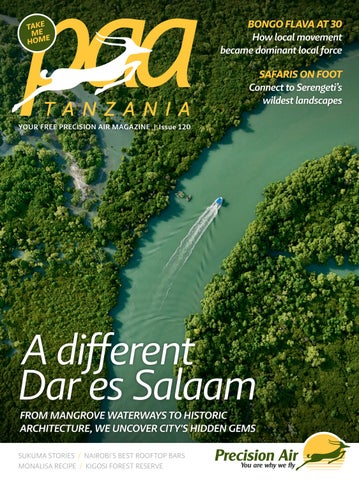
A different Dar es Salaam FROM MANGROVE WATERWAYS TO HISTORIC ARCHITECTURE, WE UNCOVER CITY'S HIDDEN GEMS
SUKUMA STORIES / NAIROBI’S BEST ROOFTOP BARS MONALISA RECIPE / KIGOSI FOREST RESERVE
Contents
Walking safaris – Page 39
FEATURES
REGULARS
6
4
BONGO FLAVA AT 30: The soundtrack of Tanzania marks anniversary
10 NAIROBI’S BEST ROOFTOP BARS Views and brews in Kenya's capital
6 5
15 THE HIDDEN SIDE OF DAR ES SALAAM Locals share their secret spots
15
22 KIGOSI NATIONAL FOREST RESERVE The season of shoebills and sitatunga 24 MONALISA RWECHUNGURA TV chef on her new series and culinary journey 29 TIPPU TIP: HERO OR VILLAIN? The legacy of Zanzibar legend
24
32 CREATIVE WRITING Author Nyachiro Lydia Kasese shares her tips
Precision Air Info
34 OPEN AIR FEST Event brings films and fun to Dar es Salaam 36 SUKUMA STORIES 39 WALKING SAFARIS A different way to experience the Serengeti 2
Paa Tanzania
PAA NEWS
26 PAA FOOD Vitumbua
18 TANZANIA’S TOP SIX GEMS 20 RESEARCHERS REST From academic hub to Arusha hideaway
FOREWORD
Precision Air CEO Patrick Mwanri welcomes you onboard
5 Paa News 45 Paa Royal Benefits 46 Route Network 47 Paa Contacts 48 Welcome Aboard
43 HARRIET’S COLUMN El Niño and Tourism: lessons for East Africa
www.precisionairtz.com
Foreword
Safer, stronger and ready for 2027
Precision Air Services Plc Diamond Plaza PO Box 70770, Dar es Salaam, Tanzania Tel: +255 (0)22 219 1000 Fax: +255 (0)22 286 0725 www.precisionairtz.com
As 2026 draws to a close and we look ahead to 2027, I am pleased to share some of the milestones that have strengthened Precision Air and contributed to the growth of Tanzania's aviation industry.
Marketing and Corporate Communications Manager: Hillary Mremi Email: hmremi@precisionairtz.com
This year, we are proud to have successfully completed our first Risk-Based IATA Operational Safety Audit (IOSA), our tenth consecutive IOSA audit since 2007. The new approach focuses safety oversight where operational risk is highest.
Paa Tanzania Magazine is published by: Land & Marine Publications (Tanzania) Ltd 5th floor, Josam House Plot Number 16, Mikocheni Area Along Coca-Cola Road, Dar es Salaam Tel: +255 686 118 816 www.landmarine.com
The audit covered eight operational disciplines from flight operations to aviation security. The long-awaited return of aircraft 5H-PWE to service was an important step towards stabilization of our fleet. It also allowed us to unveil our new aircraft livery. Our signature gazelle now faces forward. Our engineers completed PWE's livery change and Check-C entirely in-house, a true statement of our maintenance capability and continuous improvement. This year, four participants completed ATR type rating training, strengthening our local capacity to maintain the aircraft you fly on. We also became the first airline in Tanzania to complete full regulatory approval and implementation of an Integrated Electronic Flight Bag (EFB) technology. The platform supports safer and more efficient flight operations, reduces administrative work and cuts paper use. Our Approved Training Organization (ATO) had a strong year in 2026, with 111 students graduating across four classes, a significant increase from the previous year. To date, 316 students have graduated across 17 intakes. Every graduate who sat a regulatory licensing examination passed. As we introduce new courses and increase the number of intakes, we expect enrolment to double in 2027. In 2027, we will continue investing in our people, technology and operations to improve reliability and make every journey with Precision Air a better experience. Thank you for choosing to fly with us and for being part of that progress. On behalf of everyone at Precision Air, I wish you and your loved ones a Merry Christmas and a Happy New Year. May the festive season bring joy to your homes and hope for the year ahead.
You Are Why We Fly
ADVERTISING: Godfrey S. Urassa Tel: +255 (0)686 118 816 (WhatsApp) Email: godfreyurassa@landmarine.com General enquiries Email: paa-tz@landmarine.org EDITOR: Mark Edwards Email: markedwards@landmarine.com Head office: Land & Marine Publications Ltd 6 The Square, Ipswich, Suffolk, IP5 3SL UK Tel: +44 (0)7714 448059 Email: publishing@landmarine.com www.landmarine.org The contents and opinions expressed in this publication are not necessarily those of the editor, or any other organisation associated with this publication. While every care is taken to ensure accuracy in preparing the magazine, the Publisher and Precision Air assume no responsibility or liability for any inaccuracies or omissions. All submitted material is accepted on the understanding that the material can be edited, amended or abridged for publication. ©2026 Land & Marine Publications (Tanzania) Ltd.
Subscribe Request your e-version subscription by emailing: subscribe@landmarine.org
Keep in touch www.precisionairtz.com
Patrick Mwanri
Facebook: @Precisionair Tanzania
Managing Director and CEO Precision Air Services Plc
Instagram: @Precisionairtz
Call centre
LinkedIn: Precision Air Tanzania X: @PrecisionAirTZ
+255 22 2168000
+255 784 108800
Bwana Swala: 4
Paa Tanzania
+255 22 2191000
+255 620 888888
TikTok: @_precisionairtz YouTube: @PrecisionAirOfficial
Precision Air news
Facing the future with new ‘Swala’ logo
T
he Precision Air fleet has been given a fresh new look with an updated version of our iconic ‘Swala’ logo. Our beloved Thompson's gazelle now faces forward, symbolising progress, new opportunities and our commitment to building an even brighter future. The leaping gazelle is set against the backdrop of an African sunset, capturing the spirit of speed, freedom and East African elegance.
More than a visual refresh, the new livery reflects Precision Air's strategic transformation journey. It represents our ongoing commitment to delivering safe, reliable and customer-focused service while continuing to connect people, communities and opportunities across the region. As Tanzania's premier private airline
enters its next chapter, the redesigned Swala honours our 33-year heritage while looking confidently to the future. We can't wait to welcome you aboard and share the journey in our new-look aircraft.
Precision Air adopts paperless flight technology in Tanzanian first
P
recision Air has become the first airline in Tanzania to receive approval to use an Electronic Flight Bag (EFB), a digital system that gives pilots instant access to important flight information on a secure electronic device. The approval follows a detailed assessment by the Tanzania Civil
Aviation Authority (TCAA), which confirmed that Precision Air met all requirements for the safe use of the technology. The EFB replaces many traditional paper documents used by pilots with a single digital platform. It provides access to flight manuals, navigation charts, weather information, flight plans, performance calculations, and reporting tools, all in one place. The new system is expected to make flight operations more efficient, improve access to real-time information, reduce administrative tasks, and significantly cut paper use across the airline's operations. Precision Air Managing Director and Chief Executive Officer Patrick Mwanri
described the approval as an important milestone for both the airline and Tanzania’s aviation industry. “The Electronic Flight Bag is a major step forward for Precision Air,” he said. “It reflects our commitment to innovation, operational excellence, and sustainability. By moving from paper-based processes to a digital platform, we can improve efficiency, provide better information to our pilots, and reduce our environmental impact.” Mwanri also thanked the Tanzania Civil Aviation Authority for its support throughout the approval process, as well as the airline's flight operations, safety, and technical teams for their work in making the project a success. www.precisionairtz.com
5
Bongo Flava
BONGO FLAVA AT 30:
The soundtrack of Tanzania As Bongo Flava marks its 30th anniversary with concerts across Tanzania, rapper Fid Q reflects on the music’s evolution from a local movement to East Africa's dominant musical force.
6
Paa Tanzania
Bongo Flava
W
hen DJ Mike Mhagama coined the phrase ‘Bongo Flava’ on the Radio One Stereo station in Dar es Salaam in 1996, he could hardly have imagined how enduring those two words would become in Tanzanian music. He came up with the name in response to an emerging style of music being created by local artists: a Swahili-infused blend of hip-hop, R&B and reggae shaped by Arab and Indian musical influences. Thirty years on, Bongo Flava has matured into a multi-million-dollar industry and the dominant force in East African popular music. Today’s Bongo Flava stars such as Diamond Platnumz, Ali Kiba, and Harmonize regularly fill arenas, dominate streaming charts and command audiences across East Africa and beyond.
To mark the anniversary, a series of concerts under the banner ‘30 Years of Bongo Flava’ is being staged across Tanzania, culminating in a major event in Dar es Salaam, the city where the genre was born, at the end of 2026. Farid Kubanda, better known as rapper Fid Q and creative director behind the celebrations, says Bongo Flava is intrinsically Tanzanian, from its name to its origins. “Bongo is a nickname or code name commonly used for Tanzania, although it is also particularly associated with Dar es Salaam, where the movement grew and found much of its early identity,” he says. “The word is also connected to ubongo (the Swahili word for brain) reflecting the idea of being clever or using your brains to navigate life.
The 'flavour of Tanzania' “So, for me, Bongo Flava essentially means the flavour of Tanzania. And that is exactly what the music represented. We were exposed to hip-hop, R&B, soul, reggae and other sounds from around the world, but at the same time we were surrounded by our own rich musical traditions – taarab, traditional Tanzanian music, Congolese sounds and even Arabic and Indian music. “We took all these influences and processed them through our own Tanzanian experience. We spoke about our lives, our streets, our politics, our relationships, our dreams and our struggles, largely in Swahili and created something that sounded like us.”
www.precisionairtz.com
7
Bongo Flava
That the music stemmed from the streets of Dar es Salaam and gave a voice to everyday Tanzanians is, Fid Q believes, key to its longevity. To him, Bongo Flava is more a form of cultural expression than a music genre. “Bongo Flava has always belonged to the people,” he says. “It wasn’t a movement that was created by the mainstream music industry. It has given Tanzanians a soundtrack to their lives. That is why, for me, being part of the 30 Years of Bongo Flava celebration carries a much deeper responsibility. I see it as helping document, honour and preserve a cultural history that we were fortunate enough to live through. Before Bongo Flava existed as a phrase, Fid Q says there was a loose collective of underground musicians who laid down its sonic and cultural blueprints. “It grew from the streets, from young people, from small studios, cassettes, word of mouth and the hunger to express ourselves.” He namechecks Saleh Jabir, whose groundbreaking debut cassette tape ‘became the first
8
Paa Tanzania
official release of Swahili rap and included the artist’s hugely popular adaptation of Vanilla Ice’s global hit ‘Ice, Ice Baby’. “That album really travelled,” Fid Q says. “It helped attract wider attention to this emerging sound and the artists behind it. It showed that there was a real audience for music that sounded like us and spoke our language.”
Celebrating pioneers The line-up for the 30 Years of Bongo Flava concerts reflects the artists who helped build the genre from the ground up. The initiative was conceived by Hamadi Ali Seneda, better known as Mdee, and has received significant backing from fellow Bongo Flava pioneer Hamis 'Babu Tale' Taletale. Fid Q says a popular Swahili phrase, mziki ulikuwa zamani ('real music belongs to the past'), helped inspire the decision to put the foundational talent at the centre of the celebrations. “It got us thinking: if people are still talking about these artists and their music three decades later, then clearly the pioneers are still
“We are celebrating 30 years of Tanzanian creativity, identity and storytelling.”
Bongo Flava The concerts have showcased some of Bongo Flava's most influential artists including Lady Jay Dee (left)
relevant and still needed. So, it only felt right to have the pioneers themselves take centre stage and lead the celebration.” Fid Q was just entering his teenage years and living in Mwanza when Bongo Flava emerged. Here was music he loved being made by people like him, for people like him. It convinced him that a career in music was within reach. “Bongo Flava represented the freedom to experiment, to write, to express what was in my head and to take whatever sounds we could find and make them ours. “I was simply a young kid who was obsessed with music. I would look for beats to rap on chrome tapes coming from Kampala and Nairobi as Mwanza is relatively close to both cities. I think I realised there was something bigger happening when I started putting my own personal thoughts into those rhymes and sharing them with an audience. The reaction was incredible. “I had my first hit with ‘Mwaka Wetu’ (‘Our Year’), which was made on a karaoke machine. It was eventually used as a chant during
sports competitions for the Union for Sports and Secondary School Studies in Tanzania. Imagine that, you’re just experimenting with music and suddenly something you’ve created is being sung and chanted by thousands of young people. That’s probably when I began to understand that music could travel beyond me. It could become part of people’s lives, even when it wasn’t coming through the traditional channels of the music industry.”
strongly that we shouldn’t build a celebration of 30 years of Bongo Flava and end it in Dar es Salaam. Bongo Flava belongs to the whole country. “Eventually we’ll take it beyond our borders to Mombasa, Nairobi, Kampala, Bujumbura, Kigali and other cities across East Africa where Bongo Flava has a genuine audience and cultural footprint.” The concerts are not just nostalgia. Bongo Flava is more popular than ever today with new artists coming through to take the music in new directions. To Fid Q, this evolution is why Bongo Flava continues to thrive. “Every generation has brought something new without completely disconnecting from what came before,” he says. “As long as we continue telling our stories in our own voice, Bongo Flava will have a future.” Creative director of the concerts Fid Q
Enduring appeal The enduring appeal of Bongo Flava has been clear from the public response to the anniversary concerts. What began with a show at Mlimani City Mall in Dar es Salaam has grown into a nationwide celebration, with events staged in major cities across Tanzania before what Fid Q describes as the “biggest New Year’s Eve celebration of the year” in the commercial capital on 31 December. Fid Q adds that the celebrations may not stop there. “From the beginning, I felt www.precisionairtz.com
9
Nairobi Page title
NAIROBI’S BEST ROOFTOP BARS Nairobi’s finest views now come with a drinks list. Adam Maina takes the lift.
The one where you drink the best cocktails in Africa ▲ HERO Trademark Hotel, Limuru Road, Gigiri At the World’s 50 Best Bars awards in 2025, Hero was named the finest bar on the continent and placed sixtyninth on the planet. Nine floors above Gigiri, it commits fully to a comic-book
conceit, with the menu filed under heroes, sidekicks and villains and the non-alcoholic drinks grouped as law enforcement. The view runs north across the diplomatic quarter toward the hills. Reserve ahead, the whole city has worked this one out.
The one where you dress for the occasion MR. PANG SKY BAR AND LOUNGE JW Marriott Hotel, Chiromo Lane, Westlands Thirty-one floors up, this is the highest lounge in Nairobi. The kitchen is Pan-Asian, the room is adults only, and the house keeps a written dress code alongside a minimum spend. It’s worth the expense.
10
Paa Tanzania
Nairobi Page title
▼▼
The one where you finish dinner under the stars ▲ UPEPO Kwetu Nairobi, Curio Collection by Hilton Upepo does something no other rooftop in the city can. Floor-to-ceiling glass puts you level with the treetops of Karura Forest, and once the light has gone the roof slides back, so the last hour of dinner happens under open sky. The kitchen is Pan-Asian and was refreshed this year. Arrive for golden hour, order slowly, and stay until the ceiling opens.
The one where you watch aircraft and wildlife ▲ SKY LOUNGE Emara Ole-Sereni, Mombasa Road Built along the fence line of Nairobi National Park, with an infinity pool pointed straight at it and a waterhole across the way. City skyline on one flank, plains game on the other, aircraft descending into Jomo Kenyatta International Airport overhead. No other capital in the world offers all three from the same seat. Come at dusk, when the animals move to water and the lights come on behind you.
The one where you play ▼ HORIZON The Glee Hotel, Northern bypass, Runda Seven floors above Runda with treetops on every side, Neapolitan pizzas and grill skewers, live music and rooftop games running most nights. Over-18s only, and open from early afternoon at weekends.
The one where you watch the runway from your table ▲ TAZAMA Four Points by Sheraton, Jomo Kenyatta International Airport Ten minutes from the terminal, Tazama looks over Nairobi National Park on one side and the airport runway on the other. Combine the panoramic views with grills, craft beer and a heated rooftop pool. For anyone with a sunrise flight, this is the most enjoyable possible way to spend the evening before it. www.precisionairtz.com
11
Nairobi
The one where you eat your way around the Mediterranean ▲ TROY Gem Forest Hotel, MGallery, Limuru Eight floors above Limuru Road, Troy runs a long mezze menu that wanders between Greece, Turkey and the Levant, with forest canopy in every direction. Ask for The Helena, the house cocktail, and order more small plates than you think you need.
The one where you take someone special
The one where you can decide on the night ▲ SARABI ROOFTOP Sankara Nairobi, Woodvale Grove, Westlands Sarabi is the rooftop OG running a poolside deck on the eighth floor of the Sankara since long before the rest of the skyline caught on. Live music and guest DJs several nights a week, doors open daily until midnight, and walk-ins genuinely welcome.
▼ TAMBOURIN Villa Rosa Kempinski, Chiromo Road, Westlands Cabanas, soft light and Levantine food served across a whole evening rather than a sitting. Tambourin is the most unapologetically romantic room on any Nairobi roof, and the Kempinski name still means exactly what it has always meant. This is the anniversary booking, and it knows it.
The one where you keep the view whatever the sky is doing THE LOCATION Alta Towers, Ring Road, Kilimani Thirteen floors up with the full panorama wrapped in floor-to-ceiling glass, so the view is yours in every season. The drinks list is the strength here. Ask for a window table when you reserve.
12
Paa Tanzania
Nairobi
The one where you eat nyama choma in the sky
The one that comes with a film screening
KILELE NYAMA Ibis Styles Nairobi Westlands, Rhapta Road Kenya’s national dish, served under a 360 degree view, with the Ngong Hills visible on a clear afternoon and live jazz on Friday evenings. Char-grilled cuts done properly, families very welcome, no ceremony required.
▼ UNSEEN NAIROBI Wood Avenue Plaza, Kilimani Twelve floors above Kilimani, Unseen pairs a garden-style terrace with an independent cinema seating around 80 people in cheerfully pink chairs. Screenings run most evenings at seven and the ticket comes with a cocktail, popcorn and wireless headphones. The kitchen leans Asian, bao buns and Korean fried chicken, and on Sunday mornings they screen for children. It is the most quietly original thing on any roof in the city.
The one where you get three evenings in one ▲ FIFTEEN The Curve by the Park, off Mombasa Road Fifteen floors up with Nairobi National Park and the Ngong Hills held in the frame, and three separate spaces on the same roof, a sunset lounge, a chef’s table and a bar. The evening can change direction twice without anybody leaving the building.
Need to know 5pm to 7pm is the golden hour (ok, two hours). Nairobi sunsets move quickly and the light is the whole point. z A collar and closed shoes will comfortably get you into every room on this list. z Reserve ahead for Hero, Upepo and Mr. Pang. Sarabi and Kilele Nyama will happily take you as you arrive. z Book the film as well as the table if you are heading to Unseen. z Staying near the airport? Tazama makes the evening before a flight the best hour of the trip.
Adam Maina is a travel and lifestyle expert based in Nairobi. He has worked in Kenyan travel and tourism for over 15 years and is marketing manager at Bountiful Safaris.
The one where you sing social ▲ NAIROBI STREET KITCHEN, Mpaka Road, Westlands Live bands, karaoke and the big matches on screen, sitting on top of a complex holding nearly a dozen kitchens and bars that you wander through on the way up. Come hungry and come with people. www.precisionairtz.com
13
Dar es Salaam
The hidden side of Dar es Salaam Looking for the best things to do in Dar es Salaam beyond the usual tourist trail? From forest sanctuaries and mangrove-lined waterways to experimental arts spaces and standout restaurants, five locals share the places that reveal a different side of Tanzania's largest city.
www.precisionairtz.com
15
Dar es Salaam
To sample the city’s underground culture… Bongo Fiction (Chosen by Jesse Mpango, a director of Darbased curatorial arts collective Ajabu Ajabu @ajabuajabu on Instagram)
To enjoy a mangrovefringed coastline… Mbezi Beach mangroves (Chosen by Gefrida Luvuya, founder of Tanzanian ecoconscious travel and tour agency Marine Adventures @gefrida on Instagram) Mbezi Beach is a scenic, upscale coastal neighbourhood on the northern side of Dar es Salaam. Known for its sandy beaches, it also has tidal mangrove ecosystems that are vital in protecting the coastline. “I love this hidden side of Dar because it offers a slower way to experience the coast. The inlets allow for kayaking, stand-up paddleboarding, birdwatching and wellness on calm waters while surrounded by beautiful mangroves.”
16
Paa Tanzania
To savour a meal… Sala Thai @salathai.dar (Chosen by architect and culinary enthusiast Belinda Mkony @forkyourmunchies on Instagram) “Tucked in Masaki, Sala Thai serves up genuine Thai and continental fare crafted by Thai chefs who make each sauce from scratch. The result is bold, beautifully balanced flavour that feels like a trip to Southeast Asia in every bite. Don’t miss the Tom kha kai – a fragrant, coconutty bowl that’s pure comfort on a rainy day. With breakfast, lunch, and dinner on offer via dine-in, delivery, or takeaway, it's an easy favourite any time of day.”
This new venue in Kinondoni hosts film screenings, poetry readings, dramas, and art installations that showcase the emerging creative talent in East Africa. “Bongo Fiction reveals how art can bring language to our rapidly changing city. Through cinema, sound, performance and live translation, it brings artists and audiences together, drawing on humour, improvisation and everyday encounters to imagine new ways of living together. Recent events have included a program hosted by Poetry 255 and a collaboration with the University of Dar es Salaam history department. Follow the schedule at @bongofic on Instagram.”
“It’s one of those hidden gems you almost don’t want to tell people about”
To explore a green space…
To visit a historic building…
Sacred Space @sacredspacedsm (Chosen by award-winning photographer Daniel Msirikale @thattanzanianguy on Instagram)
Atiman House (Chosen by Mejah Mbuya, managing director of AfriRoots, an eco-minded African-owned cycling tour company @afriroots on Instagram)
“I’ve lived in Dar for years and one of my biggest qualms with this city is its lack of green spaces. And so it was a pleasant surprise to discover Sacred Space. You pass through the gates, and it genuinely feels like you’ve stepped through a portal. Suddenly you’re walking beneath baobabs and forest canopies, along trails surrounded by wildlife, agroforestry and a remarkable biodiversity. There’s always something to notice or learn about. What makes it even more special is knowing that the space exists as a conservation project, created not just to protect nature, but to give people in Dar a way to experience and understand it. It’s one of those hidden gems you almost don’t want to tell people about.”
“Near Dar es Salaam’s ferry terminals stands one of the city's oldest surviving buildings. Built in the 1860s as a harem for Sultan Majid of Zanzibar, the founder of Dar es Salaam, it later became the headquarters of the Missionaries of Africa, better known as the White Fathers for their distinctive white robes. Today the building is named after Tobias Atiman, a former slave from present-day Mali who was freed by the White Fathers and supported through medical training. He went on to serve communities across East Africa as a doctor for more than six decades, earning widespread respect for his work. A small museum inside the building tells the story of his extraordinary life while offering a window into the city’s complex colonial and pre-colonial history.”
Karloss-KOM / Shutterstock.com
Dar es Salaam
www.precisionairtz.com
17
Tanzanian gems
Tanzania’s TOP SIX GEMS Billions of years of tectonic activity in the Great Rift Valley have created a geological perfect storm, giving Tanzania some of the richest gemstone deposits in the world. Here are our picks of the country's most valuable jewels.
Tsavorite
What it is: A vibrant green variety of garnet renowned for its vivid colour and brilliance. Found in: Northern Tanzania, particularly around the Merelani area near Kilimanjaro. Looks like: Bright emerald-green with exceptional sparkle. Why it's valuable: Its intense colour, rarity and excellent clarity make it one of the most desirable garnets in the world. Interesting fact: Tanzania and neighbouring Kenya provide most of the world's tsavorite supply.
Tanzanite
What it is: A rare blue-violet variety of the mineral zoisite and Tanzania's most famous gemstone. It is found nowhere else in the world. Found in: The Merelani Hills near Mount Kilimanjaro in northern Tanzania. Looks like: Deep blue, violet or purple, often showing different colours when viewed from different angles. Why it's valuable: Its beauty, rarity and singlesource origin make it one of the world's most sought-after coloured gemstones. Interesting fact: Tanzanite was only discovered in 1967 and is considered one of the most important gemstone discoveries of the 20th century.
18
Paa Tanzania
Tanzanian gems
Sapphire What it is: A gemstone-quality variety of corundum, best known for its blue colour but also found in many other hues. Found in: Important deposits occur in Songea, Tunduru and Winza Looks like: Most commonly blue, but Tanzanian sapphires can also appear green, yellow, pink, orange and other colours Why it's valuable: Durability, brilliance and a wide range of attractive colours make sapphires highly desirable. Interesting fact: Some Tanzanian sapphires are of such high quality that they can be sold without heat treatment, something greatly prized by collectors.
Ruby
What it is: A red variety of the mineral corundum, coloured by traces of chromium. Found in: Notable deposits occur in the Winza area of Morogoro Region and around Longido in northern Tanzania. Looks like: Rich red to purplish-red, sometimes with flashes of pink. Why it’s valuable: Fine rubies are among the world’s most prized coloured gemstones, especially those with vivid, saturated colour. Interesting fact: Tanzanian rubies have gained increasing international recognition in recent decades, helping establish the country as a major coloured-gem producer
Chromium
Found in: Notable deposits occur in the Winza area of Morogoro Region and around Longido in northern Tanzania. Looks like: Rich red to purplish-red, sometimes with flashes of pink. Why it’s valuable: Fine rubies are among the world’s most prized coloured gemstones, especially those with vivid, saturated colour. Interesting fact: Tanzanian rubies have gained increasing international recognition in recent decades, helping establish the country as a major coloured-gem producer.
Diamond What it is: The hardest natural substance on Earth, formed from carbon deep beneath the planet's surface. Found in: Most famously at the Williamson Mine near Mwadui in Shinyanga Region, one of the world's oldest continuously operating diamond mines. Looks like: Usually colourless and brilliantly sparkling, although diamonds can also occur in shades of yellow, brown and pink. Why it's valuable: Exceptional hardness, rarity and enduring demand in jewellery help maintain its value. Interesting fact: The Williamson Mine became famous for producing a large pink diamond that was given to the UK’s Queen Elizabeth II as a wedding gift.
www.precisionairtz.com
19
Researchers Rest
FROM ACADEMIC HUB TO ARUSHA HIDEAWAY US academic and author Professor Terrence McCabe reflects on his research years in the Ngorongoro Conservation Area and his time as one of the early residents at Arusha guesthouse ‘Jo and Judith’s’, now known as Researchers Rest.
I
first came to Tanzania in 1989 after spending nearly a decade conducting research among Turkana pastoralists in northern Kenya. I came to Tanzania to lead a small team of researchers examining how conservation policy in the Ngorongoro Conservation Area (NCA) was impacting the household economy of local Maasai residents. I was thrilled to be able to conduct research in one of the world's most important and famous conservation areas and to examine the impact of wildlife conservation on the livelihoods of local people. One of the lessons I learned early on was that first impressions can be deceiving. The lush grasslands of the high plains were dominated by a non-palatable bunch grass, Eleusine jaegeri, and cattle were exposed to many tick-borne diseases, especially East Coast fever. The intertwined issues of a growing human population, a livestock population that fluctuates, the spread of cultivation,
20
Paa Tanzania
wildlife conservation, and human well-being have been the focus of my research and continue to be so today. I worked in the NCA for 12 years and then moved my research site to the rangelands bordering the eastern side of the Serengeti and now to the Simanjiro plains east of Tarangire National Park.
Intellectual atmosphere Most of my work has been conducted as part of small interdisciplinary teams and while in the field we based our research activities out of small mobile camps. We currently have a more permanent camp outside of Tarangire, but life in camp with other researchers and our Maasai assistants has been one of the most rewarding experiences of my life. Sitting around a campfire at night, talking about our research, hearing what our Maasai assistants thought of our findings, and listening to sounds of the African bush is something I will cherish forever. The intellectual stimulation I received
from conversations about research did not (and does not) stop when returning to our base in Arusha. In the early years we were able to stay at an informal guest house, known at the time as Jo and Judith’s. Jo Driessen ran a secretarial service in Arusha, which was first place that researchers could receive faxes, and I learned that Jo had a house in Sakina, about 3km from the city centre, where many researchers, especially those working in Serengeti, stayed while in Arusha. I talked to Jo about staying there, and she told me to come to the house the next day to meet her. I remember arriving at the back gate with my colleague Paul Leslie. We were interviewed not only about our work, but also about what we liked to do and, essentially, whether Jo thought we, as social scientists, would be a good complement to the mostly wildlife researchers staying at the house. Jo was an incredibly interesting person in her own right. Along with her childhood
Researchers Rest
The lodge today
friend Judith Jackson, she had founded a bar and restaurant in Arusha and became well known throughout both the expatriate and Tanzanian communities. The restaurant was called Club Safi, Kiswahili for ‘clean’ or ‘good’, and many local people referred to her simply as Mama Safi.
Lively conversations One of the now more famous safari guides, Paul Oliver, lived upstairs and the house was often filled with researchers and visitors involved in the safari business from all nationalities. The conversations around the dinner table and afterword in the sitting room among the mixture of expats and Tanzanians were lively, to say the least. Discussions often revolved around conservation policies, tourism, wildlife and Maasai livelihoods. Of course, we all did not always agree, and being able to informally discuss and sometimes argue our various points of view was something that could not be replicated in
any university or conference setting. Jo Driessen died a few years ago, and the house transitioned into an official bed and breakfast with the name Researchers Rest. A number of the researchers who used to stay at Jo and Judith’s while in Arusha still stay there as do tourists. Interesting conversations still happen around the dinner table, and tourists can gain an insight into what is happening in northern Tanzania that they cannot get from even most informed tour guides. I still have close ties with faculty at the University of Dar es Salaam and am extremely grateful for their support. I am also grateful to the various government agencies that gave me permission to conduct this research, especially the Tanzania Council on Research and Technology. Conducting research in Tanzania has been one of the joys and privileges of my life. Of course, none of this would have been possible without the support of the Maasai people, and our Maasai research assistants.
When Jo and Judith left Tanzania, they passed the running of the house to the local staff who had played such an important role in creating its warm and welcoming atmosphere. Today, the property operates as Researchers Rest, a guesthouse open to both short and long-term visitors seeking a unique base in Arusha. With just five guest rooms, the house retains the intimate, community-focused spirit that made Jo and Judith's such a memorable place to stay. Communal dinners, prepared using fresh ingredients from the on-site herb and vegetable garden, continue to bring guests together while the sitting room, lined with books collected over the years including some by previous residents, offers further opportunities for conversation. While the name, ownership and guest list may have changed, the spirit of the house remains much the same: a place where people from different backgrounds come together, exchange ideas and leave with a deeper connection to northern Tanzania. To find out more or to book a stay, visit www.theresearchersrest.com/en-GB
www.precisionairtz.com
21
Kigosi National Forest Reserve
The season of shoebills and sitatunga Precision Air destination Kahama is the gateway to Kigosi Forest Reserve, one of Tanzania’s most remote and rewarding wilderness destinations. With the wet season approaching, Paa explores how the rains transform the reserve into a lush wilderness and a haven for rare and spectacular birdlife.
T
he Kigosi Forest Reserve remains one of East Africa’s most little-visited wilderness frontiers. Yet, by flying into the western Tanzania town of Kahama, which is just 80km east of the protected wetland, intrepid travellers have the perfect launchpad to explore this hard-toreach area. Tanzania’s short rains in November and December add to the challenge, with muddy access roads sometimes becoming impassable without a 4x4 vehicle and an experienced driver. Dense seasonal vegetation can also make wildlife spotting more difficult,
22
Paa Tanzania
as lions, antelope and other mammals disappear into the thick greenery. Yet the effort is richly rewarded. The rains transform Kigosi into a verdant paradise of emerald wetlands, flourishing forests and life-filled waterways. While resident bird species thrive in these conditions, migratory birds arrive from far afield, turning the reserve into one of Tanzania’s most spectacular wet-season birdwatching destinations. Once you're in the reserve, the best way to explore at this time of year is by boat. The winding channels of the Moyowosi and Kigosi rivers reveal a landscape transformed by the rains,
with vast wetlands stretching across the floodplain. Travelling serenely through this watery wilderness soon reveals that Kigosi is no ordinary wetland. The reserve protects Africa's largest concentration of shoebill storks, perhaps the continent's most sought-after and unmistakable bird, as well as one of East Africa's largest populations of sitatunga, the world's only truly aquatic antelope. Along the way, visitors may encounter pods of hippos wallowing in secluded pools, Nile crocodiles basking on muddy banks, and flashes of colour from kingfishers and bee-eaters darting above the water.
Sitatunga: the swamp specialist Kigosi protects one of East Africa's largest populations of the rare sitatunga, an elusive antelope specially adapted to
Kigosi National Forest Reserve
life in wetlands. Unlike most antelope species, the sitatunga thrives in flooded grasslands and papyrus swamps, using its elongated, splayed hooves to move across soft, waterlogged terrain. The wet season is an especially rewarding time to look for these secretive animals, as rising water levels draw them deeper into their preferred habitat.
African Fish Eagle: voice of the wetlands Kigosi's vast network of rivers, floodplains and marshes makes it a haven for birds of prey. Alongside species such as the palmnut vulture, African hawk-eagle, western banded snake eagle and various marsh harriers, the reserve's most iconic raptor is undoubtedly the African fish eagle. Its unmistakable call echoes across the waterways throughout the wet season, providing the soundtrack to many boat safaris. Frequently seen perched above the water on riverside trees, this powerful hunter surveys the wetlands below before swooping down to snatch fish from the surface.
Shoebill Stork: Africa's prehistoric giant For birdwatchers, Kigosi's greatest prize is undoubtedly the shoebill stork. The reserve supports Africa's largest concentration of these remarkable birds, whose enormous shoe-shaped bills and prehistoric appearance make them among the continent's most sought-after sightings. Often standing motionless among reeds and papyrus, shoebills are patient hunters, waiting for fish, frogs and lungfish to come within striking distance before attacking with startling speed.
Hippos and crocodiles: aquatic wildlife The rains bring Kigosi’s waterways to life, transforming the reserve into a vast aquatic wilderness of rivers, channels and papyrus swamps. Exploring by boat offers a unique perspective on this wetland ecosystem and the wildlife that depends on it. Pods of hippos congregate in the deeper channels and pools, while the slow-moving rivers and permanent swamps provide ideal habitat for some of the reserve's most abundant residents. Nile crocodiles are a constant presence along the waterways, often seen basking on muddy banks between hunting forays. Kigosi's wetlands are also an important refuge for the much rarer and critically endangered slender-snouted crocodile, a little-known species that shares the reserve's rivers and floodplains with its larger cousin. Together, these formidable reptiles underscore the importance of Kigosi as one of Africa's great wetland sanctuaries. While Tanzania's wet season deters many safari-goers, it reveals Kigosi at its finest. The rains breathe life into the reserve's rivers, floodplains and forests, creating a sanctuary for extraordinary wildlife and some of Africa's most rewarding birdwatching. For travellers arriving through Kahama, the journey may be muddy and unpredictable, but the chance to experience one of the continent's last great wetland wildernesses makes every kilometre worthwhile. Precision Air flies to Kahama (Buzwagi Airport) from Dar es Salaam three times a week on Wednesdays, Fridays, and Sundays
Accommodation options Kigosi is not a destination for travellers seeking a wide choice of luxury lodges. The reserve's remoteness means facilities are limited, but that is precisely part of its appeal. With little development beyond a handful of tented camps, visitors are rewarded with a rare sense of immersion in one of Tanzania's last true wildernesses. Many tour operators offer multi-day expeditions using fully equipped mobile camps, allowing guests to stay deep within the reserve and experience its remarkable isolation. For those seeking more conventional accommodation, Kahama itself offers several comfortable options. Mboka Village is a tranquil, gated community of chalets set around an inviting outdoor swimming pool, while The Levels by 101 Hotel provides a well-appointed four-star experience with two restaurants, a gym and a swimming pool. Together, they provide a comfortable base from which to explore one of East Africa's remotest wetland ecosystems.
www.precisionairtz.com
23
Monalisa Rwechungura
Food should bring people together Paa cookery columnist Monalisa Rwechungura talks food, family and taking Tanzanian culinary creativity to audiences across the continent.
I
f you’re a regular flyer with Precision Air, you’ll be familiar with Monalisa Rwechungura as the cookery columnist for Paa magazine. Her recipes have long given readers plenty of inspiration to take home and try in their own kitchens. But what about the chef behind the recipes? Now is the perfect time to find out more about this Tanzanian culinary talent as she launches the latest series of her DStv cookery show, Pika Pakua. In each episode, Monalisa guides viewers through the creation of a delicious dish before sitting down to share the meal with a local celebrity. You’ll learn, you’ll laugh, and you’ll come away with another recipe to try out on friends and family. Here, Monalisa talks to Paa about the food and guests featured in the new series, her love of cooking and how she hopes to inspire creativity in kitchens across Africa. Q: Pika Pakua translates as “cook and serve.” What inspired that title, and how does it capture the spirit of the show? A: For me, Pika Pakua is about the whole experience of preparing food, serving it, sharing it and bringing people together around a table. In the show, I prepare the food myself, and then a guest joins me at the table to enjoy the meal. We also explore cocktails, mocktails and juices, so it became a complete
24
Paa Tanzania
360-degree food and lifestyle experience. The title really captures that journey. Q: Is there a common theme or connection that links the recipes featured throughout the series? A: Absolutely. The main theme is “Something Old and Something New.” In every episode, I wanted to bring together two different worlds: one local Tanzanian recipe and one international recipe. “Something Old” represents our traditional and familiar foods, dishes rooted in our culture that many Tanzanians grew up eating. “Something New” represents exploration: discovering cuisines from other parts of the world and introducing viewers to foods they may not have tried before. Q: How did the idea for the show first come about? A: My journey with food content started around 2019 with my brand, Diko by Monalisa. I started because I wanted to teach Tanzanians how to prepare our own local cuisines, but I also wanted to introduce them to food from other parts of the world. Over time, the content and audience grew. Then, around 2025, DStv Africa offered me the opportunity to do Pika Pakua. I was honestly so ecstatic about the opportunity, and I knew I had to take it.
The show gave me a completely different platform. I was able to reach audiences across Africa, which was a huge milestone for me. It also gave me the opportunity to showcase Tanzanian food and culture while speaking to a much wider audience in Swahili. For me, it was a beautiful progression from creating food content online to having a television platform where I could bring that same passion to an even bigger audience. Q: A key element of Pika Pakua is sharing food with guests. How do you decide who to invite onto the programme? A: The guests are mainly local celebrities, actors, singers and presenters. I want the guests to bring their own personalities and energy to the show. Because Pika Pakua was not only about cooking, I want it to feel as though you were inviting someone into your home, preparing a beautiful meal for them and then sitting down
Monalisa Rwechungura
Q: Your husband, Godfrey “Daddy G” Rwechungura, often appears in your content, and there is a playful chemistry between the two of you. How closely does your on-screen relationship reflect real life? A: I would say the chemistry people see on screen is very much a reflection of who we are in real life. Godfrey and I have a very playful relationship. He is my best friend, and we naturally joke around with each other. It is not something we have to manufacture for the camera. Of course, there are moments when you switch into work mode, but I think our ability to laugh and have fun together is a big part of what makes working together enjoyable.
together to enjoy it. Even though there was a structure to the show, once we are sitting around the table, people’s personalities really come out. There are spontaneous conversations, laughter and moments that you simply cannot plan. Q: Can you share some examples of guests who have appeared on the show? A: Grace Mapunda, an actress who sadly passed away before Pika Pakua aired, was one of the guests. Ben Kinyaiya, a well-known Tanzanian presenter, also appeared on the show. Each guest brought a different energy to the table.
Q: Are you aiming to encourage Tanzanians to become more adventurous in the kitchen and try dishes they might not normally attempt? A: Definitely. One of the biggest things I wanted to achieve with Pika Pakua was to encourage Tanzanians to explore food beyond what they are already familiar with. Sometimes we look at certain international cuisines and automatically think they are only for “high-class” people. I wanted to challenge that perception. Food should be something that everyone can explore and enjoy. You do not have to limit yourself to Tanzanian cuisine, and you do not have to feel that international food is out of reach. Q: For someone who feels intimidated by cooking, what is the one
“He is my best friend, and we naturally joke around with each other. It is not something we have to manufacture for the camera.”
lesson from the show that could help build their confidence? A: Just start! You do not have to be perfect before you begin. Start with simple recipes, use ingredients that you are comfortable with and gradually challenge yourself. Cooking is a skill, and like any other skill, you improve with practice. Do not be afraid of making mistakes, because mistakes are part of learning. Q: What were some of the biggest challenges you faced when building your brand as a food content creator? A: One of the biggest challenges was consistency. When you are creating content, you have to keep showing up, keep coming up with ideas and keep finding ways to remain authentic while also evolving. Another challenge was building an identity that people could recognise, including my signature outro: “Perfect, bye guys!” I wanted people to know what I stood for and what they could expect from my content. But I think those challenges also helped me grow. They taught me to trust my own voice. Q: What advice would you give to aspiring cooks? A: Focus on giving people value. If your content teaches, inspires, entertains or brings people joy, you are already creating something meaningful. Q: How would you describe the signature Monalisa style of cooking? A: I think my cooking style is about making food feel approachable, exciting and achievable. I love taking a dish that may look complicated or unfamiliar and presenting it in a way that makes people think, “I can actually make this.” www.precisionairtz.com
25
Paa Food / Make it with Monalisa
Vitumbua are a fluffy feast
V Can you really say you’ve visited Dar es Salaam if you haven’t tried vitumbua? Don’t leave without tasting these fried rice cakes and, once you’re back home, make them yourself following this easy-to-follow recipe from Paa cookery columnist Monalisa Rwechungura. 26
Paa Tanzania
itumbua are traditional Swahili rice cakes, popular along the Tanzanian and East African coast. They are made primarily from fermented rice batter, often enriched with fresh coconut, sugar, and cardamom. They are cooked in a round moulded pan that gives each cake its distinctive small, round
shape with a golden, lightly crisp exterior and a soft, fluffy, slightly chewy centre. The combination of coconut and cardamom gives vitumbua their characteristic fragrant, mildly sweet flavour. This recipe makes about 15 to 20 vitumbua. Enjoy them warm, especially for breakfast or as a snack with tea or coffee. Let’s cook!
by Chef Monalisa Rwechungura
METHOD
INGREDIENTS • What you’ll need • 320g rice flour • 100g sugar • 1 teaspoon instant yeast • Half a teaspoon ground cardamom • 360ml warm coconut milk • 120ml warm water, or as needed • Half a teaspoon salt • 2 tablespoons grated fresh coconut (optional) • Oil or ghee for cooking
Prepare the batter: In a large bowl, combine the rice flour, all-purpose flour, sugar, yeast, cardamom, and salt.
cook for about three to five minutes, until the bottoms are golden and the tops begin to set.
Gradually add the warm coconut milk and water, whisking until you have a smooth, thick but pourable batter. Add the grated coconut if using.
Carefully turn each vitumbua using a spoon or skewer. Cook the other side until golden brown and cooked through.
Ferment: Cover the bowl and leave the batter in a warm place for 1 to 2 hours, or until it becomes slightly bubbly and has risen.
Repeat with the remaining batter, lightly greasing the pan between batches if necessary.
Heat the pan: Place a vitumbua pan over medium-low heat. Lightly grease each mould with oil or ghee.
SERVING Serve warm,
Cook: Stir the batter gently, then pour it into each mould, filling until about three quarters full. Cover the pan and
traditionally with tea, coffee, or coconut milk. They can also be enjoyed with a little honey or sugar.
www.precisionairtz.com
27
Page title
28
Paa Tanzania
www.precisionairtz.com
28
His wealth transformed Zanzibar, but the human cost of his success remains contested.
TIPPU TIP HERO, VILLAIN, LEGEND. His wealth transformed Zanzibar, but the human cost of his success remains contested.
T
The original influencer? One of the earliest Swahili autobiographers wasn't shy about burnishing his legend. The name Tippu Tip is often said to derive from the ‘tip-tip’ sound of the
Public Domain | Wikimedia Commons
he legacy of Hamad bin Muhammad al-Murjabi, better known as Tippu Tip, remains deeply divisive. To some, he was a ruthless slave trader who profited from human suffering; to others, a sophisticated diplomat and entrepreneur who played a key role in the commercial growth of Stone Town and the spread of Swahili culture across Central and East Africa. The truth may lie somewhere between these opposing views. Paa explores the achievements, controversies and contradictions that made him one of Zanzibar's most influential historical figures. firearms used by his forces during inland campaigns. Historians largely know this because Tippu Tip told them. His autobiography, among the earliest substantial works written in Swahili, offers invaluable historical insights alongside a healthy dose ofself-promotion.
The man who reached the Congo Long before colonial borders existed, Tippu Tip had built an empire of trade. Leading caravans thousands strong, Tippu Tip extended his influence from Zanzibar
www.precisionairtz.com
29
Tippu Tip
DidierTais | Wikimedia Commons | CC-BY-SA-3.0
deep into Central Africa. His commercial network stretched beyond Lake Tanganyika into present-day Democratic Republic of the Congo, where he became so influential that Belgium’s King Leopold II appointed him Governor of Stanley Falls in 1887.
Wealth built on human misery His fortune came from one of history's darkest trades. Tippu Tip amassed enormous wealth through ivory and enslaved labour, becoming one of the most powerful figures in Zanzibar. By the time of his death in 1905, he reportedly owned seven clove plantations worked by around 10,000 enslaved people. Four years later, slavery was abolished in Zanzibar.
The architect of inland trade Colonial explorers followed roads he had already opened. European adventurers arrived to find established trade routes, political alliances and logistical networks already in place. Tippu Tip's caravans had spent decades mapping the interior, creating supply chains and forging relationships that would later be exploited by colonial administrations moving into the region.
Finding Tippu Tip’s house One of Stone Town's most fascinating landmarks is hiding in plain sight. Start at the Serena Hotel or Africa House and head into the labyrinth of narrow streets behind the seafront. Tucked away on Kenyatta Road in Shangani, Tippu Tip's former mansion is easy to recognise once you know what to look for. The first clue is its enormous carved wooden door, a classic symbol of Zanzibari wealth and status. Look closer and you'll spot
black-and-white marble steps and broad wooden verandas projecting above the street, designed to catch cooling ocean breezes. Don’t expect a museum. Following the 1964 Revolution, the property was converted into residential accommodation and has since fallen into disrepair. Visitors can usually admire it only from the street, although residents or guides occasionally offer informal tours inside for a small tip.
Explorer, guide and fixer Even the great Victorian explorers relied on him. When American explorer and journalist Henry Morton Stanley and Christian missionary David Livingstone ventured into the interior, Tippu Tip proved an indispensable ally. He provided guides, supplies, intelligence and protection. Stanley later described him as the most remarkable man he encountered in Africa, a testament to his immense influence and charisma.
30
Paa Tanzania
The Swahili connection
Eight sultans and a king
His caravans carried more than ivory and slaves. As trade expanded inland, so too did Swahili language, culture and agricultural practices. While the methods behind this expansion remain deeply controversial, historians argue that Tippu Tip's networks played a significant role in establishing Kiswahili as a major regional language across parts of Central Africa.
Few Zanzibaris wielded influence on such a scale. Over a career spanning more than half a century, Tippu Tip served successive Omani and Zanzibari sultans while negotiating with European powers. Merchant, diplomat, governor, judge and military leader, he operated comfortably in worlds that were increasingly colliding during the scramble for Africa.
Tippu Tip
Other Zanzibaris who shaped history From sultans and scholars to musicians and merchants, these remarkable islanders left their mark far beyond Zanzibar's shores. Siti binti Saad The voice that changed Swahili music Born to former slaves, Siti binti Saad became East Africa's first taarab recording star. By singing in Swahili rather than Arabic, she transformed court music into a popular art form and helped spread both taarab and the Swahili language across the region.
Sultan Barghash bin Said The builder of modern Stone Town Ruling Zanzibar from 1870 to 1888, Barghash oversaw the construction of roads, parks, hospitals and the House of Wonders. A master political operator, he spent years balancing the competing ambitions of European powers while preserving Zanzibar's independence.
achievement was Qur'an Takatifu, a landmark Swahili translation that made Islam's holy text accessible to generations of East Africans.
(still to be found near the ferry harbour) and donating land to support the elderly and vulnerable.
Tharia Topan
The princess who wrote history After fleeing Zanzibar with a German merchant in 1866, Princess Sayyida Salme settled in Europe as Emily Ruete. Her memoirs, published in 1886, are considered the first autobiography by an Arab woman and provide a rare glimpse into palace life in Zanzibar.
The merchant prince of the clove era Among the wealthiest businessmen of 19th-century Zanzibar, Tharia Topan built his fortune through trade, customs collection and spices. He later became one of Stone Town's great philanthropists, funding a dispensary
Sayyida Salme (Emily Ruete)
Tippu Tip Public Domain | Wikimedia Commons
Sheikh Abdulla Saleh Farsy The scholar who translated the Qur’an One of Zanzibar's most respected Islamic scholars, Sheikh Abdulla Saleh Farsy dedicated his life to education and religious leadership. His greatest
Watching an empire disappear The final chapter of his life was one of retreat. In his later years, Tippu Tip watched as European colonial powers absorbed the territories where he had once dominated trade. Retiring to Stone Town, he died of malaria in 1905, leaving behind a legacy that remains fiercely debated more than a century later. www.precisionairtz.com
31
Creative writing
Got a story, poem or play in you? Award-winning Tanzanian writer Nyachiro Lydia Kasese shares seven ways to turn inspiration into words on the page.
Calling all writers T
hey say everyone has a story inside them. But you won’t find out until you write it. And you’ll never know whether it’s any good until you share it with someone. If you’ve been waiting for a reason to start writing, this could be it. You have until 30 November to submit your entry to the Mwalimu Nyerere National Creative Writing Awards. The annual awards, set up by the Tanzania Institute of Education in honour of the country’s first President, are seeking original novels, poems, children’s stories and dramas in Swahili. The best submissions in each category will receive TZS 20 million, with the winners announced in April next year. But even if you don’t come away with the money, there’s another prize: submitting your work means you ARE a writer. That doesn’t mean it’s going to be easy. Writing takes perspiration as well as
32
Paa Tanzania
inspiration. It means putting in the hours, finding the discipline to keep going and, crucially, finishing what you start. So Paa called in some expert help. Tanzanian writer, filmmaker and photographer Lydia Nyachiro Kasese knows something about finding your voice and helping others find theirs. As co-founder of ASUSA Creative Writers Initiative, she helps give writers a platform through literary events and open mics, including Poetry 255. This year, she was one of seven poets shortlisted for the Propel Cambridge Poetry Prize, selected from 1,400 entries worldwide.
1
To write, you have to read
To be a good writer, you need to be a voracious reader. The more you read, the more you understand about writing. Reading teaches you about craft, widens
your vocabulary and shows you not only what is possible, but what has already been done. It also helps you find your own voice, which I believe is what makes really good writers stand out.
2
Read beyond your own world
For me, reading widely has always meant reading from worlds and places different from mine. I am intentional about which continents I read from and which countries and voices within those continents I seek out. I switch between genres, sometimes reading multiple genres at a time. One of my tutors, the Nigerian poet Romeo Oriogun, says that each year he
Creative writing
and minding other people’s business. Our apartment is located in a busy neighbourhood in Dar es Salaam. It is a creative’s dream. I have notebooks and a folder on my phone where I record sounds that interest me: city life, people celebrating, wapambe wa kigodoro dancing, all-night church prayers, and machinga street vendors addressing the crowds through loudspeakers. Even more disturbing sounds, like men and women fighting or children rejoicing in the murder of a crow, can be valuable material.
4 picks one country and reads as many poets from that country as he can find. Reading widely feeds your imagination and fuels your writing. Ugandan poet and playwright Nick Makoha once told me: “If you can read something, you can write it.” How exciting is that?
3
Pay attention to the world around you
We often underestimate the amount of inspiration that already exists around us, if only we pay attention. I consider myself a curious person, nosy if you like. I am constantly eavesdropping on conversations
“Ask yourself what is the opposite. It opens up your mind and forces you to think everywhere else but inside the box.”
Listen to people
As I was coming into adulthood, I quickly learned that a lot of people lacked real intimacy. By intimacy I mean the thing you feel when you get to talk and be heard. I learned really fast that people love to talk about themselves and will tell you all kinds of things if they consider you to be a safe space. All of this fuels my creativity and becomes material for when I need inspiration.
5
Consider the opposite
One of my film tutors, Amil Shivji, says that when faced with a story, situation or scenario, ask yourself: what is the opposite of this? What would be an alternative ending? What else could happen? This challenges your creativity. It opens up your mind and forces you to think everywhere else but inside the box.
6
Work in blocks
When I get down to writing, I often work in time blocks because it helps me trick my brain. On a good day I set my timer for 20 minutes; on a bad day, I set it for less. I then free-write until my timer rings. If I still want to write, which I often do by this point, I keep going for 20 minutes
Rules and guidelines Eligibility: entrants must be Tanzanian citizens. Language: works must be written in Kiswahili. Originality: submissions must be completely original and unpublished. Submission limit: each writer can submit only one work How to enter: emailing your unpublished Kiswahili manuscript and a signed declaration form to the Tanzania Institute of Education at tuzonyerere@tie.go.tz before November 30th 2026.
at a time until I find myself done for that day or moment. On days when I do not feel like it, when the timer rings, I set myself free.
7
Get feedback on your work
What has been really helpful to me in the last year or so is having a cohort of readers. I have about ten people who read my work and they vary in age, nationality, race, gender and sexuality. Because they come from different backgrounds, I am testing my craft and gaining perspectives I may not have had, which helps with my final edit. One word of caution: you do not have to use every suggestion you are given.
You can find out more about Nyachiro’s work online @ms_lilly_py, asusa_cwi and poetry255 on Instagram
www.precisionairtz.com
33
Bright & Ready Labs
Open Air Fest reimagining film culture
How Bright & Ready Labs is turning everyday Tanzanian experiences into cultural events
A
nyone who has spent time in Dar es Salaam knows that a journey across the city can be an adventure in itself. A ride in a bajaji, Tanzania’s ubiquitous three-wheeled taxi, often involves weaving through seemingly impossible gaps in traffic, darting down side streets and, on occasion, even hopping onto pavements in pursuit of progress. It is a uniquely Tanzanian experience, and exactly the kind of everyday reality that inspires Bright & Ready Labs. The Dar es Salaam-based creative production and distribution company has transformed the humble bajaji into the setting for a mobile chat show, conducting interviews while navigating the city’s bustling streets. It is the same instinct that led the company to reimagine ‘vibanda umiza’, the long-standing local tradition of small community film screenings hosted by
34
Paa Tanzania
video jockeys, or VJs. What was once a modest indoor gathering known mainly to local audiences has been expanded into Open Air Fest, a full-day celebration of film, culture and creativity built around a giant outdoor screen and designed to attract hundreds of people.
Connecting creatives Bright & Ready Labs founder and creative director Everbright Everready says these projects are designed to connect the city’s wealth of creative talent with a larger audience in a way that remains rooted in Tanzanian entertainment culture. “As creatives, we often talk about passion, which is important, but passion does not pay the rent. For me, sustainability means finding ways to build a stronger bridge between creatives and audiences, so that audiences can discover and enjoy creative
work while the people behind that work have opportunities to earn from it.” Open Air Fest, she says, is “one experiment in building that bridge”. Everbright's route into film has been unconventional. Having worked as a dancer and accountant, she later moved into acting, voiceover work and ultimately producing. She says filmmakers are limited by traditional channels such as television and cinemas to reach audiences. “I wanted to explore what other spaces could allow films to meet audiences – particularly spaces that feel familiar, social and rooted in our local entertainment culture.” Bright & Ready Labs has hosted two pilot Open Air Fest events at Dar cultural hub Nafasi Arts Space with the intention that they will become monthly events. Rather than treating films as a standalone attraction, Open Air Fest is designed as a broader social experience, combining games, music, dancing and food before audiences settle in for a screening. Everbright says: “The audience can play games, take part in social dancing, meet and interact with other people, enjoy music, have a drink or snack, and then come together to watch a film. The idea is to make the experience of consuming a film more social
All images: Bright & Ready Labs
Bright & Ready Labs
to see ourselves in it. I think that is part of the magic of VJ culture.” VJs are key to the shared experience of Open Air Fest, but their commentaries are prerecorded to run alongside the film rather than being performed live as was often the case at vibanda umiza. “By pre-recording the VJ’s dubbing, we create a version of the film that can be screened again without requiring the VJ to be physically present at every screening,” Everbright says. “I wouldn’t rule out experimenting with live commentary in the future. The live format is an important part of the tradition we are drawing from, but for now the pre-recorded approach allows us to test something that is very important to us: how VJ culture can potentially move beyond a single screening and become part of a more scalable film distribution model.”
Film selection and participatory.” It’s a grand outdoor vision, but the film element takes its inspiration from the small-scale screenings of ‘vibanda umiza’. “Like every Tanzanian,” Everbright says she has attended many of these screenings. What stayed with her was the communal experience and how the audience could connect with other cultures. “People would laugh at the VJ’s interpretation of a scene or joke about a particular translation. The audience became part of the experience. “You could be watching, for example, a Filipino telenovela, but it would be dubbed into Swahili, the characters might be given distinctly Tanzanian names, and situations would be interpreted in ways that made sense within our own cultural context. There was something powerful about that. It was a form of representation – not necessarily because the people on screen looked like us, but because the way the story was presented allowed us
The Bright & Ready Labs team casts the net wide when selecting films for screening. Previous Open Air Fests have featured films including the 2016 South African romantic comedy Skorokoroo and the Tanzanian-Kenyan co-production Married to Work. The programme has also included short films from Uganda and Kenya, as well as the premiere of Taka Taka Parade, a short film directed by Everbright that captures a live performance by dance collective House of Wondars. “We are not exclusively focused on African cinema, classics, cult films or new releases,” she says. “Entertainment is a particularly important consideration because Open Air Fest is ultimately a community experience. We want people to have a good time together. The release year is less important to me than whether the film can connect with our audience and work within the Open Air Fest experience.” Bright and Ready Labs also maintains
a strong digital presence. “We are Gen Z, what do you expect?” says Everbright. Online projects include the Bajaji Sessions and Order in the Pod, a legal podcast, while a musical feature film is currently in development. The digital and physical experiences can complement each other, Everbright believes. “Someone might discover Open Air Fest through a TikTok, come to an edition and experience it in person, and then encounter the event again through photos, videos, conversations or other content afterwards. That means the experience does not necessarily end when people leave the venue. “Digital content allows the stories, conversations and memories created around a physical event to continue circulating and reaching people who were not there. In that sense, I don’t see our online work and our real-world events as separate worlds. They are different ways of creating connection with an audience.” For Everbright, the challenge facing Tanzania's creative sector is not a lack of talent, ideas or ambition. The question is how audiences find creative work in an increasingly crowded media landscape. Whether through a chat show filmed in a moving bajaji, a legal podcast, or an outdoor film screening, Bright & Ready Labs is betting that the answer lies in meeting audiences where they already are and reimagining familiar cultural experiences for a new generation.
To find out when the next Open Air Fest will take place follow @brightandreadylabs on Instagram, TikTok, Facebook and YouTube. Alternatively, call +255 704 227 530. Bright & Ready Labs is actively looking for brands, organisations to partner with for the event.
www.precisionairtz.com
35
Sukuma
Sukuma stories Flying into Mwanza offers a glimpse into the world of the Sukuma, ‘the people of the north’, who have called the region home for over 500 years.
Where spirits walk Traditional Sukuma beliefs draw little distinction between the physical and spiritual worlds. Ancestors remain an active presence in daily life, offering guidance, protection and warnings to the living. Families have historically made offerings at shrines and sacred sites when seeking help during illness, drought or other hardships.
36
Paa Tanzania
Dance rivals Dance is serious business in Sukuma culture. For more than a century, performers have aligned themselves with one of two rival dance societies, the Bagika and the Bagalu. During festivals, teams compete through athletic choreography, drumming and displays of skill, turning celebrations into fiercely contested spectacles.
Dancing with hoes One of the most distinctive Sukuma performances is Bugobogobo, often called the Hoe Dance. Rooted in communal farming traditions, dancers rhythmically swing agricultural hoes while moving to the beat of drums and ankle bells, transforming the hard work of cultivation into an energetic form of celebration.
Sukuma
The snake connection
Rock City stories
Among the Sukuma, pythons are treated with particular reverence. They are often associated with ancestral spirits and supernatural power, a belief reflected in the famous Buyeye snake dances in which performers handle live pythons with extraordinary confidence. The serpent is seen not as something to fear, but as a powerful spiritual symbol.
Mwanza's nickname, ‘Rock City’, fits perfectly with Sukuma folklore. Many boulders are linked to stories of supernatural figures, hunters and healers whose deeds have been passed down through generations. Among the most celebrated is Jiwe Kuu, or the "Dancing Rocks", in the Bwiru-Ilemela area, where impossibly balanced boulders have inspired generations of Sukuma stories and legends. Local folklore links the site to rituals, spiritual gatherings and the exploits of powerful healers.
Feast of the Lake Zone
Music of the plains
Sukuma cuisine reflects the fertile lands surrounding Lake Victoria. Staples include ugali, alongside beans, vegetables and meat dishes. Fish from Lake Victoria also features prominently in local cooking, particularly around Mwanza’s waterside communities. even attribute the balancing rocks to the powers of ancient medicine men.
Traditional Sukuma music combines booming ng'oma drums, iron ankle bells, wooden flutes and animal-horn trumpets. Among the most unusual instruments is the kadete, a bowed fiddle whose haunting, raspy sound often accompanies storytelling and song.
‘People of the north’ With a population of almost 10 million, the Sukuma are Tanzania's largest ethnic group. Concentrated in the country's north-west, particularly around Mwanza, Shinyanga, Simiyu and Geita, their name translates as ‘people of the north’.
Granite guardians Mwanza’s famous granite boulders are more than a striking backdrop. For generations, the Sukuma have regarded certain rock formations as sacred places where elders and traditional healers sought rain, protection and guidance from ancestral spirits. Some local legends
www.precisionairtz.com
37
Walking safaris
All images © African Environments
“On foot in the Serengeti you’re part of the ecosystem’’ How exclusive walking safaris reveal the park's wildest landscapes, richest details and deepest connections.
I
f you thought a walking safari in the Serengeti was impossible, think again. While stepping out of your vehicle is strictly prohibited across the park’s network of tracks, there is a little-known exception. Around three quarters of the Serengeti is designated wilderness zone, free from safari vehicles and permanent lodges, and accessible only through exclusive, highly supervised walking safaris. One of the few operators authorised to lead these on-foot expeditions is African Environments. Its director, Richard Beatty, was part of the
reconnaissance teams that mapped routes through this remote and untouched corner of the park in the 1990s. Speaking to Paa, he explains how walking safaris offer a more immersive, sensory way to experience the Serengeti and why exploring Africa's most famous wilderness on foot reveals a side of the ecosystem few visitors ever encounter. Q: How long has African Environments been running walking safaris? A: Since the early 90s, long before anyone thought of it as a
Fly-camps are part of the multiday walking safari experience
product category. It started in the Ngorongoro highlands and down at Lake Eyasi with the Hadza, and then in an area called Angata Kiti, just north of Olduvai Gorge on the edge of the Serengeti – multi-day trips with a mobile camp moving with the group each day. Because we were about the only company doing anything like it, Tanzania National Parks Authority (TANAPA) came to us when they were redrawing the General Management Plan for the Serengeti and asked us to think through how walking could work there. When they finally approved it, we were the first people allowed to walk in the Serengeti, and I was the first person in, which was a genuine adventure. www.precisionairtz.com
39
Walking safaris
Q: What's the biggest difference between exploring the Serengeti on foot and from a vehicle? A: It’s something that happens deep inside you rather than anything you can measure. On foot in the Serengeti, you're part of the ecosystem in a way that's almost alien to most of our clients, and I think that taps into something ten thousand years old in all of us. You’ll see less big game walking than driving, and there's no getting around that. But on the last five or ten walking trips I’ve done, we've had big game on every single one, and it hits you differently. I love telling people about the moment the guide stops the group dead and whispers: “don’t look, smell.” Q: What do guests notice on foot that they might miss on a game drive? A: So much of it is the small stuff, and this is where our guides really come alive. Between them you get extraordinary detail: a five-centimetre
40
Paa Tanzania
Every step is an exploration
On a walking safari it's just you and the wild
hole in the ground that's round means a spider, oval means a scorpion, and each comes with an explanation of how it hunts and when. The guides are brilliant on birds too, picking out calls before you've even registered them, talking through habitat and feeding behaviour, getting the whole group hunting the canopy to spot whatever they've heard. You’ll come across dik-dik, bushbuck, mongoose, tortoises wandering across open ground going about their business. Q: What do guests gain from tracking wildlife on foot? A: I think it’s solitude. These are always exclusive groups, you're guaranteed not to see another soul, and the lightweight camps sit under skies with no light pollution for hundreds of miles.
“Your senses genuinely sharpen – pace, sound, smell, the whole texture of the place”
It’s a sense of being part of something larger than yourself. Your senses genuinely sharpen – pace, sound, smell, the whole texture of the place. Sitting round the fire at night you'll hear a lion roar off to the left and another answer from somewhere off to the right, hyenas cackling behind you, and everything just going on around you in the dark. Q: Where in the Serengeti can walking safaris take place? A: The areas we walk were closed to all tourism from when the park was created in the fifties, right through until that General Management Plan in the early 2000s opened certain zones specifically for walking. We favour the eastern side of the park because the landscape is so varied: open glades, woodland, rivers, gorges, kopjes, always something different to walk into. These are vast areas, and as far as I know there are only two or three operators who've gone through what TANAPA requires to run multi-day walking in them.
Walking safaris Q: How flexible are walking safaris? A: Because every trip is private and built for that specific group, the flexibility is about as complete as it gets. Over dinner that night the guide lays out what he knows of the surrounding country: kopjes to the west, a gorge to the north, a ridge with a view over some waterholes, and the group decides together how far they want to go and in which direction. And the guide adapts constantly on the ground – a large herd of impala in the distance might mean a detour behind a ridge to get closer. Q: How do the mobile camps work? A: The mobile camp is a much finer balancing act: light enough that our crew can strike it, drive it ahead in four-wheel-drive pickups, and rebuild it in a new spot within a day, but still giving people dome tents with standing headroom, proper cots with duvets, a mess tent, a roaring campfire, cold beer and good wine, and food that genuinely punches above its weight. Arriving at camp after a day’s walking is its own small ritual. The crew know people by name, remember who wanted a beer and who wanted coffee, and the guides will often deliberately not tell you camp is close, so you round a corner and it's simply there, waiting.
rather than a rumour, and clients often ask, only half joking, whether Africa gets extra stars. The guides know the constellations and so, quite often, do the clients, and it turns into one of the best fireside conversations of the trip. Q: How do guides keep guests safe? A: On the practical side, every lead guide has to pass a police firearms course focused above all on safe handling, and then we bring in trainers from Southern Africa with decades of walking-guide experience to run them through further drills. Our guide leads at the front
of the group armed, a National Parks ranger brings up the rear also armed, and touch wood we've never had to fire on an animal. But the gun is really the last line of a much longer chain – reading the bush, staying downwind, keeping a respectful distance, putting the group somewhere safe like the top of a kopje to watch elephants pass below.
Close-up animal encounters
Q: What would you say to people nervous about walking among wildlife? A: Walking through unfenced wilderness is daunting for most first-timers, and I wouldn't want to pretend otherwise – that’s honestly a large part of the appeal. What we owe them in return is genuine confidence in our ability to keep them safe. Nothing in the wild is ever entirely risk-free. Our job is to push that risk down as far as it will go. But I’d say to anyone nervous about it: you will feel scared at moments, and that’s not a flaw in the experience, that’s the thrill of being properly alive out there.
Q: What makes the nights so memorable? A: Under those skies at night, with no city for hundreds of miles in any direction, the stars do something to people. The Milky Way is properly visible www.precisionairtz.com
41
Precision Air news
Congratulations to our graduates
I
n October, Precision Air proudly celebrated its 16th Cabin Crew Ab-Initio Graduation Ceremony at its pioneering training centre. The occasion marked the successful completion of an intensive programme designed to equip future cabin crew with the skills, knowledge and professionalism required for a career in aviation. Congratulations to all graduates as they embark on their journey in the skies.
www.precisionairtz.com
43
Paa Royal Benefits
Benefits that will make you feel like royalty Precision Air is always looking to give its customers an exclusive and memorable service experience; and the Paa Royal benefits programme is part of that mission. The membership categories* are as follows:
Jade Member benefits
Upon enrolment, members will be given their unique Paa Royal number, which they must always show whenever they buy tickets as well as during check-in at the airport. After flying three times or more, members will be given a Jade membership card. With the card, they will be recognised as members of the Paa Royal Programme. Other benefits of Jade membership: • Priority membership baggage tags to ensure tagged bags will be handled with special care and delivered first on the conveyor belt at the passenger’s arrival destination • An opportunity to get a free ticket within the Precision Air’s network after accumulating enough points in their account.
*Please note that, in each membership category, if a member is unable to maintain the required number of flights in a year, he or she will be downgraded to their tier level achieved in that current year.
Silver Member benefits After attaining Silver membership level, the member will be issued with a Silver membership card which he (or she) must show at all Precision Air point of sales in order to receive the recognition that he deserves. Should a member book online by logging into Paa Royal Pages, he will automatically receive points earned to his account. Members will be entitled to special treatment and priority treatment whenever they travel. Other benefits of Silver membership: • Free 5 kg baggage every time member travels on a PW operated flight • Priority membership baggage tags to ensure tagged bags will be handled with special care and delivered first on the conveyor belt at member’s arrival destination • Opportunity to obtain a free ticket within the Precision Air network after accumulating enough points in your account • Priority telephone reservation in those times when you want to make your reservation and cannot visit our office or travel agent. Booking is a call away through our Paa Royal helpdesk line.
Gold Member benefits
After attaining the Gold membership, members will begin to experience royal and exclusive treatment whenever they fly. Members will be opened up to a new world of opportunities and experiences and, of course, receive more rewards. Should a member book online by logging into Paa Royal Pages, he (or she) would automatically receive points earned to his account. Other benefits of Gold: • Free 10 kg baggage every time member travels on a PW operated flight • Priority membership baggage tags to ensure tagged bags will be handled with special care and delivered first on the conveyor belt at member’s arrival destination • Opportunity to obtain a free ticket within the Precision Air network after accumulating enough points in your account • Priority telephone reservation at times when you want to make your reservation and cannot visit our office or travel agent. Booking is a call away through our Paa Royal helpdesk line • Priority waitlist/airport standby each time you want to travel and your selected flight is full.
Tanzanite Member benefits
When members reach Tanzanite member they attain ultimate royalty. We will always strive to give these royal members an exclusive and memorable flight experience. At this level, members will already be used to royal treatment; royalty will be their way of life. Other benefits of Tanzanite: • Free 15 kg excess baggage every time the member travels on a PW-operated flight • Opportunity to obtain a free ticket within the Precision Air network after accumulating enough points in your account • Confirmation on any flight if a member is prepared to pay Y class fare, regardless of the flight booking status • Priority waitlist/airport standby whenever you want to travel and your selected flight is full • Priority telephone reservation at times when you want to make your reservation and cannot visit our office or travel agent. Booking is a call away through our Paa Royal helpdesk line. • Priority membership baggage tags to ensure tagged bags will be handled with special care and delivered first on the conveyor belt at member’s destination.
• Silver, Gold and Tanzanite members also get discounts of up to 20 per cent when visiting GSM shopping malls Msasani and Pugu, Southern Sun Hotel, Akemi restaurant, East Point Restaurant and the Colosseum hotel and sports club - all in Dar es Salaam.
Contact Us For more details, email paaroyal@precisionairtz.com or call +255684202022
www.precisionairtz.com
45
46 46Paa Tanzania Paa Tanzania
Paa Contacts
Your nearest Precision Air office anywhere in the world TANZANIA Dar es Salaam Head Office Diamond Plaza, 1st Floor, Plot no 162 / 38, Mirambo Street/ Samora Ave, Dar es Salaam Tel: +255 (0)22 219 1000 Contact Centre: +255 (0)787 888 409/408/417 Email: pwreservations@precisionairtz.com Dar es Salaam Sales Office
NIC HDQ BUILDING, Samora Ave/Pamba Road PO Box 70770, Dar es Salaam Tel: +255 (0)22 213 0800 / 212 1718 Fax: +255 (0)22 211 3036 Email: salesdar@precisionairtz.com
E-COMMERCE (For users of VISA and MasterCard) Diamond Plaza, 1st Floor Plot no 162/38 Mirambo Street/Samora Ave Dar es Salaam Tel: +255 (0)686 177 458/ (0)689 669 446 Fax: +255 (0)22 211 3036 Email: pwreservations@precisionairtz.com
ARUSHA Ngorongoro Tourism Center First Floor Goliondoi & Makongoro Road PO Box 1636, Arusha Tel: +255 27 254 5489 / 254 5503 Email: pw-arksales@precisionairtz.com
BUKOBA Bukoba Office-GSA, Bukoba Machinery, Bukoba Centre Kawawa Road, Bukoba Tel: +255 (0) 28 222 0545/222 0204 Mob: +255 (0) 713 316 806/ (0) 787 616 806 Email: bukobamachinery55@yahoo.com
DODOMA Mtendeni street, Dodoma Tel: +255 787 845 200 / 754 972 173
MOSHI
MWANZA Along Kenyatta Road, Plot no 002, Mwanza Tel: +255 (0)28 250 0819/250 0204 Fax/Tel: +255 (0)28 250 1054 Mob: +255 (0)784 402042 Sales Office Mobile: +255 (0)784 968427
ZANZIBAR
SWEDEN
Precision Air C/o Aviareps PL 10 00750 Helsinki, Finland Tel: +46 8 5556 9162 Email: PWres.scan@aviareps.com
Aviareps, Riddargatan 17 11457 Stockholm Sweden Tel: +46 (0)8 5556 9162 Email: PWres.scan@aviareps.com
FRANCE
Zanzibar Airport Tel: +255 (0)24 223 4521 Fax: +255 (0)24 223 4520 Email: pwznz@precisionairtz.com
Precision Air, 11 rue Auber 75009 Paris, France Mob: +33 (0)6 21 824 908 Reservation: +33 (0)1 534 35397 Fax: +33 (0)1 5343 7919
KENYA
GERMANY
NAIROBI
MUNICH OFFICE
Barclays Plaza, 7th Floor, Loita Street PO Box 50990-00100, Nairobi Tel: +254 (0)20 327 4282 / 4290 / 4297 Mob: +254 (0)724 76 0736 / +254 (0)736 046 595 Airport: +254 (0) 733 934 795 / 731 530 000 Email: pw-nbo@kenya-airways.com
Josephspitalstrasse 15 80331 Munich Germany Tel: +49 (0)895 525 3373 Fax: +49 (0)895 450 6842
SOUTH AFRICA AVIAREPS Terminal A Tambo International, Johannesburg Tel: +27 11 783 1181 Email: jnbres.precision@aviareps.com
UGANDA Pan Africa House Plot no.3 Kimathi Avenue PO Box 5619, Kampala Tel: +256-790 381 431 (24hr Emergency) Mob: +256 784(704) 329 793 Email: precisionair.eva@utb.co.ug
AUSTRIA Argentinierstrasse 2/4 A-1040 Vienna, Austria Tel: +43 1 585 3630 Fax: +43 1 558 536 3088
KNCU Building, Ground Floor Old Moshi Road, Moshi Tel: +255 784 686 418 +255 (0)272 753 495/753 498 Mob: +255 (0)787 800 820 Email: sales@acobtravel.com info@acobtravel.com
AUSTRALIA
MTWARA
Park Hill, J.E Mommaertslaan 18B 1831 Diegem, Belgium Tel: +32 (0)2 712 0584 Fax: +32 (0)2 725 8392 Mobile: +32 (0)47 770 9971
Tanu Road, Posta Building PO Box 1066, Mtwara Tel: +255 (0)23 233 4116 Mob: +255 (0)787 818 442/ 767 818 442 Email: pw-mwzgsa@precisionairtz.com
FINLAND
Suite 1302, 109 Pitt Street Sydney, Australia Email: helpdesk@apg-ga.com.au/ australia@apg-ga.com
BELGIUM
FRANKFURT OFFICE Kaiserstrasse 77 60329 Frankfurt / Main Germany Tel: +49 (0)69 770 673 010 Fax: +49 (0)69 770 673 018
GREECE 7 Stadiou Street, Athens 10562 Greece Tel: +30 (0)210 9341 500/501 Fax: +30 (0)210 934 1620 Email: PrecisionairSales@tal-aviation.gr
IRELAND Precision Air GSA APG Ireland 27 Lower Ormond Quay Dublin, Ireland Reservations: +353 (0)1 804 5100 Email: precisionair@apg-ga.ie
NETHERLANDS Beechavenue 104 1119 PP Schiphol, Netherlands Tel: +31 (0)20 520 0280 Fax: +31 (0)2 6 23 0151
SPAIN Bravo Murillo 101, Planta 6 Oficina 3, 28020 Madrid, Spain Tel: +34 (0)91 458 5560 Fax: +34 (0)91 344 1726 Email: Precisionair.spain@aviareps.com
SWITZERLAND Badenerstrasse 15, 8004 Zurich Switzerland Tel: +41 (0)44 286 99 60 Fax: +41 (0)44 286 99 00 Email: precisionair-switzerland@aviareps.com
TURKEY Discover The World -Turkey Nef22 E Blok 13. Kat No:194 Atakoy/ İstanbul 34156 TURKEY Tel: +90 212 806 11 87 Email: info@discover-tk.com/ sales@discover-tk.com
USA and CANADA AirlinePros 420 Lexington Ave Suite 358-360 New York, NY 10170 Tel: +1 877 496 9887 Email: reservations@precisionairlines.us Precisionair_tanzania@airlinerpos.ca
UNITED KINGDOM APG Global Highbridge House, 581 Bath Road Longford, West Drayton Middlesex, UB7 0EW Reservations: +44 (0)844 482 2313 Email: precisionair@apg-ga.co.uk
MASTER GSA OF ASIA PACIFIC (excluding Japan and China) Elite Holiday Travel Service Taipei, Taiwan FAX: 8 Tel: 886-2-2541 3366 Fax: 886-2-2536 1824 Email: sales@eliteholiday.com.tw
PRECISION AIR OFFLINE TEAM Diamond Plaza, 1st Floor Plot no 162/38, Mirambo Street Samora Ave, Dar es Salaam, Tanzania Tel: +255 784 772 823 / +255 786 447 411 Email: pw-offline@precisionairtz.com
www.precisionairtz.com
47
Welcome Aboard
Fly with a face mask
Safety and well-being on board PASSENGER SAFETY Precision Air takes passenger safety very seriously. Aviation safety isn’t just the pilot’s or the cabin crew’s job – it takes all of us. It is easy for our natural sense of caution to be dulled in our modern environment, where things don’t go wrong very often. Whether in the air or on the ground, your life and the lives of your family members could some day be saved if you make it a point, in every situation, to create a mental plan of action in case of emergency. Here are some important tips to help you enjoy your travel experience with Precision Air – in flight and around the airport.
EXIT ROW SEAT A passenger who is allocated an emergency exit seat: A. Must be both willing and physically able to open the exit doors in an emergency B. Must completely understand the printed emergency evacuation techniques C. Must be 16 years old and above.
PAY ATTENTION TO PRE-FLIGHT BRIEFING Although the information seems repetitious, the locations of the closest emergency exits may be different depending on the aircraft that you fly on and the seat you are in.
CARRY ON BAGGAGE There are strict rules about what you can bring on board an aircraft. Because:
Carry-on bags must be small enough to fit under the seat in front of you or in the overhead bins. Please confirm with Precision Air rules before your travel to avoid delays. *Remember: All carry-on baggage must be left behind in an evacuation.
SAFETY ONBOARD Boarding and leaving an aircraft requires your full attention. As you move to and from the aircraft, you may be in a busy area with many other passengers and cargo, moving vehicles, other aircraft, slippery walkways and/or stairs.
RESPECT YOUR CREW AND FELLOW PASSENGERS Everyone has the right to safe and secure travel. That is why Precision Air employees and the aviation authority will not tolerate any behaviour that interferes with the flight or puts the safety of passengers and crew at risk.
SEATBELTS Seatbelts must be fastened during take-off, landing, during turbulence and any time the crew deem it necessary. Keeping the belt on when you are seated provides that extra protection you might need in case of emergency. If you are responsible for an infant or a child, you must first ensure that your own seatbelt is properly fastened, then secure the child and, if it is an infant, secure the child’s or the infant’s restraints.
A. Not all aircraft have space to store your carry-on baggage.
Important note: There are a number of events involving air turbulence that highlight the importance of keeping seatbelts fastened throughout the flight.
B. In an accident, baggage in the aisles makes it harder to get out of the aircraft quickly.
Though rare, in-flight turbulence is the leading cause of injuries to both passengers and crew.
48
Paa Tanzania
For the your own safety and the safety of your fellow passengers and crew, we ask you to wear a face mask during the entirety of your flight today. Thank you!
You Are Why We Fly It’s a good idea to keep your seatbelt fastened even when the seatbelt signs are not on.
MEDICAL CONDITIONS AND PREGNANCIES If you have a medical condition and may need assistance during your travel, kindly ask the Precision Air offices or agents about procedures before your flight. If you are pregnant, you will need to fill a Precision Air medical form, to be signed by your doctor, to confirm that you are OK for travel. For further details, kindly ask while booking your ticket from our sales offices and/or customer services.
PORTABLE ELECTRONIC DEVICES Use of portable electronic devices such as mobile phones, laptops, tablets, MP4 players, iPads, etc are not allowed during take-off, landing, taxiing, descent and climb. Precision Air prohibits the use of some electronic devices during flight because they emit signals that can interfere with the aircraft's instrumentation. Some of the items prohibited include cellphones, radios, remote-controlled games/toys, laser pointers, iPads or tablets that transmits frequencies, portable printers, walkie-talkies, scanners and laptops. These items need to be stowed away for these phases of the flight to avoid injuries in case of an emergency.