SPRINT KING
Meet Africa’s fastest man, Ferdinand Omanyala
MUSIC AND MORE
The stars of this year’s Futopia Festival in Zanzibar




Photograph by Mark Edwards


SPRINT KING
Meet Africa’s fastest man, Ferdinand Omanyala
MUSIC AND MORE
The stars of this year’s Futopia Festival in Zanzibar
Welcome aboard Precision Air and thank you for choosing to fly with us.
As you settle into your journey, I would like to extend a warm welcome and assure you that you are travelling with an airline that remains steadfastly committed to the highest standards of safety, reliability and service excellence.
This commitment was reaffirmed recently when Precision Air became the first Tanzanian airline approved by the Tanzania Civil Aviation Authority to operate with the EFBOne Electronic Flight Bag platform. The software created by International Flight Support (IFS) combines pre-flight, in-flight, and post-flight tasks into one customisable tool. In replacing heavy paper logs with digital tools EFBOne allows our flight crews to work faster and safer.
Beyond improving operational efficiency, the adoption of EFBOne also delivers significant environmental benefits. By replacing paper-based manuals, logs, and flight documentation with digital records, Precision Air can substantially reduce paper consumption.This transition supports the airline’s commitment to more sustainable operations by reducing waste, lowering resource use, and helping to minimize its overall environmental footprint while maintaining the highest standards of safety and compliance.
In this latest edition of Paa, we celebrate the people, places and stories that make our network so special. Within these pages, you will discover inspiring destinations, remarkable individuals and unique experiences.
Thank you for placing your trust in Precision Air. We are honoured to be part of your journey and look forward to serving you again soon.
Wishing you a pleasant flight and safe travels.
Patrick Mwanri Managing Director and CEO Precision Air Services Plc

Precision Air Services Plc
Diamond Plaza
PO Box 70770, Dar es Salaam, Tanzania
Tel: +255 (0)22 219 1000 Fax: +255 (0)22 286 0725 www.precisionairtz.com
Marketing and Corporate Communications Manager: Hillary Mremi Email: hmremi@precisionairtz.com
Paa Tanzania Magazine is published by: Land & Marine Publications (Tanzania) Ltd 5th floor, Josam House Plot Number 16, Mikocheni Area Along Coca-Cola Road, Dar es Salaam Tel: +255 686 118 816 www.landmarine.com
ADVERTISING: Godfrey S. Urassa Tel: +255 (0)686 118 816 (WhatsApp) Email: godfreyurassa@landmarine.com
General enquiries
Email: paa-tz@landmarine.org
EDITOR: Mark Edwards
Email: markedwards@landmarine.com
Head office:
Land & Marine Publications Ltd
6 The Square, Ipswich, Suffolk, IP5 3SL UK Tel: +44 (0)7714 448059 Email: publishing@landmarine.com www.landmarine.org
The contents and opinions expressed in this publication are not necessarily those of the editor, or any other organisation associated with this publication. While every care is taken to ensure accuracy in preparing the magazine, the Publisher and Precision Air assume no responsibility or liability for any inaccuracies or omissions. All submitted material is accepted on the understanding that the material can be edited, amended or abridged for publication. ©2026 Land & Marine Publications (Tanzania) Ltd.
Request your e-version subscription by emailing: subscribe@landmarine.org
www.precisionairtz.com
Facebook: @Precisionair Tanzania
Instagram: @Precisionairtz
LinkedIn: Precision Air Tanzania
X: @PrecisionAirTZ
TikTok: @_precisionairtz
YouTube: @PrecisionAirOfficial
Precision Air has renewed its Air Operator Certificate (AOC), confirming that it continues to meet the safety and operational standards required to provide commercial air services in Tanzania.
The certification, issued by the Tanzania Civil Aviation Authority (TCAA), is required for all commercial airlines operating in the country. It confirms that an airline has the necessary systems, qualified personnel and operational procedures to deliver safe and reliable flights.
The renewal follows a detailed assessment by TCAA covering all aspects of the airline’s operations, including safety,
maintenance, regulatory compliance and day-to-day operations. Precision Air successfully met all requirements throughout the process.
Precision Air Managing Director and Chief Executive Officer Patrick Mwanri said the renewal demonstrates the airline’s ongoing commitment to safety and operational excellence.
“We are delighted to have successfully renewed our Air Operator Certificate. This is more than a regulatory requirement – it is an independent validation of the quality, safety and integrity of our operations.

“Safety has always been, and will continue to be, our highest priority. Every decision we make is guided by our commitment to protecting our passengers, employees, partners and the communities we serve.”
Mr Mwanri also thanked the airline’s employees for their professionalism and dedication in helping achieve the successful renewal.
The certification strengthens Precision Air’s position as Tanzania’s leading private airline and reflects its continued focus on safety, reliability and customer confidence as it supports the growth of the country’s aviation and tourism sectors.


Precision Air recently hosted the 15th Graduation Ceremony at our Training Centre, celebrating the achievements of 49 students who successfully completed the Cabin Crew Ab-Initio Course. Congratulations to all our graduates on this remarkable accomplishment. We wish them every success as they embark on the next chapter of their professional journeys.

From a nightmare Nigerian vision of the future to a rare insight into Tanzania’s last hunter-gatherers, this year’s Zanzibar International Film Festival (ZIFF) showcased unforgettable African stories and screen talent. Here’s our pick of the prize-winners and the festival’s most talked-about films.
The Zanzibar International Film Festival (ZIFF) closed its 29th edition on 28 June after another vibrant week of screenings, debate and celebration in Stone Town. With 65 films selected from more than 400 submissions spanning more than 100 countries, the festival reaffirmed its status as one of Africa’s most important showcases of film and the arts. This year’s theme, AI and the Art of Storytelling, sparked discussions about

Directed by Jordy Sank
how technology is reshaping filmmaking, but the strongest impression came from the films themselves: bold, distinctive and deeply human stories from across the continent and beyond. From open-air screenings beneath the stars on Stone Town’s waterfront to packed festival venues across Zanzibar, audiences were treated to an impressive range of voices, visions and cinematic talent. Here are the films that stood out most to us.
At just 16 minutes long, Amazeze packs an extraordinary emotional punch. Winner of ZIFF'’ Best Short Film award, it follows Tonderai, a young Zimbabwean boy sheltering in a South African township as xenophobic violence erupts around him. His family are among the ‘fleas’ of the title – a derogatory term used for foreign migrants by some in the community. When his gravely ill younger brother desperately needs clean water, Tonderai is forced to venture into hostile streets in a race against time. Tense, compassionate and deeply affecting, the film transforms a political crisis into an intensely personal story of courage, survival and brotherly love.
Nigeria
Directed
by Bemsen Pever
Pair the ruthless family power struggles of Succession with the sweeping futurism of classic science fiction and you'll have something close to this ambitious drama from Nigerian director Bemsen ‘Bem’ Pever. Set in an alternative Nigeria whose wealth and global influence are built on agriculture rather than oil, the film centres on Africa's most powerful business leader, creator of a revolutionary food source capable of feeding the future. But just as he is about to secure a landmark international trade deal, he is assassinated.
When his family gathers for the reading of his will, they discover not only that he has a secret daughter, but that he has chosen her to lead his vast business empire. As she battles to survive and uncover the truth behind her father's death, she finds herself caught between corrupt politicians, foreign powers and corporate assassins. Ambitious in both scope and vision, the film is a gripping blend of political thriller, family drama and speculative fiction, and a worthy winner of ZIFF's top prize, the Golden Dhow for Best Feature Film.

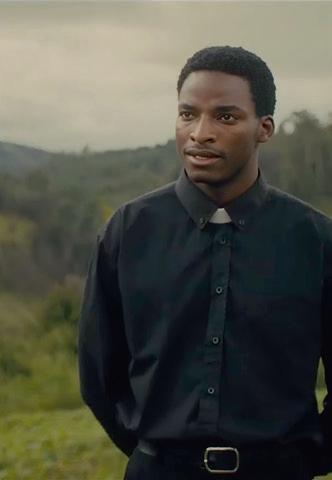
Directed by Naishe Nyamubaya
This 17-minute film is a masterclass in economical storytelling. James, a disgraced preacher, arrives in a remote village with his pregnant wife, charged with building a new church. There he comes into conflict with a formidable traditional healer who believes the land has belonged to her ancestors for generations. What follows is a gripping clash between imported faith and deeply rooted tradition, building inexorably towards a tragic conclusion. With not a scene or line wasted, the film combines powerful performances and a striking sense of place to create a haunting story that lingers long after the credits roll.
Tanzania
Directed by Florence Mwendapole
This clever cautionary tale marks the arrival of an exciting new East African filmmaking talent in Florence Mwendapole. The poet and visual artist's directorial debut follows a young woman who returns home after work to find a series of messages from an unknown number. What begins as friendly contact gradually morphs into something far more sinister. With no dialogue beyond the increasingly unsettling texts that appear on screen, the film offers a sharp commentary on modern life and our dependency on digital communication. As the messages become more intrusive, the tension mounts, before the story takes a chilling turn into psychological horror. Elegant, inventive and deeply unnerving, it is a film that lingers long after the final notification.

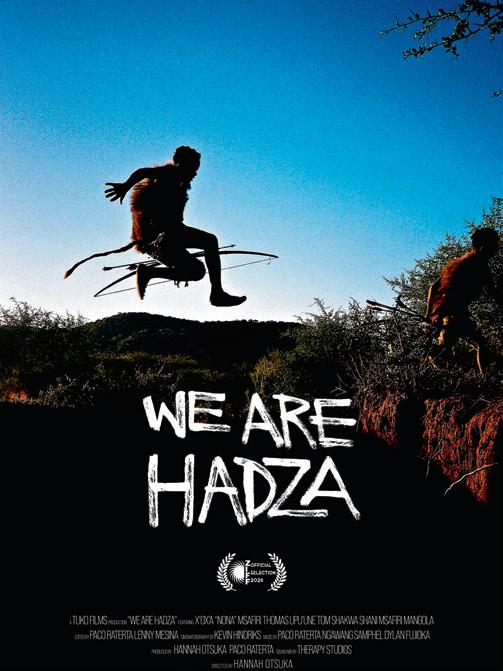
Directed by Hannah Otsuka
American filmmaker Hannah Otsuka first visited the Hadza community near Lake Eyasi in northern Tanzania in 2011. Captivated by the warmth of her welcome and the enduring traditions of one of Tanzania’s last hunter-gatherer peoples, she kept returning. This deeply affecting documentary charts the 15-year friendship that followed, offering an intimate portrait of a community whose lives remain closely connected to each other and to the environment that sustains them.
While celebrating the Hadza's unique culture, the film also explores the pressures they increasingly face from modern development, land use changes and the growth of tourism. Among its most memorable strands
is the coming-of-age story of several younger community members, especially the curious and good-humoured Upu'une, whose fascination with Otsuka's camera eventually sees him contributing his own striking photographs and footage to the film.
Rich in trust, humour and humanity, the documentary avoids romanticising its subjects while giving viewers a rare insight into a fast-changing way of life.
A popular winner of ZIFF's Chairman's Award for Documentary, it was made all the more special by the presence of many of its Hadza participants in Stone Town, where they attended screenings and workshops and introduced festivalgoers to Hadza culture on Zanzibar's beaches.
Directed by Ben Proudfoot
History comes vividly to life in The Eyes of Ghana, an inspiring documentary centred on Chris Hesse, the personal cinematographer of Ghana's first president, Kwame Nkrumah. After Nkrumah's overthrow, Hesse secretly preserved precious reels documenting Africa's independence movement, safeguarding a vital chapter of the continent's story for future generations. Executive-produced by Barack and Michelle Obama, the film combines powerful archival footage with interviews and music from West African cultural figures, including Gregg Kofi Brown Afrorock legends Osibisa and master flautist Yaw Dela Botri. The result is a moving tribute to memory, resilience and the importance of passing Africa's stories from one generation to the next.

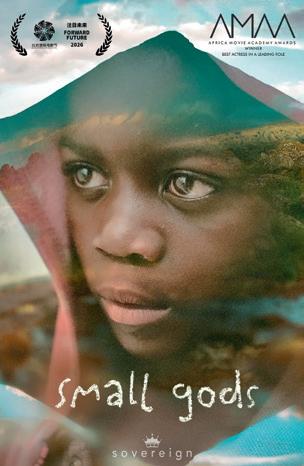
UK/Uganda
Directed by Asher Rosen / Ezra Mugisha
The opening film at this year’s festival, Small Gods is an intimate and moving drama that shines a light on a community rarely seen on screen.
This Ugandan-British co-production, was filmed on location in Kampala and Kisoro and draws inspiration from the experiences of Uganda’s indigenous Batwa people.
Ethiopia
Directed by Beza Hailu Lemma
Based on a true story, Elda tells of an Eritrean man who returned from the US and died fighting for his homeland. Rich in themes of identity, sacrifice and belonging, the film also serves as a celebration of the language and culture of the Tigrinya – an ethnic group from northern Ethiopia and parts of Eritrea. Elda won the Chairman’s Award for Best Film.
The film follows a struggling single mother and a charismatic street performer as they try to build a future beyond poverty, only for an unexpected crisis to threaten their hopes. Anchored by naturalistic performances and a strong sense of place, Small Gods combines a touching love story with a subtle exploration of identity, exclusion and resilience.
While many of this year’s standout films dealt with grand political themes, Small Gods draws its power from ordinary lives and the quiet determination of its characters. The result is a deeply humane film that gives voice to a marginalised community while avoiding sentimentality, making it a fitting choice to open East Africa’s biggest celebration of cinema. Its selection as ZIFF’s curtain-raiser underlined the growing international profile of Ugandan cinema and a film that has already attracted recognition on the festival circuit, winning awards at the Beijing International Film Festival and the Uganda Film Festival.


Uganda
Directed by Maria Buoma
Uganda made its presence felt at ZIFF 2026, with a 29-strong delegation of filmmakers and creatives travelling together by bus from Kampala to Zanzibar to champion the country's growing film industry. Their commitment was rewarded when Maria Buoma's Lice N' Shine won the award for Best Animated Film. Boasting a fresh and distinctive visual style, the witty short follows the students of Kikomera Hostel Girls School as their lives are thrown into disarray by a hair-lice outbreak. Buoma populates the film with a cast of memorable characters and enough humour and charm to leave audiences wanting more. Judging by the promise in the closing credits, the girls of Kikomera will be back for future adventures.

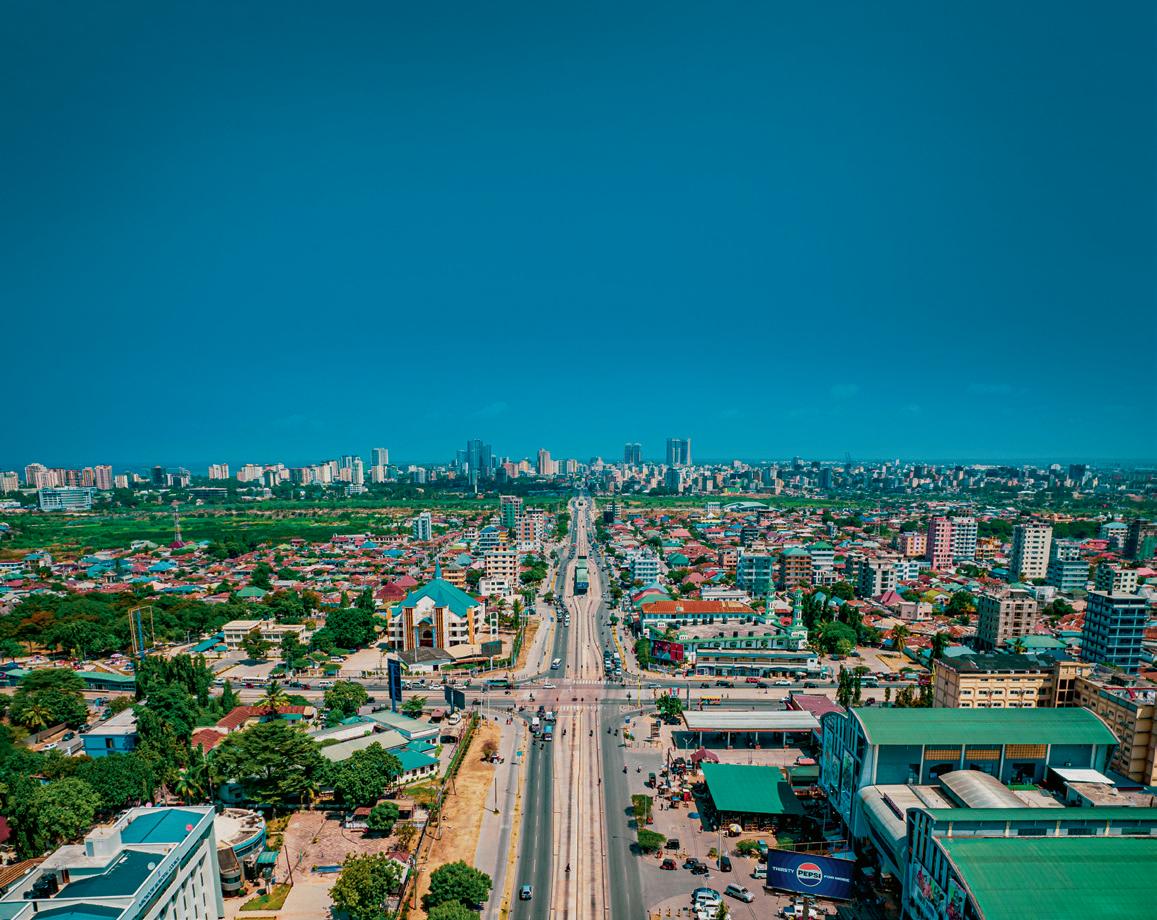
Here’s our guide to one of the commercial capital’s most desirable locations, including where to stay, eat, shop and more.
If Dar es Salaam has a postcode that perfectly captures the city’s modern energy, it might just be Mikocheni.
Located around 10 kilometres north of the city centre, this fast-growing neighbourhood has evolved from a quiet residential suburb into one of the most desirable addresses in Tanzania’s commercial capital. Popular with families, professionals, students and expatriates alike, Mikocheni offers a winning combination:
leafy streets, excellent amenities and easy access to some of Dar’s most vibrant social and cultural hotspots.
Location, location, location
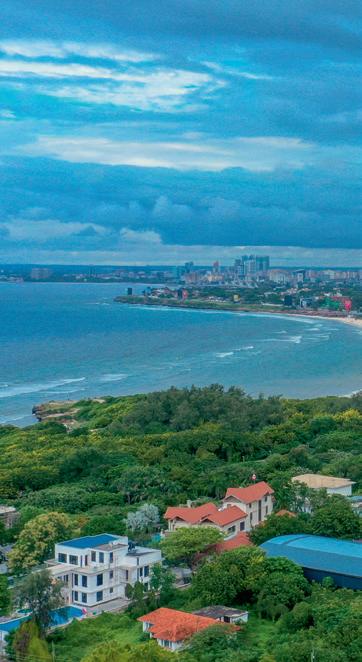
Spread across areas including Mikocheni A, Mikocheni B and Regent Estate, the neighbourhood is known for its wide, tree-lined avenues and convenient connections to major roads. Residents enjoy being close to the
city’s coastal lifestyle hubs, with Masaki and Oysterbay just a short drive away.
Mikocheni also lets you easily escape the busy city for the white sands and water sports of Mbezi Beach just five km north. The drive usually takes around 15 to 20 minutes.
That strategic location has helped transform Mikocheni into one of Dar’s most sought-after neighbourhoods, attracting developers, businesses and a growing community of young professionals.

One of Mikocheni’s biggest strengths is its self-sufficiency. The area boasts dozens of shopping plazas, several major malls, universities, hospitals and highly regarded schools. Shoppers Plaza – offering more than 80 stores catering to shopping needs from fashion to food to electronics – remains a favourite for everyday essentials, while nearby retail centres make errands quick and convenient. For bigger shopping expeditions,
Mlimani City – one of Dar es Salaam’s best-known retail destinations – is easily accessible from the neighbourhood. Families are also drawn by respected schools. Private institutions such as Dar es Salaam Independent School and Monti International School use the globally recognised Cambridge Curriculum while well-regarded state schools include Mikocheni Secondary School. Kwanza Nursery and Little Harvard are among the excellent pre-school options. Mikocheni is also well-known for its many high-quality training centres, and universities. Top institutions calling the area home are the Hubert Kairuki Memorial University that specialises in medicine and nursing and Tumaini University Dar es Salaam College offering courses in law, business, and arts.
The food scene here – like Mikocheni itself – is cosmopolitan, welcoming and constantly evolving. Whether you’re craving
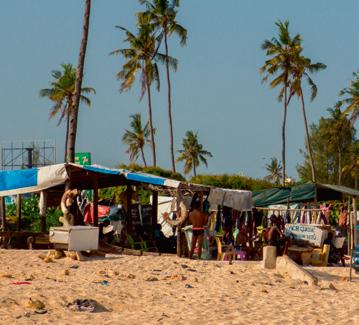

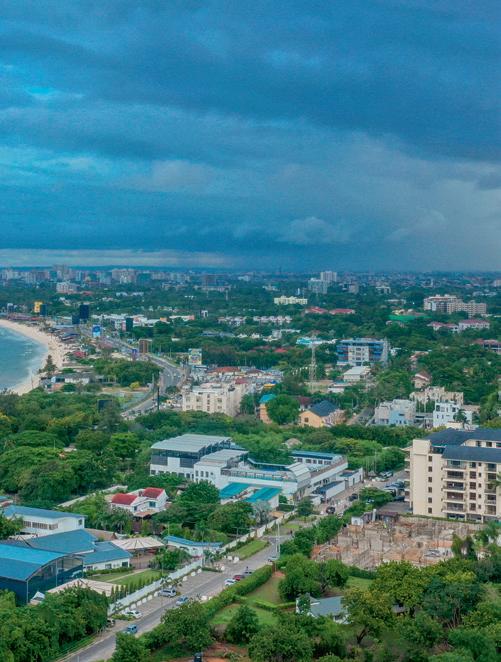
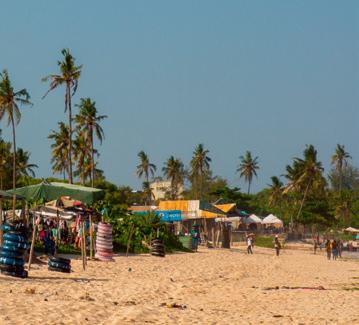
“Mikocheni offers easy access to some of Dar’s most vibrant social and cultural hotspots”
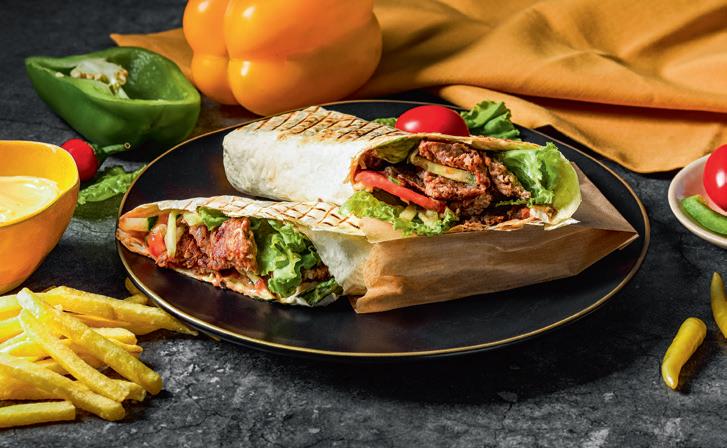
local comfort food or international flavours, the neighbourhood delivers. Start with a shawarma at Sultan Turkish Restaurant, grab a fragrant biryani and iced coffee at Vynn Cafe, or sample the famous grilled pork (kitimoto) at local institution Mona Bar and Restaurant. Pizza lovers can head to Panarottis Mikocheni for a reliable crowd-pleaser.
As the sun goes down, Mikocheni reveals another side of its personality.

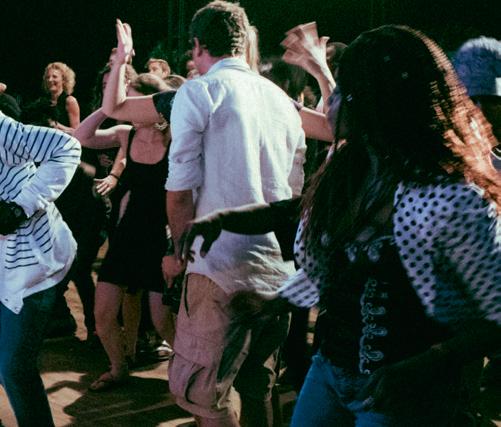

Tips Lounge has become a popular meeting point for locals and expatriates, offering a lively atmosphere, drinks, food and regular entertainment events. The venue is known for hosting live music and DJ nights, making it one of the neighbourhood’s go-to evening destinations.
Perhaps Mikocheni’s most distinctive attraction is Nafasi Art Space, a leading contemporary arts centre located in Mikocheni B. Since its founding in 2008, it has grown into a vibrant creative hub where visual artists, musicians, dancers and performers come together to create, exhibit and collaborate. It hosts workshops, exhibitions, concerts, film screenings and public festivals throughout the year. Visit nafasiartspace.org or @nafasiartspace on Instagram.
The 2024 track ‘Nairobi’ by Kenyan singer-songwriter Bien Aimé Baraza and Tanzanian artist and producer Marioo charts an East African romance in which the lovers “tulipatana bongo Mikocheni” – “met each other in Mikocheni Dar es Salaam” (Bongo is the local nickname for Dar). Check out the video here: www.youtube.com/ watch?v=04GKMWEwe98


Ferdinand Omanyala is leading Kenya’s sprint revolution. Mark Edwards charts his career from Tongaren schoolboy to record breaker.
Sprinter Ferdinand Omanyala has broken the mould of Kenyan running. Compact and powerful at 1.75 metres tall, his frame is packed with dense muscle – a sharp contrast to the long, lean silhouettes of the middle- and long-distance champions the country has become famous for producing over the past six decades.
The trait Omanyala does share with Kenya’s track luminaries –Faith Kipyegon, Eliud Kipchoge, David Rudisha, Beatrice Chebet and Emmanuel Wanyonyi among them – is that he belongs among the best in the world. In 2021, he became the fastest African in history when he ran 9.77 seconds for the 100 metres in Nairobi. Since then, he has broken the 10-second barrier – the benchmark of an
elite sprinter – five more times, regularly taking on and beating the world’s best sprint specialists.
Omanyala may be an outlier in Kenyan athletics, but he is still very much a product of his country. He grew up in Tongaren, in Bungoma County in western Kenya – a region known for its rich farmland – and credits its fresh produce with helping to build his powerful physique. He was always quick on his feet, a talent he relished showing off. “I used to race my brothers all the time – and I’d win,” he says. “I was a bit cheeky too. I would run away when my parents wanted to discipline me and they could not catch me.”
That same fleet-footed elusiveness soon translated to the rugby
Omanyala has a best time of 9.77 seconds in the 100 metres

pitch, where he excelled as a young winger. The sport was his first love. While studying chemistry at the University of Nairobi, he played for the university side, where his speed regularly caught the eye. It was there, during a game, that a friend urged him to try track sprinting – a suggestion that would change the course of his career.
Just weeks after switching sports, Omanyala ran 10.4 seconds in his first race and soon won Kenya’s Olympic trials. “I was told of sprinting but did not want to leave rugby so I went for one open athletics event in Mumius in Kakamega County in 2016 and won. When I went back to Nairobi, I started training for both sports because I did not want to let go of
Ferdinand Omanyala
rugby. Soon that became too hard because I was performing well in track.”
In 2021, Omanyala set successive Kenyan records before becoming the first Kenyan ever to run under 10 seconds, clocking 9.86 seconds in Austria. A few weeks later, he shocked the athletics world by running 9.77 seconds at the Kip Keino Classic in Nairobi, establishing him as one of the top sprinters in world athletics history.
His rise continued in 2022. He won gold at the African Championships and became the first Kenyan in 60 years to win the Commonwealth Games men’s 100m title. The quadrennial event comes around again from July 23 this year in Glasgow, Scotland. Omanyala hopes to become the first sprinter since the UK’s Linford Christie in 1990 and 1994 to retain the Commonwealth title in consecutive games.
His form this season suggests he could make history again. He leads the men’s sprint rankings in the Diamond League – a series of athletics meets across the world for the very best athletes. His best results include a victory in Xiamen, China, in a time of 9.94, destroyed a world-class field that included South African sprint prodigy Tlotliso Leotlela. The win was, he says, a “huge confidence booster”. “It gives me an edge over the others leading into the Commonwealth Games. This will be so big.”
That the 30-year-old is still recording sub-10-second times a decade into his sprinting career

is testament to Omanyala’s dedication to fitness and his sport. Such longevity was a feature of his sprinting heroes such as Jamaica’s Yohan Blake and Shelly-Ann Fraser-Price who both maintained their status as top sprinters in the mean and women’s event, respectively, for close to 20 years. Omanyala thinks he has at least three more years of competing with the world’s best and believes his best times are still ahead of him. “9.77 was remarkable,” he says. “I respect and honour that moment, but I want to go faster. I believe in the coming seasons that will happen more than once.”
Outside of his track career, Omanyala is a police officer in Kenya – a role he considers, like his sprinting, to be “a service to

the nation”. Having put Kenya on the world sprinting map is a huge source of national pride for Omanyala. He hopes his achievements will change attitudes to the sport and lead the way for more East Africans to excel. “Since I fell in love with sprinting, I have wanted to change the perception people have,” he says. “There was a belief that we could never compete globally. I wanted to be the first to go pro and inspire millions in Africa
“I feel I have inspired the sprinters in this region. We now have to bring in proper coaching and nurturing”


final in 2023 that’s when I knew am a legend among sprint legends,” he tells me. In a race that is over in a matter of seconds, an unshakeable belief in your own ability is crucial. Consequently, the elite level of the sport is made up of outsized characters such as Olympic champion Noah Wyles whose lion’s roar pre-race rituals are almost as famous as the world-beating times he clocks. Omanyala – who was in one second of Lyles 9.97
the way you want but you have to wake up the following day and keep going.”
Running the 100m at Omanyala’s elite level is a stunning display of maximum force. What does moving that fast feel like? “It feels normal,” he laughs. “We train at those speeds. We run at those speeds. We are ‘programmed’ to move at that speed. Sometimes I hit 44km per hour. After the race you wave and walk out of the stadium smiling. To someone else that is very fast. It is fast, but I am still aware of what’s going on around me as I run. So, it feels normal.”
It may feel ‘normal’ for this boy from Tongaren with the maize-fed muscles, but he is creating a new normal for Kenyan sprinting –blazing a trail for a new generation of East African speed machines.”


To keep up with Ferdinand Omanyala’s latest races and news, visit ferdiomanyala on Instagram. For more details on the Omanyala Sprint Club, go to ferdinandomanyala.co.ke/

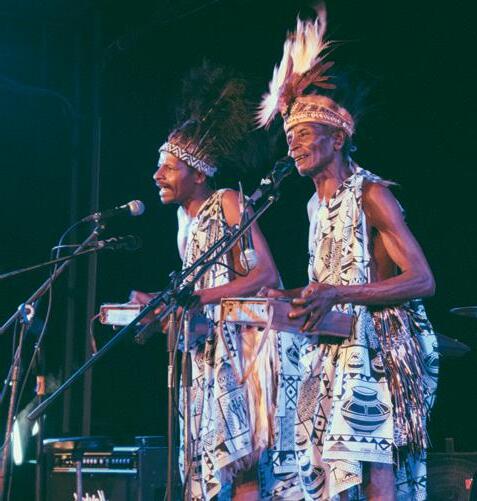
One of East Africa's newest music festivals, FuTopia bridges traditional and contemporary African sounds to Zanzibar's nature-rich Fumba peninsula. Here's who’s set to soundtrack the sands this August.
SOUTH AFRICA
Known as the ‘Gqom King’, DJ Lag helped take Durban’s hard-hitting electronic sound to dancefloors worldwide. The South African producer has worked with Beyoncé and remains one of the continent’s most influential electronic artists. Expect thunderous bass, relentless rhythms and a masterclass in controlled dancefloor chaos.



TANZANIA
The man behind some of Dar es Salaam’s biggest nights, DJ Joozey mixes blistering singeli energy with Afro House grooves. A Tanzania Music Awards and AFRIMMA nominee, he famously became the first artist to DJ atop Mount Kilimanjaro. Expect high speeds, heavy drops and serious crowd-moving power.


BURUNDI
One of Burundi’s brightest contemporary stars, Vania Ice blends Afro-pop, Afro-fusion and modern African sounds into infectious, feel-good anthems. Proudly rooted in her culture but looking firmly forward, she brings big vocals, bigger energy and the kind of stage presence that demands your attention.
TANZANIA
With the motto ‘Ancestors Meet the Bassline’, Midimu Collective connects East African tradition with contemporary club culture. The Tanzanian DJ collective fuses Afro House, electronic textures and cultural storytelling into ecstatic dancefloor experiences where ritual rhythms and modern beats become one.
ZANZIBAR
Hailing from Pemba Island, Brain Boy draws inspiration from the great taarab traditions of the Zanzibar archipelago while giving them a fresh, youthful edge. He has been nicknamed ‘Makame Faki Jr’ as he shares a similar powerful baritone with the taarab legend, but he is very much a modern talent blending kidumbaki, taarab and Zenji Flavor into songs that speak to modern island life.

TANZANIA
Baba Kash has become one of Tanzania’s most exciting live performers by blending singeli’s frantic energy with Mchiriku rhythms and Bongo Flava influences. Backed by a live band and dancers, his shows are fast, loud and impossible to stand still through.

Hammer Q: ‘The Magician Voice’ blends taarab and Zanzibari musical heritage
DCMA Taarab & Kidumbaki Ensemble: Musical collective formed by students and teachers from the Dhow Countries Music Academy in Zanzibar
Prince Kim: Energetic Bongo Flava artist from Dar es Salaam
Playroots: Chilean DJ, producer, and live performer
La Negra Mexa y las Cumbiancheras: Colombian-Mexican artist whose music fuses Afro-cumbia, rap, and powerful percussion-driven rhythms
Ruth Mlawa: Socially conscious Tanzanian spoken word artist
Zainooba: Groundbreaking Tanzanian DJ
DJ Zoro: internationally acclaimed Zanzibari DJ
GlobalLocal: Zanzibar-based DJ and spoken-word artist
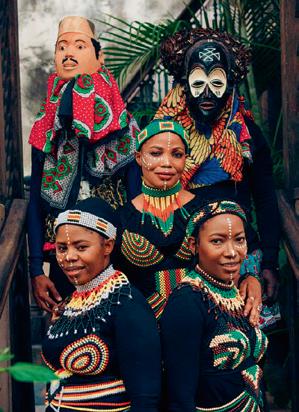
ZANZIBAR
Part performance troupe, part cultural movement, Ngoma World transforms Zanzibar’s traditions into immersive, contemporary spectacles. Through drumming, dance and theatre, the group turns every appearance into a celebration of rhythm, community and heritage – inviting audiences to join.


TANZANIA
Afro House DJ and producer Rody Joh crafts deep, atmospheric sets built on rolling percussion, rich melodies and spiritual energy. His sound is immersive, uplifting and tailor-made for sunset sessions that gradually build into fullscale dancefloor journeys.
TANZANIA
Singer, guitarist and songwriter Sauti Marley combines soulful melodies with Afro-fusion grooves and thoughtful storytelling. Based in Bagamoyo, he has built a reputation for music that is both socially conscious and deeply uplifting, delivered with warmth, musicianship and unmistakable East African flair.
CANADA/ MOROCCO
Sidi Blue Moon blurs the line between live performance and sonic ritual. Combining electronic production, live instrumentation and storytelling, he creates immersive journeys that connect African musical traditions with forwardlooking sounds from across the global electronic scene.

Other attractions include:
Up-cycled fashion shows
Health and wellness workshops
Interactive art installations
Kwetu Kwenu Community Market
Kids Zone
Food Zone
FuTopia Festival is coming to Fumba Town, Nyamanzi on August 8 and 9. To buy tickets visit www.futopia.africa/tickets/
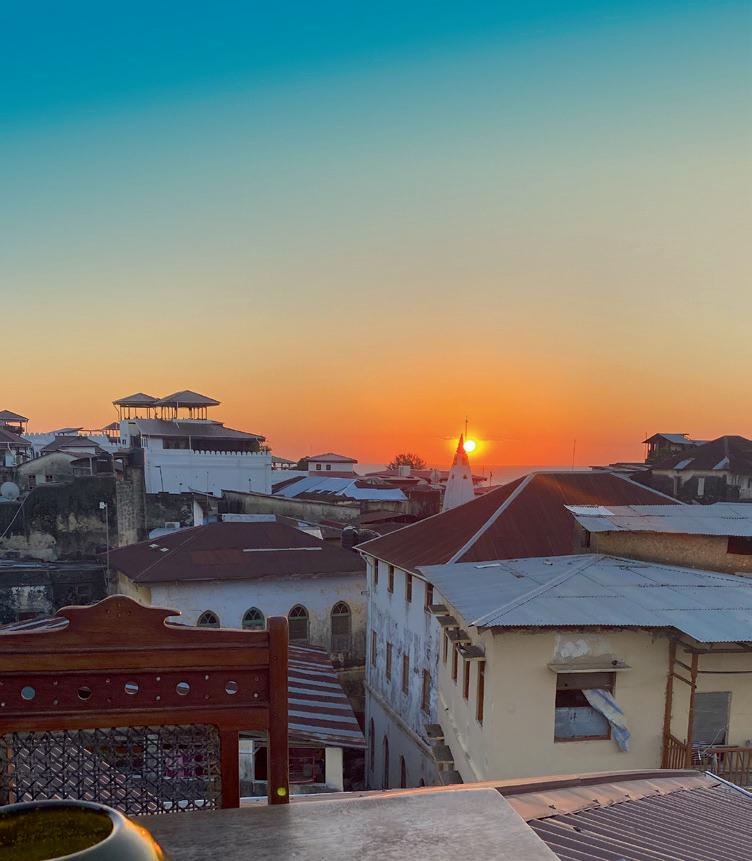
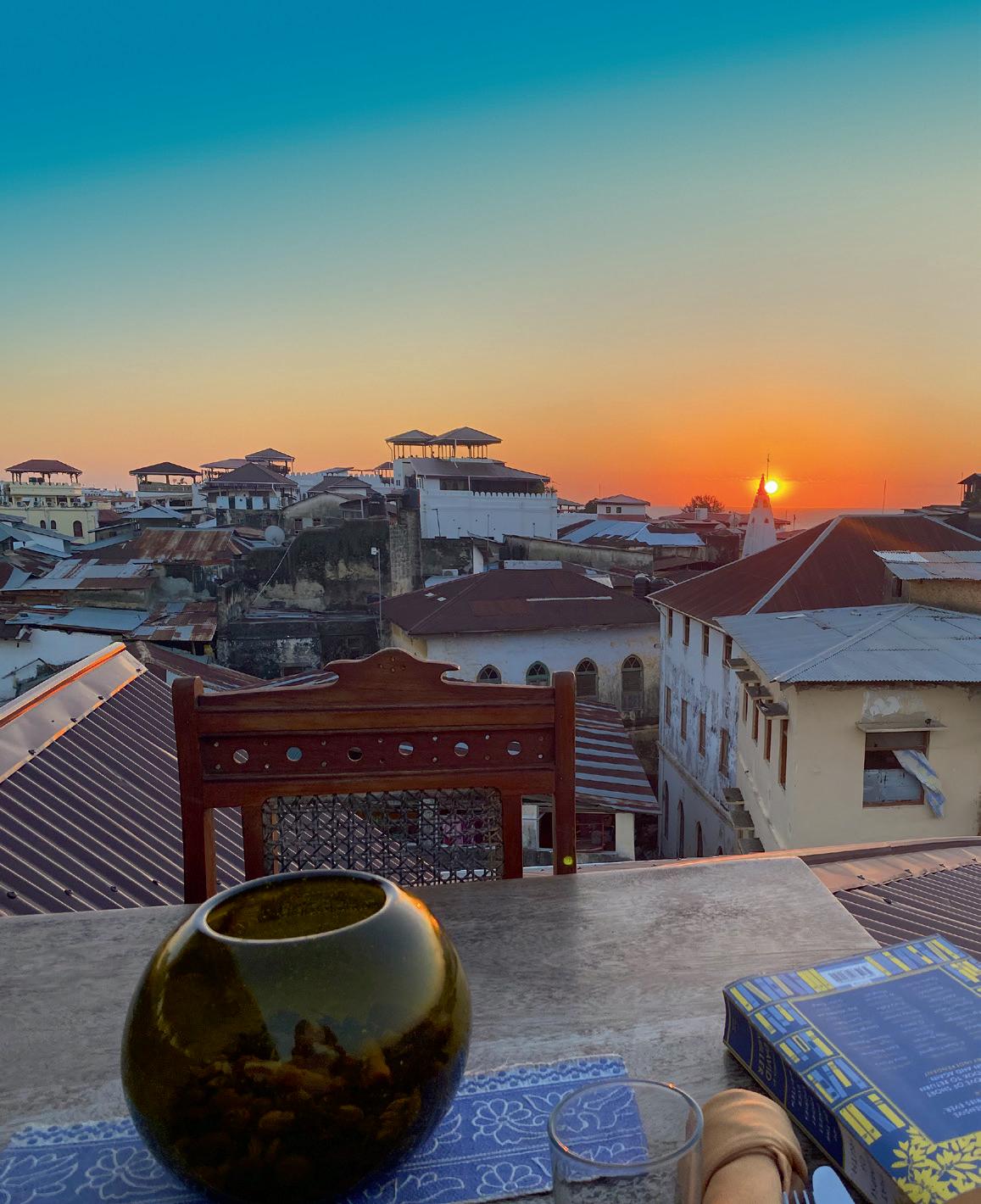
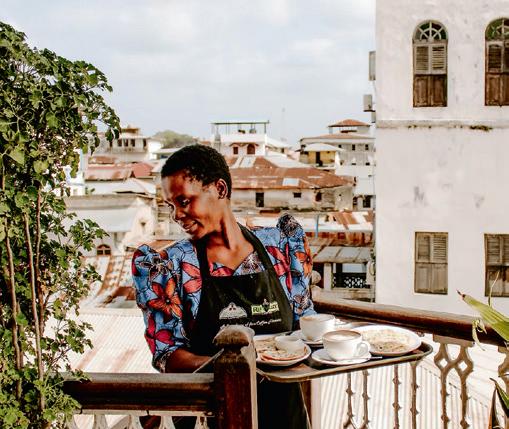
High above the bustling streets of Stone Town, Zanzibar’s historic tea houses have offered cooling breezes, conversation and spectacular views for generations. Today, these rooftop retreats remain among the most enchanting places on the island to eat, drink and watch the sun sink into the Indian Ocean.
In the tightly packed maze of Zanzibar’s Stone Town, where narrow lanes wind between coral-stone buildings, tea houses have long provided a welcome escape from the bustle below. Perched on rooftops, these elevated spaces were designed to catch cooling sea breezes and offer sweeping views across the town and out towards the Indian Ocean. Today they remain one of Stone Town’s most distinctive architectural and cultural features
Historically, tea houses formed part of the upper levels of grand homes and merchant residences. Stone Town’s architecture reflects centuries of interaction between African, Arab, Persian, Indian and European cultures, and rooftop spaces became natural gathering places where people could

entertain guests, enjoy refreshments and escape the heat trapped within the streets below. The flat rooftop terraces and elaborately detailed buildings that characterise Stone Town made these lofty retreats a practical and elegant solution to urban living.
Although their role has evolved, tea houses remain central to the visitor experience in modern-day Stone Town. Many of the most celebrated rooftops have been transformed into atmospheric restaurants and bars where diners gather for sunset cocktails, Swahili-inspired cuisine and unforgettable views over the historic UNESCO-listed skyline. For many visitors, an evening in a Stone Town tea house is every bit as memorable as a visit to the island’s beaches or spice farms
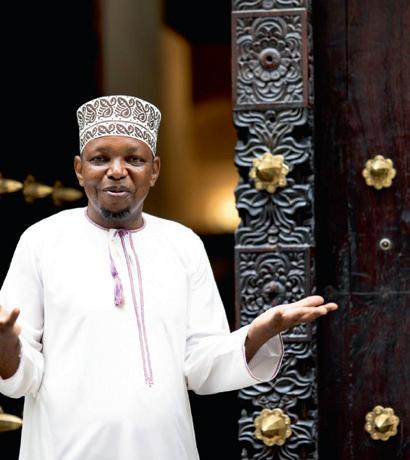
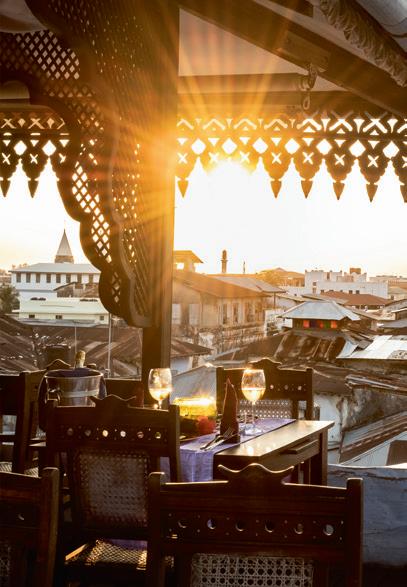
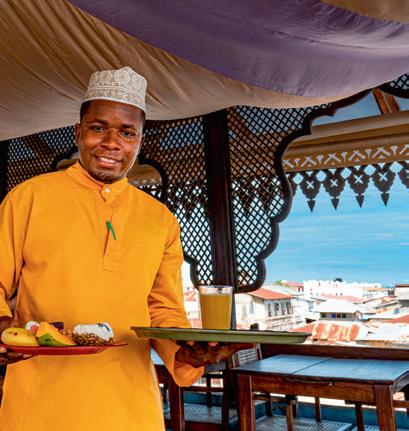



Often regarded as Stone Town’s quintessential tea house, this rooftop venue sits atop the historic Emerson on Hurumzi hotel. It offers 360-degree views across the town and the Indian Ocean, with Swahili-style seating, sunset cocktails and menus inspired by Zanzibar’s Arabic, Persian and Omani heritage. Live taarab music frequently adds to the atmosphere. www.emersonzanzibar.com
A long-standing Stone Town favourite, Zanzibar Coffee House is famed for its rooftop terrace where guests can sip locally roasted coffee while overlooking the town’s rooftops. It offers a more casual tea-house experience, perfect for breakfast, coffee and cake, or a leisurely afternoon break. www.utengule.com/zanzibar-coffee-house
One of Stone Town’s newer rooftop hotspots, Upendo House has earned a reputation for stylish cocktails, relaxed lounging and panoramic sunset views. It brings a contemporary edge to the traditional rooftop gathering space. www.upendozanzibar.com/upendohouse
Overlooking Stone Town’s historic skyline and waterfront, Maru Maru’s rooftop restaurant is a popular spot for evening drinks and dinner. Its elevated setting captures the essence of the traditional tea house while offering a modern hospitality experience. www.marumaruzanzibar.com
Located atop a restored merchant’s house, this elegant rooftop specialises in seafood tasting menus featuring local ingredients, spices and indigenous plants. The experience blends contemporary fine dining with the romance of historic Stone Town. www.emersonzanzibar.com
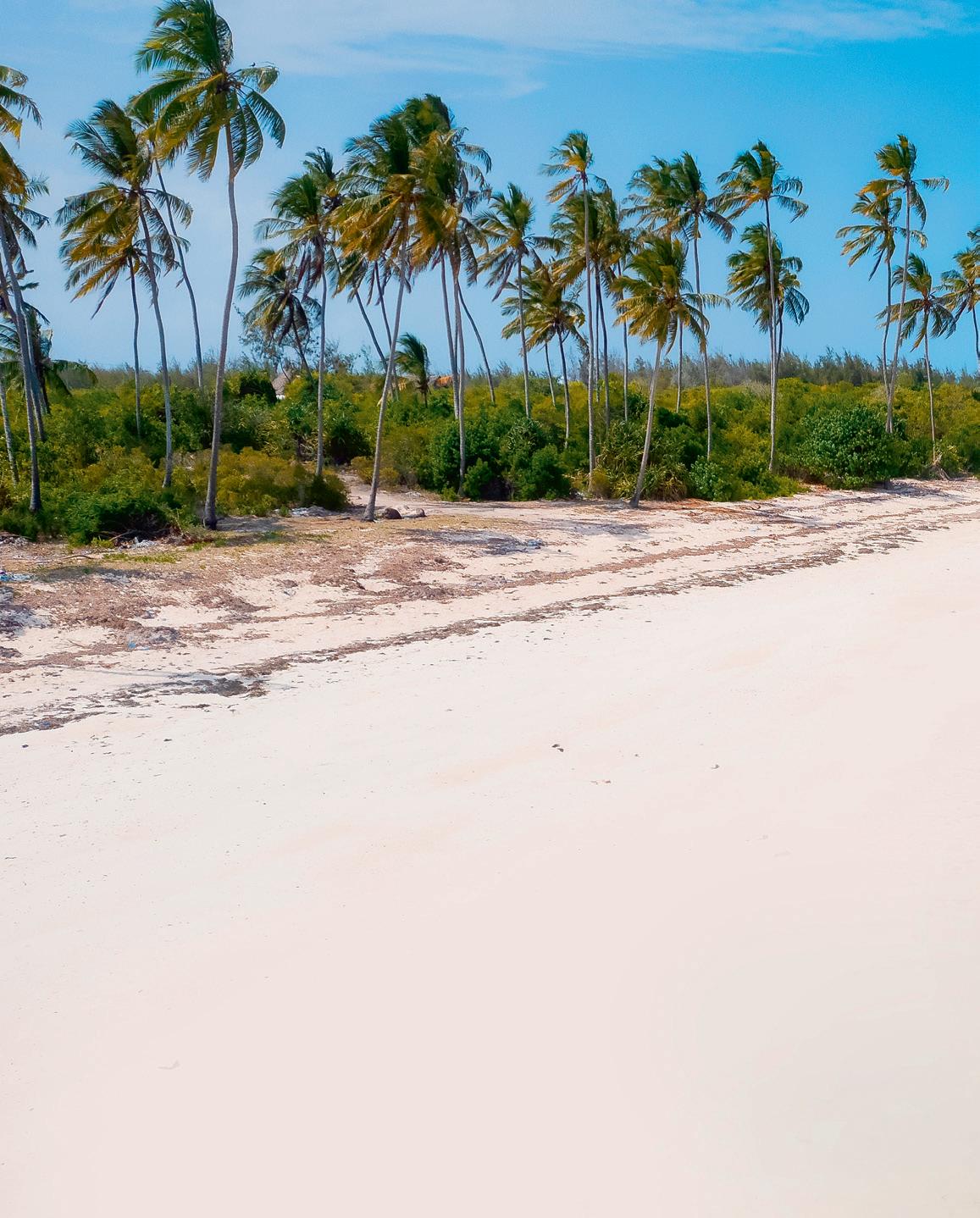
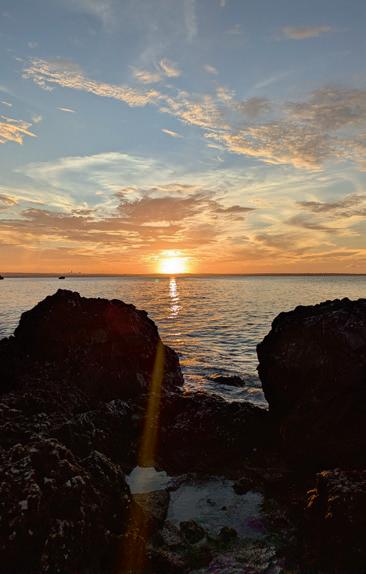
Tanzania’s coast does not begin and end with Zanzibar. Precision Air takes intrepid passengers south almost to the Mozambique border to Mtwara – a hidden gem of quiet beaches, ancient trading towns, marine parks far from the tourist trails. Here’s why Mtwara deserves to be on your travel radar.
The beaches are gloriously empty
One of Mtwara’s greatest attractions is simply the absence of crowds. Beaches around Msimbati, Mnazi Bay and the wider Mtwara coastline offer white sand, palm trees and warm Indian Ocean waters without the resort developments found elsewhere on the Swahili Coast. Visitors often have long stretches of shoreline almost entirely to themselves.
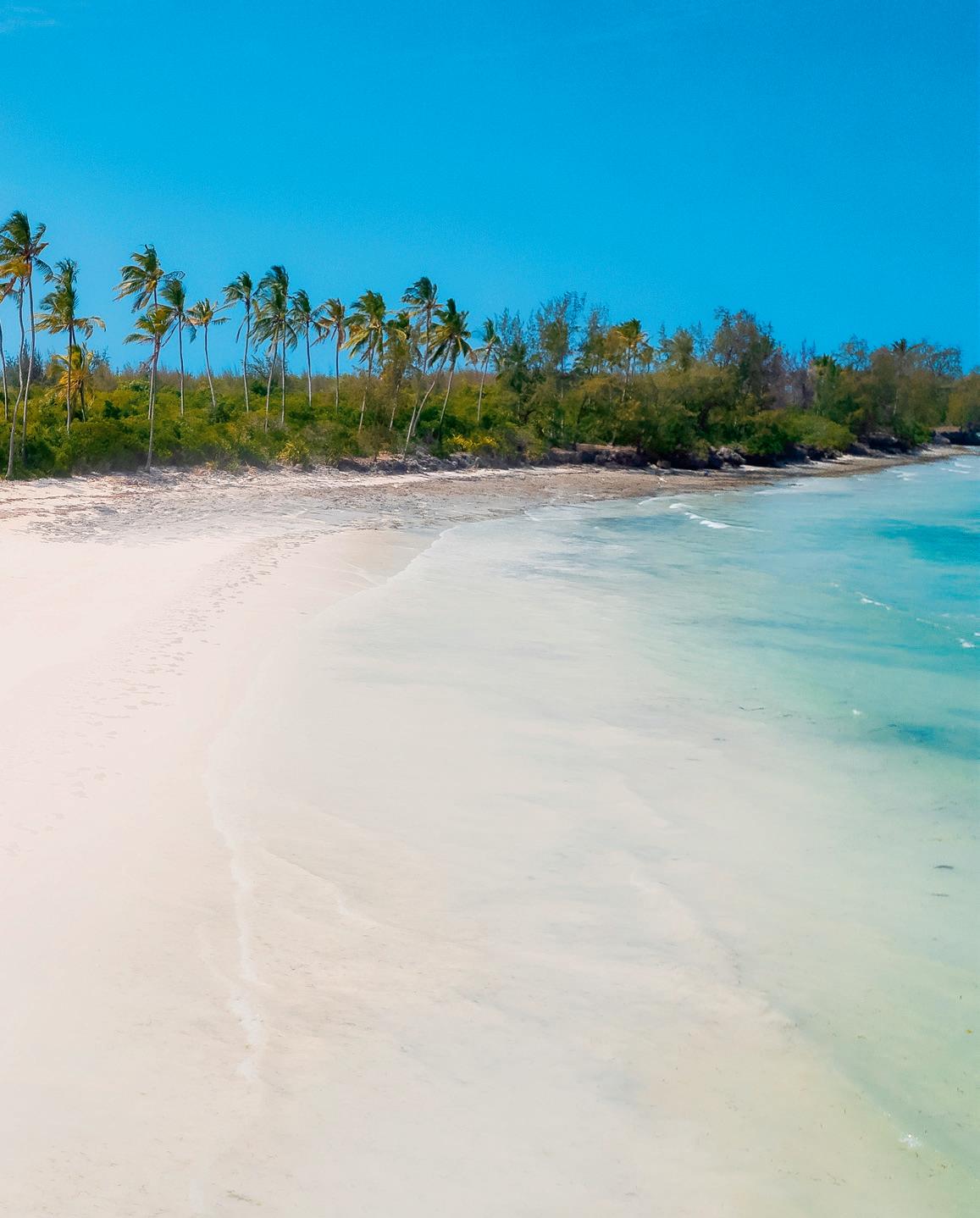
The Mnazi Bay-Ruvuma Estuary Marine Park is one of Tanzania’s least-visited coastal conservation areas. Travellers can explore coral reefs, snorkelling sites, diving locations and rich marine habitats in waters that remain remarkably unspoiled. It is one of the region’s biggest rewards for adventurous coastal explorers.
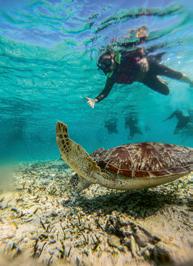
Mikindani’s history stretches back much further than most visitors realise. Sources note Arab traders settled here centuries ago, while the town became an important link in Indian Ocean trade networks reaching deep into central Africa. Historic tombs, mosques and colonial-era buildings still provide clues to this fascinating past.
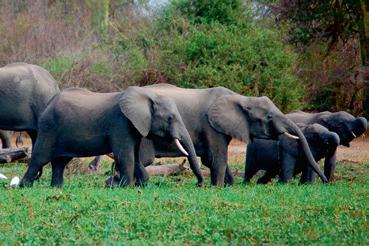
Mtwara is not just about beaches. The region’s southern coastal ecosystems and marine environments support diverse wildlife, while the nearby Ruvuma Estuary adds another layer of nature exploration. Further south, near the Mozambique border, is the Lukwika-Lumesule Game Reserve, a large wildlife corridor of miombo woodlands where elephants, hippos, and buffalo roam.
Just west of Mtwara lies Mikindani, an ancient port town that flourished as a trading centre in the eighteenth and nineteenth centuries. Wandering its narrow streets reveals coralstone houses, carved doors, old mosques and a rich blend of African, Arab and Indian influences. It feels like a place where the Swahili Coast’s trading past never completely disappeared.
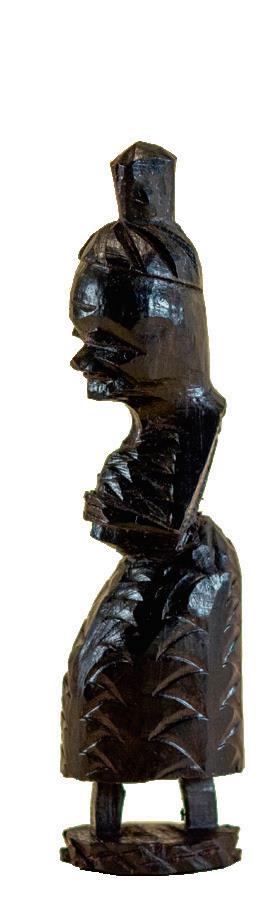
Mtwara is home to the Makonde, one of East Africa’s most distinctive cultural groups. The Makonde are internationally renowned for their extraordinary woodcarving traditions, particularly their expressive masks and sculptures made from African blackwood (mpingo).
Many visitors imagine Tanzania's coast as flat and tropical, but inland from Mtwara rises the Makonde Plateau. This elevated landscape adds dramatic scenery and a sense of remoteness, creating an unexpected contrast to the shoreline. The rugged plateau is the ancestral homeland of the Makonde people, whose distinctive culture, traditions and artistic heritage developed in this relatively isolated region.
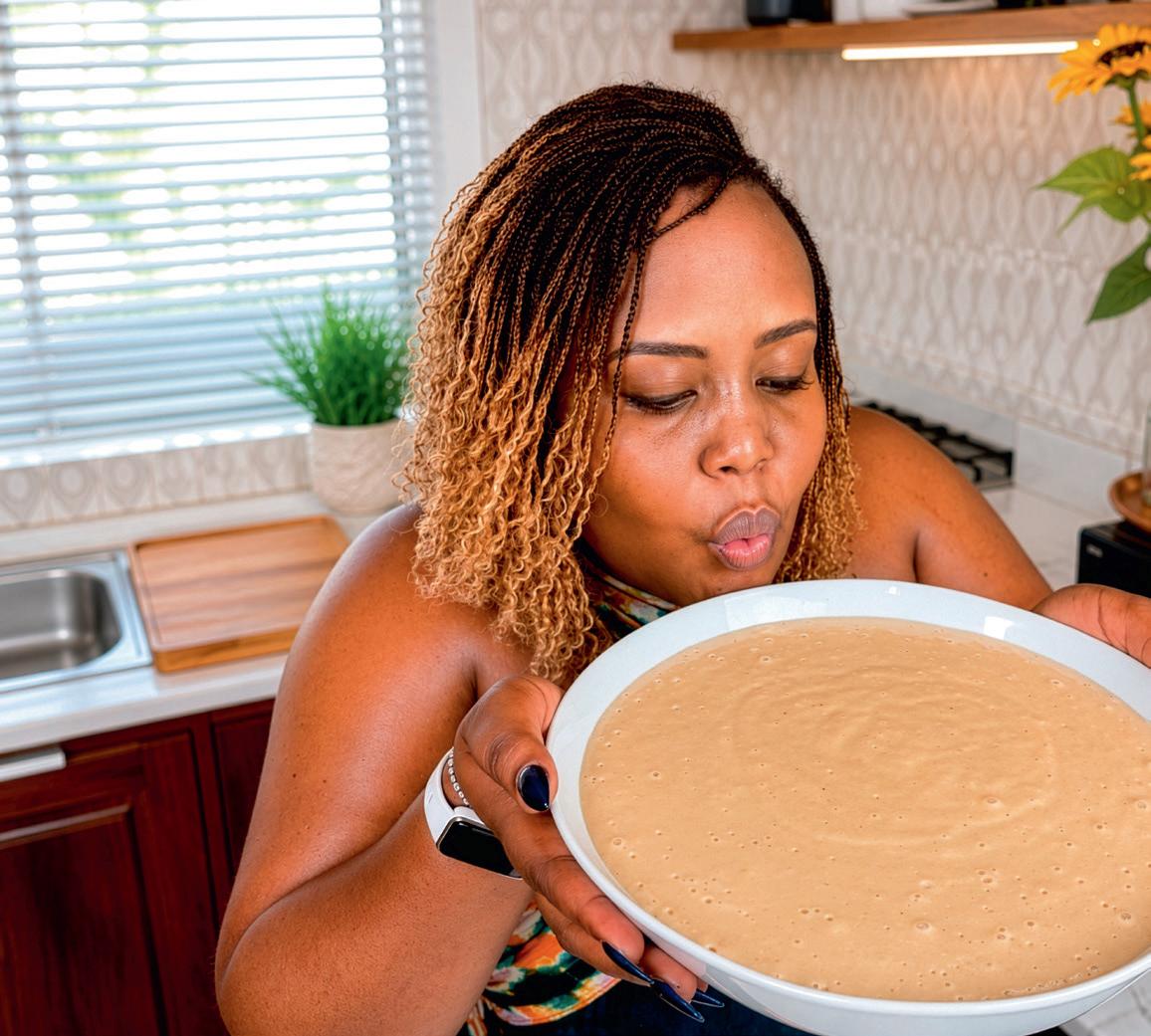
Paa cookery columnist Monalisa Rwechungura shares a creamy Chagga classic with a recipe for Kitara that has been passed down through generations of her family.
Kitawa is a highly nutritious, thick porridge made from mashed, boiled bananas, often enriched with milk, butter, or traditional natural salts to make it soft and easy to digest.
Kitawa is a cherished traditional Chagga dish from the Kilimanjaro region of northern Tanzania. Highly nutritious and easy to digest, it is traditionally prepared for new mothers to aid recovery and support breastfeeding, although it is
enjoyed by everyone. It is a very simple recipe traditionally made using green cooking bananas (ndizi mshare or ndizi kikojozi), which are tenderised with natural alkaline salt (magadi) and then mashed into a smooth purée with fermented milk (maziwa mgando).
Kitawa is tangy, creamy, smooth, and absolutely delicious. After it is prepared, it is usually covered and left to ferment in a dark place for 12 to 24 hours, allowing its flavour to develop and
deepen. Once fermented, it is ready to enjoy. I personally like to chill it in the refrigerator for a couple of hours and serve it cold with a light sprinkle of sugar.
This is a treasured family recipe that has been passed down through generations. It was taught to me by my mother, who learned it from her mother, and today I am delighted to share it with you.
Let’s cook!

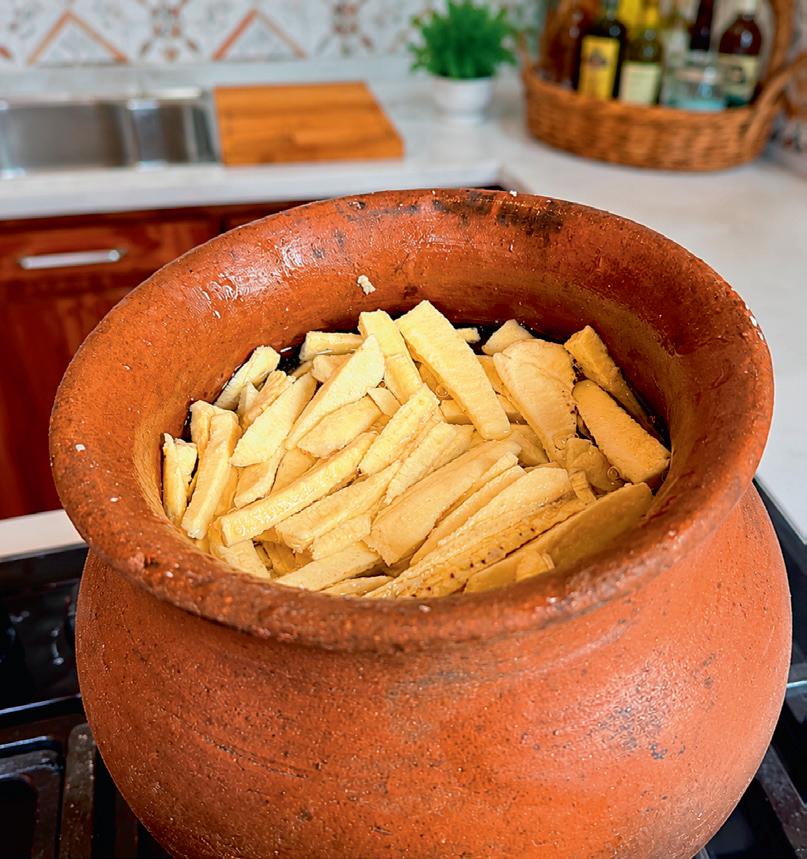
• Green cooking bananas (ndizi mshare or ndizi kikojozi)
• Fermented (sour) milk (maziwa mgando)
• Butter or ghee
• Half a teaspoon of magadi (natural alkaline salt), or half a teaspoon baking soda as an alternative
1. Peel the green bananas and boil them until they are partially cooked.
2. Add the magadi (or baking soda) and continue cooking until the bananas are tender.
3. Drain any remaining water.
4. Stir in the butter or ghee.
5. Mash the bananas until smooth.
6. Gradually stir in the fermented milk until the mixture is creamy and well combined.
7. Transfer the mixture to a bowl, cover, and leave it to ferment in a dark place for 12 to 24 hours.
Serve and enjoy!

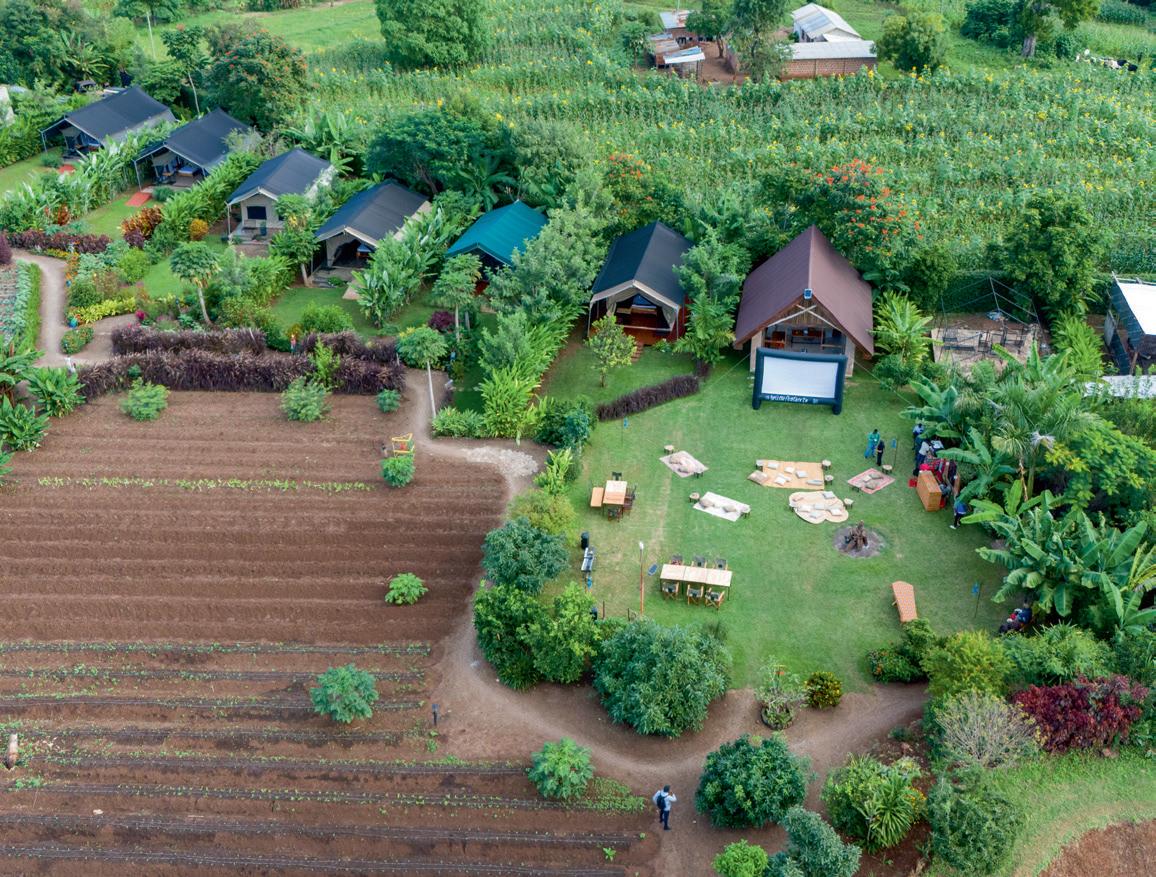
Yellow Feather is an Arusha events company that invites you to experience the slow side of the safari city.
In a city best known as the gateway to Tanzania’s iconic safari circuit, Yellow Feather is quietly reshaping how both travellers and residents experience Arusha after the game drives are done. The lifestyle experience brand has announced its much-anticipated July to October 2026 season, promising more of its signature blend of open-air cinema, creative gatherings and immersive social experiences set against the city’s lush natural backdrop.
Founded in 2025 by Gloria
Marandu, Yellow Feather has quickly built a devoted following –or ‘flock,’ as its community fondly calls itself – by offering something refreshingly different: a slower, more intentional way to engage with Arusha. In its debut year alone, the brand hosted a diverse programme of events that drew more than 600 guests, signalling a growing appetite for experiences that go beyond the traditional safari itinerary.
Arusha’s identity as a safari hub often means its social rhythm is defined by early starts, packed

itineraries and evenings that tend to revolve around nightlife. Yellow Feather introduces an alternative.
“Arusha’s social life can often feel repetitive or heavily centred around nightlife and drinking culture,” explains Marandu. “We wanted to create something softer, slower, and more intentional. Experiences that encourage people to connect not only with each other, but also with themselves and the nature surrounding the city.”
That vision has resonated strongly. Travellers passing through the city – often unsure how to spend downtime between safaris
– are increasingly seeking meaningful ways to engage with the destination itself. Yellow Feather steps into that gap with experiences that prioritise atmosphere, creativity and connection over speed.
“One thing we’ve noticed is that many people visiting Arusha often don’t know what to do while actually spending time in town,” Marandu says. “There’s been growing interest around more intentional, lifestyle-oriented experiences within the city itself.”
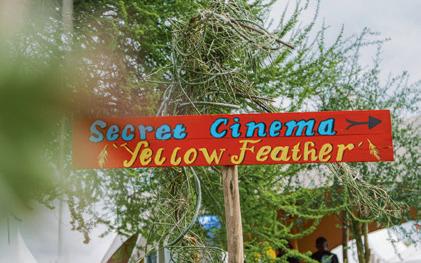
The backbone of the 2026 season will once again be Yellow Feather’s much-loved open-air cinema nights, held primarily on Thursdays and Saturdays at The Blue Heron Restaurant – a tranquil dining spot set in lush gardens with sweeping views of Mount Meru. Beginning on 4 July and running through to the end of October, these screenings offer a relaxed, social setting where guests gather under the stars to enjoy carefully selected films.
Wild and slow
Programming remains deliberately fluid and community-driven. Each month’s schedule is announced via Instagram and WhatsApp, with members of the ‘Sunbirds’ community actively shaping the lineup through polls and conversations.

music events are part of
Film selections range from nostalgic favourites and cult classics to occasional African cinema, depending on what resonates most with audiences.
Beyond film, Yellow Feather’s calendar expands into two distinctive formats: Wild Popups and Slow Gatherings.
'Sunbirds'
enjoy silent discos, meditations, and outdoor film screenings

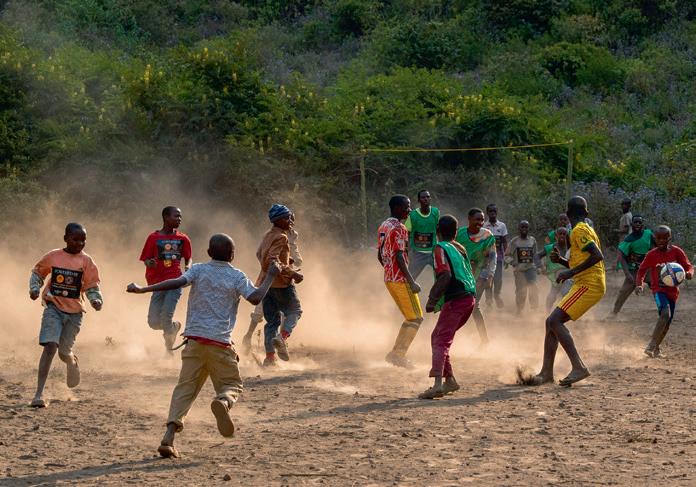
surrounded by dust, wild flora and cheering spectators, before gathering at the rim for sunset DJ sets and sundowners.
Wild Popups are dynamic, location-based experiences designed to surprise and energise. One standout from last season – returning in 2026 – is Football in the Volcano, staged at the Kilimamoto Crater in Ngaramtoni. The event saw guests descend into the crater basin for a spirited seven-a-side match
Slow Gatherings, by contrast, lean into stillness and reflection. These experiences are crafted around presence and atmosphere, blending elements such as sound healing, film and nature. One memorable evening paired a moonlit screening of the Tanzanian conservation film Chameleonair with a sound bath under the full moon. This year, the concept expands further to include movement, food and connection-centred experiences.
What distinguishes Yellow Feather is not just its programming
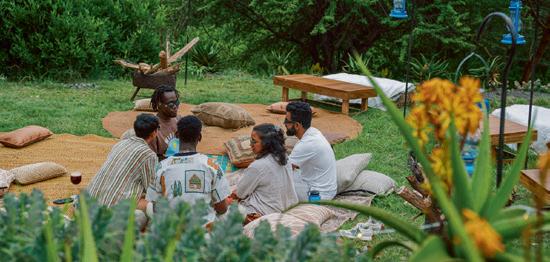

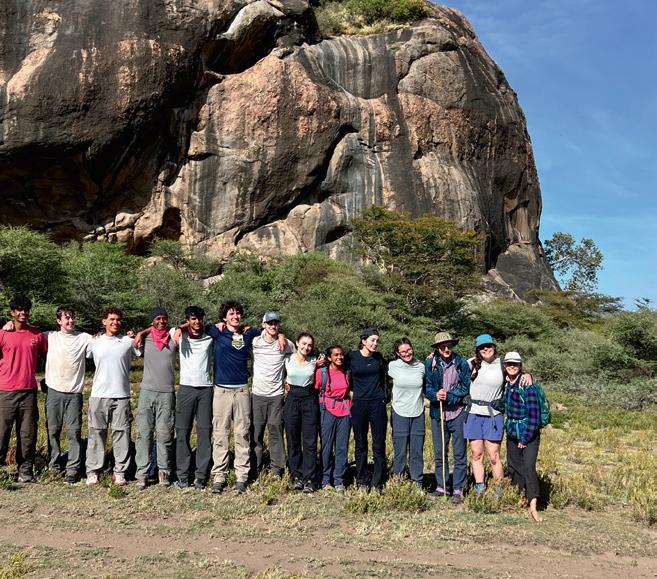
but its emphasis on fostering genuine connections. Events are intentionally designed to create space – both physically and socially – for people to linger, interact and form bonds.
“Yellow Feather was built around the idea that social experiences shouldn’t feel like something you need to recover from afterwards,” says Marandu. “But something that leaves you feeling more present, grounded, and connected.”
This approach has helped cultivate a growing network of locals and travellers who return not just for the events themselves, but for the sense of community they offer.

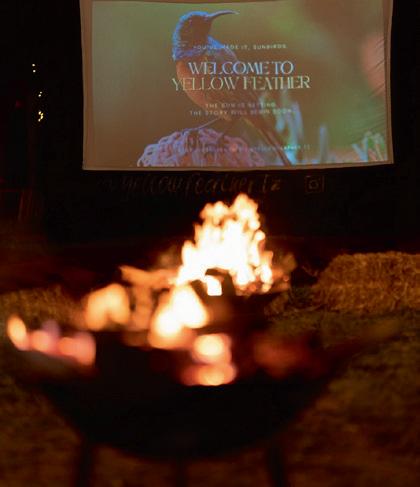
As travel trends shift towards more experience-driven and culturally immersive journeys, Yellow Feather represents a compelling evolution of Arusha’s identity. It adds a new layer to the destination – one that complements its world-famous wildlife adventures with something equally memorable, yet entirely different.
For visitors, it offers a way to engage with the city beyond transit and checklist tourism. For residents, it is helping to redefine what social life in Arusha can look like.
And as the 2026 season approaches, Yellow Feather continues to invite guests to step off the fast track and into something more meaningful.

“These experiences are crafted around presence and atmosphere, blending elements such as sound healing, film and nature”

From local nyama choma and streetside chipsi mayai to Italian pizzas and award-winning Tanzanian wines, Dodoma’s dining scene is far more diverse than many visitors expect. Here are the Paa picks for every type of foodie.
This stylish restaurant, bakery and wine bar has become one of the city’s standout addresses, pairing polished service with a menu that blends Tanzanian ingredients and international influences. The real attraction is the chance to sample wines from Tanzania’s premier wine-producing region right on their home turf. Come for a leisurely dinner, linger over a local vintage, and enjoy one of Dodoma’s most refined evenings out.
Location: Kilimani Nyerere Street in the Uzunguni area, right in the heart of central Dodoma.
Opening hours: Coffee shop 8am to 10.30pm, kitchen 12pm to10.30pm, weekends: 12pm to 11pm.
Online: @collina_wines on Instagram


Vegetarians and vegans have fewer dedicated options in Dodoma, but Leone l’Africano shines as a reliable choice. Frequently highlighted among the city’s best vegan-friendly restaurants, this long-running Italian favourite serves wood-fired pizzas, pasta and salads in a leafy, relaxed setting. The kitchen is known for accommodating dietary preferences, making it an easy recommendation for travellers seeking meat-free meals without sacrificing flavour. Pair a vegetable-topped pizza with a glass of wine from the surrounding Dodoma vineyards and settle in for a surprisingly cosmopolitan experience.
Location: Arusha Road in the centrally located residential and commercial Area C.
Opening hours: Monday to Friday 6am to 10pm, weekends 12.30pm to 10.30pm.
Online: leonelafricano.co.tz; Tripadvisor
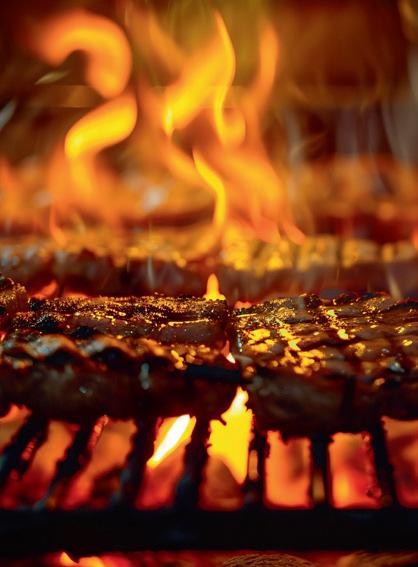
If your idea of a perfect meal involves smoke, fire and expertly grilled meat, head straight to K’s Grill House. Renowned for its barbecuefocused menu, the restaurant specialises in grilled beef, chicken and fish prepared over open flames. The atmosphere is lively and distinctly local, with groups gathering to share platters and enjoy Tanzania’s beloved nyama choma tradition. Friendly service and generous portions make it a favourite among residents, while visitors get an authentic taste of Dodoma’s carnivorous side
Location: Viwandani near the city centre
Opening hours: Monday to Saturday 9am to 11pm, Sunday 12pm to 11pm
Online: @ks_grill_house on Instagram
authentic international cuisine…
Housed inside the Best Western Dodoma City Hotel, The Pit-Stop Restaurant is one of the capital's most dependable all-rounders. Its menu ranges from African and Asian dishes to international favourites, while generous buffet breakfasts and business lunches have made it popular with everyone from government officials to passing travellers. If your tastes lean global rather than local, this polished venue offers one of Dodoma's most versatile dining experiences.
Location: Inside the Best Western Dodoma City Hotel just a short drive from the airport.
Opening hours: 6am to 3.30pm.
Online: @bestwesterndodoma

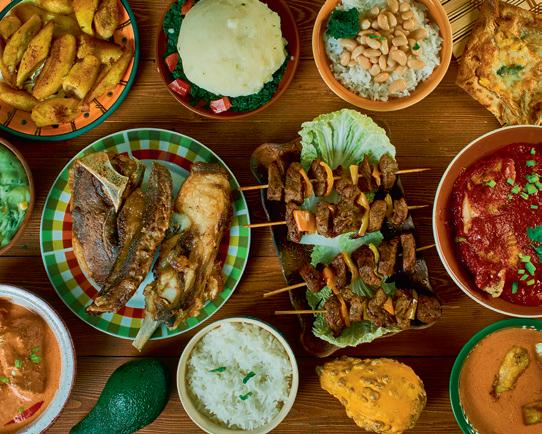
This halal restaurant close to the airport is known for its fusion of traditional Tanzanian dishes. Favourites include tender mishikaki; pilau fragranced with cloves, cinnamon, cardamom, and cumin; and Wali wa nazi, a coconut milk-infused rice that pairs perfectly with local fish or meat stews and freshly baked mandazi donuts for dessert or as a sweet snack to accompany a pot of traditional spiced tea. The social, cosy venue is also known for its kindo sinia (sharing platters) to bring people together.
Location: On Mpwampwa street near Dodoma Airport. Opening hours: 9.30am to 11pm
Online: @harvanfoodaffairs
The king of Dodoma street food is chipsi mayai, often referred to as ‘zege’. It’s a hearty, flavourful omelette made by folding French fries directly into beaten eggs, typically served with a fresh kachumbari (tomato and onion) salad and hot sauce.
Another street food option is Misalato Market, the biggest and best meat market in Dodoma, where locals flock for the freshest nyama choma served with with crispy fries or ugali.
For visitors seeking the most authentic taste of the capital, however, the real joy lies in joining the evening crowds around Samora Avenue and Four Ways, where sizzling grills, steaming omelettes and the aromas of roasted meat create one of Dodoma's liveliest nightly rituals.
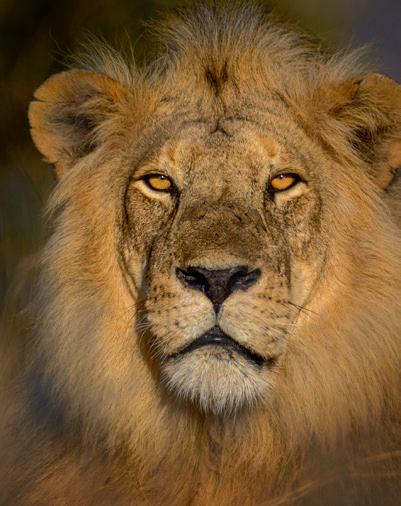
Ruaha National Park is one of Tanzania’s wildest and most remote safari adventures. Visit during the July to September dry season for unforgettable wildlife encounters, dramatic landscapes, and some of East Africa’s most rewarding game viewing.
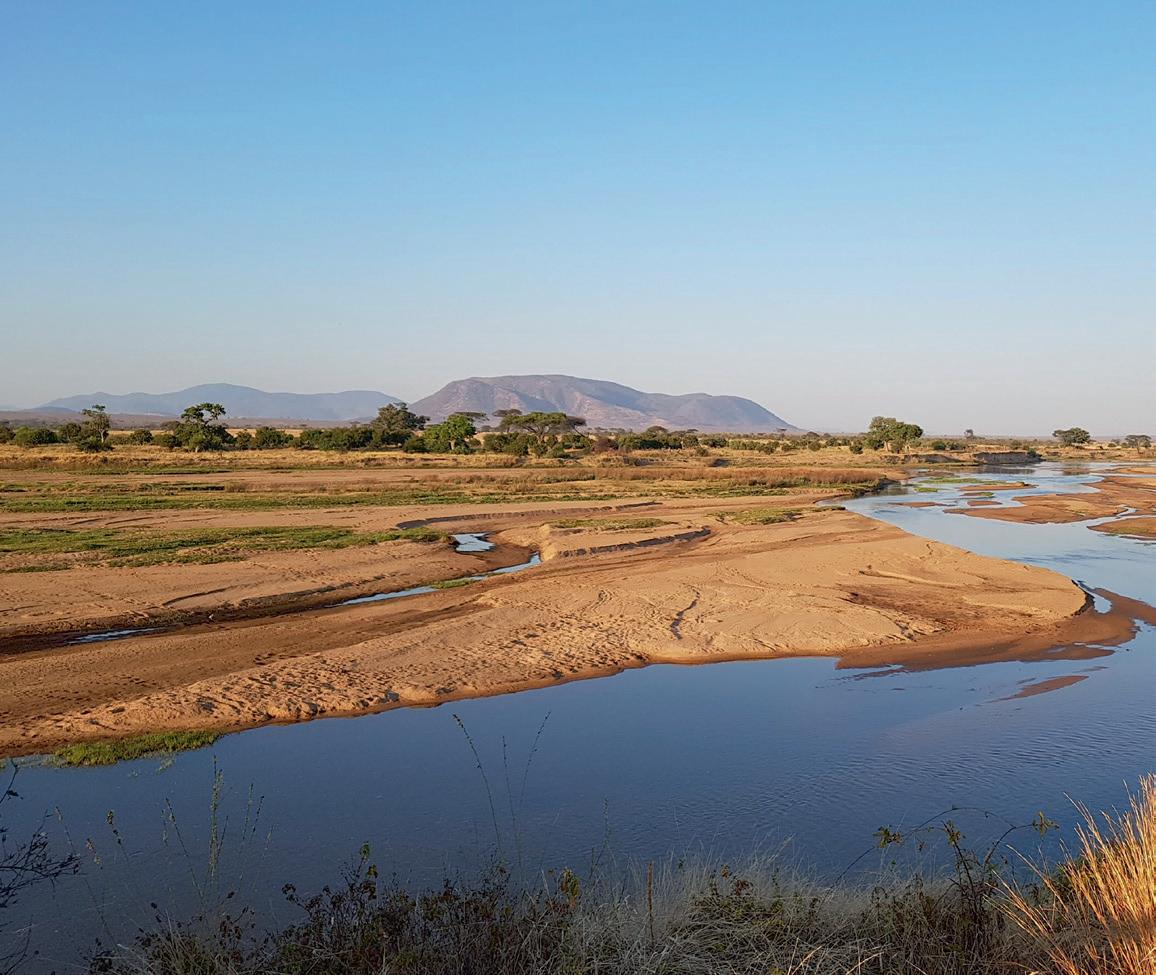
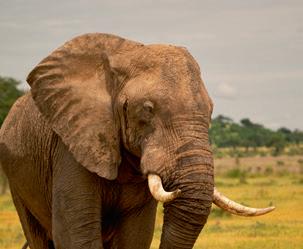
An estimated 12,000 to 14,000 elephants roam the vast Ruaha-Rungwa ecosystem. While they disperse across the 20,000 sq km park during the wet season, the vast majority congregate along the Great Ruaha River and dry riverbeds from June to October when water becomes scarce. Because surface water can disappear, elephants use their trunks to dig deep into the sandy riverbed, unearthing hidden subterranean springs that other animals then use.


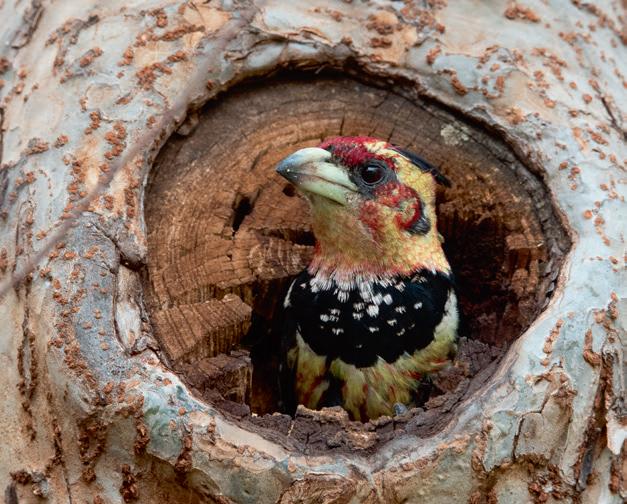
close quarters, often resulting in fierce territorial battles over the narrowing pools.
With vegetation thinning and animals concentrated around water, sightings are clearer and more consistent.
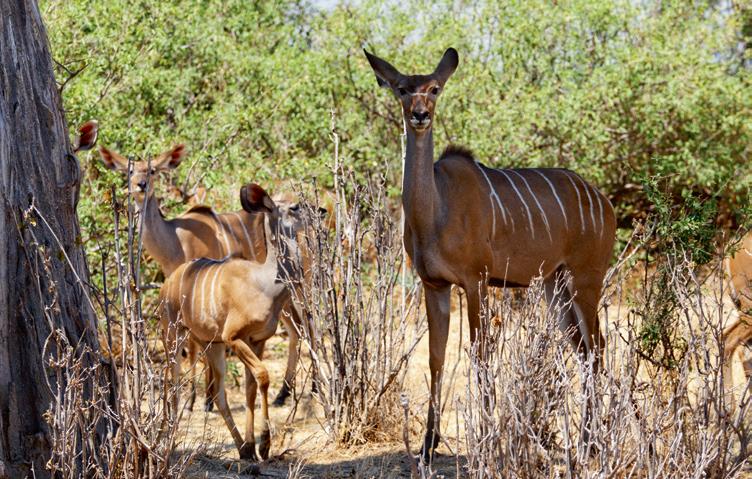
Lions, leopards, and wild dogs stalk riverbanks where they have their pick of a stream of thirsty herbivores such as impalas, waterbucks, and the majestic greater kudu. Hunting action is frequent and thrilling.
With the water of the Great Ruaha River levels dropping, hippos and massive crocodiles are forced into
Expect dusty plains, golden grasses, and towering baobabs beneath crisp blue skies. This is Ruaha at its most raw and rugged.
With fewer than 7,000 remaining in the wild, African wild dogs are among the continent’s most thrilling and elusive predators. Ruaha is considered one of the best places to see these endangered animals, especially in the dry season when the nomadic animals
are tethered to the water sources where their prey such as impala and kudu drink. The reduced foliage and softer sand will also make it easier for your expert guide to track their footprints and movements.
Dry ground, thinner bush, and cooler mornings make guided walking safaris safer, richer, and more immersive.
Think sunny days, cool nights, and almost no rain. Ideal for long game drives and outdoor adventures.
Clear light, dust-haze sunsets, and dramatic predator-prey scenes make this peak time for once-in-a-lifetime shots.
Ruaha’s unique location creates a rare wildlife crossover, where northern and southern species meet. Spot striking antelope like greater and lesser kudu, along with the elusive sable and roan – highlights of this remarkable ecosystem.
If you’ve never tasted honey from Pemba, you’re missing out on one of the Indian Ocean’s most delicious secrets. Here’s why you need to taste it on your next trip.
Bees feast on wild, untouched forests
Pemba bees forage in indigenous forests and coastal mangroves, far from industrial farming. This wild setting means cleaner nectar and a naturally “organic” honey profile.
The island’s biodiversity is the honey’s secret weapon. Bees draw from clove trees (a major crop on Pemba), mangrove flowers along the coast, coconut palms, and mango, banana, and other fruit trees. The result is a complex, multi-layered nectar source you won’t find in single-flower honeys.
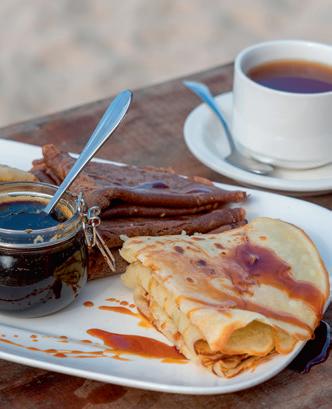
Pemba honey is typically a deep amber colour. Its flavour profile includes slightly spicy notes thanks to the clove nectar. Its layers of taste come directly from the diversity of plants with each flower leaving a signature.
Raw honey has long been valued for its healing properties – and Pemba’s is no exception. It is packed with antioxidants that

support immune health and has anti-inflammatory and woundhealing effects. Local culture across Zanzibar has deep traditions of plant-based medicine in which honey plays a supporting role.
Unlike its larger island neighbour Unguja, Pemba has retained much of its forest and mangrove coastal cover. Beekeeping helps safeguard these highly sensitive ecosystems by providing rural
communities with a sustainable source of income linked directly to environmental stewardship. As a result, practices such as deforestation and illegal charcoal production become less attractive alternatives.
Beekeeping in Pemba and across the Zanzibar archipelago has evolved from wild honey harvesting traditions with community knowledge passed

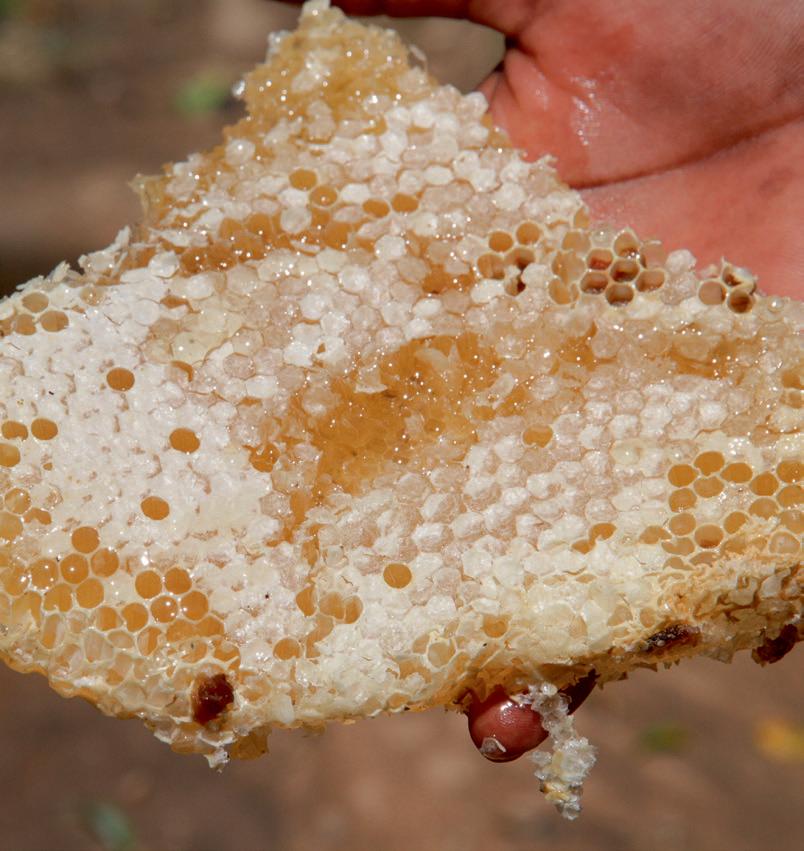
down generations. Still today it’s largely a grassroots livelihood.
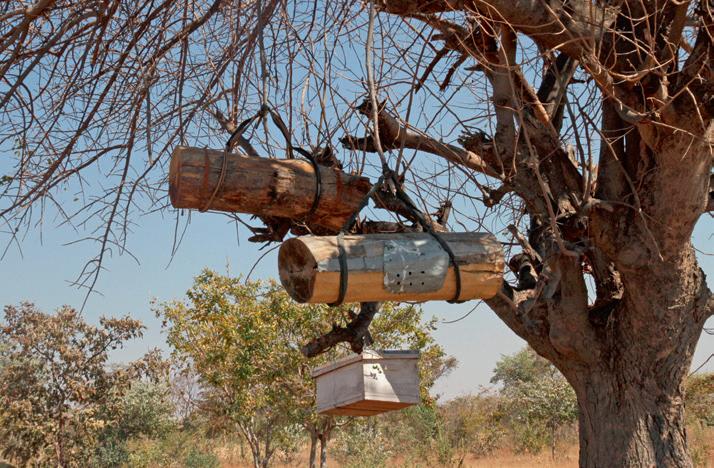
Most beekeepers on Pemba use simple, locally made log hives crafted from hollowed sections of indigenous timber and baited with beeswax to attract wild swarms. Suspended high in the canopy, these traditional hives replicate the natural tree cavities where honeybees would ordinarily nest. They provide a sheltered, insulated environment for colonies while keeping them out of reach of predators such as honey badgers, lizards and ants. Importantly, the hives are installed without harming the living trees that support them.
Beekeeping provides farmers with a vital secondary source of revenue. The bees are constantly on the move, drifting between clove blossoms, fruit trees and wild forest flowers as they collect nectar. In the process, they transfer pollen from bloom to bloom, helping many of the island's crops to flourish.
Pemba's traditional log hives are typically hung in clove trees or near coastal mangrove forests, placing bees close to two of the island's most important nectar
sources. Clove blossoms provide a delicate, naturally sweet nectar, while mangrove flowers contribute pollen and nectar rich in antioxidant compounds. The resulting honey of the latter is prized not only for its flavour but also for its traditional medicinal uses, including the treatment of burns, ulcers and minor skin infections.
Pemba beekeepers use the nectar of the island's rich flowering trees


Certified organic clove and mangrove honey is sold by the Pemba Beekeepers’ Association (PEBA), which acts as the central hub and buyer for co-operatives of small-scale farmers on the island. You’ll also find the jars of raw forest honey at local markets and herbal shops across the island. The reputation of Pemba honey has spread to Unguja with high-end botanical skin brand Zuria Rituals selling jars while one of Stone Town’s stand-out hotels, Emerson Spice, has small pots to pour on your breakfast pancakes.


It has been 62 years since Tanzania gained independence. John Kitime has been a musician for all of them. He shares his memories of the glory days of music under the country’s first president, Mwalimu Julius Kambarage Nyerere.
Iam a native of Iringa and was fortunate to grow up in a household where music was central to family life. My father was a gifted musician who played several instruments, including the trumpet, saxophone, banjo, ukulele, and acoustic guitar. In 1960, he recorded songs at Tanganyika Broadcasting Services (TBS), the only radio station at the time. His songs were first aired on the programme Jimbo Letu on May 16, 1960, and he was paid 40 shillings. Considering that a brand-new car cost about 800 shillings then, this was a significant sum. It shows that even before Independence, some musicians received royalties when their work was broadcast.



My father encouraged my siblings and me to sing along while he played the guitar, and I fell in love with music from an early age. We had both a radio and a gramophone at home, and our collection included Swahili, Indian, English, South African, and Congolese music. Listening to such a wide range of sounds shaped my musical tastes and broadened my appreciation of different traditions.

I started school in 1961, the year Tanganyika gained Independence. I remember helping sweep the roads near our school and sprinkling them with water before Independence Day celebrations to keep the dust down. There

then. Music was an important part of school life. We had a subject called Kuimba (Singing), where teachers taught us new songs every week. Songbooks contained lessons about respecting parents and elders, loving school, and good citizenship. Some teachers could even read and write musical notation, giving us an education that went beyond simply singing songs.
Every school had a band. Each morning, the band played during student inspections before classes began. I dreamed of joining one, either as a drummer or a flute player, and most of all as the

drum major. School bands were a source of pride. Teachers with musical skills trained students to perform at a high standard, while schools competed over uniforms, discipline, and precision. Public holidays were especially exciting because schools would gather for parades, each led by its band. We worked hard to appear clean, smart, and disciplined so that our school would earn praise. Schools also had choirs, traditional dance groups, and sometimes modern music bands. I attended Iringa Aga Khan Primary School, where most students were of Indian origin. Regardless of tribe or background, everyone participated in traditional dances. Some Indian students could perform the sindimba dance better than many Waswahili.
T hings changed when the Ujamaa policy was introduced while I was in Standard Seven. Traditional songs were increasingly given political lyrics, and cultural officers actively promoted political music. Foreign bands, especially Congolese groups, were encouraged to sing in Kiswahili. Schools placed greater emphasis on patriotic songs, and singing lessons reflected this shift. Throughout the country, choirs composed patriotic music that was recorded by the nationalised broadcaster, Radio Tanzania Dar es Salaam (RTD). At the end of most performances, bands were expected to play the well-known


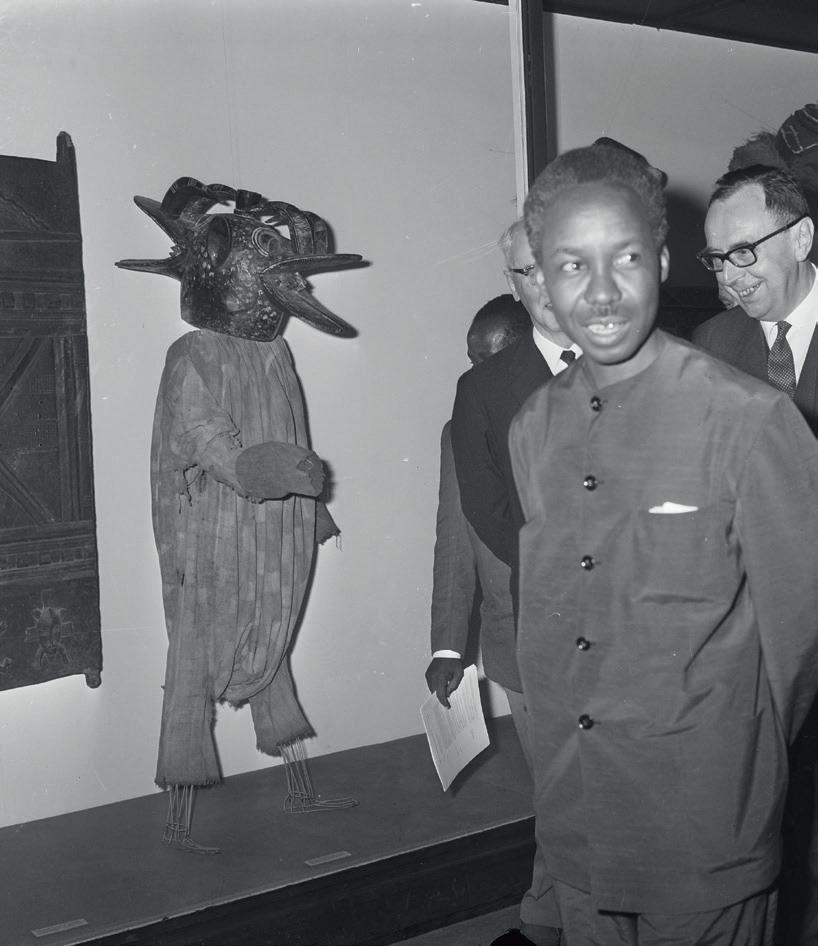
party anthem, Chama Chetu Cha Mapinduzi Cha Jenga Nchi.

The TANU Youth League (TYL) also played a major role in developing music. Its branches reached down to village level, and each was expected to maintain a choir, a traditional dance group, or both. Many districts owned dance-band instruments through

the TYL, and numerous musicians who later became famous began their careers in these groups. In Iringa, the TYL’s instruments eventually found a home with the Mkwawa Secondary School band, Orchestra Mkwawa, which went on to record several songs at RTD studios in its distinctive Ligija style.

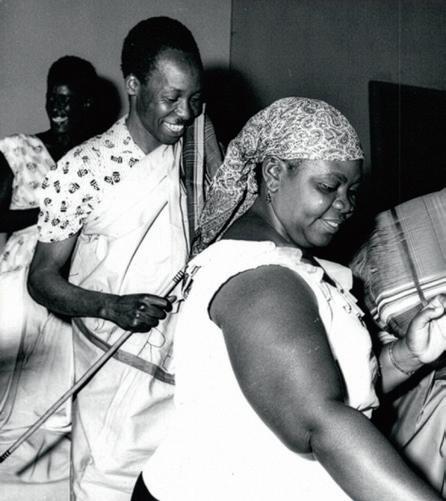

likewise encouraged to establish cultural groups, including choirs, bands, and dance troupes. Some became nationally renowned, including groups from several prominent state-held organisations and institutions. Beyond providing entertainment,
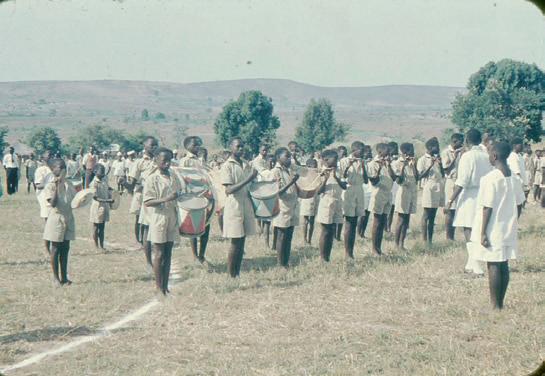
In Iringa, the TYL’s instruments eventually found a home with the Mkwawa Secondary School band

these groups fostered patriotism and gave young people opportunities to participate in
Looking back, however, there was one major shortcoming. Music and the arts were valued mainly as tools for education and nationbuilding, while the business side of the industry received little attention. Despite the abundance of talented musicians, there was only one recording company, the government-owned Tanzania Film Company. Although it

released records, promotion and distribution were weak. As a result, neighbouring countries such as Kenya and Zambia often benefited more from the commercial potential of Tanzanian music than Tanzania itself.
This was the world in which I grew up – a time when music united communities, shaped national identity, and inspired countless young people, including me. Yet it was also a time when artistic talent often flourished despite the absence of a strong music industry.
This article is adapted from a blog post that first appeared on the excellent Kitime Music Archive website. In it, John reflects on the people, places, and experiences that have shaped more than six decades of music-making. It is reproduced here with the author's full permission. Visit the archive at kitimemusicmuseum.co.tz.


Test your brain power with our fun puzzles and games!
Find your way out of the maze
Find the extra hands for each robot
FOGGY THUNDER LIGHTNING
RAINBOW BREEZE HAIL

Paa columnist Harriet James is a Nairobi-based travel journalist who loves to promote African destinations, meet new people and inspire change and positivity wherever she goes. Follow her on Instagram and LinkedIn @HarrietOwalla.

This year’s Our Ocean Conference took place in Mombasa in June – the first time the annual event, now in its 11th year, has been hosted in Africa.
Governments, scientists, conservationists, businesses and coastal communities came together to discuss the future of the continent's marine resources. The gathering highlighted Africa's growing role in ocean governance. Kenya and Tanzania share a long, stunning coastline along the Indian Ocean. It’s a valuable asset not just for the region, but for the world.
The ocean is often described as Earth's life support system, and for good reason. It absorbs around 90 percent of the excess heat generated by global warming and about a quarter of human-produced carbon dioxide emissions. Without this buffering capacity, climate change would be far more severe.
Beyond regulating the climate, the
ocean supports billions of people through food production, fisheries, tourism, shipping and trade. For many African nations, the blue economy offers enormous opportunities for sustainable development and job creation.
Yet the ocean is under unprecedented pressure. Rising temperatures are causing coral bleaching, shifting fish populations and intensifying storms, while sea-level rise threatens coastal communities. Pollution remains a major challenge, with millions of tonnes of plastic waste entering the ocean each year alongside chemical runoff and untreated sewage.
Overfishing, including illegal and unregulated fishing, continues to deplete fish stocks and undermine food security. At the same time, mangroves, seagrass meadows and coral reefs – vital ecosystems that protect coastlines,
support marine life and store carbon –are disappearing at alarming rates.
One of the conference's strongest messages was that ocean conservation is not separate from climate action; it is central to it. Research suggests that restoring coastal ecosystems, expanding marine protected areas and reducing emissions from shipping could make a substantial contribution to global climate goals while strengthening resilience to storms, flooding and erosion.
Awareness of ocean issues is growing, but recognition alone is not enough. Governments must match commitments with action by enforcing laws that reduce pollution, combat illegal fishing and protect critical habitats. Coastal communities must also remain at the centre of conservation efforts.
The ocean has protected humanity for generations. It is now our responsibility to protect it in return. Will we heed the call?

Precision Air is always looking to give its customers an exclusive and memorable service experience; and the Paa Royal benefits programme is part of that mission. The membership categories* are as follows:

Upon enrolment, members will be given their unique Paa Royal number, which they must always show whenever they buy tickets as well as during check-in at the airport. After flying three times or more, members will be given a Jade membership card. With the card, they will be recognised as members of the Paa Royal Programme.
Other benefits of Jade membership:
• Priority membership baggage tags to ensure tagged bags will be handled with special care and delivered first on the conveyor belt at the passenger’s arrival destination
• An opportunity to get a free ticket within the Precision Air’s network after accumulating enough points in their account.
*Please note that, in each membership category, if a member is unable to maintain the required number of flights in a year, he or she will be downgraded to their tier level achieved in that current year.

After attaining Silver membership level, the member will be issued with a Silver membership card which he (or she) must show at all Precision Air point of sales in order to receive the recognition that he deserves. Should a member book online by logging into Paa Royal Pages, he will automatically receive points earned to his account. Members will be entitled to special treatment and priority treatment whenever they travel.
Other benefits of Silver membership:
• Free 5 kg baggage every time member travels on a PW operated flight
• Priority membership baggage tags to ensure tagged bags will be handled with special care and delivered first on the conveyor belt at member’s arrival destination
• Opportunity to obtain a free ticket within the Precision Air network after accumulating enough points in your account
• Priority telephone reservation in those times when you want to make your reservation and cannot visit our office or travel agent. Booking is a call away through our Paa Royal helpdesk line.

After attaining the Gold membership, members will begin to experience royal and exclusive treatment whenever they fly. Members will be opened up to a new world of opportunities and experiences and, of course, receive more rewards. Should a member book online by logging into Paa Royal Pages, he (or she) would automatically receive points earned to his account.
Other benefits of Gold:
• Free 10 kg baggage every time member travels on a PW operated flight
• Priority membership baggage tags to ensure tagged bags will be handled with special care and delivered first on the conveyor belt at member’s arrival destination
• Opportunity to obtain a free ticket within the Precision Air network after accumulating enough points in your account
• Priority telephone reservation at times when you want to make your reservation and cannot visit our office or travel agent. Booking is a call away through our Paa Royal helpdesk line
• Priority waitlist/airport standby each time you want to travel and your selected flight is full.

When members reach Tanzanite member they attain ultimate royalty. We will always strive to give these royal members an exclusive and memorable flight experience. At this level, members will already be used to royal treatment; royalty will be their way of life.
Other benefits of Tanzanite:
• Free 15 kg excess baggage every time the member travels on a PW-operated flight
• Opportunity to obtain a free ticket within the Precision Air network after accumulating enough points in your account
• Confirmation on any flight if a member is prepared to pay Y class fare, regardless of the flight booking status
• Priority waitlist/airport standby whenever you want to travel and your selected flight is full
• Priority telephone reservation at times when you want to make your reservation and cannot visit our office or travel agent. Booking is a call away through our Paa Royal helpdesk line.
• Priority membership baggage tags to ensure tagged bags will be handled with special care and delivered first on the conveyor belt at member’s destination.
• Silver, Gold and Tanzanite members also get discounts of up to 20 per cent when visiting GSM shopping malls Msasani and Pugu, Southern Sun Hotel, Akemi restaurant, East Point Restaurant and the Colosseum hotel and sports club - all in Dar es Salaam.
Dar es Salaam Head Office
Diamond Plaza, 1st Floor, Plot no 162 / 38, Mirambo Street/ Samora Ave, Dar es Salaam
Tel: +255 (0)22 219 1000
Contact Centre:
+255 (0)787 888 409/408/417
Email: pwreservations@precisionairtz.com
Dar es Salaam Sales Office
NIC HDQ BUILDING, Samora Ave/Pamba Road
PO Box 70770, Dar es Salaam
Tel: +255 (0)22 213 0800 / 212 1718
Fax: +255 (0)22 211 3036
Email: salesdar@precisionairtz.com
E-COMMERCE
(For users of VISA and MasterCard)
Diamond Plaza, 1st Floor Plot no 162/38
Mirambo Street/Samora Ave
Dar es Salaam
Tel: +255 (0)686 177 458/ (0)689 669 446
Fax: +255 (0)22 211 3036
Email: pwreservations@precisionairtz.com
ARUSHA
Ngorongoro Tourism Center
First Floor
Goliondoi & Makongoro Road
PO Box 1636, Arusha
Tel: +255 27 254 5489 / 254 5503
Email: pw-arksales@precisionairtz.com
BUKOBA
Bukoba Office-GSA, Bukoba Machinery, Bukoba Centre
Kawawa Road, Bukoba
Tel: +255 (0) 28 222 0545/222 0204
Mob: +255 (0) 713 316 806/ (0) 787 616 806
Email: bukobamachinery55@yahoo.com
DODOMA
Mtendeni street, Dodoma
Tel: +255 787 845 200 / 754 972 173
MOSHI
KNCU Building, Ground Floor
Old Moshi Road, Moshi
Tel: +255 784 686 418
+255 (0)272 753 495/753 498
Mob: +255 (0)787 800 820
Email: sales@acobtravel.com info@acobtravel.com
MTWARA
Tanu Road, Posta Building
PO Box 1066, Mtwara
Tel: +255 (0)23 233 4116
Mob: +255 (0)787 818 442/ 767 818 442
Email: pw-mwzgsa@precisionairtz.com
Along Kenyatta Road, Plot no 002, Mwanza
Tel: +255 (0)28 250 0819/250 0204
Fax/Tel: +255 (0)28 250 1054
Mob: +255 (0)784 402042
Sales Office Mobile: +255 (0)784 968427
ZANZIBAR
Zanzibar Airport
Tel: +255 (0)24 223 4521
Fax: +255 (0)24 223 4520
Email: pwznz@precisionairtz.com
NAIROBI
Barclays Plaza, 7th Floor, Loita Street
PO Box 50990-00100, Nairobi
Tel: +254 (0)20 327 4282 / 4290 / 4297
Mob: +254 (0)724 76 0736 / +254 (0)736 046 595
Airport: +254 (0) 733 934 795 / 731 530 000
Email: pw-nbo@kenya-airways.com
AVIAREPS
Terminal A Tambo International, Johannesburg
Tel: +27 11 783 1181
Email: jnbres.precision@aviareps.com
Pan Africa House
Plot no.3 Kimathi Avenue
PO Box 5619, Kampala
Tel: +256-790 381 431 (24hr Emergency)
Mob: +256 784(704) 329 793
Email: precisionair.eva@utb.co.ug
Argentinierstrasse 2/4
A-1040 Vienna, Austria
Tel: +43 1 585 3630
Fax: +43 1 558 536 3088
Suite 1302, 109 Pitt Street
Sydney, Australia
Email: helpdesk@apg-ga.com.au/ australia@apg-ga.com
Park Hill, J.E Mommaertslaan 18B
1831 Diegem, Belgium
Tel: +32 (0)2 712 0584
Fax: +32 (0)2 725 8392
Mobile: +32 (0)47 770 9971
Precision Air C/o Aviareps
PL 10 00750 Helsinki, Finland
Tel: +46 8 5556 9162
Email: PWres.scan@aviareps.com
Precision Air, 11 rue Auber 75009 Paris, France
Mob: +33 (0)6 21 824 908
Reservation: +33 (0)1 534 35397
Fax: +33 (0)1 5343 7919
MUNICH OFFICE
Josephspitalstrasse 15 80331 Munich
Germany
Tel: +49 (0)895 525 3373
Fax: +49 (0)895 450 6842
FRANKFURT OFFICE
Kaiserstrasse 77 60329 Frankfurt / Main
Germany
Tel: +49 (0)69 770 673 010
Fax: +49 (0)69 770 673 018
7 Stadiou Street, Athens 10562 Greece
Tel: +30 (0)210 9341 500/501
Fax: +30 (0)210 934 1620
Email: PrecisionairSales@tal-aviation.gr
Precision Air GSA APG Ireland
27 Lower Ormond Quay Dublin, Ireland
Reservations: +353 (0)1 804 5100
Email: precisionair@apg-ga.ie
Beechavenue 104 1119 PP Schiphol, Netherlands
Tel: +31 (0)20 520 0280
Fax: +31 (0)2 6 23 0151
Bravo Murillo 101, Planta 6 Oficina 3, 28020 Madrid, Spain
Tel: +34 (0)91 458 5560
Fax: +34 (0)91 344 1726
Email: Precisionair.spain@aviareps.com
Aviareps, Riddargatan 17 11457 Stockholm
Sweden
Tel: +46 (0)8 5556 9162
Email: PWres.scan@aviareps.com
Badenerstrasse 15, 8004 Zurich
Switzerland
Tel: +41 (0)44 286 99 60
Fax: +41 (0)44 286 99 00
Email: precisionair-switzerland@aviareps.com
Discover The World -Turkey
Nef22 E Blok 13. Kat No:194
Atakoy/ İstanbul 34156 TURKEY
Tel: +90 212 806 11 87
Email: info@discover-tk.com/ sales@discover-tk.com
and CANADA
AirlinePros
420 Lexington Ave Suite 358-360
New York, NY 10170
Tel: +1 877 496 9887
Email: reservations@precisionairlines.us Precisionair_tanzania@airlinerpos.ca
APG Global
Highbridge House, 581 Bath Road Longford, West Drayton
Middlesex, UB7 0EW
Reservations: +44 (0)844 482 2313
Email: precisionair@apg-ga.co.uk
GSA OF ASIA PACIFIC (excluding Japan and China)
Elite Holiday Travel Service
Taipei, Taiwan
FAX: 8
Tel: 886-2-2541 3366
Fax: 886-2-2536 1824
Email: sales@eliteholiday.com.tw
Diamond Plaza, 1st Floor Plot no 162/38, Mirambo Street
Samora Ave, Dar es Salaam, Tanzania
Tel: +255 784 772 823 / +255 786 447 411
Email: pw-offline@precisionairtz.com
Precision Air takes passenger safety very seriously. Aviation safety isn’t just the pilot’s or the cabin crew’s job – it takes all of us.
It is easy for our natural sense of caution to be dulled in our modern environment, where things don’t go wrong very often. Whether in the air or on the ground, your life and the lives of your family members could some day be saved if you make it a point, in every situation, to create a mental plan of action in case of emergency. Here are some important tips to help you enjoy your travel experience with Precision Air – in flight and around the airport.
A passenger who is allocated an emergency exit seat:
A. Must be both willing and physically able to open the exit doors in an emergency
B. Must completely understand the printed emergency evacuation techniques
C. Must be 16 years old and above.
Although the information seems repetitious, the locations of the closest emergency exits may be different depending on the aircraft that you fly on and the seat you are in.
There are strict rules about what you can bring on board an aircraft. Because:
A. Not all aircraft have space to store your carry-on baggage.
B. In an accident, baggage in the aisles makes it harder to get out of the aircraft quickly.
Carry-on bags must be small enough to fit under the seat in front of you or in the overhead bins. Please confirm with Precision Air rules before your travel to avoid delays.
*Remember: All carry-on baggage must be left behind in an evacuation.
Boarding and leaving an aircraft requires your full attention. As you move to and from the aircraft, you may be in a busy area with many other passengers and cargo, moving vehicles, other aircraft, slippery walkways and/or stairs.
Everyone has the right to safe and secure travel. That is why Precision Air employees and the aviation authority will not tolerate any behaviour that interferes with the flight or puts the safety of passengers and crew at risk.
Seatbelts must be fastened during take-off, landing, during turbulence and any time the crew deem it necessary. Keeping the belt on when you are seated provides that extra protection you might need in case of emergency. If you are responsible for an infant or a child, you must first ensure that your own seatbelt is properly fastened, then secure the child and, if it is an infant, secure the child’s or the infant’s restraints.
Important note: There are a number of events involving air turbulence that highlight the importance of keeping seatbelts fastened throughout the flight.
Though rare, in-flight turbulence is the leading cause of injuries to both passengers and crew.
For the your own safety and the safety of your fellow passengers and crew, we ask you to wear a face mask during the entirety of your flight today. Thank you!
It’s a good idea to keep your seatbelt fastened even when the seatbelt signs are not on.
If you have a medical condition and may need assistance during your travel, kindly ask the Precision Air offices or agents about procedures before your flight. If you are pregnant, you will need to fill a Precision Air medical form, to be signed by your doctor, to confirm that you are OK for travel. For further details, kindly ask while booking your ticket from our sales offices and/or customer services.
Use of portable electronic devices such as mobile phones, laptops, tablets, MP4 players, iPads, etc are not allowed during take-off, landing, taxiing, descent and climb.
Precision Air prohibits the use of some electronic devices during flight because they emit signals that can interfere with the aircraft's instrumentation. Some of the items prohibited include cellphones, radios, remote-controlled games/toys, laser pointers, iPads or tablets that transmits frequencies, portable printers, walkie-talkies, scanners and laptops. These items need to be stowed away for these phases of the flight to avoid injuries in case of an emergency.