ISSUE No 58
Guyana
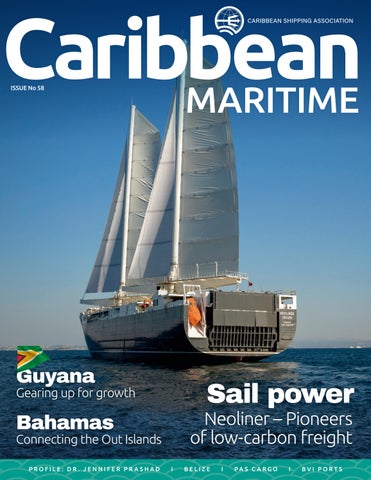
Sail power
Gearing up for growth
Neoliner – Pioneers of low-carbon freight
Bahamas
Connecting the Out Islands PROFILE: DR. JENNIFER PRASHAD
I
BELIZE
I
PA S C A RGO
I
BVI PORTS
CaribbeanMaritimeMagazine
cm_magazine
@caribbeanmaritimemagazine
www.caribbean-maritime.com
Caribbean Maritime is delivered to subscribers in biodegradable packaging and the magazine is produced using paper from PEFC certified sources implementing sustainable forestry policies to help preserve our environment.
ISSUE No 58
THE OFFICIAL JOURNAL OF THE
CONTENTS 3
MISSION STATEMENT To promote and foster the highest quality service to the maritime industry through training development; working with all agencies, groups and other associations for the benefit and development of its members and the peoples of the Caribbean region.
Managing transition
6
Group B: Chairman: Cristyan Peralta Representative: Enrique Figueroa
8
GUYANA'S GATEWAY A new gateway for Guyana
10 PAS CARGO The PAS story: More than just cargo
11 PROFILE: DR JENNIFER PRASHAD Leading the family legacy
8
15 THE BAHAMAS Connecting The Bahamas’ Out Islands: A Blueprint the Caribbean can build on
Group C: Chairman: Robert Bosman Representative: Agenor Olivardia
19 MARITIME FUTURE The 2030 Execution Cliff
Group D: Chairman: Rachel Matthews Representative: Martin Medina
22 SAIL POWER
Milaika Capella Ras – CSA General Manager CARIBBEAN SHIPPING ASSOCIATION 4 Fourth Avenue, Newport West PO Box 1050, Kingston CSO, Jamaica Tel: +876 923-3491 Email: secretariat@caribbeanshipping.org www.caribbeanshipping.org
GUYANA LOOKS AHEAD Guyana gears up for growth
GENERAL COUNCIL MEMBERS 2025 – 2026 President: William Brown Vice President: María del Mar Rodriguez Immediate Past President: Marc Sampson Group A: Chairman: Nazillia Simone Philips Representatives: Kevin Choo Quan Andre Rochester Max Mella Jr.
FROM THE CSA PRESIDENT
Pioneers of low-carbon freight: Neoliner Origin
26 BVI PORTS
11
ADVERTISING advertising@caribbean-maritime.com Tel: +44 (0)771 444 8059
BVI Ports’ operations keep a maritime nation moving
28 CHARTING BELIZE'S BLUE FUTURE Marine spatial planning and the maritime sector
PUBLISHER
32 ROUNDUP News from around the Caribbean
Land & Marine Publications Ltd 6 The Square, Ipswich, Suffolk IP5 3SL, United Kingdom Email: publishing@landmarine.com www.landmarine.com Views and opinions expressed by writers in this publication are their own and published purely for information and discussion and in the context of freedom of speech. They do not necessarily represent the views and opinions of the Caribbean Shipping Association – The Publisher. ©2026 Land & Marine Publications Ltd.
39 ADVANTUM DIGITAL TRANSFORMATION Digital, but still manual? Why going paperless isn’t enough
22 www.caribbean-maritime.com 1
FROM THE CSA PRESIDENT
Managing transition
William Brown President Caribbean Shipping Association
A
s we begin to wind down 2026, the Caribbean maritime sector is being asked to manage several transitions at once. We must support expanding economies, strengthen resilience, reduce emissions and maintain the reliable movement of goods on which our countries depend. These responsibilities are closely connected, and our success will depend on how well we address them together.
Guyana, host of the Caribbean Shipping Association’s 56th Annual General Meeting, Conference and Exhibition from October 25 to 28, 2026, brings this reality into sharp focus. Its emergence as one of the fastest growing economies in the world is creating significant opportunities for shipping, logistics and maritime services. Greater cargo volumes and investment will require modern ports, efficient systems, strong institutions and a workforce equipped to support continued expansion. At the same time, much of Guyana’s growth is being powered by oil and gas
while the maritime industry is being called upon to move away from carbonbased fuels. This is a genuine tension, and we should not disguise it. The test will be whether the opportunities created by today’s energy economy are used to finance the infrastructure, technologies and skills required for a more sustainable one. That question extends beyond Guyana. Throughout the Caribbean, economic growth and maritime sustainability must be pursued together. Doing so will require the region to participate meaningfully in the decisions that determine how
www.caribbean-maritime.com 3
FROM THE CSA PRESIDENT www.caribbeanshipping.org the transition is financed, regulated and implemented. The answer to this lies in how the maritime industry, including the CSA, can advocate for a balanced approach in using the available resources to improve our economies, while also being mindful of the long-term strategies needed to reduce greenhouse-gas emissions.
Strengthened
Strengthening our external partnerships must therefore go hand in hand with rebuilding participation across the region”
4 Caribbean Maritime
particularly among smaller territories whose experiences and concerns must form part of our agenda. In this regard, we were pleased to welcome St. Lucia back following the launch of the St. Lucia Chamber of Shipping earlier this year. We also welcomed the return of The Bahamas during our conference in Curaçao. In 2027, we will continue this work, focusing on Montserrat, Bermuda, Dominica and St. Kitts. These territories helped to establish and shape the CSA. Their renewed participation would strengthen both our regional voice and our ability to advocate on behalf of the entire Caribbean.
Innovation The importance of grounding global developments in Caribbean realities is also evident in the renewed interest in wind-powered commercial vessels. TOWT’s recent difficulties remind us that technical possibility does not guarantee commercial viability. They also reinforce the need to assess innovation according to the conditions in which it must operate. For the Caribbean, the standard must be clear. Any proposed solution must work with our routes, cargo volumes, schedules, port infrastructure and cost constraints. It must provide dependable service without adding to the already significant cost of moving goods within the region. If it cannot meet those tests, it is not yet a Caribbean solution, regardless of its environmental promise. As we look towards 2027, these priorities come together. We must widen participation in the CSA, deepen the partnerships we have established and use those relationships to advance solutions grounded in Caribbean realities. The Association’s influence will ultimately be judged not by the number of discussions in which we participate, but by the practical results we help to produce. © Neoline
This is why the CSA has deliberately strengthened its engagement with the Inter-American Development Bank, the World Bank and the International Maritime Organization’s regional office. These relationships are advancing our strategic objectives in advocacy, research and maritime decarbonization. More importantly, they allow us to bring Caribbean realities into discussions that will shape the future of global shipping. Our region must be represented while policies, financing mechanisms and technologies are being developed, not
consulted after decisions have already been made. Solutions created for larger markets cannot simply be transferred to the Caribbean without considering our cargo volumes, infrastructure, financial constraints and dependence on reliable maritime transport. For that advocacy to be credible, however, the CSA must reflect the full Caribbean maritime community. Strengthening our external partnerships must therefore go hand in hand with rebuilding participation across the region,
GUYANA'S FUTURE
Guyana gears up for growth As Georgetown prepares to host the CSA Annual General Meeting for the first time, Guyana’s oil-backed economic transformation is driving unprecedented investment in ports, terminals and logistics infrastructure.
W
hen delegates gather in Georgetown for the Caribbean Shipping Association’s Annual General Meeting in late October it will be the first time Guyana’s capital city has hosted the event in its 55-year history. Guyana has previously hosted the slightly smaller but no less important Caribbean Shipping Executives Conference (CSEC), but organizing the well-attended CSA AGM is clearly a landmark achievement for the Shipping Association of Guyana (SAG). Up until comparatively recently, Guyana lacked the necessary infrastructure of good air links and top-quality hotels to accommodate delegates and provide the high-level conference facilities for over 400 attendees. But this is a new and ambitious Guyana; no longer just an English-speaking nation in South America and one struggling
6 Caribbean Maritime
economically and in need of major inward investment. On the contrary, this is a country adjusting to the in-flow of oil revenues – forecast this year to be around US$ 6.5 billion.
Exploitation The discovery of commercial oil reserves in 2015 and the subsequent exploitation of these reserves largely by energy giants EXXON, Chevron Corporation and CNOOC Petroleumn has seen Guyana transformed. And today, Guyana is regularly judged to enjoy the world’s fastest growing economy – albeit from a low base. Growth was 19.3% in 2025 and, based on half-year figures, could be as high as 30% this year and is being felt throughout the country. After just two years away, this is how a shocked returning Guyanese described Georgetown: “The hustle. The traffic. The
construction. The new businesses. The pace of development. The sheer amount of movement happening everywhere.” This remarkable economic growth has quickly and inevitably resulted in a massive construction boom and to much-needed upgrading of the nation’s port facilities – not only readied to serve the offshore oil sector, but also to handle the dramatic upturn in imports. Georgetown has traditionally operated a somewhat diversified port/terminal sector different in many ways to many others in the region with the cargo mostly handled by privately held stevedoring firms with their own dedicated terminals. This has worked well and looks set to continue only with a greater number of such operators now on both sides of the Demerara River. Nevertheless, the outside pressure to more closely co-ordinate port capacity
Tristar Friendship Port Facility is a multipurpose-built port terminal, designed to support the evolving needs of Guyana’s maritime, oil and gas, logistics, and industrial sectors.Targeted at the offshore industry, the US$260 million Vreed-enHoop Shorebase (VEHSI) is situated on the West Bank of the Demerara River. But beyond the Demerara River, Guyana is now thinking big. Plans for new ports continue to be discussed. The biggest proposed project is the construction of the Berbice deepwater port. US Engineering company Bechtel is conducting studies on the port. The Government is assessing both the technical requirements and potential financial arrangements with Qatar before making a final decision on how and when the project should proceed. Discussions between Guyana and Bechtel on major infrastructure projects date back several years (see CM issue 42).
Abundance
But beyond Georgetown, Guyana is now thinking big. Plans for new ports continue to be discussed” may seem an obvious step in the present circumstances, but as one experienced local shipping agent explains: “We need effective coordination as traffic grows, but I do not believe that necessarily requires bringing the facilities under a single operator. Adding: “A more centralised arrangement might reduce some duplication, but I would want to understand whether it would improve service or add another administrative layer. My preference would be to preserve the flexibility and responsiveness of the existing operators, while strengthening coordination
wherever shared needs arise.” Nevertheless, the government is said to legislating to create such a port authority. New privately held terminal operators and offshore basses such as Friendship Port, Tristar Port of Guyana, GAICO Port and to some extent the US$260 million Vreed en Hoop Port have all provided much-need additional capacity. These compliment five long -established terminal operators such as John Fernandes, Muneshwers – the two share some cargo handling equipment, Guyana National Shipping Corp, Demerara Shipping Co and Guyana National Industrial Co.
Family owned The Persaud family-owned Tristar Port is a US$ 250 million eight-berth scheme located on 251,000 square meters handling container, energy, ro-ro and breakbulk cargoes.
Despite the abundance of good news, the local shipping sector faces challenges and is looking to the government to address them, with a view to improving port efficiency and strengthening the overall competitiveness of Guyana’s shipping sector. The SAG wants to ensure that Guyana’s shipping and trade systems continue to keep pace with the country’s rapid economic growth. A strong and efficient shipping sector is critical to supporting trade, reducing delays and ensuring that Guyana’s development is supported by an increasingly efficient logistics network,” the Association says. As the Association acknowledges, matching port and the local logistics capacity with an anticipated increase in freight volumes is a difficult one. Newly oil-rich Nigeria failed to do so in the 1970s; leading to delays of up to over 180 days and, consequently, massive demurrage payouts. By contrast and at the same time Dubai went ahead and built a new 35-berth port that today is only used by cruise ships with commercial cargo handling operations long since moved away to Jebel Ali. The SAG is rightly playing its part to ensure that Guyana gets these decisions right.
www.caribbean-maritime.com 7
GUYANA GATEWAY
A new gateway for Guyana Guyana recognizes the need to increase its port and transport capacity – not only in Georgetown but elsewhere and to better develop and utilize the potential of its river system
G
uyana’s expanding economy and growing trade links are creating new demands for modern, efficient, and resilient transport infrastructure. In response, the Government of Guyana, through the Ministry of Public Works, is undertaking the phased development of the Parika Modern Port, a major investment intended to transform one of Guyana’s most important river transportation hubs. Located on the eastern bank of the Essequibo River, Parika is a key gateway connecting the coast with communities across the Essequibo River, its islands and Guyana’s interior. For decades, the Parika Ferry Stelling has supported the movement of passengers, vehicles, agricultural produce and other goods through ferry, speedboat, and small-vessel services. The construction of the Parika Port will transform this historic maritime asset into a strategic socioeconomic and commercial hub. The overall development is expected to
8 Caribbean Maritime
be completed by 2029 and is being implemented in two principal phases. Phase 1 is focused primarily on the reconstruction and modernization of the Parika Ferry Docking Facility and Passenger Terminal, together with associated waterfront development. Phase 2 will expand the site into a broader commercial port and logistics complex with dedicated infrastructure for cargo vessels, heavy cargo handling, warehousing and industrial activities.
Upgrade Phase 1 of the project is currently under construction and represents a major upgrade of the existing ferry terminal and surrounding waterfront infrastructure. The new facility includes a reinforced concrete jetty and approximately 7,400 square meters of reinforced concrete platform supported on precast concrete piles. The development is designed to improve ferry operations, passenger handling, vehicle movement, safety and overall operational efficiency. The docking arrangement will include two hydraulically articulated linkspan bridges for side-loading ferries and two linkspan bridges for roll-on/rolloff ferry vessels. The expanded mooring platform will allow up to four ferries to be accommodated simultaneously, significantly improving flexibility and reducing operational constraints. A modernised passenger terminal will provide improved amenities and circulation
for travelers, while a new marina and floating dock system will support water taxis and the mooring of small vessels. Although Phase 1 is principally a ferry and passenger transport project, provision is also being made for a limited level of cargo handling. On-dock cranes and associated handling areas will support cargo movement linked to ferry and river transport operations. The works also include major shore protection and land reclamation. Approximately five acres of foreshore land are being reclaimed around the terminal area to support improved access, circulation and future commercial and tourismoriented development. Shore protection and reclamation works are now substantially completed, while construction of the main port structure and terminal facilities is ongoing. The Parika development forms part of the wider effort to strengthen Guyana’s riverine and maritime transport infrastructure. Georgetown currently serves as Guyana’s principal commercial port and handles a substantial share of the country’s international maritime trade. The development at Parika is intended to complement existing port and berthing arrangements in Georgetown, while
serving a distinct role within Guyana’s transport system. In its first phase, Parika will remain primarily a ferry and river transportation hub. Over time, however, its expanded facilities will provide additional docking and cargo-handling options outside Georgetown, supporting a more diversified and resilient national port network.
Strategic Parika’s location at the mouth of the Essequibo River also gives it strategic importance for transport links with western Guyana and for future coastal and regional services. The facility has been proposed as a potential terminal for a regional ferry service linking Guyana, Trinidad and Tobago and Barbados. Phase 2 will build on the infrastructure established under the current works and shift the development toward more intensive commercial port functions. This phase will include a modern port facility for
cargo vessels, together with warehouses, cargo-handling areas and supporting logistics infrastructure. These facilities will allow heavier commercial cargo operations to be accommodated separately from the passenger and ferry-oriented functions developed under Phase 1. A broader waterfront commercial and industrial complex is also planned, with facilities for activities such as agroprocessing and fish processing. This element of the project is particularly important given Parika’s location within a productive agricultural and fisheries corridor. The Parika Modern Port Development is a long-term investment in Guyana’s transportation and economic infrastructure. Phase 1 will deliver a safer and more efficient ferry and passenger terminal facility, supported by improved marine infrastructure, waterfront protection, land reclamation and enhanced facilities for small vessels and associated cargo movements. Phase 2 will
significantly expand Parika’s role through dedicated facilities for cargo vessels, heavy cargo handling, warehousing, logistics, agro-processing and fisheries-related activities. Together, these investments will create an integrated transportation and economic hub that complements Guyana’s existing port infrastructure in Georgetown while strengthening connectivity between the coast, the Essequibo corridor and regional markets. With Phase 1 construction progressing and the wider development programme targeted for completion by 2029, the transformation of the Parika waterfront is already taking shape. The completed development will establish a modern riverine and maritime gateway capable of supporting passenger transport, commerce, industry and regional connectivity for decades to come. This article was written by Guyana’s Ministry of Public Works
This element of the project is particularly important given Parika’s location within a productive agricultural and fisheries corridor”
www.caribbean-maritime.com 9
PAS CARGO
The PAS story: MORE THAN JUST CARGO
M
any would say PAS moves cargo, but they would be somewhat mistaken. PAS does so much more. Customers also entrust PAS to reduce uncertainty, deliver peace of mind, and ensure their business keeps moving forward. This trust lies at the very heart of the PAS story – one that is deeply rooted in the entrepreneurial heritage of Trinidad and Tobago. Phillip Sydney Lazzari, born in Trinidad in 1904, was the founding partner of Lazzari & Sampson Ltd, an agency and distribution company. From this foundation emerged Piarco Air Services Ltd, established in 1968 to provide ground handling services for aircraft at the island’s Piarco International Airport.
Expanded As the aviation industry evolved, so too did PAS. Ground handling naturally expanded into cargo operations, leading to the establishment of a cargo bond in Port of Spain. Continued growth soon required a move to a larger facility in nearby El Socorro, where
10 Caribbean Maritime
the company continues to operate today. Following his father's retirement in 1977, Ronald Lazzari assumed leadership of the business, continuing the vision established by the company's founders. A new chapter of regional expansion began in 2002 under the leadership of President Dirk Chee-A-Tow with the establishment of PAS Cargo USA. From there, the company's footprint expanded to New York, Los Angeles, Toronto, and throughout the Caribbean. Today, PAS serves customers across Trinidad and Tobago, Barbados, Grenada, St Lucia, St Vincent and the Grenadines, Antigua and Barbuda, Jamaica, St Kitts and Nevis, Suriname, and Guyana. Supporting this regional network is PAS's 15,600-square-meter Foreign Trade Zone (FTZ) warehouse in Miami. The facility enables the duty-free storage and handling of bonded imports for large-scale distribution while providing export consolidation and shipment to destinations across the Caribbean. As PAS has expanded across multiple
companies, countries, and cultures, the company has empowered local leadership while remaining united by a shared commitment to customer service.
Raising the Standard in Guyana The rapid growth of PAS Cargo Guyana Inc is an example of the progress made across the PAS Group. Since entering the Guyanese market in 2012, PAS Cargo Guyana has offered a range of services: LCL shipping, commercial cargo consolidation, airfreight, Customs brokerage, and local delivery services, providing customers with a comprehensive end-to-end logistics solution. In March this year, the company marked another significant milestone with the official opening of its new off-port bonded facility at Rome Corridor, East Bank Demerara, introducing what is expected to be Guyana's first 30-minute cargo clearance guarantee.
Access Strategically located just off Heroes Highway, the facility is the country's first commercial off-site bonded operation to combine secure cargo handling, convenient customer access, and on-site Guyana Revenue Authority Customs services in a single location. More than a new facility, it represents a new benchmark for the industry – transforming the cargo collection experience by providing customers with a faster, more efficient, and weatherprotected alternative to traditional portbased processing. The Guyana facility launch reflects the PAS Group's continued commitment to investing in innovation, setting new service standards, and delivering logistics solutions that strengthen trade throughout the Caribbean and South America. PAS Cargo Guyana reached another significant milestone in September 2026 when it became the first Guyanese company to secure financing from IDB Lab, the innovation and venture arm of the Inter-American Development Bank. The loan agreement marks an important step in supporting the company’s continued growth and locally led innovation.
PROFILE DR JENNIFER PRASHAD
Leading the family legacy After attaining impressive academic honours, Dr Jennifer Prashad now leads one of Guyana’s busiest shipping agencies. She tells Caribbean Maritime about her work and how she balances family life with a demanding career.
Q. Where were you born? A. I was born and raised in Georgetown, Guyana. Q. What influence did your parents have on your early life? A. Education was very important to my parents, and their support was constant. Throughout my school years in Guyana, they did everything they could to make sure I had what I needed, and often a little more. Textbooks were sometimes difficult to find, but there always seemed to be someone who knew someone on another Caribbean island who could help source the right one. I remember that effort as much as anything. Their commitment taught me to value the opportunities I was given and to make the most of them. It also taught me that when something mattered enough, you found a way. That has stayed with me throughout my life. Q. What was life like for you as a young person growing up in Guyana?
A. I had a very sociable childhood, with friends both at school and in the neighbourhood. We spent afternoons riding our bicycles from one another’s homes and playing games. There was always somewhere to go and someone to spend time with. I was also fortunate to spend school holidays with relatives in Berbice and Essequibo. Those visits gave me the chance to explore more of Guyana, and as a child, each summer felt like a new adventure. Getting home on time was occasionally another matter. I remember being grounded for a year for staying out later than I should have. Thankfully, the sentence was reduced! But the message landed: get home on time. Q. Where did you go to school? A. I attended Queen’s College in Georgetown through sixth form, where I completed my A-levels. Some of my closest friendships began there. Many of us have stayed close, whether we still live in Guyana or have made our homes overseas. Those friendships have lasted through
very different stages of our lives, which is something I value enormously. Q. Your education has connected you with universities in Canada, Trinidad and Tobago, and the United States. How did those experiences fit around your life and career? A. After high school, I went to Queen’s University in Kingston, Ontario, where I spent four years studying economics. My parents had family in Canada, which gave them some reassurance about sending me abroad. I returned to Guyana after graduating in 1998 and joined C&V. I wanted to continue my education, but once I was working, an extended period away was difficult to contemplate. When UWI’s Arthur Lok Jack business school began offering an MBA in Guyana, I took the opportunity. For three years, lecturers travelled here for weekend classes, allowing me to keep working while studying in person. I graduated with my MBA in 2016.
www.caribbean-maritime.com 11
PROFILE DR JENNIFER PRASHAD
Later, as online study became more accessible during the pandemic, I enrolled in the Doctor of Business Administration program at Johnson & Wales University. I completed the program within three years, with classes and examinations online. My doctoral journey culminated in my research thesis, entitled, “Exploring the Experiences of Women in Guyana’s Male-Dominated Transport and Logistics Industry”. So, these were three international educational experiences, but only the first involved living overseas. Each required a different kind of adjustment. Juggling work, home and study was challenging, but I am quite dogged about finishing something once I have started. Q. If indeed it did, how well equipped did your doctorate in business administration prepare you for the everyday world of commerce? A. It strengthened my confidence and broadened the way I think about business. Experience is invaluable, but continued study gives you the opportunity to step back, question established ways of working and consider how they could be improved. In a changing business environment, that habit matters. It also reinforced my belief that education should create opportunities for others. At C&V, we fund or subsidise further education for employees and fully fund their children’s education, including privateschool tuition. More than 75 per cent of our employees are women, many of whom carry substantial responsibilities at home. If we can ease even part of that pressure, it is worthwhile. Over time, my approach to leadership has become much more focused on our people. Our clients and principals remain central to the business, but serving them well starts with a capable, supported team. People give a considerable part of their lives to their workplace. We have a responsibility to make that time worthwhile. Q. Given the fact that your family already owned a thriving shipping agency, were you always destined to work for C&V Shipping, or given your impressive
12 Caribbean Maritime
academic qualifications did you consider a career outside the maritime sector? A. Most of my academic qualifications came after I had already joined C&V, so they developed alongside my career. I cannot say that working here was always a settled plan. When I returned from university, there was a possible opportunity to head a separate office for a shipping line interested in working with C&V. That arrangement did not go ahead, but by then I had started working in the business and found that I loved it. I began with the basics: notices, cashiering, export bills of lading, customer service, sales visits and whatever administrative work needed doing. That gave me a practical understanding of the agency. No two days in shipping are the same. You meet interesting people, and there is always a problem to solve. I discovered that I enjoyed problem solving. How you respond when something goes wrong can really distinguish your company. I enjoy the service industry, and I enjoy being of service. Q. What challenges did you face in building your own leadership role in a business established by your father, Frankie Camacho and Richard VanSluytman? A. C&V’s success was built by my father, Francis Camacho, known to many as Frankie, and Richard VanSluytman, two
experienced and highly respected figures in the industry. Their reputation opened doors, and I had the considerable advantage of learning from them. I have always been conscious of that. The challenge was to earn confidence in my own judgement and contribution. That takes time in any business, and perhaps especially in a family business where people have known you since you were young. Working across different roles helped me understand the detail and establish credibility through the work itself. Since joining C&V in 1998, I believe I have made a contribution of my own through stronger systems, continued learning and the development of our people. I see that as building on the foundation they created. There is a real responsibility in taking something your family has worked hard to establish and helping it continue to grow. Walking in the footsteps of industry giants like that was never going to be easy. Separating my own accomplishments from theirs and finding my own way of leading without losing what made C&V what it was, took time and a fair amount of patience with myself. After 27 years, I hope I've been able to do that — to honor what they built while also leaving my own mark on where the company is headed. It's been less about stepping out of their shadow and more about learning to stand alongside it. Q. What is the best business lesson or business advice that you have learned from your father? A. Do not run or hide from a problem. Face it, address it and be honest with the people involved. You may not always get the outcome you want, but your clients, partners and peers will respect you for dealing with them openly. In shipping, where so much depends on trust, that is advice I return to often. His example has been just as influential. He is one of the hardest-working people I know, always building something, making connections and thinking about his family’s future. That commitment has shaped my own sense of responsibility.
Q. How difficult is it to balance a highly pressured job in a 24-hour-a-day business such as shipping with the demands of a family life? A. I have come to the conclusion that perfect balance is something of an illusion. For me, it is more about recognizing what needs my attention at a particular time and making a conscious choice about my priorities. Sometimes work requires more of me; at other times, family must come first. That was harder when my son was younger. He is now on his own academic journey, so the demands are different, although being a parent never stops. I have also been blessed with a strong support system that encourages my career and academic pursuits while helping me meet the demands of family life. A business that operates around the clock can easily occupy every available space. I think part of managing that is accepting that you cannot do everything equally well at every moment, trusting the people around you and making room to step away. When I am with my family, I want to be present, even if I do not always achieve that perfectly.
There is a real responsibility in taking something your family has worked hard to establish and helping it continue to grow.”
Q. How has C&V Shipping adjusted and responded to the challenges of the fast-growing Guyanese economy and the changing face of Demerara River waterfront? A. For us, one of the biggest challenges is ensuring that we have the right people with the right skills as demand grows. A busy market creates opportunities, but it also places pressure on a limited pool of experienced staff. The systems and investment in people that we have developed over many years
are helping us respond. Retaining industry knowledge within the business is particularly important; experience cannot simply be replaced overnight. We are also expanding our office space, adding and upgrading services, and developing warehousing opportunities. As the waterfront changes, our working relationships with the different facilities help us respond to the needs of the lines we represent. The aim is to increase our capacity while maintaining the attention and reliability that clients expect.
Q. Beyond work, what are your main interests and hobbies? A. Travel and photography. I love experiencing different cultures and seeing how people live. Travel gives me a welcome change of perspective and the chance to be curious about places very different from home. Photography brings out a more creative side of me. Much of my working life is structured around decisions, schedules and solving problems. With a camera, I can slow down, notice the light or a small detail, and take pleasure in looking more closely. I enjoy learning the technical side, too, but there is freedom in doing something simply because it interests me. Together, travel and photography give me room to explore without needing to have everything planned or resolved…well almost!
www.caribbean-maritime.com 13
THE BAHAMAS
Connecting The Bahamas’ Out Islands A Blueprint the Caribbean can build on
F By Marques Williams Head of Operations, Nassau Cruise Port
or most countries, the common logistical challenge is the last mile. Here in The Bahamas, it's the last 760 miles. A scattered array of more than 700 islands and cays – only about 30 inhabited – home to roughly 400,000 people across an archipelago stretching from Florida to Haiti. Few nations are asked to build one coherent supply chain across that kind of distance. Solve it well, and we don't just fix a domestic problem – we build a reference case the wider Caribbean, and other archipelagic nations, can adopt.
Nassau and Freeport are the main city centers; the others – our Out Islands – depend on it. Widespread internet access has put global commerce within reach of every Bahamian, but shopping online doesn't guarantee receiving an order efficiently. That gap is the distance we need to close, against fragmented demand, constrained sailings, scarce equipment, and port infrastructure built for an earlier era of inter-island trade. Every small island economy faces some version of this. Ours is simply one of the more extreme cases
www.caribbean-maritime.com 15
THE BAHAMAS
– which is exactly why solving it well here matters. The good news: we're already moving. The National Development Plan Vision 2040 is guiding billions in investment into the Out Islands across tourism, energy and infrastructure, alongside a national economy the IMF projects will grow 2.1% in 2026. The task now is making logistics keep pace with that growth.
Connectivity Here's where a fair benchmark matters. The World Bank's Logistics Performance Index placed The Bahamas at 2.7 out of 5 in 2023. Read alone, that looks discouraging. Read against the region, it looks different: UNCTAD reports small island states lost 9% of maritime connectivity over the past decade, and Caribbean port charges commonly run two to three times those elsewhere. This isn't a Bahamas problem – it's regional, and whoever solves it first gains a real edge. That score isn't a verdict on our carriers or ports. It's a baseline, and an opportunity to move first. The World Bank's 2025 shift to LPI 2.0 gives us a better tool for that work. The new framework moves from perceptionbased surveys to shipment-level operational data. For an archipelagic economy like ours, this revised approach aligns more readily with the metrics that determine whether an Out Island resident or business
16 Caribbean Maritime
Covid-19 made clear that resilience isn't optional; a measured inventory buffer is insurance, not waste – a lesson that scales across the Caribbean.” receives their order on time. If we can measure performance clearly, we can improve it. Here's how we build a stronger, more resilient network – one the rest of the Caribbean can adopt: Digitize the supply chain, not the confusion. Priority one is shared data – electronic manifests and shipment IDs to allow carriers, ports and agencies to work from one operational truth. Much of that data today goes unrecorded, leaving planners with less visibility than the decisions in front of them deserve. We wouldn't build a six-lane highway to a town of 100 people, nor a dirt track between two cities. Better data matches infrastructure to the actual route – a lesson that applies just as well to the wider Caribbean's freight network.
Right size Re-imagine the container for the ports that exist. Containerization should remain central to how we move cargo, but standardization must serve the islands, not force every port to act like a major terminal. Not every port along our chain, or in the Caribbean, is built the same way – and that's not a shortfall; it's a design constraint we should be building around rather than working against. The goal is to right-size equipment – sometimes a 40-foot box, sometimes pallets, or a modified container – based on real route data. That includes backhaul: a network that returns empty after arriving full is paying for one-way economics twice. Put stock closer to the customer. A resilient archipelago needs multi-node warehousing. Additional Out Island hubs are
needed with scaled storage, cold rooms, and cross-docking space, so essential goods and medical supplies don't depend on a single sailing. Covid-19 made clear that resilience isn't optional; a measured inventory buffer is insurance, not waste – a lesson that scales across the Caribbean. Dockyards deserve the same discipline: berth windows, turnaround time, and yard management that ensures cargo is where it's needed, when it's needed. One customs conversation, many sovereign flags. The most ambitious opportunity sits beyond any single port fence. Cargo between Caribbean islands can face a procedural journey longer than its sea
Adam McCullough / Shutterstock.com
MARQUES WILLIAMS
voyage. The EU's Customs Union offers a design lesson, not a transplant: common rules and electronic procedures cut paper friction across borders. For the region, that means a customs interoperability compact – shared data fields, electronic pre-arrival declarations, harmonised risk categories, mutual recognition of trusted traders – without surrendering national sovereignty or enforcement power. It reinforces existing regional work rather than replacing it, and it means life becomes considerably less complicated for the private sector. The regional prize: reliability as infrastructure. The Bahamas can become the
proving ground for archipelagic freight design – demand data first, right-sized equipment second, resilient warehousing and disciplined terminals throughout. None of this erases the cost of distance or weather; it makes that cost visible, manageable, and fairer to the communities furthest from the hubs. The wider Caribbean doesn't need every island to become a miniature Singapore – just a network reliable enough that commerce can plan around the sea instead of being surprised by it. The Bahamas doesn't need to solve this for the whole region. We only need to prove it's solvable.
Marques Williams is a Bahamian maritime executive with more than two decades of leadership across cruise operations, government maritime administration, and regional supply chain strategy. He currently serves as head of Operations at Nassau Cruise Port, where he has helped generate over US$100 million in cruise and yacht-related revenue and led the port's operational restart following the global shutdown of cruising. Earlier in his career, he held senior posts within The Bahamas' Port Department and The Bahamas Maritime Authority in London, contributing to national maritime policy reform and representing the country at the International Maritime Organization. Williams holds a Master of Science in Procurement, Logistics & Supply Chain Management from the University of Salford (UK) and a Bachelor of Science in International Maritime Trade & Transportation from SUNY Maritime College, and his graduate research examined interisland supply chain performance in The Bahamas. He is Chairman of the Board at LJM Maritime Academy and a recognized voice in Caribbean maritime and Blue Economy circles, continuing to champion regional port development and logistics innovation.
www.caribbean-maritime.com 17
MARITIME FUTURE
The 2030 Execution Cliff Caribbean ports do not face a shortage of strategy. They face a delivery test that will determine whether global shipping lines continue to regard the region as commercially dependable.
By Dr Averne Pantin Execution Architect
C
onsider a vessel arriving at a Caribbean port with a weak carbon rating. Under the International Maritime Organization's Carbon Intensity Indicator, ships receive an annual rating from A to E, and the required performance becomes progressively stricter through 2030. A ship that waits at anchor, loses time during cargo operations, or increases speed to recover its schedule burns fuel without creating equivalent transport value. Port performance can therefore affect the vessel's commercial and regulatory position.
This changes the meaning of regional port inefficiency. A slow turnaround is no longer only a local operational problem. It can impose cost, schedule pressure, and emissions consequences on the operator calling at the port. As carbon requirements tighten, shipping lines will have stronger reasons to favor ports that protect schedule reliability and support compliance.
The capability gap behind the strategy Most maritime plans correctly identify what the region should build: greener corridors,
shore power, port community systems, automated terminals, and digital trade platforms. The harder question is whether institutions can absorb these changes and make them part of daily operations. My research across roughly 150 firms in several sectors indicates that Caribbean absorptive capacity is about 17 percent below global benchmarks. Maritime institutions should not be assumed to sit outside that pattern. Two ports may buy the same berth-allocation system, yet achieve very different results. One changes the behavior of pilots, tug operators, planners,
www.caribbean-maritime.com 19
MARITIME FUTURE berth windows, faster cargo movement, accurate information, and credible emissions data. This is why berth productivity is moving beyond the status of an internal metric. It increasingly affects the cost, compliance, and schedule performance of the customer. A port that executes well reduces risk for the shipping line. A port that repeatedly fails becomes a liability that operators may eventually route around.
What must happen before 2030
A port that executes well reduces risk for the shipping line. A port that repeatedly fails becomes a liability that operators may eventually route around” and stevedores within months. The other installs the platform, completes training, and continues working through informal calls and spreadsheets. The technology is present, but operating behaviour has not changed. When digitalization, emissions reporting, automation, and trade-facilitation reforms arrive together, this gap becomes commercially significant. It separates ports that deliver measurable improvement from ports that announce modernization without changing the vessel's experience.
that may not fit Caribbean conditions. Most damaging of all, responsibility fades during the long period between launch and routine adoption. That final weakness is a failure of custodianship. Approval is temporary; delivery requires someone to protect the initiative through leadership transitions, resolve resistance, track operating evidence, and keep corrective action moving. Without that ownership, an approved strategy can remain technically alive while becoming operationally irrelevant.
Why sound plans stall
Execution is becoming a commercial variable
Four recurring weaknesses explain much of the regional delivery gap. Leadership changes can leave a strategy without an active sponsor. Review cycles are often slower than the operating problems they are meant to correct. Imported frameworks carry assumptions about scale, labor, infrastructure, and institutional stability
As digital systems and emissions technologies become widely available, ownership of the technology will cease to distinguish serious ports. Consistent use will matter more. The competitive port will be the one that converts its systems into shorter waiting times, reliable
The ports that avoid the execution cliff will build three disciplines. First, they will establish a fixed review rhythm that identifies operational drift within weeks rather than at year-end. Second, they will name one accountable custodian for each major initiative and preserve that responsibility across executive and political transitions. Third, they will adapt international models before implementation, testing them against Caribbean realities such as hurricane exposure, smaller labor pools, infrastructure constraints, and single-berth dependency. These actions are practical, but they require sustained management attention. The region's challenge is not a lack of ambition. It is the discipline to convert investment and policy into repeatable operating performance.
The decision is already under way Carbon rules, digital trade requirements, Guyana's expanding maritime demand, and regional integration commitments will not arrive one at a time. They are converging now and will test institutional capacity simultaneously. The encouraging fact is that execution capacity can be built. Leaders can install a faster cadence, assign durable ownership, adapt imported models, and measure whether behaviour has changed. Institutions that begin now will enter 2030 with stronger operations and more defensible customer relationships. Those that delay may still possess excellent strategies, but the market will judge what their ports deliver.
www.caribbean-maritime.com 21
SAIL POWER
Pioneers of lowcarbon freight Neoliner Origin All images © Neoline
22 Caribbean Maritime
One of the first Neoliner Origin voyages involved the shipment of 1,000 tonnes of organic and fairtrade coffee beans, sourced from cooperatives in Colombia and Honduras”
T
here’s a slight feeling of déjà vu about the latest Europe-Caribbean sail-powered liner service now being offered by French operator Neoline. Neoline is following in the pioneering footsteps of fellow French carrier TOWT (see CM44), which ceased operations earlier this year, but has since been re-born as NEWTOWT.
Neoline says its vessel, the Neoliner Origin is redefining the boundaries of what is possible at sea – seamlessly integrating innovation, sustainability, and advanced engineering. Neoline also claims it is shaping the future of wind-powered transportation.
Triangular While Neoline’s 136-meter-long vessel is slightly different – it’s ro-ro rather than “conventional”, the essence of the company’s transatlantic-focused service is broadly similar to TOWT’s – that is a triangular routing: Belgium and France to the US and Canada with additional Caribbean loops. One of the first Neoliner Origin voyages involved the shipment of 1,000 tonnes of organic and fairtrade coffee beans, sourced from cooperatives in Colombia and Honduras and loaded at Santa Marta and Puerto Cortés, respectively. Neoline ships the coffee in one-tonne big bags. Fortunately for Neoline, the Canadian
www.caribbean-maritime.com 23
SAIL POWER
coffee importer Café William believes there is a growing local demand for its sustainable, high-quality products – including the use of near-zero carbon shipping offered by Neoline. CMA CGM is a key investor partner in the Neoline operation and as a result the French carrier can provide a low-carbon westbound option for its customers in the form of a guaranteed monthly Neoline transatlantic sailing service with a direct connection between Zeebrugge, St Nazaire, and Halifax and Baltimore. But CMA CGM-backed Neoline and TOWT/NEWTOWT are not the only sailpowered operators, or would-be operators in this still-niche market – that is shippers who are more concerned about their carbon footprint/public image than freight rates or time-sensitive delivery times. For these, the drastic reduction in emissions – up to 90% less during ocean crossings is in fact a key selling point.
Versatile The demand for low-carbon freight may not yet be large, but Neoline’s versatile ro-ro vessels can move dry, oversized, and refrigerated cargo – albeit in comparatively small quantities. Despite relying on its 3,000 square meters of rigid sails on two 70-meter carbon masts when at sea, for safety reasons the Neoliner Origin uses conventional power when maneuvering in port and berthing alongside.
24 Caribbean Maritime
…the drastic reduction in emissions – up to 90% less during ocean crossings is in fact a key selling point.”
NEWTOWT
It’s been a roller coaster year so far for former industry leader TOWT/ NEWTOWT, which was placed in liquidation in April. A month later the company was taken over by French bank Crédit Mutuel and its Révolution Environnementale et Solidaire fund; saving around 40 jobs. Since being rescued, TOWT/NEWTOWT has added a third cargo sailing vessel to its fleet. Another new sail-powered ship is currently under construction in Vietnam.
www.caribbean-maritime.com 25
BVI PORTS
BVI Ports operations keep a maritime nation moving Port Purcell was the surprise winner of the 2025 Ludlow Stewart Container Port of the Year Award. The British Virgin Islands Ports Authority gives an insight into what’s behind the remarkable achievement.
F
or an island economy, the port is more than infrastructure. It is a lifeline connecting businesses, families and communities to the goods and resources they depend upon every day. In the British Virgin Islands (BVI), that responsibility places cargo and warehouse operations at the heart of the Territory’s economic activity and places our people at the heart of our success. Over the years, the physical footprint of our principal cargo facility has not expanded at the same pace as the demands being placed upon it. Yet the operating environment has changed considerably. Cargo vessels are arriving in greater numbers, vessels are larger, cargo volumes have increased, and the expectations of customers and industry partners continue to evolve. That reality presents an important operational challenge: how do we continue to safely and efficiently accommodate increasing activity within a finite operating environment? For the British Virgin Islands Ports Authority (BVIPA), the answer begins with our people. Every vessel serviced, every container moved and every shipment leaving our warehouse represents the work of employees who plan, coordinate,
26 Caribbean Maritime
communicate and adapt to an increasingly demanding maritime environment. Their ability to make the best use of available infrastructure, equipment, time and facility space is what allows our cargo operations to continue responding to the needs of the Territory. Port Purcell, the BVI’s principal cargo facility, is where much of this work comes together. On any given operational day, cargo vessels may be alongside while containers are being discharged, equipment moves throughout the terminal, trucks enter and leave the facility, customers await shipments, inspections are conducted and preparations are already underway for the next vessel call.
Planning Before a vessel reaches the berth, our teams are already planning. Vessel schedules, berth availability, expected cargo volumes, equipment requirements, manpower, yard capacity, safety, security and landside activity must all be considered. When schedules change, cargo volumes increase or unexpected operational challenges arise, plans must change with them. This ability to adapt is one of the greatest strengths of our Operations Department. The modern port is often
By Bryan Scatliffe Manager of Operations
Across the Caribbean, ports face similar pressures. Vessel requirements are changing, customers expect greater efficiency and transparency, technology is reshaping logistics, and climate and supply-chain vulnerabilities demand greater resilience” materials, medical supplies, equipment, household goods and commercial products all depend upon reliable maritime transportation and efficient cargo handling. This is why service remains fundamental to our approach at BVIPA. Operational excellence means delivering a service that shipping lines, agents, importers, brokers, trucking companies, government agencies and customers can rely upon. It means continuously finding ways to work smarter, strengthen coordination and improve the experience of doing business through our ports.
Partnership
defined by its infrastructure, technology and equipment. These are undoubtedly important, but infrastructure alone does not deliver operational excellence. Equipment does not make decisions. A facility does not coordinate itself. It is people who transform these assets into a functioning logistics gateway. Almost everything required to sustain life and commerce in the territory has some connection to our maritime supply chain. Food, vehicles, construction
It also requires partnership. No cargo operation succeeds through the efforts of one department or organization alone. Our employees work alongside shipping lines and agents, Customs and other government agencies, truckers, brokers, importers and numerous service providers. Each has a role in the movement of cargo, and effective communication between these partners is essential to overall performance. Across the Caribbean, ports face similar pressures. Vessel requirements are changing, customers expect greater efficiency and transparency, technology is reshaping logistics, and climate and supply-chain vulnerabilities demand greater resilience. For smaller island ports, there is also the challenge of maximizing existing infrastructure while preparing for future growth. Regional leadership, therefore, should not be defined by physical size alone. It is
reflected in how effectively a port uses the resources available to it, how reliably it serves its customers, how safely it manages increasing activity, how quickly it adapts to change and, importantly, how well its people perform under pressure. These are areas in which BVIPA continues to strengthen its position as a responsive and progressive Caribbean port. Looking ahead, infrastructure improvements, technology and equipment will remain important to the continued modernization of our cargo operations. But investment in people must remain equally important. Training, knowledge, experience, leadership and employee engagement are what ultimately turn investment into performance. As cargo activity evolves, so too must our workforce. The knowledge accumulated by employees who understand our port, our customers and our operating environment is an invaluable institutional asset. Combining that experience with new technology, improved processes and continuous professional development will help position BVIPA for its next stage of operational excellence. Our facilities provide the gateway. Our equipment provides the capability. Our processes provide the structure. But it is our people who make the port work. And it is their commitment, adaptability and professionalism that will continue to move BVIPA and the BVI forward. Port Purcell was the surprise winner of the 2025 Ludlow Stewart Container Port of the Year Award.
www.caribbean-maritime.com 27
BELIZE
Charting Belize's Blue Future:
Marine spatial planning and the maritime sector Belize's ocean space is becoming increasingly busy as more people travel between the mainland and cayes, more goods are transported by sea, and industries such as tourism, fisheries, agriculture, and trade continue to depend on maritime transportation. As activity in Belize's waters grows, so does the need to ensure that these diverse uses can coexist safely, efficiently, and sustainably.
Paul Harding 00 / Shutterstock.com
T
28 Caribbean Maritime
o address this challenge, Belize has developed its first national marine spatial plan, the Belize Sustainable Ocean Plan (BSOP), which is expected to meet the legally required approval process by November 4, 2026. The BSOP is a key commitment under Belize's Blue Bonds Agreement (2021), which secured USD 180 million in conservation financing over a 20-year period. As part of this agreement, Belize committed to completing a legally enforceable marine spatial plan that defines permissible activities throughout its ocean space. The BSOP follows internationally recognized marine spatial planning frameworks,
including guidance from UNESCO's Intergovernmental Oceanographic Commission and the Caribbean Regional Marine Spatial Planning Step-by-Step Guide, while being tailored to Belize's legal, institutional, and ecological context. The plan will provide a framework for managing activities within Belize's marine environment while supporting the country's commitment to conserve up to 30% of its ocean space. It will guide current and future ocean uses, including maritime transportation, shipping, fisheries, tourism, conservation, and coastal development. At the heart of the BSOP is a structured, evidence-based, and participatory ocean
Belize Port Authority
For many coastal and island communities, the sea serves as a critical link to schools, healthcare, employment, markets, and other essential services.” zoning process. The process is designed to establish planning zones and identify the activities that may be carried out within each area. Grounded in ecosystem-based management, transparency, and integrated
governance, the zoning framework seeks to balance ecological conservation, economic development, and social equity. It promotes coordination across sectors by considering fisheries, tourism, conservation, navigation, maritime security, and cultural heritage within a single planning framework. Supported by scientific data, legal and policy analysis, and international best practices, the approach helps ensure that zoning decisions are transparent, objective, and adaptable to changing environmental and socio-economic conditions. As a coastal nation, Belize relies heavily on maritime transportation. For many coastal and island communities, the
sea serves as a critical link to schools, healthcare, employment, markets, and other essential services. A safe, reliable, and efficient maritime sector is therefore fundamental to the country's social and economic well-being.
Challenges Belize also faces unique navigational challenges. The country's coastline is protected by the Belize Barrier Reef Reserve System, a UNESCO World Heritage Site and part of the second-largest barrier reef system in the world. Extensive reef structures and shallow waters restrict navigation in many areas, requiring larger vessels to use designated
www.caribbean-maritime.com 29
INSPIRING CAPTIVATING INFORMATIVE Multi-platform publishing and design services For further information please contact Tel: +44 (0)7714 448059 Email: publishing@landmarine.com www.landmarine.com
BELIZE
channels and pilotage services when entering ports. Cruise ships typically anchor offshore and transfer passengers to shore via tenders, creating a complex network of maritime routes connecting ports, anchorages, and coastal communities.
Competition These maritime activities occur alongside fishing, tourism, conservation, and coastal development, often within the same marine areas. As a result, competition for ocean space can create conflicts among users and increase pressure on marine ecosystems. BSOP helps address these challenges by mapping existing ocean uses, identifying areas suitable for different activities, and assessing potential conflicts and opportunities for compatibility. For Belize's growing maritime sector, the plan will support more informed decisions regarding shipping routes, anchorages, port development, and transportation infrastructure while enhancing maritime safety and reducing user conflicts. Beyond strengthening ocean
governance, the BSOP positions Belize as a leader in sustainable ocean management. It supports the country's commitments under the Blue Bonds Agreement, the United Nations Convention on the Law of the Sea (UNCLOS), the Convention on Biological Diversity (CBD), and Sustainable Development Goal 14, while advancing a resilient and sustainable Blue Economy.
Vision The success of this vision will depend not only on effective planning and governance but also on ensuring that the benefits and opportunities of the Blue Economy are shared inclusively. This is where Women in Maritime Associations Caribbean (WiMAC) plays an important role. Through its focus on advancing women's participation, leadership, professional development, and capacity building across the maritime sector, WiMAC helps ensure that women are represented in discussions on marine spatial planning, maritime safety, transportation, conservation, and sustainable ocean development.
As Belize moves toward implementation of the BSOP, there is significant potential for stronger regional collaboration, knowledge exchange, training, and mentorship that connect Belizean women in maritime with counterparts across the Caribbean. These partnerships can help build a more inclusive maritime workforce while bringing diverse perspectives to decisions about the future use of ocean space. Belize is well positioned to advance this agenda through its active WiMAC National Chapter and representation on the WiMAC Governing Council. Ultimately, the convergence of marine spatial planning and initiatives championed by WiMAC offers a pathway toward a Blue Economy that is not only productive, safe, and resilient, but also inclusive. By strengthening both ocean governance and gender equity within the maritime sector, Belize can help ensure that all stakeholders can contribute to – and benefit from – the sustainable development of the country's ocean space for generations to come.
The success of this vision will depend not only on effective planning and governance but also on ensuring that the benefits and opportunities of the Blue Economy are shared inclusively”
www.caribbean-maritime.com 31
roundup Caribbean Maritime
News from around the Caribbean
DOMINICAN REPUBLIC
THE BAHAMAS Grand Bahama Shipyard Limited (GBSL) engaged Resolve Marine to provide assembly support for the shipyard’s new mega dry dock, Lucayan.
JAMAICA
Built by Turkey’s Sanmar Shipyard, the 86-tonne BP Svitzer Manzanillo has been christened in the Dominican Republic.
Due to its immense size, the dry dock arrived in Freeport, Bahamas, in four sections transported aboard heavy-lift vessels. Resolve Marine provided critical engineering and operational support throughout the complex assembly process, including controlled ballasting operations, float-off of the smaller sections, precision maneuvering using temporary hydraulic winches, and alignment of all four sections for final connection.
As the most modern and powerful tugboat in the country, Svitzer Manzanillo represents an important investment that reflects Svitzer’s commitment to supporting the growth and development of the maritime industry in the Dominican Republic.
OCEAN CLEANUP
The partnership will deploy Interceptors in the Río Manzanares and Río Gaira to stop plastic before it reaches the Caribbean Sea. This is part of the Ocean Cleanup’s 30 Cities Program, which aims to prevent up to one-third of all river plastic entering the ocean by 2030. Elsewhere across the region: In Panama City, heavy rains brought
32 Caribbean Maritime
a huge amount of trash into the waterways. But Interceptors 024 and 025 were there to stop it from reaching Panama Bay. In Jamaica, Interceptors 011, 013, and 015 prevented tonnes of waste from reaching the Caribbean Sea. In the Dominican Republic, an upgrade to Interceptor 004 is coming soon, with a new 400-meter barrier to capture more plastic and invasive water hyacinth.
The facility accommodates customs clearance for personal effects and commercial cargo arriving at the Port of Kingston. The new center places JP Logistics Solutions within one of Jamaica’s main logistics corridors and closer to key partners, including its long-standing local agent, Jamaica Freight and Shipping Company Ltd. The center will also serve as a starting point for Jamaican customers seeking global logistics solutions and opportunities to manage freight costs, which have risen amid geopolitical conflicts and disruptions to major trade routes. The company also announced that the wider Pan Jamaica Logistics Group intends to introduce customs brokerage services and additional local customer support activities before the end of 2026.
BARBADOS @TheOceanCleanup
The Ocean Cleanup has expanded its operations to Colombia, the organization’s 13th country. The Ocean Cleanup signed a partnership agreement with the City of Santa Marta and Corpamag (Corporación Autónoma Regional del Magdalena), which will also focus on downstream cleanups and responsible waste management, ensuring collected plastic does not re-enter the environment.
JP Logistics Solutions, a member of the Pan Jamaica Logistics Group, is responding to increasingly high freight costs and transport complexities with the opening of a Logistics Service Center at the Total Logistics Facility in Newport West, Kingston.
New Jersey-headquartered shipping agent Shipco has opened an office in Bridgetown. This expansion builds on its growing Caribbean network, alongside established locations in Jamaica, Trinidad & Tobago, and Puerto Rico.
DOMINICAN REPUBLIC MSC Cruises is behind the creation of Catalina Sugar Beach – the new name of the enhanced destination on Catalina Island, which is set to welcome guests from November 2026. Operated in partnership with CTL Maritime and Casa de Campo Resort & Villas, Catalina Sugar Beach will showcase the island’s natural beauty
while offering the ultimate beach escape to guests with enhanced facilities. Catalina Beach coincides with the launch by MSC Cruises of year-round sailings in the Southern Caribbean from its new homeport in La Romana. Every itinerary includes a call at Catalina Sugar Beach.
FLORIDA/USVI
PUERTO RICO
Tropical Shipping has ordered four Konecranes Gottwald ESP.6 Mobile Harbor Cranes to strengthen its container handling operations in Florida and the US Virgin Islands. Booked in the second quarter of 2026, the order includes one crane for Palm Beach, Florida, one for St. Croix, and two for St. Thomas, with delivery and commissioning scheduled for the second quarter of 2027. The deployment marks the first time mobile harbor cranes will operate on the US Virgin Islands, significantly enhancing quayside cargo handling.
Clarivette Diaz has been promoted to Regional Director of Latin America (LATAM) at Global Ports Holding – an expanded role she’s taken on while continuing to serve as General Manager of San Juan Cruise Port. This new role reflects not only her leadership at San Juan Cruise Port, but also the trust Global Ports Holding has placed in her to help lead its growth initiatives in Mexico while supporting strategic priorities across Spanish-speaking markets in the Americas.
JAMAICA Jamaica’s ports are getting a serious sustainability upgrade. Through the IMO’s GloLitter Partnerships Project, led by the Maritime Authority of Jamaica, a wide group of stakeholders has come together: Kingston Freeport Terminal, Kingston Wharves, the Shipping Association of Jamaica, the Port Authority of Jamaica, NEPA, and the National Solid Waste Management Authority (NSWMA).
The group’s focus is assessing and strengthening how the country manages port waste. With technical support from the Port of Antwerp-Bruges International, the assessment will guide upgrades to waste reception and disposal infrastructure, helping Jamaica meet international maritime standards while protecting the marine environment.
ST. LUCIA FunToSee Island Ferry has taken delivery of a new catamaran ferry. Like other vessels in the FunToSee fleet, ‘It’s About Time’ will be operated as an airport shuttle ferry, connecting travelers arriving at St. Lucia’s Hewanorra Airport with resorts and other destinations across the island. With an LOA of 16.9 meters, ‘It’s About Time’ has seating for up to 49 passengers.
PANAMA CANAL The first in a new series of ten hybrid-electric harbor tugs, ‘Isla Barro Colorado’ has been delivered to the Panama Canal by Spain’s Astilleros Armon. The 80-tonne BP tugboat also significantly reduces local emissions, supporting the Panama Canal’s sustainability goals.
FLORIDA Former Gulfport and Port Everglades chief executive Jonathan Daniels has left the Maryland Port Administration to become Director and CEO of PortMiami. During his two years here, Jonathan led the Port of Baltimore to a record year for containers; its second-best year for cargo volumes; a new five-year contract with Carnival Cruise Line; a US$147 million US Environmental Protection Agency (EPA) Clean Ports grant that is adding zeroemission equipment and charging infrastructure that will reduce emissions for the Port and surrounding communities.
www.caribbean-maritime.com 33
roundup Caribbean Maritime
SURINAME NV Havenbeheer Suriname and Haukes Construction have signed the contract for the construction of a 140-meter-long quay at the Dr Jules Sedney Harbour in Paramaribo. The expansion of the port infrastructure is part of the preparations for the further development of the offshore oil and gas sector in Suriname.
PUERTO RICO Puerto Rico Terminals has expanded its fleet with new forklifts. This investment reflects the company’s commitment to improving efficiency, increasing productivity, and providing even better service to its customers.
PANAMA Shipping agent CB Fenton & Co recently celebrated an incredible milestone: 110 years of continuous operation in Panama. Reaching over a century of operations is a rare and impressive feat in the shipping industry and it is inspiring to see a company with such a rich history continue to build for the future.
MISSISSIPPI Charles Tillotson has been appointed as the new Port Director of Port Pascagoula.
34 Caribbean Maritime
News from around the Caribbean
CURAÇAO It is estimated that Curaçao will need tens of millions of euros in additional investment to complete the next phase of modernizing and expanding its harbor infrastructure, with the government and port operator looking to both the Netherlands and private investors for financial support. The funding needs were discussed during a recent harbor tour attended by Dutch State Secretary for Kingdom Relations Eric van der Burg, Minister of Finance and Traffic, Transport and Urban Planning Charles Cooper, and representatives of CDM Holding. The Netherlands previously provided EUR 20 million through the Country Package (Landspakket) to support the first phase of the harbor renovation. According to Cooper, those funds were transferred directly to the dock company and used to carry out the initial rehabilitation works.
renovations, for which full financing has not yet been secured, with Curaçao maintaining overall control of the development strategy. The first phase of the harbor modernization included repairs to several docking facilities, which Cooper said are essential for attracting new maritime business, including ship repair and maintenance services. The government is also continuing discussions with Global Oil on a longdelayed asphalt production project, while plans remain under development to expand industrial activity in the Buskabaai area once the existing asphalt lake is removed.
During the visit, CDM Holding showcased the improvements completed under the first phase and outlined plans for a second phase of
ST. VINCENT AND THE GRENADINES Global Ports Holding has signed a Memorandum of Understanding with the Government of St. Vincent and the Grenadines to enter into exclusive negotiations regarding the management, development, and operation of SVG Cruise Port. The proposed partnership reflects a shared vision to strengthen cruise tourism through infrastructure investment, operational excellence, enhanced guest experiences, and sustainable destination development.
GPH believes St. Vincent and the Grenadines is well positioned within the Southern Caribbean cruise itinerary, and that with the right investment, modernized port infrastructure and operations, an environmentally responsible approach, and a destination-focused management strategy, the port can become an even more attractive call for cruise operators.
JAMAICA Kingston has hosted the 31st Session of the Assembly of the International Seabed Authority (ISA), bringing together government representatives, international organizations, and maritime leaders to discuss the governance and sustainable management of the world’s seabed resources. A significant milestone of this year’s Assembly is the attendance of International Maritime Organization (IMO) SecretaryGeneral Arsenio Dominguez, marking the first time an IMO Secretary-General has participated in an ISA Assembly. Welcoming his participation, ISA Secretary-General
IMO Leticia Carvalho described the visit as “an important moment in the relationship between our two organizations and a great sign for what the future holds.” During his visit to Jamaica, SecretaryGeneral Dominguez has engaged with several of the country’s leading maritime institutions, including the Maritime Authority of Jamaica (MAJ), the Caribbean Maritime University (CMU), Kingston Wharves Limited, and Kingston Freeport Terminal. These engagements highlighted Jamaica’s maritime ecosystem, from maritime governance and education to port operations and international trade.
JAMAICA The Maritime Authority of Jamaica (MAJ) joined stakeholder talks at the Shipping Association of Jamaica (SAJ), exploring a strategic partnership with the Port of AntwerpBruges International to position Kingston as a leading Green Smart Logistics and Transshipment hub. Facilitated by the SAJ, the engagement saw MAJ outline its role in developing Jamaica’s maritime cluster, including areas such as
bunkering of alternative marine fuels and dry docking. Other discussions included the MAJ’s role in the implementation of International Maritime Organization instruments, including the Convention on the Facilitation of Maritime Traffic, which requires the establishment of a Maritime Single Window (MSW) for the electronic clearance of ships.
The Kingdom of Saudi Arabia, in cooperation with the International Maritime Organization (IMO), has launched the “Smart Caribbean Legislation” Project during the Fifth Regional Meeting of Directors and Heads of Maritime Administrations held in Georgetown, Guyana. The project aims to enhance maritime legislation and regulatory frameworks across the Caribbean region, benefiting 14 participating states. The two-year project seeks to strengthen policy alignment and institutional capacity-building in participating countries, enabling them to ratify priority IMO instruments, incorporate them into national legislation, and effectively implement and enforce them. The beneficiary states of the “Smart Caribbean Legislation” Project are Antigua and Barbuda, The Bahamas, Barbados, Belize, Dominica, Grenada, Guyana, Jamaica, St. Kitts and Nevis, St. Lucia, St. Vincent and the Grenadines, Suriname, and Trinidad and Tobago.
PANAMA The Panama Canal Authority closed the period for interested companies to file prequalification documents for two container terminals. It is a procedural milestone, but a real one. The two sites are Corozal, on the Pacific entrance to the canal, and Telfers, on the Atlantic. Building both
is estimated to cost around US$2.5 billion.
Mexico and elsewhere are chasing the same cargo.
The two proposed terminals would raise capacity from about nine and a half million TEUs a year to roughly 15 million a year.
The terminals are the commercial centerpiece of a wider modernization plan worth about US$8.5 billion that includes an interoceanic pipeline and a new reservoir to secure the canal’s water supply.
Panama’s existing canal-side ports are near capacity, and rival corridors in
www.caribbean-maritime.com 35
roundup Caribbean Maritime
News from around the Caribbean
CSA The CSA partnered with the Port of Guadeloupe to open the first in a series of CariPorts II Technical Workshops in Kingston. The two days brought together port officials from across the region and was hosted by Kingston Wharves and the Port of Kingston.
climate change. Reducing emissions, improving energy efficiency, and building resilience are no longer isolated concerns; they are shared priorities across the entire Caribbean port community.”
community, with every port bringing its own history and stage of development to a stronger, shared network.
CSA Council Member Andre Rochester explained: “Caribbean ports are the backbone of our economies, yet remain among the most exposed to
For the first time, Caribbean ports aren’t simply adopting frameworks built elsewhere. Through CariPorts II, the region is shaping its own approach, grounded in island realities and the priorities of its own port
SURINAME
PANAMA
COLOMBIA
Panama is back on the Paris MoU White List. Excellent news for the Panama Registry and for all shipowners sailing under the Panama flag.
Plans are being put forward for the creation of the PanAmerican Maritime Bridge, linking Colombia’s Gulf of Urabá ports and Colón or another strategic terminal on Panama’s Caribbean coast. This ferry connection would transport passengers, vehicles, trucks and cargo.
ASCO and NV Dordt Gateway have signed Heads of Terms for a joint venture that will help shape Suriname’s logistics. Together, the companies will develop and operate the Dordt Marine Support Base in Commewijne, strengthening shorebase capacity as offshore activity builds across the GuyanaSuriname Basin. The partnership brings together Dordt Gateway’s local development vision with ASCO’s international experience in shorebase operations, logistics, marine coordination and Health, Safety, Security, Environment, and Quality (HSSEQ).
With 5,731 Port State Control inspections during the 2023–2025 assessment period and a detention rate of just 5.9%, Panama continues to perform well below the 7% benchmark applied by the Paris MoU.
BARBADOS The Barbados Flag has once again secured its place on the Paris MoU White List, maintaining its position since the inception of the regime. This achievement reaffirms Barbados’ unwavering commitment to quality shipping, maritime safety, and full compliance with international standards. The BMSR says this recognition reflects its ongoing dedication to delivering a high-quality flag administration and supporting shipowners with efficient, responsive, and professional registry services.
36 Caribbean Maritime
This project aims to complete the missing link (the Darién Gap) of the Pan-American Highway, which connects Patagonia with Alaska, offering an efficient, competitive and environmentally sustainable alternative to the almost impassable land route. The ferry would create a new strategic corridor between South America, Central America, the Caribbean and global markets. At the same time, Colombian President Abelardo De La Espriella, is seeking to evaluate the viability of a new Interoceanic Canal and Rail Corridor connecting the Caribbean with the Pacific Ocean. These are strategic projects aimed at transforming national connectivity, strengthening transport and open new opportunities for international trade.
CAYMAN ISLANDS The Cayman Islands has achieved the No. 1 ranking on the Paris Memorandum of Understanding (Paris MoU) White List, securing the highest position among all flag administrations evaluated under the 2025 performance assessment. The ranking is based on the performance of vessels during Port State Control inspections conducted between 2023 and 2025. During that period, Cayman Islands-flagged vessels undergoing inspections within the Paris MoU region recorded zero detentions. This accomplishment led to an Excess Factor of -1.95, securing the Cayman Islands the highest overall ranking among all flag administrations assessed.
FLORIDA The annual ACMF Anchor Awards will take place this November at the Diplomat Resort Hotel in Hollywood, Florida. Along with ACMF's accomplished honoree, its cadets are the reasons to celebrate, hence the theme, Caribbean Maritime Professionals: The Backyard Advantage. A red-carpet night begins on November 5 with cocktails on the Horizon Lawn facing the ocean, followed by the banquet honoring Ms. Marie McKenzie, a leader in the maritime sector who has endeared herself to the Caribbean by her corporate stewardship and support for the next generation of maritime cadets.
COSTA RICA Costa Rica’s Legislative Assembly has unanimously approved reforms to port operator JAPDEVA that clear the way for a long-planned marina and cruise terminal in Limón – a major infrastructure move that aims to reshape tourism, investment, and coastal regeneration on the nation’s Caribbean coast.
TEXAS/ PANAMA CANAL Originally signed in 2003, the Panama Canal and the Port of Houston renewed their Mutual Cooperation Agreement, reaffirming their commitment to strengthening commercial exchange and promoting the Canal’s strategic maritime route. The renewal of the agreement highlights the shared interest in boosting trade and underscores the Canal’s value as a global logistics hub. The understanding emphasizes the benefits that the interoceanic waterway offers US Gulf Coast exports, particularly those moving through the Port of Houston. Currently, cargo originating from or destined for Houston accounts for approximately 18% of all cargo transiting the Canal.
JAMAICA Valrie P. Campbell, JP started a new position as Managing Director - Pan Jamaica Logistics Group at Pan Jamaica Group Limited.
SURINAME As part of Suriname’s national cruise development, plans have been announced for a new, purpose-built passenger terminal along the Suriname River. Cruise tourism forms part of Suriname’s broader strategic diversification, supporting long-term sustainable economic growth and privatesector development. This development is a key component of a wider strategy that includes: A structured approach to cruise infrastructure The development of supporting tourism services and local suppliers A long-term vision for sustainable destination growth The terminal is designed to allow passengers to step directly into the UNESCO-listed historic center of Paramaribo, with its colonial architecture, vibrant markets, and riverfront experience.
ST. KITTS AND NEVIS Curaçao’s KTK Tugs has expanded its operations in the Eastern Caribbean with the placement of the St. Vincent and the Grenadinesflagged tugboat KTK Tribon in the Port of Basseterre. Through a new partnership with St. Christopher Air & Sea Ports Authority (SCASPA), KTK will provide tug services in support of operations in the port.
www.caribbean-maritime.com 37
roundup Caribbean Maritime
OCM Congratulations to Barbados and Jamaica on becoming the newest signatories to the wider Caribbean Ocean Coordination Mechanism (OCM) Memorandum of Understanding, signed during the 11th Our Ocean Conference in Mombasa, Kenya. The OCM is a regional governance platform established under the PROCARIBE+ framework to strengthen cooperation on ocean governance across the Wider Caribbean. They now join Antigua and Barbuda, The Bahamas, Belize, Curaçao, Dominica, the Dominican Republic, Grenada, Haiti, St. Kitts and Nevis, St. Lucia, Suriname, and Trinidad and Tobago to strengthen regional cooperation on ocean governance and the sustainable management of the Caribbean Sea.
GUYANE The e-boat project presented earlier this year by the Grand Port Maritime de la Guyane to the France-Brazil Cross-Border Joint Commission (transport) has been favorably received by the political and economic authorities. To enable the Guiana Plateau to develop its regional trade in line with its potential, the Grand Port Maritime de la Guyane is developing, with the help of STRAT'EMH, an innovative concept for the virtual construction of the cabotage line: the eboat – the precursor of a local cabotage service. Economic players and shipping companies are being mobilized to specify the conditions for a future service offering linking the ports of the Guiana Plateau from north to south and vice versa.
38 Caribbean Maritime
News from around the Caribbean
MARTINIQUE The Grand Port Maritime de la Martinique takes a bold step in its energy transition with the inauguration of its new SmartGrid. This innovative infrastructure combines solar production, energy storage, and intelligent control to optimize the energy needs of port facilities in real time. In concrete terms, the GPMLM SmartGrid is: 1,350 kWp of installed photovoltaic power 2.5 MWh of energy storage capacity Nearly 50% of the port’s energy needs covered by locally produced renewable electricity Intelligent management to optimize energy production, storage, and consumption Beyond energy performance, this achievement illustrates the GPMLM’s desire to invest in innovative solutions to build a more sustainable, more efficient port that is better prepared for the challenges of tomorrow. It is fully in line with the ambition of the 2025–2029 Strategic Project and its focus on the energy transition.
KING OCEAN
STATIA The Statia Government is urgently calling for additional funding to safeguard and future-proof the island’s harbor infrastructure. The investment is essential to ensure the harbor remains safe, resilient, and capable of supporting the island’s long-term accessibility, economic development, and emergency preparedness. Statia’s harbor is the island’s critical lifeline. As the main maritime gateway, it is essential for the supply of food, fuel, emergency resources, construction materials, and commercial goods. A safe and climate-resilient harbor is therefore crucial to the island’s accessibility, economy, and emergency preparedness. The Statia government has been seeking to secure the additional investment required for the harbor project. In June, the Island Council formally requested attention and support from the relevant parliamentary committees in the Netherlands. Engineering assessments have shown that the existing breakwater is in significantly worse condition than previously expected. The required strengthening and approximately 100-meter extension of the breakwater have resulted in an estimated funding gap of approximately EUR 40 million.
King Ocean Services has expanded its regional connectivity with a new weekly LCL service from Panama to the Eastern Caribbean, The Bahamas, and Turks & Caicos.
THE BAHAMAS
Designed for businesses shipping smaller volumes, this service provides reliable transit times, professional cargo handling, and flexible consolidation solutions across the region.
In January 2027, Margaritaville at Sea will bring together all three ships – Paradise, Islander, and its newest vessel, Beachcomber – for the first-ever fleet gathering in Nassau.
DIGITAL TRANSFORMATION
BY
Digital, but still manual?
Why going paperless isn’t enough D
igital transformation has become one of the most frequently used phrases in shipping and logistics. Freight forwarders and shipping agents increasingly receive documents electronically, communicate with customers by email, submit information through online portals and store records in spreadsheets or shared drives. On the surface, the industry is increasingly digital. But replacing paper with a screen does not necessarily change the process. If an employee receives a PDF by email, opens it, reads the information and manually enters the same details into another system, the underlying workflow has changed very little. Manual does not only mean paper based. If someone still has to repeatedly enter, transfer or reconstruct information between systems, the work is still manual. The real shift happens when information captured once can be reused, transferred or transformed to support what happens
next, without unnecessary re-entry or manual intervention. That is where automation and connected digital workflows begin to change how the operation works.
The hidden cost of re-entering information Consider a typical shipping-agency transaction. Information may arrive from a shipper, consignee, overseas agent, carrier, or vessel operator. Staff may then need to enter portions of that information into an internal system, prepare documentation, communicate with customs or port systems, update customers and eventually generate invoices. The same shipment details can therefore appear in email, PDF, spreadsheet, freightmanagement system, customs declaration, port platform and accounting system. How many times is the same vessel call, container number, bill of lading number, consignee or cargo description being entered?
Every additional entry creates work. It also creates another opportunity for error. A single incorrect container number, weight, date or customer detail can result in delays, rejected submissions, billing discrepancies, and hours spent investigating what went wrong.
Start with the workflow, not the software Digital transformation does not necessarily mean replacing every system a company uses. The first step is understanding how information actually moves through the business. Follow one shipment from beginning to end. Where does the information originate? Who enters it? Where is it entered again? Which documents are manually created? Which updates require someone to send an email? Where does staff switch between systems? What information is difficult to retrieve? Which processes
www.caribbean-maritime.com 39
DIGITAL TRANSFORMATION BY
depend heavily on spreadsheets or individual employees? For freight forwarders and shipping agents in the Caribbean, that journey can involve information moving among customers, overseas partners, shipping lines, customs, ports and other stakeholders, often across systems with different levels of integration. Those questions often reveal more about digital maturity than the number of software applications a company owns. A company can have ten systems and remain highly manual. Another can have fewer systems but achieve greater efficiency because its workflows and information are properly connected. Digital maturity should therefore be measured by how efficiently information moves, not by how much technology has been purchased.
Your inbox should not be your operating system Email remains essential to international shipping, but many companies have unintentionally turned the inbox into the center of their operations. A booking request arrives by email. Someone forwards it internally. An attachment is downloaded. Information is copied into Excel. Another employee updates the
40 Caribbean Maritime
operational system. Someone sends the customer a status update. Later, another person searches through the email chain to determine what happened. The business may own sophisticated software while still operating through emails, attachments, and individual spreadsheets. That creates a particular risk: important operational knowledge becomes dependent on people rather than processes. When a customer calls asking about a shipment, can anyone with the appropriate authorization immediately see its status? Or does the answer depend on finding the employee who handled the email? A well-connected operation should make information easier to capture, retrieve, share and act upon, regardless of who originally handled the transaction.
The competitive question For freight forwarders and shipping agents, this is becoming more than an operational issue. Customers increasingly expect visibility, speed and accuracy. They want to know where their cargo is, what documentation is outstanding, what charges have been incurred and whether anything requires their attention. Companies that can provide that information quickly have an advantage. Companies
The goal should not just be a paperless version of yesterday's operation. It should be a better operation” that can provide it without employees spending hours assembling it have an even greater one. The goal should not just be a paperless version of yesterday's operation. It should be a better operation. That means moving from documents to data, from repeated entry to integration, from manual updates to automated workflows, and from information trapped in inboxes and spreadsheets to information that can support decisions across the business.
From Digitization to Digital Transformation For 45 years, ADVANTUM has worked with the shipping industry, combining deep industry knowledge with technology designed around the realities of freight, shipping and logistics operations. We start with the workflow, identifying where processes and systems can be consolidated within ADVANTUM and where integration with existing platforms is the better approach. Digital transformation should simplify the operation, not add another disconnected system to manage. The right technology should reduce fragmentation, remove repetitive work and make better use of the information already flowing through the business. If your team is still re-entering information, managing operations through email chains, maintaining multiple spreadsheets or manually transferring data between disconnected processes, there may be a significant opportunity to do things differently. The question for your business is not whether you are using digital tools; it is whether technology has actually changed the way work gets done.