November - January
2026-27
Your gateway to East Africa
Pick of the primates Auric Air’s network connects you to the greatest gorilla and chimp encounters in the wild
Wild seclusion
Nyerere National Park: abundant wildlife, fewer tourists
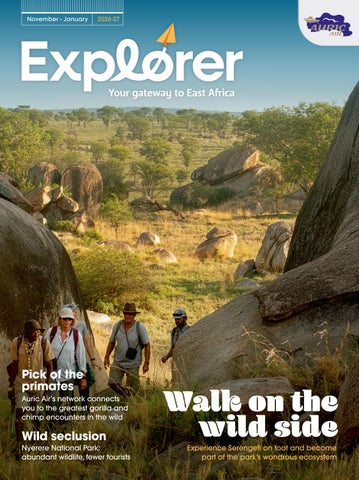
Experience Serengeti on foot and become part of the park's wondrous ecosystem
Read Explorer online: www.qrs.ly/cahj5g7
Contents 12 Foreword . . . . . . . . . . . . . . . . . . . . . . . . . . . . . . . . . . . 5 Auric Air news . . . . . . . . . . . . . . . . . . . . . . . . . . . . . 6 Serengeti walking safaris . . . . . . . . . . . . . . . . 8 Best primate adventures . . . . . . . . . . . . . . . . 12 Jay Mitta . . . . . . . . . . . . . . . . . . . . . . . . . . . . . . . . . . 16 Whale sharks of Mafia Island . . . . . . . . . . 18
24
Researchers Rest . . . . . . . . . . . . . . . . . . . . . . . . . 21 Ten reasons to go wild in Nyerere . . . . . . 24 Hidden Dar es Salaam . . . . . . . . . . . . . . . . . . 28 5 Tanzanian artists . . . . . . . . . . . . . . . . . . . . . . . 32 Auric Air fleet . . . . . . . . . . . . . . . . . . . . . . . . . . . . . 35 Auric Air destinations . . . . . . . . . . . . . . . . . . . . 37
28
Auric Air routes . . . . . . . . . . . . . . . . . . . . . . . . . . . 39
Ishan Goyal
Passenger information . . . . . . . . . . . . . . . . . . 40
auric@auricair.com
Explorer is published by: Land & Marine Publications (Tanzania) Ltd 5th floor, Josam House, Block A, along Coca Cola Road, Mikocheni Area, Dar es Salaam T: +255 686 118 816
Auric Air Services Ltd Plot 154, Block 'B' Malaika Road, Ilemela, PO Box 336 Mwanza, Tanzania
www.auricair.com
Editorial enquiries: markedwards@landmarine.com
www.facebook.com/auricair
Advertising sales: T: +44 (0)7714 448059 (WhatsApp) E: publishing@landmarine.com
The opinions expressed in this publication are not necessarily those of the editor, or any other organisation associated with this publication. No liability can be accepted for any inaccuracies or omissions. ©2026 Land & Marine Publications Ltd.
www.instagram.com/auricair
WhatsApp: +255 783 233 334 +255 746 986 123
www.x.com/auricair auric-air-services-limited
Head Office: Land & Marine Publications Ltd 6 The Square, Ipswich, Suffolk, IP5 3SL, UK Printed by Smart Printers Ltd, Nairobi Cover image ©African Environments
Your gateway to East Africa auricair.com
3
AURICAIR.COM
Your gateway to East Africa
Marking 25 years of East African adventures I’d like to welcome you on board your flight and to this special edition of Explorer. I hope the stories and destinations within these pages inspire your next adventure with Auric Air. This year, we are proud to celebrate our 25th anniversary. For a quarter of a century, we have connected travellers to some of East Africa's most remarkable destinations, helping create unforgettable adventures, cherished celebrations and lifelong memories. It is a legacy we are immensely proud of and one we look forward to building on for many years to come. Our journey began in 2001 with just a handful of light aircraft reaching remote bush and coastal airstrips. From those humble beginnings, Auric Air has grown into a modern fleet of 25 aircraft serving destinations across Tanzania and extending into Kenya, Uganda and Rwanda. As we have grown, we have been honoured to receive the trust of our passengers and recognition from the industry, including multiple consecutive awards as Tanzania's Leading Domestic Safari Carrier and Best Airline of the Year at the 2026 Africa Company of the Year Awards. This milestone belongs to everyone who has been part of our story. Thank you to every passenger who has flown with us, every crew member who has worn the Auric Air colours, and every partner and supporter who has helped us along the way. As we celebrate the memories of the past 25 years, we remain as excited as ever about the journeys still ahead. Here’s to the adventures we've shared, and to many more yet to come. Deepesh Gupta Director of Corporate Affairs
Your gateway to East Africa auricair.com
5
NEWS | EVENTS | PEOPLE
PL ACES | CULTURE | WILDLIFE
AURIC AIR WINS HISTORIC 10TH WORLD TRAVEL AWARD OUR NEW FLIGHT BOOKING APP IS HERE Planning your next journey with Auric Air is now even easier. Our official mobile app is now available for Android devices on Google Play, giving travellers quick and convenient access to essential travel services from the palm of their hand. With the new app, passengers can browse routes and fares, make flight bookings and payments, receive and download their tickets, and submit charter quotation and booking requests, all in one place. The launch marks another step in Auric Air’s commitment to enhancing the customer experience through innovation and convenience. Ready to fly? Search for ‘Auric Air’ on Google Play and download the app today. The iOS version will be available soon, bringing the same seamless experience to Apple users.
Auric Air has earned the prestigious title of Tanzania’s Leading Domestic Safari Carrier 2026 at the World Travel Awards Africa. This landmark achievement announced at the gala ceremony held at Diamonds Bijoux in Zanzibar on August 28, 2026 marks Auric Air’s 10th consecutive victory in the category, having claimed the award every year since 2016. The recognition reflects the airline’s unwavering commitment to connecting travellers with Tanzania’s most spectacular destinations through safe, reliable, and exceptional safari aviation services. The accolade adds to an already remarkable year. Earlier in 2026, Auric Air was also honoured with the Best Airline of the Year award at the Africa Company of the Year Awards (ACOYA), further cementing its reputation as one of the continent’s leading aviation brands.
Contact Auric Air
FLY WITH AURIC AIR We are dedicated to providing a travel experience that blends luxury, efficiency, and environmental responsibility. Book your next journey on our Pilatus PC-12 and discover the true meaning of flying in style.
+255 783 233 334
The Auric Air chatbot is available to answer your questions 24 hours a day, 365 days a year. Scan the code below or WhatsApp “Hello” to +255 783 233334 to get started
6
Auric Air
+255 746 986123
www.facebook.com/auricair
auric@auricair.com
www.instagram.com/auricair
www.auricair.com
auric-air-services-limited
WhatsApp: +255 783 233 334 www.x.com/auricair
TANZANIA | SERENGETI
you’re part of the ecosystem Exclusive walking safaris reveal the park's wildest landscapes, richest details and deepest connections. f you thought a walking safari in the Serengeti was impossible, think again. While stepping out of your vehicle is strictly prohibited across the park’s network of tracks, there is a little-known exception. Around three quarters of the Serengeti is designated wilderness zone, free from safari vehicles and permanent lodges, and accessible only through exclusive, highly supervised walking safaris. One of the few operators authorised to lead these on-foot expeditions is African Environments. Its director, Richard Beatty, was part of the reconnaissance teams that mapped routes through this remote and
8
Auric Air
TANZANIA | SERENGETI
untouched corner of the park in the 1990s. Speaking to Explorer, he explains how walking safaris offer a more immersive, sensory way to experience the Serengeti and why exploring Africa's most famous wilderness on foot reveals a side of the ecosystem few visitors ever encounter.
When they finally approved it, we were the first people allowed to walk in the Serengeti, and I was the first person in, which was a genuine adventure.
Q: How long has African Environments been running walking safaris?
A: It’s something that happens deep inside you rather than anything you can measure. On foot in the Serengeti, you're part of the ecosystem in a way that's almost alien to most of our clients, and I think that taps into something ten thousand years old in all of us.
A: Since the early 90s, long before anyone thought of it as a product category. It started in the Ngorongoro highlands and down at Lake Eyasi with the Hadza, and then in an area called Angata Kiti, just north of Olduvai Gorge on the edge of the Serengeti – multi-day trips with a mobile camp moving with the group each day. Because we were about the only company doing anything like it, Tanzania National Parks Authority (TANAPA) came to us when they were redrawing the General Management Plan for the Serengeti and asked us to think through how walking could work there.
Q: What's the biggest difference between exploring the Serengeti on foot and from a vehicle?
You’ll see less big game walking than driving, and there's no getting around that. But on the last five or ten walking trips I’ve done, we've had big game on every single one, and it hits you differently. I love telling people about the moment the guide stops the group dead and whispers: “don’t look, smell”.
Q: What do guests notice on foot that they might miss on a game drive? A: So much of it is the small stuff, and this is where our guides really come alive. Between them you get extraordinary detail: a five-centimetre hole in the ground that's round means a spider, oval means a scorpion, and each comes with an explanation of how it hunts and when. The guides are brilliant on birds too, picking out calls before you've even registered them, talking through habitat and feeding behaviour, getting the whole group hunting the canopy to spot whatever they've heard. You’ll come across dik-dik, bushbuck, mongoose, tortoises wandering across open ground going about their business. Q: What do guests gain from tracking wildlife on foot?
© African Environments
“I think it taps into something ten thousand years old in all of us.”
Your gateway to East Africa auricair.com
9
TANZANIA | SERENGETI
© African Environments
“It's a sense of being part of something larger than yourself. Your senses genuinely sharpen”
A: I think it’s solitude. These are always exclusive groups, you're guaranteed not to see another soul, and the lightweight camps sit under skies with no light pollution for hundreds of miles. It’s a sense of being part of something larger than yourself. Your senses genuinely sharpen – pace, sound, smell, the whole texture of the place. Sitting round the fire at night you'll hear a lion roar off to the left and another answer from somewhere off to the right, hyenas cackling behind you, and everything just going on around you in the dark. 10
Auric Air
Q: Where in the Serengeti can walking safaris take place? A: The areas we walk were closed to all tourism from when the park was created in the fifties, right through until that General Management Plan in the early 2000s opened certain zones specifically for walking. We favour the eastern side of the park because the landscape is so varied: open glades, woodland, rivers, gorges, kopjes, always something different to walk into.
These are vast areas, and as far as I know there are only two or three operators who've gone through what TANAPA requires to run multi-day walking in them. Q: How flexible are walking safaris? A: Because every trip is private and built for that specific group, the flexibility is about as complete as it gets. Over dinner that night the guide lays out what he knows of the surrounding country: kopjes to the west, a gorge to the north, a ridge with a view over some waterholes, and the group decides together
TANZANIA | SERENGETI Walking safaris combined with fly camping immerse visitors in the Serengeti
dome tents with standing headroom, proper cots with duvets, a mess tent, a roaring campfire, cold beer and good wine, and food that genuinely punches above its weight. Arriving at camp after a day’s walking is its own small ritual. The crew know people by name, remember who wanted a beer and who wanted coffee, and the guides will often deliberately not tell you camp is close, so you round a corner and it's simply there, waiting.
how far they want to go and in which direction. And the guide adapts constantly on the ground – a large herd of impala in the distance might mean a detour behind a ridge to get closer.
Q: How do the mobile camps work? A: The mobile camp is a much finer balancing act: light enough that our crew can strike it, drive it ahead in four-wheeldrive pickups, and rebuild it in a new spot within a day, but still giving people
then we bring in trainers from Southern Africa with decades of walking-guide experience to run them through further drills. Our guide leads at the front of the group armed, a National Parks ranger brings up the rear also armed, and touch wood we've never had to fire on an animal.
Q: What makes the nights so memorable?
But the gun is really the last line of a much longer chain – reading the bush, staying downwind, keeping a respectful distance, putting the group somewhere safe like the top of a kopje to watch elephants pass below.
A: Under those skies at night, with no city for hundreds of miles in any direction, the stars do something to people.
Q: What would you say to people nervous about walking among wildlife?
The Milky Way is properly visible rather than a rumour, and clients often ask, only half joking, whether Africa gets extra stars.
A: Walking through unfenced wilderness is daunting for most first-timers, and I wouldn't want to pretend otherwise – that’s honestly a large part of the appeal. What we owe them in return is genuine confidence in our ability to keep them safe. Nothing in the wild is ever entirely risk-free. Our job is to push that risk down as far as it will go.
The guides know the constellations and so, quite often, do the clients, and it turns into one of the best fireside conversations of the trip.
Q: How do guides keep guests safe? A: On the practical side, every lead guide has to pass a police firearms course focused above all on safe handling, and
But I’d say to anyone nervous about it: you will feel scared at moments, and that’s not a flaw in the experience, that’s the thrill of being properly alive out there. Your gateway to East Africa auricair.com
11
EAST AFRICA | PRIMATES
The ultimate East African
From the mist-shrouded forests of Uganda and Rwanda, where mountain gorillas reign, to the remote chimpanzee sanctuaries of western Tanzania and the secluded wilderness of Rubondo Island, Auric Air’s network connects you to the greatest region on earth for primate encounters in the wild.
ast Africa is one of the last great strongholds for wild primates, offering unforgettable encounters with mountain gorillas and chimpanzees in some of the continent’s most spectacular landscapes. Through Auric Air’s regional network, travellers can conveniently connect to gateway cities including Entebbe, Kigali and Mwanza, opening the door to some of Africa’s most rewarding primate adventures. Whether you dream of coming face-to-face with a silverback gorilla in misty mountains or tracking wild chimpanzees through ancient forests beside Lake Tanganyika, these experiences belong on every wildlife enthusiast’s bucket list.
12
Auric Air
BWINDI IMPENETRABLE NATIONAL PARK, UGANDA AURIC AIR DESTINATION: ENTEBBE
Primate: Mountain Gorilla How to get there: Fly with Auric Air to Entebbe then travel onwards to southwestern Uganda by domestic flight or road transfer to Bwindi Impenetrable National Park. Bwindi is a UNESCO World Heritage Site and protects nearly half of the world’s remaining mountain gorillas. Do: Join a guided gorilla trek through the rainforest. Visitors spend time tracking habituated gorilla families led by experienced
“These experiences belong on every wildlife enthusiast’s bucket list.”
Your gateway to East Africa auricair.com
13
EAST AFRICA | PRIMATES
rangers. The reward is a once-ina-lifetime encounter with these gentle giants in their natural habitat. Bwindi is also renowned for its biodiversity, birdlife and cultural experiences with local communities. Don't: Do not approach gorillas too closely, leave designated trails, or trek if you are feeling unwell. Mountain gorillas are highly susceptible to human diseases, and conservation rules exist to protect both visitors and wildlife.
VOLCANOES NATIONAL PARK, RWANDA AURIC AIR DESTINATION: KIGALI
Primate: Mountain Gorilla How to get there: Fly with Auric Air to Kigali, Rwanda. From Kigali, Volcanoes National Park is approximately a 2.5-hour drive through Rwanda’s scenic countryside.
The park lies within the Virunga Mountains and is one of Africa’s most celebrated gorilla trekking destinations. Do: Track one of the park’s habituated gorilla families through bamboo forests and volcanic slopes. Visitors are allowed a precious hour with the gorillas once located. While in the area, consider visiting the Dian Fossey research site or tracking golden monkeys. Don’t: Do not use flash photography, attempt to touch the gorillas or ignore ranger instructions. Rwanda's conservation success depends on responsible tourism and strict visitor regulations.
MAHALE MOUNTAINS NATIONAL PARK, TANZANIA AURIC AIR DESTINATION: KIGOMA (CHARTER)
Primate: Chimpanzee
“Visitors are allowed a precious hour with the gorillas once located.”
Mahale Mountains is home to habituated chimpanzees
How to get there: Reach western Tanzania through Auric Air's network and connect onwards to the Kigoma region. Mahale Mountains National Park sits on the eastern shores of Lake Tanganyika and is generally accessed by light aircraft and boat transfers due to its remote location Do: Embark on guided chimpanzee tracking through lush rainforest. Mahale is home to one of Africa's most significant chimpanzee populations and offers some of the continent’s finest primate viewing. The experience is enhanced by pristine beaches, crystal-clear waters and dramatic mountain scenery rising directly from Lake Tanganyika. Don’t: Do not expect a traditional vehicle safari. Mahale is explored on foot and requires a reasonable level of fitness. Visitors should also avoid making loud noises that could disturb wildlife or other trekkers.
14
Auric Air
EAST AFRICA | PRIMATES
GOMBE NATIONAL PARK, TANZANIA AURIC AIR DESTINATION: KIGOMA (CHARTER)
Primate: Chimpanzee How to get there: Fly through Auric Air's network and continue to the Kigoma area. Gombe National Park is located along Lake Tanganyika and is accessible primarily by boat, adding a sense of adventure from the very start. Do: Follow in the footsteps of the late Dr Jane Goodall, whose groundbreaking chimpanzee research began here in 1960. Guided treks offer excellent chances to observe chimpanzees interacting, grooming and foraging in the forest. The park also hosts baboons, red colobus monkeys and beautiful forest birds Don’t: Do not underestimate the terrain. Although Gombe is one of Tanzania’s smallest national parks,
its steep valleys and forested hills can be physically demanding. Wear proper footwear and follow ranger guidance throughout your visit.
RUBONDO ISLAND NATIONAL PARK, TANZANIA AURIC AIR DESTINATION: MWANZA
Primate: Habituated chimpanzees
A silverback sighting is one of the sought after wildlife encounters in Africa
The island also offers exceptional birdwatching, fishing, boat safaris and opportunities to spot sitatunga antelope, hippos and crocodiles. Don’t: Do not expect guaranteed sightings. Rubondo offers a more exploratory tracking experience than many mainland primate destinations. Patience, quiet observation and respect for the natural environment are essential for a rewarding visit.
How to get there: Auric Air flies to Mwanza, the gateway to Lake Victoria. From Mwanza, travellers can continue by light aircraft or boat transfer to Rubondo Island National Park, Africa’s largest island national park. Do: Experience one of Tanzania’s most unique conservation success stories. Chimpanzees introduced to Rubondo decades ago now thrive in the island’s protected forests, and visitors can join specialised chimpanzee tracking excursions.
Your gateway to East Africa auricair.com
15
KIGALI | JAY MITTA
Singeli pioneer Jay Mitta keeps pushing the Dar dance genre he helped create with his latest album, Kazi Kwanza. hile still in his teens, Jay Mitta was among the earliest artists making music at Sisso Studios – the tiny recording room in Mburahati in Dar es Salaam credited as the birthplace of the frenetic DIY dance music singeli. The sound of the Dar streets soon spread across East Africa and can now be heard in Europe’s coolest clubs. Mitta has been an ever-present during singeli’s rise as a producer, remixer and songwriter, but this year sees the release of his first solo album in seven years. Jay talks to Explorer about how Kazi Kwanza is the sound of where he is now, the early days of singeli, and his tireless work ethic. Q: Why did now feel like the right time to release a follow-up to your debut album? Seven years is a long time, but I was never stopping. I was in the studio every day, producing for MCs, playing shows in Tanzania and abroad, learning. I didn’t want
16
Auric Air
to release a second album just to release something. I wanted to wait until I had a sound that showed where I am now, not where I was in 2019. When I listened back to these tracks together, I knew this is the next step. Now is the time. Q: Can you take us back to when you first started making music? What equipment were
you working with then, and how has your setup evolved over the years? I started at Sisso Records, founded by the one and only DJ Sisso, in Dar es Salaam, just hanging around the studio, watching and learning. At that time it was very basic: a cheap computer with FL Studio, a small Casio keyboard, cheap speakers. With
The cover art for Jay's latest release, 'Kazi Kwanza'.
KIGALI | JAY MITTA
don’t understand Swahili. I wanted to make an album where the production is the star. Q: What does Kazi Kwanza mean? Kazi Kwanza means ‘work first’. Before talking, before money, before anything, do the work. This is how I live. I am in the studio every day, many hours. This album is the result of years of that work, many beats made and thrown away until I had these 13. It is also a message to young producers: if you work hard, people will see. Q: What are your favourite tracks on the record currently? ‘Sawa’ opens the album and sets the energy; it mixes Singeli with hardstyle. ‘Mwanzo’ is important because it is slower and more emotional, it shows another side of me.
singeli everybody started with what they could find. Today my setup is better – stronger laptop, good monitors, more sounds, and travelling has opened my ears to new tools. But the idea is the same: make the most with what you have. Q: Was Sisso Studios like a school for you? Exactly. Many young producers and MCs would come in every day, recording all night, making beats very fast for the vigodoro street parties. I remember sleeping on the floor of the studio, Singeli would literally enter my dreams. Honestly, at that time we didn’t think we were making history. We were making music for our people, for the mtaa. Q: Singeli has now been around for well over a decade and continues to evolve. What do you think has given the genre such staying power? Singeli comes from the street, from real life. It talks about what people live every day, and the energy
Q: What does the future look like for you following this album?
makes everybody dance. It is also very open: producers keep taking new sounds so singeli never gets old. We must constantly re-invent ourselves, find new samples, new approaches. We collaborate a lot with each other and now with artists from around the world. Q: You’ve worked extensively as a producer and songwriter for other artists, but this new album is entirely instrumental and focused on your own work. What made you decide to take that approach? When I make beats for MCs, the beat has to serve the voice. On this album I wanted the beat itself to speak. Playing in clubs and festivals in Europe, I saw people go crazy for singeli even when they
I want to take this album on stage as much as possible, in Tanzania, across Africa and internationally. I’ve played Nyege Nyege Mirror World in Brussels, many shows in Europe, soon Venice Music Biennale on invitation by Caterina Barbieri and then of course Nyege Nyege Uganda, November 19 to 22 that is always the highlight of my year. I also want to keep producing for young MCs and maybe build something to help the next producers in Dar.
To stream or download Kazi Kwanza, visit the Nyege Nyege page on Bandcamp at www.nyegenyegetapes.bandcamp. com/album/kazi-kwanza
Your gateway to East Africa auricair.com
17
TANZANIA | WHALE SHARKS
From October to March, the waters surrounding Mafia Island host one of the world's most remarkable wildlife spectacles. Let Auric Air take you there to swim alongside the Indian Ocean's gentle giants.
season is calling very year, the waters
surrounding Mafia Island become the setting for one of Tanzania’s most extraordinary wildlife experiences – the chance to swim alongside whale sharks, the largest fish in the ocean.
Every Whale Shark has a unique pattern of spots like a human fingerprint
Getting to the main island in the Mafia archipelago is easy with Auric Air flying three times daily from Dar es Salaam. Now is the time to visit. From around October through March, whale sharks are regularly sighted feeding near the surface in the plankton-rich waters around Mafia Island, particularly around Kilindoni Bay. The heart of the season generally
18
Auric Air
falls between November and February, making the coming months an excellent time to plan an island escape. Despite their enormous size, whale sharks are filter feeders, feeding mainly on plankton and other tiny marine organisms. Swimming and snorkelling alongside them in the warm Indian Ocean is one of Mafia Island’s signature experiences.
place in Kilindoni Bay, just off the island's western shoreline and only a short boat ride from Mafia's main town. Seasonal ocean currents further concentrate plankton here, creating ideal feeding conditions for these filter-feeding giants.
Why do whale sharks love Mafia Island?
As a result, the area has become one of the most consistent whale shark spotting sites in Africa, attracting researchers, photographers, divers and nature lovers from around the world.
Mafia Island sits close to the Rufiji Delta, where nutrient-rich waters support abundant plankton, the whale shark's favourite food. The most reliable sightings take
Remember: this is a wild animal encounter, not a staged attraction. Respectful behaviour protects both guests and the whale sharks themselves.
TANZANIA | WHALE SHARKS
Whale sharks can grow longer than a coach and weigh more than 20 tonnes, making them the largest fish species in the world. Every whale shark has its own fingerprint – a completely unique pattern of white spots, pale lines, and vertical stripes right behind the gill slits and above the pectoral fin. Scientists use photographs of these markings to identify and track individuals. Despite their enormous size, whale sharks feed almost exclusively on plankton, fish eggs and tiny marine organisms. They pose no predatory threat to humans. Researchers have identified hundreds of individual whale sharks around Mafia Island, with many returning year after year. Their unusually high residency makes the area one of the world's most significant whale shark research locations. Although whale sharks can migrate thousands of kilometres across oceans, many choose to spend extended periods feeding in the waters around Mafia Island. Whale sharks are classified as Endangered globally, making responsible tourism and conservation efforts increasingly important.
Swim responsibly Swimming with whale sharks is a privilege. Responsible encounters help ensure these magnificent animals remain protected for future generations. DO • Follow your guide’s instructions at all times • Approach calmly and quietly • Keep a respectful distance from the animal • Observe from the side rather than directly in front of its path • Use reef-safe sunscreen where possible • Enjoy the encounter without disturbing the shark
DON'T • Touch the whale shark under any circumstances • Chase, block or ride the animal • Dive directly underneath it • Make sudden splashes or loud noises • Use flash photography • Attempt to attract the shark with food
More than whale sharks Peaceful island beaches
Mangroves and hidden lagoon
Mafia receives a fraction of the tourist traffic of the Zanzibar archipelago to the north so beaches such as Kanga and Bweni are picturesque escapes.
Take a dhow or kayak through the Juani Island Channel with its dense canopy teeming with over 120 species of birds, including fish eagles and storks. Follow the waterway to the swimming sanctuary of Kua Lagoon (also known as ‘Blue Lagoon’ because of its crystal-clear waters) that is filled with large colonies of fascinating, non-stinging upsidedown jellyfish.
World-class snorkelling and scuba diving The waters of the protected Mafia Island Marine Park host over 400 species of fish and nearly 300 types of coral. Chole Bay on the southeast side of the island offers shallow, sheltered coral gardens while the outer reefs and walls feature dramatic drop-offs.
Whether you’re visiting for a weekend escape, an underwater adventure or a once-in-a-lifetime encounter with the world's largest fish, whale shark season is the perfect time to discover Mafia Island.
Your gateway to East Africa auricair.com
19
ARUSHA | RESEARCHERS REST
From academic hub to
US academic and author Professor Terrence McCabe reflects on his research years in East Africa when he was one of the early residents at Arusha guesthouse ‘Jo and Judith’s’. The lodge lives on as Researchers Rest, now open to tourists as well as academics. first came to Tanzania in 1989 after spending nearly a decade conducting research among Turkana pastoralists in northern Kenya. I came to Tanzania to lead a small team of researchers examining how conservation policy in the Ngorongoro Conservation Area (NCA) was impacting the household economy of local Maasai residents. I was thrilled to be able to conduct research in one of the world's most important and famous conservation areas and to examine the impact of wildlife conservation
on the livelihoods of local people. One of the lessons I learned early on was that first impressions can be deceiving. The lush grasslands of the high plains were dominated by a non-palatable bunch grass, Eleusine jaegeri, and cattle were exposed to many tick-borne diseases, especially East Coast fever. The intertwined issues of a growing human population, a livestock population that fluctuates, the spread of cultivation, wildlife conservation, and human well-being have been the focus of my research and continue to be so today.
I worked in the NCA for 12 years and then moved my research site to the rangelands bordering the eastern side of the Serengeti and now to the Simanjiro plains east of Tarangire National Park. One of the six bedrooms at Researchers Rest
Most of my work has been conducted as part of small interdisciplinary teams and while in the field we based our research activities out of small mobile camps. We currently have a more permanent camp outside of Tarangire, but life in camp with other researchers and our Maasai assistants has been one of the most rewarding
Your gateway to East Africa auricair.com
21
ARUSHA | RESEARCHERS REST
experiences of my life. Sitting around a campfire at night, talking about our research, hearing what our Maasai assistants thought of our findings, and listening to sounds of the African bush is something I will cherish forever.
The team behind the present-day Researchers Rest
The intellectual stimulation I received from conversations about research did not (and does not) stop when returning to our base in
“Conducting research in Tanzania has been one of the joys and privileges of my life. ” Arusha. In the early years we were able to stay at an informal guest house, known at the time as Jo and Judith’s. Jo Driessen ran a secretarial service in Arusha, which was first place that researchers could receive faxes, and I learned that Jo had a house in Sakina, about 3km from the city centre, where many researchers, especially those working in Serengeti, stayed while in Arusha. I talked to Jo about staying there, and she told me to come to the house the next day to meet her. I remember arriving at the back gate with my colleague Paul Leslie. We were interviewed not only about our work, but also
22
Auric Air
about what we liked to do and, essentially, whether Jo thought we, as social scientists, would be a good complement to the mostly wildlife researchers staying at the house.
Friends' venture Jo was an incredibly interesting person in her own right. Along with her childhood friend Judith Jackson, she had founded a bar and restaurant in Arusha and became well known throughout both the expatriate and Tanzanian communities. The restaurant was called Club Safi, Kiswahili for ‘clean’ or ‘good’, and many local people referred to her simply as Mama Safi.
ARUSHA | RESEARCHERS REST
Researchers Rest When Jo and Judith left Tanzania, they passed the running of the house to the local staff who had played such an important role in creating its warm and welcoming atmosphere. Today, the property operates as Researchers Rest, a guesthouse open to both short and long-term visitors seeking a unique base in Arusha One of the now more famous safari guides, Paul Oliver, lived upstairs and the house was often filled with researchers and visitors involved in the safari business from all nationalities. The conversations around the dinner table and afterwards in the sitting room among the mixture of expats and Tanzanians were lively, to say the least. Discussions often revolved around conservation policies, tourism, wildlife and Maasai livelihoods. Of course, we all did not always agree, and being able to informally discuss and sometimes argue our various points of view was something that could not be replicated in any university or conference setting.
New era Jo Driessen died a few years ago, and the house transitioned into an official bed and breakfast with the name Researchers Rest. A number
of the researchers who used to stay at Jo and Judith’s while in Arusha still stay there as do tourists. Interesting conversations still happen around the dinner table, and tourists can gain an insight into what is happening in northern Tanzania that they cannot get from even most informed tour guides. I still have close ties with faculty at the University of Dar es Salaam and am extremely grateful for their support. I am also grateful to the various government agencies that gave me permission to conduct this research, especially the Tanzania Council on Research and Technology. Conducting research in Tanzania has been one of the joys and privileges of my life. Of course, none of this would have been possible without the support of the Maasai people, and our Maasai research assistants.
With just five guest rooms, the house retains the intimate, community-focused spirit that made Jo and Judith's such a memorable place to stay. Communal dinners, prepared using fresh ingredients from the on-site herb and vegetable garden, continue to bring guests together while the sitting room, lined with books collected over the years including some by previous residents, offers further opportunities for conversation. While the name, ownership and guest list may have changed, the spirit of the house remains much the same: a place where people from different backgrounds come together, exchange ideas and leave with a deeper connection to northern Tanzania. To find out more or to book a stay, visit www.theresearchersrest.com/en-GB
Your gateway to East Africa auricair.com
23
24
Auric Air
NYERERE
Swap the predictable for river-level thrills, ranger-led rambles and a safari with room to breathe in Tanzania’s biggest national park.
Think big. Really big Nyerere’s 30,000 square kilometres of southern Tanzanian wilderness may be far larger than famous northern circuit parks like the Serengeti, but it receives a fraction of the visitors. This means you can go on game drives or boat safaris and watch wildlife without crowds of other safari vehicles around you. Nyerere gives “getting away from it all” a whole new scale.
Bring binoculars for the birds More than 430 bird species have been recorded, with fish eagles, bee-eaters and wetland waders adding colour and drama along the Rufiji.
Your gateway to East Africa auricair.com
25
NYERERE
Look for painted predators Nyerere is one of East Africa’s strongholds for African wild dogs. As part of the greater Selous ecosystem, the park provides the vast, unfenced, and undisturbed wilderness that wide-ranging wild dog packs require (individual packs often cover territories of 500 to 1,500 square kilometres). Nyerere is estimated to hold roughly 800 to 1,300 wild dogs, representing a major share of the global population. Visitors have the chance to witness high-energy communal behaviour of these endangered canines, including coordinated dawn hunts through the miombo woodlands and seasonal denning activity.
Take the river route The Rufiji River is the lifeblood of the park, creating a maze of oxbow lakes, channels, and sandbanks. It is one of the few places in Tanzania where you can experience boat safaris – letting you glide past massive pods of hippos, basking crocodiles, and elephants drinking at the water's edge.
Get your big-game fix Nyerere is home to an abundance of big game, including around 20,000 elephants – one of the largest populations in Africa frequently seen drinking or wallowing near the Rufiji River. Here you’ll also find huge herds of buffalo. Predators include prides of lions (numbering around a thousand or more) that are frequently spotted on morning drives, particularly near lakes and water sources. Other big cats include leopards in the dense riverine woodlands and he occasional cheetah. 26
Auric Air
Put your boots to work Unlike many other national parks in Tanzania where walking is heavily restricted or not permitted, Nyerere is famous for offering some of the best foot safaris in the country. Every walk is led by a professional natural-history guide and an armed park ranger. These walking safaris reveal tracks, plants and the intricate ecology of the bush. Slow down. Tune in.
NYERERE
Diverse habitats Miombo woodland, riverine forest, open grasslands, floodplains and oxbow lakes create a spectacular habitat mosaic, each supporting different wildlife communities.
Follow the water Seasonal changes shape animal movements, with wetlands becoming wildlife hubs and the plains and woodlands hosting grazers and predators through the dry months. go Here, the landscape helps tell you where to look.
Sleep on the wild side Andy Soloman / Shutterstock.com
For an adventure that doesn’t end at sundown, try fly camping. Sand Rivers Camp has a light-filled lodge on the banks of the Rufiji, but it also offers guests the opportunity to swap the swap the lodge for a simple bush camp, with a bedroll beneath mosquito netting, a bucket shower and supper by the fire. Fall asleep to the night sounds of the bush, with stars overhead. Visit www.nomad-tanzania.com/camps/southern-tanzania/nyerere-national-park/sand-rivers for more details
Fly straight into adventure Auric Air’s daily scheduled flights from Dar es Salaam and Zanzibar make this remote wilderness readily accessible, trading a long overland journey for a scenic flight. Less transfer. More safari.
Your gateway to East Africa auricair.com
27
EXPLORE | DAR ES SALAAM
Looking for the best things to do in Dar es Salaam beyond the usual tourist trail? From forest sanctuaries and mangrove-lined waterways to experimental arts spaces and standout restaurants, five locals share the places that reveal a different side of Tanzania's largest city.
28
Auric Air
EXPLORE | DAR ES SALAAM
TO RELAX IN NATURE…
Sacred Space @sacredspacedsm
Chosen by award-winning photographer Daniel Msirikale @thattanzanianguy on Instagram
TO ENJOY A MANGROVEFRINGED COASTLINE…
“I’ve lived in Dar for years and one of my biggest qualms with this city is its lack of green spaces. And so it was a pleasant surprise to discover Sacred Space. You pass through the gates, and it genuinely feels like you’ve stepped through a portal. Suddenly you’re walking beneath baobabs and forest canopies, along trails surrounded by wildlife, agroforestry and a remarkable biodiversity. There’s always something to notice or learn about. What makes it even more special is knowing that the space exists as a conservation project, created not just to protect nature, but to give people in Dar a way to experience and understand it. It’s one of those hidden gems you almost don’t want to tell people about.”
Mbezi Beach mangroves Chosen by Gefrida Luvuya, founder of Tanzanian eco-conscious travel and tour agency Marine Adventures @gefrida on Instagram Mbezi Beach is a scenic, upscale coastal neighbourhood on the northern side of Dar es Salaam. Known for its sandy beaches, it also has tidal mangrove ecosystems that are vital in protecting the coastline. “I love this hidden side of Dar because it offers a slower way to experience the coast. The inlets allow for kayaking, stand-up paddleboarding, birdwatching and wellness on calm waters while surrounded by beautiful mangroves.”
Your gateway to East Africa auricair.com
29
Find us online www.facebook.com/auricair www.instagram.com/auricair www.x.com/auricair auric-air-services-limited
EXPLORE | DAR ES SALAAM
TO SAVOUR A MEAL…
Sala Thai @salathai.dar TO EXPLORE A HISTORIC BUILDING…
Atiman House Chosen by Mejah Mbuya, managing director of AfriRoots, an eco-minded African-owned cycling tour company @afriroots on Instagram “Near Dar es Salaam’s ferry terminals stands one of the city's oldest surviving buildings. Built in the 1860s as a harem for Sultan Majid of Zanzibar, the founder of Dar es Salaam, it later became the headquarters of the Missionaries of Africa, better known as the White Fathers for their distinctive white robes. Today the building is named after Tobias Atiman, a former slave from present-day Malawi who was freed by the White Fathers and supported through medical training. He went on to serve communities across East Africa as a doctor for more than six decades, earning widespread respect for his work. A small museum inside the building tells the story of his extraordinary life while offering a window into the city’s complex colonial and pre-colonial history.”
Chosen by architect and culinary enthusiast Belinda Mkony @forkyourmunchies on Instagram
“Tucked in Masaki, Sala Thai serves up genuine Thai and continental fare crafted by Thai chefs who make each sauce from scratch. The result is bold, beautifully balanced flavour that feels like a trip to Southeast Asia in every bite. Don’t miss the Tom kha kai – a fragrant, coconutty bowl that’s pure comfort on a rainy day. With breakfast, lunch, and dinner on offer via dine-in, delivery, or takeaway, it's an easy favourite any time of day.”
TO SAMPLE THE CITY’S UNDERGROUND CULTURE…
Bongo Fiction Chosen by Jesse Mpango, a director of Dar-based curatorial arts collective Ajabu Ajabu @ajabuajabu on Instagram This new venue in Kinondoni hosts film screenings, poetry readings, dramas, and art installations that showcase the emerging creative talent in East Africa. “Bongo Fiction reveals how art can bring language to our rapidly changing city. Through cinema, sound, performance and live translation, it brings artists and audiences together, drawing on humour, improvisation and everyday encounters to imagine new ways of living together. Recent events have included a program hosted by Poetry 255 and a collaboration with the University of Dar es Salaam history department. Follow the schedule at @bongofic on Instagram.”
Your gateway to East Africa auricair.com
31
ART | TANZANIA
YOU NEED TO SEE IN TANZANIA A journey into the richness of Tanzanian art through five works old and new chosen by Florence Mwendapole, the co-founder of interdisciplinary art platform Wasafiri Creative Works. Not a Tinga Tinga painting in sight.
MASHETANI
By Kashmir Mathayo What does it look like? Carved from a single piece of African blackwood, the sculpture depicts a tangle of hybrid creatures that appear to be emerging from, consuming or merging with one another. A frog-like figure sits atop a long-legged beast with an elongated jaw lined with teeth, while other distorted forms twist around them. Why is it so special? The work draws on Makonde traditions and stories of supernatural spirits known as shetani. Its creatures are at once unsettling and fascinating, embodying the imagination and technical mastery for which
32
Auric Air
Makonde sculpture is renowned. Despite being installed in the museum relatively recently, the work feels timeless. Where to see it National Museum, Dar es Salaam Artwork details Materials: African blackwood (possibly mpingo) Year: 2001
ART | TANZANIA
VINYWA VYENYE NJAA (Hungry Mouths) By B. N. Desai What does it look like? Eleven figures occupy the canvas, most of them children. Several face away from us, their ribs visible beneath thin skin. A child curls into a foetal position on the ground while two adult men sit nearby, surrounded by sparse belongings and an expanse of darkness.
vessels and the dark background. What looks at first like a scene of rest quickly reveals itself as one of exhaustion and defeat, confronting viewers with the human cost of deprivation.
Why is it so special? Hungry Mouths is both arresting and deeply unsettling. Everything in the composition speaks of scarcity: the bodies, the empty
Artwork details Materials: Acrylic on canvas Year: 1970 Dimensions: Approximately 66cm × 99cm
Where to see it National Museum, Dar es Salaam
KATI YA IMANI NA HOFU (Between Faith and Fear) By Undare Mtaki
What does it look like? A woman stands calf-deep in a golden body of water, her back turned to us. She lifts her dress as though trying to keep it dry, while her shadow appears to dissolve beneath her. The painting's textured surface creates an almost pixelated effect that reveals new details the longer you look. Why is it so special? Undare's work is often compared to Gustav Klimt's, but I find the resemblance largely superficial. This piece reminded me more of the dream sequence in Shutter Island where Dolores disintegrates into ash. The endless gold creates a dreamlike atmosphere, making this a work that rewards slow looking and repeated visits. Where to see it Undareytopia Gallery, Mbezi Beach Artwork details Materials: Acrylics, recycled tissue paper and sand on canvas Year: 2025 Dimensions: 190cm × 156cm
Your gateway to East Africa auricair.com
33
ART | TANZANIA
UNTITLED
(Abstract) By Ritha Konga What does it look like? Against a vivid red and yellow background stands a humanoid figure formed from a single vertical black stroke that breaks into angular, geometric limbs. A second, female-like form occupies the space beside it, creating a scene that feels both symbolic and mysterious. Why is it so special? At first glance, the central figure reminded me of the cover artwork of Présence Africaine from 1947, particularly in its geometric treatment of the legs. Konga's painting resists straightforward interpretation, drawing viewers into its strange visual language. It is one of two abstract works by the artist held in the National Museum's permanent collection. Where to see it National Museum, Dar es Salaam Artwork details Materials: Acrylic on canvas Year: Unknown Dimensions: Approximately 110cm × 88cm
UNTITLED What does it look like? This wooden sculpture changes character depending on where you stand. From one angle it resembles an exaggerated male form, from another a double-sided arrow balanced on a question mark. Sharp bends and smooth curves give it a striking sense of movement.
and scale recall the work of celebrated Tanzanian sculptor Big Mama (Mwandale Mwanyekwa), while remaining entirely its own. It's a piece that invites curiosity rather than offering easy answers.
Why is it so special? The most engaging artworks leave room for interpretation, and this sculpture does exactly that. Its unusual form
Artwork details Materials: Wood Year: Unknown Dimensions: Approximately 165cm high
Where to see it Undareytopia Gallery, Mwezi Beach
Wasafiri Creative Works develops and showcases new works in film, literature, design and art. To explore its curated works, visit www.wasafiricreativeworks.com
34
Auric Air
AURICAIR.COM
Your gateway to East Africa
Our fleet Our fleet of 27 planes is built for adventure. With short take-off and landing capabilities, they reach destinations that larger aircraft can't. Here's a closer look at what's in the hangar.
Cessna Grand Caravan C208B/EX
De Havilland Canada Dash 8-100/200
Pilatus PC-12 NUMBER OF AIRCRAFT IN FLEET: 2
NUMBER OF AIRCRAFT IN FLEET: 14
NUMBER OF AIRCRAFT IN FLEET: 2
MAXIMUM RANGE: 1,137 NM
MAXIMUM RANGE: 912 NM
MAXIMUM RANGE: 1,148 NM
MAXIMUM CRUISE SPEED: 280 KNOTS
MAXIMUM CRUISE SPEED: 185 KTAS
MAXIMUM CRUISE SPEED: 270 KNOTS
MAX OCCUPANTS: 12
MAX OCCUPANTS: 37
MAX PASSENGERS: EIGHT WITH SIX EXECUTIVE SEATS
Cessna Grand Caravan C208B NUMBER OF AIRCRAFT IN FLEET: 4 MAXIMUM RANGE: 1,070 NM MAXIMUM CRUISE SPEED: 185 KTAS MAX OCCUPANTS: 12
Safety and maintenance Our entire fleet is meticulously maintained by reputable service providers at Wilson Airport, Nairobi. With approvals from the Kenya Civil Aviation Authority‚ the Tanzania Civil Aviation Authority‚ they ensure the highest standards of safety and reliability. All engineers in charge of maintaining the aircraft are appropriately licensed having attended approved aircraft type-rating courses with considerable practical experience ensuring all aircraft are looked after by the best of personnel.
De Havilland Canada Dash 8-300
Executive Cessna Grand Caravan C208B/EX
NUMBER OF AIRCRAFT IN FLEET: 2
NUMBER OF AIRCRAFT IN FLEET: 3
MAXIMUM RANGE: 1,490 NM
MAXIMUM RANGE: 912 NM
MAXIMUM CRUISE SPEED: 287 KNOTS
MAXIMUM CRUISE SPEED: 185 KNOTS
MAX OCCUPANTS: 50
MAX OCCUPANTS: 10
Your gateway to East Africa auricair.com
35
BOOK YOUR FLIGHT ONLINE | AURICAIR.COM
Our destinations
Our 15-strong network of destinations connects with some of the most remote and unforgettable attractions across Tanzania and beyond. Here’s where we fly.
Dar es Salaam What began as a humble fishing village is now the biggest and busiest city in Tanzania. Dar es Salaam is where you can experience the fusion of the Swahili culture and modern life. The culturally diverse city has a vibrant community with thriving food, music and art scenes. Here you can get a hit of city life and a toes-in-the-sand slice of the beach all in one.
Entebbe The Ugandan city on the shores of Lake Victoria is the gateway to a host of primate adventures such as mountain gorilla trekking in Bwindi National Park and boat rides to Ngamba Island Chimpanzee Sanctuary, which protects orphaned chimps
Iringa Time spent in this tranquil town in the southern highlands of Tanzania reveals a rich historical background – battles were fought here during German colonial times and the world wars – as well as insight into traditional African culture. It can also be the base for safari adventures with Ruaha National Park close by. Rwanda
Kahama Once a modest settlement in north-western Tanzania, Kahama has grown into a bustling town, shaped by the region’s gold mining industry. Today, Kahama offers a blend of energetic urban life and authentic Tanzanian hospitality. The town’s lively markets, local eateries, and welcoming atmosphere provide a window into daily life in the Shinyanga region.
Mafia Island
Kigali More gorilla adventures can be pursued in Rwanda. The country’s capital, Kigali, is one of Africa’s most progressive cities as well as being the launch pad for trips to Volcanoes National Park where wild gorillas live among the high forest of the Virunga Mountains – a dramatic backdrop for the trekking experience.
Lake Manyara The beautiful, bijou Lake Manyara National Park is dominated by its titular soda lake that takes up almost two thirds of the park during the wet seasons and attracts vast flocks of flamingo, pelican and more than 130 more species of birds. It comprises a diverse range of habitats with herds of elephant, Lake Tanganyika
giraffe, baboons and impala roaming the grass and woodland while its forests contain all manner of monkeys as well as tree-climbing lions.
Lake Natron
Auric Air now flies into Engaresero Airstrip, providing direct access to the iconic blood-red waters of Lake Natron in northern Tanzania. The highly alkaline soda lake is inhospitable to most flora and fauna, but lesser flamingos are uniquely adapted to its extreme conditions and gather here in their millions to breed and feed. Flights also provide convenient access to nearby Ol Doinyo Lengai, an active volcano that offers one of Tanzania's most distinctive and challenging climbs.
Lake Tanganyika A trip to Tanzania’s deepest lake opens up the country’s remote west. Here you can dive or snorkel to explore the lake’s unique marine life or take longer canoe and trekking adventures into the Mahali Mountains, renowned for its wild chimpanzees.
36
Auric Air
Your gateway to East Africa WhatsApp: +255 783 233 334 +255 746 986 123 auric@auricair.com www.auricair.com
Mafia Island
Mwanza
The waters surrounding the Mafia archipelago are protected so its pristine reefs teem with marine life and offer some of the best diving experiences in East Africa. Giants of the sea such as whale sharks and humpback whales are also regulars here.
Masai Mara This protected reserve in southern Kenya is one of the best places in the world to observe animals in the wild. Its sprawling plains are home to the Big Five‚ there are hippos and crocodiles in the rivers‚ and more than 500 species of birds. The reserve is particularly famous for its big cats—lions‚ leopards‚ and cheetahs. While the wildlife viewing at almost any time of the year is superb‚ the Masai Mara is best visited during the months of the Great Migration‚ when millions of zebra‚ wildebeest‚ and gazelle make their way north into the park from the Serengeti‚ crossing the Mara River in search of fresh grazing. Serengeti
Tanzania’s second city hugs the southern shores of Lake Victoria with its iconic coastline of gigantic granite rocks. The city centre is a bustling place with markets galore. For escapes into nature, you can take boat trips on the lake or take a ferry trip to Ukerewe Island with its lush forests. Mwanza can also be the starting point for safari trips into Tanzania’s world-famous Northern Circuit.
Nyerere National Park Nyerere National Park is Tanzania’s newest and now largest national park, yet tucked away in the country’s southern wilderness it is something of a hidden gem. Its rivers and lakes are the lifeblood of the park that hosts some fabulous game‚ including elephants‚ wild dogs‚ buffalo‚ hippo‚ crocodiles‚ and fantastic prides of lions.
Pemba Pemba is the second-largest island of the Zanzibar archipelago and provides a lush, lowkey alternative to its larger neighbour, Unguja. Nicknamed ‘The Green Island’, Pemba is renowned for its fertile soil with its clove and vanilla plantations securing it global trading renown. Ringed with pristine beaches and reefs and with a forested interior that is home to endemic birds and mammals, Pemba is a haven for nature lovers.
Ruaha National Park This massive national park is ideal if you want to escape the crowds. Here you can enjoy outstanding levels of wildlife – some of the country’s largest
prides of lions and herds of elephants call Ruaha home – with almost no other vehicles around.
Rubondo Island This island in the southwest corner of Lake Victoria has national park status with colobus monkeys, elephants, giraffes, hippos and crocodiles enjoying its sanctuary. As well as its animal adventures, the island is a true wild getaway with deserted beaches and virgin forest to explore.
Serengeti With access to the hot-spots of the Great Migration and some of the largest concentrations of African wildlife – including more wild lions than anywhere else in the world, the Serengeti takes safaris to another level. The park welcomes almost a hundred thousand tourists every year.
Tanga In colonial times, this port city in northern Tanzania headed East Africa’s trade links with the world. Now it has a more sleepy, laidback appeal, offering charming insights into the Swahili lifestyle. It also provides access to the East Usambara Mountains and the beaches of Pangani.
Zanzibar Island
Zanzibar’s main island, Unguja, has become one of Africa’s most popular tourist attractions. Resorts pepper its spectacular beaches while its historic centre, Stone Town, is a living museum of its trading heyday as well as vibrant proof of the cosmopolitan Swahili culture with its exciting food, music and arts scenes.
Your gateway to East Africa auricair.com
37
Your gateway to East Africa
AURICAIR.COM
Our routes
NEW ROUTES
Lake Natron Nachingwea
UGANDA Entebbe
Lake Victoria
RWANDA
Masai Mara and Serengeti route
Migori
Masai Mara
Tarime
Musoma
Kigali
Lake Natron
Mwanza Rubondo Island
KENYA
Kisumu
Serengeti National Park Lake Manyara National Park
Kahama
Chem Chem
Arusha
Tarangire National Park Tanga
Lake Tanganyika
Pemba Island
Pangani
TANZANIA
Saadani National Park
Zanzibar
Dar es Salaam
Ruaha National Park
Mafia Island
Iringa
Nyerere National Park (Selous Game Reserve)
Nachingwea
Plan your next journey with Auric Air Auric Air chatbot is available to answer your questions 24 hours a day, 365 days a year. Scan the code or WhatsApp "Hello" to +255 783 233334 to get started.
+255 783 233 334
WhatsApp: +255 783 233 334
www.facebook.com/auricair
+255 746 986 123
www.instagram.com/auricair
auric@auricair.com
www.x.com/auricair
www.auricair.com
auric-air-services-limited
Your gateway to East Africa auricair.com
39
Your gateway to East Africa
Passenger information
AURICAIR.COM
Need help? Auric Air chatbot is available to answer your questions 24 hours a day, 365 days a year. Scan the code or Whatsapp “Hello” to +255 783 233334 to get started.
Everything you need to know to get your journey with us off to a smooth start.
Aleksandra Tokarz / Shutterstock.com
notification is received by up to 24 hours before the flight‚ Auric Air can transfer your booking‚ at a cost of 50 per cent of your ticket basic cost‚ to the next available flight but has no responsibility whatsoever for any related extra costs. If seats are not available‚ no refunds will be made. You are advised to ensure that your travel insurance covers such situations. Details of any amendment or a cancellation must be sent by email to reservations@auricair.com
Check-in times
Baggage Baggage allowance for each passenger is 20kg (inclusive of hand baggage‚ cameras‚ filming equipment and any other personal item including loose clothing). Hard suitcases are allowed, but the dimension of individual items of luggage should not exceed dimension of 90cm in length, 65cm in width and 35cm in depth. If passengers anticipate they will have excess baggage‚ excess baggage is bookable in advance in slabs of 10kgs. The excess baggage cost is between US$ 30 and US$ 60 depending on destination. A maximum of four slabs (40kgs) additional luggage can be booked per person. For more than 40kgs‚ a freight seat at child fare is to be booked‚ which will permit a carriage of an extra 75kgs
40
Auric Air
There is a complimentary secure store at our Dar es Salaam airport office. Please enquire in advance.
Bookings You can make payment online by credit card or mobile money at the time of making your booking. Alternatively‚ email reservations@auricair.com for other payment options such as credit card payment links or bank transfer options. Children aged between two and 11 years (inclusive) are charged 75 per cent of the applicable adult fare. Infants under two years of age are not charged providing they are not occupying a seat. Infants are not entitled to baggage allowance.
Missed flights No-show passengers will be required to book and pay for new tickets. If prior
The latest Check-in time for all passengers is strictly 60 minutes before flight time. Auric Air reserves the right to depart up to 15 minutes ahead of the scheduled departure time if passengers are not present at the place of departure by that time. Auric Air has no responsibility for direct or indirect costs resulting from passengers missing a flight due to non-compliance‚ for whatever reason‚ with the above check-in times. Auric Air operates from Terminal 1 at Julius Nyerere International Airport in Dar es Salaam.
Flying when pregnant A woman with an uncomplicated pregnancy and clearance from their doctor can board flights up to the end of the 30th week of pregnancy. A doctor’s certificate or clinical card must be provided and Part 1 of our MEDI form must be completed by the passenger. They then have to be seated on the last single seat near to the emergency door.