LandEscape Contemporary
A r t
R e v i e w
Anniversary Edition
ART
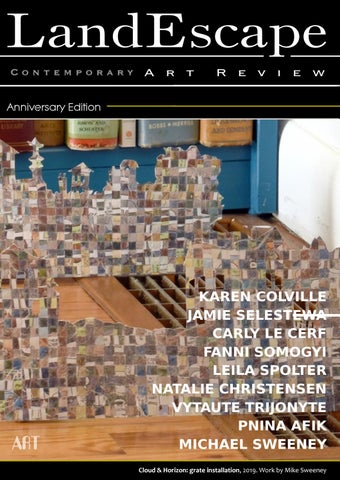
KAREN COLVILLE JAMIE SELESTEWA CARLY LE CERF FANNI SOMOGYI LEILA SPOLTER NATALIE CHRISTENSEN VYTAUTE TRIJONYTE PNINA AFIK MICHAEL SWEENEY Cloud & Horizon: grate installation, 2019. Work by Mike Sweeney
scape
Land
SUMMARY
CONTEMPORARY ART REVIEW
C o n t e m p o r a r y
A r t
R e v i e w
Pnina Afik
Michael Sweeney
Jamie Selestewa
Leila Spolter
Fanni Somogyi
Natalie Christensen
Israel
USA
USA
USA
Hungary / USA
USA
I have been occupied for many years with the issue of man within limits and frameworks. Questions I have been asking myself have leaded me to paint people within a frame work within the canvas/wood panel.After numerous years of painting this subject, I felt that the figures in my paintings should be freed from the inner frame, and so I started the series of "Little People".This series shows tiny figures walking on a floating surface, an imaginary landscape, maybe even surrealistic.
To my strength, and sometimes detriment, I am an associative thinker. Thus, my approach to visual projects is akin to those writers who assert that their characters tell them what will happen as they develop their novel. As an artist, I am influenced by processes and approaches from both Art and Craft. I value the slowness of hand production and the presence of mind and reflection that can occur while working.Most recently, I have been engaging ideas about how each of us recognizes what we know, as well as an interest in the process of seeing accurately in a noisy world.
Jamie Selestewa was born in Flagstaff, Arizona in 1981 and raised in Tuba City, Arizona. She received a Bachelor of Science degree from Northern Arizona University in advertising with a minor in graphic design. Jamie’s visual style has been greatly influenced by her artist father and her Native American Hopi heritage. She has been creating art for a number of years, with many techniques learned both from her father and from her time in school. Jamie’s work has been featured in numerous art exhibits that showcase her often simplistic color schemes and yet dramatic style of works.
I am creating a collection of artwork featuring cacti that look like vibrators as a way to challenge the image of female sexuality that has been packaged for men by the patriarchy.
Themes that often occur in my work are networking systems, modes of connection and acts of remembering.
Special Issue
They will be displayed in a space designed to look like a boutique plant store. These works exist outside of patriarchal frameworks because they display a defense mechanism which challenges viewers to reflect upon their assumptions of art, sex, and sexuality.
Natalie has shown her work in London, Berlin, New York and Los Angeles. She was one of five invited photographers for “The National 2018: Best of Contemporary Photography” I investigate how humans at the Fort Wayne Museum of Art and was recently named and technology have one of “Ten Photographers to developed a symbiotic relationship, which results Watch” at the Los Angeles in the constant presence of Center for Digital Art. Her smart devices in one’s life, photographs are in the permanent collections of the by drawing comparisons Fort Wayne Museum of Art to similar relationships in and the University of Texas at nature. One of these Tyler. Natalie is represented systems that I reference by Turner Carroll Gallery in continuously is the fungal- Santa Fe, New Mexico, Susan tree-root network. Spiritus Gallery in Newport Beach, California, and Galerie Processes such as metal Minimal in Berlin, Germany. and digital fabrication, and When Natalie isn’t looking for image projections are photos behind forgotten integral to my work. These shopping centers you can find include welding, aluminum her checking her Instagram casting and image feed while hiking the manipulation. mountains around Santa Fe.
Land
SUMMARY
scape
CONTEMPORARY ART REVIEW
Michael Sweeney
4
lives and works in the United States
32
Pnina Afik lives and works in Burgata, Center, Israel
Vytaute Trijonyte
56
lives and works in
Leila Spolter
78
lives and works in the United States
Natalie Christensen
102
lives and works in the United States
Fanni Somogyi Karen Colville
Carly Le Cerf
Vytaute Trijonyte
USA
United Kingdom
Lithuania
Karen today, rides a green eco bicycle in her local community, she teams up with a driver guide , artist colleagues to access natural settings of mountains and Oceans, that I learned to use art (specifically painting) as a catalyst for healing... and later, as a way to share my passion for nature.
I am a contemporary landscape painter, developing works that are drawn from emotional responses to the landscape that surrounds me.
I stayed at a Marine Biologist’s cabin as an Artist- in residence, Vancouver Island, Coast Salish Sea, Provincial Parks in Canada that brought back my strong passion for the environment,with drawing and painting.
Texture is a theme embedded in my practice, where I explore its dynamic potential through building up and carving back; a dance between control and unpredictability revealing the sculptural quality of wax, oil and pigment.
In her work, Vytautė Trijonytė examines individual and collective memory revolving around cultural identity. She was born and grew up in Kaunas in Lithuania. Growing up in I strive to evoke memory suburbia formed her initial and emotion through close and intimate intuitive layering and relationship with nature carving, evolving to become which resembles in her seductive and tactile works. practice. The interest in photography was cultivated during her teenage years after the death of a grandfather who used to be a professional photographer in Kaunas. He eventually turned into the main inspiration to develop a career as an artist.
128
lives and works in Baltimore, MD, USA
152
Carly Le Cerf lives and works in Mount Barker, Australia
Jamie Selestewa
170
lives and works in Flagstaff, AZ, United States
193
Karen Colville lives and works in Vancouver Canada
Special thanks to Haylee Lenkey, Martin Gantman , Krzysztof Kaczmar, Joshua White, Nicolas Vionnet, Genevieve Favre Petroff, Sandra Hunter, MyLoan Dinh, John Moran, Marya Vyrra, Gemma Pepper, Michael Nelson, Hannah Hiaseen and Scarlett Bowman, Yelena York Tonoyan, Miya Ando, Martin Gantman , Krzysztof Kaczmar and Robyn Ellenbogen.
Special Issue
Land
scape
CONTEMPORARY ART REVIEW
LandEscape meets
Michael Sweeney To my strength, and sometimes detriment, I am an associative thinker. Thus, my approach to visual projects is akin to those writers who assert that their characters tell them what will happen as they develop their novel. As an artist, I am influenced by processes and approaches from both Art and Craft. I value the slowness of hand production and the presence of mind and reflection that can occur while working. Most recently, I have been engaging ideas about how each of us recognizes what we know, as well as an interest in the process of seeing accurately in a noisy world. I am currently pursuing two projects: Cloud & Horizon (begun in 2019) and The Books of Things We Do Not Know (begun in 2014). Both deal with aspects of knowing. Cloud & Horizon, a project consisting of numerous woven paper cutouts, was sparked by the ubiquitous metaphor of “the Cloud” that the Tech world has successfully incorporated into our social consciousness. This digital “Cloud” exists as a virtual climate, a mass of data that we abide in, we add to, we allow to structure much of our social, societal and cultural weather. Like weather, it is transient and uncertain - able to provide comfort or to strike worry and fear. A digital climate and landscape, like a physical one, provides context by having diverse effects, personality, agendas, and relationships. And so this project began by weaving the metaphor of “the Cloud” into a physical form. All beings are effected, formed, and influenced by their context. In this sense, “landscape” and “the Cloud” can be considered similar in kind - each are contexts that we both live within and form. When close, clouds (real and digital) are big, but not the only elements in the landscape. Their scale and influence is seen in their relationship to other things. After weaving clouds as an analogy to the digital cloud, I began to make woven mountains (also big elements), and then cityscapes, architecture, trees – smaller elements through which people and nature have association and connection. I combine these separate elements in installation to present the complexity of a landscape. As my Cloud & Horizon project progresses, each piece I form and add to the scene propels me to consider digital systems as analogous to a complex skyscape and landscape, containing all the cultural challenges of scale and distance, of clarity and noise, of intent and agenda. Much like our experiences of digital contexts, each element and installation of my landscapes challenges the “quick read” or the “pigeon hole” with which we normally travel the world. In a related project, my Books of Things We Do Not Know are intended to remind us how much is unknown in the world. Mindful of books, an old technology, as the record or artifact of human thought, my intention is that the Books of Things We Do Not Know occupy a “fine book” or “antique book” space. Being carved and constructed as solid blocks of wood, un-openable and with their content unknowable, they trigger both a desire to open and a frustration of inaccessibility. Not merely objects and representations, one of these books can also engage awareness of what we may not know without attaching this recognition to some immediate feeling of personal ignorance. By simply being aware of the things we don’t fully know (about the nature of the world, about each other, about what happened), we are acknowledging uncertainty. In doing so, the need for tolerance can become more evident - tolerance of not just of each other, but of our own limited capacity to be certain of what we understand and declare as true. Acknowledged uncertainty can be a powerfully positive force. It can expand our capacities for best actions, course corrections, and reconsideration.
An interview by Ralph Landau, curator and Katherine Williams, curator landescape@europe.com
Hello Michael and welcome to LandEscape.
Before starting to elaborate about your artistic production and we would like to invite our readers to visit https://www.mikesweeneyartist.com in order
Cloud & Horizon: home. 2019. Photo courtesy of the artist.
Michael Sweeney
Land
scape
CONTEMPORARY ART REVIEW
to get a wide idea about your mulifaceted artistic production, and we would start this interview with a couple of questions about your background. Are there any experiences that did particularly influence your evolution as an artist and help you to develop your attitude to experiment with woven paper? I’d like to thank you for including me in this issue, and thank your readers for reading and visiting my website. I would like to preface the response to this question with the assertion I believe all things influence all of us. I am a naturally curious person. I read widely and am always happy to find things I’m unfamiliar with. I think this shapes my attitude of experimentation. I have been experimenting with materials since I began making art during college. I tend to think with my hands and am very tactile, kinesthetic, and conscious of the space between things. Like many artists, I had an early interest in drawing. I also made steel and wood sculptures, apprenticed setting up a university sculpture studio, and became interested in the physicality of making printed images. Uniting different materials, recognizing and honoring their natures, engaging with how they came together through their similarities and differences is rooted in my early works. Like many artists, I have also engaged parallel jobs and professions throughout my career. Among these, I’ve worked in educational institutions and in particular, libraries. So, it is not a surprise that in much of my work, the character of paper – its strength, malleability, structure, absorbency – is attractive and significant. The traditional identity of paper as the carrier of information, text, images, etc. is part of this interest and probably what sets
certain recurring themes for me - knowledge, perception, similarity, difference, differing perspectives… These broad concepts can be explored and evoked with paper (and other materials) through any number of subjects. For this special edition of LandEscape we have selected Cloud & Horizon, an interesting project that our readers have already started to get to know in the introductory pages of this article. What what has at once captured our attention of your works is the way you sapiently captured beauty in the convergence between natural and digital realms, providing the viewers with such multilayered visual experience: when walking our readers through your usual setup and process, would you tell us how did you develop your initial idea? I had been thinking about the digital metaphor of “The Cloud” and the inundation of posted images, text, opinion, and information. Around the same time, I was on a trip, where I spent time looking at the landscape of clouds from above in an airplane and from below in the expansive spaces of the Arizona and Nevada deserts. I began thinking about how the sheer quantity and speed of the digital landscape creates noise that overwhelms our capacity to know, understand and process information. “The Cloud” is an apt metaphor because of its association with weather, but it has implications that reach beyond the surface marketing level. I initially translated the metaphor of “The Cloud” into paper from my natural inclination to slow down, process, and connect my ideas to a materially present state. So, for these works, I weave paper because weaving is binary (under/over), is clearly material and textural, is structurally strong, and rooted and
Land
scape
Special Edition
CONTEMPORARY ART REVIEW
appreciated as a tradition. I choose colorful, preprinted papers to shred and weave because the visual patterns of color, line and text fragments complicates the visual structure of the weaving and references pixilation or fragmented data. As part of the weekly discipline of my work, I regularly weave and stockpile woven paper for use. To complete pieces for Cloud & Horizon, I draw and develop a silhouette by simplifying, adapting, and combining elements from my photos or images of clouds, landscapes, buildings, etc.. Once a silhouette has been defined, I transfer it then cut and/or tear shapes by hand depending on the image. Different silhouettes dictate how I work through the final image. For display, I set combinations of cutouts in a setting to emphasize the combination of simple imagery and visual noise, hopefully raising a consciousness of what it means to place these images near each other. Your artworks are marked out with such captivating geometric patterns that invites to viewers to elaborate personal associations, and that provide your works with a unique aesthetic identity. New York City based artist Lydia Dona once stated that in order to make art today one has to reevaluate the conceptual language behind the mechanism of art making itself: do you create your works gesturally, instinctively? Or do you methodically transpose geometric schemes? In particular, how do you consider the relation between the nature of the concepts that you explore in your artistic research and the physical aspect of your daily practice as an artist? There are both gestural and methodical aspects to making the woven pieces. In
Michael Sweeney
Land
scape
CONTEMPORARY ART REVIEW
Cloud & Horizon: installation. 2019. Photo courtesy of the artist.
Land
scape
Special Edition
CONTEMPORARY ART REVIEW
Cloud & Horizon: installation. 2019. Photo courtesy of the artist.
Michael Sweeney
Land
scape
CONTEMPORARY ART REVIEW
process, I make greater effort to control the silhouette than the pattern of “noise” in the weaving. The pattern is more instinctive. Because of each individual cutout’s scale, the entire process relies on lots of fine motor control at the finger level. While finger-level movements do certainly make gestural arrangements, they are certainly less sweeping in appearance than non-objective or abstract painting. I do engage simple and methodical processes to create the silhouettes, however the color and noise within the weavings is more immediate, a reaction to each strip of paper woven and the strip that came before it. My pieces have cultural, societal, and political ramifications that can be thought about by viewers, but are not strictly message driven. In my other body of work, The Books of Things We Do Not Know, I tried to acknowledge that the nature of things is in some way unknowable. All knowledge, all definitions have limits and raises questions about what we have not yet found out, perceived, or considered. To paraphrase Baltimore artist and MacArthur grant recipient Joyce Scott, I prefer to make my audience think, not tell them what to think. When I am making something, I am engaging it myself and thinking about the known and unknown nature of its identity and associations. However, at the same time, I’m physically engaging in a process, and in doing that find that my own thoughts are altered. Knowing that shifting perspective is part of my own process, I am open to the variety of ideas viewers might bring to my work and how they might shift in the viewing. My goal is to give them a starting point and mechanism for focusing the dialogue. Often, I recognize (or someone points out) some unintended, but related idea. It is my hope to influence the experience of my subjects toward
Cloud & Horizon: grate installation. 2019. Photo courtesy of the artist.
Land
scape
Special Edition
CONTEMPORARY ART REVIEW
some positive both in the making and in the viewing. We have really appreciated your exploration of the metaphor of “the Cloud�, as well as the way it questions the nature of perceptual processes: how important is for you to create artwork rich of allegorical qualities? I appreciate the hidden meaning (or indirect reference, or analogy) aspect of allegory, but I have always struggled with the potential for allegory to seem (or be) pedantic or moralizing. I certainly have my firmly held beliefs about how to be in the world, but I equally recognize that those beliefs come from my experiences, and are influenced by my personal history, culture, social relationships, identity, sense of security, home life, and so on. It is important to me to engage thought, but not through allegory per se. I hope to avoid simplistic morals or messages and leave room for more than one conversation or conclusion about the relationships, subjects, and images in my work. This is a difficult track when I engage ideas that are politically or socially controversial, because I want people to think, but I don’t want to tell them what to think. I aim for a relatively unencumbered physical presence to the work and hopefully encourage diverse experience, associations and discussions. As an artist and a person, that may be more difficult for me to achieve than resolving any material, process, or technique issues that arise within a body of work. Marrying simplicity with complexity successfully is challenging. As you have remarked once, your artworks are created with a sense of respect for the everyday world - a respect for all that is shared in common and all that is different or unique: how
Michael Sweeney
Land
scape
CONTEMPORARY ART REVIEW
Cloud & Horizon: cloud. 2019. Photo courtesy of the artist.
Land
scape
Special Edition
CONTEMPORARY ART REVIEW
Cloud & Horizon: neighbors. 2019. Photo courtesy of Molly Wilkinson.
Michael Sweeney
Land
scape
CONTEMPORARY ART REVIEW
does your everyday life's experience fuel your creative process? I think the aspect of my every day experience that fuels my creative process is being present and thoughtful. I try to notice and consider what is around me and foster that quality of being present. I enjoy the process of conversation and discussion about the things I read, see, or hear. It is in the process of this daily interactivity that phrases, images, or ideas come to me. Some of these things then evolve into my work and in turn offer still more things to think about. In that sense my work is very immediate to my life. In Cloud & Horizon I began with clouds, but now include an increasing number structures like colonial-style homes, brick apartment buildings, abundant trees, and steel bridges from my personal landscape. These are the structures in my lived environment and naturally influence how I am able to live. The small scale and placement of the silhouettes in Cloud & Horizon makes these large “everyday� natural and man-made environments more intimate. Finding ways for these images to evoke the contradictory experiences of familiarity, comfort, and strangeness is something that brings me back to the work table each day. In previous bodies of work, I presented images and sculptures of teabags, small birds, cats, ladders, watches, bells, light bulbs and woodworking tools to draw attention to the immediate and ordinary details of life. In the more recent Cloud & Horizon pieces, I place landscape elements on a small scale next to wall vents, electrical plugs, or other indicators of an indoors, human scale. I rearrange this juxtaposition because I cannot help but notice that despite where we place
Land
scape
Special Edition
CONTEMPORARY ART REVIEW
Cloud & Horizon: mountain. 2019. Photo courtesy of the artist.
our attention, we have as great a distance from the digital “Cloud,” as we have from natural clouds in nature and the horizon line that is part of our “everyday” experience. It is strange how where we place attention also seems to change our sense of distance or connection. Hopefully the combination of elements prompts consciousness of the ordinary things that profoundly structure daily life, yet so easily fall into the background of perception.
Rich of symbolic references and marked out with sapient combination between subtle figurative style and reminders to digital technosphere, Cloud & Horizon provides the viewers with such a multilayered visual experience, developing the expressive potential of symbols that you included in your work: how importance do play symbols and metaphors in your artistic research? In particular, how do you consider the
Michael Sweeney
Land
scape
CONTEMPORARY ART REVIEW
relationship between experience and imagination playing within your artistic practice? I have many areas of interest, but I am a diverse reader more than a researcher. I’ve always had an interest in linguistics, semiotics, and figurative language – in how things are presented as much as what is presented. I suspect this came from growing up in a predominantly English speaking area
of the United States that bordered French/English speaking Quebec. Since I was young, symbols, metaphors, analogies, and euphemisms have fascinated me most when they failed to be understood as intended. It’s interesting how misunderstanding generates meaning and directs human reactions in all kinds of ways. I appreciate the humor and discovery in such responses, while being concerned about the conflicts generated by
Cloud & Horizon: cityscape. 2019. Photo courtesy of the artist.
Land
scape
Special Edition
CONTEMPORARY ART REVIEW
Cloud & Horizon: bridge. 2019. Photo courtesy of the artist.
misunderstood communication. Images, like symbols and metaphors, are not only the language of creativity and imagination, but rife for confusion and the breakdown of communication. I try to find what I think of as a sweet spot where simple, literal images are generalized enough to evoke walks of imagination without dictating a particular cultural dogma or interpretation. I attempt to give room for viewers to recognize the associations and experiences that influence their understanding of a work. In some part, this evolved as an intentional strategy after I recognized how often my meaning and assumptions about a piece were read differently by members of my audience.
Over time, I adjusted my maker’s approach toward generating dialogue rather than pointing directly to a specific interpretation that is native to a certain cultural inclinations, rules, or conventions. With their unique visual identity, your artworks challenges the viewers' perceptual parameters: we daresay that your artistic practice seems to aim to look inside of what appear to be seen, rather than its surface, providing the spectatorship with freedom to realize their own perception. Austrian Art historian Ernst Gombrich once remarked the importance of providing a space for the viewers to project onto, so that they can actively participate in the creation of the illusion: how important is for you to trigger
Michael Sweeney
Land
scape
CONTEMPORARY ART REVIEW
the viewers' imagination in order to address them to elaborate personal interpretations? In particular, how open would you like your works to be understood? I have long felt that the mental, social, and cultural space we call “meaning” drifts somewhere between the creator’s practice, the completed piece, and the viewer. I share Gombrich’s view, but also subscribe to the idea that this trigger of imagination is inherent when viewing Art and the artist is not available to explain. Some elements of Art offer more potential for audiences than others. As an artist, I think my responsibility is to open up the possibility for imagination by providing objective visual references (images) and an atmosphere to allow subjective engagement. I
don’t think of engagement with Art as open to just any thought, but as a connected and communicative activity that should allow a piece to promote both personal and contextually-conscious engagement. Generally, I would like it if my pieces encouraged mindfulness and a positive cultural, aesthetic, and social engagement rather than a singular meaning or understanding. As you have remarked in your artist's statement, Cloud & Horizon was sparked by the ubiquitous metaphor of “the Cloud” that the Tech world has successfully incorporated into our social consciousness. Gabriel Orozco once stated, "artists's role differs depending on which part of the world they’re in": does
Land
scape
Special Edition
CONTEMPORARY ART REVIEW
Book of Things We Do Not Know (mahogany, basswood). 2015. Photo courtesy of Molly Wilkinson.
your artistic research respond to a particular cultural moment? In particular, do you think that artists can raise awareness to an evergrowing audience on topical issues, as the relationship between Tech and our social context, in our globalised age?
cultural moment. As such, regardless of my involvement, this external force is going to have effect and influence over each of us, including me. The question, I think, is how conscious we are of these effects and how we allow them to hold influence over us.
Since I’m experiencing a certain place in time and space, I exist in a particular and complex
The simple answer as to whether artists can raise awareness on topical issues is yes. Further,
Michael Sweeney
Land
scape
CONTEMPORARY ART REVIEW
Books of Things We Do Not Know (1. black walnut, oak; 2. basswood). 2016. Photo courtesy of Molly Wilkinson.
since we live in a digital context, current digital communication tools expand the regions accessible for digitally connected Artists. We can find an audience (both literally and ideologically) in more geographic locations. We can also more easily engage the many contradictions between lived experiences, social similarities and differences. This moment,
for some of us, allows greater engagement potential. However, there is an additional question of role that makes this a thorny question with too many aspects to address briefly. Just because an artist could have influence, does that mean they should use that influence and how? If an artist feels they should exert that influence, can
Michael Sweeney
Land
scape
CONTEMPORARY ART REVIEW
Book of Things We Do Not Know (birds-eye maple, cedar). 2014. Photo courtesy of Molly Wilkinson.
Land
scape
Special Edition
CONTEMPORARY ART REVIEW
Book of Things We Do Not Know. 2016 (cedar). Photo courtesy of Molly Wilkinson.
Michael Sweeney
Land
scape
CONTEMPORARY ART REVIEW
they be certain that their intent will be fulfilled? The language of the Arts can make it difficult for people to access meaning. I am sensitive to the problem that cultural and visual literacy, as well as expressive clarity, impact our capacity for addressing topical issues. Being able to influence awareness in an evergrowing audience requires us to anticipate how others might read our work. As one of many professions and groups that vie for the digital megaphone, we have some responsibilities and some challenges beyond personal expression. We also must set ourselves aside and consider the purpose of the artwork and its means of distribution. This dialogue and responsibility have no simple answers and are areas for artistic consciousness, just as they are areas for political and social consciousness in other professions. You are an established artist and over the years your artworks have been showcased in a number of occasions, including your recent show Woven Paper & Kites, at the Saxton B. Little Library, in Columbia: how do you consider the nature of your relationship with your audience? By the way, as the move of Art from traditional gallery spaces, to street and especially to online platforms as Instagram increases, how would in your opinion change the relationship with a globalised audience? I think it is important to preface my response and say I am not creating digital art at this point in my career, though I do use digital tools in my process at times. I think it is important to be conscious of distinguishing the difference between the promotional aspects of an Art career and the authentic art experience. Instagram and digital social platforms raise many questions about art’s role and identity as a commodity, as a communicator, as a critique or commentary. I can conceive of it as a very
Land
scape
Special Edition
CONTEMPORARY ART REVIEW
compelling forum and media for making art. Like any media, I believe it should be engaged with consciousness and a sense of purpose.
classes gathered in front of my billboard to talk about the connection between my imagery and a fragment of a Robert Frost poem it included.
Art has always existed in spaces other than galleries. The Caves of Lascaux. Churches and cathedrals. Museums. Libraries. Homes. Parks. Streets. Theaters. Traditional galleries may not be so traditional as we might think. It is possible to recognize the gallery tradition as tied to a culture of specialization and professionalization that has grown since the industrial revolution. It can be understood as just one of a variety of wellestablished forums for art. I like galleries for the control they provide in display, but there are centuries-long examples of other “art settings” too.
It’s important to me that people engage with Art. I enjoy the idea that a diverse group of people can view my art. To keep my food analogy, I do not only go to one restaurant or eat only at home. I’m glad that my art can be seen in various venues.
I see the movement to other platforms (forums, settings) as a return to other traditions and ways of engaging audiences. Since I believe in the importance of context, I also should acknowledge that non-gallery spaces are sometimes better venues for particular works and intentions, while galleries provide a very important function and venue for others. Recognizing the importance of the display context to the artwork is important to both artist and audience in the same way that enjoying good and tasty food of different kinds will happen in different places. Recently, a number of my themes and works match well with libraries, but I am always open to the possibilities of diverse display settings. For example, in 2015, I was part of the public art billboard exhibit called Embracing Our Differences that annually brings Art to the Sarasota Bayfront Park in Florida. I was pleased to see public school
We have really appreciated the multifaceted nature of your artistic research and before leaving this stimulating conversation we would like to thank you for chatting with us and for sharing your thoughts, Michael. What projects are you currently working on, and what are some of the ideas that you hope to explore in the future? Thank you. I ‘ve enjoyed the opportunity to talk about and share my work with you and your readers. At present, I continue to weave and cut silhouettes, juxtaposing them in actual settings and with each other. I am also developing a body of fragmentary phrases, some of which mimic things overheard in the media or on the street, some original, and others that resemble adages of times past. I am embossing these text bits into paper and anticipate placing them in everyday scenes, and juxtaposing them with common objects (or my cutouts), as an exploration of the shared space of media, language, and physical reality. An interview by Ralph Landau, curator and Katherine Williams, curator landescape@europe.com
Book of Things We Do Not Know. 2014 (purpleheart, oak). Photo courtesy of Molly Wilkinson.
Land
scape
CONTEMPORARY ART REVIEW
LandEscape meets
Pnina Afik I have been occupied for many years with the issue of man within limits and frameworks (social, political, family etc.) Questions I have been asking myself have leaded me to paint people within a frame work within the canvas/wood panel. After numerous years of painting this subject, I felt that the figures in my paintings should be freed from the inner frame, and so I started the series of "Little People". This series shows tiny figures walking on a floating surface, an imaginary landscape, maybe even surrealistic. In the process of work I try to find the adequate place for the figures in this unusual landscape, sometimes on the top, in some cases at the bottom of the canvas, in the middle, on the side, and every chosen location derives a different meaning for the scene. The colors I choose reflect an emotional state of mind; In some paintings I choose dramatic colors such as dark (almost black) aside red, and in others I choose soft, calm whitish colors. Questions to be asked remain with no answers, but the viewer is entitled to his own interpretation: Who are these people? Where are they going? What is this landscape? Etc. I believe that an art work is interesting when it arises questions, lack of clarity or pondering.
An interview by Josh Ryder, curator and Barbara Scott, curator
LandEscape. Before starting to
landescape@europe.com
production and we would like to
Hello Pnina and welcome to
invite our readers to visit
elaborate about your artistic
From the Little People series
Pnina Afik
Land
scape
CONTEMPORARY ART REVIEW
www.pninaafik.com in order to get a wide idea about your mulifaceted artistic production, and we would start this interview with a couple of questions about your background. You have a solid formal training and you hold a BA in Art, that you received from the Haifa University: how did those formative years influence your evolution as an artist? Moreover, how does your cultural substratum direct the trajectory of your current artistic research?
I was born and raised in Israel, but had lived in New York City as a teenager until the age of 18, when I have decided to leave my family behind and return to Israel to join the army. Israel has been my base and home ever since.
Pnina Afik: As previously mentioned, I have completed my education at Haifa University, majoring in fine art, experiencing various disciplines such as painting, drawing, photographing, sculpture, print, ceramic etc., all of which expanded my knowledge and limits.
The body of works that we have selected for this special edition of LandEscape and that our readers have already started to get to know in the introductory pages of this article has at once captured our attention for the way it unveils the interstitial point between the abstract and the figurative, providing the viewers with such multilayered visual experience. When walking our readers through your usual setup and process, would you tell us how does representation and a tendency towards abstraction find their balance in your work?
Haifa University's excellent educators (top Israeli artists) teach the students abstract aside figurative art, and this is probably the reason I explore the fascinating relationship between them, looking for what is beyond reality.
As I understand, being exposed to both American and Israeli cultures have widened my perspective and enriched my inner intellectual and emotional world.
Land
scape
Special Edition
CONTEMPORARY ART REVIEW
Pnina Afik: The abstraction provides the viewer with an unknown, mystical, surrealistic landscape/ environment. The figures walking on top of the floating surface encourage the viewer to ask questions such as: who are these people? Where are they going? Why are they going there? What is this surface they are walking on? Where is this landscape? And so on. I do believe that in order for an artwork to be interesting it should stimulate the imagination and the interpretation, rather than provide the viewer with clear, certain and unambiguous scenery. We have really appreciated the vibrancy of thoughtful nuances that mark out your artworks, and we like the way splashes of color and delicate lines create tension and dynamics: how did you come about settling on your color palette? And how does your own psychological make-up determine the nuances of tones that you decide to include in your works in
From the Little People series
order to provide the viewers with such immersive visual experience? Pnina Afik: I start my painting with a basic color palette.
Pnina Afik
Land
scape
CONTEMPORARY ART REVIEW
From the Little People series
Land
scape
CONTEMPORARY ART REVIEW
From the Little People series
Special Edition
Pnina Afik
Land
scape
CONTEMPORARY ART REVIEW
From the Little People series
I then continue with a composition I think would suite the subject of the art work. From
this moment I am involved in a meditative process, half conscious yet fully aware of my work. During
Land
scape
CONTEMPORARY ART REVIEW
From the Little People series
Special Edition
Pnina Afik
Land
scape
CONTEMPORARY ART REVIEW
From the Little People series
Pnina Afik
Land
scape
CONTEMPORARY ART REVIEW
From the Little People series
this process, adding on layers of color one after the other, I decide
to uncover parts of the previous layer.
Land
scape
Special Edition
CONTEMPORARY ART REVIEW
As I approach the final stage of work, I become fully conscious, my training and knowledge overcome the previous meditative stage, and this is when I review the outcome. Then I decide which of the tones are in place, which should be changed, where the right places to add lines are etc. If I find the outcome satisfactory, I declare the work complete. If not, I start all over again. I feel that I am a strict critic of my own work, for better and for worse. With their unique visual identity, your artworks challenges the viewers' perceptual parameters: we daresay that your artistic practice seems to aim to look inside of what appear to be seen, rather than its surface, providing the spectatorship with freedom to realize their own perception. Austrian Art historian Ernst Gombrich once remarked the importance of providing a space for the viewers to project onto, so that they can actively participate
in the creation of the illusion: how important is for you to trigger the viewers' imagination in order to address them to elaborate personal interpretations? In particular, how open would you like your works to be understood? Pnina Afik: I start my painting with a basic color palette. I then continue with a composition I think would suite the subject of the art work. From this moment I am involved in a meditative process, half conscious yet fully aware of my work. During this process, adding on layers of color one after the other, I decide to uncover parts of the previous layer. As I approach the final stage of work, I become fully conscious, my training and knowledge overcome the previous meditative stage, and this is when I review the outcome. Then I decide which of the tones are in place, which should be changed, where the right places to add lines are etc.
From the Veil of Light series
From the Veil of Light series
Pnina Afik
Land
scape
CONTEMPORARY ART REVIEW
If I find the outcome satisfactory, I declare the work complete. If not, I start all over again. I feel that I am a strict critic of my own work, for better and for worse. You usually paint large canvas, that provide the viewers with such an immersive visual experience: how do the dimensions of your canvas affect your workflow? Pnina Afik: I find the large scale canvas powerful and of a strong impact both on myself as working on it and on the experience of the viewer who stands in front of it. I decide in advance whether my canvas will be large, then I choose the color pallet and the adequate brushes. In the process of work I use wide hand and body gestures, in order to cover the entire space of the canvas. I also use a ladder, so I can reach the top of the canvas.
No doubt that some of my work will be more appropriate on large scale canvas and others on smaller ones. In general, when walking through an art exhibition, I will find it difficult to ignore large artworks, and I find myself being attracted first to them. I believe that the artist's choice of using a large or small canvas is reliant upon his temper. I find my paintings clearly constructive, consisting of clear borders of colors and shapes, probably deriving from the need of order in my life. I feel uncomfortable with chaos, I like to know where I stand with different matters in life, and if something goes wrong, I do everything that is in my power to straighten things up. In short, I feel that I strive to live in peace with my surroundings. The images you choose have an on going theme of architecture, colour and composition and seem
Land
scape
Special Edition
CONTEMPORARY ART REVIEW
From the Veil of Light series
From the Veil of Light series
to reflect a sense of connection with your surroundings: how does your everyday life's experience fuel your creative process? Pnina Afik: The compositions in my paintings are usually of a structural sense.
The shapes and the color spots have clear boundaries and limits. My personal life is characterized with the need for proper order and explicitly. I need to know where I stand in different matters; I like things to be clear rather than ambiguous.
Pnina Afik
Land
scape
CONTEMPORARY ART REVIEW
As you have remarked in your artist's statement, in some of my paintings I search for options of placing the figure within the limits of the restricting canvas. New York City based artist Lydia Dona once stated that in order to make art today one has to reevaluate the conceptual language behind the mechanism of art making itself: do you create your works gesturally, instinctively? Or do you methodically transpose geometric schemes?
From the Veil of Light series
If things go wrong I do everything that is in my power to improve, to rehabilitate and to make them right again. So now, as this question stimulates my mind, I find the affinity between my work and my personal life. I thank you for this insight.
Pnina Afik: For many years I have been occupied with the issue of man within limits and frameworks (social, political, family etc.) Questions I have been asking myself have leaded me to paint people within a restricting frame work within the restricting size of a canvas/wood panel, sometimes on top of it, in other times on the side. After numerous years of painting this subject, I felt that the figures in my paintings should be freed from
From the Veil of Light series
Pnina Afik
Land
scape
CONTEMPORARY ART REVIEW
the inner frame, and so I started the series of "Little People". This series shows tiny figures walking on a floating surface, an imaginary landscape, maybe even surrealistic. In the process of work I try to find the adequate place for the figures in this unusual landscape, sometimes on the top, in some cases at the bottom of the canvas, in the middle, on the side, as every chosen location derives a different meaning for the scene. I agree with Lydia Dona stating that in order to make art today one has to reevaluate the conceptual language behind the mechanism of art making itself. Yes, I create my art gesturally, instinctively, but after doing so I reevaluate the outcome, and make changes if necessary. Searching for new media, I sometimes use a combination of acrylic and stiff cloth covering a part of the wood panel.
I then cut parts of the cloth and reveal the painted figures within. The outcome looks somewhat like a window or a curtain exposing a covered scene. You are an established artist and over the years your artworks have been showcased in several occasions, including your recent participation to the International Art Biennale at the Museum of Modern Art in Barcelona. French artist Edgar Degas, once said that “Art is not what you see, but what you make others see": how do you consider the nature of your relationship with your audience? Is audience engagement a critical consideration for you, and is there a particular way of engagement that you seek to encourage? Pnina Afik: As my audience seeks for my commentary on my work, I am reluctant on providing my interpretation. Instead, by asking them relevant questions I lead them to find their own.
Land
scape
Special Edition
CONTEMPORARY ART REVIEW
I often hear very interesting responses, differing one from each other.
while searching for different media, both on canvas and otherwise.
My audience is completely free to consider and see in my work whatever matches their personality, background, thoughts and feelings. It makes me very happy to hear various evaluations from my viewers.
I am intrigued with my new research using cloths on wood panels and feel I should continue and see where it takes me.
We have really appreciated the multifaceted nature of your artistic research and before leaving this stimulating conversation we would like to thank you for chatting with us and for sharing your thoughts, Pnina. What projects are you currently working on, and what are some of the ideas that you hope to explore in the future? Pnina Afik: First I appreciate and thank you for the opportunity to express my thoughts, and for exposing my work. I intend to continue with the series "Little People" until I feel it had been utilized to the fullest,
I would also like to expand my experience in creating three dimensional art displays. My aim is to have one more solo exhibition, but this time introducing paintings, mixed media artworks and also 3 dimensional displays. In short, spending time in my studio is an ongoing challenging search for various art languages, various media and dimensions. The sky is the limit‌ An interview by Josh Ryder, curator and Barbara Scott, curator landescape@europe.com
From the Little People series
Land
scape
CONTEMPORARY ART REVIEW
LandEscape meets
Vytaute Trijonyte In her work, VytautÄ— TrijonytÄ— examines individual and collective memory revolving around cultural identity. She was born and grew up in Kaunas in Lithuania. Growing up in suburbia formed her initial close and intimate relationship with nature which resembles in her practice. The interest in photography was cultivated during her teenage years after the death of a grandfather who used to be a professional photographer in Kaunas. He eventually turned into the main inspiration to develop a career as an artist. The interest was further developed when she opted to take her Bachelors Degree in Photography in the United Kingdom. Her work is a part of private Portsmouth University art collection and has been exhibited in London among other cities in the UK. Now she is doing her Masters degree in Photography in Brussels living and working in a diverse and eclectic city. This brings new challenges in her work to find a position of human in the urban landscape. Studying and living abroad gave an opportunity to reflect on past histories and memories in a new perspective. She was born and grew up after the collapse of the communist regime but still maintained the interest in consequences of historical events and social politics. That became a part of her curiosity and exploration in photography.
An interview by Katherine Williams, curator and Ralph Landau, curator
landescape@europe.com
Hello Vytaute and welcome to LandEscape. Before starting to elaborate about your artistic production and we would like to invite our readers to visit https://vytautetrijonyte.net in order to get a wide idea about your
mulifaceted artistic production, and we would start this interview with a couple of questions about your multifaceted background. You have a solid formal training and you after having earned your Bachelor's degree in Photography from the University of Portsmouth, you nurtured your education with a Master's degree that you received from the LUCA School of Arts, in Brussels: how did those formative years influence your evolution as an artist? Moreover, how
House 1924
Vytaute Trijonyte
Land
scape
CONTEMPORARY ART REVIEW
does your cultural substratum due to your Lithuanian roots direct the trajectory of your current artistic research? Vytaute Trijonyte: Hi! Thank you for having me! I think studying and living abroad really made an impact on me as a person and as an artist. When I first came to UK and started my studies I had little knowledge of perhaps everything: art and photography theory, how to make a project, research techniques and so on. However, I was eager to learn and I think during my first year I have evolved the most and started to understand what I like and what works or doesn’t for me and my practice. I had a great teacher who told me to always challenge yourself otherwise you won’t progress. It doesn’t have to be a major change and challenge but I do believe that as an artist you cannot be stuck in the same routine and you have to experiment and try new things otherwise you will lose the energy and emotion that is crucial for any art. I know that people say nowadays you don’t need an art education to become an artist or sometimes it is even killing your creativity because it puts you in the frames, but I have enjoyed the studies and I believe it gave me a lot of knowledge and space to experiment otherwise I wouldn’t have. Talking about cultural substratum, I think
leaving the Lithuania had a major influence on my practice and the concept of it. Only when I left and had this distance to re-evaluate the social and cultural environment of my homeland, I started to see its uniqueness, absurdity and got really fascinated by it. For this special edition of LandEscape we have selected Homo (Sovieticus), an interesting project that our readers have already started to get to know in the introductory pages of this article. Highligting the sense of connection with the land and its socio political history, your project has at once captured our attention for the way it reminds us of the notion of non lieu elaborated by French anthropologist Marc Augè, for the way it expresses the resonance between the subconscious mind and its surroundings: when walking our readers through your usual setup and process, would you tell us how do you usually develop the initial ideas for Homo (Sovieticus)? Vytaute Trijonyte: It was a continuing process from the first project titled House 1924. Everything started from the place and my memories about it (it is the place and the house where my father grew up, my grandmother lived and I have been there several times when I was a child). The kicking moment was a death of my grandmother and a sale of
Land
scape
Special Edition
CONTEMPORARY ART REVIEW
the house. I had ideas for quite some time but it never felt like the right moment to start and after the latter events I understood it is now or never. After the first project House 1924, which was exploring fragmentation motive of memory and playing around with what is truth and what is constructed representation, I wanted to continue and it led me to idea to work with my father and concentrate more on the landscape. Also, I should be thankful for my mentors at the university who trusted me and encouraged to go on with the ideas. Homo (Sovieticus) seems to be laboriously structure to pursue such powerfully thoughtful visual impact: what was your working schedule like? Did you carefully plan each shot? Vytaute Trijonyte: I have visited the site few times already for the previous project and researched the artists and theory that was important for the work. When we came there for the shoot with my father it was a challenging experience to work together and combine my vision with the capabilities of my father. I couldn’t go very crazy and had to keep in mind if my father will be able to make it. The process was rather spontaneous and intuitive, we walked around the site and when I felt it could be a nice shot I asked my father
Brigitte Dietz
Land
scape
CONTEMPORARY ART REVIEW
Homo (Sovieticus)
Land
scape
CONTEMPORARY ART REVIEW
Homo (Sovieticus)
Special Edition
Vytaute Trijonyte
Land
scape
CONTEMPORARY ART REVIEW
to compose himself. I think in the end it worked very well because I had one thing in mind and my father added the other, which I was not expecting. Sometimes for me it is better not to plan everything to the last detail and leave space for interpretation and follow your instincts. I was shooting with a medium film camera so it was natural that the process took some time and it gave a moment to think and feel the environment. It's important to mention that you were born and grew up after the collapse of the communist regime but still maintained the interest in consequences of historical events and social politics: how important is for you to draw from your personal experience, in order to create works about themes that you know a lot about? Vytaute Trijonyte: I came to realise that personal experience is very important in your practice and you have to do something that you are passionate about. I have to believe in what I do otherwise I won’t be able to translate this passion and energy in my work. I wouldn’t say that I know a lot and maybe instead that I care a lot and that gives me an inspiration to learn, notice and create. For your Homo (Sovieticus) you have drawn heavily from the peculiar specifics of its environment and we have highly appreciated the way you have created
Land
scape
Special Edition
CONTEMPORARY ART REVIEW
Homo (Sovieticus)
such insightful resonance with the landscapes: how do you select the specific locations and how do they affect your creative process? Vytaute Trijonyte: This specific location has fascinated me for a while – it is not
only beautiful location but also has a sentimental value for my father and also for me. I think when you live abroad you get a distance from your homeland and start to realise the real value of it. I wanted to show this connection and relationship
Vytaute Trijonyte
Land
scape
CONTEMPORARY ART REVIEW
Homo (Sovieticus)
he has with the land. It affected the process, because it was real and emotional and I do believe you can sense this in the pictures. In general, location is very important for me and it can inspire you or make you disconnected and uncreative.
Gabriel Orozco once stated, "artists's role differs depending on which part of the world they’re in": as an artist particularly interested in how the land relates to social and political history, do you think that your artistic research respond to a particular cultural moment?
Land
scape
Special Edition
CONTEMPORARY ART REVIEW
In particular, do you think that artists can raise awareness to an evergrowing audience on topical issues in our globalised age? Vytaute Trijonyte: I think it does, it connects past with the present. This way I seek to explore the consequences of this social and political history, which is a cultural moment in Eastern Europe. I do believe that art can raise awareness on global issues and the Venice Biennale of this year titled May You Live in Interesting Times can be a good example. A lot of works were exploring global warming issues, artificial intelligence and etc. Event like Biennale attracts people from all over the world and of course it can make people think more about what is happening around them. Homo (Sovieticus) is looking at the relation between the experiential, the real and the imaginary. In this sense, we daresay that your artistic practice seems to aim to look inside of what appear to be seen, rather than its surface, providing the spectatorship with freedom to realize their own perception. Austrian Art historian Ernst Gombrich once remarked the importance of providing a space for the viewers to project onto, so that they can actively participate in the creation of the illusion: how important is for you to trigger the viewers' imagination in order to address them to elaborate personal
Vytaute Trijonyte
Land
scape
CONTEMPORARY ART REVIEW
Homo (Sovieticus)
Land
scape
CONTEMPORARY ART REVIEW
Homo (Sovieticus)
Special Edition
Vytaute Trijonyte
Land
scape
CONTEMPORARY ART REVIEW
interpretations? In particular, how open would you like your works to be understood? Vytaute Trijonyte: I am really happy to hear that you see this in my work and I would agree with it. I don’t think there can be one good explanation or interpretation of the work and I don’t like to take a position to tell the viewer what he/she should feel and think. I value this freedom and sometimes I even have to control myself to not make it too open and confusing for the viewer. I really don’t mind if my work is understood openly and creatively. I think it is a good quality of the work, if it enables the viewer to wonder in his imagination and decode symbols how he/she understands based on personal experience which is different from mine. Provocatively, German photographer Thomas Ruff stated once that "nowadays you don't have to paint to be an artist. You can use photography in a realistic way". You can even do abstract photographs. What is your opinion about the importance of photography in the contemporary art? Vytaute Trijonyte: That is a good question! I think the importance of photography in the contemporary art is changing. We have more and more examples of artists using photography in a more dynamic way and making sculptures installations or textiles out of it or based on it. Therefore,
House 1924
Land
scape
Special Edition
CONTEMPORARY ART REVIEW
photography has to be innovative and has something really special in it to exist on its own. As Ukrainian photographer Boris Michailov said in one of his interview that he was lucky because photography was in a very strange position at that time and any new image was interesting. Nowadays, it is not enough, people have seen a lot and it is getting harder and harder to surprise the audience. Over the years your work has been showcased in several occasions and it's a part of private Portsmouth University art collection and has been exhibited in London among other cities in the UK: how do you consider the nature of your relationship with your audience? By the way, as the move of Art from traditional gallery spaces, to street and especially to online platforms as Instagram increases, how would in your opinion change the relationship with a globalised audience? Vytaute Trijonyte: Every artist needs an audience and of course I want my art to be seen too. But I think it naturally attracts people who are more interested in the topics I work around. I create the art that I like and hopefully there will be people who
Vytaute Trijonyte
Land
scape
CONTEMPORARY ART REVIEW
House 1924
House 1924
Land
scape
CONTEMPORARY ART REVIEW
House 1924
Special Edition
Vytaute Trijonyte
Land
scape
CONTEMPORARY ART REVIEW
appreciate it. I think with the rise of social media like Instagram we get fast and easy access that really changes the nature of art being just exhibited in the galleries and museums. I think it becomes not only about what you create but also about marketing yourself as an artist. Instagram has become a new platform for opportunities and besides global audience that can reach your work it is also possible that curators or collectors will see it too. We have really appreciated the multifaceted nature of your artistic research and before leaving this stimulating conversation we would like to thank you for chatting with us and for sharing your thoughts, Vytaute. What projects are you currently working on, and what are some of the ideas that you hope to explore in the future? Vytaute Trijonyte: Thanks for having me, I had a great time. I am currently working on the project I started to develop during my Master degree, which incorporates self-portraits. At the moment, I still want to continue exploring the concept of landscape linked to social and political history and hopefully my ideas will evolve into works. An interview by Katherine Williams, curator and Ralph Landau, curator
landescape@europe.com
Land
scape
CONTEMPORARY ART REVIEW
LandEscape meets
Leila Spolter I am creating a collection of artwork featuring cacti that look like vibrators as a way to challenge the image of female sexuality that has been packaged for men by the patriarchy. They will be displayed in a space designed to look like a boutique plant store. These works exist outside of patriarchal frameworks because they display a defense mechanism which challenges viewers to reflect upon their assumptions of art, sex, and sexuality.
An interview by Katherine Williams curator and Ralph Landau, curator landescape@europe.com
Hello Leila and welcome to LandEscape. Before starting to elaborate about your artistic production and we would like to invite our readers to visit http://www.leilaspolter.com in order to get a wide idea about your multifaceted artistic production, and we would start this interview with a couple of questions about your multifaceted background. You have a solid formal training and after having earned your BA in Theatre (Minor in Studio Art) from James Madison University, you started your career as an artist and as a Scenic Designer: how did those formative years influence your evolution as an artist? Moreover, how does
your cultural substratum direct the trajectory of your current artistic research? Hi! Thank you for taking interest in me and my work. My education and experience in scenic design was actually what led me to realize that other media might be a better fit for my own personal artistic expression. Scenic design is focused on interpreting other people’s work rather than on the artist’s personal expression. What I loved about it was the chance to create entire, cohesive worlds – and scenic design was my first exposure to a visual art medium that considered an audience’s experience. As part of my design education I learned how audiences perceive things and how to set up a space geared towards the viewer’s experience.
Photo by Patrick Gallagher Landes
Photo by Patrick Gallagher Landes
Leila Spolter
Land
scape
CONTEMPORARY ART REVIEW
I had always wanted to create an environment for my art to be viewed in. All the time I spent studying, playing, and experimenting in theater gave me really effective tools for creating such an environment, something that isn’t just about viewing pieces of art in a gallery, but an entire spatial experience that is art in and of itself. Through a lot of my class and extracurricular experiences in college, I learned how to create big things on small budgets, including making works using free or found objects, as many of the works in Your Virtue Is like a Garden involve. I also learned that I vastly preferred working and playing with people and creating work that way, rather than reading a script and being asked to create a design based on words on paper. By contrast, in devised theater and other works where I was involved in rehearsals, I got to see how everyone else was playing with the content we were presenting. I could make decisions informed by this playtime and give the actors material to work with based on what they were doing and needing in front of me – rather than just drawing on what’s written into a text, I could react to what was happening in the process in real time. For this special edition of LandEscape we have selected Your Virtue Is like a Garden, a stimulating project that our readers have already started to get to know in the introductory pages of this article. What has at once impressed us of your successful attempt to challenge the image of female sexuality in our male oriented society is the way you saliently conveyed such powerful narrative and allegoric qualities in your work, to provide the viewers with such a multilayered visual experience. When walking our readers through the genesis of Your Virtue Is Like a
Garden, would you tell us how you structured your creative process in order to achieve such brilliant results? This whole project started when I was painting little cacti onto old paint cans that I planned to turn into planters. I painted this one cactus, paused, showed it to my friends, and said hesitantly, “is this cactus… problematic?” They responded a with a quick, “No. Wait…” After a moment, one of them excitedly said, “It’s the Lelo classic vibrator!” and I was like “OMG it is!” I stared to tell some of my friends about this and I was delighted by their responses— typically abject horror followed by laughter. I was invigorated by the possibility of someone seeing one of these, thinking it was cute, realizing what it is, and having it ruin their day! I found the image hilarious but something about the trickery made it even better. So, I kept making prickly vibes (or #pricklyvibes?) because it kept being funny. As I continued to crank out these pieces, I began to analyze them. I knew that I was loving the reactions I was getting, but I figured there had to be more to it than that. After all, I think reaction-based art is simple, and dead. So I started thinking about other delineations between art and craft. Needle point is societally linked to the feminine experience (in American society especially)—it’s seen as delicate. It’s the thing that women did because they were stuck in their homes. I thought about how young girls were told (and still are) to preserve themselves for marriage, as if sex would ruin them. I realized that I could take these things, flip them on their heads, and flip off these traditional notions. This is also the first time I have ever made art purely from a place of joy. All of my work is an
Land
scape
Special Edition
CONTEMPORARY ART REVIEW
investigation into something that I don’t yet understand. When I look back at my previous work, I can see that many pieces were about something I didn’t like about myself, or about anxiety, or grief. But this time, my drive was the joy and the humor of it. I struggled with this for a while, often diminishing the value of the work because it came from a place of joy. But this was my big discovery: it’s okay to enjoy making art! An artist shouldn’t have to rely on low feelings in order to create, especially when they plan to make a living from their art. It’s unhealthy and it’s not sustainable. The romanticized tortured artist will die and I will be the one to kill him. We like the way your artworks convey such a stimulating combination between figurative elements and captivating abstract quality: how would you consider the relationship between abstraction and figurative in your practice? In particular, how do representation and a tendency towards abstraction find their balance in your work? And how important is the use of symbols in your artistic practice? I don’t typically use symbols or symbolism— everything is an investigation and the art is the proof of that, a way to visually represent my findings, so even if the findings are metaphorical in nature, they are not allegoric. The vibrator has, for a long time now, been a symbol of women’s empowerment. However, the works in The Garden are not abstract at all—they are literal, and yes, they are meant to be as horrifying as vibrators with cactus spines would be in reality. But they do have complex meaning behind them. Occasionally cis men who have seen this work have difficulty removing themselves and their
Leila Spolter
Land
scape
CONTEMPORARY ART REVIEW
Photo by Patrick Gallagher Landes
Land
scape
CONTEMPORARY ART REVIEW
Photo by Patrick Gallagher Landes
Special Edition
Leila Spolter
Land
scape
CONTEMPORARY ART REVIEW
penises from the picture. These people have entirely missed the point that this project is about sex toys, not penises. These interactions inspired me to create pieces that were even more obviously toys in their shape, including more visible buttons, battery lights, power cords, and electrical outlets. We have deeply appreciated the way your work criticizes the women's identity in our globalized still patriarchal age. Not to mention that these days almost everything, from Maurizio Cattelan's 'The Ninth Hour' to Marta Minujín's 'Reading the News', could be considered political. Do you think that Your Virtue Is Like a Garden could be considered a political work of art, in a certain sense? In particular, do you think that your being a woman provides your artistic research with some special value? Before I can answer this question, we need to talk about how viewers engage with the work. Presenting the pieces as if in a plant store is integral to Your Virtue Is like a Garden. When people don’t feel like being challenged by something, they make the choice not to engage with it. But if a viewer is in an environment where they are comfortable and happy and excited, then they can explore and maybe stumble upon things they would have avoided otherwise. Establishing a comfortable, unexpected art space makes people more likely to engage with my work and appreciate the humor in it. It also sets up the social element of the piece. If the setting is comfortable enough for viewers to engage and respond to the work freely, then they can see each other’s reactions as they catch on to or miss the joke. Is The Garden political? Well, yes and no. It is political in that women’s rights, reproductive rights, etc. are currently under political discussion. It is political in that the personal is
Photo by Patrick Gallagher Landes
Land
scape
Special Edition
CONTEMPORARY ART REVIEW
political (see Carol Hanisch). But this is not a work of activism. The Garden doesn’t criticize woman’s identity but instead rejects in the notion of a single, collective experience of the female identity. I don’t like the idea that merely being a woman gives my artistic training, my work, and my google searches special value. Saying that implies that the baseline of existence is male and everything else is “other” or “special.” This piece came to exist because of my experiences, my thoughts, etc. I cannot claim that my experiences are universal—just because I am a woman doesn’t mean that my thoughts are inherently correct or helpful or insightful. But because I am a woman having these experiences, and have put a lot of work into these complex topics, I can express my thoughts in such a way that gives them value. That said, no cis man would ever make this artwork. You are a versatile artist: your practice is marked out with such captivating multidisciplinary nature and includes painting, installations, photography as well as drawings and planters. New York City based artist Lydia Dona once stated that in order to make art today one has to reevaluate the conceptual language behind the mechanism of art making itself: do you create your works gesturally, instinctively? Or do you methodically transpose geometric schemes? In particular, what directs you to such a multidisciplinary approach?
Leila Spolter
Land
scape
CONTEMPORARY ART REVIEW
Photo by Patrick Gallagher Landes
Land
scape
Special Edition
CONTEMPORARY ART REVIEW
Photo by Patrick Gallagher Landes
Mostly, I use what’s available. I work as a scenic artist at a theatre—they have a lot of extra wood scraps and old paint cans that would otherwise be thrown out. I thrifted my embroidery thread because I knew I could find gallon bags of thread for the same price as one
color of embroidery thread in a craft store. It’s there, might as well use it. These found, imperfect materials are so much less daunting to work with than a crisp white surface. I feel like I can try anything. Most of these materials are abundant and free. If I do
Land
scape
Special Edition
CONTEMPORARY ART REVIEW
Photo by Patrick Gallagher Landes
something and don’t like it, I haven’t wasted expensive paper. I also love trying new things, and working with unfamiliar techniques. I love a challenge. With their unique visual identity, your artwork challenges the viewers' perceptual parameters: we daresay that your artistic practice seems to aim to look inside of what appears to be seen, rather than its surface, providing the spectatorship with freedom to realize their
own perception. Austrian Art historian Ernst Gombrich once remarked the importance of providing a space for the viewers to project onto, so that they can actively participate in the creation of the illusion: how important is for you to trigger the viewers' imagination in order to direct them to elaborate personal interpretations? In particular, how would you like your works to be understood? A lot of these topics came up in my answer to Question 4, specifically with regard to the
Leila Spolter
Land
scape
CONTEMPORARY ART REVIEW
Photo by Patrick Gallagher Landes
experiential nature of the work. As discussed earlier, part of my goal is for the viewer to make a discovery about the subject matter, either by realizing themselves that the work is not what it seems, or by witnessing the reactions of other viewers around them. Gabriel Orozco once stated, "artists' role differs depending on which part of the world they’re in": does your artistic research respond to a particular cultural moment? In particular, do you think that artists can raise awareness
to an ever-growing audience on topical issues, as sustainability and environmentalism, in our globalised age? The Garden is definitely reacting to a cultural moment, it’s just not about sustainability or environmental issues, nor is it attempting to raise awareness about them or any others. These questions are asking me to perform my opinions in a way that the work refuses to do. The Garden takes advantage of the trendiness of houseplants and handmade works, and the
Land
scape
Special Edition
CONTEMPORARY ART REVIEW
Photo by Patrick Gallagher Landes
ways in which DIY culture has become more mainstream. Likewise the concept of it, as well
as the images in this article, play to the current wave of plant popularity on Instagram and I
Leila Spolter
Land
scape
CONTEMPORARY ART REVIEW
enjoy leaning into that. That said, it’s not pushing a particular agenda, it’s stating an opinion in a funny manner, in which I get to play tricks on people. It uses trend as a tactic to lure people in—a disguise but also a nod to the historical connection of embroidery to “the feminine experience.” This work is partially about female sexual autonomy—not specifically in reaction to the current politicization and political desire for control over women’s bodies, though they are connected. That movement/countermovement has also been going on for almost a hundred years so I wouldn’t specifically call it current. You are currently focusing on collaborative projects based on environmental artistic experiences. It's no doubt that collaborations are today ever growing forces in Contemporary Art and that the most exciting things happen when creative minds from different fields of practice meet and collaborate on a project: could you tell us something about the collaborative nature of your work? Can you explain how your work demonstrates communication between artists from different disciplines? The collaboration in my work comes from a series of artist salons that I have been hosting for the last 2 years. My salons are a biweekly event where I invite creatives from a variety of fields to hang out. I started hosting them as a dedicated time for myself to create art and for others to do the same. But most importantly, it’s an opportunity to gather many people of different disciplines and share thoughts. The Garden, which recently celebrated its first birthday, has grown immensely because of
the salons. Collaboration on this project has mostly been discussion-based, in that at salons I present ideas to people and gauge their reactions—this has given me the opportunity to have many guinea pigs to see what people pick up on, or don’t pick up on. Over the years your artworks have been showcased in several occasions, including your current participation in the Prague Quadrennial. French artist Edgar Degas once said that “Art is not what you see, but what you make others see": how do you consider the nature of your relationship with your audience? By the way, as the move of Art from traditional gallery spaces, to street and especially to online platforms — as Instagram — increases, how would in your opinion change the relationship with a globalised audience? Instagram is certainly a great place to build hype, but if someone just saw this work online, it wouldn’t be the same at all. As I was saying earlier, part of the point of The Garden is for people to come upon it by accident in person, and to experience it alongside other viewers and witness others’ reactions in addition to their own. Since the setting of this art is so integral to what people get from it, the move to an online medium completely would change how the audience would react to it. For instance, if someone encountered one of the works on their Instagram feed, they would probably just look at it for a moment, think “Oh, that’s cute,” and move on, without discovering the layers to it. Instagram is also solidly not the medium in which the work should be interacted with—the audience is meant to be immersed in it, caught off their
Land
scape
Special Edition
CONTEMPORARY ART REVIEW
guard, without the option of just scrolling past it and moving on once they see something they might be uncomfortable with. Where you place art changes who interacts with it and changes our assumptions of what that interaction should be. In an art gallery a layperson would walk in, be quiet, and act like they know things about art. Those are the rules, that’s what you do in a gallery. But the important thing is creating an environment that can subvert these social rules, making it easier for people who might not otherwise seek out art to engage with it. We have really appreciated the multifaceted nature of your artistic research and before leaving this stimulating conversation we would like to thank you for chatting with us and for sharing your thoughts, Leila. What projects are you currently working on, and what are some of the ideas that you hope to explore in the future? The Garden is an ongoing work and I am very much still creating art for it. I plan to tour it to multiple venues and my current focus is finding spaces in which to present it. As originally conceived, I would create the entire environment—i.e. creating the appearance of a plant store from scratch—but I am currently exploring how presenting the work in a real plant store affects the piece. I don’t know what the next project will be, until I discover something I don’t understand but get excited about and focus on that! Until then I’m going to keep making #pricklyvibes until they stop being funny.
Land
scape
CONTEMPORARY ART REVIEW
LandEscape meets
Natalie Christensen Almost five years ago, I experienced an unplanned move to New Mexico from Kentucky, where I had spent my entire life. This move was coupled with a decision to leave my career as a psychotherapist
EV IE W
and my professional identity behind. While it was an exciting move, it was also a time of reflection and questioning. Like many artists who come to the Southwest, I was immediately drawn to the light and the surreal qualities it creates in negative space. I began studying the color fields, geometric shapes and juxtapositions created by the light and shadow. The beauty of this environment is clear to most people; however, my interest was to explore the more banal suburban landscapes that may not be noticed by the casual observer and to draw attention to the drama that is missed. I am using symbols and shapes, line and shadow, to present psychological metaphors in the landscape. Closed and open doors, shadows and swimming pools, draw me to a scene as they invite conjecture. My images emphasize what is happening within the frame and invite the viewer to contemplate what is happening outside the edges but cannot be seen. For me, the symbols and spaces speak to a part of the self that is just below the conscious mind, asking to be understood, even integrated. It is a reminder that there is always something there, below the surface of awareness, threatening to reveal something new.
Natalie Christensen
PR
Natalie has shown her work in London, Berlin, New York and Los Angeles. She was one of five invited photographers for “The National 2018: Best of Contemporary Photography” at the Fort Wayne Museum of Art and was recently named one of “Ten Photographers to Watch” at the Los Angeles Center for Digital Art. Her photographs are in the permanent collections of the Fort Wayne Museum of Art and the University of Texas at Tyler. Natalie is represented by Turner Carroll Gallery in Santa Fe, New Mexico, Susan Spiritus Gallery in Newport Beach, California, and Galerie Minimal in Berlin, Germany. When Natalie isn’t looking for photos behind forgotten shopping centers you can find her checking her Instagram feed while hiking the mountains around Santa Fe.
An interview by Josh Ryder, curator and Melissa C. Hilborn, curator landescape@europe.com
Hello Natalie and welcome to LandEscape. Before starting to elaborate
about your artworks, we would suggest that our readers visit https://nataliechristensenphoto.com in order to get a synoptic view of your artistic production. Would you tell us how
Natalie Christensen
Land
scape
CONTEMPORARY ART REVIEW
you started your personal journey in visual arts? In particular, how do your studies in Psychology and your career as a psychotherapist influence your artistic research? I think the beginning point in my visual arts journey was as a college undergraduate. I was studying psychology and I was making new friends, one of whom was a fine arts major. It was the first time I had been in a painting studio or spent time with anyone focusing their lives on the visual. I remember visiting all the major art museums in New York around this time and having an emotional experience from viewing art – particularly the Abstract Expressionist painters. Those experiences stayed with me as I went on with my life and began my career as a psychotherapist. I was not making art, yet I was naturally drawn to fashion, design and objects of all kinds that could be arranged in space – these activities have always intrigued me. Sometime around 2005, I was introduced to the work of the Swiss psychoanalyst Carl Jung. I joined a small discussion group where we talked about Jung’s ideas and worked on our dreams. I found this fascinating and I began thinking symbolically about the images in my dreams and what my associations were with each individual object or scene. I decided that same year to do my own personal work with a Jungian-trained analyst and we met individually for the
next 8 years. During that time, I experienced several major life events, including the untimely death of my mother. A few years before her death she discovered the latent artist within herself and was a prolific painter up until the time she passed. She inspired me to experiment with painting as well. I did this off and on for a few years, however I found it more frustrating than fulfilling. I was a practicing therapist throughout this period and working primarily in the areas of trauma and addiction. In 2014, my husband and I decided to leave the place I had lived my entire life – the state of Kentucky in the southern part of the United States - and relocate to Santa Fe, New Mexico in the high desert of the Southwest. The landscape and sense of place was exponentially different from where I had come from. I had never explored photography or even understood how to operate a camera, so I was using my iPhone to take snapshots of subjects that most people associate with New Mexico – traditional adobe architecture and majestic skies. As I reflect on that time, I believe I was trying to make sense of this place and I was doing that visually. I am not sure I can explain what happened next, but I became consumed with making photographs and I found that urban minimalism was the area that interested me most. I informally studied this approach and I experimented with it
Natalie Christensen
Land
scape
CONTEMPORARY ART REVIEW
constantly. I was out making photographs in a focused way nearly every day. As the pictures amassed, I started to organize them into categories and reflect on WHY. Why, of all the things I could point my camera toward, did I continue to choose the most banal and ordinary sorts of scenes in the place that many people consider one of the most beautiful spots in America? I see my photos as fragments of dreams. I realized that I was drawn to making photographs of symbols, and the symbol is a question. In the Jungian approach to dream analysis, the symbol’s meaning is not prescribed. The dreamer is asked what their associations are with each element of the dream. I approach my work in this way. I do not go looking for a particular subject. Each image you see here is because it called to me. Sometimes it is clear to me why – other times I do not know – I just need to make the photograph. Dreams are like that. They knock and (maybe) we answer. The body of work that we have selected for this special edition of LandEscape and that our readers have already started to get to know in the introductory pages of this article has at once captured our attention for the way you sapiently introduce the viewers to the liminal area where the conscience mind and imagination find such unexpected point of convergence. When walking our readers through the genesis of these captivating pieces of art, would you tell us something about your usual process and set up? In particular, are your works
created gesturally, instinctively? My usual process with making images is to get my camera and get in my car. I sometimes have a general area in mind, but often not. I just drive until something inside me says “this is the place.” I park and walk until I see something. I shoot handheld. Although I own a tripod, I never use it. I am an intuitive person and I rely on that with my art. I struggle to “explain” what I am doing. When I was in Berlin recently, I led a photo walk as one of the events associated my exhibition there. Someone said, “you are just taking snapshots – is this your usual approach?” I was doing what I always do – but I think my approach looks casual and in some ways it is. Nothing is planned or staged. I often have the experience of seeing things in the periphery of my vision first. Even though the scenes are usually static – there is almost never movement – I still feel that I am “catching” something and that I have to be very tuned in to subtle cues wherever I am, or I will miss it. Often, I do miss it! Like the dream we cannot remember. As you have remarked in your artist's statement, your images emphasize what is happening within the frame and invite the viewer to contemplate what is happening outside the edges but can't be seen. Austrian Art historian Ernst Gombrich once remarked about the importance of providing a space for the viewers to project onto, so that they can actively
Land
scape
Special Edition
CONTEMPORARY ART REVIEW
participate in the creation of the illusion: how important is it for you to trigger the viewers' imagination in order to invite them to elaborate personal interpretations? In particular, how open would you like your works to be understood? This is very important to me, especially because my subject matter, on the surface anyway, is generally so familiar to people. I am always thinking about this idea of projections for myself – how does the scene impact me emotionally and what is stirred? What are my associations with the subject? How does that connect to what is happening in my life now or has happened in the past? We have all seen a chair or a trash bin countless times in our life. But what about when something so recognizable – a staircase or a closed door – appears in a dream? It takes on new meaning. I do not want to lead the viewer, but I do want to inquire, and each image is just that – an inquiry. If a photograph taps something – a little bit of unease that asks to be understood, then I feel that I have made a successful image. Marked out with such a captivating sense of geometry that provides your work with unique visual identity, your artistic production is pervaded with symbols to present psychological metaphors in the landscape — as in the interesting Gestalt at Monument Valley. How do you consider the role of symbols
Natalie Christensen
Land
scape
CONTEMPORARY ART REVIEW
Land
scape
CONTEMPORARY ART REVIEW
Special Edition
Natalie Christensen
Land
scape
CONTEMPORARY ART REVIEW
and their evocative power in your works? It is difficult to describe because I do not have a plan or thought when I go out shooting. The image to which you refer – I was traveling home with friends through Monument Valley; I had never been there and had only seen it in films and photographs. It was absolutely breathtaking. I stopped at an abandoned roadside stand where the Navajo artists sell native jewelry during the tourist season. It was freezing cold and very windy. I saw that chair next to the roadside stand and just bent down to frame the landscape in the back of the chair. I made a few pictures while my friends waited in the car. It all happened so fast; I didn’t even check the settings on my camera because it was so cold. The title is hinting at a technique in Gestalt therapy – “the empty chair technique” in which the patient/client speaks to an empty chair, which can represent an unclaimed or rejected part of themselves, or someone from their past in which they have “unfinished business.” I was not consciously thinking about any of that at the time this was shot, but I believe part of me understood it. To answer your question more specifically: Some level of consideration of symbols is always with me; it never stops when I am shooting. I feel fortunate when the symbol resonates with a viewer, but it must mean something to me first. We have been captured by the delicate nuances that mark out your palette, and
Natalie Christensen
Land
scape
CONTEMPORARY ART REVIEW
we have particularly appreciated the contrast of tones in Temptress: how do you determine the nuances of tones you decide to use in your artworks? How do you structure your palette in order to achieve such brilliant results? Because I have no formal training in art and I work in a way that pleases me, I never learned any “rules” about color or studied color theory. As I have progressed in my work, of course I have learned things, including how light and shadow play with the tones in any scene. “Temptress” was shot in a sprawling condominium complex in Santa Fe on the outskirts of town. It is one of the few locations in Santa Fe where there is vibrant color, so I shoot there quite a lot. I think people who know my work picture Santa Fe to be a very colorful town, however it is quite monochromatic. All the architecture inside the city, whether historic or new, is required to be some shade of tan to reflect “authentic” adobe – even if it is not authentic adobe! This really adds to the challenge of making my work, because color is so key. To answer your question more specifically about palette structure – I am drawn to tones of red and orange, and often those are juxtaposed against the bright blue skies we have here. “Temptress” is a more exaggerated palette – that deep purple against that elegant iridescent orange rail. I am thankful to whomever decided to paint that corridor in those colors!
We like the way your artworks capture the beauty of the Southwestern environment and we appreciate the way they reflect the sense of connection with your surroundings: how does your everyday life experience and the places you have the chance to visit fuel your creative process? New Mexico is revered for its light and unique architecture, in particular the earthen adobe structures. However, I have focused my work on the less remarkable scenes – the suburban environments that the casual observer may pass by on their way to more esteemed landmarks. I think the Southwestern light gives my work a sense of place, even if the scene isn’t recognizable. I take my camera with me as I am going about my daily life. I find my subject matter when I am on the way to the market or to a doctor’s appointment. It may sound like a mundane situation in which to be making art, but these everyday life events and locations do push me to see more deeply. I do seek out opportunities for solo road trips and international travel as well. New environments are refreshing; they push me out of my regular routine and challenge me to see in new settings. Reminding us of the surrealistic ambience that marks out Giorgio De Chirico's artworks, Lavender door reflects such powerful combination between rigorous geometry and the
Land
scape
Special Edition
CONTEMPORARY ART REVIEW
realm of imagination: how do you consider the tension between the real and the imagined playing within your artistic research? I enjoy playing with rigorous geometry in my photography, however I want to tell a story too and I am generally thinking about both in my work. What do I imagine is about to happen in a given scene – or what
did just happen? I keep the scenes rather simple and familiar, and the framing is tight. For me, the “ordinariness” of my subject matter invites imagination. The colors and light animate the scene, and the geometry and boundaries of the frame create a claustrophobic feeling, closing the viewer in. I want all those things to come together in any given image, creating a reference to the surreal.
Natalie Christensen
Land
scape
CONTEMPORARY ART REVIEW
Your artworks often have short titles, that often - as in She had an idea and in You can't get there from here - convey subtle messages and allow you to clarify the message while maintaining the element of ambiguity: how do you go about naming your work ? In particular, is it important for you to tell something that might walk the viewers through their visual experience?
I struggle with my titles – they are the hardest part of finishing a piece. Rarely does a title come to me easily. I spend a lot of time looking at an image and experiment with titles before something feels like it fits. Sometimes they just come from inside me – the titles you mention above came easily, and both of those images are earlier pieces, possibly when I was less self-conscious
Natalie Christensen
Land
scape
CONTEMPORARY ART REVIEW
about my titles. As I have progressed in my artistic career, I work hard at striking the balance between clarity and ambiguity – I don’t always succeed. I do not want to lead the viewer too much, but I think it is important to subtly cue them into my own experience with the image. You are an established artist, and over the years your works have been shown in London, Berlin, New York and Los
Angeles, including your recent solo exhibition, “The Deconstructed Self” at Galerie Minimal in Berlin: how do you consider the nature of your relationship with your audience? In particular, how do you consider the role of the emerging online technosphere — and platforms such as Instagram — in creating new links between artists and a worldwide audience? Instagram was the first place I ever
Natalie Christensen
Land
scape
CONTEMPORARY ART REVIEW
shared my art and I found it to be a very supportive environment in which to do that. I developed my style there and built my audience – it allows the audience to find artists faster than any other form of media that I know of. But to be honest, it is not the ideal place to view art. Most people are looking at work that the artist spent many hours creating, on a tiny phone screen and they are flicking through images at a rapid pace. However, it is a level playing field. Instagram removes the traditional gallery from the equation and connects the artist directly to their audience. I think my personality is well-suited to the social media environment, and I think it has helped me. This is not necessarily true for every artist using the platform, even if they are extremely talented and prolific. The social media environment is consuming – it consumes time, it consumes images and it can also consume the artist’s psychological well-being. The platform is set up to reduce any piece of art to “likes” and comments – it can be addictive. Artists can be vulnerable to that positive reinforcement by allowing it to shape their work and potentially influence risk avoidance. The immediate positive response (or lack of it) to sharing a piece of art can be very powerful. All of that being said, I will always use Instagram as a place to share my work until something better comes along. The potential audience is so vast and so many exciting things have happened in my art career
because of people finding my work on Instagram. I have made many friends, sold work, found gallery representation and had my work published, at least in part because of my presence on Instagram. Thanks a lot for your time and for sharing your thoughts, Natalie. Finally, would you like to tell us readers something about your future projects? How do you see your work evolving? Thank you for your interest in my work and inviting me to be a part of this edition of LandEscape! I am continuing my work on “The Deconstructed Self” – I see it as a lifelong project, and I love shooting this material. I am incorporating more organic matter into my images, particularly the natural landscape aggressively encroaching on the man-made environment. I am challenging myself compositionally by using a wider frame. I have an intercontinental collaboration with my friend Jim Eyre, a London-based artist. We are continuing our project called “alteredstates/alteredscapes” which is about social media and how it impacts artists’ creative processes. I am also interested in places that have been left behind. One in particular – an abandoned art school - feels ripe for exploring. Stay tuned! An interview by Josh Ryder, curator and Melissa C. Hilborn, curator landescape@europe.com
Land
scape
CONTEMPORARY ART REVIEW
LandEscape meets
Fanni Somogyi Themes that often occur in my work are networking systems, modes of connection and acts of remembering. I investigate how humans and technology have developed a symbiotic relationship, which results in the constant presence of smart devices in one’s life, by drawing comparisons to similar relationships in nature. One of these systems that I reference continuously is the fungal-tree-root network. Processes such as metal and digital fabrication, and image projections are integral to my work. These include welding, aluminum casting and image manipulation. Trees have an intricate communication system and a symbiotic relationship with mycorrhizae (root fungi) that allows them to transport nutrients and information among themselves. On my sculptures the sprue systems are designed to be left intact and are inspired by these natural networks. They also often cradle the form or become the form itself. The process of making is crucial in itself since it also represents a system. The singular objects I build also reference networks and its embedded connection paradox. The sense of ubiquity that is developed through Internet interactions is empowering, but also misleading and one can observe some similarity between this network and fungal systems. Intangible Realities, in particular, was also inspired by the idea of dreaming and sleeping, which I compare to being online and drifting elsewhere while being stationary. The small size makes the work symbolic becoming a metaphor for a node in the network. The sprue system kept within the aluminum casts, also an integral part of its fabrication, alludes to the underlying, often hidden networks. The embedded organic and inorganic networks present within the nuanced techno-human relationship continues to motivate my art.
An interview by Ralph Landau, curator and Katherine Williams, curator landescape@europe.com
Hello Fanni and welcome to LandEscape. Before starting to elaborate about your artistic production we would like to invite our readers to visit https://www.fannisomogyi.com in order to get a wide idea about your
multifaceted artistic production, and we would start this interview with a couple of questions about your multifaceted background. You have a solid formal training and you hold a BFA in Interdisciplinary Sculpture, that you recently received from The Maryland Institute College of Art, in Baltimore: how did those formative years influence your
Emerging Within Time
Fanni Somogyi
Land
scape
CONTEMPORARY ART REVIEW
evolution as an artist and help you to develop your attitude to experiment? Moreover, how does your cultural substratum due to your Hungarian roots direct the direction of your current artistic research? Attending the Maryland Institute College of Art (MICA) has affected my art making since I was able to widely experiment and try out a variety of materials, styles and techniques before settling for aluminum casting and metal fabrication. I began my artist practice by creating figurative works, which morphed into geometric semifunctional constructions to an evocative abstraction and occasional figurative work that I create now. I was able to learn wood working from Ken Martin, and although I have navigated toward utilizing steel most recently what he taught me about forms and design are still prevalent in my work. Craftsmanship has always been important for my work because I believe that things have to be made well. I was also able to learn a great number of fabrication and finishing techniques about metal, due to the many resources and talented faculty at the school. My Hungarian roots affect my work to the extent that a lot of my initial work was about space and connection over distances. Moving away from my friends and family affected what I was thinking about, and what I researched. I explored ideas of connection through the internet and memory of a place when one is gone.
That’s where my experimentation with image manipulation and projection come in. These ideas in particular led me to find my interest of the symbiotic relationship between humans and technology. The body of works that we have selected for this special edition of LandEscape and that our readers have already started to get to know in the introductory pages of this article has at once captured our attention of your insightful exploration of the symbiotic relationship between humans and technology is the way it invites the viewers to reconsider the everchanging nature of the tension between our inner Self and the outside world. When walking our readers through your usual setup and process, would you tell us how do you consider the relationship between Technology and Art? Process is something that I really enjoy and consider as an important element of my work. I usually begin with an initial idea or inspiration, which leads to multiple concept sketches, and further research about the particular idea. Experimentation with materials follows and then I begin making. Changes are made based on materials and how the in-progress sculpture feels in space. For my latest collection of work process is really crucial because the foundry is a system in itself and my experimentation with it was also conceptual. Systems are present in both technology and nature, and I’m drawn to
Land
scape
Special Edition
CONTEMPORARY ART REVIEW
how the former can mimic the latter. Technology also informs art and can enhance an experience or at least significantly change it. Technology inspires my art in the sense that I’m interested in how communication devices and the Internet can alter how we relate and connect to one another. To a large extent it amplifies human reach and we can connect with people over vast distances, but it is also teaches younger generations to be satisfied with a simulation. Rather than talking face to face they accept talking over screens. This also lends itself to what you have mentioned about the tension between inner Self and the outside world. The communication devices both serve as a barrier and a doorway between us and the rest of the world. Because we have come to depend on our smartphone in particular so much we have a symbiotic relationship. Since technology mimics nature it doesn’t feel too far from us as humans, but we have to be aware of its negative side effects. Overall, technology can be a source of inspiration for art, but it can also be a tool or material to be used in art. I tend to reference it my work rather than to directly use it. With their unique visual identity, your artworks, and in particular Emerging Within Time, challenge the viewers' perceptual parameters: we daresay that your artistic practice seems to aim to look inside of what appear to be seen,
Fanni Somogyi
Land
scape
CONTEMPORARY ART REVIEW
Intangible Realities
Land
scape
CONTEMPORARY ART REVIEW
Intangible Realities
Special Edition
Fanni Somogyi
Land
scape
CONTEMPORARY ART REVIEW
rather than its surface, providing the spectatorship with freedom to realize their own perception. Austrian Art historian Ernst Gombrich once remarked the importance of providing a space for the viewers to project onto, so that they can actively participate in the creation of the illusion: how important is for you to trigger the viewers' imagination in order to address them to elaborate personal interpretations? In particular, how open would you like your works to be understood? Without an audience there is no artwork. I create work for both myself because I love making, but also more importantly for the viewer. I want the individuals who see my work to feel something or I want their imagination to be triggered. I completely agree with Gombrich’s views. It is particularly important for me that the viewer has the ability to project onto the work. There are certain ideas that are important for me and that need to come across, but I do also think that the viewer opens a new dynamic aspect of the work by bringing their own views and experiences to the work. The work is also more than what appears on the surface. The ceramic shell hides the aluminum and the cicadas are hiding on the sprue system. Like the cicada is hidden underground for most of its life chewing on tree roots, there is a deeper importance that is initially hidden in the work. One must observe the sculpture, the materials
Intangible Realities
Fanni Somogyi
Land
scape
CONTEMPORARY ART REVIEW
to realize and appreciate the importance of the process and the system it represents. As you have remarked in your artist's statement, Intangible Realities was also inspired by the idea of dreaming and sleeping, which you compare to being online and drifting elsewhere while being stationary: how important is for you to create artwork rich of allegorical qualities? And how do you consider the role of metaphors playing within your artistic research? Yes, Intangible Realities was also inspired by the idea of dreaming. Both that activity and being online can let your mind rest in some sense by creating an alternate reality and sustaining one with a different story or activity. The great thing about networks both organic and inorganic ones is that it lets one drift and travel, and specifically with smart phones a screen can teleport you elsewhere while you are sitting on your couch or in a coffee shop. The allegorical qualities in my work are really important. I enjoy drawing comparison and creating similar situations since it allows people different entry points and ways to experience the work. One of the things I practice is evocative abstraction. My sculptures allude to certain organic and inorganic elements and the metaphors created help them understand my research and
ideas behind it. That being said I also enjoy when viewers make their own comparison or bring their own experiences to the work as we have discussed in a previous question. Although my research on networks and the effects of technology are crucial for me in developing the work, metaphors allow people to understand it in different terms and give them a unique experience. One of the reasons I’m drawn to allegories and metaphors is because I also write poetry. There I often use symbols of nature and different literary elements to paint vivid images in my readers minds. Much of your work is inspired by experimentation with such a wide range of materials including metal and digital fabrication, and processes as welding, aluminum casting and image manipulation. We’d love to ask you about the qualities of the materials that you include — or that you plan to include — in your artworks: contemporary practice has forged a new concept of art making involving such a wide and once unthinkable variety of materials and objects. In particular, photographer and sculptor Zoe Leonard once stated, "the objects that we leave behind hold the marks and the sign of our use: like archeological findings, they reveal so much about us": are you interested in the use found objects, too?
Emerging Within Time
Fanni Somogyi
Land
scape
CONTEMPORARY ART REVIEW
Emerging Within Time
Emerging Within Time
I’m very drawn to Leonard’s quote, especially the part about archeological findings since some of my recent work with the silica ceramic shell have a quality of an archeological site. As I was taking the female head out of the ceramic shell in Intangible Realities, it felt like I was rediscovering something or like something was being birthed. I decided to leave some of the ceramic shell on it because it showed the layering quality of the shell and the interaction of that material and the aluminum are both crucial in the foundry system and for my own conceptual
research. One of the qualities of the ceramic shell is that when it is fired and broken it resembles tree rings alluding to time and process. Emerging Within Time also has a similar quality. That work was based on a found object a deceased cicada that I found one afternoon while I was walking home. I have previously used found objects to be casted, like a hand-held phone for an experimentation, but I think the only found material that I prefer using are photographs, which are also rich in meaning and history. Sometimes they are
Land
scape
Special Edition
CONTEMPORARY ART REVIEW
stand ins for memory and they capture a moment in a certain event. They are provocative materials that can be used in a wide variety of different ways. I enjoy collecting old objects and being inspired by them, but they do not end up in my sculptures. For my art I focus on material experimentation. The methods that I use with my metal casted objects are non-traditional and in some sense I’m sure they bother some people because I’m not following through with the process completely. Traditionally, one is supposed to cut of the sprue-systems however, I keep them on and I elevate their status by making them the focus of the work. Meanwhile I also show the process and life of both the materials and the system itself. We like the way your artworks, as the interesting Sprue Systems Static Flow of Info-nutrients, convey such a stimulating combination between reminders to elements belonging to reality and such a captivating abstract feeling: how would you consider the relationship between abstraction and figurative in your practice? In particular, how does representation and a tendency towards abstraction find their balance in your work? Both abstraction and figurative elements are crucial in my work and I play with them to varying levels in my pieces. A lot of my work is evocatively
abstract, meaning that it evokes certain images to people. I want to make sure that my audience has an entry point and they can have an experience. Some abstract works can be confusing to people who aren’t too familiar with art, so including elements more grounded in reality can help to understand a particular concept. Science fiction is one of my many inspirations, and that genre both in writing and film has varying elements of the real and varying elements of fantasy and abstraction. The mixing of known and unknown can be a very exciting process because it forges new relationship between materials and concepts. With the abstract elements I also enjoy including figurative bits like the head. I feel that some people are more comfortable with a work of art when there is a definitively recognizable element. With Sprue Systems: Static Flow of Info-nutrients, that is crucial because it is a stand in for humans and sort of like an archetype. The fact that she is sleeping is also important as you have highlighted with one of your previous questions. The head however is severed and not attached to a body, so it can also be seen as a representation of the mind or a node within the network. The balance between representation and abstraction depends on the particular work and how much information I want to give to the viewer.
Land
scape
CONTEMPORARY ART REVIEW
Special Edition
Fanni Somogyi
Land
scape
CONTEMPORARY ART REVIEW
Manipulation in visual arts is not new, but digital technology and especially the online realm have extended the range of expressive possibilities. How do you consider the role of digital technology playing within your artistic practice? I’m inspired by digital technology and I continue to research because I find our interaction with it fascinating. Smartphones are becoming the next body part in some sense because they are so ingrained in our daily life and our ability to reach out and connect with people. A lot of people feel “naked” or like their missing something when their phone is out of battery or when they leave it at home. Sherry Turkle in Alone Together – Why We Expect More From Technology and Less From Each Other argues that society “went from seeing simulation as better than nothing to simply better, as offering companions that could meet one’s exact emotional requirements” (2011). Socializing can be stressful and by choosing simulations you have the ability to leave, disappear or stop responding anytime. I’m particularly fascinated by the Oculus Go with which if you are tired of exploring the desert or tired of being at a concert, you can turn off their device and return to your comfortable home. With communications technology too, you can pick and choose who and what you feel like interacting with. The technology that I have used in the past are projectors and image editing software, but I hope to extend and incorporate VR, such as the Oculus Go into my work in the
Land
scape
Special Edition
CONTEMPORARY ART REVIEW
future. These new technologies have the potential to create even more immersive installations, and also continue the stimulating discussion about our relationship with technology. New York City based artist Lydia Dona once stated that in order to make art today one has to reevaluate the conceptual language behind the mechanism of art making itself: do you create your works gesturally, instinctively? Or do you methodically transpose geometric schemes? In particular, how do you consider the relation between the nature of the concepts that you explore in your artistic research and the physical aspect of your daily practice as an artist? I certainly have an intuitive process, which happens through my experimentation with the materials. Some of it happens organically by testing the limits of the sprue systems and the ceramic shell, or the particular steel that I’m bending, but other aspects of the project are developed very methodically. There are certain physical limits in the foundry method, which I have to follow since I want aluminum to fill my full ceramic shell, but I can still gesturally play with the form. Since my research is important and some concepts have to come across my work those I aim to plan out exactly, like drawing comparison between technology and nature. For that comparison in
particular I employ more geometrical elements and I tend to focus on the use of steel. Although through my daily practice some minor changes are made depending on the composition. Overall, it is a balance of experimentation and methodical development. Through both of these elements, craftsmanship is important since I believe that sculptures have to be well made. Over the years your artworks have been exhibited in several occasions, including your recent solo Functional Geometries, at Pinkard Gallery at Maryland Institute College of Art: how do you consider the nature of your relationship with your audience? By the way, as the move of Art from traditional gallery spaces, to street and especially to online platforms as Instagram increases, how would in your opinion change the relationship with a globalised audience? My relationship with my audience is important. I hope that I can give them a meaningful experience and concepts to think about. Functional Geometries was an exhibition of some previous work mostly in wood and metal where I created semi-functional objects. These works were important in developing my current practice and I hope to bring back some sort of interactivity into my new work. The street is an important somewhat new gallery. It holds a lot of potential because it can take the art to the public and it can make their daily life
Fanni Somogyi
Land
scape
CONTEMPORARY ART REVIEW
more exciting or jolt them out of a rhythm. I have done some public work and I hope to continue doing that. It is more difficult to experience a sculpture or installation through Instagram. That being said, I think it is important that that platform exists because I can share process images with my audience, which in some sense demystifies the art making. It also makes art more available even if it isn’t the full experience and I have found a lot of great artists that I admire through the platform. I think in the future more and more works of art will have an existence online, but they will create a different experience. One of the great things of the Internet is accessibility to information and knowledge. One of the things I hope to do as I incorporate more tech into my artwork is make my research accessible to my viewers, so if they are interested they learn more about my thought process and different concepts I research. I currently collect a lot of information into a google doc, which I also use as a brainstorming platform and I’m in the process of creating a legible layout for this often-hidden work that I have done. We have really appreciated the multifaceted nature of your artistic research and before leaving this stimulating conversation we would like to thank you for chatting with us and for
sharing your thoughts, Fanni. What projects are you currently working on, and what are some of the ideas that you hope to explore in the future? I just recently finished a public sculpture at the Franconia Sculpture called “tree tentacle feeling in space: can you hear them talking?” it is a 9’ x 11’ 14’ steel sculpture that explores the relationship of tree and fungal systems, while drawing a comparison to technological systems. It is located in the park’s prairie near a small forest and some echinacea flowers. It was inspired by previous research and site where so much interaction is happening between different plant and fungi species. While I was at this residency I also realized that I need to incorporate more natural elements into my work. I’m interested in either using or growing mushrooms or plants in some form, although I want to make sure that what I’m doing is ethical and that I’m not harming any plant or fungi with my work. I also hope to either show or present these works outside. Another theme that I think is becoming relevant and of interest to me is the relationship between humans and nature specifically, I hope to dwell on this topic more in depth as environmental concerns are becoming increasingly essential to discuss. An interview by Ralph Landau, curator and Katherine Williams, curator landescape@europe.com
Land
scape
CONTEMPORARY ART REVIEW
LandEscape meets
Carly Le Cerf I am a contemporary landscape painter, developing works that are drawn from emotional responses to the landscape that surrounds me. I strive to evoke memory and emotion through intuitive layering and carving, evolving to become seductive and tactile works. Texture is a theme embedded in my practice, where I explore its dynamic potential through building up and carving back; a dance between control and unpredictability revealing the sculptural quality of wax, oil and pigment. Currently based in the Mount Barker, Western Australia, I completed a Bachelor of Fine Arts (Painting) at Edith Cowan University, Perth in 2000. I have been included in numerous group shows across Australia, including sixteen successful solo shows. This year I had a solo exhibition, 'Petrichor' at Michael Reid Gallery in Murrurundi NSW. I was also selected as a finalist in the Ravenswood Womens Art Prize. Previously I have been selected for The Cossack Art Award (2017), Hunters Hill Art Exhibition (2017), Minnawarra Art Award (Overall winner-2017), City of Melville Art Award (Highly Commended-2016) and the Great Southern Art Award (Overall winner-2016). I featured in the Graziher Magazine 2018 Winter edition, celebrating rural Australian women. I was also the feature Artist for the Denmark WA Telethon home (2017). My work is held in the collection of the Albany City Council.
An interview by Ralph Landau, curator and Katherine Williams, curator landescape@europe.com
Hello Carly and welcome to LandEscape. Before starting to elaborate about your works we would like to invite our readers to visit https://www.carlylecerf.com in order to get a wide idea about your
multifaceted artistic production, and we would start this interview with a couple of questions about your background. You have a solid frmal training and you hold a Bachelor of Fine Arts in Painting, that you received from the Edith Cowan University, in Perth: how did those formative years influence your evolution as an artist? Moreover, how does your cultural substratum due to your Australian roots
Land
scape
CONTEMPORARY ART REVIEW
Special Edition
Carly Le Cerf
Land
scape
CONTEMPORARY ART REVIEW
direct the trajectory of your current artistic research? Drawing has always been a part of my life and remains so today. To document what I see and feel in my immediate environment is an ingrained practice. Drawing obviously lead to more involved processes which have enabled me to express my surroundings with increasing sophistication. Having migrated from the UK to Australia with my family when I was five, I was encouraged to appreciate the unique landscape of Australia, which my parents looked upon as a utopian ideal. I believe these years to be formative in my connection to the landscape. I grew up in a newly developed suburb that lacked native spaces, therefore regular family holidays took us to camping amongst the untouched natural beauty that can be found in abundance throughout Western Australia. Whilst living in suburbia and completing my formal training at Edith Cowan University, I developed a body of work which explored urban trees and our personal connection to them. Looking back now I can see that I was seeking my own connection to place. However, it was not until I had finished my formal art training and moved to the outback, Pilbara region of Western Australia that my appreciation for the landscape grew into a passion and a life long ambition to express it. I spent 5 years in the remote towns of Onslow and Tom
Price, the landscape there, boasting a vastness I had never before experienced and an intensity in colour that I will never forget. For the past fourteen years I have lived with my husband and twin girls in Mount Barker, situated in the Great Southern Region of Western Australia. I live on an elevated 5-acre block of land surrounded by native bushland, with views extending across an agricultural landscape. Moving to this stunning part of Australia started a quiet period of consolidation. The quiet, the isolation and the physical beauty of the environment facilitated an artistic focus. My works today are a direct and emotive response to the unique Australian terrain. The body of works that we have selected for this special edition of LandEscape and that our readers have already started to get to know in the introductory pages of this article has at once captured our attention for the way your exploration of the aesthetics of Australian landscape, invites the viewers to question the themes of weather and atmosphere, and providing them with such an immersive and multilayered visual experience. When walking our readers through your usual setup and process, would you tell us how did you develop your initial ideas? I have developed my own unique process using various scraping tools, manipulating paint and wax into sculptural form. My works are mixed media, created with a process combining the alchemy of oil painting with the dynamic capabilities of
Land
scape
Special Edition
CONTEMPORARY ART REVIEW
encaustic. The possibilities of encaustic are infinite and the wax is addictively sensual. I had admired the astounding encaustic works of Jenny Sages for many years, so when a three day workshop was offered by
the renown encaustic artist Patricia Baldwin-Seggebruch from Canada, I enthusiastically enrolled. The technique known as encaustic painting, is a process, dating back to the ancient Egyptians, who
Carly Le Cerf
Land
scape
CONTEMPORARY ART REVIEW
used it in their painting of the famous Fayum mummy portraits from around 100– 300 AD. Your readers may also know it as hot wax painting, where molten beeswax is combined with damar resin and raw
pigment. I am inspired by sculpted environments and replicate this in the making process. The finished works are built from layers of
Land
scape
Special Edition
CONTEMPORARY ART REVIEW
oil paint, beeswax and pigment, I then carve into the surface and rub oil paint into the cracks and crevices until it reflects the beauty I see. A lyricism inhabits the act of building up and carving back; a dance
between control and unpredictability revealing the sculptural quality of wax and oil. My latest series is a body of semiabstract landscapes, created in response to broad vistas and how the Australian
Carly Le Cerf
Land
scape
CONTEMPORARY ART REVIEW
landscape is dramatically affected by the weather. Parts of our country have been in the grips of a devastating drought, without rain for over twelve months. Since I often paint in aerial perspective, I am
able to take in the landscape in its entirety and see the impact of the weather. From a great height, rugged textures and patterns across rural landscapes can be seen.
Land
scape
Special Edition
CONTEMPORARY ART REVIEW
We have really appreciated the tactile qualities as well as the vibrancy of thoughtful nuances that mark out your artworks, and we like the way they create tension and dynamics: how did you come about settling on your color palette? And how does your own psychological makeup determine the nuances of tones that you decide to include in a specific artwork? They say that the number one taboo is ‘touching the art’ but I implore people to PLEASE TOUCH MY ART- explore it with your hands. My works represent the landscape both visually and tactilely. That is the beauty of the inclusion of beeswax in my work, it has an inbuilt protective surface. I strive to evoke memory and emotion through intuitive layering and carving, evolving to become seductive and tactile works. I am continually trying to capture and honour the distinct textural attributes of the Australian landscape. Texture is a theme embedded in my practice, where I explore its dynamic potential in a variety of mediums. Although representational, my works are also interestingly abstract when viewed up close, where the viewer can see the way the mediums, I use interact with one another. The tools and processes I use to create the texture of the works are varied, often using my hands to move the molten encaustic paint with my fingers. Drips are created when painting vertically, which I enjoy layering between smooth films of
translucent beeswax, painted while the work is laying flat on my work bench. Some of the layers are then fused together using either a heat gun or blow torch which creates an organic melding of colour. My colour palette is quite obviously attached to what is presented to me in the season of which I am painting. However, I do tend to quieten or exaggerate colour schemes in order to express the emotion of a landscape. I often refer to my works as ‘Emotion Scapes’ as they reflect my inner world as much as they do the actual landscape I am painting. Whether it be the drama of a vivid canola field against a paynes grey sky or the subtle pastels of a freshly baled hay field in the last light of day, each suggests a certain mood and a way for the viewer to connect with it in their own personal way. We have appreciated the way you sapiently explore the techqnique of hand painting. New York City based artist Lydia Dona once stated that in order to make art today one has to reevaluate the conceptual language behind the mechanism of art making itself: do you create your works gesturally, instinctively? Or do you methodically transpose geometric schemes? Something that has perplexed me for sometime, is that it seems to me, that work that is predictable and repetitive, is more supported by the commercial artworld. I understand that a body of work needs some congruency but I worry that artist’s freedom in the making can be
Carly Le Cerf
Land
scape
CONTEMPORARY ART REVIEW
stifled by the pressures of the audience wanting more of the same. When you work in an exploratory way like I do, you need to go into it without the security of knowing
exactly the form it will take, and allow the medium and process to speak also. When painting with wax there is very little drying time so I can literally keep painting
Land
scape
Special Edition
CONTEMPORARY ART REVIEW
for hours on end with out taking a break. Once the inspirational sources, (drawings, studies and photographs) have been collected it is a matter of setting myself up
and getting into it. Over the years, I have obtained some signature marks that make my work recognisable to audiences familiar with my work, but I have to let go of a
Carly Le Cerf
Land
scape
CONTEMPORARY ART REVIEW
preconceived notion and just let the work come into being. The trick I think , is to really know your medium and to have a good starting composition. Like many other artists, I rely on the extensive use of the Golden Ratio to create pleasing compositions. Using black encaustic gesso to arrange components of my landscapes as perfectly in line with the golden rectangles as I can across the panel. Then the dance begins, a manic layering of beeswax, pigment, and oil paint, fusing and scaping in between layers. Maintaining this energy allows my creations to evolve intuitively as I build each layer of paint. I just keep going until it speaks to me. I know when it’s finished or when it needs to be completely scraped off and stated again. We like the way your artworks convey such a stimulating combination between figurative elements and captivating subtle abstract quality, to blur the fringes between real, remembered and imagined scenes: how would you consider the relationship between abstraction and figurative in your practice? In particular, how do representation and a tendency towards abstraction find their balance in your work? By nature I am a bit of a perfectionist with a tendency to overwork things to death. I remember my earlier drawings of my late teens were very tight and although well executed, they lacked any depth. Exploring painting mediums and the encaustic process has helped guide me towards more abstract
works. Encaustic can be very difficult to control and has a certain unpredictability about it, so I think I must have made a bit of a pact with it early on in the piece and decided that it could have a voice in my work. I enjoy playing and experimenting with the alchemy of paint, pigment and wax. It is very addictive and once you have mastered a new effect you can add it to your repertoire for future works. Some of my works are derived completely from memory whilst others begin from a photograph and then develop on their own, once the initial composition is in place. A central aspect of your artistic research is focussed on the exploration of the sense of connection with the surroundings, and as you have remarked in your artist's statement, your artworks are visual statements attesting to a deep connection to the land, depicting terrain that is quintessentially Australian: how important is for you to draw from your personal experience, in order to create works about themes and images that you know a lot about? And how do your memories and your daily life's experience fuel your creative process, in general? I am largely inspired by artists Australian artists, Fred Williams and John Olsen. Like my forbearers I strive to create landscapes that are an impressionistic homage to the Australian bush, depicting polka dot trees, distant hills and meandering creek beds from a distance. I still remember the first time I saw a Williams reproduction, I was in the high school art room flicking through art
Land
scape
Special Edition
CONTEMPORARY ART REVIEW
books to gain some inspiration for a painting when I came across ‘Upwey Landscape’ Fred Williams 1964–5. It held my gaze for some time and It was the first time I considered the kind of paintings I wanted to make. Something about the colour palette, composition and looseness of gesture spoke to me. It was ‘quintessentially Australian ‘ Now that I live amongst an agricultural landscape, surrounded by both the Stirling and Porongurup Ranges, my practice reveals itself with immediacy to the landscape. I paint, walk and sketch daily among the landscape. My studio is at our home with 180-degree views spanning over fifty kilometres of agricultural landscape, my life and my art are centred here, where I paint. I am also fortunate to have friends who are pilots and occasionally they take me up and over the landscape for an alternative perspective. Last year I purchased a drone that enables me to more easily access aerial images. The seasons are very apparent down here and the landscape changes quickly. There is never a shortage of inspiration and I am consistently challenged to represent it. With their unique visual identity, your artworks challenges the viewers' perceptual parameters: we daresay that your artistic practice seems to aim to look inside of what appear to be seen, rather than its surface, providing the spectatorship with freedom to realize their own perception. Austrian Art
historian Ernst Gombrich once remarked the importance of providing a space for the viewers to project onto, so that they can actively participate in the creation of the illusion: how important is for you to trigger the viewers' imagination in order to address them to elaborate personal interpretations? In particular, how open would you like your works to be understood? When an audience has to think about how an artwork was made, it's an opportunity to glimpse the learning and process that the artist went through to create it. There's an opportunity there to create mystery and intrigue between the artist and viewer. Stand close to one of my works and you will be enticed by the unique surface and a universe of textures. Move away from the work and the abstractions unblur to celebrate a landscape that is identifiable. Primarily, it is important for me to create an image that is recognisable, at least from a distance. I am constantly trying to evoke a feeling of place to my audience. I ultimately want to make art that people can connect with. Over the years your artworks have been showcased in several occasions, including , at the Michael your recent solo Reid Gallery,in Murrurundi NSW. French artist Edgar Degas, once said that “Art is not what you see, but what you make others see": how do you consider the nature of your relationship with your audience? By the way, as the move of Art
Carly Le Cerf
Land
scape
CONTEMPORARY ART REVIEW
from traditional gallery spaces, to street and especially to online platforms — as Instagram — increases, how would in your opinion change the relationship with a
globalised audience? I have been included in numerous group shows across Australia, including sixteen
Land
scape
Special Edition
CONTEMPORARY ART REVIEW
successful solo shows. As you are aware this year I had a solo exhibition, 'Petrichor' at Michael Reid Gallery in Murrurundi NSW. I was also selected as a finalist in the
Ravenswood Women’s Art Prize, a significant art prize celebrating Australian women artists. I sell my work direct form my studio via open studio events, art trails,
Carly Le Cerf
Land
scape
CONTEMPORARY ART REVIEW
Instagram, Facebook and mailing lists. I currently live five hours from the nearest city and many of my buyers and galleries are located on the other side of Australia
and overseas. Thankfully due to social media platforms and easy to use website shops, there are now more opportunities for rural artists like myself. The changes
Land
scape
Special Edition
CONTEMPORARY ART REVIEW
and new approaches within the art world are very exciting, Unfortunately I don’t get the opportunity to attend many gallery openings or network outside of my small home town. Social media, especially Instagram has opened up many doors that would have otherwise been closed to me. That being said, I still very much value the role of a gallery in terms of supporting my
art career development. The galleries that represent me, take their responsibility seriously and provide a professional, clean gallery space designed for the purpose of showcasing art. I couldn’t go exclusively online as I would be forgoing the opportunity to show my work in optimal conditions. My artworks require a sensory experience and for people to see it in the
Carly Le Cerf
Land
scape
CONTEMPORARY ART REVIEW
flesh, without gallery representation how can my audience get a true sense of the scale or the intricacies of texture? But even my representative galleries have had to embrace the online artworld. Mailing lists ensure regular clients see images of new artworks online first before coming along to exhibitions, People like this personalised service and often those who are already familiar with my work will buy online and don't feel the need to see it in the flesh. Galleries work hard to promote my work via solo and group shows. We have really appreciated the multifaceted nature of your artistic research and before leaving this stimulating conversation we would like to thank you for chatting with us and for sharing your thoughts, Carly. What projects are you currently working on, and what are some of the ideas that you hope to explore in the future? Recently I have been selected to participate in a virtual exhibition to be showcased at a Sydney art fair in September 2019 through Michael Reid Gallery, Sydney https://michaelreidmurrurundi.com.au/ex hibitions/The works in the virtual exhibition will be available to a world wide audience of art collectors. This a fabulous concept and means I can keep my work in my studio until the artwork has sold. It also enables people who can’t attend the show, the opportunity to view my work online. Details on how to access this
exhibition will be advertised on my website prior to the event. Form September 17, I will have a new body of work exhibiting at KAB Gallery, https://www.kabgallery.com/ KAB Gallery takes a contemporary and practical approach to selling art. A trusted international art brand, KAB Gallery will be offering my work for sale in both their physical and virtual gallery spaces. All artworks will be available to view and purchase online, The works in this show will lean further towards abstraction and impressionistic representation of the Australian bush. From the Saturday 21st September to the Sunday 13th October 2019, I will be opening my studio up each day as part of the annual .Southern Art & Craft Trail. https://artsouthwa.com.au/southern-artand-craft-trail/ The ArtSouthWA website enables visitors to find artists geographically and read about their works. They can also interact through Facebook and Instagram. The Trail will be in its 17th year, and with increasing participation each year, I am looking forward to many visitors to my workspace. It is a fabulous opportunity to connect with my audience and show them how I make my work. I will have a formal exhibition space with around 40 works, depicting my local landscape on display and available for sale. These works will also be able to be purchase online through my website.
Land
scape
CONTEMPORARY ART REVIEW
LandEscape meets
Jamie Selestewa Jamie Selestewa was born in Flagstaff, Arizona in 1981 and raised in Tuba City, Arizona. She received a Bachelor of Science degree from Northern Arizona University in advertising with a minor in graphic design. Jamie’s visual style has been greatly influenced by her artist father and her Native American Hopi heritage. She has been creating art for a number of years, with many techniques learned both from her father and from her time in school. Jamie’s work has been featured in numerous art exhibits that showcase her often simplistic color schemes and yet dramatic style of works.
An interview by Ralph Landau, curator and Barbara Scott, curator landescape@europe.com
Hello Jamie and welcome to LandEscape. Before starting to elaborate about your artistic production and we would like to invite our readers to visit https://www.jseles.com in order to get a wide idea about your mulifaceted artistic production, and we would start this interview with a couple of questions about your background. As you have remarked in your bio, your visual style has
been greatly influenced by your artist father, moreover, you nurtured your education with a Bachelor of Science degree from Northern Arizona University in advertising with a minor in graphic design: how did those formative years influence your evolution as an artist? Moreover, how does your cultural substratum direct the trajectory of your current artistic research? Jamie Selestewa: First, thank you very much for featuring my work in
Land
scape
CONTEMPORARY ART REVIEW
Tree #1 Acrylic paint on canvas 16 x 20"
Special Edition
Jamie Selestewa
Land
scape
CONTEMPORARY ART REVIEW
your publication and for this interview. I think in regards to my father’s artistic influence. I grew up in a household that greatly valued artistic expression and art in general. As a result, I was encouraged and exposed to various methods of art forms, from drawing to photography. In addition, not only various art forms, but also I was exposed to subjects that hold a deep cultural significance to my family and myself. Therefore, I am always looking for new methods of art production and my subject matter greatly varies. My education has also played a part in my art. During my time at Northern Arizona University, I was steeped in art history and the methods that others have used in the past. I was also formally trained with various graphic design software and techniques that I currently use in my art production. An example of this is my vector illustration of a lightbulb. As mentioned earlier, culture holds a deep significance in my artistic evolution. I am half Hopi, which is a
Native American tribe located in the southwest potion of the United States. Hopi art is most known for Katsina dolls and the Hopi ceremonial dances. Some of my work, one which is featured is this article; “The Snake Dancer” is a reflection of this cultural influence. For this special edition of LandEscape we have selected The Dead Tree, a stimulating work that our readers have already started to get to know in the introductory pages of this article. What has at once impressed us of your insightful inquiry into the concept of the transition from life into death is the way you structured your works in order to provide the viewers with such multilayered visual experience, urging them to rethink to the idea of lifecycle. When walking our readers through the genesis of The Dead Tree, would you tell us how did you structure your creative process in order to achieve such brilliant results? Jamie Selestewa: I first got the idea for “The Dead Tree” by doing some photography while hiking in my home state of Arizona. I came across
Land
scape
Special Edition
CONTEMPORARY ART REVIEW
this beautiful scene and I took a photo of it. And from there the idea grew. I saw something dead that was surrounded by life, and yet still remained beautiful. I wanted to make “The Dead Tree� highly detailed and realistic. The realism keeps the elements that the viewer is familiar with even if the colors are somewhat abstract. However, it was also important to block visual noise that could distract the viewer from the main focal point. Therefore, I thought by painting with black and white I could achieve this. Additionally, by omitting grey, I was working toward an expression of life into death with only using black and white and by using this specific tree as the subject matter. The result is a dramatic and bold composition. She has been creating art for a number of years, with many techniques. New York City based artist Lydia Dona once stated that in order to make art today one has to reevaluate the conceptual language behind the mechanism of art making itself: do you create your works gesturally,
Jamie Selestewa
Land
scape
CONTEMPORARY ART REVIEW
The Dead Tree, Acrylic paint on canvas 20 x 16
Land
scape
CONTEMPORARY ART REVIEW
Untitled, Mixed media, 18 x 14"
Special Edition
Jamie Selestewa
Land
scape
CONTEMPORARY ART REVIEW
instinctively? Or do you methodically transpose geometric schemes? Jamie Selestewa: My subjects are derived from observations and culture influences. However, the colors, layout, and techniques I think are more instinctual than anything else. I let the subject matter and mood guide these choices to bring out the essence of the artwork, while considering the color schemes and what the subject matter means to me. With their unique visual identity that mixes often simplistic color schemes and yet dramatic style, your artworks challenges the viewers' perceptual parameters: we daresay that your artistic practice seems to aim to look inside of what appear to be seen, rather than its surface, providing the spectatorship with freedom to realize their own perception. Austrian Art historian Ernst Gombrich once remarked the importance of providing a space for the viewers to project onto, so that they can actively participate in the creation of the illusion: how important is for you to trigger the
Land
scape
CONTEMPORARY ART REVIEW
Lips, Acrylic paint on canvas, 20 x 16"
Special Edition
Jamie Selestewa
Land
scape
CONTEMPORARY ART REVIEW
viewers' imagination in order to address them to elaborate personal interpretations? In particular, how open would you like your works to be understood? Jamie Selestewa: It think art should always be up for the viewer’s own interpretation. An artist may mean to present their art in a certain way, but in the end people are going to interpret it how they want and I encourage this. In my opinion, art should inspire viewers to use their own imagination. For example, my painting, “The Dead Tree” may mean one thing to me, but I would still like to give the viewer ample space and encouragement to interpret it how they like. I think art, in general, is meant to please your eye and touch your soul in some way, and I’d like to think that in order to fully get into and inside a piece of art and for a viewer to be an active participant, that this interpretive space is necessary. As you have remarked once, you explore the concept of the transition from life into death, as represented by white and black colors respectively: how important is for
Land
scape
Special Edition
CONTEMPORARY ART REVIEW
you to create artwork rich of allegorical qualities? And how important is the use of symbols in your artistic practice Jamie Selestewa: I include allegorical qualities in many of my works. However, it is really the mood and the subject of a composition that determines any allegorical qualities in one of my art pieces. Any symbols within my work would also have to aesthetically fit in. When I use symbols in my work, it often reflects in a large way of my own interpretation of the work. But as I stated earlier, my work will still give the viewers interpretive space that may lead them to their own reaction and interpretation. We like the way your artworks convey such a stimulating combination between figurative elements — as reminders to part of human body, in the interesting Woman With Wet Hair — and captivating abstract quality: how would you consider the relationship between abstraction and figurative in your practice? In particular, how does representation and a tendency
towards abstraction find their balance in your work? Jamie Selestewa: I very much like to mix abstraction with figurative works. It is very important to find a balance between the two. I like to take what is real and alter it just a tiny bit, but not so much to completely distort the subject matter. I put a little bit of what this art means to me, within the artwork. Some of my artwork give a subtle hint of my interpretation through symbolism and through abstraction, whether it be through color or through elements found within the art piece. We have really appreciated the vibrancy of thoughtful nuances that mark out Lips, and we like the way they create tension and dynamics: how did you come about settling on your color palette? And how does your own psychological make-up determine the nuances of tones that you decide to include your artworks? Jamie Selestewa: I wanted to make a bold expression. The color red was something that I saw that would pop
Jamie Selestewa
Land
scape
CONTEMPORARY ART REVIEW
The Snake Dancer Acrylic & ink wash on canvas, 48" x 36"
Woman with wet hair Acrylic Paint on Canvas 18 x 24"
Jamie Selestewa
Land
scape
CONTEMPORARY ART REVIEW
and represent power. And personally, I love the color red. The other colors, especially the black complimented it and helps the eyes focus on the lips. The color palette and composition of “Lips” is an expression of feminine power and beauty. The colors that I chose for my artwork just depends on the subject matter and the vision that I have in my head. You often draw inspiration from objects as in Bulb and Pill Bottle: how does your everyday life's experience fuel your creative process? Jamie Selestewa: I like to look at something and see past its ordinary use or the perception of the ordinary. I look at things, and in my head, I try to think about how this could look from a different perspective. Even when the finished art is not abstract in anyway, the fact that it was made from scratch is something in itself. Over the years your artworks have been showcased in several occasions, including your recent participation to All Art Arizona, in
Gilbert, AZ. French artist Edgar Degas, once said that “Art is not what you see, but what you make others see": how do you consider the nature of your relationship with your audience? By the way, as the move of Art from traditional gallery spaces, to street and especially to online platforms — as Instagram — increases, how would in your opinion change the relationship with a globalised audience? Jamie Selestewa: I like to show people what I see, yet give the viewer the freedom to use their imagination. I do not create art to fit into the popular culture. I create my art because it speaks to me and what I am feeling at the time. Although it is easier to display your works to a wider audience and more convenient for both the viewer and the artist, it can be somewhat intimidating. I love to share my work with the world because I am proud of it. However, for me it does make me feel more vulnerable and pressured. When I create my art, almost selfishly, I create it for myself. In turn,
Land
scape
Special Edition
CONTEMPORARY ART REVIEW
showing my art to such a wide audience and opening myself up to the world can be, as I said, intimidating. Nevertheless, globalization has made it possible to share works and ideas with people you may never have encountered. So, although I may find the idea intimidating, I believe it is for the best for both the viewer and the artist. We have really appreciated the multifaceted nature of your artistic research and before leaving this stimulating conversation we would like to thank you for chatting with us and for sharing your thoughts, Jamie. What projects are you currently working on, and what are some of the ideas that you hope to explore in the future? Jamie Selestewa: I am currently working on works that explore more of my cultural heritage as a Native American, specifically, Hopi. In the future, I would like to research and try out new methods in creating some amazing artwork.
Pill bottle Vector art
Jamie Selestewa
Land
scape
CONTEMPORARY ART REVIEW
Bulb Vector art
Land
scape
CONTEMPORARY ART REVIEW
LandEscape meets
Karen Colville “It seems to me that the natural world is the greatest source of excitement; the greatest source of visual beauty; the greatest source of intellectual interest. It is the greatest source of so much in life that makes life worth living.”
Sir David Attenborough Composition and light is key to appreciate changes in landscape art are constant, it is our job as Painters to capture beauty,in an exact moment of time. I am attracted to the colors of nature, the Ocean, vivid greens, turquoise, golds, and purple sea creatures as star fish and sea cucumbers, marine life,it’s mystery and sense of calm. I gravitate to the peace and quiet of light in the forest, odd shaped trees and rocks, Oceans and Lakes. Water energy is life. My Ancestors were explorers for the Crown, one relative a famous Canadian Artist, landscape it is rooted in my DNA. Karen today, rides a green eco bicycle in her local community, she teams up with a driver guide , artist colleagues to access natural settings of mountains and Oceans, that I learned to use art (specifically painting) as a catalyst for healing... and later, as a way to share my passion for nature. I stayed at a Marine Biologist’s cabin as an Artist- in residence, Vancouver Island, Coast Salish Sea, Provincial Parks in Canada that brought back my strong passion for the environment,with drawing and painting. I also admire Lakeland District and the Highlands of Scotland scenic parts of the United Kingdom.
An interview by Ralph Landau, curator and Katherine Williams, curator landescape@europe.com
Hello Karen and welcome to LandEscape. Before starting to elaborate about your artistic production and we would like to invite our readers to visit https://aquilalightpictures.com in order to get a wide idea about your mulifaceted artistic production, and we would start this interview with a couple of questions about your background. Are there any experiences that did particularly influence your evolution as an artist? Moreover, how does your cultural substratum due to
your Canadian roots direct the trajectory of your current artistic research? Karen Colville: I originally lived in rural, small town Ontario and traveled with my family to Northern Ontario as a young person.I was intrigued with the vast rocks, trees and waterfalls, places of peace, majestic with a great silence, towering trees, sounds of nature, spiritual, calming spiritual energy. Energy from a ancient dimensional connection as with our first peoples presence, a cultural mosaic, in connection with living matter and diverse, unique Canadian landscape. My perspective had to be a Canadian perspective in connection with the landscape and cultural diversity. This
Karen Colville
Land
scape
CONTEMPORARY ART REVIEW
Land
scape
Special Edition
CONTEMPORARY ART REVIEW
is what I was exposed to over and over again. I also enjoyed learning about different food, cultures and customs. I loved animals as a child and painted at the local Zoo and Parks, I developed a strong sense of landscape appreciation with other local Artists and studio visits. I learned mono printing as a teenager, and had private lessons, from Landscape painters, my Dad commissioned local Artists, in exchange for lessons,it
was enriching as life experience,unlike anything taught in art school. My parents supported my talent and would come in support of my local and rural art shows as Buck Horn a Canadian Wild life festival of arts in Peter borough, Ontario, Canada. When you have great Canadian masters as the Group of Seven, Western influences as Emily Carr,surrounded by ethnicity and popular culture, historical influences from world cultures,it takes a long time to develop due
Karen Colville
Land
scape
CONTEMPORARY ART REVIEW
to a rich cultural heritage and vastness of it all, when you truly consider this in contemporary art. Some galleries are inclusive to a particular ethnicity as Aga Khan,into Toronto, Contemporary Artists today, have to open their own galleries to make a name for themselves, few get gallery representation. An Artist has a multitude of choices, people tend to stay in their own groups, cross over can be limiting.I was influenced by media as any young person. I also watched TV ,channel 7 from Buffalo New York. Soul Train,Motown Music, Much Music and MTV,while doing art or listening to Canadian folk music. Canadian Content in the arts is importance, you are living next to a huge America as your neighbor, guns,murders, war foreign policy and gigantic media machine of popular culture, the size of a herd of elephants. Some of those American industries came in and corrupted Canada as with other countries investing here. My trip to the Al bright Knoxx Art Gallery in Buffalo, NY to study American art, Masters collection, to be with the originals Jackson Pollock, was mind blowing, Paul Gauguin, Warhol’s Elvis was outstanding, I mentioned this in my conversation with Jean Michele Basquiat,influenced my development in the early years,as per sharing the very same values, we met in Buffalo,New York at a Sports bar diner, the Press Box, no longer in exists, his friend was a DJ at. Jean Michele mentioned he had not been to Al bright Knoxx gallery, I was planning to take him there.This experience is part of my direction today. Safe communities, arts and culture is of vast importance in uplifting community standards for opportunity access to a free and fair market, Globalism may actually uplift and enable this great! One world Government thing , UN,is very overwhelming. Canada is a vast country, a place of massive immigration, it also has hidden poverty First Nations across Canada and the Vancouver, DTES I contribute in non profit community projects) DTES is gradually improving, it was like a war zone, for decades, no different than an American Ghetto, this needs to be fixed long term. The Globalist agenda and UN is fully aware of this because the death toll is increasing, UN drug policy for decriminalization is underway, there are way too many over dose deaths, the abstract element is a voice for marginalized people in another layer to green agenda 2030 by the UN advance these places into economic prosperity,I only know so much on global politics and prefer to stay focused on art, you have to use your art to
be a voice for the people,other than just a commodity,staying with values, eventually development changes experiences, light, elements, a lot of my work is very different, my experiences unique, you can tell I was present in the painting. In earlier days there were British and American ,French,cultures that developed into world culture, with mass immigration, today is Globalist immigration,debate worthy, this was in media, access to culture as music, cultural celebrations,access to land settlements, I also visited reservations as a young person to get a deeper understanding of Canadian History and Culture to understand Indigenous peoples, Diverse culture has an influence, the landscape is the focal point. I grew up in music influences from the 60’s,siblings, 70’s,80’s,90’s as Popular culture, My Mother also did not want myself watching very much TV, the signal itself is not healthy. I had a transistor radio and eventually a tape players and music albums to listen to, while creating art. I had a big record collection mostly of UK music and member access to a private music club The Star Club where independent bands would come visit in from the Islands, States, UK, all over the world. I did not emulate mainstream pop culture,as it was not my entire experience, only a part of it. Being an Artist was being a part of the Do it Yourself Movement, being independent. I understood the importance of diversity, with collective identity and individual identity. My perspective always global with a Canadian presence. The Canadian landscape is an important part of my identity as a Canadian. With all this mass migration, there are few wilderness places that will exist over time. This is what I resonated with an visiting art galleries my entire life, somehow I thought it was a safer form of entertainment, sure there were people drinking a chatting,even that was limited. I was doing my best to avoid being exposed to street and club drugs, and alcohol as a safety hazard. I did not learn about drug policy until many years later in study. I ask and answer this question. What Canadian values are or were being sold out to Globalism? We need to have a balance where our values are not harmed in any way by globalism, as with any culture’s integrity. We embrace global markets and opportunity, it’s better to be an incredible cultural exchange where all may be able to benefit,not just the select few. What I felt important to express in my experience as a Woman Artist in gaining understanding of healing,
Land
scape
Special Edition
CONTEMPORARY ART REVIEW
honoring the planet and people with cultural identities.I am an observer and participant in gaining life experience, and very fortunate to be welcomed to do so.. Few get this opportunity the real deal instead of a raw deal.My process took a lot longer. I did not judge people for their choices. Some of my experiences have a sacred and peaceful aspect this goes beyond any words of description is an energetic feeling of being human in connection with the land, the earth, Mother earth has a heart beat wehonor the life cycle, of birth and death,ever lasting life. I was influenced by cultural music with classical music, diverse world music, as a child and an adult, in a celebration of life. There were also Continental North American and European influences, African,Asian,Middle Eastern, Island influences, French Canadian, I felt my exploration was a calling to experience Western Canada, I was pulled by spiritual energy in connection, my understanding and interpretation with a global perspective while keeping a Canadian identity. My connection to Canada, is land and people, My hand and spiritual influenced paintings, are akin,a 2 d assimilation,of experiencing futurist advanced time travel keeping with traditional methods. I experiment in digital art, is not the same, the human emotional connection and element diminishes, beauty, stepping into dimensions, experiences, taking in the energy and beauty with bold and beautiful expression as divine feminine energy connected with Mother Nature with Paternal images as connection together forming a dance of life, sometimes of stillness in tranquility and peace. Imagine the Universe multi verse, space, flowing and changing with planet earth, This is taking in the changes going on in the stratosphere, bringing my vision into an earthly context with landscape as the anchor of our planet,in a pictorial contemporary manner, I honestly get one life, and excursions can be lengthy and costly, it needs to be acknowledged. I wanted and attempted to paint so many compositions ,vast beauty. I was taken in by quiet, soft tranquil light and bold vibrant and expressive hues,the reality is, you can create so many paintings in one lifetime, be selective, It took some many years to develop as A Landscape painter as a dimensional painter, this is where pieces of cultural identity gets mixed in from all over the world, there were immigrant families that had their cultures, surrounded by multicultural influences in every city, music, architecture, natural and man made settings, the truth is the Canadian Landscape and the world landscape, is too vast for any
Karen Colville
Land
scape
CONTEMPORARY ART REVIEW
Land
scape
CONTEMPORARY ART REVIEW
Special Edition
Karen Colville
Land
scape
CONTEMPORARY ART REVIEW
artist to depict, this is what draws people to record their lives in connection, having some sense of freedom of cultural expression and identity, this is a culmination of my experiences. My attraction to Vancouver Island, was more getting a wilderness experience as a natural presence with the Creator, honoring people, honoring land, I drew and sketched often and found myself painting. Staying in cabins, cars and tents and trains. My ancestors were Explorers,my Mother an Artist Designer, another relative was a famous Artist out of post world war 2, Creating is in my DNA, as it is part of identity in connection to past history, the act of creation, in present history with past influences is how we keep time from fading from us. We are on a journey and express our connection in an anthropological manner, I guess I took this serious as my life’s work. Respect with cultural identity and the land. I was not only searching and making statements, about beauty, and cultural identities, in a natural context ,I was moving with the evolution of land and people in my time, I had a preference to develop my own voice with guidance of the familiar from in the spirit of Emily Carr, Colville, continuum not his style in order to sell art a high price, perhaps mastering detail and water. I had my own path and journey to fulfill,in my own painterly voice, in my era,influences as Klimpt from Germany, the uses of gold as warmth, the Masters and contemporary Artists Abstract,Gerhardt Richter, I saw many rocks and trees, I wanted and yearned to discover more cultural roots connected to environments, with unique experiences, I grew up in a tranquil peaceful and a natural environment as rural, this eventually turned into suburbia. I was above New York City, true North, so there had to be some influence. I was traveling so much, to gain a global perspective, rather than only a North American one,researching and exploring a vast amount of people and cultures, art shows, galleries, studio visits, and taking different part of the world in, meeting people,anything long term presented difficulty. I had little time for a personal life, I partnered as engaged 2000-2006 with a male German Canadian Artist after for a few years, he passed away, art became , something so much larger than myself, dignity, self respect, integrity, all this takes time to develop. I became involved in community charity activities with my art for many years, countless hours of small group shows, many for a good cause.
Land
scape
Special Edition
CONTEMPORARY ART REVIEW
There were times, I wanted to drop it all and do something else, societal pressure and pressuring myself, my paintings would sell and support my income it was sporadic, I never gave up, not once, I had to keep going, I also had to swallow my pride and start over, this takes a lot of courage. People would encourage myself to keep going, keep painting , you are good, I diminished my ego and painted from the heart, I learned to live a basic life, I had to keep painting, it was the strength the backbone and courage I had in my life. For myself, the Visual Art and Music are two different entities of Muse energy. I could not do both at the same time and still cant, I stayed with Visual Art, and created other items of cultural interest on the sidelines, I did not want to spread myself too thin labor intensive and stayed with what people enjoyed and benefited from in my work. It kept myself humble, I was always on the Fringe of popular culture and had to accept that.I was living a global life before sustainability became popular,world music,world art. I returned to the West Coast, to recharge my health in a natural environment with access of great importance. I was spiritually charged to return, the Canadian landscape is part of my true identity, and so is all of the other cultural influences, some tribal some mixed. We had many cultural influences around us and over the border. This always goes into history, art history. I discovered every place I experienced whether for research for paintings, all had different energies that would come out in various shapes and forms in a cultural context. My energetic interpretation whether real, or shape line color and form combined,.The energy vibe growing up was in Toronto and New York city where Toronto multicultural, was growing rapid with ethnicity and vibrant colors. New York the Big Apple, the Heart of American Culture, the gateway city to contemporary art. Neo expressionism evolved, from the 1980’s, 1990’s onward Basquiat influences small influences, came in with a deeper understanding of African and French Creole, Acadia, heritage, contemporary jazz music, I also traveled to different parts of the world to gain a better understanding of cultural evolution. I also visited numerous cities in the United States
gaining a respect for history and mass migration. Traveling gave myself a deeper value to my identity, a whole being, learning from other cultures. Art is like fashion decades later is popular again. The body of works that we have selected for this special edition of LandEscape and that our readers have already started to get to know in the introductory pages of this article has at once captured our attention of your
Karen Colville
Land
scape
CONTEMPORARY ART REVIEW
exploration of Canadian landscape is the way you sapiently captured beauty in natural environments, providing the viewers with such multi layered visual experience: when walking our readers through your usual setup and process, would you tell us what did direct you to focus an important part of your artistic practice on the theme of landscape?
Karen Colville: Again this is cultural identity, the layers are of many cultures, this being an important instrument to the Canadian landscape as a whole, with respect to First Nations of respect to our lands and all of us who take care and live here of different influences and mixed heritage. Cultural Preservation of people, diversity and natural beauty. We are all as humans connected to the natural world even in an urban
Land
scape
Special Edition
CONTEMPORARY ART REVIEW
setting, we ultimately need a form of connection and access, is a moment of time to express and feel beauty and peaceful moments in our lives, with love and great respect as values. We have particularly appreciated the way your artworks shows balanced combination between sense of geometry and abstract sensitiveness. New York City based artist Lydia Dona once stated that in order to make art today one has to reevaluate the conceptual language behind the mechanism of art making itself: do you create your works gestural, instinctively? Or do you methodically transpose geometric schemes?
Karen Colville: I create my works with a strong composition as building the landscape, light is of vast importance, place is of importance,I am not afraid to experiment, I keep a traditional landscape skill set, I build character and excitement or the mood of the moment, then to be quite honest I go with the energy in the moment using various strokes, and methods of application,and then pull back and keep building,some times, I also cant rush the process, there are times my stokes are bold, soft, it all as an energy, it must come out on it’s own terms. Materials with environmental impact are kept minimum.
Karen Colville
Land
scape
CONTEMPORARY ART REVIEW
The geometry is a natural balance is either symmetrical, with the light and the abstraction comes in layers and being built up, sometimes it can be asymmetrical. I need to bring it into perspective, It takes experience and skill set to attain the sensitivity to abstraction, otherwise it becomes it’s own language. I at times, let the works speak for themselves. I am a participant in the process of creation and recreation. I go with the flow am attentive at the same time, allow the painting to breathe to let the structural voice, where geometry can come in, I let it happen natural. The ambiguous visual quality of your artworks allows you to create emotional impact on the viewers: we have particularly appreciated the way the vivid tones that marks out Yoho National Park create tension and dynamics. How does your own psychological make-up determine the nuances of tones that you decide to include in your artworks? I felt the intensity of the light and reflections, bursts of color,(color in rich hues) the tones were built up, my brush strokes increasing as having a passion for the natural majesty,it was exciting, the warmth, stillness, feeling alive, a deep passion for nature, the light traveling on the snow, it needed more life energy, I painted in the wild flowers, bold reds, I could not stop, okay I went a little crazy and it was acceptable,I kept going, like rediscovering something or someone again with passion and intensity and as falling in love, over again, it was so beautiful, you can feel the life force, the smell, the changing of nature itself, the painting came and sprang to life, a truly exciting moment with a bold move, there are only a few bushes on the trail and other man made flowers planted there, a rush a release of light energy with balance, I captured the excitement , intimacy in life, life energy in the flowers as vibrant, bold and radiant with the natural beauty and light. It was as being in love ,with the spirit of the land and in my being as ultimate expression. A deep love and passion for being there, omnipresent and being aware. I also study as an observer on the surface and take on the life force. With their unique visual identity, your artworks challenges the viewers' perceptual parameters: we daresay that your artistic practice seems to aim to look inside of what appear to be seen, rather than its surface, providing the spectator ship with freedom to realize their own perception. Austrian Art historian
Ernst Gombrich once remarked the importance of providing a space for the viewers to project onto, so that they can actively participate in the creation of the illusion: how important is for you to trigger the viewers' imagination in order to address them to elaborate personal interpretations? In particular, how open would you like your works to be understood? Karen Colville Now you are delving into the mysteries of my works and others, lol ,this is an increased understanding to appreciating the emotions in connection with the natural world going beyond survival,going beyond instinct, beyond predator and prey, a feeling of vibrancy and colors as reflection, contemplation, also the dimensional aspect allows the participant to take in how much they want to at one time, or return to visit the experience. It is a communication with the medium, the illusion is taken from a moment in reality, is part of the matrix we all participate, whether illusion or construct on our life journey. This is of great importance, to feel the living connection in the layers of the surfaces themselves, seeing and feeling beyond the surface of illusion, as life giving, beyond the surface, this is what female energy is nature is a life force and life cycle in life and death and is ongoing, leaving room for the awe and wonderment of exploration, to be present in the illusion as necessary to experience. One other thing, when one deconstructs the illusion the participant is invited into, they may miss that moment intended. A central aspect of your artistic research is focused on the exploration of the sense of connection with the surroundings: as a plein air painter, how does your everyday life's experience fuel your creative process? Yes, I agree with the interpretation my artistic process is focused as destination, the exploration aspect, we need color, to place our emotions into different environments to learn of ourselves and of cultural experience, when I go into a wooded area coming out feeling revived is awesome, I fee alive, younger even sometimes, some people need this in their daily lives is why many Artists move to wilderness small places and set up a living studio, you are into as lifestyle with simplicity, I do visit urban areas and this part of my life experience with many others, they key is to avoid too much toxicity and allow natural elements to come in whenever healing is cathartic, as a process rather than to be too isolated as finding balance, I wanted to mature gracefully with my work and gain a greater understanding of natural beauty with culture. There
Land
scape
Special Edition
CONTEMPORARY ART REVIEW
are so many choices now it is unreal, is having a raw and authentic experience mixed with other life experiences that translates into the art. I needed a greater challenge than the local community garden that was okay in it’s time when I needed sanctuary and healing, meaning I had to build this process, as a goal set, it also took support in getting the funding to do this, lots of planning, to go from one level to another level, I also like beaches, remote beaches,I do not always paint there, perhaps will be my future goal in painting, it is the level of challenge that provides the real fuel, sometimes, I am adventurous, sometimes I feel I want to chill ,relax and paint, the journey itself is the fuel is natural, nature is the fueled element itself green energy so to speak as balance, I do not need any kinds of stimulants,even coffee, just being there place and time. Many find their fuel in their cultural identity and leaving a familiar comfort zone. It offers a bit of creative spark that generates anticipation of being in the moment of awe, as a child in wonderment of creation, there is a lot of research and then getting to some of the places is with team work, that they are remote, some places take hours of driving, so it is not for every one, I also do not do this every day, these are highlights of life and recording it in a very unique and special way in natural settings, it can be a custom experience to one’s personal needs or to feel a boost of energy with peaceful reflection, sometimes it is two of us, or a group of people visiting the area, it is the love of creating and recreating with the images themselves to inner meanings, I always prefer to be in a safe environment,safety is of great importance with some humor, I have fallen in mud , in the water,a few times, I laugh it off, as part of getting to be in the experience, that is really being with nature, not just a pretty picture, danger is not as exciting, some people are fueled by danger in adventure, as a form of leadership, making it to the top, many have lost their lives on steep inclines, I am brave however with keeping safety in mind, some people prefer to be in artificial environments and find their experiences in created art because they identify with the awe in the moment in time, or what created the beauty, or inspire to want to visit themselves in their own terms. The cool part about being a Visual Artist, is that you access places before they become tourists traps or just enough to attract collectors to what you are doing before it becomes mainstream, or changed too much by society itself, it is going somewhere different,as having a
choice, there are many beautiful places indoors and outdoors, around the globe to hike, visit, paint, experience to be a recluse on an Island with few people around is really awesome. It can bring tribal energy or a passion linked with our identities and with others as an authentic life experience. Canada offers many choices of wilderness on all levels, some safe, some not so safe meaning you are left to your own devices with warnings, be smart, I could spend many life times here and still only get so much information, the end result may seem beautiful and romantic, more so because it is so vast and costly as per level of budget,to even get to these places, to keep up, when I explored soil, sand stone, even the petroglyph, I knew there was more, something I felt compelled to do as a participant in living energy, some places with easy access and timing I visit alone, in privacy, to spend more time planning and researching, studying, textures, elements, getting notes, making small paintings, sometimes the notes as all Artists do make up one large work capturing and recreating the moment felt and experienced, the great part of mastering a painting, is creating the matrix of the illusion, as such a beautiful experience, uplifting people also mention they can feel and see I am there with them or was in the experience, this is magical, unique and different for every viewer, is having some depth, take a moment to take it in with the option of being inspired on your own journey, I do my best to keep it as a safe experience for the participants of my art work, for personal safety reasons, I do not go alone, not every time, this is wild life and there are dangers present, it is traveling whenever possible, planning and budgeting to be there, good weather ,bad weather, storm watching can be fun sometimes, the anticipation and excitement the creative energy that gets into the paintings in a natural energy it also comes from myself as an interpretor of the language of nature, nature has it’’s own timing, the rest of my time is not as exciting, as I need to pace myself and spend the rest of my time on administration of my work, sometimes more many times I am already conceptualizing the next body of work, it is an ongoing everyday process,it is also accepting that nature is not always our friend, is can be beautiful, it can be menacing cruel, survival, my illusion is placing true value of the beauty in the moment,as a living entity,whatever it is. I have abundant natural energy from having experienced so many different and beautiful places. I would love to access even more remote locations, I do what I may with
Karen Colville
Land
scape
CONTEMPORARY ART REVIEW
my physical level, some people are extreme nature enthusiasts,safety is paramount, one can research a place to their level and ability,skill set, for example, I once traveled with another artist friend to go where mountain climbers are, I did not go up the mountain
with a rope myself, I was there in the moment,taking notes and making paintings, This is a building and rebuilding process, there is also the elements, I try my best to access places where I may
Land
scape
CONTEMPORARY ART REVIEW
Special Edition
Karen Colville
Land
scape
CONTEMPORARY ART REVIEW
get the best experience possible for myself and for the participant experiencing my art work. As a final result. I take notes of the light, how I feel in the moment, am I moved by what I see, sometimes I create smaller compositions, take photos as a reference to study the light you see more and more that others on the surface may miss, or different parts of the composition, it is something you feel in the moment, the vibration life force coming from the trees, the rocks, raw and pure the essence of what we as humanity are made of before our environments became artificial with human construct,this is what sets myself apart from most Artists. The composition touches myself where there is that aha moment, does it feel raw, does it feel real, does it feel authentic? How close can I be to authentic?, How do I capture aspects and elements of feeling ,unseen images or images that partially reveal secrets, this also culminates to ancient history of exploration, some of these places have went through changes of hundreds of thousands of years. How am I in my healing element with my spirit and emotions in connection to more than the surface image. We daresay that your works also invite the viewers to question the relationship between unprocessed environments and human presence. Gabriel Orozco once stated, "artists's role differs depending on which part of the world they’re in": does your artistic research respond to a particular cultural moment? In particular, do you think that artists can raise awareness to an ever growing audience on topical issues, as sustainability and environmentalism, in our globalist age? Karen Colville : Yes there is a strong emphasis placed on this theme, there needs to be a portal of entry into the composition where the human eye of perception will take you, on the journey in that moment, the environments themselves are similar to a raw file, the portal of entry is the abstraction with a cultural element, the way tribal leaders connect to other worlds, this is a visual expression of this achievement, it is up to the participant to process their own depth , education level and understanding be, affordable access in appreciating nature with value, the natural world within their own experience. Very much so, I have been building and rebuilding, in arts, fashion
Land
scape
Special Edition
CONTEMPORARY ART REVIEW
design, videos, songs, paintings, exploring Eco friendly options, with this for decades on human rights, human evolution, disability rights,consciousness and sustainability into action,in a stronger sense, I am a Visual facilitator of this process, with a Canadian Visual voice, cultural identity and inclusion, as natural, natural access having a foundation to build on the same as any Artist who processes war, human evolution, diversity, the struggle of life, nature itself , this is where some of my wearable art fits in on natural fibers, cultural identity, I met Jean Michele Basquiat in person ,many years ago, as a young person, we talked on this very subject of equality, diversity, African art, tribal art globally, natural environments, Canadian art, agriculture land preservation, I honor his memory, his legacy. I was emotionally impacted by his death,( experiencing a memory block for many years as a form of trauma ,a broken heart), all of this started coming out recently after researching and remembering his art work. I know in my heart of hearts ,he is proud of my work and accomplishments, he is with myself in spirit and smiling over me, it was a very painful part of my past,my mind was not able to process or deal with, the memory shuts off in trauma to protect the brain, I also stopped listening to the music of this era then, it was too painful, there were awesome memories, it was that as a part of myself had died, I was to be there with him and it may have been potentially dangerous to myself, that I had of been there with him, in his studio staying as his guest. I am grateful, I did not get caught up in drug abuse, heavy drugs. What is the price of fame ? When it ends this tragic, for what? In NYC ,it is everywhere. This also came back Dr. Carl Hart on a recent visit to Vancouver, I did not know anything then as I do now, with all of my medical research, I was wearing a Basquiat dress,I designed to honor his memory on the presentation of Drug Policy and to be there in support, this started my journey of bringing everything back,full circle, and our souls at peace. He knew that I loved him, you love a person, by not being there,when you are not able. I did not want to get involved with heavy drugs, I was scared and scared for him. I love him too that makes any sense, I needed to protect myself also. I needed to see him properly with a new start,clean without interference and in privacy,a tragic ending to something that we did not get to evolve as a couple, honoring his legacy with the world. I need to forgive myself for not being able to be with him in person,when he was dying. He saw his sisters a month
before, and they thought he was going to be alright, There is an after life, I will get to hug him and kiss him and have our studio time together then. NYC was wild at the time, and anything could have happened, I valued my life too much. I know what happens to people when they lose everything and are traumatized. Also young women can be lured into human trafficking and unsafe street drugs and become sex slaves all kinds of bad things can happen and also thought of Deborah Harry when she escaped being attacked or murdered in a ride she was offered by a serial killer. I was at a young age, and the connection between us was powerful we were so much alike, so much in common, he knew I was from the country, I recently read one of his published notes before he died my entire being went numb,in emotional shock, and no I could not stop thinking of him then, I let him go with love and respect. I was honored , he knew Warhol Warhol a and Blondie ,Deborah Harry and everyone in NYC art scene, elite circles, we felt a strong personal attraction, that celebrity was in the background, he was trying to get away from the NYC scene, the drug use and celebrity over powered him as being under so much pressure, he escaped it before, the extensive drug use in reality was killing him and he was dying at a young age, he would not stop staring at me, he was not trying to pick me up, he knew me and he did,my boyfriend and I were breaking up, he was watching me and my boyfriend and I dance when we met at a club, Purple Onion he had a vested interest in, the club was later closed down.This is where the arts crowd hung out. I was being considered as a Kid Creole Coconut, I confided this to him and opened up to him, my boyfriend and I, we were in a bad place together, we kept fighting. I empowered my self to leave the relationship there were forms of underlying verbal and some underlying physical abuse, we were a beautiful couple, I could not take living as this, I did not want to go into a similar relationship with Jean Michele, he was going to continue to use, because I know how it went with his previous girlfriend Madonna,I was in for security and stability, a happy home , goals toward a common law marriage ,I did not want to admit it was happening, and I was in denial, it has had an emotional impact on my life to this day, I need counsel for because creating art does not fix everything, this is why I dedicate part of my art earnings to empowering Women. I wanted a clean break, before I started any new relationship with Jean Michele, that he
Karen Colville
Land
scape
CONTEMPORARY ART REVIEW
Land
scape
Special Edition
CONTEMPORARY ART REVIEW
could get healthy, he was also getting sicker, and he was dying rapidly. I was with him in spirit and he was the same to myself. I know he was serious also about having a future together, I did not know how famous and successful an Artist he already was at the time, he was in Manhattan ,so he had to have some level of success, it did not seem to matter, he was very interested in myself and so was I in knowing him better and being with him and his art in person. I knew he had a drug problem, and told my Mom it was Heroine, she went white, she did not want myself going to New York city. Dr. Carl Hart found in his research that Heroine mixed with cocaine the mixing of chemicals is what causes death, not the drugs itself, Jean Michele was taking both, I did not even know what a speed ball was, I heard about it in a U2 song, I did not want to bring this to my parents, I told my Mom everything, I moved back home for a short time to sort
my feelings,There was no available help to him, I watched all the documentaries in my research,to get any answers, that may have prevented overdose, I could not get there to be there with him or help him, it hurt tremendous,I wanted Jean Michele to be proud of me, his life ended in tragedy, you do not get to be famous on your own terms unless you stay underground. I am not in support of celebrity drug use to glamorize it in any way, I find this disgusting,kids use drugs, and can get access to drugs anywhere,we need to educate them better with communication, stop blaming the drugs and the drug wars, and move forward. I also was not going to be the same as Alex Colville, he was from a different generation, a WW 2 Artist, in Canadian and international art history.
Karen Colville
Land
scape
CONTEMPORARY ART REVIEW
I decided I would return to school as a mature student and go to OCAD, 5 years later, my extended family bought some of my farm paintings, to encourage and support my work to go. I worked on large paintings of puppies to cope with my grief, and I spent a few more years working nights at a factory job and preparing my art portfolio to get into art school, I needed a minimum of 25 art works to get into OCA at the time, I also wanted to be a Lawyer, I was interested in Medicine, the same as Jean Michele, I felt art was my true calling. I did not want to be in any kind of danger going to NYC on my own. I was ill and in Hospital, myself in July 1988, I was young and truly scared, I felt that1988, was the worst year of my life,at the time, my kidneys had collapsed,because of all the stress and confusion of the
break up involved. I tried having an art party with my friends at the house to raise the money to go be there with Jean Michele,I did not want him to die,I was very concerned and to be some kind of help to him, it was not enough, I ended up in emergency myself, I could go safe and my family did not want me to go there on my own, my Mom had said the biggest mistake I made ,was not giving Jean Michele my parent’s telephone number. I regretted this for the rest of my life, and unable to process it, let alone write on this, I was afraid to get my boyfriend mad as he was in a previous fight that day with a man, and did not want any abuse when I returned back home. I was being blamed for everything I did not do or take part in,I was not going to be set up as him to use drugs. I had to escape the abuse and start over, I wondered daily Jean Michele was he going to be alright and prayed for him, God had different plans for him, like
Land
scape
Special Edition
CONTEMPORARY ART REVIEW
all women, who met him, wanted to take care of him and love him. In retrospect,I might have not been much help with my own problems. I also had a stomach ulcer, from being yelled at from my boyfriend, on a constant basis,who pushed myself away, that effected my eating, one of my friends,Jean Michele, gave my self the courage to leave the bastard, meeting him helped myself leave the boyfriend and I talked to my Mom and then my Dad and moved back home until I could go to art school. Jean Michele knew I moved back home and made sure my music albums were returned,this was through a mutual DJ friend, I could not listen any more and did not for years until recently, he loved the Blondie picture disc album the most it was cool, he returned my record collection through our mutual DJ friends. It was too
heart breaking to listen to songs of this era , as per his over dose death. I became silent for many years. I fell in love with him, when I looked up into his eyes, a pure soul connection, he respected myself, what I had to say as an Artist, to a young woman that meant everything, a love at first sight thing, you know and believe is true love, he felt it too, we were so much alike. He spoke to myself with respect and as a respectable lady. We did not get the chance to be together in this lifetime as a couple. Famous people partner with famous people, few can handle being a famous couple, I can only think of a few with any longevity. What is the price of being a famous Artist? Death,I find this to be the most inhumane and cruel of that arts, for centuries, you are worth more dead than alive, how sick, good thing Damien Hirst and Charles Saatchi no matter how gruesome their gallery
Karen Colville
Land
scape
CONTEMPORARY ART REVIEW
approach,changed the paradigm of a living Artist can have success with Sothebys with a gallery. I presented more of a challenge to Jean Michele Basquiat, because we were both Artists and had everything in common, I was not in it for fame, I already had a famous relative, many of us dream of fame, what is the ultimate cost involved when it takes someone’s life away? he invited myself to his studio, I wanted to be there with him, this is all I ever thought about was him, not that he was famous, is that he is human with values. This is what is most important even it ended in tragedy. My Mom told me ,I loved him,I had to let him go, I promised him, being there may have placed us both in danger. I was also scared of the heavy drug use of the NYC scene, it was not talked about then as it is today, celebrities and drug use, I was trying for a promotion at my work at the Community college, and save for art school, In one way,I was naive where I thought I might be able to help get him clean have a healthy relationship, he did it before, I was being considered in a group show in Chelsea he had myself promise again, I would come and spend some time with him in his studio, I was interested in his art, we had a strong connection and attraction,before he passed away and he was going to introduce myself around to people in the art world. He also had some of my European music albums from the UK, on loan through a mutual friend, they were all returned,I did not make it there, I was devastated of the news of his death, I lost my new friend and my potential new boyfriend and husband and a great Artist.One of the world’s greatest. I did not participate in the NYC art scene party scene, I was on the fringe,,all of a sudden, I took life very serious, goal setting, no parties, I studied art in Toronto 1990’s and Montreal,then traveled throughout Europe, as an independent Artist. Basquiat was mentioned in 1990’s in a Cowboy Junkees song, I also met Fuzz Bee Morse,Lou Reeds guitarist, in Hollywood, these were clues, my long term memory was not there, in the NYC vibe, I also visited as an artist in residence in BC previous on retreat,most everyone else was Pop Culture, Warhol, work ethic of the factory for Artist, mass producing work, involved a lot of drug use as heavy drug use,cool school idiom.I did not want to participate in, sex,drugs and rock and roll as “Celebrity, “ too many deaths followed, Being a celebrity meant heavy drug use, the same as Jazz Musicians and Writers used drugs to fuel their creativity, playing with death in a sense as Russian
roulette for fame only to take it all away, I found my drive as green, nature or energy in nature itself, I did not age as quickly,“Popular culture,”Social Icons, more extended as growth, the next wave, Generation X to XYZ to ,Z is a reset,The tribal cultural influences are global and international, health and human rights, evolution, drug policy, housing, keeping the environment safe, clean, healthy,for all to enjoy for many generations, , safe and clean environments for kids to grow and thrive in,I continued with these themes in my work and travels. I also know of global sustainability in leadership with the World Energy Summit, AbudDhabi UAE, where world leaders in the energy sector, AbuDhabi arts and culture meet every year to develop world global environmental projects info effect. People need more opportunity , a fair and free market on a global level,to be active participants with equality. This is in all aspects of living, with arts and culture. We have been struck with the way your works unveils relation between abstraction and daily life landscapes: how do you consider the relationship between the real and the imagined playing within your artistic practice? Karen Colville :Imagination takes us to many beautiful awe inspiring places, I kept imagining and re imagining the mountains of Canada, places you do not always get to see in your daily life, Where is your place of happiness? I had to be there, it was healing physically spiritually and emotionally, as educational, abstraction is merely a portal of expression of what our minds consider and relate to as real in our programmed matrix, of digits and programming in our life experience, sometimes out of dark places into light, or finding a life balance, light and shade, forms, When I think of imagination, I think of children, for example, when I read beautifully illustrated books to my young niece, or when I once visited, we watched cartoons together, it was just being together to see imagination develop as fun education.Seeing my family when possible, I did not have a family of my own, for being in the Arts. Adults and Artists always continue some level of imagination, this is the magic in realism. I create as to what I feel is important, to access nature and even go as far as using imagination to access nature that one may not physical be there as swimming with dolphins or walking n the woods, or interacting with someone’s art or standing in a projection of Vangogh or the projected works of Android Jones.
Land
scape
Special Edition
CONTEMPORARY ART REVIEW
I appreciate animation and enjoyed moments with my 7 year old niece, I value the Artist who created the illustrations, children’s books are awesome, so is children’s art. I have also work shopped in community arts education giving children access to natural materials with the environment, this program is now in effect in arts education. I am proud of all the little milestones of accomplishment this adds up to be significant as contribution to society in effecting positive change and lasting legacy. I needed more time and energy, to develop my own art, and to earn more recognition with my Collectors, My awards, grants that took years of development to help enable the visits, to earn more to finance more projects, I also boosted my projects to reality, it is such a great feeling to see your name in lights in the Royal city,New West Minster, in Canada as a Canadian, my most recent solo exhibit show, being acknowledged because it means I can do so much more in my time here in life on earth to leave some kind of legacy,with the marking I have created for people to value, appreciate and enjoy as appreciation for your environment with respect and greater regard, it goes for people living with the values of the land, and this is by many people, not just myself, I am a part of this as anyone with greater esteem to visually express this Universal shift, one of the most important times on our planet in the solar system, during this time, The world is vast as is small, I have one collector he collects all of my small works, I donate part of this to charity in giving back to community, these values are important, every bit counts, I am humbled, to have the opportunity to travel and experience different parts of Canada, Canada is a vast country, with many experiences,and the collection that is now available for sale and to continue what I am doing in this life experience. Some of my work is also based on plant based energy also with the environment that returns to one of your earlier questions, it is our culture with imagination, Sourcing natural materials to create art with is also of vast importance in relation to the environment itself. We are evolving as a species and keeping this planet as a living planet in connection with other planets in the multi verse is what advances us, When you study history, frequencies, we become multi dimensional, UFOs , time travel space travel is used with frequency and imagination, visiting other dimensions. I have had to stay and revisit with the genre closest to my original place of identity, some of my experiences, have been surreal, (I laugh) I have not taken on surrealism,
Karen Colville
Land
scape
CONTEMPORARY ART REVIEW
Land
scape
CONTEMPORARY ART REVIEW
Special Edition
Karen Colville
Land
scape
CONTEMPORARY ART REVIEW
some places I visited and was so overwhelmed by the history and art, Canada is only 250 plus years old, Europe has centuries of art, you can go back to the beginning of time with imagination, some of my commercial art, explores these concepts in digital exploration, I was unable to paint because the history is already affixed in place,it has bee done many times before, Dali the Master, surrealism, I love Dadaism, Renee Magritte, France, floating objects, I have not painted any of them. One of my private collections is small works of Shamans and Goddesses, those paintings are with a private collector, they fully came from imagination, of an aged old wizard shaman,I used my full imagination to create these paintings with light and love energy, I also love secular spiritual religious art, again few paintings in my life. I also adore Monet, I have not painted, Paul Gauguin covered tribal women of his life experience, I appreciated, we only get one life to find a style and continue a body of work, I create other cultural works, my wearable art has tribal influences of the environment of a combined heritage living equally with people of many diverse cultures and visiting places only my imagination could create and recreate, I can say it is French or tribal, it becomes it’s own voice in I is own creation or rec creation, Imagination can take a person beyond time and space to other planets, other creatures, without limitation. Canadian landscape with some abstraction is what is most collected and what I am most recognized for in making a living as an Artist, my other works, did not attain as much as I was ahead of my time not going into the mainstream, experimenting with videos on sustainability themes some time ago, it is only within the past year some of my artistic short films received recognition in film festivals international, I was experimenting with music,landscapes as short video films, is an important part of my culture, what it is like to be born into a peaceful place, to have peace in one’s life, imagination can also create opportunity, sometimes to places we do not want to visit, what is in the subconscious of our developing years, sometimes it can restore memories and experiences, past recollections and preservation as having identity and connection with the planet is nurture growth toward opportunity, people, adventures, explorations of shapes ,light, tonal values, we all need to explore this is why there are so many people on this planet that have a developed visual sense in relation to their environment, beyond dreams, imagination can transcend physical reality and come into our reality of perception this is where abstraction finds another place as a cultural mosaic with the natural world, unseen worlds are explored with
Land
scape
Special Edition
CONTEMPORARY ART REVIEW
imagination. And with communication, different forms of communication. Truly any art that is created with imagination is a natural process, this is where many movements in art history may be addressed, a gift that must be developed, landscapes is the moment of peace , one gets to create and recreate in, this is what artistic expression is about, abstraction has already been explored as a construct and mastered, You came on the international art scene exhibiting in 2010 and over the years your artworks have been showcased in several occasions. French artist Edgar Degas, once said that “Art is not what you see, but what you make others see": how do you consider the nature of your relationship with your audience? By the way, as the move of Art from traditional gallery spaces, to street and especially to on line platforms — as Instagram — increases, how would in your opinion change the relationship with a global audience? Karen Colville, Yes I came in on the international art scene in 2010, Abudhabi at the prestigious Ghaf Gallery, I also met the Crown Prince Mohammad Bin Zayed Al Nayhan in person, while exploring ancient costumes of the Silk road embroidery, an exhibit he financed, some of this Bedouin costumes of culture, had great indirect influence on my fashion design and my art designs with Vida in the United States. I gained a deeper respect for items handmade, imagine these Women in the hot blazing sun under black cloth body covers, embroidering costumes, ancient couture, I also had placed a black costume to visit the Mosque, to see all the jewels was astounding, I was one of the few earlier Women to visit, even before Queen Elizabeth 11 made her Royal Visit, I felt valued with great importance as an Artist, This also led to other Canadian international development opportunities in humanities art and culture, It also spear headed my direction of Zayed values in respecting the environment and what energy is used to the future with arts and culture practices, Traveling to too many exhibits and visits also take a tremendous amount of fossil fuel, this is why my focus has been on renewable energy as transport, I also hope to see Hemp Cannabis and Biofuels used as a sustainable fuel in the Middle east for energy transport over time, My focus has remained mostly in Canada for this very reason since It was a tremendous honor, I will always remember meeting him in person a true honor I did not get formal pictures taken with the Crown Prince, I was invited by a
Brigitte Dietz
Land
scape
CONTEMPORARY ART REVIEW
Brigitte Dietz
Land
scape
CONTEMPORARY ART REVIEW
Royal Magazine on return to the UAE.I knew the UK Government was doing more to make life better for International Ex pats, and better lives for global citizens with opportunity. I also learned of the Masdar project and the Louvre also in development. I admired the Crown Prince for all of the beautiful buildings and the transformation of the UAE itself with all that oil money, Billions of investment, I also respect the Zayed legacy of environment and the humbled development of the Bedouin culture as they are leaders of global and economic development of green energy, Zayed Solar city is what impressed myself the most. I met people from all over the world in the UAE, I had homemade food with a Moroccan family, they all spoke French, I had only the basics, I took videos that are on You tube, I also had such a greater appreciation of human rights from being there, the Arab Spring came not long after. I also enjoyed learning and seeing art with great antiquity, meeting people at the French embassy, It kind of became political with Canada, I decided to visit other countries as the Carri bean to see areas of development as Haiti and Dominican republic. I have my own website as a gallery www.aquilalightpictures with my most recent collection, I am also on Singulart and other on line web galleries, I do not do Instragram and rarely sell on line places as Etsy with the exception of a few prints, because this is what everyone else is doing, the art market is oversaturated with these sites and algorithms, I still have some art work on the Saatchi website in the UK. I'd rather be outdoors or on an adventure, hanging out with people, than being on social media as 24/7. Collectors who are genuinely interested in my work can contact myself through my website, on line gallery or through galleries who represent my work. I prefer to have and keep my own on line gallery,, 10) We have really appreciated the multifaceted nature of your artistic research and before leaving this stimulating conversation we would like to thank you for chatting with us and for sharing your thoughts, Karen. What projects are you currently working on, and what are some of the ideas that you hope to explore in the future? Thank You so much for this Brilliant and intelligent interview, it has brought my Visual art full circle with the opportunity to openly communicate more information. My direction is for safer communities,arts and culture, lasting legacy in global development this is of vast importance, while representing Canada as an Artistic
Ambassador in arts and culture, humanities. I may be able to express this with my artistic vision is another greater goal, Fab Five Freddy ,Producer, Film Maker, shares the same vision for safer communities in the USA, international,introduced Rap into popular culture for decades and a recent film on early African settlement in Italy with the BBC, Ska, Reggae, Punk, Jazz,Roots,Island Music, Latin, Cross Genre music and Visual Art from the 1970s to present culture, always remember “,what was down and dirty at one time is now sleek and sophisticated� and paying homage to the underground arts scene as Grace Jones is longevity, with safety, living arts. Right now, I have plans to honor Jean Michele Basquiat his legacy, in my own way, I know he is smiling down at myself, and is very proud of my accomplishments since we met, before he passed away and honor him in light, with mutual love and respect with ongoing legacy from my shared perspective. We had a studio visit date planned, before he passed away. I continued developing on my own terms for many years as emerging, A Golden age of the arts globalism with humanities and culture, with safer communities. I also now have a tribute portrait of him on my site Aquila light pictures, now. In his memory. I plan to do more of the as the music of the era and art shaped my global perspective as a very young person. I also prefer to see Prodigies develop in safer educational environments, I also am considering a possible art visit to New York State in the Hamptons with train access to NYC. A small collection of tribute paintings, the musical era of Kid Creole is still going strong in the United Kingdom. The 1980’s to present day is an exciting uplifting movement, my direction is for safer communities, I had the opportunity to be a back up singer with Kid Creole, I did not want to do this without Jean Michele, it was not the same at that time,in North America. I plan to develop this collection with international interests, I also will prefer to go to a remote Island in ecological retreat in Northern Scotland as an Artist in Residence or a self directed resident,in the next few years, as there are only a few spots that come available,.I also have Switzerland in mind a remote old cabin on a beach, and an invite to Finland, to have a sustainable cabin art green experience. My biggest goal is to see present day, Canadian contemporary art invested and collected in the Global international art scene, now more than ever, the green movement with sustainability has been long planned, to action with safe and equitable community development.