Lancashire Teaching Hospitals NHS Foundation Trust
Big Plan Pull Out!
RECYC
SE
• PLEA
LE
LE
SE
RECYC
Turn to centre spread!
SUMMER 2014 • VIEW ONLINE ON THE INTRANET
• PLEA
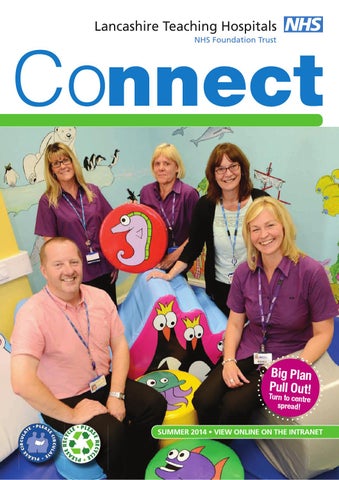
Olympian visits mobility centre to celebrate re-opening of children’s play room
Children having a look at the new play room.
Staff at the SMRC held a children’s party to celebrate the opening of a new play room and an Olympic athlete came along to mark the occasion! The upgraded room completes significant behind the scenes work from the SMRC Patient Public Involvement Team collaborating with Cardinal Newman College, the SMRC User Group and SMRC Paediatric Patients to select and commission a range of mural artworks for the play room walls that will encourage much needed play and distraction for the children. The brand new children’s play room also features TVs, DVD players, toys, slides, activity sheets and soft play mats to suit youngsters of all ages. It will be used by young patients as well as their siblings and the children of our adult patients. It helps to provide distraction and gentle stimulation and will also provide respite from parents or carers away from the main waiting area. The colourful mural was created by a student from Lancaster University, Natalie Charlesworth. Natalie kindly volunteered to produce a range of themed murals. Around 40 children and their families attended the party and the youngsters took part in a range of sporting activities led by Olympic javelin thrower Shelley Holroyd. The play room was officially opened by Chairman Stuart Heys. Chris Fenton, Patient and Public Involvement lead, said: “We are extremely appreciative to the significant volunteer work of Natalie in producing work of an extremely high quality, which we feel wholly represents the requirements of the service. We are especially pleased that Natalie has produced this work, as it continues the excellent work her grandfather and father produced for similar murals whilst the service resided at the Royal Preston Hospital.”
New team to help patients suffering from cancer of unknown primary A new team has been set up to help patients who are suffering with cancer of unknown primary (CUP). Around 10,000 people are diagnosed with CUP each year across England and Wales. It is very much a neglected cancer, patients generally have a poor prognosis and little is known about which types of treatment work best for them. They also tend to miss out on medical and other benefits because of a lack of information, understanding and specialised services. In 2010 new guidelines were issued and now we have set up a CUP team. The role of the CUP team is to be an advocate for 2
SMRC staff and patients with oyd. Olympic Javelin thrower Shelly Holr
Dying providing excellence in care The Liverpool Care Pathway was designed to make sure patients and their families received excellent care at the end of life. However the pathway was not always implemented effectively, which resulted in some patients and their families having a poor experience.
the patient and their family and provide information and advice, to liaise with GPs and community support services and carry out holistic needs assessments.
Last year an Independent Review of the Liverpool Care Pathway was carried out and one of the recommendations made was that use of it should cease by 14 July 2014.
Dr Catherine Mitchell, Consultant Clinical Oncologist said: “A cancer diagnosis is frightening for patient, family and friends. Not to know where this strange, invasive, disease has originated in the body is a double blow. CUP patients face unique psychological and social concerns. We exist to offer information and support to CUP patients, their families and friends; whilst raising awareness of this problem to stimulate action that will improve treatment.”
So from this month we are introducing a new clinical guideline to support excellent care for our patients at the end of life - it’s called ‘Dying - providing excellence in care.’ We held an awareness week so that staff were able to learn all about this new pathway. There was a range of activities held throughout the week and members of the specialist palliative care team visited each ward to talk it through with staff, share best practice and answer any questions. There is more information about this on the intranet.
Care Quality Commission inspection The Care Quality Commission (CQC), which checks that hospitals and other care providers are meeting national standards, has informed us that it will be inspecting us for a week from 8th July. The CQC will collect and analyse a wide range of information about us, including from our partners and from patients, before and during the inspection visit.
After
Bringing healthcare
TO LIFE
The inspection team will look at services at both hospitals, and eight key service areas including: Emergency Department; acute medical pathways including older people’s care; acute surgical pathways; critical care; maternity and family planning; services for children and young people; end of life care; and outpatient care.
We recently held our ‘Bringing Healthcare to Life’ event and it was a huge success!
The inspection will include both planned and unannounced visits, which will take place during the day, at evenings, and at weekends. You may be asked to take part in focus groups.
People were offered the chance to have a tour of our birth centre and Renal home dialysis training unit as well as find out about future plans. There was also the chance to undergo a health check, learn some basic first aid skills or find out how to become a Governor.
Following the inspection the CQC will publish a report that will judge whether our core services are safe, effective, caring, responsive to people’s needs, and well-led.
We opened our doors to members of the public and fellow colleagues to give them a chance to learn more about our hospitals and the work that we do. This year’s event was held at Chorley Hospital and more than 300 people attended, which is the biggest turn out we’ve ever had for this event.
The event was filmed, check out the video on the intranet. 3
Awards
LISTENING & RESPONDING WINNERS
Celebrating staff achievements Once again staff gathered together for our annual Quality Awards event. More than 200 staff gathered at Park Hall Hotel in Chorley to celebrate the achievements of individuals and teams over the past year. The Quality Awards highlight excellent care delivered by staff and is a chance to showcase new innovations that have been introduced by teams to make a positive impact on the experience of patients.
INNOVATION & IMPROVEMENT WINNERS
Nursing Director Sue Reed said: “Every single member of staff has an important role to play and a contribution to make in maintaining and improving hospital services and patient care. The annual Quality Awards is a celebration of the achievements of individuals and teams over the past year, and acknowledges the tremendous commitment and contribution of our staff who strive to provide excellent care with compassion for every patient.” Congratulations to all those who were shortlisted and a big well done to all the winners. Please see the full list below.
CATEGORY LISTENING & RESPONDING NOMINATIONS
CATEGORY INNOVATION & IMPROVEMENT NOMINATIONS
4VANITA BROOKES
4KINA BENNETT
Lancashire and Cumbria Special Care Dentistry Clinical Holding Network
The development of a pulp female urinal (VernaFem)
4LORRAINE KELLY
4MATTHEW BRIGGS
Development of the Trust Corporate Website
Neurosurgical Patient Information iBooks
4STEPHANIE IACONNIANI, DENISE MORRIS AND DENA MAXWELL
4DR DAVID ORR
CATEGORY TEAM WORKING NOMINATIONS 4ANDREW FISHBURN Head and Neck Pre and Post Treatment Clinics 4DR KATHERINE DAVIES Emergency Department Children’s Safeguarding Group 4SARAH WILKINSON
Older people’s programme/ Older people’s Consultation Events/ Patient Activity Blankets
★
★★★★
WINNERS STEPHANIE IACONNIANI, DENISE MORRIS AND DENA MAXWELL 4
Implementation and roll out of Outpatient Antimicrobial Therapy (OPAT)
★
★★★★
WINNER KINA BENNETT
Transforming End of Life Care in Acute Hospitals
★
★★★★
WINNER DR KATHERINE DAVIES
TEAM WORKING WINNERS
BEING SAFE WINNERS
‘Older people’s programme’ shortlisted for national patient care award Our ‘Older Peoples Programme’ has been shortlisted as a finalist for a Patient Safety Care Award in the ‘Dementia Care’ category.
GOVERNORS SPECIAL AWARD WINNERS
The Patient Safety Awards is a national annual event designed to recognise the best initiatives and programmes throughout the NHS. They received more than 600 nominations this year. We have established ‘The Older Peoples Programme’ in a bid to become the best dementia friendly hospital in the country, amending the care environment and equipping our staff with the indepth knowledge and resources to safely and compassionately care for people with dementia.
CATEGORY BEING SAFE NOMINATIONS
CATEGORY GOVERNORS SPECIAL AWARD NOMINATIONS
4SUE SHERLOCK Women’s Health Clinical Governance Team
The winners of The Patient Safety and Care Awards will be announced at a ceremony on Tuesday 15th July at Grosvenor House Hotel in London so best of luck to the team!
4DR GAURAV AGRAWAL Falls and Fracture Prevention Service
4SISTER MAXINE POND Sister Maxine Pond and the Tissue Viability Group 4SISTER JULIE McCLEAN Daily Bedside Handovers
4CHRISTINA ROBINSON The planning, implementation, delivery and continued audit of the new Stereotactic Radiosurgery service 4SUE SHERLOCK Public Health and Infant Feeding Midwives
★
★★★★
WINNER SISTER JULIE McCLEAN
★
★★★★
WINNER DR GAURAV AGRAWAL
Chief Executive Karen Partington with the Clinical Educators Group who won the Outstanding Cascade Trainers certificate.
Congratulations to all the winners of our accredited awards. The event is held twice a year to celebrate the success of our staff. Awards were handed out by Chief Executive Karen Partington and Chairman Stuart Heys, for a range of categories including ‘outstanding cascade trainer’, ‘student and mentor of the year’ and ‘leadership and management’. You can find the full list of winners on the intranet. 5
News in Brief Our own Woman of Steel runs two marathons for charity! Catherine Slater, a physio who works in critical care, has completed two marathons to raise money to buy equipment for patients who are battling head and neck cancer. Catherine ran the Snowdonia marathon, which is considered to be one of the most difficult marathons in Britain, and the Isle of Man mountain marathon, which was a brutal 33 miles over eight mountains. She raised £350 to buy communication boards for patients who can’t speak after surgery. Catherine was happy to see the money she raised being put to good use “The marathons were extremely hard work but it’s so rewarding to know that these communication boards will make a real difference to the lives of both patients and staff”.
Siobhan chatting with the Director of Healthwatch Lancashire at the event.
Preston Health Mela We recently supported the annual Preston Health Mela and once again, it was a great success.
Schoolchildren donate to neonatal unit in memory of former student Bishop Rawstorne Academy students have donated £1800 to Abbie’s Fund, a charity set up in memory of Abbie Merry, a former student who died in tragic circumstances. Abbie’s fund contributes to the running of our NeoNatal unit, and the students who visited were able to see the difference that they are making by contributing to such a wonderful cause. Scott Hornby, a teacher who accompanied the students, was delighted to be seeing the school pull together “The money was raised through various events held in the last year, including the Summer Ball and Easter Bingo, and is the culmination of these pupils’ efforts, as well as other members of last year’s Young Enterprise team, in raising money for such a worthwhile charity”. A proportion of the money will be spent on baby diaries, which the unit has been running low on. These diaries are supplied to each baby’s parents and they are encouraged to make a record of their events and feelings. The rest of the money will be put into the Neo-natal Endowment fund which will be used in a variety of ways - such as buying equipment, funding nurses courses and improving the environment for the parents on the unit. 6
The Health Mela is an annual event that aims to promote greater awareness of medical issues and unite local communities to talk about their health and wellbeing. It took place at Preston Guild Hall; there was a range of information stalls, as well as dance and music performances and entertainment for all ages. Siobhan Mower, the lead of our Patient as Educator programme, went along to recruit members of the public to help with our education programme. Siobhan said: “It was an excellent day, well organised in every way. There was great camaraderie among those displaying and I managed to talk to many different people throughout the community.”
Thank you to a very kind patient A very kind patient who was treated by Professor Rajbhandari has made a donation to purchase a dressings trolley for the foot ulcer clinic at Chorley Hospital. Professor Rajbhandari said: “June was very pleased with the dedication and friendliness of the staff at the Diabetic Foot Clinic and wanted to help. She noticed that there was no dressing trolley in the room she was being treated in so she decided to make a donation to buy one and we are extremely grateful.”
Walk in the dark…a great success! Rosemere recently held their annual ‘Walk in the Dark’ event and it was an incredible success this year raising over £30,000 which is more than double our target! 400 walkers turned up on the night to walk from Chorley Hospital to Royal Preston Hospital. Laura Stephenson, Area Fundraiser for Rosemere said: “We are so grateful to everybody who took part on the night, it was a fantastic turnout! We had so much support from the Masonic Lodges in the area, two Churches and even Starbucks who donated coffee for refreshment stops, so a big thank you to all!”
Staff members Vikki Snape, Kate Ellis, Aimee Robbens and Sarah Gardener took part in the Walk in the Dark.
Staff run for charity New TVs for Day Treatment Centre From left to right: Durham Modun, Mubarak Patel, Zuber Ismail, Marie Redshaw, Dee Hudson, Percy Moyo, Mubean Patel, James Ormond.
Ayman Jundi, one of our Emergency Medicine Consultants, ran the Manchester 10k marathon for the second year in a row to help people in Syria. Last year, Ayman managed to raise £5,000 for Syria Relief, a charity that focuses on delivering aid within Syria. This time he’s managed to raise over £9,000! There’s still time to donate, if you want to help please visit Ayman’s page https://mydonate.bt.com/fundraisers/aymanjundi3 Also a big thank you to a group of business analysts who took part in the race for Rosemere, they hoped to raise £500 to help patients but smashed that target and actually managed to raise £769, so well done!
Joanne Orton, the Day Treatment Centre Sister, would like to thank everyone involved with the incubator fund, which funded the installation of three televisions in the department. The incubator fund has been active for over seven years now, with many different departments benefiting from the generosity of the visiting public. Joanne was excited when she was told about the fund “Our clinic sees a range of patients who attend daily for treatment, and many of them are here all day, which can obviously be very boring for them. The department is now home to three TV’s, with two fitted in the day treatment room where patients receive their treatment, and one fitted in the reception waiting area. It helps with patient boredom and has created a more relaxed atmosphere.” 7
News in Brief Schoolchildren come to visit! 30 children from nearby St Peter’s Primary School came to visit Royal Preston Hospital to learn all about what to do in an emergency and other health skills. The youngsters took part in a range of activities, including listening to the heart and lungs, how to use the simulation equipment and how to take a temperature. The purpose of the visit was so the children could see a different view of hospitals and was an excellent opportunity for our staff to engage with younger members of our community.
Celeb spotting at Rosemere! Snooker player Steve Davis made a surprise visit to patients and staff at the Rosemere cancer centre recently. He met one of our inspirational patients, Emma Grandison who was diagnosed with terminal cancer weeks after finding out she was pregnant. Little baby Erin was delivered 15 weeks premature on 5th November, 2013 weighing just 1lb 10oz. She spent months in our neo-natal unit but is now home and doing well.
e Mick Mullins and Berni of lf ha be on Lee donated E. BA at ty uri Sec ce Advan
Children eggstatic after Easter donations Huge thanks to everybody who donated Easter eggs for our young patients. Staff on our children’s wards received hundreds of eggs to give to our patients. Donations were made by Advance Security at BAE Systems at Samlesbury, the Preston Posse Motorbike Club, H and T Preston Pawnbrokers, the Erin White Group, the Prince’s Trust, Asda in Fulwood, a local Slimming World group and a kind Carole Corless. Mick Mullins who donated on behalf of Advance Security said: “It was a delight to donate the eggs to the Paediatric Play Team who do a wonderful job caring for the children”.
8
PULL OUT & KEEP
Big Plan The executive team has held a series of Big Plan events to set out our plans for the year ahead. The Big Plan sets out our future strategy, and confirms our purpose, our long term strategic aims, and what we need to do in the next couple of years to achieve this. Presentations were given by directors to the wider leadership team who have been asked to share the details with their teams. If you haven’t already, you should soon be having a conversation with your manager about what the Big Plan means for you, your division, directorate and the service as a whole. By having a shared understanding of what we’re here to achieve we can make sure we’re all pulling in the same direction to provide excellent care with compassion.
How are we going to achieve it? Our strategic aims define our long term ambitions, and describe our core business. Those aims are: • To expand and develop specialised and tertiary services
• Caring and compassionate
• To deliver local services for Preston, Chorley and South Ribble
• Recognising individuality
• To enhance our workforce and our reputation through education, research and innovation Our key delivery strategies set out what we need to do to achieve our strategic aims. They are: • Quality
All of this information has been published on the intranet so go to the homepage to find out more.
• Workforce and organisational development
So what is our purpose?
• Operational effectiveness
Our purpose is always to provide excellent care with compassion. This is the driving force in every decision we make, the heartbeat of all the services we provide, and reflected in the way we behave.
Our organisational values define the standards of behaviour that we expect from staff to ensure we are always providing excellent care with compassion, and working effectively towards achieving our strategic aims. Those values are:
• IT • Clinical services
• Seeking to involve • Team-working • Taking personal responsibility And the Big Plan brings all of this together. It reflects and highlights the actions that we need to take this year. There is a Big Plan web page on the intranet which includes a Big Plan toolkit. The toolkit contains a variety of resources to support managers to have a conversation with staff. If you have a query or comment about the Big Plan email
BigPlan@lthtr.nhs.uk
Expanding and developing specialised and tertiary services Our aim is to expand the specialised and tertiary services we currently provide, and develop additional services in the future so that we can provide expert specialist care for patients. In the coming year we will be designated as the regional Major Vascular Centre, developing our interventional radiology service and building a new hybrid theatre. We are working in partnership with other hospital trusts to achieve this.
Over the next two years we will be expanding our Critical Care Unit and neurosurgery to support the development of specialist services and increasing demand.
Delivering local services Due to an ageing population, more people are developing chronic conditions and many have multiple or complex illnesses. As a result the number of patients who require emergency admission to hospital has been increasing significantly year on year. We need to work differently to ensure we can respond to the changing and increasing demand, and continue to provide care of the highest standard.
Urgent care review Together with health and social care services in central Lancashire we are working on improving services for elderly people, and for patients with long term conditions, to enable them to access the right care, in an appropriate setting,
when they need it, to maintain good health, independence and well-being. This means more care and support will be available to people in their own homes, and in the community. New urgent care centres at both Royal Preston Hospital and Chorley and South Ribble Hospital will provide immediate access to GPs and other health professionals for less serious illness and injury.
Midwifery-led care Last year we refurbished our midwifery unit at Chorley and South Ribble Hospital, and this year we will be developing and expanding maternity care at Royal Preston Hospital. This includes developing midwifery-led facilities and we will be investing in Obstetrics by increasing the workforce and building a new operating theatre.
Education, research and innovation We will continue to invest in education, research and innovation so that we ensure we grow the right workforce for the future and attract the very best staff. Our Organisational Development and Workforce Strategy sets out our goals to develop our staff into leaders who have the skills and abilities to ensure we can reach our aims. In the next two years we will be developing a talent management programme to make sure we are identifying and supporting those staff who are the leaders of the future.
in our hospitals. We aim to be a leader in healthcare education, and plan to launch a student-funded nursing degree course with the University of Bolton, to increase the amount of student nurses who will train and then work in our hospitals.
Delivery strategies Quality Strategy We have reviewed our Quality Strategy to ensure we can achieve our aims, and deliver care that is safe, reliable and compassionate. Following the Mid Staffordshire NHS Foundation Trust public enquiry, and publication of the Keogh and Berwick reports, we want to make sure we are learning lessons from these comprehensive reviews, and implementing all of the recommendations.
A new online appraisal system will make sure every member of staff has a constructive discussion about their performance and a personal development plan. We will be increasing our ‘human factors’ training because we know this is an effective way to learn, and is proven to improve patient safety. We are also actively recruiting additional staff, particularly nurses, to make sure we have the right resources to maintain the highest standards of care.
Over the next three years, we have three key priorities; to deliver safe care and this means providing 98% harm-free care, defined by the absence of pressure ulcers, falls, catheter associated urinary tract infections, and venous thromboembolism (blood clots) – and have robust policies and procedures in place to enable this. Our zero tolerance approach to MRSA remains, and we will continue to aim to reduce C.difficile infections, maintaining a hygienic environment remains vital for all of us.
We will be implementing a ‘widening access’ programme to engage with young people and offer them opportunities to work
To provide effective care this means reducing inpatient mortality by 15% by 2017. We will continuously review all of our clinical pathways
and practice to ensure we comply with guidance from NICE and royal colleges so we know, and patients can be assured, that the care they receive is of the highest quality standards, and improving patient flow is a critical factor in delivering effective care. Patients’ experiences of care affect their outcomes, overall satisfaction, and confidence in the NHS and in our hospitals, so it is vital we get this right. To improve patient experience which means 90% satisfaction. Patients and families have told us that we could improve communication, information and involvement so we will be focusing on this in the next two years and pausing to show patients and their families that we care makes a massive difference.
PULL OUT & KEEP Advancing technology Our IT strategy is crucial in helping us achieve our aims. The Department of Health requires all hospitals to produce a paperless patient record by 2018, and between now and then we’ll be investing in Quadramed as the system to help us. We will also be modernising our IT infrastructure so we can ensure clinicians can access records quickly and easily wherever they are.
Operational effectiveness We want to be known for running the most effective clinical management and patient administration processes and systems in the NHS. In the next two years we will be reviewing how our services are organised, to enable us to work safely, effectively and efficiently and make sure every patient is cared for in the most appropriate place. We will be creating a long term plan to redevelop and redesign our hospital spaces to create a welcoming environment that inspires confidence and that helps us to work much more effectively by creating clinical zones. We will be moving towards providing more services seven days a week, to provide quicker and more consistent treatment. We have launched a new Quality & Innovation (QI) Challenge to help us realise this ambition. This new approach will systematically identify and assess ideas to help us work more effectively, and promote innovation throughout our organisation.
Clinical services We are developing strategies to develop our clinical services for the future. This includes reviewing demographics and national policy objectives. We know the trend is to create fewer, larger centres, whilst creating more support for people in the community and in their own homes. So we’ll be investing in and
developing the tertiary services we provide, and looking at how our services are organised so that we’re working effectively.
Organisational development and workforce This strategy aims to ensure we have the right number of people, with the right skills, knowledge and expertise, doing the right jobs. Staff satisfaction is greatly improving and we want to build on this, ‘100 reasons to be proud’ will be launched this year and we have lots planned to make sure you’re engaged and empowered. We will further develop leadership programmes and are creating more development opportunities to help you learn and grow. We are also investing in more intiatives, from exercise classes to counselling, to promote your health and wellbeing.
The financial challenge
We will be moving towards providing more services seven days a week
We will be focusing on communication, information and involvement over the next two years.
In 2014-15 we will need to make efficiency savings of £22m. We are planning to achieve this by improving our procurement practice, recruiting more permanent staff so we can reduce use of more expensive agency workers, rigorous budget management and savings made through the QI Challenge.
Making the difference Achieving the strategic aims and the goals we’ve identified in our Big Plan depends upon each and every member of staff understanding what is expected of them, what they personally need to deliver, and working together as a team to make a difference for our patients. Service goals will be translated into individual objectives so staff can take personal responsibility for their own contribution. Together we will rigorously manage our performance to ensure we’re making the right progress to achieve our goals, and we’ll celebrate successes and challenge delays, to make sure we’re providing excellent care with compassion for our patients.
We are working on improving services for elderly people, and for patients with long term conditions
In 2014-15 we will need to make efficiency savings of £22m
International doctors attend kidney course We recently welcomed doctors from 13 different countries, including Canada, Egypt, Iraq and Morocco when they came to attend our renal biopsy training course. Aimun Ahmed, a Consultant Physician and Nephrologist developed the course and has been hosting it at Royal Preston Hospital for the past three years. It is designed to equip renal specialists with the skills they need to take a small piece of a patient’s kidney which can provide the information needed to diagnose, monitor or treat problems of the kidney. Aimun said: “It’s been great to see this huge interest in the third year of our course, this course is still the only one of its kind worldwide where we use two different models to train on the technique of doing a kidney biopsy”.
PACES exam We recently welcomed senior clinicians from across the country to take part in the MRCP PACES clinical exams. The assessment is designed to test the clinical knowledge and skills of trainee doctors who hope to enter higher specialist training. The exam sets rigorous standards to ensure that trainees are competent across a range of skills and ready to provide a high standard of care to patients. 25 candidates took their exam at Education Centre 2, Royal Preston Hospital. Consultant Shuja Punekar said: “Thank you to the education team and staff from Estates who helped on the day. The event was a great success and it is hoped that the MRCP PACES exams will now become a regular feature at Royal Preston Hospital.”
Our nurses are invited to House of Commons to celebrate International Nurses Day
Tracy and Emma with MP Lindsay Hoyle at the House of Common s.
Nurses from our alcohol awareness team, who were recently shortlisted for a National Nursing Standard Award, were invited to the House of Commons to celebrate International Nurses Day. Tracy Earley and Emma Dermody went along to the reception along with the other Nurse Award finalists, MPs and peers with a key interest in health issues.
9
News Health in and BriefWellbeing
We’ve WON a
‘healthy workplace’ award
We’ve been awarded with a ‘healthy workplace’ status for demonstrating commitment to the health and wellbeing of our staff. Healthcare provider Simplyhealth have given us the gong following recognition that we provide a range of initiatives and benefits that help keep employees motivated and healthy. The ‘healthy workplace’ awards recognise the contribution that UK organisations, in both the private and public sector, make to the welfare of employees.
Emergency Department sheds the pounds! A group of staff from the Emergency Department have managed to lose a whopping 15 stone since they formed a slimming club back in January. The club, which currently has nine very active members, is planning a prize draw for the biggest loser after they hit the 26 week milestone. Emma Fitton, Senior Sister of the ED and one of the founders of the club, was delighted with the progress everyone has made, she said: “I’m so proud of the group and I’ve really enjoyed seeing everyone do so well, they have every right to be very pleased with themselves. We’d initially only planned on having the staff in the Emergency Department’s office take part, but we had people outside of the office who were really keen. So we opened it up to anyone in the department who wanted to join at the beginning of January.” The slimming club encourages each member to stick to their own individual diet and exercise regimes, meaning that they aren’t restricted by a weight loss programme that might not suit everyone. The group is also planning to have a celebratory evening together, paid for by a portion of the £2 a week the members have been paying to the club. 10
Partnership group set up to help staff A new group called the ‘Partnership Working Forum’ has been set up to provide better engagement for staff. The aim of the group is to promote and facilitate effective partnership working across all areas to try to improve the services for patients and the working lives of staff. Peter Smith from Unison, said: “We have set up this group with managers as we want to encourage good working relationships and try to avoid escalation to formal processes wherever possible and appropriate. It’s all about improving staff morale and helping to make sure staff feel supported.”
Positive results for inpatients survey We received positive feedback from many of our patients who completed the latest inpatient survey carried out by the Care Quality Commission (CQC). The adult inpatient survey 2013 was carried out across 156 acute and specialist NHS trusts. Patients were eligible to take part in the survey if they were over 16 years of age and had spent at least one night in hospital. The survey was carried out across Royal Preston and Chorley Hospital in July last year with 387 patients taking part. The feedback from our patients highlights that both of our hospitals are performing as expected when compared to other trusts. The results show that almost 80 per cent of our patients that took part in the survey, said they had a very good experience while they were in hospital.
96 per cent of patients questioned said they had “confidence and trust in the doctors” that were treating them and 97 per cent said they felt as though they were “treated with respect and dignity” while they were a patient in our hospitals. Karen Partington, Chief Executive said: “We are pleased with the results of the Inpatient Survey as we believe that every patient deserves to receive the very best care. However we are not complacent, we have already made further improvements since the survey was undertaken and will continue to seek and act on patient feedback to ensure all patients always have a positive experience when staying in our hospitals.”
96% of patients questioned said they had ‘confidence and trust in the doctors’ that were treating them.
97% said they felt as though they were ‘treated with respect and dignity’ while they were a patient in our hospitals. 11
Staff survey 2013 The results are in! We are really pleased to report that the results of the national staff survey 2013 are in - and they show that we’ve made some great progress in lots of areas!
More than 60% of those who were sent the paper survey completed it, which is the highest response rate we have ever had and is the fourth highest response rate in England. A big thank you to everybody who gave their feedback whether in paper form or electronically, your comments really do help to make changes and improvements.
What did the results reveal?... We’re in the top twenty nationally for sta training, learning and development opportunities.
12
The latest results show that we scored significantly better on 28 questions compared to the feedback we received in the 2012 survey. One of the areas where we made a big improvement was staff engagement. Over the past year Chief Executive Karen Partington and the senior management team have been working hard to improve communication, make sure you feel involved and provide opportunities for you to share your thoughts and ideas.
So what happens now the results are in?...
Staff said they would recommend us a place to work or recommend our hospitals to a friend or relative for treatment
Karen said: “Staff engagement is a key priority for us so I am delighted that we have seen an improvement in this area. More staff said they feel motivated at work and look forward to going into work. There was also an increase in staff who said they would recommend us a place to work or recommend our hospitals to a friend or relative for treatment which is so pleasing to see and it means we’re moving in the right direction.” The results also show a marked improvement in your satisfaction with the quality of care you are able to deliver. 78% of you said that you do feel satisfied which is a significant increase on the 2102 survey. We’re in the top 20 nationally for staff training, learning and development opportunities. The number of staff receiving relevant training and development in the last 12 months has increased by 4% compared to our results in 2012 and we are 3% above the national average. The number of staff who say they receive support from
The feedback is analysed and used to identify areas where things can be changed or improved. This analysis is currently taking place and we’ll keep you updated of any changes made following the feedback.
immediate managers has also gone up over the last year. One area that we do need to focus on though is appraisals, the new online appraisal system is coming soon, but that will rely on managers and staff working together to make sure that appraisals do happen. The results also highlighted better communication is required between staff and senior management. The Board of Directors have produced a video, just for fun, to encourage staff appraisals, check it out on the home page of the intranet! We have also seen a marked improvement regarding the health and wellbeing of our staff. Stress at work has considerably decreased in the last 12 months and we have scored better than the national average. We also received great results regarding equality and diversity. The number of staff believing that the trust provides equal opportunities for progression and promotion has increased since 2012 and is higher than the national average.
In the past you told us that you want better communication between staff and senior management. Because of that feedback, the Chief Executive now does regular ‘back to the floor’ shifts in different departments. Karen Partington also now produces an online podcast version of Team Brief, where she talks to staff about what’s happening in the trust and updates on future plans. Staff have also said that they don’t understand our values or corporate priorities. So, we have produced a series of Big Plan events to share plans and give teams the opportunity to have a conversation about what this means for you and your service. There is much more information about the Big Plan in the pullout inside this magazine. So as you can see, your feedback is taken on board and changes are made based on those comments. Some of you may have recently been selected to complete an NHS Staff Friends and Family Test, please do fill it in because the feedback does help to make changes. 13
News Unsung in Brief heroes Reception to say thank you to Macmillan volunteers A reception was held at Preston County Hall to thank Macmillan volunteers. The Chairman of Lancashire County Council organised the reception to thank them for helping to change and improve the lives of people in our community who are affected by cancer. Rachel Glascott, Macmillan Cancer Information and Support Service Manager said, “We are really fortunate to have 25 volunteers working in our hospitals helping us to deliver high quality information and support to those affected by cancer. It was lovely that Michael Devaney, Chairman of Lancashire County Council, chose to highlight the work done by Macmillan volunteers in our area.”
Volunteer
Nominate YOUR star volunteer! Have you seen our ‘Thank you’ video? The Board of Directors has produced a video to thank all staff for all the hard work that you do, every day, for our patients. If you haven’t already seen it please go to the Lancashire Teaching Hospitals Youtube page to view it. It will make you very proud to work here and you may even spot some familiar faces!
14
We all know of the vital role all our volunteers play in the delivery of the health care services that we provide, so we are launching our ‘Star Volunteer’ as a way of recognising the incredible work done by so many of our volunteers. We will select a different star volunteer in each issue of Connect so please help us by nominating your star volunteer. Let us know who they are, what they do to help and why they are a star. Please email your nominations to Helen.burke@lthtr.nhs.uk and make sure you check the next issue of Connect to find out who is the first ‘star volunteer.’
A day in the life of…
Estates electrician We always love to hear from staff about the kind of work that you do and to share stories with colleagues so here is what Simon Prince says about being part of the Estates electrical team… “Wherever you work throughout our hospitals, the Estates electrical team have worked in your department at some time, even if it was just annoying you with our weekly fire alarm checks! A maintenance electrician’s work is incredibly varied, from the usual lighting and socket circuits, to working on nurse call systems, ward macerators (bed pan machines) dish washers, water boilers, toasters, fire detection systems, checking operating lights in theatres, generators, plant rooms, heating and ventilation, security systems and much more. I’m always learning new things and to say that the hours fly-by would be a gross understatement.
Learning to be flexible is one of the most important aspects of this job. I do try to plan my day according to the priority of the work involved, but as things change and problems arise you need to be flexible in your approach. This means there is rarely a dull day.
I look forward to “ work each and every day. Now, how many people can say that?
”
In the Estates electrical department, we always try to repair items to the absolute best of our ability. Replacing items is a last resort, as we are determined to help the department, and the trust, to get absolute value for money. With constantly changing equipment and technology, we are kept up to date with training and courses that help us to stay sharp. It’s really satisfying and rewarding to know that the skills you have and the work that you do are helping the hospitals provide important care to all its patients.
If you would like to tell us about your job role, please email Helen Burke in the Communications team. 15
Happy retirement! • KATHRYN SQUIRES Kathryn Squires recently retired after 44 years service. Past and present colleagues marked the occasion with a meal at the Italian Orchard followed by coffee and cakes on her last day. Kath started at Preston Royal Infirmary on Meadow Street in the pathology department in September 1970. Part of her career was spent in the laboratory at Whittingham Hospital before returning to the newly built Royal Preston Hospital in 1990. Everyone wishes Kath a long and happy retirement.
• HAPPY RETIREMENT TO TREVOR! Trevor Loftus recently retired after working for us for 13 years. Since he started in 2001 he has strengthened the Health and Safety culture, bringing his own brand of humour to a very serious subject. Trevor led the pilot scheme and implementation of the Central Alerting System which disseminates information from NHS England and it was so successful that it is now used for local information including health and safety bulletins throughout the trust. He was also pivotal in the implementation of the Major Incident Room and the establishment of our Emergency Preparedness Plans. Trevor insists that he isn’t retiring; he’s taking up a new career as an artist as he has a passion for painting and when he is not painting he will be walking the fells of the Lake District.
Calling all budding radio stars! Ever fancied being on the radio? Well now is your chance! Staff at Chorley Hospital radio station are looking for guests to speak on the radio either about the work you do, an event that you’re involved with or anything else that you think would be of interest to patient listeners. If you would like to get involved email: janetpickstock@yahoo.co.uk
16
Janet Pickstock from Chorley hospital radio wants to meet you!