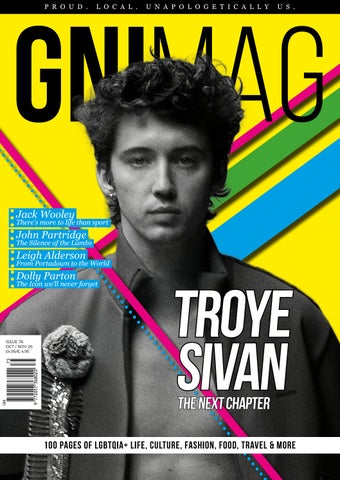
GNIMAG P R O U D .
L O C A L .
U N A P O L O G E T I C A L L Y
U S .
Jack Wooley
There’s more to life than sport
John Partridge
The Silence of the Lambs
Leigh Alderson
From Portadown to the World
Dolly Parton
The Icon we’ll never forget
ISSUE 76 OCT / NOV 26 £4.95/€ 4.95
Troye Sivan THE NEXT CHAPTER
100 PAGES OF LGBTQIA+ LIFE, CULTURE, FASHION, FOOD, TRAVEL & MORE
AUTUMN R E T R E AT IN THE HEART OF THE CITY
FOR BEST RATES BOOK DIRECT AT WWW.TENSQUARE.CO.UK
10 Donegall Square South, Belfast, Northern Ireland, BT1 5JD | 028 9024 1001 | www.tensquare.co.uk
tensquarehotel
@tensquarehotel
@tensquarehotel
M A K E
I T
A
U N I O N
S T R E E T
C H R I S T M A S
CHRISTMAS PARTIES
P R I V A T E I N
R O O M
DRINK DANCE HER TOGET
H I R E
H O S T Y O U R C H R I S T M A S C E L E B R A T I O N O U R R O O F T O P T E R R A C E O R S O H O L O U N G E .
ROOFTOP TERRACE
SOHO LOUNGE
C O V E R E D T E R R A C E • P R I V A T E B A R • F O O D O P T I O N S
F O O D P E R F E C T
F O R
O P T I O N S
W O R K
A N D
I N T I M A T E B A R •
P A R T I E S ,
C H R I S T M A S
E N T E R T A I N M E N T
A V A I L A B L E F E S T I V E
&
G E T
T O G E T H E R S
C E L E B R A T I O N S .
P A C K A G E S
E N Q U I R I E S
L O U N G E • P R I V A T E F O O D O P T I O N S
A V A I L A B L E .
B O O K I N G S
info@unionstreetbar.com B E L F A S T ’ S
H O M E
F O R
G O O D
T I M E S
ONTENT
C
M
Y
CM
MY
CY
CMY
K
Contents 4 Credits 6 Daniel’s Address 8 Troye Sivan 11 Jack Woolley 17 John Partridge 23 Leigh Alderson 27 The Glass Menagerie 30 Moxy Belfast City Q&A 32 Undetectable = Untransmittable 36 Anna Theofanous from VOYA 39 Matt Rawle – Barnum 42 Freshers Do’s & Don’ts 44 GNI Tries new brands/products 47 Bounce Festival 50 Fashion – Winter Wear 52 Carly Rae Jepsen 56 Chris Salvador 58
— GNIMAG | Page4 —
Alexa Moore/Conversion Therapy 60 Grace Walcott 62 Stewart Taylor 64 Tribute to Dolly Parton 66 Digital Detox 68 Personality Test 70 Come From Away 72 Second Nature Review 74 Gourmet Boys 77 Gary’s Hot Hits & Celeb Bits 80 Halloween Prep 83 Michael’s Coming Out Story 86 Dr Bryan’s Skin Routine 88 Paul/We Were Never Meant Tame 90 Peter – Autumn Interiors 92 Danny – Luxury Starts With Hair 94 Gavyn’s Travels to Sitges 97
Test at home
with quick results Visit: sh24.org.uk
Free STI testing and contraception Order free online STI testing: chlamydia, gonorrhea, HIV and syphilis Discreet and direct to your door Quick results Free chlamydia treatment by post Support by text and phone by specialist clinicians
www.SexualHealthNI.info
Credits Daniel May Editor & Director daniel@gnimag.com
Meet our columnists
Pauline Fitzpartick Commercial Executive Tony Day Design Columnists: Gary Campion / Danny Malone / The Gourmet Boys / Martin Murray / Peter Irvine / Paul McAllister / Gavyn Andrews / Alexa Moore / Dr Bryan and Michael Maloney Thanks to: Troye Sivan, Jack Woolley, John Partridge, Leigh Alderson, Anna Theofanous, Matt Rawle, Carly Rae Jepsen, Chris Salvador, Grace Walcot, Stewart Taylor, Mich Sandoval, Robert Hassilow, Ed Lefferon, Jeff Dorta, Second Nature Belfast, Tinderbox Theatre Company, Bounce Festival, Belfast Operatic Company, Chuff Media, Moxy Belfast City, The Rainbow Project, VOYA, The Grand Opera House, The MAC, Maurica Mackle Communications, One Day Agency, 1 Vision PR, Project Publicity, Aiken PR and everyone else who submitted content.
Danny Malone
Gavyn Andrews
Gary Campion
Gourmet Boys
Dr Murphy
Peter Irvine
Paul McAllistar
Alexa Moore
Michael Maloney — GNIMAG | Page6 —
www.revoluciondecuba.com/christmas
T: 02895 909 249 | E: belfast@revoluciondecuba.com
— EDITORSLETTER —
AN INTRO FROM THE CHIEF one of the biggest developments in my own journey. Since my last Editor’s Letter, I have received approval to adopt, bringing to an end what has been a very long, emotional and at times laborious process. I am now in the midst of matching, which is both incredibly exciting and incredibly nerve wracking. The thought that before too long I could have a little one living with me is both surreal and wonderful. There is still a way to go, but for the first time I can really begin to imagine what that next chapter might look like.
And just like that, Pride season is over, the nights are getting darker and we are heading towards the final few months of another year. The freshers have arrived, Halloween is just around the corner and, although Christmas is still a couple of months away, it is already very much on the horizon. If there is one thing I have learned after more than a decade of producing GNIMAG, it is that there is never really a quiet time! For me personally, the past few months have brought
Meanwhile, there is certainly no shortage of things keeping me busy at GNIMAG. We are now just weeks away from the 10th annual GNIMAG Awards on Saturday 7 November at Crowne Plaza Belfast, and behind the scenes we are working frantically to get everything ready. With more than 275 nominees already confirmed to attend, it is shaping up to be an incredible night celebrating the people, businesses, organisations and venues that make such a difference to our community. Reaching ten years of the Awards is a milestone I am incredibly proud of, and I cannot wait to celebrate with everyone on the night. But before we get there, we have Issue 76 to enjoy, and there really is something for everyone. We are delighted to have Troye Sivan on our cover as he prepares to release his new album. Inside, I catch up with Irish Olympic athlete and Dancing with the Stars favourite Jack Woolley, while John Partridge talks about touring the UK with The Silence of the Lambs. We also meet local ballet artist Leigh Alderson, explore The Glass Menagerie and Come From Away, and pay tribute to the one and only Dolly Parton.
to the Grand Opera House, and Anna Theofanous from Irish organic beauty and wellness brand VOYA. Our fashion pages turn their attention to outdoor wear as it is time to get out the winter coats, while we travel to Sitges and I share my own experience of Second Nature Boutique Hotel. Elsewhere, we explore personality tests, the benefits of a digital detox and practical ways to manage your budget. Our brilliant columnists return with their usual mix of food, music, health, wellbeing, interiors, skincare and hair, alongside Michael’s coming out experience, while The Rainbow Project tackles the important issue of conversion therapy. We also feature an array of products in GNI Tries. As the year begins to wind down, there is plenty to look forward to. From the Awards and Halloween to Christmas and whatever 2027 brings, the next few months are going to be busy, exciting and, in my case, life changing. Thank you, as always, to our readers, advertisers, contributors, columnists and everyone who continues to support GNIMAG. Your support allows us to keep creating a platform for stories, voices and businesses that deserve to be heard. Enjoy Issue 76, and I will see many of you on the dance floor at the 10th annual GNIMAG Awards! Until next time, Daniel May Editor, GNIMAG
There is plenty more to discover, including features with Moxy Belfast City, Matt Rawle, who is starring in Barnum on its way
Where Christmas comes together.
— GNIMAG | Page8 —
Students get 25% off glasses from £70 With single-vision lenses only to your prescription
Yep. We’ve reduced student fees Ask in store for details or see specsavers.co.uk Belfast Victoria Square Shopping Centre Tel 028 9031 1999 Offer available in store only to students who present a valid TOTUM card/other valid student photo ID at the time of purchase. One complete pair of glasses with standard single-vision lenses to your prescription only. Excludes reglazes, safety eyewear, contact lens products and non-prescription sunglasses. Cannot be used with any other offers. Discount not transferable in whole or part for cash. UK stores only, not available online.
Troye sivan
— fEATUREtroye —
— GNIMAG | Page11 —
— fEATUREtroye —
From YouTube teenager to global pop star, actor, fashion darling and one of the most recognisable queer artists of his generation, Troye Sivan has spent more than a decade growing up in public. Now, as he enters a new chapter with his fourth studio album, She’s The Best, Daniel looks back at the journey that brought him here and asks whether Troye might just be getting started.
There is something rather lovely about watching an artist grow up in front of you. Not in the slightly uncomfortable way that we have become accustomed to with celebrity culture, where every teenage mistake is preserved forever online, but in the much more interesting sense of watching somebody gradually work out who they are, what they want to say and how they want to express themselves. Troye Sivan has done exactly that, although very few people could have predicted quite where that journey would take him when he was uploading videos to YouTube as a teenager. Today, Troye is a Grammy nominated singer and songwriter, an actor, a fashion figure, a creative director in his own right, a successful touring artist and one of the most recognisable openly queer performers in the world. His music has accumulated billions of streams, his videos have become almost as important as the songs themselves and his ability to move between pop music, fashion, film and queer culture has made him something rather more interesting than simply another name on a Spotify playlist. Now, in 2026, he is preparing to open another chapter with the release of his fourth studio album, She’s The Best, on 9 October. The title track is already out, accompanied by a striking video directed by Gordon von Steiner and featuring an appearance from Australian screen legend Nicole Kidman. It is a wonderfully unexpected combination, although when you consider Troye’s career to date, perhaps we should not be surprised anymore. The new album promises to be another evolution rather than a simple continuation of what came before. Troye has described She’s The Best as a deeply personal project exploring desire, identity, loneliness, joy and queer belonging, while celebrating the women, trans women, drag queens and feminine people who have influenced his life and creativity. It sounds like an album about contradiction, and that feels particularly appropriate for an artist who has spent his career refusing to be defined by just one version of himself. To understand why this new chapter feels significant, though, it is worth going back to where it all began. Before the pop star Long before Troye Sivan was filling arenas, walking red carpets or appearing in campaigns for some of
the biggest fashion and beauty brands in the world, he was a young boy in Perth making videos for the internet. Born in Johannesburg, South Africa, Troye moved with his family to Australia when he was young and grew up in Perth. He started building an audience on YouTube during his early teenage years, at a time when the platform was still developing into the enormous entertainment machine that it would eventually become. There was something quite different about the relationship between creator and audience in those early days. It was less polished, less corporate and, perhaps most importantly, considerably more personal. Troye was not being introduced to the public through a carefully constructed record label campaign. People discovered him online and watched him develop in real time. That experience would become hugely important to the artist he eventually became because, unlike many traditional pop stars, Troye understood from an early age that an audience could connect with the person behind the music as much as the music itself.
his family, but making the decision to talk about it publicly was a significant step, particularly for somebody who had already built such a substantial online following at such a young age. The video was not a dramatic celebrity announcement. It was personal, vulnerable and straightforward, which was perhaps exactly why it resonated with so many people. Troye was not an established pop star making a carefully managed statement about his sexuality. He was a teenager talking honestly about an important part of his life. The response from young LGBTQIA+ people was enormous, with Troye subsequently hearing from viewers who said that watching him speak openly helped them with their own experiences. That moment became an important part of the story of his career, because his sexuality was never something he subsequently had to awkwardly introduce to his audience. It was already there. It was part of his story from the beginning.
“...The only constant in my life keeping me somewhat sane has not been the work, or the men.”
That is worth remembering when looking at Troye’s later success. His queerness was never a marketing accessory added once the record sales were established. It was there before the first major album, before the fashion campaigns and before the
There was another career developing at the same time, too. Acting came before the major record deal, with Troye appearing as a young James Howlett in X-Men Origins: Wolverine and later taking the lead role of John “Spud” Milton in the South African Spud film series. By the time he began seriously pursuing music, therefore, he was already comfortable in front of a camera and understood the importance of storytelling. His career was never going to be confined to simply standing on a stage with a microphone. That mixture of music, acting and visual storytelling has remained one of the defining characteristics of Troye’s work.
And that made his music particularly meaningful to a generation of young LGBTQIA+ listeners who were growing up in a world where queer representation was becoming increasingly visible, but where there was still a huge difference between being represented and actually seeing yourself reflected in the centre of a pop culture story.
Coming out and finding his voice For an LGBTQIA+ audience, however, one of the most important moments in Troye’s early life came away from the stage. In August 2013, he publicly came out as gay in a YouTube video. He had already come out to
Blue Neighbourhood Troye’s first major musical breakthrough came with the 2014 EP TRXYE, followed by WILD in 2015. These releases established him as far more than a YouTube personality having a go at making music. There was a genuine artist emerging,
— GNIMAG | Page12 —
arena tours.
— fEATUREtroye — with a distinctive voice and a particularly strong understanding of atmosphere and emotion. Then came Blue Neighbourhood. Released in 2015, Troye’s debut studio album was a coming of age record in almost every sense of the phrase. It dealt with love, loneliness, youth and heartbreak, but it did so from an openly gay perspective at a time when that was still relatively unusual in mainstream pop. The accompanying trilogy of videos for “WILD”, “FOOLS” and “TALK ME DOWN” was particularly important. Rather than simply releasing a collection of unrelated music videos, Troye created a connected story about two boys falling in love and the emotional consequences of that relationship. It was tender, melancholy and, for many young gay men watching, incredibly familiar. There was no need to make the characters heterosexual so that the story could reach a mainstream audience. There was no need to hide the romance behind vague pronouns or coded lyrics. They were two boys, falling in love. That sounds less revolutionary now than it did then, but representation is often most powerful when it is allowed to be completely ordinary. Troye was not making a political speech every time he sang about a boy. He was simply telling his story. The album went on to become a significant commercial success, with “Youth” becoming his first Top 40 hit on the US Billboard Hot 100. More importantly, though, it established the foundation for everything that followed. Growing into Bloom If Blue Neighbourhood was Troye working through adolescence and first love, Bloom was the sound of somebody becoming considerably more comfortable in his own skin. By the time his second studio album arrived in 2018, Troye was no longer the slightly shy teenager audiences had first discovered online. There was confidence in the music, the visuals and the way he presented himself, and that confidence extended into his willingness to explore queer sexuality with considerably less subtlety. “My My My!” was a declaration of freedom and desire, while “Bloom” became one of the most knowingly cheeky songs in his catalogue. The latter’s floral imagery was hardly difficult to decode, and the song became another example of Troye taking something that had historically been treated as taboo or something that needed to remain hidden and turning it into playful pop. That was an important development. There is a tendency to think of LGBTQIA+ representation only in terms of serious stories about discrimination, coming out or hardship, and those stories absolutely matter. But queer people also want songs about flirting, sex, dancing, falling in love, being ridiculous and having a very good time.
Troye increasingly provided that too. He was also beginning to understand that the visual side of pop could be just as important as the music. Fashion became increasingly central to his public identity, and his ability to move between masculine and feminine aesthetics without appearing particularly concerned about where one ended and the other began would become one of the most recognisable elements of his image. Bloom marked another step towards the artist we know today: more assured, more playful and increasingly comfortable with the fact that being a queer pop star did not require him to fit neatly into anybody else’s idea of what a male pop star should look like. The long wait Then Troye did something that pop stars are generally not encouraged to do.
spent years telling stories about gay love, but Something To Give Each Other was interested in something broader. It was about queer community, friendship, desire and the strange, exhilarating feeling of finding yourself surrounded by people who understand you without requiring an explanation. Troye himself has spoken about the importance of queer community and the sense of belonging he experienced through it, and that feeling runs through the album. “Rush” became a global hit and earned two Grammy nominations, while “Got Me Started” received another Grammy nomination. The album itself reached the Top Five of the Billboard 200 and topped Billboard’s Dance/Electronic Albums chart. But the numbers do not really explain why the era felt so significant. The image of Troye had changed.
He took his time. Following Bloom, he released the 2020 EP In A Dream, but another full studio album would not arrive until 2023. There were acting projects, the pandemic, personal experiences and the inevitable complications that come with growing older in public. When Something To Give Each Other finally arrived, it was clear that the time had done him good. This was not the same Troye who had made Blue Neighbourhood. It was not even really the same Troye who had made Bloom. Something had shifted. The melancholy was still there, because Troye has never been an artist particularly interested in pretending that life is permanently fabulous, but the new album was much more interested in connection, friendship, nightlife, sex, spontaneity and the joy of being alive.
The boyish vulnerability was still there, but it was now accompanied by swagger, sexuality and a confidence that suggested he was no longer asking whether he was allowed to occupy space in pop culture. He knew he was. One of Your Girls If “Rush” represented the physical, sweaty side of the Something To Give Each Other era, “One Of Your Girls” demonstrated another side of Troye’s creativity. The song and its video played with gender, attraction and the idea of femininity, with Troye transforming himself visually in a way that was both glamorous and deliberately uncomfortable for anybody still trying to put him neatly into the category of “male pop star”.
Then came “Rush”.
It was not simply a costume change. It was another example of Troye using femininity as a creative language.
The Rush moment It is difficult to discuss Troye Sivan’s recent career without spending some time talking about “Rush”, because it represented one of those rare moments when an artist manages to completely reset the public perception of themselves. The song arrived in 2023 with a video that was sweaty, physical, unapologetically queer and packed with the kind of imagery that would have been almost unthinkable for a mainstream male pop star a generation earlier.
That becomes particularly interesting when viewed alongside the themes of She’s The Best. Troye has increasingly spoken about the influence that women, trans women, drag queens and feminine people have had on his life and creative identity. The new album seems to take something that has been present beneath the surface of his work for years and place it much closer to the centre.
Troye had grown up.
In many ways, the new record sounds less like a complete reinvention and more like the next logical step.
And he wanted everyone to know it. The video, directed by Gordon von Steiner, captured a sense of queer nightlife that was not sanitised for a mainstream audience. It was sweaty, flirtatious, physical and communal, drawing on the energy of clubs and parties rather than presenting queerness as something that existed solely within a romantic love story. That distinction is important. Troye had already
— GNIMAG | Page13 —
Troye and fashion Music might be the foundation of Troye Sivan’s career, but it certainly is not the whole picture. Over the years he has become one of the most recognisable male artists in fashion, appearing in campaigns and collaborations involving brands including Prada, Cartier, Valentino, Calvin Klein, YSL Beauty, Rabanne Beauty, Savage X Fenty and Beyoncé’s Ivy Park.
— fEATUREtroye — There is a reason for that. Troye understands clothes as part of storytelling. His outfits are rarely just outfits. They are part of the world he is creating around a song, a video, a performance or an appearance. That has also allowed him to challenge some fairly tired assumptions about what a successful male pop star is supposed to look like. There is no great fear of femininity. There is no insistence that vulnerability somehow makes him less masculine. There is no requirement to keep sexuality hidden behind a carefully constructed image of the unattainable male celebrity. Instead, Troye’s public image is fluid. One day he can appear in something sharply tailored and traditionally masculine; the next he can embrace a far more feminine silhouette or aesthetic. Neither seems to require an explanation. That fluidity is part of the appeal. The SWEAT era Then came Charli XCX. The friendship between Troye and Charli had already produced creative collaborations, but the arrival of Brat and the subsequent SWEAT tour created one of the most exciting pop pairings of recent years. On paper, it made perfect sense. Both artists had developed huge LGBTQIA+ audiences, both were interested in club culture and both understood that pop music could be simultaneously commercial, experimental and completely ridiculous in the best possible way. Their 2024 SWEAT tour turned that chemistry into a huge live spectacle. Troye had just come off his own Something To Give Each Other tour, while Charli was riding the enormous cultural wave created by Brat. Putting them together produced exactly the sort of event that modern pop fans had become hungry for: two major artists sharing a stage rather than simply bringing out an opening act and waiting for their own set. It was less like two separate concerts and more like one enormous queer night out.
For an artist who began by performing to people through a laptop screen, there was something rather extraordinary about watching him command enormous venues alongside another artist who had built her own very different route to pop stardom. More than the music What makes Troye Sivan particularly interesting is that the music has never existed in isolation. His acting career has continued, including his appearance in Boy Erased, where he worked alongside Lucas Hedges, Russell Crowe and, once again, Nicole Kidman. His contribution to the film’s soundtrack, “Revelation”, written with Jónsi, earned a Golden Globe nomination for Best Original Song and was shortlisted for an Oscar. He later appeared in The Idol, the controversial HBO series created by Sam Levinson and The Weeknd, alongside Lily Rose Depp and Jennie from BLACKPINK. He has also developed a lifestyle business, Tsu Lange Yor, an independent collection focused on fragrance and art-driven objects. All of which brings us back to the fact that Troye Sivan is perhaps best understood not as a singer who happens to do other things, but as a creative artist whose music is one part of a much larger picture. That was apparent even when he was a teenager on YouTube. The platform may have changed, but the instinct has remained the same: make something, build a world around it and invite people in. Enter Nicole Kidman Which brings us neatly to the latest chapter. “She’s The Best” is the first single from Troye’s fourth studio album and marks his first new music since signing with Interscope Records. The song itself celebrates femininity and the women who have played an important role in his life, with a particular emphasis on trans women, drag queens and feminine expression. Musically, it begins relatively intimately before gradually building through guitars, strings and synths into something more expansive and euphoric. It has the polish you would expect from a major pop production, but there is also something organic about it that separates it from the more straightforward dancefloor energy of Something To Give Each Other. And then there is the video.
Troye’s own tour had already demonstrated how far he had come as a live performer. The Something To Give Each Other tour was his first major tour in five years and took him through Europe, the UK and Australia, giving fans the chance to hear material from Something To Give Each Other alongside the songs that had defined the earlier eras of his career.
Once again directed by Gordon von Steiner, who previously worked with Troye on “Rush”, “Got Me Started” and “One Of Your Girls”, the film takes inspiration from queer New York in the 1980s, combining high fashion, glamour, femininity and sensuality. Then Nicole Kidman appears.
The SWEAT shows then pushed that spectacle even further.
It is the sort of cameo that sounds slightly ridiculous when you write it down, but makes complete
— GNIMAG | Page14 —
sense once you see the world Troye has created around the song. Kidman, one of Australia’s most internationally recognised actors, stepping into Troye’s hyper-stylised queer universe feels like another example of the way his career now crosses boundaries that would once have seemed completely separate. And, of course, there is something rather delicious about Troye bringing one of Australia’s most famous straight female icons into a project celebrating the feminine influences on his life. It is camp. It is glamorous. It is slightly unexpected. It is very Troye Sivan. So what is She’s The Best really about? The easiest thing would be to describe the new album as simply another stage in Troye’s evolution, but that probably does not quite do it justice. The language surrounding the record suggests that this is an album about looking back as much as looking forward. Troye has described it as a painting containing all the moods and colours of his life, including the highs of the past few years and the solitude and longing underneath them. That is an interesting place for him to be. The Troye of Blue Neighbourhood was trying to understand what it meant to grow up gay. The Troye of Bloom was beginning to explore what it meant to become comfortable with desire. Something To Give Each Other was the sound of somebody embracing connection, nightlife, friendship and sexual freedom. Now, with She’s The Best, he seems to be considering the collection of people, experiences and identities that have shaped him along the way. He has described the feminine as a constant in his life, saying that it has helped keep him sane in a way that the work and the men have not. It is a funny line, but there is something quite revealing about it too. After more than a decade of being watched, analysed, photographed and discussed, Troye seems increasingly interested in the things that exist beyond the obvious headline. The people who make him laugh. The people who inspire him. The women and queer communities that have influenced him. The contradictions within himself. The difference between being surrounded by people and still feeling lonely. The tension between masculinity and femininity. The excitement of desire and the vulnerability that comes with it. Those are much more interesting subjects than simply asking what his next single will sound like. A very different kind of pop star Perhaps the most remarkable thing about Troye Sivan is how much has changed while the core of his identity has remained remarkably consistent.
— fEATUREtroye — He is still the person who understands that the internet can create genuine connection between an artist and an audience. He is still fascinated by visual storytelling. He is still willing to make himself vulnerable. He is still comfortable allowing queerness to be part of his work without turning every song into a statement about sexuality.
about wanting somebody. Sometimes it is a drag inspired music video. Sometimes it is a young gay man wearing whatever the hell he wants on a red carpet. Sometimes it is Nicole Kidman turning up in the middle of it all. And sometimes, thankfully, it is all of those things at once.
But he has also become much more confident. The teenager who once had to decide whether he could publicly tell the world he was gay is now a global pop star whose biggest videos can celebrate queer sexuality, gender expression and femininity without needing to ask permission. That journey matters. For somebody from our community, seeing an openly gay artist achieve that level of mainstream
The next chapter There is a temptation, when writing about an artist who has been around for more than a decade, to describe them as if they have already reached the final stage of their career. Troye Sivan is only 31, however, and if anything, his career increasingly feels as though it is opening up rather than settling down. He has already gone from YouTube creator to actor, from teenage singer to international pop star, from bedroom songwriter to arena headliner and from queer newcomer to an artist whose influence
between being completely yourself and constantly being observed by everybody else. That feels like a fitting subject for Troye Sivan. After all, we have spent more than a decade watching him grow up, fall in love, get his heart broken, discover his sexuality, find his confidence, reinvent his image, dance his way through queer nightlife, work with some of the biggest names in music and fashion and eventually become one of the most recognisable LGBTQIA+ artists in the world. And perhaps the best thing about where he is now is that he does not seem particularly interested in deciding exactly what comes next. He has already proved that he can be the sensitive teenager from Blue Neighbourhood, the flirtatious pop star of Bloom, the sweaty club kid of “Rush”, the gender bending fantasy of “One Of Your Girls”, the arena filling performer of the SWEAT era and the fashion figure who can turn a red carpet into his own personal editorial. There is no reason he cannot be all of them. That is perhaps what makes She’s The Best so intriguing. It does not sound like Troye Sivan trying to become somebody new. It sounds like Troye becoming increasingly comfortable with all the different people he has already been. And if the past decade is anything to go by, watching him work out where he goes next is going to be considerably more entertaining than trying to predict it. One thing is certain: Troye Sivan has come a very long way from the teenager sitting in front of a camera in Perth, talking to strangers on YouTube. He has grown into an artist with a genuinely distinctive voice, a huge global audience and an understanding of queer culture that is reflected not just in what he says, but in the way he creates.
success is exciting, but there is something even more important about the way Troye has achieved it. He has not had to make himself less queer in order to become more successful.
reaches far beyond music.
Now he is opening another door.
The difference now is that he knows exactly what he is doing.
And judging by the title, the person on the other side appears to be doing rather well.
If anything, the opposite has happened.
She’s The Best arrives on 9 October, and if the title track is anything to go by, the new era is likely to be every bit as visually ambitious and creatively unpredictable as the ones that came before it. The album seems to be interested in the contradictions that make people complicated, particularly the contradiction between wanting connection and needing solitude, between masculinity and femininity,
Troye Sivan’s fourth studio album, She’s The Best, is released on 9 October 2026.
The more comfortable Troye has become with himself, the more interesting his work has become. His career is a reminder that representation does not have to mean producing worthy, serious work all the time. Sometimes representation is a sweaty dancefloor. Sometimes it is a pop song
— GNIMAG | Page15 —
— InterviewJACK —
Jack Woolley “There’s More To Life Than Sport” From Olympic dreams and coming out at 17 to a horrific assault, finding love and planning his wedding, Jack Woolley has already lived several lives. The Irish taekwondo The Agony Uncleidentity, We Didn’t Knowmental We Needed star talks to GNIMAG about sport, resilience, health and why his next chapter could be his most exciting yet.
— GNIMAG | Page17 —
— InterviewJACK —
There is something immediately likeable about Jack Woolley. Within minutes of our conversation, we’re laughing about Speedos, television, social media and wedding plans before the conversation takes us through Olympic dreams, coming out, mental health and the moments that have changed his life. For someone who has spent almost his entire life chasing sporting success, Jack is surprisingly philosophical about what comes next. He has learned that medals don’t define him, that everyone’s journey with their sexuality is different and that sometimes the most difficult experiences can completely change your perspective on life. And, as we discovered, there is plenty more to Jack Woolley than what happens on a taekwondo mat.
WOULD YOU RATHER? Before we get serious, we put Jack through our quick fire round... Cook or eat out? Eat out. Summer or winter? Probably summer. Swimming shorts or Speedos? I’ve recently converted to Speedos the last few months! Early morning workout or late night training? Late night training. Beach holiday or city break? City break. Night in with Netflix or night out with mates? Night out with mates. Coffee or cocktails? Coffee. Famous for your sporting achievements or your personality? Personality. Let’s take things right back to the beginning. Was there a moment when you realised sport was going to become your life? No, they started me when I was six only because my older brother did it. He was bullied in primary school, so he went into it for self defence reasons, but I would just go down and watch because I was too young. I think I was about three or four when he was doing it and I just really wanted to get into it. I was a show off kid. I was like, “Oh yeah, I’m
going to go down and I’m going to be better than everybody else.” That was just the mindset I’ve always had. Even to this day, I want to be the best at everything. When I realised I was quite good, that’s when my parents probably changed from it being a bit of fun. Around the age of 11 or 12, the Olympics were starting to be spoken about and nobody in Ireland had done it before. My parents don’t really like bullshit. They want everything told to them how it is. They went to an Olympic coach and said, look, you’ve seen my child train. I was at a training camp in Greece for a week, and they said, if he’s any good and you think he can make the Olympics, tell us. But if you don’t think he can, tell us that too because it’s very expensive. The fact that I was missing school, having to fundraise and training twice a day at that time, it was a lot. It was basically, do we waste his time or is it actually a possibility? I think that was the first time I thought, OK, this could be a big thing for me. I was probably 12 or 13 at that time, so it became very, very real kind of overnight. You’ve now experienced two Olympic Games. What was it like representing Ireland on that stage? I’ve had two Olympic experiences, both polar opposites of each other. Qualifying for the Olympics was probably the most euphoric moment of my life. Just to be told that I’m going was more important and special than actually going, I think, for me, especially the first time. The first time was a Covid Olympics, so that was really rough. You weren’t allowed to mix countries and you weren’t allowed to mix sports. I’m the only one in my sport there,
— GNIMAG | Page18 —
so due to Covid we couldn’t have a training partner or anything. It was just me and my coach in the middle of Japan for almost a month and then having to compete at the end of that. You and your coach are supposed to have this amazing relationship, but you spend four weeks with anybody and you’re going to start getting bored and clashing and stuff like that. Tokyo was just really mentally draining. My parents couldn’t go, none of my friends or family could go and I was at a really low time in that part of my life anyway. I’d spent my whole life training towards something and then for it to kind of not be what I dreamed it would be as a kid. I wanted to go to this Olympics, this big event, and then I get there and it’s like a ghost town. It was like, “Oh my God, have I just wasted my whole life?” I wasn’t going to parties with everybody. I didn’t have a social life even at that time. I was coming back and I didn’t know what I was coming back to because I still hadn’t met my partner, my friends had just moved abroad, and everything just felt quite lonely at that time. So Paris was an opportunity to experience the Olympics you had always dreamed about? I wanted to flip that on its head and go to Paris, and I knew that was going to be the Olympics where I was going to experience an Olympics and have people there. That moment when I was putting the tracksuit on and flying out, and now all my parents were going to fly out, all the flags, doing up my room, interacting with the village and stuff like that, I
— InterviewJACK — actually got to have that moment. I think it took Tokyo going as badly as it did to make me really appreciate Paris. To go twice to an Olympics is hard enough, but to make it two times, I think that was something that was really important. The result didn’t go my way in either Tokyo or Paris, but I was more devastated with Tokyo because I built it up so much in my head and it just felt like it was crumbling apart in front of me. I could see pictures of me in Tokyo and I had this robotic face. Everything was very performative. Whereas I just went into Paris and I was smiling. Even after I lost, I carried myself much better. In the interviews afterwards I was actually able to have a conversation rather than thinking, “Oh my God, I’m going to go home and have to work in a corner shop because this isn’t going to work out for me, and I have no degree and I have nothing because I’ve given my whole life to the sport.”
in elite sport. Do you think it’s difficult now to know who Jack is outside of taekwondo? I’ve never known any different. I’m finding it quite hard at the moment just to navigate things because all I’ve known is the sport. Even in day to day life, you have traits that you don’t realise you have. My partner doesn’t have the traits that I have because I’ve obviously built them through the sport, but I just assumed everybody acted or thought the same way I did. It’s like, “Oh no, Jack, you’re slightly insane.” It’s mad. Athletes are insane. There’s something wrong with us putting ourselves through what we do for a bit of metal around our neck. It’s baffling looking back on it. Let’s talk about coming out. Was that something you found difficult?
I think Paris was just a bit of a nice reality check of, “Oh no, you deserve this.” “Paris was just a nice reality check of, ‘Oh no, you deserve this.’” Elite sport is incredibly demanding physically and mentally. What has taekwondo taught you about resilience? There are tenets of taekwondo, so it’s courtesy, integrity and perseverance, and we kind of get taught that from a young age. But it’s not until you get to that high level where you really see how much it does play a big role. Even down to stupid little things like being respectful online and not clapping back at trolls. There are just so many life skills that you learn. With perseverance, I went for my first Olympics when I was 17, which was Rio in 2016. You had to get gold or silver and I got bronze to qualify, so I just missed out. Seventeen year old me thought it was the end of the world because there was a documentary on Irish TV following the whole process of getting to the Olympics and then following the athletes who made it to the Olympics. I felt like I’d let myself down. But literally three weeks after I didn’t qualify, I was back on a plane. I did four competitions across three continents in three weeks and I made the final of all of them. It was just like, “Oh, you’re 17. This is just the start of it.” I then became world number one at the time in 2017. So after that I kind of pushed on and didn’t let it affect me because I realised I was a kid at the time. I just had to keep going. You’ve spent so much of your life
— GNIMAG | Page19 —
I think I knew from very, very early. I’ve asked my partner this, like when did you start to realise you were gay? He was like, “I don’t know.” But he only started to realise in his late teens and I think that’s mad because for me I was four. I was really young. Not in a sexual way, but I realised very early. I didn’t really see gender, I didn’t really care. I’d come home from playschool and be like, “Mum, I have a boyfriend,” and she’s like, “What?” It wasn’t really something I was able to put into words until I was maybe 15. Then the penny dropped. Hormones and everything as a teenager get a bit messy. As soon as I was able to say it to myself, which was quite quickly, I just went for it. I had a
— InterviewJACK — interacting with each other. He kind of thanked me and said, “I’m not ready to come out or whatever, but I’m at ease with myself now because you’re out there.” He was like, “I don’t really feel like in my country I can do that, but at least I have someone to talk to or I can relate to because it is a contact sport.” As far as I’m concerned, at Olympic level and at world high level, I am the only openly gay male athlete in my sport that has ever been at that level. It was funny to have him say that and make me realise that what I’m doing isn’t just helping young people come out who aren’t in sport, but also people of all ages. Even with my own partner, seeing how my family dynamic was and how everything was so relaxed because I was just being authentically myself, that kind of helped him too. “I realised that what I’m doing isn’t just helping young people come out, but also people of all ages.” girlfriend at the time, I told her and we stayed together for a few years after that, to be fair. Then it was telling my mum the same day and then it was a little bit harder to tell my dad. I think I told my dad three days or three weeks later and he didn’t speak to me for a while because I told my mum first. Everyone thinks, “Oh my God, that’s horrible. He didn’t talk to you.” No, it’s because I told my mum first. It’s not because he cares. My dad’s a lot older. He’s very old school. He turns 80 next week. But he’s never cared. He’s best friends with my fiancé now. He doesn’t care. You also came out publicly on an RTÉ documentary at 17. Did you ever experience much backlash? I came out on an RTÉ documentary. I don’t know, they got wind of it and they were like, “Oh, this would be a good storyline.” And 17 year old me was like, sure, why not? If I’m telling people myself, I may as well just rip the plaster off. I haven’t really had any backlash from that, up until maybe recently enough years. Coming out was handy enough for me. But because it was handy, you would think that later on it was fine. Because it was so easy for me, I had this really closed off mindset on everything. I was like, “Why is everyone crying? Why are they making TV shows about this? Who cares? I don’t understand. It’s not that hard.” That was my mindset for years, up until maybe four or five years ago, and only because I started to see how much my partner was struggling. We’ve been together just over five years now and he wasn’t out when I met him. He didn’t come out until 11 months into us being together, and he was 26 when he came out. For me, because I had it easy, I had this very
closed off mindset. But then seeing him struggle, I think it takes a struggle to kind of open your mind up a little bit. It’s funny how when people have a family member or someone close to them who they love who’s gone through that struggle, their mindset completely changes. It’s just mad to think I was part of the community and very open about my sexuality, but still quite dismissive of it for so many years. I think that’s been a lot of growth. You and your partner are now very open about your relationship online. Why is that important to you? Me and my partner make the online videos just to kind of show that it’s a normal relationship. We’re not a gay relationship. We’re just a relationship.
I don’t want to dwell on the trauma, but you’ve spoken about the horrific assault you experienced. Has it changed your perception of people or the world? Don’t worry about the trauma part, to be honest. It’s actually funny how recently I’m kind of at ease with everything, with all of that. It’s funny. It’s the smaller stuff that I actually struggle with in the sport itself. The incident itself, I’ve got two takes on it because I don’t know why it happened to me at the time and even now. It was a fluke accident that could have happened to anybody. At the time I was like, oh, it was just random because I was the first one to get attacked. I was walking with seven of us and we were all assaulted in total. Two ambulances came together. So I was like, OK, it was random for me.
It’s funny because a lot of my DMs are from middle aged married women saying, “Oh my God, this is me and my husband.”
Maybe it was premeditated, I don’t know, because there was a group of them attacking a group of other people, but I can’t state any facts.
And I’m like, see, that’s because it’s just a relationship.
For me, it was just a random attack and it was unfortunate.
It’s so important to share that and be as involved as we can.
It’s funny, I always say it’s the best worst thing, that’s ever happened to me because it put a lot of stuff into perspective.
Do you remember the first time you realised that being an openly gay athlete could actually help someone else? There’s been a few moments. I’ve had letters sent to the house or DMs and stuff, and that’s always really nice. But it wasn’t until a certain moment that I realised it was actually helping someone within the sport itself. There was a lad who was a little bit older than me and really, really high up in the sport. He was world number one and from a completely different country. We ended up fighting each other one day and then another three or four times after that, but we became really good friends just by
— GNIMAG | Page20 —
I had just come home from Tokyo and I thought my world was falling apart because I didn’t get a medal in a sporting competition. I didn’t get a piece of metal. Yes, OK, it’s the biggest sporting event in the world, but I made it there and I was devastated. I was really in a bad headspace over that. Then something like this happened and all of a sudden I was like, OK, I kind of was like, it took something like that to put life into perspective. There’s worse things that could happen to me rather than being upset over a piece of metal. So I’ve kind of tried to live every day as it comes now.
— InterviewJACK — Some days are not like that. I’m a bit of an overthinker, but when I do remember it, and to be honest I remember it quite a lot because there is physical damage and I can see it every day, it is a nice reminder. It’s also nice to see the support from people online and in general. People will always come up to me and mention the attack. It’s funny, I get stopped in the street over the attack. I get stopped in the street over Dancing with the Stars. We get stopped in the street over social media. You know what I don’t get stopped in the street over? “Oh my God, you’re the Olympian.” Never, unless it’s a middle aged straight man! “It was the best worst thing that’s ever happened to me because it put a lot of stuff into perspective.” You’re very open with your social media. Is there anything you wouldn’t share? We’ll share the good times and the bad times. My partner is very open and, to be honest, most of the ideas are him. We’ll see other couples doing videos and think, that’s a good sound to use for our experiences or whatever. We’re not the only couple out there doing these types of videos. There are straight couples and other gay couples doing it too. But what we wouldn’t share is anything very intrusive. If you put up a question box, the guys are going to be asking all sorts of questions. We keep that private. We don’t have any links in our bios or anything like that. So as far as that’s concerned, that’s off the table. So there’s no plans for a couples OnlyFans then? No, no. Well, he’s after getting a government job. It would ruin my reputation, so that’s not on the cards! To be honest, it’s a question we probably get five or six times a day easily.
And speaking of your fiancé, are there wedding bells on the horizon? Yes! Funnily enough, this Saturday we’re going to our wedding venue to sign the contract and we have the date secured. We just need to go sign the official form and pay the deposit. We’re getting married at home because he’s got quite a big family and friend group. It’s looking like it could be about 250 people at the wedding, so it’s going to be a big one. We couldn’t really ask that many people to be flying here, there and everywhere. Then we’ll have the best of both worlds. We’ll have the big celebrations here and then head off somewhere gorgeous. We’re going to Bali in four weeks and I’ve paid for his trip because he just turned 40. I was like, right, that’s your birthday present, we’ll go to Bali for two weeks. But then he turned around and goes, well, we’re getting married, so you can pay for the honeymoon because it’s my birthday the week after! I wanted to go to the Maldives. Everyone’s telling me to go to Thailand instead, so I’m just trying to make up my mind. And we’re getting married in September 2028. That’s actually exclusive for you because nobody else knows! So what does the future look like for Jack Woolley, both personally and professionally? I’ve kind of had this year off for mental health reasons. I’ve kind of decided to take a step back from everything. I was living in Spain and things got a little bit more difficult with anxiety, panic attacks and stuff like that. Going long distance wasn’t ideal. You need your person there to kind of help you through those tough times. So I moved home and I’m just trying to navigate now over the next little while what I do with the sport. This sounds mad, but I’m quite old for the sport. I’m going to be 28 and realistically everyone’s 19 or 20.
but it’s more like a thing we like to do together. It’s like if couples go bowling or go for a meal. We’re like, oh, we’ll make a few videos because we get a good laugh out of it. I’d love to push on with social media. I just went over 100K, so this time next year I’d love to be over 200K. I’d love to get invited to more things and work with a few more brands. I’ve done stuff with VHI Community Games, working with young people and being a brand ambassador. This year was also the first time we really took Pride seriously. We were going to events and involved in the parade and stuff like that. We didn’t realise how much we were being noticed until around June and July, when people started coming up to us in the streets saying, “Oh my God, we love your videos.” So over the next few months we’re going to put ourselves in a better position so that Pride next year will be something where we can really get to events, be out there and use our platforms for good. We’d love to do that. And then, five years’ time, I’d definitely be done with the sport. I’ve just qualified in teaching reformer Pilates as well, and my fiancé is a qualified PT, so we’d love to open our own place. Something that’s kind of multi faceted, with spin classes, Pilates, taekwondo, all different kinds of things. As an athlete, you don’t realise how much stuff like Pilates and spin helps, especially with doing the gym classes and helping me manage my weight for the sport. Everything kind of has a knock on effect. I think it’d be a good idea to have a multi faceted venue where we could roll everything together. So five years’ time, that’d be a big goal, but definitely doable if we can play our cards right. “There’s more to life than sport, and I think the last few months have really taught me that.”
There’s more to life than sport, and I think the last few months have really taught me that.
Closing For someone who has spent almost his entire life focused on the next competition, the next qualification and the next medal, Jack Woolley is now allowing himself to look at life a little differently. There may still be another Olympic chapter waiting for him, but there is also a wedding, a growing platform, television ambitions and a future business with his fiancé on the horizon.
I’d love to do more TV stuff too. I loved Dancing with the Stars, and if an opportunity like The Traitors or Gogglebox came up, we’d love that.
Whatever comes next, Jack seems ready for it. And perhaps, after everything he has experienced, that’s the biggest achievement of all.
I think I’d be good on Gogglebox.
Interview with Daniel May
I’m going to be honest, that’s all we do anyway. So if we make each other laugh, I think we make the nation laugh.
Folllow on Instagram jack_wooley_
I know I have it in me physically. It’s just trying to make sure I’m OK mentally to go back. The Olympics are still two years away, so in an ideal world I would be back this time in a few months and pushing on for the next one. But I’m also at ease if we don’t.
Social media is something we don’t get paid for,
— GNIMAG | Page21 —
T S M I R A S H C TER PA
F F A T S
RTY
PARTY , WHEN WE ARE STIL E H T L GO OP T S ING Y ! WH
QUEUE SKIP, DRINKS PACKAGE, PRIVATE AREA FOR YOUR GROUP, LATER ARRIVAL AVAILABLE Contact : Pr@at3.ltd for info
— INTERVIEWJOHN —
john partridge silence of the lambs Hannibal Lecter is ready to take a bite out of the stage. This iconic villain will be thrilling and horrifying theatre audiences as Thomas Harris’s multimillion-selling novel The Silence of the Lambs becomes a major new stage production, premiering at Leicester’s Curve theatre before embarking on a UK and Ireland tour.
— GNIMAG | Page23 —
— INTERVIEWJOHN —
Inhabiting the legendary Lecter is John Partridge, star of stage and screen. After training at the Royal Ballet Lower School, he joined the original UK tour of Andrew Lloyd Webber’s Cats, and his numerous theatre shows since have included Everybody’s Talking About Jamie, A Chorus Line, Grease, Starlight Express, Cabaret, and Tommy. Partridge is also well known to audiences for playing Christian Clarke on EastEnders. He now stars as Lecter opposite Mollie Gallagher (Coronation Street) as Clarice Starling in this must-see psychological thriller directed by Curve’s artistic director Nikolai Foster (Kinky Boots) and adapted by the Pulitzer Prize finalist playwright and screenwriter Gina Gionfriddo (Becky Shaw, Law & Order). What did you think when you heard The Silence of the Lambs was coming to the stage? John Par tridge: When I first heard about it being put on, I thought, “Ooh, that would be fantastic!” Ahead of my audition, they very kindly sent me the script and told me to pick two scenes, so I said to my good friend [actress] Tamzin Outhwaite, “I need you to read with me”, and when she found out what it was, she said, “Oh my god!” I feel very lucky this has come my way. Is it intimidating to take on Hannibal Lecter? Par tridge: I did wonder, “How do you do something that is so ingrained in pop culture?” I’m a child of the 70s, so when the film came out in 1991, I was one of those core Silence viewers. It lives in our zeitgeist. Then I read about Anthony Hopkins choosing three quite surprising inspirations for Lecter: Truman Capote, Katharine Hepburn, and the computer HAL from 2001: A Space Odyssey. That really gave me the freedom to do my own version of that process. My three are Cary Grant, Elizabeth Taylor, and John Malkovich. Lecter is intelligent, mocking and acerbic, but also serious and malevolent. Now, I try to forget any other version of Lecter and just put myself firmly in that cell. How do you convey Lecter’s darkness? Par tridge: The very helpful thing is that most people know already who Hannibal Lecter is – and if you don’t, you can guess from me being in a glass
box for the majority of the play that I must be an extremely terrible man! When I was first placed in the box, I thought, “Oh my goodness, how do I push my performance beyond it?” Then I realised that rather than trying to push, I have to pull the audience into the box. It also helped me get into Lecter’s headspace: how it feels for a man who has so much grace, who loves music and ar t, to be confined like that. Physically, Lecter is very still. Lots of the roles I’m known for are quite gregarious: I’ve played a lot of larger-than-life characters. Lecter is largerthan-life, but it’s very, very different. If you’re lucky enough to be in this business for a long time – I’m 55 now, I went into Cats when I was 16 – par ts like this come along where you can roll up everything you’ve done, and colour with all the crayons in your colouring box. That’s what I’m able to do here: pull out all of my best bits and put them in this character. I can use my dance background, my physicality, in a new way to inhabit Lecter, while hopefully using the actor I am now, with all my experience, to bring him to life. Does it feel like an unexpected character for you? Par tridge: I think these roles often come along when you least expect them. That’s definitely true for me. I recently emigrated to Canada, and a sure way to get a job as an actor is to move 3,000 miles away! But weirdly, it’s helped prepare me for this par t. I feel like I’ve moved my life into a very different direction personally, and now I’ve got a very different oppor tunity professionally too. What are you most excited to play? Par tridge: I was slightly panicking about the fava beans and chianti line, because how do you top that iconic version, but it’s not in our play, thankfully! Already, though, if I had a pound for every person who’s come up to me and done that line, I’d be a rich man! But there are plenty of other iconic setpieces that people will recognise in our show. I’m most excited about doing the par t where Lecter is in the cell and he attacks the guards. I shouldn’t say I’m looking forward to ripping people’s faces off, but you know what I mean! I love all the stunts, getting stuck into those shocking moments of sudden, dynamic physicality. Our production is very visual and striking.
— GNIMAG | Page24 —
How does Lecter and Clarice’s dynamic translate to stage? Par tridge: It’s inherently theatrical. It’s like a dance: I invite her to dance with me. I love Mollie – she’s a good nor thern lass. We’ve got similar backgrounds, and we’re both instinctual actors. I didn’t go to drama school, and this is her first piece of theatre. I think that’s what makes our relationship on stage really fresh. It’s a very different dynamic from Anthony and Jodie [Foster]. We’ve also got a natural rappor t. We’ve developed this tight tennis match between us, and hopefully, audiences will love seeing us try to score points off each other every night. Gina [Gionfriddo] has written a brilliant script. She’s managed to weave her words in with Thomas Harris so seamlessly – it as if Buffalo Bill has stitched it together himself! That gives us so much to play with. It’s a genuinely gripping thriller – you need to know what’s coming next. We use all these theatrical tricks to keep you on the edge of your seat. Which of the show’s ideas or themes have you found most interesting? Par tridge: There’s so much social commentary in this. It’s set in the 80s, when women were viewed very differently – or perhaps not, I’m actually not so sure half the time. If you look at American culture then and now, with Trump in power, in some ways, we’ve regressed. Our attitudes to lots of things, be it same-sex marriage, gay and trans rights, the rise of toxic masculinity, we’re actually not that far from the 1980s. As a gay man, I see my hard-earned freedoms rolled back every day. We were talking in rehearsal about the attitudes of men and police officers at the time, the rampant misogyny, but look at where we are now with the likes of Andrew Tate. Or look at the gender pay gap, the glass ceiling that’s still there. It’s pretty sobering seeing where we’ve progressed and where we have so much more work to do. Weirdly, Lecter is a psychopath but not a misogynist. He treats Clarice seriously. The one big change we’ve made in our production is with the Buffalo Bill [serial killer] character, who in the original believes himself to be transsexual and is seeking gender reassignment surgery. We do not need to be villainising our trans brothers and sisters in that way, and our story is much stronger for the
— INTERVIEWJOHN —
changes we’ve made. How key is the rise of behavioural science to this story? Par tridge: It’s enormous, both in the story and in real life. That science changed the world. In our play, in that era, the detectives who believe in it are very much stuck in the basement. Everyone dismisses them. Lecter says it’s a junk science “on a level with phrenology”. But profiling, understanding the mind of a killer, was a game-changer. Do you think audiences who love thrillers and true crime will be tempted by this one? Par tridge: I really hope so. It’s a cracking thriller. If that’s your thing, if that’s what you watch on television or listen to on podcasts, if you’re a true crime buff and you’re interested in the darker side of human psychology, then this is for you. It feels like thrillers are really taking off in the theatre right now, with shows like Paranormal Activity and Single White Female. There’s a real appetite for them. Silence is the godfather of them all – the holy grail of psychological thrillers. There’s nothing like it. Where are you most looking forward to visiting on tour? Par tridge: I’m a Manchester boy, so I always love going home to the Lowry. I’ve got Scottish heritage too, my dad’s from Glasgow, and my mum’s from Dublin, so I always like to go back to the motherland and the fatherland. With this tour, I get to do Manchester, Scotland and Ireland, so that makes me a very happy Hannibal.
Show runs at The Grand Opera House from November 10th - 14th, tickets available from goh.co.uk
— GNIMAG | Page25 —
leigh alderson — FEATURELEIGH —
From Portadown to the World
There is something rather special about meeting someone whose story begins in the same corner of Northern Ireland as your own. I grew up in Craigavon, so I know something of that experience of growing up in a relatively small community where certain ambitions, identities and possibilities could sometimes feel outside the norm. For Leigh Alderson, that ambition arrived remarkably early. At just seven years old, the Portadown boy announced to his mum that he wanted to dance. What followed was a journey from a local dance school to The Royal Ballet School in London and ultimately a career that has taken him across the UK, Ireland, Canada and Europe. Along the way, Leigh has become an accomplished dancer, actor, teacher and openly gay man who has never forgotten where it all began. For GNI, Leigh’s story is about much more than ballet. It is about ambition, family, identity, masculinity, sexuality, leaving home and discovering who you are along the way. Most importantly, it is the story of a little boy who simply knew what he wanted to do, long before he understood just how extraordinary that journey would become.
Follow on Instagrm aldersonleigh
— GNIMAG | Page27 —
— INTERVIEWLEIGH — You were just seven years old when you told your mum you wanted to do ballet. What was it that captured your imagination? As hard as it is to believe, I had no idea what I was asking. I had never seen a ballet or even been to a show. Theatre simply wasn’t something I had been exposed to. I remember standing in the kitchen and feeling this urge to tell my mother, “I’m a dancer. I want to dance.” The words just came out. Looking back, her response was so knowing. She didn’t laugh it off or tell me it was ridiculous. She went to the cupboard, got the Yellow Pages, found the Donna Whitten Dance School and called them the next day. What a weird request in Portadown in the mid nineties! My mother didn’t bat an eyelid. I think she knew more than I did. The worst part is that after all these years, that is the first question everyone asks and I still have no concrete answer. I said it, my mother followed through and that was that. That was the start of me living my dream. Growing up in Portadown, what was it like being a young boy with such an unconventional ambition? I don’t really think anyone had a choice! It just sort of happened. My mum went along with it, my dance teachers saw potential and supported me. I remember walking into Millington Primary School at about seven years old, introducing myself and saying, “Hi, I’m a dancer. I’m a professional dancer.” I was absolutely not a professional dancer! If I’d known how much work actually goes into becoming one, perhaps I would have kept my mouth shut. I just had this strange certainty about the path my life was supposed to take. My mum also created this wonderful bubble around my brother and me. Northern Ireland was going through a troubled time, but she shielded us from a lot of that. Looking back, I realise how lucky I was. I had a family who loved me, teachers who believed in me and an environment where I was allowed to believe that this completely unconventional thing was possible. I don’t remember being bullied for dancing in the way people might expect. There was more curiosity and wonderment. There was more acceptance in that little Northern Irish community than perhaps people would assume. I wouldn’t change that childhood for anything. At 11, you left home to train at The Royal Ballet School in London. What do you remember most about that huge transition? The funny thing is, I don’t remember having any big thoughts about it. I was 11 and just doing what I was doing. I had no real understanding of how enormous a decision it was. What I remember most is my mum. When I first went to The Royal Ballet School, there was a BBC film crew documenting the experience. Eventually the cameras left, everything was unpacked in my dormitory and suddenly it was real. My family were going home. I remember running back to the front doors and seeing my mum standing there with my brother. She was crying so hard. She looked at me and said, “Leigh, please go back. You need to go and settle in.” That image has never left me. I was terribly homesick for the first couple of years. This was before FaceTime, so I remember buying phone cards to call my mum and hearing that horrible beep telling you the credit was running out!
We would even arrange to watch television together. We’d say, “Coronation Street is coming on. I’ll watch it here and you watch it at home.” We were in two different countries, but we were watching the same thing at the same time. My mum’s heartbreak never became a reason for me not to go. She loved me enough to let me leave. Your career has taken you around the world. Is there one performance or moment that still gives you goosebumps? It’s hard to pick one. I’ve always been very critical of myself. You can come off stage thinking, “I absolutely killed that,” and the director thinks it was terrible. Another night you think you were awful and they tell you it was your best performance. Eventually I learned that once you cross from the wings onto the stage, it isn’t really your business anymore. You give everything you have, but you have no idea what somebody in that audience might take home with them. One memory that makes me smile was performing with Les Grands Ballets Canadiens in Madrid. We were from Canada and apparently thought Madrid meant a tropical holiday. It was bloody freezing! I was dancing the Prince in Mats Ek’s Sleeping Beauty, where the Prince actually sits among the audience during the interval before becoming part of the second act. My mum and my brother Daryn had come to see me and I told Mum not to tell Daryn what happened. Naturally, I walked into the audience, found my seat and the first person I saw was my bloody brother. He just gave me a little smirk. Immediately I thought, “Oh shit. He knows.” Of all the extraordinary stages and performances I’ve experienced, that stupid little smirk is one of the things I remember most. I got to perform for my family. That means everything. You have spoken about masculinity and being a gay man within ballet. Has that been an issue during your career? I think the bigger conversation now is about representation within the work itself. So much classical repertoire is still built around the same idea: man partners woman. Throughout my career, it has actually been quite rare for me to partner or dance intimately with another man. So perhaps the question isn’t only whether ballet has become more accepting of gay dancers. It is also: where are our stories on stage? We need choreographers willing to create queer versions of existing stories, but even more importantly, completely original queer stories. Not as a gimmick, but creating work where those relationships are given the same beauty, complexity and importance that heterosexual relationships have always been given in ballet. We’ve had generations of queer dancers telling everybody else’s love stories beautifully. I think it’s about time we got to tell a few of our own. Was there a moment when you became completely comfortable being openly gay, or was it more of a gradual process? I think it was more complicated than that. When I was younger, everything was focused on my career. I left home very young and, without really realising it, created two separate lives. My family was the heart of me. When I went home, that was all I cared about. Then I would leave again
— GNIMAG | Page28 —
and have this completely different life and all this freedom. That changed when I was living in Canada and met an amazing man called Ricky LeBlanc. Eventually we decided to get married. Rick kept saying, “You have to tell your mum.” At 25, I rather cowardly came out to my mum by email. It basically said, “In short, I’m engaged and, by the way, it’s to a guy. Love you. Bye.” Sadly, a month before we were due to get married, Rick took his own life. I was thousands of miles away from my family, and one of the hardest things for my mum was that she couldn’t simply be beside me. As awful as everything was, I will always be grateful to Rick for pushing me to tell her. After that, my mum knew all the parts of me. My acceptance wasn’t really about suddenly thinking, “I’m gay and I’m comfortable with that.” I think I had already accepted that part of myself. The bigger moment was allowing the different parts of my life to come together. There wasn’t the Leigh at home and the Leigh who lived somewhere else anymore. There was just Leigh. There is a stereotype that gay men and ballet naturally go together. Did you ever feel you had to prove yourself as a male dancer? There was a lot of internalised homophobia around ballet when I started. People don’t always realise what is actually involved. You’re lifting girls above your head and working your ass off. Just because you wear tights doesn’t make you gay! At The Royal Ballet School, there was a year where there was a lot of bullying. There were maybe three of us who were called “the gays” while the others were “the straights”. I never understood it. I had no idea what I was then. I was there to work, on my mother’s dime! Thankfully, I think times have changed enormously. I’ve fallen in love so many times on stage. My leading partners have mostly been women and there is an incredibly close relationship between you. You spend hours together, develop enormous trust and they literally have to trust you with their bodies. I would sometimes have audience members find out I was gay and say, “Oh, you’re gay? You seemed so straight on stage.” I would bark back, “I was acting!” But actually, I wasn’t really. In those moments, I was in love with the person I was performing with and with what we were creating together. Sexuality doesn’t prevent you from connecting with someone. What would you say to a young boy from Craigavon, Portadown or anywhere in Northern Ireland who loves dance but is frightened of what people might say? Honestly, I see people being more free than I have before. You have spent most of your adult life away from home. Has that changed your relationship with Northern Ireland? Being away has made me appreciate home even more. I could come home, walk through that door and immediately think, “I’m home.” There is just a feeling attached to it that you can’t really explain. My brother Daryn has also shown me parts of Ireland I’d never properly explored. I remember looking around and thinking, “Oh my God, this is
— INTERVIEWLEIGH — actually one of the most beautiful places.” My mum always said to me, “Keep your feet on the ground and never forget where you came from.” You can go to any heights and anywhere in the world, but you should never forget where it all started. Leaving Northern Ireland actually made that connection stronger. It gave me the opportunity to understand what home means rather than simply taking it for granted. I wouldn’t change where I came from for the world. You have reached a very different stage of your career now. What does success mean to you? I hate to say it, but there’s a little part of me that just wants to die on stage! I don’t want to leave it. I love performing that much. But I know there has to come a moment when I take that final curtain call. I do think I’ve made that seven year old boy from Portadown proud. Little Leigh wanted to dance and I gave him a life where he got to do that. Success for me now isn’t necessarily the next role or the next company. I’ve achieved things I’m very proud of, but success becomes much simpler as you get older. If you’re progressing, even in tiny ways, you’re doing alright. I’ve never really been competitive with other dancers. I’ve been massively competitive with myself, but I genuinely want other people to succeed. Someone else succeeding takes absolutely nothing away from me. Maybe success now is being able to give some of what I’ve learned back. To keep learning, keep creating and keep moving forward, but also to turn around occasionally and help the person coming up behind you. Whenever that final curtain call eventually comes, I think I’ll be able to look back at that little boy from Portadown and say, “We did alright, kid.” What excites you about the next chapter? I genuinely don’t know what the next chapter is going to be. I’m such a Sagittarius in that way! As much as I plan things, I think the beauty of life is the unknown. Sometimes that unknown has hurt me, but there are other moments when I can sit back and think, “You know what? I’m along for the ride.” I’ve worked bloody hard for the life and career I’ve had, and I’m proud of that. Even with some of the painful things that have happened, I don’t think I would change a thing. I’m not sure there’s one role, company or country I desperately need to tick off a list. I’m much more curious to see what life throws my way next. Whatever it is, I’ll take it as it comes, smile, put one foot in front of the other and kick-ball-change my way down that bloody street. Let’s see where it takes me. Finally, if you could sit beside that seven year old boy in Portadown, what would you tell him? Oh God, this is like the final four of RuPaul’s Drag Race and RuPaul is standing there holding a photograph of little Leigh! What would I tell him? I wouldn’t tell him a damn thing. He has to experience it for himself. He has to go out into the real world, make mistakes, get hurt, fall in love, have his heart broken, succeed, fail, laugh, cry
and learn from all of it. Life isn’t always cosy or comfortable or easy. In fact, quite often it’s the bloody opposite. But we’re here to grow, learn and experience. My mum didn’t bat an eyelid when seven year old me told her I wanted to dance. She found Donna Whitten Dance School in the Yellow Pages and off I went. From Donna came Susan McMillan. From Susan came The Royal Ballet School. Then came everything else. Those were my stepping stones. That was the road I was supposed to take. So actually, maybe I would tell that little boy one thing. “Sweetheart, you’re in for a bumpy ride.” But you’ll survive. One hundred percent, you will survive.
— GNIMAG | Page29 —
Closing From a seven year old boy in Portadown announcing that he was going to be a dancer, to an international career spanning two decades, Leigh Alderson’s journey has been anything but ordinary. Yet perhaps what makes his story most compelling is not simply the stages he has danced on or the countries he has called home, but the people and experiences that shaped him along the way. His mum’s unwavering belief, the courage to embrace every part of himself and the determination to keep moving forward have all played their part. For anyone who has ever felt different, particularly young LGBTQIA+ people wondering whether their dreams are too big or simply too unconventional, Leigh’s story is a reminder that you do not need to have all the answers at seven years old. Sometimes you just need to take that first step. And if Leigh’s final words to his younger self are anything to go by, the road might be bumpy, but it can still be one hell of a journey.
— FEATURETHEATRE —
TINDERBOX BRINGS TENNESSEE WILLIAMS’ MASTERPIECE THE GLASS MENAGERIE TO BELFAST
Directed by Patrick J O’Reilly, The Glass Menagerie will run at the MAC from 20 - 27 October 2026 as part of the Belfast International Arts Festival. The production gives Nor thern Ireland audiences the first oppor tunity in 20 years to see the American classic professionally produced on a local stage. Tickets are available now from the MAC. Award-winning theatre company Tinderbox is set to Tennessee William’s American classic The Glass Menagerie to Belfast, giving the play its first professional Nor thern Ireland production in more than 20 years.
extensive theatre credits include productions with the Lyric Theatre, Kabosh Theatre Company and Macha Productions, alongside television roles in Blue Lights, Hope Street and the for thcoming series of Line of Duty.
Running at the MAC from 20 - 27 October as par t of the Belfast International Ar ts Festival, the production marks Tinderbox’s four th time par ticipating in the festival, building on a series of critically acclaimed productions that have earned recognition both at home and internationally.
Completing the cast is local actor and director Thomas Galashan, recently seen in Bright Umbrella’s touring production of Stuck in the Middle with You and soon to appear in Terry Loane’s upcoming feature film Faraway Home. With decades of combined experience across stage and screen, the cast brings a wealth of talent to Tinderbox’s fresh interpretation of Williams’ enduring classic.
Written by Williams before A Streetcar Named Desire and Cat on a Hot Tin Roof, his first major success, The Glass Menagerie tells the story of a family struggling to hold itself together. Tom dreams of escape, Laura retreats into her collection of delicate glass animals and Amanda clings tightly to memories of a life that is slipping fur ther out of reach. Nearly 80 years after its premiere, the play remains one of the most celebrated and influential works in modern theatre.
Over recent years, Tinderbox has built a reputation for breathing new life into classic texts. The company reimagined Ionesco’s Rhinoceros as a surreal video game world, relocated Lorca’s Yerma to the Irish borderlands and most recently transformed Orwell’s Animal Farm into a prison cell in Belfast.
The production brings together a distinguished cast featuring some of Ireland’s most respected stage and screen performers including award-winning Irish actor Úna Kavanagh, best known for her role as Heather Daly in RTÉ’s Fair City which she starred in for 12 years, as well as appearances in over fifty stage productions, nationally and internationally with Ireland’s leading theatre companies, and her groundbreaking work with ANU Productions.
This latest production continues that creative journey. Combining Tinderbox’s distinctive theatrical style with Williams’ deeply personal story, The Glass Menagerie promises to offer audiences a compelling new perspective on a timeless classic.
Belfast actor, writer and theatre-maker Jacob Baird also joins the company following screen appearances in The Puzzle Lady and the Academy Award-qualifying shor t film STUCK, which he wrote and starred in. He is joined by acclaimed Belfastbased actor and writer Louise Parker, whose
“We are thrilled to bring Tennessee Williams’ The Glass Menagerie to the MAC as par t of the renowned Belfast International Ar ts Festival. The Glass Menagerie is an extraordinary play, remarkable for its ability to expose the love, hear tbreak, and regret that lie within the lives of an
Sharing his excitement ahead of the production, Patrick J O’Reilly, Ar tistic Director, Tinderbox Theatre Company, said:
— GNIMAG | Page30 —
ordinary family. Through its richly drawn characters, Tennessee Williams beautifully explores the enduring power of memory, revealing how the past continues to shape the present with tenderness. “The play is a playground for live theatre; intimate, poetic, and emotionally profound. Undoubtedly one of the great American classics of the stage, The Glass Menagerie remains as relevant and moving today as when it was first written. I am thrilled to bring this timeless masterpiece to Belfast as par t of the Belfast International Ar ts Festival.” Tinderbox’s latest production offers audiences the oppor tunity to experience one of theatre’s most enduring masterpieces through the lens of one of Nor thern Ireland’s most innovative theatre companies. Commenting, Ar ts Development Officer for Drama and Dance at the Ar ts Council of Nor thern Ireland, Caoileann Curry-Thompson, said: “The Ar ts Council of Nor thern Ireland is delighted to suppor t Tinderbox Theatre Company’s production of the much-loved classic play, the Glass Menagerie. Presented as par t of this year’s Belfast International Ar ts Festival, this show promises to be one of the theatre highlights for Festival audiences this autumn and I would encourage everyone to go along and enjoy!” With a strictly limited run of just nine performances, audiences are encouraged to book early for what promises to be one of the standout theatrical events of this year’s Belfast International Ar ts Festival. Tickets are available now from themaclive.com.
— FEATUREMOXY —
MOXY There’s something rather refreshing about a hotel that doesn’t feel like it’s trying too hard to be a hotel. Since opening its doors in Belfast City Centre a year ago, Moxy Belfast City has brought its own distinctive mix of personality, energy and playfulness to the city, quickly establishing itself as somewhere to stay, socialise, meet and simply hang out. To mark its first birthday, our Daniel caught up with three members of the team – General Manager Gemma Connor, Sales Manager Grainne Fitzsimons and Human Resource Manager James Herridge-Gibson – to look back on a whirlwind first year, discover how Moxy has become part of the Belfast community and find out why, after such a successful first year, they believe the best is still to come.
Moxy Belfast City has officially been open for a year. What has the first year been like for the team? It’s honestly been an incredible year. Opening a brand-new hotel is always exciting, but being par t of bringing the first Moxy to Nor thern Ireland to life made it par ticularly special. There have definitely been challenges along the way, but I think what has stood out most has been the team. Everyone has really embraced what Moxy is about, and we’ve created a culture where everyone gets involved and everyone has a par t to play. It’s been a very fast-paced, exciting first year, and I think we’ve learned a huge amount along the way. We’ve also had so many moments where we’ve stopped and thought, “Wow, we actually did this.” What do you think has been the biggest success of Moxy Belfast City’s first year? For me, it’s the relationships we’ve built. We wanted Moxy Belfast City to become more than somewhere people simply come and stay. We wanted it to become par t of the Belfast community, and I think we’ve really star ted to achieve that.
From our corporate par tners and local businesses to our leisure guests, events, and community par tnerships, we’ve built some fantastic relationships over the past year.
Moxy has a very different personality from a traditional hotel. How would you describe the Moxy experience to someone who hasn’t stayed yet? I’d describe it as a hotel that doesn’t take itself too seriously. Moxy is energetic, social, and approachable. Our Bar Moxy is really at the hear t of the hotel, so when you arrive, you’re checking in at the bar, getting your Got Moxy welcome drink and immediately becoming par t of the atmosphere. Our lobby is also designed to be more than just somewhere you walk through. You’ll see people working, meeting friends, having a drink, playing games, or simply hanging out. It’s a hotel, but it feels like a social space too and I think that’s what makes the Moxy experience different. What has surprised you most about Belfast’s response to the hotel since opening? Probably how quickly people have embraced it. There’s been such a positive response from Belfast, and people have really understood what we’re trying to do with the brand. It’s also been lovely seeing how many local people have come through the doors who aren’t necessarily staying with us. They’re coming in for a drink, meeting friends, attending an event or simply checking out what Moxy is all about. That’s been really impor tant to us because it shows that we’re becoming par t of the city rather than simply being a hotel in the city. How important has the local community been to establishing Moxy Belfast City over its first year? Massively impor tant! For us, being par t of Belfast has always been about building
— GNIMAG | Page32 —
EXPLORE BOLD AND VIBRANT BELFAST Check in at the bar, grab your complimentary Got Moxy welcome drink, and let the good times roll. Challenge your friends to a game of foosball, sip signature cocktails at Bar Moxy, or kick back in our vibrant social spaces. Our stylish bedrooms have everything you need and nothing you don’t, making Moxy Belfast City the perfect base to explore Belfast’s buzzing nightlife, live music, shopping and culture.
STAY BOLD. STAY PLAYFUL. STAY MOXY C +44 (0) 2 896 205 580
E reservations@moxybelfastcity.com Moxy Belfast City, 4 Clarence Street West, Belfast, Northern Ireland, BT2 7GP. @moxybelfastcity www.marriott.com/bfsox
— FEATUREMOXY — genuine relationships rather than simply promoting the hotel. We’ve worked with local businesses; organisations & suppliers and we’ve tried to create oppor tunities for people to come into the hotel and experience Moxy for themselves. I think the best relationships are the ones where it doesn’t feel like a transaction. It’s about suppor ting each other, collaborating, and creating something that benefits both sides. Moxy has always had a strong reputation for being welcoming and inclusive. What does that look like in practice at Moxy Belfast City? For us, it star ts with our people. We want everyone who walks through the door to feel comfor table being themselves. Whether you’re a guest staying with us, someone coming in for a coffee, meeting friends at the bar or attending an event, you should feel welcome. I think that’s one of the strengths of the Moxy brand. There’s a real sense of individuality and personality, and we encourage our team to bring their own personalities to work too. Belfast’s LGBTQIA+ community is an important part of the city’s social and cultural scene. How has Moxy Belfast City embraced that community? Belfast has such a vibrant LGBTQIA+ community, and we’re really proud to be par t of a city that celebrates diversity and individuality. For us, inclusivity isn’t something that should just be a campaign or a par ticular time of year. It should be par t of how we operate every day. We want Moxy Belfast City to be a place where everyone feels welcome, respected, and comfor table being themselves. What’s one thing happening at Moxy Belfast City that you think more people should know about? I think it’s that Moxy Belfast City is about so much more than accommodation. Bar Moxy, our lobby and our outdoor cour tyard are social spaces where people can meet friends, grab a coffee, enjoy a drink, work or simply relax. We also have a great meeting and social space, so you don’t have to be staying with us to enjoy the Moxy experience. We want to be a welcoming space where people can come in, meet, work, socialise and enjoy themselves right in the hear t of Belfast. If you could sum up the past year in one standout memory, what would it be? That’s a difficult one because there have been so many! I think it would have to be the feeling of opening the doors and seeing everything come to life. But actually, some of my favourite memories have been the smaller moments seeing the team celebrating a success together, welcoming returning guests who now know us by name, or seeing local businesses and par tners genuinely excited about what we’re doing. Those moments make you realise that Moxy Belfast City has become much more than a new hotel. It’s become a little community of its own. And looking ahead to year two, what can guests expect from Moxy Belfast City? Hopefully, even more of what makes Moxy Moxy! Year one was about establishing ourselves, building relationships and letting Belfast get to know us. Year two is about continuing to grow those relationships and bringing even more energy into the hotel. We want to continue creating great experiences for our guests, working with local businesses, and giving people more reasons to come through our doors whether they’re staying with us or simply coming in to enjoy the Moxy experience. We’ve had a brilliant first year, but I genuinely think year two is where the fun really begins.! After a year of firsts, new friendships, strong partnerships and plenty of Moxy moments, it’s clear that Moxy Belfast City has ambitions that stretch well beyond filling hotel rooms. Its first year has been about finding its place in Belfast and creating a space where guests, locals, businesses and the wider community can feel at home. With a team that clearly shares the brand’s infectious energy and a commitment to keeping things welcoming, inclusive and a little bit different, it seems Moxy Belfast City has firmly found its feet. And if year one was about introducing Belfast to Moxy, judging by what the team has planned, year two could be even more fun.
— GNIMAG | Page34 —
from
Gingerbread Land
“HELPING YOU CREATE A MAGICAL CHRISTMAS” Photo Booth
360 Booth
Grotto + Sleigh
Light Up Letters
Decor
+ Much more!
MORE INFO @NORTHERNLIGHTSEVENTHIRE
T: 07549062112 E: bookings@northernlightseventhire.com W: www.northernlightseventhire.com WWW.NORTHERNLIGHTSEVENTHIRE.COM
— RAINBOWundetectable —
The Rainbow Project spearheads historic first promotional campaign focused on HIV prevention in Northern Ireland – ‘U=U – Undetectable = Untransmittable. A new informational leaflet and public health campaign has been launched by LGBTQIA+ organisation The Rainbow Project, aiming to improve societal understanding of living with HIV. This is a first in Nor thern Ireland, where there have been no HIV-specific public health campaigns since the initial epidemic in the late 80s and early 90s. The campaign focuses on ‘undetectable’ HIV. Someone who is HIV positive becomes undetectable when, thanks to effective treatment known as ‘Anti-Retroviral Therapy’ or ‘ART’, their viral load becomes so low that it cannot be passed to their sexual par tners. Up to 97% of people living with HIV in Nor thern Ireland are undetectable, and therefore none of those people can pass this on to sexual par tners. Scott Cuthber tson, CEO of The Rainbow Project, said, “We know that in silence, misinformation, discrimination and stigma about HIV thrives. Significant progress has been made on the treatment and prevention of HIV, however society’s understanding of it has changed very little since the initial epidemic in the 80s and 90s. “To fight stigma, we must learn the facts about HIV; what living with HIV is like today, how it’s transmitted, how it’s prevented, how it’s treated, and impor tantly, that undetectable HIV cannot be passed on. The of lack of up-to-date information and knowledge on HIV impacts everyone, whether you are living with a diagnosis or not. “That’s why we’re launching our ‘U = U – Undetectable = Untransmittable’ campaign: to send the message that those living with HIV can live long, happy, healthy lives; to educate on the effectiveness
of modern treatment; and ultimately to reduce new transmissions of HIV to zero by 2030.” Leo Lardie, Sexual Health & Advocacy Co-ordinator at The Rainbow Project, said, “Medically, HIV is a long-term but treatable condition. That treatment for many would involve just a pill a day or for some a more recently introduced long-acting injectable every two months. HIV is no longer a death sentence, those who are diagnosed as HIV Positive today have the same life expectancy as someone who HIV Negative. With early diagnosis and effective treatment, it is very unlikely for HIV to progress to AIDS. “People fear getting their yearly HIV test for fear of a positive result, even though timely diagnosis and treatment is essential to improving health outcomes. Some avoid asking their sexual par tners for their STI testing history or talking about their preferred method of STI protection for fear of being perceived as or being outed as living with HIV. “Our inability to openly and accurately talk about HIV can contribute not just the stigmatisation of those living with HIV but to the increase of new diagnoses overall. That’s why we want you to “Catch Urself Up” about U=U, get tested regularly, and play your par t in ending new HIV transmissions by 2030.” HIV in Northern Ireland Over recent years, significant progress has been made in the expansion of testing and suppor t for both diagnosing and preventing fur ther spread of HIV, as well as suppor ting individuals who have been diagnosed as HIV positive.
— GNIMAG | Page36 —
The most recent publicly available statistics demonstrate that, in 2023, there were 101 new diagnoses of HIV in Nor thern Ireland. Of these, 47 were individuals first diagnosed in Nor thern Ireland, while 54 had previously been diagnosed abroad. Per these statistics, the most common route of transmission for new HIV diagnoses occurs through heterosexual transmission (58%). With the rollout over the past number of years of PEP (post-exposure prophylaxis) to reduce your risk of contracting HIV up to 72 hours after unprotected sex, PrEP (pre-exposure prophylaxis) that when taken as directed can almost eliminate your risk of contracting HIV, and our rollout of effective public health messaging around Undetectable HIV, we have the very real possibility of meeting the UK’s goal of ending new HIV transmissions by 2030. Are you concerned about your HIV status? Whether you’ve never been tested, haven’t had your annual HIV test yet, recently had unprotected sex, or are concerned about your HIV status, get in touch with The Rainbow Project. Our rapid HIV and syphilis testing service is free, confidential and non-judgemental. It’s available to gay and bisexual men, trans and non-binary people, men who have sex with men, and anyone who may be at risk of HIV or is feeling anxious about their status. With rapid testing, you’ll receive your results in just 10 minutes. Call: 028 9031 9030 Text: 07904 864861 Online: www.rainbow-project.org/bookonline
H
rself
With effective treatment, 97% of people living with HIV in Northern Ireland are Undetectable – and Undetectable = Untransmittable. Catch urself up, know ur status, and help end HIV transmission!
p U
!
a tc h C . . . U IV
— f e at u r e v oya —
VOYA Born from Ireland’s ancient seaweed traditions and now found in luxury spas around the globe, VOYA is celebrating 20 years of bringing the power of the sea to skincare and wellness. As the brand launches two exclusive spa rituals at Belfast’s Merchant Hotel, GNIMAG catches up with Head of Global Spa Partnerships and Business Development, Anna to talk about the brand’s remarkable journey, its growing ambitions in Northern Ireland and why, after two decades, VOYA feels like it is only getting started.
FROM SLIGO TO THE WORLD THE VOYA STORY
There is something par ticularly fitting about VOYA’s latest chapter taking place at Belfast’s Merchant Hotel. The luxury hotel has a rich maritime history, while VOYA’s story is rooted in the Irish coastline and the traditional harvesting of seaweed. The relationship between the two has already developed beyond simply introducing VOYA products to the hotel’s spa, with two exclusive treatments, an expanded retail offering and a wider experience designed around the connection between the hotel, the sea and Irish heritage. For Anna, it is another exciting
chapter in a journey that began with a visit to VOYA’s home in Sligo and has since taken her from the American spa market to a global role with a brand now making its mark across the world. Let’s go back to the beginning. How did VOYA first come onto your radar? I’d spent a long time working with the American market and the spa industry there when I was approached at an event by the Global Head of Sales at the time. She basically said, “We really need someone in the US to grow the Americas for VOYA. We’re really
— GNIMAG | Page39 —
growing. Would you be interested?” I went out to Sligo to visit VOYA and meet Mark and Kira, the founders, because I’m a firm believer that I have to really believe in what I’m selling and what I’m standing behind as a person. That’s just who I am. So I wanted to see the brand for myself and understand what was behind it. When I met them, saw how the brand was made and heard the story, I just thought, “OK, this is great.” I star ted with VOYA three and a half years ago on a consulting basis in America, really as a regional person, but it has gone leaps and bounds in such a shor t time.
— f e at u r e v oya —
After about seven months I became Head of Sales for the Americas, where I was able to strategise and grow the business. In the last three years we’ve quadrupled the business we had there, which is great. I initially had two other team members on the ground in America and then, in the last year, I’ve taken on the role of Global Head of Sales and Spa Par tnerships and Business Strategies. So I’ve grown a lot in a very shor t time with VOYA. You’d been with your previous company for 17 years, so what was it about VOYA that made you think this was the right time to move? The previous brand I was working for wasn’t huge in Europe, but it was very big in the Americas, Asia and Australia, and I’d been there for 17 years. You get to a point where you feel like you’ve done what you can do and you’re ready for another challenge. When VOYA came along, there was just so much potential and so much untapped territory. That’s what really excited me. It felt like there was an oppor tunity to take something that already had such a strong foundation and really grow it in new markets. It’s an exciting ride right now because there is still so much that can be done. We’re launching in China next month with a Chinese distributor, officially launching at The Peninsula Hotel in Shanghai, which is a huge leap from Sligo to the US and now China. It’s incredible when you
actually stop and think about that journey. From Sligo to Shanghai is quite a journey. Did you ever imagine VOYA would become such a global brand? Absolutely. We’re an Irish brand and we’ve always had great business in the UK. Europe is aware of the brand, we’ve been honing into the Americas and had major growth there, and now we’re really growing in the Asia Pacific region as well. We also have distribution in Australia, so we really are a global brand now. Outside of Ireland, we’re very much a five star luxury resor t proper ty brand. Even in Ireland, that’s our focus. We’re looking at spas across the globe, but we’re very conscious of maintaining that high end luxury resor t customer. That’s one of the things I really love about the business because we get to go and visit customers who are in these amazing proper ties around the world and then create par tnerships like we’ve done with the Merchant in Belfast. There’s something quite special about bringing a piece of Ireland into these incredible international proper ties. Let’s talk about the Merchant, because it feels like a very natural partnership. How did that come together? I have an amazing team of Business Development Managers regionally, including Claire Thompson, who is based in Nor thern Ireland and has worked very closely with me on the
Merchant. The hotel already had an element of VOYA in it, but we really wanted to take that relationship deeper. When you look at the Merchant’s history and the whole maritime theme they have, and then you look at VOYA being all about seaweed, the ocean and Irish heritage, it just seemed like such a great oppor tunity to build more of a story around the two brands. We wanted to create some really amazing treatments for them and make the experience feel more special and exclusive. We’ve expanded the retail offering and we have two big windows at the Merchant at the moment, as well as doing the spa takeover, initially for six weeks, with the intention of continuing those treatments and keeping the par tnership going beyond that. So it’s really about creating an experience rather than simply putting VOYA products into the spa? Exactly. That’s the whole point. It’s really that connection with the sea and maritime history. VOYA has such a strong story around seaweed, the ocean and Irish heritage, so when you have a proper ty like the Merchant with its own maritime identity, there is an oppor tunity to create something much deeper than simply putting products into a treatment room. It’s about the whole experience and asking how we can elevate what is already there, how we can make it
— GNIMAG | Page40 —
more special and, ultimately, how we can make it more appealing to the consumer. That’s a big par t of what we’re trying to do. We don’t want it to feel like we’ve just arrived with a range of products. We want there to be a story behind the experience. For anyone who hasn’t experienced VOYA before, what actually makes a VOYA treatment different? I think the biggest thing is that we create unique experiences. It’s not just going to be a scrub or a massage. Obviously those treatments are wonderful and I’m not knocking them at all, but we want to offer something that people haven’t experienced before. One of our most popular treatments, and something we’re doing at the Merchant, is our seaweed leaf wrap. We’re literally hand harvesting long pieces of Laminaria digitata seaweed. Our harvesters take it back to our facility, we clean it, it hangs and then goes into a mould and dries in our drying room for a few days. It’s then packaged in a vacuum seal in its most raw, organic form and sent all around the world. We’re not just sending it to Nor thern Ireland either. We have Four Seasons proper ties, The Peninsula in Hong Kong and Macau, and Four Seasons proper ties in America using it. They
— f e at u r e v oya — submerge the seaweed into hot water and it comes back to life, and that’s when they create the seaweed leaf wrap experience. So when someone has a VOYA treatment, they’re getting a truly organic form of Irish seaweed and an experience built around it. I think that’s a huge selling point for us. If you don’t go to a spa all the time, or even if you do, you’re probably always going to get a massage or a nice scrub. With VOYA, we’re trying to give people something that makes them stop and think, “I’ve never experienced that before.” The seaweed leaf wrap is one of those treatments. It’s hand harvested Irish seaweed going onto your body and changing the way your skin looks and feels. Have you actually experienced the treatments yourself? I have. Par t of my induction at VOYA, and par t of everyone’s induction, is that we bring them into head office and our training team actually does the treatments, or at least the key treatments, so that you can experience what it feels like.
kind of scientific research, so we’re really building on the results that we bring. I think the foundations have always been very strong, but what’s changing now is the way we’re looking at wellness and what consumers want from their skincare and their treatments. With longevity and all of these things coming into play, it’s about protecting and preserving our skin and our wellbeing as much as possible. That has been the bones of VOYA from the beginning, but I think for us now it’s about honing in on that a little bit more and bringing out new products and new treatment experiences. We have some coming up next year that are really honing in on that longevity piece. We were at the Global Wellness Summit in Dubai last year and it was all centred around longevity, so for us as a skincare brand, it’s about asking how we bring that into the picture. Obviously there is a huge medical side to longevity, which we’re not, but it is about protecting your skin barrier, strengthening your skin, helping with ageing and preventing the signs of ageing. Our products do all of that. So after 20 years, innovation is still a huge part of keeping VOYA fresh? Absolutely. We have new product launches centred around longevity, recovery and strengthening the skin, but it’s also about expansion into the market and creating different experiences for people.
It’s really impor tant that people know the experience themselves. You can’t really sell something properly if you don’t understand what it feels like. It sounds like a very tough day in the office! Yeah! It’s tough trying to wake up and work after that. VOYA is celebrating 20 years this year. What do you think has allowed it to stand the test of time? We’ve come leaps and bounds from star ting off in Sligo with the bathhouse producing products. Seaweed has been par t of Mark, one of our founder’s, heritage for so long, and the clinical and scientific studies they’ve done on seaweed have been amazing. VOYA was the first seaweed brand to come to the spa and do that
In Nor thern Ireland, for example, we are present in spas and retailers, but it’s about continually bringing something new and fresh to the market to keep the consumer interested. VOYA celebrated 20 years just last month in July, and there’s a lot of skincare competition and a lot of treatment competition, so I think the reason we stand the test of time is because we are always innovating. It’s about continually building on the foundation of what we currently have while keeping people interested. That’s exactly what we’re trying to do with the Merchant. Whilst they already had an element of VOYA, we’re asking ourselves how we can elevate that and make it more special. We’ve even gone as far as changing our whole brand imagery this year and really elevating it. If you look at our new imagery now, it’s like you’re opening Vogue and seeing seaweed.
I actually noticed that when I was looking through your Instagram. It really stood out. I’m so glad you got that from it because that was the whole concept. Yes, it’s seaweed and we’re harvesting it, but we’re wearing it for your skin, for confidence and for longevity. It’s tying all of that into everything we’re doing. We wanted people to see seaweed differently. It’s not just something that comes from the ocean and goes into a product. There’s a whole story around it, and we’re trying to communicate that in a much more elevated and aspirational way. Looking specifically at Northern Ireland, is the Merchant the beginning of something bigger for VOYA here? We really want to keep what we’re doing with the Merchant as exclusive as possible right now, par ticularly in Belfast, but of course we do want to build on that and expand. We’re also present at Lough Eske in Nor thern Ireland and we’re looking at doing something special there as well, honing in more on the landscape, the place where it’s located and the heritage of it, and tying that in with VOYA. We’re also working with Avoca and Ulster Stores in Ireland and really building on those par tnerships. So you can see we’re trying to elevate and be selective about the par tnerships that we’re honing in on and the ones that we want to strengthen and grow. Definitely, the spa business in Nor thern Ireland is something we’re looking to grow massively. There are some incredible proper ties here and we want to make sure that when we do par tner with them, it feels authentic and there is a genuine connection between VOYA and the place. It sounds like there is plenty happening behind the scenes. What can we look forward to next? We do have a new launch on September 3rd, so not long now. We’re launching a new treatment and two great new products. At VOYA we have a lavender and rosemary blend and sleep treatments, but we’re flipping it now with energising treatments for people. We’re launching an energising body treatment and a new pedicure using a new body butter and scrub. It’s a lime, mandarin and peppermint blend, so very energising. Our new Christmas collection is also coming out, and then in the first quar ter of next year we have another great new treatment and products coming out, again really honing in on that longevity and wellness piece.
— GNIMAG | Page41 —
So even though we’re celebrating 20 years, there’s cer tainly no sense internally that we’re sitting back and looking at what we’ve achieved. There’s a lot more coming. And what about you? You’ve gone from consulting with VOYA in America to Global Head of Sales, Partnerships and Business Strategies in just a few years. Where do you see yourself going next? It is very fast paced, and I’m trying to enjoy the ride a little bit more, but I do enjoy fast paced, so that’s OK for me! I think this is just the beginning for us in terms of everything we’re doing and the growth that we have. I always think personally, where are you going to be in the next three years? Where are you going to be in the next five years? I genuinely see that being with VOYA because I feel like we’ve just got star ted. There’s still so much to achieve globally for the brand, and that’s what makes it exciting for me. We’re taking something that has such a strong Irish identity and bringing it to completely new markets, while still keeping that connection to where we came from. Finally, after everything we’ve talked about, what would you most like people to understand about VOYA that perhaps they don’t already know? For me, our founders Mark and Kira have built such an incredible foundation. The trust they have in us as a team to take our exper tise and take that foundation to the next level is a really impor tant piece of it. I think that’s what makes it exciting. We’ve got a great foundation, we’ve got a great team and we’ve got a lot ahead of us. THE FUTURE IS LOOKING GOOD From a bathhouse in Sligo to five star resor ts around the world, VOYA’s story is one of Irish heritage, innovation and an ability to continually reinvent itself without losing sight of where it came from. Its par tnership with The Merchant feels like a par ticularly fitting chapter, bringing together the hotel’s maritime heritage with VOYA’s connection to the sea. But perhaps the most striking thing about speaking to Anna is that, despite VOYA celebrating its 20th anniversary, there is very little sense of looking backwards. Instead, there is a genuine excitement about what comes next. From Belfast and Northern Ireland to Shanghai and beyond, VOYA’s ambitions are firmly global. And if Anna is right, the first 20 years may turn out to have been just the beginning.
— FEATUREmatt —
MATT RAWLE BARNUM - THE CIRCUS MUSICAL
Returning to the lead role in Barnum - The Circus Musical for its UK and Ireland tour, Matt Rawle says: “It’s such a dream part for an actor because there’s the showman aspect to Barnum, of course, but he’s also a flawed human being. He was an entertainer who wanted to bring joy to people’s lives. He had great imagination and he was a philanthropist, but the flip side of that is that he could be exploitative. All of that makes for great drama amidst all of the songs and spectacle.” Connecticut-born P. T. Barnum revolutionised entertainment in the 1800s through the Barnum & Bailey Circus and his sensational The Greatest Show on Earth. With music by Cy Coleman, lyrics by Michael Stewart and a book by Mark Bramble, the musical about the colourful life of the marketing genius and master of spectacle premiered as a musical on Broadway in 1980 and was a huge hit the following year when Michael Crawford took the lead at the London Palladium ahead of a UK tour. It has been revived numerous times since, both here and around the world, with Matt originally playing Barnum at the Watermill Theatre in 2004 under the direction of Jonathan O’Boyle and with choreography by Oti Mabuse. The Guardian hailed the show starring actor-musicians as “an immensely beguiling production with immaculate performances that work magic” He was drawn to the production in the intimate venue in Bangor, near Newbury, because: “I was interested in how they were going to do such a circus spectacular in such a small space, the answer to which ended up being that they did it brilliantly.” For the 2026 UK and Ireland tour, which starred Lee Mead before Matt’s return in August, the show has been supersized for bigger theatres around the country - featuring more than 20 actor-musicians playing 150 instruments alongside acrobats and international circus acts. Presented by Bill Kenwright Ltd, it is in essence the same production. “But it now has more bells and whistles,” Matt marvels. “It’s on an even more spectacular scale, with more circus elements, more
aerial work and fleshed-out orchestrations.” For the actor it presents a huge challenge because: “You’re never off stage, there’s lots of dialogue, there are all the songs, of course, and it goes by very quickly.” He also plays the piano and demonstrates some circus and magic skills. Then there’s Barnum’s famous tightrope walk that ends act one to thunderous applause. Surely it’s just like riding a bike, or indeed walking a tightrope, by now? Matt laughs. “Actually, it’s much harder this time round because it’s longer and higher than it was at the Watermill and we’re in different venues for the tour, so it’s a moveable feast. The first time round I had six weeks of rehearsals, this time it was more like six days. You need a lot of stamina for a show like this but returning to it now the muscle memory soon kicks in. “When I originally started out I thought ‘If I can just get from one side to the other without breaking anything, that is gonna be my goal’. Slowly you build up the skill and the stamina, then when you make it across from one side to the other it’s magical. It never gets any easier, I’ll admit, especially on tour when sometimes the stage is raked and in other theatres it’s flat. It keeps me on my toes for sure, but it’s such a thrill to hear the reaction from the audience.” The piano-playing comes much easier for the Birmingham-born performer who actually grew up wanting to be a musician. He tinkled the ivories and composed songs, but he also sidelined as a child actor in local productions for the likes of Birmingham Hippodrome and Birmingham Rep and had a few TV roles. At sixth-form college he did music and theatre studies, admitting: “I couldn’t really do anything else because I didn’t have an aptitude for anything academic, although I did eventually retake English and Maths.” His singing teacher encouraged him to go to drama school. “I was DJ-ing and writing lots of dance music, which I could have quite happily done for the rest of
— GNIMAG | Page42 —
my life, but I managed to get into drama school on a government grant.” Matt lasted two years, smiling now: “I was quite full of myself, like ‘I think I know what I’m doing’.” Turns out that he did, since he went along to an open audition for Miss Saigon and aced it, landing the plum role of American G.I. Chris Scott in the West End in 1994. Two years later he was the lead in the original London production of Martin Guerre and has subsequently appeared in more than a dozen musicals including Into The Woods, Assassins, Evita (on stage and in concert), Pippin, Cabaret (both on tour and in the West End) and Anything Goes. “I feel incredibly fortunate to have been given the opportunities I’ve been given and very lucky,” Matt says of his impressive musical theatre CV. “There’s been a huge amount of diversity in the roles I’ve played.” Barnum had been on his radar for a long time before he stepped onto the Watermill stage in 2024. Back in the 1980s his uncle was a successful organist with a Yamaha keyboard at home (“which back then was a bit like having in a PlayStation”) who’d play the score along with ragtime songs that had influenced some of Cy Coleman’s compositions for the musical. Matt also saw the televised version of the London Palladium production that went out on the BBC. “And I was astonished by Michael Crawford’s performance. I think it was one of the first times that a West End show was filmed for TV and I’d never seen anything like it before.” The score features such classics as Come Follow the Band, There is a Sucker Born Ev’ry Minute and Join the Circus. Matt’s favourite? “I love The Colors of My Life, especially the reprise in act two. It’s a duet between Barnum and his wife Charity, who have been bickering and quarrelling and trading zingers for most of the show. Now we see them sharing memories of their lives together and it’s beautiful and moving. Barnum spends a lot of his time humbugging and it’s nice to step back from that for a moment.”
— FEATUREmatt —
P.T. Barnum was played by Hugh Jackman in the big screen blockbuster The Greatest Showman and, as in the film, the musical looks at the real man behind the on-stage persona. He was married to Charity but also became infatuated with Swedish singer Jenny Lind. “He was a complex man and a fascinating one,” Matt muses. “He was the embodiment of the American dream and the idea that you can be whatever you want to be. He championed the likes of the Bearded Lady and Tom Thumb and, while the conditions in which they worked might not have been the best, I think he genuinely wanted to transform people’s lives and show audiences a good time.” Present-day audiences, Rawle promises, will have an equally good time when they come to see Barnum in theatres across the UK and Ireland. “It’s spectacular. It’s full of death-defying stunts. You’ve got this amazing score. You’ve got a cast that play over 150 instruments live on stage every night. You’ve got all these wonderful characters, even Jumbo the Elephant! And tied into all of that is this emotional story of a relationship which has ups and downs and itself is a bit of a rollercoaster, but you really champion these two people trying to get through life. I think we can all relate to that, especially in this day and age.” Matt smiles. “And it’s a classic musical that we’re finding during this tour really brings in the crowds. At a time when people are understandably being very careful about how they spend their money, it’s really heartening to see them filling theatres and having such a great time.” Show runs at The Grand Opera House from October 13th - 17th. For tickets visit goh.co.uk
— GNIMAG | Page43 —
— FEATUREFRESHER —
new city, new rules! The freshers guide to finding your feet in Belfast
There is something incredibly exciting about arriving in a new city for the first time. Suddenly, there are new people, new places, new freedom and nobody telling you that you really should have cleaned your room. For many freshers, it is the first real taste of independence, and while that can be brilliant, it can also be a little overwhelming. Whether you have arrived in Belfast from another part of Northern Ireland, crossed the water or travelled from much further afield, there is plenty to discover. So before you throw yourself into Freshers Week, here are a few things worth knowing. DO explore beyond campus It is very easy to fall into a routine of accommodation, lectures, student union and back again. But you have moved to a city, so get out and experience it. Find your favourite coffee shop, discover somewhere good to eat, explore the independent shops, check out what’s happening at the weekends and get to know the different areas of Belfast. Your university or college is only one part of your new life. DON’T feel like you have to do everything Freshers Week can feel like one enormous FOMO machine. There is another night out, another society to join and another event you apparently cannot possibly miss. You can. You don’t have to drink every night, attend every event or make your best friends in the first 48 hours. Go out when you want to, stay in when you want to and give yourself time to settle. Everyone else is figuring it out too, even if their Instagram stories suggest otherwise. DO make the effort to meet people If you are nervous about making friends, remember that most other people are in exactly the same position. Start a conversation with the person beside you in a lecture. Ask your flatmate if they fancy grabbing food. Try a society or activity you’ve always wanted to try. Some friendships will last for years. Others might last for three weeks. Both are perfectly normal. DON’T blow your money That student loan can look very healthy when it first arrives. It won’t stay that way. Work out what you have coming in, what needs to go out and what you can realistically spend each week. Remember to allow for food, transport, bills and those annoying little expenses that seem to appear from nowhere. And use student discounts whenever you can. Just because something is discounted doesn’t mean you need it. DO look after yourself Whether you’re heading out for a big night or simply exploring the city, think about how you are getting home before you go out. Keep your phone charged, make sure you have enough money for transport and look after your friends. If someone isn’t feeling comfortable, don’t leave them to deal with it alone. You can find further student safety and support information through [nidirect] (https://www.nidirect.gov.uk/articles/support-safety-and-security-during-yourcourse).
DON’T forget who you are For some people, moving away to university is the first time they have had the freedom to properly explore who they are. If you’re LGBTQIA+, Belfast has a vibrant community and plenty of organisations, events and spaces where you can meet people and find support. You don’t have to arrive with everything figured out, and you certainly don’t have to put yourself into a box just because everyone else seems to know exactly who they are. Take your time and find your people. DO ask for help Being independent doesn’t mean doing everything alone. If you’re struggling with money, loneliness, accommodation, coursework or simply adjusting to your new surroundings, speak to someone. Universities and colleges have support services for a reason, and asking for help early is much easier than waiting until a small problem becomes a huge one. DON’T compare your experience Perhaps the most important rule of all is to remember that there is no perfect way to be a fresher. Some people will have a huge friendship group within days. Others will take months. Some will love nights out, while others would rather be home with a takeaway and Netflix. Both are completely fine. Your first year isn’t a race. Give yourself permission to make mistakes, try new things, change your mind and occasionally have absolutely no idea what you’re doing. Because somewhere between the awkward introductions, questionable cooking, late nights and figuring out which bus actually gets you home, Belfast will slowly stop feeling like a new city and start feeling like yours.
— GNIMAG | Page44 —
Call 0800 389 4424 or visit www.therowan.hscni.net
Get Married
where the Mountains Meet the Sea Say your vows with the majestic Slieve Foy mountains and the sparkling waters of the Carlingford Lough as the backdrop. Get married where life feels like a dream. The Four Seasons Hotel Carlingford caters from small personal receptions, to lavish weddings. We’re dedicated to each couple, catering to every need, to create a seamless, and unforgettable celebration. Looking for the ultimate wedding venue? You’ve just found it.
You’re invited!
Wedding Open Day 27 September 2026 | 11am-5pm Appointment only
+353 42 937 3530
| 4seasonshotelcarlingford.ie | events@fshc.ie
gni tries
— GNITRIES —
VOYA Belfast Glamour, Coastal Wellness and 5* Skin Tested by Gary Some brands do luxury loudly. Then there is VOYA: elegant, Irish, quietly confident and built around certified organic, handharvested seaweed. It is coastal wellness with polish, purpose and the kind of bathroom-shelf presence that says “I own robes”, even if your dressing gown has seen better days. Its partnership with Belfast’s iconic five-star Merchant Hotel feels beautifully judged. The Merchant is one of the city’s ultimate “treat yourself properly” destinations: grand, grown-up and just theatrical enough to make coffee feel like an event. Pair that with VOYA’s organic seaweed spa heritage and Belfast has a wellness moment worthy of the glossiest travel pages. To mark the collaboration, VOYA sent Gary a selection of hero products to try at home: Irish ingredients, serious skincare credentials and that Merchant-level sense of occasion, bottled for days when your bathroom is less spa sanctuary and more “why is there toothpaste on the mirror?” The Squeaky Clean Invigorating Body Wash brings crisp fivestar freshness. With Fucus serratus seaweed, Kakadu plum and lime and mandarin notes, it feels polished, unisex and genuinely reviving. The lather is rich without being showy, and skin is left smooth enough to swan about as though you have a late checkout. The Angelicus Serratus Nourishing Body Oil is where the glamour glows. Blending seaweed with rosehip and evening primrose oils, it gives skin that soft, expensive sheen we all pretend comes from drinking enough water. It absorbs beautifully, leaves limbs luminous rather than greasy, and carries VOYA’s citrus scent like a silk robe through a hotel corridor. The Renewal Eyes Seaweed Eye Patches are another little luxury that earns their keep. Made from 100% organic Irish Laminaria Digitata, they hydrate, cool and freshen the under-eye area beautifully. Yes, they are slippery little divas to position, but once on they deliver that “rested, booked and moisturised” look. The Sea Salt and Cypress Luxury Scented Candle adds atmosphere rather than stealing the show. Sea salt, marine air, cypress, cedarwood and amber create a calm Atlantic edge: refined, chic and very much part of the wider VOYA ritual. Our verdict? VOYA brings Belfast a beauty moment with substance: Irish seaweed science, glossy spa glamour and sustainable luxury that feels sophisticated rather than showy. This is wellness dressed for a five-star lobby, yet still grounded in the raw beauty of the Irish coast, exactly the self-care we deserve. www.voya.ie Instagram: voyabeauty
— GNIMAG | Page47 —
— GNITRIES — Tinky Elevated Everyday Freshness Tested by the Team Deodorant may not scream everyday luxury, but Tinky makes a persuasive case for upgrading the humble pits swipe. Sleek, considered and softly indulgent, this is body care that treats underarms with the same respect we usually reserve for serums, scent wardrobes and anything displayed “accidentally” on the bathroom shelf. Founded by Marium after she questioned the hidden nasties in everyday body care, Tinky offers a cleaner, calmer approach to freshness. The formulas are aluminium-free, bicarb-free and designed with sensitive skin in mind, yet nothing feels worthy or medicinal. Instead, it is quietly premium: thoughtful ingredients, polished packaging and scents that feel blended, not blasted. The texture is creamy, smooth and almost balm-like, it glides on without the chalky drag that can make natural deodorants feel like punishment for trying. No grit, no white-smudge drama; just a soft, comfortable finish that settles beautifully. The collection feels like a curated fragrance wardrobe. Fleur is elegant and romantic, with rose, lavender, ylang ylang and cinnamon. Bloom, with jasmine, sweet orange, sandalwood and vanilla, is warmer and more sensual; the kind of scent that whispers expensive linen and good lighting. Gary was especially drawn to this one. If your houseplants have been serving Eco Egg The Laundry Glow-Up We Didn’t See Coming Tested by the Team Let’s be honest: most of us approach laundry with the same energy we bring to sorting out our taxes, replying to emails, or texting back that guy who sent “hey” three days ago. We chuck in a pod, a splash of softener, maybe a scent booster for good measure, and hope for the best. So when ecoegg arrived looking suspiciously like something a particularly stylish chicken might lay, we were sceptical……Very sceptical. The result is the Laundry Egg: a refillable, reusable detergent system designed to replace traditional laundry detergent while cutting down on plastic waste. It has already helped prevent more than 102 million detergent bottles from ending up in landfill. Naturally, we put it through its paces. Bed linen? Check. Gym gear? Absolutely. Dark wash full of questionable life choices and takeaway stains? Also check. Fill the egg with the detergent pellets, click it shut, throw it in the drum and let it get on with things. There are even tourmaline pellets included for harder water areas or tougher stains. Clothes came out looking clean, feeling fresh and smelling lovely. Is the scent as strong as some of the big-brand combinations of detergent, softener and scent boosters? No. But neither does your laundry emerge smelling like it has been personally assaulted by a perfume counter. It simply smells clean.
Haze offers the freshest mood, combining eucalyptus, tea tree, chamomile and spearmint for a crisp, clean finish that feels spa-adjacent without veering into toothpaste territory. It stayed impressively fresh throughout the day too, which is where a premium deodorant either proves itself or quietly exits through the gift shop. Bare keeps things simple. Fragrance-free and designed for sensitive skin or anyone who prefers their perfume to take centre stage, it is understated, gentle and quietly reliable. Minimal luxury: no fuss, no clash, just clean confidence. What makes Tinky feel special is the balance. Practical, yes, but quietly indulgent too: minimal recycled plastic packaging, skin-conscious formulas and scents that bring polish to a routine often left tragically unglamorous. It is not shouting “wellness”; it is simply giving composed, clean, adult luxury. From £19.99, Tinky sits in premium territory, but it earns the space. Even better, GNI readers can enjoy an exclusive 30% off their first order using code GNIMAG30, making this underarm indulgence even more irresistible. Our verdict? Freshness, softened skin and scent with substance. Underarm care has officially had its glow-up. www.tinkycare.com Instagram: tinkycare
The biggest surprise was how much we enjoyed the lack of laundry nonsense. No slimy pods stuck to a sock. No washing powder turning into concrete in the cupboard. No sticky blue liquid dribbling down the side of a bottle. Just clean clothes and significantly less drama. It is also hypoallergenic, dermatologically tested, suitable for sensitive skin and costs around 14p per wash, making it surprisingly kind to both your skin and your bank balance. Our verdict? ecoegg is the quiet achiever of the laundry world. Less flashy than the usual suspects, but cleaner, greener and far less drama. The ultimate grown-up purchase? Quite possibly. GNI readers get 20% off any 70-wash Laundry Egg with code: LAUNDRYEGG20 £9.99 www.ecoegg.com Instagram: ecoegg_uk
— GNIMAG | Page48 —
— GNITRIES — Loo & Behold The Ultimate Bathroom Flex Tested by the Team Let’s be honest: toilet roll does not usually scream “lifestyle moment”. It sits there, doing its job, quietly avoiding eye contact. Then along comes Loo & Behold, sashaying into the bathroom like it has arrived late to brunch in oversized sunglasses and a fabulous print co-ord. We were sent the Fashion Collection and, before we even got to the rolls, the storage box had us impressed. Chic, sturdy and just a little bit bougie, no more shoving the spare roles in a cupboard like a shameful secret. They’re on display, darling. The rolls are individually wrapped in bold, colourful designs that give your bathroom an instant personality transplant. Think less “downstairs loo” and more “tiny gallery with hand soap”. The Fashion Collection is camp, kitsch and gloriously extra in all the right ways: a neat little makeover for a room that rarely gets main character treatment. Of course, fabulous packaging is one thing, but the product still has to perform. Happily, Loo & Behold is not just a pretty face. Each roll is made from 100% bamboo, is 3-ply, and contains 400 sheets, so it goes on and on like a pop diva’s farewell tour. The paper is soft, strong and smooth enough to feel premium without tipping into silly-for-the-sake-of-it luxury. It is also fragrance-free, chlorine-free, formaldehyde-free and BPA-free, with recyclable paper wrapping and FSC® certified bamboo, so beneath all that bathroom drama there is a thoughtful side too. Even better, £1 from every 24-roll case sold goes to Make-A-Wish UK. Who knew toilet roll could have better values than half the people on reality TV? At £30 for a one-off box of 24 rolls, or £24 with Subscribe & Save, you can grab yourself a cheeky £4 discount off your first subscription order using promo code “SPOTTED” You get double-length rolls, a luxury-style display case and the smug satisfaction of knowing your
bathroom now has more personality than your last situationship. Our verdict? Loo & Behold is soft, stylish, sustainable and just silly enough to make us smile every time we walk into the loo. A yes from the girls, gays and theys of GNI, looandbehold.co.uk Instagram: looandbeholduk
why you are there? Same. A little brain support is very welcome. FOCUS combines sodium, potassium and magnesium electrolytes with zinc, vitamins B5 and B12, plus green tea extract, designed to support hydration and mental performance without the caffeine jitters or a tragic 3pm crash. It comes in Lemon & Lime and Raspberry Lemonade; Raspberry Lemonade was our favourite. Sharp, refreshing and ridiculously drinkable, it gives “I have my life together” even when your inbox and laundry pile disagree. The range also understands that not every day has the same vibe. MOVE is for workouts, runs and Lycra with intent, while CHILL brings sodium, potassium and magnesium together with botanicals including ashwagandha, lemon balm and chamomile for those “tired but wired” evenings when your body is done but your brain is still hosting a TED Talk. Each sachet is made for 500ml of water: stir, shake, sip, done. It dissolves quickly, tastes genuinely pleasant, and the single-serve sachets are perfect for bags, desks, gym kits, festival weekends or pretending you are wildly organised. All blends are made in the UK, vegan, caffeine-free, with no added sugar and natural flavourings and colourings. At £29.99 for 26 sachets, it feels like a smart daily upgrade. Flavour commitment issues? The Mode Mix taster pack is £8.99, working out at £1.49 per serving. Sensible, portable and far more fabulous than panic-buying a neon sports drink from a corner shop. GNI readers can get 15% off all orders using discount code: GNI15 **
It’s Good Salt Hydration with Main Character Energy Tested by the Team Hydration has had a glow-up, babes. Gone are the days when electrolytes meant something medicinal, neon and usually linked to a questionable life choice the night before. It’s Good Salt has arrived with Mode Hydration™: a clever little system for real life, whether you need to move, focus, or chill the absolute F out. The team sent us the full range, but with freshers season looming, we made a beeline for FOCUS. Lectures, deadlines, chaotic weekends, walking into a room and forgetting
Our verdict? They make hydration feel modern, useful and fun. FOCUS is the star, especially Raspberry Lemonade, but the whole range is built for real life: freshers, deadlines, workouts, travel days, definitely-not-hangovers and the circus of being a functioning adult. www.itsgoodsalt.com Instagram: drinkgoodsalt ** The code is valid until 31/10/2026, can be used once per customer and cannot be combined with any other offers.
— GNIMAG | Page49 —
Arts & Activism
— FEATUREbounce -IETY —
Focus of Bounce 2026 Festival
Bounce, Nor thern Ireland’s disabled-led ar ts festival, will return from 30 September to 4 October 2026 with a powerful programme built around the theme of ‘Ar ts and Activism’. The festival will bring together disabled, d/Deaf, neurodivergent, and disabled ar tists for a celebration of ar tistic excellence, visibility, and social change. Across five days, Bounce 2026 will feature 20 performing ar tists and 50 creative practitioners, with events taking place at the MAC, Black Box, University of Atypical, and the Seamus Heaney Centre at Queen’s University Belfast. This year’s packed programme will include performance, seminars, readings, exhibitions, and ar tist-led activity, reflecting Bounce’s commitment to access, representation, and ambitious cultural programming. The festival is suppor ted by the Ar ts Council of Nor thern Ireland and the Paul Hamlyn Foundation. Additional suppor t is received from National Lottery Communities Fund, the Depar tment for Communities, NI Film Hub Belfast City Council and Four Nations International fund. Par tnership contributions have been received from Ar ts & Disability Ireland (ADI), Seamus Heaney Centre and Creative Scotland.
well as Zofia Kuligowska’s work on disability aids and invisible disability. Helen Hall, Victoria Geelan, Andrea Begley and Future Her are all billed to feature during the festival too.
The 2026 festival will explore how ar t can respond to urgency in public life, with themes that speak to identity, safety, activism, and lived experience. As Bounce won’t take place in Co Londonderry this year, the festival is bringing the Nor th-West to Belfast with comedian Emer Maguire and writer Isaac Quinn, and The MakeyUppers, performer Alex Creggan and theatre group Stage Beyond. Other highlights include Quiplash featuring Tito Bone, Joe Kenny who is curating his own show, alongside Susanne Horsch as ar tist in residence, as
Impor tant strands of the programme will include The Mighty Pen at the Seamus Heaney Centre at Queens University Belfast, Open Ar ts rehearsed readings, and an exhibition by Brain Injury Matters at the Ulster Museum. Together, these events will ensure the festival reinforces Bounce’s role as a platform where disabled-led work is visible, valued, and central to contemporary cultural conversation.
Commenting ahead of this year’s Ar ts & Activism themed festival, Bounce CEO Edel Murphy says: “Bounce 2026 is delighted to be returning, and this year we are firmly placing Ar ts and Activism side by side in a way that feels urgent, relevant, and exciting. Bounce is not just a festival programme, but a cultural intervention with impact across Ireland and the UK. Bringing together ar tists including Emer Maguire, Joe Kenny, Susanne Horsch, Zofia Kuligowska and Quiplash featuring Tito Bone, will bring a huge freshness and conversation to the ar ts. Bounce festival has always been about raising voices, challenging perceptions, and creating high-quality cultural experiences that are genuinely accessible. This year’s festival is about giving ar tists space to create work that is rooted in identity, change, and expression. We want audiences to encounter powerful performances and ideas that reflect the energy and diversity of disabled-led ar ts and the power of activism in our society today.”
Patricia Lavery, Head of Community Ar ts and Education, Ar ts Council of Nor thern Ireland,
— GNIMAG | Page50 —
said, “The Ar ts Council of Nor thern Ireland is proud to suppor t University of Atypical and the Bounce Festival, a vital platform for showcasing and celebrating the ar tistic work of d/Deaf, neurodivergent, and disabled ar tists. This festival ensures that the ar ts sector in Nor thern Ireland is inclusive and reflects society, and it also helps to ensure that more people from all backgrounds can enjoy ar ts experiences. Congratulations to University of Atypical on curating another impressive programme this year and I would encourage everyone to go along and enjoy this incredible festival!” Welcoming the festival, Belfast Lord Mayor RóisMáire Donnelly added; “Belfast City Council is delighted to suppor t the Bounce Festival which ensures that the ar ts are accessible to everyone - a vital aspect of Béal Feirste as an inclusive city. Bounce provides a powerful platform to amplify and celebrate diverse voices such as disabled, d/ Deaf and neurodivergent ar tists. Is é an rud is annamh is iontach - there is beauty in diversity. Celebrating themes of identity, safety, activism and lived experience in a thought-provoking programme, I encourage everyone to come along and experience all that it has to offer.” Fur ther programme details, ar tist announcements, and festival information will be released in the coming months. Bounce 2026 promises a rich, accessible, and thought-provoking celebration of disabled-led ar t across Belfast. To book tickets, visit https://universityofatypical.org/
— FASHIONCOATS — Nor thdale Black Winter Jacket workuniformcompany.co.uk
j
winter warmers This seasons hottest coats from workuniformcompany.co.uk
— GNIMAG | Page51 —
— FASHIONCOATS — Contrast Padded Jacket workuniformcompany.co.uk
Women’s Benton Versatile Hybrid Vest workuniformcompany.co.uk
Orlando Quilted Jacket workuniformcompany.co.uk
Regatta Kingsley 3-in-1 Jacket workuniformcompany.co.uk
— GNIMAG | Page52 —
— FASHIONCOATS —
TriDri® All-Seasons Waterproof Changing Robe workuniformcompany.co.uk
— GNIMAG | Page53 —
— FASHIONCOATS —
Women’s Nor thdale Fashionable Winter Jacket workuniformcompany.co.uk
Women’s Puffer Jacket - Urban Snow Bird workuniformcompany.co.uk
— GNIMAG | Page54 —
Retreat. Rebalance. Reawaken. Book Now: www.kingfishercountryestate.com
Email: info@kingfishercountryestate.com
Phone: 028 9443 5500
Kingfisher Country Estate, Paradise Walk, Templepatrick, Ballyclare BT39 0DD
— f e at u r e C A R LY —
Carly Rae jepsen
— GNIMAG | Page56 —
— F e at u r e C A R LY —
With her new double album Day and Night, Carly Rae Jepsen dreams up a world lavish enough to hold the full expanse of her identity: the hopeless romantic and eternal pragmatist, the cult icon and global phenomenon, the chameleonic songwriter equally enchanted by indie idiosyncrasy and dance-pop spectacle. Over the course of 24 heart-on-sleeve songs, the diamond-selling superstar journeys through an ornate wonderland of otherworldly spaces—secret gardens, champagne-soaked palaces, jewel-like beaches, the Moon—all while remaining grounded in the raw emotional truth that’s always defined her output. Encompassing both sun-soaked left-field pop (Day) and afterhours dance music (Night), her new studio LP depicts a transformative moment in Jepsen’s life, spanning from the early days of dating her now-husband to the thrilling threshold of motherhood. But for all its extravagant scale, Day and Night brings her closer to the heart of her artistry than ever before—ultimately revealing a self-possessed pop luminary at her most adventurous and assured. Her first new body of work since 2022’s The Loneliest Time (a Juno Award-nominated LP that landed on best-of-the-year lists from Rolling Stone, Consequence, and more), Day and Night marks the latest entry in a formidable catalog including standouts like 2015’s E*MO*TION—a cultureshaping milestone that earned massive praise from the likes of Pitchfork, who hailed it as “one of the best pop albums of the 21st century.” To create her most visionary work to date, Jepsen assembled a dream team of co-writers/producers, including Kyle Shearer (Slayyyter, Tove Lo), Nate Cyphert (The Head and the Heart, Hayley Kiyoko), Cole M.G.N. (Beck, Christine and the Queens), and Tavish Crowe (a longtime collaborator who co-wrote her GRAMMY-nominated blockbuster hit “Call Me Maybe”). As she documented a season of profound personal change, Jepsen found herself pulled toward two radically divergent sonic palettes: a kaleidoscopic form of folk-leaning pop, and forward-thinking dance music with a maximalist edge. “We realized the songs were moving in these very different directions, and at some point we asked, ‘What if we didn’t have to choose?’” she recalls. “The double-album approach felt really natural to me, and allowed me to play and experiment while creating something that still feels so unified.” Just as each half of Day and Night inhabits its own elaborate musical universe, its songs often explore the same emotional territory from opposing vantage points. To that end, much of Day muses on the dawning of new love with a soul-searching sensitivity,
while Night largely exists in a state of magnificently heightened sensation. Channeling a vast whirlwind of feelings—joy, anxiety, grief, transcendence—the result is a landmark achievement from a songwriter ineffably attuned to the bittersweet ache of love and longing. “As I was writing the album I was going through the very intense experience of falling in love and getting married and expecting a child, and it shifted how I thought about my whole life,” says Jepsen. “Before meeting my partner I’d had some complicated relationships and felt quite lonely for a long time, and I wanted to unpack how I got from there to here. A lot of these songs came from a very reflective place, but there’s also the celebration of moving on from a difficult period and arriving somewhere lovely.” Day and Night opens on the euphoric momentum of “After All”: a bright and airy fantasia of romantic domesticity, spiking her surreal poetry with unfiltered confession (from the first verse: “Love is a peach / Taste it, this is an oasis / I want to call it home, right here, right now”). As Jepsen reveals, the lush and luminous track served as something of a personal manifestation. “When I wrote that song, I didn’t have any of the things I was singing about yet,” she says. “I’d spent so much of my life on this constant uphill climb that comes with being an artist, and eventually I realized there’s no real finish line to that. I started to imagine a quieter kind of life, living in a smaller space with a baby and a man and not much else to do, and ‘After All’ turned into my own little daydream of domestic bliss.” As Day unfolds, Jepsen slips further into fantasy with “Versailles”—a gorgeously frenzied pop confection inspired by Sofia Coppola’s Marie Antoinette and its opulent portrait of unbridled pleasure-seeking. “So much of the Coppola version of Versailles is all fluff and fun and cake and silliness, and I wanted to make my own version of that inside a song about pursuing someone and feeling desperate in the best way possible,” she says. Next, “On Wires” tilts toward an epic urgency as Jepsen telegraphs the mind-warping rush of primal desire. “It’s about wanting someone so badly that you can barely handle pantomiming your way through the pleasantries of going out for the night,” she explains. “It’s a very ‘come hither’ song but the chorus is just me screaming ‘I want you’ over and over, because all I can think about is being alone in bed with this person.” Although Day frequently embodies a feverish emotionality, Night dials up that intensity as Jepsen delves into the more shadowy dimensions of surrender and infatuation. A prime example of the album’s dazzling complexity, “Don’t Leave Me on the Dance Floor” delivers a potent meditation on fear of
— GNIMAG | Page57 —
abandonment, spinning all that pain and heartache into a wildly ecstatic, club-ready banger. “I’d gone to see ABBA Voyage in London, and I came home with a mission of making my own ABBA-esque pop song—something with a perfect pop melody that makes you feel so good as soon as you turn it on,” Jepsen notes. Meanwhile, on “Motivation,” Night offers up one of the album’s most boldly candid moments: an incisive reflection on inherited patterns and the cost of becoming yourself, set against the hypnotic and glittering grandeur of a house-inspired backdrop. “That song started when I was back in my hometown in the fall, and the crunch of the leaves under my feet started creating this rhythm,” says Jepsen. “I was thinking about my family and how passionate we all are, how we have such high expectations of each other. ‘Motivation’ became my way of making peace with all of that—it’s our little family anthem that recognizes all the complicated parts, but I hope it can be an anthem for chosen families as well.” As its tracklist moves from symphonic pop to dreamy psychedelia to high-octane disco, Day and Night echoes the palpable sense of playful abandon Jepsen experienced in bringing her most ambitious album to life. “As I’ve gotten older I’ve allowed myself more freedom with the lyrics and treated them almost like little poems, so where we landed is much more abstract than anything I’ve done before,” she says. “Instead of overthinking anything, I just trusted that we would find our way to whatever the album needed to be. One of the only real goals was to have every song represent a different flavor of all the music I love, whether that’s ABBA or Minnie Riperton or James Taylor or whoever else. I don’t see the point in trying to stay in one particular lane when you can make room for it all, and it felt so fun to celebrate that within all these songs.” In granting herself permission to pursue her most unfettered instincts, Jepsen also made her way toward a deeper understanding of a powerful duality that’s long animated her songwriting. “Over the years I’ve had so many people tell me how joyful my music is, which has never completely made sense to me,” she says. “I’m glad that my songs have that effect on people, but I do rebel against the idea that my music is pure joy when really there’s a lot of melancholy under the surface.” And as she fully embraced those contradictions, Jepsen discovered a daring new confidence in her one-of-a-kind voice. “I feel like this album is me coming into my own,” she says. “I stopped worrying about whether something was going to work or not, and just followed what felt exciting. At this point, it’s kind of take it or leave it—this is who I am, and this is the music I want to make.”
— interviewchris —
Chris Salvatore Makes His Mark As Scorch Marks arrives on Dekkoo October 1, the Eating Out alum talks trading rom-com charm for horror-movie menace — and why playing a villain finally let him explore his darker side. By Robert Hassilow
— GNIMAG | Page58 —
— interviewchris —
When Scorch Marks — his new apocalyptic survival horror film — releases October 1, Chris Salvatore hopes fans feel like they’re meeting him again for the first time. “A lot of my fans have been with me since Eating Out, which was such a fun and unapologetically queer moment in my life and career,” he says. “Some of these people first saw me as Zack when I was basically just starting my life in Los Angeles. Now, all these years later, they’re seeing a very different actor and a very different person.” Scorch Marks follows Beckett, a man who awakens to a seemingly devastated world, only to find himself trapped with the haunting presence of his abusive ex-husband, Joel, as an even greater force approaches from beyond the horizon. It’s a long way from the sunny comedy of Eating Out, and that distance is exactly what drew Salvatore to it. He says he’ll always have deep affection for Zack and those films, but Scorch Marks gave him a chance to go somewhere he’d never been. “Joel is dark, damaged and, at times, genuinely frightening, and I got to explore par ts of myself as an actor that audiences really haven’t seen before.” What he loves is that the two roles still connect. Eating Out was about queer people getting to be funny, sexual, messy and romantic on screen; Scorch Marks argues that queer characters also deserve to exist in the bigger, harder worlds of horror, trauma, grief and survival. Queer storytelling has grown tremendously since then, and Salvatore has grown right along with it. “So for the people who have been watching me since the beginning, I’d love for them to finish Scorch Marks feeling surprised by what they saw from me, and maybe even a little proud of that evolution,” he says. We caught up with Salvatore from his home in Los Angeles to talk about playing against type, drawing from his own past relationships, and why he’s finally ready for his horror-movie era. What was your reaction when Brendan Haley first pitched you the role of Joel?
When Brendan first told me about Joel, I was immediately excited. I’ve always wanted the chance to play against type, especially because I tend to be pretty gentle by nature. There was something really freeing about getting to step into someone so different from me. As dark as Joel is, sinking my teeth into that character was incredibly fun. This is your first true horror role. I had to push myself into an energy that’s very different from how I normally move through the world. At the same time, that’s what made it exciting. Now I just hope everyone finds me convincingly awful. Joel’s charm is part of what makes him dangerous. Did any real-life exes sneak into your prep? There is definitely one ex who came to mind when I was preparing for Joel. Someone who could be incredibly charming and well liked publicly, but behind closed doors had a very different side. What interested me about Joel is that his manipulation doesn’t always look like manipulation. He can disguise control as concern, empathy, advice, or even help. That was something I had experienced and could draw from. You and Brandon Shypkowski rehearsed for months to build chemistry as exes. Honestly, having that much rehearsal time was such a gift as an actor. Brandon and I became genuine friends before we ever stepped onto set, and I think that made the history between Joel and Beckett feel much more real. We built a lot of trust during those months, which gave us both the freedom to be vulnerable and really go there emotionally. During filming we were constantly suppor ting and cheering each other on. I’m really grateful to Brandon for making some very difficult scenes feel so safe. Be honest: was there a small, secret thrill in finally getting to play the bad guy after years of playing everyone’s dream boyfriend on screen? Absolutely. It was thrilling and actually a little cathar tic. I think we all have light and dark par ts of ourselves. The difference is what we choose to
— GNIMAG | Page59 —
do with them. Playing Joel gave me permission to explore that darkness in a completely safe, creative way without letting it define me. As an actor, that was really exciting. You’ve had a second act as a singersongwriter, including your comeback single “Starting Something,” which came out of a toxic relationship. Did playing Joel feel like an eerie echo of that song, or a total coincidence? Definitely an eerie echo. The relationship that inspired “Star ting Something” was actually the same relationship I drew from while creating Joel. So there’s a strange connection between the song and the character. They’re obviously very different pieces of work, but emotionally they came from some of the same experiences. Between rom-coms, reality TV, music videos, and now apocalyptic horror, what genre is still on your bucket list? A dinosaur chase movie! I’m completely serious. Give me dinosaurs, running, screaming, stunts, blood and some ridiculous life-or-death adventure. I would have way too much fun. Scorch Marks hits Dekkoo right in prime spooky season. Are you a full Halloween person, or are you the one hiding under a blanket the second the decorations go up? I love spooky season. So having Scorch Marks come out right at the beginning of October feels perfect. I’m ready for all of it — horror movies, decorations, Halloween nights. Bring on the spook! Scorch Marks premieres on Dekkoo October 1. For more information, visit dekkoo.com/ scorch-marks.
— FEATURECONVERSION —
It’s time to ban conversion practices in Northern Ireland On the 15th September, the Conversion Practices (Criminalisation) Bill reached the Assembly f loor for its f irst substantive debate. This Bill seeks to f inally criminalise conversion practices – sometimes referred to as ‘conversion therapy’ or ‘gay cure therapy’ - in Nor thern Ireland, which cover attempts to change or suppress an individual’s sexual orientation or gender identity. It would create three new offences to capture conversion practices which aren’t currently captured within criminal law: providing formal conversion therapy, such as counselling or pseudo-scientif ic treatment; engaging in a course of coercive conversion behaviour, including more clandestine practices in domestic or community settings; as well as removing someone from Nor thern Ireland so they can undergo conversion practices. In the current draft, those convicted of any of these offences would face a prison sentence of up to 2 years. Many reading may be baff led that these practices aren’t already illegal – indeed, there have been suggestions from some quar ters that this Bill is unnecessary because conversion practices involving physical or sexual violence are already illegal due to the violence itself being illegal. However, we know that these practices, often delivered in a secretive or clandestine way, still take place in Nor thern Ireland today – arguably at a higher rate than in the rest of the UK. In 2026, it remains legal to set up a counselling ser vice that claims it can ‘cure’ homosexuality. It remains legal for a pastor or youth worker to single out a member of
their group and engage in coercive controlling behaviours, targeting them with f ire and brimstone rhetoric about how they will never be happy or fulf illed unless they turn away from their LGBTQIA+ identity. These practices are harmful, they are traumatising, and, impor tantly, they simply do not work. There is no evidence to suggest being gay or trans can be ‘cured’ or ‘f ixed’, and indeed ample evidence that attempting to do so causes lifelong harm to victims. Ahead of the second stage debate, over f ifty people took time out of their day on a windy Tuesday morning to travel up to Stormont and send a message to MLAs: LGBTQIA+ people are not wrong, we are not sick, we do not need a cure. What we need are political leaders and par ties who will stand by our right to live where we live, love who we love, and be who we are. Outside of Stormont, we also heard speeches about the necessity of this bill from its sponsor Eóin Tennyson MLA, as well as Gerry Carroll MLA and Paul Boggs MLA speaking in suppor t. The demonstration was attended by politicians from across multiple par ties including Alliance, Sinn Féin, the SDLP, Green Par ty and People Before Prof it, and was addressed by Alexa Moore and Scott Cuthber tson of The Rainbow Project. Throughout its history, Stormont has failed to pass legislation to protect the LGBTQIA+ community in Nor thern Ireland, if not outright hostile to the notion, such as when marriage equality for same sex couples was vetoed multiple times, not becoming legal until it was forced into law by Westminster, over 5 years after the rest of the United Kingdom.
But, should the Conversion Practices (Criminalisation) Bill pass into law, it will mark a sea change for Nor thern Ireland – moving from constantly lagging behind the rest of the UK and Ireland on issues of LGBTQIA+ equality to becoming the f irst jurisdiction one these islands to pass a ban on these practices.
as the bill itself only seeks to protect vulnerable persons from being subjected to coercive and controlling behaviour, and the def inition of these is adopted from another bill: The Domestic Abuse and Civil Proceedings Act (Nor thern Ireland) 2021. To be clear, this bill does not criminalise conversations, but conversion.
This is especially signif icant because LGBTQIA+ people in Nor thern Ireland are more likely to be offered or coerced into conversion practices, despite claims by some of the bill’s opponents saying that existing legislation already suitably safeguards victims of verbal and physical abuse.
Similar bills outlawing conversion practices have come into law in countries around the world, such as Malta, Germany, Greece, Spain, France, Belgium and Cyprus, and there has been no evidence from any of these countries that legislation had criminalised parents for having normal, reasonable conversations with their children.
According to the UK Government’s National LGBT Sur vey, 7% of LGBTQIA+ people across the UK repor ted that they have been offered or made to undergo conversion practices, but this number rises to 12% when we just examine Nor thern Ireland. Opponents of the bill often draw ire with the inclusion of gender Identity as a characteristic that should be protected from conversion practices; however, the same sur vey highlighted that trans people were offered or forced to undergo conversion practices at rates of almost double that of cis respondents, which only fur ther emphasises the vital impor tance of ensuring that gender identity protections are included within this bill. Debates in the Assembly and the media have also sought to mischaracterise the Bill and its scope, claiming it infringes on freedom of speech and religion, and could lead to parents being thrown in prison for having conversations with their children. This is demonstrably false,
— GNIMAG | Page60 —
What are Conversion Practices? Conversion practices, or sometimes referred to as ‘conversion therapy’, are def ined as any attempt to change or suppress an individual’s sexual orientation or gender identity. These abusive acts are ex tremely harmful to those subjected to them, and vary in execution from so-called ‘talking therapy’, physical and sexual abuse, coercion, exorcisms and other forms of violence – some of which are covered under existing legislation, while others remain legal. There should be no equivocation about the seriousness of this abuse, or the need to protect people from it. Integral to these practices is the false belief that being LGBTQIA+ is something that is sinful or wrong and needs to be changed, suppressed or ‘cured’. Many people see conversion practices as a thing of the past, but through our work with the LGBTQIA+ community, we know they are still taking place today in
— FEATURECONVERSION —
Nor thern Ireland. We have long advocated for a comprehensive ban on conversion practices which protects all LGBTQIA+ people, including transgender and asexual individuals who – according to international research - are more at risk of being subjected to these harmful practices. This ban must also leave no legal loopholes for those who carry out, promote or facilitate these practices.
To inform this work, we commissioned research into conversion practices, alongside other LGBTQIA+ organisations and colleagues across the sector to better understand why, how and where these practices happen; who experiences them and the impact they have on LGBTQIA+ people.
communities, family, and friends.
The research showed that LGBTQIA+ individuals were often offered or signposted to conversion practices through religious institutions where they felt pressured to par ticipate out of fear of losing touch with their religious
Since the return of the Nor thern Ireland Assembly, we have been working alongside colleagues across the LGBTQIA+ sector and with local politicians to push for legislation to end conversion practices.
Settings for conversion practices or signposting included youth clubs, church and faith groups, as well as schools, with LGBTQIA+ young people at some of the highest risk of being forced into these horrendous practices.
— GNIMAG | Page61 —
Hundreds of individuals have already gotten involved in the campaign – whether by emailing their MLA, responding to consultation, or coming out to Stormont ahead of second reading. Between now and March, when the Assembly adjourns for election season, there’ll be plenty of oppor tunities to continue that work, to be involved, to work together to end these horrendous practices and build a Nor thern Ireland where all LGBTQIA+ people can love who they love and be who they are.
— INTERVIEWGRACE —
A River Finds Its Flow:
Grace Walcott on River of Life, LGBTQ+ By Mick Sandoval
When Grace Walcott first imagined a documentary that would bring LGBTQ+ people together to build a space of acceptance, she worried the idea was too simple — not “cutting-edge” enough to matter. She needn’t have worried. By building a mixed-identity, intergenerational group and setting a tone of curiosity and compassion, River of Life, LGBTQ, releasing October 11, creates something far more radical than she could have imagined. Within the first weeks of filming, participants began telling her they’d never felt this comfortable in the LGBTQ+ community. Trans participants said they’d never been in a mixed group where they could speak candidly about being trans and still feel fully accepted. Elders described the relief of finally being seen and valued by a younger generation. “Toni Morrison said if there’s a book you want to read that hasn’t been written yet, you have to write it,” Walcott says from her home in Oakland. “This was the workshop I needed. It helped me see that I could trust both my therapeutic and artistic instincts — that connection and mutual recognition can be transformative, even radically liberating.” We spoke with Walcott about the film, her own journey, and why she believes unity — not sameness — is what will carry the LGBTQ+ community through this moment. You’ve said art can be “a portal through which we find meaning and healing.” What does that mean in practice? As a drama therapist, I’ve seen firsthand how art becomes a pathway to healing. When people come together in a group, we create through play, improvisation, storytelling, and movement — unpacking trauma in ways ordinary conversation can’t reach. That’s what I wanted to show in the film: healing as a creative, communal, playful process. The subject is serious — internalized oppression can decimate individuals and communities — but healing doesn’t have to be solemn. Laughter and play help us survive dark times. The film’s title comes from a drama-therapy exercise where you map your life as a river —
the flow, and the rocks. What did your own river look like? For a long time, it felt blocked by a societal dam. I was married to a man but still felt part of me was a lesbian. I had an affair with a woman, and a lesbian friend was dismissive of it; two close friends even refused to march with me in the Dyke March. Other friends welcomed me and marched by my side, but I still felt insecure about where I belonged. Later, when I began marching with trans people, the dam finally broke, and my life started to flow more freely. Why was that? I realized my queerness isn’t only about who I’m attracted to — it’s about my gender identity, too. I identify fully as a woman, and also as male. Recognizing that duality was deeply liberating. Mapping my river, I saw it had been an underground spring beneath my whole journey — sometimes hidden, but always there. So where are you today? In an exhilarating stretch of rushing rapids. My river doesn’t feel dammed anymore — it feels connected to something larger than itself: my love and devotion to my LGBTQ+ community. This film is a love letter to that community. I regularly facilitate drama therapy groups for LGBTQ+ participants, and attendance can be inconsistent. But all 13 participants in this film showed up for ten consecutive weeks, three hours a night. I think what sustained that was knowing we were healing and making the film together — and that their voices mattered. Elders in the film recall surviving bar raids and the AIDS crisis, while younger participants challenge them on gender in real time. Where did you find yourself in that exchange? Somewhere in between — a bridge between the elders’ history and the younger generation’s evolving language around gender. I remember when it was more dangerous to be openly gay. I was living in New York during the AIDS crisis, when the government ignored the epidemic because gay men were seen as having brought it on themselves. ACT UP was one of the most successful liberation campaigns ever, and it was full of gutsy humor and
— GNIMAG | Page62 —
solidarity. That fear, anger, and resilience are part of me — they connect me to the elders in the film, and to our history. Are today’s generation fighting a similar battle with gender? I feel enormous gratitude for the energy coming from younger queer people. One of the elders in the film, Sim, says: “In this younger generation, it’s like they have a kaleidoscope, and nobody’s afraid to turn the dial and discover something about themselves.” I feel that way too. Their openness to questioning and deconstructing gender invites all of us to stay curious and keep evolving. You’ve said the current political climate is scapegoating trans people to divide the LGBTQ+ community, and that this film is your answer — a case for unity. With the Trump administration targeting trans people to divide us, it’s crucial that we make an extra effort to understand one another and the power of our shared history. Division makes us easy targets. Connection gives us strength — and political power. Is there a divide between the younger and older generations? While making the film, I was struck by how many younger participants didn’t know about Anita Bryant, or how the gay community organized against her — or how ACT UP pressured the pharmaceutical industry to speed up clinical trials for lifesaving drugs. I recently spoke with a gay man in his thirties who’d never heard about the time ACT UP put a giant condom over Senator Jesse Helms’s house. What a bold, hilarious statement that was. If the film has a call to action, it’s in that spirit. It asks us to remember that we’ve survived by standing together — while recognizing that unity doesn’t mean sameness. Protecting the community means making room for difference, disagreement, and ongoing change. It means defending the right of every queer person — including me — to discover who we are, and keep becoming. For more information, visit: RiverofLifeLGBTQ.com.
— INTERVIEWGRACE —
— GNIMAG | Page63 —
— INTERVIEWSTEWART —
SUMMER UNLOVIN’
Stewart Taylor talks heartbreak in LA, channeling his inner Billy Idol, and the happy accident that shaped his darkest single yet. By Ed Lefferson “Dark Summer” started out as a piano ballad, with Stewart Taylor imagining himself as a male Lana Del Rey as he wrote and sang the lyrics. “I’m a complex person, and I wanted to get in touch with my depression on this song,” the LA-based singer, songwriter, dancer, and model explains. Del Rey’s “Summertime Sadness” and David Bowie’s “Ashes to Ashes” are two of Taylor’s favorite records, and the latter’s synth-heavy, haunting quality became a touchstone as producer Stevie Beerkens helped him chase those influences into a full-blown industrial-pop confessional about hear tbreak in Los Angeles. Along the way came a happy accident: the baritone vocals recorded for the chorus weren’t originally meant to be the lead. “I sang them as a backing vocal, but when Stevie and I heard them back, it reminded us of classic Billy Idol records, and we turned them up,” Taylor says. He hopes listeners tap into their own inner Billy Idol when they hear “Dark Summer” for the first time — and for the music video, he pairs those dark beats with a cinematic, horror-tinged visual that feels perfectly suited to the fall season. We caught up with Taylor from his home in Los Angeles to talk heartbreak, Billy Idol, and finding the light on the other side of a very dark summer. “Dark Summer” is a brooding track, Stew — much darker than anything we’ve heard from you before. I wrote “Dark Summer” about all of the men who have let me down in my life, specifically the ones I’ve dated in Los Angeles. I was having a conversation with a bartender in West Hollywood about the dark nail color she was rocking for the summer, and the whole song idea came to me! I wrote all the lyrics and melodies with my co-writer, Stevie Beerkens, in a session the next day. The title suggests a contrast of brightness and darkness colliding. What does that tension mean to you personally?
“Dark Summer” and my album as a whole absolutely explore light and dark themes. In my ten years in LA, I’ve had a whirlwind of experiences: relationships, heartbreak, rebirths, successes, and failures. I’m a pretty upbeat and happy person, and I had to fight very hard for the light in my life. This song and album were my way of exercising my demons and bringing them out of the darkness . How would you describe the song’s sound? It’s very industrial-pop — a lot darker than anything I’ve done in the past. I’ve been inspired by Lady Gaga’s recent album, Mayhem, as well as Nine Inch Nails records. What emotions or experiences were you tapping into with this single? Dating in LA has been hell. It’s definitely not an easy city to find a long-term relationship in, so I had a lot of real-life experiences to draw from when writing the lyrics. “Crying while I’m wearing my shades” came from a memory of an ex making me cry in the club and having to wear my shades for the rest of the night. Lots of broken promises, lies, and heartbreak resulted in this song. How does “Dark Summer” fit within your artistic evolution, from your earlier singles to now? Evolving as an ar tist has always been very important to me, and “Dark Summer” is definitely a new chapter for me musically. My debut album is done, and it has a lot of different textures — I sing pop, rock, and R&B, and land somewhere in between those genres. “Dark Summer” is the first taste of that. So there is a larger project that fans can look forward to? I’ve been releasing singles and music videos from my debut album for over a year, and “Dark Summer” is another taste of what’s to come. Writing, recording, and producing a full, twelve-song album has been a ton of work. I’ve pushed back the release many times to really get it right, and it’s steadily become my magnum opus. The album is a journey, for sure!
— GNIMAG | Page64 —
What ideas or imagery guided the creative direction for the music video? I wanted the visual to be very cinematic, like old horror films or James Dean classics like Rebel Without a Cause. In “Dark Summer,” I play a walking-dead James Dean. Sporting a red jacket and animatronic angel wings, I created a story of James falling from Heaven to haunt Hollywood for a day. He gets used and abused by a lot of powerful men in Hollywood and ultimately dies a tragic death in a car accident. I wrote the song about feeling beat up and scarred by love, or the lack thereof, and the music video was a way of exploring my connection to him. Is it true that an encounter with Justin Timberlake inspired all the blood in the music video? (Laughing) Yes! Working with Justin Timberlake on his “No Angels” music video absolutely inspired me to explore darker themes in my own work. Justin had me drenched in fake blood while dancing with him, so it’s his fault I went bloody in this video! The choreography in your videos is always dynamic and full of storytelling. How does the movement in “Dark Summer” help express the song’s emotions or narrative? I worked with my longtime friend and choreographer, Julie Vegliante Knight, on the “Dark Summer” choreography. We were inspired by Lady Gaga’s “Dead Dance” video, directed by Tim Burton — her performance was very evil-dead and zombiecoded, and I wanted to tap into that energy during my own dance sequences. How do you want “Dark Summer” to change the way people see you as an artist? I’m not just the fun, twenty-something pop singer who released “Mess Your Hair Up” in 2019. I have so many layers as a person and as an artist, and “Dark Summer” really explores and embraces my dark side. Follow Stewart Taylor on Instagram & TikTok @ imstewarttaylor
Your Love Story Beautifully Styled
Belfast • Derry/Londonderry • Enniskillen
Free Mental You can find us at The Playhouse, Health Support no GP referral needed.
Scan to learn more
Counselling | Crisis Walk-In (Belfast) | Weekend Crisis Hopeline (NI) | Training | Signposting 028 9080 5850 freephone 0800 088 6042 info@pipscharity.com
Weekend Crisis Hopeline Friday 9pm - 10am Saturday Sunday 9pm - 9am Monday
Unit 3, 308 Albertbridge Rd, Belfast BT5 Lynsey 07889 3844GX 420 Lynsey 07889384420 Unit 3, 308 Albertbridge Road, Belfast, BT5 4GX www.charmweddingstudio.com www.charmweddingstudio.com| | info@charmweddingstudio.com info@charmweddingstudio.com Winning Wedding & Event Styling Northern Ireland AwardAward Winning Wedding & Event Styling Northern Ireland
PIPS Suicide Prevention Charity Registered Office: 279 Antrim Road, Belfast, BT15 2GZ. Registered as a charitable company limited by guarantee in Northern Ireland (NI 615082) and is a charity registered in Northern Ireland (NIC 104726).
forever PLAN YOUR WITH US
A place where every love story belongs. Celebrate your day in a stunning setting with warm hospitality, tailored service and memories to last a lifetime.
balmoralhotelbelfast.co.uk/weddings
Ready to plan your forever? Scan the QR Code
— F E A T U R E D O L LY —
Dolly Parton
The Light She Leaves Behind There are some people who seem to exist beyond the ordinary rules of fame. Their faces become familiar before we are old enough to understand why, their voices become part of the soundtrack of our lives and their presence feels so permanent that it is difficult to imagine a world without them. Dolly Parton was one of those people. For more than six decades, she gave the world songs that could break your heart and mend it in equal measure, characters that made us laugh and a generosity that extended far beyond the stage. For countless members of the LGBTQIA+ community, she offered something even more precious: the reassurance that being different was not something to hide. Dolly had a particular ability to make people feel welcome. Perhaps it came from where she started. Born into a large family in the mountains of Tennessee, she grew up with very little money but with an abundance of music, family and ambition. She
left home for Nashville while still young, carrying little more than her talent and an unwavering belief that she could build a life for herself. What followed was an extraordinary career that would take her from country radio to Hollywood, from sold out concert halls to one of the world’s most successful theme parks, while turning her into one of the most recognisable women on the planet. Yet the remarkable thing about Dolly was never simply how successful she became. It was that she never seemed to lose sight of the person she had been before the fame arrived. Her story was one of transformation, but never reinvention at the expense of her roots. She could stand beneath a thousand stage lights in a dress covered in rhinestones and still talk fondly about the family home, the songs she learned as a child and the people who helped shape her. There was an authenticity beneath the glamour that made it difficult not to love her.
— GNIMAG | Page66 —
— F E A T U R E D O L LY — And then, of course, there was the glamour itself. Dolly understood better than most that appearance can be a form of expression. The enormous blonde hair, immaculate makeup, towering heels, spectacular costumes and unapologetically feminine silhouette became so closely associated with her that they eventually seemed inseparable from the woman herself. Dolly was never interested in looking understated. She embraced excess and turned it into an art form, but she did so with a wicked sense of humour and enough self awareness to ensure that the joke was always partly hers to tell. It is impossible to talk about Dolly within GNI without acknowledging the extraordinary affection that exists between her and the queer community. For generations of gay men and drag queens in particular, Dolly has been something of a sacred figure. There is an obvious visual appeal in her world of sequins, wigs and larger than life femininity, but reducing her appeal to camp misses something much deeper. Dolly represented the freedom to construct your own identity and to walk confidently into a world that might otherwise tell you that you should tone yourself down. For somebody who grew up feeling different, there was something profoundly comforting about watching a woman who refused to make herself smaller for anybody else. Dolly knew exactly who she was. She knew what she liked, she knew how she wanted to look and she knew that people would talk about her. Rather than allowing that scrutiny to define her, she turned it into part of her power. She made the things that could have been used to mock her into the very things that made her unforgettable. That quality resonated particularly strongly with queer people because so many of us understand what it means to construct ourselves. Long before we have the language to explain our sexuality or identity, many of us learn that the world has expectations about who we should be. We learn how we are supposed to speak, behave, dress and present ourselves. We learn, sometimes painfully, that being different can attract attention. Dolly offered another lesson. Difference could be celebrated. Personality could be exaggerated. Femininity could be theatrical. You could laugh at yourself without being ashamed of yourself. Most importantly, you could succeed without becoming somebody else. Her music provided another connection. Dolly was an extraordinary songwriter because she understood the emotional lives of ordinary people. Her songs are populated by women who love too much, people who have very little, families struggling to survive and characters caught between what they want and what life has given them. There is an honesty in her writing that makes even the most famous songs feel personal. Jolene has become one of the most enduring songs in popular music because its story is so immediate. There is no complicated explanation, just the raw fear of losing someone you love. I Will Always Love You carries a different kind of heartbreak, finding dignity in letting someone go. Coat of Many Colors turns a childhood memory of poverty into a story about pride, love and the extraordinary value of being given something by somebody who has very little to give. And then there is 9 to 5, a song that became an anthem for working women while demonstrating Dolly’s extraordinary ability to make social commentary sound effortlessly entertaining. Her songs have travelled far beyond country music because the emotions within them are universal. You do not need to have grown up in Tennessee to understand jealousy, heartbreak, family, ambition or the desire to make something of yourself. Dolly wrote about human beings, and human beings have always recognised themselves in her work. Her career in film only strengthened that connection. In 9 to 5, she joined Jane Fonda and Lily Tomlin in a story about three women challenging workplace sexism, while Steel Magnolias revealed a more vulnerable side of her talents. She could command attention with a joke and then, almost without warning, deliver a moment of genuine emotional weight. Dolly understood that being entertaining did not mean being superficial. Perhaps that is why her kindness has always felt so important. Dolly’s public persona could have easily become simply another celebrity brand, but she consistently used the extraordinary platform she had created to help other people. Her Imagination Library, established in honour of her father, grew from a local initiative into an international programme providing free books to children. It is one of the clearest examples of the philosophy that seemed to underpin so much of her life: if you have been fortunate enough to receive something, why not use that good fortune to give somebody else an opportunity?
should live their lives. She consistently expressed support for people being allowed to live authentically and with dignity, and her words carried particular weight because she came from a deeply religious and conservative part of America. She understood that faith and compassion did not have to be enemies, and she repeatedly demonstrated that the two could exist together. That mattered. For queer people who had experienced rejection from families, communities or religious environments, seeing someone with Dolly’s background speak about acceptance could carry an extraordinary amount of weight. She did not need to have lived our experiences to understand that cruelty was unnecessary. Her message was remarkably simple: people deserve to be treated with love. Perhaps that simplicity is part of the reason Dolly became so beloved. She never appeared to believe that kindness needed to be complicated. There was also something wonderfully reassuring about her consistency. Dolly did not spend decades trying to convince us that she was somebody else. The hair remained enormous. The clothes remained fabulous. The humour remained mischievous. The music continued to tell stories. She aged in public without ever seeming embarrassed by the passage of time. She continued working, creating, performing and giving, always with that unmistakable Dolly warmth. For generations of queens, she became an almost inevitable part of the cultural landscape. Somewhere, at some point, almost every drag performer has sung a Dolly song, dressed as Dolly or at least considered doing so. The reason it works is not simply because Dolly looks spectacular. It is because the character is instantly understood. Put on the wig, pick up the microphone and suddenly everybody knows exactly who you are. Dolly herself seemed to enjoy that affection. She understood the absurdity of her own image and was never afraid to laugh along with it. There is a wonderful humility in that. She could be one of the most famous women in the world and still send herself up, because she knew that glamour did not have to mean taking yourself too seriously. That may ultimately be the greatest lesson she leaves behind. Dolly showed us that you can be extraordinary without losing your humanity. You can become incredibly successful without forgetting where you came from. You can be wealthy and generous, glamorous and grounded, ambitious and kind. You can have a huge personality without making somebody else feel small. And for a community that has spent generations being told that we are too much, there is something incredibly powerful in that example. Dolly was never too much. The hair was not too big. The dresses were not too sparkly. The voice was not too distinctive. The dreams were not too ambitious. The kindness was not something to be embarrassed about. She simply was Dolly. As we mourn her passing, there will inevitably be statistics attached to her career, awards counted and records listed. There will be photographs of the extraordinary outfits, clips of the unforgettable performances and endless celebrations of the songs that became classics. All of those things matter, but they do not fully explain why her loss feels so significant. Dolly became part of people’s lives. She was there for celebrations, heartbreaks, weddings, funerals, parties, karaoke nights and quiet evenings at home. She was there when people needed to sing loudly and when they needed a song that understood how they felt. She was there for the child discovering music for the first time and the adult returning to a favourite song decades later. For many LGBTQIA+ people, she was also a reminder that the world could be kinder than we sometimes feared it would be. That is a remarkable legacy for one woman to leave behind. So perhaps we should not remember Dolly only through sadness. We should remember her in the way she lived: with music, laughter, glamour, generosity and a little bit of mischief. Put on Jolene. Sing 9 to 5. Let I Will Always Love You break your heart. Wear the ridiculous outfit. Make the hair bigger. Laugh at yourself. Be kind to somebody who needs it.
That generosity became one of the most enduring parts of her legacy. Dolly supported education, healthcare, disaster relief and numerous charitable causes, often without the fanfare that accompanies celebrity philanthropy. Her contribution to COVID 19 research, which helped support the work that ultimately contributed to the Moderna vaccine, was another reminder that behind the rhinestones was a woman who took responsibility for the influence she had acquired.
Most importantly, be unapologetically yourself. Dolly Parton spent a lifetime showing the world what that could look like. For those of us who grew up believing we needed permission to be different, she offered something much more valuable.
Her relationship with the LGBTQIA+ community was similarly rooted in an uncomplicated belief in kindness. Dolly was not interested in telling people how they
And what a light she was.
She showed us that there was nothing wrong with shining.
— GNIMAG | Page67 —
Exclusive Weddings Experience a world of elegance, tranquility, and refined pleasures amid the splendour of a Victorian Scottish Baronial mansion and its estate. Plan your dream wedding today. Scan to start your journey.
Gilford Castle Estate, 5 Banbridge Road, Gilford, Craigavon, BT63 6DJ, N. I.
(028) 3833 3800 Events@gilfordcastleestate.com Gilfordcastleestate.com
— FEATUREdetox —
digital detox The UK Cities Most Ready To Switch Off
Newry and Armagh are among the UK cities most interested in taking a break from the digital world, according to new research, while Belfast finds itself at the other end of the Northern Ireland table. Let’s be honest, most of us spend far too much time looking at a screen. Whether it is scrolling through social media, checking messages, watching videos or simply reaching for our phone out of habit, being constantly connected has become part of everyday life. But while some of us are perfectly happy to remain permanently online, new research suggests that residents in certain parts of the UK are increasingly curious about switching off. Research by media agency One Day Agency analysed search interest around digital detoxes and deleting major social media platforms across 73 UK cities. The figures were then adjusted according to population to identify where people are most actively searching for ways to step away from their screens. And there is a particularly interesting story for Northern Ireland. Newry ranks **second across the entire UK**, with 128.38 relevant searches per 100,000 residents. That is 353.6% above the national average of 28.3 searches per 100,000 people. The city’s most searched term was “delete Facebook”, suggesting that for some residents, the digital detox might begin with saying goodbye to a familiar social media platform. Armagh also makes the UK top 10, ranking tenth with 86.86 searches per 100,000 residents, which is 206.9% above the national average. Here, “delete Snapchat” was the leading search. Belfast tells a very different story. The city ranks ninth from the bottom, recording just 20.35 searches per 100,000 residents, 28.1% below the national average. That means the level of digital detox related searches in Newry is more than six times higher than in Belfast. Northern Ireland is not alone in producing some striking regional differences. Bangor in Wales takes the number one spot nationally, with an impressive 171.54 searches per 100,000 residents. That is more than six times the national average. Interestingly, Bangor’s figure is almost nine times higher than Cardiff’s, while Newport sits close to
the bottom of the table. Lichfield, Chichester, Ripon, Truro, Ely and Salisbury also feature in the top 10, alongside Stirling, which is Scotland’s highest ranking city. Salisbury was the only city in the top 10 where “digital detox” itself was the most popular search, rather than deleting a specific social media platform. At the opposite end of the scale, Canterbury recorded the lowest rate in the study, with 15.07 searches per 100,000 people, 46.8% below the national average. Newport and Sheffield were also among the cities with the fewest searches. But does searching for “delete Facebook” or “digital detox” actually mean people are putting their phones down? Not necessarily. Alexandra Gonçalves, Paid Media Manager at One Day Agency, says search data should be viewed as an indication of intent or frustration rather than proof that someone has actually changed their behaviour. Someone may search how to delete an account without ever going through with it. The research does, however, highlight an interesting distinction between wanting to step away from social media altogether and simply deciding that one particular platform has had its day. For some people, a digital detox might mean deleting every social media app and leaving the phone in another room. For others, it could be something much less dramatic, such as turning off notifications, spending less time scrolling or simply resisting the urge to check the phone every few minutes. Perhaps that is the real takeaway from the research. You do not necessarily have to disappear from the internet to have a healthier relationship with it. And if residents of Newry and Armagh are anything to go by, there are certainly plenty of people across Northern Ireland already thinking about what life might look like with a little less scrolling and a little more switching off. Credit: One Day Agency, https://oneday.agency
— GNIMAG | Page69 —
— FEATUREQUIZ —
THE LGBTQIA+ PERSONALITY TEST
— GNIMAG | Page70 —
— FEATUREQUIZ — Let’s be honest, we all love quizzes. Give us ten questions, a handful of possible answers and the promise that, by the end of it, we will discover something incredibly important about ourselves and we are in. It does not matter that we already know exactly who we are. We still want to know whether we are apparently a “chaotic bisexual with main character energy” or a “theatre gay who has never met a spotlight they did not like”. The LGBTQIA+ community is wonderfully diverse, but there are cer tain personalities, habits and characteristics that seem to appear time and time again. We all know them. In fact, some of us probably are them. So, grab a pen, keep track of your answers and discover which LGBTQIA+ personality type you really are. And remember, this is entirely scientific. Probably. The Questions 1. It is Saturday night. What are you doing? A: Getting ready three hours before I actually need to leave. B: Meeting friends for dinner and seeing where the night takes us. C: At home, in pyjamas, and absolutely delighted about it. D: Somewhere fabulous, preferably somewhere with a stage. 2. Someone you fancy has followed you on Instagram. What happens next? A: I immediately check their entire profile. B: I casually like one photograph. C: I panic and tell my friends. D: I have already found their TikTok, Facebook, LinkedIn and possibly their mother. 3. Your friend says, “I have something to tell you.” A: “Tell me everything.” B: “Oh my God, what happened?” C: “Is everyone okay?” D: “Sit down. Star t from the beginning.” 4. What is your greatest weakness? A: Attractive people.
B: Saying yes to plans. C: Saying no to plans. D: Thinking I can fix everyone. 5. You have been invited to Pride. A: Outfit planned weeks ago. B: I will decide on the day. C: I will come along for an hour and somehow still be there at midnight. D: I am already volunteering, performing, organising or photographing it. 6. Your ex walks into the bar. A: I suddenly become extremely interested in my phone. B: I say hello like a mature adult. C: I immediately tell everyone. D: I am already wondering who they are with. 7. Someone asks, “Do you know…?” and names another LGBTQIA+ person. A: “Yes.” B: “Obviously.” C: “How do you know them?” D: “Know them? I went to their bir thday par ty.” 8. Your perfect holiday is… A: Somewhere glamorous with excellent restaurants. B: Somewhere sunny with a good nightlife. C: Somewhere quiet where nobody can find me. D: Somewhere I can come home with 700 photographs and a new obsession. 9. Pick a soundtrack to your life. A: A huge pop anthem. B: Something emotional that I can dramatically sing along to. C: Something nobody else has heard of. D: A musical theatre soundtrack, obviously. 10. Finally, what is most important? A: Love. B: Friendship. C: Freedom. D: A really good night out. Your Results Mostly A: The Main Character You do not simply enter a room. You arrive. You have probably spent longer choosing an outfit than you will actually spend at the event and there is a very good chance you have taken at least three photographs before
leaving the house. You know what you like, you know what you do not like and you are not afraid to make an entrance. Your friends probably rely on you to organise the plans, choose the restaurant and make sure everyone looks fabulous. You are also secretly a romantic. You might pretend that you are completely independent and do not need anybody, but underneath it all you want connection, affection and somebody who gets you. Your greatest strength is confidence. Your greatest weakness is checking whether somebody has viewed your Instagram story. Mostly B: The Social Butterfly You are the person everyone wants at the par ty. You know people everywhere. You can walk into a room where you know absolutely nobody and somehow leave two hours later with six new friends and an invitation to somebody’s bir thday. Your phone is probably permanently buzzing and you have more WhatsApp groups than you can keep track of. You love people, you love experiences and you genuinely believe that life is too shor t to stay at home every weekend. You are also the person most likely to say, “I am only staying for one drink.” You never stay for one drink. Mostly C: The Cosy Queer You love the community. You love your friends. You love Pride. You just do not necessarily want to be surrounded by 10,000 people while doing it. Your ideal evening involves good food, your favourite people and a sofa. You are perfectly capable of having a fantastic night out, but you also understand the joy of cancelling plans. You are probably the friend people come to when they need advice. You listen. You notice things. You remember bir thdays. And when everyone else is recovering from the night before, you
— GNIMAG | Page71 —
will be sitting at home with a cup of tea thinking, “This is exactly where I wanted to be.” Mostly D: The Icon There was never really any doubt. You are dramatic, creative and completely comfor table with it. You probably love theatre, music, drag, fashion or anything that gives you an oppor tunity to express yourself. You have opinions about everything and, quite frankly, some of those opinions are probably correct. You are also the friend who brings energy into a room. Life is not about blending into the background. It is about being yourself, finding your people and having a bloody good time while you are doing it. And if that involves sequins, even better. The Truth About Us Of course, the real answer is that most of us are probably a little bit of everything. There are days when we want to dress up and conquer the world and days when the thought of leaving the house feels exhausting. There are nights when we want the dance floor and mornings when we want a coffee, a duvet and absolutely no interaction with another human being. That is the beauty of our community. There is no single way to be LGBTQIA+. There is no correct personality, no correct lifestyle and no requirement to fit neatly into a box. You can be loud or quiet. You can love Pride or prefer a quiet night in. You can be single, par tnered, dating, happily divorced or completely uninterested in relationships. You can be all of the above at different points in your life. And perhaps that is the real result of our little personality test. You are you. And frankly, that is probably the best result you could have got.
— FEATUREGANDER —
the little town that welcomed the world
COME FROM AWAY LANDS IN BELFAST Belfast Operatic Company announces its production of the remarkable true story of friendship and humanity as the world marks 25 years since 9/11 — GNIMAG | Page72 —
— FEATUREGANDER —
As the world prepares to mark the 25th anniversary of the September 11 attacks, Belfast Operatic Company has announced its new production of the internationally acclaimed musical Come From Away, respectfully shifting the focus from the horror of the attacks themselves to an extraordinary story of humanity that unfolded in their aftermath. The show takes place at the Grand Opera House, Belfast from the 23rd – 27th February 2027. On September 11, 2001, as US airspace was closed following the terrorist attacks, thousands of passengers travelling from across the world suddenly found themselves unable to reach their destinations. Thirty-eight aircraft were diverted to Gander, a small town in Newfoundland, Canada, bringing almost 7,000 unexpected visitors to a community with a population of around 10,000. What happened next became one of the most remarkable stories to emerge from those devastating days. Faced with thousands of frightened, confused and exhausted strangers, the people of Gander and neighbouring communities simply got to work and helped these stranded strangers, by opening their homes and indeed, their hearts, to people they had never met. For five extraordinary days, barriers of nationality, religion, language and background began to disappear as the stranded passengers, affectionately known as the “plane people” and the people of Newfoundland ate together, drank together, laughed together, cried together and formed friendships which would endure long after the planes finally left. Those events inspired Come From Away, written by Irene Sankoff and David Hein and based on the experiences of the real people who found themselves unexpectedly brought together in Gander. Winner of four Olivier Awards, including Best New Musical, the show has become an international phenomenon, captivating audiences with a story which manages to find warmth, humour and joy without ever losing sight of the tragedy against which it unfolded.
us instead to this tiny community hundreds of miles away and asks what ordinary people did when thousands of complete strangers suddenly needed their help. “And the answer was remarkably simple – they helped. “They found beds, gathered clothes, made food, poured drinks and even cared for animals that were being transported in the hold of the aircraft. But more importantly, they sat with people, listened to them, reassured them and made them feel that, for those few days, they belonged somewhere. “As a director, that is what excites me about this show. There is enormous emotion in it, but there is also fantastic music, great humour and tremendous energy. It is ultimately an incredibly uplifting night in the theatre.” The characters are inspired by real people and their experiences, from the town’s quick-thinking mayor and the local reporter suddenly confronted with the biggest story of her career, to a mother desperately trying to contact her firefighter son in New York and two strangers who unexpectedly find love. Among them is pioneering American Airlines pilot Beverley Bass, who was captain of one of the aircraft diverted to Gander. Beverley, the first female captain in American Airlines’ history, is played in Belfast Operatic Company’s production by Claire Howell. Claire says; “There is something particularly special about playing a character when you know that person really exists and that the experiences you are portraying actually happened to her. “Beverley had already broken down barriers throughout her career in aviation, and then suddenly she found herself responsible for her passengers and crew in circumstances nobody could possibly have prepared for.
Director Gary Redpath believes that balance is fundamental to Belfast Operatic Company’s production;
“One of the moments I am most looking forward to performing is ‘Me and the Sky’, when Beverley tells the story of her lifelong love of flying, the obstacles she overcame to become a captain and then how, in a matter of moments on September 11, the thing she loved most became associated with something unimaginable.
“September 11 will always, first and foremost, be remembered as a day of unimaginable loss. Come From Away doesn’t attempt to change that story or diminish the enormity of what happened. It takes
“But her story, like the show itself, doesn’t end there. There is resilience and hope in it. These people went through something extraordinary together and the relationships they formed in Gander stayed with
— GNIMAG | Page73 —
many of them for the rest of their lives.” Much of the spirit of Come From Away is found in the bars and gathering places of Gander, where music and storytelling help transform nervous strangers into honorary Newfoundlanders. The show promises a rousing folk and Celtic influenced score which will leave audiences on the edge of their seats as the story unfolds. From initial fear and uncertainty, the story gradually gives way to trust, friendship and even love. The musical ultimately brings the story full circle, returning to Gander ten years later as the people whose lives collided in September 2001 reunite to remember those five remarkable days and reflect on how profoundly they changed them. For Shirley Adair, Chairperson of Belfast Operatic Company, it is that combination of exceptional musical theatre and a deeply human true story which made Come From Away such a compelling choice for the company. She explains; “From the moment we began talking about Come From Away, we knew this was a very special show for Belfast Operatic Company. “It demands so much from a company. It is fast, energetic and musically challenging. But underneath all of that is something incredibly simple and incredibly powerful, people looking after one another. “We are very conscious of announcing the production as the 25th anniversary of September 11 approaches. We are not commemorating a tragedy by turning it into entertainment. We are remembering that, even in the shadow of something horrific, there were people quietly demonstrating the very best of humanity. “The people of Gander didn’t ask who these strangers were, where they came from or what they believed. They saw people who needed help and welcomed them. “I think that message feels particularly powerful 25 years later.” Tickets for Come From Away are priced between £34.00 - £48.00 including booking fee. Book now at www.goh.co.uk/whats-on/ come-from-away or call the Box Office on 028 9024 1919.
— REVIEWsecondnature —
second nature: a belfast stay that feels like home
There are some hotels where you arrive, check in, dump your bags in the room and head straight back out into the city. Then there are places that make you want to slow down for a while, have a drink, sit and people watch and actually enjoy where you are staying. This Belfast spot definitely falls into the second category. I was recently invited to spend a night at this relatively new addition to Belfast’s hotel scene and, having heard plenty about it, I was very keen to see what all the fuss was about. The shor t answer? I had a wonderful time and, by the time I was checking out, I was already thinking about when I could come back. The team describes the concept as a ‘hometel’, essentially bringing together the comfor ts and flexibility of an apar tment with the service and facilities you would expect from a hotel. Its Belfast proper ty is right in the hear t of the city on Queen Street, making it incredibly handy for shopping, nights out, theatre trips, restaurants, bars and pretty much anything else you might have planned. City Hall, the Cathedral Quar ter, the main shopping streets and Grand Central Station are all within easy walking distance, so Belfast really is right on your doorstep. What struck me first was that it does not feel like a traditional hotel. There is a much more relaxed, residential feel to it, and the design manages to be modern without feeling cold or clinical. There is colour and personality throughout, with ar twork, design details and little references to Belfast that make the space feel considered rather than generic. It is stylish, but it does not take itself too seriously, which I liked. The rooms follow the same approach. They are designed with space and
— GNIMAG | Page74 —
— REVIEWsecondnature —
flexibility in mind and, depending on the room, you have facilities such as a kitchenette, fridge, microwave and seating area. Now, I will be honest, I am not exactly desperate to star t cooking dinner when I am staying away. If I am away for the night, I want somebody else to cook it and somebody else to wash the dishes! But I can absolutely see the appeal, par ticularly for longer stays, families or anyone who likes the option of having drinks, snacks or breakfast in their room rather than having to venture out every time they want something. The bathroom was equally well thought out, with a good shower and all the little details you would expect from a comfor table hotel stay. And then there was the bed. I am pleased to repor t that it passed the allimpor tant mattress test, although I suspect I could have happily stayed there considerably longer than one night. There is always something slightly dangerous about a very comfor table hotel bed when you know you actually have to get up and leave it. I also have to say a huge thank you to Jamie, who had very kindly left some goodies and a lovely note in my room. It was such a thoughtful touch and definitely did not go unnoticed. The Tayto Crisps, popcorn and soft drinks were very happily devoured during my stay. There is something rather lovely about arriving at your room and finding a few treats waiting for you, and it immediately made the stay feel that little bit more personal. Another thing I really liked is the 2pm to 2pm approach. Rather than the usual late afternoon check-in followed by a fairly early checkout, you get a full 24 hours in your room. That might sound like a small thing, but it genuinely changes the experience. There is no feeling that you have to get up, shower, pack and vacate the room first thing in the morning. You can actually enjoy your morning, take your time and leave when you are ready. And relaxation is really at the hear t of the whole experience.
Downstairs you will find Winnie’s café and bar, along with The Common, a communal space designed for guests and locals to sit, work, chat or simply spend some time. There is also a gym, laundry facilities and a pantry, adding to that feeling that you are not simply staying somewhere for the night, but have everything you might need around you. The atmosphere is par ticularly nice. It feels like somewhere people actually want to spend time, rather than simply a hotel lobby that everyone passes through on their way to their room. With live music star ting from around 6:30pm, the atmosphere becomes even more relaxed. It is the sor t of setting where you can settle down with a drink, listen to the music and let the evening unfold without feeling that you need to be anywhere else. Winnie’s also has a relaxed café-style menu, with a new offering due to launch soon, so I kept things fairly simple during my stay. I opted for The Farmhouse Pie: slow-cooked beef in gravy beneath puff pastry, served with mashed potato and seasonal vegetables. It was exactly the sor t of comfor ting, hear ty dish I fancied, par ticularly on an autumn evening. The combination of rich gravy, creamy mash and crisp pastry really hit the spot and it was proper comfor t food. Desser t was the Irish Whiskey Caramel Cheesecake on a biscuit base with ice cream, which was a lovely way to finish the meal. The whiskey caramel gave it a little something extra without being overpowering and, naturally, ice cream was absolutely required! With the live music and relaxed surroundings, Winnie’s feels like an extension of the overall stay rather than simply somewhere you go because you happen to be staying in the building. And I think that is one of the things Second Nature gets right. Modern travellers do not necessarily want to be told how they should spend their time. Sometimes you want an early breakfast, sometimes you want to sleep in. Sometimes you want to cook something yourself, sometimes you want to eat out. Sometimes you want to go into Belfast and have a big night out and sometimes you want to sit downstairs with a drink and do absolutely nothing.
— GNIMAG | Page75 —
They seem to understand that. There is also a strong focus on sustainability and wellbeing. The business is a B Corp, while the Belfast proper ty operates using renewable energy and has a focus on reducing waste and the use of materials and resources. The proper ty also holds WELL Platinum cer tification, reflecting its approach to wellbeing and the environment. Impor tantly, none of this comes at the expense of comfor t. Sometimes sustainability can be presented in a way that makes you feel as though you are being asked to compromise, but that was not how the experience felt here. It is simply built into the way the proper ty operates. Ultimately, I think they have created something that sits somewhere between a hotel, an apar tment and a social space, and that is probably what makes it stand out. It is stylish without being stuffy, central without feeling chaotic and relaxed without feeling as though standards have been compromised. For a Belfast staycation, a night out in the city, a weekend with friends or simply somewhere different to escape to for a night, it is definitely wor th putting on your radar. I arrived expecting to like it and left having genuinely enjoyed the whole experience. Sometimes the best reviews are the ones where you find yourself wishing you had another night. A huge thank you to the team for inviting me to stay and experience the proper ty for myself, and a special thank you to Jamie for the lovely welcome waiting in my room. It really was such a thoughtful touch. I had a wonderful time and would happily return. Second Nature Belfast 32–36 Queen Street, Belfast, BT1 6EE T: 028 9018 4198 W: www.staysecondnature.com
Your Love Story Starts Here W E D D I N G S AT T I TA N I C H O T E L B E L FA S T
A unique and inclusive venue where every love story is celebrated. From intimate ceremonies to spectacular celebrations, our iconic spaces, exceptional service and attention to detail ensure a day that is uniquely yours.
B O O K YO U R P E R S O N A L S H OWA R O U N D 028 9508 2000 weddings@titanichotelbelfast.com
— REVIEWFOOD —
Gourmet Flavourful Asian Faves This time last year, we wrote about some spice-inspired restaurant discoveries which we absolutely loved. From f iery Indian curries to Filipino feasts, there’s an abundance of fantastic Asian cuisine available across NI. So, here are f ive more which we’ve enjoyed over the past few months.
Please note, this column is the opinion of the columinst and not that of GNI or Romeo & Julian Publiccations Ltd.
Masala Talkies What an absolute privilege to have “made the cut” to experience Nidhi and Vik’s sensational ‘Masala Talkies’ supper club in East Belfast.
MASALA TALKIES
Star ted by the couple as a way to make friends after moving from India, this is a unique celebration of Indian vegetarian cookery, where people can apply to attend, and the hosts then curate a guest list of strangers from different walks of life, which all comes together in an evening of incredible f lavours, wonder ful hospitality, and unexpected connections! We were invited to “Episode 8”, described as “Somewhere between what we left behind and what we found”; an exploration of where old Indian traditions meet new interpretations, where recipes carried across generations f ind a new home, and this 6-course Indian Vegetarian Supper was simply stunning. Star ting with Burrata Chaat with velvety burrata, crisp papi, tamarind, mint, and chaat masala, which made a wonder ful sharing-style dish to enjoy as we got to know our fellow diners at the beautifully presented monochromatic banqueting table. To follow, a golden Coconut Arancini, oozing with cheese, seasoned with podi masala, topped by a fragrant curry leaf, on a rich tomato chutney, then f luffy, streetfoodstyle Mushroom Masala Bao Buns f illed with umami-rich glazed mushrooms, pickled onions & crunchy slaw. For mains, we had f laky Spinach Paneer Borek, f inished with a creamy spinach curry, and Khichadi Milanese Saffron, with lentils, vegetables and rice, slow-cooked to risotto per fection, with a crisp papad for scooping up the fragrant, velvety grains.
RAGIN’ RAMIN, BELFAST
And Desser t was another totally original fusion of
— GNIMAG | Page77 —
— REVIEWFOOD —
culinary cultures, a Rasmalai Tiramisu; saffron-steeped sponge, reduced milk, cardamom, kewara water, and pistachios. Heavenly! Many thanks to Nidhi and Vik for allowing us into their home to enjoy such a fabulous feast, and to the engaging and enter taining guests we were lucky enough to meet. And let’s hope some of the stories will remain at that table: IYKYK!
Ragin’ Ramen, Belfast This brilliant restaurant ser ving ramen, snacks, sake and cock tails, has recently moved round the corner to its new City Centre home on Belfast’s Ann Street. Renowned for its delicious steaming bowls of Asian inspired broth, with a variety of toppings and noodles, savoury streetfood-style snacks, and an exceptional “east meets west” drinks selection, Ragin’ Ramen is hard to beat! We star ted with the snack Edamame Bowl with Furikake Seasoning, and some sticky and spicy Oyster Mushroom K-Pop, with gochujang, maple syrup, cucumber & scallion salad, and vegan mayo. As for the main event, the Akira Ramen with Spice Bag Furikake came with Karaage Crispy Chicken, sweet chilli curly fries, roast peppers, red onions, & scallions, in a Katsu Curry broth, and the vegan Sailor Moon with Udon noodles had cubes of
smoked tofu, spring onions, sweetcorn, and bamboo shoots in a coconut Tonkotsu broth with miso. Both dishes were superlatively slurpable, and were a riot of different f lavours and tex tures.
PLATITO BY MANGANAMICI BOLT DELI
And the sweet treats of Ice Cream Chocolate Chip Matcha Cookie Sandwich, and Lime Ginger Sorbet with Candied Yuzu, were the per fect f inish to a fabulous lunch at Ragin’ Ramen’s terrif ic new location. Platito by Mangan Ser ving up authentic Filipino dishes on the Castlereagh Road and Springf ield Road in Belfast, Platito by Mangan has received rave reviews, including accolades such as the McKenna’s Guide Best in Ireland 2026 plaque, and it was also a f inalist in last year’s NI Food to Go Awards. So we were intrigued to f ind out what made this unassuming little restaurant such a hit, with loyal customers returning time and time again.
Platito by Mangan delivers vibrant streetfood style plates and smoky barbecue f lavours.
As soon as we walked into the East Belfast branch, there was a casual, friendly vibe; the welcome was warm, and the wonder ful Eunicke talked us through some of the dishes, making some excellent suggestions.
The East Bengal, Ballyhackamore We made a return visit to one of our favourite Ballyhack restaurants, The East Bengal, with our Summer Theatre team for a meal after rehearsals.
To star t, we ordered Fresh Lumpia, a pancake stuffed with stir-fried vegetables, and topped with crushed peanuts in a sweet sauce, followed by some Grilled Tofu marinated in soy and garlic, skewered, then chargrilled.
With a mix of contemporary and authentic Indian recipes made using the freshest ingredients, The East Bengal always delivers delicious dishes.
We also had the luxuriously rich Buttered Garlic Prawns, accompanied by Stir Fried Rice with eggs, vegetables, seafood and soy.
We star ted with some crispy Papadums with dips, followed by a selection of freshly made vegetarian appetisers.
Food from the Philippines isn’t hugely spicy, but if heat is your thing, make sure you ask for a little side dish of the homemade chilli sauce. You won’t regret it!
Our main courses included a mild almond & coconutrich Chicken Tikka Masala, a sweet & spicy King Prawn Patia, zingy with citrus, and the star of the show for us at The East Bengal, The Paneer Shaslik; a gorgeous dish with huge chunks of curd cheese, cooked over f laming tandoori charcoal, and ser ved with a vegetable curry and choice of rice. Delicious!
And check out the Daily Desser ts Board for something indulgent to f inish the meal; we ordered the Turongolden, deep fried plantain with ice cream & caramel, and a marshmallowy Ube de Mercedes sweet treat.
Along with breads, veggie sides, and other
— GNIMAG | Page78 —
——F ER AE VT UI ERWE FJ AO SO OD N——
WAGAMAMA, ODYSSEY PLACE
The latest Wagamama, at Odyssey Place, marks the second Belfast store for the hugely popular chain, and we’re big fans of its Asian-inspired and Japanese dishes.
THE EAST BENGAL
accompaniments (the Chilli and Coriander Naan is wonder ful, although it’s not on the menu-just ask!), this was a fabulous feast. Also, the restaurant is BYOB, so we were able to bring a bottle (or two) of wine to enjoy with the meal. A superb evening of excellent food, great company, and attentive ser vice from the team at The East Bengal.
Based on the fast-paced, ramen bars of Japan, Wagamama has been ser ving up fresh Asian f lavours since 1992. We always love the curries, from mild and comfor ting, to aromatic and spicy, and the Chicken Katsu is an absolute treat; panko-breadcrumbed chicken with sticky white rice, dressed salad, pickles, and a Katsu Curry sauce-we usually make ours hot!! We also ordered the Salmon Teriyaki Soba from the Teppanyaki section: sizzling noodles straight from the grill with mangetout, bok choi, onion, chilli, beansprouts, sesame seeds, and a seared pink f illet of salmon. Very tasty indeed! Sit, slurp, and smile, as you enjoy lunch or dinner in the Odyssey Place restaurant. The deliciously simple, well balanced food, always packs a healthy punch, and is made freshly every day in Wagamama’s open kitchen.
Wagamama, Odyssey Place
— GNIMAG | Page79 —
Follow @thegourmetboys.com website, also LinkedIn, Facebook, Instagram, Twitter, TikTok, & YouTube Email hello@thegourmetboys.com If you have any restaurant recommendations send us a message & we’ll get right back to you.
— GARYtune —
Hot Hits & Celeb Bits Gary Campion
Well, hasn’t that been an amazing summer of outdoor festival gigs! Rain or shine, the Northern Ireland crowds are always the loudest in the world for acts that play here. We had Pitbull, Michael Bublé, Teddy Swims, The Kooks, Tom Jones, CMAT and so many more; it was hard to get to attend them all. They are only just over, and earlier than ever we are already selling out festival dates for next year; Kingfisher, Take That, Sombr and Amble have already gone on sale. Oasis have launched their tour dates for next year with 2 dates at Slane Castle, and of course us gays are waiting with bated breath for next year’s Mighty Hoopla Lineup, and given this will be its 10th year anniversary, I have a feeling it is going to be epic! Anyhow, let’s get stuck in……
Album review... Natalie Imbruglia Algorithm Out Now If you’ve championed Natalie Imbruglia since her iconic “Torn” days like I have, you are being well and truly spoiled with her brand-new LP, Algorithm. Having caught her live multiple times over the years, I’ve long admired her journey. In fact, I had an absolute Sliding Doors moment where I nearly joined her team during my early London days- how crazy is that?! But enough of my nostalgia, let’s dive into the music! Marking her seventh studio outing, Algorithm serves up a vibrant, club-ready dive into modern connectivity, screen fatigue, and emotional resilience. It’s a full-throttle leap into shimmering synth-pop that highlights her total creative rebir th. Co-writing and co-producing the entire record, she joined forces with hitmakers like Gary Lightbody, Fraser T Smith, and David Sneddon to deliver absolute magic. The album kicks off with “Debbie,” a gentle push toward fresh star ts that instantly wraps you in sparkling soundscapes. But my ultimate standout track? It’s got to be “Beautiful Love.” This one is pure, unadulterated joy! Belting out anthemic vibes about self-love and growth, it feels like Natalie shedding old skin for something totally
thrilling. It’s completely irresistible I’m literally dancing around the room every single time it plays! Plus, the fact that the accompanying video was captured entirely on an iPhone makes it feel so wonderfully personal. Running through Algorithm, there’s a hear twarming thread of liberation. “Sounds Like It Feels” delivers a lush, soaring surge that sweeps you off your feet. It’s the ultimate feelgood track for dancing barefoot on summer grass with your hands in the air pure pop freedom! Purists might pine for her throwback guitar-led tracks, but these infectious electro beats create a completely fearless, fun listening par ty. Every song glides into the next, begging you to turn the volume up, destroy the dancefloor, and shake off any negativity. With gorgeous vocals, massive choruses, and slick production, it’s bursting with life, just like the pop queen herself! Turn this up loud and get it straight on repeat. Here’s to iconic new beginnings and beautiful love!
Top 5 releases on repeat MILEY CYRUS: BASS PERSUADES Co-written with BRTINEY SPEARS after a weekend together, this is going to be huge in the clubs!
NATALIE IMBRUGLIA: BEAUTIFUL LOVE A soaring, synth-led anthem celebrating self-love, emotional resilience, and personal growth. Very Roybn-esque, but I love it!
ALEX WARREN: WILDCHILD A farewell to his father with one of the best electric guitar riffs I’ve heard in a long time, played by none other than John Mayer!!
JESSIE WARE: SAUNA THE CAMELPHAT REMIX I am adoring this bass-heavy, club-ready electronic track that transforms the sultry, slow-burning original song into a driving dance anthem.
— GNIMAG | Page80 —
PERRIE: HEARTBEAT An emotional ballad featuring the actual recorded sound of her son Axel’s heartbeat from an ultrasound scan as the song’s main beat.
— GARYtune —
Are re-releases on vinyl the new thing for the music industry? There’s a unique kind of magic in spinning vinyl. That nostalgic needle crackle, the rich analogue warmth, and the tactile joy of flipping through sleeves is something streaming just can’t replicate. With the record renaissance in full swing, pop icons are giving their legendary back catalogues fresh life on wax and as an LGBTQ+ community who have championed these pop queens from day one, we are being well and truly spoiled! Leading the pack, the legendary Girls Aloud are celebrating their iconic fourth album, *Tangled Up*, with a massive deluxe reissue. Having worked with the girls across several releases and their 10th anniversary tour, I’ve long felt this record was criminally underrated on the char ts. I mean, “Sexy! No No No...” is an all-time banger that still completely destroys the dancefloor! It was probably ahead of its time, but I’ll definitely be grabbing the vinyl. Beyond massive hits like “Call the Shots” and “Can’t Speak French,” this package is packed with incredible extras. We’re getting two unreleased vault tracks, “What’s A Girl To Do” and “My Hear t,” alongside the iconic Comic Relief collab “Walk This Way” with Sugababes making its LP debut. Hearing new material alongside these pop classics feels like a warm hug from our favourite girl group! The pop celebrations don’t stop there! The trailblazing Spice Girls are marking 30 years with a stunning new box set, *The Singles Collection*. Packed with original single ar twork, rare B-sides, and unheard vault demos, this is an absolute dream for superfans. Unreleased Spice material? Say no more! When “Wannabe” exploded in 1996, I was just a floppy-haired teenager trying to navigate life. I never imagined that years later I’d end up working alongside the band, suppor ting Mel C’s PR campaigns for years, and joining the crew for their huge first reunion premiere! I was secretly hoping for a tour or even a Vegas residency like the rest of the world, but I knew deep down the possibility of either was slim; this release will have to be the next best thing. Dropping on the 6th November, this gorgeous set comes as a 14-disc box in both CD and vibrant coloured vinyl formats. Housed in handbag-inspired outer boxes with shimmering holographic finishes, each 7-inch vinyl features original sleeves alongside their prime B-sides. Vinyl collectors will love the rare gems included, like the early demo “Do You Think About Me.” The CD set even packs an extra disc featuring four unheard demos. It’s an unforgettable trip down memory lane; time to hunt down my old CD player out of my parents’ attic! Elsewhere in music news, Amy Winehouse’s masterpiece “Back to Black” is getting a special 20th anniversary press featuring unreleased studio takes. It’s a hauntingly beautiful reminder of her timeless, soulful genius. So dust off those turntables and turn the volume up loud! Whether you’re throwing a living room dance par ty or belting these out at karaoke, these records celebrate our collective pop soundtrack. Let’s raise a glass to Girls Aloud, the Spice Girls, and Amy Winehouse, pure icons who keep our hear ts dancing and our playlists sparkling!
— GNIMAG | Page81 —
TOP five post pride pick-me-up tracks TAKE THAT FT. MICHAEL PATRICK KELLY FEEL MY LOVE A slight change of direction for the boys, but this uptempo, countr y-tinged pop track hits the sweet spot. KELLY CLARKSON I’D BE LYIN’ Kelly doing what Kelly does bes t: high-energy pop rock with an emotional punch like “Since U Been Gone.” GIRLS ALOUD WHAT’S A GIRL TO DO This is a pure GA bop, a previously unreleased vault track from the Tangled Up album. I love hearing Sarah’s vocals again on something that is s till fresh today! CAFÉ 432, WENDI HARRIOTT GOOD THING I’ve k nown Wendi for years; this is a proper feel-good track per fect for those pos tPride blues! KESHA ORIGAMI! She’s s till riding her big comeback wave as a free independent ar tis t with this sex positive anthem per fect for the gym, club or your daily run/s teps!
• Spanish tapas • • Mediterranean flavour • • Belfast soul •
This is your sign. Tapas. Sangria. Sunshine. Cathedral Quarter, Belfast | www.2taps-Winebar.com
RESIDENTIAL SUBSTANCE USE REHAB CENTRE
OPEN MORNINGS ONCE A MONTH 10.30AM - 12.30PM (CALL FOR DATES)
RECRUITING SUPPORT WORKERS (TO APPLY CALL OR EMAIL FOR MORE DETAILS)
Call Us - 028 9032 8308 (our helpline is open 9am to 11pm) Email Us - carlislehouse@pcibsw.org Address: 2-4 Henry Place, Clifton St, Belfast, BT15 2BB WWW.CARLISLEHOUSE.ORG
— featurehalloween —
Halloween: The One Night We Get To Be Absolutely Ridiculous >>>
— GNIMAG | Page83 —
— featurehalloween —
There are few occasions in the calendar that give us quite as much permission to be ridiculous as Halloween. For one night, the usual rules about what we should wear, how we should look and how much attention we should attract seem to disappear completely. Nobody raises an eyebrow when somebody walks into a bar dressed as a vampire, a horror movie character or a pop star. In fact, the more elaborate the costume, the more likely it is to be admired. Halloween is one of the rare occasions when being completely over the top is not only acceptable, but actively encouraged. For the LGBTQIA+ community, I have always thought there was something particularly appealing about that. Many of us have spent some par t of our lives being told, directly or indirectly, that we should make ourselves smaller. Perhaps we were told we were too loud, too feminine, too masculine, too dramatic or simply too different. Maybe we learned early on that attracting attention could make life more difficult, and so we became very good at watching how we behaved in public. Then Halloween arrives and suddenly the very things we have been encouraged to tone down become the things that make a costume memorable. There is a delicious irony in that. The person who spends the rest of the year insisting that they do not like attention can spend six hours getting ready for Halloween and then walk into a room wearing a wig that requires its own postcode. The friend who normally lives in jeans and a hoodie can suddenly appear looking like they have been personally styled by a Hollywood costume department. The person who claims they are “not really dressing up” will invariably arrive wearing something that has required at least three trips to a shop and an emergency visit to Boots for glitter. Halloween has a remarkable ability to reveal just how much theatricality was hiding underneath the surface all along. Perhaps that is because performance has always been woven into queer culture. Whether it is drag, theatre, music, fashion or simply the art of creating a look that makes an entrance, LGBTQIA+ people have long understood that presentation can be a form of self expression. There is something powerful about deciding how you want the world to see you, even if only for an evening, and Halloween gives us an excuse to experiment without having to explain ourselves. For somebody who has spent years worrying about standing out, there is an enormous difference between being noticed because you feel different and choosing to be noticed because you have decided to make an entrance. On Halloween, the attention is on your terms. You have deliberately chosen the costume, the makeup, the wig, the character and the amount of effort you want to put into the evening. Nobody can reasonably ask why you are dressed like
that because, quite simply, it is Halloween. Of course, not everybody approaches Halloween with the same level of commitment, and that is par t of the fun. There is always somebody who has been planning their costume since summer. They know exactly what they are going to wear, have ordered half of it online and have probably spent longer researching the correct shade of foundation than most people spend planning an actual holiday. Their costume is not an outfit; it is a project. There will be accessories, details, perhaps even a backstory, and they will be genuinely offended if somebody turns up wearing something remotely similar. At the other end of the scale is the person who has completely forgotten Halloween is happening until the afternoon of the party. They will insist that they were never planning to dress up, before rummaging through whatever happens to be in the wardrobe and announcing that they are a witch, a vampire or, with absolutely no explanation whatsoever, a member of ABBA. Somehow, despite the complete lack of preparation, they will still manage to have one of the best costumes of the night.
offers. It allows us to temporarily step outside the expectations that surround us every other day of the year. We can experiment with gender, presentation and identity without necessarily having to attach a deeper meaning to it. A man can dress as a glamorous woman without having to explain what that means about his identity. A woman can dress as a male character without anybody assuming it represents a permanent change in how she sees herself. Somebody who normally dresses conservatively can spend an evening looking completely outrageous simply because they fancy doing it. That distinction is impor tant. Not every act of self expression needs to become a declaration about who we are. Sometimes a costume is just a costume. Sometimes you simply want to look fabulous.
There is also a par ticular type of Halloween costume that seems to become increasingly popular the older we get: taking something that is not remotely frightening and making it sexy. Suddenly there are sexy vampires, sexy nurses, sexy devils, sexy cats and apparently sexy versions of things that nobody had ever previously considered capable of being sexy. It is one of the great Halloween traditions and, if nothing else, demonstrates that the human imagination is considerably more creative than it probably needs to be. The LGBTQIA+ community has never exactly been known for doing things by halves, so perhaps it should not surprise us that Halloween can become such a spectacle. A costume is an opportunity to play with glamour, humour, horror and exaggeration, and the more outrageous the better. There is no requirement to look realistic. There is no requirement to look tasteful. There is cer tainly no requirement to look sensible. If you have spent an evening balancing a hat, a wig, a pair of fake eyelashes and an outfit that makes it impossible to sit down, then you have probably understood the assignment perfectly. Yet beneath all the glitter and ridiculousness, there is something rather lovely about the freedom Halloween
— GNIMAG | Page84 —
And perhaps that is one of the reasons Halloween can be particularly enjoyable for people who have spent time questioning their identity. It gives us a safe opportunity to play with the idea of transformation. We can try something we would never normally wear and discover that we love it. We can see ourselves differently in the mirror. We can experience the reaction of other people and, perhaps most importantly, we can decide how much of that experience we want to take away with us when the night is over. There is something wonderfully temporary about
— featurehalloween —
it all. Eventually the wig comes off, the makeup gets removed and the costume is thrown over a chair because you are far too tired to put it away properly. The next morning you wake up looking considerably less glamorous and wonder why you thought wearing fake eyelashes until three in the morning was a sensible decision. Halloween allows us to become somebody else for a few hours without losing sight of who we
discrimination, mental health, politics, representation and the challenges facing LGBTQIA+ people. Those conversations are necessary, but they are not the entirety of our lives. We also fall in love, make lifelong friendships, go on holiday, dance until the early hours, perform on stage, laugh until we cannot breathe and spend far too much money on an outfit we will probably only wear once. Those moments are par t of community too. Halloween provides one of those opportunities to put the serious conversations to one side for an evening and simply enjoy being together. There is something wonderfully democratic about a Halloween par ty. It does not matter whether you are wearing an expensive professionally made costume or something you assembled from the back of the wardrobe half an hour before leaving the house. Once the music star ts, everybody is there for the same reason: to have a good time. And, inevitably, to take photographs. Lots of photographs.
are underneath it. That is perhaps why the night can be so liberating. For generations of LGBTQIA+ people, self expression has not always been straightforward. There have been times when simply looking different, behaving differently or being perceived as different could attract unwanted attention. Many people learned to carefully manage the way they presented themselves in public, sometimes without even realising they were doing it. Halloween turns that experience completely on its head. Rather than trying to avoid attention, you can deliberately walk into a room and demand it. There is something quite empowering about that reversal. It is also why I think we should never underestimate the impor tance of simply having fun within our community. We talk, rightly, about equality,
Nobody ever takes one Halloween photograph. There will be the photograph before leaving the house, the photograph outside the venue, the photograph with your friends, the photograph with somebody you have not seen in years, the photograph that looked hilarious at the time and the photograph that absolutely must never see the light of day. Somebody will have their eyes closed, somebody’s wig will have shifted, somebody will complain that they look awful and another person will insist that they look fabulous. Eventually, one photograph will emerge that everyone agrees is acceptable. It will probably be the one where nobody was actually looking at the camera. That is the kind of nonsense that becomes memory, though. Years later, you will not remember whether the costume was perfect or whether your makeup survived the evening. You will remember who was there. You will remember the laughter. You will remember walking into a room and seeing somebody you have known for years transformed into something completely unexpected. You will remember the night that everybody committed to the bit and nobody
— GNIMAG | Page85 —
cared about looking foolish. Perhaps that is the greatest gift Halloween gives us. The permission to stop taking ourselves so seriously. There is an enormous amount of pressure in modern life to present a polished version of ourselves. Social media encourages us to photograph the best angle, choose the best outfit and carefully edit what other people see. We are constantly surrounded by images of people who appear to have everything together. Halloween provides a wonderfully refreshing reminder that there is absolutely nothing wrong with looking ridiculous. In fact, sometimes looking ridiculous is exactly what we need. There is freedom in being able to laugh at yourself. There is freedom in wearing something you would normally be too embarrassed to wear. There is freedom in walking into a room knowing that people are going to look at you and deciding that you simply do not care. For a community that has often been told that our difference is something to hide, there is something beautifully defiant about celebrating it instead. So this Halloween, whether you have been planning your costume for months or are going to be standing in your bedroom at seven o’clock wondering what on ear th you can create from what you already own, embrace it. Go glamorous if that is your thing. Go frightening if you genuinely want to scare people. Go funny, go camp, go nostalgic or go completely over the top. Dress as the celebrity you have always wanted to be, the character you loved as a child or something so obscure that you will spend the entire night explaining it to people. Just commit to it. Because perhaps Halloween is not really about pretending to be somebody else at all. Perhaps it is about giving ourselves permission to explore the parts of ourselves that do not always get an opportunity to come out during the rest of the year. It reminds us that identity can be playful as well as serious, that self expression can be joyful and that there is absolutely nothing wrong with being a little bit ridiculous. After all, the costume will eventually come off. The glitter will eventually be removed, the wig will eventually return to its box and the fake blood will eventually disappear from your face. But the photographs will remain, the memories will remain and, hopefully, the reminder that you are allowed to be exactly as loud, dramatic, glamorous, ridiculous and unapologetically yourself as you want to be will remain too. For one night, nobody expects us to tone it down. So why on earth would we?
— COLUMNMICHAEL —
michael Coming out in a catholic home & church ‘If you put that on Facebook, I’ll go down to the lake, and your father, he’ll have to sell the house!!! That was the story of my comingout conversation with my mum, now almost twenty years ago. Although all those years have now passed, the situation never really improved, and at this stage I have chosen to have no contact with my immediate family rather than continually beat my head against a brick wall. God is my Father; I have Our Lady as a mother & life goes on. However, do things really need to be this difficult, or was it just my family? After very many years involved in ministry to the LGBT community, I have very sadly come to learn that while my story is pretty extreme, it’s certainly not unique.
Changing the names for the sake of anonymity, a friend of mine, John, we’ll say, eventually decided to tell his parents that he was gay while in his thir ties. He was so afraid of his Catholic Dad actually murdering him that the only way he could do it was over the phone. Sadly, his coming-out story led to a breakdown and lifelong medical issues, all from a staunchly Catholic family.
as setting a bad example to the community and so there really were only two options, either stay in the closet all one’s life or come out and leave home as soon as possible!!!
Then there was Tim from Ireland, a very prayerful gay man who, although now almost sixty, has never come out. ‘Why did God give me this?’, he asked me once. ‘In all honesty, I’d prefer if I had a terminal illness’, as he explained the smallmindedness of his local area in rural Ireland.
My first experience of this was some years ago in a religious community when I was told to tell nobody that I was gay in case the parents thought that I was a paedophile. If I told people, they told me that they’d kick me out. A year later, unable to take any more, I left.
Then, more recently, there was a younger man whose Dad contacted me. Again, he mustered up the courage to tell his Dad by text and although his Dad was brilliant about it, it still begs the question, why by text?
Some years later when I was more open about my sexuality, a religious superior scolded me for telling people and again, the paedophile card was played. His colleague asked me about my childhood and what wound I had suffered that made me gay? Eventually they gave me €100 and wished me well as I left. I regretted taking the money afterwards but I was broke!
Frankly, I could write a hundred of these types of stories and they are nearly all the same - coming-out in a Catholic family was and still is very difficult and even to this day, tears families and churches apar t. Where does this come from? In Catholic circles, avoiding sin has always been impor tant and rightly so! However, of all sins, sins of a sexual nature were very often considered the worst and so a poor girl who might have got herself pregnant in the past was effectively judged and scarred for life. Many are those who would have abor ted to avoid the shame. However, as bad and all as this was, there was another type of sexual sin whose name could not even be mentioned in the past and that was ‘homosexuality’, something so taboo and so perverse that as my friend above said, a ‘terminal illness’ would have been preferable. The lack of talking about it and pushing it away gave it power and so gay people were labelled and judged as if they had deliberately chosen to be gay because they were inherently bad and rebellious.
Please note, this column is the opinion of the columinst and not that of GNI or Romeo & Julian Publiccations Ltd.
Coming out nowadays in the Church What is it like nowadays you might ask to be an openly gay Catholic in the Church?
Then, only a few short years ago, all hell broke loose in Medjugorje when I opened up about my sexuality and while one might think that things have been easy since coming to London, nothing could be fur ther from the truth!! Many in our local church had no problem with me coming to Church as long as I didn’t get involved but when the parish priest invited me to teach the catechism to some kids a few years ago, an angry lady quickly spread rumours all over the parish that I was an abuser! Had the priest not threatened to call the police, she might have continued. Eventually, I did get to teach the catechism until more ladies got involved and pushed me out unfairly and this of course isn’t to mention the very nasty names that I have often been called around the Church! Again, you might wonder if it is just me but let me assure you, it’s not just me!
The shame then that this would bring to the family was astronomical and so as my own mother threatened, she’d have to go down to the lake and my Dad would have to sell the house!!
Only recently, a gay man came to our Church because he wanted to become a Catholic. I was asked to step in at the last minute to be his sponsor because the lady who was supposed to be his sponsor suddenly messaged him out of the blue telling him that he was in mor tal sin!
Gay people were thus seen as rebellious and dangerous and
Then there was Steve, a lovely gay man who recently became
— GNIMAG | Page86 —
— COLUMNMICHAEL —
Catholic and wanted to get more involved in his local Church. He was very honest about his life, being gay and having a partner and sadly to say, he was not selected to be a volunteer. The result of all this is that even today, a lot of people either lie or just leave the Catholic Church completely for the sake of their mental and emotional well-being and perhaps the saddest par t is that many just don’t seem to care. That said, there is hope and I have come to notice that less and less Catholics believe in ‘Conversion therapy’ and thanks to Pope Francis and his love for the marginalised, more and more Catholics are beginning to open their hearts and minds to the LGBT community but in all honestly, this change is happening very slowly and often lacks a deep understanding of the enormous hur ts that many of us in the gay community have suffered . Conclusion And while I’d like to end this article on a more positive note, I’m afraid that to do so would be disingenuous! For most people, coming out as a gay Catholic is still an excruciatingly difficult process and even more difficult is finding a Church community where one can experience love, acceptance and belonging. We can only hope and pray that over time, through brave testimonies, good education and courageous leadership from Church leaders, that the age-old taboos and prejudices will be demolished and the young LGBT people coming from Catholic homes will be loved, welcomed and understood, with the appropriate pastoral care for their specific needs. Perhaps, in the future, instead of talking about going to the lake and selling the house, parents will say ‘We love you. We are proud of you and will stand by you through thick and thin. We’ll work this out as a family’. .
— GNIMAG | Page87 —
— c o l u m n i s t D R B RYA N —
dr bryan Feet, like them or not: a dermatologist’s guide to the things that happen down there. Calluses, warts, sweaty socks, mysterious nail stripes and the occasional fungal-looking drama: a consultant dermatologist puts our most underappreciated appendages under the microscope. Let’s talk about feet. Few parts of the human body attract such a peculiar mixture of indifference, embarrassment and, in certain circles, considerably more enthusiasm, than the humble foot. Whether your relationship with feet is purely functional, aesthetically appreciative or firmly in the realm of fetish, there is no denying that they can be surprisingly compelling. For dermatologists, the fascination is rather less salacious but no less genuine. Feet are a remarkably complex dermatological environment: subjected to constant pressure and friction, enclosed in shoes, exposed to sweat and occasionally neglected until they begin making their presence rather forcefully known. So, whether your feet are proudly on display, discreetly hidden beneath designer trainers or spending most of their existence in socks, they deserve rather more attention than they usually receive. After all, they carry us through life. The least we can do is occasionally look down.
Please note, this column is the opinion of the columinst and not that of GNI or Romeo & Julian Publiccations Ltd.
Calluses: the foot’s version of armour A callus is essentially the skin saying: “I am not putting up with this anymore.” Repeated friction or pressure stimulates the outer layer of skin to thicken. The result is a hard, often yellowish area of skin, commonly found beneath the balls of the feet, heels or over prominent areas of the toes. Calluses are particularly common in people who spend lots of time standing, walking, running or wearing footwear that doesn’t quite fit. High heels can redistribute pressure onto the forefoot, while shoes that are too tight can create friction over toes. The most important treatment is not simply to attack the thickened skin with a foot file or pumice stone... address the cause. Better-fitting footwear, cushioned insoles and reducing repetitive pressure can make a considerable difference. Moisturisers containing urea can both soften thickened skin and prevent new callus formation. If you have diabetes, poor circulation or reduced sensation in your feet, however, don’t embark on aggressive DIY foot surgery. Get professional advice from a podiatrist or your doctor. Warts: the uninvited guests Viral warts are caused by human papillomavirus (HPV), and feet can be particularly susceptible because the virus enters through tiny breaks in the skin. Plantar warts often appear on the soles and may be flattened by the pressure of walking. They can contain tiny black dots, clotted blood, and might be painful, particularly when standing. Warts can disappear spontaneously, although this may take months or even years. Treatments include salicylic acid, freezing via cryotherapy and, in stubborn cases, perhaps even surgery… but cutting them out at home is not a recommended treatment. Ingrown toenails: when your nail turns against you An ingrown toenail occurs when the edge of the nail digs into the surrounding skin, most commonly affecting the big toe. There may be pain, swelling, redness and sometimes infection or overgrowth of tissue around the nail. Cutting nails too short or rounding the corners aggressively can contribute. Tight shoes don’t help either.
— GNIMAG | Page88 —
Early cases may respond to avoiding pressure, wearing roomy footwear and allowing the nail to grow beyond the skin edge. Recurrent or severe cases may require a surgical procedure to remove part of the nail. If there is significant pus, spreading redness or severe pain around a nail or your cuticle, seek medical attention. Hyperhidrosis: when your feet have their own climate Sweaty feet are normal. Very sweaty feet are another matter. Hyperhidrosis is excessive sweating that goes beyond what is needed to regulate body temperature. The soles can be particularly affected, producing damp socks, slippery footwear and offering a moist ecosystem for microorganisms to grow, often leading to a bad smell. For many it is ‘primary’ with no cause, however, for others if can result from underlying medical conditions or secondary to medication. It can undoubtedly have a considerable psychological and social impact. Treatment ranges from aluminium chloride antiperspirants to iontophoresis and, in selected cases, botulinum toxin injections or systemic medication. Keeping footwear dry and rotating shoes can help. Consider applying talcum powder before donning natural material socks. Pitted keratolysis: the smell nobody invited If hyperhidrosis creates the conditions, pitted keratolysis may move in. This is a superficial bacterial infection affecting the soles, particularly in people whose feet sweat heavily and spend long periods in enclosed footwear. It produces characteristic tiny pits or depressions in the skin and can be associated with a surprisingly powerful odour. It is not a reflection of poor personal hygiene. Sweat and occlusion in footwear are major contributors. Treatment generally involves reducing moisture and using topical antibacterial preparations such as washes, benzoyl peroxide application or by use of prescribed antibiotic treatment. Treating associated hyperhidrosis can be particularly important in preventing recurrence. Exfoliative keratolysis: when your soles start shedding Exfoliative keratolysis sounds rather dramatic; as though your feet have decided to shed - but it is a relatively common superficial peeling disorder. The skin of the palms or soles develops areas of superficial
— c o l u m n i s t D R B RYA N —
peeling, often beginning as small rings or patches before enlarging. It can be more noticeable in warm weather and may be associated with sweating or irritation. Unlike athlete’s foot, it often isn’t particularly itchy. Treatment focuses on moisturising, reducing irritants and managing excessive sweating if present. This isn’t something you should worry about, and flares can come and go over time. Psoriasis: not everything scaly is fungal Psoriasis can affect any part of the body, including the nails, and may be especially troublesome when it involves the palms and soles. Palmoplantar psoriasis can produce thickened, sharply demarcated areas of scaling, redness and hacks/fissuring. It can be painful and often interferes with walking.
or ulceration) should prompt you to have your acral mole checked by your dermatologist. My advice become familiar with what is normal for you and seek assessment if a lesion is new, changing, bleeding or otherwise unusual. Linear melanonychia: when a nail develops a stripe A common anxiety-provoking finding is a dark stripe running from the base to the tip of a nail. This is called linear melanonychia. There are numerous causes. It may result from increased pigment production in those with darker skin tone, trauma, medication, benign moles under the cuticle and, less commonly, melanoma of the nail unit.
It is frequently mistaken for fungal infection, but a dermatologist can distinguish psoriasis from fungal disease through examination and, when necessary, skin scrapings or other investigations.
For most, benign causes are common. But a new or changing pigmented band in an adult, particularly if it is widening, irregular or involves pigment spreading onto the surrounding skin, should be assessed promptly by a dermatologist.
Treatment depends on severity and can include potent topical corticosteroids, vitamin-D-based treatments, exfoliating moisturisers, light therapy in dermatology clinics and for more severe disease, particularly when associated with psoriasis on other body sites, prescription tablet or injectable therapies.
To finish: give your feet some love. Feet rarely receive the skincare attention lavished upon faces. They are scrubbed, dried, squeezed into shoes and then expected to perform approximately 10,000 steps a day
without complaint. A little maintenance goes a long way. Wash and dry them carefully, particularly between the toes. Moisturise dry skin but avoid leaving thick creams between the toes where excessive moisture can encourage fungal growth. Choose footwear that fits properly and allow shoes to dry between wears. Change socks regularly, especially if you have sweaty feet. But don’t ignore persistent pain, unexplained swelling, blisters, ulcers, changing moles or nail pigmentation. Furthermore, if off the shelf wart treatments and foot creams aren’t helping your foot problem, have your GP or dermatologist assess it before trying something else. Whether you find feet sexy, strange, fascinating or simply something attached to the end of your legs, they deserve attention. There is certainly more going on down there than most of us realise. And if nothing else, remember this: don’t be embarrassed… your dermatologist has almost certainly seen worse so they will have no problem in checking your feet out for you! Dr Bryan Consultant Dermatologist and Clinical Lead for Skin Services Cathedral Dermatology Clinic, Belfast Website: www.dermdocni.co.uk
If you have psoriasis elsewhere on the body, or a family history of it, think about this if you develop new plaques or changes on your feet. Acral moles: keep an eye on what’s underfoot Moles on the palms and soles are called acral naevi. Despite their unusual location, most are completely benign. However, because melanoma can occur on acral skin, any changing or unusual pigmented lesion deserves appropriate assessment. Reassuringly, very few acral moles that I see in clinic are melanoma, however, it is important to be alert to moles down there. A change in colour, shape or size, or indeed any atypical mole evolution (for example bleeding, pain
— GNIMAG | Page89 —
— COLUMNpaul —
PAUL Perhaps we were never meant to be tame. Something happened in Belfast this summer. For one extraordinary week, the streets seemed to remember something. Fiddles poured out of door ways. Bodhráns echoed through the city centre. People danced outside City Hall. Irish language, music, song and laughter occupied spaces that, within living memory, could have carried an entirely different tension.
The arrival of Fleadh Cheoil na hÉireann in Belfast was enormous. More than 1.65 million visits were recorded in the city centre during the eight days of the festival. But statistics don’t quite capture what happened. Belfast felt ALIVE. There was something deeply moving about watching a city with such a complicated relationship with Irish identity simply allow itself to celebrate. And impor tantly, this wasn’t about replacing one identity with another. Musicians from Loyalist and Unionist traditions and minority ethnic communities also par ticipated.
Perhaps the Irish were never meant to be quite as tame as we were taught to become. And maybe queer people have a par ticular role in remembering that. Because queerness, at its most beautiful, asks us to question inherited rules. Who told you that a man must behave like this? Who decided that love must look like that? Who taught you to be ashamed of your body?
For a moment, culture didn’t have to be a weapon. It could be an invitation. I felt something similar this month at Fuinneamh Festival in County Louth. Fuinneamh means energy, and perhaps there is no better word for what I experienced. Music. Ar t. Bodies. Mud. Dancing. Sexuality. Queerness. Masculinity and femininity spilling outside their conventional boundaries. People of different genders and sexual orientations existing alongside one another without needing to explain themselves. It was wild. And I mean wild as a compliment. Standing there, I found myself wondering whether we have misunderstood what it means to be Irish. We have inherited an image of Irishness that can sometimes feel restrained: don’t talk about sex; don’t show too much emotion; don’t be too different; don’t draw attention to yourself. For generations, religious and social institutions helped attach shame to bodies, sexuality and par ticularly homosexuality. But shame is not the same thing as culture. And repression is not an ancient Irish personality trait.
Please note, this column is the opinion of the columinst and not that of GNI or Romeo & Julian Publiccations Ltd.
with the land and forces that refuse to f it neatly into respectable boxes.
I don’t want to romanticise our Celtic ancestors or pretend we can neatly impose today’s LGBTQ+ identities onto people who lived centuries ago. History is more complicated than that. But our older traditions cer tainly contain wildness. They contain bodies, fer tility, transformation, gender ambiguity, ecstatic celebration, my thology, sensuality, poetry, sexuality, relationship
— GNIMAG | Page90 —
Who benef its when people become frightened of their own aliveness? These are queer questions, but they are also profoundly human ones. Ireland itself seems to be asking similar questions. We see it when Belfast’s streets erupt with traditional music. We see it in festivals where ancient symbolism exists alongside electronic music, queer bodies and contemporary ar t. We see it in an Ireland increasingly willing to speak internationally about human rights and Palestinian self-determination; the Irish Government formally recognised the State of Palestine in 2024, explicitly invoking Ireland’s own historical experience of seeking recognition and self-determination. There is something connecting all of this for me. Memory. Not memory as nostalgia. Memory as reclamation. Remembering that culture is alive. Remembering that identity can evolve without abandoning its roots. Remembering that Irishness belongs to the queer kid in Belfast just as much as anyone else. Remembering that our bodies are not shameful. Remembering that this island has sur vived invasion, colonisation, famine, conf lict, division and enormous social change; and yet somehow the music continued. Perhaps the nex t chapter of Irishness isn’t about
— COLUMNpaul —
returning to some imagined past. Perhaps it is about taking what was never successfully ex tinguished; our music, humour, def iance, tenderness, sensuality, creativity, relationship with the land and refusal to disappear and asking what those qualities could create now. An Ireland where Protestant, Catholic, neither and both can belong. Where Irishness doesn’t demand heterosexuality. Where queerness doesn’t require abandoning our ancestry. Where newcomers to this island become par t of its evolving story. Where our different identities don’t have to threaten each other. The Fleadh showed me a glimpse of that Ireland. Fuinneamh showed me another. And underneath the music, dancing and beautiful chaos, I heard the same invitation: Maybe we don’t need to become something new. Maybe we need to remember how alive we already are. Grá, Rithim agus Athrú Love, Rhy thm and Change. Paul McAllister- Soul Script IG: soulscript.pm Facebook: soulscript.pm Email: soulscript.pm@gmail.com www.soul-script.co.uk
— GNIMAG | Page91 —
— COLUMNPETER —
PETER Every September, our homes apparently need a personality transplant. I’m a sucker for it too, don’t get me wrong! I look around and suddenly our cushions aren’t cosy enough, the throws aren’t chunky enough and, in our house (christened The White Home), our Mediterranean style is apparently crying out for a orange/burgundy makeover. Autumn has arrived (or, if you’ve been in The Range lately, you’re already onto Christmas!), and with this season comes the annual reminder from the interiors world that we should probably buy something new. We all talk about the “spring clean” because the transition from winter to spring feels so contrasting and invigorating, and we buy into its makeover pull. But to me, the contrast from summer to autumn is just as obvious. (Does this mean we should we pen the “autumn clean”?!)
Please note, this column is the opinion of the columinst and not that of GNI or Romeo & Julian Publiccations Ltd.
I love autumn interiors. Give me a warm lamp, a fleece blanket and a room that feels like the interiors version of Gilmore Girls and I’m sold. There is something lovely about making our homes feel different as the dark evenings draw in. I find myself reaching for moodier lighting, heavier textures and the colours that somehow feel more appropriate when it’s dark outside by half past four in the afternoon. But I don’t necessarily think your home needs to look like autumn. I think it just needs to feel like it. Interestingly, that seems to be where interiors are heading this year too, and, in a more general sense, it just so happens to lend itself better to cosy decor.
I’ve talked about it in many of our previous issues: the cooler, highly coordinated interiors we’ve become so used to are making way for something warmer, more layered and much more personal. We’re seeing colours like rich chocolate browns, burgundy and ear thy greens all year round, alongside walnut and darker woods, vintage pieces and lighting that creates atmosphere rather than simply allowing us to see what we’re doing. Though, in gay world, who turns on the big light anyway?!
— GNIMAG | Page92 —
It’s hard, though. Paint colours are a dedicated choice. I know my par tner isn’t going to repaint the bedroom every six months, so it largely comes down to a styling haul without spiralling into overconsumption. The arrival of autumn doesn’t mean heading to your local bargain store and buying a pumpkin pillow made from the most flammable material known to man, or a sign that says “Harvest” because it’s hot on the tails of “Live, Laugh, Love”, if you ask me. It may seem like I’m contradicting myself here, right after saying this, but I’m going to show you some of my favourite pieces I’ve seen lately for anyone who wants to use styling objects to update their homes. That said, these are items that lend themselves well to
autumn decor but have longevity all year round. I’ve had my eye on this M&S lamp for some time now. The tinted glass creates gorgeous warmth for the season, but styled in a minimal way, it can look airy for summer too (£99). Nor th Home, a Leeds-based homeware store, has many gorgeous items, and this handcrafted Ivy Bowl is no exception. Picture it on a sunny summer table, or filled with chestnuts while the leaves fall outside in
—— FCEOALTUUMRNEPJ EA TS EORN ——
for all seasons. Look to the natural world for everything it’s doing and try to avoid all the badly made plastic crap the shops are selling us. For autumn, simply pile some chestnuts in a bowl, have some organic gourds on the bench that you genuinely might use later in a soup. Change up the faux stems in a vase for real branches, but this doesn’t always have to look traditional; it can work in the most modern and stylish of homes too. autumn (£95). An investment decorative piece. Lastly, because yer boy loves to give you range, this hand towel from Primark comes in at just £5. The green gingham works beautifully for all seasons! Pair it with pastel florals for a sweet look, with brown to cosy it up, or with postbox red and candy canes at Christmas – a towel for all seasons, so much so i’ve already bought one myself. We recently bought a brown armchair for our sunroom ( i say “we”, we all know i sent the photo to my par tner in the hopes he would offer to pay for it) and that for me was a way to introduce deeper hues without going against our homes design DNA. Sometimes you need to consider your whole house. Are there dramatic changes from room to room? Is there humour created through our decor choices? For us, there isn’t. Our home largely feels airy and natural throughout so for me to go bold with brown wouldn’t work, unless i was changing more than one room, then it’s a time for brave choices. For now, an armchair is my big autumn blowout. If i can leave you with one thing, my biggest styling advice
— G N I M— A G G|N PI Ma Ag Ge 9|3 P— age93 —
As always, follow me @ thewhitehome for more decor tips and stories and reach out to say hello or if you ever have any questions.
— columndanny—
DANNY Bespoke, luxury hair.
The Hair That Looks Expensive: Why Healthy, Bespoke Hair Is the Real Luxury
Do you actually need to go blonder?
As we head into the colder months, I always notice a change in what my clients are asking for. Summer is usually all about brightness, lighter blondes and that fresh, sun-kissed feeling. But as we move into autumn and winter, I think there’s something really lovely about bringing a little more depth, shine and richness back into the hair.
A beautiful lived-in blonde can look so much more luxurious than an all-over, super-light blonde. Adding a softer root, a little more dimension and those gorgeous beige or creamy blonde tones can completely
But before we even get to the colour, I think the most impor tant par t of any appointment is the consultation.
transform the overall look. It can make the hair appear healthier, fuller and more natural, while still giving you that beautiful blonde feeling.
For me one of the biggest trends this season is hair that looks expensive. And when I say expensive, I don’t mean complicated or highmaintenance. I mean healthy, glossy, beautifully blended hair that looks like it belongs to you.
And sometimes, going slightly deeper can actually make your blonde look blonder.
proper conversation before we star t. What you want from your hair is just as impor tant as what colour you like on Pinterest or Instagram. Your hair needs to fit around your lifestyle, your maintenance routine and, most impor tantly, you.
For me, the goal isn’t for you to leave the salon looking amazing for one day. I want you to still love your hair when you’re washing it at home, when you’re rushing to work and when you’re standing in front of the mirror three weeks later.
Are you happy coming into the salon every six weeks? Do you want something that can last three or four months? Do you wear your hair straight, curly or naturally? Do you have time to style it every morning? These are all things that can completely change what I recommend.
That’s what makes hair feel expensive.
One of the biggest conversations I’m having with blonde clients at the moment is:
Sometimes the answer is no.
It’s all about contrast and dimension. I love creating a blonde that doesn’t look like you’ve just had your hair coloured. I want it to look effor tless, almost like you’ve naturally got the perfect colour.
Think soft beige blondes, creamy tones, subtle lowlights and a lived-in root that grows out beautifully.
heating and regular styling can all leave the hair feeling dry and looking dull. So rather than constantly adding more colour or lightening the hair, sometimes the best thing you can do is take a step back and concentrate on shine, strength and overall health. Glossy hair will always look good.
I always encourage clients to have a
A picture might show me the colour you love, but the consultation tells me why you love it. That’s where bespoke hair comes in. I don’t believe there is one colour or one haircut that suits everyone. Two clients can bring me exactly the same picture, but I might create something completely different for each of them. Your skin tone, natural hair colour, condition, lifestyle and even your personality all come into play. And going into winter, I think condition becomes even more impor tant. Cold weather, central
— GNIMAG | Page94 —
So, if you’re thinking about changing your colour this autumn or winter, don’t just book in for “blonde” or “a colour.” Book in for a consultation. Let’s actually talk about what you want, what your hair needs and what will work for you. Because sometimes the biggest transformation isn’t going lighter. Sometimes it’s making your hair softer, healthier, shinier and more you and honestly, I think that’s the kind of hair we’ll all be wanting this winter. Instagram theunderdogdm Email theunderdogdm@outlook. com
Please note, this column is the opinion of the columinst and not that of GNI or Romeo & Julian Publiccations Ltd.
F O R
A N O T H E R
S O N G . N I G H T . C O N V E R S A T I O N . T O M O R R O W .
C H E C K
O N
Y O U R
M A T E
A N D
N O T
J U S T
T O N I G H T .
0 2 8 9 0 8 0 5 8 5 0 F R E E P H O N E 0 8 0 0 0 8 8 6 0 4 2 I N F O @ P I P S C H A R I T Y . C O M
y a d y r e v e g n i t a Oper directions ! w o N h t e o n b i l in n O k
Boo
COACH & SAIL ALSO AVAILABLE FROM Belfast Stena Line Terminal £45
Lisburn £48 Lurgan £49 From Belfast Grand Central Station
Book your trip today! w w w. h a n n o n c o a c h . c o m Tel: 028 9265 0700
— TRAVELGAVYN —
Sitges Never been?
S
pain has always been one of my favourite places to go on holiday and for years and years I would go to the Balearic Islands or the Costas on the mainland and so YES I will admit I was one of the many who seemed to never think about or even have the urge to go to Sitges. However as my years have passed and maybe my tastes have changed, Sitges has come more into the forefront of my travel thoughts/plans when Spain is being considered as a holiday break. This picturesque coastal town has an atmosphere which combines a relaxed, Old town and a very very vibrant and often high energy gay nightlife. You will note nothing LGBTQ is hidden here and I guess in many ways this makes it one of the Meds most welcoming and celebrated not to mention liberated destinations. Being free to be yourself as an LGBTQ tourist is well in itself quite liberating and this is the sense of feeling you will have when arriving into the main resor t streets and beach areas. I was constantly put off by one major travel issue when it came to Sitges in the past and it was simply the fact that yes you f ly into Barcelona but you then needed to get a train to it instead of well just arriving and it being a shor t taxi or bus transfer. But now that I have travelled around the world to many different destinations and done exactly this I really don’t see why it put me off. Barcelona’s El Prat Airpor t is very modern with multiple terminals and you can pretty easily get super fast, clean and relatively cheap trains. Note you will need a connection as it does not go direct to sites but the process is simple with trains running every 20 mins or so and the journey time takes between 30-40 minutes. If often like me, well you cant be bothered or f ind this too much hassle then a local airpor t taxi one way will cost from around 100 euros (Up to 4
— GNIMAG | Page97 —
— TRAVELGAVYN — passengers) cheaper but longer options would be the local bus transpor t. When it comes to beach choices then you are spoiled for choice with a total of 17 along its coastline with 11 of these being named beaches that sit along the main towns promenade and are very easily walkable from the centre. Not surprisingly, 9 of them are classif ied as Blue Flag. You will also note Gay beaches/ Coves with others known as naturist class. When it comes to the destination itself the main draw for most LGBTQ tourist are the overall feel and atmosphere of the place, its daily relaxed openness around the community and the diverse walkable nightlife which you immerse yourself in down at the Place de la Industria known as the lively hub showcasing queer culture sounds and sins in all its glory and in full view for all to enjoy. Sitges is a highly recommended spot to visit during its many different annual calendar festivals such as PRIDE in June and BEAR week in September both of which attract global clientele and offer you many many more options during your stay. (Obviously these dates can be massively busy and its little streets in the evening could be overcrowded for some of us to enjoy) Social life is a massive par t of Sitges life and you will notice this no matter the time of day or night from the cafes and bars to the more enter tainment pubs and clubs. You will def initely be able to f ind something and somewhere to eat, drink and we’ll be merry here. Some of the recommendations for spots to try during your stay on nights out include visits to Boys Bar , La Villa and one of my par ticular favs El Horno (lol I know what can I say the name of this bar says it all). Other options include the likes of Bears Bar, Man Bar and tourist favourite Parrots Pub & Terrace. Like many other destinations around Spain you will be able to f ind accommodation to suit most peoples tastes and budgets but I personally think you will notice a lot more independent LGBTQ hotels , B&B/Apar tments or Villas here compared to some larger gay friendly destinations. Some of the recommended places to stay include Dolce Sitges which is the only 5 star hotel proper ty you can f ind here but note it is about a 10 minute taxi ride from the centre of town which is maybe the price you pay for some luxury.
receives top notch reviews for both its location and accommodation style and setting. Moving into mainstream hotel chains like Me by Melia is a step up into luxury at the beach but a little far out from the main street if you don’t like to walk back and for th upon an evening. I am not sure why but apar tment rental is huge here and I guess this gives you the freedom to both self cater as well as dine out. Sitges has often been referred to in travel books and guides as the St Tropez of Spain but it is not an expensive resor t to stay in. Things you will want to do are visit Museu Car Ferrat ( A must for any Ar t Lovers among us), Do the long Promenade walk from the Me Sitges Terrace Hotel all the way down to the Marina. If you’re a Bacardi drinker then you will be happy to learn this is the place where Mr Bacardi was born and the town has put a statue up to celebrate him and yes I am hearing those camera phones click for a pic as I type for all you inf luencers. As always you can try booking f lights and accommodations separately or opt for the more traditional package holiday through a tour operator like TUI and or Jet2. I always think it is best to compare and also note the differences when it comes to luggage as most package holidays will include around 25kg checked in luggage allowance when f light only prices don’t. Some baggage fees can be more costly than the original f light so be aware. Please also note the new rules around non EU passpor t holders and what you now need to do before traveling. Personally as you are so close to Barcelona I feel it would be an excellent option to combine Barcelona and Sitges as a Spanish Multi centre break either as a full week and or break it into a week in Sitges and maybe a weekend in Barcelona itself maybe before travelling home. September is now well and truly underway and the Halloween Holiday season will very soon be upon us so make sure you have some travel plans organised to make the best of the days before the cooler days and darker nights of winter arrive. If you can’t afford to go away between now and the end of the year then why not kick star t 2027 with some holiday plans as many airlines and tour operators offer pay monthly deals and low deposits from 2027 and in 2028. Happy Travels everyone either at home or away and until nex t time stay safe. Gavyn
Elite Hotel (Gay Men Only) is a proper ty which
— GNIMAG | Page98 —
— TRAVELGAVYN —
— GNIMAG | Page99 —
— FEATUREBUDGETING —
Spend Less, Celebrate More How to enjoy the festive season without starting January broke.
Christmas might still feel like it is ages away, but with less than eight weeks to go, now is actually the perfect time to start thinking about your festive finances. The decorations haven’t gone up, the Christmas songs haven’t completely taken over the radio and there is still time to spread the cost rather than watching your bank balance disappear in December. The good news? Budgeting for Christmas doesn’t have to mean becoming the person who brings their own sandwiches to the Christmas party.
WORK OUT WHAT YOU CAN ACTUALLY SPEND
over the weeks ahead. Instead of waiting until December and putting everything through your bank card in one glorious shopping frenzy, buy a few things now and put money aside regularly. Even small amounts can help. MoneyHelper recommends treating Christmas savings like a regular bill and putting aside an affordable amount rather than waiting to see what is left at the end of the month.
HAVE THE CONVERSATION
Before buying a single present, decide what your Christmas budget is.
Nobody wants to be the person who says, “Can we not spend as much this year?” But you might not be the only person thinking about it.
Think about presents, food, nights out, travel, decorations, Christmas parties and all those smaller expenses that have a habit of adding up.
Agree on a spending limit with friends and family. Try Secret Santa instead of buying for everyone. Or simply agree that the adults don’t need presents.
Then be realistic about what you can afford.
It isn’t about being Scrooge. It is about making sure everyone can enjoy Christmas without putting themselves under financial pressure.
MoneyHelper recommends making a list of the people you are buying for and allocating an amount to each person, while also remembering to budget for food and other festive costs.
DON’T FORGET THE LITTLE THINGS It’s easy to budget for the big presents and completely forget everything else. Christmas cards, wrapping paper, Secret Santa presents, taxis home, drinks with friends, Christmas jumpers, work parties and that emergency bottle of something you need to take to somebody’s house all cost money. Write everything down. You’ll probably be surprised how quickly the total grows.
SPREAD THE COST You still have time to spread your Christmas spending
LOOK FOR VALUE, NOT JUST SALES A red sticker doesn’t automatically mean you’re getting a bargain. Compare prices, check what you’re actually getting for your money and don’t buy something simply because it has been reduced. You can also consider second hand gifts, charity shops, homemade presents or experiences. Sometimes the most memorable presents aren’t the most expensive ones.
WATCH THE SOCIAL CALENDAR December can become financially brutal because of nights out.
— GNIMAG | Page100 —
There is the work party, dinner with friends, the annual reunion, Christmas drinks and then New Year’s Eve. Decide which events matter most and budget for them. You don’t have to say yes to every invitation, and you certainly don’t have to buy every round.
DON’T BORROW YOUR WAY THROUGH CHRISTMAS Putting everything on a credit card can make December feel affordable while simply moving the problem into January. MoneyHelper warns that borrowing to fund Christmas can lead to interest and fees and potentially make financial problems harder to manage. If money is already tight, there is nothing embarrassing about scaling Christmas back.
SAVE SOMETHING FOR JANUARY This might be the most important tip. Don’t spend every penny you have just because it’s Christmas. January still brings rent, mortgages, bills, food, travel and all the other ordinary expenses of life. Keeping something back means you can enjoy the festive season without waking up in the New Year with a financial hangover. MoneyHelper also has a free online budget planner that can help you see exactly what is coming in, what is going out and what you have left. So start planning now, work out what you can afford, spread the cost where possible and don’t be afraid to say no when something doesn’t fit your budget. Because the best Christmas present you can give yourself this year might just be a January bank balance that doesn’t make you want to hide under the duvet.
Sexual Health Clinics Our clinics, provide the following FREE services: • Testing for all sexually transmitted infections • Sexual health advice • Emergency contraception • Pregnancy testing • Hepatitis A and B and HPV vaccinations for at risk individuals • Post Exposure Prophylaxis (PEPSE) following sexual risk • Pre-exposure HIV prophylaxis (PrEP) for HIV prevention • Our Causeway Hospital Clinic also provides a Specialist HIV Service - offering rapid testing, ongoing care, counselling, peer support networks and treatment guidance from our friendly staff
Sexual Health Clinics COLERAINE
Causeway Hospital 4 Newbridge Road Causeway Hospital BT52 1HSRoad 4 Newbridge Coleraine BT52 1HS
BALLYMENA
Braid Valley Site Cushendall Braid ValleyRoad Site BT43 6HL Cushendall Road Ballymena BT43 6HL
MAGHERAFELT
Mid Ulster Hospital 59 Hospital Road Mid Ulster Hospital BT45 5EX 59 Hospital Road Magherafelt BT45 5EX
Tel: 07384 820 826 • E-mail: sexualhealth@northerntrust.hscni.net
ULSTER MUSEUM
LOVE AND HISTORY.
028 9039 5111
Honey and the Moon Photography
nationalmuseumsni.org/weddings
weddings@nationalmuseumsni.org