1 Title: "Toxic Waste" and related innovative technologies by Lamanna Luigi Franco (*) Premise: I have already addressed this problem in a previous article of mine, and I would like to bring back to your attention, in the face of broader professional experiences, by the undersigned author, the illustration of the development of new technologies and products, not only able to contain and permanently isolate waste, especially toxic and dangerous waste, for the purposes of environmental protection, which is now increasingly sustainable, but so that the health of the planet and therefore also the resources that are used can be improved, through the development of a an increasingly technological economy, and which is also capable of creating new jobs, according to the safety conditions that national and international laws and regulations prescribe. With regard to sustainability, I want to recall the date of 25 September 2015, when the United Nations assembly adopted "The 2030 agenda for sustainable development" indicating a list of 17 goals to be achieved by 2030. However, the goal that I want to illustrate in this short article is the introduction to "waste management" from urban or industrial recycling [in particular that of the electronics industry]. While the management of waste during the extraction of "Rare Earths" deserves particular attention [see my articles published on this topic] which are also considered "special waste" [they are usually classified as "hazardous" and "non-hazardous"] because they are considered "by-products" from the excavated rocks.
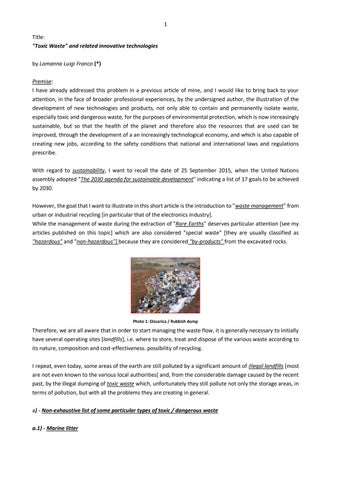
Photo 1: Discarica / Rubbish dump
Therefore, we are all aware that in order to start managing the waste flow, it is generally necessary to initially have several operating sites [landfills], i.e. where to store, treat and dispose of the various waste according to its nature, composition and cost-effectiveness. possibility of recycling. I repeat, even today, some areas of the earth are still polluted by a significant amount of illegal landfills [most are not even known to the various local authorities] and, from the considerable damage caused by the recent past, by the illegal dumping of toxic waste which, unfortunately they still pollute not only the storage areas, in terms of pollution, but with all the problems they are creating in general. a) - Non-exhaustive list of some particular types of toxic / dangerous waste a.1) - Marine litter
2 These types of waste are now a very growing concern, and not only for aesthetic reasons along the coasts of our beaches, but for the entrapment and ingestion of many marine species present in our seas. These wastes pose serious threats to the marine habitat. The main areas of accumulation of solid waste in the sea are: the coasts; the seabed; the surface of the sea which, above all, are present in the form of microplastics (diameter less than 5 millimeters). I want to remember that most of the materials that are mostly found both on the beaches and in the sea are: plastic, rubber, paper, metal, wood, glass, etc. However, the main sources of the "marine litter" come mainly from terrestrial activities: due to incorrect management of municipal waste - both solid [solid waste can accumulate in the convergence areas of marine currents causing the formation of known so-called "waste islands" also with the English term of "Garbage Patch" or "Trash Islands"). In these areas it is possible to detect a concentration of waste equal to 30,000 150,000 objects / Km2] that liquid - at all levels, as well as the disposal of untreated urban wastewater and the illegal disposal of industrial waste; while the origin of maritime activities are due to: commercial fishing in which fishing gear is often abandoned, to merchant shipping and passenger transport as well as pleasure boating, to platforms for the extraction of crude oil and gas where, the latter contributes to climate change, because pollutants are released into the atmosphere and, finally, due to the incorrect management of port areas. However, directly or indirectly, marine litter affects our health and well-being in many ways, not least because some fish ingest these products which are toxic chemical materials, and then end up on our plates. Even today it is difficult to estimate the real extent of these activities made in a reckless way of this very serious impact. a.2) - "Radioactive waste" This type of waste, as I have already had the opportunity to illustrate on previous occasions, includes several very different categories of waste, including those coming from nuclear fuel reprocessing reactors, i.e. those produced by the dismantling of old plants, and elements of spent fuel. The radionuclides of uranium and thorium normally present in this type of waste are not to be considered radioactive material in this sense (unless certain radioactivity values are exceeded). The waste of spent nuclear fuel resulting from nuclear fission in the core or core of the nuclear fission reactor represents the best known form of radioactive waste, as well as one of the most difficult waste to manage, due to its long stay in the environment; but other industrial and research activities also lead to the production of this type of waste. The classification of radioactive waste can be very different from country to country. The IAEA regularly provides information on classification systems, but the decision to implement these suggestions is still left to the individual states today. a.3) - Hazardous waste from the extraction and processing of "Rare Earth" REE From some studies carried out in the vicinity of specific areas, in the vicinity of the mining sites for the extraction and production of REE, it has been noted that another potential danger could be the formation of low-level radioactive waste. All the mining activity for the extraction of Rare Earths has involved us, in recent decades, to pay a very high price for the entire ecosystem. In fact, the lack of new technologies to reduce the contamination of natural
3 resources, such as water or soil, are considerably slowing down the extraction of these REEs, putting entire industrial sectors in crisis that are essential for the manufacture of high-tech products, such as components used in the renewable energy and pharmaceutical industries. Today, unfortunately, the process of separating the REEs present in the rocks is very complex and expensive and also completely different between the different countries of extraction. To do this separation process, one of the methods is to use organic solvents [and of which there is the release into the surrounding environment of hydrofluoric acid, sulfur dioxide and sulfuric acid]; very aggressive solvents for the environment surrounding the processing sites. Furthermore, for every ton of rare metals extracted, about 20,000 cubic meters of special waste in the form of gas are abandoned, which in turn produces about 1,000 kg of radioactive waste. Thus, the environment surrounding the mine site, workers all appear to be exposed to breathing in the dust of these metals. Therefore, in my opinion, we must reconsider all the technological development of these very serious extraction methods, with innovative systems different from those used up to now, in order to minimize any future negative impact on the environment and on humans. Finally, I would like to remind you that, on the other hand, in the industrial recycling processes, only Japan is underway, it has undertaken a serious research policy in the field of recycling for the recovery of Ni-MH batteries containing Lanthanum, Cerium, Neodymium and Praseodymium. But at present it seems that the recovery of these metals and their results place the focus on a potential series of extraction processes that cannot yet be commercially developed due to drawbacks on yields and high costs. a.4) - Waste from "coronaviruses" I would like to point out that the COVID-19 crisis, which has affected all European countries and the world, making it a priority to solve the problem of this waste, on which to base a new safety line to prevent any contagion, both in terms of atmospheric pollution. , that of the subsoil and consequently of the aquifers. According to the I.S.S. COVID-19 - nr. 3/2020 - of the Italian Higher Institute of Health at the moment the survival time in a domestic / urban rejection of coronaviruses in general, and of the SARS-CoV-2 virus in particular, is not known, but there is a high perception of risk from part of the Italian population and also among the operators involved in the collection of this urban waste. However, according to what the ISS has already illustrated on this topic, it must be considered that viruses have a pericapsid envelope - such as SARS-CoV-2 - and have lower survival characteristics than the so-called "naked" viruses ( i.e. without envelope: for example, enterovirus, norovirus, adenovirus, etc.), and therefore are more susceptible to environmental factors (temperature, humidity, sunlight, native microbiota, pH, etc.), to disinfection treatments and biocides. Therefore, limited to what is known at the present time, it can be hypothesized that the SARS-CoV-2 virus deactivates itself, by analogy with other enveloped viruses, in a time interval ranging from a few minutes to a maximum of 9 days, depending on of the matrix / material, concentration and microclimatic conditions. Generally other coronaviruses (eg SARS and MERS viruses) [Kampf et al. Journal of hospital Infection (2020)] do not survive on paper, in the absence of humidity, but are found longer on disposable clothing (if at high concentration, for 24 hours), compared to cotton for example.
4 Therefore, urban waste from homes where positive swab subjects stay in isolation or in mandatory quarantine, should be considered equivalent to those that can be generated in a health facility, as defined by the Presidential Decree no. 254/2003, Italian legislation. a.5) - Waste produced by radiopharmaceuticals I remember that, in the diagnosis and treatment of some diseases, the aid of X-rays and radioactive isotopes have proved to be very valuable. Nuclear medicine is based on the use of radioisotopes which, introduced into suitable molecules, constitute the radiopharmaceuticals that are administered to patients to carry out very specific diagnostic tests in order to obtain therapeutic effects [concentrated radiations to destroy cancer cells, saving as much as possible those healthy]. Therefore, we must pay close attention to how to dispose of these types of waste and, from all those waste contaminated by biological liquids, such as blood and various secretions or those that come from environments and patients in infectious isolation [v. in par. a.4), COVID-19]. a.6) - Landfill of urban waste In Europe, an EU directive defines a hierarchy for waste management, which first envisages prevention, then preparation for reuse, recycling and recovery, and finally disposal. Its objectives are to prevent the generation of waste as much as possible, and therefore to use the waste generated as a resource and to minimize the amount of waste to be sent to landfill. A landfill, in the waste management cycle, is a site where solid urban waste and all other waste (including wet) deriving from human activities (debris coming from building constructions, industrial waste, etc ...) which, following their collection, it was not possible to recycle, and / or send to mechanical biological treatment possibly to produce energy through cold bio-oxidation, pyrolysis or, in last rationale, the use as fuel in incinerators (incinerators with energy recovery or waste-to-energy plants). According to the European Environment Agency, if no action is taken at the abandoned landfills present in the various urban and non-urban areas, some ecosystems, including marine and coastal ones, can be seriously affected by inadequate waste management or by dispersion into the sea. a.6.1) - Landfill of PC and mobile phone waste The lack of raw materials has significantly accelerated the development of advances in recycling technology by making it more feasible to extract Rare Earths from the recycling of materials made from old PCs and smartphones or tablets, etc. Most of this waste is the result of the abandonment, in particular urban areas or in the vicinity of industrial production areas, due to the presence in old PCs and smartphones [in all electronic components in general], of thorium and uranium that is found in the minerals of the Rare Earths, used for their production. I remember that any improper use of these substances can cause serious environmental damage [biogeochemical cycles]. I also point out that if these materials are abandoned in the environment and can penetrate the soil, where their transport is determined by numerous factors such as: erosion, atmospheric agents, pH, rainfall, groundwater, and according to the their bioavailability, they can also be absorbed by plants and subsequently consumed by humans and animals.
5 Even the fertilizers used in agriculture can be enriched with these REEs because they are abandoned by man, contributing to their contamination towards the soil / soil, due to their deposition, because they are present around the production / recycling plants [biogeochemical cycles]. Some large recycling plants for these products are currently operating in India and Japan, where it is estimated that around 450,000 tons of these minerals are stored in disused electronic components. From information received, it appears that in France, about 250 tons of Rare Earths are being produced per year from the recycling of used fluorescent lamps, magnets and batteries alone. Coal and its by-products have also been considered as a potential new source of useful elements, including the presence of REE, in very important quantities. I find it very important to talk about this because, recently, examining data on the results of some research on bioengineering, it was possible to form bonds on a rare protein-metal on strains of Escherichia coli. Following this, an international group of researchers was able to make "bacterial pearls" on an acrylic polymer. Using
All photos illustred are copied from the WEB
these particular microspheres they filled a column and made it percolate inside the REE waste solutions, managing to obtain a selective separation of the Rare Earth salts.
Fig. 1 – Example of a practical scheme for separating minerals
This research technique is undergoing enormous development, therefore we will have a great recovery, through recycling, of Rare Earths with low economic and environmental impact even if, from the analyzes carried out so far, they highlight and we want to reiterate how the presence of technologies and recycling plants is actually scarce. On the other hand, it is very important in this particular moment on the world economy.
TOXIC WASTES
FORMULATED (?)
SILEX 304 STONE type FORMULATED (?)
SILEX 304 STONE type
Fig. 2 – Solution of the storage of radioactive waste in containers made with a SILEX-304-STONE type resin mortar / grout formulation with special aggregates.
6 b.1) - Storage of waste or dangerous goods The burying or storage at the bottom of the sea of hazardous urban and industrial waste, in particular nonrecoverable ones, can be carried out at depths of 50-100 / 300 meters, using special bins, which will be made with a formulation [of grout polymeric] based on particular organo-mineral resins, able to ensure that our environment in which we live and our life is safe because this formulation does not undergo any form of degradation or corrosion attack over time. The accelerated aging tests of this particular formulation were carried out in the laboratory (**), using a climatic chamber, whose times were found to be quite long; in fact, to reach an aging value of over 100 years, it took more than 1 year of continuous work [without ever turning off the oven]. b) - Toxic waste storage technology Therefore, this type of caissons can be placed in a storage area safely in the open air, in safe and controlled places, but they can also be used in underground spaces, consisting of old abandoned mining sites. These old mining sites must be made up of particular and quality rock masses. Or they can be stored in new caves or tunnels with the ability to maintain a sealed environment. I point out, unlike open places that, noise and vibrations, the subsoil provides the right protection, absorbing the shocks and energy that an explosion can develop [which can be accidental or due to terrorist attacks] or a strong earthquake . In addition, for radioactive fallout or accident, underground structures are safe if these spaces are equipped with the ability to exclude or filter contaminated outdoor air. Finally, underground structures generally have a longer duration than those above ground, i.e. outdoors, while these types of caissons [which contain hazardous waste such as radioactive ones], conceived and formulated by the undersigned, have a duration that can easily exceed 100 years [in fact, unofficial laboratory tests, only due to the lack of regulations on this subject, tell us that 500 years can be easily reached and exceeded without undergoing any degradation]. We can therefore conclude that the underground alternative also offers significant environmental benefits.
FUTURE EXTENSION
BASIN 2
BASIN 1
Fig. 3 – Design example of mining cavern/tunnels for waste
I would also like to emphasize the importance of these abandoned mines or the ad hoc construction of new caves and tunnels for the Circular Economy. These abandoned mines can become fundamental within these spaces, as well as being functional for their recycling process made up of separation, regeneration, reuse and re-production, so much so that they can be used as secondary raw materials and not as waste. They will be products of great industrial economic opportunity and environmental sustainability [Circular Economy] thanks to the lower use of natural resources in production processes, the reduction of greenhouse gas emissions and greater efficiency in the reduction and treatment of waste.
7 This new article of mine absolutely does not want to be an answer to all your questions and perplexities but just wants to represent a warning to make people understand that there are technological alternatives. There are many and are in a phase of development [as in the case of recycling] within the Innovative Industrial Pole, which the Fondazione Internazionale di Centro Studi e Ricerche - ONLS [NGO] has planned to create, through its Research Center and its own Private University with the sole purpose of helping to patent and commercialize new technologies to make the most of Italian and European innovation, invention, investments, marketing and entrepreneurship, essential to be competitive in a global world in constant change. Within our Innovative Industrioal Pole, we will make equity available to students and researchers to finance their education on involvement and investment opportunities, through participatory startups, with objectives based exclusively on research and development [see what I have already briefly illustrated in the article: "Reflection on the advantages and disadvantages of the extraction of Rare Earths - REE"] paying particular attention to new technologies on recycling. Through these new technologies on recycling it is possible to create valid substitution compromises for Rare Earths, without neglecting the re-proposal of other types of materials, which may seem less strategic but, of which a great deal of use has already been made previously and of which today its reuse has in any case become superfluous or abandoned to make room for a new industrial process, in particular, during the last decade while, by making some efficiency improvements on some processes, it is possible, through a careful analysis of the flows [ derived from money laundering], the study of real markets [v. China, all of South America and Australia] and financials, in particular on some significant raw materials, these can be substituted for Rare Earths and favor the creation of a circular economy linked to various industrial sectors, recording significant growth for the next decades and rapid [I recall in conclusion that the USA, Chile and China seem to be the countries with the greatest potential for development for the next few years. In Europe, important mineral deposits have been discovered in the east of the Czech Republic and in Serbia]. On the other hand, to conclude, the typical path of new materials, to get to commercialization, even when everything works perfectly within a Research Center, the development process is long and requires that these innovations will not enter the market globally, significantly, no earlier than the year 2030. …oo0oo…
(*) Luigi Franco, LAMANNA - INDEPENDENT TECHNICAL CONSULTANT, Consultant Specialized in Mechanized Tunnelling with Hard Rock TBM and Soft Soil EPB Shields, Expert and Consultant in structural reinforcement of concrete and / or masonry structures, tunneling and mining, - PRESIDENT OF THE FONDAZIONE INTERNAZIONALE DI CENTRO STUDI E RICERCHE, ONG, - 132, via dei Serpenti, 00184 ROMA, Italy, U.E., - Email: lamannaluigifranco1@gmail.com
(**) The tests (classified) were carried out at the largest international government Agency dealing with Atomic Energy.