What does a smarter approach to growth look like? Our community knows all too well what poor coordination looks like. We have been at the mercy of its shortcomings for decades and the problems have compounded. Constant traffic, haphazard development and a growing deficit of critical infrastructure. So, what’s the solution? The government’s approach has been to simplify and centralise. 1- Combine the relevant ministries into MCERT 2- Regionalise local government 3- Reform the RMA to make development simpler, faster, and nationally standardised. Anecdotally, it makes the boat go faster. It shaves the weight, makes it more aerodynamic and gives it a bigger engine. But it raises a bigger question, where is the boat going? For decades, New Zealand has measured success by whether the process was followed, rather than whether it produced the outcomes we actually wanted. The contradiction is we keep hoping coordinated outcomes come from a system built around fragmented decision-making. Delayed infrastructure is a symptom, not a surprise. When the solution is simply to “make that system faster”, it’s no wonder it’s making locals nervous. If speed isn’t the whole answer, then what is? Well during his recent visit, the Prime Minister was asked about the pressures of growth. He pointed to Singapore as the gold standard, celebrating the fact “you can see exactly how things will develop over the next 30 years.” I agree! And their digital models are world class. But it’s also worth remembering that Singapore can coordinate development largely because the state owns the land. If New Zealand is to achieve similar results from a market led approach, then we need to gamify development. Picture this… Imagine opening a digital twin of the district, as intuitive as Google Earth. With a click, you can see the vision of what Queenstown Lakes could look like in 10, 20, 30 years. Fly to the area you’re interested in and the zoning, infrastructure capacity and planning rules appear instantly. Select the zone, a banner appears [Infrastructure Tickets available: 105 homes]. The closer you build to existing infrastructure, the cheaper the ticket, to reflect the real costs required to service it. Be warned though, land banking in priority development areas comes with a hefty rates bill, not the passive gold mine it used to be. Infrastructure projects are triggered as growth reaches defined capacity thresholds, allowing agencies to sequence investment based on need. No more political lottery, nor the “break it to make it” culture we’ve accepted. Growth isn’t the problem. The current system, tools and incentives are. When incentives reward the outcomes we want, the market starts building the future we’ve planned for. Cr Cody Tucker, Chair of Smart Growth Committee QLDC
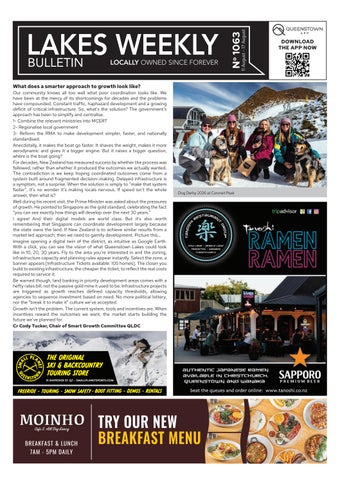
Dog Derby 2026 at Coronet Peak
15 SHOTOVER ST. QT - SMALLPLANETSPORTS.COM
BREAKFAST & LUNCH 7AM - 5PM DAILY
TRY OUR NEW BREAKFAST MENU
11 August - 17 August
LOCALLY OWNED SINCE FOREVER
No 1063
LAKES WEEKLY BULLETIN
DOWNLOAD THE APP NOW
Page 2
LAKES WEEKLY BULLETIN
ON THE APP THIS WEEK New advanced prostate biopsy service launched locally Queenstown Urology, led by Urologist Mr Amir Zarrabi, has expanded prostate cancer diagnostic services in Queenstown with the introduction of advanced transperineal MRI fusion prostate biopsy technology at Southern Cross Central Lakes Hospital. Prostate cancer is the most common cancer affecting men in New Zealand, and MRI fusion biopsy technology represents the current gold standard internationally in prostate cancer diagnosis. The technique combines high-resolution MRI imaging with real-time ultrasound guidance, allowing urologists to precisely target suspicious areas within the prostate. The transperineal approach also reduces infection risk and improves diagnostic accuracy. Until now, men in Central Otago requiring this specialised procedure needed to travel to either Dunedin, Christchurch or Invercargill for biopsy as part of their prostate cancer workup. The new
service now allows patients to access world-class diagnostic care much closer to home. Most medical insurance providers cover the costs of these biopsies. Urologist Mr Wikus Vermeulen, recently joined Amir at Queenstown Urology. Wikus has extensive experience in transperineal MRI fusion prostate biopsy. He has published internationally in the field and was recently interviewed by the American Urological Association to discuss his clinical experience and research relating to prostate biopsies and transperineal biopsy technology. Several of the new biopsy procedures have already been successfully completed at the Southern Cross Central Lakes Hospital in Queenstown, with further biopsies scheduled over the coming weeks. Amir said the investment reflects their ongoing commitment to delivering leading-edge prostateand prostate cancer care to men in Central Otago and the wider Southern region.
QLDC Mayor John Glover announces Mayoral taskforce to keep Queenstown moving: Act now, implement faster, think differently QLDC Mayor John Glover is setting up a Mayoral Taskforce in response to the significant impacts that the congested road network is having across the Whakatipu Basin. Mayor Glover explained “Queenstown’s transport woes have been in the media since the 1970s. But right now, we are seeing our future played out at peak times when the networks reach a tipping point and any exacerbator is causing it to fail. The modelling tells us that even if every currently identified intervention is delivered, Queenstown’s transport network still fails. Overall, the response comes too little, too late. Continuing to plan within the existing framework is therefore not enough. The biggest risk for Queenstown Lakes District is spending the next 30 years debating which road to build first while congestion, accessibility and productivity steadily worsen. We must act now, implement faster and think differently. How can we ever persuade people to take the bus when they are simply stuck in the same queue as everyone else?
involve other agencies/experts/community groups through the process. More details will be provided next week.
Our community expects us to show leadership rather than wait for someone to do something, and we are responding to that.” Notes to editor The taskforce group will work over a period of three to six months on practical actions that improve transport outcomes, accelerate delivery of initiatives that may be identified as part of Otago Central Lakes Regional Deal negotiations and develop innovative long-term solutions. The taskforce is expected to be established as a small group including elected representatives from local councils and government together with local businesses, mana whenua, active transport advocates, urban design, traffic engineering and finance expertise. Executive support for the taskforce will be provided by the Mayor’s office. The first step will be for the taskforce to gather to agree establishing principles, objectives, work programme, outputs and membership/ participation. It is expected that the taskforce will
DOWNLOAD THE APP NOW
LAKES WEEKLY BULLETIN
Page 3
LAKES WEEKLY BULLETIN
Page 4
ON THE APP THIS WEEK “Timely reminder as two rescued from Treble Cone back country in difficult conditions”
Twice in the past fortnight Wānaka Police coordinated a search and rescue operation involving people in the alpine environment. At around 1.45pm on Thursday, 30 July, Police were notified of two snowboarders in need of assistance near Treble Cone ski field. Two snowboarders ventured beyond the boundaries of the ski field to explore the back country before becoming lost for approximately six hours. At the time, weather conditions were extremely challenging, with heavy snowfall, strong winds, and near-zero visibility. The search was complex and required the expertise of the Wānaka Alpine Cliff Rescue Team, multiple ski patrol units, and an aerial search team. Aspiring Helicopters operated in very difficult flying conditions, and it was only through the pilot’s extensive local knowledge, experience, and exceptional flying skills that search teams could be safely deployed into the alpine environment. The snowboarders were located approximately one hour before nightfall. Had they not been found before darkness, the outcome could have been significantly more serious. Police are incredibly grateful for the professionalism, dedication, and expertise of everyone involved in the search. Wānaka is fortunate to have such highly skilled volunteer and professional rescue personnel who are prepared to respond in difficult and often hazardous conditions to assist those in need. This incident serves as another timely reminder that venturing beyond ski area boundaries into the back country should never be taken lightly. Anyone planning to enter the alpine environment must have the necessary experience, understand the current weather and avalanche conditions, carry appropriate emergency equipment, and have the skills to use it. Even a minor mistake can quickly develop into a life-threatening situation in alpine terrain.
DOWNLOAD THE APP NOW
Page 5
LAKES WEEKLY BULLETIN
DRINKS
FOOD
FEATURING
3PM-9PM SUNDAY 13TH SEPTEMBER AJ HACKETT KAWARAU BUNGY CeNtRe ON SALE NOW:
SOLD OUT
FROM $69 | TICKETS ON SALE NOW BUS TRANSFERS INCLUDED EX TRAS: BUNGY JUMP • ZIP LINING • KJET BOAT DROP-OFF NEW KAWARAU SWING!!
CHECK OUT ALL SNOW MACHINE SIDE EVENTS:
Nurturing curiosity and growing confidence. Monday to Friday 7:30-5:30pm Level 1, 30 Grant Road, Five Mile Shopping Centre www.curiousminds.co.nz qt-manager@curiousminds.co.nz | 03 974 4650 Find us on Facebook
Page 6
LAKES WEEKLY BULLETIN
CRIMELINE by Sue Fea
Public Notice | Pānui Creative Communities Scheme (CCS) August 2026 Funding Round Now Open
Aggression and assaults Police have been kept busy investigating some allegedly serious assaults and aggressive behaviour in recent weeks with one person arrested and CCTV photos released in a bid to help locate some of the other offenders. Constable Amanda Shute says an allegedly aggressive 45-year-old local man faces multiple charges after Police were called to a Frankton business at 10.30am last Wednesday, 29 July, where an allegedly intoxicated member of the public was refusing to leave and becoming aggressive towards staff. She says the man then allegedly grabbed a staff member’s arm and stood in close proximity to his face, continuing to verbally abuse him. The man was located shortly after by Police and allegedly refused to provide his details, became aggressive and threatened the officer. He was arrested and during the process allegedly resisted Police and continued to threaten attending officers, Shute says. He was charged with assault, disorderly behaviour, resisting Police, speaking threateningly and failing to refuse ID particulars to Police.
Serious assault Police are also appealing for the community’s assistance in identifying three men who may be able to assist in their enquiries after a serious assault on a man at around 2.35am outside World Bar in Church Street back on Sunday, 19 July. In a public call on Monday (3 August) they released CCTV photos, urging anyone with information to contact them on 105, quoting file number 260719/4053. CCTV photos were also released late last week calling for the public’s assistance as Police try to identify and speak with people they believe may have information to assist them in their investigations into an alleged assault outside the Camp Street Night ‘n Day shortly before midnight on Saturday, 11 July. Anyone with information on this is urged to contact Police referencing file number 260712/1402. To view CCTV photos see: www.facebook.com/SouthernDistrictPolice
Bad smash - Arrowtown Lake Hayes Road - State Highway intersection A woman was flown to Dunedin by rescue helicopter with moderate injuries after a two-vehicle crash at the busy Lake Hayes – Arrowtown Road intersection with State Highway 6 - Frankton to Cromwell, just after 5pm in peak traffic on Wednesday, 29 July. Police say a vehicle on Lake Hayes - Arrowtown Road allegedly pulled out of the intersection in front of a vehicle travelling towards Cromwell, causing substantial damage to both vehicles. The female driver of a small Suzuki car was flown to Dunedin Hospital by the Otago Southland Rescue helicopter while another person was assessed by St John Ambulance staff at the scene. A St John spokesperson says they responded to the 5.11pm callout with a helicopter, two ambulances, an operations manager and a rapid response vehicle. Both the Arrowtown and Frankton Volunteer Fire Brigades also attended on hand with cutting equipment. Arrowtown Volunteer Fire Brigade chief Murray Forward says they were potentially going to have to cut the woman free but were able to remove her via the back seat, using minimal equipment. “She was very lucky,” he says. The driver of the Toyota Hilux, which was travelling towards Cromwell, didn’t require hospital treatment.
Funding is now available for community–based arts groups and individuals. THE AIM OF THE CCS SCHEME IS TO: • encourage participation • support diversity • enable young people A funding application guide can be found at www.qldc.govt.nz/ community-funding The application form is now required to be completed online in the SmartyGrants Funding portal on the QLDC website. Funding round is now open and will close on Monday 31 August 2026. FOR ANY ENQUIRIES CONTACT: Jan Maxwell Relationship Manager Arts and Events Phone: 03 441 0469 or 027 233 7934 Email: jan.maxwell@qldc.govt.nz 10 Gorge Road Queenstown Phone 03 441 0499 | www.qldc.govt.nz
QUEENSTOWN DHARMA CENTRE, 12 LAKE ST
TUE (11 Aug) @ 6.30pm - 8pm, ‘Natural Ease’ with Grant Rix SAT & SUN (15 & 16 Aug) @ 2.30pm - 4.30pm, ‘The Four Boundless Qualities’ with Amnyi Trulchung Rinpoche All are welcome. Donations for the teacher/centre are gratefully accepted. See www.dharmacentre.org.nz / FB
XS STORAGE Secure self storage units – various sizes available Phone: 0800 297 786 www.xsstorage.co.nz
Car flips onto roof in Gorge Road crash Police were also called to a single vehicle crash on Gorge Road in which a vehicle crossed the centreline, crashed into a bank and flipped, coming to stop on its roof at 8.30pm last Thursday, 30 July, Shute says. The vehicle had been driven around a left-hand bend, its rear tyres lost traction and the driver allegedly lost control, she says. Fortunately, the driver walked away uninjured.
Drink driving A 28-year-old Queenstown man allegedly blew 647mcg after being stopped and breath tested on Lake Avenue at 8.20pm on Friday, 31 July. Another vehicle was stopped on Frankton Road at 7.40am on Sunday after Shute says the driver was allegedly seen using a phone while driving. The driver allegedly blew 400mcg and was issued with an infringement notice for the phone and breath alcohol level.
How to advertise Ph: 03 409 2800 Email: enquiries@qmg.co.nz Place your ad online: www.lwb.co.nz Advertising Deadlines Display Advertising: 12pm Thursday Situations Vacant: 12pm Friday Queenstown Media Group PO Box 1546, Queenstown 9300
Meet the team Catherine Mercer Account Manager 027 777 2785 | cat@qmg.co.nz Kylee De Suza Account Manager 021 044 2968 | kylee@qmg.co.nz Patricia W. Becker Graphic Designer Kanika Sethi Finance Sue Fea Journalist Jessica Allen Journalist/ Content coordinator
Page 7
LAKES WEEKLY BULLETIN
ON THE APP THIS WEEK Ziptrek strengthens environmental commitment through Love Queenstown partnership Queenstown tourism operator Ziptrek Ecotours has become a Love Queenstown Impact Partner, strengthening its support for local climate, conservation and biodiversity projects. Ziptrek has been involved with the community fund since its launch in 2023, contributing to fundraising events, industry planting days and other environmental initiatives. The new partnership will provide sustained financial backing for grassroots projects across the Whakatipu. Founder Trent Yeo says the partnership is a natural fit for Ziptrek and reflects the company’s belief in businesses working together. “We love working with Love Queenstown, and this step makes our support more direct and ongoing,” he says. “No one can do it individually. Collectively is much better.” Love Queenstown Community Fund Coordinator Ash Bickley says Ziptrek has long demonstrated responsible tourism in practice. “Trent and the team have been an inspiration in this space, showing what’s possible when a business puts people and place at the heart of everything it does,” she says. Since opening above Queenstown in 2009, Ziptrek has planted more than 6,000 native trees and contributed well over $250,000 to community and environmental organisations. Its support has included Mana Tāhuna, Kiwi Birdlife Park and Sustainable Queenstown, alongside Locals’ Days, staff volunteering, environmental restoration, and education. Ziptrek was also Queenstown’s first tourism operator to achieve Net Zero Carbon Business Operations certification, which it has maintained for six consecutive years. Trent says Love Queenstown gives businesses and visitors a trusted, practical way to contribute to the place they live in or visit. “Queenstown is developing as a place where people can formally, functionally and loudly contribute,” he says. “And our community wants to see that.” After almost two decades in tourism, he says sustainability should become a normal part of doing business. “You have to be simultaneously patient and impatient about these things,” he says. “The whole idea of sustainable tourism should disappear and just become normal. I am hopeful. I’m also still impatient.” He says Love Queenstown enables businesses to support credible local organisations without having to identify, assess and administer individual projects themselves. “Love Queenstown is sitting there waiting to be fed,” he says. “It’s a very solid way to ethically give out money without every business having to work out who receives it and whether they’re the right organisation. Love Queenstown manages that.” Love Queenstown Impact Partners commit either 1% of net proceeds or $10,000 or more annually. Contributions are pooled, with 80% supporting immediate environmental action through annual Impact Grants and 20% invested in an endowment fund for future generations.
DOWNLOAD THE APP NOW
SCAN THE QR CODE TO RECEIVE YOUR FREE RENTAL APPRAISAL TODAY P 03 441 0793 E rentals.queenstown@harcourts.co.nz Highland Real Estate Group Ltd Licensed Agent REAA 2008
WATCH REPAIRS NOW For all your repairs, watches, clocks, batteries, key cutting & straps. Level One, Stratton House (Below Sky City), 24 Beach Street, Queenstown Mon - Fri, 9.30am till 5.30pm. Closed on Saturdays. Phone/ text: 027 217 0442
Page 8
LAKES WEEKLY BULLETIN
COMMUNITY NOTES Experience K-Culture & Get Fit: Saturday K-Pop Dance Fit for Everyone! As migrants, sharing our culture with the wider Queenstown community is something we hold dear – and what better way to connect than through music and dance? With K-Pop taking the world by storm, the Queenstown Korean Association invites everyone to our fun and energetic weekly K-Pop Dance Fit class! Dance Fit is a fantastic, high-energy workout where you can learn easy dance moves to popular K-Pop tunes while shaking off the week’s stress. It’s designed for all ages and fitness levels – from young children to seniors. Parents are welcome to bring their little ones along. Every Saturday, our community operates two rooms packed with exciting cultural activities: • K-Pop Dance Fit Class (for public) • Taekwondo • Korean Traditional Sogo (Small Drum) Dance Practice There is no booking required – simply drop in and join the fun! When: Every Saturday at 3.00pm Where: Te Atamira /Kapa Rua Cost: $5 donation per session – all donations will go directly towards funding our upcoming Korean Day event on 10 October. What to bring: Comfortable clothes, indoor shoes, and your energy! The Korean Association of Queenstown began its activities locally in 2013 with the purpose of helping immigrants, visitors and the wider
community to live peacefully and safely. It’s a vibrant close-knit community of about 200 members spread throughout Queenstown, Wānaka, Cromwell, and Southland. Members vary from children to elders in their 80s. Contact: For any questions, please feel free to reach out to Hana at hnkim.utsugi@gmail.com Come move, sweat, smile, and experience Korean culture with us this Saturday!
Lakes Weekly gives community organisations in Queenstown Lakes the chance to address our readers directly though our Community Notes page. If you’d like to take part, email Jess at info@qmg.co.nz
creativeessencenz.etsy.com
Personalised birth posters, nursery wall art and first birthday keepsakes — each one made with care and delivered straight to your inbox.
Know someone expecting, welcoming a new little one, or celebrating a first birthday? @creativeessencenz
Scan for a special offer
Page 9
LAKES WEEKLY BULLETIN
Experts warn against pushing on amid multiple rescues by Sue Fea
Local rescuers make their way to retrieve the climber who climbed back to the summit of Mount Aspiring in freezing darkness to raise the alarm after his climbing partner fell up to 300m recently. Photo credit: Heli Otago
Experienced local rescuers are warning young climbers against “getting sucked in by summit fever’ amid calls from Police for extreme caution in the backcountry after two more major alpine rescues near Wānaka in a week. Specialist search and rescue volunteers and Police say in both cases those needing rescued were extremely lucky and they’re calling for more informed decision making, the necessary experience and a solid understanding of current weather and avalanche conditions before venturing into the mountains. Some rescuers say people sometimes get sucked into summit fever and underestimate the time to get up the peak and back down safely. Wakatipu Alpine Cliff Rescue Team coordinator Russ Tilsley says in a number of rescues recently, despite having some experience, people haven’t been allowing sufficient daylight hours to get back before darkness and extremely cold overnight temperatures set in. “They’re not allowing the time to get up and down and arriving back early the following morning.” He says in the miraculous survival of a climber who fell up to 300m off a steep snowy ledge several weeks ago the two climbers – believed to be an Australian and Cantabrian, had made the wrong decision to push on knowing they’d run out of daylight on their descent. Wakatipu team members were part of a large, coordinated rescue for those two on Aspiring, and also for an experienced local couple who’d become bluffed on a near vertical ice face at night after taking a wrong route on their descent early last month.
SPIDERS, FLIES & ANTS
PROFESSIONALLY ELIMINATED We serve the Queenstown district including Wānaka, Hāwea, Cromwell, Queenstown, Glenorchy, Kingston and all areas in between (100% NZ Owned)
Call us now on 0800 336 778 Zane on 022 096 3172 for a free quote
FREE VENUE HIRE T&Cs T&Cs apply, apply, contact contact us us on on 03 03 442 442 9995 9995 or or email email queenstown@lonestar.co.nz queenstown@lonestar.co.nz to to plan plan your your next next function. function.
A Wakatipu Cliff Rescue volunteer was up Mount Aspiring on a recreational climb just prior to the first rescue and had made the decision to turn back to the hut knowing it was too late in the day. The couple that ended up being rescued had carried on, Tilsley says. The team was also on standby to help Wānaka’s Alpine Cliff Rescue Team who flew in with skilled pilots, ski patrollers and Police after two snowboarders ventured beyond the Treble Cone boundaries in heavy snow, strong winds and near-zero visibility on Thursday, 30 July. Wānaka Sergeant Darren Cranfield says that was a complex search requiring extensive local expertise, the Aspiring Helicopters pilot flying in very difficult conditions. “It was only through the pilot’s extensive local knowledge, experience, and exceptional flying skills that search teams could be safely deployed into the alpine environment,” Cranfield says. The snowboarders, lost for six hours, were found only an hour before nightfall. “Had they not been found before darkness, the outcome could have been significantly more serious.” That was the second SAR operation coordinated by Wānaka Police in a week and Cranfield says it serves as “another timely reminder that venturing beyond ski area boundaries into the backcountry should never be taken lightly”. Tilsley says thankfully the two boarders were found: “Those kids were pretty lucky”. Like the two men in their 30s in the accident on Mount Aspiring, he says they’d “totally underestimated” what they were heading into. “Experience means being able to make the right decision and come to a conclusion that, yeah, I can make it to the top of the peak but the consequences of that will be that I will be coming down after dark,” he says. “By then people are cold, tired and hungry and that’s when they make mistakes. Do your due diligence,” Tilsley says. “One day the mountain may be attainable and one day it won’t depending on weather and snow conditions, which can vary greatly.”
Same great service in a new location Book an appointment today! 17 Neason Place Cromwell Central Otago
Cell: 0274-455-925 email: info@creativeframing.co.nz www.creativeframing.co.nz
LAKES WEEKLY BULLETIN
Page 10
DOWNLOAD THE APP NOW
Page 11
LAKES WEEKLY BULLETIN
EVENTS
GOINGS ON ABOUT
Gina Malcolm and the Hollow Souls and Johnny and The Cashtones
EVENTS - MUSIC - ART THEATRE - AT THE GALLERIES
COMMUNITY The Good Energy Queenstown Quiz
A fun mix of Queenstown trivia, classic pub quiz rounds, sustainability and energy. Get ready to spark your curiosity and charge up your brain for a night of laughs, competition, and all your favourite pub quiz rounds (plus a few more!). Expect a lively mix of Queenstown trivia, history, geography, sustainability, energy, and plenty of classic pub quiz favourites. Tickets are just $5 per person, or $30 for a full team of six. There’ll be plenty of awesome prizes up for grabs, so round up your team, lock in your tickets, and get ready for an electrifying night! When: Thursday, 13 August, 6.30pm – 8.45pm Where: Lone Star, 14 Brecon Street, Queenstown
Sip, Snack, Swap
Got cool stuff at home that no longer serves you? Join Sustainable Queenstown for a cosy night in - swap goodies, give unused items new life, and connect with like-minded locals. From stationery and books, to crafts and cosmetics, and plastic-free swaps for everyday items - surprise treasures await! Enjoy a delicious selection of low-waste snacks, homemade winter drinks, including authentic chai and hot chocolate, and a DIY snack station. They’re even giving away recipes! Tickets on Humanitix. When: Tuesday, 18 August, 6pm – 8pm Where: Komunal Cafe, 13 Red Oaks Drive, Frankton
Fruit Tree Pruning Workshop
KPCA invites you to join their annual fruit tree pruning workshop, with fruit tree expert, Alex Huffadine from Thrive Consulting in Cromwell. Starting in the Croquet Club rooms, Alex will share his knowledge about the basics of pruning and caring for a variety of fruit trees to maximise production and minimise disease. This informal session will be full of practical advice for the novice or experienced home gardener. There will be plenty of time to ask questions. Cost: koha ($30 per person recommended), spaces are limited so book early! Morning tea is included so please let them know any dietary requirements. What to bring: pen, paper, gloves, clean, sharp secateurs and loopers (if you have some). To book your place, please email: talk2kpca@gmail.com or phone Chris on 027 471 7786 for more info. When: Sunday, 23 August, 10am – 12.30pm Where: Jardine Park Croquet Club & Community Orchard
August Book Club: LGBTQIA+ Stories
Book Club is on the last Thursday of every month (unless otherwise stated). All are welcome and the theme is not strict: you can read/bring/talk about any book you like. The optional theme for August’s book club session is ‘LGBTQIA+ Stories’. Delve into stories of identity, love, resilience, joy and everything inbetween, be it tender romance, coming of age, true stories and memoirs, or something that challenges and expands your perspective. Join them for a cuppa and discuss authors, characters, stories and voices as diverse as the community itself! When: Thursday, 27 August, 5.30pm – 6.30pm Where: Queenstown Library, 10 Gorge Road, Queenstown If you would like your show, event, exhibition or meeting promoted in Goings On drop us a line at info@qmg.co.nz with the details
Join Waitaki’s party boys Johnny and The Cashtones and Queenstown’s alt-country rockers Gina Malcolm and the Hollow Souls for a special one-off night at The Sherwood. Led by Gina Malcolm’s unflinching songwriting and backed by a band steeped in dust, harmony and groove, the Hollow Souls deliver songs that sit somewhere between late-night confessionals and fullband catharsis. Expect honest stories, big choruses, and a live show built on exceptional musicianship. The Cashtones kick things off at 7.30pm, then it’s The Hollow Souls from 8.30pm, playing orginals from Gina’s acclaimed debut album First Rodeo, plus some tasty covers. When: Friday, 14 August, 7.30pm - 9.45pm Where: Sherwood, 554 Frankton Road, Queenstown
The 2026 Cargo Ceilidh
Step into Scotland without leaving Arthurs Point! Dive into an evening brimming with authentic Scottish traditions. Come early to enjoy a selection of specialty whisky and grab your seat. Cargo’s Scottish Ceilidh entertainment and dancing will run from 6pm to 9pm, featuring the traditional ode to haggis. Guests can enjoy a complimentary haggis tasting, explore their Scottish-inspired menu, and soak up the atmosphere while enjoying Cargo Collective brews on tap. It’s a night of kilts, lively reels, and pure Scottish joy! Don’t miss this chance to bring the magic of Scotland to Arthurs Point. When: Saturday, 15 August, from 5pm Where: The Cargo Collective, 172 Arthurs Point Road, Arthurs Point
Beyond 30’s Daytime Clubbing
Your kind of crowd, your kind of party! You can expect hours of good vibes, great music and unforgettable moments. Over 30s Daytime Clubbing is your chance to relive the peak of the 80s, 90s & 2000s clubbing scene. Get ready for club classics, light shows and resident DJs. When: Saturday, 22 August, 4pm – 9pm Where: Rhino’s Ski Shack, Searle Lane, Queenstown
ARTS Theatre Intimacy Choreography Training Workshop
This two-day training workshop is designed to equip community theatre practitioners and arts professionals with the knowledge, tools, and practical skills to uphold industry best-practice standards around the choreography and facilitation of intimate content — both in rehearsal and in performance. No prior experience with intimacy coordination is required. The workshop is suitable for all experience levels. You’ll need to register. Email katie@mtnz.co.nz for further details. When: Saturday, 15 – Sunday, 16 August, 10am – 3pm Where: Patagonia Tāhuna Queenstown, 49 Beach Street, Queenstown
Exhibition Opening: The Adam Portraiture Awards 2026
Celebrate the opening of the Adam Portraiture Award 2026, Aotearoa New Zealand’s premier award for painted portraiture. Presented biennially by the New Zealand Portrait Gallery Te Pūkenga Whakaata, the Adam Portraiture Award has become one of the country’s most significant portrait exhibitions. Bringing together works by established and emerging artists from across Aotearoa, it offers a timely reflection on the people who shape our communities, histories and lives. Portraiture has long been a way of recording who someone is. The opening is free to attend with all welcome. When: Friday, 28 August, 6.30pm – 8.30pm Where: Te Atamira, 12 Hawthorne Drive, Frankton
LIVE MUSIC
Page 12
LAKES WEEKLY BULLETIN
HOSPO GUIDE
DJS SPORTS BAR SPECIALS EVENTS
11 AUGUST - 17 AUGUST $20 Toastie and Soup Live music with TJ at 7pm Taco Tuesday
2 tacos & a beer for $25* *Ts & Cs apply
Wednesday
$25 Rump Steak Wednesday
Stacked Steak Loaded with onion rings & garlic bread for free!
Thursday Friday Saturday $20 Pumpkin and $20 Burger Special $25 Fish and Chips Kale Lasagna Live music with Live music with Live music with Dorothy 5pm Mitch EP 4pm Blake 5pm Duelling Pianos Duelling Pianos Duelling Pianos at 9pm at 9pm at 9pm Thursday
Friday
Classic Burger & Beer Poutine & Beer Grab a classic combo for poutine & B.Effect $30* *Ts & Cs apply
lager for $20
Monday
Sunday
$20 Hand Crumbed Schnitzel
$20 Chef’s Special
ATLAS X QMTBC END OF SEASON & KARMA KEG $10,205 RAISED!! Thanks to all the local businesses & breweries involved!
Monday
Steak for 2
Buy 2 rump steaks for $50
APRES AT ATLAS WITH OUR HAPPY HOUR BETWEEN 3PM & 6PM DAILY - ATLAS, QUEENSTOWN’S HOME OF CRAFT BEER Gourmet Pizzas, Happy hour BBQ Lunch slow-smoked ribs, burgers. Dine in & prices every day Platter Mon - Thu 5pm till Space is limited so takeaway available. on house beers, Fri - Sun late | Fri - Sun 12pm book your team via Easy online ordering 12pm - 5pm wines and spirits till late info@lokalqt.co.nz at www.lokalqt.co.nz PROUDLY SERVING FERNHILL & SUNSHINE BAY SINCE 2021, 155 FERNHILL ROAD
OPEN 7 days a week
Wednesday Quiz is back!
Tuesday
Thursday
Wednesday
Tight A$$ Tuesday
One74 with Aydn and FRY
Open Decks
Friday
Hevy: Winter Edition
Join our loyalty system. Ask one of our staff how to sign up.
Monday
Sunday
Saturday
Ribera
RnB Revival
Beer and Band Monday
Sunday
Monday
DJ MAD
DJ Rinkha
HAPPY HOUR EVERY DAY FROM 7PM - 9PM Wednesday
Tuesday
DJ Mad from 10pm
Make it your own, all night tune of your choice with our jukebox
Live Sports Pool Table Outdoor Fire
Saturday
Thursday
Pub Quiz from 7pm
Friday
DJ Grizzly from 10pm
Live Music with Dorothy from 6:30pm followed by DJ Rhinka from 9.30pm Saturday
Daily Happy Hour
Monday & Tuesday
80s VINYL PARTY FREE ENTRY
$9 Summit Pints $9.60 Guinness $12 Cocktails
Karaoke from 9pm
from 10pm
from 10pm
8pm
OPEN 8am DAILY
$25 Big Breakfast Bottomless Coffee
OPEN EVERY DAY 8AM - HAPPY HOUR UNTIL 9PM Tuesday
$12 Classic Pizzas
Wednesday
Thursday
Friday
Happy Hour 12-4pm
Poker Night
$14 Espresso Martinis
6.30pm
$14 Margs, $25 Pizza and Beer
Saturday
Sunday
Monday
$14 Singles $14 Aperols Daquiris, $10 Pool Comp Live Sports Snakebites 8pm
HAPPY HOUR DAILY 12 - 4PM $9 HOUSE PINT Tuesday
Karaoke from 9pm
Wednesday
Thursday
Curry & Pint Quiz Night Night from from 7pm 5pm - $30
Friday
Saturday
$9 House Live Music: Live Music: Danny Atkinson Black Pug drinks 5pm – 8pm 5pm – 8pm 4pm – 6pm followed by DJs followed by DJs 7 days a week till late till late
Monday
Parmy & Pint deal all day $30
HAPPY HOUR 4PM - 6PM DAILY
STRICTLY R18
1876
Tuesday
OPENING HOURS: 5pm – 4am - 7 DAYS A WEEK
Page 13
LAKES WEEKLY BULLETIN
Christmas Parties | Weddings | Birthdays | Conferences | Functions Whatever the occasion, Queenstown Bowling Club is the perfect place to bring people together. Now taking bookings: enquiries@bowlsqueenstown.co.nz
Tuesday
Wednesday
All-Day Ice Free to Watch Skating Ice Hockey included with 3x games from every Ticket 6.30pm-10pm only $26pp
Thursday
Slide & Spin with our Ice Bumper Cars running every 15 mins
All You Can Kids Eat Free Eat Pizza $35 Everyday between 5pm - 6pm
Tuesday
Dave Bell 8.30pm
Friday
NO PUBLIC SESSION New Zealand Ice Hockey from 8.30am-8.15pm
NZ Ice Hockey U18s from 6.30pm-9pm
Pav Apres hour
Sunday
Everyday from 5pm Bookings essential
$10 Pav Wine, Beer & Aperol Spritz Everyday 4pm to 6pm
Wednesday
Thursday
Brett Walker Duo
Danny Atkinson
8.30pm
Sunday Limited Public Skating from 2.15pm-5pm Free to Watch Ice Hockey from 5.15pm-10pm
Saturday
Free to Watch Ice Hockey
Monday to Friday 12pm - 3pm
Available Lunch & Dinner. Bookings essential
Sunday
Friday
Makin’ Music 9pm
Trad Session 6pm Sunday Roast $28
Friday
Saturday
Ibiza Classics
Latin Party
from 10.30pm
from 10am5.15pm
$26 Business Lunches
$28 Sunday Roast
8.30pm
Monday
Bump, Skate & Frisbee
from 11pm
EVERYDAY 5PM - 10PM HAPPY HOUR Tuesday
QUIZ NIGHT Bar tab prizes from 7pm DJ Ayeedeeg from 9pm
Wednesday
Silent Disco 3 DJs 3 Channels Free Entry
Thursday
Friday
from 7.30pm
MASHED GRZLY
Mitch EP
Riders Night
Whats Cooking - Tomoto
Nic Shea
Mad Mondays
Ribera
from 9pm
from 5pm
from 9pm
from 9pm
from 7.30pm
Sunday
Saturday
from 9pm
DJ Mad
EVERYDAY - HAPPY HOUR FROM 4PM - 6PM AND 9PM - 10PM Tuesday
Dave Arnold from 8.30pm
Wednesday
Mo Ackerman
Thursday
Trad Band
from 8.30pm
from 8.30pm
Friday
Saturday
Sunday
Dorothy Ella Sean Tinker from 9pm
from 9pm
Dave Bell 7.30pm
Monday
Matte Orange
from 8.30pm
EVERYDAY 3PM - 5PM - HAPPY HOUR Everyday
8am - 9am Coffee Happy Hour 50% off when you byo keep cup EVERYDAY - Happy Hour 3pm - 5pm
Wednesday
Friday Thursday
Live music mic with Nic Shea Open from 8pm from 5pm
SEEK IS YOUR ALL-IN-ONE DESTINATION FOR UNFORGETTABLE NIGHTS OUT. SEEK CLUB DELIVERS QUEENSTOWN’S BOLDEST AND MOST DIVERSE NIGHTLIFE EXPERIENCE. 12B Church Street, Queenstown | Ph 021 949 449 | www.seekqt.com
Cameron Dixon live music from 6pm
Saturday
Bollywood Night from 9pm
Page 14
LAKES WEEKLY BULLETIN
Is your “Pint” a Pint?! Get your 570ml Imperial Pints here
Return of the ALL DAY BREKKIE
NEW MENU! Thursday
Friday
Live music with DJ Mad
Face Off Friday
9pm
Saturday
Silent Disco
from 5pm to 9.30pm
Live Music with DJ Mad at 9pm
at 9pm
DAILY
TAP BEERS
COCKTAIL HAPPY HOUR 9pm - midnight
$6 Beer handles 7 days a week
Hangry As has taken $10 Jagerbombs | over the Rhinos $10 Coronas | Kitchen – Check out $7 Jack Daniels & the menu on insta Coca-Cola & Absolut @hangryas_ & Sprite RTDS queenstown
LATE NIGHT MENU
EVERYDAY
5 DRAFT BEERS TO CHOOSE FROM
$9 FROZEN DAIQUIRI $9 FROZEN MARGARITA
ASIAN FUSION
EVERYDAY UNTIL MIDNIGHT
MONDAY TO SUNDAY 3PM - 12AM Daily
Daily
Social Hour
All Day Dining
4pm – 6pm
From 11am – late
$10 House beer & wine | $16 Cocktails
Enjoy delicious small plates & tasty sides
R20 Venue. Drink Responsibly.
R20 Venue.
OPEN MONDAY – SUNDAY 11AM – 1AM Tuesday
Live Music with Dorothy Ella 9pm
Thursday
Wednesday
Live Music with VickyLeigh Duo 9pm
Live Music with Blake 9pm
Friday
Live Music with Danny Atkinson 9.30pm
Saturday
Live music with Mandates 9.30pm
Sunday
Live Music with Tai Forester 7pm DJ Aidan 10pm
Monday
Live Music with TJ 9pm
$12 ESPRESSO MARTINIS EVERYDAY | HAPPY HOUR 3PM TO 6PM DAILY $10 HOUSE DRINKS Tuesday
RACK ‘EM UP
Rib n Fries $10 Off until 9pm
Wednesday
WING IT WEDNESDAYS 50% Off Wings until 9pm
Thursday
PARMI CLUB Parmi, Fries, Slaw $10 Off until 9pm
Friday
TOP DAWG 50% Off Any Hot Dawgs until 9pm
Sunday
Saturday
CAESAR SUNDAYS
BREW DAY $5 Off Selected Jugs 12pm - 5pm
$2 Off Caesars and Bloody Marys ALL DAY LONG
Monday
TRIVIA NIGHT
Every Monday 6.30pm $200 Total Bar Tabs 1st and 2nd Place!
ALL SPORTS. ALL DAY. LIVE & LOUD | OPEN FROM 12PM | FOR UPCOMING SPORTS, FOLLOW OUR SOCIALS OR HEAD TO OUR WEBSITE
Happy hour 3.30pm-5pm Everyday on house wine and beer
Also serving Lamb Shanks, Blue Cod and other delicious southern classics
Famous Sunday Roasts!
Limited availability. Book and Quote “ROASTS” to secure yours
50 STANLEY STREET, QUEENSTOWN Tuesday
Pub quiz 7pm
Wednesday Chicken parmy, chips & salad | $25 from 11am Live music from 5pm Karaoke | 9pm
Thursday
Burger & chips $22 | From 11am Live music | 5pm Pubble | 7pm
Friday
Live music 5pm
Saturday Live music from 5pm NZ Darts Masters 2026 | 7pm Brisbane Broncos vs NZ Warriors | 9.30pm
Sunday
Live music from 2pm
Monday 200g wagyu rump, chips, salad & sauce | $25 from 11am
Hospo Night
LIVE SPORT ALL WEEK I HAPPY HOUR MON-SUN 4PM – 6PM I LATE NIGHT HAPPY HOUR MON-SUN 9PM – 11PM Tuesday
2 for 1 Pizza
Wednesday
Wagyu & Wine for 2 $110
Thursday
$15 Cocktail Club NRL
Friday
Putting Challenge Jackpot 4-7pm Live Music 5-8pm
NRL
Saturday
$16.5 Espresso Martinis 3-5pm NRL | Steaming Saturdays $7.50 vodkas 8-10pm
Sunday
Monday
Pasta & $3 Oysters $10 Mimosas House Wine NRL $35
Our smokin’ hot adult entertainers are the best in the biz, and we have a range of steamy in-club and at-your-event options available just for you! From 9pm – 4am | Thurs, Fri, Sat | 12B Church Street, Queenstown | Ph 021 949 449 | www.calendargirls.co.nz
STRICTLY R18
QUEENSTOWN
Daily $20 Lunch Special
Simple, fast and tasty dishes that are available at your local Joe’s during the day! All our meals are full of flavour and made with integrity. 36 Grant Road, Five Mile, Queenstown Mon-Fri: 7am - 9pm | Sat & Sun: 8am - 9pm Ph: 03 441 4991
authentic italian made with love Lunch specials from 12pm - 4pm Tuesday to Saturday Remarkables Park Town Centre 12pm - 8.30pm (closed Sun - Mon) Menu & online orders via Uber & Deliver Easy
Every Tuesday
$22 chicken parma (from 3pm) chicken parma, ham, buffalo mozzarella, vodka sauce, shoestring fries
1 arthurs point road, arthurs point, queenstown 9371 @canyontaproomqt www.canyonbrewingqt.co.nz
DOWNLOAD THE APP NOW
Arts+Culture
Bollywood dance workshop
The joy of bringing creatives together by Jessica Allen
Eric Lim is the Art Facilitator at Te Atamira, bringing local artists, musicians, and creatives into the space to share their skills and connect with the community. No two days are the same and every session feels meaningful to him – an important space where creativity and connection come together. The programmes he looks after include the Saturday Arts Social, Free Community Nights and Make Space. They’re each much-loved by the community and help to make the arts more accessible to everyone. The Community Nights came about when Lim and the team wanted to create a regular, free space where people could drop in and try something new – no experience required, no pressure and most importantly, no bookings needed.
to shake off the winter blues and try something different. Lim loves the warmth curiosity of those who attend – they’re always willing to try new things. The response from the community has been really heartwarming, too, with regulars and new faces at each session. “Some people come for the social connection, others come to learn something new and some just come because they’re curious. I’ve had people tell me they look forward to these nights all week, it’s become a little highlight in their calendar. We’ve built a lovely little community around these events and it’s growing.” Arts and culture events in our community are important, especially in such a transient town as Queenstown. The community nights give people a reason to come together, try something new and feel part of something bigger. They’re free, welcoming and open to everyone no matter background or experience.
“We run them on Tuesday evenings and each month has a different flavour,” Lim says. “The first Tuesday is Community Sing, the second is Community Draw, and the third is Community Craft – which can be anything from dance and theatre or film to stitching and cultural workshops. It’s all about making art approachable and fun.” One of the recent Community Nights saw Remarkables Theatre hosting a Theatre Games and Stagecraft event. The fun and playful session started with some theatre warmups and icebreakers before moving into some improv games. Lim says the energy in the room was fantastic and attendees were letting their guards down, laughing and having a great time. Next up is the Bollywood Dance Workshop with Nishal Malinda on 18 August, which is going to be a lot of fun. “Nishal is a brilliant dancer who brings so much passion in dancing and warmth. People can expect a lively, beginner-friendly Bollywood dance session, no experience needed at all.” Malinda will go through some simple, joyful moves and to get everyone up and smiling – a great way
Community Nights - Pacific Dance
“You don’t need to be good at art or dancing or singing – you just need to be curious. Everyone’s welcome, there’s no judgment, and you’ll leave feeling lighter than when you arrived. It’s a beautiful way to meet new people, try something new and spend your evening in a warm, creative space. We’d love to see you there.” Finally, Lim wants to give a huge thanks to all the tutors and facilitators who share their time and talent, and everyone who comes along. “The community makes these nights what they are. I’d also like to acknowledge the support from Central Lakes Trust, which makes it possible for us to keep all of these events free. If you haven’t been to a Community Night yet, come along and have fun,” Lim says. Te Atamira’s community programmes – Saturday Arts Social, the Free Community Nights and Make Space run weekly with more info on Te Atamira’s website teatamira.nz
Page 17
LAKES WEEKLY BULLETIN
Funding for bold business ideas Applications are open for this year’s QLDC Economic Diversification Fund. Have an idea for a collaborative project that will create new business and career opportunities? This fund could help bring it to life. Submit an expression of interest before 31 August to receive guidance. Applications close 30 September. Full details at www.qldc.govt.nz/edf
Sunshine Bay Reserve
Book online at www.queenstownchiro.nz Tel: 03 442 8190 5 Mile, Unit 6, Inside Flex Fitness, 34 Grant Road, Queenstown
We’ve developed a draft plan that explores how the reserve could be enhanced over time while protecting the natural and cultural values that make it special. Public feedback closes 31 August. Find out more at https://letstalk.qldc.govt.nz
Need arts funding? Grants of up to $2,500 are available from the Central Lakes Arts Support Scheme (CLASS) for community groups, incorporated societies and trusts with an arts-focused project that’s open to everyone. For more info and an application form visit www.qldc.govt.nz/community-funding
Calling business & industry Help inform the future supply and location of industrial land across our district. We’re seeking insights from businesses, landowners, developers and infrastructure providers to help plan for growth over the next 30 years. Get involved: https://letstalk.qldc.govt.nz/industrial-land-use-study
Know what your Stars have to say
Found Fido? If you find a roaming pooch please don’t bring them to a Council office as we’re not set up to safely receive or hold them. Instead, call Animal Control on 03 441 0499 and an officer will come to collect the dog. If you can, stay with it until we arrive; if not, let us know its exact location so we can help reunite it with its owner as quickly as possible.
Remarkables Astrology
Email office@remarkablesastrology.co.nz www.remarkablesastrology.co.nz
Dispose of hot ashes safely Hot ashes can start fires in bins, trucks and landfills even days after. Always empty ashes into a metal bin, douse with water, and leave for five days before putting them in your red rubbish bin. More tips at www.qldc.govt.nz/services/rubbish-recycling
Rubbish at remembering? Sign up for weekly bin day reminders and public holiday alerts via text or email at https://tinyurl.com/28hshpm4
Sign up and Let’s Talk Want to make sure your voice is heard on the important decisions that matter to you? Check out our dedicated web portal Let’s Talk. Register and start having your say at https://letstalk.qldc.govt.nz
PRIVATE AIRPORT & CITY TRANSFERS Skip the taxi queue. We'll meet you at arrivals and get you where you need to be - comfortable, on time, and stress-free. No shared shuttles. Just a clean, private vehicle and a driver who knows the South Island.
P R I VAT E · R E L I A B L E · O N YO U R T E R M S BOOK YOUR TRANSFER
www.qldc.govt.nz
LAKESDELSUR.COM
My Life story
by Sue Fea
NIEL FREAR Ice Dad
He may have arrived in the south having never seen ice but after 30 years here Niel Frear’s spent much of his time rink side at the helm while Queenstown’s produced some of New Zealand’s best Ice Blacks and the Southern Stampede’s soared to victory. It’s usually the parents who encourage the kids into a sport, but in Niel’s case it was eldest of three sons, Cameron, then five, who got him hooked on the ice hockey stick. Cameron is now the head coach of the very successful SkyCity Stampede side, has been for the past seven years, the team now through to the championship finals after a win at the weekend. Sons Mitchell and Lachlan also play for the winning side, and all three sons have been Ice Blacks. Niel’s even managed a NZ Under 18 team for the NZ Ice Hockey Federation to an International Ice Hockey Federation tournament.
For decades he’s managed, also coached, ice hockey teams from the champion Wakatipu High School side and Southern Knights regional age group sides to managing the NZ Under 18 Ice Blacks, travelling to Romania with them. While he plays down his coaching abilities, Niel led the local high school side to a historic victory at the South Island Secondary School Championships and managed the Southern Knights team to win the Under 19 national title in 2003 – their first big success. On the NZ committee for the International Federation, Niel was selected to take two young national players to an international coaching camp in Finland and train himself. Despite coaching a number of teams, you won’t catch this Camp Dad boasting up his ability. “I’d just coach if they needed someone, but we’d often have games down in Dunedin and when our local boys, including our sons, were down there studying I’d just call them in to help coach during our matches there,” he grins. He’s “lived and breathed ice hockey for about 30 years”, all voluntary service, both as president and committee member of the Queenstown Ice Hockey Club, manager for The SkyCity Stampede
Luana and Niel back in their dating days in the 1980s
Luana and Niel at the SkyCity Quiz Night fundraiser
travelling the country to every game for almost 10 years, also a Southern Ice Hockey League committee member.
“My holiday job in primary school was sitting in the boat gutting flounder. We lived off the land and the sea.” Ironically it was their plan to lure a rugby-mad Cameron away from travel all over Central Otago on frosty Saturday mornings that spurred Niel and wife of 38 years Luana into the ice hockey arena. “Lu has given so much time to the sport with me. We do everything as a team,” he says. “We bought a seven-seater and the spare seats were always full taking other kids to games.” It all started when local ice hockey player Rob Lynes took that five-year-old Cameron, along with his son, to play ice hockey in Naseby. “He was hooked and harped and harped to play ice hockey, so we took him to Jane’s Kiwi Hockey at the rink. He’d fallen in love with it,” Niel says. Dad did too. “The kids taught me to skate, and I played social ice hockey in my 30s.” Camp Dad for tournaments and games regionally, nationally and internationally, Niel says prior to the Graham family developing the fantastic indoor Queenstown Ice Arena, the club would hire scaffolding for seating at home Stampede games, erecting and taking it down for every season.
“My holiday job in primary school was sitting in the boat gutting flounder. We lived off the land and the sea.” The transition from his tiny whanau primary school to Whangaroa High was a big one, Niel leaving early to go fishing before following his older brother south on a worker scheme to Ocean Beach Freezing Works at 18 where he met Luana. “I lasted a day at the freezing works.” He worked on farms then scored a linesman’s apprenticeship with Southland Electric Power Supply in the late 70s. Niel later worked for other power companies, a planned OE canned after meeting Luana, instead marrying in 1988. With a young family well underway they moved to Queenstown in 1996 where Niel joined Central Electric as a cable joiner, working his way up through what became Delta into more supervision and subdivision design. He’s now Aurora’s key account manager having had some great mentors. Queenstown development was booming and he learned fast. “We’d fax our grocery order to Woolworths in Invercargill and collect it in banana boxes from the Northern Southland yard.” Retiring as Stampede manager in 2023, Niel says he hasn’t. He just can’t keep away. “I still go to practice every Thursday and get a burger afterwards with the boys. We’re at most of the home SkyCity Stampede games,” he says. “I’m really grateful for this ice hockey community that’s helped us raise our boys and great employers who’ve given me the space to be part of it.”
It’s all been as far as you can get from his rural Northland seaside upbringing on Whangaroa Harbour, south of Mangonui, where his mum and dad fished commercially, Niel and his four siblings growing up on their grandfather’s 60-acre (24.2ha) farmlet. His Māori mum knew her fish – the table always plentiful with scallops, crayfish, flounder and snapper she and Dad either hooked on a long line or netted at sea.
Proud Dad, second left, with, from left, Mitchell, Lachlan and Cameron with the Birgel Cup
Niel, rear row left, with Luana in front during another Stampede celebration. Photo credit: James Allan
Page 19
LAKES WEEKLY BULLETIN
QLDC Libraries Librarian Profile Kia Ora!
@qldclibraries
Lakes Weekly Bulletin and Queenstown Lakes Libraries are profiling our librarians. This month we are profiling Pauli Antoine, who works at the Adult Services Librarian at Frankton Library.
Queenstown Lakes District Libraries
Kia ora! I’m Pauli, and it’s been three years since my last librarian profile… a lot has changed since then, so I thought I’d pop back and share what librarianship looks like for me these days.
Hirst, and many others. Best of all, these performances are free, family-friendly, and open to everyone!
I’m the Adult Services Librarian at Frankton Library – but that title doesn’t tell you much, does it?
One thing I said in my profile three years ago, and still believe today, is that I want to be a bridge to those who think libraries aren’t for them. Because the truth is, we have something for everyone! Want to learn coding? Borrow our coding robots. Supporting a loved one living with Dementia Mate Wareware? Explore our Memory Care Collection. Looking for your next great read? Come and chat with us or check our lovingly curated displays.
I’m the person behind the programmes and events for adults at Frankton Library. My goal is to create opportunities for our community to learn, connect, and have fun, whether that’s through digital literacy classes, wellbeing workshops, Te Reo Māori sessions, arts and crafts, sewing workshops (coming soon!), and much more. Part of that “much more” includes one of my greatest passions: bringing art, in all its forms, into the library. It might seem like an unusual place for music, but it has become one of the most rewarding parts of my role. Over the past few years, I’ve invited talented local artists to share their music, culture, and stories with our community. We’ve been privileged to host Indian musician Eby Sebastian, Māori waiata rōpū Ngā Manu Hou, Kiwi musician and vocal coach Emma G, Scottish violinist Erica Hastie, local singer songwriter Violet
And if you’re wondering where to find me, the answer is usually: everywhere! Walking Frankton Beach with Walkie Talkies, participating in a workshop at Te Atamira (or sometimes, running them), or singing an Adele song at Blue Door’s Open Mic. At the heart of it all, my job is helping people discover something new – and more importantly, reminding them that the library belongs to them too.
My favourite recent reads are… The Song of Achilles by Madeline Miller
I who have never known men by Jacquiline Harpman
A book that made me cry
A book that made me reflect
Fate is never far from the heels of Achilles. When word comes that Helen of Sparta has been kidnapped, the men of Greece are called upon to lay siege to Troy in her name. Seduced by the promise of a glorious destiny, Achilles joins their cause. Torn between love and fear for his friend, Patroclus follows Achilles into war, little knowing that the years that follow will test everything they have learned, everything they hold dear. And that, before he is ready, he will be forced to surrender his friend to the hands of Fate.
For a very long time, the days went by, each just like the day before, then I began to think, and everything changed’ Deep underground, thirty-nine women live imprisoned in a cage. Watched over by guards, the women have no memory of how they got there, no notion of time, and only vague recollection of their lives before. As the burn of electric light merges day into night and numberless years pass, a young girl - the fortieth prisoner - sits alone and outcast in the corner. Soon she will show herself to be the key to the others’ escape and survival in the strange world that awaits them above ground.
Costanza Rachel Blackmore
Wyrd Sisters by Terry Pratchett
A book that’s still current
And a book that made me laugh
Rome, 1636. History calls her a Muse. Temptress. Fallen woman. This is her story. In the scorched city of Rome, the cobbled streets hum with gossip and sin. Costanza Piccolomini is a respectable young wife - until she meets Gianlorenzo Bernini, the famed sculptor and star of Roman society, whose jet-black gaze matches his dark temper. From the second they set eyes upon each other, a fatal attraction is born. Their secret love burns with a passion that consumes them. But with every stolen kiss and illicit tryst, Costanza’s reputation is at stake. Meanwhile, Bernini has a dangerous desire: he wants to make Costanza immortal. Bernini would rather destroy Costanza than let her go. Betrayed. Abandoned. Banished. This was meant to be the end of Costanza’s story. But Costanza is no ordinary woman: from the ashes, she will rise...
Three witches - Granny Weatherwax, Nanny Ogg and Magrat Garlick - have gathered on a lonely heath. A king has been cruelly murdered, his throne usurped by his ambitious cousin. An infant heir and the crown of the kingdom, both missing. . . Witches don’t have these kind of dynastic problems themselves – in fact, they don’t have leaders. Granny Weatherwax was the most highlyregarded of the leaders the witches don’t have. But even she found that meddling in royal politics was a lot more complicated than certain playwrights would have you believe.
for all your electrical needs
HOUSE ELECTRICAL
S a lon Nu i c o
Handmade Lash Extensions, Lash Lift/ BIAB, Gel Mani, Pedi, Soft Gel Extensions/ Eyebrows/ Cosmetic Tattoo
new builds | renovations | maintenance rob harvey rob@houseelectrical.co.nz
021 115 5637
www.houseelectrical.co.nz
Queenstown’s Best Pub Quiz! Free entry & great prizes to be won Every Tuesday from 7pm
LWB QUIZ
9 6
2. Which country hosted the first modern Olympic Games in 1896? 3. Which is the only country that borders both the Atlantic Ocean and the Mediterranean Sea? 4. Which New Zealand river is famous for the Huka Falls? 5. Which New Zealand town is famous for its giant carrot sculpture? 6. What is the name of the smallest muscle in the human body? 7. Which famous explorer was the first to reach the Pacific Ocean by crossing the Americas? 8. Which country is famous for producing Roquefort cheese? 9. Which element is represented by the symbol Sn?
SUDOKU
1. Which ocean is Madagascar located in?
5
3
4 6
1
9
EASY ADMIN - INVITING LOCAL BUSINESS, we do: PAYROLL, XERO/MYOB, GST, CASHFLOW, AR&AP, INVOICING. Office Management & Consultancy. hello@easyadmin.co.nz | 0210 823 7381 COMMUNITY
Community
CITIZENS ADVICE BUREAU QUEENSTOWN - Annual General Meeting, 11am Wed 2nd September 2026 at Queenstown Events Centre, upstairs meeting room. All welcome. WHAKATIPU BEEKEEPERS SUPPORTING LOCAL BEEKEEPERS with sharing knowledge, mentoring and maintaining best practice. Most importantly a group of likeminded individuals who love bees. Meeting regularly, for more info or to join us whakatipubeekeepers@gmail.com NEW TO THE AREA OR got more time on your hands & looking to give back to your community? Altrusa International Qtwn is looking for volunteers just like you to join our women’s charitable & service organisation supporting our local community. Want to know more? Email: president.queenstown@altrusa.org.nz or message us on Facebook.com/AltrusaQueenstown SPCA OP SHOP – 51 GORGE RD. Open 7 days a week 9am- 5pm. Pre-loved goods and clothing at great prices. Help support the ongoing work done by the SPCA. Accepting donations now. Call into store now to enquire about Volunteering. Your old goods, or your time, could help save a life. WSCA – ROOMS FOR HIRE - Spacious, sunny rooms are available for hire to Queenstown Community Groups. The rooms hold up to 90 people, with seated dining for 40. Located on the 1st floor of Malaghan House, 10 Memorial Street, Queenstown with lift access. There are kitchen facilities, toilets, Wi-Fi, media equipment for projection onto large screen plus large screen TV. Contact us on 03 4429214 or info@ wsca.org.nz for more details.
1
7
2
8
5 3
9
6
8
4
3
WHAKATIPU DRIVE MY LIFE ARE seeking volunteers to become mentor buddies to help our vulnerable people achieve their drivers licence. If you are interested or have any questions contact Louise Ward louise@reap.co.nz CANCER SOCIETY - CONFIDENTIAL SUPPORT, info, practical advice and assistance for anyone affected by cancer. www.cancernz.org.nz | 03 442 4281
Everything Else
EVERYTHING ELSE
LOOKING TO BUY SOME BEEHIVES this Spring. Please contact
me: 0212033612
DIGITISE YOUR TAPES - PRESERVE YOUR MEMORIES. Super/8mm/VHS/DVD/Audio/Negs/slides/photos. CDI’s constant tech upgrades, keep ahead of degradation. Enhancing. Free/clean/splice. No upfront costs. Also recover lost data. 03 448 6237 | photos@cdimaging.co.nz
FOR SALE: A VERY EFFECTIVE METHOD OF ADVERTISING Line Ads in the Lakes Weekly Bulletin are a very effective method of advertising. Take the first step to your successful business advertising by going to www.lwb.co.nz and place your ad online. Pricing starts from $9.50
SUDOKU ANSWER
PRIVATE AIRPORT & CITY TRANSFERS. Skip the taxi queue. Private vehicle, local driver, stress-free every time. Book at www.lakesdelsur.com
7
9
QUIZ ANSWERS: 1. The Indian Ocean | 2. Greece | 3. Spain | 4. The Waikato River | 5. Ohakune | 6. The stapedius | 7. Vasco Núñez de Balboa | 8. France | 9. Tin | 10. Tūrangi
TRADES & SERVICES
1 3
10. Which New Zealand town is known as the Salmon Capital of New Zealand?
Trades & Services
5
6
4
7
9
2
5
3
1
8
3
1
9
7
8
4
6
2
5
5
2
8
3
6
1
4
9
7
8
7
1
4
9
6
5
3
2
9
3
5
2
1
7
8
6
4
2
6
4
5
3
8
1
7
9
1
9
2
8
5
3
7
4
6
4
5
3
6
7
9
2
8
1
7
8
6
1
4
2
9
5
3
LAKES WEEKLY BULLETIN | 11 August 2026 - 17 August 2026
Page 21
VACANCIES
Ph: 03 409 2800 enquiries@qmg.co.nz jobfix.co.nz
JOBS. JOBS. JOBS.JOBS. APPLY TODAY, START TOMORROW CASUAL AND FULL TIME ROLES AVAILABLE!!!
Scan to Apply
• LABOURERS • LANDSCAPERS • HAMMERHANDS & CARPENTERS • TRAFFIC CONTROLLERS • ADMINISTRATORS • SKILLED TRADES • DRIVERS • MACHINE OPERATORS • ROOFERS & SCAFFOLDERS
Part-Time Retail Assistant – Paper Plus Queenstown Airport We’re looking for a friendly and reliable person to join our team in a job-share role. You’ll work both shifts every second week: • Wednesday: 4pm – 8:30pm • Saturday: 12pm – 8:30pm
The Salvation Army Queenstown
Family Store Assistant positions available
WHY CHOOSE REMARKABLE PEOPLE
This is 13 hours every second week and would be ideal for a secondary school student.
Hours to suit you | Weekly pay | Exclusive discount at Barmuda | Earn extra when you Refer a Friend.
Retail experience is helpful but not essential, as full training will be provided. We’re looking for someone positive, reliable, confident talking with customers and happy to help keep the store tidy and well stocked.
Fixed-term contract Start: Immediate / End: 14 April 2027 40 hours paid week Must have - Retail experience
Whether you’re looking for short-term work or your next career move, we’re here to help.
To apply, email a little about yourself and your availability to queenstownairport@paperplus.co.nz
Email Talana for more information centrallakesarea@familystore.org.nz
021 286 2977 queenstown@remarkablepeople.co.nz
Odelay is looking to find a full time BAKER/ SANDWICH MAKER at our Frankton cafe. Experience a must. Hours are flexible. Start date early August. Please contact Brad on 0277688023 or email odelaycafe@yahoo.co.nz Or drop a CV in to the cafe.
NEED NEW STAFF? ADVERTISE WHERE IT COUNTS!!
FIND YOUR NEXT TEAM MEMBER TODAY
FIND THE PERFECT CANDIDATE FOR YOUR JOB VACANCY
Job placements start from
$49
+GST
on JobFix &
Lakes Weekly from $84.70
+GST
Lakes Weekly ads also include 14 days on JobFix.
Contact us TODAY! Email enquiries@qmg.co.nz.
Page 22
LAKES WEEKLY BULLETIN | 11 August 2026 - 17 August 2026
LAKES WEEKLY |BULLETIN Ph: 03 409 2800 | enquiries@qmg.co.nz jobfix.co.nz | 11 August 2026 - 17 August 2026 Ph: 03 409 2800 enquiries@qmg.co.nz jobfix.co.nz
Page 22 SITUATIONS VACANT
VACANCIES CUSTOMER SERVICE MANAGER
Keen to try something new? Forked out for a course and still found yourself with more time than shifts? Staying in Queenstown for summer? Keen to discover why Queenstown's unofficial mascot is an orange cone? Traffic Controller Positions Available Now! Join Southern Safety Services - the original and the best. We're looking for reliable people to join our Traffic Management team in casual and full-time roles. No experience? No problem. If you've got a great attitude and commitment to learn, we'll provide the training. What's on offer? • • • • •
Full-time & casual opportunities Paid training and career development Work across civil, film & events Travel throughout the region Fun, supportive team environment
Whether you're looking for a summer gig or a long-term career, there's plenty of opportunity to grow with us in one of the region's busiest industries.
CUSTOMER SERVICE & FRONTLINE SALES We are currently seeking a sales superstar to join our customer service team. KJet is all about action and adrenaline! We are a company that’s passionate about our people and provide a fun, energetic working environment. DO YOU FANCY? Selling the original Jet boat ride Working outdoors by the lake Being part of a young, fun and sociable crew Great perks, awesome culture and a job where every day is different DO YOU HAVE?
Get in touch emailing emma@southernsafety.co.nz
Strong sales experience (minimum one-year) Great customer service and the ability to multi-task Knowledge of Ibis reservations systems (advantageous but not essential) Full NZ Drivers Licence Eligibility to work in New Zealand
Applicants must have the legal right to work in New Zealand. NZ/AU citizens or valid work visa holders only.
KJet thrill customers year round, so this full-time position may include weekend and public holiday work.
Ready to swap uncertainty for steady work and find out what all those cones are actually doing?
Drop your CV to the Main Town Pier or email seryn@kjet.co.nz
ebsite)
WE'RE HIRING DUTY MANAGER
JOIN THE TEAM
At Gibbston Valley Wines
We’re hiring for multiple roles across our restaurant, lodge & spa
S PA T H E R A P I S T
Deliver luxury spa and beauty treatments at our award-winning lodge.
C E L L A R D O O R & TO U R G U I D E
Host wine tastings and guide immersive cave tours.
FRONT OF HOUSE
Provide warm, attentive service in our restaurant and events.
C H E F D E PA R T I E & K I TC H E N H A N D
Help create exceptional food in our busy vineyard kitchen.
W H AT W E O F F E R
Competitive pay | Staff perks & discounts | A beautiful work setting | Supportive team environment.
S C A N T H E Q R C O D E to apply or email
your CV to hr@gibbstonvalley.com www.gibbstonvalley. com/jobs/
Applicants must have legal work rights in New Zealand. Reliable transport is required.
Queenstown Catering & The Winehouse Fixed-Term | Full-Time | $33–$35per hour (depending on experience) We’re looking for a confident, hands-on Duty Manager to join our team and help deliver exceptional weddings, corporate events and catering experiences across Queenstown. THE ROLE This is a fast-paced leadership position where no two days are the same. You’ll lead from the front, supervise teams, work closely with chefs and management, and ensure every event runs smoothly from setup through to pack-down. YOU'LL BE RESPONSIBLE FOR Leading and supervising front-of-house teams Managing weddings, functions and off-site catering events Delivering exceptional guest experiences and service Coordinating with chefs and event teams to ensure smooth service Delegating tasks and supporting team members Handling guest enquiries and resolving issues professionally Maintaining high standards of presentation, health & safety and responsible alcohol service Assisting with event setup, pack-down and venue operations Supporting staff training and contributing to a positive team culture WE'RE LOOKING FOR SOMEONE WHO IS A confident and experienced hospitality leader Calm, organised and professional under pressure Hands-on, proactive and willing to get stuck in A strong communicator and team player Passionate about hospitality and creating memorable experiences Flexible, reliable and adaptable Essential: Current Duty Manager's Certificate and previous hospitality, event, wedding or catering experience. If this sounds like you and you'd like to find out more about what we can offer, we'd love to hear from you. Please send your CV and a brief cover letter to: Ella Riordan - humanresources@queenstowncatering.nz
Page 23
LAKES WEEKLY BULLETIN | 11 August 2026 - 17 August 2026
LAKES WEEKLY |BULLETIN Ph: 03 409 2800 | enquiries@qmg.co.nz jobfix.co.nz | 11 August 2026 - 17 August 2026 Ph: 03 409 2800 enquiries@qmg.co.nz jobfix.co.nz
Page 23 SITUATIONS VACANT
VACANCIES
Are you a bold, people-first leader ready to make your mark on two of Arrowtown's most-loved hospitality venues?
We are People Like Us Ltd — the passionate team behind La Rumbla, our vibrant Spanish-inspired restaurant (and official ‘Restaurant of Spain’ awardholder), and Slow Cuts, our beloved craft beer and live music venue with legendary slow-cooked food. Both sit in the heart of beautiful Arrowtown, right next door to each other. Operating since 2012, we’ve built something genuinely special in this community. We’re looking for experienced and passionate staff to help us continue serving our loyal locals and intrigued travellers. Someone who brings fresh ideas, real passion, and the drive to make great things even greater. We believe in ‘open book management’ where all staff are aware of business trading finances and provide cash incentives when weekly and monthly sales and KPI targets are met. This is a wonderful opportunity to learn the ‘business of hospitality’. THE ROLES: RESTAURANT MANAGER This is a hands-on, high-impact leadership role both in operations and on the floor. You’ll work closely with ownership across both venues, owning the dayto-day operations while building a culture your teams are proud to be part of. No two days look the same — and that’s exactly how we like it.
Advertise your job vacancy jobfix.co.nz
WHAT YOU’LL BE DOING: • Lead, mentor and grow our management and floor teams across both venues • Champion a positive, high-performing and people-first workplace culture • Own staffing, rostering and labour efficiency • Monitor and drive financial performance — wage control, stock, profitability • Maintain exceptional guest experiences and consistent service standards • Ensure compliance across food safety, liquor licensing, H&S and employment law • Identify and implement operational improvements and efficiencies • Collaborate on marketing initiatives, events and seasonal strategies • Nurture supplier and community relationships — and build exciting new ones All done with support and mentoring.
Business Support – Arrowtown Full-time role •
Be part of a close-knit, community-focused office.
•
Be part of a supportive, engaged team making a real difference locally.
•
And… love your work!
Are you a proactive, systems-savvy, details-focused person looking to do varied and meaningful work? Come and join our Arrowtown team where you’ll work alongside our Family Law team leader. At Aspiring Law we’re on a mission to change the way that people think about lawyers. We’ve flipped the traditional law firm model on its head and built our business around our clients and local communities. You’ll get to know our clients like they’re friends and neighbours – because they probably are.
Applications close 28 August 2026. Find out more at www.aspiringlaw.co.nz/careers
Forward your CV and cover letter to Lynley at hiring@aspiringlaw.co.nz
WHAT WE’RE LOOKING FOR: • Proven hospitality management experience — high-volume restaurants, bars or multi-site preferred. You must be able to prove 3 years of relevant experience or a NZQF Diploma. • A strong focus on both food and beverage — you know what ‘great looks like’. Organising functions, special occasions & events. • Inspiring leadership with clear, confident communication, along with training & supervising staff. • Financial acumen and hospitality instincts. • Excellent organisational skills and sharp problem-solving ability. • Cool under pressure — you find solutions, not excuses. • Real passion for hospitality, people and memorable guest experiences. Working with the kitchen on menus, along with food & beverage pairings. A high level of understanding of food and beverage menus is required. We are looking for proven knowledge in these areas. Wine knowledge is preferred. • Solid knowledge of New Zealand hospitality compliance requirements • Hands-on, lead-from-the-front attitude • A love of community — at work and in a stunning small town You will be paid weekly and receive all NZ Entitlements such as holiday pay and sick leave etc. EXPERIENCED WAITSTAFF / BARTENDER • Excellent organisational skills and sharp problem-solving ability. • Cool under pressure — you find solutions, not excuses. • Basic knowledge of food and beverage with an eagerness to learn and develop your skills as a hospitality professional HOW TO APPLY: We’d love to hear from you. Please send us: • A cover letter telling us about your relevant skills, your passion for hospitality, and a bit about who you are. Please let us know if one restaurant appeals to you more than the other, or if you are keen to consider both venues in a bigger role. • Your CV including your full hospitality timeline • A minimum of 2 professional references is preferred Send your application to reservations@peoplelikeus.co.nz
Furniture Gallery UP TO
50% off.
479
$
ONLY
ONLY
Queenstown
1,499
$
Elements Wave 3 ‘Grab & Go’ Queen Mattress
Serenity Drift Queen Bed
Available rolled in a bag for easy transport. Grab one in-store.
NZ-made pocket springs provide personalised support.
Dream Season.
1,599
$
NOW FROM
NOW
Selected Sleepyhead.
Chiropractic Perform Pop Up Bed
12 months interest free
2,799
$
Chiropractic HD Radiate Queen Bed
The Perform Pop Up brings trusted back care into a smart, space-saving design.
BedsRus Queenstown
03 441 4554 Remarkables Park Shopping Centre, Frankton Next to Harvey Norman queenstown@bedsrus.co.nz
30
Day comfort guarantee.
54 Stores across NZ.
Dre r amSaleends08.09.26.Discountof re offffe of fers r applytoselectctcedbedsandbeddingonly,y,y pricesasmarke k d.Offffffe ke fers r excludeEv Eve Ev very ryd ydayDre y re r amprices,runouts p tst,cleara r nceststsock(unlessotherw ra r isestststa rw tated)andnottobeusedinconjjunctctctionwiith anyot y therof offffe of fer.SSeeiin-stststore r fo re forddetta tails.330-DDayCComffo fortrt Guara rn ra ava v ilablefo va f rin-ststsore fo r purc re r hasesonly.We rc y We W re r serv rve rv ve therighttocorre g r ctc erro re r rs ro r andmisprints p tst andtochange gge pro r ductctc specifi ro p fifcations.AAllpro pro r ductctctsts are r adve re v rtr isedingo ve g odfa go f ithandwillbeava fa v ilable,exceptincirc va p rc r umstststa tancesbey eyo ey yondd ourcontro r l.Pro ro r ductctc ra ro r nge ggesva v ry va r betw twe tw weenststsore r sandsomepro re r ductctctsts are ro r ava re v va inselectctcedststsore r sonly.*12monthsi re y intere r sts frfre re reeisava v illableonLongTe va g Te T rmFinance((LT LTF)in-ststsore r ppurc re r hases$4 rc $49 $4 499&& ov ove veruntil08.099.26.Offffffe ferexcludesEv Eve Ev very ryyddayDre r amPrices,runoutstst,cleara re r nce,l, layby ra yby b andnottobeusedinconjunct j ctcionwithanyothherof offffe of fer.Lendingcriteria,$50annualAc , A countFee,f Ac T &C Ts & sapply.$55Est pp ststa tablishmentFeeappliestoyo yyourfififrs rstst LT rs L Ftra r nsactctction,$35Ad ra A va Ad v nceFeeappliest p tosubsequentLT LT L Ftra r nsactctcions.Minpaymentstst of ra o 3%of o themonthlyclosingbalanceor$10(w of y g ( hichhev (w eve verisgre r ater)r)r are re r re re r qquire r dtthro re r ughoutintere ro r sts frfre re reeperiod.Payingonlyth y heminimummonthlypaym willnotffu fullyyre r ppaytheloanbef re y efo ef fore r theendof o thheintere of r sts frfre re reeperiod.Sta t ndard ta r Intere rd r sts Ra re R teof of 28.95%p.a.appliestoouts of pp tstststa tandingbalanceattheendof g o LT of L FIntere r sts Fre re r ePeriiod.Otherintere r sts ra re r tesandfe f esmayapply.RRa fe Ratesandfe f essubj fe bectctc tochange bj g .New ge e custststomers ew r needtoapplyandbeappro rs rov ro ov Maststserc r ard rc rd cre rd r dit card re r .ColumbusFinancialServ rd r icesLimitedandConsumerFinanceLimitedre rv r serv re rve rv ve therightt toamend,suspendd orterminatetheof offffe of ferandtheseTs T &C Ts & satanytimewithoutnotice.
NORDIC 85 CHAIR & OTTOMAN ONLY
$1799
*Conditions apply
SAVE up to $2900 | BONUS gift with purchase
Furniture Gallery Queenstown
12 Hawthorne Drive, Remarkables Park Town Centre
PH: 03 442 2460