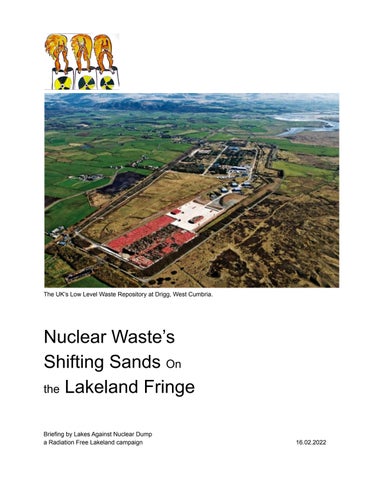
The UK’s Low Level Waste Repository at Drigg, West Cumbria.
Nuclear Waste’s Shifting Sands On the Lakeland Fringe Briefing by Lakes Against Nuclear Dump a Radiation Free Lakeland campaign
16.02.2022
1
CONTENTS Lakes Against Nuclear Dump
page 2
Low Level Waste Repository - a History
page 2 - 3
Dangerous Cocktail - Low Level Nuclear Wastes
page 3 -4
Mission Creep
page 4 - 6
Near Surface Disposal of Intermediate Level Wastes at Drigg
page 7 - 9
What is Intermediate Level Waste Anyway?
page 9
Impact on Wildlife
page 10
What would Near Surface Disposal Of Intermediate Level Wastes Look LIke?
page 11 - 12
Co-Locating to Cut Costs
page 12 - 13
Conclusion
page 13 - 14
Postscript
page 15
References
page 16 - 17
Appendix 1
page 17- 20
Appendix 2
page 20 - 26
2
Lakes Against Nuclear Dump L.A.N.D is a Radiation Free Lakeland campaign. Radiation Free Lakeland was formed in 2008 as an informal association of members following the plan for Geological Disposal of High Level Nuclear Wastes under Cumbria. There are no membership fees. Donations are used directly for campaigning purposes.
Aims Protect the diversity of wildlife on land and sea Protect the health of domestic and farm animals Protect the health of people in Cumbria (and our neighbours) Ensure future generations have the opportunity to protect themselves from long lived nuclear wastes. Encourage Education on Nuclear Issues.
Alert at Drigg We have been alerted by residents at the Western Edge of the Lake District in the village of Drigg, to a “vision” for a new development which would see Intermediate Level Nuclear waste buried in “Near Surface Disposal” alongside the UKs “Low Level Waste Repository.” The “Near Surface Disposal” for Intermediate Level Wastes would run “in tandem” with the Geological Disposal plan for High Level Nuclear Wastes. The Near Surface Disposal plan aims however be “delivered” far earlier, within 10 years. This briefing draws together our findings to date.
"LOW LEVEL WASTE REPOSITORY" - A History "The rural parish of Drigg and Carleton is on the Irish Sea coastline, part of the Cumbria Coastal Way straddling the boundary of the Lake District National Park. This small village has stunning views over the western fell and within walking distance to a fabulous beach, featured nationally in the top 10 secret beaches, which has more than a thousand acres of pristine sand dunes, home to a SSSI site with NatterJack toads & Great Crested Newts.” The “Low Level Waste Repository” site on the edge of the village was previously the location of a Royal Ordnance Factory for the Ministry of Defence until 1959 when it became a radioactive waste dump for the nearby Windscale Works then operated by the United Kingdom Atomic Energy Authority (UKAEA). On April 1, 2005, ownership of the Drigg site shifted from British Nuclear Fuels Limited to the Nuclear Decommissioning Authority.
3
"The Drigg site uses two disposal systems: 1) An original system operated from 1959 (?) to 1988 comprising a series of parallel trenches excavated into glacial clays, back filled with LLW and covered with an interim water resistant cap. 2) Current disposal of compacted waste placed in steel ISO-freight containers, with void space filled with highly fluid cement based grout. These containers are then disposed of in a series of open concrete vaults. "Radionuclides with highest activities in the inventory include 3H, 241Pu, 137Cs, 234U and 90Sr, 238U and 232Th.”
DANGEROUS COCKTAIL - “LOW LEVEL” NUCLEAR WASTES There is already at the LLWR a cocktail of relatively short-lived, intensely radioactive species such as tritium, caesium, strontium and plutonium with half lives measured in years and decades, with daughters such as americium 241, dangerous for centuries, mixed in with uranium and thorium isotopes with half lives as long as 14 billion years. 'Low level waste is not low hazard' Professor Claire Corkhill speaking on BBC Radio 4 Inside Science The Drigg site is approximately 300m from the sea and lies about 8m above mean sea level and is “likely to be destroyed by coastal erosion in 500 to 5,000 years” (BNFL Post Closure Safety Case). This conclusion is accepted by the Environment Agency. This assessment was derived from projections developed by the UN Intergovernmental Panel on Climate Change (IPCC, 2001) using computer models on future sea level rises driven by climate change. (ref Greenpeace Comments on Environment Agency’s Assessment Documents on Drigg 2005) For all the above reasons Radiation Free Lakeland have called for the gates to be locked on Drigg and for “low level” nuclear waste dumping adjacent to the Drigg dunes to cease. However far from stopping nuclear waste “disposal” at Drigg the industry is looking for novel ways to divest nuclear wastes arising from the decommissioning of redundant nuclear plants. This has included diverting nuclear wastes from Drigg to landfill, incineration and radioactive metal recycling. "The diversion of waste from disposal at the LLWR has resulted in significant life extension and avoided the need to develop a replacement LLWR”. This, in the perverse logic of the nuclear industry, “frees up” Drigg for a “vision” to dispose of ever higher activity nuclear wastes. The Nuclear Decommissioning Authority say that their
4
“strategic preference is to develop Near Surface Disposal” (for Intermediate level nuclear wastes) and that they "will support government policy development in that area.” In other words Near Surface Disposal of Intermediate Level Wastes is currently not government policy.
MISSION CREEP The following images are from a four page Advertorial by NIREX in Cumbria Life from 1993 (NIREX was the then government body equivalent to Radioactive Waste Management under the newly formed Nuclear Waste Services ) The NIREX plan was for "deep disposal” of intermediate and some low level nuclear wastes in a Geological Disposal Facility. Now in 2022 the "vision" is to dump intermediate level nuclear wastes into Near Surface Disposal (10s rather than 100s of metres below ground) at the Low Level Waste Repository at Drigg. The higher activity and very hot nuclear wastes which NIREX never proposed putting deep underground would be dumped into a Geological Disposal Facility.
5
The NIREX advert from 1993 states that the Geological Disposal Facility plan is for "intermediate and some low level wastes.” In a mission creep operation the new vision is to divert intermediate Level Wastes to Near Surface Disposal thus freeing more space in a GDF for High Level Wastes.
“On the Level” March 2021 Newsletter for the Low Level Waste Repository says: “The NDA is exploring the benefits of developing Near Surface (NSD) – for disposing of a proportion of Intermediate Level Waste (ILW), but no decision has been taken on whether UK Government will pursue this option or whether LLWR, will in time, host a NSD facility."
6
We asked a number of Freedom of Information questions on the 20th December 2021 which have not been answered directly or honestly with a simple yes or no but with replies serving to deflect and frustrate any scrutiny. Have the public been consulted about the RWM/NDA/CoRWM plan for Near Surface Disposal of Intermediate Level Waste at Drigg’s Low Level Waste Repository? The honest answer would be NO Has the Borough or County Council held a debate or vote on whether to take any steps towards Near Surface Disposal of Intermediate Level Wastes by alllowing 16 rock characterisation boreholes to be drilled at a depth of 120m into the underlying sandstone ? The honest answer would be NO What are the category of low and intermediate level wastes proposed for NSD and would this include the category of wastes previously designated by NIREX for a GDF ? The honest answer would be: the major components of Intermediate Level Wastes are nuclear reactor components, graphite from reactor cores and sludges from the treatment of radioactive liquid effluents. All of these wastes were previously designated by NIREX for a Geological Disposal Facility. Low Level Waste Repository's replies below:
7
NEAR SURFACE DISPOSAL of INTERMEDIATE LEVEL WASTES at DRIGG ? The NIREX dump entrance proposal for Intermediate Level Wastes was rejected in the 1990s because the nuclear industry had no idea how much and how fast the planned dump would leak. They still have no idea. Furthermore for a shallow dump the leaks would be even faster. In a letter to “The Guardian” of June 28,’07 the NIREX Inquiry Inspector had stated : “The relevant geology in west Cumbria is apparently now claimed to be ‘stable, although imperfect’.…the imperfection consists of simply failing to meet the internationally agreed criteria on the suitability of rocks for nuclear waste deposit. The site should be in a region of low groundwater flow, and the geology should be readily characterisable and predictable, whereas the rocks there are actually of a complex volcanic nature, with significant faulting. Also, the industry was relying on an overlying layer of sedimentary strata to dilute and disperse any groundwater leakage, when the international criteria require such a layer to act instead as a barrier…The site is not suitable and investigations should be moved elsewhere…”. And: “The site selection process was flawed, not treating safety as the most important factor, and irrationally affected by a strong desire to locate close to Sellafield.” Despite this inconvenient truth about West Cumbrian geology, investigations at Drigg are being carried out right now for the dumping of Intermediate Level Wastes in Near Surface Disposal The Nuclear Decommissioning Authority have stated that: "it is appropriate to investigate alternative options to a GDF for some of the inventory where there could be the potential to improve the overall management of Highly Active Waste. The NDA has carried out an initial technical study to investigate the feasibility of near-surface facilities for the disposal of some ILW in England and Wales, for example: certain decommissioning wastes" West Cumbria Mining’s CEO Mark Kirkbride was appointed in 2019 to the Committee on Radioactive Waste Management who advise government on the UK government’s nuclear waste divestment options. Mark Kirkbride compiled CoRWMs Annual Report No 3724 which details the push for Near Surface Disposal "advice in the last year have been in relation to the concept of Near Surface Disposal (NSD) for intermediate level waste which is being explored by NDA as a potential solution for the disposal of specific intermediate level waste materials, reducing the volume of certain elements of the inventory into a GDF." In March 2021 LLWR said in their “On the Level” newsletter: "There are two main concepts being considered for NSD in the UK: at surface level and at depth, 10s of metres below the surface. Data from 400 points in and around the Repository has been collected to support
8
feasibility studies to inform potential Near Surface Disposal (NSD) options in the future. The geophysics monitoring work to image the subsurface will help decide the best location for a potential NSD facility and inform the design optimisation process. NDA is exploring the benefits of developing NSD for disposing of a proportion of Intermediate Level Waste (ILW), but no decision has been taken on whether UK Government will pursue this option or whether LLWR, will in time, host a NSD facility. Optioneering studies are required to understand what’s possible on the site before any decision is taken on how to proceed. An NSD facility could bring benefits to the estate, for example by freeing up space in Sellafield’s Intermediate Level Waste stores, which could then be used for high hazard waste. The latest phase of the work sees the deployment of multiple wireless geophones along roadsides and the use of a specialist vehicle to generate vibrations into the ground,”
In June 2021 the LLWR reported in their newsletter sent out to local people that: "Ground has been broken on the third of 16 boreholes designed to provide additional data on the geology and hydrogeology of the Repository to inform NDA decisions over future options for the site. Boreholes will reach a depth of 120m into the underlying sandstone and the work is expected to continue until October. The LLWR study is part of wider exploratory work being conducted by NDA into near-surface disposal (NSD) options as a possible alternative for some of the less hazardous solid higher activity wastes currently intended for disposal in a Geological Disposal Facility. This type of waste could potentially be safely and permanently disposed of in near-surface facilities, comparable to those surface facilities already in place at the LLWR site, or at slightly increased depths, up to a few tens of metres. This type of waste is safely disposed in this way in other countries. LLWR’s study is expected to conclude in 2023, when it will be submitted to NDA for consideration. No decision has yet been made on whether to proceed with NSD and a decision to go ahead would require an update to current Government policy, which would be subject to a comprehensive consultation process. It would also be subject to the relevant planning, permitting and other licensing processes – all of which include stakeholder engagement.”
Local people and Councillors were not asked what they thought about this new “vision” for Drigg. Exploratory borehole investigation work has been done under "permitted development" despite the new boreholes being over 10 times deeper than 16 “offsite” boreholes drilled in 2004 which did require planning permission. In 2004 two planning applications were submitted to Cumbria County Council for 16 boreholes on land in the vicinity of the Low Level Waste Repository near Drigg. Application 4/04/9008 was for thirteen boreholes on land to the north and northwest of the site. Application 4/04/9009 was for three boreholes to the west of the site, within or immediately adjacent to the Drigg Coast SSSI and candidate Special Area of Conservation. The primary purpose of the boreholes was to provide hydrogeological data about water table levels and to sample the water and soils to "confirm the absence of contamination.” We are investigating whether these 16 boreholes of
9
10-15 metres deep are the same locations as the 16 boreholes up to 120 metres deep now being investigated to inform Near Surface Disposal of Intermediate Level Nuclear Wastes? The regulatory bodies all approved the 2004 hydrological data boreholes plan with the exception of Cumbria Wildlife Trust who objected to both planning applications on the grounds that they would cause " disturbance to the habitat and damage or destruction of the resting or breeding places of the Natterjack Toad and Great Crested Newts.” That was in 2004. This time around no-one has had the chance to object to boreholes over 10 times deeper and for a far more nefarious purpose, to facilitate the dumping of Intermediate Level Wastes in Near Surface Disposal.
WHAT IS INTERMEDIATE LEVEL WASTE ANYWAY? NIREX said: "Intermediate-Level Waste (ILW) is waste in which the radioactive decay process generates insufficient heat for this to be a design requirement instorage or disposal facilities, but with activity levels above that defined as the upper limit for low-level waste. It comprises cladding from spent nuclear fuel, filters and wastes from effluent treatment, worn-out plant and equipment, and radioactive materials used in medical treatments, industry and defence" https://researchbriefings.files.parliament.uk/documents/RP96-113/RP96-113.pdf What the NDA says: " Intermediate Level Waste exceeds the upper boundaries for Low Level Waste but does not generate a significant amount of heat. About 6% of all radioactive wastes (by volume) are in the ILW category. The major components of ILW are nuclear reactor components, graphite from reactor cores and sludges from the treatment of radioactive liquid effluents." What the Office for Nuclear Regulation says: Gases will be produced by Intermediate Level Wastes, " it is impossible to avoid some gas being produced by corrosion reactions given the nature of the waste being disposed. The majority of the gas produced will be hydrogen..” "In the Nirex 97 simulations, carried out using techSIM, breakthrough of gas to the surface occurred after only about 40 years following repository closure.” (pg 57) note this was for deep disposal - the rate of breakthrough would be faster for near surface disposal of ILW under this simulation.
10
IMPACT ON WILDLIFE ? Up until 1958 thousands of black headed gulls eggs from the Drigg and Ravenglass gullery were harvested at a time in basketfuls and sold in London. The black headed gull is now on the amber list. The collapse in the mid 1980s of the largest black-headed gull breeding colony in Europe on the Drigg dunes has never been satisfactorily explained. The official explanation is that a fox did it: “the concentrations of radionuclides in the foods, body tissues and general environment were at least three orders of magnitude too low to have had any effect. The more likely cause of the desertion of the gullery was the combination of an uncontrolled fox population, the severest outbreak of myxomatosis amongst the rabbits since 1954 and the driest May–July period on record, all in the same year (1984).” As the artist project “Re Drift” poignantly notes "The Old Warden’s Hut sits amongst the dunes at Drigg. Now abandoned, the hut is defunct of its original use since the change in populations of bird colonies on the reserve.” The 1990 book "Living in the Shadow" by Jean McSorely notes that the Warden of the Eskmeals Bird Reserve, was concerned that there might be a link between Sellafield’s nuclear wastes and the decline of the black headed gull colony, also noted was that “Oyster-catcher chicks reared by hand by Tony Warburton, from eggs taken off the dunes, showed genetic deformities in their capacity to respond to simple signals.” This anecdotal finding of cognitive damage has been repeatedly confirmed by scientists including in The 2011 paper "Chernobyl birds have smaller brains” by Anders Pape Møller , Andea Bonisoli-Alquati, Geir Rudolfsen, and Timothy A Mousseau who found that "Low dose radiation can have significant effects on normal brain development of birds as reflected by brain size and therefore potentially cognitive ability". Other wildlife directly impacted upon by the LLWR are the previously mentioned Natterjack Toad and Great Crested Newt, even these rare and “protected" creatures are trampled underfoot when it comes to the Holy Grail of where to dump nuclear wastes.
“Have a Heart” - Great Crested Newts
11
WHAT WOULD NEAR SURFACE DISPOSAL OF INTERMEDIATE LEVEL NUCLEAR WASTES LOOK LIKE? From a 2016 report prepared by R. Wilmot, S. Doudou, J. Kent, F. Neall and S. Wickham 15 July 2016 commissioned by Radioactive Waste Management Ltd (RWM Purchase Order RWM005723L) we can see the scenarios envisioned for Intermediate Level Waste at Drigg’s Low Level Waste Repository The scenarios are described thus: (1) surface mounds above the water table; (2) trench at (a) shallow depth or (b) deeper and accessed via a ramp; (3) silo or shaft operated from the surface; (4) silo operated from underground, sited below land or beneath the sea; (5) vault at a few tens of metres depth, sited below land or beneath the sea; (6) GDF-like concept implemented between 100 and 300 m, sited below land or beneath the sea. The following images are from the NDA’s 2020 Position Paper for Near Surface Disposal of Intermediate Level Nuclear Waste
12
“CO-LOCATING” TO CUT COSTS Alarmingly it is clear that the Near Surface vision is designed to cut costs by “co-locating” with a Geological Disposal Facility. Drigg with its location less than 5 miles from Sellafield would be an expedient location for NSD to “co-locate” with a subsea GDF. "The assessment of disposal costs has been made on the assumption that a nearer- surface disposal facility for DNLEU would be co-located with a GDF. This is not an absolute requirement
13
.... would require the following additional activities to be undertaken, with associated costs incurred: Additional land purchase and mineral rights. Access routes, transport arrangements (via rail, road or sea) and package receipt facilities. Site characterisation to support development of facility designs and safety cases (although co-location of facilities would also increase site characterisation requirements relative to a GDF). Depending on distance from a GDF site, workshops, stores and other surface facilities could be shared or duplicates may be required. Security arrangements, including fencing” Information on “Co-Location” from: Galson Sciences Ltd report prepared by R. Wilmot, S. Doudou, J. Kent, F. Neall and S. Wickham 15 July 2016 commissioned by Radioactive Waste Management Ltd (RWM Purchase Order RWM005723L)
CONCLUSION Alarming Nuclear waste mission creep is taking place with the “vision” for Near Surface Disposal of Intermediate Level Wastes to run in tandem with a High Level Waste deep Geological Disposal Facility. Radioactive Waste Management have kept the so called “Community Partnerships” in Allerdale, Copeland and Lincolnshire in the dark about Near Surface Disposal of Intermediate Level Wastes likely to run in tandem with a High Level Waste deep Geological Disposal Facility. The Near Surface Disposal plan for Intermediate Level Wastes would “free up” the Geological Disposal Facility for Higher Activity Wastes and, to save costs the two sites could be “co-located.’ The Near Surface dump for Intermediate Level Wastes would be expected to be completed far earlier than GDF - as soon as in 10 years time - despite Government Policy not currently allowing for Near Surface Disposal of Intermediate Level Wastes. To reiterate, the NIREX plan for a Rock Characterisation Laboratory to facilitate the dumping of Low/Intermediate Level wastes was rejected back in the 90’s.. It is not clear to us exactly when or how the plan changed from Low/Intermediate Level to High Level Nuclear Wastes for a GDF but it must have been between 1997 and 2008 ie the transition from NIREX to Managing Radioactive Wastes Safely (now RWM)
14
Here is a letter published on The Geological Society website in 2013 : "NIREX fiasco Sir, As a former mining geologist for the Beckermet Iron Ore Mines in West Cumbria, I was surprised that Nirex even considered the Sellafield area as a possible site for nuclear waste disposal (Fallout over radwaste Geologist 23.11). All the evidence from underground iron ore mining in the mines only a few kilometres north and east of the site indicated that there was a major problem with groundwater to the south and west of the mine workings. In particular, attempts to mine at Whangs, west of Egremont had to be abandoned due to the inability to cope with the inflow of water, while at Beckermet Mine itself, westward exploration along the West Drifts encountered a fault zone carrying so much water that the drifts had to be sealed with concrete dams in order to protect the rest of the mine. All this was well known to the West Cumbrian mining and geological community and seems to have been completely ignored by NIREX who then went on to waste £400M of taxpayers' money on an ill-considered proposal with more political than geological justification." Dave Greenwood was British Steel Mine Geologist 1967-81 Given that the Drigg area has already been rejected by the NIREX Inquiry for the deep burial of Low and Intermediate Level nuclear wastes it is an abuse of human rights that Radioactive Waste Management are now seeking to double down on the original plan and looking to bury High Level Nuclear Waste in a deep dump and Intermediate Level wastes (previously refused for a deep dump) into shallow silos in Near Surface Disposal. West Cumbria and the Drigg area in particular is very much seen as the line of least resistance given the decades of monetary compensation issued for the blight of hosting the UKs Low Level Waste Repository. RWMs remit is to “deliver a Geological Disposal Facility” because they say “it’s the right thing to do” with no ethical qualms about denying future generations the ability to protect themselves from leaking nuclear wastes or about producing ever hotter new nuclear wastes or keeping schtum to their “Partners” about the Near Surface Disposal plans. The “Community Partnership” of Allerdale and Copeland with RWM is less of a partnership and more an abusive relationship. Lakes Against Nuclear Dump’s advice to the Towns and Parishes within the “Community Partnerships” is to get out now and enable the Community to genuinely have an authentic voice with regards the future of nuclear wastes.
15
POSTSCRIPT
Lincolnshire: Protecting Future Generations from Nuclear Waste Dumping. Will Cumbria be the line of least resistance? There is a school of thought amongst some Cumbrian leaders that says ‘the waste is already here so what does it matter if more is dumped or more arrives or more is made with new build.’ It matters in the same way that dumping ever more plastic in the oceans matters - and nuclear waste’s toxic legacy lasts far longer!
16
References United Kingdom Atomic Energy Authority (UKAEA) https://iopscience.iop.org/article/10.1088/1361-6498/aa7788 Drigg https://drigg.org.uk/ The Ecologist: Drigg Alert https://theecologist.org/2015/dec/31/cumbria-flooding-environment-agency-issues-alert-drigg-nu clear-waste-site
Results of an aqueous source term model for a radiological risk assessment of the Drigg LLW Site, U.K. https://centaur.reading.ac.uk/16608/1/mrspaper.pdf Professor Claire Corkhill speaking on BBC Radio 4 Inside Science https://www.lakesagainstnucleardump.com/post/bbc-inside-science-nuclear-waste-podcast-kicks -off-with-a-big-fat-lie-fact-check Greenpeace Comments on Environment Agency Assessment Documents - Drigg 2005 https://citeseerx.ist.psu.edu/viewdoc/summary?doi=10.1.1.729.3508 Lock the Gate on Drigg https://www.youtube.com/watch?v=NJkpLmzzWHE Diversion of waste https://www.gov.uk/government/consultations/nda-radioactive-waste-management-strategy/outc ome/radioactive-waste-strategy-september-2019#summary-of-strategic-positionspreferences Nirex Inspector’s Report http://www.nuclearwasteadvisory.co.uk/docs/scientific-docs/nirex-inquiry-inspectors-report/ Letter to the Guardian https://www.theguardian.com/world/2007/jun/28/nuclear.uk NDA Strategy https://www.gov.uk/government/consultations/nda-radioactive-waste-management-strategy/outc ome/radioactive-waste-strategy-september-2019#summary-of-strategic-positionspreferences CoRWM https://assets.publishing.service.gov.uk/government/uploads/system/uploads/attachment_data/fil e/1000520/corwm-17th-annual-report-2021.pdf
17
LLWR https://assets.publishing.service.gov.uk/government/uploads/system/uploads/attachment_data/fil e/994530/On_The_Level_Issue_27_March_2021.pdf NIREX simulations https://assets.publishing.service.gov.uk/government/uploads/system/uploads/attachment_data/fil e/296497/geho1108bozn-e-e.pdf Re Drift https://dynamicdunescapes.co.uk/event/volunteer-cumbria-drigg/?lang=cy Chernobyl Birds Have Smaller Brains https://pubmed.ncbi.nlm.nih.gov/21390202/ NIREX FIASCO - Geological Society letter https://www.geolsoc.org.uk/Geoscientist/Letters/2013/NIREX-fiasco NDA 2020 Strategic Position Paper on Near Surface Disposal https://assets.publishing.service.gov.uk/government/uploads/system/uploads/attachment_data/fil e/910184/NSD_StrategicPositionPaper_August_2020_FINAL_V2.pdf
APPENDIX 1 Request to LLWR by concerned local - Instead of an answer, an offer for a tour around the LLWR site to “discuss any questions” but apparently not to answer them.
LLWR FOI Request, 19 January 2022
What Do They Know - Request
Classification: OFFICIAL
Thank you for your recent request for information under the Freedom of Information Act 2000.
Please note LLW Repository Ltd does not own any land; the LLWR Site is
18
owned by the Nuclear Decommissioning Authority. Should you wish to contact them their email address is [1][email address].
In response to the specific questions you have raised, please see below:
Does the company own land adjoining or in the vicinity of the low level waste repository site? No, LLWR Ltd does not own any land. The LLWR Site is owned by the Nuclear Decommissioning Authority.
If the company does own land adjoining or in the vicinity of the low level waste repository site, what land and where? please provide a map N/A – as above.
Is the company currently in the process of purchasing land adjoining or in the vicinity of the low level waste repository site? N/A – as above.
If the company is currently in the process of purchasing land adjoining or in the vicinity of the low level waste repository site, what land and where? Please provide a map N/A – as above.
I would also like to take the opportunity to reiterate to you the offer
19
from our CEO, Martin Walkingshaw, (via his email dated 1^st September
2021), to meet with you at the LLWR site where he would be happy to provide you with a tour of the site and discuss any questions you may have.
If this would be of interest to you, please do not hesitate to contact us and we will support with making the necessary arrangements.
Kind regards
FOI Team
[2]signature_1584376925 Pelham House Calderbridge, Cumbria CA20 1DB | Old Shore Road Drigg, Holmrook, Cumbria CA19 1XP
The same Freedom of Information Request was then directed to the NDA - this is the reply…
APPENDIX 1 (a) Griffin, Judith, Nuclear Decommissioning Authority 17 February 2022 OFFICIAL
Apologies for not contacting you sooner. We are not as yet in a position to respond to your request, but hope to do so shortly. However, we do not anticipate making the 20 working days deadline, but will keep you informed of our progress.
20
Under Environmental Information Regulations 2004 reg 7 we may extend the period of 20 working days to 40 working days, if the complexity or volume of the information requested means that it is impracticable to comply within the earlier period or to make a decision to refuse. We do believe that in this instance reg 7 is applicable and will endeavour to respond as soon as practicably possible, but may need to exceed the 20 day deadline to do so. Regards Judith Griffin Information Access Manager Nuclear Decommissioning Authority
APPENDIX 2 2006 Boreholes - Application for Licence (we assume granted) to Drill Over “Breading” (sic) sites of Great Crested Newts. In 2021 No Planning Requirements necessary !!
21
22
23
24
25
26
27
28
Published by L.A.N.D https://www.lakesagainstnucleardump.com/ A Radiation Free Lakeland campaign February 2022