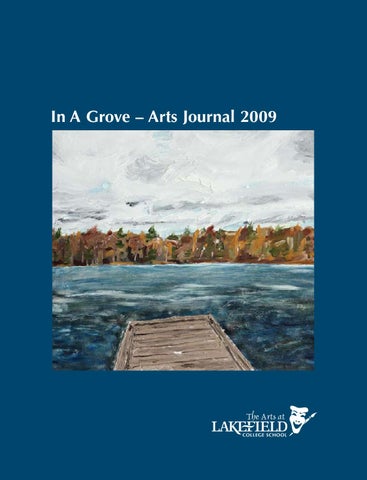
In A Grove – Arts Journal 2009
The Arts at
In a Grove 2009 A Celebration of Writing and Art Lakefield College School
Featuring the winners of LCS Writes! Sponsored by The Grove Society
LCS Writes! Winners Poetry Section Grades 11/12 1st Kate Seo, “Gratitude” 2nd Alison Cameron, “Alternate Perspective” 3rd Yasin Sridhar, “It Was Written” Grades 9/10 1st Sophia Walter, “The Sun's Path” 2nd Christopher Chan, “Perennial Satisfactions” 3rd Dina El-baradie, “I Can See Through You” Grades 7/8 1st Prag Rajdev, “Your Heart” 2nd Evie Jenden-Selway, “Ice Cream” 3rd Natalie Wagner, “Open Door”
Prose Section Grades 11/12 1st Gabrielle Cormier, “A Greater Apartheid” 2nd Rachel Grant, “Winston” 3rd Bea Chan, “Dead Simple” Grades 9/10 1st Meggy Chan, “Mother and Son” 2nd Anna Heffernan, “Triage” 3rd Christopher Chan, “Sweet Revenge”
Excerpts of prose selections published due to space restrictions. Please see page 38 for artists’ names. Visit www.lcs.on.ca and click PARENT to read prose pieces in full.
Gratitude By Kate Seo Your wrinkles deepen My face wears make up Your height shortens My height lengthens Your dark spots spread My skin wears luxurious accessories Your health wanes My children are born My wrinkles deepen My height shortens My dark spots spread I finally realize the gratitude of love 1st place, Grades 11/12 poetry
1
Alternate Perspective By Alison Cameron The blue sky shimmers above me one…two…three… The blinding sun pours into my eyes seven…eight…nine… The words I should have said turn to liquid in my mouth 2
twenty…twenty one…twenty two… I try to pull my past towards me, try to fix my grave mistake twenty nine…thirty…thirty one… slowly, surely, the water engulfs me there is nothing I can do to stop it forty one…forty two… around me, inside me, suffocating me. All is quiet, all is dark, Save for ‘Old father time’ who counts the seconds pass by… Fifty nine…sixty… 2nd place, Grades 11/12 poetry
3
It Was Written By Yasin Sridhar A morning too early, my eyes shan’t unfold, To stand is to conquer shallow sleep untold. The cold that pervades is of little help, Deceit is compelling, a trait of the whelp. I am the aged, lucid, never led, Lead I must, from sunrise to bed. 4
My charge is strong, my bark is soft, My impact great, to quell the aloft. Tellurian to live; to die in the flame, The sky holds promise; heed not to fame. Exist to exist; neither pass nor obey, Question the uncertain, practice the lay. To seek immortality is to be mortal, To seek such power leaves much to chortle. I seek the Sleep who sleeps by death, I seek the Time who times my breath. O Knowledge, come, come hither, take rest, Rest you in me at no one’s behest.
But O Knowledge so cloudy, should you be untrue, Fear not, my trust you shall not undo. I need not your trust to love or see, To feel, to hear, to lust, to be. There lies no fear in hearts of men, Joy is not what or how, but when. When shall I cease my time, to depart? When will unhappiness break my heart? Never! It shall not! I live to enjoy, From gentile old man to jubilant boy. To humble statue from bashful slumber, See bonds between the letter and number. Bathe in the truth, lest truth be afar, Chide not what they deem profoundly bizarre. The world shows the cliff from which you shall fall, Alas, he stands! The Saviour 窶話ove all! 3rd place, Grades 11/12 poetry
5
6
The Sun's Path By Sophia Walter The sun rises as it welcomes the wail of a child. A new, bright day is washed with light. It climbs up the ladder of life, Till it shines like the vibrant, pulsing soul. 7
Slowly sinking down it still glows with eternal youth, Till it disappears in a vibrant burst of colours. Yet the moon lights its path. And the stars sparkle in greeting. For there is “no need to say goodbye” As it waits for another child’s cry. 1st place, Grades 9/10 poetry
Perennial Satisfactions By Christopher Chan I love the spring puddles which wash my snow-tired feet Scrubbing away the winter blues. In winter I long for the spring breeze. I wait for the road-side slush. A summer paddle on a pristine lake soothes my heart Calming down my spring fever. In the spring I sit around dejectedly, 8
Wishing I could see green grass An autumn leaf pile crunches out a quick march for me Sounding the end of summer’s lull In the summer I pray for reds and yellows. I need to have that autumn bite, to toughen me for winter I love the way a winter icicle cracks a whip that says back to work Taming the gypsy autumn colour In autumn I feel as if I must have a snowman to greet me I call for a hill to slip and sled down 2nd place, Grades 9/10 poetry
9
I Can See Through You By Dina El-baradie I still remember Remember who you used to be It’s sad how you’ve changed You may have them fooled, but not me You’ve been through so much 10
But you hide your feelings, your pain You’re not one to show weakness After all, you have an image to maintain You still have the same beautiful smile But now it’s fake, only there to conceal your cries It stretches far enough to convince But it still doesn’t reach your eyes A split second of eye contact And I can hear all your silent screams But you carry on in conversation And it kills me to know that it’s not what it seems
You’re not an open person Your feelings you never share But I read you like an open book And I know you are oblivious to how much I care I look at you and my heart aches Because I realize I lost everything I thought I knew Where is the fire of passion that once blazed in your heart? It’s unfair how much life has taken away from you You used to strive to accomplish your dreams Now you stand around and watch life pass you by They call themselves your friends, but they’ve fallen for your false image Not me though, and I swear I wish I knew why Maybe it’s because you’re always in my head Maybe it’s because I notice everything you do Or maybe I’m so attached to you I feel like you’re a part of me But for some reason, I can see through you 3rd place, Grades 9/10 poetry
11
12
Your Heart By Prag Rajdev Your heart is like a dove It just wants to love Hearts want to be warm Not cold like a storm You should keep it above So that it can love Do remember just keep it above 1st place, Grades 7/8 poetry
13
Ice Cream By Evie Jenden-Selway Strawberry, vanilla, chocolate and mint 14
It rumbles in my tummy yum yum yummy I sprinkle chocolate chips on top Boy oh boy that hits the spot Lemon, Coffee, Mango and Lime When mum comes home with ice cream i call it "that's mine!" 2nd place, Grades 7/8 poetry
15
Open Door By Natalie Wagner Your life here on Earth goes by really fast so take all opportunities don't just skip them and be mad. Trust me I know it’s happened to me I missed parts in my 16
life that I regret every day. When you first get on a bike and pedal real fast. When you fall, hit the ground, and cry until you’re dry. When you spend more than one hour doing your hair. Then you get stood up and think it’s really unfair. So take all opportunities trust me they won't last. It’s all happened to me and I wish I would have grasped the fact that we don't last. 3rd place, Grades 7/8 poetry
17
18
19
20
A Greater Apartheid: The Denial of Education By Gabrielle Cormier On Saturday March 21st 2009, I sat inside a classroom in a township or “shantytown” of South Africa’s Cape area called Philippi. Adjudicating (the term for judging in South Africa) beginners in debating ultimately consists of offering constructive feedback and also praise for displays of prowess in speaking and reasoning. Prowess, I knew I would encounter, but to find it emanating in tidal waves from the very first speaker I heard remains a memory that will epitomize my belief in the power of education forever. The comment card I wrote for Lwando was riddled with annotations like, “excellent eye contact,” “powerful rhetorical questions,” “great literary reference,” and “rich content.” This was Lwando’s first tournament and he had exhibited a facility for public speaking in his second language and ability to reason and rebut which the majority of debaters including myself, took years to master. It was therefore imperative, for me, to apprise him of his enormous talent and also of how he could improve the aspects of debating in which he still demonstrated the characteristics of an eager beginner. Somehow, it seemed undeniable as he listened attentively that he would strive to put my suggestions into practice. A wise Nigerian saying reads, “Knowledge is not the main thing but good deed is.” This holds true. After all, what is the worth of knowledge if used with the worst of intentions? But on the flip side, good intentions in an unskilled, un-resourceful individual sadly produce efforts that lack even the smallest influence. Acquiring skills can range from carpet weaving in the South African township of Khayelitsha to learning basic numeracy in a Ugandan primary school. This knowledge, especially in the areas of craft making and literature can solidify ties between a people and their culture. These ties may have been previously denied to them under empirical hegemony. Culture represents an integral part of building a person’s identity, partic-
21
ularly during adolescence. South Africa is moving on from Apartheid because of better and more accessible education. Today, with the allocation of the greater part of the $US 76 billion dollar national budget to national education, the post-Apartheid cultural revival is being stimulated. The vivacity and residential development in the Khayelitsha township are moving in sync with the literacy rate that has skyrocketed from 23% in 1994 to 78% today. In that time span one of those new readers was Lwando. With education, youth from poverty-stricken areas would be part of a new group of innovators and could obtain international grants from the World Bank themselves. With education, individuals who truly understand the dynamics of their own regions and peoples will lead their communities with knowledge and adaptability in different sectors. These sectors include health, sanitation, teaching, construction and the establishment of small businesses. Millennium Development Goals that rely on improving nutrition, Milennium Development Goals that rely on halting the spread of HIV/AIDS, and Milennium Development Goals that rely on economic development are inex22
tricably linked to the level of education provided to the general population. Educated citizens have skills that make them employable, and a falling unemployment rate usually means reduced crime and a better standard of living. Educated citizens tend to hold government more accountable, which reduces corruption and resultantly increases the efficiency of their government’s services. Families in Honduras with a daughter enrolled in primary school, acquiring priceless skills that assure them financial security in their senior years are less likely to sell her into exploitive domestic work during childhood. Overall, knowledge-acquiring experiences built Lwando’s confidence. Overall, academia ensures 10% higher wages per additional year of schooling according to the Center for Global Development in Washington DC, and overall, students who ever attended school are less than half as likely to contract HIV/ AIDS than students who never attended school. Does anything more need to be said to convince industrial nations that universal primary education is the greatest necessity of our time? The necessity for universal education derives from its power to provide health, to provide employment opportunities and in its power to build a child’s confidence and readiness to take on challenges.
So why hasn’t universal education been achieved yet? Are the estimated 11 billion dollars necessary, too costly? The same culprit for the financial crisis will become responsible for the failure to reach the Millennium Development Goals in 2015; the tendency of the citizens of the developed world to want to keep up with the Joneses. The problem is how high numbing nonsense and consumption are ranked in comparison to the resolution of glaring problems, such as rampant illiteracy in Sub-Saharan Africa, on the list of priorities. The war in Iraq, condemned by the bulk of the UN Security Council, will have cost $659 billion dollars to the American people. Americans bought $10 billion worth of pornography last year, more than the part of American foreign aid funds that reached their rightful recipients. So what we see is a clear double standard and a belief that the African continent and other regions of the world are fated to be messes, riddled with starved and war-torn corpses forever. When Romeo Dallaire, witness to the world’s failure in Rwanda was asked why the world chose not to come to the rescue of 800 000 people condemned to death, he answered, "Because there was no self-interest....No oil. They didn't come because some humans are [considered] less human than others." Precisely because of the development in education since the Apartheid, hundreds of thousands of non-whites have the resources to be something they could not have dreamed of becoming under the Apartheid regime. Because of objective education serving differently than within the narrow scope of propaganda, the previously exclusively wealthy minority is learning that Apartheid meant more that just “Separation”. Finally, I myself, know that South Africa’s Apartheid era was merely a microcosm of the world’s own Apartheid today. The world’s macrocosmic Apartheid might be marked by great distances, but most importantly it is stained by the same social and economic inequity which Nelson Mandela fought. This inequity stems, and continues to, from the denial of education. 1st place, Grades 11/12 prose
23
24
Mother and Son By Meggy Chan Hugh tapped his left breast pocket for luck. I’m finally here, a bird in the sky, flying high over the landscape with the wind on my face. Not much to look at though—a wasteland scarred by trenches laid out like crazy giant zippers. Everything here is grey—the earth, the sky, the unending rain. Odd to think that a couple of years ago this was all farmland and colourful old towns, and there wasn’t a war. Damned Huns and their crazy Kaiser—the devil incarnate—that’s what he is. That’s what they all are. But it makes for great sport, and I can play this game as well as the next lad. Each Kraut plane that I shoot down’ll earn me a German black cross on my plane. Five down’ll make me an Ace. Not a bad goal for a 20-year-old English boy from London, Hugh mused to himself as he settled more securely in the seat of the Sopwith Camel he was piloting for the first time over Belgium. I’m after the first one now, he reminded himself. It’s out there for sure ‘cause Company 4 spotted it. I’ve got to find it and take it down. Simple. Hugh scanned the sky for the German plane. Nothing above him, in front, or to the sides. He circled. Nothing behind. He circled again, lower, and scanned the disemboweled landscape below. He cocked his head, straining to catch the sound of an enemy plane. Like a robin listening for a worm, he thought to himself. All he could hear was the drone of his own engine, changing pitch with each change in altitude or direction. Not a robin, he thought, a hawk, gliding up, down, in circles, looking for that sneaky Kraut plane. Suddenly his alert senses brought Hugh the information he craved. He tightened his grip on the joystick of the plane. There it is in full view, an enemy plane gliding just above the landscape, just barely airborne, momentarily silent. He’s hedge hopping low enough to see what the lads are eating for lunch in the trenches, Hugh thought. Hugh’s training took over. He began to assess the situation in a detached way. I’m above him; he’ll never be able to win this fight. One or two shots and he’ll be aresy tarsey.
25
Hugh dropped down on his prey. The chatter of machine gun fire--chcuchuchuchuchuchu. No hit. The high pitched whine of the other plane exploding upwards, dodging the bullets. That black cross standing out like the perfect target. The guns again. A dodge, down and around. The black cross momentarily on top. Hugh shifted the joystick quickly, and the engine screamed as he looped upwards and maneuvered himself into an advantageous position. The black cross at zero. A burst of bullets. The German plane careened in a dizzying tailspin to the ground. One down, four to go till I’m an Ace, thought Hugh proudly. In his excitement at the kill, Hugh acted upon an instinct to see his defeated opponent up close. He scanned the skies again for more planes but could see only grey emptiness. He circled, brought his plane down, and neatly landed it beside the smoldering wreck. Hugh cut the engine, jumped lightly to the ground, and strode confidently over to the wreck. 26
As he approached he could smell the acrid stench of smoke and could make out a man in the wreckage. As if waking from a dream, he suddenly became aware of an awful fact: He didn’t just bring down a plane; he’d killed that pilot. Hugh reeled at the thought. The German plane was a tangled wreck. The wings were bent, and the propeller had been nearly ripped off. Hugh ran like a crazed man to the wreck, pulling and tugging at the mangled metal that imprisoned the warm corpse. He dislodged the metal, gently pulled the German pilot away from the smoldering wreck and knelt beside him on the torn ground. He isn’t an old Kraut at all, he thought with horror. He’s a kid like me. Hugh scanned the lifeless young man’s face--blonde hair and blue eyes, just like me. The look that had followed the dead pilot into his death still lingered on his face-- excited, fearless, as if he could’ve done anything in the world. A fresh wave of horrified empathy washed over Hugh. That’s exactly how I was feeling up there. This so easily could’ve been me.
Instinctively Hugh checked his left breast pocket to make sure that the old photograph of his mother was still there. He whispered, “Mum, looks like I made it through this one okay.” Then wondering, he checked the dead man’s pocket to see if he had a picture there. He did. Hugh took it out and looked at it long and hard. That German pilot isn’t just a young man; he is somebody’s son, just like I am. He has a mother back home who adores him and is worrying about him right now. And now she won’t know what happened to her boy. Did I do this? Did I kill somebody’s son? Hugh pressed his hands to his temples to calm the throbbing accusations. He slumped to the ground beside his enemy, sobbing, oblivious to everything around him. When the sobs subsided, he set aside his horror and grimly searched the pilot for his identity, perhaps a name, an address. Hugh found a letter, still unopened in the pilot’s pocket. He opened it, hoping to read it, but it was written in German. However at the top was an address, and it was signed with an easily understandable, “Meine Mutter.” Without thinking, Hugh slipped the letter and the picture into his own pocket, arranged the dead man’s body into a dignified repose, walked slowly back to his plane, and took off into the grey Belgian sky to return to his base. After that the war went on and on in an endless maze of muddy trenches and a blur of dogfights fought in colourless skies. Hugh treasured the letter he had taken from that first downed pilot as if it were a letter from his own mother, and he kept the German mother’s photograph in his left breast pocket along with the picture of his own mother. Almost unbelievably, three years later the war ended, and by December 1918, Hugh was on his way home to England, along with the thousands of other British young men. On the streets of London, the arriving troops were greeted as victorious heroes amidst festive crowds of women and children, all waving, all reaching out to touch their returning boys. Hugh felt a rising panic. I’m not a hero, he thought. I just survived. Hands reached out to touch him, and the familiar voice of his sister, Lucy, pushed the panic away.
27
28
“Oh, Hugh, it’s so good to have you back alive and well. I can’t believe this bloody war is finally over.” She hugged him and pulled him away from the crowds, talking all the time. He only heard snatches, things like, “had so little news of you” and “so worried about you” and “so proud when you.” Her chatter ended at the door of their house. She fumbled with her keys, turned to him and smiled, “And it’s such a relief that you survived the whole thing. Come on, Dad and Fred are waiting inside.” “Yes,” he grinned back at her. “I’m so glad to be back here with you where it’s dry and warm. The food is decent, and I don’t have to worry about being shot at. It’s such a relief; you have no idea!” Once inside, they were greeted joyfully by their father and little brother, Fred. “So good to have you home, Son,” his father said, clasping his hands. “Your mother would have been so proud, so proud.” Fred was dancing about Hugh asking questions and leaving no room for answers. “Yeah, Hugh, what was it like over there? How many of the enemy did you kill? You wrote something about being an Ace in your letters, did you ever get that? Too bad it ended so soon, I wanted to join up but Pa wouldn’t let me--said I was too young.” “Actually, it was awful over there, Fred, and oh, I dunno, I guess I shot down a few. No, I never did get that Ace though,” Hugh replied without much interest. “I wish I could’ve been out there with you shooting down the enemy planes. It must’ve felt so good knowing you’re helping England and ridding the world of those awful Huns!” said Fred earnestly. “Yeah, it was great, just great…” Hugh said half-heartedly. “Freddie,” Lucy interjected as she herded them all towards the kitchen, “stop pestering Hugh. He’s just arrived, and he’s tired. Let him alone.”
29
The family sat down to supper and exchanged the news of three long years of separation. Shortly after, Hugh retired to his bedroom thinking, I’ll just crawl into my own bed and go to sleep. But sleep escaped him and left him with the image of that first boy he had shot down. I killed him was the verdict that went round and round in his head. He isn’t arriving home to his family now. His mother won’t have anyone to welcome home. Hugh got up and sighed aloud to himself, “I have to write to his mother.” He sat down at his desk and look longingly at the old framed photograph of his own mother there. He got out a pen and paper and wrote the letter he’d been waiting three years of war to write. Dear Mutter, My name is Hugh. I was a pilot for the British forces in the Great War that has just ended. I’m sure you received a letter from the German government stating that your son was missing in action. I am writing this letter to you because I 30
cannot bear what I have done any longer. He was sent out on a mission to spy on my troops, and I was sent out to stop him. I shot him down, thinking only of saving my men, not of him, nor of you. It was an unfair fight, but your son must have been a very skilled pilot and very brave one too. He tried to attack me, dodging my bullets. He held his ground for a while, but eventually I won the fight and his plane went down. I don’t exactly know why I did this, but after his plane crashed, I landed my plane, got out, and stood there staring at the wreckage I’d just caused. I want you to know that your boy did not suffer. It was all over very quickly, and when I looked at him I saw no fear in his face, only bright excitement. My heart is so heavy with what I did and I am so sorry. I know you must have loved him as any mother would have. But I want you to know that I took care of your boy’s body. I laid him out as best I could. He had your picture in his pocket, and I took it and kept it with me throughout the war. I would continue to keep it but I think you would want it back, so I include it with this letter. My mother died when I was quite young, and I think now is the only time that I am almost glad for that because I do not think she could have borne what I did that day.
31
32
It was my duty to my country to shoot down that plane, but when I saw your son lifeless and saw you in the picture he had with him, it all seemed so wrong. I know I killed your son and you probably can’t forgive me, but I will ask for your forgiveness all the same. When I was standing there that day with your picture in my hand, I wished so hard that you were the mother I didn’t have and I felt almost as though I had killed my own brother. I feel so lost in this dark world. So please, be my mother too, just for a little while, and tell me what to do. -Hugh A month later, January 1919, to the surprise of his sister Lucy, Hugh received a letter with a German postmark and stamp. He took it upstairs to his room, sat on the bed, and read. My Dear Boy, I am sorely grieved by what happened to my boy, but I do understand, and I see your dilemma. I feel you coming to me like a little boy astounded at having done ill when you meant well. And now I long to take you in my arms and lay your head against my breast and comfort you. But do not trouble yourself anymore over my boy, I will willingly forgive you. His name was Kurt. He was my baby, the youngest of four boys, all of whom went to war, yet sadly he was the only one not to return. He was a fine boy and I miss him dreadfully, but I think you saw his fineness and I was glad to know that it was your hands and no one else’s who touched my boy’s body. I’m glad you took care of it and laid him out the way a man should be laid out. It comforts me to know that he had my picture with him all that time. I feel that the picture meant a lot to you so I will send it back for you to keep as a reminder of your second mother. When you can, come to me. I will be waiting for you. -Deine Mutter Hugh took the picture from the envelope and looked at it for a while. Then he tucked it between the glass and the wooden frame of his own mother’s photograph. Once again tears poured down his face, and he sobbed. 1st place, Grades 9/10 prose
33
34
Winston (Excerpt) By Rachel Grant At dinner time one of the muzungu, a boy, came to sit beside him. The boy had sat beside him before. He talked softly and without bravado, so Winston listened. Tonight the boy told him about his home, Canada, about the long cold winters, about ice skating and maple syrup, he told him about the moose, the polar bears and how cats and dogs live as a part of the family. He had a crumpled flag pinned to his nap sack. The two red stripes on either end of it surrounded white and on the white was a red maple leaf. Winston pointed to himself, showing the boy the faded flag on his t-shirt. Winston’s flag had a red stripe too, as well as green, black and a crest in the middle. The boy asked if he could take Winston’s picture. He nodded, pointing at his t-shirt as the boy snapped his picture. Six other children, in awe of the camera, rushed over to where Winston and the boy were sitting, grabbing at the camera to see the picture. Winston slowly backed away and headed out of the meal area. 2nd place, Grades 11/12 prose
35
Dead Simple (Excerpt) By Bea Chan The effect of the use of children as soldiers is appalling. Graça Machal, the Former U.N. Secretary-General's Expert on the Impact of Armed Conflict on Children, provides a horrifying description of the effects of war on children: “Youth are killed, tortured, raped and forced to participate in unimaginable acts of violence against other human beings, and many times against their own families. The bankruptcy of human and moral values evident in this situation needs no further explanation.” In the name of humanity, the use of child soldiers must stop. 36
Why must it stop? That is dead simple—fighting a war is dangerous. According to UN statistics two million children were killed, and 4.5 million were disabled in action in wars around the world in the 1990s. Military life affects children disproportionately harshly: they suffer higher casualties, are injured more often, and have more health problems than adult soldiers because they are less able to take care of themselves. HIV is especially prevalent among child soldiers. Child soldiers are deeply affected individually, and by extension their societies suffer. In the next generation, this toll on children will result in a reduced population, in which more individuals will need health care, and fewer people will be able to work and fuel an economy recovering from war. 3rd place, Grades 11/12 prose
Triage (Excerpt) By Anna Heffernan "Back in the waiting room, seven year old Henry Tooji sat on the dirt floor beside the legs of a tall rebel man and his AK-47, clutching his stomach. He tugged on the pant leg of a passing nurse. “Can I see the doctor now? Please Miss, my stomach -” “Your name,” she said in monotone, flipping through the charts on her clipboard. “Henry Tooji,” he said, embarrassed by the very fact of being there. “We’re very busy here, Henry. You’ll see the doctor when you’re called.” “Please, miss - !” he called after her as she walked away. “Help the boy,” growled the big scary man sitting above Henry on the chair. “Can’t you see he’s in pain, aren’t you supposed to be a nurse?” His huge hand, skin shades darker than Henry’s moved to his side, trembling uncontrollably over his gun. 2nd place, Grades 9/10 prose
37
Sweet Revenge (Excerpt) By Christopher Chan When he heard his mother’s not-so-gentle snoring, Max began his assault on the locket. The hinges were already bulging under his ever-expanding body and he jimmied the clasp by pushing his arms against the two sides of the locket and jiggling them in opposite directions. With a tiny explosion and a popping sound, the clasp gave way and released Max from his imprisonment. He held his breath for a moment or two, hoping his mother wouldn’t wake. 38
Her chest rose and fell rhythmically, so he gathered his courage and he tiptoed across her neck to the edge of the bed. Peering over, he shut his eyes and jumped. Being a tiny creature, rather than falling, he seemed to drift to the floor. When he got down from the bed he hurriedly made his way under the door, down the empty hall, and to the staircase. Once there, he gazed down the staircase with a sinking feeling in his stomach. Each step looked like the Grand Canyon. He realized that even if he didn’t kill himself, by the time he was half way down the staircase, it would be morning. He had to find a faster way... 3rd place, Grades 9/10 prose
39
Artwork Front Cover: Dominic Seale Inside Cover: Bea Chan Opposite “LCS Writes! Winners”: Dianne Li Opposite “Gratitude”: Ran Zhao p3: Hannah Genosko p6: Saki Tomioka p9: Andrew Skeete p12: Rebekah Sibbald 40
p15: Celeste Hutton p17: Bea Chan p18-19: Dario Gabbani p20: Michelle Sung p24: Hannah Genosko p28: Alina Jebens p31: Peter Kotzeff p32: Philipp Duffner p34: Natalie Jennings p39: Marina Wang Inside Back Cover: Rebekah Sibbald Back Cover: Luke MacDonald
4391 County Rd 29, Lakefield, ON K0L 2H0 www.lcs.on.ca