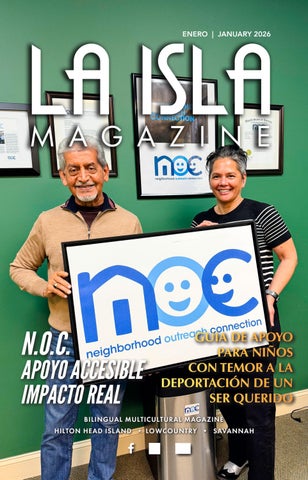
ENERO | JANUARY 2026
N.O.C.
APOYO ACCESIBLE IMPACTO REAL
GUIA DE APOYO PARA NIÑOS CON TEMOR A LA DEPORTACIÓN DE UN SER QUERIDO
BILINGUAL MULTICULTURAL MAGAZINE HILTON HEAD ISLAND • LOWCOUNTRY • SAVANNAH
su abogado bilingüe DE ACCIDENTES Localizado En Hilton Head
TRABAJO DIRECTAMENTE CONTIG 100% EN ESPAÑOL
15+ AÑOS LUCHANDO POR HISP Consultas Gratis
ZACH NAERT ABOGADO DE ACCIDE
2 CORPUS CHRISTI PLACE STE. 205 • HI
e
GO
Mi Entrevista En ESPAÑOL
PANOS
ENTES
ILTON HEAD ISLAND, SC | 843-802-0015
4 LAISLAMAGAZINE.COM • ENERO 2026
¡Este es tu año para brillar!
¡La experiencia importa!
¡Obtenga resultados!
Su idea de la belleza puede ser una realidad con el Dr. Frederick G. Weniger, certificado por el Consejo de Cirujanos Plásticos. Especializado en todo aspecto de cirugía estética de rostro, senos y cuerpo Dr. Weniger ha sido galardonado con el premio “Best Plastic Surgeon” desde el año 2009-2025 por el “Bluffton Today”. Sus pacientes obtienen excelentes resultados en rejuvenecimiento de manera natural. Nuestro objetivo es lograr que su proceso médico quirúrgico sea toda una experiencia relajante y gratificante con resultados sobresalientes.
Llame para programar su cita hoy, ¡hablamos español! 843-757-0123 • www.wenigerplasticsurgery.com • Hablamos Español 350 Fording Island Rd. Suite 200, Bluffton, SC
JANUARY 2026 • LAISLAMAGAZINE.COM 5
Participe en un Taller de Ciudadanía Donde Usted Puede Preparar su Solicitud Para la Ciudadanía Estadounidense LIBRE DE COSTO Dónde: Biblioteca de Bluffton, 120 Palmetto Way, Bluffton SC 29910 Cuándo: Sábado, 21 de FEBRERO de 2026 De 12:00 PM a 3:00 PM Qué debe traer: Su tarjeta de residente; lista de sus domicilios por los últimos 5 años; lista de todos los viajes realizados fuera de EUA después de obtener su residencia; lista de escuelas y empleos durante los últimos 5 años; su acta de matrimonio, actas de divorcio, y las actas de nacimiento de sus hijos. Abogados estarán presentes para ayudar en repasar elegibilidad y solicitudes para la Naturalización. Para más información, o para registrarse para el evento o ser voluntario, comuníquese con Kate Samuel a ksamuel24@gmail.com. *TAMBIÉN SE NECESITAN VOLUNTARIOS PARA AYUDAR EN LA PREPARACION DE LAS FORMAS DE NATURALIZACIÓN.* (Los voluntarios deben llegar a las 11:30AM para un entrenamiento breve.)
6 LAISLAMAGAZINE.COM • ENERO 2026
DJ’s EVENT CENTER
¡Tu espacio ideal para celbrar en Hilton Head!
Salón De Eventos de 1975 Pies Cuadrados, Perfecto Para:
¡Tus invitados reciben un descuento Exclusivo en hospedaje! Estacionamiento gratuito y acceso privilegiado en Hilton Head
Bodas | Quinceañeras | Cumpleaños | Reuniones de negocios | Eventos Especiales y Más ¡ESPACIOS LIMITADOS! Llama Ahora Para Asegurar Tu Fecha Reserva Con Jeff: 843-683-6477
JANUARY 2026 • LAISLAMAGAZINE.COM 7
THE LATINO RESOURCE SINCE 1999 OFFICE: 843.681.2393 386 SPANISH WELLS ROAD | SUITE B3 | HILTON HEAD ISLAND, SC 29926 WWW.LAISLAMAGAZINE.COM ENERO | JANURY VOLUME 31 | ISSUE 01
EDITORA
Publisher & Editor Andrea Segales
TABLE OF CONTENTS TABLA DE CONTENIDO
DIRECTOR DE ARTE
Art Director Jesse Aguirre CONTRIBUIDORES ESPECIALES
Special Contributors Enid Carranza FOTÓGRAFO
Photographer Jorge Estremadoiro PUBLICIDAD
Advertising Andrea Segales 843.540.0304 andrea@laislamagazine.com Eric Esquivel 843.384.3742 eric@laislamagazine.com
08 TABLA DE CONTENIDO | TABLE OF CONTENTS 10 COMUNIDAD | COMMUNITY N.O.C. | N.O.C. 18 SALUD | HEALTH CUANDO LOS NIÑOS Y NIÑAS TEMEN LA DEPORTACION DE UN PADRE | WHEN CHILDREN ARE AFRAID OF A PARENT'S DEPORTATION 28 CALENDARIO DE EVENTOS | CALENDAR OF EVENTS
30 MERCADO DE NEGOCIOS | MARKETPLACE
FRACTURACION
Billing info@laislamagazine.com
NUEVOS ANUNCIOS • NEW ADS Reserve su espacio antes del DÍA 15 de cada mes antes de la siguiente edición
Ad space reservations due on the 15TH of the month prior to next issue
ACTUALIZACIONES DE ANUNCIOS CURRENT AD CHANGES
Confirmar antes del DÍA 10 de cada mes antes de la siguiente edición Ad changes due by the 10TH of the month prior to next issue
DISCLOSURE: The views expressed here are those of the authors & do not necessarily represent or reflect the views of La Isla Magazine.
8 LAISLAMAGAZINE.COM • ENERO 2026
JANUARY 2026 • LAISLAMAGAZINE.COM 9
COMUNIDAD | COMMUNITY
NEIGHBORHOOD OUTREACH CONNECTION UNA MANO AMIGA PARA LAS FAMILIAS HISPANAS Y LAS COMUNIDAD LOCALES QUE NECESITAN APOYO POR: La Isla Magazine
En Hilton Head Island existe una organización especial llamada Neighborhood Outreach Connection (NOC) que trabaja para apoyar a niños, adultos, familias y comunidades que enfrentan desafíos cada día. Desde que comenzó en 2008, fundada por la iniciativa del Dr. Narendra P. Sharma, PhD, ha crecido gracias al corazón de muchas personas que creen que juntos pueden lograr un futuro mejor para todos. NOC, (en inglés pronunciado En - Oh - Ci), está diseñada para estar muy cerca de la comunidad, en los mismos vecindarios o a los alrededores de donde viven las personas que más lo necesitan. 10 LAISLAMAGAZINE.COM • ENERO 2026
Esto permite que los programas sean más accesibles y que las familias sientan que siempre hay alguien dispuesto a escucharlas, ayudarlas y ser aliados. LA ORGANIZACIÓN OFRECE APOYO EN TRES ÁREAS PRINCIPALES: • Educación para niños y adultos • Servicios de salud • Oportunidades de desarrollo laboral. Cada una de estas áreas está pensada para fortalecer el bienestar de quien participa, haciendo que poco a poco se sientan más seguros, capaces de alcanzar sus metas y disfrutar de una mejor calidad de vida.
Para muchos niños, NOC representa un lugar donde pueden recibir tutoría después de la escuela, obtener ayuda con tareas difíciles y explorar actividades que fortalecen sus habilidades. Estos programas ayudan a construir confianza, mejorar el rendimiento escolar y animar a cada estudiante a seguir aprendiendo con entusiasmo. Los padres y adultos también tienen su espacio. A través de clases para adultos, muchos aprenden habilidades nuevas útiles para el trabajo, como mejorar el inglés, aprender sobre comunicación y finanzas o entender mejor su entorno laboral. Estas herramientas son valiosas y se traducen en más oportunidades para toda la familia. La salud es otra pieza clave. NOC trabaja con proveedores locales para ofrecer exámenes médicos gratuitos o de bajo costo. Esto incluye revisiones básicas de salud, apoyo con información útil y referencia a servicios locales cuando es necesario. MÁS DE 600 PERSONAS RECIBEN CADA AÑO: • Exámenes comunitarios gratuitos para diabetes, presión arterial, visión y audición, VIH/SIDA, higiene dental y cáncer • Apoyo en salud mental • Orientación sobre abuso de alcohol y drogas Para muchas familias sin seguro médico, NOC es su única oportunidad de recibir atención preventiva, sin costo, y de una forma confiable y segura. NOC también cree en el poder de la comunidad, por eso involucra a padres, vecinos, voluntarios y agencias aliadas que brindan servicios comunitarios a nivel local
COMUNIDAD | COMMUNITY
Narendra P. Sharma, PhD en cada paso. Cuando todos participan, el impacto positivo es mucho mayor. Neighborhood Outreach Connection es un lugar donde cada persona puede encontrar apoyo, sentirse valorada y crecer con confianza. Si tienes hijos, si quieres aprender algo nuevo o si deseas ayudar a otros, aquí hay un espacio para ti. ¡Involúcrate hoy y forma parte de esta comunidad viva y solidaria! Contacta a NOC Teléfono: 843-681-4100 Dunmore Court, Suite 102, Hilton Head Island SC 29926 www.noc-sc.org INVITACIÓN A PEQUEÑOS NEGOCIOS ¡Tu ayuda beneficia directamente a nuestra comunidad! Los pequeños negocios pueden hacer una gran diferencia apoyando a NOC. Las JANUARY 2026 • LAISLAMAGAZINE.COM 11
COMUNIDAD | COMMUNITY donaciones son deducibles de impuestos, lo que hace que su contribución sea valiosa tanto para la organización como para su negocio. Considera donar materiales, tiempo o recursos. ACTUALMENTE EXISTEN 5 CENTROS EN EL CONDADO DE BEAUFORT QUE FORTALECEN A NUESTRA COMUNIDAD Beaufort Waters at Ribaut Center, 2500 Duke Street, Beaufort, SC 29902
OLD TOWN - APERTURA A INICIOS DEL 2026! (CHEERS!) Hilton Head Island Cordillo en Providence Presbyterian 171 Cordillo Parkway Hilton Head Island, SC 29926 Island Lutheran Center 501 Main Street Hilton Head Island, SC 29926 New Oaks Center (al lado de Dunkin Donuts) 4 Southwood Park Dr., Hilton Head Island, SC 29926
Bluffton Lowcountry Presbyterian en 10 Simmonsville Road, Bluffton, SC 29910
Bluffton Family Más De 40 Años De Experiencia
$99
Oferta Especial
INCLUYE CONSULTA, EXAMEN, Y RADIOGRAFÍA Atendemos Personas Con Dolores Musculares, Lesiones, Y Accidentes Automovilísticos
BlufftonChiropractic.com | Info@BlufftonFamilyChiro.com
843-706-3472 | 162 Bluffton Rd, Suite 101 Bluffton, SC 12 LAISLAMAGAZINE.COM • ENERO 2026
DECLARA TUS IMPUESTOS GRATIS CON VITA! VITA (Volunteer Income Tax Assistant) GRATIS Y CONFIDENCIAL PARA INDIVIDUOS Y FAMILIAS DEL LOWCOUNTRY Servicio en inglés y español en todas las locaciones Revisa el listado de lugares de preparación cerca de ti en los condados de Beaufort o Jasper. Información de requerimientos y programa tu cita en: www.uwlowcountry.org/VITA
EVENTO ESPECIAL DE UN DÍA
VITA TAX-A-THON SÁBADO 21 DE FEBRERO 10AM – 4PM
Hardeeville Recreation Center:
285 John Smith Road, Hardeeville, SC 29927
TENDREMOS: FOOD TRUCK
MÚSICA Y PREMIOS ACTIVIDADES PARA NIÑOS FERIA DE RECURSOS COMUNITARIOS Y EDUCACIÓN FINANCIERA
JANUARY 2026 • LAISLAMAGAZINE.COM 13
COMUNIDAD | COMMUNITY
NEIGHBORHOOD OUTREACH CONNECTION A HELPING HAND FOR HISPANIC FAMILIES AND LOCAL COMMUNITIES IN NEED OF SUPPORT BY: La Isla Magazine On Hilton Head Island, there is a special organization called Neighborhood Outreach Connection (NOC) that works to support children, adults, families and communities who face challenges every day.
need support the most live. This makes the programs more accessible and helps families feel that there is always someone ready to listen, help and partner.
THE ORGANIZATION OFFERS SUPPORT IN THREE MAIN AREAS: Since it began in 2008, founded through the • Education for children and adults initiative of Dr. Narendra P. Sharma, PhD, it • Health services has grown thanks to the dedication of many • Workforce development opportunities people who believe that together we can build a better future for everyone. Each area is designed to strengthen the well‑being of participants, helping them NOC (pronounced En-Oh-Ci in English) is gradually feel more confident, capable of designed to be very close to the community, reaching their goals and enjoying a better located directly in the neighborhoods or quality of life. near the neighborhoods where people who 14 LAISLAMAGAZINE.COM • ENERO 2026
COMUNIDAD | COMMUNITY For many children, NOC is a place where they can receive after‑school tutoring, get help with difficult homework, and explore activities that strengthen their skills. These programs help build confidence, improve academic performance, and encourage every student to keep learning with enthusiasm. Parents and adults also have their space. Through adult classes, many learn new skills useful for work—such as improving their English, learning about communication and finances, or better understanding their work environment. These tools are valuable and often lead to more opportunities for the entire family. Health is another key piece. NOC works with local providers to offer free or low‑cost medical screenings. This includes basic health checks, helpful information, and referrals to local services when needed. MORE THAN 600 PEOPLE RECEIVE EACH YEAR: • Free neighborhood screenings for diabetes, blood pressure, vision and hearing, HIVAIDS, dental hygiene, and cancer • Mental health support • Guidance on alcohol and drug abuse For many families without health insurance, NOC is their only opportunity to receive preventive care at no cost, in a safe and trustworthy way. NOC also believes in the power of community, which is why it involves parents, neighbors, volunteers, and partner agencies which provide community services locally every step of the way. When everyone participates, the positive impact is much greater.
Narendra P. Sharma, PhD Neighborhood Outreach Connection is a place where every person can find support, feel valued, and grow with confidence. If you have children, want to learn something new, or wish to help others, there is a space for you here. Get involved today and be part of this vibrant and caring community! Contact NOC Phone: 843‑681‑4100 Dunmore Court, Suite 102, Hilton Head Island, SC 29926 www.noc-sc.org INVITATION TO SMALL BUSINESSES Your help directly benefits our community! Small businesses can make a big difference by supporting NOC. Donations are tax‑deductible, making your contribution valuable for both the organization and your business. Consider donating materials, time, or resources. JANUARY 2026 • LAISLAMAGAZINE.COM 15
COMUNIDAD | COMMUNITY CURRENTLY 5 CENTERS IN BEAUFORT COUNTY STRENGTHENING OUR COMMUNITY
NOC OLD TOWN – OPENING EARLY 2026! (CHEERS!)
Beaufort Waters at Ribaut Center, 2500 Duke Street, Beaufort, SC 29902
Hilton Head Island Cordillo at Providence Presbyterian 171 Cordillo Parkway, Hilton Head Island, SC 29926
Bluffton Lowcountry Presbyterian 10 Simmonsville Road, Bluffton, SC 29910
Island Lutheran Center 501 Main Street, Hilton Head Island, SC 29926 New Oaks Center (next to Dunkin Donuts) 4 Southwood Park Dr., Hilton Head Island, SC 29926
Dentista para bebés, niños, jóvenes, y personas con cualquier necesidad especial. Atendemos todos los seguros, incluyendo Medicaid. Tenemos descuentos si pagas en efectivo
Somos Bilingües!!! ¡Llámanos Hoy! 291 19 Red Cedar Street, Bluffton SC, SC 29910 Promenade St. # 201, Bluffton, (843)-707-7915 | www.pediatricsmilesbluffton.com 843-707-7915 www.pediatricsmilesbluffton.com 16 LAISLAMAGAZINE.COM • ENERO 2026
JANUARY 2026 • LAISLAMAGAZINE.COM 17
SALUD | HEALTH
CUANDO LOS NIÑOS Y LAS NIÑAS
TEMEN LA DEPORTACIÓN DE UN PADRE Este folleto fue creado por profesionales de la salud mental infantil y de la primera infancia vinculados a la Universidad de Minnesota. Participaron: Hopewell Hodges, MA y candidata a doctorado; Jasmine Banegas, MSW, LICSW y candidata a doctorado; Colleen Doyle, PhD, LP; Katie Lingras, PhD, LP; y Saida Abdi, PhD, LICSW. Este artículo surgió como respuesta a preguntas de miembros de la comunidad sobre qué pueden hacer los adultos para apoyar a niños que tienen miedo de que uno de sus padres u otro ser querido sea deportado. Incluye pasos claros y prácticos para ayudar a los niños a sentirse seguros, a desarrollar una imagen positiva de sí mismos y a mantener relaciones sanas en momentos de incertidumbre. Puede ser útil para cualquier adulto que cuide o acompañe a bebés, niños y adolescentes.
18 LAISLAMAGAZINE.COM • ENERO 2026
A
medida que se intensifican las órdenes de inmigración, muchos niños/as temen ser separados de sus padres y otros seres queridos. Este documento, elaborado por profesionales de la salud mental infantil, describe los pasos que las familias inmigrantes y refugiadas pueden dar para apoyar la resiliencia de sus hijos/as y las relaciones positivas durante esta época de temor. INICIAR CONVERSACIONES: • Puede que los padres se preocupen de que las conversaciones sobre la deportación traumatizarán aún más a sus hijos/as. Sin embargo, las investigaciones
SALUD | HEALTH demuestran que cuando los niños/as pasan por cosas difíciles, tienen menos miedo si han sido preparados sobre qué esperar. Aunque estas conversaciones son difíciles, es importante iniciarlas temprano. • Antes de iniciar una conversación de este tipo, siempre tómese un momento para relajarse y tranquilizarse. Si no se siente preparado, cuídese y vuelva a intentarlo. • Es posible que tenga que hablar con su hijo(a) una y otra vez sobre este tema para responder a sus preguntas y tranquilizarlo/a. • Utilice palabras que su hijo/a entienda y hable con una voz tranquila. • Algunos niños/as mantienen sus preocupaciones en privado porque no quieren molestar a sus padres. Asegúrese de que su hijo/a sabe que usted quiere saber lo que piensa en privado. Puede decir cosas como: “Me puse muy triste cuando se llevaron al Sr. Jiménez esta semana. Me pregunto si tienes miedo de que me pase lo mismo.” “Me pregunto si has escuchado a alguien en la escuela diciendo cosas malas sobre las personas que se mudaron aquí de otro país.” “No pasa nada si te sientes asustado, enojado o triste cuando hablamos de esto. No me asustan tus sentimientos y siempre quiero saber lo que piensas.” • Su hijo/a puede escuchar cosas que sugieren que las personas indocumentadas son criminales o enemigos. Es importante
que los niños/as sepan que sus padres hacen todo lo posible por ser buenas personas. Deles un lenguaje alternativo para que entiendan lo que significa ser indocumentado. Sugerimos hacer énfasis en que se trata de un problema administrativo. Por ejemplo: “Las personas necesitan papeles para estar en EE.UU., y muchas, como yo, seguimos esperando los nuestros. Esto no significa que sea una mala persona; sólo demuestra que lleva tiempo conseguir estos papeles. Puede que tenga que vivir en otro lugar durante un tiempo mientras espero.” • Aunque su hijo/a sea muy pequeño/a, dígale quién va a cuidar de él/ella si usted tiene que salir de viaje, cómo serán sus días en casa de esa persona y cómo podrá mantenerse conectado/a desde lejos. Por ejemplo: “Los padres de Jovi te despertarán, te llevarán a la escuela, jugarán contigo, te darán de cenar, te lavarán los dientes, te leerán un cuento y te darán las buenas noches.” • Asegúrese que su hijo/a haya pasado tiempo en la casa de esta persona y sepa que esta persona lo ama. • Los niños/as se sienten más seguros cuando sus padres encuentran maneras de hacer valer sus sentimientos y también de mantener la calma. Cuando tenga estas conversaciones con su hijo/a, exprese sus sentimientos de forma calmada y que le den seguridad. Por ejemplo: “Si tuviera que irme lejos durante
JANUARY 2026 • LAISLAMAGAZINE.COM 19
SALUD | HEALTH un tiempo, me pondría muy triste. Te extrañaría todos los días y oraría para que volviéramos a estar juntos. Y tú estarías seguro cada día con tu Tía Angela.” MIENTRAS TANTO: • Complete un plan de preparación familiar para cada niño de acuerdo con las leyes de su estado. • Asegúrese de que ha completado un formulario designando a una persona o familia de confianza para cuidar de su hijo/a si usted es deportado. Lleve esto a un notario público para asegurarse de que sea válido. • Ayude a su hijo/a a sentirse orgulloso/a de quiénes son. Los niños/as inmigrantes en EE.UU. se adaptan mejor cuando son capaces de navegar la cultura de EE.UU. al mismo tiempo que tienen una fuerte conexión positiva con su origen. Puede hacerlo de las siguientes maneras: - Preparando recetas de su cultura. - Escuchando música de su país de origen. - Involucrando a sus hijos/as en prácticas religiosas y espirituales que sean importantes para usted. • Después de separaciones breves (por ejemplo, al recoger a su hijo/a de la escuela), recuérdele que estuvo pensando en él/ella y ayúdale a comprender que siguen conectados aun cuando están separados/as. • Si su hijo/a escucha comentarios negativos sobre inmigrantes o personas latinas, valida sus sentimientos de dolor y enojo. Luego, enséñale que esos
20 LAISLAMAGAZINE.COM • ENERO 2026
comentarios no son correctos. Por ejemplo: “Me enoja que alguien haya dicho eso. Algunas personas creen que la apariencia, el idioma que hablan o el lugar de donde vienen determinan qué tan buenos/ as o importantes son como personas. ¡Esas personas están equivocadas y muy confundidas!” • Repite continuamente los mensajes más importantes (que su hijo/a es igual de bueno/a e importante que los demás). Para los niños/as mayores, puede hablar sobre las razones por las que sabemos que creencias
discriminatorias o racistas son incorrectas. • Es importante que los niños/as se sientan capaces de actuar cuando tienen miedo. Puede asignarle a su hijo/a una tarea especial en caso de que tenga que irse, cómo leer un libro al día a un hermano/a menor, o mantener un diario o hacer dibujos sobre su vida diaria para que algún día puedan compartirlos contigo. • Las rutinas dan seguridad y ayudan a
SALUD | HEALTH los/las niños/as a desarrollar su identidad. Mantén las rutinas familiares establecidas (asistencia a la escuela, comidas, cuentos antes de dormir, servicios religiosos, etc.).
- El hilo invisible - La luna mango: Cuando la deportación divide a una familia - Amigos del Otro Lado - From North to South / del Norte Al Sur
• Habla con la persona que podría cuidar de su hijo/a en su ausencia para asegurarse PARA BEBÉS Y NIÑOS PEQUEÑOS: de que estas rutinas se mantendrán si llegan a separarse. • Muéstrele fotos de seres queridos que vivan lejos y practique enviándoles “deseos • Nombra y describe una y otra vez amistosos” (por ejemplo, soplando besos a a las personas que seguirán la foto). queriendo y apoyando a su hijo/a pase lo que • Envíe una foto de su familia a la persona pase (docentes, que pueda cuidar de su hijo/a para que tíos/as, líderes pueda enviarle deseos amistosos si llegan a comunitarios/as, separarse. etc.). • Los niños/as pequeños juegan • Su para comprender sus sentimientos y bienestar experiencias. Participar en sus juegos emocional puede ayudarles a comunicarse con usted. influye Fíjese en lo que le llama la atención y háblele más sobre ello. Anímele, elógele y exprésele que disfruta jugando con él/ella. directamente en el de • Las canciones y voces familiares pueden su hijo/a. ayudar a su bebé a sentirse tranquilo/a y Conéctese seguro/a, además de conectarlo/a con su regularmente cultura. Elija una canción para cantársela con personas y con regularidad, grabe su voz cantando actividades que lo y compártala con la persona que pueda ayuden a sentirse bien, y cuidar de su bebé en su ausencia. considera la posibilidad de hablar con profesionales de la salud mental u PARA LOS ADOLESCENTES otros/as líderes comunitarios/as. • Los adolescentes suelen asumir la • Los libros pueden ayudar a los/las responsabilidad de cuidar de sus hermanos niños/as a entender que no están solos/ pequeños y realizar trabajos pagados si uno as en sus sentimientos. Aún mejor: si los de sus padres es deportado. Asegúrese de leen juntos/as, demostrarás que estás que se sienten capaces de asumir estas dispuesto/a a hablar con ellos/as sobre responsabilidades; por ejemplo, que saben estas experiencias. cómo llevar a sus hermanos pequeños al
JANUARY 2026 • LAISLAMAGAZINE.COM 21
SALUD | HEALTH
colegio y limpiar la casa. Los adolescentes se adaptan mejor al estrés cuando pueden sentirse capaces y con un propósito. • Asegúrese de que la ansiedad no le impida a su hijo/a hacer lo que le ayudará en su desarrollo a largo plazo: tener éxito en la escuela, dormir bien, y hacer amigos. Deje claro que quiere que siga haciendo estas cosas, incluso si usted es deportado/a. • Asegúrese de que su adolescente sabe que sigue siendo su hijo/a aunque sus roles cambian. Utilice todos los consejos de este folleto para comunicarle que usted se compromete a cuidar de él/ella aunque no estén juntos en persona. Nombra una y otra vez a las personas que ayudarán a cuidar del adolescente y apoyaran por él/ ella. Exprese que desea que su hijo/a tenga balance y descanso en su vida. “Cuidar de Sol y Jhonathan es un trabajo a todas horas, ¡y estoy tan contento de que te tengan a ti! El pastor Luis y tu consejero escolar te conseguirán más apoyo si es difícil hacer todas estas cosas. Tu madre y yo ciertamente hemos necesitado más apoyo a veces.” • Ayude a su adolescente a relacionarse 22 LAISLAMAGAZINE.COM • ENERO 2026
regularmente con un mentor, como un amigo de la familia, un familiar, un entrenador, un líder comunitario, un terapeuta o un profesor. Esta relación puede ayudar a aportar estabilidad en caso de separación. ÁREAS EN LAS QUE HAY QUE TENER PRECAUCIÓN: • Intente no describir ni mostrar imágenes en los medios de comunicación de elementos espantosos de la deportación, como centros de detención o detenciones forzadas. • Intente no hablar negativamente de otros grupos en general (por ejemplo, “americanos,” “mexicanos,” “personas blancas,” “personas negras”). A medida que su hijo/a vaya creciendo, será importante que establezca relaciones positivas con diferentes grupos de personas. Haga énfasis, en cambio, en que la mayoría de los adultos quieren ayudar a los niños/as, y que todo tipo de personas pueden ser seguras y amables. Hodges, H. R., Banegas, J. M., Doyle, C. M., Lingras, K. A., & Abdi, S. M. (2025). Cuando los niños y las niñas temen la deportación de un padre. (When children are afraid of a parent’s deportation).
SALUD | HEALTH
WHEN CHILDREN ARE AFRAID
OF A PARENT'S DEPORTATION This pamphlet was created by infant and child mental health professionals associated with the University of Minnesota (Hopewell Hodges, MA, PhD Candidate; Jasmine Banegas, MSW, LICSW, PhD Candidate; Colleen Doyle, PhD, LP; Katie Lingras, PhD, LP; & Saida Abdi, PhD, LICSW). It came about in response to questions from community members about what adults can do to support children who are afraid of a parent or other loved ones being deported. This article contains concrete steps to support children’s sense of safety, positive identity, and healthy relationships during an uncertain time. It can be helpful for any adult who is involved in caring for infants, children, and adolescents.
As
immigration enforcement orders intensify, many children are afraid of being separated from their parents and other loved ones. This document, prepared by child mental health professionals, describes steps that immigrant and refugee families can take to support their children’s resilience and healthy relationships during this frightening time.
STARTING CONVERSATIONS: Parents may worry that conversations about deportation will further traumatize Hodges, H. R., Doyle, C. M., Banegas, J., Lingras, their child. However, research shows that when children go through scary things, they K. A., & Abdi, S. M. (2025). When children are afraid of a parent’s deportation. JANUARY 2026 • LAISLAMAGAZINE.COM 23
SALUD | HEALTH are less afraid if they have been prepared about what to expect. Even though these conversations are hard, it is important to start them early. • Always take a moment to relax and calm yourself before starting a conversation like this. If you do not feel ready, take care of yourself and try again later.
be undocumented. We suggest emphasizing that it is an administrative problem. For example: “People need papers to be in the U.S., and many people (like me) are still waiting for ours. This does not mean I am a bad person; it just shows that it takes time to get these papers. I may have to live elsewhere for a while while I wait.”
• You may need to talk with your child again and again about this topic to answer their Even if your child is very young, questions and reassure them. tell them who will take care of them if you have • Use words your child understands and to go away, what speak in a calm voice. their days might look like at • Some children keep their worries private that person’s because they do not want to trouble their house, and parents. Make sure your child knows how you that you want to hear about their private will be able thoughts. You may say things like: to stay connected “I was so sad when Mr. Jiménez was from taken away this week. I wonder if you are afar. For afraid that the same thing will happen to example: me.” “Jovi’s “I wonder if you have heard anyone at parents will school saying mean things about people wake you, take who moved here from another country.” you to daycare, play with you, give “It is okay if you feel scared or mad or sad you dinner, brush your when we talk about this. I am not afraid of teeth, read you a story, and say your feelings, and I always want to know goodnight.” what is on your mind.” • Make sure the child has spent time in this Your child may hear things that suggest home and knows this adult loves them. undocumented people are criminals or enemies. It is important that children Children feel safest when their parents find know their parents are doing their best ways to validate their feelings and also stay to be good people. Give them alternative calm. When you have these conversations language to understand what it means to with your child, express your feelings in
24 LAISLAMAGAZINE.COM • ENERO 2026
SALUD | HEALTH a way that is calm and reassuring. For example: “If I have to go away for a while, I would be so sad. I’d miss you daily and pray for us to be together again. And you would be safe every day with Tía Angela.” IN THE MEANTIME:• Complete a family preparedness plan for each child in your family. • Make sure you have completed a form designating a trusted individual or family to care for your child if you are deported. Bring this to a notary public to make sure it is official. • Help your child to build pride in who they are. Immigrant children in the U.S. do best when they are able to navigate U.S. culture while having a strong positive connection to their heritage. You can do this by: - Making recipes from your culture. - Listening to music from your home country. - Involving your children in religious and spiritual practices that matter to you.
• After short separations (e.g., at school pickup), tell your child you were thinking of them, and help them understand you are connected when you are apart. • If your child hears negative language about immigrants or Latino people, validate their feelings of hurt and anger. Then, teach them that the comments are wrong. For example: “That makes me mad that someone said that. There are some people who believe that the way people look, the language they speak, or where they come from has to do with how good or important they are as a person. Those people are wrong, and really confused!” • Continually repeat the most important facts (that the child is just as good and important as everyone else). For older children, you can talk about reasons that racist or anti-immigrant beliefs are wrong. • It is important for children to have a sense of agency when they are afraid. You may talk to your child about a special “job” they will have if you have to go away, like reading one book a day to a younger sibling, or keeping a journal or drawing pictures about their daily lives that they can share with you someday. • Routines provide security and help your child build their identity. Maintain established family routines (school attendance, meals, bedtime stories, religious services, etc.). • Talk to the person who may care for your child in your absence to make sure that these routines will be maintained if you are
JANUARY 2026 • LAISLAMAGAZINE.COM 25
SALUD | HEALTH separated.
attention and talk more about it. Offer encouragement and praise, and express • Repeatedly name and describe the people that you enjoy playing with them. who will keep loving and supporting the child no matter what (teachers, aunties and • Familiar songs and voices can help your uncles, pastors, etc.). baby feel safe and connected to their culture. Choose a song to sing with your • Your own mental health closely affects baby regularly, make a recording of your the health of your child. Connect regularly voice singing it, and share it with the person to people and practices that help you to feel who may care for your baby if you are gone. well, and consider talking to mental health professionals or other community leaders. FOR OLDER CHILDREN AND TEENAGERS: BOOKS CAN HELP CHILDREN KNOW THAT THEY ARE NOT ALONE IN THEIR FEELINGS. Even better: If you read them together, it shows that you are able to talk to them about these experiences. - El hilo invisible - La luna mango: Cuando la deportación divide a una familia - Amigos del Otro Lado - From North to South / del Norte Al Sur
• Older children and teens often feel responsibility to care for younger siblings and work at paid jobs if a parent is deported. Make sure they feel capable at these roles — for example, that they know how to take younger siblings to school and clean the house. Teenagers adapt best to stress when they can feel competent and purposeful.
• Make sure that anxiety does not get in the way of your child doing what will support their development in the long term: FOR BABIES AND VERY YOUNG succeeding at school, sleeping well, and CHILDREN: building friendships. Make it clear you want them to keep doing these jobs even if you • Show your child photos of loved ones who are deported. live far away and practice sending them “friendly wishes” (e.g., blow kisses at the • Make sure your teenager knows that photo). they are still your child even when their roles change. Use all of the tips from this • Send a photo of your family to the person pamphlet to convey that you are committed who may care for your child so your child to caring for them even if you are not can send friendly wishes to you if you are together in person. Repeatedly name the separated. people who will help care for the teen and advocate for them. Express that you want • Young children use play to make sense of your child to have balance and rest in their their feelings and experiences. Joining them life. in their play can help them communicate with you. Tune in to what is holding their 26 LAISLAMAGAZINE.COM • ENERO 2026
SALUD | HEALTH
“Taking care of Sol and Jhonathan is a full-time job, and I am so glad they will have you! Pastor Luis and your school counselor will get you more support if it’s hard to do all these jobs. Your mother and I have certainly needed that at times.” • Help your teen connect regularly with a mentor, such as a family friend, relative, coach, community leader, therapist, or teacher. This relationship may help provide stability if you are separated.
• Try not to talk negatively about other groups on the whole (e.g., “Americans,” “Mexicans,” “White people,” “Black people”). As your child keeps growing, it will be important for them to form positive connections with different kinds of people. Emphasize instead that most grown-ups want to help kids, and that all sorts of people can be safe and kind. Hodges, H. R., Banegas, J. M., Doyle, C. M., Lingras, K. A., & Abdi, S. M. (2025). Cuando los niños y las niñas temen la deportación de un padre. (When children are afraid of a parent’s deportation).
AREAS TO USE CAUTION: • Try not to describe or show media footage of frightening elements of deportation, like detention centers or forced arrests.
JANUARY 2026 • LAISLAMAGAZINE.COM 27
CALENDARIO DE EVENTOS BEAUFORT OYSTER FESTIVAL JAN 17&18
BEAUFORT
Henry C. Chambers Waterfront Park 11:00 am – 4:00 pm 700 Bay St, Beaufort, SC 29902
JAN 31
BLUFFTON OYSTER ROAST FESTIVAL BLUFFTON
Oyster Factory Park 5:00 pm – 8:00 pm 63 Wharf St, Bluffton, SC 29910
SNOW DAY / DÍA DE NIEVE JAN 31
HILTON HEAD ISLAND
HHI Rec Center 11:00 am 20 Wilborn Road, Hilton Head Island, SC 29926
28 LAISLAMAGAZINE.COM • ENERO 2026
CALENDAR OF EVENTS COMMUNITY FOOD BANK 1st & 3rd THURSDAY
BEAUFORT
Charity Inspirational Church of God 3:00 pm – 5:00 pm 31 Donaldson Dr, Beaufort, SC 29906
2026 TASTE OF BLUFFTON FEB 06
BLUFFTON
Oyster Factory Park 5:00 pm – 9:00 pm 63 Wharf Street, Bluffton, SC 29910
JAN 31 FEB 07
SEMANA DEL RESTAURANTE 2026 BLUFFTON & HILTON HEAD
Grandes descuentos en tus restaurantes favoritos Lugares variados en Hilton Head y Bluffton
JANUARY 2026 • LAISLAMAGAZINE.COM 29
MERCADO DE NEGOCIOS | MARKETPLACE
Ronnie’s y & Baky eLoru Cakes b
Pasteles Deliciosos y Artesanales
Para Cualquier Ocasión
Desayuno, Cafе` y Postres Todos Los Días
Lunes - Viernes Sabados
9:00 am - 5:30 pm 9:00 am - 4:00 pm
843.683.7850
BELLA ITALIA ¡Auténtico Sabor Italiano en el Corazón de Hilton Head! 95 Mathews Dr. Suite D-13, Hilton Head Island, SC 29926 (843) 689-5560 Martes - Domingo Almuerzo y Cena
Ordena en línea:
Eatbellaitalia.com
ABOGADA
DE INMIGRACIÓN HABLO ESPAÑOL
• Trámites de Ciudadanía y Residencia Permanente • Beneficios para Víctimas de Crimen • Peticiones Familiares y Cartas de Perdón • Asistencia a Víctimas con el Proceso Judicial
LLAMA HOY - (843) 471-0529 3226 MAYBANK HWY, SUITE B-1 | JOHNS ISLAND, SC 29455
30 LAISLAMAGAZINE.COM • ENERO 2026
SE DUEÑO DE TU VIVIENDA EN EL
843-846-6694 3418 Trask Pkwy, Beaufort SC 29906 ¡LLAMA HOY! ¡HABLAMOS ESPAÑOL! DANOS ME GUSTA EN FACEBOOK
JANUARY 2026 • LAISLAMAGAZINE.COM 31