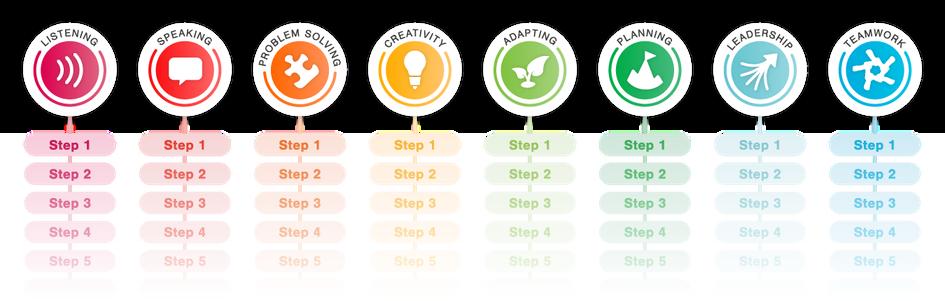
This pack will give you information and help you to learn about the Skills Builder approach that we use within school.
There’s never been a more important time to be building these skills.
Being confident in all eight essential skills can support your child’s social and wellbeing, their learning outcomes and their future employability.
There are so many ways that you can support your child to build these skills at home, simply by talking, playing games and doing activities together. This resource provides guidance about the essential skills along with content that you could use to support building the skills at home.
Skill Builder Information for Parents and Carers
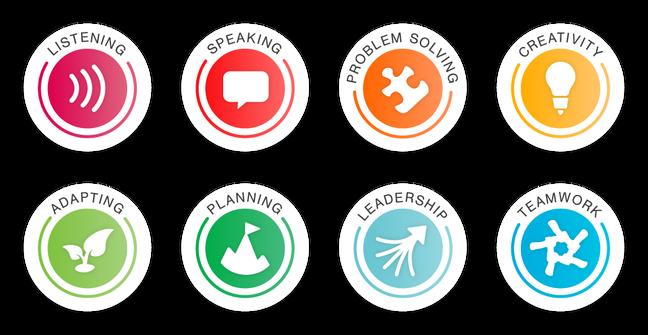
Oxclose Primary Academy works with The Skills Builder Partnership to ensure every learner has opportunities to build eight essential skills to support them now and in the future.
Research has shown that building these eight essential skills can support the emotional wellbeing and academic success of children and young people, as well as preparing them for life beyond school.
Research has shown that building these eight essential skills can support the emotional wellbeing and academic success of children and young people, as well as preparing them for life beyond school.
Skills Builder has developed a Universal Framework that breaks each of these essential skills down into 16 teachable steps. We use this framework to teach and practise each of the eight skills at the appropriate level throughout school life.
Skills Builder has developed a Universal Framework that breaks each of these essential skills down into 16 teachable steps. We use this framework to teach and practise each of the eight skills at the appropriate level throughout school life.
LISTENING
RECEIVING, RETAINING AND PROCESSING INFORMATION
This skill is about how learners receive information – whether from a peer, an educator, or someone else.
Initially, learners reliably receive information by maintaining focus, recalling simple instructions, checking they understand, and passing on information accurately. Next, learners listen actively, recognising communication’s purpose, making notes, demonstrating their engagement, and using open questions.
Suggested activities to try at home to build the skill of Listening:
For younger children
Read a story together. Stop as you go to talk about what might happen next. When you have finished, talk about what happened in the story.
Dance together to ‘Heads, Shoulder, Knees and Toes’. Sing the song and encourage your child to listen carefully and copy the actions. Alternatively, teach your child any other song and dance routine that you know!
For older children
Listen to and review an audiobook or podcast. Talk or write about what was good about it and if you would recommend it to others.
Arrange a phone or video call with an older family member. Speak clearly and listen carefully to the other person in the conversation
SPEAKING
TRANSMITTING INFORMATION OR IDEAS
This skill is about how learners transmit information and ideas to others. Initially, learners communicate clearly with individuals they know, in small groups, and then with new people while organising points to be understood. Next, learners communicate effectively by thinking about what their audience already knows, choosing appropriate language, tone, expression and gesture, and bringing in facts appropriately.
Suggested activities to try at home to build the skill of Speaking:
For younger children
Share nursery rhymes together. Take it in turns to speak and listen, speaking the words clearly so your child can copy. Talk to wider family members. Help your child use the phone, videocalling apps or other platforms to contact family members for a chat. Talk to them beforehand to plan what they might ask, then talk again afterwards about what was said.
For older children
Plan a presentation about a hobby or interest. This might be about a computer game, a sport or a style of music. Ask questions to extend the conversation.
Put on a show for the family. Organise a short show to run over a video call or in person to entertain family members. It could include a song, magic trick or a presentation. Introduce the show clearly so the family knows what to expect.
PROBLEM SOLVING
FINDING SOLUTIONS TO CHALLENGES
This skill focuses on how to solve problems, recognising that while part of Problem Solving is technical know-how and experience, there are also transferrable tools that individuals can develop and use. The first steps focus on solving simple problems by following instructions, seeking support and sharing what the problem is, or finding information themselves. The next stage focuses on being able to explore complicated problems by creating multiple potential solutions, analysing them, using success criteria for evaluation, and bringing in extra research effectively.
Suggested activities to try at home to build the skill of Problem Solving:
For younger children
Play a simple board game. Read out the instructions to set up and then to play the game, one step at a time. Follow a simple recipe. Read out, find and measure ingredients needed together. Talk through the recipe, following the instructions one step at a time.
For older children
Consider the problem: A village has a river flowing through it. Villagers need a bridge to get across the river. Draw a sketch of a bridge design. Use junk-modelling to build a model of the bridge.
Consider the problem: How can we improve the environment? Research to find out more about this problem. Create 3 solutions you could do at home or locally to address this problem. Write or sketch to show how your proposed solutions might help solve the problem, then share this with your household.
CREATIVITY
USING IMAGINATION AND GENERATING NEW IDEAS
Creativity is about how learners create new ideas and possibilities in a wide range of settings and is the complement to problem solving.
The first few steps focus on the ability to share different possibilities, share and express them, and create ideas when given a simple prompt.
The focus is then on applying creativity to suggest improvements, combine concepts, identify opportunities for innovation, and develop success criteria.
Suggested activities to try at home to build the skill of Creativity:
For younger children
Play ‘Let’s Pretend’. Encourage some role play using toys or dressing-up clothes. Use any theme that you know will capture their imagination!
Invent a helpful robot. What would it look like? What can it do to help people? Draw a picture or build a junk model of the new robot. Talk about it to others.
For older children
Fashion designer. Choose a theme, then create designs for a new outfit. The clothes could be inspired by some existing designs that you then adapt or could be completely new. Draw illustrations or create designs on the computer and talk about them to others at home.
Games Designer. Create a storyboard or play for a brand new computer game. Think about an existing game you enjoy then change the characters, setting and/or challenge to make it
ADAPTING
OVERCOMING CHALLENGES AND SETBACKS TO ACHIEVE GOALS
This skill is about how individuals adapt to challenges and setbacks effectively whether in education, the workplace or in their wider lives. The early steps focus on individuals identifying their own emotional responses and those of others, showing persistence and managing their immediate reactions to setbacks. Next, individuals demonstrate a positive approach to challenges, reflecting and learning from them, supporting and encouraging others, and proactively managing their own wellbeing.
Suggested activities to try at home to build the skill of Adapting:
For younger children
Thumbs up, thumbs down. Talk about different feelings and identify which are positive emotions (thumbs up) and which are negative emotions (thumbs down). Discuss how you are feeling at different points of the day.
Build a tall tower. Work together to build the tallest tower you can with toy bricks, Lego or anything other suitable construction materials. When it falls down, talk about how you feel and try again to build it even taller.
For older children
Play a tricky game. Play a computer or board game that you know is tricky, but is still fun! Talk about when things go wrong, or you are losing. Talk about how you feel and what you need to do to stay calm and carry on. Encourage each other to keep going.
Master something new. Think of an activity that requires practice and set it as a challenge. Could be to learn a new language, how to juggle, to play a new song on an instrument or to do a new magic trick!
PLANNING
SETTING GOALS AND DESIGNING ROUTES TO ACHIEVE THEM
This skill is about how individuals develop clear, tangible goals and robust routes to achieving them – whether in education, the workplace or their wider lives. Initially, this is about considering the difficulty of tasks, knowing what doing well looks like for them, working with care, and recognising their strengths. The focus is then on taking a positive approach to new challenges, setting achievable goals, developing simple plans, and prioritising tasks.
Suggested activities to try at home to build the skill of Planning:
For younger children
Pick up Peas. Set your child a challenge to pick up as many peas or beans as they can with a set of chopsticks or tweezers. Have a go with them. Talk about if it is too difficult or if it is easy to do.
Set yourself a balancing challenge. You will need to decide what or how you will balance and for how long. It could be standing on one leg, balancing a book on your head or balancing a ball on your nose! Make sure it is a safe challenge, but it needs to be tricky!
For older children
Start a skill exchange with a friend or member of your family. Choose something you can teach and learn. For example, you might teach a parent or carer to play a video game, and they might teach you to cook a meal.
Set yourself a challenge to get more active. For example, you might aim to complete 20 star jumps in a row or to run a certain number of laps around an outdoor space.
LEADERSHIP
SUPPORTING, ENCOURAGING AND MOTIVATING OTHERS TO ACHIEVE A SHARED GOAL
This skill is about how individuals make things happen.
At the early stages of developing this skill, individuals understand their own responses to ideas, sharing those effectively, recognising others’ reactions, and allocating tasks reasonably. The focus is then on beginning to lead others by managing time and resources to complete tasks, recognising strengths and weaknesses of themselves and others, and using this to assign roles.
Suggested activities to try at home to build the skill of Leadership:
For younger children
Create a feelings poster. Draw a happy and sad face on a piece of paper and talk about these feelings. Encourage your child to describe how they feel and talk about your own feelings too, using the pictures as a prompt.
Look at family photos together. Look at people’s faces. Talk about how they might be feeling and why.
For older children
Family Keep Fit Session. Ask your child to organise a short exercise session for the family. They will need to decide on some activities that everyone can do, how long it will take and then show everyone what to do and encourage them to join it and to follow the instructions.
Organise a family games night. Ask your child to choose some games to play, to decide how long you will spend on them and encourage them to manage any disagreements.
TEAMWORK
WORKING COOPERATIVELY WITH OTHERS TO ACHIEVE A SHARED GOAL
This skill is about how individuals work with others to achieve a shared goal. Initially, individuals show they can work with others, behaving appropriately for the setting, keeping time reliably and taking responsibility for simple tasks. The next steps focus on supporting others, being accountable for their goals, contributing to group activities, and valuing others’ contributions.
Suggested activities to try at home to build the skill of Teamwork:
For younger children
Build a puzzle together. Talk about what the puzzle will look like when it is finished. Take it in turns to add a piece each. Encourage each other and celebrate when you fit the correct puzzle piece.
Create a piece of indoor or outdoor art together. This could be a collage, painting or a junk model. Talk about what you are going to make, then share the jobs between you. Model how to help each other to achieve the final design
For older children
Cook a meal together. Decide together what you are going to cook, then share jobs out between you. Talk about the process and celebrate by sharing and eating the final meal together.
Organise a family film night. Speak to everyone in your household to get film ideas and then organise a vote to decide on the winning film.