Sunflower Oil: Quality, Applications, Processing, and Global Supply
Sunflower oil is a widely used vegetable oil with applications across cooking, frying, food manufacturing, bakery products, sauces, snacks, food service, and retail. Its versatility and neutral taste make it suitable for many different food products, while its availability in various commercial formats allows businesses to source it according to their operational requirements. For food manufacturers, distributors, wholesalers, and international buyers, selecting the right sunflower oil involves more than comparing prices. Product quality, processing, consistency, packaging, supply capacity, documentation, and logistics can all influence the efficiency of a long-term supply relationship. Understanding these factors can help businesses make better sourcing decisions and establish a dependable supply chain.
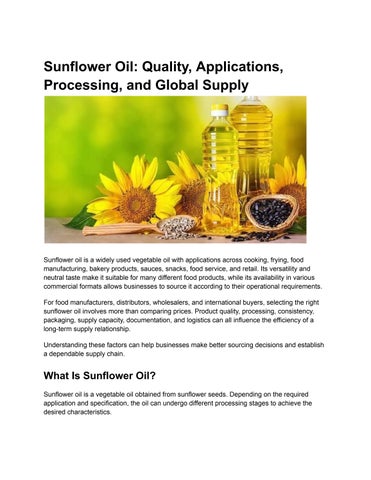
What Is Sunflower Oil? Sunflower oil is a vegetable oil obtained from sunflower seeds. Depending on the required application and specification, the oil can undergo different processing stages to achieve the desired characteristics.
Its relatively neutral flavour makes it suitable for a broad range of food applications. It can be used in cooking and frying as well as in the production of sauces, bakery products, snacks, dressings, prepared foods, and other manufactured food products. The requirements for sunflower oil can vary between industries. A food manufacturer may require specific product characteristics for a production process, while a distributor or wholesaler may focus more on volume, packaging, storage, and delivery requirements. For this reason, understanding the intended application is an important first step when sourcing sunflower oil.
Common Applications of Sunflower Oil One of the main advantages of sunflower oil is its versatility. It can be incorporated into many everyday and commercial food applications.
Cooking and Frying Sunflower oil is commonly used for cooking and frying. Its neutral taste makes it suitable for food preparation where the oil should not significantly change the flavour of the finished product. Restaurants, catering businesses, commercial kitchens, and food-service operators may require regular supplies depending on their operational needs.
Food Manufacturing Sunflower oil is also used as an ingredient in food manufacturing. It can be incorporated into sauces, mayonnaise, dressings, bakery products, snacks, and prepared foods. Manufacturers generally require consistent product characteristics because ingredients form an important part of their production processes. A dependable supply can therefore help businesses maintain continuity in manufacturing.
Bakery and Prepared Foods The food industry uses vegetable oils across a wide range of formulations. Sunflower oil can be used in bakery and prepared-food applications where its characteristics are appropriate for the finished product. The exact requirements depend on the formulation, production process, and specifications established by the manufacturer.
How Sunflower Oil Is Processed
Processing plays an important role in achieving the required quality and characteristics of vegetable oil. Depending on the product specification, sunflower oil can undergo refining and other processing stages. Refining can help remove unwanted components and produce an oil suitable for particular food applications. Deodorization is another processing stage that may be used to achieve the desired sensory characteristics. Professional processing should be supported by appropriate quality-control procedures. Monitoring the product throughout processing, storage, and handling helps maintain consistency and supports the requirements of commercial buyers. For businesses purchasing sunflower oil regularly, understanding how the product is processed can provide useful information when evaluating potential supply partners.
Why Quality and Consistency Matter Quality is a key consideration for businesses sourcing vegetable oil. While cost is naturally important, a lower purchase price does not necessarily provide the best overall value if product consistency or supply reliability is uncertain. Commercial buyers should consider whether the supplier has appropriate quality-control procedures and can maintain agreed product specifications across shipments. Laboratory monitoring and quality checks can provide additional assurance during the production process. Proper storage and handling are also important because maintaining product quality does not end when processing is completed. For food manufacturers, consistency can be especially important because changes in raw material characteristics may affect production processes and finished products.
Choosing the Right Sunflower Oil Exporters Businesses purchasing vegetable oil for international markets should carefully evaluate Sunflower Oil Exporters before establishing a supply relationship. International trade involves more than moving products from one country to another. Exporters may need to coordinate product specifications, commercial documentation, packaging, transportation, shipment schedules, and destination requirements. When evaluating an exporter, buyers should consider: ● Experience in international markets ● Product quality and consistency ● Processing and quality-control capabilities
● ● ● ● ●
Available supply volumes Packaging options Export documentation Logistics and transportation coordination Communication and order management
An experienced export partner can help make international purchasing more organised by coordinating the different stages involved in preparing and delivering an order. For buyers operating across international markets, dependable communication and clear documentation can be just as important as product availability.
How to Select Reliable Sunflower Oil Suppliers Choosing suitable Sunflower Oil Suppliers is equally important for businesses that require regular and dependable supplies. A reliable supplier should be able to understand the buyer's requirements and provide clear information about product specifications, available quantities, packaging, delivery schedules, and other commercial considerations. Supply capacity is particularly important for manufacturers and distributors with recurring demand. Businesses should consider whether a supplier can support their current requirements while also having the capacity to accommodate future orders. Buyers should also look at the supplier's approach to quality management, processing, storage, and logistics. A strong supply relationship is generally built on consistent performance rather than a single successful transaction. Instead of focusing exclusively on price, businesses can evaluate the overall value of a supplier by considering quality, reliability, service, supply capacity, packaging, and international support.
Packaging and Bulk Supply Considerations Different commercial buyers may require different packaging solutions. The appropriate format can depend on order volume, storage facilities, transportation arrangements, intended application, and destination market. For larger commercial requirements, bulk supply can provide an efficient solution for businesses with suitable storage and handling facilities. Packaging should also be considered from a logistics perspective. It needs to support safe handling, transportation, and storage throughout the supply chain.
Clear communication between the buyer and supplier before shipment can help ensure that packaging, quantities, documentation, and delivery arrangements are properly coordinated.
Sunflower Oil for International Markets The international vegetable oil supply chain involves multiple participants, including producers, processors, suppliers, exporters, distributors, and commercial buyers. For international customers, sourcing can involve additional considerations such as export documentation, transportation, customs procedures, delivery schedules, and destination-market requirements. A supplier or exporter with experience in international trade can help buyers navigate these practical requirements more effectively. For businesses establishing international supply relationships, transparency is particularly valuable. Buyers should have a clear understanding of product specifications, order quantities, packaging, delivery expectations, and documentation before an order is finalised.
Building a Reliable Supply Partnership For many food businesses, vegetable oil is an ongoing procurement requirement. Establishing a reliable relationship with a capable supplier can therefore be more valuable than repeatedly searching for the lowest-cost option. Long-term supply relationships depend on several factors, including consistent product quality, dependable availability, professional communication, accurate documentation, and reliable delivery. As a buyer's requirements develop, the ability of a supplier to support different order volumes, packaging requirements, and delivery schedules can also become important. A professional supply partner should aim to understand the buyer's business requirements and provide a consistent level of service throughout the relationship.
Why Experience Matters When Sourcing Sunflower Oil Experience can make a significant difference when sourcing vegetable oil for commercial and international applications. An experienced business is more likely to understand the practical requirements associated with processing, quality management, packaging, export documentation, and logistics. For buyers, this can reduce uncertainty and make the procurement process easier to manage.
Businesses should therefore assess potential suppliers and exporters based on their complete capabilities rather than focusing on a single factor. Product quality, processing expertise, supply capacity, international experience, packaging, documentation, and customer support can all contribute to a successful partnership.
Conclusion Sunflower oil remains an important vegetable oil for the global food industry, with applications ranging from cooking and frying to bakery products, sauces, snacks, food manufacturing, and food service. For commercial and international buyers, sourcing the right product requires careful consideration of quality, processing, consistency, packaging, supply capacity, documentation, and logistics. Working with experienced Sunflower Oil Exporters and dependable Sunflower Oil Suppliers can help businesses create a more stable and efficient procurement process. By evaluating suppliers based on quality, reliability, supply capabilities, and international support, buyers can establish stronger long-term relationships and build a more dependable vegetable oil supply chain.