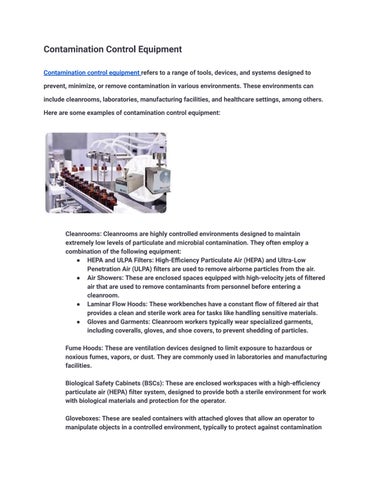
Contamination Control Equipment Contamination control equipment refers to a range of tools, devices, and systems designed to prevent, minimize, or remove contamination in various environments. These environments can include cleanrooms, laboratories, manufacturing facilities, and healthcare settings, among others. Here are some examples of contamination control equipment:
Cleanrooms: Cleanrooms are highly controlled environments designed to maintain extremely low levels of particulate and microbial contamination. They often employ a combination of the following equipment: ● HEPA and ULPA Filters: High-Efficiency Particulate Air (HEPA) and Ultra-Low Penetration Air (ULPA) filters are used to remove airborne particles from the air. ● Air Showers: These are enclosed spaces equipped with high-velocity jets of filtered air that are used to remove contaminants from personnel before entering a cleanroom. ● Laminar Flow Hoods: These workbenches have a constant flow of filtered air that provides a clean and sterile work area for tasks like handling sensitive materials. ● Gloves and Garments: Cleanroom workers typically wear specialized garments, including coveralls, gloves, and shoe covers, to prevent shedding of particles.
Fume Hoods: These are ventilation devices designed to limit exposure to hazardous or noxious fumes, vapors, or dust. They are commonly used in laboratories and manufacturing facilities.
Biological Safety Cabinets (BSCs): These are enclosed workspaces with a high-efficiency particulate air (HEPA) filter system, designed to provide both a sterile environment for work with biological materials and protection for the operator.
Gloveboxes: These are sealed containers with attached gloves that allow an operator to manipulate objects in a controlled environment, typically to protect against contamination
or exposure to hazardous materials.
Air Filtration Systems: These can include HVAC systems equipped with HEPA or ULPA filters, as well as stand-alone filtration units designed to purify the air in a specific area. Isolators: Similar to gloveboxes, isolators provide a sealed environment for handling sensitive materials, but they often involve more complex systems for controlling variables like temperature and humidity. Sterilization Equipment: Autoclaves, gamma irradiators, and other sterilization methods are used to kill or remove microorganisms from equipment, tools, and surfaces. Cleaning Systems: This can range from basic cleaning supplies to automated cleaning systems like ultrasonic baths and washer-disinfectors used in healthcare and pharmaceutical industries.
Particle Counters: These devices are used to measure and monitor the concentration of airborne particles in a given environment.
UV-C Germicidal Lamps: These lamps emit ultraviolet light at a wavelength that kills or inactivates microorganisms. They are used for disinfection in various settings.
Chemical Containment Systems: These are specialized enclosures designed to handle and contain hazardous chemicals or materials, preventing their release into the environment. Air Quality Monitors: These devices measure parameters like temperature, humidity, and levels of various contaminants in the air.
Mats and Flooring Systems: These are designed to trap and remove particulate contamination from shoes and wheels in entryways to controlled environments.
The selection of contamination control equipment depends on the specific requirements of the environment and the type of contaminants that need to be controlled. It's essential to follow best practices and industry standards when selecting, installing, and maintaining these systems to ensure they effectively mitigate contamination risks. Visit us- https://laftech.com.au