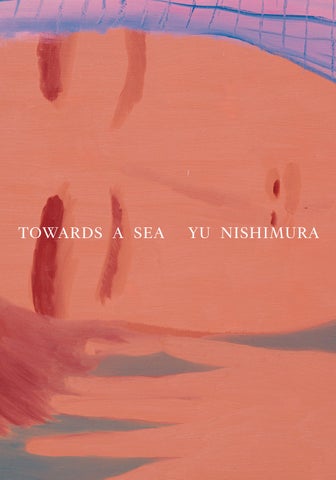
TOWARDS A SEA
YU NISHIMURA
1
TOWARDS A SEA
YU
NISHIMURA Lafayette Anticipations
7
9
47
95
153
189
208
FOREWORD by Guillaume Houzé INTRODUCTION by Clément Delépine FLOWING by Elsa Coustou THE EYE AND THE by Estelle Zhong Mengual
SEA
SYNCOPATION FOR THE HORIZON by Ryoko Sekiguchi French Texts List of Works
(EN)
FOREWORD Lafayette Anticipations was founded with the aim of empowering artists to fully share their vision of the world and, through their works, to create new experiences for the public. We are delighted to be welcoming Yu Nishimura and his exhibition Towards a Sea, whose landscapes invite us to see the familiar in a new light. Nishimura’s painting draws inspiration from everyday scenes, memories, found images, and landscapes he has travelled through. Through his brushstrokes, these elements overlap and transform: figures appear and fade, temporalities blur, and humans, animals, and plants seem imbued with the same presence. In this way, his works bring to life a world where observation blends with memory and the imaginary. The sea that accompanies Towards a Sea seems to be reflected in the layers deposited upon the canvas. This painting, in a state of perpetual transformation and deeply attuned to the bonds that connect us to our environment, conveys a worldview that resonates deeply with me. The publication accompanying Towards a Sea allows us to extend our engagement with Nishimura’s work and to share images of his works far beyond the duration of the exhibition. It provides an additional space for his work to inhabit, where paintings and previously unpublished photographs complement one another and reveal the full scope of his practice.
I would like to express my deepest gratitude to Yu Nishimura for his trust and for the generosity with which he conceived this project with us. I extend my warmest thanks to Elsa Coustou, the exhibition’s curator, as well as to Fuyumi Murata and the artist’s galleries—Crèvecœur, Sadie Coles HQ, and David Zwirner—for their invaluable support. My thanks go to the entire team at Lafayette Anticipations, whose commitment enables the foundation to pursue its ambition of supporting artists and sharing their work with the broadest possible audience. Guillaume Houzé President of Lafayette Anticipations
7
(EN)
INTRODUCTION
Was it really water? Maurice Blanchot, Thomas the Obscure
Yu Nishimura’s exhibition Towards a Sea at Lafayette Anticipations is the first institutional exhibition in Europe dedicated to the Japanese artist. It marks an important milestone for the foundation and is a source of great pride for us further reinforced by the institutional collaboration established with the Centro per l'arte contemporanea Luigi Pecci in Prato, which will host an iteration of the exhibition in January 2027. Across the floors of our highly distinctive building, designed by Rem Koolhaas and OMA, Nishimura imagines a stroll— perhaps an aimless one—along the seashore. Within the gaps between its movable platforms, he opens up a diaphanous space, melancholic in places, where the line between perception and memory grows ever thinner, and where the usual categories of reality dissolve.
Far from merely documenting the exhibition, the accompanying publication has been conceived as a further space within which to explore the artist’s work, another journey, with its own rhythm and sense of time. The texts brought together here accompany or shift the images to create new connections between the works. As-yet unseen photographs also populate the book, bringing to the fore— in keeping with the artist’s paintings—landscapes, atmospheres, and fragments of the world that inspire his vision.
The exhibition brings together existing works—several of which, on loan from the artist’s studio, are being shown here for the first time—as well as new pieces, created specifically for Lafayette Anticipations. Together, they form a landscape that is as familiar as it is unexpected, that can be crossed as one might walk along a coastline, with the sense of moving towards something that may have never stopped shifting. Nishimura’s painting focuses on fleeting moments, ordinary scenes, the objects and figures that populate our daily lives, and the places we inhabit. It maintains a unique relationship with time, paying less attention to the moment itself than to the trace it leaves behind, capturing that subtle instant when a memory surfaces and takes the place of the scene that gave rise to it.
I would like to extend my warmest thanks to Yu Nishimura for his trust and for the quality of our collaboration, as well as to Fuyumi Murata, the many lenders to the exhibition, and the artist’s galleries—Crèvecœur, Sadie Coles HQ, and David Zwirner—for their precious support. I would also like to express my gratitude to Elsa Coustou, the exhibition’s curator, who has championed and orchestrated this project with sensitivity and great insight, as well as to Antonine Scali Ringwald for coordinating the catalogue, in which I am delighted to have written these few words. Finally, I would like to pay tribute to the talent of the team at Lafayette Anticipations and thank them for their dedication and professionalism in bringing this major exhibition to fruition. Clément Delépine
9
10
(*)
Exhibited works
11
(*)
playback, 2020
12
(*)
gaze, 2023
13
a litter of kittens, 2024
14
(*)
meow, 2022
15
(*)
ingredients, 2021
17
(*)
just one, 2021
18
painting mind, 2019
19
(*)
low tide, 2024
22
(*)
composition, 2023
23
(*)
lonely girl, 2020
24
Circulation, 2026
25
(*)
paper cup journey, 2019
28
(*)
shower on flower, 2019
29
(*)
coastal yard, 2023
30
(*)
camellia, 2024
31
(*)
flowers in blue vase, 2022
32
(*)
a man weeping, 2022
35
(*)
synopsis, 2023
36
(*)
Other Hand, 2026
37
(*)
vacant, 2022
39
(*)
Hems, 2026
40
(*)
stream, 2021
41
(*)
current, 2022
42
(*)
stop the bicycle, 2019
43
(*)
midnight, 2020
45
(*)
summer clouds, 2024
(EN)
Elsa Coustou
FLOWING
There is nothing staid, nothing settled, in this universe. All is rippling, all is dancing; all is quickness and triumph. Virginia Woolf, The Waves
In the exhibition Towards a Sea, Yu Nishimura takes us towards a sea that is at once real, remembered, and imagined. The title evokes the journey to the coast, the walk that sets our bodies in motion and, as the atmospheric conditions shift, brings us close to the animals, plants, and minerals that inhabit the landscape we pass through. It calls upon our imagination, allowing us to project our own dreams and memories. The sea surrounds the exhibition. Or rather, the idea of the sea. For Nishimura, who grew up in Japan where the sea is never far away, it is more than just a subject for representation: it is a presence, a backdrop that is sometimes invisible but whose echo lingers in the memory. For him, the sea evokes a sense of immensity and openness—to possibilities, to myths, to interpretation—which he associates with his painting: across the expanse of the canvas, he builds the image by welcoming the motifs that emerge as he goes along, just as water carries to the surface whatever it finds in its path or brings up from the depths. The sea is a recurring theme throughout the exhibition. Nishimura brings it into the core of his painting: “My working process, I feel, can be somewhat associated and coincide with the shapes left behind after the waves have receded on the beach, or the seawater seeping into the sand.”1 His technique varies depending on whether he uses oil paint, which takes a long time to dry, or tempera, which has a very short drying time when diluted with water, allowing him to work with a speed akin to that of drawing. His canvases are made up of superimposed layers of varying degrees of dilution which gradually cover the existing elements as the image emerges. Like receding waves, they leave on the canvas the imprint of what has just departed and now exists in another form, as a palimpsest—behind, beside or beneath. They also give the impression of an image that has been blurred. Like seawater seeping into the sand, Nishimura’s paintings penetrate the fabric of reality, imbued with a damp texture that stirs, hollows out, and smooths over the rough edges, and which, in places, overflows. 1 Nishimura quoted in the press release for his exhibition Ebb tide at Dawid Radziszewski Gallery in Warsaw, Poland (30 September–20 November 2021).
47
(p. 66) factory, 2018 Oil on canvas 65,2 × 80,3 cm
It is this materiality—composed of overflows, of fullness, and emptiness—that we encounter upon entering the exhibition with factory (2018), the first work on display. An industrial seascape, it introduces both the journey promised by Towards a Sea and Nishimura’s pictorial work and his relationship with the landscape. A black horizontal line runs through the centre of the work: a structure on stilts that delineates, in the foreground, a stretch of water seen from a beach or a grey parapet, and, in the background, green mountains surrounding distant buildings. The largest is particularly intriguing due to its flattened dome-like shape. Moreover, the mountain spills over onto it. The layers of green paint that make up the mountainous landscape and the sky are applied with varying degrees of dilution to convey the depth of space. They sometimes reveal pale, almost ghostly forms—blurred yet still visible. The layers of colour can be perceived not only through their variations in transparency but also through streaks of drips. These convey both the sensation that the paint— and therefore the landscape—is wet and that Nishimura is inserting himself into the scene, marking his presence with brushstrokes that are less uniform than those in the lower part of the painting. In the centre, a marked brushstroke creates the impression of a work still in the making, open to possibilities and interpretation. While the scene appears to have been captured on the fly from the window of a moving vehicle, on closer inspection, is it not the landscape itself, in its entirety, that is in motion, that is stirred?
Flowing
(EN)
A breath of life surfaces on Nishimura’s canvases, making the whole landscape come alive. In the case of summer clouds (2024), it is an overflowing of the sky that gives the canvas its full power. Surprising and surreal, this overflow conveys the sky’s irrepressible momentum but, above all, transforms it into an active force: the sky appears to advance towards the house, towards the lower part of the painting, towards the foreground. A photograph from the Taishō era (1912–1926) served as the inspiration for this work, however, by inserting this blue trace, Nishimura revisits and reinterprets the photographed landscape: without this shift of the sky, attention would have remained focused on the white house, with the sky in the background. Here, it is the sky that shapes the white clouds; indeed, it acts upon the landscape and the viewer. The blue streak also draws attention to the white gaps left in the landscape, which imbue summer clouds with a sense of movement. Like the silences in a musical score, the white spaces that punctuate the work make the colours and the breathing of the landscape all the more resonant.
(p. 45) summer clouds, 2024 Oil on linen 100 × 150 cm
In Towards a Sea, the landscape is charged with emotion because of its close connection with living beings. lonely girl (2020) features a woman leaning against a tree, crouching in the middle of a pine forest through which the sea appears in the background. Her face is split in two, with a pensive, hesitant expression. The complexity of her feelings is conveyed through her intertwining with her surroundings: with the tree trunk against which she is seated and with a second figure standing, concealed by the trunk. The walk through the pine forest almost becomes a game of hide-and-seek, so much so that the two figures and the tree blend together and the eye struggles to untangle them. Clearly, the seated figure has been superimposed over the standing one; they now exist within one another, through one another. Nishimura makes the tree the element that both separates and connects them. Through the black brushstrokes extending from their faces and hair, he inscribes the tree onto their bodies as if, through empathy, the tree itself were embracing their solitude, itself isolated amid others. Certain parts of the work become blurred, as if viewed through water; traces of flowing water appear on the surface of the landscape, which takes on the hues of the characters’ emotions. By superimposing different layers that can be perceived through transparency, Nishimura brings several temporalities to life and creates a narrative within the painting.
(p. 17) just one, 2021 Tempera on canvas 83 × 100 cm
(EN)
Through the combination of drawing and painting, Nishimura captures the essence of the figures and motifs he depicts, while maintaining a sense of distance from them, sometimes with wry humour. In the animal portrait just one (2021), he depicts the cat using sinuous lines, an exaggeratedly undulating tail and a twist, while the dog stands upright on its paws, its fluffy coat rendered in white paint. In the underwater painting stream (2021), a drawn fish blends into the grey, watery back-drop. Its smile gives it an amusing air, but its transparency introduces depth and a sense of distance between the rocks in the foreground, the crab and the seaweed in the centre, and the grey background, which conveys the movement of the water and its instability. In the still life flowers in blue vase (2022), a bouquet rests on a table against a pink background. One of the flowers is not painted; only its outline is sketched. Unlike the others, its unfinished appearance makes it seem more fragile and delicate. Yet, by depicting it in this way, Nishimura renders it immutable: while the others already show signs of wilting, this one seems frozen in the drawing. Stripped of its own substance, it takes on the hue of the pink wall against which it stands: here again, Nishimura chooses to shift the focus away from the centre through the drawing to celebrate the bonds we forge with our surroundings. This drawn flower also serves to guide the eye along its stem, towards the lower part of the painting and the yellow shape, which, from a distance, resembles the leaves of the bouquet. Balancing the composition of the painting by lending it symmetry, this lemon intrigues; it seems to have been part of the floral arrangement before Nishimura decided to transform it—a luminous touch and a trace of an earlier version.
(p. 23) lonely girl, 2020 Oil on canvas 60,6 × 50 cm
In a style of his own, he often inserts elements drawn with a fine brush into the landscape, thereby creating a visual and narrative rhythm in his canvases, playing with line and colour, fullness and emptiness. These elements allow him to establish a different relationship of values, to break free from a representation in which the human figure would be central and dominant within a landscape-as-background. On the contrary, landscapes and both human and non-human figures constantly interrelate.
48
Elsa Coustou
(p. 31) flowers in blue vase, 2022 Oil on canvas 53 × 45,5 cm
Following the same principle, further on in the exhibition, finder (2020) offers a unique perspective on the landscape and the figure depicted. A human silhouette, captured in a few fine brushstrokes, rests on a blade of grass at the centre of the painting. A frame in lighter shades than the rest of the canvas is inserted into the scene as if it were viewed through a camera lens or on a computer screen. Like an insect, the figure seems to float in the air, weightless, carried by the movement of the grass and the wind. What will happen once it reaches the end of the blade? The size of the figure reminds us of our own bodies: we find ourselves facing this silhouette just as an animal lurking in the grass watches its prey, or imagine ourselves, at the same height as this insect-like figure, walking across the coastal grass.
49
(p. 40) stream, 2021 Oil on canvas 33,3 × 33,3 cm
(p. 171) finder, 2020 Oil on canvas 45,5 × 38 cm
Flowing
(EN)
Elsa Coustou
(EN)
(p. 43) midnight, 2020 Oil on canvas 116,7 × 116,7 cm
Nishimura’s landscapes appeal to our own physical and emotional perception of space. His canvases immerse us in the heart of the landscape through various techniques. In midnight (2020), an almost abstract nocturnal scene, the gaze—and the whole body—is drawn into the ghostly depth of the canvas. As in darkness, the eye tries to decipher the shadows that are depicted: behind the figure walking towards us, one can almost make out the moon’s reflections on a stretch of water. A white rectangular shape pierces the background of the work and illuminates the scene. It opens up the canvas, drawing it into a dreamlike space. midnight captures an evanescent atmosphere, a moment steeped in mystery destined to fade away. Since 2024, Nishimura has deepened his exploration of perspectives on the landscape through an extremely meticulous and detailed rendering of its constituent elements. Overground (2026) continues his reflection on the way in which images create a sense of distance and proximity to their subject. The work is inspired by a photograph that Nishimura found in his family archives, without knowing who took it, where it was taken, or why. It is a dizzying view of a city, seen from high in the sky. A sepia tone lends the city the hue of a bygone era. Hundreds of dwellings are depicted, and Nishimura has painstakingly replicated every detail of the photograph with great precision on a canvas over three metres high. Yet the image is at times slightly distorted, as if the painting possessed a life of its own.2 The viewer’s gaze is captivated by the wealth of detail that is depicted, at once drawn closer to the canvas even as it is held at a distance by the immensity of the whole. 2
Yu Nishimura, in discussion with the author, August 2026.
(p. 78) Overground, 2026 Oil on canvas 333,3 × 218,2 cm
Beyond the individual works themselves, a mental landscape takes shape as one wanders through the exhibition galleries, conceived as a series of visual echoes. For Nishimura, the spaces between the works are also of great importance to the narrative, as they give it its rhythm. The exhibition thus focuses on the visible and invisible connections that exist between things and beings, and on the way in which the images evoke our own memories and experiences. With Towards a Sea, Nishimura asks how we fit into the landscape, and how the landscape becomes part of us.
Portraiture is a genre that Nishimura continually revisits in his work, one bound up with his explorations of landscape. Often inspired by found photographs that he reinterprets, the portraits are less a representation of individuals and their stories than a gateway to the imagination: “I think of them as something that connects with the viewer’s own landscapes and memories.”3 Thus, although the figure in playback (2020) seems to be staring straight at us, the headphones over the ears suggest that their attention is turned towards something that escapes us, towards something other than what we are able to see. In boundary (2023), a human figure is depicted upside down, beneath ripples of water, with the body of a frog—looking surprised and with a hint of a smile—surfacing, placed on the figure’s nose. The figure is distanced not only by the inversion of its position but also by the water, since what we are shown is its reflection. Here too, Nishimura places an animal figure at the centre of the portrait, one that merges with the human figure and draws all our attention to it, despite its small size relative to the work as a whole. It draws the eye to the surface of the water, to the ripples and the brown patches that further inscribe the human face in a liminal space, as suggested by the work’s title. This liminality is expressed across all Nishimura’s portraits through their timeless quality: the figures depicted seem to show no signs of age; their youthfulness is no longer that of adolescence, yet they do not appear to have reached full adulthood either. Moreover, they elude immediate engagement: all are set at a distance by a state or an emotion that places them in an other space, like the dormant figure in the ochre tones of Sleeping Face (2025) which invites us into a world of dreams and introspection. 3
(p. 12) gaze, 2023 Oil on canvas 145,5 × 112 cm
51
(p. 150) boundary, 2023 Oil on canvas 53 × 65,2 cm
Nishimura, August 2026.
(p. 80) Sleeping Face, 2025 Oil on canvas 116,7 × 116,7 cm
In each painting, the porousness between the depicted elements establishes a direct dialogue between the figures and their surroundings. Nishimura frees them from figurative realism to favour the depiction of an atmosphere and emotions. gaze (2023) is a portrait of a woman onto which a cat and a dog—both with a spectral presence—have been superimposed. As the title suggests, the work questions the visual framework: what do we see, who is looking, and from what perspective? Despite its size and prominence, the main human figure is relegated to the background, while the cat’s eyes appear at the centre of the canvas. In places, the paint spills over, creating blurred areas where colours and forms blend, as if water had bled in. This damp layer envelops the figure in a misty atmosphere that creates a sense of distance, placing it in a slightly recessed space that opens onto the imaginary.
(p. 11) playback, 2020 Oil on canvas 145,4 × 112 cm
The exhibition Towards a Sea can be seen as a dreamlike space in which the sea, suspended between surface and depth, acts as a threshold. It might be a day’s walk, a journey through landscapes whose light shifts as the day progresses, drawing us closer to the sea, allowing us to touch its water, dive into its depths, and then leave it behind. It might be a quest, a lifelong journey—that uninterrupted movement from birth to death which draws us closer to, and then distances us from, the places and people who populate our daily lives or whom we encounter, if only briefly. Towards a Sea may also be a resistance to oblivion: just as memory permeates our present experience, the canvases bear traces of a past even as they open themselves up to our own memory, our experience, and our imagination.
52
(*)
projection, 2022
53
(*)
after hours, 2020
54
(*)
after snow, 2024
56
(*)
Untitled, 2023 / Untitled, 2023 / Untitled, 2023
57
(*)
Untitled, 2023 / Untitled, 2023 / Untitled, 2023
58
(*)
bay, 2023 / petals, 2023
59
(*)
Cicada, 2026
60
(*)
kite in the sky, 2022
61
(*)
distant shore, 2023
64
(*)
behind the palm, 2018
65
(*)
distant sea, 2019
66
(*)
factory, 2018
67
(*)
Town by the Sea, 2026
68
a man in the scenery, 2023
69
Green Park, 2026
70
(*)
Contours, 2026
71
(*)
Plants, 2024
72
two figures on the shore, 2020
73
(*)
sea and bicycle, 2022
75
(*)
Tolerance, 2026
(→) (*)
Filtration, 2026
76
78
(*)
Overground, 2026
80
(*)
Sleeping Face, 2025
81
silhouette on the moonlight, 2022
84
canopy, 2025–26
85
cat hill, 2021
88
part of the flow, 2018
89
hoodie portrait, 2024
92
shore, 2018
93
background, 2019
Estelle Zhong Mengual
(EN)
THE EYE AND THE SEA Yu Nishimura’s works are waterlogged, as though he had taken the canvases after painting them and plunged them into water for a second or two. And there they are before me, out of the water, exposed to the open air before my eyes. If I could shake them, just a little, I’m certain I’d see the drops beading on the surface and slowly sliding, one by one, onto the floor. That’s not what he does, but that’s what I see. The painting is full of water. Yet it’s oil. So where does the water come from? And why is it there, everywhere—on the faces, the branches, the football pitch, and the path at midnight? The water is there, and it will not go away.
I look at Nishimura’s canvases, I look again, and I believe—yes—that the water here is a trace: the water here is a memory. Not on the canvas but on my eye. A memory on the surface of my eye that Nishimura brings to the surface of the painting. For between the air and me, between the world and me, there are two chambers. Two chambers filled with water. Aqueous humour—that is their name. And this water, present on the surface between the world and me, is a memory: a trace of a past, ancient, very ancient, carried within my body into everyday life.
95
The Eye and the Sea
(EN)
Estelle Zhong Mengual
In Nishimura’s work, one lives on land as in the sea. Without weight, without force, without leaving a mark. Humans, objects, buildings, and grasses float. A man weeps as one dissolves, and for a moment rediscovers the lost immersion, a less sharp, less painful separation between oneself and the world (a man weeping, 2022). Birds stay afloat and the moon sinks (silhouette on the moonlight, 2022). A man sleeps, his face suspended, and a blanket covers his body like a sea (Sleeping Face, 2025). And sometimes, in the distance, one glimpses the blue behind the buildings, behind the branches: behind things, the sea is there like a persistent memory, and a barred horizon (coastal yard, 2023). (p. 32) a man weeping, 2022 Oil on canvas 60,6 × 50 cm
Between the world and me, then, there is the sea. The memory of the sea upon my eye. The memory of the sea like a country left behind. Nishimura paints as one remembers. Is that why there is this nostalgia, this melancholy like a veil over the canvas? Is that why the humans stand hesitant, uncertain, transparent upon the earth in Nishimura’s work, as if something within them knew they were living here in exile? As though they had recalled a former life, indistinct, faded? And sometimes, when the air is dark beneath the trees, one walks along the path without knowing whether it is night, or the ocean (midnight, 2020).
(p. 81) silhouette on the moonlight, 2022 Oil on canvas 45,5 × 38 cm
(p. 80) Sleeping Face, 2025 Oil on canvas 116,7 × 116,7 cm
(p. 29) coastal yard, 2023 Oil on canvas 31,8 × 41 cm
Our eye was born in the sea. How long ago was that? 500 million years, perhaps more. The sea from which we came. The sea where life began. And because our eye was born there, immersed in the depths, it had to figure out how to see on land when it emerged from the water, some tens of millions of years after first appearing. Our eye found a way to keep water close: to create a tiny sea, the size of two rooms on its surface, so as not to wither away, not to be dried out by the air, by the wind, which our eye had never known.
(EN)
(p. 43) midnight, 2020 Oil on canvas 116,7 × 116,7 cm (p. 116) perch, 2025 Oil on canvas 91 x 72,7 cm
Yu Nishimura paints as if attempting to return to the water, just as whales or seagrass have returned to the sea after living for a time on land. In his canvases, one sees both land and sea. To see in Nishimura’s work is to open one’s eyes underwater: the world is blurred, sometimes duplicated, contours become indistinct, silhouettes fade, the eye cannot quite bring things into focus. And melancholy surfaces here again: for while our eye remembers the sea, it no longer sees it, not really. Our eyes have been transformed by contact with the air and life on land. And so to see as if underwater, to see blurrily, is to see the distance from one’s own past, from the place from which one came. Our eye is caught somewhere in between, between air and water, neither completely of this place nor completely of that one, oscillating between the worlds. And the blur on the canvas is that distance, that gap, almost a screen between here and now—and something else that comes to haunt it.
96
97
Towards a Sea. The painting reaches towards the sea like the branches of that tree in perch (2025). They stretch out as if searching for something, from the surface to the background. They cover the distance. And the further they recede from the foreground, the more blurred they become. But the blur does not, as is usually the case, indicate perspective or depth—not really, not only. The branches become blurred, the birds, suspended between air and water, become blurred, our vision becomes blurred—as we draw closer to the sea. The bodies of the tree and the birds become blurred when they finally spread out against a blue backdrop, against the backdrop of the sea. The blur signals that the water is engulfing them. The water engulfs them until they are almost gone, which here is not a threat, but almost a relief. A relief at losing solidity, contours, boundaries, to return and merge with the world. As in the beginning. But the eye is constantly drawn back to the foreground, to that single, opaque bird, standing out in sharp relief: it too insists, as that which is, that which is here and now. And suddenly, doubt surfaces. What if the birds behind him, all identical, all in the same position as him, were not other birds—but himself? What if the branches stretched towards the background as one moves through time? What if the birds blurred against the sea were memories of himself, already lived, brought back to the surface of his memory? A dream, perhaps? Or are they rather like a premonition, a projection of what has not yet come to pass, of time flowing towards the future, of time still to come? Oscillations. The sea before us, the sea behind us. And the momentum, like the painting: the inner momentum between where we are and what calls out to us. Towards a Sea.
102
in waiting, 2026
103
104
reflection, 2025
105
receding car, 2025
108
early morning, 2021
109
faces, 2022
110
Winter street, 2020
111
riverbed, 2025
(→)
along the skyline, 2025
112
116
perch, 2025
118
byway, 2015
XXX
XXX
at the station, 2020
125
snow, 2024
126
Lizard’s Tail, 2025
127
flowers by the window, 2020
128
October sky, 2020
129
tide, 2022
(→)
two figures in a canola field, 2026
130
132
bends, 2022
133
one amidst many, 2025
134
behind branches, 2025
136
echo, 2022
137
tree garden, 2022
138
Water Square, 2024
139
backwater, 2022
140
lift, 2023
142
from hill, 2022
143
night boy, 2023
144
pearl river, 2024
147
girl at balcony, 2023
(→)
Confluence, 2025
148
150
(*)
boundary, 2023
151
under the trees, 2022
Ryoko Sekiguchi
(EN)
SYNCOPATION FOR THE HORIZON Every time we open the windows
in the morning
the salt-heavy air
in the distance
crisp
melted crystals
the sea
in the air
the clouds
coming down
every time, its image
the sea
emerges in our hearts.
Does the image of the sea exist independently from the sea?
Once an image and its model are no longer connected, does the image lose its soul and let itself wilt away? Can an image evoke another image?
Can something like chirping, for instance,
summon an image?
Can you paint chirping on a canvas?
How would you go about it?
“Sometimes, when I come back to a painting I have been working on,
my interest in it has changed overnight, and drifted elsewhere,
prompting me to completely transform the painting.” Moving at the steady pace
of daily life
unsteadily
one step
some
a sea
sidesteps
dance
something like
a thought
153
like
that never stops
and sketch out
Syncopation for the Horizon
(EN)
Ryoko Sekiguchi
an image that appears where least expected,
somewhere
We cannot impose a steady rhythm on remembrance—it cannot be modeled in this way.
we had never even glanced at before.
Like a cat trying to hide.
Like a bird’s feather tucked between two words.
(EN)
If there is some sort of steady rhythm, it will be syncopated. “My paintings sit between the images that I want to draw and the unknown images that arise during the creative process. They live in the space and time that open between these two kinds of images.”
Like a street corner we have never been to,
even though
it was always
there.
Or maybe it only existed in dreams,
and one day
decided to manifest itself
Chirping
Chirping
in our world.
All too often, we forget that every presence knocks at this world’s door in its own time. Presences exist
When we stand before the canvas, listening to the chirping,
which landscape will emerge?
somewhere outside of our realm—one day they may decide to cross the threshold. Slopes, crows, horizons: some of these presences might have entered our world only yesterday, or a week ago, rather than fifty or two
And
which
bird?
hundred years ago. We think we have known them for a long time and we are sure they have always existed, but this is because the world we have invented has always included a slope, a crow, or the horizon. We change the
past with this idea. We can fill in past landscapes with light brushstrokes and varied colors.
The artist’s brush brings this form into being, one pass at a time—but what is this form? A representation,
“It is only when I apply color to the canvas that a form gradually takes shape.”
through the artist’s hands, of their memories? Or a way for color itself to manifest its presence? “I don’t have a clear picture of the painting in my head until I stand before the canvas.” “A keshiki—a landscape or, to put it another way, an atmosphere, a scenery, the colors and hues that appear
The moment between the absence of memory and “I remember,”
what could it be
before our eyes—is never uniform. In my paintings, the colors are all over the place. But in an exhibition, I ?
arrange my paintings in space: they form a constellation; they compose a landscape.”
Which color could evoke
which
Could a color
canvas
memory
?
I remember having been painted
remember something?
The sea, for instance.
A place outside of temporality
I remember having been painted
I remember having been painted on wood glass
ceramic
metal
plastic
that, paper
at the same time, tells a story of constancy.
Where
I remember the last time I was a painting’s color.
On the beach, thousands of years of daily memories,
Memories do not pile up like dust, or like documents stacked in chronological order. Memories are free; they
and beings blend together
forget each other?
154
humans,
like to walk around, roam as they please, and wander without direction.
would a painting take up residence?
Randomness is a state of being whose absolutely sound logic must be respected.
tentatively
Like all those silhouettes that
155
blend together?
erase each other?
Syncopation for the Horizon
(EN)
Ryoko Sekiguchi
(EN)
were about to disappear,
or, rather,
depart,
climb the vertical lines that trees are,
that
and fly away, because of their great lack of roots.
that
into the canvases
into the pages
warp
Can we still call “landscape” something that, like a mirage, rises from the ground without ramifying roots?
peel off
leave
Even if it looks like it is holding its arms out, like climbing plants made of silver threads—is it a landscape? move What were we about to see?
travel
The? sea?
We never head out to the beach to see the sea—it’s the sea, the seas that come out to see us
teeming with chirping birds?
so happily
so fleetingly
If color perception depends on the reflection of light, should be
set up and
stretched
smiling to us
waving at us from the water, in the distance
then invisible threads, from various angles,
and
greeting us
Because this is what images do.
Because this is what paintings do.
Because this is what artists create.
from each
pigment
they are
quivering
murmuring
from each
particle
undulating
attachment
always
sempre
itsudemo
they are The sea
altering
the
cadences
comes over an image
of the sea
in
falling asleep
liquid form
We look at images
and
under a sheet sky blue
wave
transparent lines
of the sea
from the sea
between them
between us
backwash behind an image of
the images look at us
foam
so softly
and we ourselves become mirrored lines
luminous shadows
And so, we meet each other. In the company of all these undulating lines that sing in a language still in the making.
like mirrored shadows that are
that
156
are
slipping
are liquefying
seeping
—translated from the French by Lucas Faugère
157
160
seashore, 2024
161
modern boy, 2020
162
waiting for the sunset, 2025
165
factory with chimney, 2023
166
Osmosis, 2026
167
Spring Field, 2025
(→)
Permeation, 2025
170
Shell Collecting, 2025
171
(*)
finder, 2020
(→)
when the wings lifted, 2026
172
175
planktos, 2025
176
Lentinula Growth, 2025
177
Palimpsest, 2026
178
Foothill, 2024
179
in shade of the pinery, 2025
181
orientation, 2025
186
Arcade at Noon, 2023
(←)
Arc, 2026
(FR)
PRÉFACE Lafayette Anticipations est née de la volonté de donner aux artistes les moyens de partager pleinement leur vision du monde et de créer, à travers leurs œuvres, de nouvelles expériences pour le public. C’est avec une immense joie que nous accueillons aujourd’hui Yu Nishimura et son exposition Towards a Sea, dont les paysages nous invitent à regarder autrement ce qui nous est familier. La peinture de Yu Nishimura se nourrit de scènes ordinaires, de souvenirs, d’images trouvées et de paysages traversés. Sous son pinceau, ces éléments se superposent et se transforment : les figures apparaissent et s’estompent, les temporalités se confondent, les êtres humains, animaux et végétaux semblent partager une même présence. Ses œuvres font ainsi émerger un monde où l’observation se mêle à la mémoire et à l’imaginaire. La mer qui accompagne Towards a Sea semble se retrouver dans les couches qui se déposent sur la toile. Cette peinture en perpétuelle transformation, profondément attentive aux liens qui nous unissent à notre environnement, porte une vision du monde qui me touche particulièrement.
La publication qui accompagne Towards a Sea permet de prolonger la rencontre avec l’œuvre de Yu Nishimura et d’en faire circuler les images bien au-delà du temps de l’exposition. Elle offre un espace supplémentaire à son travail, où peintures et photographies inédites se répondent et donnent à découvrir toute l’étendue de sa pratique.
Je tiens à exprimer ma plus vive gratitude à Yu Nishimura pour sa confiance et pour la générosité avec laquelle il a imaginé ce projet avec nous. Je remercie chaleureusement Elsa Coustou, commissaire de l’exposition, ainsi que Fuyumi Murata et les galeries de l’artiste, Crèvecœur, Sadie Coles HQ et David Zwirner, pour leur précieux soutien. Mes remerciements vont à l’ensemble de l’équipe de Lafayette Anticipations, dont l’engagement permet à la Fondation de poursuivre son ambition d’accompagner les artistes et de partager leur travail avec le plus grand nombre. Guillaume Houzé Président de Lafayette Anticipations
189
(FR)
INTRODUCTION
Était-ce réellement de l’eau ? Maurice Blanchot, Thomas l’obscur
L’exposition Towards a Sea de Yu Nishimura, à Lafayette Anticipations, est la première exposition institutionnelle consacrée à l’artiste japonais en Europe. Elle marque pour la Fondation une étape importante et constitue pour nous une très grande fierté que vient renforcer la collaboration institutionnelle établie avec le Centro per l'arte contemporanea Luigi Pecci de Prato, lequel accueillera une itération de l'exposition en janvier 2027.
Loin de se limiter à consigner la mémoire de l’exposition, cette publication a été pensée comme un espace de circulation autonome dans le travail de l’artiste, une autre promenade, avec un rythme et une temporalité propres. Les textes qui y sont réunis accompagnent ou déplacent les images pour créer entre les œuvres de nouvelles correspondances. Des photographies inédites viennent également Dans les étages de notre bâtiment si particulier, conçu par ponctuer l’ouvrage, faisant émerger, en écho Rem Koolhaas et l’agence OMA, Yu Nishimura imagine une aux peintures de l’artiste, des paysages, des promenade, peut-être une errance, au bord d’une mer. Il y atmosphères et des fragments du monde qui ouvre, dans les interstices de ses plateaux mobiles, un espace nourrissent son regard. vaporeux, mélancolique par endroits, où la ligne séparant perception et mémoire se fait toujours plus fine, et où les catégories habituelles du réel se défont. L’exposition réunit des œuvres existantes, dont plusieurs, issues de l’atelier de l’artiste, sont montrées ici pour la première fois, ainsi que des œuvres inédites, conçues spécialement pour Lafayette Anticipations. Ensemble, elles composent un paysage aussi familier qu’imprévu, que l’on traverse comme on longe une côte, avec le sentiment d’avancer vers quelque chose qui, peut-être, n’a jamais cessé de se déplacer. La peinture de Yu Nishimura s’attache aux instants fugaces, aux scènes ordinaires, aux objets et aux figures qui peuplent notre quotidien, comme aux lieux que nous habitons. Elle entretient avec le temps un rapport singulier, moins attentive à l’instant lui-même qu’à la trace qu’il laisse, saisissant ce moment subtil où le souvenir affleure et vient se substituer à la scène qui l’a fait naître. Je tiens à remercier chaleureusement Yu Nishimura pour sa confiance et pour la qualité de notre collaboration, Fuyumi Murata, les nombreuses prêteuses et prêteurs de l’exposition, ainsi que les galeries de l’artiste, Crèvecœur, Sadie Coles HQ et David Zwirner, pour leur précieux soutien. J’exprime également ma reconnaissance à Elsa Coustou, commissaire de l’exposition, qui a porté et orchestré ce projet avec sensibilité et une grande justesse, ainsi qu’à Antonine Scali Ringwald pour la coordination du catalogue dans lequel je suis heureux d’écrire ces quelques mots. Enfin, je salue le talent des équipes de Lafayette Anticipations et les remercie pour leur engagement et leur professionnalisme dans la réalisation de cette exposition majeure. Clément Delépine
191
Elsa Coustou
ÉCOULÉES
(FR)
Il n’y a rien d’assuré, rien de définitif dans cet univers. Tout est mouvement, tout est danse ; tout est triomphe et rapidité 1. Virginia Woolf, Les Vagues 1 Virginia Woolf, Les Vagues, traduit de l’anglais par Marguerite Yourcenar, Paris, Stock, 1937.
Dans son exposition Towards a Sea, Yu Nishimura nous emmène vers une mer tout à la fois réelle, remémorée et fantasmée. Son titre évoque le voyage qui nous conduit au littoral, la promenade qui met notre corps en mouvement et nous fait rencontrer, au gré des changements atmosphériques, les animaux, les végétaux et les minéraux qui habitent le paysage traversé. Il convoque l’imaginaire de chacun·e, libre d’y projeter ses propres rêves, ses propres souvenirs. Une mer borde l’exposition. Ou plutôt, l’idée de la mer. Car pour Nishimura, qui a grandi au Japon où la mer n’est jamais loin, celle-ci est plus qu’un sujet de représentation : elle est une présence, une toile de fond parfois invisible mais dont l’écho reste en mémoire. La mer fait naître en lui une sensation d’immensité et d’ouverture – aux possibles, aux mythes, à l’interprétation – qu’il associe à sa peinture : sur l’étendue de la toile, il construit l’image en accueillant les motifs qui émergent au fur et à mesure, tout comme l’eau charrie à la surface ce qu’elle trouve sur son passage ou ce qu’elle fait remonter des profondeurs.
Une mer est suggérée tout au long de l’exposition, Nishimura la faisant intimement entrer dans sa peinture : « Je pense que mon processus de travail peut, d’une certaine manière, être associé aux formes que les vagues laissent sur la plage, ou à l’eau de mer qui s’infiltre dans le sable2. » Sa technique varie selon qu’il emploie de la peinture à l’huile, au temps de séchage long, ou la tempera qui, diluée à l’eau et avec une durée de séchage très brève, lui offre une rapidité d’exécution proche de celle du dessin. Ses toiles se composent d’une superposition de couches plus ou moins diluées qui recouvrent progressivement les éléments présents au fur et à mesure que l’image apparaît. Comme les vagues qui se retirent, elles laissent sur la toile l’empreinte de ce qui vient de s’en aller et existe désormais sous une autre forme, celle de palimpseste – derrière, à côté ou en dessous. Elles laissent aussi l’impression d’une image rendue trouble. Comme l’eau de mer qui s’infiltre dans le sable, les peintures de Nishimura pénètrent dans la matière du réel, imprégnées de cette texture humide qui remue, creuse et lisse les aspérités, et qui, par endroits, déborde. 2 Nishimura cité dans le communiqué de presse de son exposition Ebb tide, galerie Dawid Radziszewski, du 30 septembre au 20 novembre, 2021.
193
Flowing
(FR)
C’est cette matière, faite de débordements, de pleins et de vides, qui nous accueille dès l’entrée de l’exposition avec factory (2018), première œuvre du parcours. Paysage marin et industriel, elle introduit tout autant la promenade que promet Towards a Sea que le travail pictural de Nishimura et son rapport au paysage. L’œuvre est traversée en son milieu d’une ligne horizontale noire, une structure sur pilotis qui délimite au premier plan une étendue d’eau vue depuis une plage ou un parapet gris, et au second plan des montagnes vertes qui entourent des constructions au loin. La plus grande intrigue par sa forme en dôme aplati. Plus encore, sur elle, la montagne déborde. Les couches de peinture verte qui constituent le paysage montagneux et le ciel sont apposées ici avec des degrés de dilution différents pour représenter la profondeur de l’espace. Elles laissent parfois apparaître des formes claires presque fantomatiques, estompées mais encore visibles. On perçoit la superposition des couches de couleur à leurs variations de transparence, mais aussi par des lignes de coulures. Celles-ci donnent à la fois la sensation que la peinture est humide – et donc le paysage aussi – et que Nishimura s’insère dans la scène, marquant sa présence par des traits de pinceaux moins homogènes que ceux de la partie inférieure du tableau. Au centre, une trace de pinceau proéminente produit l’effet d’une œuvre encore en cours, ouverte aux possibles et à l’interprétation. Si la scène semble être prise sur le vif depuis la fenêtre d’un véhicule en marche, à y bien regarder, n’est-ce pas le paysage lui-même qui est mu, qui est ému ? (p. 66) factory, 2018 Huile sur toile 65,2x80 cm
(p. 23) lonely girl, 2020 Huile sur toile 60,6 x 50 cm
(p. 17) just one, 2021 Huile sur toile 80 x 100 cm
195
(p. 40) stream, 2021 Huile sur toile 33,3 x 33,3 cm
(p.45) summer clouds, 2024 Huile sur toile 100 x 150 cm 194
(FR)
Dans Towards a Sea, le paysage se charge d’émotions car le vivant lui est étroitement lié. lonely girl (2020) présente une femme adossée à un arbre, accroupie au milieu d’une pinède à travers laquelle on distingue la mer en arrière-plan. Son visage est dédoublé, dans une attitude pensive, hésitante. La complexité de ses sentiments est rendue par l’imbrication de la figure avec ce qui l’entoure : avec le tronc d’arbre contre lequel elle est assise, et avec un deuxième personnage debout, dissimulé par le tronc. La promenade dans la pinède devient presque un jeu de cache-cache, tant les deux figures et l’arbre se confondent et l’œil peine à les démêler. Visiblement, la figure assise a été ajoutée par-dessus celle qui est debout ; elles existent désormais l’une dans l’autre, l’une à travers l’autre. Nishimura fait de l’arbre l’élément qui les sépare et les relie tout à la fois. Par les traits de pinceaux noirs dans le prolongement de leurs visages et de leur chevelure, il inscrit l’arbre sur leurs corps comme si, par empathie, l’arbre lui-même embrassait leur solitude, isolé lui aussi au milieu des autres. Certaines parties de l’œuvre se brouillent comme lorsque l’on regarde à travers l’eau, des traces d’écoulement apparaissent à la surface du paysage qui se teinte des émotions des personnages. En superposant différentes strates que l’on perçoit par transparence, Nishimura fait coexister plusieurs temporalités et crée un récit à l’intérieur du tableau. (p. 31) flowers in blue vase, 2022 Huile sur toile 53 x 45,5 cm
Un souffle de vie affleure à la surface des toiles de Nishimura : le paysage tout entier s’anime. C’est aussi un débordement du ciel qui donne toute sa puissance à summer clouds (2024). Surprenante et irréelle, cette trace traduit l’élan irrépressible du ciel, mais surtout, elle en fait une force agissante : le ciel avance sur la maison, vers la partie inférieure du tableau, vers le premier plan. La source d’inspiration de cette œuvre est une photographie de l’ère Taishō (19121926), mais en insérant cette trace bleue, l’artiste revisite et détourne le paysage photographié : sans ce glissement du ciel, l’attention serait restée principalement concentrée sur la maison blanche, avec le ciel en arrière-plan. Ici, c’est le ciel qui donne leur forme aux nuages blancs, c’est bien lui qui agit sur le paysage et sur celui·celle qui le regarde. La trace bleue a aussi pour effet d’attirer l’attention sur ces interstices laissés blancs dans le paysage, qui font de summer clouds une œuvre toute en mouvement. Tels les silences d’une partition, les espaces blancs qui la ponctuent rendent d’autant plus sonores les couleurs et les respirations du paysage.
Elsa Coustou
Dans un style qui lui est propre, il insère souvent des éléments dessinés au pinceau fin dans le paysage ; il instaure ainsi un rythme visuel et narratif dans ses toiles, jouant de la ligne et de la couleur, des pleins et des vides. Ces éléments lui permettent de mettre en place un autre rapport de valeurs, de s’affranchir d’une représentation où la figure humaine serait centrale et dominante dans un paysage-décor. Au contraire, paysages, figures humaines et non humaines sont en constante interrelation.
Par l’association du dessin et de la peinture, Nishimura se saisit de l’essence des figures et des motifs qu’il représente tout en les mettant à distance, parfois avec humour. Dans le portrait animalier just one (2021), il représente ainsi le chat avec des lignes sinueuses, une queue ondulante démesurée et une torsion, tandis que le chien est campé sur ses pattes, bien droit, la texture de son poil duveteux rendue par la peinture blanche. Dans la toile sous-marine stream (2021), un poisson dessiné se fond dans le décor d’eau grise. Son sourire lui donne une allure amusante, mais sa transparence introduit de la profondeur à travers un jeu de distance entre les roches du premier plan, le crabe et l’algue au centre, et l’arrière-plan gris. Elle permet de rendre le mouvement de l’eau, son instabilité. Dans la nature morte flowers in blue vase (2022), un bouquet de fleurs est posé sur une table devant un fond rose. L’une d’elles n’est pas peinte, seuls ses contours sont tracés. À la différence des autres, son apparence inachevée lui donne un aspect plus fragile et plus délicat, mais en la représentant ainsi, Nishimura la rend immuable : tandis que les autres montrent déjà des signes de flétrissure, celle-ci semble figée dans le dessin. Ôtée de sa substance propre, elle prend la teinte du mur rose devant lequel elle se trouve : là encore, Nishimura choisit de décentrer le regard par le dessin pour célébrer les liens qu’on tisse avec ce qui nous entoure. Cette fleur dessinée a aussi pour effet de conduire l’œil le long de sa tige, vers la partie inférieure du tableau et la forme jaune qui, de loin, ressemble aux feuilles du bouquet. Ce citron, qui vient équilibrer la composition du tableau en lui donnant une symétrie, intrigue ; il semble avoir appartenu à l’ensemble floral avant que Nishimura ne décide de le transformer en une touche lumineuse, trace d’une version antérieure.
Flowing
(FR)
Par le même principe, plus loin dans l’exposition, finder (2020) introduit un point de vue particulier sur le paysage et le personnage représentés. Une silhouette humaine, saisie en quelques traits de pinceau fins, est posée sur une tige d’herbe au centre du tableau. Un cadre de teintes plus claires que le reste est inséré dans la scène, comme si elle était vue à travers l’objectif d’une caméra ou sur un écran d’ordinateur. Tel un insecte, le personnage semble flotter dans l’air, sans poids, porté par le mouvement des herbes et du vent. Que se passerat-il une fois arrivé au bout de la tige ? Sa taille nous renvoie à notre propre corps : on se retrouve face à cette silhouette comme un animal tapi dans l’herbe regarde sa proie, ou bien on s’imagine, à hauteur de ce personnage-insecte, marcher comme lui sur les herbes du littoral. (p. 171) finder, 2020 Huile sur toile 45,5 x 38 cm
Au-delà des œuvres dans leur singularité, un paysage mental se dessine au cours de la déambulation dans les salles de l’exposition, pensée comme un ensemble d’échos visuels. Pour Nishimura, les espaces entre les œuvres ont eux aussi toute leur importance dans la narration puisqu’ils lui donnent son rythme. L’exposition s’attache ainsi aux liens visibles et invisibles qui existent entre les choses et les êtres, ainsi qu’à la manière dont les images convoquent nos propres souvenirs et expériences. Avec Towards a Sea, Nishimura pose la question suivante : comment s’inscrit-on dans le paysage, et comment le paysage s’inscrit-il en nous ?
196
Dans chaque toile, la porosité qui existe entre les éléments représentés instaure un dialogue direct entre les figures et leur environnement. Nishimura les affranchit d’un réalisme figuratif pour privilégier la représentation d’une atmosphère et de ressentis. gaze (2023) est le portrait d’une femme sur lequel sont apposés un chat et un chien à la présence spectrale. Comme son titre l’évoque, l’œuvre interroge le régime visuel. Que voit-on ? Qui regarde ? Et de quel point de vue ? Malgré sa taille et sa prominence, la figure principale, humaine, est reléguée au second plan et ce sont les yeux du chat qui sont placés au centre de la toile. Çà et là, la matière déborde et crée des zones floues où couleurs et figures se mêlent, comme si de l’eau s’était infiltrée. Cette couche humide enveloppe la figure d’une atmosphère brumeuse qui la met à distance et la place dans un espace légèrement reculé qui s’ouvre à l’imaginaire.
Le portrait est un genre que Nishimura revisite sans cesse dans son travail et qui s’inscrit dans ses explorations du paysage. Souvent inspirés de photographies trouvées qu’il réinterprète, ses portraits sont moins une représentation d’individus et de leurs récits qu’une porte d’entrée vers l’imaginaire : « Je les considère comme quelque chose qui entre en résonance avec les propres paysages et souvenirs du·de la spectateur·rice 4. » Ainsi, bien que le personnage de playback (2020) semble nous fixer du regard, les écouteurs insérés dans ses oreilles suggèrent que son attention est tournée vers quelque chose qui nous échappe, vers quelque chose d’autre que ce que l’on voit. Dans boundary (2023), une figure humaine est représentée à l’envers sous des ondes d’eau ; placé sur son nez, le corps d’une grenouille fait surface, l’air surpris, esquissant un sourire. La figure humaine est mise à distance non seulement par l’inversion de sa position mais aussi par l’eau, car c’est son reflet qui nous est donné à voir. Ici aussi, Nishimura place au centre du portrait une figure animale qui fusionne avec la figure humaine et fait converger toute notre attention sur elle, pourtant si petite à l’échelle de l’œuvre. Elle attire le regard vers la surface de l’eau, sur les ondes et les taches brunes qui inscrivent d’autant plus le visage humain dans un espace liminal, comme l’évoque le titre de l’œuvre. Cette liminalité s’exprime dans tous les portraits à travers leur aspect intemporel : les personnages représentés semblent épargnés par le passage du temps. Si leur jeunesse n’est plus celle de l’adolescence, il·elle·s n’ont visiblement pas encore atteint un âge adulte avancé. De plus, il·elle·s se soustraient à un rapport immédiat : tou·te·s sont mis·es à distance par un état ou une émotion qui les place dans un espace autre, à l’instar de la figure endormie aux teintes ocre de Sleeping Face (2025) qui invite au rêve et à l’introspection.
(p. 11) playback, 2020 Huile sur toile 145,4 × 112 cm (p. 150) boundary, 2023 Huile sur toile 53 × 65,2 cm (p. 80) Sleeping Face, 2025 Huile sur toile 116,7 x 116,7 cm
4
Nishimura en conversation avec l’autrice, août 2026
(p.43) midnight, 2020 Huile sur toile 116,7 x 116,7 cm
Nishimura en conversation avec l’autrice, août 2026
(p. 78) Overground, 2026 Huile sur toile 333,3 x 218,2 cm
3
(FR)
(p. 12) gaze, 2023 Huile sur toile 145,5 x 112 cm
Les paysages de Nishimura s’adressent à notre propre perception corporelle et émotionnelle de l’espace. Ses toiles nous plongent dans l’intimité du paysage par différents procédés. Avec midnight (2020), scène nocturne presque abstraite, le regard – et le corps tout entier – est attiré par la profondeur fantomatique de la toile. Comme dans l’obscurité, l’œil cherche à déchiffrer les ombres représentées : derrière le personnage qui marche vers nous, on croit distinguer les reflets de la lune sur une étendue d’eau. Une forme rectangulaire blanche perce le fond de l’œuvre et illumine la scène. Elle ouvre la toile, la creuse vers un espace onirique. midnight rend compte d’une atmosphère évanescente, d’un instant chargé de mystère et voué à se dissiper. Depuis 2024, Nishimura approfondit l’exploration des points de vue sur le paysage à travers une exécution extrêmement minutieuse et détaillée des éléments qui le composent. Overground (2026) prolonge sa réflexion sur la manière dont les images produisent de la distance et de la proximité face au sujet représenté. L’œuvre est inspirée d’une photographie que Nishimura a trouvée dans ses archives familiales, sans savoir qui l’a prise, ni où ni pourquoi. C’est une vue vertigineuse sur une ville, depuis les hauteurs du ciel. Une lumière sépia donne à la ville la teinte d’un temps passé. Des centaines d’habitations y sont représentées : Nishimura s’est appliqué à répliquer à l’identique tous les détails de la photographie sur une toile de plus de trois mètres de haut. Pourtant, l’image s’est parfois légèrement distordue, comme si la peinture possédait son mouvement propre 3. Le regard est saisi par la quantité de détails figurés, tout à la fois appelé à se rapprocher de la toile et mis à distance par l’immensité de cet ensemble.
Elsa Coustou
L’exposition Towards a Sea peut être vue comme un espace onirique où la mer, entre surface et profondeur, est un seuil. Elle est peut-être la promenade d’une journée, une traversée de paysages dont la lumière change au fil du jour et nous fait approcher d’une mer, toucher son eau, plonger dans ses profondeurs, puis la quitter. C’est peut-être une quête, le cheminement de toute une vie, ce mouvement ininterrompu de la naissance à la mort qui nous rapproche puis nous éloigne des lieux et des êtres, qu’ils peuplent notre quotidien ou que l’on les croise un temps. Towards a Sea est peut-être aussi une forme de résistance à l’oubli : tout comme le souvenir imprègne le vécu présent, les toiles témoignent des traces d’un passé tout en s’ouvrant à notre propre mémoire, à notre expérience, à notre imaginaire.
197
Estelle Zhong Mengual
(FR)
L’ŒIL ET LA MER
Les œuvres de Yu Nishimura sont trempées. Comme s’il avait pris les toiles après les avoir peintes et les avait plongées dans l’eau, une seconde, deux secondes. Et les voilà devant moi sorties de l’eau, exposées à l’air libre devant mes yeux. Et si je pouvais les secouer, rien qu’un peu, c’est sûr : je verrais les gouttes perler à la surface et glisser lentement, une à une, sur le parquet. Ce n’est pas ce qu’il fait, mais c’est ce que je vois. La peinture est pleine d’eau, mais c’est de l’huile. Alors d’où vient l’eau ? Et pourquoi est-elle là, partout, sur les visages, les branches, le terrain de foot et le sentier à minuit ? L’eau est là et elle ne veut pas partir.
199
Je regarde les toiles de Nishimura, je regarde encore et je crois, oui, que l’eau ici est une trace : l’eau est ici un souvenir. Pas sur le tableau mais sur mon œil. Un souvenir à la surface de mon œil que Nishimura fait remonter à la surface du tableau. Car entre l’air et moi, entre le monde et moi, il y a deux chambres. Deux chambres remplies d’eau. Humeur aqueuse – c’est leur nom. Et cette eau, présente à la surface entre le monde et moi, est un souvenir: une trace d’un passé, ancien très ancien, emporté dans mon corps et dans le quotidien.
L’œil et La Mer
(FR)
Notre œil est né dans la mer. Il y a combien, 500, peut-être plus, millions d’années. La mer d’où l’on vient. La mer où la vie a commencé. Et parce que notre œil est né là-bas, immergé dans les profondeurs, il a dû inventer comment faire pour voir sur la Terre, quand il est sorti des eaux quelques dizaines de millions d’années après être apparu. Notre œil a trouvé comment garder l’eau près de lui: créer une mer minuscule, grande comme deux chambres à sa surface – pour ne pas dépérir, pour ne pas être asséché par l’air, par le vent que notre œil n’avait jamais connu. Entre le monde et moi alors, il y a la mer. Le souvenir de la mer sur mon œil. Le souvenir de la mer comme le pays laissé derrière soi. Nishimura peint comme on se remémore. Est-ce que c’est pour ça, cette nostalgie, cette mélancolie comme un voile sur la toile? Est-ce que c’est pour ça que les humains se tiennent hésitant·e·s, incertain·e·s, transparent·e·s sur la Terre dans l’œuvre de Yu Nishimura, comme si quelque chose en eux·elles savait qu’il·elle·s vivaient ici exilé·e·s ? Comme s’il·elle·s se souvenaient d’une vie antérieure indistincte, effacée? Et parfois, quand l’air est sombre sous les arbres, on marche sur le sentier sans savoir si c’est la nuit ou l’océan (midnight, 2020).
(FR)
Yu Nishimura peint comme on tente de revenir à l’eau, comme les baleines ou les posidonies sont revenues à la mer après avoir vécu un temps sur terre. Sur ses toiles, on voit sur terre comme dans la mer. Voir chez Nishimura, c’est ouvrir les yeux sous l’eau : le monde est flou, parfois double, les contours se troublent, les silhouettes s’estompent, l’œil ne parvient pas à faire le point. Et la mélancolie ici encore affleure : car si notre œil se souvient de la mer, il n’y voit plus, plus vraiment. Notre œil s’est transformé au contact de l’air et de la vie sur terre. Et voir comme sous l’eau alors, voir flou, revient à voir la distance d’avec mon propre passé, d’avec le lieu d’où je viens. Notre œil est entre deux eaux, ou plutôt, entre l’air et l’eau, ni complètement d’ici, ni complètement de là-bas, oscillant entre les mondes. Et le flou sur la toile est cette distance, cet écart, presque un écran entre ici maintenant – et autre chose qui vient le hanter. Dans l’œuvre de Nishimura, on vit sur terre comme dans la mer. Sans peser, sans forcer, sans marquer. Les humains, les objets, les bâtiments, les herbes flottent. Un homme pleure comme on se dissout, et un instant retrouve l’immersion perdue, une séparation moins tranchante, moins blessante entre le monde et soi (a man weeping, 2022). Les oiseaux surnagent et la lune coule (silhouette on the moonlight, 2022). Un homme dort, visage suspendu, et une couverture couvre son corps comme une mer (Sleeping Face, 2025). Et parfois, on aperçoit au loin le bleu derrière les bâtiments, derrière les branches : derrière les choses, la mer est là comme un souvenir qui insiste, comme un horizon barré (coastal yard, 2023). (p. 32) a man weeping, 2022 Huile sur toile 60,6 × 50 cm
(p. 81) silhouette on the moonlight, 2022 Huile sur toile 45,5 × 38 cm
Towards a Sea. La peinture tend vers la mer comme les branches de cet arbre dans perch (2025). Elles s’étirent comme on cherche quelque chose, depuis la surface jusqu’à l’arrière-plan. Elles couvrent la distance. Et plus elles s’éloignent du premier plan, plus elles deviennent floues. Mais le flou ne signale pas comme à l’habitude la perspective, la profondeur – pas vraiment, pas seulement. Les branches deviennent floues, les oiseaux, suspendus entre air et eau, deviennent flous, notre vision devient floue au fur et à mesure qu’on se rapproche de la mer. Les corps de l’arbre et des oiseaux deviennent flous quand ils s’étalent enfin sur fond de bleu, sur fond de mer. Le flou signale que l’eau les gagne. L’eau les gagne jusqu’à la quasi disparition, qui n’est pas ici une menace, mais presque un soulagement. Un soulagement de perdre en solidité, en contour, en frontière pour retourner se fondre avec le monde. Comme au commencement. Mais l’œil sans cesse est ramené au premier plan, à cet oiseau unique, opaque, qui se détache avec netteté : lui aussi insiste, comme ce qui est, ce qui est ici et maintenant. Et soudain, un doute. Et si les oiseaux derrière lui, tous identiques, tous dans la même position que lui, n’étaient pas d’autres oiseaux, mais lui-même ? Et si les branches s’étiraient vers l’arrière-plan comme on se déplace dans le temps ? Et si les oiseaux flous sur fond de mer étaient des souvenirs de lui-même, déjà vécus, ici rappelés à la surface de sa mémoire ? Un rêve peut-être ? Ou bien sont-ils comme une prémonition, une projection de ce qui n’est pas encore arrivé, du temps qui s’écoule vers le futur, du temps à venir ? Oscillations. La mer devant nous, la mer derrière nous. Et l’élan comme la peinture: l’élan intérieur entre où nous sommes et ce qui nous appelle. Towards a Sea. (p. 116) perch, 2025 Huile sur toile 91 x 72,7 cm
201
(p. 80) Sleeping Face, 2025 Huile sur toile 116,7 × 116,7 cm
(p. 29) coastal yard, 2023 Huile sur toile 31,8 × 41 cm
(p. 43) midnight, 2020 Huile sur toile 116,7 × 116,7 cm
200
Estelle Zhong Mengual
Ryoko Sekiguchi
(FR)
SYNCOPE
POUR
C’est toujours en ouvrant les fenêtres
l’air chargé de sel
au loin
frais
un cristal fondu dans
l’air
le nuage
qui descend jusqu’à nous
que son image
la mer
la mer
le matin
L’HORIZON
surgit dans notre cœur.
L’image de la mer existe-t-elle indépendamment de la mer ?
Une fois séparée de son modèle, l’image perd-elle son âme, se laisse-t-elle flétrir ?
L’image peut-elle être évoquée par une autre image,
ou convoquée par un autre élément –
par exemple, des pépiements ?
Des pépiements peuvent-ils être peints sur un tableau ?
De quelle manière ?
« Lorsque je reprends le travail sur un tableau que je suis en train
de réaliser, il arrive, la nuit étant passée, que mon intérêt ait
migré ailleurs et que par la suite je transforme complètement le tableau. » Sur le rythme régulier
Irrégulière
de la vie quotidienne
un pas
des pas
dansent
comme
une mer
une pensée
203
de côté
telle
qui n’est jamais à l’arrêt
se dessinent
Syncope pour l’horizon
(FR)
(FR)
une image qui n’apparaît pas là où on l’attend,
Être aléatoire est un état d’une logique absolue qu’il faut respecter.
mais
Comme un chat qui se cache.
La réminiscence ne se soumet pas à un rythme régulier sur lequel nous pourrions la calquer.
Comme une plume d’oiseau glissée entre deux paroles.
Ou, s’il y a un rythme régulier, il sera syncopé.
Comme un coin de rue où l’on n’a jamais mis les pieds
« Mes œuvres se situent entre une image que j’aimerais dessiner et une image inconnue sur le point de naître au
mais qui
sous un angle que l’on n’avait jamais effleuré du regard.
Ou
Ryoko Sekiguchi
existait
cours de la création. Elles se trouvent au milieu du temps et de l’espace qui s’ouvrent entre ces deux images. »
depuis toujours.
qui était là uniquement dans les rêves,
et
qui a un jour décidé de se manifester
dans ce monde.
On l’oublie trop souvent : toutes les présences ne frappent pas à la porte de ce monde au même moment.
Les pépiements
Les pépiements
Lorsqu’on se tient face à la toile à écouter les pépiements,
quel paysage pourrait surgir ?
Elles sont là, quelque part hors de notre sphère, et un jour, elles décident de franchir le seuil. Une pente, un corbeau, une ligne d’horizon ; certaines de ces présences, que nous croyons pourtant connaître depuis
longtemps, pourraient avoir fait leur entrée dans ce monde hier seulement, d’autres la semaine passée, et
Et
quel
oiseau ?
non il y a cinquante ou deux cents ans. Et si nous sommes persuadé·e·s qu’elles existent depuis toujours, c’est que nous avons inventé l’idée de ce monde comme s’il existait depuis toujours avec elles – une pente, un
« C’est en peignant les couleurs sur la toile que je vois peu à peu apparaître une forme. »
corbeau, un horizon –, modifiant ainsi le passé. Nous sommes capables de combler notre paysage du passé en
Cette forme qui prend corps au fil des passages du pinceau sur la toile, est-elle la mémoire de l’artiste
l’effleurant de brosses de couleurs diverses.
transmise par ses mains, ou la couleur elle-même trouvant, à travers lui·elle, un support pour manifester sa présence ?
« Je n’ai pas d’image précise de mon tableau, jusqu’au moment où je me tiens face à la toile. » « Un keshiki, autrement dit un paysage – terme qui pourrait se traduire par l’atmosphère d’une scène, les
coloris qui apparaissent devant nous –, n’est pas uniforme. Les couleurs sont éparpillées dans mes tableaux.
Quel serait ce moment entre l’absence de mémoire et
« je me souviens »
Mais dans une exposition, les tableaux sont placés dans un espace comme une constellation et tissent un
?
paysage. »
Quelle couleur évoque
quel
Une couleur pourrait se
?
souvenir de quelque chose ?
Je me rappelle avoir été peinte
souvenir
toile
je me rappelle avoir été peinte sur du bois
verre
céramique
métal
plastique
Quel
La mer, par exemple.
Ce lieu qui s’échappe de la temporalité
et
papier
Je me rappelle la dernière fois où j’étais la couleur d’un tableau.
Je me rappelle avoir été peinte
qui raconte en même temps la constance.
lieu d’habitation un tableau prend-il ?
Sur la plage, des milliers d’années des souvenirs quotidiens
des humains
Les souvenirs ne se superposent pas chronologiquement comme des documents que l’on empile, ni comme
se mêlent
s’oublient ?
une poussière qui s’accumule. Ils sont libres, aiment les promenades et se déplacent à leur guise, sans
orientation quelconque. 204
et des êtres
205
incertains
se mêlent ?
s’effacent ?
Syncope pour l’horizon
(FR)
Ryoko Sekiguchi
(FR)
Comme toutes ces silhouettes qui
allaient disparaître
non,
partir
grimper sur les lignes verticales que sont les arbres
qui
s’envoler, tant elles manquent de racines.
qui
sur les toiles
sur les pages
gondolent
Un paysage qui s’élève sur une terre sans voir ses racines se ramifier, tel un mirage, et pourtant qui semble
suintent
se décollent
partent
bien tendre ses bras à l’horizontale comme des plantes grimpantes faites de fils argentés, pourrait-on encore l’appeler « paysage » ?
se meuvent
voyagent
Qu’est-ce qu’on allait voir ? La ?
Ce n’est pas nous qui nous dirigeons vers la mer, c’est la mer, les mers qui viennent nous voir
mer ?
qui contient en elle des pépiements d’oiseaux ?
si joyeuses
si fugitives
nous saluer
nous sourient
agitent les mains depuis le large
Si les couleurs sont perceptibles grâce aux reflets de la lumière,
des fils invisibles sous des angles divers
devraient être tendus
étendus
et
de chaque
Parce que c’est cela que crée un·e artiste.
sempre
particule
ondulent
itsudemo
attachement
qui
modifient
La mer
est sur une image
les
cadences
Nous regardons les images
et
qui s’endort
de
sous un drap
liquide
moelleux
vague
ressac derrière une image de
de la mer
entre nous
devenant nous-mêmes ces traits inversés
ombres lumineuses Ainsi, nous nous rencontrons. Accompagné·e·s de toutes les lignes qui ondulent et qui chantent dans une langue en devenir.
traits transparents comme des ombres inversées qui se qui se
de la mer
entre elles
azur écume
les images nous regardent
de la mer
glissent
se liquéfient 206
Parce que c’est cela que fait un tableau.
toujours
murmurent
pigment
qui
Parce que c’est cela que fait une image.
frémissent de chaque
207
List of Works
List of Works
((*)p. 11)
playback, 2020 Oil on canvas 145,4 × 112 cm Courtesy of the artist and Crèvecœur, Paris.
((*)p. 12)
gaze, 2023 Oil on canvas 145,5 × 112 cm, Courtesy of the artist and Crèvecœur, Paris.
(p. 13)
a litter of kittens, 2024 Oil on canvas 27,3 × 41 cm Courtesy of the artist, Crèvecœur, Paris and Sadie Coles HQ, London.
((*)p. 14)
((*)p. 15)
meow, 2022 Oil on canvas 27,3 × 27,3 cm Courtesy of the artist and Crèvecœur, Paris.
((*)p. 23)
lonely girl, 2020 Oil on canvas 60,6 × 50 cm Courtesy of the artist.
(p. 24)
Circulation, 2026 Oil on canvas 31,8 × 41 cm Courtesy of the artist and Crèvecœur, Paris.
((*)p. 25)
paper cup journey, 2019 Oil on canvas 41 × 31,8 cm Courtesy of the artist.
((*)p. 28)
shower on flower, 2019 Oil on canvas 45,5 × 53 cm Courtesy of the artist.
((*)p. 29)
ingredients, 2021 Oil on canvas 19 × 27,3 cm Courtesy of the artist and Crèvecœur, Paris.
((*)p. 30)
just one, 2021 Tempera on canvas 83 × 100 cm Courtesy of the artist and Crèvecœur, Paris.
((*)p. 31)
(p. 18)
painting mind, 2019 Oil on canvas 53 × 45,5 cm Courtesy of the artist.
((*)p. 32)
((*)p. 19)
low tide, 2024 Oil on canvas 194 × 130 cm Courtesy of the artist, Crèvecœur, Paris and Sadie Coles HQ, London.
((*)p. 17)
((*)p. 22)
208
composition, 2023 Tempera on linen 45,5 × 33,3 cm Courtesy of the artist.
((*)p. 35)
((*)p. 36)
Other Hand, 2026 Tempera and oil on linen 194 × 162 cm Courtesy of the artist and Crèvecœur, Paris.
((*)p. 53)
after hours, 2020 Oil on canvas 60,6 × 72,7 cm Courtesy of the artist and Crèvecœur, Paris.
((*)p. 37)
vacant, 2022 Oil on canvas 24,2 × 33,3 cm Courtesy of the artist and Crèvecœur, Paris.
((*)p. 54)
after snow, 2024 Oil on canvas 24,3 × 33,4 cm Courtesy of the artist and Crèvecœur, Paris.
((*)p. 39)
Hems, 2026 Oil on canvas 194 × 162 cm Courtesy of the artist and Crèvecœur, Paris.
((*)p. 56)
Untitled, 2023 Ink on paper 29,8 × 20,9 cm Courtesy of the artist and Sadie Coles HQ, London.
((*)p. 40)
stream, 2021 Oil on canvas 33,3 × 33,3 cm Courtesy of the artist, Crèvecœur, Paris and Sadie Coles HQ, London.
((*)p. 56)
Untitled, 2023 Ink on paper 29,8 × 20,9 cm Courtesy of the artist and Crèvecœur, Paris.
((*)p. 41)
current, 2022 Oil on canvas 19 × 24 cm Courtesy of the artist.
((*)p. 56)
Untitled, 2023 Ink on paper 29,8 × 20,9 cm Courtesy of the artist and Sadie Coles HQ, London.
((*)p. 42)
((*)p. 57)
flowers in blue vase, 2022 Oil on canvas 53 × 45,5 cm Courtesy of the artist.
stop the bicycle, 2019 Oil on canvas 130,3 × 162 cm Courtesy of the artist and Crèvecœur, Paris.
Untitled, 2023 Ink on paper 29,8 × 20,9 cm Courtesy of the artist and Sadie Coles HQ, London.
((*)p. 43)
((*)p. 57)
a man weeping, 2022 Oil on canvas 60,6 × 50 cm Courtesy of the artist and Crèvecœur, Paris.
midnight, 2020 Oil on canvas 116,7 × 116,7 cm Courtesy of the artist and David Zwirner.
Untitled, 2023 Ink on paper 29,8 × 20,9 cm Courtesy of the artist and Sadie Coles HQ, London.
((*)p. 45)
((*)p. 57)
synopsis, 2023 Oil on canvas 194 × 162 cm Courtesy of the artist, Crèvecœur, Paris and Sadie Coles HQ, London.
summer clouds, 2024 Oil on linen 100 × 150 cm Courtesy of the artist, Crèvecœur, Paris and Sadie Coles HQ, London.
Untitled, 2023 Ink on paper 29,8 × 20,9 cm Courtesy of the artist and Crèvecœur, Paris.
((*)p. 52)
projection, 2022 Oil on canvas 45,5 × 53 cm Courtesy of the artist and Sadie Coles HQ, London.
((*)p. 58)
bay, 2023 Ink on paper 21,1 × 23,9 cm Courtesy of the artist and David Zwirner.
coastal yard, 2023 Oil on canvas 31,8 × 41 cm Courtesy of the artist and Sadie Coles HQ, London. camellia, 2024 Oil on canvas 24,3 × 33,4 cm Courtesy of the artist and Crèvecœur, Paris.
209
List of Works
List of Works
((*)p. 58)
petals, 2023 Ink on paper 21,1 × 23,9 cm Courtesy of the artist and David Zwirner.
(p. 69)
Green Park, 2026 Oil on canvas 45,5 × 53 cm Courtesy of the artist and Sadie Coles HQ, London.
((*)p. 59)
Cicada, 2026 Oil on canvas 18 × 12 cm Courtesy of the artist and Sadie Coles HQ, London.
((*)p. 70)
Contours, 2026 Oil on canvas 27,3 × 41 cm Courtesy of the artist and David Zwirner.
((*)p. 60)
kite in the sky, 2022 Oil on canvas 24,2 × 33,3 cm Courtesy of the artist and Crèvecœur, Paris.
((*)p. 71)
Plants, 2024 Oil on canvas 53 × 45,5 cm Courtesy of the artist and Sadie Coles HQ, London.
distant shore, 2023 Tempera on linen 162 × 162 cm Courtesy of the artist and Crèvecœur, Paris.
(p. 72)
((*)p. 61)
((*)p. 64)
behind the palm, 2018 Oil on canvas 31,8 × 41 cm Courtesy of the artist.
((*)p. 73)
((*)p. 65)
distant sea, 2019 Oil on canvas 60,6 × 72,7 cm Courtesy of the artist.
((*)p. 66)
factory, 2018 Oil on canvas 65,2 × 80,3 cm Courtesy of the artist.
((*)p. 76)
Town by the Sea, 2026 Oil on canvas 35 × 27 cm Courtesy of the artist and Crèvecœur, Paris.
((*)p. 79)
((*)p. 67)
(p. 68)
210
a man in the scenery, 2023 Acrylic on canvas 27,3 × 41 cm Courtesy of the artist and Crèvecœur, Paris.
((*)p. 75)
((*)p. 80)
two figures on the shore, 2020 Oil on canvas 33,3 × 24,2 cm Courtesy of the artist. sea and bicycle, 2022 Oil on canvas 31,8 × 41 cm Courtesy of the artist and Crèvecœur, Paris. Tolerance, 2026 Oil on canvas 227,3 × 162 cm Courtesy of the artist and Sadie Coles HQ, London. Filtration, 2026 Oil on canvas 218,2 × 291 cm Courtesy of the artist and Crèvecœur, Paris. Overground, 2026 Oil on canvas 333,3 × 218,2 cm Courtesy of the artist and David Zwirner. Sleeping Face, 2025 Oil on canvas 116,7 × 116,7 cm Courtesy of the artist and Crèvecœur, Paris.
(p. 81)
silhouette on the moonlight, 2022 Oil on canvas 45,5 × 38 cm Courtesy of the artist.
(p. 84)
canopy, 2025–26 Oil and tempera on cotton 318 × 224 cm Courtesy of the artist and Sadie Coles HQ, London.
(p. 85)
cat hill, 2021 Oil on canvas 53 × 65,2 cm Courtesy of the artist and Crèvecœur, Paris.
(p. 88)
part of the flow, 2018 Oil on canvas 53 × 41 cm Courtesy of the artist.
(p. 89)
hoodie portrait, 2024 Oil on canvas 80,3 × 65,2 cm Courtesy of the artist.
(p. 92)
shore, 2018 Oil on canvas 53 × 45,5 cm Courtesy of the artist and Crèvecœur, Paris.
(p. 93)
(p. 102)
background, 2019 Acrylic and oil on canvas 27,3 × 41 cm Courtesy of the artist. in waiting, 2026 Tempera and oil on linen 145,5 × 227,3 cm Courtesy of the artist and David Zwirner.
(p. 104)
reflection, 2025 Oil on canvas 53 × 45,5 cm Courtesy of the artist and Crèvecœur, Paris.
(p. 105)
receding car, 2025 Oil on canvas 41 × 53 cm Courtesy of the artist and Crèvecœur, Paris.
211
(p. 108)
early morning, 2021 Watercolour on paper 19,2 × 23,9 cm Courtesy of the artist and Crèvecœur, Paris.
(p. 109)
faces, 2022 Tempera on canvas 27,3 × 27,3 cm Courtesy of the artist.
(p. 110)
Winter street, 2020 Oil on linen 130,3 × 162 cm Courtesy of the artist.
(p. 111)
riverbed, 2025 Tempera on linen 22 × 27,3 cm Courtesy of the artist and Crèvecœur, Paris.
(p. 112)
along the skyline, 2025 Oil on canvas 161,9 × 193,7 cm Courtesy of the artist, David Zwirner, and Crèvecœur, Paris.
(p. 116)
perch, 2025 Oil on canvas 72,7 x 91 cm Courtesy of the artist and Crèvecœur, Paris.
(p. 118)
byway, 2015 Oil on canvas 168 × 200,5 cm Courtesy of the artist.
(p. 122)
at the station, 2020 Oil on canvas 162 × 162 cm Courtesy of the artist.
(p. 125)
snow, 2024 Oil on linen 53 × 45,5 cm Courtesy of the artist and Crèvecœur, Paris.
List of Works
(p. 126)
List of Works
Lizard’s Tail, 2025 Oil on canvas 162,6 × 130,2 cm Courtesy of the artist, David Zwirner, and Crèvecœur, Paris.
(p. 138)
(p. 127)
flowers by the window, 2020 Oil on canvas, wood 34,7 × 46,8 cm Courtesy of the artist.
(p. 139)
backwater, 2022 Oil on canvas 41 × 53 cm Courtesy of the artist.
(p. 128)
October sky, 2020 Oil on canvas, wood 42,5 × 54 cm Courtesy of the artist.
(p. 141)
lift, 2023 Oil on linen 194 × 97 cm Courtesy of the artist.
(p. 129)
tide, 2022 Tempera on canvas 53 × 41 cm Courtesy of the artist. two figures in a canola field, 2026 Tempera and oil on linen 181,8 × 227,3 cm Courtesy of the artist and David Zwirner.
(p. 142)
from hill, 2022 Oil on canvas 24,2 × 33,3 cm Courtesy of the artist.
(p. 130)
(p. 132)
(p. 133)
(p. 134)
bends, 2022 Oil on canvas 91 × 116,7 cm Courtesy of the artist. one amidst many, 2025 Oil on canvas 194 × 162 cm Courtesy of the artist, David Zwirner, and Crèvecœur, Paris. behind branches, 2025 Oil on canvas 15,8 × 22,7 cm Courtesy of the artist and David Zwirner.
(p. 136)
echo, 2022 Oil on canvas 60,6 × 50 cm Courtesy of the artist.
(p. 137)
tree garden, 2022 Oil on canvas 38 × 45,5 cm Courtesy of the artist.
212
(p. 143)
(p. 144)
(p. 147)
(p. 148)
Water Square, 2024 Tempera and oil on linen 162 × 162 cm Courtesy of the artist, David Zwirner, and Crèvecœur, Paris.
night boy, 2023 Tempera and oil on canvas 53 × 45,5 cm Courtesy of the artist and Crèvecœur, Paris. pearl river, 2024 Oil on canvas 22 × 27,3 cm Courtesy of the artist and Crèvecœur, Paris. girl at balcony, 2023 Tempera on linen 150,4 × 102,5 cm Courtesy of the artist. Confluence, 2025 Oil and tempera on cotton 194,3 × 259,1 cm Courtesy of the artist, David Zwirner, and Crèvecœur, Paris.
((*)p. 150)
boundary, 2023 Oil on canvas 53 × 65,2 cm Courtesy of the artist.
(p. 151)
under the trees, 2022 Oil on canvas 194 × 130,2 cm Courtesy of the artist and Crèvecœur, Paris.
(p. 160)
seashore, 2024 Oil on canvas 31,8 × 41 cm Courtesy of the artist and Crèvecœur, Paris.
(p. 172)
when the wings lifted, 2026 Oil on canvas 162 × 194 cm Courtesy of the artist and Sadie Coles HQ, London.
(p. 161)
modern boy, 2020 Oil on canvas, wood 54,4 × 47 cm Courtesy of the artist.
(p. 174)
(p. 162)
waiting for the sunset, 2025 Oil on canvas 31,8 × 41 cm Courtesy of the artist, David Zwirner, and Crèvecœur, Paris.
planktos, 2025 Tempera on linen 291 × 181,8 cm Courtesy of the artist and Crèvecœur, Paris.
(p. 176)
(p. 165)
factory with chimney, 2023 Oil on canvas 27,3 × 53 cm Courtesy of the artist and Crèvecœur, Paris.
Lentinula Growth, 2025 Oil on canvas 38,4 × 45,7 cm Courtesy of the artist, David Zwirner, and Crèvecœur, Paris.
(p. 177)
(p. 166)
Osmosis, 2026 Oil on canvas 24,2 × 33,3 cm Courtesy of the artist.
Palimpsest, 2026 Oil on canvas 259 × 194 cm Courtesy of the artist and Sadie Coles HQ, London.
(p. 178)
(p. 167)
Spring Field, 2025 Oil on canvas 145,5 × 131 cm Courtesy of the artist, David Zwirner, and Crèvecœur, Paris.
Foothill, 2024 Oil on canvas 24,2 × 33,3 cm Courtesy of the artist, David Zwirner, and Crèvecœur, Paris.
(p. 179)
in shade of the pinery, 2025 Oil on canvas 194 × 162 cm Courtesy of the artist and Crèvecœur, Paris.
(p. 181)
orientation, 2025 Oil on canvas 162 × 194 cm Courtesy of the artist and Crèvecœur, Paris.
(p. 184)
Arc, 2026 Tempera and oil on linen 162 × 227,3 cm Courtesy of the artist and Sadie Coles HQ, London.
(p. 186)
Arcade at Noon, 2023 Oil on canvas 227,3 × 181,8 cm Courtesy of the artist and Sadie Coles HQ, London.
(p. 168)
Permeation, 2025 Oil on canvas 182,3 × 227,3 cm Courtesy of the artist, David Zwirner, and Crèvecœur, Paris.
(p. 170)
Shell Collecting, 2025 Oil on canvas 15,9 × 23,2 cm Courtesy of the artist, David Zwirner, and Crèvecœur, Paris.
((*)p. 171)
finder, 2020 Oil on canvas 45,5 × 38 cm Courtesy of the artist and Crèvecœur, Paris.
213
Colophon
Colophon
This publication is released on the occasion of Yu Nishimura’s exhibition Towards a Sea, presented at Lafayette Anticipations, Paris, from 21 October 2026 to 3 January 2027.
CURATORIAL & PUBLICATION TEAM
BUILDING AND SAFETY TEAM
Curator Elsa Coustou
Head of Building and Safety Marie Bernard
Head of Publishing and Curator of Talks Antonine Scali Ringwald
Operations Manager Bettina Puchault
Associate Curator, Performance & Live Arts Madeleine Planeix-Crocker
PUBLIC TEAM
Associate Curator, Music Étienne Blanchot
Head of Public Relations Clélia Dehon
Curatorial Programming and Artistic Coordination Assistant Lounès Senelet-Maïté
Head of Editorial Strategy and Digital Communication Chloé Magdelaine
ADMINISTRATION TEAM
Project Manager for Cultural Outreach Julia Stankiewicz
Yu Nishimura. Towards a Sea travels to Centro per l'arte contemporanea Luigi Pecci, Prato, from 30 January to 8 May 2027. The Centro Pecci presentation is curated by Michele Bertolino. EXHIBITION Towards a Sea Yu Nishimura Curator Elsa Coustou Production Coralie Goyard Leanna Gillet Lisa Audureau Alexandre Rondeau Yu Nishimura Studio Fuyumi Murata Yasuaki Hamada
LAFAYETTE ANTICIPATIONS TEAM Board of Directors Guillaume Houzé, President Carole Ferrand, Treasurer Éric Costa, Secretary Philippe Houzé Nicolas Houzé Romain Labbé Arthur Lemoine Chris Dercon Elena Filipovic Martin Hatebur Laurent Le Bon President Guillaume Houzé
Scenography Haute Mer Studio
Director Clément Delépine
Exhibition installation Maud Cournut Emile Foucault Lucie Gholam LoÏc Laugier Arnaud Piroud
Deputy Director Géraldine Breuil Executive Assistant Héloïse Hamon
Lighting Only Light Construction and layout GAMA Agencement Ludovic Riochet Lafayette Anticipations warmly thanks Yu Nishimura and everyone who contributed to this exhibition, as well as the private collectors who generously lent their works: Collection Edgard F. Grima; The Collection of Scout Courtney; Collection of Charles Hascoët & Peggy Leboeuf; Toshiaki Ohgi Collection; Collection Séverine Redon; Collection Silvia Fiorucci - Monaco; Collection Andreas Melas; Tantan Global Partners; SEM Private Collection - Monaco; Collection of Amanda Schmitt and Nicolas Guagnini; Manizeh and Danny Rimer Collection and all private collectors who wish to remain anonymous. Yu Nishimura would like to thank Lafayette Anticipations, Guillaume Houzé, Clément Delépine, Elsa Coustou, Antonine Scali Ringwald, Crèvecœur, Sadie Coles HQ, David Zwirner, La Società delle Api, ARCH, Studio Claus Due, Kei Okano, Victor Boudin, Florent Faurie and Daniel Ribeiro, Fuyumi Murata, Yasuaki Hamada, Ulala Imai, together with the private collectors, and everyone who contributed to this exhibition.
214
Head of Administration Simona Kristapaviciute Administration Manager Yulia Sakun Legal Affairs Manager Lise Petulla PRODUCTION TEAM Head of Production Coralie Goyard Head of Exhibitions and Events Management Alexandre Rondeau Exhibition and Events Production Manager Matthieu Maytraud Head of Art Registrar Lisa Audureau Art Registrar Manager Cécile Dugat Head of Workshop Raphaël Raynaud Workshop Manager Olivier Magnier
215
Head of the Cultural Outreach Team and Welcome Desk Supervisor Émilie Vincent Public Development Manager Sara Vieira Vasques Cultural Outreach Manager Adèle Berlemont Cultural Outreach Assistant (Apprenticeship) Jade Larrat Liaison Teacher Delphine Eyffert Mediators Raphaël Delannoy Valérian Gago Beaufour Lourdes Garcia Marie Philippon Jan Kusnierak
Colophon
COMMUNICATION TEAM
PHOTO CREDITS
Head of Communication Annabelle Floriant
p.1, p.2, p. 16, p. 20–21, p. 26–27, p. 33, p. 44, p. 55, p. 62–63, p. 82–83, p. 86, p. 90–91, p. 99, p. 100–101, p. 106–107,p. 113–114, p. 117, p. 120–21, p. 124, p. 135, p. 158, p. 164, p. 182–183 © Yu Nishimura
Communication Assistant Eloise Yapo LA MAÎTRISE (Bookshop, Café-Restaurant, and Venue Rentals) Head of Development Élisa Normand Head of La Librairie (Bookshop) Camille Drouet Development Manager Helena Lyon Santamaria Development Assistants Ysé Collomb Aurélie Madile Janis Sahraoui FONDS DE DOTATION FAMILLE MOULIN (The Collection) Head of the Fonds de Dotation Lisa Audureau Art Registrar Manager Cécile Dugat
This book was made with the invaluable support of the artist’s galleries: Crèvecœur, David Zwirner, and Sadie Coles HQ. Published by Lafayette Anticipations Under the direction of Guillaume Houzé Clément Delépine
p. 12, p. 40 © Alex Kostromin
Editorial direction Elsa Coustou Yu Nishimura Antonine Scali Ringwald
p. 11, p. 17, p. 37, p. 60, p. 171 © Aurélien Mole
Editorial coordination Antonine Scali Ringwald
p. 13, p. 18, p. 19, p. 22, p. 23, p. 24, p. 29, p. 30, p. 31, p. 32, p. 35, p. 36, p. 39, p. 41, p. 43, p. 45, p. 52, p. 53, p. 54, p. 56, p. 57, p. 58, p. 59, p. 66, p. 67, p. 69, p. 70, p. 71, p. 73, p. 75, p. 79, p. 80, p. 81, p. 84, p. 88, p. 89, p. 93, p. 102, p. 104, p. 105, p. 108, p. 109, p. 110, p. 111, p. 116, p. 118, p. 122, p. 125, p. 126, p. 127, p. 128, p. 129, p. 132, p. 133, p. 134, p. 136, p. 137, p. 138, p. 139, p. 142, p. 143, p. 144, p. 148, p. 150, p. 151, p. 160, p. 161, p. 162, p. 166, p. 168, p. 170, p. 171, p. 174, p. 176, p. 177, p. 181, p. 184, p. 185, p. 186 © Kei Okano
Design Studio Claus Due Translation and proofreading Lucas Faugère Marc Feustel Claire Le Breton Colorproof and printing Narayana Press, Denmark
p. 64 © Keizo Kioku
Legal deposit October 2026
p. 14 © Martin Argyroglo
ISBN 978-2-490862-63-4
p. 15 © Pauline Assathiany
© 2026; Yu Nishimura; the authors; the translators; the photographers; Lafayette Anticipations–Fondation Galeries Lafayette, Paris. All rights reserved. No part of this publication may be reproduced, stored in a retrieval system or transmitted in any form or by any means, electronic, mechanical, photocopying, recording or otherwise, without the publisher’s prior permission. L.335-2 and following the Intellectual Property Code.
P. 125 ©︎ Shigeharu Nishimura p. 61, p. 68, p. 92, p. 165 © Pierre Morel p. 1 (dust jacket – back cover) ©Tomiya Nishimura TEXT CREDITS Ryoko Sekiguchi, translated by Lucas Faugère Estelle Zhong Mengual, translated by Marc Feustel Elsa Coustou, translated by Marc Feustel Cover: Yu Nishimura, Sleeping Face, 2025 Oil on canvas, 116,7 x 116,7 cm Courtesy of the artist and Crèvecœur, Paris.
216
217