Xinyi Cheng
Seen Through Others
Avant-propos, Guillaume Houzé p. 3 Introduction, Rebecca Lamarche-Vadel p. 5 Nous sommes des gestes, Christina Li p. 7 L’illogisme de la couleur, Kirsty Bell p. 13 L’oisiveté et l’utopie, Alvin Li p. 19 Ralentissement, désir, corps, Mi You p. 25 Biographies des auteurs p. 31 Plates / planches p. 33 Foreword, Guillaume Houzé p. 115 Introduction, Rebecca Lamarche-Vadel p. 117 We Are Gestures, Christina Li p. 119 Illogic of Color, Kirsty Bell p. 125 On Idleness and Utopia, Alvin Li p. 131 Slowing, Desiring, Bodies, Mi You p. 136 Author’s biographies p. 141 Colophon p. 142 Liste d’œuvres / List of works
Xinyi Cheng
Seen Through Others
Lafayette Anticipations
Avant-propos Il semblerait que tout existe pour aboutir à un tableau de Xinyi Cheng. Quiconque a porté le regard sur les portraits de l’artiste comprend que rien depuis des millénaires n’a supplanté le pouvoir de sidération que la peinture impose au cœur et à l’esprit humain. Il y a chez Xinyi Cheng ce qu’il faut de tradition subtile et de modernité. On flaire du Géricault dans ses lévriers, du Picasso dans ses bleus, du Nan Goldin dans ses fumeuses… mais il y a surtout l’acceptation de la fragilité contemporaine, disséquée sans manières sur des toiles faussement mélancoliques qui célèbrent la permanente imperfection de tout ce qui vit. Je me réjouis que Xinyi ait accepté de présenter cette première grande exposition en France au 9 rue du Plâtre et tiens à remercier Christina Li d’en avoir brillamment assuré le commissariat, en lien avec toute l’équipe de Lafayette Anticipations. Guillaume Houzé
5
Introduction “Make me think me” Bruce Nauman
On appelle « lignes de désir » les nouveaux sentiers tracés dans la ville sous l’effet du passage répété des marcheurs, qui dessinent ainsi des itinéraires préférés à ceux proposés par les parcours visibles et aménagés. À la façon de ces pas qui écrivent de nouvelles manières de parcourir le monde, la peinture de Xinyi Cheng nous invite à toujours reconsidérer ce que l’on croyait connaître et à emprunter d’autres voies pour rencontrer le familier. Elle peint ainsi des êtres, des animaux, des objets qui nous entourent, des images capturées dans ce qu’elles ont de plus ordinaire tout en leur offrant une intensité hors du commun. Ses tableaux sont des portes ouvertes qui nous invitent à accueillir la part d’étrange et d’énigme qui fait l’expérience de l’existence. Des scènes de réunions amicales nocturnes aux personnages en chute libre, Xinyi Cheng arpente les faisceaux d’émotions et d’états qui trament le vivant. L’exposition de Lafayette Anticipations, première grande présentation de l’œuvre de Xinyi Cheng en France, est imaginée comme une balade, une dérive dans l’existence, au plus près de cette œuvre singulière. C’est bien cette étonnante capacité à capturer autant la force que la vulnérabilité des êtres que salue Christina Li, commissaire de l’exposition, dans son texte « Nous sommes des gestes ». Kirsty Bell nous raconte sa visite à l’atelier de Xinyi Cheng et nous fait entrer dans le quotidien de l’artiste. Elle décrit également sa pratique photographique documentaire et évoque l’attente, thème central dans l’œuvre de la peintre, comme un moyen de mieux se connecter au présent. Alvin Li rappelle quant à lui combien Xinyi Cheng parvient à valoriser ces états (l’attente, l’immobilité, le mutisme) si peu célébrés dans le monde contemporain. L’oisiveté, chère à des artistes tels Marcel Duchamp, est ici un gage de liberté. La peinture de Xinyi Cheng procède par allégories et elle est peuplée de symboles. C’est ce que souligne Mi You dans son texte « Ralentissement, désir, corps » où l’autrice s’interroge sur la puissance et la portée évocatrice des corps. C’est dans un monde familier et énigmatique que Xinyi Cheng nous invite à voyager sous le regard de ces « autres » qui peuplent ses peintures et cheminent avec nous, ouvrant ainsi d’autres perspectives, comme l’évoque Seen Through Others, le titre de son exposition. Rebecca Lamarche-Vadel
7
Christina Li
9
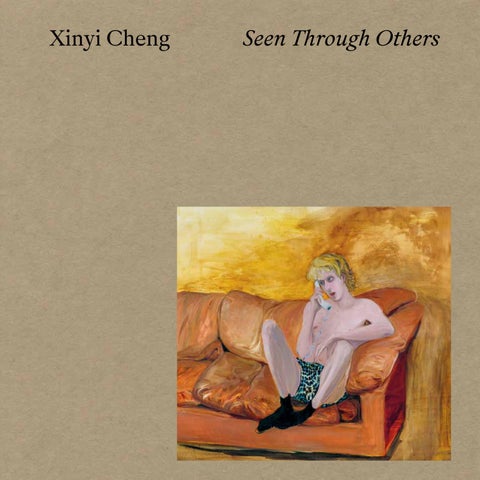
Nous sommes des gestes Le tableau de deux hommes aux visages rougeâtres surpris en train de danser joue contre joue dans un cours de tango est installé près d’un trio de poings levés intitulé Resolution ; un minuscule canidé nommé Monroe fixant des yeux un os sur un tapis bleu céruléen et rouge est exposé près d’un homme en caleçon à motifs léopard assis sur un canapé dans une pièce luminescente en train de parler dans un téléphone fixe ; un personnage flottant dans l’eau après être tombé d’un kayak rouge est présenté avec un duo de chiens courant sur la plage sous un ciel obscur. Dans ses tableaux évocateurs, Xinyi Cheng capture des scènes éphémères et des personnages qui lui sont inspirés par ses rencontres quotidiennes. Elle cherche à percer les mystères subtils et parfois déroutants de l’expérience humaine en tournant son regard vers les individus et leurs animaux de compagnie. Ses œuvres ne se contentent pas d’évoquer les sensations les plus intimes, les impulsions physiques et les rêveries qui vivent en chacun de ces personnages et en nous, elles nous incitent aussi à nous y confronter. Son usage expressif de la lumière et de la couleur semble aller à l’encontre des sentiments mineurs et tout sauf grandioses qui préoccupent momentanément ses personnages représentés en train d’agir ou plongés dans leurs pensées. Ces moments de calme empreints de malaise illustrent parfaitement la complexité des émotions, des désirs et des rapports de force qui imprègnent la vie contemporaine. * « [ … ] la présence cruciale de l’autre, l’impression que l’intimité est la condition de la possibilité de la solitude. » 1 Nancy Yosef, Romantic Intimacy
Comment l’intimité s’incarne-t-elle et s’établit-elle entre les corps ? Les manifestations de l’intimité constituent l’une des pierres d’angle
Tango Class, 2017
1. Nancy Yosef, Romantic Intimacy, Stanford, Stanford University Press, 2013, p. 253
Seen Through Others
Xinyi Cheng
de la peinture de Xinyi Cheng. Ses premiers tableaux représentaient souvent des scènes sociales nocturnes où de jeunes fêtards ivres ou de futurs amants tentent de faire connaissance et flirtent en mangeant, en buvant ou en fumant des cigarettes (For a Light II, 2020 --> P.99). Apparemment en quête de désirs terrestres dans des vies cosmopolites vécues à toute allure, ces personnages restent imperturbables au milieu des interactions et des distractions qui les entourent. Ils vivent ces moments fugaces de proximité en dégageant une impression de solitude, puis reprennent le fil de leurs pensées une fois l’instant passé. Dans des tableaux comme Tango Class (2017) --> P.61 et Where Do the Noses Go ? (2021) --> P.43, Where Xinyi Cheng resserre son cadre autour de moments de contact intimes et privés : on voit que les personnages les plus proches de nous dérivent dans leurs pensées. Ici, ce qui ressemble à un échange tendre entre deux personnes propose pourtant une lecture nuancée de l’intimité – une lecture liée à l’individualité. Malgré le potentiel romantique de ces situations, l’homme qui danse joue contre joue avec un autre et la jeune fille à lunettes échangeant un baiser ont tous deux disparu dans leurs réalités subjectives. La multitude de distances physiques et symboliques entre les sujets, sans mentionner celles qui séparent Xinyi Cheng du spectateur, pousse ce dernier à réfléchir à sa place dans le monde. La plupart du temps, ses personnages solitaires montrés au milieu de leur environnement morose, par exemple dans The Smoker (2021) --> P.85 et Landline (2021) --> P.45, semblent avoir du plaisir à être eux-mêmes, et le loisir de l’être. Le caleçon léopard presque comique qui contraste avec la pièce d’un jaune incandescent dépeinte dans le tableau Landline met en avant le contentement du personnage. De même, dans White Turtleneck (2017) --> P.67, le personnage allongé, nu des pieds jusqu’à l’entrejambe, regarde droit devant lui, l’air serein, sous l’œil du spectateur. Xinyi Cheng n’est nullement découragée à l’idée d’illustrer des situations perturbantes, à l’image de sa série de tableaux en cours sur la nourriture et l’ingestion. Dès 2016, elle a créé des œuvres autour du motif récurrent de la patte d’animal en tant que reste alimentaire dans Fremdschämen II (2016) --> P.95 et comme objet dévoré par un chien dans Predator (2016) --> P.91, tandis que dans Smoked Turkey Leg (2018) --> P.69, on découvre un homme rongeant une cuisse de dinde
10
Do the Noses Go?, 2021
Predator, 2016
Christina Li
Nous sommes des gestes
11
avec délectation et une barbarie digne du Saturne (1820-1823) de Goya. Aux côtés des couples représentés dans des réunions entre amis, l’artiste donne à voir des êtres humains et des animaux captivés par l’acte singulier qui consiste à assouvir leurs instincts primaires, créant ainsi un lien intime entre des réalités psychologiques et physiques. * « La force est en rapport étroit avec la sensation : il faut qu’une force s’exerce sur un corps, c’est-à-dire sur un endroit de l’onde, pour qu’il y ait sensation. Mais si la force est condition de la sensation, ce n’est pourtant pas elle qui est sentie, puisque la sensation donne tout autre chose à partir des forces qui la conditionnent. » 2 Gilles Deleuze, Francis Bacon : logique de la sensation
Depuis ces dernières années, Xinyi Cheng commence à observer autre chose que la vie urbaine et s’intéresse plus particulièrement à la nature. Ses scénarios sortent de ses intérieurs obscurs incandescents et scènes de rue nocturnes pour inclure des paysages extérieurs lumineux. Ces œuvres, qui représentent un engloutissement total dans des forces sublimes, poursuivent son exploration de la condition humaine en révélant notre vulnérabilité face au monde naturel. Dans Whirlpool (2021) --> P.111, Gust (2019) --> P.93 et Red Kayak (2020) --> P.101, les corps se retrouvent sans défense face à la puissance tumultueuse de l’eau et du vent qui les malmène et les renverse dans un moment suspendu. Xinyi Cheng associe ces éléments atmosphériques aux luttes existentielles stressantes de la société contemporaine. S’agit-il de la représentation d’une noyade ou d’un plongeon ? D’un envol ou d’une chute ? Délibérément ouverts et ambivalents, les tableaux de personnages balayés par le vent et l’eau offrent un espace aux Smoked spectateurs pour discerner et éprouver ces sensations profondes. La transition de Xinyi Cheng vers l’extérieur a aussi marqué son étude approfondie des environnements d’éclairage naturel et de leur relation avec nos sens. Son usage incandescent des lueurs et des ombres pour suggérer des tonalités émotionnelles joue un rôle crucial dans sa pratique, comme l’illustrent la femme aux yeux perçants nimbée d’une lueur écarlate dans The Midnight Fire (2020) --> P.83 et ses portraits saisissants de fumeurs.
2. Gilles Deleuze, Francis Bacon : logique de la sensation, Paris, Éditions du Seuil, 2002, p. 58
Turkey Leg, 2020
Seen Through Others
Xinyi Cheng
Ses œuvres plus récentes – Campfire (2020) --> P.97, image d’un feu de camp vacillant au milieu d’un paysage ténébreux dans la nuit noire, et Parapetto (2021) --> P.49, une scène aérée où deux personnes discutent au bord d’un balcon – démontrent un rapport affectif différent avec la lumière. Sorti des confins de l’environnement construit, le déploiement sensible de lumière, d’air et d’eau de Xinyi Cheng dépeint un monde ambiant fait de sentiments intacts. Sa série Incroyable (2018 –) a vu le jour quand elle a commencé à choisir des titres d’œuvres suscitant en elle un merveilleux mélange d’émotion et d’admiration. Son diptyque Incroyable (Night) (2018) --> P.39 et Incroyable (Dawn) (2018) --> P.41 représente des situations domestiques feutrées où les personnages se reposent, le passage du temps n’étant indiqué qu’entre parenthèses dans le titre ; sa toute récente pièce Incroyable (En Route) (2021) --> P.89 montre le fervent road-trip de trois personnages illuminés par le soleil levant ou couchant qui incarnent chacun différentes étapes de la vie d’un même individu. Les œuvres de Xinyi Cheng sont rarement imprégnées de tension dramatique, mais elles témoignent ici d’une exploration continue visant à représenter l’insaisissable à travers la peinture.
12
Incroyable (Dawn), 2018
* « Les chiens et les humains figurent un univers. » 3 Donna Haraway, Manifeste des espèces compagnes : chiens, humains et autres partenaires
En fin de compte, c’est une quête de liberté et d’appartenance au monde qui réside au cœur des tableaux de Xinyi Cheng. Au lieu de représenter principalement des personnages masculins, elle a commencé à inclure des personnages féminins et des animaux pour mieux dévoiler la perplexité de la vie contemporaine. Son affinité avec les chiens s’exprime dans les tableaux précités de canidés avec de la nourriture, ainsi que dans Swimmers (2021) --> P.105, où elle représente deux chiens pleins de dignité comme si c’étaient des chevaux de course, un thème courant dans la peinture chinoise traditionnelle. Ses animaux anthropomorphes sont souvent montrés dans des décors d’une étrangeté malicieuse : Monroe (2021) --> P.47 met en scène un minuscule chien avec un os de la même taille que lui, et dans The Horse Wearing a Red Ear Bonnet and Eye Blinders (2020) --> P.79, un cheval docile en tenue de course est représenté à côté d’un homme torse nu au regard tout aussi inexpressif. Malgré leur apparente innocence, les créatures de Xinyi Cheng semblent dotées d’une liberté d’esprit particulière sur laquelle
3. Donna Haraway, Manifeste des espèces compagnes : chiens, humains et autres partenaires, traduit de l’anglais américain par Jérôme Hansen, Paris, Climats, 2018
Christina Li
Nous sommes des gestes
13
les circonstances extérieures n’ont pas prise. Quand nous nous observons à travers les yeux de nos animaux de compagnie, cela nous pousse à nous demander à quoi ils pensent. Que pouvons-nous, en tant qu’humains, apprendre d’eux pour penser notre rapport au monde et aux autres ? * « Nous ne faisons pas de gestes, nous sommes des gestes. À travers eux, nous rencontrons les événements du monde où nous gesticulons, le monde qui gesticule à travers nous et que nous “signifions”. Mais certains de ces événements ont du sens, nous orientent vers l’avenir, c’est-à-dire vers nous : car nous sommes leur avenir. Ces événements sont les gestes d’autres en lesquels nous nous reconnaissons. » 4 Vilém Flusser, Gestures
À travers une utilisation scintillante de la couleur et de la lumière, Xinyi Cheng propose ses perspectives sur notre monde déroutant dans un kaléidoscope d’émotions et d’instants esthétiques qui nous saisissent parfois sans que nous ne parvenions à les exprimer sur le moment. Les différents mouvements physiques donnés à voir dans ses œuvres sont en fait des expressions de notre rencontre avec nos réalités. Les regards furtifs ou déterminés, les nombreuses manières subtiles dont sont fermement tenus et saisis les rasoirs, les verres, les cigarettes et autres objets divers symbolisent des points d’auto-évaluation. C’est une quête commune de sens à travers l’affect et les sensations qui s’incarne dans ces gestes apparemment quotidiens. Quand elle représente des individus au sein de contextes sociaux et privés, l’artiste explore l’évolution de la création de subjectivités personnelles tout en interrogeant l’influence de nos enchevêtrements avec les êtres humains, les animaux et les objets sur notre sentiment d’appartenance au monde. Le petit tableau atypique des trois poings serrés et levés intitulé Resolutions (2020) --> P.35 compte parmi les nouvelles œuvres qu’elle a produites ces deux dernières années. Cette œuvre pleine de détermination pourrait être interprétée comme la célébration d’un moment de liberté potentielle pour l’avenir. Dans la peinture de Xinyi Cheng, nous reconnaissons la joie, la mélancolie et la beauté qui résident dans ces situations intimes avec nous-mêmes et avec les autres. Elle étudie la nature humaine en représentant ses personnages dans différents états de devenir où nous, spectateurs, pouvons nous retrouver. •
4. Vilém Flusser, Gestures, Minneapolis, University of Minnesota Press, 2014, p. 69
Monroe, 2021
38
Julien, 2017 80 × 70 cm, oil on canvas / huile sur toile
46
Landline, 2021 145 × 160 cm, oil on canvas / huile sur toile
50
Parapetto, 2021 160 × 145 cm, oil on canvas / huile sur toile
Xinyi Cheng
Seen Through Others
Lafayette Anticipations
Foreword It seems as if everything exists to lead to a painting by Xinyi Cheng. Anyone who has seen the artist’s portraits understands that, for thousands of years, nothing has replaced the awe-inspiring power of painting on the human heart and mind. Xinyi Cheng’s work has the right mix of subtle tradition and modernity. One senses Géricault in her greyhounds, Picasso in her blues, Nan Goldin in her smokers… But above all, there is an acceptance of contemporary fragility, dissected in an unmannered way on deceptively melancholic canvases, which celebrate the permanent imperfection of the living. I am delighted that Xinyi has agreed to present this first major exhibition in France at 9 rue du Plâtre and I would like to thank Christina Li for her brilliant curation of the show, in conjunction with the entire Lafayette Anticipations team. Guillaume Houzé
117
Introduction “Make me think me” Bruce Nauman
We call “desire paths” those new trails in the city demarcated by the repeated passage of walkers, who thereby plot preferred routes to those that are visible and planned. Much like these footsteps that inscribe new ways of navigating the world, Xinyi Cheng’s painting invites us to always reconsider what we thought we knew and to take other pathways to the familiar. She paints beings, animals, and objects that surround us, images captured in their most ordinary form while imbuing them with an unusual intensity. Her paintings are open doors that invite us to embrace the strange and enigmatic aspects of the experience of existence. From scenes of nightly gatherings to characters in free fall, Xinyi Cheng surveys the emotions and states that course through life. The exhibition at Lafayette Anticipations, the first major presentation of Xinyi Cheng’s work in France, is imagined as a stroll, a drift through existence, up close with this singular work. It is this astonishing ability to capture both the strength and the vulnerability of beings that the exhibition’s curator, Christina Li, praises in her text “We Are Gestures.” Kirsty Bell recounts her visit to Xinyi Cheng’s studio and takes us into the artist’s daily life. She also describes Cheng’s photographic practice and discusses waiting, a central theme in the painter’s work, as a way of better connecting with the present. Alvin Li reminds us how much Xinyi Cheng manages to value those states (waiting, immobility, silence) so little celebrated in the contemporary world. Idleness, dear to artists such as Marcel Duchamp, is here a mark of freedom. Xinyi Cheng’s painting proceeds by allegories and is populated by symbols. This is what Mi You highlights in her text “Slowing, Desiring, Bodies” in which she questions the power and evocative scope of bodies. It is in a familiar and enigmatic world that Xinyi Cheng invites us to travel under the gaze of these “others” who populate her paintings and travel with us, thereby opening up other perspectives, as captured by the exhibition title, Seen Through Others. Rebecca Lamarche-Vadel
119
Christina Li
121
We Are Gestures Two ruddy faced men caught cheek to cheek in a tango class is set alongside a trio of upturned fists entitled “Resolution” ; a tiny canine called Monroe staring at a bone on a cerulean and red carpet is shown next to a man in leopard boxer shorts speaking on a landline on a sofa in a luminescent room; a buoyant figure in the water after being swept off a red kayak is juxtaposed against a pair of galloping dogs along the shoreline against the murky sky. The assembly of fleeting scenes and characters captured in Xinyi Cheng’s evocative paintings are drawn from her daily encounters. She unravels the subtle and at times bewildering enigmas of human experience, seen through individuals and their animal companions. Her works do not merely help conjure, but also induce viewers to contend with the innermost sensations, corporeal impulses, and reveries that reside within these subjects and ourselves. Captured in midaction and thought, her expressive use of light and colour belie minor rather than grandiose feelings that momentarily preoccupy Cheng’s protagonists. These quiet instances infused with uneasiness epitomize the complexities of emotions, desires, and power dynamics that underpin our contemporary life. * “[ … ] the crucial presence of another, the sense that intimacy is the condition of the possibility of being alone.” 1
For a Light II, 2020
Nancy Yosef, Romantic Intimacy
How is intimacy embodied and established between bodies? The manifestations of intimacy are a cornerstone of Cheng’s painting practice. Nocturnal social scenes are often depicted in her earlier paintings, where young carousers, or paramours-to-be, attempt to mingle and flirt over food, drinks, or cigarettes (For a Light II, 2020 --> P.99). Under the guise of the pursuit of worldly desires in our hurried, cosmopolitan life, these figures remain undisturbed amidst the
1. Nancy Yosef, Romantic Intimacy (Standford: Standford University Press, 2013), 253.
Seen Through Others
Xinyi Cheng
122
interactions and distractions that surround them. There is an air of solitude enshrouding Cheng’s characters who happen to be in these transient occasions of proximity, and once the instant is over, will carry on with their own train of thought. In paintings such as Tango Class (2017) --> P.61 or Where Do the Noses Go? (2021) --> P.43, Cheng zooms into private moments of intimate contact: the characters closest to us are adrift in their own thoughts. Here, what appears as a tender exchange between two people, opens up a nuanced reading of intimacy: one that has to do with selfhood. In spite of the romantic potential that these situations present, the man dancing with his face touching another’s and the bespectacled girl caught in a kiss have both slipped away in order to engage with their subjective realities. The multitude of physical and symbolic distances between subjects, not to mention those between Cheng and the viewer, compels the latter to consider their own place in the world. More often than not, her lone figures enfolded in their moody surroundings in The Smoker (2021) --> P.85 and Landline (2021) --> P.45 are depicted to take pleasure, and leisure, in being oneself. The almost comical animal print briefs in the latter painting, in contrast to the yellow incandescent room, accentuate the sitter’s contentment. Similarly, in White Turtleneck (2017) --> P.67, the reclining protagonist, clothed except for his bare crotch, stares ahead serenely under the onlookers’ gaze. Cheng is undaunted by the task Saturn, of showing unsettling situations, as exemplified by her evolving series of paintings on food and ingestion. As early as in 2016, Cheng has created works with the recurring motif of the animal leg as leftover in Fremdschämen II (Second-hand Embarrassment II) (2016) --> P.95, and as the object being devoured by a dog in Predator (2016) --> P.91; while in Smoked Turkey Leg (2018) --> P.69, she paints a man raptly gnawing a turkey leg in a barbaric manner reminiscent of Goya’s Saturn (1820–23). Juxtaposed with the couples in arboured social gatherings, the artist presents humans and animals alike, captivated in the singular act of fulfilling their primal instincts, intimately connecting psychological and bodily realities. * “Force is closely related to sensation: for a sensation to exist, a force must be exerted on a body, on a point of the wave. But if force is the condition of sensation, it is nonetheless not
Goya, 1820-23
Christina Li
We Are Gestures
123
the force that is sensed, since the sensation ‘gives’ something completely different from the forces that condition it.” 2 Gilles Deleuze, Francis Bacon: The Logic of Sensation
In recent years, Cheng has begun to turn her observations outside of urban life to nature. Her scenarios stretch beyond fiery umbral interiors and streetscapes after dark, to include lucent, open-air landscapes. Continuing her inquiry of the human condition, these works are fully subsumed by sublime forces, revealing vulnerability in the face of the natural world. In Whirlpool (2021) --> P.111, Gust (2019) --> P.93, and Red Kayak (2020) --> P.101, bodies are rendered defenceless to the tumultuous might of water and wind, thrashed and upended in the suspended moment. Cheng links these atmospheric elements to the fraught existential struggles of contemporary society. Are these representations of drowning or diving, soaring or plunging? Deliberately open-ended and ambivalent, the wind–and waterswept paintings allow space for viewers to discern and feel these profound sensations. Cheng’s shift to the outdoors also marked her extended studies of natural lighting environments and their relation to our senses. Her incandescent use of glimmer and shadows to suggest emotional tonalities has been pivotal to her practice, as seen in her gimlet-eyed figure cloaked in a crimson glow in The Midnight Fire (2020) --> P.83 and her vivid portraits of smokers. Notably, her newer works show a contrasting affective exercise with illumination: Campfire (2020) --> P.97, a lambent picture of a campfire in the midst of a tenebrous, pitch black landscape, and Parapetto (2021) --> P.49, a breezy scene of two people socializing on the edge of a balcony. Breaking away from the confines of the built-environment, Cheng’s sensitive deployment of light, air, and water limns an ambient world of unadulterated feelings. Her longstanding Incroyable (2018–) series came about when she began designating the title to works that arouse a marvellous amalgamation of emotion and awe in her. Her diptych Incroyable (Night) (2018) --> P.39 and Incroyable (Dawn) (2018) --> P.41 depict hushed domestic situations containing figures resting, with the passing of Incroyable time only indicated parenthetically in the title; whereas
Red Kayak, 2020
2. Gilles Deleuze, Francis Bacon: The Logic of Sensation (Cornwall: Continuum, 2003), 56.
(En Route), 2021
Seen Through Others
Xinyi Cheng
124
her newest piece Incroyable (En Route) (2021) --> P.89 is an impassioned road trip of three figures each standing for different stages of life of the very person, illuminated by the rising/setting sun. Rarely does Cheng prescribe high drama to her works, but in these instances, they become testaments of her persistent exploration in rendering the ungraspable through painting. * “Dogs and people figure a universe.” 3 Donna Haraway, The Companion Species Manifesto: Dogs, People and Significant Otherness
Ultimately, at the core of Cheng’s paintings is a search for freedom and belonging in the world. Instead of predominantly portraying male figures, she has begun to include female characters and animals to unpack the perplexity of contemporary life. Cheng’s affinity with dogs can be seen in the aforementioned paintings of canines with food, as well as in Swimmers (2021) --> P.105 where two dignified dogs are painted in the fashion of racing horses, a common subject in traditional Chinese paintings. Her anthropomorphic animals are often shown in playfully uncanny settings: Monroe (2021) --> P.47 focuses on a tiny dog with a bone of a comparable size, and in The Horse Wearing a Red Ear Bonnet and Eye Blinders (2020) --> P.79, a meek-looking horse in full regalia is seen standing next to an equally blank-looking topless man. Though they appear innocent, Cheng’s creatures exude a distinct free-spiritedness that is unaffected by external circumstances. As we observe ourselves through the eyes of our animal companions, it drives us to ask, what are they thinking about, and what can humans learn from them as we reflect on how we relate to the world and others?
* “The facts are these: we are gestures. Through them, we come up against the events of the world in which we are gesticulating, the world that gesticulates through us, and that we ‘mean.’ But some of these events have meaning, point towards a future, which is to say toward us: for we are their future. These events are the gestures of others, in which we recognise ourselves.” 4 Vilém Flusser, Gestures
3. Donna Haraway, The Companion Species Manifesto: Dogs, People and Significant Otherness (Chicago: Prickly Paradigm Press, 2003), 21.
The Horse Wearing a Red Ear Bonnet and Eye Blinders, 2020
Christina Li
We Are Gestures
Cheng, through her coruscating colour and light treatments on canvas, offers her insights to the baffling world around us, showing us all a kaleidoscope of stirring emotions and aesthetic moments that sometimes seize us, while in that precise instant, escape articulation. The lexicon of bodily movements in her works, in fact, are expressions of our encounter with our realities. The covert glances, determined looks, as well as the manifold subtle ways razors, glasses, cigarettes, and miscellaneous things are held and gripped symbolise points of self-reckoning. Embodied within these seemingly quotidian gestures is a shared quest of meaning through affect and sensations. In her portrayals of individuals in social and private circumstances, she reflects on the course of composing personal subjectivities, while also unpacking how our entanglements with individuals, animals, and objects can orientate our sense of belonging in the world. Among the new works that Cheng has created in the past two years is an atypical small painting of three raised clenched fists titled Resolutions (2020) --> P.35. Filled with resolve, the work could be interpreted as the celebration of an instance of potential freedom for the future. In her paintings, we recognize the joy, melancholy, and beauty that reside in these intimate situations with oneself and alongside others. Cheng, in her examinations in human nature, depicts her characters in various states of becoming, in which we viewers might find ourselves. •
125
4. Vilém Flusser, Gestures (Minneapolis: University of Minnesota Press, 2014), 69.
Swimmers, 2021
Liste d’œuvres / List of works Resolutions, 2020 60 × 40 cm Pinault Collection p. 35 Julien, 2017 80 × 70 cm Collection privée / Private collection p. 37 Incroyable (Night), 2018 92 × 60 cm Collection privée / Private collection, Hong Kong p. 39 Incroyable (Dawn), 2018 92 × 60 cm Collection privée / Private collection, Hong Kong p. 41 Where Do the Noses Go?, 2021 60 × 73 cm Courtesy de l’artiste / Courtesy the artist p. 43 Landline, 2021 146 × 160 cm Courtesy de l’artiste et Matthew Marks Gallery, New York / Courtesy the artist and Matthew Marks Gallery, New York p. 45 Monroe, 2020 60 × 45 cm Collection privée / Private collection p. 47 Parapetto, 2021 160 × 145 cm Collection privée, Hong Kong / Private collection, Hong Kong p. 49 Lighter, 2019 41 × 33 cm Collection Sadie Coles, Londres / Sadie Coles Collection, London p. 51
Lighter II, 2019 41 × 33 cm Collection privée, Paris / Private collection, Paris p. 53
Pomegranate, 2017 40 × 50 cm Courtesy de l’artiste / Courtesy the artist p. 71
Painting of Savva in the Light of a New Dawn, 2020 73 × 60 cm Collection privée, Pékin / Private collection, Beijing p. 55
Moon Water, 2016 50 × 40 cm Collection privée, Genève / Private collection, Geneva p. 73
Rafael, 2018 72,5 × 54 cm Collection Caroline Bourgeois / Caroline Bourgeois Collection p. 57 Itches, 2020 46 × 55 cm Collection privée, Paris / Private collection, Paris p. 59
Moon Water, 2016 70 × 85 cm Collection Jim Abrams et Mario Russo, San Francisco / Jim Abrams and Mario Russo Collection, San Francisco p. 75 Liebe & Romanze, 2016 60 × 100 cm Collection privée / Private collection p. 77
Tango Class, 2017 50 × 60 cm Collection privée, Paris / Private collection, Paris p. 61
The Horse Wearing a Red Ear Bonnet and Eye Blinders, 2020 160 × 145 cm Collection privée, Paris / Private collection, Paris p. 79
Fluffy Light, 2017 80 × 100 cm Collection privée / Private collection p. 63
Stijn, 2019 60 × 100 cm Collection privée / Private collection p. 81
Coiffeur, 2017 60 × 50 cm Collection Artemis Baltoyanni, Athènes / Artemis Baltoyanni Collection, Athens p. 65
The Midnight Fire, 2020 60 × 73 cm Collection privée / Private collection p. 83
White Turtleneck, 2017 125 × 150 cm Collection Bill Cournoyer, New York / Bill Cournoyer Collection, New York p. 67 Smoked Turkey Leg, 2020 46 × 55 cm Collection privée, Paris / Private collection, Paris p. 69
The Smoker, 2021 73 × 71 cm Courtesy de l’artiste / Courtesy the artist p. 85 Window, 2021 79 × 56 cm Courtesy de l’artiste et Matthew Marks Gallery, New York / Courtesy the artist and Matthew Marks Gallery, New York p. 87
Incroyable (En Route), 2021 60 × 92 cm Courtesy de l’artiste et Matthew Marks Gallery, New York / Courtesy the artist and Matthew Marks Gallery, New York p. 89
Midday Troubles, 2021 160 × 200 cm Courtesy de l’artiste et Matthew Marks Gallery, New York / Courtesy the artist and Matthew Marks Gallery, New York p. 107
Predator, 2016 140 × 115 cm Collection Rafael de Cárdenas, New York / Rafael de Cárdenas Collection, New York p. 91
A Whip, 2018 150 × 125 cm Collection Craig Robins, Miami / Craig Robins collection, Miami p. 109
Gust, 2019 115 × 140 cm Collection privée, Paris / Private collection, Paris p. 93 Fremdschämen II, 2016 50 × 60 cm Collection Ashkan Baghestani, New York / Ashkan Baghestani Collection, New York p. 95 Campfire, 2020 145 × 160 cm Pinault Collection p. 97 For a Light II, 2020 160 × 145 cm Collection privée / Private collection p. 99 Red Kayak, 2020 200 × 165 cm Collection privée / Private collection p. 101 Swimmer, 2020 80 × 100 cm Collection privée / Private collection p. 103 Swimmers, 2021 100 × 120 cm Collection privée, Hong Kong / Private collection, Hong Kong p. 105
Whirlpool, 2021 91 × 101 cm Courtesy de l’artiste / Courtesy the artist p. 111 * Tension, 2017 68,5 × 78,7 cm Courtesy de l’artiste / Courtesy the artist p. 14 North Brother Island, 2017 125 × 150 cm Collection privée / Private collection p. 21 Tension II, 2012 78,7 × 68,5 cm Courtesy de l’artiste / Courtesy the artist p. 126 I surrender…, 2018 140 × 115 cm Fosun Foundation, Shanghai p. 133 Sauf mention contraire, toutes les œuvres sont courtesy d’Antenna Space, Shanghai ; Balice Hertling, Paris / If not stated otherwise all works courtesy Antenna Space, Shanghai; Balice Hertling, Paris.
Scènes nocturnes, en ville ou en pleine nature, humains et animaux, tous les sujets de Xinyi Cheng interpellent par leur intensité, dans une peinture où la douceur et la simplicité ne sont qu’apparentes. Pour sa première exposition monographique institutionnelle en France, Lafayette Anticipations présente une vaste sélection de ses œuvres, réunies dans cet ouvrage, ainsi que des textes de Christina Li, Kirsty Bell, Alvin Li et Mi You, et cinq photographies inédites de Xinyi Cheng sous forme de cartes postales.
Nocturnal scenes, in the city or in nature, humans and animals, the profound intensity of Xinyi Cheng’s subjects is striking within paintings which transcends their apparent softness and simplicity. For her first institutional solo exhibition in France, Lafayette Anticipations has invited Xinyi Cheng to present a broad selection of her works, gathered in this book with texts by Christina Li, Kirsty Bell, Alvin Li, and Mi You and five unpublished photographs by Xinyi Cheng as postcards.
ISBN 978-2-490862-22-1 25 €