CREATE LASTING IMPACT Rotary
Rotary D6330 Environment Committee Chair Doug Thompson, RC of Stratford
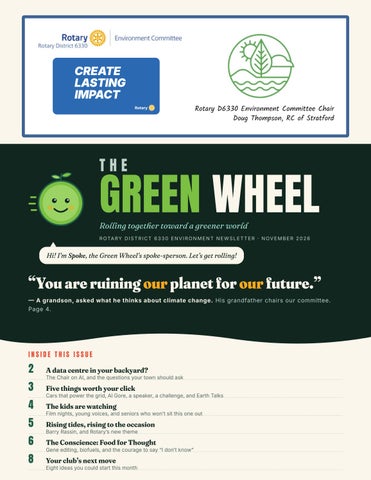
THE
GREEN WHEEL
Rolling together toward a greener world
R O TA R Y D I S T R I C T 6 3 3 0 E N V I R O N M E N T N E W S L E T T E R · N O V E M B E R 2 0 2 6
Hi! I’m Spoke, the Green Wheel’s spoke-sperson. Let’s get rolling!
“You are ruining our planet for our future.” — A grandson, asked what he thinks about climate change. His grandfather chairs our committee. Page 4.
INSIDE THIS ISSUE
2
A data centre in your backyard?
3
Five things worth your click
4 5 6 8
The Chair on AI, and the questions your town should ask Cars that power the grid, Al Gore, a speaker, a challenge, and Earth Talks
The kids are watching
Film nights, young voices, and seniors who won’t sit this one out
Rising tides, rising to the occasion Barry Rassin, and Rotary’s new theme
The Conscience: Food for Thought
Gene editing, biofuels, and the courage to say “I don’t know”
Your club’s next move
Eight ideas you could start this month
FROM THE CHAIR
Sorting the science from the noise Doug Thompson Chair, D6330 Environment Committee · Rotary Club of Stratford
I thought I would update you on some topics of interest about climate change, and some news of concern. Sorting the science for the truth is difficult in these times, and social media doesn’t make it any easier.
AI is here to stay. At what cost? Artificial intelligence is still of concern, both for its
development until regulations can be put in place, impartially and internationally.
use for good and bad, and for the effect it will have
There are great expectations that AI’s efficiencies
on the environment and on jobs. I use AI every day,
will offset its carbon debt. That will not happen until
and we all realize it is here to stay. It is smarter than
most of its huge energy demand comes from
humans; it can perform tasks, searches, and
renewable sources. Communities that jumped in
important science much faster than we can, and in
early, attracted by the promise of good jobs and
some instances better.
prosperity, have been alarmed by the negative
Because of world conflict and competition, it remains to be seen whether enough cooperation can happen to regulate it. And the hacks have already started. Data centres and their environmental effects are a real worry for the communities next to them. Some cities have enacted moratoriums, and most scientists recommend pausing data centre
impacts on their communities.
So, what should we do? First, beware if a data centre is being considered near you. Your community, with its own unique circumstances, can research the environmental impact and make sure it won’t do harm. As for AI’s threat to humanity: when the scientists and the mega-developers themselves are sounding the alarm, I would be very worried.
“The promise of jobs and prosperity does not outweigh the environmental effects for your community.” DATA CENTRE PROPOSED NEAR YOU? ASK ABOUT ITS… Water needs
Energy needs
Noise
Light
Pollution THE GREEN WHEEL
Before your town says yes, ask the hard questions. That’s how the wheels of good decisions turn.
D 6 3 3 0 E N V I R O N M E N T · N OV E M B E R 2 0 2 6
2
THE CHAIR’S PICKS
Five things worth your click On screen? Click the link. On paper? Point your phone’s camera at the code. THE FUTURE OF DRIVING
Cars that power the grid Newer electric vehicles will have bidirectional charging: they can charge batteries, the grid, and other EVs. This may be the future for our communities, and California already has pilot projects that pay EV owners to power the grid.
1
Read the article “More EV owners can now get paid to power California’s grid,” MSN Autos
A SPEAKER FOR YOUR CLUB
A speaker worth booking
3
Remember John Watson of Blue Water Energy Inc.? He has spoken to Rotarians in both London and Stratford about energy systems. Watch his talk, and consider inviting him to speak at your own club.
TWENTY YEARS LATER
Al Gore, then and now
Watch the interview YouTube
PRIZES ON OFFER
Take the Net Zero Challenge
Join the challenge
YouTube
canadiangeographic.ca
5
FREE, WEEKLY, OPEN TO EVERYONE
Join an Earth Talk
We all live on the same planet, and the solutions are global. If you believe ESRAG was on the right course, they welcome your support.
4
Canadian Geographic’s Live Net Zero Household Challenge invites you to tell your story: how you have worked towards net zero in your own life. Share it with others, and you may win prizes.
Watch his talk
The Chair is still wondering whether ESRAG (the Environmental Sustainability Rotary Action Group) will reemerge. Meanwhile, a group from ESRAG has carried on as the Earth Talks Foundation, with weekly speakers, a growing following, and programs like Plant Rich Diets, Million Solar Panels, and Renewable Energy. Its recent talk on reinventing agriculture for drylands was excellent.
2
Remember Al Gore and his very impactful An Inconvenient Truth, released in 2006? In a more recent interview, he credibly sums up the present state of affairs, and he gives us hope for the future.
Transforming stories into action One hour a week, for Rotarians and nonRotarians alike: • Hear highlights of innovative projects, or share your own. • Learn from global experts in sustainability. • Network with others taking action for our planet. Visit Earth Talks Past talks are on the website.
THE GREEN WHEEL
D 6 3 3 0 E N V I R O N M E N T · N OV E M B E R 2 0 2 6
3
YOUNG & OLD
The kids are watching “You are ruining our planet for our future.” — Doug Thompson’s grandson, when Doug asked him what he thought about climate change
Somehow, we have to make climate change as
Why not plan a film night in your own community, at
important as the other issues of the day, including
the local school? Perhaps students could earn credit
inflation, jobs, and health care. We need to show
in some form. A group in Stratford is now thinking of
young people that we are on their side, and that we
holding a climate film weekend featuring the same
stand ready to correct the problem we caused.
documentary.
Host a film night
Too old to bother? Think again.
The eco club at Stratford District Secondary School is showing the film How to Live on Earth to students and the public. It’s a great way to engage
Seniors for Climate are very active. As the Chair puts it, we need to fix the problem that we caused.
the younger generation and show them, positively, that we care.
Image: Seniors for Climate
NOW SHOWING: HOW TO LIVE ON EARTH Preview it before you plan your film night: watch on YouTube.
THE GREEN WHEEL
Popcorn, a projector, and a planet worth saving. I’ll bring the reel.
D 6 3 3 0 E N V I R O N M E N T · N OV E M B E R 2 0 2 6
4
EARTH TALKS · OCTOBER 2, 2026
Rising tides, rising to the occasion
At Earth Talks’ biggest Giving Season event, Past Rotary International President Barry Rassin connected rising seas and disaster with Rotary’s power to act. Wade Nomura was emcee. His message, in four steps:
1
Build partnerships.
2
Invest in resilience.
3
Engage young leaders.
4
Turn a global climate challenge into practical local action.
Watch Barry Rassin’s talk on YouTube SOURCE: Earth Talks Foundation, “Rising Tides, Rising to the Occasion: Rotary’s Climate Reckoning,” October 2, 2026
CREATE LASTING IMPACT Rotary’s 2026–27 theme comes from RI President Olayinka H. Babalola. His point: change is a starting point, but impact is what lasts. Every turn of the wheel counts. Source: rotary.org
THE GREEN WHEEL
D 6 3 3 0 E N V I R O N M E N T · N OV E M B E R 2 0 2 6
5
T H E C O N S C I E N C E · A COLUMN FOR THINKING IT THROUGH
Food for Thought ROTARY’S 7TH AREA OF FOCUS · THE ENVIRONMENT
How much do we really know about the environment we hope to protect?
How do we stay informed enough to take part in decisions about our future?
How do new technologies affect the environment?
We are increasingly being asked to form opinions about technologies that can be difficult to understand. Many have implications for our environment. Within Rotary, we plant trees, organize beach cleanups, encourage plant-rich diets, recycle, repurpose, and reduce our use of fossil fuels. These activities serve different environmental purposes. How do we assess their results and build on them to create meaningful, lasting impact? Can we even measure “lasting impact”? A Canadian agricultural questionnaire recently landed in my inbox. It asked about biotechnology, gene editing, cellular agriculture, and biofuels, subjects that connect with food production, health, environmental sustainability, and climate change. Then came the question that rattled me: How much did you know about this before responding? Honestly? I knew the terms, and not much more. So I answered truthfully, and then I did a little research. Here’s what I found.
JARGON BUSTER BIOTECHNOLOGY
GENE EDITING
A broad term for using living organisms, or parts of them, to make products or develop processes.
Making targeted changes to an organism’s DNA.
CELLULAR AGRICULTURE
BIOFUELS
Producing animal cells or food ingredients using cell cultures or microorganisms.
Fuels made from biological materials such as food scraps, soybean or canola oil, and other organic waste.
Here are some real questions Could gene editing help make crops more resistant to disease or drought? Could cellular agriculture change how we produce meat and dairy ingredients? Could biofuels reduce greenhouse gas emissions when their entire production and use are considered? Could these technologies lower costs, or introduce new challenges? Before we can form informed opinions, we need reliable information. And that leads to another question: where do we go to learn about subjects we know very little about? Perhaps lifelong learning is not simply about discovering new information. It’s also about learning to tell reliable evidence from speculation, promises, and opinions. And that’s important! THE GREEN WHEEL
D 6 3 3 0 E N V I R O N M E N T · N OV E M B E R 2 0 2 6
6
THE CONSCIENCE · FOOD FOR THOUGHT, CONTINUED
Government science resources, universities, and organizations such as the United Nations Food and Agriculture Organization can help us begin.
YOU DON’T NEED TO BE A SCIENTIST TO ASK GOOD QUESTIONS 1. What problem is this intended to solve? 2. What evidence supports the claimed benefits? 3. What risks, costs, or trade-offs need to be considered? 4. Who benefits, and who might be disadvantaged? 5. What remains uncertain? Rotary clubs might contribute by inviting knowledgeable speakers who explain both the possibilities and the limitations, and who welcome questions. Perhaps our next environmental project could include helping ourselves and our communities to become better informed.
How Rotary asks us to take action • Protecting and restoring land, coastal, marine, and freshwater resources
• Strengthening ecosystems and communities affected by climate change
• Enhancing the capacity of communities to support natural resource management and conservation • Supporting sustainable agriculture, fishing, and aquaculture practices
• Supporting education initiatives that promote behaviour that protects the environment • Advocating for sustainable consumption to build an economy that uses resources more efficiently
• Addressing the cause of climate change by reducing
• Addressing environmental public health concerns
the emission of greenhouse gases SOURCE: Rotary International, Protecting the Environment
Some of these actions require learning about the new technologies mentioned earlier: biotechnology, gene editing, cellular agriculture, and biofuels.
“I don’t know enough yet” can be the beginning of a thoughtful opinion. How do we stay informed enough to take part meaningfully in decisions about our future? We begin by recognizing what we need to learn, and making room to learn it.
Contributed by Kitty Bucsko, RC of D6330 Passport
LEARN MORE • Rotary: Protecting the Environment — The environment became Rotary’s seventh area of focus in 2020; grant applications began in July 2021. • Health Canada: Biotechnology and Cellular agriculture — explains these broad terms. • FAO: Gene editing and agrifood systems — potential benefits, safety, access, and who shares in the benefits. • Environment and Climate Change Canada: Fuel Life Cycle Assessment — how emissions are assessed across a fuel’s whole life cycle.
THE GREEN WHEEL
D 6 3 3 0 E N V I R O N M E N T · N OV E M B E R 2 0 2 6
7
GET ROLLING
Your club’s next move
One club turning is a cog. Every club turning is a movement. Your spin?
Eight ideas from this issue. Pick one. Tick the box. Tell us how it went. Host a film night
Book a speaker
Screen How to Live on Earth with your local high school. (Page 4)
Invite John Watson of Blue Water Energy Inc. to talk energy systems. (Page 3)
Watch your town council
Take the challenge
If a data centre is proposed nearby, ask about water, energy, noise, light, and pollution. (Page 2)
Try Canadian Geographic’s Net Zero Household Challenge, and share your story. (Page 3)
Join an Earth Talk
Hand the mic to youth
One free hour a week, with experts from around the world. (Page 3)
Engage young leaders, as Barry Rassin urges. Ask them what they think. (Page 5)
Ask better questions
Show the seniors’ spirit
Invite a speaker who covers both the promise and the limits of new technology. (Page 7)
You’re never too old to fix a problem we helped cause. (Page 4)
IS YOUR CLUB DOING SOMETHING GREEN?
Tell us about it! Send your environment project, with a photo or two, to the D6330 Environment Committee, and we’ll feature it in an upcoming issue of The Green Wheel.
We are all half of the solution. The solutions are doable, and tomorrow really is too late. Keep trying and stay focused. — Doug Thompson, Chair, D6330 Environment Committee
“This newsletter was researched and developed with material and sources provided by the Rotary District 6330 Environment Committee. The final design, format, and editing were prepared with the assistance of AI writing tools.”
THE GREEN WHEEL
D 6 3 3 0 E N V I R O N M E N T · N OV E M B E R 2 0 2 6
8