onehttps://issuu.com/ladykitt/docs/march_newsletter_2021
Here’s to Opening Opportunities through our World!
Rotary International President, Holger Knaack, Germany District 6330 Governor, David Elliott Club President, Marsha Kalakay (2020-21)
District website: https://rotary6330.org/
April 2021 , 2020
Page 1
TABLE OF CONTENTS Page No. Rotary Theme for April Rotary Monthly Themes (Rotary calendar) Coming Events IMPORTANT ROTARY INFORMATION RI President-elect interview, Shekhar Mehta Maternal and Child Health Care – April Focus History – Fighting Polio Looking Ahead in D6330 April 24 – D6330 Environment Day June 5 – 50 Years of Youth Exchange May 26 and September 25 – Grand Bend events Diversity and Racism in Rotary article Rotary theme for 2021-22 Rotary Foundation UPDATE ON POLIO ERADICATION New Polio Vaccine RI President Holger Knaack, Interview ESRAG WASH RAG BELRAG MALARIA PARTNERS ROTARY’S CORE VALUES
1 3 4 5 5 8 10 11 11 12 13 13 15 15 16 17 18 20 21 23 24 25
CLUB NEWS How to tell friends about the Passport Club Make-ups? Opportunities for Service Short Inspirational video Happy Chat reminder International Dates of Note Rotary’s Areas of Focus Reasons for Rotary Membership World Immunization Week – last week in April BACK PAGES Object of Rotary and Four-Way Test Rotary’s Code of Conduct Rotary’s Vision Statement EREY – Every Rotarian Every Year D6330 Graphic Humour Support our Sponsors References
April 2021 , 2020
26 26 27 28 28 29 29 30 31 32 33 34 34 35 36 37 38
Page 2
The Calendar below shows Rotary’s monthly themes. ROTARY CALENDAR and THEMES Month July August September October November December January February March April May June
Theme Transition month/New beginnings Membership and New Club Development Basic Education and Literacy Economic and Community Development Rotary Foundation Disease Prevention and Treatment Vocational Service Peace and Conflict Prevention/Resolution Water and Sanitation Maternal and Child Health Youth Service Rotary Fellowships
c
April 2021 , 2020
Page 3
FOCUS ON CHILD & MATERNAL HEALTH Month of April
MONTHLY ONLINE PASSPORT CLUB MEETING April 7 at 7:00 p.m. Click here.
HAPPY CHATS ONLINE – JOIN US! Every Wednesday at 6:30 p.m. Every Saturday at 1:00 p.m. Please join us!
D6330 ENVIRONMENT DAY April 26, 2021
50 YEARS OF ROTARY YOUTH EXCHANGE June 5, 2021
GRAND BEND VIRTUAL GALA September 25, 2021
April 2021 , 2020
Page 4
IMPORTANT ROTARY INFORMATION 2020-21 RI PRESIDENTIAL THEME
International President, 2020-21 – Holger Knaack RC of Herzogtum Lauenburg-Mölin, Germany RI President’s April message delayed. Instead, read an interview with the President-elect below. Click here to view President Holger Knaack’s April message when it is posted online.
April 2021 , 2020
Page 5
THROUGHOUT AN HOURLONG INTERVIEW with Rotary magazine, Shekhar Mehta mentions dreaming no fewer than a dozen times. Dreams about repairing broken hearts. About eradicating polio from the world. About reaching a 95 percent literacy rate by 2026 in India, a country where 1 in 4 people can’t read. "Dreams have to be big enough for people to be motivated to achieve them," he says. "Gandhi once said that if you find the goal, the means will come. That’s how it’s been my whole Rotary life." Mehta grew up in a home committed to service; both of his parents were members of Lions Clubs International. Having learned from an early age about the good that service organizations can do, when his friend Chittaranjan Choudhury asked him to become a Rotary member, Mehta readily agreed. Though only 25 years old at the time, he was quickly tapped to take on additional roles within Rotary — his motto being that if somebody asked, he would say yes. Mehta, who values the contributions of a team, would then enlist others to help. That exemplifies his ability not only to dream big, but to get things done. "I either have done it or have a plan for it; otherwise I won’t ask others to do it," he says. He is a director of the India arm of Operation Eyesight Universal, a former trustee of ShelterBox (he helped build nearly 500 homes for families affected by the 2004 Indian Ocean tsunami), and the architect of a literacy program that has reached thousands of schools. Yet he didn’t mention any of that during this interview, and when talking about accomplishments, he always says "we," rather than "I." His theme, Serve to Change Lives, flows naturally from, and informs, everything he does. With his wife, Rashi, seated next to him, Shekhar Mehta spoke with Rotary editor in chief John Rezek and senior staff writer Diana Schoberg in November from the Mehtas’ home in Kolkata, where Shekhar is a member of the Rotary Club of Calcutta-Mahanagar. Although the discussion took place over Zoom and the participants were separated by 8,000 miles, Mehta’s message and enthusiasm were as stirring and immediate as if everyone were together in the president elect’s office at Rotary International headquarters in Evanston. By the end, everyone was thinking about how big and daring our dreams can be. When did you realize that you could accomplish something significant in Rotary as a member? I had a baptism by fire. I was 25 when I got admitted to my club, after a friend asked me if I’d like to join. The first month I was asked to create a souvenir publication to raise funds through the sales of advertisements. I had no clue how to do this. But I was asked, and I said OK. Many people offered to help me, and suddenly it became very successful. We raised a lot of money and everybody said, "Wow, Shekhar, well done!" Three months later, I was asked to become the editor of the club bulletin. I loved that job! If ever I were asked to do another thing at the club level, that’s the job I’d love to do. You become the nerve center; every piece of information passes through you. You know what’s happening around the club, which was one of the reasons I got so involved. Shortly after, we organized an artificial limb camp, where we would fit limbs for people who did not have legs and give them hand-crank tricycles. Everybody was given a job. I was given the responsibility to determine whether the recipient had enough hand or arm strength to pedal one. So I’d have the person grab my hands and I would pull. I saw the first person coming, but he wasn’t walking, he was crawling. And as he stretched out his hand, and I stretched mine to pull his, I shuddered. I didn’t want to touch his hands; they were very soiled. The fourth person was a leper, but I had no option: I had to hold every hand. But by the seventh or eighth hand, I had
April 2021 , 2020
Page 6
forgotten about my reservations and I was thinking about their plight. I think that’s when I became a Rotarian: I started feeling how others felt. Did you seek higher levels of responsibility in Rotary or did higher levels of responsibility seek you? I never sought anything in Rotary and I never said no to anything. This is what I keep telling everyone: A Rotarian is a volunteer, and being a volunteer means yes, I want to do something. What kind of volunteer are you if you say no? What was your reaction when you found out you were going to become president of Rotary? The immediate reaction? It felt nice. I didn’t jump with excitement or anything like that. Whenever responsibilities come to me, I think of them as a greater opportunity for service. I’ll give you an example. When I was nominated to be a Rotary director, I was invited to a huge felicitation program. These are very common in India. People come and say nice things about you, and I felt such embarrassment. I thought I needed to do extraordinary things to justify the adulation. So, that night, I wrote down what I hoped to achieve in the next two years. I was coming from a world where there are too many needs and there is a lot of opportunity to do the work. And so I sat down until 4 in the morning thinking of, say, opening 50 eye hospitals in India, of doing 5,000 heart surgeries for children. One of the former presidents of India, A.P.J. Abdul Kalam, used to say that dreams are not what you see when you sleep, but dreams are those things that do not let you sleep. That day his thoughts resonated with me so vividly. People laughed when they heard what I was planning to achieve. But when you’re trying to do something extraordinary, they may laugh at you, but you’ll have the last laugh. I am happy to tell you, many of these dreams got fulfilled. Are we going to see an exponential series of dreams during your time as Rotary president? Absolutely. If that doesn’t happen, in my heart, I’m not a worthy president. But I also understand that when I was a Rotary director, my focus was on India. When I’m the president of Rotary, my focus has to be on the world, and Rotary is not the same around the world. We’re an organization that is 116 years old, which is present in more than 200 countries and geographical areas, and has 1.2 million leaders — not just Rotarians, leaders — and the legacy of nearly eradicating a disease. We have to do projects that have an impact on the national level. I come from one of the largest countries in the world, and Rotary’s work today is absolutely having an impact on the national level. It can have a national impact in Nepal, I’m aware of it. It can happen in Bangladesh, in Pakistan. And polio eradication is something we have done on the world level, with polio now endemic in only two countries. Rotary in India had the idea to present grade school education on TV, one channel for each grade — so grade 3, channel 3; grade 9, channel 9. The telecast is the same curriculum that the child would get in school, and at the end of each lesson there’s a message that this was made possible by Rotary. This is presented to 100 million children every day; 100 million children get to hear the name of Rotary and get to know Rotary as an organization that does good in the world. Click here to read the rest of the interview.
April 2021 , 2020
Page 7
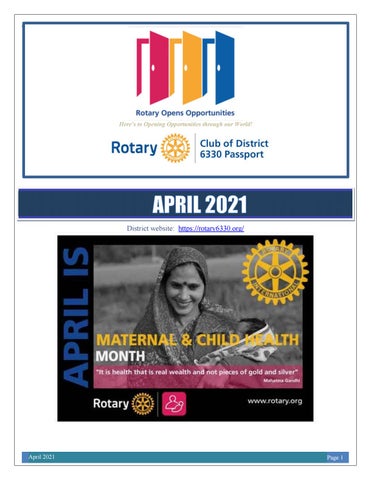
ROTARY’S APRIL FOCUS ON MATERNAL & CHILD HEALTH What can we do to focus on Maternal & Child Health? Every day mothers risk their lives giving birth, and millions of children die each year from treatable, preventable causes. At least 7 million children under the age of five die each year due to malnutrition, poor health care, and inadequate sanitation. To help reduce this rate, we provide immunizations and antibiotics to babies, improve access to essential medical services, and support trained health care providers for mothers and their children. Our Rotary projects ensure sustainability by empowering the local community to take ownership of health care training programs.
Key facts In 2019 an estimated 5.2 million children under 5 years died mostly from preventable and treatable causes. Children aged 1 to 11 months accounted for 1.5 million of these deaths while children aged 1 to 4 years accounted for 1.3 million deaths. Newborns (under 28 days) accounted for the remaining 2.4 million deaths. An additional 500,000 older children (5 to 9 years) died in 2019. Leading causes of death in children under-5 years are preterm birth complications, birth asphyxia/trauma, pneumonia, congenital anomalies, diarrhoea, and malaria, all of which can be prevented or treated with access to simple, affordable interventions including immunization, adequate nutrition, safe water and food and quality care by a trained health provider when needed. Older children (5-9 years) had one of the largest declines in mortality since 1990 (61%), due to a decline in infectious diseases. Injuries (including road traffic injuries and drowning) are the leading causes of death among older children. Click here to read more.
COVID-19 could reverse decades of progress toward eliminating preventable child deaths The number of global under-five deaths dropped to its lowest point on record in 2019 – down to 5.2 million from 12.5 million in 1990, according to new mortality estimates released by UNICEF, the World Health Organization (WHO), the Population Division of the United Nations Department of Economic and Social Affairs and the World Bank Group.
April 2021 , 2020
Page 8
The fact that today more children live to see their first birthday than any time in history is a true mark of what can be achieved when the world puts health and well-being at the centre of our response,” said Dr. Tedros Adhanom Ghebreyesus, WHO Director-General. “Now, we must not let the COVID-19 pandemic turn back remarkable progress for our children and future generations. Rather, it’s time to use what we know works to save lives, and keep investing in stronger, resilient health systems.” With the number of under-five deaths at an all-time recorded low of 5.2 million in 2019, disruptions in child and maternal health services due to the COVID-19 pandemic are putting millions of additional lives at stake. Since then, however, surveys by UNICEF and WHO reveal that the COVID-19 pandemic has resulted in major disruptions to health services that threaten to undo decades of hard-won progress. Click here to read more.
Global response: Sustainable Development Goal 3.2.1 The Sustainable Development Goals (SDG) adopted by the United Nations in 2015 were developed to promote healthy lives and well-being for all children. The SDG goal 3.2.1 is to end preventable deaths of newborns and under-5 children by 2030. There are two targets: 1. Reduce newborn mortality to at least as low as 12 per 1 000 lie births in every country 2. Reduce under-five mortality to at least as low as 25 per 1 000 lie births in every country.
April 2021 , 2020
Page 9
BRIEF ROTARY HISTORY – FIGHTING POLIO INTRODUCTION Thanks in large part to the urgings of the Pan American Health Organization and Rotary International, the World Health Assembly of the WHO launched the Global Polio Eradication Initiative (GPEI) in 1988 when it was estimated that 350,000 children were still being paralyzed by polio each year. There are between 200 and 2,000 asymptomatic infections for every symptomatic case of paralytic polio. Accordingly, in 1988, there were probably at least 70 million cases of wild poliovirus (WPV) infection being transmitted annually throughout the world, and 125 countries were considered to have ongoing circulation of indigenous WPV. A decade later, in 1998, the number of clinically recognizable cases of polio had dropped by 95%, the region of the Americas was polio-free, and the Western Pacific and European regions were almost polio-free. Type 2 WPV was eliminated globally the following year in 1999. Pan American Health Organization led the way by achieving polio-free status for the Americas in 1994, leaving the remainder of cases primarily in sub-Saharan Africa and parts of Asia. To accelerate the eradication of WPV in Africa and Asia, mass vaccination campaigns were initiated in the mid-1990s. At that time, the standard four doses of oral polio vaccine (OPV) given at birth and at 6, 10, and 14 weeks of age were considered sufficient to ensure immunity, and expert opinion led to the strategy of adding a few doses per year in mass campaigns in places where routine immunization coverage was low. This would presumably create the herd immunity needed to provide protection against transmission of WPV. These mass campaigns also had the added benefit of supplanting the endemic WPV with the live attenuated vaccine virus in the general population, thereby providing both direct and indirect exposure to the attenuated vaccine virus. The strategy was both simple and visionary, and it succeeded in interrupting the transmission of WPV in most countries—but not all. A great many non-governmental organizations (NGOs), including CORE Group members, participated in these early campaigns in the 1990s by providing logistical and mobilization support at the provincial, district, and community levels where they were already actively implementing health projects unrelated to polio. Click here to read more. Click here for a short video about the early days of polio in the 20th Century.
April 2021 , 2020
Page 10
LOOKING AHEAD in D6330
APRIL 24 D6330 Environment Day. April 24, 2021, we are asking every club to participate in celebrating Rotary’s 7th avenue of service, “Supporting the Environment” in your area. The District Conference committee is working with Associate Professor Stephan Vachon and students that are part of the Centre for Environment and Sustainability at Western University. We will provide each club different options to participate on this special day, no matter what COVID-19 19 restrictions are in place.
It were not best that we should all think alike; it is difference of opinion that makes horse races. -- Mark Twain There never were in the world two opinions alike, no more than two hairs or two grains; the most universal quality is diversity. -- Michel de Montaigne
April 2021 , 2020
Page 11
JUNE 5 50 Years of Youth Exchange. June 5, 2021, we will be celebrating 50 years of Youth Exchange virtually connecting with past students, their families, host families, and other Rotarians current and past that have been part of Rotary’s youth exchange program. Join us on June 5, 2021, in celebrating 50 years of Rotary Youth Exchange in District 6330! It's an opportunity for D6330 RYE alumni, Rotarians, and host families to celebrate, reconnect, and catch up.
Click here to register!
April 2021 , 2020
Page 12
MAY 26
SEPTEMBER 25
…A message from PDG Tony Sheard I have recently received a number of questions from across the District on how best to respond over diversity and racism in these uncertain times.
April 2021 , 2020
Page 13
At the RI Virtual Conference recently President Mark Maloney Rotary’s reminded all Rotarians that our core values are the bedrock of our organization: Fellowship
Integrity
Leadership
Service
Diversity
He went to say: “We must become better listeners and be more openminded learners” and he urged “all clubs to hold a mirror to ourselves and ask if our membership and club experience reflects the diversity of our communities…. wherever we come up short we must be willing to correct our course and face the challenge without fear or hesitation.” Many of you will recall I specifically highlighted the importance of integrity and diversity during my club visits in 2019. The Rotary International’s position is very clear, and was recently reinforced by the issue of the following statement: “At Rotary, we have no tolerance for racism. Promoting respect, celebrating diversity, demanding ethical leadership, and working tirelessly to advance peace are central tenets of our work. We have more work to do to create more just, open, and welcoming communities for all people. We know there are no easy fixes and that challenging conversations and work lie before all of us. Rotary’s strength has long been our ability and commitment to bringing people together. We will tap into that strength now as we stand with those who are working for peace and justice. Rotary will do our part to listen, learn and take action to ensure that we continue to contribute to making positive change.” Some clubs in the USA have publicly endorsed this statement and written to the editors of the local media to illustrate Rotary’s position in their communities. As clubs look to update their club’s strategic plans in the coming months, I recommend all clubs to take Mark Maloney’s advice and hold a mirror to ourselves. If we are to achieve a richer culture, rich in contrasting values, we must recognize the whole gamut of human potentialities, and so weave a less arbitrary social fabric, one in which each diverse human gift will find a fitting place. -- Margaret Mead Man has affinity for his fellowman, regardless of race, creed, or politics, and the greater the variety, the more the zest. All friendliness needs is a sporting chance; it will take care of itself in any company.
PDG Tony Sheard (2019-20)
-- Paul P. Harris
April 2021 , 2020
Page 14
ROTARY’S THEME FOR 2021-22
By diversity, we mean the presence of a people from all backgrounds, cultures, experiences, and identities. By equity, we mean the striving for the fair treatment of, opportunities for, and the advancement of all Rotary participants. By inclusion, we mean the ability to create experiences and foster environments in which all people feel welcome, respected, and valued.
THE ROTARY FOUNDATION
The Rotary Foundation (Canada) is an official associate foundation of The Rotary Foundation of Rotary International. We make a living from what we get; we make a life from what we give. -- Winston Churchill
April 2021 , 2020
Page 15
UPDATE ON POLIO ERADICATION
Summary of new WPV and cVDPV viruses this week (AFP cases and ES positives): o o o o o o o
Afghanistan: one WPV1 and four cVDPV2 positive environmental samples Pakistan: three WPV1 and four cVDPV2 positive environmental samples Côte d’Ivoire: two cVDPV2 positive environmental samples Liberia: one cVDPV2 positive environmental sample Niger: one cVDPV2 positive environmental sample South Sudan: three cVDPV2 cases Tajikistan: two cVDPV2 cases and two cVDPV2 positive environmental samples
POLIO PARTNERS
For more information, click here - http://polioeradication.org/polio-today/polio-now/this-week/
Click here to learn the difference between Wild Polio Virus (WPV) and Vaccine-derived Polio Virus. (VDPV)
April 2021 , 2020
Page 16
A vaccine against a type of polio that is spreading in the Southern Hemisphere is expected to receive emergency approval before the end of the year. If it does, it will be the first time the World Health Organization has steered an unlicensed vaccine or drug through its emergency listing process. Wild polio has been almost eradicated. Only two countries — Afghanistan and Pakistan — still report cases. But a version of the virus that arose naturally from the weakened polio virus used in vaccination is increasing, What is called circulating vaccine-derived poliovirus (cVDPV) is increasing in both Afghanistan and Pakistan, as well as in the Philippines, Malaysia, Yemen and 19 African countries — with Chad, the Democratic Republic of the Congo and Côte d’Ivoire the worst affected in Africa. So far in 2020, there have been more than 460 cases of vaccine-derived polio worldwide. This is more than 4 times the number detected by this time in 2019, which is a major problem for the 32-year, US$17-billion global campaign to wipe out the disease. Researchers who model polio infections say that for every known case, there are about 2,000 infections in the population.
“Millions of people potentially have no immunity to the vaccine-derived virus, and that’s why we’re very concerned,” says Kathleen O’Reilly, an epidemiologist at the London School of Hygiene and Tropical Medicine who models polio infections. Independent scientific advisers to the World Health Organization (WHO) have been assessing a vaccine that is designed specifically to protect against cVDPV. This vaccine, a decade in the making, has been tested for safety and efficacy, but is not yet licensed and still has to undergo further trials. The WHO is in the last stages of considering whether to approve it more quickly, under what is called an emergency-use listing — a procedure that was created during the 2014–16 Ebola outbreak in West Africa, and which the agency is also
preparing to use for coronavirus vaccines. Click here to read more.
2021 Taipei Rotary International Convention WILL BE VIRTUAL
April 2021 , 2020
Page 17
PN: President Knaack, thank you for taking the time to speak to us. A little more than a year into the global COVID-19 pandemic, what is your take on the current situation, also with a view of the global effort to eradicate polio? HK: There are many interesting lessons we learned over the past 12 months. The first is the value of strong health systems, which perhaps in countries like mine – Germany – we have over the past decades taken for granted. But we have seen how important strong health systems are to a functional society, and how fragile that society is if those systems are at risk of collapse. In terms of PolioPlus, of course, the reality is that it is precisely children who live in areas with poor health systems who are most at risk of contracting diseases such as polio. So everything must be done to strengthen health systems systematically, everywhere, to help prevent any disease. The second lesson is the value of scientific knowledge. COVID-19 is of course a new pathogen affecting the world, and there remain many unanswered questions. How does it really transmit? Who and where are the primary transmittors? How significant and widespread are asymptomatic (meaning undetected) infections and what role do they play in the pandemic? And most importantly, how best to protect our populations, with a minimum impact on everyday life? These are precisely the same questions that were posed about polio in the 1950s. People felt the same fear back then about polio, as we do now about COVID. Polio would indiscriminately hit communities, seemingly without rhyme or reason. Parents would send their children to school in the morning, and they would be stricken by polio later that same day. Lack of knowledge is what is so terrifying about the COVID-19 pandemic. It also means we are to a large degree unable to really target strategies in the most effective way. What polio has shown us is the true value of scientific knowledge. We know how polio transmits, where it is circulating, who is most at risk, and most importantly, we have the tools and the knowledge to protect our populations. This knowledge enables us to target our eradication strategies in the most effective manner, and the result is that the disease has been beaten back over the past few decades to just two endemic countries worldwide. Most recently, Africa was certified as free of all wild polioviruses, a tremendous achievement which could not have been possible without scientific knowledge guiding us. So while we grapple for answers with COVID, for polio eradication, we must now focus entirely on operational implementation. If we optimize implementation, success will follow.
April 2021 , 2020
Page 18
And the third lesson is perhaps the most important: we cannot indefinitely sustain the effort to eradicate polio. We have been on the ‘final stretch’ for several years now. Tantalizingly close to global eradication, but still falling one percent short. In 2020, we saw tremendous disruptions to our operations due to COVID-19. We never know when the next COVID-19 will come along, to again disrupt everything. Last year, the polio program came away with a very serious black eye, so to speak. But we have the opportunity to come back stronger. We must now capitalize on it. We know what we need to do to finish polio. We must now finish the job. We must all recommit and redouble our efforts. If we do that, we will give the world one less infectious disease to worry about once and for all. PN: You recently called on the Rotary network worldwide to use its experiences from PolioPlus in supporting the COVID-19 response. Could you elaborate on that? HK: We have a global network of more than 1.2 million volunteers worldwide. This network has been consistently and systematically utilized to help engage everyone from heads of state to mothers in the most remote areas of rural India for polio eradication. We have helped secure vaccine supply and distribution, and increased trust in vaccines among communities. In the process, we have learned many lessons on what it takes to address a public health threat and these same lessons now should be applied to the COVID-19 response, especially as vaccines are now starting to be rolled out. That is why I thought it was important to call on our membership network to use their experiences and apply it to the COVID-19 response. Click here to read more about this interview.
Where talents and the needs of the world cross, therein lies your vocation. -- Aristotle Never become so much of an expert that you stop gaining expertise. View life as a continuous learning experience. -- Denis Waitley The greatest reward for doing is the opportunity to do more. -- Dr. Jonas Salk
April 2021 , 2020
Page 19
Interact Club Launches Labdoo Hub to Equip Schools, Divert E-Waste Key Biscayne, Florida (USA), March, 2021. Undaunted by the pandemic, 17-year-old Eric Vives inspired his Interact Club at MAST Academy in Miami to embrace a quest to provide curriculum to schools worldwide and divert e-waste. They’re doing it as a hub for Labdoo.org, a non-profit global collaborative network that makes it easy for people to donate computers and tablets they are no longer using. After personal data are deleted and operating systems updated, Labdoo volunteers add a trove of educational resources that fit the needs of the requesting schools, and get volunteers who are already traveling in the direction of the recipient school to carry them, minimizing the project’s carbon emissions. Living on Key Biscayne, an island in South Florida, “we know the ramifications of global warming,” Eric explains. The project is a perfect fit for MAST, a public magnet school which specializes in maritime studies, science and technology, and environmental awareness. Shown below: MAST Interact Club members Rachel Bass, Eric Vives, and Tomás Martinez. Labdoo.org was created in 2010 by Jordi RosGiralt, a computer scientist in Barcelona, Spain who holds a PhD and MBA from the University of California. Labdoo.org is a 100% volunteer-run network of donors, travelers, and schools. Together they have already provided devices to over 600,000 students in 2,000 schools across 135 countries. Several participating sites serve refugees. “A child in India could be brilliant, but without the opportunities, the next Einstein could be lost, affecting not only him, but humanity,” Eric says. “A child in Yemen could discover civil engineering and go on to develop housing for people in poverty.” The dedication of Ghanaian refugee Ousman, whose non-profit partners with Labdoo to equip schools in Ghana, is one of the stories that moved Eric to propose the project to his Interact Club. Read more here.
April 2021 , 2020
Page 20
Click here to read about projects that are looking for partners.
The above statement should say more accurately “With B.R.E.W. we get Clean Water.” Over the past four years, the Rotary Fellowship Beer Rotarians Enjoy Worldwide (B.R.E.W.) has donated $18,000 to support clean water projects through the WASH Rotary Action Group. At the 2021 Rotary International Virtual Convention in Taipei, Taiwan, B.R.E.W. plans to make another generous donation to the WASH Rotary Action Group.
April 2021 , 2020
Page 21
On its website RotaryBREW.org describes the mission of its Rotary Fellowship. They aim to foster and encourage fellowship between and among Rotarians of all nations who have love Beer. Through this Fellowship, they support international projects of the Rotary Foundation. Annual membership of $20 USD, or lifetime membership of $100 USD. Steven Lack, B.R.E.W. Vice-Chair, Rotary Club of Pleasant Hill, California, tells the story: in 2013 as District Governor his district undertook the project to provide water wells to five villages in the country Burkina Faso in West Africa. In the following year, he visited one of the villages and villagers had used some of the clean water to brew beer. That is when he realized clean water and beer were universal. In 2016, Arnold R. Grahl, Rotary International Journalist, wrote an article for the Rotary News called “All You Need to Know About Beer and Clean Water” If you enjoy a beer, warm or cold, consider joining this dynamic Rotary Fellowship and in turn, support clean water projects.
BREW donates to WASH Rotary Action Group
April 2021 , 2020
Page 22
We are a network of Rotarians throughout the world who have a special interest in acting upon the mission and goals of Rotary International related to • • •
Alleviating illiteracy Enhancing literacy teaching and learning globally Helping to provide materials and equipment for literacy education at different levels
Like all Action Groups, it is an autonomous association of like-minded Rotarians, partners of Rotarians, and Rotaractors working in partnership with Clubs and Districts on literacy projects of mutual concern.
World Literacy Day is September 8. Click here to learn more.
April 2021 , 2020
Click here for a presentation on world literacy.
Page 23
March 9, 2021 FOR IMMEDIATE RELEASE Today, Rotary International, World Vision, and the Bill & Melinda Gates Foundation announced the launch of Rotary’s first Program of Scale, Partners for a Malaria-Free Zambia, a $6 million investment to train, equip and deploy Community Health Workers in Zambia. This program will scale up Rotary’s successful work in the Copperbelt Province to reduce malaria by 90% in two additional Zambian provinces.
Bill Feldt and Steve Bell, President of the RC of Federal Way at the Rotary International Programs of Scale signing ceremony.
Led by the Rotary Club of Federal Way (WA), the program will benefit over 1.3 million Zambians and bring together Rotary clubs across the U.S. and Zambia to provide community-based education, testing, and treatment for malaria.
“By empowering CHW volunteers, the project connects people in areas with little to no access to health care with trusted members of their community who can test for and treat malaria,” says Bill Feldt, a member of the Federal Way Rotary Club. Fighting malaria has long been a priority for the Federal Way club. For more than 10 years, members have been working with international partners, including Zambian Rotary clubs, Malaria Partners Zambia, Malaria Partners International, PATH MACEPA, Zambia’s National Malaria Elimination Centre, World Vision, and the Bill & Melinda Gates Foundation. Malaria is a formidable foe. It is responsible for 50% of all infant deaths and 20% of all maternal deaths in Zambia. Partners for a Malaria-Free Zambia will strengthen the national health system by working closely with local health officials and health facility staff. Most significantly, it will train and equip 2,500 Community Health Workers (CHWs) to test, diagnose, and treat malaria in their communities. Click here to read more.
When it comes to global health, there is no “them” – only “us.” -- Global Health Council
April 2021 , 2020
Page 24
ROTARY’S CORE VALUES
April 2021 , 2020
Page 25
Passport Clubs differ from e-clubs in that members live within a defined geographical region – in this case, District 6330. If you think this new style of Rotary club might be a good fit for you - reach out!
When someone asks you What is a Passport Club? The District 6330 Passport Club is a new format of Rotary Club; one where the structure better suits the lives of those who maybe can’t meet on a weekly basis or make significant financial contributions but who still have a passion for what Rotary does best; doing good. To facilitate this, the 6330 Passport Club conducts business electronically and offers several in-person opportunities per year. In lieu of weekly meetings, members are encouraged to engage in humanitarian service, however that works best for them! The founding principle is simple: Make Rotary fit your life! The Rotary District 6330 Passport Club members are full Rotary members, with the same privileges and rights as Rotarians who are members of traditional clubs.
Do you need a make-up? missed meetings? Here is a list of online clubs where you can earn a make-up along with learning a whole lot more about Rotary! Why not visit them all? • • • • •
Rotary E-Club of Canada One – Rotary On Demand, Where you want, When you want Rotary Club of One World Rotary E-Club of World Peace District 6330 Noon Zoom from January, 2021 – Topic Cyber Security! District 6330 Foundation Webinar – January 20, 2021
April 2021 , 2020
Page 26
From Lynn Coates – Service Opportunities City-wide bottle drive in London As your Area 4 representative for our club, I have a request for volunteers as follows for the city-wide bottle drive.
Treasurer Lynn
With COVID, I know our U.S. members will not be able to help, but for the rest who are close by, if you have the time, that would be great. All Covid protocols will be in place :)
Date
Where
April 3
Ice House
April 3
London Club Site, 17 York Street Sutherland Elliott Insurance Bldg.
Volunteers required To assist at the Ice House sorting bottles. All the bottles/cans will be collected here. To assist with sorting. This is one of the drop-off sites.
Tree planning assistance. I will also be sending out requests for the tree planting day assistance April 24 (D6330 Environment Activity), once I get all the information from the clubs that are doing this for their Environment Day projects. Rainbarrel Fundraiser. London Hyde park is organizing the sale of Rain Barrels for their environmental project. No assistance is needed for this as the company does all the work :) So, if you or someone you know, needs a new rain barrel, it’s a win-win for everyone. A portion of sales is going to the Hyde Park club. Here is the info sent to me by their organiser. Click the link below for further information.
April 2021 , 2020
Page 27
Now for a little inspiration – Have a look at this short video! https://www.youtube.com/watch?v=H9S3n_tILKo&t=344s
I
Don’t forget our Happy Chats – get to know our club members! Join the Happy Chats – get to know our club members! Happy Chats are online every Saturday and Wednesday. Saturdays at 1:00 p.m. - 1:30 p.m. Join your Rotary friends for an informal 30 minute get together. Wednesdays at 6:30 p.m. - 7:00 p.m. Join our Zoom Meetings
April 2021 , 2020
Page 28
U.N. INTERNATIONAL DATES TO NOTE April 2 World Autism Awareness Day April 7 International Day of Reflection on the 1994 Genocide against the Tutsi in Rwanda World Health Day April 22 International Mother Earth Day April 24 International Day of Multilateralism and Diplomacy for Peace April 25 World Malaria Day
ROTARY’S AREAS OF FOCUS
It has been the way of Rotary to focus thought upon matters upon which members are in agreement, rather than upon matters in which they are in disagreement. -- Paul P. Harris
April 2021 , 2020
Page 29
SO MANY REASONS FOR MEMBERSHIP So many motives to consider becoming a Rotarian! Some of the most notable reasons to love Rotary: 1. Warm Fellowship. Being a Rotarian means having the opportunity to experience the warm fellowship of a Rotary Club which can greatly expand one’s circle of acquaintance, foster lifelong friendships, and help one do for their community what they might not be able to accomplish alone. 2. Business Development. One of the original reasons for Rotary’s beginning is business development; Rotary is a cross-section for the business community and great for networking! 3. Personal growth. Personal growth & development through human relations, service projects, and local & international commitments. 4. Value to your community. Improves one’s citizenship in the community through involvement and service. 5. Staying informed. Staying informed and up to date on current events. We often host guest speakers at our meetings that provide us with education and keep us informed about what is going on in the community, our nation, and the world. 6. FUN! 7. Global citizenship. Every Rotarian is welcome - encouraged even - to attend any of the 29,000 clubs in 194 nations and geographic regions. Instant friends worldwide! 8. World’s first service club. Rotary is comprised of a lot of prominent members who are leaders in business, military, art, and more. It is the oldest and most prestigious service club in the world. 9. You are welcome! It is an open club - no secret handshake, no secret policy, and no official creed. Rotary welcomes anyone who believes in helping others. 10. Service above self. Perhaps the best reason for becoming a Rotarian - our business is humankind & our product is service.
April 2021 , 2020
Page 30
WORLD IMMUNIZATION WEEK – last week of April …celebrated every year in the last week of April – The World Health Organization (WHO) aims to promote the use of vaccines to protect people of all ages against disease. Immunization saves millions of lives every year and is widely recognized as one of the world’s most successful health interventions. Yet, there are still nearly 20 million children in the world today who are not getting the vaccines they need, and many miss out on vital vaccines during adolescence, adulthood and into old age. Using the theme “Vaccines bring us closer,” World Immunization Week 2021 will urge greater engagement around immunization globally to promote the importance of vaccination in bringing people together, and improving the health and wellbeing of everyone, everywhere throughout life. As part of the 2021 campaign, WHO, partners, and individuals around the world will unite to: • •
Increase trust and confidence in vaccines to maintain or increase vaccine acceptance Increase investment in vaccines, including routine immunization, to remove barriers to access
While the world focuses on critically important new vaccines to protect against COVID-19, there remains a need to ensure routine vaccinations are not missed. Many children have not been vaccinated during the global pandemic, leaving them at risk of serious diseases like measles and polio. Rapidly circulating misinformation around the topic of vaccination adds to this threat. In this context, this year’s campaign will aim to build solidarity and trust in vaccination as a public good that saves lives and protects health. To this end, we will be looking for more partners to join us, bringing people together in support of a lifesaving cause. Vaccines have brought us closer, and will bring us closer again. For over 200 years, vaccines have protected us against diseases that threaten lives and prohibit our development. With their help, we can progress without the burden of diseases like smallpox and polio, which cost humanity hundreds of millions of lives. Whilst vaccines aren't a silver bullet, they will again help us progress on a path to a world where we can be together again. Vaccines themselves continue to advance, bringing us closer to a world free from the likes of TB and cervical cancer, and ending suffering from childhood diseases like tetanus and measles. Investment and new research is enabling ground-breaking approaches to vaccine development, which are changing the science of immunization forever, bringing us closer still to a healthier future. Our campaign page will be up and running shortly so stay tuned for more information. Click here for the source and to read more. Click here to view a short video about how to understand vaccine efficacy.
April 2021 , 2020
Page 31
April 2021 , 2020
Page 32
In a world where you can be anything, be KIND!
2021-22 Rotary Theme
April 2021 , 2020
Page 33
See our Passport Club Facebook page for more up-to-the-minute Passport news!
https://www.facebook.com/rotary6330passport/
THE ROTARY FOUNDATION - EREY
The Every Rotarian, Every Year (EREY) initiative encourages all Rotary club members to contribute at least $100 USD every year to help us reach our goal to support the Rotary Foundation financially each year. One who contributes $100 USD every year is a Sustaining Member.
April 2021 , 2020
Page 34
A VISUAL OF ROTARY DISTRICT 6330
After cancelling our 2020 international convention in Honolulu due to the COVID-19 pandemic, we are proud to announce that we will visit the Aloha state when we host our 118th convention in Honolulu on June 5 – 9, 2027. Learn more about our upcoming conventions: https://on.rotary.org/2Nhhquz
April 2021 , 2020
Page 35
A LITTLE HUMOUR
https://www.youtube.com/watch?v=dKeqaDSjy98
April 2021 , 2020
Page 36
SUPPORT OUR SPONSORS!
April 2021 , 2020
Page 37
********* REFERENCES
Adams, Randal. Speaking of Rotary. E.J. Press, U.S.A. 2007. Chapman, Mary. Growing Rotary. A Personal Collection of Ideas That Worked. Dochterman, Cliff. The ABCs of Rotary. Evanston, Illinois: Rotary International. (363-EN) Forward, David C. A Century of Service. The Story of Rotary International. (912-EN) Rotary Club of Hobart. The Rotary Book of Readings. Inspiration to Change the World. Rotary International. Honoring Our Past: The Words and Wisdom of Paul Harris. Evanston, Illinois: 1996. (925-EN) Rotary International. Rotary Basics. Evanston, Illinois. (595-EN) Rotary International News. Online. Rotary Global History Fellowship <https://www.facebook.com/RotaryGlobalHistoryFellowship/ > Submissions from Club members and Social Media Please send Club News and photos (with appropriate IDs) to Kitty at ladykitt@gmail.com
April 2021 , 2020
Page 38