LADUE HORTON WATKINS HIGH SCHOOL 1201 S. WARSON RD. ST. LOUIS, MO 63124
PANORAMA NEWSMAGAZINE
MAY 2026
VOL. 75, ISSUE 9
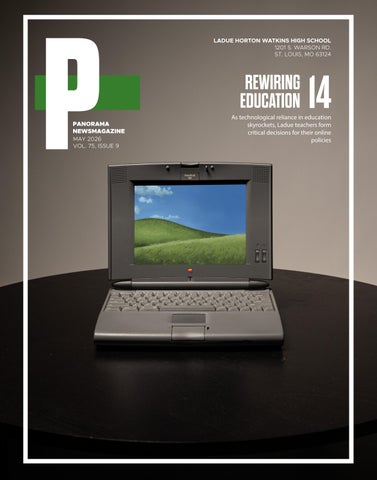
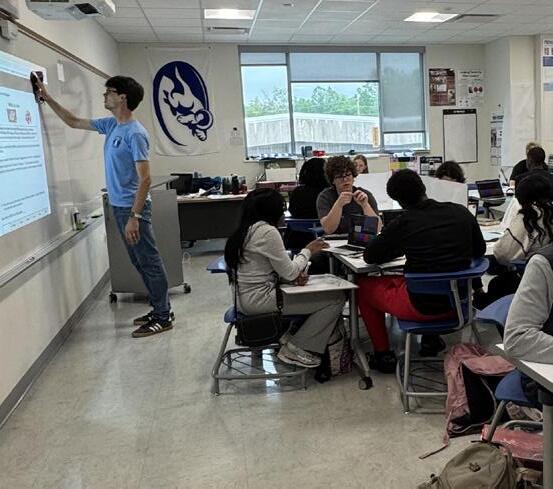
As technological reliance in education skyrockets, Ladue teachers form critical decisions for their online policies
Photo by Gabriella Beltranena
Photo by Sarmistha Pulagam
Editorial Policy
Ladue Media is an open forum for students at Ladue High School. In order to ensure the news we report is accurate, important and relevant to our students, we do not operate under prior review. All content decisions are made by student editors.
Scan to view our full Editorial Policy
Editor’s Note
EDITORS-IN-CHIEF
Madeline Fong
Isaac Zelinske
DESIGN EDITOR
Margaret Myckatyn
COPY EDITORS
Sophie Cowlen
Nathan King
INFOGRAPHIC EDITOR
Loukya Gillella
PHOTOGRAPHERS
Sarmistha Pulagram
Teo Lee
NEWS STAFF
Sydney Gao
Elsa Flores-Tamayo
Emily Pan
FEATURES STAFF
Medha Chode
Jane Scheffel
Gabriella Beltranena
Ryan Nolan
I remember whenever I would get hurt as a kid, my father would tell me that struggle was good for me and it would make me stronger, so I should stop crying. I imagine this is the same principle teachers operate under when they strip us students of our shiny new laptops and replace them with old fashioned papers and pencils, forcing us to handwrite notes, or god forbid, complete a worksheet! We poor students may miss our easy Google searches, quickly typed notes and AI assistants, but peeling our eyes from screens every once in a while may carry some important benefits.
While technology has made education accessible for millions of students, our reliance and constant use of it has brought up some concerns of health from
Ladue Media Staff
IN-DEPTH STAFF
Emery Mao
Angella Zhang
Henry Madden
OPINIONS STAFF
Amelie Lock
Adelaide Flintrop
Claire Zhang
ARTS & ENTERTAINMENT STAFF
Tiya Kaul
Caroline Cobaugh
Cami Welsh
HEALTH & SPORTS STAFF
Josie Stout
Irene Murphy
Ellie Lercher
ARTIST
Joyce Li
ADVISERS
Abigail Eisenberg
Sarah Kirksey
both teachers and students – concerns which we sought to address and give a voice to in this month’s In-Depth, “Rewiring Education,” in order to hopefully give you a new perspective, and some important information, on the positives and negatives of technology use in a student’s life as well as its place as a tool within education.
In addition to this we are covering the renovations happening to the high school over the summer to accommodate for the increasing student population, a feature on the VEX Robotics team and their recent performance at worlds, an infographic on the importance of sunscreen and protection from skin cancer and finally, updates on the spring sport’s season along with a sports feature story on a member of the varsity boys golf team.
Our May issue wraps up another year of the Panorama publication. On behalf of all of Ladue Media, thank you for supporting us, and have an amazing summer!
Madeline Fong Isaac Zelinske
SPONSORS
SPONSORS
Issue
David Von Allmen
Nicholas Reding
Profusion Private Asset Fund
The Demkovitch Family
Ladue Blue
Allison and Terence Myckatyn
Bruce and JoAnne Vieweq
Donna Freeman and Mike Heyne
Ed Tanyag
Katie Myckatyn
Mr. and Mrs. Charles Cobaugh
The Awad Family
The Chode Family
The Derdoy Family
The Devine Family
The Fong Family
The Kaul Family
The King Family
The Lock Family
The Nolan Family
The Pan Family
The Pisarkiewicz Family
The Stout Family
The Strauss Family
The Warwick Family
The Zwibelman Family
Theresa Tanyag
Wendy Tinnin
Gold
Anonymous
Arti Jain
Desta Gingrich
Jean Hayne
Kurtis and Katie Van Allen
Lillian Jansen
Mark Heyne and Rachel Abroms
Michael & Jamica Johnson
Mike and Elaine Stout
Ms. A Jansen
Ms. Elizabeth Welsh
Pam and Matt Cobaugh
The Cummings Family
The Jansen Family
The Liu Family
The Mathew Family
The Tenenbaum Family
The Witt Family
The Yeoh Family
The Zhao Family
The Zhou Family
“Uncle Blake” Baraks
Silver
Amy & Kevin Fischer
Anonymous
Bill and Cathy Scheffler
Bill and Sharon Hunn
Bremer Family
Gary & Shana Singer
Gillella Family
Hello Garage
John Gingrich
Juli and Bernie Plassmeyer
Kathy Bucholz
Laurie Family
Louise Flick & Bill True
Meera & Barry Bryant
Megan Gingrich
Mr. & Mrs. Brissette
MW Interiors
Myles Leonard
Pedro Beltranena
Sara Serati
Steve and Liz Van Allen
Tass Padavan
Taylor Stone
The Bowen Family
The Cormier Family
The Flores-Tamayo Family
The Gandra Family
The Gebrehiwet Family
The Guyton Family
The Haines Family
The Larrew Family
The Mayer Family
The Provine Family
The Scheffel Family
The Sheldon Family
The Solomon Family
The Turner Family
The Varvares Family
The Zotos Drobak Family
Friendly
Alena Tartouskaya
Amanda & Ryan Reagan
Amy Moglen
Anonymous
Anonymous Ladue Alumni
Berman Chiropractic & Wellness
Candice Bellinger
Clarissa Joyce
Edward Zhang
Ella Bender
HaugenHaus.com
Johnny Zhang
Julie Walther Scheibel
Lindsay Turner
Matthew Kweon
Mohamad Yaacob
Nancy Scheberle
Nithin Kumar Gattu
Olivia Cornelison
Salsbury Family
Shanthi Priya D
Sharon and Louis Hill
Sneha Vadlamudi
The Arora Family
The Choe Family
The Denman Family
The Ganni Family
The Gu Family
The Guthrie Family
The Hanes Family
The Hofer Family
The Lohse Family
The Mao Family
The Murphy Family
The O’Neal Family
The Pandian Family
The Poremba Family
The Reagan Family
The Rhodus Family
The Shi Family
The Silver Family
The Swillinger Family
The Taylor Family
The Wang Family
The Yang & Zhang Family
Tim Armstrong
Venkata Pulagam
Vivek Manohar
Walton Family
Will Kodner
Yan Sun
Zhenyi Liu
Zia Mahmood
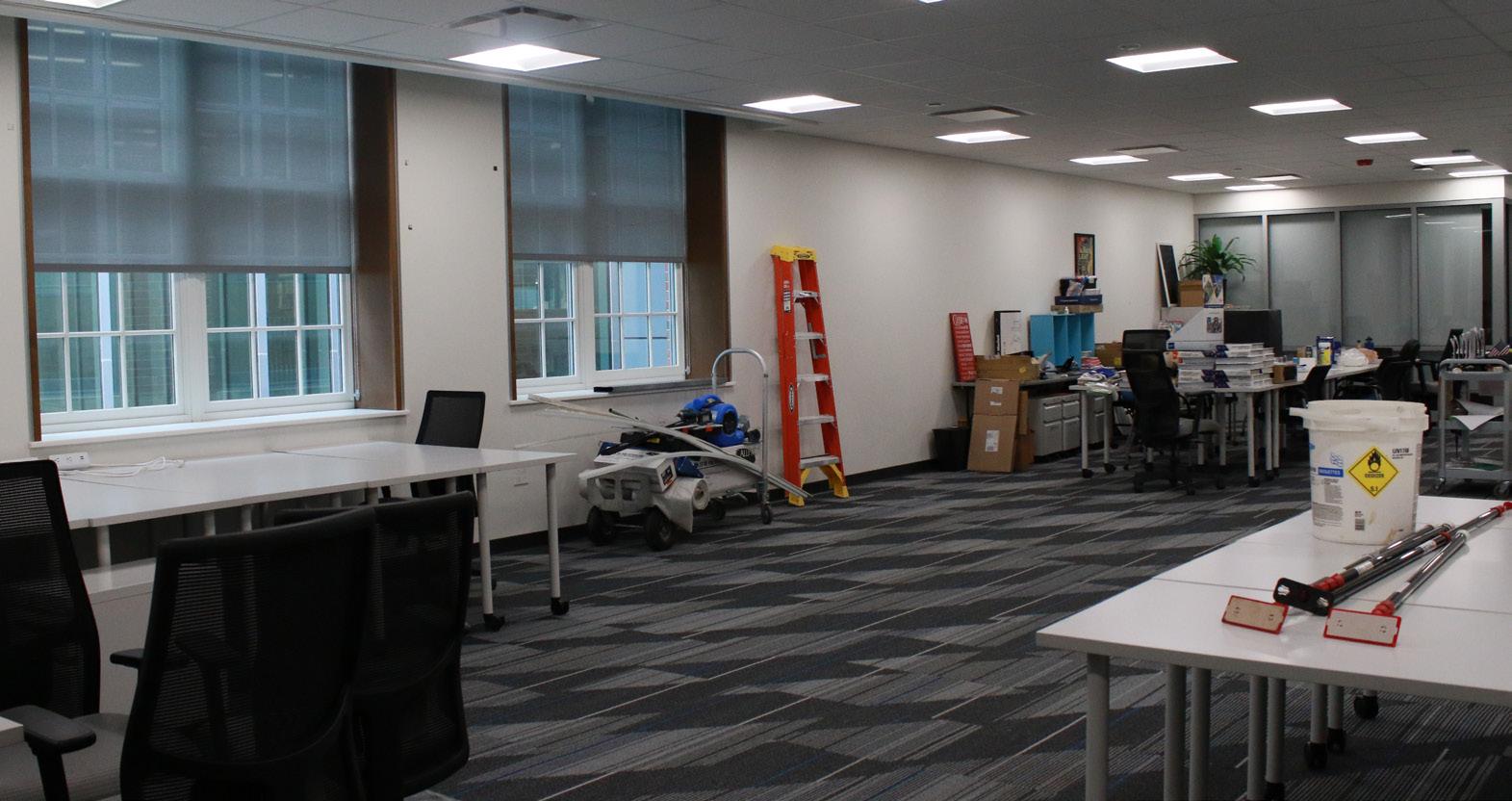
Staff lounges are being thoroughly cleared out in preparation for the upcoming building renovations. Staff members began the cleaning out process in early spring. “There are administrators and support staff members on 12 month contracts, who have to figure out what that looks like and where we are going to go,” Griffith said. “It is not difficult now with computers; we can simply go to another building.”
SUMMER REFRESH
TTO PREPARE FOR THE upcoming school year, the high school began over-the-summer renovations at the end of April with the objective of completing construction before August.
The campus will have a new chilling tower for air conditioning, expanded instructional spaces and a revamped parking lot. These were planned to accommodate a the growth of the student population.
“Our numbers continue to increase,” Principal Brad Griffith said. “We are welcoming a large eighth
grade class, and are looking at ensuring that we have enough instructional space to meet those needs for our teachers.”
Proposed to teachers in August 2025, the blueprint for new classrooms was first evaluated with special use and capacity metrics.
“We started the process [by] talking with teachers,” Griffith said. “Part of that came to defining the need. We ran utilization percentages for every classroom and department full-time equivalent, then broke that down to look at our spaces.”
These statistics translated into daily classroom use and staffing numbers. Currently, the school relies on traveling teachers because the number of instructors exceeds the available classrooms.
“The classrooms have been in discussions this school year as far as what locations make the best use of available space,” Specialized Maintenance Technician Chip Thomsen said. “[New] classrooms will help teachers not have to transfer to dif-
RENOVATIONS
TIMELINE
1 2 Chilling tower installed at the end of June
Classroom renovations begin end of April
3 North parking lot overlayed in June and July
4 Renovations concluded before students return in August
ferent rooms for their classes each [school] day.”
To alleviate this, the administration is repurposing teacher spaces, which are currently underutilized in comparison to instructional areas.
“The factor was the ability to have the instructional space we need to meet the incoming class,” Griffith said. “While our staff lounges are wonderful, they are primarily used for meetings and lunch. [We thought], ‘Is there a way we can get creative with some space [to] expand our footprint with classrooms?’”
In terms of other renovations, the plan extends to the school’s core infrastructure with an emphasis on long-term sustainability and safety.
“A chilling tower essentially supplies all of our air conditioning,” Griffith said. “The parking lot [being] overlaid will benefit safety, and the pavement is not in great shape. Also, I think optically it will be nice. [We] have been toying around with the idea of landscaping to make it look more visually appealing.”
BY SYDNEY GAO staff
PHOTOGRAPHY BY GABRIELLA BELTRANENA photographer
Ladue High School begins summer construction to improve the campus
NEWS TO KNOW
BOARD UPDATE
SUPERINTENDENT MENTIONS
Patricia Brown was praised for her work with STEAM Fest on April 8 by Jim Wipke. Geoff Macy and board member Amy Hammerman advocated for the future of public education regarding House Bill 2780 and property taxes by traveling to Jefferson City a few days prior of the board meeting.
STUDENT RECOGNITION
Dhruv Rohatgi and Lucas He (6) were recognized as the 2026 Presidential AI Challenge state winners a in competition held by the White House April 13. They acheived this award because they created WebLiteracy.com to help their peers with the credibility of webpages.
FUTURE GOALS
A main goal was to increase student engagement in a classroom setting with encouragment. Specifically at the Fifth Grade Center, increasing grade level achievement by closing learning gaps. This could be done by getting 85% of students to grade level using academic interventions.
ELECTION RESULTS
Kisha Lee, Pablo Flinn and Peter Gariepy were sworn in as members of Ladue Schools Board of Education. They were also recognized for their continued commitment to serving the community. This comes after the board election, where there were four candidates up for election.
RAMS AROUND THE WORLD
BY EMILY PAN staff
Students share their cultures through food and performances
RAMS AROUND THE WOrld took place in Ladue High School’s multipurpose room and cafeteria Wednesday, April 29. During the event, students brought homemade meals and presented cultural performances to honor their country’s heritage.
“It is a great event where we can celebrate our diversity in the Ladue community,” Spanish teacher Haydee Taylor-Arnold said.
Rams Around the World has presented an opportunity to learn about other peoples’ cultures.
“It is an act of bonding [with others] because I get to meet and collaborate with other Chinese people like myself,” Nina Ye (11) said. “We can showcase our culture and our favorite parts of it to the Ladue community.”
Not only are students able to display their culture, but they also can participate in others.’
“This year I’m volunteering as a henna artist, so I can do henna,” Ye said. “I have worked at the China food stand in the past handing out boba, and it’s fun overall.”
Emery Mao (10), Emma Limpiphiphatn (11), Josh Gu (12) and Daniel Tang He (10) lion danced April 29 on the multipurpose room’s stage to honor their Chinese heritage.
(photo by Sarah Kirksey)
CURIOUS?
Scan to see the list of recipients
Ladue High School staff honored students for exemplifying values such as respect, self-discipline and responsibility April 24. Every teacher had the opportunity to nominate one student. “My favorite part about [the Ram Pride Awards] is an opportunity for teachers to recognize students, not just for academics, but for people that make a difference in their lives,” Assistant Principal Mike Tarpey said. “It’s [not] just that idea that we’re for an institution of higher learning, or that you’re smart, but because you’re kind.”
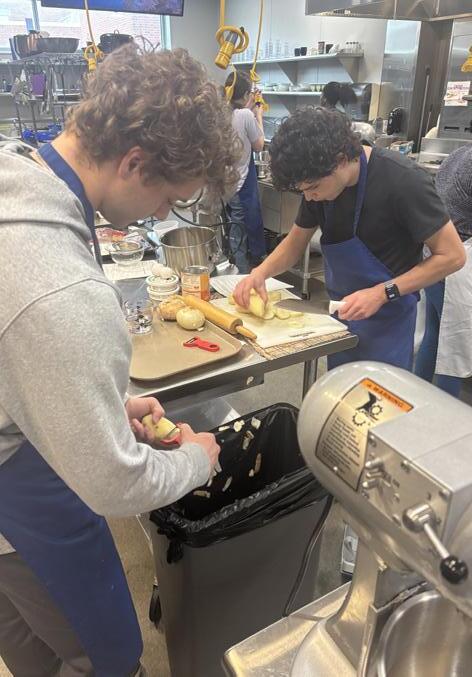
Tennyson Summers (12) peels potatoes for a Foods ll final project April 27. In this project, students prepared traditional family dishes. “My mom started making mashed potatoes every year for Thanksgiving,” Summers said. “It has become a staple food we always have.”
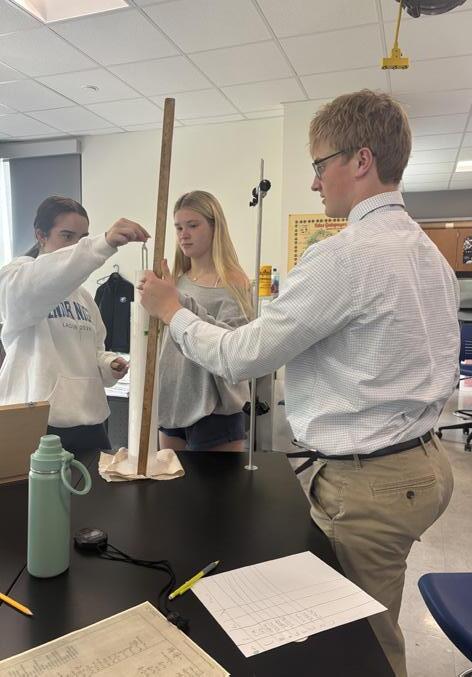
Liam Reeves (12) performs a physics lab April 27. In this lab, students learned how to measure the speed of sound of different notes using a tuning fork.
“I hope I will learn about sound,” Reeves said. “And also spark more of an interest in music for me because I really love music.”
CLASS COVERAGE
AP PREPARATION
“
Austin Ma (10)
“I do the online practice Mr. Miller provides us. I go back and review those questions, especially the ones I get wrong. I typically study for around two to three hours a day.”
Students describe how they are studying for their AP Exams
“Audrey Rickard (12)
“I have been completing the study guides that Dr. Rzeszutko has handed out. I have been doing practice multiple choice questions on AP Classroom.”
Riley Keltner has been teaching AP U.S. History for seven years. Along the way, she has gained experience with advising students for AP testing. “My advice would be to not get bogged down by the details,” Keltner said.
“Queena Xu (12)
“I have been preparing for my AP Psych exam by doing practice questions and reviewing my notes I have taken for this class. I have studied around two hours a week.”
“Focusing on the story of your class is important. For my class, we spend a lot of time looking at the major themes from our course. So that when they get to the test, they feel like ‘I can make a connection between this and this.’”
friends and fellow thespian, Vera Narghang (10), admires Fries’ theatrical talents.
“In theater I definitely [look up to her],” Narghgang said. “She’s a strong actor, a strong singer, a strong dancer and all things that I aspire to be.”
Throughout the troupe there is a culture of mutual respect between members. But this shared esteem isn’t just expressed through the high regard they speak about one another in, but also the actions they take in consideration for each other.
“One of my friend’s dad also got me flowers as well as her to support me. I thought that was just the sweetest thing. [The theater community] was just this support that I really needed from everyone, and I’m glad I found that.”
Since the theater community has given so much to Fries, she took on a leadership role in hopes to give back. Fries is one of four elected officers. The officers, Tripp Hoffman (12), Mina Farrow Prater (12), Grace Pinex (12) and Fries work to create a collaborative environment in the troupe.
“As officers we are there to serve the troupe and help it be the best it can be,”
Fries said. “It’s not like the officers are above everyone. We’re all working together, we just have different roles to play.”
To excel in her leadership positions Fries remains cheerful and collaborative with the members of her troupe. This makes other thespians she works with, like Narghang, feel at liberty to make artistic decisions during the creative process.
“[She adds] to the theater community through her positive attitude towards everything,” Narghang said. “She’s also a good leader, because she can lead, but allow people to do their thing as well, [which makes her] a good director.”
Fries’s theater journey has spanned over the majority of her life, and she plans for it to continue. It’s uncommon for someone this young to know exactly what they want to do with the rest of their life, but for Fries, the ability to voice her values through theater is a major factor in her choice.
“Being able to do so many shows I feel like I’ve gotten more experience being able to connect with the characters and audience to convey the messages and morals of the shows,” Fries said. “As I’ve gotten older, I’m doing more mature shows with relevant themes. I’ve been able to actually express some of my opinions through the shows and through the characters.”
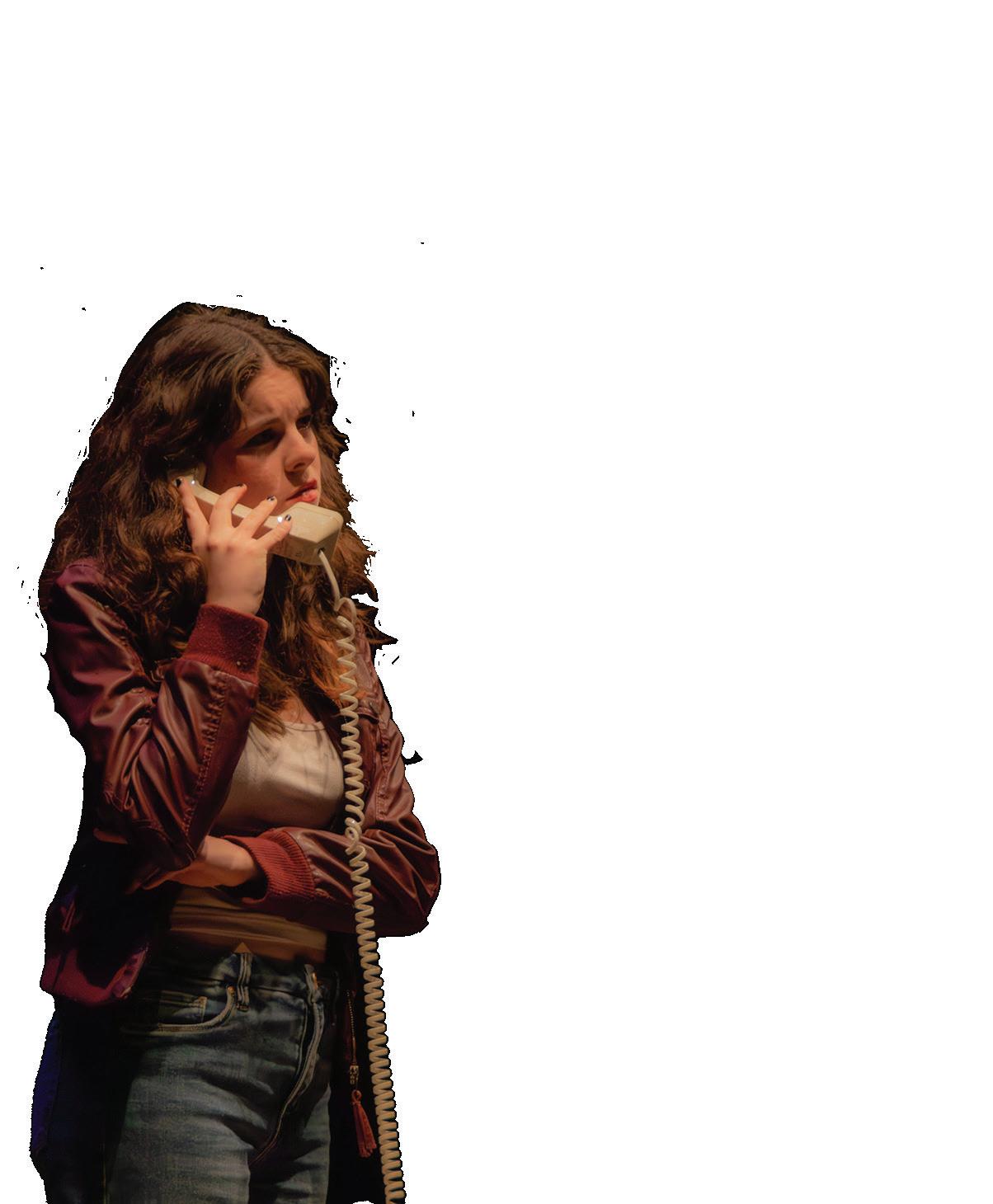
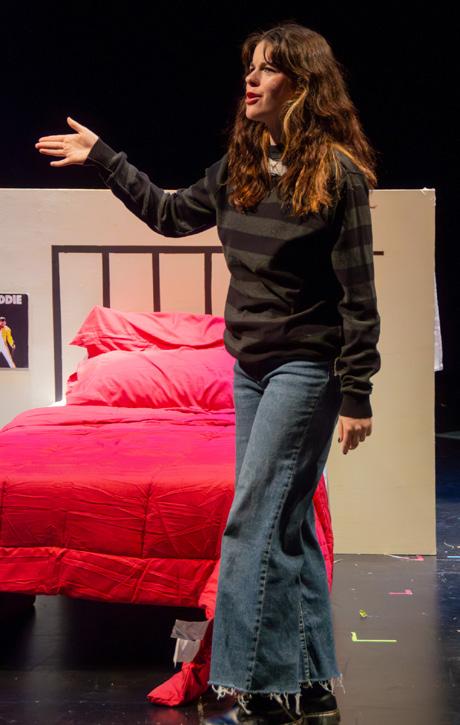
Left: Elizabeth Fries (10) performs in the Senior-Directed OneAct “Vivification,” written and directed by Chloe Lang (12). Set in the 1980’s, the production followed the story of Vivian, a teenager navigating her sexuality and the evenutal revelation of her AIDS diagnosis. “I am really passionate about the overall message of love and keeping hope for the future,” Fries said. “I feel so honored to be apart of it, and I’m really proud of everything we accomplished.”
(photos by Gabriella Beltranena)
Left: Fries applies makeup for William Weltig (10) before his role in the one act. Serving as a primary makeup artist for the theater troupe, Fries has been responsible for ensuring actors are ready. “I typically help out [with makeup] since I’ve had a lot of experience doing my own,” Fries said. “Oftentimes I am in charge of designing makeup for the shows I’m costuming.”
(photos by Gabriella Beltranena)
GABRIELLA BELTRANENA
BUILT FOR
WORLDS
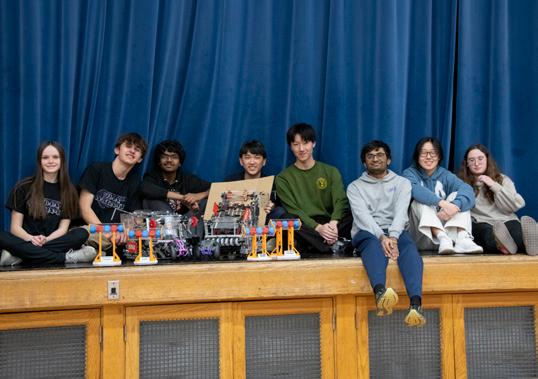
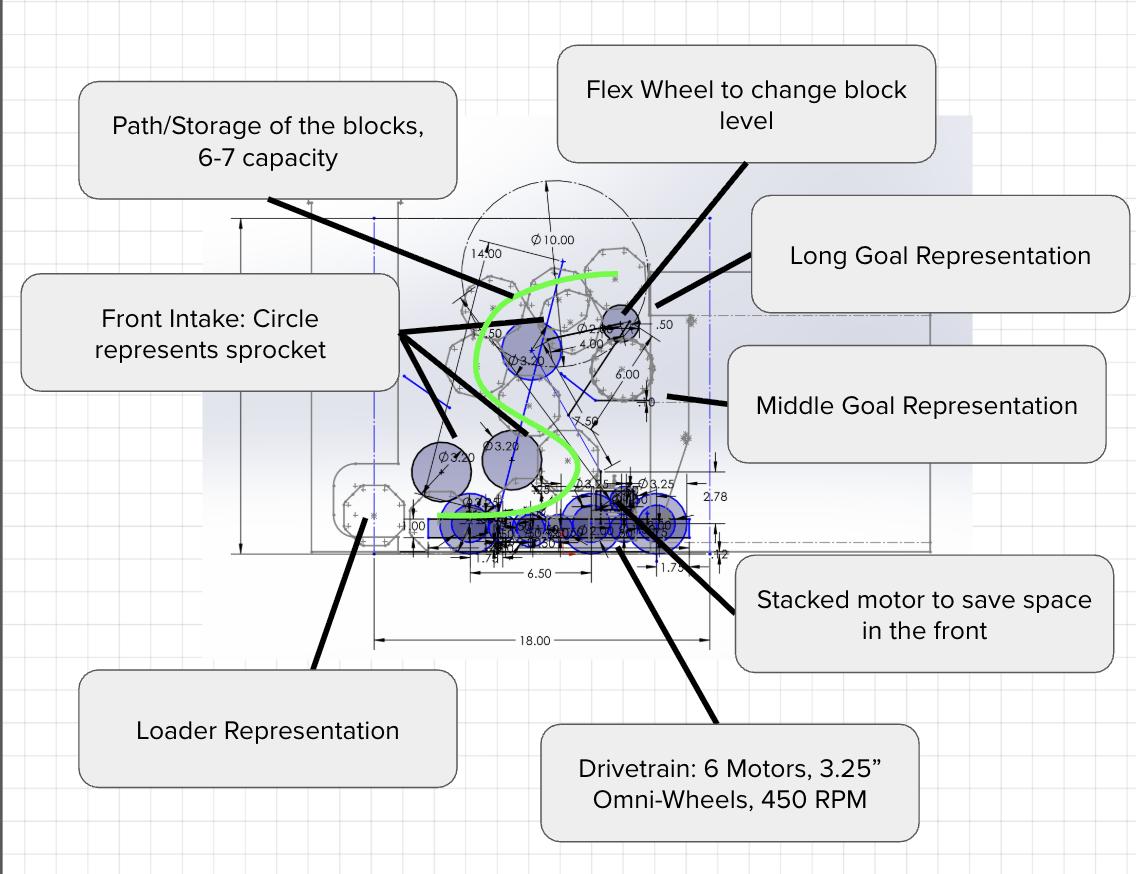
TTWO OBJECTIVES: SCORE blocks, de-score your opponents. What may seem like a simple task requires hours of developing the best and strongest robot to achieve the ultimate goal, a win. From analyzing the game, to coding, to building their robot and more, the VEX Robotics team Gheese carefully
VEX Robotics team Gheese develops a robot, taking them to the VEX Robotics World Championship
BY JANE SCHEFFEL staff & BY MEDHA CHODE staff
PHOTOGRAPHY BY TEO
LEE photographer
crafted their robot, preparing it to compete against other teams at the VEX Robotics World Championship April 21-24 in St. Louis.
VEX Robotics is the largest robotics competition in the world. It consists of students from middle and high schools working together to create a robot that completes the decided game most efficiently. The Ladue VEX Robotics club has five teams consisting of six to 10 students working on creating a robot.
“The competitions that we go to monthly, based on how [the teams] rank there, they can qualify for state,” teacher advisor Eliza Lazaro said. “We go to multiple [competitions] so that teams have the opportunity to qualify for state. The team that’s going to worlds, they qualified early on for state.”
WHAT’S THE DIFFERENCE?
VEX
- Smaller robot, with more compact parts
- Cheaper, more accessible for schools with less funding
- Longer year round season
Vex Robotics and First Robotics Competition may both be robotics but how do they differ?
FRC
- Bigger robot, up to 125 pounds
- Significantly higher cost, often corporate sponsored
- Shorter seasons, around three months
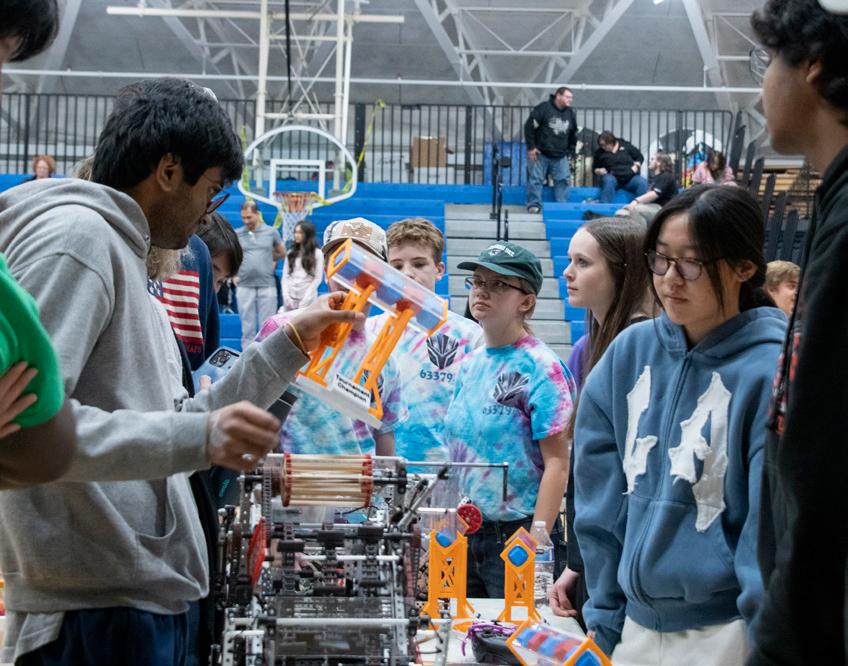
ABOVE: The VEX Robotics team Gheese compete at the various tournaments. The team is composed of students across all grade levels who work together to create the most efficient robot. “[There is] a pretty tight knit community, especially within the same heliosphere,” Kelly Bian (12) said. “Anytime you go to the local competitions, you see the same teams every time.”
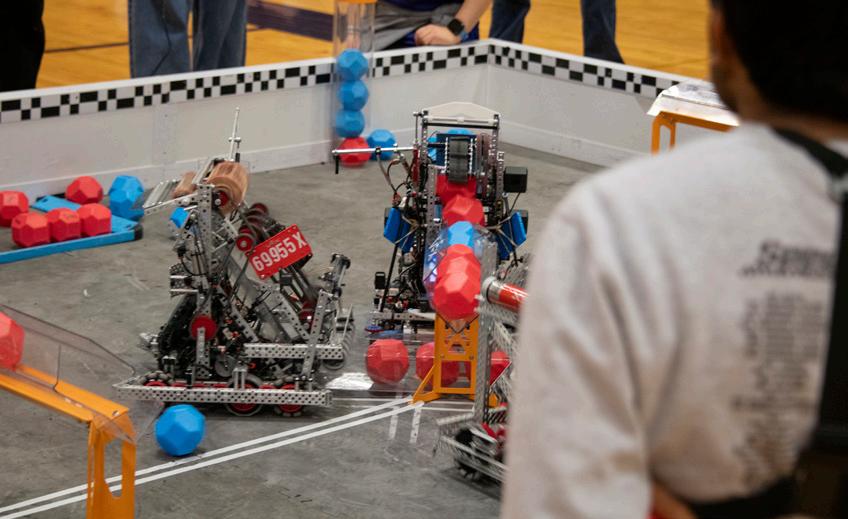
Competitions include multiple matches starting from qualifiers to eliminations, with each team trying to score as many points as possible. There are two sections in a round, the first is a 15-second autonomous period, where only coding controls the robot, then there is a one-minute-and45-second driver period, where both coding and a driver control the robot.
“[The team] has qualification matches in which you’re randomly paired with an alliance, and you’re going against two teams that are also randomly paired,” team member Ashvik Chilakala said. “And so for about four or five hours, you’re just doing qualification matches in which you’re trying to win as many games as you possibly can to get to the top.”
There is one game that the competitions use, announced at the end of the previous world championship. This year the game entails four goals that the robot is trying to get their blocks into. But what adds an additional challenge to the game is that a team can de-score another team’s blocks.
“This year, the most effective tactic available is to de-score your opponent’s blocks as much as possible, while keeping your blocks in the middle,” Chilakala said. “There’s something called the control bonus, in which if you have the most amount of blocks in a particular zone, and the long goals, or the goals that are really high up top, you’ll get an extra 10 points.”
The team is broken into different parts, each member simultaneously doing their designated job and working on the robot in preparation for upcoming competitions. As the competition day approached, the team met daily to coordinate the robot.
“We usually sit down as a team and do a Gantt chart, which lets us visualize and plan out exactly the specific things that we want to do,” Chilakala said. “We’ll tell Rex, our lead builder, to get two weeks to build. Then me and Kai get one week to code, and then our driver, Dheeran, gets a week. From there, we try to have checkup meetings, usually every week.”
The team has been together for multiple years, each working to develop their engineering abilities and teamwork. Although two members are seniors, the team hopes to continue working hard and representing Ladue in VEX Robotics competitions.
“We performed at our local competitions and state, and did well,” team member Kelly Bian (12) said. “Internally, we worked really well as a team this year. We had a little change in team dynamics, just because we introduced some more people to the team. Also as graduating seniors, there’s the responsibility of passing down the knowledge that you’ve gained through the past four years to people that are younger than you. So I think we really worked great as a team, and I’m confident that Gheese will continue to be great.”
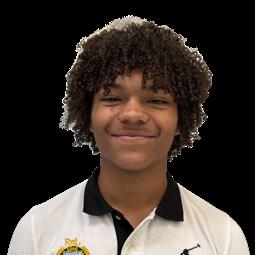
THE TEAM
Meet the members of the worlds-qualifying VEX team Gheese
Kelly Bian (12)
Ashvik Chilakala (11)
Coder/ Notebooker
Notebooker Scouter Lily Schreiber (9)
Notebooker
Rex Zhu (12) Builder Designer
Kai Chen (11) Coder
Dheeran
Ramesh (10)
Driver Builder
LET’S TALK SUN
Information on protection against the sun, causes of skin cancer and the aftermath of detection
BY LOUKYA GILLELLA infographic editor
ILLUSTRATION
editor
GILLELLA
UV VS. YOU
The importance of using sunscreen to protect you against the sun
Brielle DeRuisseau (12)
Americans will develop skin cancer by the age of 70
COULD YOU SPOT IT?
Self-examination is the first step towards detection
A symmetry: One half of the spot doesn’t look like the other.
B order: The spot has an irregular and undefined shape.
C
olor: The spot has different colors like shades of tan or areas with white, red or blue.
D iameter: The size is usually greater than six millimeters.
E volving: The spot is constantly changing in shape and size.
SOURCES: Skin Cancer Foundation, Chemical & Engineering News, Mayo Clinic, American Academy of Dermatology Association
CATCH IT, BEAT IT
Steps to follow if self-examination shows an odd spot
BLOCK IT
Tips to reduce chances of skin cancer and ingredients commonly found in suncreen
ACTIVE INGREDIENTS - 20%
Compunds that filter UV rays from the sun like zinc oxide
FORMULATION STABALIZERS - 55%
Solvents, preservatives and thickening agents
EXTRA INGREDIENTS - 2%
SENSORY ENHANCERS - 23%
Compounds that improve the feel and scent of the formula like fragrances and mosturizers
Seek Shade
This is especially important between 10 a.m. and 4 p.m.
Protective Clothing
When in the sun, the more skin you cover the better.
1. Communication
Reach out to your primary care provider or a dermatologist.
2. Skin physical
A professional might look at your skin and ask about your symptoms.
Healthy diet
Interactions between different nutrients in food is very effective.
3. Skin biopsy
A professional may remove a sample tissue to test it in labs.
4.
Staging tests
Some people may need more tests to determine if the cancer has spread.
Rewiring Education
As technological reliance in education skyrockets, Ladue teachers form critical decisions for their online policies
BY EMERY MAO & HENRY MADDEN staff
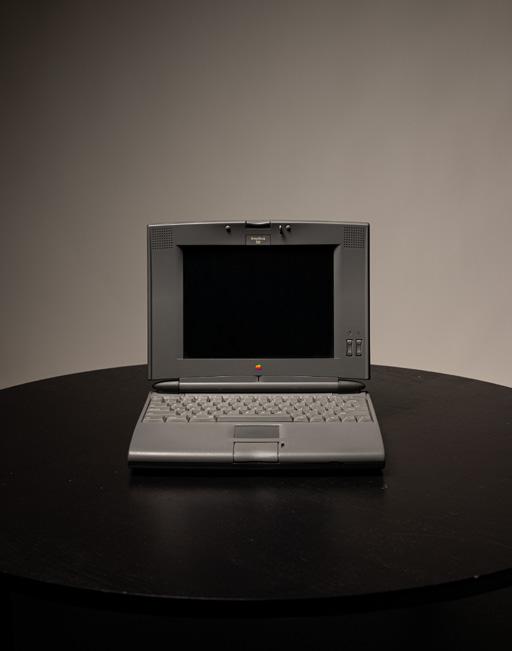
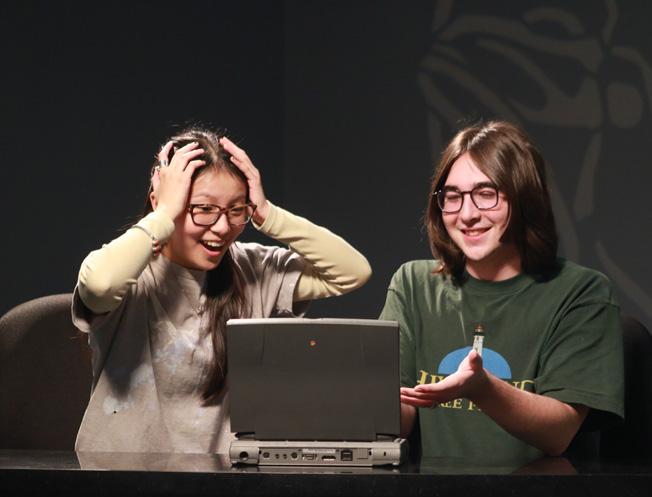
ILLUSTRATION BY EMERY MAO staff
TTHE WORLD IS AT OUR FINgertips. A cold blue computer screen greets you into a slow descent, diving into the rabbit hole. A white page with blocky, bright colored letters and a search bar holds the secrets of the universe. The rapid growth of technology has interwoven itself into education; it is reshaping not just how each student studies, but how they think, create and imagine. The question is no longer whether technology belongs in the classroom, but what, in welcoming it, the education system has agreed to give away –– and where, and when, the line is drawn.
“There’s
Online
It is undeniable that technology has made day-to-day life for everyone far more simple than ever before. No longer must students carry textbooks through the halls or have friends bring back homework when sick. Computer science teacher Brian Lehmann agrees –– learning has become considerably more accessible than in previous years.
“Years ago, the programming classes were done on physical computers that were tethered to these tables,” Lehmann said. “They’ve gotten rid of that. They used to be really bulky and hard to maintain. It is so much easier now that every student has a laptop they are in charge of and all the coding is usually done on a website through a browser.”
very, very few people who are actually hoping to go backwards. Like, ‘I wish there was a world before cell phones.’ Nobody is seriously entertaining that idea because they’re just too useful.”
With a fnite amount of time given in each period to learn concepts, it is common that important information taught from each lesson can become lost. That’s where technology steps in: a laptop can not only be a study tool to review material, but a teacher for new ideas.
Brian Lehmann, computer science teacher
Conversations have been mounted across the country over the degree to which technology should be used in schools. A study by Michigan State University found that, for the frst time in history, nearly half of all students in the U.S. have a school provided device. As technology becomes increasingly common in classrooms, an increasingly polarized debate has followed. Where some consider this new wave of technology to bring mental and physical harms, countless students and teachers swear behind online learning. Not only has technology allowed learning to be easier than ever before in infnite ways, but the online tools provided make school much more interesting for many.
“Technology is good for flling in the gaps that you’re missing,” Frank Tian (11) said. “That can be watching lessons through videos online or asking an AI to walk you through a problem you don’t understand. That contrasts so much with just copying down an answer once you search it up online.”
Educators are incorporating technology into their classrooms in order to streamline their classes. For math teacher Garrett White, online tools have been instrumental for teaching his students. Throughout his career in the educational feld, he’s witnessed as the instruments around him have changed and evolved with time.
“I prefer to use more technology than less [because of] the effciency,”
White said. “When I frst started teaching, I was using chalk, but if I’m using a chalkboard or something like that, I can’t make a copy of that very easily. I like that about using the iPad, it’s much easier. I can just save the PDF, and I can put that up as notes. I like the ease of [it] much better.”
Lehmann, who worked as a software developer for over 25 years before teaching, believes that discourse over technology is generally over sensationalized. The simplicity that technology brings to daily life is a commodity very few are truly willing to give up.
“There’s very, very few people who are actually hoping to go backwards,” Lehmann said. “Like, ‘I wish there was a world before cell phones.’ Nobody is seriously entertaining that idea because they’re just too useful.”
The defning feature of the internet is it has made information much easier to fnd. Before web browsers were commonplace, searching for and using the library was a physical, time consuming and laborious process that required in-person visits and human assistance. Even then, it’s not like a library could hold every piece of knowledge and information one might need.
“The devices that we use give us access to so many things that we cannot access just purely based off of textbooks,” Tian said. “Maybe you could access them through textbooks, but it is defnitely not as effcient as something such as a simple Google search or one AI prompt.”
Teachers corroborate across the board that technology makes their jobs substantially easier. As technology evolves further each day, the question of whether or not that ease is benefcial becomes more and more consequential. For people like Lehmann, the future of technology doesn’t look like the Terminator, but rather C-3PO.
“Fundamentally, I am a technology optimist,” Lehmann said. “There’s always certain things that maybe were better in the olden days, but generally, by and large, technology has made our lives easier and more fun and more interesting and more creative and sure, there are costs to that. We need to make sure that we still focus on our physical bodies and our mental health.
Logging on
How many hours do you spend on your laptop at school each day?
Student poll demonstrates the effects of electronics at Ladue
How often do laptops distract you from schoolwork?
Have you seen any mental or physical effects from excessive screentime?
Do you think we use technology too much at school?
But in most ways, technology has made our lives better.”
Some students like Tian believe that Ladue has generally managed technology well, but wish for more access to certain AIs. As of now, Ladue has blocked many major AI softwares, including Claude and ChatGPT.
“When I want to check for errors in my coding for my AP Computer Science class, I would have liked to choose Claude to overlook potential errors,” Tian said. “But that has recently been blocked, and now I have no access to that which may affect the accuracy of my code.”
A global recession, countless wars, an international pandemic and a deep-
ly polarizing political landscape. Alongside this electric change, technology has evolved as well. But after mass adoption by schools and educators, many have begun to reconsider.
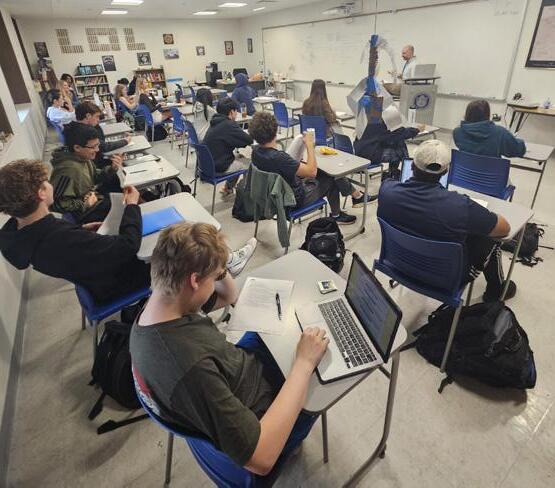
History teacher Jeffrey Miller has been at Ladue for 20 years, and has watched as computers have infected every corner of the curriculum. In Miller’s classroom, however, he has begun to phase out the use of technology in favor of traditional teaching styles.
“A lot of note sheets, lessons and things that three to fve years ago I would have done on the laptop, I’m no longer allowing students to do, ” Miller said. “I’ll ask them to put their laptops away, and I’ll have them write it on paper.”
Returning to traditional teaching methods has become a growing sen-
timent across Ladue and the country at large. A similar story is found with psychology teacher Meg Kaupp, who has begun to use technology sparingly, after fnding it causes distraction to become extremely common in students.
“Sometimes for review, we’ll do Kahoots, or I’ll push out different kinds of review activities online, but I have pulled more away from it in the last few years,” Kaupp said. “Basically, because when you’re teaching and you ask students to open up their laptops, they’re not just [focusing] on what you’re asking them to do. There’s a lot of tabs open, a lot of people get their VPN and they’re playing games or shopping for prom shoes or texting with their friends.”
The main issue with widespread access to technology lies in one key
thing: students no longer understand how to struggle. A peer-reviewed study from Harvard University found that students with laptops or devices in lectures performed worse in their classes.
“You have to be comfortable with struggle,” Kaupp said. “Stress is good. Stress tells us that there is a level that we need to master in order to move into understanding the material at a nice, deep, foundational level, and technology helps us bypass that struggle. But the problem is, [the work] doesn’t have the depth or the meaning.”
When students forget how to struggle, a chain of events follows: the ability to work against the grain is lost. Resiliency is no longer a trait commonly found in students. Thus, when those same people begin to face real challenges, their emotional and mental abilities are no longer able to stay afoat.
“I’ve defnitely seen an increase of students who, quite simply, are not able to handle a school environment from a mental health standpoint –– like they cannot be here,” Miller said. “It is too overwhelming from a mental health standpoint, to be in this environment. I would say that technology plays a role in that. There’s no [leaving school because] school [is] everywhere, your machine’s everywhere.”
That forever-in-class mindset applies even further. When the school district frst adopted Infnite Campus, students and parents could see grades and grade updates as soon as they came out for the frst time. Kaupp found students and parents constantly refreshing Infnite Campus, checking for a score on a quiz or test.
“There’s a lot of information that gets lost when the transaction of fnding out a grade is more important than actually understanding the process of why somebody has a certain grade,” Kaupp said. “Before COVID-19,
I was really upset [when] kids would get alerts from parents about a grade that got put into Infnite Campus at 10 o’clock on a random Tuesday.”
Oftentimes, students would be actively working in class, then suddenly, their phone begins to buzz and ring, flled with upset messages from their parents. Each message loaded with angry words about the grade entered online. In a sense, it’s Pavlovian conditioning, like the ringing of a bell –– students await the ding of an Infnite Campus notifcation at all hours.
“It’s just, it’s wrong,” Kaupp said. “It’s just not the way it should be. Too much access to grades because of technology is defnitely negatively impacting students and families.”
As benefcial as laptops are to the learning experience, the unspoken psychological effects have the potential to be incredibly damaging for students.
“I think [laptops] are a barrier to the community that you’re trying to build in a classroom,” Kaupp said. “We knew during COVID that one of the big issues was the lack of social interaction and learning. We know that learning is a social process, and laptops don’t [belong] in the classroom when you are face to face [and] should not be there unless they are intentionally being used with a purpose.”
Teachers and experts follow a doctrine of signifcant restraint when it comes to regulation because the potential impacts are disastrous. At the end of the day, regulation is incredibly subjective, and deciding on a proper balance is of utmost diffculty and priority for most teachers and students.
“We’ve lost a lot of signifcant skills that we need to be careful about,” Kaupp said. “We’re not getting rid of tech, and tech has made the classroom in many ways much more engaging. It’s just at what cost.”
How has technology affected your learning?
Find a user
You have 4 new friend requests!
“I can submit stuff online, and it provides a database for me to search.”
Sarah Shao (9)
“It’s [helped] writing essays and looking things up, but it’s also distracting.”
Alex Loynd (10)
“It’s easier to navigate assignments. With paper, it’s hard to fnd if you lost it.”
Quiniya Jones (9)
“It has improved my learning with the usage of AI.”
Daniel Wang (11)
PANORAMA PERSPECTIVE
The lack of school spirit creates a sense of division rather than community amongst students
22 LADUE MEDIA EDITORS AGREE
2 LADUE MEDIA EDITORS DISAGREE
CCLUSTERS OF STUDENTS SIT IN boredom in the bleachers, counting down the minutes until the bell rings. As various sports teams and clubs run across the gym, cheers briefly fill the awkward silence, but something else is missing: school spirit. Although spirit weeks and pep rallies help to promote school spirit, it is undeniable that school spirit has changed over the past few years. School is supposed to be a place of community and belonging. Yet for many students, school feels more like an obligation rather than a community. Students often dread waking up in the mornings to go to school and show little interest in participating in school events. But what caused this change in perspective?
Think back to elementary school, students were excited to go to school, participate in spirit weeks and spend time with
their friends. Today, with the rise of technology, students are so focused on their devices that they couldn’t care less about school spirit. Without a large sense of spirit, students continue to remain isolated and disconnected from school events.
To begin, technology has played a central role in the decline of school spirit. Students spend countless hours texting and scrolling on social media. According to the American Academy of Child and Adolescent Psychiatry, children in the United States average around 7.5 hours of screen time each day. Since students can easily connect with their friends online, school events are often seen as unnecessary for socializing. Consequently, students have become more invested online than what is happening in the world around them. Additionally, trends illustrate that peer pressure has significantly affected student involvement in school events. Out of 205 Ladue students surveyed April 27, 66% of
48%
Panorama surveyed 205 students April 27 of students think sports games best promote school spirit
students said that peer pressure has influenced the activities that they participated in to some extent. People are worried about how they may be perceived and fear that they will stand out from the crowd. For instance, many students refrain from cheering at pep rallies due to the fear of being judged by their peers. The constant societal pressure to fit in has greatly contributed to the changes in school spirit over the years. It’s no secret that Ladue lacks a bit of school spirit. At the same time, school pride doesn’t just appear out of nowhere. Everyone must put in the effort, whether that includes going to a sports game, cheering at the pep rally or simply joining a club. School spirit should bring students together in order to create a community where students can celebrate their accomplishments and be proud to represent Ladue. However, real school spirit cannot be fully achieved without the active participation of all students. It’s a choice that everyone must make. And at the end of the day, school spirit starts with showing up.
Editorial note: Each editorial, Panorama selects an issue that the staff thinks is important to address and expresses a view that belongs to the majority of the editorial board. Panorama welcomes the opinions of its readers and encourages letters to the editors. Panorama reserves the right to revise submissions for length so long as original intent remains unaltered.
SOMETHING TO ADD?
Scan here for more on letters to the editor, guest essays, submitting correction and the full editorial policy. P
STANDARDIZED MIND
When schools prioritize and reward compliance over creativity, cognitive disorder diagnoses rise, revealing a significant problem within today’s educational environment
BY AMELIE LOCK staff
SOCIETY LABELS STUDENTS
with conditions to explain their struggle to adapt to the rigid, test-based structure of today’s high school environment, instead of reforming the educational approach. According to the Data Research Center for Child and Adolescent Health, 31% of teens are diagnosed with a cognitive disorder – a number that suggests we are witnessing a nothing less than a public health crisis. Yet, if a third of the population is struggling, a number that reflects a nearly 35% increase since 2016, we have to stop blaming the mechanics of the individual and start questioning the design of the machine.
A recent article in the San Francisco Chronicle stated that four in 10 Stanford University students are registered as disabled – a rate that has nearly quintupled in 15 years. These disabilities, typically cognitive, range from generalized anxiety disorder to dyslexia, and usually result in extended time on tests for students. This trend is not a national phenomenon, instead clustering almost solely at the most prestigious schools. Why do such prestigious schools have many students receiving accommodations, when the same trend is not reflected across the country? The answer likely stems from their high school experience. American high school students looking to attend elite colleges are held to a specific standard. Fives on AP exams, perfect standardized test scores and 4.0 GPAs. When all of these hurdles become overwhelming, and a student’s performance subsequently slips, extended time may appear a simple solution. It is time to consider that the
modern high school – a firm, test reliant environment – is increasingly out of sync with the complexity of the young brain, prompting many adults to jump toward a diagnosis instead of adaptation.
The current high school structure is one of standardization. While there are progressive schools that lean toward project based learning, most assume that all teenagers should learn at the same pace and demonstrate their knowledge through one primary structure: the test. When a student’s cognitive style doesn’t align with that one dreaded marker of success, they are often labeled as “disordered.” However, many of the traits we villainize — including hyper-focus, high energy or a need to simply move — are key indicators for success and innovation in the real world.
In 2026, schools are grappling with the presence of AI, often adopting a more hands on, creative approach to combat the “laziness epidemic” in students. As generative AI takes over the rote tasks of memorization and basic synthesis — the very things standardized tests measure — the human premium will shift toward high level strategy and divergent thinking. When the test no longer rules the classroom, the student who once needed an ADHD diagnosis may suddenly find themselves extremely engaged in a collaborative project.
The rise in diagnoses and accomodations should force us to carefully confront a frightening truth: some students may be searching for shortcuts, but often the system they are in makes those shortcuts feel necessary. This does not mean that diagnoses are illegitimate, or that students with real learning differences should lose support. The goal should not be to blame students for adapting to a flawed system, but to foster an educational model where curiosity and deep thinking matter just as much as performance under pressure.
P
15% of public high school students recieve special education services
118,894
Missouri public school students receive special education services
1 Stanford students are diagnosed with a cognitive disability in4
31%
SOURCES: Data Resource Center, The Atlantic, Center for Child and Adolescent Health, MO DESE of teens are diagnosed with a cognitive disorder
CLAIRE ZHANG AMELIE LOCK
SPREAD DESIGN BY
BEYOND THE GAZE
The fetishization of queer characters in media and resulting impacts on the queer community
QQUEER MEDIA HAS LONG BEEN an important part of pop culture. Far before Jack Nicholson presented the Academy Award for Best Picture in 2006 which, to his very apparent shock, did not go to “Brokeback Mountain,” gay characters were making waves. Queerness in media is impactful, allowing people to see themselves where they weren’t able to before. Today, queer media is often reduced to elementary stereotypes and stripped of complexity. While reception for “Heated Rivalry.” largely supportive, hypersexualization of characters is rampant among the fanbase. This fetishization is exacerbated on social media by explicit posts and fan-
BY ADELAIDE FLINTROP staff
ILLUSTRATION BY JOYCE LI artist
made edits. “Heated Rivalry” has been reduced to just “that gay hockey show.”
The devaluation of queer characters isn’t isolated to one example. In spite of acclaim, “Brokeback Mountain” is subject to endless reduction, dubbed the “gay cowboy movie.” Thirsty jokes that are low-hanging fruit at best have created a derogatory culture around the film and those like it.
Hasty generalizations miss the point of these stories; “Brokeback Mountain” is a tale of loving someone who society tells you that you shouldn’t, and losing everything you were never supposed to have. “Heated Rivalry” explores learning to love flaws that you’ve been taught to hide by loving somebody who has them too.
Depriving stories of nuance is always harmful, but especially so when dealing with marginalized communities. Queer stories aren’t just rom-coms or chick-flicks — they’re expressions of realities scarcely understood. Jake Fittipaldi of Rolling Tape
writes, “[Brokeback Mountain] captures something uniquely painful: the way queer people learn to romanticize memory because memory is safer than reality.”
More than worsening ignorance, misrepresentation often perpetuates negative stereotypes. The hypersexualization of queer people so prevalent in certain depictions like those in “Pulp Fiction” and on social media contribute to the long-held belief that being queer is itself wrong and perverse. But queer representation within media itself has improved since; Indiana State University finds that queer depictions in media have shifted from reductive stereotypes of sexual depravity and perversion to well-rounded characters and plots. However, hypersexualization online continues to further negative stereotypes.
Stereotypes that portray queer people as shallow and hypersexual extend beyond the screen. Negative portrayals contribute to societal hatred toward minorities. The issue is cyclical; negative portrayals create negative feelings and perceptions, which in turn create more negative portrayals.
Conversely, good representiation has enormously positive effects; a study by
the National Institutes of Health found that good media portrayals improve views of marginalized groups. “Heated Rivalry” has been key in fostering acceptance in an athletic spaces that have historically excluded queer people. Emilia Belli of BBC writes, “Showing [the experiences of] gay people in the sport, even if that’s not what it’s really like right now, can be the start of it becoming what it’s really like one day.”
Generalizations are especially prevalent for queer stories that end happily. Pain is a
“comes from a set of regulations which sought to prevent positive representation of queer people. The Hays Code, which was active between 1934-1968, imposed censorship rules on Hollywood requiring that queer characters be punished for their “immorality” within the plots of film and TV, often through death or suicide. Because of this origin, assigning worth only to queer stories that end dismally is detrimental; Light Naing writes in “Spheres of Influence,” “the queer tragedy trope maintains
Because straight women rightly view romantic love untouched by patriarchal structures as some impossible, unattainable thing, infatuation with the idea is a given. Psychology Today explains that intense yearning for things you can’t have is a common psychological phenomenon. Hope becomes something harmful; a constant state of wondering if you could ever have what want but can’t have escalates desire for it. This delusion drives straight women’s fascination with gay love stories.
“I did not grow up with stories like this. As gay men and queer people, we do not get happy endings in media often.” - Jacob Tierney
common theme of queer stories, and while showing queer struggles is crucial to understanding, agony being the only end to queer stories in media makes it seem like the only outcome in real life too. Comprehending pain is powerful, but not more than fostering hope. Jacob Tierney, creator of the televised version of “Heated Rivalry” explains, “I did not grow up with stories like this. As gay men and queer people, we do not get happy endings in media often.”
Deeming queer stories that end happily unworthy of their space on screens and pages is intrinsically damaging. The frequency with which queer stories end in tragedy
the idea that queer love is bound to be punished by suffering.” Queer stories shouldn’t have to be doomed to be understood. Understanding that these misrepresentations happen and the harms that come with them is important, but perhaps more vital is understanding why they happen. The Guardian has observed that many of the people contributing to the hypersexualization of gay characters are women. It further explores that for straight women, queer media, especially about gay men, explores romance free from misogyny and hierarchy — something which, for the vast majority, will remain nothing but a fantasy.
BY THE NUMBERS
In 2005, Brokeback Mountain was banned from being shown in many theaters in the South, but despite criticism, it grossed over winning three Academy Awards at the 2006 ceremony and four Golden Globes $200 MILLION,
SOURCES:
Fenway Health, NCHC, New York Times,
Simplification is also driven by a desire to understand. The National Center for Cultural Competence explains that, when attempting to process complex information, cognitive systems simplify the effort by using categories and stereotypes as opposed to individual, nuanced evaluation. Reduction of queer media to tired stereotypes is seldom intentional and less often malicious. In spite of the harmful effects, it’s typically aimed at understanding both identities of others and one’s own feelings. However, in an attempt to understand, people continue to ignore the complexities that would actually let them.
The effects of rising popularity of television and movies depicting queer characters
97%
of participants of a Fenway Health survey said they had seen negative depictions of transgender people in the media in the last year
45% P
Studies show that of people believe greater visibilty increases acceptance, but that it also perpetuates harmful stereotypes
Odds of developing depression are increased by in LGBTQ+ adults by the incorrect and stigmatized representations of queer people 18%
IN THE SPOTLIGHT
KALEIDOSCOPE
BY TIYA KAUL staff
Orchestra students perform in annual Kaleidoscope concert
ORCHESTRA STUDENTS
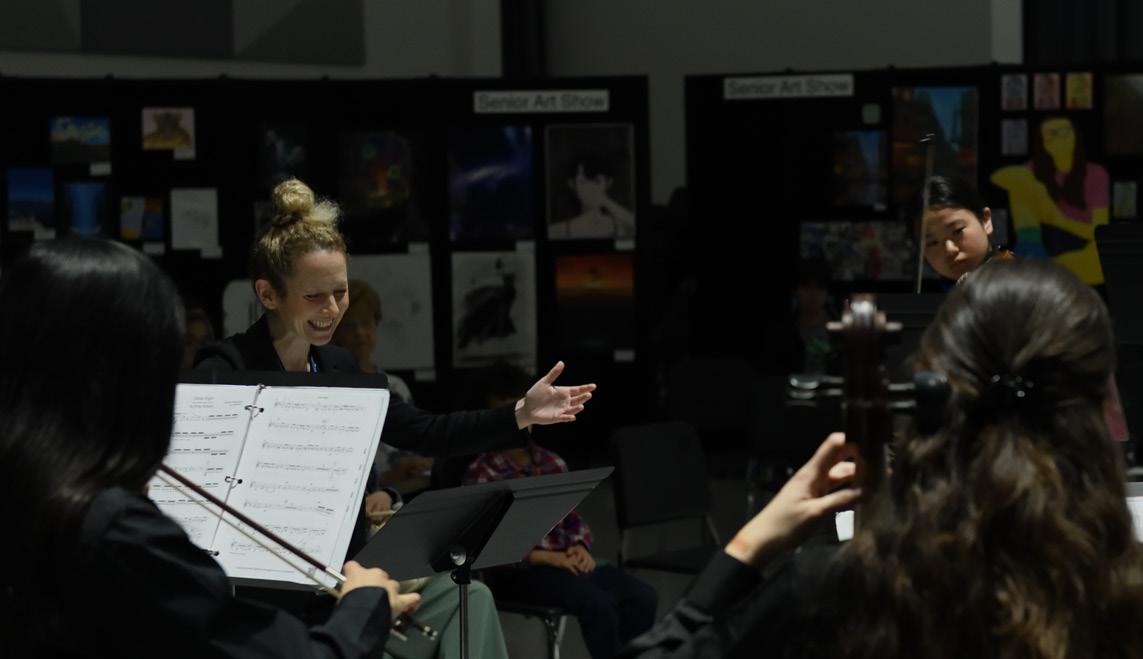
present songs in the Kaleidoscope Arts Festival Saturday, April 25 to showcase student art and music. Performances included a wide variety of music, a large crowd of friends and family members of performers and a calm ambience.
“The concert takes place in the orchestra room, where a stage is set up for performers, while the senior art show sprawls behind the audience for people to admire before and after the concert,” Orchestra student Nina Ye (11) said. “The lights [were] dimmed during the concert, allowing for all attention to be focused upon the performers.”
Since Kaleidoscope is such a major event, students had ample time to practice their pieces. They played several different songs which they had around one month to practice for. Along with audience members,
performers gained the chance to appreciate the music of their peers.
“My favorite part of the concert is hearing my friends Elizabeth and Frank’s performance,” Ye said. “I also really liked the first piece from ‘Yuri on Ice,’ which is one of my favorite animes.”
Though there was a sense of pressure to the concert, students ultimately accepted their skills and felt confident enough to perform.
“I’m pretty sure no one thinks I can play anymore,” Ye said. “But that’s okay because it’s not like practicing can save me.”
P
ABOVE: Orchestra students perform during the Kaleidoscope Arts Festival. Kaleidoscope is a major orchestra music festival, and students have spent a month practicing for their performances. “Students get to choose a piece and a chamber group to play with,” Ye said.
SONG REVIEWS
“DROP DEAD”
When I heard Olivia Rodrigo came out with a new single, I was excited, but in my humble opinion, “Drop Dead” missed the mark. The music video was aesthetically pleasing, featuring the grand Palace of Versailles as a backdrop. However, the lyrics were rather shallow and overly similar to Rodrigo’s past songs. There is no “wow” factor that differentiates it from her old songs. It is still worth a listen, but it’s nothing too special.
“THE GREAT DIVIDE”
My first time listening to a Noah Kahan song was April 24, when he released his new album “The Great Divide,” and I was not disappointed. The lyrics of songs like “Porch Light” were heartfelt and the pacing of the music was mellow yet radiant. This album might have converted me into a Noah Kahan fan. If you aren’t streaming this album yet, I highly recommend you do.
“WISHBONE DELUXE”
On April 24, Conan Gray released his “Wishbone Deluxe” album, adding on to his “Wishbone” album from 2025. The album includes newly featured songs like “Door” and “The Best.” The music was nicely paced and the lyrics were emotional, yet it felt very similar to his older music. I noticed that the tone of the songs and rhythms were just like his 2025 songs. Nothing really stood out to me, but overall, it’s not bad.
SUMMER SIPS
STARBUCKS COFFEE
I got the Iced Dubai Chocolate Mocha from Starbucks and I would not recommend it. The only flavor is dark chocolate and there is no taste of the pistachio cold foam.
MUNY
“SHREK”
Tiya Kaul reviews seasonal coffees from three different coffee shops
KALDI’S COFFEE
The Iced Ube Latte from Kaldi’s Coffee is pretty good. The ube and coffee blend well together, but it is a
DEER CREEK COFFEE
This was my first time at Deer Creek Coffee and I tried the Caramel Royale. Overall, it was a solid coffee,
The Muny will present “Shrek The Musical” from June 25 to July 2. The cast will feature Nik Walker as Shrek, Kara Lindsay as Fiona and Marcus M. Martin as Donkey.
“HAIRSPRAY” “SOUTH PACIFIC”
The Muny will present “Hairspray” from June 15 to June 21. The cast will feature Katy Geraghty as Tracy Turnblad, Richard Kind as Edna Turnblad and John Bolton as Wilbur Turnblad.
The Muny will present “South Pacific” from July 6 to July 12. The cast will feature Paulo Szot as Emile De Becque, Taylor Louderman as Ensign Nellie Forbush and Joan Almedilla as Bloody Mary.
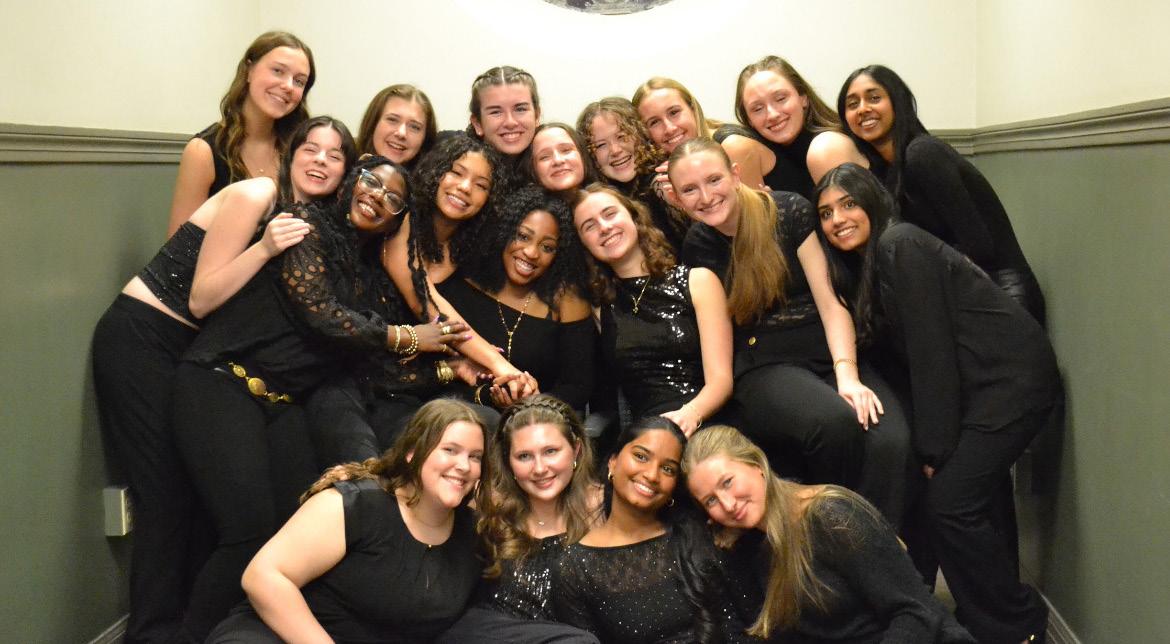
Viva Voce members pose for a group photo together. Members attended Ladue Middle School April 22, where they performed to middle school students. “Our Viva tour was fun because we got to sing to possible future viva members,” Viva Voce member Violet Coughlin (11) said.
VIVA VOCE
TIYA KAUL SPREAD DESIGN BY
CCONDÉ NAST IS KNOWN FOR its culture of privacy and exclusivity, but in 2006, director David Frankel opened their doors by reshaping Anna Wintour’s legacy into an iconic blockbuster, “The Devil Wears Prada.” Its much-awaited sequel, “The Devil Wears Prada 2,” premiered May 1. It’s safe to say that the new rendition has an extensive legacy to live up to: one of beloved looks, memorable controversies and quotes that are still referenced today.
Miranda Priestly, the editor-in-chief at Runway, a prestigious fashion publication inspired by Vogue, became adored by fans for her emphatic representation of Win-
GOING VOGUE OR GOING ROGUE?
“The Devil Wears Prada 2” brings back the world of fashion journalism
ILLUSTRATIONS BY JOYCE LI artist
tour. Frankel casted Meryl Streep to portray Priestly and craft a character who’s known for being both cold-blooded and an artistic prodigy, but the original movie seemed to create tension between Vogue and the movie crew. The expository plotlines, including ruthless layoffs and a cultish dedication to the publication, had crossed a line that Wintour was infamously protective of.
Now, on their long and winding press tour, Wintour has accompanied the movie star as a friend. “What I liked about the first film is that it showed the world what a huge business fashion is,” Wintour said in a recent interview. The two stars – one dominating the film industry and one orchestrating the fashion world – have presented a much closer relationship than their uncomfortable distance in years prior.
The original movie was celebrated for the remarkable outfits worn by each leading character. Images of Andrea Sachs’s Chanel boots and Emily Charlton’s Fendi bag still circulate through social media. However, the new costumes haven’t been held in such high regards. The chunky sandals and use of Shein-esque pinstripes have received backlash from unsettled fans. The ensembles could be compared to an Old Navy catalog or another commercial clothing brand who market towards unadventurous millennials.
24%
23%
Panorama surveyed 205 students April 29 of students watched “The Devil Wears Prada” of students plan on watching “The Devil Wears Prada 2”
21%
74% of students believe the new movie is not needed approval rating on Rotten Tomatoes for “The Devil Wears Prada 2”
Hopefully the pervasive “Emily in Paris” style hasn’t plagued the sequel of one of the most exceptional fashion movies of our time.
Triumphing above the millennialism in the movie itself, the cast of “The Devil Wears Prada 2” has emerged with impressive looks along their press tour. On each red carpet destination, they’ve seized the opportunity to display resplendent Schiaparelli emblems and a recurring red, staying true to the movie’s bold theme. Streep also opted for a custom cerulean sweater on “The Late Show with Stephen Colbert” – a nod to the unflattering blue pullover worn by Andrea Sachs on her first day as Miranda’s assistant. “That’s cerulean. Cerulean blue,” Streep corrected Colbert when he pointed out the striking shade.
SOURCE: Rotten Tomatoes P
Fashion journalism has undergone remarkable changes since “The Devil Wears Prada” was released. The original movie, defined by the thriving culture of print media in the early 2000’s, depicted magazines as prolific empires. Each character fought to maintain their role in the publication as if it were an elite society. Now, copies of Vogue collect dust on the shelves around Walgreens check-out lines. “The Devil Wears Prada 2” has tackled this issue by following Miranda Priestly’s struggle against AI and the competition for online prevalence.
THAT “VOGUE” LOOK
It’s refreshing to look at the expertly styled out ts of the original “ e Devil Wears Prada.” e stylists followed a criteria to match the distinct 2000’s caliber, but they refrained from replicating cookie-cutter out ts from catalogs. Each Chanel blazer and Marni blouse appeared to be hand-picked from the closet of the magazine headquarters, not idealized by a team of lm stylists.
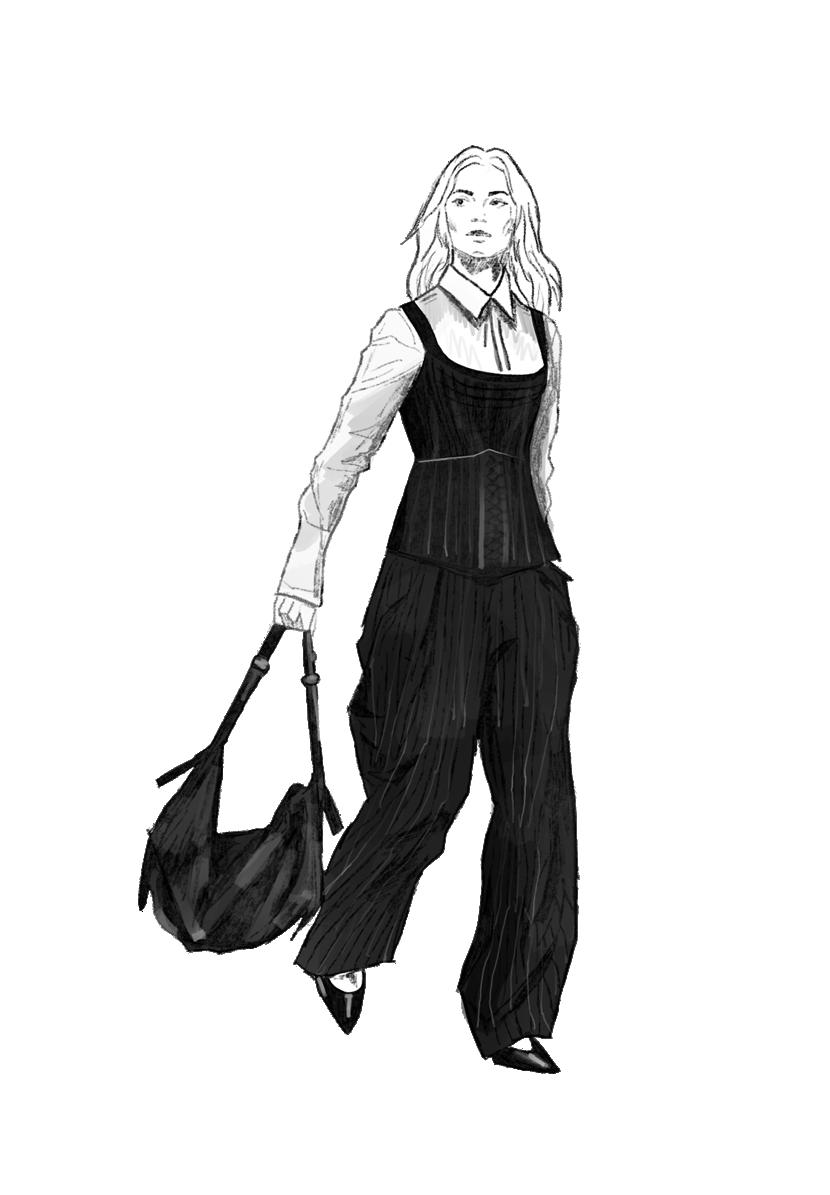
Emily Charlton, played by Emily Blunt, was known for her polished looks and seamless work ethic. In the rst movie, she played the role of a workplace watchdog who presided over the incompetent Andy Sachs. Her austerity and dedication to the fashion industry showed up in her Vivienne Westwood bodices and sharply jet-black color scheme. Emily’s newer out ts, however, would have
QUALITY DOWNFALL
her ostracized by the other publication sta ers if she wore them in the original movie. It seems as though the stylists have abandoned her elevated sense of style and replaced it with out ts that teenagers would’ve worn during quarantine. Each costume, which was curated for a character whose wardrobe should exemplify her success and experience in the industry, has come across as ironically childish.
ed the beloved Vogue lifestyle the same way we get ready for school each morning. You become immersed into the world of Park Avenue princesses who carried themselves like they were made of porcelain, but adopted the fervidity of a gladiator when entering the workplace. “ e Devil Wears Prada 2,” on the other hand, captures corporate attire without giving the impression that a busy fashion journalist selected it while hurrying out the door of their Midtown apartment.
THE RUN-THROUGH
MISPLACED EFFORTS
nely tailored Dolce & Gabbana suit from a press tour checkpoint in Mexico City perfectly encapsulates the demanding presence of Miranda Priestly, and it would’ve been a perfect outline for her character’s overall wardrobe. e sharpness of the silhouette and the blaring shade of red is a quintessential example of the discipline that Priestly represents; as well as the core principles of Vogue as a publication. However, I get a twinge of annoyance looking at what Priestly’s ts could have been. Each of the character’s
costumes repeat the same pattern: a blouse, straight leg pants, stilettos and a coat that falls near the shin. ey have such dull and textureless dispositions that they almost come across as AI-generated. e days of Camilleri fur and striking patterns have been le in the past. It seems that they’ve been replaced with an array of norm-core getups and the overload of monochrome that millenials aspire towards. e gap of quality between the press tour looks and the movie costumes is nothing short of egregious.
CAROLINE
SPRING SPORTS
SPORTS IN REVIEW CHASING THE SWEEP
OVERVIEW
GIRLS LACROSSE
The girls lacrosse team is having a strong season with a record of 9-1 as of April 27. Their only loss was in their season opener against Eureka High School. The team has also been building chemistry off the field with traditions such as a lock-in, where they spend the night at the high school competing in different team bonding challenges.
BOYS TENNIS
The boys tennis team has had a dominant season so far with a record of 10-2. Their only losses of the season have been to two strong teams, Westminister Christian Academy and Mary Institute and Country Day School. The team is hoping to continue this strong start heading into the rest of their season.
GIRLS SOCCER
The girls soccer team has had a competitive season so far. As of April 27, they have a record of 7-6. The team’s main goal for their season is to win districts. Last year, they were very close to this goal, making it to district finals. They have built team chemistry off the field with an away trip to Quincy, Ill.
BOYS GOLF
The boys golf team is off to a strong start with a winning record to their season. Competing in the Class 4 District 2 division, the team is competing against several competitive high schools. They are hoping to continue their success leading into their upcoming season.
BY IRENE MURPHY staff Ladue boys volleyball works toward a record season
THE LADUE BOYS VOLleyball team has had an incredible start to their season. With a record of 18-1 as of April 29, the team began the year with big goals for the remainder of their season.
“An undefeated season would be really cool,” varsity captain Luke Reiser (12) said. “Making it to state is the other [goal for our team]. We are in a pretty tough district but I think it’s possible.”
This year, the team has appointed a new head coach, Tom O’Toole. He been coaching competitive volleyball for the past eight years. For his first year as Ladue’s head coach, he is using his expertise to set the team up for success in reaching their goals for the rest of their season.
“[The team is] taking it one game at a time,” O’Toole said. “[I want them to] understand that we are doing something that is exciting
and we need to push in every game against every opponent to get a win.”
One of the team’s most exciting wins so far this season was against Mehlville, which was a team that they had previously lost to last year. They played four close sets, Ladue winning each one.
“[The team I am most looking forward to playing] is Francis Howell Central,” Reiser said. “It’s the second to last game in our season. They are a really strong team.”
During practice this season, the team has been working hard to continue improving their game and mindset. The team tries to go into every match with a good headspace to obtain a strong start for a win.
“[I am most proud of the team’s] resilience,” O’Toole said. “We have been tested multiple times and found ways to win even when we didn’t play our best.” P
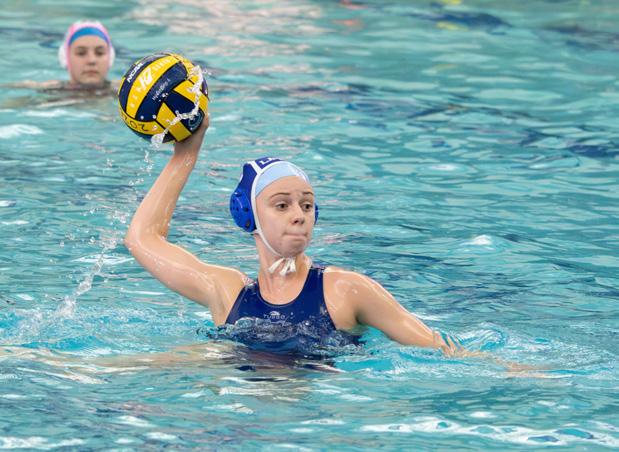
Harkonen (12) throws
water polo
Pattonville High School March 30. The team beat Pattonville with an aggressive 16-15 win. “[In this game,] I learned that I made some enemies,” Harkonen said. “What happens in the game stays in the game.” (photo by Risa Fingerman)
Joanna
the ball in the girls
game against
Eli Kozower (11) prepares to hit in the varsity boys baseball’s highly anticipated first game of the season against Parkway Central High School March 24. Although the team ended up losing to Parkway Central 3-1, they have since improved in their season and have come back, holding a more competitive record of 7-10 as of April 27. “The [game overall] was good,” Kozower said. “[Although] we lost, we a played a hard game against a good team. It was also fun to play with my friends.” (photo by Ivana Todorova)
BASEBALL
TRACK AND FIELD Q&A
“
ANABELLA ACOSTA (11)
My favorite part about track is the fun [I am able to] have with my friends and running as a group. It’s a really fun community.”
Track and field players give insight to their season so far
“OLUWATOMISIN FALAKO (11)
My favorite part is spending time with the team. After I am done with my individual events, [I like] going to say hi to my friends that are runners.”
“ IKE GUNDERSON (11)
[My favorite part is] probably seeing my teammates every day. Also, making new friends at different schools.”
Brooke Broadnax (10) lines up at the start line, preparing for her race at the Webster Stateswomen Invitational April 10. Although the girls track and field team did not win a race during this competition, the event served as an opportunity for more practice in preparation for the remainder of their competitive season this spring. “[The competition] was pretty good,” Broadnax said. “I learned that warming up is pretty important and to not dwell on the mistakes that you make.” (photo by Isabella Plumb)
IRENE MURPHY SPREAD DESIGN BY
FIRST DRIVE
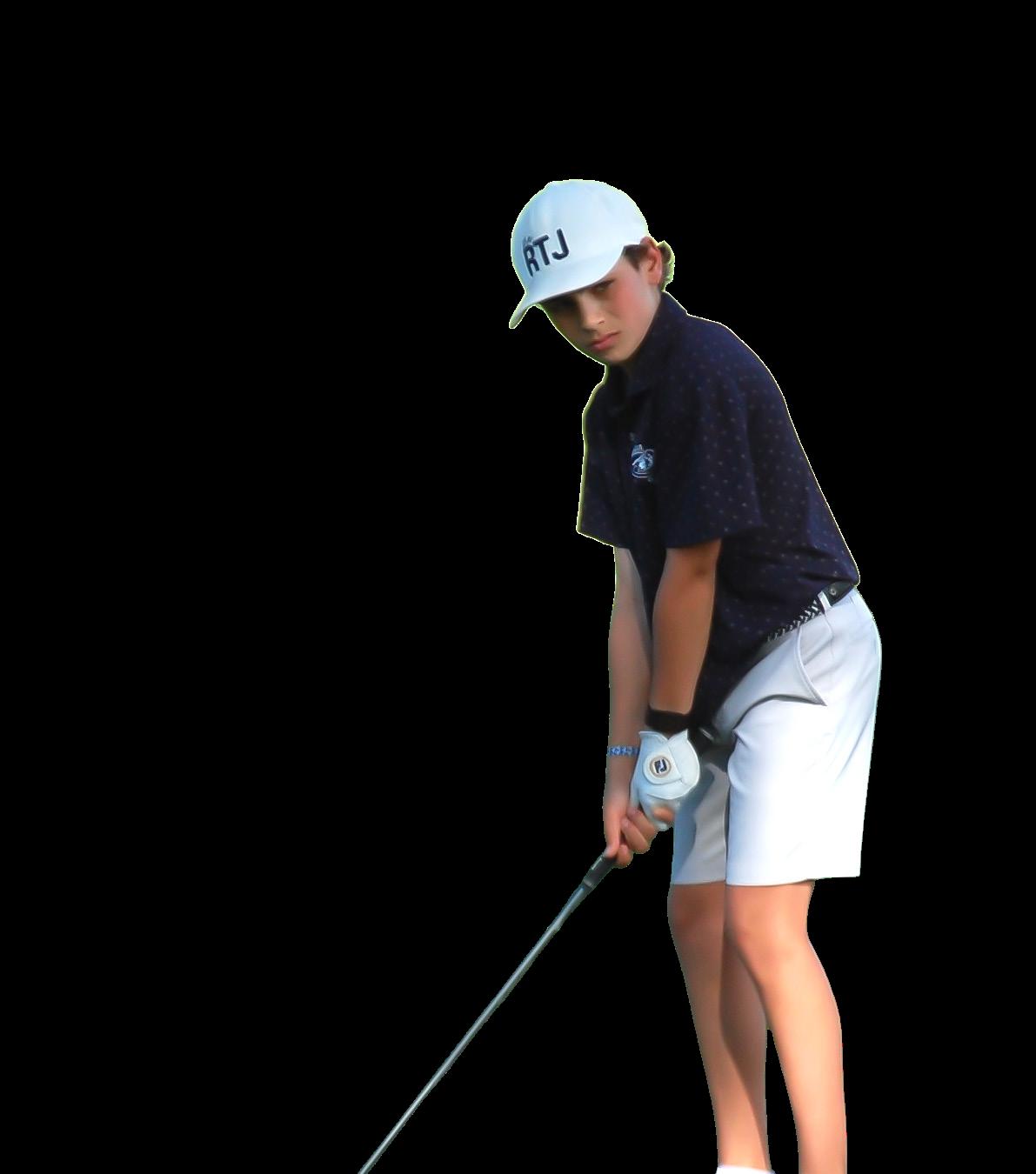
Dylan Press (9) excels on the boys varsity golf team and leads the team to a winning record of 4-2
PHOTO COURTESY OF DYLAN PRESS
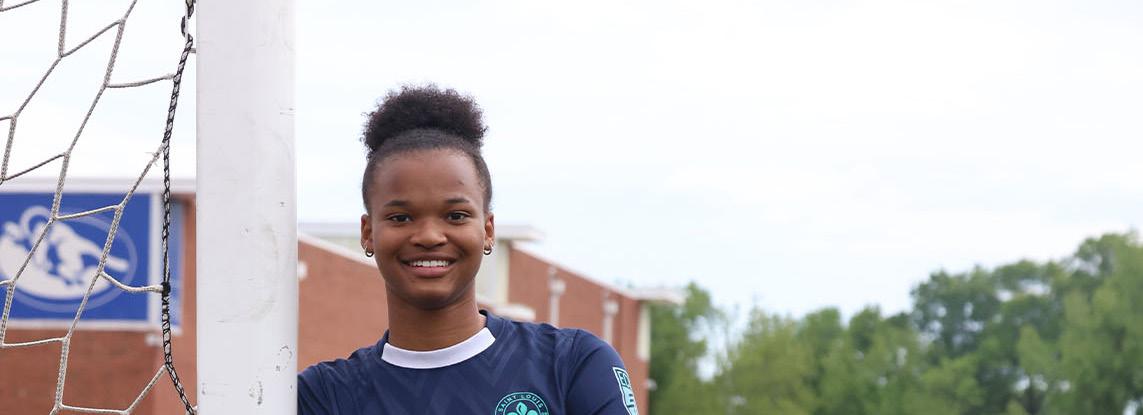
Ayrissa Robinson (11) leans against a soccer goal. She verbally committed to play soccer at Texas Christian University in fall 2025. “I’d say I’m most proud of committing to college soccer,” Robinson said. “I feel like I’ve finally met the expectations that everyone had for me.”
FROM TURF TO TRACK
BY
athlete
FFEET THUNDER AS AYRISSA
Robinson (11) sprints towards the goal, dribbling a soccer ball between her feet. Dodging left and right, she looks out for defenders attempting to snatch the ball out of her control. She’s completely focused, years of training and thousands of hours of practice keeping her synced up with her teammates to get the ball into the net.
Robinson is a dedicated multi-sport athlete who allots her time to both track and soccer. She plays soccer on the St. Louis Scott Gallagher club team. She mostly faces other midwest teams in games and runs track on the Ladue team.
“I’m a forward,” Robinson said. “My job is to score all the goals… [For track], I
run the 100, 200 and the relays, so I run the straightaway, the curve, then the straightaway.”
Robinson has experienced a great deal of success while running track, going so far as to win at state, but what makes the sport fun for her is the connections she’s made.
“I like the people,” Robinson said. “That’s what makes [track] fun.”
In addition to running track, Robinson trains nearly every day for soccer. A combination of team training and conditioning keeps her sharp. Her joy comes not only from the sport itself, but from the teammates who make all the time, energy and hard days worth it.
S“It’s hard maintaining and achieving expectations that other people have set for you,” Robinson said. “Because if you underperform, there can be people who are like, ‘Oh, she’s supposed to be so good. She’s committed to [Division I].’”
Despite the pressure, Robinson displays an impressive amount of resilience. She’s focused on her team and won’t let tough days stop her from giving the game her all.
“Soccer is bigger than me. I’m not just playing for me. I’m playing for my teammates.
Ayrissa Robinson (11)
“[Soccer] is bigger than me,” Robinson said. “I’m playing not just for me. I’m playing for my teammates.”
However, that doesn’t mean that she doesn’t have challenges. After winning at states for track last year and committing to play Division I at Texas Christian University, the pressure to perform is intense.
“She handles setbacks and challenges really well because she is such a hard worker and never gives up,” Charlotte Wilson (11), one of Robinson’s friends, said.
The frequent traveling and competition are a recipe for stress for some. However, the community Robinson has built within both sports combined with grounding pre-game rituals keeps her out of her head, focused, and performing her absolute best on the turf and the track.
“I really just turn on my tunes,” Robinson said. “I talk to my friends, talk to my teammates. That really helps me ignore all that pressure, that stress that I feel.”
P
JOSIE STOUT staff PHOTOGRAPHY BY SARMISTHA PULAGAM photographer
Multi-sport
Ayrissa Robinson (11) balances playing soccer and running track
MEASURED IN SECONDS
Qina Hong (10) trains to reach her running goals
PHOTOGRAPHY BY SARMISTHA PULAGAM
PHOTO
photographer
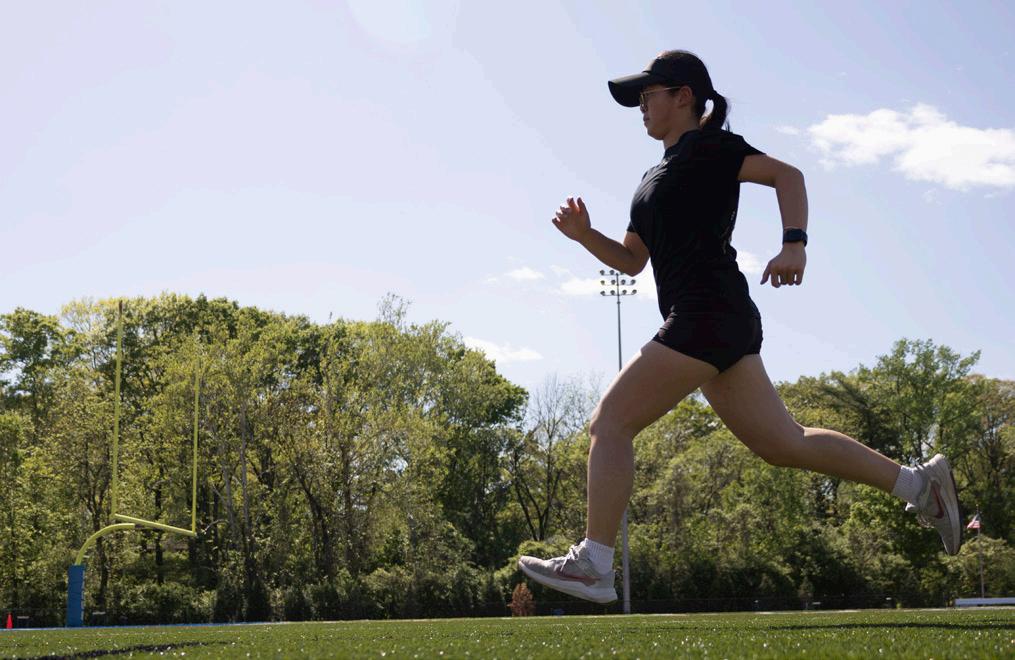
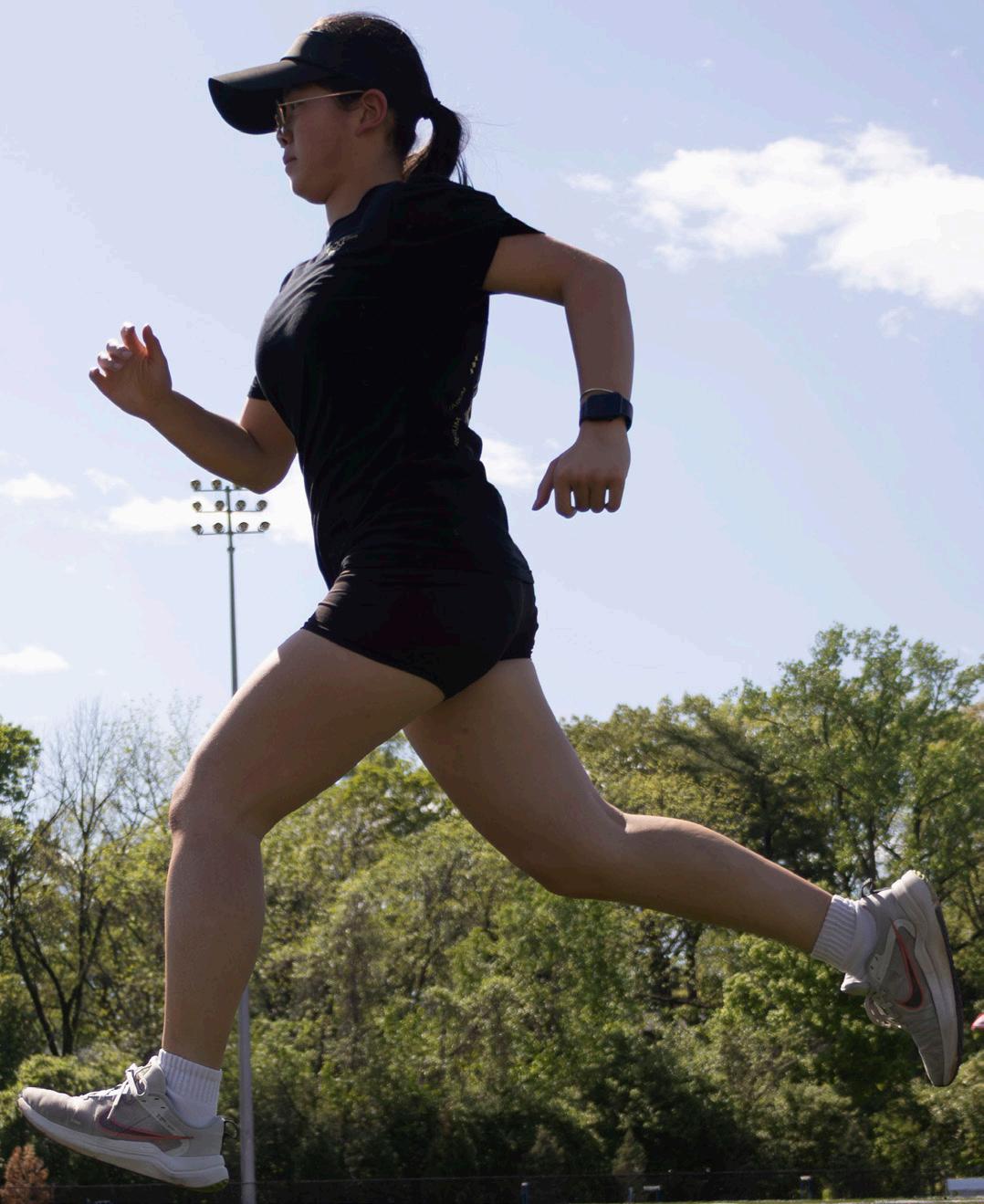
Main Photo: Qina Hong (10) sprints across the turf on a bright spring afternoon. She joined the track and cross country teams as a way to challenge herself both physically and mentally. “It really does get better and better the farther you go,” Hong said.
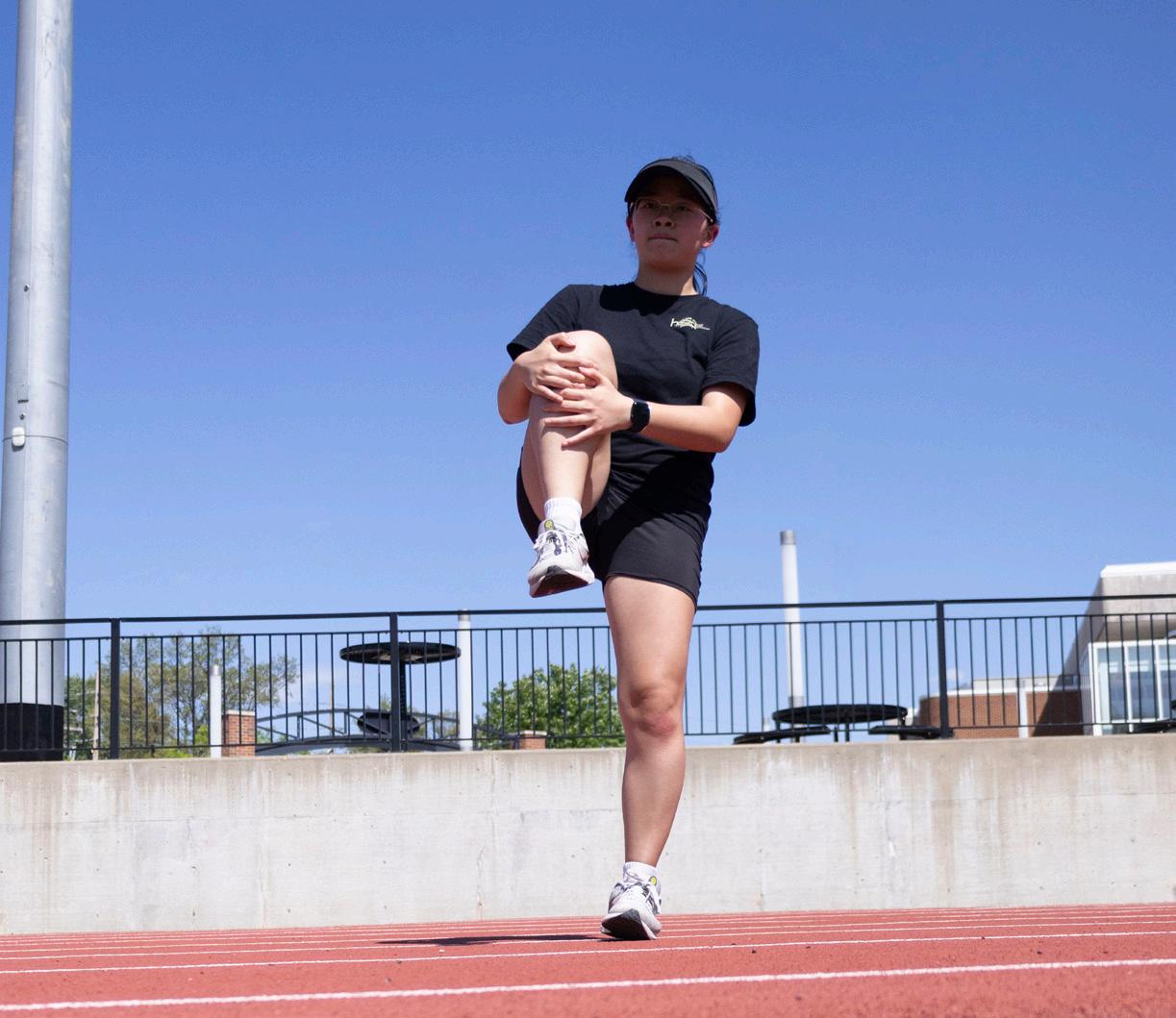
Top: Hong smiles by the track as she stretches before a run. For her, the people around her are just as important as the sport itself. “Track and cross country have such a friendly, supportive community,” Hong said.
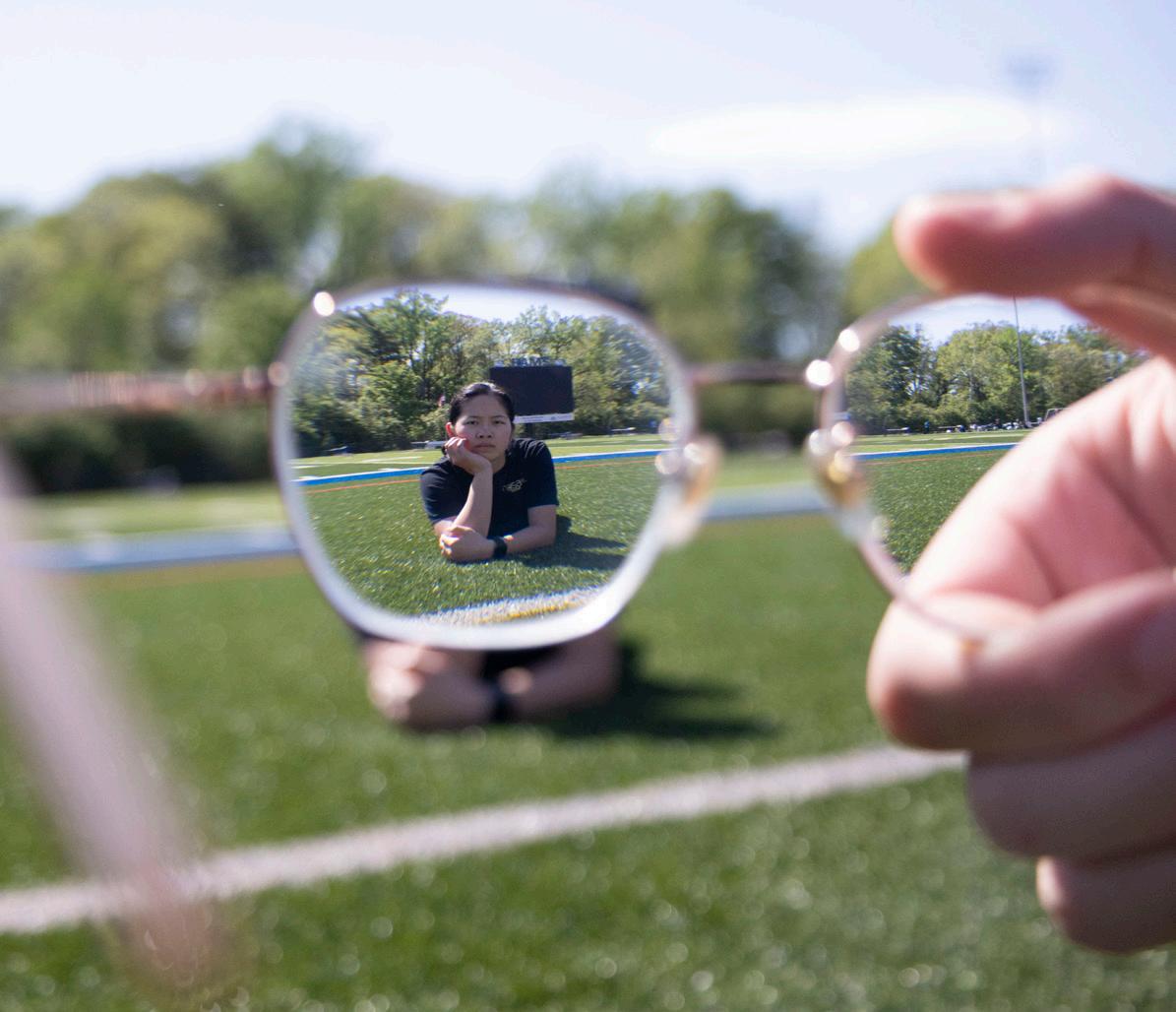
Middle: Seen through the lens of her own glasses, Hong lies on the field between runs. Hong has made many friends through her running journey. “Many things, especially running, are better when done with others,” Hong said.
Bottom: Hong stretches out on the track, preparing her body before a run. Setting goals and working toward them was a big part of why she was drawn to the sport in the first place. “You’ve got the tools, facilities, the coaches and the support system here to back you up,” Hong said.
The EdTech market was valued
Source: Research Nester at $187 billion in 2025 and is forecast to reach $214 billion in 2026.