
TABLE OF CONTENTS
Un Pasado Aún En El Corazón
Outrunning



POLICY CREDITS
Front cover photo illustration by Vincent Hsiao. Front and back cover designs by Maya Mathew. Mission statement by Annabelle Reagan and Ira Rodrigues.
The Ladue High School administration agrees to allow the Ladue Media staff to make content decisions and to operate as an opem forum, provided they do not infringe on the rights of other students or create a substantial disruption at school as per the Tinker standard. The adviser will give advice to the students on staff and play devil’s advocate concerning controversial or sensitive material, but ultimately, the students have final say in what is published.
EDITOR’S NOTE
Warm weather has come, and with it, the bustle of summer life too. Students and teachers anxiously count down the days until the school doors close for summer break. Seniors prepare to walk across the stage and receive their hard-earned diploma, marking the end of their memorable time as students in Ladue. Now, as we prepare to be separated for months, and for those leaving we face the bi ersweet truth that we still may not know many of those familiar faces around us.
ID’s third volume continues to stay consistent with our mission: to unite our community through sharing stories that represent the unique and vibrant people that make our school district special. In this edition, we highlight stories from artistic pursuits through dance, music or drawing, to the many cultural identities and journeys that students and sta have pursued.
Our goal is to upli as many voices as we can in order to facilitate a greater conversation over the beauty of identity in all forms. We hope to provide a platform for undercovered stories to be told and to represent the diverse community of Ladue. And through this, we hope both our subjects and our readers can learn about themselves and how their unique identity is shaped by the world around them.
We hope you take the time to read these pieces and learn something about the incredible members of our community, and in turn, re ect on your own identity: what makes you, you. We will continue to share stories and hope you continue to read them. Everyone has a story; here are just a few.


MISSION STATEMENT
ID Magazine seeks to provide the most accurate, relevant and important information regarding the identities of Ladue High School students, teachers and administration. e stories aim to showcase the myriad of talents exhibited by the school community. ID strives to amplify student voices and perspectives, creating a lasting record of the experiences that shape Ladue. e magazine remains commi ed to representing the diversity of Ladue High School, and the sta works to ensure ID is racially, religiously and economically inclusive. ID also makes an e ort to maintain professional standards and employ current design trends within the journalism eld.
STAFF
MANAGING EDITOR-IN-CHIEF
Marie Demkovitch
DESIGN EDITOR-IN-CHIEF
Maya Mathew
CONTENT EDITOR-IN-CHIEF
Annabelle Reagan
COPY EDITORS-IN-CHIEF
Katie Jansen
Grace Kweon
Ira Rodrigues
PHOTO EDITOR-IN-CHIEF
Vincent Hsiao
STAFF
Gabriella Beltranena
Medha Chode
Sophie Cowlen
Adelaide Flintrop
Sydney Gao
Tiya Kaul
Nathan King
Irene Murphy
Ryan Nolan
Jane Sche el
Josie Stout
Elsa Flores-Tamayo
Angella Zhang
Claire Zhang
PHOTOGRAPHERS
Gabriella Beltranena
Caroline Cobaugh
Teo Lee
Sarmistha Pulagam
EXECUTIVE EDITORS-IN-CHIEF
Josh Devine
Celina Zhou
ADVISERS
Sarah Kirksey
Abigail Eisenberg
Annabelle Reagan

R LLING
THE DICE
Xavier Stockmann builds community and identity with Dungeons & Dragons
written by photographed by Tiya Kaul Vincent Hsiao
The forest turns dark. Fog descends from the gloomy sky and powerful gusts of wind sweep fallen leaves off the ground.
The party, consisting of an orcish barbarian, an elf ranger, a dwarf cleric and a gnome wizard, becomes alert. Their gaze shifts. Their hearts race. Searching for danger in this new environment, they discern a mysterious figure appearing behind the soaring trees. Outside of this fantasy world, a group of anxious teenagers huddles around a table with a Dungeons & Dragons board. Palms sweaty, they wait for the roll of the 20-sided die. This roll determines everything. As the die is cast, their options change, and a thundering voice falls from the sky. “What will you choose to do now?” This voice belongs to none other than Dungeon Master Xavier Stockmann (12).
As a Dungeon Master, Stockmann narrates the events of the Dungeons & Dragons (D&D) roleplaying game, usually played on a tabletop. As Stockmann questions players and sets up the scene, members embark on a fantasy adventure to accomplish a specific quest.
“I describe a fantasy environment with strong details and specific wording,” Stockmann said. “I’m trying to share the area and experience to my players in a way that lets them truly visualize the setting. Most often, I’ll try to have the characters fit into the setting, either interacting with existing stuff or seeing the space for the first time. In a way, I’m writing a story, but I’m also including the people playing the game.”
Stockmann channels his passion for D&D through the small D&D club after school, which also allows him to collaborate and spend time with his friends.
“We’ve been able to build a very tight-knit and personal community,” Stockmann said. “Most people in the club know each other pretty well.”
Stockmann doesn’t just play D&D for fun, but also to include people with similar interests and give them something to look forward to. He prioritizes making his team feel like a family so nobody feels left out.
“The goal I’ve had in the club is to make everyone feel welcome,” Stockmann said. “I believe that everyone is comfortable being around each other.”
As a result of Stockmann’s passion for D&D, he adopted an influential role in the club and continues to exhibit leadership and kindness when he participates.
“[It’s] pretty rare for someone to come in and just start running a game, but to see him take on the leadership role has been great,” D&D club sponsor and math teacher Garrett White said. “He’s gotten better and better as the years have gone on. Sometimes you’re going to have conflict every now and then, but seeing him, as he’s gotten older, be able to navigate everybody’s personality has been pretty cool.”
Stockmann joined the D&D club as a freshman, and since then, he has transformed into a driving force for inclusivity, friendship and growth among members.
“He brings everybody in,” White said. “He has a nice presentation that he’ll give to people and he has just

a nice way about him. [H]e can interact with all these different kids and it really is cool to see. He’s one of the best that I’ve had.”
Stockmann has also experienced profound selfgrowth through D&D club. Since he began it, the game has evolved into a crucial part of Stockmann’s identity. It is not simply a game: it is a powerful form of selfexpression and a key part of who he is as a person.
“D&D has become a huge part of my identity,” Stockmann said. “It’s really helped me embrace myself as more of a nerdy person.”
Despite being a game, D&D helped Stockmann approach his real-life problems and friendships with unique perspectives. Stockmann’s application of D&D principles in his life helped him build a strong and longlasting community among him and his loved ones.
“The game has helped me find a lot of good friends, which for a while I found very difficult,” Stockmann said. “It’s helped me rethink how I solve a lot of problems as well.”
Stockmann often uses his role as Dungeon Master to keep growing and inspiring the D&D community.
“He has motivated new people to experience this club that otherwise wouldn’t have,” club Vice President Natalie Brunworth said. “He helps out with newer [Dungeon Master]’s and players.”
D&D also influences the way Stockmann is perceived by others, with his persona being impacted by the game.
“[D&D] affects the way I carry myself,” Stockmann said. “Part of my interest in the game is the general fantasy and whimsical vibes of stuff, so in my daily life, I will make connections to the game or connections to similar types of content. [This] will change how I react to things and often, I react to things due to the game.”
Due to the sheer amount of time and effort the game takes, Stockmann needs to be completely immersed while playing, especially due to being Dungeon Master.
“Because of how I’m always running the game, I’m very locked in,” Stockmann said. “I’m constantly reading lots of stuff, rechecking tables I’ve written, all the notes I’ve got, which is really fun for me. The entire time I’m feeling very free.”
Despite the pressure to perfect each and every game session, Stockmann prioritizes enjoyment, smooth sailing and having a good time with his friends.
“I’m very happy,” Stockmann said. “I always enter a flow state whenever I’m playing D&D and I feel very connected to the people I’m playing with.”
Over time, Stockmann has evolved to be more selfassured while leading the game. He is very capable in his management skills and welcomes each player to the club.
“He has become a more confident [Dungeon Master] over the years,” Brunworth said. “In the very first few meetings he would go around and make sure everything
was running smoothly and everyone could create their characters.”
Since Stockmann runs the D&D club, he has the power to create an inclusive community, and he does exactly that. He puts the club and its members before himself.
“I want to make people around me comfortable being themselves,” Stockmann said. “I don’t necessarily need them to like me, but I want them to like being in a space that’s around me. I want them to be able to be who they are.”
Stockmann’s benevolence in the game extends not only to the members but to the sponsor as well. His help in managing the club and expressing his love for the game is noticed and appreciated by the whole D&D crew.
“He’s made my life very easy, because he runs everything and I don’t need to do a lot,” White said. “As a matter of fact, sometimes even in the past, we’ve disagreed on certain things, but he’s had really great reasons for the way he feels.”
Stockmann ensures that members feel like themselves by making the story fluid and viable to change. If one member wants to roleplay a different persona, Stockmann alters the story to make everybody feel comfortable.
“There isn’t one set story,” Stockmann said. “While the people are playing as an orc or an elf or a grand wizard, the actual person behind the character is the most important. Their personality always reflects the characters they have or vice versa.”
This unity and diversity in the club helps the members embrace themselves in the game as well as real life. Stockmann fostered this environment to make sure that members could use D&D to learn more about themselves and feel comfortable while playing the game.
“We always are going to support each other,” Stockmann said. “We are such a tight community, everyone there is so themselves. It feels like we are actually being ourselves in this environment. There is a very strong sense of authenticity and belonging.”
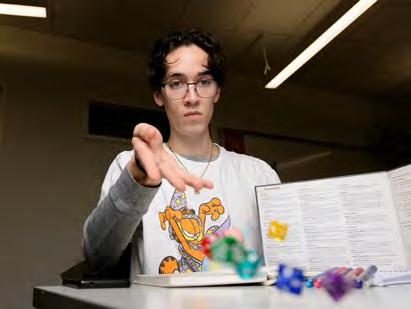
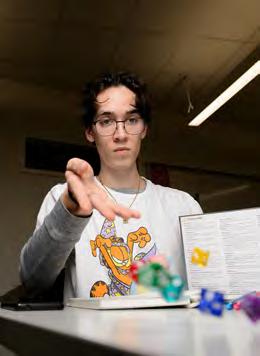
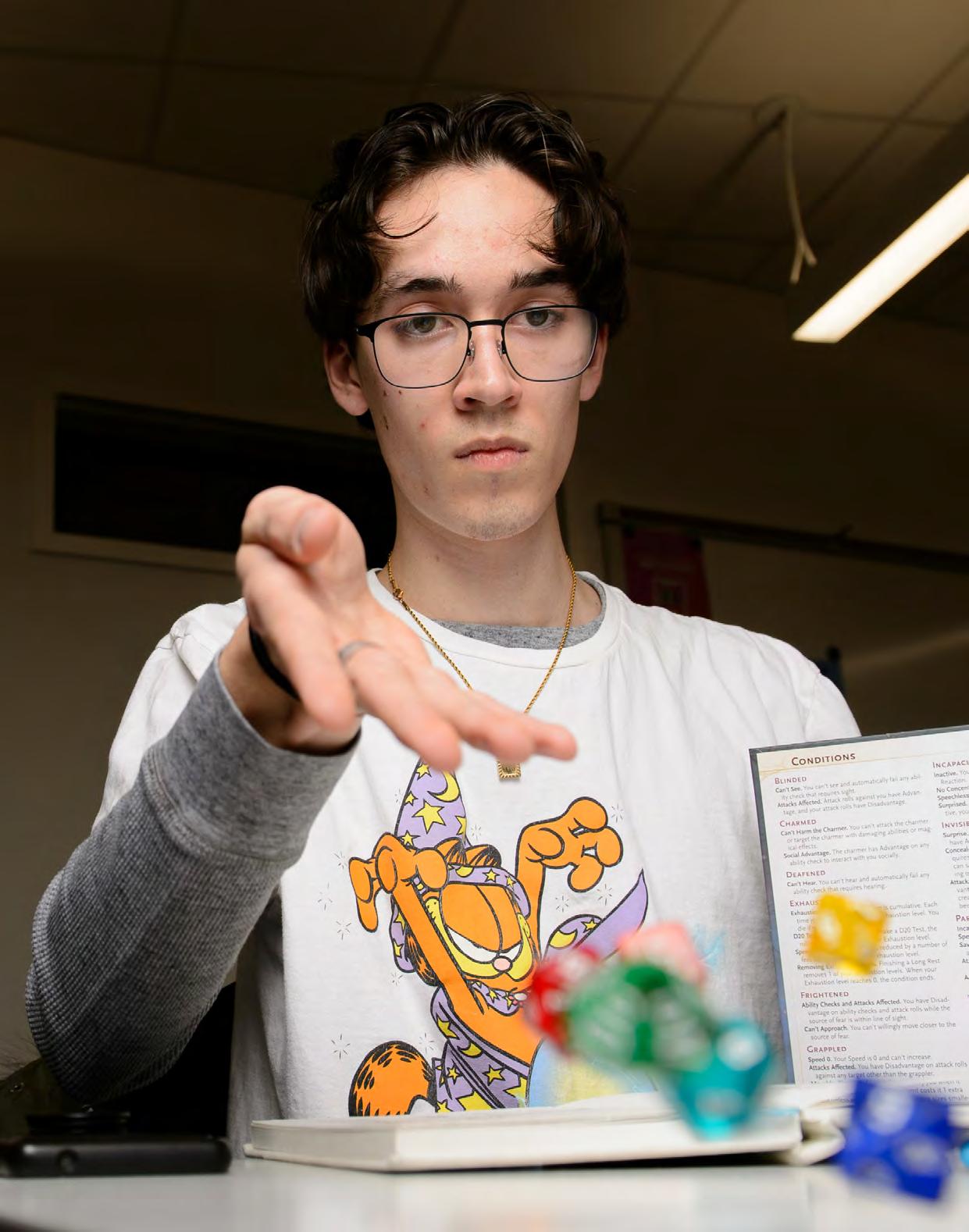
Caption: Xavier Stockmann (12) rolls 20 sided die to initiate a game of D&D. Stockmann joined D&D club as a freshman and, since then, has become the Dungeon Master who leads the game. “[I write] different games and [lead] stories and events for the club,” Stockmann said.“IorganizethedifferentgroupsandIhelp[students with] problems involving social stuff that interacts with the rest of the game.” (on pages 4-5)
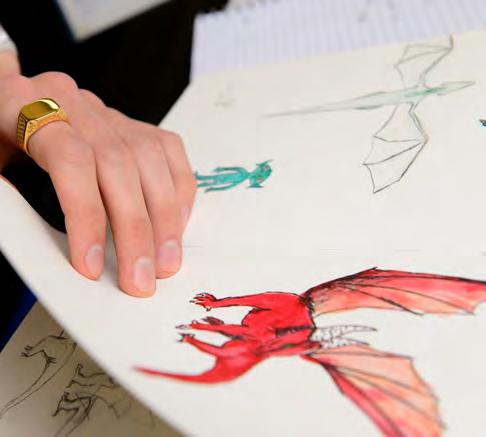
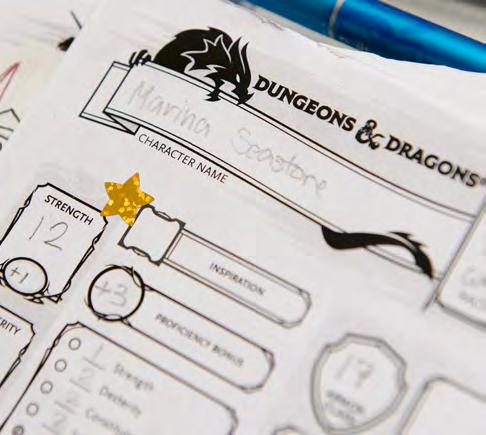
Stockmann manages D&D club materials such as the dice, artwork and sheets with character information. Stockmann’s learned many life lessons and organization skills due to his role as Dungeon Master. “A few of [the club members] will have a computer in front to check information,” Stockmann said. “I will have a large pile of dice and my small pile of books, full of information as well.” Photos by Vincent Hsiao. (on pages 6-7)
"The goal I’ve had in the club is to make everyone feel welcome."
Xavier Stockmann (12)
Ellen
redefines femininity as a multi-sport athlete
Widjaja
written by photographed by photos courtesy of Claire Zhang Vincent Hsiao
Ellen Widjaja

SPREAD DESIGN BY CLAIRE ZHANG
From the moment the school bell rings, Ellen Widjaja (9) rushes through the chaotic and packed hallways. She isn’t racing to the parking lot like most students. Instead, she heads to the pool for a two-hour diving practice. Immediately a er, she a ends a four-hour gymnastics practice with the faint smell of chlorine still lingering in her hair. Busy for some, this is just another regular weekday for Ellen as a multi-sport athlete.
Ellen competes in gymnastics, water polo, swimming and diving. Gymnastics was Ellen’s rst sport, which she began at 5-years-old. Her parents and older siblings played a signi cant role in the sports she chose to pursue.
“My mom put me in [gymnastics] classes when I was li le,” Ellen said. “My sister also did it, and I really liked it. For swim, my mom also put me into that. She just wanted me to learn how to swim.”
Ellen grew up with older siblings who both played various sports. As children, their parents had to juggle a busy schedule, driving them to and from practices.
“It’s de nitely busier for our parents, especially when we were younger and couldn’t drive yet,” her brother, Glen Widjaja (12), said. “It was a lot for them to manage ge ing us to di erent places. Both of my sisters go to di erent gyms and I’m always at the pool. But once my older sister and I started to be able to drive, it actually made it a lot easier because I could take my sister to practice.”
Gymnastics is scored by a panel of judges based on the combined di culty and execution scores. As she has matured as a gymnast, Ellen has learned to focus less on the results and more on her personal growth.
“[Ellen] is not stuck on a score,” her mother, Irene Gunawan, said. “[Gymnastics is] an extremely subjective sport. You perform the skill, you perform your routine, you think you nail everything, but then that’s not the score that you expect. Ellen has learned that it is not the scores that control her, but her controlling her own delivery, the skills and the presentation.”
A few years ago, Ellen experienced gymnast’s wrist — a common injury caused by repetitive, high-impact stress on the wrist. Although it took over a year to heal, Ellen continued to return to the gym with a positive mindset.
“I would say [Ellen is] hardworking,” Glen said. “I know she’s very busy. She pushes herself a lot and I really admire that. It’s a lot on her, especially as a young teenage girl. But she always pushes through and I’m proud of her for that.”
Aside from gymnastics, Ellen dives and plays water polo for Ladue. is year, she placed second at diving districts, qualifying for state. For many, including Ellen, high school sports brings a strong sense of community.
“[Sports have] made me appreciate how much I can do with my body.”
Ellen Widjaja (9)
Over the years, gymnastics has become Ellen’s main sport as well as her favorite. She trains with Team Central Gymnastics Academy. Unlike gymnastics, swimming was an activity Ellen participated in only during the summer as part of the Robinwood West swim team.
“I didn’t really fall in love with [swimming] the way I did with gymnastics,” Ellen said. “I really fell in love with gymnastics and the process. But for swim, it was just kind of a fun li le excursion with friends.”
ere are four events in women’s gymnastics — vault, uneven bars, balance beam and oor. Gymnastics challenges Ellen both physically and mentally, having to learn new skills and routines on a regular basis.
“I de nitely think gymnastics is the most challenging because there’s just so many components,” Ellen said. “You have to be so precise with it, especially with all the four di erent events. at’s four di erent aspects you have to train and get really good at. Once you get to a higher level, around where I am, it’s mainly mental because your body already knows how to do the skills. You just have to trust your mind to allow your body to do it.”
“[My favorite part about high school sports] is really this community,” Ellen said. “ e girls are so nice. We all just help each other up and we all really encourage each other. I think it’s really fun.”
For high school sports, competitions are typically held on Tuesdays and ursdays. As the girls’ swim and dive manager, Glen is able to support Ellen directly on the pool deck. Additionally, her parents are always in the stands to cheer her on and provide advice along the way.
“Being a parent, I don’t know the ins and outs of the sports that she is involved in,” Gunawan said. “But [I’m] just there for her, reminding her that not everyone is going to be at the top spot. Sometimes you just nail it. You’re on top of the world. And the next time, it can ip, and that’s okay, that’s life.”
While Ellen spends a lot of time in the pool or gym with her teammates, her busy schedule makes it challenging for her to connect with friends outside of school.
“[I’m most proud of Ellen] just managing to balance all of this,” Glen said. “Sometimes she can’t hang out with her friends as o en for these sports. I know it’s a sacrice, but I feel she truly loves these sports, and I’m just proud of her for ge ing through it.”
Balancing four sports along with school and other responsibilities is a di cult task for one person. Hence, Ellen uses her time wisely to complete her homework.
“[I learned] time management, being able to persevere, really just listening to myself and my body and what I need while also trying to help and support everyone else because that’s part of being a team,” Ellen said.
Moreover, sports have allowed Ellen to develop discipline, which can be applied to other aspects of her life. For instance, she has learned to recognize her limits and persevere through challenging tasks and assignments.
“[Sports have] made me appreciate how much I can do with my body,” Ellen said. “I’m really glad that I am blessed with that. It’s made me persevere [and] try to keep going for a math problem. It’s allowed me to reach out when I need help, especially with a subject that’s hard.”
At certain moments, Ellen has felt underestimated as a female athlete, especially in male-dominated sports like water polo. Despite these barriers, she has competed at Junior Olympics with the St. Louis Lions water polo team for the past two summers, winning silver in 2024.
“As a female athlete, some people would say, ‘Oh, can you really do that? Like, you can’t really be that good,’” Ellen said. “But I just ignore them and I like to prove them wrong when I’m training.”
While only a freshman, Ellen is open to the idea of competing in gymnastics at the collegiate level. She hopes to inspire future generations of female athletes.
“To younger female athletes, keep going, you’re amazing,” Ellen said. “Everyone loves you. Even if nobody loves you, I love you. And just try to keep going. Really push like you can do it. (ui ing was always an option for me but never a thought.”
Captions: Ellen Widjaja (9) dives at districts Feb. 13, entering the water in a streamline position. Her experience in gymnastics o en transfers to diving, in which Ellen placed second at districts and 13th at state this season.“Gymnasticshasreallyhelpedme[learn]divesalot quicker,” Ellen said. Photo by Vincent Hsiao. (on page 9)
Ellen stands for a photo with her teammates at Junior Olympics in Dallas. She played water polo with the St. Louis Lions. “My teammates have been a great support,” Ellensaid.“Iknowalloftheteamhasmybackandthey’ll stand up for me if I need it.” (on page 11)
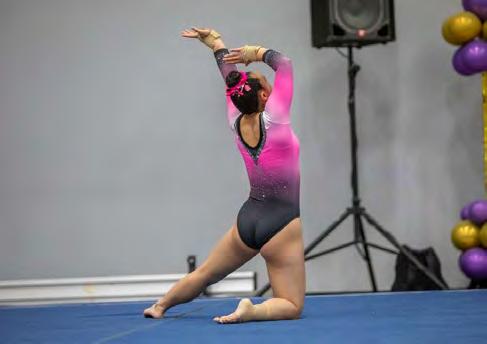
Ellen kneels on the ground as she nishes her gymnastics oor routine. Over time, she has developed a routine to manage her anxiety on competition day. “For gymnastics and diving, I just try to relax and trust my training,” Ellen said. “I know I can do it, but sometimes I get in my head.” (on page 11)
Ellen poses in her gymnastics leotard while standing on the balance beam. She rst started gymnastics when she was 5 years old at a daycare and eventually joined a gymnastics team. “I’ve been doing it for so long now,” Ellensaid.“ ere’ssomanyaspectstoitthatit’sjustlike, how can you not be in love?” Photos courtesy of Ellen Widjaja. (on page 11)


BELLVILLE
H PPY WHILE
HELPING
Stephanie Bellville discovers fulfillment through compassion for others
written by photographed by Irene Murphy Sarmistha Pulagam
photos courtesy of Stephanie Bellville
An alarm cuts through the silence as the clock ticks to 4:15 a.m. A sleepy gure walks through the house to the kitchen, where co ee is poured into a simple white mug. Now, history teacher Stephanie Bellville can start her 30-minute meditation period. A er, a purple yoga mat is spread out on the oor and she performs a series of stretches that focus her mind on the day ahead of her. Light is nally reaching through the windows, signaling that it is time to get to school. Once she arrives in her classroom, she prepares for a full day of teaching students about the world around them.
Growing up, Bellville lived the typical suburban life in Rockland County, N.Y. Outside of the normal teenage activities, Bellville was inspired to help those in need by her parents who cared deeply about the world.
“My dad was a lawyer, and my mom taught high school science,” Bellville said. “ ey just had empathy and compassion for the human experience, and I got that from them. My aunt was a social worker. She was my mentor at my rst job, and so I’ve always felt like I wanted to do something that contributed to society.”
Her advocacy journey started in high school when she worked as a children’s counselor in a ba ered women’s shelter o ering women refuge from domestic violence. In this job, she helped children feel at home in their new environment and she also helped them to complete their homework assignments for school.
things that you can do is just acknowledge someone’s human dignity, no ma er where they are in life.”
rough her various jobs, Bellville learned that her true calling was in teaching. Her rst teaching job was at Lowell High School in San Francisco for the rst 16 years of her education career. A er that, she moved across the country again to teach history classes at Ladue High School, where she has been for the past nine years.
“As a social worker, you’re working with adults who are pre y hardened in their ways,” Bellville said. “I wanted to work with young people to have the most impact as possible. My mom was a teacher, so I was either going to be a psychologist or I was going to be a teacher. I decided that teaching was a be er t for me.”
During her 25 years of teaching, she has learned about herself and how to become the most e ective teacher. She tries to nd a balance in her teaching to reduce burnout.
“Ultimately, what I want to be is a catalyst, not a replacement for [student’s] thinking or e ort,” Bellville said. “It’s nding that balance of giving a kid just enough, meeting them where they’re at [and] guiding them, but ultimately getting them to develop that con dence in their own thinking.”
“One of the most powerful things that you can do is just acknowledge someone’s human dignity, no matter where they are in life.”
Stephanie Bellville, history
teacher
Since coming to Ladue, Bellville has found a di erent way to support others, speci cally with her students. With the collaboration of English for Speakers of Other Languages teacher Deepa Jaswal, she started the Asian Cultural Advocacy Group.
“[At the women’s shelter,] I learned that you can be there to support people, but that people have to be ready to make changes,” Bellville said. “Changes can o en be extremely di'cult to make.”
Bellville a ended the University of Michigan as a history major. She spent her junior year of college studying abroad in France, where she gained new perspectives.
“Living in a foreign city was incredible,” Bellville said. “[It was] looking at the world through di erent eyes. We grow up [in the U.S.] and we think everybody thinks like we think. en, you live in another country and you realize that our point of view is not the only point of view.”
A er college, she moved across the country, relocating to San Francisco to pursue social work. She landed a job in the Conard House, which is a facility for the formerly homeless and psychiatrically disabled adults.
“[I learned] that we’re all one or two misfortunes away from being down and out,” Bellville said. “Just nd the humanity in everyone. One of the most powerful
“[Bellville's] Asian students reached out that they wanted a safe place and to create a group,” Jaswal said. “She became the sponsor. It’s work that’s really important to her, and she is always willing to go an extra mile.”
Due to her concern for the number of teachers that quit the workforce within their rst years in the job, Bellville came up with the idea for a book and podcast that focuses on solving the issue of teacher burnout.
“I found that there was a lot of a ention during the COVID-19 pandemic given to teenage and student mental health,” Bellville said. “No one was really acknowledging the impact that it was having on teachers. We’re still seeing the impacts of that.”
at’s why Bellville published her “Happy While Teaching” workbook and podcast: to address teacher burnout and helping teachers prioritize mental health.
“It’s something that I’m so passionate about,” Bellville said. “ ere was about a year and a half that I was thinking about writing a book, but I didn’t know what exactly it was going to be. Once I knew what it was going to be,
[ideas] just came to me and in the summer I did a lot of the writing, [which] really owed out of me.”
e main message of the podcast focuses on maximizing contentment in the job by taking care of oneself. Bellville aimed for it to be free and accessible. e podcast reached others like English teacher Emma Lawson.
“[ e podcast] speaks to those li le moments as teachers that you feel down about something,” Lawson said. “She takes those moments and recontextualizes them, and she talks to experts. It’s truly illuminating.”
Bellville copes with her own burnout through yoga. Not only does it help to clear her head and give her a strong mind, body and spirit connection, but she has found that it can also be helpful to her students as well.
“I have a lot of techniques like breathing [or] something as simple as if I want to get my kids focused, have them stand up and stand on one leg,” Bellville said. “It focuses your mind. I also try to sense when kids sort of are stressed out, needing a li le bit of a stretch.”
Her whole life, Bellville has been deeply commi ed to the act of helping others, whether it is at a women’s shelter, as a social worker or educating herself and others. She wants to continue helping her community in whatever way she can and inspire others to do the same.
“Follow your own inner voice, stop listening to what everybody else says,” Bellville said. “You [have] to sit down and ask your own heart and mind, ‘What is it that you want? What is your spirit telling you that is the right thing?’ If there’s something that’s important to you, you’ve got to really search your own soul and follow that path.”
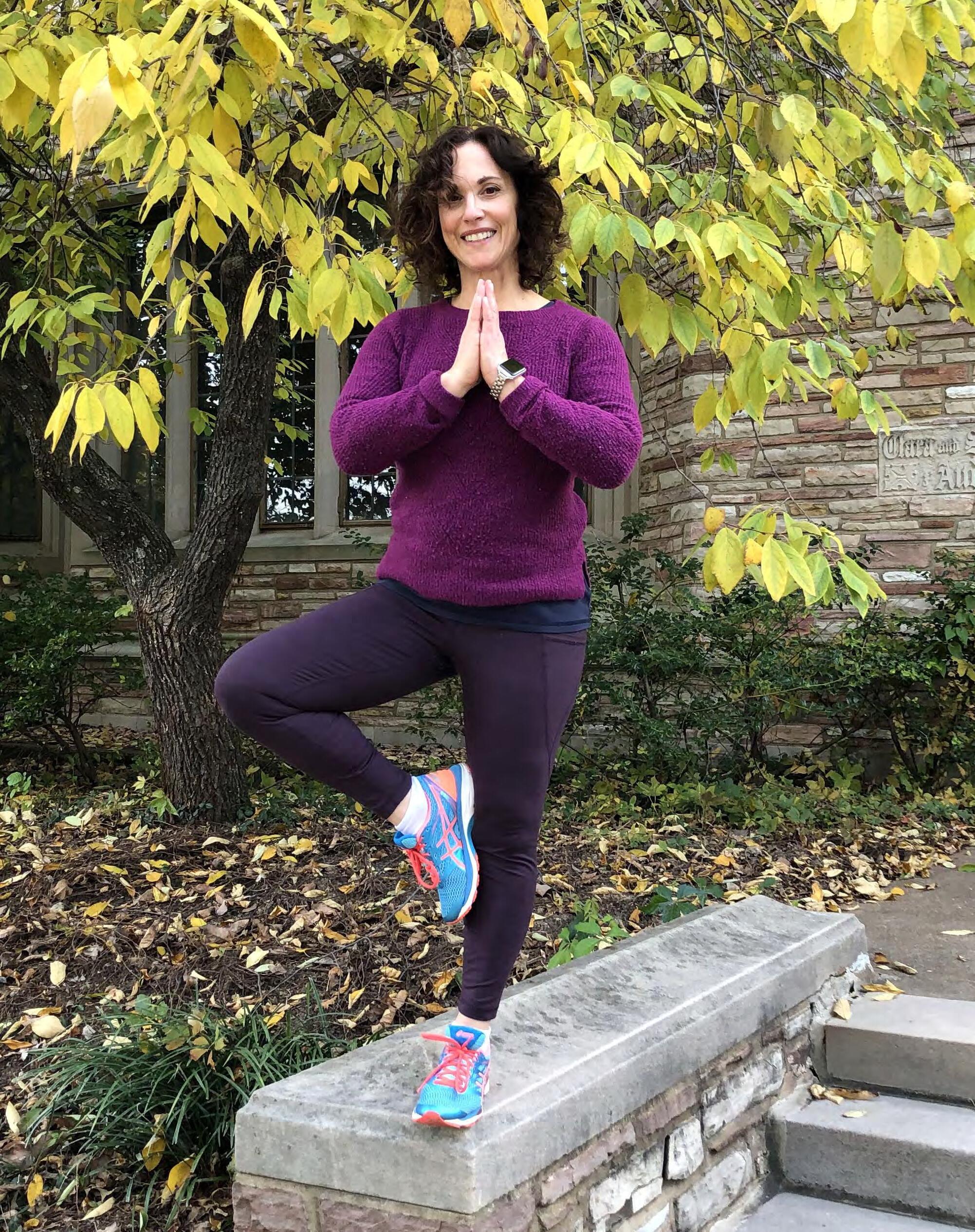
Captions: Stephanie Bellville performs the tree pose while in a park. She has loved yoga sinceshe was a teenager,whenhermomtookhertoher rstyogaclass.“ e thingaboutyogathatIloveisthemind,body,spiritconnection,” Bellville said. “It zens me out like nothing else.” (on page 12)
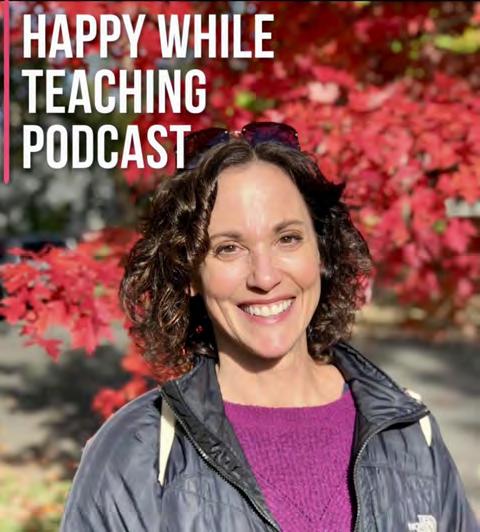
e cover of Bellville’s podcast. In this podcast, she didamixofguestandsoloepisodes.“Wedosomuchfor other people, and very o en, we neglect ourselves in the process,” Bellville said. “I want to encourage teachers to not neglect themselves.” (on page 15)
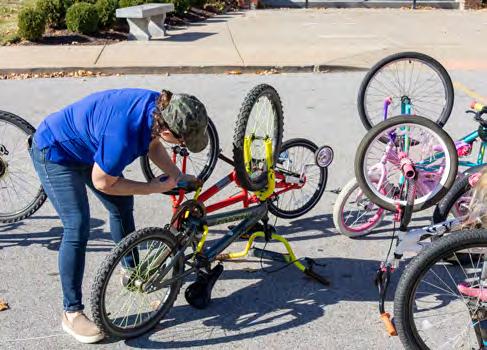
Bellville volunteers at the Wheels To Africa drive, where people could donate their bicycles for children in Africa.Shehasalsodoneothertypesofcharitywork.“At the ba ered women’s shelter, I was a children’s counselor, and my job was really to help [kids] be in a di erent environment from their homes,” Bellville said. “[In] San Francisco, I had a couple of social work jobs.” Photos courtesy of Stephanie Bellville. (on page 15)
Bellville teaches an AP World History class. She has taught for 25 years. “I would say my greatest strength as ateacherismyauthenticity,”Bellvillesaid.“I’mrealwith my kids.” Photo by Sarmistha Pulagam. (on page 15)
IN HIS OWN HANDS
Maximo Derdoy channels culture through individual pursuits in music and art
written by photographed by Sydney Gao Vincent Hsiao
photos courtesy of Maximo Derdoy


At 3 years old, Maximo Derdoy (10) climbed onto the back of an old horse at his grandparents’ farm outside of Ayacucho, Argentina, galloped across the open land and declared it the best moment of his life. This sense of joy, raw and pure, has followed him ever since. Today, he channels that energy through the piano keys he loves to play, the sketchbooks he has filled over years and the Argentinian culture he continues to share with family. For Maximo, the things that matter to him, the ones he feels the most passion for, were never assigned to him. He found them on his own.
Maximo has been playing the piano and drawing since his early childhood. Both of these pursuits have always served the same purpose; they act not just as simple hobbies, but as ways to process emotions, connect with his heritage and make sense of who he is.
Culture & Heritage
As Maximo’s parents hail from Argentina, particularly the towns of Ayacucho and General Juan Madariaga, he feels a strong tie to Argentinian culture. He specifically connects to his heritage through food, where the dinner table is often full of flavorful and diverse cuisine.
“We eat a lot of traditional foods in my household,” Maximo said. “My favorite meal would probably be empanadas, which my mom cooks a lot and usually [fills with] meat, eggs or olives. I also love the lentejas or milanesa that she makes. Those are my favorite meals from Argentina and [my family] always eats them here.”
Despite growing up in the United States, Maximo has also been exposed to his Argentinian heritage for all of his life through the Spanish language. He uses his linguistic fluency to communicate with his family and further explore opportunities both in and out of school.
“It’s super important for us that [Maximo] keeps speaking Spanish because we want him to be connected with our family as most of them in Argentina don’t speak English,” Maximo’s mother, Agustina Derdoy, said. “I also feel like a second language will open doors for him in the future. For school, jobs and [other] opportunities, it’s much better when you can speak a second language.”
In addition to traditional food and language, Maximo frequently travels to Argentina to strengthen his cultural identity and bonds with extended family. But one aspect that stays with him no matter the distance is music. By playing the piano, Maximo takes part in tradition, maintaining familial ties across thousands of miles.
“There’s always music, and you can hear it wherever you are in Argentina,” Maximo said. “So when I’m playing piano, I feel that I am more connected to my family, because music is a big part of the culture. A lot of people in my family also play instruments; my dad and my sister
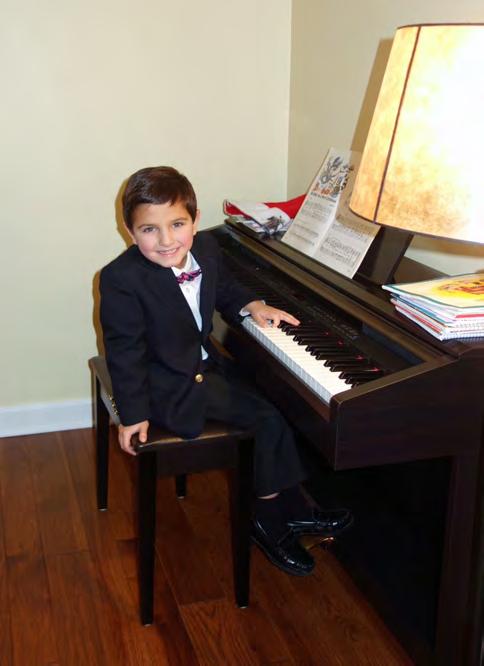
play the guitar, so we’ll play together when my family’s in town. That’s what helps me connect to my [heritage].”
Music
Maximo began playing piano at just 5 years old, initially starting through formal lessons. However, his musical journey was far from straightforward.
“He started playing in kindergarten, but he wasn’t always this passionate,” Agustina said. “There was a time when he quit piano. He didn’t want to [take] lessons anymore because he was bored. It was a struggle at the time, so he had no desire to continue and didn’t play piano for a long time. Then one day, [Maximo] started playing again, picking up the songs that he liked. I think that developed a different sense of passion for him.”
When Maximo returned to the instrument on his own terms, the shift from obligation to independent pursuit changed everything and brought rewarding outcomes.
“He is very passionate and happy because [piano] is relaxing for him,” Agustina said. “He likes to hear the melodies and [enjoy] the process. When he starts learning a song, he goes from nothing, then keeps trying and trying, and by the end of the day, he’s able to play the full song. It’s very rewarding.”
As a viewer, Agustina observes the passion and happiness in her son, but he experiences something else at the piano. For Maximo, what began as a means of enjoying melodies and discovering the satisfaction of progress has transformed into a space to explore emotions.
“[When I play], I feel calm and more relaxed,” Maximo said. “I feel like it’s a way of navigating through my own emotions. That’s how I choose the type of song I want to play, depending on what I’m feeling.”
The way Maximo plays adds another layer to this emotional connection. He doesn’t rely on sheet music for most songs; instead, he takes a unique approach that makes the experience feel more personal.
“A lot of songs that I wanted to learn and play are based off of memory,” Maximo said. “So it feels better when I’m playing, and I feel more pride because I’m not just listening to the song or reading the sheet music. It’s [as if] I’m expressing and playing it myself because the music is coming from my own memory.”
A musical presence has remained a crucial aspect of Maximo’s family. It’s a constant that ties them together through one specific tradition.
“Music has always been a big part of our lives,” Maximo’s older sister, Juana Derdoy, said. “My dad and I will play the guitar, Maximo will be on the piano, we’ll all be singing, my mom and sister will pick up a drum, and my dog will bark with us. So, we’ve always had music.”
Playing with his father and sister is just one example of how Maximo harnesses the piano. Music is
deeply integrated into his culture, where it accompanies every special celebration and family gathering.
“Music connects our family,” Agustina said. “We have a lot of musical instruments in our [household], so every occasion we are celebrating, we will do it with music. When we visited Argentina, [Maximo] even played for my father-in-law’s 90th birthday. It was very special.”
Maximo’s musical journey has taught him about both perseverance and growth. The process of stopping formal lessons, temporarily stepping away from music entirely, then gradually finding his own way back through personal passion has shaped the way he views independence and improvement.
“I’ve learned that with dedication, anything is possible,” Maximo said. “When I was little and my piano teacher would give me pieces, I thought I wasn’t really improving, that I was staying at the same skill level. But when I finally stopped taking those lessons and took it upon myself to learn, I realized how far practice really got me. Playing on my own and learning songs that I enjoy helped me improve a lot, and it’s truly what keeps me going.”
Art
Maximo began playing and expressing himself through art at a very young age, years before he had the words to describe what really drew him to it.
“For as long as I can remember, he has always been drawing, playing with crayons and paper,” Agustina said.
This early habit of drawing stuck with him. Despite a lack of formal instruction, Maximo kept practicing on his own, driven by genuine enjoyment and passion.
“Unlike piano, I’m self-taught,” Maximo said. “I think I improved because I spent so much of my time drawing. I really enjoyed it and I would use [my skills] to make gifts for my family.”
Evidently, the artwork Maximo created didn’t just stay in his sketchbooks. As he improved, he regularly channeled his artistic abilities into gifts for loved ones.
“I’m very proud and enjoy looking at [Maximo’s] artwork,” Agustina said. “I have a box of cards that he’s made me for Mother’s Day and my birthday. Those are very special memories, because I can look at them and see how he has developed his art through the years.”
Art serves a deeper purpose for Maximo. Much like piano, it has become a way to process his unspoken emotions, allowing him to find relief from everyday stress.
“[Art] really helps me navigate through my emotions because it’s a great way for me to express myself, clear my head and escape stress and hard things in life,” Maximo said. “It’s a way to get away from all of that.”
For Maximo, his drawing is also a source of pride, motivation, improvement and personal growth.
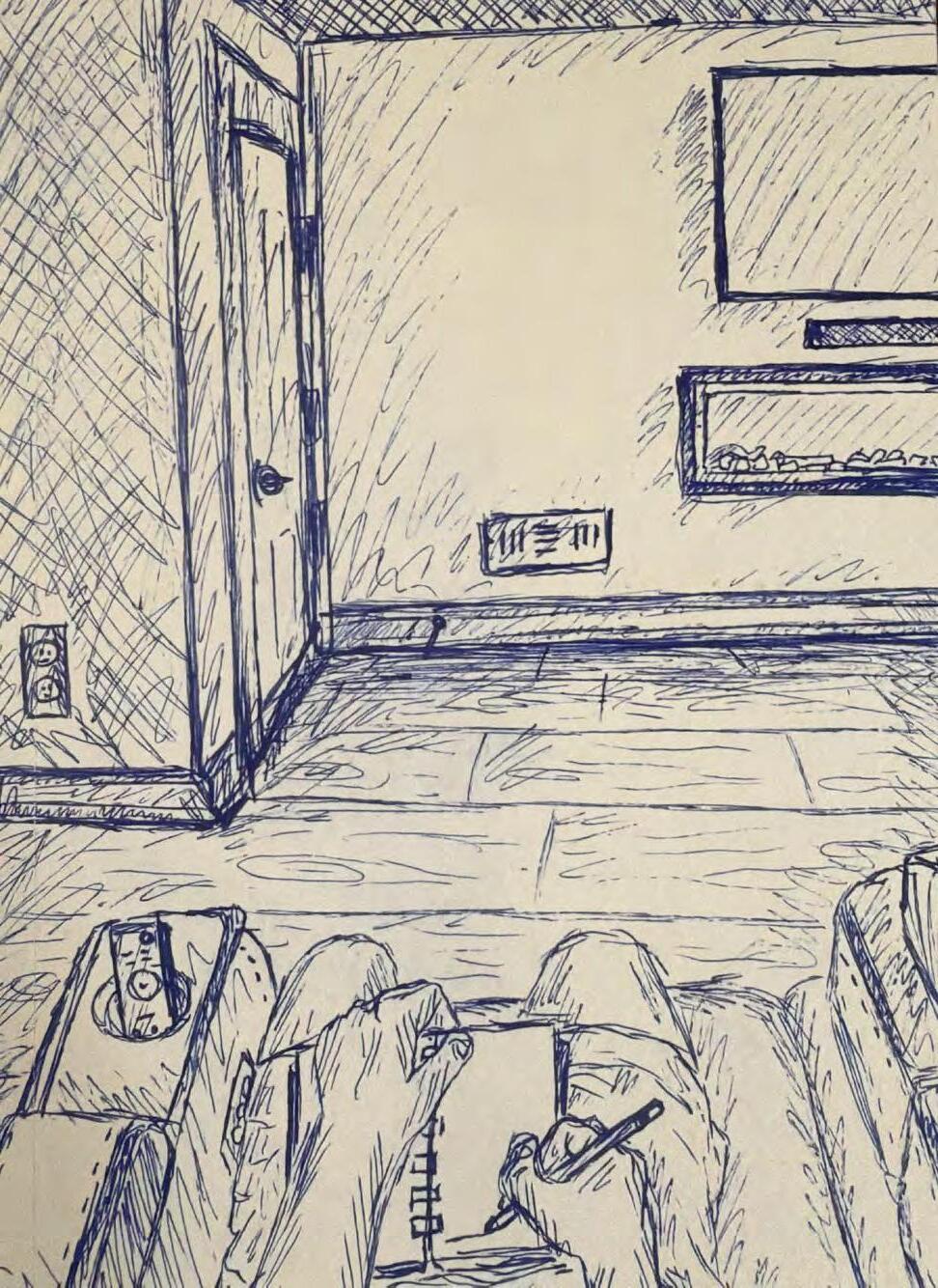
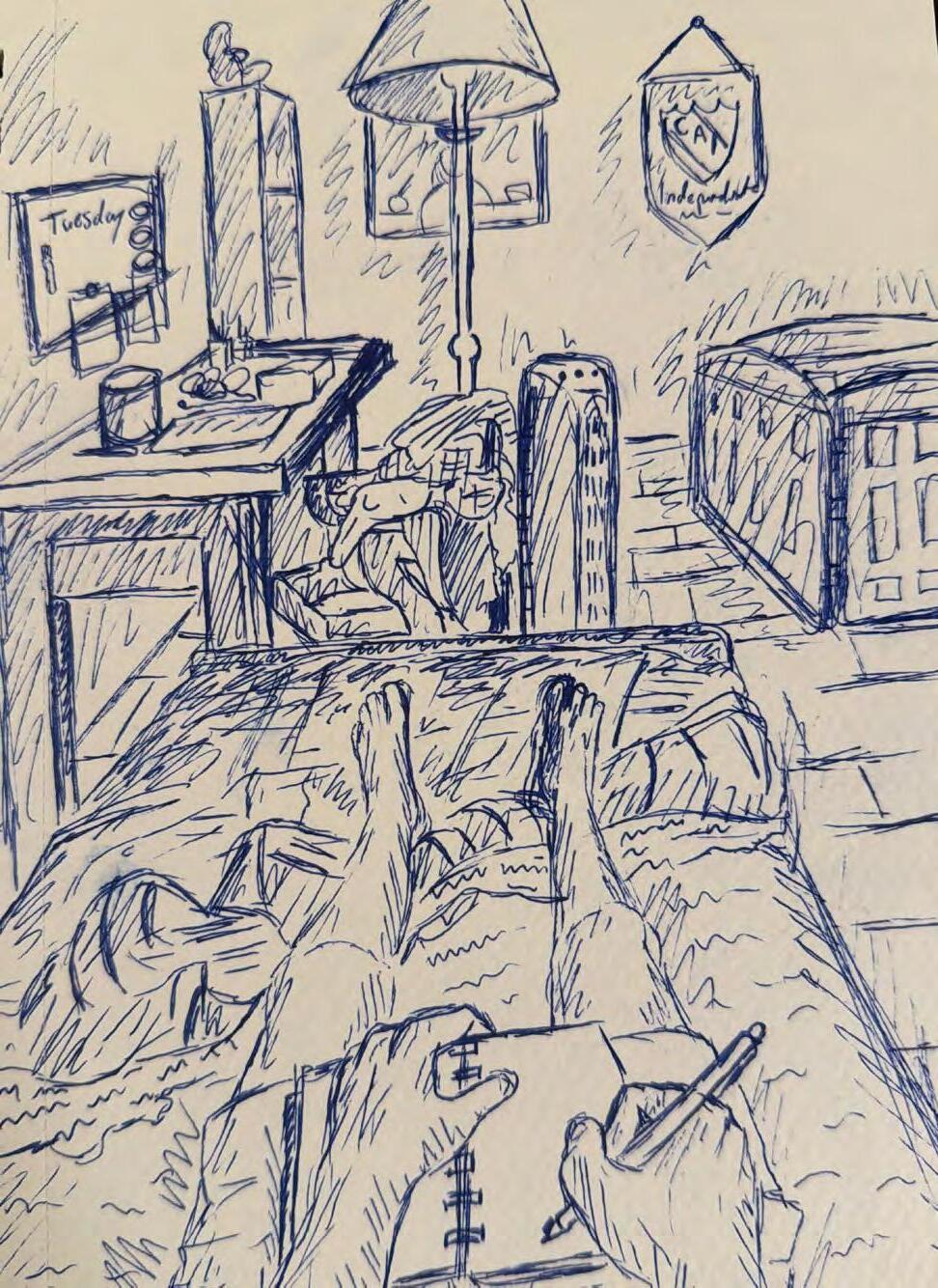
“I enjoy [art] so much,” Maximo said. “I like seeing the improvement, where my hard work has gotten me and how my skills develop over time. When other people tell me they like my art or compliment me, it keeps me going.”
That pride comes largely from being able to look back and measure how far he has come over the years.
“Seeing my improvement, the hard work, and how my style was starting to develop over time really motivated me,” Maximo said. “Especially looking back a couple years and seeing the difference, I feel like I’ve improved a lot and just developed my own style.”
Identity
The same creativity and expressiveness from Maximo’s involvement in music and art have shaped who he is from early on. His imagination has always shown, even before his piano lessons began and his artistic abilities emerged. Juana observed those moments clearly.
“[Maximo] was always creative,” Juana said. “Him and [our other sister] Vicky would make a bunch of movies with these crazy plots. I don’t even know how they came up with [them]. He had a lot of creative direction, even though he was little. It’s always been that way.”
Beyond Maximo’s musicality and sketchbook, his creativity appears most strongly in the way he relates to others. It helps him easily connect with others.
it’s something that he does spontaneously. If he’s sitting with a paper and a pen, he will start drawing.”
To those who know him best, Maximo’s journey reflects his growth: how he’s learned to express himself, connect with others and stay true to what he loves.
“I’m most proud that [Maximo] has found what he loves to do and a way to carry himself,” Juana said. “He’s really grown into his own and is always sharing what he loves. It’s so cool to see that as [an older sibling].”
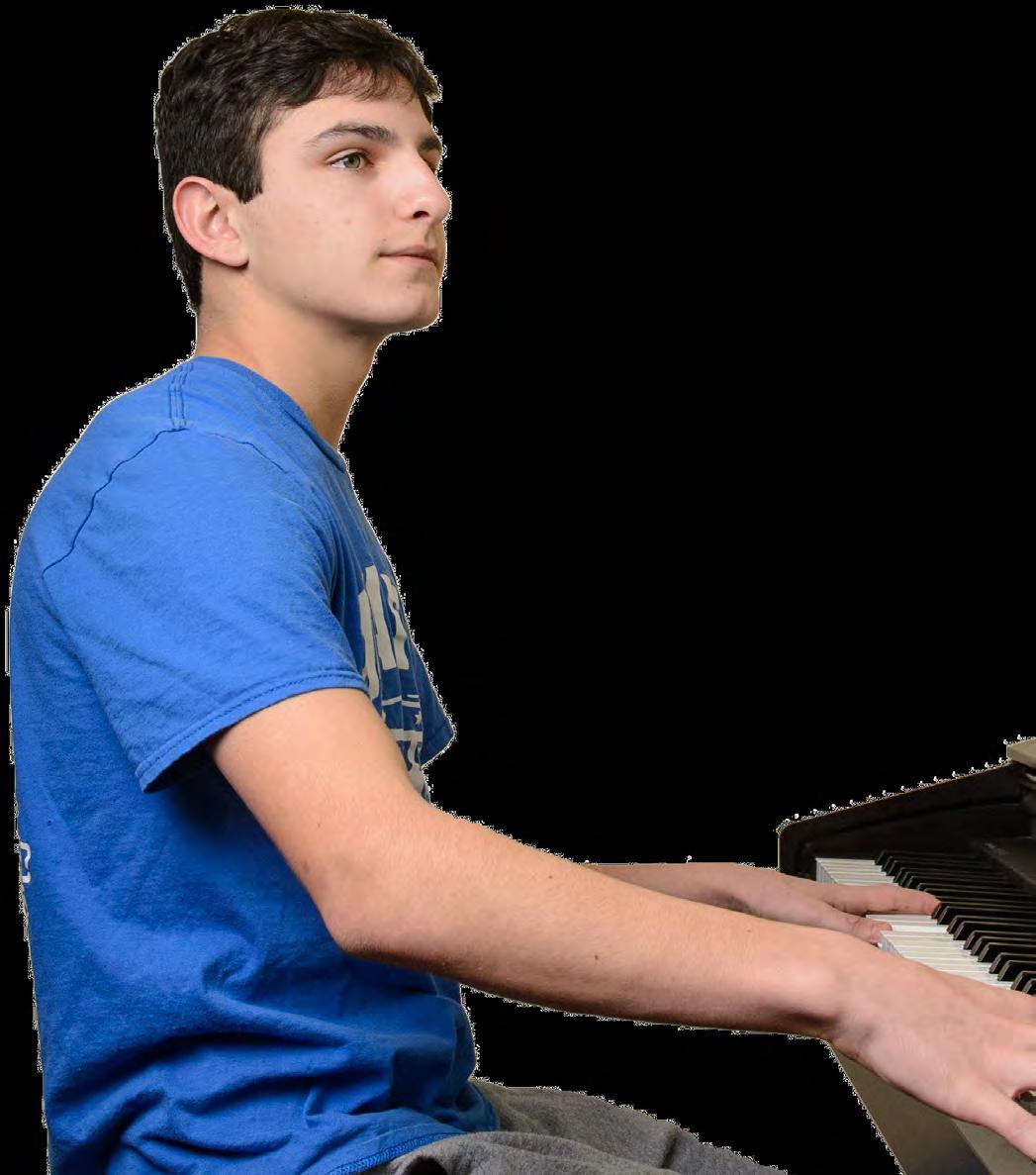
Captions: Maximo Derdoy (10) blends his two passions, piano and art. These are lifelong hobbies that help him make sense of who he is. “They teach me about my character and personality,” Maximo said. Photo by Vincent Hsiao. (on page 16)
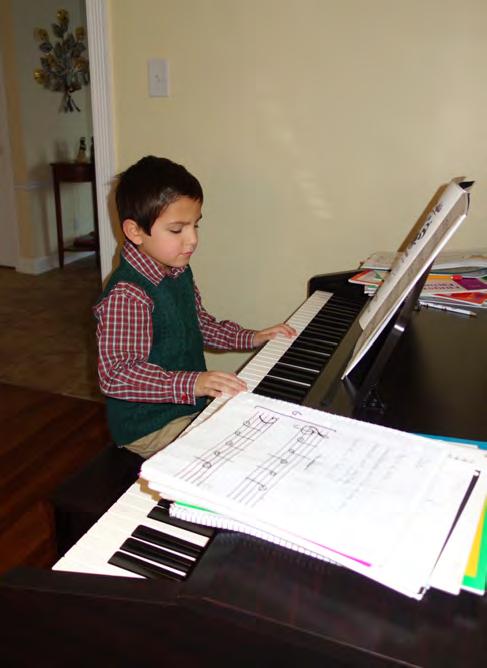
Maximo practices the piano. He first began playing throughformalinstructionat5yearsold.“Thefirstpiece thatIchosetoplaywasFürElisebyBeethoven,”Maximo said. “That piece inspired me to keep going because it was my choice and I enjoyed it.” (on page 18)
Maximo smiles before a music recital. He has performed for others since childhood. “I enjoy playing for anaudiencebecauseIrealizedhowmuchtheyappreciate what I put into it,” Maximo said. (on page 18)
“[Art and music] teach me about determination, perserverance and not giving up.”
Maximo Derdoy (10)
“His overall biggest strength as a person is his ability to connect with people,” Juana said. “It works in the way that he’s able to make friends with everyone, but it also finds its way into his music too. And when it comes to sports and being a team player, I think that’s his greatest strength.”
Music and art are tools Maximo uses to figure out who he is and how he wants to move throughout the world. But, they also present him with lifelong skills.
“[Art and music] teach me about self determination, perseverance and not giving up,” Maximo said. “I want to keep going to find those things that I love and help me express myself, because the arts have helped me learn about my own character and personality.”
Maximo’s creativity has allowed him to build a life around what he loves, his own path chosen through each drawing and every song. As he looks to the future, his mother, Agustina, believes this passion will persist.
“I have no doubt [that] Maximo will continue playing piano,” Agustina said. “He will learn and play more difficult songs. He will also continue drawing because
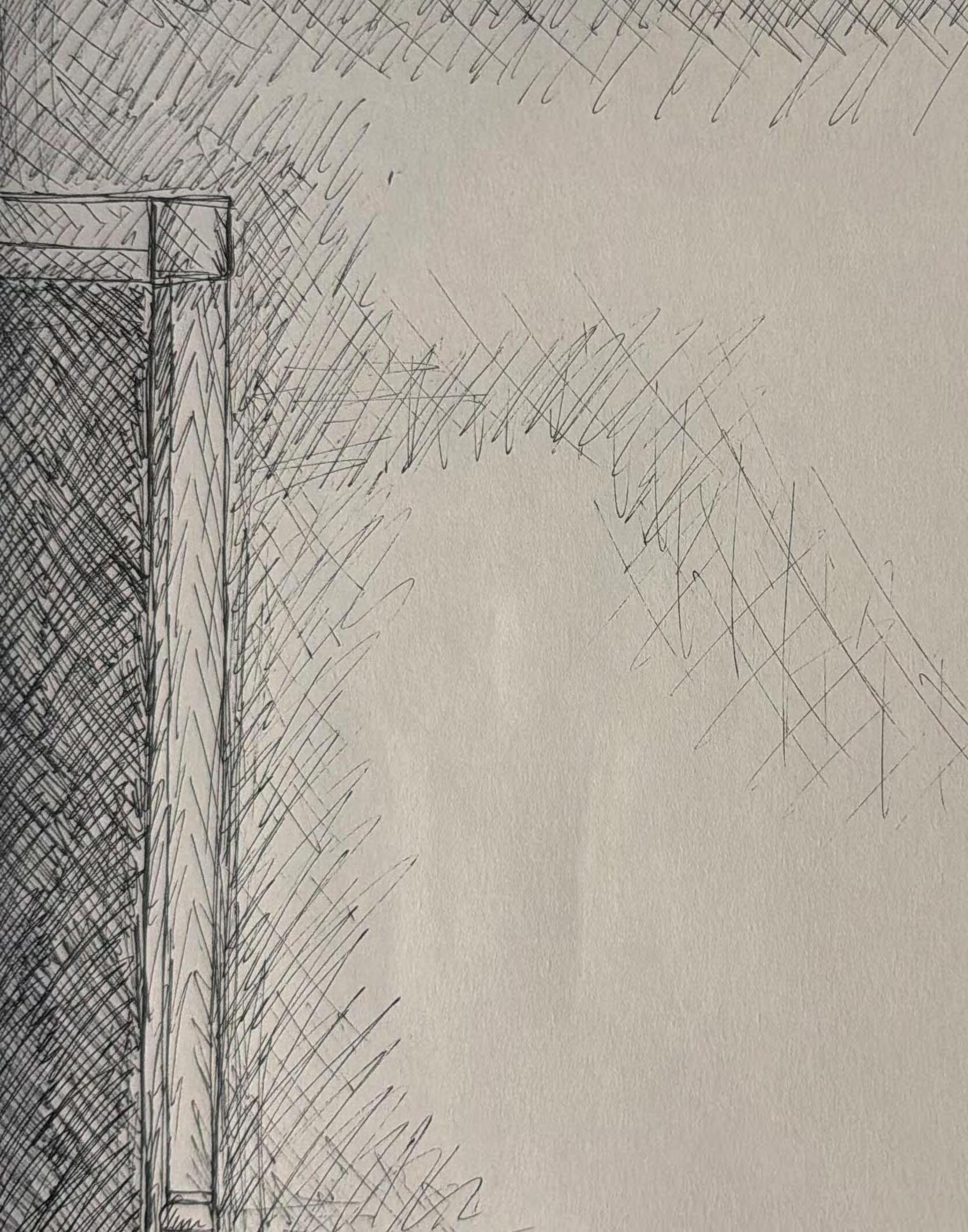
Maximo displays a point-of-view drawing of a movie room. These sketches became one of his favorites. “I like drawing objects and perspectives,” Maximo said. “At the airport, or wherever, I’ll draw what’s in front of me.” (on page 19)
Maximo draws himself in his bedroom. The environment was crucial when heisworking.“AlotoftimeswhenI’mdrawing,Iliketo listen to music,” Maximo said. (on page 19)
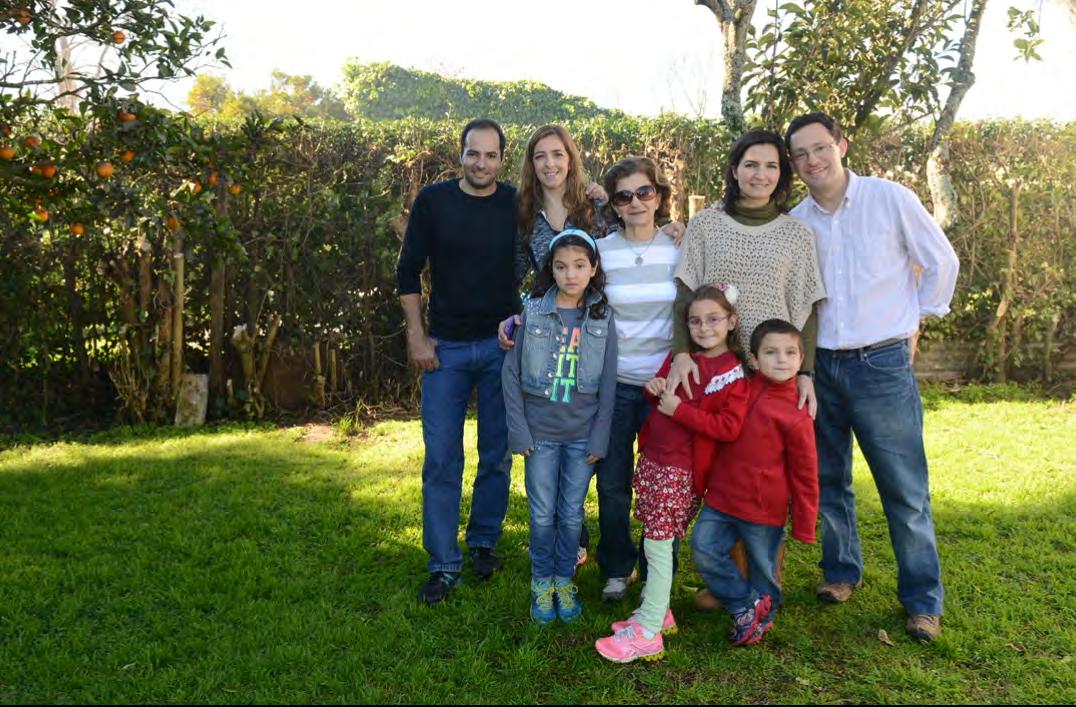
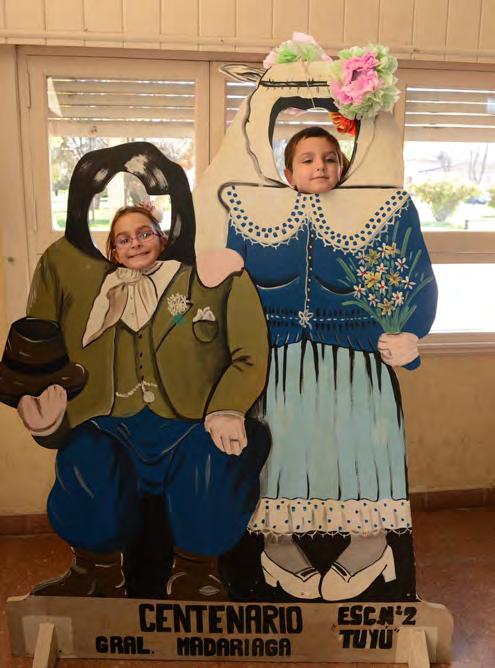
Maximo visits his family in General Juan Madriaga, Argentina.TheDerdoyfamilyfrequentlytraveledtovisit their in-laws. “I like when I go to the farm with my family and we spend time with my cousins and reconnect,” Maximo said. (on page 21)
Maximo and his sister, Vicky, visit Agustina’s preschool in her hometown. This was a festival celebrating the 100th anniversary of the school. “[Our family] visits [Argentina] every other year,” Juana said. (on page 21)
Maximo and Vicky wave the Argentinian flag. One oftheDerdoyfamily’sfavoriteArgentiniancustomswas watching sports. “We keep our traditions alive with soccer,” Maximo said. (on page 21)
Maximo rides a horse at his grandparents’ farm. This became one of his favorite activities growing up. “There was a very old horse Maximo was galloping on,” Agustina said. “He said, ‘wow, this is the best day of my life.’” Photos courtesy of Maximo Derdoy. (on page 21)


A TESTAMENT TO
SERVICE
Amelia Drake exemplifies her faith through community service and advocacy
written by
photoillustration by Josie Stout Eva VonAllmen
photos courtesy of Amelia Drake
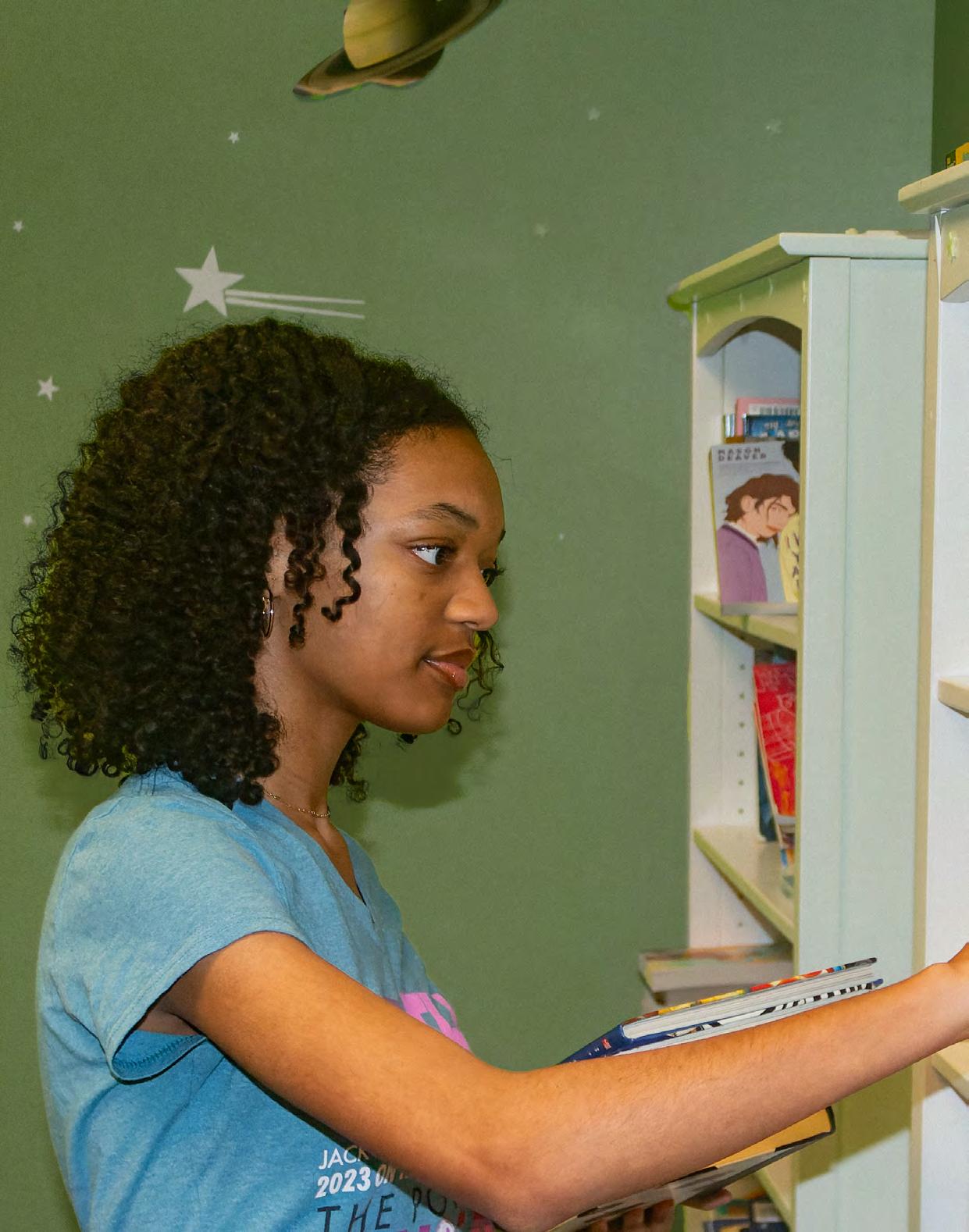
Books, decorations and furniture now brighten what was once a bare and drab storage room. Colorful beanbags, rugs and bookshelves breathe life into the room.
Teenagers and adults alike spend hours cleaning out and preparing the room until it’s ready to be presented. The old space has been transformed into an outer space-themed book nook, a project days in the making. Staff with the Boys and Girls Club of Greater St. Louis collected donations in the form of books, decorations and money to help any and all children in need get access to not just books, but education as a whole.
The Lighthouse Literacy Project had Amelia Drake (12) at the helm, driven by a strong passion to help others and serve the community surrounding her.
Community Service
Amelia works closely with Jack and Jill Incorporated of America, St. Louis Chapter, a program dedicated to producing future leaders, and a program that often collaborates with other organizations, such as the Boys and Girls Club of Greater St. Louis, on service projects.
“[Jack and Jill] is a mothers’ organization,” Amelia said. “It’s a family organization that prepares African American children to be leaders, participate in community service and learn about ways to impact the government and the community.”
Amelia’s dedication to helping the community has led her to serve as a foundation chair member for Jack and Jill. She was given opportunities to lead events like the Lighthouse Literacy Project, which is one of her favorite things she’s not only organized, but been a part of.
“I was able to actually see the kids’ reactions to the books in their new space,” Amelia said. “That was really cool.”
Amelia’s community involvement doesn’t just stop at her leadership position with Jack and Jill. She also spent eight weeks over the summer as an intern at United Way of Greater St. Louis, a health and human services organization dedicated to helping local families. She connected with different corporations to organize service events.
“Wells Fargo had a company event, and they wanted United Way to come,” Amelia said. “We planned it out, and we had a care packaging thing set up for them. So we planned the event, and we came to Wells Fargo.”
In her experience, Amelia has realized that service is no Herculean feat. Even starting a nonprofit is easier than many realize. If there’s passion, there’s opportunity.
“It’s a lot easier than you think to get involved with community service and to get involved with advocacy and all that,” Amelia said. “There are a lot of organizations that want people and that need people to advocate for them and want [you] to help them out.”
Amelia is familiar with how easy it is to put yourself out there and get involved. However, it can be quite difficult to get people to actually follow through.
“Motivating people to come to events is hard,” Amelia said. “I’ll plan these events and I’ll do the background work, but then, people don’t want to come and spend their Saturday sorting diapers.”
Despite this, Amelia is not discouraged by the lack of dedication from other people. Her purpose is unshakable.
“It’s really fulfilling to me to know that I’m helping other people,” Amelia said. “I like knowing that what I’m doing is making a difference.”
Religion
Every Sunday, Amelia attends First Baptist Church of Chesterfield, where she partakes in services or helps out in the kitchen, youth rooms and wherever else she’s needed. Her religious connections are closely interlinked with her community service and drive to do good.
“Churches are [about] giving back,” Amelia said. “And that’s a big part of the gospel as well, giving back and doing things for your community and helping out your community.”
Amelia’s religiosity stretches beyond just habitual church-going. Her convictions are fueled by biblical teachings that spill over into her day-to-day life.
“I think that being Baptist Christian, because we’re big on forming your own relationship with the Lord, it pushes you to read the Bible for yourself, and to take the teachings in there and apply them to your life,” Amelia said. “[It] teaches about helping others, like Jesus was helping others. So that’s what I should do as well.”
As a very spiritual person, bible study and scripture are huge forces that not only push Amelia to do good, but provide clarity and structure to her daily life.
“Philippians 4:13, ‘I can do all things through Christ who strengthens me,’” Amelia said. “I think he gives me a lot of encouragement, and I know that anything is possible.”
Amelia grew up with Baptist Christianity, and it’s continued to provide her comfort, security and confidence. She’s built a strong community within her church that’s always there for her when she needs them.
“I grew up there,” Amelia said. “I’ve been going there since I was two, which was when we moved [to St. Louis]. I’d say they’re like a second family to me.”
Every third Sunday, Amelia’s church has birthday-anniversary time during which the community members get together to celebrate. Food is prepared by church members, and Amelia dedicates time to help out with the cooking of the meals for the special tradition.
“The culinary team has elderly members, and [she is] just available and actively engaged with them,” the Rev.
Cristopher Rogers, Senior Pastor of First Baptist Church of Chesterfield, said. “It’s a beautiful thing because she’s crossed generational boundaries to now be of service and support to the church and the larger community.”
Throughout any endeavors Amelia undertakes, she’s been able to turn to scripture. It’s helped her gain confidence and even take up leadership within the church.
“The Church has really supported her in her opportunities to speak, lead and give comfort with talking about her faith and what God means to her,” Bettina Drake, Amelia’s mother, said. “It has been beautiful to see her grow in her faith and in leadership, [which is] the work of the church and all of the people that have surrounded her there.”
Amelia puts her community first, whether it be in church or elsewhere, she looks out for other people.
“She is one who will be vocal and speak out, not just as an advocate, but just as one who is looking out for the greater good about youth in the church,” Rogers said.
It has been Amelia’s faith that has propelled her to become so active and involved in her community.
“I love when she expresses her passion about a topic,” Bettina said. “[I love] when she expresses confusion or frustration when society or people are mistreated unfairly and desires to do something to create that change. All of that [is] grounded in her faith in God, which gives her that confidence to be who she is.”
Advocacy
Throughout Amelia’s community service experience and the faith she fuels her life with, she’s developed a strong sense of right and wrong and channels it towards advocacy. Over the summer, she was involved with another internship: the Bank of America Student Leaders. The program was made to give advocacy education and give kids opportunities to get them politically connected.
“We went to [Washington D.C.] and we learned about advocacy,” Amelia said. “I’ve been on Capitol Hill three times now, and I’ve been able to talk to people in our Congress about important issues in my community and in other communities as well. Advocacy is a big part of what I’m drawn to.”
It’s no mystery where Amelia’s desire to help and advocate for others came from. Ever since she was a child, she’s had a strong sense of empathy, always wanting to extend a helpful hand and befriend those in need.
“She became very passionate about making sure that things like education and health care was a right that everyone had access to,” Bettina said. “She wanted to know, ‘What can we do? What can society do? What changes need to happen in order to help them?’”
Another thing that’s always been constant in Amelia’s life is her observant nature. Ever tactful and intelligent,
she’s careful and thoughtful with how she approaches the world and any injustice she comes across.
“She is one to look and assess, and once she assesses, then she speaks up,” Rogers said. “She is one of those people, kind of like E.F. Hutton, who may not say a lot, but when she speaks, what she says is definitely worth listening to.”
Amelia makes a point to articulate her thoughts and ideas often. She knows how important it is to shed light on societal issues, whether it’s at Capitol Hill, church or during a casual conversation with her peers.
“I’m very vocal about a lot of things,” Amelia said. “I talk to people about [activism] all the time.”
Amelia tries to understand how and why marginalized communities are in the situation they’re in. She strongly believes prejudice comes from a lack of education.
“Knowing more history, so I can know more about why things are the way they are and how things came to be, has shaped my community service,” Amelia said. “[I want] to help problems that have been historically situated.”
The results of judgment have been a pattern throughout Amelia’s service. The Boys and Girls Club is an example of this: having been in a predominantly black neighborhood, it was impacted by redlining and segregation. To reduce this prejudice, Amelia hopes to increase education for those hurt by their historical situations.
“Educational literacy is so important,” Amelia said. “People will have less prejudice and will want to focus more on solutions, rather than putting stereotypes on people or having negative connotations.”
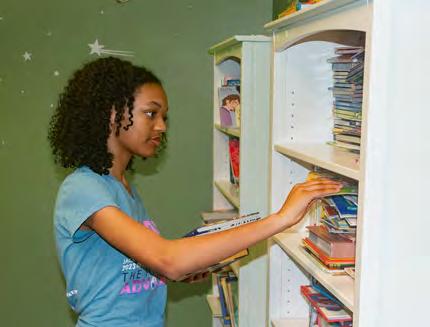
Captions:AmeliaDrake(12)setsupbooksinthebook nook she helped create for the Lighthouse Literacy Project. She worked with other teens to collect materials to transformthestorageroom.“Itgoesbacktoherwanting to make sure that kids have access to resources so that their possibilities are not limited when they get older,” Bettina said. Photo by Eva VonAllmen. (on page 22)
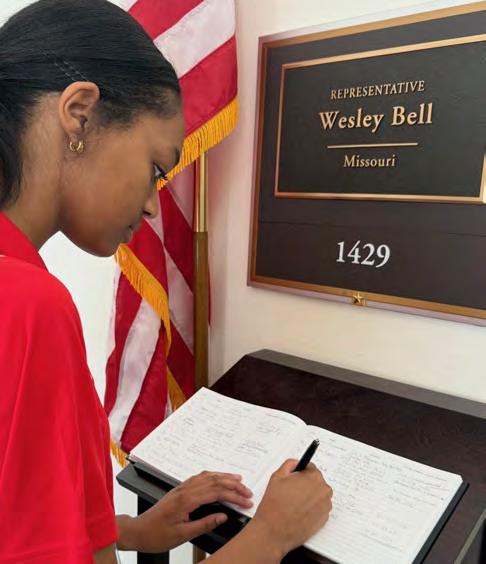
Amelia writes a question to Representative Wesley Bell.ShetookatriptoWashingtonD.C.withtheBankof America Student Leaders for a summit. “I talked to Wesley Bell about his plans for gun reform and educational equity in St. Louis,” Amelia said. (on page 25)
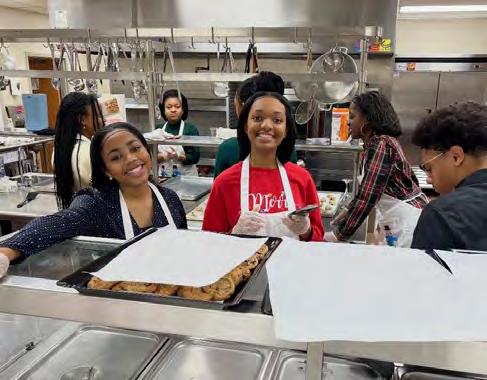
Amelia stands with her friends in her church’s kitchen.Shehasbeenhelpingoutaroundthechurchforyears. “I do a lot of work with the youth ministry,” Amelia said. “I also help out in the kitchen when we have big events.” (on page 25)
Ameliastandsinfrontofherchurch,leadingadiscussion. She has embraced a variety of leadership opportunities in the church. “She has volunteered to open [service]up,”Rogerssaid.“Sometimesinworship,toreading Scripture,toapplyingaprayer.”PhotoscourtesyofAmelia Drake. (on page 25)
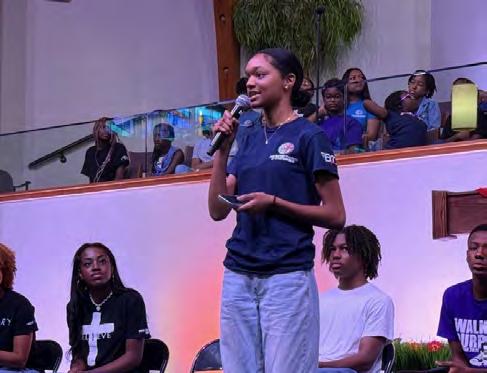
"When you look at Amelia, you see first of all, the genuineness of her heart." Christopher Rogers
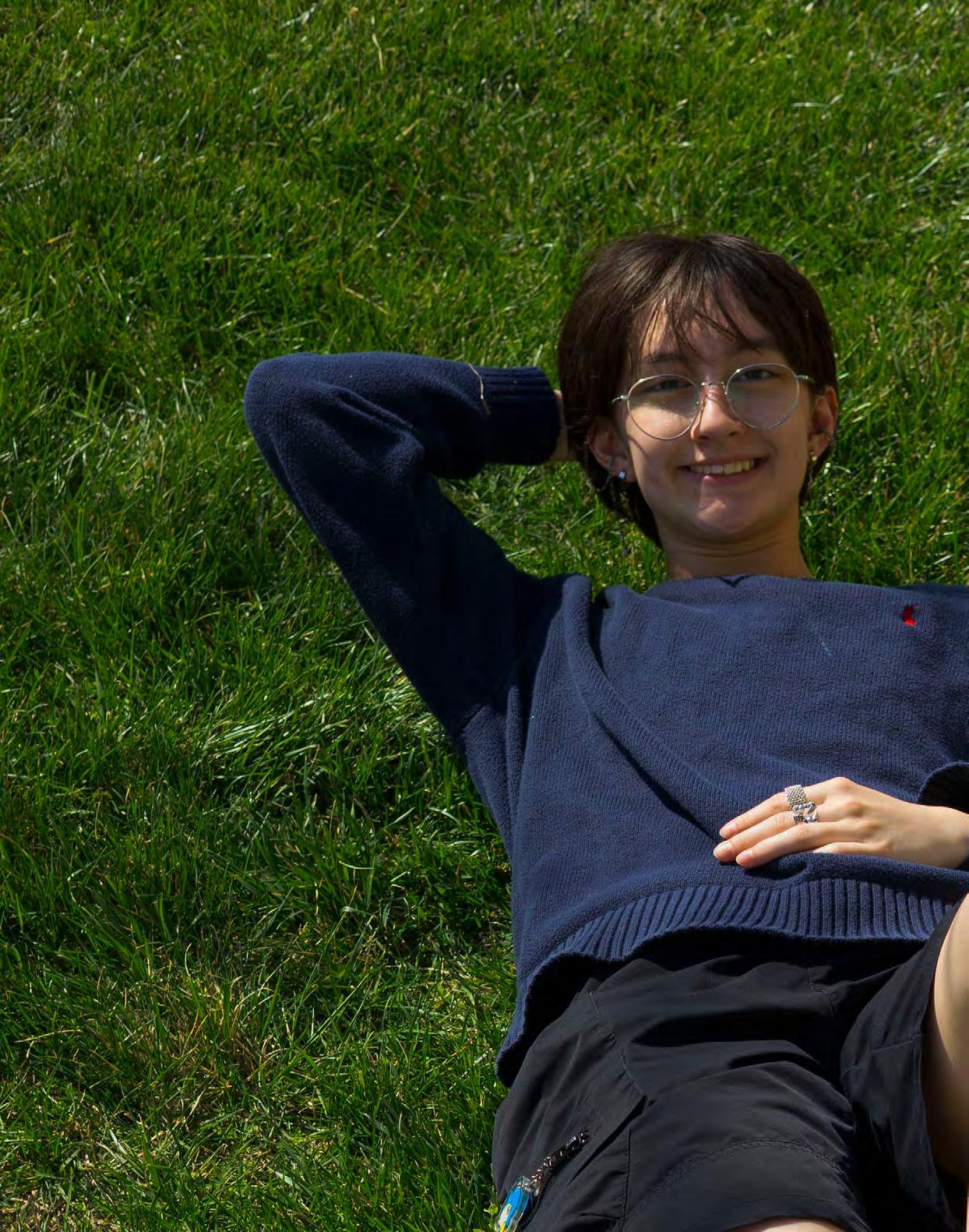


Niko Dalton (11) seems to do it all: a national level competitor in Science Olympiad, English As a Second Language teacher for students in Taiwan, volunteer and video game developer. One glance at their schedule has one asking, “How do they have the time?”
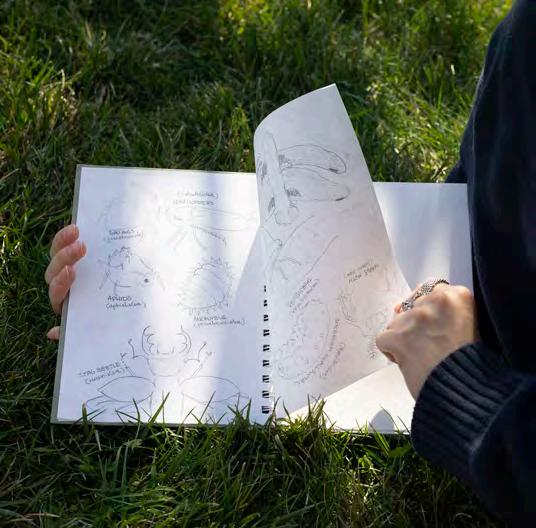
Balancing a busy school schedule with a laundry list of extracurriculars is daunting, but Dalton’s passion makes it look easy. In Science Olympiad, Dalton is a competitor in the Dynamic Planet and entomology events, which respectively deal with rotating ecology topics and the study of insects. From memorizing di erent species of insects for entomology to studying the chemical structure of ice for last year’s Dynamic Planet focus on glaciology, the workload to prepare for competition is immense.
“I nd it easier to do all of the studying when I’m interested in the topic,” Dalton said. “In terms of actual studying, there’s binder making. I do binder events [at Science Olympiad], meaning that you can have an entire binder full of information about whatever you want.”
e stockpile of on-hand information doesn’t make competing much easier. It’s still di cult and time intensive, requiring collaboration between partners. Both are testing simultaneously while pressed for time, requiring a entive coordination without speaking. For Dalton, Science Olympiad blends cooperation and individuality.
“Almost all of the time you put into Science Olympiad is just you at your desk,” Dalton said. “[But] all of the tests that you take are towards a team placement, and that’s the most important part, because you don’t want to be the person bringing the team’s ranking down.”
Even though this is only Dalton’s second year competing in Science Olympiad, they’ve achieved a great deal. e Science Olympiad season begins with local invitationals and escalates to regional, state and national tournaments. Dalton has already made it to state this year; whether they make it to nationals for the second year in a row depends on the team’s success at state.
More than the competitive achievement is the passion Dalton has found for the educational part of Science Olympiad. Entomology was a new event in their rst year of competition, so others wouldn’t be more experienced and Dalton wouldn’t be disadvantaged. e choice of entomology started out as practical and competitively advantageous, but has turned into so much more.
“I found it really interesting that [the bugs] can all look so di erent,” Dalton said. “ ere are thousands and thousands of species of insects. A lot of times you’ll come across a type of caterpillar, and it’ll look like it crawled out of space. It’s crazy how they can look sometimes.”
Dalton has found that no ma er how small and infrequently noticed, insects are vital to the planet. To them, these cri ers are just as amazing and worth paying a ention to as beings thousands of times their size.
“I’ve become a ached to entomology as my main event,” Dalton said. “Insects are vital to our ecosystem in every part of the world, and it’s really interesting to nd all of these relationships between insects, like parasitism. ere are just so many interesting insects to learn about.” e community surrounding Science Olympiad spans far. Competitors at Ladue have formed valuable connections through online platforms with students across the country, relating to each other due to shared passions. is collaboration has had a profound e ect on Dalton.
“[Science Olympiad] has de nitely a ected my identity in school and in my education,” Dalton said. “A lot of the people in Science Olympiad have really high goals for themselves. It’s really cool to meet all these people who are so intelligent and interesting. It’s motivated me to have the same goals for myself.”
Others take notice of Dalton’s academic ambition; Seph Zhu (11), one of Dalton’s friends, o en collaborates with Dalton academically. Zhu noticed Dalton’s love for learning in their h grade English class, an early show of academic passion that has only blossomed since.
“When you grow up together, you don’t really notice other people changing, because you’re also changing,” Zhu said. “I know they were always extremely academically oriented, and I can really see that paying o in terms of their work ethic and ambition.”
students, ranging from ages 4 to 14. Dalton cra s lesson plans, activities and practice exams to help students reach their goals, from college entrance exams to simply building the foundation for learning English.
“Tutoring is something that a ects a lot of di erent parts of my life,” Dalton said. “It makes me a lot be er at communicating, whether it’s just someone I’m working with on an AP Biology lab or somebody that I’m working with long term for Science Olympiad. [I’ve] become more patient when explaining things or trying to express ideas. It changes the way you learn, because you see it from a perspective of a teacher and student. It’s also changed the way I learn when I’m learning programming.”
Dalton began to learn programming while developing the demo for a science ction video game. Dalton aspires to a career in video game development, blending their loves for teaching, communication, science and art.
“I’ve learned a lot while I’ve been making my game demo,” Dalton said. “Especially [with] art, because I’ve been interested in art for a long time, but I’ve never really been into animation. It’s really interesting to learn.”
“I’ve become attached to entomology. Insects are vital to our ecosystem in every part of the world.”
Niko
Dalton (11)
Dalton furthers their commitment to community by teaching the middle school entomology team. As a coach, Dalton is in charge of organizing practices, creating and grading tests, teaching lessons and assisting students.
“[ e middle schoolers] will ask me questions about how to identify certain insects that they think look similar,” Dalton said. “Or they’ll ask me what it’s going to be like when they go to the state or national competition.”
Beyond Science Olympiad, Dalton is connected to their culture through the local Taiwanese community. ey volunteer for Tzu-Chi, an aid organization that originated in Taiwan, and was designed to provide relief for destruction caused by natural disasters. e local branch retains this original purpose, while expanding aid to refugees who have recently moved to St. Louis.
“Most recently, I volunteered at an aid event where they handed out checks to people who were a ected by the May 2024 tornadoes,” Dalton said. “ ere are a lot of people who don’t have housing anymore because of it.”
Further, Dalton combines their passion for teaching with their dedication to the Taiwanese community by tutoring students from Taiwan in English. ey tutor ve
From the earlier days of development, guring out the basics of programming, to nalizing cut scenes, game physics and combat animation, Dalton has come a long way with this project. While they hope to submit a nalized demo as part of the “maker pro le” component to their college applications in fall, the main driver of their e ort is their passion for learning and creating.
“Just for fun, I made [the video game] insect themed,” Dalton said. “Which was just because I already know stu [about insects]. I just wanted to have fun.”
Captions: Niko Dalton (11) poses for a photo in the grass near the football eld outside of Ladue Horton Watkins High School. eir strong connection to nature comes from a long term and intensive study of insects that Dalton has pursued through Science Olympiad alongsidetheircompeitivepartners.“Youneedtobeable to work really closely with your partner,” Dalton said. “We meet to do practice tests and to work on our materials together.” Photo by Adelaide Flintrop. (on page 26)
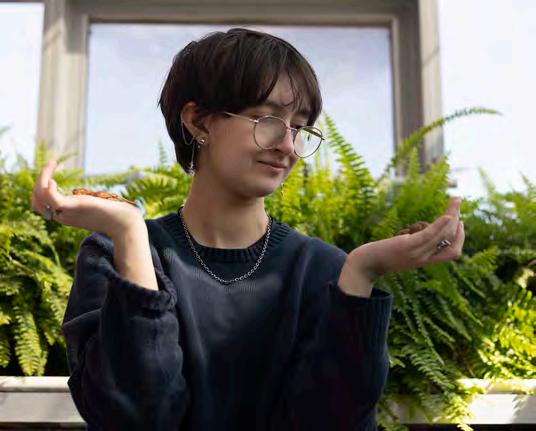
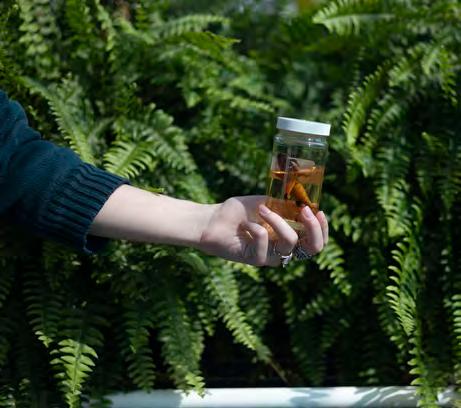
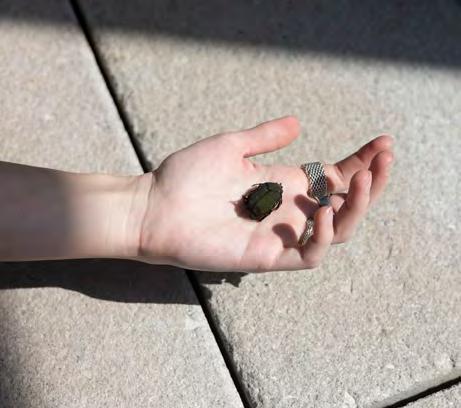
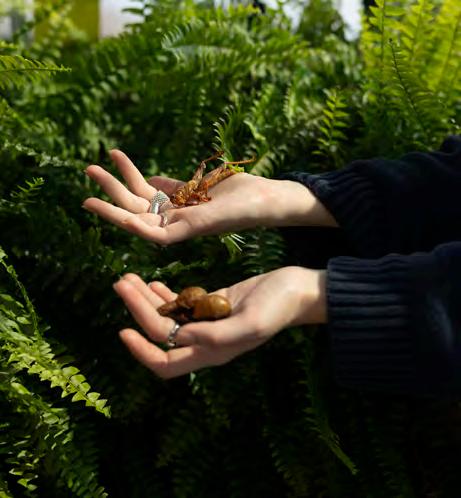
Dalton shows o a large collection of preserved insects, including a grasshopper, cicadas and june beetles.
ecollection,whichwasstarteda erDaltonhelpedformer Science Olympiad coach and Ladue Middle Mchool teacher Mark Biernbaum clean out his classroom where many of the insects were once stored, consists of specimenthathavebeenpreservedformorethanthirtyyears. “Insects can seem like a plot out of an alien movie,” Dalton said. Photo by Sarmistha Pulagam. (on page 29)


FROM RINK TO STAGE
Amara Loynd navigates a busy schedule of hockey, dance and musical theatre
written by
photo courtesy of Marie Demkovitch Laura Stange
photos courtesy of Adaeze Loynd

Worn-in jazz shoes, glistening hockey skates and dance leotards li er the oor of the family car. Amara Loynd (9) balances her lunch while packing her bag for her next activity, rushing to make it to dance rehearsal.
“From a very young age, I was very heavily involved with sports,” Amara said. “I remember days where I would go and it’d be like, I have dance in the morning, and then I would eat lunch in the car, changing to go to gymnastics. And then a er that, I [would] eat dinner in the car, changing to go to hockey.”
As she grew up, Amara never got any less busy. While she no longer does gymnastics, she has started pursuing musical theatre more seriously by joining Muny Kids and has continued to dance and play hockey.
“ e main thing is just balancing my time and also tting in homework, it can be kind of challenging,” Amara said. “It is a sacri ce, because I’m doing so much. I can’t be there at every single thing. I’ve missed football games, I’ve missed hockey games and I’ve missed meeting rehearsals. So that’s a big challenge, but just staying caught up when I do have to miss the things that I miss and communicating stu like that has helped me be able to be as busy.”
When Amara started playing hockey, she joined the Rockets at 10 years old with her brothers. She was the only girl on the Rockets, and she stayed on the team until h grade. A er that, she joined the Lady Falcons, an all-girls hockey team.
While she faced challenges over her hockey journey, Amara has grown to love the sport and the experiences that come with the dedication she has to hockey.
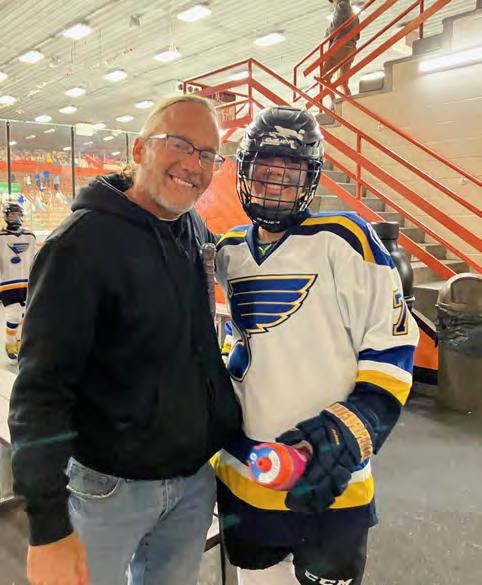
“ e most memorable game I played was probably [Rockets] 8U,” Amara said. “Sometimes at the Blues games, the younger teams play a game on the ice during hal ime, and I remember I scored a goal in that game. Afterwards, me and my friend, who was the only other girl on the team with me, got interviewed at the Blues game [in front of everyone], which was really fun.”
Amara started doing musical theatre from 3 years old, when her family did community theater shows. In sixth grade, Amara auditioned for the Muny and made the Kids Troupe, but decided to defer it for a show instead. In 2023, she performed in her rst show, Li le Shop of Horrors, and in 2024, she did In e Heights.
“I remember the rst time being on the Muny stage, it was pre y scary, because it’s like 12,000 seats and very dark,” Amara said. “You can’t see everything, but you look out and there’s a million people. You get used to it the more years you’ve been doing it, but I just remind myself they’re here to watch the show, it’s nothing scary.”
As I’ve gotten older, it’s become a very big part of who I am, not just an activity my family signed me up for. I couldn’t imagine my life without dance and hockey.
Amara Loynd (9)
“When I switched to an all-girls team, it was really nice to have friends and people I can count on,” Amara said. “With the all-boys [team], I remember they didn’t pass [the puck] that much. It was a li le bit harder to get close with the team just because I didn’t talk to them that much. I was just a li le bit separated.”
Despite switching to an all-girls team, Amara still encountered struggles outside of being one of the only girls on the team. As she progressed in level and gained skill, the game of hockey started to intensify.
“Sometimes on the ice, other girls will give her a hard time because she’s one of the be er players on our team and try to get her in her head or talk bad to Amara on the other team,” Jordyn LaMontagne (9), Amara’s hockey teammate of three years, said. “But what she’ll do is she’ll just ignore it and approach it more in a positive way of ge ing out there and trying harder.”
Amara auditioned to become a Muny Kid because of her sister, Adaeze Loynd (12). Adaeze has been a Muny Kid since 10 years old, and the directors encouraged Amara to audition over Adaeze’s years at the Muny.
“Over the years, but especially this season, I’ve seen her grow a lot as a performer,” Adaeze said. “She’s de nitely grown more. Especially having both of us being in the same activities, it can feel like [competition]. But as we’ve grown older, it’s so beautiful to see her grow into an individual, not just someone’s sister, especially given she’s the younger one of the whole family.”
Along with the Muny, Amara and Adaeze have danced at the St. Louis Academy of Dance together from a young age and are on the Ladue es dance team together.
“We’ve been on the same team and dancing together since forever, but we de nitely motivate each other and keep each other accountable,” Adaeze said. “It’s nice having a friend on the team, but also a sister who’s able to push me in a good way and be completely honest with me, more than a typical friend would be able to do.”
Juggling her di erent activities has proven to be a challenge, but for Amara, nding love for each one is not. Both dance and hockey are key to her identity.
“I’ve been able to enjoy them both so much, and I’ve been doing them for such a long time, both of them are just di erent aspects of myself,” Amara said. “I feel more graceful and fun when I’m dancing. I feel more happy. It’s fun; it’s like a more artistic part of me. But then when I play hockey, I feel more tough and cool and it’s part of me too. So both parts are represented, but just in di erent ways, and not like they’re both equal.”
e di erent a ributes that hockey, musical theatre and dance require shapes Amara into a unique person. Her con dence has grown from being on the ice as well as performing in front of thousands of people.
“[What] I admire most about Amara is probably her resilience,” Adaeze said. “I think she is very strong. She’s very opinionated, but in the best way. She’s not afraid to question others and speaks her mind. It’s great to have someone who pushes me, and friendly competition.”
While her current world is demanding and a busy schedule puts pressure on her, Amara has slowly gured out how to manage her activities over time. Being optimistic of her future has proved to be a key to success.
“Success for me is doing the very, very best I can and pushing myself and challenging myself,” Amara said. “Making mistakes is okay. Messing up is okay. Just as long as I’m doing the very best I can and pushing myself, that’s successful in my eyes.”
Captions: Amara Loynd plays in a hockey game. She joined the Lady Falcons in fifth grade. “The fall is pretty much my busiest time,” Amara said. “Every other weekend, I was out of town.” (on page 32)
Amara performs at the Muny Holiday Show at the St. LouisClub.2025wasthefirstyearsheparticipatedinthe Muny Holiday Show, but she had been particpating in Muny shows since sixth grade. “It’s not really how well you sing, but if you know your notes and your parts,” Amara said. “It’s a whole operation. And so that was a little different for me, especially since I never really had voice lessons or anything.” (on page 33)
Amara stands next to her dad after a hockey game. Her dad played hockey through high school and college, and brought Amara and her brothers to play the sport as well. “I love how it feels on the ice,” Amara said. “I love the competitiveness of it, and like the intensity. And as you get older, the intensity and competitiveness increases.” (on page 33)
Amara poses amongst the Muny Holiday Troupe before performing at the Muny Holiday Show. Amara has been participating in theater since 3 years old, with the Muny being her next step after her community theater. “I feel like being a dancer and a competitive dancer that performsonastage,youhavetouseyouractingabilities already” Amara said. “that part came more natural to me whenIstartedtodomusicaltheater.”PhotosCourtesyof Adaeze Loynd. (on page 33)


PRINCESS
OF SOUND
Norah Murphy discovers her passion for music and songwriting
written by photographed by Angella Zhang Vincent Hsiao

SPREAD DESIGN BY ANGELLA ZHANG
The snow piles up and wind sharply blows by. Inside a warm home, a large family gathers around a tree adorned with glittering lights and exquisite ornaments. At the base of the tree, colorful presents in shiny bows bewitch the eyes, tempting the children to open them. It’s Christmas Day and 9-year-old Norah Murphy (12) has just been handed a present from her grandparents. It’s large and heavy in her small hands and she eagerly rips the wrapping paper off, revealing a sleek acoustic guitar. She strums the strings and her eyes light up in awe. Little did she know, but these first few notes would cascade into a lifelong passion for music and performing.
Since a young age, Murphy tried a variety of different sports. As both of her parents were athletes in their youth, Murphy tried everything from basketball to field hockey, but none of them felt right to her. Seeing this, her grandmother decided as a last resort to give her a guitar for Christmas and enroll her in lessons with guitar instructor Steven Staicoff when she was 9 years old.
“[Staicoff is] a really good teacher because he not only teaches you how to do the technical aspects of music, but he also is really good at teaching passion and showing how you can find joy through music,” Murphy said. “[During] my first lesson, I realized this is something [I] have to work really hard at, but it was the first time in my life that I was not scared of the aspect of working hard. [I was] more excited about it.”
Staicoff saw a great deal of potential in Murphy during her first few lessons. He noticed that she was always extremely serious and well-prepared every week, constantly asking for more difficult repertoire to practice.
“I saw pretty early on that [Murphy] had this spark inside of her,” Staicoff said. “After a year or two, that spark turned into a flame and she wanted to do some very challenging songs like Here Comes the Sun and Blackbird. She put the time into it [and] performed them perfectly with absolute confidence and poise.”
By now, Murphy has been working with Staicoff for almost ten years. They have formed a routine during lessons where she is first challenged by sight-reading sheet music, and then allowed to sing and perform a song of her choice, cultivating her love for singing.
“Eventually that warped into songwriting,” Murphy said. “I would sing a song that I wrote instead of a song that I played. [Staicoff] let me find my own groove when it came to guitar. He didn’t force me to do anything that I hated, but he also challenged me to do things I hadn’t heard of before.”
Guitar lessons eventually led to piano lessons as Murphy desired to widen her musical range. Although she quit piano lessons to pursue it on her own and focus on other interests, she eventually joined the band in fifth grade and picked the saxophone as her next instrument.
Although she liked the saxophone for its expressiveness and musical tone, she felt a sense of boredom.
“I liked playing the saxophone, but every concert, I would turn around and all the percussionists would be running around [and] going to different instruments,” Murphy said. “They’d be having a good time. They have their own special teacher who looks super awesome and I wished I was part of their group.”
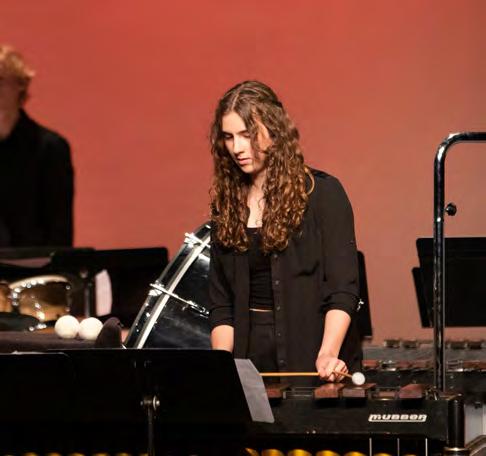
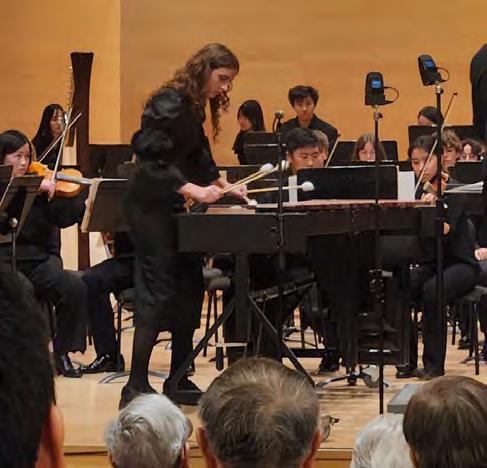
With a lot of work and private lessons, Murphy eventually joined percussion in seventh grade and continues to pursue it to this day. She practices every day for at least one hour, which has allowed her to get into esteemed symphonic groups, such as the Young People’s Symphonic Orchestra at Webster University (YPSO), Saint Louis Symphonic Youth Orchestra (SLSYO) and All-State Orchestra. One of her first experiences in a symphony was performing with the YPSO while in eighth grade.
“I’d only ever done percussion ensembles [at] Ladue,” Murphy said.” But being put in the YPSO was such high pressure [because] all of a sudden, I had my own part that I had to handle on my own and I had to simultaneously learn how to play all these instruments and how to follow a conductor and read an orchestral part.”
In addition to performing, orchestral groups offered Murphy new perspectives and opportunities through the fellow musicians she met. Being a part of the best symphonic groups in the state opened doors for future career opportunities for Murphy to consider in music.
“I think get[ting] to know people through [music] groups has been the most influential part of it all, because you start to realize the possibilities of what you can do,” Murphy said. “Before St. Louis Symphony Youth Orchestra, I didn’t even know that you could [perform music] for a living, but I had all these friends that were going to school for music and [were studying] to be an orchestral musician.”
Murphy also performs in many solo recitals each year for guitar, voice and percussion. Frequently performing helped her become more confident and riveting on stage.
“I remember being so nervous; on the program, every time it would go down another person, my stomach would drop and I would be so scared,” Murphy said. “Now every time the name drops, I’m so excited. It’s been really cool to be able to grow comfortable performing and think of it not as a scary thing I have to do, but as an opportunity to show what I love to do.”
Last summer, Murphy auditioned and got selected for the Boston University Tanglewood Institute Percussion Workshop. With the culmination of all of her percussion endeavors and this summer program, Murphy realized percussion’s role in her life wasn’t what she envisioned.
“Percussion is beautiful, classical, and there’s so much to pursue down that path, but the entire month that I was there, I couldn’t stop thinking about how much I missed


my guitar [and] songwriting,” Murphy said. “I just realized percussion’s role in my life was to strengthen my chops as a musician and get my head in a music mode, not necessarily my end goal.”
Murphy has been singing for almost as long as she has been playing guitar, but she hadn’t seriously considered pursuing it until high school. She sings for the rock band Raised on Radio and has also been a part of many esteemed singing and songwriting groups, including Viva Voce, All-State Choir and All-State Collective Ensemble.
“I don’t even have to make a goal of practicing singing because I look forward to it,” Murphy said. “After a long day, all I want to do is go downstairs and sing the song that I wrote, refine it and do some recording.”
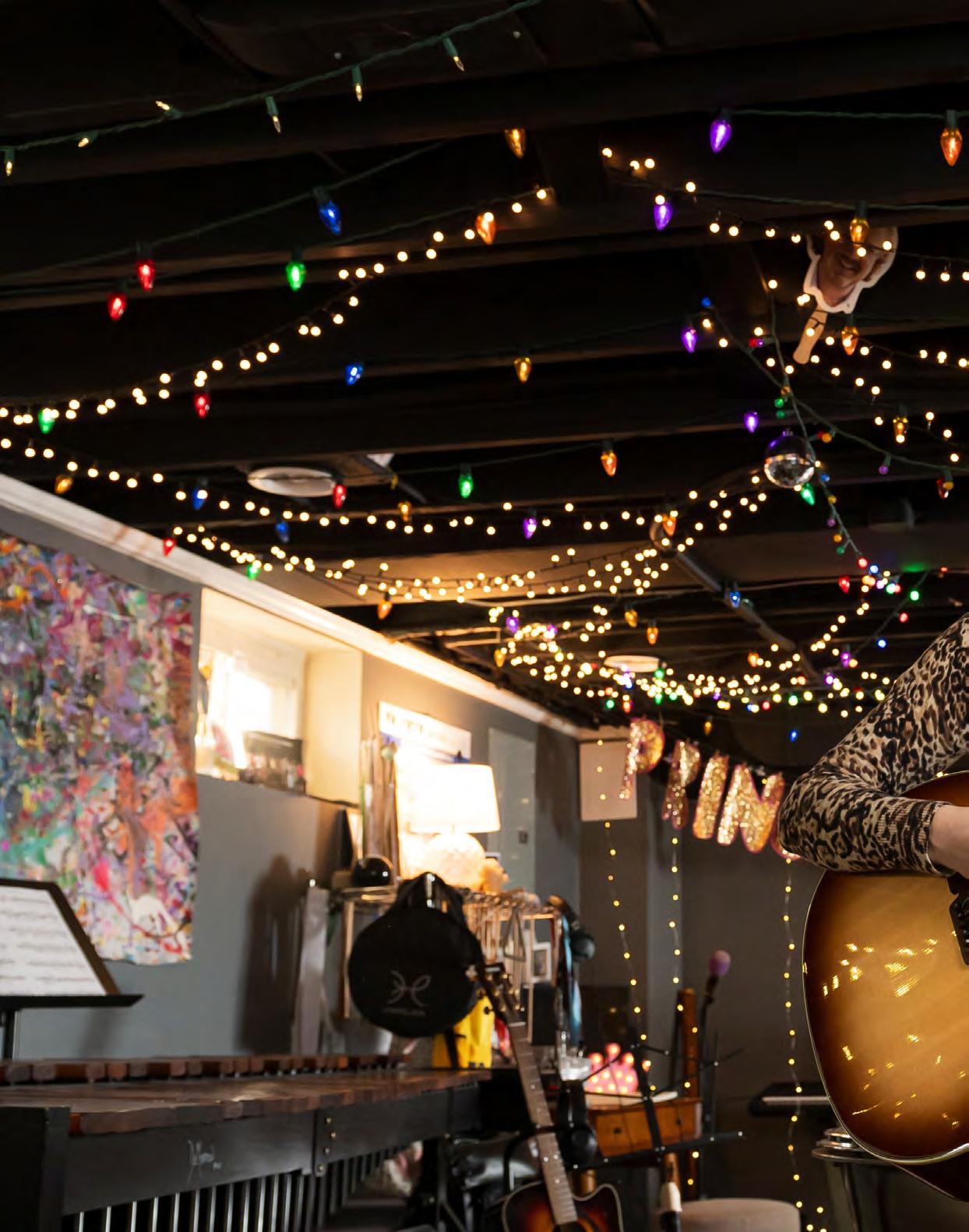
Murphy’s music studio is located in her basement and filled to the brim with percussion instruments, a piano, guitars and a desk with all her recording devices. She spends hours writing, producing, filming and practicing downstairs every day. The easiest part of making a song for her is writing lyrics. They flow easily for her, so it only takes her around 20 to 45 minutes to write a song.
“My best songs have come out of that state where I get a strong emotion,” Murphy said. “I go downstairs to my studio, which is my favorite place on earth, and I pick up my guitar and I find a chord progression that fits my emotion in the moment. So once I find one of those, then I just kind of brain dump [and] word-vomit all the lyrics.”
When Murphy was younger, her songs revolved around unserious topics, such as bagels. As she grows older, Murphy has explored more complex themes of heartbreak, nostalgia and reflection, as shown in one of her first and favorite songs, called ‘I Bring the Rain.’
“‘I Bring the Rain’ is about trying your best to do whatever it is you’re trying to do,” Murphy said. “Trying your best to be a good family member, a good friend and a good person in general. And then even though you’re trying your best, [you’re] still bringing the rain, failing in a way.”
All of Murphy’s songs are made by her, from singing, lyrics and recording to all the instrumentals, but outside perspectives are also important for her. Grace Pinex (12) is one of Murphy’s closest friends and is also a singer, performing in choir groups such as Viva Voce with her.
“Sometimes on a couple of songs, [Murphy will] feel like it’s not clicking in some ways,” Pinex said. “The demo will start out amazing and then she adds everything, [but] sometimes something just might not sound right, so I’ll listen to it and I’ll tell her what I hear that sounds a little bit off and then she’ll go through each layer that she’s added and see what’s happening and then fix it.”
With the support of her friends, teachers and family, Murphy released her first album, Princess, this past October. She has been working on this album, consisting of 12 songs, since freshman year. Murphy celebrated this
pivotal moment with an album release party, inviting all her closest friends and family who supported her.
“‘I Bring the Rain’ is the first song that [Murphy] ever shared with me,” Pinex said. “When we were at the release party and it got to the last track, I started crying because [of] the way that she’s matured since the first time that we heard it. It’s always going to be my favorite.”
Through hours of practicing and arduous auditions, Murphy got accepted into Berklee College of Music in Boston, MA with a full-ride scholarship. She will be majoring in Professional Music, which encompasses a variety of different musical aspects, such as songwriting, music production, music marketing and music business.
“I can learn how to improve upon writing my songs [and] over producing them [at Berklee]. I’m proud of what I did with Princess, but I can definitely improve in that avenue,” Murphy said. “And then I can learn how to sell my music, which is probably the one I’m most looking forward to learning because I think that’s a whole other beast that I still need to conquer.”
Looking into the future, Murphy hopes to turn her passion for music into a full-time career. By getting into Berklee, she’s one step closer to her dreams of performing in front of large audiences and inspiring others that anything is possible with hard work and determination.
“I want to be on tour. I want to be playing sold out shows at venues, and I want to be on a stage with my voice, singing a song that I wrote with thousands of people singing along with me,” Murphy said. “That makes me smile just thinking about it. That’s my complete goal [and] final destination.”
Captions: Norah Murphy (12) practices in her studio. She has written and recorded all her music in her basement.“Afteralongday,allIwanttodoisgodownstairs, sing the song I wrote, refine it and do some recording,” Murphy said. Photo by Vincent Hsiao. (on pages 34-35)
Murphy plays marimba at a concert. She has made manysymphonicgroupssuchastheAll-StateOrchestra. “Percussion has taught me how to be a beast at music in general,” Murphy said. (on page 36)
Murphyandherfellowmusiciansposeforthecamera. Programs like the SLSYO inspired her to pursue music. “Without the inspiration of high level musicians around me, I would not have pushed myself as hard,” Murphy said. (on page 36)
Murphy sings on stage. Her love for singing sparked a passion for songwriting. “I don’t even have to make a goal of practicing singing because I just look forward to it,” Murphy said. (on page 37)
Murphycelebratesheralbumreleasewithfriendsand family. She began working on it during freshman year. “Releasing that album and being able to see it growing [is] super cool,” Murphy said. Photos courtesy of Norah Murphy. (on page 39)

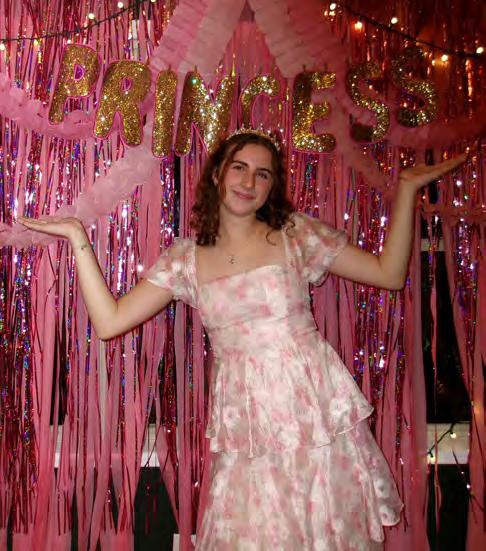

"Harmonies that people wouldn’t think of, or would be odd for others, somehow [Murphy] always makes it beautiful."
Grace Pinex (12)

UN PASADO AUN EN EL CORAZON
U.S from Cuba
The ice-cold wind cuts through his much too thin jacket as he stands on the corner of a New York City street, watching cabs y past beneath alien-like towers of glass that seem to pierce the clouds and sky. He thinks back to the classroom in Santa Clara he was in just a few days but seemingly lifetimes ago, with its peeling walls trapping heat like an oven, the air so thick he wonders if it can even make it to his lungs, the shouts of students constantly ghting on the other side of a thin wooden board that divided one room from another. Now, shivering as he witnesses his breath turn to fog in the cold, surrounded by cars and buildings that dwarfed anything he’d ever seen before, he nally feels the gravity of the 1,314 miles between him and his homeland, Cuba.
Marcos Moran Echevarria (12) was born and raised in Santa Clara, Cuba, not taking his rst steps into the United States until he was 12 years old. Growing up in Cuba not only shaped Moran Echevarria into who he is today, but also limited his opportunities to interact with things that may be ordinary for St. Louis residents, including modernized architecture and bi er temperatures.
“It was my rst time seeing skyscrapers and so many buildings, cars and everything so modern,” Moran Echevarria said. “At the same time, the cold was something that stuck out. at’s what makes the greatest di erence.”
He spent his rst days in the U.S. in New York City, and then in Pennsylvania. Making connections and good friends in an unknown country is an obstacle that could discourage even the most sociable characters and can result in years spent in loneliness, but Moran Echevarria found companionship with his classmates who were also arriving in the U.S. for the very rst time.

“It was super simple to make friends with people who are not from the United States,” Moran Echevarria said. “We shared a lot and because we’re both immigrants and share things in common, like what we had to go through to come over here, [which were] sometimes even dangerous situations, that’s how I connected with them.”
Aside from connecting through shared experiences, a mutual love for sports has brought Moran Echevarria friendships and mentors throughout his entire life.
“I have made most of my friends or companions because of sports,” Moran Echevarria said. “ e moments and memories that you have with [your teammates] build up and that’s how you make that friendship.”
Sports have been a part of Moran Echevarria’s life since long before he arrived in the U.S. His love for it was found when he was just a 9-year-old boy in Santa Clara.
“I started to do boxing in Cuba,” Moran Echevarria said. “I didn’t spend too much time boxing because my mother couldn’t a ord to have me there too much, and at the same time she just didn’t have the time to give to me for sports. [My mother] also didn’t want me to take another pathway, [or] go corrupt like the other kids in the streets.”
Moran Echevarria’s love for sports has always led him to try various forms, but the meager resources dedicated to them in Cuba did not allow for him to explore extensively. Once, Moran Echevarria wanted to try out swimming, but the pool closed a er one of the other members of the team drowned during the rst practice.
“ e pool was big, and the bo om of the pool was dark,” Moran Echevarria said. “It was painted black so you barely can see. Or it could be the fact they don’t clean the bo om, so god knows whatever was down there.”
Marcos Moran Echevarria finds community after moving to the
written by photographed by Elsa Flores-Tamayo Teo Lee
photos courtesy of Marcos Moran Echevarria
Upon arriving in St. Louis, one of the rst things Moran Echevarria did was look into the sports programs that were available to him. e variety of sports and intensity of the programs were not the only changes that stood out to him. e more extensive process of ge ing enrolled proved to be what made the biggest di erence.
“When I got here, the [sports] programs were overwhelming,” Moran Echevarria said. “ e paperwork you have to do is a lot. [In Cuba] I was just like, ‘Hey, can I be in this?’ And just ll out a paper and that was it.”
Alongside sports, one of the most neglected privileges of life in Cuba is education. Schools receive poor funding and even the students are aware of how li le their government cares about the education they receive.
“ e school couldn’t a ord good teachers, so most of the time we barely even had teachers,” Moran Echevarria said. “We were grown without a solid education like we have here in the United States.”
In addition to the poor level of education that Moran Echevarria received growing up in Cuba, his school building faced infrastructural issues and did not frequently receive renovations to address them.
“If you walk up to my school in Cuba, it is basically like you go inside of a prison,” Moran Echevarria said. “I remember once, I went to the bathroom and the door fell on me, and I was like ‘What did I do to this world?’”
AP Spanish courses o ered. is year, Maritza Sloan, Director of the Foreign Language Department at Ladue, is teaching the highest number of native speakers she has ever taught and is delighted by their contributions.
(Translated from Spanish) “I love [Marco’s perspective] because I feel like [native speakers are like] an orange, I can squeeze the juice from the student,” Sloan said. “ en the students in class who don’t have that experience can learn something about the culture, not just through a textbook or from the teacher, but from one of their classmates.”
Moran Echevarria’s extensive knowledge of the Spanish language and culture have proven to further engage and excite students in Sloan’s classroom, but his much faster and thickly accented native Spanish can sometimes be di cult for his classmates to understand.
(Translated from Spanish) “I always had to tell him, speak slower so [your classmates] can understand,” Sloan said. Especially because not only was he speaking fast, but also with dialect and mannerisms related to Cuba that most of the time was di cult for the other students. But li le by li le they got used to it and at the end of the year they didn’t have to pay so much a ention, but his contribution to the class was always very natural.”
“The world can be a dark place sometimes, but Marcos brings a lot of light to it.”
e year-round heat that Cuban residents experience was an unfortunate addition to the deteriorating infrastructure of Moran Echevarria’s school building, which drew focus away from the students’ a empt at learning class material.
Matthew Horn, history teacher
Every country and culture has their own traditions and ways of life, and a large portion of the AP Spanish courses is dedicated to understanding the unique aspects of Spanish culture. Having students like Moran Echevarria who practice these traditions and have rst hand experience with Spanish culture brings an incomparable perspective to class.
“In the rooms you will die of heat, the heat is just too much,” Moran Echevarria said. “I can’t even breathe in those classrooms, and so we pray to God that it at least rained. But in the moments that it rained, later when it got hot, the water vapor is your suicide. Going in there, it’s a suicide.”
Moran Echevarria grew up in a country where schools were tightly under government in uence. ey had no choice but to idolize their country and their leaders. All students faced the e ects of this in their lives daily.
“When you get [to school] in the morning, one of the rst things is we had [to do was]to salute the ag and at the same time sing the national anthem of Cuba,” Moran Echevarria said. “A er being there, standing for at least 30 minutes, we can proceed and go to class.”
Along with the change in rigor and quality of education in the U.S., Moran Echevarria is now able to use his Spanish abilities and receive AP credit for taking both
(Translated from Spanish) “You come to know man through what he is, and culture teaches you this; language helps you to know that culture,” Sloan said. “Learning the language is the vehicle, but the culture is the gasoline that is going to take you there. So in place of judging a person, you have to get to know them.”
e AP Spanish classes spent the rst classes back from winter break learning about the many di erent New Year’s traditions in Spanish cultures, and Moran Echevarria got to share and re ect on how his family and community celebrated the new year together within their close-knit neighborhood in Santa Clara.
“ e 31st of December is saying goodbye to the old year and welcoming the new year,” Moran Echevarria said. “We have a Caldosa in the street with the community where everybody joined together and talk, have fun, dance, play sports, do whatever they want. La Caldosa is basically a food that everyone makes in a big pot.”
Along with using his knowledge of Spanish culture, Moran Echevarria positively contributes to his other classes with his endlessly optimistic a itude.
“He has that kind of ability where he can pre y much talk and get along with any individual that you throw in front of him,” history teacher Ma hew Horn said. “I would put him with people that I knew might need a li le upli ing, because he’s a very positive, fun loving disposition and that manifests itself in his interactions with people.”
Despite having faced di cult experiences throughout his upbringing, Moran Echevarria spreads his positivity and joyous demeanor to everyone who crosses his path.
“ e world can be a dark place sometimes, but Marcos brings a lot of light to it,” Horn said.
Moran Echevarria’s experiences and perspectives serve his classmates in far more than just understanding the classwork. O en, his experiences in Cuba raise awareness in other students of the rights and privileges that he believes can be taken for granted in the U.S.
“Be happy with the Bill of Rights because our constitution in Cuba is bad,” Moran Echevarria said. “We don’t have the same rights, we don’t have the same liberties that we have here. Sometimes I didn’t agree with things and I had to just agree with the teacher because she said so. But here in the United States, you at least have the right to express yourself and talk back if you feel like [something] is wrong.”
Captions: Moran Echevarria stands with the Cuban ag draped across his shoulder, displaying his national pride. Being proud of his nation and culture has always been a part of his identity. “I did run the streets back in Cuba but that was a long time ago,” Moran Echevarria said. Photo by Teo Lee. (on page 40)
Moran Echevarria spends time with two of the rst people he connected with a er arriving in the U.S. ey found common ground through their love for spending timeoutdoors.“Ialwaysliketoseepeoplehappy,”Moran Echevarria said. “If someone feels good, I also feel good.” (on page 43)
MoranEchevarriagetsreadyforhis rstdayoffourth grade, a memorable milestone moment from his childhood in Cuba. While living in Santa Clara, his home was in close proximity from the school, making the journey to and from the building a part of his daily routine. “[In the mornings] I ate my breakfast and started walking all the way to school,” Moran Echevarria said. “It was less than a mile.” (on page 43)
Moran Echevarria visits Caibarién beach with his grandma. Spending time outdoors has always been important to him. “Now, I normally go and play basketball or just go and play some football with my friends,” Moran Echevarria said. Photos courtesy of Marcos Moran Echevarria. (on page 43).

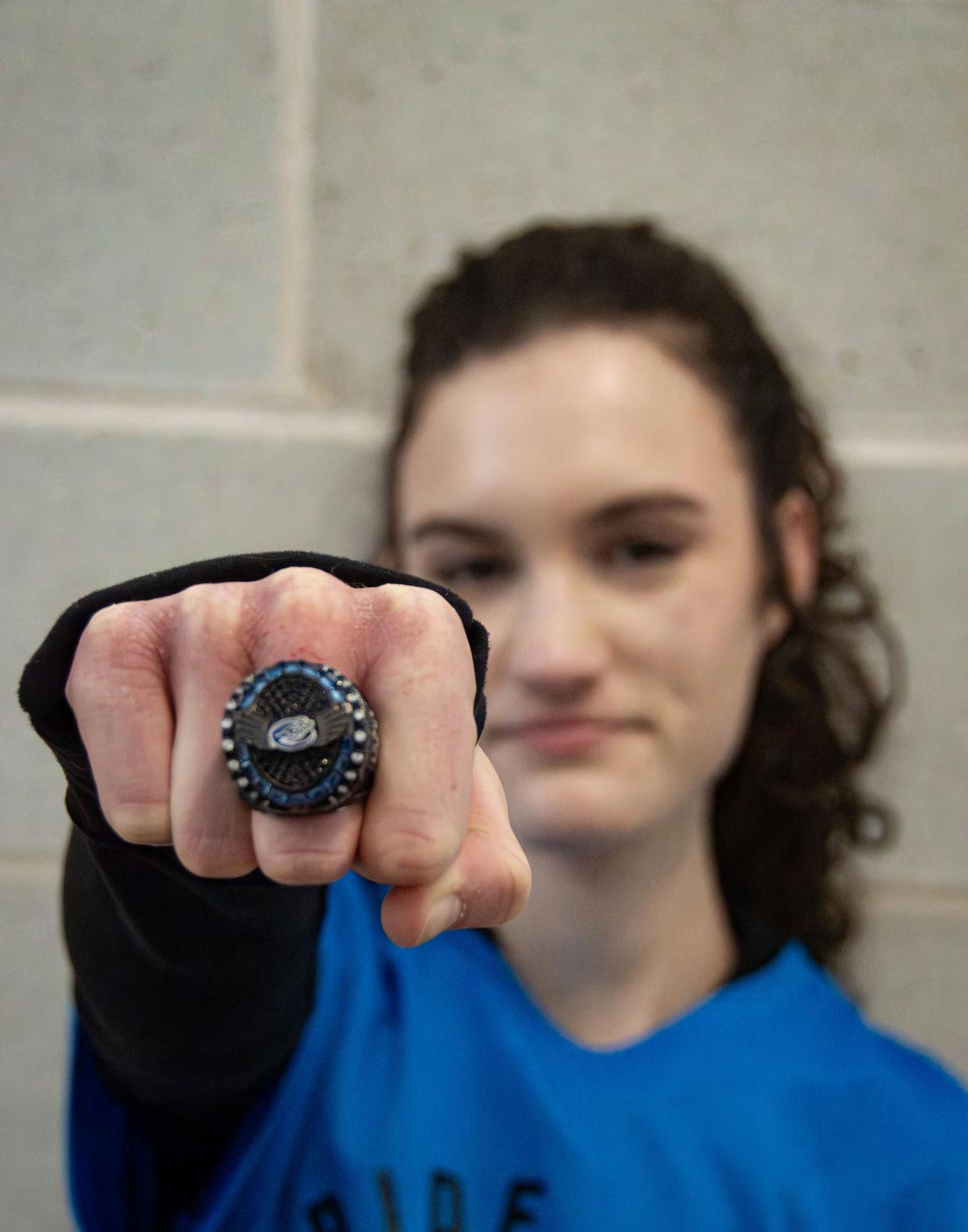
OUTRUNNING THE ODDS
Emiliah Brown defines her own “di erent” through Hashimoto’s disease
written by
Gabriella Beltranena
photographed by Gabriella Beltranena
photo courtesy of Emiliah Brown
It started with a routine wellness check and a doctor’s eyes going wide with panic. At just 9-yearsold, Emiliah Brown (10) looked as if she had swallowed a golf ball; her thyroid was so swollen from her own immune system’s attack that her life changed in an instant. Now at 15-years-old, the trackand-field athlete and singer is redefining what it means to be a competitor while living with an autoimmune disorder that turns her body into its own foreign invader.
Early Life
In her early years, the diagnosis was more of a social barrier rather than a medical diagnosis. While her third grade peers were enjoying school lunches and birthday parties, Brown was navigating a restrictive new world where gluten, dairy and red meat were strictly off limits.
“I didn’t quite understand what was going on,” Brown said. “I had to go through a lot of different testing and I had to get my blood drawn quite frequently.”
After the diagnosis was confirmed, Brown was put on Synthroid, which is a synthetic hormone medication. But that soon became a problem within itself, as being so young and on hormone treatment presented growth complications that were kept under close watch.
“I felt like I was almost an alien among my peers, which affected me for a really long time,” Brown said. “But it came to something that just made me different, which I realized was not a bad thing.”
This feeling of being “different” was something Brown understood from a young age. However, what first began as confusing elementary school experience slowly transformed into a feeling of acceptance that standing out wasn’t a weakness, but a starting point.
“I get very frustrated and fearful of what’s going on, because I don’t always understand why the pain is going on,” Brown said. “We haven’t explored too much yet with my diagnosis, as it’s more recent.”
Having Hashimoto’s
Hashimoto’s disease is an autoimmune disorder that causes the immune system to attack thyroid cells as if the cells were something foreign in the body. If not treated, the disease can lead to death. A year ago, Brown started experiencing symptoms such as joint pain and stiffness.
“I have days where it’s a struggle to just move and get out of bed because it’s so stiff and painful,” Brown said. “But if you look at me from the outside, you would never know whether I’m having pain or not.”
One common occurrence of Hashimoto’s are flare-ups, when symptoms worsen for a period of time depending on where the thyroid levels are in the body. There is no exact time for when these flare-ups can happen.
“I take a general medication,” Brown said. “We can up and lower doses depending on where my thyroid levels are. I can take Aleve or Advil, but it’s not something that makes [the pain] go away.”
Tracking hormone and thyroid levels is crucial, because that dictates whether or not medication doses need to change, or if more action might need to be taken.
“You can lose or gain weight very quickly if your levels are off,” Brown said. “When [levels] are imbalanced you can have issues.”
Brown isn’t walking this path alone. Hashimoto’s is frequently genetic, found more often in women, and in her household, it’s a shared reality. The disease is shared in a clear lineage through her grandfather, aunt and mother, with exceptions including her brother.
“I know she has fear,” Brown’s mother, Elizabeth Hauser-Haddock said. “[Hashimoto’s] is a very manageable thing to experience and deal with.”
Track and Field
From a young age, Hauser-Haddock pushed for Brown to be involved with her school community; it didn’t matter if it was a sport or a school activity. Since then, Brown has been involved in many different sports. She first started with gymnastics, then moved to volleyball and shortly after she transitioned to playing soccer and golf.
“[Sports] gives her a chance to really hone in on what it means to be a part of a team,” Hauser-Haddock said. “How to be involved with other things other than just going to class.”
Hauser-Haddock believes the structure and form of timely activities is necessary to reaching her goals. However, the only sport that ever really stuck with Brown were cross country and track and field.
“I found a lot of friends in this community, [and] I’ve gotten a lot of support through coaches,” Brown said. “But, I’ve also learned a lot about myself through track.” Brown first started running cross country in seventh grade, picking up track and field the year after. Since then, she has competed in many different events, from the 400 to the 4x400-meter-relay. However, being so involved comes with the constant risk of getting an injury.
“I sprained my ankle my first season coming out of the blocks,” Brown said. “And more recently, I’ve been having a little bit of an issue with my right hip.”
Fighting through limited stamina is a struggle that many athletes face. For Brown, this exhaustion isn’t something that can be quickly fixed. It requires a difficult, honest approach of how far she can push herself.
“She can be somewhat critical of herself when she doesn’t need to be,” Track and Field Head Coach Nick Buckvar said. “But [she] is always looking for what she could have done better.”
All of Brown’s hard work and mental discipline led up to her proudest moment with track and field so far during the May 2025 conference meet at Webster Groves High School. Brown was running the first leg of the 4x400 when she was told by her coach that she needed to run the first 200 meters faster than her personal record.
“I was gunning it around the curve, and I could feel the lactic acid buildup,” Brown said. “But I came around that last corner and my team was stationed there cheering me on. I had completed my goal and I dropped five seconds off my time.”
Throughout the school year, Brown normally trains for the majority of the week until 5:30 p.m. This consistent and dedicated drive is what continues to define her vital role within the track and field program.
“She is a really important part of the overall program,” Buckvar said. “She wants the overall team and her teammates to be doing well just as much as herself.”
Choir
While Brown’s dedication to track is a major part of her life, it is not the only way she expresses herself. Outside of athletics, she finds other outlets that are just as meaningful in her life. She started singing in her community church choice when she was young. This later manifested itself into continuing the same activity at school.
“[Choir is] somewhere I can put my emotion [and] my frustration,” Brown said. “I can focus on singing and doing things and pouring that emotion into the piece in which I’m singing.”
This vital emotional outlet becomes especially essential during flare-ups, particularly when her symptoms make even the most basic tasks feel like a grueling marathon. When her body feels worn out, Brown relies on the power of music to process her reality. Many choral pieces tell a story, and within these stories, she is able to find how to project her own struggles into the music.
“I’ve learned a lot of thing from other people, not only with music but life,” Brown said. “And I think it’s just allowing [for there] to be a space that I’m comfortable.”
Despite the mental relief, choir provides the intense physical demands of performing that make way for a completely different set of problems to manage. While most students are warned not to lock their knees on the risers to avoid fainting, for Brown, the stakes are higher.
“I remember one time, at one of my first choir concerts, I accidentally locked my knees,” Brown said. “By the time I was done, I was wobbling off the risers.”
Brown views these moments as an opportunity for transformation. Rather than letting the physical discomfort taint the performance, she uses it as fuel.
“Pain, for me, when it comes to choir, can be turned into something beautiful through song,” Brown said.
Ultimately, what keeps Brown returning to the stage is not just the music, it is the people. As a self-described social butterfly, she finds a deep sense of safety in the choir room. If she were ever forced to give up the hobby, the total absence of music in her life would be secondary to the loss of deep connection to the people she has met.
“I’ve met some of my best friends and friends that will be lifelong friends,” Brown said. “It’s that trade-off of being there [for each other]. There are people that I do not ever wish to lose.”
Moving Forward
Now, Brown is a 15 year old balancing the demands of high school and competitive sports. She views her diagnosis not as a limitation, but as a specialized lens through which she sees herself and the world around her.
“There’s always going to be someone out there who has done it before or is better than you are, and that’s okay,” Hauser-Haddock said. “Those are the people you try to find and you emulate instead.”
For Brown, the race isn’t just against the girl in the next lane, or the person standing next to her on stage, it’s against the version of herself that thinks she has to be perfect. For every morning that she chooses to get out of bed and stand in front of the mirror, she’s already won.
“I have to accept that I am who I am, and this is my body,” Brown said. “I am going to live with it [for] the rest of my life, so this is something that I have to love.”
Captions: Emiliah Brown (10) sings “From the Start” by jazz-pop artist Laufey alongside her friend Velvet Majumdar (9) during the Winter Cabaret Dec. 11. The pair practiced the duet for three weeks in preparation fortheirperformanceinfrontoftheirfamiliesandpeers. “We learned our parts individually and then we put it together, figured out how exactly we wanted to do stuff,” Majumdar said. “The looking at each other and being next to each other was really nice, it definitely calmed my nerves.” (on page 47)
Brown displays the medals from her early track season. Among her collection are orange and black medals earned during one of her first meets while competing in the4x100,4x200,4x400.AmongthemedalsisherState Championship Ring, awarded after the girls track team won first place at state. “Every time I look at [the ring], I sometimes feel like I don’t quite deserve it,” Brown said. “But I also feel so grateful that I was able to be a part of that amazing team of girls.” (on page 47)
Brownlinesupaputtduringheryearsofcompetingin youth golf. While Brown eventually stepped away from the sport when her grandparents moved to Florida, golf served as a vital bridge for family connection. “I hated playing golf,” Brown said. “But I loved that it was a way for me to spend time with [my grandpa].” (on page 47)
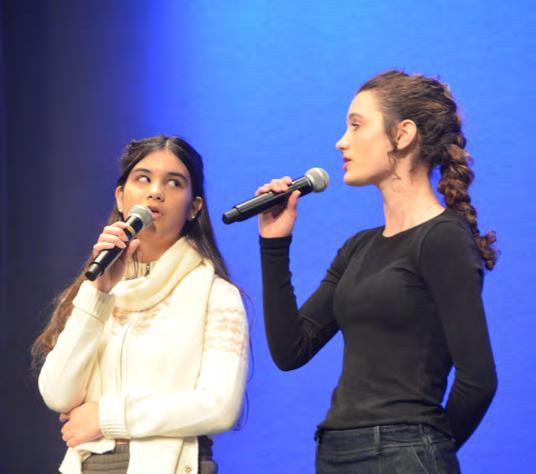
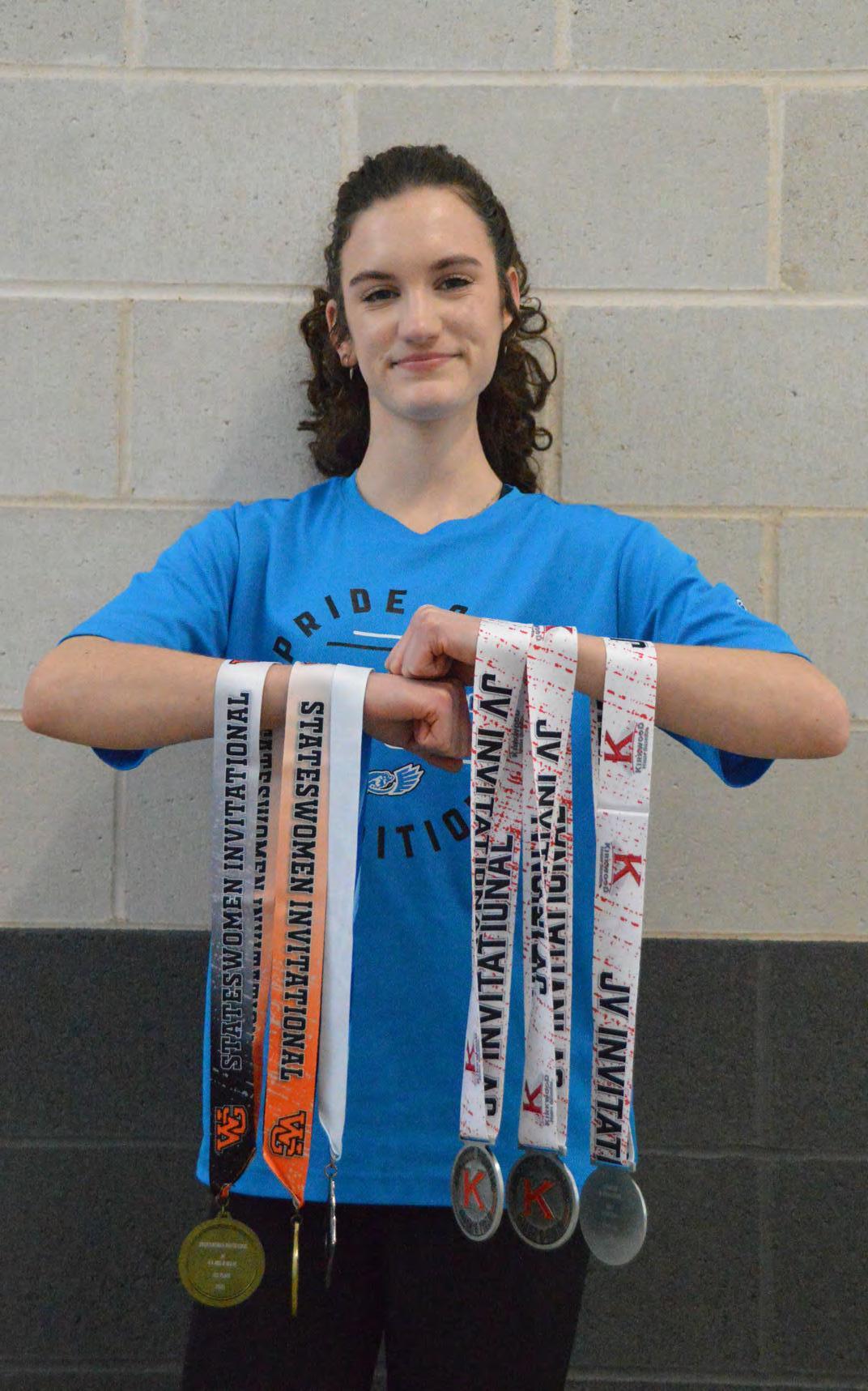

COMPASSION ACROSS CULTURES
Mary DeLia merges her passion for Hispanic culture, volunteering and teaching
written by photographed by Sophie Cowlen Caroline Cobaugh
photos courtesy of Mary DeLia
As the sky darkened over the tropical landscape of Honduras, Mary DeLia gathered with people from a small village. Circling up under an array of bright stars, she cultivated connections with people who were di erent from her while developing a deeper appreciation for the simplicities of life. As early as her high school years, DeLia volunteered abroad, helping in orphanages on the Mexican border and beyond. rough her travels, she gained a love for Hispanic culture and philanthropy. Merging these interests, she volunteers, teaches Spanish and continues to make connections within the Hispanic community today.
DeLia was born in St. Louis. Her mother, Rita Andres, taught Spanish and passed down her knowledge of the language and Hispanic cultures to DeLia.
“When they were real li le, I used to label everything in my house with the Spanish for words, like the door, ‘puerta,’ because I always wanted them to learn Spanish,” Andres said.
In addition to teaching the Spanish language to DeLia, Andres also exposed her to Latin American cultures from a young age. DeLia didn’t just take from the cultures, she loved the people behind the cultural aspects as well.
“She wouldn’t be the kind of person to like just the food,” Andres said. “I would say [she likes] the people, the way of life, she loves to dance and she likes music.”
On top of exposing her to the Spanish language and Hispanic culture, Andres also inspired DeLia to do philanthropic work. When Andres went to meetings or volunteer events, she always made sure to include her.
“I worked with immigrants here in St. Louis,” Andres said. “And I always had a big respect for what immigrants go through to come here. And so I always took Mary and the other children with me.”
In addition to service with the Hispanic community, DeLia also traveled to Latin American countries from a young age. At the age of nine, she traveled abroad for the $rst time to Mexico. As a teenager, she returned to Mexico to stay with a family there for the summer.
“We had a kind of an exchange with a very wealthy Mexican family in Mexico City, and they would send their child for the summer, and then we would send one of our one of our [family members to them],” Andres said. “She loved living with the family in Mexico City. I know that she lived there with them, and by the time that she went to live with them, we had already had all four of their children with us. When she knew the parents and everything, that was pre y special.”
DeLia traveled to Mexico to volunteer as well. What was really touching to her was the humanitarian aid she did at the Mexican border when she was in high school.
“I know when they came back, she was really taken by the children on the border, because when she had to say
goodbye to them, she just cried because she felt like the li le boy that she had really made friends with was kind of looking at her, super sad,” Andres said. “ at was an amazing trip for her because it made her really aware of issues on the border.”
Nearing the end of her high school career, DeLia knew she wanted to continue to work abroad. She went to college at e University of Missouri, where she originally studied nursing, hoping to be a nurse in other countries.
“I had this dream that I wanted to be a nurse in South America and help the really poor communities. So I studied nursing, and I was all the way up to my junior year in nursing, and there was one day where I was like, this just is not for me,” DeLia said. “We started doing clinicals in the hospitals, and it just was a di erent feel from what I thought it would be. And I was like, I miss that culture piece. So, I ended up moving to Spanish literature.”
A er graduating from e University of Missouri, DeLia got a certi$cation for teaching English as a foreign language. Later, she moved to Chile and taught English to businessmen and women from di erent companies.
“I got a job in Santiago, and I thought I was only going to be there for six months, and I ended up staying for a li le over two years there,” DeLia said. “I just fell in love with it.”
A er a couple years abroad, DeLia had to return home. When she came back to St. Louis, she brought with her more clarity on her passion for teaching and culture.
“I think that I came to reality, like, I think I’m gonna stay [in St. Louis], and I love teaching about the culture,” DeLia said. “So that’s when I was like, I think Spanish would be perfect for me. And my mom laughed because she said, ‘You said you’d never be a teacher.’”
DeLia went on to get a teaching certi$cate. She started by doing student teaching at Webster High School. Later, a er working at di erent schools for several years, she was hired as a Spanish teacher at Ladue High School, where she hopes to work for the rest of her career.
“What I love the most is just connections with students. I like seeing students have fun with the language, and the energy of just being in a high school is fun,” DeLia said. “My colleagues are great here. ey have always been so supportive, and so that makes a big di erence when someone feels like somebody’s got your back.”
By teaching Spanish, one of DeLia’s goals is to educate young people on the beauty of other cultures, from the music to the food to the traditions. In her curriculum, she teaches lessons about various countries, including Spain, Colombia, Mexico, Brazil and beyond.
“I want them to be exposed to di erent cultures, and be able to compare and contrast that culture with their own, and just get a more worldly perspective as well,” DeLia said. “So in the future, when they do meet other people, especially Spanish-speaking people, they can
hopefully connect with them through language, but also through the culture a li le bit.”
rough DeLia’s travels, she’s learned how rewarding volunteering is and she wants young people to experience that as well. In the future, she hopes to organize a volunteer trip abroad for Ladue students so they can learn more outside her classroom and make a real impact.
“I’d like to $nd a place that we can do some service work, maybe in the Caribbean. I would love to have [students] work in an orphanage with Spanish-speaking children, and so [students] can bene$t too, learning Spanish and then also connecting with those children,” DeLia said. “I learned a lot from those people. Enjoying the simple life, but also being able to help them is a good feeling. So my dream is someday to get that all $gured out.”
In addition to teaching, DeLia expands her impact by sponsoring the Ladue chapter of the United Nations International Children’s Emergency Fund (UNICEF). e club works to raise money for children around the world, providing them with education, emergency aid, vaccines, clean water, food and much more. In Ladue speci$cally, her goal is to bring awareness to what is happening to children worldwide and how we can help them.
“No child deserves some of these conditions these children are in,” DeLia said. “I love that UNICEF goes into these dangerous areas lots of times and makes sure that they’re helping these children.”
In addition to the work she does with UNICEF, DeLia also continues to volunteer with the Hispanic community today to make a di erence in the lives of others. Over winter break, she helped immigrants in St. Louis.
“It was for immigrants that came here, mostly Spanish-speaking, and they had a holiday Christmas event,” DeLia said. “ ey had stockings for them, and they had games for the kids and di erent things they would need for Christmas because a lot of them just recently came, so people didn’t even have beds.”
DeLia worked with her mom and other volunteers during the event. Together, they were able to help around 120 kids, especially by using their Spanish to communicate with the families who didn’t speak English well.
“We had games and we had Mexican dancing, and we gave each family about $200 worth of gi cards and thri store vouchers,” Andres said. “And the kids got to go around and get these li le tags and then pick any toy that they wanted, because we got lots of donated toys.”
Not only does DeLia make an impact in the lives of others today, but her dedication to her community has been a special part of her life for years. Even as a teenager, helping others had been a central part of her values.
“She’s always worked,” Andres said. “When she was in high school, she worked at what they call Pillar House, which was a social service agency. ey were supposed
to do a certain amount of service, but Mary went over and beyond. Every time she had a chance, she was down there helping those families.”
DeLia’s lifelong dedication to helping others is just one of many things that shows her kind, sel ess character. From educating students on the beauty of other cultures to working with UNICEF and volunteering around the world, she has made impacts on countless lives. Her ultimate goal is to leave behind a legacy of kindness.
“I’m really trying to be able to help people that are less fortunate, and you think you’re giving to them, but usually you gain things as well,” DeLia said. “I just want to be known as a person that was kind and helped others and treated people well.”
Captions: Mary DeLia writes in Spanish on the board during a lesson. When designing her curriculum, she aimedtomakelearninganewlanguageengagingforher students. “I want kids to have fun with the language,” DeLia said. Photo by Caroline Cobaugh. (on page 48)
DeLiastandswithpeoplefromCiudadJuárez,Mexico. She volunteered on the Mexican border during college. “I did some service work at an abused women and children’s shelter,” DeLia said. “It was hard work because we were in a really rough area of Mexico, but I just enjoyed helping people.” (on page 51)
DeLia poses for a photo with people in Chile. ere, she taught English to business people. “It was really great,”DeLiasaid.“Wecouldtravelontheweekends.You could go to the beach town, you could go skiing or go over the Cordillera Andes Mountains.” (on page 51)
DeLia rides a horse through a village in Honduras. As aseniorinhighschool,hertravelshelpedherunderstand di erent ways of life. “ e thing that resonated with me themostisIlivedwithawomanandherson,”DeLiasaid. “ ey worked in the $elds with machetes. It was a culturalshock,butitwasareallyneatexperiencebecauseit was so di erent than the way we live.” (on page 51)
DeLiaposesforaphotowithHonduranpeople. ere, she volunteered at an orphanage and gained wisdom about what ma ers in life. “Sometimes you go to these communities where people view them as poor,” DeLia said. “But they would sit under the stars in a circle and justtalkwitheachother.Itremindsyousomeofthesimplest things are the most beautiful things.” (on page 51)
DeLia stands in front of ruins in Tenochtitlan with her family. Mexico City is one place DeLia has traveled to since she was young. “She was nine years old the $rst time I took her to Mexico,” Andres said. (on page 51)
Members of Ladue’s UNICEF club pose for a group photo. DeLia sponsered UNICEF for several years, overseeing all of the club’s operations. “My favorite part about it really is good students who want to do good thingsandhavefunatthesametime,”DeLiasaid.Photos courtesy of Mary DeLia. (page 51)
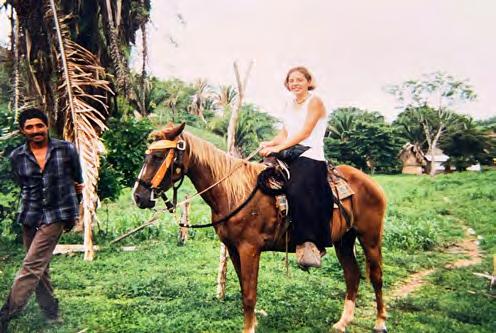
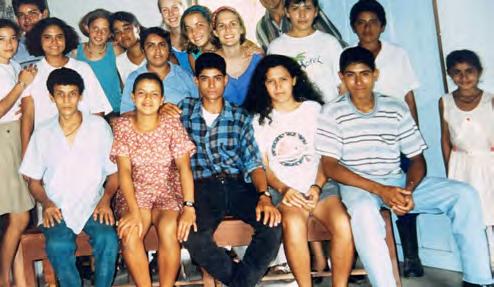
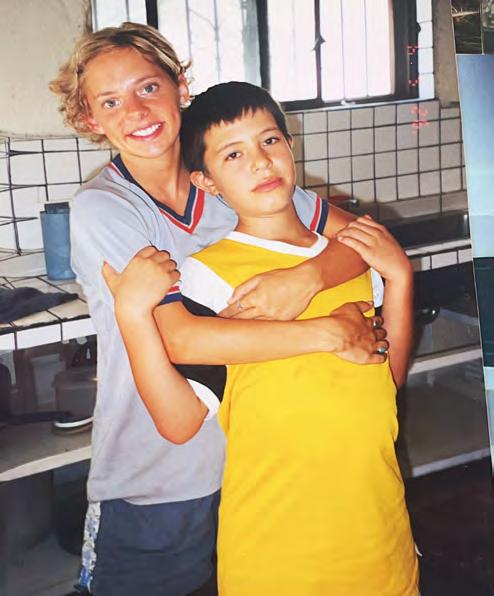
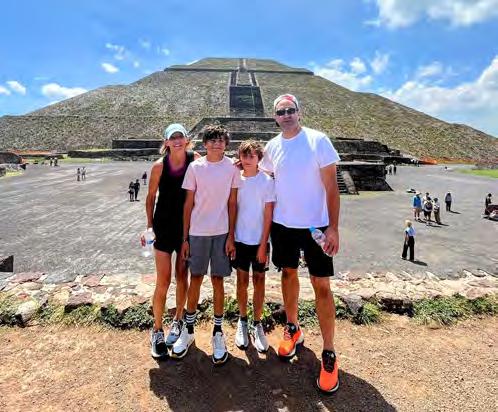

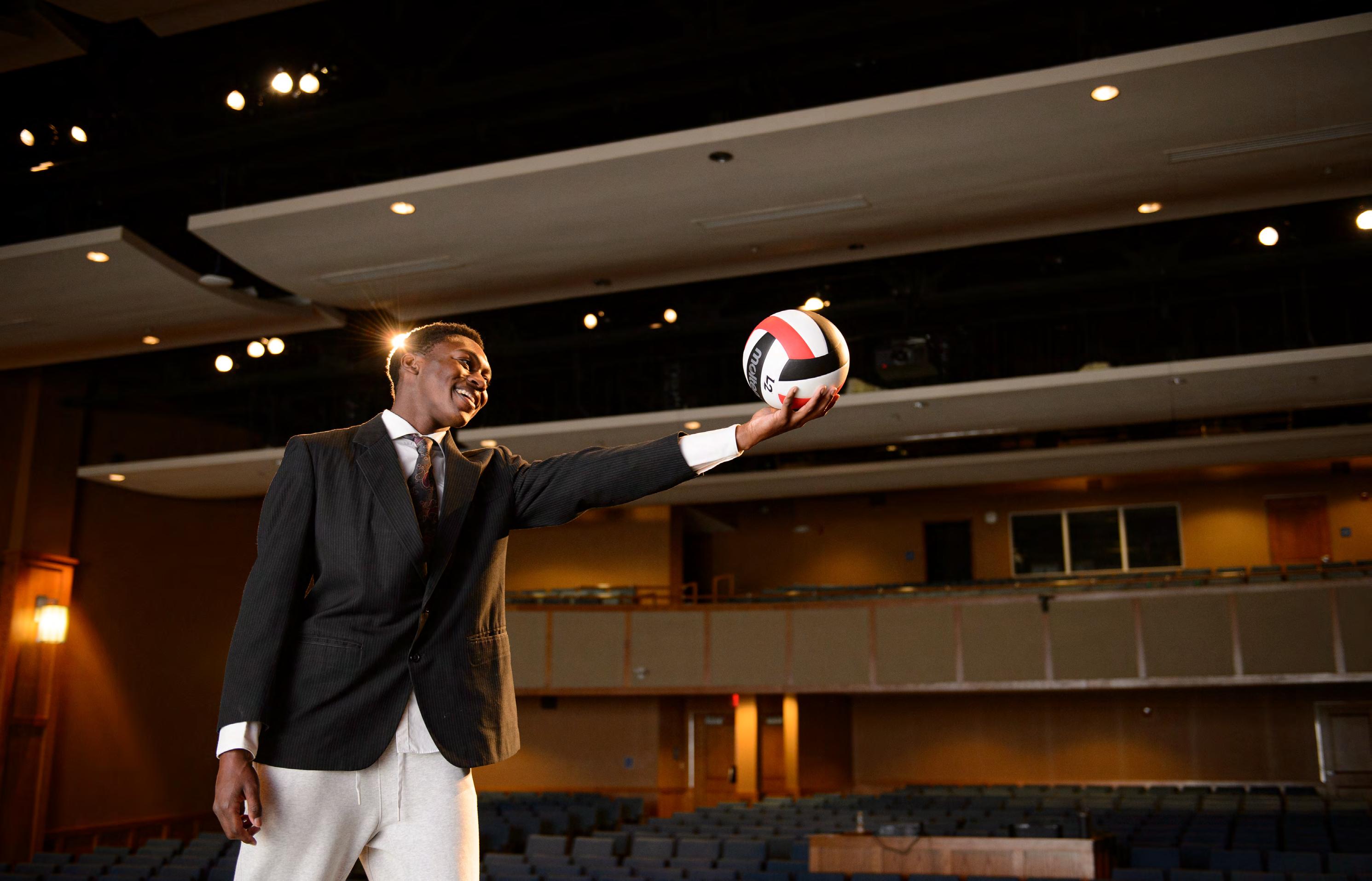
IN THE MIDDLE OF IT ALL
Landon Page develops a strong sense of self by
written by photographed by Ryan Nolan Vincent Hsiao
photos courtesy of Landon Page balancing volleyball and theater
Landon Page (11) thrives where he must constantly navigate two di erent worlds and two separate languages. Some days for him, blocking means marking his moves on the theater stage, practicing for the numerous productions he performs in per year. Other times, it’s what he does on the volleyball court, defending his side of the net. But whether it’s on a team or in a cast, memorizing his lines or spiking a ball, Landon strives to remain a hard worker and a reliable friend to all.
Landon has been an avid performer all across St. Louis. He got his start in community theatre and has participated in multiple Ladue shows as well as the Muny. But this impressive resume didn’t begin recently. It’s a byproduct of a decade of passion and talent.
“I had always grown up as a big music person,” Landon said. “It kind of just helped me have a place to put that passion. I guess it just came natural to me.”
But Landon wasn’t the only person to recognize his natural talent. His mother, Ladue Middle School English teacher Maria Page, was the "rst to recognize her son’s musical passion, and she acted on it, enrolling him in his "rst show e Li le Mermaid at 6 years old.
“ e director asked me where he took dance because the choreographer said that Landon was picking up everything so quickly,” Maria said. “ e next thing I knew, once we had the show, Landon said, ‘Mom, "nd me a new show. I loved it, I don’t want it to be over.’ He’s been doing it ever since.”
Landon’s natural air for the theater has created an environment where he can express himself using his musical talents with people who enjoy doing the same. He’s had unique experiences that he a ributes solely to his experience at the Muny. On more than one occasion, he has had the opportunity to work alongside professional performers, like actress and singer Jessica Vosk in a Muny production of Waitress: e Musical.
“It’s helped me see a professional environment before I’m an adult,” Landon said. “It’s unique, the way the creative teams work is just on a new level.”
Exposure to this professional environment has only pushed Landon to grow over the years. He’s developed from someone who simply goes through the motions to a person who embodies the characters he plays. His mother has seen the evolution of his theatrical skills "rsthand.
“I mean, he could always get the choreography and do the steps,” Maria said. “His memory muscles are so strong. But his showmanship has de"nitely improved, and just like in volleyball, his con"dence has improved.” e independence and con"dence Landon gained from acting isn't only isolated to theater. He’s been able to implement it into more of his life, which helps him to act independently when making his own decisions. is autonomy led Landon to try volleyball for the "rst time
his freshman year on a whim. Since then, he has played for Ladue for the last three years and one year for the Blue Steel Volleyball club as a middle blocker. His job is to to stop swings from the opposite team landing on their side of the court, and he has stuck with that position since his start in freshman year. While the physical aspect can be harsh, o entimes, maintaining a clear head is just as critical to the success of a match as athleticism.
“Volleyball is a really mental game," Landon said. "You could be the best blocker, the best hi er, whatever, but if you’re in your head about things, you’re going to play bad. So, for me [knowing that] helps me stay out of a negative mindset.”
While Landon does personally work to be the best athlete he can by keeping a positive mindset, volleyball isn’t an individual sport. For the team to be successful, they must work together to keep a itude as a whole. To Landon, the chemistry created on the court has turned into some of the strongest friendships in his life.
“I have made some of my closest friends from volleyball because you have to be so close with your teammates,” Landon said. “Everything you do, you have to be on a wavelength. You have to understand each other on a certain level to play well together.”
One of the bonds Landon has acquired through volleyball is with his teammate and friend, George Fister (12). e two have been friends playing on the same team since 2023. According to Fister, keeping that positive bond between players is a task Landon wholeheartedly takes on as he works to keep his team motivated.
“Landon is a great player and an even be er teammate,” Fister said. “He’s usually in the front row either pu ing the ball into empty parts of the court or blocking the opponent. Even when he’s not playing, you can hear him on the bench cheering his team on.”
Juggling his activities has contributed to Landon developing his own personal sense of self. Yet, while Landon remains passionate about his extracurriculars, they do tend to pile up. To avoid burnout, Landon must remind himself why he's stuck with them this long.
“[Balancing everything] can just get very tiring at the end of the day,” Landon said. “It’ll be school for most of the day and then practice till "ve and Muny from six to 10. So then you get home and you accomplish everything you need to, but it’s very tiring and it goes on for a while. But, since I’ve done this for so long, I know it’s always worth it in the end.”
Landon’s ability to push himself through these rigorous days is a testament to his work ethic. When his schedule requires him to be on the go for over 14 hours, Landon must remain resilient and organized to keep up.
“[Landon] is very driven,” Maria said. “When he sets his mind to do something, he works to achieve it. He is excellent at time management because a lot of times he’s
doing so many things. As a mom, I want to say maybe you shouldn’t do all of those things, but somehow he manages to do them all, and do them well."
rough balancing his extracurricular activities he’s learned more than just time management, he’s also learned important life lessons on perseverance.
[My extracurriculars] taught me the importance of never giving up,” Landon said. “You’re not always going to get the role you want or the play that you make is not always going to go the way that you want it to. I would say that it has helped me grow by keeping me looking at the other side of things.”
Ultimately, whether he is blocking a ball at the net or hi ing a high note at the Muny, Landon’s journey is a re ection of the character he has built over the course of his life. From his "rst production over a decade ago, to his "rst day of volleyball tryouts just three years ago, the people he met along the way have all helped him mold his identity. But to his mother, these achievements aren’t as important as the person he has become.
“I appreciate all of the wonderful things that he can do,” Maria said. “I look at Landon, and that’s how I know that God loves me, because he gave me the most amazing son.”
Captions:LandonstandsonthePerformingArtsCenter Stage with a volleyball in hand wearing his costume from Legally Blonde: the Musical. Landon has done theatre for over a decade and started volleyball during his freshman year. "My biggest strength is my ability to be flexible when things don't go according to plan,” Landon said. “[It helps] in theater since every night something new happens. For volleyball, you have to be flexible because you're not going to do everything perfect, but you can't harp on it." (on pages 52-53)
Landon acts out a scene during dress rehearsal for Legally Blonde the Musical in the Performing Arts Center. Landon was cast as Emmett Forrest, a leading role. "I'll always have my friends who I know from theater whoaredefinitelygoingtopursueitlaterinlife,”Landon said.“Eventhoughwe'reprobablynotgoingtobeinany shows together in the future, they're always going to be there for me." Photos by Vincent Hsiao (on page 55)
Landon jumps to block an opposing hit during a homegame.Landonhasstuckwithhispositionasamiddle blocker, since he first began playing volleyball. “I've metalotofnewpeoplethatIneverwouldhavemetotherwise,” Landon said. “Overall, volleyball has opened me up to many new relationships and introduced me to a new world of sports." Photo by Riley Dolan (on page 55)
Landon's club team huddle up during a game. He's played for both Blue Steel Volleyball Club and Ladue. “I like being a part of a team effort,” Landon said. "When you come together with other people for sports, I enjoy that.” Photo courtesy of Landon Page (on page 55)

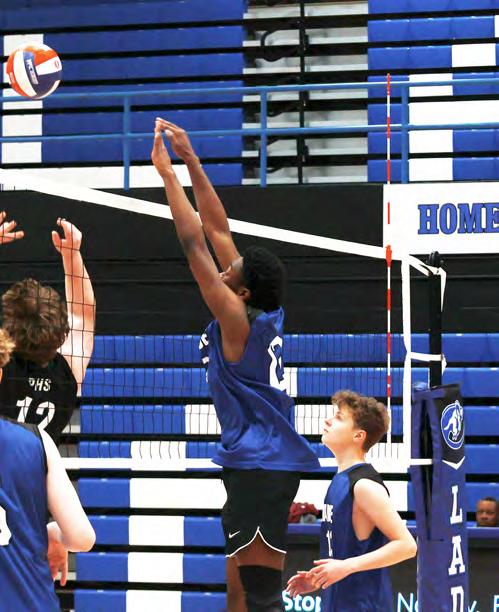



MANY W RLDS, ONE IDENTITY
Oyku Akgun builds a place for herself at Ladue through her experiences and faith
written by photographed by Medha Chode Sarmistha Pulagam

Each box holds di erent memories and mementos of the places she’s lived. When unpacked, the seeming chaos of cultures comes together to form Oyku Akgun (9). Having made multiple international moves in her life, Akgun combines her many geographical experiences with her unabating faith to create a space at Ladue.
Before moving to the United States, Akgun lived long term in Turkey and Germany, along with brie y spending time in Italy and Greece. Overall, she has not only moved countries multiple times, but she has also moved cities many times in her life. A necessary part of moving so o en is adapting to new schools every time.
“I’m a very hard-working person, [because] I’ve never lived somewhere for a long time,” Akgun said. “I always had to work a lot more to be average at school. [In] Germany, even to be average, [I had] to learn German as a third grader and it has a ected me. I’m really grateful how it turned out. I think it was worth going through it.”
Where Akgun lived in Germany, fourth grade was the year that students were separated into one of three different levels of schooling. e school depended solely on their grades and Akgun’s goal was the highest level.
“For you to be able to get in the hardest [school] you had to have a [3.7 grade point average],” Akgun said. “I was just learning German and I remember working really hard that year, and I actually made it in the hardest school. My teacher, [who] was really harsh, gi ed me a small statue of a pig that said good luck and had a [clover] on it, and I kept it for a long time.”
Akgun didn’t move to the U.S. from Germany until eighth grade. A major challenge of this was going from learning English in a classroom to speaking it all the time.
“I think Germany has a really good English education,” Akgun said. “I felt prepared. But when I moved [to the U.S.], I realized I wasn’t. It was hard. ere’s always a lot more to learn.”
One characteristic of the U.S. that remained consistent from Germany was her religion. Having been born in Turkey, which is a predominantly Muslim country, Akgun has been practicing Islam for her whole life.
“[Living in Germany] is di erent from living in the U.S., but not in the perspective of Islam, because Germans aren’t Muslim either,” Akgun said. “So [having my Muslim] friends helps me, but it’s not really needed.”
One way Akgun practices her religion is by making time on special occasions to go to her mosque.
“Being closer to God in general makes you more faithful,” Akgun said. “It gives you strength. So I always had hope, and I always felt positive and was grateful.”
e main way Akgun tries to practice her religion is by being grateful and giving back. Having moved around a lot, this is very important to her. Currently, she volunteers with friends to teach children Turkish.
“I just try to be really grateful,” Akgun said. “Sometimes, especially when you’re moving a lot, it can feel like you don’t have support. But I just try to be very grateful, because moving so much also makes you realize how di erent people’s lives are, and it makes you more grateful.”
Akgun also partakes in the many religious holidays that go along with being Muslim. She recently observed Ramadan, which took place Feb. 17-March 19.
“I remember [Oyku] telling me that fasting was about to start and it’s really hard for her,” Audrey Crosse (9), one of Akgun’s friends, said. “But she does it because of her religion and she feels it’s good to celebrate the food that we have, and really make sure to be thankful.”
Although Akgun has involved herself in the Ladue community, there are still many things she misses about Europe. e connections she has made here cannot be compared to the bonds of childhood friendship.
“[What I miss the most is] my friends,” Akgun said. “I miss them so much. We still talk to each other on the phone. I used to spend time with them every day, and now I only see them through video calls or chats. e time di erence is also hard.”
It’s especially hard to keep in touch when it comes to family. However, having holidays special for Islam makes it easier for Akgun to regularly keep in contact.
Aarushi Kuppa (9) rst met Akgun in math class a er she moved to Ladue in eighth grade. Her intial impression of Akgun was how smart and helpful she was, leading to the pair quickly becoming close friends.
“ ere were a lot of times in math when I was really struggling and she would just step in and [be] so helpful,” Kuppa said. “I just met her and she was really helpful in math, and we started becoming friends over that.”
Akgun’s friends describe her as trustworthy, helpful and compassionate. ey think of her as someone who would be there when they need, no ma er what.
“[In one word, Akgun is] helpful,” Kuppa said. “Genuinely, I think she just has to help everyone and she just makes your day be er.”
Kuppa noticed that, although Akgun was a li le bit shy and quiet when she rst moved from Germany to the U.S., she now has many friends, is much more outgoing and ts in really well with the Ladue community.
“She’s adapted really well [and] has made so many new friends,” Crosse said. “She’s such a sweet girl, she makes friends really easily. She has a good life here, going into school, and she has her friend group and she’s really excelling in math. I know she really likes it, and she’s trying to be in calculus next year, so I think she’s doing really well.”
“One thing I would say to my friends here is that I love them so much and I am beyond grateful to have them in my life.”
Oyku Akgun (9)
“We have holidays special for Islam,” Akgun said. “I think [having holidays] brings us closer, because even though we try to call each other a lot on the phone, it’s really hard with the time di erence. But having those holidays [means I] call them and talk to them.”
However, for Akgun, with moving around o en comes being close to her parents and younger brother. ey all know they can rely on one another and are tight-knit.
“[I always have] my close family,” Akgun said. “My mom, my dad and my brother. I feel like we’re kind of isolated from everyone else, but we always have each other, and I’m really grateful for that.”
Despite missing her friends and family in Europe, Akgun has formed many close-knit friendships in the past two years since she moved to Ladue. She has made a long lasting positive impact on the people around her.
“I would say [my favorite thing about Akgun is] how easy she is to talk to and how she has a smile on her face even if she is obviously struggling with something,” Crosse said. “She’ll always make sure that you’re okay too and she’s just really sel ess.”
Akgun a ributes her ability to making friends to constantly being on the move. Relocating o en means that she has to be open and outgoing in order to connect with people.
“I [can be] a really shy person, but moving around countries made me realize how basic life actually is,” Akgun said. “You don’t need to be shy, you can just become friends. I was really shy, but now I’m kind of more comfortable and I’m not scared of being alone, because moving so much a ects that.”
Akgun’s unique experiences mean that she is able to connect with others who have had similar journeys. She is a part of the Ladue Student Council and hopes to help students like her adapt to their new environment.
“[Some advice I have is] make sure to call your relatives and friends,” Akgun said. “Also, always be yourself.”
Caption: Oyku Akgun (9) re ects on the di erent events that have led her to where she is now. Akgun moved over 10 times to unique places across the globe before coming to the U.S. to make her place at Ladue. “I don’t regret anything,” Akgun said. “I think everything happensforareason,forbiggergoalswemaybecan’tsee yet.” Photos by Sarmistha Pulagam. (on page 58)
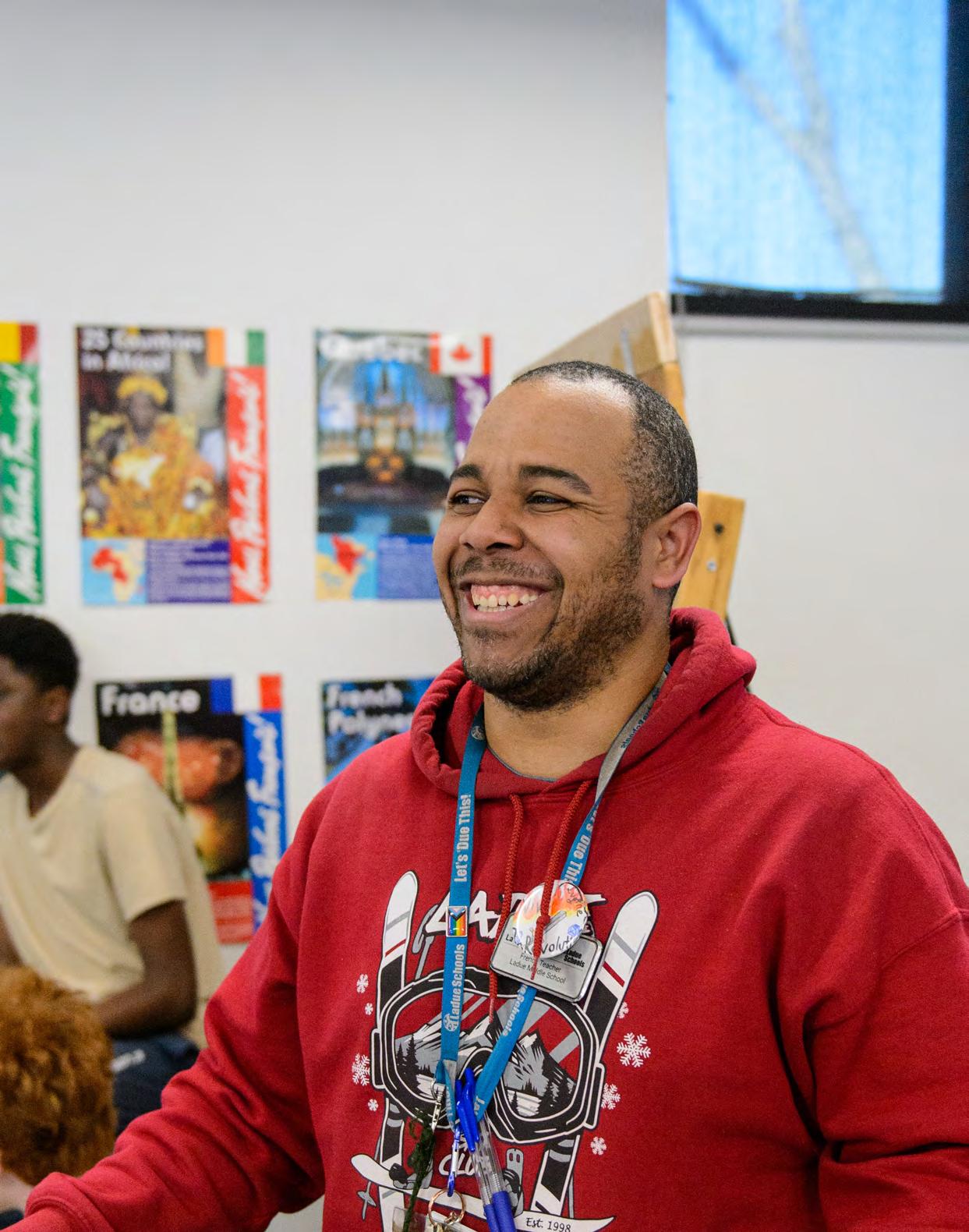
C’EST LA VIE
La’Ondrill Brown finds his voice in di erent languages and environments
written by Nathan King
photographed by Vincent Hsiao
In a classroom occasionally lled with cacophonous noise, copious amounts of teenage angst and severely irksome trends, French teacher La’Ondrill Brown has found his place. While many people would rather spend time in prison than go back to being in middle school, Brown recognizes middle school for what it is — a critical period in the development of students’ identities. With futuristic computers and foreign languages, Brown inspires his students by embedding his passions into the way that he teaches in class and works with a variety of extracurriculars.
Even though Brown may feel like a mainstay of the middle school for many students, his journey with language and learning began outside of Ladue. He spent the majority of his adolescence in Florissant, Mo. a er previously living near the Missouri Botanical Garden.
“When we moved to North County, it [was] proper suburbs, so I was kind of insulated,” Brown said. “School was up the street. My friends were up the street. I didn’t have to go to the main road unless we got into a car. So to a certain respect, I was kind of sheltered, which was a good thing. e internet didn’t really exist, so everything was friends, video games and occasionally books.”
While in high school, Brown was involved in a variety of activities. However, one of the most impactful to him was his role as a school diplomat, where he interacted with foreign exchange students.
A er ge ing more experience with teaching in a college environment, Brown decided that he would prefer teaching at a middle school. By coincidence, he ended up at the same middle school that he’d a ended previously.
“ e transition between college and middle school is uncanny,” Brown said. “It’s completely di erent. ere are things that you can’t say in middle school that you could de nitely get away with saying in college, and of course, there is no such thing as behavior problems in college. at was a nice learning experience. And the fact that I was a student in that building myself long time ago, that was a story I could tell the kids, ‘Oh yeah, when you were negative, such and such, years old, I was here.’”
A er several years teaching in the Ferguson-Florissant School District, Brown made the switch to Ladue, where he is in his h year of teaching and working with clubs. He currently sponsors the esports and anime clubs.
“Ironically, I’m more known for clubs than being a French teacher,” Brown said. “Even among French students, they say, ‘Oh yeah, [he’s] the anime club teacher. Yeah, he teaches French too.’ But that’s the funny thing. It’s those clubs and experiences that go beyond the classroom that kids really appreciate.”
“I wanted to do something with language, and French kind of clicked with me.”
La’Ondrill Brown, French teacher
“I noticed when they came in, they were kind of isolated,” Brown said. “ ey would stay together or only talk to people who were like them, and I wanted to be a person who helped push them out of that comfort zone and help them make friends. I’m not sure if I necessarily became friends with them, but they did end up nding their friend group.”
Following his positive experiences with language in high school, Brown majored in French at the University of Missouri–St. Louis. However, Brown wasn’t always completely certain about a future teaching others.
“I knew I wanted to do something with language, and French kind of clicked with me,” Brown said. “For the longest time, I was thinking about teaching abroad, but then my college professors pushed me into a master’s program that led me down this pipeline, which I’m happy about. But, I didn’t really have a speci c plan. I just knew I wanted to work with people and be around people, and eventually I got pushed into [teaching] French.”
A er completing his undergraduate degree with a major in French and minors in Japanese and psychology, Brown ended up working as an o ce assistant at UMSL.
e most recently established of Brown’s clubs is the esports club, created last year. Brown applied for a grant from the Ladue Education Foundation, and he used the funds that he received to purchase large amounts of gaming equipment for the bene t of the students involved with esports.
“A lot of [students] associate it strictly with the idea that they get to play video games,” Brown said. “But they’re making bonds. ey’re making friendships. Even students who just a year ago didn’t like each other can actually have a conversation with each other now, because they have that common space, that common language that they’re talking about. So, there’s that social aspect. It’s that sort of community [where] these are the people that you can reach out to if you’re struggling.”
Brown has watched anime for a large portion of his life. He decided to become the sponsor for the anime club, because he recognizes how it can be a positive outlet, especially when it comes to topics that students don’t necessarily encounter daily in the classroom.
“[Anime] can be about literally anything, and there are no boundaries,” Brown said. “Unlike cartoons that are mostly just slapstick comedy that are for kids, you do talk about those more di cult subjects in anime, and I think that’s what really draws kids in. Even shows that are really, really popular, like “Naruto,” there’s a lot of Buddhist philosophy in there. ere’s a lot of what happens when
"He’s got a very big heart. He really cares a lot."
Melody Frese, librarian
a best friend betrays you, that sort of scenario, and you have the fantastical art and action that blends that lesson with something that’s really entertaining.”
Even when it isn’t for his own clubs, Brown still spends a signi cant portion of time helping his students succeed in their education and extracurriculars.
“He’s really involved in anything,” middle school librarian Melody Frese said. “At one point, he was the a er school activities coordinator. Now he’s just doing some a er school activities, and he works with the buses a er school. He volunteers for basically everything. If there’s a ski trip, he’s going to go on it. If they need help with sixth grade camp, he’s going to go early and help put stu together. He’s just that kind of guy.”
Concurrent with teaching and working with clubs, Brown is also writing several books. With each book in a di erent genre, Brown is actively creating scienti c futures, fantastic worlds and crime- lled cities.
“You really want what you see in your head to come o in the words that people will be reading,” Brown said. “And sometimes I’ll struggle with a word or phrase or an expression, and I want to take [it] out of my head and put it on the page. And that is so challenging to do, because when you put it on the page, it almost sounds less poetic than it does in your own mind.”
Another major part of Brown’s journey has been guring out what his name means. Just as his name has been a question of identity, it has also been a potential source of confusion when interacting with others.
“ ere have been many occasions where I go into a classroom where my students think that I’m a woman, and they discover I’m not,” Brown said. “ ey also discover I’m not French. ey think I’m some foreign person, and then they nd out [I’m not]. I think some people nd the name to be compelling, so they’re almost drawn to it. ey want to learn more about it. ey want to understand how it is that this seemingly normal person has such a unique name, so they sort of share in that process of helping me de ne who I am.”
However, dealing with a unique name is a whole other struggle when it comes to living internationally. In France, Brown goes by an alternate name to di erentiate his identity between the languages that he speaks.
“It’s a hard name to wear,” Brown said. “In France, I go by Laurent, and the reason I adopted that name is because I felt like my identity in French should be di erent from my identity in English. I’m still him, and blending those two things is so hard for people to understand.”
Brown currently speaks three languages uently: English, Japanese and French. rough these di erent languages, Brown assumes di erent lenses of the world.
“When I speak French, when I speak English, when I speak Japanese, I do become a di erent person,” Brown said. “My English side, I’m pre y nice. I’m pre y patient.
My French side is not very patient. I get very direct in French, especially when I’m in France. And then in Japanese, [someone] said that I speak very pre ily, which was the nicest way of saying [that] I talk like a woman.”
Another facet of Brown’s everyday life — o en unavoidably discovered by students — is his social media presence. Since 2015, Brown has been making a post every single day to express his thoughts about politics, pop culture and anything else he’s passionate about.
“It was a challenge between a friend of mine and I,” Brown said. “I was really considering just deleting all my social media accounts and living life in the real world, but I recognized that a lot of people that I really care about, I can really only connect with on social media. Every year, it’s been something di erent, until the last two years where it became ‘post whatever I want.’”
While there’s likely other trilingual middle school French teachers, there probably aren’t any others that have run for governor. Brown entered the gubernatorial race leading up to the 2020 elections because he felt that change should be made in the political system.
“I wanted to push the state in a di erent direction, so I jumped into the race,” Brown said. “My only regret is that our political system is very top-heavy, and so both parties had their candidates picked out. I [thought], ‘I could go to Je erson City and pay money to lose,’ or I could go be with my students, and I decided that day, ‘I’m just gonna go teach and have a good time.’”
Whether he’s acting as an author, teacher, governor candidate or club sponsor, Brown lls his work with passion. From the hills of France to the halls of Ladue, Brown’s life experiences have shaped him into who he is today — a compassionate and dedicated person.
“In middle school, I was badly depressed, and the only reason I’m still alive is because one of my teachers saved my life,” Brown said. “I think that’s also the reason why I ended up becoming a teacher. I am the trusted adult of many students or an adult that students feel comfortable with, and with the sorts of things that they share with me in con dence, I didn’t expect to be that person.”
Captions:Brownoverseesagroupofstudentsplaying games during esports club. Brown’s goal in sponsoring theclubwastofosterlearninginnovelways,sostudents could acquire various technical skills. “Part of our grant for esports is to help students learn more about computers, technology, so ware, hardware and to ultimately buildavideogame,”Brownsaid.“[Studentswill]learnto code and build a video game in house.” (on page 60)
Brown is found in a variety of places both during and a er the school day. Brown reached out to students a er coming to Ladue, because he felt that he could make a di erence in their future lives. “I know it’s not about me, it’s about the things that I do for [students] or with [students].” Photos by Vincent Hsiao. (on page 63)
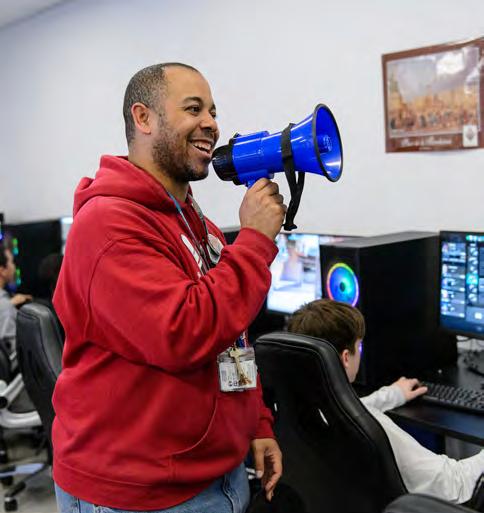
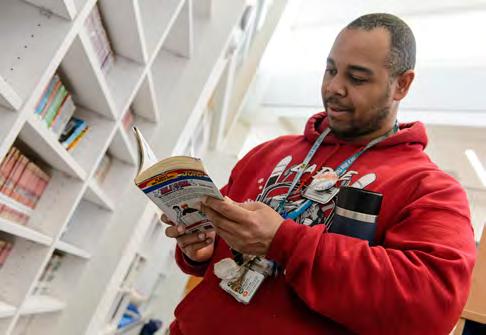
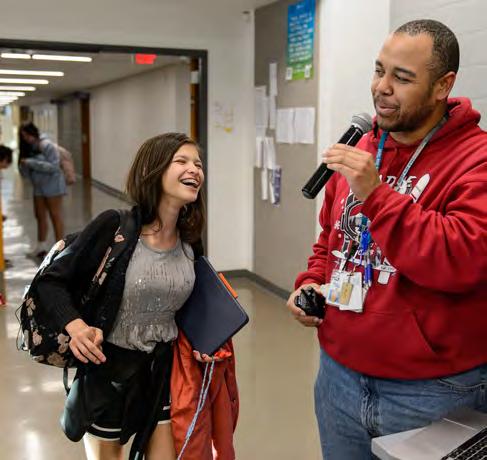




Sasha Prasad expresses herself through the Indian dance form of Kathak
written by photographed by Jane Sche el Sarmistha Pulagam
photo courtesy of Sasha Prasad
One step at a time, Sasha Prasad (10) makes her way onto the stage. Nerves flutter in her stomach, bright lights reflect off the gold stripes on her dress. But then the music starts and the rhythm overflows, matching each step she takes. The eyeliner drawn on her eye enhances her gaze, drawing the audience in. Each movement and look tells the story of a Hindu god. Finally, the music stops. Her movements stall with it, heavy breaths filling her lungs as she looks into the crowd.
This is Kathak, a traditional Indian dance that Prasad performs every week. Originating in Northern India from both Hindu and Muslim influences, the dance focuses on the rhythm of the music and telling stories, ranging from love stories to a depiction of the power of gods.
“It’s mostly rhythmic,” Prasad said. “Basically, you kind of just have to feel the beat. When you’re performing, there’s live musicians playing with instruments called tabla, which is kind of like a drum, and you just have to move to that. It can be lyrical, but traditionally, and as you go into higher levels, it’s only the rhythm that you rely on for your dancing.”
Prasad had been dancing her whole life in styles like ballet, tap and jazz. But in fourth grade, she began learning Kathak because of a movie. After doing so, she decided to quit the other dance styles and focus her time solely on practicing Kathak.
“My mom really liked this movie, and it had a Kathak dance and they sang this song,” Prasad said. “It’s one of her favorite songs, and she always played it around me. And when I was little, she would make me watch it, and we would just dance around playing [to the song].”
“I’d say it is definitely a strong community, because everyone knows everyone, especially if you’re really in the [Kathak] community,” Balakrishnan said. “When you’ve done dance for a long time, you gain a lot of friends and family from it.”
As a high school student, balancing classwork, social life and dance creates challenges for Prasad to manage her time. She is on the Ladue speech and debate team and has other responsibilities as well, so she cannot attend dance practice on Fridays and Saturdays. She has created a system so she can manage her school and extracurricular responsibilities while still working on her dancing.
“On Sunday, I set that day just for practicing [Kathak],” Prasad said. “I make sure to practice every day, regardless. Because if you don’t, you can’t get up to the speed that you need to. So I make sure to practice every day regardless of what I’m doing. And on Sunday, I make sure to meet my teacher and just go over everything.”
Prasad does a wide range of performances in Kathak throughout the year. At competitions, she does shortened depictions of stories, while in her studio’s annual show, she will do longer, more in-depth stories. Prasad’s dance teacher choreographs all of her dances.
[Performances] can be elaborate or shortened. Some can be dramas, where you’re acting out an entire scene or play of Hindu stories.”
Sasha Prasad (10))
Even at a young age, Prasad had to commit and dedicate lots of time to dance. Prisha Balakrishnan (10) used to do Bollywood dance with Prasad in elementary school and remembers the community they formed.
“It was a Friday or weekend, and we’d stay there for several hours on end,” Balakrishnan said. “We’d have snacks and it was kind of just a whole experience. It was really good to bond with the team, actually being together for so long.”
The dance style of Kathak has a smaller community of participants compared to other Indian styles of dance. This small community helps Prasad to be more involved with volunteering and connecting with her fellow dancers. She finds this connection through helping to teach the little kids learning Kathak at her dance studio.
“[Performances] can be elaborate or shortened,” Prasad said. “Some can be dramas, where you’re acting out an entire scene or play of Hindu stories.”
Many different elements play an important role in creating and telling the story. From the makeup the dancers wear to the detailed costumes and accessories, each piece of the performance allows the story to be expressed to the audience.
“My favorite thing about Kathak is definitely the outfits,” Prasad said. “I think they’re really beautiful, and it makes me feel really nice putting them on and dancing, especially the elegant dances where you’re spinning and doing simple [dances]. It’s really nice to have it all together.”
Caption: Sasha Prasad (10) performs multiple stories through Kathak, a traditional Indian dance, with her dance team. They can dress up as specific characters in Hindustories,ortheycouldsimplydancetoexpressHindugods.“Formoreprofessionalproductions,wedohave outfits that correlate to what we’re doing,” Prasad said. “If we’re doing a boy, we’ll have loose Indian-style pants or if we’re doing a girl, we’ll have elegant [dresses]. We were doing a wedding scene, we had a veil while dancing.” Photo courtesy of Sasha Prasad. (on page 67)
ID



"It’s really important to find a balance with school, and that you find something that you’re passionate about."
Prisha Balakrishnan (10)