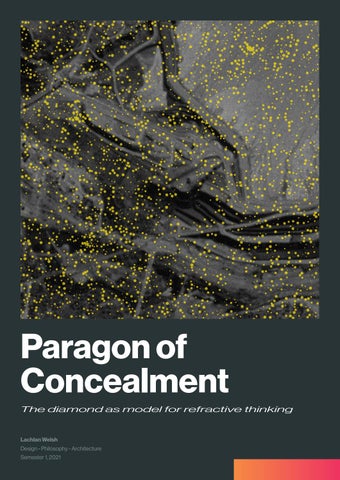
Paragon of Concealment The diamond as model for refractive thinking
Lachlan Welsh Design - Philosophy - Architecture Semester 1, 2021
This illustrated essay was produced for ABPL90421 Design - Philosophy - Architecture in Semester 1, 2021. Led by Prof. Hélène Frichot Melbourne School of Design Words and images by Lachlan Welsh Amasha Samaratunge Andrew MacKinnon Belinda Yang Brett Luke Charles Deicke Jiatong Shi Jingheng Qian Julia Xu Lachlan Welsh Oskar Rosa Roland van Olphen Thandi Paterson Yaseera Moosa Yuhui Zheng
Contents
04
06
12
18 24
Introduction
Production Consumption Refraction Architecture
24
Conclusion
30
References
Paragon of Concealment
Fig 1. The split ecologies of the diamond; production and consumption separated by the refractive object.
4
Introduction
“The spectacle is capital to such a degree of accumulation that it becomes an image… the commodity, who knows so well how to seem at first glance something trivial and obvious, is on the contrary so complex and so full of metaphysical subtleties.” Guy Debord, The Society of the Spectacle, 1967.
We live in a society engrossed in consumption. Even as global climate change intensifies towards a point of no return, we are presented with an ever-expanding range of goods to purchase, each product emerging from complex origins of resource extraction, pollution, and labour exploitation. Hellbent on profit, a cunning system of consumer capitalism operates to mask these realities of production. The consumer is suspended in an alluring world of advertising that encourages ignorant and excessive consumption. Transformed from raw material to pristine image, each product serves as a breakpoint, divorcing ecologies of production and consumption. Such is the game of concealment played by consumer products under capitalism. If we are to confront the issues facing our planet today, we must look beyond the spectacle and take a critical view of the objects that populate our consumer landscape. In no other product is this game of concealment more evident than the diamond. Functioning as a symbol of luxury in advertising and popular culture, the geometric purity of the diamondform can be considered a mask for the complex history of its production. The reality of diamond extraction is a far dirtier process comprising many entangled strands of land exploitation, colonialism, and capitalism. Investigating the ecologies of production and consumption alongside one another, this essay proposes a methodology for studying products under capitalism more critically. By viewing consumer objects as bridges between production and consumption we are led to deeper understandings of the systems and ideologies that constitute them.
5
Production
Paragon of Concealment
Fig 2. The commodification of the East Kimberley. A topographical model of the Argyle diamond mine carved from rough pink diamonds.
8
Production
For all their enchanting beauty, diamonds are objects of intense brutality. Emerging from origins of land degradation and labour exploitation, diamonds are haunted by their dark past. In Cultural Studies of Extraction, Laura Junka-Aikio and Catalina Cortes-Severino used the term ‘extractivism’ to describe a mode of critique that returns to sites of production to examine the deeper underlying logics of capitalism.1 Through this lens, this section of the essay examines the production of one of the most sought-after coloured jewels in the world — the Australian pink diamond — ninety per cent of which come from a single mine. Tracking back to the site of this extraction, entangled histories of colonialism and subsequent resource extraction exemplify the dirty underlying ecology of diamond production.
In 1979, CRA Ltd. – a joint mining venture of Australian and South African corporations – discovered the diamond deposit. Despite attempts by the local people to reject the mine and protect the site, a clause in Western Australia’s underdeveloped Aboriginal Heritage Act 1972 allowed a private company to occupy and ‘vary’ the use of the land.4 On top of this, in their eagerness to encourage foreign investment, the Federal and State Governments permitted CRA Ltd. to arrange the terms and conditions of the mining and marketing of diamonds free from public scrutiny.5 The mine proceeded in exchange for an annual provision of funding to the local area for the building of resources such as roads, schools, and a community centre. Whilst the mining company did engage with the Indigenous population, an uncommon practice at the time, the deal took place upon an imbalance of power and a deep foundation of violent, government-sponsored dispossession.6 Members of the community felt they had been misled about the level of funding and protection of the sacred sites, adding to the sense of loss inflicted by the mine.
The story begins in the East Kimberley region of Western Australia. Formed in the pressurised crucible of the earth’s core over millions of years, it was in this arid desert that the pink diamonds finally surfaced. For thousands of years the glistening stones embedded in the rockface were admired by the Miriwung and Gidja people, mythologised in their Dreaming stories.2 Thought to have originated from the scales left behind from an ancient Barramundi evading capture, the diamond deposit was of high cultural significance to the local people, integral in the women’s Dreaming ceremonies.3 However, as is usually the case, with white settlement the search for resources began.
9
1.
Laura Junka-Aikio and Catalina Cortes-Severino, “Cultural Studies of Extraction,” Cultural Studies 31, no 2-3 (2017): 177.
2.
Stuart Kells, Argyle: The Impossible Story of Australian Diamonds (Melbourne: Melbourne University Publishing, 2021), 40.
3.
David Wroth, “Barramundi Dreaming Daiwul,” Japingka Aboriginal Art, published 1 July, 2019, https://japingkaaboriginalart.com/ articles/daiwul-barramundi-dreaming/.
4.
Ciaran O’Faircheallaigh, “Indigenous Women and Mining Agreement Negotiations: Australia and Canada,” in Gendering the Field: Towards Sustainable Livelihoods for Mining Communities (Canberra: ANU Press, 2011), 97.
5.
Dave Cox, “Argyle Diamond: The Political Economy of a Lost Resource,” Australian Journal of Political Science 31, no. 1 (1996): 83.
6.
Kells, Argyle, 45.
Paragon of Concealment
Fig 3. The diamond shop in the desert, showing the incongruity of the luxury diamond trade and its sites of extraction.
10
Production
Over the next four years, the Argyle diamond mine materialised like an industrial parasite on the rocky outcrop of the East Kimberley. Opening in 1983, the mine operated for 37 years producing 865 million carats of rough diamond. 7 The pink diamonds were an instant global sensation, causing a frenzy in highend auction houses from New York to Tokyo. The Argyle Pink Tender, featuring the rarest of the pink gems, became the most exclusive diamond sale in the world with diamonds sold for millions of dollars per carat.8 For the Gidja and Miriwung people, despite the transitory economic benefits, the deal with CRA Ltd. could only be described as a pitiful barter for one of the richest pieces of real estate on Earth.9 During the mine’s lifetime, millions of tons of ore were moved, the landscape scarred with an immense open wound inflicted by capital. The poisoned land disrupted natural ecosystems of flora and fauna and the site of the Barramundi Dreaming was desecrated beyond repair — blown up, dug out, broken apart and spread out in vast piles of tailings. The destruction of this important spiritual site resulted in great anguish for its traditional custodians.10 These social woes were compounded as the injections of money into the community by the mining company produced a feral economy. Local people became reliant on the funding whilst simultaneously being priced out by the inflated mining economy of fly-in-fly-out workers.11 Both environmentally and socially, the mine caused an intense rupture to the pre-existing ecology of the area. Through an extractivist lens, it can be seen that the reality of diamond production is entangled with consequences, both historical and ongoing. Behind the allure of pink diamonds lies a decades long struggle for Indigenous self-determination and land rights; a situation so very distant, both physically and conceptually, from our cultural understanding of diamonds. This is the dirty ecology of pink diamond production. 7.
Courtney Fowler and Vanessa Mills, “Rio Tinto’s Argyle Diamond Mine Stops Production After 37 Years,” ABC News, published 3 November, 2020, https://www.abc.net.au/news/rural/2020-11-03/ wa-argyle-pink-diamond-mine-closure/12840466.
8.
Fowler and Mills, “Argyle Mine Stops Production.”
9.
Kells, Argyle, 50.
10. O’Faircheallaigh, “Indigenous Women and Mining,” 97. 11.
11
Richard Howitt, “A Different Kimberley: Aboriginal Marginalisation and the Argyle Diamond Mine,” Geography 74, no. 3 (1989): 237.
Consumption
Paragon of Concealment
Fig 4. A close examination of the precise cutting of the diamond. Through a series of geometric manouevres, the diamond ceases to appear natural.
14
Consumption
Given this dark history, how could the diamond be considered an object of beauty? On the journey from extraction to finished product, diamonds undergo an intense image transformation which propels them into the world of consumption. In such a denial of production, a great deal of artifice must be employed. Aided by a system of advertising and popular culture, consumer capitalism uses a deliberate crafting of image to enable guilt-free consumption.
Denial of the origin of the diamond is reinforced by a system of advertising which serves to elevate it as a sign of cultural prestige. Bound up in notions of class, the diamond acts as a symbol of status. With the expansion of the middle class in the twentieth century, the marketing of diamonds increasingly targeted a new form of aspirational consumerism. In The Consumer Society, Jean Baudrillard states that commodities are no longer defined by their use, but rather by what they signify. Moreover, what they signify is defined not by what they do but by their relationship to the entire system of commodities and signs, including advertising and media.14 In this system, the use-value of the diamond is clearly less important than its sign-value.
The point at which the diamond is cut from rough stone to faceted jewel is the precise moment it is divorced from its ecology of production. Professionals in workshops around the world craft the surface through a series of precise geometric manoeuvres resulting in a form so perfect that it denies any natural association. In The Form, The Mould, and the Material, Pauline Lefebvre explains that the shaping of raw materials is central to our cultural reading of them.12 As we mould, we impose social values on the material. In the case of diamonds, the hard shimmering boundary of the form resists contemplation, dazzling the viewer with sheer affect. Through this distortive crafting of image, the material origins of the diamond are obscured. It ceases to appear as an extracted compound, instead standing as a sign, a spectacle. As Guy Debord explains in The Society of the Spectacle, capitalism operates as a system of spectacles: “When the real world changes into simple images, simple images become real beings and effective motivations of a hypnotic behaviour. The spectacle has a tendency to make one see the world by various specialised mediations.” 13 This is the first step in the transition from production to consumption, from reality to image.
12. Pauline Lefebvre, The Form, The Mould, and the Material [lecture], presented at Melbourne School of Design, 31 March, 2021. 13. Guy Debord, The Society of the Spectacle (Berkeley: Bureau of Public Secrets, 1967), 18. 14. Jean Baudrillard, The Consumer Society (London: Sage Publications, 1970), 23.
15
Paragon of Concealment
Fig 5. An analysis of the subtle augmentations of the female body through jewellery adornment in advertising.
16
Consumption
As well as appealing to notions of class, the advertising of diamonds also operates within dynamics of gender. Marketed towards women as objects of transhuman beautification, they expand the very boundaries of the human subject; an ornamentation of carefully crafted accoutrements supplementing the fleshy form of the body with rigid formations of rare materials. Perhaps more concerningly, however, diamonds are marketed towards men as a stamp of patriarchy and power. To buy diamonds for your lover is to purchase their love; linked to the institution of marriage in which the ring, often diamond, symbolises the bond. Diamonds are therefore involved in the entrenchment of patriarchal systems of ownership of not only resources, but women. This embroilment in gender dynamics only serves to further distance the diamond from its ecology of production. The cultural signification of the diamond is further reinforced by an immense realm of popular culture. The glamorous ideal of diamonds is entrenched in our collective imagination through their inclusion in film alongside the likes of Audrey Hepburn in Breakfast at Tiffany’s and Sean Connery in Diamonds are Forever.15 In music too, the diamond is trivialised by its use as a sign. When Marilyn Monroe sang that “diamonds are a girl’s best friend,” it was clearly not directed to the Gidja and Miriwung women and their Barramundi dreaming. This incorporation of the diamond into popular media lifts it out of its dirty beginnings with a rigging of cultural virtualities. The crafting of form, advertising, and popular culture all deny the natural origins of the diamond in favour of its role as a cultural sign. As Charity Edwards outlines in her study Wet Ontologies, this type of masking produces cultural ‘blind fields’ that obscure socio-spatial relations: “an ideological notseeing and therefore not-knowing.”16 More than a simple knowledge gap, blind fields are deliberately constructed, revealing logics of power and commodification. Dazzled by the surface level image of the diamond, we look no deeper, blissfully ignorant in our consumption. This is the ecology of diamond consumption.
15. Matthew Hart, Diamond: Journey to the Heart of an Obsession (Newtown: Walker Books, 2001), 75. 16. Charity Edwards, Wet Ontologies and Wild Operations [lecture], presented at Melbourne School of Design, 12 March, 2021.
17
Refraction
Paragon of Concealment
Fig 6. Refractive thinking investigates overlapping distorted realities. In this image, topographical imagery of the mine is overlaid with Barramundi scales.
20
Refraction
Inside the hard geometric boundary of the diamond, another form of concealment is at play. Refraction is the internal bending of light that occurs within each prism. The faceted surface of the diamond is deliberately angled to increase refraction, distorting rays of light to produce maximum luminescence. These distortions may be considered a metaphor for the deliberate obscuration of reality found in the capitalist spectacle. One must simply look closer, beyond the spectacle, to discern the realities embedded within. So far, this essay has investigated the disconnected zones of diamond production and consumption, viewing these realities as distinct from one another. Moving beyond mere appearances, this section of the essay develops a methodology for uniting the juxtapositions and contradictions of consumer objects into a single ecology. I term this mode of critique ‘refractive thinking’.
Also influential on the development of refractive thinking is Elizabeth Grosz’s theory of the ‘in-between’. By starting with the diamondobject itself, thinking of it as a mid-point between zones of production and consumption, one can proceed in both directions using the object as a bridge between seemingly unrelated worlds. As Grosz states in Architecture from the Outside, the site of the in-between enables “contestation of the many binaries and dualisms that dominate Western knowledge” embodying the potential to destabilise these operations that sit either side of it.18 Through this lens, the diamond is recalibrated from an object of compliance in a capitalist system, to an object of critique bringing the worlds of production and consumption face-to-face with one another.
Refractive thinking draws from several strands of Feminist New Materialism theory. It is a strategy that encourages a broad view of consumer objects and all their entanglements in worlds of production and consumption. The methodology is indebted to Karen Barad’s concept of diffraction, in which a single object may be thought of as constituting multiple realities. In Diffracting Diffraction, Barad outlines that thinking in this way “queers binaries” with expanded notions of identity and difference.17 Diffraction involves the splitting of a single beam of light into several parts, breaking down the seemingly invincible image of an object. Refraction takes this one step further in dealing with images that are deliberately distortive. Learning to decipher refracted traces is a skill specifically relevant when analysing consumer objects under capitalism.
17. Karen Barad, “Diffracting Diffraction: Cutting Together-Apart,” Parallax 20, no. 3 (2014): 169. 18. Elizabeth Grosz, “In-Between: The Natural in Architecture and Culture,” in Architecture from the Outside (Cambridge: MIT Press, 2001), 93.
21
Paragon of Concealment
Fig 7. The environment-world of the diamond, combining the mine layout with the plan of Tiffany and Co, New York.
22
Refraction
What results from this bridging is what Hélène Frichot might term the expanded ‘environment-world’ of the diamond. In How to Make Yourself a Feminist Design Power Tool, Frichot defines an environmentworld as the physical and virtual ecology that each object is involved within.19 Refractive thinking allows one to distinguish and map environment-worlds, charting back through the traces of an object revealing “otherwise unseen and unfelt forces and relations.”20 Rather than considering the diamond in a single location in the present moment, the refractions juxtapose all the different environments it has moved through over time into a single image. If inspected closely, this reveals the tendrils that extend in directions of both production and consumption — the land degradation and decimated communities alongside the luxury retail and glamorous advertising. This is the expanded environment-world of the diamond where the dust of the East Kimberley finds its way into the sparkling vitrines of Tiffany and Co. In short, refractive thinking is a technique for viewing the objects of our consumer landscape in a more broadly relational way. Drawn from the internal dynamics of the diamond, it develops along several lines of existing theory. Given the distortive power of capital, however, refractive thinking is particularly useful in peering beyond the façade of objects that deliberately conceal their origins. The rejection of mere constructed appearances allows a more expansive view of the complex networks within which a material may be implicated. Refractive thinking is a technique at our disposal with which we can analyse any consumer product.
19. Hélène Frichot, “Step 4: Chart Your Environment-World,” in How to Make Yourself a Feminist Design Power Tool (Baunach: AADR, 2016), 88. 20. Frichot, “Step 4,” 90.
23
Architecture
Paragon of Concealment
Fig 8. The sinuous curves of the Al Wakrah Stadium facade play the same role as the faceted surface of the diamond in distracting the viewer.
26
Architecture
Thinking refractively, this section of the essay takes a closer look at another product of capitalism – architecture. The production of architecture is never a neutral exercise and therefore requires scrutiny of its underlying systems of power. In Charting Material, Karin Reisinger outlines the process by which buildings move energy and material “from the peripheries to a centre.”21 These places of production are typically forgotten in the discipline of architecture. Just like the diamond, the final marketable image of architecture often obscures realities of wealth inequality, stolen land, exploited labour, resource extraction and pollution. Refractive thinking allows for closer inspection of this dynamic.
it is important to see buildings not as objects but as summations of relationships with environments, people, and resources.23 Just like the Olympic Games, as the FIFA World Cup travels around the world, it creates concentrated moments of excessive building development. Constructing a series of new stadiums for a one-year event seems an absurd proposition when one considers the sites of extraction the building materials must emerge from. In terms of human resources, the culture of building practices in Qatar is highly exploitative, relying on migrant labour working in deadly conditions. Since 2012, 382 Nepalese and 500 Indian workers died due to unsafe construction conditions, whilst building for the World Cup; several of them working on Al Wakrah Stadium.24 Tracing further back to a point before construction, the dynamics of architectural labour are revealed through the toxic business operations of Zaha Hadid Architects, well known for its culture of unpaid overtime.
This type of misalignment between image and reality is evident in the Al Wakrah Stadium, designed by Zaha Hadid Architects for the 2022 FIFA World Cup in Qatar. Using the latest parametric design techniques, the building presents a slick and beguiling image. It is a work of architecture for visual consumption, both through images and tourism. The carefully crafted geometry is key to producing a grand spectacle of pure affect. An example of what Douglas Spencer might call‘facadism’, the smooth surfaces mask the realities of the building, presenting it as a benign form of sculpture.22 This crafting of appearance can be considered a deliberate attempt to distract the viewer from recognising the underlying ecological assemblages that produce the final building.
Therefore, behind the outward appearance of the stadium lies an entangled network of resource and labour exploitation. The dazzling final product simply cloaks these processes of labour and consumption that transmute extracted raw resources into highly refined facades. Through this we understand architecture not to be some benign or autonomous pursuit of aesthetics, but a form of production deeply embroiled within the core issues of capitalism.
Considered through a refractive lens, the building is revealed as not so enchanting. Following Joan Tronto’s line of thinking in Caring Architecture, 21. Karin Reisinger, Following the Followers, Charting Material [lecture], presented at Melbourne School of Design, 19 March, 2021. 22. Douglas Spencer, “Neoliberalism and Affect: Architecture and the Patterning of Experience,” in The Architecture of Neoliberalism (New York: Bloomsbury Academic, 2016), 140. 23. Joan Tronto, “Caring Architecture,” in Critical Care: Architecture and Urbanism for a Broken Planet (Cambridge: MIT Press, 2019), 28. 24. Owen Gibson, “More Than 500 Indian Workers Have Died in Qatar since 2012, figures show,” The Guardian, published 19 February, 2012, https://www.theguardian.com/world/2014/feb/18/qatarworld-cup-india-migrant-worker-deaths. 25. India Block, “UK Architects Unionise to Challenge Industry’s Toxic Culture of Long Hours and Low Pay,” Dezeen, published 11 November, 2019, https://www.dezeen.com/2019/11/11/ architecture-union-uk/.
27
Paragon of Concealment
Fig 9. The Argyle landscape scattered with Acacia pollen. A hope for the future of the site after the closure of the mine.
28
Conclusion
By investigating diamonds, this essay seeks to demonstrate the strong separation often found between ecologies of production and consumption. As consumers we are detached from sites of production, floating around obliviously in a sea of images and all their semiotic attachments. Hiding behind these flashy images, however, lie the murkier realities of production. Derived from the internal effects of the diamond, refractive thinking is a theoretical methodology applicable to any product under consumer capitalism. Refractive thinking treats the concealing spectacle-object not as a breakpoint, but a mid-point, a bridge to track backwards in time and space. To better understand the consumer objects of our world, we must look beyond the spectacle to the refracted details flickering within. Recognition of this is the first step in undertaking the process of care and repair needed to halt the destruction of our planet.
29
Paragon of Concealment
Fig 10. Stills from the title sequence of James Bond Diamonds are Forever, haunted by the memory of the Argyle diamond mine.
30
References
Reference List Barad, Karen. “Diffracting Diffraction: Cutting Together-Apart.” Parallax 20, no. 3 (Jul 2014): 168-187.
Howitt, Richard. “A Different Kimberley: Aboriginal Marginalisation and the Argyle Diamond Mine.” Geography 74, no. 3 (Jun 1989): 232-238.
Baudrillard, Jean. The Consumer Society. London: Sage Publications, 1970.
Junka-Aikio, Laura and Catalina Cortes-Severino. “Cultural Studies of Extraction.” Cultural Studies 31, no. 2-3 (May 2017): 175-184.
Block, India. “UK Architects Unionise to Challenge Industry’s Toxic Culture of Long Hours and Low Pay.” Dezeen. Published 11 November, 2019. https://www.dezeen.com/2019/11/11/ architecture-union-uk/.
Kells, Stuart. Argyle: The Impossible Story of Australian Diamonds. Melbourne: Melbourne University Publishing, 2021. Lefebvre, Pauline. The Form, The Mould, and the Material [lecture]. Presented at Melbourne School of Design, 31 March 2021.
Cox, Dave. “Argyle Diamonds: The Political Economy of a Lost Resource.” Australian Journal of Political Science 31, no. 1 (Jun 1996): 83-98.
O’Faircheallaigh, Ciaran. “Indigenous Women and Mining Agreement Negotiations: Australia and Canada.” In Gendering the Field: Towards Sustainable Livelihoods for Mining Communities. Canberra: ANU Press, 2011.
Debord, Guy. The Society of the Spectacle. Berkeley: Bureau of Public Secrets, 1967. Edwards, Charity. Wet Ontologies & Wild Operations [lecture]. Presented at Melbourne School of Design, 12 March 2021.
Spencer, Douglas. “Neoliberalism and Affect: Architecture and the Patterning of Experience.” In The Architecture of Neoliberalism, 139-141. New York: Bloomsbury Academic, 2016.
Fowler, Courtney, and Vanessa Mills. “Rio Tinto’s Argyle diamond mine stops production after 37 years.” ABC News. Published 3 November, 2020. https://www.abc.net.au/news/ rural/2020-11-03/wa-argyle-pink-diamondmine-closure/12840466.
Reisinger, Karin. Following the Followers, Charting Material [lecture]. Presented at Melbourne School of Design, 19 March 2021.
Frichot, Hélène. “Step 4: Chart Your Environment World.” In How to Make Yourself a Feminist Design Power Tool, 83-108. Baunach: AADR, 2016.
Tronto, Joan. “Caring Architecture.” In Critical Care: Architecture and Urbanism for a Broken Planet, 26-32. Cambridge: MIT Press, 2019. Wroth, David. “Barramundi Dreaming Daiwul.” Japingka Aboriginal Art. Published 1 July, 2019. https://japingkaaboriginalart.com/articles/ daiwul-barramundi-dreaming/.
Gibson, Owen. “More Than 500 Indian Workers Have Died in Qatar since 2012, figures show.” The Guardian. Published 19 February, 2014. https:// www.theguardian.com/world/2014/feb/18/ qatar-world-cup-india-migrant-worker-deaths. Grosz, Elizabeth. “In-Between: The Natural in Architecture and Culture.” In Architecture from the Outside, 91-109. Cambridge: MIT Press, 2001. Hart, Matthew. Diamond: Journey to the Heart of an Obsession. Newtown: Walker Books, 2001.
31
Lachlan Welsh Design - Philosophy - Architecture Semester 1, 2021