Economic Reform Roundtable Submission - Labor for Housing
A PLACE FOR PRODUCTIVITY
Labor for Housing
Briefing Paper
This report was written on the stolen lands of the Wurundjeri Woi-wurrung people of the Kulin Nation. The First Peoples of this country were the first to face housing insecurity, as a direct result of colonisation, and we acknowledge that the right to secure and safe housing remains an issue that affects First Peoples disproportionately. We stand in solidarity with their fight for justice in all its forms We pay our respects to Elders past and present, and acknowledge that these are stolen lands, never ceded, and that this is, was and always will be Aboriginal Land.
This document was compiled and written by Shirley Jackson and Julijana Todorovic, with valuable input and insights from Labor members across the country. The opinions in this report are those of the authors and do not represent the official views of the Australian Labor Party, nor the organisations which employ any members of Labor for Housing. Any errors, misrepresentations or omissions are the sole responsibility of the authors.
Labor for Housing is an incorporated association pursuant to the Associations Incorporations Act 2012 (Vic).
For further information on Labor for Housing, or to join our movement, please click here. You can donate to support our advocacy by emailing: admin@laborforhousing.org
A PLACE FOR PRODUCTIVITY
Submission to the Economic Reform Roundtable Labor for Housing
Labor for Housing is a non-factional, non-affiliated advocacy group within the Australian Labor Party, established in 2019.
We work tirelessly with members, unions and governments to end the housing crisis and ensure every Australian has a safe, secure place to call home.
We are proud of our strong links to the trade union movement and within the housing sector.
We have been instrumental in driving reform in State and Federal Labor government policy and play a key role between the housing sector, the Labor Party membership and Labor governments.
Australia’s capital resources have become landlocked.
Investing in housing reform is productive.
As the Australian economy continues to rebuild after the once in a generation shock of the pandemic, there is little doubt that reform has become a necessity The time for small targets, short term thinking and [incrementalism] has passed and the challenge that the Economic Reform Roundtable must confront is wideranging and all encompassing: to rebuild our economy in a way that is efficient, effective, and equitable
However, rather than be daunted by the scale of the challenge, we believe that if done right, this Roundtable can drive significant reform While the focus in the lead up has quite rightly been on increasing the productivity of Australia’s economy in the face of unprecedented technological change, we believe that the Roundtable presents a unique opportunity to solve the ongoing housing crisis plaguing Australia.
A PLACE FOR PRODUCTIVITY
In short, we believe there is in the solution to the housing crisis The current system of incentives and rewards has transformed an abode into an asset, and one that has been incredibly lucrative to investors. This has had a disasterous effect on Australia’s economy, directing much needed capital away from the productive powers of the market towards dormant, passive income
We believe that by boldly reforming the economic governance of Australia’s housing market, the Government can unlock the potential of Australia’s investment capacity and increase the capital productivity Crucially, we believe that in doing so, we can rebalance the scales and recognise the true value of property: as a home.
In Solidarity,
PROBLEM 1: MORE HOUSING, FEWER HOMES
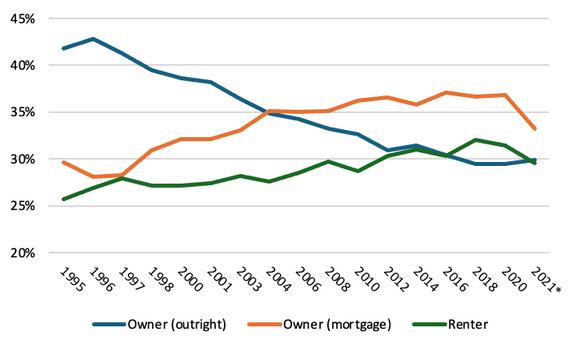
The current rate of homeownership in Australia is 63.1%, which has dropped from an all-time high in 1966 of 73%, representing a drop of 10% (see Figure 1) Worse still, most of the drop in home ownership rates has occurred in the past two decades, driven by poor policy choices. In 2004, 70% of Australians owned their home with a mortgage or outright, but the rate of ownership has dropped by an average of 0.8% per year ever since
Housing by Tenure, 1995-2021
Source
For those who rely on waged labour, the only path to genuine economic security is through owning their own home. Unfortunately, successive economic reforms in the name of liberalisation, privatisation and economic growth eroded the pillars that lit the path
Reforms to tax incentives transformed homes into investment vehicles for the wealthy, and decoupled housing prices from median wages Much like the climate crisis, for too long the housing crisis was ignored because it wasn’t visible and, as a result, it hasn’t been the priority. ·
Figure 1
PROBLEM 2: CAPITAL PUNISHMENT
The current system of incentives within the housing market has become unbalanced As the combined crisis of productivity and property slowed the growth of the Australian economy, wealthy investors have experienced incredible benefit at expense of many would be homeowners While no single reform can be blamed for a series of complex economic problems, some can lay claim to more of the burden than others One key reform that has contributed to both the lag in capital productivity and the housing crisis is the discount to the capital gains tax (CGT).
When originally recommended by the Ralph Review in 1999, the discount was designed to ‘invigorate the Australian equities markets’, to stimulate greater participation by individuals, and to achieve a better allocation of the nation’s capital resources ’ (p 598)
This was an undoubtably good idea By encouraging investment in Australian industry, the discount not only capitalised on the growth in Australia’s collective income, but also incentivised the circular flow of money within our economy Unfortunately, the virtuous cycle of investment was undone when the discount was extended from shareholders to landholders.
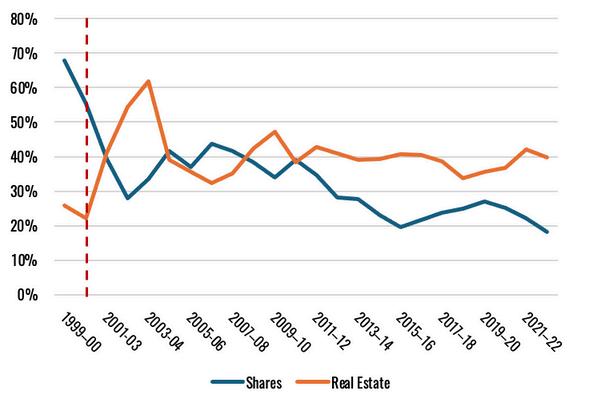
Instead of investing in the productive powers of Australian industry, investors tied up their money in land. Where the original reform has hoped to stimulate investment in economic activity, its application to real estate saw capital buried for decades, as investors waited for house prices to double, and individual investment in shares has plummeted (see Figure 2)
In 1999, before the discount, individual investment in shares represented 68% of all capital gains and real estate accounted for 26% The most current data shows that now investment in shares have fallen to 18% while real estate has surged to 40%.
Figure 2
Share of Capital Gains, Individuals by Source
CGT Discount Introduced
Source Authors owncalculationsbasedonATO data
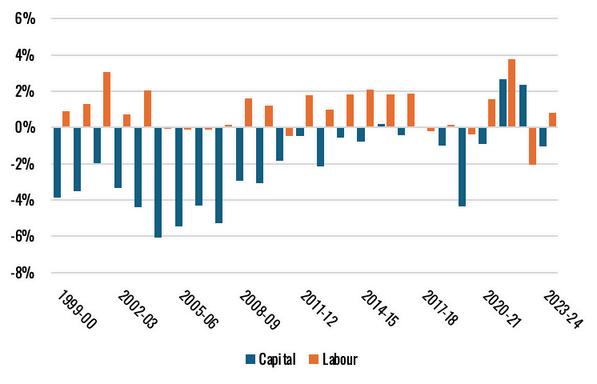
This has had a significant impact on the productivity of the market, restricting Australia’s economic growth While many point to rising labour costs as a core driver behind sluggish productivity, multifactor measures show that it is a lack of productive capital that is holding us back (see Figure 3).
The impacts of this imbalance isn’t restricted to private industry - it has had an effect on the Government’s bottom line
As highlighted previously, approximately 40% of all income received from the sale of assets in Australia is taxed at a lower rate than other forms of income This means that the Government has foregone revenue for a discount that has had the inverse impact on the market, socialising the risk of investment while allowing the gains to be privatised
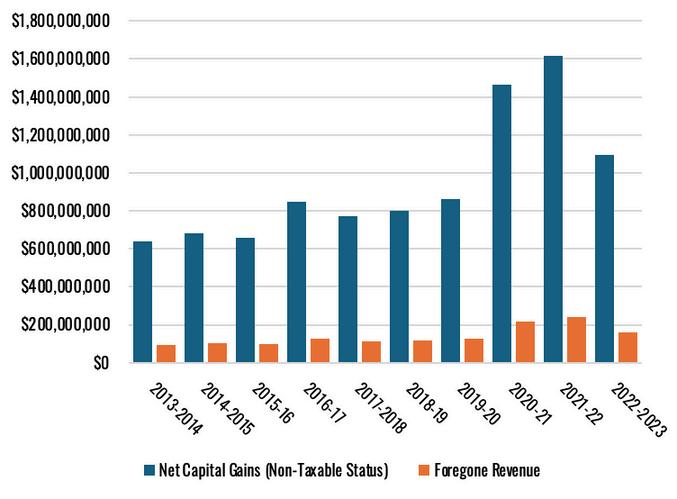
The ATO data shows that approximately 130,000 individuals received more than $876m of non-taxed capital gains (see Figure 4). While just 32 people pocketed a staggering $1m or more in untaxed gains, the majority received between $1,000 and $10,000
Figure 4
Capital Gains and Foregone Reveue
Conservatively, we estimate that the foregone revenue between 2014-2023 was approximately $1.4bn While this is not substantive in the context of Federal budgets, where revenue averages are half a trillion, the foregone revenue is compounded by government expenditure on services that increase land prices
Billions of dollars in public funds have been spent on the infrastructure, road, rail, health, education, and recreation, which has contributed in no small part to the increased value of land in growth corridors around the country This investment in publicly funded services is a good thing, but the CGT discount means that this necessary public investment is being enjoyed by people who aren’t paying their fair share Not only does this put less revenue into Australia’s coffers, but it is a gross injustice for the working families who have been priced out of the market while their tax dollars are spent increasing the profits of land developers and property investors
PROBLEM 4: NO HOME SHOULD NOT MEAN NO HOPE
In the current economic climate, with the critical focus on interest rates, taxation, and productivity, it is very easy for business and government to become consumed with the fiscal detail of the broader economy. However, there are many issues, and in far too many instances, people who are pushed to the margins and forgotten While many deserve greater attention within economic policymaking, one group is forced to experience the most significant failure of our economy: the unhoused.
According to Homelessness Australia data, on any given night in Australia more than 122,000 people are unhoused. That means that 48 out of every 100,000 Australians is living without a secure place to sleep. Worse still, a shocking 23% of those are children and young people While we reject the idea that anyone deserves to live without secure housing, the idea of any child spending a night without housing is unacceptable.
Outside of the obvious moral injustice of homelessness, an often unacknowledged fact is that it has significant productivity impacts. When someone is without a safe and secure home, it is almost impossible to obtain meaningful work Without a fixed address, it can be difficul to access common digital hiring portals Finding reliable and affordable transport options can also prove a challenge. Most concerningly, even when some are lucky enough to enter the hiring process, the experience of stigma and discrimination is all to frequent
Indeed, recent research from the University of Melbourne indicates that unhoused people are significantly more likely to leave their job than other groups This makes far too many unhoused people trapped into unemployment, creating greater demands on welfare and public health resources, and leaves them unable to contribute revenue to the national treasury
As a result, there are 169,000 households, representing upwards of 300,000 people, in Australia who are on a social housing waitlist. While this figure is unacceptably high, the worse news is that this figure only includes people who meet eligibility requirements for their individual state or territory That means that many unhoused people and other households in significant housing stress won’t even be captured in this disturbing statistic.
We believe that no society, no economy, can be considered a success if it cannot provide safe and secure housing for all its people. Any economic reform agenda that does not put more people into secure housing is a failed agenda.
PROBLEM 5: PROFITS BEFORE PUBLIC HOUSING
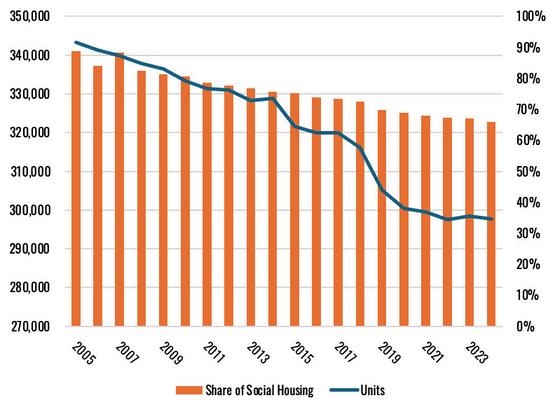
Over the past 30 years, as the demolition of older public housing units has grossly outpaced the construction of new units, public housing stock has been falling - both in absolute terms and as a share of social housing (see Figure 6). Despite the increased demand for social housing, Governments at all levels are continuing to outsourcing their responsibility to house their citizens
Figure 5
The Collapse of Public Housing
Source:Authorscalculations basedonAIHWdata
In 2005, public housing was the predominant form of non-market housing, representing 89% of all social housing stock. Now, it has collapsed to 66% as more than 45,000 homes have been lost as the rate at which older units are being demolished has outpaced new public housing projects
While community housing is a critical and indispensable part of the housing mix, as a country, we cannot dispense of our fundamental responsibility to provide and maintain public housing to our most vulnerable citizens This dereliction of duty from governments at all levels should be a source of national shame.
SOLTUION 1:
BETTER GAINS FROM CAPITAL GAINS
Over time the conversation on property taxes has been transformed into a version of America’s “ gun debate”: on one side, we have powerful vested interests who are desperate to maintain the status quo; on the other, we have the victims. In Australia, it’s working families who suffer. And governments are reticent to debate the issue publicly for fear of political retribution
The Australian dream of home ownership has become a nightmare, where many are locked in a vicious cycle of housing insecurity and stress
We believe that the Economic Reform Roundtable represents the best opportunity in decades to dissemble this false dichotomy, and build an economy that provides for all Australians
We recommend that the Government:
1 Remove residential property as a category of investment which attracts the CGT discount; and
2 ‘Grandfather’ the reform by legislating a sunset clause for the expiry of discounts on residential property
If done correctly, this reform not only gives current investors ample opportunity to restructure their investments, but overtime will help to restructure the shape of the economy, as investing in Australian companies becomes a more attractive option.
Ultimately, any reform focussed on productivity and increasing housing supply is beneficial - provided equity and economic justice are at its centre
SOLUTION 2: NO MORE PENALTIES FOR PUBLIC HOUSING
We believe the decline of public housing projects is a policy failure Not only is it a moral failure, but it has negative impacts on productivity in the construction sector, reducing demand for building and maintenance While the most recent round of grants from the Housing Australia Future Fund (HAFF) were exclusively offered to State Governments, it will largely result in the construction of more community housing.
Often, the claim from State Governments is that it is more efficient to fund community housing than public housing due to taxation on the goods and services used to build, maintain and manage the properties. Conversely, community housing (non-government, non-profit providers) are exempt from GST
GST is not charged on the building, maintenance and management of state-run public hospitals and public schools - so why is housing treated differently to other essential public infrastructure?
We recommend that the Government:
1. Exempt public housing from GST; and
2 Reform the Social Security Act to ensure that Commonwealth Rent Assistance (CRA) is paid to public housing tenants
We believe that the Roundtable represents a critical opportunity to reform our economic governance system in a way that removes disincentives to public housing
REFERENCES
Australian Bureau of Statistics, Census 2006 (Catalogue No 2001.0, Australian Government, 27 August 2007)
Australian Bureau of Statistics, Census 2011 (Catalogue No 2001 0, Australian Government, 28 March 2012)
Australian Bureau of Statistics, Census 2016 (Catalogue No 2001 0, Australian Government, 27 June 2017)
Australian Bureau of Statistics, Census 2021 (Catalogue No 2001.0, Australian Government, 28 June 2022a)
Australian Bureau of Statistics, Housing and Occupancy (Catalogue No 6553 0, Australian Government, 25 May 2022b)
Australian Bureau of Statistics, Government Finance Statistics (Catalogue No 5512 0, Australian Government, 22 April 2025)
Australian Housing and Urban Research Institute, ‘What is Inclusionary zoning, and how does it help deliver affordable housing’ (Policy Brief, AHURI, 29 August 2023)
Australian Institute of Health and Welfare, Housing assistance in Australia (Web Report, Australian Government, 24 June 2025)
Australian Tax Office, ‘Deductions for Vacant Land’ (Report, Australian Government, 17 June 2024)
Australian Tax Office, Taxation Statistics 2022-23 (Individuals and Families, Australian Government, 27 June 2025)
Homelesness Australia, Homelessness Fact Sheet 2023 (Fact Sheet, HA, 15 October 2023)
Productivity Commission, Report on Government Services 2025 (Report, Australian Government, 11 February 2025)
Swarmi, N , ‘The Effect of Homelessness on Employment Entry and Exits: Evidence from the Journeys Home Survey’ (Working Paper no. 01/08, Melbourne Institute, February 2018)