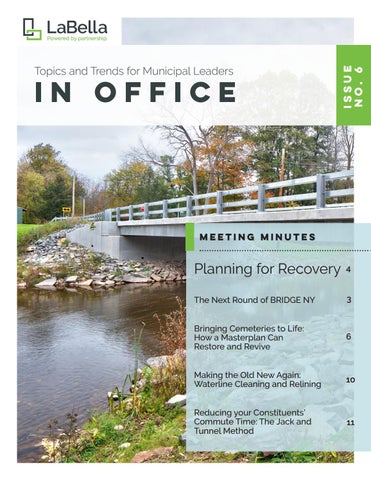
IN OFFICE
ISSUE NO. 6
Topics and Trends for Municipal Leaders
Meeting minutes
Planning for Recovery
4
The Next Round of BRIDGE NY
3
Bringing Cemeteries to Life: How a Masterplan Can Restore and Revive
6
Making the Old New Again: Waterline Cleaning and Relining
10
Reducing your Constituents’ Commute Time: The Jack and Tunnel Method
11
2
In Office LaBella Associates |
Issue No. 6
NEW YEAR, NEW LOCATIONS With 2021 ahead of us, it’s time to look back at all that we were able to accomplish in 2020. We wanted to take a moment to recognize what we’re most proud of. It was certainly a busy year for us at LaBella, and we are grateful that we were able to continue our growth in the midst of a difficult year. In addition to our partnership with The Chazen Companies (featured right), we are also happy to announce a partnership with Highland Technical Services, Inc. (HTSI). LaBella and HTSI have collaborated to serve clients in Alabama for years. HTSI has developed expertise in various project types including hazardous waste; solid waste; brownfield redevelopments; stormwater; air permitting; underground storage tank management; and various types of environmental assessments and permitting. We’re proud of the partnerships we’ve built this year, and we’re excited about all that we have planned for the future within these new geographies. With each issue of In Office we present our experience, our expertise, and our forecasting on the topics and trends that affect municipal projects. Let us know if there’s a topic we can explore for you by contacting us at inoffice@labellapc.com.
LaBella welcomes The Chazen Companies!
LaBella is proud to announce a partnership with The Chazen Companies, a multi-disciplinary consulting firm headquartered in Poughkeepsie, NY. Effective Jan. 1, 2021, the deal furthers LaBella’s growing presence in the Capital Region and extends its reach north to Glens Falls and the Adirondack region, and south to the Hudson Valley and NYC metro regions. Additionally, Chazen’s established offices in Nashville and Chattanooga, TN will complement LaBella’s teams in the Southeast. A Portland, Oregon office will mark LaBella’s first West Coast presence. Founded more than 70 years ago, The Chazen Companies provide civil engineering, land surveying, planning, environmental consulting, building code & life safety services, landscape architecture, construction services, geology, transportation planning, and traffic engineering to clients in the private and public sectors. “Like LaBella, Chazen has been successful because of long-term client partnerships, fostered by employee-owners,” said Jeff Roloson, AIA, President, LaBella Associates. “Culturally, it’s a natural fit.” Existing clientele of both Chazen and LaBella will benefit from enhanced serviceability and an expanded depth of resources. All of Chazen’s current employees are expected to remain with the company, which will operate as Chazen, a LaBella company, through 2021.
In Office LaBella Associates |
Orleans County – Carton Road Bridge
Infrastructure
The Next Round of BRIDGE NY The LaBella team of transportation engineers has been actively following the status of the next round of BRIDGE NY funding announcements. As most municipalities know, the state has made funding available for local governments over the past several years to rehabilitate and replace bridges and culverts statewide. We know this investment in local transportation infrastructure will support the needs of the traveling public, movement of goods, and regional economic competitiveness. The BRIDGE NY program, administered by the NYSDOT, is open to all municipal owners of bridges and culverts. Projects will be awarded through a competitive process and support all phases of project development. Projects selected for funding under the BRIDGE NY initiative will be evaluated based on: •
•
The resiliency of the structure including such factors as hydraulic vulnerability and structural resiliency, The significance and importance of the bridge including traffic volumes, detour considerations, number and types of businesses served, and impacts on commerce; and
•
The current bridge and culvert structural conditions.
Bridge projects must be on a public roadway that carries vehicular traffic; be eligible for federal aid; and shall follow the federal aid process. Culvert projects must be on a public highway and shall follow the state aid process. The department may consider bridge projects that incorporate sensors to monitor structural integrity. Bridges and/ or culverts that are on a toll collection facility are excluded from eligibility for BRIDGE NY funds. Multi-use (pedestrian/ bicycle) and railroad bridges are not eligible for BRIDGE NY funds. Previous experience has taught us that certain bridge and culvert candidates tend to score very well. Listed below is the scoring
Issue No. 6
3
of the Bridge Priority Index (BPI). As noted, certain factors should be reviewed prior to preparing the application to ensure you are choosing the correct structure to be submitted. Note that the detour length is a significant variable. A complete application with sound cost estimating is also imperative. Many of the early projects funded under round one of the BRIDGE NY program were woefully underfunded. This left local bridge/culvert owners seeking ways to fund the difference. Applications for round two of BRIDGE NY saw a two-step process with reviews from state and county officials. These reviews were implemented to raise any red flags with the application and reduce the potential for future funding issues. Additionally, municipalities are also strongly encouraged to have a NYS Professional Engineer review bridge applications and provide a signed letter certifying that a NYS PE has performed a quality assurance review of the application. The LaBella team has completed numerous successful applications for municipalities and fully understands the process. We would welcome the opportunity to assess your current infrastructure needs and help your municipality with the application process to maximize your award.
Local Bridge Priority Index (0 to 100) Category
Category Points
Individual Parameter
Parameter Points
Capital Need
47.5
General Recommendation
27.5
Structural Deficiency
5
Model Recommendation
15
AADT
7
% Trucks
7
Detour Length
13.5
Facility Importance
27.5
Restrictions
5
Postings
5
Risk/Resiliency
20
Fracture Critical
5
Material Type
5
Design Type
5
Hydraulic Vulnerability
55
Total 100
4
In Office LaBella Associates |
Issue No. 6
Feature
Planning for Recovery As municipalities continue to deal with the financial impacts of the coronavirus pandemic, including loss of sales and use taxes, there is an opportunity for each community to begin planning for recovery when the crisis ends. The impacts of the pandemic emergency have been similar to a severe weather event like a major hurricane or significant flooding. However, unlike a weather event that affects a specific area, the impacts of the pandemic have been widespread. The lessons and process of recovery planning from severe weather events can be a starting point for communities to begin to build back better. The shock of the pandemic also provides motivation for communities and state governments to make immediate and long-term changes.
Many communities have immediately addressed the social-distancing requirements by granting use of public right-of-ways for outdoor dining, outdoor recreation, and bike lanes.
Strategic Planning
Funding
One of the immediate actions municipalities should consider initiating is a strategic planning process to assess and address the impacts of the pandemic. Establishing a task force of municipal staff, residents, and businesses to review the impacts of the pandemic on the community would be an ideal place to start. Surveying residents and businesses would provide key data to understand the effects of the pandemic on the community.
Since resiliency and recovery are key themes emerging from recently released grant funding programs, communities should be prepared to provide proposals that address those priorities.
Based on the data obtained from the task forces and surveys, a strategic recoveryplan can be tailored and focused to address key issues that will accelerate recovery. Some state programs are also providing funding to develop recovery plans.
At the federal level, under the Build Back Better agenda, substantial infrastructure funding for roads, bridges, energy grids, and broadband is anticipated. The proposed 2021 New York State budget also includes funding for significant infrastructure investments.
Finance Municipal budgets, especially those reliant on sales tax, have been stressed since the pandemic hit. Since most communities are currently reviewing their 2021 fiscal year budget, they will need to be creative to provide the same level
In Office LaBella Associates |
of services they have in the past. Some budget considerations may include: 1. Use of reserve funds – fortunately many communities, because of the relatively healthy economy before the pandemic, have adequate reserve funds they can use to bolster their 2021 budgets. 2. Refinancing debt – with interest rates at historic lows even before the pandemic, now is the time to review and refinance projects funded with higher interest rates. 3. Consolidation of services – many communities have deliberated or studied consolidation in the past, but the pandemic provides motivation to implement consolidation. 4. Investing in upgraded infrastructure – communities should be prepared for recovery grant funding and specifically investing in infrastructure that reduces long-term operating costs or user fees.
States can also help municipalities. The New York Association of Counties recently issued some recommended temporary and long-term reforms to help struggling municipal budgets including increased sales tax rates, flexibility to exceed tax caps, and extending maximum borrowing terms.
Land Use and Economic Development Planning The immediate and long-term impacts of the pandemic on public and private land uses could be substantial. Many communities have immediately addressed the social-distancing requirements by granting use of public right-ofways for outdoor dining, outdoor recreation, and bike lanes. Some municipalities are considering permanently closing select streets for pedestrian use. Future land use and associated zoning changes will be a mid- to long-term consideration for many communities because of the pandemic. Single-use zoning for
5
office parks or retail uses will need to be reconsidered, as internet shopping and working from home have potentially changed those industries forever. Obtaining data on the impacts of the pandemic on specific industries within a community will be important to forecast potential future zoning changes. While some industries have suffered, others have done well during the pandemic such as distribution companies, delivery services, home office suppliers, and supermarkets.
Be Prepared for Recovery While imagining a future after the pandemic may be difficult, communities that understand the impacts of the pandemic and begin planning for their future will accelerate community recovery. The recovery strategy may need to be flexible as we continue to learn more, but having an action plan will be a proactive step to ensure your community’s future.
Being savvy about funding sources is going to be very important for municipal leaders grappling with sales tax deficits.
While imagining a future after the pandemic may be difficult, communities that understand the impacts of the pandemic and begin planning for their future will accelerate community recovery.
Issue No. 6
6
In Office LaBella Associates |
Issue No. 6
Civil Engineering
Bringing Cemeteries to Life: How a Masterplan Can Restore and Revive As cultural norms and burial practices shift, many public cemeteries lack the funding and support for necessary upkeep. A master plan for public cemeteries can provide innovative strategies for changing public perception, use of cemeteries, and expansion opportunities. Cemeteries have primarily been used as space for somber reflection to remember our deceased, but can cemeteries also be for the living? Historically, the answer is yes. Cemeteries were some of the first public parks in America and even served as inspiration for New York City’s Central Park. As parks arose, the recreational use of graveyards fell off. But today, some cities have hundreds of acres of public and private cemetery grounds that sit idle. Mount Hope Cemetery in Rochester, New York is the first municipal cemetery in the United States.
It was founded in 1838 and is the final resting place for many notable historical figures. As one of many historic sites in Rochester, Mount Hope provides visitors with 196 acres of forest in downtown Rochester where guests are encouraged to enjoy the landscape, plants, and wildlife that the space has to offer. Designated paths within the cemetery provide scenic routes for runners, bikers, and group tours. About 800 miles south, Elmwood & 9th Street Pinewood Cemetery in Charlotte, North Carolina has been in existence since the 1850s. For years, this cemetery has
been a place for people to walk, run, and take their dogs. The original cemetery was split when Interstate 77 was built in the 60’s, which reduced the total footprint and required some graves to be relocated into two smaller cemeteries: North Pinewood and West Pinewood. In general, there are three types of cemeteries: private for-profit, private non-profit, and public. Typically, the older the cemetery, the less it is used for current burials, which means it is more likely to be publicly owned. Take Charlotte for example, a recently completed first phase
In Office LaBella Associates |
Issue No. 6
7
As parks arose, the recreational use of graveyards fell off. But today, some cities have hundreds of acres of public and private cemetery grounds that sit idle.
of a master plan revealed that of their seven publicly-owned cemeteries, only three of them have grave or non-traditional burial spaces currently available for sale. This creates a unique challenge for the city because burials (and alternative burial options) are a primary source of revenue generation to help sustain the grounds. Without revenue, these public cemeteries lack the necessary funding to support infrastructure, upkeep, and staff. In addition to the lack of plots, our modernized burial practices contribute to the problem, but also create opportunities for existing cemeteries. Over time, cremation has become the preferred practice over burial because of reduced cost, lack of burial space, and ecological concerns. It also allows the family more flexibility in the process rather than leaving it to a funeral home or cemetery director. By 2030, forecasters believe the cremation rate will be 70 percent. Areas that would be considered undesirable for traditional burial graves can be utilized for scattering gardens and columbarium niches for cremation memorial areas.
Typically, the first phase of a cemetery master plan is aimed at taking inventory of the city’s cemetery available land area and infrastructure resources like roads and storm drainage and to provide solutions for expansion, maintenance, and repair. Some larger challenges facing cities and their cemeteries are revenue generation to maintain management and operations. For fast growing cities, land grabs and subsequent lack of park and greenspace have made it difficult to develop and maintain municipal cemeteries. Many political conversations have shifted to the importance of adaptive re-use projects, restoring history and supporting development that focuses on community. We’ve seen many historic buildings and spaces lost with time. Our cemeteries are hidden gems, containing historical significance, and often
located within areas of cities that need parks and greenspace. While the goal of a final master plan is to include prioritization and recommendations for maintenance and expansion within budgets and revenue streams, ideally a communitydriven effort to support these cemeteries being utilized as parks could be a panacea for a city’s cemetery dilemma of lack of funding and greenspace. At LaBella, our Planners and Engineers have experience guiding communities with plans for future development, municipal investments, and land use policy. A masterplan, like the one completed in Charlotte, can help your community unite its buildings, public spaces, and the surrounding environment to create a peaceful and useful space, like a cemetery, for everyone to enjoy.
8
In Office LaBella Associates |
Issue No. 6
This innovative, newly constructed Law Enforcement Center is located on the site of the Dutchess County Justice and Transition Center campus to address the long-term needs of the Dutchess County Sheriff’s Office.
Public Safety
Dutchess County Law Enforcement Center The Dutchess County Law Enforcement Center (DCLEC) is a newly constructed 57,000 square foot facility that provides a safe and efficient environment which allows the county to deliver public service facilities and back-of–house law enforcement business functions within the same building. Public service facilities include the public lobby, pistol permits, community training facilities, and the Civil & Records Division.
The back-of-house law enforcement business includes the Sheriff’s Office, Road Patrol, Detectives, arrestee processing, evidence, and building maintenance. The sheriff must also be accessible to the public with visitor access to private offices and work areas within the sheriff’s administrative suite. These areas must be monitored and controlled while maintaining an atmosphere of dignity and respect for the public.
The design followed the mandates of the New York State Commission of Correction, Walkway-Gateway District guidelines, ADA accessibility, and vertical circulation principles for ADA and interdepartmental transfer of arrestees. Innovative techniques, along with collaboration between stakeholders, resulted in improved efficiency for public interaction and required departments, and enhanced the support of modern law enforcement activities.
In Office LaBella Associates |
Issue No. 6
9
Gastonia’s water treatment plant expansion was the largest project the City of Gastonia had ever undertaken. The plant remained operational during the project.
Water Treatment
Gastonia a Finalist for Water Innovation Award If your expertise is in municipal water/wastewater, you may have seen LaBella’s work featured as a finalist for the Research Triangle Cleantech Innovation Awards!
The project is generating attention for LaBella’s work to introduce ultrafiltration membranes to North Carolina the first in the state. The project has paved the way for other municipalities in North Carolina to utilize the technology.
LaBella’s work with the City of Gastonia’s plant began with a study in 2009. Our team of engineers delivered a modernization and expansion that was completed while remaining fully operational.
Project Feature
From Concept to Reality: La Marketa at the International Plaza
The 5 repurposed shipping containers on the site will allow for pop-up retail by local vendors.
La Marketa is an outdoor marketplace located at 828 N. Clinton Avenue. After decades of planning, the ribbon cutting for this new community plaza took place on October 8th, 2020. LaBella Associates teamed up with the City of Rochester and Architectura to design the marketplace, bandstand, and restroom building. The plaza will serve as a community hub featuring local music, arts, and entertainment.
The design was centered around providing a positive neighborhood atmosphere and includes amenities such as benches, bike racks, seat walls, and grass berms that will serve as viewing areas during concerts and events. Borinquen Bakery and New Generation Meats are the anchor tenants for The International Plaza. They will operate yearround retail kiosks in 2 of the 5 repurposed shipping containers. The other 3 containers will be used for pop-up retail by local vendors.
10
In Office LaBella Associates |
Issue No. 6
Waterline Cleaning and Lining
Making the Old New Again Watermain infrastructure is often overlooked by the public unless there is an emergency like a watermain break or fire hydrant without enough pressure. Many northeastern cities that experienced growth in the first half of the 20th century are now plagued with aging systems. The cost of 24/7 operation and maintenance of water systems increases annually. In many towns and cities, municipalities are supporting systems that are designed to supply more than the current population requires. Existing cast iron watermains can become clogged progressively over time due to the buildup of iron oxide. Low water pressure and volume are a result of the clogging. Managing system maintenance and repair/ reconstruction efficiently is essential to ensure financial success. Conventional watermain replacement consists of constructing a parallel watermain to the existing watermain. Full reconstruction of the watermain
requires full length excavation for installation and associated trench restoration. The trench restoration, especially in city projects with tighter right-ofways usually requires expensive pavement or sidewalk restoration. Final restoration of the trench is typically delayed until after the watermain is constructed, disinfected, and tested.
Cleaning and relining as an alternative to full replacement As an alternate to complete reconstruction, which disrupts the entire neighborhood’s daily life with roadway restriction and closed sidewalks during the full duration of construction, cleaning and lining the existing watermain can be a viable and cost effective option to address these issues. The structural soundness of the watermain is determined by the accurate record keeping of breaks and maintenance to the existing watermain. Once deemed structurally sound, the cleaning process
Cleaning and lining an existing watermain can be a viable and cost effective option as an alternate to complete reconstruction. mechanically removes the tuberculated build up of iron oxide. Cleaning is facilitated by excavation of access ports throughout the project area. The access locations are typically spaced every 600 to 800 feet and consist of approximately 20 to 30 feet of disturbance centered around each access port. The cleaning equipment is inserted into the system at the access ports and the watermain is mechanically “cleaned” and flushed between access ports. After cleaning, the relining equipment utilizes the same access ports and reestablishes the cement lining within the watermain. The access ports are “closed” with new waterline installation and the smaller disturbed area is restored to preconstruction conditions. This process rejuvenates the watermain extending its service life while improving service pressure and volume. Using the cleaning and relining method reduces the amount of watermain to be replaced by 90%. Because cleaning and relining takes the existing watermain temporarily out of service, temporary water service must be established while the watermain is being rejuvenated.
The before and after images of a waterline that has been cleaned and relined, a cost effective alternative to full waterline replacement.
With the successful completion of a project, the cleaning and relining effectively extends service life of the existing watermain with increased area wide pressures on a shorter, less disruptive schedule.
In Office LaBella Associates |
Issue No. 6
11
Infrastructure
The Jack and Tunnel Method: Reducing your Constituents’ Commute Time
All of us have felt the frustration of construction impacts on our commute home at one time or another. With many cities experiencing unprecedented growth, and therefore increased traffic volumes, road closures caused by replacing storm drainage infrastructure can cause commuting headaches!
The jack and tunnel method is also a trenchless method to install a box culvert. While this approach is rare, growing municipalities that need an efficient way to install a box culvert with minimal disruption to traffic flow could benefit from considering it. The technical process is as follows:
Luckily, some construction methods are more commuter friendly than others. If minimizing road closures is a priority for your project, you might want to consider a jack and tunnel approach instead of the more traditional/common jack and bore method.
•
The jack and bore method (a method of trenchless installation for circular pipes and casings) is what comes first to many people’s minds when thinking about stormwater infrastructure installation While efficient, it causes surface disruption if you are replacing a culvert under a major thoroughfare. This could lead to road closures in busy intersections, which may not be an option due to commuter volume.
The reinforced concrete box culvert must be designed to withstand the forces from a hydraulic jacking system in addition to ultimate service loads.
•
A launching pit is constructed similar to a traditional bore pit with the exception of the thrust restraint for the hydraulic jacking process which may be more substantial,,depending on the size of the culvert.
•
A tunnel shield is fabricated from steel plates that are attached to the leading edge of the culvert. The culvert itself provides the work area for the tunnel crew to excavate and transport soil material from the tunnel face.
•
Bentonite slurry is injected through grout ports in the box culvert to do two things: 1. Fill any voids around the culvert created by overcut or soil sloughing; and 2. Lubricate the culvert to help avoid it “seizing up” during the jacking process.
•
Once the culvert is in its final position, grout is injected to fully displace the bentonite slurry and eliminate any voids around the culvert.
Although the installation of a box culvert by jack and tunnel is more expensive than a traditional open cut method, it can be extremely beneficial for replacing aging infrastructure while also minimizing commuter disruption. We have successfully used the jack and tunnel method to install box culverts under railroads and major thoroughfares in many growing communities and would welcome the opportunity to help assess which approach may be better for you.
When gatherings resume, La Marketa at the International Plaza will surely be an exciting destination within the City of Rochester, featuring a bandstand, retail and restaurant kiosks, and community connection. For more, see page 9.
LEARN MORE: visit our website for more information
ph. (877) 626-6606
www.labellapc.com/municipal
inoffice@labellapc.com