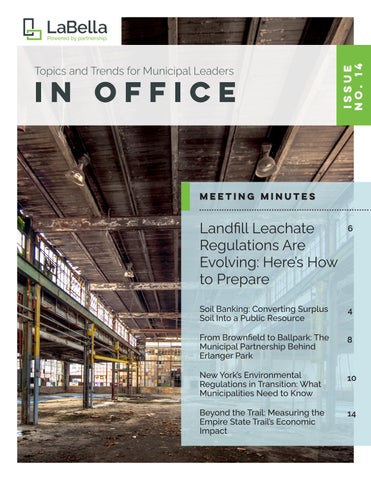
IN OFFICE
ISSUE NO. 14
Topics and Trends for Municipal Leaders
Meeting minutes 6 Landfill Leachate Regulations Are Evolving: Here’s How to Prepare Soil Banking: Converting Surplus Soil Into a Public Resource
4
From Brownfield to Ballpark: The Municipal Partnership Behind Erlanger Park
8
New York’s Environmental Regulations in Transition: What Municipalities Need to Know
10
Beyond the Trail: Measuring the Empire State Trail’s Economic Impact
14
2
In Office LaBella Associates |
Issue No. 14
“PUBLIC OFFICE IS A PUBLIC TRUST.”
ENVIRONMENTAL ECONOMICS Environmental decisions don’t just shape landscapes. They shape local economies. Whether through resource reuse, capital planning, or proactive regulatory compliance, today’s environmental decisions influence tomorrow’s investments. In this issue, we explore how environmental planning informs sound economic decision-making. Discover how urban soil banking transforms excavated soil into a valuable resource, learn how early capital planning can help communities prepare for the financial impacts of emerging PFAS regulations, and understand how evolving wetlands regulations may impact future development. Environmental stewardship and economic priorities are often viewed as competing interests. In practice, thoughtful environmental decisions enable communities to prioritize investments, manage public resources, and plan confidently for the future. With each issue of In Office, we present our experience, our expertise, and our forecasting on the topics and trends that affect municipal projects. Let us know if there’s a topic we can explore for you by contacting us at inoffice@labellapc.com.
A Catalyst for Community Growth For many years, stadiums were considered single-purpose facilities that came alive only on game days. Today, communities recognize that stadiums can serve as multifunctional civic assets that support economic development, social connectivity, and long-term community vitality. In our last issue, we highlighted how stadiums can serve as catalysts for community revitalization. When designed as true community hubs, they deliver value far beyond game day. CarMax Park is a prime example of this concept in action. More than 25 years in the making, CarMax Park is already energizing the surrounding neighborhood, creating opportunities for connection, year-round entertainment, and continued growth throughout the evolving Diamond District in Richmond, Virginia. Scan the QR code below to hear about the impact of this new facility on the Richmond community!
In Office LaBella Associates |
Issue No. 14
3
Award-Winning Project
CR 26 Emergency Response and Bridge Replacement Honored With Three Regional Awards The CR 26 Bridge over the Genesee River in Belfast, New York, serves as the only river crossing for nearly a dozen miles, providing important access for local residents, businesses, schools, and emergency services. Following a sudden and severe structural failure that posed an immediate threat to public safety and regional connectivity, the Allegany County Department of Public Works, in coordination with LaBella, initiated an emergency response that included rapid assessment, temporary stabilization, and ongoing monitoring. The effort ultimately culminated in the closure, removal, and replacement of the unsafe structure.
A permanent replacement bridge was designed and constructed, incorporating solutions to address the underlying causes of the structural failure and ensure longterm safety and resilience. More than a bridge replacement, the project restored a critical transportation link for residents, businesses, schools, and emergency responders. This achievement was recognized with three regional awards for its community impact: •
2025 Public Works Project of the Year Award (Disaster or Emergency Construction/ Repair, $5–$25 million category)—American Public Works Association New York Chapter
Pictured (left to right): Mike Karsten, PE (Sessler Wrecking), Steve Gauthier, PE (LaBella), and Tom Windus (Allegany County)
•
2026 Bridge of the Year Award ($2–$10 million category)— Association for Bridge Construction and Design Western New York Chapter
•
2026 Construction Project of the Year Award—New York State Society of Professional Engineers
This crossing serves as a vital lifeline for the community, and LaBella is honored to have played a role in restoring safe, reliable access. To learn more about this project, scan the QR code below.
4
In Office LaBella Associates |
Issue No. 14
The soil stockpile pictured above was used to remediate a community garden in Queens, New York.
Land Development
Soil Banking: Converting Surplus Soil Into a Public Resource By Daniel Walsh, PhD | Senior Technical Advisor and NYC Clean Soil Bank Founder Local governments can cut costs, reduce emissions, and build resilience by treating excavated soil as a resource. Cities need clean soil and other fill materials for earthworks projects, ranging from large-scale flood protection in waterfront areas to urban green infrastructure and community gardens, but the high cost of clean fill, limited supplies, and uncertain chemical quality can obstruct this important work. Studies show that excavation during urban construction produces large quantities of clean soil that is a valuable but often overlooked natural resource in cities. With basic planning to promote a circular soil economy, this soil can be retained within the city and used as a low-cost fill to supply urban earthworks.
In urban areas, soil is excavated to make room for underground parking and basements and is often disposed of at commercial facilities located outside the city at a high cost. At the same time, public and private construction projects within the city are purchasing clean fill to reshape or elevate urban land—also at high cost and often from the same commercial vendors that take exported soil. Without local policy in place, this regional commercial marketplace maximizes construction costs, truck transportation, fossil fuel consumption, greenhouse gas and other pollutant emissions, and traffic congestion. Soil banking is an innovative way to retain and reuse surplus soil within cities to create a low-cost supply of fill material that can lower construction costs, assure chemical quality, and improve availability.
Soil banking can also direct soil reuse to government earthworks projects at low or no cost to the city, reducing taxpayer costs for new construction. The country’s first clean soil bank, which matches public and private developers that generate soil with developers that need it, was established in New York City in 2013. In that model, environmental professionals vet the chemical quality of the donor’s soil before the logistics of soil transfer are worked out. Typically, polluted shallow soil must be removed first and properly disposed of. The pristine, deep soil below is circulated through the soil bank. Clean soil is excavated, and its quality is vetted again as it is loaded onto trucks to be transported to the receiving site.
In Office LaBella Associates |
Issue No. 14
5
Proof In Practice Studies show that about 1.5 million tons of clean soil are generated during construction in NYC every year. That’s enough soil to fill a professional baseball field to a height of about 30 feet. Despite its high quality, about 95% of this surplus soil is exported out of the city at a cost of tens of millions of dollars every year. In contrast, all of the soil in the NYC Clean Soil Bank is retained and reused within the city, reducing soil transportation mileage by about 80%. An office in City Hall operates the NYC Clean Soil Bank as part of efforts to promote a circular economy. The nonprofit program costs nothing to use. Donors pay to ship the soil but save about 67% on soil disposal costs compared to commercial disposal outside the city. Recipients receive the soil for free. Over the first three years, 26 soil donors saved $220,000 per project and 40 recipients saved $256,000 per project, with overall soilmanagement savings estimated at $16 million. Because the program is run out of City Hall, government construction projects get first dibs on soil to lower taxpayer costs. This source of clean soil has been used for many purposes, including elevating flood-prone land; constructing waterfront berms; creating tidal and freshwater wetlands and other green infrastructure to improve flood resilience; and providing a protective cover layer on polluted land. A steady supply of clean soil at very low cost can create opportunities for many innovative programs. The NYC Clean Soil Bank enabled the establishment of PURE Soil, a program that improves soil quality in urban community gardens.
A foot or more of clean soil is amended with municipal compost to improve fertility and facilitate vegetative growth and is used to cover existing gardens built on degraded urban soil. The program has also established a publicly available stockpile that provides free clean soil to residents.
How to Build a Soil Bank An urban soil bank requires technical expertise to set up and run. Differentiating polluted shallow soils from clean soil below to ensure the soil is safe for its intended use requires technical rigor. Soil excavated during construction is regulated in many states as “solid waste,” so establishing a soil bank may require approval from state environmental regulators. Soil testing to confirm quality is recommended and may be required in many states. The technical nature of the program should not be a disincentive to its use. While most cities do not have the staff expertise to perform these tasks, a soil bank can be built and operated under contract with qualified environmental
Banked soil was used to build a tidal wetland at Sunset Park in Brooklyn, New York.
professionals from the private sector. For example, LaBella is partnering with the City of Rochester, New York, to establish a soil bank that will support future municipal earthwork projects. Urban materials banks can also be developed for other secondary materials, such as recycled concrete, brick, masonry, and asphalt, with similar benefits. Because soil banking can be used to service municipal construction projects, savings for soil disposal or purchase can fully offset the cost of operating a soil bank and result in significant net savings to the city. The NYC Clean Soil Bank prioritized government construction projects to receive soil (33% of all soil managed in the program) and saved about $1.1 million per year over the first three years, with program operations costs of about $20,000 per year. With advance planning and thoughtful program design, these savings can be used to fully fund all soil banking activities, including government contracts with the private sector for program design and operation.
6
In Office LaBella Associates |
Issue No. 14
Feature
Landfill Leachate Regulations Are Evolving: Here’s How to Prepare By Jenny Johnson | Senior Vice President & Director of Waste & Recycling Federal regulation of per- and polyfluoroalkyl substances (PFAS), also known as “forever chemicals,” is accelerating and expected to directly impact county- and city-owned landfills and wastewater utilities. The United States Environmental Protection Agency (US EPA) is developing new national discharge standards for landfill leachate that will likely drive significant capital costs, operating expenses, and policy decisions at the local level. Within the next three to five years, local governments may face unfunded mandates, rising rates, and increased operational complexity.
What Is Changing The US EPA is updating Effluent Limitation Guidelines (ELGs) for landfills to address PFAS in leachate. Specifically, this means that treatment of leachate to remove PFAS must occur before leachate can be discharged to a wastewater treatment plant (WWTP). Requirements will be implemented through permits affecting both landfills and WWTPs. In fact, the US EPA is already instructing permit writers to use existing National Pollutant Discharge Elimination System (NPDES) and pretreatment tools before final ELGs are in place.
In its PFAS permitting memos, the US EPA states that NPDES permits can include PFAS monitoring, best management practices, source identification, pretreatment actions, and, in some cases, technology-based or facility-specific permit limits. The US EPA is currently targeting March 2027 to issue the proposed rule for PFAS ELGs for landfill leachate. Once a proposed rule is published in the Federal Register, it typically takes two years before the rule is final. Therefore, the rule is not expected to be final prior to March 2029.
In Office LaBella Associates |
How Local Governments Are Affected Local governments are typically responsible for municipal solid waste landfills, WWTPs or publicly owned treatment works, and the ratepayer-funded infrastructure that supports both. As a result, they will be affected on multiple fronts. If leachate can no longer be managed the way it is today, municipalities may need to build or expand treatment capacity at their landfills to remove PFAS prior to discharge. At the same time, receiving WWTPs may face new requirements, including additional monitoring, pretreatment controls, permit modifications, or even capital upgrades. This dual impact is what makes the issue particularly complex. It is not solely a landfill challenge or a wastewater challenge. Rather it is both, and the costs and responsibilities may fall on the same local entity. The US EPA has also acknowledged that publicly owned treatment works are not designed to effectively remove PFAS. As a result, the agency has emphasized reducing PFAS at the source before it reaches municipal treatment systems. This shift will likely require new infrastructure, operational changes, and coordination across departments. PFAS enters landfills and WWTPs through consumer products, industrial discharges, and sewage sludge. These systems are often described as “passive receivers,” since neither system manufactures nor intentionally uses PFAS. Yet local governments remain responsible for managing and treating the resulting contamination.
For municipal WWTPs receiving landfill leachate, this creates pressure on both sides of the system. Utilities may be required to monitor and control PFAS even though they are not the original source, while landfills may be required to pretreat or limit PFAS before discharge. In many cases, these competing pressures fall on the same local government, compounding both operational and financial challenges.
Expected Impacts The expected impacts to local governments will be significant, spanning financial, operational, and equity considerations. From a financial perspective, local governments face substantial capital investment requirements. New landfill leachate treatment systems and potential WWTP upgrades will require significant upfront funding, in addition to ongoing monitoring and compliance costs. In many cases, the greatest risk is not a single investment but the need to fund both landfill and wastewater infrastructure upgrades at the same time. Operationally, these requirements introduce a new level of complexity. Advanced treatment technologies (e.g., carbon filters, membranes) will be required to remove PFAS. These systems also generate residual waste streams, including concentrated PFAS, that must be managed and disposed of safely. In addition, increased regulatory oversight will require more intensive monitoring, reporting, and coordination across departments. These more complex treatment systems will also require specialized expertise, exacerbating the existing shortage of certified wastewater plant operators.
Issue No. 14
7
Finally, these impacts raise important equity considerations, as the costs for new and upgraded treatment systems will be passed on to local taxpayers and ratepayers. Yet neither local governments nor their residents manufactured or intentionally used PFAS in industrial processes, raising broader questions about how the financial burden of compliance should be distributed.
Implications for DecisionMaking Local government leadership should anticipate: •
Rate increases for solid waste and wastewater services
•
Capital planning pressures in upcoming Capital Improvement Plan (CIP) cycles
•
Interdepartmental coordination (solid waste + utilities + finance + legal)
•
Increased public scrutiny over costs and environmental responsibility
There are steps local governments can take now to prepare. Begin incorporating PFAS scenarios into CIPs and evaluate funding strategies (e.g., rates, bonds, grants) to address capital and operational expenses. Align landfill and WWTP strategies to ensure coordinated planning across departments and assess whether current leachate management and disposal practices will remain viable under future regulatory requirements. continued on page 8
8
In Office LaBella Associates |
Issue No. 14
Feature, continued from page 7
Project Feature
In parallel, conduct systemlevel assessments to better understand PFAS pathways. This may include identifying major contributors to WWTP influent and characterizing PFAS concentrations in both landfill leachate and wastewater streams. However, developing this data also carries potential regulatory and liability considerations that should be carefully evaluated.
From Brownfield to Ballpark: The Municipal Partnership Behind Erlanger Park
Finally, participate in the national Passive Receiver Coalition, which is composed of organizations representing wastewater, water, public works, and solid waste interests. These organizations include the National Association of Clean Water Agencies, the Water Environment Federation, the American Public Works Association, the National Association of Counties, and the Solid Waste Association of North America, among others, who are advocating for source control, federal funding support, and legal protections for passive receivers. PFAS regulation is expected to create financial and operational impacts for local governments, particularly where landfills and wastewater utilities intersect. For local government landfills, the risk extends beyond permit limits at the landfill itself to the combined effects on leachate management, WWTP permits, capital budgets, operations and maintenance, staffing, and overall liability. These impacts are interconnected and, in many cases, will fall on the same local entity. As a result, early planning and coordinated strategy will be critical to managing costs and avoiding reactive decision-making.
Along the Tennessee River on Chattanooga’s Southside, a comprehensive brownfield redevelopment is transforming former industrial land into a world-class mixed-use stadium district, breathing new life into the South Broad District. The Foundries District redevelopment of the former U.S. Pipe and Wheland Foundry sites, spanning 16 properties across 94 acres, is part of the South Broad Tax Increment Financing (TIF) district, which is projected to generate significant private investment, including multi-family housing, restaurants, retail, and office space. The centerpiece of the U.S. Pipe revitalization efforts is Erlanger Park—the new home of the Chattanooga Lookouts Double-A baseball club. More than just a stadium, this community asset celebrates the site’s industrial past, serves as a destination for recreation, and provides amenities that support year-round events.
Sports-Anchored MixedUse Redevelopment The redevelopment is being advanced through a collaborative partnership between the City of Chattanooga, Hamilton County, the Chattanooga-Hamilton County Sports Authority, the Chattanooga Lookouts, Perimeter Properties, and private development partners.
Funding for the publicly owned stadium was supported through Chattanooga-Hamilton County Sports Authority bonds. These bonds will be repaid using new tax revenue generated within the TIF district rather than existing tax dollars. Additional resources and funding, including land, infrastructure improvements, direct financial investment, and financial responsibility for construction cost overruns, were provided by private partners. The Chattanooga Lookouts baseball team entered into a 30-year lease, paying annual rent and covering all stadium operating and maintenance costs.
The Benefits The goal of the South Broad redevelopment is to generate long-term economic, community, and public benefits beyond professional baseball. The stadium is expected to serve as the catalyst for more than $1 billion in private investment, and approximately $2.3 billion in longterm regional economic impact. This includes the generation of roughly $186 million in new funding for Hamilton County Schools and more than $100 million in additional city and county tax revenue over 30 years, without increasing existing tax rates. LaBella’s analysis of total suspended solids loading showed that the newly developed site achieves more than an 80% reduction compared to the former industrial site (pictured here), meeting the City’s water quality requirements.
In Office LaBella Associates |
Issue No. 14
The centerpiece of the U.S. Pipe revitalization efforts in the heart of the South Broad District is Erlanger Park—the new stadium and home of the Chattanooga Lookouts AA baseball club.
Beyond the financial benefits, the redevelopment transforms former industrial sites into an active mixed-use district with a publicly owned venue for year-round community events, expanded public access to the Tennessee Riverwalk, and establishes a western gateway into Chattanooga.
LaBella’s Role LaBella played a significant role in preparing the brownfield site to be pad-ready for Erlanger Park by providing
comprehensive multidisciplinary engineering services for the stadium and surrounding mixed-use development. Beginning with utility and topographic surveys to inform site layout, grading, drainage, and utility design, the team then supported the brownfield redevelopment through environmental observation during soil management activities, geotechnical design of a stabilized working surface using recycled concrete aggregate, and construction materials testing, on behalf of the developer.
Additional services included designing the stadium’s stormwater collection and drainage system; conducting traffic engineering studies and preparing improvement plans to support the stadium and adjacent development while minimizing impacts on the surrounding transportation network; and developing construction documents and providing construction administration and oversight of the landscape installation. Beyond the stadium, LaBella has supported redevelopment efforts across The Foundries District, including public roadway and Riverwalk improvements, residential development, parking infrastructure, and survey basemaps for all redevelopment properties. Learn more about this worldclass stadium by scanning the QR code below:
9
10
In Office LaBella Associates |
Issue No. 14
Regulatory Update
New York’s Environmental Regulations in Transition: What Municipalities Need to Know By Shelby Sova, PWS | Permitting & Compliance Department Lead For decades, New York’s Freshwater Wetlands Act (FWA) provided a relatively predictable framework for determining when development projects would require state wetland permits. State wetland maps developed by the New York State Department of Environmental Conservation (NYSDEC) identified regulated wetlands throughout the state. The maps became a key planning and permitting tool, serving as reliable guidelines to municipalities during project review. Today, however, municipalities across New York find themselves navigating a period of uncertainty. A series of regulatory updates and a recent court decision have fundamentally altered the landscape of freshwater wetland regulation.
As New York State regulations continue to evolve, more wetlands may become subject to regulatory oversight. Municipalities that remain informed and proactive will be best positioned to navigate the changes.
As local governments continue to review projects, understanding the status of environmental regulations has become increasingly important.
Shifting Regulations Recognizing increasing concerns regarding flooding, water quality, habitat protection, and climate resilience, New York State began enacting significant amendments to the FWA. In 2022, initial changes expanded the state’s authority to regulate wetlands. Permit application fees increased, enforcement capabilities were strengthened, official wetland maps became informational rather than regulatory, and the criteria for regulated wetlands expanded.
The changes also updated procedures for jurisdictional determinations (JDs), official evaluations used to determine whether wetlands on a property are subject to state permitting requirements. These changes represented a major shift from previous practice, requiring applicants and municipalities to rely more heavily on field wetland delineations rather than mapped boundaries. In spring 2026, the New York State Supreme Court annulled the adopted regulations, determining that NYSDEC failed to comply with requirements under the State Environmental Quality Review Act (SEQR) during the rulemaking process. As of July 2026, NYSDEC has not chosen to appeal.
In Office LaBella Associates |
What Municipalities Need to Know While replacement regulations are being developed, municipalities should understand several important aspects of the current regulatory framework as it stands as of July 2026: •
•
•
NYSDEC continues to regulate previously mapped freshwater wetlands, wetlands that are 12.4 acres or larger and their 100foot adjacent areas, and wetlands within 50 meters of a NYSDEC wetland if they are hydrologically connected. Expect increased use of JDs. Several JD pathways are available, including Parcel JDs, Consultant-Assisted Parcel JDs, and Project JDs. Municipalities can require an applicant to obtain a JD if there are any questions surrounding wetlands on a project site. To help manage an increasing number of projects requiring wetland review, NYSDEC developed
several general permits intended to streamline authorization for recurring activities. General permits can significantly reduce review times compared to individual permit applications. Several general permits have already been finalized for specific types of development projects, including, but not limited to, community-scale solar, electric utility, natural gas utility, and housing development.
Municipalities may see increasing demands for wetland delineations, JDs, environmental
11
review, and permitting support as more properties fall within potential regulatory oversight. Additionally, NYSDEC plans to release new criteria for wetlands of “unusual importance” in the future, that would allow NYSDEC to regulate wetlands of any size if they fit these criteria. For municipalities, the safest approach is the following: •
Continue screening projects for wetlands early in the review process using online informational wetland mapping and in-field wetland delineations.
•
Encourage applicants to obtain formal JDs from NYSDEC.
•
Do not assume that the absence of a mapped wetland means NYSDEC lacks jurisdiction.
•
Anticipate longer review times for projects involving potential wetlands until replacement regulations are adopted.
Looking Ahead Despite current legal uncertainty, municipalities should remain focused on long-term regulatory trends. Perhaps the most significant future milestone is scheduled for January 1, 2028, when the default size threshold for regulated wetlands will decrease from 12.4 acres to 7.4 acres. This change would substantially expand the number of wetlands potentially subject to state regulation.
Issue No. 14
continued on page 12
12
In Office LaBella Associates |
Issue No. 14
Regulatory Update, continued from page 11
A Period of Change Requires Vigilance
As local governments continue to review projects, understanding the status of environmental regulations has become increasingly important.
New York State is entering a period of significant regulatory transition. Changes in regulations are creating uncertainty around jurisdiction over many wetlands and increasing the importance of early wetland screening and formal JDs. To successfully navigate these changes, municipalities should encourage early environmental
due diligence, maintain close coordination with NYSDEC and qualified environmental consultants, and train planning and zoning boards on evolving requirements. Communities that remain informed and adaptable will be best positioned to balance economic development, infrastructure investment, and environmental stewardship in an increasingly complex regulatory landscape.
Additional Important SEQR Changes in New York New York has also initiated major changes to the State Environmental Quality Review Act (SEQR) process. Effective June 12, 2026, amended SEQR regulations implement New York State’s Environmental Justice Siting Law. If a proposed project is located in or within a half-mile of a disadvantaged community, the lead agency is required to determine whether impacts from the proposed project may affect that disadvantaged community. For example, air pollutant emissions or new sources of solid waste generation would be a trigger for further environmental analysis. SEQR Type I actions now include consideration of future physical climate risks, including
a proposed project’s vulnerability to damage from a projected 100-year flood, and whether a proposed project would increase the vulnerability of humans or ecological communities to climate or weather hazards. Concurrently, the enactment of Governor Hochul’s “Let Them Build” initiative further amended SEQR by creating new, narrowly tailored exemptions for certain projects, including, but not limited to, multi-family housing, parkland/trail projects, and water/wastewater infrastructure. Importantly, these changes do not eliminate existing regulatory requirements related to wetlands, floodplains, stormwater management, or endangered species.
Successful project planning will require proactive environmental review, early due diligence, and close coordination with NYSDEC and qualified environmental consultants who can help navigate these evolving requirements in New York State. Scan the QR code to explore the topic further in an article by Environmental Program Manager Frances Kabat.
In Office LaBella Associates |
Issue No. 14
13
Award-Winning Project
As the first Materials Recovery Facility on Alabama’s Gulf Coast, this state-of-the-art facility is transforming regional recycling while earning top engineering honors for its innovative design.
Project team pictured left to right: Kristie Hooper, Larry Ingram, PE, LEED AP BD+C, and Darrell Thornock, PE
Baldwin County Materials Recovery Facility Recognized for Engineering Excellence by ACEC Alabama Located in Summerdale, Alabama, the 62,000-squarefoot Baldwin County Materials Recovery Facility (MRF) is the first MRF along Alabama’s Gulf Coast. Developed for the Solid Waste Disposal Authority of Baldwin County and designed to process 40,000 tons of materials per year, the facility features a 50,000-square-foot recycling material receiving and processing area equipped with state-of-theart sorting technology, including four optical sorters and a full suite of recycling equipment.
Additionally, the MRF includes a 12,000-square-foot office building that houses the Baldwin County Solid Waste Disposal Authority and a large public outreach and education center. In February 2026, the Baldwin County MRF received the Grand Engineering Excellence Award in the Environmental category from the American Council of Engineering Companies of Alabama (ACEC Alabama). The Engineering Excellence Awards honor design achievements of superior skill and ingenuity. Projects are judged on a rigorous set of criteria, including complexity, innovation, and value to society. LaBella is proud to have been recognized for our contribution to this groundbreaking project! To learn more about this project, scan the QR code below:
14
In Office LaBella Associates |
Issue No. 14
Project Feature
Beyond the Trail: Measuring the Empire State Trail’s Economic Impact Spanning 750 miles, the Empire State Trail is the longest multi-use trail system in the United States. It connects communities across New York State and generates significant economic, health, and environmental benefits. At the request of Parks & Trails New York (PTNY), LaBella and the Institute for Transportation Research and Education (ITRE) led a comprehensive study to quantify the trail’s economic impact across sectors, including tourism, recreation, transportation, and small business development.
LaBella guided a collaborative, statewide effort, working closely with PTNY and state agency partners to coordinate stakeholder engagement, data collection, and case study development. These partnerships were critical in facilitating access to trail users, local data, and on-the-ground insights across diverse communities along the corridor. ITRE designed and implemented trail user surveys, analyzed visitation and spending patterns, and utilized IMPLAN modeling to quantify direct, indirect, and induced economic impacts, as well as health and environmental benefits.
The study integrated multiple data sources, including intercept surveys, cell phone visitation data, GIS analysis, and economic datasets. Field data collection at representative locations across the state supported the development of user profiles, trip characteristics, and spending behavior, forming the foundation for a defensible and repeatable methodology.
In Office LaBella Associates |
The Results PTNY recently announced the results of the study in the final report, “The Economic Impact of the Empire State Trail.” These results show that the 750-mile Empire State Trail generates approximately $1.87 billion in annual economic output, supports nearly 9,700 jobs statewide, and contributes more than $206 million in state and local tax revenue each year. Beyond documenting the value of the Empire State Trail itself, the data collected through this effort provides compelling evidence that investments in trails, greenways, and active transportation infrastructure can deliver measurable economic, health, and environmental benefits for communities of all sizes. After examining variables such as trail type, surrounding land use, visitation patterns, community characteristics, and business activity, the project team quantified how different greenway attributes contribute to economic performance. This analysis demonstrated that the benefits associated with the Empire State Trail can be translated into predictive models, enabling estimation of the potential economic impact of other trail and greenway networks using the same variables. These predictive models will help decision-makers better understand the economic value that trail networks can generate while supporting public health, tourism, transportation, and community development objectives.
Issue No. 14
15
Representatives from LaBella, Parks & Trails New York, and other project partners attended a press conference on June 9, 2026, in Albany, New York, to mark the completion of the landmark Empire State Trail Economic Impact Study.
Erlanger Park Explore how public-private collaboration and multidisciplinary engineering are delivering long-term economic growth and community benefits in Chattanooga’s South Broad District. Read more on page 8.
LEARN MORE: visit our website for more information
ph. (877) 626-6606
www.labellapc.com/municipal
inoffice@labellapc.com